Key Issues for Session 7
This briefing has been produced by the Scottish Parliament Information Centre (SPICe), which is the Parliament’s impartial research service. It identifies some of the key issues that MSPs may face in the Parliament’s seventh Session. It is intended to assist MSPs and their staff, who are encouraged to contact SPICe if they require further information on these or any other topics.
Foreword from the Clerk/Chief Executive
Welcome to the Scottish Parliament Information Centre’s ‘Key Issues for Session 7’ briefing.
The Scottish Parliament Information Centre (SPICe) is the Parliament’s internal research and information centre. The Key Issues for Session 7 briefing illustrates the kind of analysis that SPICe produces for parliamentarians. It outlines some of the key subjects likely to be of particular interest in the coming Parliamentary Session, providing tailored, expert, impartial analysis of the issues that matter to MSPs and the Parliament.
While the Parliament will undoubtedly engage with a broad range of issues during the next five years, SPICe has identified four overarching themes for Session 7, covering all major areas of devolved policy including the public finances and delivery of public services, the cost of living and wellbeing, environment and natural resources and the devolution landscape itself. You can read the briefing from cover to cover, or you can easily dip into the specific issues that interest you most. I hope it proves to be a thought-provoking and useful reference tool for the months and years ahead.
SPICe is here to support the work of MSPs. If you have any questions about how SPICe can help you in your duties please contact SPICe Team Leaders – their contact details and much more can be found in the SPICe service guide, accessible on the Parliament's intranet.
David McGill, Chief Executive
Welcome from SPICe Office Heads
Welcome to the Scottish Parliament Information Centre (SPICe) ‘Key Issues for Session 7’ briefing.
SPICe is the Parliament’s internal research and information centre. Our researchers and information specialists provide impartial, factual, accurate and timely information and analysis to support MSPs with parliamentary and constituency business. SPICe provides support to enable MSPs to scrutinise legislation and Scottish Government policy, both in committees and in the Chamber; and assists MSPs in responding to constituency enquiries.
SPICe offers a range of services including:
carrying out research on behalf of the Parliament's committees, Members and their staff, and Parliament staff
offering a confidential enquiry service to Members and their staff
publishing briefings and blogs, interactive tools, animations and graphics
commissioning and managing research from academics
maintaining and publishing parliamentary data and information
providing library, collections management and documentation services to the Parliament.
As well as supporting Members in carrying out their parliamentary and constituency duties, we also work with offices across the Parliament to support a range of work including the work of the committees, public participation and inward and outward international visits.
Specifically for Members, we can provide information to assist you in answering constituency enquiries through our confidential enquiry service and we can provide background information to support your contributions to Parliamentary business and your committee work.
This Key Issues briefing has been prepared by our team of subject specialists and covers a wide range of devolved policy issues. It provides an example of the kind of research and analysis SPICe will continue to produce throughout Session 7 to support you in your work. We hope you enjoy reading the briefing; if you have any questions in relation to any of the Key Issues or any other matter, please get in touch with our subject specialists directly or contact [email protected].
Graeme Cook – Head of Research and Sustainable Development Scrutiny
Nicola Hudson – Head of Research and Financial Scrutiny
Shona Skakle – Head of Research, Library and Knowledge Exchange
Public Finances and Public Service Delivery
This theme focuses on the challenges that the Scottish Parliament will face when considering the delivery of public services in the context of a challenging public finances environment. It considers issues including fiscal sustainability, the public sector workforce and delivery of public services such as health, social care and education.
Follow the money - spending in Session 6 and the need for fiscal sustainability
Andrew Feeney-Seale and Rachel Cook, Senior Researchers, Financial Scrutiny
The outlook for public finances in Session 7 is challenging, with the Institute for Fiscal Studies highlighting that a slowdown in UK Government funding, and growing demands and costs for health and social care mean that the Scottish Budget is under pressure.
Tracking spending priorities over time is not straightforward. Budgets can change during the year and changes in Ministerial portfolio responsibilities can add to the challenges.
There are fortunately some standardised approaches to the classification of public spending which can help. The OECD has developed the ‘Classification of the Functions of Government’ (COFOG) which splits spending into ten standardised categories such as education and social protection. The Scottish Government has published COFOG data alongside recent Scottish Budgets.
This chapter will look at what the COFOG data tells us about spending during Session 6 of the Scottish Parliament, informing the public finance context for the new government.
Overview of the data – key trends and analysis
Another factor that can distort comparisons over time is the fact that the size of the Scottish Budget has increased over time. If we look at only the resource and capital parts of the budget, where the Scottish Government has discretion, this has grown from £46.7 billion in 2021-22 to £59.8 billion in 2026-27. This increase largely reflects inflation and the devolution of additional responsibilities, most significantly social security. For this reason, we have focused on the share of spending by priority area, rather than the absolute amounts.
Table 1 sets out the proportions of resource and capital spending categorised into the ten top level COFOG classifications.
| Table 1: COFOG classifications | 2021-22 | 2022-23 | 2023-24 | 2024-25 | 2025-26 | 2026-27 |
| General public services | 24.4% | 24.8% | 20.3% | 21.8% | 21.2% | 19.8% |
| Public order and safety | 7.3% | 7.5% | 7.6% | 7.8% | 8.0% | 7.6% |
| Economic affairs | 12.4% | 12.6% | 11.8% | 11.1% | 11.6% | 11.2% |
| Environment protection | 0.6% | 0.9% | 1.1% | 1.1% | 1.3% | 1.2% |
| Housing and community amenities | 2.7% | 2.7% | 1.7% | 1.1% | 1.6% | 1.7% |
| Health | 36.6% | 33.6% | 36.9% | 37.7% | 37.1% | 36.8% |
| Recreation, culture and religion | 0.9% | 0.7% | 0.6% | 0.6% | 0.6% | 0.8% |
| Education | 6.6% | 7.5% | 8.1% | 5.8% | 5.4% | 6.9% |
| Social protection | 8.5% | 9.7% | 12.0% | 12.9% | 13.3% | 14.0% |
Scottish Government. 2021-22 to 2023-24 are based on final outturn data, 2024-25 on provisional outturn data, 2025-26 on the Autumn Budget Revision, while 2026-27 is based on the Budget Bill.

Scottish Government
Spending on healthcare accounted for the largest proportion of spending across Session 6. The proportion of spending on health remained fairly stable, despite the increase in the size of the Scottish Budget, reflecting increasing demand for healthcare services. Health spending grew at an average annual rate of around 5% over the past five financial years, reflecting the rising demand from an ageing population, efforts to address the backlog and capacity pressures, and increasing staffing and operational costs.
General public services covers a wide range of spending, such as the core administrative operations of the Scottish Government, foreign aid, and research and development related to general public services. Significantly, this also includes non-ringfenced funding allocated to local government, as the Scottish Government does not have sight of how this funding will spent. While as a proportion of the budget this declined, there was some volatility. For example, in the early years of Session 6, around £500 million per annum was classified as spending on pre-primary education. From 2024-25 onwards this was classified as general public spending, as the funding was provided to local government who make decisions about how it is distributed.
The most significant area of growth during Session 6 was spending on social protection, which includes spending on devolved social security benefits. Social protection spending increased much faster than overall day-to-day spending. This was partly due to expanded powers on social security and because of rising numbers of people receiving disability payments in Scotland, a trend which is fairly consistent across the UK.
Looking ahead to Session 7
While it will be for the Session 7 Scottish Government and Parliament to make spending decisions in the coming years, some of the pressures which influenced spending decisions in the last parliament are expected to continue.
Scotland’s population continues to age, and this will put significant pressure on the public purse. National Records of Scotland forecast that the working age share of Scotland’s population will decrease from 64.6% in 2024 to 64.5% in 2032. A more significant decline is expected in the proportion of the population aged 15 or under – declining from 16.2% in 2024 to 14.3% in 2032. The proportion of the population of pensionable age is forecast to rise from 19.2% in 2024 to 21.2% in 2032.
A smaller population of children could reduce demand for spending on education, but the more significant growth in the older population is expected to increase demand for healthcare and other public services. A proportionately smaller working age population could mean lower public revenues from taxation.
The Scottish Fiscal Commission (SFC) forecasts that spending on social security will continue to rise over the next parliament, rising from £7.4 billion in 2026-27 to £9.2 billion in 2030-31. The SFC notes that 80% of this expenditure will be on disability payments.
In addition to this, real disposable income per person, a measure of Scottish living standards, is forecast by the SFC to grow at less than 1 percentage point per year. This compares to average growth of 2.9% per year between 1999 and the financial crisis in 2008. Lower growth in living standards leave households vulnerable to shocks, and puts pressure on income from devolved taxes.
The Session 6 Scottish Government forecast that, on current trends, by 2029-30 there would be a £4.7 billion shortfall in resource and capital spending. The Scottish Spending Review (January 2026) identified £1.5 billion in public sector efficiencies and reforms to help address the gap between demand for spending and available resources.
As the new Scottish Government manages these fiscal pressures and seeks to deliver against its policy priorities, it will be for Members and Committees of the Scottish Parliament to scrutinise these priorities and decisions.
Scotland's devolved public sector workforce – a growing pressure point?
Greig Liddell and Rachel Cook, Senior Researchers, Financial Scrutiny
The devolved public sector has grown significantly over the past five years. In the run-up to the 2026 Scottish Parliamentary election, parties described a “bloated government operation” (Labour), “failing public services” (Reform), a “cluttered quango landscape” (Liberal Democrats) and a need to cut “government bureaucracy and waste” (Conservatives).
The Session 6 Scottish Government introduced its Public Service Reform Strategy in June 2025 with an observation that the “public sector in Scotland is larger than the UK and accounts for 22% of total employment, compared to 18% in the UK as a whole”. The Session 6 Scottish Government confirmed its aim to reduce public sector staffing levels by an average of 0.5% per year until 2030, and estimates this will be a reduction of around 11,000 workers mainly “through natural attrition and on a voluntary basis”.
Given the political interest in this area, it seems likely that scrutiny of public sector reform, headcount and pay will be a focus for the Scottish Parliament in Session 7.
Size and composition of the devolved public workforce
The devolved public sector includes local government and NHS workers, Scottish Government civil servants (including prison staff and court officials), police, firefighters, college staff and a range of public bodies, for example those described as “quangos”. The chart below shows the most recent headcount by broad sector:

Scottish Government: Public sector employment statistics
This 551,000-strong workforce provides a whole range of important public services. It has grown significantly over the past decade, not least after the Brexit vote and the COVID-19 pandemic. It is almost 50,000 larger than it was 10 years ago, an increase of 10%. We can see that most of this increase has taken place since 2019:

A breakdown of this trend shows that the health and local government sectors have driven the increase in headcount (a 29,000 and 17,000 increase respectively). However, the largest percentage increase has been in the devolved civil service sector:

Public sector pay
Public sector pay accounts for over 50% of the Scottish Government’s resource budget. Writing in 2024, the Scottish Government stated that “the Health, Local Government and teacher pay bill account for 80 per cent of the total at £20 billion”.
The median annual full-time pay for public sector workers in Scotland was £43,043 in 2025, noticeably higher than the private sector median of £37,733. Over the past ten years, median full-time pay for Scottish public sector workers has broadly increased in line with inflation.
Scottish public sector pay policy is likely to become a growing pressure point. Recent pay deals have included inflation‑linked clauses intended to offer protection against price rises, but these introduce significant uncertainty into future costs. If inflation does not fall in line with expectations, such clauses risk triggering higher pay awards than originally budgeted for, creating greater uncertainty over future spending.
With limited scope for additional funding, higher pay awards could mean difficult trade‑offs with service delivery, workforce numbers, or other public spending priorities. Recruitment and retention challenges, alongside the risk of industrial action if pay rises are perceived as inadequate, add further complexity. As a result, future pay negotiations may be more contested, with inflation clauses, affordability constraints, and workforce expectations all pulling in different directions, making public sector pay a central and ongoing policy challenge.
You can read more about public sector pay challenges in the SPICe blog.
The Session 6 Scottish Government’s Public Service Reform Strategy
With the cost of Scotland’s public sector workforce increasing and public satisfaction with a range of services declining, the Session 6 Scottish Government believed that public service reform is essential. However, successive governments have been saying this for over a decade now. The Session 6 Government’s Public Service Reform Strategy, published in June 2025, aimed to identify barriers to reform and “set out practical actions to overcome those barriers”. Speaking in the Chamber shortly after the publication of the Strategy, the then Cabinet Secretary for Finance and Local Government told the Parliament:
We will set a managed reduction target for the public sector workforce to reduce staffing levels by an average of 0.5 per cent per year until 2030. That will be achieved through reforms to our public services, as has been set out in our public service reform strategy, through natural attrition and recruitment controls.
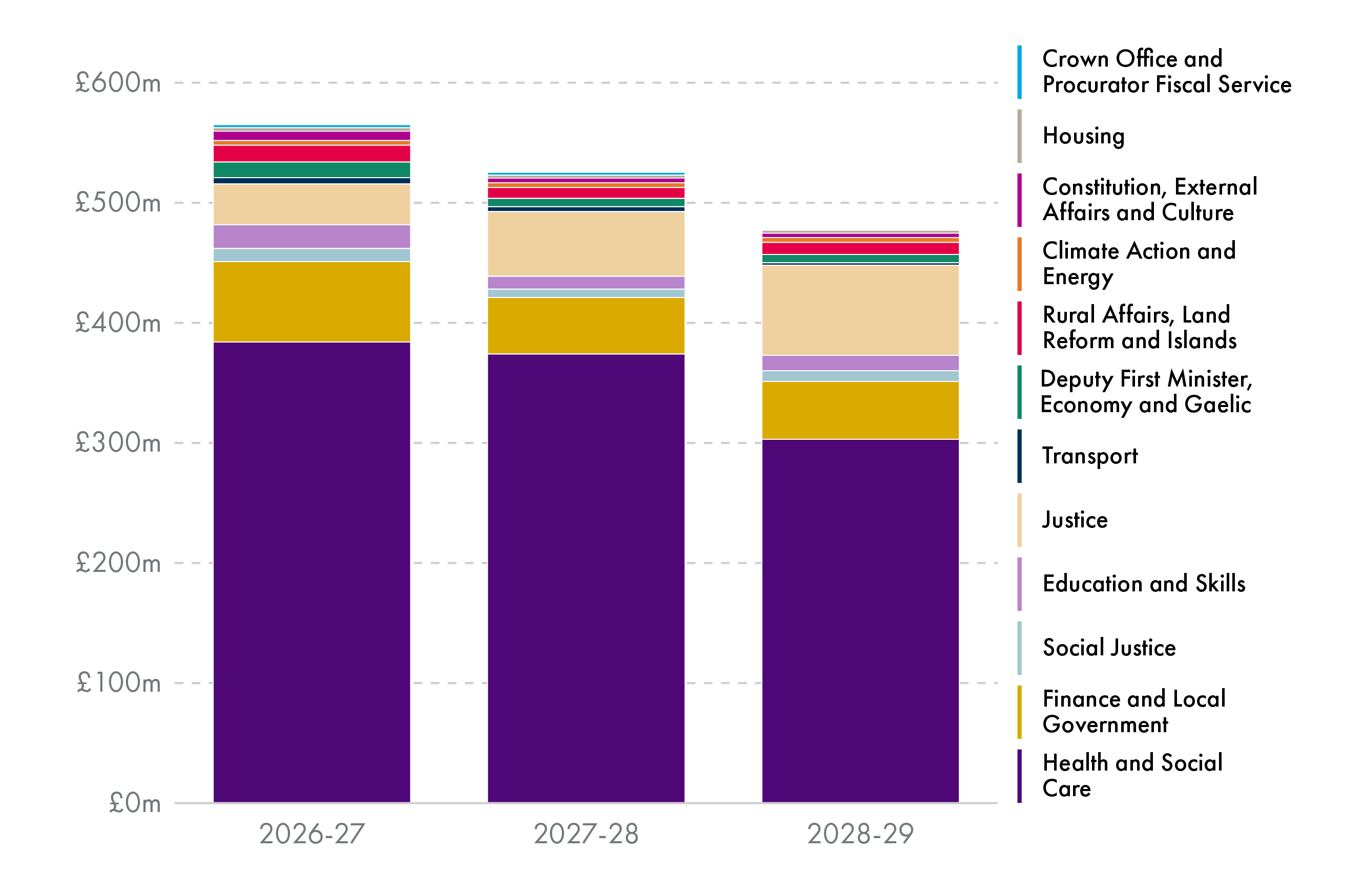
The Session 6 Scottish Government’s Spending Review document, published alongside the Scottish Budget in January 2026, included portfolio efficiency and reform plans which set-out actions “to deliver cumulative, recurring savings of £1.5 billion over the [three year] spending review period”. The plans cover workforce savings, efficiencies in corporate functions and wider service reforms. As can be seen in the chart below, Health and Social Care is expected to do the heavy lifting in terms of savings plans:
Scottish Government: Scottish Spending Review 2026
The Session 6 Scottish Government’s Public Service Reform Strategy describes trade unions as “our key social partners” and “securing their views and input on reform is critical both in terms of their members’ working arrangements and the wider social implications”. However, the largest public sector union, Unison, has already stated that “Scottish government plans to cut between 11,000 and 20,000 jobs from public services” are “dangerous” and “unworkable”. In a recent newspaper story, its secretary, Lilian Macer, warned that “industrial action was not off the table”.
The left-leaning think tank, IPPR Scotland, recently concluded that “current political discourse about public service reform lacks substance”, and “the current workforce reduction target risks Scotland slipping into austerity”.
Artifical intelligence
The use of artificial intelligence (AI) is an important part of public service reform with “scaling intelligent automation” being one of the Scottish Government’s 18 public service reform workstreams. A survey of civil service managers across the UK by the Fabian Society found 72% of respondents have either introduced AI or would like to in the future. This is reflected in the Scottish Government’s own AI Register which documents a range of public sector projects already underway. The Session 6 Scottish Government’s Spending Review document states:
The Scottish Government Intelligent Automation Centre of Excellence (IACoE) enables delivery of more efficient, effective, and sustainable public services. By deploying AI-enabled automation, we are not only unlocking capacity and reducing costs, but also fundamentally improving the experience for both citizens and staff.
Issues for Session 7
The increased use of AI across government, and its impact on public sector workers and the services they provide, is likely to be a key theme of Session 7. Other key issues may include:
The sustainability of public sector pay deals.
The impact a 0.5% annual reduction in public sector staff could have on public services and public satisfaction.
What a more efficient public sector looks like.
Opportunities for more collaboration between public bodies.
The impact of reducing “back office” staff on frontline services.
Whether a decades-long focus on prevention has had any impact on public service costs and outcomes.
From Roads to Rails: How Infrastructure Is Funded
Rachel Cook, Senior Researcher, Financial Scrutiny
Infrastructure underpins everyday life and economic activity, encompassing everything from homes, schools and hospitals to transport systems, utilities, energy networks and digital connections that keep society operating.
In recent years, capital projects have faced mounting pressures, including disruptions to global supply chains and persistent labour shortages. These challenges have been compounded by increasingly constrained capital budgets, intensifying competition for limited funding, all of which raise difficult questions about affordability and prioritisation.
Against this backdrop, the Session 7 Scottish Government will face a series of strategic capital allocation decisions, shaped not only by future priorities but by long-standing patterns of infrastructure investment and the funding mechanisms that underpin it.
How is infrastructure funded?
The primary sources of funding for public sector infrastructure investment in Scotland are:
Capital budget - the “traditional” method through which the Scottish Government funds infrastructure, primarily via grants for upfront project costs. It is financed through the UK block grant and limited Scottish Government borrowing powers, which for 2026-27 allow borrowing for capital projects of up to £491 million annually and £3,275 billion cumulatively.
Financial transactions – Financial Transactions (FTs) are a form of capital funding provided to the Scottish Government since 2012-13, largely linked to UK housing-related loan and equity schemes such as Help to Buy. FTs can only be used to support loan or equity investment outside the public sector and must ultimately be repaid to HM Treasury. Since inception, allocations have totalled almost £4 billion, creating long-term repayment obligations that are expected to continue into the mid-2050s. You can find out more about borrowing and the Scottish Budget in the SPICe blog.
Revenue-financed investment – public-private partnership (PPP) models, such as the Private Finance Initiative (PFI) and the Scottish Government’s non-profit distributing (NPD) model, have been used to finance infrastructure investment, including many schools and hospitals. Under these schemes, a private sector consortium provides upfront financing for infrastructure project and the public sector then pays for the infrastructure (and, in some cases, related maintenance) once it is completed through regular payments over a period of 25-30 years. It is important to note that the annual payments come out of the Scottish Government’s revenue budget, leaving the capital budget free to be spent on other projects and increasing the overall level of investment that can be made. The Infrastructure Delivery Pipeline published by the Session 6 Scottish Government confirmed that it intended to continue to deploy revenue-funding models including the Mutual Investment Model (MIM). MIM is a variation of the PFI model, used in Wales, which involves greater public sector involvement.
Scottish Government Bonds - The Session 6 Scottish Government planned to issue its first bonds as part of a £1.5 billion programme during Session 7. This would mark a new approach to capital borrowing following strong credit ratings. While bond issuance does not increase overall borrowing limits, it offers greater flexibility than National Loan Fund (NLF) borrowing, including repayment structures that defer repayment of the principal amount until the end of the loan period. This can ease short‑term budget pressures and support higher levels of capital investment, although it creates larger repayment costs in future years. Bond proceeds are expected to play a central role in funding projects within the Infrastructure Delivery Pipeline, with bonds intended to meet most capital borrowing needs during Session 7 alongside continued use of the NLF for resource borrowing.
Past choices: What has been invested?
Since 2007, £19.2 billion worth of Scottish Government-led infrastructure projects have been completed.
The images below illustrate major, operational capital projects where the Scottish Government has played a direct funding role. The dataset also includes a mix of delivery models (PPPs, PFIs, NPD and ‘hub’).

Scottish Government
The £19.2 billion of investment since 2007 is predominately accounted for by projects in transport, health and sport, and education. This includes school investment programmes led by the Scottish Government, but not the local authority led schools’ investment.

Scottish Government
Of the £19.2 billion of capital investment either completed since 2007 or currently under construction, almost 30% is concentrated within Glasgow and Edinburgh. The next largest shares are accounted for by Highland (approximately 7%) and Fife (around 6%). At the other end of the scale, Argyll and Bute records the lowest share, at just 0.3%. Overall, rural and island authorities receive only a very small proportion of national capital investment.
A strong corridor effect is also evident in transport investment across these local authorities, with particularly high shares observed in West Lothian, Fife, Perth and Kinross, and North Lanarkshire. This pattern reflects investment in rail electrification, motorway enhancements, and improved inter‑city connectivity along strategic transport routes.
Current Outlook
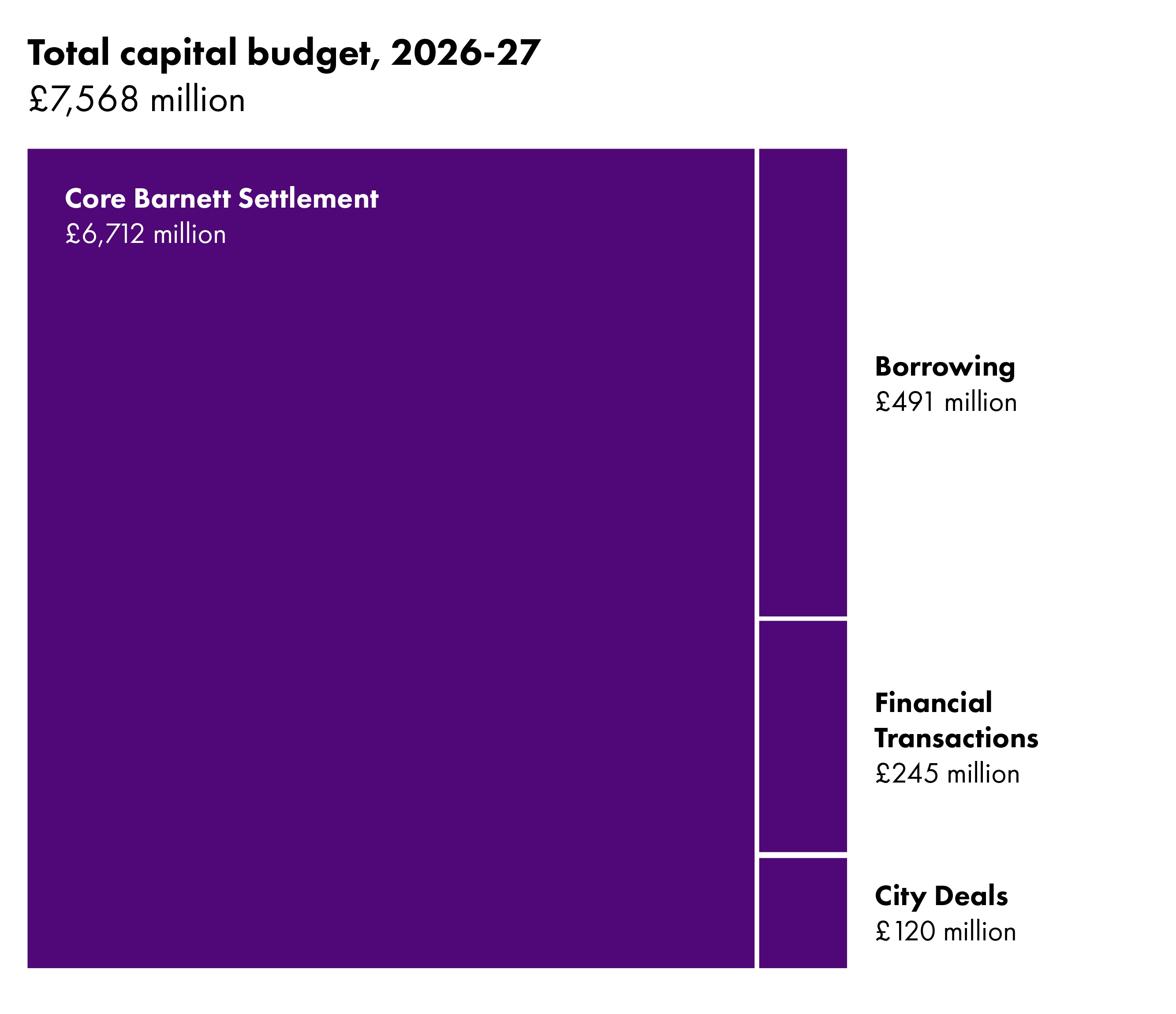
The 2026-27 Scottish Budget has a total of £7,568 million in capital and financial transactions funding available, which is an increase of £146 million compared to 2025-26 (2% higher in cash terms, or a 0.3% decrease in real terms).
The majority of the capital budget comes from HM Treasury. The core Barnett settlement increased by £456 million to £6,712 million (89% of total capital budget).
Scottish Government
In January 2026, the Session 6 Scottish Government published its Spending Review, setting out capital allocations alongside an Infrastructure Delivery Pipeline and a draft Infrastructure Strategy. The pipeline outlines the major capital projects planned for delivery between April 2026 and March 2030.
The Infrastructure Delivery Pipeline (IDP) sets out projects with a capital value exceeding £5 million and programmes valued over £20 million. It includes major investments such as the A9 Dualling Programme, rail services improvement and decarbonisation initiatives, and the Ambulance Replacement Programme. The IDP represents a continuation of the investment pipeline established in the 2021 Infrastructure Investment Plan (IIP), with several projects carried forward as they approach completion.
Decisions on the capital budget must also balance investment in new projects with the ongoing need to maintain, upgrade and replace existing infrastructure and equipment.
As capital resources are constrained, priorities must therefore be carefully managed to ensure that essential maintenance and replacement needs do not crowd out investment in new projects, or vice versa.
Capital funding makes up around 12% of total funding. The Scottish Fiscal Commission (SFC) expects it to grow by 4.4% in nominal terms between 2025-26 and 2030-31. However, after adjusting for inflation, this represents a real terms reduction of 5% as shown in SFC’s figure below.

Scottish Fiscal Commission, Scottish Government
Future choices
Looking ahead to Session 7, capital funding decisions will require careful judgement to balance competing pressures within a constrained fiscal environment. While there is an increasing need to maintain and renew existing assets, continued investment in infrastructure remains critical to supporting economic growth, productivity and regional connectivity, as well as improving quality of life and public services. Striking this balance will be essential to ensuring that capital investment delivers long-term value for both the economy and society. Members and Committees may wish to scrutinise how the Scottish Government’s capital budget is used to deliver infrastructure throughout Session 7.
Funding challenges: Can we prevent demand for reactive services?
Anne Jepson, Senior Researcher, Health and Social Care, Ailsa Burn-Murdoch, Senior Researcher, Financial Scrutiny and Ota Dvorak, SPICe UKRI intern
Prevention is a broad term. Towards the end of Session 6 the Scottish Government renewed its focus on ‘preventive systems’. The hoped-for outcomes of preventive systems are increased population health and wellbeing, as well as a reduced demand for reactive services. As a key issue, prevention and preventative spend spans the whole of government. However, the successful outcomes are to be found in the improved overall health and wellbeing of Scotland’s population. As an issue, therefore, it presents a challenge for scrutiny of policy and legislation.
The challenge facing public service delivery bodies
Through a combination of high demand and funding gaps, public service delivery bodies are increasingly finding themselves in situations where they are struggling to balance their budgets and have to rely on additional in-year funding. The Scottish Fiscal Commission warns of a projected 4.1% funding gap between funding and spending for Scottish devolved services by mid 2040s. Scottish Household Survey data show a steady decrease of public satisfaction with public services since the early 2010s. Life expectancy, one of the indicators of population health, has plateaued since the early 2010s.
The situation has been described in detail in the 2011 Christie Commission report on the future delivery of public services and many of Dr Christie’s findings and suggestions remain relevant today. Talking about growing demand for public services in Scotland, the Commission says:
In part, at least, this demand can be said to stem from a focus on reactive spending as opposed to preventative spending, which seeks to prevent problems before they occur. The costs to Scotland and its public services of negative outcomes such as excessive alcohol consumption, drug addiction, violence and criminality are substantial. Addressing the 'failure demand' that results from focussing on consequences rather than causes, and approaches which alienate or disempower service users, has a high cost for society and high costs for public services. This will be increasingly difficult to sustain into the future.
The Christie Commission suggested that one of the key objectives of public service reform should be prioritising prevention, reduction of inequalities and promoting equality. While in June 2025, The Session 6 Scottish Government admitted that the vision presented in the Christie Commission report “has not been delivered to its full potential”, prevention has become a household term used across Government strategies, plans and frameworks, as well as across the work of Parliamentary Committees.
Preventative spending
When discussing prevention, it is important to keep in mind that it goes beyond the realm of healthcare services. From a range of definitions for prevention, the following definition was derived for the SPICe briefing, Preventative spending in Scotland:
A preventative action aims as a primary goal to reduce an individual's or a population's demand for urgent, reactive public services now and in the future, by removing risk factors, increasing resilience to risk factors, or providing early identification or intervention.
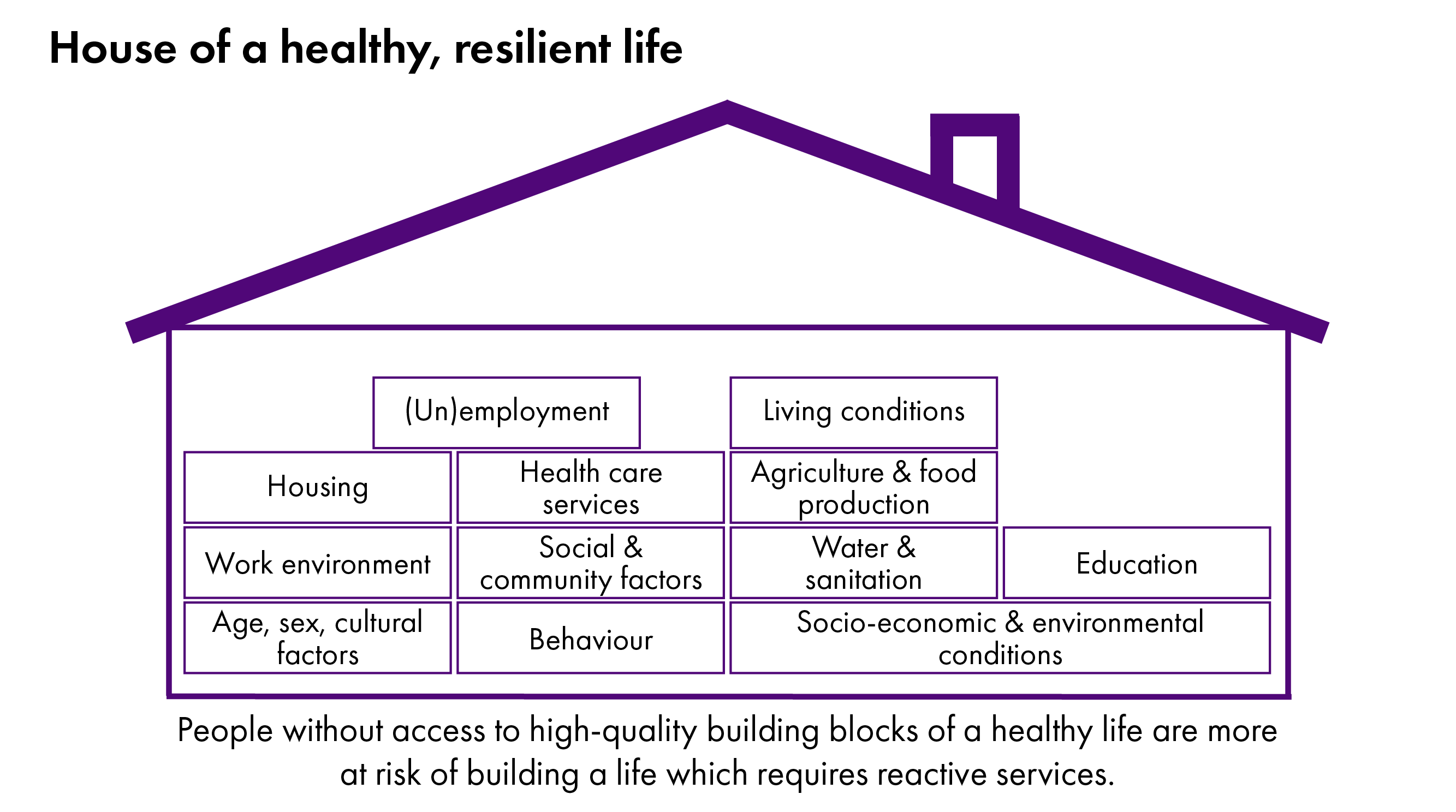
Other definitions are available from Public Health Scotland or the Scottish Health Equity Research Unit. The above definition adds the clarification that prevention should reduce public service demand as a primary goal, not as an “accidental” positive externality. Regardless of the definition, prevention as a principle for public service delivery is closely linked to reducing inequalities and promoting people’s access to what the Health Foundation calls “the building blocks of health”.
SPICe
SPICe has published a range of work on prevention:
The ongoing pursuit of 'prevention' in health and social care looked at the positioning of ‘prevention’ in recent health and social care strategy documents.
Prevention: The “urgent” topic of the last decade approaches prevention from the point of view of resource allocation.
Preventative spending in Scotland is a longer-format briefing describing preventative approaches in more detail, including explanations of why they might provide a solution and how, challenges with their implementation and international case studies.
How can we prevent problems before they arise?
Preventing problems before they arise might sound like the logical thing to do, but it is far from obvious how this should be achieved.
In the Scottish context, at the time of writing there exists no quantitative evidence of the financial benefits of preventative approaches.
Although prevention features as a principle in many of the Scottish Government’s strategies, the Government hasn’t been very explicit about what it is that it is trying to prevent from happening.
At the time of writing, there is no information on how much is being spent on prevention across the Scottish Budget, although the Scottish Government is undertaking a pilot, for tagging preventative spending across the devolved budget, which it said should inform future budget allocations.
It is unclear what the mechanism of allocating money to preventative approaches should be, with some suggesting a new category of departmental expenditure, which would effectively ring-fence prevention spending, while others point out that the Scottish Budget has to follow the UK public expenditure framework and that the Scottish Government and COSLA have agreed on a default position of no ring-fencing.
Preventative approaches do not always align neatly with the structure of the Government’s Directorates’ and the Parliament’s Committee’s, which makes it unclear who is responsible for the delivery of the “sustainable shift to prevention” or who is responsible for the scrutiny of this delivery.
The spending on prevention and the benefits of prevention do not always accrue to the same area of Government spending, making it tricky to account for it as an investment.
Potential impacts of preventative interventions may take longer to realise than the annual budgeting system can account for.
During Session 6, prevention featured in Scottish Budget scrutiny work of at least three Scottish Parliamentary Committees. Committees expressed concerns about the slow pace of reform since the Christie Commission report, asked the Scottish Government to lay out plans for ensuring budget decision-making better reflects the cross-cutting nature of prevention, and requested more information about progress towards tracking and measuring the outcomes of preventative spend.
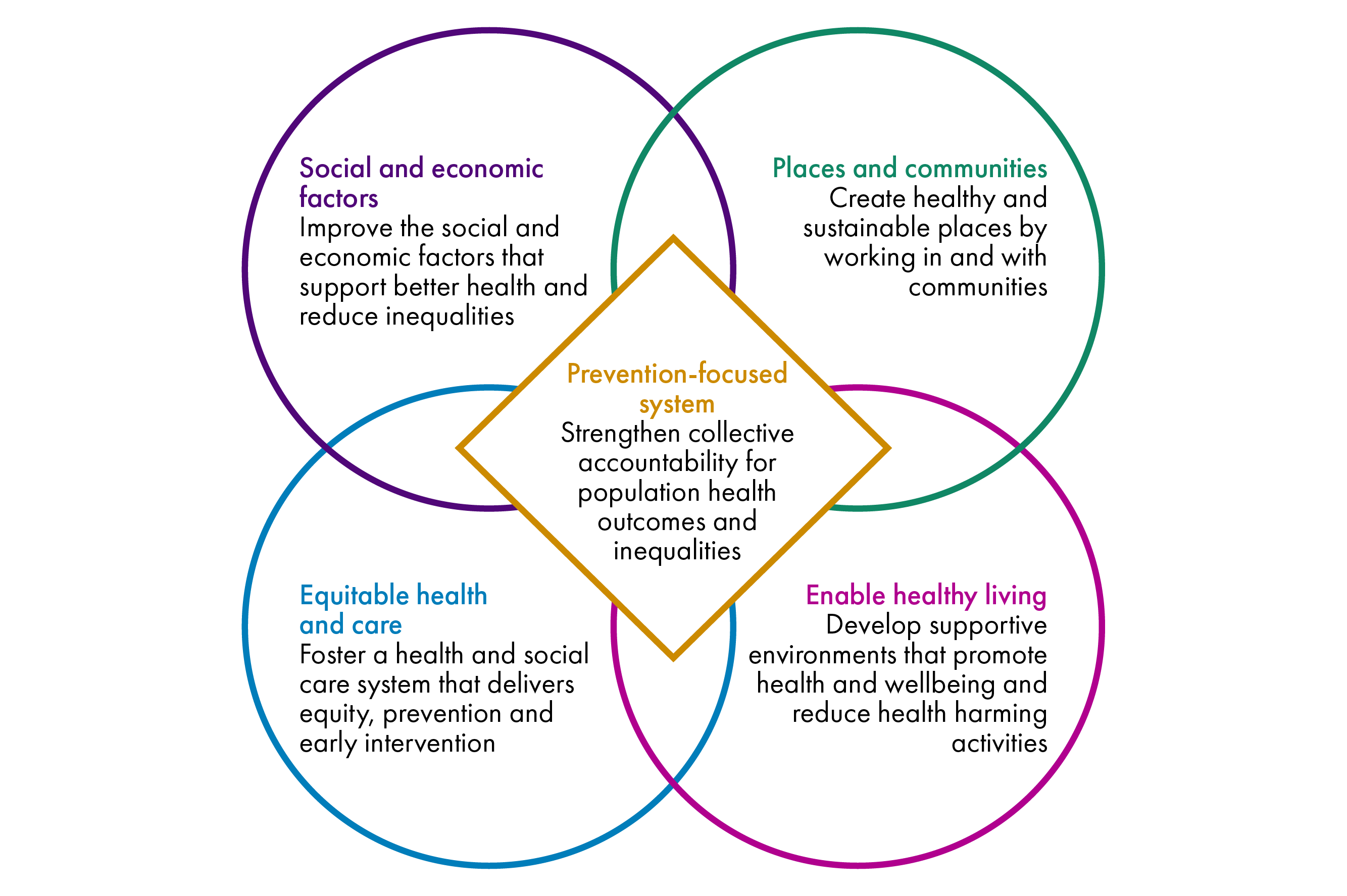
The Session 6 Scottish Government’s work on prevention recently involved including it as a pillar in the Public Service Reform Strategy, the draft revised National Performance Framework, and the Population Health Framework among others. Despite this recent work by the Government, progress is hard to scrutinise, because there is not yet a measurement and evaluation framework, although the Government has committed to its development. An example of the Scottish Government’s work related to prevention during Session 6, which might be possible to scrutinise during Session 7 is the Invest to Save fund, a £30 million fund aimed directly at increasing efficiency, effectiveness and productivity of projects as part of the Public Service Reform.
SPICe, using data from Scotland's Population Health Framework.
Looking ahead to Session 7
During Session 7 if the Scottish Parliament and Scottish Government want to further the work on prevention, the challenge will likely lie in accurately determining how much is being spent on preventative approaches now, and in which sectors, figuring out how to allocate money towards preventative approaches, establishing an evidence base for the selection of approaches, and properly setting the goals for these approaches. Outcomes and indicators do not provide the complete story in evaluating policies: spend and investment must be explicitly linked to appropriate quantitative and qualitative data on those indicators and outcomes, and tracked to allow proper scrutiny.
Prevention is a hot topic, and new publications from Demos, Carnegie UK, CIPFA, King’s Fund, and other sources can be expected. In the Scottish context, The Scottish Health Equity Unit’s Prevention Watch provides regular updates on prevention as a means of public service delivery. These sources of new data may inform Scottish Parliamentary scrutiny of preventative spending during Session 7.
NHS productivity and reform
Kathleen Robson, Senior Researcher, Health and Social Care
The NHS frequently ranks as the most important issue for Scottish voters. Health is also the largest single area of Scottish Government spending and its share of the budget has grown steadily over time.
The health budget has been protected relative to other portfolio areas and this has resulted in sustained increases in NHS funding and staffing. The pandemic also posed unprecedented challenges for the NHS, and Governments across the UK responded by increasing resources further.
However, despite having more, the Scottish NHS is struggling to do more.
NHS Scotland has more money (+£3 billion) and more staff (+20,000) compared to 2019, yet key activity measures are still below pre-pandemic levels.
How the Scottish NHS budget is spent, and what we get for that money, is likely to continue to be a topic for debate during Session 7.

Public Health Scotland: Outpatient Attendances; Inpatient and day cases; Multiple Emergency admissions, and NHS Education Scotland: TURAS Workforce Data
Why the productivity paradox?
This ‘productivity paradox’ is evident across the UK and has been much discussed but is not well understood. Suggested reasons include:
Patients are sicker, older and have more complex problems.
Social care has not had the same level of investment and this has delayed hospital discharges and had a knock-on effect on hospital activity.
The workforce is less experienced and burnt-out in the wake of covid.
A lack of management levers, complex governance and unclear accountability.
Investment has been in people rather than places.
In relation to this last point, revenue budgets have generally been protected at the expense of capital budgets, which would fund investment in equipment and hospitals. Staff productivity depends directly on the tools, systems and space in which care takes place, but the prioritisation of the revenue budget has resulted in under-investment in buildings, beds, equipment and IT. The maintenance backlog for the NHS estate alone is estimated to be £1.5 billion, and that is before we consider the potential costs of the opportunities afforded by technology and AI.
Regardless of the reasons for the productivity challenge, some believe it existed before the pandemic and will continue without significant change.
Time for change?
The Scottish NHS has not experienced fundamental reform since the post-devolution dismantling of the internal market. Before this, the service was often felt to be suffering from ‘change fatigue’ with seemingly endless restructuring.
Policy changes have since been implemented largely within existing structures and systems. While this probably gave staff a welcome reprieve, there is now growing sentiment that fundamental reform may offer a better solution to the productivity challenge than more money and staff.
Audit Scotland has repeatedly called for reform to the Scottish NHS in its annual overview of the finance and performance of the service:
Improvements in productivity and reform of the health and care system are essential if health outcomes are to get better, health inequalities are to be reduced and service delivery to improve. (Audit Scotland Finance and Performance Report 2025)
In the news release accompanying the report, the Auditor General for Scotland wrote that, despite health boards making unprecedented savings, the NHS in Scotland “remains financially unsustainable”. He went on to say:
The Scottish Government has made progress in setting out its plans for reform, including a short-term operational improvement plan and longer term health and social care frameworks. But the published improvement plan lacks clear actions, timeframes and accountability, which will make reporting its progress difficult. And some of the ambitions within the documents, such as moving more care into communities, are longstanding and have yet to be delivered.
Similar calls can be found in previous Audit Scotland reports, dating back several years.
Party manifestos for the 2026 Scottish Parliament election showed the inevitable focus on the NHS, with shared promises to improve services. However, there was less unity in the proposed policies to achieve this. Some manifestos focused heavily on increasing inputs and/or outputs, while others called for more fundamental reform.
Perhaps more unusually, calls for change are increasingly coming from frontline staff. Recently, a group of senior staff from across health, social care and the third sector published an open letter calling for more radical reform:
We understand that simply spending more money will not solve all of the problems we face. But a vision at the centre - of a whole ecosystem of health, a service of health care and social care for all and a culture that promotes equality and fairness and honours all who work in health and care and for a healthier nation – can make Scotland unique. And we recognise that reform of the NHS is only part of the picture and that wider issues require to be addressed, including the vital role of the third sector and local government. Health care is not the sole responsibility of the NHS. We need to look beyond the NHS to the broader determinants of health and prioritise prevention and health creation as a national imperative, while recognising the role of social care in its own right.
The letter also stressed the importance of cross-party collaboration and that what is needed cannot be dependant on ‘the needs of short-term party politics or conditioned by the next parliamentary election’.
Conclusion
Taken together, the evidence suggests that Scotland’s NHS productivity challenge cannot be explained by a single factor, nor solved by incremental increases in funding alone.
Despite sustained growth in resources, the service has struggled to convert additional inputs into higher levels of activity, reflecting deeper structural, organisational and system‑wide constraints. While the pandemic intensified these pressures, many of the underlying problems pre‑date Covid and are likely to persist without deliberate change.
The growing consensus among auditors, analysts and frontline staff is that improving productivity will require more than additional money or workforce expansion: it will demand better alignment between health and social care, renewed investment in capital and infrastructure, and a shared, long‑term vision that transcends electoral cycles. Whether Scotland’s Session 7 Parliament is willing to grasp that challenge may determine not just the future performance of the NHS, but its long‑term sustainability as a publicly funded service.
Provision of social care services
Anne Jepson, Senior Researcher, Health and Social Care and Greig Liddell, Senior Researcher, Financial Scrutiny
With the lack of the planned structural change to create a National Care Service in Session 6, social care and support remains a key issue for the next parliamentary session in terms of increasing demand for services, a growing very elderly (> 75 years) population, and consistently growing pressure on local government and NHS resources and funding.
What is social care?
Social care encompasses all forms of personal and practical support for people of all ages to enable them to live as independently as possible. Services include care at home, such as help with washing, dressing and feeding as well as residential care in a care home.
A social worker assesses needs, and if those needs reach the local eligibility threshold, someone’s ability to contribute to the cost of their care and support will also be assessed. If the assessed need is for personal and nursing care, then it is free for anyone who needs it, and funded by the local authority. Local authorities can charge for certain services such as alarms and meal deliveries.
People access social care in Scotland through Self-Directed Support. This is a system which intends to place an individual in control of the care and support they receive, ideally through 'direct payments' to enable them to organise their own care and support.
How are community health and social care funded?
Local authorities and NHS boards must work together to plan and deliver adult community health and social care services, including services for older people. This is mainly done through integration joint boards (IJBs). These are separate legal entities responsible for commissioning a range of health and social care services across partnership areas.
Adult social care services and in some areas children’s services are delegated to IJBs, meaning they are responsible for commissioning appropriate services and directing the budgets allocated from local authorities and health boards.
Total IJB income in 2024-25 amounted to £12.9 billion, with 67% coming from the NHS, 29% from local government and the rest being income from chargeable services, such as meals provision and alert alarm services (4%).

Audit Scotland: Integration Joint Boards Finance bulletin 2024-25
NHS boards delegate around 47% of their revenue budgets to IJBs to fund primary and community healthcare services, i.e. those that operate between social care and NHS care.
Local government funding for social care
Since the Social Work (Scotland) Act 1968, local authorities have been required to “promote social welfare by making available advice, guidance and assistance on such a scale as to be appropriate for their area”. The Act places wide responsibilities on councils in relation to childcare, child protection, supporting families and providing social services for adults. For financial reporting purposes, spend in this area comes under the heading “social work”.
Spending on social work is Scottish local government’s second highest area of spending (after education), amounting to around £5 billion in 2025-26, or 31% of the total net expenditure by local government. Around £4 billion of this goes through Integration Joint Boards. The image below shows how local government social work spending has grown in real terms over the past 16 years:

Scottish Government: Local government finance statistics
Local authorities now spend £800 million more in real terms on social work than in 2010-11 (an 18% increase). Over this period, total local government net expenditure has risen by only 3%. In a recent survey of local authority leaders, chief executives and directors of finance, the Local Government Information Unit found that social care is the biggest pressure on council finances.
Pressures affecting social care provision
One of the key pressures affecting social care is demographic change: this includes the effect of population growth on the demand for health and social care services, the impact of a population living longer, and demographic change in the workforce itself. Inequalities are also widening leading to higher needs and higher demand.
The image below shows National Records of Scotland population projections by age group, from mid-2024 to mid-2049. This shows a large increase in people aged over 75 and a reduction in the number of people aged under 30.
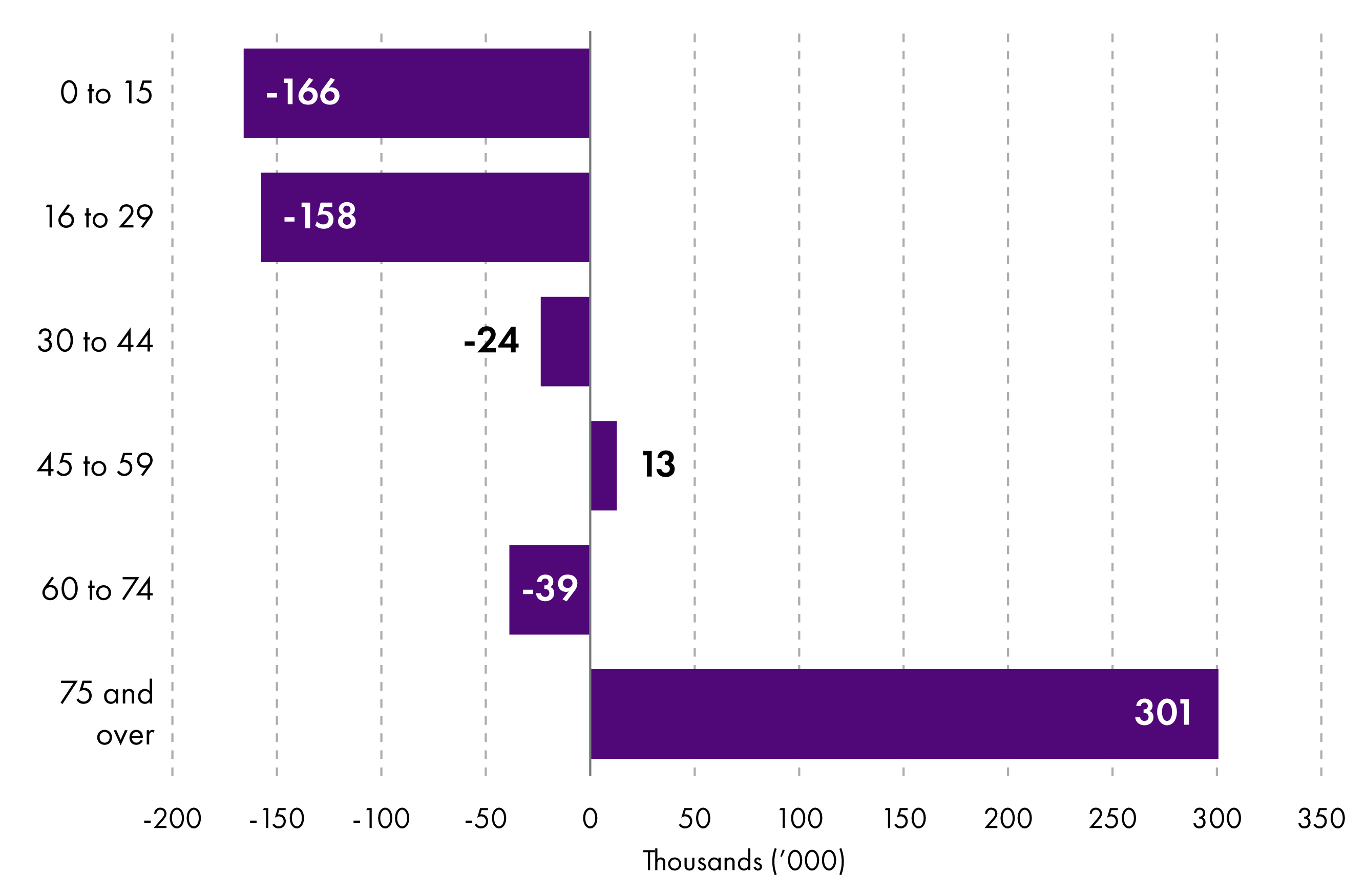
National Records of Scotland (NRS): Projected Population of Scotland (2024-based)
Other pressures affecting social care provision include:
Price effects: general price inflation within health and social services means increased costs for individuals and services, as do rising energy costs and increased pay.
Non-demographic growth: demand-led growth, generated by increased public expectations and advances in new technology or service developments.
Workforce requirements and sustainability of services, most of which (80%) are provided by private, independent or third sector organisations.
Rurality and remoteness: the geography of Scotland includes many rural and remote areas where all the above pressures impact more acutely.
Changes to UK immigration policy for health and social care staff: overseas recruitment of social care workers ended on 22 July 2025.
More on integration since 2016
Health and social care have been formally integrated since legislation was passed in 2016. New bodies, called Integration joint boards, a form of integration authority, were established, with services being delivered through health and social care partnerships. However, governance and financial arrangements are complex because health boards are directly accountable to the Scottish Government whereas local authorities have the statutory accountability for social care services.
Integration was intended to erode the boundaries by introducing a model whereby Integration Joint Boards (IJBs), comprising representatives from councils and health boards, along with other non-voting members, were given the responsibility to commission local services and direct relevant budgets from local authorities and health boards accordingly. Early in 2026 legislation was passed to extend voting rights on IJBs, from 1 September 2026, to representatives of unpaid carers, the third sector and people who use care and support services. The IJB Chairs network raised concerns prior to parliamentary scrutiny about the significance of these changes to local democratic accountability.
Integration has not yet succeeded in dissolving those boundaries between health and social care services, nor budgets. A recent Local Government Information Unit (LGIU) survey heard criticism of the IJB model:
IJBs were characterised as an ineffective way to allocate resources, a financially precarious burden on councils, and an unnecessary confounding factor in determining accountability.
The Accounts Commission recently concluded that IJBs have now “reached a critical point, with a significant risk they will become financially unsustainable within the next 12 to 24 months”.
What happened to the National Care Service?
Throughout most of Session 6 the Scottish Government sought to introduce structural reform to create a National Care Service. In June 2022, the Session 6 Scottish Government introduced a Bill to establish a National Care Service. The original Bill would have moved responsibility for social care from local government to the Scottish Ministers – however, this proposal was rejected by the Scottish Parliament. SPICe tracked progress of the Bill through to its eventual transformation into the Care Reform (Scotland) Act in June 2025 through a series of blogs and briefings.
What emerged from the legislative process is a National Care Service Charter. Rather than introducing new rights for individuals, it brings together existing rights into the context of social care delivery and expectations. There is no right to receive social care services free at the point of need as there is for healthcare services, free personal and nursing care notwithstanding.
A new National Social Work Agency has also been established as a consequence of the National Care Service work. Furthermore, an interim advisory board was set up in 2025 to provide advice to Scottish Government ministers and council leaders on social care, social work and community health services in Scotland.
Conclusion
Social care and support has grown as an issue over a number of years because of growing demand from demographic change and increasing costs as well as its status in relation to healthcare. Across the UK, the challenge to better structure and fund social care and support services remains. There will be opportunities to scrutinise reform of social care through public service reform, developments to integration of health and social care through IJB scrutiny, as well as ongoing budget scrutiny. The fundamental challenge for true integration is the very different accountability and governance arrangements for health and for social care services.
Further and higher education - towards sustainability for colleges and universities
Lynne Currie, Senior Researcher, Further and Higher Education
Funding sustainability of universities and colleges was a recurring theme in Session 6. Toward the end of the session, the situation reached a critical point and the Education, Children and Young People (ECYP) Committee repeated its concerns about the long-term sustainability of the sectors.
Audit Scotland’s 2025 Scotland’s Colleges report found a £20 million reduction in cash terms and 20% reduction in real terms in funding for colleges between 2021-22 and 2025-26. In addition, a 2025 Scottish Funding Council (SFC) report highlighted operating deficits facing colleges, concluding that the forecasts “show that most colleges are not sustainable”.
In another 2025 report, the SFC also highlighted the challenge of financial sustainability for universities. The Institute for Fiscal Studies (IFS) found universities facing pressures as a result of increasing staff costs and declining numbers of international students.
The IFS also found a real terms fall in funding for home students as the per student fee paid to institutions by the Student Awards Agency Scotland (SAAS) has remained at £1,820 for over 15 years.
Although the financial crisis faced by the University of Dundee from the end of 2024 onward was found to be a result of failures in governance as well as financial management, it crystallised the risks facing the sector.
In Session 7, finding solutions to address these risks will be crucial to ensure high-quality college and university education continues in Scotland.
Laying the groundwork for change
Steps towards reform began in the aftermath of the COVID-19 pandemic.
The SFC’s 2021 Review of Coherent Provision and Sustainability set out recommendations for the college and university landscape. This included calls for the Scottish Government to establish an overall vision and strategy for further and higher education, increase collaboration between colleges and universities and move to multi-year funding.
The Independent Review of the Skills Delivery Landscape was carried out by James Withers and published in June 2023. This set out 15 recommendations for transforming skills delivery. These included calls for the Scottish Government to take responsibility for skills planning at a national level and create a single funding body for provision of all post-school education and student support.
In evidence to the ECYP Committee on 15 November 2023, James Withers told MSPs that a 10-year timescale for skills reform is “not unrealistic”. He added: “establishing a vision for what good looks like … should be the north star” in order to ensure clarity about the aims of change.
Following the Withers review, the Session 6 Scottish Government published 'Purpose and Principles for Post-School Education, Research and Skills' in June 2023. This is a framework intended to set the overarching policy direction for higher and further education. It has five key principles:
Transparent, Resilient and Trusted
High Quality
Supportive and Equitable
Globally Respected
Agile and Responsive
The Scottish Government also published an Initial Priorities document. This included the development of “a new model of public funding for all forms of provision”.
A 2024 consultation put forward three options for change in relation to the functions and responsibilities of the SFC, Skills Development Scotland (SDS) and the SAAS. These were: maintain business as usual; bring all funding provision into the SFC and all student support funding into the SAAS; or bring all provision funding and student support funding into the SFC.
Independent analysis of the consultation responses found a slight majority of respondents in favour of the SFC managing funding for provision and the SAAS managing student support funding. This option was taken forward by the Scottish Government and relevant provisions were included in the Tertiary Education and Training (Funding and Governance) Bill.
The Bill contained provisions to simplify the funding landscape and improve the operation and governance of the SFC. It proposed giving Ministers power to fund and commission the SFC to secure and fund provision of national training programmes and apprenticeships. Previously, SDS distributed funding for Modern Apprenticeships.
The final Bill included amendments to introduce greater transparency on college and university principals’ pay, requirements for colleges and universities to adopt further fair work principles, and reviews of the credits-based funding system for colleges and contribution rates for apprenticeships.
It passed at Stage 3 in January 2026 and became an Act in March 2026.
Looking ahead to Session 7
Following a number of years of real-terms decline in university and college funding, the Scottish Government’s 2026-27 Budget set out a rise in resource and capital budgets.
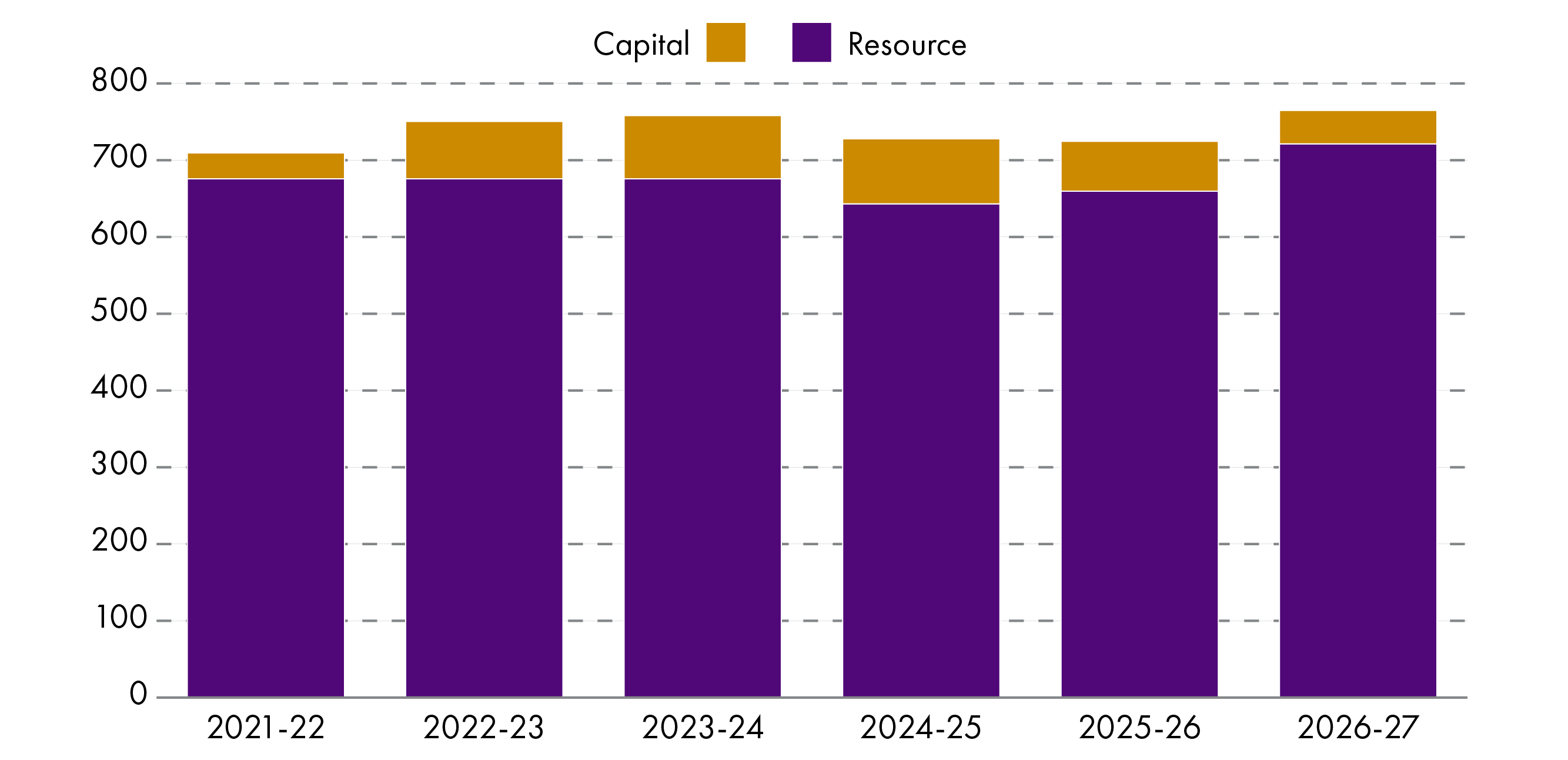
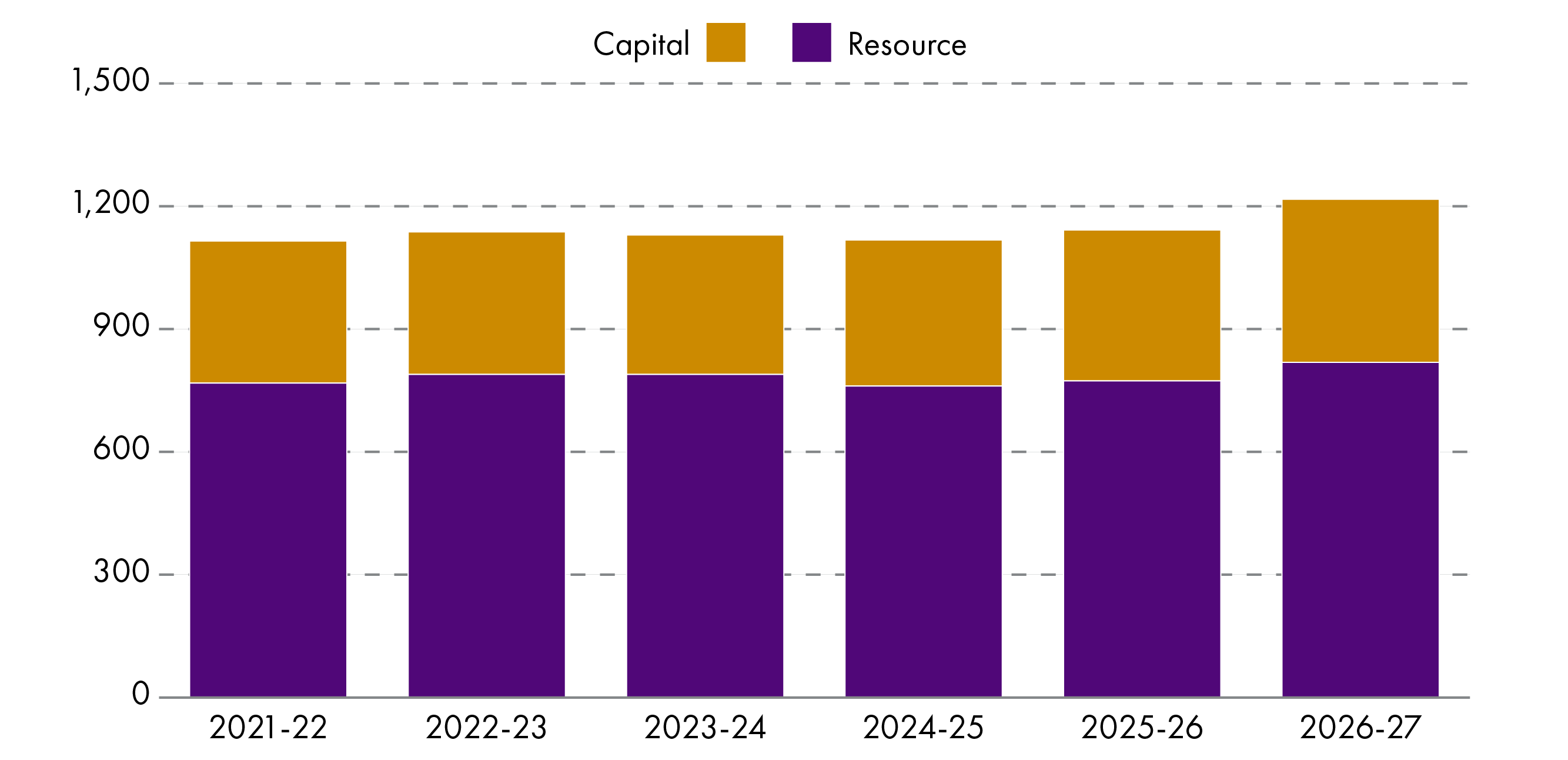
In response, Universities Scotland stated that universities would “continue to experience financial pressures” and the budget rise would have “little impact, particularly when it comes to funding for teaching”.
Colleges Scotland stated that while the increase would help, it “does not fully restore the investment lost in our colleges over recent years”.
The Scottish Government has set up working groups looking at sustainable funding with both sectors. Work is expected to conclude in Autumn 2026.
The Framework for Sustainability and Success of Scotland’s Universities is co-chaired by Scottish Government Director-General for Education and Justice Neil Rennick and Professor Andrea Nolan CBE. In a letter to the ECYP Committee in December 2025, the co-chairs set out:
Universities Scotland and the Scottish Government will develop and deliver a co-designed body of work to establish an evidence base that quantifies the current funding gap within the sector, considers the future purpose of Scotland’s university sector and the reforms necessary to deliver a sustainable and competitive funding and business model that allows for greater long-term flexibility of provision, and which supports institutions to thrive. This work will be taken forward within the context of a publicly funded tuition fee model.
There will be three pillars to this work:
Pillar 1 will bring together baseline evidence on funding levels and costs of teaching delivery, along with a look at issues facing the sector.
Pillar 2 will look at how funding and sustainability challenges may be addressed.
Pillar 3 will provide an overview of the issues with options on how to address funding gaps.
In March 2026, then-Minister for Higher and Further Education, Ben Macpherson MSP, wrote to the ECYP Committee in March 2026 to announce a similar approach for colleges. The College Sector of the Future is a collaborative project between the Scottish Government, Colleges Scotland and SFC that will report to Ministers.
This work also has three pillars:
Pillar 1 will build an evidence base by looking at previous reviews and evidence of current and future needs of learners.
Pillar 2 will consist of stakeholder workshops looking at the future roles and priorities of colleges.
Pillar 3 will see the creation of options for funding models and frameworks.
Though both sectors are invested in their respective groups, this work will need to hold on to momentum as the new government comes into office. Cross-party buy-in will likely be a crucial factor in its success. There is also a role for the Scottish Parliament and its new members to oversee the discourse around change.
As the changes of Session 6 bed in, the big question is whether the years ahead bring the beginnings of stability or further turbulence for colleges, universities and their students and staff.
School education and childcare: Priorities and pressures in Session 7
Ned Sharratt, Senior Researcher, Childcare and School Education
School education and childcare are key devolved policy areas which are likely to continue to be of interest to Members during Session 7. In previous parliamentary sessions, school and childcare policies have often been the topic of debates in the chamber and the subject of constituency casework.
Because local authorities are responsible for securing the provision of both school education and funded pre-school early learning and childcare (ELC), national policy in this area is often developed in partnership with local government, along with representatives of the teaching profession.
There are a range of issues in childcare and school education which will be briefly covered here. Some of these topics will also be the subject of more in-depth SPICe briefings to be published in the coming months.
Delivering on these areas in the context of the likely budget constraints will be a challenge for the Session 7 Scottish Government.
Ongoing reform of school education
The Session 6 Scottish Government pursued a number of areas of reform. These included: reform of the qualifications’ agency, establishing the education inspectorate as a stand-alone body, exploring changes to how school qualifications are assessed, and establishing a process to review Curriculum for Excellence – the Curriculum Improvement Cycle.
In this new parliamentary session we will begin to see the results of this work. For example, initial outputs from the Curriculum Improvement Cycle are expected this summer.
Teachers’ contact time
The terms and conditions of teachers working in the public sector are agreed nationally through the Scottish Negotiating Committee for Teachers. These include issues such as payscales, and a range of employment conditions. These conditions include a maximum of 22.5 “contact hours” for each week. Teachers are expected to be teaching a class for a maximum of 22.5 hours a week, with the remainder of their time devoted to preparation, marking, meeting parents/carers, professional development etc.
The Session 6 Scottish Government aimed to reduce this to 21 hours per week. Delivery of this aim proved to be challenging. Speaking to the Education, Children and Young People Committee in January 2026, the then Cabinet Secretary for Education and Skills said the Government will be funding pilots of reducing contact time in this financial year. She noted that “since 2018, the pay of classroom teachers has increased by 40 per cent” and the Scottish Government “could not have forecast that situation when we came into power again in 2021.” She also said:
The other factor, which is inherently linked, is that the teaching unions separate pay and conditions from their negotiations.
Following a ballot of its members, on 6 March 2026 the EIS announced it would take industrial action in relation to teachers’ workload and a lack of progress in the reduction of contact time. Following further negotiations, on 13 March 2026 the Scottish Government announced that:
A weekly reduction of 90 minutes will be introduced on a phased basis, with primary school teachers and those working in special schools benefiting from August 2027. Secondary school teachers will follow two years later.
The EIS suspended plans for industrial action. The Scottish Government said that it would provide £40 million in 2026-27 to support this deal and that a “multi-year budget line from 2027-28 onwards will cover the full implementation costs.” COSLA estimates that the annual cost of this policy could be up to £250-£310 million per year.
Expanding publicly funded childcare
Families of eligible children are entitled to receive 1,140 hours of funded early learning childcare (ELC) free of charge. All children are eligible from shortly after their 3rd birthday to the start of primary school; a 2-year old may be an “eligible child” if their family is in receipt of certain benefits or if a parent or the child has experience of care.
Local authorities have a duty to secure the provision of this ELC for children in their area. This can be through: directly providing the service in a local authority nursery or nursery class at school; funding a place at a private, voluntary or independent setting; or funding a childminder. A little under 70% of ELC provision nationally is through local authority settings, although different local authorities have different mixes of provision.
The Scottish Government in Session 6 undertook a range of work to explore how to expand the provision of pre-school and school-aged childcare. This was also a theme in several of the manifestos for the recent election. In England there is a different model and, since September 2024, this has included funded childcare provision for working families for children from 9 months.
Additional support needs
The number of pupils being identified with one or more additional support needs has been steadily growing for over a decade. There have also been reports that since the pandemic both the number of pupils presenting with an additional support need and the complexity of the need has increased.
How to ensure that pupils’ additional support needs are consistently met has been a longstanding issue and the subject of regular commentary, review and reports. This issue will continue to be an area of focus in Session 7 and will be the subject of a more detailed SPICe Briefing in the coming months.
Positive relationships, behaviour and mobile phones
Since the pandemic there is evidence of worsening behaviours in Scotland’s schools. In 2024, the Scottish Government and COSLA agreed a national relationships and behaviour in schools action plan covering 2024 to 2027 and the Scottish Government issued new guidance in 2025. The Behaviour in Scottish Schools Research (BISSR) is a regular and consistent source of data on this matter. It was last undertaken in 2023 and we expect the next BISSR to be published later in 2026.
A related issue is the use of mobile phones in schools. In 2024, the Scottish Government published guidance for local authorities and schools to develop local policies on mobile phone usage in schools. This guidance said decisions on mobile phone usage, including whether to ban them, is for headteachers. There has been a shift in recent months with a wider consensus that there ought to be a national ban of the use of mobiles in classrooms.
Attendance levels in schools are also lower than pre-pandemic. In March 2026, the Scottish Government published updated guidance on improving attendance.
Closing the poverty related attainment gap
There is a negative correlation between pupils’ families’ experiences of deprivation and the educational outcomes of those pupils. The “attainment gap” is measured by comparing the performance or outcomes for pupils living in the most and least deprived areas in Scotland.
The Scottish Government’s Scottish Attainment Challenge (SAC) is the main national policy aimed at closing the attainment gap. SAC is a range of programmes backed by the Attainment Scotland Fund which is worth around £200 million per year. The Scottish Government measures the attainment gap through 13 “key measures” and reports on these annually through the National Improvement Plan.
Reducing the impact of deprivation on educational outcomes will continue to be a focus of policy and practice in school education during Session 7.
Summary
This section has highlighted just some of the issues that are likely to arise in the areas of school education and childcare and which are likely to be of interest to Members and Committees during Session 7.
Transport policy - your delivery has been delayed
Alan Rehfisch, Senior Researcher, Transport and Planning
Has Scottish Government transport policy delivered desired outcomes? This chapter considers those outcomes, how travel patterns have changed, and identifies issues that could be considered during Session 7.
Transport policy goals of Scottish Governments
Transport policy goals pursued by successive Scottish Governments have been remarkably consistent. The first plan for the development of Scotland’s transport system was in the 2004 White Paper Scotland’s Transport Future, which set out a vision of:
An accessible Scotland with safe, integrated and reliable transport that supports economic growth, provides opportunities for all and is easy to use; a transport system that meets everyone’s needs, respects our environment and contributes to health; services recognised internationally for quality, technology and innovation, and for effective and well-maintained networks; a culture where fewer short journeys are made by car, where we favour public transport, walking and cycling because they are safe and sustainable, where transport providers and planners respond to the changing needs of businesses, communities and users, and where one ticket will get you anywhere.
This vision was carried through into the first National Transport Strategy, published in 2006, and again in the “refreshed version”, published in 2016. The second National Transport Strategy, published in February 2020, includes a similar, but shorter, vision:
We will have a sustainable, inclusive, safe and accessible transport system, helping to deliver a healthier, fairer and more prosperous Scotland for communities, businesses and visitors.
Changes in Scottish travel trends
So how has travel in Scotland changed since this vision was introduced in 2004? (All statistics from Scottish Transport Statistics 2025 unless stated otherwise)
Annual distance travelled by car has increased by almost three billion kilometres (8.9%), rising from 33.17 billion km in 2004 to 36.11 billion in 2025.
Annual bus patronage has fallen by 125 million trips (27.2%), declining from 459 million trips in 2004-05 to 334 million in 2024-25 – remaining below the 2019-20 pre-covid figure of 361 million trips, despite the introduction of free bus travel for under 22s in January 2022.
Annual ScotRail patronage has increased by 20.7 million trips, increasing from 64.02 million in 2004-05 to 84.71 million in 2024-25 – although patronage in both 2017-18 and 2018-19 hit a pre-covid high of 97.78 million trips.
Annual distance travelled by bike has increased by 162 million kilometres (73.3%) – although this is a fall from a covid lockdown related high of 597 million kilometres pedalled in 2020.
Statistics on the distance covered on foot are not routinely collected, with Scotland-wide statistics on walking indicating that there is likely to have been a modest increase as walking as a mode of transport since 2004.
In summary, the transport policy of successive Scottish Governments has largely failed to deliver the desired outcomes first set out over 20 years ago, particularly reducing car use and growing public transport patronage. The reasons for this are complex, including social, economic, cultural, and financial factors, but key issues include:
Reduced public transport service levels: The number of vehicles used to provide scheduled bus services in Scotland fell by 34% between 2004-05 and 2024-25, from 5,000 down to 3,300. The distance operated by Scotland’s buses fell by 20.3% (73 million kilometres) over the same period. This is principally the result of commercial decisions taken by Scottish bus operators.
The distance operated by ScotRail services in 2024-25, while almost 15% higher (an extra 5.51 million kilometres) than that provided in 2004-05, had reduced by 14.3% (6.63 million kilometres) from the all-time high in 2019-20.
Increased traffic congestion and longer bus journey times: The growth of road traffic has had a negative impact on bus use. Research conducted for the Confederation of Passenger Transport reports 20 million fewer bus trips annually due to longer journey times caused by traffic congestion.
Cost: The chart below shows that, relative to the Retail Prices Index (RPI) measure of inflation (the measure used to calculate increases in rail fares) between 2004 and 2025 that:
the cost of motoring fell by 12.2%
rail fares increased by 8.8%
bus fares increased by 29%.
As the cost of motoring has fallen in real-terms, it is not unreasonable to assume that people have chosen to travel by car for an increasing proportion of journeys, particularly at the expense of bus and rail – which have been subject to cost increases above the RPI measure of inflation.

Covid: A UK Government sponsored international literature review of the implications for the Covid pandemic on travel patterns concluded that:
The evidence is clear. People have embraced private modes of transportation, hybrid working has increased, and online activities have coexisted with traditional in-person interactions. These shifts have transformed travel destinations, commute patterns, and daily routines.
These changes have had a significant impact on rail and bus use, particularly reducing the number of people using these modes for regular commuting to work. This in turn has an impact on the financial viability of some services, which local and national government only have a limited ability to ameliorate.
Scottish Government implementation and investment priorities: Despite a policy focus on reducing car use and increasing the use of sustainable modes, capital investment in transport infrastructure has skewed towards expanding the road network. Between 2004 and 2026 successive Scottish Governments supported the delivery of several significant public transport capital projects, including the Airdrie-Bathgate railway, Borders railway, and Levenmouth rail link. However, these projects are dwarfed in scale and cost by projects to expand the trunk road network delivered over the same period, including the Queensferry Crossing, M74 completion, M8 completion, and Aberdeen Western Peripheral Route.
The most significant increase in revenue investment in public transport was the extension of free bus travel. Previously only available to disabled people and those aged 60+, in January 2022 the policy was extended to include all Scottish residents aged under 22, However, despite free bus travel now costing in the region of half a billion pounds per year, this investment has failed to arrest the long-term decline in bus patronage.
Annual investment in active travel has never exceeded 5.6% of the total transport budget (2024-25) and stands at around 4% in 2026-27.
Conclusion
Increasing travel by foot, bike, bus, and rail and reducing car use will likely require significant and sustained capital investment by the Scottish Government and councils in improved pedestrian environments and the development of continuous, direct, and safe networks of bus and cycle lanes. It may also require ongoing revenue support for bus service provision and low-cost public transport ticketing options. Consideration might be given to 12 interventions identified in academic research to reduce driving and increase the use of active and sustainable modes, such as congestion charging, workplace parking charges, and limited traffic zones (limiting car access to city/town centres). None of these interventions have been pursued by national and local government in Scotland with any vigour to date.
Successfully delivering existing long-term transport policy goals will require strong national and local support for potentially unpopular interventions (although research shows support often increases after implementation), long-term capital and revenue investment in active and sustainable travel networks, and no further expansion of road capacity for private cars, as recommended by the Scottish Infrastructure Commission.
Considering these policy goals, issues for consideration in Session 7 could include the funding and authorisation processes for bus and cycle infrastructure, integrated ticketing, support for bus services and maximising the effectiveness of free bus travel on modal shift and supporting the uptake of electric vehicles.
Living Standards and Wellbeing
This theme focuses on the decline in living standards observed in Scotland in the context of the increasing cost of living in part as a result of external shocks such as the ongoing conflict between Iran and the United States of America and Israel. It also looks at what these issues mean for Scotland’s child poverty targets along with focusing on other wellbeing issues such as the housing emergency, disability prevalence and the challenges for public policy of the increase in diagnosis of neurodivergent conditions.
Living standards and the cost of living
Rob Watts, Senior Researcher, Financial Scrutiny
Since 2008, Scotland’s economic performance has deteriorated across a range of measures. What was initially considered a slow recovery from the financial crisis has become the new normal. This has direct consequences for people’s living standards and ability to meet the cost of living. Furthermore, it makes other government policy objectives harder to achieve. How to improve Scotland’s economic performance and living standards will be a key question for Session 7.
Scotland’s post-2008 economic performance
There is no single way to measure economic performance but on some key measures, Scotland’s performance has deteriorated since around 2008.

Scottish Government: Quarterly National Accounts
Gross Domestic Product (GDP) measures the value of goods and services produced in the economy. The extent to which GDP growth should be an objective of economic policy is contested, but it remains the best available single measure of economic output. The image below shows that the rate of growth in GDP per capita has slowed in Scotland since 2008.
A similar story can be observed on employee wages.

ONS: Annual Survey of Hours and Earnings, see SPICe dashboard for details
The sense of stagnation is evident in other economic metrics. On productivity, Scotland’s place in international league tables remains almost exactly the same as in 1998. Investment spending (needed to grow the economy over the long-term) has been subdued for two decades and remains below 1998 levels as a percentage of GDP.
Scotland’s economy is on a lower growth trajectory
Whilst one-off events have had an impact, the deterioration in economic performance appears to be a long-term trend.
It’s not that Scotland’s economy has hit a few speed bumps. It appears to be travelling in a permanently lower gear.
Taking onshore GDP per capita, for example, Scotland’s annual growth rate averaged 1.8% between 1998 and 2008. It averaged 0.5% between 2008 and 2024, exceeding 1.8% in only four of those years.
On wages, real terms median earnings for employees grew at an average annual rate of 1.8% between 1998 and 2008. Even ignoring a period of decline in the early 2010s, median employee earnings have grown at an average annual rate of 0.9% since 2014. Had wages continued to grow at their 1998-2008 rate, median employee earnings would be roughly £170 per week or £8,800 per year higher today.
It’s also important to note that 1998-2008 was not an outlier for Scotland’s economy. Directly comparable official statistics pre-1998 are unavailable, but academic studies tend to show the post-2008 slowdown in economic performance is unprecedented in the post-World War II era.
Finally, it should be stressed that these trends are also occurring in economies elsewhere both in the UK and internationally.
What this means for living standards
One consequence of Scotland’s deteriorating economic performance has been a slowdown in the rate of growth in people’s standard of living, which is often measured by disposable income per person.

Scottish Fiscal Commission: Fiscal Sustainability Perspectives: what Scotland’s finances mean for the next parliament – February 2026
The image above shows that in the early years of devolution, the average citizen’s standard of living was improving by 10% roughly every three and a half years. But since 2008-09, a 10% improvement in average living standards has taken around twelve and a half years.
The consequences of this slow growth in living standards go beyond people’s personal finances. For example, there is evidence that higher living standards lead to better health and education outcomes.
The cost of living
In 2022, Russia’s full-scale invasion of Ukraine and the tail end of the Covid-19 pandemic saw global supply chain disruption and energy price shocks. This largely contributed to a period of high inflation across the economy. The rapid increase in prices, following years of slow growth in living standards, was often called the ‘cost of living crisis’.

Although inflation has since fallen back, prices have not. ‘The cost of living’ remains one of voters’ top concerns. It is not clear to what extent this relates specifically to rising prices or to a general sense that living standards have stagnated. A key issue for Session 7 will be supporting households with the cost of living but also addressing the root causes of why households are struggling to meet the cost of living in the first place.
Why this matters for other policy areas
If these economic trends continue (and the Scottish Fiscal Commission forecasts that they will), then future Scottish governments will face more constrained choices. This is because deteriorating economic performance and slow growth in living standards will lead to tax revenues growing slowly. When combined with the rising demand on public services from an ageing population, this could result in difficult trade offs between different policy objectives of the Scottish Government.
Furthermore, the policy levers available to the Scottish Government that affect economic performance cross multiple portfolios. The Scottish Parliament has devolved powers over infrastructure, economic development, education and skills, business regulation in some sectors, planning, housing, as well as some tax and social security powers. During Session 7, decisions made across all of these policy areas will shape Scotland’s economy, particularly over the long-term.
External shocks and their impact on Scotland’s politics and economy
Andrew Feeney-Seale, Senior Researcher, Financial Scrutiny and Iain McIver, Senior Researcher, Europe and International
Whilst foreign affairs and international relations are reserved matters, the impact of external shocks and international events can influence devolved policy areas. Stretching back to the end of Session 5, and throughout Session 6, there have been significant shocks which have impacted energy and food prices, Scottish exports and the available funds for public spending.
These events (some of which are shown in the timeline below) have ranged from the COVID-19 pandemic, to the UK’s departure from the European Union in 2021 and Russia’s illegal invasion of Ukraine in 2022, to the imposition of a new tariff regime by the United States and US military action in Venezuela and Iran.

SPICe
Whilst these issues are outwith the Scottish Government’s control, the experience of recent years suggests geopolitical events and shocks could also have an impact on the new Scottish Government’s policy programme during Session 7.
This chapter will look at some of the impacts these external shocks have had on policy in Scotland.
How have recent external shocks impacted the Scottish economy?
As described above, there have been a significant number of external shocks which have had an impact on Scotland’s politics and economy in recent years. With so many shocks, at times overlapping, it can be a challenge to precisely quantify the impact of any one event, but the infographic below summarises some of the impacts on Scotland’s economy.

ONS: Consumer Price Index Annual Rate 00(2025=100), Scottish Government: GDP Quarterly National Accounts 2025 Q3, and Export Statistics 2023
Prior to the UK’s exit from the EU, the then Scottish Government set a target to grow the value of Scotland’s exports to the equivalent of 25% of GDP. However, the increase in trade barriers with many significant markets for Scottish goods, coupled with the changing international context for tariffs, has made this target much more challenging to achieve.
The Covid-19 pandemic resulted in a significant economic shock in 2020 as much of the economy was forced to close during the lockdowns. While the economy recovered to its pre-pandemic level by November 2021, growth since then has been relatively muted.
During 2021 gas prices were already increasing, due to challenging weather conditions and the effects of the Covid-19 pandemic. However, the Russian invasion of Ukraine in February 2022 resulted in a further, significant increase in energy costs. This contributed to inflation being above the UK Government’s 2% target for much of Session 6 of the Scottish Parliament.
The current conflict in the Middle East
SPICe recently wrote a blog looking at how the US and Israeli conflict with Iran could affect households and businesses in Scotland. This is a rapidly evolving situation – since we published our earlier analysis there has been a tense ceasefire and some attempts to negotiate an end to the conflict.
At the time of writing, Iran claims that the Strait of Hormuz is closed, while the USA claims to be blockading Iran’s ports.
The Strait of Hormuz is an important trade route for several industrial goods

World Economic Forum: Beyond oil - 9 commodities impacted by the Strait of Hormuz crisis
The impact of this conflict, and in particular continued disruption to the Strait of Hormuz, is likely to be felt in several sectors of the Scottish economy:
Energy: The United Kingdom remains exposed to international fossil fuel markets – as of 2024, 35.6% of all UK electricity was generated from gas. Around 20% of the global supply of liquified natural gas transited through the Strait of Hormuz in 2024, so disruption in the region has a significant impact on the global price of gas. As the UK relies on imports, any price increases are passed on to consumers and businesses. The consultancy Cornwall Insights forecast that the price cap for typical household energy bills will increase by around £160 per year from July. The conflict has also led to significant increases to the cost of other products using oil and gas, such as petrol and diesel, and oil for heating.
Agriculture: The United Nations highlights the risk that restricted supply of fertilisers will reduce crop outputs later this year and next year, driving up food prices. Approximately one third of global fertiliser supply passes through the Strait of Hormuz. These concerns have prompted NFU Scotland to call for urgent government action to support farmers struggling with fertiliser and energy costs.
Manufacturing: The London School of Economics notes that half of the world’s sea-borne trade in sulphur is via the Strait of Hormuz. Sulphur is a key input to industrial processes. 30% of global helium comes from the Ras Laffan industrial hub in Qatar which is vital for semiconductor manufacturing. There are also shortages of aluminium used in cars.
Shipping and travel: The costs of insuring shipping to transit the Strait of Hormuz have increased significantly since the conflict began. The airline industry has also been hit, with a number of European carriers cancelling flights or increasing ticket costs in the face of jet fuel shortages.
These sectoral impacts are expected to contribute to a wider economic impact across Scotland and the UK. The OECD recently updated their global economic outlook, and the forecast for UK GDP growth for 2026 was downgraded from 1.3% to 0.7%. Sky News noted that this was the largest downgrade among advanced economies, with the UK’s exposure to international energy markets being the key factor in this changed forecast.
A decrease in confidence about the trajectory for the economy has contributed to a slowdown in other markets, such as financial services. The BBC notes that there has been a significant increase in interest rates for financial products such as mortgages, with the number of deals on offer also declining. Anticipated increased energy and food costs are expected to drive UK inflation higher than had been forecast for 2026.
What does this mean for Session 7?
Forecasting the impact of the current conflict in the Middle East, much less the next external shock which may be around the corner, is of course more of an art than a science. Prior to the recent conflict in the Middle East, Scottish voters already ranked the cost of living as one of their top issues. The next Scottish Government will face a more challenging economic context than was the case at the start of the year. Higher inflation will lead to higher welfare spending as benefits are uprated, while a more acute cost of living crisis will increase pressure for further support, such as the support announced for households relying on heating oil in April.
Will Scotland's child poverty targets be met?
Camilla Kidner, Senior Researcher, Social Security
Child poverty was a key issue for the Session 6 Scottish Government. In March 2026, the then First Minister said:
we are not here just to reduce child poverty in Scotland. We are here to eradicate it. Utterly and completely.
The Child Poverty (Scotland) Act 2017 set four targets to effectively eradicate child poverty by 2030-31. These are:
10% of children in relative poverty (below 60% median income)
5% of children in absolute poverty (below 60% of the 2010-11 median income)
5% of children in combined low income and material deprivation (below 70% median income and lacking certain essentials)
5% of children in persistent poverty (in relative poverty in three of the four previous years)
For context, the median household income after housing costs in 2022-25 was £636 per week. All the above targets are measured after housing costs and refer to equivalised income – i.e income is adjusted to reflect the fact that different kinds of households, such as those with children require a higher income to achieve the same standard of living. Aside from the material deprivation measure, all the targets measure income inequality relative to the rest of the population. Assessing progress towards meeting these targets is likely to be of interest to Members of the Scottish Parliament during Session 7.
How many children in Scotland are in poverty?
In 2022-25 around 210,000 children (21%) in Scotland were in relative poverty.
The targets are for a single year. Figures for 2024-25 are listed below, but single year figures can be volatile, so the three-year average (as given above) is more reliable.
In 2024-25, child poverty rates were:
21% in relative poverty
16% in absolute poverty
14% in combined low income and material deprivation
17% in persistent poverty
The chart below shows that child poverty in Scotland declined until around 2011, before rising until 2019. Since then it is difficult to discern a clear trend.

Department of Work and Pensions: Family Resources Survey, Scottish Government: Child Poverty cumulative assessment
Data changes make comparison difficult
Data from 2021-22 onwards includes a more accurate assessment of income from social security but this break in the time series, alongside falling sample sizes, makes it difficult to assess longer term trends. The Institute for Fiscal Studies estimates that the changes to income measurement lower the UK poverty rate by around two percentage points and the chart above illustrates this impact at a Scottish level. Although the adjusted figures show that the interim target for 18% relative poverty was met in 2023-24, the return to 21% relative poverty in 2024-25 makes the trend very unclear. These changes also mean that earlier data is not strictly comparable.
Longer term trends will be easier to identify once a revised data series from 2018-19 is published this summer. Further improvements in 2027 mean the poverty statistics could be revised again.
Despite these data issues, it is clear that considerable change is needed to reduce child poverty to 10%.
The latest child poverty delivery plan sets out action to 2030
There have been three plans since 2018 - –Every Child, Every Chance (2018-2022), Best Start, Bright Futures (2022-2026) and now Bringing Hope, Building Futures (2026 – 2031). Throughout, the approach has been:
Identifying the three main drivers of child poverty: cost of living and income from work and social security.
Emphasising prevention by improving life chances.
Identifying six priority groups: lone parents, minority ethnic families, disabled people, younger mothers, children under one and families with 3 or more children.
Poverty is addressed through a very wide range of policies, but most of the targeted investment has been in social security.
Most investment is in social security
The first plan proposed an income supplement that became the Scottish Child Payment. This currently costs £485 million (2026-27) and Scottish Government modelling suggests that child poverty would be 5 percentage points higher (50,000 children) without it. When other (mostly social security) policies are included, the Scottish Government estimates that child poverty is around 10 percentage points lower than would have otherwise been the case.
Professor Stephen Sinclair, Chair of the Poverty and Inequality Commission, said in January that:
we need three or four measures on the scale of the Scottish child payment if we are to meet the 2030 targets
The Institute for Fiscal Studies has commented that:
The most direct way to make progress towards the target would be further rises in Scottish benefits, but this would come at considerable cost.
The new delivery plan sets out £4,011 million of spending in 2026-27’ (see annex 1, table 1). Nearly three quarters (72%) of this is for five large scale policies which are continuations of existing provision. These are:
1,140 hours early learning and childcare £1,027 million
Affordable Housing Supply Programme £926 million
Five Family Payments (including Scottish Child Payment) £524 million
Scottish Attainment Challenge £200 million
Free School Meals £210 million.
The two largest areas of investment – Early Learning and Childcare for 3 and 4 year olds and affordable housing – are not specifically targeted on families in poverty.
New funding of £117 million is spread across 18 different policies. Most of this focuses on childcare, skills and training and a new third sector fund to provide ‘Whole Family Support’. It includes:
£20 million third sector ‘whole family support’ fund
£19 million transport to employment fund
£9 million to mitigate the impact of the freeze in Local Housing Allowance rates.
The Session 6 Scottish Government announced that it would increase the Scottish Child Payment to £40 for babies under one from 2027-28 at a cost of £7 million per year.
UK Government child poverty plan
The UK Government also has a plan to reduce child poverty. Published in 2025, it sets out a similar analysis of causes and the types of interventions needed to reduce child poverty. The headline measure of abolishing the two-child limit was implemented in April.
Historically, higher housing costs have contributed to higher child poverty in England compared to Scotland. UK Government projections are for UK child poverty to fall from 33% in 2026 to 29% in 2031. Scottish Government modelling suggests child poverty in Scotland will be 18% in 2030.
Further action needed
Although ”Bringing Hope, Building Futures” is a five-year plan through to 2031, the focus is on 2026-27. John Dickie of the Child Poverty Action Group (CPAG) commented that:
It is now vital that all those who seek to form the next government set out how they will put more flesh on the bones of this framework
To meet the targets, the Session 7 Scottish Government will need to add further actions to the current plan, and/or the impact of existing policies will need to improve.
The annual progress report is due at the end of June 2026 and the latest plan states:
With the Scottish elections due to take place in May 2026, this plan is designed to give the next administration a strong foundation to build on, while allowing them to set their own policy priorities and decide how best to speed up progress. It sets out the actions we will take in 2026-27, with further action to be outlined within annual progress reports on child poverty by an incoming Scottish Government.
Conclusion
The Scottish Government must report to the Scottish Parliament on both its plans to reduce child poverty and its progress in doing so. During session 7 therefore the Scottish Parliament has a role in scrutinising progress towards meeting the 2030 targets.
Legal aid – how close is meaningful reform?
Abigail Bremner, Senior Researcher, Civil Justice
Legal aid reform is expected in Session 7. This key issue briefing looks at the main options and sticking points.
What is legal aid?
Legal aid is the system of support the Scottish Government provides to people who wouldn’t otherwise be able to afford legal advice. It is a key intervention to support access to justice.
Access to legal aid could be described as vital to the functioning of the criminal justice system, where the vast majority of solicitors rely on legal aid fees for payment. However, legal aid also plays an important role in supporting people to exercise civil law rights – for example, in situations such as homelessness or domestic abuse.
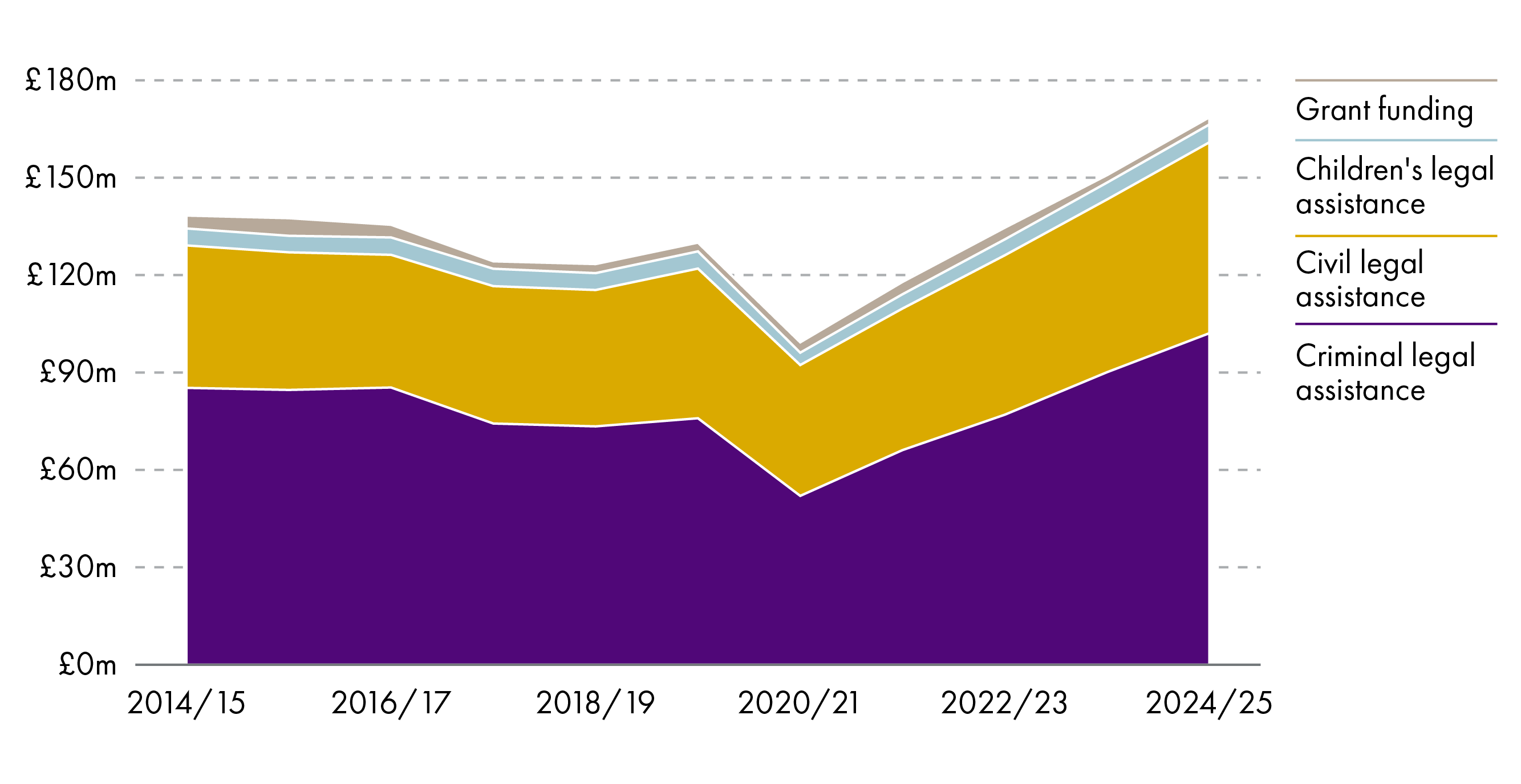
Scottish Legal Aid Board: Annual Report 2024-25 and Annual Report 2017-19
The figures above reflect the net cost of legal aid, i.e. after payments into the legal aid system from things like contributions from applicants have been deducted. This shows the actual cost to the taxpayer of legal aid.
The need for reform
The case for reforming Scotland’s current legal aid system has been building. The Scottish Government commissioned an independent review (published in 2018) which recommended radical restructuring to focus on service users’ needs. The Herald ran a series of articles at the end of 2024 which highlighted problems with current provision.
The Scottish Parliament’s Session 6 Equalities, Human Rights and Civil Justice Committee undertook an inquiry into civil legal assistance in 2025. One of its conclusions was that there were “legal aid deserts” – geographical areas or areas of law where accessing a legal aid solicitor was extremely difficult. The Committee found that these were having a serious impact on people’s ability to exercise their legal rights.
The Session 6 Scottish Government had promised legislation to deliver legal aid reform in its Programme for Government 2021-22. However, it accepted later in the Session that this would not be possible. Significant reform is expected in Session 7.
How to deliver reform?
Part of the problem is that legal aid reform is complex. The system we have is flexible but mainly unplanned. There are several different types of legal aid which apply differently in different circumstances. And making applications and getting payment is administratively burdensome.
How to match supply with demand?
The current system for legal aid delivery is called “judicare”. `Solicitors are paid fees for undertaking legal aid work, but there is no obligation on them to offer particular services or undertake a specified volume of work. There is some limited grant funding of advice services too.
The Scottish Government and Scottish Legal Aid Board would like to increase delivery options, including things like more grant funding or contracting with specific firms to deliver services. They argue that this would provide the tools needed to ensure that services are available where and when they are needed.
However, supporters of the current system note that it is flexible – with advice on any matter of Scots law covered – and independent of government direction. It also benefits from a “demand-led” funding model, meaning that the Scottish Government pays all fees validly incurred. Grant funding or contracting would involve a capped amount of money being directed towards the delivery of specified services. This introduces the risk that funding isn’t enough or services are poorly planned.
Which services should be covered?
Currently, legal aid is only available to solicitors (with some non-solicitor advice provision covered in grant-funded projects). However, advice services such as Citizens Advice Bureaux provide an important mechanism for people to resolve legal issues. In addition, they offer the potential to resolve some issues at an earlier stage, which will usually be more efficient.
And there could be advantages to throwing the net even wider. People in the criminal justice system need legal advice in relation to the charges they face. But they may also need access to health services or employment support.
Greater co-ordination between solicitor, advice and support services is likely to deliver better outcomes for service users. However, there is no clear model to achieve this and no clear system for allocating funding in a strategic way across the country.
How much to pay?
Fee levels are probably the most controversial issue in the current legal aid system. Solicitors argue that they are too low to make legal aid work viable, driving lawyers away from the system. In their view, this is the key factor in the existence of “legal aid deserts”.
However, the Scottish Government and Scottish Legal Aid Board point to a number of recent fee increases, including 13% due to come into force in September 2026. They argue that fee increases on their own do not provide a mechanism which guarantees the delivery of services. By this viewpoint, legal aid deserts are primarily caused because there is an inability to control where and how services are provided.
The 2018 review of legal aid recommended setting up an agreed process for fee review to take some of the heat out of this issue. The review group saw tensions around fee levels as damaging relationships between the government and the legal profession.
The idea was that the Law Society of Scotland and the Scottish Government would agree a mechanism by which fees should be calculated. This would be applied at regular intervals to keep fees up-to-date.
There have been several attempts to establish such a system. However, they’ve been beset with delays and disagreements. The Session 6 Scottish Government, the Law Society and other stakeholders have been working on the problem via an Independent Fee Mechanism Review Group, established in December 2025.
The Scottish Government’s reform priorities
At the end of Session 6, the Scottish Parliament agreed regulations which will increase legal aid fees (from September 2026) and significantly simplify the provision of criminal legal assistance (from December 2026). Criminal Legal Aid, which has more generous financial thresholds and simpler administrative systems, will become the main type of legal aid for all criminal court work.
In its most recent discussion paper on legal aid (February 2025), the Session 6 Scottish Government also set out its longer term priorities for reform. These were:
moving to a mixed model of service delivery – the Session 6 Scottish Government still saw a role for judicare, but this would be complemented by grant funding and contracting. Services would be “shaped by an evidence informed approach to assessing need, embedding the user voice, and designing services to focus on the effective delivery of outcomes.”
embedding user voice – the Session 6 Scottish Government also recognised the need to get service users involved in the planning and delivery of legal aid services. This is intended to improve responsiveness and cement their position at the centre of the system.
What to look out for in Session 7
Despite the Session 6 Scottish Government’s discussion paper, the wider shape and extent of reform proposals are unclear. With different stakeholder groups wanting different things, MSPs and committees will need to consider what trade-offs are appropriate to deliver a legal aid system fit for the 21st century.
Rising disability prevalence
Rob Watts, Senior Researcher, Financial Scrutiny
The number of disabled people in Scotland is increasing, largely driven by higher prevalence of mental health conditions. This poses important and complex questions for the Session 7 Scottish Government across different policy areas. How to improve outcomes for disabled people, such as economic, health and education outcomes? How to improve population health (particularly mental health)? And how to manage higher demand on the devolved social security system and public services?
Disability prevalence is rising faster in Scotland than the UK average
Official statistics on disability prevalence use a definition of disability that aligns with the Equality Act 2010. Survey respondents are asked whether they have a long-standing physical or mental health condition (lasting or expected to last 12 months or more) that limits day‑to‑day activities. Those who answer either “a lot” or “a little” appear as disabled in official statistics.
The share of Scotland’s working age population reporting a disability has increased from just under 20% in 2014 to 28% in 2025. This is approximately two percentage points higher than the UK average – a gap that has widened over the last decade.

When the data is broken down by different types of impairment, by far the biggest increase in prevalence has been amongst those reporting a mental health condition.
Another factor is demographic change. Scotland’s population is ageing faster than the UK average and disability prevalence tends to increase with age.
Analysis of official statistics suggests that increased awareness and reduced stigma around mental health conditions could be a factor in higher rates of disability. Nevertheless, the questions posed at the top of this section remain.
Outcomes for disabled people
A recent review of evidence by the Scottish Government highlights some of the inequalities and challenges faced by disabled people in Scotland.
In schools, for example, the review concluded that disabled children “may face higher exclusion rates, lower expectations for advance achievement, and challenges in transitioning to adulthood, including accessing employment, housing, and mental health services”.
In the workplace, disabled people earn on average 17% less than non-disabled people (a UK-wide statistic). The employment rate for disabled people in Scotland is 31.5 percentage points below that of Scotland’s non-disabled population. During 2021-2024, the poverty rate amongst disabled people was 23%, compared with 17% for those without disabilities. Research also shows that there are higher living costs for disabled people.
The most recent Scottish Crime and Justice survey shows that disabled people were more likely to experience crime than non-disabled people (23.5% and 18.6% respectively).
Improving these outcomes for disabled people is a longstanding issue, likely to be made more pressing with increased disability prevalence.
Fiscal implications of rising disability prevalence
Higher disability prevalence is creating higher demands on Scottish Government spending.
In part this is because disabled people are more likely to use health and social care services, which are by far the largest part of the Scottish Government’s spending budget.
But on top of this, disability and carer benefits were largely devolved in the Scotland Act 2016. The Scottish Fiscal Commission (SFC) forecasts that one million people will receive devolved disability benefits in Scotland by 2030-31. The increase in disability benefit recipients is seen across age groups.

Scottish Fiscal Commission: Fiscal Sustainability Perspectives: what Scotland’s finances mean for the next parliament – February 2026
This has important consequences for the Scottish Government’s fiscal position, as the SFC forecasts that the amount spent on devolved disability benefits will increase from £4.8 billion in 2024-25 to £7.4 billion in 2030-31.
Much of this increase will be funded by UK Government spending on equivalent benefits elsewhere in the UK, which results in a higher Block Grant for the Scottish Government. However, the extent to which per capita spending on devolved benefits rises faster in Scotland must be paid for from within the Scottish Budget at the expense of lower spending on other devolved areas or higher taxes.
It should be noted that whilst higher disability prevalence is a key factor driving the increased spending on disability benefits, policy choices made by the Scottish Government also matter. These choices include the rates of payment given to recipients (which the Scottish Government typically chooses to increase in line with inflation) and the eligibility criteria and application process for disability benefits.
Improving population health
As the number of disabled people in Scotland grows, improving outcomes for disabled people and managing the higher demand on Scottish Government spending are likely to be key issues in Session 7. But another aspect of this issue is understanding and addressing the reasons why disability prevalence is rising in the first place.
There is a large body of evidence that population health is determined by multiple policy areas beyond health policy. For example, economic security, the safety and quality of housing, environmental factors, community safety, and access to transport all affect health outcomes at a population level.
To conclude, rising disability prevalence presents the Session 7 Parliament with a growing challenge around improving outcomes for disabled people, whilst managing higher demand on budgets for devolved social security and public services. At the same time, decisions across multiple policy areas may affect the underlying causes of rising disability prevalence.
Neurodiversity in Scotland: challenges for public policy
Lizzy Burgess, Senior Researcher, Health and Social Care and Nicki Georghiou, Senior Researcher, Equalities and Human Rights
The number of people seeking assessments for neurodevelopmental conditions has surged recently. This is not unique to Scotland:
Every economically developed country in the world is facing the same need. No country predicted this need, no country prepared for it well and no country is managing the need particularly well just now..
Dr Jim Crabb, Royal College of Psychiatrists Scotland
Some health boards in Scotland have reported increases in the number of children waiting for a neurodevelopmental assessment of over 500% for children and 2,200% for adults since 2020. Long waits have also been reported for both children and adults, with some people waiting over five years to be seen. In some areas increased pressure has led to neurodevelopmental assessment only being available for adults eligible for referral to secondary mental health services. In March 2025, NHS Tayside announced that it is not taking new referrals for child neurodevelopmental assessments unless they met the CAMHS (Child and Adolescent Mental Health Service) criteria.
What is neurodiversity?
Neurodiversity is a term used to describe the variation of brain function and development across a group of people. Individuals whose neurocognitive functions (such as the ability to learn and use language, to regulate attention, emotions, impulses, social behaviours and processing sensory stimuli) fall within the usual range are described as neurotypical, while those whose functions fall outside that range are described as neurodivergent.
Neurodevelopmental conditions include autism and ADHD (Attention Deficit Hyperactivity Disorder) and frequently co-occur. Some people with these conditions lead fully independent lives, while others require varying degrees of support.
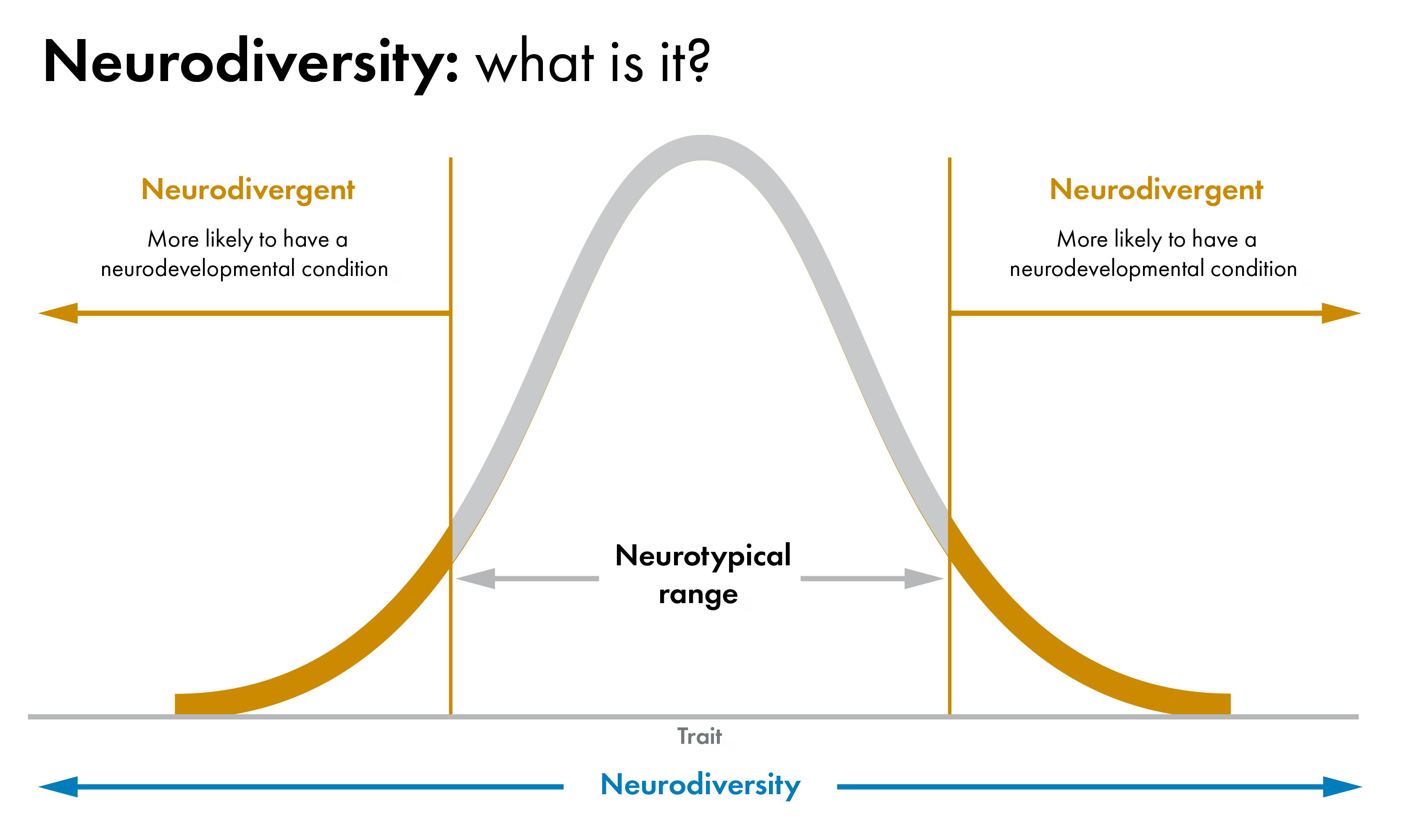
Adapted from Shah et al (2022).
Between 10 and 20% of people living in Scotland are believed to be neurodivergent. Neurodevelopmental conditions include:
Developmental Co-ordination Disorder (formerly known as dyspraxia)
Dyslexia and dyscalculia
Neurodivergence is not a mental health condition, but neurodivergent people are more likely to experience mental and physical health difficulties in their lives, in part due to the stigma and discrimination they experience. Because of these adverse effects, evidence suggests that autistic people and people with ADHD live on average for six to eight years less than their neurotypical peers.
Neurodivergence is a result of differences in brain function, rather than deficit, and many feel that neurodiversity is something that should be affirmed and celebrated, rather than treated or cured.
Waiting times
In March 2025, information gathered by the Health, Social Care and Sport Committee indicated that over 42,000 children and more than 23,000 adults were waiting for neurodevelopmental assessment across reporting health boards.
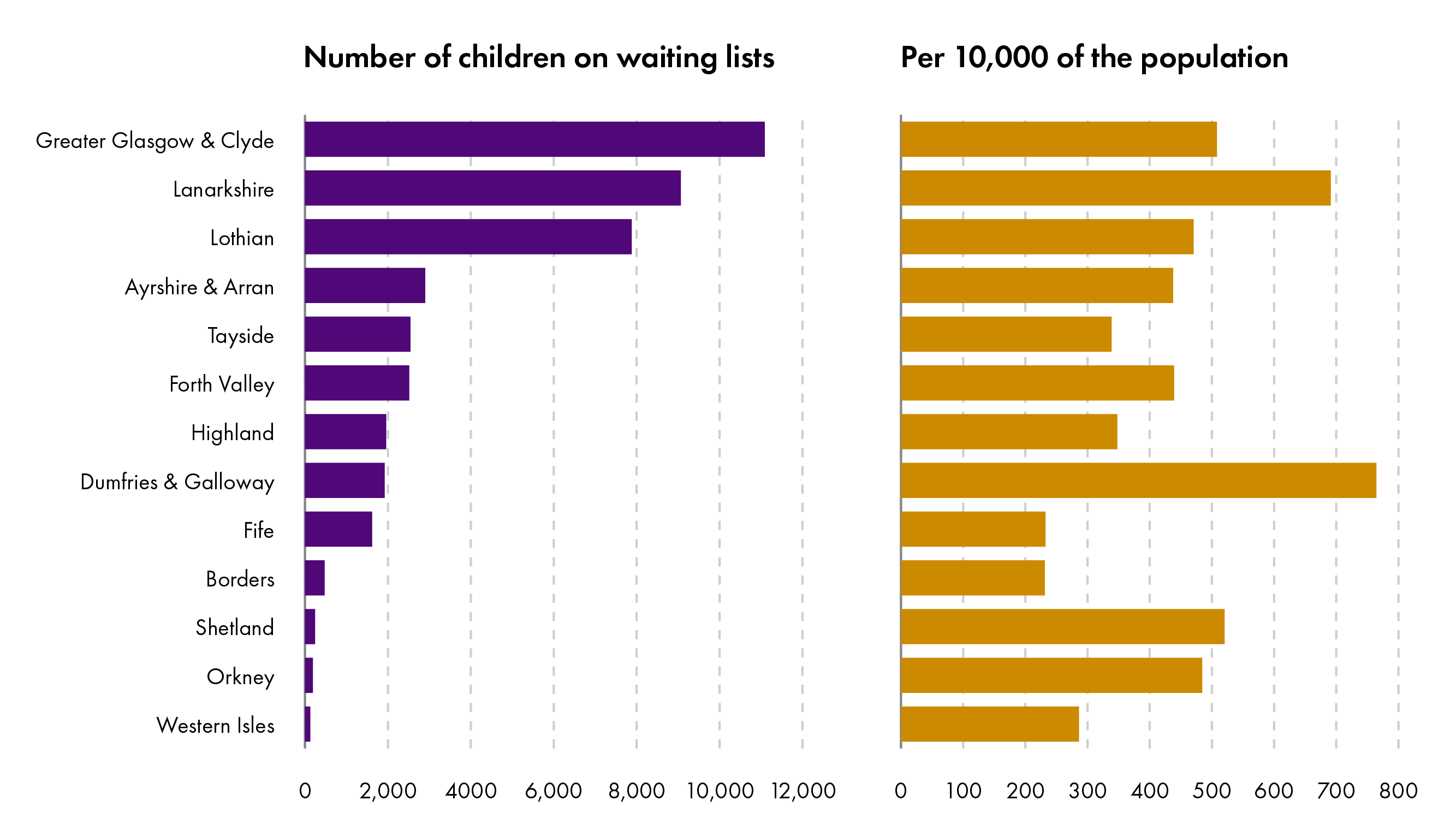
Health Board responses to Health, Social Care and Sport Committee, March 2025
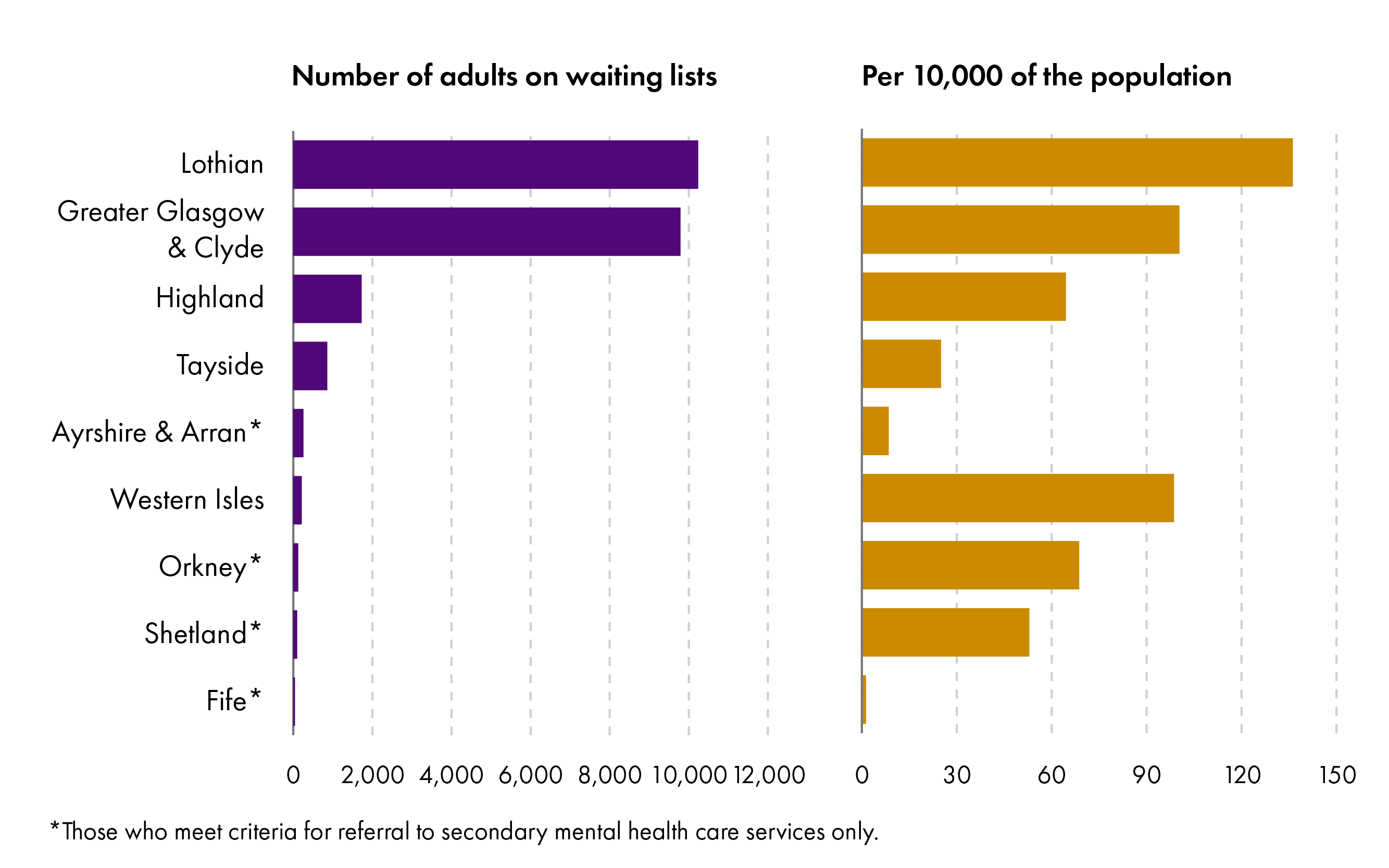
Health Board responses to Health, Social Care and Sport Committee, March 2025
In Session 6, the Minister for Social Care and Mental Wellbeing, said:
A traditional national health service waiting list approach is not sufficient. What is needed is a co-ordinated multi-agency response that focuses on timely, needs-based support and reflects the evolving nature of neurodevelopmental needs and the diversity of individual experiences.
Scottish Parliament committee scrutiny during Session 6
The next section provides a summary of the work of the Health, Social Care and Sport Committee and the Equalities, Human Rights and Civil Justice Committee on neurodiversity during Session 6.
Health, Social Care and Sport Committee
The Session 6 Health, Social Care and Sport Committee undertook an inquiry into ADHD and autism, pathways and support. The Committee report called for urgent action to deliver a national plan that ensures autistic people and people with ADHD can access clear, consistent pathways to support across every health board in Scotland. It made recommendations focusing on:
pathways to support
treatment thresholds and gatekeeping
open referral
waiting times
assessment process
diagnosis
private diagnosis and shared care
transitions
role of the third sector
need for a whole society approach
improved data.
Countering claims that neurodevelopmental conditions are subject to over-diagnosis, the report noted evidence that rising demand for assessments reflects historic under-diagnosis and improved understanding of these conditions. The report recognised that diagnosis can validate lived experience and help people access adjustments, support and medication.
Equalities, Human Rights and Civil Justice Committee
The Session 6 Equalities, Human Rights and Civil Justice Committee undertook an inquiry into Neurodivergence in Scotland. The inquiry was agreed to after the Committee heard evidence on the Session 6 Scottish Government’s decision to delay the Learning Disabilities, Autism and Neurodivergence (LDAN) Bill.
It focused on how neurodivergent people experience education, work, and the criminal justice system. It found:
there are big implementation gaps – where good laws and policies do not address people’s real-life experience
many people face long waiting lists, disbelief, stigma and inconsistent support.
A diagnosis can be crucial as it helps people to understand themselves, access medication, ask for reasonable adjustments, and build community. The Committee said that support should be available without a diagnosis, but the reality is that this is not happening, and this gap is harming neurodivergent people.
The Committee called on the next Scottish Government to prioritise neurodivergence through national leadership, mandatory training, consistent support and cultural change. It said it must work directly with neurodivergent people to meet their needs. Ultimately it called for a neuro-affirming Scotland where neurodivergent people can thrive.
Scottish Government approach
The Session 6 Scottish Government recognised the significant increase in demand for neurodevelopmental assessments and acknowledged that this created challenges for a range of services. It worked with health boards and local authorities to implement the National Neurodevelopmental Specification for Children and Young People and has taken steps towards developing a national Adult Neurodevelopmental Pathway with the National Autism Implementation Team.
The Scottish Government has provided targeted funding to support assessment and service improvement, including £3.4 million in 2025-26 and a further £7.65 million allocated within the 2026-27 mental health programme.
The Session 6 Scottish Government also committed to introduce a LDAN Bill in its Programme for Government 2021-22, to strengthen the rights of neurodivergent people and those with learning disabilities. However, in September 2024, a delay was announced, with the Government stating that it was “continuing to develop proposals for the Bill”.
On 18 March 2026, the Session 6 Scottish Government outlined proposals for potential Bill provisions, including:
a statutory definition of ‘neurodivergence’
a duty to publish a national neurodivergence and learning disabilities strategy, local delivery plans and statutory guidance
a duty requiring mandatory training for relevant employees in key public bodies
a broad right of access to advocacy.
The Session 6 Scottish Government said it recognises that legislation alone will not address all the challenges, and given the timing, it would be for a future government to decide on how to proceed.
Issues to consider during Session 7
Rising demand for support for neurodevelopmental conditions continues to exceed capacity, leading to long waits and unequal access to assessment and support. The evidence gathered by Scottish Parliament committees during Session 6 suggests the need for clearer national leadership, consistent pathways and improved data, as well as support that does not depend on diagnosis. The LDAN Bill proposed by the Session 6 Scottish Government could provide an opportunity to improve support for neurodivergent people in Scotland. These will be issues that Members and Committees may wish to consider during Session 7.
Approaches to palliative care policy
Sarah Swift, Researcher, Health and Social Care
The final days of the last session of Parliament saw the vote on the Assisted Dying for Terminally Ill Adults (Scotland) Bill. Although the Bill fell, the one area where there was consensus was on the need to improve palliative care services in Scotland.
Palliative care offers physical, practical, and emotional support to people living with a life shortening illness. It can be provided to anyone with a life shortening condition, at any point after diagnosis. It aims to support people with life shortening illnesses to live as well as possible.
End of life care, or “care around dying” as it is described in the Scottish Government’s Palliative Care for All strategy, is one element of palliative care. It is offered when a person begins the process of dying, and focuses on creating comfort for the dying person and those around them.
In Scotland, palliative care is offered by a range of health and social care partners according to patient needs and local provision. It can be delivered by specialist practitioners, or general healthcare professionals such as GPs. It may be delivered at home, in a care setting, a hospital, or a hospice.
Palliative care provision in Scotland
An estimated 56,416 people died with a palliative care need in Scotland in 2021, accounting for 89% of all deaths. The number of people dying with palliative care needs is projected to increase as Scotland’s population ages, and the number of people dying with multiple health conditions increases.
A 2021 study led by Marie Curie projected that by 2040, the number of people dying with palliative care needs in Scotland will be 14% higher than in 2017, with the largest increase in those aged 75 or over. The number of people dying with multiple health conditions is projected to increase by 82% compared to 2017.
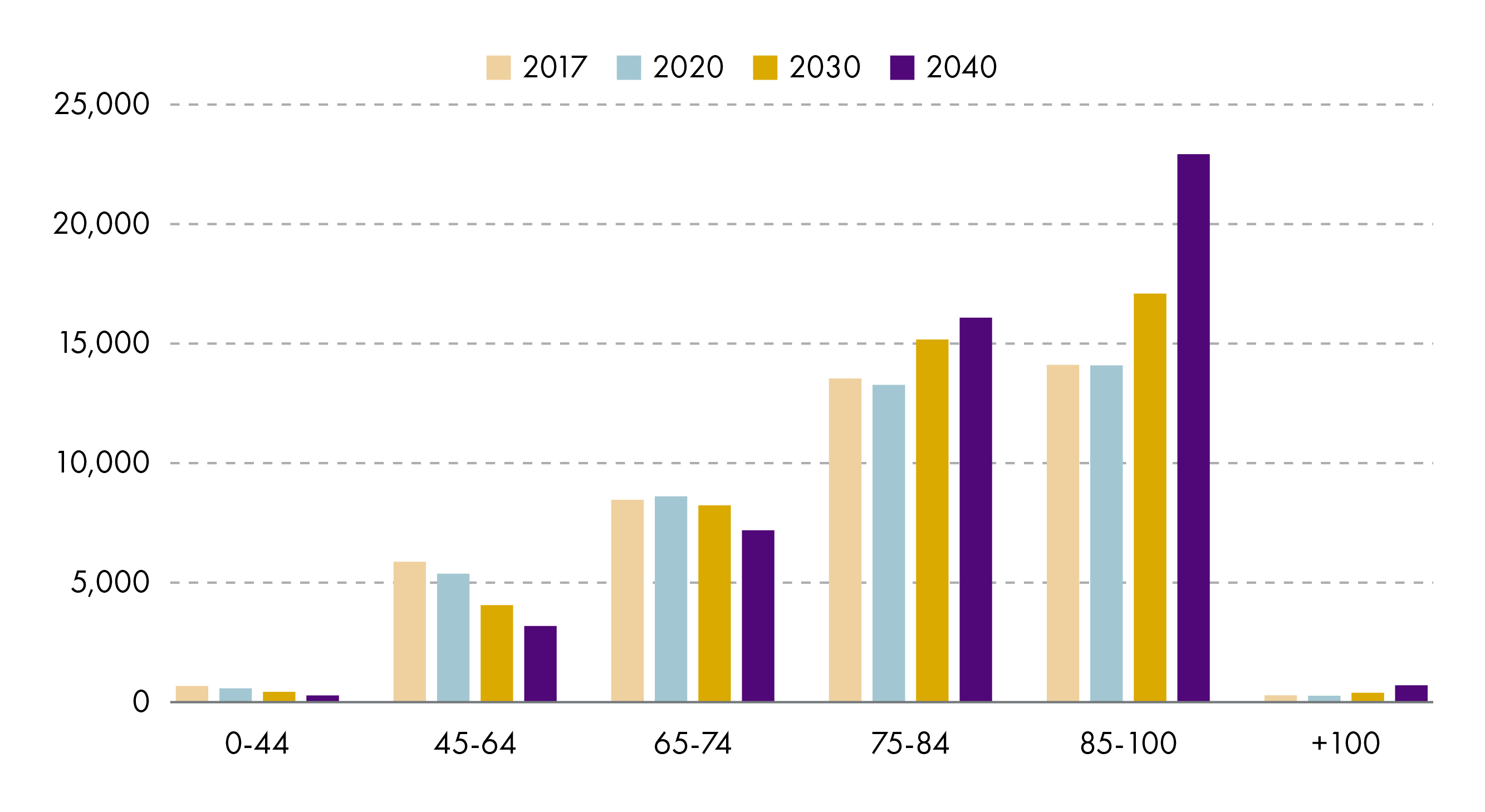
Finucane et al, 2021. Reproduced with permission.
Integration Authorities are responsible for planning and resourcing adult palliative care. Care may be delivered by a range of NHS, social care, third sector, and other independent partners. Children’s palliative care is provided by Health Boards, local authorities, Integration Authorities, independent hospices, and third sector organisations.
Unmet palliative care needs
Although a significant number of people dying in Scotland would benefit from palliative care, not everyone can access it. Marie Curie estimated that in 2022, 18,500 people – approximately one in three people who died in Scotland - had unmet palliative care needs, such as unaddressed symptoms or a lack of timely access to care.
Access to palliative care is affected by health inequalities. People experiencing poverty are less likely to receive the palliative care support they need, and may face additional challenges at the end of life due to financial hardship. People living in Scotland’s remote, rural, and island communities can experience difficulties in accessing palliative care. People from ethnic minority communities might be offered culturally inappropriate care, or struggle with language barriers. Some LGBTQ+ people may experience discrimination when seeking care.
People with dementia can face inequalities in access to palliative care. Although the number of people dying with dementia in Scotland has increased in recent years, the availability and quality of palliative care for those affected by the condition is variable. People with dementia should be as involved as possible in decisions concerning their end of life care. Advance care planning can help to ensure that a person with dementia’s perspective is considered when assessing their palliative care needs.
Legislative and policy context
Scotland does not currently have specific legislation concerning palliative care. In September 2025, the Session 6 Scottish Government published its first palliative care strategy for 2025-30. The Strategy has two overarching aims:
Enabling people and communities - Scotland is a place where people of all ages and their communities can help and support each other to live as well as possible with life shortening conditions, dying, death and bereavement.
Strengthening palliative care - People of all ages with life shortening conditions and their families and carers receive palliative care, care around dying and bereavement support based on what matters to them.
The Strategy is supported by an initial delivery plan, covering the period from 2025-28. The delivery plan lists 23 actions across six groups: enabling communities; delivering palliative care; future care planning; education and learning; data and experiences; and governance and reporting.
Palliative care funding
There is no current data on funding for palliative care in Scotland. The most recent source of official information on this topic is Audit Scotland’s 2008 report on palliative care. It noted that £59 million was spent on specialist palliative care in Scotland in 2006-07, and that almost half of this funding came from the voluntary sector. More recent data from England suggests that this pattern has continued.
Independent hospices receive some statutory funding from the Health and Social Care Integration Authorities, but rely on charitable donations for much of their income. Hospice care providers have cautioned that this model is unsustainable, and impacts their ability to meet increasing operational and payroll costs. The Session 6 Scottish Government took some steps to address this challenge, including allocating £2.9 million of funding in its 2026-27 Budget to enable independent hospices to achieve pay parity for staff with their NHS counterparts.
Funding challenges in palliative care featured prominently during Parliamentary scrutiny of the Assisted Dying for Terminally Ill Adults (Scotland) Bill. Some Members expressed concern that the introduction of assisted dying would exacerbate the challenges affecting palliative care services. Others argued that the two types of care could not be conflated. Though the Bill fell at Stage Three, the scrutiny process highlighted some of the issues facing palliative care funding.
Potential considerations for Session 7
In February 2026, the Scottish Parliament’s Cross-Party Group on Palliative Care published a report with recommendations for the next Scottish Government. The recommendations included:
Improvements to bereavement support
Establishing a legal right to palliative care
Supporting care homes to provide palliative care
Delivering a long-term, sustainable funding model for hospice care
Taking steps to address funeral poverty
Making palliative care education mandatory for health and social care workers who care for those with palliative care needs
Embed death and grief education into the curriculum
Improve mental health support for people accessing palliative care
Support GPs to improve their provision of palliative care services
Improve palliative care access for children and young people.
The impetus to improve palliative care is likely to feature strongly in the next session. This may come in the shape of new bills (either on assisted dying or palliative care specifically). Or it might be in the way of Committee scrutiny. Either way, the legacy of the assisted dying bill is unlikely to be forgotten any time soon.
Asylum policy and its impact on devolved issues
Nicki Georghiou, Senior Researcher, Equalities and Human Rights
Asylum is reserved. However, the operation of the UK asylum system has direct implications for devolved services in Scotland, including housing, homelessness, health, education and community cohesion.
An asylum seeker is a person who has applied for international protection because they fear persecution, conflict or serious harm in their country of origin and is awaiting a decision on that claim. Asylum seekers have limited entitlements while their claim is considered and do not have an automatic right to work. Refugees are people whose asylum claims have been accepted and who are granted leave to remain in the UK, with access to work, housing and mainstream benefits.
A survey commissioned by the BBC on voters’ concerns showed that ‘immigration’ was the fourth most important issue facing Scotland, although it does not distinguish between work, study and asylum migration. People seeking asylum only account for around 11% of overall migration to the UK.
Much of the recent debate in Scotland has focused on the use of hotel accommodation to house asylum seekers, often introduced at short notice with limited prior engagement with local communities. There have been protests outside some hotels, reflecting tensions around community cohesion as well as pressures on local services. In response, the Session 6 Scottish Government provided funding to support community cohesion, and has considered measures such as “buffer zones” around accommodation sites.
The National Audit Office estimates direct expenditure by the UK Government on asylum seekers of around £4 billion in 2024–25, largely driven by accommodation costs.
Recent UK Government changes have reduced the initial duration of refugee leave to remain from five years to 30 months, with settlement subject to review.
Asylum seekers currently receive £49.18 per week to meet essential living costs, or £9.95 per week where meals are provided in accommodation.
Devolution context
Immigration and asylum are reserved matters under the Scotland Act 1998. The UK Government is responsible for the UK’s policy on asylum, including the process for applications and the provision of asylum support and accommodation.
The Scottish Government and local authorities support asylum seekers and refugees in devolved policy areas, as set out in the Session 6 Scottish Government’s New Scots Refugee Integration Strategy: 2024, and its Delivery Plan 2024-2026. This includes health, education, social care and legal services, and housing, but not asylum accommodation.
UK picture: numbers, routes, and backlog
In the year ending December 2025, around 100,600 people claimed asylum in the UK, slightly fewer than the previous year but more than double the number in 2019.
Just over half of asylum seekers arrived via irregular routes, including small boats, and almost 40% entered the UK on visas before claiming asylum. The largest numbers of applicants came from Pakistan, Eritrea, Iran, Afghanistan and Bangladesh. Around three‑fifths of applicants were adult males, though women and children form a substantial minority.
At the end of December 2025, around 64,000 people were awaiting an initial asylum decision, a 48% reduction on the previous year. However, over a third had been waiting for more than 12 months. Delays remain a feature of the system, with implications for individuals’ wellbeing and for public services.
In November 2025, the UK Government set out reforms intended to reduce backlogs, strengthen decision‑making and increase removals, while maintaining a system described as fair and humane.
Asylum accommodation
Across the UK, just over 107,000 people were receiving asylum support at the end of December 2025, the vast majority of whom are housed in asylum accommodation, while a minority, around 3,500, receive subsistence support. This was 5% lower than the end of December 2024, and 14% fewer than the end of September 2023, when the number of supported asylum seekers peaked at around 123,700 people.
Asylum accommodation falls into three broad categories:
Initial accommodation, which is similar to hostel type accommodation.
Longer‑term dispersal accommodation, managed by an accommodation provider on behalf of the Home Office.
Contingency accommodation, including hotels, used when capacity is constrained. While overall numbers have fallen, the use of hotels continues.
The picture in Scotland
For around 20 years, Glasgow City Council was the only dispersal area for asylum seekers in Scotland. In response to increasing numbers and delays in processing claims, all 32 Scottish local authorities agreed to widen dispersal across the country.
As at December 2025, around 6,700 asylum seekers were supported in Scotland, around 7% of the UK total. The majority are housed in asylum accommodation, with around 270 in receipt of subsistence support only. Glasgow continues to accommodate the largest number, at just over half of all asylum seekers in Scotland.
The image below shows that most asylum seekers in Scotland live in dispersal accommodation. However, around 1,600 people were housed in hotel accommodation, with significant numbers in Aberdeen City, Aberdeenshire, Edinburgh and other areas. These are procured by the Home Office and managed by private providers. The uneven distribution of hotel accommodation has raised concerns for some local authorities and communities.
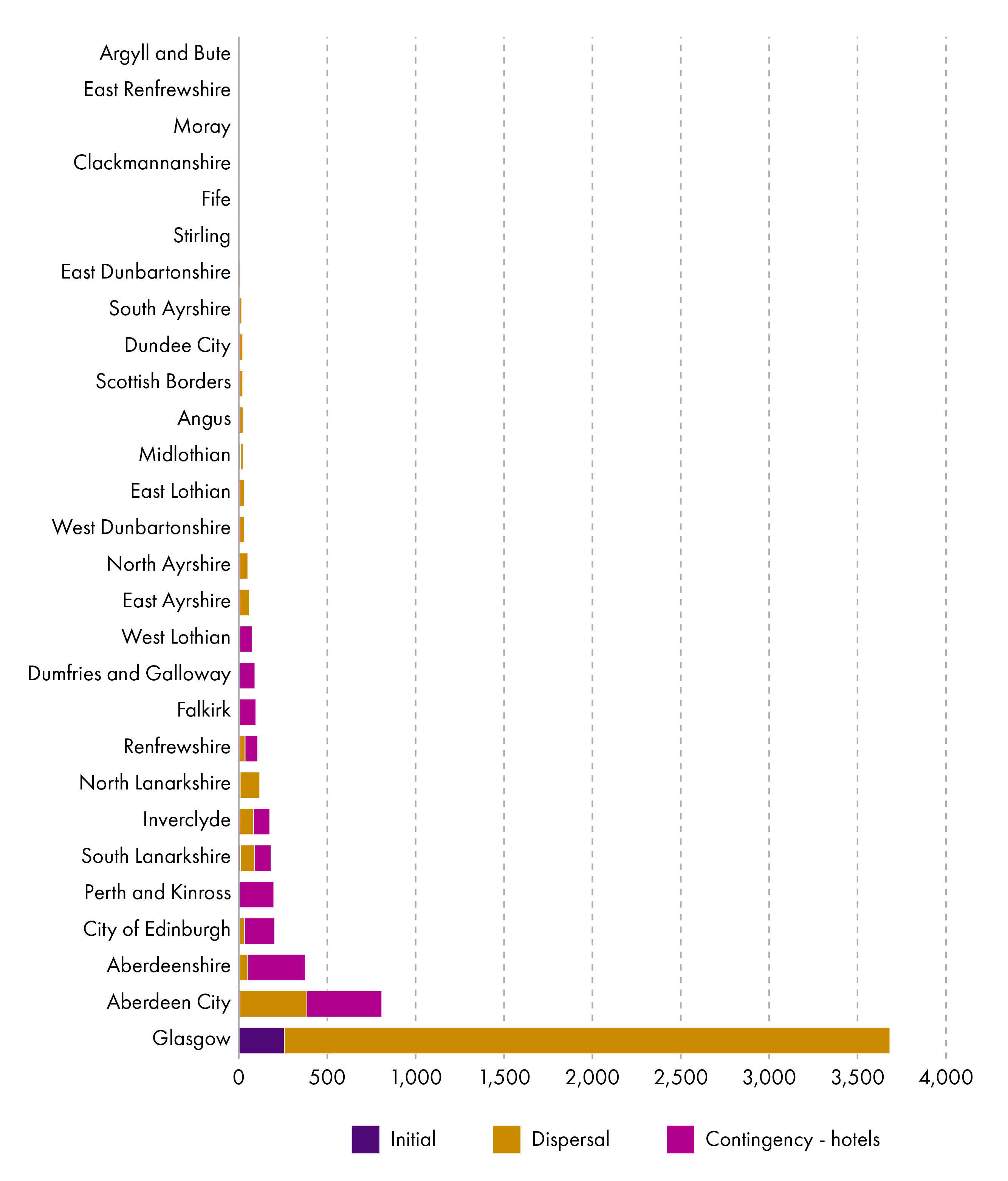
Impact on homelessness and housing
The impact on housing pressures in Scotland has been a focus of the debate on asylum seekers. Individuals granted refugee status must leave Home Office accommodation and are entitled to homelessness assistance from local authorities.
In November 2022, the Session 6 Scottish Government removed the ‘local connection’ rule for homelessness applications, allowing households to apply as homeless to any local authority. Some argue that this change has contributed to higher numbers of refugees making homelessness applications in areas with already stretched housing supply. The Session 6 Scottish Government stated that time spent in asylum accommodation does not establish a local connection for homelessness purposes and that the policy change is not driving these pressures.
Data show variation across local authorities, with Glasgow recording both high homelessness applications and a higher proportion of applicants with refugee status or leave to remain. Pressures can be particularly acute at the point when individuals are granted refugee status and must move on from asylum accommodation within 28 days although support can continue for up to 42 days in practice. This can particularly increase pressure on temporary accommodation. For example, Glasgow had just over 2,600 households with refugee/leave to remain status living in temporary accommodation at the end of September 2025, more than double the number two years previously.
The chart below illustrates homeless applications by local authority in 2024-25 and the number of applicants who have been granted refugee status or leave to remain.
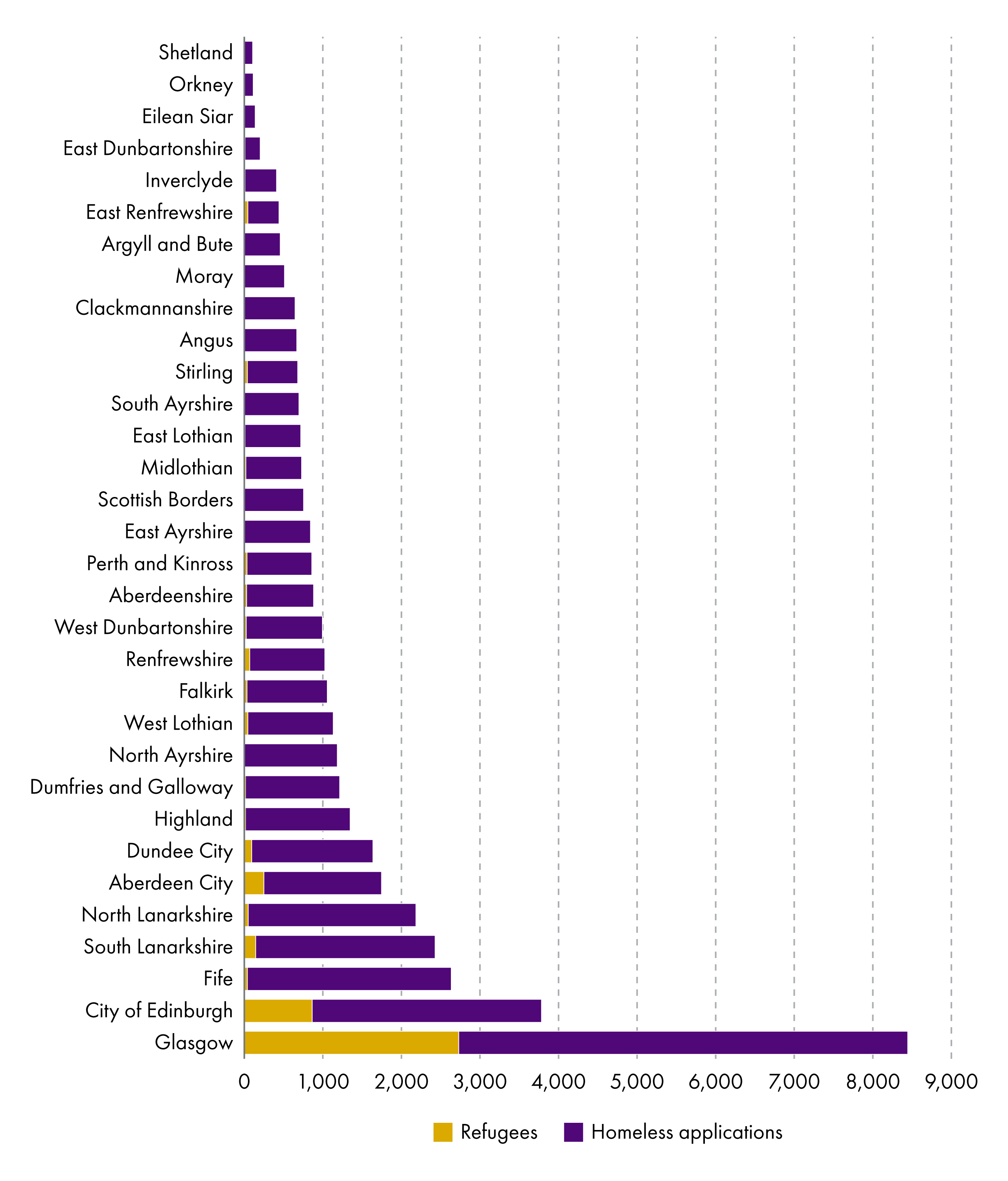
Scottish Government: Homelessness in Scotland 2024-25
What did the parties say in their manifestos?
Political debate in Scotland tends to focus less on asylum policy itself, and more on the impact on devolved services.
In their manifestos, Reform Scotland and the Scottish Conservatives highlighted the pressures on local communities and social housing, linking these concerns to the removal of the local connection rule and calling for local residents to be prioritised.
The Scottish Greens and Scottish Liberal Democrats focused more on what they perceived as wider policy failures, such as delays in the system and the use of hotel accommodation.
Scottish Labour and the SNP emphasised refugee integration and support.
Issues to consider for Session 7
While asylum policy is reserved, there is an impact on devolved services. The next Scottish Government and Parliament will need to find a way to address how the ongoing use of hotel accommodation affects community cohesion, and perceived pressures on homelessness and housing when refugee status is granted.
Scotland’s Housing Emergency – an end in sight?
Kate Berry, Senior Researcher, Housing
Having a safe, secure home is fundamental to every aspect of life and is recognised as a human right. Yet growing numbers of families and children are living in temporary accommodation, and some councils are now struggling to meet their legal duties towards people experiencing homelessness.
On 15 May 2024, the Scottish Parliament agreed to a motion supporting the declaration of a national housing emergency. Fourteen councils have also declared a local housing emergency, beginning with Argyll and Bute Council in June 2023, and most recently with Dundee City Council on 2 March 2026. Scrutiny of any measures to address the housing emergency and its consequences are likely to be a priority issue for Session 7.
Why has a housing emergency been declared?
There is no single agreed definition of a “housing emergency,” but common themes include:
increasing pressure on homelessness services
rising numbers of people in temporary accommodation
a shortage of affordable homes alongside long waiting lists
A range of factors have contributed to the situation, including the rising cost of living and higher construction costs. Evidence to the Session 6 Local Government, Housing and Planning Committee suggested that the crisis has been decades in the making, driven by long‑term structural issues such as wages failing to keep pace with house prices and rents.
Each council has its own reasons for declaring a housing emergency in its area reflecting local pressures. For example, Glasgow City Council has referred to pressures on the homelessness system arising from the UK Government’s streamlined asylum process. Aberdeen City Council has cited the presence of Reinforced Autoclaved Aerated Concrete (RAAC) in some homes in its area.
What are councils doing to address housing emergencies in their areas?
Local responses vary, but many councils have developed action plans. Common measures include:
prioritising the repair and re‑letting of empty or void properties
purchasing existing homes to increase supply
strengthening homelessness prevention services
adjusting allocation policies
For example, the City of Edinburgh Council has suspended its usual council house allocation policy until 2027 to focus on reducing homelessness.
What did the Session 6 Scottish Government do in response to the housing emergency?
The Session 6 Scottish Government’s initial response was largely based on existing actions with additional money for councils that were experiencing the greatest homelessness pressures.
After some criticism that the Scottish Government’s response did not adequately reflect a response to the “emergency” situation, in September 2025, the newly appointed Cabinet Secretary for Housing published a national Housing Emergency Action Plan. This plan is built on three strategic objectives:
Ending the practice of children living in unsuitable accommodation – as a vital part of the determination of previous Scottish Governments to eradicate child poverty.
Supporting the housing needs of vulnerable communities.
Building our future – maximising investment in Scotland’s Housing Emergency.
Short-term actions include, for example:
increased funding for social landlords to buy existing homes
encouraging councils to convert (“flip”) suitable temporary accommodation into permanent homes
boosting the Discretionary Housing Payments budget.
Longer-term actions include:
a new all tenure housing delivery ambition
new homelessness prevention duties
increased investment in affordable housing supply.
Importantly, the 2026–27 Scottish Budget prioritises affordable housing, with £926 million allocated and a commitment to £4.1 billion of public sector investment over four years. Social landlords have stressed that long-term certainty of funding is essential for planning new homes.
In January 2026, the Session 6 Scottish Government also announced a new national housing agency, More Homes Scotland. Expected to be operational in 2028-29 the agency will have a, “focus on simplicity, scale and speed to enable the delivery of housing of all types, helping to meet housing need across Scotland.”
What’s been the impact and what next?
The national and local housing emergency declarations have brought greater attention to the housing crisis.
There’s not any defined way of measuring whether we are out of an emergency, although fewer households living in temporary accommodation and increases in affordable housing supply are key aims.
Progress so far appears mixed. As of September 2025:
homelessness applications had fallen by 2% over the year
the number of households in temporary accommodation continued to rise
the average time spent in temporary accommodation remained unchanged.
On affordable housing supply, work continues toward the Session 6 Scottish Government’s long-term target of delivering 110,000 affordable homes by 2032.
Investment has helped increase the number of social homes, and Scotland continues to deliver affordable housing at a higher rate than other UK nations. However, stakeholder groups have argued for increased ambitions in delivery. But based on current approval and construction levels, meeting the 110,000 target may itself prove difficult. By the end of December 2025, 30% of the target had been completed (see the images below).
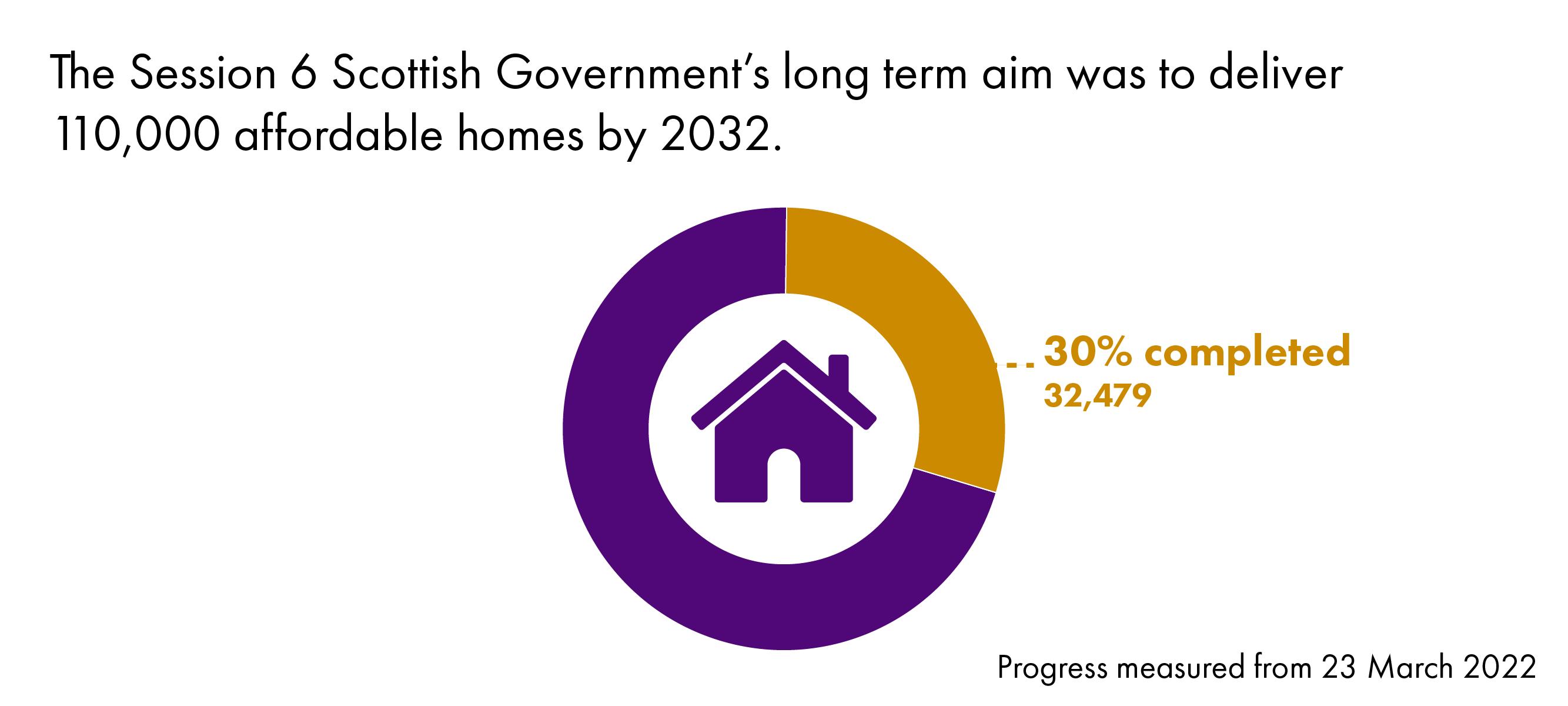
Scottish Government: Affordable Housing Supply Programme Statistics
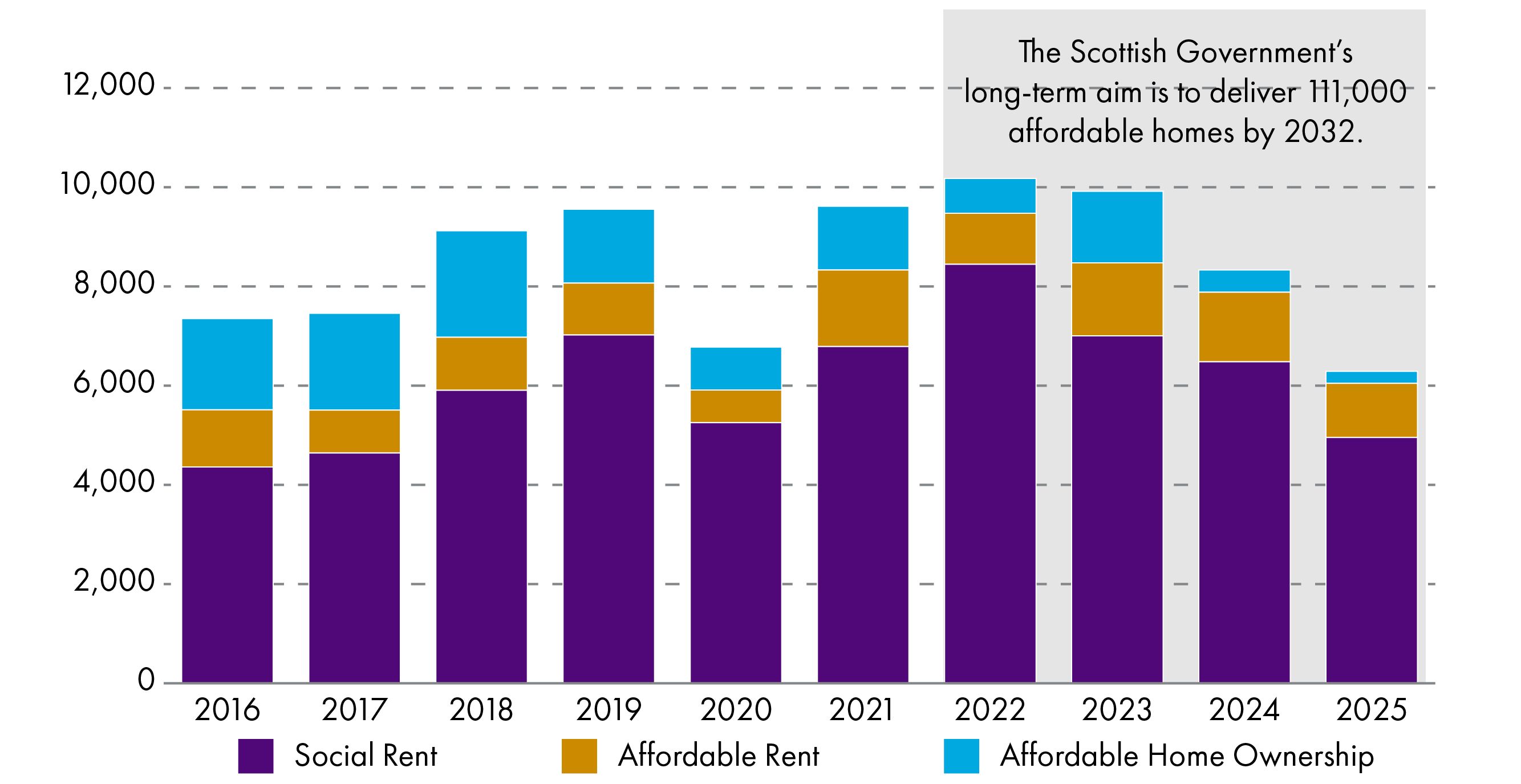
Scottish Government: Affordable Housing Supply Programme Statistics
Despite the increased budget challenges remain. These include increasing costs of building and a lack of labour and materials, particularly in rural areas. Social landlords also face a range of competing demands, including investing in retrofitting their own stock while keeping rents affordable.
The previous Cabinet Secretary for Housing reaffirmed the government’s commitment to the target and acknowledged the challenges to delivery:
Achieving that involves everything that I have mentioned: increasing the affordable supply programme; giving four years of funding certainty, to allow RSLs, councils and others to plan; setting the all-tenure target; and making sure that planning is a facilitator, not an inhibitor. It is all those things, as well are trying to build up the capacity to where we need it to be, because the curve is steep.
Conclusion
Ongoing scrutiny of the situation is likely to be important in the new session. The previous Local Government, Housing and Planning Committee legacy report recommended any successor committee should continue to monitor what progress is being made by the Scottish Government and local authorities to ease the pressures on housing availability and affordability.
Environment, Natural Resources and Rural Affairs
This theme focuses on the approach to meeting targets to achieve Net Zero by 2045, how Scotland might adapt to climate change and work to halt nature decline. It also looks at the development of a circular economy, the considerations informing a new agricultural policy for Scotland and how the approach to land reform might evolve. Finally, it looks at fisheries and marine policy.
The approach to net zero in Scotland
Niall Kerr, Senior Researcher, Climate change and net zero
In 2019, the Scottish Government set a target of net zero greenhouse gas (GHG) emissions by 2045. In 2024, the targets for emission reductions between now and 2045 were made slightly less ambitious and a system of 5-year carbon budgets was introduced.
Between 1990 and now, Scotland has managed to reduce its territorial emissions by about half. Since the first climate legislation in 2009,roughly two thirds of emission reductions have resulted from the closure of electricity power stations like Cockenzie and Longannet. Further reductions have come via efficiency improvements in vehicles, and home heating systems.
The next parliamentary session roughly aligns with the Government’s first 5-year carbon budget (2026-30). This Key Issue considers potential developments in Scottish emission reductions and government policy in this period along with identifying opportunities for parliamentary scrutiny.
The pursuit of net zero in Session 7
The final version of the Scottish Government’s latest Climate Change Plan (CCP) was published on 24 March 2026, at the very end of Session 6. Annex 3 of the Plan sets out the emission reductions that the Scottish Government expect to result from their policies in this period.
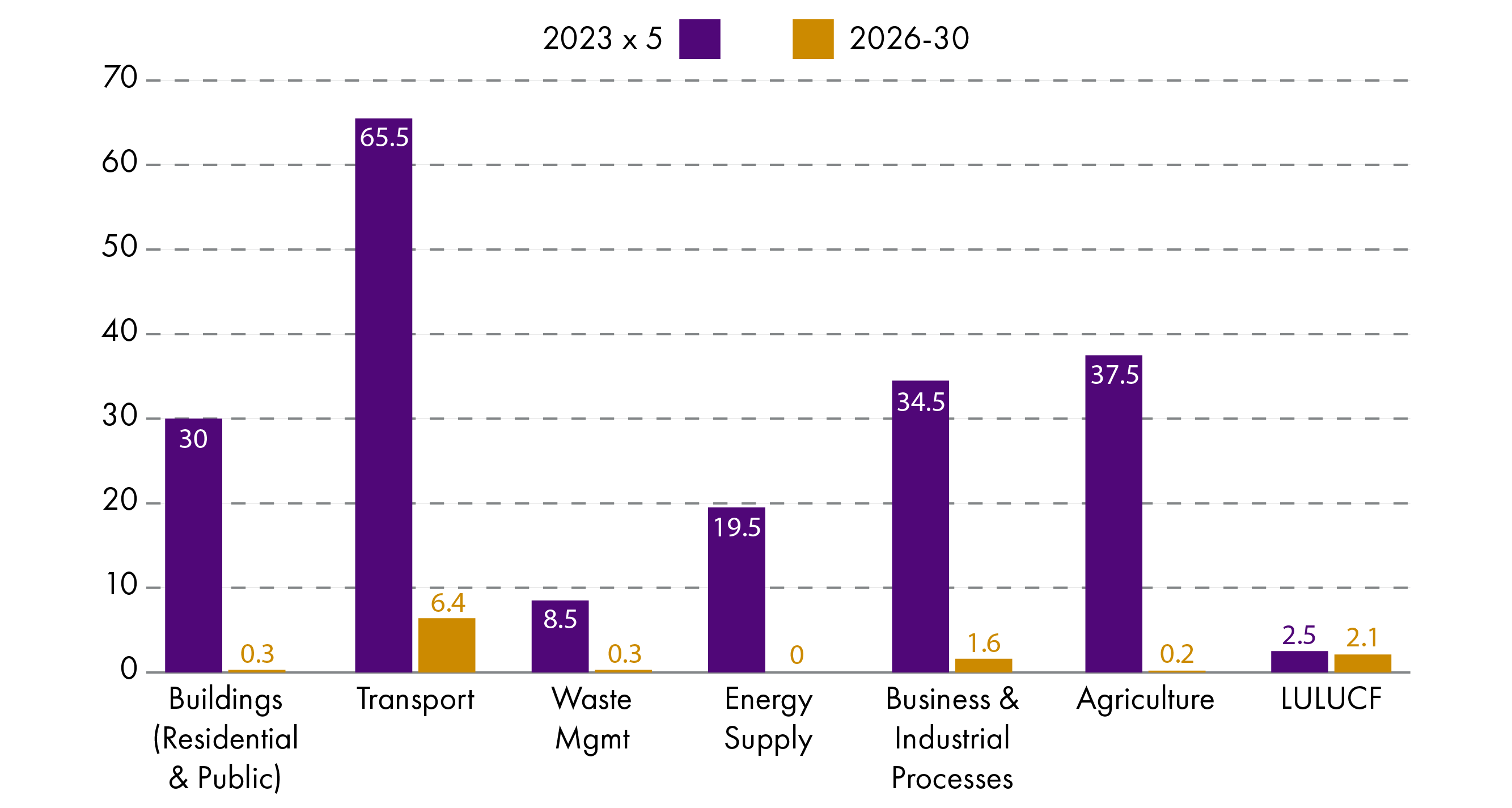
Scottish Government: First set of emissions Scottish Greenhose Gas Statistics and emission reduction data from the final Climate Change Plan (2026)
Note: the chart above represents current emissions using 2023 and multiplying it by five to make it equivalent to the forthcoming first 5-year carbon budget. We have chosen not to use the period 2019-23, as emissions in this period were significantly impacted by the consequences of the covid-pandemic, and using 2023 was considered a better representation of current emissions (even though a single year will be subject to annual fluctuations).
It is important to note that the planned emission reductions from the policies set out in the CCP only tell part of the story. There are significant UK policies that will affect emissions and non-policy factors e.g. the wholesale cost of energy, and behavioural and cultural changes that may also have an impact.
It is also worth noting that the approach in the CCP has been described as ‘delay and catch-up’ by the Climate Change Committee (CCC) due to their view that less is planned in the coming five years with more effort expected in the 2030s. The nature of emission reduction action has often been to prioritise the easier, ‘lower hanging fruit’ meaning that the more difficult actions are left to later.
Transport
Transport is the largest emitting sector and future emission reduction policies are listed in the latest CCP. These include those related to reducing car use and those that incentivise public transport. Policies include the highly significant UK Government policy, the Zero emission vehicle (ZEV) mandate which if implemented as planned will require 80% of new cars sold in Britain to be zero emission by 2030. In Scotland, as SPICe has highlighted, nearly 90% of transport emission reductions in 2026-30 are expected to come from electric vehicles. Alongside plans for zero emission vehicles, there is a new Scottish Government car use reduction target of 4% by 2030 .
Land use
The Land Use sector is different from other sectors as it is a mix of emission sources like degraded peatland and emission sinks like forestry. This means the overall emissions can seem low, but it is a critical sector with the potential to both reduce and sequester (capture and store) emissions. The final CCP has emissions sources falling slightly in 2026-30 but sequestration from trees is also reducing. This fall in emissions removed in the coming years is the result of lower levels of tree-planting historically; increased planting more recently is expected to increase sequestration. There have been concerns about a reduction in the funding available for tree planting in recent years, and while peatland restoration was at an all-time high in 2024-25, it needs to increase substantially to achieve the targets set.
Agriculture
In Agriculture, very little emission reductions are imagined in the next five years with the Scottish Government pledging to ‘not bring forward policy to reduce livestock numbers’. This is an area where non-policy factors can have a significant bearing on emissions, with changing diets and agricultural economics influencing livestock numbers. Like various other climate-linked policies, a new Rural Support Plan was published at the end of Session 6 without any opportunity for parliamentary scrutiny. Relatedly, Scotland’s first Good Food Nation Plan was published in December 2025; it outlines that delivering emissions reductions in agriculture is one component of Scotland’s ambition to become a Good Food Nation.
Business and industry
In Business and Industry, much of the debate around emissions relates to the extent that reductions are being driven by deindustrialisation with the recent closures of Grangemouth refinery and Mossmorran ethylene plant. The ability of Scottish industry to be globally competitive, and the impact that net zero policy and wider factors (such as the Iran war) have upon this, will be persistent topics of debate in Session 7.
Energy supply
Linked to this is Energy Supply, which has been a central theme in the 2026 election. The Scottish National Party manifesto pledged to formally request the ‘transfer of energy powers from Westminster to Holyrood’. Crucially the UK Parliament would need to agree to any such transfer. The main remaining sources of emissions from electricity supply are the Peterhead gas plant and energy from waste (EfW) plants. The CCP models that the Peterhead plant continues emitting at existing levels throughout the next session as do the EfW plants.
Plans for a replacement gas plant at Peterhead that is fitted with carbon capture and storage (CCS) technology were submitted to Scottish Ministers in 2022. The CCP models that this project goes ahead and that the required CCS project – Acorn – comes online in 2032. The UK Government have pledged to make a final investment decision on Acorn during this UK parliamentary term i.e. by 2029.
Alongside the cessation of the remaining emissions, there are many planned renewable energy developments. The Scottish Government has 2030 targets for onshore wind (20GW, up from 10.4GW currently), offshore wind (8-11GW up from 4.2GW) and solar (4-6GW up from 0.8GW). There is also potential for the subject of new nuclear power plants in Scotland to get the attention of members in Session 7.
Buildings
The decarbonisation of Buildings heating is an area in which there has been a notable recalculation from the Scottish Government in recent years. The 2020 CCP update planned for roughly half of Scottish homes to be using low carbon heat by 2030. The 2026 CCP models very little movement in heat decarbonisation with this a particular area of criticism from the CCC. A new Heat in Buildings Strategy and Delivery Plan has been promised by the end of 2026.
Net zero beyond emissions
Beyond reducing emissions, net zero is important in a number of different ways. The potential economic and employment benefits are considered in the Green Industrial Strategy published in 2024, with the impact on jobs and economic growth from the planned expansion in renewable energy likely to be a topic of parliamentary scrutiny.
Critical to the delivery of net zero is the perception of the Scottish public as to whether the approaches taken are the correct ones. A Climate Change Public Engagement Strategy was published in 2021, had a mid-point review in 2025 with the delivery period ending in 2026. There is also a critical connection between reducing emissions and efforts to improve the natural environment. Major workstreams in the Biodiversity Delivery Plan include a target to effectively protect 30% of land and sea by 2030, and a planned programme of ecosystem restoration, which offer opportunities for nature-based solutions to climate change.
Potential net zero developments in Session 7
Session 6 saw parliamentary attention to net zero initially at high levels only for interim targets to be revised and a whole Session to pass before an emission reductions plan (the CCP) was produced. While some of the optimism around net zero in Scotland has lessened, the severity of the task remains essentially the same. Session 7 will involve highly consequential decisions and developments on the Acorn CCS project, the roll-out of electric vehicles and renewable energy, and the economic implications of emission reduction.
Climate Change - Scotland's approach to adaptation and resilience
Niall Kerr, Senior Researcher, Climate Change and Net Zero and Dr Andy Russell, Thematic Research Lead on Climate and Environment, seconded to the Scottish Parliament
Climate change as a political issue can be roughly divided into climate change mitigation i.e. efforts to reduce greenhouse gas (GHG) emissions and reduce the level of change, and climate change adaptation, or how we adjust to be ready for the effects of climate change.
The topic of how emissions are being reduced in Scotland is covered in the section on net zero emissions, while the section below covers overall global efforts to reduce emissions, the expected resulting levels of climate change in Scotland and the efforts to adapt to these. With the impacts of climate change increasingly recognised and the rate of change at its highest ever level, the consequences of a changing Scottish climate are of relevance to a wide variety of policy areas in Session 7.
Global emissions and climate change overview
The level of climate change in Scotland is dictated by the global level of GHG emissions. At the beginning of Session 6, the Scottish Government had recently declared a ‘climate emergency’, and the COP26 climate negotiations were being held in Glasgow. As a result of these events, there was much interest in Session 6 of the Scottish Parliament in the global effort to reduce GHGs and what Scotland’s role in this might be.
Globally, GHG emissions rose through the 19th, 20th and early 21st centuries, are now at their highest annual levels and are still rising. The world is already more than 1°C warmer on average than it was before industrial times, owing to GHGs released from human activities. As a result of record emission levels in recent years, the rate of warming rose from under 0.2°C per decade from 1970–2015 to about 0.35°C per decade over the past 10 years. At this rate, the Paris Agreement target (2015 multinational agreement to limit climate change) of 1.5oC will be breached this Session (around 2030).
A possible turning point may, however, be reached during Session 7 with global annual emissions predicted to possibly plateau and begin to fall in the coming years. The latest data from the world’s biggest emitting country – China – has seen emissions roughly flat in 2024 and 2025. The world’s second biggest emitting country – the USA – has, however, recently left the Paris Agreement which seeks to limit global temperature increase.
While the current level of warming is around 1.3oC (above pre-industrial levels), the most recent UN Emissions Gap report sets out that existing policies will result in 2.8oC of warming by the end of the century. Although, the level of future change is uncertain - affected by government policy, technology development and possible cultural changes - the changing climate is something that governments need to plan for and adapt to. The Climate Change Committee (CCC) asks UK public authorities to prepare for 2oC by 2050 and actively assess the risks of 4oC beyond this.
Climate change adaptation policy in Scotland
In Scotland, planning for the impacts of climate change has been a statutory requirement since the 2009 Climate Change (Scotland) Act. The 3rd Scottish National Adaptation Plan (SNAP3) was published in 2024. SNAP3 aims to manage the risks outlined in 2022’s 3rd UK Climate Change Risk Assessment (CCRA3) and to build on the CCC’s assessment of Scotland’s 2nd adaptation plan. The Session 6 Scottish Government’s SNAP annual progress report in June 2025, showed that some SNAP3 milestones have been achieved (e.g. publication of Scotland’s first Flood Resilience Strategy) and indicator updates have been published.
In Session 6, climate change adaptation fell within the remit of the Net Zero Energy and Transport committee. Although the Committee did not carry out a dedicated piece of work on the topic, evidence sessions were held with climate scientists and with the CCC adaptation team, as part of wider climate scrutiny. Seasonal instances of extreme events like flooding, drought and wild-fires will likely focus attention on the changing Scottish climate and there are various events and publications coming in Session 7 which could present an opportunity for scrutiny.
CCRAs are due from the CCC in 2026, and the UK Government in 2027. The next CCC assessment of adaptation progress in Scotland is scheduled for ‘the second half of 2026’. A Scottish National Adaptation Plan 4 (SNAP4) is due in 2029.
Climate change impacts in Scotland
As highlighted, the Scottish climate has already changed and will likely continue to do so in the coming decades. Below are some of the key impacts happening now and in the predicted future, as well as some of the issues that make adapting to change a challenge.
Flooding

First chart from Climate Change Committees (CCC) 2022 assessment of Scotland climate adaptation planning. Second from Audit Scotland's Flooding in Communities report. Third from an attribution study by the British, Irish and Dutch Met Offices. Final chart from CCC's various reports.
Extreme heat and water scarcity
May 2024 was the warmest May in the UK since record taking began in 1884. An attribution study found that these temperatures were made 6 - 14 times more likely by the current climate relative to a pre-industrial climate.
Dry conditions in 2024-25 also led to significant water scarcity last summer, particularly in eastern Scotland. By 2050, Scottish Water projects a national deficit of 240 million litres of water per day during drought conditions if services are not adapted. Actions may be required to improve water efficiency and reduce consumption. Scottish Water forecasts that the funding needed to deliver sustainable services over the next 25 years could be approximately double what it is today (around £50 billion).
Food Security
The UK imports around 40% of its food. A study from the Barcelona Supercomputing Centre found various examples of extreme weather driving food price inflation. In the UK, potato prices increased 22% (from Jan to Feb 2024) following extreme winter rainfall that was made 20% heavier and 10 times more likely by climate change. The 2022-2023 drought in southern Europe, for which climate change contributed for more than 30% of the drought intensity, increased olive oil prices 50% year-on-year.
With respect to domestic production, the amount of high quality agricultural land at risk from fluvial (river) flooding will increase by 26% by 2050.
Potential Parliamentary focus during Session 7
Parliamentary scrutiny of climate adaptation could involve time spent considering the overall approach during the run-up to the publication of SNAP4, possibly in early 2029. Other opportunities include the annual June publication of the adaptation monitoring and evaluation framework. As highlighted, a changing climate will affect a wide variety of areas. For example, any consideration of the ‘cost of living’ challenges could consider the effects on food prices. Consideration of the security of supply for the various utilities - water, energy, waste etc.- should also take onboard how the climate might change in the decades ahead.
Can the decline of nature be halted by 2030?
Alexa Morrison, Senior Researcher, Environment
Healthy ecosystems support human wellbeing in many ways. They support food production, reduce flood risk, improve air quality, protect coasts, support public health through access to greenspace, and store carbon helping to mitigate climate change.
Nature is depleted - in Scotland and globally
Scotland is considered one of the world’s most nature-depleted countries. The 2023 State of Nature Report for Scotland found that, since 1994, species abundance in Scotland has declined on average by 15%. One in nine Scottish species are thought to be threatened with extinction. Despite progress in some areas, it showed that Scotland’s nature “continues to decline and degrade.”
How the Scottish Government seeks to tackle and halt the trajectory of nature loss in Scotland will be an issue the Scottish Parliament might focus on during Session 7.
Scotland is not alone in facing the challenge of nature decline. The landmark 2019 UN ‘IPBES’ review (by the Intergovernmental Science-Policy Platform on Biodiversity and Ecosystem Services) found that nature is declining globally at an unprecedented rate, often termed the "nature crisis" (see Figure 40 below).
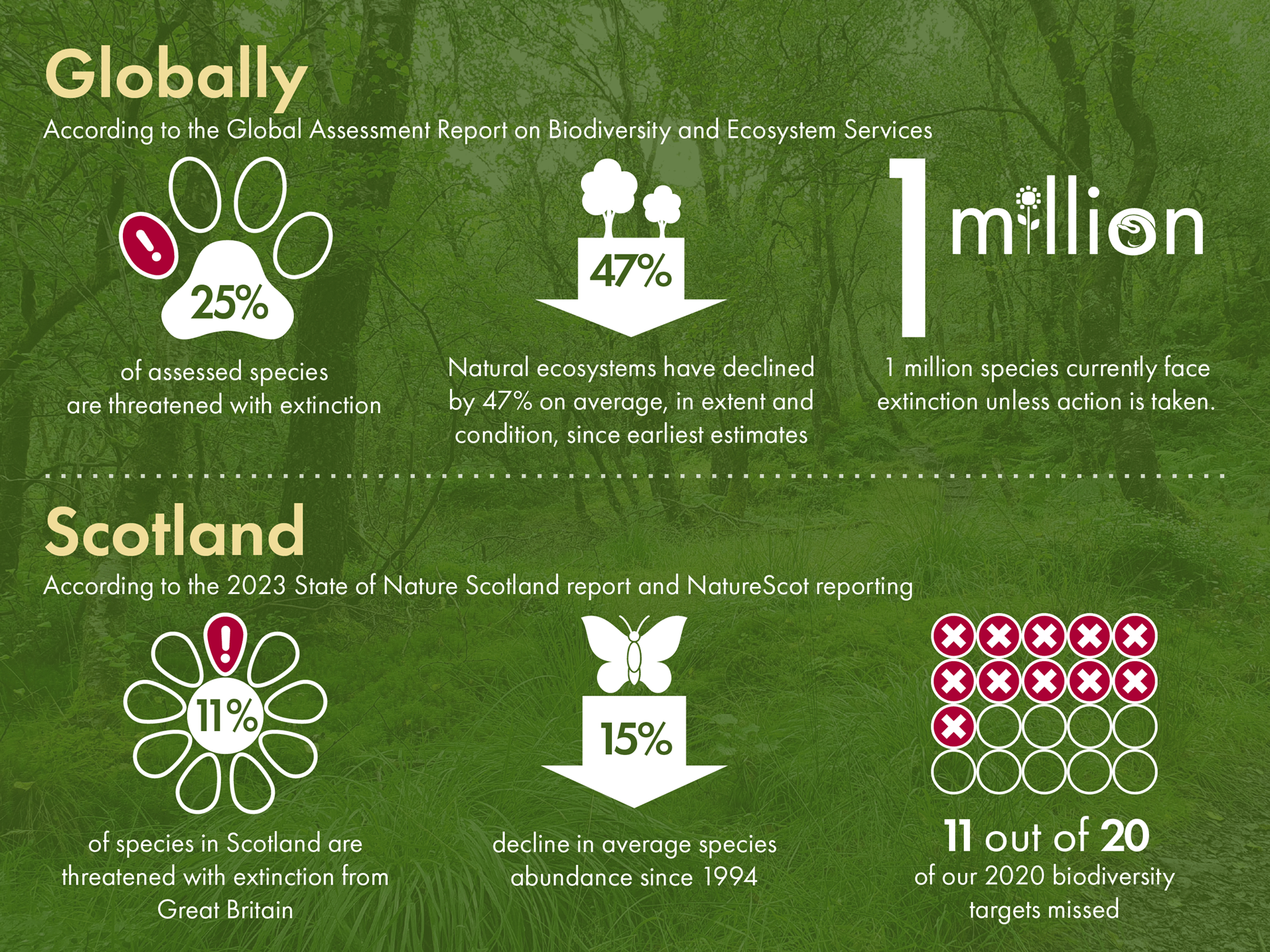
The key drivers of biodiversity loss in Scotland are summarised in the image below and include agricultural and fisheries management, climate change, invasive species, pollution and development. Consumption in Scotland – of imported products and materials - is also driving nature loss in other countries, through supply chains linked to pollution, habitat loss or unsustainable extraction.
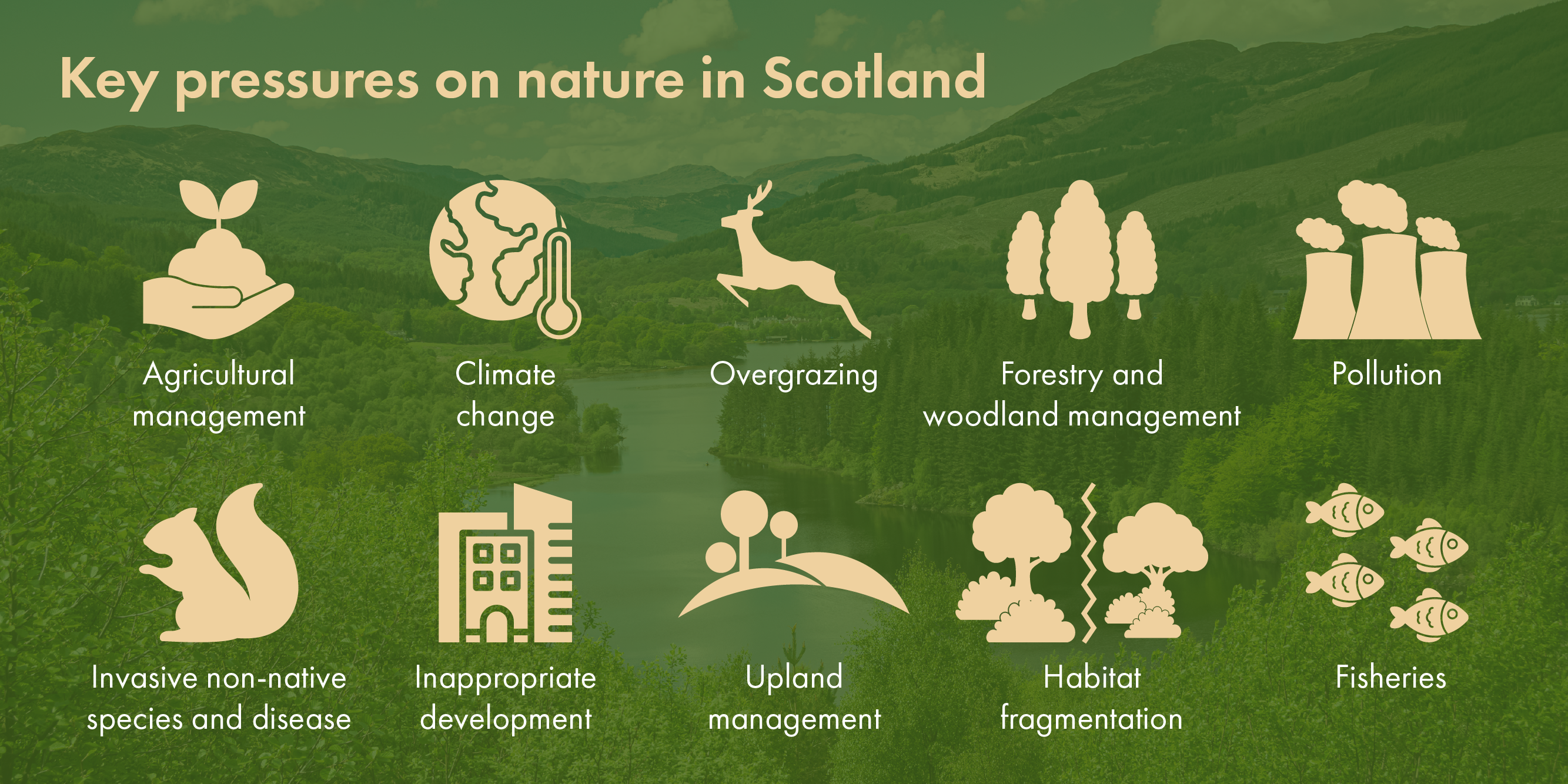
The IPBES review found that it was not too late to tackle biodiversity loss, but "transformative change" is needed. That conclusion was echoed by a 2021 review of the Economics of Biodiversity ('the Dasgupta review') which found:
Biodiversity is declining faster than at any time in human history.
Declines are undermining economic resilience.
Urgent action should be taken to reverse biodiversity loss.
Taking early action would be significantly less costly than delaying it.
The UN Environment Programme (UNEP) considers that investment in nature needs to at least triple by 2030 to meet global climate and biodiversity targets.
The Session 6 response – a new ‘framework’ for tackling the nature emergency
Growing evidence of ecological decline led the Session 5 Scottish Government to commit to a ‘step change’ in efforts to tackle biodiversity loss in 2019.
A 2021 NatureScot progress assessment found most 2020 biodiversity goals for Scotland (which aligned with international targets) were not met, and called for urgent, coordinated action “throughout the coming decade”.
A subsequent major development in 2022 was the adoption of a new Global Biodiversity Framework (GBF) at COP15 of the UN Convention on Biological Diversity. Parties agreed an overarching mission to halt biodiversity loss by 2030, supported by 23 individual 2030 targets, including to:
Conserve and effectively manage at least 30% of land and sea through well-connected protected areas or other area-based conservation measures (‘30 by 30’).
Reduce pollution, tackling pesticides, hazardous chemicals and plastics.
Reduce the global footprint of consumption and support sustainable choices.
Phase out harmful subsidies.
Integrate biodiversity into policy and planning across sectors.
To implement the GBF, the Session 6 Scottish Government created a new strategic framework consisting of:
a Scottish Biodiversity Strategy (2024) with a vision to halt biodiversity loss by 2030 and restore nature by 2045
six-year Biodiversity Delivery Plans: the first covers 2024-2030
the Natural Environment (Scotland) Act 2026, which requires statutory nature targets to be set, with draft regulations laid within 12 months of section 1 of the Act coming into force (this section was not commenced in Session 6).
Another key intervention was the establishment of the Nature Restoration Fund, which invested around £65 million in nature restoration projects from 2021-2026.
The move to setting nature targets in law echoes changes in other parts of the UK:
The UK Government set legally binding nature targets for England in 2023 as part of a package of environmental targets.
The Environment (Principles, Governance and Biodiversity Targets) (Wales) Act 2026, which received Royal Assent in April, created a framework for nature targets for Wales to be set in secondary legislation.
Stakeholders in Scotland broadly welcomed the shift to statutory nature targets, but stressed that success would depend on strong policy, funding and enforcement.
The challenge for Session 7 – putting the framework to work
Halting biodiversity decline in Scotland by 2030 is a huge undertaking which will require investment, leadership, collaboration and rapid action across government, public agencies, land managers, communities, industry and the third sector.
The first UK progress report towards the GBF 2030 targets reveals a picture of targets already largely off-track, further underlining the challenge.
Examples of significant workstreams under the 2030 Biodiversity Delivery Plan include commitments to:
Reform agricultural support: Introduce an agricultural support framework which delivers for nature and food. The future for agricultural payments is itself identified as a key issue, discussed in another section. Nature restoration is one of five key outcomes for the new policy, though progress in reforming agricultural support has been slower than expected. As the majority of Scotland’s land area is used for some form of agriculture, this is a key policy area for biodiversity.
Deliver 30 by 30: At the moment, around 18% of terrestrial Scotland is under some form of conservation designation (although not all of these areas are in good condition), meaning there is a need to protect approximately 990,000 ha more land – a huge task. NatureScot has published a framework for getting to 30 by 30 which, on land, includes piloting a new form of conservation area with land managers, as well as working to boost the condition of existing protected areas.
Protect vulnerable marine ecosystems: implementing fisheries management measures in Marine Protected Areas (MPAs) and protecting Priority Marine Features. 37% of Scottish waters are designated as MPAs. However, to meet the 30 by 30 target, MPAs must also be effectively managed. The Scottish Government faced criticism in Session 6 on delayed commitments to agree fisheries management measures in inshore MPAs. This and other marine issues are discussed further in the key issues section on Crowded Seas.
Embed biodiversity in planning: including through introducing a ‘biodiversity metric’ for the planning system, used to show how development proposals meet planning policies to enhance biodiversity under the fourth National Planning Framework (NPF4). NatureScot has said there will be a consultation in 2026 and is seeking to build on approaches in England. Research has stressed the need for biodiversity metrics to be scientifically robust in order to be effective.
Establish a “high-integrity market for responsible private investment in natural capital”. The Scottish Government published a Natural Capital Market Framework in 2024 which seeks to encourage private investment in woodland creation and peatland restoration, in particular through carbon markets, as a means of meeting climate goals as well as an economic opportunity. Stakeholders have sought to highlight both opportunities and risks of natural capital finance approaches.
Enhance freshwater biodiversity: including by identifying ‘emerging contaminants’ e.g. forever chemicals, microplastics, and pharmaceuticals, and controlling pollution from industrial activities, farming and wastewater treatment.
Each of these areas could attract detailed scrutiny in Session 7. The overarching question will be whether actions are sufficient, as a whole, to halt nature loss by 2030.
Where next for the Agricultural Reform Programme?
Anna Brand, Senior Researcher, Agriculture
A key issue for Session 7 will be the development of a long-awaited new agricultural policy.
Planning for agricultural policy reform has been underway in Scotland since the UK voted to leave the European Union (EU) in 2016. The UK’s departure from the EU in 2020 means that Scotland is no longer subject to the Common Agricultural Policy (CAP), which has shaped agricultural policy and support for decades.
This has led to a process of reform, with multiple stakeholder groups, consultations, pieces of legislation, and reports. This key issue will focus on the events during Session 6; details up to the end of Session 5 is available elsewhere.
The story so far
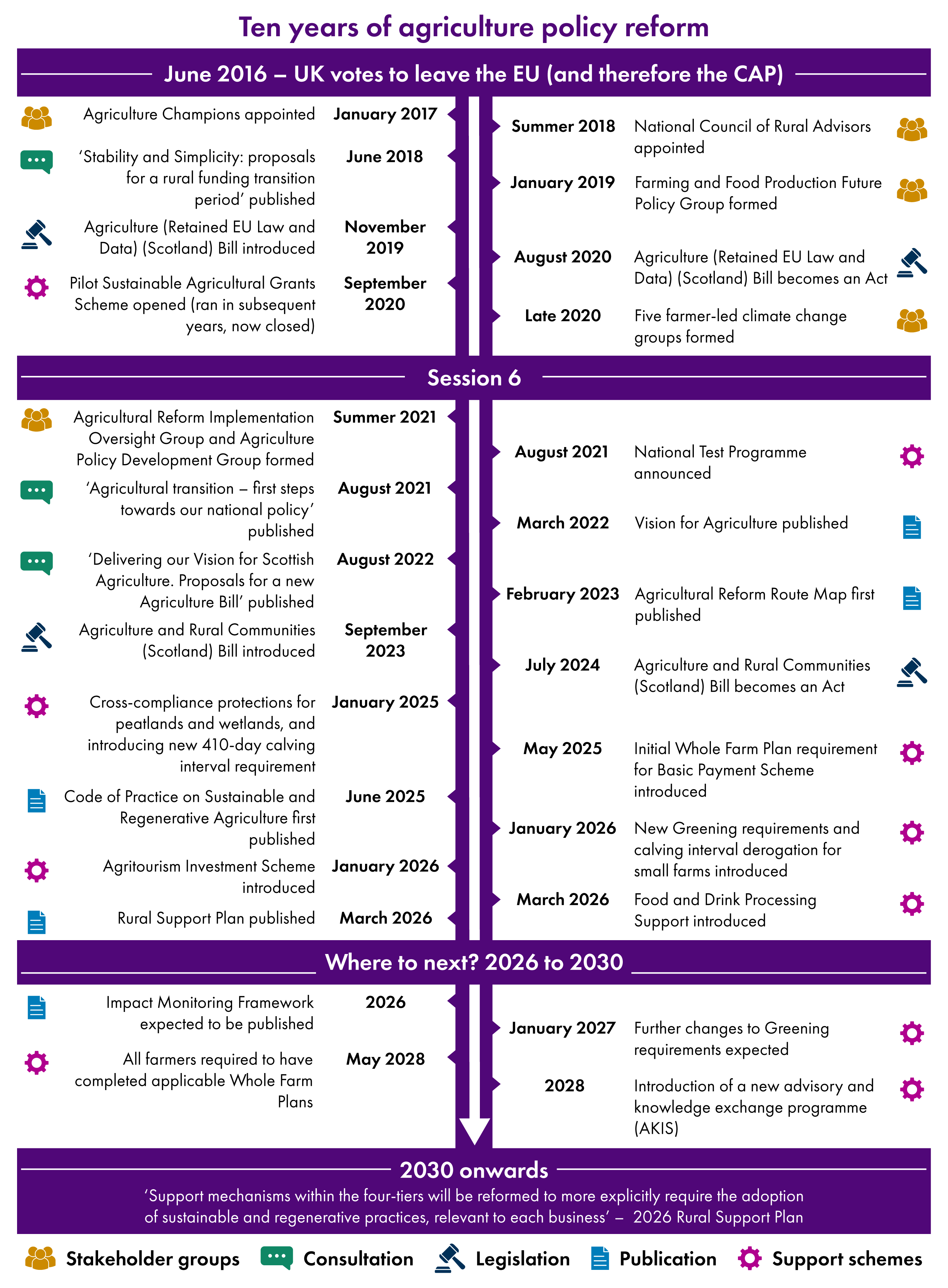
SPICe
The Session 6 Scottish Government first proposed a structure for a new four-tier agricultural support framework in the 2022 consultation on an agriculture bill. This was expanded on in the 2023 Agricultural Reform Route Map and remains the official goal. The broad structure is illustrated in the infographic below.
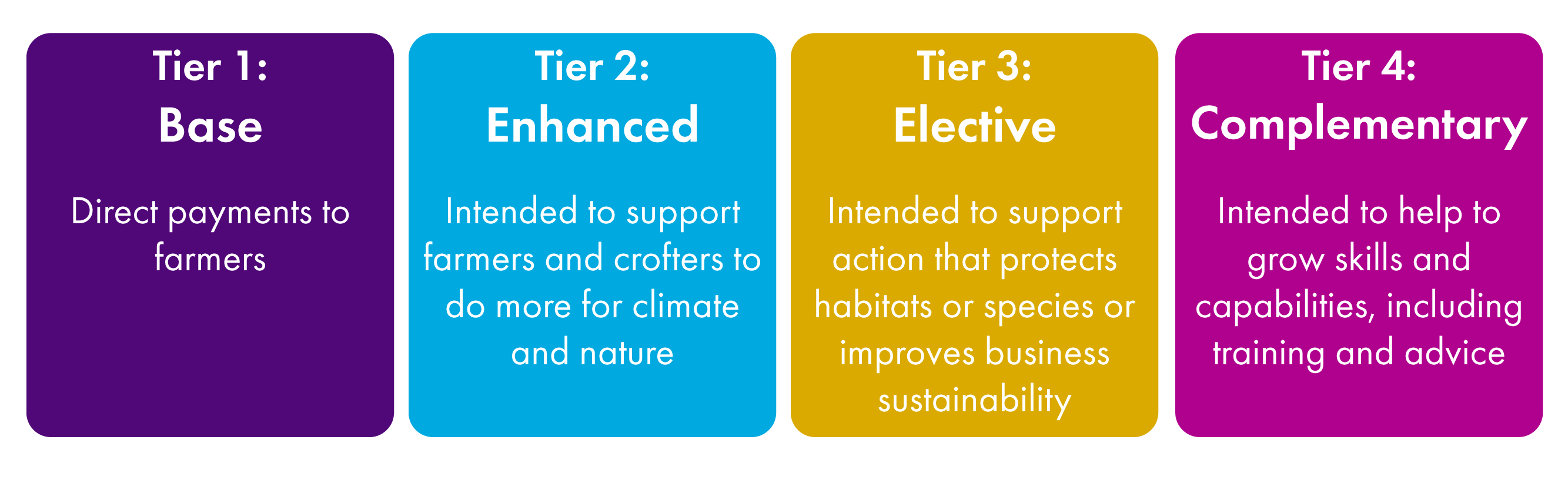
The Agriculture and Rural Communities (Scotland) Bill (‘the Bill’, now ‘the 2024 Act’) was introduced in the Scottish Parliament in September 2023. It is ‘framework’ legislation: it does not set out detailed requirements but it gives Scottish Ministers powers to create the four-tier framework. It also requires Ministers to produce an overview document - the ‘Rural Support Plan’.
Reactions to the Bill were mixed. Stakeholders acknowledged the need for new powers to replace the CAP, but were also disappointed at the lack of direction of travel in the Bill.
There had been a general understanding that future agricultural policy would be introduced from 2026 - and some notable changes have been made to some schemes from this year. For example:
the number of farms required to participate in environmental activities as part of ‘Greening' increased by around 65% (from 21% to 35% of farming businesses; around 65% remain exempt from many requirements), and
a new 410-day ‘calving interval’ (a maximum number of days between a cow having two calves) was introduced (with derogations for small businesses) for the Suckler Beef Support Scheme, aiming to increase efficiency.
In addition, over the last few years, several new grant schemes have run to improve sustainability, business efficiency and prepare for future changes, though the size of these schemes has been small compared to the overall agricultural budget.
However, earlier Session 6 Scottish Government documents, such as the 2022 Vision for Agriculture and the original version of the Agricultural Reform Route Map, gave the impression that a ‘new’ support system would be taking shape by 2026. The latter document stated, for example, that “in 2026 Basic Payment Scheme will end and Base and Enhanced Support will be introduced.”
In particular, Tier 2 – the ‘enhanced tier’ – was expected to be operational by 2026, and an indicative list of measures set out proposals for new activities. However, by autumn 2025 it became clear that schemes would remain similar from 2026. The existing Greening scheme was adapted to become ‘Enhanced Greening’ in place of a new Tier 2. The Basic Payment Scheme continues as Tier 1, but with steps taken towards requiring all farms to have ‘Whole Farm Plans’ in place by 2028.
Progress to date has fallen short of the expectations of some stakeholders. Particularly for environmental organisations, change has been “far too little and at too slow a pace” leading to disagreements between some stakeholders and the Scottish Government, and views of a “failure of process”.
For farming organisations, questions remain about what support schemes will look like in practice, particularly regarding climate change and biodiversity actions. Some questions discussed during Stage 1 of the 2024 Act also remain, such as how payments will be distributed between farms.
The impact of agricultural reform on other policy areas
Alongside the obvious importance of a new policy for farmers and crofters and for Scotland’s food production, other outcomes depend on a new agricultural policy. Reforming agricultural support is expected to help deliver the Scottish Government’s Climate Change Plan – and it is key to halting and reversing biodiversity loss in the Scottish Government’s biodiversity delivery plan to 2030.
Agricultural policy is also a key component in wider food policy. The Scottish Government published its first Good Food Nation Plan in December 2025, setting out interconnected ambitions around reforming Scotland’s food system. Regulations giving effect to the plan and commencing a requirement for local plans are forthcoming, and the next step for the Parliament will be scrutiny of how successfully the Scottish Government is delivering the goals set out in the plan. More detail on these developments can be found in a recent SPICe guest blog.
Key issue for Session 7 – putting the framework to work
The key issue for the Scottish Parliament in Session 7 will be scrutinising the delivery of a new agricultural policy.
In Session 5, the Scottish Government committed to a period of ‘stability and simplicity’ until 2024. In Session 6, the Scottish Government stressed its intention for a smooth transition, without ‘cliff edges’.
However, despite assurances around certainty and stability over the short term, farmers have stressed their experience of uncertainty around what is going to happen next.
The first Rural Support Plan was published on 24 March 2026. The Session 6 Scottish Government has again committed to a period of ‘certainty’ until 2030, in the form of continuing direct payments and maintaining current funding splits between schemes to 2030 and mapping out some incremental changes. It also signalled that, in 2030-31, some of the funding in Tier 1 will shift to Tiers 3 and 4 (leaving 70% in tiers 1 and 2), and over time, at least half of all funding will be targeted towards nature restoration and climate mitigation and adaption.
A key point of contention and uncertainty in Session 6 has been around how funding will be split between the different tiers. Farming organisations welcomed commitments from the Scottish Government in 2024 that 70% of the annual budget for agricultural support will be allocated to Tiers 1 and 2, leaving 30% shared between Tiers 3 and 4. However, environmental and other organisations contend that the “engines of change” to address climate change and biodiversity loss will be in the schemes in Tier 3 and 4. In part due to the late arrival of the Rural Support Plan (originally expected at the end of 2025), this question was never fully explored during Session 6, and the Rural Affairs and Islands Committee recommended in its legacy report that a successor committee scrutinise funding decisions.
Responding to the Rural Support Plan, the NFUS welcomed the five-year funding clarity, particularly around continuing direct payments but again stressed that “more detail is needed on how schemes will operate in practice and how existing support will transition into the new system”. Other stakeholders, such as Scottish Environment LINK, who consider the current payments system to be “ineffective and unfair”, welcomed plans for some funding changes expected in 2030, but underscored that the plan “still does not go far enough to outlining the concrete changes industry will be asked to make”. They contend that there has been a “lost decade of potential to reform farming policy”.
The key questions for Members and Committees to consider during Session 7 will therefore be: when will farmers, crofters and other stakeholders see frameworks become a fully-fledged agricultural support policy, what will it look like, and how effectively will it deliver the ambitions pinned on it?
The land reform jigsaw
Alasdair Reid, Senior Researcher, Energy, Climate Change and Land Reform
A complex framework of land reform measures currently exists, with further additions expected in Session 7, meaning that Parliamentary understanding and robust scrutiny are key to ensuring that proposals are in the public interest.
What is land reform?
Land reform is a broad concept and is considered to include measures which modify or change the management, use and possession of land in the public interest. Since 2000, Scottish Government action in relation to land reform has spanned topics as diverse as community ownership, urban renewal, housing, human rights, and agricultural land, as well as modernising property law and the fiscal systems which govern land ownership and management.
In 2016, a “human rights approach to land rights and responsibilities” was set out in the Session 5 Scottish Government’s Land Rights and Responsibilities Statement, Principle one of which states:
The overall framework of land rights, responsibilities and public policies should promote, fulfil and respect relevant human rights in relation to land, contribute to public interest and wellbeing, and balance public and private interests. The framework should support sustainable economic development, protect and enhance the environment, help achieve social justice and build a fairer society.
Recent work by the Scottish Land Commission stated that “Land underpins almost everything that matters to Scotland, from climate and housing to jobs and community identity.” Emerging themes from this consultation include:
A strong appetite for further changes in how land is owned and used.
Concern about concentration of power – too much land, and too much influence, sits in too few hands.
A lack of transparency regarding who owns land, undermining trust and accountability.
Connection to place matters, and landowners should be meaningfully connected to the places their decisions affect.
Too little local influence, with an inability to influence local land use decisions, particularly where change is significant and long-term.
Frustration with wasted potential – derelict and underused land, and the limited use of tax to encourage productive use, signalled that existing tools are not being used to their full effect.
This section focuses on what happened in Session 6, with details on key land reform measures prior to this set out in the SPICe Blog: Land Reform at 20 – What does a post-feudal era look like?
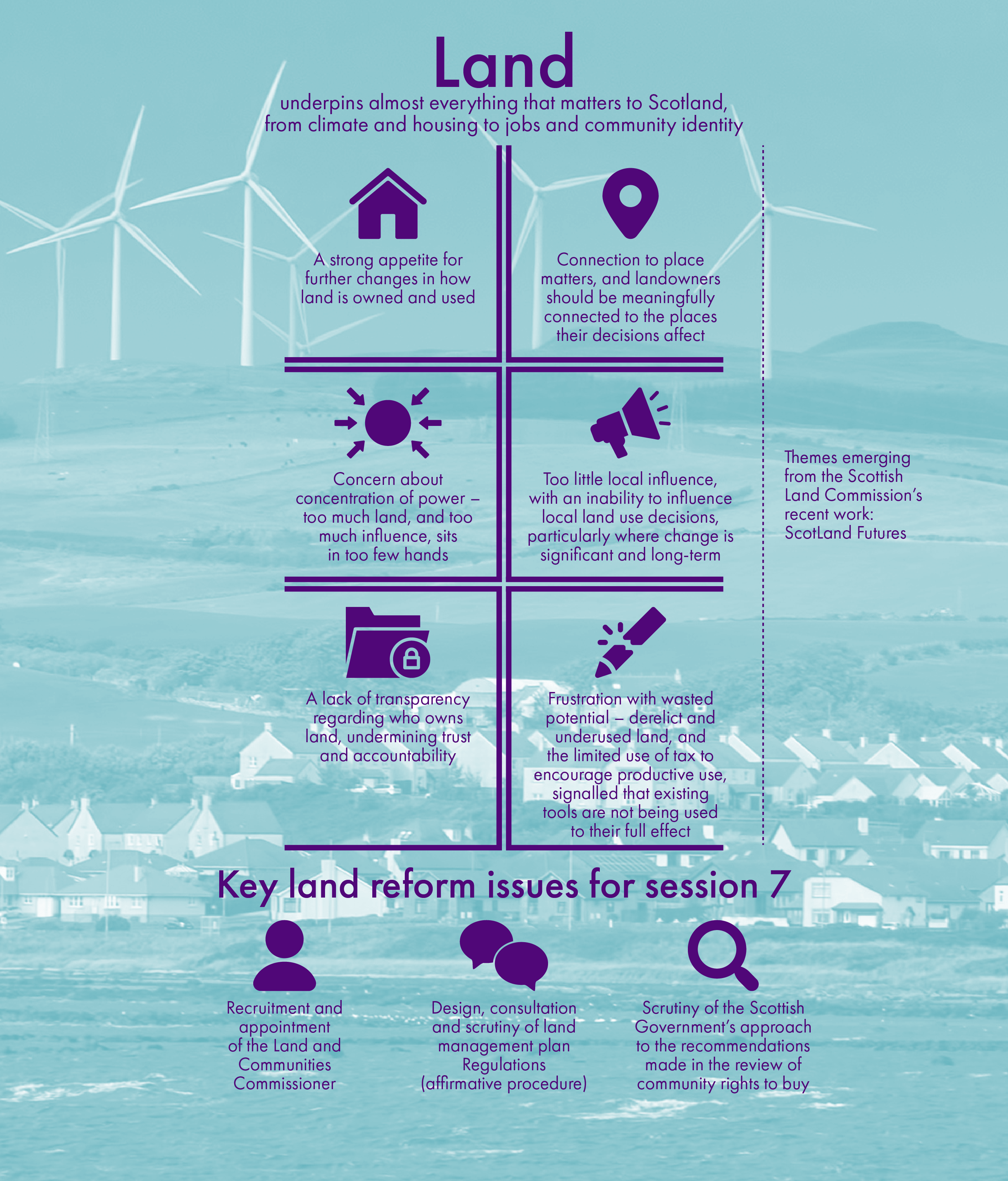
Scottish Land Commission and SPICe
Session 6 – Land Reform Act
Part 1 of the Land Reform (Scotland) Act 2026 inserts a new section into the Land Reform (Scotland) Act 2016 and includes a power for Ministers to impose obligations on owners of large land holdings (over 1,000ha) to produce, consult on with the local community, and then publish a land management plan for their holding.
In the event of a transfer of all or part of a large land holding, a modified pre-emptive right to buy for a local community and/or lotting (i.e. compulsory fragmentation) is also provided for. To oversee and advise on this, a new Land and Communities Commissioner is established within the Scottish Land Commission.
Some of the information that a land management plan must contain is set out in the Act:
The land to which it relates and how ownership is structured.
Long-term vision and objectives.
Compliance with outdoor access and deer management codes.
How the owner intends to manage the land in a way that contributes to achieving net-zero greenhouse gas emissions, adapting to climate change and increasing biodiversity.
How the owner is having regard to, or intends to have regard to, any relevant local place plan.
However, the detail of the land management plan obligations will be set out in regulations (expected during Session 7) which will be laid under the affirmative procedure. These regulations must be informed by the Land Rights and Responsibilities Statement, and Ministers must consult the Land and Communities Commissioner, and anyone else that is considered “appropriate”.
The recruitment and proposal of Land Commissioners is carried out by the Scottish Government; however Parliament must approve the appointment.
Much of the Act is yet to be commenced, with commencement regulations, as well as further provisions in relation to compensation for lotting decisions expected in Session 7.
Session 6 – Community Right to Buy Review
Community Rights to Buy are a collection of legal powers available to communities across Scotland which allow eligible bodies to take ownership of land and buildings.
In July 2024 the Session 6 Scottish Government launched a review of the four existing rights to buy. Each of these has different eligibility criteria based on land type, condition, and whether the purchase is voluntary or compulsory. They are:
Part 2 of the Land Reform (Scotland) Act 2003 – allows communities to apply to register an interest in land or buildings, and to be given the first right of refusal should the landowner decide to put the land up for sale.
Part 3 of the Land Reform (Scotland) Act 2003 – gives crofting communities the right to acquire and control the croft land where they live and work. This is a compulsory purchase right.
Part 3A of the Land Reform (Scotland) Act 2003 – allows communities to apply to Ministers for consent to exercise a compulsory purchase of land or a building, which is wholly or mainly abandoned or neglected, or where the use or management of the land is causing harm to the environmental wellbeing of the community.
Part 5 of the Land Reform (Scotland) Act 2016 – allows communities to apply for the compulsory purchase of land or buildings for the purposes of furthering the achievement of sustainable development.
This review concluded in March 2026 and recommended a series of changes, including merging the Part 3A and Part 5 rights, changes to how community bodies are structured and to the ballot thresholds used to indicate community support.
One of the key areas that the review identified for change was to the process for late applications under Part 2. An application is considered "late" if it is submitted after the owner has taken an action to transfer the land but before missives are concluded, or an option to acquire is granted.
There has been a general downward trend in approval rates for late applications, with none approved in the last five years. The review noted concerns that the current late application process has failed to adapt to shifts in the market. Therefore, some streamlining of the process is recommended, including to remove the requirement for a detailed business plan at the point that a late application is made.
As yet, there is no indication of how or when these recommendations will be acted on, however they will require legislative changes.
What’s on the menu for Session 7?
Whilst the review of community rights to buy and the passage of the Land Reform Bill were (theoretically) separate, MSPs in the coming session will need to examine these changes and ensure that a coherent and genuinely useful framework evolves to support and complement other parts of land reform policy.
The first part of this jigsaw is likely to be scrutinising the appointment of the Land and Communities Commissioner, who will have a crucial role in developing the detailed regulations for land management plans. These regulations will then come before Parliament in draft form for Members to ensure that they deliver what the lead Committee considered to be “essential increases in transparency about land ownership and use”, in the public interest.
An implementation timetable for the 2026 Act is expected early in session 7.
Moving from a linear to a circular economy
Alexa Morrison, Senior Researcher, Environment
Scotland still largely has a linear economy, where resources are extracted, products are made and used, and waste disposed of. Whether there is progress in moving from a linear to a circular economy will be an issue the Scottish Parliament might focus on during Session 7.
Context – why is a linear economy harmful?
Only 1.3% of the resources Scotland uses are cycled back into the economy, with over 98% of Scotland’s material use coming from virgin resources directly extracted from nature. Scotland’s per capita material footprint is 21.7 tonnes, nearly double the global average.
The impacts of this model extend beyond waste disposal, impacting on climate change, biodiversity, pollution, land and water use, and depleting natural and mineral resources. Impacts are not just caused when products become waste, but through resources and energy used in production (embodied impacts), or social harm if there are poor labour standards. The value of material can also be lost from the economy where it is exported, landfilled or incinerated.
Recognising these pressures, the Session 6 Scottish Government committed to transition from a linear economy to a circular economy in 2016. A circular economy is one in which:
Resources are kept in circulation for as long as possible.
Product design prioritises longevity and sustainable materials.
Materials are kept in circulation through repair, reuse, and remanufacture, or are recycled or composted.
If materials are disposed of, maximum value is extracted e.g. energy recovery.
Progress so far
Progress has been made in Scotland in reducing waste and improving recycling, but not at the scale of significantly ‘shifting the dial’ in how Scotland consumes resources:
Waste generation has gradually fallen. Around 9.55 million tonnes of waste were generated in Scotland in 2023, a drop of 20.2% since 2011.
GHG emissions from waste fell 73% from 1990 to 2013, but have since plateaued.
Recycling rates have stagnated. In 2023, 62.2% of Scottish waste was recycled, only a small increase from 2018. Performance is much worse for some materials. Only 32% of plastic waste was recycled in 2023.
Session 6 developments - a framework for a circular economy
During Session 6, the Scottish Government established a new ‘framework’ for the transition to a circular economy, comprising:
A Circular Economy and Waste Routemap to 2030 setting out priority actions.
The Circular Economy (Scotland) Act 2024 introducing a range of duties and powers.
The Act put duties on Scottish Ministers to:
Publish a new Circular Economy Strategy.
Set statutory circular economy targets in regulations.
Produce a statutory code of practice on household recycling (significant for local authorities).
The subsequently published Circular Economy Strategy went on to identify five priority sectors for action:
the built environment
energy infrastructure
textiles
the food system
transport.
Zero Waste Scotland has been tasked with developing five‑year roadmaps for the first four sectors by March 2027.
The Strategy set out that the Scottish Government would also take a ‘product stewardship’ approach, working with the other UK nations to prioritise packaging, waste electrical and electronic equipment (WEEE), batteries, end-of-life vehicles and fishing gear. In addition, it stated that it would prioritise textiles, mattresses and furniture.
The Act also gave Scottish Ministers regulation-making powers to:
Restrict how businesses can dispose of unsold goods, in response to public concern around destruction of new products.
Require businesses to report on waste streams, with an initial consultation expected on food waste.
Introduce charges on single-use items. A proposed charge on single-use drinks cups was consulted on but not progressed during Session 6.
Other developments in Session 6 included:
The Recycling Improvement Fund: A £70 million Recycling Improvement Fund (£66 million invested at June 2025) was created to help local authorities improve infrastructure.
Product bans: a ban on certain single-use plastics (2022), single-use vapes (2025) and public sales of plastic wet wipes (coming into force 2027). These were coordinated across UK countries, influenced by the UK Internal Market Act (UKIMA). A commitment to ban the sale of horticultural peat did not progress, with the Scottish Government citing the need for UK aligned action.
Packaging EPR: UK-wide roll out of Extended Producer Responsibility (EPR) which seeks to shift the full cost of managing packaging waste to producers.
Digital waste tracking: UK-wide introduction of a single digital waste tracking system, aiming to generate better data to inform policy.
Contentious areas included the delay to the Deposit Return Scheme (DRS) for single-use drinks containers. The Scottish Government pushed back the launch of DRS in 2023 to align it with the scheme being developed in England and Northern Ireland, after the UK Government declined to agree a ‘UKIMA exclusion’ for a Scottish DRS including glass to go ahead. DRS is expected to launch in October 2027 covering PET plastic and aluminium.
The operation of UKIMA caused tension in Session 6 between the UK and Scottish Governments in the circular economy arena. Following a review of the operation of UKIMA in 2025, the scope of future divergence is largely still to be tested.
A planned 2025 ban on landfilling biodegradable municipal waste (BMW) to cut emissions from landfill was also delayed to 2028. Although BMW landfilling has fallen 73.8% since 2011, SEPA announced in 2025 that Scotland lacked sufficient Energy from Waste (incineration) capacity to enforce the ban. This links to a wider debate about the need to avoid long-term over-dependence on incineration of waste, which has increased rapidly since 2011. The Session 6 Scottish Government committed to publish an ‘indicative cap’ for EfW capacity in 2027.
The Scottish Government also struggled to tackle food waste in Session 6. An estimated 1 million tonnes of food was wasted in Scotland in 2021, accounting for roughly 6% of Scotland’s carbon footprint. Food waste is also the leading cause of biodiversity loss stemming from household waste.
There is also a question of whether the Session 7 Scottish Government will seek to align with evolving EU standards. There were significant EU developments in Session 6 across areas such as microplastics, eco-design and the ‘right to repair’ goods, and a new EU Circular Economy Act is under development.
The Session 6 Net Zero, Energy and Transport Committee sought views on what waste and circular economy policies were most important in order to meet climate targets. Many responses encouraged the Scottish Government to prioritise policies which move further up the ‘waste hierarchy’ (enshrined in the 2024 Act) - focusing on prevention followed by reuse, recycling, recovery and disposal (see Figure 46 below).
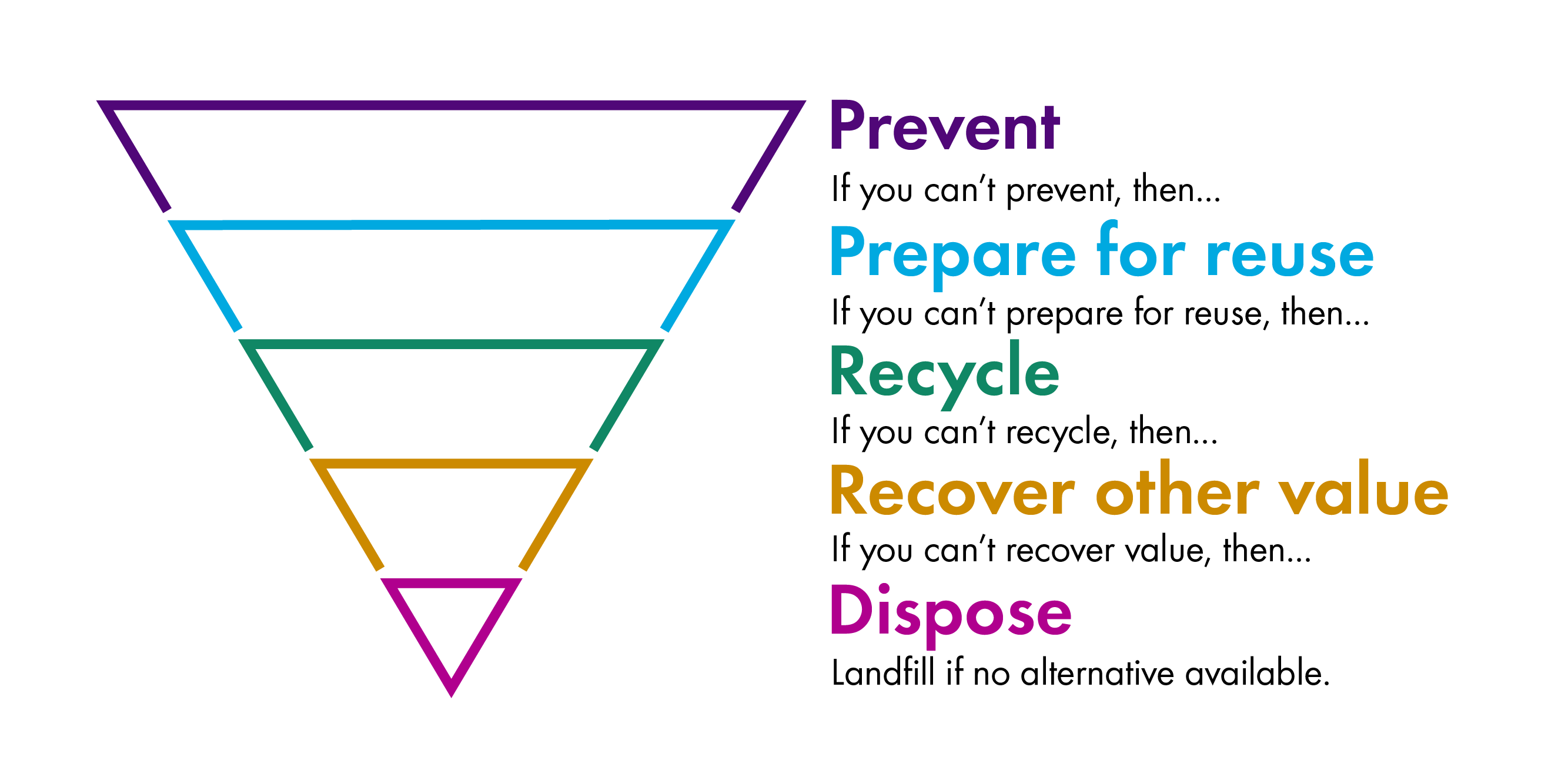
Adapted from Scottish Government
Session 7 – putting the framework to work
The cumulative effect of the above circular economy framework could drive major change across Scotland’s economy. However, the scale of impact will depend on how quickly and ambitiously the Session 7 Scottish Government acts in this area. Much rests on:
The ambition of future statutory circular economy targets (noting the Act does not set any timeframe for targets to be introduced).
The strength and specificity of sectoral roadmaps.
Whether Ministers use new powers in relation to unsold goods and single-use items, or existing powers to pursue new EPR schemes.
The influence of UKIMA and extent to which the Scottish Government will seek to diverge from approaches in other parts of the UK.
Ambitions to align with changing EU standards.
Scrutinising how the Scottish Government seeks to make progress in this area will be the responsibility of Members and Committees during Session 7.
Crowded seas
Damon Davies, Researcher, Environment, Rural, Constitution and International Relations unit
At the start of Session 6, SPICe identified that a key challenge for the Parliament would be assessing whether the Scottish Government was taking an integrated approach to marine and fisheries policy, linked to wider goals for a Green Recovery from the COVID-19 pandemic. Other challenges included tackling marine ecosystem decline and ensuring that the expansion of marine industries supports sustainable economic opportunities in coastal communities.
As we begin Session 7, those pressures have intensified as Scotland’s seas have become increasingly crowded. Tensions between marine resource exploitation and marine protection now sit at the centre of marine policy debates. For example:
Competing pressures
As we begin Session 7, those pressures have intensified as Scotland’s seas have become increasingly crowded. Tensions between marine resource exploitation and marine protection now sit at the centre of marine policy debates. For example:
Offshore wind has continued to expand and the way its impacts are managed is changing. The Scottish Government’s Green Industrial Strategy seeks to maximise Scotland’s wind economy to transition to net zero greenhouse gas emissions to meet international and domestic climate change targets. However, this expansion has led to concerns over fisheries being squeezed out and potential impacts of offshore wind developments on marine species and ecosystems. Regulations are also set to come into force in May 2026 (using powers in the UK Energy Act 2023) which will enable a ‘strategic compensation’ approach to the environmental impacts of offshore wind on protected areas across the whole UK Marine Protected Area network. This will mark a significant change in the way offshore wind is consented in Scotland, and how (and where) environmental impacts are mitigated and compensated for.
More areas of the marine environment are now protected, but protection has not translated into improved environmental status. Trends indicate a continued deterioration in the UK’s marine environment, with legal commitments to achieve ‘Good Environmental Status’ having been met for only two out of 15 indicators in the latest 2025 assessment. Scotland’s Marine Protected Area (MPA) network comprises 247 sites covering around 37% of the seas around Scotland. While fishing restrictions in offshore MPAs (12-200 nautical miles from the coast) were introduced in 2025, inshore measures (0-12 nautical miles) and protections for Priority Marine Features (designated habitats and species outside the MPA network) remain delayed. Spatial restrictions on certain fishing methods to meet conservation objectives may contribute to further displacement of commercial fishing activity, contributing to spatial pressures between different types of fishing methods (e.g. pots/traps and trawling/dredging).

Scottish Government: Marine Environment - Marine Protected Areas
Aquaculture production and development continues to grow. Scottish farmed salmon is the UK’s largest food export with international sales of £828 million in 2025 and is an important source of employment and investment. While the Scottish Government’s Vision for Sustainable Aquaculture aims to increase productivity and reduce impacts, parliamentary scrutiny and recent planning decisions have highlighted ongoing tensions, including concerns about the environmental impact of salmon farming and encroachment into fishing grounds. Legislation to expand marine planning zones out to 12 nautical miles has also provided the potential for aquaculture sites to expand further offshore.
Coastal and island communities bear the brunt of competing pressures. In 2025, the Scottish Government consulted on a Rural Development Plan which “aims to create a vibrant, sustainable, equal and inclusive rural Scotland”. The National Islands Plan also sets out actions to address the challenges and opportunities facing Scotland's islands. Highland coastal and island communities are particularly reliant on marine industries such as fishing, aquaculture, offshore energy and coastal tourism, but these communities may also be vulnerable to cumulative pressures from human activity, environmental change and climate risks, including extreme weather and coastal erosion.
Marine spatial planning – an essential tool for managing competing pressures?
Marine planning provides a key framework for managing competing pressures at sea. Marine planning legislation in Scotland and the UK has its roots in the EU Maritime Spatial Planning Directive (Directive 2014/89/EU) which came into force in July 2014 aiming to “promote sustainable development and to identify the utilisation of maritime space for different sea uses as well as to manage spatial uses and conflicts in marine areas”.
Under the Marine (Scotland) Act 2010, Scottish Ministers are required to publish a National Marine Plan. Scotland’s first National Marine Plan (NMP) was adopted and published in March 2015. Reviews of the NMP undertaken in 2018 and 2021 found that the existing plan did not adequately reflect current policy and legislation evolution, or emerging issues, including increased competition for space or the twin climate and biodiversity crises. Following these reviews, the Session 6 Scottish Government began developing its second National Marine Plan (NMP2) with a consultation on an initial Planning Position Statement (PPS). However, the anticipated full public consultation on a draft NMP2 was postponed.
The Session 6 Scottish Government did not opt for embedding the spatial element of marine planning in statutory plans, relying instead on sectoral policies to guide decisions on marine developments. Spatial planning featured prominently in responses to the PPS consultation. The majority of respondents supported its inclusion in NMP2 to implement Scottish Government priorities and reduce conflict over marine space. While views differed on how far a spatial approach should go, and some sectors raised concerns about impacts on their interests, overall support was strongest for further consideration of spatial planning.
These views were also mirrored in the Session 6 Net Zero, Energy and Transport Committee’s scrutiny of the Scottish Government’s draft Biodiversity Delivery Plan. The Committee supported calls for “urgent progress with spatial approaches to restore and protect biodiversity and of protected areas, on a nationwide basis (including marine mapping)”, but also that spatial planning approaches should not be “a determinative decision-making process, but rather a process of setting parameters and priorities [...] to create far greater certainty but to leave space for consultation, discussion and co-design at a local level so that communities feel part of the process.”
It’s likely that the NMP2 will come to the Parliament during Session 7. This presents an opportunity to scrutinise these issues in more detail and to consider the Scottish Government’s approach to spatial planning to manage competition and conflicting objectives in the marine space.
Regional marine planning also offers the potential for greater consultation, discussion and co-design at a local level. Under the 2010 Act, Scottish Minister may also delegate functions to 11 marine regions to develop regional marine plans. These regional plans offer a mechanism to consider more local economic, social and environmental contexts. They may also act as a catalyst for community engagement and more detailed data collection and monitoring in the marine environment.
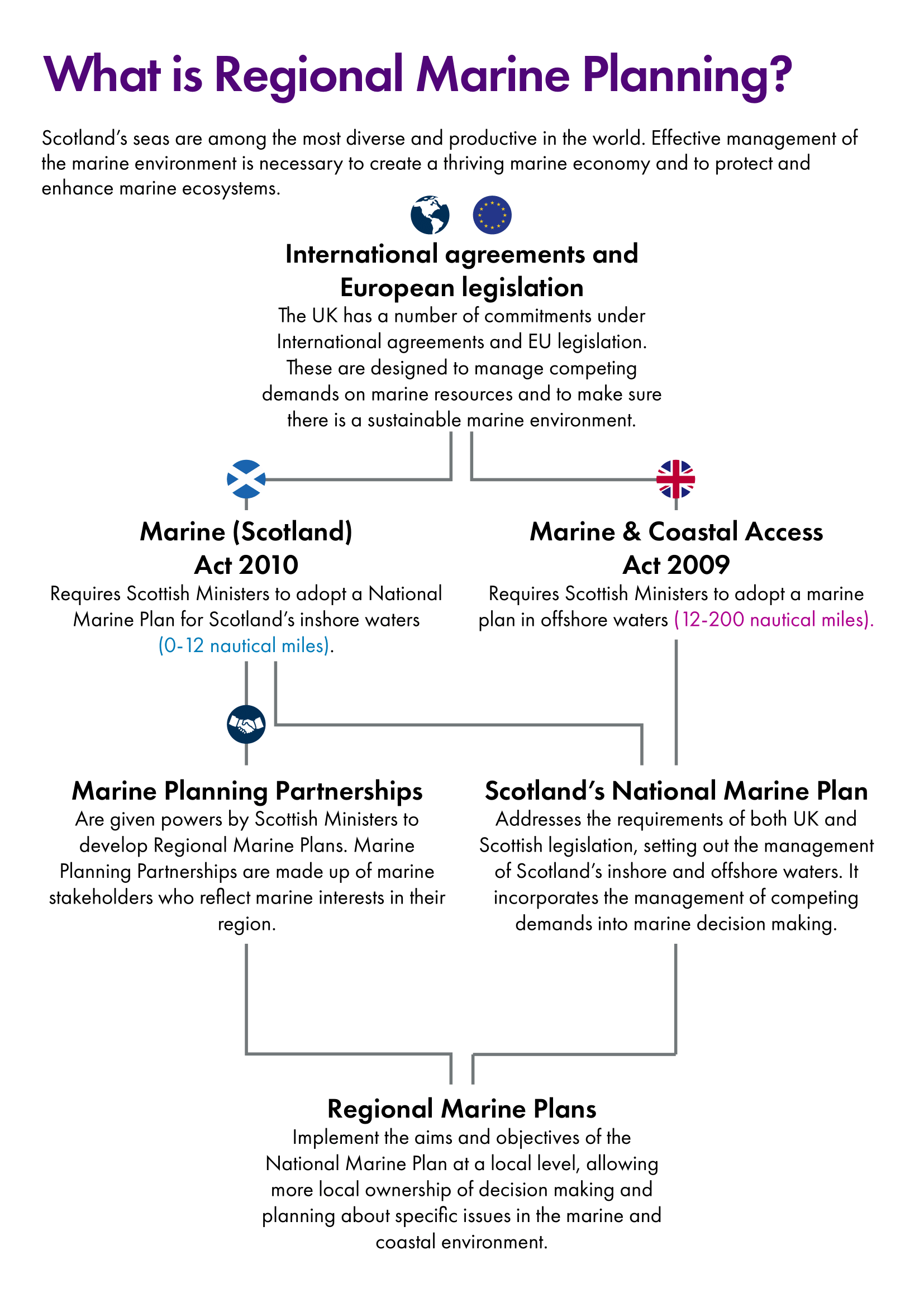

Scottish Government: Scottish Fish Farm Production Survey 2015
In 2019-20 (during the Scottish Parliament’s fifth Session) the Environment, Climate Change and Land Reform (ECCLR) Committee undertook an inquiry into progress in implementing regional marine plans following frustration from stakeholders over slow progress. The Committee considered that regional marine planning had the potential to be a key driver for delivering a Green Recovery and sustainable economic growth in Scotland's coastal communities. The Committee strongly recommended the then Scottish Government should commit to providing finance to establish Marine Planning Partnerships in all 11 Scottish Marine Regions over the next 10 years.
Over five years on from the ECCLR Committee report and 15 years since the Marine (Scotland) Act 2010, only two statutory regional marine plans have been adopted (Shetland Islands and Orkney Islands). A lack of urgency and pace in developing marine planning at national and regional levels risks deepening policy and stakeholder tensions in Scotland’s increasingly crowded seas.
Looking ahead to Session 7
Session 7 will be a critical period for parliamentary scrutiny of how Scotland’s seas are governed and managed. The expected introduction of National Marine Plan 2 will provide Parliament with a focal point to examine whether the Scottish Government is taking a genuinely integrated and spatial approach to managing competing demands, and whether policy choices are aligned with statutory climate and biodiversity commitments. There is also scope to scrutinise delays in implementing marine protection measures in MPAs, the implications of new consenting and compensation arrangements for offshore renewables, and the pace and resourcing of regional marine planning.
How the benefits and burdens of marine development are shared with coastal and island communities, and how conflicts between sectors are managed in practice, will be critical tests of whether current policy frameworks are fit for purpose in increasingly crowded seas.
Devolution, the Parliament and Transparency
This theme sets out the way in which devolution now operates including looking at the impact of the UK Internal Market Act, common frameworks and UK Ministers’ having delegated powers in devolved policy areas. The section also examines what the election result might mean for the constitutional question on Scotland’s future and the potential return of EU law in some areas of devolved policy as a result of UK-EU agreements. The section also looks at developments following the Supreme Court ruling on the meaning of sex in the Equality Act 2010. Finally, it provides background on Scotland’s transparency framework in relation to things like freedom of information, the Scottish Parliament’s register of interests and the lobbying register.
Scrutiny of how devolution operates
Sarah McKay, Senior Researcher, Parliament and Constitution
How devolution operates has changed significantly in recent years. The Scotland Act 1998 still provides the legal basis for devolution, but its day-to-day operation is now heavily affected by other legislation as well as non-legislative arrangements. Scrutiny of these arrangements will be a key issue for Session 7 because of how significantly they influence Scottish policy development and legislation.
Whether legislative or non-legislative, the arrangements all have one thing in common – the degree to which they are managed through intergovernmental activity (work between the UK Government and the Scottish (as well as other devolved) governments).
For subject committees, understanding how intergovernmental activity is shaping policy development and legislation will be key to getting to grips with how policy areas are evolving.
At an oversight level, the central issue will be to understand the extent to which intergovernmental activity is affecting the shape of devolution. This includes the balance of powers between the Scottish Parliament and the Scottish Government, but also the relationship between the Scottish and UK Parliaments and the influence of UK Ministers in devolved areas.
Intergovernmental activity
Intergovernmental activity has taken place since 1999, but the ‘shared space’ between governments is more important than ever because of the number and importance of decisions being taken in it. As the Session 6 Constitution, Europe, External Affairs and Culture Committee noted in its legacy report:
The UK leaving the EU drove the establishment of legislative and non-legislative mechanisms to manage intra-UK difference, but these mechanisms are now established in the operation and shape of the devolution settlement.
Intergovernmental activity is no longer simply interactions which take place in the formal three-tier intergovernmental relations (IGR) structure which exists in the UK.
SPICe
Rather, intergovernmental activity encompasses ways of governments working together outside of this structure. That may be discussions through common frameworks, negotiations through the exclusions process linked to the UK Internal Market Act 2020, managing the legislative consent process, or dialogue on how UK Ministers take and exercise delegated powers in devolved areas.
An upcoming SPICe briefing on How Devolution Works will explain all of these intergovernmental matters in more detail, but a short overview of each is provided below.
The UK Internal Market Act 2020 and the exclusions process linked to the UK Internal Market Act 2020
The United Kingdom Internal Market Act 2020 ("UKIMA") is the legal framework governing the movement of goods and services across the United Kingdom. UKIMA allows for minimal regulatory difference (i.e. difference in the legal requirements across the UK) through the application of two market access principles - mutual recognition and non-discrimination. An automatic recognition principle also applies to the recognition of professional qualifications.
The way UKIMA operates means that an Act of the Scottish Parliament or a Scottish Statutory Instrument can contain provision which runs contrary to it, but that the provision will be disapplied where relevant. This can limit the effectiveness of Scottish Parliament legislation.
Only UK Ministers have the power to make changes to UKIMA, and specifically when the market access principles do not apply, through the creation of an exclusion. A three-tier intergovernmental process is in place for discussion of exclusions.
The key issues in relation to UKIMA and the exclusions process are:
understanding how the market access principles are shaping legislative proposals
improving transparency around intergovernmental discussions on exclusions.
Common frameworks
Common frameworks are non-legislative agreements setting out how the UK and devolved governments will work together to make decisions about policy direction and regulatory difference in certain devolved policy areas.
The aim of common frameworks is to manage difference in these areas in order to achieve consistency in policy and practice where this is deemed desirable by governments across the four UK nations.
The key issues in relation to common frameworks are:
scrutiny of remaining common frameworks (a further two are expected)
understanding how common frameworks as forums for intergovernmental discussions affect Scottish policy development and legislation
working to improve transparency of the information Parliament receives in relation to the operation of common frameworks
oversight of the common frameworks programme.
Legislative consent - the Sewel Convention
The Sewel Convention is a political convention on legislative consent. It applies where the UK Parliament is considering primary legislation which is within the competence of the Scottish Parliament, or which changes the powers of the Scottish Parliament or the powers of Scottish Ministers. In such instances, the UK Parliament seeks the consent of the Scottish Parliament through the Sewel Convention.
The principle of legislative consent was developed almost entirely at governmental level and takes shape in the form of a Memorandum of Understanding (MoU) between the UK Government and the devolved governments.
The Session 6 Constitution, Europe, External Affairs and Culture Committee noted that Sewel was “under strain”. The UK Government has committed to a new Memorandum of Understanding on Sewel.
Key issues for Session 7 will likely be:
scrutiny of any new MoU on legislative consent
oversight of the legislative consent process, including whether the UK Parliament enacts legislation without consent and how the process works in practice (e.g. whether enough time is afforded to the Scottish Parliament to undertake meaningful scrutiny)
monitoring of the UK and Scottish Governments’ positions on the taking of powers by UK Ministers in devolved areas.
UK Ministers’ delegated powers in devolved areas
Since 2016 primary legislation passed by the UK Parliament has increasingly given UK Ministers powers to act in devolved areas.
The Session 6 Constitution, Europe, External Affairs and Culture Committee recognised the implications of UK Ministers having delegated powers in devolved areas for the devolution settlement and the Scottish Parliament's ability to scrutinise devolved law, stating:
The extent of UK Ministers’ new delegated powers in devolved areas amounts to a significant constitutional change.
The Sottish Parliament is not given a formal role in scrutinising statutory instruments made at the UK Parliament, even if they are within devolved competence. At the end of Session 6 the Scottish Parliament and Scottish Government agreed to a statutory instrument protocol for Session 7. The protocol notifies the Parliament to UK statutory instruments made within devolved competence.
Key issues for session 7 are anticipated as being:
implementation of the new protocol
oversight of statutory instruments being made at the UK Parliament within devolved competence
the Scottish Government’s position on the exercise of delegated powers by UK Ministers in devolved areas.
The transparency challenge
One of the main challenges in understanding how intergovernmental activity is shaping policy development and legislation is a lack of transparency in intergovernmental processes.
The Session 6 Constitution, Europe, External Affairs and Culture Committee reported on the transparency of intergovernmental activity and its implications for parliamentary scrutiny in March 2026. The Committee’s legacy report states:
we found ongoing challenges for the Parliament in scrutinising the many decisions which now take place in the shared intergovernmental space, including on exclusions to UKIMA’s market access principles, common frameworks and the taking and exercise of delegated powers in devolved areas by UK Ministers.
The Committee made several recommendations to improve transparency in Session 7, including a recommendation for its successor committee to complete a review of the Written Agreement on the provision of information in relation to IGR between the Scottish Parliament and the Scottish Government.
SPICe has an intergovernmental activity hub which tracks key intergovernmental meetings, legislative consent and common frameworks. SPICe also publishes a quarterly intergovernmental activity update which details key intergovernmental activity each quarter, including in relation to UKIMA exclusions, and provides a horizon scan. These resources are to aid transparency and support the Parliament’s scrutiny of intergovernmental activity.
Scotland’s constitutional future
Sarah McKay, Senior Researcher, Parliament and Constitution
The election result means that the constitutional question on Scotland’s future – whether it remains part of the UK or seeks independence – is likely to be a central issue for Session 7.
The Scottish National Party, and other independence supporting parties, stated during the election campaign that the people of Scotland returning a majority of either SNP MSPs or MSPs in favour of Scottish independence would give them a mandate to seek a second referendum on Scottish independence.
Can the Scottish Parliament legislate for an independence referendum?
The Supreme Court ruled in 2022 that it would not be within the Scottish Parliament’s competence to legislate for a referendum on independence.
Ahead of the 2014 referendum on independence, the UK Government and the Scottish Government agreed a transfer of power which put beyond legal doubt the Scottish Parliament’s ability to legislate for that independence referendum. This was achieved through a “section 30 Order” (a type of subordinate legislation which is made under the Scotland Act 1998) which can be used to increase or restrict the Scottish Parliament’s legislative competence.
A section 30 Order can be initiated either by the Scottish or UK Government but requires approval by resolution of the House of Commons, House of Lords and the Scottish Parliament before it can become law. A section 30 Order is made as an Order in Council (i.e. at a meeting of the Privy Council with the King in person).
A section 30 Order similar to the one used ahead of the 2014 referendum, or primary legislation at the UK Parliament, would be required to provide for, or allow the Scottish Parliament to legislate for, a second independence referendum.
Are there other routes to independence?
The Session 6 Constitution, Europe, External Affairs and Culture Committee held an inquiry ‘Options for a legal mechanism for triggering any independence referendum’. In its report, published 27 February 2026, the Committee noted “the broad consensus expressed by witnesses and by its advisers as to the current legal position in relation to any future independence referendum” which was stated as:
That international law confers no legal right for Scotland unilaterally to secede from the United Kingdom nor unilaterally to hold a referendum on the question of Scottish independence;
Therefore, that the question of Scottish independence must be answered in accordance with the United Kingdom’s constitutional arrangements;
That while the Scottish constitutional tradition of the sovereignty of the people is widely accepted, the UK’s constitutional arrangements vest legal sovereignty (i.e. the highest law-making authority) in the UK Parliament;
Therefore, the primary route for Scotland to become independent is an Act of (the UK) Parliament providing directly for Scottish independence or enabling the Scottish Parliament to declare independence;
That the Scotland Act 1998 reserves both “the union of the Kingdoms of Scotland and England” and “the Parliament of the United Kingdom” to the United Kingdom Parliament and makes the Acts of Union subject to that Act;
That the Supreme Court has determined that legislation authorising a referendum on Scottish independence would “relate to” these reserved matters and therefore would be outside of the Scottish Parliament’s legislative competence;
Therefore, that in order for the Scottish Parliament to legislate for an independence referendum this would require a transfer of legislative competence either by a section 30 order or by primary legislation made by the UK Parliament;
The Committee also stated that there should, within the UK constitution, be agreement on a “trigger mechanism which would allow the people of Scotland to exercise their democratic right to determine Scotland’s constitutional future if they so wish.” As such, the Committee recommended that:
…the Scottish Government and the UK Government should negotiate a clear pathway to exercising Scotland’s democratic right to determine its constitutional future as a matter of urgency. This should include consideration of the statutory and non-statutory options discussed in this report.
The options considered by the Committee included:
An amendment to the Scotland Act that would give to the Scottish Parliament powers to legislate directly for a referendum if certain criteria are met (such as the referendum provisions in St Kitts and Nevis or in Liechtenstein) or that confers such a power more broadly (such as in the Turks and Caicos Islands).
An amendment to the Scotland Act that would place a duty and/or confer a discretionary power to hold a referendum on the UK Government (or to transfer such a power to the Scottish Parliament) if certain criteria are met (such as the referendum provisions contained in the Northern Ireland Act or in the constitution of Ethiopia).
Binding political agreement between the Scottish and UK Governments as to what measures – votes in devolved and/or UK elections; votes in the devolved legislature; quantitative and qualitative opinion polls; other forms of civic engagement such as citizens’ assemblies – should determine the clear will of the people of Scotland to be asked and to answer the question of Scottish independence.
The return of EU law?
Iain McIver, Senior Researcher, Europe and International
Throughout Session 6, the Scottish Parliament’s Constitution, Europe, External Affairs and Culture Committee (CEEAC) took an interest in the development of the UK-EU relationship following the UK’s departure from the European Union (EU). The Committee published inquiry reports on the operation of the Trade and Cooperation Agreement from the perspective of trade in goods and trade in services.
Given that the current UK Government was elected on a commitment to reset relations with the EU and has more recently spoken about closer ties between the UK and the EU, it is likely that the UK-EU relationship will continue to be relevant to Members of the Scottish Parliament and the committees during Session 7.
The reset in UK-EU relations
In its manifesto ahead of the General Election in July 2024, the Labour Party committed to seeking a reset in UK-EU relations. The new UK Government quickly set about achieving that reset following its election.
The May 2025 leaders’ summit between Prime Minister Starmer and the President of the European Commission Ursula von der Leyen was an important milestone in the reset with the UK and the EU agreeing measures on security and defence and a Common Understanding setting out areas where both sides agreed to seek a closer relationship.
From a devolved perspective, the most significant agreement was the Common Understanding on a renewed agenda for EU-UK cooperation. This focused-on areas such as fisheries, mobility, emissions trading (ETS) and sanitary and phytosanitary measures (SPS). Looking ahead to Session 7, the requirements for both ETS and SPS agreements may be most relevant to the Scottish Parliament.
Dynamic alignment
To enable both SPS and ETS agreements, the EU has required the UK to dynamically align with EU law. The EU can make this requirement of the UK because it is the bigger partner with the larger available market (size matters in trade negotiations). The European Union’s rationale is that if the UK wants to have better access to the EU Single Market for its animal and food products then it must observe “all the relevant European Union rules”. Similarly, if the UK wants to link its ETS scheme to the EU’s then it must ensure alignment “with the relevant European Union rules underpinning the functioning of the ETS link”.
Dynamic alignment means requiring the UK to transpose and implement EU law in all relevant policy areas. A key consideration in relation to dynamic alignment is that a country (in this case the UK) is required to follow the laws of the EU whilst having no direct say in the legislative process. It has been proposed that the European Commission will consult the United Kingdom at an early stage of policy-making for laws in relevant areas for both an SPS and an ETS agreement. However, the Common Understanding adds that:
These rights would not extend to [the UK’s] participation in the work of the Council or its preparatory bodies.
The scale of the alignment commitment has been explored in a previous SPICe blog. It is worth noting that, as a starting point, relevant EU legislation which has been passed since the UK left will have to be incorporated into UK law (where continued alignment has not already been ensured). In addition, all further future changes will need to be transposed on a case-by-case basis which is likely to mean several hundred pieces of EU tertiary legislation each year may need to be transposed into UK law to ensure ongoing compliance with the EU’s SPS and ETS frameworks.
The EU Reset Bill
It is expected that the UK Government’s next King’s Speech, due to take place on 13 May 2026, will include a commitment from the UK Government to bring forward legislation to implement its agreements with the EU.
Whilst the detail of the agreements is at this stage unclear, the UK Government appears set to introduce primary legislation which, amongst other things, will implement the terms of the SPS and ETS agreements it reaches with the EU and will include provisions to facilitate dynamic alignment with EU law.
What might this mean for the Scottish Parliament?
How dynamic alignment will be achieved will only be known once any primary legislation is introduced at the UK Parliament. A Bill could give UK Ministers powers to keep the statute book aligned as necessary, or it could confer powers on UK Ministers and Scottish Ministers (within devolved competence). Recent primary legislation on issues such as Product Regulation and Metrology has seen UK Ministers take powers in devolved areas with a consent requirement – meaning that UK Ministers must seek the consent of Scottish Ministers before making secondary legislation in devolved areas. The Scottish Parliament is expected to consider a legislative consent memorandum relating to any ‘EU reset’ Bill early in Session 7. This will be the only opportunity for the Parliament to consider who has powers to make secondary legislation to allow for dynamic alignment.
In its Legacy Paper, the CEEAC wrote:
The Committee notes that procedures for the transposition and implementation of EU legislation in the UK were previously set out in the Concordat on Co-ordination of European Union Policy. The Committee further notes that if a similar transposition model is introduced for dynamic regulatory alignment that similar procedures will be needed. If so, it is essential that this includes consideration of the need for transparency and Ministerial accountability.
If the UK Government decides to ensure alignment by making secondary legislation in areas of devolved competence, the Scottish Parliament will not have a formal scrutiny role as only the UK Parliament considers UK statutory instruments. This is the case even where Scottish Ministers are asked for their consent. The Scottish Parliament will be notified of any UK statutory instruments made within devolved competence under an agreement with the Scottish Government called the Session 7 Statutory Instrument Protocol.
If a Bill gives UK and Scottish Ministers concurrent powers (meaning either UK or Scottish Ministers could make secondary legislation to align with EU law in devolved areas) then how decisions are made on which Ministers exercise powers will be important considerations for the Parliament in Session 7.
More widely, the Parliament is likely to want to understand how the UK Government is reaching agreement with the EU on areas where UK and EU law should align, particularly in devolved areas, so that it can try to influence negotiations to ensure that its voice is heard on matters which are of central importance to Scotland. That it likely to need an understanding of the intergovernmental processes not only between the UK and EU but also between the Scottish Government and the UK Government.
The Scottish Parliament – developments in its procedures and standards
Sarah McKay, Senior Researcher, Parliament and Constitution
Every session of the Scottish Parliament brings change. The Parliament constantly needs to evolve to ensure that its procedures are fit-for-purpose and that its standards reflect what voters would expect from the behaviour of their MSPs.
The Session 6 Parliament first met as the COVID-19 pandemic continued and the Parliament adopted a hybrid model on a permanent basis with its members able to take part in proceedings in person and remotely. Session 7 may not face change on such an unprecedented scale, but it will continue to evolve and adapt to ensure that it is a Parliament fit for the 21st century.
The Session 6 Standards, Procedures and Public Appointments Committee’s legacy report set out many of the issues which are likely to need to be considered by the Parliament in Session 7, but the Committee’s work in Session 6 likewise means some significant changes early in Session 7.
This section highlights some of the changes to be aware of in Session 7, as well as highlighting areas which are likely to be key development issues.
Committee size
Committees can vary in size and have done throughout different Sessions although Standing Orders provided that each committee (other than a Private Bill or Hybrid Bill Committee) would have at least 5 but no more than 15 members.
The Session 6 Standards, Procedures and Public Appointments (SPPA) Committee considered committee size through its inquiry and report on strengthening committee effectiveness (published in October 2025), recommending that:
smaller committees should be established at the start of the next session… a change is made to Standing Orders to reduce the maximum number of members for subject and mandatory committees down from fifteen to ten members…committees should normally have a maximum of seven members.
The suggested Rule changes to implement the recommendation by the SPPA Committee were considered by the Parliament on 19 March 2026 and motion S6M-21053 was agreed to. As such, Standing Orders (as of 11 May 2026) provide that the maximum number of MSPs on a committee should be 10.
Elected committee conveners
In previous sessions, the political party of the convener, and if relevant the deputy convener, of each committee have been agreed by the Parliament on a motion of the Parliamentary Bureau. Conveners and deputy conveners have been selected at the first committee meeting.
At the end of Session 6, the Parliament agreed to the recommendations made by the SPPA Committee in its report Standing Orders rule changes - Elected Conveners. The changes mean that in Session 7 committee conveners will be elected.
It will still be for the whole Parliament to agree the political party of the convener of each committee (or to agree that any MSPs can hold the position regardless of party). Once this has been decided, there will be an election process for committee conveners.
Standing Orders broadly provide that:
If there is only one candidate, and no objections are received, then that candidate is elected convener.
If there is one candidate, and any objection is raised, an election will be held and MSPs are able to vote for or against the candidate or abstain. If the candidate receives a simple majority of votes they are elected as convener.
If there are two candidates, MSPs can vote for one of the candidates or abstain. If one candidate receives more votes than the other then they are elected convener.
If there are more than 2 candidates, a system of transferable votes will be used.
For a vote to be valid, at least a quarter of MSPs must vote.
Gender balance
As a result of the Session 6 Scottish Parliament Gender Sensitive Audit, a number of new rules on gender balance have been introduced by Standing Orders. These rules will come into effect on 11 May 2026.
There have been no rules about gender balance on committees in previous sessions. For Session 7 two new Rules come into effect which relate to gender balance on committees. One means that, at the point a committee is established, the Parliamentary Bureau should try to ensure it reflects the gender balance of the Parliament. The second rule means that single sex committees are not allowed. The full background to these changes and the text of the changes are set out in the SPPA Committee report Standing Order rule changes arising from the Committee’s report ‘Strengthening committees’ effectiveness’ and were agreed by the Parliament on 19 March 2026.
Similarly, there have to date, been no rules about gender balance of the Presiding Officer and deputies. A new rule has been added to Standing Orders requiring that gender balance be considered in the appointment of the Presiding Officer and deputy Presiding Officers with a requirement that there be one male and one female.
The new Rule provides that:
Where the Presiding Officer and the first deputy Presiding Officer are the same gender, any candidate of that same gender shall not be a candidate for election as the second deputy Presiding Officer.
Previously the membership of the Parliamentary Bureau (the body proposing the business of the Parliament each week) did not have to be gender balanced, although there was a requirement for party leaders to “consult each other and have regard to gender balance”.
In Session 7, there is a change to the requirement “to have regard to” gender balance to instead be that party leaders will have “to ensure that due regard is given to achieving gender balance in the membership of the Parliamentary Bureau.”
Review of the Complaints Sanctions Process
MSPs are bound by the Code of Conduct which sets out principles which govern standards of behaviour. Complaints can be made about MSPs under the Code of Conduct and the Parliament is able to sanction MSPs in certain circumstances where complaints are upheld.
The Session 6 Parliament initiated an independent review of the Parliament’s complaints process. In February 2026, the Scottish Parliamentary Corporate Body (SPCB) published the report of the complaints sanctions review.
The Parliament’s response to the report is likely to be a key issue for Session 7. The Session 6 SPPA Committee recommended that additional resources be considered “to ensure that the role of the Committee in relation to complaints and the recommendation of sanctions can be better understood by other Members and the wider public”.
A possible Bill to introduce a recall mechanism for MSPs
The Session 6 Parliament considered Graham Simpson’s Scottish Parliament (Recall of Members) Bill. The Bill proposed a recall mechanism (a way for the electorate (those able to vote) to remove their elected representative before the end of their term in office) for MSPs.
Although the Scottish Parliament (Recall of Members) Bill fell at the end of Session 6, there was broad support for the principle of recall and a majority of political parties committed to introducing a recall mechanism in their manifestos for the 2026 Scottish Parliament election. As such, it’s likely to be an issue which returns in Session 7. Possible routes for legislation could be a Committee Bill, a further Member’s Bill or, less likely, a Government Bill.
Supreme Court ruling on the meaning of sex in the Equality Act 2010
Nicki Georghiou, Senior Researcher, Equalities and Human Rights
On 16 April 2025, the UK Supreme Court delivered a judgment that clarified how the Equality Act 2010 must be interpreted. In For Women Scotland Ltd v The Scottish Ministers, the Court held that the terms “man”, “woman” and “sex” in the Act refer to biological sex, and that this meaning applies across the legislation.
The ruling answered a question that has divided service providers and public bodies: whether a person’s sex for the purposes of the Equality Act could be changed by the possession of a Gender Recognition Certificate (GRC). The Court concluded that it could not. It said that any other interpretation would render the Act “incoherent and unworkable”.
While the Court stressed that trans people continue to be protected from discrimination under the characteristic of gender reassignment, the ruling has highlighted a gap between the law and the guidance relied upon by organisations to comply with it.
The Equality and Human Rights Commission (EHRC), Great Britain’s equality regulator, enforces the Act and issues guidance, including statutory Codes of Practice which must be approved by the UK Parliament. Previous EHRC guidance referred to “legal sex”, under which a trans person could change their legal sex by obtaining a GRC. A previous Code of Practice, now out of date, also advised service providers to treat trans people according to the gender role in which they presented, except in exceptional circumstances.
The Supreme Court’s judgment and legal effect
The legal effect of the judgment lies in how it determines the operation of specific provisions of the Equality Act 2010. The Court found that several parts of the Act depend on sex being understood as biological:
Pregnancy and maternity protections apply only to biological females.
Single‑sex and separate‑sex services, such as women’s refuges, changing rooms, hospital wards, and hostels, rely on sex‑based distinctions that would be impractical if “sex” depended on certification.
Sport may be separated by biological sex for reasons of fairness and safety. The Court noted that treating a trans woman with a GRC differently from one without would create complex and inconsistent requirements for organisers.
Positive action for women, intended to address disadvantage linked to sex, only makes sense if “woman” refers to people who are biological females.
This interpretation differs from positions previously taken by the Scottish Government, the EHRC and the Scottish courts. The Court emphasised, however, that its judgment concerns the meaning of sex in the Equality Act rather than the legal recognition of gender under other legislation.
Protection of trans people under the Equality Act
The Court emphasised that its interpretation does not remove legal protections from trans people. Trans people, with or without a GRC, remain protected from discrimination under the protected characteristic of gender reassignment. Sex discrimination provisions may also apply where discrimination arises from perception or association.
Why the ruling matters
The judgement is significant for organisations that rely on the Equality Act to provide single‑sex or separate‑sex services, including schools, workplaces, hospitals, prisons, sports bodies, voluntary organisations and public sector bodies.
The ruling does not require organisations to provide single-sex or separate-sex services, but where they do, it must be based on biological sex. Many organisations are awaiting updated EHRC guidance in order to reduce legal uncertainty and litigation risk.
Some organisations have publicly set out how they are applying the ruling. For example, the Women’s Institute and Girlguiding announced, with expressions of regret, that they would no longer offer membership to trans women or trans girls. Other organisations may be implementing the ruling in less visible ways, such as by specifying who may use sex‑segregated facilities.
Institutional responses and the guidance gap
Scottish Government response
The Scottish Government accepted the ruling in a statement to Parliament on 22 April 2025. In May 2025, it established a working group to review the implications of the judgment for legislation, policy, and guidance and to prepare for revised statutory guidance from the EHRC. Further updates were issued to Scottish public bodies.
The EHRC position and statutory guidance
The EHRC welcomed the “clarity” provided by the judgment and stated that the law, as set out by the Court, was “effective immediately”. It indicated that a revised statutory Code of Practice on services, public functions, and associations would be laid before the UK Parliament.
While consulting on the revised Code, the EHRC published an “interim update” on the practical implications of the ruling. This update was subsequently withdrawn by the EHRC following a legal challenge by the Good Law Project. However, the High Court rejected the legal challenge, and now the Good Law Project has lodged an appeal.
The consultation on the revised Code of Practice was extended from two to six weeks. The EHRC submitted a draft Code to the Minister for Women and Equalities in September 2025, but it has not yet been approved. In October 2025, the EHRC wrote to the Minister urging approval, noting that organisations continue to rely on outdated guidance. In April 2026, the EHRC confirmed that it had made further amendments following feedback from the UK Government and had resubmitted the draft for approval.
UK Government position
The UK Government welcomed the clarity of the Supreme Court’s judgment but indicated that it would take time to consider the revised EHRC Code of Practice. In April 2026, it confirmed that it had received the updated draft Code but stated that it could not make further announcements during the pre‑election period in Scotland and Wales. The Government said it intended to lay the Code as soon as practicable after the election period, at which point it would be subject to a 40‑day period of parliamentary scrutiny.
Ongoing disputes and litigation
Despite the legal clarification provided by the Supreme Court, disputes have continued to arise. For Women Scotland has expressed concern about the pace of change by the Scottish Government across a range of policy areas. In December 2025, it sought judicial review of the Scottish Prison Service’s policy on the management of transgender prisoners. A three‑day hearing took place in February 2026, and judgment is awaited.
Employment-related disputes have also continued. In Sandie Peggie v Fife Health Board (December 2025), which began prior to the Supreme Court ruling, a nurse objected to sharing female changing facilities with a transgender doctor. The employment tribunal judgment said that NHS Fife had harassed the nurse, but dismissed allegations of discrimination and victimisation. It was confirmed by Sandie Peggie’s legal team in January 2026 that the ruling would be appealed.
The EHRC’s statutory Code of Practice on employment will also require updating, although no timetable has been announced.
How things currently stand
While organisations may be awaiting updated statutory guidance, the EHRC has stated that employers and service providers must comply with the law as it currently stands. Any single-sex or separate‑sex provision must be made for a good reason, and organisations are advised to seek specialist legal advice where necessary rather than delaying action pending new guidance.
Approval of a revised Code of Practice is unlikely, on its own, to resolve disputes over access to single‑sex services. Further legal challenges and political debate are likely, and additional legislative or policy responses may ultimately be required to provide greater clarity and long‑term stability.
Reform of the transparency landscape in Scotland
Courtney Aitken, Researcher, Environment, Rural, Constitution and International Relations unit
Scotland's transparency framework refers to the set of laws, registers, codes of conduct and oversight bodies that govern public access to information, the disclosure of private interests held by elected members, and the regulation of external influence on decision-making.
Previous progress on transparency reform
Session 6 saw limited progress on transparency reform. Debates centred on whether it was for the Scottish Government or Scottish Parliament to initiate legislative change across the different pillars of the framework, and several reform processes ran out of parliamentary time. The question of how, and by whom, reform should be taken forward therefore remains live for the Session 7 Parliament.
SPICe
The framework rests on three main pillars:
Freedom of information (FOI) — the Freedom of Information (Scotland) Act 2002 (FOISA), operational since 2005, grants individuals the right to access recorded information held by Scottish public authorities.
Declaration of interests — the Interests of Members of the Scottish Parliament Act 2006 (and the Code of Conduct for MSPs) require MSPs to register financial interests, gifts, and relevant relationships that could influence their parliamentary conduct.
Lobbying transparency — the Lobbying (Scotland) Act 2016 established a public register of regulated lobbying.
Beyond these three pillars, the framework also encompasses the Scottish Ministerial Code and the role of audit and scrutiny bodies (e.g. Audit Scotland and parliamentary committees) in holding public institutions to account.
Freedom of information
Reform of the FOISA has been under active consideration since 2017, when the Scottish Parliament’s Session 5 Public Audit and Post-legislative Scrutiny (PAPLS) Committee undertook post-legislative scrutiny of the Act. That scrutiny identified two principal areas (among several technical updates) requiring attention: the need for a more systematic approach to extending coverage of the Act; and a shift in the default approach to public sector information sharing towards proactive publication.
Although the PAPLS Committee recommended that the Scottish Government consult on legislative changes, the Session 6 Scottish Government ultimately chose not to introduce legislative reform. This led Katy Clark MSP to introduce the Freedom of Information Reform (Scotland) Bill as a Member's Bill during Session 6.
The Session 6 Standards, Procedures and Public Appointments (SPPA) Committee considered the Bill at Stage 1 and did not recommend that the Parliament agree to the general principles of the Bill, citing issues it considered had not been sufficiently addressed (including the cost of implementing the Bill, the proposed further powers for extending FOI, and detail about how proactive publication would work in practice). The SPPA Committee in its Stage 1 report on the Bill also expressed its view that there is a “fundamental conflict of interest within the institution of government when it comes to reform of the freedom of information regime”. The Committee also concluded that a Committee Bill may be the most appropriate route to reform if the (Session 7) Scottish Government does not see the need for an updated regime.
Whilst the Session 6 Parliament nonetheless agreed to the general principles, it did so subject to a reasoned amendment which noted the time pressure in the parliamentary session and stated that FOI reform should be addressed in the next parliamentary session. As a result, the Bill fell at dissolution of the Session 6 Parliament having completed Stage 1 only.
Register of Interests
The Interests of Members of the Scottish Parliament Act 2006 and the associated Code of Conduct for MSPs did not undergo significant scrutiny during Session 6. The Session 6 SPPA Committee did however identify two technical areas where the existing legislation may benefit from amendment. It stated in its Session 6 Legacy Report:
The Interests of Members of the Scottish Parliament Act 2006 contains a requirement for Members to reassess the value of any interests in shares or heritable property on the 5 April each year and to update relevant entries in the Register of Interests accordingly. Given the change in approach to the date of dissolution, we recommend that consideration is given to disapplying this requirement in the final April of each Session. We also recommend that a change is considered to ensure that the requirements of the Interests Act reflect an increase in the level at which donations for political activities are published by the Electoral Commission.
Lobbying transparency
The Lobbying (Scotland) Act 2016 established a public register of regulated lobbying, operated by the Scottish Parliament, with the aim of increasing transparency of direct face-to-face paid lobbying with MSPs and Ministers. Legislative reform has been anticipated for some time, but progress has been delayed by a recurring question over which institution should lead that work, and a lack of parliamentary time in Session 6.
The Act required a post-legislative review within two years of the duty to register coming into force. The Session 5 PAPLS Committee undertook this review and recommended that the Scottish Government commission an independent impact assessment to inform a consultation on legislative changes. The Session 5 Scottish Government indicated its view, however, that it was for Parliament rather than Government to commission that assessment and bring forward changes by means of a Committee Bill.
The Session 6 SPPA Committee commissioned SPICe to undertake a partial evaluation of the Act in 2023. This evaluation found a potential imbalance between what the Act's provisions allow for in terms of transparency and the degree to which the public engages with the Register. The report also identified areas where the framework could be strengthened against international legislative benchmarks.
The Session 6 SPPA Legacy Report acknowledged that competing demands meant the Committee was unable to progress a Committee Bill and recommended this as an early priority for the Session 7 Committee.
Cross-cutting issues
Across the transparency framework, several broader considerations are relevant to any reform programme the Session 7 Parliament may wish to pursue.
Balance between openness and operational capacity
While the principle of openness commands broad public support, there are questions about the administrative capacity of public authorities to meet growing demand. More than 110,000 freedom of information requests were made in 2025-26. The Scottish Information Commissioner has noted that rising demand is driven partly by erosion of trust in public services. An emerging dimension of this is the potential for AI tools to significantly increase request volumes. The SPPA Committee raised similar concerns about AI-generated correspondence to MSP offices in its Session 6 Legacy Report.
Public awareness
Transparency mechanisms are only effective to the extent that the public knows they exist and trusts how they operate. At the same time, public awareness of the transparency framework is uneven. While FOI enjoys relatively high public awareness, there is limited evidence that members of the public routinely consult other components of the transparency framework (such as the Lobbying Register).
Data fragmentation
Finally, as more public bodies are required to publish information, there is a risk of data fragmentation (where data is published independently by many authorities but cannot easily be aggregated or compared). The incoming Parliament may therefore wish to consider how codes of practice could support public authorities to publish information to a common standard and what central resource would be needed to support authorities in meeting that standard.
Priorities for Session 7
The Session 7 Parliament inherits a transparency framework that is in need of updating but where reform has repeatedly stalled over questions of institutional responsibility and parliamentary time. Its most immediate task will likely be to resolve the future of freedom of information reform — whether through a Committee Bill, a Government Bill, or another mechanism — and to make early progress on long-delayed lobbying transparency legislation. Beyond these specific pillars, the incoming Parliament will also need to consider cross-cutting challenges: managing growing demand on public authorities, improving public awareness of the framework, and addressing the fragmentation of published data. Taken together, these represent an opportunity for Session 7 to establish a more coherent, accessible and future-proofed transparency regime for Scotland.