Constitution, Europe, External Affairs and Culture Committee
Transparency of intergovernmental activity and its implications for parliamentary scrutiny
Introduction
This report sets out the findings and recommendations of the Constitution, Europe, External Affairs and Culture Committee (“the Committee”) following our short inquiry on the transparency of intergovernmental activity - the interactions and cooperation between central and devolved governments - and its implications for parliamentary scrutiny and Ministerial accountability.i The Committee thanks all those who provided written and oral evidence which is available on the inquiry webpage.
As part of our inquiry we also held a number of informal meetings in London on 17th November 2025 with UK Government Ministers, Cabinet Office officials, parliamentary committees in the House of Lords and the House of Commons and the authors of A More Collaborative Way of Governing? Why the UK’s Council of the Nations and Regions Matters.
A note of key themes to emerge from our informal meetings with UK Government Ministers and Cabinet Office officials is attached at Annexe A.
We also previously commissioned research jointly with the Scottish Government to examine whether the written agreement on intergovernmental relations between the Scottish Parliament and the Scottish Government is fit for purpose. The report, including the recommendations, have been very useful in informing the findings of this inquiry.
In particular the research has been very useful in informing the joint review of the written agreement on intergovernmental relations between the Parliament and the Government. This work has been paused pending the outcome of this inquiry. Our findings below are intended to inform a revised Written Agreement early in Session 7. We are broadly in agreement with the 8 recommendations provided by Professor McEwen and Dr Brown Swan and we thank them for their work.
Our inquiry was also informed by our earlier IGR-related work including our reports on the UK Internal Market Inquiry | Scottish Parliament; The Impact of Brexit on Devolution | Scottish Parliament; and How Devolution is Changing Post-EU | Scottish Parliament.
The report focuses on three main areas–
The UK Government’s commitment to resetting relations with the devolved governments since the UK General Election in July 2024;
Ongoing challenges to resetting relations between the UK and devolved Governments since the UK General Election in July 2024.
Background
This Committee and our predecessor committees have continually raised concerns both about the weakness of formal Intergovernmental (IGR) structures within the UK and the lack of transparency and Ministerial accountability in relation to the operation of those structures. The weakness of formal IGR structures was highlighted by the Smith Commission which was established after the independence referendum in 2014 to examine the devolution of further powers to the Scottish Parliament.
The Commission found that weak inter-governmental working was a problem which needed to be fixed and that the existing inter-governmental machinery needed to be reformed as a matter of urgency and scaled up significantly. In parallel, formal processes needed to be developed for parliamentary collaboration in areas of joint interest in holding respective Governments to account.1
The Dunlop Review was established in July 2019 to consider, “within the context of the existing devolution settlements, how the UK Government can work to most effectively realise the benefits of being a United Kingdom and how institutional structures can be configured to strengthen the working of the Union.”2 The Review which publish its report, Review of UK Government Union Capability, in 2021 found that the UK’s intergovernmental relations machinery was not fit for purpose.
The Dunlop Review’s recommendations were intended to “improve the effectiveness of UK Government Union capability regardless of any future changes in the political makeup of the UK Government or devolved administrations.” If implemented the intention was that “Trust, respect and co-operation between governments would be more than aspirations – they would be built into our system of government.”
More recently a joint report from PolicyWISE and the Bennet Institute for Public Policy has stated that–
The system of incremental and asymmetrical devolution which has developed in the UK in the last twenty-five years has been weakened by the lack of institutionalised cooperation between the Westminster government and the devolved governments.3
The report suggests that devolution was developed on the basis of ‘self-rule’ and autonomy from the central state in areas of devolved competence. Consequently, there was little focus on the need for coordination and the possibility of partnership and collaboration.
'Self-rule' was established as a default position with little recognition that there may be overlapping policy areas which may also require ‘shared rule’. At an institutional level this undermined the need to establish formal structures present in many other devolved and federal systems to structure routine forms of administrative engagement between central and substate governments. Consequently, very little changed at the heart of British government and there was little sense in Whitehall of the need to evolve or adapt in response to devolution.3
Review of Inter-Governmental Relations
The Review of Inter-governmental Relations was published in 2022 following an agreement between the UK Government and the devolved governments.1 This included the following principles for intergovernmental relations–
Maintaining positive and constructive relations, based on mutual respect for the responsibilities of the governments and their shared role in the governance of the UK;
Building and maintaining trust, based on effective communication;
Sharing information and respecting confidentiality;
Promoting understanding of, and accountability for, their intergovernmental activity;
Resolving disputes according to a clear and agreed process.
Professor McEwen nots that the “formal structures of intergovernmental relations were overhauled in 2022 following a four-year review of intergovernmental principles, processes and machinery, conducted by the four UK administrations.”2 The review established a new three tier structure for formal intergovernmental activity involving Ministers and/or officials from the UK Government and each of the devolved Governments.
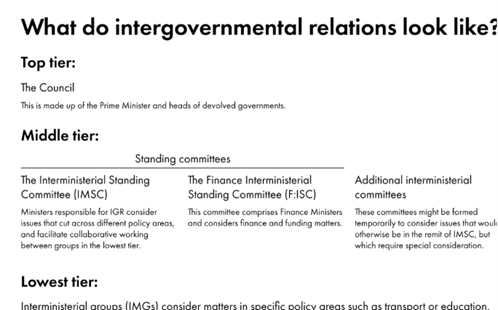
SPICe
Dr Anderson told us that the IGR review in 2022 “potentially marks a moment when those patterns and structures become more institutionalised, but it is very late in the day and means that the process of cultural change and institutionalisation will take a very long time. That is further affected by the sheer asymmetries of scale and power involved.”3
PolicyWISE and the Bennet Institute’s view is that, overall, “the planned changes amounted to a more jointly-owned system which was implicitly based on an acceptance of the need for greater parity of esteem between the UK and devolved administrations.” In some respects this “brought the UK’s system of IGR more in line with the practices of many other democratic states with federal or devolved models of government.”4
Professor Horsley’s submission notes that “IGR are central to the smooth functioning of the UK territorial constitution, particularly post-Brexit. Yet their development has been notably ad hoc” and their non-statutory basis “means effectiveness depends largely on the political will of the UK and devolved governments, and on the quality of relationships between political actors. This represents a further source of constitutional fragility.”5
Professor McEwen and Dr Brown Swan’s research identifies the continued ad hoc nature of interministerial meetings. They note that “meetings continue to be sporadic, with agendas set in the days or even hours leading up to the event. This leaves little time to report to relevant committees in advance of meetings being held.”6
The Scottish Government states that the “new processes and structures established through the Review have become the main framework through which formal intergovernmental relations are conducted and it “has worked collaboratively with the UK and other devolved governments to implement its recommendations.”7
The Scottish Government’s view is that the Review has “also introduced some practical improvements such a fairer and more transparent escalation and dispute resolution mechanism; an impartial, standing IGR Secretariat; and improved reporting on intergovernmental activity, providing further transparency to, and accountability from, each government’s respective legislatures.”7
The Committee recommends that the IGR process should be less ad hoc, with a formal, transparent and structured schedule of interministerial meetings which should be published in advance and communicated to each UK legislature by the Standing Secretariat.
Transparency and Parliamentary Accountability
The 2022 Review states that “governments are accountable to their respective legislatures for the conduct of intergovernmental relations and will seek to promote a wider understanding of this activity. All governments commit to increased transparency of intergovernmental relations through enhanced reporting to their respective legislatures.”1
Professor McEwen states that–
The UK Government continues to issue joint communiques after inter-ministerial meetings when these have taken place within the formal three-tier structure. Communiques are not routinely published following meetings outside of that structure. Communiques provide transparency over the fact that a meeting was held, and who was in attendance. They rarely provide any transparency over what was discussed, and by whom. Even rarer still would be any indication of any issues that emerged within the meetings. Thus, in their current form, they are of limited value to parliamentary scrutiny.2
Dr Anderson states that while “the 2022 Review has led to some improvements in reporting compared to previous arrangements, it is evident that ministers and officials are still not routinely updating parliamentary committees on intergovernmental activities. Strengthening this reporting practice is essential for ensuring proper scrutiny and accountability.” In his view, “more detailed communiqués are required to provide a clear record of discussions, decisions and outcomes of intergovernmental meetings.”3
The House of Lords Constitution Committee states that the formal IGR structures “still lack sufficient transparency” and that “agendas and minutes of all formal IGR meetings should be published routinely, with appropriate redactions where necessary, and that all four governments should ensure transparency reporting is timely and sufficiently detailed to facilitate effective scrutiny.”4 For the Law Society of Scotland, the Review “went some way to addressing concerns about transparency and accountability.”5 Professor Horsley recommends improving “consistency and transparency in reporting IGR activity (e.g., through the IGR Secretariat).”6
Professor McEwen’s view is that “transparency and accountability can be best increased by strengthening the requirements upon the Scottish Government to report on its activity in IGR.”2 Dr Anderson’s view is that across “the different parliaments in the UK, there remain questions of capacity and remit for committees to engage in scrutinising IGR. In this respect, parliamentary scrutiny of IGR could be enhanced via the establishment of a dedicated IGR committee.”3
Professor McEwen and Dr Brown Swan suggest that reliance on jointly-produced communiques is sub-optimal to parliamentary scrutiny as they do not–
generally give much insight into the substance of the discussions and their quality can vary significantly between IMGs;
give any insight into the priorities, strategies and asks that the Scottish Government took to interministerial meetings.
In their view the communiques are of limited value, many lack detail and some do little more than reiterate the agenda. Partly this is a consequence of the challenges involved in securing agreement between governments on the content of communiques. They found that “reaching agreed text for communiques can be a slow and ‘often painful’ process.”9
Professor McEwen and Dr Brown Swan also suggest that reliance on jointly produced communiques does not give any insight to the Scottish Government’s position. They state that when “summaries are shared with committees, it has become common practice to share the joint communique agreed by the four administrations, rather than give an account of the Scottish Government’s own engagement in IGR.”9
They recommend that the “Written Agreement should be revised to include an explicit commitment to provide a written summary, in the form of ministerial correspondence, outlining the positions and priorities that the Scottish Government took to interministerial meetings.” In their view, this “should have the advantage of not having to wait on other governments to agree the text of joint communiques that represent the shared position and outcomes of all participating administrations.”9
The Committee supports this recommendation with regards to reporting on transparency around the Scottish Government’s position. We also believe that there is a need to strengthen joint reporting of interministerial meetings through a strengthened IGR secretariat. This should include a summary of the position of each government in attendance (see paragraph 48 below).
A Standing IGR Secretariat
The IGR Review established ‘A Standing IGR Secretariat’, consisting of officials from all governments, to support the Prime Minister and Heads of Devolved Governments Council (“the Council”), the Inter-Ministerial Standing Committee (IMSC) and time-limited Inter-Ministerial Committees (ICs). It has a limited role in supporting Inter-Ministerial Groups (IMGs) as each IMG has its own secretariat.
However, the IGR Secretariat is responsible for maintaining a record of engagement within IMGs, including a record of IMG meetings as provided by IMG Secretariats. The IGR Secretariat also provides support in establishing new IMGs and with the escalation of matters from IMGs to the IMSC.1
The secretariat is “hosted and funded by the Cabinet Office” and is intended to “promote the efficient and effective maintenance of relations at each tier, facilitate prompt handling and resolution of disputes, and provide administrative support across the structures.”2 It is intended to serve “all governments equally and act impartially” with this impartiality “assured through its accountability to the Council and through its commitment to serve all administrations equally in accordance with the agreed guidance, rules and processes in the IGR review”.1
The functions of the secretariat include –
Determining dates, agenda, location and chairing of intergovernmental meetings of the Council, IMSC, and ICs, and establishing new IMGs as requested;
Compiling/commissioning background papers for discussion for the Council, IMSC, and ICs;
Reporting on the outcomes of meetings, drafting minutes and sharing joint communiqués for the Council, IMSC, and ICs;
Facilitating the process of dispute resolution.
It also operates in accordance with a set of guidelines including to promote "transparency and accountability wherever possible.”2
The IMSC “is supported by the Secretariat, which is responsible for coordinating meetings, capturing minutes and actions, and preparing and publishing communiqués.”5 However, the Secretariat does not support IMGs which “are organised, and secretariat support provided, by the participating teams in each government. The IMGs meet in accordance with their jointly agreed Terms of Reference and publish their own communiqués.”
It is unclear when the IGR Secretariat became operational. Terms of reference for it were published on 27 November 2023. The Secretariat is staffed by officials on placement from across governments. The first two annual reports by the Secretariat, covering 2022-23 and 2023-24, were published on 5 November 2025. The 2023-24 report states that the Secretariat’s Head was appointed in May 2023 but that the Secretariat was “still gearing up and was not fully staffed over the course of this reporting period”.5
Professor McEwen and Dr Brown Swan note that the establishment of the secretariat had not, at the time of undertaking the review of the written agreement on IGR in December 2024, yet generated a more institutionalised process and “there is no transparency over its operation or staffing, and it does not have a presence or identity online to match its commitment to promote transparency and accountability.”7 However, they “anticipate developments here now that more staff have been appointed to the secretariat.”
A more institutionalised process would include more routine intergovernmental meetings that would facilitate advanced notice with the secretariat having responsibility for issuing advanced notice of meetings to each legislature. In their view, while acknowledging a need for flexibility, “a more established transparent secretariat, could produce many benefits both for relationship-building across administrations, and the transparency of those relationships, including mitigating some of the barriers to advanced reporting.”7
Dr Anderson’s view is that the IGR secretariat “has limited visibility and almost no online presence. To further transparency, all governments should work together to strengthen the visibility and accessibility of the Secretariat.”9 Professor McEwen notes that the expectation was that the standing secretariat “would oversee joint reporting” but “there is no transparency on its composition or work.”10
PolicyWISE and the Bennet Institute state that–
The Secretariat currently has very little visibility, with a minimal online presence and a lack of public-facing profile. This stands in contrast to the British Irish Council Secretariat, which maintains a useful website containing information on what the BIC is, its themes and workstreams, recent activity, history, and more. The IGR Secretariat should establish a similarly substantial online presence, which clearly communicates the purpose and remits of the different bodies it administers.11
In its view responsibility “for transparency should lie with the IGR Secretariat, which should be responsible for publishing in one place a range of information related to the Council and its ongoing activities.”11
Dr Brown Swan’s view is that the Secretariat, “which could be a key resource for those engaged in the scrutiny of IGR, remains underdeveloped. It does not possess a standalone web presence, and the IGR reporting carried out (albeit intermittently) by the previous government does not appear to have been updated. SPICe fills the gap, with its Intergovernmental Activity Hub, but it seems logical that agendas and agreed communiques should be published at the UK level.”13
The Scottish Government states that a “key function” of the Secretariat “is not only to promote impartial and efficient intergovernmental relations between all governments but also to support individual governments to report to their respective legislatures regarding their IGR activity, as required.”14 The UK Government states that reporting of intergovernmental relations activity by all four governments and the independent secretariat is vital to support parliamentary scrutiny and Ministerial accountability.15
Scottish Government officials told us that “the secretariat acts independently, even though, for convenience, it is housed in the Cabinet Office” and that they “have a great deal of confidence in the secretariat acting impartially” and “it is not led by the UK Government.”16
The Committee recommends that the role of the Standing Secretariat needs to be considerably strengthened including as follows –
The Secretariat should be based outside of London with additional resources to those currently available;
The Secretariat should be more public-facing including an on-line presence similar to the British Irish Council secretariat;
There should be a greater focus on promoting transparency and accountability in line with its remit as set out in the 2022 Review;
This should include criteria agreed at an intergovernmental level for all communiques including around the minimum level of detail which is required to be provided to support transparency and accountability;
The intergovernmental criteria should include a commitment to provide in each communique a summary of the position of each government in attendance;
The development of an intergovernmental activity hub;
More emphasis on its independence from government(s) as well as impartiality between governments;
A requirement to appear before parliamentary committees if requested.
Informal Intergovernmental Activity
The IGR Review sets out new formal structures to facilitate the operation of intergovernmental relations. However, the majority of intergovernmental activity takes place outside of formal structures. This is evident from the UK Government’s interactive dashboard which covers its engagement with the devolved governments since coming into office in July 2024.
For the reporting period between July 2024 and March 2025 the dashboard provides details of meetings held under the formal IGR structures described above. This includes 14 departmental IMG meetings and 2 meetings of the IMSC. However, the dashboard also notes that these formal structures “are not the sum total of engagement” and the “vast majority of meetings (338), including bilaterals and ministerial visits, took place outside the formal IGR structures.”1
Dr Anderson notes that in “all multi-level systems, it is common for some intergovernmental activity to take place outside formal forums. Indeed, for some participants involved in IGR, informal interactions are seen as more effective, particularly in terms of time efficiency and building trust between those involved.”2 Within the UK context, transparency reports since the 2022 Review “indicate that a considerable number of intergovernmental activities, such as bilateral meetings between Scottish and UK government ministers, take place outwith formal IGR structures.”
The Committee heard that the extent and frequency of this informal activity creates significant challenges for transparency and parliamentary accountability. As Dr Anderson notes there is little evidence that “these meetings are being consistently or adequately reported to parliamentary committees” and this lack of reporting “significantly undermines opportunities for effective legislative oversight.”2 He told us that the “important thing is that, often, the formal meetings inside those [IGR] structures and processes are not where things are discussed. The informal meetings, bilateral discussions and things on the sidelines are sometimes much more important.”4
Hedydd Phylip told us that the IGR review “was a real attempt at formalising and regularising structures, but the comfort zone is to fall back into more informal structures” which is “understandable, but it is unhelpful when you are working towards strengthening or formalising structures that we have worked hard to establish.” She added that a benefit of formal structures is that it “gives some protection from waiting on the whims of a Government’s political colours or political preferences” but that when “you fall back into less formalised structures, you are leaning back into political relationships or political difficulties.” In her view, a “more formalised system at least sets an expectation about what Governments will do together and the areas that they will collaborate in or at least discuss.”5
The Written Agreement on intergovernmental relations between the Scottish Parliament and Scottish Government applies to “the participation of Scottish Ministers in formal, inter-governmental structures.”6 However, given the intergovernmental landscape has changed significantly, with the creation of common frameworks and the process for agreeing exclusions to the market access principles of the UK Internal Market Act 2020 (discussed in more detail later in this report) Professor McEwen and Dr Brown Swan suggest that this “misses much of the critical decision making between administrations that affects the operation of devolution" and that it should be revised “to include the breadth of agreements that fall within its scope, with sufficient flexibility to accommodate new forms of agreement which may emerge.”7 Recommendation 2 also stated that “Reporting requirements should cover all formal bilateral and multilateral ministerial engagement, as originally intended, rather than be limited to the new Interministerial Groups or Interministerial Standing Committees, as has been current practice.”
Professor Wincott told us that his “sense is that the informality of practice and the traditions of UK civil servants—and of some parts of the political system—bend towards confidentiality as a kind of blanket. That is used, in combination with the informal and often ad hoc arrangements that are in place, to treat giving out information as the exception.”5 Dr Anderson told us that it “is difficult to scrutinise the formal meetings because we do not have a lot of information, and it is impossible to scrutinise the informal meetings because we do not know anything.”4
Dr Anderson also told us that informal meetings “happen much more frequently than people would think, and the challenge is that there is no obligation to report on them. If there were an informal bilateral between the Deputy First Minister and the Secretary of State for Scotland, neither of those figures would have to report what was said in that meeting to a parliamentary committee or anything else. That is where parliamentary scrutiny becomes super difficult.”4
Professor McEwen’s written submission states that most “meetings between ministers take place outside of the formal machinery, and are not routinely reported.”11 This informal activity is also outwith the scope of the Written Agreement.
The Committee’s considers that interminsterial engagement should be supported by proportionate reporting of all meetings at which officials are present, to strengthen transparency and enable effective parliamentary scrutiny. The Committee further considers that the Written Agreement on intergovernmental relations between the Scottish Parliament and the Scottish Government should be revised to reflect this.
UK Government’s commitment to resetting relations with the devolved governments since the UK General Election in July 2024
The UK Government’s written submission states that “We have reset the relationship with the devolved governments” and “this has led to a high level of ongoing ministerial engagement between the governments, which will continue.”1 The UK Government’s view is that “it is the quality of engagement - not just its volume - that is important” and that “good intergovernmental relations and ensuring that there are effective working relationships across governments is a joint responsibility shared across all four governments.”1
The Scottish Government’s written submission states that, overall “significant work is still required from the UK Government to fully reset the relationship; ensure its approach respects devolved responsibilities; fully involve Scottish Government at the appropriate point in policy development; and maintain a consistent approach to collaboration across all priorities areas.”3
In our previous work this session we considered the impact of political culture and trust on IGR. Paul Cackette, a former Scottish Government Director, told us that “trust and culture are very hard to develop” and Professor Gallagher agreed that changing “culture is very difficult.”4
We explored the impact of political culture further with our witnesses as part of this inquiry. Dr Anderson told us that there “are two things when it comes to intergovernmental relations: there are the processes and the structures, and then there is the political culture.” While the structures are one thing, “if the people operating within them do not want those structures to work or are not keen on intergovernmental relations because of, for example, party-political differences, they will not work.”5
Dr Anderson suggests that what “differentiates the UK from Germany, but even from other federal and multilevel governance systems, is the absence of….a federal political culture—the willingness to co-operate and to operate on principles of consensus, partnership, equality and parity of esteem.”5
Professor McEwen’s written submission states that the “main focus of the IGR reset has been cultural. This is not insignificant. There is now greater willingness to engage with the devolved governments, and a culture of openness and constructive cooperation in their interactions.”7 She told us that while “we have seen a culture change in that process of resetting relations” that “cultural shift will take you only so far. Some of the challenges that were there previously and which contributed to the difficulties in the relationship are still there.”5
Professor McEwen’s view is that without “a shared perspective on the role of the devolved institutions in policy areas that interact with devolution, and legislative or procedural reforms that restore the authority of the devolved institutions, tensions in IGR are likely to resurface.” 7
Professor Horsley’s submission states that the reset of relations between the UK Government and the devolved governments “has so far followed established patterns: relying on non-statutory mechanisms rather than introducing legal or constitutional reforms.” In his view this non-statutory approach “remains vulnerable to political tensions and breakdowns in trust.”10
A number of our witnesses agreed that there had been a change of tone in the UK Government’s approach to relations with the devolved governments. Dr Minto told us that “Since the Labour Government arrived, we have seen a more positive tone to the nature of engagement with those structures as part of the reset.”11 Professor Wincott’s view is that “there has been a change of tone, and that is not insignificant. However, the tendency towards continuity is a feature of the system, and there is a significant amount of continuity. Any change of tone is fragile, and I agree that the changes have not been consistent or consistently maintained.”11
Dr Anderson told us that what “we have seen so far is, principally, a change in tone. In 2024, the rhetoric and the mood music were fairly positive, with positive notes from both the Scottish Government and the UK Government. However, the position has slightly deteriorated as things have gone on.”5 Dr Brown Swan states in her written submission that the “2024 reset has improved the tone and frequency of engagement, with revised interministerial meetings and the establishment of the Council of the Nations and regions. However, progress has been most noticeable in terms of tone, rather than substantive changes to how IGR takes place.”14
The Committee asked the Cabinet Secretary for his view on progress regarding the UK Government’s commitment to resetting relationships with the devolved governments. He told us that there “has definitely been a change since the last UK general election, certainly rhetorically” and acknowledged that “there are areas where there is good and improving dialogue.” However, he “has no doubt that “the attitude in Westminster is that devolved Administrations and Parliaments are subordinate and that one should do as much as is necessary to help intergovernmental relations to work when it is in one’s interest and to ignore them when it is not. That is the reality of things.” In his view, improved IGR is “not primarily about structures” and that “the key underlying issue is the attitude towards things.”15
The Committee notes that, while the UK Government’s position is that its relationship with the devolved governments has been reset, the Scottish Government’s position is that "significant work is still required from the UK Government to fully reset the relationship"1.
The Committee notes that there is a risk that resolving these differences regarding a reset of relations is overly dependent upon the good will of those taking part. We agree with the findings of the Dunlop Review which stated that there is a need to improve the effectiveness of intergovernmental relations " regardless of any future changes in the political makeup of the UK Government or devolved administrations.17
The Committee has previously noted that "there remains an ongoing intergovernmental disagreement regarding the extent to which the executive and legislative autonomy of the devolved governments and legislatures have been undermined by the constitutional arrangements put in place post-EU exit.4 These arrangements include the UK Internal Market Act and the operation of the Sewel Convention post-EU exit.
The Committee also notes that there has been significant disagreement between the devolved institutions and the UK Government regarding how the post-EU regulatory environment should be managed within the UK, and this remains unresolved.
The Committee notes that at questions to the First Minister in the Welsh Senedd on 10th March reference was made to an unpublished note from the Prime Minister to his UK Cabinet colleagues. The record of proceedings19 includes a direct quote from the note which states that "an overly deferential or laissez-faire approach to devolved Government engagement almost inevitably creates political challenges or misses positive opportunities. We should be confident in our ability to deliver directly in those nations, including through direct spending, even when devolved Governments may oppose this.”i
Whitehall and Devolution
In our discussions with the UK Government in London on 17th November we heard that there has been increased awareness and understanding of devolution among officials across Whitehall and UK Government departments are encouraged to consider the devolved perspective as early as possible.
Professor Wincott told us that there “is always a sense that the UK centre governs by far the largest part of the UK— England—and the roles of Westminster and Whitehall in relation to England have changed relatively little. They have not had to have a huge culture shift, and there remain quite a number of people working at the centre for whom devolution is something of an afterthought.”1
Dr Anderson told us that there “is a mismatch in the understanding of devolution of different Governments across the UK. The UK Government and the UK civil service see no issue with the UK Government flexing its muscles or exercising powers in the devolved nations, because it is the Government of the United Kingdom.” In his view, with “regards to the reset, a lot of work is still to be done, notwithstanding 25 years of devolution, to try to change the unitary mentality that still underpins how the civil service in Whitehall and some Government ministers understand devolution.”2
The Scottish Government’s written submission states that there “remains wide inconsistency in the meaningful consideration from UK Government departments of Scottish Parliament procedures in the development and passage of legislation, which risks undermining the Parliament’s role and authority.”3
The Scottish Government’s written submission states that “continuing inconsistency in information sharing across UK Government departments” and “lack of meaningful engagement throughout the policy development process” means that improvements need to be made to address these issues across UK Government departments including–
in the consistency of experience across policy areas;
to information sharing generally; and
further work across the UK civil service to increase capability when it comes to dealing with devolved governments and legislatures, to raise standards in the UK Government towards the best practice already demonstrated in some parts of the UK Government.3
A senior Scottish Government official told us that they have found “an inconsistency of approach between different UK departments. Some of that was based on a lack of sophistication towards devolution because they had potentially not dealt with a devolution issue previously, whereas some departments had a good level of devolution capability.”5
However, he also highlighted a number of ways in which efforts are being made to improve an understanding of devolution across the Civil Service. This includes through the devolution unit in the Cabinet Office, “which tries to drive improvements in the understanding of devolution across the UK civil service.” Additionally, he cited the annual devolution learning week (a series of online events for civil servants right across the UK, Scottish and Welsh Governments) and a shadowing pilot (to match civil servants from Scottish and UK Government departments to help to drive better understanding across those departments).5
Professor Wincott told us that he recently gave a presentation during the Cabinet Office’s annual devolution learning week and that “seemed to me to show both sides of the issue. There is a fairly high-level commitment to learning about devolution, but there is also a perceived need to teach Whitehall about devolution for a week a year.”1
Hedydd Phylip told us that one “challenge is how you mainstream understanding across all Whitehall departments. Devolution is not just a thing that should be of concern to a certain number of people sitting in one place; it is a factor and a question that officials should be asking in every department at most points of the policy-making process.”1
We asked the Cabinet Secretary whether more consideration could be given to improving understanding of devolution in Whitehall and understanding of the challenges faced by Whitehall within the Scottish Government. His senior official told us that his team “are acutely aware of the pressures that UK Government civil servants are working under and of the fact that devolution issues are just one of the considerations that they are having to make.” Consequently, when upskilling civil servants across the Scottish Government there is an emphasis on helping people to be more empathetic about the pressures that their UK Government colleagues are working under, because that is a pathway to better understanding and collaboration.”5
At its meeting on 12th June 2025 the Interparliamentary Forum discussed opportunities for officials to develop and deepen their experience of the work of other Governments within the UK with Douglas Alexander MP, Minister for State in the Cabinet Office.10
The Committee’s view is that after more than a quarter century of devolution there remains significant concern around levels of understanding of the powers and role and of the devolved governments and legislatures within Whitehall. There appears as a result, a lack of thought in some cases about how devolution affects the development of policy by the UK Government and passage of legislation at the UK Parliament.
The Committee recommends that there needs to be a thorough independent review of how UK Government departments and civil servants interact with devolution. The review should highlight best practice as well as improvements which can be made to intergovernmental working given the increasingly complex shared governance space. The review could also usefully consider how working with the devolved governments is recognised as a valuable element of professional development and career progression within the civil service.
The Committee notes the view of the Scottish Government that further work across the UK civil service is required “to increase capability when it comes to dealing with devolved governments and legislatures raise standards in the UK Government towards the best practice already demonstrated in some parts of the UK Government.”3 The Committee recognises that there are good examples of some UK Government departments working well with their colleagues in the devolved governments and agrees with the Scottish Government that this best practice should be achievable across all UK Government departments. Equally, we recognise that this best practice also applies to civil servants within the devolved governments.
Engagement with UK Ministers
The UK Government’s written submission states that if “invited to appear before a devolved legislature committee, UK ministers will consider whether the subject of the inquiry relates closely to their portfolio in deciding whether to accept. Some of the considerations UK Government ministers may make are set out in Devolution Guidance Note 12.”1
Note 12 deals with the attendance of UK Ministers and Officials at Committees of the Devolved Legislatures. This was last updated in November 2011. This states that while “UK Ministers’ over-riding responsibility is to the Parliament at Westminster, any request for a Minister to attend a Committee of a devolved legislature should be treated with as much care and courtesy as an invitation to attend a Commons or Lords Select Committee.”2
The Committee welcomes the willingness of UK Government Ministers to meet with us informally during our visits to London on 12th June and 17th November 2025. However, there have also been a number of occasions where we have invited Ministers from the current UK Government to appear before us publicly which have been declined.
The Committee’s view is that the resetting of intergovernmental of relations should include improving the effectiveness of engagement between governments and legislatures. The Committee therefore recommends that Devolution Guidance Note 12 should be updated to support clear and consistent expectations around UK Ministers appearing before the Committees of the devolved legislatures. Within the shared governance space which now exists between the UK Government and the devolved governments those expectations should be that invitations are normally accepted. (See also paragraph 106 below) Equally we recognise that improved levels of engagement should also apply to Scottish Ministers appearing before Westminster committees.
Interparliamentary Relations
We note that during Session 6 two interparliamentary forums were established: the Inter-Parliamentary Forum (successor to the Interparliamentary forum on Brexit) and the Interparliamentary Finance Committee Forum.
The primary purposes of the Inter-Parliamentary Forum are to provide a mechanism for dialogue and cooperation between parliamentarians from the UK’s legislatures in meeting common scrutiny challenges arising from the constitutional arrangements put in place following the UK’s departure from the EU and to co-operate in finding solutions to overcome them.
Priorities inlcude the oversight of intergovernmental relations. The forum first met in February 2022 and since then has met a further 6 times.
The primary purposes of the interparliamentary Finance Committee Forum are to provide Finance Committees from the devolved Parliaments with the opportunity for–
information sharing and networking;
to hear from UK and Devolved Government Ministers;
consideration of common challenges.
The Finance Committee Forum first met on 16 June 2022 and has since met a further 3 times.
At the Interparliamentary Forum’s meeting on 15th November 2024, Members welcomed the commitment from the present UK Government to reset relations between the four governments within the UK and sought a commitment that this reset extends to relations with the devolved legislatures, including a recognition that there will be occasions when it is helpful for committees in the devolved legislatures to hear from UK Ministers. The Forum agreed to explore how its members can encourage UK Ministers and officials to respond positively and in a timely way to requests from committees in devolved administrations to give evidence in the spirit of reciprocity. Members also recognised the importance of Ministers in the devolved administrations providing information and evidence to the committees in the House of Lords and House of Commons.1
Professor McEwen’s submission states that–
Interparliamentary work may be of some value, particularly with the other devolved legislatures. This would enable committees to compare and potentially share information they are receiving with respect to multilateral IGR meetings. The Westminster parliament, particularly the House of Commons, has less interest in IGR especially at the portfolio level, and has demonstrated less interest than the devolved legislatures in scrutinising the UK Government’s intergovernmental activity.2
Dr Anderson notes that generally Interparliamentary relations (IPR) has been “somewhat neglected” and “largely ad hoc and informal.” In his view, enhancing IPR “and building further links between committees and the legislatures would be a welcome development, facilitating opportunities for knowledge exchange, the sharing of best practice and giving voice to parliamentary issues.”3 He also suggests that enhancing IPR might also lead to joint committee meetings from different legislatures which could also assist the devolved parliaments in engagement with UK Ministers.
He told us that “there is an incentive to think more deeply about interparliamentary relations. As members of this committee—and every other one—will know, in reality it is very difficult to get a UK Government minister to come before you.” Consequently, “there would be merit in exploring whether Parliaments could work together better, horizontally, to hold Governments to account on intergovernmental relations.”4
Professor McEwen told us that “there is value in interparliamentary work, because you can raise awareness with your colleagues in the Westminster Parliament of why the intergovernmental space matters.”4 The Bennet Institute and PolicyWISE recommend that the relevant parliamentary committees “monitor and examine the Council of the Nations and Regions as it develops and continue to enhance their inter-parliamentary capacity and working in doing so.”6
Hedydd Phylip told us that interparliamentary relations is relatively underdeveloped in our current system.” In her view there has been a slight lack of focus within the Interparliamentary Forum on where it goes next and is essentially an ad hoc informal structure, despite the fact that it is more formalised than any other interparliamentary connection. From her perspective there “is a job of work to be done for the legislatures to think seriously about what they have capacity for, how they would resource a more formalised structure, and what that formalised structure might want to do.”7
We note that one of the key benefits of interparliamentary working is that it provides an opportunity for Members from different legislatures to jointly scrutinise government ministers. In 6 of the 7 Interparliamentary Forums this session a government minister has attended to discuss intergovernmental relations.
The UK Government’s written submission states that with “the already existing high level of scrutiny of individual governments in their respective legislatures, the question is then how can all four governments and all four legislatures bring this together to aid the scrutiny of intergovernmental activity across the United Kingdom to enhance transparency and accountability.” It stated that it “is committed to continuing to support the role and remit of the Interparliamentary Forum to advance this scrutiny.”8
The Committee welcomes the commitment of the UK Government to support the role and the remit of the Interparliamentary Forum and recommends that Devolution Guidance Note 12 is amended to reflect this commitment. (See also paragraph 92 above).
The Committee also considers that the four legislatures of the United Kingdom should jointly explore how interparliamentary relations could be further developed and strengthened. The Committee therefore recommends that the legislatures consider commissioning research on potential approaches to enhancing interparliamentary cooperation and scrutiny, and that this proposal be discussed at a future meeting of the Interparliamentary Forum.
Ongoing Challenges to Resetting Relations since the UK General Election in July 2024
The Committee has carried out a number of inquiries over Session 6 which have identified a number of ongoing challenges arising from the UK leaving the EU which have had a negative impact on relationships between the UK Government and the devolved governments. We summarised the deleterious effects of leaving the EU on relations between the UK Government and the devolved governments in our report on How Devolution is Changing Post-EU | Scottish Parliament–
Notably, there are significant differences between the UK Government and the devolved governments in how they view the extent of change to the operation of the devolution settlement outside of the EU.
Fundamentally, there remains an on-going intergovernmental disagreement regarding the extent to which the executive and legislative autonomy of the devolved governments and legislatures have been undermined by the constitutional arrangements put in place post-EU exit. In turn, these arrangements have considerable implications for both how the shared space is managed at an inter-governmental level and how it is scrutinised at a parliamentary level.1
As noted by the House of Lords Constitution Committee, the UK Government maintained that UK legislation to implement Brexit “extended the reach of devolved powers or left them unaffected, but the Scottish and Welsh Governments criticised what they perceived to be new constraints on their ability to exercise these powers, particularly through the UK Internal Market Act 2020.”2
Professor McEwen’s submission states that–
Some of the commitments made in the Labour manifesto, such as strengthening the Sewel Convention and reaching a new Memorandum of Understanding, have yet to be secured. And the review of the UK Internal Market Act makes clear that this legislation, which has far-reaching implications for devolved law-making and which was passed without the consent of the Scottish Parliament and the Senedd, is here to stay. These are legacy barriers that require more than a culture shift alone. Without a shared perspective on the role of the devolved institutions in policy areas that interact with devolution, and legislative or procedural reforms that restore the authority of the devolved institutions, tensions in IGR are likely to resurface.3
In this section of our report we examine how the UK Government’s reset of relations with the devolved governments has addressed these ongoing challenges. In doing so we agree with the Law Society of Scotland that “Whatever arrangements are developed in the period of reset they must be of sufficient strength to withstand political and social crises in the future.”4
Sewel Convention
The Committee has previously reported on the “fundamental difference of viewpoint between the UK Government and all the devolved governments with regards to how the Sewel Convention has been operating since EU-exit” and that this had “led to a deterioration in relations between the UK Government and all the devolved Governments.” We took the view that “this level of disagreement on a fundamental constitutional matter is not sustainable particularly within the context of an increasing shared space at an intergovernmental level.”1
We sought the views of the new UK Government in July 2024 on this issue and others raised in our report on How devolution is changing post-EU. We highlighted our view that the Sewel Convention is “under strain” following the UK’s departure from the EU. We also highlighted our view that devolution looks very different outside of the EU compared to when the UK was a Member State and, within this context, our recommendation that there is a—
need for a new Memorandum of Understanding and supplementary agreements between the UK Government and the Devolved Governments. This should specifically address how devolution now works outside of the EU and based on a clear constitutional design including consideration of the principles of subsidiarity and proportionality. This should be accompanied by new Devolution Guidance notes and other operational guidance notes.1
We also noted our proposal that the new MoU should include supplementary agreements on Common Frameworks and on the use of delegated powers by UK Ministers in devolved areas.
The UK Minister responded that—
we know our relationship with the EU also has implications for the constitution, and many aspects of the Withdrawal Agreement and the Trade and Cooperation Agreement fall within devolved competence. This is one of many reasons it is important that we reset relations between the four governments within the UK. My approach to UK-EU relations will always respect the role of devolved governments and legislatures.3
The Minister added that “the Sewel Convention and the way the UK Government legislates is certainly a priority area and we are intending to strengthen the Sewel Convention with a new memorandum of understanding. We will be able to send you a fuller response soon.”3
The Scottish Government’s written submission states that restoring confidence in the Sewel Convention is “key to resetting the relationship between the UK and devolved governments and ensuring that the position of the Scottish Parliament is protected, with sufficient opportunity for scrutiny.” The Scottish Government, therefore, “welcomed the proposal for a memorandum of understanding to strengthen Sewel. Although there has not been significant work on this commitment yet, the Scottish Government stands ready to assist and looks forward to progress in the near future.”5 The UK Government’s written submission states that officials “are currently engaging with their devolved government counterparts on a new Memorandum of Understanding regarding legislation, and we hope to agree a final version in the months ahead.”6
The UK Government states in its written submission that they “have been prioritising early and effective engagement on legislation with the devolved governments since the General Election” and that this “co-operation has resulted in the devolved legislatures passing 37 Legislative Consent Motions for UK Bills and Acts.”6 The Scottish Government recognise that the UK Government “has not breached the Sewel Convention in relation to Scotland during its first year in office.”5
However, the Scottish Government does raise concerns “on timely sharing of information and proper recognition of Scottish parliamentary procedures in its Bill timetabling processes.” In its view “there remain numerous examples of Bills being shared too late in the process for the Scottish Government to lodge its legislative consent memorandum in time to meet Scottish Parliament standing orders. There have also been instances of late sharing of amendments and timetabling pressures leading to inadequate time for proper consideration by the Scottish Parliament.”5
Professor McEwen told us that a “number of problems were associated with the operation of the Sewel convention even before we got to the point of it being set aside and the UK Parliament proceeding without consent.” In her view that “is the biggest issue, but there were other issues around timing— the devolved legislatures being given due time to consider legislative consent motions—and the possibility of legislation changing further down the line, after consent has been given.”10
Furthermore, the “missing bit of the picture for me has always been what happens in the UK Parliament if consent is withheld—the answer to that, so far, is nothing. If we want to bolster the Sewel convention, I would want to see a bit more than just an MOU between the Administrations.” She suggests that there “is a role for the UK Parliament, too, in acknowledging whether it wants to recognise the fact or in some way amend its process if consent is withheld from one or more of the devolved legislatures.”10
Dr Anderson told us that under the Sewel convention, “the onus should be on the UK Government to engage with the UK Parliament and explain what steps it has taken to engage with the devolved Governments.” In his view this “would have the benefit of the UK Government having to consider the implications for the devolved institutions, to explain what those would mean, particularly in the early stages of law making, and to offer an opportunity to address any concerns.” Furthermore, “when consent was withheld, the UK Government would have to explain to Parliament, through a clear and transparent process, whether proceeding without consent would be the right thing to do.”10
In our discussions with the UK Government in London on 17th November 2025 we were told that the MoU on Sewel is taking a while but there is an emphasis on getting it right. The Cabinet Secretary and his official provided us with a further update on 18th December 2025. The Cabinet Secretary told us that “not as much has been done as we would like” and “it is a bit surprising that we still have not received that memorandum of understanding or made substantive progress.” His official added that there are collaborative discussions on-going between UK Government and Scottish Government officials “to try to bring about wording that we could potentially put to ministers” and there “is hope that we could potentially have something to put to ministers shortly, on the basis that we have a looming Scottish parliamentary election, which I think changes matters.”13
The Committee welcomes the commitment of the UK Government to strengthen the Sewel Convention with a new memorandum of understanding. We reiterate our previous recommendation in 2023 of—
the need for a new Memorandum of Understanding and supplementary agreements between the UK Government and the Devolved Governments. This should specifically address how devolution now works outside of the EU and based on a clear constitutional design including consideration of the principles of subsidiarity and proportionality. This should be accompanied by new Devolution Guidance notes and other operational guidance notes.1
The Committee welcomes the update provided by the Scottish Government that “collaborative discussions” are ongoing between their officials and UK Government officials. The Committee recommends that our successor should prioritise scrutiny of the outcome of those discussions early in Session 7.
UKIMA and Common Frameworks
The UK Government launched a review of and published a consultation on the UK Internal Market Act 2020 Parts 1,2,3, and 4 on 23rd January 2025.1 The document stated that “management of the internal market is best achieved through discussions between all 4 nations” and that when that “collaboration is working well”, UKIMA “sits in the background as a tool for all governments within the UK to manage instances of divergence which might cause unnecessary cost and trade barriers – enabling free movement of goods and services and supporting people to work and do business.”2 The document also highlighted the UK Government’s commitment to use Common Frameworks “as the main fora for the 4 governments of the UK to discuss and collaborate on new ideas and policies in the areas they cover, and to consider the impact these may have on the internal market” and to “aim to ensure that the programme to establish Common Frameworks is complete by Easter 2025.”2
The UK Government published its analysis of the responses4 to the public consultation on 15th July 2025 including the following–
“Overall, there is broad recognition of the need for a secure framework to support a well-functioning UK internal market, with a range of views about how this could best be achieved.”
“There is general support for the UK Internal Market Act’s Market Access Principles of mutual recognition and non-discrimination, with responses recognising the important role they play in facilitating the smooth trade of goods and provision of services across the UK.”
“Businesses and BROs[business representative bodies] are particularly vocal about the need to avoid barriers to free trade and the consultation showed clearly that the protections provided by the Market Access Principles are an important way to achieve this.”
“What is also clear is that a broad range of stakeholders want to see the four governments within the UK working together more effectively.”
“The majority of respondents do not want repeal or major reform of the Act, although many did assert the importance of innovation addressing local needs.”
“Respondents also want to see improvements in the way that exclusions from the Market Access Principles are considered and agreed.”
“Stakeholders were broadly satisfied with the current functions conferred on the Competition and Markets Authority (CMA) and the way in which the Office for the Internal Market (OIM) is carrying them out.”
In response to the review and the public consultation the UK Government agreed the following “key changes”–
“To implement all UK Internal Market Act exclusions where they are agreed by all governments in a Common Framework;
Alongside economic impacts, we will now consider in particular environmental protection and public health in UK Internal Market Act exclusions, thereby ensuring a balance of factors is considered; and
To implement a streamlined process to consider proposed exclusions that have minimum economic impact.”2
The UK Government also agreed to “firmly establishing Common Frameworks as the principal place for intra-governmental policy discussion” and aspires to “see genuine collaborative working between the four governments in the best interests of our country and its citizens, effectively moving the UK Internal Market Act into the background, only operating to underpin an efficient and effective UK internal market.”2
The UK Government also published an evaluation of common frameworks in July 2025. It states that frameworks “do not set out policy themselves; rather, they are non-statutory documents setting out how officials across the UK work together” and it “was too early to judge how effectively frameworks were working, even within frameworks that had experienced governments determining different policy approaches.”7
Other findings included that “within most frameworks there were regular meetings between officials within each of the governments” and that the “frameworks were helpful in formalising working between governments." Officials also reported that frameworks “were seen as mainly internal processes” and that they were used “to share information on what they were working on and where they were up to, to support better policy making.”7
The Scottish Government’s position is that the outcome of the UKIMA review, “represents a missed opportunity to remove an unnecessary source of friction between the governments of the UK and restore confidence in the devolution settlement.” In their view the “package of measures falls significantly short of what is needed to address the damage the IMA has caused to the powers of the Scottish Parliament, to effective intergovernmental relations, and to the establishment of a workable, proportionate and transparent post-EU Exit market regime which delivers for businesses, consumers and citizens.”9
The Scottish Government welcomes the commitment to foregrounding Common Frameworks “as the primary mechanism for managing divergence between the nations of the UK is welcome, but there remains a lack of clarity on how the UK Government propose Common Frameworks fulfil their intended role. The market access principles of the IMA continue to apply automatically in almost all cases and subsequently condition the operation of Common Frameworks.”9
The Committee asked the Cabinet Secretary whether he considered that the views of the Scottish Parliament had been reflected in the UK Government’s review of UKIMA. He responded, “No, I do not, because the current UK Government, having said before it was elected that it would repeal the internal market act, did not act on that commitment to repeal the act when it took up office and overlooked two votes in this Parliament for the repeal of the act.”11
The Cabinet Secretary told us that the “issue is not about making the internal market act work; it is about repealing it and making the common frameworks mechanism work.” However, in his view the UK Government’s preferred approach “is to deal with these intergovernmental matters through the common frameworks route but that it wants to keep the internal market act in reserve. That position has been resisted very strongly by the Scottish Government, which still believes that the IMA should be repealed.”11
The Welsh Government published a written statement on the outcome of the review in which it stated that–
We need an approach to governing the UK internal market which works with the grain of devolution and respects our democratic mandate. The commitments made by the UK Government following the review are a good start towards this goal. We particularly welcome the commitment to implement any exclusions agreed via Common Frameworks, which should improve the functioning of the UK internal market.13
The statement also reaffirmed the Welsh Government’s “long-standing and consistent view that the Act should be repealed and replaced with a system, underpinned by legislation, designed around the Common Frameworks and which maintains the safeguards necessary to support the Windsor Framework.” The Welsh Government “will continue to make the case for statutory changes to the Act to prevent its misuse and improve its functioning alongside the devolution settlements. The non-statutory commitments made by the UK Government are welcome, but they do not prevent the misuse of the Act by future UK Governments to enforce English policy preferences in affected devolved policy.”13 The statement concludes that “Notwithstanding these concerns, I welcome the changes being made by the UK Government as a positive step in the right direction. We will work together with the UK Government and other devolved governments to support the further clarification and implementation of the proposed changes.”13
Common Frameworks Programme
As part of our inquiry the Committee received an update on the implementation of the Common Frameworks programme from both the Scottish Government and the UK Government. The Scottish Government’s position is that the programme “continues to face various headwinds. Chief among these is the missed opportunity to address, through the recent statutory review, the impact of the Internal Market Act (IMA) on the devolution settlements in general, and the operation of Common Frameworks specifically.”1
For the Scottish Government this “is regrettable, and means the IMA remains an impediment to effective implementation of Common Frameworks” but despite “these obstacles, the Scottish Government remains committed to making progress with the finalisation of the Common Frameworks programme where possible.”1
This means that for those frameworks “where the IMA continues to present obstacles to successful operation, such as the Resources and Waste Common Framework, the outcomes of the statutory review do not provide the necessary assurance to the Scottish Government to allow us to proceed to sign-off. These frameworks will therefore have to remain provisional, while fully operational, for the time being.”1
The UK Government’s position is that it is regretful that the programme is not yet fully implemented and remains of the view that all frameworks should receive ministerial sign off from all relevant governments as soon as possible.4
The UK Government confirmed that 27 frameworks are provisionally operational, and 1 is fully operational and that these “are being used right now to facilitate close working between the governments party to them, to ensure interoperability of policies and regulations and where desired, agree common goals and approaches, recognising devolved governments’ decision-making powers and the specific needs of each part of the UK.”4
The Committee notes that the principles for Common Frameworks were agreed at the Joint Ministerial Committee (EU Negotiations) JMC in October 2017 between the UK government and Scottish and Welsh Governments and that these were endorsed by the NI Executive in June 2020. Yet over 8 years since that initial agreement it is striking that a majority of Common Frameworks have yet to be agreed by the Scottish Government.
The Committee also notes that although the Scottish Parliament has twice voted by division to support repeal of the UK Internal Market Act in Session 6, the possibility of repeal was not considered as part of the UK Government review of UKIMA. We also note that this has impacted negatively on the Scottish Government’s agreement of Common Frameworks “where the IMA continues to present obstacles to successful operation, such as the Resources and Waste Common Framework…”1
The Committee’s view is that it is therefore unclear how further progress can be made in agreeing Common Frameworks in policy areas impacted by the UK Internal Market Act. In our view this undermines certainty and trust among businesses and other stakeholders that the UK’s regulatory environment is being managed effectively through robust intergovernmental relations. It also hinders Ministerial accountability and parliamentary scrutiny.
Transparency and Stakeholder Engagement
A key issue for this Committee and our predecessor Committee has been the lack of transparency, parliamentary accountability and stakeholder engagement with regards to intergovernmental activity within the ambit of Common Frameworks and the UKIMA exclusions process. In our response to the UKIMA review we stated that both the operation of Common Frameworks and the exclusions process are largely opaque with little opportunity for parliamentary scrutiny or stakeholder engagement.
We have also previously identified a low level of awareness of Common Frameworks among business and other stakeholders and recommended that the “role of business and other stakeholders in the process and the role of parliament(s) in holding Ministers to account must be part of the wider framework process.”1
Findings rom the UK Government’s evaluation of common frameworks in July 2025 included the following–
“internal resource was raised as a barrier to different framework activities such as monitoring cross-cutting issues, risk-assessing the impact of potential areas of divergence, and conducting stakeholder engagement”;
“this was particularly a barrier for devolved governments in being able to participate as actively as UK Government officials within the frameworks.”
“The case study frameworks tended to have had limited stakeholder engagement.”
“Frameworks were seen as mainly internal processes and therefore that it was not always relevant to consult with stakeholders.”
“Resource was mentioned multiple times as a barrier to stakeholder engagement within frameworks, even among those who were doing more active engagement.”
“It was noted that, more widely across governments, there was not good knowledge and understanding of Common Frameworks.”
The UK Government’s report on the UKIMA identified concerns from businesses and other stakeholders in relation to the operation of Common Frameworks. The report states that the UK Government recognises and agrees “with stakeholders’ concerns around the lack of clarity about how Common Frameworks operate.” The report notes that there “was a view from a range of stakeholders that Common Frameworks need to operate with more clarity, with government policy delivery programmes communicating more effectively with their external stakeholders about upcoming areas of discussion.” Furthermore, stakeholders “want their views to be considered within Common Frameworks discussions, and for this to take place in a clear and transparent way.” 2
The package of measures announced in the report inlcude a commitment “to work with the devolved governments to agree processes for how all four governments engage with businesses and other stakeholders on matters being discussed in Common Frameworks.” 2
Food and Drink Federation Scotland told us that–
If the Scottish Parliament does not know what is going on and the academics do not necessarily get the latest information and have to rely on other stuff, can you imagine how difficult it is for businesses? My written evidence touches on the issues of clarity, transparency and information about timescales. None of that is there, from a business perspective.4
Professor McEwen’s submission states that intergovernmental discussions within the ambit of Common Frameworks “are usually conducted amongst officials rather than ministers, and there are no reporting requirements for these meetings.” In her view this “lack of transparency can have a significant impact on parliamentary scrutiny and generate considerable confusion and uncertainty among stakeholders. This has been especially apparent when the Scottish Government has sought an exclusion from the Market Access Principles of the United Kingdom International Market Act (2020).”5
Dr Anderson notes that responsibility “for reporting on the operation of common frameworks rests with ministers” and that this “presents a challenge to effective scrutiny, with the risk that respective committees have little information on framework operations, disputes or other emerging issues.”6 He also notes that scrutiny of frameworks “has been largely limited to their development rather than functioning.”6
Professor McEwen and Dr Brown Swan recommended “supplementing the yearly Programme for Government with an assessment of the elements of that programme that interact with, or may be affected by, Common Frameworks, the United Kingdom Internal Market Act, EU alignment, or other executive, legislative, fiscal or constitutional factors that will necessitate cooperation between governments.”8
The research also recommended that the Scottish Government “should commit to enhanced reporting to relevant committees during the process of seeking an exclusion from the market access principles of the UK Internal Market Act, in recognition of its significant impact on Parliament’s law-making function.”8
The Committee supports both of these recommendations.
The Committee also recommends amending Rule 9.3.3 of the Standing Orders to require the Scottish Government to set out in the Policy Memorandum accompanying a Government Bill –
whether the market access principles in the UK internal market Act are likely to affect the policy objectives of the legislative proposal, if UKIMA has shaped the legislative approach and, if so, how; whether consideration has been given to seeking an exclusion and, if so, provide details on the scope of the exclusion sought and the exclusion process under which it has been made (i.e., through a common framework, through the minimum economic impact process or by the reserve process;
whether and how common framework agreements have affected or may affect the policy objectives of the legislative proposal and, if they do have an impact, provide details.
However, the Committee is also of the view that it is difficult to see transparency and stakeholder engagement improving while there are fundamental constitutional differences at an intergovernmental level.
UK/EU Relations
The Minister for the Cabinet Office wrote to the Committee on 13th August 2024 stating that the UK Government–
intends to improve security co-operation and remove barriers to trade between the UK and the European Union (EU) However, we know our relationship with the EU also has implications for the constitution, and many aspects of the Withdrawal Agreement and the Trade and Cooperation Agreement fall within devolved competence. This is one of many reasons it is important that we reset relations between the four governments within the UK. My approach to UK-EU relations will always respect the role of devolved governments and legislatures.1
The Scottish Government’s written submission states that the UK Government’s “tone and approach to EU relations has shifted significantly since the 2024 General Election and the new government’s attempt to reset relations. This approach extended to an offer to integrate the Scottish Government’s concerns more closely into the process of negotiating closer relations with the EU.”2
The Cabinet Secretary acknowledges “that there are areas where there is good and improving dialogue. The Government minister that I speak with most often is Nick Thomas-Symonds of the Cabinet Office, who has responsibility for negotiations with the European Union.”3
However, the Scottish Government also highlights significant strains on relations at times when the UK-EU Relations IMG process was not used to share information with the Scottish Government in advance of the UK-EU Summit in London on 19 May 2025. The submission states that a “clear example of this was the fisheries agreement, where no information was shared in advance. Scottish Government Ministers have made clear this was unacceptable.” 2
The Cabinet Secretary told us that the “Scottish Government can be better informed about EU-UK matters because of what we hear in Brussels than because of what we hear from the UK Government. That is an extraordinary state of affairs, and I am sure that everybody would agree that that is not the way that things should operate.” 3
He added that his “issue is not necessarily about being informed. We were informed that there was a UK-EU agreement process—of course we were. We had meetings about it and I have given evidence about it. That is not the major issue. The major issue is about the content.”3
Dr Anderson told us that “the position has slightly deteriorated as things have gone on”, for example, “the issue of the UK Government’s negotiations with the European Union, particularly around fisheries, where the Scottish Government was not involved or indeed updated until what seemed to be the last minute.”7
The Committee recommends that the Concordat on International Relations – Scotland is revised and updated.8 This should set out how the UK Government and Scottish Ministers will co-operate with respect to international relations including with regards to UK-EU relations.
Dynamic Regulatory Alignment
A UK-EU Summit in May 2025 resulted in an agreement for new and closer relations between the UK and the EU. The commitments to agree an SPS Agreement and to link Emissions Trading Schemes would result in dynamic regulatory alignment for the whole of the UK with a specified area of EU laws.
We asked some of our witnesses about the potential impact of dynamic regulatory alignment arising from the UK-EU reset. Professor McEwen told us that on “the broader issue of the UK-EU reset, I think that the implications of dynamic alignment will be enormous” with the expectation that “there will be a lot of secondary legislation coming through, to maintain dynamic alignment if that is what is ultimately agreed, and a lot of that will inevitably fall within devolved areas.”1
Furthermore, regulatory alignment with the EU as a non-Member “comes at a price, and the price is democratic accountability at that level, because the UK is no longer at the table” and this “has knock-on effects for this Parliament when it comes to that process. That is why it is important to try to get at least the input processes right and make sure that the Parliament has a role in that respect.”1 Professor Horsley told us that the “issue of ‘take it or leave’ when it comes to dynamic alignment will be determined by the agreement that is reached, but you could end up in the same position as Norway, whereby ‘take it or leave it’ applies not just to this Parliament but to the whole of the UK in the sense of what is on the table.”1
Professor Wincott explained that when the UK was a member of the European Union, devolved Governments played a significant role in transposing EU rules into domestic law: “Those EU structures were designed to give domestic actors a margin of manoeuvre in how they implemented a common law—a shared internal market law across the EU—whereas now we are potentially having dynamic alignment. If there is an agreement on dynamic alignment, the “assumption seems to be that that will be primarily through secondary legislation at the UK level, bolstered by the structures of the UK internal market and scrutinised technocratically by the office for the internal market.” In his view some “serious challenges lie ahead, which, to go back to the devolution reset, have not been thought about systematically across the UK level.”4
Hedydd Phylip told us that “dynamic alignment poses significant questions for both the legislatures and the devolved Governments. It will require resources and require some hard thinking about how they balance the need for them to do it themselves to honour their devolved commitments, and the realities of rolling that out.” In Ms Phylip’s view “we will probably expect a degree of the UK Government doing it on everyone’s behalf, which is, of course, a nervous place for us to witness from, having already seen the extent to which the UK Government legislated on our behalf in respect of withdrawing from the EU. We are right to be concerned about how that will work out.”4
Dr Minto suggested that the Interministerial group on UK-EU relations would “do the heavy lifting in the work around the UK-EU reset and the dynamic alignment around sanitary and phytosanitary measures and the emissions trading system.” In her view there are “big questions about the extent to which the interministerial group would be able to do that, given the scale of work that is required.”4 She also raised questions around the transparency of the group given there have not been communiqués issued from all of the meetings of the group and those which have been issued have been brief.
Food and Drink Scotland told us that they would “expect a significant volume of regulation, initially at least and probably on-going” but “what ability you will have to say no here or in the Senedd or at Westminster is unclear. It becomes a bit more difficult to understand where the ability to defend Scotland’s or the UK’s interests will lie.”1
The Scottish Government’s written submission states that the “degree of legislative activity the summit agreements will create is considerable and the UK Government, in parallel to negotiating with the EU, is currently assessing what legislation will be required to implement the expected substantial re-adoption of EU law in areas where full alignment has not been maintained.”8
The 5th EU Law Tracker report states that the “domestic implementation of any new UK-wide agreement(s) with the EU also raises questions regarding arrangements for scrutiny.” There are two main elements to these arrangements–
The domestic legislation to give effect to the anticipated UK-EU agreements;
The subsequent legislation required to comply with the new obligations for dynamic regulatory alignment of the UK with the EU.9
This raises questions regarding arrangements for scrutiny of both the primary legislation and the subsequent legislation (most likely secondary) required to comply with the new obligations for dynamic regulatory alignment of the UK with the EU. With regards to the latter the Scottish Government submission states that “secondary legislation is expected to be significant in volume” and that a “transposition model is expected, with powers taken to implement the necessary EU law via secondary legislation.”8 Consequently, Scottish Government officials “expect to work with the CEEAC Committee before the elections and its successor to agree on the most effective means for the Scottish Parliament to scrutinise the anticipated legislation.”8
Both Professor McEwen and Professor Horsley were supportive of SIP2 as a basis for the scrutiny of secondary legislation arising from dynamic alignment with the EU. Professor McEwen told us that the protocol has a bit more heft to it than the written agreement” while Professor Horsley told us that the protocol “does have teeth and I think would be a useful instrument in that sense.”1
The Committee has previously reported that “the constitutional landscape is now much more complex with delegated powers for UK Ministers in devolved areas in numerous UK Acts and not solely in policy areas previously within EU competence.”13 We have also noted that this amounts to a significant constitutional change and that this has occurred on an ad hoc and iterative basis without any overarching consideration of the impact on how devolution works.13
The UK Government’s written submission states that–
UK Government ministers can also use certain regulation-making powers to legislate on devolved matters. The Sewel Convention only applies to primary legislation and there is no similar convention governing the use of secondary legislation. However, UK Government departments are encouraged to work with colleagues in the devolved governments on the content of regulations in devolved areas and, for some powers, there have been commitments to seek the agreement of, or to consult, the devolved governments before using them. In the year following the General Election, the Government laid 92 Statutory Instruments covering devolved topics. For 43 of these Statutory Instruments, a UK minister sought the agreement of ministers in the devolved governments and for a further 23 Statutory Instruments, a UK minister formally consulted devolved government ministers.15
The possibility of dynamic regulatory alignment with the EU in some policy areas adds to this complexity and raises further questions around Ministerial accountability and parliamentary scrutiny. As noted in the 5th EU Law Tracker report, implementing “any commitment to UK-wide dynamic regulatory alignment with aspects of EU law may result in centralisation of relevant policy areas, even if these are devolved.”9
The Committee notes that the expected substantial increase in volume of secondary legislation to implement dynamic regulatory alignment raises significant resource questions for both the Scottish Government and Scottish Parliament. At the same time the Committee reiterates our emphasis on the fundamental constitutional principle that the Scottish Parliament should have the opportunity to effectively scrutinise the exercise of all legislative powers within devolved competence while also acknowledging that this scrutiny needs to be proportionate.
The Committee welcomes that Scottish Parliament and Scottish Government officials are currently reviewing Statutory Instrument Protocol 2 to ensure effective and proportionate scrutiny of all UK SIs made within devolved competence, including those anticipated to arise from a requirement for dynamic regulatory alignment with the EU.
Dynamic regulatory alignment illustrates many of the themes and scrutiny challenges highlighted elsewhere in this report. For example, the opportunities for Scotland to influence the UK-EU relationship and other bilateral trade deals exist only in the shared space of UK intergovernmental activity.
Issues which may arise in devolved policy areas which will fall under a UK-EU agreement are also influenced by the existence of common frameworks, governed by the operation of the UK Internal Market Act 2020, and shaped by the willingness of successive UK Governments to take and exercise powers in devolved areas, often without the consent of Scottish Ministers.
The UK leaving the EU drove the establishment of legislative and non-legislative mechanisms to manage intra-UK difference, but these mechanisms now exist in a form which fundamentally changes the operation and shape of the devolution settlement. As the Committee has previously noted the reach of these mechanisms extends beyond the scope of former EU competence and the areas which are likely to be governed by dynamic alignment.
In the Committee's view, it is accordingly essential that the Scottish Parliament is notified by the Scottish Government of all SIs containing provision within devolved competence, irrespective of whether they arise from dynamic alignment. The interrelationship between the issues also informs the Committee's view that the Session 7 committee responsible for oversight of UK-EU and external relations should also be responsible for scrutiny of the operation of the devolution settlement through the scrutiny of the common frameworks programme, UKIMA and its exclusions process, the operation of the Sewel convention including the taking of delegated powers and the exercise of delegated powers in devolved areas.
The Committee notes that there is likely to be a substantial increase in the volume of SSIs and SIs containing provision within devolved competence as a consequence of dynamic alignment. We further note that the impact on parliamentary resources will be dependent on the transposition model agreed between the UK Government and the Scottish Governments and the extent to which EU law within devolved competence is transposed through SSIs and/or SIs. It will also be dependent on the agreement between the UK and the EU and whether there is any flexibility in relation to the transposition of EU law.
The Committee notes that procedures for the transposition and implementation of EU legislation in the UK were previously set out in the Concordat on Co-ordination of European Union Policy. The Committee further notes that if a similar transposition model is introduced for dynamic regulatory alignment that similar procedures will be needed. If so, it is essential that this includes consideration of the need for transparency and Ministerial accountability.
Annexe A - Note of Meetings with UK Government, London, 17th November 2025
As part of our inquiry we held a number of informal meetings in London. The key themes to emerge from our informal meetings with the Parliamentary Secretary for the Cabinet Office, Chris Ward MP; Parliamentary Under-Secretary of State for Scotland, Kirsty McNeill MP; and with Cabinet Office officials were as follows –
IGR structures should work in good times as well as bad but tone and personal relationships are also important and the UKG is determined to make strong relationships work;
at the formal/Ministerial level, the reset has led to effective regular meetings with crunchy agenda items involving really good discussions and that they feel like worthwhile productive meetings;
at official level there are really strong relationships with devolved governments at both a formal and informal level and generally allow for frank and honest discussions;
while there is scope for more informal relationship building it is recognised that this is not a substitute for robust structures;
recognise the importance of a robust independent secretariat;
the frequency of meetings was less important than the content of the meetings and there is a sense that meetings happen when they are needed/wanted by all governments;
the communique following an IGR meeting requires agreement of all governments and there needs to be a balance between transparency and having a space for frank discussion; there could be a discussion between governments around the appropriate level of transparency to facilitate greater parliamentary scrutiny;
the confidentiality of IGR meetings allows for a frank exchange of views and there is a risk that too much focus on transparency would make these meetings less effective;
while it for each legislature to scrutinise its executive it was recognised that there could be a role for the Interparliamentary Forum in conducting joint scrutiny;
there has been increased awareness and understanding of devolution among officials across Whitehall and UKG departments are encouraged to consider the devolved perspective as early as possible;
Common Frameworks are seen by the UK Government as the arena for addressing disputes about the UK Internal Market with UKIMA seen as the legislative backstop for addressing disputes; recognise there is a need to look at transparency of the frameworks;
The MoU on Sewel is taking a while but there is an emphasis on getting it right.
Annexe B - extracts from meeting minutes
Transparency of Intergovernmental activity and its implications for parliamentary scrutiny:
The Committee took evidence from—
Professor Thomas Horsley, Professor of Law, University of Liverpool;
Professor Colin Reid, Professor of Public and Environmental Law, University of Dundee;
David Thomson, Chief Executive, Food and Drink Federation Scotland;
Dr Paul Anderson, Senior Lecturer in International Relations and Politics, Liverpool John Moores University;
Professor Nicola McEwen, Professor of Public Policy, University of Glasgow.
Transparency of Intergovernmental activity and its implications for parliamentary scrutiny:
The Committee took evidence from—
Hedydd Phylip, Lecturer in Public Law and Devolution, Professor Daniel Wincott,Blackwell Professor of Law and Society and Dr Rachel Minto,Senior Lecturer in Politics, Cardiff University;
Mireia Grau Creus, Head of Research, Institute for Self-Government Studies, Barcelona.
Transparency of Intergovernmental activity and its implications for parliamentary scrutiny:
The Committee took evidence from—
Angus Robertson, Cabinet Secretary for Constitution, External Affairs and Culture and Chris Mackie, Deputy Director, Constitution & UK Relations, Scottish Government.
Transparency of Intergovernmental activity and its implications for parliamentary scrutiny (in private):
The Committee considered a draft report on the Transparency of intergovernmental activity and its implications for parliamentary scrutiny inquiry and agreed to consider a further draft at its meeting next week.
Transparency of Intergovernmental activity and its implications for parliamentary scrutiny (in private):
The Committee considered and agreed a draft report. One change was agreed by division. Neil Bibby, Stephen Kerr and Jamie Halcro Johnston dissented from the report.
Sources
The Smith Commission. (2014). Report. Retrieved from <a href="https://webarchive.nationalarchives.gov.uk/ukgwa/20151202171059/http://www.smith-commission.scot/smith-commission-report/" target="_blank">https://webarchive.nationalarchives.gov.uk/ukgwa/20151202171059/http://www.smith-commission.scot/smith-commission-report/</a>
UK Government. (2021). The Dunlop Review into UK Government Union capability. Retrieved from <a href="https://www.gov.uk/government/publications/the-dunlop-review-into-uk-government-union-capability" target="_blank">https://www.gov.uk/government/publications/the-dunlop-review-into-uk-government-union-capability</a>
PolicyWISE and the Bennet Institute for Public Policy. (2025). A more collaborative way of governing? Why the UK’s Council of the Nations and Regions matters. Retrieved from <a href="https://www.bennettschool.cam.ac.uk/publications/council-of-the-nations-and-regions/" target="_blank">https://www.bennettschool.cam.ac.uk/publications/council-of-the-nations-and-regions/</a>
UK Government. (2022). Review of intergovernmental relations. Retrieved from <a href="https://www.gov.uk/government/publications/the-review-of-intergovernmental-relations" target="_blank">https://www.gov.uk/government/publications/the-review-of-intergovernmental-relations</a>
Professor Nicola McEwan. (2025). Written submission. Retrieved from <a href="https://yourviews.parliament.scot/session-6/transparency-of-intergovernmental-activity-and-its/consultation/view_respondent?uuId=151731984" target="_blank">https://yourviews.parliament.scot/session-6/transparency-of-intergovernmental-activity-and-its/consultation/view_respondent?uuId=151731984</a>
Scottish Parliament. (2025). Official Report, Constitution, Europe, External Affairs and Culture Committee meeting, 2 October 2025. Retrieved from <a href="https://www.parliament.scot/chamber-and-committees/official-report/search-what-was-said-in-parliament/CEEAC-02-10-2025?meeting=16619" target="_blank">https://www.parliament.scot/chamber-and-committees/official-report/search-what-was-said-in-parliament/CEEAC-02-10-2025?meeting=16619</a>
Professor Horsley. (2025). Written submission. Retrieved from <a href="https://yourviews.parliament.scot/session-6/transparency-of-intergovernmental-activity-and-its/consultation/view_respondent?show_all_questions=0&sort=submitted&order=ascending&_q__text=horsley&uuId=296361946" target="_blank">https://yourviews.parliament.scot/session-6/transparency-of-intergovernmental-activity-and-its/consultation/view_respondent?show_all_questions=0&sort=submitted&order=ascending&_q__text=horsley&uuId=296361946</a>
Professor Nicola McEwen and Dr Coree Brown Swan. (2024). The Scottish Government-Scottish Parliament Written Agreement on Intergovernmental Relations: Still Fit for Purpose?. Retrieved from <a href="https://www.gla.ac.uk/research/az/publicpolicy/outputs/headline_1142729_en.html" target="_blank">https://www.gla.ac.uk/research/az/publicpolicy/outputs/headline_1142729_en.html</a>
Scottish Government. (2025). Written submission. Retrieved from <a href="chrome-extension://efaidnbmnnnibpcajpcglclefindmkaj/https://www.parliament.scot/-/media/files/committees/constitution-europe-external-affairs-and-culture-committee/correspondence/2025/igr--scottish-government.pdf" target="_blank">chrome-extension://efaidnbmnnnibpcajpcglclefindmkaj/https://www.parliament.scot/-/media/files/committees/constitution-europe-external-affairs-and-culture-committee/correspondence/2025/igr--scottish-government.pdf</a>
Dr Paul Anderson. (2025). Written submission. Retrieved from <a href="https://yourviews.parliament.scot/session-6/transparency-of-intergovernmental-activity-and-its/consultation/view_respondent?uuId=1044022869" target="_blank">https://yourviews.parliament.scot/session-6/transparency-of-intergovernmental-activity-and-its/consultation/view_respondent?uuId=1044022869</a>
Constitution Committee of the House of Lords. (2025). Written submission. Retrieved from <a href="https://yourviews.parliament.scot/session-6/transparency-of-intergovernmental-activity-and-its/consultation/view_respondent?uuId=710875590" target="_blank">https://yourviews.parliament.scot/session-6/transparency-of-intergovernmental-activity-and-its/consultation/view_respondent?uuId=710875590</a>
Law Society of Scotland. (2025). Written submission. Retrieved from <a href="https://yourviews.parliament.scot/session-6/transparency-of-intergovernmental-activity-and-its/consultation/view_respondent?show_all_questions=0&sort=submitted&order=ascending&_q__text=law+society&uuId=685435537" target="_blank">https://yourviews.parliament.scot/session-6/transparency-of-intergovernmental-activity-and-its/consultation/view_respondent?show_all_questions=0&sort=submitted&order=ascending&_q__text=law+society&uuId=685435537</a>
UK Government. (2023). The Intergovernmental Relations Secretariat: function and role. Retrieved from <a href="https://www.gov.uk/government/publications/the-intergovernmental-relations-secretariat/the-intergovernmental-relations-secretariat-function-and-role" target="_blank">https://www.gov.uk/government/publications/the-intergovernmental-relations-secretariat/the-intergovernmental-relations-secretariat-function-and-role</a>
UK Government. (2025). IGR Secretariat Annual Report 2023-24. Retrieved from <a href="https://www.gov.uk/government/publications/intergovernmental-relations-secretariat-annual-reporting/igr-secretariat-annual-report-2023-24-html#purpose-and-structure" target="_blank">https://www.gov.uk/government/publications/intergovernmental-relations-secretariat-annual-reporting/igr-secretariat-annual-report-2023-24-html#purpose-and-structure</a>
Dr Coree Brown Swan. (2025). Written submission. Retrieved from <a href="https://yourviews.parliament.scot/session-6/transparency-of-intergovernmental-activity-and-its/consultation/view_respondent?show_all_questions=0&sort=submitted&order=ascending&_q__text=brown+swan&uuId=474523600" target="_blank">https://yourviews.parliament.scot/session-6/transparency-of-intergovernmental-activity-and-its/consultation/view_respondent?show_all_questions=0&sort=submitted&order=ascending&_q__text=brown+swan&uuId=474523600</a>
UK Government. (2025). Written submission. Retrieved from <a href="https://www.parliament.scot/-/media/files/committees/constitution-europe-external-affairs-and-culture-committee/uk-governments-response-to-the-inquiry-into-transparency-of-intergovernmental-activity-and-its-impli.pdf" target="_blank">https://www.parliament.scot/-/media/files/committees/constitution-europe-external-affairs-and-culture-committee/uk-governments-response-to-the-inquiry-into-transparency-of-intergovernmental-activity-and-its-impli.pdf</a>
Scottish Parliament. (2025). Official Report, Constitution, Europe, External Affairs and Culture Committee meetin 18 December 2025. Retrieved from <a href="https://www.parliament.scot/chamber-and-committees/official-report/search-what-was-said-in-parliament/CEEAC-18-12-2025?meeting=16774" target="_blank">https://www.parliament.scot/chamber-and-committees/official-report/search-what-was-said-in-parliament/CEEAC-18-12-2025?meeting=16774</a>
UK Government. (2025). IGR dashboard. Retrieved from <a href="https://intergovernmental-relations.grid.civilservice.gov.uk/app/igr-dashboard" target="_blank">https://intergovernmental-relations.grid.civilservice.gov.uk/app/igr-dashboard</a>
Scottish Parliament. (2025). Official Report, Constitution, Europe, External Affairs and Culture Committee meeting 20 November 2025 . Retrieved from <a href="https://www.parliament.scot/chamber-and-committees/official-report/search-what-was-said-in-parliament/CEEAC-20-11-2025?meeting=16705" target="_blank">https://www.parliament.scot/chamber-and-committees/official-report/search-what-was-said-in-parliament/CEEAC-20-11-2025?meeting=16705</a>
Scottish Government. (2016). Inter-governmental relations written agreement between the Scottish Parliament and Scottish Government. Retrieved from <a href="https://www.gov.scot/publications/igr-agr-scotparl-scotgov/" target="_blank">https://www.gov.scot/publications/igr-agr-scotparl-scotgov/</a>
Scottish Parliament. (2023). Constitution, Europe, External Affairs and Culture Committee 'How Devolution is Changing Post-EU'. Retrieved from <a href="https://digitalpublications.parliament.scot/Committees/Report/CEEAC/2023/10/24/6692fb8e-0bf0-47cd-a1ba-cff461d9395d" target="_blank">https://digitalpublications.parliament.scot/Committees/Report/CEEAC/2023/10/24/6692fb8e-0bf0-47cd-a1ba-cff461d9395d</a>
Welsh Parliament. (2026). Plenary, 10 March 2026. Retrieved from <a href="https://record.assembly.wales/Plenary/15793#C757379" target="_blank">https://record.assembly.wales/Plenary/15793#C757379</a>
UK Government. (2025). Seventh meeting of the Interparliamentary Forum. Retrieved from <a href="https://committees.parliament.uk/committee/327/public-administration-and-constitutional-affairs-committee/news/207539/seventh-meeting-of-the-interparliamentary-forum/" target="_blank">https://committees.parliament.uk/committee/327/public-administration-and-constitutional-affairs-committee/news/207539/seventh-meeting-of-the-interparliamentary-forum/</a>
UK Government. (2011). Devolution Guidance Note 12. Retrieved from <a href="https://www.gov.uk/government/publications/devolution-guidance-notes" target="_blank">https://www.gov.uk/government/publications/devolution-guidance-notes</a>
Northern Ireland Assembly. (2024). Interparliamentary Forum - 15 November 2024. Retrieved from <a href="https://www.niassembly.gov.uk/assembly-business/brexit-and-beyond/interparliamentary-relations/ipf-meeting---15-november-2024/" target="_blank">https://www.niassembly.gov.uk/assembly-business/brexit-and-beyond/interparliamentary-relations/ipf-meeting---15-november-2024/</a>
UK Government. (2024). Resetting the UK Governments Relationship with the Devolved Governments - UK Government response. Retrieved from <a href="https://www.parliament.scot/chamber-and-committees/committees/current-and-previous-committees/session-6-constitution-europe-external-affairs-and-culture-committee/correspondence/2024/resetting-the-uk-governments-relationship-with-the-devolved-governments-uk-government-response" target="_blank">https://www.parliament.scot/chamber-and-committees/committees/current-and-previous-committees/session-6-constitution-europe-external-affairs-and-culture-committee/correspondence/2024/resetting-the-uk-governments-relationship-with-the-devolved-governments-uk-government-response</a>
Constitution, Europe, External Affairs and Culture Committee. (2025). Response to UK Government's UKIMA review and consultation. Retrieved from <a href="chrome-extension://efaidnbmnnnibpcajpcglclefindmkaj/https://www.parliament.scot/-/media/files/committees/constitution-europe-external-affairs-and-culture-committee/ukima-submission.pdf" target="_blank">chrome-extension://efaidnbmnnnibpcajpcglclefindmkaj/https://www.parliament.scot/-/media/files/committees/constitution-europe-external-affairs-and-culture-committee/ukima-submission.pdf</a>
UK Government. (2025). UK Internal Market Act 2020: review and consultation relating to Parts 1, 2, 3 and 4. Retrieved from <a href="https://www.gov.uk/government/consultations/uk-internal-market-act-2020-review-and-consultation/uk-internal-market-act-2020-review-and-consultation-relating-to-parts-1-2-3-and-4#ministerial-foreword" target="_blank">https://www.gov.uk/government/consultations/uk-internal-market-act-2020-review-and-consultation/uk-internal-market-act-2020-review-and-consultation-relating-to-parts-1-2-3-and-4#ministerial-foreword</a>
UK Government. (2025). UK Internal Market Act 2020: review and consultation. Retrieved from <a href="https://www.gov.uk/government/consultations/uk-internal-market-act-2020-review-and-consultation" target="_blank">https://www.gov.uk/government/consultations/uk-internal-market-act-2020-review-and-consultation</a>
UK Government. (2025). Common Frameworks Evaluation. Retrieved from <a href="https://www.gov.uk/government/publications/common-frameworks-evaluation/common-frameworks-evaluation-html#executive-summary" target="_blank">https://www.gov.uk/government/publications/common-frameworks-evaluation/common-frameworks-evaluation-html#executive-summary</a>
Welsh Government. (2025). Written Statement: Outcome of the UK Government review of the Internal Market Act 2020. Retrieved from <a href="https://www.gov.wales/written-statement-outcome-uk-government-review-internal-market-act-2020" target="_blank">https://www.gov.wales/written-statement-outcome-uk-government-review-internal-market-act-2020</a>
Scottish Government. (2026). Letter from Angus Robertson MSP, Cabinet Secretary for Constitution, External Affairs and Culture providing the Scottish Government’s approach to the finalisation of Common Frameworks. Retrieved from <a href="https://www.parliament.scot/chamber-and-committees/committees/current-and-previous-committees/session-6-constitution-europe-external-affairs-and-culture-committee/correspondence/2026/finalisation-of-common-frameworks" target="_blank">https://www.parliament.scot/chamber-and-committees/committees/current-and-previous-committees/session-6-constitution-europe-external-affairs-and-culture-committee/correspondence/2026/finalisation-of-common-frameworks</a>
UK Government. (2026). Letter from Chris Ward MP, Parliamentary Secretary providing an update on the status of Common Frameworks. Retrieved from <a href="https://www.parliament.scot/chamber-and-committees/committees/current-and-previous-committees/session-6-constitution-europe-external-affairs-and-culture-committee/correspondence/2026/common-frameworks-programme" target="_blank">https://www.parliament.scot/chamber-and-committees/committees/current-and-previous-committees/session-6-constitution-europe-external-affairs-and-culture-committee/correspondence/2026/common-frameworks-programme</a>
UK Government. (2010). Memorandum of understanding between the UK Government, Scottish Ministers, the Welsh Ministers and the Northern Ireland Executive Committee. Retrieved from <a href="https://www.gov.uk/government/publications/memorandum-of-understanding-between-the-uk-government-scottish-ministers-the-welsh-ministers-and-the-northern-ireland-executive-committee" target="_blank">https://www.gov.uk/government/publications/memorandum-of-understanding-between-the-uk-government-scottish-ministers-the-welsh-ministers-and-the-northern-ireland-executive-committee</a>
Scottish Parliament. (2025). 5th EU Law Tracker Report. Retrieved from <a href="https://www.parliament.scot/-/media/files/committees/constitution-europe-external-affairs-and-culture-committee/eu-law-tracker-number-5--final.pdf" target="_blank">https://www.parliament.scot/-/media/files/committees/constitution-europe-external-affairs-and-culture-committee/eu-law-tracker-number-5--final.pdf</a>