Local Government, Housing and Planning Committee
Legacy Report of the Local Government, Housing and Planning Committee, Session 6
Introduction
The Local Government, Housing and Planning Committee is pleased to present its legacy report - an overview of the work we have undertaken in Session 6 and our conclusions on the next steps. We hope this will be of use to our successor committee or committees in designing a work programme and responding to the legislative agenda of the Scottish Government.
As with the recommendation tracker reports we have published each year, we have divided this report into sections based on different areas of our remit. We have also described our approach to scrutiny and measuring our impact. Our engagement work with stakeholders, communities and members of the public is also included, as well as how we have promoted our work. We wish to thank all those who have taken the time to write to us, to submit evidence and to share their views and experiences, both in the Parliament and in the communities impacted by our work.
Membership
Membership of the Local Government, Housing and Planning Committee in Session 6
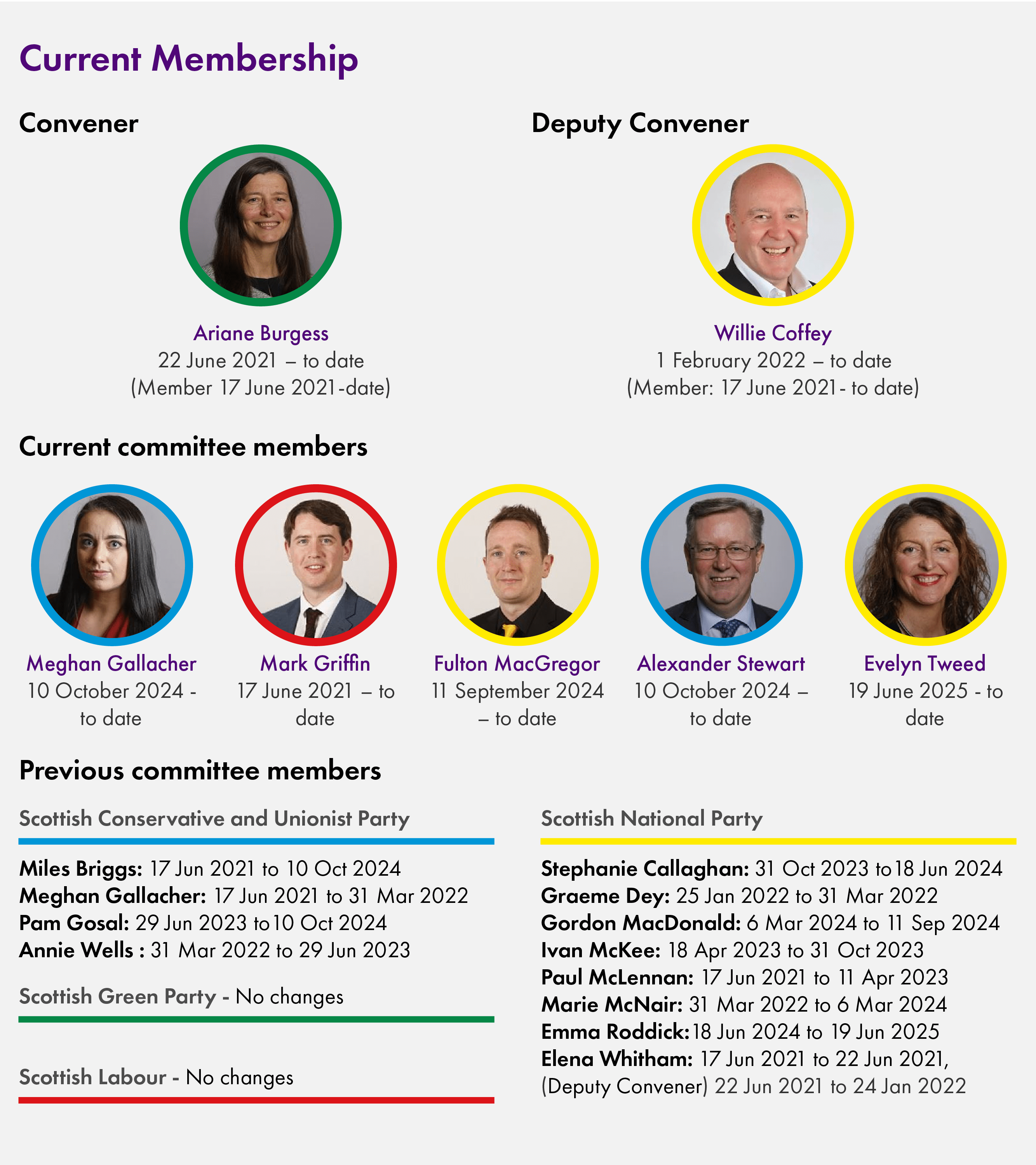
Scottish Parliament (2025)
Recommendations
LOCAL GOVERNMENT
New deal for local government and the Verity House Agreement
The Committee believes that it will be important for future committees to maintain an interest in the operation of the Fiscal Framework, particularly how COSLA and the Scottish Government are working together to review that and any amendments which will be made as a result.
The Committee welcomes progress made on ring fencing of funding for local authorities from the Scottish Government and suggests future committees should maintain an interest in this to ensure progress continues.
The Local Government, Housing and Planning Committee suggests our successor should consider the monitoring and accountability framework early in the next Session and, as with the Fiscal Framework, maintain an interest in its ongoing operation.
General powers of competence
A successor committee may wish to be aware of work taking place between COSLA and the Scottish Government on a general power of competence and the potential for legislation in this area in Session 7.
Local Governance Review
The Committee highlights the work it has done in tracking progress of the Local Governance Review since the start of the session. We believe this work has not progressed at pace despite its importance and suggest a successor committee may wish to continue to seek an update from the Scottish Government and COSLA early in the next Session. The Scottish Government and COSLA have previously said the implementation phase will be in the next Parliament, including any legislative elements required.
Implementation of the visitor levy
The Committee suggests that its successor may wish to consider how the discretionary power of visitor levy schemes by local authorities has been implemented once the first few schemes are in operation.
A future committee may also wish to be aware of the potential for primary legislation on a cruise ship levy and a point of entry levy.
Community Empowerment (Scotland) Act 2015 - post legislative scrutiny
A successor committee may wish to consider the actions arising from the Scottish Government's reviews of Part 3 on participation requests and Part 5 on asset transfers of the Community Empowerment (Scotland) Act 2015.
We believe it would be helpful to maintain the focus we have had this Session on allotments due to their significance in the community empowerment agenda. More generally we recommend a successor committee should maintain an interest in the duties of local authorities under the Good Food Nation (Scotland) Act 2024. Further subordinate legislation on the specified functions is anticipated and the provisions in the Act which place duties on local authorities to report are yet to be commenced. We think implementation of this should be monitored and a successor committee may wish to consider local authority plans when complete.
More generally, we have noticed a theme running through our work this Session of local authority reporting requirements, of which there are many. These tend to arise under different pieces of legislation without consideration of how any one requirement links to another. We believe that an audit of local authority statutory reporting requirements would be an interesting area to explore.
Community wealth building
The Committee believes a successor committee charged with considering the work of local government should consider local authorities' roles and responsibilities under the community wealth building legislation passed by the Scottish Parliament in February 2026. In particular we highlight the role of procurement in supporting local economies.
We believe particular attention should be paid to how local authorities propose to deal with vacant and derelict land and buildings, including bringing them back into use.
The Bill as passed requires action from local authorities and, as we have recommended elsewhere in this report, we think a future committee could make a valuable contribution were it to consider the number of reporting duties borne by local authorities and whether there are any areas of overlap.
Understanding barriers to participation in local politics
The Committee hoped to have a positive impact in the work it undertook on understanding barriers to participation in local politics. Our tracker reports have allowed us to revisit the issue each year, but we did not consider this in as much depth each year as we would have liked due to scheduling of other work. A successor committee may wish to maintain an interest in understanding barriers to participation in local politics and build on the work undertaken to engage with parties and local authorities.
A successor committee may wish to pursue the work understood to be carried out by COSLA on the wider recommendations of the Scottish Local Authorities Remuneration Committee (SLARC) relating to expenses and the introduction of a severance payment.
A successor committee may also be interested to see what impact the increase in councillor pay has had.
Boundaries Scotland
It is with great disappointment that we highlight the events which have transpired this Session in relation to reviews of local authority electoral boundaries. There has been a lack of progress on reviews in both Highland and Argyll and Bute Council areas, which Boundaries Scotland has acknowledged is detrimental for citizens in those areas.
We do not agree with the Scottish Government's and Boundaries Scotland's view on the need for change of process and are extremely disappointed that the outcome of the Review of the Process for Determining Electoral Boundaries, which appeared pre-disposed to this. We do not agree with the previous Minister for Parliamentary Business's view that there is "consensus" on moving to a system of automaticity. We do not believe that the proposed role for the Electoral Commission in reviewing the proposals of Boundaries Scotland is sufficient.
We acknowledge the Scottish Government's position that changing the system of adoption of recommendations by Boundaries Scotland will require primary legislation. We urge a successor committee considering any such legislation in the next session to take our submission to the Review into account and protect the role of the Parliament in determining local authority electoral boundaries and arrangements.
We also believe community cohesion is an important factor in considering local authority electoral boundaries and arrangements. Communities must be consulted thoroughly on specific recommendations of the Review in any consideration by the Parliament of potential changes to the system.
Non-domestic rates
Future committees with an interest in non-domestic rates from a business and local government perspective may wish to keep this under review.
National Care Service (Scotland) Bill (Care Reform (Scotland) Bill)
A successor committee may wish to maintain an interest in how local authorities are being asked to deliver social care services and the resources which are being made available to support this.
As we have noted elsewhere in this report, responding to immediate needs like social care will always be a priority over investing in public service reform measures. However, barriers to innovation will perpetuate if upfront investment to improve delivery of all services, including social care, is not made.
Council tax
We recognise the work that has already been undertaken on council tax reform and acknowledge there are different views on how this should be progressed. There are several outstanding issues and questions arising from our inquiry on council tax reform which the Committee believes could be pursued as part of future consideration of this issue:
The Scottish Government committed to a debate in the Scottish Parliament in early 2026 informed by the research by the Institute of Fiscal Studies, which has not taken place. A future committee may wish to consider this research if undertaking any work on council tax reform.
The Committee had recommended the Scottish Government should provide a specification to the Scottish Assessors Association to allow it to estimate the cost of overall revaluation. A cost has been estimated in the Budget for 2026-27 for the creation of two additional bands and we were told by the Scottish Government that "The assessors are confident in their assessment of the costs of undertaking the exercise over the two-year period and in the appeals process that they have provided to us...".i It is not clear to the Committee whether this has been part of a comprehensive estimate of the costs of recalibrating council tax bands. We have not been provided with the specification for overall revaluation as requested and a future committee may wish to pursue the request for clarity on what assessments have been made of the cost of revaluation.
The public consultation closed on 30 January. We were told a summary of responses would be available in late March or early April.i In addition, a wider engagement programme took place in 2025 and the results of this are anticipated to be included in the consultation analysis. The timing of this means the Local Government, Housing and Planning Committee has not had the opportunity to consider the results of this exercise.
National performance framework
As the National Performance Framework's National Outcomes are to be reviewed every 5 years, a review in Session 7 is likely and our successor committee with responsibility for housing may wish to be aware of our comments on the creation of the new housing indicator. We suggest it would be valuable to consider how the new outcome has contributed to progress across housing policy.
HOUSING
Housing Emergency and Housing to 2040
Given the housing emergency remains ongoing, the Committee strongly recommends that its successor committee continues to monitor what progress is being made by the Scottish Government and local authorities to ease the pressures on housing availability and affordability throughout Session 7. In particular it could seek regular updates from the Scottish Government on what progress is being made in delivering its Housing Emergency Action Plan, and it may wish to engage with those local authorities which have declared a housing emergency to determine what local progress has been made and where further support from the Scottish Government would be beneficial.
As part of this work the successor committee could also continue scrutiny of the Affordable Housing Supply Programme targets and budget.
The Committee recommends that its successor committee monitors the position of housing cooperatives within Scotland’s housing sector, in particular what actions the Scottish Housing Regulator and the Scottish Government take to ensure that the sector is able to grow.
We therefore bring to our successor Committee's attention the importance of Housing to 2040 and recommend that it asks the Scottish Government for clarification on what progress is being made in achieving its Vision, and reinforces the call for a clear implementation plan for its delivery.
The Committee welcomed the appointment of a cabinet secretary with specific responsibility for housing in 2025. We hope that delivery of the Housing 2040 strategy and the Housing Emergency Action Plan will continue to be supported by a cabinet secretary with specific responsibility for their success.
Rural Housing
The Committee recommends that its successor committee continues to monitor the housing challenges in rural and islands communities and the effectiveness of the Scottish Government's response.
Building safety - cladding
Nearly nine years on since the tragedy at Grenfell, it appears that very few of the buildings in Scotland identified as at risk have since been remediated. The Committee therefore strongly recommends that progress in delivering the Scottish Government's cladding remediation programme is closely monitored during Session 7 and that a successor committee requests and considers the quarterly updates which this Committee has initiated.
Building safety - damp and mould
The Committee recommends the following actions to our successor committee during Session 7:
Monitoring the impact that 'Awaab's Law' has on reducing incidences of damp and mould in rental properties.
Monitoring the dataset which will become available from the Scottish Housing Regulator about damp and mould in social housing.
Consider taking specific evidence on the condition of social and private rented homes available for rent or allocation, including where they are exhibiting damp and mould.
Building safety - RAAC (Reinforced Autoclaved Aerated Concrete)
The Committee recommends that during Session 7 this issue continues to be monitored by its successor committee, in particular the ongoing impact on tenants and homeowners and the response from local authorities.
Retrofitting and heat in buildings
The Committee notes that, depending on the outcome of the election, legislation could be anticipated in Session 7 and highlights the draft Buildings (Heating and Energy Performance) and Heat Networks (Scotland) Bill to a successor committee. We have not had the opportunity to consider this in detail.
The Scottish Government has indicated it will publish the final Climate Change Plan in this Session and a new Heat in Buildings Strategy and Delivery Plan is also anticipated later in 2026 as a result of this. We suggest consideration of these should be in the work programme of a successor committee with responsibility for examining heat in buildings policy and could build on the work we have conducted and the conclusions reached in our report on the draft Climate Change Plan.
In addition, our successor Committee should seek updates from the Scottish Government about the progress it is making with the delayed regulations introducing minimum energy efficiency standards for private rental properties. A future committee may also wish to assess progress on the same standard for social rented housing.
Rent control
Rent control areas may be created during the course of Session 7. The Committee recommends that the impact and success of the rent control legislation are monitored by our successor committee.
Short term lets
During Session 7, our successor committee may wish to monitor the impact of the licensing of short-term lets on improving housing supply and affordability, particularly in the context of the ongoing housing emergency.
Our successor Committee in Session 7 may wish to consider further this difference between Scottish and European short-term let licensing schemes.
Tenants' rights, and the First-tier tribunal
Our successor committee may wish to consider issues raised with this Committee on enforcing the rights of tenants and landlords during work on housing issues.
PLANNING
Fourth National Planning Framework
The Committee has remained committed to tracking the progress of NPF4 and the impact this is having on planning issues. We recommend our successor Committee continue to monitor the implementation of NPF4.
Gender sensitive planning
We believe future consideration of NPF4 and other planning policy should incorporate gender sensitive planning.
Local development plans and local place plans
Local place plans are due to be reviewed in summer 2026 and the Scottish Government must lay a report on this in the Scottish Parliament.
We recommend our successor committee could use the information we have gathered on the prevalence of the creation of local place plans around Scotland as a foundation for further consideration of these. We recommend that a successor committee engage with the Scottish Government in the pursuit of more robust national data on the development of local place plans, and in particular where these are being created and the resources available in those areas. We believe the potential power inherent in local place plans should be available to all communities equally.
We also recommend our successor committee consider the outcome of the Scottish Government's review of local place plans and in particular whether these are actually contributing to or having an impact on local development plans. Otherwise, they are in danger of being a wishlist.
Vacant and derelict land and buildings
The Committee suggests that a successor committee could add value by holding an inquiry into vacant and derelict land and buildings, and how town centres might be revitalised. It could also examine the role of local authorities in this.
We believe this topic is an example of where a lived-experience and expert panel could support the Committee's work.
Flooding
The Committee remains concerned about the situation of home and building owners who find themselves in a newly created flood risk area, and the impact this has on their ability to sell and insure their assets. We suggest this issue could be incorporated into future consideration of NPF4 and that a future committee may wish to engage with insurers and mortgage lenders on this issue.
SCRUTINY OF OMBUDSMAN, COMMISSIONER, COMMISSION AND REGULATOR ACCOUNTABLE TO THE COMMITTEE
We make the general observation that the Committee's role in relation to scrutinising the work of these bodies is very high level. We are of the view that it would be helpful to set out in the remit of a future committee that they have responsibility for scrutiny of a specific ombudsman or regulator with reference to relevant legislation.
We have undertaken in-depth consideration of the SPSO and the SHR once this session (although we have pursued the issues raised during that work thereafter). We believe that hearing from stakeholders and individuals has been valuable to our work and would recommend that a successor committee may wish to do this on an annual basis. Ideally, it could hear from the same stakeholders to assess progress.
We also believe that a successor committee would benefit from standardised information gathering from the regulators and ombudsman, which would again allow for consistent assessment each year.
Scottish Public Services Ombudsman
Among the reflections and recommendations we made following our in-depth scrutiny of the SPSO in 2024, we wish to highlight that we suggested the powers of the Ombudsman should be reviewed and that legislative change in this area would drive many of the improvements stakeholders, and the SPSO, have called for. A successor committee may wish to instigate this.
We also note that while complaints to the SPSO include those on local authority services, its scope is much wider than this. We believe the committee with responsibility for considering the work of the SPSO could be another committee with a wider overview of public service delivery, perhaps sitting in the public administration area.
Having sought views to support our consideration of the SPSO in 2024, we have heard from people on their individual experiences of engaging with the SPSO. We have previously welcomed the SPSO's efforts to improve how it communicates with complainants and believe this should be monitored by our successor committee.
We are also of the view that engagement with the SPSO can be the last part of a process of attempting to make a complaint about a public body. The SPSO has specific processes both for considering complaints and for its decisions to be challenged. However, thought should be given to whether these processes provide sufficient support for the emotional impact of making a complaint. This is particularly relevant where complainants have exhausted the options in the complaints process as set out.
Scottish Housing Regulator
We recommend that a successor Committee undertake a comprehensive review of the work of the Scottish Housing Regulator (SHR). Ideally, this could take place in the first or second year of the Session and provide a platform on which to build ongoing information gathering and assessment. We suggest this should include hearing from the stakeholders we have written to previously to ensure they have a regular opportunity to provide their views on the work of the SHR. As stated previously, we believe our successor committee should monitor the position of housing cooperatives within Scotland’s housing sector, in particular what actions the SHR and the Scottish Government take to ensure that the sector is able to grow.
We believe regular consideration each year thereafter on how the SHR has progressed areas of interest would be beneficial.
We believe scrutiny of the SHR is an area where the appointment of an adviser to the Committee or the procurement of specialist research could add value.
SCRUTINISING THE SCOTTISH GOVERNMENT'S BUDGET
The Committee recommends that its successor consider how it can best focus its efforts when carrying out pre-budget scrutiny and it should consider how it can assess the impact of this work on the final budget.
We also recommend that our successor should work with other committees to consider how collaboration might improve the overall impact of the Parliament's scrutiny of the budget, particularly on the committee debate.
HOW THE COMMITTEE HAS APPROACHED ITS WORK
Designing our work programme
We recommend our successor committee should hold annual business planning days.
Informing our work
The Committee has found opportunities to discuss issues in depth with people with lived experience to be extremely valuable to our scrutiny. We recommend our successor committee(s) continue with this where specific pieces of work will benefit from this approach.
In particular we benefited from establishing a lived-experience panel to advise us on the Housing (Scotland) Bill and would commend this approach to a successor.
Promotion of our work
We commend the approaches we have taken to promotion of our work, as well as an openness to innovations, to a successor committee.
Relationship building
We recommend a successor committee continue to find opportunities for informal engagement with stakeholders to support its work.
As part of this, we believe particular focus should be paid to establishing relationships with individual councils.
Tracker reports
The Committee would recommend that its successor committee(s) should evaluate its work, including measurement of impact and progress of recommendations throughout the next Session. The Local Government, Housing and Planning Committee has found the production of tracker reports to be an effective way to achieve this.
REMIT
We believe the areas within our remit have complemented one another and been sufficiently linked to allow us to work efficiently.
The one exception we would highlight is that homelessness has been within the remit of the Social Justice and Social Security Committee this Session. We believe this would have naturally sat with housing and would have made examination of the Housing (Scotland) Bill smoother.
Local Government
New deal for local government and the Verity House Agreement
The relationship between local and central government was the focus of an event in May 2023 held by the Committee and supported by Scotland's Futures Forum . The conference brought together Members of the Scottish Parliament (including Committee Members) and a range of stakeholders from central and local government, academia, and the public, private and third sectors to explore what was required to improve the relationship between local and central government. The progress towards a new deal for local government was discussed.i
The Verity House Agreement (VHA) was published on 30 June 2023 and sets out a vision of collaboration between the Scottish Government and the Convention of Scottish Local Authorities (COSLA).
This agreement included various commitments to ways of working such as:
A shared set of priorities in the form of "...tackling poverty, just transition to net zero and sustainable public services."ii
A Fiscal Framework, to include improved engagement during development of the Scottish Government's budget;
A default position of no ring-fencing or direction of funding;
Dispute mechanisms;
Jointly agree an accountability and assurance framework; and
Work together on public service reform.
The Committee has considered aspects of the VHA throughout Session 6. One of the noteable outcomes from the new deal and the development of the VHA has been the change of tone in how local and central government refer to one another. Hierarchical terminology has been replaced by discussion of "spheres of government", which the Committee welcomes.
Fiscal Framework
The Fiscal Framework between COSLA and the Scottish Government was published in October 2025.i It was anticipated it would be published before then. The point in the Session at which it arrived prevented us from assessing its operation and how it had contributed to the Budget process in detail. We posed initial questions to COSLA during our Pre-Budget scrutiny for the 2026-27 Budgetii, and asked the Cabinet Secretary for Finance and Local Government about it on 27 January 2026 once the Budget was published.ii COSLA told us that the Cabinet Secretary had committed to keeping the operation of the Framework under review.ii
The Committee believes that it will be important for future committees to maintain an interest in the operation of the Fiscal Framework, particularly how COSLA and the Scottish Government are working together to review that and any amendments which will be made as a result.
Ring fencing
The Scottish Budget 2026-27 includes a "...significant reduction in the proportion of the revenue allocation that is either ring-fenced for specific purposes or transferred in-year from other portfolios...".i The Committee welcomes this progress and hopes this trend will continue.
The Committee welcomes progress made on ring fencing of funding for local authorities from the Scottish Government and suggests future committees should maintain an interest in this to ensure progress continues.
Monitoring and accountability framework
The VHA includes a commitment to produce a monitoring and accountability framework to "provide evidence and visibility over progress towards agreed outcomes".i
On an accountability framework, the Cabinet Secretary said:
"Whilst there has been much progress and collaborative working on the Accountability and Assurance Arrangements, we recognise that agreeing and finalising the monitoring framework must be a priority for both Scottish Government and COSLA. I am mindful that it is two years since we had committed to completing this and hope to have this agreed by the Autumn this year."ii
On 28 October, Ellen Leaver, Acting Director for Local Government, Scottish Government, told the Committee that work was ongoing which she anticipated would conclude early in the new year, so that Ministers and COSLA leaders might finalise it before the end of the session.iii The Committee received correspondence confirming the finalisation of the framework on 24 March 2026.iv
The Local Government, Housing and Planning Committee suggests our successor should consider the monitoring and accountability framework early in the next Session and, as with the Fiscal Framework, maintain an interest in its ongoing operation.
Public Service Reform
The VHA between the Scottish and local government sets out the two will “work together strategically to advance public service reform”.i
The Scottish Government published its Public Service Reform Strategy in June 2025.ii This sets out commitments to change the system of public services “...to be preventative, to better join up and to be more efficient”.ii
We chose to focus on this in our pre-budget scrutiny at the end of 2025 (for the 2026-27 Budget). In particular, we looked at the Invest to Save Fund.
We welcomed this pot but suggested it should be increased and further flexibility on how it is used by local authorities (including in collaboration with other parts of the public sector) should be built in. Some witnesses, including COSLA, told us the establishment of funds accessed via application for particular purposes was a form of ring fencing.
We asked the Scottish Government to consider how the fund could be allocated across local authorities without a bidding process.
We believe it could be useful to explore whether there has been equal focus and improvement in developing preventative spend, as opposed to just increasing efficiencies.
General powers of competence
The Committee has been tracking the issue of the general power of competence (GPC) throughout Session 6. The Scottish Government consulted on a GPC in 2025.i The Cabinet Secretary for Finance and Local Government told the Committee:
"...we are looking at primary legislation on a general power of competence or something similar. One option would be to use the local democracy bill that is currently planned for year 2 of the next session of Parliament, but I recognise that that is quite far down the line."ii
The Cabinet Secretary for Finance and Local Government wrote to the Committee on 28 October highlighting her intention to progress elements of a GPC by laying subordinate legislation on local authorities’ ability to trade with non-statutory bodies.iii
The Cabinet Secretary later wrote to the Committee to indicate this was not going to be laid in the current session. She said:
“In terms of next steps, a working group including representatives from COSLA and Local Government will be established in February 2026 to consider how best to widen the scope of the existing ‘power to advance wellbeing’ to provide greater financial freedom to local authorities from 2026/27 onwards whilst the introduction of a general power of competence or similar legislation is considered for 2027/28.”iv
A successor committee may wish to be aware of work taking place between COSLA and the Scottish Government on a general power of competence and the potential for legislation in this area in Session 7.
Local Governance Review
The Local Governance Review was jointly launched by the Scottish Government and COSLA in December 2017 to consider how powers and resources should be shared between national and local government, and with Scotland’s communities.
Throughout Session 6, the Committee has considered the progress of the Review and the resulting outcomes. We took evidence in November 2021 on how the review was progressing.i In our Tracker report for 2021-22, we called for the urgency in finalising the review and implementing its outcomes.ii The following year (2022-23) we noted the Scottish Government has established a second phase of the Democracy Matters conversations, which was welcome.iii Our 2023-24 Tracker Report also noted our dissatisfaction with the pace of progress despite confirmation of the establishment of the Democracy Matters steering group and the intention to progress work on the single authority model.iv
The Verity House Agreement commits to concluding the review by the end of the parliamentary termv and in a joint statement in 2024, the Scottish Government and COSLA said:
"...we will now work towards an implementation phase early in the next Parliament, including the consideration of the need for any essential legislation."vi
In May 2025, the Cabinet Secretary for Finance and Local Government told us:
"Programme for Government 2025-26 confirmed that as part of the conclusion of the Local Governance Review we will publish a blueprint for models of democratic community decision making and plans for Single Authority Models in the three participating geographies, with at least one of these areas transitioning to shadow arrangements."vii
She described this further:
"This work is moving at pace and principles for models are taking shape. In line with the recent PfG commitment we will be publishing blueprints for new models before the end of this parliamentary session. Officials plan to carry out some engagement and testing of what’s been developed so far, both with communities and the wider public sector, before then and will set out plans for that in due course."vii
On Single Authority Models, she told us that engagement had established a "shared understanding across the sectors of the opportunity this creates to transform how people experience key services in these unique settings for generations to come."vii She noted ongoing work to agree arrangements "...best suited to local circumstances and which can command the support of local communities and relevant workforces."vii
These commitments form a part of the third strand of work in the Scottish Government's Public Service Reform Strategy, which was published on 19 June 2025.xi We noted in our 2024-2025 report that we did not anticipate being able to consider these ahead of the end of Session and noted our intention to highlight these to successor committees.xii
The Committee highlights the work it has done in tracking progress of the Local Governance Review since the start of the session. We believe this work has not progressed at pace despite its importance and suggest a successor committee may wish to continue to seek an update from the Scottish Government and COSLA early in the next Session. The Scottish Government and COSLA have previously said the implementation phase will be in the next Parliament, including any legislative elements required.
Implementation of the visitor levy
The Committee has considered two bills on the introduction of the visitor levy this session. We looked at the Bill in 2023 which established the levy and more recently considered the amending Bill which updated and clarified aspects of implementation of the powers to create visitor levy schemes.i
We have noted in our last two tracker reportsii and in our reports on the billsiii that monitoring of the implementation of the scheme would be essential. This has proved necessary given the updates which have been required to improve the original legislation before any schemes are in operation.
In his response to the Committee's Stage 1 report on the Visitor Levy (Amendment) (Scotland) Billiii, the Minister for Public Finance noted provisions in the Visitor Levy (Scotland) Act 2024 requiring a review of implementation by the Scottish Government and that a report should be laid in the Parliament on this.v
However, this is a singular event 3 years after the start of the first scheme and the Committee believes that post-legislative scrutiny of these pieces of legislation would be prudent. The Committee may also have the chance to consider implementation if the regulation making powers contained at section 6 of the most recent Bill are used.
There were other issues highlighted to us during passage of both bills relating to tourism charges. Island authorities and stakeholder organisations proposed a point of entry model levy would be more suitable in their areas. The Scottish Government also consulted on a cruise ship levy and analysis of this was sent to the Committee on 10 March 2026.vi Creation of a cruise ship levy would require additional primary legislation which could feature in the work programme of a future committee.
The Committee suggests that its successor may wish to consider how the discretionary power of visitor levy schemes by local authorities has been implemented once the first few schemes are in operation.
A future committee may also wish to be aware of the potential for primary legislation on a cruise ship levy and a point of entry levy.
Community Empowerment (Scotland) Act 2015 - post legislative scrutiny
The Committee has considered the operation of the Community Empowerment (Scotland) Act 2015 throughout the session. We continued our predecessor's consideration of Part 3 on participation requests and Part 5 on asset transfers, while adding scrutiny of Part 2 on community planning and Part 9 on allotments.
Reviews on the operation of Part 4 on participation requests and Part 5 on asset transfers have been published by the Scottish Government and they have committed to several actions arising from these. A successor committee may wish to use these as a focus for ongoing scrutiny of the 2015 Act.
We also looked at Part 9 of the 2015 Act which related to allotments. We took evidence on the issue and made several visits to understand more about how the powers in the Act in relation to allotments were supporting increased access to growing spaces and the empowerment of communities. The Cabinet Secretary for Finance and Local Government told us in May 2025 that the Good Food Nation Plan, due to be laid in draft in the Parliament that summer, contained current Scottish Government policy on allotments and community growing. She also said
"Scottish Ministers will be required to have regard to the Plan when exercising functions specified in secondary legislation, in accordance with section 6 of the Good Food Nation (Scotland) Act 2022. Consideration is currently being given to the suitability and appropriateness of including the Scottish Minister’s legislative duties imparted by Part 9 as a specified function in forthcoming secondary legislation."i
The draft Plan was laid on 27 June 2025.ii Due to its interest in local authority delivery of the Good Food Nation Plan and their duty under the Act to produce local plans, the Committee took evidence from stakeholders and from the Cabinet Secretary for Rural Affairs, Land Reform and Islands. We reported on 23 September 2025 and concluded there had been "... little change, which is disappointing."iii
The Good Food Nation (Specified Functions and Descriptions) (Scottish Ministers) Regulations 2025 (draft) was laid on 27 October.iv The regulations propose the list of specified functions which, when exercising, the Scottish Government must take into account the Good Food Nation Plan.
The list included: "Issuing guidance for the purposes of section 137(1) of the Community Empowerment (Scotland) Act 2015 (guidance on the functions conferred on local authorities relating to allotments)."
One of the issues some Members of the Rural Affairs and Islands (RAI) Committee were concerned about was the approach of specifying some, but not all, relevant functions in the schedule to the regulations. The RAI Committee did not recommend approval of the instrumentv and the Scottish Government withdrew it.vi
A successor committee may wish to consider the actions arising from the Scottish Government's reviews of Part 3 on participation requests and Part 5 on asset transfers of the Community Empowerment (Scotland) Act 2015.
We believe it would be helpful to maintain the focus we have had this Session on allotments due to their significance in the community empowerment agenda. More generally we recommend a successor committee should maintain an interest in the duties of local authorities under the Good Food Nation (Scotland) Act 2024. Further subordinate legislation on the specified functions is anticipated and the provisions in the Act which place duties on local authorities to report are yet to be commenced. We think implementation of this should be monitored and a successor committee may wish to consider local authority plans when complete.
More generally, we have noticed a theme running through our work this Session of local authority reporting requirements, of which there are many. These tend to arise under different pieces of legislation without consideration of how any one requirement links to another. We believe that an audit of local authority statutory reporting requirements would be an interesting area to explore.
Community wealth building
The Local Government, Housing and Planning Committee carried our pre-legislative scrutiny of an anticipated bill on community wealth building. This included visits and evidence sessions in the Parliament.
When the Community Wealth Building (Scotland) Billi was introduced to the Parliament on 20 March 2025, the Economy and Fair Work Committee was designated as the lead Committee for scrutiny of the Bill at Stage 1. We agreed to write to that Committee with details of our pre-legislative work to inform their consideration of the general principles of the Bill.ii
The Bill was passed on 10 February 2026. It requires Scottish Ministers to publish a community wealth building statement and to lay this in the Scottish Parliament. This statement must include details of how it will use various levers, including procurement to advance community wealth building.
We commend this area of work to a successor committee and suggest it may wish to take an interest in the statements laid in the Parliament and ongoing review reports, with particular reference to requirements of local authorities.
The Act also requires local authorities to produce community wealth building action plans for their area.i The plans must include the measures which will be taken within a local area to generate and circulate wealth in the local area.
One of the indicators included in the Bill as passed is "...bringing vacant and derelict land back into use in a way that provides financial, social or environmental benefit to the community". The Committee has not considered this issue in the detail it would have liked during Session 6 (either through community wealth building or our work on the National Planning Framework discussed later in this report). However, we believe this would be an important piece of work should a future committee have space in its work schedule to consider how we can maximise existing assets and revive town centres.
The Committee believes a successor committee charged with considering the work of local government should consider local authorities' roles and responsibilities under the community wealth building legislation passed by the Scottish Parliament in February 2026. In particular we highlight the role of procurement in supporting local economies.
We believe particular attention should be paid to how local authorities propose to deal with vacant and derelict land and buildings, including bringing them back into use.
The Bill as passed requires action from local authorities and, as we have recommended elsewhere in this report, we think a future committee could make a valuable contribution were it to consider the number of reporting duties borne by local authorities and whether there are any areas of overlap.
Understanding barriers to participation in local politics
Throughout this session the Committee has focussed on the barriers deterring younger people, women, disabled people and people of colour becoming councillors or remaining as councillors.
In 2022, we took evidence from stakeholders and the Scottish Government in 2022 on the results of the candidacy diversity survey carried out for the local elections that year. A response rate of 28.2% to that survey meant it was hard to draw conclusions. We also wrote to political parties and Scottish local authorities to ask what they were doing to support and encourage diversity of candidates.i
The Committee recognised that one of the key barriers to participation in local elected politics is the relatively low rate of pay for councillors. In 2022, the Scottish Government and COSLA agreed that a review of councillor pay was necessary “...to ensure that terms and conditions truly reflect the responsibilities of a modern-day Councillor, and that remuneration does not act as a barrier to encouraging a diverse range of people to stand for elected office”.
The Scottish Local Authorities Remuneration Committee (SLARC) was convened in April 2023 to undertake a one-off independent review of councillor remuneration, having last reported in 2011. It published its recommendations on Councillors' remuneration and expenses in February 2024.iii
In February 2025, we considered the following Scottish Statutory Instruments which increased the salary paid to all levels of councillors across all local authority bandsi and made adjustments to the numbers of senior councillors able to be appointed in specific local authoritiesii:
The Committee did not have comments on the instruments and was pleased to see the SLARC recommendations on remuneration being effected.
On the wider recommendations, the Cabinet Secretary for Finance and Local Government told us:
"Recommendations relating to expenses and the introduction of a severance payment better sit with local government. My officials are engaging with COSLA on these recommendations and will make any required regulations to implement any changes when required and before the next planned local elections."iv
It was understood that COSLA’s Barriers to Elected Office Special Interest Group would be considering next steps in respect of SLARC’s wider recommendations. The Committee has not pursued this further with the Scottish Government or COSLA in 2025.
The Committee hoped to have a positive impact in the work it undertook on understanding barriers to participation in local politics. Our tracker reports have allowed us to revisit the issue each year, but we did not consider this in as much depth each year as we would have liked due to scheduling of other work. A successor committee may wish to maintain an interest in understanding barriers to participation in local politics and build on the work undertaken to engage with parties and local authorities.
A successor committee may wish to pursue the work understood to be carried out by COSLA on the wider recommendations of the Scottish Local Authorities Remuneration Committee (SLARC) relating to expenses and the introduction of a severance payment.
A successor committee may also be interested to see what impact the increase in councillor pay has had.
Boundaries Scotland
One of the first pieces of work undertaken by the Local Government, Housing and Planning Committee this Session was consideration of local authority electoral boundaries.
The Islands (Scotland) Act 2018 placed a duty on Boundaries Scotland to review the electoral boundary arrangements for the six local authorities in Scotland which contain inhabited islands “as soon as practicable”. The review formally commenced in January 2019 and Boundaries Scotland reported to the Scottish Government in May and June 2021.i
Regulations were laid in the Parliament in August 2021 and referred to the Local Government, Housing and Planning Committee for consideration. These proposed amendments to the electoral boundaries in the following local authority areas: Na h-Eileanan an Iar, Orkney, Shetland, Highland, Argyll and Bute, and North Ayrshire.
The Committee considered the instruments and recommended approval of the instruments, with the exceptions of those relating to Highland Council and Argyll and Bute Council. The Committee reported to the Parliament on 30 September 2021.ii The report includes the Committee’s conclusions on the evidence heard. As a result, the Scottish Government withdrew the two instruments relating to Highland Council and Argyll and Bute Council areas. The then Deputy First Minister, John Swinney MSP, said the "...appropriate action for ministers to take is to ask Boundaries Scotland to take a further look at the proposals."iii
Since then, it is not clear what progress has been made on reviews of the electoral arrangements within the two local authority areas. Boundaries Scotland had previously suggested that it will not progress the reviews until the process, agreed by the Parliament and which gives the Parliament its place in scrutinising Boundaries Scotland's recommendations, is changed.iv In his letter of 24 March, the Minister for Parliamentary Business said he had recently received a progress update from the Chair of Boundaries Scotland.v
In the meantime, Boundaries Scotland has also acknowledged that failing to progress the reviews leaves councils such as Highland "...facing malapportionment".iv The Chair of Boundaries Scotland told the Standards, Procedures and Public Appointments Committee that Highland Council "...has among the top underrepresented and overrepresented wards in Scotland".iv
We have called for these reviews to take place throughout the Session.viii
The Scottish Government has indicated support for a system of automaticity for the approval of recommendations by Boundaries Scotland and commissioned a review to examine how this approach could work in Scotland.
We have taken the opportunity of producing a legacy report to include a copy of our representations to the Chair of the Independent Review of the Process for Determining Electoral Boundaries at Annexe A. This includes a detailed account of the history of this issue from the perspective of the Local Government, Housing and Planning Committee.
Since we made our submission, the report on the results of the review has been published.ix It recommends that a system of automaticity should be adopted. Scottish Government ministers made clear in evidence to the Standards, Procedures and Public Appointments Committee and via the terms of reference that this was the anticipated outcome.iv The review also recommended changes to the wider system and suggested a role for the Scottish Parliament and local authorities as statutory consultees.ix
The review also concludes that the Electoral Commission "...is the relevant body to bring additional and appropriate scrutiny by reporting on the process followed by Boundaries Scotland."ix
This Committee does not agree with the proposed move to a system of automaticity or the alterations to the role of the Parliament as they remove the democratic element inherent in the current approach. We also believe that community cohesion is important in local authority electoral boundaries and arrangements. We have written to the Scottish Government to reiterate our position following the publication of the report of the review.xiii A response was received on 24 March.v
It is with great disappointment that we highlight the events which have transpired this Session in relation to reviews of local authority electoral boundaries. There has been a lack of progress on reviews in both Highland and Argyll and Bute Council areas, which Boundaries Scotland has acknowledged is detrimental for citizens in those areas.
We do not agree with the Scottish Government's and Boundaries Scotland's view on the need for change of process and are extremely disappointed that the outcome of the Review of the Process for Determining Electoral Boundaries, which appeared pre-disposed to this. We do not agree with the previous Minister for Parliamentary Business's view that there is "consensus" on moving to a system of automaticity. We do not believe that the proposed role for the Electoral Commission in reviewing the proposals of Boundaries Scotland is sufficient.
We acknowledge the Scottish Government's position that changing the system of adoption of recommendations by Boundaries Scotland will require primary legislation. We urge a successor committee considering any such legislation in the next session to take our submission to the Review into account and protect the role of the Parliament in determining local authority electoral boundaries and arrangements.
We also believe community cohesion is an important factor in considering local authority electoral boundaries and arrangements. Communities must be consulted thoroughly on specific recommendations of the Review in any consideration by the Parliament of potential changes to the system.
Non-domestic rates
The Local Government, Housing and Planning Committee has considered non-domestic rates (NDR) throughout Session 6 through scrutiny of subordinate legislation.
A revaluation exercise is being undertaken in 2026 which is anticipated to increase NDR liabilities for many organisations. A debate on this issue was held in the Chamber on 7 January 2026.i
The Budget 2026-27 was published on 13 January 2026 and:
"...includes measures aimed at softening some of the impacts of the 2026 revaluation, with the Government reducing the Basic Property Rate (for properties with a rateable value up to and including £51,000) from 49.8p to 48.1p. Reductions will also be seen for the Intermediate and Higher Property Rates."ii
The Committee has considered subordinate legislation in the last few weeks of the Session on relief measures.
The Programme for Government 2025-26 included a commitment to a review of the valuation methodology applied to the licensed hospitality sector for the purposes of non-domestic rates. The review is being led by BJ Gill KC and is anticipated to report before the end of 2026.iii
Future committees with an interest in non-domestic rates from a business and local government perspective may wish to keep this under review.
National Care Service (Scotland) Bill (Care Reform (Scotland) Bill)
The National Care Service (Scotland) Bill was introduced on 20 June 2022. The aim of the legislation was to establish a national care service. The lead committee for consideration of the general principles of the Bill at Stage 1 was the Health, Social Care and Sport Committee.
The Local Government, Housing and Planning Committee, along with the Criminal Justice Committee, the Education, Children and Young People Committee and the Social Justice and Social Security Committee, also considered the Bill at Stage 1. We focused on the role of local authorities in delivering the proposed national care service, as well as related housing issues. As a secondary Committee, we wrote to the lead Committee on 14 December 2022 with our views on the Bill at Stage 1.i This brought together the conclusions of evidence heard across 7 panels of witnesses.
The Committee did not consider the Bill following its Stage 1 role and the Bill ultimately changed in nature at Stage 2.ii The structural elements of the Bill were removed and the Bill which was passed, the Care Reform (Scotland) Bill focused on other elements of the Bill relating to social care.
The delivery of social care remains a challenge for local authorities and represents a significant portion of its spending. We were told this in our pre-budget scrutiny of the 2026-27 Budget at the end of 2025 where our focus was public service reform.iii It also arose during our discussions on the sustainability of local government finance ahead of the 2025-26 budget in 2024.iv In both years, local authorities have argued that funding provided for the delivery of social care is being exceeded by demand. COSLA called for £750m to support the delivery of social care in the 2026-27 Budget and expressed disappointment that additional funding was not made available.v The Cabinet Secretary for Finance and Local Government explained that the Scottish Government had delivered a fair settlement in the context of the available finances.vi
A successor committee may wish to maintain an interest in how local authorities are being asked to deliver social care services and the resources which are being made available to support this.
As we have noted elsewhere in this report, responding to immediate needs like social care will always be a priority over investing in public service reform measures. However, barriers to innovation will perpetuate if upfront investment to improve delivery of all services, including social care, is not made.
Council tax
In 2014, the Scottish Government and COSLA established the Commission on Local Tax Reform, which reported in December 2015, and concluded that the existing council tax framework was no longer fit for purpose and that substantial reform was needed.i In 2022, the Scottish Government and COSLA formed the Joint Working Group on Sources of Local Government Funding and Council Tax Reform, to examine potential changes to the council tax system.
The Local Government, Housing and Planning Committee undertook a short inquiry on council tax in early 2025. The remit of our work covered progress by the Joint Working Group, barriers to change, the case for a revaluation of domestic properties, lessons from other jurisdictions, and the likely costs and funding options for revaluation.
Prior to taking evidence, the Committee wrote to the Scottish Government requesting an update on the Joint Working Group's progress.ii
In its response, the Scottish Government referred to a joint engagement programme to gather data and evidence to help inform discussions, with activities due to begin by late summer 2025.iii The response emphasised that the work was necessary to shape reforms that are representative of stakeholders' views, whilst reiterating that the Working Group was committed to evidence-led engagement.
As part of this, research was commissioned from the Institute of Fiscal Studies to:
"..assess market trends, model potential reforms, and establish a robust evidence base to guide public discussion and policy development. The findings from this research, alongside the views gathered through engagement, will inform a Scottish Parliament debate in early 2026."iv
We took evidence from the Cabinet Secretary, academics, tax specialists, local authority representatives and COSLA. Across these sessions, witnesses broadly agreed that the current banding system is outdated and regressive, with no revaluation since 1991.
Several witnesses highlighted that revaluation would carry substantial cost, administrative complexity and political difficulty.v COSLA reiterated that any reform of council tax must be developed with cross-party support across all council areas, whilst emphasising the need for fairness and robust modelling.v
We wrote to the Scottish Government upon completing our inquiryvii and our conclusions included:
A recommendation that revaluation should take place early in the next Parliament, including a statutory requirement for further regular revaluations;
That the Scottish Government should provide a specification to the Scottish Assessors Association to enable it to assess the likely costs of revaluation as a first step and to share this document with the Committee.
In its response, the Scottish Government set out further details of a joint engagement strategy and a programme of independent analysis from the Institute for Fiscal Studies, with the intention that findings from both these areas would inform a parliamentary debate in early 2026.iv The Government also confirmed their intention that any models of reform will be delivered on a revenue-neutral basis but said that the timing of revaluation would depend on the outcome of the engagement exercise.
On the recommendation to provide the Scottish Assessors with a specification for determining the cost of revaluation, the Cabinet Secretary said she was working with the body "...to understand the resource implications of delivering potential reforms and the feasibility of different implementation scenarios."iv
The Scottish Government published its consultation on council tax on 27 October 2025 and it closed on 30 January.x
In the meantime, the Budget 2026-27 contains £5 million in 2026-27 to support the introduction of two new high value property bands for the purpose of calculating council tax.xi This is described as a “targeted council tax revaluation” and will apply to properties worth over one million pounds.xi
We recognise the work that has already been undertaken on council tax reform and acknowledge there are different views on how this should be progressed. There are several outstanding issues and questions arising from our inquiry on council tax reform which the Committee believes could be pursued as part of future consideration of this issue:
The Scottish Government committed to a debate in the Scottish Parliament in early 2026 informed by the research by the Institute of Fiscal Studies, which has not taken place. A future committee may wish to consider this research if undertaking any work on council tax reform.
The Committee had recommended the Scottish Government should provide a specification to the Scottish Assessors Association to allow it to estimate the cost of overall revaluation. A cost has been estimated in the Budget for 2026-27 for the creation of two additional bands and we were told by the Scottish Government that "The assessors are confident in their assessment of the costs of undertaking the exercise over the two-year period and in the appeals process that they have provided to us...".v It is not clear to the Committee whether this has been part of a comprehensive estimate of the costs of recalibrating council tax bands. We have not been provided with the specification for overall revaluation as requested and a future committee may wish to pursue the request for clarity on what assessments have been made of the cost of revaluation.
The public consultation closed on 30 January. We were told a summary of responses would be available in late March or early April.v In addition, a wider engagement programme took place in 2025 and the results of this are anticipated to be included in the consultation analysis. The timing of this means the Local Government, Housing and Planning Committee has not had the opportunity to consider the results of this exercise.
National performance framework
The Scottish Government's National Performance Framework and the associated National Outcomes are a set of ambitions and indicators of how successfully policies are improving the lives of the people of Scotland. Progress towards achieving the National Outcomes is monitored and reported on using National Indicators.
The National Outcomes are reviewed every five years and the latest review took place in 2024. The Finance and Public Administration Committee led collaborative scrutiny by committees, including the Local Government, Housing and Planning Committee. We considered the new proposed outcome on Housing. This was generally welcomed, although we made reference in our letter to the Finance and Public Administration Committee of the improvements which could strengthen this.i This included alignment with existing policies, such as the Housing to 2040 strategy and the fourth National Planning Framework (NPF4). The monitoring and evaluation of the outcome, and existing policies, was also vital. We expressed concerns which our successor committee may wish to be aware of on the availability of housing data.
As the National Performance Framework's National Outcomes are to be reviewed every 5 years, a review in Session 7 is likely and our successor committee with responsibility for housing may wish to be aware of our comments on the creation of the new housing indicator. We suggest it would be valuable to consider how the new outcome has contributed to progress across housing policy.
Housing
Throughout Session 6, housing issues have been at the forefront of the Committee’s work, with housing affordability, availability, safety and energy efficiency all key areas of scrutiny. These have been impacted by external factors including the COVID-19 pandemic, the cost of living crisis, and rising energy prices, which culminated in recognition of a national housing emergency.
Housing Emergency and Housing to 2040
On 15 May 2024, the Scottish Parliament agreed to a motion supporting the declaration of a national housing emergency.i Fourteen local authorities also declared a local housing emergency, beginning with Argyll and Bute Council in June 2023, and most recently Dundee City Council in March 2026.ii
The housing emergency has been a priority concern for the Committee. The Committee held an inquiry scrutinising how the emergency is being tackled by the Scottish Government and local authorities, and explored what a properly functioning housing system would look like.
As part of that inquiry, the Committee issued a call for written views from a number of organisations (receiving 26 responses), undertook a visit to Argyll & Bute Council in November 2024 to explore their response to the housing emergency, and held two evidence sessions (5 and 12 November) to hear directly from local authorities, academics, and organisations representing tenants and landlords. It then took evidence from the then Minister for Housing.
The Committee's report was published on 15 May 2025, a year after the national housing emergency was declared.v It highlighted that a strategic approach by the Scottish Government, as afforded by the existing Housing to 2040 strategy, will be critical to re-balancing the housing system and ensuring the current situation is not repeated. In summary its key recommendations were:
The Scottish Government should develop a national overarching Housing Emergency Action Plan to include clear milestones and outcomes to enable progress to be measured.
A whole-systems approach is required that is led by the Scottish Government and its partners in order to stabilise housing in Scotland and help prevent future emergencies.
The Scottish Government should assess the impact of its wider policies on housing, as an important component in tackling the current housing emergency and also in helping prevent future such emergencies.
There needs to be clarity as a matter of urgency to housing providers on the intended statutory requirements for homes to meet net zero standards.
The Committee received a response from the Cabinet Secretary for Housing on 1 July 2025.vi
The Committee was pleased that in September 2025 the new Cabinet Secretary for Housing published the Scottish Government’s Housing Emergency Action Planvii, which committed to ending children living in unsuitable accommodation, supporting the housing needs of vulnerable communities, and maximising investment in the housing sector. The measures to reduce homelessness fall outwith the remit of this Committee, which are instead covered by the Social Justice and Social Security Committee.
More specifically the Action Plan contains a number of key actions, some of which overlap with other areas in this report (such as housing safety):
Create a new all-tenure target of 10% increase each year in the next 3 years;
Increase affordable housing;
Raise standards, introducing Awaab’s Law;
Introduce rent control; and
Reduce temporary accommodation.
It also highlights the role of the planning system in tackling the emergency, and the importance of a whole-systems approach (as recommended by the Committee). Some of these measures have since been implemented, such as regulations bringing forward Awaab’s Law.vii
A key part of addressing the housing emergency is increasing supply. The Scottish Government has a target of delivering 110,000 affordable homes by 2032. This is supported by investment in the Affordable Housing Supply Programme (AHSP). The Scottish Government planned Budget for 26/27 is £926m with £4.1bn over the next few years. The Committee has considered the funding for affordable housing as part of its pre-budget scrutiny for the 2023/24 Budget. Most recently, we heard evidence from the Cabinet Secretary for Housing on this aspect of the 2026/27 Budget in January. She provided an update on progress towards targets.ix
The impact of second and empty homes on the housing emergency has also been considered by this Committee, and most recently when considering regulations which remove restrictions on the premiums which councils can charge for second and long term empty homes. We took evidence on this instrument from stakeholders in February 2026.x We suggest monitoring the use of this by local authorities across Scotland.
The Committee has heard about the important role that housing cooperatives have in being community based tenant-led landlords anchored within their local areas, and the role they could help play in addressing the housing emergency, but recognises that their numbers have significantly diminished in recent years. The Committee notes recent action by the Scottish Housing Regulator to build working relationships with the 7 remaining cooperatives.
Given the housing emergency remains ongoing, the Committee strongly recommends that its successor committee continues to monitor what progress is being made by the Scottish Government and local authorities to ease the pressures on housing availability and affordability throughout Session 7. In particular it could seek regular updates from the Scottish Government on what progress is being made in delivering its Housing Emergency Action Plan, and it may wish to engage with those local authorities which have declared a housing emergency to determine what local progress has been made and where further support from the Scottish Government would be beneficial.
As part of this work the successor committee could also continue scrutiny of the Affordable Housing Supply Programme targets and budget.
The Committee recommends that its successor committee monitors the position of housing cooperatives within Scotland’s housing sector, in particular what actions the Scottish Housing Regulator and the Scottish Government take to ensure that the sector is able to grow.
The Scottish Government published its Housing to 2040 Strategyxi in 2021, which was to provide a 'route-map' for achieving its vision for housing, accompanied by a set of supporting principles to guide housing policy. Since then the housing emergency has been declared, but the strategy remains at the centre of Government policy on housing.
In its report on the housing emergency the Committee concluded that the Housing to 2040 Strategy is an important component in re-balancing the housing sector and preventing future emergencies, but that it requires an implementation plan to be put in place as a matter of urgency.
We therefore bring to our successor Committee's attention the importance of Housing to 2040 and recommend that it asks the Scottish Government for clarification on what progress is being made in achieving its Vision, and reinforces the call for a clear implementation plan for its delivery.
The Committee welcomed the appointment of a cabinet secretary with specific responsibility for housing in 2025. We hope that delivery of the Housing 2040 strategy and the Housing Emergency Action Plan will continue to be supported by a cabinet secretary with specific responsibility for their success.
Rural housing
The particular issues facing rural housing have been a common thread throughout the Committee's scrutiny of housing issues in Session 6. These include the impact of short-term lets and second homes in areas with high tourism, the high costs of building and of retrofitting, a lack of social housing, poor energy efficiency, and the impact which a housing shortage has on the depopulation of rural areas. In April 2024 the Committee held an evidence session with stakeholders on these issues.i In our inquiry on the Housing to 2040 strategy, we considered the rural housing pipeline and what needs to happen to increase the supply of housing in rural areas, including the important role that rural housing plays in enabling other parts of rural economies. We also heard about the importance of community led development of rural housing.i
In a letter to the Committee in November 2025iii the Cabinet Secretary for Housing highlighted that the Scottish Government's commitment to delivering 110,000 affordable homes by 2032 includes 10% of homes being in rural and island communities. The letter also notes that the £30 million Rural and Island Housing Fund and the £25 million Rural Affordable Homes for Key Workers Fund seeks to address specific rural housing issues where they arise. The Rural and Islands Housing Fund has also been extended to March 2028 as part of Programme for Government 2025-26.
The Committee recommends that its successor committee continues to monitor the housing challenges in rural and islands communities and the effectiveness of the Scottish Government's response.
Building Safety
In 2023 the Committee held an annual evidence session on building safety. At that point, the Committee’s primary focus was on issues relating to potentially unsafe cladding on high rise buildings, but this focus later broadened to cover other issues including damp and mould in social and private housing, and the use of reinforced autoclaved aerated concrete (RAAC). There are ongoing concerns about each of these issues.
Cladding
Following the Grenfell tragedy in 2017, the Scottish Government put in place a cladding remediation programme to identify and remove dangerous cladding from high rise buildings.i During the course of this session, the Committee has monitored progress with that programme, in addition to its scrutiny of the Housing (Cladding Remediation) (Scotland) Bill in 2023-2024, which came into force in February 2025.
The Committee has expressed significant concerns about the slow pace of progress in the Scottish Government's delivery of the cladding remediation programme.iii
Following its evidence session with the Minister for Housing in April 2025, the Committee agreed to request quarterly reports from the Scottish Government on its progress with the cladding remediation programme.iv The Scottish Government also publishes regular management information on the programme. The publication in December 2025 highlights that 17 Single Building Assessments (SBAs) had been completed, and remediation work had started in buildings related to 2 of those SBAs.v The report notes it is also possible that developers or other organisations have carried out more SBAs and remedial works than the Cladding Remediation Programme is currently aware of. As of 24 December 2025, only one developer had signed the Developer Remediation Contract.vi
A definitive figure for the number of buildings affected by dangerous cladding is not available, but the Scottish Government estimates that 1,260-1,450 of the residential buildings in Scotland which are 11 metres or more in height might require work to alleviate external wall system life-safety fire risk.
Nearly nine years on since the tragedy at Grenfell, it appears that very few of the buildings in Scotland identified as at risk have since been remediated. The Committee therefore strongly recommends that progress in delivering the Scottish Government's cladding remediation programme is closely monitored during Session 7 and that a successor committee requests and considers the quarterly updates which this Committee has initiated.
Damp and Mould
The issue of damp and mould in social and private rented housing prompted considerable public concern and media interest following the death of two-year old Awaab Ishak in 2020 as a result of a severe respiratory condition due to prolonged exposure to mould in his home in Rochdale. The Committee held evidence sessions in 2023 and has returned to the issue during the course of wider housing-related scrutiny. The Scottish Government has since laid secondary legislation to create an Awaab’s Law in Scotland which would introduce new duties on both social and private rented landlords to investigate reports of damp and mould and to commence any repairs within a set timescale (unless the landlord is unable to do so for reasons outwith their control). The Committee recommended approval of this instrument at its meeting on 10 March 2026.
In addition, the Scottish Housing Regulator (SHR) has developed specific indicators on damp and mould for social housing.ii This new data has not yet been available during this Committee’s lifespan but will be an important tool in monitoring housing safety.
Nonetheless, the Committee remains seriously concerned that as it stands, social and private landlords are able to allocate homes which contain damp and mould.
The Committee recommends the following actions to our successor committee during Session 7:
Monitoring the impact that 'Awaab's Law' has on reducing incidences of damp and mould in rental properties.
Monitoring the dataset which will become available from the Scottish Housing Regulator about damp and mould in social housing.
Consider taking specific evidence on the condition of social and private rented homes available for rent or allocation, including where they are exhibiting damp and mould.
RAAC (Reinforced Autoclaved Aerated Concrete)
Initially, Reinforced Autoclaved Aerated Concrete (RAAC) appeared to affect public buildings rather than domestic residences (either social or privately owned housing). However, in 2023 around 500 homes in Aberdeen were found to contain RAAC. Since then the Committee has followed this issue closely, first holding a roundtable session in October that year and then taking evidence from the Cabinet Secretary for Social Justice.i It held further evidence sessions in 2024 and 2025, including oral evidence from stakeholders (March 2025)ii and from the then Minister for Housing (April 2025).ii
Scottish Housing Regulator statistics published in July 2025 indicate that RAAC is present in 2,205 socially rented homes, owned by 17 landlords.iv While RAAC is not thought to have been widely used in privately owned homes, the Committee is aware of clusters of privately owned homes with RAAC elements in a number of areas - including Aberdeen, Clackmannanshire, and Dundee - mostly bought under the right to buy, but national statistics for RAAC in privately owned homes are not currently available.
When the Committee sought stakeholders' views at evidence sessions in 2025, it heard that there are social housing tenants who have been decanted to unsuitable alternative accommodation, owners of homes with RAAC having to make mortgage payments on properties they cannot access and with little value, and variable levels of support provided by local authorities for home owners.ii
The Cabinet Secretary for Housing has been emphatic that there will not be a Scottish Government fund for RAAC remediation.vi However, she has offered to work with local authorities to support them to use alternative funding models to support remediation.ii She has also established the RAAC in Housing Leadership Group which includes UK Finance and the Association of British Insurers. The Cabinet Secretary for Housing has said she is working with organisations to avoid a situation where "...people have either paid or been supported to remediate RAAC in their home and it has green status, but they still find that they cannot sell it."ii
The Committee recommends that during Session 7 this issue continues to be monitored by its successor committee, in particular the ongoing impact on tenants and homeowners and the response from local authorities.
Retrofitting and Heat in Buildings
Homes and buildings are a significant contributor to greenhouse gas emissions, being currently the fourth highest-emitting sector in Scotland. At the same time, high energy prices put an increasing number of people at risk of living in fuel poverty unless their homes can be made more efficient through retrofitting measures such as improved insulation. The Scottish Government has a target of transitioning buildings to clean heating systems as part of its ambition to reach net zero by 2045 (such as air source heat pumps and solar thermal energy solutions which we've considered both as part of our work on heat in buildings, but also in connection with fuel poverty and damp and mould).ii
In September 2023, the Scottish Government's Programme for Government included a Heat in Buildings Bill, and in November that year a consultationiv was launched on detailed proposals. In each annual tracker report which the Committee has since published, we have expressed disappointment at the lack of urgency from the Scottish Government in progressing this.
In November 2025, the Scottish Government announced that the Bill would not be introduced in Session 6 and instead published a draft Bill (Buildings (Heating and Energy Performance) and Heat Networks (Scotland) Bill), intended to be introduced next Session depending on the outcome of the election. The draft Climate Change Plan also highlights that a new Heat in Buildings Strategy and Delivery Plan will also be published by the end of 2026.
The Committee carried out detailed scrutiny of the buildings element of the draft Climate Change Plan, and recommended in our report that both the Bill and the new Strategy should take account of our conclusions.vii These include those sections considering heat networks, retrofitting and skills, and decarbonising buildings, and in particular our concern that the projected rates of heat pump installations will not sufficiently scale up by 2030 in order to put Scotland on course to reaching the 2045 target. We recommend that the Heat in Buildings Strategy and Delivery Plan encompasses a National Retrofit Strategy and should include planning for:
An area-based approach which enables retrofitting to take place at scale using housing archetypes. This would in turn help reduce costs and enable local supply chains to be developed;
Retrofitting Scotland's significant proportion of tenement and flatted buildings; and
Meeting the particular challenges in retrofitting rural properties.
The anticipated legislation on heat in buildings was part of a suite of measures the Scottish Government is developing in this area. It has also included reform of the Energy Performance Certificate system and plans to introduce minimum energy efficient standards in the private rented sector (PRS MEES). The order in which these policies were actioned, and their interactions with the anticipated primary legislation, has been the subject of advice on "sequencing" provided to the Cabinet Secretary for Housing by the Regulatory Review Group.viii
The Committee scrutinised regulations reforming the Energy Performance Certificate system for homes.ix These were approved by the Parliament in December 2025 but the Cabinet Secretary has since noted potential delays caused by delays to the UK Government Home Energy Model.x
The Scottish Government had also indicated that regulations would be laid introducing minimum energy efficiency standards for private rental properties. In anticipation of these the Committee took evidence from stakeholders at its meeting on 17 February 2025. On 18 February, the Cabinet Secretary for Housing wrote to us to provide detail of the sequencing suggested by the Regulatory Reform Group. Their advice on the PRS MEES was:
"Currently, the EPC reform regulations are scheduled to be laid before parliament in autumn 2025, with the PRS MEES regulations to be laid by January 2026. The reformed EPC would come into force in autumn 2026, with the PRS MEES applying to all new tenancies from 2028. The group is concerned that the introduction of the PRS MEES may need to wait until EPC reform has been implemented, as the MEES relies on the new, reformed version of the EPC being in place to fully function. There is a risk that the timescales presented are beset by delays in implementation or funding for one or both policies, leading to a dysfunctional and confusing policy landscape, and potentially reducing the amount of time available for landlords to make the necessary improvements to their properties ahead of the implementation of the PRS MEES."xii
In her letter to the Committee on 18 February, the Cabinet Secretary notes funding made available in the 2026-27 Budget for energy efficiency measures before saying:
"From this foundation, the programme will move into a phase of establishing standards, both in the private rented sector and social rented sector, with provisions for owner occupied properties included in the draft Buildings (Heating and Energy Performance) and Heat Networks (Scotland) Bill and subject to later regulation."xiii
The Committee was previously told that, despite consultation on this issue in 2023, work on minimum energy efficiency standards for the social rented sector is paused.x
In a letter to the Committee on 9 March, the Cabinet Secretary for Housing confirmed that an instrument on PRS MEES would not be laid in this Session and that there may be adjustments to the introduction of EPC reforms early in Session 7 due to delayed introduction of the UK Government's Home Energy Model and wider EPC reform.xv
The Committee notes that, depending on the outcome of the election, legislation could be anticipated in Session 7 and highlights the draft Buildings (Heating and Energy Performance) and Heat Networks (Scotland) Bill to a successor committee. We have not had the opportunity to consider this in detail.
The Scottish Government has indicated it will publish the final Climate Change Plan in this Session and a new Heat in Buildings Strategy and Delivery Plan is also anticipated later in 2026 as a result of this. We suggest consideration of these should be in the work programme of a successor committee with responsibility for examining heat in buildings policy and could build on the work we have conducted and the conclusions reached in our report on the draft Climate Change Plan.
In addition, our successor Committee should seek updates from the Scottish Government about the progress it is making with the delayed regulations introducing minimum energy efficiency standards for private rental properties. A future committee may also wish to assess progress on the same standard for social rented housing.
Rent control
Rent control has arguably been one of the most contentious issues which the Committee has considered during Session 6. A temporary form of rent control was first introduced in 2022 with the Cost of Living (Tenant Protection) (Scotland) Act. That has since lapsed, however the Housing (Scotland) Act 2025 creates a framework for the introduction of rent control areas in local authority areas subject to certain approval processes. Within designated zones, rent increases for private tenants will be capped at a rate of CPI + 1%, though any such rent control areas will not be in place before 2027.
Regulations have since been considered by the Committeeii which would exempt mid-market rent (MMR) and build-to-rent (BtR) properties from any such rent controls. We heard concerns from some stakeholders that these exemptions may create a two-tier rental market, and leave private rental tenants at the mercy of significant rent increases.iii
Rent control areas may be created during the course of Session 7. The Committee recommends that the impact and success of the rent control legislation are monitored by our successor committee.
Short-term lets
The licensing of short-term lets (such as holiday lets) was introduced in 2022 with the Civic Government (Scotland) Act 1982 (Licensing of Short-term Lets) Order 2022. The Committee has heard throughout Session 6 about the impact of short-term let properties on housing supply and affordability, particularly in rural areas popular with tourists.
During Session 7, our successor committee may wish to monitor the impact of the licensing of short-term lets on improving housing supply and affordability, particularly in the context of the ongoing housing emergency.
In a letter to the Committee in February 2026, the Constitution, Europe, External Affairs and Culture Committee (CEEACC) highlighted that the EU registration scheme for short-term lets operates in a broadly similar way to Scotland's licensing scheme, although a key difference is the amount of personal information being asked for is higher in Scotland's scheme. The CEEACC's letter notes that there is an expectation that subject committees will consider the case studies or new EU laws relevant to their respective remits that are set out in the series of reports, as part of their role in scrutinising the Scottish Ministers’ policy commitment to align with EU law.ii
Our successor Committee in Session 7 may wish to consider further this difference between Scottish and European short-term let licensing schemes.
Tenants' rights, and the First-tier Tribunal
Throughout our work on housing in Session 6, we have heard about the challenges which tenants can face in finding a suitable home, in enforcing their rights, and sometimes in understanding or being aware of those rights. Tenants' rights have been extended by the provisions of the Housing (Scotland) Act 2025 (for example by providing tenants with rights to appeal to the First-tier Tribunal if they are not allowed to keep a pet or to decorate their home), and also by the introduction of Awaab's Law and the right to have damp and mould tackled by landlords.
We have heard however about the difficulties which tenants face in taking cases to the First-tier Tribunal, and landlords too have told the Committee that when they need to take a case to the Tribunal, the timescales are very lengthy.i
Our successor committee may wish to consider issues raised with this Committee on enforcing the rights of tenants and landlords during work on housing issues.
Planning
Fourth National Planning Framework (NPF4)
At the start of Session 6, we led cross committee collaborative scrutiny of the Scottish Government's draft fourth National Planning Framework (NPF4).
The National Planning Framework is the spatial expression of Scottish Government policy. The Town and Country Planning (Scotland) Act 1997, as amended by the Planning etc. (Scotland) Act 2006 and the Planning (Scotland) Act 2019, provides the legislative framework for the National Planning Framework (NPF).
The NPF is required to be reviewed at least once every 10 years, with the most recent being the review undertaken and considered by parliamentary committees in 2022.i The Scottish Parliament must approve a draft of the revised NPF before it can take effect.
Once the final NPF4 was published, we undertook an annual review of this. In 2024, we concluded this was too soon and in 2025 we noted issues relating to resources available to planning departments (a perennial issue in our work on planning this session), the availability of guidance and enforcement issues.
We wish to highlight specific themes arising from our work on NPF4 and planning this session:
Gender-sensitive planning;
Local Development Plans and Local Place Plans;
Vacant and derelict land; and
Provisions on flooding.
The Committee has remained committed to tracking the progress of NPF4 and the impact this is having on planning issues. We recommend our successor Committee continue to monitor the implementation of NPF4.
Gender sensitive planning
We have posed questions where appropriate on how NPF4 has incorporated gender sensitive planning. We note the view of the Scottish Government that this is embedded in NPF4.i
We believe future consideration of NPF4 and other planning policy should incorporate gender sensitive planning.
Local development plans and local place plans
In 2025, we raised the issue of local place plans and how these relate to the next round of local development plans (the deadline for completion of which is 2028). We believe these are powerful tools for communities to participate in the democratic process if used to full effect.
Following our evidence session with the Minister for Public Finance on NPF4 in June 2025, we decided to look in more depth at how communities are creating local place plans and the support which is available to them. We wanted to establish a picture of how local place plans are being developed across Scotland by communities, including with support of development trusts and community councils. We wrote to local authorities and national park authorities to seek details from their areas.i Responses included the number of LPPs being developed and common reasons for these being rejected. Some local authorities described their interactions with communities to improve LPPs. No information was provided by any of the authorities we engaged with about how the LPPs were contributing to local development plans. Analysis of the responses by the Scottish Parliament Information Centre showed that it is difficult to tell whether community affluence or deprivation affects the likelihood of an LPP being produced due to a lack of robust national data. Based on the data that was available, it appears that LPPs are more likely to be produced in areas of average or above affluence.
Local place plans are due to be reviewed in summer 2026 and the Scottish Government must lay a report on this in the Scottish Parliament.
We recommend our successor committee could use the information we have gathered on the prevalence of the creation of local place plans around Scotland as a foundation for further consideration of these. We recommend that a successor committee engage with the Scottish Government in the pursuit of more robust national data on the development of local place plans, and in particular where these are being created and the resources available in those areas. We believe the potential power inherent in local place plans should be available to all communities equally.
We also recommend our successor committee consider the outcome of the Scottish Government's review of local place plans and in particular whether these are actually contributing to or having an impact on Local Development Plans. Otherwise, they are in danger of being a wishlist.
Vacant and derelict land and buildings
We would have liked to do more work on vacant and derelict buildings and the role that NPF4 could play in bringing these back to life. We are not clear on whether existing powers to achieve this are being used by councils. We think an incentives based solution could be explored, as well as the use of relevant powers by local authorities (such as compulsory purchase orders which the Scottish Government has recently consulted oni). This would include how best practice is being developed and shared among councils.
The Committee suggests that a successor committee could add value by holding an inquiry into vacant and derelict land and buildings, and how town centres might be revitalised. It could also examine the role of local authorities in this.
We believe this topic is an example of where a lived-experience and expert panel could support the Committee's work.
Flooding
As part of our consideration of NPF4, we asked how SEPA’s flood risk maps and guidance affect the land-use plan making process and development management decision making. In particular, we were interested in how revised flood risk assessments affect the availability of land for housing, especially brownfield sites that tend to be located in town centres and may be prone to flooding. The Committee also explored the impact that flood risk maps and guidance are having on people are already living in areas newly identified as being at risk of flooding and the impact this is having on homeowners, purchasers and the wider community.
We wrote to the Scottish Environment Protection Agency (SEPA) for further details in January 2026.i In response, we were told about the flood risk assessment process in Scotland, and mapping of this across the country. SEPA said:
"The flood maps are based on our best understanding of long-term flood risk at the time of being made. We continue to enhance our evidence base and understanding as more data becomes available and as we monitor flooding events. Our maps are reviewed every six years, with the next version due in December 2031."ii
The Committee remains concerned about the situation of home and building owners who find themselves in a newly created flood risk area, and the impact this has on their ability to sell and insure their assets. We suggest this issue could be incorporated into future consideration of NPF4 and that a future committee may wish to engage with insurers and mortgage lenders on this issue.
Scrutiny of Ombudsman, Commissioner, Commission and Regulator accountable to the Committee
The Committee has a role in scrutinising the performance of the following bodies who are accountable to the Parliament:
The Scottish Public Services Ombudsman (SPSO);
The Commissioner for Ethical Standards in Public Life in Scotland (also known as the Ethical Standards Commissioner — ESC);
The Standards Commission for Scotland (SCS); and
The Scottish Housing Regulator (SHR).
The Committee has undertaken annual scrutiny of these bodies, normally based around their annual reports. This was a practice continued from the work of the Session 5 Local Government and Communities Committee.i
The role of the Committee is to consider how the four bodies carry out their functions.
The SPSO, ESC and the SCS are independent office holders supported by the Scottish Parliamentary Corporate Body. The SHR is a Non-Ministerial Department independent of the Scottish Government. It is directly accountable to the Scottish Parliament. It is not supported by the Scottish Parliamentary Corporate Body.
We make the general observation that the Committee's role in relation to scrutinising the work of these bodies is very high level. We are of the view that it would be helpful to set out in the remit of a future committee that they have responsibility for scrutiny of a specific ombudsman or regulator with reference to relevant legislation.
We have undertaken in-depth consideration of the SPSO and the SHR once this session (although we have pursued the issues raised during that work thereafter). We believe that hearing from stakeholders and individuals has been valuable to our work and would recommend that a successor committee may wish to do this on an annual basis. Ideally, it could hear from the same stakeholders to assess progress.
We also believe that a successor committee would benefit from standardised information gathering from the regulators and ombudsman, which would again allow for consistent assessment each year.
Scottish Public Services Ombudsman
Having heard from the Scottish Public Services Ombudsman on its annual report each year, in 2024 the Committee agreed to a more in-depth approach. It agreed to invite stakeholders to send written submissions and to take oral evidence from stakeholders as well as the SPSO. The Committee then wrote to the SPSO on its reflections and conclusions following those meetings.i
Among the reflections and recommendations we made following our in-depth scrutiny of the SPSO in 2024, we wish to highlight that we suggested the powers of the Ombudsman should be reviewed and that legislative change in this area would drive many of the improvements stakeholders, and the SPSO, have called for. A successor committee may wish to instigate this.
We also note that while complaints to the SPSO include those on local authority services, its scope is much wider than this. We believe the committee with responsibility for considering the work of the SPSO could be another committee with a wider overview of public service delivery, perhaps sitting in the public administration area.
Having sought views to support our consideration of the SPSO in 2024, we have heard from people on their individual experiences of engaging with the SPSO. We have previously welcomed the SPSO's efforts to improve how it communicates with complainants and believe this should be monitored by our successor committee.
We are also of the view that engagement with the SPSO can be the last part of a process of attempting to make a complaint about a public body. The SPSO has specific processes both for considering complaints and for its decisions to be challenged. However, thought should be given to whether these processes provide sufficient support for the emotional impact of making a complaint. This is particularly relevant where complainants have exhausted the options in the complaints process as set out.
Scottish Housing Regulator
In the last 18 months of the session, we have pursued several issues relating to the work of the Scottish Housing Regulator (SHR), both with stakeholders and with the SHR itself. We have established a body of work which we commend to a successor committee as a useful starting point for establishing its role in scrutinising the SHR.i The conclusions from our initial work on the SHR in 2024 were set out in correspondence to the SHR and we have maintained an interest in the themes which arose.i
Seeking consistent information beyond that which is available in the annual report has allowed this Committee to delve into the role of the SHR in a meaningful way. We highlight the themes we have pursued:
Correspondence to the Scottish Housing Regulator in February 2026ii in which we sought further details including:
Informal engagement and how this is recorded and monitored;
The SHR's relationship with its key stakeholders and the approach to regulatory engagement (following concerns in the past on this issue); and
Use of consultants.
Correspondence to the Scottish Housing Regulator in October 2025iii in which we sought various pieces of information which we believe complement the details provided in the SHR's annual report each year:
Details of internal practices for ensuring compliance with the Scottish Regulators Code of Practice;
Information on the appointment of any co-optees, consultants and interim managers in the reporting year;
Details of information engagement with registered social landlords;
Trends identified across engagement with landlords which might form the basis of good practice sharing.
We recommend that a successor Committee undertake a comprehensive review of the work of the Scottish Housing Regulator (SHR). Ideally, this could take place in the first or second year of the Session and provide a platform on which to build ongoing information gathering and assessment. We suggest this should include hearing from the stakeholders we have written to previously to ensure they have a regular opportunity to provide their views on the work of the SHR. As stated previously, we believe our successor committee should monitor the position of housing cooperatives within Scotland’s housing sector, in particular what actions the SHR and the Scottish Government take to ensure that the sector is able to grow.
We believe regular consideration each year thereafter on how the SHR has progressed areas of interest would be beneficial.
We believe scrutiny of the SHR is an area where the appointment of an adviser to the Committee or the procurement of specialist research could add value.
Scrutinising the Scottish Government's budget
The Committee has carried out pre-budget scrutiny on the following during this session:
Public Service Reform and the Invest to Save Fund;
Sustainability for Scottish Local Government Finance; and
Funding for Affordable Housing.
In our response to the Finance and Public Administration Committee's call for views as part of its inquiry into the pre-budget scrutiny process, we said it was hard to assess the impact our work had on the budget. We also posed questions on how the committee debate could be strengthened.i
The Committee recommends that its successor consider how it can best focus its efforts when carrying out pre-budget scrutiny and it should consider how it can assess the impact of this work on the final budget.
We also recommend that our successor should work with other committees to consider how collaboration might improve the overall impact of the Parliament's scrutiny of the budget, particularly on the committee debate.
How the Committee has approached its work
Designing our work programme
The Committee has found Business Planning Days to be an effective form of strategy meeting for the year ahead, as well as the opportunity to establish working relationships among committee members in an informal setting.
We recommend our successor committee should hold annual business planning days.
Informing our work
The Committee has designed its scrutiny of various topics to include a blend of formal evidence taking in the Parliament, as well as outreach events and fact-finding visits. We thank all of those who have engagement with us, be it in the Parliament or further afield.
Engagement events
The Committee has undertaken engagement work throughout the Session to support its work. The form of this has usually been discussed and agreed during consideration of approaches to inquiries or legislation. Examples include:
Visits throughout Scotland;
Online engagement events on specific topics including:
NPF4 which was arranged in collaboration with stakeholders (February 2022);
Community Planning (January 2023); and
Retrofitting properties (November 2025);
Recruitment of lived-experience panels of tenants and landlords to support to the Committee’s consideration of the Housing (Scotland) Bill (details of this are included at Annexe B);
Using online tool Your Priorities to ascertain views on the original Visitor Levy (Scotland) Bill and a questionnaire to seek views of the public on proposed amendments to local authority boundaries in 2021.
Hosting an event with Scotland’s Future Forum and the Net Zero, Energy and Transport Committee on heat in buildings.
The Committee has found opportunities to discuss issues in depth with people with lived experience to be extremely valuable to our scrutiny. We recommend our successor committee(s) continue with this where specific pieces of work will benefit from this approach.
In particular we benefited from establishing a lived-experience panel to advise us on the Housing (Scotland) Bill and would commend this approach to a successor.
Evidence at meetings of the Committee
The Committee has found smaller panels more effective than larger panels. It allows witnesses more time to convey their views. We have found taking evidence in a roundtable format to be valuable where the topic has lent itself to a flowing discussion.
Visits
The Committee has undertaken several fact-findings visits each year to support our work. In general we found these a valuable part of our scrutiny. Full details of these are available at Annexe C. These were of particular benefit where we were able to hear directly from those with lived experience of an issue.
A map showing the locations of the visits of the visits undertaken by the Committee this Session.
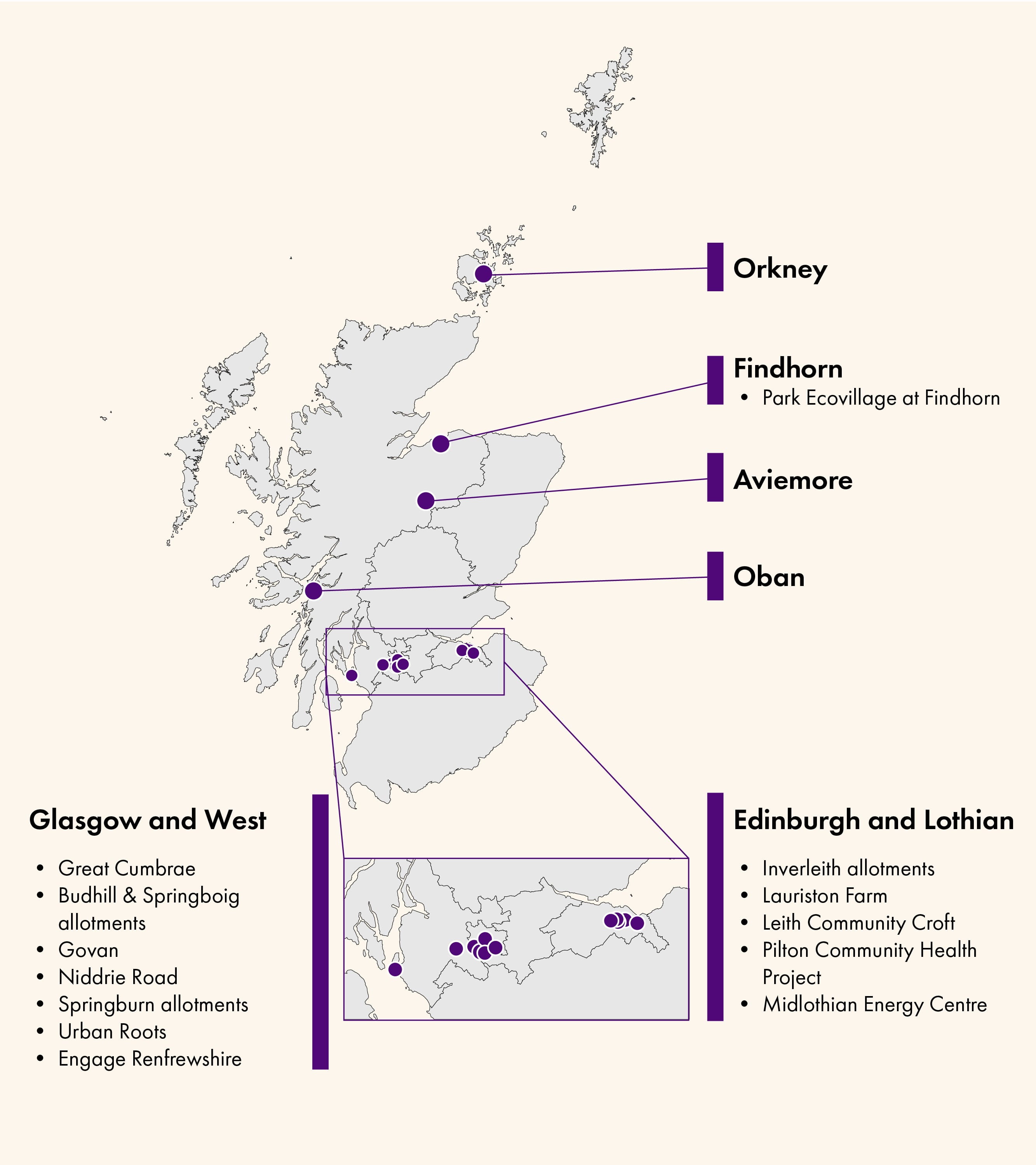
Scottish Parliament
Promotion of our work
The Scottish Parliament’s Communications Office has promoted the Committee’s work throughout the Session. This has involved activity including liaising directly with press on relevant sessions, managing media inquiries, issuing press releases on specific pieces of work or reports, creating content for the Parliament’s social media channels and sharing information via the Committee’s own Twitter/X feed.
We have also utilised innovative approaches such as podcasts and the creation of videos to explain our work. In January 2026 we launched a pilot of a quarterly newsletter to keep stakeholders and the public up to date with our work.
We commend the approaches we have taken to promotion of our work, as well as an openness to innovations, to a successor committee.
Relationship building
The Committee has heard from some stakeholders such as COSLA and the Accounts Commission consistently throughout the session, both on their own work and for their views on other policy areas. We have also found informal relationship building with such stakeholders very useful and thank all those we have met informally for their time and willingness to support our work.
We recommend a successor committee continue to find opportunities for informal engagement with stakeholders to support its work.
As part of this, we believe particular focus should be paid to establishing relationships with individual councils.
Tracker reports
In June 2022, the Committee agreed to produce a report annually reflecting on its work in the preceding year, tracking ongoing work, the Scottish Government's response to that work and looking ahead to work in the coming year. This idea arose from some members' previous experience of undertaking inquiries and making recommendations which were not pursued once that piece of work was concluded.
The Committee believes that a critical feature of an effective committee is a commitment to follow-up on its inquiries and ensure that the recommendations it has made have been acted upon and progress has been made. The Committee believes that its tracker report has been a key element of this follow-up work, allowing it to track its work and in turn hold the Scottish Government to account.
The Standards, Procedures and Public Appointments Committee's report on "Strengthening committees' effectiveness" covered the evaluation of committee performance and noted our work on this report throughout the session. That Committee recommended:
"that committees consider, annually, their progress in meeting their objectives for individual pieces of scrutiny and inquiry work. Furthermore, in this report we have highlighted some good practice examples of how committees can evaluate their performance which we commend to committees."i
The Committee would recommend that its successor committee(s) should evaluate its work, including measurement of impact and progress of recommendations throughout the next Session. The Local Government, Housing and Planning Committee has found the production of tracker reports to be an effective way to achieve this.
Remit
We believe the areas within our remit have complemented one another and been sufficiently linked to allow us to work efficiently.
The one exception we would highlight is that homelessness has been within the remit of the Social Justice and Social Security Committee this Session. We believe this would have naturally sat with housing and would have made examination of the Housing (Scotland) Bill smoother.
Annexe A - Local Government, Housing and Planning Committee's letter to the Chair of the Independent Review of the Process for Determining Electoral Boundaries - 5 September 2025
Andrew Kerr, Chair, Independent Review of the Process for Determining Electoral Boundaries
05 September 2025
Dear Mr. Kerr,
Independent Review of the Process for Determining Electoral Boundaries
The Local Government, Housing and Planning Committee of the Scottish Parliament has agreed to write to you in your role as Chair of the Independent Review of the Process for Determining Electoral Boundaries in Scotland on its experience of considering regulations on changes to local authority electoral areas and arrangements.
Our key messages are:
The current system for approving local authority electoral areas and arrangements was approved by Parliament in 2020. It gives Parliament a role in scrutinising the proposals for changes to local authority electoral areas and arrangements presented by Boundaries Scotland. The legislation stipulates the use of the affirmative procedure and the role of a committee is to consider the regulations before making a recommendation to Parliament on whether they should be approved.
The current system has been tested once and followed the process laid out in the legislation as intended. Boundaries Scotland expressed disappointment in the outcome.
A system of automatic approval of the proposals presented by Boundaries Scotland is the preference of Boundaries Scotland and the Scottish Government. Were such a system introduced, it could remove the parliamentary role in considering the proposals put forward by Boundaries Scotland for amendments to local authority electoral boundaries. The Committee does not agree with the Minister’s position that there is “consensus” on moving to such a system.
The Committee notes that despite a lack of consensus on the issue, the Terms of Referencei of the review are to explore automaticity. While we recognise you are working to the terms of reference as presented to you, we do not believe the result of an independent review should be presumed.
We urge you to explore the status quo with equal weighting to change.
Boundaries Scotland has not reviewed local authority boundaries since the events of 2021. Delays to reform where required have the potential to exacerbate existing issues.
The detail of our views is contained in the Annexe to this letter. We hope you will find this helpful in compiling your report on your review.
We welcome the opportunity to contribute to the Review. We have unique experience as the only Committee to have scrutinised regulations laid under section 17 the Local Government (Scotland) Act 1973 (as amended by the Scottish Elections (Reform) Act 2020).
We also welcome your offer to meet to further discuss these views and the clerks to the Committee will contact the Secretariat.
Yours sincerely,
Ariane Burgess MSP
Convener
ANNEXE TO THE LETTER
Primary Legislation
The Local Government (Scotland) Act 1973 was amended by the Scottish Elections (Reform) Act 2020 to change the process for reviewing, proposing and confirming amendments to local government electoral areas and arrangements.
Specifically, it removed the ability of Scottish Government Ministers to alter the recommendations of the review body (now Boundaries Scotland, and formerly the Local Government Boundary Commission for Scotland (LGBCS)) upon receipt.
The Policy Memorandumii for the Scottish Elections (Reform) Bill highlighted the consultation analysis in advance of the Bill which said:
“A majority of respondents (56%) was opposed to Scottish Ministers being able to change the recommendations of the LGBC on constituency and council wards. However, there was general support for the Scottish Parliament being able to challenge the recommendations of the LGBC (75% were in favour). In addition, a majority (73%) did not think the recommendations of the LGBC should have to be implemented without change. In their comments, respondents offered a wide range of views, but emphasised the importance of independence, impartiality and scrutiny in the boundary review process.”
There was therefore support for a role for Parliament in scrutinising boundary reform proposals. This was incorporated into the current process by the Scottish Elections (Reform) Act 2020.
Current process
Section 17(4) of the Local Government (Scotland) Act 1973 was amended by the Scottish Elections (Reform) Act 2020. It now states that upon receipt of a report on a review of local authority electoral areas and arrangements from Boundaries Scotland, the Scottish Government must lay the report on the review in the Scottish Parliament. The Scottish Government must lay regulations to give effect to proposed changes.
Where these proposals abolish or alter the boundaries of any local government area or electoral ward, or amend the number of councillors to be returned in a ward, these regulations must be subject to the affirmative procedure for consideration by the Scottish Parliament (s17(4)).
The affirmative procedure requires approval before an instrument becomes law (as opposed to the absence of an objection). The role of a committee is (emphasis added):
“In the case of any instrument or draft instrument which is subject to the affirmative procedure…..the lead committee shall decide whether to recommend that the instrument or draft instrument be approved.”iii
Further details of how the affirmative procedure operates can be found in the Scottish Parliament’s Standing Orders Chapter 10 (see Rule 10.6).
The process, including use of the affirmative procedure, was included in the Scottish Elections (Reform) Bill as introduced at Stage 1.iv
Test of the current system
The first use of the process contained in the amended section 17 of the Local Government (Scotland) Act 1973 was in 2021.
The Islands (Scotland) Act 2018 placed a duty on Boundaries Scotland to review the electoral boundary arrangements for the six local authorities in Scotland which contain inhabited islands “as soon as practicable”. The review formally commenced in January 2019 and Boundaries Scotland reported to the Scottish Government in May and June 2021.v
Regulations were laid in Parliament in August 2021 and referred to the Local Government, Housing and Planning Committee for consideration. These were:
Draft SSI 2021/Na h-Eileanan an Iar (Electoral Arrangements) Regulations 2021
Draft SSI 2021/ Orkney Islands (Electoral Arrangements) Regulations 2021
Draft SSI 2021/ Shetland Islands (Electoral Arrangements) Regulations 2021
Draft SSI 2021/ Highland (Electoral Arrangements) Regulations 2021
Draft SSI 2021/ Argyll and Bute (Electoral Arrangements) Regulations 2021
Draft SSI 2021/ North Ayrshire (Electoral Arrangements) Regulations 2021
The Local Government, Housing and Planning Committee took evidence on the instruments from the relevant local authorities, Boundaries Scotland and the Scottish Government. It also hosted a call for views from people and organisations within the relevant local authority areas.vi
The Committee considered the instruments and recommended approval of the instruments, with the exceptions of those relating to Highland Council and Argyll and Bute Council.
The Committee reported to Parliament on the 30 September.vii The report includes the Committee’s conclusions on the evidence heard.
Section 17(6) of the 1973 Act states that an instrument proposing amendments to local authority electoral areas or numbers of councillors to be returned in wards cannot be withdrawn without the approval of Parliament. The Scottish Government lodged motionsviii seeking the approval of the Parliament to withdraw the instruments relating to Highland Council and Argyll and Bute Council areas. The then Deputy First Minister said:
“The committee disagreed with some of the recommendations for Highland Council and Argyll and Bute Council. As a consequence of that decision by the committee, I consider that the appropriate action for ministers to take is to ask Boundaries Scotland to take a further look at the proposals.”
He also said:
“The committee has called for the councils involved to engage with Boundaries Scotland on new reviews for those areas. I echo that call. However, I stress to members that an independent boundary commission is widely considered to be a key feature of democratic societies. It will not always be possible for Boundaries Scotland to resolve all concerns that are raised, but I believe that Parliament should have confidence in how Boundaries Scotland carries out its functions. We will monitor progress with the new reviews closely, and will include that experience in our post-legislative assessment of the new laws surrounding boundary reviews. I therefore propose that the instruments in relation to Highland and Argyll and Bute councils be withdrawn.”ix
Parliament approved the withdrawal of the instruments on 7 October 2021.iii
Boundaries Scotland wrote to the Committee expressing its disappointment in the Committee’s recommendation on 4 Octoberxi and 2 November 2021xii.
The Committee executed its role in considering the proposals in the instruments in accordance with the process laid out in section 17 of the Local Government (Scotland) Act 1973, as amended by the Scottish Elections (Reform) Act 2020. Use of the affirmative procedure in this Act means it is intended a committee should consider proposals from Boundaries Scotland as presented in draft instruments and come to a view on whether to recommend approval. It is inherent in the process contained in the 2020 Act that a committee may not recommend approval where the affirmative procedure is applied.
Scottish Elections (Representation and Reform) Bill
The Scottish Government consulted again on electoral reform in 2022. The consultation included questions on the process for setting electoral boundaries.
The consultation offered respondents the chance to say whether they thought the system of approving electoral boundaries should be amended, along with several options for reform. The results in the consultation analysis have been reproduced below (emphasis added) and, for clarity, Option 3 is a preference for a system of automaticity.xiii
| N= | % No Change | % Option 1 | % Option 2 | % Option 3 | % Other Option | |
| All answering | 452 | 39 | 6 | 18 | 34 | 4 |
| Individuals | 444 | 39 | 6 | 18 | 33 | 4 |
| Organisations | 8 | 13 | 0 | 13 | 75 | 0 |
The Scottish Elections (Representation and Reform) Bill was introduced in January 2024.
The Standards, Procedures and Public Appointments Committee considered the Bill at Stage 1. The Local Government, Housing and Planning Committee wrote to the then Deputy First Minister noting it would not scrutinise the Bill at Stage 1 but would monitor progress.xiv
The Bill did not contain proposals for change to the current system for considering boundaries. However, the then Minister for Parliamentary Business told the Local Government, Housing and Planning Committee:
“Following the Electoral Reform Consultation, the Scottish Government has made a commitment in the policy memorandum for the Scottish Elections (Representation and Reform) Bill to consider further how best to approach any future changes to the boundary approval process.”xv
The Policy Memorandum expresses the Scottish Government’s preference for automaticity, saying the Scottish Government is “sympathetic” to this system. We highlighted this in our correspondence to the Deputy First Minister:
“The Committee notes that the Policy Memorandum confirms that the Scottish Government has consulted on a number of options to prevent political influence on the boundary-setting process and is “sympathetic” to the automatic approval of recommendations made by independent boundary commissions but that further consideration on the best way to approach such a reform is required.”xiv
In evidence to the SPPA Committee at Stage 1, the Minister for Parliamentary Business confirmed this was the Scottish Government’s settled position, saying automaticity is the “international standard”xvii and “…is our chosen direction and, inevitably, it is where we will end up.”xvii
The SPPA Committee published its Stage 1 report on 18 June 2024xvii and welcomed the Scottish Government’s commitment to automaticity. Support for these proposals came from Boundaries Scotlandxvii and the Scottish Governmentxvii during the Committee’s evidence sessions. Analysis of other responses to the Committee’s call for views notes a submission from Boundaries Scotland.vi
During the Stage 1 debate on the Bill, the Minister said automaticity:
“…has been raised by Boundaries Scotland. I am broadly sympathetic to the idea, which I recognise and see the merits of. We would all recognise that it would involve a fairly substantial change from where we are now, so it merits further consideration. I will engage with the chair of Boundaries Scotland to begin that process.”
Independent Review of the Process for Determining Electoral Boundaries in Scotland
The Minister for Parliamentary Business wrote to the Local Government, Housing and Planning Committee on 10 December 2024 ahead of Stage 3 consideration of the Scottish Elections (Representation and Reform) Bill. He announced the establishment of a review of the process for determining electoral boundaries in Scotland. In doing so he said there was a “broad consensus” for a change in the system from one including parliamentary approval to one of automaticity.
The Minister said:
“Since the SPPA Committee’s consideration earlier in the Bill’s passage, I have met the Chair of Boundaries Scotland to hear her perspective directly and have taken Professor Henderson’s views into account and will continue to do so as the review goes forward.”
We wrote to the Minister seeking evidence of the broad consensus on which the review, and premise that change is needed, appear to be basedxxiii. In his response on 27 February, the Minister said:
“On your question as to the emergence of a broad position of consensus for automaticity, my impression is that during the passage of the Elections (Representation and Reform) Act 2025 the position emerged on automaticity as the way forward and it was welcomed by the Standards, Procedures and Public Appointments Committee in their Stage 1 Report.
Ultimately, however, it will require primary legislation to introduce automaticity and Parliament will have the final say if the process is to be changed.”xxiv
In his letter of 18 March 2025, the Minister for Parliamentary Business said (emphasis added):
“The review will consider the process for implementing changes to electoral boundaries in Scotland, in particular options for the introduction of a form of automaticity, taking account of the experience elsewhere in the United Kingdom and internationally. It has also been tasked with considering whether changes should be made to the processes that form part of boundary reviews, such as engagement and consultation with the public and elected representatives, and the supporting structures and resources.”
We sought details of how the terms of reference for the Review would “take into account the historical, community and geographical links to electoral boundaries which are not determined by population numbers (for example in island and rural communities).”xxv
On 17 April, the Minister said (emphasis added):
“As you will see, the Review will consider the process for implementing changes to electoral boundaries in Scotland, and makes clear that this consideration should focus on identifying a form of ‘automaticity’ for that process. The Review also has scope to recommend further changes which it may consider appropriate alongside any new approval process. This could, for example, include aspects of existing legislation such as consultation requirements when conducting boundary reviews.”xxvi
In the same letter, he noted:
“I would emphasise that the Review is independent of Scottish Ministers. It will be entirely up to the Chair of the Review, Andrew Kerr OBE, to make recommendations for change after a consultation process. Mr Kerr’s report will be published and laid in Parliament.”
We are concerned by the justification for this Review as we do not agree there is a “broad consensus” in favour of removing Parliamentary oversight. This is not demonstrated by the results of the Scottish Government’s consultation.
We are also concerned the result of the Review has been pre-determined.
The Committee believes the Terms of Reference should have focused on whether change is needed, with options for change as a secondary concern, rather than the Scottish Government’s preferred outcome. We urge you to include consideration of whether change is needed in your report on the outcomes of the Review.
Local Government boundary reviews since 2021
No reviews of local authority electoral areas or arrangements have taken place in the period since 2021, including the new reviews of the Highland and Argyll and Bute council areas. The impetus for the original reviews, as mandated by the Islands (Scotland) Act 2018, remains and the Committee has continued to question when these reviews will take place. It is not clear whether the Scottish Government has notified Boundaries Scotland that it is required to conduct a further review of the proposals for Highland and Argyll and Bute Councils as required by section 17(6)(b) of the Local Government (Scotland) Act 1973.
The Committee has sought updates on this from Boundaries Scotland and the Scottish Government since 2021, given the time available before the next local authority elections.xxvii
In August 2023, Boundaries Scotland said it had no plans for further review of local authority areas.
In evidence to the SPPA Committee in 2024, the now Chair of Boundaries Scotland, Professor Ailsa Henderson, told the SPPA Committee:
“…after the fifth review, some of our proposals were rejected, and then after the islands review, some others were rejected. We then went to the Deputy First Minister at the time and said that, until the approvals process is clarified, it does not make sense for us to continue to generate proposals. We would be fulfilling our statutory duties and doing the job appropriately, but those proposals could be rejected for questionable reasons.”xvii
She also said:
“In a Scottish context, the rejection of boundary reviews means that we are facing passive malapportionment at the moment, because solutions that were equal at the time of the fourth reviews are equal no longer. The most striking example of that is in the Highland Council area, which has among the top underrepresented and overrepresented wards in Scotland.”xvii
In February 2025, we heard there were “no immediate plans to commence a review of local government electoral arrangements” due to the current focus on Scottish Parliament constituency boundaries.xxx Professor Henderson noted the organisation is looking at its work programme in light of the amended deadline of local authority boundary reviews to 2030 (from 2028) (noting the next local government elections due to take place in 2027).xxx
The Committee is concerned that delays to further reviews of local authority boundaries, including those still required for Highland Council and Argyll and Bute, exacerbates existing issues.
Annexe B - Case Study: Tenants and Landlords Lived Experience Panels: Housing (Scotland) Bill
The Local Government, Housing and Planning committee convened two separate Lived Experience Panels to prepare for and support its Stage 1 scrutiny of the Housing (Scotland) Bill. The panels met between January and May 2024. This panel process ran alongside a call for views.
One panel was made up of tenants, and the other was made up of landlords, both from the private rented sector. This approach was developed before the Housing (Scotland) Bill was introduced. The committee agreed that it would be useful to explore the context of the private rented sector in advance so they could test the Bill against what they had learned from both panels.
Panel members were recruited via a range of relevant organisations with links to tenants and landlords. In total there were 91 landlords and 37 tenants who applied to take part.
Applicants to both panels were asked to complete a survey which was designed by Committee support staff and agreed for use by the Committee. The ambition was not to be representative of the population – panel members were instead chosen to represent people with a diverse set of perspectives and experiences.
The panels each had two online meetings which were designed and facilitated to support them to come to a collective agreement on a set of recommendations from the respective positions as landlords or tenants.
The two panels each produced a set of recommendations that were presented to the Committee. Members of the panel had the chance to meet with Committee members informally and in groups of three or four discussed the recommendations in more detail. Following the publication of the details of the rent control component of the Bill in November 2024, panel members were invited back to give evidence at a public Committee meeting in January 2025.
Throughout the formal evidence sessions, Committee members made reference to the lived experience panels. There were examples of Members asking witnesses to directly respond to proposals or claims that the panel had made. There were also references made throughout the Committee’s Stage 1 report, setting out the purpose of the panel recommendations and acknowledging the value this had added to the scrutiny process.
Annexe C - Details of visits undertaken by the Local Government, Housing and Planning Committee
| Date | Place | Met with/learned about | Inquiry or legislation |
|---|---|---|---|
| Late 2021 | Members of the Committee visited the Niddrie Road (Strathbungo East, Glasgow) EnerPHit Retrofit project to see retrofitting work in practice in tenement. | John Gilbert Architects and Southside Housing Association | Retrofitting |
| 21 February 2022 | The Committee visited Govan to discuss how NPF4 might affect community regeneration projects in the area, most notably the transformation of Old Govan Church into a museum and the regeneration of the Govan Graving Docks. | Members engaged with community activists, council planners and other relevant organisations to learn about the challenges and opportunities that had impacted on the project and to hear about ways in which such projects could be facilitated. | Draft NPF4 |
| 2022 | Visited allotment sites in Edinburgh and Glasgow | Leith Community Croft, Inverleith allotments, Pilton Community Health Project, Lauriston Farm, Springburn allotments, Urban Roots, and Budhill & Springboig allotments. | Community Empowerment (Scotland) Act 2015 Part 9 - allotments |
| 2023 | Renfrewshire’s Third Sector Interface ‘Engage Renfrewshire’ in Paisley | Local community partner organisations to hear about community planning in action. | Community Empowerment (Scotland) Act 2015 – Community Planning |
| 2023 | Great Cumbrae in North Ayrshire | Pre-legislative scrutiny of the Community Wealth Building Bill (which was considered by the Economy and Fair Work Committee at Stage 1) | |
| 2023 | Orkney | Visitor Levy (Scotland) Bill | |
| 2023 | Aviemore | Visitor Levy (Scotland) Bill | |
| Early 2024 | Anonymised | To that end, the Committee undertook a visit to meet people living in an affected building and held a roundtable session owners and tenants living in affected buildings too. | Housing (Cladding Remediation) (Scotland) Bill |
| November 2024 | Oban | Argyll and Bute Council | Housing emergency |
| March 2025 | Park Ecovillage at Findhorn | To see examples of different housing technologies, including the use of heat pumps. | Pre-legislative scrutiny on heat in buildings |
| November 2025 | Members of the Committee visited the Midlothian Energy Centre, a large-scale heat network development delivered by Vattenfall Heat UK and Midlothian Council. | Pre-legislative scrutiny on heat in buildings |