Intergovernmental activity update Q1 and Q2 2026
This update gives an overview of intergovernmental activity of relevance to the Scottish Parliament between the Scottish Government and the UK Government, the Welsh Government, and the Northern Ireland Executive during quarters one (January to March) and two (April to June) of 2026.
Introduction
SPICe publishes quarterly updates to give an overview of intergovernmental activity.
'Intergovernmental activity’ refers to work between governments – in a Scottish context between the Scottish Government and the UK Government or other devolved governments. It can include discussions on areas of mutual interest, policy development, and policy implementation.
Read more about what intergovernmental activity is and why awareness of it is an essential element of parliamentary scrutiny on our SPICe blog. SPICe has also launched an intergovernmental activity hub that collates information on intergovernmental activity of relevance to the Scottish Parliament and published an explainer briefing on intergovernmental activity and its implications for the Scottish Parliament.
This update reflects information available at the time of publication. Please note that no intergovernmental activity update covering quarter 1 of 2026 was published due to the Scottish Parliament election in May 2026 and associated campaign period. This briefing will cover intergovernmental activity that took place in Q1 and Q2 of 2026.
Highlights
.png)
Scottish Parliament Information Centre
Intergovernmental activity
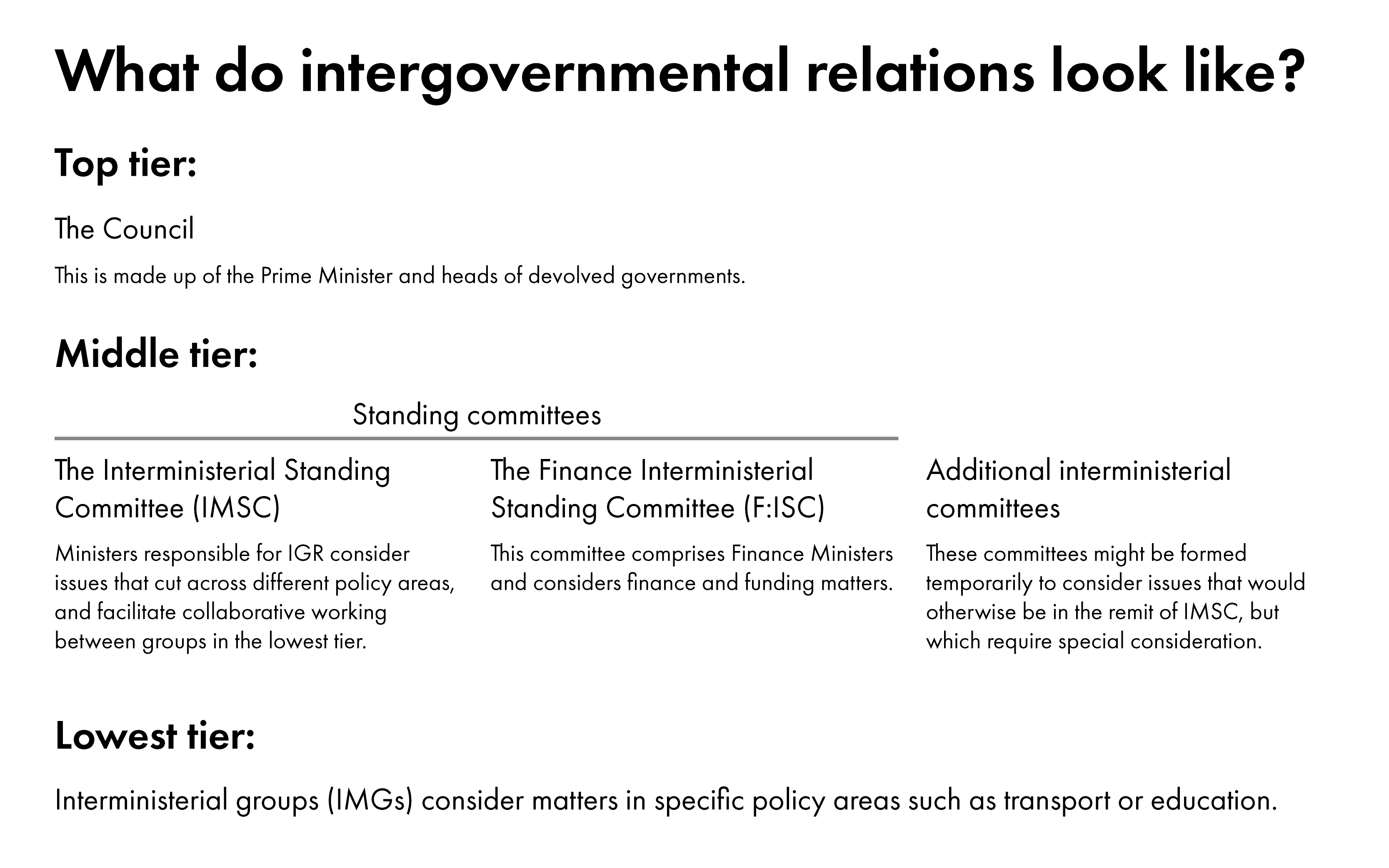
Formal intergovernmental interactions take place under the following structure, which was established in January 2022.
Scottish Parliament Information Centre
See a SPICe blog for more information on how the new structure operates.
Intergovernmental Relations Secretariat annual report 2024/25
The IGR Secretariat's annual report for 2024/25 was published on 24 March 2026. The report provides an overview of interministerial meetings and topics discussed. It brings together information already published in minutes of individual interministerial meetings. The annual report does not mention any formal disputes having arisen.
Interministerial meetings
.png)
Scottish Parliament Information Centre
Interministerial Standing Committee
The Interministerial Standing Committee met on 24 June 2026. According to the published minutes of the meeting, the Deputy First Minister and Cabinet Secretary for Finance and Local Government, Jenny Gilruth MSP, represented the Scottish Government. Discussions included Ministers' strategic priorities, the situation in the Middle East, and community cohesion. The Scottish Government is due to chair the next meeting, to be held in autumn 2026.
In advance of the meeting, the Europe, External Affairs and Culture Committee received a letter (dated 22 June 2026) from the Deputy First Minister. The letter set out when the meeting would be taking place and listed likely areas of discussion. An update on the Scottish Government's contribution to the meeting was provided on 15 July 2026.
Finance: Interministerial Standing Committee
The Finance: Interministerial Standing Committee met on 19 March 2026. Then Cabinet Secretary for Finance and Local Government, Shona Robison, represented the Scottish Government. Discussions included the economic outlook, the Spring Statement, and the operation of the Barnett formula. Ministers also discussed several shared priorities including Public Financial Institutions, the use of Financial Assistance Powers under the UK Internal Market Act 2020 and the fiscal flexibilities available to devolved governments.
Interministerial Group for Transport Matters
The Interministerial Group for Transport Matters met on 16 March 2026. Discussions focused on approaches to bus fares and concessionary travel, public safety on public transport, and ongoing work to develop and refine national transport strategies. The Secretary of State for Transport provided an update on developments in UK-EU relations and on the transport implications of the ongoing situation in the Middle East.
Interministerial Group for Trade
The Interministerial Group for Trade met on 8 January 2026 and 4 March 2026. Discussions focused on the UK Government’s trade priorities, including the UK free trade agreement programme, the US Economic Prosperity Deal, UK steel trade measures, and negotiations on a UK-Gulf Cooperation Council Free Trade Agreement.
Interministerial Group for Elections and Registration
The Interministerial Group for Elections and Registration met on 11 February 2026. Discussions included the UK Government’s forthcoming Representation of the People Bill, including legislative consent and the implications of the then forthcoming Scottish and Welsh elections. SPICe has published a blog on the Representation of the People Bill. Ministers also exchanged updates on electoral reform and election preparations, including voter access to the Online Absent Voting Application in Scotland following the Absent Voting (Elections in Scotland and Wales) Act 2025.
Interministerial Group for Environment, Food and Rural Affairs
The Interministerial Group for Environment, Food and Rural Affairs met on 5 February 2026. Ministers discussed allocations from the Fishing and Coastal Growth Fund, with devolved governments expressing disappointment that funding had been allocated using the Barnett formula.i Ministers also discussed progress on negotiations for a UK-EU Sanitary and Phytosanitary Agreement, emphasising the importance of continued engagement with devolved governments and effective arrangements for bringing forward relevant legislation.ii Further discussions covered the Farm Profitability Review, the UK Government Food Strategy, proposals for a coordinated approach to banning peat use in horticulture, the impact of visa rules on the availability of sheep shearers, and the implications of African Swine Fever outbreaks in Spain.
Interministerial Group for Housing, Communities and Local Government
The Interministerial Group for Housing, Communities and Local Government met on 4 February 2026. Discussions included place-based approaches to housing policy and the challenges and potential solutions to increasing housing supply across the UK. Ministers agreed that increasing housing supply across all tenures is essential to supporting thriving and sustainable communities and welcomed continued collaboration.
Interministerial Group for Business and Industry
The Interministerial Group for Business and Industry met on 3 February 2026. Discussions included recent economic developments across the UK, the role of public finance institutions (including the National Wealth Fund) in supporting investment and strategic priorities, and preparations for maintaining continuity of work during the then upcoming election period.
Interministerial Group for Net Zero, Energy and Climate Change
The Interministerial Group for Net Zero, Energy and Climate Change met on 26 January 2026. Discussions focused on the UK Government's Warm Homes Plan and proposals for a Warm Homes Agency, including progress on its development and potential participation by the devolved governments.
Interministerial Group on UK-EU Relations
The Interministerial Group on UK-EU Relations met on 21 January 2026. Discussions included the progress and priorities of UK-EU negotiations, the progress of Trade and Cooperation Agreement implementation, and the devolved governments’ priorities on UK-EU issues.
Interministerial Group for Work and Pensions
The Interministerial Group for Work and Pensions met on 19 January 2026. Discussions focused on employability support for disabled people and young people.
Common Frameworks
Common Frameworks are intergovernmental agreements which set out how governments will work together to make decisions about policy in certain devolved policy areas, in particular decisions about policy divergence.
They were originally intended to be used to consider matters which were former EU competences, however, some also state that they may be used to consider related matters within the wider policy area. You can read more about what common frameworks are on SPICe's intergovernmental activity hub and in an explainer briefing on common frameworks and their implications for the Scottish Parliament.
The Session 6 Constitution, Europe, External Affairs and Culture Committee received two letters from the UK Government and Scottish Government providing updates on the common frameworks programme in January 2026. The previous intergovernmental activity update covers these updates in greater detail. The UK Government's update indicated that ten common frameworks were ready to be published as finalised and stated:
The UK government is continuing to work with the devolved governments to finalise as many Frameworks as possible in the first quarter of 2026.
Three common frameworks were finalised and published on 19 March 2026:
In a statement to the House of Commons on 19 March 2026 on the finalisation of the three frameworks, the Parliamentary Secretary (Cabinet Office), Chris Ward MP, stated:
These documents have been updated to reflect changes in both policy and legislation since the common frameworks were laid for scrutiny, and accommodate many of the recommendations made, not only by the UK Parliament, but also legislatures in Scotland, Wales and Northern Ireland. In addition, changes have occurred in key areas such as the Windsor framework replacing the Northern Ireland protocol. The Windsor framework has reduced regulatory divergence between Great Britain and Northern Ireland for goods remaining in the UK. The standard text was updated in the relevant common frameworks following agreement by the four Governments.
Mr Ward further set out:
As we look ahead, we are focused on the future transparency of the programme. The UK Government are clear that this should not only allow the four legislatures of the UK insight into the effectiveness of common frameworks, but also ensure that all relevant stakeholders with a specific industry interest can utilise this information.
Finally, the UK Government are firmly committed to the speedy finalisation of the remaining common frameworks. We continue to work with the devolved Governments to complete the remainder of the programme and the Government will update the House on those developments in due course.
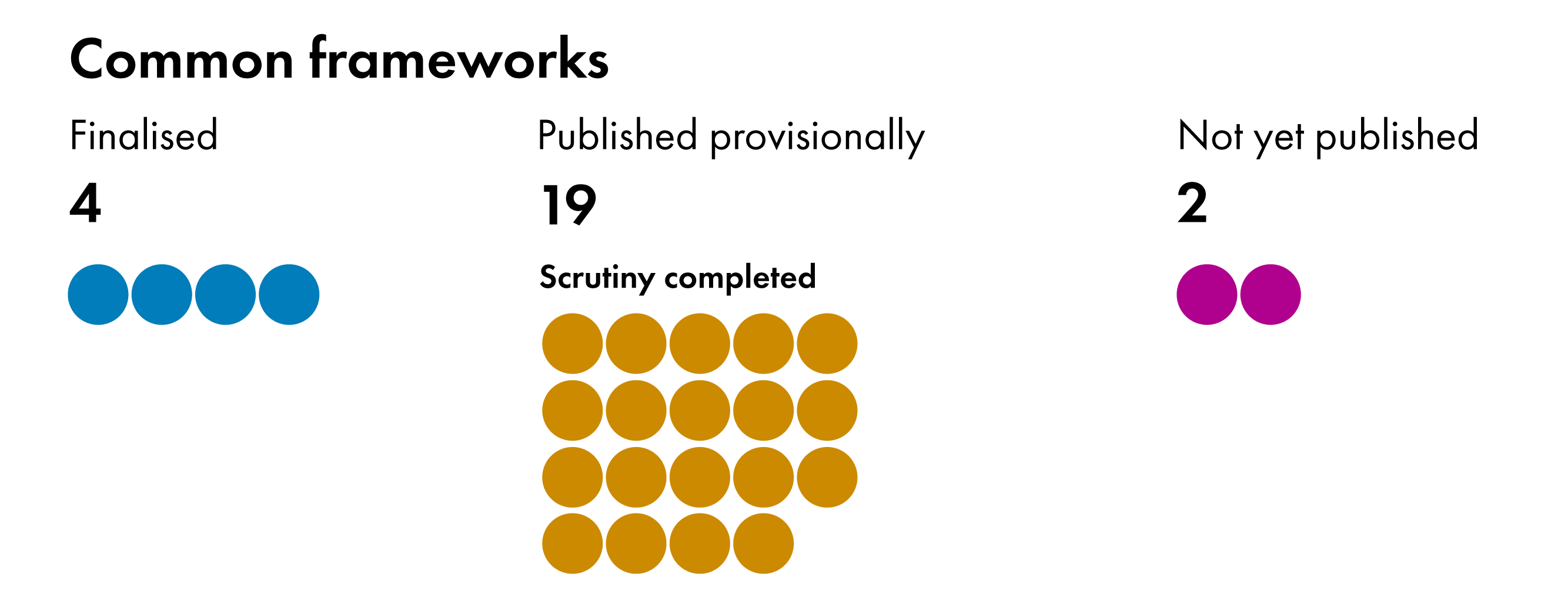
Scrutiny of all currently provisionally published frameworks that apply to Scotland has been completed at the Scottish Parliament.
The image below provides an update on frameworks relevant to Scotland and scrutiny of frameworks at the Scottish Parliament.
Scottish Parliament Information Centre
'provisionally published': Common framework agreements are published in draft form to enable scrutiny. They may be revised before finalisation.
'scrutinised': Common framework agreements can be examined by the four UK legislatures.
'operational': Common framework forums facilitate intergovernmental activity in the policy area covered by the framework, in line with the processes set out in the agreement.
'finalised': Common framework agreements are republished to reflect any changes made following parliamentary scrutiny.
These terms describe key points in the development and use of common frameworks, but they do not represent a set of sequential stages. For example, a framework may be provisionally published and become operational while parliamentary scrutiny is still ongoing.
UK internal market
The UK Internal Market Act 2020 (UKIMA) is UK-wide legislation about the flow of goods and services. You can read more about the Act's provisions in a SPICe explainer briefing.
Office for the Internal Market annual report 2025/26
The Office for the Internal Market (OIM) is part of the Competition and Markets Authority, which is a non-ministerial department of the UK Government. The OIM describes its responsibilities as independently advising the UK Government and devolved governments on how specific laws, rules and regulations affect the UK’s internal market and report on how the internal market is operating.
On 25 March 2026, the OIM published its fourth annual report on the operation of the UK internal market. Its overall assessment was:
"The operation of the UK internal market is stable and the internal market, taken as a whole, continues to function effectively overall. However, there remains a need for close collaboration between governments in relation to specific sectors where we have observed the potential for regulatory differences to emerge that could impact on the UK internal market."
The OIM found that "the internal market continues to function effectively and that the internal market regime is reaching a greater degree of maturity". However, the OIM did identify areas where there could be improvements in the way regulatory differences are managed, such as through the greater use of common frameworks.
UK Internal Market Act exclusions
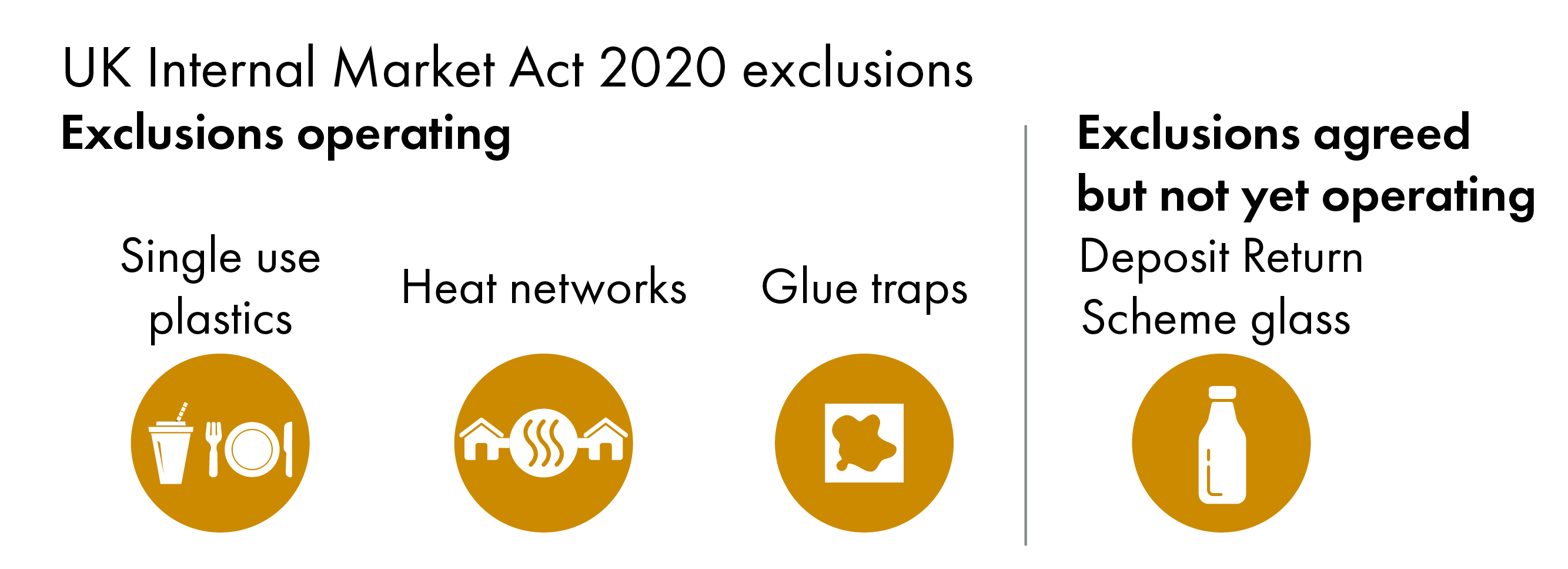
A process was established in 2021 by which the UK Government and devolved governments could consider exclusions to the UKIMA market access principles in the appropriate common framework forum. The UK Government carried out a review of UKIMA in 2025. The review outcomes include a commitment by the UK Government to implement all exclusions that have been agreed by all governments through a common framework. In addition, the outcomes indicate that two additional processes for considering exclusions will operate alongside the common framework process and that environmental protection and public health considerations will be taken into account when assessing potential exclusions. For more information on these changes, see a SPICe blog on the review outcomes.
Scottish Parliament Information Centre
Deposit Return Scheme
Discussions about a UKIMA exclusion relating to a Scottish Deposit Return Scheme (DRS) for drinks containers took place during 2023. The UK Government offered a temporary, narrower exclusion than the one requested by the Scottish Government, which the Scottish Government cited as the reason for its delay of the Scottish DRS scheme. See SPICe blogs from 2023 for background about the scheme and further information about intergovernmental discussions regarding an exclusion.
Following the UK Government's exclusion decision, the Scottish Government said it would align its scheme with UK-wide DRS plans. The UK Government, Scottish Government, Welsh Government and Northern Ireland Department of Agriculture, Environment and Rural Affairs agreed in an April 2024 joint policy statement to launch interoperable deposit return schemes covering the whole of the UK in October 2027. The Deposit and Return Scheme for Scotland Amendment Regulations 2025 and the Deposit and Return Scheme for Scotland (Designation of Scheme Administrator) Order 2025 amended the original framework for a Scottish DRS to give effect to the policy position set out in the April 2024 joint policy statement.
The Welsh Government announced in November 2024 that it would not proceed with the joint process and would instead pursue its own scheme that includes glass. In February 2026, the UK Government announced that it would make a UK Internal Market Act exclusion for single-use glass bottles in the Welsh DRS Scheme. Discussions on the exclusion took place through the Resources and Waste Common Framework. Glass is not currently included in plans for Deposit Return Schemes in Scotland, Northern Ireland or England. A blog by Senedd Research provides more information about plans for the Welsh DRS Scheme.
The Welsh Government has stated that it also wants the scheme to include 'reuse' (where containers are collected not only to be crushed and recycled but also washed and reused). A UKIMA exclusion for this part of a Welsh DRS has not been agreed to date. The UK Government has stated that it will continue further discussions with the devolved governments on the potential for alignment across the UK on reuse.
Regulatory developments
This section summarises other intergovernmental activity in relation to regulatory developments.
Assisted Dying Bill
The Assisted Dying for Terminally Ill Adults (Scotland) Bill ('the Bill') was a Member's Bill introduced by Liam McArthur MSP on 27 March 2024. A SPICe briefing on the Bill provides further background.
Several provisions in the Bill became the subject of discussion in relation to the legislative competence of the Scottish Parliament and the executive competence of Scottish Ministers. The Policy Memorandum for the Bill identified several provisions as relating to reserved matters and outlined a number of possible ways of proceeding, including through pursuing Orders under the Scotland Act 1998. SPICe has published a blog on Orders made under section 30 and section 104 of the Scotland Act 1998 and the intergovernmental activity update Q4 2025 contains further background on intergovernmental activity relating to the Bill.
In a letter dated 5 March 2026 to the Session 6 Health, Social Care and Sport Committee, the then Cabinet Secretary for Health and Social Care, Neil Gray MSP, provided an update on intergovernmental activity with the UK Government in relation to a section 30 and a section 104 order. The Bill fell at Stage 3 on 17 March 2026.
Non-surgical Procedures and Functions of Medical Reviewers (Scotland) Act
The Non-surgical Procedures and Functions of Medical Reviewers (Scotland) Bill was introduced on 8 October 2025. The Lead Committee for the Bill was the Session 6 Health, Social Care and Sport Committee.
The then Scottish Minister for Public Health, Jenni Minto MSP, wrote a letter to the UK Minister of State for Health on 16 January 2026, stating:
The Scottish Government intended to include training and qualification standards and supervision requirements within the Bill, as well as restrict some procedures to being carried out by a healthcare professional only. However, in preparing the Bill, it was identified that the UK Internal Market Act 2020 (UKIMA) has a potential impact on what can be regulated for in Scotland.
SPICe has published a blog on the UK Internal Market Act 2020 and the Non-surgical Procedures and Functions of Medical Reviewers (Scotland) Bill. The intergovernmental activity update Q3 2025 and Q4 2025 contain further background on intergovernmental activity relating to the Bill and its potential interaction with UKIMA.
At Stage 2 the Scottish Government lodged an amendment which proposed an additional section to the Bill. The section allows Scottish Ministers to specify in secondary legislation an individual assessment process to which section 26 of UKIMA would apply. Under such a process, an individual may apply to have their qualifications, training, experience or skills assessed for equivalence to any standards which may be set in Scotland. Importantly, where a regulator offers an individual an individual assessment under section 26 of UKIMA the automatic recognition principle does not apply.
In a letter dated 16 March 2026 to the Session 6 Health, Social Care and Sport Committee, the then Minister for Public Health and Women's Health shared correspondence from the UK Government setting out its position on the interaction between the Bill and UKIMA:
As set out below, the UK Government does not believe that the UK Internal Market Act 2020 (UKIMA) restricts the Scottish Government’s intentions to introduce training and qualification standards and supervision requirements within the Non-surgical Procedures and Functions of Medical Reviewers (Scotland) Bill and to restrict some procedures to healthcare professionals only.
The UK Government shares the Scottish Government’s concerns around the risks posed by the lack of regulation in the cosmetics space, and is similarly committed to introducing legal safeguards to protect the public. I would like to commend the efforts of the Scottish Government to improve the safety of the cosmetics sector and the progress made with the introduction of your (Scotland) Bill.
The Bill was passed on 17 March 2026 and became an Act on 12 May 2026.
Looking ahead: First joint referral to the Office for the Internal Market on 'Ready-to-burn' scheme
On 20 April 2026, the OIM accepted its first joint referral from the UK Government and devolved governments. The OIM was asked to review the impact of UKIMA Market Access Principles on the UK internal market with respect to certain products that fall within the UK Government's ‘Ready-to-burn’ certification scheme.
The OIM published its report on 17 July 2026. It concludes that the UKIMA market access principles are coinciding with several other developments contributing to increased sales of cheaper uncertified solid fuels in England. The market access principles "may have increased the pace of certain changes by creating a legal route to supply uncertified fuels to customers in England" and that "the sector will probably continue to evolve towards uncertified fuel in the absence of an exclusion [from the market access principles]." The report recommends further consideration of an exclusion and work on enforcement through the Air Quality Common Framework.
Legislative consent
Scottish Parliament Information Centre
According to the Sewel Convention, the UK Parliament will not normally legislate on devolved matters without the consent of the Scottish Parliament. The Scottish Parliament's standing orders set down rules which apply where UK primary legislation requires the Parliament's consent under the Sewel Convention. They apply where UK primary legislation makes ‘relevant provision’, which means provision which applies to Scotland in any of the following ways:
for any purpose within the legislative competence of the Scottish Parliament
to alter the legislative competence of the Scottish Parliament
to alter the executive competence of the Scottish Ministers.
When any of the criteria on relevant provision are fulfilled, the Scottish Government is obliged to lodge a legislative consent memorandum. A legislative consent memorandum, amongst other things, sets out the Scottish Government's view on whether the Parliament should grant legislative consent.
Following the lodging of the memorandum, Members of the Scottish Parliament may vote on a motion on legislative consent to either grant or withhold consent for the Bill.
Find out more about legislative consent on the Scottish Parliament's website, and in this November 2024 SPICe blog. SPICe has also developed two tools that can be used to track legislative consent at the Scottish Parliament, which can be accessed on SPICe's intergovernmental activity hub.
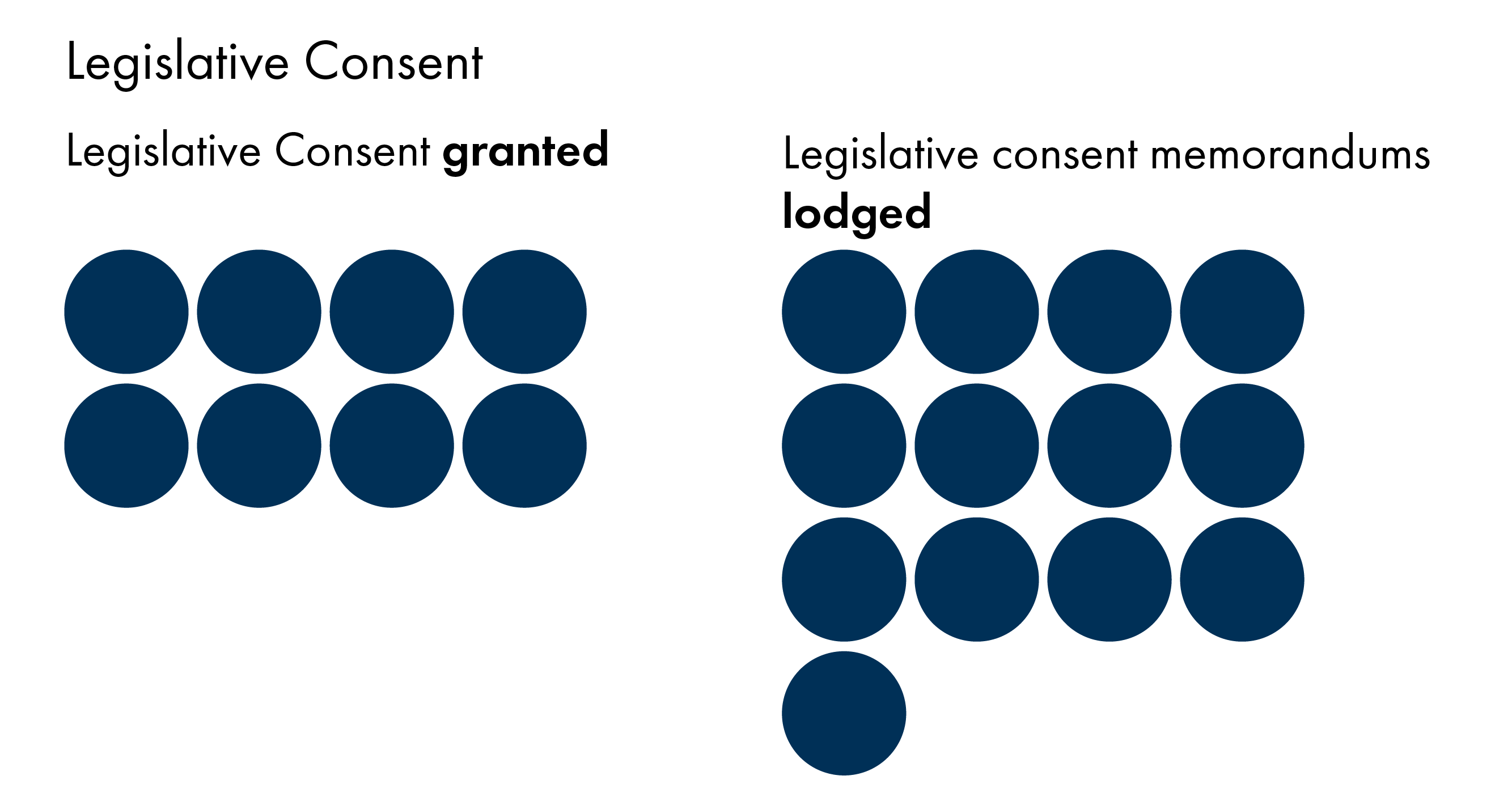
During quarters 1 and 2 of 2026, the Scottish Government lodged 13 legislative consent memorandums.
Legislative consent memorandums lodged during Q1 2026
| Bill title | Date memorandum lodged | Consent recommendation by Scottish Government |
|---|---|---|
| Cyber Security and Resilience (Network and Information Systems) Bill | 6 January 2026 | Partial consent recommended |
| Finance (No. 2) Bill | 7 January 2026 | Consent recommended |
| Medical Training (Prioritisation) Bill | 21 January 2026 | Consent recommended |
| Armed Forces Bill (Session 6) | 26 February 2026 | Consent recommended |
| Representation of the People Bill (Session 6) | 27 February 2026 | No recommendation on consent |
Legislative consent memorandums lodged during Q2 2026
| Bill title | Date memorandum lodged | Consent recommendation by Scottish Government |
|---|---|---|
| Sporting Events Bill | 5 June 2026 | No recommendation on consent |
| Steel Industry (Nationalisation) Bill | 15 June 2026 | Consent not recommended |
| Armed Forces Bill | 16 June 2026 | Consent recommended |
| National Security (State Threats) Bill | 17 June 2026 | Consent recommended |
| Commercial Payments Bill | 19 June 2026 | Consent recommended |
| Health Bill | 23 June 2026 | No recommendation on consent |
| Representation of the People Bill | 24 June 2026 | No recommendation on consent |
| Financial Services and Markets Bill | 25 June 2026 | No recommendation on consent |
Eight motions on legislative consent were considered by the Parliament.
Motions on legislative consent considered during Q1 2026
| Bill title | Date motion considered | Consent decision |
|---|---|---|
| Biodiversity Beyond National Jurisdiction Bill | 15 January 2026 | Consent provided |
| Sustainable Aviation Fuel Bill | 29 January 2026 | Consent provided |
| Finance (No. 2) Bill | 11 February 2026 | Consent provided |
| Medical Training (Prioritisation) Bill | 12 February 2026 | Consent provided |
| Armed Forces Bill (Session 6) | 24 March 2026 | Consent provided |
| Railways Bill | 24 March 2026 | Consent provided |
Motions on legislative consent considered during Q2 2026
| Bill title | Date motion considered | Consent decision |
|---|---|---|
| Steel Industry (Nationalisation) Bill | 17 June 2026 | Consent provided |
| National Security (State Threats) Bill | 24 June 2026 | Consent provided |
Further information
Information within this intergovernmental update is primarily based on the following sources:
The UK Government intergovernmental relations website contains minutes of interministerial groups and standing committees. Minutes of other intergovernmental meetings are not currently published and hence are not reflected in this update.
The UK Government Common Frameworks website contains Common Framework agreements.
The Scottish Parliament legislative consent website lists legislative consent memorandums and associated motions.
Further information on intergovernmental activity can be found on our intergovernmental activity hub and:
SPICe explainer briefing on intergovernmental activity and its implications for the Scottish Parliament and an explainer briefing on how devolution works.
House of Commons Library briefing on intergovernmental relations
UK Government transparency reports on intergovernmental relations and quarterly intergovernmental relations engagement dashboard
Senedd Legislation, Justice and Constitution Committee Monitoring reports
Northern Ireland Assembly Brexit and Beyond newsletters.