Explainer: The UK Internal Market Act 2020 and implications for the Scottish Parliament
This briefing outlines the operation of the UK Internal Market Act 2020 and its implications for the Scottish Parliament. It summarises the Act’s relationship with common frameworks, how the Act has worked to date, the UK Government's review of July 2025, and the revised exclusions processes. The briefing also sets out the views of devolved governments and parliamentary committees on the Act and linked issues, highlighting those relevant to parliamentary scrutiny and oversight for Session 7.
Executive Summary
The United Kingdom Internal Market Act 2020 (UKIMA) was introduced to provide a legal framework to govern the movement of goods and services across the United Kingdom following the UK’s exit from the European Union. It operates alongside the common frameworks programme, which was intended to manage regulatory difference in devolved policy areas (mainly those which are also areas of former EU competence) through intergovernmental agreement.
A statutory Review of the Act was announced alongside a consultation in January 2025. A response to the Review was published by the UK Government in July 2025, setting out changes to how exclusions from the market access principles will be considered and how intergovernmental working in relation to UKIMA issues will be conducted.
This briefing explains how the Act, the exclusions process linked to it, and common frameworks work alongside one another to manage the UK internal market. A SPICe Explainer: how devolution works provides detail on the Act and intergovernmental processes within the wider context of devolution.
Since its introduction, UKIMA has been the subject of sustained political, intergovernmental, and parliamentary debate. In particular, there has been discussion about its implications for devolved competence, regulatory autonomy, and parliamentary scrutiny. As such, the briefing also considers the implications of the Act for the Scottish Parliament, and examines increased governmental working through common frameworks and the exclusions process.
This briefing has been undertaken by Dr Brown Swan as an academic fellow in SPICe. The views expressed in this briefing are the views of the author, not those of SPICe or the Scottish Parliament.
Managing the UK Internal Market
This section of the briefing considers the arrangements in place to manage the UK internal market. The timeline below shows the evolution of these arrangements from the decision to have common frameworks to the enactment the UK Internal Market Act 2020 (UKIMA) and the revised exclusions process linked to the Act.
The timeline shows the development of common frameworks and of the UK Internal Market Act 2020
.png)
Scottish Parliament Information Centre
Common Frameworks
Common frameworks are agreements setting out how the UK and devolved governments will work together to make decisions about policy direction and regulatory difference in certain devolved policy areas (generally those formerly governed by EU law). The aim of common frameworks is to manage difference in these areas in order to achieve consistency in policy and practice where this is deemed desirable by governments across the four UK nations. Common frameworks are intergovernmental agreements, but they are not legally binding.
The Joint Ministerial Committee (EU Negotiations), an intergovernmental group to discuss the UK's exit from the EU, defined common frameworks in a communique:
As the UK leaves the European Union, the Government of the United Kingdom and the devolved administrations agree to work together to establish common approaches in some areas that are currently governed by EU law, but that are otherwise within areas of competence of the devolved administrations or legislatures. A framework will set out a common UK, or GB, approach and how it will be operated and governed. This may consist of common goals, minimum or maximum standards, harmonisation, limits on action, or mutual recognition, depending on the policy area and the objectives being pursued. Frameworks may be implemented by legislation, by executive action, by memorandums of understanding, or by other means depending on the context in which the framework is intended to operate.
Joint Ministerial Committee (EU Negotiations). (2017, October 16). JOINT MINISTERIAL COMMITTEE (EU NEGOTIATIONS) COMMUNIQUE. Retrieved from https://assets.publishing.service.gov.uk/government/uploads/system/uploads/attachment_data/file/652285/Joint_Ministerial_Committee_communique.pdf [accessed 13 November 2025]
Common Frameworks are employed when necessary in order to:
Joint Ministerial Committee (EU Negotiations). (2017, October 16). JOINT MINISTERIAL COMMITTEE (EU NEGOTIATIONS) COMMUNIQUE. Retrieved from https://assets.publishing.service.gov.uk/government/uploads/system/uploads/attachment_data/file/652285/Joint_Ministerial_Committee_communique.pdf [accessed 13 November 2025]
enable the functioning of the UK internal market, while acknowledging policy divergence;
ensure compliance with international obligations;
ensure the UK can negotiate, enter into and implement new trade agreements and international treaties;
enable the management of common resources;
administer and provide access to justice in cases with a cross-border element;
safeguard the security of the UK.
In the Communique, the Governments noted "Frameworks will respect the devolution settlements and the democratic accountability of the devolved legislatures", and will therefore:
Joint Ministerial Committee (EU Negotiations). (2017, October 16). JOINT MINISTERIAL COMMITTEE (EU NEGOTIATIONS) COMMUNIQUE. Retrieved from https://assets.publishing.service.gov.uk/government/uploads/system/uploads/attachment_data/file/652285/Joint_Ministerial_Committee_communique.pdf [accessed 13 November 2025]
be based on established conventions and practices, including that the competence of the devolved institutions will not normally be adjusted without their consent;
maintain, as a minimum, equivalent flexibility for tailoring policies to the specific needs of each territory as is afforded by current EU rules;
lead to a significant increase in decision-making powers for the devolved administrations.
The UK Government noted that Common Frameworks have limitations in guaranteeing the integrity of the internal market.
Common Frameworks aim to protect the UK Internal Market by providing high levels of regulatory coherence in specific policy areas through close collaboration with devolved administrations to manage regulation. They do this by enabling officials to work together to set and maintain high regulatory standards. However, Frameworks on their own cannot guarantee the integrity of the entire Internal Market. As they tend to be sector-specific, they do not address the totality of economic regulation or the cumulative effects of divergence, i.e. the consequences of regulatory difference in one sector that affects other sectors. Finally, they do not fully address the question of how best to substitute the wider EU ecosystem of institutions and treaty rights had on the UK Internal Market.
UK internal market policy paper . (2020, July). Retrieved from https://www.gov.uk/government/publications/uk-internal-market/uk-internal-market [accessed 27 May 2026]
As a result, the UK Government's view was that more comprehensive legislation was necessary.
You can find more detail on how common frameworks were developed, how many there are which are applicable to Scotland and how they operate in the SPICe Explainer: common frameworks and their implications for parliamentary scrutiny.
The introduction of the UK Internal Market Bill and reaction to it
In July 2020, the UK Government led by the then Prime Minister, Boris Johnson, published its White Paper on the UK Internal Marketi. It was the UK Government's view that the UK Internal Market Bill was necessary to ensure the ongoing prosperity of the United Kingdom. The introduction to the White Paper states:
The UK Internal Market has for centuries been at the heart of our economic and social prosperity as a country. It dates back to the Acts of Union of 1706 and 1707, and has been a source of unhindered and open trade across the United Kingdom – one which pulls us together as a united country and means that, as a Union, we are greater than the sum of our parts. The UK Internal Market long predates many other countries’ economic unions, and has been uniquely successful in driving forward economic prosperity across our whole country, providing businesses with the certainty that they need to grow and thrive.
UK internal market policy paper . (2020, July). Retrieved from https://www.gov.uk/government/publications/uk-internal-market/uk-internal-market [accessed 27 May 2026]
The UKIMA Bill was met with opposition from the devolved governments which expressed concerns that the legislation would constrain devolved competence in policy areas such as environment, public health, and agriculture.
Then First Minister, Nicola Sturgeon MSP, described it as a "full frontal assault on devolution".2
In the Welsh Government's analysis of the White Paper, it argued that there are significant challenges in managing the tension which exists in any internal market between open trade and regulatory divergence.
We have been clear that, while we agree that every aspect of the Internal Market is not covered by current Frameworks, this is not a justification for a heavyhanded piece of legislation which goes much further than areas covered by retained EU law.
Welsh Government. (2020, August 14). The UK Government’s White Paper on a UK Internal Market Welsh Government Analysis. Retrieved from https://business.senedd.wales/documents/s103942/Correspondence%20from%20the%20Counsel%20General%2014%20August%202020.pdf [accessed 13 November 2025]
The Welsh Labour First Minister at the time, Mark Drakeford AM, described the Bill critically.
Now the UK government instead of relying, as we wish, on agreement, on discussion, on finding common ways to address common problems, their answer is to smash and grab the devolution settlement.
Chappell, E. (2020, September 9). Drakeford slams internal markets bill as “smash and grab” on devolution. Retrieved from https://labourlist.org/2020/09/drakeford-slams-internal-markets-bill-as-smash-and-grab-on-devolution/
UKIMA was passed without the consent of the Scottish Parliament. The Welsh Senedd also withheld consent, and consent was not obtained from the Northern Ireland Assembly. The key provisions of UKIMA came into force at 11pm on 31 December 2020.
The UK Internal Market Act 2020
The UK Internal Market Act 2020 (UKIMA) governs the trading relationship between the different parts of the UK for goods and services and the recognition of professional qualifications. The introduction of UKIMA, as a legal underpinning for the domestic market, was motivated by the then UK Government's concern that EU exit would result in difference in rules and regulations across England, Scotland, Wales, and Northern Ireland, creating barriers to trade and mobility within the United Kingdom.1
UKIMA sought to provide, according to the then UK Government "a baseline level of regulatory coherence across a wider range of sectors. This means that areas without a Common Framework will still benefit from a low-level regulatory coherence underpinning. Crucially, market coherence will be provided for issues that fall around or between individual sector-focused frameworks."2
UKIMA establishes two market access principles (MAPs) - mutual recognition and non-discrimination.
The mutual recognition principle for goods is the principle that goods which have been produced in, or imported into, one part of the United Kingdom, and can lawfully be sold there, should be able to be sold in any other part of the United Kingdom. Any different requirements that would otherwise apply to the sale in the other part of the UK are disapplied.
The mutual recognition principle for services is that a person authorised to provide services in one part of the UK is not required to meet additional authorisation requirements to provide those services in another part of the UK.
The non-discrimination principle for goods is the principle that the sale of goods in one part of the United Kingdom should not be affected by relevant requirements that directly or indirectly discriminate against goods that have a relevant connection with another part of the United Kingdom.
The non-discrimination principle for services is that a regulatory requirement will be of no effect in relation to an incoming service provider where it discriminates against that provider directly or indirectly.
UKIMA also contains provisions to ensure a system for the mutual recognition of professional qualifications across the UK internal market. This allows professionals qualified in one of the four parts of the UK to access the same profession in a different part without needing to requalify.
UKIMA allows for minimal regulatory divergence. The MAPs apply unless there is an exclusion provided for in the Act. The exclusions provided in the Act are relatively few and often narrowi. Accordingly, nearly all devolved policy areas are potentially affected by the market access principles. There are specific exclusions, for example, neither of the MAP currently apply to healthcare services, social services or transport services. There are very few general exclusions from the MAPs, especially as they pertain to goods. For example, direct discrimination may be permitted if the aim is to combat the spread of pests or diseases, but only if the pest/disease is significantly less present in the restricting nation, if there is a serious threat to health, and if the legislation can be reasonably justified as necessary to address the threat. Similarly, some restrictions may be permitted if they are responding to a "public health emergency", but only where it poses an "extraordinary threat" to human health. Indirect discrimination against other UK goods may be permitted but only if it can be justified as necessary for "the protection of the life or health of humans, animal or plants," or "the protection of public safety and security".
Academics expressed the view that the MAPs limited the practical reach of devolved legislation even where powers were formally unchanged.3 Professor Thomas Horsley described the Act as
[a] stark example of market-making through negative harmonisation, and one with profound consequences for the effective policy choices available to the devolved governments at the sub-state level.
Horsley, T., & Hunt, J. (2023). Internal market governance by consensus rather than conflict? Common Frameworks and the potential for positive harmonisation. Northern Ireland Legal Quarterly, 30-67. doi: 10.53386/nilq.v74iAD2.1083
Under sections 10 and 18 of UKIMA, UK Ministers do, however, have the power to amend the list of exclusions to which the MAPs do not apply. This leaves considerable power in the hands of UK Ministers. Although UK Ministers are required to seek the consent of relevant devolved ministers before making regulations which change the exclusions, there is no requirement for consent to be secured. UKIMA specifies that if consent is not given within one month of being sought, the regulations can be made without it. This means that UK Ministers can change the exclusions to the market access principles even where the devolved administrations disagree.
Although only UK Ministers have the power to make changes, the UK and devolved governments agreed a process for the consideration of exclusions in areas covered by common frameworks. The agreement was published in December 2021. The exclusions process is covered in more detail later in this briefing.
While exclusion discussions through the exclusions process have been on goods to date, legislation under consideration by the Parliament in Session 6, namely the Non-surgical Procedures and Functions of Medical Reviewers (Scotland) Bill, has raised the issue of the effects of UKIMA in relation to regulation of professional qualifications for the first timeii. The UKIMA issues were explored in more detail in a SPICe blog.
The way UKIMA operates means that an Act of the Scottish Parliament or a Scottish Statutory Instrument can contain provision which runs contrary to UKIMA, but the provision will be disapplied where relevant (i.e., in relation to goods and services which come from another part of the UK or in relation to the recognition of professional qualifications). Scottish legislation remains enforceable in relation to goods produced in, or first imported into Scotland, in relation to the provision of services by Scottish-regulated service providers and in relation to the professional qualifications of Scottish-qualified individuals.
This disapplication in relation to goods and services from different parts of the UK does, however, limit the effectiveness of Scottish Parliament legislation which engages either a market access principle or the automatic recognition principle in relation to professional qualifications in spite of the fact that the principles do not introduce any new statutory limitations on the legislative competence of the Scottish Parliament.
UKIMA works by ‘disapplying’ requirements in legislation (something in either primary or secondary legislation) which run contrary to the principles it establishes.
Disapplication is different to where a law is ‘struck down’. In the case of disapplication, the requirement is still law, but it doesn't apply in particular circumstances. Where a law is 'struck down' it means that it is void.
The Internal Market Act in Practice
Once enacted, UKIMA continued to draw attention and discussion around its devolution impacts. A 2022 inquiry carried out by the Scottish Parliament's Constitution, Europe, External Affairs and Culture (CEEAC) Committee noted:
that there are significant challenges in managing the tension which exists in any internal market between open trade and regulatory divergence. Within the context of the UK internal market the Committee's view is that in resolving this tension it is essential that the fundamental principles which underpin devolution are not undermined.
Scottish Parliament Constitution, Europe, External Affairs and Culture (CEEAC) Committee. (2022, February 2022). UK Internal Market Inquiry. Retrieved from https://digitalpublications.parliament.scot/Committees/Report/CEEAC/2022/2/22/73682bfb-fb43-47e5-b206-b79ec5e28262-2 [accessed 13 November 2025]
For the devolved governments, there was a significant tension between the consensual nature of the common frameworks programme and the fact that UKIMA was enacted without the consent of the devolved legislatures. The Scottish Government's position being:
Common frameworks are based on agreement, not imposition, and the incentive to agree ways of aligning and managing differences is fundamentally weakened when the market access principles of the Internal Market Act require standards coming from other UK nations to be accepted across all nations.
The Scottish Govenrment . (2021, March). AFTER BREXIT: The UK Internal Market Act & Devolution. Retrieved from https://www.gov.scot/binaries/content/documents/govscot/publications/strategy-plan/2021/03/brexit-uk-internal-market-bill-scotlands-future/documents/brexit-uk-internal-market-act-devolution/brexit-uk-internal-market-act-devolution/govscot%3Adocument/brexit-uk-internal-market-act-devolution.pdf [accessed 1 March 2026]
To try to address that tension, the UK and devolved Governments worked to agree a process through which the devolved governments could ask for exclusions to the market access principles. The process is discussed in more detail in the section of this briefing The exclusions process and its use to date.
The first use of an exclusion to the MAP under UKIMA came with the Environmental Protection (Single-use Plastic Products) (Scotland) Regulations 2021. These regulations banned a number of single-use plastic items in Scotland. However, under the terms of UKIMA single-use plastic products which were lawfully produced in or first imported into other parts of the UK could still be sold in Scotland until an exclusion could be secured. 3
SPICe has previously noted the single-use plastics products exclusion illustrates “the transparency challenges for the Parliament in scrutinising how common frameworks and the associated UKIMA exclusions processes are working”.4 SPICe noted that inter-governmental discussions took place in the December 2021 and March 2022 meetings of the Inter Ministerial Group for Environment Food and Rural Affairs. On 6 May 2022, then Minister for Green Skills, Circular Economy and Biodiversity Lorna Slater MSP made a notification seeking the approval of the Parliament for Scottish Ministers to consent to the UK statutory instrument that would create an exclusion from UKIMA for the single-use plastics regulations.
This meant that the Parliament was being asked to consent to Scottish Ministers consenting to the UK statutory instrument without any idea of the scope of the exclusion or details of framework discussions that supported the exclusion.
SPICe. (2023, March 24). From single-use plastics to the deposit return scheme: How are Common Frameworks and UK Internal Market Act exclusion processes operating?. Retrieved from https://spice-spotlight.scot/2023/03/24/from-single-use-plastics-to-the-deposit-return-scheme-how-are-common-frameworks-and-uk-internal-market-act-exclusion-processes-operating/ [accessed 27 November 2025]
The Scottish Government's experience of how UKIMA operated informed its position on the issue as expressed in its 2023 paper Devolution since the Brexit Referendum. In that paper the Scottish Government stated:
Most significantly, the UK Internal Market Act 2020 (IMA) makes fundamental changes to the effective powers of the Scottish Parliament. Rules set elsewhere in the UK will apply in Scotland to imports from that part of the UK, whatever the equivalent rules in Scotland say. In contrast to the flexibility of the European Single Market, which recognises both local factors and a balance of different policy objectives – such as health – with economic activity, the IMA imposes a rigid requirement, in almost all cases, that standards set in other parts of the UK must automatically be accepted in Scotland, regardless of laws passed by the Scottish Parliament. The result is that the Scottish Parliament is effectively prevented from setting the standards it wants for Scotland within areas of devolved responsibility.
For example, Westminster has recently passed legislation to allow “precision breeding” (broadly gene editing) of plants and animals, including for human consumption, in England: Under this legislation and the IMA, these products will have to be allowed into the Scottish market, even if they would otherwise be illegal under Scottish rules.
If the Scottish Parliament makes rules that affect what can be bought and sold in Scotland - as it recently did to ban single use plastic items – these rules, unless excluded from the Act, will not apply to suppliers from elsewhere in the UK who can still sell their products in Scotland .
Concerns about the process by which exclusions were agreed accelerated over the Scottish Deposit Return Scheme6, and the ban on the sale of glue traps7 in Scotland. Detailed information on the use of the exclusions process to date is provided in the section of this briefing on the exclusions process.
The effect of the application of the exclusions process on devolved policy making and legislation was a feature of the Constitution, Europe, External Affairs and Culture Committee’s response to the UK Government's consultation and review on UKIMA. In the Committee's response it noted the view of its adviser, Dr Chris McCorkindale, who stated UKIMA:
strikes at the law-making and scrutiny functions of the Scottish Parliament in important ways.” He suggests that the market access principles “constrain devolved regulatory autonomy in fact, if not in law, and in ways that exceed the constraints applicable within the EU Single Market.”
The exclusions process and exclusions to date
As explained earlier in this briefing, only UK Ministers have the power to make changes to UKIMA, and specifically when the market access principles do not apply through the creation of an exclusion.
The UK and devolved governments agreed a process for the consideration of exclusions in areas covered by common frameworks and the agreement was published in December 2021i. The process was light on the detail of how exactly it operated in practice and there was no mechanism built into it to allow the Scottish Parliament or other stakeholders to have a say.
Broadly, the process required that if a government wished to seek an exclusion to the market access principles, it had to set out the scope and rationale for this. The proposed exclusion was then considered by the appropriate common framework forum. If the exclusion was agreed, it was for UK Ministers to introduce a draft instrument to the UK Parliament to give effect to the exclusion. The UK Parliament would then consider the draft instrument.
The full text of the agreement is set out below.
1. Sections 10 and 18 and Schedules 1 and 2 of the UK Internal Market Act contain provisions excluding the application of the United Kingdom market access principles in certain cases.
2. Whenever any party is proposing an amendment to those Schedules in areas covered by a Common Framework:
the exclusion seeking party should set out the scope and rationale for the proposed exclusion; and
consideration of the proposal, associated evidence and potential impact should be taken forward consistent with the established processes as set out in the relevant Common Framework, including an assessment of direct and indirect economic impacts.
3. It is recognised that all parties will have their own processes for considering policy proposals. Administrations should consult and seek agreement internally on their position before seeking to formally agree the position within the relevant Common Frameworks forum.
Agreement of an exclusion request
4. Where policy divergence has been agreed through a Common Framework this should be confirmed in the relevant Common Framework forum. This includes any agreement to create or amend an exclusion to the UKIM Act 2020’s market access principles.
5. Evidence of the final position of each party regarding any exclusion and whether an agreement has been reached should be recorded in all cases. This could take the form of an exchange of letters between appropriate UK Government and Devolved Administration ministers and include confirmation of the mandated consent period for Devolved Administration ministers regarding changes to exclusions within the Act28.
6. Parties remain able to engage the dispute resolution mechanism within the appropriate Common Framework if desired.
Finalising an exclusion
7. Under section 10 or section 18 of the UK Internal Market Act 2020 amendments to the schedules containing exclusions from the application of the market access principles require the approval of both Houses of the UK Parliament through the affirmative resolution procedure. Where agreement to such an exclusion is reached within a Common Framework, the Secretary of State for the UK Government department named in the Framework is responsible for ensuring that a draft statutory instrument is put before the UK Parliament.
The Scottish Government has used the exclusions process to request an exclusion to the market access principles three times to date in relation to:
An exclusion in relation to heat networks was also made at the request of the Scottish Government, but the request was not made through the exclusions processii. The exclusion was requested as part of a 10 week consultation on exclusions to the market access principles which ran in early 2021. In its response to the consultation, the then UK Government stated:
The Scottish Government requested the addition of an exclusion for heat regulation including certain services connected with heat networks from the mutual recognition principle, because of the different licences for the provision of heat networks services. The Government recognises that there are sound policy objectives for different regulatory approaches within the UK. The Government therefore proposes to add an exclusion to Part 1 of Schedule 2 to prevent this, which is in part consistent with the approach adopted to other energy and utility sectors.
The Scottish Government did not, however, consent to the SI which brought in the exclusion. In a letter to the Fair Work and Economy Committee (23 August 2022), John Swinney MSP, then Deputy First Minister and Cabinet Secretary for Covid Recovery, noted that the exclusion granted was narrower than the one requested by the Scottish Government:
The new Schedule will create new exclusions, including heat networks, which follows a Scottish Government request for both heat networks policy and wider heat regulation policy to be excluded in response to a UK Government consultation (the latter, wider exclusion was rejected by the UK Government).
The letter also set out the Scottish Government’s grounds for not consenting:
The new Schedule would bring a number of new policy areas into scope of the Act: financial services, postal services, electronic communications services, services of temporary work agencies, and services of a statutory auditor. We have previously made clear that we are opposed in principle to the scope of the Act being extended, a position strengthened by the approach to parliamentary scrutiny adopted by the UK Government. Therefore, while we welcome the exclusion of Heat Networks, the Scottish Government has not consented to this SI.
Single use plastics
The Environmental Protection (Single-use Plastic Products) (Scotland) Regulations 2021 were made on 9 November 2021 and came into force on 1 June 2022. These regulations banned many single-use plastic items in Scotland. However, the UKIMA mutual recognition principle meant that single-use plastic products which were lawfully produced in or first imported into other parts of the UK could still be sold in Scotland. This was the case until the United Kingdom Internal Market Act 2020 (Exclusions from Market Access Principles: Single-Use Plastics) Regulations 2022 came into force on 11 August 2022.
The first indication that an exclusion from the UKIMA market access principles had been requested was in the minutes from the Interministerial group for Environment, Food and Rural Affairs on 6 December 2021. The Communiqué (published on 12 January 2022) stated:
The meeting opened with a discussion on Single Use Plastics where Scottish government ministers presented their preferred approach to mitigate the environmental policy impact of the UK Internal Market Act (the Act) as raised by their Single-Use Plastics regulations. This included the option for as broad an exclusion as possible from the operation of the market access principles set out in the Act for policy areas under the Resources and Waste Common Framework, noting that they wanted to come to a workable solution for all administrations despite their continued and fundamental opposition to the Act. Welsh ministers also favoured the broad solution approach.
The Resources and Waste framework, through which an exclusion for single use plastics was first expected to be considered, had been operating on a provisional basis since January 2021. However, the provisional framework was only published on 19 December 2022. As such, there was little indication as to which framework groups considered the evidence base for an exclusion prior to its consideration by the Interministerial Group for Environment, Food and Rural Affairs.
A later Communiqué from 21 March 2022 indicated that a “narrow” exclusion was to be agreed. Whilst there was a list of items to be included in the exclusion, there was no information on what had been omitted or the nature of the broader exclusion from which to assess how the policy decisions had developed. This Communiqué stated:
Defra’s Secretary of State confirmed that the UK Government’s position was for a narrow exclusion from the UK Internal Market Act covering bans on the supply of single use plastic straws, stirrers, cotton buds, plates, cutlery, balloon sticks and expanded and extruded polystyrene food and drinks containers. While Scottish and Welsh Ministers welcomed that an exclusion had finally been agreed, they were clear that their preference remained for a much broader exclusion to align with devolution and to avoid needing to revisit the process in the near future for further bans on single use plastic.
The Parliament was first informed of the exclusion on 6 May 2022, when the Minister for Green Skills, Circular Economy and Biodiversity Lorna Slater MSP made a notification seeking the approval of the Parliament for Scottish Ministers to consent to the UK statutory instrument that would create an exclusion from UKIMA for the single-use plastics regulations. This meant that the Parliament was being asked to agree to Scottish Ministers consenting to the UK statutory instrument without having seen a draft of the instrument or details of framework discussions that supported the exclusion.
Subsequent correspondence between the Convenor of the Net Zero, Energy and Transport Committee and the Minister did not provide details on the nature and scope of the broader exclusion requested versus the exclusion that was agreed.
On 12 February 2025, the Office for the Internal Market (OIM) published a report on the impact of the regulation of sale of single use plastics on the operation of the internal market. The report followed a discretionary review by OIM of single-use plastic restrictions under section 33(1) of UKIMA which allows OIM to review any matter relevant to assessing or promoting the effective operation of the internal market in the UK.
The report considers the effects on businesses of SUP regulations introduced since 2011 (when the Welsh Government became the first administration in the UK to introduce a plastic bag charge), with a specific focus on the functioning of the UK internal market. To produce its findings, the OIM conducted in-depth qualitative interviews with businesses and trade associations. It also reviewed information from sources including government consultations and impact assessments, and engaged with officials from all four UK administrations. The report found that:
The overall effects of SUP regulations on internal market trade have been “modest”, in the context of the current broad alignment in existing single use plastic restrictions across Great Britain (albeit with significant impacts on some individual businesses).
As regulations governing specific products (e.g. cotton buds, drinking straws, drinks stirrers, and polystyrene food and drinks containers) have mostly been introduced across England, Scotland and Wales at broadly similar times, suppliers have “largely adapted simultaneously” across these nations (i.e. minimising the potential for new trading frictions or competitive [dis]advantages to emerge).
There are few examples of “material differences” in the identity of active suppliers across the UK or in individual nations before and after the regulations.
Most businesses which trade across the UK have adopted a “uniform approach”, ensuring their products comply with regulations in all nations, rather than tailoring different approaches to each nation’s specific regulations.
“Businesses of all sizes strongly prefer alignment of single use plastic regulations, in terms of scope and implementation dates, both across the UK, and (where businesses sell into the EU and/or rely on EU supply chains) with EU regulations”.
Some businesses suggested that where different regulations are in place across different nations, this could create opportunities to trial new products in nations which have introduced a new or more extensive SUP restriction first.
While large businesses are generally aware of UKIMA and the market access principles they would not choose to rely on them to underpin their UK-wide trading activity, “as this would not align with their sustainability goals and carried reputational risks”. OIM also finds that SMEs “generally have much less awareness” of UKIMA.
Governments across the UK “are working effectively together” on single use plastic restrictions and have learned lessons from the introduction of previous SUP regulations. This includes sharing research and data, and keeping each other informed of their policy plans.
Governments are using Common Frameworks to manage regulatory proposals, including collaborating on the proposed bans on wet wipes containing plastic, and on single use vapes.
Deposit Return Scheme
The original deposit return scheme (DRS) for Scotland was approved by the Scottish Parliament in the Deposit and Return Scheme for Scotland Regulations 2020 on 13 May 2020. This was before the Bill for UKIMA was introduced on 9 September 2020.
Further detail on the nature of the broad exclusion to the market access principles of UKIMA that was first requested through the Resources and Waste Common framework was not known until the Scottish Government published this information on 28 February 2023. This information was published ahead of a Ministerial statement on the DRS on 1 March 2023. This information was not provided to the Parliament, rather it was put into the public domain by the Scottish Government following comments made by the Secretary of State for Scotland Alister Jack MP to the House of Commons on 22 February 2023 that suggested the Scottish Government had not requested an exclusion from UKIMA for DRS.
The Scottish Government stated that it first raised the issue of an exclusion for the DRS when it initiated the consideration of a broad exclusion in July 2021. However, there was no indication from information in the public domain at that time that the specific requirements of DRS were expected to be included in this exclusion. The Interministerial Group minutes from the 21 March 2022 only referred to the Scottish Government’s single-use plastics regulations and policy areas covered by the Resources and Waste framework.
The Scottish Government documents then indicate that a separate assessment of UKIMA exclusion for DRS was not initiated in the Resources and Waste framework until October 2022. Notification that the proposal was being considered by the Interministerial Group for Environment, Food and Rural Affairs was not included in a Communiqué until November 2022. Ministerial discussion of the proposed exclusion (as indicated in the Scottish Government documents) was expected on 6 March 2023, and minutes from that meeting (published by the Scottish Government on 20 March 2023 and the UK Government on 21 March 2023) provided further detail on the nature of the discussions. The minutes state:
Minister Slater reiterated how an exclusion from the UK Internal Market Act, with a broad scope to cover all deposit return schemes across the UK but, at a minimum, an exclusion for Scotland’s deposit return scheme regulations, is needed in advance of the Scottish scheme launch on 16 August. Scottish Ministers pressed Defra Ministers now for a decision regarding their support for an exclusion and a timeline for when a final UK Government position may be reached. Defra Ministers acknowledged that Scottish Ministers have fully followed the agreed processes, that the relevant Common Framework had agreed to seek ministerial views on its recommendations of an exclusion, while also highlighting Defra’s need to progress with seeking agreement internally as set out in the process for considering UK IMA exclusions in Common Framework areas.
On 27 May 2023 the UK Government agreed to a temporary partial exclusion (not including glass) for DRS. The Scottish Government announced on 7 June 2023 that the DRS would be delayed “as a consequence of the UK Government’s refusal to agree a full exclusion from the Internal Market Act”.
Scotland will now be part of a wider DRS scheme which is also being introduced in England. The Welsh Government has proceeded with a different DRS scheme to include glass. The Welsh Government requested an exclusion to the MAP in relation to DRS in November 2025. On 12 February 2026 the UK Government published a policy paper on the Welsh Government's DRS and its response to the exclusion request. The response stated:
The UK government has therefore offered an exclusion for single-use glass bottles in Wales, which will be implemented in legislation at the earliest opportunity. This exclusion is subject to the Welsh Government committing to all of these points:
commencing its DRS for plastic and metal drinks containers as planned on 1 October 2027
ensuring that its DRS for plastic and metal drinks containers meets key criteria for integrating with a UK-wide scheme (this includes ensuring that schemes have a single registration and reporting system, processes for reciprocal takeback of material – for example, material can be returned in any nation, consistent logos and the same deposit level)
extending its proposed transitional period for single use glass (where a 0p deposit applies and no labelling requirements or targets apply) to October 2031 – this will provide industry with additional lead-in time to prepare for the introduction of glass in the Welsh DRS.
Glue traps
The Wildlife Management and Muirburn (Scotland) Bill (now Act 2024) was introduced in Parliament on 21 March 2023. The Bill as introduced proposed a ban (in most circumstances) on the purchase and use of glue traps in Scotland.
The Policy Memorandum for the Bill explained that the Scottish Government wished to ban the sale of glue traps, as well as their use or purchase, but that this was affected by UKIMA. The Policy Memorandum explained that the Scottish Government was exploring the possibility of an exclusion and that, should this be granted, it would bring forward an amendment at Stage 2 or Stage 3 to ban sale.
The Minister said on 7 February 2024 during Stage 2 proceedings that it was still the intention to amend the Bill in this way at Stage 3 but that a UKIMA exclusion had not yet been agreed:
I have still not had any agreement from the United Kingdom Government on the exemption under the United Kingdom Internal Market Act 2020. Several letters have gone back and forth, and a meeting to discuss the matter with UK Government ministers was cancelled at the very last minute, so I have not had satisfaction there. There are a lot of balls up in the air in relation to this matter, which is why I have not lodged my proposed amendments here.
At Stage 3 the Minister lodged an amendment to ban the sale of glue traps, indicating that:
Use of glue traps has already been banned completely in Wales, and England has banned their use by members of the public, so there are already different approaches being taken in two parts of the United Kingdom…Discussions about the exclusion will continue, but I see no reason not to take the opportunity to legislate now to ban possession and sale of glue traps.
On 26 March 2024, the then UK Government wrote to the Scottish Government indicating that it did not agree the case for an exclusion in relation to glue traps.
The UK Government does not consider that the evidence presented demonstrates that a ban on the sale of glue traps would be substantially more effective than a ban focused on their use and possession. The UK Government therefore does not believe that the case has been made that an exclusion under the UKIM Act is necessary to deliver the policy aims of restricting the use of these traps in Scotland.
The Scottish Government . (2024, March 31). Glue traps sales ban: letter to UK Government. Retrieved from https://www.gov.scot/publications/glue-traps-sales-ban-letter-uk-government/ [accessed 23 February 2026]
On 12 December 2024, Douglas Alexander MP, Minister for Trade Policy and Economic Security made a statement to announce the review of UKIMA. During that statement, the Minister also indicated that the UK Government would grant an exclusion for glue traps, stating “this Government recognises this proposal has a minimal economic impact on trade within the UK”.
The United Kingdom Internal Market Act 2020 (Exclusions from Market Access Principles: Glue Traps) Regulations 2026 were made on 29 January 2026 and came into force on 20 February 2026.
Implications of exclusions for the Scottish Parliament
The exclusions process in place from December 2021 lacked clarity, including on time-frames and exactly how the process was triggered (reflected in the DRS exclusion example). There are, for example, no requirements of discussions or outcomes and rationale to be made public. Similarly, common frameworks, through which discussions of exclusions were to be had, have lacked openness. For the Parliament this means that it has been asked to consider policy, or in the case of the Wildlife Management and Muirburn (Scotland) Bill (now Act), legislation, without full clarity on the implications of UKIMA.
The lack of transparency has also made holding Ministers to account for their actions in intergovernmental discussions on, for example DRS, uniquely challenging.
As Dr Chris McCorkindale, adviser to the Constitution, Europe, External Affairs and Culture Committee has noted:
with no formal mechanism of reporting to legislatures, the Scottish Parliament relies heavily on the discretionary publication or sharing of information by the relevant governments.
Scottish Parliament Constitution, Europe, External Affairs and Culture Committee. (2025). UKIMA Consultaton. Retrieved from https://www.parliament.scot/-/media/files/committees/constitution-europe-external-affairs-and-culture-committee/ukima-submission.pdf [accessed 12 February 2026]
In a similar vein, Professor Horsley has highlighted the importance of Ministers staying accountable when acting through common frameworks, for example in relation to exclusion process discussions, stating that it is:
imperative that robust processes exist to ensure the Scottish Government remains fully accountable to the Scottish Parliament when acting within the Frameworks.
Scottish Parliament Constitution, Europe, External Affairs and Culture Committee. (2025). UKIMA Consultaton. Retrieved from https://www.parliament.scot/-/media/files/committees/constitution-europe-external-affairs-and-culture-committee/ukima-submission.pdf [accessed 12 February 2026]
Professor Aileen McHarg told the Constitution, Europe, External Affairs and Culture Committee that the challenge between common frameworks, the exclusions process and UKIMA, was:
There is no obligation to turn a common framework agreement into a UKIMA exclusion, which needs to be looked at. The other problematic aspect of the common frameworks process, which we alluded to earlier, is the fact that they are intergovernmental processes that are not transparent and can pose problems for legislative scrutiny, stakeholder involvement and so on. An improved common frameworks process would also address stakeholder participation and democratic scrutiny.
Official Report, the Scottish Parliament . (2025, March 6). Constitution, Europe, External Affairs and Culture Committee, Official Report. Retrieved from https://www.parliament.scot/chamber-and-committees/official-report/search-what-was-said-in-parliament/CEEAC-06-03-2025?meeting=16305&iob=139286 [accessed 1 March 2026]
The Office for the Internal Market
UKIMA also established the Office for the Internal Market (OIM) as part of the Competitions and Markets Authority, giving it powers to monitor, advise and report on the internal market. The Act gives the OIM enforceable investigatory powers to support its work.
Guidance on the Operation of the OIM explains that its role is advisory, not decision-making. OIM can provide reports or advice on specific regulatory provisions, including proposals relating to such regulatory provisions. These reports or advice are provided upon the request of the UK Government, Scottish Government, Welsh Government or a Northern Ireland Department.
OIM must report annuallyi on:
the operation of the internal market in the UK, and
developments as to the effectiveness of the operation of that market.
OIM is also required to report periodically (every five years)ii on:
the effectiveness of the operation of provisions of Parts 1 to 3 of the Actiii;
the impact of the operation of Parts 1 to 3 of the Act on the operation and development of the internal market in the UK;
any interaction between the operation of Parts 1 to 3 of the Act and common framework agreements;
and the impact of common framework agreements on the operation and development of the internal market in the UK.
The UK Government consultation and Review
A statutory review of UKIMA ("the Review") was required by the Act itselfi. The provisions of the Review required the Secretary of State to consult Scottish and Welsh Ministers, and the Department for the Economy in Northern Ireland.
In December 2024, the the UK Government announced that the Review time would be brought forwardii, and would extend to cover "the process for considering exclusions from the Act, and the role and functions carried out by the Office for the Internal Market".1 This was announced as part of a broader "reset" of intergovernmental relations. Announcing the review, Douglas Alexander MP , then Minister for Trade Policy and Economic Security said:
[w]e recognise that the operation of the UK Internal Market Act can be improved, including more certainty and clarity when considering proposals which remove areas of regulation from the scope of the market access principles. We believe that the UK Internal Market Act should complement Common Frameworks and support collaborative policy-making.
To improve the management of the UK internal market, the Government will deliver an initial package of measures to demonstrate a more pragmatic approach. This includes:
A recommitment to the principles for Common Frameworks agreed at the Joint Ministerial Committee (EU Negotiations) in October 2017 between the previous Government and Devolved Governments. This recommitment includes:
developing closer working relationships and increased transparency between the Government and the Devolved Governments on UK internal market matters that impact significantly on devolved responsibilities within Common Frameworks;
acknowledging the benefits of policy innovation and shared learning on policy development and implementation, while enabling the smooth functioning of the UK internal market;
aiming to finalise the Common Frameworks programme by Easter 2025 ensuring the necessary structures exist for joined up inter-governmental discussions around regulatory divergence and implications for the performance of the UK internal market; and
agreeing an exclusion from the UK Internal Market Act’s market access principles regarding the sale of rodent glue traps, in response to the Scottish Government’s previous proposal, as this Government recognises this proposal has a minimal economic impact on trade within the UK.
However, it was made clear that the UK Government's review would not include consideration of the repeal of the Actiii.
The consultation held as part of the Review invited views from businesses and representative organisations, specialist interest groups, academia, and devolved government. The Welsh and Scottish Governments both submitted evidence. The Scottish Parliament Constitution, Europe, External Affairs and Culture Committee and the Senedd Legislation, Justice and Constitution Committees also submitted evidence.
The Scottish Government's submission was critical of the unwillingness of the UK Government to consider the possibility of repealing and replacing the Act, saying:
The IMA is demonstrably more restrictive, arbitrary and unpredictable than the system of market oversight which was in place when the UK was an EU member state. The principles of proportionality and subsidiarity, central to the operation of the European Single Market, are entirely absent from the Act. It should be replaced with a more balanced system, which acknowledges and protects the ability to make divergent policy, while ensuring overall market coherence and guarding against regulatory friction that may inhibit growth.
Scottish Government. (2025, April 3). Internal Market Act 2020: position paper. Retrieved from https://www.gov.scot/publications/scottish-government-position-paper-internal-market-act-2020/pages/1/
The Scottish Parliament's Constitution, Europe, External Affairs and Culture Committee submission recommended:
Greater certainty is more likely to be delivered through a more robust legal framework which addresses uncertainty at a political level in a way which future proofs the potential impact of government policy changes. The Committee believes, therefore, that the review should consider legislative changes, including consideration of subsidiarity and proportionality tests, as a means of simultaneously creating more certainty for businesses and other stakeholders, while protecting the fundamental principles which underpin devolution.
Scottish Parliament Constitution, Europe, External Affairs and Culture Committee. (2025). UKIMA Consultaton. Retrieved from https://www.parliament.scot/-/media/files/committees/constitution-europe-external-affairs-and-culture-committee/ukima-submission.pdf [accessed 12 February 2026]
The Senedd's Legislation, Justice and Constitution Committee reflected on the need to "fully assess whether the regime put in place by the previous UK Government adequately manages the operation of the UK’s internal market, whilst recognising the democratic legitimacy of the devolved legislatures and governments" and expressed regret that the Review would not consider the repeal of the Act.4
The outcomes of the review
The UK Government response to the Review was published on 15 July 2025.1 In its response to the Review, the UK Government committed to address some of the concerns about the Act. These centred on improving intergovernmental working and taking into account issues beyond economic impact when considering whether an exclusion may be granted.
Importantly, the outcomes of the Review did not propose changes to UKIMA itself; meaning that the market access principles of mutual recognition and non-discrimination still apply as they did prior to the review.
The proposed changes include:
An agreement to consider environmental protection and public health, alongside economic impacts, in UKIMA exclusions.
A commitment to implement any UKIMA exclusions that have been agreed by all governments within a Common Framework.
A Minimum Economic Impact (MEI) process for considering exclusions with an economic impact of less than £10 million a year, and a commitment by the UK Government to implement them where all governments agree the exclusion has minimum economic impact.
A “reserve” exclusions process for instances where it has not been possible for all four governments to reach agreement on an exclusion through either the common framework or MEI process.
Work to improve the transparency of common frameworks by the governments working to agree processes for how to engage with businesses and other stakeholders on matters being discussed in frameworks.
A commitment that the UK Government will work with the devolved governments to agree a process for all four governments to jointly refer UK internal market matters for advice to the Office for the Internal Market.
An expanded basis for exclusions: environmental and public health matters
As explained earlier, the market access principles of UKIMA allow for very little divergence between regulatory requirements for goods and services in different parts of the UK. The market access principles - of mutual recognition and non-discrimination - apply unless explicitly noted in Schedule 1 (goods) and Schedule 2 (services) of the Acti.
Unlike in some internal markets, such as the EU single market, UKIMA's market access principles apply even where regulations are made which relate to environmental protection or public health measures.1
The UK Government's response to the Review proposed expanding the basis for exclusions by explicitly allowing consideration of certain additional evidence when considering exclusion requests.
As such, environmental protections impacts and benefits and public health impacts and benefits will be considered alongside economic impact when exclusions from the market access principles are being discussed through a revised exclusions process.
The UK Government's response to the Review notes "Considering these factors alongside direct and indirect economic impacts or benefits will ensured balance consideration and a more rounded evidence base to inform any final decisions".
Environmental and public health matters are key devolved policy areas that may have an interaction with the UKIM Act. We believe that, by taking those into account in the consideration of a UKIM Act exclusion, we will ensure the right balance between encouraging innovation and solutions that meet local needs; and preserving the integrity of the UK internal market. We encourage devolved governments also to consider environmental protection and public health factors in any exclusion proposal.
UK Government. (2025, July 25). UK Government response to the Review of the United Kingdom Internal Market Act 2020 and Public Consultation. Retrieved from https://assets.publishing.service.gov.uk/media/686fa10e2cfe301b5fb679d0/uk-government-response-to-the-review-of-the-united-kingdom-internal-market-act-2020-and-public-consultation.pdf
The consultation document does not detail how these considerations will be weighed when making decisions about UKIMA exclusions.
It is also worth noting, as set out in a SPICe blog on the outcomes of the UKIMA Review, that:
Although environmental protection and public health were not specifically included in the existing exclusions process, this does not mean that evidence on these impacts could not be considered. That said, because of the lack of transparency around how Common Frameworks and the exclusions process operates it’s been largely unclear how decisions on exclusions have been reached to date.
There was also not a threshold under which exclusions with minimal economic impact could be granted.
A revised exclusion process
The UK Government's response to the Review set out a revised three-tier process through which exclusions will be considered. This is to replace the process for considering exclusions which was agreed in 2021.
The revised three-tier process is made up of separate, but interrelated, processes for:
Exclusions discussed through Common Frameworks
Minimum Economic Impact (MEI) exclusions, and
A Reserve process.
An exclusion can be considered through one or more of the processes with the relevant process or processes being triggered by a proposal "in writing" from the requesting devolved government to all relevant UK Government Ministers and other devolved governments.
Common framework exclusions
On 12 December 2024, then Minister for Trade Policy and Economic Security, Douglas Alexander MP, announced the early review of UKIMA. In doing so the Minister highlighted the importance of common frameworks, stating:
The Government is committed to working closely with the Devolved Governments to deliver effective outcomes for people across the UK. To ensure the efficiency of the UK’s internal market, the Government considers Common Frameworks to be the key fora for supporting collaborative policy-making processes in the areas they cover, managing policy divergence between the UK’s nations where it occurs, and maximising the benefits of taking different, innovative approaches in different parts of the UK. We are therefore committed to finishing the Common Frameworks programme as soon as possible.
Hansard . (2024, December 12). Statement made on 12 December 2024. Retrieved from https://questions-statements.parliament.uk/written-statements/detail/2024-12-12/hcws299 [accessed 1 March 2026]
In its submission to the UK Government Consultation on the UKIMA Review, the Scottish Government had stated that:
The Scottish Government welcomes and shares the UK Government’s ambition that Common Frameworks are the key mechanism for managing policy divergence and ensuring regulatory co-operation. That, after all, was the role for which they were designed, a role made much more challenging by the imposition of the Internal Market Act.
The Scottish Governemnt . (2025, April). Scottish Government Position Paper on the UK Internal Market Act 2020. Retrieved from https://www.gov.scot/binaries/content/documents/govscot/publications/strategy-plan/2025/04/scottish-government-position-paper-internal-market-act-2020/documents/scottish-government-position-paper-internal-market-act-2020/scottish-government-position-paper-internal-market-act-2020/govscot%3Adocument/scottish-government-position-paper-internal-market-act-2020.pdf [accessed 8 January 2026]
As such, it was expected that discussion of exclusions through common frameworks would continue and perhaps be strengthened. The process facilitates discussion of proposed exclusions through existing Common Frameworks, and implementation of exclusions that have been agreed by all four governments. The UK Government response to the Review states:
The UK Government confirms it will discuss proposed UKIM exclusions in Common Framework meetings, and will implement all exclusions that have been agreed by all governments.
This was welcomed by the Welsh Government, which noted “The Common Frameworks operate on a clear set of principles which fully respect devolution and include dispute resolution mechanisms.”
The UK Government stated that "it intends to use Common Frameworks meetings to ensure interoperable policy solutions across the UK, as far as that is reasonably possible, but also to seek to reach agreement with all governments where an exclusion is suitable and necessary"3.
This process has already been used to discuss an exclusion requested by the Welsh Government in relation to its proposed deposit return scheme. The UK Government's response to the exclusionrequest notes:
The Welsh Government has proposed an exclusion from the UK Internal Market (UKIM) Act’s market access principles through the Resources and Waste Common Framework. The exclusion has been considered following the processes set out in the review of the UKIM Act published in 2025. As set out in the review, the UK government has considered economic impacts, environmental protection and public health impacts, to ensure a balance of factors are considered. The UK government has engaged extensively with industry and environmental stakeholders to carefully consider the Welsh Government’s proposal.
Minimum Economic Impact exclusions
The UK Government signalled that it would be more likely to approve exclusions with minimal economic impact on the internal market. The previous government had withheld an exclusion that would allow for a ban on the sale of rodent glue traps.1 Upon entering office in July 2024, the UK Government said it would back the exclusion in full.
The UK Government's response to the Review makes reference to this example and introduces a Minimum Economic Impact (MEI) exclusion process, in which exclusions would be granted for policies which had an impact of less than £10 million per year in cost to business.
However, Professor Thomas Horsley notes:
Even the UKG’s specific concession on glue traps is not the olive branch that it may seem at first sight. That the UKG could simply gift that exclusion to the Scottish Government in the Review’s terms of reference serves as a powerful reminder that, using its UKIMA powers, the UKG presently enjoys an effective veto over devolved legislation that conflicts with the market access principles.
Horsley, T. (2025). Reforming the UK Internal Market: The UK Government’s Response to the Review of the United Kingdom Internal Market Act 2020. Retrieved from https://ukconstitutionallaw.org/2025/07/21/thomas-horsley-reforming-the-uk-internal-market-the-uk-governments-response-to-the-review-of-the-united-kingdom-internal-market-act-2020/ [accessed 30 November 2025]
While the UK Government cannot strike down legislation that contravenes the market access principles, relevant legislative provisions are disapplied where they relate to goods and services coming from another part of the UK as explained earlier in this briefing.
The provisions for this MEI exclusion process are set out below:
a. The proposing government would need to reasonably and proportionally demonstrate that the economic impact of an exclusion in the policy area in question would be no greater than £10m per year in terms of Equivalent Annual Net Direct Costs to Business (EANDCB)
b. All other governments would need to be satisfied that this had been sufficiently demonstrated and so had no objections to this exclusion; and
c. If agreed, UK government will commit to implement the exclusion in law as soon as practically possible.
UK Government. (2025, July 25). UK Government response to the Review of the United Kingdom Internal Market Act 2020 and Public Consultation. Retrieved from https://assets.publishing.service.gov.uk/media/686fa10e2cfe301b5fb679d0/uk-government-response-to-the-review-of-the-united-kingdom-internal-market-act-2020-and-public-consultation.pdf
The use of the MEI process would, however, be limited to avoid cumulative divergence (by multiple MEI exclusions being agreed in the same area). To avoid excess cost to business, the UK Government will monitor total cumulative divergence agreed under the MEI process, and notify ministers where a threshold of £50 million is met in a policy or sectoral area. Future requests for MEI exclusions would be considered by the relevant Common Framework. Monitoring would also consider whether there are disproportionate impacts within sectors or territories.3
MEI exclusions would be pursued in a case in which the government proposing the exclusion believes the total economic impact of the exclusion would be less than £10 million per year in terms of Equivalent Annual Net Direct Costs to Business (EANDCB).
A written request is to be accompanied by evidence in support of the EANCB, alongside evidence that there are no disproportionate impacts on locations and businesses that would limit their ability to operated across the UK internal market and that businesses and consumers can access alternatives to the product or service affected by the exclusion.
An assessment of the evidence is to be made within six weeks of the initial ministerial correspondence. If all governments agree that the proposal meets the requirements for an MEI, the UK Government will begin the process of implementing the exclusion as soon as reasonably practicable. If agreement is not secured, the relevant UK Minister is to write to the devolved government to explain why an exclusion has not been agreed to.
Reserve exclusions
The Reserve Exclusion process has been outlined for use in three instances:
when the proposed exclusion does not fall within a Common Framework area;
when a proposed exclusion exceeds the £10 million threshold set out in the MEI process;
when agreement is not reached on an exclusion proposal through either the Common Frameworks or the MEI process.
In these instances, the devolved Minister seeking an exclusion may write to the relevant UK Minister, detailing the proposal and indicating they wish to use the Reserve Exclusion process to propose the exclusion. This process appears to be based on a review of the proposal by the UK Minister responsible for the relevant policy area.
The UK Government's response to the Review outlines that letters outlining the case for exclusion will be acknowledged within one month, and devolved Ministers should receive a published, ministerial response within six months of the proposal being made. If a decision has not been reached in the time frame, the response should explain why and commit to a new time frame.
Devolved Contributions and Responses
The Scottish and Welsh Government broadly welcomed the consultation and Review, although they were critical of the fact that the UK Government did not consider repeal amongst its options.
The Scottish Government outlined its position in its submission to the Review, critiquing what it viewed as the "unilaterally determined terms of the statutory review".1
The Scottish Government's position is clear, in line with two votes in the Scottish Parliament in October 2023 and February 2025: we must see the full restoration of the powers of the Scottish Parliament. The IMA should be repealed and replaced with an equitable, co-designed system built around the Common Frameworks approach.
The Scottish Governemnt . (2025, April). Scottish Government Position Paper on the UK Internal Market Act 2020. Retrieved from https://www.gov.scot/binaries/content/documents/govscot/publications/strategy-plan/2025/04/scottish-government-position-paper-internal-market-act-2020/documents/scottish-government-position-paper-internal-market-act-2020/scottish-government-position-paper-internal-market-act-2020/govscot%3Adocument/scottish-government-position-paper-internal-market-act-2020.pdf [accessed 8 January 2026]
The Scottish Parliament agreed (by 73 votes to 47) a motion calling for the Act to be repealed on 19 February 2025. The text of the motion read:
That the Parliament notes the publication of the UK Government's consultation and review of the United Kingdom Internal Market Act 2020, which sets out that it will “not consider whether to repeal the UK Internal Market Act or any part of it”; recalls that both the Scottish Parliament and Welsh Senedd refused to give the Act legislative consent; notes the position of the Welsh Government, which opposes the Act, believing it to be “an unwarranted attack on devolution”; reaffirms its decision regarding the Act on 3 October 2023, and calls for it to be repealed.
The Constitution, Europe, External Affairs and Culture Committee responded to the Review. The Committee recommended:
that the review should address the lack of clarity around:
the purpose of UKIMA in relation to the operation of Common Frameworks especially given concerns that UKIMA potentially undermines the management of regulatory divergence within the frameworks process;
the purpose of Common Frameworks given there is little evidence that they are delivering common goals, maximum or minimum standards or harmonisation as initially intended;
stakeholder engagement in the frameworks process and the role of parliament(s) in holding Ministers to account.
The Committee concluded that "there remains a lack of consensus about how the regulatory environment should be managed", adding that "There is also a lack of clarity and certainty around mechanisms, such as the exclusions process, which are key to how the regulatory environment is now managed". The Committee stated that "the review of UKIMA should address this lack of clarity, consensus and certainty".
The Senedd's Legislation, Justice, and Constitution Committee welcomed the prospect of an improved exclusion process, but it too expressed disappointment that the review did not engage with the devolved calls for the repeal of the Act, in full or in part.
We are disappointed that the Review will not be considering whether the 2020 Act (or any part of it) should be repealed. However, we do welcome the recognition in the consultation document that the market access principles should sit “in the background” rather than being used to manage the UK internal market.
Welsh Parliament Legislation, Justice and Constitution Committee. (2025, April 2). UK Internal Market Act 2020: review and consultation Committee submission. Retrieved from https://business.senedd.wales/documents/s161644/LJC6-16-25%20-%20Paper%207%20-%20Committee%20submission%202%20April%202025.pdf
Following the publication of the review, a Written Statement from the Welsh Government noted:
The commitments made by the UK Government following the review are a good start towards this goal. We particularly welcome the commitment to implement any exclusions agreed via Common Frameworks, which should improve the functioning of the UK internal market...
However, it is our long-standing and consistent view that the Act should be repealed and replaced with a system, underpinned by legislation, designed around the Common Frameworks and which maintains the safeguards necessary to support the Windsor Frameworki.
Irranca-Davies, H. (2025, July 17). Written Statement: Outcome of the UK Government review of the Internal Market Act 2020. Retrieved from https://www.gov.wales/written-statement-outcome-uk-government-review-internal-market-act-2020
The Scottish Government did not respond to the UK Government's response to the Review. However, in its response to the Constitution, Europe, External Affairs and Culture Committee inquiry Transparency of intergovernmental activity and its implications for parliamentary scrutiny the Scottish Government stated:
In relation to the statutory review of the Internal Market Act, not only did it explicitly rule out, in advance, the Scottish Government’s preferred option of repeal and replace, but it was also conducted without permitting the close collaboration of the devolved governments. There was no opportunity to discuss, far less jointly agree, the scope of the review and there was no acknowledgement that the Act was imposed by the previous UK Government without the consent of any devolved legislature. Moreover, the devolved governments were treated throughout the process as stakeholders, not partners; the review recommendations made little or no reference to the positions and priorities of the devolved governments and legislatures; and there was no acknowledgement of the IMA’s constitutional effect, far less proposals on how this might be addressed.
Parliamentary scrutiny
The central scrutiny challenge for the Scottish Parliament is that UKIMA affects devolved policy making, and the legislative proposals put before the Parliament to consider, by shaping decisions at an intergovernmental level. This "shared space" between the UK and devolved Governments is accepted to be insufficiently transparent1.
This section of the briefing therefore considers the scrutiny challenges of intergovernmental relations, common frameworks and the exclusions process linked to UKIMA.
Intergovernmental relations
Intergovernmental relations (IGR) have long been considered a challenge for parliamentary scrutiny, particularly in the United Kingdom, where the nature of IGR tends to be ad hoc, despite formal intergovernmental interactions take place under the following structure, which was established in January 2022. 1
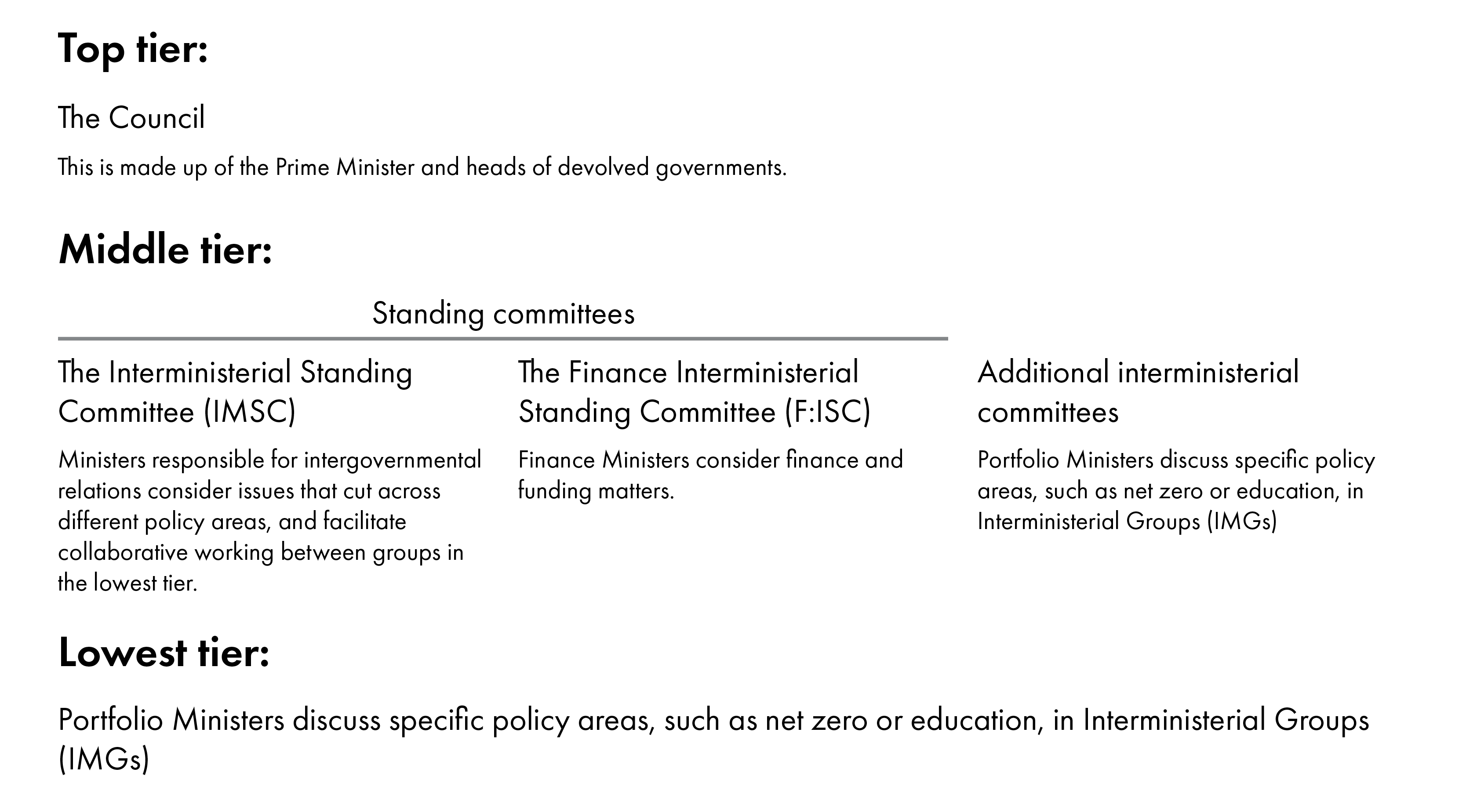
Scottish Parliament Information Centre
The 2016 Inter-Governmental Relations Written Agreement Between the Scottish Parliament and Scottish Government sets out terms upon which information on intergovernmental relations would be shared, but the agreement was signed prior to the UK's exit from the European Union, and the introduction of both Common Frameworks and the UK Internal Market Act 2020, both of which necessitate a greater volume of IGR and increase the stakes of intergovernmental decision-making.
Committee inquiries in Scotland and Wales, as well as the 2022 Review of Intergovernmental Relations2 noted a need for greater transparency of intergovernmental relations, and have stated that this need extends to both the Common Frameworks and the exclusions process linked to UKIMA.
The Constitution, Europe, External Affairs and Culture Committee's 2023 report titled How Devolution is Changing Post-EU stated:
Even where there is consensus at an intergovernmental level there remains a risk that the Scottish Parliament's core functions are diluted. As we have noted previously the increased significance of intergovernmental relations within a shared governance space raises substantial challenges for parliamentary scrutiny […] This is primarily because the management of the regulatory environment across the UK is now dependent on effective intergovernmental relations which could involve a significant increase in UK wide legislation in devolved areas.
Constitution, Europe, External Affairs and Culture Committee. (2023). How Devolution Is Changing Post-EU. Retrieved from https://digitalpublications.parliament.scot/Committees/Report/CEEAC/2023/10/24/6692fb8e-0bf0-47cd-a1ba-cff461d9395d [accessed 7 July 2025]
You can find out more about intergovernmental relations and how they operate in the SPICe Explainer: intergovernmental relations and implications for parliamentary scrutiny.
Common Frameworks
While the re-affirmation of the importance of the Common Frameworks was welcomed by governments and parliamentary committees, parliamentary committees have long expressed concern about the transparency of work within Common Frameworks.
A SPICe blog on Common Frameworks notes:
Most frameworks tend not to specify the interactions that will take place with legislatures in the future and do not commit the governments to making operational details about the framework available.
McKay, S., & Bosse, A. (2022, April 19). What’s the story? How to scrutinise common frameworks . Retrieved from https://spice-spotlight.scot/2022/04/19/whats-the-story-how-to-scrutinise-common-frameworks/ [accessed 6 November 2025]
The blog also states that "It is noticeable that some frameworks expressly restrict the sharing of information".
The Constitution, Europe, and External Affairs Committee noted in a 2022 report:
In order to provide clarity and certainty there needs to be a formal agreement with the four legislatures across the UK that each government will provide detailed information on the outcome of common framework discussions which impact on significant policy areas, such as single-use plastics.
Scottish Parliament Constitution, Europe, External Affairs and Culture Commitee. (2022, February 22). UK Internal Market Inquiry. Retrieved from https://digitalpublications.parliament.scot/Committees/Report/CEEAC/2022/2/22/73682bfb-fb43-47e5-b206-b79ec5e28262-2#Introduction [accessed 27 November 2025]
The issue of transparency of Common Frameworks was also raised by the Welsh Senedd's Legislation, Justice and Constitution Committee and the Senedd's Economy, Trade and Rural Affairs Committee. The latter made two recommendations pertaining to information sharing and transparency in its 2022 report on Common Frameworks.
Recommendation 8. The Welsh Government should make it clear to the Senedd and stakeholders wherever proposed legislation or policy is being taken through any of these common frameworks.
Recommendation 9. The Welsh Government should inform the Senedd if proposals for legislation or policy changes result from decision-making processes in any of these common frameworks.
Welsh Parliament Economy, Trade and Rural Affairs Committee. (2022, December). Common Frameworks. Retrieved from https://senedd.wales/media/oago3cxo/cr-ld15529-e.pdf [accessed 27 November 2025]
In the UK Government's response to the Review of UKIMA, it was noted that:
consultation responses contained a number of comments and suggested improvements that stakeholders would like to see in how Common Frameworks operate. These include:
a. Common Frameworks not operating with sufficient transparency. Stakeholders feel that Common Frameworks can be perceived as UK government and devolved governments operating behind closed doors;
b. decisions taken in Common Frameworks not being communicated or understood well by affected stakeholders, including businesses;
c. governments failing to adequately engage or consider the views of businesses in the development and implementation of policies;
The UK Government stated that "we recognise and agree with stakeholders’ concerns around the lack of clarity about how Common Frameworks operate" and confirmed that "We will therefore work with the devolved governments to improve transparency and communication around the Common Frameworks programme overall and via individual frameworks themselves".4
In July 2025, the UK Government published what it described as an "in-house process evaluation" of Common Frameworks, which it had carried out between early 2023 and February 2024 (during the previous Conservative administration). The evaluation was principally based on data provided by officials from UK Government and the devolved Governments and was not designed to assess the impact of the Frameworks, but instead to look at how they are functioning and identify areas for improvement. 5
Findings from the evaluation process included:
A sense among officials that it was too early to judge how effectively Frameworks were working, but that they were helpful in formalising joint working between Governments, and had led to greater information sharing and joint working "at least to some extent".
Political differences between Governments can make official-level working within Frameworks "more challenging", even if relationships between officials are strong.
UK Government tended to be viewed as having "more weight" in Framework discussions, with most meetings across Frameworks chaired by the UK Government who would also take the lead in setting the agenda.
The ability of the Frameworks process to handle divergence was perceived not yet to have been fully tested, even within Frameworks where Governments had been considering different policy approaches.
There had not yet been much use of the formal dispute resolution processes within Frameworks, but officials were broadly confident in those processes. The evaluation concluded that "there could be greater clarity on how these processes should be used", in particular regarding the distinction between formal and informal disagreements.
The evaluation also identified "six key factors to maximise the effectiveness" of the Common Frameworks programme in future:
Sim, D. (2025, July 31). The intergovernmental relations 'reset': one year on. Retrieved from https://bprcdn.parliament.scot/published/2025/7/31/2990fc7c-82aa-4c04-a6d9-efd8ab34cead/SB%2025-28.pdf [accessed 5 March 2026]
Increased sharing of good practice across Frameworks
Increasing co-ordination across Frameworks
Effective levels of stakeholder engagement
Increasing wider knowledge and awareness of Frameworks within governments
Central guidance and monitoring of key Framework processes; and
Further evaluation of Frameworks in the future
The exclusions process
In its submission to the consultation and Review on UKIMA, the Constitution, Europe, External Affairs and Culture Committee called for greater transparency in the exclusion process:
The Committee believes that it is essential that the exclusions process does not undermine the Scottish Parliament's legitimate legislative and scrutiny functions. The Committee also believes that if an exclusion is not granted by UK Ministers that this is communicated to the Scottish Parliament at the same time as it is communicated to the Scottish Government, and with a commitment that a UK Minister would be available to appear before the relevant subject committee.
Constitution, Europe, External Affairs and Culture Committee. (2025). Response to UK Government's UKIMA review and consultation. Retrieved from chrome-extension://efaidnbmnnnibpcajpcglclefindmkaj/https://www.parliament.scot/-/media/files/committees/constitution-europe-external-affairs-and-culture-committee/ukima-submission.pdf
In its response to the Review of UKIMA, the UK Government noted that:
We have listened to the concerns of devolved governments and stakeholders about the previous UK government’s management of the UK internal market exclusions process. We heard criticisms about:
a. exclusion proposals only being assessed against economic impacts;
b. a lack of clarity about how decisions were taken in response to exclusions proposals;
c. a lack of transparency about the operation of the exclusions process; and
d. stakeholder concern at UK government and devolved governments treating exclusions discussions as a means to pursue political arguments rather than considering the best interests of business and other stakeholders.
UK Government. (2025, July 25). UK Government response to the Review of the United Kingdom Internal Market Act 2020 and Public Consultation. Retrieved from https://assets.publishing.service.gov.uk/media/686fa10e2cfe301b5fb679d0/uk-government-response-to-the-review-of-the-united-kingdom-internal-market-act-2020-and-public-consultation.pdf
The UK Government did, however, appear only to making the reserve exclusions process more transparent, stating:
Exclusion proposals under this process will be acknowledged in writing by the relevant UK government minister within one month, and should receive a published, ministerial response from UK government within six months of the proposal being made. If a decision has not been reached in this timeframe – for example, if the evidence provided is insufficient to make a decision - the response should explain why this has not been possible and commit to a new timeframe. This should be published to extend transparency to businesses and Common Frameworks.
UK Government. (2025, July 25). UK Government response to the Review of the United Kingdom Internal Market Act 2020 and Public Consultation. Retrieved from https://assets.publishing.service.gov.uk/media/686fa10e2cfe301b5fb679d0/uk-government-response-to-the-review-of-the-united-kingdom-internal-market-act-2020-and-public-consultation.pdf
Implications of intergovernmental working for transparency and accountability at the Scottish Parliament in Session 7
The operation of UKIMA, the Common Frameworks programme and the revised exclusions processes raise ongoing issues for parliamentary scrutiny, including access to information, and the role of legislatures in intergovernmental decision-making.
The UK Government's commitment to a ‘reset’ of intergovernmental relations has the potential to lead to increased joint working in the shared intergovernmental space1. In this space significant policy decisions are taken. As highlighted in this briefing, for example, those on exclusions to the market access principles of the UK Internal Market Act.
Increased and closer joint working between governments has the potential to increase the concerns previously articulated by the Constitution, Europe, External Affairs and Culture Committee around the transparency and accountability of the shared intergovernmental space in its report How Devolution is Changing Post EU and in its legacy reportwhich stated :
we found ongoing challenges for the Parliament in scrutinising the many decisions which now take place in the shared intergovernmental space, including on exclusions to UKIMA’s market access principles, common frameworks and the taking and exercise of delegated powers in devolved areas by UK Ministers
A July 2024 SPICe blog discussing the implications of the UK General Election result for the Scottish Parliament likewise observed that: “closer co-operation at intergovernmental level may present challenges for the Scottish Parliament from a transparency and scrutiny perspective”.
Professor Thomas Horsley, Professor of Law at the University of Liverpool, has similarly argued in a blog for the Constitutional Law Association that:
Intergovernmental cooperation on regulatory standards poses its own challenges to devolution. In particular, the shifting of decision-making to the intergovernmental space makes it harder for the devolved legislatures to scrutinise, not to mention shape, policy in devolved areas.
Dr Chris McCorkindale and Professor Aileen McHarg have described this risk in the following terms:
There is such a thing as too close co-operation at the intergovernmental level. Both Holyrood’s CEEAC Committee and the Senedd’s Legislation, Justice and Constitution Committee have already expressed concerns that the Scottish and Welsh Governments are still sometimes too ready to recommend consent to UK legislation in devolved areas on pragmatic grounds. The risk here is that pragmatic intergovernmental co-operation excludes the legislative and scrutiny functions of the devolved legislatures – constitutional goods in themselves – and with them important values of good governance such as participation, transparency and accountability.
Scottish Parliament . (2025, July 31). The intergovernmental relations 'reset': one year on Author: Duncan Sim. Retrieved from https://digitalpublications.parliament.scot/ResearchBriefings/Report/2025/7/31/2990fc7c-82aa-4c04-a6d9-efd8ab34cead [accessed 1 March 2026]
What this means for the Parliament is that close scrutiny of intergovernmental working is essential. Only by undertaking such scrutiny will the Parliament be able to see how intergovernmental working is shaping the policies of the Scottish Government and the legislative proposals brought before the Parliament and, in turn, how UKIMA and common frameworks are shaping how devolution operates.
Dr Paul Anderson told the Constitution, Europe, External Affairs and Culture Committee in written evidence on its inquiry into the transparency of intergovernmental activity and its implications for parliamentary scrutiny that although IGR “by their nature are executive-dominated” it is “important that parliaments have a role in scrutinising intergovernmental activity” even though it is an “indisputable challenge”. In Dr Anderson’s view:
An inability to do so would result in a serious democratic deficit, including the potential for an erosion of trust between parliament and government, as well as with the electorate.
The Scottish Parliament . (2025, June 24). Written response to CEEACC call for views on transaprency of intergovernmental relations and implications for parliamentary scrutiny. Retrieved from https://yourviews.parliament.scot/session-6/transparency-of-intergovernmental-activity-and-its/consultation/view_respondent?uuId=1044022869 [accessed 27 February 2026]
On 17 March 2026, the Constitution, Europe, External Affairs and Culture Committee published its report Transparency of intergovernmental activity and its implications or parliamentary scrutiny. On UKIMA and common frameworks, the Committee noted:
The Committee’s view is that it is therefore unclear how further progress can be made in agreeing Common Frameworks in policy areas impacted by the UK Internal Market Act. In our view this undermines certainty and trust among businesses and other stakeholders that the UK’s regulatory environment is being managed effectively through robust intergovernmental relations. It also hinders Ministerial accountability and parliamentary scrutiny.
Constitution, Europe, External Affairs and Culture Committee Scottish Parliament . (2026, March 17). Transparency of intergovernmental activity and its implications for parliamentary scrutinySHARE . Retrieved from https://digitalpublications.parliament.scot/Committees/Report/CEEAC/2026/3/17/70658a2e-1fd6-45d5-aa1e-1f4b78a31992#60e32d4f-d6ca-4258-b2bd-e2cdd59cf080.dita [accessed 18 March 2026]
The same Committee published its legacy report on 24 March 2026. In that report the Committee endorsed the recommendations of the independent review of the written agreement on intergovernmental activity between the Scottish Parliament and the Scottish Government, saying:
The Committee recommends that concluding the joint review of the written agreement on intergovernmental relations between the Parliament and the Government is a priority for our successor early in Session 7 as a means to improve transparency and accountability of intergovernmental activity.
Improving parliamentary scrutiny
Independent research commissioned by the Constitution, Europe, External Affairs and Culture Committee and the Scottish Government, to review the Written Agreement on Intergovernmental Relations (an agreement between the Scottish Parliament and Scottish Government on information sharing about IGR), identified that adherence to the terms of the Agreement was poor, and offered a range of recommendations pertinent to parliamentary scrutiny of Common Frameworks and UKIMAi.1
The recommendations of the independent research note that there are a range of legislative functions which are shadowed by intergovernmental processes (most notably the effort to secure an exclusion for the Scottish DRS, as well as on gluetraps). As a result, reporting only on high-level interministerial meetings would not capture the interdependence between these parallel legislative and intergovernmental processes.
The research suggests changes to the Written Agreement to better reflect both the realities of post-Brexit intergovernmental relations, and provide "big picture insights into the extent to which devolved legislation interacts with these new features surrounding the devolution settlement"1.
Relevant recommendations include:
Recommendation 7: We recommend supplementing the yearly Programme for Government with an assessment of the elements of that programme that interact with, or may potentially be shaped by, Common Frameworks, the United Kingdom Internal Market Act, EU alignment, or other executive, legislative, fiscal or constitutional factors that will necessitate cooperation between governments.
Recommendation 8: The Scottish Government should commit to enhanced reporting to relevant committees during the process of seeking an exclusion from the market access principles of the UK Internal Market Act, in recognition of its significant impact on Parliament’s law-making function.
At a minimum, this should include:
(i) an explicit statement within Policy Memoranda accompanying Government Bills as to whether the legislation interacts with the IMA market access principles (or other post-Brexit complexities), alongside a copy of the published BRIA;
(ii) notification when an exclusion request is initiated or first discussed, the scope of the request, and the relevant Common Framework and IMG that are discussing the request;
(iii) notification of when the intergovernmental phase of the exclusion process has been concluded, with an update on progress; and
(iv) the outcome of the process, following the UK Government’s decision.
These recommendations, if adopted, would serve to provide legislators with greater insight into intergovernmental processes.
Sources
Joint Ministerial Committee (EU Negotiations). (2017, October 16). JOINT MINISTERIAL COMMITTEE (EU NEGOTIATIONS) COMMUNIQUE. Retrieved from <a href="https://assets.publishing.service.gov.uk/government/uploads/system/uploads/attachment_data/file/652285/Joint_Ministerial_Committee_communique.pdf" target="_blank">https://assets.publishing.service.gov.uk/government/uploads/system/uploads/attachment_data/file/652285/Joint_Ministerial_Committee_communique.pdf</a> [accessed 13 November 2025]
UK internal market policy paper . (2020, July). Retrieved from <a href="https://www.gov.uk/government/publications/uk-internal-market/uk-internal-market" target="_blank">https://www.gov.uk/government/publications/uk-internal-market/uk-internal-market</a> [accessed 27 May 2026]
Holyrood Magazine. (2020). UK internal market bill a 'full frontal assault on devolution', Nicola Sturgeon Says. Retrieved from <a href="https://www.holyrood.com/news/view,uk-internal-market-bill-a-full-frontal-assault-on-devolution-nicola-sturgeon-says" target="_blank">https://www.holyrood.com/news/view,uk-internal-market-bill-a-full-frontal-assault-on-devolution-nicola-sturgeon-says</a> [accessed 30 October 2025]
Welsh Government. (2020, August 14). The UK Government’s White Paper on a UK Internal Market Welsh Government Analysis. Retrieved from <a href="https://business.senedd.wales/documents/s103942/Correspondence%20from%20the%20Counsel%20General%2014%20August%202020.pdf" target="_blank">https://business.senedd.wales/documents/s103942/Correspondence%20from%20the%20Counsel%20General%2014%20August%202020.pdf</a> [accessed 13 November 2025]
Chappell, E. (2020, September 9). Drakeford slams internal markets bill as “smash and grab” on devolution. Retrieved from <a href="https://labourlist.org/2020/09/drakeford-slams-internal-markets-bill-as-smash-and-grab-on-devolution/" target="_blank">https://labourlist.org/2020/09/drakeford-slams-internal-markets-bill-as-smash-and-grab-on-devolution/</a>
Brown Swan, C., Horsley, T., McEwen, N., & Whitten, L.C. (2024). Westminster Rules? The United Kingdom Internal Market Act and Devolution. Retrieved from <a href="https://eprints.gla.ac.uk/337897/1/337897.pdf" target="_blank">https://eprints.gla.ac.uk/337897/1/337897.pdf</a>
UK Government. (2020, July). UK Internal Market. Retrieved from <a href="https://assets.publishing.service.gov.uk/media/5f1033f43a6f40038573bcbb/uk-internal-market-white-paper.pdf" target="_blank">https://assets.publishing.service.gov.uk/media/5f1033f43a6f40038573bcbb/uk-internal-market-white-paper.pdf</a> [accessed 13 November 2025]
Dougan, M., Hunt, J., McEwen, N., & McHarg, A. (2022). Sleeping with an elephant: devolution and the United Kingdom Internal Market Act 2020. Law Quarterly Review, 138, 650-676.
Horsley, T., & Hunt, J. (2023). Internal market governance by consensus rather than conflict? Common Frameworks and the potential for positive harmonisation. Northern Ireland Legal Quarterly, 30-67. doi: 10.53386/nilq.v74iAD2.1083
Scottish Parliament Constitution, Europe, External Affairs and Culture (CEEAC) Committee. (2022, February 2022). UK Internal Market Inquiry. Retrieved from <a href="https://digitalpublications.parliament.scot/Committees/Report/CEEAC/2022/2/22/73682bfb-fb43-47e5-b206-b79ec5e28262-2 " target="_blank">https://digitalpublications.parliament.scot/Committees/Report/CEEAC/2022/2/22/73682bfb-fb43-47e5-b206-b79ec5e28262-2 </a> [accessed 13 November 2025]
The Scottish Govenrment . (2021, March). AFTER BREXIT: The UK Internal Market Act & Devolution. Retrieved from <a href="https://www.gov.scot/binaries/content/documents/govscot/publications/strategy-plan/2021/03/brexit-uk-internal-market-bill-scotlands-future/documents/brexit-uk-internal-market-act-devolution/brexit-uk-internal-market-act-devolution/govscot%3Adocument/brexit-uk-internal-market-act-devolution.pdf" target="_blank">https://www.gov.scot/binaries/content/documents/govscot/publications/strategy-plan/2021/03/brexit-uk-internal-market-bill-scotlands-future/documents/brexit-uk-internal-market-act-devolution/brexit-uk-internal-market-act-devolution/govscot%3Adocument/brexit-uk-internal-market-act-devolution.pdf</a> [accessed 1 March 2026]
Scottish Parliament Information Centre. (2022, October 27). Scotland’s Ban on Single-Use Plastics: a case study of the impact of the UK Internal Market Act. Retrieved from <a href="https://spice-spotlight.scot/2022/10/27/scotlands-ban-on-single-use-plastics-a-case-study-of-the-impact-of-the-uk-internal-market-act/" target="_blank">https://spice-spotlight.scot/2022/10/27/scotlands-ban-on-single-use-plastics-a-case-study-of-the-impact-of-the-uk-internal-market-act/</a> [accessed 13 November 2025]
SPICe. (2023, March 24). From single-use plastics to the deposit return scheme: How are Common Frameworks and UK Internal Market Act exclusion processes operating?. Retrieved from <a href="https://spice-spotlight.scot/2023/03/24/from-single-use-plastics-to-the-deposit-return-scheme-how-are-common-frameworks-and-uk-internal-market-act-exclusion-processes-operating/" target="_blank">https://spice-spotlight.scot/2023/03/24/from-single-use-plastics-to-the-deposit-return-scheme-how-are-common-frameworks-and-uk-internal-market-act-exclusion-processes-operating/</a> [accessed 27 November 2025]
Aitken, C. (2023, March 24). From single-use plastics to the deposit return scheme: How are Common Frameworks and UK Internal Market Act exclusion processes operating?. Retrieved from <a href="https://spice-spotlight.scot/2023/03/24/from-single-use-plastics-to-the-deposit-return-scheme-how-are-common-frameworks-and-uk-internal-market-act-exclusion-processes-operating/" target="_blank">https://spice-spotlight.scot/2023/03/24/from-single-use-plastics-to-the-deposit-return-scheme-how-are-common-frameworks-and-uk-internal-market-act-exclusion-processes-operating/</a> [accessed 30 October 2025]
Scottish Government. (2024, March 31). Glue traps sales ban: letter to UK Government. Retrieved from <a href="https://www.gov.scot/publications/glue-traps-sales-ban-letter-uk-government/" target="_blank">https://www.gov.scot/publications/glue-traps-sales-ban-letter-uk-government/</a> [accessed 30 October 2025]
The Scottish Government . (2024, March 31). Glue traps sales ban: letter to UK Government. Retrieved from <a href="https://www.gov.scot/publications/glue-traps-sales-ban-letter-uk-government/" target="_blank">https://www.gov.scot/publications/glue-traps-sales-ban-letter-uk-government/</a> [accessed 23 February 2026]
Scottish Parliament Constitution, Europe, External Affairs and Culture Committee. (2025). UKIMA Consultaton. Retrieved from <a href="https://www.parliament.scot/-/media/files/committees/constitution-europe-external-affairs-and-culture-committee/ukima-submission.pdf" target="_blank">https://www.parliament.scot/-/media/files/committees/constitution-europe-external-affairs-and-culture-committee/ukima-submission.pdf</a> [accessed 12 February 2026]
Official Report, the Scottish Parliament . (2025, March 6). Constitution, Europe, External Affairs and Culture Committee, Official Report. Retrieved from <a href="https://www.parliament.scot/chamber-and-committees/official-report/search-what-was-said-in-parliament/CEEAC-06-03-2025?meeting=16305&iob=139286" target="_blank">https://www.parliament.scot/chamber-and-committees/official-report/search-what-was-said-in-parliament/CEEAC-06-03-2025?meeting=16305&iob=139286</a> [accessed 1 March 2026]
Alexander, D. (2024, December 12). The Review of the United Kingdom Internal Market Act 2020. Retrieved from <a href="https://questions-statements.parliament.uk/written-statements/detail/2024-12-12/hcws299" target="_blank">https://questions-statements.parliament.uk/written-statements/detail/2024-12-12/hcws299</a> [accessed 23 October 2025]
Scottish Government. (2025, April 3). Internal Market Act 2020: position paper. Retrieved from <a href="https://www.gov.scot/publications/scottish-government-position-paper-internal-market-act-2020/pages/1/" target="_blank">https://www.gov.scot/publications/scottish-government-position-paper-internal-market-act-2020/pages/1/</a>
Welsh Parliament Legislation, Justice and Constitution Committee. (2025, April 2). UK Internal Market Act 2020: review and consultation Committee submission. Retrieved from <a href="https://business.senedd.wales/documents/s161644/LJC6-16-25%20-%20Paper%207%20-%20Committee%20submission%202%20April%202025.pdf" target="_blank">https://business.senedd.wales/documents/s161644/LJC6-16-25%20-%20Paper%207%20-%20Committee%20submission%202%20April%202025.pdf</a>
UK Government. (2025, July 25). UK Government response to the Review of the United Kingdom Internal Market Act 2020 and Public Consultation. Retrieved from <a href="https://assets.publishing.service.gov.uk/media/686fa10e2cfe301b5fb679d0/uk-government-response-to-the-review-of-the-united-kingdom-internal-market-act-2020-and-public-consultation.pdf" target="_blank">https://assets.publishing.service.gov.uk/media/686fa10e2cfe301b5fb679d0/uk-government-response-to-the-review-of-the-united-kingdom-internal-market-act-2020-and-public-consultation.pdf</a>
Hansard . (2024, December 12). Statement made on 12 December 2024. Retrieved from <a href="https://questions-statements.parliament.uk/written-statements/detail/2024-12-12/hcws299" target="_blank">https://questions-statements.parliament.uk/written-statements/detail/2024-12-12/hcws299</a> [accessed 1 March 2026]
The Scottish Governemnt . (2025, April). Scottish Government Position Paper on the UK Internal Market Act 2020. Retrieved from <a href="https://www.gov.scot/binaries/content/documents/govscot/publications/strategy-plan/2025/04/scottish-government-position-paper-internal-market-act-2020/documents/scottish-government-position-paper-internal-market-act-2020/scottish-government-position-paper-internal-market-act-2020/govscot%3Adocument/scottish-government-position-paper-internal-market-act-2020.pdf" target="_blank">https://www.gov.scot/binaries/content/documents/govscot/publications/strategy-plan/2025/04/scottish-government-position-paper-internal-market-act-2020/documents/scottish-government-position-paper-internal-market-act-2020/scottish-government-position-paper-internal-market-act-2020/govscot%3Adocument/scottish-government-position-paper-internal-market-act-2020.pdf</a> [accessed 8 January 2026]
Learmouth, A. (2024, April 4). Why selling and using glue traps has sparked a constitutional crisis. Retrieved from <a href="https://www.heraldscotland.com/news/24232463.constitutional-crisis-selling-using-glue-traps/" target="_blank">https://www.heraldscotland.com/news/24232463.constitutional-crisis-selling-using-glue-traps/</a> [accessed 30 October 2025]
Horsley, T. (2025). Reforming the UK Internal Market: The UK Government’s Response to the Review of the United Kingdom Internal Market Act 2020. Retrieved from <a href="https://ukconstitutionallaw.org/2025/07/21/thomas-horsley-reforming-the-uk-internal-market-the-uk-governments-response-to-the-review-of-the-united-kingdom-internal-market-act-2020/" target="_blank">https://ukconstitutionallaw.org/2025/07/21/thomas-horsley-reforming-the-uk-internal-market-the-uk-governments-response-to-the-review-of-the-united-kingdom-internal-market-act-2020/</a> [accessed 30 November 2025]
Irranca-Davies, H. (2025, July 17). Written Statement: Outcome of the UK Government review of the Internal Market Act 2020. Retrieved from <a href="https://www.gov.wales/written-statement-outcome-uk-government-review-internal-market-act-2020" target="_blank">https://www.gov.wales/written-statement-outcome-uk-government-review-internal-market-act-2020</a>
Constitution, Europe, External Affairs and Culture Committee. (2023). How Devolution Is Changing Post-EU. Retrieved from <a href="https://digitalpublications.parliament.scot/Committees/Report/CEEAC/2023/10/24/6692fb8e-0bf0-47cd-a1ba-cff461d9395d" target="_blank">https://digitalpublications.parliament.scot/Committees/Report/CEEAC/2023/10/24/6692fb8e-0bf0-47cd-a1ba-cff461d9395d</a> [accessed 7 July 2025]
McEwen, N., Kenny, M., Sheldon, J., & Brown Swan, C. (2020). Intergovernmental relations in the UK: time for a radical overhaul?. The Political Quarterly, 91(3), 632-640. doi: https://doi.org/10.1111/1467-923X.12862Digital Object Identifier (DOI)
UK Government. (2022, January 13). Review of intergovernmental relations. Retrieved from <a href="https://www.gov.uk/government/publications/the-review-of-intergovernmental-relations" target="_blank">https://www.gov.uk/government/publications/the-review-of-intergovernmental-relations</a> [accessed 17 May 2022]
McKay, S., & Bosse, A. (2022, April 19). What’s the story? How to scrutinise common frameworks . Retrieved from <a href="https://spice-spotlight.scot/2022/04/19/whats-the-story-how-to-scrutinise-common-frameworks/" target="_blank">https://spice-spotlight.scot/2022/04/19/whats-the-story-how-to-scrutinise-common-frameworks/</a> [accessed 6 November 2025]
Scottish Parliament Constitution, Europe, External Affairs and Culture Commitee. (2022, February 22). UK Internal Market Inquiry. Retrieved from <a href="https://digitalpublications.parliament.scot/Committees/Report/CEEAC/2022/2/22/73682bfb-fb43-47e5-b206-b79ec5e28262-2#Introduction" target="_blank">https://digitalpublications.parliament.scot/Committees/Report/CEEAC/2022/2/22/73682bfb-fb43-47e5-b206-b79ec5e28262-2#Introduction</a> [accessed 27 November 2025]
Welsh Parliament Economy, Trade and Rural Affairs Committee. (2022, December). Common Frameworks. Retrieved from <a href="https://senedd.wales/media/oago3cxo/cr-ld15529-e.pdf" target="_blank">https://senedd.wales/media/oago3cxo/cr-ld15529-e.pdf</a> [accessed 27 November 2025]
Sim, D. (2025, July 31). The intergovernmental relations 'reset': one year on. Retrieved from <a href="https://bprcdn.parliament.scot/published/2025/7/31/2990fc7c-82aa-4c04-a6d9-efd8ab34cead/SB%2025-28.pdf" target="_blank">https://bprcdn.parliament.scot/published/2025/7/31/2990fc7c-82aa-4c04-a6d9-efd8ab34cead/SB%2025-28.pdf</a> [accessed 5 March 2026]
Constitution, Europe, External Affairs and Culture Committee. (2025). Response to UK Government's UKIMA review and consultation. Retrieved from <a href="chrome-extension://efaidnbmnnnibpcajpcglclefindmkaj/https://www.parliament.scot/-/media/files/committees/constitution-europe-external-affairs-and-culture-committee/ukima-submission.pdf" target="_blank">chrome-extension://efaidnbmnnnibpcajpcglclefindmkaj/https://www.parliament.scot/-/media/files/committees/constitution-europe-external-affairs-and-culture-committee/ukima-submission.pdf</a>
Scottish Parliament . (2025, July 31). The intergovernmental relations 'reset': one year on Author: Duncan Sim. Retrieved from <a href="https://digitalpublications.parliament.scot/ResearchBriefings/Report/2025/7/31/2990fc7c-82aa-4c04-a6d9-efd8ab34cead" target="_blank">https://digitalpublications.parliament.scot/ResearchBriefings/Report/2025/7/31/2990fc7c-82aa-4c04-a6d9-efd8ab34cead</a> [accessed 1 March 2026]
The Scottish Parliament . (2025, June 24). Written response to CEEACC call for views on transaprency of intergovernmental relations and implications for parliamentary scrutiny. Retrieved from <a href="https://yourviews.parliament.scot/session-6/transparency-of-intergovernmental-activity-and-its/consultation/view_respondent?uuId=1044022869" target="_blank">https://yourviews.parliament.scot/session-6/transparency-of-intergovernmental-activity-and-its/consultation/view_respondent?uuId=1044022869</a> [accessed 27 February 2026]
Constitution, Europe, External Affairs and Culture Committee Scottish Parliament . (2026, March 17). Transparency of intergovernmental activity and its implications for parliamentary scrutinySHARE . Retrieved from <a href="https://digitalpublications.parliament.scot/Committees/Report/CEEAC/2026/3/17/70658a2e-1fd6-45d5-aa1e-1f4b78a31992#60e32d4f-d6ca-4258-b2bd-e2cdd59cf080.dita" target="_blank">https://digitalpublications.parliament.scot/Committees/Report/CEEAC/2026/3/17/70658a2e-1fd6-45d5-aa1e-1f4b78a31992#60e32d4f-d6ca-4258-b2bd-e2cdd59cf080.dita</a> [accessed 18 March 2026]
McEwen, N., & Brown Swan, C. (2024, December). The Scottish GovernmentScottish Parliament Written Agreement on Intergovernmental Relations: Still Fit for Purpose?. Retrieved from <a href="https://www.gla.ac.uk/media/Media_1143252_smxx.pdf" target="_blank">https://www.gla.ac.uk/media/Media_1143252_smxx.pdf</a>