Intergovernmental activity update Q3 2025
This update gives an overview of intergovernmental activity of relevance to the Scottish Parliament between the Scottish Government and the UK Government, the Welsh Government, and the Northern Ireland Executive during quarter three (July to September) of 2025.
Introduction
SPICe publishes quarterly updates to give an overview of intergovernmental activity.
'Intergovernmental activity’ refers to work between governments – in a Scottish context between the Scottish Government and the UK Government or other devolved governments. It can include discussions on areas of mutual interest, policy development, and policy implementation.
Read more about what intergovernmental activity is and why awareness of it is an essential element of parliamentary scrutiny on our SPICe blog. SPICe has also launched an intergovernmental activity hub that collates information on intergovernmental activity of relevance to the Scottish Parliament.
This update reflects information available at the time of publication.
Highlights
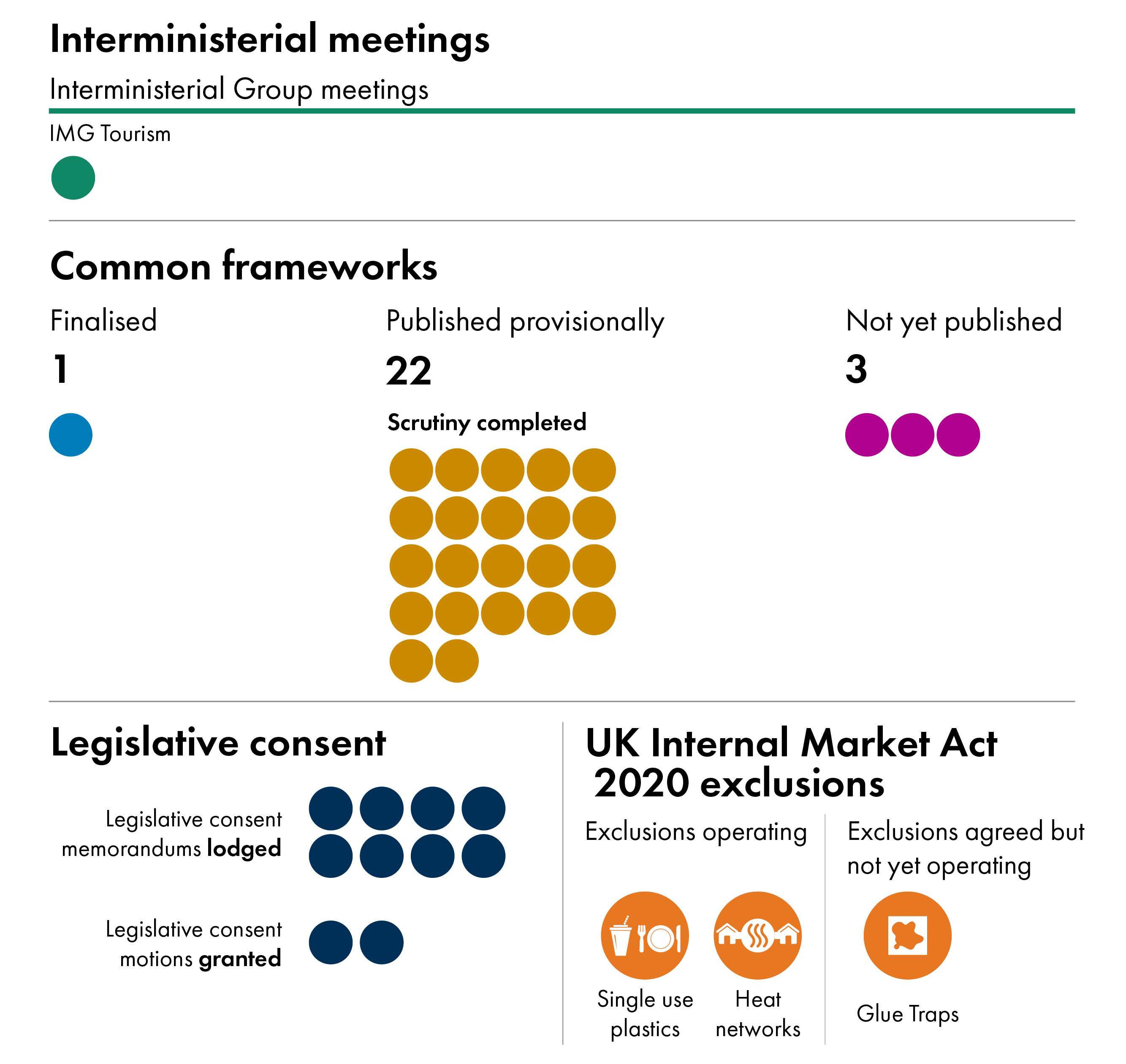
Scottish Parliament Information Centre
Intergovernmental activity
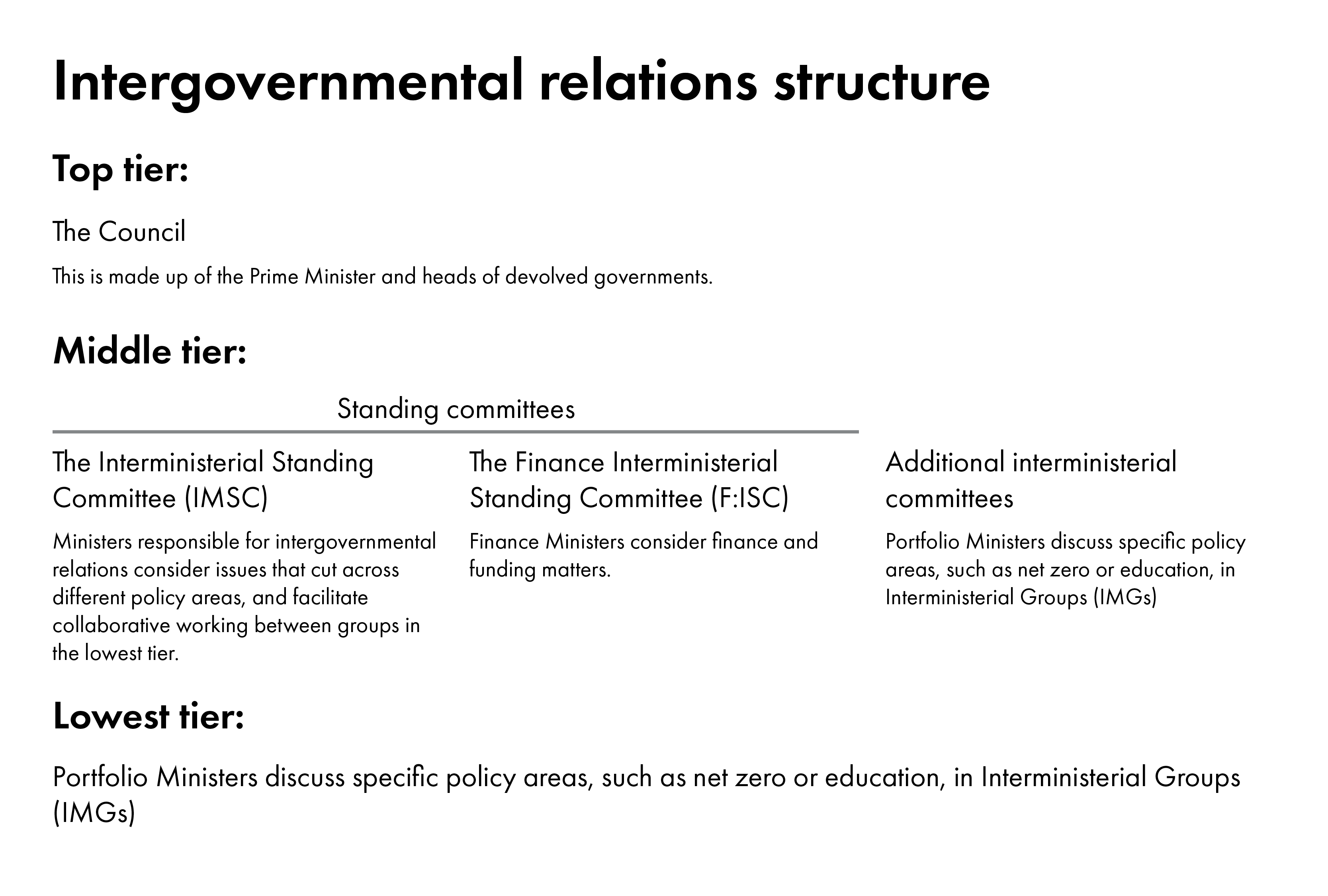
Formal intergovernmental interactions take place under the following structure, which was established in January 2022.
Scottish Parliament Information Centre
See a SPICe blog for more information on how the new structure operates.
UK Government Intergovernmental Relations Engagement Dashboard
The UK Government has published an Intergovernmental Relations Engagement Dashboard. The dashboard covers the UK Government’s engagement with the devolved governments from July 2024, when it came into office, until March 2025. In addition to intergovernmental activity taking place under formal IGR structures, the dashboard also includes information on the number of intergovernmental meetings taking place outwith formal IGR structures such as bilateral meetings between the Scottish Government and UK Government.
Interministerial meetings

Scottish Parliament Information Centre
Interministerial Group for Tourism
The Interministerial Group for Tourism met on 22 July 2025. The group had last met in November 2021. According to minutes of the meeting agreed by all four governments, discussions included:
the state of the tourism sector across different parts of the UK
the UK Government's upcoming Visitor Economy Growth Strategy
the impact of the cut to the GREAT international marketing budget. The GREAT Campaign is the UK’s international communications programme which encourages international audiences to visit, study, trade, invest, live and work in the UK.
Interministerial Group for Work and Pensions
Terms of reference for a new Interministerial Group for Work and Pensions were published on 12 September 2025. The inaugural meeting of the group took place on 26 June 2025. A communique for the meeting was published too late for inclusion in the Q2 intergovernmental activity update. The communique indicates that the group discussed the UK Government’s Green Paper Pathways to Work: Reforming Benefits and Support to Get Britain Working, the UK Government’s Get Britain Working White Paper, changes to Winter Fuel Payments in England and Wales, and the group's terms of reference.
The terms of reference state that the group:
provides a forum for the UK Government, Scottish Government, Welsh Government and Northern Ireland Executive to discuss matters of mutual interest in the fields of employment support, disability, social security, child maintenance and pensions.
Common Frameworks
Common Frameworks are intergovernmental agreements which set out how governments will work together to make decisions about policy in certain devolved policy areas, in particular decisions about policy divergence.
They were originally intended to be used to consider matters which were former EU competences, however, some also state that they may be used to consider related matters within the wider policy area. You can read more about what Common Frameworks are on SPICe's intergovernmental activity hub.
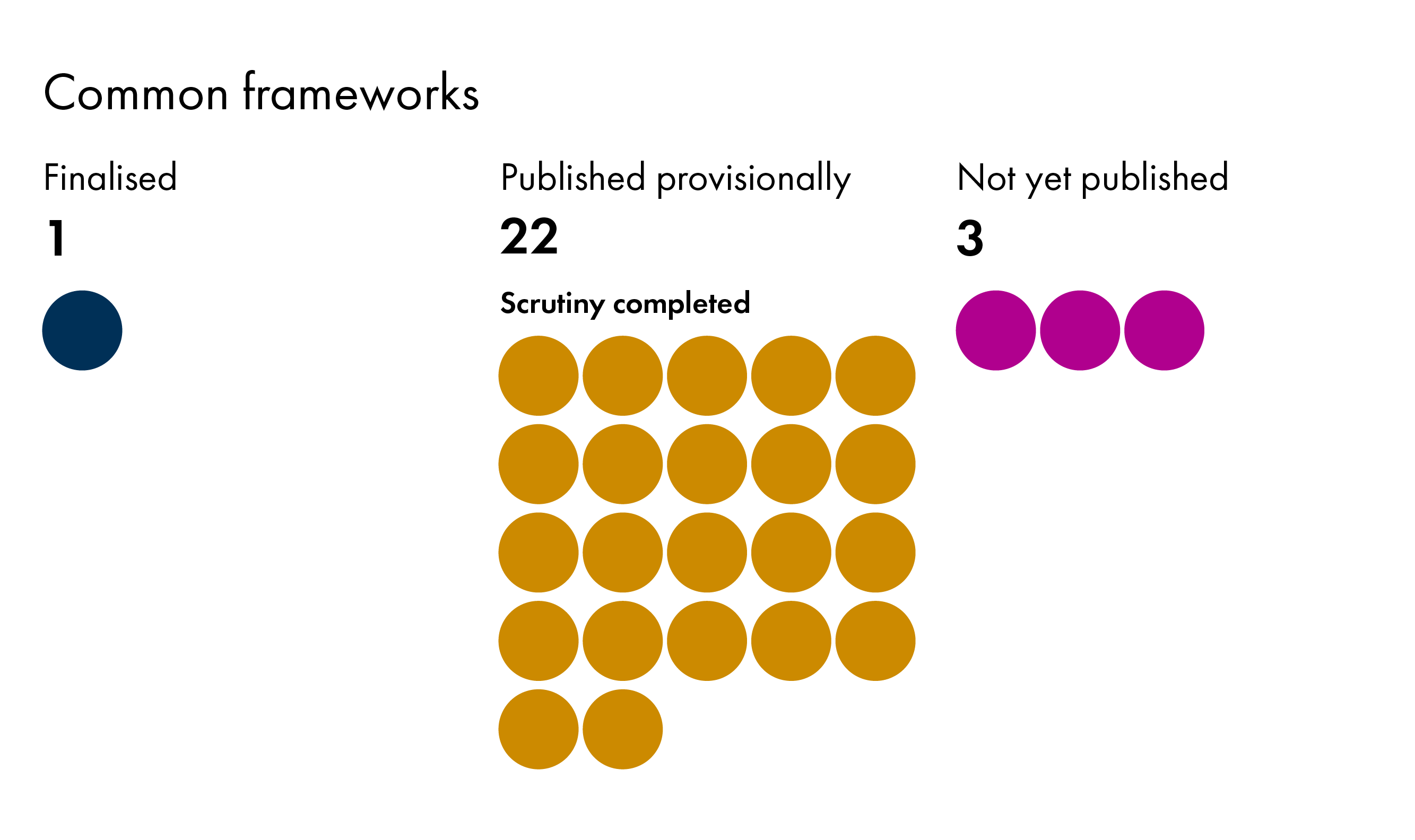
One Common Framework, Hazardous Substances (Planning), has been finalised. Scrutiny of all currently provisionally published frameworks that apply to Scotland has been completed at the Scottish Parliament. Three more planned frameworks that apply to Scotland – the Zootechnics Framework, the Mutual Recognition of Professional Qualifications Framework, and the Services Directive Framework – remain unpublished.
No new framework agreements applicable to Scotland were published during the reporting period. The image below provides an update on frameworks relevant to Scotland and scrutiny of frameworks at the Scottish Parliament.
Scottish Parliament Information Centre
The UK Government published a Common Frameworks Evaluation on 17 July 2025. The aim of the evaluation was to evaluate how common frameworks have been operating especially in relation to governance arrangements, instances of intra-UK divergence, and mechanisms for managing disagreement.
The evaluation involved analysis of data on 28 frameworksi and in-depth case studies into 6 Common Frameworks. Views were also sought from officials working within the UK Government, Scottish Government, Welsh Government, and the Northern Ireland Executive.
The evaluation identified six "key factors relevant to maximising the effectiveness of the programme" in the future:
1. Increased sharing of good practice across frameworks
2. Increasing co-ordination across frameworks
3. Effective levels of stakeholder engagement
4. Increasing wider knowledge and awareness of frameworks within governments
5. Central guidance and monitoring of key framework processes
6. Further evaluation of frameworks in the future.
UK internal market
The UK Internal Market Act 2020 (UKIMA) is UK-wide legislation about the flow of goods and services. You can read more about the Act's provisions in our SPICe briefing and a SPICe blog.
UK Government review of the Internal Market Act
The UK Government announced a Review of parts of the UK Internal Market Act 2020 on 23 January 2025. A statutory review of three aspects of UKIMA was required by the Act itself by December 2025 but then Minister for Trade Policy and Economic Security, Douglas Alexander MP, set out in a Ministerial statement on 12 December 2024 that the Review would be wider in scope than required by law and would also be
inviting views on the process for considering exclusions from the Act, and the role and functions carried out by the Office for the Internal Market.
The Intergovernmental Activity Update Q2 2025 covers the background to the review and submissions from the Scottish Government and the Constitution, Europe, External Affairs and Culture Committee.
The UK Government’s response to the Review was published on 15 July 2025 and was accompanied by a Ministerial Statement laid in the UK Parliament. The outcomes of the Review do not propose changes to UKIMA itself; the market access principles of mutual recognition and non-discrimination still apply and no changes to the Act are proposed. The Review outcomes are a series of commitments to try to address some of the concerns raised by those who responded to the consultation held as part of the review. The changes are, therefore, a commitment to better intergovernmental working which include:
An agreement to consider environmental protection and public health, alongside economic impacts, in UKIMA exclusions.
A commitment to implement any UKIMA exclusions that have been agreed by all governments within a Common Framework.
A Minimum Economic Impact (MEI) process for considering exclusions with an economic impact of less than £10 million a year, and a commitment by the UK Government to implement them where all governments agree the exclusion has minimum economic impact.
A “reserve” exclusions process for instances where it has not been possible for all four governments to reach agreement on an exclusion through either the Common Framework or MEI process.
Work to improve the transparency of Common Frameworks by the governments working to agree processes for how to engage with businesses and other stakeholders on matters being discussed in frameworks.
A commitment that the UK Government will work with the devolved governments to agree a process for all four governments to jointly refer UK internal market matters to the Office for the Internal Market for advice.
SPICe has published a blog which considers each of these commitments in more detail.
Windsor Framework Review
The Windsor Framework is an agreement between the UK Government and the European Commission which makes changes to the operation of the Northern Ireland Protocol (which set out Northern Ireland's post-Brexit relationship with the EU and Great Britain as part of the UK's exit from the EU). This SPICe blog from March 2023 sets out more detail about the Framework and its implications for Scotland.
In December 2024, a vote on whether relevant EU law should continue to apply in Northern Ireland took place in the Northern Ireland Assembly. A majority voted in favour but since the vote did not receive cross-community support, an independent review of the Windsor Framework was legally required.
In January 2025, the Secretary of State for Northern Ireland, Rt Hon Hilary Benn MP, commissioned the Review. It was led by the Rt Hon Lord Murphy of Torfaen and published on 4 September 2025. The review focussed on the democratic deficit ("Northern Ireland being subject to legislation made in Brussels, but without taking part in EU law-making") and issues for business and trade. The House of Commons Library has published a blog that summarises the recommendations made by the review and political reactions to it.
UK Internal Market Act exclusions
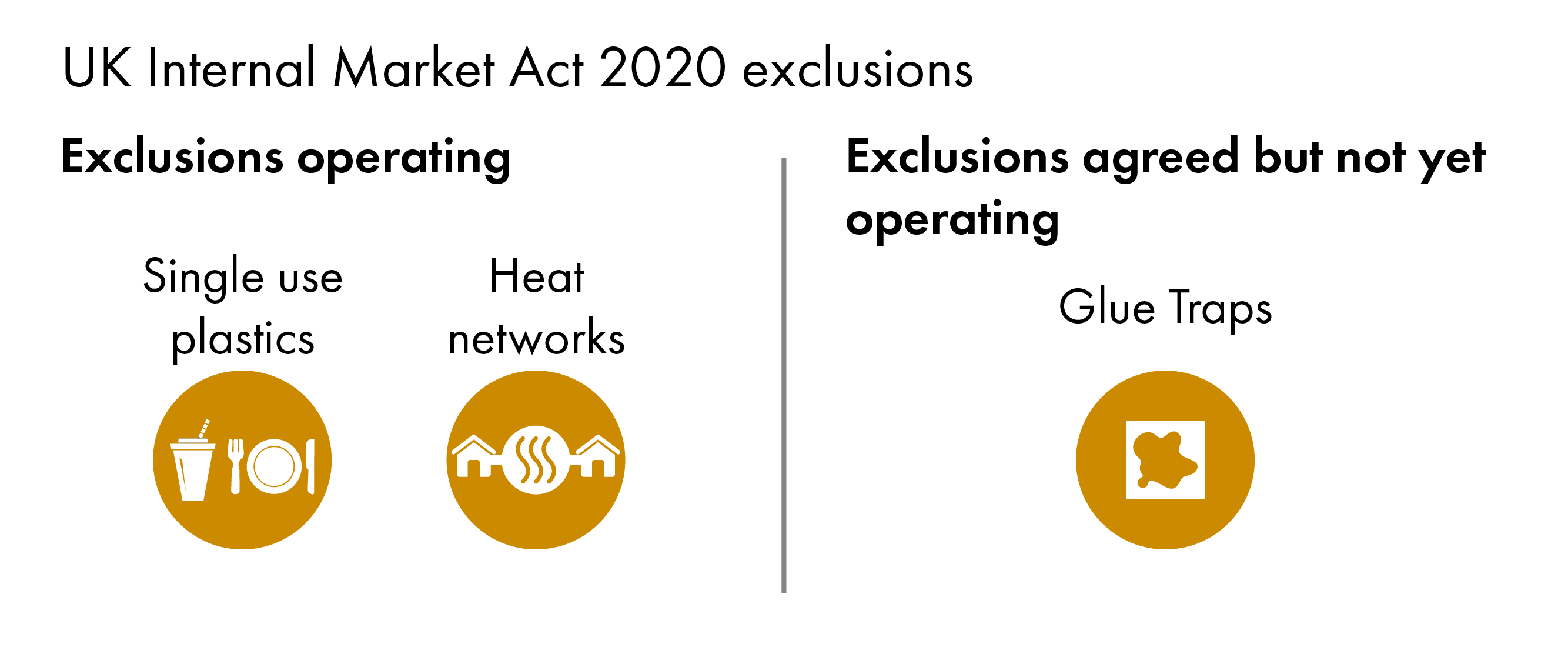
A process was established in 2021 by which the UK Government and devolved governments could consider exclusions to the UKIMA market access principles. The 2025 UKIMA review outcomes include commitments to change how exclusions will be considered. Information provided in this briefing relates to exclusions considered under the old exclusions process and not the new model - the latter involves three separate exclusion processes. For more information on these changes, see the SPICe blog on the review.
Scottish Parliament Information Centre
Glue traps
The Wildlife Management and Muirburn (Scotland) Act 2024 provides for bans on the purchase, sale, and use of rodent glue traps. The previous UK Government did not agree to a UKIMA exclusion. The Q1 2024 intergovernmental activity update and SPICe briefing on the Bill ahead of the Stage 3 debate summarised the discussions about glue traps and a potential UKIMA exclusion relating to their sale during the then Bill's parliamentary process.
In a written statement to the House of Commons on 12 December 2024 announcing the new UK Government's review of UKIMA, Rt Hon Douglas Alexander MP (then Minister of State for Trade Policy and Economic Security) indicated that the new UK Government would agree an exclusion "as this Government recognises this proposal has a minimal economic impact on trade within the UK."
The Minister for Agriculture and Connectivity, Jim Fairlie MSP, wrote to the Convener of the Rural Affairs and Islands Committee on 30 October 2025 about the United Kingdom Internal Market Act 2020 (Exclusions from Market Access Principles: Glue Traps) Regulations 2025. The Regulations are due to be laid on 01 December 2025 and come into force on 22 December. According to the letter:
The United Kingdom Internal Market Act 2020 (Exclusions from Market Access Principles: Glue Traps) Regulations 2025 will create an exclusion from the market access principles in Part 1 of the UKIM for legislation so far as it prohibits the sale of glue traps. This means that the market access principles will not apply to, nor affect the operation of, any legislation so far as it prohibits the sale of glue traps in any part of the UK.
The letter further states:
The passing of the SI will enable the Scottish Government to draft its own SSI to commence the glue trap provisions (ban on use, supply and possession) in the Wildlife Management and Muirburn (Scotland) Act 2024.
The Scottish Government has requested a response from the Rural Affairs and Islands Committee by 27 November 2025.
Regulatory developments
This section summarises other intergovernmental activity to help manage the UK internal market.
Bovine electronic identification
The Office for the Internal Market (OIM) launched a review on 17 July 2025 into the potential effects on the UK internal market from regulatory differences arising from proposed legislation relating to bovine electronic identification. The review was published on 29 October 2025. This review was the OIM's first short-form review, "a targeted and timely analysis of potential regulatory differences to support effective policy making across the four nations". As part of the review, the OIM considered datasets on cattle movements and conducted 51 interviews with industry and government stakeholders.
According to the review, the UK Government and devolved governments are at different stages of the policy development cycle for bovine electronic identification (EID) policies, with different parts of the UK expected to introduce tags that use different technologies. The report states:
The technologies are not interoperable with each other, in the sense that a LF [low frequency] reader cannot read an UHF [ultra-high frequency] tag and vice versa. This raises the prospect that some cattle keepers will be dealing with cattle that have both LF and UHF tags. If they wish to read these tags electronically, they will therefore need both LF and UHF tag readers. This could increase costs of moving cattle across national borders – particularly across the English/Scottish border - and potentially impact on trade within the UK.
The report considers how much trade could be affected and finds:
Taking the evidence in the round, we have reached the view that the adoption of two technical standards for EID within the UK, if managed carefully, would have a limited impact on the overall pattern and total volume of internal market trade. The impact is, however, likely to be material for the businesses most directly affected.
[...] Even if well managed, two technical standards will introduce additional investment costs and trade friction, relative to a situation in which a single standard was adopted. The costs include: the costs of additional EID readers; potential upgrades to software to allow data from both LF and UHF tags to be handled and transmitted to the relevant databases seamlessly; and perhaps changes to infrastructure to accommodate the extra equipment. These additional investment costs will most acutely affect larger livestock auction markets (hereafter ‘markets’ for brevity) and abattoirs and have the greatest impact in regions neighbouring the English/Scottish border but will not be confined to those businesses or regions. Absent a clear and coordinated approach to the management of cross-border trade, there is an increased risk that industry may make unnecessary investments or investments that prove redundant [...]
[...] Operating two technical standards for EID within the UK is likely to introduce trade frictions that go beyond investment costs, including greater complexity and potential difficulties in identifying whether an animal is tagged with an LF or UHF tag. Unless they are carefully designed, any regulatory developments that mandate that where an EID read is used, even if voluntarily, that a particular type of bovine EID read must be used may create greater difficulties for internal market trade, especially once paper passports are phased out. Similarly, the overall approach to supporting two technical standards will need to be coordinated and sufficiently robust to meet the standards necessary to retain access to international markets.
The OIM made two recommendations:
That the UK Government, Scottish Government and Welsh Government set up a working group "involving representatives from the farming, livestock auction and abattoir/meat processing sectors to discuss how cross-border trade can be maintained".
That the UK Government, Scottish Government and Welsh Government produce a joint statement on the management of cross-border movements within Great Britain that use EID. The intention is that this "would assist the industry by reducing uncertainty and limiting the risks associated with business investments becoming stranded by subsequent regulatory developments".
Non-surgical cosmetic procedures
The Non-surgical Procedures and Functions of Medical Reviewers (Scotland) Bill was introduced on 8 October 2025 and is at Stage 1. The Lead Committee for the Bill is the Health, Social Care and Sport Committee. SPICe has published a briefing on the Bill.
The Scottish Government has stated that it wishes to restrict who can undertake certain procedures but has not done so in the Bill because it has not yet reached a settled view on the effect of the United Kingdom Internal Market Act 2020 (UKIMA).
Part 3 of UKIMA establishes a UK-wide system for recognising professional qualifications – referred to as the automatic recognition principle. The automatic recognition principle means that if a person is authorised to practise a regulated profession in one part of the UK, they are entitled to practise that profession in any other part without needing to requalify.
If the Bill were to include qualification requirements or restrictions on who can undertake certain procedures, for example by requiring certain training or limiting procedures to specific healthcare professionals, it may engage Part 3 of UKIMA.
The Scottish Government has indicated that it is continuing to consider the matter, including engaging with the UK Government.
Legislative consent
Scottish Parliament Information Centre
According to the Sewel Convention, the UK Parliament will not normally legislate on devolved matters without the consent of the Scottish Parliament. The Scottish Parliament's standing orders set down rules which apply where UK primary legislation requires the Parliament's consent under the Sewel Convention. They apply where UK primary legislation makes ‘relevant provision’, which means provision which applies to Scotland in any of the following ways:
for any purpose within the legislative competence of the Scottish Parliament
to alter the legislative competence of the Scottish Parliament
to alter the executive competence of the Scottish Ministers.
When any of the criteria on relevant provision are fulfilled, the Scottish Government is obliged to lodge a legislative consent memorandum. A legislative consent memorandum, amongst other things, sets out the Scottish Government's view on whether the Parliament should grant legislative consent.
Following the lodging of the memorandum, Members of the Scottish Parliament may vote on a legislative consent motion to either grant or withhold consent for the Bill.
Find out more about legislative consent on the Scottish Parliament's website, and in this November 2024 SPICe blog. SPICe has also developed two tools that can be used to track legislative consent at the Scottish Parliament, which can be accessed on SPICe's intergovernmental activity hub.
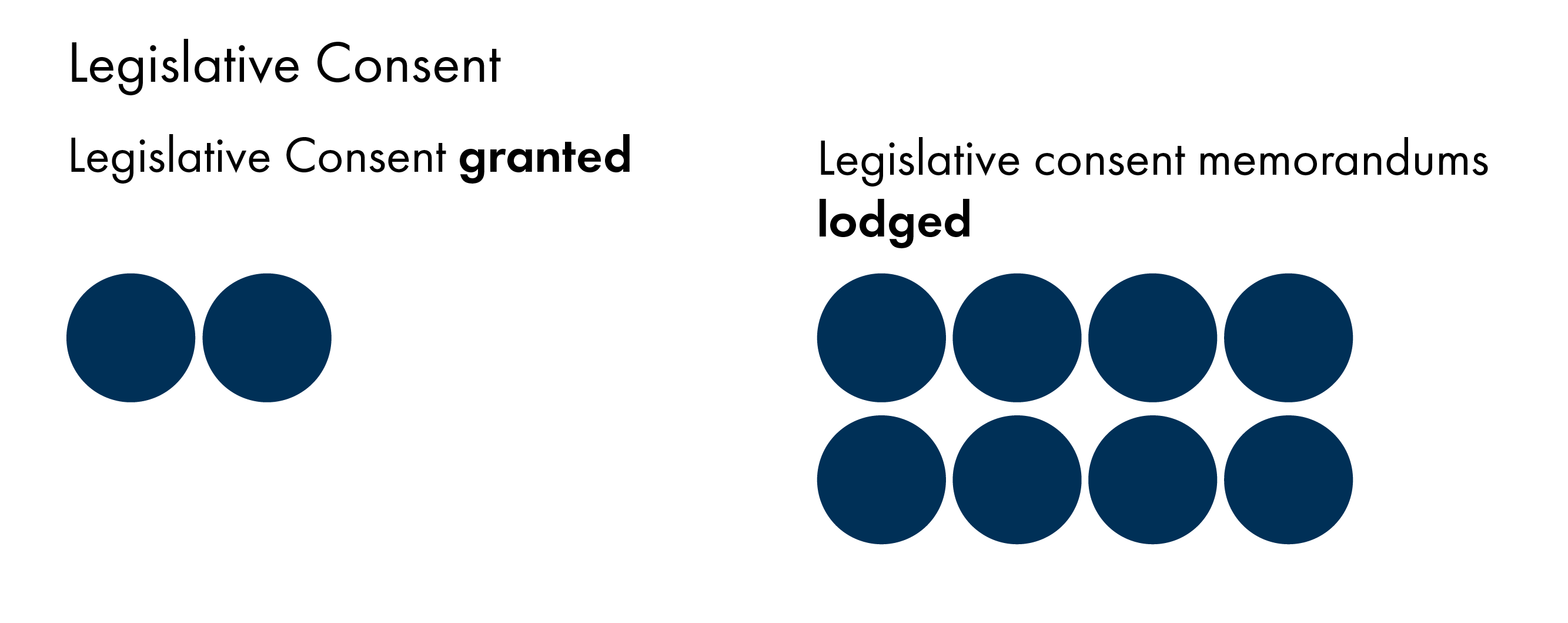
During quarter three of 2025, the Scottish Government lodged eight legislative consent memorandums (three of which were supplementary memorandums).
| Bill title | Date memorandum lodged | Consent recommendation by Scottish Government |
|---|---|---|
| Sustainable Aviation Fuel Bill | 24 July 2025 | Partial consent recommended |
| Crime and Policing Bill (supplementary) | 1 August 2025 | Consent recommended |
| Planning and Infrastructure Bill (supplementary) | 13 August 2025 | Consent recommended |
| Employment Rights Bill (supplementary) | 14 August 2025 | Consent recommended |
| Terminally Ill Adults (End of Life) Bill | 27 August 2025 | Consent recommended |
| Bus Services (No. 2) Bill | 5 September 2025 | Consent recommended |
| Biodiversity Beyond National Jurisdiction Bill | 25 September 2025 | Partial consent recommended |
| Pension Schemes Bill | 26 September 2025 | Consent recommended |
Two legislative consent motions were considered by the Parliament.
| Bill title | Date motion considered | Consent decision |
|---|---|---|
| Employment Rights Bill | 4 September 2025 | Consent provided |
| Bus Services (No. 2) Bill | 10 September 2025 | Consent provided |
Further information
Information within this intergovernmental update is primarily based on the following sources:
The UK Government intergovernmental relations website contains minutes of interministerial groups and standing committees. Minutes of other intergovernmental meetings are not currently published and hence are not reflected in this update.
The UK Government Common Frameworks website contains Common Framework agreements.
The Scottish Parliament legislative consent website lists legislative consent memorandums and associated motions.
Further information on intergovernmental activity can be found on our intergovernmental activity hub and:
House of Commons Library briefing on intergovernmental relations
UK Government transparency reports on intergovernmental relations and quarterly intergovernmental relations engagement dashboard
Senedd Legislation, Justice and Constitution Committee Monitoring reports
Northern Ireland Assembly Brexit and Beyond newsletters.