Intergovernmental activity update Q4 2025
This update gives an overview of intergovernmental activity of relevance to the Scottish Parliament between the Scottish Government and the UK Government, the Welsh Government, and the Northern Ireland Executive during quarter four (October to December) of 2025.
Introduction
SPICe publishes quarterly updates to give an overview of intergovernmental activity.
'Intergovernmental activity’ refers to work between governments – in a Scottish context between the Scottish Government and the UK Government or other devolved governments. It can include discussions on areas of mutual interest, policy development, and policy implementation.
Read more about what intergovernmental activity is and why awareness of it is an essential element of parliamentary scrutiny on our SPICe blog. SPICe has also launched an intergovernmental activity hub that collates information on intergovernmental activity of relevance to the Scottish Parliament.
This update reflects information available at the time of publication.
Highlights
.png)
Scottish Parliament Information Centre
Intergovernmental activity
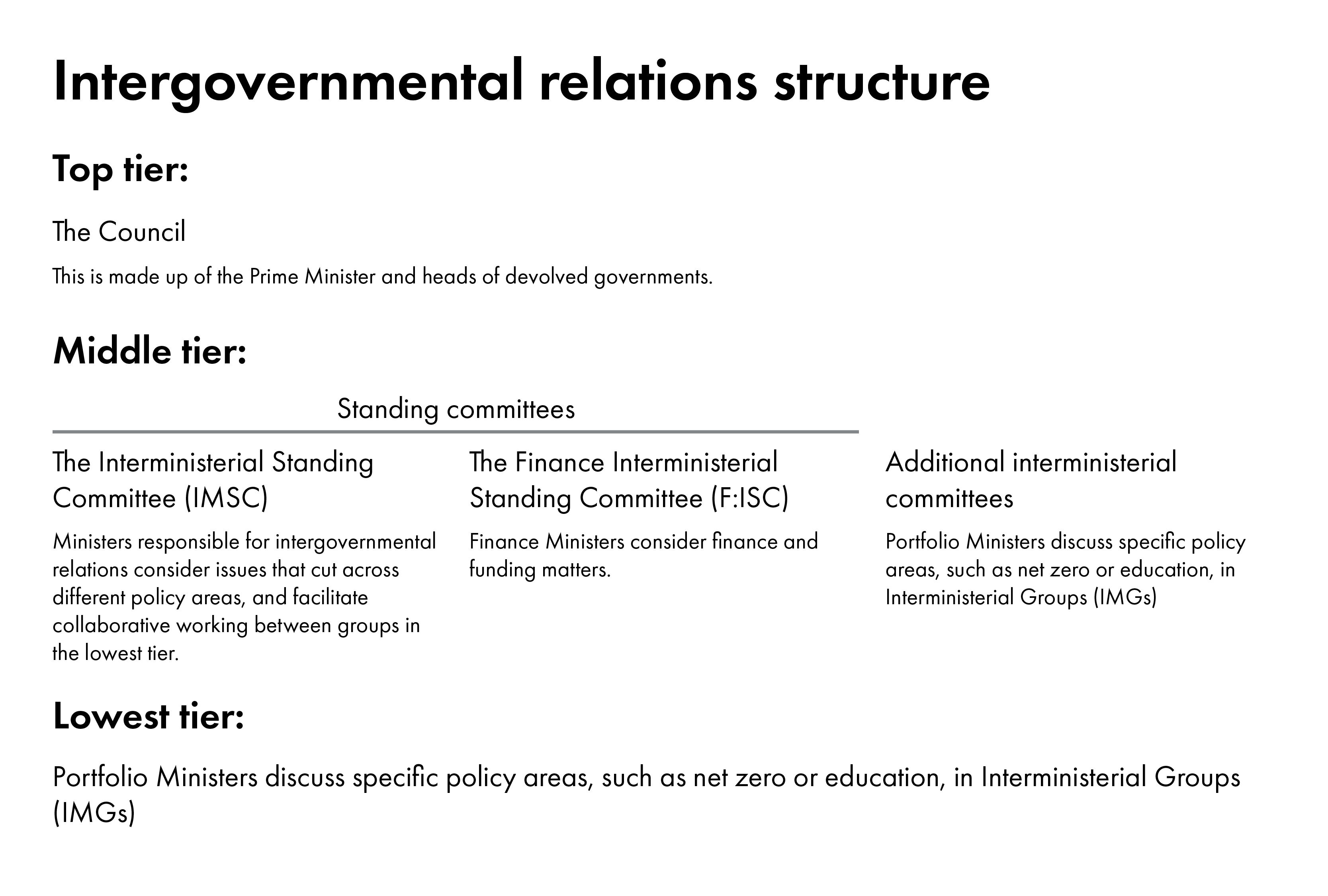
Formal intergovernmental interactions take place under the following structure, which was established in January 2022.
Scottish Parliament Information Centre
See a SPICe blog for more information on how the new structure operates.
Intergovernmental Relations Secretariat annual reports
The IGR Secretariat's annual reports for 2022/23 and 2023/24 were published on 5 November 2025. The reports provide an overview of interministerial meetings and topics discussed. They bring together information already published in minutes of individual interministerial meetings. Neither annual report mentions any formal disputes having occurred.
Interministerial meetings
.png)
Scottish Parliament Information Centre
Finance Interministerial Standing Committee
The Finance Interministerial Standing Committee met on 17 October 2025. Discussions included the economic and fiscal context and options for enhancing the fiscal flexibilities available to devolved governments. Ministers also "agreed that joint work would be undertaken looking at ways of improving the operation of the Barnett formula, to report at the next [Finance Interministerial Standing Committee]".
Interministerial Group for Net Zero, Energy and Climate Change
The Interministerial Group for Net Zero, Energy and Climate Change met on 21 October 2025. Discussions focussed on the Seventh Carbon Budget including the UK Government's approach to it and the risks and opportunities for devolved governments. The UK Minister for Climate also gave an update on UK Government preparations for COP30.
Interministerial Group for Elections and Registration
The Interministerial Group for Elections and Registration met on 30 October 2025. The minutes from this meeting are detailed and include updates from each government and a discussion on democratic engagement and security. Ministers further agreed to re-adopt the group's terms of reference from 2021.
Interministerial Group for Education
The Interministerial Group for Education (also called the UK Education Ministers Council) met on 13 November 2025. Discussions included curriculum reform, misbehaviour, the use of artificial intelligence in schools, and the arrival of Chevening scholars and full-scholarship students from Gaza.
Interministerial Standing Committee
The Interministerial Standing Committee met on 20 November 2025. Discussions included the UK Covid-19 Inquiry Module 2ABC report, the current international context and its impact on domestic policy, and community cohesion. Ministers also discussed the timetabling of UK legislation in the context of the Senedd and Scottish Parliament elections and progress on joint work to develop a Memorandum of Understanding on the operation of the Sewel Convention.
Interministerial Group for Environment, Food and Rural Affairs
The Interministerial Group for Environment, Food and Rural Affairs met on 24 November 2025. Discussions included water quality, the EU-UK Common Understanding agreement, the Fishing and Coastal Growth Fund, funding needs of the EFRA sector, and the resilience of the CO₂ supply chain for the agri-food industry. In relation to the Fishing and Coastal Growth Fund, the minutes state:
Ministers from the Scottish Government and DAERA [Department of Agriculture, Environment and Rural Affairs of Northern Ireland] voiced concerns about the methodology used to calculate the amount of funding allocated, which they felt did not take sufficient account of the sector size in Scotland and Northern Ireland.
Defra [UK Government Department for Environment, Food & Rural Affairs] stated that the allocation had been determined using the Barnett formula in line with HM Treasury guidance to ensure consistency with the wider devolution settlement and to give devolved governments full discretion over devolved policy areas.
Defra ministers agreed to follow up with further explanation of the funding allocation methodology.
The Cabinet Secretary for Rural Affairs, Land Reform and Islands set out the Scottish Government's position in more detail in a letter to the Minister of State for Food Security and Rural Affairs dated 22 October 2025.
The minutes further note:
Under other business there was brief discussion of the Welsh Government’s proposal for an exclusion from the UK Internal Market Act’s market access principles regarding the Deposit Return Scheme, and also forthcoming work on the UK government’s Food Strategy.
The Deputy First Minister and Cabinet Secretary for Climate Change and Rural Affairs for the Welsh Government set out the Welsh Government's position on an exclusion in a written statement published on 27 November 2025. He stated:
Lastly, I want to also acknowledge the feedback from industry on the importance of ensuring there is clarity of law and certainty for businesses. This is crucial to the effective operation of all Deposit Return Schemes across the UK. The Welsh Government has therefore formally proposed an exclusion for the Deposit Return Scheme in Wales to the United Kingdom Internal Market Act 2020 (UKIMA), noting that the scope of the scheme is fully within devolved competence. We have also been clear that should that exclusion as requested not be agreed, this would lead to the scenario where there would be no DRS in Wales, and as such an exclusion would be required for the schemes in other nations.
Interministerial Group for Justice
The Interministerial Group for Justice met on 11 December 2025. Discussions included technology use in justice systems, violence against women and girls, and court caseloads.
Common Frameworks
Common Frameworks are intergovernmental agreements which set out how governments will work together to make decisions about policy in certain devolved policy areas, in particular decisions about policy divergence.
They were originally intended to be used to consider matters which were former EU competences, however, some also state that they may be used to consider related matters within the wider policy area. You can read more about what Common Frameworks are on SPICe's intergovernmental activity hub.
No new framework agreements applicable to Scotland were published during the reporting period. Scrutiny of all currently provisionally published frameworks that apply to Scotland has been completed at the Scottish Parliament. The image below provides an update on frameworks relevant to Scotland and scrutiny of frameworks at the Scottish Parliament.
.png)
Scottish Parliament Information Centre
The Constitution, Europe, External Affairs and Culture Committee received two letters providing updates on the Common Frameworks Programme in January 2026.
The Committee received a letter from Chris Ward MP, Parliamentary Secretary, dated 14 January 2026, following a meeting on 17 November 2025 as part of the Committee’s inquiry into the transparency of intergovernmental relations. The letter states:
You will be aware that the devolved governments were keen to wait until after the UK government’s review of the UK Internal Market Act 2020, before committing to ministerial sign off of some frameworks. I am pleased that all four governments have subsequently agreed that approximately half of the programme can now be signed off by ministers and look forward to rapid progress in the new year. The UK government, Scottish Government and Northern Ireland Executive have agreed not to progress the Mutual Recognition of Professional Qualifications Common Framework at this stage, which would reduce the total number of Frameworks to 30, pending agreement of Welsh ministers.
The 30 frameworks mentioned in the letter include five which are bilateral agreements between the UK Government and Northern Ireland. These are not included in SPICe infographics as they do not apply to Scotland.
The letter provides an update on the status of the 25 frameworks that are agreements between all four governments:
One Common Framework, Hazardous Substances (planning), is fully implemented and was published as a finalised Framework in August 2021.
Ten Frameworks have been scrutinised by all legislatures, revised, agreed at official-level and are ready to be progressed for publication. These are:
Public Procurement
Radioactive Substances
Fertiliser Regulations
Food and Feed Safety and Hygiene
Plant Health
Plant Varieties and Seeds
Animal Health and Welfare
Public Health and Public Health Security
Food Compositional Standards and Labelling
Nutrition-related Labelling, Composition and Standards
Eight Common Frameworks have been scrutinised by all legislatures and are being reviewed and updated by policy officials from each government. These are:
Chemicals and Pesticides
Blood Safety and Quality
Organs, Tissues and Cells
Late Payment
Agricultural Support
Emissions Trading Scheme
Fisheries Management and Support
Organic Production
Four Common Frameworks have not completed the scrutiny process through all four legislatures. This means officials are as yet unable to commence work to review and update them. These are:
Best Available Techniques
Ozone-depleting Substances and F-Gases
Air Quality
Resources and Waste
Two proposed Common Frameworks have completed development and have been agreed at official-level. They are ready to be progressed to publication for the scrutiny of each legislature as provisional Common Frameworks. These are:
Zootech
Provision of Services Regulations
The Committee also received a letter from the Cabinet Secretary for Constitution, External Affairs and Culture on 22 January 2026, outlining the Scottish Government’s approach to the finalisation of Common Frameworks. The Cabinet Secretary states that the UK Internal Market Act 2020 “remains an impediment to effective implementation of Common Frameworks, and continues to act as an unjustified and arbitrary constraint on the powers and democratic accountability of the Scottish Parliament. “ Mr Robertson sets out how the Scottish Government intends to treat different types of Common Frameworks:
For those frameworks where there is cross-government agreement that there are no market dependencies, we propose working at pace to sign these off.
For those where the [UK Internal Market Act] continues to present obstacles to successful operation, such as the Resources and Waste Common Framework, the outcomes of the statutory review do not provide the necessary assurance to the Scottish Government to allow us to proceed to sign-off. These frameworks will therefore have to remain provisional, while fully operational, for the time being.
There is a third category: those frameworks where there is scope for policy divergence and [UK Internal Market Act] interactions, but where substantive intra-UK policy difference is likely to be minimised by the UK Government’s plans to dynamically align with some elements of EU law, principally in the areas of sanitary/phytosanitary (SPS), energy policy and electricity trading.
Of these, the main impacts are, at the moment, most likely in the SPS areas of food and feed safety and standards, labelling, animal welfare and animal and plant health. It will be important to ensure that relevant policy areas are not subject to overlapping but distinct regulatory regimes, in the form of both the [UK Internal Market Act] and dynamic EU alignment. […]
For Common Frameworks in this category, the Scottish Government believes that dynamic SPS alignment presents an opportunity to remove a current barrier to finalisation, if [the UK Internal Market Act] is disapplied in relevant policy areas.
UK internal market
The UK Internal Market Act 2020 (UKIMA) is UK-wide legislation about the flow of goods and services. You can read more about the Act's provisions in our SPICe briefing and a SPICe blog.
UK Internal Market Act exclusions
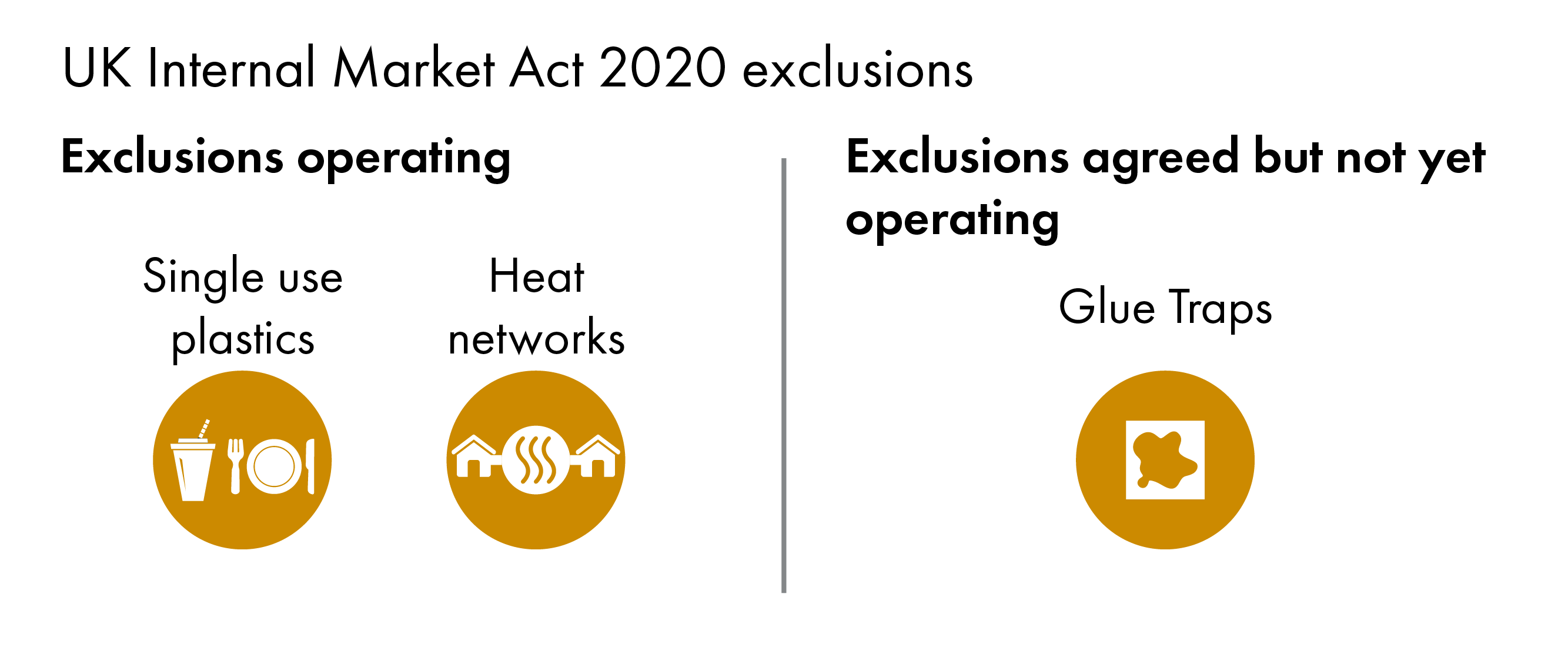
A process was established in 2021 by which the UK Government and devolved governments could consider exclusions to the UKIMA market access principles in the appropriate common framework forum. The UK Government carried out a review of UKIMA in 2025. The review outcomes include a commitment by the UK Government to implement all exclusions that have been agreed by all governments through a common framework. In addition, the outcomes indicate that two additional processes for considering exclusions will operate alongside the common framework process and that environmental protection and public health considerations will be taken into account when assessing potential exclusions. For more information on these changes, see a SPICe blog on the review outcomes.
Scottish Parliament Information Centre
Glue traps
The Wildlife Management and Muirburn (Scotland) Act 2024 provides for bans on the purchase, sale, and use of rodent glue traps. The previous UK Government did not agree to a UKIMA exclusion. The Q1 2024 intergovernmental activity update and SPICe briefing on the Bill ahead of the Stage 3 debate summarised the discussions about glue traps and a potential UKIMA exclusion relating to their sale during the then Bill's parliamentary process.
In a written statement to the House of Commons on 12 December 2024 announcing the new UK Government's review of UKIMA, Rt Hon Douglas Alexander MP (then Minister of State for Trade Policy and Economic Security) indicated that the new UK Government would agree an exclusion "as this Government recognises this proposal has a minimal economic impact on trade within the UK."
The Minister for Agriculture and Connectivity, Jim Fairlie MSP, wrote to the Convener of the Rural Affairs and Islands Committee on 30 October 2025 about the United Kingdom Internal Market Act 2020 (Exclusions from Market Access Principles: Glue Traps) Regulations 2025. The Convener of the Rural Affairs and Islands Committee responded on 21 November 2025:
I am writing to confirm that the Committee has considered the Scottish Government’s consent notification for the above UK statutory instrument and agreed it is content for these provisions relating to devolved competence to be included in a UK SI.
The United Kingdom Internal Market Act 2020 (Exclusions from Market Access Principles: Glue Traps) Regulations 2025 were laid on 1 December 2025 and have been agreed by the UK Parliament, although they are not yet made and in force.
Regulatory developments
This section summarises other intergovernmental activity.
Non-surgical cosmetic procedures
The Non-surgical Procedures and Functions of Medical Reviewers (Scotland) Bill was introduced on 8 October 2025 and is at Stage 1. The Lead Committee for the Bill is the Health, Social Care and Sport Committee. SPICe has published a briefing on the Bill. The intergovernmental activity update Q3 2025 contains further background on the Bill and its potential interaction with UKIMA.
The Scottish Minister for Public Health wrote a letter to the UK Minister of State for Health on 16 January 2026. It states:
The Scottish Government intended to include training and qualification standards and supervision requirements within the Bill, as well as restrict some procedures to being carried out by a healthcare professional only. However, in preparing the Bill, it was identified that the UK Internal Market Act 2020 (UKIMA) has a potential impact on what can be regulated for in Scotland.
The Scottish Government considers that Part 3 of UKIMA would be engaged by any provisions made under the Bill that set a training standard for practitioners, or prevents practitioners who do not hold certain qualifications or are not existing regulated professionals from providing certain procedures. While there may be remedies under UKIMA, such as the introduction of an individual assessment process under section 26 scheme, these may have a number of practical challenges for the sector.
Given both England and Scotland will be seeking to introduce training and qualification standards, supervision requirements and to restrict the provision of some procedures to certain healthcare professionals in the non-surgical procedures sector in the coming years, I would like to ask that we work together to see if mutually agreeable and enforceable standards can be agreed. This would support and provide greater clarity for businesses working in the sector and those seeking these procedures. I would also appreciate an update on your intended timeline for progressing legislative work in this space following the consultation response that DHSC published last summer
The Minister for Public Health asked for a response by the end of January. Stage 1 consideration of the Bill is due to be completed by 6 February 2026.
Assisted Dying Bill
The Assisted Dying for Terminally Ill Adults (Scotland) Bill is a Member's Bill introduced by Liam McArthur MSP on 27 March 2024. It is at Stage 3. The Lead Committee for the Bill is the Health, Social Care and Sport Committee. SPICe has published a briefing on the Bill.
Several provisions in the Assisted Dying for Terminally Ill Adults (Scotland) Bill have been the subject of discussion in relation to the legislative competence of the Scottish Parliament and the executive competence of Scottish Ministers. The Policy Memorandum for the Bill identified several provisions as relating to reserved matters and outlines a number of possible ways of proceeding, including through pursuing Orders under the Scotland Act 1998. SPICe has published a blog on Orders made under section 30 and section 104 of the Scotland Act 1998.
A Scottish Government Memorandum on the Bill set out the Scottish Government's position on the Bill as introduced, including that "the Bill in its current form is outside the legislative competence of the Scottish Parliament." A SPICe briefing on the Bill provides further background.
In a letter to the Health and Sport Committee dated 16 December 2025, the Cabinet Secretary for Health and Social Care provided an update on ongoing discussions between the Scottish Government and the UK Government. The letter states:
Following extensive engagement, the Scottish and UK Governments have come to an agreement on the terms of a section 30 Order for the Bill. This Order will be laid imminently and covers the identification and regulation of the approved substance and medical devices for use in assisted dying. [...]
The section 30 Order will allow Members to consider how matters relating to substances and devices could be dealt with if the Bill is passed, enabling the Parliament to confer powers to make regulations either on the Scottish Ministers (with the Secretary of State’s agreement) or on the Secretary of State, depending on their purpose. [...]
Section 104 Order/Stage 3
As you will be aware from our initial Memorandum and critique on Stage 2 amendments, there are other aspects of the Bill that raise issues of legislative competence which require further consideration by the Scottish Government and the UK Government as it progresses.
The following areas are currently under consideration for a potential section 104 Order:
• provisions in relation to regulation of professions involved in assisted dying, which may relate to the G2 reservation (regulation of health professions); and
• provisions in relation to employment protections for people who refuse to be involved in assisted dying, which may relate to the H1 reservation (employment and industrial relations), and potentially the G2 reservation.
It will be necessary to remove those sections of the Bill which are determined to be outwith competence during Stage 3 considerations, with the intention of these being addressed via a section 104 Order if the Bill passes, and discussion around which provisions would be required to be dealt with in this manner are continuing at pace between the Scottish Government and the UK Government
As Committee Members will be aware, it is important as the Bill undergoes further amendment at Stage 3 – as with any Bill – that no further provisions that could take it back without competence are agreed upon by Parliament.
We are aware that it will be necessary to provide greater detail on what it is proposed will be covered under the section 104 Order as far in advance as possible ahead of Stage 3 considerations and will endeavour to update the Committee further as soon as we are in a position to do so.
Legislative consent
Scottish Parliament Information Centre
According to the Sewel Convention, the UK Parliament will not normally legislate on devolved matters without the consent of the Scottish Parliament. The Scottish Parliament's standing orders set down rules which apply where UK primary legislation requires the Parliament's consent under the Sewel Convention. They apply where UK primary legislation makes ‘relevant provision’, which means provision which applies to Scotland in any of the following ways:
for any purpose within the legislative competence of the Scottish Parliament
to alter the legislative competence of the Scottish Parliament
to alter the executive competence of the Scottish Ministers.
When any of the criteria on relevant provision are fulfilled, the Scottish Government is obliged to lodge a legislative consent memorandum. A legislative consent memorandum, amongst other things, sets out the Scottish Government's view on whether the Parliament should grant legislative consent.
Following the lodging of the memorandum, Members of the Scottish Parliament may vote on a legislative consent motion to either grant or withhold consent for the Bill.
Find out more about legislative consent on the Scottish Parliament's website, and in this November 2024 SPICe blog. SPICe has also developed two tools that can be used to track legislative consent at the Scottish Parliament, which can be accessed on SPICe's intergovernmental activity hub.
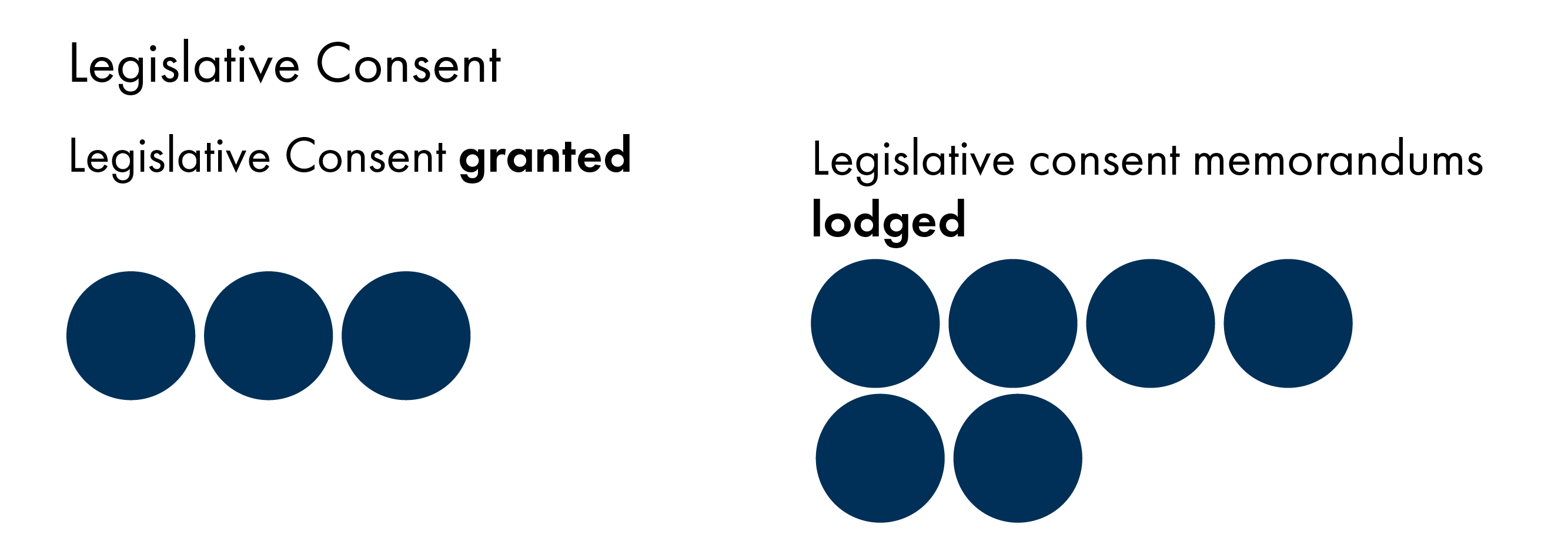
During quarter four of 2025, the Scottish Government lodged six legislative consent memorandums (two of which were supplementary memorandums).
| Bill title | Date memorandum lodged | Consent recommendation by Scottish Government |
|---|---|---|
| Sustainable Aviation Fuel Bill (supplementary) | 27/10/2025 | Consent not recommended |
| Sustainable Aviation Fuel Bill (supplementary) | 17/12/2025 | Consent recommended |
| Public Office (Accountability) Bill | 31/10/2025 | Consent not recommended |
| Sentencing Bill | 26/11/2025 | Consent recommended |
| Northern Ireland Troubles Bill | 11/12/2025 | No recommendation on consent |
| Railways Bill | 12/12/2025 | Consent recommended |
Three legislative consent motions were considered by the Parliament.
| Bill title | Date motion considered | Consent decision |
|---|---|---|
| Terminally Ill Adults (End of Life) Bill | 9/12/2025 | Consent provided |
| Pension Schemes Bill | 17/12/2025 | Consent provided |
| Sentencing Bill | 18/12/2025 | Consent provided |
The Minister for Parliamentary Business and Veterans gave evidence to the Delegated Powers and Law Reform Committee on 28 October 2025. In response to a question about the timetabling of bills and time available for consideration of legislative consent, the Minister stated:
[...] although I absolutely understand the frustration of Parliament about this, some of the issues that we have had are the result of an improved relationship with the UK Government. Concerns that have been raised by the Scottish Government and the Scottish Parliament about proposals have led to amendments and bills, and that has created issues with the LCM process. I am not trying to make excuses or to defend that but, in some ways, it is the consequence of improved working. However, of course we want the process to be better. I would much rather see LCMs going to committees than straight to Parliament. The committee should have the opportunity for scrutiny.
Questions were also asked about what forthcoming legislation at the UK Parliament is expected to engage the Sewel Convention and what impact dissolution and the Scottish Parliament election in May will have on parliamentary scrutiny. Officials highlighted a number of anticipated bills:
[...] the Public Office (Accountability) Bill, formerly known as the duty of candour bill; the cyber security and resilience bill; the Northern Ireland legacy (no 2) bill; the National Wealth Fund bill; the railways bill; the elections and democracy bill; the armed forces bill; the UK energy independence bill; and an artificial intelligence bill. We are also expecting legislation in the space of EU reset, pending the outcome of the EU-UK negotiations, and a major sporting events bill.
In relation to the impact of dissolution and the election on legislative consent processes, the Minister and officials stated that they have communicated to the UK Government that Scottish Parliament Committees will not be available to consider legislative consent memorandums until September 2026.
Further information
Information within this intergovernmental update is primarily based on the following sources:
The UK Government intergovernmental relations website contains minutes of interministerial groups and standing committees. Minutes of other intergovernmental meetings are not currently published and hence are not reflected in this update.
The UK Government Common Frameworks website contains Common Framework agreements.
The Scottish Parliament legislative consent website lists legislative consent memorandums and associated motions.
Further information on intergovernmental activity can be found on our intergovernmental activity hub and:
House of Commons Library briefing on intergovernmental relations
UK Government transparency reports on intergovernmental relations and quarterly intergovernmental relations engagement dashboard
Senedd Legislation, Justice and Constitution Committee Monitoring reports
Northern Ireland Assembly Brexit and Beyond newsletters.
Please note that the next intergovernmental activity update, covering quarter 1 of 2026, will not be published according to the usual publication schedule due to the Scottish Parliament election in May 2026.