Explainer: how devolution works
This briefing considers the devolution settlement in Scotland, explaining the powers of the Scottish Parliament, what legislation is and how law making at the Scottish and UK Parliaments interacts. It describes how devolution works, including intergovernmental processes which affect the Parliament and the exercise of its powers. It considers how the operation of devolution has evolved since 1999, the implications of how devolution works now for the Parliament and what the key oversight issues are likely to be for the Session 7 Parliament.
Summary
The nature of devolution has evolved since the new Scottish Parliament first met on 12 May 1999. Amendments to the Scotland Act 1998, the legislation which underpins the devolution settlement in Scotland, have given the Scottish Parliament and Scottish Ministers powers in more areas.
In addition to the Parliament's powers changing, devolution has evolved in a way which has increased the work between governments across the UK. This increased intergovernmental working has a significant influence on the shape of policy and legislation in Scotland.
This briefing seeks to explain how devolution operates at the start of the Session 7 Parliament. In doing so, the first part sets out the legal basis for devolution and explains the source of the Parliament's powers. It provides detail on how the Parliament considers legislation; the interaction between the Scottish and UK Parliaments; and explains how intergovernmental processes are governed and should work.
The second part of this briefing focuses on how devolution operates in practice - including how the UK Internal Market Act 2020, common frameworks and new approaches from successive UK Governments to the taking and exercise of powers in devolved areas have reshaped the operation of devolution. What this reshaping means for the Parliament and the scrutiny it carries out are also explored.
This is the first briefing in a series which seek to explain aspects of how devolution works. Future briefings will complement this paper by covering particular topics in more detail. The series includes explainers on the UK Internal Market Act 2020; intergovernmental activity; common frameworks and secondary legislation procedure.
The fundamentals of the constitution of the United Kingdom
As part of the UK, Scotland is a constitutional monarchy. This means that it has a monarch as Head of State, and a constitution which establishes principles and laws on how the UK is run.
The UK does not have a codified constitution. There is no single document that describes, establishes or regulates the structures of the state and the way in which these relate to the people. Instead, the constitutional order has evolved over time and continues to do so. It consists of various institutions, statutes, judicial decisions, principles and practices that are commonly understood as ‘constitutional’.
Uk Government Cabinet Office . (2011, October). The Cabinet Manual . Retrieved from https://assets.publishing.service.gov.uk/media/5a79d5d7e5274a18ba50f2b6/cabinet-manual.pdf [accessed 16 April 2026]
The UK, and Scotland within it, are also representative parliamentary democracies, meaning that the people choose the representatives they send to parliament through free and fair elections. In Scotland, representatives are elected to both the UK Parliament, and to the Scottish Parliament. Both parliaments have legislative power (the power to make laws).
The Scotland Act 1998 is recognised as a constitutional statute (i.e., a written law which forms part of the constitution of the UK)1. It provides for devolution in Scotland under a reserved powers model.
This means that the UK Parliament makes laws on some matters, such as trade, defence and international relations, and the Scottish Parliament makes laws on others, such as health, justice, housing and education. The UK Parliament does, however, remain Sovereign (i.e., it enjoys supreme legal authority in the UK). This means that is it able to make, or unmake, laws on any matters including those relating to Scotland3.
Governments are formed to exercise executive power. Scotland has two governments, the UK Government and the Scottish Government. The Scottish Government is formed from representatives returned to the Scottish Parliament. The UK Government is formed from representatives returned to the House of Commons and may also contain some peers (Members of the House of Lords who are not elected).
The judiciary across the UK is also independent and is there to interpret the law and to ensure that it is applied equally and impartially without political interferencei.
As such, the UK operates under the doctrine of the separation of powers. This means that the main institutions of state - the executive, the legislature, and the judiciary - are divided. This separation of powers is to ensure that no one institute holds excessive power and that there are checks and balances on each.
"Separation of powers" refers to the idea that the major institutions of state should be functionally independent and that no individual should have powers that span these offices. The principal institutions are usually taken to be the executive, the legislature and the judiciary.
The House of Commons Library . (2011, August 16). The Separation of Powers. Retrieved from https://researchbriefings.files.parliament.uk/documents/SN06053/SN06053.pdf [accessed 16 April 2026]
What is devolution?
Devolution is the decentralisation or transfer of power. In the case of Scottish devolution, a transfer of power from the UK Parliament and government to the Scottish Parliament and Scottish Government.
In Scotland, devolution follows a 'reserved powers' model. This means that certain matters are reserved to the UK Parliament. These reserved matters are specified in the Scotland Act 1998. Anything not expressly reserved is deemed to be non-reserved, and is referred to as "devolved".
Although the Scottish Parliament is able to make laws on devolved matters, the UK Parliament remains sovereign. This means that it is able to legislate on any matter in Scotland whether the matter is reserved or devolved.
The legal basis for devolution
This section of the briefing explains the legal basis for devolution with reference to the Scotland Act 1998 as amended.
The Scotland Act 1998
The Scotland Bill was introduced in the House of Commons on 17 December 1997 and received Royal Assent on 19 November 1998, becoming the Scotland Act 1998.
The Scotland Act 1998 ("The Scotland Act") is the legislation which underpins devolution in Scotland. The Scotland Act provides for the establishment of the Scottish Parliament and the Scottish Administration (previously known as the Scottish Executive and now referred to as the Scottish Government).
An Act to provide for the establishment of a Scottish Parliament and Administration and other changes in the government of Scotland; to provide for changes in the constitution and functions of certain public authorities; to provide for the variation of the basic rate of income tax in relation to income of Scottish taxpayers in accordance with a resolution of the Scottish Parliament; to amend the law about parliamentary constituencies in Scotland; and for connected purposes.
Legislation.gov.uk. (1998). The Scotland Act 1998. Retrieved from https://www.legislation.gov.uk/ukpga/1998/46/section/1 [accessed 15 January 2026]
The Scotland Acts of 2012 and 2016
The Scotland Act 1998 was amended by the Scotland Act 2012 and the Scotland Act 2016. These Acts transferred more powers to the Scottish Parliament, increasing its legislative competence. The Acts also increased the competence of Scottish Ministers.
The Scotland Act 2012
The Scotland Act 2012 gained Royal Assent on 1 May 2012. The 2012 Act transferred powers, including certain fiscal powers to the Parliament. It followed recommendations made in the Commission on Scottish Devolution (most often referred to as the Calman Commission) which was established in 2008 and published its final report in 2009. The Commission's terms of reference were:
To review the provisions of the Scotland Act 1998 in the light of experience and to recommend any changes to the present constitutional arrangements that would enable the Scottish Parliament to serve the people of Scotland better, that would improve the financial accountability of the Scottish Parliament and that would continue to secure the position of Scotland within the United Kingdom”.
BBC News . (2009, June). Serving Scotland Better: Scotland and the United Kingdom in the 21st Century. Retrieved from http://news.bbc.co.uk/1/shared/bsp/hi/pdfs/15_06_09_calman.pdf [accessed 13 April 2026]
The Calman Commission considered four areas1:
strengthening accountability in finance
strengthening cooperation - the relationship between the UK and Scottish Parliaments and governments
strengthening the devolution settlement
strengthening the Scottish Parliament.
In November 2009 a White Paper, Scotland's Future in the United Kingdom was published by the UK Government and the steering group it had established (comprising of Liberal Democrat, Labour and Conservative members) to consider the Calman Commission proposals. The White Paper also contained the UK Government's response to the Commission's recommendations.
The Scottish Government also published a response to the Commission's recommendations in November 2009. The Scottish Government supported some recommendations, disagreed with others- including those on income tax- and felt that several required further consideration. It also felt that the remit of the Commission had been "too narrow" meaning that:
From the outset therefore it was clear that the Commission would not be able to consider the proposition that Scotland should be an independent country. Federalism was also outwith the Commission's remit.
The Scottish Government . (2009, November). The Scottish Government Response to the Recommendations of the Commission on Scottish Devolution. Retrieved from https://www.astrid-online.it/static/upload/protected/Comm/Commission-Scottish-Devolution-Government-Response_11_2009.pdf [accessed 13 April 2026]
The UK Government committed in the Queen's Speech of May 2010 to implement the recommendations of the Calman Commission. It subsequently published a Command Paper, Strengthening Scotland's Future, in November 2010 setting out its position on the Calman recommendations.
The Scotland Bill was introduced in the House of Commons in late November 2010. Many of the provisions of the Bill were linked to recommendations made by the Calman Commission, but the Bill did not follow them exactly.
As passed, the Act devolved to the Scottish Parliament the power to:
set a Scottish rate of income tax
introduce taxes on land transactions and on waste disposal from landfill.
It also introduces a mechanism to add new devolved taxes by Order in Council, so a new Act of Parliament is no longer required each time a tax is devolved.
The Scotland Act 2016
The Scotland Bill 2015-16 was introduced into the House of Commons on 28 May 2015. The Scotland Bill 2015-16 was introduced following the referendum on Scottish Independence held on 18 September 2014 and the cross-party Commission chaired by Lord Smith of Kelvin ("the Smith Commission"). The establishment of the Smith Commission followed the referendum and the so-called 'vow' made by the then leaders of the Conservatives, Labour and Liberal Democrats (David Cameron, Ed Miliband and Nick Clegg).
The 'vow' had been made on 16 September 2014 and has stated that a vote against independence would deliver "faster, safer and better change" than independence would. The then leaders stated:
Extensive new powers for the parliament will be delivered by the process and to the timetable agreed and announced by our three parties.
What now for 'the vow'?. (2014, October 1). Retrieved from https://www.bbc.co.uk/news/uk-scotland-29443603 [accessed 18 April 2026]
It was the Smith Commission which was tasked with overseeing the process to agree the devolution of further powers to the Scottish Parliament. The Terms of Reference were published on 23 September 2014.
to convene cross-party talks and facilitate an inclusive engagement process across Scotland to produce, by 30 November 2014, Heads of Agreement with recommendations for further devolution of powers to the Scottish Parliament. This process will be informed by a Command Paper to be published by 31 October and will result in the publication of draft clauses by 25 January. The recommendations will deliver more financial, welfare and taxation powers, strengthening the Scottish Parliament within the United Kingdom.
nationalarchives.gov.uk. (2014, October 27). Report of the Smith Commission for further devolution of powers to the Scottish Parliament. Retrieved from https://webarchive.nationalarchives.gov.uk/ukgwa/20151202171059/http://www.smith-commission.scot/smith-commission-report/ [accessed 18 April 2026]
The Commission published its report on 27 November 2014 in which it detailed Heads of Agreement (i.e. proposals) on further devolution of powers to the Scottish Parliament.
On 22 January 2015 the UK Government published its response to the Commission's report in the form of command paper Scotland in the United Kingdom: An enduring settlement. The paper included draft clauses to give effect to the majority (although not all) of the Smith Commission proposals.
In constitutional terms, the command paper and subsequent Scotland Bill made two significant proposals:
to put the Sewel Convention on a statutory footing
to establish the permanence of the Scottish Parliament.
Clause 1 delivers paragraph 21 of the Smith Commission Agreement, which calls for UK legislation to state that the Scottish Parliament and Government are permanent institutions. The statement that “There shall be a Scottish Parliament” set out in the original 1998 Act, is retained and it is recognised that a Scottish Parliament and a Scottish Government are permanent parts of the United Kingdom's constitutional arrangements.
Clause 2 relates to paragraph 22 of the Smith Commission Agreement, which calls for the Sewel Convention to be put on a statutory footing. The convention is that the UK Parliament will not normally legislate with regard to devolved matters in Scotland without the consent of the Scottish Parliament...the UK Parliament and the UK Government have observed the convention since the start of devolution, and the clause reflects the wording of the convention. The clause maintains the current position whilst placing the convention on a statutory footing.
nationalarchives.gov.uk. (2015, January). Scotland in the United Kingdom: An enduring settlement. Retrieved from https://webarchive.nationalarchives.gov.uk/ukgwa/20151202171017/http://www.smith-commission.scot/ [accessed 18 April 2026]
Both proposals were agreed by the UK Parliament during the passage of the Scotland Bill 2015-2016. As such, section 63A of the Scotland Act 1998 (inserted by the Scotland Act 2016) provides:
(1) The Scottish Parliament and the Scottish Government are a permanent part of the United Kingdom's constitutional arrangements.
(2) The purpose of this section is, with due regard to the other provisions of this Act, to signify the commitment of the Parliament and Government of the United Kingdom to the Scottish Parliament and the Scottish Government.
(3) In view of that commitment it is declared that the Scottish Parliament and the Scottish Government are not to be abolished except on the basis of a decision of the people of Scotland voting in a referendum
legislation.gov.uk. (n.d.) The Scotland Act 1998. Retrieved from https://www.legislation.gov.uk/ukpga/1998/46/section/28 [accessed 18 April 2026]
With section 28(8) of the Scotland Act 1998 (inserted by section 2 of the Scotland Act 2016) stating:
(8) But it is recognised that the Parliament of the United Kingdom will not normally legislate with regard to devolved matters without the consent of the Scottish Parliament.
legislation.gov.uk. (n.d.) The Scotland Act 1998. Retrieved from https://www.legislation.gov.uk/ukpga/1998/46/section/28 [accessed 18 April 2026]
The Smith Commission also made observations about intergovernmental relations in the UK, stating:
the issue of weak inter-governmental working was repeatedly raised as a problem. That current situation coupled with what will be a stronger Scottish Parliament and a more complex devolution settlement means the problem needs to be fixed. Both Governments need to work together to create a more productive, robust, visible and transparent relationship. There also needs to be greater respect between them...
current inter-governmental machinery between the Scottish and UK Governments, including the Joint Ministerial Committee (JMC) structures, must be reformed as a matter of urgency and scaled up significantly to reflect the scope of the agreement arrived at by the parties.
nationalarchives.gov.uk. (2014, October 27). Report of the Smith Commission for further devolution of powers to the Scottish Parliament. Retrieved from https://webarchive.nationalarchives.gov.uk/ukgwa/20151202171059/http://www.smith-commission.scot/smith-commission-report/ [accessed 18 April 2026]
In addition, the Commission proposed a revised fiscal framework for Scotland which was adopted, and the Scotland Act 2016 devolved other matters, including:
electoral matters relating to Scottish Parliament elections and the franchise for local government elections
further fiscal powers relating to the power to set the rates and thresholds of income tax as well as the devolution of Air Passenger Duty and Aggregates Levy
certain social security benefits, including Disability Living allowance and Attendance Allowance7
management of the Crown Estate in Scotlandi
powers over the making of road signs and the speed limit
the management and operation of tribunals
powers to introduce certain equality requirements for Scottish (and cross-border) public bodies
consumer advocacy and advice
management of licences relating to onshore oil and gas resources in Scotland
abortion
The Devolution (Further Powers) Committee of the Session 4 Scottish Parliament published its interim report on the Smith Commission proposals in May 2015, and noted that the:
shift from a devolution settlement based on a system of largely separate powers to one of shared powers, which is recommended by the Smith Commission, represents a fundamental shift in the structure of [the] devolution settlement.
Constitution, Europe, External Affairs and Culture Committee. (2023). How Devolution Is Changing Post-EU. Retrieved from https://digitalpublications.parliament.scot/Committees/Report/CEEAC/2023/10/24/6692fb8e-0bf0-47cd-a1ba-cff461d9395d [accessed 7 July 2025]
The powers of the Scottish Parliament to make laws for Scotland
This section of the briefing explains the basis of the Scottish Parliament's powers to make laws.
Legislative competence
The Parliament's powers to make law are derived from the Scotland Act 1998. The Scotland Act provides that the Scottish Parliament is only able to make laws for Scotland in certain areas. 'Legislative competence' refers to those areas in which the Scottish Parliament has the power to make laws.
Limits of the Parliament's legislative competence
The limits to the legislative competence of the Scottish Parliament are provided for in section 29 and section 30 of the Scotland Act 1998.
Section 29 provides that an Act or provision of an Act of the Scottish Parliament is outside its legislative competence where:
it relates to reserved matters
it is in breach of the restrictions in Schedule 4, (Schedule 4 sets out ‘enactments protected from modification’ - often referred to as protected enactments - by the Scottish Parliament, for example the UK Internal Market Act 2020)
it is incompatible with any of the Convention rights
it would remove the Lord Advocate from his position as head of the systems of criminal prosecution and investigation of deaths in Scotland.
Section 30 of the Scotland Act 1998 gives effect to Schedule 5 "Reserved matters" .
Reserved matters
Schedule 5 of the Scotland Act 1998 provides a list of general and specific reservations. The Scottish Parliament cannot legislate on reserved matters. It is the UK Parliament which legislates for Scotland in these areas.
Part I of Schedule 5 lists general reservations which are:
elements of the constitution including the Crown, succession and a regency; the Union of the Kingdoms of Scotland and England; the United Kingdom Parliament; the existence of the High Court of Justiciary as a criminal court of first instance and of appeal, and the existence of the Court of Session as a civil court of first instance and of appeal
the registration and funding of political parties
foreign affairs
public service (i.e., the Civil Service)
defence
treason.
Part II of Schedule 5 lists specific reservations under 11 Heads.
Head A – Financial and Economic Matters
Head B – Home Affairs
Head C – Trade and Industry
Head D – Energy
Head E - Transport
Head F – Social Security
Head G – Regulation of the Professions
Head H – Employment
Head J – Health and Medicines
Head K – Media and Culture
Head L – Miscellaneous
The specific reservations are not whole policy areas, but elements within the general area of policy described in the Head. For example, in relation to transport, the matters of specific Acts such as the Vehicle Excise and Registration Act 1994.
Changes to the legislative competence of the Parliament
A "section 30 Order" is a type of subordinate legislation which is made under section 30(2) of the Scotland Act. Such an Order can be used to increase or restrict, temporarily or permanently, the Scottish Parliament's legislative competence. A section 30 Order does this by modifying the provisions of Schedule 4 and/or Schedule 5 of the Scotland Act.
A section 30 Order can be proposed by either the Scottish Government or the UK Government but requires approval by resolution of the House of Commons, House of Lords and the Scottish Parliament before it can become law. Once the two Parliaments agree to an Order, it is made as an Order in Council (i.e., at a meeting of the Privy Council with the King in person).
Perhaps the most high-profile example of such a section 30 Order is the The Scotland Act 1998 (Modification of Schedule 5) Order 2013 which temporarily devolved authority to legislate for a Scottish independence referendum to the Scottish Parliament.
Section 30 Orders have also been used to allow the Scottish Parliament to:
Although it is for the Scottish and UK Parliaments to agree to or reject such Orders before they go to Privy Council, section 30 Orders require a significant amount of intergovernmental working. This is to agree the scope of an Order and the drafting of it. This is work undertaken by Scottish and UK Ministers before an Order is laid in Parliament and made (i.e., becomes law).
Statements on legislative competence
Section 31 of the Scotland Act requires statements regarding legislative competence to be made on or before the introduction of a Bill in the Parliament. This legislative requirement is given practical effect through the Standing Orders of the Scottish Parliamenti.
The Standing Orders allow for the introduction of different types of Bills in the Parliament. The most common type of Bill is a public bill introduced by a member of the Scottish Government (i.e., the First Minister, a Cabinet Secretary, the Lord Advocate and the Solicitor General). These are known as ‘Government Bills’. Public bills may also be introduced by a Member of the Parliament (known as a Member's Bill) or by a Committee (known as a Committee Bill).
When a Public Bill is introduced in the Parliament the Standing Orders require that the Presiding Officer and the Member introducing the Bill make statements on the legislative competence of the provisions of the Bill. This Rule gives effect to the legislative requirements for statements on legislative competence provided for by section 31 of the Scotland Act.
The Standing Orders require that:
1. A Bill shall on introduction be accompanied by a written statement signed by the Presiding Officer which shall—
(a) indicate whether or not in the Presiding Officer's view the provisions of the Bill would be within the legislative competence of the Parliament; and
(b) if in the Presiding Officer's view any of the provisions would not be within legislative competence, indicate which those provisions are and the reasons for that view.
1A. A Bill shall on introduction be accompanied by a written statement signed by the member introducing the Bill which states that in that member's view the provisions of the Bill would be within the legislative competence of the Parliament.
Rule 9.3 of Standing Orders
As the Scottish Parliament Guidance on Public Bills explains:
2.17 The duty on the Presiding Officer to make a statement on legislative competence differs from that on the member in charge. The Presiding Officer's statement may indicate a view that the Bill is (or specified provisions of it are) outwith competence, giving reasons. A statement in such terms does not prevent the Bill from being introduced.
2.18 The established form of words for the statement on legislative competence by the member in charge of the Bill is: “In my view, the provisions of the [short title] Bill would be within the legislative competence of the Scottish Parliament.”.
2.19 Although the Presiding Officer's statement must express a definite view as to the legislative competence of the provisions, and the statement by the member in charge must be that the Bill would be within competence, both statements are opinions as to the competence of the Bill at introduction. Legislative competence can be a complex issue, and can ultimately be determined only by the courts. It can be an important issue of debate throughout the scrutiny of a Bill... The statements should not, therefore, be regarded as precluding the Parliament, or any committee, from critically examining a Bill on grounds of legislative competence during its passage.
A Bill may be amended during its consideration by the Parliament. Although Members may be conscious of legislative competence considerations when proposing amendments to a Bill, legislative competence is not in itself a criterion for the admissibility of amendments.
4.10 …legislative competence is not a criterion for the admissibility of amendments. Whether a Bill, or specific provisions within it, are within the Parliament's legislative competence may be a matter of debate throughout the passage of a Bill irrespective of the statements made by the member in charge and the Presiding Officer on the introduction of the Bill... There may also be debate about whether amendments would take a Bill outside competence or, indeed, whether amendments may resolve concerns about competence.
Scottish Parliament Guidance on Public Bills
Protected subject matters
Section 31(4) of the Scotland Act 1998 as amended provides that Bills which relate to some matters require a two-thirds majority in order to pass at Stage 3 or Reconsideration Stage. They are:
the persons entitled to vote as electors at an election for membership of the Parliament
the system by which members of the Parliament are returned
the number of constituencies, regions or any equivalent electoral area, and
the number of members to be returned for each constituency, region or equivalent electoral area.
Standing Orders provide that:
After any amendments have been disposed of, the Presiding Officer shall state whether or not in his or her view any provision of the Bill relates to a protected subject-matter within the meaning of section 31(4). This statement may be made orally or in writing, and if made in writing shall be published by the Clerk.
Standing Orders Rule 9.48.5BA
Scrutiny of Bills by the Supreme Court
Given that the Parliament can only legislate within its competence, Bills may be referred to the Supreme Court after they are passed by the Parliament if there are questions on legislative competencei.
This is why, after the Scottish Parliament passes a Bill, there is a four week period in which one of the Law Officers (the Advocate General for Scotland, the Attorney General, or the Lord Advocate, but not the Solicitor General) may refer the Bill to the Supreme Court over questions of legislative competenceii.
There are two relevant sections of the Scotland Act.
Section 32A of the Scotland Act provides for consideration of Bills by the Supreme Court on questions of protected subject-matter. The Law Officers may refer to the Supreme Court the question of whether a Bill, or any provision of a Bill, relates to a protected subject-matter. The Law Officers may do this at any time during the period of four weeks following the rejection of the Bill where the Presiding Officer made a statement (under section 31(2A)) that provisions of the Bill relate to a protected subject-matter; or following the Parliament's passing of a Bill where the Presiding Officer made a statement (under section 31(2A)) that in their view no provisions of the Bill relate to a protected subject-matter and the number of members voting in favour of the Bill at its passing was less than two-thirds of the total number of seats for members of the Parliament.
Section 33 of the Scotland Act provides that the Supreme Court may consider Bills on questions of legislative competence. It provides that the Law Officers can refer the question of whether a Bill, or any provision of a Bill, would be within the legislative competence of the Parliament. The Law Officers are able to do this at any time during the period of four weeks following passing of the Bill (or approval of the Bill at Reconsideration Stage)iii. It is the established route for challenging a Bill, or a provision of a Bill, already passed by the Parliament.
A separate power (under section 35 of the Scotland Act) allows a Secretary of State to challenge a Bill during the four week period after it is passed.
Section 35 of the Scotland Act
Section 35 of the Scotland Act 1998 gives the Secretary of State (in practice it is most likely to be the Secretary of State for Scotland who is a UK Government Minister) a power to intervene in certain circumstances where the Scottish Parliament has passed a Bill, but before it is submitted for Royal Assent (i.e, during the four week period after a Bill is passed by the Parliament).
Section 35 allows the Secretary of State to exercise this power:
If a Bill contains provisions—
(a) which the Secretary of State has reasonable grounds to believe would be incompatible with any international obligations or the interests of defence or national security, or
(b) which make modifications of the law as it applies to reserved matters and which the Secretary of State has reasonable grounds to believe would have an adverse effect on the operation of the law as it applies to reserved matters
Section 35 allows the Secretary of State to make a section 35 Order where the tests set out above are met.
The effect of a section 35 Order is that it prohibits the Presiding Officer of the Scottish Parliament from submitting the Bill for Royal Assent (i.e., from being sent to the King for formal agreement and becoming an Act of the Scottish Parliament).
It is important to note that a section 35 Order can be made where there is no question over the Scottish Parliament's legislative competence (i.e., its power) to pass the Bill. As the explanatory notes to the Act explain in relation to section 35:
there are certain limited circumstances where the UK Government can exercise a policy control or veto over what legislation is enacted by the Scottish Parliament, even although it is within its competence. This section defines what those circumstances are.
A section 35 Order is a form of secondary legislation. The Scotland Act 1998 (section 35 (2)) provides that an Order made under section 35 must:
identify the Bill and the provisions in question and state the reasons for making the order.
This means that a section 35 Order must:
state the Bill to which it relates and the provision or provisions which the Secretary of State believes are problematic
and provide the reason for making the Order.
As at the start of Session 7, section 35 has only been used once. The section 35 Order made in 2023 prevented the Gender Recognition Reform (Scotland) Bill, which the Scottish Parliament passed on 22 December 2022, from being submitted for Royal Assent.
The Supreme Court interpretation of section 28(7) of the Scotland Act 1998
Section 28(7) of the Scotland Act 1998 recognises that the UK Parliament can make laws for Scotland including in devolved areas.
Since 2018 UK law officers have referred three Bills passed by the Parliament to the Supreme Court to ask whether the Bill, or a provision within it, is within the Parliament's competence. The Bills are:
the UK Withdrawal from the European Union (Legal Continuity) (Scotland) Bill
the United Nations Convention on the Rights of the Child (Incorporation) (Scotland) Bill
the European Charter of Local Self-Government (Incorporation) (Scotland) Billi.
An academic report on the judgments in relation to the three referred Bills and implications for devolved law making states that:
Section 28(7) of the Scotland Act 1998 makes clear that the UK Parliament can continue to make laws for Scotland, including in devolved areas…Prior to the Supreme Court reference cases, this was widely regarded as a symbolic reaffirmation of Westminster parliamentary sovereignty. However, the Supreme Court interpreted this section more broadly: the Scottish Parliament (and by extension the other devolved legislatures) cannot make laws that are inconsistent with the maintenance of the UK Parliament's ‘unqualified’ legislative power. The Scottish Parliament can amend or repeal UK laws in devolved areas or make new free-standing laws. But it cannot legislate to condition the meaning or effect of UK laws in devolved areas or make the UK Parliament's rules conditional on decisions made by other bodies, such as Scottish Ministers or the courts.
Legislation at the Scottish Parliament
This section of the briefing explains the different types of legislation which the Parliament can consider and explains, briefly, the relevant scrutiny processes.
Legislation is a law, or laws, passed by a Parliament. The Scottish Parliament is able to pass primary legislation and agree to or reject secondary legislation.
Primary legislation
A piece of primary legislation passed by the Scottish Parliament is referred to as an Act of the Scottish Parliament. Acts of the Scottish Parliament (ASPs) are published onlinei.
ASPs are all numbered. They are numbered chronologically within the year in which they are made.
The number is referred to as 'ASP' (standing for Act of the Scottish Parliament) e.g. Wild Animals in Travelling Circuses (Scotland) Act 2018 is cited as '2018 asp.3'.
Legislation.gov.uk. (n.d.) Understanding legislation . Retrieved from https://www.legislation.gov.uk/understanding-legislation#citationandnumbering [accessed 14 April 2026]
Bills
A Bill is a proposed Act of the Scottish Parliament. A Bill might be a proposal on a new idea, or it may change or remove part of an existing law. The Parliament considers different types of Bills, including:
Government Bills
Members’ Bills
Committee Bills
Budget Bills
Private Bills
Hybrid Bills
Most Bills are "Public Bills". This means that they are introduced by a Member of the Scottish Parliament and deal with matters of public policy and the general law. Various types of Bills including Government Bills, Members’ Bills and Committee Bills are classed as Public Bills. This briefing focuses on these types of Bills. Private Bills and Hybrid Bills follow different rules and the Parliament does not consider these types of Bills very often.
Parliamentary scrutiny of Bills
Most Bills go through a three stage process at the Scottish Parliament. At Stage 1 a Committee is usually asked to consider a Bill and report on it before the whole Parliament votes on whether to support the general principles of the Bill.
Stage 2 is again a committee stage. This is the first point at which MSPs are able to lodge amendments to make changes to the Bill. The Committee considering the Bill debates amendments and votes on them.
Stage 3 is the final amending stage and is a two-part process. The whole Parliament first considers any amendments and votes on whether to agree to them or not. The second part of the process is a debate on the Bill as amended. At the end of the debate the Parliament must vote on whether or not to pass the Bill.
If a Bill passes there is a four week period where it may face legal challenge. A Bill must receive Royal Assent (where the King agrees to the Bill) before it becomes an Act of the Scottish Parliament and the law.
If the Parliament votes against the Bill at Stage 3 then the Bill falls and does not become law.
Secondary legislation
Secondary legislation (sometimes referred to as "delegated" or "subordinate" legislation) is law created under powers given in primary legislation (an Act of the Scottish Parliament or an Act of the UK Parliament).1 Secondary legislation has the same legal standing as primary legislation. All secondary legislation is published online.
By giving powers to make secondary legislation, the Parliament is delegating its legislative function to others for a specific purpose. It is usually Ministers who make law by secondary legislation, but it can also be other bodies which have been given the power to do so by the Parliament in primary legislation. Although the Parliament delegates authority for Ministers to make secondary legislation, it maintains a scrutiny role (these scrutiny procedures are explained below) to ensure that the powers it has delegated are used appropriately. As such, the Parliament is able to agree to, reject or annul most secondary legislation.
An Act which gives powers to make secondary legislation is called a "parent Act" (or an "enabling Act"). 2 The parent Act sets out:
by whom the power or powers may be used
usually how the powers may be exercised (i.e., their scope)
the level of parliamentary scrutiny which will apply when they are exercised.
Some Acts, often those referred to as 'framework', contain very broad powers with little detail in the Bill about how the powers can be exercised i.
Secondary legislation is often used to fill in the details of primary legislation to make how the law will operate clearer, to keep legislation up to date, and to specify the date on which an Act, or certain provisions of an Act, will come into force3.
Statutory instruments are the most common form of secondary legislation.4 Scottish Statutory Instruments (SSIs) are made (usually by Scottish Ministers) under powers granted in Acts of the Scottish Parliament or in Acts of the UK Parliament. They are considered by the Scottish Parliament.
The two most common scrutiny procedures for SSIs are the negative procedure and the affirmative procedure. The type of procedure which applies to an instrument is usually determined by the parent Act.
Negative – this is the most common procedure attached to instruments laid before the Scottish Parliament. Negative instruments do not need to be approved by Parliament before they can come into force, but Parliament can annul (i.e., make void) a negative instrument. Negative procedure is generally attached to instruments relating to matters of less significance than those subject to affirmative procedure.
Affirmative – before an instrument which is subject to the affirmative procedure can be made and brought into force, it must be approved by Parliament. Affirmative procedure is often attached to instruments relating to more significant matters and provides for a greater level of scrutiny than the negative procedure.
Importantly, the Parliament is not able to amend an SSI. In the case of an affirmative instrument the Parliament simply accepts or rejects it. In the case of a negative SSI, the Parliament can reject the instrument by voting to annul it. If an instrument is annulled before it comes into force then it does not become the law. If an instrument is in force prior to it being annulled then it ceases to be the law.
Frequently used terms
"Made" – an instrument is made when it is signed by a Minister (or the person with the power to make secondary legislation under the parent Act). A made instrument is not necessarily yet in force.
"Laid" – an instrument is laid before the Parliament when a copy of it (either made or in draft) is provided to Parliament for its consideration.
"Draft" – an instrument is in draft if it is not yet made. Some statutory instruments are published and laid before the Parliament in draft to allow the Parliament to consider the proposed SSI.
"Come (or enter) into force" – an instrument comes (or enters) into force when its provisions become enforceable. The date on which an instrument comes into force is usually specified within the instrument.
SSIs can also be3:
no procedure/laid only
provisional affirmative
super affirmative
Laid only SSIs tend to be used for things such as when provisions in an Act are to come into force (known as commencement regulations). The Parliament cannot stop a no-procedure SSI.
Provisional affirmative (often referred to as "made affirmative") SSIs are less common and can change the law immediately. However, to remain in force the Parliament must approve the SSI within 28 days. If the Parliament does not approve the instrument then it ceases to be the law.
Super affirmative SSIs are used when the proposed SSI needs significant consideration by the Parliament. As such, the Parliament usually has 60 or 90 days to look at the draft SSI before it is laid, as determined by the parent Act.
Statutory Instruments (SIs) are made (usually by UK Ministers) under powers granted in Acts of the UK Parliament. They are considered by the UK Parliament, but can affect the law in Scotland, including the law in devolved areas.
Where SIs made at the UK Parliament affect the law in devolved areas, the Scottish Government notifies the Scottish Parliament that a relevant SI has been made. This is known as the Statutory Instrument Protocol. The Protocol was agreed at the end of Session 6 by the Constitution, Europe, External Affairs and Culture Committee and the Delegated Powers and Law Reform Committee.ii The Scottish Parliament has no formal role in the scrutiny of SIs made at the UK Parliament.
The graphic shows that the Scottish Government will notify the Scottish Parliament of a UK SI within devolved competence being laid or made, usually within 28 days

Scottish Parliament Information Centre
The relationship between the Scottish Parliament and the UK Parliament
This section of the briefing explains how the UK Parliament seeks the consent of the Scottish Parliament if it is considering legislation which affects a devolved matter. It also explains how the legislative consent process works at the Scottish Parliamenti. A later section in the briefing on legislative consent in practice explores how the operation of the Sewel convention has developed since 1999.
This section also explains how UK Ministers are able to make provision to amend reserved law should it be required to give full effect to Acts of the Scottish Parliament.
Legislative consent
The Sewel Convention is a political convention on legislative consent. It applies where the UK Parliament is considering primary legislation (a Bill) which is within the competence of the Scottish Parliament, or primary legislation which changes the powers of the Scottish Parliament or the powers of Scottish Ministers. In such instances, the UK Parliament seeks the consent of the Scottish Parliament through the Sewel Convention.
The principle of legislative consent was developed almost entirely at governmental level. It took formal shape in the Memorandum of Understanding (MoU) between the UK Government and the devolved administrations (the Scottish Executive, the Welsh Assembly Cabinet and the Northern Ireland Executive) in 2001. The latest version of the MoU was published in October 2013 and states:
The United Kingdom Parliament retains authority to legislate on any issue, whether devolved or not. It is ultimately for Parliament to decide what use to make of that power. However, the UK Government will proceed in accordance with the convention that the UK Parliament would not normally legislate with regard to devolved matters except with the agreement of the devolved legislature. The devolved administrations will be responsible for seeking such agreement as may be required for this purpose on an approach from the UK Government.
The MoU was supplemented by a series of Devolution Guidance Notes, including Devolution Guidance Note 10 (Post-Devolution Primary Legislation affecting Scotland).
In line with one of the recommendations from the Smith Commission, the Sewel Convention was put on a statutory footing. Section 28(8) of the Scotland Act 1998, states:
But it is recognised that the Parliament of the United Kingdom will not normally legislate with regard to devolved matters without the consent of the Scottish Parliament.
Legislative consent memorandums
Chapter 9B of the Parliament's Standing Orders sets out the rules and procedures for seeking legislative consent in the Scottish Parliament under the Sewel Convention. The requirement for consent only relates to primary legislation introduced in the UK Parliament. The requirement for consent does not apply to secondary legislation .
Consent is also only required for UK bills which make ‘relevant provision’, which means provision which applies to Scotland in any of the following ways:
for any purpose within the legislative competence of the Scottish Parliament
to alter that legislative competence of the Scottish Parliament
to alter the executive competence of the Scottish Ministers.
When any of the criteria on relevant provision are fulfilled a member of the Scottish Government is obliged to lodge a legislative consent memorandumi. Legislative consent memorandums may also be lodged by MSPs who are not Scottish Government Ministers, although this should not normally be done until a memorandum has been lodged on behalf of the Scottish Government.
All legislative consent memorandums should summarise:
what the Bill does
its policy objectives
the extent to which it makes relevant provision.
Legislative consent memorandums lodged by a member (including a member of the Scottish Government) who intends lodging a motion on legislative consent - a motion seeking the Parliament's consent or refusal of consent to relevant provision in a relevant UK Bill - should include a draft motion and the reasons for such a decision.
A legislative consent memorandum should normally be lodged within two weeks of the Bill being introduced in the UK Parliament. However, memorandums may be lodged at a later date, or be added to in a supplementary memorandumii. This may be in order to reflect any amendments made to the Bill in either or both Houses of the UK Parliament. For example, the memorandums for the Scotland Bill 2010-12 and Scotland Bill 2015-16 were both lodged at a date later than two weeks after introduction. Supplementary memorandums were also lodged for both Bills.
Consideration of the memorandum will be assigned to a lead committee in the Scottish Parliament. Other committees may consider the memorandum, reporting their comments on the memorandum to the lead committee. Where the Bill contains provisions which confer powers on Scottish Ministers to make subordinate legislation the Delegated Powers and Law Reform (DPLR) Committee must consider those provisions and can report on them to the lead committee.
The DPLR Committee has also adopted the practice of scrutinising (as part of its legislative consent scrutiny) any provisions in the Bill that confer power on UK Ministers to legislate in devolved areas. This is not part of its role for legislative consent memorandums under Standing Orders (Rule 9B.3.6) but is done under the element of its remit that allows it to consider:
proposed powers to make subordinate legislation in particular Bills or other proposed legislation
Standing Orders Rule 6.11.1(b)
Such provisions engage the Sewel Convention as their purpose relates to matters within the legislative competence of the Parliament. The lead committee will produce a report on the memorandum.
Motions on legislative consent
When a Bill contains relevant provision, members of the Scottish Government may include a draft motion on legislative consent in the memorandumi. The example of a motion on legislative consent given in the Parliament's Guidance on Motions, shows how such a motion is typically worded:
S4M-02496 John Swinney: Financial Services Bill – UK Legislation— That the Parliament agrees that the relevant provisions of the Financial Services Bill, introduced in the House of Commons on 26 January 2012, relating to the enhancement of understanding and knowledge of the public of financial matters and the ability of members of the public to manage their own financial affairs, so far as these matters fall within the legislative competence of the Scottish Parliament, should be considered by the UK Parliament.
The Scottish Parliament . (2021, May 5). Guidance on motions. Retrieved from https://www.parliament.scot/-/media/files/chamber-office/guidance-on-motions.pdf [accessed 15 April 2026]
The wording of a motion on legislative consent in the Scottish Parliament may include a qualification to the Parliament giving its consent to the UK Parliament legislating on its behalf. For example, the motion on the Welfare Reform Bill 2010-12 consent urged the UK Government to reconsider the Welfare Reform Bill, stating:
That the Parliament […] on the matter of legislative consent, agrees that the relevant provisions of the Welfare Reform Bill, introduced in the House of Commons on 16 February 2011, […] so far as these matters fall within the legislative competence of the Parliament, or alter the executive competence of the Scottish Ministers, should be considered by the UK Parliament; […] while agreeing the above position, urges the UK Government to reconsider the Welfare Reform Bill and, more broadly, its welfare reform agenda, which the Parliament considers will adversely affect vulnerable people across Scotland.
The Scottish Parliament, SPICe. (2024, November 5). Consent processes in the Scottish Parliament . Retrieved from https://www.parliament.scot/-/media/files/spice/factsheets/parliamentary-business/consent-processes-in-the-scottish-parliament.pdf [accessed 5 May 2026]
A motion on legislative consent can seek consent or refusal of consent in relation to one or more relevant provisions in a relevant Bill.
The Standing Orders make no mention of how the information on the decision made in the Scottish Parliament is to be conveyed to the UK Parliament. In practice, the Clerk of the Scottish Parliament writes to the Clerks of the two Houses of the UK Parliament to inform them of the outcome of the decision taken on a motion on legislative consent. The Clerk also sends a copy of the relevant Scottish Parliament Minutes and a copy of the legislative consent memorandum.
When a motion is decided on in the Scottish Parliament, a copy of the memorandum and the Clerk's letter on the outcome of the decision on the motion should appear on the Bill Documents page on the UK Parliament's website. The decision on a motion is also indicated next to the relevant Bill in the Bills in Progress section of the House of Lords Business and the Bill should be tagged in the House of Commons' Order Paper.
The Scottish Parliament also lists each of the UK Bills subject to legislative consent. SPICe also publishes a legislative consent tracker, made up of the Consent Compass and the Consent Lens, that can be used to track legislative consent at the Scottish Parliament. The trackers provide information on Bills considered in the UK Parliament for which at least one legislative consent memorandum was lodged in the Scottish Parliament since Session 5.
The Consent Compass includes a list of Bills and provides information on whether consent was recommended and provided for each.
The Consent Lens provides more detailed information on individual Bills, for example whether the UK Government and Scottish Government agreed on which provisions in a Bill required legislative consent and consideration by committees in the Scottish Parliament.
Is the Sewel Convention legally enforceable?
In 2017 the UK Supreme Court determined that the Sewel Convention is a political convention and not legally enforceable.
On 24 January 2017, the UK Supreme Court delivered its judgment in the Miller case. The court decided that formal notice of withdrawal from the European Union under Article 50 of the Treaty of European Union could not lawfully be given by UK Ministers under the Royal Prerogative without prior legislation being passed in both Houses of Parliament authorising that notice.
In its consideration, the UK Supreme Court examined the effect of the Sewel Convention as set out in section 28(8) of the Scotland Act 1998. The Supreme Court ruled that the Sewel Convention was a political convention which could not be enforced legally through the courts. Therefore, the courts have no role in determining how the convention is to be applied to any particular Bill or circumstances.
Scotland Act section 104 Orders
A section 104 Order is simply an order made under section 104 of the Scotland Act 1998.
On occasion, when the Scottish Parliament passes an Act, changes are needed to other laws for the Act to have full effect. Where the laws are in areas reserved to the UK Parliament, section 104 of the Scotland Act allows the King or a UK Government Minister to make secondary legislation considered "necessary or expedient in consequence of any provision made by or under an Act of the Scottish Parliament" or through Scottish secondary legislation1.
In December 2024, for example, a section 104 Order was laid by the then Secretary of State for Scotland, Ian Murray MP, so that the Miner's Strike (Pardons) (Scotland) Act 2022 could be fully enacted.
A press release from the Scotland Office explained the purpose of the Order, stating:
The Miner's Strikes (Pardons) (Scotland) Act 2022 automatically pardons people convicted in Scotland of breach of the peace, breach of bail conditions, or obstructing the police while taking part in strike action. It took effect from 27 July 2022.
At the request of the Scottish Government, this Scotland Act Order would add Section 7 of the Conspiracy and Protection of Property Act 1875 (now repealed) to the pardoning criteria.
Section 104 Orders were also required for Scottish equal marriage and civil partnership legislation and the Fire (Scotland) Act 2005.
Section 104 Orders are only considered by the UK Parliament. Schedule 7 of the Scotland Act 1998provides for the type of procedure subordinate legislation made under the Act is subject to.
The Scottish Administration
This section of the briefing sets out the legal basis for the formation of the Scottish Administration (known as the Scottish Executive until September 2007 and since then as the Scottish Government). It also explains what devolved competence is and describes the transfer of powers from UK Ministers to Scottish Ministers in 1999.
The Scottish Government
The Scottish Government is the devolved government for Scotland. It has a range of responsibilities and runs the country in relation to devolved matters, like health, the environment and education.
Section 44 of the Scotland Act 1998 ("the Scotland Act") provides that the Scottish Government is made up of:
the First Minister
Ministers appointed under section 47 of the Scotland Act (this refers to the Ministers who are Cabinet Secretaries, and does not include junior Ministers)
the Lord Advocate and the Solicitor General for Scotland (collectively known as the Law Officers)
There is no statutory limit on the size of the Scottish Government as the Scotland Act does not limit the size by specifying a maximum number of Scottish Ministers.
Previous Scottish Governments have varied in size. A SPICe factsheet which details all Ministers and Law Officers in Session 6 of the Parliament is available.
Devolved and executive competence
"Devolved competence" and "executive competence" describe the extent of the Scottish Ministers' power to take executive action – such as making secondary legislation.
The extent of the Scottish Ministers' devolved competence mirrors the Scottish Parliament's legislative competence. Section 54 of the Scotland Act 1998 sets out the limits of devolved competence.
In addition to devolved competence, Scottish Ministers also have executive competence. This is power to act in some policy areas which are reserved (in other words, Scottish Ministers have some responsibilities in areas which are reserved matters, and for which the Scottish Parliament does not have legislative competence).
The Scottish Government's devolved competence has the same extent as the Scottish Parliament's legislative competence. However, the Scottish Government's executive competence is greater, covering some reserved policy areas.
Scottish Ministers are given powers by the legislature through Acts (primary legislation). Acts of the Scottish Parliament can only give the Scottish Ministers powers within legislative competence. Executive competence over reserved matters can be conferred on Scottish Ministers by UK Acts. For example, the Railways Act 2005 gave Scottish Ministers sole responsibility for securing future ScotRail franchises.
Executive competence can also be conferred on Scottish Ministers by UK secondary legislation.
Transfer of powers at the point of devolution
When the Scottish Parliament was established in 1999, the powers of UK Ministers to make secondary legislation in devolved areas were transferred from UK Ministers to Scottish Ministers with only a few exceptions. This was known as the "general transfer of functions". As such, at the start of devolution, UK Ministers did not tend to have powers to make secondary legislation in devolved areas.
In general, UK Acts made after 1999 which created new powers in devolved areas tended to confer the new powers on Scottish Ministers rather than UK Ministers.
Where UK primary legislation proposes to confer powers on either Scottish or UK Ministers in devolved areas, the Scottish Parliament is asked to give its consent under the Sewel Convention.i
The independent judiciary
This section of the briefing explains briefly the role of Scotland's judiciary in relation to the separation of powers. It also explains certain Acts made by the Court.
The judiciary in Scotland
Judiciary refers to judicial office holders - judges, sheriffs and justices - who preside over cases, both civil and criminal, to ensure that the law is upheld impartially. The judiciary in Scotland is entirely independent of the Scottish Parliament and the Scottish Government.
The independence of the judges, who deal with every case without fear or favour, affection or ill-will, is one of the pillars on which a stable democracy rests."
Lord Pentland , L.P. (n.d.) Judiciary of Scotland About Us . Retrieved from https://judiciary.scot/ [accessed 16 April 2026]
The judicial system in Scotland has been distinct from that in England and Wales for centuries. When the United Kingdom was formed by the Act of Union in 1707, Scotland maintained its distinct legal system and courts, its legal profession and own prosecution service (the Crown Office and Procurator Fiscal Service).
When the Scottish Parliament was established in 1999, most elements of justice policy were therefore devolved to the Scottish Parliament under the Scotland Act 1998.
The Courts have statutory powers to change the rules which apply to court proceedings- the Court Rules - by Act of Sederunt and Act of Adjournal.
An Act of Sederunt is the legal name given to the procedural rules regulating various civil legal procedures in Scotland, for example, "Act of Sederunt (Small Claims Rules) 2002", which is commonly known as the "Small Claims Rules". An Act of Sederunt may also contain the styles of forms to be used.
An Act of Adjournal is the legal name given to the rules regulating criminal procedure in Scotland. An Act of Adjournal may also include the styles of forms to be used in criminal procedure.
Scottish Courts and Tribunals Service . (n.d.) Rules of Court . Retrieved from https://www.scotcourts.gov.uk/rules-and-practice/rules-of-court/new-rules/ [accessed 16 April 2026]
Acts of Sederunt and Acts of Adjournal are published but are not subject to Parliamentary procedurei in recognition of the independence of the judiciary.
Devolution: Memorandum of Understanding between the UK and Scottish Government
This section briefly describes the Devolution Memorandum of Understanding and Supplementary Agreement between the UK and devolved Governments (including the Scottish Government) which was agreed in 2012 and last revised in October 2013.
As the Session 6 Constitution, Europe, External Affairs and Constitution Committee noted:
A key part of the devolution settlement are non-statutory agreements and conventions which govern relations between the UK Government and the devolved administrations.
Scottish Parliament. (2023). Constitution, Europe, External Affairs and Culture Committee 'How Devolution is Changing Post-EU'. Retrieved from https://digitalpublications.parliament.scot/Committees/Report/CEEAC/2023/10/24/6692fb8e-0bf0-47cd-a1ba-cff461d9395d
Memorandum of Understanding
In 2012 the UK and devolved Governments agreed a Memorandum of Understanding on devolution. The Memorandum of Understanding ("MoU") "sets out the principles which underlie relations between these administrations"1. The MoU is an intergovernmental agreement, but is not legally binding.
Attached to the MoU is an agreement on the Joint Ministerial Committee, including a protocol on the avoidance and resolution of disputes, and concordats on the coordination of European Union policy issues, financial assistance to industry, and international relations.
UK Government, Cabinet Office . (2012, October 1). Devolution: memorandum of understanding and supplementary agreement. Retrieved from https://www.gov.uk/government/publications/devolution-memorandum-of-understanding-and-supplementary-agreement [accessed 17 April 2026]
The 2012 MoU superseded command paper Cm5240 which was published in December 2001. The command paper was itself a "revised edition of the Memorandum of Understanding and supplementary agreements between the UK Government, Scottish Ministers, the Cabinet of the National Assembly for Wales and the Northern Ireland Executive Committee".3
The MoU of 2012 established a Joint Ministerial Committee (JMC) with a terms of reference:
UK Government, Cabinet Office . (2012, October 1). Devolution: memorandum of understanding and supplementary agreement. Retrieved from https://www.gov.uk/government/publications/devolution-memorandum-of-understanding-and-supplementary-agreement [accessed 17 April 2026]
to consider non-devolved matters which impinge on devolved responsibilities, and devolved matters which impinge on non devolved responsibilities;
where the UK Government and the devolved administrations so agree, to consider devolved matters if it is beneficial to discuss their respective treatment in the different parts of the United Kingdom;
to keep the arrangements for liaison between the UK Government and the devolved administrations under review; and
to consider disputes between the administrations.
The MoU also contained three separate overarching Concordats relating to:
the coordination of EU policy and implementation
financial assistance to industry, and
international relations touching on the responsibilities of the devolved administrations.
Devolution toolkit for civil servants and devolution guidance notes
A devolution toolkit was published for civil servants in September 2015 (with a last update noted in January 2017)1.
The toolkit intended as "Guidance and advice for civil servants working with devolved administrations" lists relevant guidance, including the 2012 MoU and Supplementary Agreements and 17 Devolution Guidance Notes (DGNs)1.
The DGNs relevant to Scotland are:
DGN 6 Circulation of inter-ministerial and inter-departmental correspondence
DGN 10 Post-devolution primary legislation affecting Scotland (i.e. legislative consentunder the Sewel Convention)
DGN 12 Attendance of UK ministers and officials at committees of the devolved legislatures
DGN 13 Handling of parliamentary business in the House of Lords
DGN 15 Scottish legislative proposals giving devolved powers and functions to UK bodies
The end of EU law in the UK
When the UK was a member of the European Union (EU), EU law applied in areas within EU competence and the Scotland Act 1998 required any legislation passed by the Parliament to comply with EU law.
EU law ceased to apply in the UK at the end of the implementation period, at 11pm on 31 December 2020. This point in time is known as Implementation Period Completion Day, or "IP Completion Day". The requirement for Scottish Parliament legislation to comply with EU law also came to an end.
Assimilated law (previously retained EU law)
Assimilated law is simply the name given to a body of domestic law which has its origins in the UK's membership of the EU.
At IP Completion Day, some EU laws were preserved in domestic law (the law which applies in the UK)i. These provisions were initially known as "retained EU law", or REUL. At the beginning of 2024, REUL that remained on the statute book became known as "assimilated law".
The Retained EU Law (Revocation and Reform) Act 2023 ("the REUL Act") granted UK and Scottish Ministers extensive powers to make changes to assimilated law by secondary legislation – including powers for UK Ministers in devolved areasii.
Many of the powers contained in the REUL Act are due to expire in June 2026. Ministers will, however, still have the power to update assimilated law to reflect changes in technology or scientific developments after this date.
As assimilated law is domestic law, it is open to the UK Parliament and (within its legislative competence) the Scottish Parliament to amend it, or to repeal or revoke pieces of it, should they wish to do so.
Scottish Government commitment to align with EU law
The position of the previous Scottish Government (2021-2026) was that the law in Scotland should remain "aligned with EU law where it is possible and meaningful to do so"1.
Alignment with EU law can be achieved through:
secondary legislation (with Scottish Ministers exercising powers from a relevant parent act)
exercise of the power in section 1(1) of the UK Withdrawal from the European Union (Continuity) (Scotland) Act ("the Continuity Act")i. This power allows Scottish Ministers to make regulations with the effect of continuing to keep the law in Scotland aligned with EU law in areas of devolved competence, provided the purpose of doing so includes maintaining and advancing standards in certain policy areasii. Although Scottish Ministers can make regulations so that the law on certain devolved matters keeps pace with EU law, they are not required to do so.
The "keeping pace" power is time limited. The Continuity Act provides that no regulations can be made under section 1(1) "after the end of the period of 6 years beginning with the day on which section 1(1) comes into force". The Act came into force on 29 March 20212. As such, regulations cannot be made after 29 March 2027 unless Ministers exercise the option to extend the duration of the power, which is open to them under section 4(2) of the Continuity Actiii.
The Scottish Government must provide the Parliament with an annual report on the exercise of the "keeping pace" power3.
Dynamic alignment with EU law
The UK and EU have been discussing closer cooperation on Sanitary and Phytosanitary (SPS) measures and the linking of the UK and the EU emissions trading schemes. As part of the discussion, the UK Government has agreed in principle (and in the futurei) to align the law applicable in the UK in these areas with the relevant EU law.
Such alignment would be achieved by the adoption of relevant EU law and rules into domestic law. This would be a legal requirement. This is called 'dynamic alignment'.
A key consideration in relation to dynamic alignment is that the UK may be required to follow the laws of the EU whilst having no direct say in the legislative process of the European Union.
How devolution operates
How devolution operates has changed significantly in recent years. The Scotland Act 1998 still provides the legal basis for devolution, but its day-to-day operation is now heavily affected by other legislation as well as non-legislative arrangements, namely:
The UK Internal Market Act 2020
The exclusions process linked to the UK Internal Market Act 2020
Common frameworks
Whether legislative or non-legislative, the arrangements are all managed through intergovernmental activity.
Parliamentary scrutiny of the intergovernmental activity surrounding these arrangements is crucial because of how significantly they influence Scottish policy development and legislation.
Regulation of the UK Internal Market
The United Kingdom Internal Market Act 2020 ("UKIMA") is the legal framework governing the movement of goods and services across the United Kingdom. It operates alongside the common frameworks programme, intended to manage regulatory difference in devolved policy areas through intergovernmental agreement.
UKIMA establishes two market access principles ("MAPs") - mutual recognition and non-discrimination, for both goods and services.
The mutual recognition principle for goods is the principle that goods which have been produced in, or imported into, one part of the United Kingdom, and can lawfully be sold there, should be able to be sold in any other part of the United Kingdom. Any different requirements that would otherwise apply to the sale in the other part of the UK are disapplied.
The mutual recognition principle for services is that a person authorised to provide services in one part of the UK is not required to meet additional authorisation requirements to provide those services in another part of the UK.
The non-discrimination principle for goods is the principle that the sale of goods in one part of the United Kingdom should not be affected by relevant requirements that directly or indirectly discriminate against goods that have a relevant connection with another part of the United Kingdom.
The non-discrimination principle for services is that a regulatory requirement will be of no effect in relation to an incoming service provider where it discriminates against that provider directly or indirectly.
UKIMA allows for minimal regulatory divergence. The MAPs apply unless there is an exclusion provided for in the Act (neither of the market access principles currently apply to healthcare services, social services or transport services, for example)i. Nevertheless, there are very few general exclusions from the MAPs, especially as they pertain to goodsii. For example, restrictions which have the aim of environmental protection or public health protection are not generally excluded. Accordingly, nearly all devolved policy areas are potentially affected by the market access principles.
Under sections 10 and 18 of UKIMA, UK Ministers do, however, have the power to amend the list of exclusions to which the MAPs do not apply. This leaves considerable power in the hands of UK Ministers. Although UK Ministers are required to seek the consent of relevant devolved ministers before making regulations which change the exclusions, there is no requirement for consent to be obtained. UKIMA specifies that if consent is not given within one month of being sought, the regulations can be made without it. This means that UK Ministers can change the exclusions to the market access principles even where the devolved administrations disagree.
Although only UK Ministers have the power to make changes, there is a process for the consideration of exclusions in areas covered by common frameworks. The process is explained in the exclusions process section of this briefing.
UKIMA also contains provisions to ensure a system for the mutual recognition of professional qualifications across the UK internal market. This allows professionals qualified in one of the four parts of the UK to access the same profession in a different part without needing to requalify.
The way UKIMA operates means that an Act of the Scottish Parliament or a Scottish Statutory Instrument can contain provision which runs contrary to it, but the provision will be disapplied where relevant (i.e., in relation to goods and services which come from another part of the UK or in relation to the recognition of professional qualifications). Scottish legislation remains enforceable in relation to goods produced in, or first imported into Scotland, in relation to the provision of services by Scottish-regulated service providers and in relation to the professional qualifications of Scottish-qualified individuals.
UKIMA works by ‘disapplying’ requirements in legislation (something in either primary or secondary legislation) which run contrary to the principles it establishes.
Disapplication is different to where a law is ‘struck down’. In the case of disapplication, the requirement is still law, but it doesn't apply in particular circumstances. Where a law is 'struck down' it means that it is void.
This disapplication does, however, limit the effectiveness of Scottish Parliament legislation which engages either a market access principle or the automatic recognition principle in relation to professional qualifications in spite of the fact that the principles do not introduce any new statutory limitations on the legislative competence of the Scottish Parliament.
Common frameworks
Common frameworks are agreements setting out how the UK and devolved governments will work together to make decisions about policy direction and regulatory difference in certain devolved policy areas. Most frameworks operate in areas formerly governed by EU law, but some do go beyond what was previously decided at an EU level.
The aim of common frameworks is to manage regulatory and policy difference in these areas in order to achieve consistency where this is deemed desirable by governments across the four UK nations. Common frameworks are intergovernmental agreements, but they are not legally binding.
Common frameworks are employed when necessary in order to:
Joint Ministerial Committee (EU Negotiations). (2017, October 16). JOINT MINISTERIAL COMMITTEE (EU NEGOTIATIONS) COMMUNIQUE. Retrieved from https://assets.publishing.service.gov.uk/government/uploads/system/uploads/attachment_data/file/652285/Joint_Ministerial_Committee_communique.pdf [accessed 13 November 2025]
enable the functioning of the UK internal market, while acknowledging policy divergence;
ensure compliance with international obligations;
ensure the UK can negotiate, enter into and implement new trade agreements and international treaties;
enable the management of common resources;
administer and provide access to justice in cases with a cross-border element;
safeguard the security of the UK.
The Scottish Government set out its view on common frameworks in its April 2025 position paper on the UK Internal Market Act 2020, which stated:
The Scottish Government welcomes, and shares, the UK Government's ambition that Common Frameworks act as the key mechanism for managing policy divergence and ensuring regulatory co-operation.
For the Parliament, the key challenge is a lack of transparency around the operation of common frameworks which makes holding the Scottish Government to account for their actions in framework forums difficult. The Session 6 Constitution, Europe, External Affairs and Culture Committee noted this in its report on transparency of intergovernmental activity and its implications for parliamentary scrutiny:
A key issue for this Committee and our predecessor Committee has been the lack of transparency, parliamentary accountability and stakeholder engagement with regards to intergovernmental activity within the ambit of Common Frameworks and the UKIMA exclusions process.
Constitution, Europe, External Affairs and Culture Committee Scottish Parliament . (2026, March 17). Transparency of intergovernmental activity and its implications for parliamentary scrutinySHARE . Retrieved from https://digitalpublications.parliament.scot/Committees/Report/CEEAC/2026/3/17/70658a2e-1fd6-45d5-aa1e-1f4b78a31992#60e32d4f-d6ca-4258-b2bd-e2cdd59cf080.dita [accessed 18 March 2026]
More information on individual common frameworks can be found on the SPICe Intergovernmental Activity Hub.
The exclusions process linked to the UK Internal Market Act 2020
Only UK Ministers have the power to make changes to UKIMA, and specifically to change when the MAPs do not apply through the creation of an exclusion.
As explained earlier in this briefing, the MAPs of UKIMA allow for very little divergence between regulatory requirements for goods and services in different parts of the UK. The principles apply unless there is an exclusion.
A three-tier process is now in place for discussion of exclusions to the MAPsi. The three-tier process is made up of separate, but interrelated, processes for:
exclusions discussed through common frameworks
Minimum Economic Impact (MEI) exclusions, and
a reserve process.
An exclusion can be considered through one or more of the processes. The relevant process or processes is/are triggered by a written proposal from the requesting government to all relevant UK Government Ministers and devolved governments.
The three-tier exclusions process explicitly allows consideration of environmental protection and public health issues as well as economic impact.
Environmental and public health matters are key devolved policy areas that may have an interaction with the UKIM Act. We believe that, by taking those into account in the consideration of a UKIM Act exclusion, we will ensure the right balance between encouraging innovation and solutions that meet local needs; and preserving the integrity of the UK internal market. We encourage devolved governments also to consider environmental protection and public health factors in any exclusion proposal.
UK Government. (2025, July 25). UK Government response to the Review of the United Kingdom Internal Market Act 2020 and Public Consultation. Retrieved from https://assets.publishing.service.gov.uk/media/686fa10e2cfe301b5fb679d0/uk-government-response-to-the-review-of-the-united-kingdom-internal-market-act-2020-and-public-consultation.pdf
Implementation of exclusions agreed by all governments in Common Framework areas
The first ‘exclusions process’ facilitates discussion of proposed exclusions through common frameworks. Where an exclusion is agreed through a common framework, UK Ministers have committed to giving legal effect to the exclusion.
The common frameworks exclusions process provides that1:
Exclusions shall be proposed in writing to all relevant Ministers in UK Government and devolved governments, who shall confirm receipt of the proposal.
Whenever any party is proposing an amendment to Schedules 1 or 2 of the Act by a Common Framework:
a. Once all avenues to explore similar policy approaches have been pursued within the Common Framework, the exclusion-seeking party should set out the scope and rationale for the proposed exclusion; and provide evidence – including input from affected businesses and any OIM [Office for the Internal Market] evidence that has been sought.
b. Consideration of the proposal, associated evidence and potential impact should be taken forward consistent with the established processes as set out in the relevant Common Framework. Exclusion proposals will consider evidence in particular of the following:
i. direct and indirect economic impacts (including costs to businesses);
ii. environmental protection; and
iii. public health.
It is recognised that all parties will have their own processes for considering policy proposals, before seeking to formally agree the position within the relevant Common Frameworks. It is also recognised that substantive policy change to an exclusion proposal that occurs during discussions may require further / new agreement between parties.
Where policy divergence has been agreed by all governments through a Common Framework, this should be confirmed in the relevant Common Framework. This includes any agreement to create or amend an exclusion to the UKIM Act Market Access Principles.
Evidence of the final position of each party regarding any exclusion, and the fact that an agreement has been reached, should be recorded in all cases. This could take the form of an exchange of letters between appropriate UK government and devolved government ministers.
Parties remain able to engage the dispute resolution mechanism within the appropriate Common Framework, if desired. The need for seeking an exclusion does not automatically mean there is a dispute to resolve.
The UK Government will commit to implement all exclusions that have been formally agreed by all governments within a Common Framework.
Minimum Economic Impact exclusions
A Minimal Economic Impact (MEI) exclusion process can be used where the economic impact of the proposed exclusion is no greater than £10 million each year in Equivalent Annual Net Direct Costs to Business. The process is more streamlined, requiring that:
the proposing government demonstrates that the economic impact does not exceed the £10 million annual threshold
other governments have no objections based on MEI having been demonstrated
the UK Government implements legislation and commits to doing so as soon as reasonably practicable.
The reserve exclusions process
A reserve exclusions process is used for proposed exclusions which fall neither within a common framework area nor within the MEI exclusions process. The reserve exclusions process is also used should agreement not be reached on an exclusion proposed through either the common frameworks or the MEI exclusion processes.
The reserve process means that the administration seeking an exclusion can write to the relevant UK Minister, detailing the proposal and indicating they wish to use the reserve exclusion process to propose the exclusion.
The reserve process appears to be based solely on a review of the proposal by the UK Minister responsible for the relevant policy area. Decisions under the reserve process, as with the exclusions process through common frameworks, will consider evidence in relation to direct and indirect economic impact, environmental protection and public health.
Intergovernmental activity
Intergovernmental activity refers to work between the UK Government and the devolved governments (i.e., the Scottish Government, the Welsh Government and the Northern Ireland Executive).
Intergovernmental activity includes discussions on areas of mutual interest, policy development, and policy implementation through legislative and non-legislative routes. Intergovernmental activity has taken place since 1999, but the number and importance of decisions being taken in this shared space between governments has increased in recent years because of the development of intergovernmental processes such as common frameworks and the exclusions process linked to the UK Internal Market Act 2020.
The UK leaving the EU drove the establishment of legislative and non-legislative mechanisms to manage intra-UK difference, but these mechanisms are now established in the operation and shape of the devolution settlement.
The Scottish Parliament . (2026, March 24). Legacy Report of the Constitution, Europe, External Affairs and Culture Committee, Session 6SHARE . Retrieved from https://digitalpublications.parliament.scot/Committees/Report/CEEAC/2026/3/24/e019190f-b6f7-4770-8a71-4634751f3adb#ef56aaec-74ba-4755-9132-84207a815056.dita [accessed 17 April 2026]
In Session 6 the Constitution, Europe, External Affairs and Culture (CEEAC) Committee used the term 'intergovernmental activity', rather than 'intergovernmental relations', to highlight informal ways of governments working together, as well as formal interactions through set intergovernmental mechanisms2.
The Session 6 CEEAC Committee adopted this approach because important bilateral and informal meetings between UK and Scottish Ministers, day-to-day interactions between governments, interactions through common frameworks and discussions through the exclusions process linked to the UK Internal Market Act 2020 are not captured in formal intergovernmental structures.
Formal intergovernmental structures
Formal intergovernmental interactions, involving Ministers and/or officials from the UK Government and each of the devolved Governments, take place in a three-tier structure, which was established in January 2022.
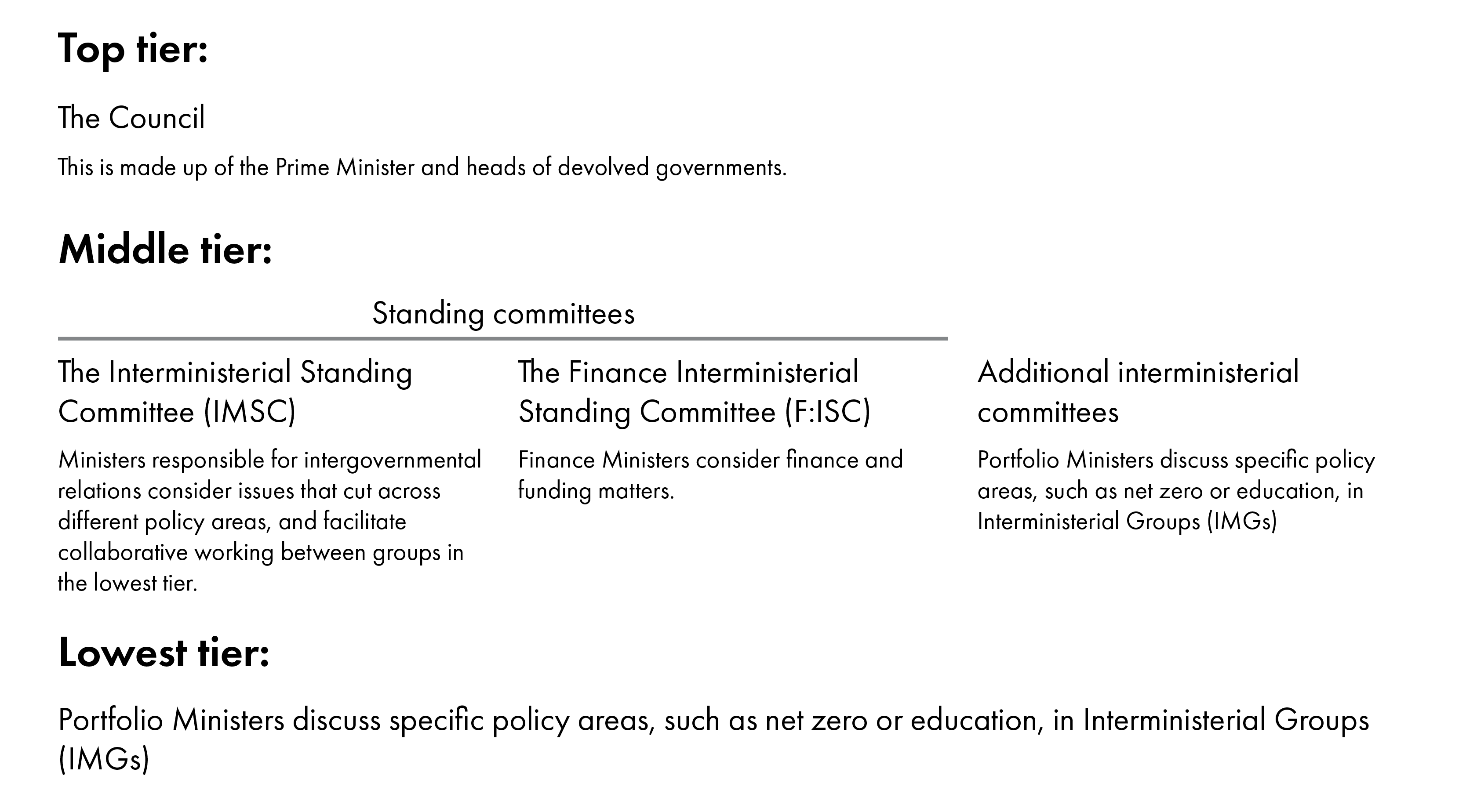
Scottish Parliament Information Centre
The 2022 reforms committed the UK Government and devolved governments to increased transparency, which had long been noted as an area of concern. Whereas before the review little information on intergovernmental activity was publicly available, minutes of most interministerial groups are now routinely publishedi.
The 2022 reforms also included a revised dispute resolution process. The process sets out a central role for an independent Intergovernmental Relations Secretariat as it, not governments involved in a disagreement, decides whether a disagreement is to enter the formal dispute resolution process. The process also includes more extensive reporting requirements.
The structure introduced in 2022 was designed to provide "a positive basis for productive relations", and support "ambitious and effective" intergovernmental working between the UK Government, the Scottish and Welsh Governments, and the Northern Ireland Executive.1
In September 2024, it was confirmed that the Prime Minister would establish a Council of the Nations and Regions where he and the Heads of devolved Governments "can look at challenges and opportunities together". The then Cabinet Secretary for Constitution, External Affairs and Culture, Angus Robertson MSP, reacted positively to the Council's creation saying that the Scottish Government would "welcome the opportunity for a reset" in intergovernmental relations, and was "ready to work with the new UK Government to agree a collaborative, co-operative approach to intergovernmental relations, which respects devolution and all of the powers of the Scottish Parliament". The Council of the Nations and Regions held its inaugural meeting in Edinburgh in October 2024.
The transparency challenge
One of the main challenges in understanding how intergovernmental activity is shaping policy development and legislation is a lack of transparency in intergovernmental processes.
The Session 6 Constitution, Europe, External Affairs and Culture Committee reported on the transparency of intergovernmental activity and its implications for parliamentary scrutiny in March 2026. The Committee's legacy report states:
we found ongoing challenges for the Parliament in scrutinising the many decisions which now take place in the shared intergovernmental space, including on exclusions to UKIMA’s market access principles, common frameworks and the taking and exercise of delegated powers in devolved areas by UK Ministers.
The Committee made several recommendations to improve transparency in Session 7, including a recommendation for its successor committee to complete a review of the Written Agreement on the provision of information in relation to IGR between the Scottish Parliament and the Scottish Government.
Recent UK Government approach to legislative consent and delegated powers
This section of the briefing considers how recent UK Governments have approached legislative consent under the Sewel Convention and the taking and exercise of delegated powers by UK Ministers in devolved areas. Where relevant, information on how the Scottish Parliament and Scottish Government have responded is also provided.
Legislative consent in practice
Before 2016, the Sewel Convention had been engaged 140 times, but the Scottish Parliament had only withheld its consent on one occasion. Since 2016, however, the UK Parliament has passed legislation on a number of occasions in spite of the Scottish Parliament withholding its consenti.
before the demands of EU withdrawal changed the consent dynamics, the Sewel convention had been engaged more than 140 times in Scotland but consent had been withheld only once, in relation to the Welfare Reform Bill. On that occasion, aspects of the bill, as they related to devolved policies… and services… were amended by the UK Government.
The Scottish Parliament. (2022, September 22). Constitution, Europe, External Affairs and Culture Committee: The Impact of Brexit on Devolution. Retrieved from https://digitalpublications.parliament.scot/Committees/Report/CEEAC/2022/9/22/1b7a03d8-e93c-45a4-834a-180d669f7f42#Introduction [accessed 29 May 2025]
The Session 6 Constitution, Europe, External Affairs and Culture Committee noted in 2023 that, prior to 2016, the "Sewel Convention worked well" but that since 2016:
there has subsequently been considerable and continuing disagreement between the UK Government and the devolved governments and parliaments regarding its effectiveness.
Constitution, Europe, External Affairs and Culture Committee. (2023). How Devolution Is Changing Post-EU. Retrieved from https://digitalpublications.parliament.scot/Committees/Report/CEEAC/2023/10/24/6692fb8e-0bf0-47cd-a1ba-cff461d9395d [accessed 7 July 2025]
The Labour Party's 2024 UK General Election manifesto included a commitment to "strengthen the Sewel Convention by setting out a new Memorandum of Understanding outlining how the nations will work together for the common good"3.
It is notable that, since the present UK Government came to office in July 2024, the Scottish Parliament has not withheld its consent. A number of legislative consent memorandums lodged by the Scottish Government have noted that the Scottish and UK Governments are discussing issues and, as a result, the recommendation is initially to refuse consent (but that subsequently changes to a recommendation to grant consent)ii. There have also been occasions where no initial consent recommendation is given because the Scottish Government has not had time to undertake sufficient analysis of the Billiii.
It is clear that there is considerable intergovernmental working between the Scottish and UK Governments on legislative consent for Bills since July 2024. The challenge for the Parliament is that such intergovernmental working often comes at a cost - leading to delays in the lodging of legislative consent memorandums or leading to multiple supplementary memorandums as intergovernmental discussions continue and compromise is reached.
In response to a question from the Session 6 Delegated Powers and Law Reform Committee about time for committee consideration of legislative consent memorandums being squeezed, the then Minister for Parliamentary Business appeared to suggest that this was, at least in part, the result of better intergovernmental working:
Concerns that have been raised by the Scottish Government and the Scottish Parliament about proposals have led to amendments and bills, and that has created issues with the LCM process. I am not trying to make excuses or to defend that but, in some ways, it is the consequence of improved working...
As I said earlier, particularly with supplementary LCMs, that is a consequence of more collaborative and constructive working with the UK Government, which I think we would all welcome...
I hope to have meetings with UK Government ministers in short order, and one of the topics will be what we can do collectively to try to improve the situation.
The Scottish Parliament . (2025, October 25). Official Report, Delegated Powers and Law Reform Committee . Retrieved from https://www.parliament.scot/api/sitecore/CustomMedia/OfficialReport?meetingId=16641 [accessed 18 April 2026]
In Session 6 there were also a number of occasions when Standing Orders were suspended to allow legislative consent memorandums to be considered by the Chamber, rather than first being referred to a lead committee because of a lack of time for meaningful scrutinyiv.
A new Memorandum of Understanding on the Sewel Convention
In August 2024, the then UK Government Minister for the Constitution and EU Relations, Rt Hon Nick Thomas-Symonds MP, confirmed that:
the Sewel Convention and the way the UK Government legislates is certainly a priority area and we are intending to strengthen the Sewel Convention with a new memorandum of understanding.
UK Government . (2024, August 13). Letter from Rt Hon Nick Thomas-Symonds MP Minister for the Cabinet Offìce to Constitution, Europe, External Affairs and Culture Committee Convener. Retrieved from https://www.parliament.scot/-/media/files/committees/constitution-europe-external-affairs-and-culture-committee/correspondence/2024/response-from-rt-hon-nick-thomassymonds-mp-minister-for-the-cabinet-office-and-paymaster-genera.pdf [accessed 18 April 2026]
In November 2024 the UK Government published its response to a House of Lords Constitution Committee report. That response indicated that the Memorandum of Understanding would:
establish a mutual baseline for engagement, and the importance of good policy outcomes as the main objective of legislation UK-wide.
In evidence to the House of Commons Scottish Affairs Committee (also November 2024), the UK Government Advocate General for Scotland, Baroness Smith of Cluny KC, stated that the drafting of the memorandum was "already underway and is quite well advanced". Baroness Smith described it as "a principles document", which was "seeking to entrench a lot of what already goes on in practice".
The then Secretary of State for Scotland, Rt Hon Ian Murray MP, confirmed in February 2025 in a letter to the Scottish Affairs Select Committee that initial conversations between officials in the UK and devolved Governments relating to the memorandum's development had taken place towards the end of 2024, and would be continuing "soon" – though he also emphasised his view that "it is important that we take the time to ensure that this new Memorandum achieves its purpose". The letter also noted that "Principles of cooperation and collaboration are central” to the work and that "prioritising positive intergovernmental relations is essential for this Government".
In a letter to the Conveners of the Session 6 Public Audit Committee and the Finance and Public Administration Committee following the February 2025 meeting of the Interministerial Standing Committee, then Deputy First Minister Kate Forbes MSP said that, at the meeting, she had stated that the Scottish Government was "ready to assist with the development" of the new memorandum, and that she had emphasised that "the scope of the renewal should be done in collaboration and agreement with the devolved Governments". The letter also stated that the Deputy First Minister had "reflected on recent positive examples of the UK Government's approach to legislative consent".
In its Legacy Report, the Session 6 Constitution, Europe, External Affairs and Culture Committee noted that:
In our discussions with the UK Government in London on 17th November 2025 we were told that the MoU on Sewel is taking a while but there is an emphasis on getting it right. The Cabinet Secretary and his official provided us with a further update on 18th December 2025. The Cabinet Secretary told us that "not as much has been done as we would like" and "it is a bit surprising that we still have not received that memorandum of understanding or made substantive progress." His official added that there are collaborative discussions on-going between UK Government and Scottish Government officials "to try to bring about wording that we could potentially put to ministers" and there "is hope that we could potentially have something to put to ministers shortly, on the basis that we have a looming Scottish parliamentary election, which I think changes matters."
The Scottish Parliament . (2026, March 24). Legacy Report of the Constitution, Europe, External Affairs and Culture Committee, Session 6. Retrieved from https://digitalpublications.parliament.scot/Committees/Report/CEEAC/2026/3/24/e019190f-b6f7-4770-8a71-4634751f3adb#8983d3eb-06a4-4f55-a1aa-7f0c17a38a05.dita [accessed 18 April 2026]
The scrutiny of any new Memorandum of Understanding on legislative consent was identified as a priority issue for the Session 7 Parliament2.
UK delegated powers in devolved areas
Since 2016 primary legislation passed by the UK Parliament (including legislation for which the Scottish Parliament has withheld consent), has increasingly given UK Ministers powers to act in devolved areas.
The Session 6 Constitution, Europe, External Affairs and Culture Committee recognised the implications of UK Ministers having delegated powers in devolved areas for the devolution settlement and the Scottish Parliament's ability to scrutinise devolved law, noting concern around the taking and exercise of delegated powers by UK Ministers in devolved areas, stating:
The extent of UK Ministers’ new delegated powers in devolved areas amounts to a significant constitutional change. We have considerable concerns that this has happened and is continuing to happen on an ad hoc and iterative basis without any overarching consideration of the impact on how devolution works.
Constitution, Europe, External Affairs and Culture Committee. (2023). How Devolution Is Changing Post-EU. Retrieved from https://digitalpublications.parliament.scot/Committees/Report/CEEAC/2023/10/24/6692fb8e-0bf0-47cd-a1ba-cff461d9395d [accessed 7 July 2025]
The Committee also felt that that there was:
a significant risk that laws made at a UK level in devolved areas will lessen the accountability of the Scottish Ministers to the Scottish Parliament and the opportunities for the public and stakeholders to engage at a devolved level.
Constitution, Europe, External Affairs and Culture Committee. (2023). How Devolution Is Changing Post-EU. Retrieved from https://digitalpublications.parliament.scot/Committees/Report/CEEAC/2023/10/24/6692fb8e-0bf0-47cd-a1ba-cff461d9395d [accessed 7 July 2025]
It appears that the current UK Government is also open to taking delegated powers in devolved areas, albeit the present administration has agreed to the inclusion of statutory consent requirements (i.e., a requirement to gain the consent of Scottish Ministers) in some UK Bills which grant UK Ministers powers in devolved areas. Examples include the Product Regulation and Metrology Act 2025 and the Animal Welfare (Import of Dogs, Cats and Ferrets) Act 2025.
The Session 6 Constitution, Europe, External Affairs and Culture Committee adviser Dr McCorkindale highlighted that the:
ad hoc and inconsistent development of UK Ministers taking powers to act in devolved areas has been accompanied by ad hoc and inconsistent consent mechanisms...consent, sometimes:
Constitution, Europe, External Affairs and Culture Committee. (2023). How Devolution Is Changing Post-EU. Retrieved from https://digitalpublications.parliament.scot/Committees/Report/CEEAC/2023/10/24/6692fb8e-0bf0-47cd-a1ba-cff461d9395d [accessed 7 July 2025]
must be obtained or it must be sought or consultation is enough;
requirements are imposed on the UK authorities or on the devolved authorities;
must be sought of legislatures or of ministers;
is a decision or it is merely a view;
is a creature of statute or it is a creature of convention or it sits awkwardly between; protects devolved autonomy and sometimes inhibits it;
means something close to a veto or appears to be little more than a courtesy;
is not required at all.
The Sottish Parliament is not given a formal role in scrutinising statutory instruments made at the UK Parliament, even if they are within devolved competence. At the end of Session 6 the Constitution, Europe, External Affairs Committee and the Delegated Powers and Law Reform Committee agreed to a statutory instrument protocol for Session 7. The agreement is between the Scottish Government and Scottish Parliament and requires UK statutory instruments made within devolved competence to be notified to the Parliament. The Protocol is explained in more detail in the secondary legislation section of this briefing.
Key issues for the Session 7 Parliament
At an oversight level, the central issue will be to understand the extent to which intergovernmental activity is affecting the shape of devolution. This includes the balance of powers between the Scottish Parliament and the Scottish Government, but also the relationship between the Scottish and UK Parliaments and the influence of UK Ministers in devolved areas.
For subject committees, understanding how intergovernmental activity is shaping policy development and legislation will be key to grasping how policy areas are evolving.
The Session 6 Constitution, Europe, External Affairs and Culture Committee's legacy reportsuggested that:
concluding the joint review of the written agreement on intergovernmental relations between the Parliament and the Government is a priority for our successor early in Session 7 as a means to improve transparency and accountability of intergovernmental activity.
This recommendation followed the Committee's previous work to review the written agreement, which included an independent review commissioned jointly by the Committee and the Scottish Government.
The key issues in relation to UKIMA and the exclusions process are likely to be:
understanding how the market access principles are shaping legislative proposals
improving transparency around intergovernmental discussions on exclusions.
In relation to common frameworks the probable key issues are:
scrutiny of remaining common frameworks (a further two are expected)
understanding how common frameworks as forums for intergovernmental discussions affect Scottish policy development and legislation
working to improve transparency of the information Parliament receives in relation to the operation of common frameworks
oversight of the common frameworks programme.
In relation to legislative consent, the key issues for Session 7 will likely be:
scrutiny of any MoU on legislative consent
oversight of the legislative consent process, including whether the UK Parliament enacts legislation without consent and how the process works in practice (e.g., whether enough time is afforded to the Scottish Parliament to undertake meaningful scrutiny)
monitoring of the UK and Scottish Governments' positions on the taking of powers by UK Ministers in devolved areas.
Key issues for session 7 in relation to UK delegated powers are anticipated as being:
implementation of the new statutory instrument protocol
oversight of statutory instruments being made at the UK Parliament within devolved competence
the Scottish Government's position on the exercise of delegated powers by UK Ministers in devolved areas.
Sources
Uk Government Cabinet Office . (2011, October). The Cabinet Manual . Retrieved from <a href="https://assets.publishing.service.gov.uk/media/5a79d5d7e5274a18ba50f2b6/cabinet-manual.pdf" target="_blank">https://assets.publishing.service.gov.uk/media/5a79d5d7e5274a18ba50f2b6/cabinet-manual.pdf</a> [accessed 16 April 2026]
Torrance, D. (2025, November 18). Parliamentary sovereignty. Retrieved from <a href="https://commonslibrary.parliament.uk/research-briefings/cbp-10377/" target="_blank">https://commonslibrary.parliament.uk/research-briefings/cbp-10377/</a> [accessed 16 April 2026]
The House of Commons Library . (2011, August 16). The Separation of Powers. Retrieved from <a href="https://researchbriefings.files.parliament.uk/documents/SN06053/SN06053.pdf" target="_blank">https://researchbriefings.files.parliament.uk/documents/SN06053/SN06053.pdf</a> [accessed 16 April 2026]
Legislation.gov.uk. (1998). The Scotland Act 1998. Retrieved from <a href="https://www.legislation.gov.uk/ukpga/1998/46/section/1" target="_blank">https://www.legislation.gov.uk/ukpga/1998/46/section/1</a> [accessed 15 January 2026]
BBC News . (2009, June). Serving Scotland Better: Scotland and the United Kingdom in the 21st Century. Retrieved from <a href="http://news.bbc.co.uk/1/shared/bsp/hi/pdfs/15_06_09_calman.pdf" target="_blank">http://news.bbc.co.uk/1/shared/bsp/hi/pdfs/15_06_09_calman.pdf</a> [accessed 13 April 2026]
The Scottish Government . (2009, November). The Scottish Government Response to the Recommendations of the Commission on Scottish Devolution. Retrieved from <a href="https://www.astrid-online.it/static/upload/protected/Comm/Commission-Scottish-Devolution-Government-Response_11_2009.pdf" target="_blank">https://www.astrid-online.it/static/upload/protected/Comm/Commission-Scottish-Devolution-Government-Response_11_2009.pdf</a> [accessed 13 April 2026]
What now for 'the vow'?. (2014, October 1). Retrieved from <a href="https://www.bbc.co.uk/news/uk-scotland-29443603" target="_blank">https://www.bbc.co.uk/news/uk-scotland-29443603</a> [accessed 18 April 2026]
nationalarchives.gov.uk. (2014, October 27). Report of the Smith Commission for further devolution of powers to the Scottish Parliament. Retrieved from <a href="https://webarchive.nationalarchives.gov.uk/ukgwa/20151202171059/http://www.smith-commission.scot/smith-commission-report/" target="_blank">https://webarchive.nationalarchives.gov.uk/ukgwa/20151202171059/http://www.smith-commission.scot/smith-commission-report/</a> [accessed 18 April 2026]
nationalarchives.gov.uk. (2015, January). Scotland in the United Kingdom: An enduring settlement. Retrieved from <a href="https://webarchive.nationalarchives.gov.uk/ukgwa/20151202171017/http://www.smith-commission.scot/" target="_blank">https://webarchive.nationalarchives.gov.uk/ukgwa/20151202171017/http://www.smith-commission.scot/</a> [accessed 18 April 2026]
legislation.gov.uk. (n.d.) The Scotland Act 1998. Retrieved from <a href="https://www.legislation.gov.uk/ukpga/1998/46/section/28" target="_blank">https://www.legislation.gov.uk/ukpga/1998/46/section/28</a> [accessed 18 April 2026]
Scottish Government . (2023, December 6). Social security in an independent Scotland. Retrieved from <a href="https://www.gov.scot/binaries/content/documents/govscot/publications/research-and-analysis/2023/12/social-security-independent-scotland/documents/social-security-independent-scotland-paper-9/social-security-independent-scotland-paper-9/govscot%3Adocument/social-security-independent-scotland-paper-9.pdf" target="_blank">https://www.gov.scot/binaries/content/documents/govscot/publications/research-and-analysis/2023/12/social-security-independent-scotland/documents/social-security-independent-scotland-paper-9/social-security-independent-scotland-paper-9/govscot%3Adocument/social-security-independent-scotland-paper-9.pdf</a> [accessed 18 April 2026]
Constitution, Europe, External Affairs and Culture Committee. (2023). How Devolution Is Changing Post-EU. Retrieved from <a href="https://digitalpublications.parliament.scot/Committees/Report/CEEAC/2023/10/24/6692fb8e-0bf0-47cd-a1ba-cff461d9395d" target="_blank">https://digitalpublications.parliament.scot/Committees/Report/CEEAC/2023/10/24/6692fb8e-0bf0-47cd-a1ba-cff461d9395d</a> [accessed 7 July 2025]
Legislation.gov.uk. (n.d.) Understanding legislation . Retrieved from <a href="https://www.legislation.gov.uk/understanding-legislation#citationandnumbering" target="_blank">https://www.legislation.gov.uk/understanding-legislation#citationandnumbering</a> [accessed 14 April 2026]
National Archives. (n.d.) Understanding Legislation. Retrieved from <a href="https://www.legislation.gov.uk/understanding-legislation" target="_blank">https://www.legislation.gov.uk/understanding-legislation</a> [accessed 15 December 2022]
UK Parliament. (n.d.) What is Secondary Legislation?. Retrieved from <a href="https://www.parliament.uk/about/how/laws/secondary-legislation/" target="_blank">https://www.parliament.uk/about/how/laws/secondary-legislation/</a> [accessed 19 December 2022]
The Scottish Parliament . (n.d.) About secondary legislation. Retrieved from <a href="https://www.parliament.scot/bills-and-laws/about-bills/about-secondary-legislation" target="_blank">https://www.parliament.scot/bills-and-laws/about-bills/about-secondary-legislation</a> [accessed 13 April 2026]
Hansard Society. (2023, December 5). Delegated Legislation What types are there, and how are they made? . Retrieved from <a href="https://www.hansardsociety.org.uk/publications/delegated-legislation-what-types-are-there-and-how-are-they-made" target="_blank">https://www.hansardsociety.org.uk/publications/delegated-legislation-what-types-are-there-and-how-are-they-made</a> [accessed 18 December 2023]
The Scottish Parliament . (2021, May 5). Guidance on motions. Retrieved from <a href="https://www.parliament.scot/-/media/files/chamber-office/guidance-on-motions.pdf" target="_blank">https://www.parliament.scot/-/media/files/chamber-office/guidance-on-motions.pdf</a> [accessed 15 April 2026]
The Scottish Parliament, SPICe. (2024, November 5). Consent processes in the Scottish Parliament . Retrieved from <a href="https://www.parliament.scot/-/media/files/spice/factsheets/parliamentary-business/consent-processes-in-the-scottish-parliament.pdf" target="_blank">https://www.parliament.scot/-/media/files/spice/factsheets/parliamentary-business/consent-processes-in-the-scottish-parliament.pdf</a> [accessed 5 May 2026]
legislation.gov.uk. (1998). The Scotland Act 1998, section 104. Retrieved from <a href="https://www.legislation.gov.uk/ukpga/1998/46/section/104" target="_blank">https://www.legislation.gov.uk/ukpga/1998/46/section/104</a> [accessed 17 April 2026]
Lord Pentland , L.P. (n.d.) Judiciary of Scotland About Us . Retrieved from <a href="https://judiciary.scot/" target="_blank">https://judiciary.scot/</a> [accessed 16 April 2026]
Scottish Courts and Tribunals Service . (n.d.) Rules of Court . Retrieved from <a href="https://www.scotcourts.gov.uk/rules-and-practice/rules-of-court/new-rules/" target="_blank">https://www.scotcourts.gov.uk/rules-and-practice/rules-of-court/new-rules/</a> [accessed 16 April 2026]
Scottish Parliament. (2023). Constitution, Europe, External Affairs and Culture Committee 'How Devolution is Changing Post-EU'. Retrieved from <a href="https://digitalpublications.parliament.scot/Committees/Report/CEEAC/2023/10/24/6692fb8e-0bf0-47cd-a1ba-cff461d9395d" target="_blank">https://digitalpublications.parliament.scot/Committees/Report/CEEAC/2023/10/24/6692fb8e-0bf0-47cd-a1ba-cff461d9395d</a>
UK Government, Cabinet Office . (2012, October 1). Devolution: memorandum of understanding and supplementary agreement. Retrieved from <a href="https://www.gov.uk/government/publications/devolution-memorandum-of-understanding-and-supplementary-agreement" target="_blank">https://www.gov.uk/government/publications/devolution-memorandum-of-understanding-and-supplementary-agreement</a> [accessed 17 April 2026]
Hansard Volume 377: debated on Tuesday 18 December 2001. (2001, December 18). Devolved Administrations, written answers. Retrieved from <a href="https://hansard.parliament.uk/Commons/2001-12-18/debates/7e7c9e8c-1843-4897-8277-182a289e0691/DevolvedAdministrations" target="_blank">https://hansard.parliament.uk/Commons/2001-12-18/debates/7e7c9e8c-1843-4897-8277-182a289e0691/DevolvedAdministrations</a> [accessed 17 April 2026]
Uk Government . (2015, September 10). Devolution toolkit. Retrieved from <a href="https://www.gov.uk/government/publications/devolution-toolkit" target="_blank">https://www.gov.uk/government/publications/devolution-toolkit</a> [accessed 17 April 2026]
The Scottish Government . (2025, February 7). Third bi-annial Scottish Government REUL update . Retrieved from <a href="https://www.parliament.scot/-/media/files/committees/constitution-europe-external-affairs-and-culture-committee/correspondence/2025/third-biannual-reul-act-report--letter-to-ceeac-convener--february-2025.pdf#page=4" target="_blank">https://www.parliament.scot/-/media/files/committees/constitution-europe-external-affairs-and-culture-committee/correspondence/2025/third-biannual-reul-act-report--letter-to-ceeac-convener--february-2025.pdf#page=4</a> [accessed 17 April 2026]
legislation.gov.uk. (2021, March 15). The UK Withdrawal from the European Union (Continuity) (Scotland) Act 2021 (Commencement No. 1) Regulations 2021. Retrieved from <a href="https://www.legislation.gov.uk/ssi/2021/141/regulation/2/made" target="_blank">https://www.legislation.gov.uk/ssi/2021/141/regulation/2/made</a> [accessed 17 April 2026]
legislation.gov.uk. (2021, January 29). Section 10, UK Withdrawal from the European Union (Continuity) (Scotland) Act 2021. Retrieved from <a href="https://www.legislation.gov.uk/asp/2021/4/section/10" target="_blank">https://www.legislation.gov.uk/asp/2021/4/section/10</a> [accessed 17 April 2026]
Joint Ministerial Committee (EU Negotiations). (2017, October 16). JOINT MINISTERIAL COMMITTEE (EU NEGOTIATIONS) COMMUNIQUE. Retrieved from <a href="https://assets.publishing.service.gov.uk/government/uploads/system/uploads/attachment_data/file/652285/Joint_Ministerial_Committee_communique.pdf" target="_blank">https://assets.publishing.service.gov.uk/government/uploads/system/uploads/attachment_data/file/652285/Joint_Ministerial_Committee_communique.pdf</a> [accessed 13 November 2025]
Constitution, Europe, External Affairs and Culture Committee Scottish Parliament . (2026, March 17). Transparency of intergovernmental activity and its implications for parliamentary scrutinySHARE . Retrieved from <a href="https://digitalpublications.parliament.scot/Committees/Report/CEEAC/2026/3/17/70658a2e-1fd6-45d5-aa1e-1f4b78a31992#60e32d4f-d6ca-4258-b2bd-e2cdd59cf080.dita" target="_blank">https://digitalpublications.parliament.scot/Committees/Report/CEEAC/2026/3/17/70658a2e-1fd6-45d5-aa1e-1f4b78a31992#60e32d4f-d6ca-4258-b2bd-e2cdd59cf080.dita</a> [accessed 18 March 2026]
UK Government. (2025, July 25). UK Government response to the Review of the United Kingdom Internal Market Act 2020 and Public Consultation. Retrieved from <a href="https://assets.publishing.service.gov.uk/media/686fa10e2cfe301b5fb679d0/uk-government-response-to-the-review-of-the-united-kingdom-internal-market-act-2020-and-public-consultation.pdf" target="_blank">https://assets.publishing.service.gov.uk/media/686fa10e2cfe301b5fb679d0/uk-government-response-to-the-review-of-the-united-kingdom-internal-market-act-2020-and-public-consultation.pdf</a>
The Scottish Parliament . (2026, March 24). Legacy Report of the Constitution, Europe, External Affairs and Culture Committee, Session 6SHARE . Retrieved from <a href="https://digitalpublications.parliament.scot/Committees/Report/CEEAC/2026/3/24/e019190f-b6f7-4770-8a71-4634751f3adb#ef56aaec-74ba-4755-9132-84207a815056.dita" target="_blank">https://digitalpublications.parliament.scot/Committees/Report/CEEAC/2026/3/24/e019190f-b6f7-4770-8a71-4634751f3adb#ef56aaec-74ba-4755-9132-84207a815056.dita</a> [accessed 17 April 2026]
UK Government . (2022, January). The Review of Intergovernmental Relations, 2022. Retrieved from <a href="https://assets.publishing.service.gov.uk/media/61df0068e90e07037ba76b4c/The_Review_of_Intergovernmental_Relations.pdf" target="_blank">https://assets.publishing.service.gov.uk/media/61df0068e90e07037ba76b4c/The_Review_of_Intergovernmental_Relations.pdf</a> [accessed 4 April 2026]
The Scottish Parliament. (2022, September 22). Constitution, Europe, External Affairs and Culture Committee: The Impact of Brexit on Devolution. Retrieved from <a href="https://digitalpublications.parliament.scot/Committees/Report/CEEAC/2022/9/22/1b7a03d8-e93c-45a4-834a-180d669f7f42#Introduction" target="_blank">https://digitalpublications.parliament.scot/Committees/Report/CEEAC/2022/9/22/1b7a03d8-e93c-45a4-834a-180d669f7f42#Introduction</a> [accessed 29 May 2025]
The UK Labour Party . (2024). Change . Retrieved from <a href="https://labour.org.uk/wp-content/uploads/2024/06/Labour-Party-manifesto-2024.pdf" target="_blank">https://labour.org.uk/wp-content/uploads/2024/06/Labour-Party-manifesto-2024.pdf</a> [accessed 18 April 2026]
The Scottish Parliament . (2025, October 25). Official Report, Delegated Powers and Law Reform Committee . Retrieved from <a href="https://www.parliament.scot/api/sitecore/CustomMedia/OfficialReport?meetingId=16641" target="_blank">https://www.parliament.scot/api/sitecore/CustomMedia/OfficialReport?meetingId=16641</a> [accessed 18 April 2026]
UK Government . (2024, August 13). Letter from Rt Hon Nick Thomas-Symonds MP Minister for the Cabinet Offìce to Constitution, Europe, External Affairs and Culture Committee Convener. Retrieved from <a href="https://www.parliament.scot/-/media/files/committees/constitution-europe-external-affairs-and-culture-committee/correspondence/2024/response-from-rt-hon-nick-thomassymonds-mp-minister-for-the-cabinet-office-and-paymaster-genera.pdf" target="_blank">https://www.parliament.scot/-/media/files/committees/constitution-europe-external-affairs-and-culture-committee/correspondence/2024/response-from-rt-hon-nick-thomassymonds-mp-minister-for-the-cabinet-office-and-paymaster-genera.pdf</a> [accessed 18 April 2026]
The Scottish Parliament . (2026, March 24). Legacy Report of the Constitution, Europe, External Affairs and Culture Committee, Session 6. Retrieved from <a href="https://digitalpublications.parliament.scot/Committees/Report/CEEAC/2026/3/24/e019190f-b6f7-4770-8a71-4634751f3adb#8983d3eb-06a4-4f55-a1aa-7f0c17a38a05.dita" target="_blank">https://digitalpublications.parliament.scot/Committees/Report/CEEAC/2026/3/24/e019190f-b6f7-4770-8a71-4634751f3adb#8983d3eb-06a4-4f55-a1aa-7f0c17a38a05.dita</a> [accessed 18 April 2026]