Criminal Justice Committee
Annual report of the Criminal Justice Committee 2025-26
Introduction
This report outlines the work of the Criminal Justice Committee ("the Committee") during the Parliamentary year from 13 May 2025 to 8 April 2026.
During this period, Jamie Hepburn MSP replaced Ben Macpherson MSP as a member of the Committee on 23 September 2025.
Michael Matheson MSP replaced Stuart McMillan MSP as a substitute member on 13 May 2025. Brian Whittle MSP replaced Stephen Kerr MSP as a substitute member on 26 June 2025.
Meetings and visits
The Committee held 32 meetings over this period. Three meetings were held entirely in public, two meetings were held entirely in private, and 27 meetings were partly in private. Most items taken in private were to consider draft reports or the Committee's work programme.
Infographic showing key statistics of the Committee's work for 2025 to 2026.
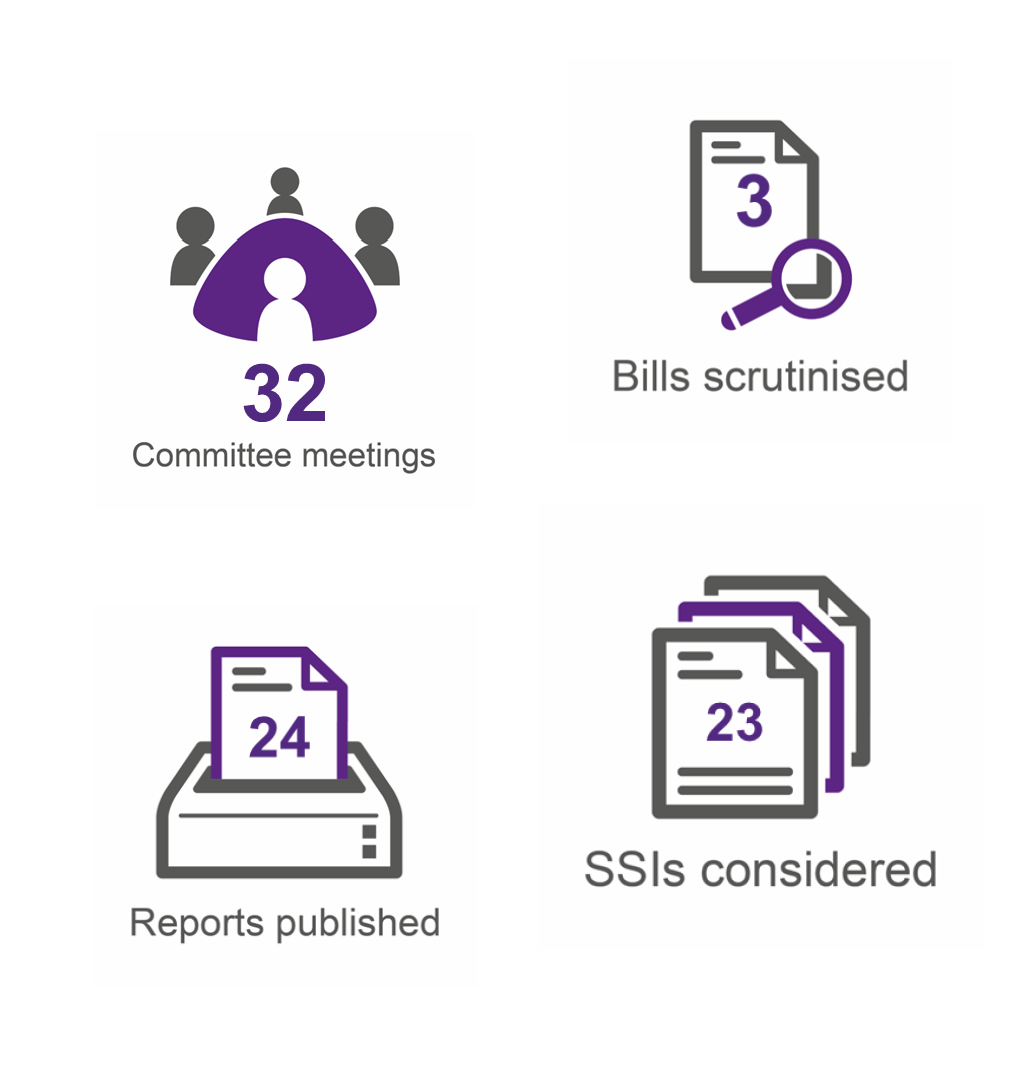
Of these meetings, one meeting was held jointly with a selection of members from the Health, Social Care and Sport Committee and the Social Justice and Social Security Committee, for the purposes of scrutinising the efforts to tackle drug deaths and drugs harm.
Legislation
Bills
Criminal Justice Modernisation and Abusive Domestic Behaviour Reviews (Scotland) Bill
In June 2025 the Committee considered Stage 2 amendments to the Criminal Justice Modernisation and Abusive Domestic Behaviour Reviews (Scotland) Bill.
This Bill makes permanent certain temporary powers relating to the criminal courts introduced in response to the COVID-19 pandemic, as well as introducing several new criminal court procedures. Part 2 of the Bill also creates a process for reviewing deaths which relate to abusive behaviour within relationships.
Various amendments were agreed to at Stage 2, for example an amendment which clarified the circumstances in which national jurisdiction could extend beyond initial custody hearings. The Scottish Government also brought forward amendments to address the Committee’s concerns that there should be nothing in Part 2 of Bill that would undermine the commonly understood definition of domestic abuse in Scotland.
Prevention of Domestic Abuse (Scotland) Bill
The Prevention of Domestic Abuse (Scotland) Bill was a Member's bill introduced on 7 May 2025 by Dr Pam Gosal MSP and referred to the Committee as lead committee for Stage 1 scrutiny. The Bill sought to introduce a series of measures aimed at reducing the incidences of domestic abuse and reoffending. Its provisions included the creation of notification requirements for certain domestic abuse offenders, enhanced assessment for rehabilitation programmes, strengthened data collection and reporting obligations, and measures relating to education and prevention.
The Committee launched a call for views which received 145 submissions from organisations and individuals. Five oral evidence sessions were held, and the Committee also considered reports from the Finance and Public Administration Committee and the Delegated Powers and Law Reform Committee.
Part 1 of the Bill proposed mandatory notification requirements for certain individuals convicted of specified domestic abuse offences, modelled in part on the notification framework applicable to sexual offenders. Those subject to the requirements would have been required to provide personal information to Police Scotland and to update that information periodically. A failure to comply would have constituted a criminal offence. Provision was also made for review of indefinite notification periods.
Evidence received by the Committee reflected strongly held and divergent views. A number of organisations supported the principle of enhanced monitoring, arguing that it would improve public protection, address perceived inconsistencies in risk management, and provide reassurance to victim-survivors. Some witnesses emphasised the importance of signalling the seriousness of domestic abuse as a form of violence and coercive control.
However, a substantial body of evidence raised concerns regarding proportionality, effectiveness and practical implementation. Witnesses questioned whether the proposed measures would materially improve victim safety beyond existing mechanisms, including Multi-Agency Public Protection Arrangements (MAPPA), Multi-Agency Risk Assessment Conferences (MARAC) and the Disclosure Scheme for Domestic Abuse Scotland. Concerns were expressed about potential duplication, resource implications for policing and justice social work, and the risk that expanding notification regimes without commensurate investment could dilute existing safeguards.
The Committee also heard evidence regarding human rights considerations. Any system imposing ongoing notification requirements engages rights relating to privacy, proportionality and rehabilitation, and must be justified as necessary and proportionate to a legitimate aim, namely the protection of others from harm. Witnesses highlighted the need for careful drafting to ensure clarity of thresholds, appropriate safeguards, and fair review mechanisms. Others cautioned against unintended consequences that might discourage reporting or place additional burdens on victim-survivors.
In relation to other Parts of the Bill, evidence addressed the importance of evidence-based perpetrator programmes, robust data collection to inform policy, and preventative education consistent with Scotland’s Equally Safe strategy. Several witnesses emphasised that long-term reduction in domestic abuse requires sustained investment in early intervention, specialist services, and culturally competent support for diverse communities.
On 16 January 2026, prior to the Committee’s consideration of its draft Stage 1 report, the Bill was withdrawn by the Member in Charge. In light of the substantial evidence gathered, the Committee agreed to publish a Summary of Evidence to inform any future legislative proposals in this area.
The Committee recognises that domestic abuse represents a significant violation of human rights, disproportionately affecting women and girls, and that Parliament has an ongoing responsibility to scrutinise measures designed to prevent harm, protect victims and uphold fairness and due process. The publication of the Summary of Evidence was intended to contribute constructively to that continuing debate.
Prostitution (Offences and Support) (Scotland) Bill
The Prostitution (Offences and Support) (Scotland) Bill (the Bill) was a Member's Bill. It was introduced on 20 May 2025 by Ash Regan MSP and referred to the Committee for Stage 1 consideration.
The Bill proposed to create a new offence of paying for sexual acts. The Bill also proposed to repeal the existing offence under section 46 of the Civic Government (Scotland) Act 1982 of soliciting and importuning by prostitutes. People who have been convicted of this offence in the past would have had their convictions quashed. Additionally, Scottish Ministers would have needed to ensure that a person who is, or has been, in prostitution is provided with help and support.
The Committee launched a public Call for Views on the provisions of the Bill from Monday 30 June to Friday 5 September. 541 submissions were received via the Citizen Space portal.
The Committee took oral evidence from witnesses between 26 June and 24 November 2025, including from the Scottish Government Minister for Victims and Community Safety and the Member-in-Charge of the Bill. The Committee also arranged to receive the personal evidence of individuals with lived experience.
The Committee considered the evidence received between late November and mid-January 2026, and published its Stage 1 report on the Bill on 23 January 2026.
In its report, the Committee acknowledged the strongly held views both for and against the proposal in the Bill to criminalise the purchase of sexual acts. The Committee unanimously viewed prostitution as a form of violence against women and children. The Committee supported the goal of reducing the prevalence of prostitution. However, the Committee identified concerns with the Bill as drafted. Taking into account all the evidence received, some Committee Members were content to recommend that the Bill should progress to Stage 2. Others were of the view it should not progress beyond Stage 1.
The Parliament debated the general principles of the Bill 3 February 2026. The Parliament disagreed to the general principles with a vote of 54 for, 64 against, 0 abstained. As a result the Bill fell.
Subordinate Legislation
During the parliamentary year, the Committee considered 23 Scottish Statutory Instruments ("SSIs"), 10 of which were negative instruments and 13 were affirmative instruments.
The affirmative SSIs were as follows:
The Restitution Fund (Scotland) Order 2025
The Home Detention Curfew (Amendment of Specified Time Periods) (Scotland) Order 2025
The First-tier Tribunal for Scotland General Regulatory Chamber Police Appeals and Upper Tribunal for Scotland (Composition) Regulations 2025
The First-tier Tribunal for Scotland General Regulatory Chamber (Police Appeals) (Procedure) Regulations 2025
The First-tier Tribunal for Scotland (Transfer of Functions and Members of the Police Appeals Tribunal) Regulations 2025
The Early Release of Prisoners (Scotland) Regulations 2025
The Sexual Offences Act 2003 (Notification Requirements) (Scotland) Amendment Regulations 2025
The Management of Offenders (Scotland) Act 2019 and the Prisoners (Early Release) (Scotland) Act 2025 (Consequential Modifications) Regulations 2026
The Antisocial Behaviour (Fixed Penalty Offences) (Miscellaneous Amendment) (Scotland) Order 2026
The Early Removal of Prisoners from the United Kingdom (Amendment of Specified Time Periods) (Scotland) Order 2026
The Hate Crime and Public Order (Scotland) Act 2021 (Characteristic of Sex) (Amendment and Transitional Provisions) Regulations 2026
The Prisoners (Early Release) (Miscellaneous Amendment and Transitional Provisions) (Scotland) Regulations 2026
The Antisocial Behaviour (Fixed Penalty Offences) (Miscellaneous Amendment) (Scotland) Order 2026
In addition to the subordinate legislation scrutiny outlined above, the Committee also considered one proposal for a UK Statutory Instrument under the Statutory Instrument Protocol.
Legislative Consent Memoranda
The Committee considered legislative consent memoranda for three UK Government Bills during the reporting year.
A legislative consent memorandum (LCM) and two supplementary LCMs relating to the Crime and Policing Bill were considered on 1 October 2025. The Committee also considered a third supplementary LCM for the Bill on 25 February 2026.
The Committee considered an LCM for the Sentencing Bill on 17 December 2025.
The Committee is due to consider LCMs for the Northern Ireland Troubles Bill and a supplementary LCM for the Crime and Policing Bill on 18 March 2026.
Inquiries/case studies
Inquiry into the harm caused by substance misuse in Scottish Prisons
In February 2025, the Committee agreed to undertake an inquiry into the harm caused by substance misuse in Scotland’s prisons. The inquiry was prompted by sustained concern regarding drug-related deaths in custody, the emergence of increasingly potent synthetic substances, and evidence from oversight bodies, families and practitioners that existing responses were not sufficiently reducing harm. The Committee was also mindful of the Parliament’s wider scrutiny of Scotland’s response to drug deaths and the recommendation of the People’s Panel that further consideration be given to drug supply and harm in prisons.
The inquiry sought to provide an evidence-based assessment of the extent and pattern of substance use in custody; the drivers of demand; the effectiveness of prevention, healthcare, treatment and recovery services; the impact on safety and staff wellbeing; and whether current governance, accountability and data arrangements support effective oversight. The Committee deliberately adopted a whole-system lens, recognising that prisons sit at the intersection of justice, public health and social inequality.
The Committee held six formal evidence sessions and received 32 written submissions from a wide range of stakeholders during its call for views, including Scottish Government Ministers, the Scottish Prison Service (SPS), Public Health Scotland, Police Scotland, NHS representatives, the Prison Officers’ Association Scotland, academics, third-sector organisations and individuals. Members also undertook visits to HMP Grampian and HMP Edinburgh to observe practice on the ground. In addition, the Committee held private engagement sessions with individuals with lived and living experience of substance use in prison, and with family members. These sessions provided important insight into the human impact of policy and operational decisions.
Evidence presented to the Committee highlighted a complex and evolving landscape. Drug Trend Testing data demonstrated high levels of substance use on entry to custody, and witnesses described the growing presence of synthetic cannabinoids and emerging threats from nitazene-type opioids. The Committee heard that many individuals entering custody present with multiple and overlapping needs, including trauma, mental ill-health, poverty and homelessness. Substance use in custody was frequently described not as an isolated behavioural issue, but as symptomatic of broader unmet health needs.
The Committee also heard that severe overcrowding, staff shortages and limited purposeful activity contribute to both demand and supply. Witnesses emphasised the impact of synthetic drugs on staff safety, describing unpredictable behaviour and medical emergencies. The Committee recognised the pressures placed on prison officers and healthcare professionals operating in this context.
Throughout the inquiry, the Committee was mindful that people deprived of their liberty retain their fundamental human rights, including the right to life and the right to the highest attainable standard of health. Evidence suggested variability in access to mental health support, withdrawal management and continuity of care on release. The Committee therefore considered the adequacy of clinical governance, implementation of Medication-Assisted Treatment (MAT) standards within custody, and arrangements for throughcare and reintegration.
The Committee’s report concluded that substance-related harm in prisons cannot be addressed solely through enforcement measures. While effective security and disruption of supply are essential, they must be balanced with harm reduction, evidence-based treatment and rehabilitation. The Committee made detailed recommendations relating to healthcare provision, data collection, workforce capacity, accountability structures, and continuity of care between custody and community settings. The report was published on 16 January 2026.
Reducing drug deaths in Scotland and tackling problem drug use
During Session 6, the Committee continued its scrutiny of Scotland’s response to drug deaths and drug-related harm, including through sustained cross-committee working with the Health, Social Care and Sport Committee and the Social Justice and Social Security Committee. This collaborative approach reflected the cross-cutting nature of the public health emergency declared in 2021 and the recommendations of the Scottish Drug Deaths Taskforce.
Joint meetings were held periodically to examine progress in delivering the National Mission on Drugs and to assess the impact of measures across justice, health and social care portfolios. This approach enabled Members to consider policy in a holistic manner, recognising that effective responses to drug harm require coordinated action across institutional boundaries.
The Committees scrutinised implementation of the Medication Assisted Treatment (MAT) Standards, the expansion of residential rehabilitation capacity, the operation of the National Naloxone Programme, and the effectiveness of the Rapid Action Drug Alerts and Response (RADAR) system. Members also examined emerging trends, including the increasing prevalence of cocaine and the growing threat posed by synthetic opioids such as nitazenes.
National Records of Scotland figures published during the year showed a reduction in drug misuse deaths compared with the previous year, although levels remained historically high. Public Health Scotland data indicated changing patterns of harm, including shifts in substances implicated in hospital admissions and emergency attendances.
Throughout this work, the cross-committee emphasised that responses to drug harm must be grounded in public health evidence and human rights principles. Individuals affected by substance use disorders are entitled to access appropriate treatment and support without stigma or discrimination. The cross-committee therefore examined issues relating to equitable access to services, the sustainability of workforce capacity, data transparency, and the need for robust monitoring of outcomes.
The cross-committee legacy report agreed in February 2026 summarised the scrutiny undertaken during Session 6 and identified areas requiring continued parliamentary oversight in Session 7, including the long-term sustainability of the National Mission, the resilience of treatment services, and preparedness for emerging synthetic drug markets.
The impact of Brexit on policing and judicial co-operation in Scotland: presentation of research
In our 2024-25 Annual Report, we reported on the Committee's scrutiny of the impact of Brexit on policing and judicial co-operation in Scotland. This included the findings of research commissioned by the Committee and SPICe from Gemma Davies, Associate Professor of Criminal Law, Durham University and Helena Farrand Carrapico, Professor of International Relations and European Politics, Northumbria University.
Their research report identified the impact of the UK’s exit from membership of the EU on law enforcement and judicial cooperation in Scotland. It also suggested actions the UK should seek to take with the EU to address some of these impacts.
In the wake of this work, the Committee wrote to the Scottish Government, the UK Government, the Lord Advocate and Police Scotland, bringing the findings of the Committee's scrutiny to their attention. The Committee also sought responded from these key stakeholders on how such impact could be addressed as part of the upcoming review of the UK-EU Trade and Cooperation Agreement in Q2 of 2026.
In response, between June and August 2025 the Committee received correspondence from the UK Parliamentary Under-Secretary of State for Justice, the Chief Constable of Police Scotland, the Scottish Government Cabinet Secretary for Justice and Home Affairs and the Lord Advocate.
The Committee will set out further details of this work to its successor committee by way of its Session 6 legacy report, in March 2026.
Challenges facing businesses and vulnerable individuals in Scotland from cybercrime
During 2025, the Criminal Justice Committee undertook scrutiny of the challenges facing businesses and vulnerable individuals in Scotland from the risks of cybercrime. The focus of this work was to help inform parliamentary debate and raise awareness of the impact of cybercrime and cyber-security.
The Committee wanted to examine the impact of cybercrime on particular individuals such as the elderly, as well as the impact on those in employment and the wider business community across Scotland.
The focus of our work did not cover elements of child exploitation, as that is an area that has already received substantial debate in the public and parliamentary realm.
This scrutiny aims to consider how authorities in Scotland coordinate with key partners across the UK and internationally, with the aim of:
Gaining an oversight of how sophisticated cybercrimes have become today, and what we are likely to face in the coming years
Discussing how policing/law enforcement bodies prioritise their response to cybercrimes
Considering whether policing bodies have the tools and resources necessary to properly investigate cybercrimes reported to them
Considering whether laws on cybercrime are keeping pace with developments
Looking at how key justice sector, business, and civil society partners are working to try to help protect people and businesses in Scotland from the latest cybercrime threats.
On 14 May 2025, the Committee took written and oral evidence from a number of witnesses on the issue of cybercrime and cyber security.
Following this, the Committee sought more written evidence for various stakeholders, including the Scottish Government.
On 12 December 2025, the Committee published a summary report of the scrutiny it had undertaken on cybercrime.
This report was debated by the Parliament on 17 December 2025.
The Committee will set out further details of this work to its successor committee by way of its Session 6 legacy report, in March 2026.
Budget Scrutiny
This year sees the final year of pre-budget scrutiny for Session 6 as the Committee examined the proposals for the justice portfolio in the 2026/27 Scottish Budget.
The aim of the Committee's scrutiny is to examine the spending priorities of the Scottish Government across the justice portfolio against the backdrop of a flat-cash settlement for the last three years.
The Committee also focussed its pre-budget scrutiny on the efforts criminal justice sector organisations are making in helping to meet Scotland's carbon reduction targets under its draft Climate Change Plan.
The Committee also wished to consider the needs of key justice sector organisations going forward when set against the backdrop of the Scottish Spending Review for 2027/28 to 2029/30.
Pre-budget scrutiny of the 2026/27 was complicated this year by the decision of the UK Government to delay the publication of its budget from October 2025 to late November 2025. This meant the Scottish Government could not finalise its own budget plans before the start of the new year.
The Scottish Budget was published on 13 January 2026, alongside the outcomes of the Scottish Spending Review for 2027/28 to 2029/30.
This meant the Committee was requires to take pre-budget written and oral evidence on the 2026/27 budget before the Parliament, or key stakeholders, knew their proposed funding settlements for the coming year.
The Committee undertook a public a call for view on the 2026/27 budget between 7 July and 9 September 2025, and received 25 submissions.
The Scottish Government's 2022 Resource Spending Review (‘RSR’) proposed a flat-cash settlement for the justice sector for the financial period up to the 2026/27 Scottish budget at the end of Session 6.
Owing to the demands of Stage 1 scrutiny on various bills in late 2025, the Committee decided to focus its pre-budget oral evidence taking on hearing from the major expenditure stakeholders in the criminal justice sector.
Between 5 and 26 November ,the Committee took evidence from the Crown Office and Procurator Fiscal Service, Police Scotland and the Scottish Police Authority, the Scottish Courts and Tribunals Service, the Scottish Fire and Rescue Service and the Scottish Prisons Service. We concluded oral evidence taking by hearing from the Cabinet Secretary for Justice and Home Affairs.
The Committee published its Report on its Pre-Budget Scrutiny 2026/27 on 19 December 2025. The Committee highlighted its concerns over the unsustainable pressures not facing key parts of the criminal justice sector as a result of the flat-cash settlement of recent years
The Convener of the Criminal Justice Committee set out the Committee key findings and recommendations to the Parliament which debated the Committee’s recommendations as part of the Stage 1 debate on the Finance and Public Administration Committee’s report on the budget on Wednesday, 21 January 2026.
Following the publication of the 2026/27 budget and the Scottish Spending Review, the Committee had concerns regarding the level of funding provision provided to the justice portfolio stakeholders.
As a result, the Committee has asked key stakeholders to provide further oral evidence on the impact of the budget settlement for their ability to deliver their functions.
These evidence session took place between 4 February and 4 March 2026. The Committee will set out further details of its budget scrutiny to its successor committee by way of its Session 6 legacy report, in March 2026.
Challenges and reforms facing the Scottish Fire and Rescue Service
The Scottish Fire and Rescue Service (SFRS) was established on 1 April 2013 by Part 2 of the Police and Fire Reform (Scotland) Act 2012. It succeeded the eight regional fire and rescue services which continued on after the abolition of local government regions in 1996 and the introduction of 32 unitary local authorities.
Throughout Session 6 the SFRS, the Fire Brigades Union (FBU) and others have liaised with the Committee on their very serious concerns for the future capacity of the SFRS to meet all of the challenges it faces.
These are also set against the backdrop of a flat cash settlement for the SFRS from the Scottish Government over the period since 2021/22 coupled with decreasing numbers of wholetime, part-time and retained firefighters.
In October 2023, the FBU published its Firestorm Report to inform MSPs and the public of the challenges faced from issues like climate change, changes to employment and working patterns, problems with recruitment and retention of firefighters, firefighter safety and wellbeing on issues such as decontamination facilities, RAAC concrete in older fire stations and insufficient numbers of appliances and firefighters available to provide sufficient cover across Scotland, leading to increased response times to 999 calls.
The report also highlighted a growing backlog of necessary maintenance in the SFRS’s fleet and estate development, estimated to be over £800 million by 2025/26
The current SFRS Service Delivery Plan (SDR) covers the period from FY 2021/22 to FY 2026/27. The Board of the SFRS has been consulting on options for a new SDR which may look to reshape of the way in which the SFRS delivers its services throughout Scotland.
In the wake of these growing concern the Committee has examined funding and investment deficiencies as part of its pre-budget scrutiny of the 2026/27 budget. The Committee has also considered the implications for the SFRS going forward of the near flat-cash settlement proposed in the Scottish Spending Review for 2026/27 - 2029/30.
The Committee also took and written and oral evidence from the FBU on 3 December 2025. It took further written and oral evidence from the FBU on the progress of the SDR on 4 February 2026. A final decision on the SDR by the Board of the SFRS was expected by December 20205. However, this has now been delayed until the end of June 2026.
The Committee will set out further details of its budget scrutiny to its successor committee by way of its Session 6 legacy report, in March 2026.
Non-fatal strangulation
The issue of non-fatal strangulation (NFS) has been an ongoing area of significant interest for the Committee. On 23 April 2025, the Citizen Participation and Public Petitions Committee referred petition PE2136, in the name of Fiona Drouet, Make non fatal strangulation a standalone criminal offence in Scotland, to the Committee.
On 21 May 2025, the Committee held a one-off session on the issue of non-fatal strangulation. The Committee took evidence from Fiona Drouet, petitioner and CEO and founder of EmilyTest, Assist, the Institute for Addressing Strangulation, the Crown Office and Procurator Fiscal Service, Police Scotland, the Law Society of Scotland and the Police Service of Northern Ireland. At this meeting, the Committee agreed to keep the petition open and to write to the Scottish Government and the Lord Advocate.
On 23 June 2025, the Committee received a response from the Lord Advocate, outlining her views on NFS becoming a standalone offence in Scotland and the collection of better data on the prevalence of NFS. On 22 July 2025, the Committee received a response from the Cabinet Secretary for Justice and Home Affairs which committed to carrying out a comprehensive assessment of the relevant law in this area.
On 26 February 2026, the Cabinet Secretary for Justice and Home Affairs wrote to the Committee to advise that the Scottish Government had published a consultation on a number of areas - including NFS - to help improve protection within the justice system for women and girls. The consultation will run until June 2026.
Policing and mental health
The police response in Scotland to dealing with vulnerable people, including people in mental health crisis or responding to mental-health related incidents has been a key area of ongoing scrutiny for the Committee since the start of Session 6.
While police have a valid role as first responders when called to an incident, the Committee has previously heard evidence that there are challenges for the police after the initial call out in terms of referring any individuals involved to appropriate services.
Recent years has seen an ever-growing demand on Police Scotland to look after vulnerable people for long periods after the initial incident. This issue required a more joined-up approach between the police and criminal justice system, and a range of health and well-being service providers to effectively address the intersectional nature of this kind of policing.
This scrutiny has included looking at the increased demand this work is having on police resources, as well as considering how this might be more appropriately supported by other public services, such as the NHS or social work.
The Committee has also been keen to examine how Police Scotland and the Scottish Police Authority support the mental health and welfare of police officers and police staff to ensure their well-being as employees.
This involves looking at the challenges of frontline policing, and scrutinising the efforts of Police Scotland and the Scottish Police Authority to improve the support provided to police officers and staff in relation to their own mental health and well-being. This has included the issue of police suicides.
The Committee's scrutiny on this issue since May 2022 is set out online.
On 18 February 2026, the Committee took further written and oral evidence from the Scottish Government, the Scottish Police Federation and Police Scotland and the progress made to date in addressing the police response to vulnerable people, as well as support for the well-being of police officers and staff.
The Committee will set out further details of its budget scrutiny to its successor committee by way of its Session 6 legacy report, in March 2026.
Equal Opportunities
The Committee’s main area of interest in relation to its work and equal opportunities has been its focus on the consideration of policies aimed at tackling various aspects of gender-based violence, such as its consideration of various pieces of proposed legislation and consideration of the plans to tackle non-fatal strangulation.
The Committee has also looked at issues around inequalities in the provision of health and mental health in the context of the support offered in prison to those with drug and alcohol related conditions.
Post legislative scrutiny
The Committee did not conduct any post-legislative scrutiny inquiries in this parliamentary year due to competing business, particularly related to the volume of legislation being considered.