Adult Social Care and Support in Scotland 2026 update
This briefing describes how adult social care and support operates in Scotland. It includes information on the history, key legislation and policy to help explain the 'system' that comprises adult social care and support. It also includes data from key sources. Session 7 of the Scottish Parliament is expected to see public service reform which is likely to impact on what is covered in this briefing.
Executive Summary
Adult social care comprises all forms of personal and practical support for adults who need extra support (which also applies to children and young people). It describes services and other types of help, including care homes and supporting unpaid carers to help them continue in their caring role. It means supporting people to:
live independently
be active citizens
participate and contribute to our society
maintain their dignity and their human rights
supporting people to stay at home or in a homely setting, with maximum independence, for as long as possible.
Historically, social care has been distinct from health care. The organisation of social care services was the responsibility of local authorities, and elected, local councillors were accountable for services. Health services were the responsibility of health boards, which are directly accountable to the Scottish Ministers. This distinction is important because it means that services were organised through different governance and delivery structures.
Legislation and Policy since 1990 has:
described, defined and classified elements of social care support
created categories of person requiring support
codified an assessment of need
created eligibility criteria
introduced regulation and registration for staff and services
introduced standards and principles of care (rights based)
sought to (re)-integrate health with social care support
sought to empower the individual through choice and control over the support they receive, with a rights-based approach
acknowledged the role, the needs and rights of unpaid carers to improve the consistency of support they receive.
The Self-directed Support (Scotland) Act 2013 1makes legislative provisions relating to the arranging of care and support, community care services and children's services to provide a range of choices to people for how they're provided with support. The aim of the legislation is to increase the choice and control individuals exercise in how their care is organised and delivered, and by whom.
Health and social care integration, established by legislation in 2014 (Public Bodies (Joint Working) (Scotland) Act 2014)2 was a major effort to, in effect, merge what had become two distinct spheres of activity, legislation, governance and resource. The focus had been on handing the control of elements of separate health board and local authority budgets to a new body, the integration authority, made up of councillors and non-executive directors and a range of stakeholders to establish 'joined up' services from the point of view of those using them.
Social care and community healthcare are the responsibility of integration authorities. They are responsible for the planning, budgeting and commissioning of social care services Health and Social Care Partnerships are the public-facing bodies, which are responsible for the operational delivery, bringing together health board and local authority offices and staff. Local authorities are the contracting partners, procuring social care services from external providers.
The Care Reform (Scotland) Act 2025 started life as the National Care Service (Scotland) Bill in 2022. It sought to introduce structural change such that the Scottish Ministers would have overall responsibility for social care through a National Care Service National board, and creating local care boards, replacing integration authorities. However, the Bill as introduced did not provide clarity on the status of local authorities, whose statutory responsibility for providing services was unchanged. Nor did the Bill make provision for any changes to the delivery landscape of social care, which predominantly comprises independent providers. The Bill was heavily amended at Stage 2, with all the substantive structural proposals removed. SPICe created a 'hub' for National Care Service related publications and blogs covering the years 2021 - 2025
Commissioning and procurement are frequently talked and written about as if they were part of the same process. However, the distinction is key. Integration authorities commission services according to local need, while local authorities, are responsible for procuring and contracting care from providers. This means that the procurement of social care services is not necessarily distinct from the procurement of other council services in terms of process, such as road resurfacing and transport in the wider sense, although there are specific rules and regulations that councils must abide by. There is3specific best practice guidance for social care procurement, and 4Scottish model procurement guidance defines value for money as the best balance of cost, quality and sustainability and that this should be reflected throughout strategy development, reporting and procurement processes.
Social care services are regulated by the Care Inspectorate (CI). This body, legally known as Social Care and Social Work Improvement Scotland, registers and inspects care services across Scotland.
Social care staff are regulated by the Scottish Social Services Council (SSSC). The SSSC liaises with the Care Inspectorate, the regulator for social care provision, as well as other partners such as Skills Development Scotland. The SSSC Register was set up under the5Regulation of Care (Scotland) Act 2001 to regulate social service workers and to promote their education and training.
In 2020 the Scottish Government commissioned an independent review of adult social care which was chaired by Derek Feeley and the 6report was published in February 2021.
The COVID-19 pandemic in 2020 had a profound effect on social care services and how people received their care. Improvisation and innovation were required at speed from providers and people being supported. There have been many reports of how communities became the focus of local support and how the sluggish progress of integration was suddenly accelerated and changes thought too difficult were quickly implemented by local partnerships between public bodies, and between public bodies and the third sector.
Despite the overlay of the pandemic in 2020, and the sharp focus on social care at the time, many of the intractable problems with social care have been rehearsed over many years and much time has been devoted to them, and they remain. Despite changes to legislation that have happened in Scotland and not in England, such as introducing free personal and nursing care, the problems have not been 'solved'. These include so-called 'catastrophic costs' - the high costs of care that can accrue quickly in later life by those who have to pay for their own residential care (often more than £100,000), recruitment and retention of staff, and inequity in how different diseases are regarded and treated by the NHS: cancer and dementia for example. Below is a list of the main issues affecting social care, as identified to the Health and Sport Committee and Health Social Care and Sport Committees over the last two parliamentary sessions by many stakeholders:
Funding
Commissioning and procurement
Self-directed Support
Workforce
Alternative Models of Care
Integration of health and social care
Housing
Technology
Human Rights based approaches to social care
Community focus in planning
Third Sector
Accountability
For Session 7, 'social' has been removed from the Cabinet Secretary and Ministerial titles; social care and integration and the social care workforce are the responsibility of the Minister for Community Care.
Introduction
Health and social care have been formally integrated since legislation was passed in 2016. New bodies, called integration authorities were established and these are now responsible for ensuring that health and care of local populations is organised collaboratively by health boards and local authorities - with services being delivered through health and social care partnerships. According to the Scottish Government, these bodies should focus on primary prevention and good public health outcomes for everyone 1. Care should be person-centred and, where appropriate, community-based in homely settings. Preventable diseases and conditions should reduce over time, reducing the reliance and burden on hospital care.
There is not a national health and care service, despite integration, and many people, depending on their financial circumstances, will have to pay towards some of their social care support, and accommodation costs if they require care in a care home.
Most studies conclude that the demand and costs for health and social care will increase over the next decades in the following ways:
Price effects: general price inflation within health and social services means increased costs for individuals and services, as do rising energy costs and increased pay for the workforce. As in other sectors, pay represents a significant proportion of the care provided.
Demographic change: this includes the effect of population growth on the demand for health and social care services, the impact of a population living longer, often with more complex health and care needs, and demographic change in the workforce itself.
Non-demographic growth: demand-led growth, generated by increased public expectations and advances in new technology or service developments, for example expenditure on new technology and drugs.
Workforce requirements and sustainability of services, most of which (80%) are provided by private, independent or third sector organisations.
Rurality and remoteness: the geography of Scotland includes many rural and remote areas where all the above pressures impact more acutely. Urban areas can experience pressures from rapid population growth.
Changes to UK immigration policy for health and social care staff: overseas recruitment of social care workers ended on 22 July 2025.
People assessed as needing support and care access it in Scotland through Self-Directed Support. This is a statutory approach which intends to place an individual in control of the care and support they receive, through four different options. Option 1 or 'direct payments' enables them to organise their own care and support. Other options allow different degrees of control over the their allocated budget to achieve the outcomes agreed between social services and the individual along with their representatives.
According to many commentators and reports, the principles of both integration and self-directed support continue to be confounded and undermined by the complex interplay of persisting structures and entrenched practices, as well as an overarching unresolved problem: a sustainable and fair way of funding social care in the context of rising demand. See, for example Audit Scotland's 'Transforming Health and Social Care Hub', the Coalition of Care and Support Providers Scotland (CCPS) publications and LGiU's Next steps in social care reform. Overall, these challenges are compounded by a lack of widespread public awareness of the distinction between the NHS and social care provision, until they have to navigate it for themselves or their family. In 2024, alongside scrutiny of the National Care Service (Scotland) Bill, the Health, Social Care and Sport Committee undertook post-legislative scrutiny of the Social Care(Self-directed Support) (Scotland)Act 2013.
This briefing seeks to explain and explore some of this complexity and challenge and provide a comprehensive guide to how social care operates for individuals, as well as providing a summary of the history, legislation, policy, and structures that underpin social care in Scotland.
Definitions of social care support
Adult social care, which is the focus of this briefing, covers social care support for all adults over the age of 18 (but in some circumstances over 16), such as those with a physical and/or learning disability. It is not just about the care and support available to people who are older. However, the issues facing different groups, policy makers and providers of services do vary. This briefing will highlight issues in common, and in particular, to specific groups. Over the years social care has been defined and described in a range of ways.
The Scottish Government defined social care as :
Social care means all forms of personal and practical support for children, young people and adults who need extra support. It describes services and other types of help, including care homes and supporting unpaid carers to help them continue in their caring role...
...Social care support is about supporting people to:
live independently
be active citizens
participate and contribute to our society
maintain their dignity and their human rights
We are committed to supporting people to stay at home or in a homely setting, with maximum independence, for as long as possible.
Source: Social Care, Scottish Government
However, this definition was superseded with the advent of the National Care Service narrative to a simpler:
Social care supports people with daily living so they can be as independent as possible.
It can also help people who look after a family member or loved one, like an unpaid carer.
The King's Fund provide a more detailed definition of social care. However, they also argue that 'social care' is not a phrase widely used or understood by the general public. Surprisingly perhaps, there is no single definition of 'social care' in legislation and it has no recognisable 'brand' as the NHS does:
Richard Humphries reflected at the end of last year: 'A troubled NHS easily commands public attention through visual images of overflowing hospitals and queuing ambulances. But when the social care system is “full”, few notice, the consequences scattered silently and invisibly across thousands of homes and families. It makes little noise on the radar of political and public concern.’
Source: The Guardian (from King's Fund blog 'Social Care: What's in a name?) 2017
In policy, the distinction between health and (social) care is now less pronounced, even though in practice, the very different structures mean there remains a distinct divide. This policy directionreflects the desire of policy makers to remove separation between the spheres of health and social care support, along with a move to focus on prevention.
Changing demography
The Scottish Government estimates that the number of people aged 75 and over in Scotland is set to increase by 85% by 2039. By this estimate then, in 2039, over 800,000 people will be over the age of 75. This changing demography will have a profound effect on social care provision for all age groups who require care and support. As the birth rate also declines, a smaller pool of working age people will contribute to social care and other state-funded services and benefits.
The chart here shows some of the data available relating to the changing demographics in Scotland and the demand for social care.
Figure 1 shows that between 2018 and 2043 there will be an estimated 4 percentage point rise in people of pensionable age.
Vertical bar chart showing a reduction (324,000) of people aged under 30 and a similar increase (301,000)in people aged over 75 by 2049
.png)
National Records for Scotland - Projected Population of Scotland: 2024-based - National Records of Scotland (NRS)
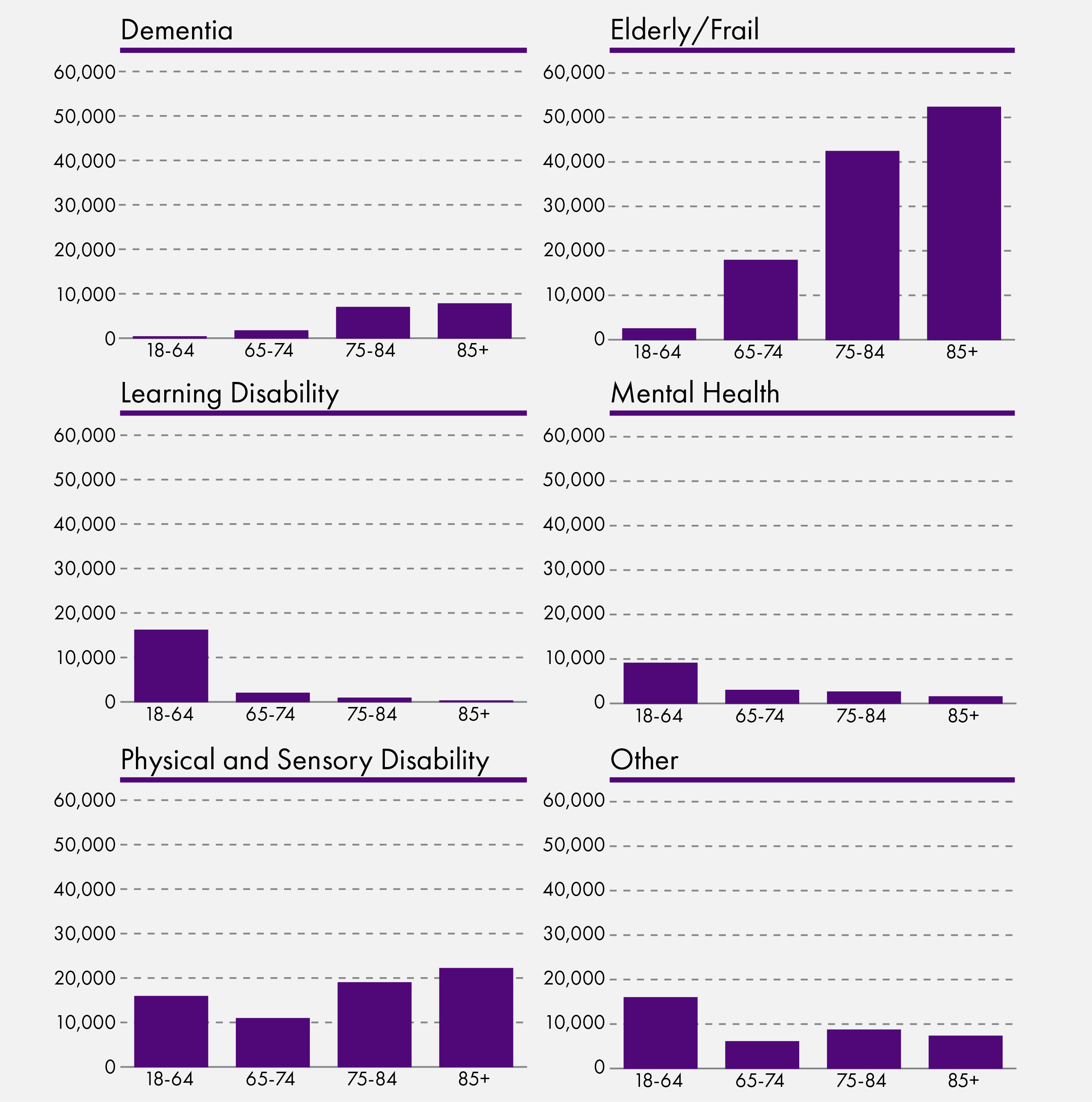
Figure 2 below shows the frail elderly are the biggest group receiving social care support.
This chart shows the numbers of people in different groups and age sets receiving social care support between 2018 and 2024. It could be that individuals will fall into multiple categories.
History of social care
Health care and social care have very different histories, and it is worth providing a broad sweep of the social history of social care to provide some context. The introduction of Free Personal Care and Self Directed Support, (Social Care (Self-directed Support) Act 2013), also demonstrate the distinct path that Scotland has taken since devolution. The integration of health and social care is another marked structural shift seeking to collapse two previously separate spheres of activity and culture. This section tracks the development of the concept of social care from earliest records of civic organisation.
The responsibility for social care has always been with local communities and authorities, and used to include the healthcare of those who were considered destitute. Prior to the inception of the NHS, public health was also the responsibility of local councils or parishes, and covered the provision of clean water, sanitation, and the control of infectious diseases. Prior to the middle of the nineteenth century, the notions we now have of healthcare (and social care) did not really exist at all . If we were ill, and could afford it, we went to to the doctor who charged for his/her services. If we were poor and couldn't work, because of infirmity, we approached the local parish authorities, or in earlier times, the monastic bodies.
The National Records Office for Scotland provides information on records relating to poor relief which has been used to provide this background.
Social (and health) care emerged from 'Poor Law' legislation, from as early as 1424 in Scotland. The 'Old Poor Law' dates from 1574, and was the main legislation governing how those who couldn't afford to support themselves and their families should be assisted. After the Reformation (ca. 1560), and the demise of monastic orders, the responsibility for the poor fell on the parish, jointly through the local landowners and the kirk sessions. The landowners often made voluntary contributions to the poor fund in preference to being assessed for a tax on their land or property. It was assumed that anyone physically able to earn a living was doing so, and assumed that there was always access to employment of some kind. Consideration was therefore given to those who, 'through no fault of their own', by way of disability or illness for example, were unable to support themselves. This set the stage for concept of the 'deserving' and 'undeserving poor', which hadn't previously existed. Once established, it has become hard to shift and persists in current narratives around welfare and social security support.
Following the 1Poor Law Amendment (Scotland) Act of 1845 parochial boards were set up in each parish to administer poor relief. There was continuation in that the kirk sessions and landowners made up the boards. Individuals would apply to the boards for assistance and could appeal decisions through the sheriff courts.
Destitution boards were set up after 1846 to cope with the widespread poverty in the Highlands, following the failure of the potato crop. Between 1847 and 1852 the boards distributed meal in return for work, for example road building, fence repair and knitting.
Where the parish system of providing poor relief was found to be inadequate, especially in more urban areas, by sheer volume of people, private charities filled some of the gaps. These charities founded schools, hospitals and orphanages.
A series of UK Acts were introduced between 1875 and 1929 paving the way for thesystem of local government to be established, that we recognise today. Public health became the responsibility of councils, in areas such as the control of infectious diseases like tuberculosis and cholera. Concerns about sanitation and spread of disease had grown alongside rapid urbanisation and the associated health hazards of large populations - how human waste was dealt with for example.
Schedule 1 of the Local Government (Scotland) Act 1929 , shows the range of statutory provisions, from various legislation, and functions transferred to county councils including such things as notification of infectious diseases, maternity and child welfare and public health.
The National Assistance Act of 1948 covered the whole of the UK and contained provisions about welfare and accommodation for those in need of care and support. However, most of the provisions of this were replaced by the 2Social Work (Scotland) Act 1968, which remains the basis for current policy and practice.
Scotland's NHS Act came after the NHS Act in England and Wales (1946). The National Health Service (Scotland) Act 1947 came into effect on July 5, 1948 and created the National Health Service in Scotland. Many sections of the Act were repealed by the National Health Service (Scotland) Act 1972 and the remaining provisions were repealed by the 3National Health Service (Scotland) Act 1978. These Acts underlined and established the separation of health and social care.
This exchange in the House of Commons in October 1968 provides an overview of the fluctuations in thinking, placement and organisation of health and social care during the twentieth century up to the Social Work (Scotland) Act 1968.
Social care is not organised like health care...yet
Historically, social care has been distinct from health care. However, a long journey to effect better co-ordination between health and care services culminated in legislation in Scotland to integrate the two:1The Public Bodies (Joint Working) Scotland Act 2014
In simple terms, historically, the organisation of social care services was the responsibility of local authorities, and elected, local councillors were accountable for services. Health services were the responsibility of health boards, which are directly accountable to the Scottish Ministers. This distinction is important because it means that services were organised through different governance and delivery structures.
The integration of health and social care2sought to collapse the distinction between the two governance and accountability structures to ensure that those who plan, design and deliver services, whether employed by the local authority or the health service, do so in close collaboration.
Importantly, strategic planning of certain health and social care services, commissioning of those services and the related budgets of health boards and local authorities covering health and social care are the responsibility of integration authority boards (usually an Integration Joint Board (IJB)). The IJB is responsible for planning the health and care services that have been delegated to it and it has full power to decide how to use related resources and plan the services, delegated to them from the NHS boards and the local authorities, to improve the health and well-being of the people in their area. Integration authorities were created by the 2014 legislation.
Under the legislation some services must be delegated to the IJB by the Local Authority 3and by the Health Board 4, and some may be delegated. This is done through the strategic commissioning plan, and binding directions from the IJB to the Health Board and Local Authority:
This table shows those services which are delegated to the integration authority from the Health Board or Local Authority. The integration authority directs the budget for the services delegated to it.
| Must be delegated | May be delegated | |
|---|---|---|
| NHS Health Boards | Adult primary care (including general practice, public dental service, opthalmic services, pharmaceutical services, out of hours) | Children's health services (health visiting, school nursing etc.) |
| Adult community health | Acute Specialist Care (some elements of planned hospital care) | |
| Unscheduled hospital care (A&E, general medicine, geriatric medicine, palliative care, mental health services etc) | Non-specialist public health (health improvement) | |
| Local Authorities | Adult Social Care | Children's social work |
| Support Services - Occupational therapy, day services and equipment | Justice social work | |
| Carer Support services | Housing support (homelessness services and wider community support) |
The discretionary services that have been delegated vary from one integration authority to another. For example, 19 have Children's Health delegated and 10 have Children's social work delegated. Planning for the National Care Service (NCS)sought to create national consistency for delegated services, bringing Children's social work in as a delegated function in every integration authority area. However, the NCS appeared to potentially undermine integration, with the creation of health and social care boards, directly funded by the Scottish Government, while maintaining the 14 territorial Health Boards. As part of wider public service reform plans announced in the 2026 Programme for Government5, the Scottish Government proposes a drastic reduction in the number of territorial or area Health Boards to two, covering the east and west of Scotland respectively. Separate proposals have been mooted for the island health boards.
There is a lack of clear data or conclusive research6on the impact of delegating or not delegating services, but it would be very difficult to assess on available data, and depends on a range of immeasurable factors such as organisational culture, stability and availability of services, budgetary pressures/choices etc.
In practice, the collapsing of the structural, financial and cultural boundaries between health boards and local authorities has been challenging. Integration should be viewed from the perspective of the service user: if services and support do not appear to be 'joined up' from their point of view, then it could be deemed that integration isn't working (see: Scottish Government Ministerial Strategic Group Progress Review 2019) 7.
This briefing focuses on adult care and support services, and in particular, publicly funded care provided by local authorities for those individuals who cannot afford to pay for all, or any of their own care. The local authority has a duty to assess anyone's needs, regardless of ability to pay. The local authority also has to ensure that there are services to cover local care and support needs.
However, there is an unknown number of people who pay for their own support needs, whether at home or in residential accommodation. Some may never approach the local authority for support, even though they might be entitled to Free Personal Care. Up until 2021-22, data on social care need and provision were relatively sparse compared with health and NHS data. Data quality was also an issue because of the way local authorities collected data, and what was collated. Since then, available data have been increasing. For example the number of people requiring a social care assessment for care at home services, and number of hours needed, is now reported, providing some insight into unmet need. The care and support of those with needs not being met by local authorities may be met by family carers, neighbours and friends. Some of these people will not be aware that they are entitled to support, will not be deemed eligible for support or are waiting for support to be put in place.
Also, while local authorities provide some or all of the funding for those they support, they do not provide all the services. There is a mix of private, voluntary sector, not-for-profit and in-house (local authority/Health and Social Care Partnership) provision. Most care and support (around 75%) is provided by private, independent providers. There are, of course, many individuals who purchase their own care and support, and enter into individual contracts with carers, personal assistants, and care homes, for example, but the the landscape is very complex. Some providers contract with several local authorities separately, and there are some highly specialised providers unable to meet the demand, which drives up costs. The local authority might be the only 'block' or spot purchaser of care services. This creates a monopsony, a situation where there is a single purchaser and a range of suppliers. This can, in any market or labour situation, drive prices or wages down, as suppliers compete for contracts. See an exploration of alternative ways to plan, purchase and pay for social care8 by the Coalition of Care and Support Providers Scotland (CCPS) and for further information on how the 'market' operates9 in social care.
A brief aside: Social Care and Social Security Benefits
This briefing does not go into any detail about the support people receive through the social security benefits systembut, since a range of benefits have been devolved to the Scottish Ministers in recent years, and the introduction of Direct Payments and Self-directed Support in 2013, the narrative of both spheres of policy - social security and Self-directed Support - have overlapped, in relation to independence, investment in people, taking a rights based approach and enabling the means to participate in community life. .
They are two quite distinct spheres of both legislation and policy, despite a shared early history, prior to the establishment of the welfare state, and it looks as though they will remain so. There is at least one important distinction: social security benefits are not audited in the way that self-directed support direct payments are. Once a person is deemed entitled to social security benefits, they are not audited, whereas budgets and payments made to support social care arrangements are. This is because the payments emanate from different sources, social security comes directly from central government and social care budgets from local authority funding and these budgets are not ring-fenced at a national level Some confusion can occur therefore, if someone regards their direct payment as a fixed and ongoing payment (as social security benefits are), when in reality, local authorities will review and change direct payments in certain circumstances.
Direct payments for social care and support are audited by the local authority, to ensure that the direct payment is spent to meet needs and outcomes agreed by the person and the local authority. The overall social care budget, which also covers direct payments, varies from one area to another and from one year to another, depending on the demands across the local authority budgets.
However, a number of Social security benefits are applicable to someone who needs care and support or who is caring for someone . Eligibility for social security benefits is very different from eligibility for social care and support. What creates some confusion is the way Self-directed Support is described compared with the purpose of some social security payments. Both are described as providing assistance with daily living and independence. This can make it difficult to distinguish between the two spheres: social security and social care budgets. See also SPICe Social Security subject profile. 1
The Independent Living Fund is an organisation operating in Scotland (and Northern Ireland), distributing funding from the Scottish Government to help disabled people live independently. The fund was closed for a number of years to new applicants, but reopened in 2024. To qualify, someone must be in receipt of a SDS budget of at least £800 per week (2026), and local authority staff will apply to the Fund on behalf of disabled people.
Legislation and policy context
This section outlines, chronologically, some of the key legislation since 1968. The box below shows the 'spine' of policy development, and increased codification of 'care' especially since 1990.
Legislation and Policy since 1990 has:
described, defined and classified social care support
created categories of person requiring support
codified an assessment of need
created eligibility criteria
introduced regulation and registration for staff and services
introduced standards and principles of care (rights based)
sought to (re)-integrate health with social care support
sought to empower the individual through choice and control over the support they receive, with a rights-based approach
acknowledged the role and needs and rights of unpaid carers to improve the consistency of support.
A range of legislation underpins health and social care in Scotland. The following sections cover the main pieces of legislation relevant to social care.
Care Information Scotland also provides links to all the relevant legislation, including legislation covering human rights and mental health, and is a public-facing website that provides basic information and many links useful to the public.
Social Work (Scotland) Act 1968
Part II of the Social Work (Scotland) Act 19681(the '1968 Act') made provision for the promotion of social welfare of adults, over the age of 18, by local authorities. The duties include the provision of advice, assistance and the organisation or provision of services. It also allows for local authorities to charge for services, and can assess someone's ability to pay , or to provide the services free of any charge. This part of the Act also sets out the duty to assess the needs of any person over the age of 18 within their area, if they seek assistance. There is nothing to stop local authorities providing a service without first doing an assessment, but even if they don't provide services directly, they must assess a person's needs and make, arrange or secure provision.
This Act (Section 87)1 also allows local authorities to recover charges for care and support provided at home, but it does not stipulate that local authorities have to charge for such services.
Part IV of the NHS Community Care Act 1990
Part IV of the NHS and Community Care Act 19901was the first legislation to try to bridge the gap between health boards and local council social services. It reaffirms the duty of assessment and requires local authorities to publish information about services, how to access them and for whom they are intended.
Under the Act, social care departments were given the responsibility for community care for older people. These services should be designed and delivered according to need, following an assessment of needs. Home care, day care and respite care were to be developed to help people live in their own homes wherever possible.
This legislation was the first time that the needs of carers were taken into account, although the '1968 Act' does make reference to the views of carers being taken into account. Note that many of the sections in the Act relating to the NHS in Scotland have been repealed.
The National Assistance (Assessment of Resources) Regulations 1992
The National Assistance (Assessment of Resources) Regulations 1992 1and the associated Charging for Residential Accommodation Guidance (CRAG)2 is published by the Scottish Government and determines charging for residential services. A person is charged for accommodation arranged by the local authority according to their ability to pay. This means that the local authority can charge someone moving into a care home run by the local authority or health and social care partnership, as well as a home run independently/privately, if they are assessed as having the means to pay.
The regulations set out how a care home resident's income and capital should be treated during the financial assessment.
If a person is paying for residential care themselves, then they contract directly with the provider, with the local authority being responsible for paying for Free Personal and Nursing care (FPNC), if they require it. There might be no involvement of the local authority if FPNC is not required.
If someone approaches their local authority for assistance, and an assessment of needs is arranged for care and support at home, they might be charged. The 1992 regulations do not refer directly to assessments for receiving care at home. The legislative context for charging for care delivered at home is the Social Work (Scotland) Act 1968 3.However,charging guidance for care at home is issued annually by COSLA, and provides templates that local authorities can use to explain their charging policies. COSLA also publishes each local authority's charging policy, together with its guidance to allow ready comparison between areas.
The Regulation of Care (Scotland) Act 2001
The Regulation of Care (Scotland) Act 2001 1introduced registration, regulation and closer scrutiny of care services and staff involved in providing care services. Schedule 21sets out the function, role and remit of the Scottish Social Services Council (SSSC). Many parts of the Act were replaced by the Public Service Reform (Scotland) Act 2010.3 (The '2010 Act')
The Community Care and Health (Scotland) Act 2002
The Community Care and Health (Scotland) Act 12002 introduced two key policy initiatives:
the introduction of free personal and nursing care for older people, regardless of income or whether they live at home or in residential care
the creation of rights for unpaid carers, with the intention of providing adequate support services to ensure the continuation of care-giving in the community.
The Act 1was was modelled on the Royal Commission Report “With Respect to Old Age” published on 1 March 1999. The Act created the right to a separate carer's assessment where carers provide substantial and regular care, and the responsibility of health boards to produce 'carer information strategies' to be submitted free of charge to carers (now superseded by Carers (Scotland) Act 2016, in which there is no requirement for providing substantial and regular care, covered below).
The Act was amended in June 2018 (The Community Care (Personal Care and Nursing Care) (Scotland) Amendment (Regulations) 2018) when Parliament agreed to extend free personal and nursing care to adults under the age of 65, regardless of their condition. This came into force on 1 April 2019.
The Act makes clear what aspects of care and support local authorities could not charge for. What denotes 'personal care' is set out in Schedule 1 of the Act1 and applies to those over and under the age of 65. A range of people - GP, welfare guardian, family member - has to arrange for an assessment of their needs by the local authority. Social work services assess need according to the aspects of care covered in the Act. These are summarised by the Scottish Government as follows:
Personal hygiene - Bathing, showering, hair washing, shaving, oral hygiene, nail care.
Continence management - Toileting, catheter/stoma care, skin care, incontinence laundry, bed changing.
Food and diet - Assistance with the preparation of food and assistance with the fulfilment of special dietary needs.
Problems with immobility - Dealing with the consequences of being immobile or substantially immobile.
Counselling and support - Behaviour management, psychological support, reminding devices.
Simple treatments - Assistance with medication (including eye drops), application of creams and lotions, simple dressings, oxygen therapy
Personal assistance - Assistance with dressing, surgical appliances, prostheses, mechanical and manual aids. Assistance to get up and go to bed. Transfers including the use of a hoist.
More explicit detail on these is given in Schedule 1 of the 2002 Act.1
Nursing care cannot be charged for either. Free personal and nursing care guidance was updated in December 2018.
Other aspects of care can be charged for, such as:
help with housework
laundry
shopping
services outwith your home such as day care centres or lunch clubs
cost of supplying food or pre-prepared meals
supply and monitoring of personal alert alarms.
This means that someone will be subject to a financial assessment, if they are looking to the local authority to fund the services.
It is likely that there are people who are entitled to free personal and nursing care who have not approached their local authority for an assessment of need . This would include those who have never had any reason to interact with social work services previously, and choose to pay for any care they receive privately.
Any nursing care required is organised and co-ordinated through district/community nursing services and GP practices when it is required.
However, some care at home and care home services employ their own nursing staff. These nurses would liaise between primary care district nursing services and social care staff. They are employed by these care services, and not by the NHS and are subject to the terms and conditions of the care service rather than the NHS. They are though, registered and regulated by the Nursing and Midwifery Council.
Free personal and nursing care in a care home
If someone moves into a care home, they will not necessarily need personal or nursing care. However, if they become less able, this might change. In this instance the local authority would need to carry out an assessment of needs. If the assessment confirms the need for either or both elements, then the local authority will pay the care home directly for providing them - free personal care and/or free nursing care.
There are amounts set every year to cover free personal and nursing care. These are the amounts that the local authority will pay over to the care home to cover the costs of providing free personal and nursing care per person assessed as needing them. Currently (2026-27) these amounts are, per week:
£260.30 for personal care
£117.10 for nursing care.
If someone is 'receiving' this personal care element, they will cease to be eligible for Attendance Allowance.
If someone was unaware that they might be entitled to the free personal care element, the local authority doesn't have to backdate the payments to the date they moved into the care home.
A person enters into a contract with a care provider when they move into a care home. There are three of contractual routes that people can follow depending how the care is being paid for.
Route 1 – self-determined. This is the route when someone is paying all care home fees themselves (and would not necessarily seek an assessment for free personal and nursing care). They enter into a private contract with the care home.
Route 2 – mutual. This route is used when, being assessed as needing personal care and/or nursing care, the local authority would organise a contract with the care home for the payment of the free personal care/nursing care elements while the person makes a separate contract with the home for their 'boarding' or accommodation costs.
Route 3 – integrated. Even if a person is paying the fees or a portion of the fees themselves, the local authority can contract with the care home on the person's behalf. This means that the person is protected by the National Care Homes Contract, which was developed to standardise terms and conditions as well as fees for publicly-funded residents.
Route 4 - integrated with Top-up. This approach is available to the supported person who is eligible to receive a publicly funded (either part or full funded) care home placement with or without free personal and/or nursing care. There may be occasions when the care home does not accept the National Care Home Contract rate, and the supported person does not have the income or capital to fulfil the shortfall of the costs. On these occasions a Top Up is required which should be paid for by a third party, for example, a family member, charity or organisation. It may be possible, following this route, that there will be up to three contracts in place:
• Contract 1 between the local authority and the care home
• Contract 2 between the supported person and the care home or the local authority
• Contract 3 between the care home and the third party (top up)
Some care homes will ask for guarantees that a person will be able to fully fund their place for a number of years before agreeing that a person can remain in the home with only public funding after their money runs down.
Route 5. This approach is available to the supported person who is eligible to receive a publicly funded placement, and this is irrespective of their financial assessment. This may be used on occasions when the supported person requires specialist care or step-up placements etc.
Routes 3,4 and 5 follow the National Care Homes Contract.
Recouping payments made for personal and nursing care
Guidance on a common eligibility framework and a shared assessment model for free personal care was issued under Section 5 of the Social Work (Scotland) Act 1968 1, and following the Sutherland Review of free personal care in 20082. This sought to address some of the problems identified with the 2002 Act 3, such as food preparation and apparent differences between local authorities in eligibility.
The guidance, along with the court case outlined below clarified the situation regarding the point at which a local authority becomes liable for payment of free personal and nursing care.
Local authority resources require to be deployed effectively both in the individual case and across the community care client group. Effective deployment of resources will include ensuring that they are applied in a fair, consistent and transparent manner. Eligibility criteria assist local authorities to achieve fairness, consistency and transparency in how decisions are taken. This guidance promotes a nationally consistent approach to the way in which local eligibility criteria are formulated whilst recognising that eligibility for community care services is fundamentally a matter for the local authority.
Scottish Government guidance: National Standard eligibility criteria and waiting times for the personal and nursing care of older people.
The position is supported by a judicial review carried out in 2007. The case involved a complaint made to the Scottish Public Sector Ombudsman (SPSO) that Argyll & Bute council had failed to provide funding to cover the personal care costs of a resident. The individual had been placed on a waiting list until funding was found to cover the care costs, and the individual’s family arranged and paid for care in the interim.
The SPSO investigation concluded that the council was placed under a statutory duty to provide funding by section 1 of the Community Care and Health (Scotland) Act 20023 and therefore that the council should reimburse the family. However, Lord MacPhail took the view that Argyll & Bute council was not required to reimburse the care costs as the care had been obtained by the family rather than the council.
Lord MacPhail’s ruling had implications for waiting lists in that he confirmed that a council was not obliged to make payments for personal care unless the care had been provided or secured by it, and was not liable for the costs of care arranged by any other party.
'Frank's Law'
'Frank's Law' was the result of a successful campaign by Amanda Kopel, which began with a petition presented to the Scottish Parliament in 2013. Her husband Frank Kopel had been diagnosed with dementia at 59. He was therefore too young to qualify for free care. The petition sought to ensure anyone living with disabilities and degenerative conditions could access support, regardless of age.
In 2018, the Regulations accompanying the Community Care and Health (Scotland) Act1were amended. The age qualification of 65 was removed and the Act now applies to adults over the age of 18. If a person is not classed as an adult then personal and nursing care is free in any case. Definitions of the age of adulthood vary according to different policy and legislation, making the navigation of services between childhood and adulthood - 'transitions' complicated for families. Updated guidance on all aspects of free personal care was published in December 2018. SPICe has also published a FAQ blog on free personal and nursing care.
The cost of free personal care and nursing care is borne by the local authority, which commissions and procures the care from a range of providers: in-house, local authority provision, private providers, third sector providers. There is allocation within the Local Government finance settlement from the Scottish Government
Across Scotland, the proportion of providers in each of the three categories varies widely.
More detail on the policy and 'structures' of social care and support are provided in later sections.
Adult Support and Protection (Scotland) Act 2007
This legislation applies to adults at risk. It applies when someone is over 16 years old, cannot safeguard their own well-being, property or rights and they are deemed to be more vulnerable to harm than others because of a disability, mental health condition, illness or a physical or mental infirmity.
It was felt that additional legislation was required for circumstances where a vulnerable individual might find themselves at risk of physical harm, psychological harm, exploitation such as extortion, theft or fraud, and conduct which causes self-harm.
The overriding principle is that any intervention is the least restrictive to the person's freedom, to protect or provide benefit.
Councils have a duty under the Act to make inquiries about an individual's well-being, property or financial affairs if they know or believe they are at risk. The council has a duty to consider the provision of appropriate services, and are authorised to carry out visits, interviews, require health, financial or other records to be produced. A number of public bodies are required to cooperate with local councils where harm is known of or suspected in respect of an individual, including the Mental Welfare Commission for Scotland, the Care Inspectorate, the Public Guardian, Police, Health Boards and others that can be specified.
If necessary, a council can apply to the sheriff for a protection order to assess, remove or ban someone from a place of risk.
Part V of the Public Service Reform (Scotland) Act 2010
Part 5 of the Public Services Reform (Scotland) Act 2010 1established Social Care and Social Work Improvement Scotland (SCSWIS), which is commonly called the Care Inspectorate. See How Social Care is Regulated. The body was created to:
protect the users of social care services
to encourage a diversity of services
to promote the independence of users of care services
to identify and promote good practice in social care.
Alongside this broad remit, the Care Inspectorate registers, inspects and supports improvement of care services for children and adults. They have the powers to register or refuse to register care services. All care services must be registered with them. They have the power to inspect services, to issue notices of improvement and enforcement, and can ultimately seek to cancel a care service's registration through the Courts.
The Care Inspectorate replaced the Care Commission (Scottish Commission for the Regulation of Care), which had been established by the Regulation of Care (Scotland) Act 2001 (repealed).
The 2010 Act also established NHS Healthcare Improvement Scotland (HIS) to provide assurance about the quality of care within a health setting through inspections and improvement methodologies. HIS does not have the same registration and enforcement powers as the Care Inspectorate, but they do register and inspect independent health clinics - i.e. those not run by NHS Scotland. There are many more independent care services in Scotland than there are independent health clinics. As explained, the governance and accountability of social care and healthcare are very different. All health boards are a particular category of public body ('health bodies') whereas the Care Inspectorate is an executive Non-Departmental Public Body (NDPB). Not all public sector bodies share the same relationship with government, or operate within the same public bodies framework.
Social Care (Self-directed Support)(Scotland) Act 2013
The Social Care (Self-directed Support) (Scotland) Act 2013 1sets out a framework to underpin the arranging of care and support, community care services and children's services to provide a range of choices to people for how they're provided with support. The aim of the legislation is to increase the choice and control individuals exercise in how their care is organised and delivered, and by whom. Since the legislation was passed in 2013, Self-directed Support or SDS, as it has come to be known, has become the main organising mechanism for child and adult social care and support in Scotland. So, SDS, along with Free Personal Care, can be seen as two distinctly Scottish policy initiatives that are relevant in any discussion on social care and support.
The Social Care (Self-directed Support) (Scotland) Act 2013 was established to ensure that social care is controlled by the person to the extent that they wish; is personalised to their own outcomes (including where they receive social care support commissioned or delivered by the public sector); and respects the person's right to participate in society.
Scottish Government: Self-directed support strategy 2010-2020: implementation plan 2019-2021 2
The legislation was introduced into the Scottish Parliament in February 2012 as the Social Care (Self-Directed Support) (Scotland) Bill. More information on the Bill as it was introduced can be found in the SPICe briefing on the Bill. (archived with National Records of Scotland).
The Bill envisaged a shift in the culture of public bodies and professionals from viewing service users as passive recipients of care to genuine partners in making decisions over the services they need and outcomes they wish to achieve.
Self-directed support entails a written agreement between the individual and social services. Any support or activity is, in theory, possible as long as it will help someone achieve the outcomes in their support plan. As well as the more traditional care support services, this could also include visits to the cinema, gym membership, a pet or access to an allotment, for example.
The 2013 Act introduces four options for people, providing different degrees to which they are directly involved in organising their care.
Option 1 - you get a direct payment
You get money from the council to arrange your own support. You can:
hire your own care staff
buy services from a care organisation
This gives you the most control, but also the most responsibility.
Option 2 - Individual Service Fund
You choose the support you want, and the council arranges it for you. You do not manage the money, but you still have control over decisions about your care.
Option 3 - the council arranges support
The council chooses and arranges the support for you.
Option 4 - a mixture of options 1 - 3
You choose which parts you want to manage and which parts the council should handle.
If things change or if you decide it’s not right for you, you can request a review at any time if your needs change or if you want to switch to a different option.
Source: Scottish Government
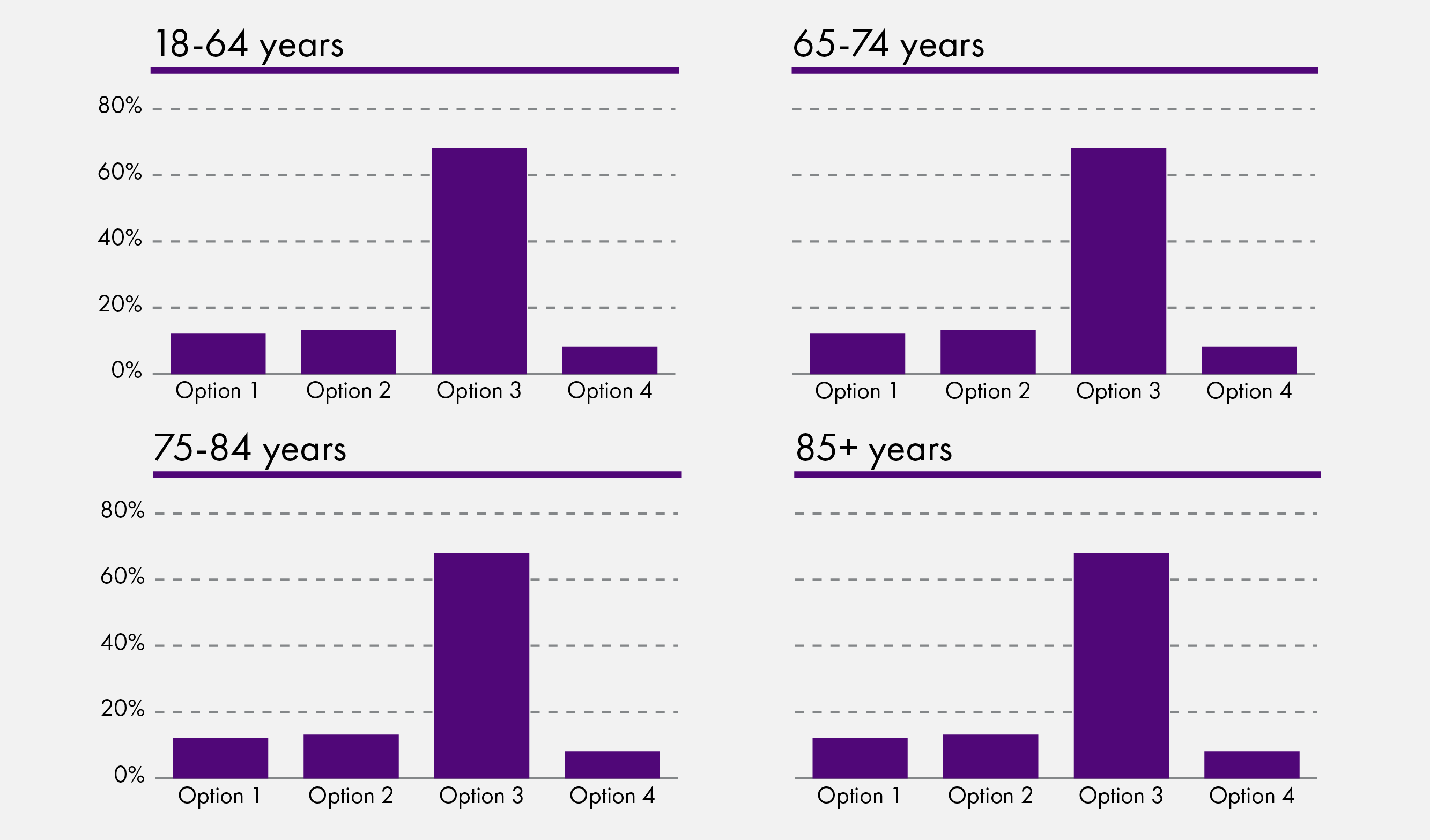
According to Public Health Scotland data, most people select Option 3, whereby the local authority selects and arranges the provision using the person's agreed budget. (Note that this data is not up-to-date and publication was paused because of data quality concerns. However, the Scottish Government has used the data, but numbers should be regarded as estimates because of incomplete data.
It is important to note that SDS covers all adult (and children's) social care and support, including unpaid carers, not just older people.
These charts show that most people have chosen for the local authority to arrange their support. Note that because of incomplete data all figures are estimates.
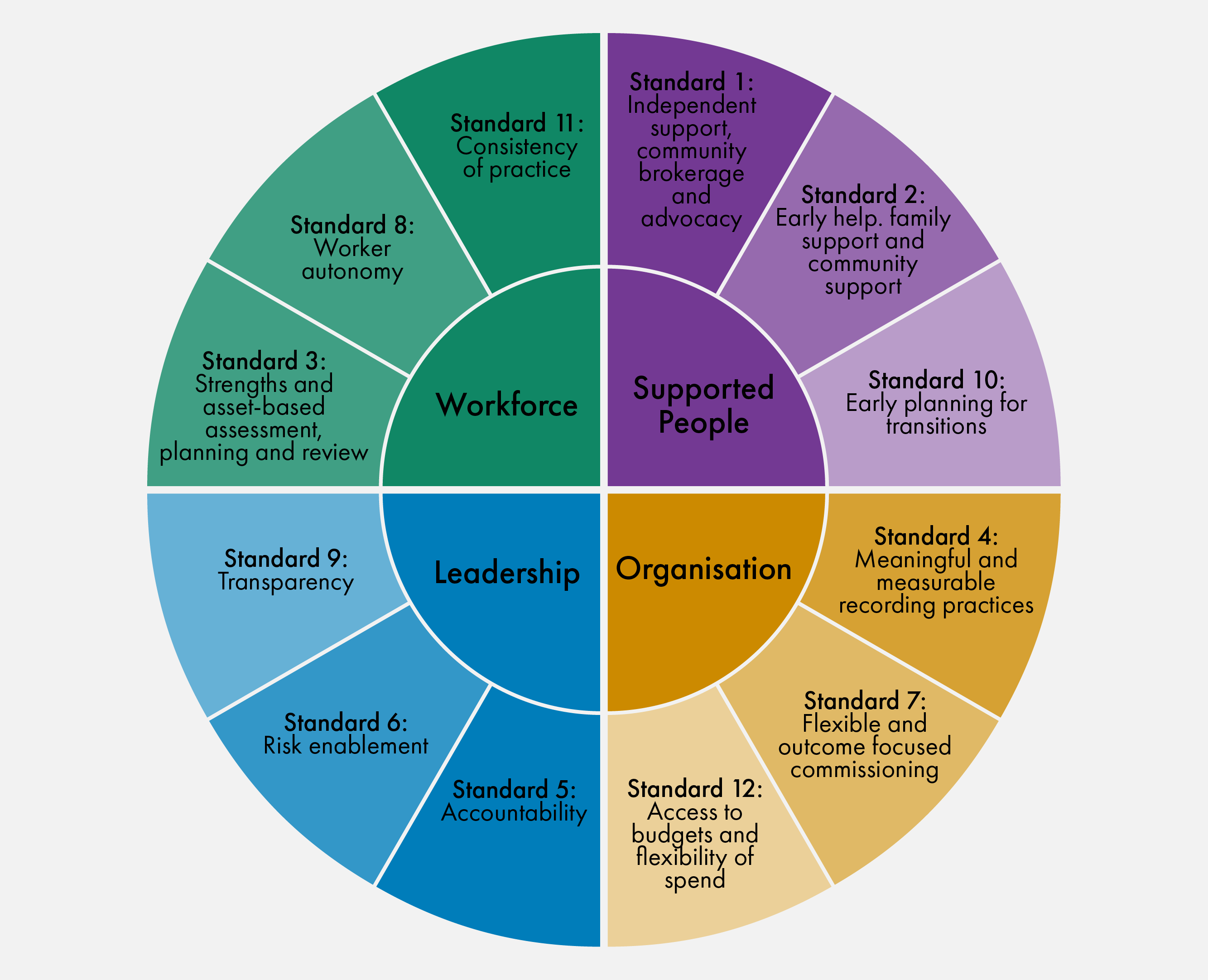
A Framework of Standards for Self-directed Support was created in 2021-22 comprising 12 standards and accompanying practice statements to align with statutory guidance and to address and support better implementation, consistency of outcomes and system change. A further standard, Standard 13 was introduced in 2024 relating to Direct Payments and employing Personal Assistants.
SDS standards organised by theme
The implementation journey of Self-directed Support
Implementation of SDS was considered in a ten-year strategy plan, 2010-20 . Through a range of studies and parliamentary scrutiny up to 2021, implementation came to be deemed slow or, effectively, not happening in some areas. Progress had apparently been hampered by the challenges presented by the integration of health and social care and the attendant structural upheavals and staff changes.
There were also issues around information on the options and independent advocacy to support people in making the choices. Data on outcomes was also, and remains, an issue that was highlighted. Attitudes and empowerment of front-line staff was also raised in scrutiny carried out by the Public Audit and Post Legislative Scrutiny Committee in 2017:
Stakeholders said they felt the process was still budget driven with decision making powers sitting with the social worker and not the person; and that often an authority will refuse to disclose the monetary value of the award or even how it was calculated.
We heard that often authorities’ policies do not fit well with the SDS legislation and are inconsistently applied. For example, one authority area may allow a budget to be spent on services which other areas will not. We also heard that authorities are becoming increasingly prescriptive about how individual budgets can be spent.
source:Public Audit and Post legislative Scrutiny Committee (PAPLS) letter to Cabinet Secretary
Commissioning was also raised, with the PAPLS Committee in Session 5, hearing that some authorities had not embraced and embedded the principles of personalisation and choice in commissioning practices. Finally, it was not clear how the money invested by the government on implementation had been allocated or used, nor how much was actually required to fully implement SDS.
The Scottish Government commissioned a research study in 2018, and published a series of papers on implementation of SDS.
The study concluded:
The case studies identified that uptake of the four options in a local authority is not a suitable proxy for full and genuine implementation based on the fundamental principles of self-directed support. Although the four options are a gateway to choice and control, what is potentially more important is:
the quality of the social care assessment and reviews, including a genuinely “good conversation”;
the degree to which there is a focus on the supported person’s outcomes;
budgets being available to meet these outcomes;
the availability of local providers and other resources; and
the enabled creativity and authority of supported people, social workers and the care market to find solutions to meet those outcomes.
Any future evaluation will need to focus on these elements, alongside cost-effectiveness.
On cost effectiveness of the policy, the report stated that economic evaluation would remain difficult until outcomes data was properly collated alongside data on the time taken by staff to properly enable choice and control.
Further Post-legislative scrutiny of Social Care (Self-directed Support) (Scotland) Act 2013
In 2023-2024 the Health, Social Care and Sport Committee undertook post-legislative scrutiny (PLS) of the Social Care (Self-directed Support) Act 2013. Given its close relevance, the work was timed to coincide with scrutiny of the National Care Service (Scotland) Bill.
The scrutiny took a two-phased approach, to mitigate consultation fatigue with social care over a number of years. There was also widespread frustration at the lack of progress on implementation of SDS over the ten years since its introduction. Staff supporting the Committee carried out some intense work with a number of individuals with experiences of SDS, carers, social care staff, social work staff and social care providers, and collated an initial set of recommendations to focus the Committee's scrutiny into specific issues. The issues that emerged were:
Lack of knowledge and understanding about SDS, because of the lack of training, among local authority social work and finance staff.
Lack of collaborative communication between social work and finance.
Inconsistency around budgets and budgeting within and between local authorities, and for individuals.
Eligibility criteria can be a barrier for people in need of care and support, and exacerbate a 'crisis' approach to provision. When services and finances are under pressure, the threshold for receiving care and support rises. This approach works directly against a prevention approach.
Independent advocacy to help people navigate SDS was highlighted, and that it should be available during the assessment process. (This raises questions about the role and position of the social worker during the process).
Transparency about unmet need.
Lack of flexibility in how budgets are used or directed by the person receiving care and support.
A lack of trust, collaboration and transparency over decisions made and changing budgets.
Following the Committee's scrutiny, it published its report in September 2024 with a set of 48 recommendations. While the Scottish Government had updated its guidance in 2022 and May 2024, it did not reference the Committee's work, but did reference the Independent Review of Adult Social Care and Audit Scotland's work in 2017 on the lack of progress in implementing SDS. The Scottish Government responded to the Committee's report in December 2024.
An SDS Improvement Plan 2023 - 2027 set out to improve implementation. In March 2025 a monitoring, evaluation and learning framework was published to measure impact of the improvement activities. Statutory guidance has also been updated periodically.
In October 2025, Social Work Scotland facilitated research on the impacts of reports of reductions in Option 1, direct payments. Its discussion paper on the research reiterates issues raised during Committee scrutiny.
Reductions and constraints affecting SDS particularly Option 1 (direct payments), have reduced choice, control, and flexibility for many disabled people. In practice, this has led to care arrangements that are often less responsive to individual need and preference.
Social workers report increasing difficulty in delivering person-centred, rights-based practice within tightening eligibility criteria and financial controls. Many describe experiencing moral and ethical strain when required to implement decisions driven primarily by affordability, while also being the visible point of contact for service users experiencing fear, frustration, or loss.
Trust across the system has been eroded. Supported people and carers frequently report feeling excluded from decision making and inadequately informed about changes to support. Social workers report rising levels of conflict, complaints, and emotional labour, combined with limited scope to influence resource decisions.
Public Bodies (Joint Working)(Scotland) Act 2014
The Public Bodies (Joint Working) (Scotland) Act 2014 1set the framework for integrating adult health and social care. The aim of Health and Social Care Integration was to establish consistent provision of quality, joined up, sustainable health and care services. The 2014 Act established new integration authorities. The integration authorities do not employ staff, although the Act does allow this. The Chief Officer and the Finance Officer of integration authorities are seconded (or appointed and then seconded by one of the partner bodies) from their substantive posts in either the health board or local authority. One person can fulfil both roles. Their role is to direct the delegated budget, comprising contributions from local authorities and health boards, to ensure the best health and wellbeing outcomes for their populations. All other staff are employed by either the health board or the local authority. The Chief Officer must be an employee of either the local health board or local authority.
In the Act two models for integration are covered:
Lead Agency
Highland is the only area to adopt the lead agency arrangement. In this arrangement, the chief executive of the lead agency is responsible for developing the strategic plan. NHS Highland has responsibility for adult health and social care services and Highland Council has responsibility for children’s health and social care services.
Body Corporate
30 areas have adopted the body corporate model (also known as the IJB) (Clackmannanshire and Stirling formed a joint IJB) where the planning of health and social care services is led by the integration joint board.
Once the partner bodies - Councils and NHS Boards - agree a settlement with their Integration Authority, this funding is passed on and forms an integrated budget. The intention is that the budgets from the respective bodies lose their identity, to become a local health and social care budget. Health boards are able to 'set aside' a proportion of their budget to cover unscheduled acute hospital services, with the intention that this budget should reduce over time with a shift towards services aimed at reducing demand for unscheduled care.
Health and social care integration has been a major effort to, in effect, merge what had become, as described in the History section, two distinct spheres of activity, legislation, governance and resource. The focus has been on handing the control of separate budgets (for health and social care) to a new body, the integration authority. What is perhaps unusual is that the integration authority does not comprise a body of staff.
Over the past number of years, through Health and Social Care Partnerships, council staff have moved to work within health boards and vice versa to ensure that services across health and social care are more coherent. In NHS Highland, where the alternative model of integration was chosen, there has been the unusual feature of the Health Board employing social care staff, because of their responsibility for adult health and adult social care services. Session 7 of the Scottish Parliament is expected to see efforts to achieve public services reform in the areas of health, social care and integration.
The intention of integration is that budgets paid to local government and health boards lose their respective identities and are directed by the new body (IJB), with the aim of shifting the focus and locus of care into the community. The aim is for primary prevention of disease through the proactive actions of HSCPs, so, eventually, reducing the burden on the NHS resources by reducing unscheduled care and preventable health harms. See also:
Audit Scotland:
NHS NES collection of relevant documents relating to integration
Ambitions set out in 2025 and 2026 by the Scottish Government seek renewed efforts to create preventive systems to address inequality and overall burden of disease.
A key change to the make up of voting members of IJB boards was introduced in 2026, through regulations. In addition to councillors and non-executive NHS board members, representatives of service users, unpaid carers and the third sector also now hold voting powers. The Standards Commission for Scotland issue advice and guidance for IJB members.
Carers (Scotland) Act 2016
The Carers (Scotland) Act 2016 extends and enhances the rights of unpaid carers in Scotland to help improve their health and well being, so that they can continue to care, if they so wish, and be supported in balancing other aspects of their life alongside caring. The Act covers both adult and young carers.
Changes to the Act have been brought in through the Care Reform (Scotland) Act 2025. However, as at August 2026, these have not yet been commenced.
The main provisions of the 2016 Act are:
a duty for local authorities to provide support to carers, based on the carer’s identified needs which meet the local eligibility criteria
a specific adult carer support plan (ACSP) and young carer statement (YCS) to identify carers’ needs and personal outcomes
a requirement for local authorities to have an information and advice service for carers which provides information and advice on, amongst other things, emergency and future care planning, advocacy, income maximisation and carers’ rights
a requirement for the responsible local authority to consider whether that support should be provided in the form of a break from caring and the desirability of breaks from caring provided on a planned basis.
Statutory Guidance indicates how the Act should provide assistance using the options provided under self-directed support.
Sometimes it might be challenging to differentiate whether support is being provided to the carer or the person they care for, as both are likely to benefit from the provision of services. This is recognised in the Act.
The Carers (Waiving of Charges for Support) (Scotland) Regulations 2014 require local authorities to waive charges in relation to support provided to unpaid carers (of any age), if they are assessed as requiring support. The Statutory Guidance supporting the Act provides comprehensive detail on support provided to carers and the waiving of charges.
Where the responsible local authority exercises its duty to provide support to the carer to meet the carer’s eligible needs or its power to meet the carer’s other identified needs (both under section 24 of the Act), the carer must be given the opportunity to choose one of the options for self-directed support (unless the local authority considers that the carer is ineligible to receive direct payments). Any carer support provided for the carer will be provided under section 24 of the Act and cannot be charged for or means tested.
Scottish Government. Statutory Guidance, Carers (Scotland) Act 2021
The guidance states that the Act:
seeks to improve physical and emotional well-being and deliver positive outcomes for Scotland's carers by ensuring more personalised and effective delivery of carer support.
The Care Reform (Scotland) Act 2025 included several sections modifying the 2016 Act. However as at August 2026 these sections were not in force.
National Care Service(Scotland) Bill to Care Reform(Scotland) Act 2025
The National Care Service (Scotland) Bill was introduced in the Scottish Parliament on 20 June 2022 by the Scottish Government. The Care Reform (Scotland) Act, following significant amendments to the Bill, including its title became an Act on 22 July 2025.
The SPICe briefing on the Bill– National Care Service (Scotland) Bill was published on 10 October 2022
SPICe Spotlight hosted a ‘NCS hub’, which provides links to blogs about the proposals prior to introduction and throughout the Bill process. The blogs describe the convoluted passage of the Bill and its final iteration as the Care Reform (Scotland) Act 2025.
To assist scrutiny of the Bill, the Health, Social Care and Sport Committee commissioned research into international models of social care to provide further background and context.
The Bill sought to establish a National Care Service (NCS). This was to be achieved by moving responsibility and accountability (partially) for social care to the Scottish Ministers via national strategic planning, transferring of local authority and NHS functions, and with local care boards replacing integration authorities. (Although the replacement of integration authorities was assumed rather than being made explicit in the Bill documents.)
One of the aims was to reduce variation across the country for those receiving social care and support services. The Scottish Ministers were to set the strategic plan for the NCS, and care boards would be established to follow the national strategic planning and NCS principles via their own strategic planning. Although not clear in the legislation, the Policy Memorandum published alongside the Bill explained that care boards would replace integration authorities, alongside major changes to overall governance. The Scottish Ministers could also have transferred functions from local authorities and the NHS to the Scottish Ministers’ control, by regulations. Children’s and Justice Social Work services were specifically detailed, with certain duties to consult attached prior to any transfer.
The Parliamentary scrutiny of the Bill had some unusual features. Stage 1 scrutiny timeframes were extended on several occasions to reflect significant changes to the proposed implementation as the Stage 1 scrutiny proceeded. For example, the proposed changes to the role of local authorities in respect of social care changed significantly during Stage 1 following agreement between national and local government to remove the provision in the Bill that would transfer council staff, assets and functions. This meant that the proposed NCS Board could not have functioned as intended by the Bill as introduced.
The Bill was a framework bill, lacking substantive detail in the Bill itself, with detailed implementation to follow through secondary legislation.
The Act that was passed, following substantial amendment and a name change at Stage 2, was the Care Reform (Scotland) Act. It included provisions on information sharing and care records. It included provisions about rights to breaks for carers, and provisions to strengthen the rights of care home residents with regard to visits and visitors ('Anne's Law'). New sections were added during stages 2 and 3 to ensure continuity of service if someone moves to a different local authority area. Following work done in relation to Self-directed Support, and the SDS Improvement Plan, independent advocacy services were covered as well as standards relating to reporting, data and intelligence to improve social care.
The Care Reform (Scotland) Act 2025 1 introduces reforms to social care, social work and community health, including:
Right to breaks for unpaid carers.
Anne’s law, enhanced care home visitation rights.
An integrated health & social care record, information sharing and information standards.
New procurement routes for the third sector.
National Chief Social Work Adviser & National Social Work Agency.
Continuity of care for persons with a disability.
Timescales for assessments for persons with a terminal illness.
Duty on relevant bodies to promote financial or other support take-up available to unpaid carers.
Enable Scottish Ministers to amend Integration Principles in the Public Bodies (Joint Working) Act 2014.
Report on projected care needs and the social care market.
Ethical commissioning guidance, procurement strategies, and social care bargaining guidance.
Independent advocacy standards, reporting and access.
As at September 2026, following the The Care Reform (Scotland) Act 2025 (Commencement No. 1) Regulations 2025, a number of the provisions are already in force.
Certain Sections between 1 to 34 including s.14, Visits To or By Care Home Residents came into force in January 2026. This brought “Anne’s Law” into effect, which upholds the rights of people living in adult care homes to see loved ones and identify an essential care supporter.
These Regulations also brought into force section 1, which sets out the duty on Scottish Ministers to facilitate every person who receives healthcare or a social service in Scotland to have a digital integrated care record, while section 24, Provision of Information By and To Health Care Services, is also in force and includes enabling people to access information on their care and improving the movement of information across care settings.
The Regulations also brought into force the following sections:
Section 9(1) and (2), requiring ministers to prescribe timescales for the preparation of adult carer support plans.
Section 10(1), requiring ministers to prescribe timescales for the preparation of young carer statements.
Section 11, minor modifications in relation to carers.
Section 13, a duty to promote take-up of support by carers.
Section 22, cancellation of care service registration.
Section 23, assistance in inspections from Healthcare Improvement Scotland.
Section 25, ministers to designate a member of staff as National Chief Social Work Adviser and form the National Social Work Agency.
Section 33, fair work strategy for ministers to monitor and promote fair work in the care sector by collecting, recording, analysing and reviewing data.
Section 34, ministers to report on fair work in the care sector.
Section 16, s.18, s.20 and s.21, mainly concerning commissioning and procurement, were also brought into force on 7 January 2026.
Section 31, Report on the Social Care Market, in which the Scottish Ministers must, by the end of each reporting period, make publicly available a report on the state of the social care market in Scotland, came into force on 1 April 2026.
Section 32, Power to Obtain Information for the Purposes of s.31, also came into force on 1 April 2026.
On 30 April 2026, s.36, Sectoral Bargaining: Guidance etc. came into force.
National Care Service work continues...
Despite the failure of the bill to achieve its initial intent, the Scottish Government continues to use the narrative of a national care service in relation to developing and improving care services. There is a National Care Service Advisory Board which provides advice to Scottish Ministers, council leaders, health boards and health and social care partnershipsand a National Care Service Forum has met annually, including in November 2025. Policies included in the improvement of the social care system are:
Getting it Right For Everyone (GIRFE)
Coming Home
Self-directed support improvement plan
Support in the Right Direction
A National Social Work Agency was established and launched on 17 March 2026. It is an executive agency of the Scottish Government to provide national leadership for the profession, to strengthen the profession and help drive improvement to care services.
Other relevant legislation
There is other relevant legislation, particularly the Adults with Incapacity (Scotland) Act 2000 which is relevant to social care if someone has dementia for example, or a learning disability. Not having capacity will affect the degree to which someone can choose and control the social care support they need. The 2000 Act covers others acting as a welfare guardian or attorney for a person when they have lost capacity. Incapacity is defined in Section 1(6) of the Act, and the legislation applies to anyone over the age of 16, not 18. Mental health legislation should also interact effectively with the legislation outlined above.
SPICe published a briefing on Adults with incapacity in 2022.
Local authorities have a duty under the Adult Support and Protection (Scotland) Act 2007 to make enquiries about a person's well-being, property or financial affairs if it knows or believes that an adult is at risk of harm, and that it might need to intervene in order to protect the person's well-being, property or financial affairs.
A multi-agency approach to adult support and protection work is required and much of the work concerning individual adults will overlap with the work of, for example, registration and inspection bodies. Section 5 of the 2007 Act provides that certain bodies and office holders must, so far as is consistent with the proper exercise of their functions, co-operate with a council making enquiries, and report to the council the facts and circumstances where they know or believe an adult is at risk of harm.
One further Act which will have an impact on care services is the Health and Care (Staffing)(Scotland) Act 2019. The main focus of the Act is on the purposes of staffing for health and care services. There should be appropriate staffing in all health and care settings to provide safe and high-quality services, and to ensure the best health care or (as the case may be) care outcomes for service users. The sections on staffing in care settings were commenced in April 2024.
Accessing social care and support
This section of the briefing explains how social care in Scotland operates.
It might be helpful to think about some hypothetical scenarios in which social care and support might be required or considered.
Care and support is provided to all adults who are assessed as needing it. Not everyone turns to social services for this help and support. Many older people choose to organise their care privately and pay for it. For someone older, it might be merely seen by them as the continuation of a financially independent life, and they seek support from carers when they can no longer do everything for themselves, although there is no available data on people who self-fund their care and support at home. They might also see their home as an investment stored, to be used to pay for this care in a residential care home when the time comes. It is estimated that around 38%of people fund residential care themselves. Alternatively, they might employ someone to live in their home to care for them or pay for someone to call in several times a day. As long as they can pay for their care, they would possibly remain unknown to social services, (even though they are entitled to seek means-tested support, or free personal care and nursing care).
Many people, however, become aware of social services, possibly after a hospital admission for a fall, say, and their needs and capabilities will be assessed to see if they can return home safely. At this point, care might arranged, including some chargeable services. A financial assessment is carried out to assess whether they need to make a contribution and how much. Personal and nursing care is provided free of charge to everyone over the age of 18 if they are assessed as needing it.
If someone moves into residential care, they might also be liable for accommodation costs, sometimes called 'hotel costs'. These don't include personal and nursing care costswhich are covered by the local authority, in payments made directly to the care home. In order to cover the 'hotel costs', they might need to sell their home as these costs can be substantial.
Once someone has exhausted their financial assets to a certain level, which changes annually, (currently £36,750 (2026-7)), they will not be paying all of the accommodation costs, but still making a contribution, calculated by the local authority based on their assets and income. Once their capital falls below a lower limit, currently £22,750, the council will pay the standard rate towards care home fees which is around £1,000 per week.
A different scenario: a young adult, over 18, who has required a high level of support throughout childhood, perhaps because of a learning disability, but who has lived at home, will become subject to an assessment of their needs at 18, as well as a financial assessment. The legislation governing children's and adult services is different and the young person will have to transition between services governed by different policy and legislation. A SPICe briefing, Transitions of Young People with Service and Care Needs Between Child and Adult Services in Scotland, covers these transitions. That young person might move into supported accommodation, sharing a home with another, or small number of others, receiving full-time care and housing from the local authority, or other provider, paid for through a mix of social security benefits and local authority support.
When someone seeks state assistance, whatever their circumstances, it is through local authority social work departments. Advocacy is increasingly available to help people to navigate self-directed support and is the first Standard in the Framework of Standards, published in May 2024
There will be many other scenarios covering many aspects of care and support for adults from the age of 18. Support is available through NHS services, local authorities, private companies, a wide range of third sector organisations, further education providers, housing associations and others. Financial support for those with disabilities and/or caring responsibilities is available through the social security system.
The figure below shows a summary of the process someone goes through once they contact their local authority for support for themselves or someone they care for.
This graphic shows how adults seek social care support - residential or care at home - if they are seeking assistance from the local authority.
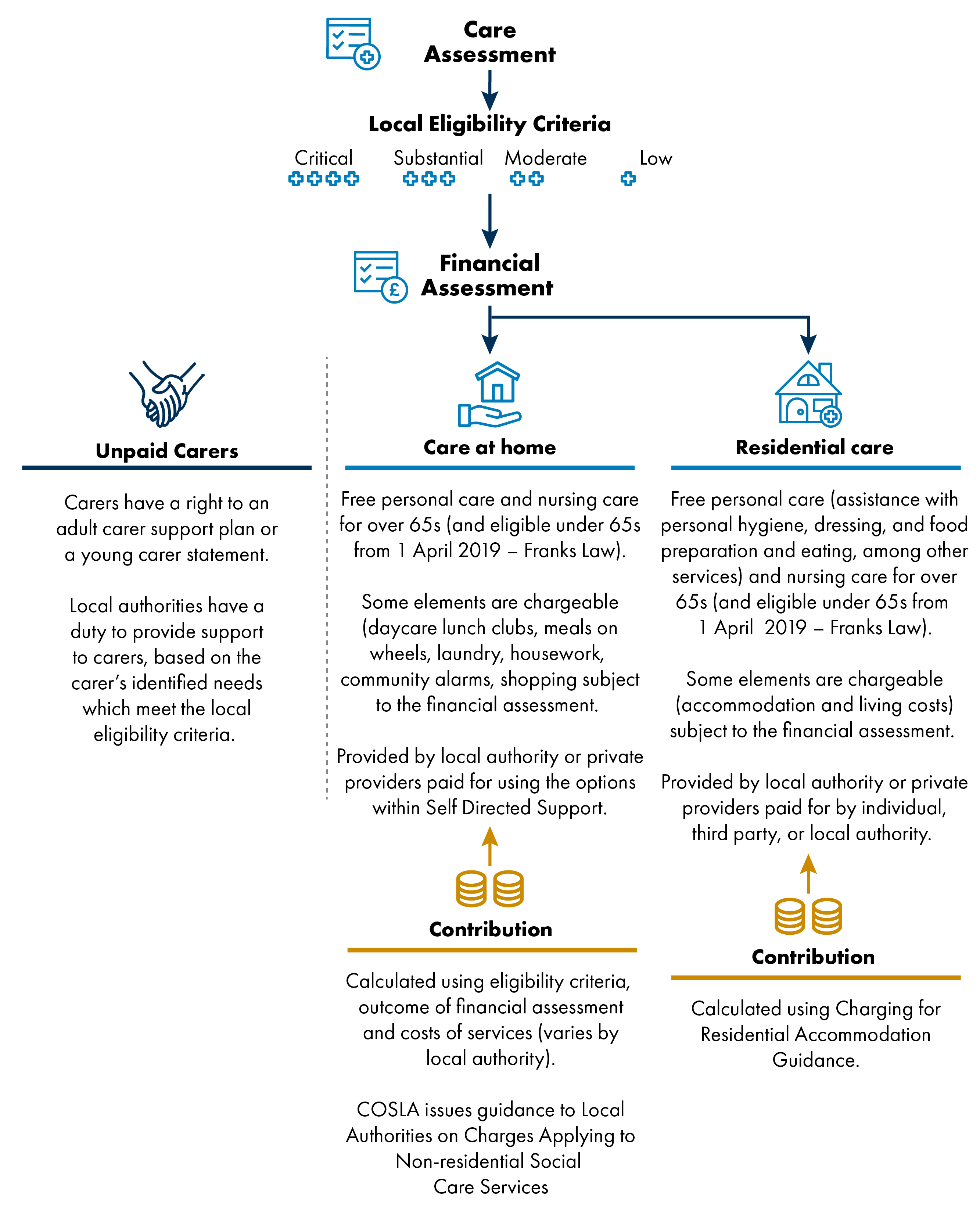
SPICe
Below is the outline of the 'process' of arranging care, providing more detail, from the point of contact with social services. Practices will vary from one partnership area to another, and integration seeks to foster innovation in preventative and early intervention measures. When an adult, or a carer of an adult, feels that they need support they would:
Contact their local authority social work department
The local authority arranges for an assessment of needs to be done, either at the person's home, or, in hospital, if that is where the person is awaiting discharge. The local authority has a statutory duty to assess the needs of anyone over 18 who requires assistance, including carers. National eligibility criteria and Health and Well-being outcomes are used, among other locally devised measures, to assess those needs.
The local authority undertakes a financial assessment of the person's income and assets
A 'care package', which could comprise any support that a person wants or needs in order to live their life as independently as possible, and to achieve outcomes that they have identified alongside their social worker - is put together, with the person deciding, under Self-Directed Support, the degree of autonomy they want to have in devising the care and support package, and how it is delivered.
Services are commissioned by the health and social care partnership (integration authority) and procured by the local authority, guided by the Health and Care Standards ( Exceptions to this are if the person has decided to take a direct payment or self-directed support Option 2 (see below), and to organise their own care and support, or if the care and support is provided 'in house' by local authority/NHS staff).
Support and care are arranged and/or monitored by the local authority
If someone is deemed to be at 'critical' or 'substantial' risk, as per the national eligibility criteria, personal and nursing care should be in place within six weeks from the confirmation of need. Some other services and adaptations might take longer to arrange.
If someone does not require residential care, and they own their home, then the home is not counted as an asset in the financial assessment. However, if residential care is decided upon, then the value of the property could be taken into account, and might need to be sold to pay for that person's care. However, this only applies in certain circumstances. If the person's spouse is living in the house for example, the value of the property will not be part of the financial assessment. Each year, COSLA and the Scottish government issue and update charging guidance to local authorities and integration authorities/health and social care partnerships for both residential (Scottish Government) and non-residential care (COSLA).
One aspect of social care support in Scotland that sometimes causes confusion is 'free personal care'. It is useful to understand that this does not mean that social care support is free for everyone who feels they would benefit from it.
Personal care is free to those assessed as needing it, whether they live in their own home or in residential care. In residential care the local authority will pay a nationally agreed amount to the care home for personal care, which is currently (2026-27) £260.30/week for personal care and £117.10 per week for nursing care.
Types of care and support
The following sections do not provide an exhaustive description of all types of care and support provided for adults, but considers three of the most common.
What these descriptions don't include are the many and ever-evolving community-led and community-based innovations. These are becoming increasingly asset-based and configured in partnerships between statutory and third-sector bodies.
Evaluation from the planning stages to ongoing sustainability of many of these innovations remains a challenge when funding streams are short-term however. Variation too is an issue, with no established mechanisms in place for ensuring that best-practice is shared and adopted/modified across different partnerships.
Residential care (care homes)
A care home is where adults live together and have their care needs met by a team of staff. Staff will be on site 24 hours, 7 days a week. They can also be called residential care homes or nursing homes. Nursing staff may or may not be employed by the home or by the company running the home. According to legislation in Scotland, there is no difference between a home calling itself a care home or a nursing home, although some homes might not employ a nurse and could not offer nursing care. Many, if not most care homes will offer some nursing care, as the levels of frailty and complexity of care needs increase. However, the conditions of registration with the Care Inspectorate vary between care homes depending on the levels and complexity of care they provide.
They are usually for people needing more care than they could get in their own home or in supported/sheltered housing. Over recent decades the age profile has got higher, the level of infirmity greater, and the length of stays shorter. This means that care homes are managing far more complex care needs, such as high incidence of people with advanced dementia alongside a number of other conditions such as diabetes, chronic obstructive pulmonary disorder (COPD) or mobility problems. They also provide end of life care.
There are a range of providers of residential care: Health and Social Care Partnerships/local authorities, private companies, housing associations and voluntary organisations. There are are range of models for providing residential care and sizes of care homes from a few rooms in a domestic setting to over 50 beds in a purpose-built home. Some private homes will only take people who can pay for themselves, some will take a mixture of private and local authority funded residents. Some ask that a person can guarantee to cover the full fees for a number of years, after which time (when their assets and income have fallen below the annually set capital limit ) the person can stay on in the home, supported at the rate paid by the local authority. There is no cap on the amount that private providers can charge self-funding individuals, and local authorities have no powers over this, only what they will pay for a publicly funded place.
The chart below shows the proportions of local authority funded places, NHS and self-funded places there are in care homes in Scotland.
The chart shows that most care home places are publicly funded

Public Health Scotland: Care home census 2015 - 2025
Each year COSLA and the Scottish Government set what are called the 'standard rates' for publicly funded residents. COSLA negotiates these standard rates with Scottish Care, the body that represents independent care providers. From April 2026 these standard rates are:
The standard rates for 2026/2027 are:
£1,074.13 a week for nursing care
£930.45 a week for residential care
Under Section 22 of the National Assistance Act local authorities are required to set rates for the care homes they own and manage at a rate equal to the actual cost of providing accommodation . This means that they could be charging a person considerably more than the standard rates paid to other providers to provide care and accommodation.
The chart below shows the steady rise in care home rates rose over ten years. People paying for care and accommodation themselves have consistently paid more than local authorities have paid to providers. Self-funders pay more whether or not they receive nursing care.
.png)
SPICe using data from the care home census report 2025
Changing provision of residential care
Over recent years, the number of care home places has been falling. There will be a range of reasons for this. One is that some providers are withdrawing from the market. Providers have argued for a number of years that the money provided by local authorities does not cover the cost of care in a care home. To remain viable, providers state that they are forced to charge self-funders more in order to subsidise residents being funded by local authorities. In 2017, the UK Competition and Markets Authority conducted a UK wide care home review . They published summaries for each of the nations, and this summary for Scotland discusses this issue.
This chart shows the decline in the number of care homes by the voluntary and statutory sector
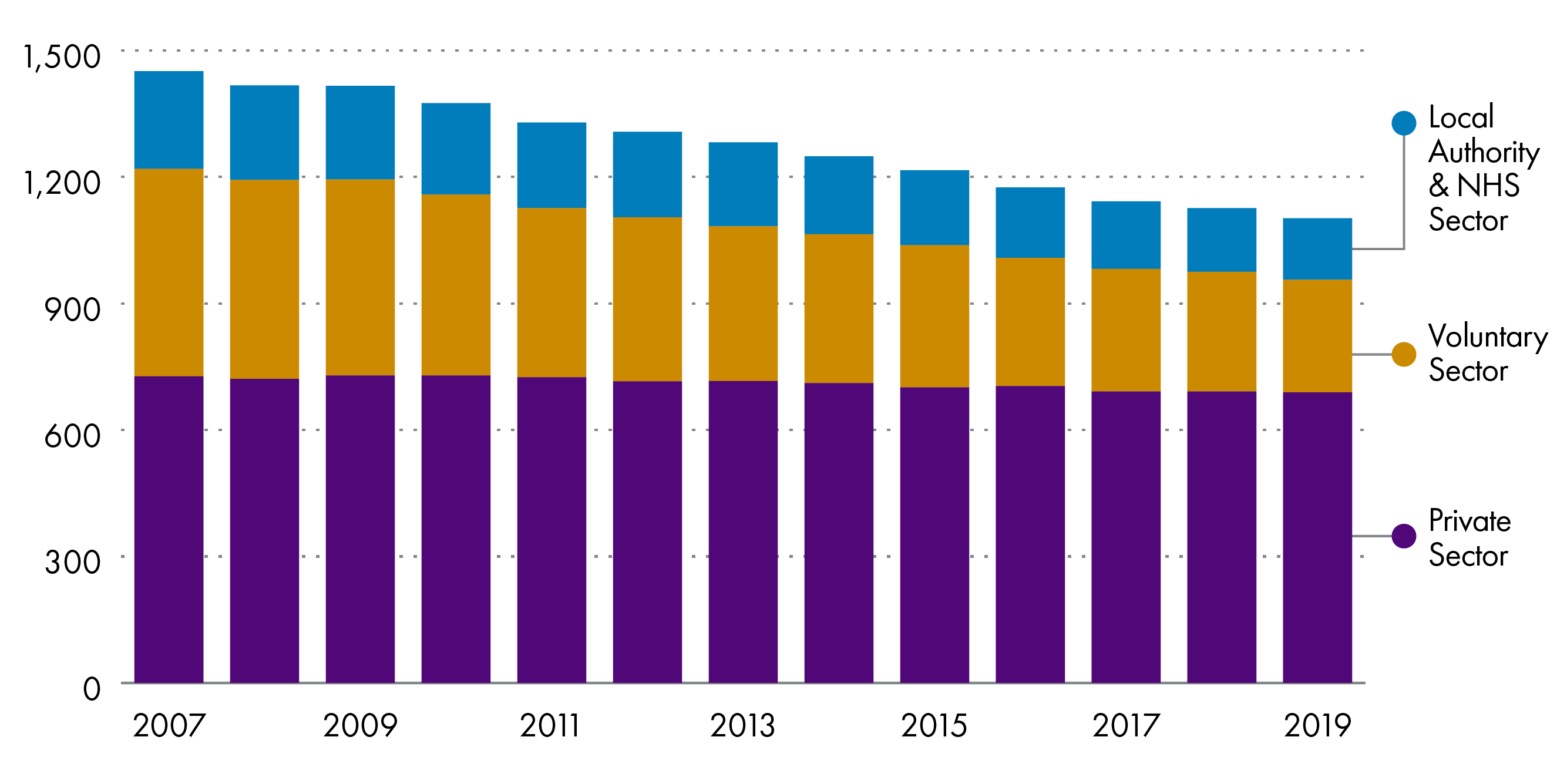
This chart shows the numbers of residential provision for different groups and how the number of residential facilities have reduced. Older people use most care home places.
.png)
SPICe using data from Public Health Scotland, Care home census 2025
Care at home
Scottish Government policy seeks to support people to live independently in their own homes for as long as possible, or in as homely a setting as possible. The integration of health and social care is key in supporting this aim. A person should receive that support through the principles of self-directed support, according to the statutory guidance, which entails the person being fully involved in decisions about what support they need and how it will be delivered.
Care at home is an umbrella term for a range of statutoryand non-statutory provision, some of which is free to all adults assessed as needing it, such as personal and nursing care . Others, such as cleaning, shopping, safety alarms, laundry, collecting pensions, prescriptions and help with paying bills are not covered in the definition of 'free personal care'. Local authorities can arrange or provide this type of care, but it can also be provided by private home care providers/companies, the voluntary sector, family, or personal assistants.Personal assistants (PAs) are employed directly by the person seeking support to help with any tasks or activities to meet agreed personal outcomes that they want help with. These tasks are summarised in a job description and contract of employment. This will, in turn, inform the audit of direct payments. Some local authorities charge for the other services, not included in free personal care definitions, but they are not obliged to, and charging policies vary across the country. The Scottish Government committed to ending non-residential care charges in 2021, but this has not happened. Charging for certain services provides a source of income for local authorities that they would otherwise not receive, allowing them to provide a range of services to more people locally.
The charts below show how the number of hours of care provided and the distribution across ages. Note the changes in distribution and number of hours provided over recent years when compared with earlier (2018-19 data) in Figure 10a.
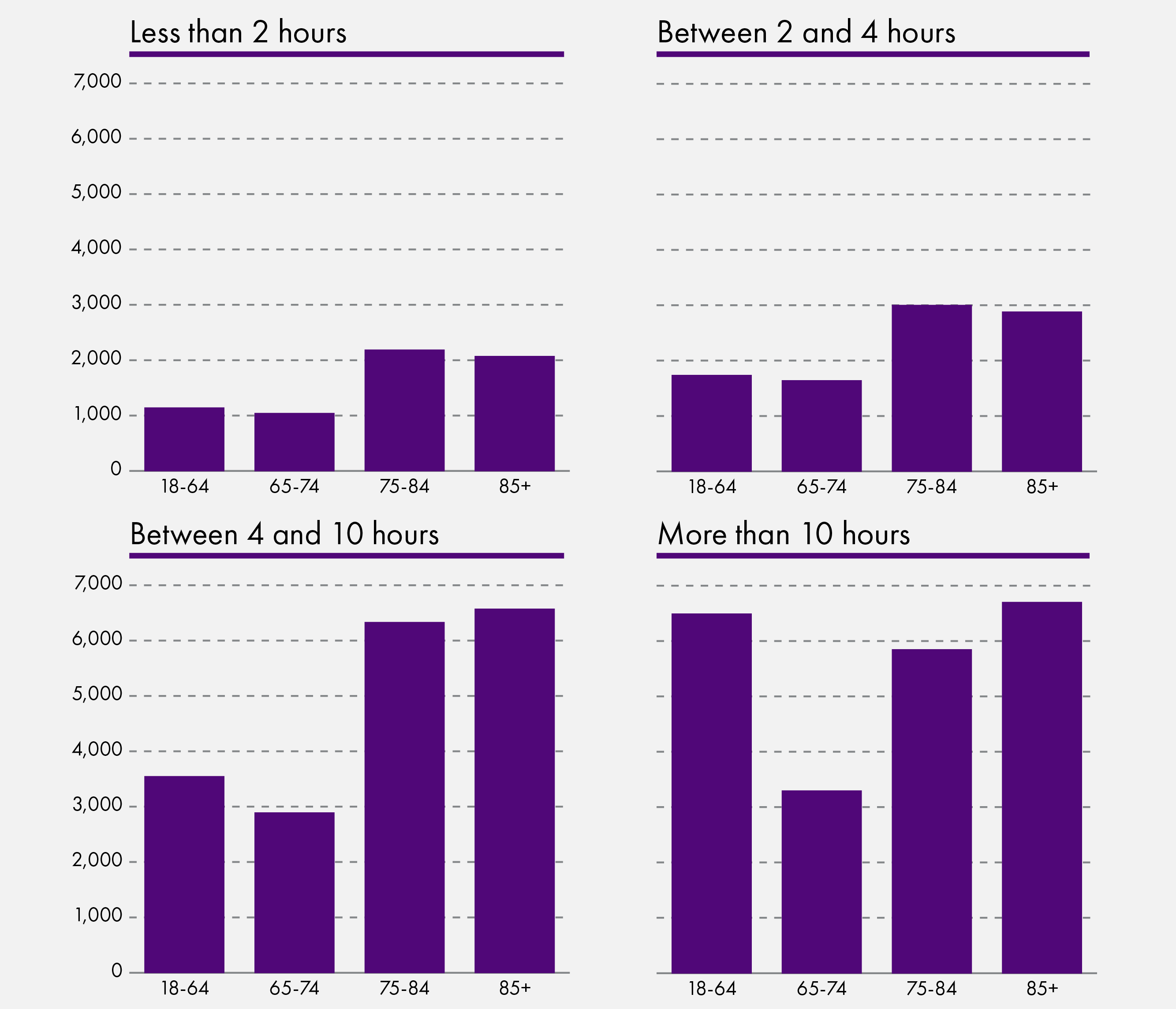
SPICe using data from Public Health Scotland
This chart shows that people over 75 account for care received under 10 hours per week. When more than ten hours is required, provision is more evenly spread across the age groups
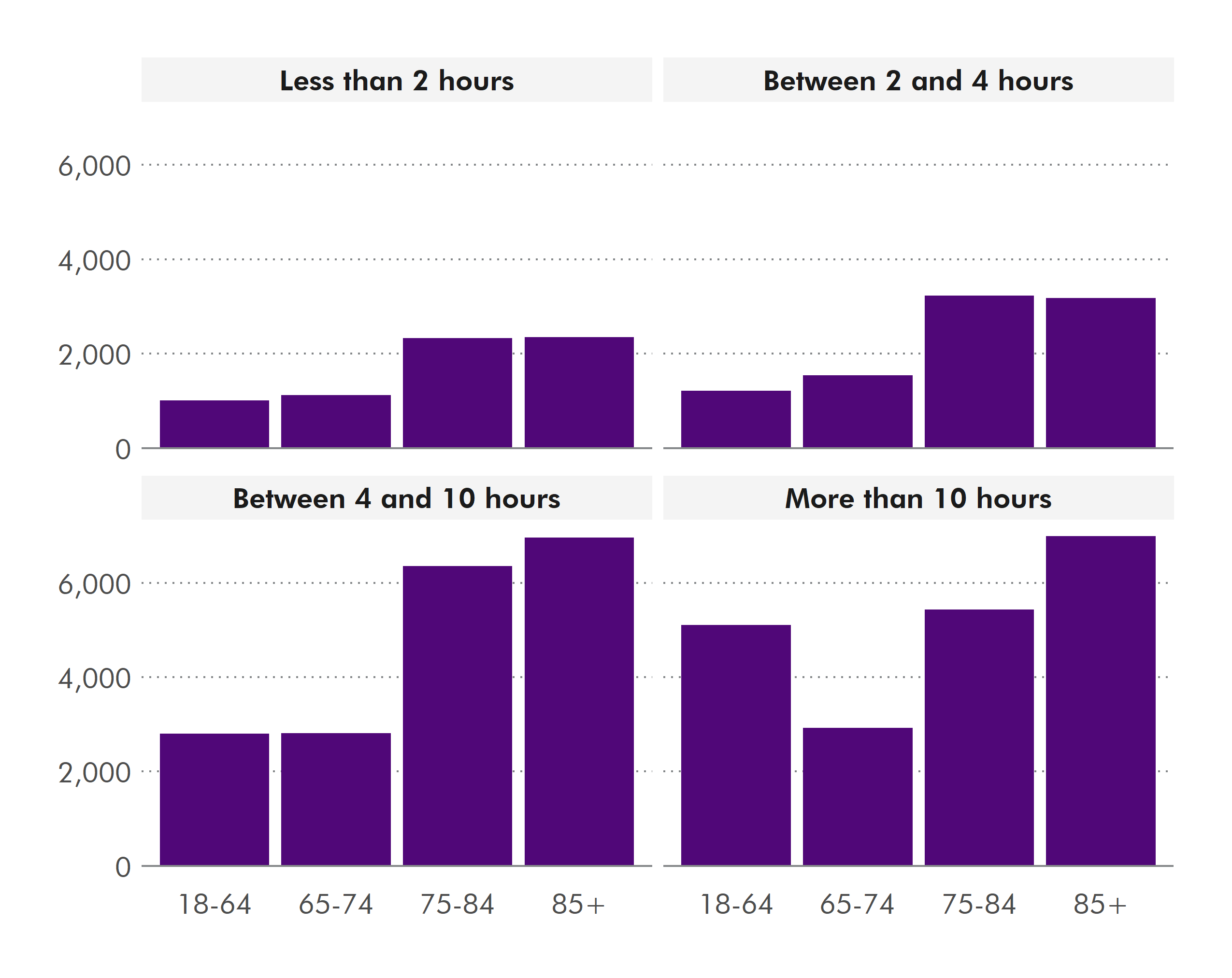
SPICe using data fromPublic Health Scotland
Housing support
Housing support services are intended to help vulnerable people to live as independently as possible in the community. This is a sector where social care support often interacts with the benefits system, when someone is entitled to both social care and social security benefits. In terms of governance it is also complex, with responsibilities for housing and homelessness sitting across multiple organisations and planning systems.
The social care element of housing support is provided by the local authority, and operates in exactly the same way whether someone lives in social rented housing, private rented housing or if they own their own home. The Coalition of Care and Support Providers in Scotland (CCPS) has published a guide on housing support as well as an assessment of costs and benefits of delivery and funding of housing support, in collaboration with the Universities of Sheffield and Stirling.
Some of it is supplied as and referred to as 'sheltered housing'. It might be specially adapted or have a level of care attached, such as a warden. However, an individual might also be receiving 'round the clock' care from a team of people through their social care package, and be in receipt of housing support.
Registered housing support services are regulated and inspected by the Care Inspectorate using the Care Standards, as per inspections of all care services.
The largest group of people who receive housing support is older people living in sheltered housing, but a wide range of people with particular needs can receive housing support services:
people with a chronic illness
people with a physical impairment or learning disability
people with drug- and alcohol-related problems
others who need support, like women escaping domestic violence, homeless people, refugees, and ex-offenders.
Housing support services include help:
to claim welfare benefits
to fill in forms
to manage a household budget
to keep safe and secure
from other specialist services to obtain furniture and furnishings, and help with shopping and housework.
The type of support provided aims to meet the specific needs of the individual.
The Scottish Housing Regulator (SHR) publishes reports each year on how social landlords perform against the Scottish Social Housing Charter. Data on the characteristics of households by tenure are published in the annual household survey. This (2024) data shows that 59% of social rental households have someone with a long term disability or mental health condition compared with 27% in the private rented sector. This figure compares with earlier data (Social Tenants in Scotland report 2017) which estimated that only 12% of people in the social rented housing sector were permanently sick or disabled.
These services are mainly provided by councils, housing associations and voluntary sector organisations, while Scottish Government is responsible for overall policy.
People often pay rent for supported housing, and the housing is managed by the local council, a private company, charity or housing association. Charges for the support services received are normally included in the rent.
How is social care organised?
The following sections provide information on how social care is currently commissioned, funded and regulated. It also considers social care staffing: workforce planning, training and registration as well as unpaid carers. Social care planning and funding are influenced by, and subject to, multiple overlapping bodies and accountabilities at a local level. This can create unwanted complexity, duplication, fragmented accountability and hamper sustainability.
How social care is funded
Since the Social Work (Scotland) Act 19681, local authorities have been required to “promote social welfare by making available advice, guidance and assistance on such a scale as to be appropriate for their area”. The Act places wide responsibilities on councils in relation to childcare, child and adult protection, justice social work, supporting families and providing social services for adults. For financial reporting purposes, spend in this area comes under the heading “social work”.
Local government remains statutorily responsible for procuring, as well as providing social work services, including social care support (integration notwithstanding). Local authorities provide services directly as well as contracting external providers from the private and not-for-profit sectors. Local authorities receive funding to cover the cost of providing social work services from the Scottish Government as general revenue funding in annual settlements.
The annual Scottish Local Government Finance Statistics show what local authorities spend in total on social work (but this is not the same as social care services, because not all social work services are delegated to integration authorities). It is also possible to see what local authorities contribute to Integration authorities using this data (see below).
Spending on social work services is Scottish local government’s second highest area of spending (after education), amounting to around £5 billion in 2025-26, or 31% of the total net expenditure by local government. Around £4 billion of this goes through Integration Joint Boards.
Local authorities now spend £800 million more in real terms on social work than in 2010-11 (an 18% increase). Over this period, total local government net expenditure has risen by only 3%. In a 2025 survey of local authority leaders, chief executives and directors of finance, the Local Government Information Unit found that social care is the biggest pressure on council finances.
The image below shows how local government social work spending has grown in real terms over the past 16 years.
The graph shows how much local authorities have spent on social work services since 2010.

Scottish Government. Local Government annual financial statistics
How financial and other data about social care in Scotland is collected and recorded has been changing over recent years, making it difficult to analyse some trends over time, particularly in spending. In the local government financial statistics, funding for social care is not isolated from the other, non-integrated social work services.
This means that it is challenging to analyse trends in local government funding for social care. Up to 2016, all social care service spending was reported through local government financial data. This showed that around £3.3 billion was spent on social work services each year between 2011 and 2016. Again, however, this was not broken down by the different social work services.
COSLA called for reconsideration of local authority funding in its 2019 report, Fair Funding for Essential Services. In the report they emphasise the renewed focus that local authorities have on health and well being and preventive services. They cite the changing demographics, a real terms increase of 6.3% in spending on care for older people since 2010-11 and the 10% increase in the demand for home care services as more care is delivered out of hospital.
Health is wider than the NHS; Local Government plays a vital role in the health, well-being and social care of Scotland and should therefore receive its share of health consequentials...
...Health is not only delivered by the NHS and we must ensure a whole system approach to funding if we are to meet targets, in particular in early intervention, public health, adult health and social care.
Fair Funding for Essential Services
The narrative remains similar in 2026, with COSLA's White Paper, 'A Social Care system built on prevention', published ahead of the 2026 parliamentary elections, asking for a focus on prevention. COSLA believes that a further £750 million is required in 2026-27:
A clear commitment to valuing social care by bolstering funding with an immediate injection of an additional £750m. Commit to continued and strengthened integration of health and social care, ensuring more support that is high quality; personalised; offers choice and control; and reduces inequalities.
Source: COSLA Manifesto 2026
Social care data for England
NHS Digital provide detailed data for social care in England, and how much is spent. It should be remembered that health and social care are not integrated in the same way in England, so the data is only from local authorities. However, it does provide an indication on the level of detailed data available on social care activity and spending in England which is not available in Scotland, and could provide a source for some comparison.
Personal contributions to care and support and self-funding
Many people make a contribution towards the cost of their support and care, depending on their income and assets. The amount that people will contribute varies widely across the country depending on a local authority's charging policy. Others make no approach to their local authority for support and organise and pay for their care themselves. Data is limited on this latter group, unless they are in residential care (self-funders).
Currently, in Scotland, there is no data on the breakdown of contributions towards care received at home, from those who receive fully-funded packages and those who pay for all the care themselves. So, it is not known how many people fund all of their care and support at home, if they have not approached the local authority. Since 2023, however, Public Health Scotland has published monthly data on people waiting for a social care assessment.
Contributions towards care packages will also vary over time for any individual as income and assets vary and charging policies might be modified.
Integration authority finance and social care
Local authorities and NHS boards must work together to plan and deliver adult community health and social care services, including services for older people. This is mainly done through integration joint boards (IJBs). These are separate legal entities responsible for commissioning a range of health and social care services across partnership areas.
Since the establishment of integration authorities, funding for social work services and a range of community health and care services has been directed by integration authorities. Data is available on integration authority finance. However, integration authority budgets include the financial data for both social care and delegated health functions.
The Scottish Government also published quarterly consolidated financial reports for integration authorities until 2022-23. It also publishes updated 2025 accounts for local authorities and health boards in respect of integrated services. However, detailed breakdowns of these accounts are not publicly available.
Total IJB income in 2024-25 amounted to £12.9 billion, with 67% coming from the NHS, 29% from local government and the rest being income from chargeable services, such as meals provision and alert alarm services (4%). The higher proportion coming from the NHS Board budget is because many costly health functions are delegated to IJBs, including prescribing and acute unscheduled hospital services.
It is important to note that this budget is delegated for all integrated health and social care services, not just social care. They also include homelessness services and children's and justice social work for example. It is not possible to compare financial data for social work services before and since integration.
Despite a real-terms increase in funding between 2023/24 and 2024/25 of 2.3 per cent, the financial position of IJBs has become increasingly concerning. Financial pressures and demands on services continue to grow, outstripping increased funding and savings made, raising concerns around IJBs’ financial sustainability. IJBs must make difficult decisions about how services are delivered, determine the appropriate level of services, and decide where to redesign, reduce or discontinue services. They must be transparent with service users and the public about the potential impact of these changes on service performance and outcomes.
Audit Scotland: Integration Joint Boards Financial bulletin 2024/25
These sections have considered high level funding of social care, along with some information on calls for further funding by local government, but decisions on funding overall, commissioning and the procurement of services are part of a bigger picture. For example, most social care providers are either independent businesses or not-for-profit organisations, managing their own finances and sustainability in a context beyond public sector provision, entailing other operational costs and compliance requirements, and funding which is sought and derived from a range of sources.
Additionally, some funding decisions are made at a UK level, such as increasing employers' national insurance contributions; or at a Scotland level, such as, increasing social care hourly rates and night-time payments for care workers. These have a compounding and cumulative effect on the pressures on providers.
Calls for reform of social care funding
Reform of social care funding has been on the political agenda in the UK for at least 25 years. The King's Fund produced an interactive timeline of the many attempts, and starts from the Royal (Sutherland) Commission, established in 1997, through green papers, white papers, further commissions and legislation. The timeline refers mainly to England. However, despite some key policy decisions taken in Scotland, such as free personal and nursing care, the Scottish Government recognises that structural issues remain and are similar to those that have troubled successive UK governments such as: rising demand, rising costs, inequity, staffing, 'catastrophic care costs', greater complexity of need for some individuals and a widespread lack of awareness among the public of how social care operates. The timeline was updated in 2023, and the King's Fund continues to report on social care. The most recent review is being conducted by Baroness Casey, leading a two-phase, two year independent commission on social care, due to report in 2028.
In 2026, with the demise of the Scottish Government's National Care Service reform plans through legislation and structural reform, it is not yet clear how reform of social care will develop over the next five years, or whether further major legislation will be introduced. At the start of the seventh parliamentary session, while social care reform was not highlighted, public service reform and a focus on prevention across the public sector were presented as Scottish Government priorities.
Radical options might address how social care is funded, or, it might be that health and social care integration is further developed to diminish the separation between the two domains - NHS and social care provision. However, as demand is very likely to continue to increase and needs become more complex, the fundamental challenges relating to governance, accountability and social care funding remain. Without reform, financial and workforce pressures are likely to intensify further.
At a more local and pragmatic level, the complexity and relative lack transparency of how money moves through a complex system involving multiple public bodies and stakeholders, itself creates costs across that system in administrative effort, duplication of processes and reporting duties, which diverts resources away from delivery and planning for prevention.
The challenge of costing outcomes
Since 2007 the Scottish Government has sought to foster a focus on outcomes from policy, rather than to create a balance sheet of inputs and outputs. The National Performance Framework (NPF)(under review since February 2026) and the Scottish Parliament budget process demonstrate a will to embed an outcomes approach in both delivery and scrutiny of policy. However, it is not straightforward and especially difficult when budgets are constrained. Establishing indicators and evidence is challenging in health and social care, as highlighted by Audit Scotland. In June 2019 Audit Scotland published a briefing, Planning for Outcomes. This is a high-level document but with practical approaches to performance planning and reporting. This has not been updated, and, arguably remains relevant. SPICe continue to publish on the NPF.
The Scottish Government has established Monitoring, Evaluation and Learning Frameworks in relation to the Self-directed Support Improvement Plan, and for its Public Service Reform strategy.
It is perhaps worth noting that not-for-profit organisations have a breadth and depth of experience in evaluating their impact on outcomes, as such evidence is required constantly to secure ongoing and new funding from a broad range of funders. This wealth of data tends to remain with the organisation, rather than being harnessed nationally to inform policy. However, its value has been recognised for over a decade, through initiatives such as the Knowledge Translation Network and the Scottish Third Sector Research Forum. Evaluation Support Scotland supports organisations in demonstrating impact, but they are not the repository for a national database on outcomes evaluation.
In 2025, the Scottish Government also published a draft Scottish Learning and Improvement Framework for adult social care support and community health (SLIF). This was developed to help focus and track improvement across outcomes. It has a set of high-level themes and to be used in conjunction with Primary Care reform and the development of the new National Social Work Agency, with the National Performance Framework being the overarching policy driver. Priority themes are:
Ensuring person-led practice is embedded as the way care is provided;
Supporting the workforce;
Supporting people who provide unpaid care;
Creating integrated systems and processes of care, which enable rights-based delivery;
Embedding ethical strategic planning and commissioning.
While there are outcomes identified under each theme, measurement principles set out, and allusion to the need for 'meaningful measurement at all levels of the system from individual to national', there are no suggestions or detail on the type of data or methodology to be developed to enable meaningful measurement.
How social care is commissioned and procured
Commissioning and procurement are sometimes talked and written about as if they were part of the same process. However, they are very different activities. Social care is commissioned by the integration authorities through the delivery bodies, health and social care partnerships, not local authorities. Local authorities, though, remain responsible for procuring and contracting care from providers. This means that the procurement of social care services is not necessarily distinct from the procurement of other council services in terms of process, such as road resurfacing and transport for example.
Strategic commissioning is required by the Public Bodies (Joint Working) (Scotland) Act 20141 and the Statutory guidance2describes how commissioning should be approached:
(The)Integration Authority is required to take into account the integration planning and delivery principles set out in the Act, and the national health and well-being outcomes set out in Regulations, in preparing a strategic commissioning plan. This is to ensure the principles and national outcomes are at the heart of planning for the population and to embed a person centred approach, alongside anticipatory and preventative care planning.
In addition, commissioners must consider a number of other complementary elements of policy and legislation such as; the Health and Care Standards , the legislation and principles of Self-Directed Support, equity of provision, Fair Work and the new Health and Care Staffing (Scotland) Act.
Integration authorities are required to publish strategic commissioning plans every three years. New ones are due to be published in 2026. A review was undertaken by the Ministerial Strategic Group for Health and Community Care in January 2020 for plans to 2023. The Group states that redesigning social care support should be a strategic priority. A further review has not been carried out.
The review also considers that guidance encourages a collaborative approach to commissioning (see the comprehensive collection of Coalition of Care and Support Providers Scotland publications on commissioning and other reports relevant to social care and integration) at a locality level (as defined by the Act). The statutory guidance on localitiesstates that localities provide one route, under integration to ensure strong community, clinical and professional leadership of strategic commissioning of services. Under integration, each integration authority is able to decide on the number of localities in their area, but there must be at least two.
During the progress of the National Care Service Bill scrutiny, there was discussion about ethical commissioning and what it means in practice. SPICe published a blog 'Ethical Commissioning and why does it matter?' in 2022. During Stage 2 scrutiny, consideration of amendments, it was further discussed by the Health, Social Care and Sport Committee. The final Care Reform (Scotland) Act 2025 includes section 18 which modifies section 53 of the Public Bodies (Joint Working) Scotland Act 2014 to require the Sottish Ministers to consult on, and issue guidance on ethical commissioning.
Commissioning then, should be the result of a joint exercise by all the relevant local partners, including those in social work, health, housing, the voluntary and independent sectors, planning, etc. that considers the needs of the whole local population in terms of health and care. Some areas will have different priorities from others, and some partnerships will work more or less closely with the wider community planning structures, local people, the third sector and private providers of care in identifying those priorities. Overall though, the major partners will be the local health board, the local authority and the associated integration authority/ies.
That said, the Statutory guidance to accompany the Procurement Reform (Scotland) Act 2014, includes an annex, to accompany section 13 of the 2014 Act, about the procurement of health and social care services. The Scottish Model of Procurement defines value for money as the best balance of cost, quality and sustainability and this should be reflected throughout strategy development, reporting and procurement processes. The guidance makes specific reference to contracts for health and social care services.
Examples of considerations regarding quality include:
the quality of the service
the continuity of the service
the affordability of the service
the availability and comprehensiveness of the service
the accessibility of the service
the needs of different types of service users
the involvement of service users
innovation.
When budgets are tight and/or providers are scarce fulfilling these expectations can be challenging.
The Coalition of Care and Support Providers (CCPS) published a study report in 2019, Handing Back Contracts: Exploring the rising trend in third sector provider withdrawal from the social care market . The report draws clear conclusions and explains why contracts are being handed back in the voluntary sector. It should be noted that since the report was published, it has been Scottish Government policy to enable the payment of the Scottish Real Living Wage, via IJBs, to social care staff. The report highlights:
The 'hourly rate' offered is not sufficient to cover Scottish Living Wage costs or overheads.
It is challenging to recruit and retain staff (cannot offer attractive wages for skilled and emotionally challenging work).
'Second level' adjustments to improve practices - to eliminate 15 minute visits, increased use of technology, training etc do not address underlying deficits and operational challenges caused by lack of funding.
Commissioners, as the only 'customer' can hold down prices (and therefore quality).
Providers carry all the risk of the arrangements/contracts.
'spot' contracting to ensure choice under SDS for the person needing support, has a perverse effect on contracting, such as an increase in piecemeal or zero hours contracts.
The research's reading and analysis of the problem renders procurement guidance ineffectual in the context of the structural and funding issues described.
It is not clear whether the situation has improved significantly since 2020, although work is ongoing on innovation in commissioning under the broad umbrella of 'ethical commissioning'. If commissioning is conceived of differently then how procurement is carried out for social care could follow.
Care Reform (Scotland) Act 20251 - changes to procurement practices
The Independent Review of Adult Social Care (the Feeley Report) highlighted issues with current commissioning and procurement practices and proposed a different approach:
The current approach to commissioning and procurement is characterised by mistrust, conflict and market forces. We need to radically redesign commissioning and procurement around the common good and stewardship of public money.
An improved approach to commissioning would change how procurement works. Care planning would be based to a lesser extent on costs and more on a range of factors. These could include, for instance, terms and conditions of the workforce, investment by providers in training and support for staff and in the fabric of buildings, flexibility and adaptiveness of services and people's experience of the quality of care. We were sympathetic to the view expressed by many people that procurement arrangements with providers should include requirements for the investment of a proportion of any profit made in improving the quality of care, and in staff terms and conditions.
The Care Reform (Scotland) Act 2025 1includes provisions allowing public bodies to reserve participation in procurement processes for certain contracts to particular types of qualifying organisations. To constitute a reservable contract, the contract must be for services which constitute or are connected with a function which it is possible to delegate in terms of the Public Bodies (Joint Working) (Scotland) Act 2014 3. Alternatively, the contract must be for services which constitute or are connected with a function exercisable by a health board or special health board constituted under the National Health Service (Scotland) Act 19784 . The service must fall within certain identified health, social and related service codes set out in Schedule 3 of the Public Contracts (Scotland) Regulations 2015 (the "Procurement Regulations"). Scottish Ministers have the power to change these codes.
To qualify, an organisation must exist solely to provide benefits to society or the environment.
Scottish Ministers must issue Ethical Commissioning Guidance following consultation with certain organisations connected with an Integration Joint Board and certain groups, for example health professionals and users of health care. The Guidance must also address the fair treatment of workers, including workers recruited from overseas. Such Guidance would require to be followed unless there was good reason not to do so.
The Act expands the existing requirements under the 2014 Act to produce a procurement strategy. Under the 2014 Act, a procurement strategy must be prepared by a contracting authority where the estimated value of its regulated procurements is £5m or more. In terms of the Act, if such an authority intends to carry out regulated procurements under the 2014 Act in connection with functions it has delegated to an Integration Joint Board, the authority must include a statement in its procurement strategy setting out how it intends to approach those procurements in a way which is consistent with the Integration Authority's strategic plan.
How social care is regulated
Social care services are regulated by the Care Inspectorate (CI). This body, legally known as Social Care and Social Work Improvement Scotland, registers and inspects care services across Scotland.
The CI is an executive non-departmental public body (NDPB). This means they operate independently from Scottish Ministers but are accountable to them and are largely publicly funded. Their functions, duties and powers are set out in the Public Services Reform (Scotland) Act 2010 and associated regulations. They are audited annually by Audit Scotland.
Their regulatory work includes registering and inspecting care services, dealing with complaints and carrying out enforcement action, when required. They play a role in supporting improvement in care services and local planning and health and social care partnerships.
The Care Inspectorate regulates, inspects and supports to improve registered care services across Scotland. The remit is broad, and in line with the services specified in the Public Service Reform (Scotland) Act 20101. This includes children's services. Some of the services are: childminders, care homes, care at home, daycare of children, and housing support. The CI's quarterly reports provide information on the number of care services, registrations and cancellations of services, enforcement notices, complaints about services, and quality of services. Many of their inspections are unannounced. If areas for improvement are found then follow up visits are undertaken to ensure that recommendations have been followed. They regulate around 10,500 care services.
The CI recognises that their remit extends beyond the inspection of individual care services, particularly in the context of the integration of health and social care. Some of their inspections are joint inspections with other bodies, such as NHS Healthcare Improvement Scotland and other scrutiny partners (eg education and police) for other services they monitor.
They also carry out inspections of health and social care partnerships' strategic planning and commissioning, as well as thematic reviews such as the review of carer involvement and on the implementation of 'Anne's Law', which came into force early in 2026.
They publish 'joint inspection' reports about and across services in all integration authority areas, particularly examining the strategic commissioning of integrated (or delegated) services. In these, they make recommendations for improvement, using the same five key questions (see Health and Social Care Standards ) that they use for any inspection of an individual registered care service.
The inspection teams are made up of inspectors and associate inspectors from both the Care Inspectorate and Healthcare Improvement Scotland as well as clinical advisers seconded from NHS boards. The CI includes inspection volunteers who are members of the public who use a care service; have used a care service in the past or are carers; Healthcare Improvement Scotland’s public partners on their inspections.
The Care Inspectorate's strategic outcomes are set out to achieve their vision:
The Care Inspectorate’s vision is that everyone in Scotland experiences high-quality, compassionate care, support and learning when they need it, which upholds their rights and choices.
To assure and improve
To involve and inform
To uphold and champion rights
In 2022 the Care Inspectorate published a quality framework for care homes for older people. These are a co-produced set of self-evaluation tools. This Framework is based on a new inspection methodology, informed by the European Foundation for Quality Management Excellence Model (EQFM model) ,that supports continuous improvement.
Services are inspected and self-assess against the Health and Social Care Standards which are:
I experience high quality care and support that is right for me
I am fully involved in all decisions about my care and support
I have confidence in the people who support and care for me
I have confidence in the organisation providing my care and support
I experience a high quality environment if the organisation provides the premises
The new framework has five key self-assessment questions for services which can be evaluated at inspection including elements such as 'How well do we support people's well-being?'and, 'How good is our leadership?'
The Care Inspectorate publish a range of statistics, reports and publications, alongside their inspection reports.
In 2023, the Scottish Government commissioned Dame Sue Bruce to carry out an Independent Review of Inspection, Scrutiny and Regulation (IRISR) of social care support in Scotland. The report highlighted that there was a gap between the intention to base inspection on an inclusive, human rights based approach and the experience of people who use and work in social care services. It makes a number of recommendations about fostering a culture of improvement and trust, a review of some of the relevant legislation, and less focus on process issues and more on how individuals experience care within, and connected to their communities. Work on implementing the recommendations is ongoing.
The Care Inspectorate came under scrutiny during and after the coronavirus pandemic because of the high number of deaths in care homes. Evidence submitted to the Scottish Covid-19 inquiry summarises the issues from the rapid discharge in the early weeks of 2020 of untested people from hospitals into care homes, to the suspension of inspections and the high death rates in care homes.
Staffing in social care
This section provides data and information on staffing in social care and support.
The chart below shows the relative numbers of staff employed in the different parts of the care sector by how they are employed: by public bodies, private providers or not-for-profit providers (Voluntary).
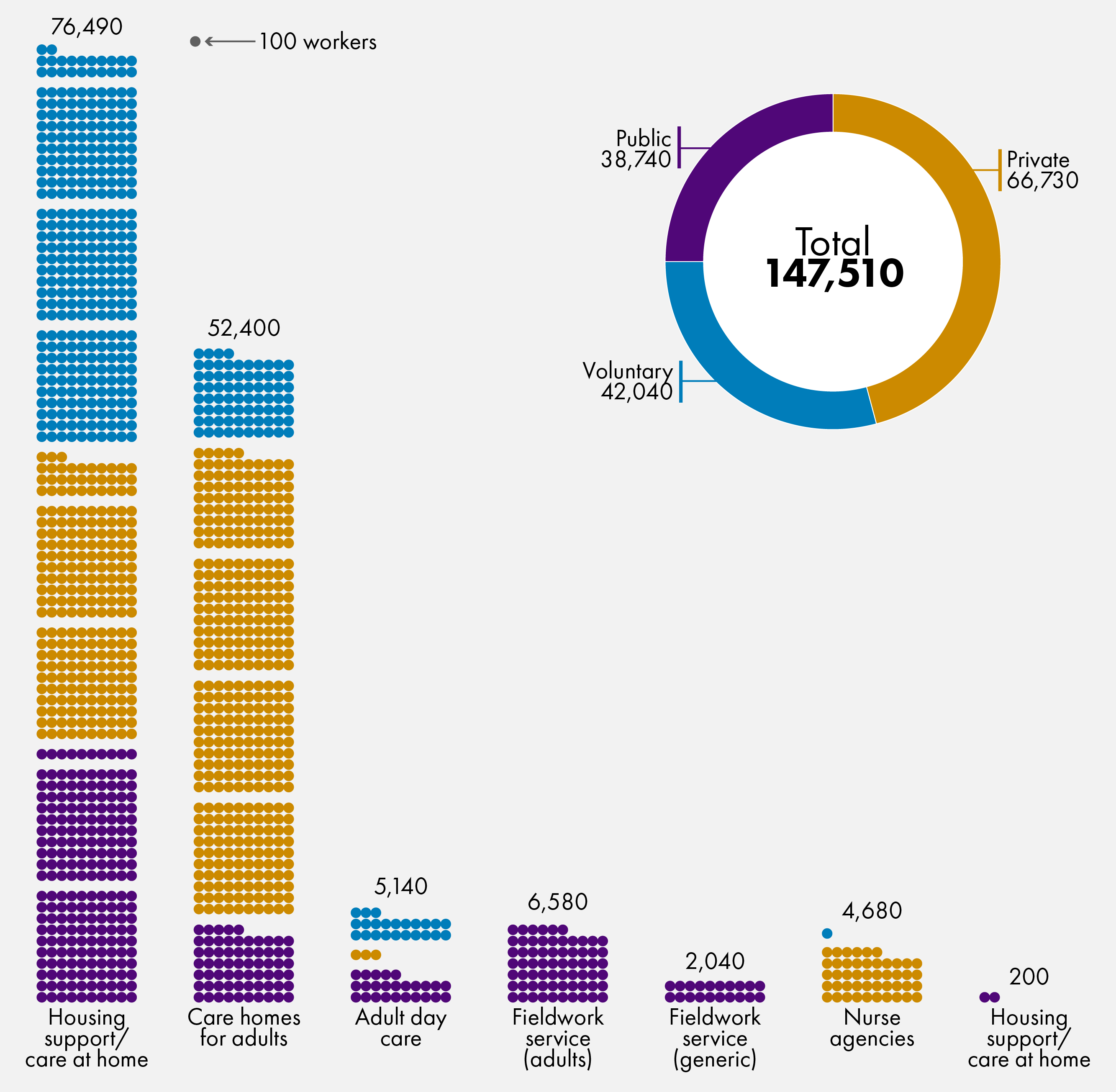
SPICe using data from SSSC workforce data
The chart below shows the relative numbers of staff employed in the different parts of the care sector by how they are employed: by public bodies, private providers or not-for-profit providers (Voluntary).
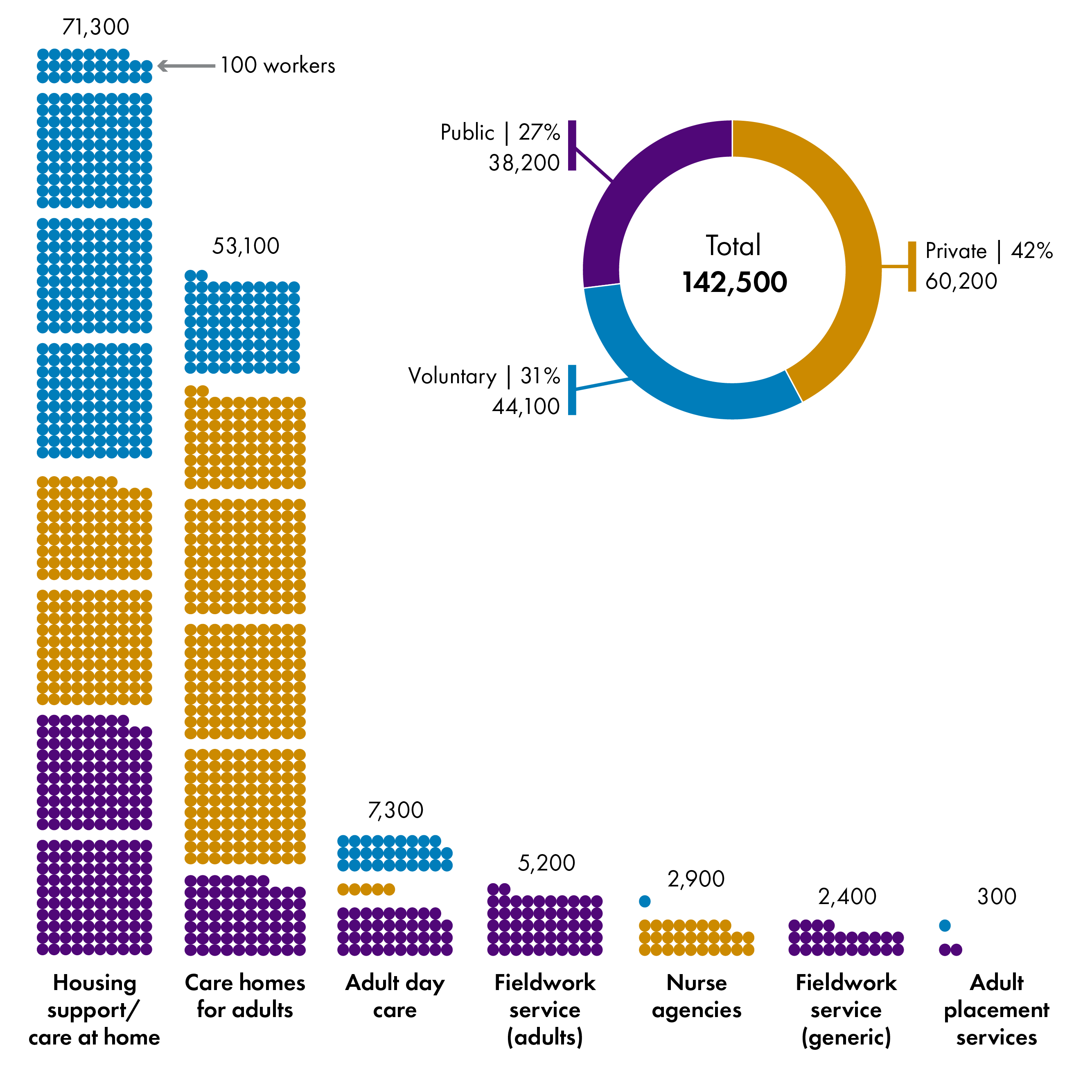
SPICe using data from SSSC workforce data (2019)
Social care staff are regulated by the Scottish Social Services Council (SSSC). The SSSC liaises with the Care Inspectorate, the regulator for social care provision, as well as other partners such as Skills Development Scotland.
The SSSC Register was set up under the Regulation of Care (Scotland) Act 20011to regulate social service workers and to promote their education and training.
It is important to note that many registered nurses, as well as allied health professionals and primary care staff such as GPs and community nursing teams are either employed in the sector or work very closely with social care staff. These staff are registered and overseen by other regulators.
The Scottish Social Services Council publishes workforce reports annually. The most recent report, published in September 2025 highlights:
The Scottish social service workforce increased to its highest level yet (214,750) in 2024. Largely driven by an increase in staff working in privately run care homes for adults (+1,800 since 2023).
The care homes for adults workforce is getting bigger. Their workforce increased in 2024 to 52,400, while the number of services decreased by 24 to 999.
The total number of direct care staff increased by 17.4% since 2015, due to growth in two of the largest sub-sectors: housing support/care at home and day care of children.
The WTE number of staff is 163,790 and the actual number of staff is 214,750 resulting in a ratio of 0.76 which means that on average each employee works 76% of whole-time hours.
At 41% the private sector continues to have the largest share of the sector's workforce.
Decreases in public and voluntary housing support/care at home staff is counterbalanced by an increase in the private sector headcount so that housing support/care at home continues to be the largest employer of social care staff, accounting for 36% of the total workforce.
In 2024, 83% of the sector were employed on permanent contracts and 5% had a no guaranteed hours contract, consistent with 2015 and 2023.
Frequently and continually raised issues about the social care workforce over the past few years include the following, most of which are interdependent:
Issues - social care workforce
recruitment and retention - availability of staff and attractiveness of the profession
workforce planning and the impact of Brexit
commissioning and procurement practices that undermine person-centred care and inhibit strategic workforce planning
value of profession and parity of esteem with other community-based staff
training and development
career progression vs a desire to focus on the direct caring role, unfettered by additional qualifications and management responsibility
affordability of additional or agency staff and overnight payments
delays in assessments and reassessments (of six weeks), making it hard to be responsive to changing needs of people.
The Health and Sport Committee conducted a series of short inquiries on different aspects of social care in Session 5 and one that focused on the social care workforce in 2016 explored some of these issues. Scrutiny of the proposed National Care Service was undertaken through most of Session 6 along with post-legislative scrutiny of Self-directed Support. The following sections consider some of the issues: recruitment and retention, fair work and framework contracting, and workforce planning.
Recruitment and retention
Recruitment and retention can be affected by terms and conditions which have compared poorly against, for example, retail work. In different sectors, terms and conditions can also vary widely. Through the short inquiries carried out by previous Committees, it was highlighted that staff did not feel valued, or heard by multi-disciplinary teams in relation to the needs of the people they were paid to care for. Carers sometimes felt embarrassed to tell people what they did for a living, and commissioning and assessment practices undermine person-centred care and flexible arrangements in commissioners' efforts to manage spending. Private and third sector organisations bid to provide services within framework agreements which do not specify particular packages of care. It is up to the provider to work out how they will fulfil the contract in terms of staffing.
The Scottish Living Wage was introduced for social care staff in the 2016 budget, but providers argued that little partnership existed between government, commissioners and employers over the implementation and challenges, and that added costs would present a profound challenge.
Since 2020 the minimum rate of pay for adult social care workers, as well as changed arrangements for overnight working, has increased a number of times. A new voluntary social care bargaining body is being established to provide a forum for trade unions and care providers to negotiated better wages and wider terms and conditions.
Fair work and framework commissioning
When the Health and Sport Committee looked into the social care workforce in 2016, workforce planning was deemed to be absent in any meaningful way, and 'framework contracting', whereby detail is limited, were seen to push risk away from the commissioner, and onto providers. Framework contracts were also deemed to do nothing to contribute to strategic workforce planning, because within that way of contracting, workforce planning becomes solely a matter for the provider. Scotland Excel, the organisation that supports public bodies in their commissioning and procurement, describe the process in positive terms, stating that it can 'support a consistent approach, provide detailed management information and ensure sustainability of care services.', as well as supporting outcomes focused commissioning. Concerns have been raised by some providers about the operation of national frameworks.
It seems that this approach is not borne out by other evidence. Three years on from the Committee inquiry, The Fair Work Convention published a report in 2019, 'Fair Work in Scotland's Social Care Sector'1providing information and detail on many of these issues, from the point of view of the workforce. On commissioning, the report states:
The current method of competitive tendering based on non-committal framework agreements has created a model of employment that transfers the burden of risk of unpredictable social care demand and cost almost entirely onto the workforce. We have deliberated carefully over the nature of the contractual frameworks, and it is our belief that this method of procurement creates a situation that is untenable.
source: Fair Work in Scotland's Social Care Sector
They recommended:
that the current commissioning practice of hourly rate based non-committal competitive tenders and framework agreements should end. Social care providers should be commissioned based on their level of skill, expertise, understanding and application of the Fair Work Framework, and on costs based on the right numbers of staffing required and a satisfactory and fair income level for each member of staff. Commissioners should be responsible for assessing and predicting the level of demand and commissioning the right levels of staff from the provider organisation, with no expectation that the provider or worker carry the risk for working time not being required.
Since 2020 and particularly following the recognition of the sector's crucial role during the COVID-19 pandemic, more focus has been directed to the sector, the issues outlined and staff terms and conditions.
Workforce Planning
At around the same time as the Fair Work Convention's report was published, the Scottish Government published An Integrated Health and Social Workforce Plan for Scotland December 2019. This followed a series of three separate preparatory documents covering workforce planning in primary care, social care and healthcare. This was followed up in 2022 with a national workforce strategy for health and social care 1. It is not clear what work has been ongoing since 2022 on workforce planning for social care, but in March 2026, the Scottish Government stated it was:
Revitalising our approach to workforce planning, with a new Improvement Framework later this year, helping to manage pressure and support staff well-being
The Integrated Workforce Plan estimated staff needed in key groups up to 2030. This includes 1,500 more allied health professionals, 8,800 more care home staff and over 14,400 more home care and housing support staff. Looking at the data for 2024,this increase is not yet evident for social care staff, but since January 2020 there are now (July 2026) 2,360 more WTE (Whole Time Equivalent) allied health professional staff employed (across health and social care).
They highlight the potential impact of Brexit on the supply of these staff, with estimates that around 5 - 7% of staff in a range of staff groups are currently non-UK EU nationals. In addition, turnover and vacancy rates among relevant staff groupings are relatively high, and growing in some professions.
The government seek to address some of the challenges in a number of ways: creating more training places, supporting recruitment into care careers, widening access, improving fair work practices and improving workforce planning.
Historically, workforce planning was seen as the responsibility of the health boards, local authorities and care providers. However, in evidence heard by the Health and Sport Committee during the scrutiny of the Health and Care Staffing (Scotland) Bill, it became clear that workforce planning was based on past supply, not future demand. There was no national overview of the demands of changes in policy, such as integration, in future requirements for staff. Only some training places are controlled by government (eg. medicine). There was no national intelligence on the training places required to meet future demand. While the published plan does not provide reliable projections based on data (because much of the data doesn't exist) a single workforce data platform is being developed, and work to understand the care labour market is being developed. It has also been recognised that the skills required to conduct large-scale workforce planning do not necessarily exist, and a qualification is being developed.
Shortly before the Workforce Plan was published, an independent report, 'The Implications of National and Local Labour Markets for the Social Care Workforce' commissioned by the Scottish Government and COSLA, was published (March 2020). This study took an in-depth look at the care labour market including topics such as retention, recruitment, training, motivations of staff, movement of staff and conducted a range of surveys with stakeholders. Many observations, from a much larger pool, reflect those heard by the Committee in 2016.
External factors affecting workforce - Brexit and visas
Some academic research has been carried out looking specifically at the impact of Brexit on social care staffing. Through a mix of qualitative and quantitative methods, the study concluded that Brexit, along with other workforce issues discussed in this briefing, has exacerbated the recruitment and retention of staff in the adult social care sector.
The research also discusses visa arrangements before and after Brexit in some detail.
Prior to Brexit, there was no dedicated visa route to work through which migrants could work in the social care sector. In addition to EU nationals and their dependants who could work in any sector of the economy under the FoM, visa routes to the frontline social care roles had been through Tier 4 (General Student) route and their dependants as well as through dependants of migrants on Tier 2 (Skilled Worker) route (MAC, 2022). To address the acute staffing shortages in the health and social care sectors following Brexit, the UK Government launched the Health and Care Worker (H&CW) Visa in August 2020 to provide a direct route to employment in both sectors. However, frontline care workers (care assistants, support workers, home carers, etc) were not eligible under the initial criteria for this visa route and would take a further recommendation by the Migration Advisory Committee (MAC) to include these frontline care workers in February 2022. The visa route initially enjoyed considerable interest from migrant care workers. The immigration conditions under which most migrant care workers are employed, however, make them vulnerable to exploitation and abuse (Gayle et al., 2024). For example, workers under the H&CW visa are tied to a particular care employer and they cannot change their employer unless they update their visa.
Since early in 2024, UK visa restrictions have tightened and from 11 May 2025, the UK government announced that the overseas recruitment of care workers was to end. This was in combination with the revocation of a number of licences of rogue care providers engaged in exploitative practices, compliance breaches and data discrepancies. As visas are tied to the employer, this left a large number of care workers without work and without visa cover. SPICe published a blog:'What is the future for international social care workers in Scotland?' in December 2025, describing the situation and the mitigations in place.
Care workers can no longer be recruited directly from abroad. However, there is a grace or transition period currently running whereby visas can be extended, and switching employers will still be possible till July 2028. It is unclear what will happen after that date, but the aim of the change is for care staff employers to recruit from the resident population.
Although a reserved area of policy and legislation, Scotland has a migration information servicefor employers and investors to assist navigation of the UK visa and immigration rules.
Training
The Scottish Social Services Council (SSSC) is responsible for developing the qualifications for social work and social care staff as well as registering and regulating staff. They also promote the sector. Most of the materials are available through their website, where people can find out about careers in the sector, how to register. Continuing professional development resources are also available. Providers will also design and implement their own training.
People can become a care support worker without any formal qualifications. However, a condition of registration is an undertaking to work towards a qualification. Accepted qualifications are also listed on the website and depend on the role.
Currently, there is little financial support available for undertaking courses, but this possibly reflects the reality that most people enter the workforce and train and gain qualifications 'on the job'. If a person joins as an apprentice they do not pay for training.
Staff at all levels have to pay a fee to join the register.
Personal Assistants
Personal Assistants (PAs) is the term that covers a person that is employed or paid directly by someone needing care and/or support. Direct Payments, under Option 1 of Self-directed Support, can be used to pay for the services of PAs. The local authority monitors the arrangement in relation to agreed outcomes, so some record keeping is required by the person employing the PA.
The person needing support becomes the employer of the personal assistant, or the PA will be self-employed and will invoice the individual. If the person is employing the PA, they will need to think about their responsibilities as an employer such as tax, national insurance, employee rights and pension payments. If the PA is self-employed then the person will need to think carefully about what should be in the contract. Support is available from a range of sources, via Self-directed Support Scotland for example, who can arrange advice and peer support. SDS Scotland have also produced a dedicated PA handbook.
As part of the updated Self-directed Support Standards produced in 2024, Standard 13 relates directly to PAs. Information and guidance is available via the Care Inspectorate website and through Self-directed Support Scotland.
Personal Assistants do not currently have to register with the Scottish Social Services Council and are not regulated by them or the Care Inspectorate. However, like all social care staff, they are expected to hold a PVG (Protection of Vulnerable Groups) certificate and uphold the SSSC code of practice:
Social service workers must:
protect the rights and promote the interests of supported individuals and carers
work to establish and maintain the trust and confidence of supported individuals and carers
promote the independence of supported individuals while protecting them as far as possible from danger or harm
respect the rights of supported individuals while making sure that their behaviour does not harm themselves or other people.
PAs have increasingly become recognised as having the same status and rights as any other social care worker. This has been demonstrated in discussions on living wage, sleepover payments and more recently, during the COVID-19 pandemic when they were explicitly recognised as key workers.
Because there are no registration requirements, there are also currently no qualification requirements for PAs. Anyone can call themselves a PA if they are receiving payment for looking after or supporting someone. In practice many PAs are employed by other organisations or companies to work as PAs for people accessing self-directed support, so removing the employment burdens from individuals.
Unpaid carers
While not part of the 'workforce', unpaid carers are recognised in law for the contribution they make in social care by looking after family members, neighbours and friends.
The actual number of carers is not known, partly because many would not identify as one, seeing their role as being part of normal family life, but according to the Scottish Government, the number was previously estimated to be between 700,000 and 800,000. This included 29,000 who were under the age of 18. The most recent Scotland’s Carers report1(March 2026) provides statistical analysis and research on caring and carers.
The Scottish Government has collated information on legislation, policy and support for carers of all ages.
Carers UK conducted a study, Will I Care? in 2019, looking at the likelihood that someone would become a carer. What is striking is that most are carers in middle age, not after retirement. The study revealed that although one in two men in Scotland will be a carer by age 57, this drops to age 45 for women.
Analysis by the universities of Sheffield and Birmingham, who conducted the study, show that between 1991 to 2018, 65% of adults in Scotland have been an unpaid carer for a loved one. The research also shows that the average person in Scotland has a 50:50 chance of caring by 49 years-old. There is not a huge variation in these figures in other parts of the UK. Researchers derived their data from large scale national surveys such as the British Household Panel Survey/ Understanding Society.
A more recent report published by Carers UK, State of Caring:the cost of caring in Scotland in 2025, considers the impact of caring on finances, employment and education, and on health.
The Carers (Scotland) Act was passed in Scotland in 2016 and came into effect on 1 April 2018. The intention of the Act was to ensure that carers (including young carers below the age of 18) are better supported on a more consistent basis so that they can continue to care, if they so wish, in good health and well being, allowing them to have a life alongside caring.
The Act gives carers a right to a support plan from the local authority, taking account of the person's individual circumstances. They are also entitled to an assessment of their needs, and, if local eligibility criteria are met, then support will be put in place. As with eligibility criteria for social care, it is likely that bespoke Self-directed support from the local authority will only be available to those deemed to be at 'substantial' or' critical risk' because of their caring responsibilities. However, this does not mean that authorities are not providing more universal services and means of support, such as the funding of local organisations that provide support. Carers will be signposted to local services, such as peer support groups, information and advice on applying for small grants for example.
Most authorities will make information on how eligibility works locally available through their websites. This is just one example from South Lanarkshire.
The Carers (Waiving of Charges for Support) (Scotland) Regulations 2014 and the Self-directed Support (Direct Payments) (Scotland) Regulations 2014 require Local Authorities to waive charges in relation to support provided to carers.
support to the cared-for person to meet their assessed needs, the indirect consequence of which is not so much that the carer’s identified needs are met, but that the carer no longer has those needs; or
support to the carer to meet the carer’s identified needs, which could be through care or support to the cared-for person.
Integration authorities have had to develop carer strategies and eligibility criteria for their area. There is not yet an automatic right to a break from caring, but authorities have to involve carers in the development of their carer strategies and short break statements. Once the Right to Breaks comes into effect, carers will have the right to “sufficient breaks” and local authorities and HSCPs will have duties to ensure people who do not have sufficient breaks from their current caring role are supported to do so. The needs of carers are, of course, inseparable from the needs of the person they care for, and the Act recognises that a carer's needs will be quite individual. The continuation of the policy of personalisation and person-centredness inherent to Self-directed Support is clear, as is the reflection of the long-standing processes of assessments of need and eligibility criteria. It is important to note that carers are entitled to self-directed support, using the same principles, and options available to the person they care for. The first step in this process is arranging for a carer support plan.
The Scottish Government published a Carers' Charter in 2018 to explain the Act and what people should expect. The Coalition of Carers in Scotland also produced a document to explain the Act and what people should expect: 'What to Expect...The Carers (Scotland) Act'
The Coalition of Carers in Scotland has also produced a range of leaflets explaining different aspects of the Act.
1. What to expect when you make an adult carer support plan
2. What to expect if the person you care for is being assessed
3. What to expect when you are considering a short break
4. What to expect when accessing Self-directed support as a carer
5. What to expect when you make an emergency plan
6. What to expect when the person you care for is discharged from hospital
Unpaid and paid carers responded in large numbers to Health and Sport Committee survey asking about care and support at home during the pandemic.
The Care Reform (Scotland) Act includes provisions to improve support to unpaid carers.
Issues for social care (for twenty years and counting)
This section provides some links to reports written on the main issues highlighted below. Some of the information referred to is based on social care in England and Wales but there are enough parallels with aspects of social care in Scotland to make them relevant. The publications, along with others referred to in the briefing provide further background and information useful in considering reform.
Funding
Commissioning and procurement
Self-directed Support
Workforce
Alternative Models of Care
Integration of health and social care
Housing
Technology
Human Rights based approaches to social care
Community focus in planning
Third Sector
Accountability see summary of evidence, for a discussion of these topics.
The Coalition of Care and Support Providers in Scotland (CCPS) published a report in August 2026, 1'On the Ground' which describes a fragmented picture of integration, and maps the complexity of local governance and planning for social care at a local level.
Because so much has been written about the problems with social care, there is little value in repeating it here. The King's Fund, although with a focus on England, summarised key aspects of these issues in Fixing social care: the six key problems and how to tackle them
The Nuffield Trust publishes regularly on social care reform, again, with a focus on England although they do also publish reports comparing UK and international systems.
See also a range of briefings and reports written by the UK Parliament:
House of Commons Library: Adult Social Care funding in England 2025
House of Lords Library: Future of Adult Social Care 2023
House of Lords Library:Reforming adult social care: House of Lords committee report 2023
House of Commons Library: Paying for Social Care : 20 years of inaction
House of Commons Library: Adult Social Care in England: possible reforms
Economic Affairs Committee (HoL) Report: Social Care Funding: time to end a national scandal
Citizens' Assembly on Social Care: Recommendations for Funding. Report
Audit Scotland have also published a number of relevant reports. These recognise the impact of the policy and structural innovation that integration entails, and considers social care in this context in its current publications.
Delayed discharges: A symptom of the challenges facing health and social care
Community health and social care performance
Integration Joint Boards Financial bulletin 2024/25
Local government budgets 2026/27
Blog: A renewed focus on the sustainability of social care
Self-directed Support (progress report) 2017
Changing models of health and social care 2016
Implications for public finances in Scotland (COVID-19) August 2020
As this briefing has outlined, the Scottish Government has introduced significant policy and legislation, seeking to improve social care: free personal care, self-directed support, support for unpaid carers and the integration of health and social care. Lack of sustainable funding, workforce capacity and the care market have meant that the full expectations of these have not been realised.
...and proposed remedies in Scotland
The following sections consider the efforts made to reform the care of older people in Scotland over the past ten years, with a programme for change from 2011-21. This programme took on board the recommendations of 1Christie and Dilnot (and 2012 progress update)2. Prior to the integration of health and social care, the Scottish Government introduced a 'change fund' to stimulate the development of community-based services for older people who might otherwise remain in hospital, and to prevent emergency admission in the first place. The expectation was that a reduction in unscheduled (emergency care) hospital care costs would result, and money be reinvested in prevention and investment in community-based services. These efforts prefigured and have run in parallel with the ongoing process of integration of health and social care. Again, the expectations have not yet been met, despite some progress.
Independent Review of Adult Social Care
The key piece of work in Scotland in recent years, and in the wake of the COVID-19 pandemic, was the Independent Review of Adult Social Care (IRASC), led by Derek Feeley. This purportedly led to the development of the National Care Service work for the legislation, although the 'nuts and bolts' of its operational detail was also informed by external consultants. See also FOI release on breakdown of costs.
Feeley made the case for a National Care Service but also provided insights and recommendations on models of care, implementation of an outcomes focused system, fair work and commissioning. His overall reframing of social care was a key element, advocating a positive narrative of investment, capability, collaboration and prevention rather than social care being a burden, about crisis management and competition and markets. He was advocating a move away from a transactional approach which had become a function of stretched resources in local government.
The National Care Service Bill sought to address some of the recommendations but was chiefly concerned with creating the foundational, structural elements for a National Care Service. The extent to which it would have enhanced or hampered the integration of health and social care project or radically reformed the overall system over time, remains moot. The Bill did not address the fundamentals of funding or provision of care services, nor the 'market'. As noted above, the Act as passed was radically different from the Bill that was introduced.
A focus on prevention
In June 2025, the Scottish Government published a Public Service Reform Strategy, and the 7th session of the Scottish Parliament saw the establishment of a Public Service Reform Committee.
The Strategy comprises three key pillars: Prevention, Joined up services and Efficient services. Prevention, it says, is about intervening early, at a population level, that it supports fiscal sustainability and can cut demand for expensive crisis services.
In 2025 the Scottish Government also published three health and care related strategy documents, declaring them defining documents for the improvement of health and social care services over the next ten years. They are:
The Population Health Framework(PHF) and
SPICe published a blog summarising and considering the three documents:The ongoing pursuit of ‘prevention’ in health and social care: Two frameworks and a plan
SPICe also published a briefing on Preventative spending in Scotland, looking at public services more broadly.
As described elsewhere in this briefing, much of Session 6 involved scrutiny and discussion of reform of social care through the passage of the Care Reform (Scotland) Act 2025 (which started life as the National Care Service (Scotland) Bill).
Reshaping care for older people
In 2011 a vision document was produced by the Scottish Government, COSLA and NHS Scotland called 'Reshaping care for older people: a programme for change 2011-21' The vision was that “Older people are valued as an asset, their voices are heard and they are supported to enjoy full and positive lives in their own home or in a homely setting.”. While this is arguably now very out of date, the two key contemporary high profile Commissions, fromChristie and others specifically on social care, (in England) remain relevant, or ongoing.The programme was followed up by an update paper on progress in 2013 which reflected that the principles of personal outcomes for individuals was becoming embedded:
In line with Christie (2011), a personal outcomes approach supports sustainability by moving the focus away from service led approaches. This requires supporting people to make the move from viewing the delivery of service as the endpoint, to focusing on the purpose of engagement and activity with individuals. When the starting point is clarifying purpose (outcomes), the next stage is identifying how those outcomes might be achieved - this includes considering the role of the person and other resources in their lives, as well as services, consistent with an enabling culture.
This seems to suggest that statutory services should become less significant in a person's life, or that there is a change of emphasis, such that services should not be put in place to address problems (a deficit model), but to support the capacity and abilities of the person and the access to facilities and other people around them (an assets based model). However, for someone with severe dementia or advanced MND, or profound learning disabilities, there will always be a requirement for 24/7 personal care/nursing care and a high level of support.
The original report concluded that two actions were necessary to address the increase in demand as a result of demographic change:
that current resources were being used to meet agreed policy goals ie, more robust research and data on outcomes
how additional resources could be secured to create sustainable services into the future, perhaps by attending to recommendations of the Dilnot Commission (King's Fund briefing paper)(2011)
Shifting the balance of care from hospital to the community
How additional resources are secured for social care has remained at the heart of the problem for reforming social care, across the UK. According to the King's Fund:
The Dilnot recommendations aim to eliminate the catastrophic care costs faced by some people by capping the maximum amount individuals contribute over their lifetime, beyond which the state will meet all future funding. By limiting people’s liability in this way, the Commission expects a market to develop for financial products so that people can insure themselves against the cost of their contribution.
In Scotland, the 'Re-shaping Care for Older People Report' prefigures SDS, but also, in its 'next steps' looks to integration to promote 'resource release' from the acute sector. The report recognised the real challenges in this: it is difficult to reduce the number of people accessing unscheduled (emergency) care, where a third of costs are located. Also, it is perhaps unrealistic to hope that a shift of resource is a simple transfer of funds calculation. Several years of integration has shown this to be true.
This difficulty in shifting resource from hospital care to community-based care could be partly because the very nature of unscheduled care; demand is unpredictable, but it also doesn't take account of medical and technological advances and costs of new medicines for example, and other increasing health costs. The NHS cannot do that much in controlling the costs of medicines, devices and new technologies.
From the community-based services perspective, it is challenging to keep up with increased needs and financial pressures. In order to meet statutory duties and ensure financial sustainability, preventative services and less intense forms of support have been de-prioritised. In turn this increases demand on the acute end of the system.
Another challenge is the focus on measures and targets at the acute end, such as waiting times, and delayed discharge data. Performance has been measured by outputs instead of outcomes, and are easy to report on. It was hoped that the data could be used as a mechanism to highlight and then address issues strategically, rather than reactively. Meanwhile it is deemed to be difficult to measure the impact of preventative services as it is difficult to discern which poor outcomes have been prevented by policy in the shorter term. However, in policy areas such as crime prevention and reduction, Violence Reduction Units set up in 2019 in England and Wales demonstrated a reduction in hospital admissions, a decrease in assaults and knife crime in under 24 year olds, where the work is focused. Interventions included mentoring, sports programmes, therapeutic support, social skills training or a combination of these - all community-based interventions. Ironically, the challenge in providing the interventions arose when there were few if any local activities or services.
Impacts appear gradual and cumulative, aligning with the programme’s longer-term whole-systems logic (that is, not expected to deliver immediate, short‑term changes).
Source: UK Home Office
It is also worth noting that not-for-profit organisations have a breadth and depth of experience in evaluating their impact on outcomes, as such evidence is required constantly to secure ongoing and new funding from a broad range of funders. This wealth of data tends to remain with the organisation, rather than being harnessed nationally to inform policy. However, its value has been recognised for over a decade, through initiatives such as the Knowledge Translation Network and the Scottish Third Sector Research Forum. Evaluation Support Scotland supports organisations in demonstrating impact, but they are not the repository for a national database on outcomes evaluation.
The report also concludes that the funding, procurement and affordability of social care are the main issues, and that it is up to the Scottish Government to assess what policy and legislative levers it has at its disposal. It should be remembered that this programme was being developed alongside health and social care integration, and very shortly after the establishment of the Care Inspectorate.
Despite the overlay of the pandemic in 2020, many of the intractable problems with social care have been rehearsed over many years and much time has been devoted to them, and they remain. Despite radical changes to legislation that have happened in Scotland and not in England, such as introducing free personal and nursing care, the problems have not been 'solved'. These include so-called 'catastrophic costs'(because many people have to pay for their own social care in a residential home, some people with significant care and support needs will end up paying very large sums – £100,000 and above. Many will have to sell their main, or only asset,their home, to pay these costs), recruitment and retention of staff, and inequity in how different diseases are regarded and treated by the NHS: cancer and dementia for example.
Local Government
Local Government is, of course, the central element of social care provision and organisation in Scotland, and therefore reform.
COSLA published a 'white paper' ahead of the 2026 Scottish Parliamentary election on social care reform: A social care system built on prevention. It argues that:
A preventative approach is a whole‑system, place‑based way of working that focuses on the social, economic, and environmental conditions that shape people’s wellbeing. It means investing in early intervention, supporting community resilience, and redesigning services to reduce avoidable demand—not just avoiding ill‑health. At its core, a preventative approach is about creating the conditions for people and places to thrive
Its vision is that:
Through properly embedding prevention across our communities, Local Government will deliver a social care system that:
Is genuinely whole-system, fully integrating health and social care while championing parity between them.
Values and empowers its workforce, supporting the workforce to know when and how to draw upon innovative solutions, such as digital and technology.
Prioritises and promotes human rights and the wellbeing of people and communities.
Ensures local flexibility, while ensuring high-quality care and positive outcomes for all.
The Local Government information Unit, LGiU, is a non-partisan membership- led UK wide organisation. It aims to provide local government with insights, analysis and innovation to strengthen local governance and effectiveness. It published, in collaboration with the Chartered Institute of Public Finance and Accountancy, CIPFA, a series of briefings on social care and reform across England, Wales and Scotland.
The final report in the series made four recommendations for reform in Scotland:
Finance
Despite the significant advances in social care in Scotland in recent decades, the current adult social care financial settlement in Scotland is not working. Funding is structurally unsustainable and increasingly unable to meet the expectations of communities and policy makers. Resources are directed at keeping the wheels on the service rather than improvement and sustainability. There was recognition among interviewees that funding for social care will have to increase over time, but that this increase should come with purpose rather than as a reaction to increasing demand, with investment in front-line services to improve quality and access to care. There should also be a shift from reaction to prevention.
Recommendation: Dedicate funding to service sustainability and improvement.
Available resources are currently directed to keeping a struggling service afloat and towards policies that do not increase capacity or improve outcomes. This recommendation is about reprioritising resources to enable public bodies to innovate, redesign services and improve financial resilience.
Recommendation: Clarify financial accountability within integration.
After the NCS experience, there is an appetite for practical, deliverable changes within existing structures. Current integration arrangements blur responsibility and do not serve their intended purpose effectively. For example, set-aside budgets were intended to enable resources to shift from acute to community settings when demand reduced. However, in practice, in some areas it is treated as a purely notional accounting entry, while in others it is a major financial pressure over which integrated joint boards (IJBs) have no control. This mechanism, as an example, needs reform so that funding genuinely flows towards care in the community. Other areas of reform include pooled budgets and risk-sharing arrangements.
Governance
Scotland’s integration structures are inconsistent, fragmented and complex. There are 31 IJBs (six of them in the Greater Glasgow and Clyde Health Board area alone), and they all have divergent integration schemes, delegated services and financial arrangements. Such variation acts as a block to collaboration and value for money. Structural simplification, reduced fragmentation and clearer governance must be central to adult social care reform in Scotland.
Recommendation: Standardise delegated services.
Different IJBs have different integration arrangements with responsibility for different parts of the social care system. For example, some have responsibility for children’s services, while others don’t. While different local integration arrangements offer greater flexibility, standardising the services delegated to IJBs would reduce inconsistency, foster greater collaboration and create a clearer integration system. Consistency in what is delegated will make it easier to compare performance, financial pressures and drive national policy.
Recommendation: Review opportunities to strengthen scale, collaboration and shared capacity across IJBs.
There is an opportunity to improve strategic capability, governance resilience and efficiency by exploring how IJBs can operate at greater scale where appropriate. This could include shared commissioning arrangements, joint analytical and financial functions, or closer alignment 8 of neighbouring partnerships. Strengthening collaboration across IJBs would help reduce duplication, improve consistency of strategic planning and support more effective management of financial risk, while retaining the benefits of local accountability.
Audit Scotland
Audit Scotland seeks and supports the improvement of public services, including health and social care, by looking at how public money is spent and whether policies achieve the desired outcomes. They regularly report on different areas of health, social care and integration, considering and highlighting finance, 'best value' and performance from an individual body - such as a local authority or health board, to wider, issues or service based analysis, such as delayed discharges, community health and social care, governance etc. Audit Scotland also publishes Local Government overview reports.
Their work is essential in informing scrutiny and reform by providing factual insight and audit.
Other Scottish Parliamentary activity
Much of Session 6 of the Scottish Parliament, 2021 - 26 was dedicated to scrutiny of social care and self-directed support through the scrutiny of the Care Reform (Scotland) Bill, integration authorities and post-legislative scrutiny of the Social Care (Self-directed Support) Act 2013. 1
The Session 6Health, Social Care and Sport Committee hosted an event, Scotland 2030: A Sustainable Future for Social Care for Older People, in collaboration with Scotland’s Futures Forum, to consider the future of social care for older people in Scotland. The event considered the general proposition of how social care would look (and be financed) in 2030.
The difficult questions surrounding social care were addressed by a number of speakers at the event and the report summarises some of these alongside some of the options for the future of social care. Extensive quotes are presented here because they are not available through the Official Report.
Professor Bell provided a brief history of long-term care policy in Scotland, noting the 2001 work of the Care Development Group, the introduction in 2002 of Free Personal Care and the Sutherland Review in 2008. However, he stated, not much has been done since then to look at the overall funding of care.
English ideas
Professor Bell referred to previous reviews in England, including the Barker Commission, which suggested making social care free at the point of use for those with “critical” needs, extending to those with substantial needs as the economy improved and to those with moderate needs by 2025. The Commission also floated four different ways of funding these changes:
• remove exemptions for prescription charges, while making them cheaper;
• restructure National Insurance to collect more from those aged over 40 and high earners;
• increase contributions from older people such as by limiting winter fuel payments to those on low incomes; and
• review wealth and property taxes
What do we mean by fairness?
Professor Bell suggested that decisions on funding come down to what we mean by “fairness” in the context of long-term care, and he pointed to these areas for consideration.
• Condition: is it fair that there is free care for people with cancer but not for people with dementia?
• Income: what share of cost should be borne by low or high-income households and families? Does the prospect of high care costs cause a disincentive to save?
• Wealth: should we use wealth rather than income when considering ability to pay?
• Place: how far should local communities be able to set their own levels of long-term care support?
• Generational: will subsidies to care for the baby boomers adversely affect following generations?
Bell goes on to consider the proportion of the older population supported by national care services in England and Scotland, compared with Germany and France. In England and Scotland the proportion is steadily decreasing. The opposite trend is seen in Germany and France.
Dee Fraser, from the Coalition of Care and Support Providers Scotland (CCPS), that represents not- for-profit providers of social care and support, also presented at the event and spoke specifically about the so-called 'market' of social care.
Context
As context, Ms Fraser noted that 80% of social care is delivered by non-statutory partners in the voluntary and private sectors, with 69% of social care workers in those sectors. The fact that the majority of work is done under contract rather than directly by public authorities is the reason why commissioning is so important.
Not a market. Although we talk about a market for social care, Ms Fraser noted that we really have a monopsony, where there are lots of providers but only one purchaser. In such a situation, the purchaser has a lot of control, over price for example, but the long-term effect can be toxic. Providers unable to meet the requirements drop out, leaving only one large provider, and a monopoly emerges. Given that situation, and the fact that the opportunities under self-directed support are not being used by much of older population, Ms Fraser suggested that we end up with an overly bureaucratic system that provides decreased availability and choice of care.
A new mindset. In response, Ms Fraser called for a new commissioning mindset. Rather than let commissioning be led by finance, purchasing and practice of procurement, we should fit services around people and consider the whole system rather than just the parts. With that in mind, Ms Fraser suggested five areas to consider for the future.
1: Pay attention to effects Ms Fraser provided an example from a local authority in Scotland – although simplified, it showed how reaching a quick fix can cause more problems. Social care expenditure was increasing, so the authority’s reaction was to re-tender with a lower, capped hourly rate. Providers withdrew as the rate was not financially viable, meaning that the external providers market reduced. The statutory duty to provide support lay with the local authority, which had to buy in agency staff to cope with the demand. This, in turn, increased the social care expenditure. A better solution would have been to develop an understanding of cross-sectoral expenditure, with collaborative allocation leading to a better use of resources.
2: Alliance contracting Alliance contracting (a process used in places such the oil and airline industries) is a vehicle to share risks, responsibilities and opportunities. It is not a legal entity, so there is no need to merge any bodies; it is an alignment based on outcomes and a commitment to principles and behaviours. 8 Traditional contracting involves one commissioner and several providers, with separate contracts with each party. In it, there are separate drivers for each party, performance is individually judged and does not drive collaboration, the commissioner is the co-ordinator, provision is made for dispute and contracts are based on tight specifications. As such, change can not be easily accommodated and the process is not responsive to changing demand. Under alliance contracting, the public body is commissioner but is also part of the contract – this gives it a greater involvement in the outcomes. Under one agreement and performance framework, with aligned objectives and shared risks, success is judged on overall performance, with shared co-ordination and collective accountability. There is an expectation of trust and an agreement which describes outcomes, and change and innovation in delivery are expected.
3: Confident collaboration in a competitive context. Ms Fraser’s third area to consider was an example from a local authority that, seeing massive gaps in provision, invited all the providers to breakfast meetings over six months to discuss the situation. Following a process of collaborative allocation, they encouraged providers to work together to fill gaps, rather than compete (or not compete) for provision. This has worked well, including by helping the providers come together to meet the requirement for the living wage to be paid for overnight support.
4: Systemic planning. Ms Fraser suggested that public authorities suffer from both bureaucratic redundancy (asking staff to do unnecessary work) and failure demand – where they create demand for services by failing to meet people’s needs earlier. If we can help people who do not need to be in the system to stay out of the system, that leaves more resources to support those who need it.
5: Self-directed support. Finally, Ms Fraser noted that that if there were a real move to people taking control of their own budget, it would unlock the social care market, bringing it closer to a real market with individuals making own choices and services growing to meet that demand. Conclusion In conclusion, Ms Fraser suggested that we need to stop doing the wrong thing a bit better and, instead, we need to do the right thing, even if it takes some time to do it properly. In particular, we need a change in mindset and courageous cross-sectoral systems leadership.
While private businesses are intimately entailed in the NHS, the costs of healthcare are pooled across the population, meaning that private profit is removed from the relationship between the providers of healthcare and the public. The question is how could this be achieved in social care, and should it be?
Because the catastrophic costs for individuals mainly relate to accommodation costs, sometimes called 'hotel' costs, of staying in residential care, any future planning must consider housing for the future. The Futures Forum hosted a further event in the series: Scotland 2030: Housing and Ageing. Clearly, this opens up any discussion on social care, into a discussion on community planning and infrastructure planning. The event considered the report from a UK wide engagement study: 'Housing and Ageing: linking strategy to future delivery for Scotland, Wales and England', which included the input from a wide range of stakeholders and policy makers. The report from the programme concluded that housing should be at the centre of health and social care integration and preventative local strategies, and made the following recommendations:
Invest in early intervention and prevention within the home and community
Achieve meaningful co production/co-working and consultation with older people
Focus on accessible information and advice for older people living in urban and rural communities
Build new suitable housing, such as intergenerational and lifetime homes that are adaptable, flexible, inclusive and affordable across all tenures
In the first Programme for Government in Session 7, the First Minister highlighted the intention to reform social care through the reform of the NHS and local government.
Scotland faces increasing demographic challenges, placing growing financial pressures on health and social care and affecting people’s experience of services. Right now, the arrangements we have in place to manage and deliver social care in Scotland are too often inconsistent in their delivery.
With improvement of outcomes for people and financial sustainability at the core of this programme, reform of both the National Health Service and local government must also include examining all options for the future governance and delivery of social care. We will use these next three months to engage with local authorities, trades unions, and healthcare and service providers to reach agreement on reform of social care which makes best use of the funding in the system, delivers fairer and more efficient services and achieves economies of scale, while enhancing the focus on community need.
Source: Scottish Government
The First Minister's speech went further:
I do not seek to be prescriptive, but I cannot see us resolving the fundamental challenges facing social care without a single line of decision-making, accountability and funding, with the NHS taking the lead. For the NHS itself, in order to ensure more joined up delivery, to improve patient access to care, and to reduce inequality for some patients due to health board boundaries, we will replace the current 14 territorial boards with two Strategic Health Boards. This will be the most significant structural reform of our NHS in the Devolution era.
Sources
Scottish Parliament. (2013). Social Care (Self-directed Support) (Scotland) Act 2013. Retrieved from <a href="https://www.legislation.gov.uk/asp/2013/1/contents" target="_blank">https://www.legislation.gov.uk/asp/2013/1/contents</a>
Scottish Parliament. (2014). Public Bodies (Joint Working) (Scotland) Act 2014. Retrieved from <a href="https://www.legislation.gov.uk/asp/2014/9/contents" target="_blank">https://www.legislation.gov.uk/asp/2014/9/contents</a>
Scottish Government. (2021). Procurement of care and support services: best practice guidance. Retrieved from <a href="https://www.gov.scot/publications/procurement-care-support-services-best-practice-guidance/" target="_blank">https://www.gov.scot/publications/procurement-care-support-services-best-practice-guidance/</a>
Scottish Government. (2024). Scottish procurement: policy manual. Retrieved from <a href="https://www.gov.scot/publications/scottish-procurement-policy-manual/" target="_blank">https://www.gov.scot/publications/scottish-procurement-policy-manual/</a>
Scottish Parliament. (2001). Regulation of Care (Scotland) Act 2001. Retrieved from <a href="https://www.legislation.gov.uk/asp/2001/8/contents" target="_blank">https://www.legislation.gov.uk/asp/2001/8/contents</a>
Scottish Government. (2021). Independent Review of Adult Social Care 'Feeley Report'. Retrieved from <a href="https://www.gov.scot/publications/independent-review-adult-social-care-scotland/documents/" target="_blank">https://www.gov.scot/publications/independent-review-adult-social-care-scotland/documents/</a>
Scottish Parliament. (2014). The Public Bodies (Joint Working) (National Health and Wellbeing Outcomes) (Scotland) Regulations 2014. Retrieved from <a href="https://www.legislation.gov.uk/ssi/2014/343/made" target="_blank">https://www.legislation.gov.uk/ssi/2014/343/made</a>
UK Parliament. (1845). Poor Law Amendment (Scotland) Act. Retrieved from <a href="https://hansard.parliament.uk/Commons/1845-04-02/debates/0beb3ffe-e1ee-4bf7-b122-854231d82883/PoorLaw(Scotland)" target="_blank">https://hansard.parliament.uk/Commons/1845-04-02/debates/0beb3ffe-e1ee-4bf7-b122-854231d82883/PoorLaw(Scotland)</a>
UK Parliament. (1968). Social Work (Scotland) Act . Retrieved from <a href="https://www.legislation.gov.uk/ukpga/1968/49/contents" target="_blank">https://www.legislation.gov.uk/ukpga/1968/49/contents</a>
National Health Service (Scotland) Act 1978. (1978). Retrieved from <a href="https://www.legislation.gov.uk/ukpga/1978/29/contents" target="_blank">https://www.legislation.gov.uk/ukpga/1978/29/contents</a>
Audit Scotland. (2018). What is Integration?. Retrieved from <a href="https://audit.scot/uploads/docs/report/2018/briefing_180412_integration.pdf" target="_blank">https://audit.scot/uploads/docs/report/2018/briefing_180412_integration.pdf</a>
Scottish Parliament. (2014). The Public Bodies (Joint Working) (Prescribed Local Authority Functions etc.) (Scotland) Regulations 2014 . Retrieved from <a href="https://www.legislation.gov.uk/ssi/2014/345/pdfs/ssi_20140345_en.pdf" target="_blank">https://www.legislation.gov.uk/ssi/2014/345/pdfs/ssi_20140345_en.pdf</a>
The Public Bodies (Joint Working) (Prescribed Health Board Functions) (Scotland) Regulations 2014 . (2014). Retrieved from <a href="https://www.legislation.gov.uk/ssi/2014/344/pdfs/ssi_20140344_en.pdf" target="_blank">https://www.legislation.gov.uk/ssi/2014/344/pdfs/ssi_20140344_en.pdf</a>
Scottish Government. (2026). Programme for Government 2026 - 2031. Retrieved from <a href="https://www.gov.scot/publications/programme-government-2026-2031/" target="_blank">https://www.gov.scot/publications/programme-government-2026-2031/</a>
CELCIS. (2023). MAPPING INTEGRATION AND OUTCOMES ACROSS SCOTLAND: A STATISTICAL ANALYSIS. Retrieved from <a href="https://strathprints.strath.ac.uk/87734/1/Anderson-etal-CELCIS-2023-Childrens-Services-Reform-Research-Mapping-Integration-and-Outcomes-Across-Scotland-Statistical-Analysis.pdf" target="_blank">https://strathprints.strath.ac.uk/87734/1/Anderson-etal-CELCIS-2023-Childrens-Services-Reform-Research-Mapping-Integration-and-Outcomes-Across-Scotland-Statistical-Analysis.pdf</a>
Scottish Government. (2019). Ministerial Strategic Group Health and Social Care integration: progress review. Retrieved from <a href="https://www.gov.scot/publications/ministerial-strategic-group-health-community-care-review-progress-integration-health-social-care-final-report/pages/1/" target="_blank">https://www.gov.scot/publications/ministerial-strategic-group-health-community-care-review-progress-integration-health-social-care-final-report/pages/1/</a>
CCPS. (2020). Big Ideas: Ideas for changing how social care is planned, purchased and paid for . Retrieved from <a href="https://www.ccpscotland.org/wp-content/uploads/2022/06/Big_Ideas-CCPS.pdf" target="_blank">https://www.ccpscotland.org/wp-content/uploads/2022/06/Big_Ideas-CCPS.pdf</a>
CCPS. (2023). It's out of Whack! Expert voices on ethical commissioning and procurement in not-for-profit social care. Retrieved from <a href="https://www.ccpscotland.org/wp-content/uploads/2023/11/Its-Out-Of-Whack-Interviews-CCPS-_Final.pdf" target="_blank">https://www.ccpscotland.org/wp-content/uploads/2023/11/Its-Out-Of-Whack-Interviews-CCPS-_Final.pdf</a>
SPICe, Scottish Parliament. (2026). Social Security subject profile. Retrieved from <a href="https://www.parliament.scot/chamber-and-committees/research-prepared-for-parliament/research-briefings/2026/6/10/sb-2631" target="_blank">https://www.parliament.scot/chamber-and-committees/research-prepared-for-parliament/research-briefings/2026/6/10/sb-2631</a>
UK Parliament. (1990). National Health Service and Community Care Act 1990. Retrieved from <a href="https://www.legislation.gov.uk/ukpga/1990/19/part/IV" target="_blank">https://www.legislation.gov.uk/ukpga/1990/19/part/IV</a>
Scottish Parliament. (1992). The National Assistance (Assessment of Resources) Regulations 1992. Retrieved from <a href="https://www.legislation.gov.uk/uksi/1992/2977/contents/made" target="_blank">https://www.legislation.gov.uk/uksi/1992/2977/contents/made</a>
Scottish Government. (2026). Charging for Residential Care Guidance. Retrieved from <a href="https://www.publications.scot.nhs.uk/files/ccd2026-01.pdf" target="_blank">https://www.publications.scot.nhs.uk/files/ccd2026-01.pdf</a>
Scottish Parliament. (2010). Public Service Reform (Scotland) Act 2010. Retrieved from <a href="https://www.legislation.gov.uk/asp/2010/8/contents" target="_blank">https://www.legislation.gov.uk/asp/2010/8/contents</a>
Scottish Parliament. (2002). The Community Care and Health (Scotland) Act 2002. Retrieved from <a href="https://www.legislation.gov.uk/asp/2002/5/contents" target="_blank">https://www.legislation.gov.uk/asp/2002/5/contents</a>
Sutherland, S. (2008). Free Personal and Nursing Care in Scotland. European View, 7(2), 297-302. doi: https://doi.org/10.1007/s12290-008-0046-6
Scottish Parliament. (2018). The Community Care (Personal Care and Nursing Care) (Scotland) Amendment (No. 2) Regulations 2018. Retrieved from <a href="https://www.legislation.gov.uk/ssi/2018/200/pdfs/ssi_20180200_en.pdf" target="_blank">https://www.legislation.gov.uk/ssi/2018/200/pdfs/ssi_20180200_en.pdf</a>
Scottish Parliament. (2013). Social Care (Self-directed Support)(Scotland) Act 2013. Retrieved from <a href="https://www.legislation.gov.uk/asp/2013/1/contents/enacted?utm_source=Update&utm_campaign=2a041b3951-Update_Bulletin6_14_2011&utm_medium=email" target="_blank">https://www.legislation.gov.uk/asp/2013/1/contents/enacted?utm_source=Update&utm_campaign=2a041b3951-Update_Bulletin6_14_2011&utm_medium=email</a>
Scottish Government. (2019). Self-directed support strategy 2010-2020: implementation plan 2019-2021. Retrieved from <a href="https://webarchive.nrscotland.gov.uk/public/20251028224841/https://www.gov.scot/publications/self-directed-support-strategy-2010-2020-implementation-plan-2019-21/" target="_blank">https://webarchive.nrscotland.gov.uk/public/20251028224841/https://www.gov.scot/publications/self-directed-support-strategy-2010-2020-implementation-plan-2019-21/</a>
Scottish Parliament. (2025). Care Reform (Scotland) Act 2025. Retrieved from <a href="https://www.legislation.gov.uk/asp/2025/9/contents" target="_blank">https://www.legislation.gov.uk/asp/2025/9/contents</a>
Scottish Government. (2014). Strategic commissioning plans: guidance. Retrieved from <a href="https://www.gov.scot/publications/strategic-commissioning-plans-guidance/pages/9/" target="_blank">https://www.gov.scot/publications/strategic-commissioning-plans-guidance/pages/9/</a>
UK Parliament. (1978). National Health Service (Scotland) Act 1978. Retrieved from <a href="https://www.legislation.gov.uk/ukpga/1978/29/contents" target="_blank">https://www.legislation.gov.uk/ukpga/1978/29/contents</a>
Fair Work Convention. (2018). Fair Work in Scotland's Social Care Sector. Retrieved from <a href="https://fairworkconvention.scot/" target="_blank">https://fairworkconvention.scot/</a>
Scottish Government. (2022). Health and social care: national workforce strategy. Retrieved from <a href="https://www.gov.scot/publications/national-workforce-strategy-health-social-care/pages/10/" target="_blank">https://www.gov.scot/publications/national-workforce-strategy-health-social-care/pages/10/</a>
Scottish Government. (2026). Scotland's Carers. Retrieved from <a href="https://www.gov.scot/publications/scotlands-carers-2026-main-report/" target="_blank">https://www.gov.scot/publications/scotlands-carers-2026-main-report/</a>
CCPS. (2026). The View From on the Ground. Retrieved from <a href="https://www.ccpscotland.org/wp-content/uploads/2026/08/CCPS-Report-The-View-From-On-The-Ground.pdf" target="_blank">https://www.ccpscotland.org/wp-content/uploads/2026/08/CCPS-Report-The-View-From-On-The-Ground.pdf</a>
Scottish Government. (2011). Commission on the Future Delivery of Public Services. Retrieved from <a href="https://www.gov.scot/binaries/content/documents/govscot/publications/independent-report/2011/06/commission-future-delivery-public-services/documents/0118638-pdf/0118638-pdf/govscot%3Adocument/0118638.pdf" target="_blank">https://www.gov.scot/binaries/content/documents/govscot/publications/independent-report/2011/06/commission-future-delivery-public-services/documents/0118638-pdf/0118638-pdf/govscot%3Adocument/0118638.pdf</a>
UK government. (2012). Social Care Funding Reform. Retrieved from <a href="https://assets.publishing.service.gov.uk/media/5a7ca7b2ed915d6969f4669f/progress-report-on-social-care-funding-reform-Accessible-version1.pdf" target="_blank">https://assets.publishing.service.gov.uk/media/5a7ca7b2ed915d6969f4669f/progress-report-on-social-care-funding-reform-Accessible-version1.pdf</a>