Environment: Session 7 Subject Profile
This briefing provides an overview of environmental policy and governance in Scotland - including information on key legislation, responsibilities and forthcoming areas of policy development across different subject areas. It is designed to provide Members of the Scottish Parliament with a broad overview of environmental policy and regulation at the beginning of Session 7.
Introduction
Environmental policy and regulation in Scotland is mainly a devolved area. There is a significant body of environmental legislation in Scotland and complex regulatory systems. This briefing is not a comprehensive summary, but seeks to provide an introduction to and overview of main legislation and regulatory roles across the following areas, alongside some brief discussion of topical issues:
Environmental governance - including public body roles, environmental principles and procedural rights
Nature conservation and biodiversity
Waste management and the circular economy
Air quality
Water environment
Chemicals and pesticides
The quality of the environment in Scotland is also heavily influenced by other devolved policy areas such as agriculture, forestry and wider land use policy, fisheries, transport, planning, development and infrastructure, food, and devolved aspects of economic and fiscal policy. How we use and protect our environment to support our wellbeing can also influence outcomes in devolved policy areas such as public health. A number of these areas are covered by separate SPICe Subject Profiles.
Interaction with reserved areas
Devolved areas of environmental regulation and policy can also interact strongly or overlap with reserved areas - some key examples are import and export control, energy, product standards, health and safety, and fiscal policies. In some areas this can result in coordinated UK-wide approaches, for example in areas such as chemicals regulation and radioactive substances regulation.
Regulatory approaches can also be influenced by the UK Internal Market Act 2020 (UKIMA) which was introduced to provide a framework to facilitate the movement of goods and services within the UK following EU exit. More information is set out in a SPICe briefing. UKIMA operates alongside the common frameworks programme, intended to manage regulatory difference in devolved policy areas through intergovernmental agreement. There are SPICe briefings on provisional Common Frameworks in environmental areas.
Environmental governance in Scotland (cross-cutting issues)
Environment Strategy
The Scottish Government published an Environment Strategy for Scotland on 24 March 2026, a requirement of the UK Withdrawal from the European Union (Continuity) (Scotland) Act 2021. Scottish Ministers have a statutory duty to have "due regard" to the Strategy when making policies, including proposals for legislation.
The Strategy is framed around a vision for 2045 of helping to secure a safe and just future for people and planet by restoring nature, ending Scotland’s contribution to climate change and tackling pollution. It states that:
Scotland must play its full role in tackling the global nature, climate and pollution crises to help secure a liveable and just planet for current and future generations and the rest of life on Earth.
This is a reference to the 'triple planetary crisis' of climate change, pollution and biodiversity loss, which the United Nations describes as "the three main interlinked issues that humanity currently faces". The vision is supported by the following outcomes:
Scotland’s nature is protected and restored
We have ended Scotland’s contribution to climate change
We minimise pollution and waste in our environment
Scotland’s global environmental impact is sustainable
Scotland’s society is transformed for the better by living sustainably, in harmony with nature
Scotland’s net zero, nature positive and circular economy thrives within the planet’s sustainable limits
We build Scotland’s resilience to climate change and other global environmental risks
These transformations are achieved through a just transition, supporting climate and environmental justice and intergenerational equity.
Pathways and priorities for achieving the outcomes are set out, which link to more specific policies across other areas. There is also a commitment to take a 'whole of government' approach to tackling the triple crises, and to promote alignment between environmental and economic policies. The Strategy recognises that synergies and tensions can exist between policy areas affecting the environment e.g. between biodiversity and net zero policies, and there is a recognition of the need to avoid "offshoring environmental impacts to other countries".
There is discussion of how environmental policy can seek to increase wellbeing and health, and the need to avoid unintended consequences such as exacerbating inequalities or unfairly impacting on certain groups e.g. rural communities. There is a commitment to support preventative approaches, where investment to prevent harm "is more cost effective than remedying the impacts of harm".
Environment Strategy Monitoring Framework
The Scottish Government has set up an Initial Monitoring Framework which sets out high level trends and signposts data. The Strategy sets out that the Scottish Government intends to further develop the Monitoring Framework to include robust indicators, and take account of planned work to develop statutory nature targets and circular economy targets.
Session 7 potential area for scrutiny: The Scottish Government is expected to develop the Environment Strategy Monitoring Framework, identifying robust indicators, linking in to planned work on nature and circular economy targets, and the review of the National Performance Framework.
Public Service Reform
The Strategy states in relation to the Public Service Reform agenda that the Scottish Government is "exploring opportunities to maximise the effectiveness of public service delivery, including at a regional, river catchment and place-based level". The Strategy highlights the following areas as particularly supporting Public Service Reform:
"Steps for green public procurement": setting out that the public sector spends more than £16 billion a year buying goods, services and works, and that "Sustainable procurement practices can help to direct flows of public money towards green business activities, helping to stimulate market development and innovation".
"Improving climate and nature literacy": commitment to "Consider opportunities for strengthening climate and nature literacy in the public sector, to empower staff at all levels to take steps towards tackling the climate and nature crises in their organisations".
Guiding principles on the environment
The UK Withdrawal from the European Union (Continuity) (Scotland) Act 2021 ('the Continuity Act') established five guiding principles on the environment:
The principle that protecting the environment should be integrated into the making of policies
The precautionary principle as it relates to the environment
The principle that preventative action should be taken to avert environmental damage
The principle that environmental damage should as a priority be rectified at source
The principle that the polluter should pay.
The aim of these principles is to "ensure that consideration of protection and improvement of our environment is embedded in decision making across different policies and sectors".
Background
A range of 'environmental principles' have been long-established in international agreements. EU law is underpinned by environmental principles enshrined in the Treaty on the Functioning of the European Union (TFEU). Following EU exit, there was stakeholder support for these principles to be 'retained' in Scots law. More background can be found in the 2023 consultation on this area and SPICe Bill briefing on the Continuity Bill.
When do the principles need to be applied?
The Continuity Act places a duty on Scottish Ministers to have "due regard" to the guiding principles when developing policies. The same duty is imposed on other public bodies when doing anything in respect of which a Strategic Environmental Assessment (SEA) is required. In practice this means that the duty does not extend to individual decisions by the Scottish Ministers or public bodies made under a particular policy or regime.
The guiding principles apply to all areas of policy development (including proposals for legislation) with specified exclusions for policies or proposals so far as they relate to "national defence or civil emergency", or to "finance or budgets".
Statutory guidance on the principles, which public authorities must have regard to, came into effect in November 2023. The guidance includes illustrative examples of how the principles might be applied and on how compliance can be recorded e.g. in an SEA report.
Scrutiny considerations for the Scottish Parliament: The guiding principles are a scrutiny consideration across almost every devolved area. The Session 6 Net Zero, Energy and Transport (NZET) Committee wrote to other Committees in 2023 suggesting that monitoring how well the Scottish Government and public bodies are integrating the principles into policy-making "would be a useful and important addition to committees’ work". This was also flagged in the NZET Committee's Legacy Report.
Enforcement and delivery (public body roles)
Environmental standards in Scotland are set out across multiple regulatory frameworks.
The following tables (1 and 2) summarise key regulatory and delivery functions of Scottish public bodies. Table 3 shows UK-wide bodies with environmental functions in Scotland. These are not exhaustive - many public bodies carry out functions that can impact on Scotland's environment.
The split of 'regulatory' and 'delivery' roles is made for illustration. Bodies in Table 1 in practice also play key roles in delivery. Local authorities, for example, have a range of enforcement and delivery functions. Delivery is also not just undertaken by public bodies, it is shared across the third sector, communities, land managers, business and industry.
| Regulator | Type of body | Key functions |
|---|---|---|
| Scottish Environment Protection Agency (SEPA) | An executive non-departmental public body* (NDPB), established by the Environment Act 1995 | Scotland's principal environmental regulator. Regulatory functions (as well as policy and operational roles) in relation to waste, air quality, pollution control, the water environment, industrial emissions, flooding, chemicals, radioactive substances and climate regulations ** |
| NatureScot (in legislation, referred to as Scottish Natural Heritage) | An executive NDPB*, established by the Natural Heritage (Scotland) Act 1991 | Lead public body on matters relating to natural heritage, with advisory, regulatory and licensing functions in relation to protected areas and species, wildlife management and other aspects of land management(including grouse moor licensing, muirburn licensing and deer management) |
| Environmental Standards Scotland (ESS) | A non-ministerial office, accountable to the Parliament, established by the UK Withdrawal from the European Union (Continuity) (Scotland) Act 2021 | Scotland's environment 'watchdog body' - oversees Scottish Ministers' and other public bodies' compliance with environmental law, and the effectiveness of environmental law |
| Marine Directorate | A directorate of the Scottish Government | Manages Scotland's seas and freshwater fisheries along with delivery partners NatureScot and SEPA.NB/ The Marine Directorate was previously known as Marine Scotland (this renaming did not alter its status, Marine Scotland was also a directorate of the Scottish Government, not a public body) |
| Scottish Forestry | Executive Agency of the Scottish Government | Responsible for forestry policy, support and regulations |
* Executive NDPBs carry out functions on behalf of Government. There is information on types of public bodies in Scottish Government guidance and a Directory of public bodies.
** Regulation of radioactive substances is not covered in detail by this briefing, information is collated on the SEPA website. Climate regulations include areas such as emissions trading, control of harmful greenhouse gases and energy savings.
Delivery roles
| Body | Type of body | Key functions and roles in relation to the environment |
|---|---|---|
| Local authorities (or councils) | There are 32 local authorities (councils) in Scotland, governed under a range of legislation | Various delivery and decision-making functions across planning, waste, air quality, biodiversity.Also regulatory role in relation to trading standards (e.g. Enforcing product regulations) and environmental health |
| National Park Authorities | Executive NDPBs established under the National Parks (Scotland) Act 2000 | Exact functions (e.g. in relation to planning, waste) can differ., but includes various powers to further the aims of the Park |
| Zero Waste Scotland | An executive NDPB (since 2024 following its reclassification as a public body in 2023) | Provides expertise to support the development and delivery of circular economy policy |
| Forestry and Land Scotland | Executive agency of the Scottish Government, governed by the Forestry and Land Management (Scotland) Act 2018 | Manages Scotland's national forest estate. Delivery functions in relation to forestry relevant to nature and other areas e.g. circular economy, flooding |
| Scottish Water* | Public corporation accountable to Scottish Ministers, established by the Water Industry (Scotland) Act 2002 | Responsible for providing water and waste-water (sewerage) services. |
| Crown Estate Scotland | Public corporation accountable to Scottish Ministers, established by the Scottish Crown Estate Act 2019 | Manages Scottish Crown Estate assets including seabed out to 12 nautical miles |
| Scottish Land Commission | Executive NDPB established the Land Reform (Scotland) Act 2016 | Reviews effectiveness of law and policy relating to land, advises Scottish Ministers on land reform |
* For economic purposes, Scottish Water is regulated by the Water Industry Commission for Scotland (WICS). WICS would not generally be considered an environmental regulator; ESS oversee Scottish Water's compliance with environmental law.
| Body | Type of body | Key functions and roles in relation to the environment |
|---|---|---|
| Joint Nature Conservancy Committee (JNCC) | UK-wide executive NDPB established under the UK Natural Environment and Rural Communities Act 2006 | UK-wide advisory functions on nature protection, and statutory advisory roles for offshore waters (12-200 nautical miles). Some functions are delegated to NatureScot in practice. |
| The Health and Safety Executive (HSE) | A UK-wide executive NDPB, established by the Health and Safety at Work etc. Act 1974 | Main regulatory body for chemicals under various regimes such as UK REACH |
| Climate Change Committee (CCC) | A UK-wide executive NDPB established by the UK Climate Change Act 2008. | Advises the UK Government and devolved administrations on carbon budgets and progress against them, as well as progress on climate adaptation |
Enforcement of environmental law
As principal regulator, SEPA has a range of enforcement tools available to it in respect of environmental offences and regulatory breaches. Enforcement powers and tools are underpinned by the Regulatory Reform (Scotland) Act 2014, key legislation such as Environmental Authorisations (Scotland) Regulations 2018 (as amended) and across a wide range of other regulations. It has published policies on its use of enforcement action.
Civil penalty options include fixed monetary penalties, variable monetary penalties and enforcement undertakings, or alternatively SEPA can refer criminal offences to the Crown Office and Procurator Fiscal Service (COPFS) to consider prosecution.
Some cross-cutting mechanisms for enforcement of environmental law include:
The offence of causing significant environmental harm under section 40 of the Regulatory Reform (Scotland) Act 2014
The Environmental Liability (Scotland) Regulations 2009 which can be used to hold those that have caused environmental damage liable for remediation (with enforcement powers shared between Scottish Ministers, SEPA, or NatureScot depending on the type of damage).
The extent to which the above tools have been effectively used in enforcing environmental law, and whether penalties for environmental crime have kept pace with EU standards were a source of debate during Stage 1 of the Ecocide (Scotland) Bill in Session 6. More information can be found in the SPICe Bill briefing, Committee Stage 1 report, and NZET Committee's Legacy Report.
Public body duties in relation to the environment
Public bodies also have a number of statutory duties set out across various legislation, to take into account in the proper exercise of their functions. Whilst not an exhaustive list, some key statutory duties of public bodies which relate to environmental protection are:
The biodiversity duty in the Nature Conservation (Scotland) Act 2004
Climate change duties under the Climate Change (Scotland) Act 2009 (as amended)
The sustainable procurement duty in the Procurement Reform (Scotland) Act 2014
Statutory duties relating to the guiding principles on the environment set out above.
Environmental Standards Scotland
Environmental Standards Scotland (ESS) is Scotland's environment watchdog, established by the UK Withdrawal from the European Union (Continuity) (Scotland) Act 2021 (‘Continuity Act’) to fill governance gaps as a result of EU exit. ESS was established on an interim basis in 2020 and has been functioning on a statutory footing since October 2021. It is a non-ministerial office, accountable to the Scottish Parliament. Members of the ESS Board are appointed by Scottish Ministers and must be approved by the Scottish Parliament.
ESS has a duty to produce a Strategy which must be approved by the Scottish Parliament. Amongst other things, the Strategy must set out how ESS plans to exercise its functions in a way that avoids overlap with other statutory regimes, bodies such as the Climate Change Committee, and any Scottish Parliament Committee whose responsibilities include matters relating to environmental law. The ESS Strategy for 2026-2031 was scrutinised by the Session 6 NZET committee in March 2026. In relation to its budget, the Continuity Act requires Scottish Ministers to seek to ensure that the resource allocated to ESS is "reasonably sufficient to enable it to perform its functions”.
Functions and powers
ESS’s principal function is to monitor public authorities’ (including Scottish Ministers’) compliance with environmental law, the effectiveness of environmental law and how environmental law is applied. It has various powers to secure those outcomes. It can:
Issue an information notice requiring a public authority to provide it with any information needed to carry out its functions
Issue a compliance notice requiring a public authority to take steps to address a failure to comply with environmental law, and prevent that failure from being repeated (the authority has a right of appeal), and report it to the Court of Session if it fails to comply
Issue an improvement report where it finds a systematic failure to comply with environmental law, recommending measures that Scottish Ministers and public authorities should take. In response, Scottish Ministers must lay an improvement plan within set timeframes, which must be approved by the Scottish Parliament.
Apply for judicial review or intervene in civil proceedings if a public authority’s conduct represents a serious failure to comply with environmental law, and it is necessary to make the application to prevent, or mitigate, serious environmental harm.
ESS is not authorised to act as an appeal body for individual decisions by public bodies. At the time of writing, no legal action had been taken by ESS to date but three Improvement Reports have been issued on:
Air quality (2022): compliance with legal limits on nitrogen dioxide levels
Climate change delivery (2023): effectiveness of systems to support local authority climate duties
Engine idling (2026): effectiveness and enforcement of engine idling laws - a Scottish Government 'Improvement Plan' (required in response to the Improvement Report) is expected early in Session 7
ESS also publishes reports on its wider monitoring, analytical and investigations work, often with recommendations for Scottish Ministers or other public authorities which it is empowered to make under the Continuity Act. Reports sometimes set out where 'informal resolution' has been reached for certain actions. Examples of recent reports include:
Protecting Scotland's seafloor: an assessment of Scottish Ministers' implementation of the Marine Strategy Regulations 2010 (June 2026) looking at systems for achieving Good Environmental Status and recommending an action plan within 6 months
Control of Invasive Non-Native Species: an analysis of regulatory tools and approaches in Scotland (June 2026) which recommended that the Scottish Government update the regulatory framework for invasive non-native species to make it more effective
An 'Incineration Capacity Investigation Informal Resolution Report' (December 2025) on the effectiveness of environmental law in relation to incineration capacity in Scotland.
New biodiversity and climate functions
ESS is preparing to integrate two new scrutiny functions that were agreed during Session 6, to:
Act as the Independent Review Body for delivery of statutory nature targets. Detailed review functions are set out in the Natural Environment (Scotland) Act (amending the Nature Conservation (Scotland) Act 2004)
Scrutinise local authorities’ delivery of and reporting against statutory climate change duties. This new function was agreed with the Scottish Government as part of ESS's Improvement Report on climate change delivery by local government.
Monitoring international developments (including EU alignment)
The Continuity Act also sets out that in exercising its functions, ESS may, in particular:
Keep under review implementation of UK international obligations relating to environmental protection
Have regard to developments in, and information on the effectiveness of, international environmental protection legislation (including EU law).
With a view to supporting this function, ESS established an International Advisory Panel in 2024. To support consideration of EU alignment, ESS commissioned a report from the Institute for European Environmental Policy (published June 2025).
Environmental rights and access to justice
The UN Convention on Access to Information, Public Participation in Decision-making and Access to Justice in Environmental Matters ('Aarhus Convention') - to which the UK is a party - seeks to establish and protect 'procedural environmental rights'. Procedural rights seek to recognise the supportive roles of stakeholder involvement, public accountability and transparency in environmental protection. The 'three pillars' of the Convention are:
Public participation in environmental decision-making
Access to information
Access to justice in environmental matters
Public participation: Processes relevant to the Scottish Government's delivery of this right include arrangements for consultation on environmental policy development, proposals for legislation and proposals for development, including for example as part of Environmental Impact Assessment (EIA) or Strategic Environmental Assessment (SEA).
Access to information: Public access to environmental information in Scotland is governed via the Environmental Information (Scotland) Regulations 2004 which require bodies within scope to share data upon request and actively publish key environmental information. This is similar to, but in some areas goes further than the framework for Freedom of Information (FOI). More information is set out in a 2025 SPICe briefing.
Access to justice: Article 9 of the Convention requires that members of the public with a sufficient interest in an environmental decision should have access to a review procedure before a court of law or other impartial body, to challenge its substantive and procedural legality. Procedures should be fair, equitable, timely and "not prohibitively expensive".
There is a long-standing debate about Scotland's compliance with the "access to justice" pillar of the Aarhus Convention. This debate relates to both the costs of engaging in the justice system, and whether there are routes to challenge the substantive legality of decisions (e.g. due to the scope of judicial review, under which there are limits to how much the merits of a decision may be challenged.)
The Aarhus Convention Compliance Committee has concluded on a number of occasions that the UK (and Scotland, as part of the UK) is non-compliant with the Convention on the basis that access to justice is "prohibitively expensive". There is also an outstanding complaint before the Aarhus Convention Compliance Committee regarding rights of appeal in planning in Scotland.
This topic was scrutinised in Session 6 by:
The Session 6 Equalities, Human Rights and Civil Justice (EHRCJ) Committee in 2024, specifically on the subject of compliance with the Aarhus Convention and access to justice
The Session 6 NZET Committee as part of its scrutiny of the Scottish Government's 2023 review of environmental governance, and subsequent Statement on the Effectiveness of Environmental Governance Arrangements (2024). The review was required to consider the need for an environmental court in Scotland (which some stakeholders have called for for a number of years to support Aarhus compliance). In its 2024 Statement the Scottish Government said it remains of the view that a specialist court "is not necessary to achieve high environmental standards" but committed to work to improve access to justice.
A current area of development in relation to the 'costs' aspect of this debate is a consultation by the Scottish Civil Justice Council (SCJC) on proposals that would allow a party to request costs protection in all environmental cases, via an extension of Protective Expenses Orders or 'PEOs' (closing 18 September 2026).
A right to a healthy environment?
The concept of 'substantive' environmental rights refers to a direct right to a healthy environment or a more specific aspect of that e.g. to clean air, water. The UN recognised the right to live in a clean, healthy and sustainable environment in 2021. In 2023, the Scottish Government consulted on enshrining a right to a healthy environment as part of broader package of proposals for human rights legislation, following on from work by a Scottish Human Rights Taskforce. The Scottish Government postponed this work in 2024, and a new discussion paper was published in July 2025 with further proposals on a right to a healthy environment.
Potential area of scrutiny for Session 7: Whether the Scottish Government will bring forward human rights legislation including a right to a healthy environment, and more broadly, the ongoing issue of Scotland's compliance with the Aarhus Convention.
International obligations and EU alignment
The negotiation of international agreements is a reserved area. However, the Scottish Government is responsible for delivering international obligations in devolved areas. There are a large number of international agreements on environmental matters to which the UK is a party and which shape the law in Scotland. Many are UN treaties. Some examples are:
The UN Convention on Biological Diversity and Global Biodiversity Framework
The UN Framework Convention on Climate Change and the Paris Agreement
The UN Convention on Long-range Transboundary Air Pollution and its protocol
The Stockholm Convention on Persistent Organic Pollutants (POPs)
The UNECE Convention on Access to Information, Public Participation in Decision-making and Access to Justice in Environmental Matters (Aarhus Convention) as set out above
Alignment with EU environmental standards
Prior to leaving the EU, environmental law in Scotland was heavily driven by the development of EU standards and underpinned by EU Directives and Regulations (themselves often heavily shaped by international treaties such as those set out above). Following EU exit, there was a significant legislative programme to retain EU standards, now known as 'assimilated law'. Since EU exit, the Scottish Government has had a policy of seeking to align with EU environmental standards where appropriate. A scrutiny challenge for the Scottish Parliament is in identifying where divergence has taken place and what the implications are of that divergence.
The ability of the Scottish Government to align with EU law is also impacted by diverse factors, including areas of regulation which operate at UK level, the UK Internal Market Act (UKIMA), and evolving UK-EU relations and agreements, such as developments around 'dynamic alignment'.
As set out above, ESS published a commissioned-report from the Institute for European Environmental Policy in June 2025. The Scottish Government responded to the report on EU alignment on 7 July 2026 stating:
We note the report’s recognition of the Scottish Government’s ongoing commitment in this area, alongside its assessment that divergence with EU environmental law has increased since EU exit, notwithstanding examples where Scotland has acted to keep pace where possible within devolved competence.
The Scottish Government remains committed to protecting and advancing EU environmental standards where it is possible and meaningful to do so within the current devolved settlement. Our focus continues to be on those areas where alignment can have the greatest impact on the well being of the people of Scotland, including in relation to the environment and public health.
Nature and biodiversity
Biodiversity trends in Scotland (the nature crisis)
Biodiversity and healthy ecosystems provide multiple benefits, such as supporting food production, reducing flood risk, improving air quality, protecting coasts, boosting public health through access to greenspace, and storing carbon, mitigating climate change.
However, globally, biodiversity is in steep decline on land and at sea. The landmark 2019 UN ‘IPBES’ review (by the Intergovernmental Science-Policy Platform on Biodiversity and Ecosystem Services) found that nature is declining at an unprecedented rate. This has been termed the 'nature crisis' or 'ecological crisis'.
A 'National security assessment on global ecosystems' (January 2026) carried out by the UK Government found that global ecosystem degradation and collapse threaten UK national security and prosperity.
Whilst Scotland hosts important species and habitats, Scotland's ecosystems are also heavily degraded, and Scotland is one of the world’s most nature-depleted countries. The 2023 State of Nature report for Scotland found that despite progress in some areas, Scotland’s nature “continues to decline and degrade.” (see Figure 1 below)
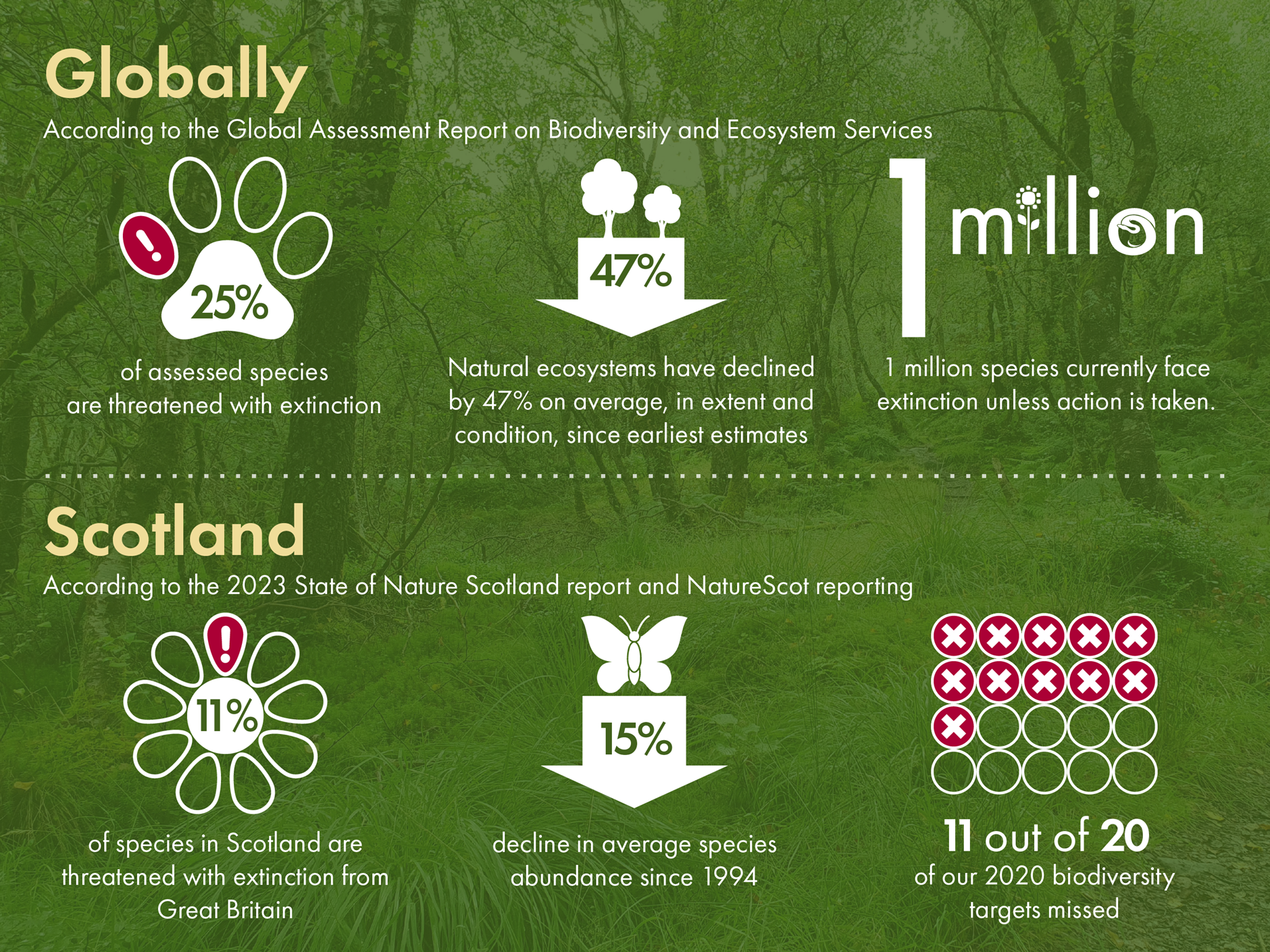
Key drivers of biodiversity loss in Scotland are summarised in Figure 2. Consumption of imported products and materials in Scotland is also driving nature loss in other countries, through supply chains linked to pollution, habitat loss or unsustainable extraction.
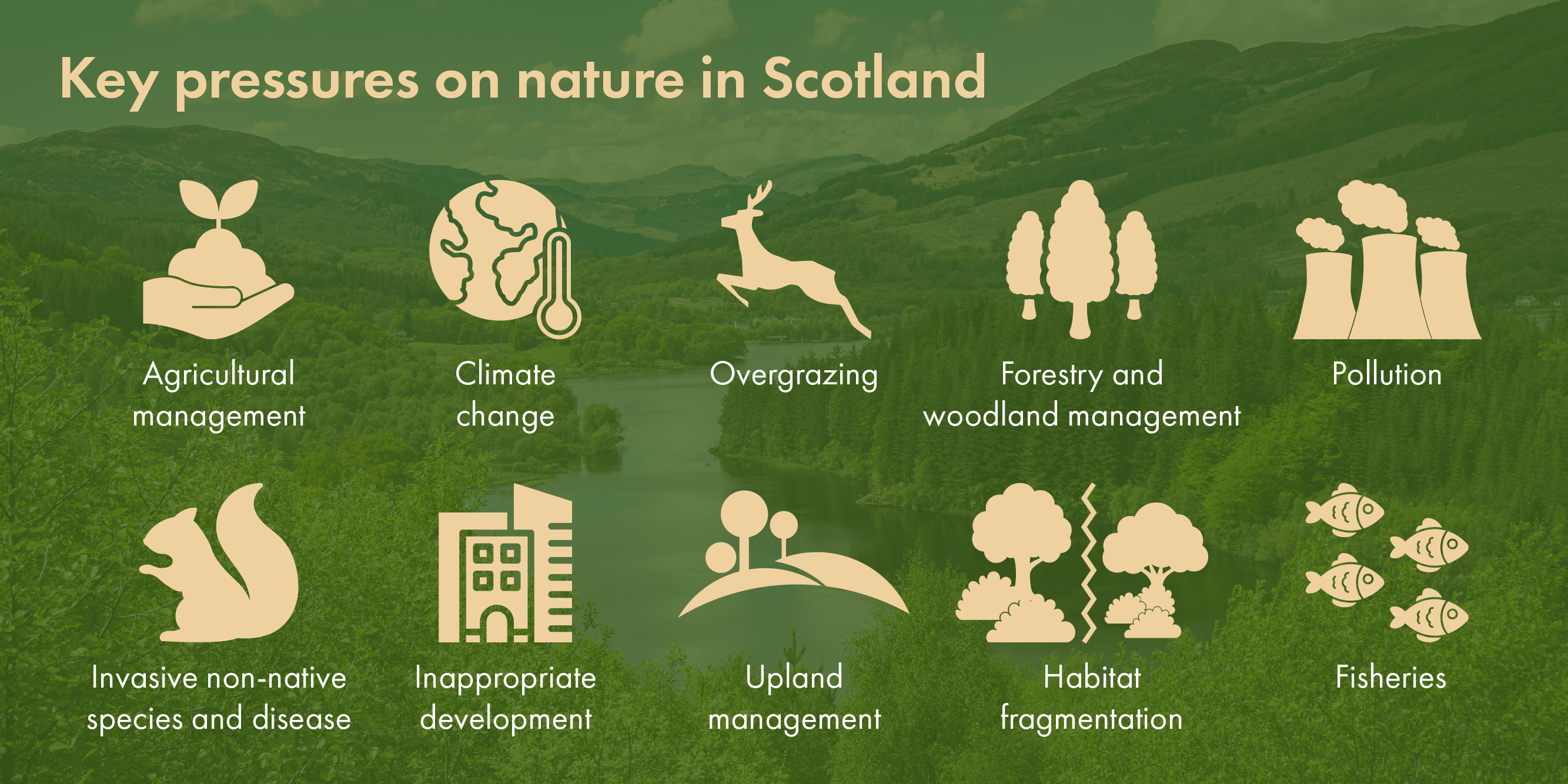
Source: State of Nature Scotland 2023
The global response - the 2030 Global Biodiversity Framework
The 15th Conference of the Parties (COP15) of the UN Convention on Biological Diversity sought to respond to the nature crisis with the adoption of the Global Biodiversity Framework (GBF) in December 2022. It sets out an overarching vision of a world of living in harmony with nature by 2050, and a mission to halt biodiversity loss by 2030 supported by 23 individual 2030 targets. 2030 targets include for example to:
Restore 30% of all degraded ecosystems
Conserve 30% of land, waters and seas (known as '30 by 30')
Halt species extinction, protect genetic diversity, and manage human-wildlife conflicts
Reduce the introduction of invasive alien species by 50% and minimize their impact
Reduce pollution to levels that are not harmful to biodiversity
Minimize the impacts of climate change on biodiversity and build resilience
Enhance biodiversity and sustainability in agriculture, aquaculture, fisheries, and forestry
Enhance green spaces and urban planning for human wellbeing and biodiversity
Integrate biodiversity in decision-making at every level
Enable sustainable consumption choices to reduce waste and overconsumption
Strategic framework for halting nature loss by 2030
Evidence of the nature crisis led the Scottish Government to commit in 2019 to a ‘step change’ in efforts. In response to the Global Biodiversity Framework, the Scottish Government established a ‘strategic framework’ for biodiversity in Session 6. This is made up of a Scottish Biodiversity Strategy and Delivery Plan for 2024-2030, and framework for the introduction of nature targets under the Natural Environment (Scotland) Act 2026.
The Strategy sets out a vision to halt biodiversity loss by 2030, and to have restored biodiversity by 2045. It sets out six objectives and 22 outcomes. The objectives are to:
Accelerate ecosystem restoration and regeneration
Protect nature on land and at sea, across and beyond protected areas
Embed Nature Positive farming, fishing and forestry
Protect and support the recovery of vulnerable and important species and habitats
Invest in nature
Take action on the indirect drivers of biodiversity loss
The Delivery Plan sets out priority actions with time-frames and responsible bodies (see box below). Scottish Environment LINK has published a Biodiversity Strategy Tracker.
Priority actions in the Biodiversity Delivery Plan (examples)
Ensure that at least 30% of land and sea is protected and effectively managed by 2030 (30 by 30): see more discussion of this below.
A programme of ecosystem restoration: NatureScot has identified 9 landscape scale exemplar projects, where agencies will focus efforts. The Delivery Plan commits that by the end of 2026, six exemplar projects will have engaged with communities, developed action plans and identified funding.
Nature Networks: Local authorities have been tasked with establishing spatially defined Nature Networks in their areas, ensuring they are being implemented to support connectivity between important places for biodiversity by 2030.
Farming: Commitments are to ensure "increased uptake of high diversity, nature-rich, high-soil carbon, low-intensity farming methods" and to "introduce an agricultural support framework which delivers for nature restoration".
Embedding biodiversity in planning: A commitment to introducing a ‘biodiversity metric’ for the planning system, used to show how development proposals meet nature policies under the fourth National Planning Framework (NPF4). NatureScot has said there will be a consultation on the metric in 2026.
Tackling unsustainable consumption: A commitment to address unsustainable supply and demand, including through delivering the circular economy framework and reviewing public body Biodiversity Duty Reporting by 2024.
The Natural Environment (Scotland) Act 2026: a framework for nature targets
The Natural Environment (Scotland) Act 2026 established a framework for setting nature targets in regulations, inserting this framework into the Nature Conservation (Scotland) Act 2004 (as amended). In introducing the Bill the Scottish Government said:
Successful targets will be ones which incentivise the necessary action and ensure that biodiversity is factored into policy development at all levels of government (often referred to as ‘mainstreaming’).
The Act requires Scottish Ministers to lay draft regulations for statutory nature targets within 12 months of commencement of section 1 of the Act and to consult on those regulations. The Act sets out detailed arrangements for the introduction, monitoring and review of targets. Key aspects include:
Scottish Ministers may set targets on any matter relating to the restoration or regeneration of biodiversity, but must set at least one target in respect of each of these topic areas:
the condition or extent of any habitat
the status of any species (including in particular those which are or may become threatened)
the environmental conditions for nature regeneration
Scottish Ministers must review progress towards the targets every 3 years and review the targets themselves every 10 years (in both cases seeking scientific advice and reporting)
ESS is established as 'Independent Review Body' to independently assess those 3 and 10-year reviews.
A Biodiversity Programme Advisory Group (PAG) was formed in 2022 to provide advice on the topic areas for targets in advance of the Bill, and went on to provide 'final advice' on target topics and recommendations on indicators for targets in December 2025, including consideration of indicators used by the Global Biodiversity Framework and EU, and indicators already used by SEPA, NatureScot and as part of the National Performance Framework. Establishing targets for which there are meaningful indicators and available data, enabling a robust approach to monitoring is a key consideration.
The 12-month deadline for draft regulations is subject to the Scottish Government choosing to commence section 1 of the 2026 Act. The Scottish Government said in Session 6 that it would seek to commence this requirement "as soon as practically possible". The Biodiversity Delivery Plan set out in 2024 that statutory nature targets would be introduced by 2026.
The Scottish Government wrote to the Climate Action Committee and Rural Affairs Committee on 30 July 2026 indicating that section 1 will not be commenced in forthcoming commencement regulations (for other provisions in the Act) expected in October 2026. The letter sets out some information on technical advice and forthcoming consultations anticipated in 2027, but does not set a clear time-frame for introduction of targets.
Scrutiny milestone for Session 7: Expected draft regulations for the first statutory nature targets, and how targets and wider delivery priorities will 'pull towards' the 2030 goal of halting biodiversity decline in Scotland.
Biodiversity duty and biodiversity reporting duty
Under section 1 of the Nature Conservation (Scotland) Act 2004, all public bodies have a duty, “in exercising any functions, to further the conservation of biodiversity so far as is consistent with the proper exercise of those functions”. This is known as ‘the biodiversity duty’. In seeking to comply with that duty, public bodies must have regard to the Scottish Biodiversity Strategy and the UN Convention on Biological Diversity. When section 1 is brought into force, the 2026 Act will also require public bodies to have regard to statutory nature targets (not in force at time of writing).
Public bodies are also required to publish a report every 3 years on action taken. This is called ‘the biodiversity reporting duty’. Reports are published by the individual public bodies and signposted to by NatureScot. During the passage of the Natural Environment (Scotland) Bill, it was discussed whether biodiversity reporting could be more effective. Ultimately the 2026 Act amended the biodiversity reporting duty (not yet in force) so that only 'specified public bodies' must produce reports, with a power for Scottish Ministers to introduce regulations on reporting arrangements.
Potential area for scrutiny in Session 7: How biodiversity reporting by public bodies could develop to maximise its impact.
Protected areas (and conserved areas)
Protected sites form a cornerstone of biodiversity protection. There are a range of types of protected nature site or 'designated sites' which aim to preserve terrestrial and marine habitats, and the species supported by those habitats. NatureScot hosts a public database of protected areas. Key types of protected area for biodiversity conservation are set out below.
A central overarching policy commitment is to ensure that at least 30% of land and sea is protected or conserved for nature by 2030 ('30 by 30'). The Global Biodiversity Framework requires signatories to:
Ensure and enable that by 2030 at least 30 per cent of terrestrial and inland water areas, and of marine and coastal areas, especially areas of particular importance for biodiversity and ecosystem functions and services, are effectively conserved and managed through ecologically representative, well-connected and equitably governed systems of protected areas and other effective area-based conservation measures... (emphasis added)
To complement protected areas and as a tool alongside them to deliver 30 by 30, a new type of 'conserved area' was launched in 2025 called 'Nature30'. Nature30 sites are Scotland’s interpretation of ‘other effective area-based conservation measures’ (OECMs) as set out in the above GBF target. There is more information on Nature30 sites below.
European sites
'European sites' refers to Special Areas of Conservation (SACs) for habitats and species and Special Protection Areas (SPAs) for birds. These sites attract the strictest level of protection. Scotland has 243 SACs covering more than 3.84 million hectares and 162 SPAs covering around 2.75 million hectares. Geographically there is significant overlap between these sites and other designated sites.
European sites are designated by Scottish Ministers under the Conservation (Natural Habitats, &c.) Regulations 1994 ('the Habitats Regulations'). The Habitats Regulations also provide for species protections (see next section).
The Habitats Regulations originally implemented the EU Birds and Habitats Directives and are now assimilated law. European sites in the UK are also still part of the Emerald Network under the Bern Convention.
NatureScot plays a key role in advising on site designations, assessing site condition and working with owners and occupiers to ensure that they are managed appropriately. Designation does not automatically rule out any specific uses. Site objectives are agreed for species and habitats covered (site 'features') to contribute towards their 'favourable conservation status'. Any plan or project that may damage a European site must be assessed and can only go ahead if certain conditions are met, using a 'Habitats Regulations Appraisal'. The Habitats Regulations were amended in Session 6 to enable a strategic compensation approach to the impacts of offshore wind (see box below).
Strategic compensation for impacts of offshore wind - a new approach
Recent changes have been made to the Habitats Regulations in Scotland as part of UK-wide developments aimed at enabling a "more flexible approach" to compensating for adverse effects of offshore wind on European sites. The reforms require that compensatory measures for offshore wind must benefit the UK Marine Protected Area (MPA) network in a manner reasonably proportionate to the adverse effects, or predicted adverse effects, on European sites. This enables compensation across the MPA network as a whole, a significant change from the previous law where measures needed to have direct links to the impacted species or habitat. The reforms required a 'compensation hierarchy' to be established which was published on 6 July 2026. Related developments in this area include a commitment by the Scottish Government to establish a Scottish Marine Recovery Fund, consulted on in 2025.
Strategic reform of protected area monitoring
The condition of protected areas is a key issue, both to be able to deliver for biodiversity, but also as to 'count towards' 30 by 30, protected areas must be effectively managed. NatureScot is responsible for what is currently called Site Condition Monitoring (SCM). The proportion of natural features reported to be in favourable condition on protected sites on 31st March 2025 was 75%. NatureScot states in its 2024-25 Annual Report that:
Over the longer term, our measurement work shows that the condition of SCM sites is still declining despite our efforts to improve the situation which highlights the need to expand and change our work and monitoring.
The report also set out that protected woodlands are "mostly in unfavourable condition and that the proportion in unfavourable condition is steadily increasing".
The current approach to monitoring protected areas is focused on the 'features' for which the site is designated. NatureScot is in the process of reforming its approach and moving to a new approach called Monitoring to Deliver Healthy Ecosystems ('mDHE') by 2028. This approach is expected to shift focus from feature condition to look at site-level health, or management effectiveness. NatureScot states that "the new approach puts greater emphasis on making sure management in in place and effective, as well as providing greater flexibility to meet site-specific needs and encompass Nature30 sites".
Potential area for scrutiny in Session 7: The condition and effective management of protected areas, and transition to a different approach to monitoring protected areas by NatureScot.
Sites of Special Scientific Interest (SSSIs)
Sites of Special Scientific Interest (SSSIs) are designated ('notified') by NatureScot using powers in the Nature Conservation (Scotland) Act 2004, and JNCC guidelines. SSSIs are areas considered to best represent Scotland's natural heritage. Scotland has 1,422 SSSIs covering around 1 million hectares. Some SSSIs are also European sites. Most are in private ownership. It is an offence to intentionally or recklessly damage the features of an SSSI, and NatureScot provides occupiers with a statement which describes management needed. Certain operations must also be consented by NatureScot.
Ramsar sites (protected wetlands)
Ramsar sites are a global designation under the Convention on Wetlands of International Importance (Ramsar Convention). Scotland has 51 Ramsar sites covering around 0.3 million hectares. Most sites are linked to the European site network and all are underpinned by SSSIs. Scottish Government guidance (2025) set out that features of Ramsar sites must be treated as though they are features of European sites, following an ESS investigation into Ramsar sites in response to concerns about a lack of statutory underpinning for site protection. A duty was introduced by the Natural Environment (Scotland) Act 2026 requiring Scottish Ministers to introduce regulations about the protection of Ramsar sites by March 2031.
National Parks
National Parks in Scotland are designated and governed under the National Parks (Scotland) Act 2000 ('the 2000 Act'). A core aim is to conserve and enhance the area’s natural and cultural heritage. There are two National Parks in Scotland: Loch Lomond and The Trossachs (established 2002), and Cairngorms (established 2003, extended 2010). Proposals in Session 6 for a third National Park were not progressed (see box below).
Each National Park has a National Park Authority (NPA) responsible for producing and implementing a national park partnership plan. NPAs have various powers including entering into management agreements, making byelaws, arrangements for access and providing ranger services. The Act allows for NPAs to have different functions e.g. planning functions. The Natural Environment (Scotland) Act 2026 amended the 2000 Act in several ways, updating the statutory aims of National Parks, requiring Scottish Ministers to produce a National Parks policy statement every ten years, and making changes to the process for designation.
Galloway and Ayrshire National Park proposal - what happened in Session 6?
The Scottish Government committed in its 2021-2022 Programme for Government to designating "at least one new National Park" in Session 6. In 2022 - 2023, the Scottish Government consulted on and published an Appraisal Framework. Nominations were invited in 2023 and five were appraised. On 22 July 2024, the Scottish Government announced that Galloway and Southern Ayrshire was the “proposed location” subject to the outcome of a reporter investigation. NatureScot (the Reporter) consulted on a set of options whilst also asking the overarching question of whether or not a National Park should go ahead. The proposals became locally controversial with campaigns both for and against.
NatureScot provided its report to the Scottish Government on 5 May 2025 and separate advice as statutory nature advisor. The Scottish Government announced its decision not to progress the designation on 29 May 2025, stating that the proposal did not have sufficient local support. However, the Scottish Government said it would place a "renewed focus on delivering for the people of South West Scotland" and consider recommendations from NatureScot, which included resources and management strategies for protected areas in the region. The Session 6 Rural Affairs and Islands Committee discussed the decision with the Scottish Government on 11 June 2025. The then Cabinet Secretary for Rural Affairs, Land Reform and Islands said the Government was "open to considering the establishment of a national park in the future, but it would be for a future Government to determine how to take that forward".
Marine Protected Areas (MPAs)
'Marine Protected Area' (MPA) can refer to a range of designations in the marine environment, including European sites and SSSIs. Nature Conservation MPAs (NC MPAs) are designated under the Marine (Scotland) Act 2010 (inshore MPAs up to 12 nautical miles) and Marine and Coastal Access Act 2009 (offshore MPAs from 12-200 nautical miles). Management measures in offshore MPAs were introduced in October 2025. Delays to introducing management measures in inshore MPAs have been subject to criticism. A consultation is expected in Session 7, looking at e.g. how impacts of practices such as dredging and trawling on habitats can be better managed.
National Nature Reserves
Scotland also has 44 National Nature Reserves (NNRs), considered to be of national importance for nature, and where the site is primarily managed for nature and for people to enjoy. Sites are designated ('declared') by NatureScot under the National Parks and Access to the Countryside Act 1949 and Wildlife and Countryside Act 1981, supported by an NNR partnership. Torridon NNR became the most recently declared NNR in August 2026.
Nature30 Sites ('conserved areas' rather than 'protected areas')
As set out above Nature30 sites have been introduced recently as an additional means by which area-based conservation can contribute to the 30 by 30 target in Scotland. Nature30 sites cannot be 'imposed on' an area of land and can only be recognised where there is the consent of the landowner or manager. NatureScot states that Nature30 sites "offer an alternative to traditional Protected Areas by recognising areas that deliver positive, sustained, and long-term outcomes for biodiversity, as a result of the land management, regardless of the primary objective of this management". The recognition is administered by NatureScot on behalf of Scottish Government. There are currently seven recognised sites.
Other designations
There are some further types of protected area e.g. Local Nature Reserves, World Heritage Sites, Biosphere Reserves, National Scenic Areas. There is more information on the NatureScot website.
Potential area for scrutiny in Session 7: How will Scotland meet the '30 by 30' target?
At the moment, around 18% of terrestrial Scotland is under some form of conservation designation (although not all of these areas are in good condition), meaning there is a need to protect approximately 990,000 ha more land by 2030 – a huge task. NatureScot has published a framework for getting to 30 by 30 which, on land, includes rapidly rolling Nature30 sites, as well as working to boost the condition of protected areas. In the marine environment, 37% of Scottish waters are within MPAs, however the 30 by 30 framework recognises that work is needed on the condition and effectiveness of MPAs.
Species protection, licensing and wildlife management
Scottish wildlife is protected under the following main pieces of legislation. This legislation also provides for the circumstances in which certain activities can be licensed:
The Wildlife and Countryside Act 1981 (as amended)
The Conservation (Natural Habitats &c.) Regulations 1994 (as amended), and;
The Protection of Badgers Act 1992 (as amended)
Deer (Scotland) Act 1996 (as amended)
The Marine (Scotland) Act 2010 and the Protection of Seals (Designation of Haul-Out Sites) (Scotland) Order 2014 - for seals
The Offshore Marine Regulations 2007 apply more than 12 nautical miles from land
NatureScot is the licensing authority for most species licensing in Scotland, with licensing in the marine environment generally falling to the Marine Directorate. Licensing allows for actions that would otherwise constitute an offence against a protected species e.g. killing or taking certain species or moving or translocating them.
NatureScot publishes trends, indicators and official statistics showing the status of species, as well as a Genetic Scorecard which shows diversity within key Scottish species.
Species at risk and the Scottish Biodiversity List
Information on the most vulnerable species can be found on NatureScot's Species at Risk database, alongside information on other species lists used to demonstrate vulnerability or rarity of species and habitats e.g. Priority Marine Features and the International Union for Conservation of Nature (IUCN) Red List. Additionally, the Scottish Biodiversity List aims to provide a targeted list of species and habitats to support public authorities to "prioritise resources and action to help halt and reverse nature loss". It is a policy tool to highlight species in most need of conservation action rather than a form of statutory protection.
Wildlife Management and Muirburn Act 2024 (introduction of grouse moor licensing)
NatureScot's licensing functions were expanded in Session 6 through the Wildlife Management and Muirburn Act 2024 (WMMA) which introduced:
Licensing for land used to kill or take red grouse ('grouse moor licensing') and an associated statutory Code of Practice for Grouse Moor Management, which seeks to provide "a framework for managing grouse moorlands in a way which supports biodiversity and net zero targets". Licensing commenced in 2024 (see box below)
New arrangements for licensing wildlife traps used to catch wild birds or spring traps used to catch mammals for predator control. These provisions have yet to be commenced while supporting arrangements are being developed.
Background to grouse moor licensing
The Scottish Government set up an independent Grouse Moor Management Group in 2017 to examine the environmental impact of grouse moors and advise on the option of licensing, in response to a debate around their sustainability including concerns about raptor persecution. The 'Werritty review' considered evidence on raptor persecution, muirburn, mountain hares, and use of medicated grit. Its 2019 report made multiple recommendations. The Scottish Government announced in 2020 that licensing would be consulted on and went on to introduced the Wildlife Management and Muirburn (Scotland) Bill in 2023. Protection for mountain hare was increased in 2021 through amending the Wildlife and Countryside Act 1981. Guidance on the use of medicated grit was integrated into the Code of Practice for Grouse Moor Management.
The WMMA also banned snaring, increased powers of Scottish SPCA inspectors to investigate wildlife crime, and introduced a new system for licensing muirburn (more detail in the SPICe Land Use Subject Profile). The Act requires that Scottish Ministers review grouse moor licensing every 5 years and review other provisions in the Act “no later than 5 years after the day on which this Act receives Royal Assent”. Both reviews are expected in 2029.
Session 7 milestone: 2029 review of grouse moor licensing
The WMMA includes post-legislative review provisions for 2029 requiring grouse moor licensing to be reviewed, including an assessment of the conservation status of golden eagle, hen harrier, peregrine falcon and merlin.
Species reintroductions
Anyone wanting to release a new species in Scotland must have a licence from NatureScot. Release without a licence is a criminal offence. Species reintroductions (or ‘conservation translocation’ between areas) can be pursued to increase biodiversity and support ecosystem restoration. However, species reintroductions can also be controversial e.g. where there are concerns about local impacts on land management. The Biodiversity Delivery Plan includes a priority action to "Develop effective species recovery, reintroduction and reinforcement programmes" by 2027.
Areas of focus have included re-introductions of the Eurasian beaver and white-tailed eagle, and translocations of golden eagles to the South of Scotland. Conservation translocations have also been undertaken for species such as the rare freshwater pearl mussel. There have also been controversial releases: in advance of authorised releases, beavers became established in Tayside through illegal release, and there was an illegal release of lynx in 2025. Whilst some stakeholders have argued for lynx reintroduction to support nature restoration, the Scottish Government has stated it has no plans to do so.
Deer management
Deer management in Scotland is a key issue for biodiversity, climate change and rural livelihoods. NatureScot has a statutory responsibility to further the sustainable management of all wild deer species in Scotland. The Deer (Scotland) Act 1996 is the key legislation with governance arrangements, including licensing, for deer management. Detailed changes were made to deer management law by the Natural Environment (Scotland) Act 2026, with the Scottish Government stating that "The twin climate and biodiversity crises require a much greater urgency to the efforts to ensure sustainable deer management". This is covered in more detail in the SPICe Land Use Subject Profile.
Other topical areas of wildlife management
Goose management policy seeks to manage tensions between the conservation status of migrating geese and damage caused to farms and crofts in some areas. The Scottish Government reviewed its goose management policy in 2022 and published a delivery plan in March 2026. There is a National Goose Forum and local goose management schemes provide payments to land managers for maintenance of disturbance-free feeding areas.
Urban gull management can raise tensions between considerations of community amenity and species conservation. Urban areas may have become more attractive to gulls due to e.g. food availability and reductions in traditional habitats. However, all five species of commonly encountered gull that breed in Scotland are in serious decline. All wild birds are protected by the Wildlife and Countryside Act 1981 (as amended) however NatureScot has powers under the Act to license management defined purposes. It published revised gull management guidance in 2025. The Scottish Government also hosted a summit in Inverness in September 2025 to discuss urban gull issues with a range of stakeholders.
Species licensing review
The Scottish Government commissioned a review of NatureScot’s species licensing functions in 2024. This review set out to ensure that the law is being applied correctly, to assess the potential to apply cost recovery to licensing and assess the potential for a public register of licences. Delays in finalising this review have been subject to scrutiny. In response to a question in the Scottish Parliament in November 2025 the Scottish Government said the review was being finalised and it expected to be in a position to respond in early 2026. NatureScot told the Session 6 NZET Committee in February 2026 that it had presented the review to Scottish Ministers.
Wildlife crime
Wildlife crime can have a serious impact on the conservation status of species. Examples of types of wildlife crime can include:
Persecution of birds of prey, badgers and bats
Damage to protected areas
Use of traps and snares and possession of illegal pesticides
Poaching e.g. fish, deer, salmon
Hunting a wild mammal with dogs
Freshwater pearl mussel fishing
N.B. Licensing can apply to these activities, meaning an activity or action may be allowed that would otherwise be an offence, as set out above.
Police Scotland is the lead enforcement agency and each division has a Wildlife Crime Liaison Officer. Detecting and obtaining sufficient evidence to prosecute wildlife crime presents challenges, for example when crimes take place in remote areas. NatureScot assists the police by providing expert advice. Police Scotland is also a member of the Partnership for Action against Wildlife Crime (PAW) which brings together law enforcement and other stakeholders. The Scottish Society for the Prevention of Cruelty to Animals (Scottish SPCA) can also investigate wildlife crime in certain circumstances.
Wildlife crime statistics are published by the Scottish Government, required by section 26B of the Wildlife and Countryside Act 1981 (as amended). The most recent report (February 2026) sets out statistics for 2023-24. In this period poaching and coursing was the most common priority area, followed by raptor persecution then badger persecution.
Other key policy areas
This section summarises some further key policy areas for biodiversity and nature in Scotland.
Invasive non-native species (INNS)
Invasive non-native species (INNS) are a significant threat to biodiversity in Scotland. They damage nature where they invade habitats, spread quickly and outcompete native species. They can also have wider economic impacts e.g. damaging riverbanks and man-made structures, or harming human and animal health. Problematic INNS in Scotland include rhododendron, Japanese knotweed, American mink and signal crayfish.
NatureScot published the Scottish Action Plan for INNS for 2026-2032 in March 2026. It estimated that INNS added direct costs to the Scottish economy of £499 million in 2021 and set out a range of actions. ESS published a report in June 2026 examining the effectiveness of the regulatory framework for INNS, finding that the effectiveness of that framework could be improved in several areas. It has asked the Scottish Government to provide a plan of action within six months.
Potential area for scrutiny in Session 7: How the Scottish Government responds to ESS's 2026 Invasive Non-Native Species report.
Funding nature restoration
From 2021-2026, over £65 million was allocated to projects across Scotland through the Nature Restoration Fund with further allocation in the 2026-27 Scottish Budget. The Nature Restoration Fund is administered in two main ways. One is a competitive strand administered by NatureScot and the other is an allocation to local authorities via the ‘Edinburgh Process’. A range of other funding streams (and how they operate) are also relevant to biodiversity outcomes, such as budget allocations for peatland and woodland restoration and the design of agricultural payments.
There is more information on the interaction between agriculture, forestry and peatlands policies with climate and nature goals in the SPICe Land Use Subject Profile.
Natural capital and nature-based solutions
Further concepts which feature prominently in approaches to nature restoration are 'natural capital' and 'nature-based solutions' (NbS). Natural capital is a term for the 'stock' of natural resources that provide social, environmental and economic benefits to humans.
Natural capital finance is investment to conserve or build natural capital, and is often used to refer particularly to mechanisms for private investment, such as carbon financing of woodland and peatland restoration. The Scottish Government published a Natural Capital Market Framework in 2024 and committed to supporting “a values-led, high-integrity market for responsible private investment in natural capital”. A Biodiversity Investment Plan was also published in February 2025, and the Nature Finance Exchange, developed by NatureScot and Scottish Government, was launched as a gateway for "connecting businesses and funders with nature projects to unlock Scotland's natural wealth".
The opportunities and risks of natural capital finance approaches were scrutinised in the Scottish Parliament in Session 6 and discussed in a SPICe blog series.
Nature-based solutions (NbS) refers to the use of nature restoration approaches to support the delivery of goals and addressing societal challenges such as climate change mitigation, flood risk management and improving public health. The Scottish Government states that there is a "growing case for investment in nature-based solutions" and that natural capital "can be viewed as a form of infrastructure – natural infrastructure – similar to engineered solutions for climate change or flood risk".
Soils
Healthy soils are an important building block for the environment. As well as supporting biodiversity, they underpin food production, manage flood risk and act as a carbon sink. Pressures on soils include land management practices e.g. construction, agriculture, forestry and overgrazing, and application of chemicals and nutrients.
There is no specific legislation for soil protection, but key related areas include the regulation of pesticides and fertilisers, policies for agricultural support, policies for peatland protection and restoration, how soil impacts are considered in the planning system and in forestry, how business activities are regulated by SEPA e.g. application of sewage sludge to land and the regime for remediation of contaminated land.
A Scottish Soils Framework was published by the Scottish Government in 2009 which had committed to develop a soil monitoring network. A 2024 scoping report by ESS on soils criticised the lack of progress on a monitoring regime meaning it was "difficult to reach conclusions on the state of soil and the risks posed to it". ESS also found that Scotland is falling behind international best practice in this area. In response, the Scottish Government commissioned ClimateXChange to develop a Soils Policy Route Map, published in March 2025, followed up with technical research published in June 2026.
Potential area for scrutiny in Session 7: How the Scottish Government chooses to progress development of soil policy (including monitoring).
Circular economy and waste management
Scotland largely still has a linear economy, where resources are extracted, products are made and used and waste disposed of. Zero Waste Scotland's 2023 'Circularity Gap' report set out that:
Only 1.3% of the resources Scotland uses are cycled back into the economy in Scotland, with over 98% of Scotland’s material use coming from virgin resourcesi
Scotland’s per capita material footprint is 21.7 tonnes, nearly double the global average of 11.9 tonnes
This impacts on climate change, biodiversity, pollution, and depletion of natural and mineral resources. Impacts are not just caused when products become waste, but also through resources used in production (embodied impacts), social harm e.g. if there are poor labour standards, and loss of value where materials are exported, landfilled or incinerated which might be recovered.
Zero Waste Scotland has also published research on 'material flows' in Scotland (June 2026) which it states demonstrates "Scotland’s reliance on imports, with nearly half (43%) of all materials and two-thirds (66%) of the critical raw materials it needs coming from overseas - highlighting the economy's exposure to global supply chain disruption."
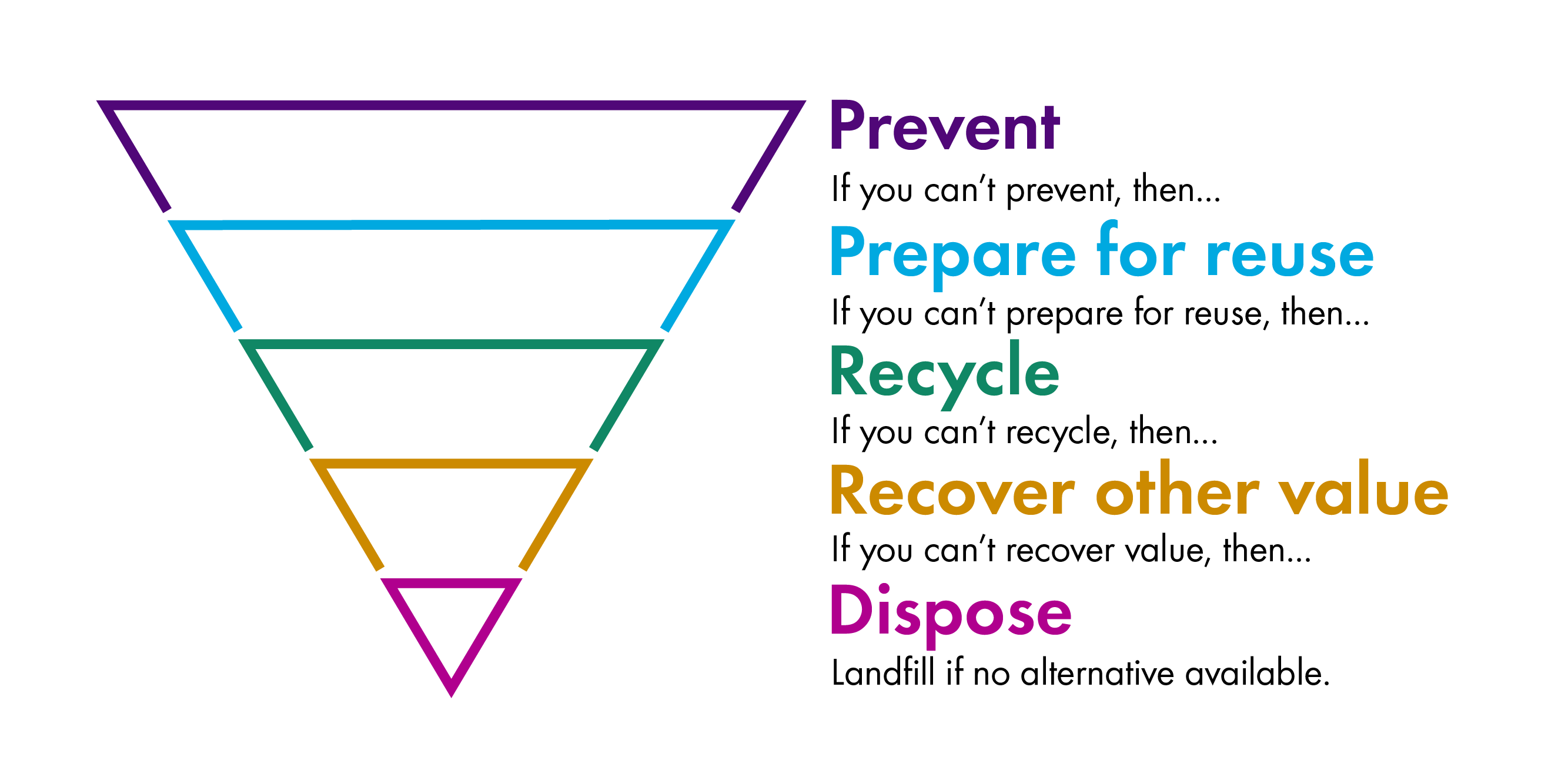
The Scottish Government published its first 'circular economy strategy' in 2016, committing to move towards a more circular economy "where products and materials are kept in high value use for as long as possible". Waste management policy focuses on limiting impacts and ensuring waste is disposed of legally, and seeking to prioritise actions further up the 'waste hierarchy' (see Figure 3). Circular economy policy is broader and can be applied across the whole economy.
Consumption emissions – the ‘bigger picture’ of waste emissions
Circular economy policy also seeks to tackle consumption emissions, which include emissions associated with the production of imported goods and services consumed in Scotland. Combined with territorial emissions, this is Scotland’s carbon footprint, providing the bigger picture of Scotland's contribution to climate change. Whilst climate targets are based on territorial emissions, legislation requires reporting of consumption emissions, and the Climate Change Plan commits to address "emissions associated with the goods and services we consume, regardless of where they are produced".
Whilst Scotland’s territorial emissions fell 49.8% between 1998 and 2022, Scotland's carbon footprint only fell by 17.5% in the same period (see Figure 4 below). Whilst Scotland's carbon footprint had been gradually falling between 2007 and 2020, the last two annual reports have shown increases:
Between 2021 and 2022, Scotland’s carbon footprint increased 1.6 % from 60 to 61 million tonnes carbon dioxide equivalent (MtCO2e)
Between 2020 and 2021, Scotland’s carbon footprint increased by 14.6%
This is largely associated with a spike in emissions from imported goods and services.
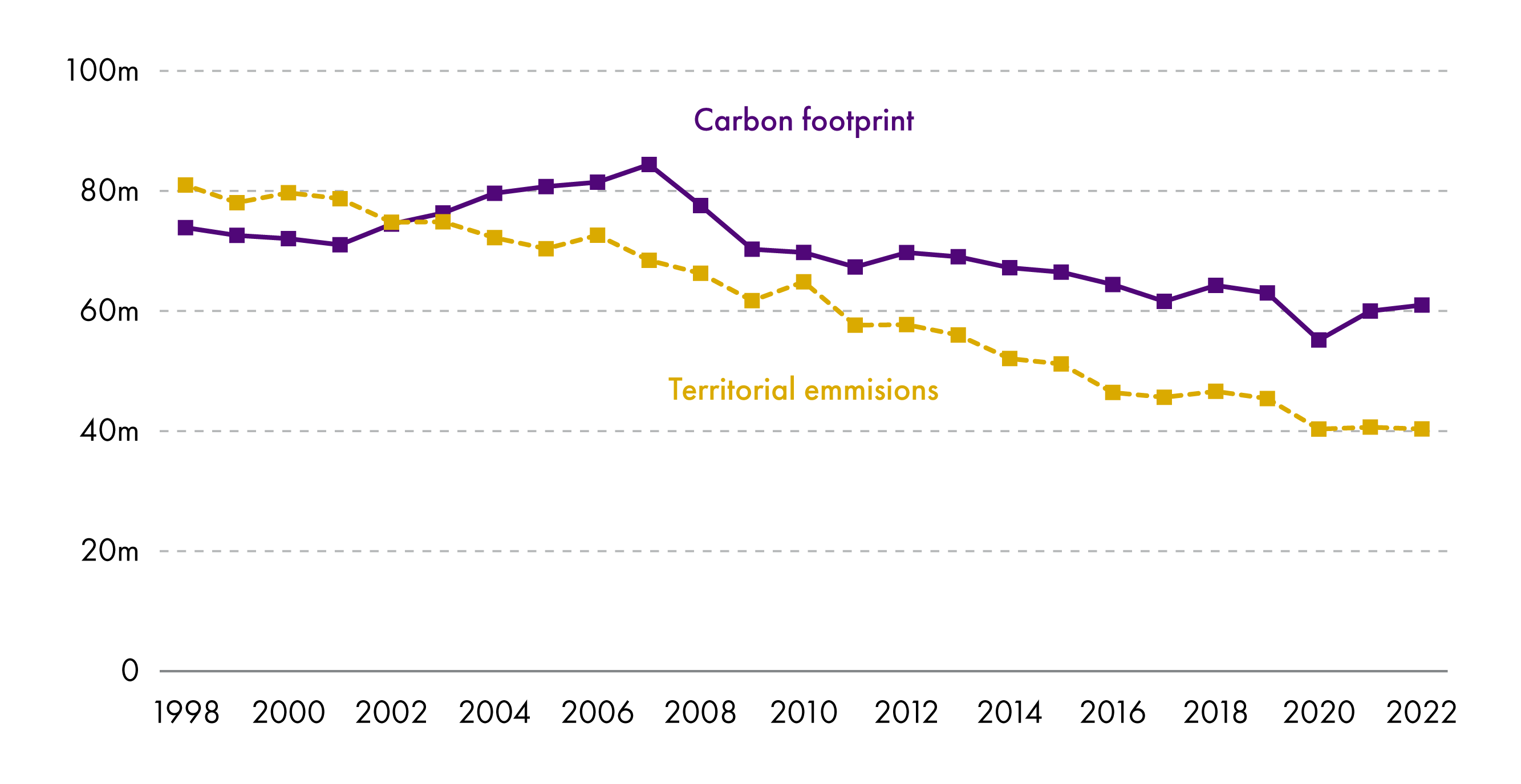
Source: Scottish Government
Waste and resource trends
Progress has been made in Scotland in reducing waste and improving recycling, although in some areas progress has stalled in recent years. The Scottish Government was previously working towards a set of waste targets:
A 15% reduction in all waste, based on a 2011 baseline
Minimum of 60% recycling of household waste by 2020
Minimum of 70% recycling of all waste by 2025
Maximum 5% of all waste to landfill by 2025
33% reduction of food waste by 2025, based on a 2013 baseline
A ban on all biodegradable municipal waste going to landfill by 2025
These have now been largely superseded. A framework for setting circular economy targets was established by the Circular Economy (Scotland) Act 2024 (see next section).
Total waste has gradually decreased
The estimated total 'Waste from All Sources' generated in Scotland was 9.55 million tonnes in 2023 across household, commercial, industrial, construction and demolition sources. When construction and demolition is excluded (as it can mask wider trends) waste generation has been gradually downward for 2011 – 2023 (see Figure 5). The Scottish Government met its 2025 target to cut waste by 15% against 2011 levels.
.png)
GHG emissions from waste have decreased but plateaued
Waste sector emissions (as defined in the Climate Change Plan) have fallen significantly (73%) since 1990 to 1.7 MtCO2e in 2023. This was achieved between 1990 and 2013, with emissions plateauing since. These figures do not include emissions from Energy from Waste (EfW), classed as energy emissions. EfW sites had emissions of around 0.3 MtCO2e in 2023 but this level is expected to increase (more detail below).
Recycling rates have stagnated
Recycling rates have been around 60% for several years (Figure 6 below). In 2023, 62.2% of Scottish waste was recycled. This is far lower for some materials e.g. 32% of plastic waste was recycled in 2023. It is unclear whether the Scottish Government target for 70% of all waste to be recycled by 2025 will be met. The target for 60% recycling of household waste by 2020 was not met (in 2024 it was 44.3%, varying by local authority).
.png)
Landfill has decreased significantly and Energy from Waste increased significantly
The amount of waste landfilled in Scotland has fallen significantly and was 1.81 million tonnes in 2023, a fall of 21.1% from 2022 and 61.3% since 2011. Change is driven by a range of factors including the Scottish Landfill tax and transition to Energy from Waste.
The landfilling of Biodegradeable Municipal Waste (BMW) has fallen by 73.8% since 2011 but was not eliminated by the end of 2025 as set out in the target above. The total quantity of waste incinerated in Scotland in 2024 was 1.86 million tonnes, an increase of 14.7% from 2023 and 354% from 2011 (see Figure 7).
.png)
N.B. Whilst Figure 7 broadly demonstrates a transition from landfill to EfW, it should not be interpreted that every tonne no longer landfilled has moved to Scottish EfW. Trends are also influenced by changes in recycling, waste generation, exports, and imports e.g. incineration figures include waste wood imported for energy recovery.
Food waste has increased
Food waste is a key driver of waste emissions. Research published by Zero Waste Scotland suggests that food waste is also the leading cause of damage to biodiversity stemming from household waste, and second only to textiles for climate change impacts. It is estimated that over 1 million tonnes of food was wasted in Scotland in 2021, accounting for around 6% of Scotland’s carbon footprint. The Scottish Government has struggled both to monitor and reduce food waste, and 2021 estimates indicate there has been a 5% increase in food waste since 2013. It appears unlikely that the target to reduce food waste 33% 2025 (from a 2013 baseline) will be met. The revised 2026 Climate Change Plan committed to continue efforts to reduce food waste but did not set a target.
Circular economy framework
During Session 6, the Scottish Government established a new framework for the transition to a circular economy, comprising:
The Circular Economy and Waste Routemap to 2030 (December 2024)
The Circular Economy (Scotland) Act 2024 ('2024 Act')
A new Circular Economy Strategy (March 2026)
Implementation of the Circular Economy (Scotland) Act 2024
The Circular Economy (Scotland) Act 2024 requires Scottish Ministers, when developing strategies and targets in this area, to have regard to the desirability of the economy being one in which—
Processes for the production and distribution of goods, products and materials are designed so as to reduce their consumption and their whole life-cycle carbon emissions
The delivery of services is designed so as to reduce the consumption and whole life-cycle carbon emissions of goods, products and materials
Goods, products and materials are kept in use for as long as possible to reduce their consumption, their whole life-cycle carbon emissions and their impacts on the environment
The maximum value is extracted from goods, products and materials by the persons using them
Goods, products and materials are recovered or, where appropriate, regenerated at the end of their useful life
Waste is managed in Scotland if it is appropriate to do so
Due diligence in relation to environmental protection and human rights is exercised in supply chains.
The 2024 Act puts duties on Scottish Ministers to:
Publish a Circular Economy Strategy (see below)
Set statutory circular economy targets: Scottish Ministers have a duty to introduce circular economy targets, by regulations, under section 6 of the Act. The framework for targets sets out considerations for Ministers in developing the targets, and that targets could relate to a range of areas including reducing consumption emissions, increasing reuse, refurbishment and repair, increasing recycling and reducing waste. Regulations must set out arrangements for monitoring and reporting, and draft Regulations must be laid in the Scottish Parliament under a super-affirmative procedure. There is no statutory timeframe for introducing targets, however in the 2030 Routemap the Scottish Government commits to doing so by 2027.
Produce a statutory code of practice on household recycling: The Act requires that Scottish Ministers prepare and publish a statutory Code of Practice on household waste recycling, which sets out the standards expected of local authorities in carrying out waste management functions. This is a significant shift away from the current voluntary approach via Scotland’s Household Recycling Charter. The Scottish Government aims, by putting the Code on a statutory footing, to "provide a clear strategic direction for household recycling in Scotland, accelerate improvements to both the quality and quantity of recycling and improve the consistency of services". The 2030 Routemap makes a commitment to consult on a draft Code following a co-design process by the end of 2026.
The Act also gave Scottish Ministers regulation-making powers to:
Set individual recycling targets for local authorities
Restrict how businesses dispose of unsold goods (Zero Waste Scotland has gone on to publish research in this area in July 2026)
Require businesses to report on waste with the Routemap stating "Food waste will be the first area where we introduce mandatory public reporting"
Introduce charges on single-use items. A proposed charge on single-use drinks cups was consulted on but not progressed during Session 6.
Circular Economy Strategy
The Circular Economy Strategy (published March 2026) identified five priority sectors: the built environment, energy infrastructure, textiles, the food system and transport.
Zero Waste Scotland has been tasked with developing five‑year roadmaps for the first four sectors by March 2027 (the strategy states that as it is a key sector within the Climate Change Plan, transport will not have a separate roadmap). Roadmaps for the built environment and for energy infrastructure have already been published, and research on product stewardship approaches to textiles has been published.
The Strategy set out that the Scottish Government will also take a ‘product stewardship’ approach, discussed in more detail below. The focus on food and textiles aligns with the Environment Strategy which described these as sectors "with a large ecological footprint".
Potential areas for scrutiny in Session 7: Implementation of various aspects of the Circular Economy (Scotland) Act 2024 including the first statutory circular economy targets, and the impact of circular economy roadmaps.
Product Stewardship
The Circular Economy Strategy and 2030 Routemap set out that the Scottish Government will take a ‘product stewardship’ approach, including:
Publishing a 'Product Stewardship Plan' by 2025/26
Working with the other UK nations to prioritise packaging, waste electrical and electronic equipment (WEEE), batteries, end-of-life vehicles and fishing gear
Prioritising textiles, mattresses and furniture.
What is product stewardship?
Product stewardship refers to a range of policy and regulatory mechanisms designed to tackle environmental impacts across a product's life-cycle. A number of these have been pursued at UK-level, related to UK internal market reasons or the overlap between devolved and reserved areas. Some product stewardship approaches are reserved such as most product standards and labelling, and taxation e.g. the plastic packaging tax.
The Scottish Government has also sought to encourage circular business models through non-regulatory approaches such as funding and advice (generally via Zero Waste Scotland). Zero Waste Scotland has published research on product stewardship approaches including targeted work on product streams such as mattresses.
Types of regulatory approach can include:
Restrictions or bans on problematic products: Scottish Ministers have powers in the Environmental Protection Act 1990 to prohibit or restrict "injurious substances or articles", used to bring in bans on certain single-use plastics (2022), single-use vapes (2025) and public sales of plastic wet wipes (from 2027). These were coordinated across UK countries, influenced by the UK Internal Market Act. A commitment to ban the sale of horticultural peat has not yet progressed, with the Scottish Government citing the need for aligned action.
Product design and labelling standards: sometimes called 'eco-design' standards, or related consumer rights such as a 'right to repair'. Scottish Ministers have concurrent powers with UK Ministers to introduce 'resource efficiency' or 'resource efficiency information' regulations under the UK Environment Act 2021. This means that Scottish Ministers could legislate in devolved areas or consent to UK-wide regulations. In practice, due to UKIMA considerations and strong interactions with reserved areas on product standards, regulation is likely to be UK-wide. For example, UK regulations on labelling domestic goods like washing machines for water efficiency are expected to be introduced using these powers in 2026.
Producer and Extended Producer Responsibility (EPR) schemes seek to shift the cost of managing waste to producers. EPR schemes aim to transfer full costs. Producer responsibility has generally been pursued on a UK-wide basis with schemes in place for packaging, waste electrical and electronic equipment (WEEE), batteries and end of life vehicles (ELVs) for many years. EPR for packaging waste was introduced in stages from 2023 and is expected to channel additional funding to local authorities. As above, Scottish Ministers have concurrent powers with UK Ministers to introduce EPR regulations under the UK Environment Act 2021.
Deposit Return Schemes (DRS): Powers for Scottish Ministers to establish DRS are set out in the Climate Change (Scotland) Act 2009. The Deposit and Return Scheme for Scotland Regulations 2020 (as amended) provide for the introduction of DRS for single-use drinks containers, aiming to reduce littering and increase recycling. A UK-wide DRS is now scheduled to go live on 1 October 2027 covering PET plastic and aluminium (plus glass in Wales). Whilst the Scottish DRS Regulations were originally to be implemented in 2022, this was delayed due to a range of factors (including the pandemic) and came to be an initial test of the operation of UKIMA, with the Scottish Government and UK Government disagreeing, principally about inclusion of glass. The UK Parliament House of Commons Library published a a summary of UK DRS regulations and background in July 2026.
The operation of UKIMA caused tension in Session 6 between the UK and Scottish Governments in this area. Following a review of the operation of UKIMA in 2025, the scope of future divergence is largely still to be tested. SPICe guest blogs on the operation of devolution in relation to climate change and a SPICe briefing on the Resources and Waste Common Framework provide further context.
Alignment with EU standards
There is also a question of to what extent the Scottish Government will seek to align (under its broader policy of aligning with EU standards where possible) with significant developments at EU level aimed at developing a circular economy, for example:
A new EU Regulation on microplastic pollution entered into force in December 2025
The 2024 Ecodesign for Sustainable Products Regulation in 2024 enables phased introduction of rules to make products more durable, reusable, repairable and recyclable.
A 2024 Directive on repair of goods establishing a “right to repair”.
There are also strong interactions between management of chemicals e.g. 'forever chemicals' and 'Persistent Organic Pollutants' and circular economy policy at product stewardship and waste management stages.
Regulation of waste management
Waste management is generally a devolved area, except for import and export control which is a reserved area. As set out above waste management policy seeks to divert waste away from landfill and further up the waste hierarchy, embedded in the Environmental Protection Act 1990 (as amended).
SEPA is the key regulator in this area, in relation to how waste is stored, transported, treated, and disposed of to prevent harm. Its roles include licensing and monitoring waste carriers and management facilities e.g. landfills and incinerators, tackling waste crime, responding to serious pollution incidents and publishing waste data. SEPA also fulfils certain enforcement roles in producer responsibility schemes (see previous section) e.g. for electronic waste and batteries.
Key legislation for the regulation of waste management includes:
The Environmental Protection Act 1990 (as amended) or 'EPA 1990' and Waste (Scotland) Regulations 2012 (which amended the EPA) govern a range of aspects of how businesses and waste managers handle waste and materials e.g. plastics, metals, food for collection, disposal and recycling. The Scottish Government produced a Code of Practice (updated 2026) on statutory duties. Local authorities are 'waste management authorities', and responsible for collecting waste as defined in the EPA 1990 and providing a minimum recycling service to householders.
The Environmental Authorisations (Scotland) Regulations (EASR) under which SEPA regulates and authorises waste management activities. EASR was introduced in November 2025, consolidating SEPA permitting systems into a single framework and revoking the Waste Management Licensing (Scotland) Regulations 2011.
Forthcoming landfill ban and future of waste infrastructure
Ending the landfilling of biodegradeable municipal waste (BMW) i.e. waste that decomposes releasing methane and is mostly residual household waste that cannot be recycled, is a milestone in reducing the climate impact of waste. A ban on sending BMW to landfill ('the landfill ban') was initially legislated to be from 2021 under the Waste (Scotland) Regulations 2012 (which amended the Landfill (Scotland) Regulations 2003). In 2020 the Scottish Government delayed the ban until 31 December 2025, recognising the sector was not ready and enforcement would mean relying on waste exports.
Although BMW landfilling has continued to fall significantly (see above), SEPA announced in 2025 that Scotland still lacked sufficient EfW capacity to enforce the ban. Whilst the statutory prohibition applies from 31 December 2025, SEPA has adopted a temporary regulatory position under which it will not enforce the ban for up to two years where specified conditions are met. Full effect is expected from 1 January 2028.
This links to a wider debate about the environmental impacts of incineration of waste, which has increased rapidly since 2011. Whilst diverting waste from landfill to EfW is expected to reduce emissions, there have been concerns that waste policy should seek to avoid ‘lock-in’ to EfW infrastructure, in particular if there is uncertainty around when Carbon Capture and Storage (CCS) will become viable at scale.
The Session 6 Scottish Government committed to publish an ‘indicative cap’ for EfW capacity in 2027 to seek to manage this risk, in response to an ESS report. The Government also previously commissioned an independent review of incineration (the ‘Church review’), which made a number of recommendations in 2022 relating to managing the impacts of incineration. It had also recommended developing an indicative cap for EfW.
However, recent analysis of EfW capacity published by Zero Waste Scotland (August 2026) appears to mitigate previous concerns about future over-supply. It states that "Contrary to the previous analysis published in 2024", the updated analysis "does not indicate significant EfW overcapacity in Scotland in any of the scenarios modelled..."
The Scottish Government also consulted on expanding the landfill ban to include non-municipal biodegradable (and other) wastes in 2025, but has not yet published a response.
A policy challenge for the Scottish Government in this area is in managing the decline of landfill whilst balancing the need to retain sufficient capacity for residual wastes requiring safe disposal, and resilience in the waste management system.
Forthcoming policy milestones and potential areas for scrutiny: The Residual Waste Plan expected in 2027 and full enforcement of the landfill ban from 2028.
Other key areas of policy and regulation include:
The Scottish Landfill tax: Revenue Scotland administer the Scottish Landfill Tax with support from SEPA. It is a devolved tax, replacing UK Landfill Tax in Scotland in 2015 following the passage of the Scotland Act 2012 and Landfill Tax (Scotland) Act 2014. Landfill tax has escalated over time, aiming to support a transition from landfill.
Digital waste tracking: The Digital Waste Tracking (Scotland) Regulations 2026 come into force on 1 January 2027 to introduce a UK-wide digital waste tracking system, aiming to improve data to inform waste policy and enforcement.
Funding for recycling infrastructure: A £70 million Recycling Improvement Fund (£66 million invested) was created to help local authorities improve infrastructure.
Air quality
Background and trends
Air quality is important for public health, with increasing evidence that even very low concentrations of certain pollutants are harmful. Air pollution also has wider impacts on habitats and wildlife, and economic impacts through e.g. reducing agricultural productivity and increasing healthcare costs.
Public Health Scotland states on outdoor air pollution (or 'ambient' air pollution) that:
It is "one of the largest environmental risks to human health and one of the main avoidable causes of death and disease globally"
An estimated 1,800 to 2,700 deaths in Scotland are attributed to long-term exposure to outdoor air pollution each year
Health costs of air pollution in the UK are estimated at £8.5 billion - £20.2 billion a year
The three main associated conditions are respiratory disease, cardiovascular disease and lung cancer. Certain groups are particularly vulnerable - older people, pregnant people and those with pre-existing conditions such as asthma. People from poor and disadvantaged communities may be disproportionately impacted.
Public Health Scotland states that the two air pollutants of greatest public health concern are particulate matter (PM) and nitrogen dioxide (NO2). Other pollutants that are relevant to public health include ozone (O3), sulphur dioxide (SO2) and ammonia (NH3).
Trends and pressures
Scotland's Environment web (managed by SEPA) states that "air quality has improved significantly since the 1950s, with dramatic reductions in most pollutants", but "there are still some hot-spot areas of air poor air quality within our urban centres and background air pollution concentration levels have largely remained static". Pressures on ambient air quality include:
Transport (road transport is the dominant source of nitrogen dioxide emissions)
Industrial emissions from energy production, manufacturing
Emissions from agriculture e.g. ammonia
Domestic heating e.g. wood burning stoves.
Information on the relative contributions to air pollution from different sources is published on the Air Quality in Scotland website. A review of Scottish Air Quality data for 2024 (December 2025) set out that:
NO2 trends at urban background, suburban, and rural sites (except one) displayed a decreasing trend over 10 years, but analysis over the last 5 years indicated a plateauing.
Urban traffic sites over 10 years also showed a decreasing trend in NO2. However, for the most recent 5 years the trend is again plateauing with some sites increasing.
PM10: 10-year analysis shows that, in general, sites are showing decreasing trends. However the 5-year trend indicates levels are plateauing and beginning to increase.
PM2.5: 10-year analysis shows a slight decreasing trend at varying levels, but 5-year analysis indicates that levels are plateauing.
Maps of annual concentrations are also available on the Scottish Air Quality Database.
Key legislation and policy
Key air quality legislation in Scotland is:
Part IV of the Environment Act 1995 which established the Local Air Quality Management regime
The Air Quality (Scotland) Regulations 2000 (as amended in 2002 and 2016) which set statutory air quality objectives and the Air Quality Standards (Scotland) Regulations 2010 (as amended in 2016) which set legally binding limit values for certain outdoor air pollutants.
Statutory air quality objectives, limits or target values are in place for:
Sulphur dioxide
Nitrogen oxides
Particular matter (PM10, PM2.5)
Ozone
Polycyclic aromatic hydrocarbons (PAH)
Benzene (a volatile organic compound or VOC)
1,3-Butadiene (a VOC)
Carbon monoxide
Lead and heavy metals
Many of the targets derive from EU law (in particular the 2008 EU Directive on ambient air quality and cleaner air for Europe) and are now assimilated law. Scotland was the first country in Europe to adopt the 2005 World Health Organization (WHO) guideline value for fine particulate matter (PM2.5) into domestic law through the Air Quality (Scotland) Amendment Regulations 2016.
UK-wide legislation also applies. The National Emission Ceilings Regulations 2018 seeks to implement international obligations under the Gothenburg Protocol (to abate acidification, eutrophication and ground-level ozone and control long-range transboundary pollution). They set emission ceilings for sulphur dioxide (SO2), oxides of nitrogen (NOx), non-methane volatile organic compounds (NMVOCs), fine particulate matter (PM2.5) and ammonia (NH3).
Local air quality management (LAQM)
Local authorities are responsible for reviewing and assessing and working towards outdoor air quality standards and objectives through the LAQM regime. In areas where air quality objectives are being exceeded, or at risk of being exceeded, local authorities are legally required to:
designate an Air Quality Management Area (AQMA); and
Set out proposals to improve air quality in an Air Quality Action Plan (AQAP).
As at December 2025, eight local authorities in Scotland had declared a total of 13 AQMAs.
Statutory LAQM guidance (May 2024) provides guidance on AQAPs. SEPA has powers (if acting with the approval of Scottish Ministers) to require local authorities to take action if they are failing to make sufficient progress towards meeting the air quality objectives or failing to fulfil their statutory duties under LAQM.
The guidance on AQAPs was updated in 2024 by the Scottish Government in response to an Air Quality Investigation Improvement Report by ESS in 2022. ESS investigated arrangements in place to achieve compliance with NO2 limits and found "significant weaknesses" with the LAQM system and use of powers to issue directions to local authorities. In response, a Scottish Government Improvement Plan was approved by the Scottish Parliament in 2023 which contains a range of commitments.
Environmental Authorisations and other SEPA roles
SEPA has a number of regulatory, monitoring and advisory roles in relation to air quality. As set out above, SEPA advise local authorities under the LAQM regime. SEPA also regulates and monitors industrial activities in Scotland that can generate airborne pollution, via the Environmental Authorisation (Scotland) Regulations 2018 (as amended) or 'EASR regime'. EASR replaced the the Pollution Prevention and Control (Scotland) Regulations 2012 (as amended). Emissions from certain industrial installations are also regulated by SEPA under UK Best Available Technique (BAT) conclusions.
Further functions of SEPA in relation to air quality are that it:
Advises on air quality impacts of proposed developments as a statutory consultee at planning stages
Operates an Airborne Hazards Emergency Response (AHER) service on behalf of the Scottish Government, a system for responding to and managing risks from air pollution from a major industrial incident e.g. fire, chemical spill, or gas release
Maintains the Scottish Pollutant Release Inventory (SPRI) which makes information available on releases of pollutants from certain regulated industrial facilities (and off-site transfers of waste)
Is a delivery partner of the Cleaner Air for Scotland 2 Strategy (CAFS2, see below).
Cleaner Air for Scotland strategies
The Environment Act 1995 required the UK Government and devolved administrations for Scotland and Wales to produce a national Air Quality Strategy. The most recent UK-wide strategy was published in 2007. The Scottish Government has operated under a complementary strategy since 2015, the Cleaner Air for Scotland Strategy (CAFS). It was replaced in 2021 by a second strategy (CAFS2) which expires at the end of 2026.
The Scottish Government has indicated that CAFS2 will be replaced by a new air quality framework, which it stated in June 2025 would be delivered in 2026. It is unclear if this timeframe is still expected as a public consultation on a draft framework has yet to take place. The Scottish Government has formed a working group to advise on proposals.
Session 7 potential area for scrutiny: the introduction of a new air quality framework, replacing the second Cleaner Air for Scotland Strategy (CAFS2).
The CAFS strategies set out a vision for Scotland “to have the best air quality in Europe” alongside policy commitments across various themes, including health, place-making, industrial emissions and transport. A progress report was published in June 2025.
On transport, key commitments include to increase active travel, improve public transport and establish Low Emission Zones in Scotland's four largest cities (LEZs) (see box below).
Another area of development in Session 6 was on domestic fuel burning. The New Build Heat Standard (NBHS) was introduced in April 2024 via the Building (Scotland) Amendment Regulations 2023, which restricted the installation of wood burning stoves or other heating systems using bioenergy or fossil fuels in new builds. This was controversial in rural and island communities and shortly after its implementation, the Scottish Government announced a review, and decided to amend the NBHS to continue to allow the use of bioenergy and peat heating in new builds.
Low Emission Zones (LEZs)
LEZs are areas which restrict access to vehicles that do not meet minimum emissions standards, with the aim of improving air quality. Vehicles breaching restrictions are liable to penalties. The Transport (Scotland) Act 2019 gave local authorities powers to create LEZs, following a 2017 Scottish Government policy commitment to have LEZs in place in the four major urban centres by 2020 (delayed by the pandemic).
LEZs are now in place in Glasgow (for buses since 2019 and expanded from 2023), and in Edinburgh, Dundee and Aberdeen since 2024. There is more information on the Scottish Government website.
Public Health Scotland published a summary of health evidence on LEZs in 2023 as part of the evidence base for their introduction. Research has been published on health impacts of LEZs in other parts of the UK, for example research published on the London LEZ in 2025 and research published in August 2026 which found that introduction of the London Ultra-LEZ was associated with improved lung function growth trajectories in children. An initial research project on health impacts of Scottish LEZs is expected to conclude in 2028. A 2025 report on the Glasgow LEZ concluded that following implementation there is evidence that "air quality on the most polluted streets is continuing to improve", also driven by changes to the bus fleet.
Alignment with World Health Organization guidelines and EU standards
The World Health Organization (WHO) air quality guidelines offer global guidance on thresholds for key air pollutants that pose health risks (covering PM2.5 and PM10, ozone, nitrogen dioxide, sulphur dioxide and carbon monoxide). They are recommendations, not legally binding standards. The first guidelines were released in 1987 and there have been several updates, the most recent in 2021.
Scottish air quality standards do not currently align with the 2021 WHO guidelines. In Session 6, a Scottish Parliament petition called on the Parliament to urge the Scottish Government to update regulations to align with the WHO guideline values for nitrogen dioxide and fine particulate matter. In 2024, ESS also published a report on particulate matter, which recommended that the Scottish Government reviews standards as part the forthcoming CAFS2 review. It also said that while the focus in recent decades has been on pollutants from transport, attention should be broadened to other sources of pollution.
The Scottish Government has said that the planned review of CAFS2 will consider the 2021 WHO guideline values. There may also be questions around whether the Scottish Government will seek to align with EU standards as part of its new air quality framework. A revised EU Directive on ambient air quality set new limit values in 2024 to be attained by Member States by 2030. It also introduced stricter exposure reduction targets for PM2.5 and new targets for NO2, alongside more extensive requirements for monitoring.
Scrutiny of EU alignment in relation to air quality could also cover how ammonia emissions are regulated under the revised EU Industrial Emissions Directive ('IED 2.0').It came into force in 2024, and introduced stricter thresholds for ammonia emissions from large livestock farms.
In 2023, the Scottish Government consulted on regulating ammonia emissions from livestock but decided to progress this through good practice. The CAFS2 progress report in June 2025 stated that "The Scottish Government remains committed to action to reduce ammonia emissions from large scale units in the agricultural sector", and that work was ongoing to "better understand emissions from the dairy and beef sectors in Scotland; investigate further measures to address emissions; and engage with the sector to ensure any proposals for action are proportionate and effective".
Indoor air quality
Indoor air quality is also important for health, impacted by outdoor air quality and by household activities such as heating and cooking. Unlike outdoor air quality, there are no regulated limits for indoor pollutants in domestic settings, although there are building standards for ventilation.
Water environment
Background and trends
Scotland's water environment is a key part of our natural and cultural heritage. It supports:
Biodiversity and habitats
Climate resilience and adaptation, including mitigating flood risks.
Drinking water supply and water services for industry (abstraction and discharges)
Energy production (hydropower)
Health and wellbeing e.g. through public amenity and recreation, and tourism
The water environment in Scotland is affected by a range of activities including: forestry, agriculture, aquaculture, abstraction for industrial use, run off from roads and engineering works, impoundment in reservoirs, pollution from chemicals and sewage, and man-made barriers to fish passage.
There are 3652 'classified water bodies' in Scotland which includes rivers, lochs, estuaries, coastal water and groundwater bodies. There are also over 1600 protected areas associated with the water environment including bathing waters, shellfish waters, areas protected for wildlife or areas used to supply drinking water.
'Classification' is the approach used to define the state of Scotland’s water environment and is produced annually for all classified water bodies. Data on the classification status of water resources in Scotland are published on SEPA's Water Environment Hub.
Scotland has a central target to ensure that 81% of all Scotland’s classified water bodies achieve a ‘good’ or better classification by 2027. Since the start of water environment classification in 2008, the overall condition of Scotland’s water bodies improved each year until 2023, but declined slightly between 2023 and 2024. The State of Scotland’s Water Environment: Summary Report 2024 (November 2025) sets out that since 2023:
The proportion of our water environment assessed as being in good or better overall condition has decreased from 67.9% to 67.1%.
However it states that just over half of that decrease is due to changes in how it reports on classification and new information on pre-existing impacts.
Table 1: Overall condition of Scotland’s water environment (percentage)
| Rivers (%) | Lochs (%) | Estuaries (%) | Coastal (%) | Groundwater (%) | Total | |
| High/ good | 56.9 | 69.8 | 87.5 | 99.6 | 86.1 | 67.1 |
| Below good | 43.1 | 30.2 | 12.5 | 0.4 | 13.9 | 32.9 |
Source: SEPA
2025 review of pressures on the water environment
SEPA published a review of pressures on the water environment in 2025. It summarised:
Scotland’s water environment is experiencing unprecedented and accelerating pressure from climate change with increased temperatures, droughts and flooding. The water environment is also under continued and evolving threats from pollution, loss of habitat and invasive species. All of this means that the benefits provided to nature, people and the economy are at risk.
It also emphasises that resolving issues cuts across policy areas and requires partnership working across catchments, and that the condition of the water environment is "a good barometer for the health and sustainability of land-use" and "a good indicator of how well Scotland is achieving a circular economy, reusing materials and eliminating waste".
Key issues and pressures on the freshwater environment include:
Diffuse pollution (from widespread activities): While progress is reported e.g. through working with farmers, there are ongoing issues with nutrient levels in the water environment. Action is set out as being needed in fertilisers, land management and understanding impacts of private wastewater.
Physical condition of rivers: modification of natural rivers e.g. through embankments or artificial straightening can reduce the benefits rivers provide. 61% of Scotland’s rivers have been modified from natural or near natural status.
Artificial barriers to fish migration: linked to wild salmon decline. 82% of Scotland’s salmon stocks were in poor or moderate conservation status in 2025.
Sea lice from fish farms: the assessment and management of the interaction between sea lice from fish farms and wild Atlantic salmon and sea trout.
Water Use: 5 out of last 8 years have seen significant water scarcity in Scotland and climate change will see water scarcity increasing. Growing demands for public water supply, agriculture, renewables and other uses are increasing pressure on water resources.
Wastewater and sewer networks: including addressing impacts from wastewater on bathing waters and the good condition target for Scotland’s water environment.
Chemicals in the water environment: noting increasing public concern over a wide range of chemical issues including pesticides, pharmaceuticals, veterinary medicines, forever chemicals and chemical mixtures.
Emerging contaminants - including 'forever chemicals' and microplastics
As set out above, there is increasing public concern over and a need to understand the impact of contaminants in the water environment including 'forever chemicals' and microplastics.
PFAS (per- and polyfluoroalkyl substances) are a large class of man-made chemicals used since the 1940s in products such as firefighting foam, non-stick pans, waterproof clothing and sealants. Because they breakdown very slowly they are often called 'forever chemicals'. There is growing concern around concentrations of PFAS, including in the water environment, and associated risks to the environment and health including through drinking water.
Research indicates that PFAS can lead to health issues such as decreased fertility, developmental delays in children and a higher risk of some cancers. They are 'endocrine disrupter' which means they interfere with the body's natural hormone systems.
SEPA monitoring of PFAS at surface and groundwater sites in 2025 found that "PFAS were commonly detected in Scotland’s water environment" at locations sampled, with elevated levels in rivers located near sites with the potential to release PFAS. The PFAS chosen were based on legislative requirements, including PFAS listed in the Scotland River Basin District (Standards) Directions 2024 and substances of emerging concern.
SEPA has also been working on improved techniques for water sampling to enable more large-scale analysis of diverse chemical compounds in the water environment, including pesticides, pharmaceuticals, and veterinary medicines.
Microplastics are small fragments of plastic which can enter aquatic systems, be ingested by organisms and accumulate through the food web, causing harm to health and the environment. There is no current systematic monitoring of microplastics in the water environment. A 2020 study carried out in Orkney showed 80% of marine life collected from the seagrass beds contained microplastics.
Key legislation and policy
SEPA is the principal regulator for the water environment. It is responsible for monitoring the water environment, regulating activities which may impact on the water environment (e.g. abstractions, discharges, engineering works) under the Environmental Authorisations (Scotland) Regulations, and developing and implementing (in partnership) River Basin Management Plans.
SEPA is also the lead authority for Flood Risk Management Planning and the flood warning authority for Scotland, and manages the Water Environment Fund which funds river restoration projects.
Environmental Authorisations (EASR)
As set out previously, from 1 November 2025, water, waste management, and industrial activities are all regulated by SEPA under a single framework established by the Environmental Authorisation (Scotland) Regulations 2018 (EASR), as amended in 2025. The 'EASR' regime revoked the 'CAR regime' for regulating activities impacting on the water environment, with existing CAR authorisations migrating into the new regime.
Activities under EASR are authorised under four tiers depending on the associated level of environmental risk:
Via a permit: In accordance with a permit granted by a regulator under the regulations
Registration: Subject to a requirement to register the activity with SEPA and SEPA determine if this is granted
Notification: Subject to a requirement to notify SEPA of the activity
General binding rules: Subject to compliance with rules but not requiring any specific permit or notification
More information on what activities are subject to which tier, and associated conditions, is on the SEPA website. Certain information on authorisations (including where penalties have been issued) is set out in a SEPA Public Register.
River Basin Management Plans
The Water Environment and Water Services (Scotland) Act 2003 (WEWS Act) transposed the EU Water Framework Directive and provides a framework for the protection of freshwater bodies, transitional waters (where water is partially saline in river mouths) and coastal waters (3 nautical miles from the highest tide).
It provides for the production of River Basin Management Plans (RBMPs) by SEPA on behalf of Scottish Ministers, which seek to identify and manage pressures on the water environment - including pressures impacting on water quality, resources, and fish migration. The RBMP is reviewed and updated every six years. The first plan was published in 2009. 'RBMP4' is due to be published in December 2027, with a draft expected by the end of 2026.
As set out above, the RBMP for Scotland 2021-27 includes a central target to ensure that 81% of all Scotland’s waterbodies achieve a ‘good’ or better classification by 2027. The Session 6 NZET Committee discussed progress with SEPA on 25 February 2025. SEPA set out key challenges in meeting the targets, particularly highlighting the complexity of tackling diffuse pollution, and opportunities of investing in river restoration.
Session 7 potential area for scrutiny: a new River Basin Management Plan, and whether Scotland will meet the key target for 81% of classified waterbodies to achieve a 'good' or higher status by 2027.
Flooding
Flooding is a regular occurrence in Scotland with around 400,000 properties (1 in 8) currently in areas at medium risk of flooding (a rise from 284,000 in the 2018 assessment), and by 2100, climate change could push that number to over 600,000 properties according to SEPA’s 2025 National Flood Risk Assessment.
The Scottish Government's National Flood Resilience Strategy (2024) describes flooding as Scotland’s "biggest climate adaptation challenge".
The Scottish Government is responsible for setting flood risk management policy and oversees the implementation of the Flood Risk Management (Scotland) Act 2009, the key legislation in this area. Funding is provided annually in the Scottish Budget to local authorities for flood protection which has been at an agreed level of £42 million a year for around 15 years, with allocations linked to the national flood risk assessment. The Scottish Government also funds the Scottish Flood Forum, an organisation that works with communities to build flood resilience and provide advice.
The Flood Risk Management (Scotland) Act 2009 establishes powers, functions and duties of public bodies including Scottish Ministers. Key aspects include:
A framework for cooperation between organisations involved in flood risk management
Assessment of flood risk and preparation of flood risk management plans
Responsibilities and functions for SEPA, Scottish Water and local authorities
A process for flood protection schemes.
The Scottish Government website describes roles and responsibilities allocated by the 2009 Act, and there is further statutory guidance on these. The Act creates a general duty for responsible authorities to exercise their functions with a view to reducing overall flood risk.
SEPA is Scotland’s national flood forecasting, flood warning and strategic flood risk management authority. Local authorities are responsible for producing flood risk management plans and for implementing and maintaining flood protection actions according to those plans. The Act also provides local authorities with a ‘general power to manage flood risk’. Scottish Water is responsible for the public drainage of surface water from roofs and paved ground surfaces within a property boundary.
There is a flood risk management plan for each of the 14 flood risk management districts in Scotland, which are called Local Plan Districts. The plans are reviewed and updated every six years. The first plan was published in 2015. SEPA is supporting the development of the 2028 - 2034 plans, with a consultation expected to be launched by the end of 2026.
The Scottish Government recognises that natural flood management can play a key strategic role in managing flooding and seeks to encourage this through planning policies on 'blue and green infrastructure' (a form of 'nature-based solution').
Session 7 potential area for scrutiny: The introduction of flood risk management plans for 2028-2034 as part of the strategic response to escalating flood risk.
Regulation of sewage pollution
In recent years there has been growing public interest in sewage pollution, particularly in the impact of storm overflows, which are designed to operate when there is heavy rainfall and more water enters sewers than they have capacity for. Sewage discharges from overflows, as part of the Scottish Water network, are regulated by SEPA under the EASR regime (see above or more specific detail on the SEPA website).
Other key legislation is the Urban Waste Water Treatment (Scotland) Regulations 1994 (1994 Regulations), supported by duties under the Sewerage (Scotland) Act 1968. The 1994 Regulations impose duties on Scottish Water for the provision and maintenance of sewer networks and treatment plants, including treatment standards and discharge limits. There is provision in the Regulations for Scottish Ministers to take enforcement action against Scottish Water should it fail to, or be likely to fail to, comply with the Regulations. In practice, this is delivered through Scottish Water investment plans or improvements in operational practices agreed with SEPA.
The RBMP also required Scottish Water to publish a route map “setting out the steps that it will take with other partners to reduce sewage litter and spills from combined sewer overflows”. This is the basis for Scottish Water’s Improving Urban Waters Routemap (2021) which set out various commitments around reducing sewage spills and increasing monitoring.
In 2024, ESS published a report on storm overflows. Key findings included that:
There is no comprehensive public data on the scale and impact storm overflow spills, but where there is data, it is clear some sites spill more frequently than should be expected
Guidance is outdated and not clear on the circumstances under which spills may occur, limiting effective implementation of the 1994 Regulations.
The report made several recommendations which included that more data on spills, compliance and pollution incidents should be made publicly available, and that Scottish Water and SEPA should do more to identify and improve overflows which spill in dry weather. ESS publishes correspondence with updates on these issues.
Scottish Water committed to installing 1,000 new CSO monitors and publishing data on both a near-real-time and annual basis. Updates and data can be found on its website. As part of the Scottish Government's response to the ESS review, it has committed to looking at how guidance on the 1994 Regulations might be updated – in advance of further expected legislative review.
The ESS review also raised issues around keeping pace with EU standards. The 1994 Regulations sought to implement the 1991 EU Urban Waste Water Treatment Directive (UWWTD). A revised EU Urban Waste Water Treatment Directive was adopted in 2024 with significant changes in relation to how environmental and health risks of wastewater discharge should be managed. The Scottish Government responded that it was assessing the recast Directive and considering how to apply it.
2023 Water, Wastewater and Drainage Consultation
In the 2023-24 Programme for Government, the Scottish Government made a commitment to “Build on our £170 million investment in Scotland’s water and sewerage services and review of water industry policy, and continue to assess how water, sewerage and drainage services can adapt to the impacts of climate change to avoid water scarcity through future legislation.”
The Scottish Government consulted on various proposals regarding management of water, wastewater and drainage from 21 November 2023 to 21 February 2024. It included discussion of:
The need for more strategic planning of water resource and catchment management
Potential changes to how water scarcity is managed
How to increase blue-green infrastructure to support urban drainage
How to tackle issues around sewage overflows
What the water sector needs to do to transition to a circular economy.
Further topical issues and regulatory developments
Adaptation of water services in response to climate change and ageing infrastructure: There is detailed information about the public and private drinking water and wastewater infrastructure, how it is regulated, and discussion of future challenges for the water industry in a 2025 SPICe briefing. Demand for water in Scotland is expected to rise due to population growth and drier summers. Additionally, cooling systems for data centres and technologies such as hydrogen production may also increase demand. Scottish Water's strategy recognises three major pressures: climate change, demographic shifts, and ageing infrastructure. Issues discussed include mechanisms for climate resilience e.g. blue-green infrastructure and reducing per capita consumption of water, and tackling pollution issues.
Forever chemicals (PFAS) and other contaminants in water: The Public Water Supplies (Scotland) Amendment Regulations 2022 require Scottish Water to check for the presence of 20 PFAS in drinking water it supplies to ensure that it does not contain concentrations above regulatory limits. Limits were informed by World Health Organisation (WHO) guidelines and also sought to align with aspects of modified EU standards under the recast Drinking Water Directive. The Scottish Government said in introducing the above standards that it was taking a phased approach to aligning with updated EU law, and further alignment e.g. around monitoring microplastics would be considered at a later date.
Alignment with revised EU law on water pollution: In addition to the recast Drinking Water Directive referred to above, the EU has updated its list of water pollutants covered by water legislation to include certain PFAS, pesticides, pharmaceuticals and microplastics in a new framework directive on water. This new framework constitutes a major revision to EU law on water, and modified the Water Framework Directive, the Environmental Quality Standards Directive, and the Groundwater Directive. The Scottish Government said in July 2026 that it is reviewing some of these changes and considering further action.
The above developments are complex, with detailed considerations around alignment with EU standards, and long-term questions around investment in infrastructure, monitoring systems and building the evidence-base on emerging contaminants.
There is more detail about responses to PFAS concerns in the below section on chemicals. The presence of contaminants such as PFAS is also relevant to the protection of soils via regulation of the use of sewage sludge.
Session 7 potential areas for scrutiny: Water legislation may be introduced following on from the 2023 Water, Wastewater and Drainage consultation, which could seek to tackle cross-cutting issues around water management, scarcity and quality. The Scottish Government is also considering complex questions around how Scotland aligns with new EU standards on water quality.
Chemicals and pesticides
Background and trends
Chemicals have diverse uses across the economy. They form part of everyday life, products and industrial processes. Plant protection products such as pesticides are used to protect crops from pests and disease and to prevent contamination of food.
However, the Environment Strategy (2026) states that "chemical pollution is increasingly recognised as a threat to nature that transcends borders, including impacts on biodiversity and the water environment". The planetary boundary for chemical pollution is thought to have been crossed. Globally, there has been a 50-fold increase in production of chemicals since 1950, projected to triple again by 2050.
SEPA set out in its 2025 report, Safeguarding Scotland's water environment that:
"There is increasing public concern over a wide range of chemical issues including pesticides, pharmaceuticals, veterinary medicines, chemicals that are long-lived in the environment (e.g. forever chemicals), and chemical mixtures".
"The number of chemicals in use and potentially emitted into the water environment poses a challenge in terms of understanding risks."
"This complex picture requires a change in approach to the way in which we monitor and assess the presence of this wide range of chemicals and the risks they may pose to Scotland’s water environment".
As set out in the water environment section, managing risks from PFAS (forever chemicals) is a significant challenge.
Certain chemicals in the marine environment are also monitored under the programme of monitoring the contaminants indicator for Good Environmental Status (GES). There are issues around the levels of heavy metals in some areas, and the presence of 'persistent pollutants'.
Statistics on pesticide use on Scottish farms is published by the Scottish Government. In 2024, 98% of arable crops received a pesticide treatment. Pesticides are also used by other land managers e.g. in gardens, public spaces, horticulture and forestry. Whilst the use of pesticides can have socioeconomic benefits, pesticides can also have harmful impacts including killing non-target species. Improper use can have a negative impact on plants, animals and humans.
Key legislation and policy
Chemicals regulation is a complex area. Regulation of chemicals and pesticides for the purposes of environmental protection is devolved. However, there are overlaps with reserved areas e.g. health and safety in the workplace and product standards, and in practice regulatory regimes tend to operate on a UK-wide or GB-wide basis.
Protecting of the water environment from chemical pollution is also discussed in the previous section, there is significant interaction between these areas.
Chemicals and pesticides regulation is a highly centralised area of EU regulation, meaning complex regulatory systems and governance functions had to be replaced following EU exit, a process which has taken several years and in some areas is ongoing. Key legislation includes:
UK REACH was developed to replace EU REACH, the EU-wide framework for the for the 'Registration Evaluation Authorisation and restriction of Chemicals' (it applies in GB only, EU REACH applies in Northern Ireland). The key regulator is the UK Health and Safety Executive (HSE). HSE must take advice from the Environment Agency, who in turn must collaborate with SEPA on environmental issues. In Scotland, enforcement duties sit across local authorities, SEPA and HSE. Deadlines for businesses to submit full regulatory data to UK REACH as part of its establishment have been pushed back a number of times. Stakeholders have raised concerns about the pace of development and risks of divergence from EU REACH.
The UK Persistent Organic Pollutants Regulation (UK POPs Regulation) implements the Stockholm Convention on Persistent Organic Pollutants (POPS), to which the UK is a signatory. POPs are toxic to humans and the environment and of particular concern as they remain intact for long periods, can become widespread and accumulate in the environment. Challenges around the handling of POPs in waste streams e.g. furniture were raised in the Scottish Parliament during scrutiny of the Circular Economy (Scotland) Bill, and in consideration of 2024 updates to the UK POPs Regulation. The Scottish Government has committed to publishing a Residual Waste Plan in 2027, which will investigate “how we manage unavoidable wastes such as those containing persistent organic pollutants”.
The GB Biocidal Products Regulation (GB BPR): Biocides are used to control harmful organisms. The GB BPR seeks to ensure that when biocidal products are used properly, they do not harm people, pets or the wider environment. Similarly to UK REACH, the EU BPR was largely copied into assimilated law to create a GB regime.
The GB Classification, Labelling and Packaging of substances and mixtures Regulation (GB CLP) seeks to ensure consistent labelling including safety data
The GB Prior Informed Consent Regulation (GB PIC) regulates export and import of hazardous chemicals and is the mechanism through which the UK seeks to implement the Rotterdam Convention.
Environmental stakeholders raised concerns about reform to the above three regimes under HSE 'Chemicals Regulation Reform' proposals implemented through UK secondary legislation, scrutinised in the NZET Committee in February 2026.
Key pesticides legislation is the Plant Protection Products (Sustainable Use) Regulations 2012 and the Plant Protection Products Regulations 2011. Since 2021, an independent pesticides regulatory regime is in operation in GB (Northern Ireland operates under the EU framework). HSE is the GB regulator on behalf of the UK government and devolved administrations.
The extent of alignment of UK chemicals regimes with EU law, including as part of evolving UK-EU relations is also a key issue for policy development. The UK Government confirmed in March 2026 that rules on PPP and biocides authorisations would fall within the scope of UK legislation to be aligned with EU law under the UK-EU Sanitary and Phytosanitary (SPS) Agreement.
In terms of how chemicals regulation and monitoring may need to develop in Scotland to effectively manage environmental risks, SEPA states that:
"Many of the traditional controls available to SEPA are at the point of discharge e.g. by requiring treatment of sewage or engineering of a landfill. However, such measures can be technically challenging, expensive and carbon intensive."
"There are often alternative interventions that could be put in place by working with partners, other stakeholders and regulatory bodies. It is often better for action to be taken at source, especially for substances associated with widespread risk."
The forthcoming review of the RBMP provides an opportunity to look for innovative and collaborative solutions.
UK PFAS Plan and Environmental Audit Committee inquiry
The UK Government published a PFAS Plan in February 2026 which sets out a UK-wide approach to managing PFAS, and a range of areas of action including for the Scottish Government and for SEPA. The UK Parliament's Environmental Audit Committee (EAC) published a report on its inquiry into PFAS on 23 April 2026 which stated that whilst the PFAS Plan was a welcome step:
However, the Government’s plan is short on decisive actions to prevent the harmful build-up of these chemicals in the environment. Our inquiry found that the UK faces a growing legacy of PFAS pollution, alongside continued emissions. Tackling the scale of contamination requires a combined approach: prevent ongoing PFAS emissions at the source, manage pollution, and address waste and end-of-life disposal. This must be supported by sustained research, funding, monitoring and public transparency.
Potential scrutiny area for Session 7: The role of the Scottish Government and public bodies in delivering the UK PFAS Plan and managing PFAS risks more broadly.
Pollution from pet parasite treatments
Another topical issue in chemicals regulation, and for the water environment, is pollution from pet parasite treatments, in particular from fipronil and imidacloprid - active substances in veterinary medicines used in flea and tick treatments for cats and dogs. The 'Cross-government Pharmaceuticals in the Environment Group' (which includes SEPA) published a roadmap of activities in July 2025 aiming to address levels of those substances detected in UK waterways, and the UK Government ran a call for evidence on their use in spring 2026.
The House of Lords Environment and Climate Change Committee published a report in August 2026 on pet parasite treatments which found "substantial evidential gaps" around the widespread and intensive use of these medicines in companion animals and recommended interim measures restricting their use. N.B. This raises a further overlap with reserved areas as the regulation of veterinary medicines is a reserved matter.