Explainer: intergovernmental activity and its implications for the Scottish Parliament
This briefing provides an overview of intergovernmental activity and its implications for the Scottish Parliament. It explains what intergovernmental activity is, why awareness of it is important for parliamentary scrutiny, and summarises its implications for the Scottish Parliament.
Summary
‘Intergovernmental activity’ refers to work between governments – in a Scottish context, between the Scottish Government and the UK Government or other devolved governments. It can include discussions on areas of mutual interest, policy development, and policy implementation. Understanding intergovernmental activity, and how it may affect policymaking, is an important part of understanding how devolution operates.
This short briefing gives an overview of issues that have arisen to date in relation to intergovernmental activity and what implications these may have for Session 7.
What is intergovernmental activity?
‘Intergovernmental activity’ refers to work between governments. It can include discussions on areas of mutual interest, policy development, and policy implementation. In the UK, intergovernmental activity relates to the UK Government and the devolved governments of Scotland, Wales, and Northern Ireland working together.
In any system of multi-level government, there is likely to be some interdependence and overlap of powers and responsibilities. In Scotland, where some matters are the responsibility of the Scottish Government and others are the responsibility of the UK Government, intergovernmental work is important for effective governance.
Intergovernmental interactions can take place through formal structures, often called ‘intergovernmental relations’ – more on these below – as well as informally. SPICe uses the term ‘intergovernmental activity’ to include formal interactions as well as more informal ways of working together, for example through common frameworks or bilateral meetings.
Intergovernmental relations
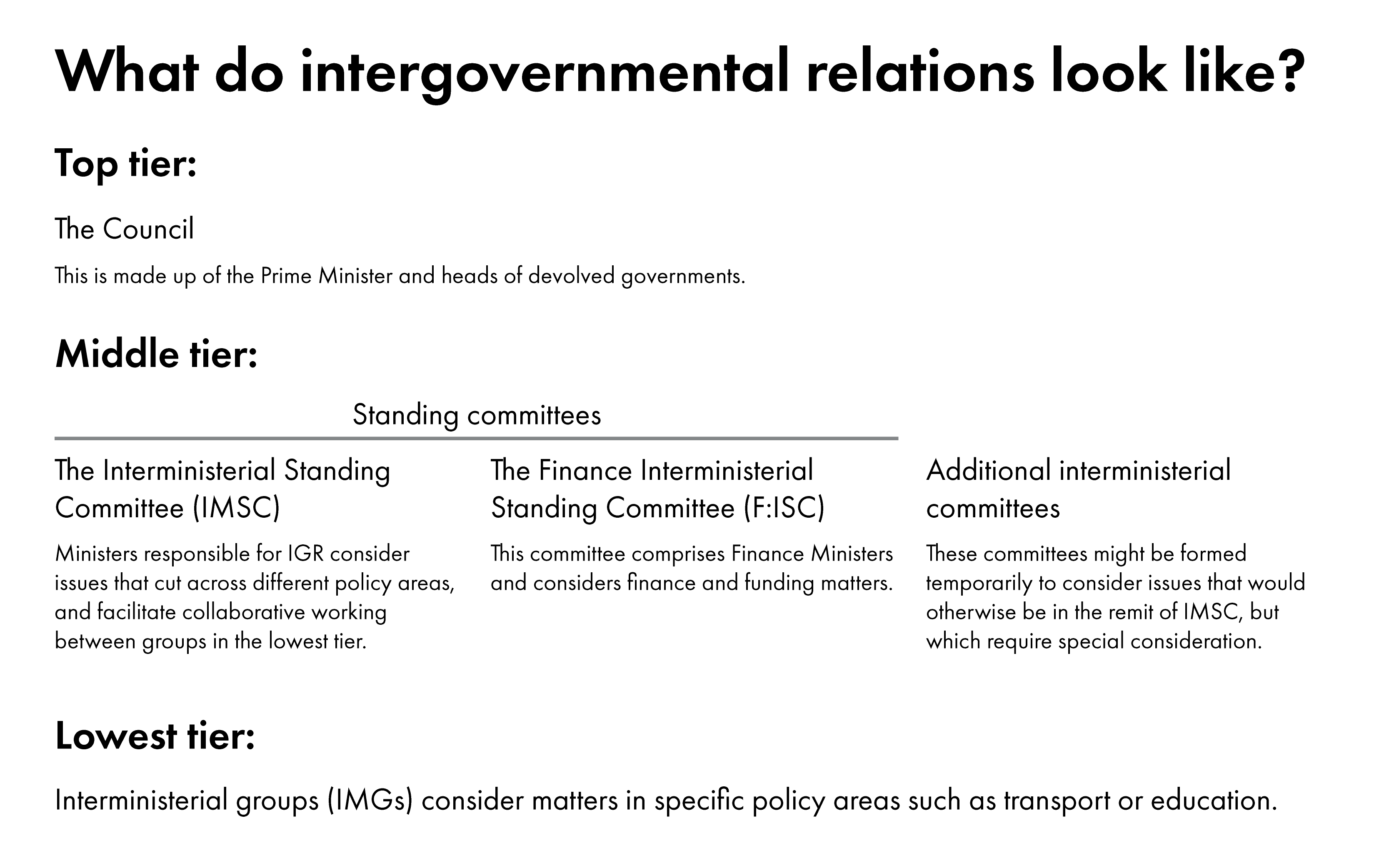
In 2022, the UK Government and the devolved governments agreed a new approach to intergovernmental relations.
Scottish Parliament Information Centre
The new structures also include an Intergovernmental Relations (IGR) Secretariat. The IGR Secretariat is accountable to the Council, staffed by officials from all governments and hosted and funded by the Cabinet Office. The IGR Secretariat’s role includes:
providing administrative support across all intergovernmental tiers
facilitating handling and resolution of disputes
publishing an annual report on intergovernmental activity.
Why is understanding intergovernmental activity important?
A central function of the Scottish Parliament is to scrutinise the policies and actions of the Scottish Government. As such, the Parliament has a role in ensuring that it is content with the Scottish Government’s participation in intergovernmental activity.
Because many decisions about policy development and implementation take place in an interdependent space shared between governments, arrangements such as common frameworks and the UK Internal Market Act 2020 play a significant role in shaping how decisions are reached. This makes awareness of intergovernmental activity an essential element of effective parliamentary scrutiny. SPICe has published an explainer briefing on common frameworks and will publish an explainer briefing on the UK Internal Market Act 2020.
Key Issues
A central function of parliament is to scrutinise the policies and actions of government. The ability of the Scottish Parliament to exercise its powers effectively requires it to consider the full range of legislative and non-legislative options that fall within devolved competence. Intergovernmental activity which includes discussion of policy choices has the potential to influence the Scottish Government's consideration of these options. An awareness of such activity is therefore an important element of parliamentary scrutiny.
Effective scrutiny depends on having access to sufficient information about the Scottish Government’s part in intergovernmental activity. However, the information made publicly available about intergovernmental activity is often limited:
Minutes of meetings of intergovernmental forums are now routinely published on the UK Government webpage, but they are often published with delays and vary in the level of detail they provide.
Minutes of intergovernmental activity outside formal forums, for example bilateral talks, are not routinely published. The UK Government Intergovernmental Relations Engagement Dashboard provides some information on the number of such engagements, but no information about the content of discussions.
In addition to information published centrally by the UK Government, the Scottish Parliament and the Scottish Government agreed a set of information requirements to accompany legislative proposals in September 2023 to support committees to undertake scrutiny post‑EU, such as:
whether the market access principles of the UK Internal Market Act 2020 may impact on the policy objectives of the proposal
whether an exclusion to the market access principles is considered necessary, and whether such an exclusion has been discussed
whether any relevant common frameworks may impact on the policy objectives of the proposal (in areas of former EU competence).
The Constitution, Europe, External Affairs and Culture (CEEAC) Committee's legacy report recommended amending Rule 9.3.3 of the Standing Orders to require the Scottish Government to set out information relating to potential interactions with the UK Internal Market Act 2020 and common frameworks alongside documents accompanying Government Bills. The CEEAC Committee's report on the Transparency of intergovernmental activity and its implications for parliamentary scrutiny made further recommendations to strengthen reporting requirements on intergovernmental activity, summarised in the next section.
Parliamentary scrutiny in Session 6
The CEEAC Committee carried out scrutiny of the evolving intergovernmental arrangements through a number of inquiries:
February 2022 - UK Internal Market Inquiry
September 2022 - The Impact of Brexit on Devolution
October 2023 - How Devolution is Changing Post-EU
March 2026 - Transparency of intergovernmental activity and its implications for parliamentary scrutiny
The CEEAC Committee and the Scottish Government jointly commissioned research to inform a review of the written agreement on intergovernmental relations between the Parliament and the Government, which has been in place since 2016. The research, carried out by Professor Nicola McEwen and Dr Coree Brown Swan and published in December 2024, made a number of recommendations to strengthen reporting requirements in relation to intergovernmental activity. These include requiring the Scottish Government to:
report on all formal intergovernmental meetings, including bilateral ministerial engagements
provide summaries of positions taken by the Scottish Government at intergovernmental meetings
provide information on intergovernmental engagement the Scottish Government anticipates in advance, including alongside the yearly Programme for Government
provide enhanced reporting during the process of seeking exclusions to market access principles from the UK Internal Market Act 2020.
The CEEAC Committee's report 'The Transparency of intergovernmental activity and its implications for parliamentary scrutiny' stated that it was broadly in agreement with the recommendations in Professor McEwen's and Dr Brown Swan's report. The CEEAC Committee further recommended:
establishing a formal, transparent and structured schedule of interministerial meetings that is published in advance
strengthening and better resourcing the IGR Secretariat, including improving its online presence to enhance accessibility
bolstering reporting of interministerial meetings by the IGR Secretariat
Subject committees also considered intergovernmental activity in their remit, such as scrutiny of common frameworks or intergovernmental activity affecting policy developments. For example, the Net Zero, Energy and Transport Committee scrutinised developments relating to an exclusion to the market access principles of the UK Internal Market Act 2020 for the Scottish Deposit Return scheme. SPICe has published a blog that provides background on how the exclusions process operated and when information was made public.
Implications for Session 7
The need to scrutinise intergovernmental activity will continue into Session 7. However, the lack of transparency around intergovernmental activity, including in common frameworks and the exclusions process linked to the UK Internal Market Act 2020, will affect the Parliament’s ability to scrutinise intergovernmental decision‑making. The Session 6 CEEAC Committee's legacy report included work it felt should be a priority for its successor in order to try to improve transparency of intergovernmental processes, as set out below.
The Sewel Convention
Where the UK Parliament wants to consider a Bill which is within the legislative competence of the Scottish Parliament, or which changes the powers of the Scottish Parliament or Scottish Ministers, it asks the Scottish Parliament for its consent. This process is called legislative consent. The political convention governing this process is known as the Sewel Convention. Under the Sewel Convention, the UK Parliament should not normally make a law within devolved competence unless the Scottish Parliament agrees.
The CEEAC Committee noted in its 2023 report How Devolution is Changing Post‑EU that since 2016 “there has subsequently been considerable and continuing disagreement between the UK Government and the devolved governments and parliaments regarding its effectiveness.” The CEEAC Committee also highlighted that "this level of disagreement on a fundamental constitutional matter is not sustainable particularly within the context of an increasing shared space at an intergovernmental level."
In August 2024, the UK Government stated that “the Sewel Convention and the way the UK Government legislates is certainly a priority area” and that it intended to strengthen the convention with a new Memorandum of Understanding (MoU). A revised MoU has not, at the time of publication (12 June 2026), been published. Minutes of the most recent meeting of the Interministerial Standing Committee, on 17 February 2026, state that work on the MoU was ongoing.
In its session 6 legacy report, the CEEAC Committee recommended that consideration of any revised MoU should be a priority for Session 7, reiterating its earlier call for a new Memorandum of Understanding and supplementary agreements addressing how devolution now works , supported by updated Devolution Guidance notes and operational guidance.
UK Internal Market Act 2020
The UK Government carried out a review of the UK Internal Market Act 2020 (UKIMA) in the first half of 2025, including the operation of the exclusions process. The UK Government committed to implement all exclusions agreed by all governments through a common framework. It also confirms that two additional processes for considering exclusions will operate alongside the common framework process, and that environmental protection and public health considerations will be taken into account when assessing potential exclusions.
An exclusion for single-use glass bottles as part of a Welsh Deposit Return Scheme was agreed in February 2026 through the Resources and Waste Common Framework. The UK Government stated that in accordance with the updated processes set out in the UKIMA review, it considered economic impacts, environmental protection and public health impacts, as part of its decision-making. It remains to be seen how the updated exclusions processes will operate during Session 7—particularly the two additional routes for considering exclusions—and what information will be made available to support parliamentary scrutiny.
Review of the Intergovernmental Relations: written agreement between the Scottish Parliament and the Scottish Government.
As explained above, the CEEAC Committee and the Scottish Government began a joint review of the written agreement on intergovernmental relations which both organisations agreed to in 2016. This review was paused pending the outcome of the CEEAC Committee's inquiry into transparency of intergovernmental activity and its implications for parliamentary scrutiny. The legacy report states:
Our recommendations are intended to inform a revised written agreement early in Session 7. This includes our broad support for the 8 recommendations in the research we jointly commissioned with the Scottish Government to examine whether the written agreement on intergovernmental relations between the Scottish Parliament and the Scottish Government is fit for purpose. The Committee recommends that concluding the joint review of the written agreement on intergovernmental relations between the Parliament and the Government is a priority for our successor early in Session 7 as a means to improve transparency and accountability of intergovernmental activity.
A revised agreement could have a positive impact on the Parliament’s ability to scrutinise intergovernmental decision-making. Enhanced reporting requirements would give committees clearer insight into how intergovernmental activity shapes policy options and decision‑making.
Where can I find more information?
Minutes of intergovernmental meetings are published on the UK Government's webpage.
SPICe maintains an intergovernmental activity hub that collates information on intergovernmental activity. The hub includes:
a dashboard, which supports parliamentary scrutiny by making information on intergovernmental activity easier to find and navigate
two tools for tracking legislative consent at the Scottish Parliament
information on common frameworks, which are intergovernmental agreements on how governments will work together in certain policy areas, and parliamentary scrutiny of them.
SPICe also publishes quarterly updates on intergovernmental activity. These updates collate information on intergovernmental meetings, common frameworks, exclusions to the market access principles of the UK Internal Market Act 2020, and legislative consent at the Scottish Parliament.