Public Service Reform: an overview
This briefing gives an overview of contextual changes and policy action in the 15 years since the publication of the Christie Commission's recommendations on public service reform, looking specifically at progress made against the four pillars set out by the Commission - people, partnership, prevention and performance.
Introduction
In 2011, the Christie Commission Report set out a vision for the future delivery of public services in Scotland. This came on the back of the shock of the 2008 global financial crisis, and against the backdrop of the UK Government's austerity programme and both increasing demand for public services and rising inequalities in Scotland.
The Christie Report set out four key pillars, or principles, for improving the delivery of public services:
Services built around people and their communities.
Working together to achieve outcomes.
Prioritising prevention, reducing inequalities and promoting equality; and
Improving performance and reducing cost.
Fifteen years later, following the introduction of its first Public Service Reform Strategy in June 2025, and the May 2026 Scottish Election, the Scottish Government appointed, for the first time, a Cabinet Secretary for Public Service Reform (former Minister for Public Finance, Ivan McKee MSP). In response, the Scottish Parliament established a Public Service Reform Committee in June 2026.
In order to set the scene for the work of that Committee, this briefing aims to update and compare the fiscal and demographic context set out in the Christie Report in line with current trends, and to consider progress made against the four pillars set out in 2011.
Background
It could be argued that Scotland has been in a state of public service reform since (at least) 2010. The first use of the term in the Scottish Parliament's Official Report was in 2003, and it is worth remembering that there was a Minister for Public Finance and Public Service Reform (Tom McCabe MSP) in the Session 2 Scottish Executive.
In 2010, the Public Service Reform (Scotland) Act led to the dissolution of certain public bodies, the establishment of new national bodies for healthcare and social care delivery, and the establishment of a new body for arts and culture.
The Christie Commission
However, the publication of the Christie Commission Report in 2011 was a foundational moment in modern Government thinking on public service reform (PSR). The Commission was established by the Scottish Government in November 2010 to develop recommendations for the future delivery of public services. Chaired by Dr Campbell Christie CBE, the Commission operated independently of government. When setting the remit of the Commission, the Scottish Government set out a vision for public services that:
are innovative, seamless and responsive, designed around users' needs, continuously improving
are democratically accountable to the people of Scotland at both national and local levels
are delivered in partnership, involving local communities, their democratic representatives, and the third sector
tackle causes as well as symptoms
support a fair and equal society
protect the most vulnerable in our society
are person-centred, reliable and consistent
are easy to navigate and access
are appropriate to local circumstances, without inexplicable variation
are designed and delivered close to the customer wherever possible, always high quality
respond effectively to increasing demographic pressures
include accessible digital services, that are easy to use and meet current best practice in the digital economy
have governance structures that are accountable, transparent, cost-effective, streamlined and efficient.
The Commission was asked to identify opportunities and obstacles which would help or hinder progress against this vision. Specifically, the Government wished it to:
address the role of public services in improving outcomes, what impact they make, and whether this can be done more effectively
examine structures, functions and roles, to improve the quality of public service delivery and reduce demand through, for example, early intervention
consider the role of a public service ethos, along with cultural change, engaging public sector workers, users and stakeholders.
In doing this, the Commission was expected to take a long-term view, unconstrained by existing delivery structures, and with reference to joint work already underway regarding health and social care integration and reform of police and fire services.
The Commission completed its work in June 2011 and published its report on 29 June 2011. In this, it stated that the key objectives of the reform programme must be to ensure progress against four areas, which have since been referred to as 'the four P's':
People - public services are built around people and communities, their needs, aspirations, capacities and skills, and work to build up their autonomy and resilience;
Partnership - public service organisations work together effectively to achieve outcomes - specifically, by delivering integrated services which help to secure improvements in the quality of life, and the social and economic wellbeing, of the people and communities of Scotland;
Prevention - public service organisations prioritise prevention, reduce inequalities and promote equality; and
Performance - all public services constantly seek to improve performance and reduce costs, and are open, transparent and accountable.
The report also set out criteria for proposals for the reform of public services, stating that they should:
first and foremost, be shown to support the achievement of outcomes - real-life improvements in the social and economic wellbeing of the people and communities of Scotland;
be affordable and sustainable within the budgets expected to be available to Scotland's public services;
include appropriate arrangements for services to account to the people and communities of Scotland, both directly and through their democratically elected representatives, so that public confidence in and support for the delivery of services can be maintained;
ensure that services are built around the needs of people and communities, to increase individual and community capacity, resilience and autonomy;
allow and encourage services to empower front-line staff and allow them to give of their best;
support the local integration of service provision;
encourage services to pursue preventative approaches, tackle inequality and promote equality;
improve transparency over plans, expenditure and performance;
contribute to the simplification and streamlining of the public sector landscape; and
be consistent with and support the wider reform and improvement of Scotland's public services.
Responses to Christie, including scrutiny
The Scottish Government responded to the Christie Commission in September 2011, and announced the establishment of a Cabinet Sub-committee on Public Service Reform (chaired by the Cabinet Secretary for Finance, Employment and Sustainable Growth) and a supporting Public Service Reform Board. The response set out a 5-year programme of public service reform, aligned with the four pillars identified by the Commission as priorities.
As well as detaining work which had already taken place which it felt supported these priorities, the Government outlined several upcoming commitments and planned pieces of legislation. These included:
the use of various change funds;
minimum unit pricing for alcohol;
strategies on regeneration and cities;
workforce interventions;
integration of health and social care services;
legislation on the rights of children and young people, self-directed support and community empowerment;
reform of police and fire services;
the establishment of Children's Hearings Scotland;
improvements to digital services; and,
a programme of savings and rationalisations across Government services.
Beyond the Government plans throughout Session 4 of the Scottish Parliament, several key pieces of Government strategy and legislation over Sessions 5 and 6 could also be viewed through the prism of PSR, such as the integration of health and social care services, and the ongoing local governance review. These examples, and others, will be explored in this report.
On the tenth anniversary of the report, amidst the later stages of the COVID-19 pandemic, stakeholders and commentators sought to take stock of progress to date.
At a roundtable discussion hosted by the University of Glasgow/Policy Scotland and the University of Edinburgh in June 2021, panellists suggested that some of the larger institutional changes made would have occurred even without the Christie Commission. Despite some progress, panellists and presenters agreed that the reforms of the last ten years have not been sufficient to meet the scale of the challenge. They felt that the scale of shift towards prevention and re-prioritisation in budgeting had fallen short of what was needed. A willingness to sign up to the principles of Christie was clear, but the execution was lacking. A key barrier identified was monitoring and evaluation:
There has been less scrutiny and performance measurement on how public services and communities work together; what service users think about public services and how service users can challenge public services if they do not meet their needs; how and whether prevention is embedded in public services; and the quality of collaboration between and within the public sector and the third sector in service delivery. A missing piece in the jigsaw is how decisions, on reform and budgets, feed through to tracking on National Performance Framework.
Despite a shift towards local delivery of services, and more being asked of local government, it was felt that the power to control programmes and spending still lay heavily with the Scottish Government, and that a lack of leadership at a local level inhibited the opportunities for innovation.
Writing ten years after Christie, Scotland's Auditor General, Stephen Boyle, stated that implementation gaps exist between PSR ambitions and delivery on the ground. He explained:
Concerted action has been taken to try and implement progressive policies in areas such as community empowerment and self-directed support since Christie was published. But audit work consistently shows a major implementation gap between policy ambitions and delivery on the ground.
The Auditor General, citing the 2017 progress audit on self-directed support, said that there “was no evidence that authorities had made a transformation in services”. Boyle also highlighted the “mismatch” between the Scottish Government's vision for Scotland, and how effectively public sector performance is assessed, and concluded that although the public sector had striven to live up to Christie's ambitions, in the first 10 years following publication, it had fallen short.
That said, Boyle argued that genuine public service reform did take place during 2020 and 2021 when the public and third sectors worked together to respond to the pandemic. He thought this showed some of the transformational change that Christie had envisaged ten years before:
Since last March [2020], we've seen public bodies disobeying organisational boundaries and delivering ‘Christie’ at scale and pace. It's been truly impressive and shows what can be done….But it's also important to ask why that happened. The answer? Because it was life and death. There was a clear imperative that trumped everything else. It would be another tragedy if the same urgency wasn't now applied to poverty, education, health and strengthening our communities.
Talking specifically about anti-poverty work, COSLA recently wrote that Scotland is most effective “when local knowledge, national resources, and community expertise – including people with lived and living experience of poverty - are brought together".
These messages are echoed in publications and commentary published by the ALLIANCE and the Improvement Service, and again in more recent commentary by the likes of the Royal Society of Edinburgh and IPPR.
Public Service Reform has also been a long-standing focus of Parliamentary scrutiny, most recently with the Session 6 Finance and Public Administration Committee carrying out a focused inquiry into the Scottish Government's Public Service Reform programme in 2023, and subsequently integrating the matter into its ongoing scrutiny of the Scottish Budget.
Public Service Reform Strategy
Ivan McKee MSP, the new Cabinet Secretary for Public Service Reform was previously Minister for Public Finance. In that role, he launched the Scottish Government's Public Service Reform Strategy in June 2025.
The PSR strategy includes 18 different workstreams which aim to remove barriers to reform, presented very much as a ‘theory of change’ approach setting out where the Government wants to get to, what success looks like, and how change will be delivered. Some workstreams may be familiar from the 2011 Christie Commission report, for example the commitment to empowering people, places and communities and a focus on prevention. Others are relatively new, such as the scaling up of intelligent automation and enhanced use of data.
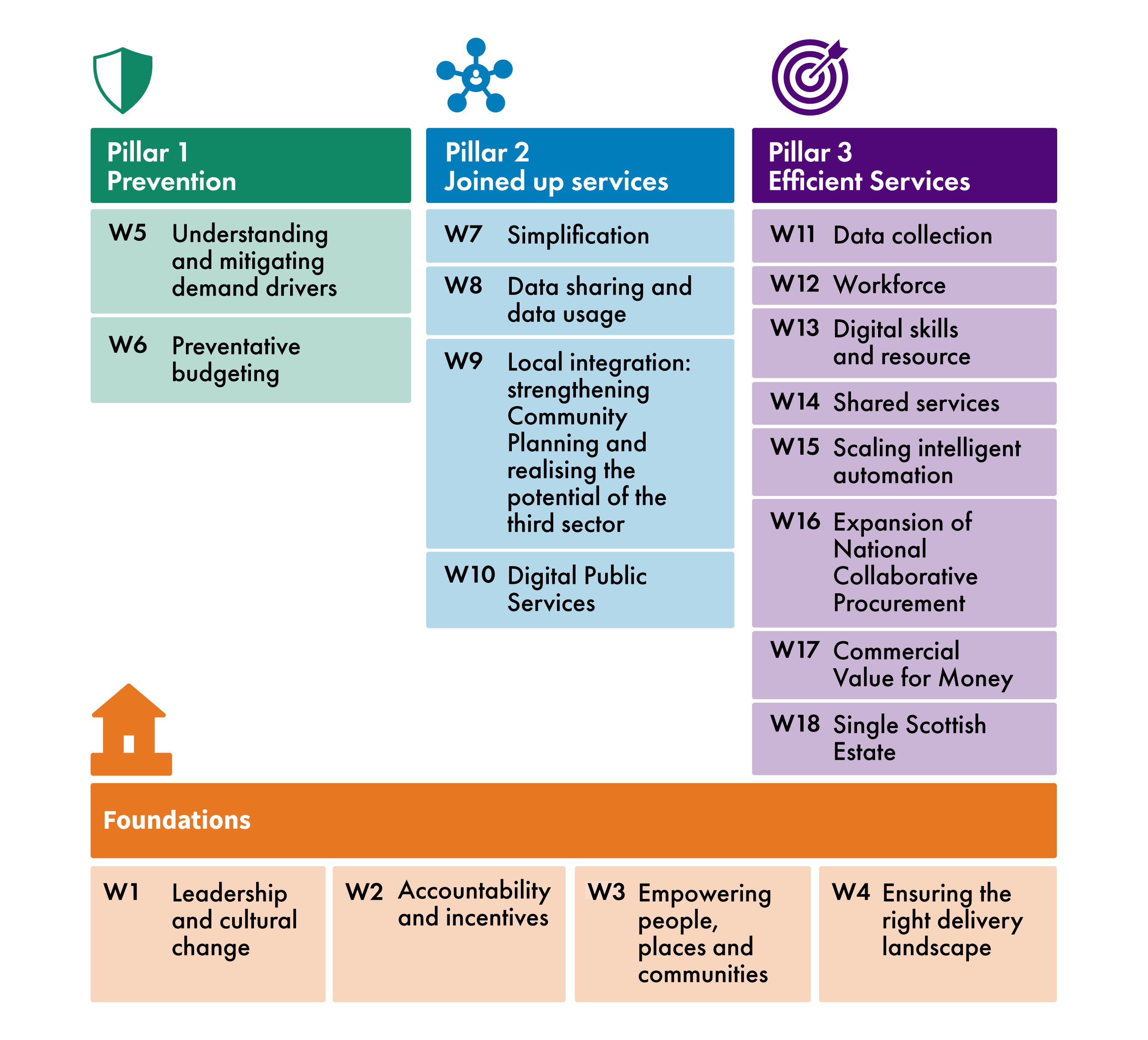
Scottish Government: Scotland's Public Service Reform Strategy: Delivering for Scotland (2025)
According to the Government, each of these workstreams will have their own evaluation framework. However, the Strategy also states:
…we must also monitor and evaluate impact at a system wide level to ensure coordination. This will be undertaken by our Public Service Reform Board. The PSR Board brings external input from public bodies, local government, third and private sector to provide advice and challenge on progress of PSR within Scottish Government. The Board is co-chaired by the Minister for Public Finance and Director-General Strategy and External Affairs.
The Strategy lists a number of “partners in delivery”. These are: local government, public bodies, communities, trade unions, the third sector and wider economy.
In response to the number of workstreams in the Strategy, during a June 2026 debate on Government's Public Service Reform agenda, the Cabinet Secretary explained:
… there is an awful lot of work to be done here across a very broad front. That is laid out, with more than 80 actions, and we are moving forward on all of those, because it is important that they come together as we take the agenda forward.
Following the publication of the strategy, the Session 6 Finance and Public Administration Committee heard that stakeholders welcomed the PSR strategy, but that there were concerns about the number of live strategies across Government which led the Committee to request annual updates on this. A cluttered strategic landscape was also something which had become a key theme in pre-budget scrutiny across Session 6 committees. SPICe explored this further in a February 2026 blog, which highlighted where clarifications might help committees to better understand the linkages between strategies and actions.
Challenges facing our public services
In its report, the Christie Commission set out the economic and budgetary context within which the Commission was making its recommendations. This section looks at how that context has changed in the 15 years since the publication of the report, whether projections set out have come to pass, and how the forward look has changed.
The Commission highlighted that these underlying financial challenges facing the public sector arose not just from the budgetary situation at the time – they also linked to long-term societal needs and demographic change, as well as the global financial crisis which began in 2007.
The ongoing effects of the latter are arguably still felt today, perhaps even more strongly following the cumulative impacts of years of restrictions on public spending, a lack of capital investment, and slow economic growth.
These shocks have been added to by the additional economic impacts of the UK's exit from the EU, the COVID-19 pandemic, and global instability caused by the wars in Ukraine and Iran.
Alongside these additional challenges there have also been new opportunities. Most significantly, the further devolution of powers, including powers over taxation and some social security spending have given the Scottish Government new levers to both raise revenue, and to tackle inequalities. They have also, however, increased the size of the Scottish public sector, which makes some comparisons against earlier forecasts complicated.
Public services and inequalities
The Christie Commission argued that “the greatest challenge facing public services is to combat the negative outcomes for individuals and communities arising from deep-rooted inequalities”. It highlighted that although a number of important outcomes for the Scottish population had improved since the 1990s, on most dimensions, inequalities had remained unchanged, or had worsened.
The outcomes highlighted as having improved are set out below, with more recent updates.
Life expectancy , particularly for men, had improved between 1999 and 2011, though Scotland still lagged other UK nations. Between 2011 and 2024, life expectancy increased at a far slower pace, and aside from dips caused by the pandemic, has been effectively stagnant since 2014. The gap between Scotland and other UK nations has not narrowed. Healthy life expectancy, measured since 2013, which had improved to see Scotland falling behind only England in 2016, has fallen steadily since. Although healthy life expectancy has fallen across all UK countries in the past decade, the fall in Scotland began sooner, and has been steeper, with the healthy life expectancy of Scottish males being the lowest in the UK by 2024.
Employment rates, up until the start of the 2007 financial crisis, had increased in Scotland since 1999, taking it from having a lower rate to a higher one in comparison to the rest of the UK (excluding London). It maintained this status as rates fell in the years following the crisis, but in 2016 returned to lagging the rest of the UK (rUK). Similarly, median annual net household income in Scotland grew from being lower than rUK in 1999 to surpassing it through the years following the financial crash, however by the late 2010s this had begun to fall again. The Christie report noted that although household income had improved since devolution, the income inequality gap had widened. Since then, figures have fluctuated, but both income inequality and wealth inequality remain high. For more information, our subject profile on Scotland's economy gives a full overview of economic indicators since devolution.
In 2011, the Christie Report highlighted that people in Scotland were less likely to be a victim of crime than in the late 1990s. This trend has continued, with property and violent crime falling by 42% between 2008-09 and 2024-25, though rates have recently increased from a historical low in 2021-22.
In education, the 2011 figures pointed to some improvements in outcomes for children and young people in Scotland, but a lingering attainment gap was highlighted, with the gap between the bottom 20 per cent and the average in learning outcomes having remained unchanged since devolution. More recent (2024-25) statistics suggest that the rates of pupils achieving target literacy and numeracy levels in Scotland at both primary and secondary school are at record high levels, with the attainment gaps between the highest and lowest SIMD quintiles at all stages being at their lowest ever levels. It is worth highlighting though, that this represents attainment since the introduction of the Curriculum for Excellence in 2016-17 so a longer-term data comparison is not possible. There is also little improvement shown in closing the deprivation gap in relation to attendance and sickness absence rates, or participation in higher education among 16–19-year-olds.
A 2024 report by the Scottish Health Equity Unit at the Fraser of Allander Institute, Scotland’s Census: Understanding changes in health and socioeconomic inequality since 2011, serves to highlight where inequalities persist and sheds some light on the causes of the persistent demand for public services despite the improvements noted above. This highlights that despite significant cultural and circumstantial changes in Scotland between 2011 and 2022, there has not been the improvement in outcomes one might expect:
The Scotland of 2022 continues to be characterised by inequities in health outcomes, with life expectancies in the wealthiest parts of the country exceeding those in the poorest by more than a decade. These inequalities have failed to improve since 2011, growing by only a few months for men and women alike. This stagnation in health outcomes is paralleled by a stagnation in average household incomes, which grew by a paltry 4% in real terms over the decade. The Scottish population has grown, but the growth has slowed compared to the decade prior, driven by an increase in immigration alongside a decrease in births.
The report highlights that, in 2022, people were more likely to report that they are in poor health than they were in 2011, and that the number of people with mental health conditions, especially among young women, increased dramatically. This is particularly significant when one considers that health and social care makes up the most significant proportion of public spending in Scotland.
Public services and economic development
The Christie Commission spoke about public services as social investments and highlighted the economic role of public services in Scotland. At the time, Scotland's public sector accounted for over a fifth of Scotland's total economic output, and the £9 billion public sector procurement budget accounted for a significant proportion of the output of other sectors of the economy. More recent figures show Scotland's public sector accounting for more than a quarter of the country's economic output.
Scotland's public sector is relatively larger than the UK average. Furthermore, its share of the economy is expanding, in terms of both output and employment. Evidence tells us this is a long-term trend, likely driven by demographic change placing higher demand on sectors that are currently delivered by the public sector – healthcare in particular.
The fact that Scotland's public sector is, on average, larger and better paid than the UK has important implications for the Scottish Government's fiscal policy. Scottish Government analysis points out that:
Part of the funding the Scottish Government receives is based on the size of additional spending for UK public sector pay deals. However, with relatively more public sector workers in Scotland, as well as higher average pay, matching a UK pay deal in Scotland will typically cost more than the funding received.
In its report, the Commission states that it does not see public services as a drag on economic progress. Scottish Government analysis shows that public sector productivity has been broadly flat in Scotland over the last two decades. This is in contrast to productivity in the economy as a whole, which has grown over the period. Considering both the size of Scotland's public sector, and the higher rate of pay than the rest of the UK, the Government concludes:
Given the current fiscal context, this presents a challenge to budgets, and productivity growth will be essential for both the private and public sector in Scotland. The public and private sectors are often closely linked. The public sector can set direction and formal or informal norms for the economy, the sectors provide services to one another, and in some areas they compete for similar staff. However, there is no strong evidence that the public sector acts as drag on private sector activity. Instead, the composition of the public sector is key for ensuring public services are efficient, and support innovation across the economy.
Demand for public services
The Christie Commission looked at long term trends in demand for public services. At the time, it highlighted although the Scottish Government's projections could provide estimates up to 2025 for budget revenue, there was no comparable, authoritative data for the growth in demand or the costs of meeting it . This was seen as a significant gap in data analysis, and was a key focus of some of the Commission's recommendations.
Despite the lack of authoritative analysis, the Commission did highlight indicative figures, including:
NESTA’s 2010 estimate that “Scotland's public services will need to cope with additional demands in health, social care and justice alone amounting to more than £27 billion, due in particular to an ageing society and the prevalence of certain ill-health conditions.”
The Scottish Government estimated in 2010 that if the models of care at the time continued, the care budget of approximately £4.5 billion would need to increase by £1.1 billion by 2016 and £3.5 billion by 2031.
Projections commissioned by the Strategic Funding Review Group, an officer group comprising representatives from SOLACE, Directors of Finance, Improvement Service, COSLA staff and Scottish Government officials, showed that if local government services remained as they were configured in 2011, a gap of over £3 billion could arise between demand and available resources by 2016-17. Note that the only source for these figures is the Christie report itself; SPICe has been unable to locate the original report.
The Commission cited predictions that between 2008 and 2033, the number of people aged 60 and over was projected to increase by 50%; numbers aged 75 and over were predicted to increase by 84%.
Looking at most recent projections, in comparison to 2008 mid-year population estimates, the number of people aged over 60 is currently expected to have grown by a more conservative 35%. In the same period, the projected increased in people aged over 75 is predicted to increase by 31%. Although these increases aren't as drastic as previously predicted, the increase in older people as a share of the population is significant - an increase of 7 percentage points between 2008 and 2033 for people aged over 60, taking this demographic from representing 24% of the Scottish population, to 31% (with 2025 figures sitting between the two at 28%). By 2049, it is anticipated that over a third of the Scottish population will be aged 60 or over.
Looking forward, although projections now go beyond 2033, that year remains significant – 2024 population projections predict that 2033 will be the year when the overall population of Scotland begins to fall. This means that the continued anticipated growth of older age groups becomes increasingly challenging. Between 2024 and 2049, the proportion of people aged 60 and over in Scotland is expected to grow to 35% of the overall population. This is not as steep an increase as previous growth, however there is anticipated to be a shift within this demographic, with a 63% increase in the number of people aged 75 and over. This means that, should predictions come to pass, the proportion of people in the 75+ age group will have gone from representing 9% of the Scottish population in 2008, to 17% in 2049.
This growth in people of pensionable age is not matched by growth in people of working age, which is predicted to begin to decline from 2029 onwards. It is anticipated that from 2024 to 2049, the number of people of working age will fall by 6.6%, while the number of people of pensionable age will increase by 18.8%. In this time the number of children is also expected to fall dramatically, by close to 36%. Although, as the Commission highlighted, older people make a major positive contribution to the economy and society, the overall suggestion is that by the middle of this century, public spending will be directed more heavily towards later life, and there will be fewer people in the labour market.
As we explored in a recent guest briefing on preventative spending, annual healthcare spending increases as patients age, and with healthcare already accounting for the lion's share of public spending, a population profile with more older people and fewer economically active people has significant implications for the sustainability of public spending.
There is still no comprehensive data on projected costs of meeting the demand for public services. However, as was the case in 2011, there are some indicative figures, and some warnings:
The 2025 Medium-Term Financial Strategy (MTFS) repeated Scottish Fiscal Commission modelling that demand for health resource spending would rise by 3.3% in real terms each year from 2030 onwards. The MTFS also noted that similar pressures would apply to social care spending in local authorities .
The MTFS also explained that rising demand for social security is one of the drivers of forecast increases in costs, but that these forecasts also reflect inflationary increases in benefit payments, and new/ divergent policy decisions by the Scottish Government.
The Improvement Service has in the past modelled the pressure that increasing demand might cause to local authorities, stating that spending in 2024-25 would have had to be nearly £10 billion higher to match the costs of increased demand since 2010.
The IFS has mentioned rising financial pressure from demand for public services, and discussed the implied trade-offs that come from prioritising health spending, though it has not modelled how much demand is increasing by.
In its Public Service Reform Strategy, the Scottish Government acknowledges these challenges – it says that “based on current trends, health and social care spending is projected to rise from around 40% of devolved public spending in 2029/30 to almost 55% in 2074/75.”
Understanding the scale of ‘failure demand’
The Christie Report speaks about ‘failure demand’. It categorised this as spending which could have been prevented by earlier interventions. It reported that at least 40% of public spending was estimated to be spend on addressing negative outcomes. This figure appears to originate with the National Community Planning Group of the time. This may or may not be the same group which was established in 2012 by the Scottish Government, and was disbanded in 2015 following the enactment of the Community Empowerment (Scotland) Act 2015. A similar figure was also quoted in Scottish Future's Forum evidence to a 2010 Finance Committee inquiry on Preventative Spending, however, in neither case is it possible to identify the original source or methodology for the figure.
There have been isolated, sector-based reports of spending related to failure demand since 2011. For instance, the Independent Care Review's 2020 analysis, Follow the Money, “estimates the cost of services required by care experienced people as a result of the current ‘care system’ failures to be £875million per annum. A further £732million per annum is lost as a result of the lower incomes care experienced people have on average.”.
Quantifying preventative spending
More recently, the Scottish Government has undertaken work on a budget-tagging pilotto better understand its investment in prevention, and reported on its findings in June 2026. This pilot approach involved developing a Preventative Budgeting Tool which provides a method for “tagging” budget information against a consistent definition of prevention and allows this spend to be linked to outcomes and drivers of public service demand. This tool was tested through a pilot programme focusing on identifying planned preventative spend within a selection of 99 “Level 4” lines (the most detailed published data available) across different portfolios in the Scottish Budget 2025-26. The level 4 budget lines explored accounted for around 21% of the total Scottish Budget lines, and 41% of Scottish Budget spending.
In its report, the Government committed to extending the tagging approach to the entirety of the Budget, which may aid in identifying a more recent estimate of the amount spent on ‘failure demand’. Alongside its report, the Government also set out definitions of prevention-related terminology. It defines failure demand as being “demand for services that arises after problems have emerged - often because earlier intervention was absent, insufficient, or ineffective - and therefore reflects avoidable or system-generated need. Failure demand represents the downstream consequences of unmet need or system shortcomings, and typically necessitates reactive, often more costly, responses.”
The Fraser of Allander Institute connect failure demand to what the Government categorises as spend aimed at “Tertiary prevention” - an intervention made once a problem has been identified to stop it from getting worse or recurring in future. However, Former Social Justice Minister Des McNulty, writing for public policy think tank Enlighten, points out that this approach effectively classes reactive spending (i.e. spending that reacts to a problem that has already happened, and has occurred because of a failure to prevent a negative outcome) as prevention. He also notes that this approach to retroactively classifying spend as preventative does not meet the aspirations of the Christie Commission, which by contrast defined prevention as being action focused on structural transformation, the redistribution of power, empowering people so they are less dependent on services, and eliminating the underlying causes of demand.
There is a possibility that the extension of the budget tagging approach could make it possible to better understand the proportion of spending which aims to address negative outcomes. However, the FAI highlight several caveats around the pilot, not least the restriction of tagging against what the Government is trying to prevent, and the subjective nature of tagging. It also points out that:
Level 4 budget lines are not as detailed as is demanded for this kind of analysis; to get the detail required, the prevention unit have gotten more information about how budget lines break down and assigned percentages of preventative versus other types of spend. The prime example of this is the parallel pilot conducted with health boards, where the Scottish Government team provided guidance and support to health boards to carry out a tagging exercise on their own budgets.
As it stands, there is not sufficient public data, either historical or current, to fully understand or replicate the 40% failure demand figure that the Christie Commission highlighted. Given the acute nature of welfare spending, it seems reasonable to assume that the devolution of further social security powers to the Scottish Government, combined with increased demands on primary healthcare services, would lead to a higher modern estimate rather than a lower one.
Trends in public spending against Christie forecasts
In its report, the Christie Commission set out trends in the Scottish Budget over time, and both short- and long-term indicative outlooks. In this it noted the direct nature of how changes to the UK Budget, particularly after austerity measures were introduced in 2010, impacted on the devolved budget through the Barnett formula. At the time of devolution, most of the Scottish budget came from the block grant, which is why trends representing the size of the budget would for the most part reflect those for the UK as a whole. What would differ would be how funding was then allocated across portfolios, which the Scottish Government has always had power over.
Of course, as we have highlighted, in the time since the Commission reported, further areas of fiscal responsibility and powers to raise tax have been devolved to Scotland. This process, enabled through the Scotland Act 2012 and Scotland Act 2016, began in 2015 with the devolution of Land and Buildings Transaction Tax and Scottish Landfill Tax.
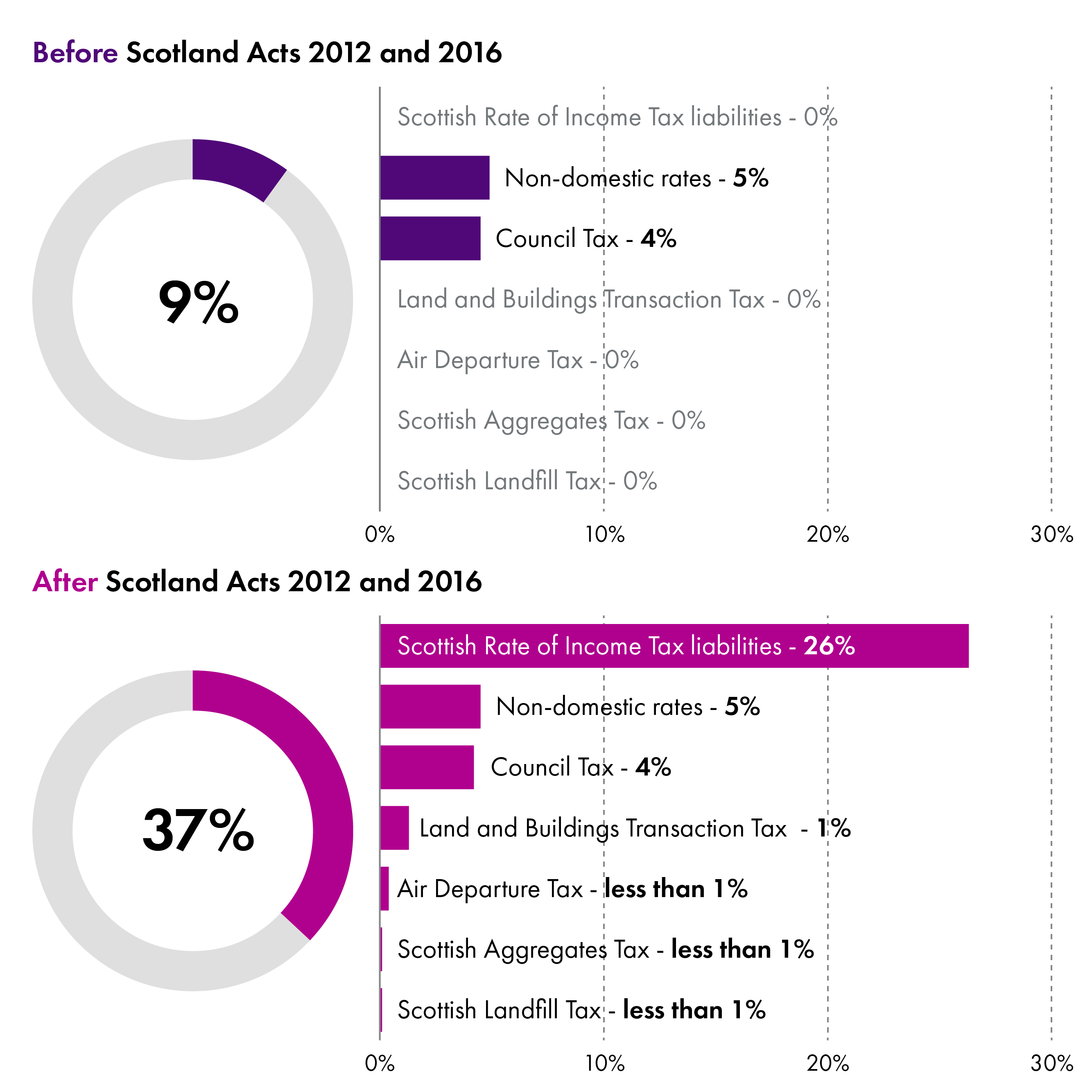
Scottish Government: GERS 2024-25
As fiscal devolution has progressed, the most recent Government expenditure & revenue Scotland (GERS) report, for 2024-25, suggests that the tax powers of the Scottish Government have gone from representing roughly 9% of estimated devolved expenditure at devolution, when only Non-Domestic Rates and Council Tax were devolved, to 37% once fully implemented. At the point of publication, only Air Departure Tax has yet to be applied - this is expected to take place on 1 April 2027.
In its Fiscal Sustainability Report (November 2025), Audit Scotland noted that 34% of the Scottish Budget for 2025-26 was funded through Scottish Income Tax, Land and Buildings Transactions Tax and the Scottish Landfill Tax. This compares to 30 per cent in the 2018-19 Budget. Audit Scotland, however, set out three key messages:
Devolved taxes are making a positive contribution to the Scottish Budget, but lower earnings and employment growth in Scotland compared to the rest of the UK are reducing their overall impact.
Despite tax and economic growth being key pillars of the Scottish Government's overarching fiscal strategy, its approach to addressing the projected funding gap focuses on controlling public spending. The Scottish Government has not been clear enough about the degree to which tax is expected to contribute.
The alignment of the Scottish Government's tax and economic strategies is not sufficiently detailed to support its fiscal sustainability strategy.
The outlook for the future in Christie noted several areas of uncertainty, and specifically highlighted the potential implications of the UK Government's plans at the time to undertake significant welfare reform, as per the Welfare Reform Bill (2011) which had been introduced shortly before the report's publication.
The report set out a long-term fiscal outlook, produced after the June 2010 Budget by the Chief Economic Adviser to the Scottish Government in light of the UK Government's fiscal consolidation plans. This suggested that Scottish Departmental Expenditure Limit (DEL) expenditure would fall year-on-year up to 2015-16, before beginning to increase again, and that it would not return to its 2009-10 levels in real terms until 2025-26. The most recent outturn figures suggest that this is likely to have come to pass, though it is possible that both the devolution of further powers and the demand on public services caused by the COVID-19 pandemic altered the rate of recovery.
As Christie highlights, the resource available, both forecast and outturn, only tells one part of the story – it does not illustrate the demand for services. Put simply, even though public spending has reached pre-austerity levels, it has done so in the context of increased demand (as we have already explored).
The report shared the warning from NESTA that:
Scotland's public services will need to cope with additional demands in health, social care and justice alone amounting to more than £27 billion, due in particular to an ageing society and the prevalence of certain ill-health conditions.
Although comparing budgets for specific portfolio areas over time is complicated by the restructuring of services, particularly the introduction of Integrated Joint Boards in social care delivery, the additional funding for these services has fallen well short of the level set out by NESTA. Funding for the Health portfolio represents by far the greatest proportion of the Scottish Budget, with the highest demands. Between 2009-10 and 2024-25, Total Managed Expenditure on Health increased by £8.6 billion in cash terms, or £3 billion in real (2024-25) prices.
An ongoing theme across many sectors, but particularly the health and local government sectors, is the shadow of an ever-increasing funding gap, which we will explore alongside up to date fiscal outlooks.
Resource spending
To forecast resource spending, the MTFS takes the current levels of spend and models anticipated changes through future demand – significantly public sector pay which accounts for more than half of resource spending. Resource spending is forecast to rise from £52.6 billion in 2025-26 to £61.7 billion in 2029-30, but over the same period resource funding is expected to rise to £59.1 billion. This £2.6 billion difference between planned spending and anticipated resource funding is the resource element of the so-called ‘black hole’.
In addition to the block grant received from the UK Government, resource funding takes account of the anticipated net tax position – this is the difference between the amount of funding subtracted from the block grant to account for devolved taxes, and the amount raised by the devolved taxes. The difference reflects both policy choices and the relative economic performance of Scotland and the UK. In 2025-26 the net tax position is expected to be £1.2 billion, and this is forecast to rise to £2.3 billion by 2029-30. The net tax position is sensitive to the SFC forecasts for devolved tax revenues, and the Office for Budget Responsibility (OBR) forecasts for revenues across the rest of the UK (rUK) from equivalent taxes, and so will be subject to change over the forecast period.
Health spending has been a consistent priority for the Scottish Government in recent years, and the MTFS forecast suggests that this trend will continue. Health spending is expected to grow by 3.3% per year, which is higher than UK funding associated with healthcare. Because health and social care accounts for almost 40% of the Scottish budget, changes to forecasts can have significant impacts. For instance, if healthcare spending grows by 1% more than expected, the impact would be over £1 billion additional spending by 2029-30.
The costs of delivering social security in Scotland are driven by two factors: trends affecting demand, and policy choices. The Scottish Government notes that the trends affecting demand, including increasing demand for disability payments, increased cost of living, and rises in payment rates due to uprating, are consistent across the UK.
However, there is also divergence due to different policy choices in Scotland. This covers both new payments like the Scottish Child Payment, changes to existing UK wide benefits, and the cost of the Scottish Government's different approach to applications for social security than that of the UK Government. Total ‘additional investment’ reflecting these policy choices in Scotland rises from just over £1 billion in 2025-26 to £1.8 billion in 2029-30. The Scottish Government notes that this is expected to be just over 3% of total resource budget in 2029-30.
The different cost of social security in Scotland does not reflect only decisions made in Scotland. Changes in UK Government policy can change the level of block grant adjustment, which can increase or reduce the additional costs in Scotland. This is very much a live issue as the UK Government considers its approach to welfare reform, and represents an area of uncertainty in the short term. For example, in the 2025 UK Autumn Budget, the UK Chancellor announced that the two child limit would be removed from April 2026. This led to an increase in spending on benefits in England, resulting in approximately £151 million additional revenues each year for the Scottish Budget through the operation of the fiscal framework.
Capital spending
While both capital and resource spending plans suggest a shortfall or ‘black hole’ of over £2 billion each by 2029-30, this is much more striking in the capital space given the relative size of each budget. The £2.6 billion resource ‘black hole’ is around 4% of planned resource spending in 2029-30. In contrast, the £2.1 billion capital ‘black hole’ is around 23% of total planned capital spending.
The MTFS provides more detail on the proposed capital spending, including categorising spend:
Continuation of service delivery: This involves regular maintenance spending on assets such as the road and rail networks, and ferries.
Existing asset renewal and improvement: This relates to work to improve or replace assets, such as HMP Glasgow which is replacing HMP Barlinnie, or costs related to dualling the A9.
Capitalised research: This is a way of accounting for research costs, and allows for them to be accounted over several years rather than being fully recognised when they are incurred.
Capital programmes: This includes major programmes such as Affordable Housing, Heat in Buildings and the General Capital Grant for local government.
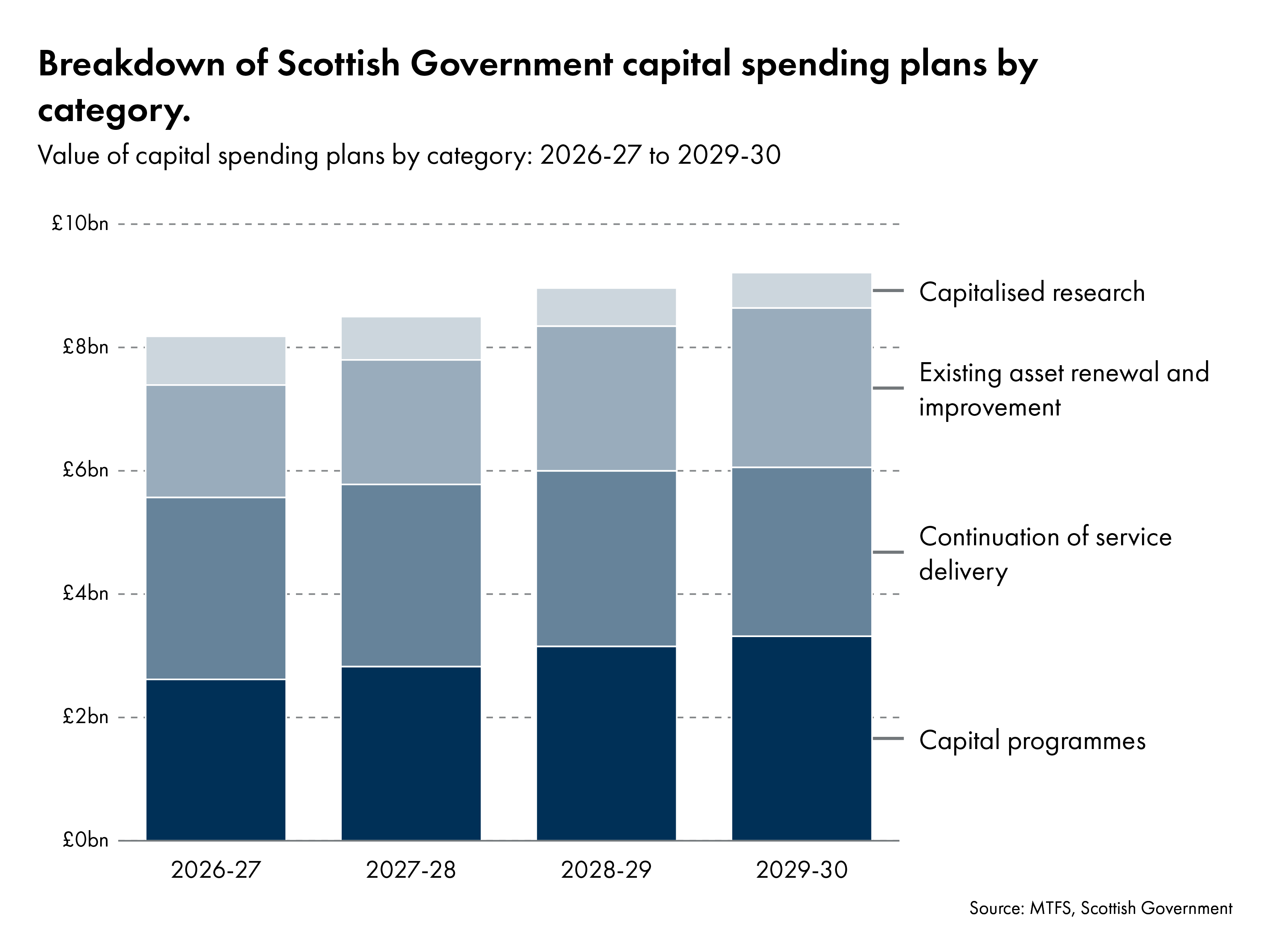
Scottish Government: Medium Term Financial Strategy (2025)
On capital spending plans, the Scottish Government notes that ‘continuation of service delivery’ accounts for nearly £3 billion each year from 2026-27 onwards, although this reduces slightly from £2.95 billion to £2.74 billion. Another £2 billion relates to ‘existing asset renewal and improvement’. Taken together, they account for around £5 billion each year, rising slightly over the forecast period.
In 2026-27, there is approximately £1.5 billion available for capital programmes after these costs are met – but the MTFS suggests spending plans for this year valued at around £2.6 billion. By 2029-30, the amount available for capital programmes (after covering other costs) declines to around £1.1 billion, but the programme is expected to cost over £3 billion.
Alongside the 2026-27 Budget, the Scottish Government published its first spending review since the 2022 resource spending review. The document provides some detail on portfolio resource allocations over the next three years, and capital over the next four years, mirroring the period covered by the UK Government's spending review published in June 2025.
The Spending Review also sets out some more detail on how the £1.5 billion public sector efficiencies and reforms are to be achieved. Health and social care reform will do the heavy lifting, with over £1 billion of the total planned savings to come from this sector. There is repeated reference to the intent to “protect” or “free up” investment in frontline services through the reforms.
NHS Boards will have to achieve recurring annual savings equivalent to 3% of their baseline revenue resource limit. The latest Audit Scotland report, covering the 2024-25 financial year, shows that boards achieved recurring savings of 2.2%, so meeting this target will require an improvement.
The Fraser of Allander Institute notes that some of the planned efficiencies will be challenging to deliver, stating that:
The area that looks like it has taken the biggest clobbering [as a percentage of the total budget] though is the justice system. It does not seem credible that such large cuts can be made to this area without impacts on services.
.png)
Scottish Government: Spending Review (2026)
The same context, but more of it
When looking back at the challenges set out in the Christie Commission's report, and comparing these to the situation 15 years on, there are two clear messages:
The challenges have not changed. Public spending is still under a huge amount of pressure, and none of the challenges highlighted have been significantly mitigated despite the additional powers available to the Scottish Government.
The challenges have grown, and will continue to do so. Global and national shocks have continued to impact the economy and the welfare of the Scottish population, and demand for services has increased and is likely to grow. The resulting gap between what the public service budget in Scotland must cover, and what is available, is predicted to continue to grow.
Put simply, the urgent need to address these challenges and demands continues to become increasingly urgent as time passes. Despite this context, and a clear intent to address these challenges coming from the Scottish Government, there has been a sense of inertia.
It's fair to say that these are challenges that many administrations around the world are grappling with. However, since the publication of the Christie Commission's recommendations, there is emerging evidence that other countries have begun to demonstrate practical ways to respond to these challenges. Moving forward, as well as new and shifting challenges and opportunities, the ability to learn from practice elsewhere may well be a contextual factor which the Commission did not have the benefit of when forming its recommendations.
The four pillars of Christie - intention vs progress
As we have highlighted, the Christie Commission presented its priorities using four themes, which are typically referred to as the four pillars, or the "4 P's" - People, Partnership, Prevention and Performance.
This section of the briefing explores each of these pillars in turn, looking at the original recommendations made by Christie, the initial response from the Scottish Government and subsequent progress from a policy and legislative perspective, how the Public Service Reform Strategy is expected to build on progress, and where possible, highlights some case studies of specific interventions.
People
The Christie Commission report states that a key objective of public service reform “should be to ensure that our public services are built around people and communities, their needs, aspirations, capacities and skills, and work to build up their autonomy and resilience”.
The report suggested that when public services work collaboratively and innovatively to meet the actual needs of people, they can become more efficient and effective. As a result, the Commission recommended that public services "should increasingly develop and adopt positive approaches which build services around people and communities, their needs, aspirations, capacities and skills, and work to build up their autonomy and resilience".
The Commission gave various examples of work in the public sector which demonstrated services working with and for people. This included personalised services built around individuals and families, as well as services built around specific communities of place and interest. It went on to make recommendations about how any community empowerment legislation should promote community participation and building capacity in communities.
The Commission emphasised the role of public sector staff in meeting these aspirations for people and communities, and recommended that managers and leaders "develop and extend empowerment of front-line staff to support their engagement with people and communities to improve service provision.". Specifically, the Commission felt it was important that the Scottish Government, local government and other partners develop a systematic and coordinated approach to workforce development.
Progress from a legislative and policy perspective
In its response to the Commission's recommendations, the Government focused on the workforce and leadership aspect of the Commission's recommendations, though it can be argued that the responses to recommendations on building services around people are reflected under the partnership aspect of the response.
The priority actions outlined by the Government include some less defined areas, such as commitments to emphasising the role of community planning partnerships in capacity-building, building collaborative leadership capacity (with the Scottish Leaders Forum), and sharing the core learning and principles of the UK Employee Engagement Taskforce. Specific workforces were named as areas where workforce skills and leadership development would be focused - the social services workforce, the alcohol and drugs workforce, and the third sector. The most tangible commitments made by the Government were that it would:
Take forward the recommendations of the 2010 review, Teaching Scotland's Future,
Develop a practice-based qualification for criminal justice social workers in Scotland (to replace the former MSc), and
The employment of 30 apprentices over three years with Historic Scotland to enhance the development of traditional building skills and expertise.
Community Empowerment
The Community Empowerment Act 2015 built on the Local Government in Scotland Act 2003, which had given a statutory basis to the community planning approach. Community planning is about organisations within communities working together to improve the lives of residents and the services they receive. Part 2 of the 2015 Act created a duty on Community Planning Partnerships (CPPs) to focus on improving outcomes for their communities. CPPs should work with communities, ensuring they can participate in making decisions about local priorities and services.
Community planning was seen by the Scottish Government in 2015 to be a key part of delivering public service reform at a local level. However, post-legislative scrutiny of Part 2 of the Act conducted by the Local Government, Housing and Planning Committee last session heard frustrations from various organisations that “true community participation is often not happening, despite it being at the heart of the 2015 Act”.
Part 3 of the 2015 Act deals with “participation requests” which enable engagement and dialogue between community participation bodies (such as community councils and community development trusts) and public service authorities (for example local authorities or health boards). Community bodies can make a request to a “public service authority” to participate in a process to improve an outcome of a public service. A Scottish Government review published last year found that the use of participation requests is low and there is "mixed understanding of their purpose and when they are needed ".
Teaching Scotland's Future
Teaching Scotland's Future (2011) (TSF), often referred to as the Donaldson review, sought to review teacher education in Scotland following a period of substantial change within the profession. The report identified strengths in the profession, but also noted the ad hoc and fragmented nature of continuous professional development and aspects of Initial Teacher Education (ITE) for the primary sector that needed improvement. The recommendations focused on leadership and improvements to both ITE and continuous professional development, and all were accepted in whole or in part by the Government.
In response to the recommendations, the Government established a National Partnership Group to consider them in more detail, resulting in 20 substantial projects being taken forward by the National Implementation Board for Teacher Education. A 2015 evaluation, carried out by Ipsos MORIon behalf of the Government, found that despite a challenging background of new policies and restrained resources, there was evidence of real progress in many areas of teacher education and a significant shift in the culture of professional learning. Teachers were more engaged with professional learning, more aware of its impact on pupils, engaged in professional dialogue more often, and more willing to try new approaches. There had also been specific improvements to teacher education at all stages.
Despite improvements, Ipsos MORI said that that there was "a considerable way to go before the vision set out in TSF [was] fully realised". Areas for improvement included better clarification of roles and understanding of partnerships between local authorities and universities, more use of mentoring and reflection, and better signposting of resources. There were two national-level challenges raised - issues around obtaining supply cover, and a sense that there were too many competing priorities in education.
How the PSR strategy will support people
The empowering of people, places and communities is a “foundational workstream” of the current PSR Strategy. Perhaps mindful of the COVID-19 experience, the Strategy states that “communities have huge capacity to work together and with public services to build the support people need where they are”.
Under this workstream, the Scottish Government commitments include:
Working with local government and public bodies to conclude the Local Governance Review.
Empowering local government and health partners to strengthen and streamline local decision-making through the development of Single Authority Models in three rural and island local areas.
Taking forward the findings of the review of parts of the Community Empowerment (Scotland) Act 2015.
Exploring how to devolve further elements of decision-making and delivery to Regional Economic Partnerships (REPs).
This workstream will presumably have its own evaluation framework and will also be looked at by the Public Service Reform Board. It is currently unclear how the Board will ensure that the views of communities and the third sector are included in this evaluation work.
The Local Governance Review
The Local Governance Review was launched in December 2017 “to consider how powers, responsibilities and resources are shared across national and local spheres of government, and with communities”. Eight years later, the Scottish Government published a route map to reformarising from years of consultation and discussion. The document discusses various proposals, including a Local Democracy Bill, but notes “there continue to be significant points of difference in public views in the scale and pace of reform”.
Much of the Government's route map focuses on strengthening “community governance”, with a tacit acknowledgement that community councils and CPP locality plans aren't working for all areas. New community bodies may be required, but there is little detail on what these would look like.
Throughout the last two parliamentary sessions, the Parliament's local government committees heard concerns about community capacity in relation to empowerment. The tools provided by the Community Empowerment Act – community planning partnerships, asset transfers and participation requests – undoubtedly have the potential to help communities improve outcomes. However, a consistent barrier has been the lack of awareness, organisation, confidence and skills within many communities across Scotland. Moreover, the Session 5 Local Government and Communities Committee concluded:
Resources are part of the issue, with evidence that some communities do not have the support they need at grassroots level to help unlock the potential of the 2015 Act.
Professor Oliver Escobar, one of Scotland's leading academics in the fields of public participation and community empowerment, told last session's Local Government, Housing and Planning Committee:
…community learning and development departments have been cut over the past 10 years, more than in the previous 20. A lot of the capacity that had been built in the early 2000s has been dismantled. There has been a real knock-on effect of public spending cuts, because the first thing that tends to go is the community workforce. There is a real issue there if we are to live up to the aspirations of the community empowerment act, the local governance review, the community wealth building agenda and the planning framework. All those things have community empowerment at their heart, and we need to consider the community workforce.
The Scottish Government's route map accepts that the “community development infrastructure” needs more investment, and it includes a workstream which aims to:
Consider how capacity support provided at national, local and regional level might be increased and more strategically designed and deployed – including through grant-making and investment in community development support.
The workstream also aims to ensure community bodies have the governance, finance skills, and capacity they need to take on greater rights and functions.
Partnership
The Christie Commission priority of “working together to achieve outcomes” focused on encouraging public service organisations to move towards models of “delivering integrated services which help to secure improvements in the quality of life, and the social and economic wellbeing, of the people and communities of Scotland”.
As a counter to the collaboration between people, communities and services explored in the ‘people’ objective, this area of observation and recommendations focuses specifically on partnership between different bodies within the public sector.
The Christie report highlighted that such approaches should be outcomes-based, but despite positive steps such as the introduction of the National Performance Framework, this approach had not been fully embraced and that there were practical barriers, particularly around accountability and budgeting models, to achieving this goal.
The vision set out in Christie is one of public service organisations coming together to address an identified and localised issue to “design and deliver an integrated pattern of service provision”. The Commission focused on the community planning partnership model in its recommendations, as well as the need to increase flexibility in funding models and establish common powers and duties across different bodies. Underpinning this was the suggestion that there should be a revamped political agreement between the Scottish Government and local government.
Overall, the Commission highlighted that it favoured policy approaches which:
were focused on the achievement of outcomes in the lives of people and communities;
were designed to build the capacity of those individuals and communities;
would support the local integration of service provision; and
would prioritise prevention and tackle inequalities.
Progress from a legislative and policy context
The Government's initial response to the recommendations gave a commitment to “sharpen the focus of public services on 'place' as a magnet for partnership” and removing bureaucratic barriers to partnership working. In setting out its priorities, it highlighted several areas of existing practice and funding that it aimed to continue and strengthen, such as the Single Outcome Agreement process and its Change Fund for NHS boards and local authorities. It also set out areas where it would strengthen legal duties and aim to better align services. Most significantly though, the Government made commitments to more significant legislative approaches, service redesign and strategic approaches, including:
Integrating health and social care services across Scotland
The introduction of the Social Care (Self-directed Support) Bill.
The development of a Community Empowerment and Renewal Bill, and
The development of a Cities Strategy.
Health and social care integration
The Public Bodies (Joint Working) (Scotland) Act 2014 paved the way for the creation of Integration Authorities to bring together NHS Boards and Local Authorities to plan, commission and deliver social work services under a localised partnership model.
Legislation to implement health and social care integration came into force on 1 April 2016, and represented the most significant step towards public service reform in Scotland to date. This brought together NHS and local council care services under one partnership arrangement for each area. In total, 31 local partnerships were set up across Scotland, and they manage around £13 billion of health and social care resources. NHS and local council care services are jointly responsible for the health and care needs of patients, aiming to ensure that those who use services get the right care and support whatever their needs.
Audit Scotland's 2018 update on the progress of integration highlighted that Integration Authorities had introduced more collaborative ways of delivering services and had made improvements in several areas of integration, however there remained significant concerns around financial planning, governance and strategic planning arrangements and leadership capacity, as well as the slow pace of integration.
The Independent Review of Adult Social Care in Scotland (also known as the Feeley review) in 2021 argued that a lack of integration at national level is contributing to unacceptable variation in local progress, and that Integration Authorities should be reformed to take full responsibility for the commissioning and procurement of adult social care support locally. The report argued strongly for the introduction of a National Care Service Bill, which the Government put in motion in 2022. In the end, however, during its passage through the Parliament the Care Reform (Scotland) Bill was altered significantly, with the Scottish Government instead committing to a much narrower version of a National Care Service.
The Improvement Service's Local Government Benchmarking Framework tracks the satisfaction levels of social care service users. The annual report for 2024-25 concludes that “user-reported experience indicators continue to show a long-term downward trajectory across all core domains”. The following table shows those indicators most relevant to people's sense of control:
| Indicator | 2015-16 | 2023-24 |
|---|---|---|
| % of adults supported at home who agree that they are supported to live as independently as possible | 82.7% | 72.4% |
| % of adults supported at home who agree that they had a say in how their help, care or support was provided | 78.8% | 59.6% |
| % of carers who feel supported to continue in their caring role | 40.0% | 31.2% |
The ambition behind the integration of health and social care was that, over time, budgets would lose their identity and become a single budget pot. During pre-Budget scrutiny for 2025-26, the Health, Social Care and Sport Committee highlighted evidence it had received which suggested that this had yet to be realised.
Illustrating the challenge, Sharon Wearing (Chartered Institute of Public Finance and Accountancy Scotland), had explained to the Committee:
while we work in two ledgers—one from the council and one from the health board—budgets will never lose their identity. I have said previously to committees that, to get true integration of budgets, things need to be done in one ledger. They cannot be done in two, because what happens is that our health performance is reported through the health board and comes up through the Scottish Government, and the social work bit is reported through the council. To allow budgets to lose their identity, there needs to be a completely different approach, in which we all work in one ledger and the budget is all in one ledger.
Self-directed support
The Social Care (Self-Directed Support) Bill 2013, enacted in 2014, aimed to give people more choice and control over how their social care needs were met. The options for care enshrined in the Act existed prior to legislation, but the Act placed a legal duty on local authorities to offer these options to service users, alongside other obligations such as providing advice and support on options. The options given to service users under Self-Directed Support are:
Option 1 – a direct payment to the service user or a chosen third party.
Option 2 – the service user directs the available support.
Option 3 – the local council arranges the support.
Option 4 – a mix of the above.
The Scottish Government has used a rolling programme of implementation plans and reviews to continue to develop and support the approach. As we noted in the introduction to this briefing, a 2017 Audit Scotland progress report found that although there were many examples of positive progress in implementing Self-Directed Support (SDS), there was no evidence that authorities had made the transformation required to fully implement the SDS strategy. Following the conclusion of the most recent implementation plan covering 2019-2022, and in the context of the integration of health and social care and plans for wider reform of adult social care services, the Government and COSLA jointly presented an improvement plan to cover 2023 to 2027.
In a 2022 blog, researchers at the University of Glasgow's Policy Scotland research and knowledge exchange sought to answer the question,"Why has the policy of self-directed support not secured transformative change in social care in Scotland?". They found that:
SDS has led to very little change in social care. Option 3 remains the dominant and default service for users.
The 3 different sectors involved in social care – local authority, disabled people’s organisations (DPOs) and third sector organisations (TSO) – each have different solutions and aspirations for social care. This has resulted in a disconnect between sectors, with little evidence of co-production.
For DPOs, the gold standard for the delivery of social care is through Option 1, but this is perceived as being expensive and difficult to implement by many social workers.
TSOs view Option 2 as the basis for a more flexible system, but many local authorities perceive this as contractually difficult and overly legalistic. Therefore, services have not developed services through this route at scale.
Option 3 has become the default mode. As social care has shifted to crisis management, it is seen as the quickest and most effective means of providing support and therefore dominates service provision.
The context for delivering SDS seems to be ever-evolving, particularly when it comes to the level of funding available for support. A 2026 joint report by Inclusion Scotland and Self-Directed Support Scotland highlights the impacts of changes to SDS direct payments on people. It explains that “while SDS is built on the premise of choice and control, the findings show a gap between these principles and people's experiences.”. This echoed findings from the Session 6 Health, Social Care and Sport Committee's post-legislative scrutiny of the Bill in 2024, which highlighted stakeholder concerns that the integration of health and social care services had diverted attention and resources away from SDS. The Committee was also concerned that this could continue to be the case through the introduction of a National Care Service, despite the Scottish Government arguing that inconsistency in SDS was one reason for the legislation. As noted, this legislation did not progress as originally stated, and it could be argued that this is an example of what may have been enabling legislation in public service reform encountering significant structural and political barriers.
Community empowerment
As we have already set out in the section on People, The Community Empowerment (Scotland) Act 2015 was one of the key pieces of legislation which the Scottish Government brought forward to support public service reform. A key aspect of this was partnership working.
During its, post-legislative scrutiny of Part 2 of the Bill, the Local Government and Housing Committee concluded from the evidence it heard that there had been significant improvements made over the eight years since the passage of the Bill, particularly in greater collaboration and cross-sectoral understanding across community planning partners. However, concerns were raised about the capacity for partner organisations to jointly contribute resources to enable partnerships to deliver outcomes. The Committee also expressed concerns about the third sector's capacity to engage with community planning partnerships, and it recommended that the Government explore how CPPs could best engage the private sector in community planning.
Cities strategy
The Scottish Government published its cities strategy, Scotland's Agenda for Cities, in 2011, with a vision of “A Scotland where our cities and their regions power Scotland's economy for the benefit of all”. One key aspect of the strategy was to set the foundations for the Scottish Cities Alliance as a collaborative model across Scotland's 7 cities. The strategy was updated in 2016 to reflect the maturation of this alliance, up to date economic growth policy, and the growing focus on City Region Deals.
Although the Scottish Government's strategic approach to cities may be less frequently framed in the context of public service reform, it still represents a significant example of an approach built on partnership working. However, the Session 6 Economy and Fair Work Committee, in its inquiry report on Scotland's City and Regional Growth Deals (May 2025) found that the benefits of partnership working between multiple levels of government and partners may be being missed. It explained:
the range of partners has created complex governance structures and untidy lines of accountability, where local decisions require final approval from the Scottish and UK governments. The Committee notes that the process for agreeing projects is more bureaucratic today than in the early days of growth deals in Scotland. Ensuring compliance with Green Book requirements has proved to be onerous and caused long delays in some cases.
How the PSR Strategy will support partnership
In the Public Service Reform Strategy, the Scottish Government sets out that, to enable strategic change in Partnership working:
Leaders should be incentivised & empowered to act across silos.
Policy landscape should be streamlined.
Accountability structures should support and require joint working.
It sets out workstreams under three pillars, of which the most relevant to Partnership is Pillar 2 – “Joined up services”. The workstreams under this are:
Workstream 7 - Simplification
Workstream 8 - Data sharing and data usage
Workstream 9 - Local integration: strengthening Community Planning and realising the potential of the third sector
Workstream 10 - Digital Public Services
All pillars are underpinned by foundations, which are arguably just as much, if not more crucial to supporting partnership working. These are:
Workstream 1 - Leadership and cultural change
Workstream 2 - Accountability and incentives
Workstream 3 - Empowering people, places and communities
Workstream 4 - Ensuring the right delivery landscape
The Government's narrative on how it will achieve its aims is less specific than its previous commitments in terms of action points, however the underlying ethos through the narrative is that lines of responsibility and accountability within a cluttered policy and delivery landscape need to be clarified and streamlined, alongside collective approaches and data sharing to remove bureaucracy. It does, however, make some actions which link back to Christie recommendations clear, including a commitment to the development of Single Authority Models in three rural and island local areas, a pilot approach to integrating Whole Family Support services in six local authority areas, and strengthening and refreshing the Community Planning Partnership approach.
One aspect of the Christie Commission's recommendations on Partnership that is less explicitly addressed in the strategy is the need to address the barriers created by siloed and varied funding and budgeting arrangements. Making changes which make it easier to move and share money across services is mentioned in the context of preventative budgeting, but this framing falls short of the Christie aspirations that the focus of budgeting should increasingly move away from institutional silos towards outcomes, potentially using Total-place type approaches.
Case studies in partnership
The Christie Commission used case studies in its report which showed the successes of partnership working in Operation Focus, a collective approach to tackling drugs and community safety in West Lothian in 2009, and the Cheviot Programme, a place-based community planning approach in the Scottish Borders in 2010. It is hard to find any long-term reflection on the impact of Operation Focus. By comparison, there is clear evidence of the Cheviot Programme leading to service redesign, despite early concerns raised by Audit Scotland about the true level of partnership, and leadership capacity. The most recent Best Value Report (2024) suggests that Scottish Borders Council has taken a continuous improvement approach to tackling these shortcomings, and more recent strategic plans suggest there is a sustained place-based approach to service delivery.
There are frequent examples of partnership working across Scotland highlighted by public bodies and the media. The Highland Health and Social Care Partnership's work with local charity Urram to develop a new, flexible model of care for people living on the Ardnamurchan peninsula, West Lochaber is a recent example.
Social Enterprise Scotland has highlighted case studies of social enterprises delivering essential public services: Giraffe Healthcare CIC (web-based physiotherapy), West Granton Housing Co-operative, The Wise Group (employment, justice, skills), Atlantis Community Leisure (health and sport in Oban), Glenfarg Community Transport, Shore Psychology and NHS Lothian and third sector partnerships. It is notable that only some of these case studies reference a partnership working approach. Social Enterprise Scotland's 2024 Census showed that in 2024, 46% of social enterprises reported trading with the public sector. This was down from 50% in 2021 and 61% in 2015. This suggests that the social enterprise sector is becoming more independent, but it's unclear what this decline might mean in terms of partnership working.
The Accounts Commission's report, Delivering for the Future (2026), highlights recent partnership working case studies, such as the exploration of ‘Pan-Ayrshire shared services” and Midlothian Council's Multi-Agency Transformation Management Group. However, as the Accounts Commission notes, there is often little transparent reporting on the longer-term impacts of such projects, and the examples are often “on the margins in terms of transformation".
Linking back to our comparison of the Public Service Reform Strategy against the recommendations of the Christie Commission, the Accounts Commission also highlights that “Joint funding arrangements can be a strong enabler to progressing transformational partnership initiatives”. It notes that most examples of joint funding in partnership occur with the UK or Scottish Government, for instance by councils receiving joint funding for a shared service. There are fewer examples of joint funding with other partners.
Prevention
The Christie Commission emphasised that reform should be to ensure that public service organisations prioritise prevention, reduce inequalities and promote equality. It drew the link between the growing demand for public services and a focus on reactive spending, as opposed to preventative spending. Put simply, if public services are tied up in the more costly impacts of negative outcomes, it makes it challenging for them to shift towards spending money on preventing negative outcomes.
The Commission highlighted that many of the recommendations for reform made against its other priorities would support a preventative approach and tackle inequalities, for instance:
“pooling budgets in support of a longer-term, outcomes-based approach should allow preventative approaches to be prioritised. It should also contribute, over time, to a reduction in 'reactive' public expenditure by preventing duplication and reducing negative demand;
extending and deepening a local partnership approach can involve a wide range of public service organisations in coordinated and preventative approaches;
empowering front-line staff should promote greater initiative in identifying ways in which the causes of inequality can be tackled;
empowering people and communities to engage in the initiation, design and delivery of public services should support the development of preventative approaches; and
helping communities to achieve their own ambitions.”
As a result, the Commission recommended that any powers or duties developed under other priorities should “include a specific presumption in favour of prioritising preventative action, and action to tackle inequalities”. To support this, the Commission also made specific recommendations around community-led regeneration focused on targeting the needs of deprived communities and promoting equality.
Progress from a legislative and policy context
Following the recommendations of the Christie Commission, the Scottish Government committed to:
accelerating progress in building prevention into the design and delivery of all public services
focusing support in the first few years of life where we it can have the biggest impact in improving life chances for the most vulnerable in society
unlocking resources invested in dealing with acute problems
tackling inter-generational cycles of inequality and pockets of disadvantage that blight the life chances of some people
better utilising the talents, capacities and potential of people and communities.
Highlighting its foundational work with COSLA through the Early Years Framework, the Government committed to extending its approach. Much of the delivery of this was framed as being through ‘change funds’, which were already in place for older people's services and would be extended with an Early Years and Early Intervention Change Fund and a Reducing Reoffending Change Fund. Similarly, the Government committed to the creation of a £250 million Scottish Futures Fund which would include specific funds focused on:
Developing youth talent through sport, enterprise and creativity (Young Scots Fund)
The roll-out of superfast broadband (Next Generation Digital Fund)
Effective intervention in a child's life, overseen by the Early Years Task Force (Sure Start Fund)
Tackling fuel poverty (Warm Homes Fund)
Supporting Scots to move to low carbon and active travel options (Future Transport Fund).
The Government also set out various plans for legislation around the rights of children and young people, renewing post-16 learning and student support, investment in early cancer detection, minimum pricing for alcohol, a tobacco control strategy, the development of a Regeneration Strategy that would responds to the challenges faced by the most disadvantaged communities, and continuing to support renewable energy schemes at a community level.
Change funds
The Scottish Government's ‘change funds’ aimed to facilitate partnership working and piloting new models of service delivery focused on early intervention activity. The Government, in its Draft Budget 2016-17, took stock of its three flagship change funds (Early Years, Reshaping Care for Older People, and Reducing Reoffending), and the investments it, and public sector partners, had made since 2012-13. In this, it suggested that change funds had increased the profile and understanding of prevention in the public sector, had supported strategic change, and had improved outcomes in the targeted areas. The narrative in the Draft Budget suggested that the Scottish Government saw its recently passed Community Empowerment (Scotland) Act 2015, and Community Planning Partnerships as being the model through which such innovation would continue. The last time a change fund was referenced in the narrative of the main Scottish Budget document was the Transformational Change Fund in 2018-19, though change funds did continue – the Reducing Reoffending Change Fund was referenced in Level 4 Budget dataas recently as 2024-25. A Community Living Change Fund was introduced in February 2021, but this has proven hard to locate in fiscal documents.
For all three funds, the Scottish Government gave progress updates and evaluations (e.g. the 2016 evaluations of the Reducing Reoffending Change Fund and Early Years Change Fund), but external evaluations are limited, and SPICe has been unable to identify long-term evaluations of impact. The Accounts Commission's 2014 evaluation of Reshaping Care for Older People confirmed that the change fund had been successful in bringing together NHS boards, councils and the third and private sectors to develop and agree joint plans to improve care for older people in their local area, however it noted that initiatives arising from the fund were not always evidence-based or monitored for long term impacts, there was little evidence of progress in moving money towards community-based services, and it was not clear how successful projects might be sustained or expanded.
As noted, there were several additional time-limited funds announced by the Scottish Government to target resource towards prevention, contained within the £250 million Scottish Futures Fund. The last allocated spending on this detailed in the Scottish Budget dates from 2015-16, and SPICe has been unable to find any comprehensive review of the impact of the fund.
The Children and Young People (Scotland) Act 2014
The Children and Young People (Scotland) Act 2014 introduced a range of reforms across children's services and embedded elements of the Government's Getting it Right for Every Child (GIRFEC) approach in legislation. The Act also: extended provision of funded early learning and childcare; introduced corporate parenting duties for certain public bodies to meet the needs of care- experienced people; set out local authority duties to provide services and support for children at risk of becoming 'looked after' and to provide assistance for kinship carers; extended the age of eligibility for aftercare support for young people leaving care to 26; and introduced 'continuing care', providing care leavers up to the age of 21 with the opportunity to continue with accommodation and support they were provided with immediately before they ceased to be looked after.
The 2014 Act as passed contained provisions for every child in Scotland to have a 'named person' as a first point of contact for children and families seeking information or advice about a child or young person's wellbeing. Following a successful legal challenge and Supreme Court ruling, the provisions were never brought into force and have since been repealed by section 32 of the Children (Care and Justice) (Scotland) Act 2024.
Although the 2014 Act has not been subject to post-legislative scrutiny as a whole, individual provisions have been looked at by parliamentary committees. The Session 6 Finance and Public Administration Committee also reviewed the Bill's Financial Memorandum, assessing the accuracy of its cost estimates. The Committee highlighted the importance of identifying outcomes and monitoring arrangements at the earliest stages of policy development.
Subsequent legislation, including the 2024 Act and the Children (Care, Care Experience and Services Planning) Act 2026, provides for significant changes to areas including corporate parenting, aftercare, and (as noted later in this briefing) the Children's Hearings System. Some of these changes have yet to be enacted.
Health interventions
The Government has made several specific, targeted health interventions since the Christie Commission reported. Minimum Unit Pricing for Alcohol was legislated for in 2012, but, following legal challenges and review by the UK Supreme Court, was not implemented until 2018. In the Public Service Reform Strategy, the Government highlights Public Health Scotland findings that the introduction of minimum unit pricing (MUP) was estimated to have reduced alcohol hospital admissions (4.1%) and deaths due to alcohol (13.4%) between 2018 and 2020.
In 2013, the Scottish Government launched ‘Creating a Tobacco-Free Generation’, with the aspiration of achieving smoking rates of 5% or lower amongst adults in Scotland by 2034. This has been followed by a rolling series of strategies, with a second five year strategy published in 2018, and the third and current strategy announced in 2023. As part of the most recent strategy, the Government mapped smoking rates against policy interventions, which suggest that although meeting the reduction targets will be challenging, there appears to have been a clear impact from smoke-free policies and restrictions on the visibility of tobacco products in stores. The strategy also makes clear the link between inequalities and smoking, and makes explicit that the 2034 target must be reached in the most deprived areas instead of just across the population as a whole.
The different iterations of the Government's tobacco policy demonstrate the impact of changing products and social norms on prevention, and the need for prompt interventions. In the first strategy, e-cigarettes are only briefly mentioned, and the term ‘vape’ (which had not quite entered common usage) is not used at all. The context for these products did highlight concerns about them acting as a gateway to tobacco but also spoke about their potential to support smoking cessation. The 2018 strategy highlighted that most use of e-cigarettes was by former smokers and included some measures to make it possible for these to be used in certain settings, but it also flagged concerns around education, licensing and regulation in relation to young people. The 2023 strategy specifically addresses the use of vapes, but the data provided shows that despite concerns being raised in earlier strategies, the rate of vape use (and therefore, tobacco use) among children and young people has grown since the historical lows caused by smoking interventions.
Understanding inequalities
In recent years the Scottish Government has responded to calls from the Christie Commission and others, including Parliamentary committees, to improve its understanding of equalities gaps and to improve the collection and use of disaggregated data. Most prominently, this has included its Equality Data Improvement Programme (EDIP), and its underpinning strategies, the Equality Evidence Strategy 2017-2021 and Equality Evidence Strategy 2023-2025.
This has led to more accessible data on equalities, through the Equality Evidence Finder, and greater use of data. This has been demonstrated within a budget-setting context through, for instance, the use of distributional analysis to understand the impact of tax and spending decisions on different groups. For the 2026-27 Budget, the Government also refreshed its approach to reporting on statutory duties around impact assessment, by replacing the former Equalities and Fairer Scotland Budget Statement with a Strategic Integrated Impact Assessment, which made use of "enhanced" distributional analysis and set out a pilot approach to intersectional analysis based on minority ethnic women. Our analysis at the time noted that the Strategic Integrated Impact Assessment represented the most significant progress made to date towards addressing stakeholder concerns about the use of equalities data in budgeting.
Alongside the Population Health Framework, which "sets out Scottish Government's and COSLA's long-term collective approach to improving Scotland's health and reducing health inequalities", there has been clear progress in efforts to understand how to best target services towards reducing inequalities.
How the PSR Strategy will support Prevention
The Public Service Reform strategy uses a data-driven model for future action around prevention. The Government sets out two workstreams to achieve its aim of better understanding the proportion of spend being directed towards prevention.
Workstream 5, on understanding and mitigating demand drivers, centres around:
improving the evidence base around prevention and being better equipped to identify issues that the public service system must address.
Better understanding the economic impact of preventative approaches.
Using lessons learned from successful preventative interventions to understand the collaborative models that can drive change and to apply this learning to other challenges, and
Setting out costed proposals to tackle the drivers of demand.
The Public Service Reform Strategy recognises that “current budgeting processes are a key barrier to shifting resources to preventative spend”, and commits to re-designing its “approach to identifying, tracking and monitoring preventative spend”. There is a recognition of the cross-cutting nature of preventative spending and a commitment by the Government to change the way it budgets. In the strategy, Workstream 6 focuses on preventative budgeting, though better identifying, tracking and monitoring of preventative spend, changing budgeting approaches to allow for more flexibility and ability to target funding towards prevention, and development of an Invest to Save fund. As we highlighted earlier in this briefing, recent work on budget tagging is an example of how it is moving forward progress towards tracking and monitoring preventative spend.
The Government set out several examples of ‘live and upcoming’ preventative programmes, which include the Tackling Child Poverty Delivery Plan, the Scottish Attainment Challenge, the Early Child Development Transformational Change Programme, the Population Health Framework, Supporting Healthy Weight in Scotland, and ‘Shifting the Balance between Custody and Justice in the Community’.
Both the narrative around changes to the budget, and the examples given of ongoing work, reflect the recommendations and aspirations of the Christie Commission. That said, IPPR has pointed out that, in reference to the Invest to Save fund, "a £30 million fund will not generate savings that touch the sides of a £2.6 billion deficit in four years’ time".
Examples of prevention
It is interesting when looking for examples of prevention to refer back to the examples used by Christie to see if there is any data on the long term preventative impacts of the projects highlighted. The Christie Commission used employability scheme Glasgoworks as the sole case study around prevention in its report. That initiative had already at that point produced some impressive statistics around outcomes for job-seekers. As with other case studies used by Christie, Glasgoworks was a time-limited initiative, which has since been replaced by an evolving model of service delivery. This makes it challenging to point to the direct long-term impact of the approach used. However learning from the various strands of work, partnership approaches and toolkits developed during the lifespan of Glasgoworks is likely to have been carried forward into later programmes such as Glasgow Futures and the Glasgow Guarantee, and there is clear evidence of a collaborative partnership approach still being used within Glasgow’s Local Employability Partnership.
For more recent examples, the Accounts Commission's Delivering for the Future report highlights several case studies around transformation of services, with a focus on funding aimed towards community investment, service modernisation and reform, and digital projects. Only one case study highlighted, from its East Ayrshire Council Best Value thematic management report (2025) detailed gives detail of early intervention and prevention funding, the use of which was being consulted on with local communities and community planning partners.
Performance
The Christie Commission argued that reform was needed “to ensure that all public services constantly seek to improve performance and reduce costs, and are open, transparent and accountable”.
The Commission felt that issues such as complexity, duplication and weak accountability had been manageable and less visible during times of “buoyant” public expenditure, but that these shortcomings had become more pronounced under austerity. It argued that in times when household finances are under pressure, public confidence and satisfaction in public services are “crucial to sustain public support”.
In its recommendations, the Commission led with suggestions to improve transparency and consistency, with the aim of rebuilding trust between the public and public services. It recommended that all public sector bodies should be required to demonstrate how expenditure was driving improved outcomes, with regular benchmarking and reporting requirements. To support this aim, it also suggested that Audit Scotland be given a stronger and more proactive accountability role and that the functions of the Auditor General and the Accounts Commission should be amalgamated to create an integrated approach to oversight.
The Commission felt that procurement and commissioning was an area where reform could reap rewards and suggested that these activities undergo a “rebalancing” which focused less on cost efficiency and more on effectiveness and promoting positive outcomes. As part of this, it made suggestions aimed at creating consistent procurement processes and scrutiny standards across the public sector.
The Commission highlighted evidence around both good practice and a lack of progress on shared services, and spoke about the sense that Scotland had a “fragmented and poorly coordinated system of public services”. It recommended that more be done to explore and pilot ‘single public authority’ models of service delivery, and that the Scottish Government and partners take forward a rolling programme of bottom-up, outcomes-based reviews across service areas, with a focus on exploring where streamlined and shared services/locations and simplified governance might improve performance and reduce costs.
Finally, the Commission emphasised the importance of long-term strategic planning and said that the Government should “provide all public services with forward revenue and capital budget projections on the same multi-year planning cycle”, and that it should replicate the Office of Budget Responsibility's (OBR) independent fiscal sustainability analysis in Scotland.
Progress from a legislative and policy context
In its response to the Commission's recommendations on performance, the Government committed to the development of an improvement framework which would strengthen and support a ‘performance culture’ across the public sector. As a flagship policy, it set out plans to reform police and fire services through a single service model. It also made commitments to:
Reducing running and management costs across the civil service, and deliver additional savings through simplification projects and a programme of scrutiny reform.
Establish a new national body to deliver children's hearings to replace services at a local authority level.
Through its digital services strategy, move an increasing number of services online, in addition to exploring wider options for digital service delivery and taking forward the recommendations in the McClelland Review of Public Sector ICT Infrastructure, and
Work with local authorities to improve road management, including through the use of shared services.
It is worth highlighting that alongside Government-led action, the Accounts Commission and Audit Scotland has over time strengthened their approach to oversight. Since 2022, auditors have undertaken thematic Best Value audit work alongside annual audit work at Scottish councils, such as the 2026 report, Delivering for the Future. This has come alongside a steady programme of reflection on audit practice, with the Code of Audit Practice being reviewed every 5 years, and a commitment to monitoring the impact of audit work.
Police and fire reform
The Police and Fire Reform (Scotland) Act 2012 created a single police service and a single fire and rescue service, replacing the eight police forces and the eight fire brigades that had existed previously. The Bill sought to deliver three key policy aims:
To protect and improve local services despite financial cuts, by stopping duplication of support services eight times over and not cutting front line services;
To create more equal access to specialist support and national capacity – like flood rescue – where and when they are needed; and
To strengthen the connection between services and communities, by creating a new formal relationship with each of the 32 local authorities, involving many more local councillors and better integrating with community planning partnerships.
The Government's own evaluation process found that the reform process had supported both the partnership and prevention agendas, and that lessons learned could be valuable in progressing partnership working, innovation and prevention across wider public sector services.
In 2019, the Session 5 Justice Committee published findings on post-legislative scrutiny of the Act, with separate reports on police services and on fire services. The findings of the Committee in relation to both services differed – it had more confidence, for instance, that the creation of the Scottish Fire and Rescue Service had met the policy aim of protecting and improving local services, though it did note that the model and contractual framework for the retained duty service was not fit for purpose. By comparison, the report on police services suggested that this aim had only been partially met – although there had been a reduction in duplication of services, there were conflicting views about whether local services had been improved and front-line services maintained.
Although there may have been ongoing challenges to manage within police and fire services, the reforms are often cited as an example of progress being made in public service design and delivery.
Children's Hearings Scotland
The Children's Hearings (Scotland) Act 2011 aimed to modernise and streamline the operation of the children's hearings system and deliver greater national consistency through the creation of a new non-departmental public body, Children's Hearings Scotland. This would see responsibilities spread across 32 Children's Panel Advisory Committees, local authorities and Scottish Ministers amalgamated under single body.
Detail on the implementation of the Act from a Christie perspective is limited, as, appropriately, most commentary focuses on the changes from the perspective of the children and young people in the hearings system. The Act created a single body to oversee the hearings system itself, however that in itself does not seem to have been able to address inconsistencies across the country in the application of recommendations made at hearings, because this falls under the responsibility of local social work services. There have also been bureaucratic challenges reported in the interaction between the referral service (Scottish Children's Reporter Administration) and Children's Hearings Scotland. Children's services are, however, ever evolving, and more recent legislation in the form of the Children (Care, Care Experience and Services Planning) (Scotland) Act 2026 has sought to address the wider challenges across the care system in a more holistic way.
Digital Services
As noted, the Scottish Government already had a digital services strategy in place when the Christie Commission reported. This was updated in 2017, at which point it reported successes such as the launch of online tax portal Revenue Scotland and mygov.scot as a central information portal, and improvement to digital services in local government and health services. A refreshed strategy was published in 2021, and a 2024 progress report highlighted the introduction of common platforms, and illustrated how the Government was reacting to a need for improved authentication and security processes within digital services. The most recent digital strategy was published in November 2025, and reflects the ethos of the Public Service Reform Strategy, as well as the opportunities that the rapid acceleration of Artificial Intelligence might bring to the transformation agenda.
Audit Scotland has played a key role in monitoring progress on digital transformation. In 2012 it made recommendations on Managing ICT contracts in central government, which focused on skills and oversight. In a 2017 update on progress, it noted that the Government had introduced new assurance and oversight arrangements, but that these arrangements had “not been fully effective”. In a 2019 report, Enabling digital government, Audit Scotland said that more strategic leadership was needed from the Government, and highlighted that the Government did not have a complete picture of what had been achieved across the public sector to date, or an understanding of the money being invested. Progress at a local authority level driven by the need to respond to the COVID-19 pandemic was noted in a 2021 publication, but this highlighted a need for greater collaboration, citizen engagement and strategic planning.
As noted earlier in this briefing, the Session 6 Finance and Public Administration Committee followed progress against the Government's public service reform programme. As part of this, it took a particular interest in digitalisation and visited Estonia to learn from the country's experience as a global leader in digital transformation. In its Legacy Report, the Committee said:
While Estonia benefited from a very specific set of conditions in its digitalisation journey, which cannot be directly replicated in Scotland, their experience shows the crucial importance of consistent investment, collaboration with the private sector, coherence and interoperability of systems, alongside transparency and public trust, to delivering successful public service reform.
How the PSR Strategy will support Performance
Pillar 3 of the Public Service Reform Strategy, entitled ‘efficient services’, contains the largest number of workstreams, and speaks the most to the Performance pillar of Christie's recommendations. Within this pillar, the Government aims to, over the 5 years following the strategy's publication, “reduce annualised Scottish Government and public body corporate costs by £1 billion, representing around 20% of the identified public body corporate and core government operating costs”.
These workstreams under the pillar are:
Workstream 11 on data collection, which includes better understanding corporate function costs of public services and committing to the setting, monitoring and tracking of financial targets.
Workstream 12 on workforce includes several strands of action, ranging from workforce planning and management, strengthening leadership, guidance on workforce change, improved workforce and productivity data, and reprofiling of the public sector workforce.
Workstream 13 on digital skills gives a commitment to managing and controlling digital spend at a government level and focusing prioritisation on efficiency and service quality, alongside more sharable data and digital architecture. It also includes a focus on digital skills and workforce development, with a more centralised model being used to manage the digital workforce across the public sector.
Workstream 14 on shared services focuses on building on and scaling up the use of shared platforms, in particular recently rolled out HR, Finance and Purchasing solutions.
Workstream 15 on scaling intelligent automation includes expanding Intelligent Automation as a shared service, and supporting capability to use automation and pilot AI across services.
Workstream 16 aims to strengthen and expand National Collaborative Procurement.
Workstream 17 on commercial value for money uses a model which provides commercial expertise across in-scope Scottish Government expenditure, and the Government aims to review, align and consolidate spend, with a focus on grant funding.
Finally, Workstream 18 on the Single Scottish Estate supports the continued efforts of the Government to reduce the size, cost and emissions of the public sector estate.
The ‘live and upcoming’ work flagged by the Government includes the NHS Operational Improvement Plan, the Health and Social Care Service Renewal Framework, efficiencies sought in the criminal justice system, and reform of both education and post-school education and skills.
The public sector workforce since Christie
The PSR Strategy observes that the “public sector in Scotland is larger than the UK and accounts for 22% of total employment, compared to 18% in the UK as a whole”. The devolved public sector, in headcount terms, has grown since the Christie Commission reported. This section sets out detail on changes, which illustrates the context against which the Scottish Government is trying to lead efficiencies.
The devolved public sector has grown significantly over the past five years. In the run-up to the 2026 Scottish Parliamentary election, parties described a “bloated government operation” (Labour), “failing public services” (Reform), a “cluttered quango landscape” (Liberal Democrats) and a need to cut “government bureaucracy and waste” (Conservatives).
The devolved public sector includes local government and NHS workers, Scottish Government civil servants (including prison staff and court officials), police, firefighters, college staff and a range of public bodies, for example those described as “quangos”. The chart below shows the Q4 2025 headcount by broad sector:

Scottish Government: Public sector employment statistics
This 553,900-strong workforce provides a whole range of important public services. It has grown significantly over the past decade, not least after the Brexit vote and the COVID-19 pandemic. It is 51,600 larger than it was 10 years ago, an increase of 10%. We can see that most of this increase has taken place since 2019:

Scottish Government: Public sector employment statistics
A breakdown of this trend shows that the health and local government sectors have driven the increase in headcount (a 29,000 and 17,000 increase respectively). However, the largest percentage increase has been in the devolved civil service sector:

Scottish Government: Public sector employment statistics
The Scottish Government is aiming to reduce the devolved public sector workforce by an average of 0.5 per cent per year until 2030. According to the Scottish Government, this works out as a reduction of around 11,000. The Government believes this can be done “on a natural attrition and a voluntary basis”, meaning for example when people leave or retire, they are not replaced.
The largest public sector union, Unison, has already stated that the Scottish Government's plans are, in their words, “dangerous” and “unworkable”, and they've already mentioned the prospect of industrial action. The Scottish Government describes unions as one if its “key social partners”, priding itself on having good relations with them. And so far, the devolved public sector has mostly avoided the prolonged periods of industrial action seen south of the border, most notably within the NHS.
IPPR Scotland has notedthe Scottish Government's commitment to protect ‘frontline’ jobs, but notes that it has "failed to explain what that means". IPPR explains:
Should teacher numbers hold constant and the NHS workforce keep pace with demand, this could mean as many as 20,000 jobs will be cut from other areas by the end of the decade. That is about as many jobs as were lost from local government in the first five years of 2010s austerity... It is highly unlikely that these job cuts can be achieved without damaging public services.
How far have we come in realising the Christie Commission's ambitions?
This section of the briefing draws some tentative conclusions on progress to date against the four pillars of Christie, and sets some context for the future of public service delivery - both the potential knowns, and the unknowns.
As a scene-setter, the first debate on Public Service Reform of Session 7 gave an opportunity to understand the priorities of members, and what the new Cabinet Secretary has in store.
The Cabinet Secretary led with the successes of the Scottish Government that he wished to highlight:
We have already shown what is possible. More than £300 million has been saved through more efficient procurement in the past two years and we are projecting savings of more than £50 million through the rationalisation of estates—13 core Scottish Government buildings have been closed in the past three years and there are more to follow. There is an extensive automation programme, with more than 140 automations having been implemented, delivering more than £15 million in cost avoidance. There has been a rationalisation of the public sector landscape with the formation of Police Scotland and the Scottish Fire and Rescue Service, the regionalisation of colleges and, more recently, the launch of Public Services Delivery Scotland. Legislation has empowered communities to acquire public assets and we have passed the world-leading Community Wealth Building (Scotland) Act 2026.
We have also introduced a wide range of effective preventative initiatives, including childsmile, the Caledonian system for addressing domestic abuse, minimum unit pricing of alcohol and family nurse partnerships, to name but a few. We have seen the roll-out of digital services, including the ScotAccount app, which expands people’s access to essential services via a single sign-in process and now has 750,000 users, and ScotPayments, which supports organisations across the public sector to make faster, safer payments. This summer, we will launch the Scottish Government’s mygov.scot app, which will allow people in Scotland to conveniently access a range of public services from their own devices.
Rather than the 'four Ps', the Cabinet Secretary framed the four pillars as empowerment, prevention, integration and efficiency.
Members speaking in the debate were keen to understand how the Government would prioritise action, and concerns that the PSR agenda would be driven purely by the need to close the fiscal gap. There were also concerns raised about the number of public bodies and potential waste of resources through Arms Length bodies, and the impacts of a one-size-fits-all approach to the centralisation of services. Finally, opposition members questioned whether there was a disconnect between the Government's policies on social security and the PSR agenda.
Some of the "asks" of opposition members included:
Broader technological implementation.
A better understanding of the role of the third sector and communities in delivering public services, particularly those services which had been withdrawn.
Service reform designed from a worker perspective.
More public ownership of essential public services (such as transport).
Greater conditionality over the way public money is spent, around areas such as fair work policies and environmental responsibility.
More focus on understanding how public sector services might share resources.
A focus on front-line services.
Progression towards a legal framework for rural-proofing, and
Better use of long-term impact evaluation and roll-out of services after pilot projects.
In summing up, the Cabinet Secretary chose to focus on the points made around the third sector and communities, and prevention. He also emphasised his desire to find consensus and collaboration across the Chamber as the PSR agenda moved forward.
People
The 'people' pillar of Christie is one of the harder ones to define - it can, and has been, posed in quite distinct ways. One angle looks at the perspective of building services around people, and therefore could be said to focus on community empowerment and citizen engagement and participation. The other angle focuses on the people delivering public services - on developing the workforce. The Scottish Government itself seems to have followed either interpretation at different times, though action in this area can just as easily be captured within the 'partnership' pillar so it doesn't help to be too literal with interpretations.
What does seem to be lacking, however, is the level of public engagement envisioned by Christie. The Royal Society of Edinburgh, in its report, Public service reform in Scotland: how do we turn rhetoric into reality?, spoke about the importance of engaging with the public and the third sector on the planning and delivery of public service reform. It explained that:
The need to think beyond the public sector when planning and delivering activities designed to improve outcomes within communities was highlighted. It was noted that, during the Covid-19 pandemic, third sector organisations were as vital as local authorities in delivering public services, displaying an agility and understanding of local communities that Scottish Government lacked. Despite its central role in delivering the national pandemic response, the roundtable noted the widespread feelings of lack of parity of esteem between the third sector and local government partners and highlighted longstanding concerns about how late and short-term funding of third sector bodies can impact on the viability and sustainability of some critical charitable and advocacy organisations.
In a recent column for the Scotsman reacting to the Scottish Government's PSR agenda, Sarah Davidson, Chief Executive of Carnegie UK, referenced Carnegie's Enabling State programme, which argued that public services must move beyond seeing the public as passive recipients of services. She referenced new UK Prime Minister Andy Burnham's work in Manchester on the Live Well initiative, which focused on neighbourhood working, community power and prevention, and argued that a similar approach to public service reform in Scotland would be more beneficial than an exercise in cutting administrative costs.
Other commentary backs this up - the Joint Research Centre of the European Commission, publishing analysis of the 2025 EU Citizen Engagement Impact Survey, found that once public administrations and experts across the EU become engaged in citizen participation, they saw improved policymaking, better democratic outcomes, greater legitimacy and increased trust in government. They reported that:
As much as 97% of the 105 public administrations who responded to the survey said they would conduct citizen engagement again in future, citing reasons such as better policy quality, uptake of community needs and strengthened democracy and legitimacy.
The findings also indicated that conducting citizen engagement drives culture change within institutions and enhances their capacity to engage more directly and more productively with citizens.
Partnership
On the face of it, partnership working is one of the Christie priorities which has seen a significant amount of action. Large legislative changes around the integration of health and social care and community empowerment, along with investment in partnership approaches to economic development, have shown that the Government is committed to change. Case studies show that the will is also there at a local level.
There is, however, a lack of evidence that the changes made have led to genuine transformation, or represent genuine partnership working, and a common theme is concerns about accountability and leadership. These are barriers which the Government has acknowledged and prioritised in its Public Service Reform Strategy, but the barrier of inflexible funding, accounting and budgeting models may continue to be a sticking point. In its most recent annual finance bulletin covering Integration Joint Boards, for instance, the Accounts Commission warned that despite a real terms increase in funding, IJBs are in a critical financial position, with almost half holding no contingency reserves and the majority reporting operational overspends. The Accounts Commission said:
IJBs must make difficult decisions about how services are delivered, determine the appropriate level of services, and decide where to redesign, reduce or discontinue services. They must be transparent with service users and the public about the potential impact of these changes on service performance and outcomes.
There are significant opportunities going forward, such as the ongoing impact of the Verity House Agreement between the Scottish Government and COSLA, but there are also challenges that will arise. As we explored, prevention is a significant priority, and one proposed way to prioritise spend towards prevention is the ring-fencing of funds. This, however, risks being in direct opposition to the Verity House Agreement, which illustrates where the solution to progressing one of Christie's priorities may create friction against another.
Prevention
In a guest SPICe briefing, Ota Dvorak expanded on the financial and strategic contexts of prevention, and differentiated between prevention as an outcome (i.e. health outcomes), and the levers of prevention (that fall across portfolios). This briefing identified the Public Service Reform Strategy, the National Performance Framework, and various strategies for modernisation of individual public services as being crucial in enabling a shift towards prevention, and noted that:
It is possible that prioritising preventative approaches from a budgetary point of view will require a change to the way budgets are allocated. This could involve changing the time-frames for setting and scrutinising budgets, linking budgets more clearly to outcomes, making better use of cross-portfolio impact assessments, ring-fencing spending on prevention, or including a way to calculate the real costs of policies, to name just a few approaches.
The Fraser of Allander Institute has warned that “if the aims of the [PSR] strategy are to be met, preventative budgeting cannot be treated as a purely analytical exercise that categorises expenditure after budgets have already been set”. Referencing equalities budgeting, it raised concerns about analytical approaches which serve purely to retrospectively justify decision-making, rather than shaping decisions from the outset.
In comparison to the Government's response to the Commission, which set out specific pockets of action, the Public Service Reform Strategy focuses more on establishing a strong foundation to better understanding demand, inequalities, and the impact of preventative approaches, and enabling a shift towards a data and outcomes driven approach to prioritising preventative spending.
As we noted in the context section of this briefing, the Government's pilot work in budget-tagging represents early action on meeting the data-driven aims of this pillar of work. With further improvement on the data and monitoring framework, it might be the case that long-term impacts of intervention may be easier to track than they have been for past interventions. The Government's tobacco policy has shown that this is possible, but it has also illustrated the need for early intervention on emerging challenges.
Performance
The University of Glasgow and Policy Scotland's reflections of The Christie Commission 10 years on suggested that the ‘performance’ pillar of Christie is "an area where progress has been disappointing". As one presenter noted:
the last ten years have demonstrated a will to sign up to the principles of the Christie report and the ideas put forth for reform, but the challenge is in execution. One of the issues identified is in monitoring and evaluation.
The National Performance Framework (NPF) was referenced as a key tool in understanding and progressing performance. As we highlighted in a recent blog, Scotland's National Performance Framework is undergoing its most significant reform since 2018, with the Scottish Government proposing a shift to a smaller, clearer set of long‑term wellbeing outcomes, a stronger focus on cross‑cutting perspectives such as human rights and fairness, a refreshed and more coherent indicator set, and even the possibility of renaming the framework to improve public understanding.
At the time of publishing this briefing, the final detail on the form and approach of the new NPF is yet to be published, so it is hard to understand to what extent this will support better understanding of how the Government and devolved public sector is performing against key outcomes.
Looking forward
This briefing serves as a snapshot of progress against the Christie Commission's aims over the past 15 years, and may support understanding of future progress, but it is important to note that the context for public service reform - the challenges, opportunities and possibilities - are always evolving. With that in mind, this briefing concludes with a look at some of the less predictable elements that might impact on the PSR agenda moving forward. SPICe would like to thank the Scottish Futures Team at the Scottish Parliament for their contributions to this section of the briefing.
While demographic change and fiscal pressures provide a relatively clear picture of some of the challenges facing public services over coming decades, they are not the only forces likely to shape demand. One of the most significant lessons of the period since the Christie Commission reported is that some of the most consequential pressures on public services arise from events and trends that are difficult to predict precisely. The COVID-19 pandemic, Brexit and recent geopolitical instability have all had profound implications for Scotland's economy, public finances and public services, yet none featured prominently in long-term planning before they occurred.
This presents a challenge for policymakers. Forecasting future expenditure and population trends remains important but resilience increasingly depends on the ability of public institutions to identify emerging risks and opportunities at an early stage and adapt accordingly. This approach, often described as horizon scanning, seeks to identify social, economic, environmental and technological developments that may have significant future consequences, allowing public bodies to prepare for multiple possible futures rather than a single predicted outcome.
Several of the most frequently identified long-term risks have direct implications for Scottish public services. Often, they are overlapping. The Scottish Government's 2025 Participatory Horizon scanning engagement found that young people perceive the nation's future challenges – climate change, economic fairness and public service resilience - as deeply interconnected.
Climate change is likely to affect every area of government activity. Alongside the costs associated with decarbonisation and achieving statutory climate targets, the Scottish National Adaptation Plan 2024-2029 highlights that climate change is expected to increase the frequency of extreme weather events, place greater pressure on infrastructure, affect public health outcomes and create new demands on emergency response and resilience services. The costs of adaptation are likely to fall across multiple sectors, including transport, housing, local government, health and social care. At the same time, the CCC’s Seventh Carbon Budget for Scotland illustrated that transition to a low-carbon economy presents economic opportunities that could support growth, employment and revenue generation if successfully realised. This point was reinforced in the Scottish Government's Climate Change Plan 2026-2040.
Technological change and artificial intelligence (AI) present a different combination of risks and opportunities. The OECD's report on governing with artificial intelligence highlights that advances in automation, machine learning and digital technologies have the potential to improve productivity, reduce administrative costs and support more personalised public services. In a context where workforce pressures are expected to intensify due to demographic change, these technologies may help public services meet demand with relatively fewer staff. However, technological change also creates new challenges, including cybersecurity risks, ethical concerns, digital exclusion, workforce reskilling requirements and uncertainty about the future shape of labour markets and tax revenues. The OECD's Toolkit for Artificial Intelligence in the Public Sector details where these risks are most prevalent and how they can be mitigated.
Within technological change, advances in medical technology, as well as wider medical practice, are worth noting as having potential impacts, particularly in the context of certain demographic and population health challenges. There are frequent headlines around such advances, such as recent reporting on a blood test which may support Alzheimer's diagnosis. As the Scottish Fiscal Commission has noted, from a forecasting perspective, improvements to population health are expected to lead to lower fiscal pressure down the line, both from a medical perspective and from a care perspective. Certain markers of population health have worsened in recent years, but what might new and emerging treatments be able to do to reverse these trends? As an example, the level of adults living with obesity increased from 24% in 2003 to 32% in 2023. The adoption of GLP-1 agonist treatments such as Wegovy and Mounjaro has the opportunity to address this challenge, but in the short term it has cost implications around prescribing, and the long-term impacts on health outcomes, and resulting impacts on public health spending are hard to predict. Scotland's role in medical advances should also be considered. Many advances may originate elsewhere, but Scotland has a strong history of medical research and development, and recent reporting shows that this is still going strong - the intersecting economic contribution of the research sector, and the risks to the sector created by financial pressure on universities, are further areas of uncertainty.
Broader societal change may also alter demand for services in ways that are difficult to anticipate. Trends already visible include changing patterns of work, evolving expectations of public services, declining trust in institutions in some instances and growing social polarisation facilitated by online platforms. Scottish Government data highlights specific examples of changes that are difficult to anticipate, for example, 43% of Scottish students in 2025 required Additional Support Needs showing a marked increase on previous years. Scotland's demographic projections provide insight into how many people may require services in future; they provide less certainty about the types of services those individuals will need, how they will want to access or the frequency with which they will do so.
International developments will continue to exert significant influence. Scotland's public finances and economy remain closely linked to wider UK and global economic performance. The Scottish Government's March 2026 economic insight report highlighted the vulnerability of the Scottish economy to changes such as the war in Iran. Future systemic shocks (such as trade disruption, pandemics, geopolitical instability) could have consequences for public service demand that are as significant as those experienced over the past fifteen years.
Taken together, these factors suggest that future public service challenges will be shaped not only by predictable pressures such as ageing and fiscal constraint but also by greater uncertainty and rapid change. Scotland is of course not alone in tackling these issues, a greater emphasis in public policy in comparing approaches and understanding common challenges may be one way in which the Government might look to future solutions.
As the COVID-19 pandemic and global instability in recent years have demonstrated, Governments are likely to find themselves increasingly having to consider long-term risks and uncertainty. Our review has shown that reacting to 'known' risks and making a shift towards preventative spending has been challenging enough, despite consensus that it is the right course of action. The Public Service Reform Strategy focuses on reacting to the known demands and constraints on Scotland's public services. What is less certain is how the Government's public reform agenda can, and will, help it to be more resilient in the face of the unknown, and how it will support it if and when it might need to allocate money to less certain outcomes.