The impact of tightening finances on Scotland's universities
This briefing considers the financial challenges faced by Scottish universities, examining the potential root causes of the current situation, the impact on university students and staff, and how the sector might move forward. The research was carried out by the authors as part of the SPICe Fellowship Scheme and the views expressed in this briefing are the views of the authors, not those of SPICe or the Scottish Parliament.
Executive Summary
This briefing considers the financial challenges faced by Scottish universities, examining the potential root causes of the current situation, the impact on university students and staff, and how the sector might move forward. The research was carried out by the authors as part of the SPICe Fellowship Scheme and the views expressed in this briefing are the views of the authors, not those of SPICe or the Scottish Parliament.
Scotland's universities face a financial crisis of considerable proportions. Systemic deficits, frozen tuition fees support, and rapidly increasing costs have prompted institutions to announce significant job cuts. At the UK-wide level, it was alleged that up to 60,000 university positions could be at risk 1. This matter is not simply regarded as a sectoral problem confined to higher education as it may threaten Scotland's economic future, innovation capacity, and regional stability.
Universities are not peripheral to Scotland's economy, rather they are anchor institutions that can generate £28.30 billion in annual economic impact, support 34,000 jobs through research funding, and create employment multiplier effects that are capable of sustaining entire regional economies23. For example, in Edinburgh, the university sector's contribution is reckoned to be equivalent to ten Commonwealth Games as the University generates £7.52 billion per year to the UK economy compared with £740 million over seven years by the Glasgow 2014 Commonwealth games45 . In Dundee, universities support 1 in 12 jobs in the city6.
Given the importance of universities and the financial crisis they face, we conducted this study to elucidate the various factors that contributed to this financial crisis. The evidence gathered through literature, data analysis and interviews suggests that this crucial issue is not temporary, and instead warrants an urgent, carefully considered response. Contributing factors include:
(i) a frozen fees regime that has created a widening gap between the true cost of provision and regulated income
(ii) real terms reductions in public funding
(iii) escalating costs (staff pay, pensions, energy, compliance and estates) that outpace income
(iv) over-reliance on fragile international student fee income, arising from unstable geopolitical and policy shifts
(v) structural weaknesses in financial resilience and governance at a subset of institutions.
Such a multiplicity of contributory factors strongly implies that while efficiency gains are necessary, they would be insufficient to close the gap.
Interviewees expressed concerns that, if the present trajectory continues, Scotland is likely to see a hollowing out of university capacity with long-term, and in some cases irreversible, damage. The immediate effects such as job losses, programme closures and degraded student choice may even cascade into reduced research productivity, fewer PhD completions, loss of innovation and spin-offs, and diminished global standing. It is noted that regions with fewer alternative employment anchors (e.g. smaller cities and rural areas) are likely to be more vulnerable; therefore, the withdrawal of university spending could have persistent negative spillovers on local labour markets, Small and Medium-sized Enterprises (SMEs), housing and services. Likewise, talent flight of both experienced academics and early career researchers may erode institutional reputation and future recruitment. Access and equity are also deemed at risk if financial pressures shift provision away from widening participation agenda.
With the Scottish Government signalling reform through the Tertiary Education and Training (Funding and Governance) Bill and the Framework for the Sustainability and Success of Scotland’s Universities, key stakeholders broadly welcome a unified tertiary vision and stronger system stewardship. Equally, interviews and sector analysis highlight the urgent need to respond, suggesting several potential models, e.g. colleges and tertiary pathways alongside universities, and inherent repercussions of long review timelines affecting essential funding and structural decisions.
Our report presents two set of recommendations - one for the higher education (HE) sector and the second for the Scottish Parliament- with a view to restoring sustainability while recognising and preserving the unique strengths that the Scottish HE sector offers.
The recommendations suggest that HE institutions should strengthen governance through regular external reviews and data-driven financial management, while embracing radical transparency. Evidence suggests that institutions will stand in good stead if they continuously and pragmatically review their programme portfolios to protect research-led teaching while removing duplication and diversifying funding through industry partnerships and commercialisation activities. Scaling online and hybrid delivery are a vital consideration to reduce costs, protect doctoral supervision and priority research areas, and cultivate a co-ordinated international recruitment strategy to help sustain diversified income streams.
The Scottish Parliament, on the other hand, may wish to consider calling for the Scottish Government to look at establishing a standardised financial management framework with multi-year funding settlements that can restore real-terms value in teaching and research grants while preserving free tuition for Scottish-domiciled undergraduates. The Scottish Parliament’s role is deemed crucial in revising fee mechanisms with equity safeguards, leading cross-institutional collaboration through joint procurement and regional centres of excellence, and formalising permanent dialogue. All these efforts can be complemented by a clear and strong message that Scotland welcomes global talent to keep on attracting international students, researchers and staff members to study and work in Scotland’s institutions.
Our study findings endorse urgent action, particularly since the cost of decisive action is likely to be lower than the ensuing economic, social and reputational costs. By pairing disciplined institutional reforms with an enabling national framework grounded in transparency, collaboration and long-term investment, Scotland can, in turn, restore sustainability, protect excellence in teaching and research, and ensure that universities continue to serve as builders, brokers, beacons and bases of national prosperity for decades to come7
Part I: The strategic importance of universities to Scotland's prosperity
The multi-dimensional value of universities as anchor institutions
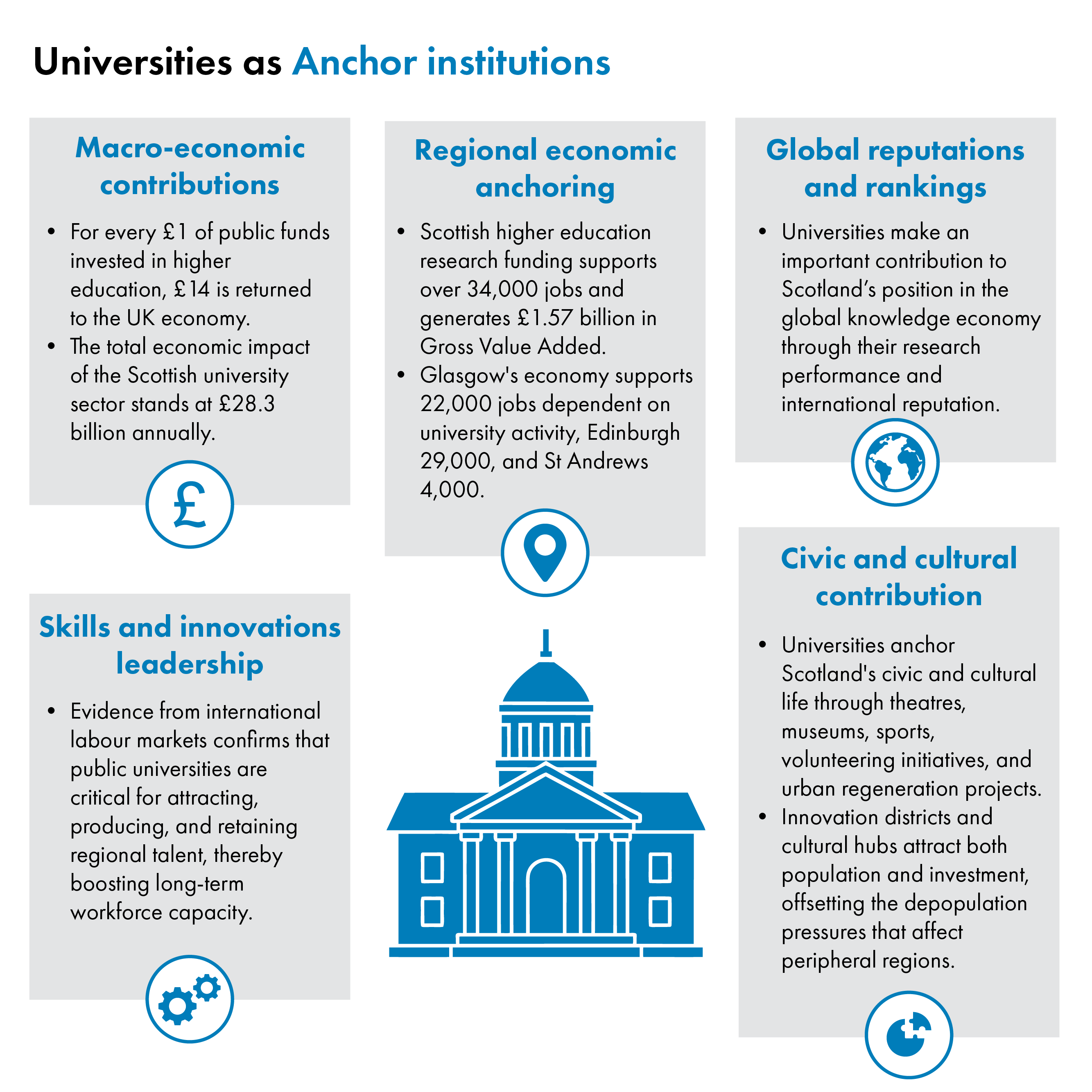
Universities arguably serve Scotland in capacities far beyond the immediate purpose of learning and teaching. They are, in the formal sense, regarded as 'anchor institutions' operating as “builders” of skills and entrepreneurship; “brokers” connecting industry, policy, and international partners; “beacons” projecting Scotland's reputation globally; and bases of long-term stability that drive regional regeneration, cultural vitality, and social cohesion12 . These roles are crucial considerations when higher education policies are debated and developed.
London Economics. (2024). The economic impact of higher education teaching, research, and innovation. Retrieved from https://www.universitiesuk.ac.uk/sites/default/files/field/ downloads/2024-09/LE-UUK-Impact-of-university-TL-and-RI-Final-Report.pdfUniversity and College Union. (2024). New study demonstrates huge local economic impact of universities. Retrieved from https://www.ucu.org.uk/article/10922/New-study-demonstrates-huge-local-economic-impact-of-universitiesFraser of Allander Institute. (2023). The economic impact of university research funding in Scotland. Retrieved from https://www.fraserofallander.org/wp-content/uploads/2023/11/2023-11-Report-Valuing-university-research-FINAL.pdf
Macro-economic contribution: It has been stressed that the return on public investment in higher education is exceptional. For example, a report for the Universities UK claims that for every £1 of public funds invested in higher education, £14 is returned to the UK economy6. The total economic impact of the Scottish university sector stands at £28.3 billion annually7. International students alone generated £37.4 billion in net economic benefit across the UK, with Scotland receiving a substantial contribution from this revenue stream, estimated to be equivalent to £750 per Scottish resident8 . These are not marginal returns; they arguably exceed the performance of most major infrastructure investments, which may justify the warrant to prioritise the HE sector viability.
Regional economic anchoring: The geographic concentration of university employment notably amplifies their significance for regional economies. As an example, Scottish higher education research funding supports over 34,000 jobs and generates £1.57 billion in Gross Value Added5 . While Edinburgh's university sector generates £7.52 billion in output and supports 32,760 jobs10 , Dundee's contribution of £975 million in Gross Value Added sustains 9,410 jobs, representing 1 in 12 jobs in the city11 . Moreover, Glasgow's economy supports 22,000 jobs dependent on university activity, Edinburgh 29,000, and St Andrews 4,0004 . The employment multiplier effect suggests that universities typically create one additional local job for every person directly employed, i.e. a 1:1 ratio that amplifies their economic footprint across suppliers, housing, and services sectors4. These figures elucidate why job losses in universities carry potentially significant consequences for regional labour markets. It can be argued that for peripheral and economically weaker regions, university presence is even more critical to economic resilience as there are fewer available options for the alternative employment.
Skills, innovation, and competitive positioning: Universities are recognised as one of Scotland's primary drivers of high-level skills and training pipelines. They supply the graduate and PhD workforce essential for technical sectors including the capabilities that Scotland may struggle to replace through alternative mechanisms. They feed Scotland's emerging tech ecosystem and provide the research infrastructure that is known to generate patents, spin-offs, and entrepreneurial ventures5. Evidence from international labour markets also endorses that public universities are critical for attracting, producing, and retaining regional talent, thereby boosting long-term workforce capacity15 .
Global reputation and competitive advantage: By and large, Scotland's position in the global knowledge economy depends directly on university research performance and institutional reputation. Arguably, Scottish universities anchor the nation's soft power, influence inward foreign direct investment, and enable competitiveness in high-value growth sectors including artificial intelligence, biotechnology, and green energy. This positioning frequently rests on world-class research output that consistently ranks highly in international assessments16. Notably, reputation, once tarnished and diminished, is likely to be difficult to restore, and the UK education sector is risking its reputation both locally and abroad due to its planned job cuts17.
Civic and cultural contribution: Universities also tend to anchor Scotland's civic and cultural life through involvement with theatres, museums, sports, volunteering initiatives, and urban regeneration projects119. Innovation districts and cultural hubs attract both population and investment, offsetting the depopulation pressures that may affect peripheral regions. For smaller cities, university-led cultural activity is deemed more essential to maintain population stability and/or prevent further demographic decline20.
Part II: The unfolding financial crisis and job cuts
Scale and immediacy of the crisis
Converging evidence points to how the financial position of UK universities has deteriorated dramatically. At the time of this report’s writing, 43% of UK universities are running operating deficits1. In Scotland, the Scottish Funding Council's own data reveals that underlying surpluses have reduced from £210 million in 2022/23 to just £17 million in 2023/24, with more than half of all institutions forecasting deficits by 2025-262. This is not viewed as a temporary disruption; it reflects and highlights structural imbalances in the funding model as presented in the next section.
Job cuts and their root causes
The consequence of financial crisis has been distinctively swift and severe. As a case in point, the University of Dundee announced redundancies likely to go beyond 300 positions1. Other institutions have launched voluntary redundancy schemes and major restructuring exercises. At the UK level, analysis from the University and College Union suggests that at least 60,000 university jobs could be at risk altogether2. These are not abstract figures; they represent academic researchers, teaching staff, and support professionals whose loss can likewise degrade the sector's capacity to deliver its strategic functions.
Some of the well documented and reported root causes are described below.
Macpherson, S. (2019). SPICe Spotlight: The price of free tuition in Scotland. Retrieved from https://spice-spotlight.scot/2019/12/18/the-price-of-free-tuition-in-scotland/Currie, L. (2024). SPICe Spotlight: Student support and fees in Scotland. Retrieved from https://spice-spotlight.scot/2024/02/23/student-support-and-fees-in-scotland/#UndergraduateOgden, K., & Thomas, M. (2024). Scottish budget: higher education spending. Retrieved from https://ifs.org.uk/publications/scottish-budget-higher-education-spendingGillies, P. (2025). Investigation into Financial Oversight and Decision Making at the University of Dundee. Retrieved from https://www.sfc.ac.uk/wp-content/uploads/2025/06/Gillies-Report.pdfScottish Funding Council. (2022). Financial Sustainability of Universities in Scotland 2022-23 to 2026-27. Retrieved from https://www.sfc.ac.uk/wp-content/uploads/2025/09/Download_Financial-Sustainability-of-Universities-in-Scotland-2022-23-to-2026-27.pdfOgden, K. (2024). A decline in foreign students and higher costs create perfect storm for Scottish universities. Retrieved from https://ifs.org.uk/articles/decline-foreign-students-and-higher-costs-create-perfect-storm-scottish-universities
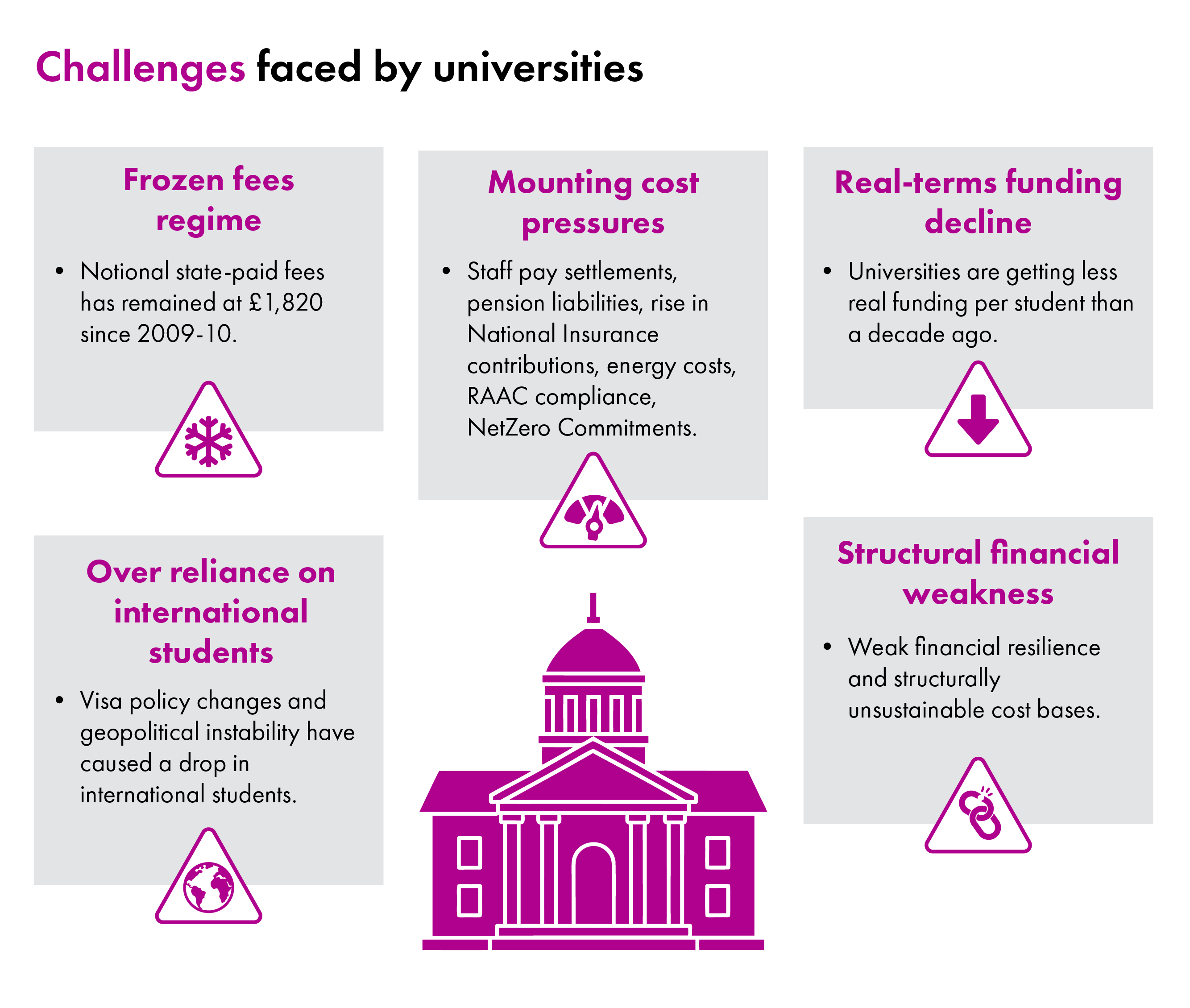
The frozen fees regime: The tuition fee has largely remained frozen for over a decade in the rest of the UK (rUK) which creates an escalating financial shortfall. In turn, Universities lose approximately £2,500 per UK student annually compared to indexation with inflation9. Over thirteen years, this compounds into tens of millions in cumulative losses per institution. In Scotland, while Scottish-domiciled students pay no tuition fees, the notional state-paid fee has remained at £1,820 since 2009-1034.
Real-terms funding decline: Declining public funding compounds the freeze. Funding per student per year of study has fallen by 19% in real terms since 2013–145, which seemingly contracted the resource base from which institutions can operate. It can be argued that the combination of frozen fees and retreating public funds has created a structural mismatch between university income and associated cost.
Mounting cost pressures: While income has stagnated, cost pressures have intensified. Staff pay settlements, pension liabilities, rise in National Insurance contributions, energy costs, building maintenance, and new compliance demands (Reinforced Autoclaved Aerated Concrete (RAAC) remediation, Net Zero commitments) have risen sharply and in many7 cases dramatically7. For universities already running thin surpluses, these combined pressures led to a reinforced impact.
Unsustainable reliance on international student income: To offset domestic funding shortfalls, a number of universities are reported to have become increasingly dependent on international student fee income5. This, however, inadvertently created increased vulnerability to factors that are external to the institutions and at times, external to the UK. Visa policy changes, geopolitical instability, and exchange rate movements are examples of such factors that are beyond institutional control. When international recruitment16 contracts, as analysis suggests it has in response to recent visa tightening, institutions face immediate and severe income loss8. The Scottish Funding Council has warned explicitly that falling international recruitment combined with rising costs could create a "perfect storm" for Scottish universities8.
Structural financial weakness: The Gillies report concludes that the financial collapse at the University of Dundee was primarily caused by governance failure and weak financial oversight6 . It must be said, though, that the Gillies report confirmed that Scottish Code for Good Higher Education Governance remains robust and fit for purpose and the governance failure at the University of Dundee is not representative of wider sector16.
Part III: Policy context and emerging reform framework
Parliamentary scrutiny and government acknowledgement
The Scottish Parliament has highlighted concerns about funding sustainability, risks to teaching and research quality, and potential loss of regional provision123. Moreover, Parliamentary committees have pointed out real-terms funding reductions and reliance on fragile income streams, and questioned whether reforms can succeed under current financial constraints. Notably, the Government's October 2024 response reaffirmed commitment to reform, free tuition, and diversified international recruitment whilst acknowledging that institutions must manage significant cost pressures4.
However, analysis by the Scottish Parliament's Information Centre (SPICe) has also highlighted concerns that Government responses to repeated parliamentary warnings lack sufficient detail and urgency, pointing to a gap between high-level commitments and practical delivery mechanisms56.
Emerging structural reform agenda
Scotland's financial crisis in higher education is unfolding alongside a broader restructuring of the post-school system. A 2021 strategic review warned that demographic change, rising costs, and fragmented provision could threaten long-term sustainability, particularly for smaller and financially weaker institutions1. In response, an independent review proposed a unified tertiary model linking colleges, universities, apprenticeships, and lifelong learning that is aligned to Scotland's economic transformation priorities in digital, green, and life sciences sectors2. In this proposal, it was recognised that meeting future skills needs requires integration between institutions and flexible provision pathways.
The Scottish Government formalised this direction through its Purpose and Principles for Post-School Education strategy, emphasising equality, widening access, global research standing, innovation, lifelong learning, and alignment with labour market skills needs3. These principles sit within the National Strategy for Economic Transformation, which positions skills and tertiary education as central to Scotland's productivity and sustainable growth ambitions4 .
Legislative progress: In February 2025, the Scottish Parliament introduced the Tertiary Education and Training (Funding and Governance) Bill, creating a statutory unified tertiary system and expanding the powers of the Scottish Funding Council (SFC) to oversee all post-school learning5. The Bill gives Scottish Ministers and the SFC additional powers to monitor the financial sustainability of colleges and universities6.
As the Bill progressed to Stage 3, stakeholders welcomed simplification of funding but raised concerns about the balance between stronger Scottish Funding Council powers and institutional autonomy, as well as protections for students78 .
Framework for the Sustainability and Success of Scotland’s Universities: In December 2025, the Scottish Government and Universities Scotland jointly announced a Framework for the Sustainability and Success of Scotland’s Universities, establishing a collaborative partnership extending to 20459. This Framework may represent a significant commitment to long-term, evidence-based planning, as it brings together government, all 19 universities, and key stakeholders in a formal co-design process to address collectively systemic sustainability challenges. Such an initiative signals the view that university viability is extensively valued due to its perceived link to Scotland’s economic competitiveness, regional development, and demographic resilience.
Part IV: The consequences of unmitigated job cuts
The presented evidence on consequences of mass job losses is directly relevant to Parliament's deliberation. Large-scale job losses tend to produce long-term negative effects that are rarely reversed through natural labour market adjustment. Local economies often do not quickly bounce back; instead, lasting scars may continue to appear in wages, employment rates, and skill levels.
In this connection, some relevant cases are highlighted below. While these cases are not directly related to the education sector, they provide clear evidence about how mass job cuts can cause long term challenges for the respective sectors and local economies.
In an article that investigated the long-term reaction of local labour market (LLM) to a mass layoff in a manufacturing plant, it was found that, on average, mass layoffs in a manufacturing plant abruptly decrease industry employment by 22% and this decline is persistent even nine years later1 . The article bases its main analysis on data from 25 LLMs that experienced a mass layoff between 2008 and 2011 in Italy. What occurred has negative and statistically significant effects only on the same industry of the affected LLM. The findings of this work may provide lessons for the education sector.
In another study based on German administrative data (2006-2012) on German establishments to investigate how mass layoffs affect overall and local employment, it was found that the municipal employment contracted 10-12% following major redundancies and this contraction remained statistically significant five years later2 . Crucially, only one-quarter of displaced workers were reabsorbed into local employment, and this reabsorption was strictly limited to a 1-kilometre radius around the original firm. Beyond that distance, labour market recovery was negligible implying that the broader regional skills ecosystem did not absorb the full loss2.
If these findings are transferable to the university sector, then we can envisage some university staff might be re-employed locally within Scotland (e.g. local spinouts, research-intensive businesses), but broader regional skills ecosystems would not fully absorb the loss, meaning that a lot of specialist academic expertise would be gone.
Finally, a study on how the deindustrialisation affected the living standards in the UK has found that the deindustrialisation has had lasting effects on people’s wellbeing with increased long-term sickness, declining life expectancy and surges in regional economic inactivity4. The article argues that these effects have been felt not only by those who lost their jobs but also by their children and even grandchildren.
It is argued that the universities are anchor institutes, economically as well as socially. The universities not only shape education and research but also urban economies, communities, and social development. Based on this, the impact of job cuts in the universities have wide-ranging consequences as discussed below.
Sectoral consequences: The risks to innovation and skills
Research productivity and competitive advantage
Evidence across multiple studies shows that funding cuts to research may also lead to significant reductions in patenting, publications, quality of research output, and entrepreneurship1234. This evidence stresses how funding cuts do not merely bring forth incidental consequences. More importantly, it can directly threaten Scotland's internationally competitive research position which has been cited as having “exceptional” international impact5. Scottish research is cited 76% more frequently than the global average, implying the global research leadership of Scottish universities.
Funding cuts can impact the broader research environment in ways that may further suppress productivity such as patent applications6. When research capacity is cut, it is likely for the impact to continue to cascade, e.g. fewer supervisors may mean fewer PhD students, fewer PhDs may means reduced capacity for STEM breakthroughs. Subsequently, this may slow down the technology ecosystem that Scotland's future economic strategy depends upon.
Furthermore, cuts risk frequently shifting reliance towards private-sector research, which carries its own risks. Private funding tends to prioritise commercial research over foundational science, the latter of which generates the fundamental breakthroughs on which future industries ultimately depend2.
Workforce development and access
A recent case study from Hungary demonstrates the cascading effects from cuts to doctoral funding. Scholarship reductions cut PhD student productivity by 45%, a substantial loss of research capacity1. Critically, these cuts also often reduce diversity, with measurable declines particularly in female and first-generation student participation1. Job cuts in universities are likely to have similar effects, i.e. fewer academic positions mean fewer supervisors, which can in turn, depress doctoral training and inadvertently reduce Scotland's capacity to develop its own advanced workforce in the technical sectors.
The broader picture is equally concerning. Funding cuts have already shown reduction in lifelong and adult learning pathways, with seven million fewer qualifications delivered in England since 20103. Additionally, the skills pipeline through Early Career Researchers (ECRs) that Scotland needs for its future HE institutions as well as for economic transformation is gradually and continuously narrowed.
Programme closures and loss of academic breadth
There is evidence to show that Universities have already begun rationalising their academic portfolios. For example, 49% of universities have cut courses1, and recent reporting indicates that 4,000 courses have disappeared from higher education offerings within the UK2. What this suggests, however, is that shrinking of academic choice can significantly reduce institutional attractiveness to both domestic and international students, and in turn, compound further revenue pressures.
Even without complete programme closure, the shift from permanent to contingent staffing tends to have measurable negative consequences. A case in point is supported by research on US universities, which suggest that replacing permanent academics with contingent staff lowered student retention and learning outcomes3. What is strongly conveyed by this particular study is that programme cuts and staffing uncertainties may degrade educational quality in ways that often carry long-term reputational costs.
Economic consequences: Regional impact and GDP loss
Direct economic impact on regional economies
The economic consequences of university job losses typically extend far beyond the immediate redundancies. It is acknowledged that universities bring substantial economic benefit; evidence indicates that £1 invested in Scottish higher education research returns £2 to the economy1. Specifically, international student fees generate enormous gains (£37.4 billion net to the UK economy in 2021/22, with Scotland receiving substantial benefit2). The University of Dundee alone supports over £500 million GVA and more than 7,000 jobs in the Tay Cities Region through its own employment, supply chain, and staff and student spending3. Further, it is warned that £2.5 billion loss in income for universities from a drop in student numbers might result in a £6 billion hit for the UK economy stressing upon the wider economic consequences4. The figures show how universities are often among the single largest contributors to the local economy4. Consequently, any significant loss of university capacity could remove hundreds of millions of pounds from the regional economy, with knock-on effects for local suppliers, housing demand and the service sectors that depend on university staff and students.
Macroeconomic impact analysis
US analysis provides models of the aggregate economic consequence. A 25% cut to non-defence related public Research & Development spending could be expected to reduce US GDP by 3.8% in the long run, an economic contraction comparable to the Great Recession1. A 50% reduction could cut GDP by 7.6%. For context, this is equivalent to making the average American $10,000 per year poorer (in today’s prices) compared to a scenario where US GDP per capita continues to grow in line with its post-1947 average1.
While Scotland's circumstances differ from the United States, anticipated/perceived elasticity stresses the idea that severe university cuts could inflict macroeconomic damage that might dwarf any savings achieved through redundancies.
Funding cuts in the United States were forecast to lead to multi-billion-dollar losses in local economies3. What has been evidenced in such studies is that university closure is likely to produce growing economic threat to local communities4. These effects are likely to be long-lasting and are comparable to the economic scarring produced by industrial closure56.
Differential regional impact
The evidence from the literature also suggests that the burden of these losses falls disproportionately on regions with fewer alternative employment anchors. For example, Dundee, without diverse employers, has limited capacity to absorb displaced university workers into alternative employment and therefore the job cuts may be catastrophic for the city of Dundee and surrounding area1. This is worthy of attention since there is a risk that these regions may not recover fully from large-scale university job losses. The pattern is exemplified by UK industrial history and other cases of university job cuts, which is seemingly being replicated in Scotland's cities.
Reputational and quality consequences
Research output and global competitiveness
There is a prevailing view from the literature that we examined that job cuts and associated reduction in research staff can directly threaten Scotland's research competitiveness. Research productivity is considered the foundation of university reputation and the mechanism through which universities attract leading academics and overseas students. Cuts that depress research output may then erode the very assets that sustain institutional standing.
Such risks tend to be amplified by the current competitive environment. To illustrate, nearly one in four leading UK universities are cutting down staff numbers, with warnings being raised that these risks are damaging the UK's global standing1. If Scottish universities face cuts while international competitors maintain, even increase their investment, it might lead Scotland's competitive position to deteriorate. This may then generate a vicious cycle, i.e. reduced reputation attracts fewer students, producing further revenue loss, necessitating further cuts.
Talent retention and brain drain
Evidence shows that reputation and research outputs drive institutional standing and research outputs are at risk from budget cuts1. Other implications can also be observed. Programme cuts demonstrably reduce institutional attractiveness as many universities start to rationalise course offerings2. This is against the backdrop of international recruitment under pressure3. Taken together, these factors create conditions for significant brain drain or loss of leading researchers and students to better-funded institutions either in the UK or internationally.
Access and equity consequences
Over-reliance on international students to overcome the decline in state funding has been found to reduce access for domestic students in certain disciplines1 . Universities facing financial pressure tend to shift recruitment towards fee-paying international students and away from widening participation for students who may require additional support. This is worth noting as it could undermine Scotland's policy commitment to equality and access by instead concentrating on opportunities potentially available only to more affluent cohorts.
Irreversibility of reputational damage
A final critical point: once university reputation and global standing erode, it was stressed that they are extraordinarily difficult to restore. Given that the higher education sector is more exposed to reputational crisis than the business sector, the reputational protection becomes extremely important1. Like the labour market effects of mass layoffs, reputational effects tend to persist, and consequently, full recovery may not be possible. Scotland's universities have taken decades, and in some cases centuries, to build their current global standing. In this connection, damage to that position through structural underfunding may represent a strategic loss from which the nation might not fully recover.
Part V: Literature-based policy considerations
The evidence presented through literature emphasises that universities serve a distinct role as regional anchors. Supporting their viability can help safeguard jobs, sustain innovation capacity, and preserve population stability across Scotland's regions. By contrast, allowing them to contract through unmitigated job cuts may risk long-term economic and demographic decline that could dwarf any short-term savings.
It is crucial that cost-saving measures do not lead to hollowing out the core functions that universities perform. Financial adjustment, considerations to preserve teaching quality, maintain access and diversity, and protect the innovation capacity on which regional economies depend are vital. The following literature-based recommendations offer a framework for achieving financial sustainability while avoiding destructive cuts.
Enhance financial management and efficiency
Improve data on costing and decision making: Better use of university costing and financial management data such as Teaching and Research Allocation of Costs could improve operational efficiency and decision-making, potentially reducing the need for job cuts1. The Scottish Government may wish to consider requiring the Scottish Funding Council to mandate transparent, standardised costing practices across all institutions and to provide evidence-based analysis of cost efficiency to support strategic institutional decisions.
Reduce duplication through collaboration: Universities can explore partnerships, academic collaboration, and sharing curricula and services that currently duplicate teaching effort2. The forthcoming tertiary education integration agenda is timely in facilitating institutional collaboration while maintaining and preserving differentiation and specialisation.
Leverage online and global teaching capacity: The potential of global classrooms, online teaching expansion, and partnerships with universities in the Global South can be explored3 , with the proviso that teaching quality is maintained and that such partnership does not become a substitute for investment in core teaching and research functions.
Consider institutional consolidation: While mergers present upfront costs along with governance and cultural challenges, merger proposals can be evaluated objectively4. Evaluation will focus on the merits of these mergers and with particular attention to protecting institutional autonomy as well as preventing the consolidation from further reducing regional provision.
Restructure the funding model and streams
Arguably, the fundamental problem is structural, i.e. income is insufficient relative to sustainable cost bases. This implies that efficiency improvements alone may be insufficient to bridge this gap. In this respect, questions could be raised with the Scottish Government concerning a reform of the funding model across four axes:
Adjust tuition fees support: Scottish students do not pay any tuition fees. The tuition fee is paid through Student Awards Agency Scotland (SAAS) and has remained fixed since 2009-10. The current tuition fee for a degree programme is £1,820 per academic year for each eligible funded student. Government support through SAAS payments could be indexed to inflation or adjusted upward to reflect the true cost of quality higher education. The additional support might need to be funded from the Scottish Government’s resource budget either through raising taxes or reducing spending elsewhere. This should be done carefully, with simultaneous strengthening of student support to maintain access for disadvantaged students, but the frozen-fee model is no longer sustainable1.
Increase public funding: Public investment in higher education necessitates increase in real terms, reflecting not only the high return on investment (£14 returned for every £1 invested), but also the strategic importance of universities to Scotland's economy, research, and regional development23. It can be argued that an increase in funding is not treated as an expenditure, but as an investment.
Diversify funding streams: The graduate contribution models should be explored for their full potential and other innovative financing mechanisms, with a view to diversifying funding sources and reducing dependence on fragile international student fee income4.
Balance international recruitment with domestic provision: Universities may wish to take into account protecting and expanding international recruitment since the fees from overseas students remain essential given current domestic funding constraints5. It is worth bearing in mind, however, that international recruitment is not a substitute for adequate domestic funding. It remains crucial for universities to maintain robust admission of domestic students with consideration for meeting local industrial need or widening participation students’ needs, while sustaining international enrolment. Altogether, this will necessitate parallel investment in domestic funding to prevent a de facto shift away from domestic students.
Considerations for Framework for the Sustainability and Success of Scotland's Universities
The announcement of Framework for the Sustainability and Success of Scotland’s Universities is a welcome sign for addressing the HE sector’s current financial predicament. Yet critical analysis also raises concerns about the Framework’s scope and political timing. Academics Huw Morris (former Director of Skills, Higher Education and Lifelong Learning in Welsh Government) and Des McNulty (former Scottish Government minister) argue in a January 2026 Enlighten report that the review’s narrow focus on universities alone “does not provide a forum for the necessary broader public debate about the future of post-school education.”
With 92% of Scotland’s colleges forecast to run deficits in 2025–26, they contend that comprehensive tertiary education reform examining colleges, four-year degree structures, international student levies, and graduate contributions must accompany university funding decisions. In addition, the review’s timeline (reporting autumn 2026) coincides with the Scottish Parliament election in May 2026, raising concerns that this risks the issue being blindsided and eventually overlooked rather than being given the attention that it deserves to enable urgent resolution of structural problems affecting the HE sector1.
Part VI: Insights and policy considerations from the interviews
We are colleagues … everybody that works in higher education. We all talk about these things all the time. It's the main topic of conversation. …we all care and we're all very, very aware of it….
Senior academic, ancient university
Methodology
The overarching aim of this research project is to investigate the broader implications of the widespread job cuts in Scotland’s Higher Education (HE) institutions, with specific research objectives as set out below.
Objective 1: To understand the impact of HE job cuts on Scotland's technical and skills sector and their effects on HE’s ability to contribute to technological advancements.
Objective 2: To explore the impact of job cuts on the economic contribution of universities and to Scotland's overall economy.
Objective 3: To investigate the influences of HE job cuts on the quality of education, international reputation, and talent retention in Scotland.
The aim and objectives have informed our overall approach to our research project – from reviewing the literature, conducting the interviews and synthesising the findings from both desk and empirical research.
This section of the briefing is informed by in-depth individual interviews with twelve individuals representing a spectrum of stakeholders from six Scottish Universities and from two organisations supporting the HE sector. Interviewees were primarily those in senior or executive management roles. They comprised Executive members from different Scottish institutions, including Vice-Chancellor, Director of Finance, Head of Professional Services, Director of Learning and Teaching, Programme Director, PhD supervisor, Director of organisations, a student representative, an international doctoral student, and a senior academic who was made redundant. Many of these individuals play multiple, complementary roles and are well-positioned in offering a meaningful perspective on the impact of the job cuts phenomenon on the quality of education, institutional reputation and talent retention in Scotland’s universities.
While we endeavoured to include the Scottish Government and Scottish Funding Council, they politely declined to take part in this study. We also contacted several universities, some of whom declined to participate as well. Table 1 and Table 2 give a breakdown of the affiliations of interviewees who kindly participated in the study.
| Participant profile | Number of participants |
|---|---|
| University affiliation | 10 |
| Non-university affiliation | 2 |
| Of these: | |
| Senior Executive/Management | 6 |
| Faculty | 4 |
| Postgraduate Students | 2 |
| Category of institution | Number of participants |
|---|---|
| Ancient Universities | 7 |
| Chartered Universities | 2 |
| Modern Universities | 1 |
| Small Specialist Institutions (SSI) | 0 |
Note: Ancient Universities include University of St Andrews, University of Glasgow, University of Aberdeen and University of Edinburgh. The Chartered Universities include University of Dundee, University of Strathclyde, Heriot-Watt University, and University of Stirling. Modern Universities are Abertay University, Glasgow Caledonian University, Edinburgh-Napier University, Queen Margaret University, Robert Gordon University, University of Highlands & Islands, and University of West of Scotland. SSI are Glasgow School of Art, Royal Conservatoire of Scotland, Scotland's Rural College and the Open University in Scotland.
While we had a list of semi-structured interview questions (see Annexe), during the interviews our participants’ expertise, what mattered to them and their first-hand experience were our primary considerations. After giving a brief overview of the overarching aim of our research project, the ensuing discussions were guided by what participants considered vital not only in understanding this complex issue, but also in stressing points worthy of consideration from their perspective. This is crucial in ensuring flexibility and that the views of a senior executive management member as well as an international doctoral student were given equal importance. Therefore not all topic areas were covered in every interview.
Key Interview Insights
Key insights from interviews are explored in the sections that follow.
Universities as anchor institutions
Education is hugely important and is part of Scotland’s national identity. Educational institutions – from school to postgraduate level anchored within a particular region attracts not only people, but investment. They offer a range of learning provision, but also job opportunities via teaching, research and student support. As “anchor institutions”, they “bring much more than just the sum total of their output" to create synergy (Senior executive management, non-university affiliation). Universities are widely recognised as key in regional economies due to their significant partnerships with many other economic actors (e.g. small and medium-sized enterprise, large industries). Notably, universities are not only major contributors to productivity and economic growth, they contribute to every aspect of public life. For example, a rise in the student population entails demand for more accommodation, a boost in commercial activities and the local economy, which is supported by research in population and migration, as exemplified below:
If you’re thinking about how to stimulate population growth, one of the single biggest things you can do is have a Higher Education Institution, because it signals to people opportunity…. It acts as a magnet for all sorts of other things that mean that as an area that you will see populations growing around and actually, the absence of one has the converse effect … people have to leave the area to learn and then leave.
Senior executive management, non-university affiliation
Such findings are particularly relevant to Scottish rural areas where the populations are declining and are ageing quite significantly. They highlight why the success or failure of a university can have a substantial associated impact on the economic and societal domains where the university is situated.
While universities continue to generate impressive outputs via high quality teaching and research, innovative spin-offs, sponsorship with industries, the underlying business model may not necessarily be strong. If this happens, it becomes a fundamental issue requiring an urgent and careful institutional response to enable them to maintain their core mission, preserve their core business, overcome the crisis and consequently, restore financial sustainability.
A ‘perfect storm’ for the HE sector
All senior academics and management teams from ancient, chartered and modern universities indicated that a wide range of issues were responsible for several Scottish universities’ underperformance and financial predicament – leading to major financial strain, and at times, drastic measures – many of which were “highly foreseeable” according to a senior academic from an ancient university.
Such issues included a declining level of public investment across research and teaching, hence “true costs” are not met (e.g. Senior academic, modern university); a very inflexible, “chronically underfunded" capped model of domestic undergraduate income/teaching distribution creating the funding gap that universities are expected to bridge (e.g. Senior executive management, ancient university); depleting income from the international student cohort possibly influenced by changes in immigration policy in the host country impacting recruitment (e.g. Senior management, ancient university); internal pressure to expand universities; substantial financial decisions based on the assumption that universities will continue to grow (e.g. Senior management, ancient university); sending countries’ slowdown due to economic growth and geopolitical situations affecting students choosing Scotland/UK as a study destination (e.g. Senior financial management, ancient university); insufficient profit via commercialisation of research (e.g. Senior executive management, modern university); the demands from universities are not commensurate with the funding model (e.g. Senior executive management, non-university affiliation); a lot of money spent on new attendance-tracking and university admissions software (International doctoral student, chartered university) and inflationary environment in which costs increase while income goes down (e.g. Senior academic, ancient university).
A senior academic from an ancient university expressed the view that the lack of good governance, strategic thinking and strategic financial management by “people in those positions who are incapable of coming to the right decisions [and] able to get away with it because they don’t get challenged” is deemed “very dangerous”. The importance of good leadership and governance was mentioned by more than half of the participants. For example, while the Gillies report1 is focused on one specific Scottish university, the importance of good governance is further stressed by a senior executive member with a non-university affiliation –
... the [HE] sector's approach to governance over a number of years has been very much about enhancement. ... Prof Gillies said that [the Scottish Code of Good Higher Education Governance (‘Scottish Code’)] was fit for purpose ... albeit it wasn’t the Titan in the instance of Dundee ... and so we’re not closed off to the idea that there could be further improvements. ... The operating environment has become [more risky and challenging] in recent years, so effective leadership and effective governance [is crucial] When times are stable, it is one thing, but when you’re responding to a declining environment, in which we are seeing financially across the sector, it doesn’t take much for the consequences of poor leadership or poor governance to have quite a significant impact.
Senior executive member, non-university affiliation
What this suggests is that there is a multiplicity of reasons for the decline in university finances. In addition, this has been building up in the HE sector for several years – as a senior executive management member from a modern university stressed:
... it's a shock to the system and now we need to react … to a very sudden situation [but] it's not a sudden situation … it's been … coming for a number of years, but also politically. You always have to be prepared … for every time.
Senior executive management member, modern university
This has led to a situation wherein the HE sector as a whole faces financial difficulty, and reinforces the idea that the higher education model in Scotland is not currently financially sustainable.
An executive management member from an ancient university highlighted the example of New Zealand:
… New Zealand went through four major crises in higher education before the government really did anything. I mean, what governments tend to do is just enough to keep it going. It goes on for a few more years, and it's another crisis they do just enough to keep it going. It goes on a bit and but the problem is that really the trajectory is downwards. … If you look at countries that have invested heavily in higher education, their universities have moved up world rankings. Countries that are disinvesting in higher education are not supporting higher education in the relationship are gradually slipping down their rankings, and that that is a real risk for Scottish universities.
Executive management member, ancient university
Groups affected by job cuts
Two interviewees explained that during job cuts, staff who are primarily on teaching and learning contracts are less affected. It is those who are research-focused – perceived to be “not bringing in enough money” – who tend to be “targeted” during job cuts (Senior academic, ancient university). A senior executive management member from a modern university specifically highlighted the often-overlooked impact of job cuts on two specific groups of staff members: a) the very experienced staff; and b) Early or Mid-Career staff.
… the ones that are really very experienced [typically] acting as mentors … may think… ‘okay, I can afford retirement now. In the past they would be happy to stay … for many years. But now they start to think, okay, if my job is not exactly safe and I can afford retirement, why can I not just [do it]?
Senior executive management, modern university
[With] ‘two years or three years … professional kind of experience … I’m able to go to industry that would pay … better…. They could have a job that is 9 till 5, not 9 till midnight or … beyond that [while thinking] if people are leaving around me, am I [going to] get more work? [And] they’re the ones that bring a lot of energy in the classrooms….
Senior executive management, modern university
In addition to this, an international doctoral student from an ancient university highlighted the much-reduced teaching opportunities – previously available to doctoral students in general.
The evidence gathered in our interviews highlights that job losses may drive away these specific groups of staff who have distinct and vital roles to play in the university ecosystem. Likewise, Early and/or Mid-Career academics and researchers – the main recipients of such expertise – are directly and indirectly affected. Apart from reduced mentorship experience, appealing offers of better compensation outside academia and possibly less work, nothing keeps these ‘pipelines’ of talent from staying in academia. Arguably, this double impact poses a serious challenge for the future of academia, in general.
In the midst of the discourse on job cuts, another group arguably requiring thoughtful attention are the international students in Scotland. Their decision to choose Scotland as their learning destination is at the crux of the issue due to their recognised multiple and varied contributions, particularly to the HE sector’s financial revenue.
Both passages below representing an international student and professional service perspectives stress observed inattentiveness to the plight and circumstances surrounding the international student group.
… there’s a general fear that … certain parts of the university will … turn into … pure teaching with no space for research … education in the UK universities still have a relatively good reputation but then the more they try to squeeze things out [makes me think] if I hadn’t had … funding for my Masters and my PhD, would I have made the choice to come here and study … at a university that is going bankrupt? ‘No!’ But also, would I recommend to anyone in [geographical region] consider [coming to study in Scotland]?
International doctoral student, chartered university
… international students not only add … value to our universities, they add value … to the rest of the society and what they bring over, but if the political side is not supporting … then that … will impact their [views when] they go around the world … still our education is really, really valued … in the UK. But … if they're not welcomed … or they're feeling [unwelcome], then they will … go somewhere else. And that means we're putting obstacles in. In a sense, impacting … universities’ very excellent income … from tuition fees and so on that comes from international students.
Senior management, ancient university
A senior academic from a modern university added that “UK [as a study destination] is not as attractive as it has been five, seven years ago”, particularly when visa fees or access to NHS are considered. The concerns raised in relation to international students’ insubstantial contribution is worth heeding as they are likely to have a cascading impact on the future student composition in Scottish universities. Arguably, it may even affect these institutions’ existence.
Intertwined impact of job cuts
Job losses have an intertwined impact on various components within and outwith academia. When layoffs of researchers happen, its effects are not solely limited to the breadth, richness and quality of research, this equally has a cascaded impact on teaching since “research-led teaching is bound to decrease” and specifically since the environment no longer supports research-led teaching (Senior academic, ancient university).
… if job losses are happening … there will be less expenditure on research facilities, so facilities will fall behind competitors. There will be less expenditure on postgraduate students [since] many postgraduate students have been part-funded by universities. The whole research ecosystem in a university will suffer … and that ultimately will hit global rankings.
Senior executive management, ancient university
…if [staff] go, then the quality of … your research-led teaching is bound to decrease … that richness and that high quality of research, and therefore, that’s bound to affect research-led teaching.
Senior academic, ancient university
Whereas job cuts directly affect those whose income has ceased, it is also worth recognising the impact on staff that remain within the institution. Staff reduction causes reduced activity but also higher workload and consequently, increasing strain among fewer people delivering the programme activities, as raised by two senior academics from ancient and modern universities.
On another level, it leads to feelings of uncertainty and negativity among its workforce as well as students.
... maybe it's me next … I've had almost had a career out of it, but it has … for 40 years been precarious. I have gone through several cycles of … redundancies.… [University of X] always had budgetary problems because of where it sits geographically, because of its size, it's just not quite big enough to sustain vibrant research, but just big enough to keep it going. And so … it's always going to be up-and-down … university governance … is a disaster area. It still is.
Senior academic, ancient university
[as a student], you feel [that] you don’t have the freedom to do a lot of interesting and exciting things any more here. And it doesn’t seem like it’s a particularly stable place to be, particularly for young academics. So, they just move on and work somewhere else … there’s a general fear that … certain parts of the university will … turn into … pure teaching with no space for research.
International doctoral student, chartered university
A senior academic from a modern university added that being at the receiving end of job cuts is demoralising, but the process was not clearly conveyed to staff and students and the extent of the problem caused considerable frustration.
These passages suggest that the initial impact of job cuts may lie within the research ecosystem, but it can greatly affect the entire ecosystem. As described by three participants in different roles, this includes impact on employees’ wellbeing, e.g. feelings of fear, job insecurity and uncertainty, precarity or even worse, decreased morale that at times lead to lower productivity, disengagement and poor work quality. They emphasised that when staff no longer feel comfortable or safe, they may start looking elsewhere, which may be outside the UK. This could then be a potentially huge loss for the UK.
It is worth noting that in the midst of this negativity, an international doctoral student from a chartered university observed that although they have been made aware of the severity of the financial situation in their institution – manifesting itself via programmes, courses, departments, extra language classes and various opportunities being reduced or discontinued – they also observed ongoing dedication of staff members:
The existing staff members do their very best to make sure that it doesn’t affect students … as a student, you don’t often feel the impact directly because [staff] make so many great sacrifices.
International doctoral student, chartered university
A possible strategic response
It is also worth stressing that job losses are not always perceived to be negative. It might also be viewed as an indicator of HE institutions responding effectively/strategically to changes in its environment. It is regarded as “the direction of travel, it’s not the end point” (Senior executive management, non-university affiliation). It is deemed part of the process, rather than an outcome of such changes. For a number of universities, job cuts serve a strategic response when universities are under intense pressure to manage their resources and income “to rebalance the books” – achieving efficiency and effectiveness (Senior academic, ancient university). Shedding jobs then helps restore financial stability for the longer term. Capacity to respond to a deficit position often incurs a sense of agency.
A senior executive management member from an ancient university also stated that “the longer it takes you to take cost out, the bigger your deficit position becomes, so you need to act quite quickly”. Nevertheless, it was further stressed that job cuts need to be structured and carefully planned; an unstructured reactive approach to funding challenges within the HE sector poses “a risk to the quality of education” and misgivings among the workforce, particularly when there is a lack of transparency and ineffective communication.
Institutional strategic response is strongly linked to having a financially rigorous framework guiding the major decisions of a senior executive management member from an ancient university.
… getting your planning right is really important and being careful and realistic in that planning, so don’t assume that you will have income that you just won’t have. ... It’s not always possible to ensure that [their jobs are secure], but you must try to … get your financial position as strong as it can be. And I don’t mean making lots of surplus [but] a sound financial position that is sustainable in the longer term. And sometimes, that might mean, if your income is dropping, that may well mean restructuring the university, but doing it in a planned way, not in a reactive way.
Senior executive management, ancient university
Equally, a framework to guide university finances is not only a means to maintain a sound and sustainable financial position, which is a strategic attempt to maintain a realistic perspective on university expenditures – what they can and cannot afford – on an ongoing basis for a long period of time. In this regard, the passage below offers a metaphor for effective financial management, which is at the core of strategic and good university governance.
… it's like you would do with your own your own home. …you got your bank … you get your salary coming in. … you get everything that you pay out in an ongoing basis. …that bit that you've got at the end of the month. You might put into savings ... or you might hold in your bank account because you want to build up … to buy a car or you need to fix the roof in your house or you want to buy a new house…. Operating cash is what's left at the end. …we're going to have a minimum amount that we're [going to] hold in our bank account because we know that the house, the roof my roof might have a leak one day, and we need to fix it. Yeah. And we don't want to take out a bank loan because we've already got quite a big bank loan. And … that's the fundamentals.
Senior financial management, ancient university
Finally, a senior management member from another ancient university offered a related perspective on how the university financial situation may present an opportunity for a more strategic response to improving infrastructure, university processes or improving the ‘symbiotic’ coordination among different schools, colleges, centres, etc. to achieve the best configuration, with a view to meeting university’s strategic priorities.
… our disability learning sports services and our counselling service used … [are] not integrated with the mainstream record… Everyone's working really hard and that's in spite of our systems and our processes. … part of this is exacerbated by the significant growth in our student population … there is a great opportunity here to … review and reconsider and redesign our approach to professional services [to] deliver as one university … we need to look at this holistically and we consider how we organise ourselves because … everything's been done in in silos. … the cuts are necessary to make sure that we can maintain our fiscal responsibility but also continue to thrive and survive as a university. … was [the university] providing the right service? Were the resources targeted and distributed in the appropriate way to meet the strategic priorities … especially with the REF around the corner? … It would be more appropriate to deliver on some of our institutional obligations with regard to student voice, study skills development, curriculum development. Training of our academic professionals so a restructure would have come regardless….
Senior management member, ancient university
In this connection, a cost-cutting exercise whether or not it coincides with job cuts may need to be undertaken not as an urgent, short-term solution but as a strategic re-building plan with a long-term vision. This necessitates striking a balance by maintaining “a critical mass of people” to avoid scenarios where institutions face constraints against the whole operating model, resulting in sub-optimal performance (Senior executive management, chartered university).
Job cuts as catalyst for a vicious cycle
Job cuts are likely to have continuing long-term impact initially on research, quality of teaching and institutional reputation. Given that universities’ status as anchor institutions are widely recognised, the expected impact is extended to the non-academic components.
… if a university downsizes substantially and talent leaves, the impact of that on the economy may not be felt for some time. There may be a delay because the developments were happening in the university are then not flowing into society [characterising] a delayed effect.
Senior executive management, ancient university
The potential impact, however, is much more subtle on both the local economy and society. This varies from university staff spending money in local shops to participation in the housing market. In the long term, it may also negatively affect the institution’s reputation, i.e. as institutions in question become less attractive to staff and students – diminishing their capacity to attract global talent. As institutions are losing those people who are key, e.g. to industry, this may also mean obstruction of academic-led industrial advances. While such non-instantaneous impacts and developments may come from outwith academia, they nevertheless affect Higher Education Institutions’ research competitiveness, and consequently, their global ranking.
… if you are an institution that is making people redundant … and that is known more widely, your ability to attract talent into the university diminishes dramatically and actually, that lasts for a long time, so it becomes very difficult to effectively get out of this position where your whole reputation is dropping.
Senior executive management, ancient university
These passages exemplify how the research environment by and large depends on the people recruited or the talent that institutions have grown, the laboratories that you have, the facilities generally and so on. The issue of talent depletion in any university, especially if widely known, can severely impact overall institutional reputation, student and partners’ trust and propensity to study, work or seek partnership with these universities.
Such concerns are strongly linked to the earlier discussion concerning international students. While an international doctoral student from an ancient university will make a decision primarily based on selected institution’s academic reputation, an international doctoral student from a chartered university stressed that their trust in the institution’s capacity to offer them high-quality learning experience and other relevant opportunities will inform their decision to consider Scotland as a study destination (if they were to start again). The same criterion will be applied if they were to recommend others to choose Scotland. Our interview evidence from current international students about their perspectives on their educational experience suggests that it may have an extended impact on future international students’ decisions to consider studying at Scottish universities.
Inevitable changes in addressing an unsustainable funding model
While ‘the world has changed a lot’, that was not the case for the higher education sector in Scotland since 1992, which has remained broadly the same. The only exception was the formation of the University of the Highlands and Islands in 2011. Specifically, three crucial factors were argued to have led to the unsustainable funding model for the HE sector – prompting an inevitable and urgent response:
First and foremost, the funding needs to be sorted out. It is unsustainable. And … it's affecting everything, retention, new staff, attracting new staff, attracting students…. I [also] think we need to look very carefully at … what we fund and … where the funding goes…. We need to start to think about what certain institutions are able to do and deliver and look at the structure of those institutions. And try to give them more of a purpose rather than a one size fits all. … But again, it's people's jobs.
[Second, in] the Modern Languages at [University X], there was almost no students, still there was double the number of staff compared to the number of students. …ultimately, …it was ending in a road that people would be losing jobs etcetera, but if there are no students want to go to [University X], it's not like you couldn't [study] anywhere in Scotland … everybody can't do everything, but look carefully, preserving the excellence of what we have.
Third, … to make institutions work much more closely together to make sure that they represent that to the national advantage…. Because certainly combined, there is a synergistic effect. …if you have better funding and better security, people would not be stabbing each other’s backs … because there will be a decent amount of funding.
Senior academic, ancient university
The sentiment above is widely shared by almost all interviewees. Given the financial turmoil facing the Scottish HE sector, participants’ viewpoints are generally directed towards addressing the recognised unsustainability of the current funding model. A senior executive management member from an ancient university put forward the necessity “for a proper dialogue to take place between the government, funding council and the sector about what shape and size the sector needs to be in the future and how it can be funded”.
While it is universally recognised that funding is critical, one participant is quick to stress:
‘it’s not just about funding. It’s about what’s the right future shape … it would be easy … to hold up my hand to government and say: “Give us more money”, but that is not the answer. …we need to think [about] the future. What is the right shape for higher education? Going forward into the future for Scotland, we need to think about the different missions of the different universities. So, for example, what we don’t want to do is get into a situation where everybody tries to be the same, because they’re not.’
Senior executive management, ancient university
It is really a tough one because at the end of the day, we really need to be pragmatic as well of what’s available, what … resources are available. Due to the complex picture when balancing the targets, funding, staffing and resources, such issues can neither be resolved by using only one formula nor the notion of ideal staff-student ratio. There is no one magic solution. It is therefore deemed best for institutions to use their individual discretion to inform their decisions as there are areas that they possibly prefer to protect.
Senior executive management, modern university
Another senior executive management member from another modern university concurred by emphasising that there is no “magic bullet” to address the Scottish HE sector’s challenges. The pressing nature of the problem is well acknowledged by these HE stakeholders, which is associated with the urgent need to de-risk the situation and address the question posed by a senior financial management member from an ancient university: “How do we stop the decline?”. In connection, another crucial question was posed by a senior executive management member from an ancient university, i.e. how many universities are necessary in Scotland to deliver the academic, economic and societal needs, without compromising the quality of the Scottish HE sector and possibly, “preserving the excellence of what we have”? Whereas Scotland’s population is comparable to Singapore, but with a different geographical spread, the latter only has five universities in total. It makes it worth asking the question if Scotland can retain all of its HE institutions in their current forms while fulfilling its mission and re-evaluating its vision.
In this funding debate, a senior executive management member with a non-university affiliation further raised that it is also worth pondering that responding to the case of institutional failure is “exceptionally high”. Whereas approximately £62 million is needed to save one failing university, about £70 million on the other hand can be budgeted to support teaching and research for the whole HE sector in Scotland, with the latter being regarded as the “a much better use of public money”. Taken together, all these points need to be considered for the shape and size of the future HE sector in Scotland that is known for its academic or research excellence, supportive learning environment and is financially robust.
Aiming for large alternative savings via a planned rather than a reactive mode of responding
Some institutions took the view that all avenues to save finances need to be explored. This includes the decision not to hire doctoral or postgraduate researchers or Associate Tutors as part of the teaching teams. Additionally, academics were given much reduced funding to explore scholarly activities, e.g. conference attendance.
This, however, was challenged by a senior executive management member from a modern university who argued that institutions need to consider first areas where big savings can be made. Payment for conference attendance, Graduate Teaching Assistant and Associate Tutor support have been argued not to be the ones needing scrutiny; this is merely seen as penny pinching. Instead, focus needs to be on infrastructure, if institutions would like to make an effort to move away from staff costs. A senior financial management member from an ancient university concurred that “estate spend [is] actually the easiest [option since] you can freeze these”.
…big savings are usually in infrastructure. There is a lot that goes into infrastructure within institutes … for example, selling part of their campus in order to have that big savings [since] infrastructure … cost millions.
Senior executive management, modern university
[going to conferences] is definitely enriching to academics … to have these opportunities. But I would start really thinking where a number of savings [can be made], but really mostly looking at where the big savings are rather than smaller ones, obviously everything counts … when it comes to … travel … it's really few hundreds here … but these, for me, are smaller, smaller ones.
Senior executive management, modern university
An international doctoral student from a chartered university also stressed the importance of having tight control, particularly for major items of expenditure, e.g. new attendance-tracking and university admissions software is not deemed to be the best way of managing finances and at times deemed wasteful.
...it is very important when it comes to ... cost analysis at the different universities to look at ... really high cost ... that are not directly student facing and there's a lot of money being paid on technology. ...in my university there was a huge case about ... millions paid for ... new software to track attendance.... And then there was lots of money spent on something that was supposed to help with the admissions process.
International doctoral student, chartered university
Another point for consideration according to one senior executive management member from a modern university is through exploring potential income via external funding, e.g. by soliciting sponsorship from industry partners, exploring other opportunities to invest based on market intelligence or other ways of getting income.
[Since] public funds have a limit, [it is worth asking] where can we get more sponsorship? Where can we get more into industry demand if industry tells you that these are the skills that they're needing from graduates? [Such industries] really need to support and be part of that picture. So, really get the industry on board to sponsor facilities and everything that is required.
Senior executive management member, modern university
This participant further argued that trying to diversify [institutional] income in every possible way "is … one of the main solutions" when finding other viable sources of income.
Preserving and building on excellent qualities of the sector
What distinguishes Scotland from rUK is that the Scottish Government still values free higher education and further education as noted by the participants. A publicly funded tuition fee model whereby free tuition fees are offered to eligible Scottish-domiciled university students lies at the very core of the Scottish higher education provision.
The Scottish HE sector has also already demonstrated a number of collaborative approaches to partnership and delivery of service, e.g. one non-university affiliated senior executive management member told us that 60% of Scottish research is conducted in collaboration with international university partners; colleges and universities are working together via joint procurement or frameworks driving cost efficiencies and securing substantial savings across the HE sector; Scottish HE research partners are with industries “twice as much as the global average”. This invites building on existing established, excellent modes of collaboration with HEIs and their partners.
Moreover, another example of effective practice was shared by a senior executive management member from a modern university.
If we've got certain areas … [where] we have either a lab that is really excellent [e.g.] engineering or cybersecurity … if we already have got that resource, if it is possible to actually share labs, then that would be amazing … especially the three universities in [our city since] the distance between us is not massive, so moving students across could be manageable [apart from] a headache for timetabling…. Through the principle of sharing facilities, students may benefit from access to already-available best resources. It has been argued though that in order for facility-sharing to happen, somebody has to be the mediator because universities don’t talk to each other, they are competitors.
Senior executive management member, modern university.
In the overall discussion of the distinct strengths of Scottish institutions, our participants mentioned various embedded provision prioritised by these institutions. In other words, in providing a high-quality educational experience, universities also take into account other aspects that can have a major impact on student learning. A senior executive management member from a modern university pointed this out:
... how do you support students? For example, how much [support] do you [give] … especially for students with specific needs? How do you contextualise [learning] to the students as unique [individuals]? Also, there are students who achieved all five A’s enabling them to go to a university and there are those who did not manage to obtain the entry requirements by certain universities. How should universities respond?
Senior executive management member, modern university
Interview-based policy considerations
University leadership and governance
Scottish universities require strong leadership and governance in making strategic plans, responding suitably to challenges and de-risking university environments. Even leaders with strong governance foundations would benefit from ongoing, further leadership improvements, particularly with respect to managing and/or responding to fragile, vulnerable and/or sustained period of financial crisis for the HE sector. Good governance becomes increasingly difficult to do well in risky environments – requiring excellent foresight, brilliant scanning, and quick decision-making.
How can we ensure that the Executive teams and the university courts are equipped and properly supported in making such difficult decisions? Universities need to have the right people on board, with the right skills, ensuring that these people are trained and/or upskilled. This needs to be complemented by independent reviews of university governance, e.g. every five years.
According to one non-university affiliated senior executive management member, good governance entails sound understanding of the reserves, i.e. the “millions of pounds of reserves”, which refer to the university’s physical assets that have a sales value. It is crucial to understand that it is worth looking at the university’s cash reserve position and recognising that good practice requires universities to have approximately four months reserves. That these cash reserves are tied and should not be used to cover core and/or ongoing costs to help assure “a healthy and responsible financial position for an autonomous institution”. Universities need to ensure that such reserves should not deteriorate significantly and are primarily used for ‘rainy days’ only.
Pragmatic financial planning
Cost efficiency needs to be weighed against a number of factors: a) maintaining high quality higher education provision; b) meeting the skills required by the employers/industry; c) capacity to undertake cutting edge research in which “knowledge is fed back to the classroom” (Senior executive management, modern university); and d) facilitating future academics’ trajectory, i.e. Early Career Researchers (including postgraduate researchers) through classroom exposure.
Leadership and governance are strongly linked to planning stable and sustainable university finances, i.e. ten to fifty years – entailing a long-term strategic vision and requiring long-term planning rather than the current annual basis of planning employed by a number of universities. Having finances under control versus university mismanagement lead to opposing outcomes, as evidenced and exemplified by several Scottish universities. This requires ongoing planning and a strong financially rigorous framework. University finances constantly need to be a top institutional priority since any management and planning slippage may lead to devastating consequences. By contrast, being constantly prepared can help weather the storm even before it comes.
Effective governance and financial planning then enables not only management of the university activities, but capacity to reward staff members financially – offering them a secure environment in the knowledge that once university costs “run ahead of their income”, that puts them in a position where the only option left is job cuts (Senior executive management, ancient university). Likewise, this stresses the importance of a funding model that is not solely or immensely dependent on hugely fragile international student income that is susceptible to geopolitical events – often outwith the UK/Scottish Government’s control. This is extended to eliminating overhanging costs, with a view to prioritising the quality of student experience and research outputs as well as the quality of teaching as much as practicable.
There are apparent pitfalls to be avoided. Where universities may spend a lot for a better recruitment systems or high-tech attendance tracking software, priorities need to be focused on their core provision, i.e. high-quality research, teaching and contact time with students. In so doing, financial planning needs to be strategic rather than reactive; guided by long-term rather than short-term vision. Finally, transparency, control of expenditure, contingency plans and measures for handling financial deficits are invaluable considerations for effectively managing university finances.
Effective programme planning
While the cost determines what universities can offer in terms of the number of programme options and/or additional provision to enhance their learning experience, the HE sector needs to take great caution in preserving and building on the excellent qualities that makes Scottish education stand out. It is also worth asking how universities can optimise in terms of staff cost, e.g. teaching foundational courses, teaching outside their fields of specialty.
University provision is also argued not to be about delivery per se. Learning provision includes offering student support and various provision, e.g. for those who have specific learning needs, disabilities or are in adverse circumstances. They may also include support for mental health and wellbeing. Likewise, support for widening access and participation are additional costs included in institutions’ broader provision.
It is worth remembering that as universities have been given an opportunity to review their programmes, they may decide to take a more strategic approach by improving existing infrastructures (in silos) or enhancing co-ordination and processes among schools, colleges and centres to increase working efficiency – for the benefit of students and staff members alike.
Working as one sector
Working towards a shared objective of preserving the best of what the Scottish HE sector can possibly offer despite the current financial challenges facing the sector is something to ponder. This necessitates long-term rather than short-term strategic thinking and planning. This also includes a deeper reflection into the many examples of the “transformational change” whereby universities and colleges work collaboratively to harness their strengths, optimise existing resources and drive cost efficiencies, transformation and efficiency – overall “present[ing] the best value for money” as they work together having “one sector” in mind (Senior executive management, non-university affiliation).
There needs to be a visionary sector-level approach to the complex change awaiting the HE sector. It is critical and more strategic for the HE Institutions to consider proactive rather than reactive planning to achieve stability in the HE sector. Considerations for long-term strategic decision-making are aided by several factors including: a) expectations from the HE sector (increasingly high-skilled knowledge; demographic learning); b) gaps in teaching and research; c) specific measures that will prevent erosion of the value of teaching and research; and d) Scotland’s future of economic needs (e.g. regional economic needs). Such factors crucially prompt reflection on what a sector-level change should look like instead of merely focusing on fragmented changes frequently pursued at individual institutional level.
Dialogue as a requisite among Scottish HE stakeholders
The challenge of the HE sector to work as one warrants a proper dialogue and a “more joined up approach” that has seemingly already begun to take place involving some HE stakeholders, i.e. the Government, the funding council and other HE stakeholders – with the Government leading and implementing the changes (Senior academic, ancient university). Such changes need to come from HE stakeholders, i.e. academics, politicians and academics in leadership positions. This requires a major review of the HE sector, which will give a comprehensive idea of what the higher education looks like, staff and pay costs, the shape of programme provision, the staff-student ratio to help determine the next steps. In the discussion about “what shape and size the sector needs to be in the future and how it can be funded”, it is important to embrace “brave decisions to stop the decline” (Senior executive management and senior financial management, ancient university). It necessitates “a commitment from all of the political parties to have a continuing dialogue after the election, regardless of who is in power” to attain a positive outcome for Scotland (Senior executive management, ancient university).
Clear and transparent communication
Despite the major challenges facing the Scottish HE sector, they equally present opportunities. It is therefore important to ascertain the strengths and where there are synergies. Irrespective of the direction of travel for the HE sector and its individual or collective implications for the Scottish universities, it is crucial that there is transparency and clear channels of communication. The lack of communication often exacerbates the fears and feelings of uncertainty when any organisations go through major changes. Such transparency will reassure not only academia but also society in general.
A senior academic from a modern university and an international doctoral student from an ancient university expressed the opinion that they can accept hard decisions and/or outcomes, but what makes the process difficult for everyone is when they are deliberately kept uninformed of the major issues facing the university until it is too late to react.
Potential alternative models to the current setting
When it comes to rethinking the HE sector, two factors are suggested to be core: a) such provision is able to meet national demands; and b) there need to be sufficient opportunities offered to Scottish students. This is not intended to be ‘a quick fix’, but rather ‘part and parcel’ of strategic future planning for the HE sector. Seeking alternative models to the current setting necessitates openness to radical forms of collaboration and/or different models of working. Irrespective of the type of changes to be implemented, this action will entail investment since “the change costs money, and it takes time, so you have to invest to save long-term”. Financial support from the government is necessary to realise it – by “quantify[ing first] what it costs to deliver change” (Senior executive management, non-university affiliation).
Alternative case models are likely to involve intense collaboration and partnerships among universities and colleges, several universities or universities and other business establishments. Here are possible cases to reflect on:
Case 1: Rethinking Scotland’s approach to education funding. Firstly, universities need to look at their teaching resource and ensure that they have a sustainable level. Having a ‘critical mass’ or a baseline for teaching staff will enable continuity of core teaching delivery.
Secondly, according to a senior academic from an ancient university, Scottish four-year degrees that are research-led teaching is a key feature of Scottish undergraduate higher education. However, due to job losses and not “having the resources to teach at the same level or depth of content”, endeavouring to deliver something similar is likely to “degrade the quality” of learning. Scottish institutions may instead consider restricting the scope, i.e. programmes and courses offered and/or reduce the number of years of study altogether, i.e. similar to English three-year degrees. This suggests changing the current approach to teaching to compensate for these mandatory changes while preserving the quality of student learning experience.
Case 2: A tertiary institution comprises colleges and universities working seamlessly at the structural level – creating a pathway and offering an integrated curriculum. This means that programmes are offered at the college with university staff members delivering this provision and enabling these students to “stay in college and get a university degree”. Creating a seamless connection between colleges and universities is not a merger per se, but facilities and resources are instead shared – with “[universities] sitting alongside the college” – and offers some benefits with this model. In doing so, colleges and universities closely work in tandem to address the knowledge and skills required according to employers. While this may not suit all programmes, there is value in capitalising on college-university collaborations that are already in existence. This particular model can be potentially scaled up to meet both learner and employer needs while reducing costs as well as lessening studying time – with an added advantage that it may, in turn, avert significant job losses. At the same time, it is worth considering that this will take a huge investment of time and energy from both colleges and universities that are likely to be already in a difficult financial situation (Senior executive management, non-university affiliation).
Case 3: A degree of consolidation among university facilities and/or resources through another form of intense collaboration among universities, e.g. via shared Human Resources department, shared finance department, or integrated student records system particularly on instances where there is a much more limited number of students. In sum, opportunities to share resources and facilities could be pursued. This fosters not only more efficient use of human or physical resources, but also financial viability for universities concerned. It is worth noting this option will likely involve costs upfront before savings are made.
Case 4: Pursuit of more business partnerships, e.g. an online, distance-learning degree provision in partnership with a business partner in the private sector. Such pursuits lend themselves to interdisciplinary working where academics will strengthen collaboration not only with colleagues from other disciplines, but consideration for how they can strengthen their working partnerships with industries. All these partnerships entail opportunity costs. They also take a lot of time to establish. While these ideas are potentially beneficial, universities need to consider carefully if this serves as part of their cost-saving strategy and whether they have the time to invest in developing such provision given significant financial concerns. Moreover, clear institutional guidelines are crucial in pursuing partnerships with the private sector.
Case 5: Based upon the government dynamics and given the autonomous nature of universities, stronger institutions may take over failing institutions if the latter are allowed to starve of funding with no financial intervention from the government despite its downward trajectory. This case happened in New Zealand, in which they experienced about four crises before the government stepped in to do anything substantial. Such an approach is potentiality deemed problematic in a number of ways, however, if applied in the Scottish context.
Case 6: Universities may consider adopting an approach taken by Scottish colleges, in which they worked together with the Scottish Government to work towards a number of mergers, with a view to considering issues facing the college sector. Such mergers were led but not imposed by the Scottish Government. The intention was to make a pragmatic assessment of the situation and collectively come up with a decision for the best way forward for these colleges. Relevant examples of such mergers are highlighted in the College Regionalisation Report1 .
Finally, regardless of the model that the HE sector decides to pursue, efforts should be made to maintain and nurture pipeline talent, i.e. Early Career Academics and Researchers as well as richly experienced staff members for the future of Scottish academia. There has also been a perception, particularly from the international student group, that Scotland is losing its attraction, which needs to be carefully thought about – bearing in mind that once the talent is gone from a country or a city, it is very, very rare that it comes back… (Senior executive management, modern university). University leaders need to focus on stabilising institutional challenges, restoring them to a good position financially, promoting collegiality and reassuring its workforce that universities are workplaces where everyone can pursue fulfilling careers.
A welcoming narrative for international students
The UK in general is suggested not to be as appealing as a study destination compared to five to seven years ago, particularly the visa fees, access to NHS, opportunity to work in the UK etc. The rhetoric that Scotland needs to pursue, which is to be backed by Government policies is that international students are welcome, Scotland is a safe place to study and live and that international students can expect a high quality of education. By also offering incentives, these gestures will not only remove any perception of hostility but will instead build a healthy relationship with the international cohort (Senior executive management, chartered university).
Given what is necessary for the future of the HE sector, the UK Government may reflect on the messages, tone and impact of their policies and regulations in making international students feel welcome during their study and stay in the UK. For example, how will the incoming levy for international students affect both Scottish and English universities? Could this possibly be sending the message that by setting slightly lower fees, the quality of education offered by Scottish universities is lower than that of the English universities?
Taken together, as a senior executive management member expressed their view, we need to get higher education right for the country. To support Scottish universities moving up the world rankings requires heavy investment in higher education. Scotland can learn from countries that heavily invested in higher education, which subsequently led to their universities moving up the world rankings. By contrast, for countries that disinvested in higher education, their universities slipped down their rankings. How can knowing this inform the current circumstances facing Scotland’s HE sector? Strategically supporting universities demonstrates that it is a win-win situation for the Government and the HE sector.
We really need to go for what's best for the student experience [as] it's a service to the student experience. What's the best for that? What's the best for our research that feeds into the society? The community that we serve? And beyond that…?
Senior executive management, modern university
Considerations & conclusions
For Higher Education Institutions
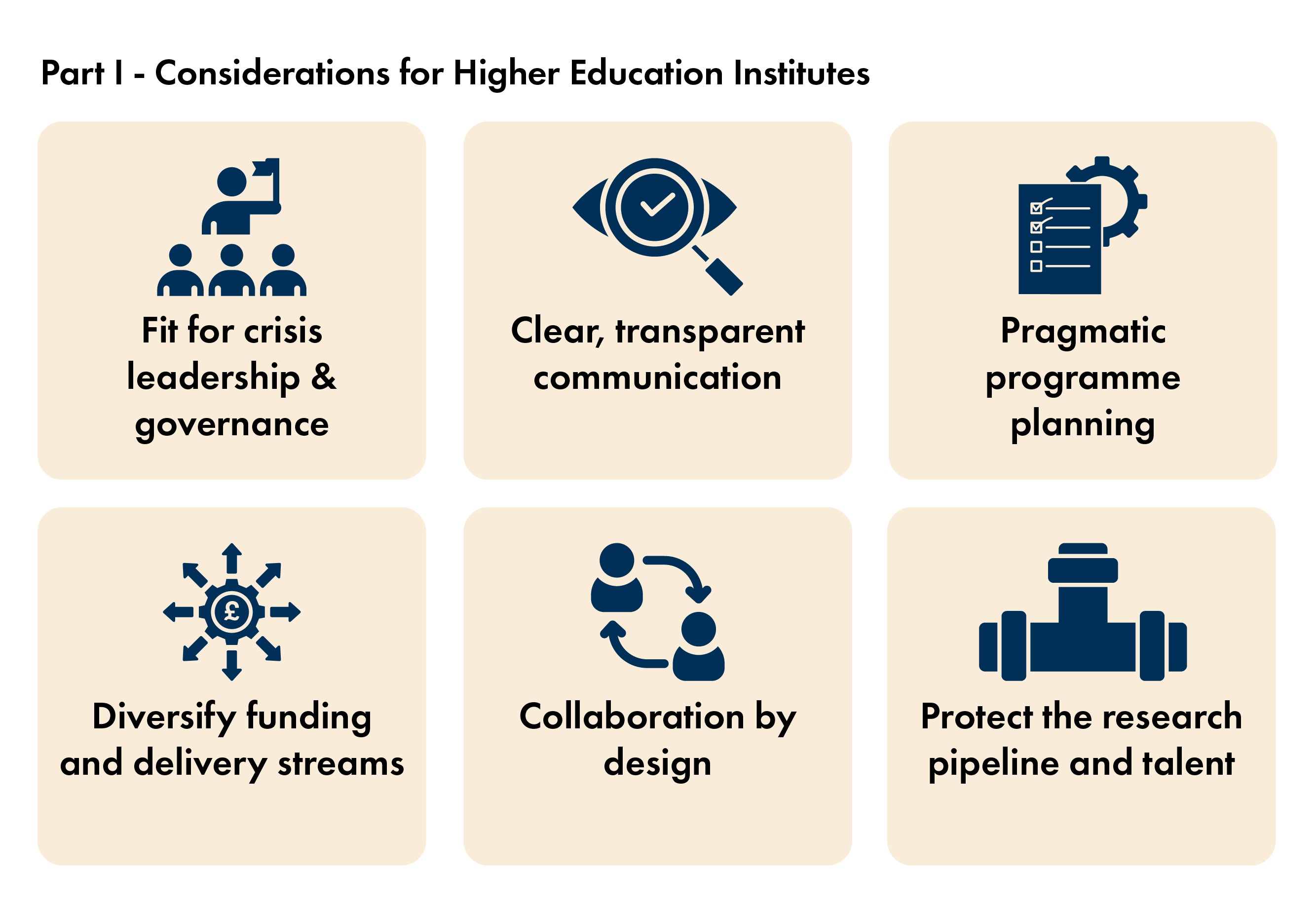
1. Fit for crisis leadership & governance: Have annual, independent board level reviews of governance capability, which may lead to upskilling senior management members on scenario planning, and risk management.
2. Clear, transparent communication: Enhance clarity and transparency of communication with employees and the external world, particularly in relation to matters that are of great concern to university employees.
3. Pragmatic programme planning: Have an annual portfolio review that takes into account preserving research-led teaching and maintaining critical mass in priority fields, co-delivering foundation years and/or sub-degree pathways where appropriate.
4. Diversify funding and delivery streams: Build a more balanced income portfolio, which may include offering micro credentials aligned to regional skills, CPD with industry sponsorship, targeted transnational education (TNE) partnerships or online/hybrid delivery.
5. Collaboration by design: Explore formal partnership and collaboration with neighbouring HEIs/colleges for joint procurement, shared service hubs and expensive labs.
6. Protect the research pipeline and talent: Prioritise future academics by ring-fencing funding that offers opportunities for doctoral students, ECRs and staff members (e.g. teaching opportunities via Graduate Teaching Assistant scheme, conference participation).
For the Scottish Parliament
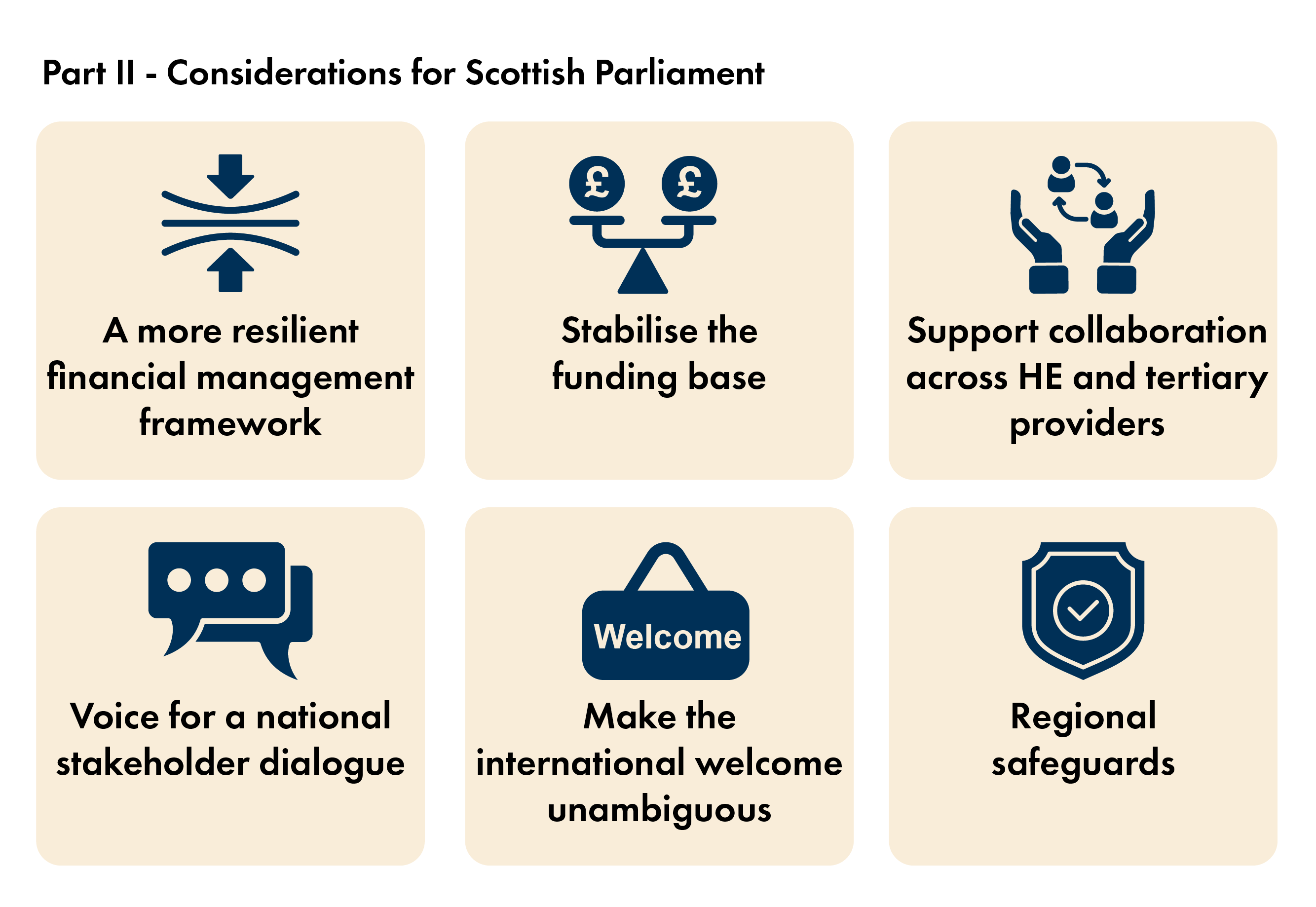
1. A more resilient financial management framework for the HE sector: Members of the Scottish Parliament (MSPs) may wish to consider advocating for the Scottish Government to promote standardised, transparent costing (TRAC aligned) and forward-looking sustainability metrics (multi-year financial projections, worst-case scenario costings) across universities (and colleges), monitored by the Scottish Funding Council (SFC).
MSPs may also wish to track the impact of new requirements on the SFC to monitor the financial sustainability of post-16 education bodies, introduced by the Tertiary Education and Training (Funding and Governance) (Scotland) Bill.
2. Stabilise the funding base: MSPs may wish to consider advocating for a multiyear settlement for the SFC teaching and research grants that also restores real terms value. Other considerations may include indexing non-Scottish domiciled (rest of UK) fee caps to inflation and reviewing postgraduate fee guidance. While preserving free tuition for Scottish domiciled undergraduates, revising the SAAS funding to match the cost of teaching per individual at the university could be a consideration.
3. Support collaboration across HE and tertiary providers: MSPs may wish to consider the benefits and risks of fostering the emerging tertiary reform agenda to incentivise “one sector” collaborations, as appropriate, based on each sector strengths, and without undermining institutional autonomy.
4. Voice for a national stakeholder dialogue: MSPs may wish to consider how they might increase their involvement in Scotland-wide dialogue among stakeholders including Scottish Government, SFC, SAAS, HEIs, colleges, industry, students and local authorities to agree the future “shape and size” of the sector.
5. Make the international welcome message unambiguous: MSPs may wish to advocate for the Scottish Government to focus on strengthening Scotland’s global profile – academically, societally and through government policies. This includes articulation of positive, welcoming messages to international students and implementing recommendations from Scotland’s International Education Strategy 2024.
6. Regional safeguards: MSPs may wish to consider the merits of encouraging HEIs and local bodies to conduct regional impact assessments before large redundancy waves or programme closures to avoid negative spillovers in vulnerable local economies.
Conclusions
There is considerable evidence from both the literature and the interviews that the current funding model is structurally unsustainable. This can inevitably lead to universities closing programmes, cutting jobs, which in turn leads to reduced research output and contract access. Accordingly, the consequences of inaction are not promising either. Mass job losses can produce long-term economic scarring that possibly takes decades to reverse. As a case in point, research cuts reduce innovation and competitiveness. Programme cuts are acknowledged to lead to damaged reputation and institutional attractiveness. In this HE funding debate, access restrictions may inadvertently affect more vulnerable groups of students. It is also noteworthy that once reputation erodes and talent migrates, recovery is likely to be difficult.
Evidence suggests that universities are strategic assets that have a positive impact on Scotland's prosperity, innovation, and regional stability. At the same time, the current financial situation requires serious consideration not only about what each university can do, but also what universities in collaboration with each other and/or with the college sector can do to create synergy and possibly collectively address the financial problem.
Drawing upon our study, we highlight key considerations, including enhancing efficiency, reforming funding, protecting research, and balancing international with domestic recruitment, with a view to restoring financial sustainability. These reforms may require difficult decisions on several fronts, e.g. tuition fees, public investment, and allocation of public resources. The alternative, however, of allowing universities to contract through incremental job cuts might inflict damage far greater than the cost of intervention.
We highlighted implications and recommendations as vital considerations for the HE sector, Scottish Parliament and the Scottish Government. The evidence from this study points strongly to the view that incremental adjustments are no longer likely to be enough and structural reform may now be needed.
Annexe
Guiding Questions for the Interviews
Opening (5 mins)
Brief introduction to project aims and ethical approval.
Confirm consent for recording and data usage as per university guidelines.
Section 1: Scientific Innovation and Skills (7 mins)
How have recent job cuts impacted your institution’s ability to deliver cutting-edge scientific or technical innovation?
What specific research areas or technological advancements have been/could be most affected?
In your view, how might ongoing resource reductions reshape Scotland’s technical and skills ecosystem?
Section 2: Economic Stability (7 mins)
In what ways have job cuts affected your institution's economic contribution to local and national economies?
Can you identify examples of lost opportunities, decreased industry engagement, or economic outputs linked to staff reductions?
How do you see this influencing Scotland’s overall economic landscape in the medium term?
Section 3: International Reputation & Talent Retention (7 mins)
What impact have job cuts had on the quality of education and the international reputation of Scottish universities?
Are international partnerships, recruitment, or global rankings being affected?
How are institutions addressing challenges around talent retention, particularly for researchers and educators?
Section 4: Policy Perspectives and Recommendations (4 mins)
Based on your experience, what policy measures or sector-wide strategies could mitigate negative effects of future job cuts?
What role should government, funding bodies, or sector leadership play in sustaining innovation and reputation despite financial constraints?
Any recommendations for policymakers or sector leaders that you would like to highlight as part of this study?
Closing (Final Minute)
Thank the participant and confirm next steps for sharing findings and future engagement.
Reiterate commitment to confidentiality and ethical standards.
Questions worth probing, if they are not addressed during the conversation
Exploring what led to the current situation
Is there a connection between Scottish Universities’ charitable status and their financial circumstances? Please explain.
What are the other things that the University of [name] does to manage its overall finances more effectively (compared to other HEIs) – in terms of reducing costs, increasing its income and mitigating any financial risks?
Which of the key factors that contributed to your University’s financial situation are within your control? Outwith your control?
Retrospectively, were there perhaps other areas where your university may have allocated funding unwisely? What prevented you from doing differently?
In your view, what might be the approximate percentage or absolute amount required by each university as their ‘threshold operating surplus’? Could you possibly give an approximate quantification – expenses vs income?
International student contribution
It has been widely acknowledged that the income from international students is a major factor that largely contributed to the current financial concern. What did your university do in the past? What can your university do in the next few years?
How can your University compete better with other English-speaking HEIs elsewhere (US, Australia, New Zealand) in terms of attracting a healthy number of international students?
Key lessons learned
What are the key principles that will help your University to remain financially stable? Could these principles also apply to other HEIs?
How do you think the policymakers (government) can make a real difference to this major challenge? How can they help tackle the challenges facing the Higher Education sector?
Sources
University and College Union. (2020). Universities’ £2.5bn ‘Black Hole’ will cost economy £6bn and 60,000 jobs, warns report. Retrieved from <a href="https://www.ucu.org.uk/article/10759/Universities-2.5bn-black-hole-will-cost-economy-6bn-and-60000-jobs-warns-report" target="_blank">https://www.ucu.org.uk/article/10759/Universities-2.5bn-black-hole-will-cost-economy-6bn-and-60000-jobs-warns-report</a>
Booth, J., & et al, . (2024). The economic impact of higher education teaching, research, and innovation. Retrieved from <a href="https://www.universitiesuk.ac.uk/sites/default/files/field/downloads/2024-09/LE-UUK-Impact-of-university-TL-and-RI-Final-Report.pdf" target="_blank">https://www.universitiesuk.ac.uk/sites/default/files/field/downloads/2024-09/LE-UUK-Impact-of-university-TL-and-RI-Final-Report.pdf</a>
Fraser of Allander Institute. (2023). The economic impact of university research funding in Scotland. Retrieved from <a href="https://www.fraserofallander.org/wp-content/uploads/2023/11/2023-11-Report-Valuing-university-research-FINAL.pdf" target="_blank">https://www.fraserofallander.org/wp-content/uploads/2023/11/2023-11-Report-Valuing-university-research-FINAL.pdf</a>
Forrester, J., & et al., . (2023). The economic impact of the University of Edinburgh. Final report for the University of Edinburgh. Retrieved from <a href="https://files.edinburgh-innovations.ed.ac.uk/ei-web/production/images/EconomicSocialImpactReport_ExecSummary_June23.pdf" target="_blank">https://files.edinburgh-innovations.ed.ac.uk/ei-web/production/images/EconomicSocialImpactReport_ExecSummary_June23.pdf</a>
University’s economic impact worth ten Commonwealth Games. (2023). Retrieved from <a href="https://www.ed.ac.uk/news/2023/university-s-economic-impact-worth-ten-commonwealt" target="_blank">https://www.ed.ac.uk/news/2023/university-s-economic-impact-worth-ten-commonwealt</a>
BiGGAR Economics. (2022). University of Dundee Economic Impact Assessment. A report to the University of Dundee. Retrieved from <a href="http://dundee.ac.uk/corporate-information/uod-impact-assessment" target="_blank">http://dundee.ac.uk/corporate-information/uod-impact-assessment</a>
Jeffrey, C. (2024). Builder, broker, beacon and base: Universities as anchor institutions. Progress in Human Geography. doi: 03091325251350307
Harris, M., & Holley, K. (2016). Universities as anchor institutions: Economic and social potential for urban development. Higher education: Handbook of theory and research , 393-439.
London Economics. (2024). The economic impact of higher education teaching, research, and innovation. Retrieved from <a href="https://www.universitiesuk.ac.uk/sites/default/files/field/ downloads/2024-09/LE-UUK-Impact-of-university-TL-and-RI-Final-Report.pdf" target="_blank">https://www.universitiesuk.ac.uk/sites/default/files/field/ downloads/2024-09/LE-UUK-Impact-of-university-TL-and-RI-Final-Report.pdf</a>
University and College Union. (2024). New study demonstrates huge local economic impact of universities. Retrieved from <a href="https://www.ucu.org.uk/article/10922/New-study-demonstrates-huge-local-economic-impact-of-universities" target="_blank">https://www.ucu.org.uk/article/10922/New-study-demonstrates-huge-local-economic-impact-of-universities</a>
Universities UK. (2025). The economic impact of higher education, teaching, research and innovation. Retrieved from <a href="https://www.universitiesuk.ac.uk/what-we-do/policy-and-research/publications/economic-impact-higher-education" target="_blank">https://www.universitiesuk.ac.uk/what-we-do/policy-and-research/publications/economic-impact-higher-education</a>
Cannings, J. (2023). The benefits and costs of international higher education students to the UK economy. Retrieved from <a href="https://www.hepi.ac.uk/wp-content/uploads/2023/05/Full-Report-Benefits-and-costs-of-international-students.pdf" target="_blank">https://www.hepi.ac.uk/wp-content/uploads/2023/05/Full-Report-Benefits-and-costs-of-international-students.pdf</a>
O'Neill, M., & Bagchi-Sen, S. (2023). Public universities and human capital development in the United States. Geo Journal, 88(1), 733-751.
Elsevier, . (2025). Scotland research and innovation performance: A dynamic hub for quality and global collaboration. Retrieved from <a href="https://elsevier.shorthandstories.com/scottish-research-and-innovation-dashboard/" target="_blank">https://elsevier.shorthandstories.com/scottish-research-and-innovation-dashboard/</a>
William, T. (2025). Slow cuts or risk lasting harm, staff warn stricken universities. Retrieved from <a href="https://www.timeshighereducation.com/news/slow-cuts-or-risk-lasting-harm-staff-warn-stricken-universities" target="_blank">https://www.timeshighereducation.com/news/slow-cuts-or-risk-lasting-harm-staff-warn-stricken-universities</a>
Scottish Funding Council. (2022). Financial Sustainability of Universities in Scotland 2022-23 to 2026-27. Retrieved from <a href="https://www.sfc.ac.uk/wp-content/uploads/2025/09/Download_Financial-Sustainability-of-Universities-in-Scotland-2022-23-to-2026-27.pdf" target="_blank">https://www.sfc.ac.uk/wp-content/uploads/2025/09/Download_Financial-Sustainability-of-Universities-in-Scotland-2022-23-to-2026-27.pdf</a>
Lovén, I., Hammarlund, C., & Nordin, M. (2020). Staying or leaving? The effects of university availability on educational choices and rural depopulation. Papers in Regional Science, 99(5), 1339-1366.
The Week. (2025). Why the UK's universities are in financial crisis. Retrieved from <a href="https://theweek.com/education/uk-universities-why-higher-education-is-in-crisis" target="_blank">https://theweek.com/education/uk-universities-why-higher-education-is-in-crisis</a>
Scottish Parliament. (2025). Education, Children and Young People Committee Official Report. Retrieved from <a href="https://www.parliament.scot/api/sitecore/CustomMedia/OfficialReport?meetingId=16649" target="_blank">https://www.parliament.scot/api/sitecore/CustomMedia/OfficialReport?meetingId=16649</a>
Macpherson, S. (2019). SPICe Spotlight: The price of free tuition in Scotland. Retrieved from <a href="https://spice-spotlight.scot/2019/12/18/the-price-of-free-tuition-in-scotland/" target="_blank">https://spice-spotlight.scot/2019/12/18/the-price-of-free-tuition-in-scotland/</a>
Currie, L. (2024). SPICe Spotlight: Student support and fees in Scotland. Retrieved from <a href="https://spice-spotlight.scot/2024/02/23/student-support-and-fees-in-scotland/#Undergraduate" target="_blank">https://spice-spotlight.scot/2024/02/23/student-support-and-fees-in-scotland/#Undergraduate</a>
Ogden, K., & Thomas, M. (2024). Scottish budget: higher education spending. Retrieved from <a href="https://ifs.org.uk/publications/scottish-budget-higher-education-spending" target="_blank">https://ifs.org.uk/publications/scottish-budget-higher-education-spending</a>
Gillies, P. (2025). Investigation into Financial Oversight and Decision Making at the University of Dundee. Retrieved from <a href="https://www.sfc.ac.uk/wp-content/uploads/2025/06/Gillies-Report.pdf" target="_blank">https://www.sfc.ac.uk/wp-content/uploads/2025/06/Gillies-Report.pdf</a>
Ogden, K. (2024). A decline in foreign students and higher costs create perfect storm for Scottish universities. Retrieved from <a href="https://ifs.org.uk/articles/decline-foreign-students-and-higher-costs-create-perfect-storm-scottish-universities" target="_blank">https://ifs.org.uk/articles/decline-foreign-students-and-higher-costs-create-perfect-storm-scottish-universities</a>
Universities Scotland. (2025). Sector response to the Gillies review. Retrieved from <a href="https://www.universities-scotland.ac.uk/publications/gilliesreview" target="_blank">https://www.universities-scotland.ac.uk/publications/gilliesreview</a>
Scottish Parliament . (2023, November 15). Education, Children and Young People Committee Official Report. Retrieved from <a href="https://www.parliament.scot/chamber-and-committees/official-report/search-what-was-said-in-parliament/ECYP-15-11-2023?meeting=15553&iob=132729" target="_blank">https://www.parliament.scot/chamber-and-committees/official-report/search-what-was-said-in-parliament/ECYP-15-11-2023?meeting=15553&iob=132729</a>
Scottish Parliament. (2024, October 9). Education, Children and Young People Committee: Pre-budget 2025-26 scrutiny: Committee letter of 9 October 2024. Retrieved from <a href="https://www.parliament.scot/-/media/files/committees/rural-affairs-and-islands-committee/correspondence/2024/prebudget-2025-to-2026-9-october-2024.pdf" target="_blank">https://www.parliament.scot/-/media/files/committees/rural-affairs-and-islands-committee/correspondence/2024/prebudget-2025-to-2026-9-october-2024.pdf</a>
Scottish Parliament . (2025, November 14). Education, Children and Young People Committee Pre-budget 2026-27 scrutiny: Committee letter of 14 November 2025. Retrieved from <a href="https://www.parliament.scot/chamber-and-committees/committees/current-and-previous-committees/session-6-education-children-and-young-people-committee/correspondence/2025/prebudget-scrutiny-202627-letter-of-14-november-2025" target="_blank">https://www.parliament.scot/chamber-and-committees/committees/current-and-previous-committees/session-6-education-children-and-young-people-committee/correspondence/2025/prebudget-scrutiny-202627-letter-of-14-november-2025</a>
Scottish Parliament. (2024). Minister’s response to ECYP Committee pre-budget scrutiny 2025-26: Letter of 31 October 2024. Retrieved from <a href="https://www.parliament.scot/-/media/files/committees/education-children-and-young-people-committee/correspondence/2024/prebudget-scrutiny-2025--2026-letter-from-minister-for-higher-and-further-education-and-minister-fo.pdf" target="_blank">https://www.parliament.scot/-/media/files/committees/education-children-and-young-people-committee/correspondence/2024/prebudget-scrutiny-2025--2026-letter-from-minister-for-higher-and-further-education-and-minister-fo.pdf</a>
Currie, L. (2024). Post-school reform: One year on from Withers. Retrieved from <a href="https://spice-spotlight.scot/2024/07/18/post-school-reform-one-year-on-from-withers/" target="_blank">https://spice-spotlight.scot/2024/07/18/post-school-reform-one-year-on-from-withers/</a>
Scottish Parliament Information Centre. (2025). Scottish Government responses to pre-Budget scrutiny: all smiles, no substance?. Retrieved from <a href="https://spice-spotlight.scot/2025/01/27/scottish-government-responses-to-pre-budget-scrutiny-all-smiles-no-substance/" target="_blank">https://spice-spotlight.scot/2025/01/27/scottish-government-responses-to-pre-budget-scrutiny-all-smiles-no-substance/</a>
Scottish Funding Council. (2021). Coherence and sustainability: A review of tertiary education and research. Retrieved from <a href="https://www.sfc.ac.uk/wp-content/uploads/uploadedFiles/coherence-and-sustainability.pdf" target="_blank">https://www.sfc.ac.uk/wp-content/uploads/uploadedFiles/coherence-and-sustainability.pdf</a>
Withers, J. (2023). Fit for the Future: Developing a post-school learning system to fuel economic transformation. Retrieved from <a href="https://www.gov.scot/publications/fit-future-developing-post-school-learning-system-fuel-economic-transformation/" target="_blank">https://www.gov.scot/publications/fit-future-developing-post-school-learning-system-fuel-economic-transformation/</a>
Scottish Government. (2023). Post-school education, research and skills: Purpose and principles. Retrieved from <a href="https://www.gov.scot/publications/post-school-education-research-skills-purpose-principles/" target="_blank">https://www.gov.scot/publications/post-school-education-research-skills-purpose-principles/</a>
Scottish Government. (2022). Scotland’s National Strategy for Economic Transformation: Delivering economic prosperity. Retrieved from <a href="https://www.gov.scot/binaries/content/documents/govscot/publications/strategy-plan/2022/03/scotlands-national-strategy-economic-transformation/documents/delivering-economic-prosperity/delivering-economic-prosperity/govscot%3Adocument/delivering-economic-prosperity.pdf" target="_blank">https://www.gov.scot/binaries/content/documents/govscot/publications/strategy-plan/2022/03/scotlands-national-strategy-economic-transformation/documents/delivering-economic-prosperity/delivering-economic-prosperity/govscot%3Adocument/delivering-economic-prosperity.pdf</a>
Scottish Parliament. (2025). Tertiary Education and Training (Funding and Governance) (Scotland) Bill (as introduced). Retrieved from <a href="https://www.parliament.scot/-/media/files/legislation/bills/s6-bills/tertiary-education-and-training-funding-and-governance-scotland-bill/introduced/bill-as-introduced.pdf" target="_blank">https://www.parliament.scot/-/media/files/legislation/bills/s6-bills/tertiary-education-and-training-funding-and-governance-scotland-bill/introduced/bill-as-introduced.pdf</a>
Scottish Parliament. (2025). Tertiary Education and Training (Funding and Governance) (Scotland) Bill . Retrieved from <a href="https://www.parliament.scot/bills-and-laws/bills/s6/tertiary-education-and-training-funding-and-governance-scotland-bill" target="_blank">https://www.parliament.scot/bills-and-laws/bills/s6/tertiary-education-and-training-funding-and-governance-scotland-bill</a>
Universities Scotland. (2025). Evidence to the Education, Children and Young People Committee on the Tertiary Education and Training (Funding & Governance) (Scotland) Bill. Retrieved from <a href="https://www.universities-scotland.ac.uk/wp-content/uploads/2025/05/FINAL-US-Evidence-to-Ed-Committee-Tertiary-Bill-Apr25.pdf" target="_blank">https://www.universities-scotland.ac.uk/wp-content/uploads/2025/05/FINAL-US-Evidence-to-Ed-Committee-Tertiary-Bill-Apr25.pdf</a>
Dickinson, J. (2025). Amendments are in on the Tertiary Education and Training (Funding and Governance) (Scotland) Bill. Retrieved from <a href="https://wonkhe.com/wonk-corner/amendments-are-in-on-the-tertiary-education-and-training-funding-and-governance-scotland-bill/" target="_blank">https://wonkhe.com/wonk-corner/amendments-are-in-on-the-tertiary-education-and-training-funding-and-governance-scotland-bill/</a>
Universities Scotland. (2025). Framework for the Sustainability and Success of Scotland’s Universities. Retrieved from <a href="https://www.universities-scotland.ac.uk/future-framework/" target="_blank">https://www.universities-scotland.ac.uk/future-framework/</a>
Celli, V., Cerqua, A., & Pellegrini, G. (2023). The long-term effects of mass layoffs: do local economies (ever) recover?. . Journal of Economic Geography, 23(5), 1121-1144.
vom Berge, P., & Schmillen, A. (2023). Effects of mass layoffs on local employment—evidence from geo-referenced data. Journal of Economic Geography, 23(3), 509-539.
Rueda, V. (2025). How has deindustrialisation affected living standards in the UK?. Retrieved from <a href="https://www.economicsobservatory.com/how-has-deindustrialisation-affected-living-standards-in-the-uk" target="_blank">https://www.economicsobservatory.com/how-has-deindustrialisation-affected-living-standards-in-the-uk</a>
Jung, H. (2025). University closures and declining regional innovation: evidence from South Korea. Science and Public Policy.
Babina, T., He, A.X., Howell, S.T., Perlman, E.R., & Staudt, J. (2023). Cutting the innovation engine: how federal funding shocks affect university patenting, entrepreneurship, and publications. The Quarterly Journal of Economics, 138(2), 895-954.
Ford, E.W., & Huerta, T.R. (2025). The financial impact of NIH’s indirect cost cap on higher education research. Health Affairs Scholar. doi: qxaf094
Husted, T.A., & Kenney, L.W. (2018). The effect of reduced support from state government on research in state universities. Journal of Education Finance, 164-174.
Elsevier. (2025). Scotland research and innovation performance: A dynamic hub for quality and global collaboration. Retrieved from <a href="https://elsevier.shorthandstories.com/scottish-research-and-innovation-dashboard/" target="_blank">https://elsevier.shorthandstories.com/scottish-research-and-innovation-dashboard/</a>
Zhao, B. (2019). State disinvestment in higher education: The impact on public research universities' patent applications. Boston, MA: Federal Reserve Bank of Boston (Working Paper No19-2).
Rossello, G. (2025). The effect on science of government cuts to doctoral scholarships. Studies in Higher Education, 1-19.
Borrett, A. (2024). Funding cuts have halved number of adult learners in England since 2010. Retrieved from <a href="https://www.ft.com/content/e201b548-eaa4-40d0-bc37-d9bf5b6d0058" target="_blank">https://www.ft.com/content/e201b548-eaa4-40d0-bc37-d9bf5b6d0058</a>
Universities UK. (2025). Universities grip financial crisis – but at what cost to the nation? . Retrieved from <a href="https://www.universitiesuk.ac.uk/what-we-do/creating-voice-our-members/media-releases/universities-grip-financial-crisis-what" target="_blank">https://www.universitiesuk.ac.uk/what-we-do/creating-voice-our-members/media-releases/universities-grip-financial-crisis-what</a>
Jack, P. (2025). Almost 4,000 courses closed at UK universities since 2024. Retrieved from <a href="https://www.timeshighereducation.com/news/almost-4000-courses-closed-uk-universities-2024" target="_blank">https://www.timeshighereducation.com/news/almost-4000-courses-closed-uk-universities-2024</a>
Jaeger, A.J., & Eagan, M.K. (2011). Examining retention and contingent faculty use in a state system of public higher education. Educational Policy, 25(3), 507-537.
Gonzalez Garcia, I., Montecino, J., & Ramaswamy, V. (2025). Preliminary Estimates of the Macroeconomic Costs of Cutting Federal Funding for Scientific Research. Retrieved from <a href="https://doi.org/10.57912/28746446" target="_blank">https://doi.org/10.57912/28746446</a>
Clouse, C., Blazek, K., & West, C. (2024). Closing Campus Doors: A Growing Threat to Local Economies. Retrieved from <a href="https://blog.implan.com/college-closures" target="_blank">https://blog.implan.com/college-closures</a>
Blank, M., & Maghzian, O. (2025). New Research on How Layoffs Affect the Labor Market. Retrieved from <a href="https://hbr.org/2025/07/new-research-on-how-layoffs-affect-the-labor-market" target="_blank">https://hbr.org/2025/07/new-research-on-how-layoffs-affect-the-labor-market</a>
University and College Union. (2025). University and College Union (UCU) Scotland comment on job cuts at Dundee University. Retrieved from <a href="https://www.ucu.org.uk/article/13972/University-and-College-Union-UCU-Scotland-comment-on-job-cuts-at-Dundee-University" target="_blank">https://www.ucu.org.uk/article/13972/University-and-College-Union-UCU-Scotland-comment-on-job-cuts-at-Dundee-University</a>
Adams, R. (2025). Quarter of leading UK universities cutting staff due to budget shortfalls. Retrieved from <a href="https://www.theguardian.com/education/2025/feb/01/quarter-of-leading-uk-universities-cutting-staff-due-to-budget-shortfalls" target="_blank">https://www.theguardian.com/education/2025/feb/01/quarter-of-leading-uk-universities-cutting-staff-due-to-budget-shortfalls</a>
Bound, J., Braga, B., Khanna, G., & Turner, S. (2020). A passage to America: University funding and international students. American Economic Journal: Economic Policy, 12(1), 97-126.
Oxford Metrica & Aon, . (2014). Protecting Your Most Important Asset: Reputation – A Strategic Risk Analysis for Higher Education. Retrieved from <a href="https://www.oxfordmetrica.com/public/CMS/Files/930/Aon%20OM_Reputation%20in%20Higher%20Ed.pdf" target="_blank">https://www.oxfordmetrica.com/public/CMS/Files/930/Aon%20OM_Reputation%20in%20Higher%20Ed.pdf</a>
Salter, R., & Cohen, E. (2025, November). Understanding universities’ costs What can TRAC tell us? . Retrieved from <a href="https://www.kcl.ac.uk/policy-institute/assets/understanding-universities-costs.pdf" target="_blank">https://www.kcl.ac.uk/policy-institute/assets/understanding-universities-costs.pdf</a>
Universities UK. (2025). Transformation and Efficiency Taskforce: Towards a new era of collaboration. Retrieved from <a href="https://www.universitiesuk.ac.uk/sites/default/files/field/downloads/2025-07/UUK-Transformation-and-Efficiency-Towards-a-new-era-of-collaboration-2025_1.pdf" target="_blank">https://www.universitiesuk.ac.uk/sites/default/files/field/downloads/2025-07/UUK-Transformation-and-Efficiency-Towards-a-new-era-of-collaboration-2025_1.pdf</a>
Hastings, M., & Habib, A. (2025). Rethinking the Financial Challenge of English Universities. Retrieved from <a href="https://www.hepi.ac.uk/2025/01/21/rethinking-the-financial-challenge-of-english-universities/" target="_blank">https://www.hepi.ac.uk/2025/01/21/rethinking-the-financial-challenge-of-english-universities/</a>
Augar, P. (2024). Just like the banks – universities are too big to fail. Retrieved from <a href="https://www.ft.com/content/491a63d2-f44f-4432-9f47-a8534d98f082" target="_blank">https://www.ft.com/content/491a63d2-f44f-4432-9f47-a8534d98f082</a>
Ogden, K., & Waltmann, B. (2024). Higher education finances: how have they fared, and what options will an incoming government have? . Retrieved from <a href="https://ifs.org.uk/sites/default/files/2024-06/Higher-education-finances.pdf" target="_blank">https://ifs.org.uk/sites/default/files/2024-06/Higher-education-finances.pdf</a>
Packer, H. (2026). Scottish university funding review ‘kicks issues into long grass’. Retrieved from <a href="https://www.timeshighereducation.com/news/scottish-university-funding-review-kicks-issues-long-grass" target="_blank">https://www.timeshighereducation.com/news/scottish-university-funding-review-kicks-issues-long-grass</a>
Scottish Parliament. (n.d.) Education, Children and Young People Committee: Colleges regionalisation inquiry . Retrieved from <a href="https://www.parliament.scot/chamber-and-committees/committees/current-and-previous-committees/session-6-education-children-and-young-people-committee/business-items/colleges-regionalisation-inquiry" target="_blank">https://www.parliament.scot/chamber-and-committees/committees/current-and-previous-committees/session-6-education-children-and-young-people-committee/business-items/colleges-regionalisation-inquiry</a>