Further and Higher Education: Subject Profile
This briefing provides an overview of Further and Higher Education in Scotland. It sets out information about the structure of the sectors, available qualifications, student support and fees, management and governance and recent policy developments.
Summary
While Scotland's colleges and universities are two distinct sectors delivering post-school education, they are becoming more closely linked in recent years. During Session 6 of the Scottish Parliament, the Scottish Government's overarching policy focus was to move toward a more coherent tertiary education system.
Steps toward reform began in Session 6 and are likely to continue throughout Session 7, with changes introduced by the Tertiary Education and Training (Funding and Governance) Act 2026 beginning to be implemented.
Financial sustainability of both sectors was also a major area of interest during the last Session, though the circumstances faced by the sectors are different.
This briefing provides a summary of policy developments during the last Session of Parliament. It also provides a high-level overview of each sector, including information on areas such as funding and governance arrangements, monitoring of quality, and student support.
Scotland's further and higher education system
There are 19 universities - also referred to as Higher Education Institutions (HEIs) - and 24 colleges in Scotland, delivering a range of qualifications from Access courses at college to PhDs at university. Two of these are tertiary institutions, delivering further and higher level qualifications. Figure 1 sets out the institutions that make up the tertiary education landscape.
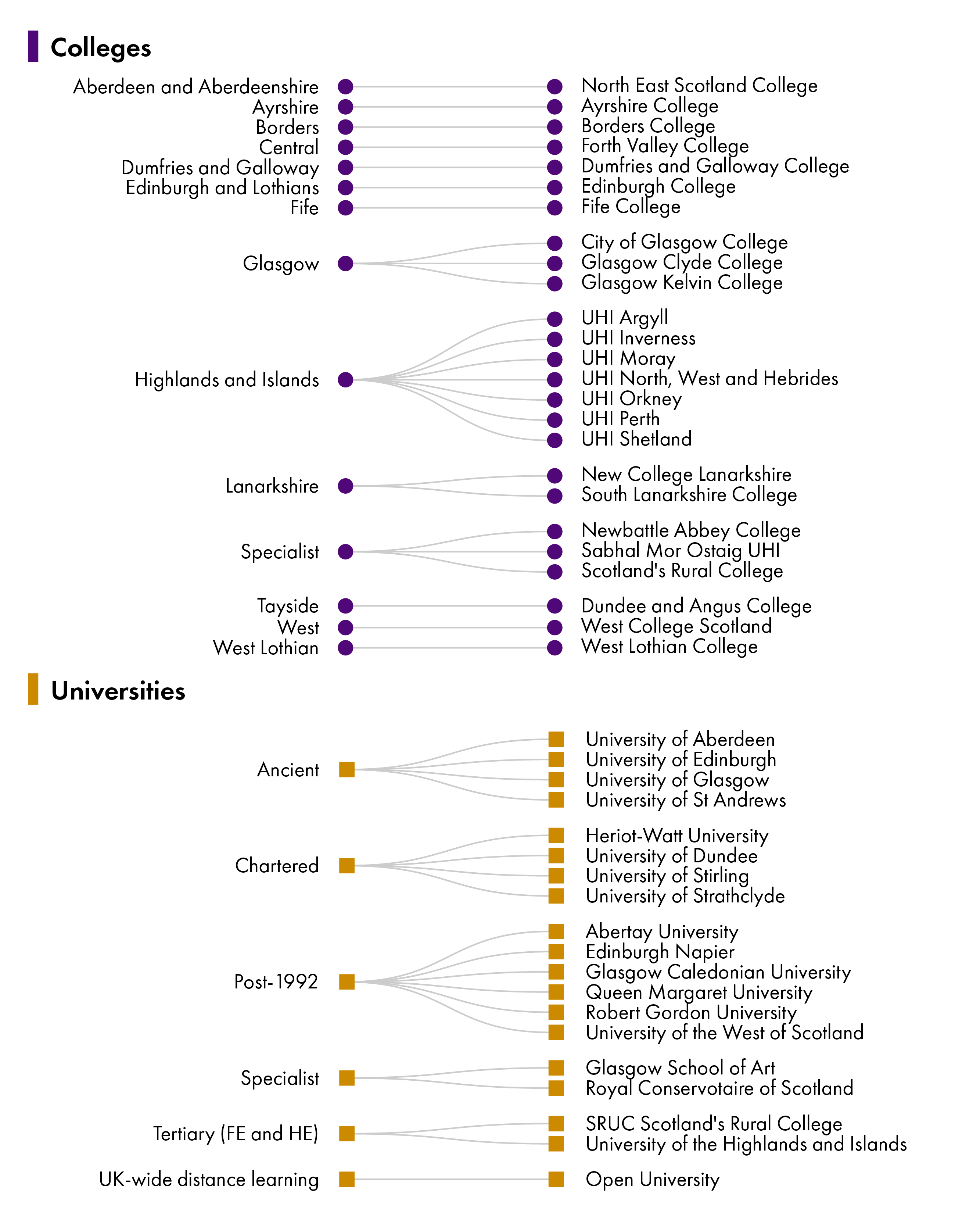
Audit Scotland and Colleges Scotland
Prior to 2013, there were 41 stand-alone colleges in Scotland. The Post-16 Education (Scotland) Act 2013 (the 2013 Act) introduced college regionalisation. During this time, mergers brought the number of colleges down from 41 in 2011 to 261, and later to 24. Colleges were also organised into 13 college regions. 10 regions had a single regional college, and three - Lanarkshire, Glasgow and the Highlands and Islands - were multi-college regions.2 Regional Strategic Bodies (RSBs) were introduced into the Further and Higher Education (Scotland) Act 2005 (the 2005 Act) by the 2013 Act to oversee funding arrangements across multi-college regions.
The Regional Strategic Bodies and Regional Colleges (Glasgow and Lanarkshire) Order 2025 abolished the Glasgow and Lanarkshire Regional Strategic Boards (RSBs). The colleges in these areas now manage themselves as regional colleges.
There are currently 24 colleges, following the August 2023 merger of UHI North Highland, UHI Outer Hebrides (formerly Lews Castle College) and UHI West Highland to form UHI North, West and Hebrides. Scotland's Rural College (SRCU) and the University of the Highlands and Islands (UHI) are tertiary institutions delivering provision across a wide span of SCQF levels.
Sector organisations and their roles
The list below sets out the public bodies with roles relating to the tertiary education sector and many of the stakeholders representing the sector.
Scottish Government: The Scottish Government allocates funding for colleges and universities to the Scottish Funding Council (SFC) via the Budget. SFC then allocates this to institutions.
Scottish Funding Council (SFC): The national, strategic body that is responsible for funding teaching and learning provision, research and other activities in Scotland's colleges and universities. SFC works closely with colleges and universities to monitor the impact of public investment to support improved educational, social and economic outcomes.
Student Awards Agency Scotland (SAAS): SAAS assesses how much financial support for eligible higher education students in colleges and universities are entitled to. This funding includes student tuition fees for certain higher education courses.
Skills Development Scotland (SDS): SDS currently delivers funding for Modern Apprenticeships, though from April 2027 this function will be taken on by SFC. SDS will then focus on providing a careers service.
Audit Scotland: Provides the Auditor General and the Accounts Commission with services to check that public money is spent efficiently and effectively. Reports annually on college sector finances and sustainability.
Scottish Credit and Qualifications Framework (SCQF): The SCQF has 12 levels mapping out the majority of qualifications in Scotland. This provides a way to compare qualifications and credits and plan learning choices.
The University and Colleges Admissions Service (UCAS): Provides information, advice and admissions services to applicants to UK universities. Applicants pay a fee to submit one application that can list numerous courses at different universities via the same form. Some publications can be broken down by Scottish Index of Multiple Deprivation (SIMD) to provide data on applicants and acceptances in relation to widening access to university.
The Higher Education Statistics Agency (HESA): Collects and publishes statistical data on UK universities. Some publications can be broken down by SIMD to provide data on widening access.
Universities Scotland: The membership body representing the Principals and senior leaders of Scottish universities.
Colleges Scotland: The membership body representing senior leadership in Scottish colleges.
College Employers Scotland: Representative body for the colleges as employer.
CBI Scotland: Represents business interests in Scotland.
Scottish Training Federation: Represents over 130 organisations operating in the field of work-based training across Scotland.
National Union of Students (NUS) Scotland: Union representing a majority of college and university Students' Associations and students.
University and College Union (UCU) Scotland: Union representing around 7,000 members working in universities across Scotland.
Further Education Lecturers' Association (EIS-FELA): Autonomous organisation operating within the Educational Institute of Scotland (EIS) teaching union. Represents college lecturing staff and has a branch in every college in Scotland.
UNISON: The main union for support staff working in the college sector.
Quality Assurance Agency for Higher Education (QAA) Scotland: The quality body for higher education in Scotland. QAA analyses and advises on standards and quality in UK higher education.
Prosper: Formerly SCDI. Membership organisation with many business and third sector members. Focuses on economic development and transformation.
Royal Society of Edinburgh (RSE): Independent expert advice from an 1,800-strong Fellowship.
Institute for Fiscal Studies (IFS): Independent economics research institute. Has produced reports on university funding in Scotland.
Fraser of Allander Institute: University of Strathclyde's Fraser of Allander Institute is an economic research institute, which carries out impactful research to inform the big challenges and opportunities facing the nations of the UK. It has previously done work on the impact of colleges.
Higher Education Policy Institute (HEPI): Independent think tank for UK higher education.
Session 6 recap: steps toward change
Concerns about the future sustainability of colleges and universities saw initial steps made toward change in the tertiary education sector.
The SFC’s 2021 Review of Coherent Provision and Sustainability1 set out recommendations for the college and university landscape. This included calls for the Scottish Government to establish an overall vision and strategy for further and higher education, increase collaboration between colleges and universities and move to multi-year funding.
The Independent Review of the Skills Delivery Landscape2 was carried out by James Withers and published in June 2023. This set out 15 recommendations for transforming skills delivery. These included calls for the Scottish Government to take responsibility for skills planning at a national level and create a single funding body for provision of all post-school education and student support.
In evidence to the Education, Children and Young People Committee on 15 November 2023, James Withers told MSPs that a 10-year timescale for skills reform is “not unrealistic”.3
Following the Withers review, the Session 6 Scottish Government published 'Purpose and Principles for Post-School Education, Research and Skills' in June 2023. This is a framework intended to set the overarching policy direction for higher and further education. It has five key principles:4
Transparent, Resilient and Trusted
High Quality
Supportive and Equitable
Globally Respected
Agile and Responsive.
The Scottish Government also published an Initial Priorities document. This included the development of “a new model of public funding for all forms of provision”.5
A 2024 consultation put forward three options for change in relation to the functions and responsibilities of the SFC, Skills Development Scotland (SDS) and SAAS. These were:
maintain business as usual
bring all funding provision into the SFC and all student support funding into SAAS
or bring all provision funding and student support funding into the SFC.
Analysis of the consultation responses found a slight majority of respondents in favour of the SFC managing funding for provision and SAAS managing student support funding6. This option was taken forward by the Scottish Government and relevant provisions were included in the Tertiary Education and Training (Funding and Governance) Bill. It passed at Stage 3 in January 2026 and became an Act in March 2026.
The Act contains provisions that, once commenced, are intended to simplify the tertiary education funding landscape and improve the governance of the SFC. The Act places a duty on Scottish Ministers to fund the SFC to secure and fund provision of national training programmes and all apprenticeships. SDS will continue to distribute funding for Modern Apprenticeships until April 2027.
Alongside the legislation, the Scottish Government signalled the intention to introduce greater transparency on college and university principals’ pay, require colleges and universities to adopt further fair work principles, and undertake a review of the credits-based teaching funding system for colleges and contribution rates for apprenticeships.7
Funding
Scotland's colleges and universities receive almost £2 billion of Scottish Government funding via the SFC each year. Institutions in both sectors can also generate income from other sources, though colleges are more restricted in how this is done due to their status as public bodies.
The Scottish Government allocates funding for further and higher education to the SFC as part of the Scottish budget process each year. SFC then provides funding to publicly funded institutions. These institutions are listed in the Further and Higher Education (Scotland) Act 2005 as ‘fundable bodies’. The Scottish Government sets out priorities to the SFC in a 'Letter of Guidance', usually issued in March each year. Fundable bodies receive funding in return for meeting conditions of funding as set out by SFC.
The SFC's Outcomes Framework (OF) and Assurance Model (AM), introduced in 2024, replaced the previous system of assurance and accountability, which included Outcome Agreements between the SFC and individual institutions. The new approach was developed in response to recommendations set out in the SFC's 2021 Review of Coherence and Sustainability
The OF sets out expectations of institutions in exchange for funding received. These include outcomes around governance, high quality learning and teaching (monitored by the Tertiary Quality Enhancement Framework (TQEF)), skills and work-based learning, financial sustainability, student interest net zero and equalities, diversity and inclusion.
The AM is the assurance mechanism the SFC uses to ensure outcomes are monitored and delivered.1
Toward the end of Session 6, the Scottish Government set up two working groups to look at sustainability of college and university funding in response to growing concerns about its long-term sustainability. The Framework for Sustainability and Success of Scotland's Universities (the Future Framework) and the College Sector of the Future will look at how challenges facing the sectors might be addressed. Work is expected to conclude in winter 2026-27. Further information about this work is available in the SPICe briefing Key Issues for Session 7.
The Future Framework published its first report in August 2026. This found that funding received and income generated by universities is not enough to cover the costs of core activities of teaching and research. As a result, the funding gap between cost and all sources of income was around £200 million in 2023-24.2
Further information about specific arrangements for college funding and university funding is set out in this section.
College funding
There are 24 colleges in total: 19 are ‘incorporated’ public bodies and five are unincorporated. SFC provides funding for all colleges and Audit Scotland audits incorporated colleges only. Scotland's Rural College (SRUC) delivers further education, though it is classed as a Higher Education Institution and gained degree-awarding powers in October 2024.
Scottish Government funding distributed via the SFC is the main source of income for colleges. 12 Following the ONS reclassification of colleges as public bodies in 2014, they must now operate within the same budget limits as other Scottish Government bodies, restricting their ability to build financial reserves.3 Some colleges have set up arm's length foundations following this change, but Audit Scotland has noted that opportunities for income generation vary across the sector.12
In recent years, the college sector has faced financial challenges. In September 2025, the SFC published its report on the Financial Sustainability of Colleges in Scotland 2022-23 to 2027-28. This found nine colleges reporting adjusted operating deficits in 2024-25, with 22 colleges forecasting adjusted operating deficits in 2025-26.
The SFC report stated that while there is variation between colleges, overall:
Further substantial adjusted operating deficits are forecast over the next three years … These forecasts show that most colleges are not sustainable.6
Audit Scotland's Colleges 2026 report found funding for colleges has decreased by over seven per cent in real terms in the five years to 2026-27.2The report also said that in 2024-25:
Scotland's 19 incorporated colleges reported a collective deficit of £5.6 million, up from £1.9 million the previous year.
SFC provided additional financial support, amounting to £13.9 million, to five colleges. The previous year, additional financial support of £5.4 million was provided to two colleges.2
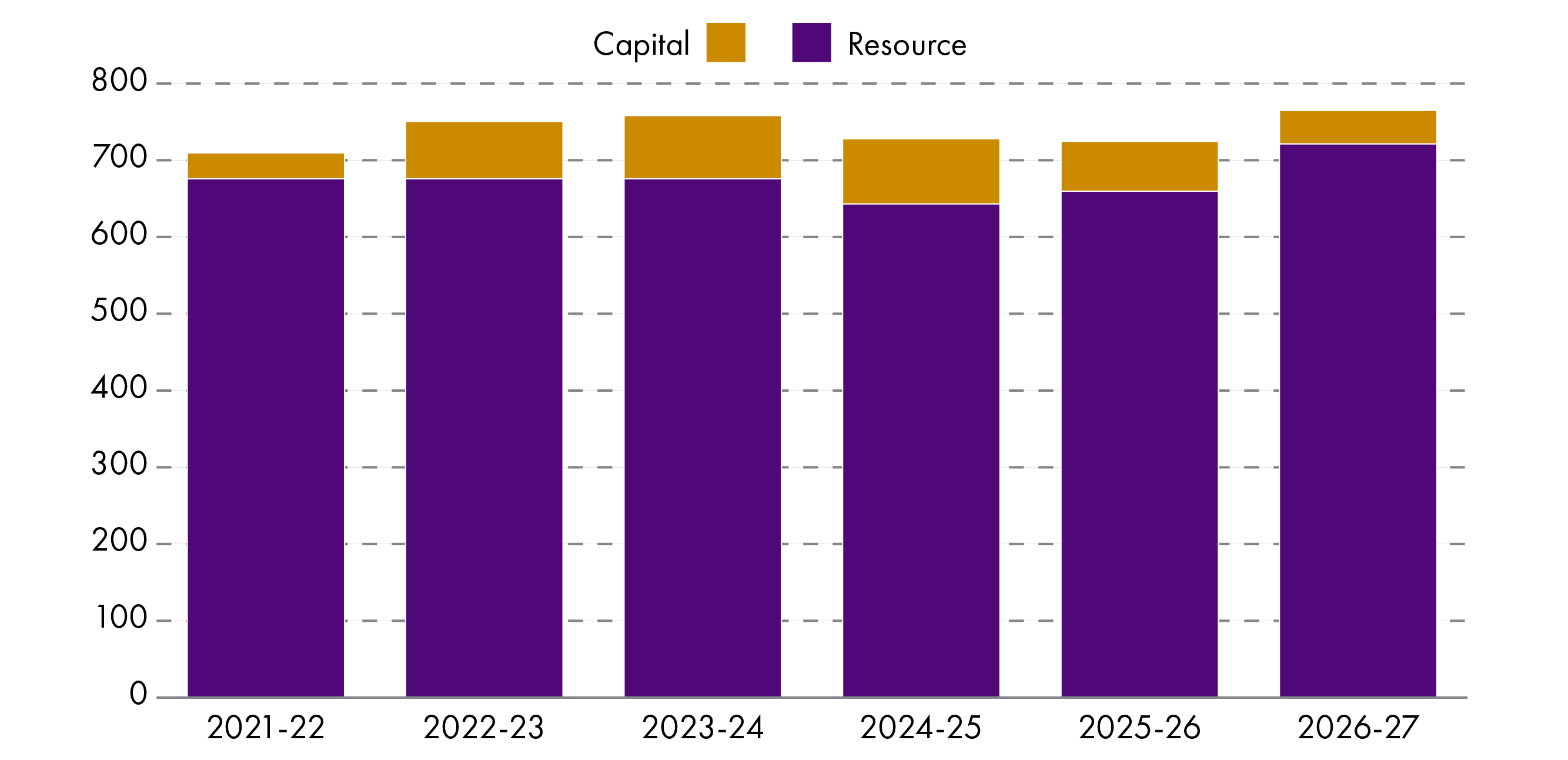
The 2026-27 Scottish Budget set out an increase in college budgets following real-terms decline since 2021-22. On the impact of this, Audit Scotland's Colleges 2026 report states:
The Scottish Government increased net resource funding for colleges by over nine per cent in 2026/27, but funding has decreased by over seven per cent in real terms in the five years to 2026/27. It is not clear if the uplift in funding is sufficient or if it will be sustained for colleges to deliver the level of reform needed in the college sector.2
University funding
Universities in Scotland deliver learning, teaching, research, knowledge exchange and innovation. These activities make a substantial contribution to economic, social and regional development.1
Universities - also referred to as Higher Education Institutions (HEIs) - are autonomous bodies, though they receive significant funding from the Scottish Government via the Scottish Funding Council and deliver agreed priorities.
Funding for teaching of Scottish-domiciled university students is provided to HEIs via a combination of teaching grant funding from the SFC and tuition fee income from SAAS:
A block teaching grant is provided to each HEI by SFC. Details of 2026-27 allocations can be found in the SFC publication University Final Funding Allocations AY 2026-27.
A tuition fee of £1,820, primarily for undergraduate (first) degree courses or Professional Graduate Diploma in Education (PGDE) courses, is paid by SAAS to the institution for each eligible Scottish-domiciled student accepting a full-time place.
Funding for just under 132,000 places has been provided for 2026-27.2
While universities are not subject to a formal cap on funded student places for non-controlled subjects, the SFC will recover funding equivalent to the tuition fee of full-time, undergraduate students eligible for funding recruited over and above the consolidation number, subject to a 10% threshold at institution level. This is set out in the SFC’s Conditions of Funding 2026-27 document3. For controlled subjects such as medicine, dentistry, nursing and midwifery, intake targets are set following Scottish Government guidance and engagement with universities.4
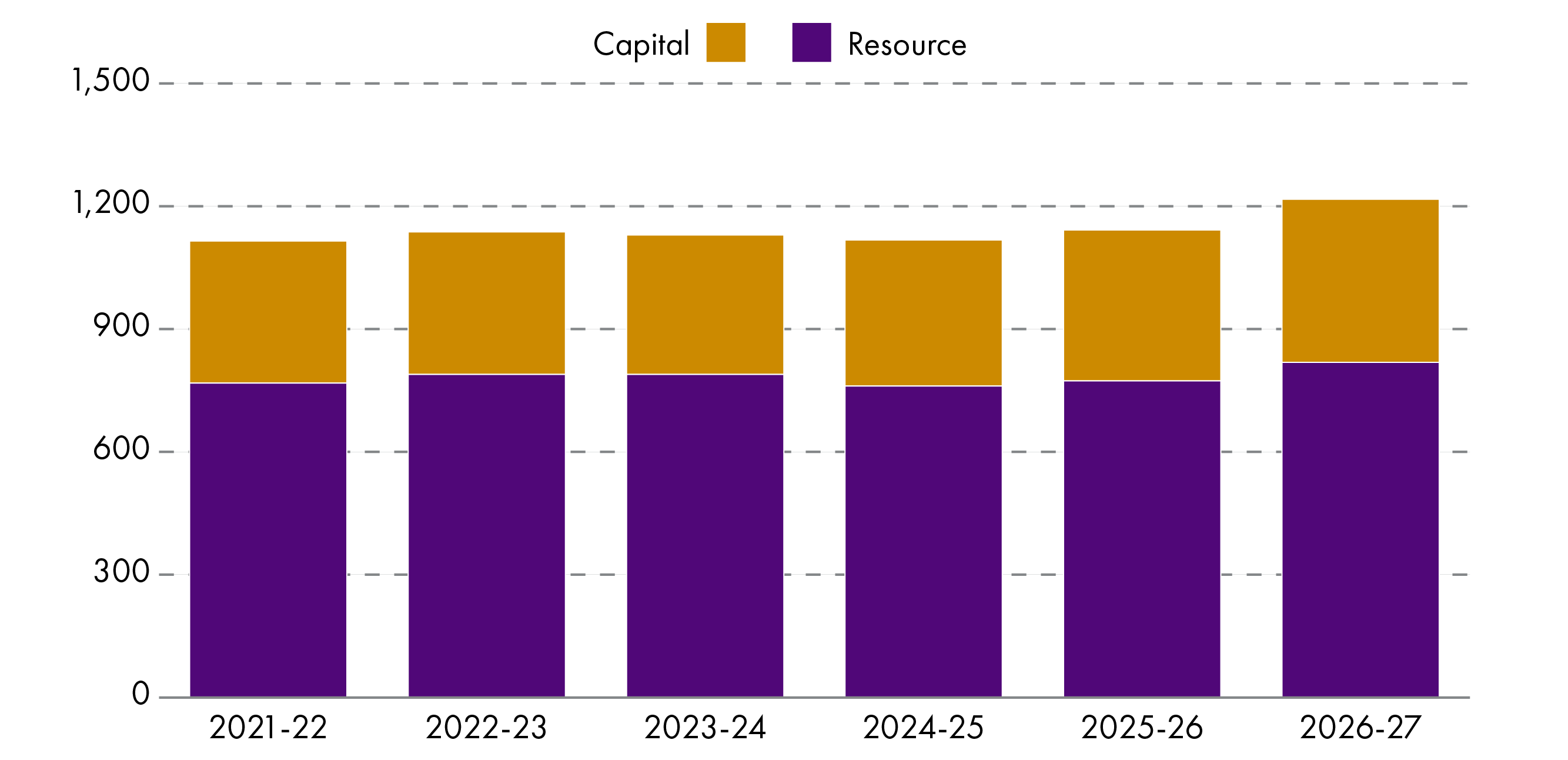
The university budget settlement for 2026-27 set out a rise in resource and capital budgets. This followed a number of years of real-terms decline. Although the financial crisis facing the University of Dundee from the end of 2024 onward was found to be a result of failures in governance as well as financial management5, it crystallised the risks facing the sector.
During Session 6, the sector called for the Scottish Government to address the longer-term sustainability of university funding, and Universities Scotland has said the costs of teaching Scottish-domiciled students outweigh the funding provided for them. A February 2024 report from the Institute of Fiscal Studies found:
Funding per student per year of study has fallen by 19% in real terms since 2013–14 and, as a result, Scottish universities are increasingly reliant on international student fees.
Ogden, K., & Thomas, M. (2024, February 20). Scottish Budget: Higher education spending. Retrieved from https://ifs.org.uk/publications/scottish-budget-higher-education-spending
Figure 3 below sets out university capital and resource budgets between 2021-22 and 2026-27.
In September 2025, the SFC published its report on the Financial Sustainability of universities in Scotland 2022-23 to 2026-277. It highlighted that international student tuition fee income represents the largest source of income for the sector. The report stated that universities need international fee income to remain financially sustainable and to support other areas of their operation such as research, which is a loss-making activity. The report observed:
There is an increasing risk that universities may not meet their international student tuition fee income targets as this continues to be an area of significant fluctuation and risk due to the competitive nature of the international markets, UK visa and immigration policy and geopolitical changes.
Scottish Funding Council. (2026, June 3). University Final Funding Allocations AY 2026-27. Retrieved from https://www.sfc.ac.uk/publications/university-final-funding-allocations-ay-2026-27/
The ‘Framework for Sustainability and Success of Scotland's Universities’ (Future Framework) has been set up by the Scottish Government with the university sector to look at longer-term funding sustainability of the sector. This work is expected to conclude in winter 2026-27.
The Future Framework published its first report in August 2026. This used Transparent Approach to Costing (TRAC) and Higher Education Statistics Agency (HESA)data to provide an overview of the financial position of the Scottish university sector. TRAC is the standard methodology used by HEIs in the UK for costing their activities. The approach was introduced in 2000 to improve accountability and inform decision making.9. HESA figures were used to complement TRAC data in areas including income composition, institutional variation and sector-wide coverage over time.10
The data analysis found1:
funding received and income generated by universities is not enough to cover the costs of core activities of teaching and research. As a result, the funding gap between cost and all sources of income was around £200 million in 2023-24
around 82% of the costs of teaching Scottish students are recovered, resulting in a public funding gap of around £288 million in 2023-24
around 72% of the costs of university research are recovered, with a funding gap of £580 million in 2023-24
the estimated estates maintenance backlog across the university sector was £1.1 billion in 2023-24.
The data also showed a funding gap pattern with universities operating below full economic cost recovery throughout most of the period from 2016-17 to 2023-24, with only one year where this was not the case.1
College management and governance
Scottish councils ran all publicly funded colleges in Scotland until the introduction of the Further and Higher Education (Scotland) Act 19921. Under this Act, most colleges established their own corporate body and boards of management. These boards took over responsibility for financial and strategic management. 19 colleges currently operate in this way and are referred to as incorporated colleges, producing accounts subject to audit by the Auditor General for Scotland. The remaining five colleges are classed as non-incorporated. Scotland's Rural College (SRUC) is classed as an HEI though it counts towards the achievement of the national targets for colleges.
The Post-16 Education (Scotland) Act 2013 introduced college regionalisation, which saw the formation of 13 college regions. During this time, mergers brought the number of colleges down from 41 in 2011 to 26, and later 24.
Of the 13 regions, 10 had a single college and three were multi-college regions. The 10 single college regions were given powers to receive and be accountable for public funding and securing provision of further and higher education. Each regional college is governed by a board of management. The Chair is appointed by Scottish Ministers.2
Initial arrangements for the three multi-college regions are described below in a 2025 Scottish Government policy note:
In the 3 multi-college regions – Glasgow, Lanarkshire and Highlands and Islands - it was recognised that fulfilling the aims of regionalisation would require individual colleges to work together. To support this, a new statutory body was introduced – a “regional strategic body” (RSB) – under the [Further and Higher Education (Scotland)] 2005 Act. Colleges within these regions are assigned to the RSB and referred to as “assigned colleges”. The RSB is responsible for strategic oversight and funding arrangements across the region. .2
Assigned colleges are governed via their own board of management, with the Chair appointed by the RSB. The Glasgow and Lanarkshire RSBs were governed by a board of management, the Chair of which was appointed by the Scottish Ministers.2 The assigned RSB for the Highlands and Islands is the University Court of the Highlands and Islands5.
In 2025, the Regional Strategic Bodies and Regional Colleges (Glasgow and Lanarkshire) Order dissolved the Glasgow Colleges' Regional Board and removed New College Lanarkshire as the designated RSB for the Lanarkshire college region.2 The Highlands and Islands is now the only region with an RSB in place.
Further information on regional chairs and principals can be found on the Colleges Scotland website. Colleges are required to comply with the Code of Good Governance for Scotland's Colleges as a condition of grant funding. This code was developed by the college sector and was last updated in 2026.
University governance
Scottish universities are autonomous and independent legal entities, with powers and governance arrangements established through charter or legislation rather than direct public sector control.
In addition to delivering identified priorities in exchange for public funding, Scotland's universities are required to comply with the terms of the Scottish Funding Council's Financial Memorandum as a condition of grant funding, and the principles of good governance as set out in the Scottish Code of Good Higher Education Governance. Universities also have charitable status, placing on their governing bodies the legal responsibilities of trustees to ensure that the aims of the charity are delivered effectively and sustainably.
HEI governing bodies are responsible for ensuring the effective management of the institution, planning the institution's strategic direction and future development and advancing its mission. The governing body has ultimate responsibility for all the affairs of the institution. Appointments to each governing body are made in keeping with the arrangements set out in their governing instruments and in accordance with the Higher Education Governance (Scotland) Act 2016 and Gender Representation on Public Boards (Scotland) Act 2018.
There are several categories of Higher Education Institution:
Ancient universities are constituted under and governed by the Universities (Scotland) Acts 1858 to 1966, and Higher Education Governance (Scotland) Act 2016. Each institution has: a Senate, presided over by the Principal; a Court with responsibility for finance and operation, presided over by an elected rector; and a General Council, presided over by a Chancellor. The making or amending of Ordinances by ancient universities requires Privy Council approval.
Chartered universities were granted university status by Royal Charters which set out the institutions’ overall constitution, alongside statutes, which give more detail as to how the university should operate in practice. All matters other than those set out in the Charter are to be set out by the Court in Statutes, Ordinances and Regulations. Amendments to the Charter and Statutes are made by the University's Court but require Privy Council approval.
Post-92 institutions is the term used for institutions designated as Higher Education Institutions through the Further and Higher Education (Scotland) Act 1992. Changes to constitutional arrangements of post-92 institutions are normally made through Orders of Council approved by the Privy Council.
Small and specialist institutions’ constitutional arrangements are established through a combination of the 1992 Act and the Companies Act, which requires an Annual General Meeting to be held and an updated list of directors to be maintained.1
A review of Higher Education Institution governance was carried out on behalf of the Scottish Government by a group chaired by former Principal of Robert Gordon University, Professor Ferdinand Von Prondzynski. The review was published in 2012, making a range of recommendations for changes to HE governance, with a focus on increasing transparency. Following the review, the Higher Education Governance (Scotland) Act 2016 introduced new rules for how HEIs should appoint Chairs of Court. It also provided that all Courts must include members who are trade union representatives, staff members and students.
The Scottish Code of Good HE Governance was taken forward by the sector following the Von Prondzynski review. The Code was last reviewed and updated in 2023.
College and university qualifications
Scottish qualifications are mapped out on the Scottish Credit and Qualifications Framework (SCQF) from level 1 to 12, taking in qualifications awarded by Qualifications Scotland (QA), Further and Higher Education Institutions, and apprenticeships and vocational qualifications.
Colleges typically offer courses from SCQF Level 4 to SCQF Level 8, and some offer courses below SCQF Level 4, such as Access courses and Lifeskills. Learners can study Further Education (FE) courses at SCQF Level 6 or below such as National 4 and 5, Higher and vocational courses.
Higher Education (HE) courses delivered at colleges are Higher National Certificates (HNCs) and Higher National Diplomas (HNDs):
HNCs (SCQF Level 7) are generally one-year long college courses and some can allow direct entry into the second year of a degree programme.
HNDs (SCQF Level 8) are two-year college courses, and some can allow direct entry into the third year of a degree programme.
Universities offer qualifications from SCQF Level 7 to SCQF Level 12. These include:
Bachelors/Ordinary Degree (SCQF Level 9): A three-year, first degree without honours.
Graduate Apprenticeship (SCQF Levels 9 to 11): Work-based learning opportunities up to Masters degree level.
Honours Degree (SCQF Level 10): A four-year, first degree with honours.
Masters Degree (SCQF Level 11): A further study option following a first degree, usually completed in one to two years full time or two to four years part time.
Postgraduate Certificate/Postgraduate Diploma (PGCert/PGDip) (SCQF Level 11): Further study options following a first degree. Courses take one or two terms with no dissertation.
Doctoral Degree (SCQF Level 12): Known as PhDs, these qualifications involve students conducting independent and original research over three or four years full time or up to seven years part time.
Quality of provision
The SFC has a statutory responsibility to ensure provisions are made for assessing and enhancing the quality of further and higher education in Scotland. This is set out in section 13 of the Further and Higher Education (Scotland) Act 2005.
The Outcomes Framework (OF) sets out the SFC's expectations of institutions in exchange for funding received1. Provision of high quality learning and teaching is one such expectation. This is monitored using the SFC's Tertiary Quality Enhancement Framework (TQEF), launched in 2024. The over-arching question TQEF aims to answer is:
Is the provision delivered by Scotland's colleges and universities of high quality and is it improving?2
Quality of provision is monitored through a combination of institutional self-evaluation, external review, student engagement, performance monitoring and national quality enhancement activities.
The SFC describes TQEF as:
... a shared set of principles, delivery mechanisms and outputs that can be applied to the different contexts of our colleges and universities to give assurance on academic standards, the quality of the student experience and ensure accountability for public investment in learning and teaching.2
The principles underpinning the approach are:
excellence in learning, teaching and assessment
supporting student success
enhancement and quality culture
student engagement and partnership
data and evidence
'externality' (external review and benchmarks)2.
The mechanisms for delivering quality assurance and enhancement are comprised of the following:
Peer-led Tertiary Quality Enhancement Reviews (TQER), managed by the Quality Assurance Agency for Higher Education (QAA), with support from the College Development Network (CDN) Student Partnerships in Quality Scotland (Sparqs), and Scottish Credit and Qualifications Framework Partnership (SCQFP).
Annual Quality Engagement (AQE) with QAA and SFC.
Institution led-quality activity, with all institutions expected to have arrangements for monitoring and review.
Scotland's Tertiary Enhancement Programme (STEP), a national programme of coordinated activity aimed at helping institutions work together to deliver improvement.
Data and evidence-led reporting that accounts for public investment in the delivery of quality.2
Students are involved in the delivery mechanisms in order to reflect the student experience.
TQEF outputs include:
tertiary Quality Enhancement Review (TQER) reports of findings from the independent peer review of colleges and universities
annual Self-Evaluation and Action Plans (SEAPs), annual submissions to SFC from colleges and universities reflecting on their quality assurance and enhancement activity, evaluate evidence, and identify priorities for improvement
thematic reporting, drawing together evidence and learning on key issues across the tertiary sector
reporting on the impact of enhancement activity, drawing together evidence from institutions, quality agencies and Scotland's Tertiary Enhancement Programme (STEP)
evidence on the effectiveness of responding to concerns, providing assurance that issues raised through review, engagement or other routes are identified and addressed appropriately
sector-level analysis and intelligence, bringing together evidence from reviews, SEAPs, annual engagements and enhancement activity to support SFC's public accountability and assurance role
data used to monitor institutions’ progress with securing high-quality learning provision and the quality of the student experience.6
College student numbers
Table 1 shows the latest available figures for the number of Full-Time Equivalent (FTE) student numbers studying part-time or full-time further education (FE) or higher education (HE) at college in Scotland from 2020-21 to 2024-25. The figures show that college numbers have fallen in recent years.
| Academic Year | Part-time FE | Full-time FE | Part time HE | Full-time HE | Total |
|---|---|---|---|---|---|
| 2020-21 | 38,035 | 50,085 | 5,195 | 35,245 | 128,560 |
| 2021-22 | 42,125 | 49,750 | 4,865 | 32,430 | 129,175 |
| 2022-23 | 43,470 | 49,120 | 4,985 | 27,080 | 124,655 |
| 2023-24 | 38,305 | 47,840 | 4,685 | 25,770 | 116,600 |
| 2024-25 | 39,655 | 47,405 | 4,595 | 24,400 | 116,055 |
University student numbers
Table 2 below shows there were over 270,000 students studying at universities in Scotland in 2024-25. This is down from a high of over 300,000 in 2021-22, following the Scottish Government's provision of funding for additional places in the aftermath of the COVID-19 pandemic. 1
| 2020-21 | 2021-22 | 2022-23 | 2023-24 | 2024-25 | |
|---|---|---|---|---|---|
| Postgraduate research | 13,535 | 13,705 | 14,105 | 13,610 | 13,735 |
| Postgraduate taught | 68,375 | 83,065 | 79,395 | 72,075 | 66,390 |
| Undergraduate | 200,960 | 204,465 | 198,745 | 195,770 | 192,495 |
| Total | 282,870 | 301,235 | 292,245 | 281,455 | 272,620 |
Table 3 sets out the latest available data on domicile of students at Scottish universities studying at undergraduate level. The chart shows the total number of undergraduate students has fallen in recent years. The number of students from EU countries has fallen as these students no longer qualify for home fee status following Brexit.
| 2020-21 | 2021-22 | 2022-23 | 2023-24 | 2024-25 | |
|---|---|---|---|---|---|
| England | 19,580 | 20,330 | 20,055 | 20,035 | 20,330 |
| Wales | 560 | 605 | 640 | 605 | 615 |
| Scotland | 145,140 | 148,480 | 144,090 | 143,285 | 142,435 |
| Northern Ireland | 3,260 | 3,160 | 2,800 | 2,500 | 2,315 |
| Other UK | 180 | 210 | 340 | 380 | 345 |
| European Union | 14,480 | 11,955 | 9,230 | 6,920 | 4,840 |
| Non-European Union | 17,755 | 19,695 | 21,170 | 21,700 | 21,310 |
| Not known | 0 | 30 | 415 | 345 | 300 |
| Total | 200,955 | 204,465 | 198,740 | 195,770 | 192,490 |
Table 4 sets out the latest available data on domicile of students at Scottish universities studying at postgraduate level. The data shows that while numbers of Scottish and EU domiciled postgraduate students has fallen, the number of non-EU students has increased.
| 2020-21 | 2021-22 | 2022-23 | 2023-24 | 2024-25 | |
|---|---|---|---|---|---|
| England | 9,940 | 10,335 | 8,830 | 8,485 | 8,400 |
| Wales | 435 | 500 | 425 | 425 | 395 |
| Scotland | 35,030 | 34,545 | 29,655 | 30,510 | 26,695 |
| Northern Ireland | 495 | 510 | 450 | 405 | 390 |
| Other UK | 70 | 80 | 260 | 305 | 350 |
| European Union | 6,070 | 5,185 | 3,905 | 3,510 | 3,300 |
| Non-European Union | 29,875 | 45,605 | 49,670 | 41,785 | 40,485 |
| Not known | 5 | 5 | 300 | 260 | 115 |
| Total | 81,920 | 96,765 | 93,494 | 85,685 | 80,130 |
Student support
Students studying at universities in Scotland may be eligible for support with tuition fees and living costs. Living cost support is available through repayable student loans or non-repayable bursaries. Eligibility and entitlement depends on factors including:
Residency: Students must meet general residence conditions to qualify for tuition fee and living cost support. Students resident in Scotland are 'home' students and eligible to have their tuition fees paid for them by SAAS.
Course level: Further Education (FE) college courses and Higher Education (HE) courses at colleges and universities have different financial support entitlements.
Course studied: Students studying certain courses such as nursing, midwifery and paramedic science are entitled to bursary support.
Household income: Bursary and/or loan support entitlement depends on household income.
In recent years there have been some changes to student support delivery and entitlements. In particular:
The 2017 independent review of student support recommended that there should be parity of support across FE and HE. It also recommended a minimum student income entitlement of £8,100 - funding that was equivalent to the Living Wage at the time1. From academic year 2024-25, the Scottish Government introduced the £2,400 'Special Support' loan for HE. Included as part of a student's overall loan, the Special Support Loan does not impact on benefit entitlements.2
In 2023, James Withers’ Independent Review of the Skills Delivery Landscape recommended that a single funding body should fund provision and student support across the tertiary sector3. The Scottish Government did not accept this recommendation in full, but did move responsibility for delivery of FE student support from the SFC to SAAS from 1 August 2026.4
Further information about support entitlement and eligibility is provided throughout this section.
Applying for funding
From 1 August 2026, the Student Awards Agency Scotland (SAAS) will deliver student support for FE and HE as part of the Scottish Government's commitment to simplify the post-school funding body landscape.1 Previously, the Scottish Funding Council (SFC) provided support for FE students.
The amount of support available to an eligible student studying in Scotland depends on their level of study:
FE students are those at college studying courses below HNC/HND level. Financial support for FE students will be administered to colleges by SAAS and continue to be distributed by colleges.1 Students apply directly to their college to receive non-repayable bursary payments. Further information about FE support is set out in the 'Support for Further Education students' section of this briefing.
HE students are those at university studying undergraduate or postgraduate degree paths, or those at college studying for their Higher National Certificate or Diploma (HNC or HND). HE students apply directly to SAAS for tuition fee and living cost support. Living cost support for HE students is available as non-repayable bursaries or repayable student loans, depending on age, level of study and household income. There are different levels of support for undergraduate and postgraduate HE students; further information is set out in the 'Support for Higher Education students' sections of this briefing.
General residence conditions
To qualify for support with tuition fees and living costs, Further Education (FE) and Higher Education (HE) students must meet general residence conditions. These are set out in the Student Support (Scotland) Regulations 2022 (the 2022 Regulations).1
Applicants must:
be ordinarily resident in Scotland on the relevant date (the 1 August for courses starting in Autumn); and
have been ordinarily resident in the UK in the three years prior;
have settled status in the UK; or
have been granted a form of leave to enter or remain in the UK, where that leave has not expired
be a spouse, civil partner or child of a qualifying person described above.
Definition of ‘ordinarily resident’
The Scottish Government expects someone who is ordinarily resident in Scotland to have made their home in Scotland with the intention of staying and living here. Those who have moved here for the purpose of full-time study are not considered ordinarily resident.
The 2022 Regulations set out:
… a person who is resident in Scotland on the relevant date as a result of having moved to Scotland for the purpose of undertaking a course of education is to be considered to be ordinarily resident in the area from where they moved. 1
There is no set time someone needs to be in Scotland to establish ordinary residence, though SAAS states the UK must be the applicant's main place of residence for the “three years immediately before the relevant date”.2
In cases where it was considered appropriate to do so, SAAS may write to HE applicants seeking specific details as to why someone had resided in Scotland. Examples of further information SAAS might request are details on property ownership or employment contracts.
The 2022 regulations also include exceptions to the ordinary residence conditions. Under these exceptions applicants may qualify for tuition fee support only, or tuition fee and cost of living support.
Exceptions are explained further by SAAS guides:
The SAAS guide to residence conditions for UK nationals sets out eligibility criteria for those who: have returned to the UK; live in the EU, EEA or Switzerland; were born and spent “the greater part” of their life in the UK; have fled Ukraine or Afghanistan; or are in or have a family member in the Armed Forces.3
The SAAS guide to residence conditions for EU, Irish, EEA, Swiss, Gibraltar and Turkish nationals following Brexit sets out eligibility criteria for people from these areas.4
The SAAS guide to residence conditions for non-EEA nationals sets out eligibility criteria for: Ukrainian nationals; asylum seekers and those granted refugee status, Humanitarian Protection or Discretionary Leave in the UK; Iraqi nationals with Indefinite Leave to Enter the UK; Syrian nationals with Humanitarian Protection; those granted Leave to Remain as a Stateless Person; those granted Leave to Remain as a victim of modern slavery; and those granted Indefinite Leave to Enter or Remain as a victim of domestic violence or domestic abuse.5
Support for Further Education students
Students studying FE courses (SCQF Level 6 or below) at colleges in Scotland may be eligible for financial help to cover tuition fees, living costs, study and travel expenses.
FE students must contact their college student support team to apply for support. Contact details for college funding sites can be found on the Student Information Scotland website.
Further information on FE tuition fees and living costs and other expenses are set out in this section.
Further Education tuition fees
The tuition fee rate for FE courses for 2026-27 is £1,008. To qualify to have their fees waived, a student must be ‘ordinarily resident ’ in Scotland. Colleges apply a tuition fee waiver from the Scottish Funding Council (SFC) for eligible students.
Further Education living costs, study and travel expenses
Students studying FE level courses can receive a non-repayable bursary to support them during their studies.
Students under the age of 18 are eligible for Education Maintenance Allowance (EMA) of £30 per week. For those who are under 18 and living away from home, an additional weekly bursary of up to £49.91 is available.
Those aged 18-24 living with parents are eligible for up to £99.35 per week, while over-25s living with parents are eligible for up to £125.55.
All students aged over 18 and living away from home are eligible for up to £125.55 per week. 1
However, the amount of support FE students receive can be affected by household income. Further information on income thresholds can be found on the Student Information Scotland website.
Care-experienced FE students are eligible for a non-income assessed bursary of £225 a week.
Students may also be eligible for funding for the following1:
Study expenses such as specific clothing or footwear required for a course.
Travel expenses if living more than two miles from college. Students with additional support needs are eligible to have travel costs covered no matter where they live. Students under 22 are eligible for the Young Persons’ Free Bus Travel scheme.
Accommodation Allowance for those staying in college-approved accommodation. This replaces a student's bursary and covers rent of up to £140.13 per week.
Dependents Allowance of up to £67.55 per week for full-time students with care or financial or legal responsibilities for an adult dependent.3
In addition to travel costs, further help is available for students with additional support needs. This is provided following assessment from the college student support team.
In addition, students in financial difficulty can apply to their college for additional funding via the discretionary and childcare funds.
To find out more about support entitlements, students can contact their college funding/support team.
Support for Higher Education students
University and college students studying courses at SCQF Level 7 and above can apply to SAAS for support with tuition fees. Information on support available is set out in this section and can be found under the headings below:
Undergraduate tuition fees
Eligible students living in Scotland studying Higher Education courses at college (HNC/HND) or university (degree level) at Scottish institutions apply to have their tuition fees paid for by SAAS.
The tuition fee rate for HN level courses is £1,285 and £1,820 for undergraduate and Professional Graduate Diploma in Education (PGDE) courses. This is funded through SAAS for eligible students.1
SAAS will pay fees for the duration of the course. A ‘+1’ year of funding for a course change or repeat year is also available if needed. 2
Students studying part time can apply for the Part-time Fee Grant (PTFG) to cover tuition fees for eligible courses at HN level and above. To be eligible for this funding, students must earn less than £25,000 per year before tax and National Insurance.3
SAAS can also provide a tuition fee loan of up to £9,790 a year for students from Scotland studying at publicly funded colleges or universities elsewhere in the UK. 1
Students from elsewhere in the UK studying at Scottish universities are responsible for paying their own tuition fees. For academic year 2026-27, the maximum fee level will be £9,790.5
Some Irish and UK nationals living in the Republic of Ireland, Gibraltar or elsewhere in the EU may be eligible to apply to SAAS for a tuition fee loan of up to £9,790. More information about this is available on the SAAS website.
Undergraduate living support
Undergraduate living support is available to eligible full-time students in the form of a bursary and/or student loan. Living cost loans are not available for part-time study.
The Scottish Government introduced a ‘Special Support Loan’ of £2,400 from academic year 2024-25. Included as part of a student's overall loan, the Special Support Loan does not impact on benefit entitlements.1
Living support entitlements are worked out by SAAS based on an assessment of factors including household income, age, dependents and marital status2.
For young students under age 25 who are not self-supporting, have no children and do not live with a partner, parental income is considered when determining funding. The maximum loan amount for young students is currently £9,400. A bursary of between £500 and £2,000 is available for those with household income of under £34,000 per year.
Independent students are those who are married, in a civil partnership, over 25, have dependent children or have been self-supporting for at least three years. Parental income is not assessed for these students. The maximum loan amount available is £10,400. A bursary of £1,000 is available for those with income of £20,999 or less per year.
Estranged students who no longer have contact with their parents or legal guardians may be eligible for an Estranged Students Bursary of £1,000 and the maximum student loan amount of up to £10,400.
Care experienced students are eligible for a bursary of £9,000, along with the option to apply for the £2,400 Special Support Loan.
Disabled students and those with additional learning needs studying higher education courses may be eligible to receive Disabled Students’ Allowance (DSA). Support a student receives through DSA depends on their individual needs and the course studied. DSA has three allowances2:
A basic allowance, which can be claimed for items including printing and Braille paper.
An Equipment, Software and Accessories Allowance over the duration of a course to cover the hire or purchase of equipment such as laptops or voice recognition software.
A non-medical personal help allowance, which can be used to employ support workers such as British Sign Language interpreters (BSL), proof-readers or note takers.
DSA can also cover costs for travel expenses. Information about allowance rates can be found on the SAAS website.
Lead Scotland's Disabled Students’ Helpline can provide further information about claiming benefits as a disabled student.
Dental students in Scotland can apply for the Dental Student Support Grant, a bursary of £4,000 per year4.
Students studying to be a paramedic, nurse or midwife can apply for the Paramedic, Nursing and Midwifery Student Bursary (PNMSB). This is a bursary of £10,000 per year for the first three years of a course and £7,500 for the final year of the course. 5
Further information about bursary and loan amounts is available in the SAAS guide on funding for undergraduates.6
Postgraduate tuition fees
Fee levels for postgraduate courses are not regulated by the Scottish Government. Institutions set their own fee levels for courses, and in some instances these fees may be higher than the fee loan amount.
SAAS can provide a tuition fee loan of up to £7,000 for full-time and part-time courses at Postgraduate Diploma and Masters level.
If a course is longer than one academic year, the £7,000 tuition fee loan is split over the length of the course.1
SAAS can also provide student loan support to eligible students studying full-time postgraduate courses at publicly funded institutions elsewhere in the UK.1
More information about postgraduate support can be found in the SAAS guides for Part-time Postgraduates and Full-time Postgraduates.
Funding for postgraduate courses in Social Work is provided by The Scottish Social Services Council (SSSC).3 A limited number of postgraduate bursaries for students studying MSc Social Work are available each year. The bursary is intended to cover tuition fees, living costs and study expenses. The living costs element of the bursary is means tested.
SAAS does not provide funding for courses at Postgraduate Certificate, PhD or Doctorate level. More information about finding PhD funding is available on the Student Information Scotland website.4
Some Irish and UK nationals living in the Republic of Ireland may be eligible to apply to SAAS for a postgraduate tuition fee loan of up to £7,000. More information about this is available on the SAAS website. 5
Postgraduate living support
Full-time postgraduate students can apply for a living-costs loan of up to £6,900. This loan is split equally across each year of the course, and includes the £2,400 Special Support Loan.1
There is no living cost support for those on part-time postgraduate courses.
Disabled students and those with additional learning needs studying postgraduate courses and PhDs may be eligible to receive DSA.2
EU and international tuition fees
Prior to Brexit, EU students were eligible for free tuition. From the 2021-22 Academic Year, EU students are now charged the same rate as other international students.
EU students with protected rights under the EU Settlement Scheme remain eligible to apply for support if they meet residency conditions.
Further information on funding for EU students is available in the SAAS funding guide for EU, Irish, EEA, Swiss, Gibraltar and Turkish nationals following Brexit.1
Tuition fee rates for international students are set by institutions and can range from £10,000 to £50,000 per year depending on course and institution.
Other support
In addition to tuition fee and living costs support, students may be able to apply for discretionary support or claim social security benefits in some circumstances.
Students in financial hardship studying HE level courses at college and university can apply for discretionary funding via their institution. Funding is administered to institutions via SAAS. Contact details for student support services can be found on the Student Information Scotland website.1
While most full-time students can't claim social security benefits, the following may be eligible2:
young students in FE courses who are living away from their parents
students who are parents
students with a disability.
It is important to note that, with the exception of the Special Support Loan (available to HE and Postgraduate students only), being in receipt of loan or bursary support may reduce the amount of money a student can claim for social security benefits they are eligible for:
Universal Credit and the benefits it replaced (including Child Tax Credit, Working Tax Credit, Income Support, income-based Jobseekers Allowance, income-related Employment and Support Allowance, and Housing Benefit) are means tested and affected by student funding.
Non-means tested benefits include: contribution-based Jobseeker’s Allowance, contribution-based Employment and Support Allowance, Adult disability payment, Carer support payment, and Child Benefit.3
The Child Poverty Action Group’s Benefits for Students in Scotland Handbook contains further details of student eligibility for benefits and tax credits.
Repayment of student loans
Student loan repayment conditions are set out in the Repayment of Student Loans (Scotland) Regulations 2000 (the 2000 Regulations) and the UK Education (Student Loans) (Repayment) Regulations 2009 (the 2009 Regulations), as amended.1
The Student Loans Company (SLC) makes loan payments and works out repayment arrangements for borrowers.
Further information about student loan repayment is available on the mygov.scot website.
Most borrowers repay their loans through repayments to HM Revenue and Customs (HMRC), either by employers taking amounts from pay or via the tax Self-Assessment process.
All Scottish students who started an undergraduate or postgraduate course on or after 1 September 1998 are on repayment Plan 42. The meaning of ‘Plan 4 loan’ is contained in the 2009 Regulations. It allows for Scottish Ministers to determine collection of repayments of loans paid under Scottish regulations.
Repayment threshold
Borrowers only begin to repay student loans once they earn over a certain amount. This is known as the ‘repayment threshold’. The 2000 Regulations define ‘repayment threshold’. This rises annually and is currently set at £33,795.
If a borrower's salary drops below the salary threshold, repayments are stopped and only restart once earnings go over the threshold once again.1
Interest
Student loan interest is charged from the day a borrower is paid their first instalment until it is repaid in full or cancelled.1
The Student Support (Scotland) Regulations 2022 set out how loan interest is calculated.
Interest is applied at a rate of Retail Price Index or the Bank of England base rate plus 1%, whichever is lower. Currently the interest rate for Plan 4 is 4.1%2. The interest rate is determined on 1 September each year.1
Cancellation of loan debt
Regulation 8 (4) of the 2000 Regulations sets out criteria for cancellation of loan. It states that Scottish Ministers can cancel a borrower's liability to repay where:
the borrower dies
the borrower receives a disability-related benefit and because of that borrower's disability is permanently unfit for work
the 30th anniversary of a borrower becoming liable to repay the student loan
the borrower's 65th birthday.
Sources
Scottish Parliament Information Centre. (2021, July 27). Further and Higher Education in Scotland: Subject Profile. Retrieved from <a href="https://www.parliament.scot/chamber-and-committees/research-prepared-for-parliament/research-briefings/2021/7/27/sb-2142#" target="_blank">https://www.parliament.scot/chamber-and-committees/research-prepared-for-parliament/research-briefings/2021/7/27/sb-2142#</a>
Scottish Government . (2025). Policy Note: The Regional Strategic Bodies and Regional Colleges (Glasgow and Lanarkshire) Order 2025. Retrieved from <a href="https://www.legislation.gov.uk/ssi/2025/177/policy-note/contents" target="_blank">https://www.legislation.gov.uk/ssi/2025/177/policy-note/contents</a>
Scottish Funding Council. (2021, June 29). Review of Coherent Provision and Sustainability. Retrieved from <a href="https://www.sfc.ac.uk/wp-content/uploads/uploadedFiles/coherence-and-sustainability.pdf" target="_blank">https://www.sfc.ac.uk/wp-content/uploads/uploadedFiles/coherence-and-sustainability.pdf</a>
Scottish Government. (2023, June 7). Fit for the Future: developing a post-school learning system to fuel economic transformation. Retrieved from <a href="https://www.gov.scot/publications/fit-future-developing-post-school-learning-system-fuel-economic-transformation/" target="_blank">https://www.gov.scot/publications/fit-future-developing-post-school-learning-system-fuel-economic-transformation/</a>
Scottish Parliament. (2023, November 15). Education, Children and Young People Committee Official Report. Retrieved from <a href="https://www.parliament.scot/chamber-and-committees/official-report/search-what-was-said-in-parliament/ECYP-15-11-2023?meeting=15553&iob=132729" target="_blank">https://www.parliament.scot/chamber-and-committees/official-report/search-what-was-said-in-parliament/ECYP-15-11-2023?meeting=15553&iob=132729</a>
Scottish Government. (2023, June 28). Purpose and Principles for Post-School Education, Research and Skills. Retrieved from <a href="https://www.gov.scot/publications/post-school-education-research-skills-purpose-principles/" target="_blank">https://www.gov.scot/publications/post-school-education-research-skills-purpose-principles/</a>
Scottish Government. (2023, June 28). Post-school education, research and skills - purpose and principles. Retrieved from <a href="https://www.gov.scot/publications/post-school-education-research-skills-purpose-principles/documents/" target="_blank">https://www.gov.scot/publications/post-school-education-research-skills-purpose-principles/documents/</a>
Scottish Government. (2025, January 22). Post-School Education and Skills Reform legislation: consultation analysis. Retrieved from <a href="https://www.gov.scot/publications/post-school-education-skills-reform-consultation-legislation-analysis-responses/documents/" target="_blank">https://www.gov.scot/publications/post-school-education-skills-reform-consultation-legislation-analysis-responses/documents/</a>
Scottish Government. (2026, January 20). Bill to redesign skills landscape passed. Retrieved from <a href="https://www.gov.scot/news/bill-to-redesign-skills-landscape-passed/" target="_blank">https://www.gov.scot/news/bill-to-redesign-skills-landscape-passed/</a>
Scottish Funding Council. (2026). Outcomes Framework and Assurance Model. Retrieved from <a href="https://www.sfc.ac.uk/assurance-accountability/outcomes-framework-and-assurance-model/" target="_blank">https://www.sfc.ac.uk/assurance-accountability/outcomes-framework-and-assurance-model/</a>
Future Framework for Universities. (2026, August 28). Pillar 1A: Funding Gap Analysis. Retrieved from <a href="https://www.futureframework.scot/pillars/funding-gap-analysis" target="_blank">https://www.futureframework.scot/pillars/funding-gap-analysis</a>
Audit Scotland. (2025, October). Scotland’s colleges 2025. Retrieved from <a href="https://audit.scot/publications/scotlands-colleges-2025" target="_blank">https://audit.scot/publications/scotlands-colleges-2025</a>
Audit Scotland. (2026, September 10). Scotland's Colleges 2026. Retrieved from <a href="https://audit.scot/publications/scotlands-colleges-2026" target="_blank">https://audit.scot/publications/scotlands-colleges-2026</a>
Audit Scotland. (2013, August). Scotland's Colleges 2013. Retrieved from <a href="https://audit.scot/publications/scotlands-colleges-2013" target="_blank">https://audit.scot/publications/scotlands-colleges-2013</a>
Scottish Funding Council . (2025, September). Financial Sustainability of Colleges in Scotland 2022-23 to 2027-28. Retrieved from <a href="https://www.sfc.ac.uk/publications/financial-sustainability-of-colleges-in-scotland-2022-23-to-2027-28/" target="_blank">https://www.sfc.ac.uk/publications/financial-sustainability-of-colleges-in-scotland-2022-23-to-2027-28/</a>
Scottish Funding Council. (2026, June 3). University Final Funding Allocations AY 2026-27. Retrieved from <a href="https://www.sfc.ac.uk/publications/university-final-funding-allocations-ay-2026-27/" target="_blank">https://www.sfc.ac.uk/publications/university-final-funding-allocations-ay-2026-27/</a>
Scottish Funding Council . (2026, June 3). Conditions of university funding AY 2026-27 . Retrieved from <a href="https://www.sfc.ac.uk/wp-content/uploads/2026/05/University-final-funding-allocations-26-27_Annex-C.pdf" target="_blank">https://www.sfc.ac.uk/wp-content/uploads/2026/05/University-final-funding-allocations-26-27_Annex-C.pdf</a>
Scottish Funding Council . (2025, May). RSE Briefing - Tertiary Education Funding . Retrieved from <a href="https://rse.org.uk/wp-content/uploads/2025/08/Funding_tertiary_paper_SFC.pdf" target="_blank">https://rse.org.uk/wp-content/uploads/2025/08/Funding_tertiary_paper_SFC.pdf</a>
Gillies, P.P. (2025). Investigation into financial oversight and decision making at the University of Dundee. Retrieved from <a href="https://www.sfc.ac.uk/wp-content/uploads/2025/06/Gillies-Report.pdf" target="_blank">https://www.sfc.ac.uk/wp-content/uploads/2025/06/Gillies-Report.pdf</a>
Ogden, K., & Thomas, M. (2024, February 20). Scottish Budget: Higher education spending. Retrieved from <a href="https://ifs.org.uk/publications/scottish-budget-higher-education-spending" target="_blank">https://ifs.org.uk/publications/scottish-budget-higher-education-spending</a>
Scottish Funding Council. (2025, September 26). Financial Sustainability of Universities in Scotland 2022-23 to 2026-27. Retrieved from <a href="https://www.sfc.ac.uk/publications/financial-sustainability-of-universities-in-scotland-2022-23-to-2026-27/" target="_blank">https://www.sfc.ac.uk/publications/financial-sustainability-of-universities-in-scotland-2022-23-to-2026-27/</a>
Scottish Funding Council. (2026). Transparent Approach to Costing (TRAC). Retrieved from <a href="https://www.sfc.ac.uk/assurance-accountability/institutional-sustainability-and-governance/institutional-sustainability/transparent-approach-costing/" target="_blank">https://www.sfc.ac.uk/assurance-accountability/institutional-sustainability-and-governance/institutional-sustainability/transparent-approach-costing/</a>
Future Framework for Universities. (2026, August 28). Pillar 1A: Analytical Report. Retrieved from <a href="https://cdn.sanity.io/files/rao5hx2j/production/5ef4fa90df9c2e83168a23487c804c0a27c89500.pdf" target="_blank">https://cdn.sanity.io/files/rao5hx2j/production/5ef4fa90df9c2e83168a23487c804c0a27c89500.pdf</a>
Audit Scotland. (2019). Scotland’s colleges 2019. Retrieved from <a href="https://www.audit-scotland.gov.uk/uploads/docs/report/2019/nr_190604_scotlands_colleges.pdf" target="_blank">https://www.audit-scotland.gov.uk/uploads/docs/report/2019/nr_190604_scotlands_colleges.pdf</a>
UHI. (2026). Court. Retrieved from <a href="https://www.uhi.ac.uk/en/about-uhi/governance/court/" target="_blank">https://www.uhi.ac.uk/en/about-uhi/governance/court/</a>
Scottish Government. (2026, August 20). SPICe correspondence with Scottish Government.
Scottish Funding Council . (2025, October 30). Outcomes Framework and Assurance Model: Guidance for institutions. Retrieved from <a href="https://www.sfc.ac.uk/publications/outcomes-framework-assurance-model-guidance-for-institutions/" target="_blank">https://www.sfc.ac.uk/publications/outcomes-framework-assurance-model-guidance-for-institutions/</a>
Scottish Funding Council. (2026). Scotland’s Tertiary Quality Enhancement Framework. Retrieved from <a href="https://www.sfc.ac.uk/assurance-accountability/learning-quality/scotlands-tertiary-quality-enhancement-framework/" target="_blank">https://www.sfc.ac.uk/assurance-accountability/learning-quality/scotlands-tertiary-quality-enhancement-framework/</a>
Scottish Funding Council . (2026, August). SPICe correspondence with the SFC.
Scottish Government. (2017, November 20). Student financial support in Scotland: independent review. Retrieved from <a href="https://www.gov.scot/publications/independent-review-student-financial-support-scotland/" target="_blank">https://www.gov.scot/publications/independent-review-student-financial-support-scotland/</a>
SAAS. (2026). Special Support Loan. Retrieved from <a href="https://www.saas.gov.uk/need-to-know/special-support-loan-element" target="_blank">https://www.saas.gov.uk/need-to-know/special-support-loan-element</a>
Withers, J. (2023, June 7). Fit for the Future: developing a post-school learning system to fuel economic transformation. Retrieved from <a href="https://www.gov.scot/publications/fit-future-developing-post-school-learning-system-fuel-economic-transformation/" target="_blank">https://www.gov.scot/publications/fit-future-developing-post-school-learning-system-fuel-economic-transformation/</a>
Student Information Scotland. (2026). Further Education Student Support - College Indicative Funding Allocations 2026 to 2027. Retrieved from <a href="https://www.studentinformation.gov.scot/publications/college-indicative-funding-allocations-2026-27" target="_blank">https://www.studentinformation.gov.scot/publications/college-indicative-funding-allocations-2026-27</a>
legislation.gov. (2022). Student Support (Scotland) Regulations 2022. Retrieved from <a href="https://www.legislation.gov.uk/ssi/2022/157/schedule/1/made" target="_blank">https://www.legislation.gov.uk/ssi/2022/157/schedule/1/made</a>
SAAS. (2026, April 13). General residence conditions. Retrieved from <a href="https://www.saas.gov.uk/guides/residence-conditions-for-uk-nationals/general-residence-conditions" target="_blank">https://www.saas.gov.uk/guides/residence-conditions-for-uk-nationals/general-residence-conditions</a>
SAAS. (2026, April 13). UK nationals and their family members. Retrieved from <a href="https://www.saas.gov.uk/guides/residence-conditions-for-uk-nationals/family-members" target="_blank">https://www.saas.gov.uk/guides/residence-conditions-for-uk-nationals/family-members</a>
SAAS. (2026, April 13). Residence conditions for EU, Irish, EEA, Swiss, Gibraltar and Turkish nationals following Brexit. Retrieved from <a href="https://www.saas.gov.uk/guides/residence-conditions-eu-irish-eea-swiss-gibraltar-turkish" target="_blank">https://www.saas.gov.uk/guides/residence-conditions-eu-irish-eea-swiss-gibraltar-turkish</a>
SAAS. (2026, June 11). Residence conditions for non-EEA nationals. Retrieved from <a href="https://www.saas.gov.uk/guides/residence-non-eea-nationals" target="_blank">https://www.saas.gov.uk/guides/residence-non-eea-nationals</a>
Student Information Scotland. (2026). Bursary for further education students. Retrieved from <a href="https://www.studentinformation.gov.scot/students/further-education/bursary" target="_blank">https://www.studentinformation.gov.scot/students/further-education/bursary</a>
CPAG. (2026). Benefits for Students in Scotland Handbook 2025/26. Retrieved from <a href="https://askcpag.org.uk/?id=-267443&System.Collections.Specialized.NameValueCollection#iosaggregatecontent-267461" target="_blank">https://askcpag.org.uk/?id=-267443&System.Collections.Specialized.NameValueCollection#iosaggregatecontent-267461</a>
SAAS. (2026, April 29). What funding is available. Retrieved from <a href="https://www.saas.gov.uk/full-time/undergraduates/student-loan-bursary-tuition-fees" target="_blank">https://www.saas.gov.uk/full-time/undergraduates/student-loan-bursary-tuition-fees</a>
SAAS. (2026, May 2026). Course changes and repeat years. Retrieved from <a href="https://www.saas.gov.uk/need-to-know/previous-study/course-changes-repeat-years" target="_blank">https://www.saas.gov.uk/need-to-know/previous-study/course-changes-repeat-years</a>
SAAS. (2026, May 6). Part-time Fee Grant (PTFG) guide. Retrieved from <a href="https://www.saas.gov.uk/part-time/undergraduate-funding" target="_blank">https://www.saas.gov.uk/part-time/undergraduate-funding</a>
SAAS. (2026). EU Tuition Fee Loan. Retrieved from <a href="https://www.saas.gov.uk/need-to-know/eu-tuition-fee-loan" target="_blank">https://www.saas.gov.uk/need-to-know/eu-tuition-fee-loan</a>
mygov.scot. (2025, November 10). About the Dental Student Support Grant. Retrieved from <a href="https://www.mygov.scot/dental-student-support-grant" target="_blank">https://www.mygov.scot/dental-student-support-grant</a>
SAAS. (2025, May 28). Paramedic, nursing and midwifery funding. Retrieved from <a href="https://www.saas.gov.uk/full-time/funding-paramedic-nursing-midwifery" target="_blank">https://www.saas.gov.uk/full-time/funding-paramedic-nursing-midwifery</a>
SAAS. (2026, April 29). Undergraduate funding guide. Retrieved from <a href="https://www.saas.gov.uk/full-time/undergraduates" target="_blank">https://www.saas.gov.uk/full-time/undergraduates</a>
SAAS. (2026, April 13). Postgraduate funding guide: Full time. Retrieved from <a href="https://www.saas.gov.uk/full-time/postgraduates" target="_blank">https://www.saas.gov.uk/full-time/postgraduates</a>
Sccottish Social Services Council. (2026). Funding for social work study. Retrieved from <a href="https://www.sssc.uk.com/careers-and-education/social-work/#funding-for-social-work-study" target="_blank">https://www.sssc.uk.com/careers-and-education/social-work/#funding-for-social-work-study</a>
Student Information Scotland. (2026). Funding your PhD. Retrieved from <a href="https://www.studentinformation.gov.scot/students/higher-education/funding-your-phd" target="_blank">https://www.studentinformation.gov.scot/students/higher-education/funding-your-phd</a>
SAAS. (2026, June 10). Disabled Students' Allowance (DSA). Retrieved from <a href="https://www.saas.gov.uk/guides/disabled-students-allowance" target="_blank">https://www.saas.gov.uk/guides/disabled-students-allowance</a>
SAAS. (2025, January 9). Extra financial support for students (discretionary funding). Retrieved from <a href="https://www.studentinformation.gov.scot/students/extra-financial-support" target="_blank">https://www.studentinformation.gov.scot/students/extra-financial-support</a>
Child Poverty Action Group. (2025). Benefits for Students in Scotland Handbook 2025/26. Retrieved from <a href="https://askcpag.org.uk/?id=-267278" target="_blank">https://askcpag.org.uk/?id=-267278</a>
Student Information Scotland. (2026). How studying may affect your benefits. Retrieved from <a href="https://www.studentinformation.gov.scot/students/student-life/how-student-funding-may-affect-benefits" target="_blank">https://www.studentinformation.gov.scot/students/student-life/how-student-funding-may-affect-benefits</a>
Scottish Parliament Information Centre . (2026, June 22). Student support and fees part 4: Benefits and student loan repayment. Retrieved from <a href="https://spice-spotlight.scot/2026/06/22/student-support-and-fees-part-4-benefits-and-student-loan-repayment/" target="_blank">https://spice-spotlight.scot/2026/06/22/student-support-and-fees-part-4-benefits-and-student-loan-repayment/</a>
mygov.scot. (2025, December 12). Repay your student loan. Retrieved from <a href="https://www.mygov.scot/repay-student-loan" target="_blank">https://www.mygov.scot/repay-student-loan</a>
gov.uk. (2025, September 1). How interest is calculated - Plan 4. Retrieved from <a href="https://www.gov.uk/guidance/how-interest-is-calculated-plan-4" target="_blank">https://www.gov.uk/guidance/how-interest-is-calculated-plan-4</a>
gov.uk. (2026). Repaying your student loan. Retrieved from <a href="https://www.gov.uk/repaying-your-student-loan/what-you-pay" target="_blank">https://www.gov.uk/repaying-your-student-loan/what-you-pay</a>