Scotland's economic policy landscape
This briefing is an introduction to Scotland’s economic policy landscape, focusing on areas that are devolved to the Scottish Parliament. It provides information on what powers are devolved, how Scottish Governments have used these powers, and what various public bodies and partnerships do.
Summary
The Scottish Government has a number of powers that it can use to shape Scotland’s economy. These include:
Economic development policy, such as:
Providing support and advice to businesses.
Support for entrepreneurship.
Export support.
Support for innovation.
City region and growth deals.
Education and skills policy, including post-school learning and apprenticeships.
Some business regulations. Regulations across devolved government can have a direct impact on businesses in different sectors. This includes regulations in agriculture, housing, planning, public health, and environmental protection.
Infrastructure spending. The devolved capital budget in 2026-27 is set to be £7.6 billion, roughly 3.5% of Scotland’s onshore GDP.
Employability services, which are designed to support people furthest from the labour market to access work.
Some tax powers, including:
Income tax powers (specifically, the power to set rates and bands of tax on non-savings non-dividend income).
Property taxes, including council tax, non-domestic rates and land and buildings transaction tax.
Scottish landfill tax.
Scottish aggregates tax.
Scottish building safety levy.
Air departure tax.
The ability to legislate for local authorities to impose new local taxes. This approach was used to establish the visitor levy.
Targeted business tax relief, such as non-domestic rates relief, can be used to support particular sectors.
Some social security powers, notably over disability and carer benefits but also ‘top up’ powers that have been used to deliver the Scottish Child Payment (a top up payment for some Universal Credit claimants).
Public procurement.
Successive Scottish Governments have implemented economic strategies that have widened in scope. Whereas early strategies provided a direction for enterprise agencies, later strategies are directed at the whole of government and seek to tackle issues such as inequality and climate change.
Assessing the impact of these strategies is difficult, as there are lots of things that affect Scotland’s economic performance beyond the control of the Scottish Government. Broadly, Scotland’s economy has performed similarly to the UK’s since devolution, with some marginal relative improvements on productivity, GDP and full-time employee wages.
Academics have noted:
The evidence on economic outcomes is mixed. As in 1999, Scotland continues to perform as one of the ‘best’ parts of the UK on key metrics. In some areas, relative performance has got slightly better (e.g. productivity), some have made little progress if at all (e.g. exports, business growth and innovation), whilst others have ebbed and flowed (e.g. labour market).
…
Whilst a change in performance might have been the ambition, the dial has not shifted by much (good or bad), in part, because of a preference for adhering to long-standing policy solutions. Where there has been change, such as the increased progressivity of income tax or reforming social security, these have been framed by motivations beyond economics, including funding of public services and perceived fairness of the tax system.
Goudie, A., Roy, G. and Waite, D. (2024) Scotland’s economy after 25 years of devolution. Scottish Affairs, 33(4), pp. 381 405
Finally, there are a number of public sector bodies and partnerships that have responsibilities over economic policy in Scotland. This briefing provides an introductory snapshot of these:
Scottish Enterprise
Highlands and Islands Enterprise
South of Scotland Enterprise
Scottish National Investment Bank
VisitScotland
Consumer Scotland
Local authorities
City region and growth deals
Regional economic partnerships
Green freeports
Crown Estate Scotland
Scottish Fiscal Commission
Scottish Futures Trust
Skills Development Scotland
Introduction
This briefing is an introduction to Scotland’s devolved economic policy landscape.
It provides information on what powers are devolved to the Scottish Parliament, how Scottish Governments have used these powers, and what various public bodies and partnerships do.
Devolved and reserved powers
This section sets out what economic policy levers are devolved to the Scottish Parliament and how successive Scottish Governments have used them.
Scottish devolution operates under a reserved powers model. This means that the Scottish Parliament can legislate in all areas that are not listed in the Scotland Act 1998. The Act details what powers are reserved to the UK Parliament.
In practice, there is often an overlap between devolved and reserved powers. Decisions made in devolved and reserved areas often interact with one another.
What economic policy powers are devolved?
There are a number of devolved policy levers that the Scottish Government can use to shape Scotland’s economy, particularly over the longer-term. These include:
Economic development policy. This can include:
Providing support and advice to businesses, generally delivered viaenterprise agencies and Business Gateway. It can also include providing finance and investment to businesses via enterprise agencies and the Scottish National Investment Bank.
Support for entrepreneurship. The Scottish Government has sought to stimulate the start-up and scale-up economy, for example through the Techscaler investment programme.
Export support. The Scottish Government can support businesses to export, with advice, market research and access to networks. It also promotes Scottish industry internationally through Scottish Development International.
Support for innovation. The Scottish Government funds innovation centres, university–industry collaboration in research and development (R&D), and programmes to support commercialisation and spin-outs.
Enterprise areas and green freeports. These are packages of tax reliefs, regulatory exemptions and investment incentives located at various sites across Scotland. These aim to stimulate regional or sectoral economic activity. They are generally delivered in co-ordination with the UK Government.
City region and growth deals. The Scottish Government, UK Government and local authorities have established multi-year funding agreements across Scotland. Through these deals, public authorities co-ordinate investment in regional economies and infrastructure, designed to stimulate regional economic growth. The Scottish Government has joint oversight of these deals and can choose how much to invest.
Education and skills policy, including post-school learning and apprenticeships.
Some business regulations. Regulations across devolved government can have a direct impact on businesses in different sectors. This includes regulations in agriculture, housing, planning, public health, and environmental protection.
Infrastructure spending. The devolved capital budget in 2026-27 is set to be £7.6 billion, roughly 3.5% of Scotland’s onshore GDP. This funds infrastructure in areas such as transport (roads, rail, ferries, active travel), housing (including affordable housing supply), digital connectivity (such as broadband rollout), and public sector assets such as schools and hospitals.
Employability services, which are designed to support people furthest from the labour market to access work.
Some tax powers, including:
Income tax powers (specifically, the power to set rates and bands of tax on non-savings non-dividend income).
Property taxes, including council tax, non-domestic rates and land and buildings transaction tax.
Scottish landfill tax.
Scottish aggregates tax.
Scottish building safety levy.
Air departure tax.
The ability to legislate for local authorities to impose new local taxes. This approach was used to establish the visitor levy.
Targeted business tax relief, such as non-domestic rates relief, can be used to support particular sectors.
Some social security powers, notably over disability and carer benefits but also ‘top up’ powers that have been used to deliver the Scottish Child Payment (a top up payment for some Universal Credit claimants).
Public procurement. The devolved public sector in Scotland spent £16.6 billion in 2022-23 procuring goods and services.1
What ecconomic policy powers are reserved?
The major economic policy powers are reserved to the UK Parliament. These include:
Monetary policy, such as setting interest rates and issuing currency.
Most taxation powers, including VAT, corporation tax, fuel duties and National Insurance contributions.
Fiscal policy and the ability to borrow at scale.
Employment law, including workers’ rights, trade union law and most aspects of workplace regulation.
International trade policy, including trade agreements, tariffs and trade remedies.
Competition law and financial services regulation.
Company law and corporate governance.
The UK Internal Market Act 2020 is also relevant to the relationship between devolved and reserved economic policy making. The Act provides a legal framework to govern the movement of goods and services across the UK following the UK’s exit from the European Union.
The Act’s principles of mutual recognition and non-discrimination could limit the practical impact of devolved economic policy.
This would happen if the Scottish Government diverges from UK regulations in a devolved area. In this case, it might not be possible to exclude goods and services that do not meet devolved regulatory requirements from the Scottish economy, if those goods and services are lawfully sold elsewhere in the rest of the UK.
Scottish Government economic strategies in the devolution era
This section provides information on how successive Scottish Governments have used their economic powers.
Looking back over the devolution era
There have been eight economic strategies and strategy updates in the devolution era - three under Labour-Liberal Democrat government and five under SNP government (including one that was initiated under the co-operation agreement with the Scottish Green Party).
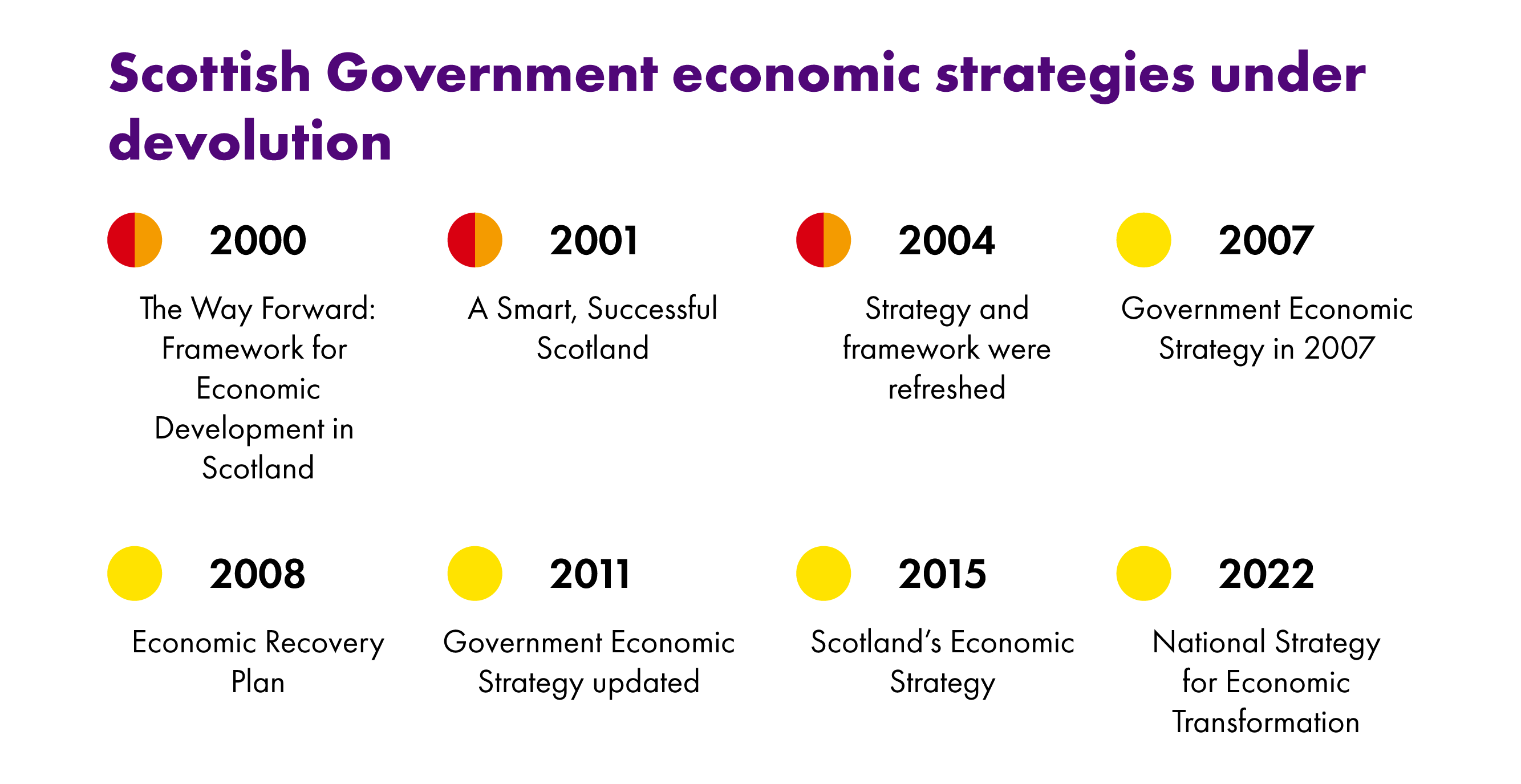
The first strategy in 2000 was focused on providing direction for enterprise agencies and economic development activity. By 2007, economic strategies were being designed as a framework for all government policy.
Successive strategies have gradually tackled wider social challenges. Reducing inequality and transitioning to a low carbon future explicitly feature in the language of more recent devolved economic policy.
The most recent Scottish Government economic strategy
The most recent Scottish Government economic strategy, launched in 2022, is the National Strategy for Economic Transformation (NSET). It is centred around five ‘programmes of action’:
Programme 1: Enterprise and innovation
This programme aims to address relative underperformance in the creation of new businesses, the scaling up of successful companies, and the share of businesses developing new products, services and businesses practices.
Government action involves the Techscaler programme, Scotland AI, the Ecosystem fund, the Chief Entrepreneur role and the Pathways fund to widen access to entrepreneurship.
Programme 2: Investment
The level of capital investment in the Scottish and UK economy has lagged international competitors in recent decades.1 Programme 2 aims to narrow this gap, attract international investment in Scotland’s economy, and expand Scottish businesses’ activity in new markets – both geographic (i.e. exporting overseas) and industrial (i.e. in emerging industries, such as renewable energy, the hydrogen economy and life sciences).
Programme 3: Productive businesses and regions
This programme aims to improve productivity performance across Scotland’s regions. The scope of this programme was recently expanded to include planning. The Scottish Government also includes housebuilding, businesses’ regulatory environment, digital infrastructure and major events within this programme.
Programme 4: Skilled workforce
This programme aims to upskill and expand the size of the workforce. It highlights population challenges in rural areas and points out that technological change and the transition to net zero will bring changing skills requirements.
Programme 5: A fairer and more equal society
Programme 5 aims to increase wages, tackle poverty and improve measures of wellbeing. The strategy aims to focus on “the sectors where low pay or precarious work are most prevalent”, deliver the fair work agenda, and reduce structural barriers to participation in the labour market.
The most recent NSET progress update is summarised in a SPICe blog.
The impact of devolved economic strategies
Assessing the impact of devolved economic policy is difficult. A starting point might be to compare headline economic indicators in Scotland compared to other parts of the UK since 1999.
A 2026 article by Future Economy Scotland notes that, since the onset of devolution:
GDP has grown faster in Scotland than in any other UK nation,
employee wages for full-time workers have overtaken England to be the highest of any UK nation,
disposable income has grown faster in Scotland than anywhere outside London.
However, looking at headline measures alone comes with limitations because there are lots of things that affect Scotland’s economic performance beyond the control of the Scottish – and indeed UK – Government.
Whilst there are some clear examples of devolved policies affecting economic outcomes (e.g.the impact of the Scottish Child Payment on child poverty rates), it is difficult for observers to know the overall impact of Scottish Governments’ economic strategies. This is partly due to the nature of devolved and reserved powers, which can interact with each other in complex ways. However, it is also because detailed and systematic evaluation of Scottish Government economic strategies has been limited.
There has been evaluation activity, both within government and from external bodies, such as Audit Scotland. However, this has tended to focus on specific policy programmes and funding streams, the delivery of promised actions, or on the governance of economic strategies.
There has been no formal systematic review of the total impact of devolved economic strategies, what has worked, where policy has or has not ‘shifted the dial’, and whether the strategic priorities are right.
However, academia has provided some commentary. In 2024, economists Andrew Goudie, Graeme Roy and David Waite examined Scotland’s economy after 25 years of devolution.
They concluded:
How well has Scotland’s economy performed? The evidence on economic outcomes is mixed. As in 1999, Scotland continues to perform as one of the ‘best’ parts of the UK on key metrics. In some areas, relative performance has got slightly better (e.g. productivity), some have made little progress if at all (e.g. exports, business growth and innovation), whilst others have ebbed and flowed (e.g. labour market).
One crucial observation is that Scotland’s relative performance needs to be viewed through the lens of an increasingly unequal UK economy with a concentration of activity in London and the South East. As we show, Scotland, in the main, has maintained its relative – or indeed marginally improved its – position within the UK, but long-standing gaps with international economies remain.
Should we be surprised? Arguably, no. The Scottish economy is highly integrated into the wider UK economy and Holyrood only has partial devolution of economic responsibilities. But at the same time, a review of strategies [over the devolution era] reveals a remarkable degree of similarity in approach if not language.
Whilst a change in performance might have been the ambition, the dial has not shifted by much (good or bad), in part, because of a preference for adhering to long-standing policy solutions. Where there has been change, such as the increased progressivity of income tax or reforming social security, these have been framed by motivations beyond economics, including funding of public services and perceived fairness of the tax system.
More generally, despite a churn of initiatives, there has been a lack of evaluation of what has worked, what has not, and how effective delivery has been. One is left with the impression of the economics of devolution as often being focussed upon style rather than substance.
Devolved economic policy - who does what?
This section introduces devolved public sector organisations that are relevant to economic policy in Scotland. It also includes some partnerships and organisations outwith the public sector where these have some responsibilities around economic policy in Scotland.
Where relevant, there is also a brief outline of some themes that emerged from parliamentary scrutiny of these organisations in Session 6.
Scottish Enterprise
Responsibilities
The Scottish Government’s national economic development agency. A non-departmental public body of the Scottish Government. Established by the Enterprise and New Towns (Scotland) Act 1990, although its predecessor was established in the 1970s.
Scottish Enterprise provides businesses with advice, funding and investment to help them grow, innovate and export. Alongside business-level support, it also delivers infrastructure assets aimed at supporting key sectors, such as the Dundee Life Sciences Innovation Hub.
Scottish Enterprise’s international arm is Scottish Development International, which helps Scottish companies with exporting and attracting foreign investment.
Scottish Enterprise budget settlement 2026-27
| Budget | 2026-27 Scottish budget |
| Resource | £134 million |
| Capital (including net financial transactions) | £90 million |
Source: Scottish Government
Scottish Enterprise’s resource budget has remained fairly flat in cash terms over the last three budget cycles, but its capital budget has been growing in real terms.
Staff numbers
Full-time equivalent headcount 2024-25: 1,384
Source: Scottish Enterprise
Session 6 scrutiny
The Session 6 Economy and Fair Work Committee routinely scrutinised the performance of Scottish Enterprise. Its focus was on value for money, the outcomes achieved by Scottish Enterprise, the coverage of Scottish Enterprise’s support to businesses, and governance.
During our 2026-27 pre-budget scrutiny, the Committee was unclear, particularly in the case of Scottish Enterprise, what its impacts had been, what outcomes were being delivered, and how Scottish Enterprise satisfies itself that its work is additional. On business support provided by the enterprise agencies, although data is available on businesses that receive it, the Committee was interested to know which businesses did not receive support and the reasons for that. The Committee also asked about the role of the Boards and the extent to which there is an appropriate challenge function being exercised. The Committee suggests that these are areas that an incoming committee may wish to give further consideration to.
Source: Session 6 Economy and Fair Work Committee
The activities of enterprise agencies often support jobs and business growth, but some of this may have occurred anyway had enterprise agencies not intervened. Therefore, a key challenge for scrutiny of enterprise agencies (in general, not just in Scotland) is understanding their additional impact on the economy.
Highlands and Islands Enterprise (HIE)
Responsibilities
Economic development agency for the Highlands and Islands region. A non-departmental public body of the Scottish Government. Established by the Enterprise and New Towns (Scotland) Act 1990, although its predecessor was established in the 1960s.
The Highlands and Islands and the South of Scotland (see below) are the only two parts of Scotland with their own regional economic development agency.
HIE’s remit is similar to that of Scottish Enterprise but with additional responsibilities over social development. Supporting the development of Gaelic is also within its remit.
HIE budget settlement 2026-27
| Budget | 2026-27 Scottish budget |
| Resource | £28 million |
| Capital (including net financial transactions) | £25 million |
Source: Scottish Government
HIE’s resource and capital budgets have remained almost completely flat in cash terms since 2024-25, meaning a real terms decrease in funding from the Scottish Government.
Staff numbers
Average number of employees 2024-25: 337
Source: HIE
Session 6 scrutiny
The Session 6 Economy and Fair Work Committee routinely scrutinised the performance of HIE. Its scrutiny fell along similar lines to its scrutiny of Scottish Enterprise.
The Session 6 Public Audit Committee also scrutinised management of events at the Cairngorm Funicular Railway. The railway is managed by a subsidiary of HIE, Cairngorm Mountain (Scotland) Limited.
South of Scotland Enterprise (SOSE)
Responsibilities
Economic development agency for Dumfries and Galloway and Scottish Borders. A non-departmental public body of the Scottish Government. Established by the South of Scotland Enterprise Act 2019.
SOSE has a similar remit to Scottish Enterprise but with an additional focus on sustainability and social development that is explicit in its founding legislation.
SOSE budget settlement 2026-27
| Budget | 2026-27 Scottish budget |
| Resource | £14 million |
| Capital (including net financial transactions) | £17 million |
Source: Scottish Government
Similar to Scottish Enterprise, SOSE’s resource budget has remained flat in cash terms over the last three budget cycles, but its capital budget has grown in real terms.
Staff numbers
Average number of employees 2024-25: 143
Source: SOSE
Note headcount figures include temporary staff.
Session 6 scrutiny
The Session 6 Economy and Fair Work Committee led parliamentary scrutiny of SOSE, alongside its scrutiny of Scottish Enterprise and HIE.
Scottish National Investment Bank (SNIB)
Responsibilities
The Scottish Government’s development bank. SNIB is a public limited company, wholly owned by the Scottish Ministers. It was established by the Scottish National Investment Bank Act 2020.
SNIB was set up to provide ‘patient’ capital to businesses operating in Scotland where commercial finance is unavailable. Patient capital is a form of long-term investment, where the investor (in this case, SNIB) is willing to accept lower or delayed financial returns than typically available from commercial investors.
When SNIB invests in a business, it aims to generate financial, social and environmental returns in line with at least one of its three missions: achieving a just transition to net zero, addressing regional inequality, and enabling innovation to support competitiveness and productivity.
It typically invests in businesses requiring between £1 million and £50 million of capital.
The Scottish Government’s intention is to capitalise SNIB with £2 billion over its first ten years. In practice, this has meant the Scottish Government allocating £200 million per year from its capital budget to SNIB to invest at arms-length from ministers.
In the long term, the Scottish Government intends that returns on SNIB’s investments will be recycled, enabling the Bank to operate as a self‑sustaining, perpetual investment fund.
SNIB budget settlement 2026-27
SNIB’s operating costs are now fully covered by its investment income, meaning that it does not require any funding from the Scottish Government’s resource budget.
It receives £200 million per year from the Scottish Government’s capital budget, specifically in the form of Financial Transactions. These are a form of capital funding from the UK Government that can only be used for loans or equity investments in the private sector.
Session 6 scrutiny
The Economy and Fair Work Committee scrutinised SNIB’s establishment and performance during Session 6.
After three Chief Executives in its first five years, the Committee was concerned about strategic continuity and governance while the Bank was establishing itself.
The Committee was also concerned about HM Treasury rules that constrain SNIB in recycling capital:
HM Treasury (HMT) rules prevent SNIB from recycling capital, as is the case for other state-owned banks or other investment vehicles. The Committee regards this as sub-optimal as this restricts the capacity for compounded growth. The Parliament's intention was, in due course, for SNIB to have a full range of financing powers and flexibility to function as a perpetual fund. HMT dispensation is required but little progress has been made. The Committee recently wrote to HMT seeking further clarification but is yet to receive a response. The successor committee will wish to follow this up.
Source: Session 6 Economy and Fair Work Committee
Otherwise, the focus of the Committee’s scrutiny of SNIB was on:
the performance of the Bank’s investment portfolio,
losses made on investments and whether the Bank’s risk appetite is appropriate,
the extent to which SNIB is meeting its goals across its three missions.
VisitScotland
Responsibilities
Scotland’s national tourism board. A non-departmental public body of the Scottish Government. Established when the Tourist Boards (Scotland) Act 2006 abolished regional tourism boards and created a single national body.
VisitScotland supports the visitor economy with the aim of growing its value. This includes providing support and advice to tourism businesses, promoting Scotland as a tourist destination internationally, enhancing the visitor experience, and compiling data on tourists’ behaviour to inform market opportunities.
VisitScotland budget settlement 2026-27
| Budget | 2026-27 Scottish budget |
| Resource | £40 million |
| Capital (including net financial transactions) | £9 million |
Source: Scottish Government
VisitScotland’s budget settlement has been fairly flat in cash terms for a number of years. This means its real terms spending power is falling.
The £9 million capital allocation includes £7 million budgeted for ‘tourism special projects’, such as the £4 million Rural Tourism Infrastructure Fund.
Staff numbers
Average full-time equivalent headcount 2024-25: 441
Source: VisitScotland
Note headcount figures are for VisitScotland Group and includes inward secondments and temporary staff.
VisitScotland’s headcount is on a downward trajectory, falling from 525 in 2022-23 to 441 in 2024-25. Furthermore, this is the average headcount across the year. At 2024-25 year-end, VisitScotland’s headcount was 399 full-time equivalents, suggesting that its average for 2025-26 may be lower still than 2024-25.
Session 6 scrutiny
The Session 6 Economy and Fair Work Committee scrutinised VisitScotland’s management of its declining real terms budget, its business change programme (particularly the closure of tourist information centres in favour of a ‘digital first’ approach), and how it positions Scotland in a competitive international market.
The Committee has been keen to protect VisitScotland's international promotional spend. In 2024, VisitScotland announced a two-year phased closure programme for all visitor information centres, to focus on a “digital first” approach; an approach that the Committee regards as providing a woefully inadequate service. These closures are part of VisitScotland's wider strategic change programme. An incoming committee may wish to evaluate the programme.
Consumer Scotland
Responsibilities
An independent statutory public body established by the Consumer Scotland Act 2020 to represent and promote the interests of consumers in Scotland.
Provides consumer advocacy and advice (though not to individual consumers), conducts research into consumer issues, maintains a database of recalled goods, and promotes the consumer duty across public authorities. It took on some statutory consumer advocacy functions previously carried out by Citizens Advice Scotland and others, particularly in regulated markets such as energy, post and water.
Consumer Scotland budget settlement 2026-27
| Budget | 2026-27 Scottish budget |
| Resource | £5 million |
| Capital (including net financial transactions) | £0 |
Source: Scottish Government
Staff numbers
Full-time equivalents employed at year end 2024-25: 34
Source: Consumer Scotland
Session 6 scrutiny
The Session 6 Economy and Fair Work Committee scrutinised Consumer Scotland.
The Committee has been interested in Consumer Scotland's efficiency and effectiveness, value for money, how outcomes are measured, public reach, and how it supports small businesses. An independent review of Consumer Scotland's performance is about to conclude. A successor committee will wish to consider the report of that review.
Local authorities
Local authorities in Scotland have direct responsibilities for the delivery of business advice and support services, mainly via Business Gateway, and for local economic development, including employability services and local area regeneration. They are also responsible for a wider range of services and functions which impact directly on the growth of the economy, including:
planning, roads and transport, environmental health, education and childcare, events and tourism, community development and culture and leisure services
the delivery of City and Growth Deals and the development of broader regional economic partnerships.
Local authorities’ economic development spend is currently a relatively small part of most councils’ budgets, amounting to £643 million in 2023-24 (from a total net revenue spend of £14.3 billion). This now includes some funding direct from the UK Government.1 The Scottish Local Authority Economic Development group (SLAED) says that there were 1,343 FTE staff working in economic development delivery across Scotland in 2023-24. Total local government employment (FTE) stood at around 215,000.2
City region and growth deals
City region and growth deals are not public sector organisations in themselves. However, they are relevant to how economic development is delivered in Scotland.
City region and growth deals are bespoke multi-year funding agreements between the Scottish Government, the UK Government, local authorities and other local partners. Each area of Scotland has at least one deal in place. City region and growth deals typically span more than one local authority area.
They are designed to bring about long-term improvements to regional economies, particularly by co-ordinating public investment and infrastructure projects. In total, £6.3 billion of funding was committed to the growth deals over 11 years.
Each deal is different and has its own governance structure. However, the Scottish and UK governments have convened a Scottish City Region and Growth Deal Delivery Board to oversee implementation of growth deals in Scotland.
Session 6 scrutiny
The Session 6 Economy and Fair Work Committee undertook an inquiry into Scotland's city region and growth deals. It called for a second phase of deals in Scotland, as current deals begin to expire.
Regional economic partnerships (REPs)
As with city region and growth deals, REPs are not public sector organisations. They are included in this briefing as relevant bodies to economic development in Scotland.
REPs is a general term for bespoke arrangements across different geographic areas of Scotland that bring together local authorities, enterprise agencies, private sector industry, education providers and the third sector.
They act as a forum for collaboration, intelligence gathering and sharing, and provide strategic direction for economic development at a local level.
They do not, however, have formal powers underpinned by legislation.
REPs are closely linked to city region and growth deals. In fact, many REPs were established as a direct result of these deals.
Green freeports
The freeports programme was initiated by the UK Government in England. Freeports are designated economic zones centred around a trading hub, where businesses are given tax reliefs, regulatory exemptions, bespoke customs arrangements and planning support. The aim is to stimulate investment and economic activity in a given area.
Because the tax and regulatory incentives involved relate to reserved and devolved powers, a joint approach has been taken to freeports in Scotland. In particular, the Scottish Government has tried to adapt them to incentivise ‘fair work’ practices and conditionality around the transition to net zero, hence the name ‘green freeports’.
Green freeports do not have a standalone statutory basis. They are established by agreement of UK and Scottish Governments using existing powers over tax, planning, economic development and trade.
Scotland currently has two green freeports: the Inverness and Cromarty Firth Green Freeport and the Forth Green Freeport.
Crown Estate Scotland
Crown Estate Scotland is the public body responsible for managing the Scottish Crown Estate. Following the devolution of Crown Estate powers through the Scotland Act 2016, it has operated as a public corporation accountable to the Scottish Parliament under the framework established by the Scottish Crown Estate Act 2019.
It manages a diverse portfolio of rural, coastal, marine and urban assets on behalf of the Crown, including much of Scotland's seabed, rights to offshore renewable energy development, aquaculture leases, and extensive rural land holdings.
It has become increasingly important to Scotland's economic development through its role in offshore wind leasing, marine investment and the management of assets linked to the energy transition.
Scottish Fiscal Commission (SFC)
The SFC is Scotland's independent fiscal institution and a non-ministerial office established by the Scottish Fiscal Commission Act 2016. It is operationally independent of the Scottish Government and is directly accountable to the Scottish Parliament.
The Commission produces the official forecasts that underpin the Scottish Budget. These include forecasts of the Scottish economy, revenues from devolved taxes and expenditure on devolved social security benefits. It also assesses the reasonableness of the Scottish Government's borrowing projections and publishes analysis of the long-term sustainability of Scotland's public finances.
Scottish Fiscal Commission budget settlement 2026-27
| Budget | 2026-27 Scottish budget |
| Resource | £3 million |
| Capital (including net financial transactions) | £0.1 million |
Source: Scottish Government
Staff numbers
Average number of full-time equivalents 2024-25: 25.6
Source: SFC
Scottish Futures Trust (SFT)
The SFT is an arm's-length public body established by the Scottish Government in 2008 to improve the efficiency and effectiveness of infrastructure investment across Scotland.
Rather than directly funding or delivering infrastructure projects, SFT provides commercial, financial and technical expertise to public bodies.
Scottish Futures Trust budget settlement 2026-27
| Budget | 2026-27 Scottish budget |
| Resource | £8.5 million |
| Capital (including net financial transactions) | £0 |
Source: Scottish Government
Staff numbers
Average number of full-time equivalents 2024-25: 63
Source: SDS
Skills Development Scotland (SDS)
SDS is Scotland's national skills agency. It is a non-departmental public body of the Scottish Government established in 2008 through the merger of several skills and careers organisations.
SDS is responsible for Scotland's all-age careers service, providing careers information, advice and guidance to individuals throughout their working lives. It also administers significant public investment in apprenticeships and other forms of work-based learning, working with employers, training providers and colleges to develop Scotland's workforce. In addition, SDS produces labour market and skills intelligence used by government, businesses and education providers to inform skills planning and investment decisions.
Skills Development Scotland budget settlement 2026-27
| Budget | 2026-27 Scottish budget |
| Resource | £198 million |
| Capital (including net financial transactions) | £1 |
Source: Scottish Government
Staff numbers
Average number of full-time equivalents 2024-25: 1,302
Source: SDS
Session 6 scrutiny
Session 6 parliamentary scrutiny of SDS was primarily delivered as part of scrutiny of wider skills-related issues.
In particular, the Session 6 Education, Children and Young People Committee scrutinised reform of the skills system in Scotland. This includes:
The Independent Review of Qualifications and Assessment (the Hayward Review)
The Independent Review of the Skills Delivery Landscape (the Withers Review)
Transitions between education, training and employment for disabled children and young people.
Source: Education, Children and Young People Committee Session 6 legacy report
Sources
Scottish Government. (2025, April). Procurement activity: annual report 2022 to 2023. Retrieved from <a href="https://www.gov.scot/publications/annual-report-procurement-activity-scotland-overview-procurement-activity-2022-2023/pages/2/" target="_blank">https://www.gov.scot/publications/annual-report-procurement-activity-scotland-overview-procurement-activity-2022-2023/pages/2/</a>
Scottish Parliament Information Centre (SPICe). (2026, July). Scotland's economy: A subject profile. Retrieved from <a href="https://www.parliament.scot/chamber-and-committees/research-prepared-for-parliament/research-briefings/2026/7/1/sb-2640#dp64883" target="_blank">https://www.parliament.scot/chamber-and-committees/research-prepared-for-parliament/research-briefings/2026/7/1/sb-2640#dp64883</a>
House of Commons Library. (2026, June). Local growth funds. Retrieved from <a href="https://commonslibrary.parliament.uk/research-briefings/cbp-9460/" target="_blank">https://commonslibrary.parliament.uk/research-briefings/cbp-9460/</a>
Scottish Local Authority Economic Development group (SLAED). (2025, February). Scottish Local Authorities Economic Development: Indicators Framework Report 2023-24. Retrieved from <a href="https://www.slaed.org.uk/__data/assets/pdf_file/0033/57696/SLAED-Indicators-Report-2023-24.pdf" target="_blank">https://www.slaed.org.uk/__data/assets/pdf_file/0033/57696/SLAED-Indicators-Report-2023-24.pdf</a>