Explainer: common frameworks and their implications for the Scottish Parliament
This briefing provides an overview of common frameworks and their implications for the Scottish Parliament. It explains what they are, why they are being developed, and covers key issues that have arisen in connection with them.
Summary
Common frameworks are agreements that set out how the governments in the UK work together to make decisions about the law and policy in certain devolved areas. Understanding common frameworks and how they may affect policymaking is an important part of understanding how devolution operates. This short briefing explains what common frameworks are and how they link to the UK Internal Market Act 2020. It also gives an overview of issues that have arisen to date in relation to common frameworks and what implications these may have for Session 7.
What are common frameworks and why are they needed?
Common frameworks are intergovernmental agreements that set out how the governments in the UK agree to work together when making decisions about the law and policy in certain devolved areas. In particular, they provide a forum through which the governments can reach decisions about when they should pursue the same policy, and when policy difference is appropriate.
During its membership of the European Union, the UK was required to comply with EU law. This meant that, in many policy areas, a consistent approach was often adopted across all four nations of the UK, even where those policy areas were devolved. The requirement to comply with EU law has not applied since the transition period ended on 31 December 2020.
The UK and devolved governments agreed that common frameworks should be developed to avoid significant policy difference (sometimes referred to as 'divergence'), where that would be undesirable. In October 2017, the Joint Ministerial Committee (EN), which was a forum for the UK Government and devolved governments to discuss EU exit, agreed an underlying set of principles to guide the creation of common frameworks. These principles are set out below.
Common frameworks will be established where they are necessary in order to:
enable the functioning of the UK internal market, while acknowledging policy divergence;
ensure compliance with international obligations;
ensure the UK can negotiate, enter into and implement new trade agreements and international treaties;
enable the management of common resources;
administer and provide access to justice in cases with a cross-border element; and
safeguard the security of the UK.
Frameworks will respect the devolution settlements and the democratic accountability of the devolved legislatures, and will therefore:
be based on established conventions and practices, including that the competence of the devolved institutions will not normally be adjusted without their consent;
maintain, as a minimum, equivalent flexibility for tailoring policies to the specific needs of each territory, as is afforded by current EU rules; and
lead to a significant increase in decision-making powers for the devolved administrations.
Frameworks will ensure recognition of the economic and social linkages between Northern Ireland and Ireland and that Northern Ireland will be the only part of the UK that shares a land frontier with the EU. They will also adhere to the Belfast Agreement.
Common frameworks were originally intended to be used to cover former areas of EU competence (i.e., areas governed by EU law prior to the UK leaving the EU), but some common framework documents state that they may be used to consider related matters within the wider policy area. For example, the Animal Health and Welfare Common Framework states that it applies to all Animal Health and Welfare legislation in the UK, including but not limited to assimilated law (formerly called 'retained EU law').
Common frameworks are published on the UK Government website. They are typically made up of two components:
a framework overview called a ‘Framework Outline Agreement’
a written agreement called a ‘Concordat’ or ‘Memorandum of Understanding.’
The overview document explains the framework by setting out the policy area, the legislation relevant to it, and operational details on how the governments will work together to make decisions and how they will resolve disagreements. The Concordat/Memorandum of Understanding is what the governments sign. These written agreements are not legally binding, they are political commitments.
Why is understanding common frameworks important?
Common frameworks are an important part of understanding how devolution operates. They sit alongside other changes such as reformed structures to support intergovernmental relations and arrangements relating to the UK Internal Market Act 2020 (UKIMA), all of which affect developments in devolved policy areas.
What's the link with the UK Internal Market Act?
The UK Internal Market Act 2020 (UKIMA) governs the trading relationship in goods and services across the UK (i.e., within the UK's internal market). It also affects how professional qualifications are recognised across the UK.
UKIMA establishes two market access principles, mutual recognition and non-discrimination, to protect the flow of goods and services in the UK’s internal market.
The mutual recognition principle for goods is the principle that goods which have been produced in, or imported into, one part of the UK, and can lawfully be sold there, should be able to be sold in any other part of the UK. Any different requirements that would otherwise apply to the sale in the other part of the UK are disapplied.
The mutual recognition principle for services is that a person authorised to provide services in one part of the UK is not required to meet additional authorisation requirements to provide those services in another part of the UK.
The non-discrimination principle for goods is the principle that the sale of goods in one part of the UK should not be affected by relevant requirements that directly or indirectly discriminate against goods that have a relevant connection with another part of the UK.
The non-discrimination principle for services is that a regulatory requirement will be of no effect in relation to an incoming service provider where it discriminates against that provider directly or indirectly.
Under UKIMA, UK Ministers have the power to amend the list of exclusions to which the market access principles do not apply. The consent of the devolved Ministers must be sought for any changes, but their consent is not required.
Although only UK Ministers have the power to make changes, the UK and devolved governments agreed a process for the consideration of exclusions in areas covered by common frameworks. The agreement was published in December 2021. To date, this process has been used to agree an exclusion in relation to single-use plastics. A proposed exclusion relating to the Deposit Return Scheme for Scotland was rejected leading to significant tensions between the UK Government and Scottish Government. The process was also used in relation to rodent glue traps, despite the policy not falling within a common framework area. Although UK Government Ministers are able to make a new exclusion, they are not legally obliged to do so.
The UK Government carried out a review of UKIMA in the first half of 2025, including the operation of the exclusions process, and published its response in July 2025. This includes a commitment by the UK Government to implement all exclusions that have been agreed by all governments through a common framework. In addition, it indicates that two additional processes for considering exclusions will operate alongside the common framework process and that environmental protection and public health considerations will be taken into account when assessing potential exclusions. SPICe has published a blog analysing the outcomes of the UK Internal Market Act review in more detail. An exclusion for single-use glass bottles as part of a Welsh Deposit Return Scheme was agreed in February 2026 through the Resources and Waste Common Framework.
More information on the UK Internal Market Act 2020 can be found in an upcoming SPICe briefing.
Current Status
Common frameworks go through four phases of development. The stages are set out below. The Parliament receives frameworks for scrutiny at phase four.

Scottish Parliament Information Centre
Each legislature in the UK can consider common frameworks. Issues raised by legislatures during this scrutiny are fed back to their respective government. Governments then consider any changes that should be made to frameworks in light of scrutiny by legislatures before implementing the framework. Changes in light of scrutiny are not, however, a requirement.
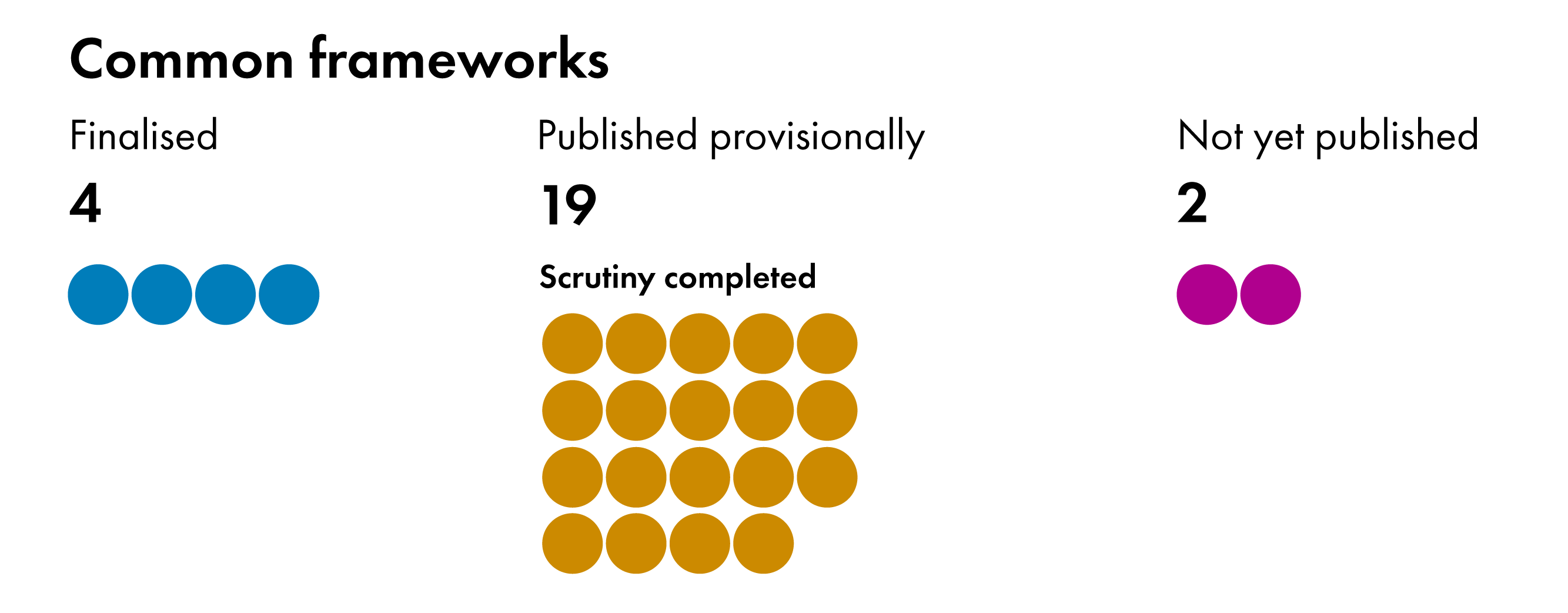
At the time of publication (12 June 2026), four common frameworks that apply to Scotland have been finalised. A further 19 have been published provisionally. Two more planned frameworks – the Zootechnics Framework and the Services Directive Framework – remain unpublished.
Scottish Parliament Information Centre
Information on the status of all common frameworks and scrutiny of them can be found on the SPICe intergovernmental activity hub.
'provisionally published':
Common framework agreements are published in draft form to enable scrutiny. They may be revised before finalisation.
'scrutinised':
Common framework agreements can be examined by the four UK legislatures.
'operational':
Common framework forums facilitate intergovernmental activity in the policy area covered by the framework, in line with the processes set out in the agreement.
'finalised': Common framework agreements are republished to reflect any changes made following parliamentary scrutiny.
These terms describe key points in the development and use of common frameworks, but they do not represent a set of sequential stages. For example, a framework may be provisionally published and become operational while parliamentary scrutiny is still ongoing.
Key Issues
Delays in the framework programme
Most frameworks have been 'provisionally operational' (i.e., in operation but not finalised by governments) since the beginning of 2021, but were not published and sent to the Parliament (and other UK legislatures) for scrutiny until 2022. Only four frameworks have been finalised, meaning they have been scrutinised by all UK legislatures and agreed by the governments. Finalisation of those frameworks which are operating on a provisional basis has been delayed several times. Reasons for the delays include the lack of a functioning Northern Ireland Executive between 2022-24 and issues relating to the UK Internal Market Act 2020.
Scrutiny challenges for the Scottish Parliament
A central function of the Scottish Parliament is to scrutinise the policies and actions of the Scottish Government. Given that frameworks are intergovernmental agreements, the Scottish Parliament has a role in ensuring that it is content with the Scottish Government’s part in them.
Common frameworks are intergovernmental agreements and forums established by them facilitate intergovernmental discussion. As such, framework forums are attended by government officials. There are generally no requirements to publish minutes of common frameworks meetings and only some frameworks include requirements to report to legislatures.
Some frameworks require that governments inform legislatures of developments in policymaking 'where appropriate' but most contain no requirement for parliamentary engagement. This means that it is difficult for the Scottish Parliament to get information on the discussion and decision-making taking place in common frameworks. Governments have agreed an annual reporting process to inform legislatures and others of key developments that will apply to all frameworks, however, this requirement only takes effect once all frameworks are finalised. This lack of transparency is a significant scrutiny challenge for the Parliament and raises issues of accountability if the Parliament is unable to hold Ministers to account for the decisions made in these intergovernmental forums.
Parliamentary scrutiny in Session 6
During Session 6, Scottish Parliament committees undertook scrutiny of individual common frameworks during phase four of their development, when legislatures across the UK scrutinise common framework agreements. The Constitution, Europe, External Affairs and Culture (CEEAC) Committee had an oversight role in relation to the common frameworks programme.
In its 2023 report 'How Devolution is Changing Post-EU', the CEEAC Committee noted that "there appears to be a consensus among the UK Government and the Devolved Governments that Common Frameworks provide the right mechanism to manage regulatory divergence within the UK internal market" but highlighted a number of issues, including:
There is a lack of clarity around purpose with little evidence that frameworks are delivering common goals, maximum or minimum standards or harmonisation as initially intended;
Rather, as highlighted by the [Office for the Internal Market], the majority of activity has been routine intergovernmental working;
At the same time there have been some significant examples of regulatory divergence which raise questions around the role of frameworks in discussing exclusions from the market access principles and how these discussions feed into the process for considering exclusions;
The role of business and other stakeholders in the process and the role of parliament(s) in holding Ministers to account must be part of the wider framework process;
The low level of awareness of frameworks among business and other stakeholders.
Many of these reflected concerns raised by subject committees in their scrutiny of individual frameworks, including by the Session 6 Net Zero, Energy and Transport Committee and Rural Affairs and Islands Committee.
Concerns about stakeholder engagement were also echoed in the CEEAC Committee's 2026 report, 'Transparency of intergovernmental activity and its implications for parliamentary scrutiny', which highlighted the limited opportunities for stakeholder engagement within common frameworks.
Implications for Session 7
As set out in the section on the status of common frameworks, four of the 25 frameworks relevant to Scotland have been finalised at the time of publication. In January 2026, the Constitution, Europe, External Affairs and Culture Committee received updates on the common frameworks programme from both the Scottish Government and the UK Government .
The UK Government’s update indicated that ten frameworks are ready for publication in their finalised form, eight were being reviewed by policy officials, four remained under scrutiny by one or more of the UK's legislatures, and two were ready to be published provisionally.
The Scottish Government stated that UKIMA continues to act as a barrier to the effective implementation of common frameworks. The Scottish Government's position is that it will only sign off common frameworks where all governments agree that there are no market‑related interactions, meaning that any framework affected by UKIMA must remain provisional. The Scottish Government also identified a further group of frameworks (particularly those relating to Sanitary and Phytosanitary measures, energy and electricity), where, in its view, the UK Government's plans for dynamic alignment with EU law in some areas "may limit policy divergence, creating an opportunity to finalise these frameworks if UKIMA is disapplied in the relevant areas."i Given the Scottish Government's position on not finalising frameworks on which UKIMA has an effect, it is unclear whether frameworks which are provisional will be finalised in Session 7.
For the Scottish Parliament, the fact that frameworks are not finalised has practical implications for scrutiny. Reporting requirements, limited as they are, apply only once a framework is finalised. If information on how common frameworks are operating is not forthcoming then the Parliament’s ability to scrutinise these intergovernmental decision‑making forums is significantly constrained. This is of particular concern when it comes to how decisions taken in these forums interact with the exclusions process linked to UKIMA.
In relation to stakeholder engagement, the UK Government’s 2025 review of UKIMA heard that stakeholders “want their views to be considered within Common Frameworks discussions, and for this to take place in a clear and transparent way.” As part of the review, the UK Government committed to “work with the devolved governments to agree processes for how all four governments engage with businesses and other stakeholders on matters being discussed in Common Frameworks.”
Where can I find more information?
Common framework agreements are available on the UK Government's webpage.
SPICe publishes a briefing on each common framework entered into by the Scottish Government and provides information on scrutiny of common frameworks on the SPICe Intergovernmental Activity Hub. SPICe has also published blogs on why it is important for common frameworks to be scrutinised and how the Scottish Parliament can do so.