Social Security subject profile
This briefing explains how devolved social security has developed since 2013 and outlines current policy issues. It also considers how social security is funded and looks at forecast spend up to 2030.
Summary
Spending on devolved benefits represents around 22% of all social security spending in Scotland. Following the Smith Commission, the Scotland Act 2016 added significant new social security powers, mainly for disabled people and carers and to provide help with winter heating costs. The Scottish Government has since developed 'Scottish versions' of these, and added its own social security benefits, not available elsewhere in the UK - notably the Scottish Child Payment. A new executive agency, Social Security Scotland was established in 2018 to administer Scottish social security.
The process of developing these benefits took nine years and cost £683 million. Over 700,000 people had their benefits transferred from the UK Department for Work and Pensions (DWP) to Social Security Scotland by the end of 2025. In addition, around one million pension age people now get their winter heating payments from Social Security Scotland instead of DWP.
The main item remaining from this initial social security programme is creating Employment Injury Assistance to replace the DWP's Industrial Injuries Benefits scheme.
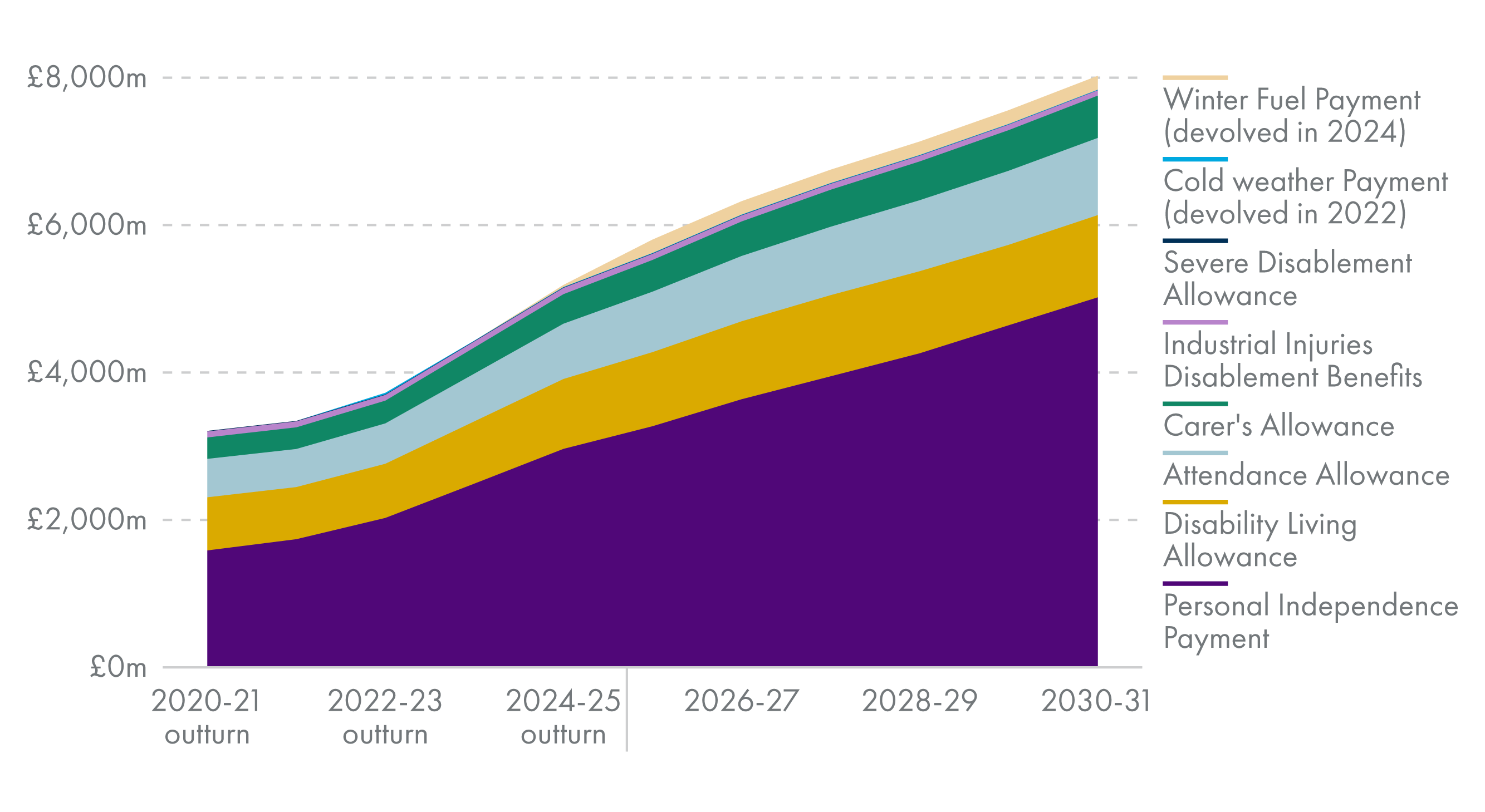
Spending on devolved benefits is forecast to increase from £7,335 million in 2026-27 to £9,156 million in 2030-31. This is not due to significant additional policy commitments. Instead it is mainly due to expected increase in people qualifying for disability benefits alongside a statutory duty to increase payment rates in line with inflation. Around 85% of this spending is covered by funding provided by the UK Government through Block Grant Adjustments to the Scottish block grant.
Of particular relevance to the debate about Scottish social security spending are two separate reviews of disability benefits. One, by Sir Stephen Timms, is looking at Personal Independence Payment (PIP). Due to report this autumn, this will have implications for the level of funding provided to the Scottish Parliament through the PIP Block Grant Adjustment. The other, a review of Adult Disability Payment by Edel Harris which reported last summer, contains a very wide range of recommendations, many of which have been left to the new Scottish Government to respond to.
Social security, through the Scottish Child Payment, has also been a major plank in the Scottish Government's plans to meet the statutory targets on child poverty. However, stakeholders have argued that much more needs to be done to meet these targets. In response the Scottish Government has proposed increasing the payment for children under one to £40 per week.
Devolved and reserved benefits
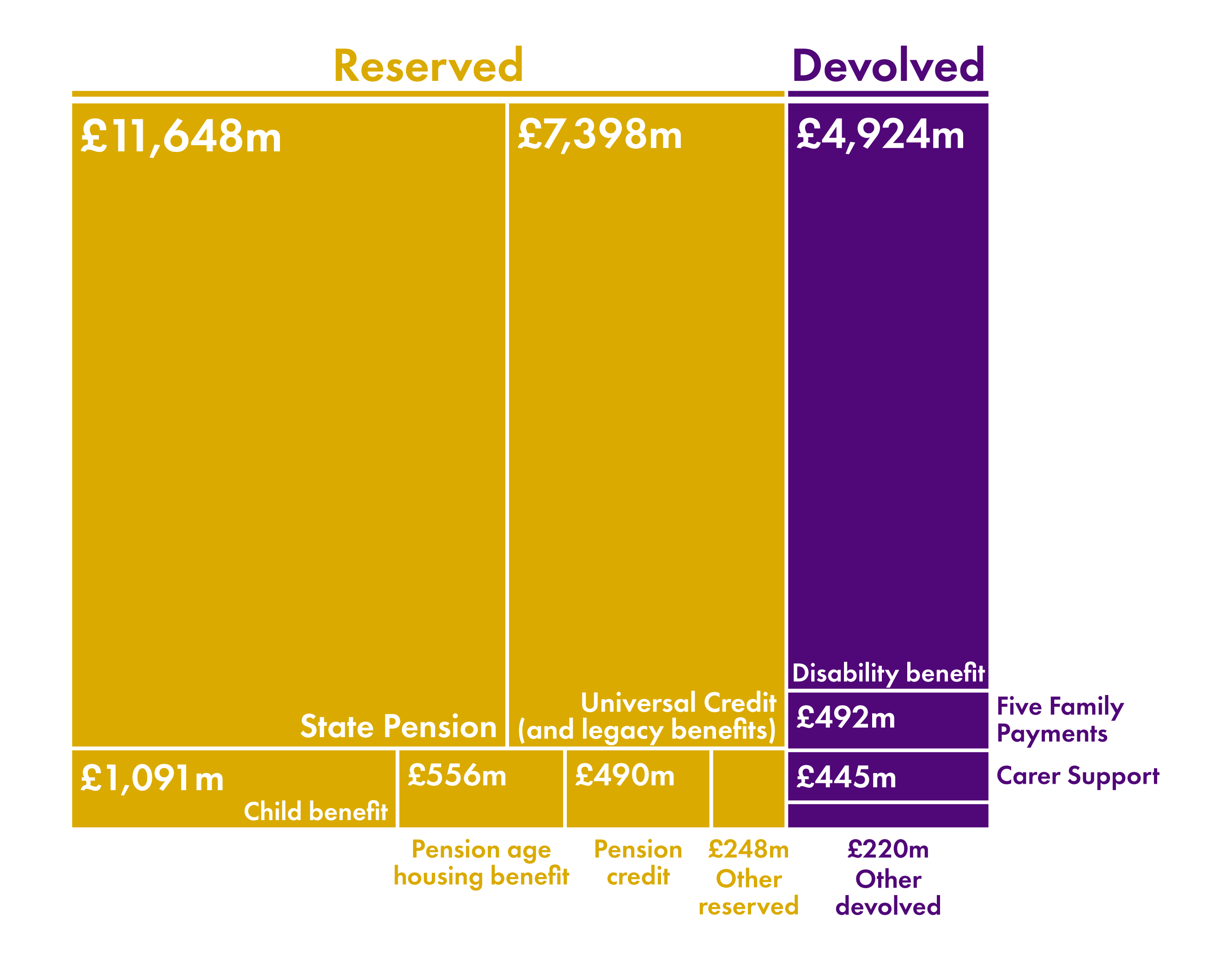
Most social security remains reserved to the UK Government with the largest benefits by spending being the State Pension and Universal Credit. Devolved benefits make up around 22% of total social security spending in Scotland.1
The main devolved benefits, administered by Social Security Scotland are:
Benefits that contribute to the extra cost of disability. These are not related to a person’s income or employment but instead reflect the types of tasks a person needs help with.
Benefits for carers.
Benefits for low-income families with children, including the Scottish Child Payment.
Benefits for winter heating for people on a low income, people of pension age and disabled children.
There are also smaller devolved benefits for help with funeral costs and help for young people moving off benefits into employment
In addition, there are relevant devolved payments administered by local authorities. These are:
Council Tax Reduction. Although not defined in law as a social security benefit, it is a devolved scheme that was introduced to replace Council Tax Benefit in 2013.
Discretionary Housing Payments – most of which are used to mitigate the under-occupancy charge (‘bedroom tax’/ ‘spare room subsidy’) in the social housing sector.
Scottish Welfare Fund – which provides discretionary grants in a crisis.
A new Care Leaver Payment from April 2026.
The chart below illustrates the scale of spending on reserved and devolved benefits in Scotland in 2024-25.
Department for Work and Pensions. (2025). Benefits Caseload and Expenditure . Retrieved from https://www.gov.uk/government/collections/benefit-expenditure-and-caseload-tables [accessed 9 June 2026]
Links between devolved and reserved benefits
Important links remain between reserved and devolved benefits which mean the systems cannot be entirely separate. For example:
Universal Credit is the main qualifying benefits for the devolved ‘Five Family Payments’, Funeral Support Payment and Job Start Payment.
To get (devolved) Discretionary Housing Payments, a person must be having their rent paid through (reserved) Housing Benefit or Universal Credit.
To get additional amounts in (reserved) Universal Credit for having a disabled child, a person must be getting (devolved) Child Disability Payment.
Social Security Scotland relies on data from the Department for Work and Pensions (DWP) for several of its benefits. For example, administration of Winter Heating Payment relies on DWP for information about people getting qualifying benefits.In addition, there are ongoing agency agreements with the DWP for them to administer two benefits on behalf of the Scottish Government: Industrial Injuries Disablement Benefitand Severe Disablement Allowance.
A separate briefing describes each of the devolved benefits.
Development of Scottish Social Security 2013 to 2026
Limited powers for social security were greatly expanded under the Scotland Act 2016.
Before 2016: Local authority payments
Before 2016, Scottish Ministers already had some social security powers for payments administered by local authorities.
In 2013 the Scottish Government gained responsibility for what had been community care grants, crisis loans and council tax benefit. These became the Scottish Welfare Fund (SWF) and the Council Tax Reduction scheme (CTR) administered by local authorities.
In 2014, Scottish Ministers were granted additional powers over Discretionary Housing Payments (DHPs) that enabled them to mitigate the ‘bedroom tax’. DHPs were fully devolved in 2017.
| Scotland | England and Wales equivalent |
|---|---|
| Discretionary Housing Payment | Crisis and resilience fund |
| Scottish Welfare Fund | Crisis and resilience fund |
| Council tax reduction | Council tax reduction local schemes |
Smith Commission and Scotland Act 2016
In 2016 very significant new social security powers were devolved to Scotland following the agreement set out in the 2014 Smith Commission report. No-one initially proposed the particular suite of social security powers that were eventually granted – it was the product of negotiation and compromise.
The SNP had argued for full devolution of social security whereas both the Labour Party and the Scottish Conservative and Unionist Party saw merit in devolving social security where there was a link to existing devolved services – for example Housing Benefit and Attendance Allowance given the links to already devolved powers of housing, health and social care.
The negotiations were conducted against the backdrop of significant welfare reform by the UK Government including the creation of Universal Credit and Personal Independence Payment in 2013. These were intended, in part, to reduce social security spending. For further detail see this House of Commons Library briefing.
From the Smith Commission to the present day, UK welfare reform continues to inform much of the debate about what Scottish social security should look like. The Scottish Government has often contrasted their own approach with that of successive UK Governments. For example, in 2025 the Scottish Government said:
Since the passage of the Social Security (Scotland) Act 2018, we have established a devolved social security system built on dignity, fairness, and respect, aiming to support Scotland’s most vulnerable people and address inequality. We have deliberately built a radically different system to both tackle the worst impacts of UK Government cuts and to tackle inequality and child poverty, as well as providing vital assistance to enable older people to heat their homes and to help disabled people live independent lives.
Scottish Government. (2025). Scottish Government high level action plan in response to the Committee on Economic, Social and Cultural Rights. Retrieved from https://www.gov.scot/publications/scottish-government-high-level-action-plan-response-committee-economic-social-cultural-rights/pages/13/ [accessed 13 April 2026]
The Scotland Act 2016 provided for devolution of:
Disability benefits (Disability Living Allowance, Personal Independence Payment, Attendance Allowance, Severe Disablement Allowance and Industrial Injuries Disablement Benefits).
Benefits for carers (Carer's Allowance).
Payments related to cold weather (the social fund Winter Fuel Payment and Cold Weather Payment).
Funeral expenses (the social fund Funeral Expenses Payment).
Welfare foods and certain payments for maternity expenses (Healthy Start Vouchers and vitamins, nursery milk and the social fund Sure Start Maternity Grant).
Discretionary Housing Payments.
The Scotland Act 2016 also allows Scottish Ministers some limited powers to alter the housing costs element of Universal Credit and change how these payments are made. It devolves power to top up reserved benefits (except those relating to housing costs) and to create new benefits (except pensions).
A system based on dignity and respect
Using the newly devolved powers, the Social Security (Scotland) Act 2018 established the legal framework for Scottish social security. This includes:
Establishing the different types of assistance, with individual benefits created by regulations made under the Act.
Requiring a Social Security Charter, benefit take-up strategy, a right to advocacy and a duty to uprate benefits by inflation.
Establishing the Scottish Commission on Social Security to scrutinise regulations and the Charter.
Providing for benefit decisions to be challenged through re-determination and appeal to the social security chamber of the First-tier Tribunal and Upper Tribunal.
Setting out the framework for recovering overpayments.
Setting out offences - including for seeking to obtain benefits by deception.
Social Security Scotland is not named in the Act as it is an executive agency rather than a statutory public body.
From the start, there was an emphasis on having a rights-based system with eight statutory principles based on dignity, fairness and respect. These are:
Social security is an investment in the people of Scotland.
Social security is itself a human right and essential to the realisation of other human rights.
The delivery of social security is a public service.
Respect for the dignity of individuals is to be at the heart of the Scottish social security system.
The Scottish social security system is to contribute to reducing poverty in Scotland.
The Scottish social security system is to be designed with the people of Scotland on the basis of evidence.
Opportunities are to be sought to continuously improve the Scottish social security system in ways which put the needs of those who require assistance first, and advance equality and non-discrimination.
The Scottish social security system is to be efficient and deliver value for money.
Introducing the Bill at the Stage 1 debate in December 2017, the then Minister for Social Security, Jeanne Freeman, MSP acknowledged the complexity and scale of the task:
We are, together, engaged in a complex and complicated task—to ensure that we build a rights based social security system for Scotland that not only delivers the 11 devolved benefits safely and securely but does so true to the principles that we have set out, and works effectively alongside the United Kingdom system. It is complex and it is complicated, but it is also a golden opportunity. The prize is a social security system that is there to support the people who need it, when they need it, for decades to come; a new public service that embodies the social contract between the individual and the state, founded on the shared recognition that we all contribute in different ways and that it is right that the state should provide at those times when we are in need.
Scottish Parliament. (2017). Chamber Official Report 19 December 2017, col 24. Retrieved from https://www.parliament.scot/api/sitecore/CustomMedia/OfficialReport?meetingId=11275 [accessed 13 April 2026]
Creating new benefits: the Social Security Programme 2017 - 2026
The practical task of establishing Scottish social security involved:
Establishing the Social Security Programme in the Scottish Government to develop new systems and create ‘Scottish versions’ of DWP benefits.
Establishing a new executive agency, Social Security Scotland, to deliver new benefits.
Having ‘agency agreements’ for DWP to continue to administer benefits like Personal Independence Payment in Scotland until the Social Security Scotland replacement was ready.
The Social Security Programme was established in the Scottish Government in January 2017 and ran until March 2026.1 It was separate from Social Security Scotland which focused on running live benefits. By the time the Programme closed, 18 benefits had been created and handed over to Social Security Scotland for live running, 8 of which were unique to Scotland.
| Scotland | England and Wales | |
|---|---|---|
| Disability | Child Disability Payment | Disability Living Allowance |
| Adult Disability Payment | Personal Independence Payment | |
| Scottish Adult Disability Living Allowance | Disability Living Allowance | |
| Pension Age Disability Payment | Attendance Allowance | |
| Carer | Young Carer Grant | n/a |
| Carer Support Payment | Carer’s Allowance | |
| Carer Additional Person Payment (2026) | n/a | |
| Scottish Carer Supplement | n/a | |
| Children | Best Start Grants (3 grants) | SureStart Maternity Grant |
| Best Start Foods | Healthy Start Vouchers | |
| Scottish Child Payment | n/a | |
| Winter heating | Child Winter Heating Payment | n/a |
| Winter Heating Payment | Cold Weather Payment | |
| Pension Age Winter Heating | Winter Fuel Payment | |
| Other | Funeral Support Payment | Funeral Expenses Payment |
| Job Start Payment | n/a |
The whole Programme was initially expected to take four years but in fact took nine. Reasons given by the Scottish Government for the longer time-frame included adding in additional benefits, particularly the Scottish Child Payment and delays due to COVID.2
Two defining features of the approach were:
Taking a phased approach to delivery, using Agency Agreements with DWP to administer devolved benefits until the ‘Scottish version’ was ready. This approach emphasised safe and secure transfer of DWP clients to Social Security Scotland. Around 700,000 clients transferred from DWP to Social Security Scotland by the end of 2025, with only Severe Disablement Benefit and Industrial Injuries Disablement Benefit still operating under agency agreements in 2026.
Using the 'Agile' approach to system development, which is based on delivering a minimum viable product which is then revised and improved.
These choices continue to influence devolved social security today.
Emphasising ‘safe and secure transfer’ meant that many stakeholders' hopes for major changes to eligibility criteria have not yet been realised. The eligibility rules for most Social Security Scotland benefits look very similar to their DWP counterparts. The main differences are in the approach to administration, such as not requiring assessments in Adult Disability Payment. Now that case transfer is complete, there are expectations for further change – particularly to Adult Disability Payment. For example, in 2022 the Disability and Carer Benefits Expert Advisory Group published recommendations for change 'beyond safe and secure transfer', saying:
Whilst the Scottish Government has introduced some improvements at this time including a system based on the principles of dignity, fairness and respect; reducing face-to-face assessments for disability benefits; improving communications and processes; offering disabled people that need help with the application process independent advocacy; introducing Short-term Assistance; and involving people with diverse lived experiences of social security in developing policy there are many aspects that remain unchanged, unfair and problematic. Beyond a safe and secure transfer, the Scottish Government has the opportunity to introduce transformational changes to the Scottish social security system to create a world-leading rights-based system of support.
Disability and Carer Expert Advisory Group. (2023). Beyond safe and secure transfer. Retrieved from https://www.gov.scot/binaries/content/documents/govscot/publications/independent-report/2023/03/disability-carer-benefits-expert-advisory-group-beyond-safe-secure-transfer/documents/disability-carer-benefits-expert-advisory-group-beyond-safe-secure-transfer/disability-carer-benefits-expert-advisory-group-beyond-safe-secure-transfer/govscot%3Adocument/disability-carer-benefits-expert-advisory-group-beyond-safe-secure-transfer.pdf [accessed 13 April 2026]
More recently, Edel Harris stated in her review of Adult Disability Payment that:
there is an overwhelming expectation because of this Review, for the inherited PIP criteria to be improved to sit more comfortably with the aspirations set out in the Charter and to ensure that Adult Disability Payment is fair, transparent and supportive, empowering those it serves to live with dignity and independence.
Harris, E. (2025). Independent Review of Adult Disability Payment. Retrieved from https://www.gov.scot/binaries/content/documents/govscot/publications/independent-report/2025/07/independent-review-adult-disability-payment-final-report/documents/independent-review-adult-disability-payment-final-report/independent-review-adult-disability-payment-final-report/govscot%3Adocument/independent-review-adult-disability-payment-final-report.pdf [accessed 13 April 2026]
In March 2026 when discussing the Scottish Government's response to that Independent Review of Adult Disability Payment, Craig Smith (Scottish Action for Mental Health) told the Social Justice and Social Security Committee that:
we are pretty disappointed that the much more fundamental change to the actual structure of ADP—to move away from the framework that we have as a legacy of the personal independence payment—which the review rightly calls for, has been parked
Scottish Parliament. (2026). Social Justice and Social Security Committee Official Report, 12 March 2026, col 9. Retrieved from https://www.parliament.scot/api/sitecore/CustomMedia/OfficialReport?meetingId=20144 [accessed 13 April 2026]
Using the ‘Agile’ approach has meant that further work is required to refine systems. Audit Scotland commented in 2022 that Agile:
supports fast, user-focused and adaptable delivery by focusing on ‘must-have’ features to allow benefits to be launched in an acceptable way. For Social Security Scotland to operate efficiently and effectively, resources will be needed over the longer term to continue systems development and replace temporary and manual processes.
Audit Scotland. (2022). Progress in implementing the devolved benefits. Retrieved from https://audit.scot/publications/social-security-progress-on-implementing-the-devolved-benefits [accessed 13 April 2026]
Cost of creating the new system
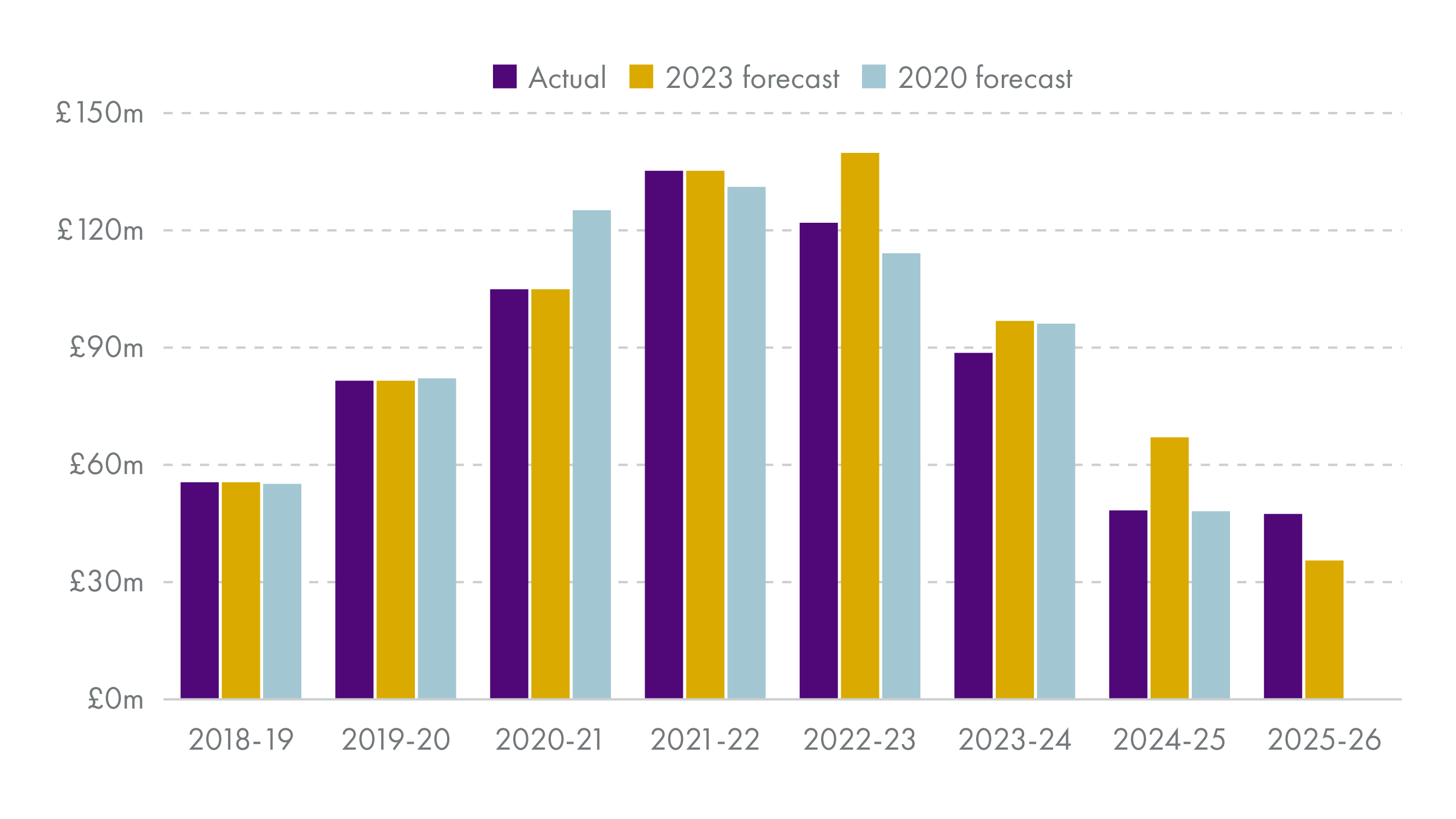
The costs of setting up the new system – the ‘implementation investment’ was initially estimated at £308 million over four years to 2020-21. Final costs were £683 million over nine years to March 2026.
The Financial Memorandum in 2017 had given a very broad brush initial estimate, stating:
At this stage, the estimates of implementation costs set out above total £308 million and will change materially as further decisions are taken and the programme of work to specify and procure the infrastructure required for Scotland’s new social security system evolves.
Scottish Parliament. (2017). Financial Memorandum Social Security (Scotland) Bill. Retrieved from https://www.parliament.scot/-/media/files/legislation/bills/previous-bills/social-security-scotland-bill/introduced/financial-memorandum-social-security-scotland-bill.pdf [accessed 13 April 2026]
In 2020, the financial business case revised implementation costs to £651 million over 8 years (to 2024-25).2
In 2023, this was revised again, to £715 million over 9 years (to 2025-26).3 When the Programme closed in March 2026, the final cost was slightly lower, at £683 million over nine years.4
The chart below shows how implementation investment peaked in 2021-22, at £135 million. At its peak, the Programme employed over 800 people.5
Scottish Government. (2026). Social Security Programme 2017-2026 Delivery Report. Retrieved from https://www.gov.scot/publications/social-security-programme-2017-2026-delivery-report/ [accessed 13 April 2026]Scottish Government. (2023). Revised Programme Business Case. Retrieved from https://www.gov.scot/publications/executive-summary-social-security-business-case-february-2023/ [accessed 13 April 2026]Scottish Government. (2020). Programme Business Case. Retrieved from https://www.gov.scot/publications/social-security-programme-business-case-executive-summary/documents/ [accessed 13 April 2026]
The timeline below shows how the Programme started with the more straightforward benefits, such as Best Start Grant before moving on to more complex ones, such as Adult Disability Payment. The main addition to the Programme was the creation of Scottish Child Payment which was not part of the original plans in 2017. This, and other benefits unique to Scotland are highlighted in bold. Some benefits were launched as pilots in a few local authorities. The timeline refers to the year they were available across Scotland.
| 2018 | Carer's Allowance Supplement |
| Social Security Scotland established | |
| Social Security (Scotland) Act 2018 | |
| Best Start Grant - pregnancy and baby payment | |
| 2019 | Best Start Grant - early years |
| Best Start Grant - school age | |
| Best Start Foods | |
| Funeral Support Payment | |
| Young Carer Grant | |
| 2020 | Job Start Payment |
| 2021 | Scottish Child Payment (under 6) |
| Child Disability Payment | |
| Start of case transfer | |
| Child Winter Heating Payment | |
| 2022 | Adult Disability Payment |
| Scottish Child Payment (under 16) | |
| Winter Heating Payment | |
| 2024 | Carer Support Payment (nationally) |
| Pension Age Winter Heating Payment (DWP administered) | |
| 2025 | Pension Age Disability Payment (nationally) |
| Pension Age Winter Heating Payment (Social Security Scotland administered) | |
| Completion of case transfer | |
| 2026 | Completion of Social Security Programme |
| Carer Additional Person Payment | |
| Scottish Carer Supplement replaces Carer's Allowance Supplement |
For an outline of eligibility, payment rates and caseload see Devolved Social Security Benefits briefing.
Responsibility transfers to Social Security Scotland
When it closed in March 2026, the function of developing new benefits was transferred to Social Security Scotland. Reflecting this, Social Security Scotland’s budget increased from £324 million in 2025-26 to £476 million in 2026-27.1
Speaking to the then Social Justice and Social Security Committee in January 2026, chief executive of Social Security Scotland, David Wallace said:
For the first time, we will enter an environment where we do not have a programme in the Scottish Government and we do not have a dedicated programme in the DWP. I cannot overplay the significance of that.
Scottish Parliament. (2026). David Wallace, Social Justice and Social Security Committ Official Report, 22 January 2026, col 4. Retrieved from https://www.parliament.scot/api/sitecore/CustomMedia/OfficialReport?meetingId=20033
Total development and administrative spend
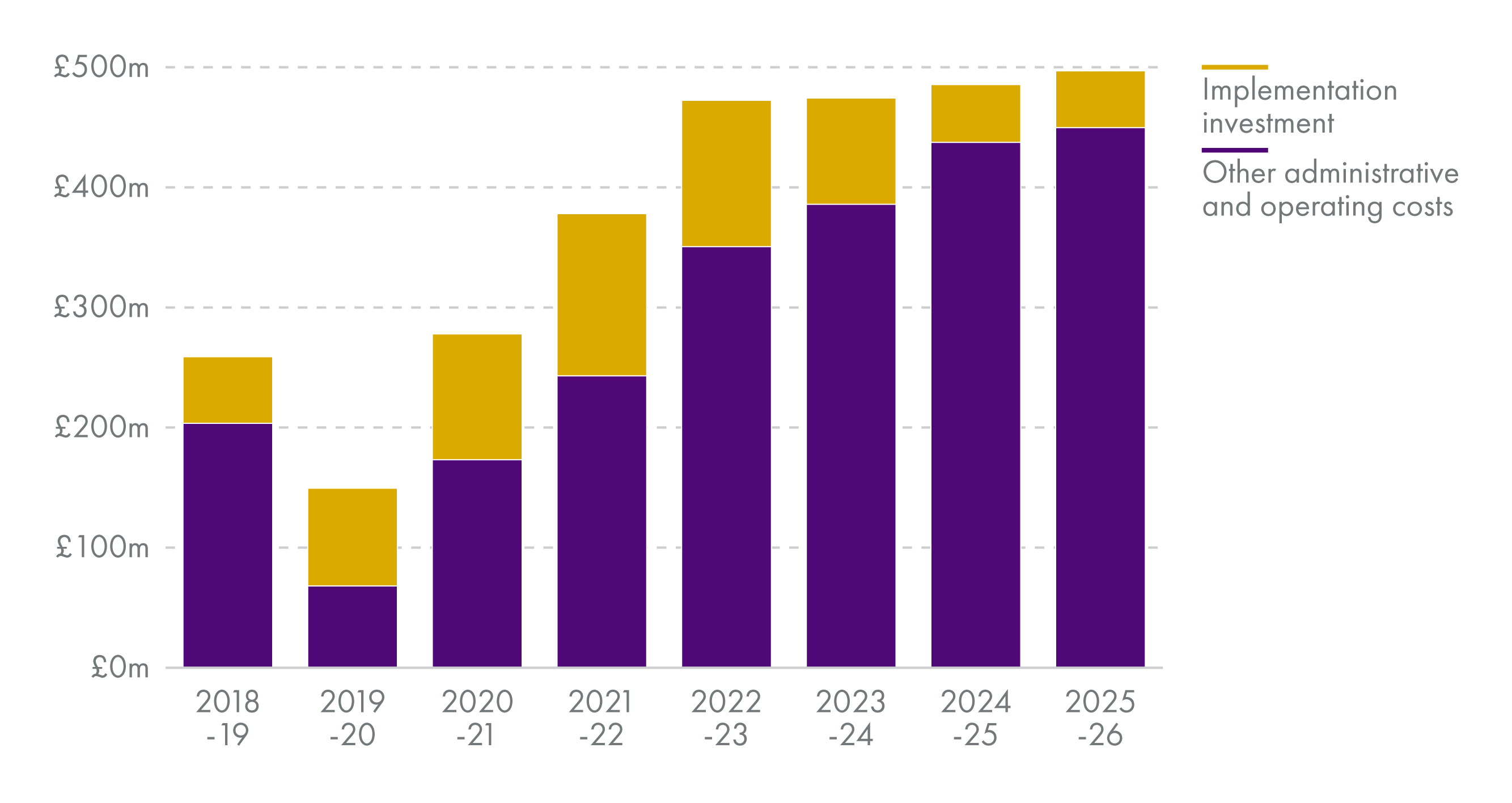
The chart below shows how the ‘implementation investment’ discussed in the previous section made up a small proportion of total operational and administrative costs of the devolved social security system.
Scottish Government. (2026). Scottish Budget 2026-27, annex D.02 . Retrieved from https://www.gov.scot/publications/scottish-budget-2026-2027/documents/ [accessed 9 June 2026]Scottish Government. (2026). Social Security Programme 2017-2026 Delivery Report. Retrieved from https://www.gov.scot/publications/social-security-programme-2017-2026-delivery-report/ [accessed 13 April 2026], SPICe calculations deducting implementation investment from total outturn reported in Scottish Budget annex D.02.
In 2026-27, total administrative costs of the agency and central Scottish Government combined are £513 million. This is 7% of total forecast benefit spend of £7,335 million.
Work remaining to be done
Almost all of the Social Security Programme set out in 2017 has been achieved. There are a few areas where the original plans have not yet been completed and there are also administrative improvements that have yet to be completed.
New benefits
Some of the original policy aims from 2016 and 2017 are still being worked on. These include:
Converting Industrial Injuries Disablement Benefits into Employment Injuries Assistance. A working group report is due this summer.
Allowing Universal Credit payments to be split between couples. The Scottish Government continues to work with the DWP on policy design for this.
Abolishing the ‘bedroom tax’ ‘at source' through changes to Universal Credit, instead of mitigating it through Discretionary Housing Payments. Scottish Ministers have requested progression on this from the DWP over many years.
In terms of more recent policy, a new care leaver payment is being delivered by local authorities from April 2026 onwards and the previous Scottish Government announced that it would increase the Scottish Child Payment for babies under one to £40 per week from 2027-28.
In 2016, there were also commitments to consider more fundamental changes to disability and carer benefits once safe and secure transfer was complete.1 The scope for further change to these benefits is still under discussion as set out in the final section of this briefing.
Administrative improvements
The Social Security (Amendment)(Scotland) Act 2025 includes several provisions that have yet to be implemented. These include:
Allowing appeals to lapse (which would allow Social Security Scotland and the client to agree on an outcome without having to go to tribunal). Work is underway to implement this although as of February 2026 there was no timeframe available.
Requiring clients to comply with requests for information. This relates to wider work on estimating levels of fraud and error. Further regulations are being consulted on.
Providing for a new form of benefit, 'childhood assistance'. This would enable the Scottish Government to fulfil their commitment to change the legislative basis of Scottish Child Payment so that it is a 'stand-alone' benefit rather than a 'top-up' to Universal Credit.
Social Security Scotland is also developing the ability to carry out enforced deduction of benefit payments to recoup overpayments. Currently deductions are by agreement only. Gerry O’Donnell (interim deputy director for finance and corporate services, Social Security Scotland) told the previous Social Justice and Social Security Committee that:
Work is on-going to establish processes around challenge rights in relation to enforced deductions, which are complex. We are hoping to have that matter resolved by later this year—I think that it will be in quarter 3 in 2026-27.
Scottish Parliament. (2026). Social Justice and Social Security Committee Official Report, 22 January 2026, col 11. Retrieved from https://www.parliament.scot/api/sitecore/CustomMedia/OfficialReport?meetingId=20033 [accessed 14 April 2026]
Among technical changes needed is the creation of a new payment platform. When Social Security Scotland was established in 2018, they negotiated temporary use of DWP's payment platform. Audit Scotland commented on this in 2022, saying:
This is a critical aspect of Social Security Scotland’s digital infrastructure, and a long‑term solution will need to be put in place to provide suitable payments functionality for Social Security Scotland beyond this point.2
More recently, David Wallace, (Chief Executive, Social Security Scotland), told the Social Justice and Social Security Committee in January 2026 that:
Our current payment platform, which relies on the DWP, will expire, so we are having to build a payment platform to ensure that the end bit of the process works for Scotland.
Scottish Parliament. (2026). David Wallace, Social Justice and Social Security Committee Official Report, 22 January 2026, col 31. Retrieved from https://www.parliament.scot/api/sitecore/CustomMedia/OfficialReport?meetingId=20033 [accessed 14 April 2026]
Funding and spending on devolved benefits
The Scottish Government receives additions to the Scottish block grant for social security. These 'block grant adjustments' (BGAs) broadly reflect the amount that would have been spent on the devolved benefits in Scotland if they had remained reserved and UK policy decisions applied.
These additions to the Scottish budget aren’t ‘ring-fenced’ to be spent on social security, but the difference between these BGAs and forecast spending are a good indication of pressure on the budget created by devolved social security.
There is a BGA for each of the eight benefits devolved under the Scotland Act 2016: Disability Living Allowance, Personal Independence Payment, Attendance Allowance, Carer’s Allowance, Industrial Injuries Disablement Benefit, Severe Disablement Allowance, Winter Fuel Payment and Cold Weather Payment.
Not all Scottish benefits have an associated BGA. Benefits without a BGA are:
Those unique to Scotland, like the Scottish Child Payment.
Those that do exist in the rest of the UK, but where funding was added to the general block grant on devolution and it is not possible to separately identify current funding. The largest of these in terms of spending is Discretionary Housing Payments.
Social Security Funding - the Block Grant Adjustments
There are eight social security BGAs.
The intention is that funding keeps track with what would have been spent had that benefit not been devolved.
The Social Security BGAs are calculated based on Office for Budget Responsibility forecasts at UK budgets.
Because the calculation is based on forecast spend, there is a two-stage reconciliation process. Updated forecasts are used to make in-year changes, normally at the spring budget revision. Then there is a final reconciliation once outturn spend is known which results in additions or reductions to future Scottish budgets.
The BGAs are calculated as follows:
A baseline amount is set based on the spending on the benefit in Scotland in the year before it was devolved. For example, the baseline for the PIP BGA was spending on PIP in Scotland in 2019-20 of £1,303 million.1
The baseline is increased or decreased each year by the percentage change in spending on that benefit in England and Wales. For example, PIP spending in England and Wales increased by 22% in 2020-21, so the PIP BGA also increased by the same proportion.
This BGA figure is then adjusted to reflect any difference in the rate of population growth between Scotland and England and Wales. The final PIP BGA in 2020-21 was £1,585 million.2
The main sources for finding BGAs are:
Scottish Fiscal Commission forecasts – although they do not forecast BGAs, the SFC include information on them in their forecast reports.
Scottish Government Fiscal Framework Outturn Reports and Fiscal Framework Data Annex
A detailed description of how the BGAs are calculated is available in this Fiscal Framework Technical Note.
Social Security Spending – where to find information.
The Scottish budget for social security is set by the Scottish Government based on forecasts made by the Scottish Fiscal Commission. These are normally published in May and December. They forecast five years ahead based on current Scottish Government policy.
The SFC publish a forecast evaluation report, normally in August. This shows how outturn varied from the forecast used in the Scottish Government budget.
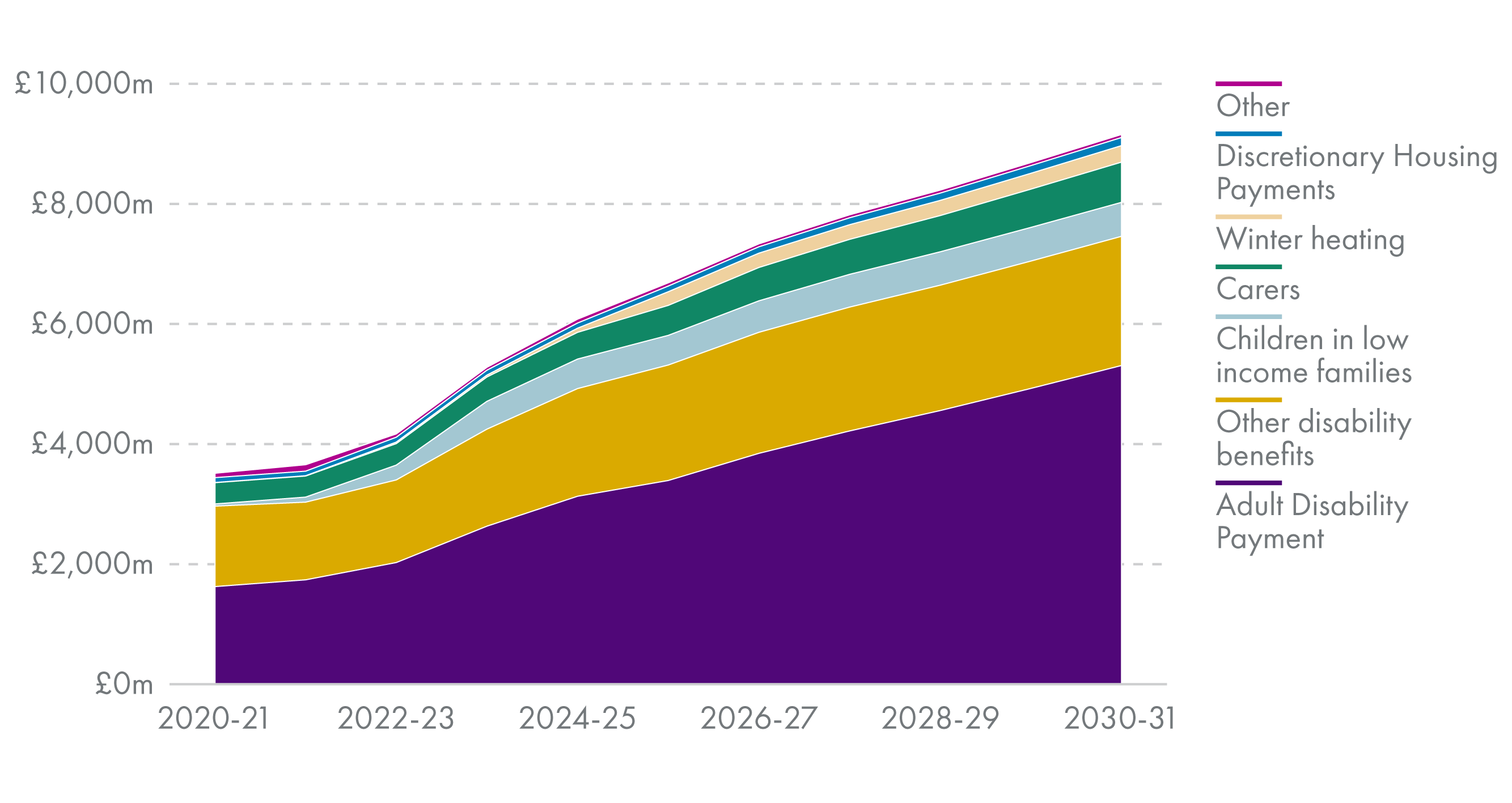
Chart 4 below shows how spending on benefits is forecast to increase by £5,642 million over the ten years from 2020 to 2030 from £3,514 million to £9,156 million. Most of this spending is on disability benefits, particularly Adult Disability Payment.
Scottish Fiscal Commission. Includes spend on DWP equivalent benefits prior to case transfer.
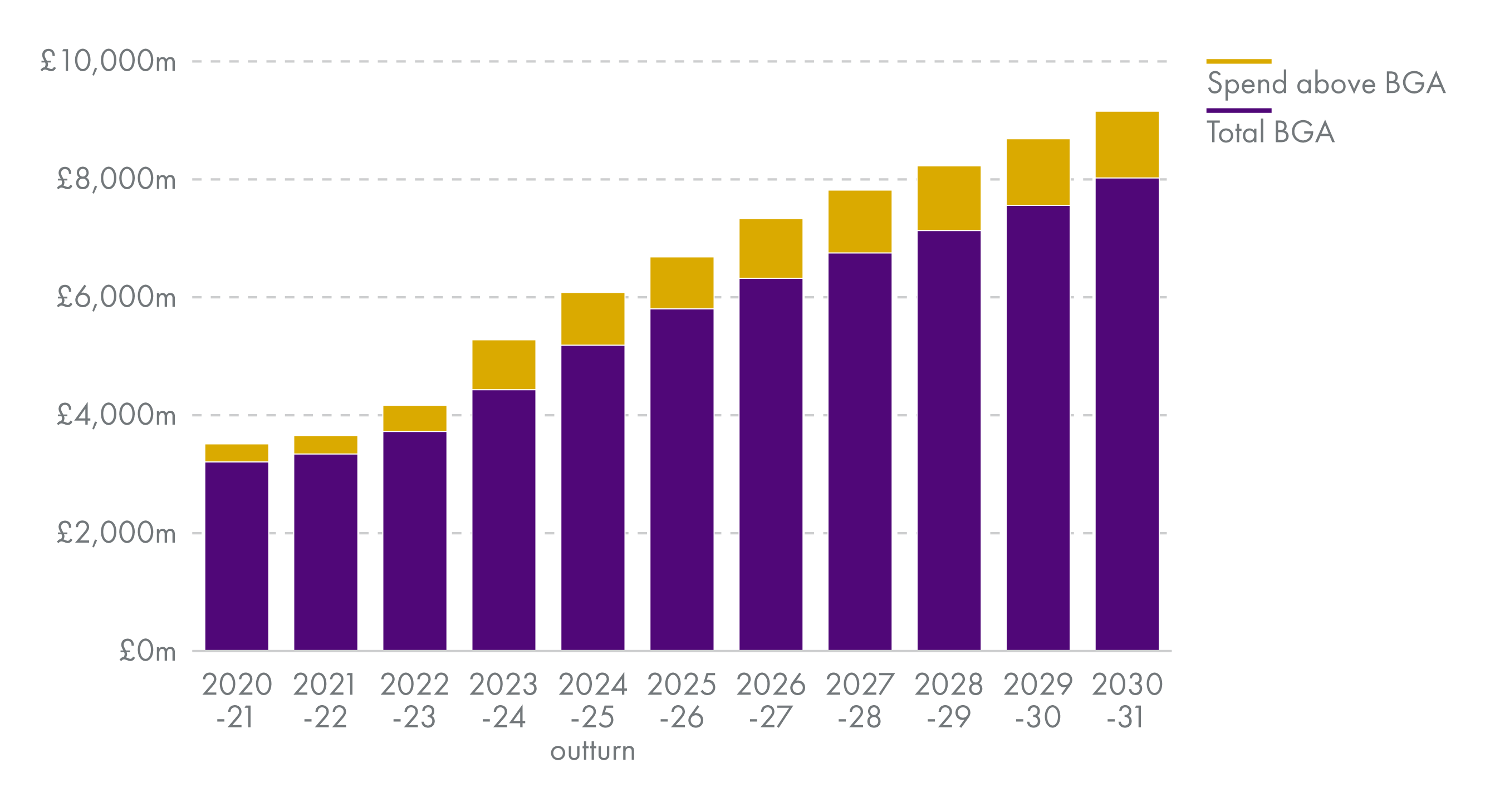
Funding to the Scottish Budget from social security Block Grant Adjustments is also forecast to increase. Between 2020 and 2025 spending was increasing faster than funding. However, current forecasts are that, over the next five years, the forecast growth in funding and spending are similar. Chart 6 shows how BGAs increased by £2,596 million between 2020 to 2025 while spending increased by £3,171 million. Between 2026 and 2030, BGAs are forecast to increase by a further £1,701 million and spending by a further £1,822 million.
Scottish Fiscal Commission
As the two previous charts illustrate - most of the spending on benefits is matched by BGA funding. Chart 6 compares total BGA with total spending, showing that BGAs cover 86% of benefit spending this year (2026-27) rising to 88% in 2030-31.
Scottish Fiscal Commission
The Scottish Government spends around £1,000 million more on social security than it receives in social security block grant adjustments. Broadly this spend ‘above BGA’ is what must be funded from other sources – either by reducing spending in other policy areas or through raising additional revenue.
A complicating factor is that there are some benefits that do not have a BGA but are not unique to Scotland. Funding for these was added to the block grant when these benefits were devolved and is not separately identifiable. The following discussion on additional spending therefore ignores a total of £48 million spending on Best Start Foods, Funeral Support Payment, the pregnancy and baby Best Start Grant and a small part of DHPs not being used to mitigate the 'bedroom tax' or 'benefit cap'. Removing the spend on these other payments gives a better estimate of identifiable additional spend on social security.
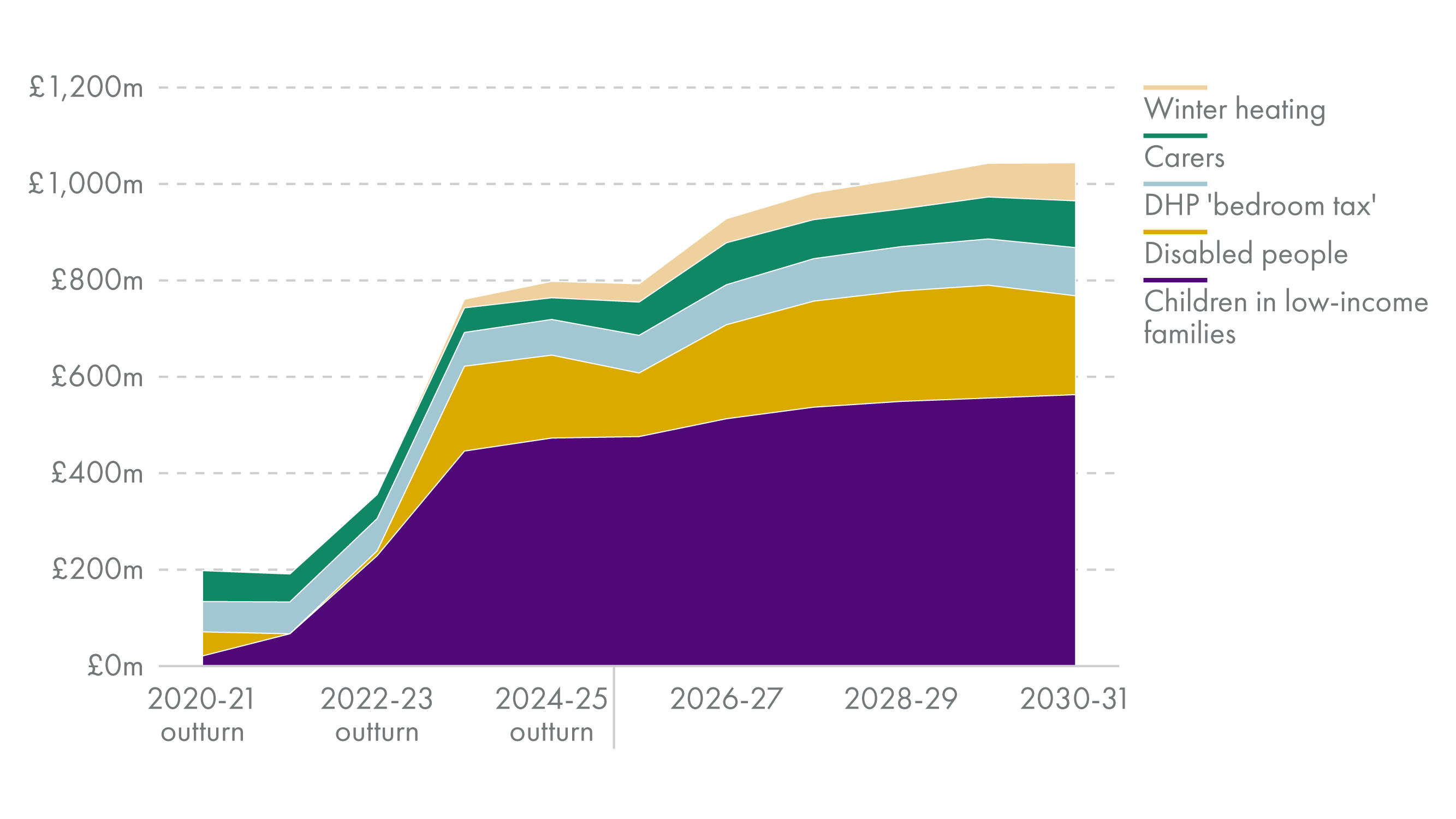
Based on current UK and Scottish Government policy as at March 2026 identifiable additional investment is not forecast to increase substantially over the next few years. It is forecast to grow from £928 million this year (2026-27) to £1,044 million in 2030-31. However, policy shifts by either the UK or Scottish Government, particularly on disability benefits, could change this.
Chart 8 below groups this identifiable additional spend by client group. While total spend, as set out in chart 4 above, is focused on disabled people, chart 7 shows that identifiable additional investment by the Scottish Government is focused mainly on low-income families with children. The largest benefit in this category is the Scottish Child Payment which has a forecast spend of £485 million in 2026-27. This additional spend reflects where the Scottish Government has focused resources, and illustrates the different investment choices compared to continuing with UK Government policies.
SPICe calculations based on Scottish Fiscal Commission forecasts.
Policy Issues
Now that Scottish social security is established, policy debates are moving from establishing systems to discussions about effectiveness and improvements. One long standing debate is the extent to which Scottish social security can or should depart from that available in the rest of the UK. This is generally discussed in terms of seeing DWP benefits as a 'floor' which the Scottish Government can improve upon. In tension with this is the debate about affordability which became more prominent towards the end of the last Parliamentary session.
Increasing demand for disability benefits
Across the UK an increasing number of people are receiving disability benefits. The reasons for this increase are not fully understood.12 A number of contributing factors have been put forward, including:
Worsening health, particularly worsening mental health.34
The increasing cost of living making people more likely to claim benefits they were always entitled to.4
Cuts to other benefits in the 2010s making people more likely to claim disability benefits.6
An ageing population, and increases in the State Pension Age.4
Changes in the benefit system - including the move from Disability Living Allowance to Personal Independence Payment.4
The introduction of Adult Disability Payment and Child Disability Payment in Scotland.1
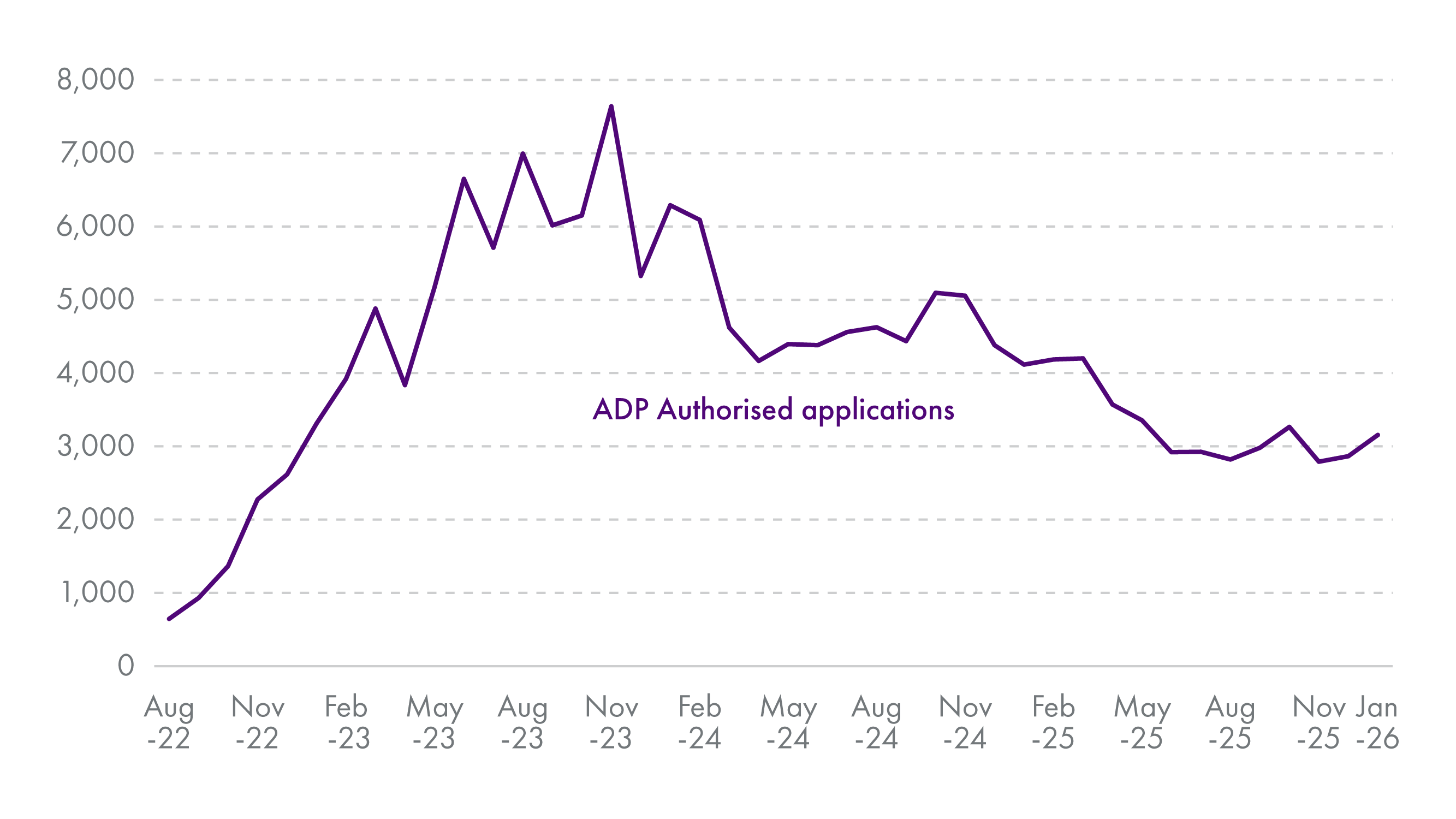
The trend in Scotland has been complicated by the introduction of Adult Disability Payment. ADP was introduced across Scotland in August 2022 as a replacement to PIP. An expected initial spike in applications has been followed by a reduction in the number of new awards. Since June 2025 there have been around 3,000 new awards each month (chart 8). However, as people tend to remain on disability benefits for a long time, the total caseload (and therefore total spending) is still growing (chart 9 below).
Social Security ScotlandSocial Security Scotland. (2026). Adult Disability Payment statistics. Retrieved from https://www.socialsecurity.gov.scot/publications/2026/03/adult-disability-payment-statistics-to-31-january-2026 [accessed 9 June 2026]
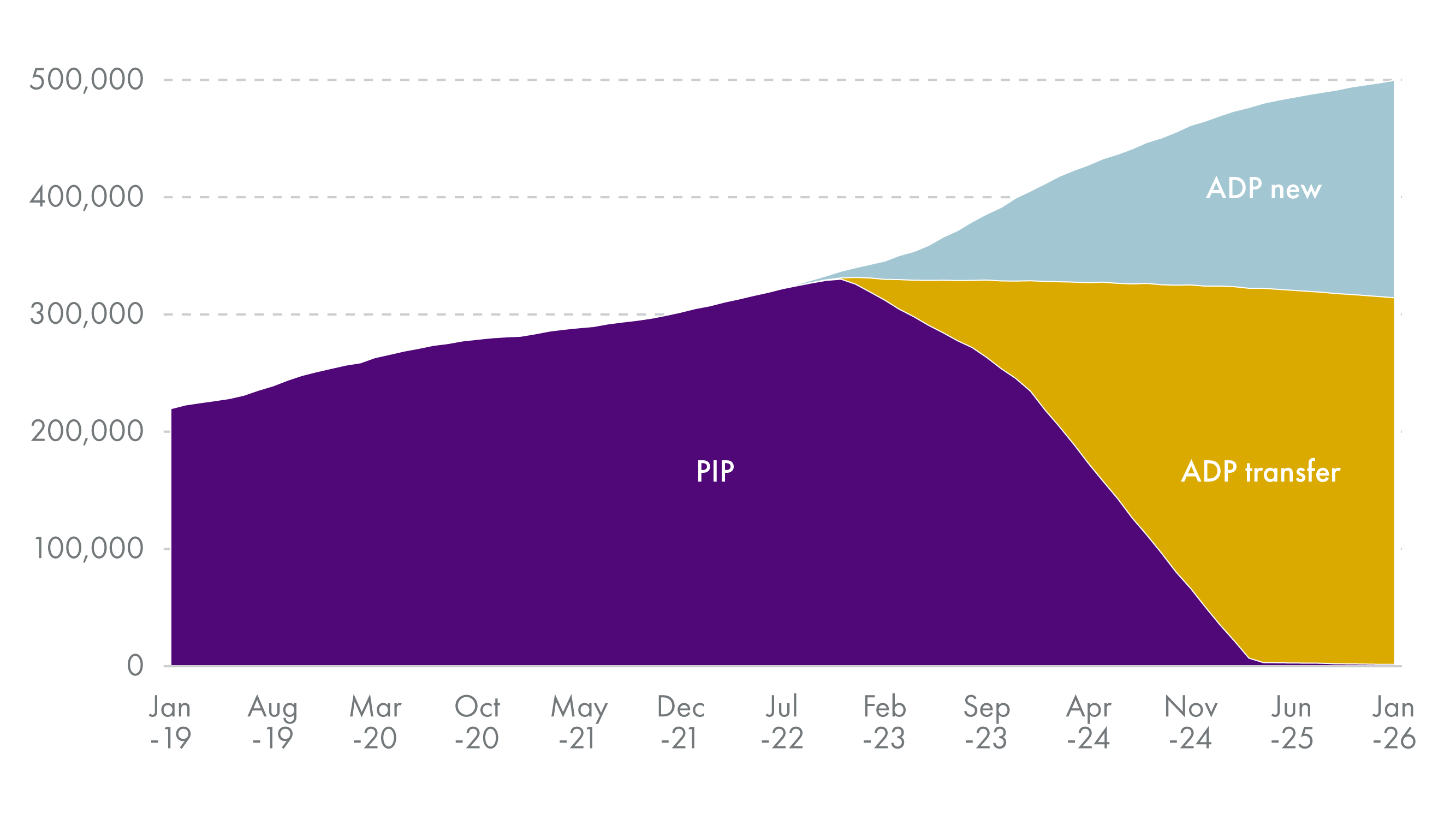
Social Security Scotland (for ADP), DWP StatXplore (for PIP)
Disability Benefit Reform
This autumn, Sir Stephen Timms is due to report on the review of Personal Independence Payment. If this results in lower forecast spend on PIP in England and Wales, then the social security funding (via the social security BGA) to the Scottish Government will reduce. In order to maintain their current policy approach, the Scottish Government would need to plug the gap from elsewhere in the budget. When this possibility arose in summer 2025, the then Scottish Government was clear that they would not cut Scottish disability benefits. Those proposed reforms to PIP did not go ahead, and it is unclear whether the outcome of the Timms review will result in reduced spending on PIP. Given the large size of the PIP BGA, the possibility of UK disability benefit reform creates a clear risk to the affordability of devolved social security.
Also relevant is Alan Milburn's recent report1 on young people and employment where he criticised an approach to welfare benefits which "measures functioning. It does not plan for improving it." He argues that disability benefits for young people "could help to deliver improved participation as well as independence outcomes." If this were to lead to policy changes for PIP that affected spending, then this would have implications for the Scottish budget via the PIP BGA.
In Scotland, Edel Harris's 2025 review of Adult Disability Payment made extensive recommendations for change, reflecting years of debate about the design of disability benefits. The last Scottish Government responded to some of the ‘process’ orientated recommendations, but left the most significant recommendations – and those with the greatest cost implications – for a future government to consider.
There are potentially therefore developments at a UK level that could reduce funding for Scotland and, at the same time, recommendations for reform at Scottish level that would increase spending on disability benefits.
Divergence from UK Social Security
The debates on disability reform are illustrative of a wider issue. Devolution of social security was widely seen as an opportunity to have different policy priorities. As discussed earlier in this briefing, the Scottish Government have often contrasted their approach with that of the UK Government and it has focused its additional spending on low-income families through the Scottish Child Payment (Chart 7, above).
In general, the Scottish Government’s choices have been to spend more, rather than spend differently. This is not always the case though. For example Winter Heating Payment is a flat rate payment of £62 per year, whereas the UK equivalent pays £25 each time the local weather station forecasts 7 days of temperatures of zero or below. Another example is Best Start Foods which is available to children under 3 in Scotland, while the rUK equivalent, Healthy Start Foods, is available to children under 4, but at a lower payment rate. (£4.65 basic rate per week in England and Wales compared to £5.60 per week in Scotland). Best Start Foods is also available to all those on Universal Credit whereas Healthy Start is only available to those on Universal Credit whose income is under a certain threshold.
When stakeholders first asked for changes to disability and carer benefits in 2016, the Scottish Government emphasised the need for ‘safe and secure transfer’ and keeping benefits aligned at least until everyone was transferred from DWP to Social Security Scotland benefits.1 That process is now complete, but another risk now coming more to the fore is that, were Scottish benefits to become sufficiently different, they may not be treated as equivalent in the UK benefits system (with potential implications for access to other benefits).
For example, in their response to the independent review of ADP the Scottish Government stated that:
The UK Government has not committed to permanently recognising ADP as an equivalent benefit to Personal Independence Payment (PIP) for access to reserved benefits, and changes to ADP may affect reserved benefit entitlement. At the time of writing, the UK Government intends to abolish the Work Capability Assessment, affecting how ADP clients will access the health element of Universal Credit. Any changes in ADP eligibility must therefore be carefully weighed against these potential consequences.
Scottish Government. (2026). Response to the Independent Review of Adult Disability Payment. Retrieved from https://www.gov.scot/publications/scottish-government-response-independent-review-adult-disability-payment-final-report/ [accessed 15 April 2026]
Similar fears have been raised when discussing reform to Carer Support Payment. The two issues of affordability and equivalence were discussed in the Scottish Government’s response to the consultation on carer support in 2023. These considerations have not fundamentally changed since.
A recurring theme from the consultation responses was for changes to go further and be made faster. However, we are aware of the need to balance any changes we would need to make, against the funding to invest in making those changes. We will need to decide how affordable and sustainable any improvements we wish to make are, as part of the fixed Scottish budget, and we need to make sure that changes are targeted where they will deliver the most benefit. We also know how important it is that any improvements we make don’t do anything which would risk the other financial support carers get from reserved benefits, and we have dependencies on other government agencies such as the Department of Work and Pensions and His Majesty’s Revenue and Customs, as well as external organisations, which can affect when we are able to make changes.
Scottish Government. (2023). Scottish Carer's Assistance Consultation: Scottish Government Response. Retrieved from https://www.gov.scot/publications/social-security-scottish-carers-assistance-consultation-scottish-government-response/pages/7/ [accessed 15 April 2026]
Affordability of social security
A critical part of the debates outlined above is the issue of affordability. Can Scotland afford to make more generous provision for social security? Increasingly towards the end of Session 6 members debated whether even current policy was sustainable. Current social security rules are forecast to result in increasing levels of spending in future (see chart 4 above). This is partly because people tend to remain in receipt of benefits for a long time, and there is also a statutory duty to increase benefits by inflation. These result in rising spending even in without any new policy commitments.
The previous Scottish Government was clear that it considered social security spend to be ‘an investment in people’. For example, when challenged at First Minister’s Questions about benefit spending John Swinney, MSP said:
I think that the approach that the Scottish Government takes to benefits is based on the principles of fairness and dignity that this Parliament legislated for. I am proud to associate my Government with those values, which are enshrined in statute. I believe that the benefit system in Scotland is sustainable, as is demonstrated by this Government’s ability to ensure effective budget planning to meet all those commitments.
Scottish Parliament. (2026). John Swinney, Chamber Official Report, 29 January 2026, col 9. Retrieved from https://www.parliament.scot/chamber-and-committees/official-report/search-what-was-said-in-parliament/meeting-of-parliament-29-01-2026?meeting=20034&iob=207680 [accessed 15 April 2026]
In May, the new Deputy First Minister, Jenny Gilruth, re-iterated this view that the benefits bill in Scotland is not 'too high'.
On the other hand, the Finance and Public Administration Committee’s report on the 2026-27 Scottish Budget said that:
The Committee remains of the view that the Scottish Government has not provided sufficient evidence of the sustainability of the social security budget.
Scottish Parliament Finance and Public Administration Committee. (2026). Report on 2026-27 Budget. Retrieved from https://digitalpublications.parliament.scot/Committees/Report/FPA/2026/2/5/64e8da4f-f7da-49d2-a6df-34315f71b064 [accessed 15 April 2026]
The Scottish Fiscal Commission's report on fiscal sustainability has described how, even based on current policy:
Spending on devolved social security, has been increasing in real terms and is forecast to keep growing. This has meant that other areas of spending have had to see their levels grow more slowly or even fall in real terms.
Scottish Fiscal Commission. (2026). Fiscal Sustainability Perspectives. What Scotland's finances mean for the next parliament.. Retrieved from https://fiscalcommission.scot/publications/fiscal-sustainability-perspectives-what-scotlands-finances-mean-for-the-next-parliament-february-2026/ [accessed 15 April 2026]
This is part of a much wider debate about Scottish public finances which goes beyond what is discussed here. Increasing social security spending is one of a number of issues putting pressure on the Scottish budget.456
As discussed earlier in this briefing, while social security spend takes up an increasing share of the budget, around 85% of it is matched by the social security Block Grant Adjustment. The remaining spend ‘above BGA’ is, on current policy, expected to remain at around £1,000 million. While this is a very substantial sum, the Scottish Government has already balanced its 2026-27 budget based on a similar figure. All else being equal, the pressure placed on the rest of the budget by social security policy is not expected to increase substantially.
Broader economic issues could cause this risk to increase– such as higher than expected inflation and if demand for disability benefits increases in Scotland more quickly than in England and Wales.
The other major category of risk is policy change – either at UK level (in ways that affect funding) or at a Scottish Government level (in ways that affect spending).
A separate question, which is beyond the scope of this briefing, is the extent to which the broader financial context enables current levels of ‘additional investment’ in social security to be maintained.
Child Poverty
The flagship measure for meeting the statutory targets to reduce child poverty in Scotland is the Scottish Child Payment. Stakeholders have argued consistently that social security is the most immediate way to reduce poverty, and as set out above, the ‘additional investment’ in social security by the Scottish Government has been largely focused on tackling child poverty. For example John Dickie, (Child Poverty Action Group) told the then Social Justice and Social Security Committee in January that:
The evidence is absolutely clear that there is no credible path to meeting the 2030 child poverty targets without further substantive investment in social security.
Scottish Parliament. (2026). John Dickie, Social Justice and Social Security Committee Official Report, 15 January 2026, col 3. Retrieved from https://www.parliament.scot/api/sitecore/CustomMedia/OfficialReport?meetingId=20019 [accessed 15 April 2026]
The Scottish Government is forecast to spend £524 million on the Five Family Payments, and stakeholders have called for further increases to tackle child poverty. For example, in 2025, the End Child Poverty Coalition called for an increase in the Scottish Child Payment to £40 per week. The Scottish Government has since announced such an increase for babies under one planned for 2027-28.
Administrative Issues
As discussed earlier in this briefing, various administrative improvements are due to be put in place with the implementation of the Social Security (Amendment) Scotland Act 2025.
One of the main administrative issues discussed during the last Parliament was application processing times. These vary considerably between different benefits with Adult Disability Payment, Child Disability Payment and Carer Support Payment taking much longer than other benefits to process. While processing times for these benefits have improved, they are still lengthy. The chart below shows the average processing times for benefits between January 2025 and (for most) up to March 2026. This shows marked improvement for Child Disability Payment - from 100 days in April 2025 down to 40 days by March 2026. For other benefits, the time taken is getting longer. For example, in March 2026, the Scottish Child Payment took, on average, 31 working days to process, up from 14 days in March to August 2025.
In January David Wallace (Chief Executive, Social Security Scotland), told the Social Justice and Social Security Committee how they move resource around to meet fluctuating demands:
The processing time will move around depending on a number of circumstances, such as the demand that is coming into the system and, because this is cyclical, the time of year. Particularly at this time of year, we have to move resource around the organisation for the winter payments that are going through and in preparation for the new benefits that are coming in. There is always a balance: we try to make sure that the resource of the organisation is in the right place so that we can keep the correct balance.
Scottish Parliament. (2026). David Wallace, Social Justice and Social Security Committ Official Report, 22 January 2026, col 4. Retrieved from https://www.parliament.scot/api/sitecore/CustomMedia/OfficialReport?meetingId=20033
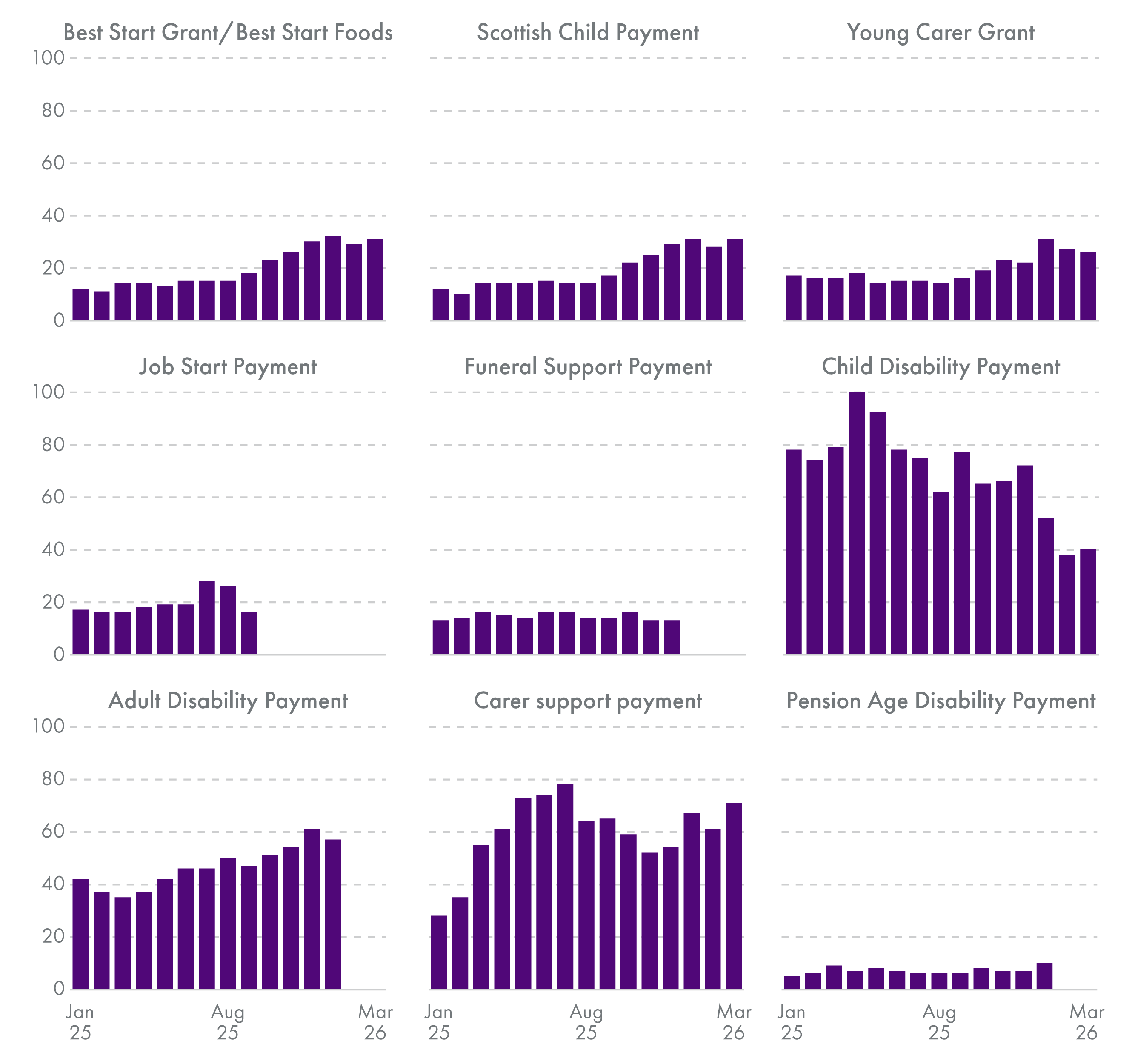
Social Security Scotland
Another part of the system where there can be long waits are for appeals, administered by the Scottish Courts and Tribunals Service. Most appeals are for Adult Disability Payment. Between August 2022 and January 2026 there had been 14,140 ADP appeals lodged and 5,465 appeals heard indicating a considerable waiting time for appeals to be heard.
Sources
Scottish Government. (2025). Government expenditure and revenue in Scotland 2024/25. Retrieved from <a href="https://www.gov.scot/publications/government-expenditure-revenue-scotland-2024-25/documents/" target="_blank">https://www.gov.scot/publications/government-expenditure-revenue-scotland-2024-25/documents/</a> [accessed 13 April 2026]
Department for Work and Pensions. (2025). Benefits Caseload and Expenditure . Retrieved from <a href="https://www.gov.uk/government/collections/benefit-expenditure-and-caseload-tables" target="_blank">https://www.gov.uk/government/collections/benefit-expenditure-and-caseload-tables</a> [accessed 9 June 2026]
Scottish Government. (2025). Scottish Government high level action plan in response to the Committee on Economic, Social and Cultural Rights. Retrieved from <a href="https://www.gov.scot/publications/scottish-government-high-level-action-plan-response-committee-economic-social-cultural-rights/pages/13/" target="_blank">https://www.gov.scot/publications/scottish-government-high-level-action-plan-response-committee-economic-social-cultural-rights/pages/13/</a> [accessed 13 April 2026]
Scottish Parliament. (2017). Chamber Official Report 19 December 2017, col 24. Retrieved from <a href="https://www.parliament.scot/api/sitecore/CustomMedia/OfficialReport?meetingId=11275" target="_blank">https://www.parliament.scot/api/sitecore/CustomMedia/OfficialReport?meetingId=11275</a> [accessed 13 April 2026]
Scottish Government. (2026). Social Security Programme 2017-2026 Delivery Report. Retrieved from <a href="https://www.gov.scot/publications/social-security-programme-2017-2026-delivery-report/" target="_blank">https://www.gov.scot/publications/social-security-programme-2017-2026-delivery-report/</a> [accessed 13 April 2026]
Audit Scotland. (2022). Progress in implementing the devolved benefits. Retrieved from <a href="https://audit.scot/publications/social-security-progress-on-implementing-the-devolved-benefits" target="_blank">https://audit.scot/publications/social-security-progress-on-implementing-the-devolved-benefits</a> [accessed 13 April 2026]
Disability and Carer Expert Advisory Group. (2023). Beyond safe and secure transfer. Retrieved from <a href="https://www.gov.scot/binaries/content/documents/govscot/publications/independent-report/2023/03/disability-carer-benefits-expert-advisory-group-beyond-safe-secure-transfer/documents/disability-carer-benefits-expert-advisory-group-beyond-safe-secure-transfer/disability-carer-benefits-expert-advisory-group-beyond-safe-secure-transfer/govscot%3Adocument/disability-carer-benefits-expert-advisory-group-beyond-safe-secure-transfer.pdf" target="_blank">https://www.gov.scot/binaries/content/documents/govscot/publications/independent-report/2023/03/disability-carer-benefits-expert-advisory-group-beyond-safe-secure-transfer/documents/disability-carer-benefits-expert-advisory-group-beyond-safe-secure-transfer/disability-carer-benefits-expert-advisory-group-beyond-safe-secure-transfer/govscot%3Adocument/disability-carer-benefits-expert-advisory-group-beyond-safe-secure-transfer.pdf</a> [accessed 13 April 2026]
Harris, E. (2025). Independent Review of Adult Disability Payment. Retrieved from <a href="https://www.gov.scot/binaries/content/documents/govscot/publications/independent-report/2025/07/independent-review-adult-disability-payment-final-report/documents/independent-review-adult-disability-payment-final-report/independent-review-adult-disability-payment-final-report/govscot%3Adocument/independent-review-adult-disability-payment-final-report.pdf" target="_blank">https://www.gov.scot/binaries/content/documents/govscot/publications/independent-report/2025/07/independent-review-adult-disability-payment-final-report/documents/independent-review-adult-disability-payment-final-report/independent-review-adult-disability-payment-final-report/govscot%3Adocument/independent-review-adult-disability-payment-final-report.pdf</a> [accessed 13 April 2026]
Scottish Parliament. (2026). Social Justice and Social Security Committee Official Report, 12 March 2026, col 9. Retrieved from <a href="https://www.parliament.scot/api/sitecore/CustomMedia/OfficialReport?meetingId=20144" target="_blank">https://www.parliament.scot/api/sitecore/CustomMedia/OfficialReport?meetingId=20144</a> [accessed 13 April 2026]
Scottish Parliament. (2017). Financial Memorandum Social Security (Scotland) Bill. Retrieved from <a href="https://www.parliament.scot/-/media/files/legislation/bills/previous-bills/social-security-scotland-bill/introduced/financial-memorandum-social-security-scotland-bill.pdf" target="_blank">https://www.parliament.scot/-/media/files/legislation/bills/previous-bills/social-security-scotland-bill/introduced/financial-memorandum-social-security-scotland-bill.pdf</a> [accessed 13 April 2026]
Scottish Government. (2020). Programme Business Case. Retrieved from <a href="https://www.gov.scot/publications/social-security-programme-business-case-executive-summary/documents/" target="_blank">https://www.gov.scot/publications/social-security-programme-business-case-executive-summary/documents/</a> [accessed 13 April 2026]
Scottish Government. (2023). Revised Programme Business Case. Retrieved from <a href="https://www.gov.scot/publications/executive-summary-social-security-business-case-february-2023/" target="_blank">https://www.gov.scot/publications/executive-summary-social-security-business-case-february-2023/</a> [accessed 13 April 2026]
Scottish Parliament. (2026). David Wallace, Social Justice and Social Security Committ Official Report, 22 January 2026, col 4. Retrieved from <a href="https://www.parliament.scot/api/sitecore/CustomMedia/OfficialReport?meetingId=20033" target="_blank">https://www.parliament.scot/api/sitecore/CustomMedia/OfficialReport?meetingId=20033</a>
Scottish Government. (2026). Scottish Government Draft Budget 2026-27. Retrieved from <a href="https://www.gov.scot/publications/scottish-budget-2026-2027/pages/7/" target="_blank">https://www.gov.scot/publications/scottish-budget-2026-2027/pages/7/</a> [accessed 14 April 2026]
Scottish Government. (2026). Scottish Budget 2026-27, annex D.02 . Retrieved from <a href="https://www.gov.scot/publications/scottish-budget-2026-2027/documents/" target="_blank">https://www.gov.scot/publications/scottish-budget-2026-2027/documents/</a> [accessed 9 June 2026]
Scottish Government. (2016). A New Future for Social Security. Retrieved from <a href="https://consult.gov.scot/social-security/social-security-in-scotland/supporting_documents/Consultation%20on%20social%20security%20in%20Scotland%20%20full%20version.pdf" target="_blank">https://consult.gov.scot/social-security/social-security-in-scotland/supporting_documents/Consultation%20on%20social%20security%20in%20Scotland%20%20full%20version.pdf</a> [accessed 15 April 2026]
Scottish Parliament. (2026). Social Justice and Social Security Committee Official Report, 22 January 2026, col 11. Retrieved from <a href="https://www.parliament.scot/api/sitecore/CustomMedia/OfficialReport?meetingId=20033" target="_blank">https://www.parliament.scot/api/sitecore/CustomMedia/OfficialReport?meetingId=20033</a> [accessed 14 April 2026]
Scottish Parliament. (2026). David Wallace, Social Justice and Social Security Committee Official Report, 22 January 2026, col 31. Retrieved from <a href="https://www.parliament.scot/api/sitecore/CustomMedia/OfficialReport?meetingId=20033" target="_blank">https://www.parliament.scot/api/sitecore/CustomMedia/OfficialReport?meetingId=20033</a> [accessed 14 April 2026]
Department for Work and Pensions. (2025). Benefit expenditure and caseload tables. Retrieved from <a href="https://www.gov.uk/government/publications/benefit-expenditure-and-caseload-tables-2025" target="_blank">https://www.gov.uk/government/publications/benefit-expenditure-and-caseload-tables-2025</a> [accessed 20 May 2026]
Scottish Government. (2021). Fiscal Framework Outturn Report . Retrieved from <a href="https://www.gov.scot/publications/fiscal-framework-outturn-report-2021/pages/8/" target="_blank">https://www.gov.scot/publications/fiscal-framework-outturn-report-2021/pages/8/</a>
Scottish Fiscal Commission. (2026). More people reporting disabilities and receiving support.. Retrieved from <a href="https://fiscalcommission.scot/more-people-reporting-disabilities-and-receiving-support/" target="_blank">https://fiscalcommission.scot/more-people-reporting-disabilities-and-receiving-support/</a> [accessed 15 April 2026]
Scottish Government. (2026). Understanding the drivers of changes in demand for disability benefits in Scotland.. Retrieved from <a href="https://www.gov.scot/publications/understanding-drivers-changes-demand-disability-benefits-scotland-2010-quick-scoping-review/pages/7/" target="_blank">https://www.gov.scot/publications/understanding-drivers-changes-demand-disability-benefits-scotland-2010-quick-scoping-review/pages/7/</a> [accessed 15 April 2026]
Institute for Fiscal Studies. (2025). The role of changing health in rising health related benefit claims. Retrieved from <a href="https://ifs.org.uk/publications/role-changing-health-rising-health-related-benefit-claims" target="_blank">https://ifs.org.uk/publications/role-changing-health-rising-health-related-benefit-claims</a> [accessed 15 April 2026]
Resolution Foundation. (2024). Under Strain. Retrieved from <a href="https://www.resolutionfoundation.org/app/uploads/2024/06/20-Under-strain.pdf" target="_blank">https://www.resolutionfoundation.org/app/uploads/2024/06/20-Under-strain.pdf</a> [accessed 15 April 2026]
Institute for Fiscal Studies. (2025). Do disability benefit claims rise when other benefits are cut?. Retrieved from <a href="https://ifs.org.uk/publications/do-disability-benefit-claims-rise-when-other-benefits-are-cut" target="_blank">https://ifs.org.uk/publications/do-disability-benefit-claims-rise-when-other-benefits-are-cut</a> [accessed 15 April 2026]
Social Security Scotland. (2026). Adult Disability Payment statistics. Retrieved from <a href="https://www.socialsecurity.gov.scot/publications/2026/03/adult-disability-payment-statistics-to-31-january-2026" target="_blank">https://www.socialsecurity.gov.scot/publications/2026/03/adult-disability-payment-statistics-to-31-january-2026</a> [accessed 9 June 2026]
Milburn, A. (2026). Young people and work: Interim report. Retrieved from <a href="https://www.gov.uk/government/publications/young-people-and-work-interim-report/young-people-and-work-interim-report#chapter-6-a-welfare-state-not-designed-for-participation" target="_blank">https://www.gov.uk/government/publications/young-people-and-work-interim-report/young-people-and-work-interim-report#chapter-6-a-welfare-state-not-designed-for-participation</a> [accessed 2 June 2026]
Scottish Government. (2026). Response to the Independent Review of Adult Disability Payment. Retrieved from <a href="https://www.gov.scot/publications/scottish-government-response-independent-review-adult-disability-payment-final-report/" target="_blank">https://www.gov.scot/publications/scottish-government-response-independent-review-adult-disability-payment-final-report/</a> [accessed 15 April 2026]
Scottish Government. (2023). Scottish Carer's Assistance Consultation: Scottish Government Response. Retrieved from <a href="https://www.gov.scot/publications/social-security-scottish-carers-assistance-consultation-scottish-government-response/pages/7/" target="_blank">https://www.gov.scot/publications/social-security-scottish-carers-assistance-consultation-scottish-government-response/pages/7/</a> [accessed 15 April 2026]
Scottish Parliament. (2026). John Swinney, Chamber Official Report, 29 January 2026, col 9. Retrieved from <a href="https://www.parliament.scot/chamber-and-committees/official-report/search-what-was-said-in-parliament/meeting-of-parliament-29-01-2026?meeting=20034&iob=207680" target="_blank">https://www.parliament.scot/chamber-and-committees/official-report/search-what-was-said-in-parliament/meeting-of-parliament-29-01-2026?meeting=20034&iob=207680</a> [accessed 15 April 2026]
Scottish Parliament Finance and Public Administration Committee. (2026). Report on 2026-27 Budget. Retrieved from <a href="https://digitalpublications.parliament.scot/Committees/Report/FPA/2026/2/5/64e8da4f-f7da-49d2-a6df-34315f71b064" target="_blank">https://digitalpublications.parliament.scot/Committees/Report/FPA/2026/2/5/64e8da4f-f7da-49d2-a6df-34315f71b064</a> [accessed 15 April 2026]
Scottish Fiscal Commission. (2026). Fiscal Sustainability Perspectives. What Scotland's finances mean for the next parliament.. Retrieved from <a href="https://fiscalcommission.scot/publications/fiscal-sustainability-perspectives-what-scotlands-finances-mean-for-the-next-parliament-february-2026/" target="_blank">https://fiscalcommission.scot/publications/fiscal-sustainability-perspectives-what-scotlands-finances-mean-for-the-next-parliament-february-2026/</a> [accessed 15 April 2026]
Scottish Fiscal Commission. (2026). Scottish Economic and Fiscal Forecasts. Retrieved from <a href="https://fiscalcommission.scot/wp-content/uploads/2026/02/Scotlands-Economic-and-Fiscal-Forecasts-January-2026-revised-11-02-2026.pdf" target="_blank">https://fiscalcommission.scot/wp-content/uploads/2026/02/Scotlands-Economic-and-Fiscal-Forecasts-January-2026-revised-11-02-2026.pdf</a> [accessed 15 2026]
Scottish Government. (2025). Medium Term Financial Strategy. Retrieved from <a href="https://www.gov.scot/publications/scotlands-fiscal-outlook-scottish-governments-medium-term-financial-strategy-3/" target="_blank">https://www.gov.scot/publications/scotlands-fiscal-outlook-scottish-governments-medium-term-financial-strategy-3/</a> [accessed 15 April 2026]
Audit Scotland. (2025). Financial Sustainability and Taxes. Retrieved from <a href="https://audit.scot/uploads/2025-11/nr_251113_fiscal_sustainability_tax.pdf" target="_blank">https://audit.scot/uploads/2025-11/nr_251113_fiscal_sustainability_tax.pdf</a>
Scottish Parliament. (2026). John Dickie, Social Justice and Social Security Committee Official Report, 15 January 2026, col 3. Retrieved from <a href="https://www.parliament.scot/api/sitecore/CustomMedia/OfficialReport?meetingId=20019" target="_blank">https://www.parliament.scot/api/sitecore/CustomMedia/OfficialReport?meetingId=20019</a> [accessed 15 April 2026]