Devolved Social Security Benefits
This briefing summarises devolved benefits available from Social Security Scotland, local authorities and the Department for Work and Pensions in Scotland as at May 2026.
Introduction
This briefing gives an overview of devolved social security benefits, showing basic eligibility, forecast caseload, spending and payment rates for 2026-27.
Useful links are provided at the end.
Please note: this is only a very brief overview. Further detail and information about how to make applications is available from the Scottish Government. A separate briefing: 'Social Security subject profile' will focus on policy and funding.
Most devolved benefits are administered by Social Security Scotland, an executive agency created in 2018. Social Security Scotland benefits fall into five categories:
Disability benefits for children, working age and older people. They are not related to income or whether someone works (Child Disability Payment, Adult Disability Payment, Pension Age Disability Payment and Scottish Adult Disability Living Allowance).
Carer benefits for people caring for someone who gets a disability benefit (Carer Support and Young Carer Payment).
Winter payments – for disabled children, those of pension age and those on a low income (Child Winter Heating, Pension Age Winter Heating, Winter Heating Payment).
Five Family Payments – for low-income families with children (Best Start Grants (3 grants), Best Start Foods, Scottish Child Payment),
Other benefits: Funeral Support Payment is for those on a low income responsible for paying for a funeral and Job Start Payment is a one-off payment for unemployed young people moving from benefit into work.
Local authorities also administer a few devolved benefits - in particular two discretionary schemes. The Scottish Welfare Fund provides cash payments in a crisis. Discretionary Housing Payments provide help with rent and is mostly used to mitigate the under-occupation penalty in the social rented sector. Local authorities also administer Council Tax Reduction which can lower council tax bills for eligible people.
The Scottish Government has ongoing agency agreements with the UK Department of Work and Pensions (DWP) to deliver two benefits on their behalf. One, Severe Disablement Allowance, will remain with the DWP permanently as it is closed to new claimants. The other, Industrial Injuries Disablement Benefits Scheme, is due to be replaced by Employment Injury Assistance.
Please note: As the move to Universal Credit was largely complete by March 2026, with a brief extension granted for those moving from Employment and Support Allowance, this briefing does not list the benefits Universal Credit is replacing in the descriptions of qualifying benefits for Scottish social security. These 'legacy benefits' are: Income Support, income based Job Seekers Allowance, income related Employment and Support Allowance, Working Tax Credit, Child Tax Credit ).
Social Security Scotland benefits
Most devolved benefits are administered by Social Security Scotland. They have a local delivery service which, by appointment, can assist people with applications. In addition, Advice Direct Scotland provide a free advocacy service for disabled people applying for Social Security Scotland benefits.
The Social Security (Scotland) Act 2018 sets out a common framework for these benefits which includes:
Administration according to statutory principles, including that social security is a human right. These principles form the basis of the Social Security Charter.
Regulations creating and amending benefits are reported on by the Scottish Commission on Social Security before being laid in the Parliament.
Benefits must be uprated annually to reflect inflation.
Individuals have the right to challenge a benefit decision (determination) by asking Social Security Scotland to re-make it (redetermination) and, if that does not resolve the issue, appeal to the social security chamber of the First-tier Tribunal and onwards to the Upper Tribunal and Court of Session. Redeterminations must be requested within either 31 or 42 days, depending on the benefit, and appeals must be lodged within 31 days. There is a growing body of caselaw, mostly in relation to disability benefits. Upper Tribunal decisions are published online.
Benefit decisions are made on the basis of written information. Face to face, online or over the phone assessments will only be carried out if there is no other way of making a benefit decision. If an assessment (called 'consultations' by Social Security Scotland) is required, it will not be done by the private sector. This is mainly relevant for disability benefits.
Overpayments can be recovered only if they are the individual's fault and the individual ought to have noticed the error. Financial hardship must be considered.
Offences include trying to obtain benefits by deceit and failure to notify a change of circumstances.
Two benefits are made under different legislation. Best Start Foods is made by regulations under s.13 of the Social Security Act 2013 and Job Start Payment is made under Scottish Minister's executive powers under Section 2 of the Employment and Training Act 1973. As such, they have reviews rather than redetermination and appeal rights.
The following sections give a brief overview of:
Five Family Payments
Funeral Support Payment
Job Start Payment
Carer Benefits
Help with winter heating costs
Disability Benefits
Five Family Payments
The 'Five Family Payments' are: the three Best Start Grants, Best Start Foods and the Scottish Child Payment. Best Start Grants are three 'one-off' payments made when a child reaches a certain age. Best Start Foods and Scottish Child Payments are regular payments for children under 3 and under 16 respectively.
To receive them, a family must be responsible for a child of the relevant age and be getting a 'qualifying benefit'. The main qualifying benefits are Universal Credit and Pension Credit. In addition Housing Benefit is a qualifying benefit for Best Start Grant and Best Start Foods, but not Scottish Child Payment.
There are a couple of exceptions. Qualifying benefits are not required for:
Parents under 18
Parents aged 18 or 19 if their own parent or carer gets Child Benefit, the child element of Universal Credit or child addition in Pension Credit for them.
For Best Start Foods if the child is a UK citizen and the parent's immigration status means they have no recourse to public funds.
Take-up for these benefits is high. In 2024-25 take-up was estimated at:
Scottish Child Payment 94%
Best Start Grant 91%, 87% and 97% for the baby, early learning and school-age payments respectively and,
Best Start Foods 81%.
Table 1 below, summarises eligibility and payment rates for 2026-27.
| Benefit | Client group | Amount |
| Best Start Foods | Child under 1 | £11.20 per week |
| Best Start Foods | Pregnant OR child aged 1 or 2 | £5.60 per week |
| Best Start Grant: pregnancy and baby | Pregnancy to six months | £398.35 (£796.65 for first born) one-off grant |
| Best Start Grant: Early learning | Age 2 to 3 ½ | £331.95 one-off grant |
| Best Start Grant: School age | For 2026/27: born 1/3/21 to 28/2/22 and apply between 1/6/26 and 28/2/27. | £331.95 one-off grant |
| Scottish Child Payment | Children under 16 | £28.20 per week |
Processing times in 2025-26 were 22 working days for the Scottish Child Payment and 24 days for Best Start Grant/Best Start Foods.
There are very few appeals for these benefits. Of 160 Best Start Grant appeals decided since 2018, only 10 were upheld. Of the 255 Scottish Child Payment appeals decided since 2021, 85 were upheld.
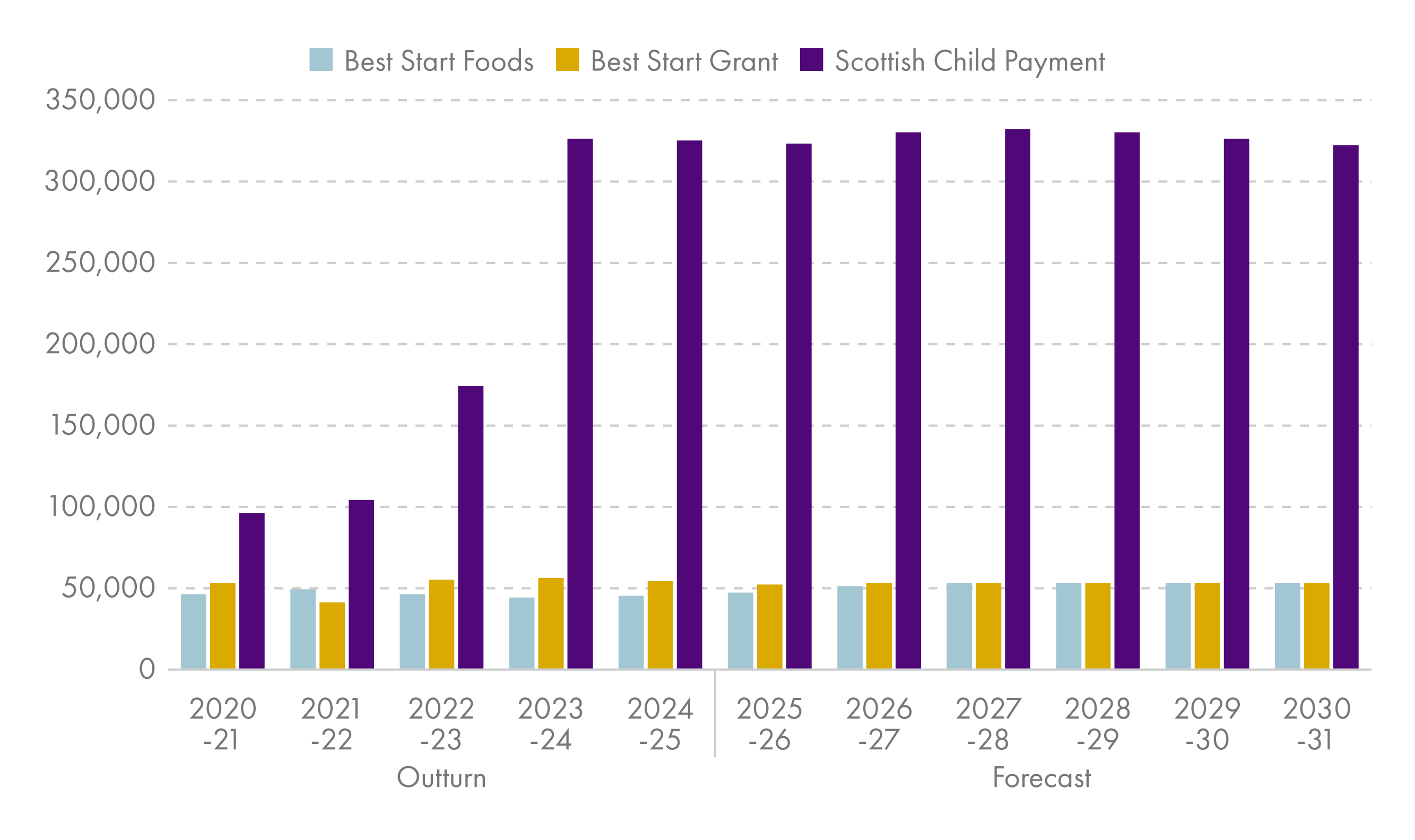
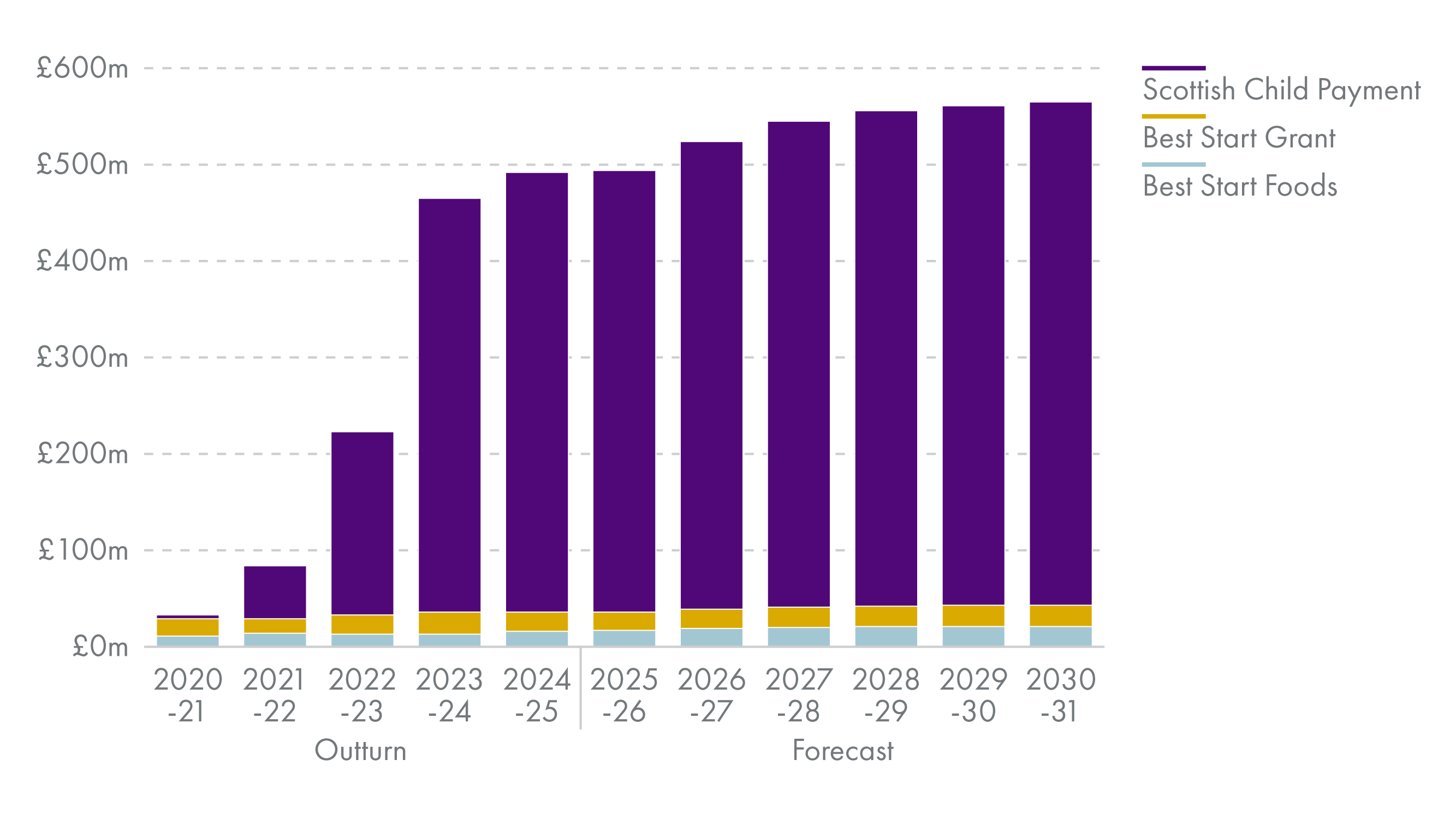
The charts below show the large increase in caseload and spending following the extension of Scottish Child Payment to children between the ages of 6 and 16 in November 2022. Looking ahead, the number of children receiving Five Family Payments is forecast to reduce very slightly over the next four years, reflecting demographic change. However, because the payments are linked to inflation and also because of a commitment to increase the Scottish Child Payment to £40 for children under one from 2027-28, total spending on the five family payments is forecast to increase, reaching £566 million by 2030-31.
Scottish Fiscal Commission
Scottish Fiscal Commission
Funeral Costs
Funeral Support Payment (FSP) can help towards the costs of a funeral. It is not intended to meet the whole cost. The person responsible for the funeral must be getting a qualifying benefit. These are: Universal Credit, Pension Credit and Housing Benefit.
The payment can be made either to the person applying or direct to the funeral director.
The benefit is made up of a flat rate payment plus additions for certain costs including burial and cremation fees, medical certificates and transport. The average award in 2025 was £2,188.
In 2026-27 the flat rate payment is £1,327.75 but this is reduced to £162.05 if the deceased was 18 or over and had a funeral plan or similar in place.
The number of people getting FSP is forecast to remain steady over the next four years at around 6,000 people per year, but spending is forecast to increase from £12 million in 2024-25 to £15 million in 2030-31, mainly reflecting the statutory duty to uprate for inflation.
There are not many appeals lodged for FSP. Since the payment started in 2019 there have been 110 appeals decided, of which, 30 were upheld.
Processing times are relatively quick. Funeral Support Payment took 15 working days on average to process in 2025.
Take-up is relatively low, at an estimated 61% in 2024-25.
| Client group | Payment rate | Eligibility |
| Responsible for funeral costs. Normally nearest relative. | Higher rate; £1,327.75Lower rate: £162.05 Some additional costs can be claimed. | On qualifying benefit (Universal Credit, Pension Credit, Housing Benefit) |
Carers
Social Security Scotland administers four benefits for carers. Carer Support is made up of three separate benefits: Carer Support Payment, Scottish Carer Supplement and Carer Additional Person Payment. In addition, the Young Carer Grant is an annual payment for those aged 16 to 19 who aren't entitled to Carer Support.
For all carer benefits, the person being cared for must be getting certain disability benefits. This includes;
the middle or higher rate care component of Child Disability Payment or Scottish Adult Disability Payment,
the daily living component of Adult Disability Payment,
Pension Age Disability Payment or
Armed Forces Independence Payment.
There were two main changes to carer support in March 2026. The twice yearly Carer's Allowance Supplement was replaced by the Scottish Carer's Supplement paid as a top-up to Carer Support Payment every four weeks. It is the same payment, just paid on a different schedule. In addition a new Carer's Additional Person Payment will provide an additional weekly payment for those caring for more than one person.
In 2025-26, applications for Carer Support Payment took 63 working days, on average, to process.
There are no take-up statistics for Carer Support Payment. Take-up for Young Carer Grant was 80% in 2024-25.
Caseload and Spending
Around 100,000 people receive Carer Support Payment. There are another 33,000 people who qualify for Carer Support Payment but cannot receive it because they get another 'overlapping' benefit such as the State Pension. This is know as having 'underlying entitlement' .
The number of people getting Carer Support is forecast to increase by about 30% between 2024-25 and 2030-31 (from 91,000 in 2024-25 to 119,000 in 2030-31) - reflecting the increase in people getting disability benefits. Spending is increasing faster, by 50% from £445 million in 2024-25 to £670 million in 2030-31, reflecting inflation and the new 'additional person' payment in addition to the growth in caseload.
Young Carer Grant is a much smaller benefit with around £2 million paid out in total in 2025-26 to around 4,900 young people.
Table 4, below summarises the basic eligibility criteria and payment rates for carer benefits.
| Benefit | Client group | Amount | Eligibility |
| Young Carer Grant | Young carers aged 16 to 19, who don't get Carer Support Payment | £405.10 annually | Caring 16 hours a week for 3 months for someone getting certain disability benefits |
| Carer Support Payment and Scottish Carer's Supplement | Unpaid carers | £98.15 per week(£86.45 CSP and £11.70 supplement). | Caring 35 hours a week, for someone getting certain disability benefits. Earning £204 or less per week |
| Carer Additional Person Payment | Caring for more than one person | £10.40 per week for each additional person. | Get Carer Support Payment. |
Getting into Work
The Job Start Payment provides a one-off payment for a young person moving from unemployment benefits to employment. Relatively few young people have received a Job Start Payment, and expenditure and take-up are low.
Between launching in 2020 and September 2025, £2 million was paid out to 6,360 young people. Take-up in 2024-25 was estimated at 19% and expenditure was £0.26 million.
The table below summarises eligibility and payment rates for 2026-27.
| Client group | Amount | Eligibility |
| Age 16 to 24, out of work for six monthsORCarer leaver aged 16 to 25, out of work. | £331.95 (£531.10 if main carer of a child). One-off payment. | On Universal CreditANDa job offer of at least 12 hrs per week |
Winter Heating
There are three different annual winter heating payments:
Pension Age Winter Heating Payment - for all households of pension age
Child Winter Heating Payment - for families with disabled children getting certain disability benefits, and
Winter Heating Payment - for low-income households getting certain benefits.
All three are single payments made once a year to those who meet the qualifying criteria in a particular week. They are normally paid automatically, so most people do not have to make an application.
Table 5 below summarises eligibility and payment rates.
| Benefit | Client group | Amount for winter 26-27 | Eligibility |
| Child Winter Heating Payment | Disabled children and young people | £265.50 annually from November | In receipt of higher rate care Child Disability Payment, enhanced daily living Personal Independence Payment/Adult Disability Payment in week of 3rd Monday in SeptemberPaid automatically |
| Winter Heating Payment | Low income households and either: pensioner, child under 5 or disabled person | £62.00 annually from mid December | In receipt of Pension Credit, certain elements of UC or support for mortgage interest in week of 1st Monday in November)Paid automatically |
| Pension Age Winter Heating Payment | All pension age households. | £211.15 per household (or £316.70 if household member aged 80+)Paid annually from November. | All those of pension age.Re-paid through tax if income over £35,000 p.aNormally paid automatically. |
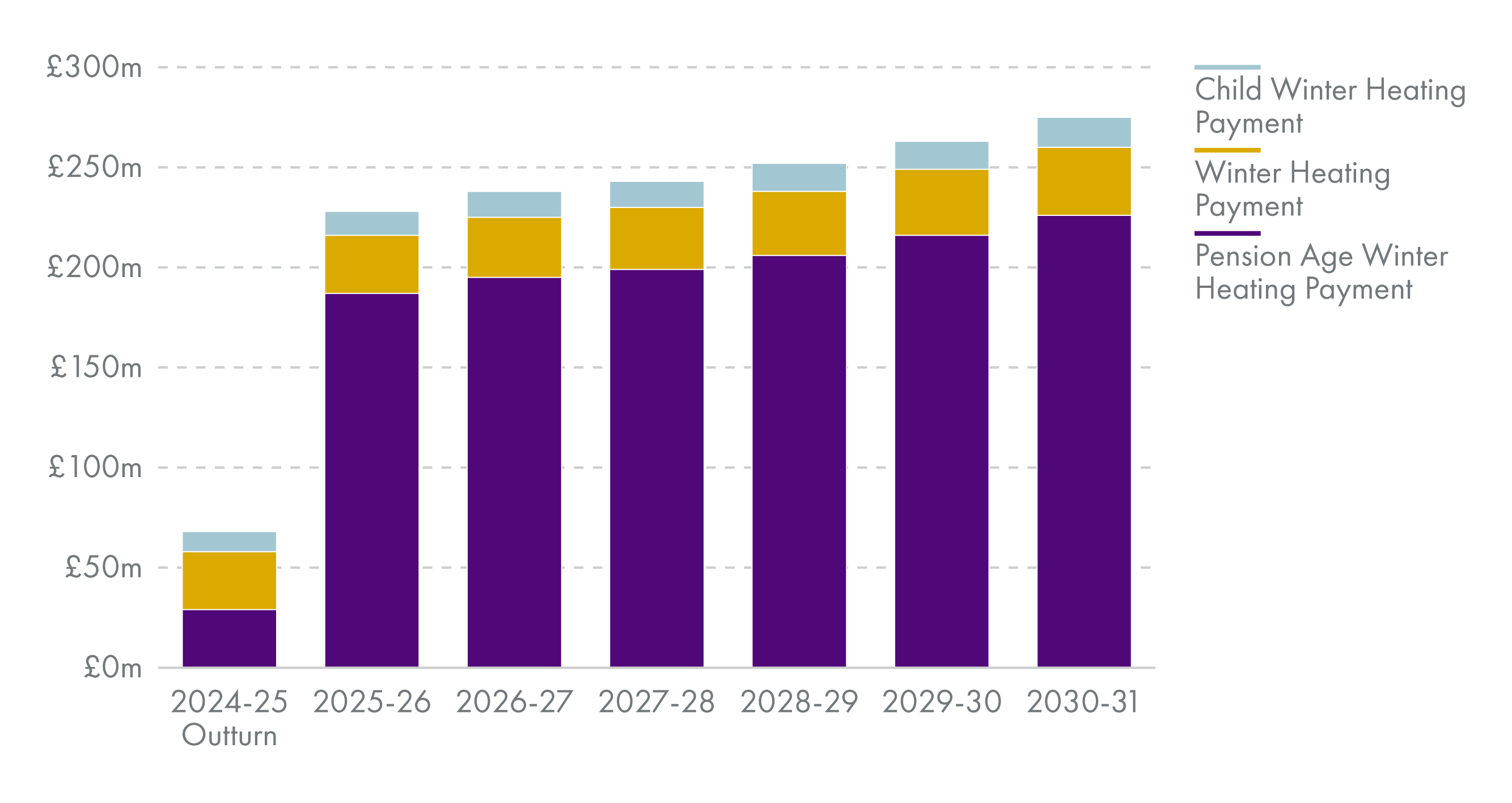
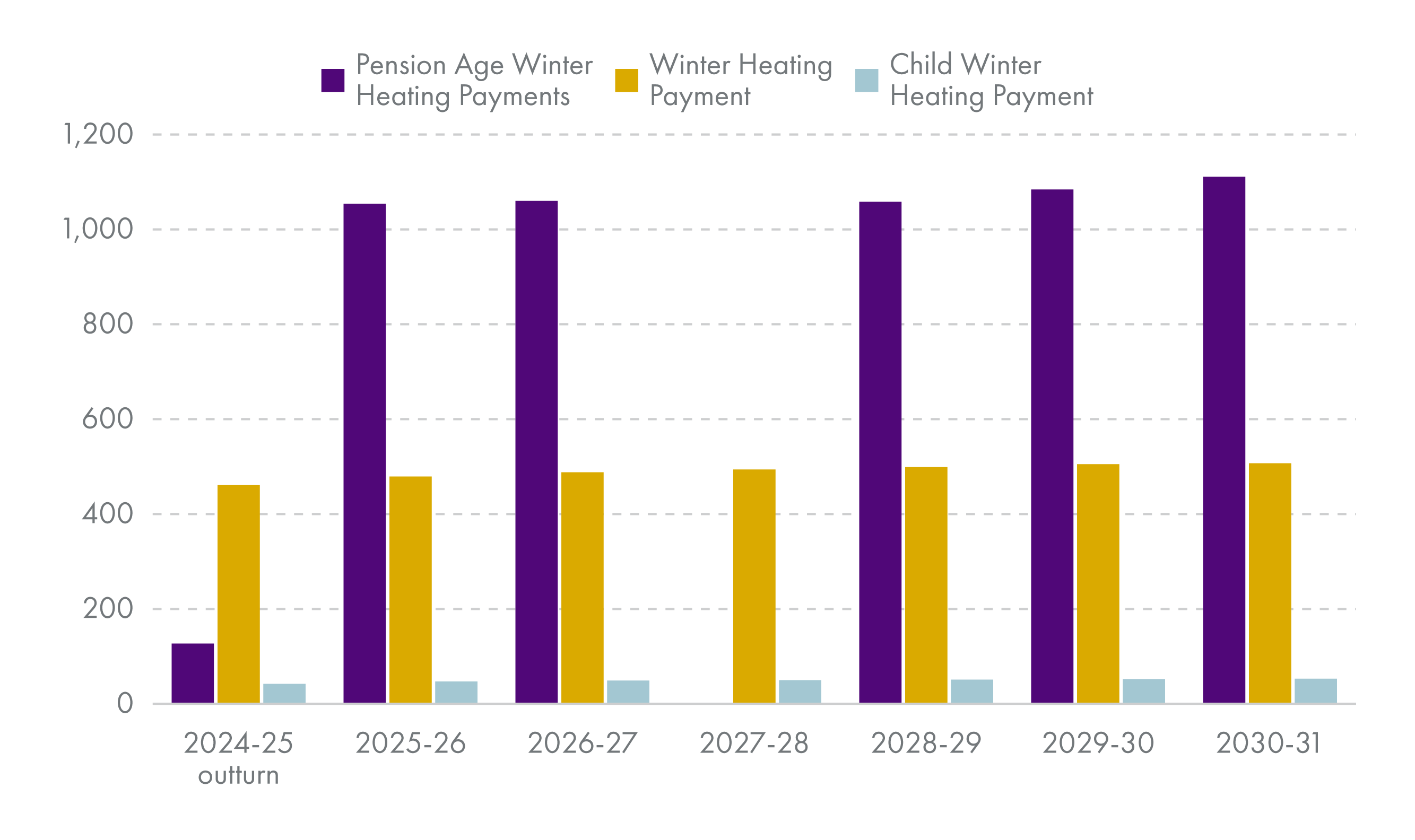
Spending on winter payments was much lower in 2024-25 as the eligibility for the pension age payment was restricted to those getting Pension Credit. The move back to a universal payment in 2025-26 saw caseload and spend return to levels similar to that of Winter Fuel Payment in 2023-24. Over the next few years spending on winter payments is expected to increase gradually, mainly reflecting annual uprating for inflation.
Winter payments do not have the highest spend, but they do have the highest caseloads of any devolved benefit with nearly 500,000 people getting the low income payment and around 1 million people getting the pension age payment.
The tables below show caseload and spend from 2024-25, as the largest payment - Winter Fuel Payment was devolved that year and became Pension Age Winter Heating Payment.
Scottish Fiscal Commission
Scottish Fiscal Commission
Disability
There are four disability benefits administered by Social Security Scotland:
Child Disability Payment (CDP),
Adult Disability Payment (ADP)
Pension Age Disability Payment (PADP)
Scottish Adult Disability Living Allowance (SADLA)
Disability benefits are intended to be a contribution towards the additional cost of disability. It doesn't matter if someone is working or how much income they have.
The eligibility criteria for CDP and PADP are based on a person's care needs.
Child Disability Payment
There are two parts to CDP: a care component and a mobility component. The care component can be awarded at a lower, middle or higher rate based on care needs during the day, during the night or during both night and day. The mobility component is awarded at a lower or higher rate, based on the level of assistance required to move around.
Pension Age Disability Payment
PADP can be awarded at a lower rate if someone needs care either during the day or during the night and is awarded at a higher rate if they need care during both day and night.
Adult Disability Payment
ADP has a 'daily living' component and a 'mobility' component each with a standard or enhanced rate, awarded using a points system.
The 'daily living component' is awarded based on points scored against descriptors grouped under 10 'daily living' activities. These are based on day to day activities - such as washing, dressing, preparing food and communicating. Each activity has several 'descriptors' describing different levels of ability, each with a certain number of points. For example someone who 'cannot prepare or cook food' scores 8 points under Activity 1: 'Preparing Food' and if they also 'need prompting to be able to read or understand basic written information' they would score a further 4 points under Activity 8 'Reading and Understanding'. This would take their total to 12 points in total under the 'daily living' activities. A total of 8 points are needed for the standard rate and a total of 12 points are needed for the enhanced rate.
The mobility component, is similarly based on points and awarded at a standard rate for a score of 8 points and an enhanced rate for a score of 12 points.
For further detail on how the 'points system' works, see Social Security Scotland's decision-making guide.
The higher rate of the mobility component in CDP and ADP can be used to lease a vehicle provided by Motability.
Scottish Adult Disability Living Allowance
SADLA is not open to new claims, and people receiving this benefit have been transferred from Disability Living Allowance administered by the DWP. The rules are very similar to Disability Living Allowance and Child Disability Payment.
Short Term Assistance and appeals
If a person challenges a decision whether by redetermination or appeal, they can apply for Short Term Assistance to top up their award to the amount they received before it was changed by the decision they are challenging. By the end of January 2026 there had been £6.9 million awarded in Short Term Assistance, almost all (£6.7 million) to those challenging ADP decisions.
There have been more appeals for ADP than any other devolved benefit. By January 2026 there had been 14,140 ADP appeals received, of which 5,465 had been heard. Of those, 53% were upheld. For CDP, there had been 1,425 appeals received, 580 heard, of which 59% were upheld. PADP was introduced across Scotland in April 2025, and there were 70 appeals received by the end of January 2026.
Table 6 below summarises components and payment rates for these benefits.
| Benefit | Client group | Amount | Eligibility |
| Child Disability Payment | Disabled children and young people | Care: £30.30 or £76.70 or £114.60 per week.Mobility: £30.30 or £80.00 per week | Rates paid depend on needs assessed against set criteria |
| Adult Disability Payment | Working age disabled people. Can continue after pension age. | Daily Living: £76.70 or £114.60 per weekMobility: £30.30 or £80.00 per week | As above. (ADP also has a ‘transitional’ care rate of £30.30 for those transferring from lower rate care DLA) |
| Pension Age Disability Payment | People becoming disabled after pension age. | Higher rate: £114.60Lower rate: £76.70 | Rate paid depend on needs assessed against set criteria. |
| Scottish Adults Disability Living Allowance | People previously in receipt of Disability Living Allowance | Care: £30.30 or £76.70 or £114.60 per week.Mobility: £30.30 or £80.00 per week | Not open to new claimants. |
| Short Term Assistance | Disabled people challenging a decision through redetermination or appeal. | Tops up benefit to the amount paid before the decision being challenged. | Was getting CDP, ADP, PADP or SADLA and are now challenging a decision to stop or reduce that benefit. Apply when asking for redetermination |
There are no estimates of take-up for disability benefits, as it is extremely challenging to assess eligibility at a population level.
Spend and Caseload
Chart 5 below shows the total number of people in Scotland getting these disability benefits (or the DWP benefits they replaced) increasing by nearly 80% over ten years, from 576,000 in 2020-21 to a forecast 1,030,000 in 2030-31.
Spending is rising faster than caseload. Chart 6 shows the amount paid out in disability benefits in Scotland increasing by 157% over ten years (in cash terms), from £2,877 million in 2020-21 to £7,383 million in 2030-31.
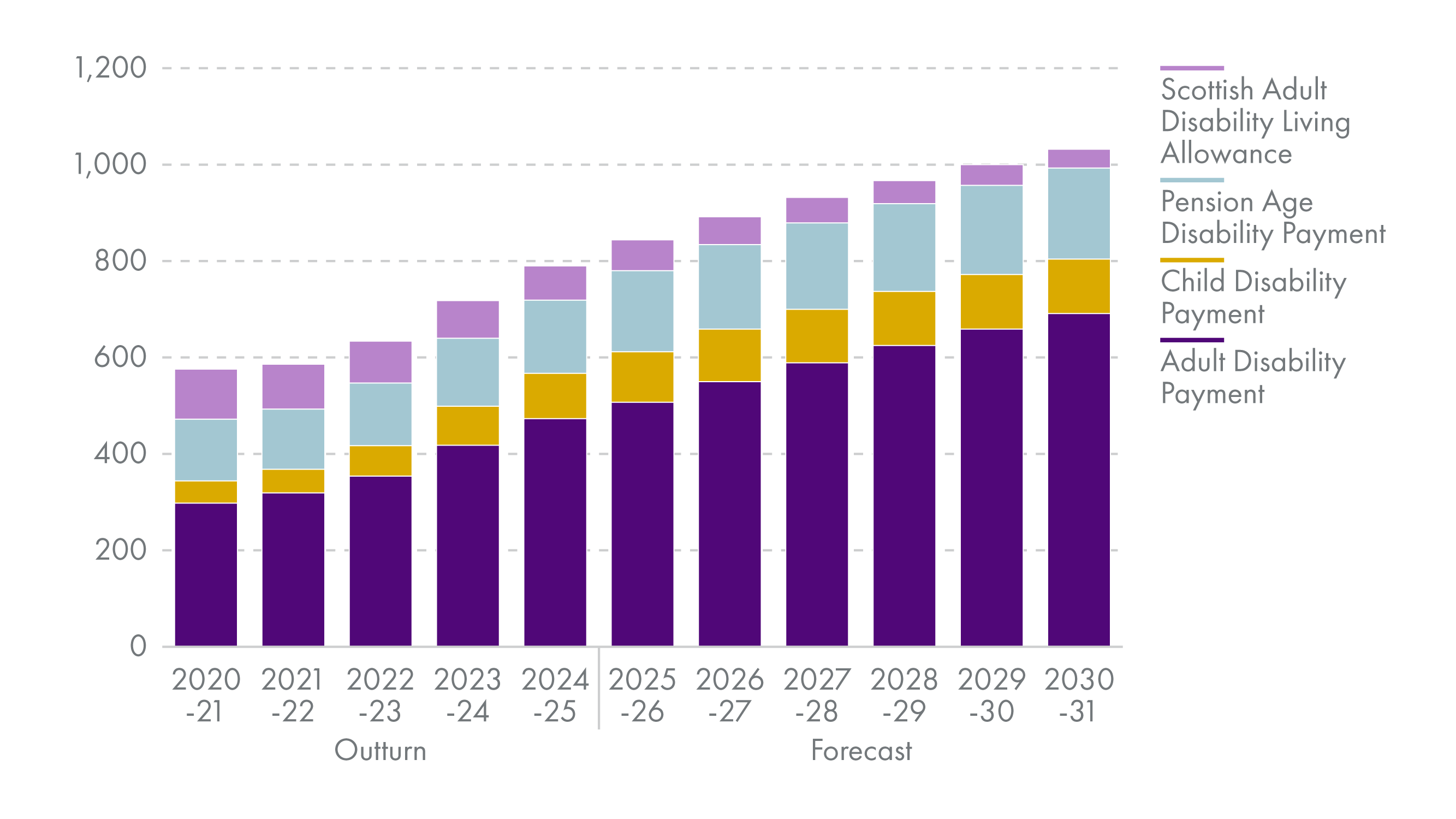
Scottish Fiscal Commission. Note: Before case transfer was completed at end of 2025, figures include DWP equivalent benefits - Personal Independence Payment, Attendance Allowance and Disability Living Allowance.
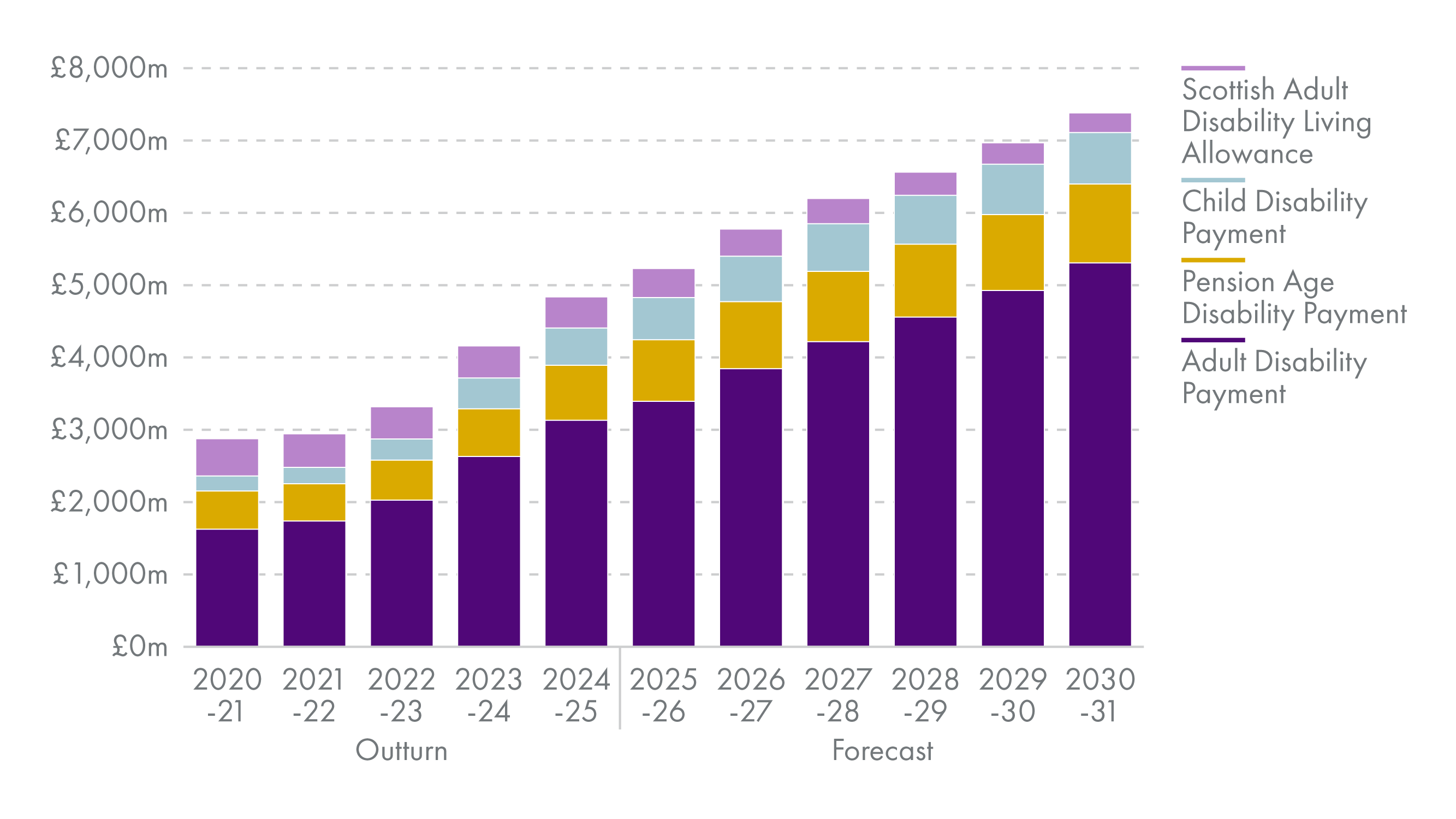
Scottish Fiscal Commission. Note: Before case transfer was completed at end of 2025, figures include DWP equivalent benefits - Personal Independence Payment, Attendance Allowance and Disability Living Allowance.
Processing times
Applications for CDP and ADP take considerably longer to process than other benefits (apart from Carer Support Payment), reflecting the more complex decision-making required. In 2025-26 CDP decisions took, on average, 62 working days. It has since improved, taking 40 days in March 2026. In period Apri 2025 to January 2026 ADP was taking 48 working days on average.In contrast PADP took 7 working days.
Disabling conditions
The most common category of condition for people getting CDP and ADP is mental health and behavioural disorders. This is the main disabling condition for 70% of those receiving CDP and 43% of those receiving ADP. This category includes learning disabilities and autism which includes a large proportion of the children receiving disability benefits. For PADP and SADLA the most common category is diseases of the musculoskeletal system and connective tissue. This is the main disabling condition for 24% of people in receipt of PADP and 38% of those in receipt of SADLA.
Local Authority Payments
Local authorities administer the Scottish Welfare Fund and Discretionary Housing Payments under the Scottish Welfare Funds Act 2015 and Part 5 of the Social Security (Scotland) Act 2018 respectively. They also administer Council Tax Reduction and a new Carer Leaver Payment.
Scottish Welfare Fund
The Scottish Welfare Fund is a discretionary fund, paid out of a fixed budget and administered by local authorities under statutory guidance issued by the Scottish Government. It provides:
Crisis grants - where an individual is facing a disaster or emergency situation, and where there is an immediate threat to the health or safety of that individual or their family. The average grant in 2024-25 was £144.
Community Care Grants - to help to establish or maintain a settled home and to support individuals and families facing exceptional pressure . The average grant in 2024-25 was £773.
Around 180,000 to 200,000 awards are made each year. In 2024-25, over half of all awards went to single person households (57%), and over a quarter to single parent households (28%).
If a person disagrees with a decision they can ask the council to review it. If that does not resolve the issue then they can ask the Scottish Public Sector Ombudsman (SPSO) for an independent review. In 2024-25 the SPSO considered 688 Scottish Welfare Fund reviews.
The charts below shows how annual expenditure has increased from £28.7 million in 2013-14 to £51.9 million in 2025-26 - an increase of £23.2 million over 12 years. However, after accounting for inflation, spending was around £11 million higher in 2025-26 than it had been in 2013-14. Spending increased substantially following the COVID pandemic and, while it has since fallen back, it is still considerably higher than it was in the period before 2020.
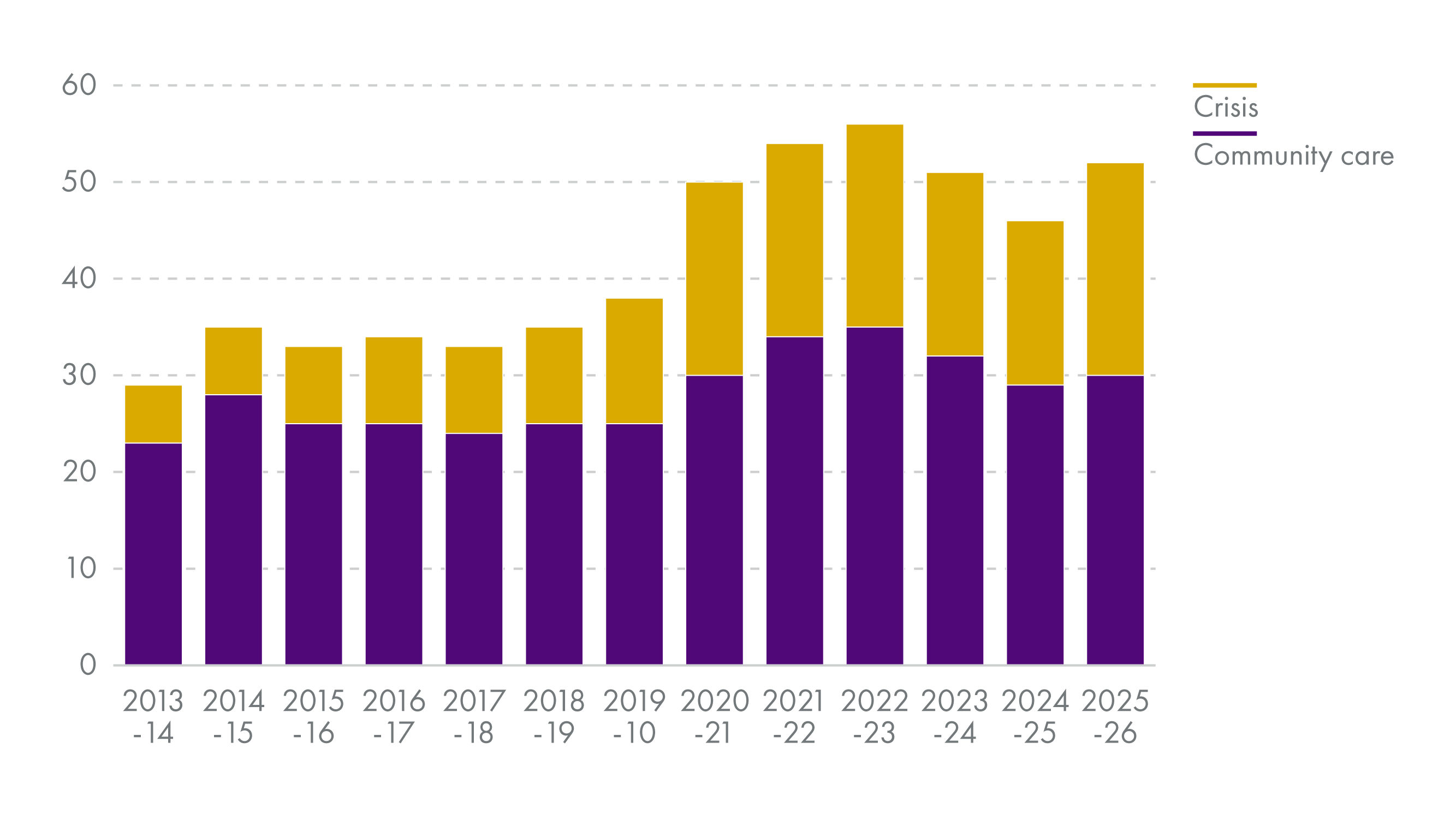
Scottish Government
Discretionary Housing Payments
Discretionary Housing Payments (DHPs) can be granted by local authorities to people who get help with housing costs through Universal Credit or Housing Benefit. When making decisions, local authorities must have regard to statutory guidance issued by the Scottish Government.
DHPs are intended to help with short term housing pressures, but in Scotland they have been used primarily to mitigate the impact of the under-occupancy chargein social housing (known as the 'bedroom tax', or 'spare room subsidy').
More recently, the Scottish Government has also provided funding to local authorities to mitigate the 'benefit cap' - the UK Government's limit on the amount of certain social security benefits that a household can receive.
The policy expectation that these deductions are mitigated in full creates a demand-led element to what is, in statute, a discretionary fund.
The other main reason to provide a DHP is to make up shortfalls caused by the limit placed on the rent support provided in Universal Credit and Housing Benefit for private sector rents (known as the Local Housing Allowance). Local authorities also have discretion to pay DHPs for other housing needs.
If a person disagrees with a local authority's decision on a DHP they can ask the local authority to review it. There is no route for appeal.
Chart 8 illustrates how spending on DHPs has risen steadily reaching nearly £90 million in 2024-25. This trend is set to continue with funding forecast to reach £135 million by 2030-31.
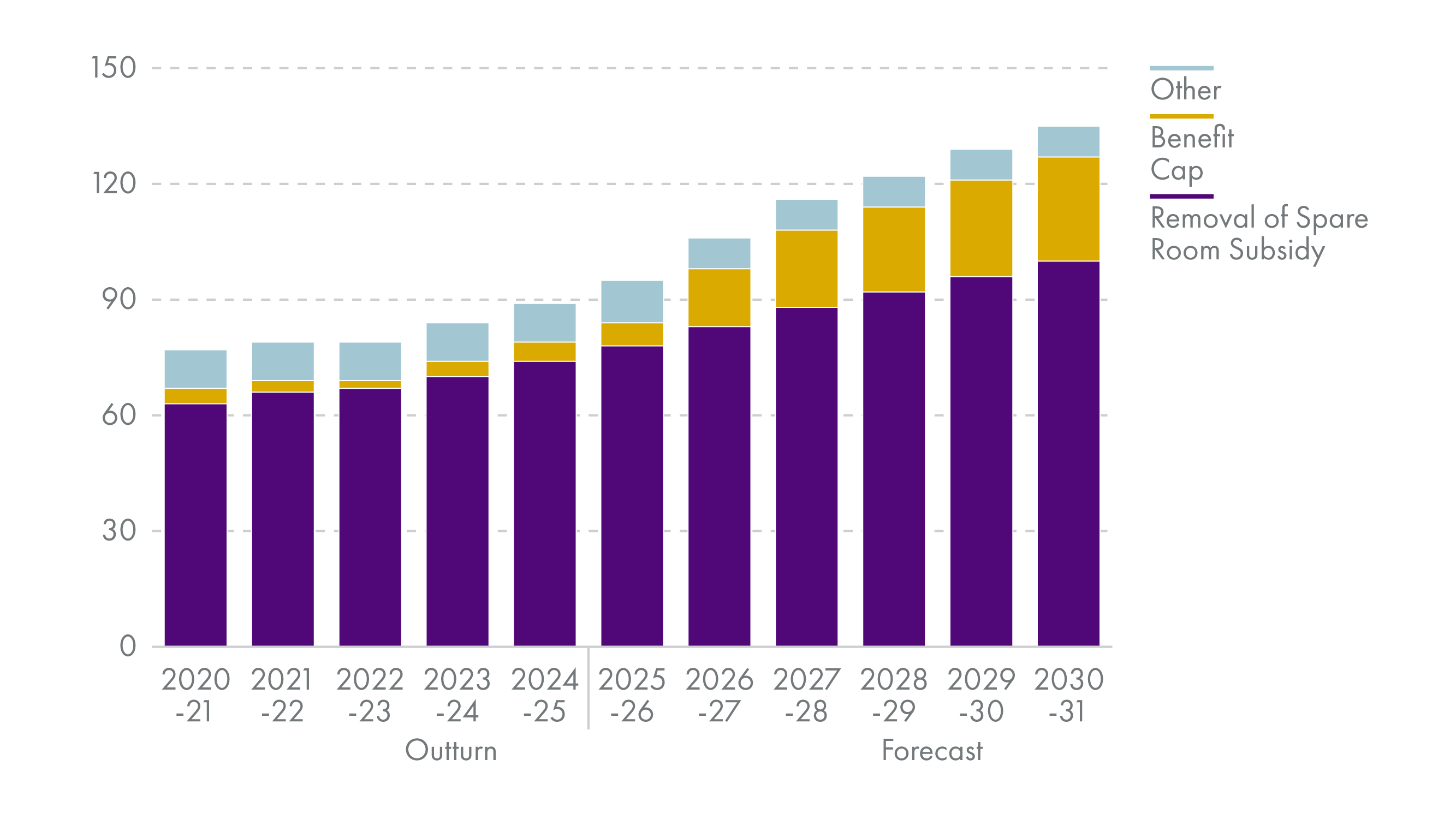
Scottish Government, Scottish Fiscal Commission
Council Tax Reduction
The Council Tax Reduction scheme reduces the council tax bill for eligible people, so is technically a reduction in tax liability rather than a social security benefit. The rules are set out in Scottish regulations for 'working age'and 'pension age' people made under the Local Government Finance Act 1992.
It is a complex scheme, designed to continue the same policy as was in place for Council Tax Benefit prior to its abolition. Very briefly, people who receive Pension Credit will get their council tax bill reduced in full. For everyone else, once Universal Credit has replaced 'legacy benefits' from summer 2026, eligibility depends on a means test taking into account income and savings as well as personal circumstances including whether you are a carer, have a disability and if you have children.
A useful introduction to Council Tax Reduction is available from the Child Poverty Action Group.
In 2024-25, 458,120 people received a Council Tax Reduction, which resulted in £390 million 'income foregone' by local authorities, up from £330 million in 2013-14.
Care Leaver Payment
The Care Leaver Payment is a new social security benefit introduced in April 2026 and administered by local authorities in line with Scottish Government guidance and regulations
It is a one-off payment of £2,000 for those leaving care at or after their 16th birthday.
There were 1,383 care leavers in 2023-24 and expenditure is estimated at around £3 million per year.
Department for Work and Pensions
The DWP still administers two devolved benefits on behalf of the Scottish Government under Agency Agreements. They also administer 'Universal Credit Scottish Choices' (described below).
Industrial Injuries Disablement Benefits
Industrial Injuries Disablement Benefits are a group of benefits for people who become ill or are disabled because of an accident or disease either:
at work, or
on an approved employment training scheme or course.
In addition to injury, the scheme covers more than 70 diseases.
The scheme includes a number of benefits, which are:
Industrial Injuries Disablement Benefit
Constant Attendance Allowance
Exceptionally Severe Disablement Allowance
Reduced Earnings Allowance
Retirement Allowance
Unemployability Supplement
Industrial Death Benefit
The final two are closed to new claimants. There are also two benefits which remain in legislation although they are closed and have no claimants - these are: Industrial Injuries Disablement Gratuity and Hospital Treatment Allowance.
The 'core' benefit is Industrial Injuries Disablement Benefit. The amount of payment is based on a person's assessed level of disability. This is assessed by a ‘medical advisor’ on a scale of 1 to 100%. The payment for 100% disability in 2026-27 is £233.90 per week. The DWP has published 'technical guidance' providing more detail on how each benefit works.
Expenditure in Scotland is around £80 million a year, and there are around 23,000 people in receipt.
Although any legislation concerning IIDB would be considered by the Scottish Parliament, under the agency agreement, the Scottish Government follows the rules and policy for IIDB set by the Department of Work and Pensions. Applications are made to DWP.
The Scottish Government intends to replace these benefits with Employment Injury Assistance, administered by Social Security Scotland.
Severe Disablement Allowance
Severe Disablement Allowance (SDA) has been closed to new applicants since 2001 and was superseded first by Incapacity Benefit and then by Employment and Support Allowance.
In 2026-27 there are only around 600 people receiving this benefit in Scotland and expenditure is around £4 million (SFC January 26 forecast).
In 2019, the Scottish Government announced that SDA would remain administered by the DWP rather than transfer to Social Security Scotland. The reasons given were:
there will be no new claims;
there is a small and declining caseload;
the Scottish Government is not proposing to make changes to the benefit and this proposal is largely supported by stakeholders and individuals;
the interaction with the State Pension could cause unnecessary confusion for clients and;
transferring the benefit may cause unnecessary disruption to some SDA clients.
It is forecast that by 2030-31 there will only be around 300 people in receipt in Scotland.
Universal Credit - Scottish Choices
Universal Credit - Scottish Choices was introduced in 2017 to give clients the choice about:
Whether the part of their Universal Credit that is for housing costs is paid direct to their landlord, and
Whether they receive their payment every four weeks, or split as a fortnightly payment.
Both these arrangements are possible throughout the UK, where they are known as 'Alternative Payment Arrangements' or APAs and have been in place since 2013. The difference is that an APA can be imposed if, for example, a client is in rent arrears.
In February 2026, out of 612,732 people getting Universal Credit in Scotland, 175,644 (29%) had chosen more frequent payments. Out of the 410,051 people whose Universal Credit included an amount for rent, 85,654 (21%) had chosen for this to be paid direct to the landlord (DWP, StatXplore).
APAs still operate alongside Scottish Choices. The table below shows that a further 173,888 people in Scotland had a 'direct to landlord' payment arranged through an APA and a further 9,197 people had 'more frequent payments' arranged through an APA. The table also gives figure for England and Wales showing that, where clients are given the choice, they are a significant minority (29%) choose fortnightly rather than monthly payments.
| Scottish Choices | APA - Scotland | APA - England and Wales | |
|---|---|---|---|
| More Frequent Payments: % of UC households. | 29% | 2% | 7% |
| Direct to Landlord: % of UC households with a housing element | 21% | 42% | 33% |
DWP StatXplore
Useful Links
Scottish Fiscal Commission - forecasts of caseload and expenditure
DWP StatXplore - interactive benefit statistics tool for DWP benefits (login required but free to sign up)
Scottish Commission on Social Security- reports on Scottish social security regulations.
Social security chamber of First-tier Tribunal for Scotland - appeals on Scottish social security benefits