History of fiscal devolution: taxes, reliefs and policy issues for Session 7
This briefing summarises the fiscal powers available to the Scottish Parliament and how they have changed since 1999. It gives an overview of the fiscal framework which outlines how the Scottish and UK Governments manage the impact of devolved taxes on the Scottish Budget. Finally, the briefing summarises current tax policy, and issues which parliamentarians may wish to consider during Session 7.
Key points
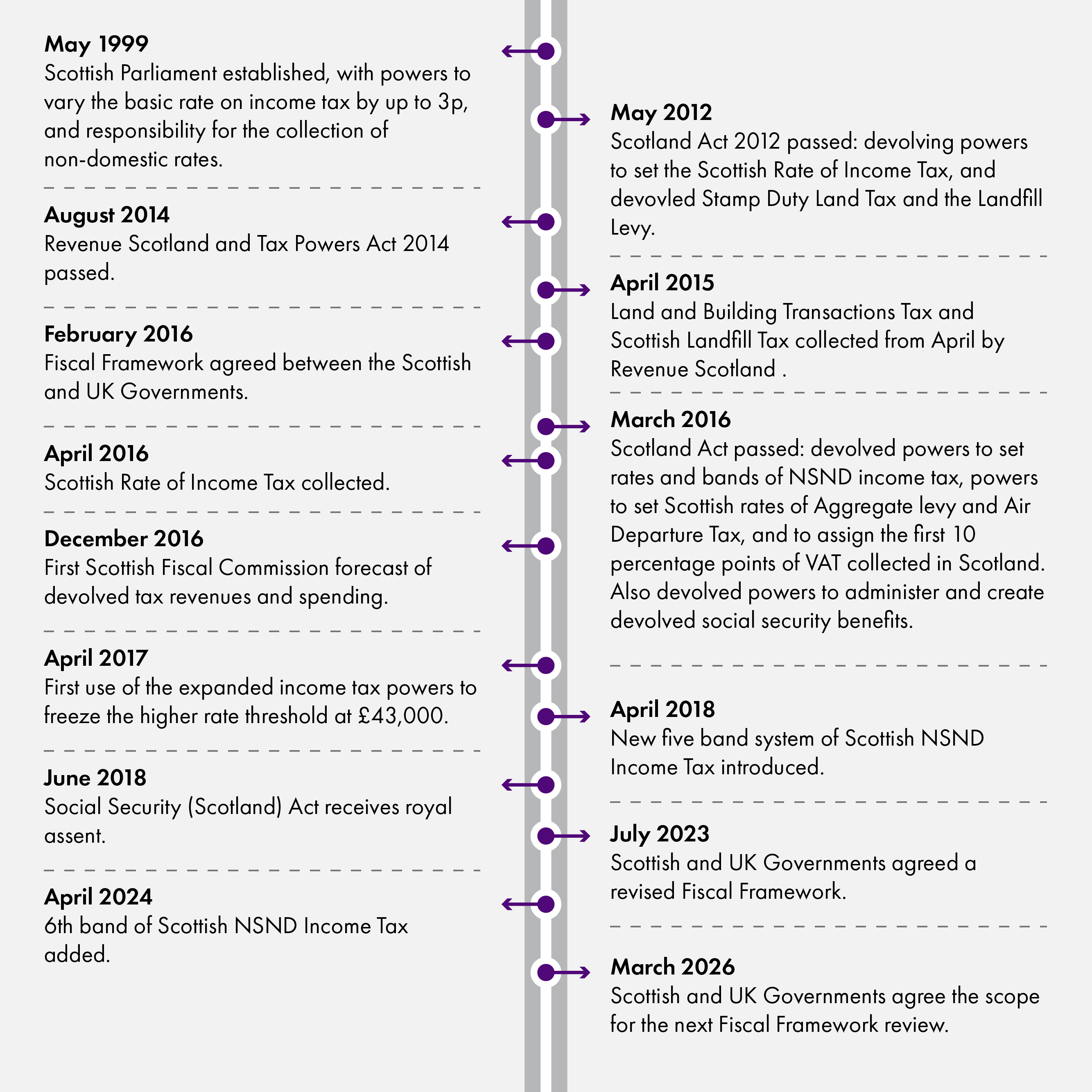
Since the Scottish Parliament was reconvened in 1999, there have been considerable changes to the Budget process and the financial powers available. This briefing gives a detailed overview of the evolution of these powers:
Section one sets out the initial fiscal powers granted to the Parliament in 1999.
Section two gives an overview of how these have changed since then.
Section three discusses areas of reform which might occur in the future.
Section four gives more details on current tax policy in Scotland.
Section five explains how tax devolution functions in practice
Section six sets out some of the key policy issues that Parliamentarians may wish to consider during Session 7
SPICe
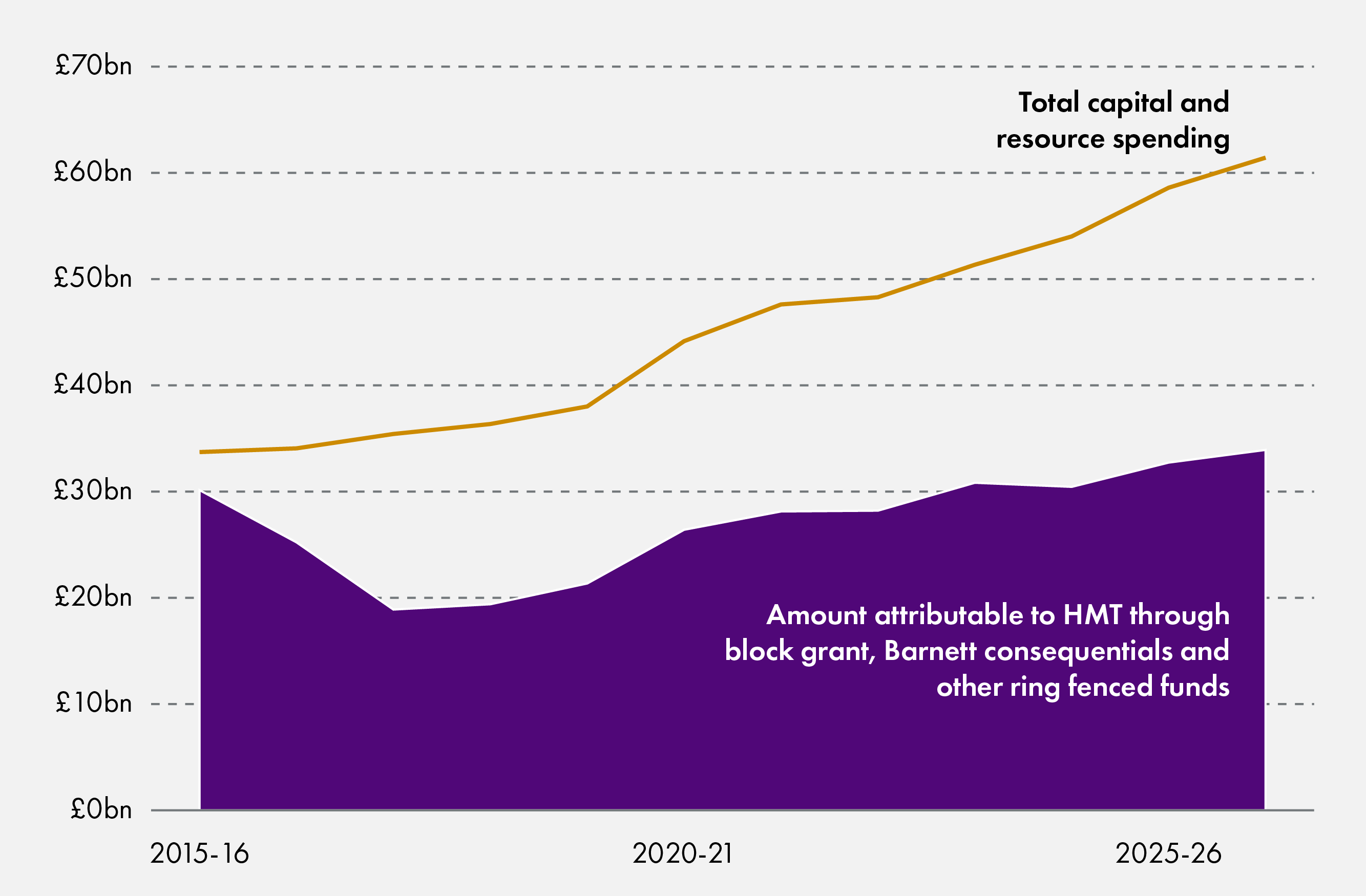
One of the major effects of these changes is that an increasing proportion of the Scottish budget can now be linked directly to tax decisions taken in the Scottish Parliament, as shown in Figure 2 below.
The revenue from devolved taxes has been increasing over time
SPICe
History of fiscal devolution
In the 27 years of devolution, there have been a number of changes to the fiscal powers of the Scottish Parliament. This section will give a brief overview of the powers which were granted to the Parliament under the 1998 Scotland Act, and summarise how these powers have changed over time.
The 1998 Scotland Act
The 1997 Scottish devolution referendum asked two questions;
Do you agree that there should be a Scottish Parliament as proposed by the Government?
Do you agree that a Scottish Parliament should have tax-raising powers as proposed by the Government?
On 11 September 1997, 74.29% voted yes to the first question, and 63.48% voted yes to the second.
The Scotland Act 1998 therefore included provision for a 'Scottish Variable Rate' of income tax (SVR). This allowed the Scottish Parliament to increase or decrease the basic rate of income tax set by the UK Parliament by a maximum of 3p. The House of Commons Library note that raising the basic rate of income tax by 3p in Scotland could have generated about £450 million1.
In addition, powers related to the framework and rules for local taxation (Council Tax and Non-domestic rates) were devolved to the Scottish Parliament.
Council Tax
The council tax and non-domestic rates systems we see now would have been very familiar to those voting in the 1997 referendum. Although local taxation has been fully devolved for 27 years, and problems with both taxes have been repeatedly highlighted over that period, there have been only very small changes made.
Council tax is a local tax on domestic properties which helps pay for local authority services. All households pay council tax unless exempt, and the owner or occupier of the property pays the tax. It was introduced on 1 April 1993, placing every “dwelling” in Scotland into one of eight valuation bands (A to H). Each council tax band represents a range of capital values at 1 April 1991. The band a dwelling is placed in is determined by independent assessors.
Until the passing of the Visitor Levy Act in 2024, council tax was the only locally set tax in Scotland. Although it is a "local tax", there are still limits to what councils can and cannot do with it. For example, ratios between Council Tax bands are defined in national legislation and often the Scottish Government will aim to ensure a cap or freeze on any potential increases. Nevertheless, Council Tax Band D rates are set annually by councils, the tax is collected by local authorities, retained by them, and spent entirely on local services.
The Scottish Government's Provisional Outturn and Budget Estimates (POBE) publication shows that, in 2026-27, Council Tax will likely bring in £3.5 billion for Scotland's councils, an estimated 19% of total local government general funding1:
| Component | 2026-27 (estimate) (£m) | % of total General Fund |
| General Revenue Grant (GRG) | 11,226 | 61% |
| Non-Domestic Rates Distributable Amount | 3,474 | 19% |
| Council Tax | 3,547 | 19% |
| General revenue funding | 18,305 | 100% |
Strengths and weaknesses of the current council tax system
In 2015, the Scottish Government established the Commission on Local Tax Reform, an independent Commission co-chaired by the Minister for Local Government and the President of COSLA. It brought together local and national politicians from different political parties and a range of expertise from across Scotland to look at ways of developing a fairer system of local taxation. Its report concluded that "the present Council Tax system must end"1.
Dr Lewis Forsyth of Glasgow University undertook research on council tax as part of his SPICe Academic Fellowship last year. His report explores how council tax aligns with the six principles of Scottish tax policymaking as set out in the Scottish Government's 2021 Framework for Tax2. The research involved extensive background reading followed by in-depth interviews with 15 participants selected for their expertise on council tax. The following highlights some of the strengths and weaknesses he identified.
Strengths
Being a property tax, council tax provides a reliable and predictable source of income for councils.
The present system is largely effective in ensuring convenience for both taxpayers and local authorities. Most people pay the tax through monthly direct debits.
The use of bands brings simplicity and reduces the likelihood of appeals.
Weaknesses
It is based on a tax base from 1991 which is not a true reflection of the distribution of properties today.
Council tax is widely recognised as regressive (see IFS, 2025).
Banding weakens the link between property value and wealth.
Band multipliers do not match real differences in property values.
There is a common misunderstanding that council tax pays for all council services.
Non-domestic rates
Non-domestic rates (NDR) are local taxes paid on land and heritages used for non-domestic purposes in the private, public and third sectors. The tax is administered and collected by local authorities, but tax rates and reliefs are set by the Scottish Government. Since 1989 councils have had no role in the setting of non-domestic rates. NDR is forecast to bring in around £3.5 billion for local government in 2026-27, almost the same as council tax.
Like council tax revenues, NDR income varies across the 32 local authorities. Unsurprisingly, Scotland's two largest cities will see the highest levels of NDR income in 2026-27 in monetary terms. Those local authorities seeing the smallest NDR revenues are Eilean Siar and Orkney Islands. Low levels of NDR and council tax income are compensated for by a larger than average General Resource Grant allocation (as a % of total general income) from the Scottish Government.
The gross bill for a non-domestic property depends on the rateable value (RV) of the property, which is set by independent assessors, and the poundage rates, set by the Scottish Government. Rates are announced in the Scottish Budget, alongside various rates reliefs.
Each non-domestic property in Scotland is assigned an RV by independent Scottish Assessors, with legislation requiring revaluation to be done every three years. Normally the RV of a property should reflect the annual rent that it could have been let for on the open market, taking account of the type and nature of the property.
The most common form of rates relief is the Small Business Bonus Scheme which has been in place since 2008. This provides rates relief to non-domestic properties in Scotland under a certain rateable value. For rates payers with one business property they may be exempt from paying any NDR if the property has an RV of less than £12,000. For properties with an RV between £12,001 to £15,000 they could be eligible for significant reductions. According to the Scottish Government, the scheme awarded relief to 116,000 properties in 2025-26, reducing non-domestic rates bills by more than £247 million.
The 2026 revaluation
There has been particular interest in NDR in 2026 as Scotland, like England and Wales, underwent a revaluation of rateable values. In January, the Scottish Parliament held a debate on NDR and the impact of increased bills on businesses across Scotland. This came after draft valuation notices were sent to properties at the end of November showing proposed changes to their rateable values from 1 April 2026.
The Scottish Government published statistics showing the differences between the previous rateable values (from the 2023 revaluation) and the rateable values from the 2026 Revaluation. Over 140,000 properties are expected to see an increase in RV compared to the 2023 valuation, with an average increase of £6,800.
Hotels, self-catering properties and leisure and entertainment premises are expected to see some of the highest percentage increases in RV when comparing 2023 cycle valuations and 2026 valuations. The Scottish Government's statistical summary found:
The overall rateable value of accommodation properties increased by 29%, with a corresponding increase in the gross bills after revaluation transitional relief of 15%. Around 23,000 properties saw an increase in rateable value, on average by £5,300, while for 2,700 accommodation properties the rateable value decreased by an average of £3,300.
Announcement of reliefs in the 2026-27 Budget
As well as reducing the poundage rates (the multipliers) and continuing the Small Business Bonus Scheme, the Scottish Budget 2026-27 included a new 15% NDR relief for retail, hospitality and leisure (RHL) premises liable for either the Basic or Intermediate Property Rates. The Scottish Government estimated that this could help up to 37,000 properties (subject to the cap of £110,000 per ratepayer). The Budget also extended and expanded the 100% relief for three more years for RHL properties on islands and some remote areas.
The Scottish Government also announced a new Revaluation Transitional Relief (RTR) for those businesses seeing significant increases to their rateable values in April 2026. With this, the Government is capping increases in gross bills up to 2029.
The Budget included details of a new Small Business Transitional Relief aimed at ratepayers losing eligibility for Small Business Bonus Scheme relief. This scheme aims to ensure they do so “in a phased manner”. Eligible ratepayers will pay 25% of any increase to their net bill in the first year (2026-27), 50% in the second year (2027-28) and 75% in the third year (2028-29).
On the 12 February 2026, the Cabinet Secretary for Finance and Local Government told the Chamber:
I committed to passing on to hospitality any additional consequential funding from the United Kingdom Government’s recent announcement on business rates for pubs and music venues in England. We consulted the business community prior to finalising our package, and I confirm that the Scottish Government will provide 25 per cent additional relief for the next three years for licensed hospitality and music venues that are on the basic or intermediate property rates, including pubs, restaurants, hotels, nightclubs and licensed clubs.
Along with the 15% relief for the retail, hospitality and leisure sectors for properties on the basic or intermediate property rate, which was announced in the Budget, total relief for eligible licensed hospitality premises and music venues will be 40% for the next three years—capped at £110,000 per business per year.
This means that the following type of premises will be eligible for a 40% relief on their NDR Bills, if their RV is less than £100,000: hotel, hostel, live music venue, public house or night club and restaurant.
With regards self-catering properties, the Cabinet Secretary also stated:
I have also listened to concerns that have been raised by those in the self-catering sector. I will introduce a specific revaluation transitional relief for that sector, which will cap increases in gross liabilities due to revaluation at 15 per cent year on year, up to the next revaluation.
A new, specific transitional relief was therefore added for eligible self-catering properties.
With the announcement from the new UK Prime Minister On 23 July 2026, that there would be an additional 20% relief for pubs, clubs and live music venues from 2027-28, pressure will be on the Scottish Government to introduce something similar in their forthcoming Budget.
Before the summer recess, the Scottish Government announced a comprehensive review of non-domestic rates. According to the Scottish Government: "this will examine improvements and reforms that can be made to the system, working closely with business to ensure the system provides the clarity, incentive, and transparency which businesses need".
Reforms to taxation since Scotland Act 1998
The power to change the basic rate of income tax in Scotland (the SVR introduced by Scotland Act 1998) was never used. In order to be administered, the Scottish Government was required to pay an annual maintenance payment. The Scottish Government stopped making this payment in 2007, which meant that it would require a new payment, and at least two years notice, for HMRC to be ready to administer the SVR.
Wider political developments resulted in several reforms to the fiscal powers available to the Scottish Parliament. This section of the briefing will summarise these changes, covering the following topics:
The Calman Commission and Scotland Act 2012
In June 2009, the Commission on Scottish Devolution (the Calman Commission) published its final report "Serving Scotland Better: Scotland and the United Kingdom in the 21st Century"1. Part 3 of this report focused on strengthening accountability in finance.
The final report noted that the Calman Commission was tasked with setting out how to improve the financial accountability of the Scottish Parliament. The report noted that the existing SVR tax powers could be used to increase or decrease the size of the Scottish Budget by approximately £1 billion, but noted that this power had not been used. The report stated that:
First and most obviously there has never been a political consensus in the Parliament to exercise the power. Additionally, the first ten years of the Parliament’s existence have been a time of rapidly growing public spending, and the challenges in managing the growth of that spending wisely may have suggested that further growth from additional taxation was unnecessary.
There may however be other reasons. Evidence such as that from the Institute of Chartered Accountants in Scotland (ICAS) that estimates that the cost, especially the start-up cost of using the SVR for the first time, would be quite substantial in comparison with the revenue that might be received, especially for variations of less than the full 3p in the pound. More profoundly, however, there is the nature of the power itself. Because the SVR is a power to alter a rate already set by the UK Government, a decision to do nothing has no effect on the budget of the Parliament.
The report discussed a range of options to improve this, ranging from the assignation of a share of revenues to the Scottish Parliament to devolution of powers. Assignation would create risk and unpredictability, but not provide the Scottish Parliament with powers to help manage this.
Noting that the vast majority of the Scottish Budget came from a grant from the UK Parliament, the Calman Commission made four recommendations relating to the further devolution of taxation and financial powers to the Scottish Parliament:
The Scottish Variable Rate of income tax should be replaced by a new Scottish rate of income tax (SRIT). This would lower the basic and higher rates of income tax by 10p in Scotland, and reduce the Block Grant by a corresponding amount. It would then be for the Scottish Parliament to set a tax rate. This would only apply to non-savings, non-dividend income, and would not give the Scottish Parliament powers to alter the tax bands or allowances.
Stamp Duty Land Tax, Aggregates Levy, Landfill Tax and Air Passenger Duty should all be devolved to the Scottish Parliament.
The Scottish Parliament should be given a power to legislate with the agreement of the UK Parliament to introduce specified new taxes that apply across Scotland.
Scottish Ministers should be given powers to borrow for short term purposes to manage cash flow related to devolved taxes, and limited borrowing powers for capital investment.
The Scotland Act 20122 implemented 39 out of 42 recommendations from the Calman Commission final report. Two of the recommendations not implemented were related to financial powers. A House of Commons Library briefing3 sets out the reasons for two specific taxes not being devolved at that time:
The Aggregates Levy was not devolved, as the UK levy was at the time subject to ongoing legal challenges in the European Union.
Air Passenger Duty was also not devolved, due to complications regarding legal exemptions for the Highlands and Islands under state aid and subsidy control rules.
Limited borrowing powers were granted to the Scottish Parliament. To fund infrastructure investment, up to 10% of the total capital budget could be funded through borrowing from either the National Loans Fund or commercial banks, subject to a cumulative cap of £2.2 billion. A limited version of the power was put in place early, from April 2013, to allow the Scottish Government to fund £100 million of pre-payments for the Forth Road Crossing.
Resource borrowing was also permitted to help manage the increased risk associated with SRIT and the devolved taxes. This was subject to an annual limit of £200 million, and a cumulative limit of £500 million.
Land and Buildings Transaction Tax
In its final report, the Calman Commission noted that UK Stamp Duty on property transactions (Stamp Duty Land Tax - SDLT) was a suitable candidate for devolution as it is closely linked to areas of devolved responsibility (in this case, housing), there were already reliefs to allow different rates to operate in different areas, and the nature of the tax meant that there was good existing data on the levels of stamp duty land tax paid in Scotland.
The Scottish Parliament passed the Land and Building Transaction (Scotland) Act 20131, which become the first purely Scottish tax statute enacted in over 300 years. One of the more significant changes was to move from SDLT's then 'slab' structure to a more progressive tax structure. Until 2014, under UK SDLT, any property which sold just above a threshold would apply the increased tax rate to the entire purchase price. Under Land and Buildings Transactions Tax (LBTT), the tax rate under each band only applies to that portion of the price above the tax threshold, with the intention of reducing market distortions. The UK Chancellor later matched this 'slice' structure for UK SDLT in 2014.
The Scottish Budget for 2015-16 set the first rates of LBTT. There are three different parts of the tax: those applying to residential property sales, those applying to non-residential properties, and for commercial leases. The tables below set out the bands and rates for LBTT for the 2015-16 financial year.
| Purchase price | LBTT rate |
|---|---|
| Up to £145,000 | 0% |
| Over £145,000 to £250,000 | 2% |
| Over £250,000 to £325,000 | 5% |
| Over £325,000 to £750,000 | 10% |
| Over £750,000 | 12% |
| Purchase price | LBTT rate |
|---|---|
| Up to £150,000 | 0% |
| Over £150,000 to £350,000 | 3% |
| Over £350,000 | 4.5% |
| Net present value of rent | LBTT rate |
|---|---|
| Under £150,000 | 0% |
| Over £150,000 | 1% |
Revenue Scotland started collecting LBTT from 1 April 2015.
Scottish Landfill Tax
As with Stamp Duty Land Tax, Landfill Tax was considered to be a good candidate to devolve as it relates closely to areas of devolved responsibility, and the tax base is geographically specific and immobile.
The Scottish Parliament passed the Landfill Tax (Scotland) Act 20141 on 21 December 2014, which enabled Revenue Scotland to collect Scottish Landfill Tax (SLfT) from 1 April 2015. Unlike LBTT, the Scottish Government did not seek to diverge in terms of the SLfT rate compared to the UK Landfill Tax.
The two band system and the tax rates were maintained at UK levels, in order to ensure that there were no incentives to transport waste across borders to take advantage of lower rates. These original rates were £2.60 per tonne for the lower rate, and £82.60 per tonne for the higher rate.
However, there were some changes introduced in SLfT compared to the UK Landfill Tax. Revenue Scotland were given powers to apply the tax to illegally dumped waste - so fly-tippers would receive a tax bill in addition to any criminal fines issued by the courts or the police. SLfT also made 'loss on ignition' testing mandatory. This requires landfill operators to laboratory test a sample of waste, and if a sample lost more than 10% of its weight when burned then it would be disqualified from the lower rate. This change was rolled out across the UK in 20152.
Scottish Rate of Income Tax
The most significant devolved power in financial terms in the Scotland Act 2012 was the Scottish Rate of Income Tax (SRIT). In the 2016-17 Budget, reapplying the 10p rate of SRIT was forecast to be worth £4.9 billion, in other words this was around 13% of the total budget of £37.3 billion.
The SRIT was fully implemented and operated during the 2016-17 financial year. However, by this time the Scotland Act 2016 had already been enacted. In 2016-17, the basic, higher and additional rates of income tax were reduced by 10 percentage points in Scotland, and on 11 February 2016 the Scottish Parliament passed the first Scottish Rate Resolution to add 10 per cent back to each of the three bands.
This resulted in the block grant for the 2016-17 financial year being reduced by £4.9 billion, which was equal to the revenue raised by SRIT.
The further revisions to income tax powers are discussed later in the briefing (see Scottish Income Tax).
The Smith Commission and Scotland Act 2016
Following the 2014 referendum on Scottish Independence, Lord Smith led a commission to consider the further devolution of powers to the Scottish Parliament. The final report1, published on 27 November 2014, made several recommendations under three pillars. Pillar 3 aimed to strengthen the financial responsibility of the Scottish Parliament, and included five recommendations:
The Scottish Parliament should have the power to set the rates and bands of non-savings, non-dividend income tax in Scotland, above the personal allowance.
The first 10 percentage points of the standard rate of VAT should be assigned to the Scottish Government's budget, with the Scottish and UK Governments to agree a methodology for calculating the amount assigned.
Air passenger duty to be devolved.
Once the current legal issues are resolved, the Aggregates Levy should be devolved.
The fiscal framework between the Scottish and UK Governments should be updated to increase the borrowing powers, reflecting the additional risk that the Scottish Budget will face following devolution of additional powers.
The Scotland Act 20162 received Royal Assent on 23 March 2016, and implemented the recommendations from the Smith Commission. On the financial powers, there was one change relating to the assignation of VAT. While the Smith Commission had recommended that the first 10 percentage points of the standard rate of VAT should be assigned to the Scottish budget, the Scotland Act 2016 also included the first 2.5 percentage points of the revenue from the reduced rate of VAT.
Council tax reforms
Reform to the council tax system since 1999 has been limited, despite a number of parliamentary inquiries, manifesto commitments and the Scottish Government's own Commission on Local Tax Reform (2015). For the vast majority of households in Scotland, the council tax system looks pretty much as it did in 1999; valuations are based on 1991 house prices, homes are still placed into one of 8 bands and many members of the public still assume (wrongly) that the tax pays for local government services in their entirety (see 1 and 2). Nevertheless, a few tweaks have been made over the past 27 years and this section summarises some of the more recent ones.
Changes to band multipliers
The only significant change arising from the 2015 Commission on Local Tax Reform was the Scottish Government's decision to increase the ratios of the upper council tax bands (E-H) relative to Band D. From April 2017, the roughly 25% of Scottish households in these higher bands were to pay between £100 and £500 more per year. The Scottish Government estimated this would raise an additional £100 million per year across Scotland.
Changes to council tax bills for second and empty homes
In many areas of Scotland, high numbers of second and empty homes are placing pressures on the local housing supply. The Scottish Government is committed to supporting councils to ease these pressures and one such approach is the use of local taxation3. Since 2013, councils have been able to charge a 100% council tax premium—that is, double the normal rate—on certain long-term empty homes. This power was extended to second homes in April 2024. Further regulations were introduced earlier this year, following a Scottish Greens amendment to the Housing (Scotland) Act 2025. These allow councils to set even higher council tax charges for long-term empty homes and second homes. More information is available in a recent SPICe blog post.
Non-domestic rates
The Scottish Government responded to the 2017 Barclay review1 by implementing a number of changes, including:
A commitment by the Scottish Government for revaluations to take place every three years and to bring the tone date forward to one year prior to revaluation (rather than two).
Fresh Start relief, aimed at bringing empty properties in to use, was extended on 1 April 2018. The relief increased from 50% to 100% for the first year of new occupation and was made to apply after a property had been empty for six months rather than the previous 12.
A review of the Small Business Bonus Scheme.
The Non-Domestic Rates (Scotland) Bill was introduced in the Scottish Parliament in March 2019 becoming an Act in March 2020. This legislated for revaluations every three years and enabled Ministers to make provision for the relief from the payment of NDR for new and improved properties. The Scottish Government has published a timeline detailing changes to the business rates system. This details a number of changes made over the past 9 years, including those resulting from the 2020 Act.
Towards the end of Session 6, the Local Government, Housing and Planning Committee was made aware of some businesses seeing sharp increases in the rateable value of their premises, with little clarity or transparency from assessors on the methodology used. The Scottish Government sets the policy framework for NDR, including relief schemes, but the assessment process is independent of government. Nevertheless, the Deputy First Minister announced in June 2026 that the Scottish Government will establish an independent panel to undertake a rapid review of the outcomes of the 2026 revaluation:
Specifically, it will be tasked with examining and reporting to ministers, within three months of its appointment, on allegedly anomalous valuations and their overall impact. Ministers will ask the panel to make recommendations on how those might be addressed.2
The Deputy First Minister also committed to a general review of the assessor function:
The review will ensure that assessors’ independence in valuation is maintained, but it will also seek to ensure that there is confidence in the system for all. Over the summer, we will begin engaging with stakeholders to develop options for reform to the structure of assessors and establish how those options could deliver improvements in accountability and transparency.2
Scottish Aggregates Tax
The Aggregates Tax and Devolved Taxes Administration (Scotland) Act1 received Royal Assent on 12 November 2024.
The Act was introduced as a consequence of the measures enacted in the Scotland Act 2016 which allowed the Scottish Parliament to legislate for a tax to replace the UK Aggregates Levy. The Act makes provision for a Scottish Aggregates Tax (SAT) - a tax on the commercial exploitation of primary aggregates. The tax was introduced on 1 April 2026 and is collected and managed by Revenue Scotland, the tax authority responsible for the collection and management of all Scotland's fully devolved taxes.
The Act also proposed legislative amendments to the Revenue Scotland and Tax Powers Act 20142 which were intended to support the efficient and effective collection of all devolved taxes by Revenue Scotland.
The Scottish Fiscal Commission (SFC) produced its first forecast of revenues for 2026-27, noting that:
HMRC does not currently collect data on the amount of the current UK-wide Aggregates Levy that is attributable to Scotland. We have therefore used other data sources to estimate the share of quarrying and cross-border movement of aggregate. Once SAT is introduced in April 2026, we will be able to obtain outturn data from Revenue Scotland. We expect to have SAT outturn data available to inform our forecast published alongside the 2027-28 Budget.
The SFC expects SAT to raise £42 million in 2026-27. In the first year of operation, the block grant adjustment (BGA) will be set to match SAT revenues and so will not impact the funding available for the Scottish budget. (See section below for further discussion of BGAs).
Scottish Building Safety Levy
The Building Safety Levy (Scotland) Act 20261 received Royal Assent on 13 May 2026. The Act proposed introducing a new tax, called the Scottish Building Safety Levy (SBSL), to be charged on the construction or conversion of residential property developments, with some exceptions. This followed an amendment to the Scotland Act 19982 to include powers for a devolved tax to be charged in relation to certain steps in the building control process.
Money raised through this levy will be used to fund building safety expenditure. An equivalent tax is also being developed in England.
The SBSL does not replace an existing rUK tax, so there will no block grant adjustment process required. In addition, the SBSL aims to raise a fixed amount to contribute to the costs of cladding remediation (£30 million per year of operation). Revenue Scotland will begin collecting the SBSL from 1 April 2028, with secondary legislation to set out the details of the tax, including rates and reliefs.
Air Departure Tax
The Air Departure Tax (Scotland) Act1 (ADT) was passed by the Scottish Parliament in 2017. However, implementation of ADT has been delayed due to concerns over whether the existing Highlands and Islands exemption for the UK-wide Air Passenger Duty (APD) – and any equivalent exemption within a devolved ADT – would comply with the UK Government’s Subsidy Control regime.
The Scottish Government explained this delay in 2025, noting that:
While flights from airports in the Highlands and Islands have been tax exempt since 2001 under APD, implementation of ADT represents the establishment of a new tax alongside new tax exemptions. The creation of a new Highlands and Islands tax exemption must demonstrate compliance with subsidy control principles and consider any possible market or trade distortion. As a result, the Scottish Government has continued to defer implementation of ADT on the basis that a new exemption is necessary to protect aviation connectivity for remote and rural communities, and to ensure that devolved powers are not compromised.
The 2026-27 Budget states that proposals for a new Highlands and Islands exemption have now been developed that will allow for implementation of ADT in Scotland. The Scottish Government published a consultation on their proposals for ADT on 29 January 2026, which closed on 26 March. This consultation covered the proposed approach to ADT, including plans for a Highlands and Islands exemption and the proposed private jet supplement.
An analysis of the consultation responses was published on 15 July2. Key points highlighted in this report include:
There was support for the proposed expanded exemption for flights to airports in the Highlands and Islands, and for flights originating in the Highlands and Islands travelling to any UK airport, including via connections.
Some concerns were expressed about the proposed removal of the international exemption to ADT. The Scottish Government note that an exemption for international travellers might present issues in complying with UK Subsidy Control.
Consultation responses expressed support for higher rates of taxation for private jets.
The importance of a clear and consistent ADT framework, and continued engagement with stakeholders.
For 2027-28, the Scottish Government intends that ADT rates and bands will be set in line with the UK Air Passenger Duty. From 2028-29, the Scottish Government will set rates consistent with its stated high-level principles for ADT3, with the intention that this will include a private jet supplement. The Scottish Government states that it will also engage with the UK Government to seek further devolution to allow private jet ‘ghost flights’ to be addressed (this is where private jets fly without passengers in order to reposition the aircraft).
The Visitor Levy
The Visitor Levy (Scotland) Bill was passed by the Scottish Parliament on 28 May 2024, becoming an Act on 5 July 2024. This allows local authorities to introduce Visitor Levy Schemes and tax overnight visitors. The original legislation empowered councils to charge a levy based on a percentage of the cost of the overnight stay.
Less than 19 months after the Visitor Levy Bill passed, the Scottish Government introduced an amending Bill (passed in March 2026) which now allows local authorities to introduce flat rate levies (eg £2 a night). Councils therefore have a choice of a percentage rate or a flat rate for a scheme (but not both).
Accommodation providers collect the levy on behalf of councils and make quarterly returns to the local authority. The money collected by the local authority should only be used for certain specified purposes. With reference to the Act, Visit Scotland states that "the funds must facilitate the achievement of a vistor levy scheme’s objectives and that they should develop, support and sustain facilities and services for or used by visitors to a local authority area for leisure or business purposes"1.
All 32 local authorities in Scotland have the power to introduce a visitor levy. However, relatively few have enough visitors to merit introducing a scheme. As of August 2026, five local authorities have decided to introduce schemes, with Edinburgh's being the first to go live (from the end of July 2026). Accommodation providers in the Capital must charge a levy of 5% on overnight accommodation up to a maximum of five nights. It is estimated that the Edinburgh levy could raise up to £50 million a year which will be used to "invest in sustaining, supporting and enhancing Edinburgh's worldwide appeal as a place to visit and live"2.
The legislative amendment made earlier this year could encourage more local authorities to introduce a levy, based on a flat rate rather than a percentage. Currently, Argyll and Bute Council and the Highland Council are exploring options with their communities and businesses.
Future reforms
In addition to the reforms already enacted, there are some areas from the 2016 Scotland Act which have not yet been enacted. This section of the briefing will summarise these possible future reforms, setting out the reasons they have not yet been implemented.
New council tax bands, aka "the mansion tax"
The Scottish Government's 2026-27 Budget included a commitment to introduce a "mansion tax" from 2028, by adding two bands to the top of the council tax system for properties valued at over £1 million and £2 million1. This comes after the UK Government used its 2025 Budget to announce plans for a High Value Council Tax Surcharge on residential properties worth £2 million and above in England.
The Scottish Government intends to introduce primary legislation to enable new bands to take effect from 1 April 2028. They believe this provides "sufficient lead-in time for Scottish Assessors to complete a targeted revaluation of residential properties worth over £1 million". All other properties will not be revalued for council tax purposes:
The targeted revaluation applies only to properties estimated to be worth more than £1 million at 1 April 2026 values. The existing 1991 valuation basis for all other properties will remain entirely intact. This means that all other homes in Scotland – i.e. any property estimated to be worth less than £1 million as at 1 April 2026 - will remain on the existing 1991 valuation basis and will remain unchanged in their current Bands A to H.2
A consultation on the Scottish Government's proposals closed on 24 August 2026 and it will take some time before submissions are summarised and findings published. However, the submission from Professor Ken Gibb of Glasgow University, one of the leading experts on housing economics in Scotland, was published in August 2026. Some of his key points include:
The decision to keep the mansion tax separate from any wider discussion of council tax revaluation "verges on the ridiculous".
It makes no sense to contemplate revaluing (to current prices) just the top 1% and leaving the rest of the tax base stuck in 1991.
How will the uprating of property values operate in terms of maintaining an accurate tax base for those who are above the threshold?
It is worth noting that Wales has had an additional high value band – Band I for properties with a value of over £424,000 - since April 2005. However, this was introduced at the same time as a revaluation of all properties in Wales.
VAT assignment
The Scotland Act 2016 provided for the first 10p of standard Value Added Tax (VAT) receipts and the first 2.5p of reduced rate VAT receipts raised in Scotland to be assigned to the Scottish Government. However, progress on implementing this has been complex as the appropriate basis for identifying the relevant receipts has not been agreed.
The Fraser of Allander Institute highlighted the challenges in agreeing a methodology to measure VAT receipts in Scotland, noting that there were challenges in producing a time series of data which was not especially volatile:
Given the sums involved, the Scottish Parliament would be taking on a significant – and unreasonable – risk based upon current plans. It should, at the very least, press for a delay in the assignation of VAT to the Scottish Budget.
On 14 November 2023, the Finance and Public Administration Committee held an evidence session looking at the assignation of VAT in Scotland. Witnesses noted the lack of sufficient data to calculate VAT receipts in Scotland, that the proposed assignation of revenues increased the risk and volatility of funding for the Scottish budget to a significant degree, and that it was not clear that there was a sufficiently strong link between changes in assigned VAT revenues and action taken by the Scottish Government.
The Budget notes that the 2023 Fiscal Framework Agreement1 with the UK Government outlines that further work is required to mitigate any risks from VAT assignment and states:
We note the comments from the House of Commons Scottish Affairs Committee and the Scottish Parliament Finance and Public Administration Committee on the risks and challenges regarding the implementation of VAT Assignment. The Scottish Government continues to acknowledge the uncertainties and complexities that the proposed assignment methodology could bring to the Scottish Budget, and will ensure these issues are fully covered in further discussions with the UK Government.
Tax policy in Scotland
This section will summarise the latest policy position across the devolved or partially devolved taxes.
Scottish Government tax strategy
The Scottish Government published a Tax Strategy alongside the 2025-26 Budget1 (December 2024), intended to set out the steps that will underpin the Scottish Government’s approach to developing tax policy.
In terms of firm commitments, these are limited and the commitments were only made to the end of the Session 6 Parliament. In respect of income tax, the Scottish Government committed to:
not introducing any new bands or rates (for the remainder of the 2021 - 2026 parliament)
ensuring that more than half of Scottish taxpayers will pay less income tax than they would in the rest of the UK – currently this is achieved, but these individuals pay only £28 less per year at most than they would in the rest of the UK, so it is not a major difference
uprating the starter and basic rate bands by at least inflation
freezing the higher, advanced and top rate thresholds.
Beyond the specific commitments, there is lots of talk of “exploring”, “considering” and “engaging” on a range of taxes, including council tax and non-domestic rates. The main 2025-26 Budget document2 refers to plans for a Cruise Ship Levy and Carbon Land Tax, but these are not referred to in the Tax Strategy document.
Scottish Income Tax
Income tax is a partially devolved tax in Scotland. The Scottish Parliament can create bands and set the income tax rates, but it cannot alter the definition of a Scottish income tax payer, the definition of the income that the tax will apply to, the Personal Allowance, and it cannot create other reliefs.
In recent years there have been three primary objectives of income tax policy in Scotland:
To set bands and rates in a way which ensures a majority of taxpayers pay less tax than they would in England.
To set a more progressive tax system through using 6 tax bands.
Raising significantly more revenue than would have been the case without fiscal devolution, increasing funding available for the Scottish budget.
Achieving these three objectives has not always proved straightforward, in particular in ensuring that most taxpayers pay less tax than they would in England. In recent years the Scottish Government has allowed a relatively small margin for error. The 2025-26 Scottish Budget for example suggested that 51% of taxpayers would pay less than they would in the rest of the UK. As such, a relatively small increase in average earnings could result in the commitment no longer being met.
In November 2025, the SFC published an update to their estimates of median income in Scotland1. This update suggested that someone earning an income of £30,318 or above would pay more income tax in Scotland than they would elsewhere in the UK. According to the SFC, in 2025-26 this is expected to be 49.1% of Scottish taxpayers, so the commitment was still met for 2025-26 based on this update. However, the same update showed that the statement no longer held for 2023-24 and 2024-25 on the basis of the updated data.
In the 2026-27 Budget, the then Cabinet Secretary gave herself a little more headroom, by setting income tax in a way which means that 55% of Scottish income taxpayers pay less than they would in the rUK, on the basis of the current forecasts.
The Scottish Government had pledged not to increase tax rates further during the remainder of the Session 6 Parliament, and so the 2026-27 Budget made limited changes to NSND income tax policy. The starter and basic bands were increased by 7.4%, which will reduce the amount of tax paid by the majority of taxpayers. The result of this change is small however, worth a maximum of £31.75 per year.
| Band | Taxable income | Rate |
|---|---|---|
| Starter rate | £12,571* - £16,537 | 19% |
| Basic rate | £16,538 - £29,526 | 20% |
| Intermediate rate | £29,527 - £43,662 | 21% |
| Higher rate | £43,663 - £75,000 | 42% |
| Advanced rate** | £75,001 - £125,140 | 45% |
| Top rate** | Over £125,140 | 48% |
* Assumes individuals are in receipt of the standard UK personal allowance (£12,570 in 2026-27). The personal allowance is reserved and set by the UK Government.
** Those earning more than £100,000 will see their personal allowance reduced by £1 for every £2 earned over £100,000. This policy is reserved to the UK Government.
Land and buildings transaction tax
LBTT was the first tax to be fully devolved in Scotland, and has been collected since the 2015-16 financial year. It is applied to purchases of residential and non-residential land and buildings, as well as commercial leases.
The first policy was to introduce five bands of LBTT for residential purchases:
| Band (by purchase price) | Rate |
|---|---|
| £0 to £145,000 | 0% |
| £145,001 to £250,000 | 2% |
| £250,001 to £325,000 | 5% |
| £325,001 to £750,000 | 10% |
| Over £750,000 | 12% |
Since LBTT was introduced, there has been only one temporary change to these five bands. Between 15 July 2020 and 31 March 2021, the Scottish government extended the 0% band to cover property transactions up to £250,000, with the higher three bands remaining the same.
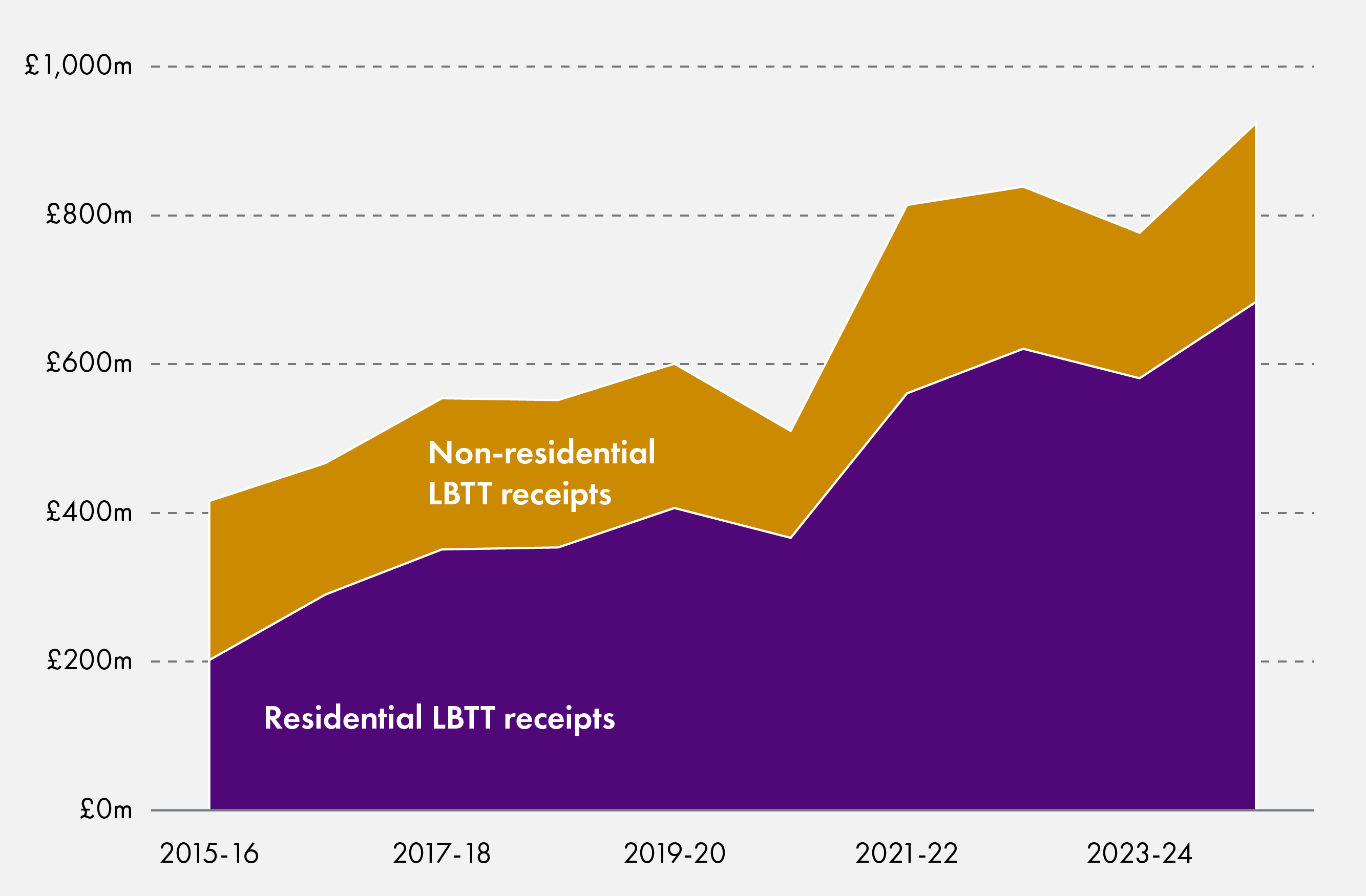
While the rates and bands of residential LBTT have not changed over time, house prices in Scotland have grown. According to data from the Registers of Scotland, the median purchase price for a home in 2015-16 was £140,000, but by 2024-25 this had increased to £190,000 (an increase of 35.7%)1. As house prices have increased, proportionately fewer transactions will attract the 0% or lower rates of LBTT. As such receipts from LBTT have grown over time. This is referred to as fiscal drag, and is something we discuss in more detail later in the briefing.
Revenue Scotland publish data on the receipts from LBTT, with the most recent data covering the 2024-25 financial year. Figure 3 below sets out how receipts have grown over time:
Revenue Scotland
While thresholds and bands have been virtually unchanged since the introduction of LBTT, there have been some reforms. From 30 June 2018, an additional relief was provided for first time buyers which extended the 0% rate to cover transactions up to £175,000. All parties to the transaction must be first time buyers in order to qualify for this relief.
From 1 April 2016, the Scottish Government have also introduced an additional dwelling supplement (ADS). This supplement is chargeable on transactions above £40,000, where the property is not intended to be used as the only or main residence. Initially, the rate of the ADS was set as 3% of the total purchase price. This rate has increased several times, and since December 2024 has stood at 8%.
There have been fewer changes to the rates and bands for non-residential LBTT, but changes were made to the bands and thresholds from 25 January 2019. The Land and Buildings Transaction Tax (Tax rates and Bands etc) (Scotland) Amendment Order 20182 reduced the lower rate on non-residential LBTT from 3% to 1%, increased the upper rate of non-residential LBTT from 4.5% to 5%, and reduced the starting threshold of the upper rate of non-residential LBTT from £350,000 to £250,000.
The Scottish Government announced a review of LBTT at the 2025-26 Budget. This review was published on 25 March 20263. Key points include:
Stakeholders highlighted concerns about the complexity and the proportionality of the lease review regime.
The difficulty in defining and administering 'exceptional circumstances' fairly with respect to the Additional Dwelling Supplement.
Scottish Landfill Tax
SLfT applies to the disposal of waste to landfill, charged by weight on the basis of two rates: a standard rate; and a lower rate for less polluting materials. The tax is intended to provide a financial incentive to support a more circular economy, reduce overall waste and the amount going to landfill and increase recycling.
The policy intention of this devolved tax is not to raise revenue, but to encourage behavioural change by creating a disincentive to dispose of waste at landfill.
In the 2026-27 Scottish Budget, the Scottish Government stated that:
We will introduce legislation to increase both SLfT rates from 01 April 2026 to align with UK Landfill Tax rates for 2026–27. This maintains policy consistency and prevents waste being moved across borders due to rate differences. Notably, the lower rate of tax will more than double, reinforcing the signal to reduce landfill use.
Since SLfT was introduced in April 2015, the Scottish Government has consistently maintained parity with the UK rates to avoid any cross border differences. The increases in rates have been at a higher rate than the rate of inflation over this time period. Between 2015-16 and 2026-27, the GDP deflater has increased by an average of 3.2% per year. The lower rate of SLfT has increased by an average of 11.6% per year over the same period, and the higher rate by an average of 4.3% per year.
While the rates of SLfT and its UK equivalent have increased faster than inflation since 2015-16, the tax has achieved significant behavioural change which has reduced revenues over time. Revenue Scotland publishes data showing the degree of this change - in 2015-16 the total tonnage of waste declined from 2.9 million tonnes to 0.8 million tonnes (a decline of 71.4%). The SFC forecasts SLfT revenues1, while Revenue Scotland publishes data on outturn when available2. The latest outturn data covers up to 2025-26. Table 7 below sets out the outturn data since 2025-16, and the SFC forecast for 2026-27 revenues.
| £ millions | 2015-16 | 2016-17 | 2017-18 | 2018-19 | 2019-20 | 2020-21 | 2021-22 | 2022-23 | 2023-24 | 2024-25 | 2025-26 | 2026-27 |
|---|---|---|---|---|---|---|---|---|---|---|---|---|
| Total SLfT revenues | 149.3 | 148.0 | 146.6 | 141.3 | 118.6 | 106.3 | 121.7 | 110.1 | 68.7 | 55.9 | 56.0 | 27.0 |
Scottish Aggregates Tax
The Scotland Act 2016 gave the Scottish Parliament the power to introduce a devolved tax to replace the UK Aggregates Levy in Scotland. The UK levy is paid on the commercial exploitation of aggregates, in essence crushed rock, sand, and gravel.
The Aggregates Tax and Devolved Taxes Administration (Scotland) Act 2024 received Royal Assent in November 2024, making provision for SAT.
The Scottish Budget for 2026-27 set the SAT rate from 1 April 2026 at £2.16 per tonne of taxable aggregate. This is the same as the equivalent rate in the rest of the UK, which the Scottish Government states is to ensure stability and certainty during the transfer of powers.. Revenue Scotland began to collect SAT from 1 April 2026. The SFC forecast that £42 million would be raised in 2026-27, but note that in the first year of operation the BGA for SAT will be adjusted to be equal to revenue, therefore having no impact on the net tax position. The SFC expect to have outturn data for 2026-27 available to inform the next forecast to accompany the 2027-28 Scottish Budget.
Scottish Building Safety Levy
The Scottish Parliament recently passed legislation to introduce a Scottish Building Safety Levy. The UK Government has introduced a similar levy which will come into force in October 2026 in England only.
The Scottish levy will provide revenue to support the funding of the Scottish Government’s Cladding Remediation Programme and is intended to come into effect on 1 April 2028. The Scottish Government 1published indicative rates for the SBSL on 31 July 2026. This sets proposed greenfield and brownfield rates per square metre for each local authority, shown in Table 8 below:
| Local Authority Area | Greenfield rate | Brownfield rate |
|---|---|---|
| Aberdeen City | £36.16 | £18.08 |
| Aberdeenshire | £24.23 | £12.11 |
| Angus | £26.96 | £13.48 |
| Argyll and Bute | £24.34 | £12.17 |
| City of Edinburgh | £48.46 | £24.23 |
| Clackmannanshire | £27.62 | £13.81 |
| Dumfries and Galloway | £23.17 | £11.58 |
| Dundee City | £29.39 | £14.70 |
| East Ayrshire | £24.30 | £12.15 |
| East Dunbartonshire | £39.19 | £19.60 |
| East Lothian | £34.82 | £17.41 |
| East Renfrewshire | £36.88 | £18.44 |
| Falkirk | £28.90 | £14.45 |
| Fife | £29.93 | £14.96 |
| Glasgow City | £38.04 | £19.02 |
| Highland | £27.46 | £13.73 |
| Inverclyde | £30.92 | £15.46 |
| Midlothian | £36.05 | £18.02 |
| Moray | £23.25 | £11.63 |
| North Ayrshire | £27.04 | £13.52 |
| North Lanarkshire | £29.46 | £14.73 |
| Perth and Kinross | £26.67 | £13.33 |
| Renfrewshire | £32.33 | £16.17 |
| Scottish Borders | £24.77 | £12.39 |
| South Ayrshire | £29.63 | £14.81 |
| South Lanarkshire | £28.46 | £14.23 |
| Stirling | £28.59 | £14.29 |
| West Dunbartonshire | £30.64 | £15.32 |
| West Lothian | £33.06 | £16.53 |
How do devolved taxes impact the Scottish Budget?
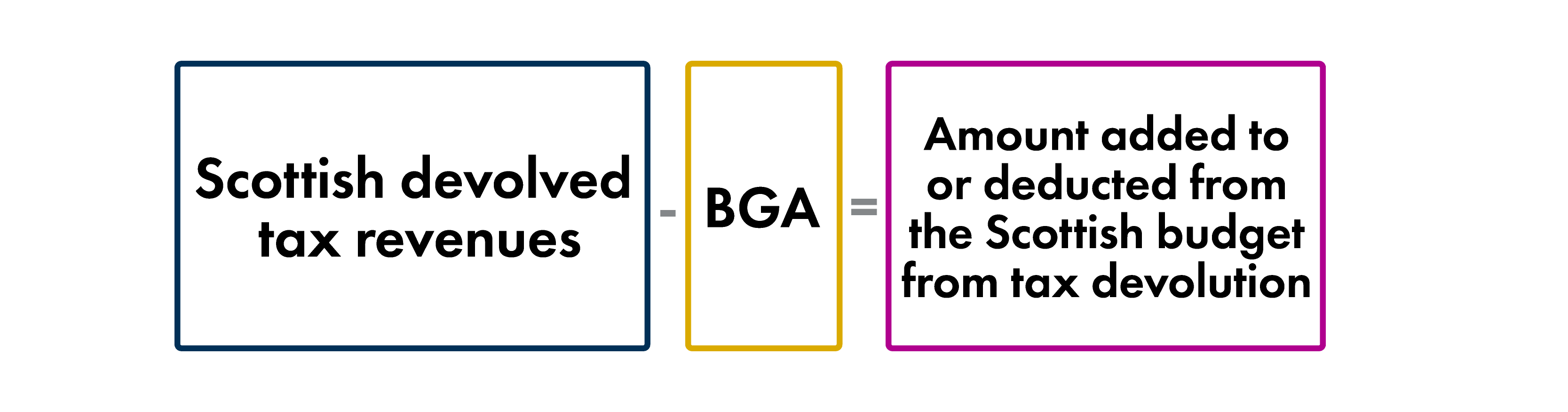
The logic of tax devolution is that the Scottish Government keeps any revenue raised through devolved taxes over and above what would have been raised had these taxes not been devolved. The reverse is also true if devolved taxes raise less revenue than would have been the case without devolution.
The amount of revenue raised through each devolved tax in Scotland is added to the Scottish budget. Then, a proxy for the amount that the UK government would have raised in Scotland had that tax not been devolved is deducted from the Scottish budget. This proxy is the Block Grant Adjustment (BGA). Each devolved tax has its own BGA.
The difference between the amount of revenue raised by each devolved tax and its corresponding BGA is known as the ‘net position’. This is what is added to or deducted from the Scottish Government’s budget for devolved taxes.
SPICe
The tables below set out the forecast receipts from devolved taxes and BGAs from the 2026-27 Scottish Budget.
| Scottish Income Tax | £ million |
|---|---|
| Scottish revenue | 21,508 |
| BGA | -20,539 |
| Net position | 969 |
| Land and Building Transaction Tax | £ million |
|---|---|
| Scottish revenue | 1,049 |
| BGA | -788 |
| Net position | 261 |
| Scottish Landfill Tax | £ million |
|---|---|
| Scottish revenue | 27 |
| BGA | -55 |
| Net position | -28 |
| Scottish Aggregates Tax | £ million |
|---|---|
| Scottish revenue | 42 |
| BGA | -37 |
| Net position*i | 5 |
How Block Grant Adjustments are calculated
The BGA for Scottish Income Tax (SIT), SLfT, and LBTT is calculated by taking the actual amount raised by that tax in Scotland the year before it was devolvedi. The BGAs are then increased each year in line with the per capita increase in equivalent tax receipts in the rest of the UK.
This means that the assumption being made in calculating BGAs is that if tax powers had not been devolved, per capita revenues would have grown in Scotland at the same rate as in rUK. Any deviation from this is what is added to or deducted from the Scottish budget from devolved taxes.
Relative tax revenues is what matters
All of this means that, when considering how the Scottish budget is affected by tax devolution, it’s not just the revenue raised by devolved taxes that matters. It’s the relative revenue raised by devolved taxes per head compared with their equivalents in rUK.
There are two factors that drive this. The first is the relative tax rates and thresholds chosen by the Scottish and UK governments. For example, if the Scottish Government increases income tax rates relative to policy in rUK, then all else equal, income tax revenues would grow faster in Scotland than in rUK. Devolved tax revenues would grow faster than the income tax BGA and the Scottish budget would be better off than would otherwise have been the case.
The second factor is the relative growth in the size of the tax base (i.e. the thing that is being taxed, see table 13). For devolved taxes, if the tax base grows more slowly in Scotland than in rUK, the Scottish Government’s funding will be lower than would otherwise have been the case.
| Tax | Tax base |
|---|---|
| Scottish Income Tax | Taxable income of Scottish residents, except income from savings and dividends. Taxable income typically includes income from employment, self-employment, property and rental income, and pensions. This tends to grow when earnings and employment in the Scottish economy grow. |
| LBTT | The amount paid in land and property transactions in Scotland. |
| SLfT | The amount of waste disposed of at landfill sites in Scotland. |
| SAT | The amount of primary aggregates (e.g. sand, gravel and rock) commercially exploited in Scotland. |
To explain this, consider a scenario where Scottish and UK income tax rates are exactly the same but incomes rise faster in rUK than in Scotland. On a per capita basis, income tax revenues would grow more slowly in Scotland than in rUK. This means devolved tax revenues would rise more slowly than the BGA. The Scottish budget would then be worse off as a result (i.e. the net position would be negative).
Tax base performance gap
For Scottish Income Tax – by far the largest of the devolved taxes – the two factors above have worked in opposite directions. On average, income tax rates are relatively higher in Scotland than in rUK, which has added to the Scottish budget. But the amount of taxable income in the economy has grown more slowly in Scotland than in rUK since income tax devolution, which has acted as a drag on the Scottish budget.
In 2026-27, the SFC forecasts that relatively higher rates of Scottish income tax will add £1.75 billion to the Scottish budget compared to a scenario where UK Government income tax rates applied in Scotland. However, relatively slower growth in the size of the tax base since income tax devolution means that only £969 million is forecast to be added to the Scottish budget from income tax devolution. The SFC refers to this gap of £785 million as the ‘tax base performance gap’.
Slower growth in the Scottish income tax base could in part be a result of Scottish Government decisions. Indeed, the Fiscal Framework was established in this way to incentivise the Scottish Government to use its powers to improve Scotland’s economic performance. However, it is also likely that factors beyond the control of the Scottish Government also explain Scotland’s slower growth in earnings. Either way, it is the Scottish Government that now assumes the fiscal risk (and possibly reward) if the devolved tax base grows more slowly (or faster) in Scotland than in rUK.
UK Government decisions still matter
It is worth noting that even in areas where tax powers have been devolved, decisions by the UK Government still have a direct impact on the Scottish budget.
As noted above, the relative tax rates chosen by the Scottish and UK Governments affect the amount added to or deducted from the Scottish budget from devolved taxes.
Relative tax rates change when either government changes policy.
Consider an example where the UK Government increases income tax rates in rUK. All else remaining equal, this would mean per capita income tax revenues would grow faster in rUK than in Scotland. The result is that the income tax BGA would increase faster than devolved tax revenues, meaning the income tax net position would decrease (i.e. the Scottish budget would be worse off than would otherwise have been the case).
Reconciliations
When the Scottish Government publishes its annual budget, the amount added to available funding from devolved taxes, or deducted from available resources from the block grant adjustment is based on forecasts.
The Scottish Fiscal Commission (SFC) produces forecasts of how much devolved taxes will raise in Scotland, while the Office for Budget Responsibility (OBR) produces forecasts that determine the BGAs for each tax when the budget is set.
Inevitably, forecasts will not be 100% accurate.
The extent to which forecasts were too optimistic or pessimistic only becomes known once outturn data is published. Outturn data provides information on the amount of revenue that was actually collected from different taxes.
Outturn data is published at different times for different taxes. For example, income tax outturn data is published nearly a year-and-a-half after the end of tax year in question. This is due to the time it takes to get information from self assessment returns.
The difference between what was forecasted and what actually occurred is then added to or deducted from the following Scottish budget. This process is known as a reconciliation.
Table 14 demonstrates this timeline for the income tax in the 2022-23 Scottish budget
| Date | Information available |
|---|---|
| December 2021 | Draft Scottish Budget 2022-23 published. SFC forecast of the 2022-23 income tax net position published. This forecast determines the amount added to or deducted from the 2022-23 Scottish budget from income tax devolution. |
| July 2024 | Outturn data of 2022-23 income tax revenues published. |
| September 2024 | Fiscal Framework Outturn report published. 2022-23 outturn income tax net position and reconciliation requirement is now known. |
| December 2024 | Draft Scottish Budget 2025-26 published. Reconciliation applied to the 2025-26 budget. |
The Scottish Government is able to borrow money to account for reconciliations up to a limit of £655 million per year and a total of £1,910 million (as of 2026-27). Both these limits rise with inflation each year.
The logic of this is that differences between forecasts and outturn data can be smoothed out over time so that funding available for devolved public services is not subject to volatility from forecast errors.
Case study: Non-savings, non-dividend income tax reconciliations
Since NSND income tax was devolved for the 2017-18 financial year, the reconciliation process has been run for eight years up to 2024-25, with data recently published for the final reconciliation for 2024-251.
Looking at the original forecasts for each budget year, these suggested that a cumulative total of £2,548 million additional revenue would be collected as a result of policy divergence, and the relative performance of the Scottish tax base. However, if we look at Fiscal framework outturn reports, this cumulative additional revenue has reduced over these 8 years to £2,024 million.
This cumulative reduction of £525 million between 2017-18 and 2024-25 is driven by BGAs being higher than forecast. While total NSND receipts over these 8 years were £2,723 higher than originally forecast, the total BGA reduction was £3,248 million higher.
| £ million | 2017-18 | 2018-19 | 2019-20 | 2020-21 | 2021-22 | 2022-23 | 2023-24 | 2024-25 |
|---|---|---|---|---|---|---|---|---|
| Forecast NSND Income Tax receipts | 11,857 | 12,177 | 11,684 | 12,319 | 11,788 | 13,671 | 15,810 | 18,844 |
| Forecast BGA | 11,750 | 11,749 | 11,501 | 12,365 | 13,861 | 14,681 | 17,432 | 17,432 |
| Forecast net position | 107 | 428 | 183 | -46 | -475 | -190 | 1,129 | 1,412 |
| Outturn NSND receipts | 10,916 | 11,556 | 11,833 | 11,948 | 13,724 | 15,169 | 17,093 | 18,635 |
| Outturn BGA | 11,013 | 11,437 | 11,685 | 11,852 | 13,639 | 14,911 | 16,362 | 17,943 |
| Outturn net position | -97 | 119 | 148 | 96 | 85 | 258 | 731 | 692 |
| Reconiliation | -204 | -310 | -35 | 142 | 560 | 448 | -398 | -720 |
SFC forecasts, Fiscal Framework Outturn Reports, HM Treasury and Scottish Government income tax outturn statements
Borrowing powers
The Scottish Government has some borrowing powers but these are subject to statutory limit.s
The Scottish Government can borrow to fund its capital investment (spending that creates or maintains an asset, such as buildings, equipment or infrastructure). In 2023-24, it could borrow a maximum of £450 million in a single financial year, up to a total cumulative debt stock of £3 billion. Since the Fiscal Framework Agreement, these borrowing limits have been uprated annually in line with the Office for Budget Responsibility's (OBR) GDP deflater forecast. In 2026-27, the capital borrowing limits are £491 million in a single year and a cumulative debt stock limit of £3,275 million.
The Scottish Government is also able to undertake resource borrowing, but only in limited circumstances. Resource borrowing cannot be used to support general day-to-day spending pressures. Instead, it is primarily available to manage forecast errors associated with devolved tax revenues, social security expenditure, and the associated BGAs, which are reconciled after the financial year has ended.
In 2023-24, resource borrowing was limited to £600 million in a single financial year, capped at a total debt stock of £1.75 billion. Since the Fiscal Framework Agreement, these limits have also been uprated in line with the OBR's GDP deflator forecast.In 2026-27 will be £655 million in one year, with a total debt stock of £1,910 million.
Finally, the Scottish Government can access the Scotland Reserve, which allows funds to be carried forward between financial years. In 2026-27 the limit on the Scotland Reserve is £764 million.
Policy issues for Session 7
This section will set out some of the issues which parliamentarians may wish to consider during Session 7.
Council tax revaluation and reform
Non-domestic rates policy
Income tax policy
Fiscal drag
Tax divergence
Taxation on income from property
The tax base performance gap
VAT assignment
Wider council tax reforms
Separate from the "mansion tax" consultation, a wider programme of engagement on council tax reform has been taking place over the past two years. Led by the Scottish Government and COSLA, the Joint Working Group on Sources of Local Government Funding and Council Tax Reform was first established in December 2022 to "to provide a space for joint dialogue on a range of issues relating to sources of local government funding and council tax". The Group is hoping to build a consensus on a single approach to reforming council tax.
In October 2025, the Scottish Government launched a consultation seeking views on how the council tax system could be made fairer and more up to date. This was accompanied by analysis from the Institute for Fiscal Studies which provides insights into the effects of potential reforms. Speaking to the Session 6 Local Government, Housing and Planning Committee in January 2026, the former Cabinet Secretary for Finance and Local Government stated that the consultation was:
...aimed at building political consensus around what local taxation should look like, not just among politicians—we are trying to take the public with us, too. Council tax can be pretty contentious—it has a contentious history—and we want to build consensus around what the future looks like for local taxation.1
The consultation sought views on a number of areas, including:
Updating the market reference point (currently based on values as at 1991) to reflect current market values.
Exploring approaches to revaluation, including localised revaluation where band thresholds could differ by council area to reflect local housing markets.
Introducing options for new council tax bands at the top and bottom of the scale to ensure the system is more progressive and proportionate.
Considering transitional measures such as phased implementation and deferral options to help households adjust to any changes, as well as reductions to support lower-income households.
A summary of consultation responses was published on 11 September 2026.
Income tax policy
In Session 6, two noteworthy trends emerged in Scottish Income Tax policy – fiscal drag and tax divergence. The extent to which these trends continue could be a key development in Session 7, along with the possibility of further devolved powers.
Fiscal drag
During Session 6, the threshold at which the Higher Rate tax band begins was frozen in cash terms at £43,663. As people’s incomes have risen with inflation, more taxpayers have been pulled into the higher rate tax band and above. This phenomenon is known as fiscal drag.
In 2016-17, 12% of taxpayers were in the Higher Rate band or above. In 2026-27, this figure is forecast to rise to 26%.
Fiscal drag has raised more revenue for the Scottish Government than would have been the case if tax thresholds and bands had increased in line with inflation.
Although the Higher Rate tax threshold in the rest of the UK is higher than in Scotland (see Scottish Income Tax), it too has been frozen in cash terms over the last five years.
Raising more revenue primarily through freezing thresholds tax, rather than increasing tax rates, appears to be an active policy choice of governments across the UK.
The personal allowance (the threshold below which taxable income is exempt from income tax) has also been frozen, but this is a decision that is made by the UK Government.
Tax divergence
Since income tax was partially devolved, the Scottish Government has used its powers differently to governments elsewhere in the UK.
This has resulted in Scotland’s income tax schedule for non-savings non-dividend income diverging with other parts of the UK for the first time.
| Tax band | Taxable income | Tax rate |
|---|---|---|
| Personal allowance | Up to £12,570 | 0% |
| Starter rate | £12,571 - £16,537 | 19% |
| Basic rate | £16,538 - £29,526 | 20% |
| Intermediate rate | £29,527 - £43,662 | 21% |
| Higher rate | £43,663 - £75,000 | 42% |
| Advanced rate | £75,001 - £125,140 | 45% |
| Top rate | Over £125,140 | 48% |
| Tax band | Taxable income | Tax rate |
|---|---|---|
| Personal allowance | Up to £12,570 | 0% |
| Basic rate | £12,571 - £50,270 | 20% |
| Higher rate | £50,271 - £125,140 | 40% |
| Additional rate | Over £125,140 | 45% |
The result is that taxpayers in Scotland pay a different amount of income tax than they would in other parts of the UK. In particular, the highest earning quarter (roughly) of taxpayers who fall in the Higher Rate tax band and above pay notably more income tax than they would in rUK.
| Annual earnings | Scottish Income Tax payable 2026-27 | Difference compared with 2025-26 | Difference compared with rUK |
|---|---|---|---|
| £20,000 | £1,446 | -£11 | -£40 |
| £25,000 | £2,446 | -£11 | -£40 |
| £30,000 | £3,451 | -£32 | -£35 |
| £35,000 | £4,501 | -£32 | £15 |
| £40,000 | £5,551 | -£32 | £65 |
| £45,000 | £6,882 | -£32 | £396 |
| £50,000 | £8,982 | -£32 | £1,496 |
| £55,000 | £11,082 | -£32 | £1,650 |
| £60,000 | £13,182 | -£32 | £1,750 |
| £65,000 | £15,282 | -£32 | £1,850 |
| £70,000 | £17,382 | -£32 | £1,950 |
| £75,000 | £19,482 | -£32 | £2,050 |
| £80,000 | £21,732 | -£32 | £2,300 |
| £85,000 | £23,982 | -£32 | £2,550 |
| £90,000 | £26,232 | -£32 | £2,800 |
| £95,000 | £28,482 | -£32 | £3,050 |
| £100,000 | £30,634 | -£32 | £3,300 |
| £150,000 | £59,684 | -£32 | £5,931 |
The key driver of the income tax differentials in Table 18 is the Higher Rate threshold. Earnings above this threshold attract a significantly higher rate of tax than earnings below it (see Table 16). The threshold kicks in at earnings above £43,663 in Scotland and £50,270 in England.
Overall, tax divergence has raised a significant amount of revenue for the Scottish Government to spend on devolved social security and public services. The income tax net position for 2026-27 is forecast to be £969 million. The Scottish Fiscal Commission projects that if UK Government income tax policy applied in Scotland, the Scottish Government would raise £1.75 billion less from income tax in 2026-27. The difference between these two figures is the tax base performance gap.
Although higher than in rUK, research by Future Economy Scotland highlights that income tax and social security contributions on earnings from work in Scotland remain below the OECD average for both middle and higher earners, as defined by those earning 67% and 100% of the average wage1.
Finally, it is also worth noting that how taxpayers respond to tax divergence could affect the amount of revenue raised by the Scottish Government and wider economic outcomes.
Taxpayers might, for example, change their behaviour around the number of hours they work, how they are remunerated and where they reside in response to changes in tax policy – particularly given the tax divergence between Scotland and rUK.
In Session 6, HMRC published research that showed these responses to be relatively minor in the early years of tax divergence. However, income tax policy has continued to diverge since then, so further evidence published in Session 7 might inform the policy choices and debate around devolved income tax.
Taxation on income from property
Scottish income tax rates and bands currently apply to non-savings, non-dividend (NSND) income, which includes property income. At the moment, the Scottish Government can only set tax policy to apply to all types of NSND income. It cannot currently differentiate between types of income and – for example – apply a different policy to property income.
In the 2025 UK Autumn Budget, the UK Government announced a 2p increase to the rates of income from property, starting in 2027-28. The UK Chancellor pledged to devolve the relevant powers so that the devolved administrations can determine policy in this area. So, in future, the Scottish Government might also be able to set a different policy for taxation of property income should it choose to do so.
The tax base performance gap
As noted earlier in this briefing, there has been a difference between the amount of revenue that could be raised by devolved taxes in Scotland, compared to the amount that is actually added to the Scottish Budget. This difference is referred to by the Scottish Fiscal Commission (SFC) as the 'tax base performance gap'. The SFC note that:
The tax base performance gap arises because of many factors. The most substantial of these are slower aggregate earnings and employment growth in Scotland compared with the rest of the UK, behavioural responses from taxpayers to policy changes, differences in the sectoral make up of the Scottish economy, and the different distribution of incomes in Scotland and in the rest of the UK.
Scottish Fiscal Commission. (2026, January 13). Scotland’s Economic and Fiscal Forecasts – January 2026. Retrieved from https://fiscalcommission.scot/publications/scotlands-economic-and-fiscal-forecasts-january-2026/ [accessed 16 January 2026]
The Scottish Government wrote to the Public Audit Committee in April 2025 discussing some of the factors contributing to the tax base performance gap2. This noted that behavioural responses from taxpayers would have an impact on the net tax position, but also highlighted two aspects of the fiscal framework which could also impact the net tax position:
The Scottish Government highlight analysis from the 2022 Medium Term Financial Strategy which noted that existing differences in income distribution between Scotland and the rest of the UK could contribute to a tax base performance gap, even if earnings growth in Scotland matched the rUK.
The letter also highlights the impact that the downturn in the oil and gas sector is having on Scottish tax receipts. The Institute for Fiscal Studies also highlighted this as one factor contributing to the net tax position3.
Understanding how Scottish Government policy, both on tax decisions and wider economic policy decisions, can feed through to the Scottish Budget via the performance of the devolved tax base, is a key issue for Parliament to consider.
VAT assignment
The assignation of VAT is an area where there has been little progress since the Scotland Act 2016 devolved the powers. As summarised earlier in the briefing, there have been questions asked about the ability of VAT revenues in Scotland to be measured in a way which can be agreed by the Scottish and UK Governments. On 16 July 2025 the Scottish Affairs Committee published its report on the financing of the Scottish Government1, and noted with respect to the assignment of VAT that:
It seems highly unlikely to us that the assignment of VAT revenues will ever come into force. It is clear that implementing the assignment poses a significant challenge, and given the amount of time that has passed since the change was due to come into force, it is far from clear whether it is realistic or possible.
The report called on the UK Government to set out why it felt that the assignment of VAT was still possible, but the response from the UK Government only pledged to continue to work with the Scottish Government to deliver the Smith Commission recommendations.
Given that there seem to be no calls from stakeholders or either the Scottish or UK Governments to proceed with the assignment of VAT, parliamentarians may wish to consider whether this is still a desirable outcome.
Sources
House of Commons Library. (1998, January 8). The Scotland Bill : tax varying powers. Retrieved from <a href="https://researchbriefings.files.parliament.uk/documents/RP98-4/RP98-4.pdf" target="_blank">https://researchbriefings.files.parliament.uk/documents/RP98-4/RP98-4.pdf</a>
Scottish Government. (2026). Local Government 2025-26 Provisional Outturn and 2026-27 Budget Estimates. Retrieved from <a href="https://www.gov.scot/publications/local-government-2025-26-provisional-outturn-and-2026-27-budget-estimates/documents/" target="_blank">https://www.gov.scot/publications/local-government-2025-26-provisional-outturn-and-2026-27-budget-estimates/documents/</a>
Commission on local tax reform. (2015, December). Just Change: a new approach to local taxation. Retrieved from <a href="https://www.gov.scot/binaries/content/documents/govscot/publications/foi-eir-release/2024/01-e/foi-202300377074/documents/foi-202300377074---information-released---annex-a/foi-202300377074---information-released---annex-a/govscot%3Adocument/FOI%2B202300377074%2B-%2BInformation%2BReleased%2B-%2BAnnex%2BA.pdf" target="_blank">https://www.gov.scot/binaries/content/documents/govscot/publications/foi-eir-release/2024/01-e/foi-202300377074/documents/foi-202300377074---information-released---annex-a/foi-202300377074---information-released---annex-a/govscot%3Adocument/FOI%2B202300377074%2B-%2BInformation%2BReleased%2B-%2BAnnex%2BA.pdf</a>
Forsyth, L. (2026, March 6). Assessing the council tax against the principles of "good" tax policymaking. Retrieved from <a href="https://www.parliament.scot/chamber-and-committees/research-prepared-for-parliament/research-briefings/2026/3/6/sb-2615" target="_blank">https://www.parliament.scot/chamber-and-committees/research-prepared-for-parliament/research-briefings/2026/3/6/sb-2615</a>
Commission on Scottish Devolution. (2009, June). Serving Scotland Better: Scotland and the United Kingdom in the 21st Century. Retrieved from <a href="http://news.bbc.co.uk/1/shared/bsp/hi/pdfs/15_06_09_calman.pdf" target="_blank">http://news.bbc.co.uk/1/shared/bsp/hi/pdfs/15_06_09_calman.pdf</a>
UK Parliament. (2012). Scotland Act 2012. Retrieved from <a href="https://www.legislation.gov.uk/ukpga/2012/11/contents" target="_blank">https://www.legislation.gov.uk/ukpga/2012/11/contents</a>
House of Commons Library. (2015, January 23). Devolution of tax powers to the Scottish Parliament: the Scotland Act 2012 . Retrieved from <a href="https://researchbriefings.files.parliament.uk/documents/SN05984/SN05984.pdf" target="_blank">https://researchbriefings.files.parliament.uk/documents/SN05984/SN05984.pdf</a>
Scottish Parliament. (2013, July 31). Land and Buildings Transaction Tax (Scotland) Act 2013. Retrieved from <a href="https://www.legislation.gov.uk/asp/2013/11/contents" target="_blank">https://www.legislation.gov.uk/asp/2013/11/contents</a>
Scottish Parliament. (2014, December 21). Landfill Tax (Scotland) Act 2014. Retrieved from <a href="https://www.legislation.gov.uk/asp/2014/2/contents" target="_blank">https://www.legislation.gov.uk/asp/2014/2/contents</a>
House of Commons Library. (2015, June 17). Landfill Tax (Qualifying Fines) Order 2015. Retrieved from <a href="https://commonslibrary.parliament.uk/research-briefings/cbp-7228/" target="_blank">https://commonslibrary.parliament.uk/research-briefings/cbp-7228/</a>
The Smith Commission. (2014, November 27). Report of the Smith Commission for further devolution of powers to the Scottish Parliament. Retrieved from <a href="http://news.bbc.co.uk/1/shared/bsp/hi/pdfs/28_11_14_smithcommission.pdf" target="_blank">http://news.bbc.co.uk/1/shared/bsp/hi/pdfs/28_11_14_smithcommission.pdf</a>
UK Parliament. (2016, March 23). Scotland Act 2016. Retrieved from <a href="https://www.legislation.gov.uk/ukpga/2016/11/contents" target="_blank">https://www.legislation.gov.uk/ukpga/2016/11/contents</a>
McFadden, J. (2008). Local Government Law in Scotland. (n.p.): Bloomsbury.
Scottish Government. (2026). The Council Tax (Variation for Unoccupied Dwellings) (Scotland) Amendment Regulations 2026, Draft Policy Note. Retrieved from <a href="https://www.legislation.gov.uk/sdsi/2026/9780111065303/policy-note/contents" target="_blank">https://www.legislation.gov.uk/sdsi/2026/9780111065303/policy-note/contents</a>
Kenneth Barclay. (2017, August 22). Non-domestic tax rates review: Barclay report. Retrieved from <a href="https://www.gov.scot/publications/report-barclay-review-non-domestic-rates/" target="_blank">https://www.gov.scot/publications/report-barclay-review-non-domestic-rates/</a>
Scottish Parliament Official Report. (2026, June 23). Non Domestic Rates Statement by the Deputy First Minister. Retrieved from <a href="https://www.parliament.scot/chamber-and-committees/official-report/search-what-was-said-in-parliament/meeting-of-parliament-23-06-2026?meeting=20179&iob=224004" target="_blank">https://www.parliament.scot/chamber-and-committees/official-report/search-what-was-said-in-parliament/meeting-of-parliament-23-06-2026?meeting=20179&iob=224004</a>
Scottish Parliament. (2024, November 12). Aggregates Tax and Devolved Taxes Administration (Scotland) Act 2024. Retrieved from <a href="https://www.legislation.gov.uk/asp/2024/14/contents" target="_blank">https://www.legislation.gov.uk/asp/2024/14/contents</a>
The Scottish Parliament. (2014, September 24). Revenue Scotland and Tax Powers Act 2014. Retrieved from <a href="https://www.legislation.gov.uk/asp/2014/16/contents" target="_blank">https://www.legislation.gov.uk/asp/2014/16/contents</a>
Scottish Parliament. (2026, May 13). Building Safety Levy (Scotland) Act 2026. Retrieved from <a href="https://www.legislation.gov.uk/asp/2026/14/contents" target="_blank">https://www.legislation.gov.uk/asp/2026/14/contents</a>
UK Parliament. (2024, December 18). The Scotland Act 1998 (Specification of Devolved Tax) (Building Safety) Order 2024. Retrieved from <a href="https://www.legislation.gov.uk/uksi/2024/1362/contents/made" target="_blank">https://www.legislation.gov.uk/uksi/2024/1362/contents/made</a>
Scottish Parliament. (2017). Air Departure Tax (Scotland) Act 2017. Retrieved from <a href="https://www.legislation.gov.uk/asp/2017/2/contents" target="_blank">https://www.legislation.gov.uk/asp/2017/2/contents</a>
Scottish Government. (2026, July 15). Air Departure Tax: consultation analysis report. Retrieved from <a href="https://www.gov.scot/publications/delivering-scotlands-air-departure-tax-consultation-analysis-report/" target="_blank">https://www.gov.scot/publications/delivering-scotlands-air-departure-tax-consultation-analysis-report/</a>
Scottish Government. (2025, June 25). High-level principles of Air Departure Tax. Retrieved from <a href="https://www.gov.scot/publications/high-level-principles-air-departure-tax/" target="_blank">https://www.gov.scot/publications/high-level-principles-air-departure-tax/</a>
Visit Scotland. (2026, August). Guidance on the Visitor Levy for Local Authorities. Retrieved from <a href="https://www.visitscotland.org/tourism-events-industry/visitor-levy" target="_blank">https://www.visitscotland.org/tourism-events-industry/visitor-levy</a>
City of Edinburgh Council. (2026). Edinburgh Visitor Levy comes into effect. Retrieved from <a href="https://www.edinburgh.gov.uk/news/article/14452/edinburgh-visitor-levy-comes-into-effect" target="_blank">https://www.edinburgh.gov.uk/news/article/14452/edinburgh-visitor-levy-comes-into-effect</a>
Scottish Government. (2026, January). Scottish Budget 2026-27. Retrieved from <a href="https://www.gov.scot/binaries/content/documents/govscot/publications/corporate-report/2026/03/scottish-budget-2026-2027/documents/scottish-budget-2026-2027/scottish-budget-2026-2027/govscot%3Adocument/scottish-budget-2026-2027.pdf" target="_blank">https://www.gov.scot/binaries/content/documents/govscot/publications/corporate-report/2026/03/scottish-budget-2026-2027/documents/scottish-budget-2026-2027/scottish-budget-2026-2027/govscot%3Adocument/scottish-budget-2026-2027.pdf</a>
Scottish Government. (2026, July 6). Council Tax High-Value Property Bands (Mansion Tax): consultation. Retrieved from <a href="https://www.gov.scot/publications/consultation-council-tax-high-value-property-bands-mansion-tax/documents/" target="_blank">https://www.gov.scot/publications/consultation-council-tax-high-value-property-bands-mansion-tax/documents/</a>
Scottish and UK Governments. (2023, August 2). Fiscal framework: agreement between the Scottish and UK Governments. Retrieved from <a href="https://www.gov.scot/publications/fiscal-framework-agreement-between-scottish-uk-governments/" target="_blank">https://www.gov.scot/publications/fiscal-framework-agreement-between-scottish-uk-governments/</a>
Scottish Government. (2024, December 4). Scotland's Tax Strategy: Building on our Tax Principles. Retrieved from <a href="https://www.gov.scot/publications/scotlands-tax-strategy-building-tax-principles/" target="_blank">https://www.gov.scot/publications/scotlands-tax-strategy-building-tax-principles/</a>
Scottish Government. (2024, December 4). Scottish Budget 2025 to 2026. Retrieved from <a href="https://www.gov.scot/publications/scottish-budget-2025-2026/" target="_blank">https://www.gov.scot/publications/scottish-budget-2025-2026/</a>
Scottish Fiscal Commission. (2025, November 11). Scottish median incomes fact sheet: SFC estimates update. Retrieved from <a href="https://fiscalcommission.scot/wp-content/uploads/2025/11/Scottish-median-incomes-fact-sheet-Scottish-Fiscal-Commission-estimates-update-November-2025.pdf" target="_blank">https://fiscalcommission.scot/wp-content/uploads/2025/11/Scottish-median-incomes-fact-sheet-Scottish-Fiscal-Commission-estimates-update-November-2025.pdf</a>
Registers of Scotland. (2026, June 9). Property Market Report 2025-26. Retrieved from <a href="https://www.ros.gov.uk/data-and-statistics/property-market-statistics/property-market-report#residential-market" target="_blank">https://www.ros.gov.uk/data-and-statistics/property-market-statistics/property-market-report#residential-market</a> [accessed 23 July 2026]
Scottish Parliament. (2018, December 12). The Land and Buildings Transaction Tax (Tax Rates and Tax Bands etc) (Scotland) Amendment Order 2018. Retrieved from <a href="https://www.legislation.gov.uk/ssi/2018/372/made" target="_blank">https://www.legislation.gov.uk/ssi/2018/372/made</a>
Scottish Government. (2026, March 25). Land and Buildings Transaction Tax review: Scottish government policy evaluation 2025-2026. Retrieved from <a href="https://www.gov.scot/publications/review-land-buildings-transaction-tax-scottish-government-policy-evaluation-2025-2026/" target="_blank">https://www.gov.scot/publications/review-land-buildings-transaction-tax-scottish-government-policy-evaluation-2025-2026/</a>
Scottish Fiscal Commission. (2026, January 13). Scotland’s Economic and Fiscal Forecasts – January 2026. Retrieved from <a href="https://fiscalcommission.scot/publications/scotlands-economic-and-fiscal-forecasts-january-2026/" target="_blank">https://fiscalcommission.scot/publications/scotlands-economic-and-fiscal-forecasts-january-2026/</a> [accessed 16 January 2026]
Revenue Scotland. (2026). Scottish Landfill Tax (SLfT) statistics: Q4 2025/26, January - March 2026 and annual trends. Retrieved from <a href="https://revenue.scot/news-publications/publications/statistics/quarterly-slft-statistics/scottish-landfill-tax-slft-statistics-q4-202526" target="_blank">https://revenue.scot/news-publications/publications/statistics/quarterly-slft-statistics/scottish-landfill-tax-slft-statistics-q4-202526</a>
Scottish Government. (2026, July 31). Scottish Building Safety Levy: indicative rates. Retrieved from <a href="https://www.gov.scot/publications/scottish-building-safety-levy-indicative-rates/" target="_blank">https://www.gov.scot/publications/scottish-building-safety-levy-indicative-rates/</a>
HM Treasury and the Scottish Government. (2026, August 27). Income tax outturn reconciliation 2024 to 2025: joint statement with HM Treasury. Retrieved from <a href="https://www.gov.scot/publications/income-tax-outturn-reconciliation-2024-to-2025-joint-statement-with-hm-treasury/" target="_blank">https://www.gov.scot/publications/income-tax-outturn-reconciliation-2024-to-2025-joint-statement-with-hm-treasury/</a>
Scottish Parliament Official Report. (2026, January 27). Local Government, Housing and Planning Committee official report. Retrieved from <a href="https://www.parliament.scot/chamber-and-committees/official-report/search-what-was-said-in-parliament/LGHP-27-01-2026?meeting=20036&iob=224856" target="_blank">https://www.parliament.scot/chamber-and-committees/official-report/search-what-was-said-in-parliament/LGHP-27-01-2026?meeting=20036&iob=224856</a>
Future Economy Scotland. (2026, February 25). https://www.futureeconomy.scot/publications/198-funding-scotland-s-future-tax-reform-for-a-just-transition. Retrieved from <a href="https://www.futureeconomy.scot/publications/198-funding-scotland-s-future-tax-reform-for-a-just-transition" target="_blank">https://www.futureeconomy.scot/publications/198-funding-scotland-s-future-tax-reform-for-a-just-transition</a> [accessed 22 July 2026]
Scottish Government. (2025, April 30). Letter to the Public Audit Committee: Administration of Scottish Income Tax 2023-24. Retrieved from <a href="https://www.parliament.scot/-/media/files/committees/public-audit-committee/correspondence/2025/admin-of-sit-dgse-to-pac-30-april-2025.pdf" target="_blank">https://www.parliament.scot/-/media/files/committees/public-audit-committee/correspondence/2025/admin-of-sit-dgse-to-pac-30-april-2025.pdf</a>
Institute for Fiscal Studies. (2026, March 18). The Scottish Government’s record on tax and benefit policy. Retrieved from <a href="https://ifs.org.uk/publications/scottish-governments-record-tax-and-benefit-policy-0" target="_blank">https://ifs.org.uk/publications/scottish-governments-record-tax-and-benefit-policy-0</a>
The Scottish Affairs Committee, House of Commons. (2025, July 16). The financing of the Scottish Government. Retrieved from <a href="https://committees.parliament.uk/publications/48818/documents/256455/default/" target="_blank">https://committees.parliament.uk/publications/48818/documents/256455/default/</a>