Social Security Committee
Annual Report of the Social Security Committee for 2019/20
Summary infographic
Scottish Parliament
Introduction
This report covers the work of the Social Security Committee during the parliamentary year 12 May 2019 to 11 May 2020.
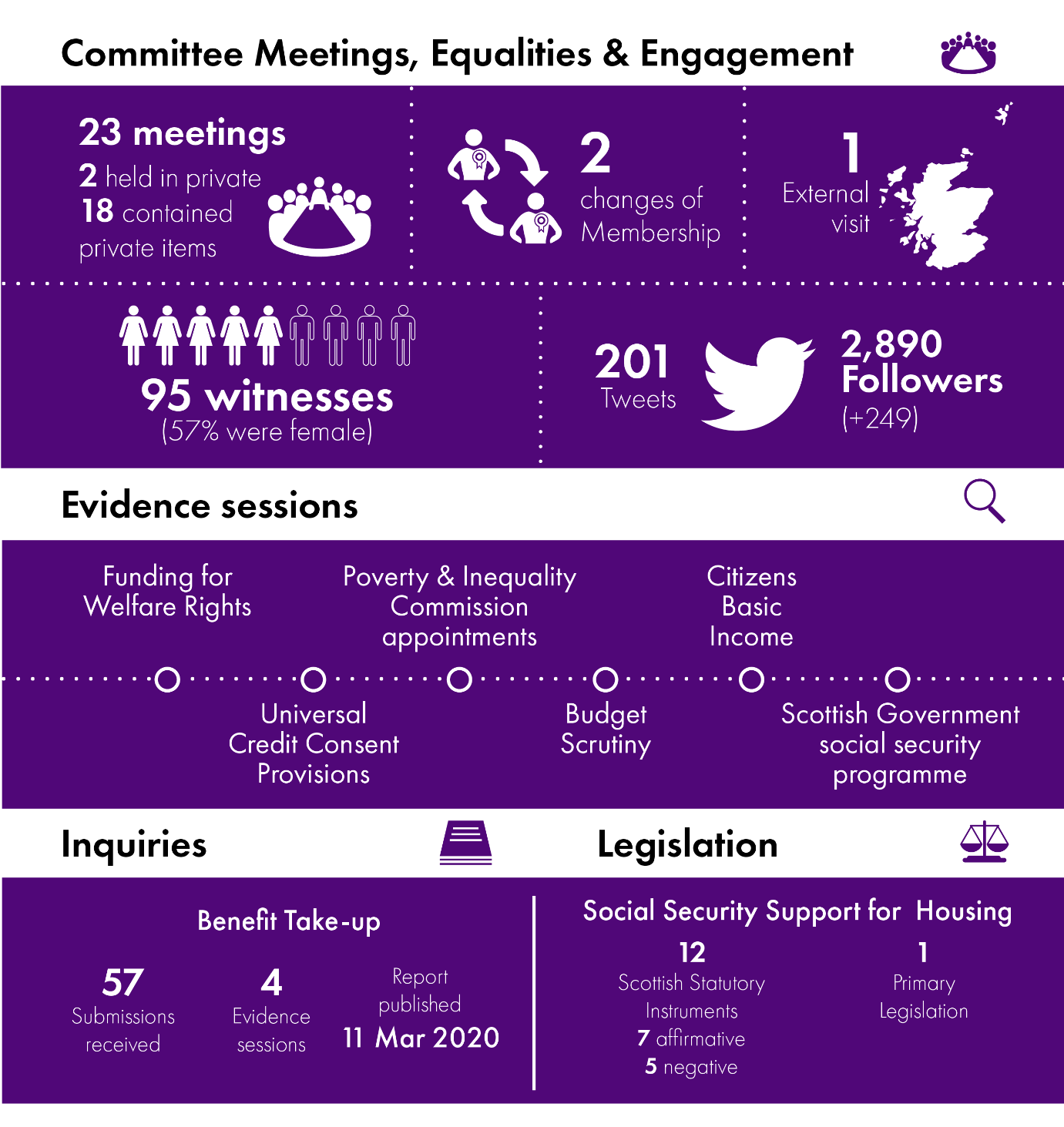
The Committee's inquiry into social security support for housing started in February 2019 and reported this year. The Committee then launched an inquiry into Benefit Take-up, reporting in March 2020. Alongside this, we held some quick-focus inquiries. We welcomed the first reports of the Scottish Commission on Social Security and considered 12 Scottish Statutory Instruments (7 affirmative, 5 negative). We recently launched a call for views on the Social Security Administration and Tribunal Membership (Scotland) Bill.
Unfortunately, due to covid-19, the Committee's work programme for the latter part of this year was disrupted.
Membership changes
There were two membership changes.
Michelle Ballantyne left the Committee on 5 March 2020 and was replaced by Graham Simpson;
Alasdair Allan left the Committee on 5 March 2020 and was replaced by Tom Arthur;
Inquiries
Social Security Support for Housing
Our inquiry into Social Security Support for Housing considered and made recommendations to improve how devolved and reserved social security powers support tenants and landlords, particularly in the private rented sector. Our report was published in June 2019. The Scottish Government responded in August 2019.
Benefit Take-up
Our inquiry considered the reasons why people do not claim the benefits to which they are entitled. We received 57 responses and, between November 2019 and February 2020, held four oral evidence sessions. In November we met informally with staff and volunteers from a variety of initiatives providing support and advice locally in Wester Hailes, Edinburgh. Our inquiry report was published in March 2020. We await the Scottish Government's response to our recommendations.
Funding for Welfare Rights
In May 2019 we held a roundtable discussion on the provision and funding of welfare rights services in Scotland, including the newly established Citizen's Advice ‘help to claim’ service. This is a national service, established by the Department for Work and Pensions to support those making new claims for Universal Credit. We wrote to the UK Government about protecting the date on which a claim for Universal Credit starts. The Secretary of State for Work and Pensions responded in June 2019.
Universal Credit Consent Provisions
In June 2019 we took evidence on universal credit consent provisions. We then wrote to the Secretary of State for Work and Pensions about the DWP's requirement for explicit consent from a claimant before an adviser or representative is able discuss a client's UC claim with DWP. A response was received in July 2019.
In January 2020 we became aware of difficulties being experienced by some MSPs when making universal credit constituency inquiries. We wrote to the Secretary of State for Work and Pensions raising our concerns about a lack of parity between MSPs and MPs. We want MSPs to have the same access rights as MPs.
Citizens Basic Income
In November 2019, the Committee took evidence from members of the citizens basic income feasibility study steering group on its interim report. The Committee looks forward with interest to the final report, particularly given growing support amongst stakeholders and commentators for some form of universal basic income.
Budget Scrutiny
We now take a full-year approach to scrutiny of the Scottish Government's budget, embedding it in our programme of inquiry and legislative work. In September 2019 we took evidence from the Scottish Fiscal Commission on its forecast for Scottish social security spend. In October 2019 we took evidence from the Cabinet Secretary for Social Security and Older People on the Scottish Government's social security spending plans for 2020/21.
We reported our findings in a letter to the Cabinet Secretary on 4 November 2019 and asked the Scottish Government to work with COSLA to ensure the appropriate allocation of the Scottish Welfare Fund across local authorities. We also asked the Scottish Government to clarify whether a benefit take-up campaign by it, resulting in an increase in take up of reserved benefits, could lead to the UK Government seeking reimbursement, due to policy spillover. We were pleased to receive confirmation that it would not.
During our budget scrutiny we noted that the fiscal framework agreement is due to be reviewed by the Treasury. Social security spend is demand-led which can create a considerable risk for in-year cashflow. We have called for Scottish Ministers’ access to reserves and powers to borrow to be considered as part of the review. We expect to continue our joint work with the Finance and Constitution Committee in advance of the Treasury review and in anticipation of increasing demand for social security.
Scottish Government social security programme
Due to covid-19, the Scottish Government's social security programme has been delayed. We had expected to start our consideration of draft regulations for the Child Disability Payment and the Scottish Child Payment however both have been put back. In April 2020 we took evidence from the Cabinet Secretary for Social Security and Older People to discuss the impact and resource implications of the delay. We will continue to return to these.
Poverty and Inequality Commission appointments
The Child Poverty (Scotland) Act 2017 ("the Act") established the Poverty and Inequality Commission. We considered the Scottish Ministers’ nominations for appointment. In June 2019, three Committee members met in private with the nominees to consider their suitability for appointment. Following this, the Committee recommended to the Parliament that the nominations be approved.
Legislation
Primary legislation - The Social Security Administration and Tribunal Membership (Scotland) Bill
This Bill was introduced by the Scottish Government in April 2020 to make some administrative changes to the social security system and expand the range of people allowed to act as judges in Scottish Tribunals. The Committee has been asked to expedite its consideration and has recently issued a short call for written views.
Subordinate legislation
The detail of new forms of Scottish social security is being brought forward by regulations. This year, the Committee considered twelve Scottish Statutory instruments (7 affirmative, 5 negative). Amongst significant instruments considered by the Committee were the Carer's Assistance (Young Carer Grants) (Scotland) Regulations 2019 which provide a new payment (£300) to young carers aged 16,17 and 18 who do not receive Carer's Allowance, and the Social Security Assistance (Investigation of Offences) (Scotland) Regulations 2020 that enabled Social Security Scotland to undertake investigations into suspected benefit fraud.
The Scottish Commission on Social Security (SCoSS) is an advisory non-departmental public body set up to provide independent scrutiny of the Scottish social security system (including benefit regulations). We have been grateful to the Commission for the work it has undertaken in its first year of operation to consider and report on draft regulations in advance of the Parliament's formal consideration and decision to approve. The Committee looks forward to continuing its close working relationship with SCoSS.
Committee Meetings, Equalities and Engagement
The Committee held 23 meetings this year:
8 contained items taken in private,
3 were held entirely in public
2 were held entirely in private.
The meetings and items taken in private were primarily to consider evidence heard, draft reports and the Committee's work programme.
We use a variety of methods to gather information including online forums, informal external events and formal evidence sessions. This ensures we hear from a wide variety of stakeholders.
During formal evidence sessions, the Committee took evidence from 95 witnesses; 57% of which were female.
The Committee's twitter account continues to grow and now has 2890 followers, an increase of 249 in the parliamentary year. The work of the Committee is published on the account and in the past parliamentary year 201 tweets were made from the account.