Economy, Energy and Fair Work Committee
Scottish National Investment Bank Stage 1 Report
Introduction
Timeline
The Scottish National Investment Bank Bill was introduced in the Parliament on 27 February 2019 by the Cabinet Secretary for Finance, Economy and Fair Work.
On 12 March 2019 the parliamentary Bureau designated the Economy, Energy and Fair Work Committee as lead committee to consider the Bill.
The Scottish Government intends, parliamentary approval permitting, that the Scottish National Investment Bank (the Bank or SNIB) be operational in 2020.i
What the Bill does
According to the Explanatory Notes—
The Bill places a duty on the Scottish Ministers to establish the Scottish National Investment Bank as a public limited company and gives the Scottish Ministers the necessary powers to capitalise the Bank. Scottish Ministers will also be given the power to set the strategic direction of the Bank by the setting of Missions.
The Bill describes the relevant powers of the Bank in broad terms, leaving much of the detail to other documents, most notably the Articles of Associationi (currently in draft form).
The aim of the Bank as set out in the Policy Memorandum is “of boosting Scotland’s economic performance and realising the Scottish Government’s ambition for the economy by providing patient capital to finance growth”.i
Background to the Bill
The Scottish Parliament Information Centre (SPICe) has published an extensive briefing on the characteristics of – along with the rationale for – a national investment bank, the detail of what the Bill does, and financial implications. It also has a glossary explaining key terminology such as Financial Transactions, Multi-criteria Analysis and Patient Capital.
Announcements, consultation and parliamentary debate
The idea for a ‘Scottish Business Development Bank’ dates back to at least 2013 when the Scottish Government published a Sustainable, Responsible Banking Strategy for Scotland. In its Programme for Government 2017 to 2018, the Scottish Government announced plans to establish a SNIB. It set out terms of reference and commissioned Benny Higgins, former Chief Executive of Tesco Bank, to provide recommendations on the role, remit, governance and capitalisation of the Bank.
Alongside that work, a consultation was issued on 20 October 2017 and a consultation report published in February 2018.
An implementation plan, developed by Mr Higgins and an Advisory Group on the Implementation Plan for a Scottish National Investment Bank, was launched on 28 February 2018. This set out a blueprint for SNIB as a unique new public institution and the Scottish Government accepted all 21 of the recommendations.
A debate took place in the Parliament on 8 May 2018, from which the following motion (as amended) was agreed—
That the Parliament notes the publication of the Scottish National Investment Bank Implementation Plan, which sets out proposals and recommendations for the establishment of the bank; further notes the emphasis that these proposals place on the bank being bold and ambitious by providing patient mission-based finance, which will help create and shape future markets and help Scotland achieve its full economic potential; acknowledges concerns expressed by stakeholders that a cluttered policy landscape can lead to confusion, a lack of alignment, duplication and weakened accountability, and calls on the Scottish Government for clarity of focus and delivery with respect to the role and objectives of the bank.
In the Programme for Government 2018-2019, the First Minister announced plans to legislate to underpin the Bank. A further consultation was issued during September and October 2018 and the Scottish Government additionally held 21 engagement events. An independent analysis of the responses was published in February 2019 and the Bill introduced toward the end of that month.
Overview of the Bill
The Bill is comprised of three parts and 25 sections plus a schedule.
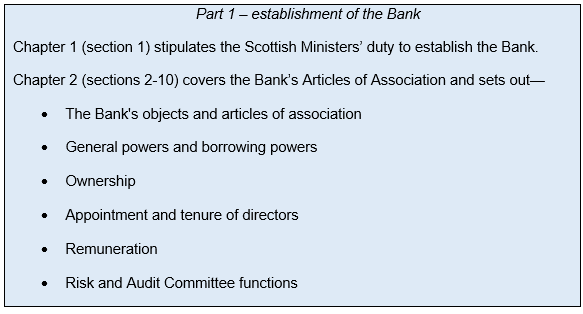
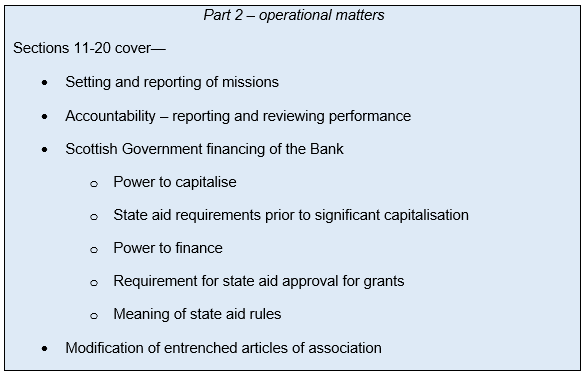
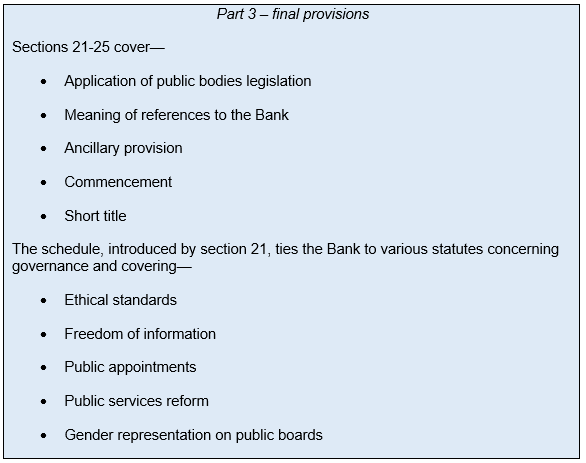
EEFW Committee's considerations
The Committee issued a call for views that closed on 3 May 2019, receiving 27 written responses plus one piece of supplementary evidence.
A letter from the Cabinet Secretary was received on 25 April and the Committee replied on 2 May. The Cabinet Secretary wrote again on 16 May and once more on 26 May along with a copy of the draft Strategic Framework for the SNIB (focused on the Shareholder Framework Document).
The Scottish Government provided a briefing note on the draft Articles of Association on 21 May. The Committee sought external views on the Articles and asked the Scottish Government to respond. The points raised and responses can be found in Annexe A.
The Committee held evidence sessions on 7 May, 14 May, 21 May, 28 May, 4 June and 11 June, hearing from members of the advisory group (whose implementation plan informed the Bill), business organisations, STUC, the third sector, Scottish Enterprise, think tanks, investors, the Clydesdale Bank, economists Mariana Mazzucato and Laurie Macfarlane (authors of A mission-oriented framework for the Scottish National Investment Bank), other investment banks, and the Scottish Government.
Consideration by other committees
The Finance and Constitution Committee considered the Financial Memorandum and received three written submissions to its own call for views, deciding to undertake no further work on the financial implications of the Bill.
Scrutiny
It should be noted that the Bill itself does not establish the Bank as a statutory body and does not confer any powers in itself. Rather, it places the Scottish Government under a duty to establish it as a public limited company, which will be done according to the rules of the Companies Act 2006.
This is very much an enabling or framework Bill, one which describes the set-up and operational activity of the Bank with broad strokes, while a lot of the detail is left to the Articles of Association. Many of the intentions and aspirations expressed in the Implementation Plan are not explicit in the Bill. As described by Bennie Higgins, Strategic Adviser to the First Minister on SNIB, the approach taken with the Bill is “relatively light”.i
Were the Bank subject to legal challenge, it would be its Articles of Association that the courts would look to rather than this enabling Bill. Given the technical nature of such a document, and that it is still in draft form, we have sought views from the Scottish Law Society and a legal academic on the content of the Articles as currently drafted. The points raised have been put to the Scottish Government and can be found along with the response in Annexe A.
There are various reports, strategies and plans mentioned in the Bill or wider suite of supporting materials – some in draft form and still evolving, some for the future and the Bank to devise.
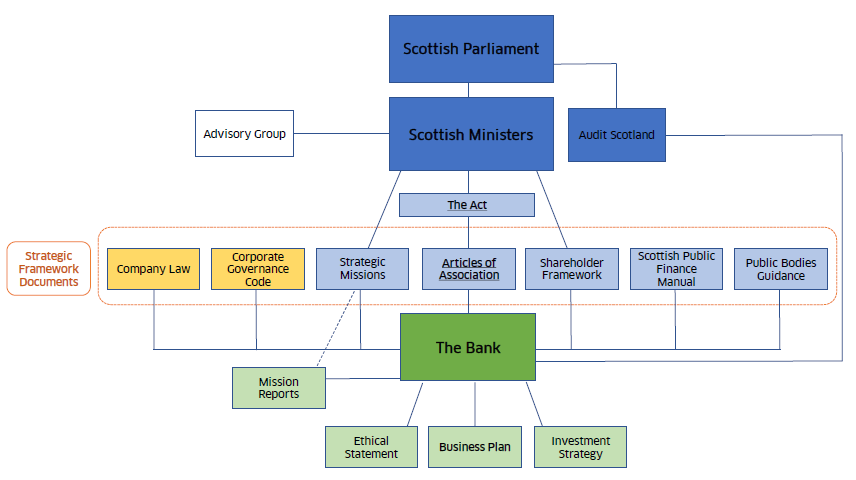
Documents that come under the catch-all heading of “Strategic Framework for the Scottish National Investment Bank” (focused on its operation and relationship with the Scottish Government) include—
The medium-term strategic missions for the Bank that will be set by Scottish Ministers
The Ethical Statement that the Bank will publish
The Shareholder Framework Document
Documents that will be required from SNIB when established (as listed in Appendix A of the SPICe briefing) include—
The Annual Performance Report
The External Performance Review
The Investment Strategy
The Mission Report
The vision is of a new institution at the heart of the Scottish economy, a body that can take the long view but adapt its approach as necessary. As Alan McFarlane, a member of the Advisory Group, put it—
We are talking about forming an entity that is here for the long-term and which is demonstrably patient, evergreen and continuing.ii
The draft strategic framework states—
As an institution to be underpinned by statute, which will be both a public limited company and a Scottish public body, the Scottish National Investment Bank will be an unusual body.
All of which presents something of a challenge to the parliamentary scrutiny of a Bill that – though an integral part in the establishment of SNIB – is not the only piece in the jigsaw. Therefore, in the interests of rigour and completion of the puzzle, so to speak, this report takes a wider and thematic approach rather than limit consideration to the nine pages of the Bill alone.
Accordingly, the following sections will consider—
Role and status
Capitalisation and costs
Governance and accountability
Markets and demand
Ethics and equalities
Vision and mission
Role and status
This section addresses the characteristics, role and status of an investment bank, the private sector focus, what is meant by commercial activities, and expectations for what can be achieved by SNIB.
What is it?
In simplest terms, a national investment bank is an institution created by a government to finance economic development. Such bodies have become popular again in Europe post-2007-08. The British Business Bank (BBB) and Banking Corporation of Ireland, for example, were set up in 2014, the Development Bank of Wales (DBW) in 2017.
Par Equity’s Andrew Castell told the Committee—
Essentially, SNIB is an example of that great Scottish invention, the investment trust – it is not really a bank.i
Why do we need one?
The key issues for SNIB, identified by the Advisory Group, were—
A need for greater long-term investment (or patient capital) in small to medium size enterprises (SMEs)
Scotland’s relative innovative performance lagging behind comparator countries
Furthermore, the Bank will have a national mandate while also being expected to maintain regional reach in order to help businesses across Scotland to achieve their economic potential; something considered particularly important since Scotland’s productivity varies significantly across regions.
How will it work?
The Bank will act commercially (see paragraph 62 for elaboration of acting commercially), meaning it should target a positive financial return at both an individual investment and portfolio levels – the portfolio return target set over the long-term. The financial target rate of return will be finalised prior to vesting of the company.
Benny Higgins said—
We have not yet set out the precise numbers associated with that and we have to take into account also the comments made about societal benefit, but the intention is that the bank will make a return on capital.i
SCDI’s Matt Lancashire told us—
We need to crowd in funding. Germany’s KFW and the Japan Finance Corporation have similar mechanisms and institutions. There are global examples of national investment banks or similar being used as cornerstones to pull not only public finance but private sector investment together as long-term patient capita.ii
Public limited company model
The Policy Memorandum considers the public limited model “the most appropriate model for the Bank”. It suggests this will allow it to raise capital from a range of sources, provide “additional protections” – e.g. ensuring ownership remains with the Scottish Ministers, and not restrict the potential issue of dividends.i
STUC welcomed the Bank being established as a public limited company “wholly owned by Ministers” as it ensured privatisation would need primary legislation.Women’s Enterprise Scotland’s Lynne Cadenhead suggested it was important to learn from what had worked in other countries and that “on balance” the approach was “the right one”.iii Mydex CIC argued for the Community Investment Company model, contending that such an approach was “asset and mission locked” and offered future protection against being “driven down a market forces route”.iv
Benny Higgins said the Advisory Group had discussed different models and concluded—
…the best way to serve the Scottish economy in the long run is to have clear and unequivocal ownership by the Scottish Government.v
Classification
It is proposed the Bank should be classified as a public body, or more specifically a non-statutory non-departmental public body (NDPB), classified by the Office for National Statistics under the heading General Government. How the Bank is classified relates to its capitalisation and also the degree and form of Ministerial control.i Such an approach is intended to ensure better alignment between the activities of the Bank and the broader economic policy of the Scottish Government and its enterprise agencies.
Economic, social and environmental returns
According to the Implementation Plan, the Bank should take into account economic, social and environmental returns, and with reference to the National Performance Framework, when making investment decisions. A balanced scorecard will be developed between the Bank and Scottish Government to establish the requirement and measurement of non-financial returns. Investment should also be undertaken on an ethical basis, with the Bank expected to develop a code of ethics. The balanced scorecard, it should be noted, is not referenced in the Bill or any of its accompanying documents.
Additionality
It will be for the Bank itself to develop its own products, the expectation of the Implementation Plan being that it will invest through a variety of instruments – including debt, equity and mezzanine finance (a hybrid of debt and equity). But the Bank should aim to maximise additionality i.e. giving priority to areas of investment that are additional to the finance already provided by the market and other providers. Through doing so, it can complement rather than crowd-outi existing or potential investment.
In a blog by Laurie Macfarlane and Mariana Mazzucato from February 2018, they framed additionality with the words of John Maynard Keynes—
The important thing for Government is not to do things which individuals are doing already, and to do them a little better or a little worse; but to do those things which at present are not done at all.
Funding the funders
It is intended that much of the Bank’s investment and lending activities, similar to the British Business Bank, will be through others, requiring a fund management role and structures.
Co-investment will also be key. David Ovens of Archangel Investors praised Scottish Enterprise’s Scottish Co-investment Fund model, describing it as “demonstrably successful”. He urged SNIB to build on what worked and told the Committee—
It has been copied around the world, most recently by the British Business Bank.i
Mariana Mazzucato invoked Keynes’ animal spiritsi, suggesting the central role of SNIB was to provide direct finance “in mission-orientated areas in order to create a new landscape in which there is increased business investment afterwards”.
CBI’s Flora Hamilton spoke of “three distinct buckets of activity” which she described as—
…funding for entrepreneurial businesses at start-up stage, funding for scale-up for the mid-tier businesses, where real economic growth lies, and long-term patient capital to go into projects that sit within the specific missions…ii
What it will not do
The Bank will not undertake funding activities such as the awarding of capital and revenue grants, which will remain with the Scottish Government and its agencies. It will not function as a traditional retail bank i.e. it will not take deposits.
As stipulated in section 4 of the Bill, the Bank can only borrow from the Scottish Ministers. It will not issue bonds or public shares.
Furthermore, as stated in the Policy Memorandum—
The Bank will lend solely to the private sector. It will not lend to public institutions including local authorities, government agencies or arms-length bodies.i (See also paragraph 62 for elaboration of what constitutes the private sector.)
Commercial focus
STUC’s Helen Martin spoke of the “tension at the heart of the bill” between using patient capital to aim at “innovation in society” with that of “short-term requirements for supporting growth companies”. She wondered if the commercial focus might “act as a brake” to “long-term and slow-growth projects”, suggesting aspects of the Bill had “not been…bottomed out”.i
Commercial can mean different things to different people suggested Mydex CIC’s David Alexander—
I ask people to consider that the word commercial is about the mission of making things better, faster, cheaper, more efficient and fairer.ii
Citing the different elements of SNIB’s stated remit, the socioeconomic focus and commercial approach, Clydesdale Bank’s Graeme Sands thought it would be “incredibly hard” to cover everything “if, as we would suggest, its remit keeps it clearly away from existing commercial opportunities.”iii
LINC Scotland’s David Grahame sought a “fuller understanding” of what was meant by commercial and did not consider it restricted activity to the private sector. He added the proviso that what was being invested should be capable of offering a return, “otherwise, it is just a grant”.iv
Referring to A mission-oriented framework for the Scottish National Investment Bank, Mariana Mazzucato said—
…the bank should provide patient finance to organisations in the public, private and third sectors and in civil society that are willing to engage with the government missions.vi
She spoke of “commercial dynamics” by which investment in one area might suggest possibilities in another, citing Viagra as a “classic example”, it being a product originally intended to treat heart problems.vi
Her UCL colleague Laurie Macfarlane said it was his “understanding” that “‘private sector’ meant everything – social enterprises, charities and so on – apart from the public sector”.viii
Professor Mazzucato said efforts to deal with “global problems” – such as the energy and health challenges – were being funded by institutions from various sectors, and “multiple solutions” were necessary—
We call it a cross-sectoral, cross-disciplinary, cross-actor investment process. I encourage the committee to keep provoking on that point.ix
Support for the Bill
Describing the Bill as “close to our hearts”, Robin McAlpine of Common Weal said he would have preferred to see more emphasis on “working with local authorities housing associations and others” and that in some places—
…the bill implies slightly more than I would have liked that the bank will be just an SME bank...i
Identifying where the emphasis lay in its developmental work, Bennie Higgins said—
The bank will work on the origination in relation to the mission-related projects, while SMEs will be covered by the existing agencies…ii
He had been “delighted” by the “very broad support” for the Bank “across the political spectrum and the Scottish economy’s ecosystem”. From consultation as well as informal conversations, people had expressed their views and raised issues—
There were questions about whether the bank will be big enough, and how we will operate pay policy…whether there would be an ethical code and what the approach to missions would be…all legitimate questions that were asked within almost universally strong support for the bank.iii
Clarification on 'private' and 'commercial activities'
SPICe sought further clarification from the Scottish Government on the reference in the Policy Memorandum to lending solely to the private sector (see paragraph 50) and the focus on commercial activities (see paragraph 34). It received the following response—
Our understanding from the questions that have been asked in the Committee and the recent PQs submitted is that Members would welcome clarity as to the range of types of body in which the Bank could invest and particularly whether third sector bodies, CICs, social enterprises and cooperatives may be eligible to seek financing from the Bank.
We can confirm that this will be case. The reference to “private sector” in the Policy Memorandum was intended to mean non-public and we’re happy to clarify that. We have engaged on this subject with a number of interested groups and will be continuing to do so.
The reference to “commercial activities” in section 2 of the Bill and elsewhere does not inhibit these types of entity’s access to finance from the Bank either. Commercial activities in this context refers to business activities that are profit-making or aim to be profit-making, carried out by business associations of various types, that the Bank may be interested in providing financial assistance to. This would clearly include a social enterprise or CIC [Community Interest Company] for example.
Expectations
Hopes for what the Bank can achieve are high and a number of witnesses counselled against unrealistic expectations. Benny Higgins described it as a “critically important additional piece of apparatus” but “we cannot imagine that the bank will solve every problem”.i
Common Weal’s Robin McAlpine said “it cannot do everything”ii and was worried people might conclude “that’s Scotland decarbonised and gender equal”—
No – we have a source of finance that is more conducive to making those things happen, but we cannot take our foot off the pedal...iii
Although in principle “strongly in favour” of a SNIB, Clydesdale Bank’s Graeme Sands highlighted the use of “bold” and “ambitious” in the consultation and the wish to address socio-economic concerns while also being “commercial” and “achieving an ambitious rate of return”. He said—
It will be incredibly hard for the bank to achieve all those aims in combination...iv
Many witnesses recognised the ambition of the undertaking but urged patience. David Alexander of Mydex CIC told us—
We are constantly faced with people trying to rewire the building with the power still switched on. That is the transformation that is under way and it is not going to be done in three years.v
David Grahame of LINC Scotland pointed out it was 15 years since the co-investment fund was founded and only now was its work coming to fruition. Patience was again the word and he saw a “real challenge” for those designing SNIB to enable it to endure and withstand criticism—
Most of the bad news comes earlier, which is sometimes difficult politically…The lemons ripen before the plums.vi
Scottish Government
The Cabinet Secretary said consultation had been “crucial” to SNIB’s progress to date, but “certain key decisions” – such as the products it will offer, its structure and the scope of the missions – were still to be taken.i He said—
We will continue to consult widely, including with this committee, as we finalise our proposals to ensure that the bank can truly transform Scotland’s economy.i
Addressing the question of commercial activities and its meaning, he told us—
The commercial element concerns the financial instruments that it can use, and the bank will not invest in the public sector in the way government would do through resource or capital grants.iii
Reporting that discussions with HM Treasury over dispensation for SNIB to carry over funds were “still under discussion”, he suggested “we would manage without it, but that would be far from desirable”. Regarding permissions required from the European Commission, the Scottish Government were “building up that case” and work would be passed to the UK Department for Business, Energy and Industrial Strategy to “carry out the notification process”.iv
Asked why a Bill was necessary to underpin the establishment of the Bank, David Wilson told the Committee—
…the decision that has been made, and the advice that we received, was that, in order to capitalise such a company on the scale that ministers intend, legislation would be needed.v
The Cabinet Secretary said—
It is about the scale of the bank. If we get the dispensations, the bank will have further financial flexibility, which the agencies that we currently have do not enjoy. There are benefits from establishing the bank in legislation.vi
On the question of whether the Bank required a banking licence, the Cabinet Secretary told us there was no need for one “given the nature of the activities that the bank will be engaged in”. Asked about regulation by the Financial Conduct Authority, David Wilson said the FCA’s “approval will be required for the use of the term, “bank” but the Scottish Government were “not anticipating any particular challenge around that”.vii
As to its intended longevity, and the Bank being allowed to get on with its work beyond the short-term political cycle and without any undue interference, Mr Mackay felt the approach to engagement, operation, accountability, transparency and governance “gets the balance right”.viii
The sense was “the bank will achieve more if it is as independent as possible” but the checks and balances envisaged “will give us assurances about its operation”. He said—
…I think that we have struck the right balance to ensure that the bank endures beyond any parliamentary term…viii
Conclusions
The Committee acknowledges that the Bill is part of a wider process that the Scottish Government is undertaking to establish the Scottish National Investment Bank. There are numerous other documents related to the Bill – Articles of Association, Shareholder Framework etc. – and we ask that the Scottish Government provide further drafts or ideally final versions of all relevant materials as soon as possible and certainly in advance of the Stage 1 debate.
We note that the proposal for the Bank has been consulted on twice by the Scottish Government – before our own call for views – and that there has been a strong level of engagement with the business community, investment organisations, economists, the third sector, think tanks and others. There was also a debate in the Parliament on 8 May 2018, with the motion (as amended) agreed to – see paragraph 11.
The Committee recognises, given the level of capitalisation being sought, the need and rationale for the Bank to have a statutory underpinning.
We note the public limited company model being proposed and – having heard various views, some questioning, many positive – are content with the approach.
The Committee welcomes the Scottish Government’s clarification on the meaning and emphasis on commercial activity and the private sector – see paragraph 60. However, the Implementation Plan stated that the Bank should take into account economic, social and environmental returns when making investment decisions, and that a balanced scorecard would be developed to establish the requirement and measurement of non-financial returns. The balanced scorecard, which is to be devised between the Bank and the Scottish Government, is not referenced in the Bill or anywhere else outside of the Implementation Plan. Some witnesses perceived a tension at the heart of the Bill between the commercial aspect and the long-term slow-growth focus. We believe non-financial returns must be anchored in the Bill and invite the Scottish Government to consider how best that can be achieved.
The Committee is aware of the constraints around Financial Transactionsi and the rationale for the Bank not to provide input where the Scottish Government itself can deploy resources. However, as Mariana Mazzucato told us, the Bank “should provide patient finance to organisations in the public, private and third sectors and in civil society that are willing to engage with the government missions”. We ask therefore that the Scottish Government think beyond SNIB’s work in its initial phase, look to future-proof the mission-orientated focus, and – given that potential missions such as the climate emergency, social care and fuel poverty will inevitably require public sector/local government input – keep the door open to who the Bank will be able to work with in the longer-term. We invite the Scottish Government to set out how it would intend to achieve this.
Dispensations/permissions are still required from HM Treasury, the European Commission and the Financial Conduct Authority. We were told these matters are all in-hand but the Committee urges the Scottish Government to follow-up on all fronts as soon as possible – accepting the need to work through the UK Department for Business, Energy and Industrial Strategy for the case to be put to the EC to secure permission in order to comply with State Aid rules – and to keep us informed of progress, providing copies of correspondence.
People have such high expectations for the Bank that it is unlikely it can deliver on everything to which its name has been speculatively attached before even a single mission is framed or its first investment made. The vision is that of a new and unique institution, one that will become a cornerstone of the Scottish economy via its investments and missions; an entity which the Committee agrees should be independent but accountable and permanent but adaptable, taking a long-term, patient view.
Capitalisation and costs
This section deals with the level of capitalisation, the proposed costs of establishing and running SNIB, and remuneration.
Scale of capitalisation
The Implementation Plan suggests the capitalisation proposed is consistent with levels for other national investment banks and—
In a Scottish context, £2bn broadly equates to 1.3% of GDP.
It is noted, however, that such a statement will be correct only when full capitalisation is achieved after a 10-year period.
The impact of that sum was “difficult to speculate on” according to Bennie Higgins but he described it as a “catalyst” and “wonderful opportunity to make a big difference” and “feed ambition”.ii He said—
…£2 billion strikes a decent balance between aspiration and impact.iii
The amount compared “pretty reasonably” with similar institutions in the UK and internationally, according to Laurie Macfarlane. The difference was that SNIB would not be able to leverage that capital by borrowing or issuing bonds, which was “where the difference might lie, at least in the initial phase”.iv
SCDI welcomed the sum but contrasted that level of capitalisation with the scale of ambition set out in the vision to transform Scotland’s economy. It contended that it could be challenging – with the investment spread across a decade – “to deliver a truly transformative macroeconomic impact” and—
Our concern is that we will not reach that proportion of GDP until 2030...Scale and speed are required quickly.
Advisory Group member Alan McFarlane said it could be argued “the denominator is not the £170 billion that is Scotland’s gross national product but 10 times that number”. He thought the approach “could be significant if it is targeted but it cannot be a blunderbuss”; and explained that because leverage in terms of “borrowing money from your own balance sheet” was not permitted for SNIB, it would have to mean “influencing others to behave differently”. He suggested there was “clear evidence” the Scottish Investment Bank (SIB) had been “quite good” at doing this.vi
UNITE Scotland was not convinced £2 billion represented a sufficient level of capital investment to deliver real economic change. It cited several examples of projects that would have made a significant albeit hypothetical dent in the figures – e.g. the Beatrice offshore wind farm being a £2.6 billion project and if the owners had sought just 10% of the cost, that would have come to £260 million, “wiping out the whole budget in one year, on one project”.
Similarly, RSE had concerns over the level of capitalisation restricting the number of potential missions the Bank could have. It suggested £200 million a year over the first decade was “not enough to provide investment across three or four missions - such as demographic issues and/ or transition to low carbon economy - which are significant in scale”.
DBW’s Rob Hunter told the Committee—
I know that in Scotland the challenge is to invest £200 million a year and from our experience in Wales, I think that is a probably the right level to aim at.ix
Robin McAlpine of Common Weal said—
Everything has to start somewhere and £2 billion is a good starting point, but we are much more ambitious of the bank’s future than that.x
Costs
The Financial Memorandum states—
The indicative financial modelling projects that the Bank will cover its operational costs from 2023/24. The indicative financial modelling is subject to further review and change.
The document is heavily caveated and the figures for SIB are not reflected in the costings set out. More information is due to be published by the Scottish Government on the operating costs and indicative financial modelling.
Alan McFarlane told the Committee—
There will be red ink spilled in its annual reports and accounts every year until 2023. That is why I said at the beginning that, if you want long-term patient capital, you have to have long-term patient investors.ii
Also asked about the Bank’s break-even point of 2023/24, Andrew Castell from Par Equity stated bluntly “in government cash-accounting terms, I would say that there is not a hope”. Looking at a company level, however, and as to whether SNIB could turn “an accounting profit”, he believed “it probably would” but much would depend on whether Scottish Enterprise’s existing portfolio was transferred over.iii David Ovens of Archangel Investors suggested “it is difficult to see how the bank will be washing its own face within five years”.iv
Mydex CIC’s David Alexander also had concerns, describing the 2023/24 aim as “completely unrealistic” and contending that becoming self-funding “will not happen overnight”. He said—
I think that you would be happy if the bank broke even in 15 years. That might be blasphemous.v
Asked about operating costs, Ray Perman of the Royal Society of Edinburgh (RSE) suggested the £25 million figure represented a “very high expectation of costs” when compared with the British Business Bank. In particular he questioned the need for the 40 civil servants and £4 million a year identified by the Implementation Plan to staff the sponsorship unit within the Scottish Government—
“That seemed rather excessive for monitoring a bank that will have only 100 people.”vi
Benny Higgins, asked whether the proposed levels of operating costs in the Bank’s first few years were realistic, told us—
We have modelled that on the basis of the nature of the activity and the number of people involved. It is our best guess. We have taken as many readings against similar organisations as we can, so we think that it is realistic.vii
Remuneration
The Bill provides that the Articles of Association must include that the remuneration of the Bank’s directors and staff be determined by the directors, subject to any direction from the Scottish Ministers. Work is ongoing to determine the eventual position.
The Bank will be operating in the financial sector and the Scottish Government believes it will need to reflect that in its terms and conditions of employment. However, it will also be a public body and required to deliver value for money. It is expected that the majority of staff will fall within public sector pay policy, but alternative approaches may be required for some roles.
Respondents to the Scottish Government’s consultation believed that any attempts at performance-related remuneration should be approached with great caution as such schemes almost inevitably lead to distortion of behaviour. The simpler and more transparent the process the better.
SCDI thought investing in people was vital to organisational success and supported a “judicious approach to remuneration which ultimately reflects labour market realities”. It also suggested that remuneration, particularly for staff at the leadership level, “be closely linked to the performance of the Bank, macroeconomic impact delivered, and rates of financial return achieved”.
It was crucial to the STUC that the Bank’s remuneration policy retained public support—
Given the Scottish financial sector's track record of failure, it is simply not credible to pay senior staff as private sector bankers instead of public servants...
The Law Society of Scotland said in relation to section 8 of the Bill that any direction from the Scottish Ministers about remuneration of staff should be “in line with levels of transparency and accountability in terms of civil service remuneration”.
It was the view of Friends of the Earth Scotland that there could be “no credible case for the Bank paying senior staff as private bankers instead of public servants”. It welcomed the proposal to pay all Bank staff the Scottish Living Wage or more and proposed this was “extended to sub-contracted services such as cleaning and IT”. Furthermore—
Pay within the Bank should not exceed the First Minister’s salary, which currently stands at £151,721.
Placing the issue in a wider context, Mariana Mazzucato argued the case for reframing the public sector “to attract the top talents” in the investment and scientific sectors in order to “take a risk and be a creative actor”. She said such an approach had been shown to work in “bringing in high level expertise” to government bodies—
You do not have to match bankers’ salaries but you have to ensure that the bank’s remit is ambitious and that it will be an honour to work there.v
Graeme Sands of Clydesdale Bank felt the right people would be attracted to “execute that purpose”.vi David Ovens of Archangel Investors cautioned “against a bonus culture”, suggesting that any incentives be long-term in outlook, like the Bank itself.vii Mydex’s David Alexander argued the “masters of the universe” model was “an illusion” and recruits from the financial sector did not have to be “treated like gods.”. What was needed, in his view, was clarity about the mission and the role and that the Bank was an opportunity to “do something different”—
You should insist on talent but make it plain that you are not paying eye-watering salaries.viii
DBW’s Rob Hunter explained that their salaries were independently market- tested every three years, with “pinch points for the higher salaries” relating to fund managers—
We have adjusted our salaries for the people who deal with equity, but we recognise that we cannot offer the stellar bonuses that people who work in the private sector can get.ix
Scottish Government
Regarding the level of capitalisation, the Cabinet Secretary said—
We have set out the £2 billion capitalisation over the 10-year period, but exactly how we profile that will be determined by the resources that we have available from budget to budget, within that aspiration.i
On the likelihood of the Bank meeting its break-even deadline of 2023-24—
It might. It is possible, and even likely, but it will depend on what the bank invests in; when there is a financial return; the state of the economy at the time; where there is success, whether that is around the bank’s missions or around its investment profiles; and what we choose to do around the economic cycle.ii
He wished the Bank to be self-financing and “able to reinvest its returns as soon as possible” but did not view the Bank “as a cash cow that will be able to contribute to the fiscal coffers”. Success would be “allowing investments to happen that would not otherwise have happened”, which was of “much greater importance than ministers having the ability to take a dividend from it”. That was not the motivation—
“It is about transforming the economy to direct more efforts towards demographic and environmental challenges, including the transition to a low-carbon economy and the scale-ups.”ii
Remuneration was an issue “we will wrestle with” he said. As a PLC and a public body, the challenge was of “attracting the right people to operate the bank while working within the public sector pay policy, as far as possible”. The Bank “will work within the fair work principles and…be a living wage employer”. However, “higher remuneration levels will be required for some posts” and close attention would be given to the BBB’s pay policy so as to “be commercially minded but publicly accountable”. He told us—
“We will give the matter a great deal of thought and we will balance the need for people who have the right skills and experience with respect for the public sector pay policy, which the vast majority of the staff will be under.”iv
Mr Mackay explained the Bank itself would “lead on its remuneration policy and the recruitment of staff, but ministers will set out a view and a direction” and said—
I do not want to encourage a bonus culture in the bank, which would be an inappropriate driver. I want the bank to be inspired and energised by its missions.v
Conclusions
The Committee considers the level of capitalisation a good starting point but – given the duration of 10 years during which the annual sum will be subject to each year’s budget process – our welcome is a qualified and cautious one.
We draw attention to the fact that the Financial Memorandum is heavily caveated and the figures for the Scottish Investment Bank are not reflected in the costings. We note that more information is due to be published by the Scottish Government on the operating costs and indicative financial modelling. In the interests of transparency, we seek an updated set of figures at the earliest opportunity and certainly well in advance of the Stage 1 debate.
The Committee notes the concerns of at least one submission to our call for views at the size and cost of the sponsorship unit within the Scottish Government. We would welcome a more detailed breakdown of the projected figures and thorough explanation for the number of staff thought to be required.
Remuneration is a difficult and potentially contentious issue in the case of an investment Bank that is a plc but also a public body. We were encouraged, however, to hear a number of witnesses say that making the Bank a great place to work – innovative in its approach and pursuing missions of wider social significance – would attract those with talent and expertise. The Committee agrees that the broader purpose of the Bank will help to attract people with the right ethos as well as the right skills and welcomes the Cabinet Secretary’s statement of not encouraging a bonus culture, notes that the majority of employees will come under public sector pay policy, and recommends that the Scottish Government look to the examples of the Development Bank of Wales and the British Business Bank – other relevant and commercially minded but publicly accountable bodies.
Governance and accountability
This section covers SNIB’s governance arrangements, including the Board of directors, the proposed Advisory Groupi, accountability and the role of the Parliament.
Governance
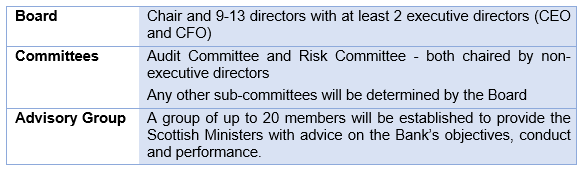
The Policy Memorandum makes clear that “Ministers will not have a role in the Bank’s internal governance or the operational decisions made by the Board”.i Bennie Higgins drew attention to another document key to the relationship between the Bank and the Scottish Government—
There will be a strategic framework, which I see as being an envelope within which the bank will operate; we seek to create an envelope that will allow the bank to be operationally independent.ii
Alan McFarlane observed that the board of directors would take on the same responsibilities as directors of any company under the Companies Act 2006. What would be key was the interaction with the Scottish Government—
The bank will make losses for the first three or four years, so it will be imperative that there is an extremely close and confident relationship between the board of directors and the shareholders, who will be the Scottish ministers.iii
Furthermore—
To have an audience of fans baying for the manager to be sacked three games in would be the worst possible outcome.iii
Advisory Group
The Financial Memorandum states—
An Advisory Group of up to 20 members will be established to provide the Scottish Ministers with advice on the Bank’s objectives, conduct and performance. It will be resourced by the Scottish Government and is anticipated to meet 1-2 times a year. The establishment of an Advisory Group is not provided for in the Bill but will take place following the coming into force of the Bill.i
The annual costs of the Group are estimated between £20,000 and £50,000 but the Financial Memorandum only captures these until 2022-23.ii
Mariana Mazzucato stressed the importance of having a representative Advisory Group. She said it was not practical to involve “hundreds of people” but “you can ensure that the people who are around the table genuinely represent different voices”. How that was decided was for the “political process” but—
Ideally, different types of voice will be represented. For example, if there is a care mission, it is obvious to me that social care workers and nurses should be at the table.iii
Linda Hanna from Scottish Enterprise was positive about the role of the Advisory Group, suggesting that it has a “real opportunity to bring diversity of thinking to the matter” and “to provide some independent thought”. She distinguished its role from the issue of the Bank’s governance.iv
An “advisory board that focused on customers” was the description of Common Weal’s Robin McAlpine. He added “the customers being Scotland”. He recognised that the board could heed the advice or not but—
We suggested taking that approach to address the fear that banks can sometimes be a little tin-eared when it comes to fiduciary duties.v
RSE expressed concern at the lack of clarity and potential influence of the proposed Advisory Group, warning of the risk of a clash with the Board and how this might “increase the risk of inappropriate political interference from Ministers”. It recommended that the Chair of any Advisory Group should not sit on the Board.
The CBI described the Advisory Group’s role as “crucial” and suggested it draw its membership from business, finance, higher education, think tanks, and enterprise agencies. Flora Hamilton said—
The advisory group’s membership must cover a broad spectrum, and it must be independent, clear and transparent in its monitoring of the bank’s performance and how it delivers against a set of tangible and measurable KPIs.vii
In Laurie Macfarlane’s opinion—
It must not be seen as being there just to provide cover, with no meaningful agency to shape things.viii
Benny Higgins was keen to “respond to the desire of a broad church of people who would like to have a voice that ministers hear as they go through the strategic cycle”.ix However, he emphasised that the Group’s role was to advise ministers and not the bank itselfix—
An advisory board will have a voice to inform ministers, as the owners of the bank, but it will not inhibit the bank’s day-to-day operation.xi
Accountability and the role of Parliament
The Policy Memorandum states that—
While the Bank will be operationally and administratively independent, the Scottish Ministers, as the Bank’s sole shareholder and sponsor, will set the parameters within which the Bank should work. Scottish Ministers will also set the direction for the Bank’s investment through setting it strategic missions.i
Section 11 of the Bill gives the Scottish Ministers that power of setting the missions and after sending the Bank a document doing so, the Scottish Ministers must “lay a copy of it before the Scottish Parliament”. Section 14 (Review of performance) stipulates that the Scottish Ministers do the same with a copy of a review of the Bank’s performance (to be carried out at least every five years).
The Law Society of Scotland observed that the Bill made “provision for transparency and accountability” for SNIB’s reporting to the Scottish Ministers on missions. However, there was “”no corresponding duty” on the Scottish Ministers to allow parliamentary and public scrutiny of the Bank’s performance. It suggested the Bill require that a copy of the report be sent to the Scottish Parliament and made publicly available.
There was support from STUC for the key role of Scottish Ministers in determining the strategic framework, setting missions, and defining performance objectives—
However, ultimately, we believe that Parliament should also input and authorise final approval. They should therefore be subject to affirmative procedure.
Helen Martin of STUC said the Parliament’s role was “crucial” and it “should have the right to consider, amend and vote on the bank’s missions.”iv
There were concerns from Friends of the Earth Scotland that the “lack of Parliamentary oversight over the setting and delivery of missions” could downplay their importance. It argued there was a “real risk” that the missions could be seen as a minor part of the Bank’s work.
Asked whether the Parliament should have a role in agreeing the mission(s), Ray Perman of RSE and Common Weal’s Robin McAlpine thought it should.vi LINC Scotland’s David Grahame suggested “scrutiny and comment rather than full approval”.vii
Bennie Higgins told us—
I think that we could over-intellectualise it by having to go through a parliamentary process to address the missions. There are big obvious missions that we need to pursue in this country.viii
Scottish Government
Asked if the chair or another member of the Advisory Group should sit on the Board of the Bank, the Cabinet Secretary said he “could give that further thought”. He was not suggesting the advisory group “should never meet representatives of the bank” or wishing to “be overly restrictive” but he pointed out that the advisory group’s role was “ultimately to advise ministers”. Given that advisory function, he was “not proposing to put it in the act”.i
Rachel van Kempen said the consultation had proposed that a non-executive director of the Board would chair the Advisory Group, the thought being of “creating a connection between the advisory group’s thinking and the board and its thinking”. The Cabinet Secretary said that would “give you the link that you were asking about—not from the advisory group into the board, but from the board to the advisory group”.i
He told us—
The important point about the advisory group is that we want it to be reflective of Scotland and its key economic interests. It cannot be totally comprehensive and cover every sector, but we want the group to be informed, and for it then to inform ministers.i
In terms of accountability, the Cabinet Secretary did not believe the missions should be subject to formal parliamentary scrutiny or approval—
I think that it is right for the Government to be able to get on with its job as an executive and have a relationship with the bank, whereby the bank will have a degree of independence, but the missions will set out the parameters within which it should operate.iv
However, he was “keen for a cross-party approach to be taken to refining the missions”, likening it to his work on the national performance framework—
That did not require an affirmative vote by Parliament; it was a mission for the whole country.iv
The NPF was developed “in an inclusive way”, Mr Mackay said, suggesting a similar approach with the missions – and committing “to taking a round-table approach”. He proposed—
Rather than have a parliamentary vote and unnecessary division on the missions, I would like to engage with Parliament on them, in the same way that I did for the national performance framework.iv
Conclusions
The Advisory Group, as we understand it, will have a crucial role in advising the Scottish Ministers on the Bank’s objectives, conduct and performance. It has the potential to help shape the thinking and decision making that sets the parameters within which the Bank operates, most notably via its missions.We agree that membership should cover a broad spectrum of business and society, that it should be independent, rigorous and transparent in its monitoring of the bank’s performance against a set of tangible and measurable KPIs, and that its membership should be changeable and refreshed over time, reflecting the challenges of different missions e.g. for a social care mission, care workers and nurses should be around the table. This is no small undertaking for a group that it is intended to meet once or twice a year and number no more than 20 members.
The Committee is concerned at the potential for confusion over the nature of the Advisory Group’s role, the make-up of its membership, and how much agency it will have in shaping the Bank’s missions. Doubtless the Scottish Government is working on various models, scenarios and permutations and we invite them to share these in advance of the Stage 1 debate.
The Committee would expect to see the STUC and COSLA among those represented, and we also recommend that the Scottish Government consider how the Advisory Group could be reflected in the Bill. The Scottish Government must clarify that the Advisory Group is there to advise Scottish Ministers as the sole shareholder of the Bank.
The Scottish Government’s consultation included the suggestion of a member of the Bank’s Board of Directors sitting on (and chairing) the Advisory Group. The Cabinet Secretary said he would give further thought to the idea of a reciprocal arrangement whereby the chair (if not a member of the Board) or another member of the Group might have a seat on the Board. We recommend that a member of the Board does not chair the Advisory Group, our concern being a potential conflict of interests.
The Committee welcomes the Cabinet Secretary’s suggestion of a roundtable approach to refining the missions, similar – as he saw it – to the approach taken with the National Performance Framework. Our view, however, is that the Parliament should be formally consulted on those areas that will set the long-term focus of the Bank’s work – likely to be fundamental policy matters such as climate crisis, social housing or the care system. Examples of formal parliamentary consultative mechanisms that already exist can be found in the Community Empowerment (Scotland) Act 2015 (regarding the National Performance Framework), the Climate Change Scotland Act 2009 (regarding the Climate Change Plans) and the Town and Country Planning (Scotland) Act 1997 as amended (most recently by the Planning (Scotland) Bill of 2019) (regarding the National Planning Framework). We recommend the Scottish Government consider these examples in order to devise a means for the Parliament to be consulted on and meaningfully inform the process by which the Bank’s missions are formulated and refined.
Markets and demand
The pertinent question in the Committee’s call for views was: How can we ensure the market is ready for the investment opportunities the Bank can offer? The following section examines demand concerns and stimulation, alignment, expectation of return, and performance metrics.
Demand
What the Committee heard about business demand for finance was mixed.
The supply of capital was growing – according to RSE – via the private sector and also the BBB, but investment remained low, which suggested the “critical importance of a lack of demand in the market”. If SNIB did not help to stimulate demand, directly or otherwise, “then it will be particularly difficult for it to achieve its main objective of stimulating investment and enhancing productivity”.
Alan McFarlane said there were “no guarantees” but he did not believe that the low uptake of initiatives such as the Scottish Growth Scheme “damns anything”—
…having an enduring and continuing entity, which makes it its business to let everybody know that it is available, is a big step forward.ii
SIB’s Kerry Sharp said that uptake of the Scottish-European Growth Co-investment Programme had been “slower than we would have liked” but there had been 120 inquiries and they were “actively working on 30 or so”. Brexit, she though, had “played a negative role” on both the investor and company sides. However—
SEGCP was always a niche fund – the objective was to support only five, six of seven companies a year.iii
She had also said—
Another issue is the nature of the programme, which is different, new, first in class and has never been done before—we are the first in Europe to do it. It has taken time to educate the companies and speak to investors.iv
The issue of awareness was also raised by David Grahame from LINC Scotland. He suggested demand could be “inhibited by a number of factors”, of which lack of awareness of what was there and how to get it was the most basic. Confidence was another factor, depending on the certainty or otherwise of the times, as was the cyclical nature of markets when “at any point in the cycle the nature of demand can be out of step with available supply”. He said—
An important requirement of SNIB is that it be well informed and agile in order to enable it to respond. It will also need to be extremely well integrated with all sorts of other agencies in order to manage the demand flow properly.v
He sought to distinguish between “need” and “demand”—
Need is huge, but the ability to convert that need to fundable demand is a big issue.v
The Scottish Enterprise/Scottish Investment Bank [add link] (SIB) submission suggested a “significant impact” has been made in “addressing the demand and supply challenges of the Scottish market for risk capital and more recently debt finance”. It accepted, though, “that even more needs to be done in an increasingly uncertain economic environment”.vii
SIB’s integration into SNIB and alignment between Scottish Enterprise and SNIB were “essential to make a step change in the market”. Substantial demand stimulation activities” were also necessary alongside the additional “investment capability” of SNIB.vii
The BBB highlighted its new Demand Development Unit (DDU), “created specifically to develop the Bank’s positioning and relationship with smaller businesses across the UK” and help it deliver against the following objectives—
Encouraging and enabling SMEs to seek the finance best suited to their needs
Promoting the Bank as the Government’s Centre of Expertise for smaller business finance in the UK
Identifying and helping to reduce imbalances in access to finance for smaller businesses across the UK
Mariana Mazzucato said there were two issues behind a “lot of status quo behaviour”: a lack of “quality finance” i.e. the patient kind, and not enough demand for finance in the SME space. She suggested that instruments such as tax incentives, guarantees and subsidies work on the assumption that the private sector wants to invest already. If that proves not the case, these “indirect incentives” simply boost profits—
However, there is no profits problem – there is an investment problem.x
She thought SNIB could draw in investment by “increasing the imagination of the business community” and showing it an “exciting new future” in the realm of “mobility, clean growth and an aging society”, one in which there were “long-term profits to be made”.x
Alignment
Bennie Higgins said he was “working hand in glove” with Scottish Enterprise and Highlands and Islands Enterprise on “origination” in order to reach the “right place”.i
His colleague Paul Brewer said whether it was low carbon or digital and data—
…the bank will need to work with academia, existing businesses and other investors to bring in considerable expertise, so that Scotland is seen as a place with a fertile investment environment.ii
Scottish Enterprise’s Linda Hanna referred to the Enterprise and Skills Strategic Board and the agenda to “rationalise and simplify”. It was “about the whole system working” and delivering “business services that business needs” and connecting “into new instruments such as SNIB”.iii
Kerry Sharp of SIB saw the need that “everything in the ecosystem is as joined up as possible”, including Business Gateway. SIB’s financial readiness team, which is staying within Scottish Enterprise rather than moving over to SNIB, “works well with Business Gateway” and colleagues “are often based in Business Gateway offices”.iv She said—
That area of specialism is very much the lynchpin between the wider enterprise support of the type that is delivered by Business Gateway and the funding support that SNIB will provide.v
However, warning of “over-lapping initiatives” and encouraging “targeted advice” to be “consistently delivered”, Mydex’s David Alexander told us—
There have to be contact points that join the dots. Otherwise we will have a Venn diagram on steroids, with everybody trying to provide advice…vi
The experience of Wales was that there had been a “lot of discussion” around integration between DBW and Business Wales. Board representation was “the first step”, followed by “automatic routing” of phone inquiries (so callers were not “batted around various departments”), and a “full joint strategy session” between the Business, Economy and Innovation Department and “all the other elements”. Rob Hunter told us—
…we wanted to hide the wiring as far as businesses were concerned.vii
Returns
The Implementation Plan states that in some cases SNIB will invest on the same commercial terms as the private sector. In other areas, e.g. in response to specific market failures where State Aid allows, it may take different risks or different returns, but always in expectation of a return. This will be assessed alongside the wider economic, social and environmental impacts.
The concept of the level of return is referenced in the Policy Memorandum but not the Bill. The Scottish Government has confirmed that the financial target rate of return for the Bank will be finalised prior to the company being established.
It can be noted that the BBB’s target rate of return is 2.5% though it achieved 4.7% in its most recent full-year report. Also, neither DBW nor SIB has a target rate of return, albeit DBW’s Rob Hunter indicated “our target return of investment is currently forecast to be positive by about 0.7%”.ii
Equity Gap’s Jock Millican told us—
…it would hamstring the bank very badly to set out an ambitious rate of return at an early stage.iii
In a similar vein, Graeme Sands of Clydesdale Bank warned against “trying to make the organisation too commercial too quickly” and argued that placing an emphasis on “aggressive rates of return” early on “could be hard to sustain”.iv
Bennie Higgins told us work on rates of returns was a “work in progress” and that in some scenarios, e.g. where a market does not yet exist, no comparators were available. However—
For the avoidance of doubt, the bank is being set up to make a return on capital.v
Performance
Some respondents to our call for views expressed concerns about how SNIB’s performance would be assessed.
Engender stated—
We do not feel there is sufficient clarity about the metrics that will be employed to measure success, particularly non-commercial, economic returns.
Similarly SCVO highlighted that the Bill provides scant indication of the importance of measuring the Bank’s investments “beyond generating financial profit and surplus for reinvestment”.
Close the Gap agreed that the success ought not to be measured by financial indicators alone, proposing “wellbeing indicators” to judge the public benefits of patient capital.
Warning against the Bank starting out in search of “some quick wins”, Laurie Macfarlane said such an approach “will not generate the kind of additionality that is the point of the bank”. It was “not the volume…but the direction of investment”. He told us—
Making sure that it is doing things that would not otherwise happen will be key to the success of the bank.iv
According to Businesses for Scotland, drawing on the National Performance Framework was “fundamental” and the Scottish Government should avoid the "absence of clarity in the criteria through which the Green Investment Bank was going to be evaluated".
Benny Higgins said work on the key performance indicators was in progress and—
One has to remember that we have to get back to the national performance framework…The bank should play its part in delivering that.vi
Quizzed about HM Treasury Green Book, he said it had been “part of the conversation” and was “not being ignored”.vii
Mariana Mazzucato suggested the Green Book was “determined very much by cost benefit-type calculations” and they were working with the Treasury on “more dynamic efficiency versus allocative efficiency metrics”.viii
She also called for flexibility, adaptability and “knowing when to turn the tap off”—
…you should know how to pivot and how to question your behaviour and why things are not succeeding.ix
Scottish Government
Emphasising the importance of engaging with the enterprise agencies, the Scottish Futures Trust and the banks to stimulate interest and raise awareness, the Cabinet Secretary said—
We want to ensure that there is demand—folk queueing up at the door, if you like—so that people take advantage of the financial products that will be available.i
We could learn “from Wales and from the British Business Bank and the Green Investment Bank” but SNIB was also “different from all of them…unique to Scotland’s economic circumstances and landscape”. But the intention was not “to crowd out the BBB, either—we want it to keep investing in Scotland”. Additionality was the word.i
Decisions remained on “who and what transfers, and what resource is where” and he would “look closely at those issues to avoid duplication”. What was wanted was a “potent, targeted, national investment bank”, the enterprise agencies and SFT left with their functions—
We will look closely at how we align our efforts, organisations and staff. We are also working right now on a single point of entry for business support. It is about decluttering.iii
The question was “what fits best where and how we can address duplication to ensure that we get maximum output from public finance”.iv
Asked about the relationship to the strategic board, the Cabinet Secretary said it would “be wrong to assume that the strategic board will take no interest in the bank”. The board “might be able to give advice on the landscape of the agencies” and he would “give that further thought”. However, he did not wish for “too many sources of leadership, when the purpose was to declutter and to bring things together”.iv
Questioned on the take-up of the Scottish Growth Fund, perhaps a signal of demand in the current market, he committed to write to the Committee with a detailed update broken down by portfolio, but—
Am I still confident that the half a billion pounds to which we committed in the programme for government will be allocated over the period? Yes, I am.vi
Discussing demand in the context of the Scottish-European Growth Co-Investment Programme, Mr Mackay said—
If we have financial products for which there is not enough demand, we can create bespoke products and look at how we can support companies if they want a different kind of financial product.vii
Furthermore—
Companies will, naturally, always take free money before loans or equity—anyone would take a grant first—but we will provide loans and equity. Because of the nature of the economy and risk or financial uncertainty, companies may not be willing to take up specific projects.vii
The target rate of return was raised with the Cabinet Secretary and he said it was “important” to have one and he would “engage with the bank” on the matter, but he did not see it as “a matter of primacy” when this was “about transforming our economy and adding to it”.ix He told us—
It should be there, and we should be mindful of it, but it must not be our north star—the only thing that we follow.x
Success was described by the Cabinet Secretary as “the bank allowing investments to happen that would not otherwise have happened”.xi Asked about the balanced scorecard, referenced in the Implementation Plan, he said they were “still working on it” but would appear in the stakeholder framework document, along with financial targets, and also the business plan and the investment strategy. The missions would “cover key socioeconomic challenges…both the financial and non-financial returns will be part of that”. He told us—
It will build on the Treasury’s green book guidance and develop a specific approach suited to a mission-orientated development bank.xii
He said—
The bank will be held to a very high standard, and that is admirable.xiii
Conclusions
The Committee believes the issue of demand for the investment opportunities that the Bank will offer is paramount. Close working with the enterprise agencies, the Scottish Futures Trust and Business Gateway – all those bodies directly involved with companies and closest to the markets – will be key. What nobody wants is an even more confusing and cluttered landscape of business support, or – as one witness put it – a Venn diagram on steroids. Given the Cabinet Secretary’s indication that he would think further about the role of the Enterprise and Skills Board, and while recognising its and the Bank’s very distinct roles but not losing sight of the need for alignment, we ask for clarification as to how these two bodies will interact.
The need to stimulate demand was a message the Committee heard loud and clear and that role would seem to sit primarily with the enterprise agencies. Lessons can also be learnt from the Development Bank for Wales, the British Business Bank and the Green Investment Bank in terms of boosting awareness and profile and – to paraphrase one of our contributors – identifying the best way to convert investment need into fundable demand. The issue is one of resources and where to direct them. The enterprise agencies could fulfil this role and/or consideration given to establishing a Demand Development Unit within SNIB itself. We ask the Scottish Government to specify its intentions with regard to stimulating demand and how this will be resourced.
The Committee was told by Bennie Higgins and others that the Bank is being set up to make a return on capital. The rate of return is to be determined closer to it being operational. The Committee understands the concept of additionality in terms of how, where and to whom the Bank directs its funding and the wider long-term socio-economic and sustainable benefits at which the missions will be aimed – and members recognise that a not-yet-determined percentage figure will not be the Bank’s guiding star – but we heard little in the evidence to suggest the rate is likely to be much more than notional.
Our concern is that from being a notional rate, it may preoccupy the Bank and become the measure by which the institution is judged, perhaps harshly, in the early years. The Committee therefore recommends that a rate of return is not set or applied for the short term, say the first 2-3 years of the Bank being in operation. Beyond that, and looking at the experience of other investment banks, we believe a rate of return would have a useful part to play in the Bank’s investment activities.
Evaluation of the Bank, not just the rate of return of its investments but the wider benefits desired from the mission-orientated approach, will be a challenge. The National Performance Framework and UK Treasury Green Book were discussed but the question remains of how best to measure the Bank’s performance, particularly regarding what you might call the non-commercial, economic returns. The Scottish Government says work is ongoing. The Implementation Plan mentions the balanced scorecard yet, as said, this is not referenced in other documents. As previously set out (in paragraph 80), the Committee believes that non-financial returns must be firmly anchored in the Bill and we ask the Scottish Government to consider how best to do that.
We note also the initiative being undertaken Mariana Mazzucato in collaboration with the Treasury to move away from cost benefit-type calculations and toward what she called more dynamic efficiency-versus-allocative-efficiency metrics. Whatever is devised must – as the Cabinet Secretary encouraged – allow us to hold the Bank to a high standard. The Committee seeks more clarity on how this is to be achieved.
Ethics and equalities
This section outlines issues concerning the ethical framework of the Bank and questions raised over equalities – including criticism of the Equality Impact Assessment (EQIA).
Ethical framework
The Bank’s investment, according to the Implementation Plan, should be on an ethical basis; to which end it should develop a code of ethics that goes beyond regulatory requirements and adopts a best practice approach.
SCDI wanted further clarity on whether ethical framework would prevent the Bank investing in certain sectors – as the Scottish Government’s consultation had suggested – and, if so, which sectors.
Social Enterprise Scotland thought those receiving investment should be obliged to adopt a social enterprise business model or sign up to the Scottish Business Pledge or Scotland Can B.
Scottish Environment LINK pointed to the Green Purposes of the original state-owned Green Investment Bank and suggested a “minimum standards assessment” be included in the Articles of Association. It said many banks and pension funds apply ethical lending exclusions, including RBS, the Norwegian Sovereign Wealth Fund, Green Investment Group and Triodos.
According to Equity Gap’s Jock Millican, ministers should provide guidelines because—
…what was ethical 20 years ago may not be ethical now.v
Alan McFarlane suggested that some ethical investment questions “answer themselves” but there were “more ticklish issues”, oil supply for example. His experience of ethical investment suggested such issues were “generally problematic but individually usually much easier to deal with.”vi
Mydex’s David Alexander knew of “no investment bank or venture capitalist that does not have some sort of portfolio rulebook that says that they invest only in certain things.” Given the aim of SNIB was “to improve society”, he asked—
…why would anyone back something that made things worse?vii
Engender observed that the EQIA was intended to inform the drafting an Ethical Investment Statement. However, based on the “current form” of that document, the organisation felt it could have “no confidence” in such a statement—
We do not know how the incomplete evidence-base included could sufficiently inform the Bank’s equalities considerations in its lending, operation and governance.
Equalities
Close the GAP stated—
“We are concerned that the equality impact assessment of the Bill is significantly flawed, in terms its process and structure, the scope of its content, its analysis, and conclusions.”
The organisation saw this as “part of a wider challenge across Scotland’s public sector” where EQIAs were “often not done, and where they are, they are done poorly”.
According to Engender—
“…as an EQIA it is insufficient, lacking anything more substantive than a cursory analysis and omitting all but two of the protected characteristics...”
Those that were addressed, race and gender, it found “limited”, looking at particular aspects such as access to finance for women-led businesses, but not examining the “different economic and social contexts of men and women”.
Eilidh Dickson elaborated on Engender’s concerns, She told us an EQIA was “not just a bureaucratic, tick-box exercise”, and from the information gathered that policy should be articulated, research carried out and changes seen—
There is very little evidence that the equality impact assessment has informed any aspects of the Bill.v
Ms Dickson was “pretty convinced” the EQIA would need to be “redeveloped” with “missing sections” added and the “whole process of analysis will have to be redone”. Furthermore, she told us—
Equality and non-discrimination are not included in the bill, and that does not translate through to meaningful action.vi
Scottish Government
Asked about the ethical dimension expected of the Bank, the Cabinet Secretary said that he did “not intend to legislate specifically on defining things as ethical”. However, there would be an ethical statement and that could be reviewed. He would “not just leave it to the bank to compose the statement—I propose to engage beforehand”.i
One scenario from an earlier evidence session was that of investment in the oil and gas sector. Mr Mackay suggested it took us “to a wider debate about the bank’s ethical statement and the restricted nature of what the bank may or may not invest in, on which we may have a view”. However, he did “not want to speculate too much about what the bank may or may not invest in”, suggesting such matters will be covered either by the investment strategy or ethical policy.ii
Addressing criticism of the EQIA, he had “seen the evidence from Close the Gap and Engender” and said officials were meeting with the organisations so that “what they have to say shapes and informs future work”.iii
He also told us “further work on socioeconomic deprivation will be carried out under the Fairer Scotland duty assessment”, the findings expected to be published “at the end of the summer”.iv
His aim was to “ensure that we cover issues such as having an inclusive approach, ensuring inclusive economic growth, sustainability and equality and tackling inequality”. They should also “feature in the missions and the shareholder framework document, and I also expect them to be set out in the remuneration policy, the investment strategy, the business plan and the ethical statement”.iv
The Cabinet Secretary said of the EQIA—
If it was felt—as was clearly the case in the evidence that you received—that there were gaps in the assessment, I would want to work on that, including in what we could do with those with protected characteristics.iv
Also—
We will meet the individual organisations to see what progress can be made during the passage of the bill, but I point out that what are perhaps even more important than the bill itself, which allows us just to build the bank, are the strategic documents and directions, which are where equalities should feature.iv
And—
…for the avoidance of doubt, although the word “equality” is not mentioned in the bill, it will be mentioned, where appropriate, in all other documents. The Government’s economic strategy, to which the bill refers, mentions tackling inequality, and that is a key part of the strategy. That means tackling inequality in every sense, not just financial inequality.viii
Conclusions
The Committee highlights the concerns voiced by Close the Gap and Engender over the poor quality of the Equality Impact Assessment. This must be about more than a tick-box exercise. We heard the Cabinet Secretary’s assurance that dialogue with those organisations will shape and inform future work. This is a necessary and welcome remedy. The Committee seeks a fully revised EQIA before the Stage 1 debate, one significantly improved by the input of Close the Gap and Engender, compliant with the Fairer Scotland Duty Assessment, and which also presents a comprehensive overview on how the various strands of work on this Bill and concerning the establishment of the Bank will help to reduce inequality.
The ethical dimension will be crucial to both the credibility of the Bank from the outset and the success of the long-term missions to which its work will be directed. Probity, perception and public confidence matter. We welcome the Cabinet Secretary’s comments about working pro-actively with the Bank on its ethical statement. We acknowledge that ethical investment is a matter which can provoke vexing questions and while there are obvious no-go areas, there are also nuanced cases. One example cited was that of an oil and gas company seeking to diversify its business into renewables.
The Bank’s governance structure should of course inform its decision-making. To which end, the Committee seeks clarification on the inclusion of the audit and risk committees under section 9 but not that of the other four committees mentioned in the draft Shareholder Framework document, including an ethics committee. We ask the Scottish Government to consider whether there is a case for including the ethics committee or indeed all six committees mentioned in that document on the face of the Bill.
The Committee encourages adherence to the United Nations-supported Six Principles for Responsible Investment; the first being to incorporate environmental, social and corporate governance (ESG) into all investment analysis decision-making. We also recommend that the Fair Work Action Plan informs the work of the Bank in terms of its ethos and culture, working practices, decision making and operations.
Vision and mission
In the context of defining a cynic as someone who knows the price of everything and the value of nothing, the mission-orientated approach – as advocated by economists Mariana Mazzucato and Laurie Macfarlane and underpinning SNIB – could be said to place a premium on value while keeping an eye on price. This final section on themes considers that approach and related matters of objects and vision, inclusive growth, and regional perspective.
Missions
Section 11 of the Bill gives the Scottish Minister the power to set the direction of the Bank by setting strategic missions. It is intended these will complement the Bank’s objects.
Mariana Mazzucato told us—
There are many public banks in the world, and many of those are part of the problem rather than part of the solution; they end up being just handout machines.i
She said SNIB’s role was “to use patient finance to fuel organisation that are willing to engage in the missions” and—
That is why we say that you should pick the willing, not the winners.ii
Laurie Macfarlane reinforced the point, saying the “whole point of a mission-oriented bank” was to work with those “willing, able and excited to invest in the key areas of the future rather than it just sitting back and saying, ‘Here’s this financial instrument—come and take it’”.iii
Changes in the world economy were the backdrop to mission setting, according to Bennie Higgins. He mentioned carbon neutrality, automation, demographic change and social housing as possible missions. Clarity, though, was key—
We have to ensure that, with the investments that we make, we find refuge in simplicity, not complexity, and doing the right thing.iv
Clarity was also sought by Clydesdale Bank’s Graeme Sands who suggested it could avoid the Bank “straying into things that are not market gaps”.v
STUC suggested it was not clear whether the missions applied to all the Bank’s funding and advised against investing in anything “counter to missions or core objectives – such as providing fair work or tackling climate change”.
RSE’s Ray Perman recommended a “single simple mission” rather than beginning “with a weight of expectation”.vii
Mariana Mazzucato said—
I would advise that the bank take that – almost experiment of a – first mission really seriously.viii
She majored on the inclusive and not top-down approach to missions right from the start of the process, referring to a UCL colleague’s Movements with missions make markets paper, which looked at movements in areas such as the climate crisis or social care – so “missions can be set with different voices”. She said—
Public actors, private actors, social enterprises…and civil society organisations should be at the table, thinking about the missions.ix
Underlining the merits of such an approach, she added—
That is much easier said than done, but it is really important if we are to bring not just legitimacy but resilience to missions, so that they cannot easily be wiped away when a new minister comes on board and wants his or her pet project to be mission X.ix
She said there was “no blueprint for it” – though citing the cross-sectoral work behind the 1969 moon landing as a historic example of following multiple solutions to secure a mission – and “you should be willing to learn from your mistakes”. It was also important to know when to stop—
One of the most mission-orientated agencies in the history of capitalist countries was the US Defense Advanced Research Projects Agency – or DARPA – which was not only good at funding innovation but very good at knowing when to turn the tap off.xi
Objects and vision
The Policy Memorandum expresses the desire “to be a nation with an enviable place in the world” and—
This means Scotland inventing, designing and manufacturing the innovations that will shape the future – not just being a consumer of other people’s ideas – and this is at the heart of the role for this Bank.i
Professor Mazzucato told us—
The bank is a wonderful experiment in Scotland, to see precisely what it would be like to transform our imagination of what the public sector is for.ii
She asked—
Would you rather take a risk and be a creative actor who is creating value or just facilitate or enable the fixing of market failures?iii
David Alexander of Mydex CIC believed the wording of the objects (set out in section 2 of the Bill) needed to be “tighter and more explicit” or the Bank risked failure.ivWomen’s Enterprise Scotland’s Lynne Cadenhead suggested the sense of “a lack of clarity” from within the investment community.v Common Weal’s Robin McAlpine was “broadly” happy with the objectives of the Bill, as was Ray Perman of RSE. Linda Hanna of SIB was also positive.vi
Social Enterprise Scotland felt the Bill’s current wording meant it could “easily be interpreted” that SNIB would operate like any other bank but “with a veneer of social purpose”. No mention of fair work, inequality or climate change was a concern for the STUC, which also wondered why it was the Scottish Government’s economic policy that was referenced in the Bill rather the National Performance Framework.
Eilidh Dickson from Engender was concerned that the objects “focus primarily on the core economic aspects of the bank rather than the social wellbeing and environmental impact that the bank is supposed to have” and said—
We believe that, without an equality and non-discrimination objective, there will be no radical change in the way that things are currently done in the economic development field.vi
Inclusive growth
Wellbeing Economy Alliance Scotland suggested that the term 'inclusive and sustainable economic growth' (as used in section 2) was open to interpretation.
Likewise, Scottish Environment LINK found the objects “problematic due to the ambiguity of the term sustainable and the emphasis on growth”.
Welcoming the emphasis on inclusive growth, Lynne Cadenhead of Women’s Enterprise Scotland said the Bank had a “significant opportunity to transform funding opportunities for female-led businesses”. She told us of a “very harsh statistic”—
…in the United Kingdom, only 1p in every pound of venture capital investment goes to female-led businesses.iii
A report on inclusive growth by IPPR Scotland – commissioned by The Poverty and Inequality Commission – was published in June 2019. (See also paragraphs 203-216 under the section on Equalities). It indicated a high level of commitment to make the agenda work but found—
What is less clear, however, is how the Scottish Government can translate theory on inclusive growth into a clear vision and successful delivery of more inclusive growth in practice.
Among the report’s proposals was the setting of “clear and measurable inclusive growth outcomes, against which key policy agendas and interventions are measured”.
Also—
The Scottish Government and its agencies could be clearer and more consistent in their definition of inclusive growth and demonstrate how this applied definition translates into practice.
SNIB was referenced in the report, many respondents to the research citing new programmes, the Bank included, as areas that could contribute to the inclusive growth agenda.
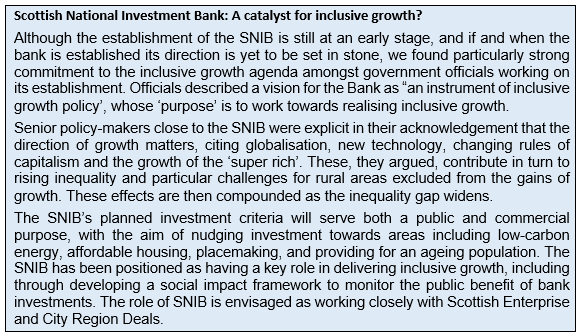
Extract from the Delivering Inclusive Growth In Scotland report
The Poverty and Inequality Commission’s response to the IPPR report stated—
As it stands, inclusive growth appears to be more of a concept than something which results in a tangible outcome. The Government has also not been clear about how it might measure progress towards inclusive growth or what success would look like.
The Commission found it “heartening” that SNIB was “looking to build inclusive growth in from the outset” but wanted to ensure the agenda “penetrates into the heart of economic policy making”.
Regional perspective
Bennie Higgins emphasised that the “agenda outside the central belt” was an “important part of what we have to do.”i
Common Weal’s Robin McAlpine told us the Bank would have to be “demand driven”—
It will not invent or direct the projects, and it will not travel around the country saying ‘We’re going to invest here’.ii
He added—
Getting different regions of Scotland to increase the demand pool is a different task, and it is a task for local authorities and the local arms of Scottish Enterprise.ii
Asked about the merits of a role for local authorities in the work of SNIB, STUC’s Helen Martin thought “there absolutely should be”. She said—
One of the things that we are very interested in is where the community voice is within the bank...iv
DBW’s Rob Hunter outlined the local network approach his bank had taken—
…it is crucial that the organisation is not seen as a bank for Cardiff or as Cardiff-centric. It is certainly not that, as we now have very good reach right across Wales.v
He underlined how important it was to connect the Bank to the people and show “it is making a difference”. Microloans were a means of doing that—
Rather than making 20 large-scale investments a year, for example, the finance is being spread across the nation and businesses across the region can identify with what is going on and share in that success.vi
Scottish Government
Asked whether the Bill – and specifically its objects – reflected the vision for SNIB set out in the implementation plan, the Cabinet Secretary said—
I am content that we will achieve the vision for the bank through the objects and, of course, the missions, which will be crucial.i
He pointed out that the objects in section 2(2) of the Bill “include not just boosting competitiveness but tackling inequality” and added—
Right across the articles of association, the shareholder framework document, the missions, the investment strategy, the business plan and the ethical statement, we will want to direct the bank in a way that Parliament would want us to. Therefore, I do not think that there is any risk of the intentions being lost.i
Describing “essentially an enabling bill that builds the structure of the bank”, he said the Bank “will be an enduring, long-term institution…a permanent feature of our financial landscape”.iii In short—
The bill must provide the structure and enable us to get on with setting up the bank.iii
However—
…the missions need to be adaptable…We must be agile and able to adapt to circumstances, which is why it is important that the missions are not outlined in the bill.iii
As to the balance between the Bank’s pursuit of missions as opposed to other financial products, he told the Committee—
I expect the missions to be transformative and to absorb a lot of the bank’s energy and resource. We will direct the bank to engage in missions. That is not to say that every single investment will be exclusively part of the missions, but we will expect the missions to direct the energies of the bank.vi
He referred to the “illustrative missions” that had already been outlined and which were “quite wide” but also focused “in that they focus on inclusive and sustainable economic growth".vii
In terms of the timeframe for changing missions, Mr Mackay suggested there should “be enough flexibility to change it as the economy demands, but every year would be too often” given the Bank’s business plan and investment strategy—
I would imagine that the missions will be more medium term than short term. How can the bank make strategic long-term investments if we change the mission statement every year?viii
Asked about investment decisions concerning projects or companies that might not necessarily fit with the missions, he said—
As long as the bid meets the other policy requirements, an investment can be made outwith the specific missions.viii
Questioned on the Bank’s regional approach, he said it “can deliver for every part of the country” and “there is an expectation that that will happen”. He suggested investments would be “merit based… but can reach right across Scotland”.x
Advising against a focus on physical location as the bank “will not be like a traditional bank where people rock up to the counter to ask for a loan”, he talked in terms of “making financial products available intelligently”. In order to ensure that “national locus” he would “engage with Business Gateway and local authorities to ensure that the bank has national reach”.xi
He told the Committee—
My ambition is to ensure that the bank speaks to the whole country and that its financial products work for the whole country.xi
Addressing the role of local authorities, he was “reaching out to local government to see how we can do local economic development better” but did not suggest a direct role for them in the bank. However—
There is of course an expectation that the economic development units, business gateway and others will work with the bank to ensure that it fulfils the potential in every part of the country.xi
Conclusions
There is a contrast between the precise and often dry vocabulary of a government Bill and the eloquence of those who endorse the mission-orientated approach. The concern from a number of contributors to our inquiry was that they saw a gap between the wording in the Bill and what was being articulated in other statements and documents not only in tone and style but also in terms of content, emphasis and direction.
Assurances were sought by several witnesses that the ambition, ethos and wider perspective intended for the Bank – as proclaimed in the Implementation Plan and the Scottish Government’s own consultations – would feature in its day-to-day working; the fear being it could become just another financial institution, another money-making vehicle, rather than the transformative entity desired.
The Committee remains to be persuaded that the language of the Bill fully matches the ambitions for SNIB to be transformative. Therefore we invite the Scottish Government to reflect on this and to clarify the rationale behind the wording of the objects as they are set out in section 2 of the Bill and in contrast to what was set out in the Implementation Plan – which states that SNIB was to "provide finance and act to catalyse private investment to achieve a step change in growth for the Scottish economy by powering innovation and accelerating the move to a low carbon, high-tech, connected, globally competitive and inclusive economy" – or the phrasing and framing included in the A mission-oriented framework for the Scottish National Investment Bank document, itself including references to the UN Sustainable Development Goals and the Scottish Government’s own National Performance Framework.
The Committee welcomes the Cabinet Secretary’s stated intention that the mission-orientated approach will indeed be central to the ethos of the Bank, will absorb and direct its energy and resources, and will ensure the focus of its work.
The meaning of inclusive growth, as this Committee has pointed out through various pieces of work this parliamentary session, is open to different interpretation. We recommend the Scottish Government give careful consideration to the findings of the recently published Delivering Inclusive Growth in Scotland report – based on research carried out by IPPR Scotland on behalf of the Poverty and Inequality Commission – and particularly how it can translate the theory into a clear vision and more tangible and successful delivery.
The Committee is encouraged by the Cabinet Secretary’s emphasis on the regional dimension of what was expected of the Bank; that it can deliver for every part of the country, must have a national locus, and should speak to the whole of Scotland. We support his willingness to engage with Business Gateway and local authorities to help the Bank achieve that national reach. We gently point out the contrast of that message with the single sentence that appears under the heading of Local Government in the Policy Memorandum: “The provisions of the SNIB Bill do not impact directly or indirectly on local government in Scotland”.
In light of the Committee’s recent inquiry and report on Business Gateway and other local authority support for businesses, we would further encourage the Scottish Government and the Bank itself to engage in partnership and work in collaboration with local authorities in the interests of SNIB serving the whole country. We invite the Scottish Government to set out what specific action it will take to achieve this.
General principles of the Bill
The Committee welcomes the introduction of the Bill and notes the various documents, strategies, plans, frameworks, charts etc. associated with it. We expect to see further and, wherever possible, final drafts of all such documents in advance of the Stage 1 debate and as part of the Scottish Government’s response to this report. We note also the legal significance and status of the Articles of Association, on which an exchange of views on the draft form can be found in Annexe A along with a further exchange on miscellaneous and mostly technical issues.
However, we would still like to see prior to Stage 1 more detail from the Scottish Government, specifically – and in reference to earlier paragraphs in this report – in the form of—
Consideration of how the importance of non-financial returns can be anchored in the Bill (paragraph 80);
Setting out how the mission-orientated approach can be future-proofed in terms of the range of organisations and sectors the Bank will be able to work with in the longer-term (paragraph 81);
Keeping us informed of progress with the dispensations and permissions outstanding (paragraph 82);
Further information on the financial side, including an update on what is set out in the Financial Memorandum and with inclusion of the SIB figures, and also more of a breakdown of and rationale for the costs and staffing of the sponsorship unit within Scottish Government (paragraphs 118 and 119);
Consideration of the experience of the Development Bank for Wales and the British Business Bank in their approach to remuneration (paragraph 120);
Elaboration on what the Advisory Group will look like in order to be reflective of Scottish business and society (paragraph 149);
Consideration of how the Advisory Group could be reflected in the Bill and clarification that its role is to advise Scottish Ministers as the sole shareholder of the Bank (paragraph 150);
Consideration of our view that a member of the Board should not chair the Advisory Group (paragraph 151);
Consideration of our recommendation that the Parliament should be consulted on and able to meaningfully inform the process by which the Bank’s missions are formulated and refined – and the mechanism by which that might be achieved (paragraph 152);
Clarification of the relationship between the Enterprise and Skills Board and the Bank and how the two should interact and align (paragraph 199);
Clarification of the approach to stimulating demand and how this is to be resourced (paragraph 200);
Consideration of our recommendation that a rate of return is not set in the short term (paragraph 202);
Better indication of how the Bank’s financial and non-financial returns are to be evaluated and whether and how the balanced scorecard will feature (paragraphs 203 and 204);
A fully updated and revised Equality Impact Assessment (in light of the Scottish Government’s discussions with Engender and Close the Gap) (paragraph 228);
Consideration of whether there is a case for including the Bank’s ethics committee on the face of the Bill (paragraph 230);
Reflection on the wording used for the objects of the Bank as set out in section 2 of the Bill and how that matches with the vision set out in the Implementation Plan and elsewhere (paragraph 280);
Consideration of our findings regarding the Fair Work Action Plan and the Six Principles for Responsible Investment (see paragraph 231);
Consideration of the findings of the recently published Delivering Inclusive Growth in Scotland report – based on research carried out by IPPR Scotland on behalf of the Poverty and Inequality Commission – and particularly how the Scottish Government can translate the theory of inclusive growth into a clear vision and more tangible and successful delivery (paragraph 282), and
Specifying what action it will take to work in collaboration with local authorities in the interests of SNIB serving the whole country (paragraph 284).
The Committee recommends that the Parliament agree to the general principles of this Bill.
Annexe A - Additional Information
Articles of Association
The Committee sought external legal views on the draft Articles of Association and asked the Scottish Government to address the points raised:
Concerns raised
I am not concerned about the objects of the articles, or the wording of much of the Act. Articles 7 to 25, and 76 and 77 seem fine to me. What concerns me is shown below – and I expect I have said nothing that others haven’t already said.
Unnecessary provisions in the articles
The template that has been used for the Bank’s articles appears to be that of a standard non-listed plc. It has a great deal of stuff in it that is not exactly wrong, but is probably not needed. Most of the rules to do with directors are acceptable, but given that the point of the Bank is to lend money, and the shares are not going to be traded but are to be held by the Scottish Ministers, do we need all the detail in Part 4 of the Articles to do with share certificates, consolidation of share certificates, liens, partly paid shares, calls, forfeiture, surrender and transmission? I cannot imagine the Bank ever needing to issue partly-paid shares, nor needing to forfeit shares because someone didn’t pay for them properly.
S. 5(b) of the Bill says that shares in the Bank may not be transferred. If so, there would be no need in the Articles part 4 (arts 55-59) for the rules relating to the transfer or transmission of shares.
The articles relating to dividends/distributions, and capitalisation of profits would only apply in a trading company. It is not necessarily wrong to have them, but if the Bank makes any profits, I cannot see it capitalising those profits to give the member (the Scottish ministers) a greater investment in the Bank than they had before. What are the Scottish ministers to do with the capitalised profit? Wouldn’t they actually be using their profits, if they made them, to be funding more projects rather than making the bank's capital greater (though of course they could do that if they wished to do so)?
Part 6 of the Articles refers to company seals. It is not wrong to have a company seal and the Bank might like to have one, just because it looks impressive. All the older banks used to have them and probably occasionally still use them for big transactions. But most companies don’t bother now. Does the Bank really need to have a seal?
Response
The draft Articles of Association for the Scottish National Investment Bank follow the UK Government’s model Articles of Association for public limited companies. The draft Articles have, however, been adapted to reflect special provisions mandated within the Bill some of which are entrenched and can therefore only be amended by resolution of the Scottish Parliament. Some Articles may never become active while others are not relevant to the Bank at present but may become so at a future date. While the respondent is correct to point out those Articles which they feel will remain dormant for the life of the Bank, given the anticipated longevity of the Bank, it is impossible to know when specific Articles may become active based on future changes to the role and responsibilities of the Bank. Retaining Articles in case they become active at a future date is consistent with the Government’s approach of ensuring that the Bank has operational flexibility within the parameters of entrenched Articles while also being consistent with the approach taken by other public limited companies.
Ambiguity in membership – one or many?
Concerns Raised
My next concern is the ambiguity relating to the shares and the member(s). S.1 (c) of the Bill says that the Scottish Ministers are its only member (singular). It is not clear how this works. Is each minister allotted shares on behalf of his or her Department? I doubt it. Do all the ministers collectively hold all the shares in one big untransferable bundle? Presumably so (s.5 of the Bill says that shares are untransferable, as does art. 6(2)). Articles quite commonly specify what type of shares are being used, but in the absence of any specific wording the shares will be ordinary shares. There is no documentation to say what the nominal value of these shares is or how many would be issued, but again this would not absolutely need to be specified in articles. All we know is that one member seems to be envisaged, and that that one member has non-transferable shares of indeterminate nominal value. For accounting purposes there will need to be a nominal value for each share.
Confusingly, Part 3 of the Articles is all about decision making at general meetings at which members (plural) are present. The Articles, using the standard wording, seem to envisage members (plural) voting on a show of hands (see para. 31), or by polls, while referring to proxies. S. 20 of the Bill also refers to members (plural).
There is a fundamental inconsistency here. Someone needs to decide whether there really is one member, or if there are members. And if there are members, who exactly are they? Is each Scottish minister for the time being a member?
Response
Shares in the Bank will held by the Scottish Government on behalf of Scottish Ministers in accordance with provisions on exercise of functions and properties and liabilities as set out at Section 52 and 59 of the Scotland Act 1998 respectively. The Articles of Association refer to or imply more than one shareholder where clauses have been lifted directly from the model Articles of Association produced by the UK Government. These have been deliberately included within the Bank’s Articles to ensure they have the capacity to respond to potential changes in the Bank’s ownership as outlined in the previous response. Reference to members in the articles does not preclude there being just one member, such as Scottish Ministers or HM Treasury and that member has accordingly 100% of the voting power. As the inclusion of these Articles does not cause any detriment to the Bank’s governance it was felt prudent to retain these clauses in case they are required at a future point.
If there is indeed only member, how does it make up its mind?
Concerns Raised
What is not clear is how the collective body of Scottish ministers is supposed to decide matters when the ministers are wearing their collective hat as the one member of the Bank (if indeed there is only one member). What if the Ministers cannot agree between themselves? Is it going to be majority rule? Will there be a special committee of ministers whose job it is to keep an eye on the Bank? This needs to be clarified.
If there is only member, it either approves something or it doesn’t, so the requirement for a special resolution in s.20 of the Bill is confusing. Of course, if there are really are many members, and each one is a minister, then 75% of the ministers would need to approve any change for the special resolution to be passed.
Response
Reference is again made to Section 52 of the Scotland Act 1998. In practice Cabinet is the forum through which high level decisions are made collectively by Scottish Ministers and so decisions that the Government will be required to take as sole shareholder of the Bank could be taken by Cabinet through majority voting if necessary. In addition, many administrative decisions may be made by civil servants acting on behalf of Scottish Ministers under the ‘Carltona doctrine’.
A potential resolution of the ownership difficulty and of the difficulty in changing the articles
Concerns Raised
It is always a good idea to see how things are elsewhere. When the Bank of England was nationalised, the ownership of the shares in the Bank of England was given to the Treasury Solicitor, who holds them on behalf of the UK Government. Why don't we give the ownership of the shares in the Scottish National Investment Bank to a civil servant with a suitable title who holds them for the Scottish Government? The civil servant may retire, but his title remains, and the new incumbent becomes the new owner. This is dealt with by the nice legal fiction of the "corporation sole", who is the holder of the office at the time. We could, for the sake of argument, say that the head of the Scottish Legal Services would be the "owner" on behalf of the Scottish Government. As owner of all the shares in the Bank he or she can pass unanimously, and therefore in compliance with the Companies Act 2006, whatever resolutions he or she is instructed to pass, whether special or ordinary.
The advantage of this is that it slightly depoliticises it. Having the interpolation of a civil servant gives slightly less say to politicians. What this solution does not resolve is how the civil servant can be instructed, this being the same problem as the one posed above – how does the one member, if there is one, makes up its mind? Or if the ministers are all the members, on what basis are their decisions made?
Response
The Government is bound by Section 59 of the Scotland Act (1998) in relation to its ownership of property and liabilities.
On what basis are directors of the bank appointed, and how much latitude will they be given?
Concerns raised
What is also not spelled out is what criteria will be employed by the Scottish ministers in appointing directors and the degree of independence that directors will be afforded. The directors will owe a fiduciary duty to the bank, and this may occasionally be at odds with what politicians want, particularly if there is a change of Government. National Investment Banks are by nature easy prey for politicians. If the Scottish Ministers own the Bank, they are in a position to influence lending decisions, particularly if they are favourable to politicians' pet projects. Some may remember the ill-fated National Enterprise Board back in the 1970’s and '80s, when politicians used taxpayers' money for various disastrous enterprises. Politicians make poor bankers, and equally, good bankers are poor politicians. Unless the politicians are exceptionally hands-off, which is unlikely, there will be pressure put to lend to politically desirable projects which may be financially unwise. I think there needs to be thought given to how the Bank is to avoid capture by politicians and for the directors to be allowed to exercise the discretion to say No to politicians' pet projects. Perhaps there need to be some protocol adopted, setting out what criteria for the appointment of directors would apply, and defining the relationship between directors and the Scottish ministers. Article 12 allows the members by special resolution to tell the directors what to do. While this is not an unusual provision in company articles (and leaving aside for the moment the issue of one member or many members), if the Scottish ministers tell the directors what to do, and if the directors don’t like it, the directors can either do it under protest, as it were, or they can resign, neither of which looks good.
Response
Scottish Ministers will be the sole shareholder in the Bank and it is only right that they have the opportunity to shape the Bank’s priorities. In constructing the Bill, however, every effort has been made to ensure that the Bank has the operational flexibility to act as patient lender while remaining publicly accountable.
Directors will be appointed by Scottish Minsters in accordance with established Scottish Government policy for recruiting and appointing Non-Executive Directors to the Board of public bodies. The relationship between Scottish Ministers (as sole shareholder) and the Bank will be governed by the Shareholder Framework Document which will be signed by a representative of Scottish Ministers and the Chair of the Bank immediately before its establishment. In addition, the Plc model places a fiduciary duty on Board Members with which they must comply to the extent that Ministers will not be able to instruct them to break with those duties. Article 12 is a type of reserve power and in practice is seldom used by members for the reasons set out by the respondent.
All directors will be appointed by Scottish Ministers but executive directors will also have employment contracts in respect of their executive functions. It will be for the Board to select and choose the persons to be given executive contracts of employment and then for Ministers to appoint them as directors.
The need for checks and balances
Concerns raised
The essential idea behind the Bank is obviously sound. What seems to me to be lacking is checks and balances to ensure that directors are allowed to disagree with politicians where politicians are clearly getting above themselves. At the same time, the politicians represent the democratic will and if they want something done, sometimes it has to be done. This is an inherent tension in Government and requires wise heads to resolve. The niceties of this paradox need to be resolved.
Response
The Government recognises the importance of checks and balances in the Bank as it recognises the importance of checks and balances in all aspects of the public sector. As mentioned, the draft Bill and Articles of Association seeks to give the Bank the flexibility to be commercially-minded in how it operates while acknowledging the role of Ministers, as sole shareholder, to set the strategic direction for the Bank through Missions. It is also important to recognise the role of Parliament will scrutinise the Bank and hold Scottish Ministers to account for its performance as well as voting on proposed changes to entrenched articles.
Are there any areas of the Bill that could be improved?
Concerns Raised
The most important point is probably that several Articles say that the Articles may be amended only in accordance with the SNIB Act. However, we consider that any provision of that Act, and any order made under it, would be subject to section 22(3)(a) of the 2006 Act, which is UK legislation and the statement is therefore subject to existing law.
In any case, we note that section 22(3)(a) of the 2006 Act merely repeats, and does not exclude, the rule that the consent of all the voting members is as effective as a formal resolution in binding the company.
Similarly, we do not consider that Article 7.2 could, as a matter of company law, restrict the power of the sole member to appoint directors.
In addition, we are of the view that Article 6.2, which says that the shares are not transferrable, is probably not enforceable (see the New Zealand case of Wellington Bowling Club v Sievwright [1925] GLR 277, which is an appellate decision). Even if the Article were enforceable, it could, again as a matter of company law, be effectively overridden, at will, by the sole member.
For completeness, the Articles on calls, and forfeiture, of partly paid shares will be of no practical effect. The same is true of the Articles relating to meetings.
Response
The Government acknowledges that section 22(3)(a) of the Companies Act (2006) allows Members to override any of the entrenched Articles and is proposing to bring forward an Order under Section 104 of the Scotland Act (1998) disapplying this provision in respect of the Scottish National Investment Bank.
Wider technical concerns linked to Bill drafting
Entrenchment of provisions/changing the bank company's articles
Issue—
The Law Society of Scotland believe that the Bill has a provision at s.10 referring to entrenchment of provisions, which in turns refers to s.20. There it says that the only way the bank company's articles can be changed is by a special resolution of the members of the Scottish National Investment Bank (SNIB), with a draft having been laid in front of Parliament beforehand and approved by the MSPs. However, s.1(c) says that the Scottish Ministers constitute the sole member of the company. The special resolution (ie at least 75%) referring to the bank's members (plural) does not fit with the stipulation that there is to be only one member (the Scottish Ministers) as the one member either votes for it “unanimously” or not at all. It is not clear what would happen if the MSPs voted for something but the Scottish Ministers either opposed the decision or were divided on it. The Bill does not stipulate that the Scottish Ministers would be bound to accept the MSPs' vote. Further clarification as to whether a specific procedure should be followed in these circumstances might be of assistance.
Answer—
The Government sees no difficulty with the application, in relation to a single-member company, of a provision that requires the votes of members representing not less than 75% of the total voting rights of members to pass a resolution. Clearly if the single member (holding 100% of the voting rights) votes to pass the resolution it will have sufficient support and therefore be passed. The Companies Act 2006 refers to a company’s members in many places (including in section 283, which explains what a special resolution is) without making special provision about single member companies. It is unnecessary to do so because the Interpretation and Legislative Reform (Scotland) Act 2010 (which applies in relation to the Bill) and the Interpretation Act 1978 (which applies in relation to the Companies Act) expressly provide that the singular imports the plural.
From a legal perspective, there is no risk that the Scottish Ministers will be divided on the question of whether to pass a resolution. The Bill confers functions on the Scottish Ministers as a body (see section 52 of the Scotland Act 1998). This is the normal drafting practice for all Acts of the Scottish Parliament, and indeed Westminster Acts and subordinate legislation.
We do not consider that there is any lack of clarity about what would happen if MSPs voted for something that the Scottish Ministers (as the Bank’s sole member) opposed. Section 20 is explicit that the Bank’s articles can be modified only if a special resolution is passed by the Bank’s members and a draft of that resolution has been approved by the Parliament. The approval of a draft resolution by the Parliament alone has no effect in law. This is in line with the Government’s policy intention that Parliament is given a veto should the Scottish Ministers wish to amend or repeal key provisions of the Bank’s constitution.
Issue—
If the intention is to ensure that where MSPs collectively want to change the articles, they have the right to do so, and then the Scottish Ministers will be bound by the will of the Scottish Parliament, then we do not consider that the Bill, as currently drafted, would achieve this aim.
Answer—
As set out above, that is not the aim that the Government is trying to achieve in the Bill.
When acting as the sole shareholder, the Scottish Ministers will, as per the Scotland Act 1998, act collectively in the discharge of their functions. Any member of the Scottish Government will be able to act to exercise the functions conferred on the Scottish Ministers, and decisions as to the exercise of those functions will be reached collectively. S.20 provides that a provision of the Bank’s Articles of Association which has been entrenched may only be amended or repealed via a special resolution of the Bank’s members, if a draft of the special resolution has been approved by a resolution of the Scottish Parliament.
In practice this means that in situations in which the Scottish Ministers wish to amend or repeal an entrenched provision of the Articles (as a person may wish to do in any company in which they are the sole shareholder) they must first lay a draft of the special resolution in the Scottish Parliament. Should a majority of MSPs vote to reject such a resolution, the Scottish Ministers would not be able to amend or repeal the provision.
As the Articles of Association are a legal agreement between a company and its shareholders, in this case the Scottish National Investment Bank and the Scottish Ministers, it would not be appropriate for a third party to initiate amendment to or repeal of provisions in the Articles.
Power to create subsidiaries
Issue—
The Law Society of Scotland note that s.3(b) gives the SNIB the power to create subsidiaries. They consider that the Bill should clarify that where any such subsidiaries are to established, their articles of association must mirror those of the bank itself as set out in s.2.
Answer—
S.3(1) provides that the Scottish National Investment Bank be able to form and act through subsidiaries “for the purpose of its objects”. This will constrain the purposes for which a subsidiary may be established and will mean that the objects of any subsidiary will mirror at least part of the objects of the Bank itself. The draft Shareholder Framework Document for the Bank sets out that the final Shareholder Framework will apply to the Bank and to any subsidiaries created – this will establish the governance of any subsidiary.
As an example of why some flexibility may be required, one reason the Bank may wish to establish a subsidiary is to pursue some particular aspect of the Bank’s objects. This would seem lacking in merit if the subsidiary in question could only be a clone of the Bank.
Auditing requirements
Issue—
Audit Scotland note that the PM accompanying the Bill states that “The Bank’s accounts will also be subject to audit by the Auditor General for Scotland or an auditor appointed by the Auditor General” (paragraph 35). To ensure that the relevant provisions in the Public Finance and Accountability (Scotland) Act 2000 apply to the Scottish National Investment Bank, this requirement should also be included in the legislation. This would require that the Bill (or other enactment or prerogative instrument) includes a section on accounts and audit that sets out the need for the Bank to prepare annual accounts and to send them to the Auditor General for Scotland for auditing. An example of this can be found in section 45 of the Water Industry (Scotland) Act 2002, which relates to the arrangements for Scottish Water.
Subsection 9(3)(a) of the Bill provides that the role of the audit committee will include “independent review and oversight of the company’s … independent auditors”. The independence of the Auditor General for Scotland and auditors appointed by her is an essential element of the Scottish public sector audit model. While it is important that the company’s audit committee reviews and has oversight of the outcomes of the independent audit process, it is not appropriate for it to have any role in directing or in any way overseeing the work of the external auditor. This may be read as being implied by the current wording.
Answer—
We have noted the evidence submitted by Audit Scotland and will continue to engage with them on the points they have raised. The legislative provision made for Scottish Water is not a direct comparison in this case because it is a statutory body, whereas the Bank is to be a public limited company. As a public limited company, by default, the Bank will be subject to the auditing requirements set out in Part 16 of the Companies Act 2006. Section 483 of that Act makes special provision about the Auditor General for Scotland’s role in relation to Scottish public sector companies. As set out in the Policy Memorandum the Government shares Audit Scotland’s view that the Bank’s accounts should be subject to audit by the Auditor General for Scotland (or an auditor appointed by the Auditor General). To achieve that result it is our intention that an Order will in due course be brought forward under section 483 of the Companies Act 2006.
In relation to Section 9(3)(a) we can clarify that the reference to “independent auditors” does not encompass the Auditor General for Scotland or any auditors appointed by her but instead provides for the Audit Committee of the Bank to have oversight of any independent auditors appointed directly by the Bank. As a public limited company the Bank must have external auditors. The external auditors’ annual audit is separate from any statutory audit of a company by the Auditor General for Scotland, who is subject to statutory supervision of her statutory audits of companies by the Independent Supervisor appointed under section 1228 of CA 2006 (which comes under the Companies reservation in the Scotland Act 1998).
Section 9(3)(a) does not provide that the Bank’s audit committee will have the power to direct independent auditors (whether that is the Auditor General for Scotland or another external auditor). For an auditor to take direction from the subject of the audit would be contrary to their professional responsibilities. The form of words that section 9(3)(a) mandates that the Bank’s articles include is a standard form of words that can be found in the articles of many companies.
Ancillary Provision
Issue—
STUC note that Section 23 titled ‘Ancillary Provision’ allows for Scottish Ministers to “make any incidental, supplementary, consequential, transitional, transitory or saving provision they consider appropriate the purposes of, or in connection with, or for giving full effect to this Act or any provision made under it.” It further states that regulations under this section “are subject to the affirmative procedure if they add to, replace or omit any part of the text of an Act (including this Act), but otherwise are subject to the negative procedure”. The STUC believe these should be subject to the affirmative procedure.
Answer—
Section 23 is an ancillary power in the form familiar to the Parliament and which provides for parliamentary scrutiny of regulations made under it on what has been for many years now the usual basis. Should the Delegated Powers and Law Reform Committee, or the lead committee, recommend a departure from the normal approach in this case the Government will of course consider that carefully but we note that, in its consideration of the Scottish National Investment Bank Bill, the Delegated Powers and Law Reform Committee reported that it was content with the delegated powers provisions contained in the Bill, including those set out at s.23 . The Government’s view when preparing the Bill was, and it remains, that no particular issues arise in the context of this Bill which would merit such a departure. Subjecting all ancillary regulations to the affirmative procedure, no matter how trivial, would not in the Government’s view make appropriate use of Parliament’s time.
The Decision to Adopt a plc Model for the Scottish National Investment Bank
Following the Committee’s request for further information on the reasons why the Scottish Government has chosen to propose a public limited company (plc) model for the Scottish National Investment Bank (the Bank), this briefing has been produced to provide the Committee with an overview of the Scottish Government’s decision to propose a plc model, outlining the reasons why it is the best fit in enabling the Bank to become a cornerstone institution in Scotland’s economic architecture.
Background
The most appropriate model for the Bank was considered in the development of the Implementation Plan which highlighted the importance of having a model that would give the Bank operational flexibility while ensuring it remains publicly accountable and aligned to wider SG policy. The Implementation Plan therefore proposed that the Bank be set up as both a public body and a limited company. It stated:
“The Bank should be set up as a limited company, wholly owned by the Scottish Government with an independent Board to oversee operations. This enables the Scottish Government to set up the Bank at arm’s length and enables it to act more freely and flexibly in the market than a regulated bank in order to achieve the objectives set for it by Scottish Ministers. The Bank should be a public body, classified to the public sector to ensure direct alignment between the activities of the Bank, the broader economic policy and the Scottish Government’s enterprise and skills agencies.”
The Scottish Government has therefore sought to identify a model for the Bank that delivers on the ambitions set out in the Implementation Plan to create an institution that is both commercially-minded and publicly accountable. In reaching this conclusion a number of models were carefully considered as part of determining the appropriate structure for the Bank. The Scottish Government discounted the idea of establishing the Bank as a Statutory Non-Departmental Public Body due to the fact that it would curb the operational flexibility of the Bank, it would not be a good model for a financial institution and would not add anything to what could be achieved through a company model.
Analysis of responses to both consultations conducted on the Bank demonstrate that there is strong support among stakeholders for the approach taken by the Scottish Government in establishing the Bank. The majority of those who responded to the initial Consultation, undertaken in September 2017, felt that while the Bank should be a public body, it should be independent of and at arm’s length from Government to safeguard against political influence in investment decisions, this view was subsequently reflected in the Implementation Plan. Based on this, the following Consultation asked respondents to comment on the most appropriate model to use in establishing the Bank as an arm’s length body, the majority of whom felt that the plc model represented the optimum model for the Bank. Further detail on the rationale for adopting a plc model is set out below.
1. A clear and well-understood distinction between the shareholder and the Board
Granting SNIB the license to operate with the flexibility referenced in the Implementation Plan while remaining publicly accountable requires a company model in which the relationship between the Board and the shareholder are clear and well-understood in the context of a financial institution. The limited company model, underpinned by a Shareholder Framework, establishes a system of governance that has a clear delineation in the roles and responsibilities of the shareholder (Scottish Ministers) and the Board of Directors with Scottish Ministers setting the direction for the Bank which the Board is required to deliver against. The decision to establish the Bank as a public limited company (plc), rather than as a company limited by guarantee or a private limited company is consistent with the model adopted by other financial institutions including the British Business Bank and the Development Bank of Wales.
2. The plc model is consistent with the Scottish Government's commitment to ensuring the Bank is an accountable and transparent institution
The Scottish Government is committed to ensuring that the Bank meets the highest standards of accountability and transparency in how it operates. In reviewing the many models available, the plc model has been identified as the most effective at ensuring that the principles of accountability and transparency are built into the fabric of the Bank. Plcs are subject to a series of additional legal requirements in relation to their governance structures as set out in the Companies Act (2006) which necessarily introduces higher levels of transparency and accountability than in other models such as private limited companies. The Companies Act states that plcs must publish their annual accounts and places a requirement on them to employ a professional Company Secretary who is responsible for ensuring compliance with corporate governance regulations. In addition, plcs are legally required to have more directors than private limited companies.
The Scottish Government has, through the Scottish National Investment Bank Bill, taken additional steps to ensure that the Bank meets the standards of accountability and transparency expected of a public body by making the Bank subject to the Freedom of Information (Scotland) Act 2002 which gives the public the ability request information on its operation and activity thereby building transparency into the Bank from the outset.
3. The plc model allows the Bank to adapt to its socio-economic contexts
Adopting the plc model also ensures that the initial legislative basis for the establishment and capitalisation of the Bank is as far as possible “future-proofed”. It enables the Bank to raise finance from wider sources in the future including individuals or other bodies such as local authorities or other financial institutions, through borrowing, whether this is an actual loan or an issue of a bond. Any additional protections can be included in the Articles to ensure that that share ownership, for example, remains with Scottish Ministers unless they or the Scottish Parliamentary approve a different arrangement.viii
4. Enables appropriate handling of the Bank’s assets
The use of assets accrued by the Bank is vital to ensuring that it has the flexibility to operate effectively both as a financial institution and a public body. The plc model allows the Bank maximum control over its assets, including distribution of any future accrual of surplus capital by the Bank, which it is agreed is not required for re-investment, as dividends to Ministers which can then be made available for application to other national priorities. Using a plc model means that dividends to Scottish Ministers can only be paid in accordance with the Bank’s Articles of Association which state that payment of dividends must be agreed by resolution of the Bank’s directors thereby providing additional oversight of the financial sustainability of the institution.
The plc model also ensures that assets can be transferred out should the decision be taken to close the Bank at a future date.x Both the Community Interest Company model and the Company Limited by Guarantee model place restrictions and limits on the ability to move assets which make them an unsuitable model to be adopted for the Bank, as they reduce the flexibility that comes with a standard limited company and plc.xi
Further detail on the different company models considered for the Bank by the Scottish Government is set out below:
Private company limited by shares – While it was deemed feasible to create the Bank as a private limited company, this operating model was not chosen because if the Bank were to raise finance from wider sources in the future (for example, a public bond or share issue) it would have to change to being a public limited company.
Company limited by guarantee – no shares other than the members’ share which typically have a nominal value; non-profit distributing, so any gains would be locked in and not available for wider purposes in the future; can raise capital from borrowing but not from offering shares (equity) in the company.x
Companies incorporated by Royal Charter – has the powers of a natural person, and can sue or be sued in its own right; there are no shares and no members and a Royal Charter sets out the terms of operation.xi
Companies created by legislation – consistent with the way that many public bodies are created, and also called statutory companies or corporations. They are created through bespoke legislation and have no shares or members.xi The decision was taken to establish the Bank as a company limited by shares rather than as a statutory body so that it had the flexibility to change its constitution (Articles of Association) without the need for primary legislation.
Community Interest Company (CIC) – a limited company, created for undertaking an activity or business with community benefit and with an “asset lock” which can limit the way in which surpluses are distributed and, like charities, the CIC’s assets and profits must be permanently retained within the company or only transferred to another company with a similar “asset lock”xi. CICs are also subject to the oversight of the Office of the Regulator of Community Interest Companies Regulator placing additional, potentially restrictive requirements on the Bank’s governance on top of the shareholder framework, Articles of Association and provisions within the Bill. Furthermore, the community focus which some stakeholders have raised as a reason for a CIC model is already being addressed through the Missions and the Shareholder Framework, both of which will orientate the Bank’s activities towards delivering social and environmental value.
Annexe B - Minutes of Meeting
15th Meeting, 2019, Tuesday 7 May 2019
2. Scottish National Investment Bank Bill: The Committee took evidence on the Bill at Stage 1 from—
Benny Higgins, Strategic Adviser for the Establishment of the Scottish National Investment Bank;
Paul Brewer, former member, and Alan McFarlane, former member, the Advisory Group on the Implementation Plan for a Scottish National Investment Bank; Ray Perman, Fellow, Royal Society of Edinburgh;
Eilidh Dickson, Policy and Parliamentary Manager, Engender;
Robin McAlpine, Director, Common Weal.
Angela Constance declared that she was in the process of joining the board of Common Weal.
3. Scottish National Investment Bank Bill (in private): The Committee considered the evidence heard at today's meeting.
16th Meeting, 2019, Tuesday 14 May 2019
1. Scottish National Investment Bank Bill: The Committee took evidence on the Bill at Stage 1 from—
Professor Mariana Mazzucato, Director of the UCL Institute for Innovation & Public Purpose (IIPP), and Laurie Macfarlane, Head of Patient Finance at the UCL Institute for Innovation and Public Purpose, University College London (by video conference).
3. Scottish National Investment Bank Bill (in private): The Committee considered the evidence heard at today's meeting.
17th Meeting, 2019, Tuesday 21 May 2019
2. Scottish National Investment Bank Bill: The Committee took evidence on the Bill at Stage 1 from—
Professor Lynne Cadenhead, Chair, Women's Enterprise Scotland;
Linda Hanna, Managing Director of Scottish Economic Development, Scottish Enterprise;
David Alexander, Chief Executive and Co-Founder, Mydex CIC;
Matt Lancashire, Director of Policy and Public Affairs, SCDI;
Flora Hamilton, Director, Financial Services, CBI;
Helen Martin, Assistant General Secretary, Scottish Trades Union Congress.
3. Scottish National Investment Bank Bill (in private): The Committee considered the evidence heard at today's meeting.
18th Meeting, 2019, Tuesday 28 May 2019
2. Scottish National Investment Bank Bill: The Committee took evidence on the Bill at Stage 1 from—
David Grahame, Chief Executive, LINC Scotland;
David Ovens, Chief Operating Officer, Archangel;
Jock Millican, Investment Director, Equity Gap;
Andrew Castell, Partner, Par Equity;
Graeme Sands, Business Banking Corporate and Mid Market Director, Clydesdale Bank.
3. Scottish National Investment Bank Bill (in private): The Committee considered the evidence heard at today's meeting.
19th Meeting, 2019, Tuesday 4 June 2019
3. Scottish National Investment Bank Bill: The Committee took evidence on the Bill at Stage 1 from—
Kerry Sharp, Director, Scottish Investment Bank, Scottish Enterprise;
Rob Hunter, Director of Strategy, Development Bank of Wales.
4. Scottish National Investment Bank Bill (in private): The Committee considered the evidence heard at today's meeting.
20th Meeting, 2019, Tuesday 11 June 2019
3. Scottish National Investment Bank Bill: The Committee took evidence on the Bill at Stage 1 from—
Derek Mackay, Cabinet Secretary for Finance, Economy and Fair Work, David Wilson, Programme Director, Scottish National Investment Bank Directorate, Rachel van Kempen, Head of Finance and Resourcing, Scottish National Investment Bank Directorate, and Fraser Gough, Parliamentary Counsel Office, Scottish Government.
4. Scottish National Investment Bank Bill (in private): The Committee considered the evidence heard at today's meeting.
21st Meeting, 2019, Tuesday 18 June 2019
Scottish National Investment Bank Bill (in private): The Committee considered a draft Stage 1 report, various changes were agreed to, and the Committee agreed to consider a revised draft in private at a future meeting.
22nd Meeting, 2019, Tuesday 25 June 2019
Scottish National Investment Bank Bill (in private): The Committee considered and agreed a revised draft Stage 1 report.