Environment, Climate Change and Land Reform Committee
Stage 1 Report on the Climate Change (Emissions Reduction Targets) (Scotland) Bill
Executive Summary
The Committee welcomes the introduction of the Climate Change (Emissions Reduction Targets) (Scotland) Bill and the opportunity to review Scotland's ambition for limiting global warming and tackling climate change.
The Bill was drafted ahead of the recent report of the Intergovernmental Panel on Climate Change (IPCC) on limiting global temperature rises to 1.5°C. The Committee supports the findings of this report and agrees that a net-zero target for all greenhouse gas emissions is necessary to achieving it.
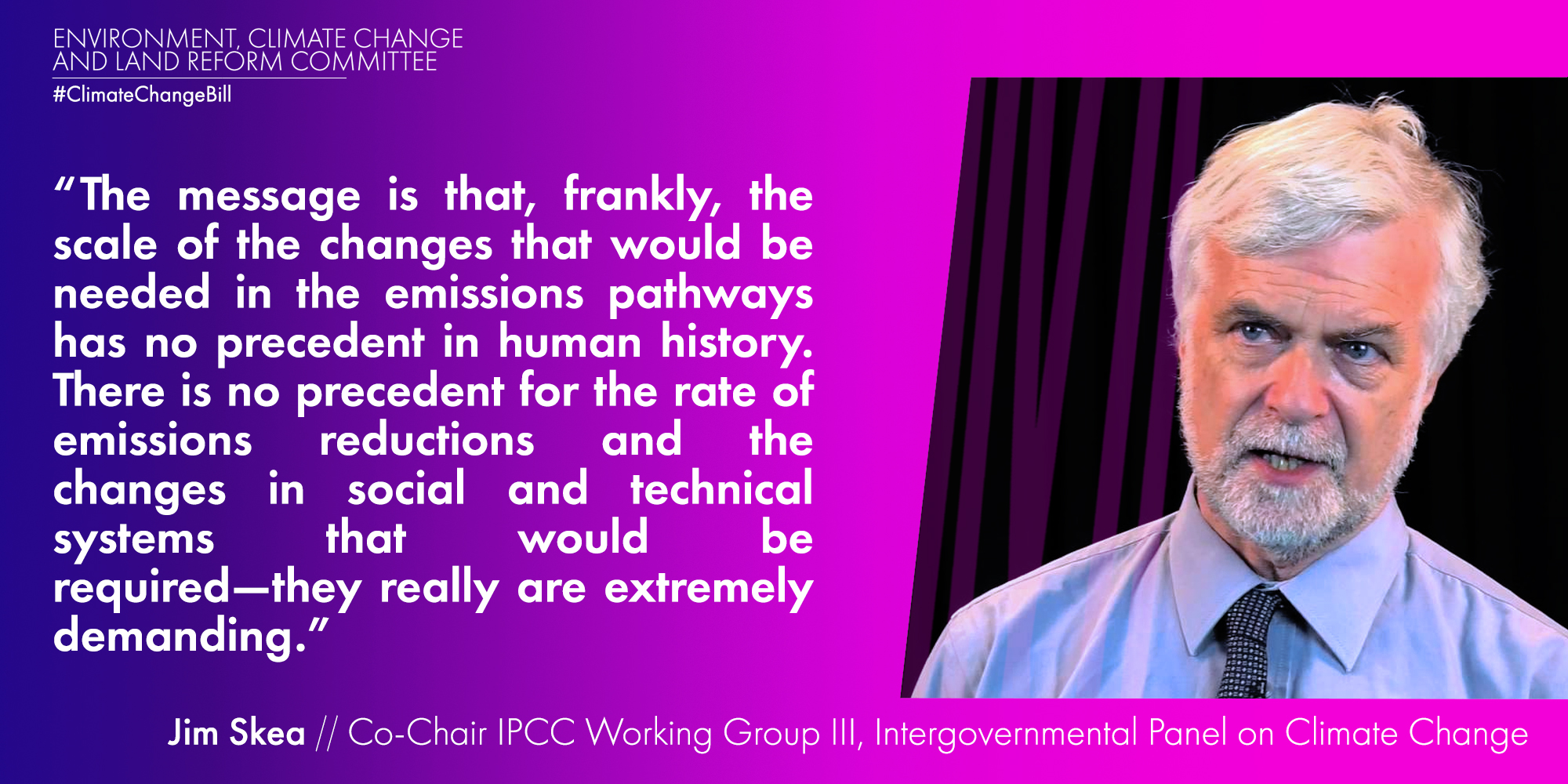
The speed and scale of the changes needed in emissions reductions, emissions pathways and changes to social and technical systems has no precedent in human history. The Committee would like to see this reflected in a greater urgency of action across all parts of Government, across the public and private sectors and by individuals, to deliver the transformational change that is required.
Climate change is an intergenerational justice issue and the Committee believes we need to act now to help ensure future generations inherit a world that is sustainable.
The targets in the Bill are based on advice from the Committee on Climate Change (CCC) in 2017, before publication of the IPCC report. Updated advice on the targets will be published by the CCC on May 2, 2019.
Given the critical nature of this advice and its impact on the Bill, the Committee recommends that the Bill's journey through Parliament be timetabled to accommodate thorough and detailed scrutiny of the advice.
A 90% target is stretching and challenging and a net-zero target will present further challenges but there are likely to be great opportunities. The benefits and cost savings of early action outweigh the costs of the effects of climate change.
There is potential for innovation, jobs, the economy, the environment and for the well-being of the people of Scotland and beyond, by acting now. The Committee would like to see Scotland at the forefront in exploring, developing and investing in these opportunities and in the technology that will help us reach our emissions targets.
Investment in and support for innovation, knowledge exchange, technology transfer and support to key sectors such as agriculture and transport will be vital to meeting the targets. The Government needs to take a holistic approach and further work is needed on target setting and identifying pathways for key sectors and we need to increase and accelerate action in the near-term.
As a developed country Scotland has a responsibility to lead action on climate change. We need a greater focus on transformational behaviour change at individual, institutional and systemic levels. This should be prioritised, promoted and incentivised by the Scottish Government. Many small changes can have a significant impact.
The Committee makes a number of recommendations in its report:
Clarity is needed on the temperature limit that the Bill is contributing to and seeking to achieve. The Committee recommends this should be 1.5°C and should reflect the most ambitious scenario of the forthcoming advice of the CCC.
Target setting should be more transparent.
There should be a presumption against lowering targets.
Target setting, measurement and reporting for specific sectors could be improved.
Further consideration should be given to setting sector specific targets within the Bill.
Climate justice requires further focus to ensure that the most vulnerable are supported in the transition.
Further consideration is needed on the possibility of establishing an independent Just Transition Commission, underpinned by statute.
Further clarity and safeguards on the use of carbon credits is necessary.
There should be no fixed period for parliamentary scrutiny of Climate Change Plans.
Monitoring reports should be published in time for Parliamentary Committees to consider them within their budget scrutiny.
The Scottish Government must give an explanation if it acts contrary to advice from the CCC.
The Committee looks forward to receiving the Scottish Government response to this report and to the forthcoming advice from the CCC and the Scottish Government's response to that advice. This response is crucial in advance of its consideration of the Bill at Stages 2 and 3 and the Committee will reflect on what changes may be required as a result.
Scottish Parliament 2019
Scottish Parliament 2019
Scottish Parliament 2019
Scottish Parliament 2019
Introduction
Membership changes
The membership of the Committee changed during the course of the Committee's consideration of the Bill at Stage 1 (starting from the date of the referral by the Parliamentary Bureau to the Committee, 29 May 2018).
On 28 June 2018, the Convener, Graeme Dey MSP left the Committee. He was replaced as Convener by Gillian Martin MSP who joined on 6 September 2018.
On 6 September 2018, Donald Cameron MSP and Alex Neil MSP left the Committee.
On 30 October 2018, Alex Rowley MSP left the Committee.
Rhoda Grant MSP was a member of the Committee from 1 November 2018 to 20 November 2018.
Richard Lyle MSP left the Committee on 22 November 2018.
The Committee thanks its colleagues who are no longer on the Committee for their diligent work in scrutinising the Bill.
Committee consideration
The Climate Change (Emissions Reductions Targets) (Scotland) Bill was introduced on 23 May 2018.
The Scottish Government has published the following documents in relation to the Bill:
In addition, the Cabinet Secretary for Environment, Climate Change and Land Reform wrote to the Committee to highlight an information and analysis documenti to support discussion of the Bill.
Under Rule 9.6 of the Parliament's Standing Orders, the Parliamentary Bureau referred the Bill to the Environment, Climate Change and Land Reform (ECCLR) Committee on 29 May 2018 to consider and report on its general principles. No secondary Committee was appointed to consider the Bill.
The Finance and Constitution Committee considered the Financial Memorandum. It issued a call for views and received 4 submissions.ii
The Delegated Powers and Law Reform (DPLR) Committee considered the Bill at Stage 1 also and under Rule 9.6.2 of the Standing Orders submitted a reportiii to the ECCLR Committee. The ECCLR Committee supports the recommendations of the DPLR Committee in that report.
Environment, Climate Change and Land Reform Committee consideration
At its meetings on 29 May 2018,i 26 June 2018i and 25 September 2018,i the Environment, Climate Change and Land Reform Committee agreed its approach to consideration of the Bill. It agreed to issue a call for evidence on 27 June 2018 with a deadline of 23 August 2018 and agreed the following programme of scrutiny. The Committee received 101 written submissions on the Bill.
The Committee heard from the Bill team in June 2018 and took evidence from many stakeholders over six meetings in October and November 2018 before hearing from the Cabinet Secretary for Environment, Climate Change and Land Reform. The Committee also agreed to an extensive programme of engagement activities, which are detailed in the ENGAGEMENT section of this report.
Detailed information on the Committee's evidence sessions is available at Annexe A. Responses to the call for evidence can be found at Annexe B. An outline of the timetable for scrutiny is provided below.
| Date | Event |
|---|---|
| 19 June 2018 | Evidence session: Bill Team |
| 27 June 2018 | Launch of the call for evidence |
| 23 August 2018 | Close of call for evidence |
| 23 October 2018 | Evidence session: Intergovernmental Panel on Climate Change, ClimateXChange and the Committee on Climate Change |
| 30 October 2018 | Evidence session: International perspectives including witnesses from other countries |
| 6 November 2018 | Evidence session: Behaviour Change and Climate Change Governance |
| 13 November 2018 | Evidence session: Sectoral perspectives - Agriculture and Transport |
| 15 November 2018 | Evidence session: Innovation |
| 20 November 2018 | Evidence session: Content of the Bill (environmental and climate change groups and sectoral perspectives) |
| 27 November 2018 | Evidence session: Cabinet Secretary for Environment, Climate Change and Land Reform |
| 18 December 2018 | Draft report consideration |
| 8 January 2019 | Draft report consideration |
| 22 January 2019 | Draft report consideration |
| 29 January 2019 | Draft report consideration |
| 5 February 2019 | Draft report consideration |
| 19 February 2019 | Draft report consideration |
| 26 February 2019 | Draft report consideration and finalise report |
| 4 March 2019 | Publish report |
Engagement
In developing its engagement strategy for the Bill, the Committee sought to go beyond the targets and understand what people felt needed to happen in order to increase ambition, as well as gauge the types of changes they would be prepared to make.
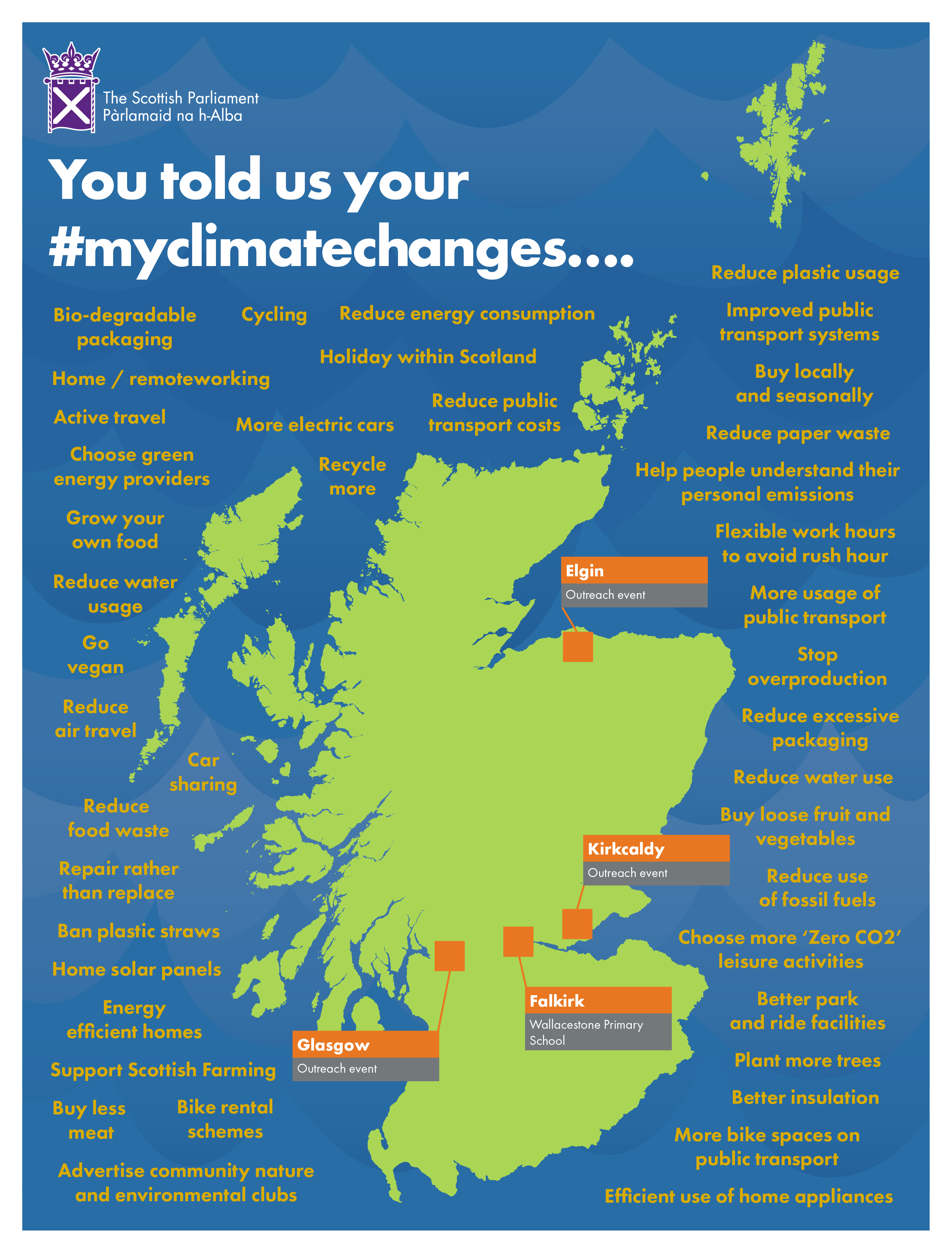
To promote its call for evidence, the Committee visited various locations in Edinburgh to ask people what they would do.
Scottish Parliament 2019
Scottish Parliament 2019
Scottish Parliament 2019
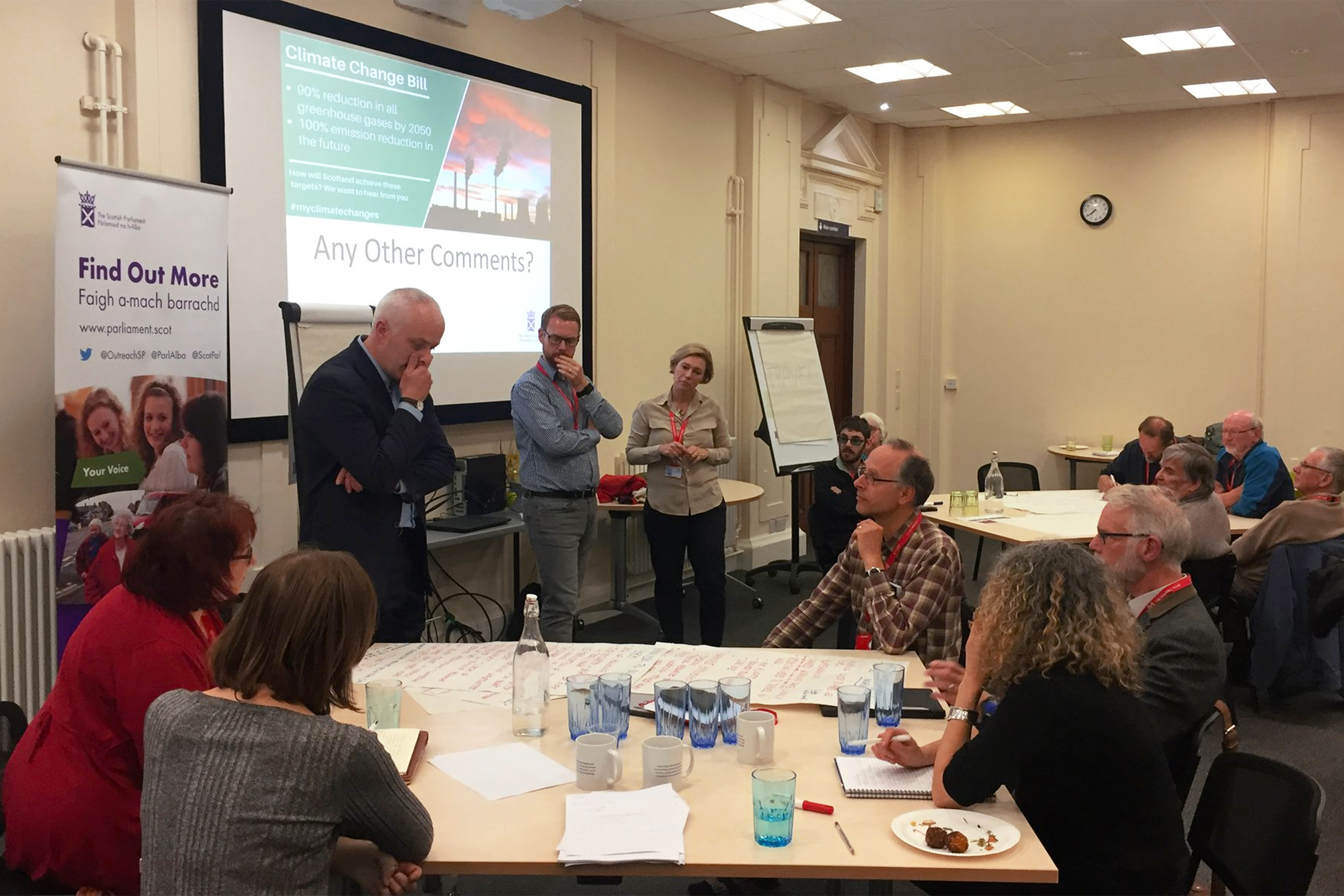
The Committee travelled around the country to host a series of outreach events. A total of 74 people attended 3 community events looking at what behaviour change is required in order to help Scotland reach more ambitious Climate Change targets. 12 people in Glasgow, 38 in Elgin and 24 in Kirkcaldy participated with Members to explore this issue. Attendees came from local grassroots environmental organisations, youth groups, schools, church of Scotland and other charities and community groups, as well as many interested members of the public. The Committee also held an event in the Scottish Parliament which a number of people engaged in the community events attended.
Questions around behaviour change were posed under 4 broad “themes” of Home, Work, Travel and Leisure and the discussions generated a varied and enthusiastic response - partly captured in the graphic above. Participants also noted the current barriers inhibiting progress, such as cost and convenience, and offered a range of solutions, including new incentive systems and infrastructure improvements. A full list of the suggestions provided can be found at Annexe E. Many of these suggestions could result in the transformational change that the Committee heard was required to tackle climate change. The Committee is aware that the Scottish Government plans action on many of these issues and opportunities but a number of the suggestions are new and innovative. The Committee encourages the Scottish Government to review these proposals as part of its future work on climate change and behaviour change, particularly in the context of the anticipated revisions to the Climate Change Plan. The Committee looks forward to pursuing this in its scrutiny of the revised Plan.
The Committee also visited Wallacestone Primary School in Brightons, where it met the school's Eco Group to find out what the young people thought about behaviour and climate change. Members found them brimming with ideas and are grateful for their helpful insights.
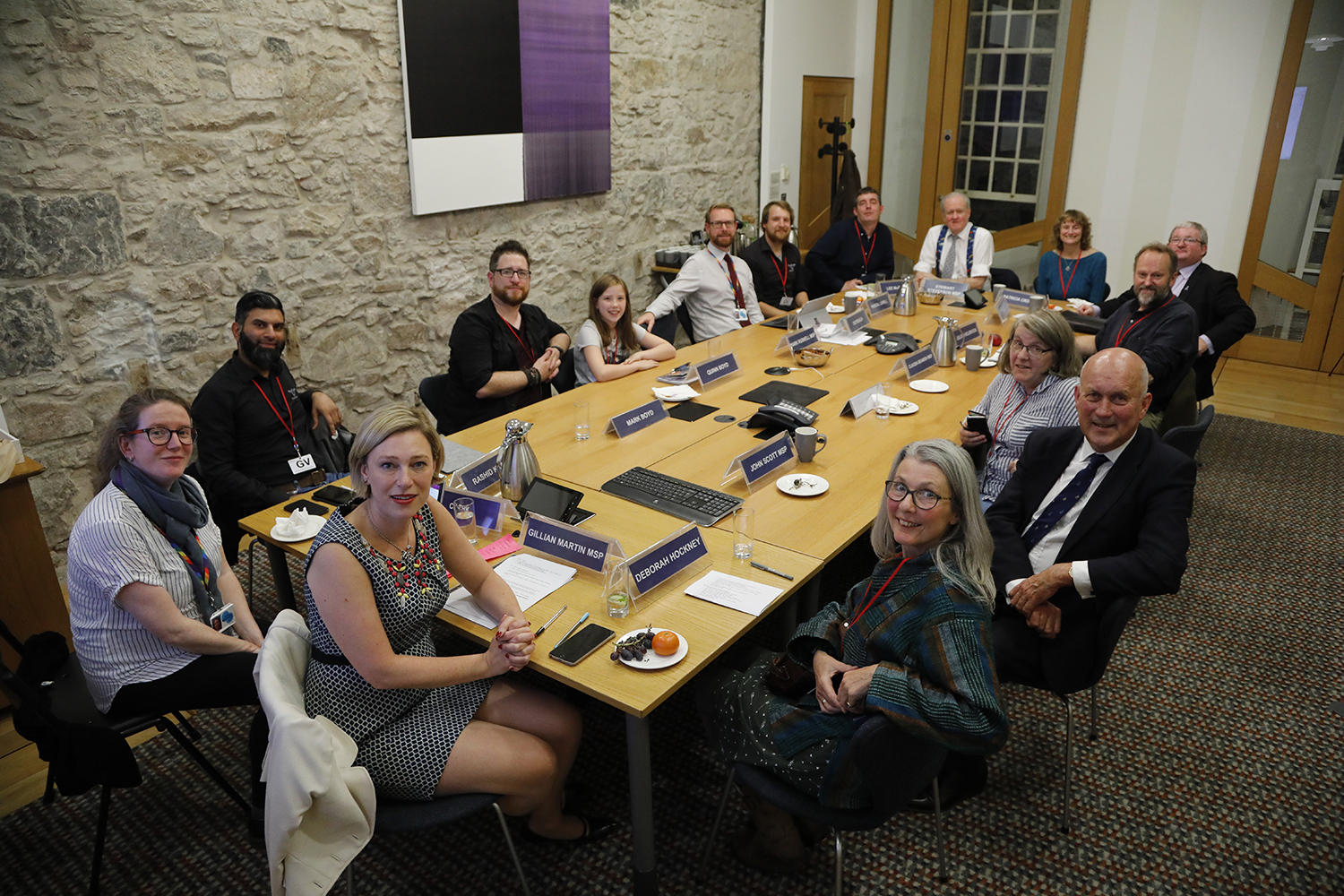
Scottish Parliament 2019

Scottish Parliament 2019
Scottish Parliament 2019
The Committee thanks all those who contributed to its deliberations on the Bill by providing written evidence, by appearing in person to give evidence and by engaging in meetings across the country. This has been invaluable to the Committee's scrutiny.
Policy and financial memoranda
The lead Committee is required under Rule 9.6.3 of Standing Orders to report on the Policy Memorandum which accompanies the Bill. It is also required to report on the Financial Memorandum and has taken the opportunity to comment on the Explanatory Notes which accompanied the Bill.
Policy Memorandum
The Committee was satisfied by the content of the policy memorandum, other than the sections highlighting the impact assessments that have been carried out.
The Policy Memorandum states—
"Climate change directly and indirectly affects a range of human rights both in Scotland and globally, for example the rights to life, health, food, water and housing. However, as this is a framework Bill and does not set out how progress towards the targets will be delivered it is not possible to identify direct effects on human rights from the Bill proposals."i
The document concluded—
"It is not possible to assess the impact of the Bill provisions on specific groups in terms of protected characteristics, as it does not set out which actions must be taken to deliver the increased reductions in emissions."ii
The EIA reportiii also suggested that every policy and proposal to implement the Bill would require an equalities impact assessment. However, it goes on to note—
"The Bill is considered to be fully compatible with the European Convention on Human Rights (ECHR)."i
It also does not assess the impact on island communities, which was requestedi by Argyll and Bute Council, or on local authoritiesi due to the perceived technical nature of the Bill.
Although the Scottish Government is of the view that the Bill itself may not directly have an impact on these areas, the climate change plans (as the method of implementation) will. The Committee agrees with the Scottish Government that every policy and proposal to implement the Bill will require an EIA and climate change plans should be accompanied by impact assessments on these areas.
The Committee recommends the Climate Change Plans be accompanied by impact assessments for each of the policies and proposals on:
island communities
local authorities
human rights
The impact assessments should also address the impacts on those groups identified in the Paris Agreement (indigenous peoples, local communities, migrants, children, persons with disabilities and people in vulnerable situations).vii
Financial Memorandum
The Financial Memorandumi to the Bill has caused the Committee considerable concern during its deliberation. While the memorandum discussed the costs of implementing the Bill, it did not address the substantial cost of inaction and this omission was a particular concern for the Committee. The Committee is aware that information on the costs of inaction was available when the previous Climate Change Bill (now Act) was under consideration.
The memorandum states—
"The current situation whereby plans for delivery of the targets must be set out in Climate Change Plans will remain the case, and as such the Bill does not specify how the targets must be achieved. Future Governments will decide what actions to take to deliver the targets, the costs of which will be affected by future scientific understanding and the availability of technology. It is therefore not possible to describe with accuracy what the cost of achieving higher targets will be."i
The Committee on Climate Change (CCC) was similarly unable to produce costs for meeting a 90% target by 2050.iii
However, estimates of the costs of mitigating climate change have been provided by the Scottish Government through analysis produced by ClimateXChangeiv and using the TIMES model—
"Scottish TIMES analysis indicates that the cost of moving from an 80% to 90% Greenhouse Gas reduction target is estimated to result in an additional system cost of approximately £13 billion over the period 2030-2050 (costs are discounted and in 2017 price). Prior to 2030, the estimated system cost of an 80% and 90% ambition are broadly aligned."i
Further detail on the expected additional costs of moving from 80% and 90% was provided, however this showed they were only anticipated within the energy sector and that £10bn was represented by investment.vi In subsequent correspondence, the Government told the Committee—
"TIMES was not able to find a pathway to a 90% target with the constraints of the Climate Change Plan included. In order for the model to find a solution to achieve a 90% target it was necessary to alter the constraints of the model. The constraints altered were chosen on the basis that they would allow for a 90% target to be met and a cost to be produced, as required for the Financial Memorandum. They do not represent a change in Scottish Government policy, or a revision to the Climate Change Plan."vii
and
"For this reason, the cost of meeting the 80% target given here is not the same as the cost of delivering the Climate Change Plan."vii
The Committee explored this with the Cabinet Secretary for Environment, Climate Change and Land Reform. When asked why the TIMES run to determine the difference between 80% and 90% only included assumptions relating to the energy sector and not to other areas, she said—
"The short answer is that we considered those areas to be already at a point at which we could not see a pathway beyond that."ix
Correspondence from the Scottish Government confirmed this—
"As sector emission pathways in non-energy sectors (LULUCF, waste and most of agriculture) have not been modified between the 80% and 90% targets, there are no additional costs borne out by these in the £13 billion figure."vii
Simon Fuller, Deputy Director, Office of the Chief Economic Adviser, added—
"Although there are options for increasing emissions reductions in all sectors, the most cost-effective way to proceed that we could identify was to focus primarily on industry, surface transport and, to an extent, buildings and property. That is the basis on which the modelling that fed into the financial memorandum was done."ix
The Committee is not clear why the cost effectiveness of additional sectors was ruled out prior to a TIMES run, as this is the stated purpose of the exercise. It is also not clear why the Government would decide what pathways TIMES would and would not suggest, prior to the run. The Committee is concerned that, once again, hugely significant sectors such as transport and agriculture have been omitted from TIMES modelling. As Friends of the Earth Scotland pointed out, the final climate change plan moved backwards from the draft version, and so there are policies and proposals which could have been considered and would have cost more. The Committee believes it unfeasible that in moving from 80% to 90%, sectors beyond energy would not be asked to deliver more and therefore it is unclear why they have been omitted from model runs to determine costs.
The Committee has concerns about the inconsistencies in the way sectors are dealt with. The Committee recommends that the Scottish Government give further consideration to the effectiveness of relying on a partial model (TIMES) that excludes a number of the most significant sectors in terms of ensuring emissions reductions. Failure to include sectors such as agriculture and transport and the financial implications of this is a significant omission.
In evidence to the Committee, Sara Grainger from the Scottish Government said of the £13bn figure provided—
"There is a great deal of uncertainty around the cost estimates that are given—they are given as a best indication rather than anything more. The only thing that we can be absolutely certain of is that they will be wrong, but I cannot tell you in which direction."ix
The Committee was concerned to discoverix there was no detail on the robustness of the calculations, on their underlying assumptions and that detail was unavailable on a sectoral basis.
Having probed further, the Committee was also told by the Scottish Government that—
"Unadjusted for inflation, the cost of moving to a 90% target is estimated to be approximately £25bn.......adjusting for inflation and removing the impact of discounting, the estimated cost of moving to a 90% target is approximately £59bn."vi
Additionally, the Committee was told that: "Achieving an 80% target under the relaxed constraints necessary to achieve a 90% target, is estimated to cost £47 billion (relative to a baseline of no-action) whilst achieving a 90% target would result in additional costs of £13 billion"vii meaning the £13bn is in addition to the cost of delivering an 80% target. Therefore the actual cost of delivering a 90% target in full is estimated to be £60bn.
Having been provided with three (or four) possible figures, after several prompts, the Committee called into question the Government's reliance on these figures. The Committee explored this further with the Cabinet Secretary and her officials. Simon Fuller provided further detailix on how the £59bn, £25bn and £13bn figures had been determined. The Committee believes these figures and an explanation should have been outlined in the Financial Memorandum for clarity.
Stakeholders also questioned the cost estimation process.
Paul Gray, Chief Executive of NHS Scotland, said—
"Calculations can be done, but they have a very big confidence interval. If we are serious about tackling climate change, we will need to plan for it and plan for affording it. If we are not willing to do that, the implications and impacts will be much more profound than whether we can afford to run a health service."ix
In evidence, the Committee also heard concerns regarding whether the following had been accounted for:
Pushing climate change up the agenda and providing certainty for organisations on how the costs of meeting the targets would be met;ix
The changing tax base arising from changes designed to meet targets (for example, on energy);ix
The cost of dealing with adaptation (the exampleix given was of new diseases coming to the UK as a result of changing temperatures and movement of animal or insect species).
While the Committee acknowledges the limits of the TIMES model, it asks the Scottish Government to provide details on the assumptions and a more comprehensive analysis which takes all sectors and activities into account.
Cost of the climate change plans and the use of TIMES
The Committee's frustrations with the Financial Memorandum are fuelled by its experience of recommending costed policies be provided in the final Climate Change Plan. The Committee has been continually told that TIMES cannot produce such figures.
In correspondence to the Committee, the Scottish Government said—
"TIMES framework can only be used to provide a broad indication of cost, and is most helpful for framing what the magnitude of cost could be."i
It continued—
"TIMES specifies the most cost effective energy mix, and the associated cost, for achieving a given climate change target. It does not consider the policy options for achieving this energy mix or where the costs of doing so should ultimately fall (e.g. government, local authority, businesses or consumers). Who the costs fall to will be determined by the future design of policies and proposals that will deliver emissions reductions to achieve these stretching targets. There are many ways in which costs can be distributed."i
The Committee still believes this information should be provided, and once provided for each policy and proposal, it should be possible to break this down by sector. The Committee is currently receiving cyclical information from the Scottish Government that—
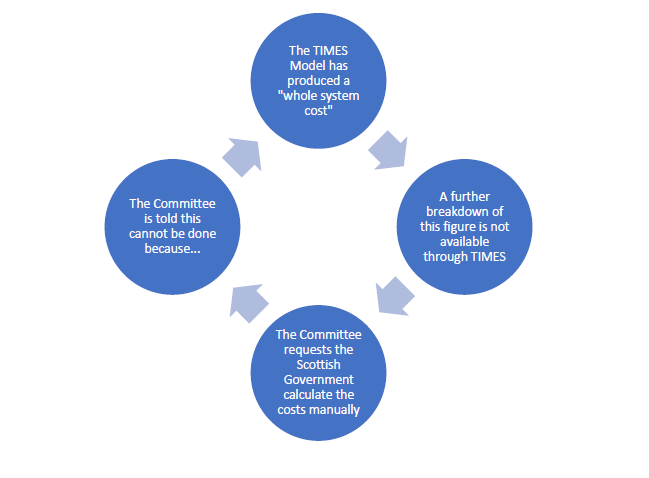
The Committee is of the view that the Scottish Government could calculate such figures based on what TIMES produces and the policies it has proposed in the climate change plans, and in particular, the costs which fall to the Scottish Government. This view was sharediii by Sara Grainger in evidence to the Committee.
The ability to do this was previously confirmed by the former Director for Energy and Climate Change at the Scottish Government, Chris Stark, who said "Where we are clear on how a policy will work, we are clear on the costs of that policy."iii The Committee requested such clarity be shared, calling for levels of funding for grants, funds and loan schemes be detailed in the final Climate Change Plan,v as well as the costs of each policy and proposal.v The Committee seeks a greater degree of clarity in the costing process and believes the lack of detail on funding information for policies and proposals within the Climate Change Plan makes the pathways hard to assess.v
If it is the case that the Scottish Government is "clear on the cost" of policies within the Climate Change Plan, the Committee once again recommends detailed information be shared in the documents produced to ensure greater transparency. The Committee has recommended section 19 of the Bill be updated to reflect this (see SECTION NINETEEN - CLIMATE CHANGE PLANS, CONTENT OF THE PLANS, COSTS of this report). It was satisfied to hearviii that this is already being considered by the Scottish Government, although believes this should have been done for the final Climate Change Plan as recommended previously.
Cost benefit and risk analysis
The Policy Memorandum states—
"The Strategic Environmental Assessment carried out on the Bill consultation proposals found that raising the ambition of Scotland’s targets for reducing greenhouse gas emissions will enhance Scotland’s efforts at tackling climate change, with likely benefits to climatic factors. In addition, positive secondary effects are expected for air quality, population and human health, and material assets, due in large part to the further decarbonisation of energy generation and transport."i
However, it does not appear that the secondary or wider benefits of measures needed to meet the targets have been assessed for either their quantifiable benefits or the cost savings achieved from early, rapid action. This was confirmedii in evidence to the Committee by the Cabinet Secretary. While "positive secondary effects are expected,"i there is no information presented on precisely what these are, what savings across the Scottish Government's budget can be anticipated and when this will be achieved.
Several stakeholders emphasised the need to quantify additional benefits, such as Aberdeen City Council.ii
Professor Andy Kerr of ClimateXChange noted the change of narrative in recent times from action to mitigate climate change being expensive to supporting cost savings.ii He also noted the benefits to areas such as public health from improved air quality.
Stop Climate Chaos Scotlandvi expressed concern at the lack of analysis beyond the use of the TIMES model.
In correspondencevii to the Committee, the Scottish Government outlined why it was inherently difficult to consider the costs of climate change mitigation from a cost-benefit perspective, and that this should be considered in terms of risk instead. This view was derived from the conclusions of a Government commissioned reportviii by the ClimateXChange on the economic impacts of climate change.
Anders Wijkman, Chair of Climate-KIC, and Stefan Nyström, of the Swedish Environment Protection Agency, agreed, noting that economic modelling and cost-benefit analysis, particularly in the long-term, was inherently unreliable as current models lacked the capacity to anticipate innovation, among other things.ii
Other witnesses noted the scale of the task, while Dave Moxham of the Just Transition Partnership suggestedii that undertaking a cost benefit analysis of mitigating climate change could be a role for the Just Transition Commission.
The Committee welcomes the news that "the Scottish Government has also commissioned the University of Strathclyde, via ClimateXChange, to link UK versions of an economic model that they have to TIMES. This piece of work, to be completed over the next twelve months, will allow further analysis of the wider economic impacts of TIMES scenarios."xi
The Committee accepts there can be a degree of uncertainty in long-term forecasting and there are challenges in capturing the effects of innovation. However it considers there is scope for more work on this. The Committee intends to engage in further discussion with the Scottish Government and the Committee on Climate Change to develop a more robust approach to assessing the impacts of mitigating and adapting to climate change. In particular, it would welcome a model that highlights the significant additional and secondary benefits to, among other things, health, industry, and employment. The Committee requests that the result of work commissioned by the Government, from the University of the Strathclyde, is shared with the Committee when available.
Cost of inaction
Despite the difficulties in determining the costs of the Bill and the costs of additional benefits, the Scottish Governmenti and other witnesses were certain that whatever the overall cost of mitigating and adapting to climate change, the cost of inaction and delayed action will be far greater.
Instead, the benefits of early action in terms of cost were consistently emphasised. Professor Jim Skea of the Intergovernmental Panel on Climate Change (IPCC) said: "everything that you do now will buy you benefits further down the line"i and confirmed there were cost savings and additional benefits associated with early action.i Anders Wijkman said early action was not only preferable, but also the fundamental message of the IPCC report.i
The Committee notes the evidence it received on the cost-saving benefits of early action and believes this supports the argument for immediate action, outlined in SECTION NINE - ANNUAL TARGETS 2021 TO 2049, MORE ACTION, THE SOONER THE BETTER of this report.
Financial Memorandum - conclusions
The Committee has considered the issue of the Financial Memorandum and the presentation of the £13bn figure for the cost of delivering the difference between an 80% and 90% target in depth. It was initially concerned about the apparent inclusion of a figure with no basis or justification.
Different assumptions have again been applied to different sectors when using the TIMES model, and the Committee believes all sectors should be considered in runs of the model.
There are difficulties in ascertaining the savings and additional benefits to be derived from action on climate change. The Committee examined this issue in its recent consideration of the Budget 2019/20 and indicatedi that it would welcome further discussion with the Scottish Government on the subject of leveraging additional funds into the ECCLR portfolio to derive efficiency savings and cost benefits elsewhere. The Committee understands the difficulties involved, but this does not justify inaction. The Committee would also welcome further discussion with the Scottish Government and the CCC on the approach to assessing impact and cost/benefit.
A consensus exists among stakeholders that it would be cost effective to tackle climate mitigation challenges sooner rather than later, which will also help prevent long-term or irrecoverable damage.
Explanatory Note
The Committee felt that the Explanatory Note accompanying the Bill could have been clearer, principally in detailing not only the function of each of the provisions but also what these meant in practice. Many of the descriptions referred to how the section amended the 2009 Act by reference to section numbers only, and did not state what the effect of these were.
The Committee recommends the Scottish Government consider how the Explanatory Notes could be improved in future Bills to provide explanation on the effect of a particular section, as well as a technical, legalistic description of its function.
Timing of the introduction of the Bill
The Committee's ability to come to a view on many parts of the Bill, particularly on the targets, has been constrained by the fact that the advice upon which the targets are based is under further consideration by the Committee on Climate Change (CCC), following publication of the Intergovernmental Panel on Climate Change (IPCC) report in 2018.
An outline of the timescales for the advice on the Bill is provided below:
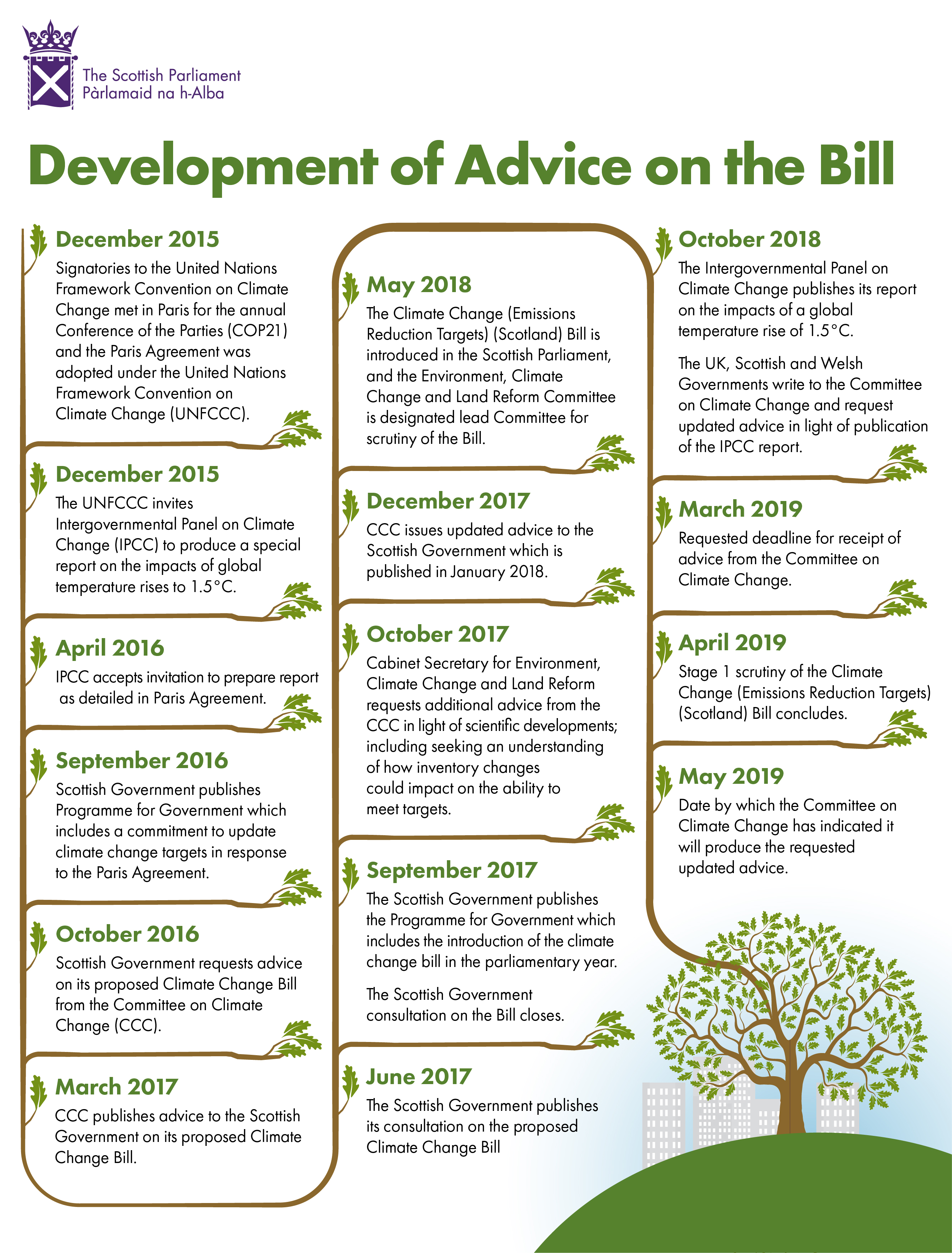
Scottish Parliament 2019
As shown, it was predictable that the IPCC report and the request for updated advice would occur during the Bill's consideration.
When asked about the IPCC report, the Cabinet Secretary said—
"Like everybody else, we are waiting with interest to see what the IPCC says and I expect that that will inform some of the discussions around the bill... I think that the CCC is already plugged into some of that conversation and is effectively feeding back, via its advice, its assessment of what we can and cannot do now."i
The Committee exploredi the impact that the publication of the IPCC advice would have on the timescales for consideration of the Bill at Stage 2 with the Bill team in June, prior to the request for advice from the governments of the UK to the CCC.
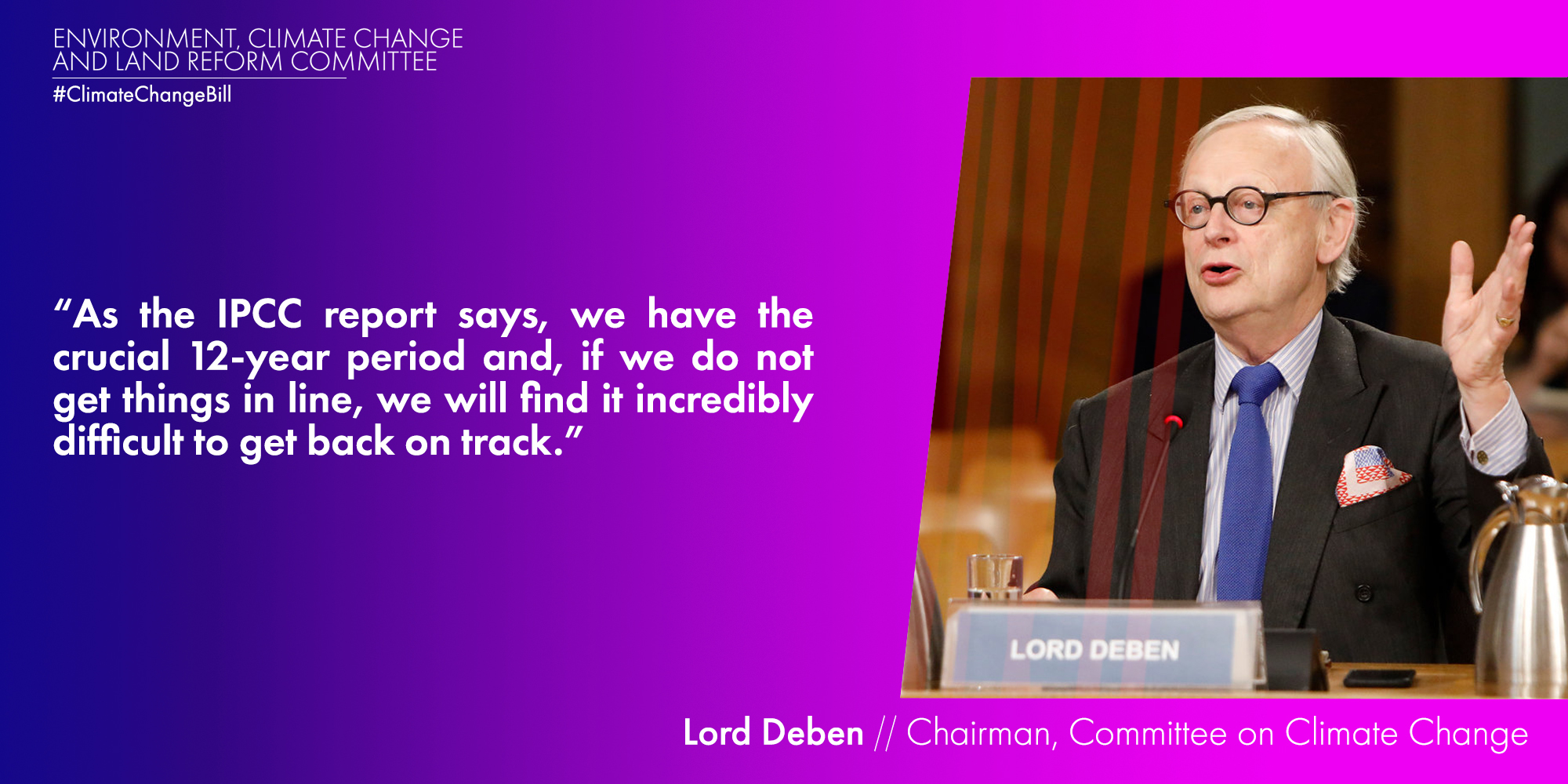
When he appeared before the Committee in October 2018, Lord Deben, Chair of the CCC, said that the updated advice was likely to be received by April.i Lord Deben subsequently wrote to the Cabinet Secretary confirming that the updated advice will be published on May 2.iv
Stakeholders such as Unison Scotlandv and Stop Climate Chaos Scotlandv requested this advice be made urgently available to support scrutiny of the Bill.
The Committee heard from the Cabinet Secretary in November 2018 that—
"neither the Government nor I want to tie the bill too tightly to a timetable that would mean that we would need to proceed without the necessary advice. That would be an absurd position to be in....it is more important that the bill is right and reflects the advice that we receive, than that we stick to a deadline in a timetable."i
The Committee recommends, and intends to request, a deadline for consideration of the Bill at Stage 2, which allows it sufficient time to consider and, if necessary, take further evidence on the advice received from the Committee on Climate Change prior to considering amendments.
Background to and purpose of the Bill
Scotland's record on climate change and emissions reduction
The Climate Change (Scotland) Act 2009 was landmark legislation that set Scotland on course to be one of the most ambitious countries in the world, particularly in terms of reducing emissions.
As the First Minister told the Conveners of Scottish Parliament committees on 24 October 2018—
"Already, our emissions are almost half of 1990 levels. We have met our last three annual targets and are on track to reach the increased 2020 target. We are outperforming the UK and I think that, across the EU, only Sweden performs better than Scotland. That is a track record to be proud of."i
The Committee recognises the progress made to date and commends the Scottish Government, and the public, private and voluntary sectors for the efforts made to date to reduce emissions and adopt low carbon behaviours.
Paris Agreement
In December 2015, signatories to the United Nations Framework Convention on Climate Change met in Paris for the annual Conference of the Parties. In December 2015 the Paris Agreement (UNFCCC 2015)i was adopted under the United Nations Framework Convention on Climate Change (UNFCCC). The Scottish Parliament Information Centre (SPICe) produced a briefingii on provisions of the Paris Agreement and what these might mean for Scotland. In relation to global temperature rises, the agreement states this should be limited to "well below" 2°C and to "pursue efforts" to limit temperature increase to 1.5°C above pre-industrial levels (See Article 2).i
Following the adoption of the agreement, the First Minister (who attended the summit)iv welcomed the statement—
"COP21 has, as we had hoped, achieved a big step forward in the international fight against climate change…..Devolved administrations, like the Scottish Government, will be strong drivers of a progressive climate agenda. We look forward to working with our international partners to secure the successful implementation of the Paris Agreement."iv
In its Programme for Government 2016-17,vi the Scottish Government signalled its intentions to create new, more pressing climate change targets via new legislation in order to address the Paris Agreement. In its 2017-18 Programme for Government, the Scottish Government stated that the Bill would be included in the programme of legislation that year—
"The Climate Change Bill will respond to the historic Paris Agreement by setting more ambitious targets to reduce greenhouse gas emissions. The Bill will increase transparency, demonstrate our commitment to sustainable economic growth and signal to the international community that Scotland is the place to do low carbon business."vii
The Advice of the Committee on Climate Change
The CCC is an independent, statutory body established under UK legislation: the Climate Change Act 2008. The purpose of the CCC is to provide advice on emissions targets and report to the UK Government and Devolved Administrations on progress made in reducing greenhouse gas emissions. The CCC is jointly sponsored by the UK Government, the Scottish Government, the Northern Ireland Executive, and the Welsh Government.
The Scottish Government requested advice from the CCC on its proposed Climate Change Bill in October 2016 and received a responsei in March 2017.
Advice was requested in four areas—
"the appropriate level of future emissions, the form of future emissions targets, the future accounting framework, and flexibility to update emissions targets."i
Further advice was soughtiii in October 2017 following the publication of the latest emissions data for Scotland in June of that year, with anticipated changes to the inventory. It sought advice on both the impact of this on the original advice and the suitable framework for emissions accounting.
Lord Deben, Chair of the CCC, wroteiii to the Cabinet Secretary for Environment, Climate Change and Land Reform to provide updated advice in December 2017. The Committee was advisediii of this by the Cabinet Secretary in January 2018.
In evidence to the Committee,vi Lord Deben explained how the CCC develops advice, noting that the organisation is unique among its worldwide contemporaries for being populated by experts, rather than representatives.
The detail of advice provided to date by the CCC is explored in subsequent chapters of this report.
Request for updated advice - October 2018
Following the publication of the IPCC's special report on 1.5°C, the UK, Welsh and Scottish Governments wrotei to the Chair of the CCC in October 2018 to request updated advice on targets. The letter requested receipt of that advice by March 2019. It stated—
"I am now writing to request...an update to the advice you provided in October 2016, as part of your report on UK climate action following the Paris Agreement. Carbon budgets already set in legislation (Carbon Budgets 3-5 covering 2018-2032) are out of scope of this request. This advice will inform consideration of the UK’s long term targets, and should include options for the date by which the UK should achieve:
a) a net-zero greenhouse gas target and/or
b) a net-zero carbon target in order to contribute to the global ambitions set out in the Paris Agreement, including whether now is the right time for the UK to set such a target. Your advice should also provide options for:
the range which UK greenhouse gas emissions reductions would need to be within, against 1990 levels, by 2050 as an appropriate contribution to the global goal of limiting global warming to well below 2°C above pre-industrial levels, and
the range which UK greenhouse gas emissions reductions would need to be within, against 1990 levels, by 2050 as an appropriate contribution towards global efforts to limit the increase to 1.5°C above pre-industrial levels.
Your report should provide evidence on:
how reductions in line with your recommendations might be delivered in key sectors of the economy; and
the expected costs and benefits across the spectrum of scenarios in comparison to the costs and benefits of meeting the current target."ii
The Cabinet Secretary subsequently wroteiii to the Chair of the CCC to state that although the UK has sought to limit the scope of advice, this should not prevent the CCC from providing advice on all of Scotland's targets in relation to the IPCC report (including those up to 2032).
The Committee welcomes this approach from the Scottish Government, having heard evidence on the importance and cost effectiveness of short-term action to achieve long-term goals.
Lord Deben also stressed that longer-term goals could not be achieved without completing the required actions in the near-term carbon budgets.iv
Additionally, Lord Deben toldiv the Committee that, despite the request for the advice by the end of March 2019, it will likely be delivered in April 2019.
The Scottish Government's view on the advice of the Committee on Climate Change
The Committee explored the way in which the Scottish Government has considered and utilised the advice of the Committee on Climate Change (CCC) during its deliberations on the Bill.
The Scottish Government has taken a selective approach in responding to CCC advice. This has had an impact on the Bill, and on the policies and proposals which will be required to meet more ambitious climate change targets. Specifically, the Committee raises issues in relation to—
Consideration of other sources of advice, beyond the CCC;
Citing the primacy of the CCC advice in relation to targets but not in relation to their advice on the content of the climate change plans or on policy considerations.
Consideration of other sources of advice
The Committee explored whether sources beyond the CCC had been taken into consideration in the development of the Bill.
According to Lord Deben, the CCC is "recognised internationally as being absolutely at the front on where the science is."i This view was echoed to the Committee by Anders Wijkman, Chair of the Climate-KIC in Sweden.i
In evidence to the Committee on 19 June 2018, Sara Grainger of the Scottish Government said—
"The UKCCC is therefore the ideal set of people to provide advice. However, there is nothing in the 2009 act that means that we cannot look more widely, and we certainly consider information, analysis and opinions from a much broader range of people."i
The Committee explored the "information, analysis and opinion" that the Scottish Government drew upon to inform its setting of the targets and was toldiv that it only considered the scientific advice provided by the CCC, who base their evidence on the Intergovernmental Panel on Climate Change (IPCC) synthesis reports.
The Committee recognises the authoritative voice of the CCC as an expert advisor. It also understands that the scope of its advice can depend on the framing of the enquiry and the underpinning assumptions, and this can impact the advice provided.
The advice of the Committee on Climate Change on the content of climate change plans and policy
The Committee explored the approach of the Scottish Government to the advice of the CCC. The First Minister said: "We are obliged to take into account the advice of the Committee on Climate Change, and we do so, but its advice will not be the only factor that we take into account when we come to decisions."i
The Committee has encountered various examples of the Scottish Government either choosing a different path to the one proposed by the CCC or not seeking their advice in the first place. An example of this is the lack of opportunity for the CCC to review the most recent Climate Change Plan between the completion of parliamentary scrutiny of the draft and the publication of the updated final plan, as recommended by the Committeeii (explored further in SECTION NINETEEN - CLIMATE CHANGE PLAN, SCRUTINY BY THE COMMITTEE ON CLIMATE CHANGE OF THE CLIMATE CHANGE PLANS of this report). However, the area where divergence from CCC advise is most apparent is in relation to agriculture policy. In this case, the CCC recommended an approach which was subsequently rejected by the Scottish Government without an explanation provided to justify the decision.
In its most recent report for Scotland on progress towards meeting emissions reduction targets, the CCC again noted: "Not all our recommendations have been implemented. In the agriculture sector, ambitions for emissions reduction have been further scaled back from the draft Plan."iii
On the attitude towards CCC advice, the Cabinet Secretary for the Rural Economy and Connectivity said: "Independent, expert advice from the CCC forms an important part of the Scottish Government’s response to tackling climate change – alongside other considerations such as stakeholder views and available resources including financial budgets."iv
The Committee welcomes the recognition of the importance of stakeholder views, but has concerns about this response because:
It does not fit with the narrative used to justify the setting of a 90% target over a net-zero target in the Bill (i.e. a desire not to diverge from the advice of the CCC);
The Scottish Government appears to take a selective (and at times inconsistent) approach to adherence to CCC advice.
The Cabinet Secretary for Environment, Climate Change and Land Reform committed to following the CCC's advice in terms of a pathway to setting a net-zero target, should this be presented in the advice due in May. She said—
"We are asking the Committee on Climate Change to update its advice two years down the line and consider whether it thinks that there is a feasible way of doing it. If there is, we will do it that way."ii
The Committee agrees with the purpose and role of an independent adviser on climate change issues, and understands why the Scottish Government has chosen to frame the Bill around the advice it has received. However, the Committee recommends that if the Scottish Government does not act on the advice of the Committee on Climate Change, it should provide an explanation of the rationale for rejecting that advice, to ensure the process is transparent.
International Comparisons
The Policy Memorandum to the Bill states—
"In response to the United Nations Framework Convention on Climate Change Paris Agreement, the Bill reaffirms the Scottish Government’s commitment to remain at the forefront of global ambition."i
The Committee welcomes and shares the Scottish Government's ambitions for Scotland to be a world leader in action to reduce global emissions and it sought to understand how other countries are approaching the issue.
While the Paris Agreement represented a significant milestone in international cooperation on climate change, its interpretation and implementation among signatories has varied. In scrutinising the Bill, the Committee was keen to understand the international context, exploring how the proposals advocated by the Scottish Government compared with action taken around the world. In short, the Committee wanted to assess whether the proposals in the Bill rise to the challenge of being at the "forefront of global ambition."i
Evidence was received from ClimateXChange, which highlighted the research work it had been commissioned to undertake by the Scottish Government on international comparisons. It produced four papers iii, iv, v,vi
This research highlights several points:
International comparison is complicated by the fact that no two systems of setting targets or accounting for emissions are the same. Varied approaches by signatories to international agreements make assessment difficult.
Scotland "is in rather a unique position"v, as it is not required to submit Nationally Determined Contributions (NDCs), is not a Members State with responsibilities directly to the EU, and is not a party to the United Nations Framework Convention on Climate Change (UNFCCC). It could therefore "devise something specifically tailored to Scotland’s needs, but it also means that Scotland may not readily find comparable frameworks in other countries."v
In its information and analysis document, the Scottish Government states—
"Comparisons between different countries’ legal frameworks are not straightforward. France, UK, EU, Sweden, Norway and Finland each have domestic legislation for reducing emissions by between 75 and 100%. Sweden’s legislation is considered by some as being the most ambitious – with a net-zero target for 2045 – however, it reserves the right to make up a significant share (15%) of this reduction through payments to other countries. Scotland’s proposed 90% reductions will come from domestic effort alone."ix
The Committee recognises that comparisons between countries can be difficult as their approaches and how greenhouse gas emissions are accounted for differs from country to country. The Committee discusses later in this report the fact that Scotland retains the option to use carbon credits in the Bill.
The Committee notes that Sweden is among those at the forefront of global ambition on climate change. The Committee is also aware that Sweden uses different mechanisms to calculate its emission standards, opting to exclude shares of aviation and shipping, which could make achieving targets easier. Anders Wijkman, Chair of Climate-KIC in Sweden, applauded Scotland for including aviation and shipping in its accounting and noted that Sweden has "...not yet come that far, but I think that we will get there."x
However, Stefan Nyström of the Swedish Environment Protection Agency also told the Committee that Sweden does not account for its forest area when calculating emissions, noting that—
"In Sweden, we emit about 55 million tonnes of CO2 each year, and the net uptake by our forests is about 45 million to 50 million tonnes. We do not count that at all, but we could do. We might begin to count the uptake by our forests in the future, but at the moment we look on it as a free service to the world, so to speak."x
The Committee is aware that excluding forestry from the calculations can make targets difficult to achieve.
Recognising the difficulty of comparing and contrasting the use of different models between countries, Andy Kerr of ClimateXChange used Sweden as an example when discussing how variations in approach or definition of net-zero creates huge difficulty: "...We have to be quite careful, therefore, about trying to make direct comparisons."xii
However, various stakeholders such as David Reay, Lynsey Penny, the Aldersgate Group and the 2050 Climate Group said Scotland's setting of a net-zero target would send a signal to the international community and help maintain worldwide momentum.
Andy Kerr agreed and said "Scotland has been at the leading edge in setting targets."xii He further noted Scotland was seen as a model of good practice in terms of "robust" monitoring and evaluation framework around targets.xii
Lord Deben, Chair of the CCC, remarked on Scotland's progress within the UK: "Scotland continues to be in advance of the rest of the United Kingdom in the way in which it is setting its targets."xii
The Committee heard of a range of different approaches and mechanisms to account for GHG emissions internationally. The Committee recognises other countries employ different methods to define net-zero and choose to include or exclude certain emissions which makes a direct comparison with the approach taken in Scotland very difficult. The Scottish Government has taken the opportunity presented by the Bill to make accounting and target setting more transparent and accountable. The Committee welcomes this ambitious approach, including issues such as inventory, baselines, annual target years and types of greenhouse gases. The Committee notes this approach, and believes that setting a 90% target, will place Scotland among those at the forefront of global ambition on climate change.
Scope of the Bill
The Policy Memorandum states—
"Amongst a wide range of comments in this section, a number of respondents, and campaign responses called for delivery measures to be included in the Bill and many questioned the territorial basis for calculating emissions."i
The Bill does not include provisions for how the targets will be achieved, although various stakeholders (including Aberdeen City Council and the Royal Society for the Protection of Birds Scotland) believe it should and viewed the Bill as a missed opportunity to progress policy issues.
The accompanying documents make clear that implementation is intended to be delivered through climate change plans. When questioned on why there were no specific policy provisions in the Bill, the Cabinet Secretary saidii that this could have made the legislation unmanageably large and that there were implications for including policy in primary legislation, which was binding and focused on creating a framework.
In its advice to the Scottish Government, the CCC said—
"By adopting a more ambitious 2050 target than currently exists for Scotland, or for the UK as a whole, it would be important to identify the areas in which Scotland will go further than the rest of the UK."iii
In evidence to the Committee, the Cabinet Secretary said—
"Rather than just having the idea of ambition for ambition's sake, we want to be crystal clear about the implications of the targets: what they will actually mean in real life."ii
Among those who described the consultation and the Bill as a missed opportunity were the Scottish Communities Climate Action Network, who argued that it was "essential" that the interim targets in the Bill reflect "the need for rapid, and early, emissions reductions."v
Stakeholders such as the Existing Homes Allianceii argued that the Bill should have included policy measures.
The Committee agrees with the Cabinet Secretary that we need to be "crystal clear" about the implications of the targets and what they mean "in real life" but recognises that this may only be possible in the shorter-term as greater uncertainty exists in the longer-term. Nevertheless, the Bill and accompanying documents do not provide the necessary clarity to address this. The Committee also agrees with many stakeholders who expressed concern that the Bill and its accompanying documents fail to include specific costed policy measures and asks for an explanation, including costed measures, where possible.
Can targets be considered in isolation from the measures required to hit them?
The Committee explored whether increased targets for emissions reduction could be considered in isolation from the measures which would be required to meet them. Based on the volume and strength of evidence received on policy measures, the Committee considers that the two cannot be easily separated.
Jim Skea, Co-Chair of the Intergovernmental Panel on Climate Change Working Group III, said—
"The message is that, frankly, the scale of the changes that would be needed in the emissions pathways has no precedent in human history. There is no precedent for the rate of emissions reductions and the changes in social and technical systems that would be required—they really are extremely demanding."i
Andy Kerr also stated—
"Ensuring that targets are set with practical outcomes that can be delivered—in terms of transport infrastructure and building infrastructure—over the next five or 10 years will be absolutely critical. That is more important than worrying too much about whether the net figure is zero by 2040, 2045 or 2050."i
The Committee is of the view that targets for emissions reduction cannot easily be considered in isolation from the measures that would be required to meet them. While including policy measures would undoubtedly result in a lengthier Bill, this should have been an integral part of it. The Committee notes from the IPCC report that the speed and scale of the changes needed in emissions reductions, emissions pathways and changes to social and technical systems has no precedent in human history. The Committee would like to see this reflected in a greater urgency of action across all portfolios and throughout the public and private sectors, to deliver the transformational change that is required.
Climate Justice
The Paris Agreement states—
"Acknowledging that climate change is a common concern of humankind, Parties should, when taking action to address climate change, respect, promote and consider their respective obligations on human rights, the right to health, the rights of indigenous peoples, local communities, migrants, children, persons with disabilities and people in vulnerable situations and the right to development, as well as gender equality, empowerment of women and intergenerational equity."i
Climate justice and achieving the equity aims of the Paris Agreement factored heavily in discussions on the Bill. The Cabinet Secretary acknowledged Scotland's historical contribution to the problem and its work to ensure fairness—
"I have made the point that Scotland was one of the cradles of the industrial revolution. The phrase that I have used is that our sticky fingers are all over climate change, because right from the get-go we were beneficiaries of it, although arguably the vast majority of the population did not benefit massively from the industrial revolution—a small number of fairly wealthy people benefited fairly massively. We have been very conscious of the climate justice side of things. I think that we were the first country in the world to identify climate justice as a specific funding stream and a specific issue that we should be pushing. We have done so at every level. We were one of the first sub-state contributors to the UN climate justice fund and I know that the UN was very grateful for that, because it was able to use Scotland as an example precisely for the reasons that you have laid out."ii
The Aldersgate Group raised fuel poverty and health as an issue which could be addressed through the Bill, while the Energy Agency commented on the mental health impacts of this.
The importance of Scotland playing its part in terms of international justice and its responsibility to developing countries was impressed upon the Committee.
Mary Sweetland of the Eco-Congregations said "communities that are suffering the most are the ones that have done least to increase their carbon use. They want Scotland to share its knowledge and experience, rather than selling it to them for profit."ii She further noted the importance of sharing the message of climate justice, in her case beyond the work of the churches.ii
Lord Deben, Chair of the CCC, noted—
"When you look at the capacity of some countries to meet the targets that they are prepared to sign up to, it is clear that we in the richer countries have to do more. This is the kind of area in which we should be doing more. We should be saying that there is a little bit extra that we can contribute to the general good."v
On the Bill, Dr Rachel Howell from the University of Edinburgh said the climate justice angle was attractive in terms of messaging to encourage action,ii while Gina Hanrahan of WWF suggested a 90% target did not go far enough to address the "equity dimension."ii
Professor Tahseen Jafry of the Centre for Climate Justice emphasisedii the need to develop structures to support the most vulnerable through a period of transition and for them to be involved in this process.
Written submissions, such as those from the Scottish Catholic International Aid Fund (SCIAF) and the Scottish Human Rights Commission,ix highlighted the fundamental importance of climate justice.
The Scottish Human Rights Commissionix and Keep Scotland Beautiful called for the Sustainable Development Goals, to which Scotland is a signatory, to be reflected in the Bill.
The Committee welcomes the Scottish Government's recognition of the importance of ensuring climate justice. However, the Committee considers climate justice requires further focus to ensure Scotland has the necessary structures in place to engage and support the most vulnerable through the period of transition, as well as a responsibility to developing nations. The Committee recommends the Scottish Government give specific attention to this and identify priorities for early action. The Committee looks forward to further discussion on this with the Scottish Government.
Just transition to a low carbon economy
Of the climate justice issues discussed, the transition to a low carbon economy received the most attention during consideration of the Bill at Stage 1. The Policy Memorandum states—
"We will work to deliver an inclusive, socially just transition to a low carbon economy, based on equal opportunity, a fair and inclusive jobs market, regional cohesion and safe and secure communities."i
The Committee welcomed the Cabinet Secretary's remark on the opportunities associated with a transition to a low carbon economy—
"We need to think about the fact that there are potential benefits and opportunities. That should all be harnessed in such a way that we end up with jobs and better working environments. Although some jobs and some job titles may disappear, they will be replaced by others."ii
Some industries, such as transport, housing, and agriculture, were more prevalent than others in the discussion. Notably, support and planning for transition in the agriculture industry received considerable attention.
Pete Ritchie of Nourish Scotland described the need for a just transition in agriculture—
"It means having a new deal with farmers and saying that we will support them if they will support us to deliver on our social objectives for climate change and the environment."ii
While discussing dietary changes, Rachel Howell noted the impact this could have on rural areas and emphasised how important just transition would be.ii However, she also noted more generally that—
"I certainly do not feel that rural areas should be disadvantaged, but no policy can be brought in without some disadvantage to some people. We have to try to mitigate that disadvantage, but we cannot simply say that we cannot do anything because there will be some disadvantage to some people. We have to consider how to offset that. There are ways in which we might be able to do that. If we simply say that we cannot bring in the policies that we need in order to change behaviour at the required level, we are accepting 3°C to 4°C warming by the end of this century, which will be a tremendous disadvantage for everybody."ii
Several witnesses spoke of the potential negative impact a badly managed transition could have in rural areas and on those working in the agriculture industry.
Elizabeth Leighton of the Existing Homes Alliance spokeii of the need for a transition to be just for energy consumers too, noting the balance between rural and urban areas could be redressed in this way.
Energy was discussed at length by many stakeholders, including Anders Wijkman of Climate-KIC, who noted the need for a European-wide debate regarding support for communities reliant on the coal industry.ii
Oil and gas was another area generating much discussion on the need for careful prior planning. As Will Webster of Oil & Gas UK noted, a just transition "means making the most of the expertise that we have in the traditional energy sectors, including the several hundred thousand jobs that there are in oil and gas."ii
The advice of the CCC was based on an expectation that the oil and gas sector will continue to represent an important part of Scotland's energy mix for years to come. However, the Committee received mixed evidence on this.
Tom Thackray of the CBI said—
"There is huge expertise and supply chain capability in the oil and gas industry that needs to be celebrated. There needs to be a managed transition as we get the most out of the resources that we have. The Scottish and Westminster Governments and the industry need to have an honest conversation about that. There are massive opportunities in new forms of energy generation that are particularly relevant to Scotland. We know the prowess of the wind companies here, and there are supply chain opportunities. There has to be a transition; I think that the industry accepts that. We are not yet exploiting the new generation capability that we have for renewables, particularly because we do not have the routes to market through, for example, the CFD.ix If signals on that are sent early enough, that would enable industry to invest, which could pick up some of the slack in the overall economy. A signal of change to the CFD would be critical for the UK generally, but for Scotland specifically."ii
Mai Muhammad, of Aberdeen City Council, discussed the importance of transferable skills, of investing in hydrogen, district heating and air source pumps, and of training in her responseii to how Aberdeen, as a city, was responding to decarbonisation and maintaining its reputation as the city of energy.
Gina Hanrahan said there was a "managed decline" for the sectorii while others had a more positive view of its future contribution.
Angus McCrone of Bloomberg New Energy Finance warnedxiii against assuming the oil and gas sector would decline imminently. Will Webster describedii how the industry was viewing its future in two time-frames - up to 2035 and beyond. He was optimistic about the future and spokeii of the expertise that existed in the sector and how this could be utilised across a low carbon economy. Fabrice Leveque of Scottish Renewables highlightedxvi the emerging partnership with the offshore wind sector to make the most of the skills that existed. Dave Moxham of the Just Transition Partnership predictedii a future for oil and gas, but noted that potential skills transfers needed to be identified and examined now.
Consumer choice and fair trade, as well as global jobs and skills, were also discussedii as just transition issues.
The Committee supports the Scottish Government's objective of an inclusive, socially just transition to a low carbon economy. The Committee agrees with the Cabinet Secretary that there are potential opportunities arising from the transition and would like to see Scotland at the forefront of exploring, developing and investing in these opportunities. The Committee believes there is likely to be a role for the Just Transition Commission in looking at the skills required across the economy, and in working with educational institutions to support this. The Committee recommends the Scottish Government report progress on this work to the Committee at the earliest opportunity.
Just Transition Commission
The Scottish Government's Programme for Government in 2017 stated—
"We will establish a Just Transition Commission to advise Scottish Ministers on adjusting to a more resource-efficient and sustainable economic model in a fair way which will help to tackle inequality and poverty, and promote a fair and inclusive jobs market."i
Some stakeholders (such as Stop Climate Chaos Scotland, Keep Scotland Beautiful, Unite the Union, the Levenmouth Rail Campaign and Clear Buckhaven) suggested that the establishment of a Just Transition Commission should be included in the Bill.
When questioned in June 2018, Scottish Government officials said there was not evidence that the Commission would require statutory footing in order to provide valuable advice.ii Still the Cabinet Secretary noted that she was open to having an "upfront debate"ii about it, including what the practical implications of this would be.
However, the Cabinet Secretary appeared to be more resistant to this in November 2018. She explainedii to the Committee that the Commission had already been established, with a chair appointed and members soon to be added. She anticipated the first meeting would take place in January 2019 and that the Commission would report within 2 years. She also suggested that placing the Commission on statutory footing via the Bill would mean having to halt the work of the informal Commission and begin a lengthy and expensive process of setting up a statutory commission.
The Cabinet Secretary made the point that legislation was not needed to set up the Commission. However, groups such as Friends of the Earth Scotlandii argued that the long-term nature of the group's work necessitated a statutory footing to guarantee its future. The Committee pressed this point and was told that the Commission was not the only place where important issues were considered.v
On the question as to whether the Commission should have statutory footing, Dave Moxham argued that the commission was a key way to bridge the gap between the idea and the delivery, and to engage with key institutions, such as the national investment bank, local authorities and enterprise agencies. He proposed that—
"..the commission should be in legislation, because that would be a statement of future intent. It should be suitably independent, because that would make it operate more effectively."ii
Professor Tahseen Jafry questioned the clarity of what the "commission would be about and what it would involve."ii Dave Moxham also told the Committee—
"We need to ensure that the innovation from the R and D is properly built into an industrial strategy and that, if there are gaps between the technology and the delivery, we can deliver the plan, even if that involves Government investment. In advising the Government, the just transition commission has a real role in filling that gap."ii
Furthermore, he suggestedii that undertaking a cost-benefit analysis of mitigating climate change could be a role for the Just Transition Commission and statedii that it might support the work of the CCC in providing advice to the Scottish Government.
In its written submission, the Just Transition Partnership suggested the Commission should:
"advise Government and all relevant agencies on making the transition to a prosperous low-carbon economy in which the costs and rewards are shared fairly; and report on measures put in place to ensure that livelihoods of workers and of communities are protected and social equity is enhanced."xii
Report to ministers and those reports should be laid before Parliament.
It suggested the Bill should include the establishment of the Just Transition Commission and said it should:
"include a commitment that a Just Transition approach will be applied to the delivery of climate change targets, protecting livelihoods, enhancing social justice and contributing to a fairer and more equal Scotland;
include reporting requirements on Just Transition in the Climate Change Plan i.e. on how proposals and policies will affect employment in different sectors, what measures should be put in place to support the transition of the workforce and related communities, and the scale and sources of investment. Ministers should report annually on progress towards this; and
put the Just Transition Commission on a statutory basis in order to give it the status needed to carry out these functions effectively and help drive the changes needed, for the duration of the climate targets laid out in the Bill."
It is not clear to the Committee why an informal commission established to consider issues of just transition would have to cease its work were a commission on a statutory footing to be proposed. It considers there have been other areas, such as land reform, where informal work has led to the establishment of a formalised body, underpinned by legislation. It is also concerned about the short-term life span of the informal commission, given the significance of the issue. The Committee asks the Scottish Government to reflect on this and consider the points raised by stakeholders above.
The Committee recommends that the Scottish Government keep an open mind and, in advance of consideration of the Bill at Stage 2, reflect on the possibility of establishing a Just Transition Commission with statutory underpinning. The Committee would welcome further discussion on this and on the merits, or otherwise, of establishing a Just Transition Commission as an independent parliamentary commission.
Intergenerational Justice
Since its establishment, the Committee has made young people one of its key audiences for engagement in its work. Further detail of how it has incorporated this into its work on the Bill is available in the ENGAGEMENT section of this report.
This included taking evidence from young people and groups working with young people to ensure their voices were reflected in the evidence received.
Siri Pantzar of the Climate 2050 Group told the Committee of the need for intergenerational justice to sit alongside international justice, and said—
"It will be much more just and productive to make the change at this point, when we have a bit of wriggle room and a bit of space for a managed transition, rather than in 2030 or 2040. We might not have that budget then, so our options would be different."i
Stakeholders such as Mary Sweetland of Eco-Congregation Scotlandi and Adam Priceiii also told the Committee about the importance of acting to mitigate climate change in the interests of future generations. Siri Pantzar spoke of the need to focus on "intergenerational equity and justice"i now, while Alan Munro of Young Friends of the Earth Scotland urged the Government to revise the 2030 target, as current legislation "passes the burden for the more radical transformative action to young people: we will have to address it in the future if you do not address it now."i
The Committee urges the Scottish Government to continue to place a priority on intergenerational justice and to ensure that the purpose of the Bill is underpinned by this. In advance of Stage 2 the Committee asks the Scottish Government to consider how this can best be reflected on the face of the Bill.
Review of the 2009 Act
The Climate Change (Scotland) Act 2009 was heralded for its consensual and ambitious approach to setting climate change targets and strategies to meet them. The Act was not limited to the target setting framework, but included policy measures. In considering the scope of the Bill, the Committee was keen to hear how these had been considered and reviewed.
Sara Grainger, the Scottish Government's Decarbonisation: Delivery Unit Team Leader, said—
"there is a strong feeling that the 2009 act is working. The framework that we have in Scotland is achieving a great deal, and Scotland is doing very well at reducing emissions. The proof of the pudding is in the eating: the act is doing its job. The aim of the bill is really just to increase the targets."i
However, the Committee notes that the Government has taken the opportunity presented by the Bill to update some parts of the 2009 Act it did not consider to be working well, mainly regarding reporting.i Furthermore, the Cabinet Secretary informedi the Committee of work undertaken to review the engagement strategy under the Act, which she said needed revisions.
The Committee received evidence suggesting a review of the operation of the 2009 Act should have been undertaken, particularly when setting new targets.
The Committee also notes that whilst international aviation continues to be included in the Scottish Greenhouse Gas Inventory, further consideration of calculation methods (as recommended by the CCC in 2010), in particular in relation to a multiplier to reflect the direct and indirect non-carbon dioxide impacts of emissions at altitude, does not appear to have been carried out. This might have been resolved, had there been a review of the 2009 Act.
The Committee considers it challenging to set targets in isolation from consideration of implementation. While a review and setting of new targets is welcome, excluding or divorcing this from a full consideration of policy measures is a missed opportunity. The Committee is also aware there has been no review of the other elements of the 2009 Act. The Committee believes that a review of the operation of the 2009 Act should have been undertaken to inform the Bill and recommends that the Scottish Government now undertake this review.
Local Authority Energy Efficiency Discount Schemes
One of the areas of the 2009 Act the Committee was interested in was local authority energy efficiency discount schemes.
Sections 65 and 67 of the Climate Change (Scotland) Act 2009 provide for domestic and non-domestic energy efficiency discount schemes. Section 65 requires Local Authorities to—
"[…] establish a scheme for reducing the amounts which persons are liable to pay in respect of council tax where improvements are made to the energy efficiency of chargeable dwellings."
The Committee wrote to all 32 local authoritiesi regarding Energy Efficiency Discount Schemes, and asked how they had implemented the provisions, in particular:
Details of the schemes running in their local authority area;
Uptake of the opportunity offered by the schemes; and
Evaluation and review of the success of the schemes.
Responses were received from 12 local authorities and the Scottish Parliament Information Centre (SPICe) produced a summaryii of these. In short, uptake under the schemes has been low; this appears, predominantly, to be because other energy efficiency schemes offered better value. Angus Council is the only local authority that responded to the Committee currently operating a scheme. A total of 651 properties have benefitted from this scheme, with a total Council Tax saving of £33,865.
In written evidence on the Bill, the Energy Saving Trust states—
"It is important to point out that while the way in which these schemes was implemented (i.e. with CERT funding) was entirely understandable, it was not necessarily done in the way that was originally intended or in a way that was likely to maximise uptake. As noted above the 2005 Energy Saving Trust work saw the provision of this type of discount as an additional discount (i.e. a discount in addition to existing CERT offers) that would provide the “nudge” necessary to get certain householders to take action. However, funding these schemes solely under CERT meant that the discounts were essentially re-packaged CERT offers and not CERT offers plus a council tax discount and meant that these schemes competed with, as opposed to added to, existing CERT offers."iii
In relation to s67 and non-domestic rates. Highland Council states—
"[…] the Secretary of State has the power to set the non-domestic rate poundage. While section 67 of the 2009 Climate Change Act gives the additional power to prescribe the amount of non-domestic rate to those who are energy efficient, we are not aware that the Secretary of State has ever exercised this power i.e. introduced a different poundage for energy efficient non-domestic properties."iv
Similarly, Orkney Islands Council sought clarification, and stated—
"Section 67 of the 2009 Act refers to section 153 of the Local Government etc. (Scotland) Act 1994 which appears to be principally about the powers of the Secretary of State to prescribe the amount of non-domestic rates and it is not clear what discounts should be offered by the Council."v
It appears there is confusion as to how such schemes should be implemented and questions as to whether these are being used as additional measures to effect behaviour change. This appears to be an area of the 2009 Act that is not working as effectively as it could and is worthy of further consideration by the Scottish Government.
The Committee recommends that the Scottish Government carry out a review of the operation of sections 65 and 67 of the Climate Change (Scotland) Act 2009 and consider how this could be improved across Scotland.
Public Sector Reporting
The Committee, and its predecessor, the Rural Affairs, Climate Change and Environment Committee, have taken an interest in the public sector reporting duty since its establishment.
Chris Wood-Gee of the Sustainable Scotland Network, which runs the public sector reporting duty, told the Committee that the duty was now in its third full year and—
"The process will need tweaking. We have worked with it for long enough to understand what the good bits are and where there are opportunities to improve it. It might be good for the Scottish Government to consider that."i
Paul Gray of NHS Scotland detailed the benefits of reporting and noted that "as public services are publicly accountable... there should be no resistance to reporting."i When asked whether there should be penalties for public bodies failing to demonstrate progress, he noted that incentives should be built into the process in the first instance, while measures such as budget relocations could be applied if progress is still lacking.i
Mai Muhammad of Aberdeen City Council said—
"With the carbon reduction commitment, a lot of people make their reports and pay for the carbon—and that is it for the year. Because there are no incentives, penalties or whatever, the scheme has not delivered what it initially set out to deliver, and what is proposed might go down the same route."i
Tom Thackray of the CBI provided background on the private sector experience of reporting and said they bought into the idea that "what gets measured gets changed."i
Andy Kerr of ClimateXChange said—
"Public bodies report on climate change but the danger that we have seen with that is that reporting can become simply a tick-box exercise; organisations do not bring it back to the virtuous circle and say what they are going to do to drive further change. That is the challenge. It is not just about public bodies reporting well; they have to ensure that they go back and deliver the outcomes."vi
Anders Wijkman of Climate-KIC described the situation in Sweden—
"There is a provision in the law that each and every Government sector—each ministry—has to take account of climate law in all that it does. Climate mitigation and adaptation concerns have to be taken into account in all policy making. That is one of the strongest parts of the legislation and has led to much more integration than was previously the case."i
Keep Scotland Beautiful suggested that public sector reporting duty should be addressed within the Bill.
The Scottish Government indicatedviii in July 2018 that it will review the public sector reporting duty over the coming year and that any action required as a result will be taken through secondary legislation. The Committee hopes the Scottish Government finds the evidence and correspondence it has received useful in its review.
The Committee welcomes the commitment from the Scottish Government to review the public sector reporting duty and considers this could have usefully informed the development and content of the Bill. The Committee has also agreed to consider the public sector reporting duty following the most recent publications. The Committee would welcome clarification from the Scottish Government on the timescales and remit of its review, including whether results will be available before the end of the parliamentary year in June 2019.
Land Use Strategy
Scottish Environment LINK advocated a strengthening of the land use strategy, a key commitment in the Climate Change (Scotland) Act 2009. It said—
"the Strategy has not been properly implemented and the benefits arising from better and a more coherent land use policymaking has not been delivered, including emissions reductions in the agriculture and land use sectors. Despite the opportunities for climate change mitigation and adaptation through land use change, sectoral priorities continue to be set in isolation of each other, which fails to maximise the potential benefits to be gained from a more coordinated approach to land use in Scotland."
They suggested the Bill should legislate for—
"A Land Use Strategy Action Plan, outlining the specific actions and milestones to deliver the policies and proposals;
An annual progress report, to be laid before the Scottish Parliament; and
A duty on Ministers to establish Regional Land Use Frameworks, in all parts of Scotland."i
The Committee remains concerned that the potential benefits of the Land Use Strategy have not been fully realised and supports a more coordinated approach to land use in Scotland.
Other types of targets suggested for inclusion
While the Bill focuses on emissions reduction targets, there were many calls for other targets to be included within the Bill, some of these related to creating targets and frameworks for particular sectors.
There were also various suggestions for targets other than emissions reduction (relating to sectoral performance) to be included in the Bill:
Energy performance certificates standard C by 2025 or 30 (suggested by WWF Scotland,i Unison Scotland,ii and Stop Climate Chaos Scotland,iii among others -- although Suzy Goodsir of Greener Kirkcaldy suggestedi that education was required to make these a meaningful currency in terms of home purchases)
Zero carbon buildings by 2050 (as advocated by the Existing Homes Alliance)i
Fossil fuel vehicles to be phased out by 2030 (as suggested by WWF Scotland)i
Nitrogen Budgets to be set for the agriculture sector (as proposed by WWF Scotland,i among others)
100% renewable energy generation (Industrial Biotechnology Innovation Centre)ii
Statutory targets for land in organic management (Nourish Scotland)ii
Increased targets for agroforestry in Scotland (Scottish Environment LINK)iii
The Existing Homes Alliancei called for statutory targets and a framework to manage energy efficiency measures. Elizabeth Leighton argued for the inclusion of energy efficiency measures and targets relating to energy efficiency. i She raised concerns about further delays and the implementation of the energy efficient Scotland programme, which will go into the implementation phase from 2020.i
Unison Scotland and Stop Climate Chaos Scotlandx called for the Bill to create a Zero Carbon Infrastructure Commission.
The Committee recommends that the Scottish Government consider the proposals and benefits of including additional types of targets within the Bill in advance of Stage 2.
The Climate Change (Emissions Reduction Targets) (Scotland) Bill
The Climate Change (Emissions Reduction Targets) (Scotland) Bill was introduced in the Scottish Parliament on 23 May 2018. The Policy Memorandum to the Bill states that "The primary objective of the Bill is to raise the ambition of the greenhouse gas emissions reduction targets that are set out in the Climate Change (Scotland) Act 2009."i It also states that the target levels proposed in the Bill are "arguably the most ambitious legislative targets in the world given that they include international aviation and shipping and a default position that they must be achieved through domestic effort alone."i
According to the Policy Memorandum, the Bill "reaffirms the Scottish Government’s commitment to remain at the forefront of global ambition"i and notes its secondary objective is to improve transparency in the way emissions are measured and targets are reported upon.
The following sections of this report will consider each of the parts and provisions of the Bill.
Part One - Emissions Reduction Targets
The current targets
Part one of the Bill is concerned with setting new targets for emissions reduction.
The current targets are set out in Part One the Climate Change (Scotland) Act 2009 and are as follows—
A 2050 target of 80%;
A 2020 target of 42% (known as the "interim target");
Secondary legislation setting annual targets between 2010 and 2050 which would "allow the interim target and the 2050 target to be met" and for the targets set between 2020 and 2050 to be "at least 3% less than the target for the preceding year";
A requirement on the Scottish Government to seek advice from the "relevant body" and consider the "target setting criteria" when setting annual targets;
Modification of—
the percentage of 3% by which annual targets between 2020 and 2050 should be made more challenging;
the dates by which annual targets should be set;
the target setting criteria;
annual targets, but only to make them more challenging;
A requirement that at least 80% of the reduction in the net Scottish emissions account in any target year must be from net Scottish emissions reductions (known as the domestic effort target, its effect is to limit the amount of the target which can be met through carbon trading); and
The Scottish Government to request a progress report from the relevant body each year.
It also provides for other matters, including:
A definition of the greenhouse gases covered by the targets;
A definition of the baseline;
A definition of the net Scottish emissions account;
The inclusion of Scotland's share of international aviation and shipping emissions in calculating progress towards the target;
The ability to include "removals" from carbon sequestration in the target;
International carbon reporting practice; and
Carbon units and accounting, and the limit on the use of carbon units.
The advice of the Committee on Climate Change on the form of future emissions targets
In March 2016, the Committee on Climate Change (CCC), which is the "relevant body" under the 2009 Act, provided advice to the Scottish Government on appropriate levels of targets for the years 2028 - 2032. This advicei outlined a "central scenario" and a "high ambition scenario."
Following its commitment to set more challenging targets for emissions reduction via new legislation, the Scottish Government again sought the advice of the CCC in October 2016. It requested the CCC's view on four areas relating to the proposed legislationii—
Appropriate level of future emissions;
Form of future emission reduction targets;
Future accounting framework; and
Flexibility to update emissions reduction targets.
The adviceiii was published in March 2017. In October 2017, the Cabinet Secretary wrote to the Chair of the CCC, Lord Deben, to request updated advice and this was publishediv in December 2017.
In its updated advice,i the CCC noted that it had "re-examined whether a 90% reduction by 2050 is still consistent with our High Ambition Scenario" in light of new estimates for emissions released in June 2017 and "further information about planned developments in greenhouse gas measurement."i The CCC stated that its "updated analysis concludes that a 90% reduction on 1990 levels by 2050 is still feasible for Scotland on the basis of the current estimation methods and evidence published to date."i
In its original advice, the CCC presented two options for setting the target levels in the Bill—
"1. Keep the target for a reduction in greenhouse gas emissions of at least 80% by 2050 with subsequent reviews to increase ambition.
2. Set a ‘stretch’ target for a reduction in greenhouse gas emissions of 90% by 2050, potentially accompanied by a net-zero CO2 target for 2050."i
Option One
The CCC noted Option One was consistent with limiting the global temperature rise to around 2°C, and that options to go further should be maintained by setting a challenging 2030 target and setting review points, aligned with the pledge and review process created by the Paris Agreement. Option One recognised the need for high levels of ambition and suggested it was "appropriate to set targets at least to 2030 that keep open the option of more ambitious longer-term reductions."i
Option Two
Option Two represented a more ambitious path. This option was selected by the Scottish Government and is reflected in the Bill.
Option Two proposes a "stretch target for a greenhouse gas reduction of 90% by 2050, potentially accompanied by a net-zero CO2 target for 2050."i It is described as being at the "limit of the measures the Committee has identified to reduce emissions in Scotland and would require strong progress across every area of the economy."i On Option Two, the CCC also makes the following points—
The CCC has not been able to calculate the cost of a "scenario that achieves this target."
Option Two means a reduction of CO2 to zero, "with the residual net positive emissions comprising non-CO2 greenhouse gases (primarily methane and nitrous oxide from farming)"i
Strong, well-designed policies would be required to achieve a 90% target and the CCC suggest "it would be important to identify the areas in which Scotland will go further than the UK as a whole, the role for greenhouse gas removal options (including afforestation, use of wood in construction, bioenergy with carbon capture and storage and a range of other options), and whether relevant policy levers are under Scottish or UK Government control."i
Legislation should allow for the creation of a net-zero target "once the evidence base has been strengthened."i
The Bill's policy memorandum states—
"The Scottish Government accepted the CCC high ambition scenario as Scotland’s targets should be very challenging, and should reflect a fair contribution to maintaining global temperatures to well below 2°C above pre-industrial levels as set out in the Paris Agreement."vi
The Committee recognises that the Scottish Government selected the more ambitious of the two options proposed by the Committee on Climate Change, which highlights what will be required from governments around the world to keep temperature rises closer to 1.5°C than 2°C. However, it notes that the Scottish Government is awaiting further advice from the Committee on Climate Change in light of the 2018 IPCC report.
Age of the advice
The Committee received various pieces of evidence commenting on the information the CCC had based its analysis on, including from WWF Scotland who stated—
"That was based on 2015 advice developed for the fifth carbon budget at the UK level. There is a really exciting global conversation happening now about net-zero and 1.5°C, stimulated by the Paris Agreement, which means that a plethora of new research is being produced that tackles the feasibility question."i
The Committee is mindful that previous CCC advice was based on the best evidence available at the time, and there will always be a cut off point. However, it is also aware that there have been significant developments in the period since the publication of the advice and the consideration of the Bill, which have been incorporated into its view of the proposed legislation. The Committee welcomes the Scottish Government's request for updated advice.
Section one - The Net-Zero Emissions Target
Section 1 of the Bill proposes to insert a new section into the 2009 Act which allows for a "net-zero" target of a reduction of greenhouse gas emissions of 100% from the 1990 baseline. Proposed section A1(1) states—
"The Scottish Ministers must ensure that the net Scottish emissions account for the net-zero emissions target year is at least 100% lower than the baseline (the target is known as the “net-zero emissions target”)."i
Proposed section A1(2) states—
"The Scottish Ministers may by regulations specify a year which is to be the year in which the net-zero emissions target is to be met (the year specified in the regulations is known as the “net-zero emissions target year”)."i
Ministers are also required to publish a statementiii explaining their reasons for choosing the target year, the "extent to which the proposed net-zero emissions target year takes account of the target-setting criteria"iii and whether their actions are consistent with the most recent advice of the relevant body (in practice, the CCC).
The Delegated Powers and Law Reform (DPLR) Committee recommended in its Stage 1 Report on the Bill that the "Scottish Government brings forward an amendment for the power in section A1 (introduced by section 1 of the Bill), mirroring for that power the provision that is made at new section 2A(3) (introduced by section 4 of the Bill)."v This is to ensure that in making the regulations setting the net-zero year, Ministers should have regard to the target setting criteria and whether this position is consistent with the most up-to-date advice from the CCC.
Much of the debate on the Bill has concerned whether a target year should have been included on the face of the proposed legislation. There were stakeholders who welcomed the approach taken by the Scottish Government in the Bill, such as the Scottish Hydrogen and Fuel Cell Association, NHS Lothian, the Scotch Whisky Association, the Soil Association, Keep Scotland Beautiful, the Industrial Biotechnology Innovation Centre, SSE and the Strathclyde Partnership for Transport.
However, other evidence received by the Committee suggested the net-zero year should be set now in the Bill, including from Action Aid International, Scottish Environment LINK, Friends of the Earth Scotland, the 2050 Climate Group and WWF Scotland.vi
The Committee supports the recommendation of the Delegated Powers and Law Reform Committee and recommends that the Scottish Government bring forward an amendment to make it explicit that in preparing regulations to specify the net-zero target year, Ministers must have regard to the target setting criteria and whether the position is consistent with the most up-to-date advice from the Committee on Climate Change.
Definition of "net-zero"
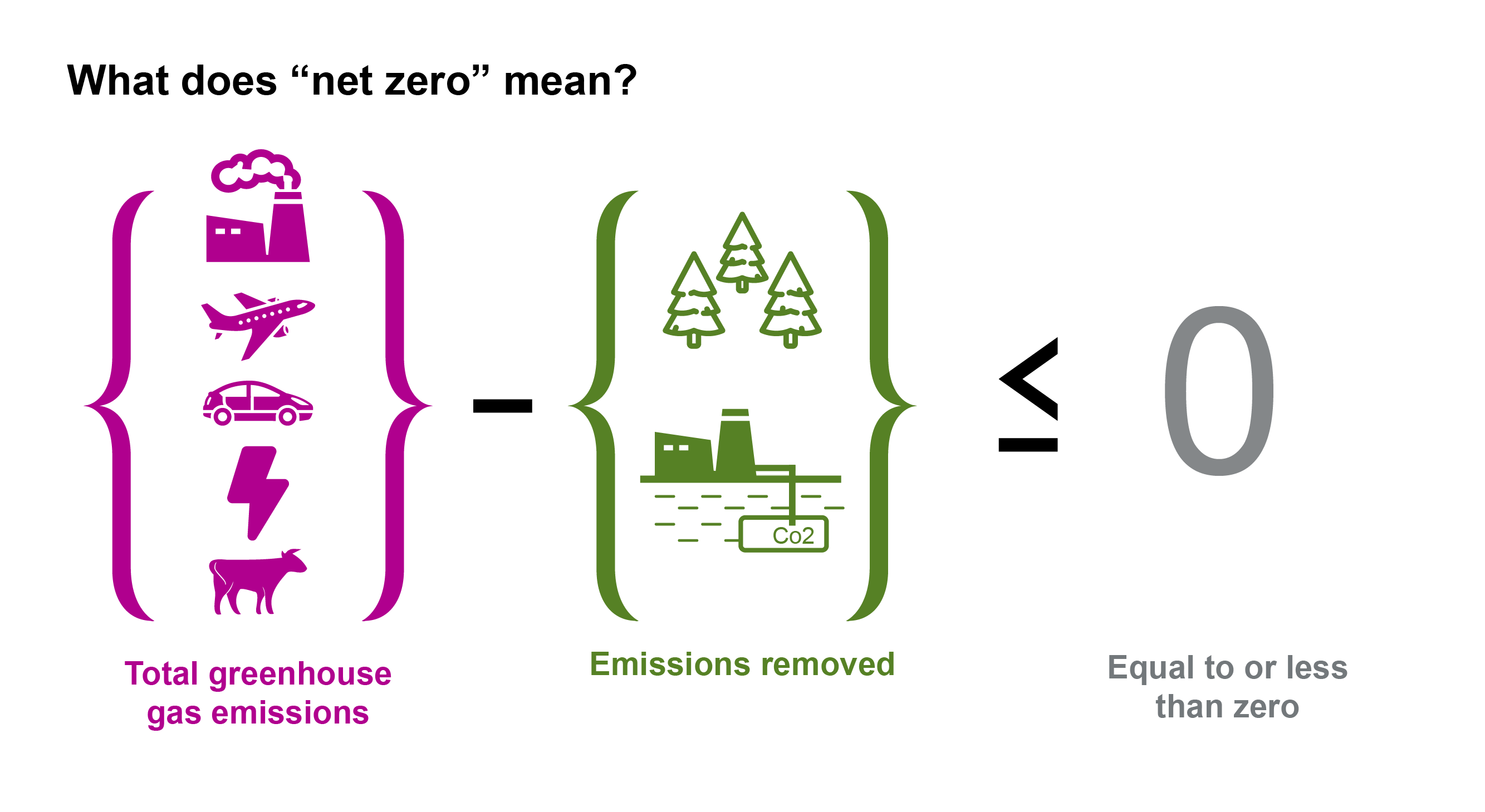
Scottish Parliament 2019
The Committee is aware that the use of the term “net-zero” is used differently depending on what is being described, and the term is not always clearly defined. The Climate Change Bill states in Part 1 that—
“The Scottish Ministers must ensure that the net Scottish emissions account for the net-zero emissions target year is at least 100% lower than the baseline (the target is known as the “net-zero emissions target”).”
In the context of the Bill, the Committee understands that “net-zero” means that the balance of greenhouse gas emissions emitted by sources, and removed by sinks across one year (as measured by the net Scottish emissions account) is equal to or less than zero. Generally, this means that those emissions which do take place must be counterbalanced by sequestration from other sources to achieve “net-zero.” The glossary of this report has an expanded definition.
Analogous terms to net-zero such as “zero carbon” or “carbon neutral” are not referred to in the Bill or 2009 Act. They are often used colloquially to refer to the net-zero emissions target as defined by the Bill. The Committee notes the distinction between “net-zero carbon” and net-zero for all greenhouse gases, made by the Scottish Government, in evidence to the Committee at its meeting on 19 June 2018 when it was confirmed that—
"the plans... encompassed in the bill represent a net-zero carbon target for 2050 and that the 10 percentage points difference between 90 per cent and 100 per cent relate entirely to the five gases other than carbon, of which the predominant one is methane"
The Committee understands this distinction between "net-zero carbon" and net-zero for all greenhouse gases refers to the Scottish Government's climate change mitigation plans, rather than a distinction made by the targets in the Bill. The Committee also notes that an additional gas (fluorocarbon) has been added since the 2009 Act (via secondary legislation) to the gases which the Bill seeks to address.
The Committee believes there are a number of ways to understand "net-zero" and numerous similar terms are used inter-changeably. The Committee considers it would be helpful to have clarity as to what the term "net-zero" means within the context of the Bill and recommends the Scottish Government make clear their definition of "net-zero."
Is net-zero the right target?
The Committee heard a range of evidence on the targets that should be included in the Bill and when they should be set. This evidence is considered throughout this report, but it has led the Committee to ask the fundamental question of whether a percentage of emissions reduction by a certain date was the right objective.
When asked by the Committee if the Bill was adequate in terms of delivering the Paris Agreement, stakeholders noted the disconnect between the goal of reducing emissions and the aim of preventing global temperature rises. According to WWF Scotland—
"one of the fundamental questions that needs to be answered about the bill is what temperature target it is aiming for. There has not yet been enough clarity about that from the Scottish Government."i
The Intergovernmental Panel on Climate Change published "Global Warming of 1.5 °C - an IPCC special report on the impacts of global warming of 1.5 °C above pre-industrial levels and related global greenhouse gas emission pathways, in the context of strengthening the global response to the threat of climate change, sustainable development, and efforts to eradicate poverty"ii in October 2018. The report sets out the consequences of temperature rises to 1.5°C, which is at the higher end of the ambition of the Paris Agreement.
The Committee believes that the Bill should be underpinned by the aims of the Paris Agreement and the international framework set out by the IPCC in terms of temperature. Therefore, a greater degree of clarity is needed from the Scottish Government on this issue.
What temperature target is the Bill aiming for?
The Policy Memorandum to the Bill states targets should "reflect a fair contribution to maintaining global temperatures to well below 2°C above pre-industrial levels as set out in the Paris Agreement."i
The CCC has said "A 90% reduction in greenhouse gas (GHG) emissions would be more consistent with the temperature limits set out in the Paris Agreement" and "Aligning to the 1.5°C ambition also implies reaching net-zero CO2 emissions by 2050."ii
When questioned on whether the Bill was aiming to achieve actions associated with a 2°C or 1.5°C temperature rise, the Scottish Government Bill team echoed the wording of the Paris Agreement—
"Sara Grainger— ....the Paris Agreement references two targets—trying to keep to well below a 2°C temperature rise and to nearer 1.5°C.
Mark Ruskell— So what is the target? Is it well below 2°C? Is it 1.6°C or 1.5°C, or is it 2°C and then going back to 1.5°C? I am not really clear what we are aiming for.
Sara Grainger— I do not think that we can be any more clear than the Paris Agreement."iii
The Committee probed this further and was told by Sara Grainger: "we are sufficiently clear on that and understand the need and purpose of the Paris Agreement to limit temperature rise to well below 2°C."iii
The question of what temperature the Bill is aiming for is important in light of the CCC's advice—
"We concluded in our report on UK climate action following the Paris Agreement that aligning more closely to the 1.5°C ambition implies UK emissions of greenhouse gases in 2050 at least 86-96% below 1990 levels. For Scotland, this equates to a reduction of 89-97% on 1990 levels, as Scottish per-capita emissions in 1990 were above the UK average."ii
Tom Russon provided the Scottish Government's interpretation of the advice as—
"The UKCCC’s advice on those two options was that remaining at 80 per cent would stay in line with a 2°C goal, while the 90 per cent target would be more in line with a goal of 1.5°C."iii
The Scottish Government is of the view that the target of 90% would help limit the rise to 1.5°C and meet the aims of the Paris Agreement, which both the First Ministerii and the Cabinet Secretaryiii confirmed. However, many stakeholders (including Friends of the Earth Scotland,iii the Existing Homes Alliance,iii Stop Climate Chaos, Scottish Catholic International Aid Fund, Nourish Scotland, the Scottish Communities Climate Action Network and Unison Scotland) disagreed with the Scottish Government's assessment that the proposed targets in the Bill would achieve the temperature rise limits required by the Paris Agreement.
The Committee does not consider the aims of the Bill with regard to temperature to be very clear. In evidence to the Committee, Gina Hanrahan of WWF also emphasisediii the lack of clarity on the aims of the Bill.
The Cabinet Secretary indicated that she understood these criticisms, but suggested they were of the CCC and not the Scottish Government, as it was on the former's advice that the Bill was based. She also noted that more specific information with regard to temperatures has now been sought from the CCC "on the range that emissions would need to be within to make an appropriate contribution to keeping warming to well below 2°C and to limiting it to 1.5°C."iii She spokeiii further on how this might have an impact on the targets in the Bill and said this might cause the Scottish Government to consider where within the 89% to 97% range to pitch the targets in the Bill.
The Committee considered there are several issues with what the Bill is aiming for:
It jeopardises our ability to contribute to restricting global temperature rises if we do not know what we are aiming for;
It weakens the message to the international community and the perceived levels of Scotland's ambition - a common denominator in terms of targets could be the temperature rise restrictions countries are seeking, regardless of how their target system is structured;
The Committee has received evidence suggesting a rise of more than 1.5°C which then reduces back to 1.5°C (an overshoot scenario) would be catastrophic; and
The environmental and social impacts of the difference between 1.5°C and 2°C are very significant.
The advice of the Committee on Climate Change on setting a net-zero target
As detailed in PART ONE - EMISSIONS REDUCTION TARGETS - THE ADVICE OF THE COMMITTEE ON CLIMATE CHANGE CCC ON THE FORM OF FUTURE EMISSIONS TARGETS - OPTION TWO, the CCC advised the legislation should allow for the creation of a net-zero target "once the evidence base has been strengthened."i It also suggested that flexibility should be retained within the legislation and policy making for increased ambition in the future.i There was substantial support for this position from stakeholders in written evidence to the Committee.
During its consideration of the Bill, the Committee explored various facets of the CCC's advice on the net-zero target:
The perceived cautious nature of the advice;
The assumptions in the advice;
Feasibility;
Whether a pathway to 2050 is required to set the target; and
Whether scientists or politicians should be setting targets.
Economic and sectoral perspectives of a net-zero target
The Bill's Policy Memorandum states—
"Sustainable development is integral to the Scottish Government's efforts to tackle climate change. A low carbon economy, which sustainably utilises natural resources to increase the well-being of people while acting against the threat of climate change, is a resilient economy better adapted to handle a changing climate and any disruption in global energy markets."i
However, the Committee does not consider the Scottish Government is sufficiently promoting the positive case for robust climate change targets. There is huge economic potential for Scotland to be a technological and innovative pioneer, championing best practice in terms of business and trade.
The Committee, however, is mindful of the need to balance pioneering, bold steps in terms of climate change with economical realities. Tom Thackray of CBI Scotland told the Committee—
"If the climate science says that we should go for a net-zero target, let us have a conversation about what policies we need to put in place to reach that. However, would we not rather set things that we will achieve than set things for which we do not at this stage have the scientific backing of the Committee on Climate Change...there are significant policy gaps in achieving current targets. We need to fill those gaps to meet 90 per cent, and we will need to go even further to meet net-zero. There needs to be some realism along with ambition."ii
The Committee has received evidence on the potential positive and negative impacts of a net-zero target from various sectoral perspectives, including:
Agriculture and land use;
Transport; and
Energy.
These, along with opportunities for the economy and keeping pace with international competitors, are explored in the following sections.
Which year should be the net-zero target year?
Although the results of the Scottish Government consultation and many of the views expressed to the Committee in both written and oral evidence support setting a net-zero target on the face of the Bill, there were differing opinions on when this should be set.
Some stakeholders, such as the 2050 Climate Group,i suggested they would be content with the target being included in the Bill and were not concerned about which year was set as the target year, whereas others had definite views on when the date should be.
Scottish Government consultation
The Committee heard that over 99% of respondents to the Scottish Government's consultation on the Bill called for a net-zero target to be set for 2050. A total of 19,365 responses to the consultation were received, including 273 non-campaign responses and 19,092 campaign responses.i
The Scottish Government's analysis of its consultation showed that—
"Most respondents, including all campaigns...agree the need for ambitious targets but believe that the proposed targets are not ambitious enough. Many respondents would rather have the proposed targets than no targets or lower targets."i
These responses challenge the Scottish Government's determination that "at this time, it would not be acceptable to the majority to impose policies that restricted aviation, shipping, agriculture, food production and industry to the levels that would be required to meet a net-zero target."iii
Net-zero as a clear message
The Committee heard in evidence that net-zero sent a clear message and was far easier to communicate than a 90% target.
Stefan Nyström of the Swedish Environmental Protection Agency said—
"I would say that a net-zero target or a fossil-free target is much easier to communicate to anyone than a target of 86 per cent, 93 per cent or whatever percentage, because what is that a percentage of? A net-zero target is something to stand behind. It is like the Apollo project to launch a man to the moon—it is something that is needed in this period of transition."i
Jamie Stewart of the Citizens Advice Scotland said "Gaining public support for a net-zero 2050 target is the easy part; getting public support for the programmes that will come into place next year is the more difficult bit."i Dr Rachel Howelli of the University of Edinburgh and Shane Donnellani of Changeworks also suggested that communication should be about individual actions, while Mary Sweetland of the Eco-Congregation Scotland notedi that a net-zero target would be well-received in Scotland and would "make people realise that they need to take some action."
Siri Pantzar of the Climate 2050 Group also thought a net-zero target expressed the extent of the situation—
"A target of a 90 per cent reduction leaves a little bit of space, which allows everybody to think that they do not have to change by quite as much. A net-zero target would serve as a clear image for the public and would let all sectors know that they needed to look at what work they were doing. There is a public drive for having a net-zero target."i
The Committee accepts that a net-zero target is a clearer message to understand than 90% and would send a strong signal, emphasising the need for significant change.
Section one - The Net-Zero Emissions Target - Conclusions
The Committee heard evidence from both sides of the debate - that a net-zero target should be set on the face of the Bill or that it should be set at a future date after a clear pathway was determined.
The Committee agrees that the goal should be to reach net-zero but the question is when. The Committee considers it would be premature to make recommendations on whether the Bill should or should not contain such a target prior to receiving the advice of the CCC and hearing the Scottish Government's response. However, the Committee notes the Cabinet Secretary's commitment that—
"If the UK Committee on Climate Change advises us that a net-zero target is now feasible, in March, April, May or whenever, we will do it."i
In relation to carbon emissions, the Committee heard the Cabinet Secretary say—
"I do not think that we require to amend the bill because of the IPCC report. We are already on track, with the bill, to achieve what the IPCC report is looking for, including being carbon neutral by—in our case—a set date of 2050. What we are proposing lies within the parameters of what the IPCC asks for."ii
However, she also stated that—
"The commitment in the bill to meet net-zero emissions as soon as practicable is such that it would be relatively easily amended if the Committee on Climate Change comes back with advice that that is a feasible pathway. Such an amendment at Stage 2—which is when we would see it happening—would be fairly straightforward."ii
The Committee is of the view that the temperature limit the Bill is contributing towards achieving could be clearer and notes the warnings contained in the IPCC's report, which highlights the potential impacts of warming above 1.5 and the speed at which action is required to prevent that. It also notes the comments from Jim Skea on the need for Scotland to be achieving net-zero before the 2040 - 2070 period in order to meet this goal.
The Committee recommends that the Scottish Government give further consideration to how the Bill and accompanying documents could be amended to clarify the temperature limit the Bill contributing to.
The Committee believes that significant developments have taken place since the Committee on Climate Change first produced advice for the Government 18 months ago and notes that the content of the Bill may require reconsideration following receipt of the anticipated updated advice.
Section two - The 2050 target
Beyond the debate on the inclusion of net-zero target on the face of the Bill lies the establishment of new targets for 2050, as well as interim and annual targets. The former will be explored in this section of the report.
Section 2 of the Bill states "In section 1(1) of the 2009 Act, for “80%” substitute “90%.”"i While much of the debate around the Bill has focused on whether the target should be 100% (or net-zero), there has also been debate around raising the level of ambition from 80% to 90%, and the impact this will have.
This section explores the evidence received by the Committee in relation to the 90% target.
Advice of the Committee on Climate Change
The increase from 80% to 90% follows the advice of the CCC, which said a 90% target would be commensurate with its "high level ambition scenario" outlined in its October 2016 advicei on target levels between 2028 and 2032. It also aligns with Option 2 in its advice on the Bill, which described 90% as being at the "limit of the measures the Committee has identified to reduce emissions in Scotland and would require strong progress across every area of the economy."i
On a 90% target, the CCC also makes the following points—
It has not been able to calculate the cost of a "scenario that achieves this target" (this is addressed in the FINANCIAL MEMORANDUM section of this report);
Option 2 means a reduction of CO2 to zero, "with the residual net positive emissions comprising non-CO2 greenhouse gases (primarily methane and nitrous oxide from farming)"ii; and
Strong, well-designed policies would be required to achieve a 90% target and the CCC suggest—
"it would be important to identify the areas in which Scotland will go further than the UK as a whole, the role for greenhouse gas removal options (including afforestation, use of wood in construction, bioenergy with carbon capture and storage and a range of other options), and whether relevant policy levers are under Scottish or UK Government control."ii
Section three - The interim targets
Section 3 is as follows—
"(1) For section 2 of the 2009 Act, substitute—
The interim targets (1) The Scottish Ministers must ensure that the net Scottish emissions account for the year—
(a) 2020 is at least 56% lower than the baseline,
(b) 2030 is at least 66% lower than the baseline, and
(c) 2040 is at least 78% lower than the baseline.
(2) In this Act, each target set out in subsection (1) is known as an “interim 20 target”."i
The interim targets were welcomed by Argyll and Bute Council, among others. The Committee also received written evidence to suggest they should be stronger but with specific targets requested.
2020 interim target
The CCC noted that "Scotland is on course to outperform the interim emissions reduction target for at least a 56% reduction in actual emissions by 2020."i
It also said—
"The Scottish Government is therefore currently on track to meet the 2020 target and is largely implementing the Committee’s recommendations. In some areas Scotland’s progress is leading the UK, and providing examples to other parts of the UK on how to raise ambition cost effectively. However, in order to meet ambitious targets beyond 2020 much more is required to reduce emissions from transport and agriculture and land use, and increased uptake in renewable heat."i
It was later confirmediii by Tom Russon that the 2020 target will be achieved because the climate change plan has aimed for the more difficult of the two targets.
There were questions raised in evidence to the Committee on whether the 2020 target represented progress from the previous position and on whether this should be made more ambitious. However, the Committee considers that in the context of other recommendations in this report, particularly on the climate change plans and the need for certainty, changing this could be potentially damaging so it should remain.
2030 interim target
The 2030 interim target received much attention throughout the Committee's consideration of the Bill. For many, this target was more important than the 2050 or the net-zero debate, as the rate of action taken between now and 2030 would dictate whether or not targets beyond that could be met and whether an overshoot scenario could be prevented.
The CCC suggested that flexibility should be retained within the legislation and policy making for increased ambition in the future.i It proposed that a 2030 target be set and noted—
"In order to keep in play reductions by 2050 consistent with our High Ambition scenario, it will be important to take actions over the period to 2030 (e.g. on low-carbon heat, ultra-low emissions vehicles, carbon capture and storage) that allow those very low levels emissions to be feasible in the longer term."ii
Groups such as the Scottish Hydrogen and Fuel Cell Association agreed with the level of the proposed 2030 target.
However, some stakeholders were concerned at the rate of action and the level of the 2030 target. Groups such as Nourish Scotland called for more action in the next five to ten years. Friends of the Earth Scotland expressed concern about the pathway to 2030 which it saidiiirepresented little change from the 2009 Act and the 2050 Climate Group pressed for more action now while there is more "wriggle room" for a managed transition.iii
In evidence to the Committee, Friends of the Earth Scotland describediii how it subscribed to the Fair Shares methodology of setting emissions targets, developed by the Stockholm Environment Institute. Based on this, the organisation proposed a 77% target for 2030, which was supported by Young Friends of the Earth Scotlandiii and Action Aid International.iii Teresa Anderson said—
"The 2030 target is the key issue. The graphs in the Intergovernmental Panel on Climate Change’s special report “Emissions Scenarios” are very clear, and scenario 1 is especially clear. If you look at the scenarios, you will see that the first scenario is the socially hopeful one for which we all want to reach. That curve is much steeper, and it does not rely on future technologies that have not yet been invented to solve the problem. If we want to keep in line with the IPCC, that steeper curve is critical. The focus should really be on the 2030 target, with 2040 as the net-zero emissions point."iii
WWF suggested a 77% target for 2030 and said the organisation had "based our analysis on the carbon law principle that was developed by Johan Rockström at the Stockholm Resilience Centre and which relies on our halving emissions every decade, as the science tells us we need to do."iii
There were several supporters of a 77% target for 2030 including Scottish Environment LINK,iii the Energy Agency, Nourish Scotland, RSPB, Unison Scotland and Stop Climate Chaos Scotland.
In terms of increasing action between now and 2030, Friends of the Earth Scotland pointed out that because of the roll back on ambition between the draft and the final climate change plan, there are already a suite of proposals which the Government has considered and the Parliament had scrutinised, which could be deployed to go further by 2030.i
In light of the IPCC report, which calls for "rapid, far-reaching and unprecedented changes in all aspects of society" in the next 12 years and the recent request for updated advice from the CCC, the Committee recommends that the Scottish Government should also request updated advice from the CCC on whether the 2030 target is appropriate.
2040 interim target
The CCC suggested in its 2017 advice to the Scottish Government that the value of setting a 2040 target depended on the likelihood of a 2050 target being revised and proposed that a 2040 target of 78% would be consistent with a 2050 target of 90%.i Others such as Quality Meat Scotland suggested a 2040 target should not be set now, but should be part of the review of the 2050 targets in the future. There was also, as detailed above, support for making 2040 the net-zero target year or making the target more ambitious.
The Committee agrees with the CCC on the dependence of the 2040 target to the 2050 target, and notes the support it heard for 2040 being set as the net-zero target year. It will therefore await the outcome of the advice of the CCC and reserve judgement on the issue of the 2040 target. However, it does suggest this needs to maintain the ambition and level of action needed were a 77% target for 2030 to be set.
Sectoral targets
The Committee discussed sectoral targets with the Bill team in June 2018. Both the Committee and Scottish Government officials were of the view that emissions reduction targets and the effort required for each should depend upon the specific sector.
Lord Deben added, "We should be making clear to the sectors what they are supposed to do. In that sense, a certain disaggregation of the targets is required."i
The Confederation of Paper Industries suggested targets should be set in the areas of the economy where the biggest gains were possible. Keep Scotland Beautiful welcomed a commitment to increase action across all sectors.
The Committee considers we need to take a holistic approach to setting sectoral targets. Sectors need a clear understanding of what they are expected to deliver. The Committee agrees that a sectoral disaggregation of the targets is required and as our understanding of what is necessary in each sector develops, a move to sector specific targets may be appropriate. This could be considered through the work of the Just Transition Commission.
The Committee has considered the issue of sectoral targets and believes sectoral reporting on the overall target would be a more flexible approach to ensuring accountability for meeting targets within each sector, which is discussed later in this report.
The Committee recommends the Scottish Government give further consideration to setting sectoral specific targets within the Bill and respond to the Committee ahead of Stage 2 with clarification as to how target setting, measurement and reporting for specific sectors could be improved. The Committee would welcome further discussion with the Scottish Government on this and the potential implications of setting legislative targets for each sector. The Committee may wish to take further evidence on this, following receipt of the updated advice from the CCC.
Section four - Modification of the 2050 and interim targets
Section 4 of the Bill proposes to allow Scottish Ministers to amend the 2050 targeti and any of the interim targets.ii This can be done to make the targets more or less challenging.iii However, a lower target may not be proposed if it is—
"(a) inconsistent with the most up-to-date advice the Scottish Ministers have received from the relevant body,
(b) lower than any percentage figure applying, immediately after the 35 regulations come into force, for an interim target for an earlier year, or
(c) lower than 100% for a year which is the same as, or later than, the net-zero emissions target year."iv
Subsections (4) and (5) provide that where a net-zero target year is set under A1(2), all subsequent targets following that year (if not 2050) should be updated by (affirmative procedure) regulations to 100%.v According to the Explanatory Notes—
"Subsection (4) provides that the duty in subsection (5) applies in the event that both: (i) the Scottish Ministers lay a draft of regulations under section A1(2) which propose to specify a net-zero emissions target year of 2050 or earlier, and (ii) one or more percentage figures applying for the purposes of the 2050 target, or any interim target for a year which is the same as or later than the proposed net-zero emissions target year, is lower than 100%. In this event, subsection (5) provides that the Scottish Ministers must, simultaneously or as soon as reasonably practicable afterwards, lay before the Scottish Parliament a draft of regulations under subsection (1) which modify to 100% each such lower percentage figure."vi
Ministers are also required to publish a statement outlining their reasons for "proposing to modify the percentage figure,"vii the "extent to which the proposed modification takes account of the target setting criteria"viii and whether the "proposed modification is consistent with the most up-to-date advice they have received from the relevant body,ix which, according to the Scottish Government, must also take into account the target setting criteria.x
There was support for this ability to modify targets, "with due regard" to CCC advice, from the Scottish Hydrogen and Fuel Cell Association.xi
The Scottish Government outlinedx examples of scenarios in which the targets may need to be modified, but also noted this was a "last resort"x option as one of the benefits of targets was to provide long-term certainty and signalling.
Friends of the Earth Scotland told the Committee that the issue had been discussed at length in the Scottish Government technical working group on the Bill and that while it felt instinctively wrong to allow targets to be reduced, they were content that sufficient safeguards were in place within the Bill.x Professor Paul Jowitt of Heriot-Watt University suggestedx it was "common sense" to be able to modify targets in both directions.
Lowering target levels
As the Bill states at section 2A 'Modification of the 2050 and interim targets'—
"(1) The Scottish Ministers may by regulations modify one or more of the percentage figures applying for the purposes of—
(a) the 2050 target, or
(b) any of the interim targets,
so as to substitute a higher or lower figure for the one for the time being mentioned in section 1(1) or, as the case may be, section 2(1)(a), (b) or (c).
(2) But regulations under subsection (1) may not substitute a lower percentage figure for the 2050 target or for an interim target if that figure is—
(a) inconsistent with the most up-to-date advice the Scottish Ministers have received from the relevant body,
(b) lower than any percentage figure applying, immediately after the regulations come into force, for an interim target for an earlier year, or
(c) lower than 100% for a year which is the same as, or later than, the net-zero emissions target year."
Tom Russon offered an explanation as to why the ability to lower targets was required—
"[...] the science around how we measure emissions is changing all the time. The experience that we have had with the 2009 act is that that can change the figures in either direction—we can find out either that we have always had a lot more emissions than we thought or that we have had a lot less than we thought. On a year-to-year basis, which way those changes will go is entirely unpredictable. Control over the changes is almost entirely out of the hands of the Scottish Government, as decisions are made at a UK level, in line with the United Nations guidelines. In crude terms, these are things that happen to us that we have to respond to. Because those measurement changes can go in either direction, the issue is entirely policy neutral—at this level, it is purely technocratic. That is why the CCC advice is that it is important to be able to modify the targets both ways."i
Stop Climate Chaos Scotlandii told the Committee it would like the Bill to rule out reductions in targets based on inventory changes. The group felt longer-term targets should be protected from this, adding that: "The Bill doesn't, but should, create a clear differentiation between the advice, Ministerial powers and processes that relate purely to inventory changes, and those for the general changing of targets."
The Committee notes the advice from the CCC that it is important to be able to modify the targets both ways. However, the Committee remains unclear why changes to the inventory and measurement should impact the targets. The Committee considers increased policy action should be required to meet targets if they appear jeopardised by future inventory changes.
If a source of emissions is discovered to be larger than previously considered, this has a practical impact and the impact of that source of emissions can only be removed by greater action. The Committee is of the view that altering a target to fit changes in measurement science may mask the need for additional, urgent action as required.
The Committee understands the desire to maintain flexibility to modify target levels in both directions should there be a change in the science but considers there should be a presumption against lowering targets. The Committee is not persuaded that the safeguards in the Bill as currently drafted are adequate.
The Committee recommends the Scottish Government give further consideration to the drafting of the Bill in advance of Stage 2 to ensure it reflects a presumption against lowering of targets and provides only for modifications based on changes in the science rather than as a result of a failure of policy effort.
Section five - The target-setting criteria
Section 5 of the Bill updates the target setting criteria which exist in the current Climate Change (Scotland) Act 2009 to include reference to "European and international law and policy relating to climate change (including the United Nations Framework Convention on Climate Change and protocols to that Convention)."i
It also defines the "fair and safe emissions budget" as—
"the aggregate amount of net Scottish emissions for the period 2010 to 2050 as recommended by the relevant body as being consistent with Scotland contributing appropriately to stabilisation of greenhouse gas concentrations in the atmosphere at a level that would prevent dangerous anthropogenic interference with the climate system."ii
It is proposed the target setting criteria can be amended by regulations.iii These can be added, removed or varied. The Committee considers that this should be subject to the affirmative procedure.
Development of the target setting criteria
The Scottish Government Bill team toldi the Committee that the target setting criteria had not been reviewed in developing the new Bill, but that the original criteria as laid out in the 2009 Act had been transposed and updated to include reference to European and international law.ii
The Scottish Government said of the consultation process on the Bill with regard to the criteria—
"A wide range of views were put forward, including suggestions that further, more specific criteria should be added, and suggestions that the number of criteria should be reduced, or prioritised. The Scottish Government took the view that there was not a clear case for fundamentally amending the criteria in the 2009 Act."iii
The Committee questionedi why energy policy had been included but other industries, such as agriculture and transport, had been omitted from the list and the Scottish Government said it was not intended to send a message as to the importance of one sector over another. In correspondence, it told the Committee—
"The advice request must also seek views on the respective contributions that should be made by energy efficiency, energy generation, land use and transport (section 2C(3)(e) of the 2009 Act, as inserted by section 6 of the Bill). It is our view that these headings allow the Committee on Climate Change to provide advice across all sectors with flexibility for the advice to adapt as the respective importance of sectors changes over time."iii
The Committee believes the Bill could have been an opportunity to review the list and suggests that the Scottish Government consider how this could be made more comprehensive by including other sectors.
The Committee does not wish to be in a position of scrutinising legislation which has not been thoroughly considered in the development and proposes the Scottish Government consider the list in its entirety based on the aims of the new Bill.
The Committee welcomes the addition of the new criterion, incorporating the United Nations Framework Convention on Climate Change, and recommends that the Scottish Government conduct considered analysis of its target setting criteria, assessing whether these need updated in light of changes in emissions since the passage of the Climate Change (Scotland) Act 2009.
Fair and Safe
During the consultation process, the Scottish Government had considered the option of removing reference to the "fair and safe" emissions budget. The Bill's Policy Memorandum states—
"Some respondents expressed clear opposition to the proposal to remove fair and safe emissions budget from the target-setting criteria and called for the concept of a fair and safe budget to not only be retained, but strengthened through a clear definition also being given."i
Sara Grainger, Decarbonisation: Delivery Unit Team Leader, outlined the reasons for considering removal of the phrase—
"Our thinking internally was that that criterion was no longer particularly necessary in the form that it was in because of the move to percentage-based targets. To be clear on that point, there was never any suggestion that we should move away from the importance of the concept of a fair and safe Scottish emissions budget—that remained absolutely central—but we did not think that the criterion in that form was necessary any more. However, the consultation responses were quite clear. Environmental stakeholder groups were very clear that they did not want to lose that criterion in that form and that they considered it to be very important. Therefore, the bill that we have introduced makes no change to that."ii
Stakeholders told the Committee that they were glad this element of the criteria had been retained. Friends of the Earth Scotland called for the definition to be tightened to have more of a focus on the "fair" element—
"At present, the definition refers more to the “safe” part of the fair and safe budget; it does not really reflect the “fair” aspect. We think that the UNFCCC principles of equity and common but differentiated responsibilities should be included, and we would like there to be a requirement for the CCC to consider our fair and safe emissions budget when it produces its five-yearly advice and to include it in its calculations."ii
The Cabinet Secretary providedii her own definition of "fair and safe" before indicating she was open to further discussion on defining this within the Bill. She said this meant "the total amount of emissions over the period that the Committee on Climate Change thinks would be consistent with an appropriate Scottish contribution to global efforts."ii
The Committee notes it has received evidence questioning the CCC method of calculating Scotland's share of global emissions, which suggested this did not take into account the restricted ability of developing countries to mitigate emissions. Stop Climate Chaos Scotland also suggested it was not clear whether the fair and safe budget would be recalculated when the CCC provide advice on a five yearly basis.
The Committee welcomes the Cabinet Secretary's openness to discussion on the definition of fair and safe and recommends the Scottish Government explore a revised definition with stakeholders ahead of Stage 2.
The Committee also recommends the Scottish Government clarify whether and when the calculation of what is fair and safe will be revised.
Proposed Additions
The Committee heard several suggestions regarding updates to the target setting criteria.
WWF Scotland,i Stop Climate Chaos Scotlandii and Unison Scotlandii proposed that public health should be added to the list of criteria and the Existing Homes Alliance calledi for social, as well as health and well-being, factors to be considered.
Dr Diana Casey calledi for an additional five criteria:
whether the cost-effective technology exists to meet the targets;
economic circumstances and the question of competitiveness to ensure "the burden of meeting those targets is shared across different sectors of the economy";
policy;
fuel availability and whether there is enough biomass to go around the decarbonised sectors that need biomass; and
interaction with industrial strategy and clean growth.
The Cabinet Secretary saidvi she was open to the inclusion of other criteria but warned against including so many elements that it become unworkable.
The Committee recommends the Scottish Government consider the proposals of stakeholders on the target setting criteria, particularly with regard to incorporating a public health benefit aspect, in advance of Stage 2.
Section six - Duty to seek advice from the relevant body
Section 6 proposes to impose upon Ministers a duty to seek advice from the relevant body at least every 5 years.i Ministers are required to ask:
Whether a net-zero emissions target is achievable and when;ii
Whether the existing 2050 and interim targets are still appropriate (with reference to the target setting criteria);iii
The extent to which targets should be met through domestic action or whether there is a need to use international carbon credits;iv
The contributions which should be made in the next 15 yearsv by:
Sectors of the economy covered by trading schemes and all other sectors of the Scottish economy.vi
Energy efficiency, energy generation, land use, transport.vii
Definition of Achievable
Section 6 (2C)(3) states—
"(3) A request for advice under subsection (1) must request the relevant body’s views as to—
(a) whether the net-zero emissions target is achievable and, if so, what is the earliest achievable net-zero emissions target year (with views on both matters taking account of the target-setting criteria)."i
There was concern about the use of the term “achievable”, with Stop Climate Chaos Scotland stating—
"‘Achievable’ could be interpreted as technological, social, economic etc, however Government's intention is unclear. We interpret it as requiring a technological pathway, but there are inherent economic and social assumptions inbuilt into all technological pathways. And technological feasibility is in constant evolution."ii
Gina Hanrahan of WWF said—
"The bill gives achievability a status that it did not have in the previous legislation. Previously, feasibility of technology was one of the criteria that had to be balanced along with a number of other factors, including science and economics, when the CCC was giving advice. In the bill, the only reason why we would set the net-zero target is if we know that it is achievable.
[...] the IPCC has six layers with regard to how it considers feasibility, going from the geophysical issues, through the techno-economic issues to the socio-political issues. The really big question about whether something is achievable is whether there is enough political will to put it in place."iii
Both Friends of the Earth Scotlandiii and Action Aid Internationaliii said the IPCC focus on what is necessary should be prioritised over what is deemed achievable, as this could have various interpretations.
Dr Diana Casey said achievable meant "decarbonisation without de-industrialisation."iii Fabrice Leveque suggestediii that cost should be a factor of achievability.
Sara Grainger of the Scottish Government stated—
"We will look to the UK Committee on Climate Change to advise us on what is “achievable.” Its current advice, on which the bill is based, is clear and explicit that going beyond a 90 per cent reduction is not feasible and stretches the bounds of credibility, so we interpret that as meaning that a reduction of more than 90 per cent is not achievable. That is what we mean by “achievable.”"iii
The Cabinet Secretary said "We cannot set a target that is not achievable."ix However, she offered no indication on when the target had to be achievable, noting—
"In effect, “achievable” means being able to show how we get from here to there in a way that is credible and realistic....Achievability has to be quite specific: it is not simply about setting a target without thinking about how you get there."ix
However, she also indicated that "pointers"ix on 'acheivability' would suffice—
"If it is financially possible, there is a technological pointer or they can put together a way of getting there that does not require what is in effect a leap in the dark, that is an achievable pathway. That is all that we are looking for. We cannot get absolute certainty, so we are looking for something that we can present to people, in practical terms, as how we get from here to there, what we need to do and what we need to be thinking."ix
The Committee shares stakeholder concern regarding the Bill's failure to define the term achievable sufficiently. As has been discussed elsewhere in this report, a net-zero target is achievable and possible, but the methods of doing so are not yet deemed acceptable. That is different from it being impossible. It is important, therefore, that a clearer understanding of the term achievable is provided, as well as an explanation of the criteria used to identify when something becomes achievable.
The Committee recommends the Bill be amended to include a definition of 'achievable' in relation to setting targets.
As soon as reasonably practicable
This section considers the phrase "as soon as reasonably practicable", which occurs throughout the Bill e.g. in section 8—
"Scottish Ministers must publish any advice received in response to a request [...] as soon as reasonably practicable after they receive it."
The Committee asked what was meant by this term and was told this would depend on the "nature of the task."i For advice from the CCC, it was suggested by the Scottish Government that the requirement was to publish this on the same day "which is what has happened in the past."i
The Committee notes that advice from the CCC has not always been published on the date of receipt, however, the Committee welcomes confirmation from the Scottish Government that CCC advice could be published on the date of receipt. The Committee considers this should be the expected practice.
Contributions towards meeting the target from sections of the economy
The Bill stipulatesi that the CCC should provide advice on the respective contributions to be made by the following sectors:
energy efficiency;
energy generation;
land use; and
transport.
The Committee considers the advice requested from the CCC should extend to include the sectors identified by the UNFCCC. There should be a read across from the advice of the CCC to the sectors and chapters in the Climate Change Plans. (See SECTION NINETEEN - CLIMATE CHANGE PLANS, CONTENTS OF THE PLANS, CHAPTERS of this report).
The Committee recommends the Scottish Government give further consideration to the list of sectors included in section 6 to determine what additional sectors should be included on the face of the Bill and to ensure that these align with the Climate Change Plan and annual reports. The Committee also recommends the Scottish Government consider the need to include provision to add to the list by regulation.
Section seven - Power to seek additional advice
Under section 7 of the Bill, Ministers can seek additional advice from the relevant body (the CCC) at any time during the 5 year period on any matter in the list in section 6i or any other matter they believe to be relevant. However, seeking advice on every aspect of the list in 2C(3) will be treated as a request made under that section and will trigger the start of a new 5 year period.ii
Section eight - Ministerial duties following request for advice
Section 8 imposes duties on Ministers following a request for advice from the relevant body (the CCC).
Firstly, this must be published as soon as reasonably practicable.i If the CCC recommend a newii net-zero target yeariii and the Scottish Government do not amend the targets to create a net-zero target within a year,iv the Scottish Government must make a statementv to the Scottish Parliament setting out the reasons for not doing so.
If the CCC advice suggests modification of the 2050 or an interim target (see SECTION FOUR - MODIFICATION OF THE 2050 AND INTERIM TARGETS), and the Scottish Government do not introduce regulations within a year, they must again make a statement to Parliament explaining the reasons for this.
The Committee is unclear what will happen in the year between the publication of advice and the ministerial statement to the Scottish Parliament outlining the response. A year seems a long interval for there to be uncertainty concerning whether the Scottish Government will take the advice of the CCC. Regardless of whether there is a ministerial statement, the Committee believes there should be a mechanism in the Bill whereby the Scottish Government has to announce its response to the advice sooner.
The Committee recommends section 8 be amended to include a mechanism providing clarity to Parliament and stakeholders on the Scottish Government's response to the advice of the CCC, whether setting a net-zero target year or modifying a target.
Section nine - Annual targets 2021 to 2049
Scottish Parliament 2019
Section 9 of the Bill is concerned with the calculation of annual targets in percentage terms in relation to the interim and 2050 targets. It stipulates a linear path between each of these defined points. The Explanatory Notes provide an example—
"...if the percentage figure applying for the purposes of the 2020 target remains at 56%, and the corresponding figure for the 2030 target at 66%, the difference is 10%. This 10% difference must be apportioned so that there is an equal percentage point change between the percentage figure for each consecutive year in the period beginning with 2020 and ending with 2030."i
It also states Ministers "must ensure that the net Scottish emissions account is at least the relevant target figure lower than the baseline for each year"ii which is not an interim target year or 2050.
Once a net-zero target year has been identified, the annual targets must be updated to reflect the most recent interim target year and the net-zero target.iii Again, the Explanatory Note states—
"These subsections require, in effect, that, for the period containing the net-zero emissions target, a straight line is drawn between the percentage figure applying for the purposes of the target year which precedes this period and the 100% percentage figure applying for the purpose of the net-zero emissions target."i
Further rules concerning regulations on modifying targets or to setting a net-zero target year are describedv in proposed section 3B of the Climate Change (Scotland) Act 2009. The Policy Memorandum describes the effect of this as—
"...the Bill proposes that annual target levels will be automatically calculated by reference to the interim targets, the 2050, and the net-zero emissions target (if the year has been specified). The Bill ensures that future annual targets are automatically recalculated to take account of any changes to the interim targets, the 2050 target or the net-zero emissions target year. This allows the Scottish Ministers to adjust their policies in order to try to meet any modified targets. This situation described above applies in all cases apart from the situation where the CCC has advised that target levels should be amended solely due to a change in international reporting practice (an inventory change). Should this situation arise, then all targets that have not yet been reported upon will be adjusted to ensure that targets are not achieved, or missed, solely due to changes in the inventory. This is consistent with advice from the CCC."i
On annual targets, Lord Deben thought the concept of immediate targets and therefore immediate accountability was helpful, noting "It means that you cannot put off to beyond your electoral cycle the things that have to be done."vii He said annual targets could "focus the mind."vii However, he also acknowledged annual targets could make comparisons over a period of time difficult and the constant requirement to report potentially missed targets could be demotivating, both for the Government and the wider community.vii
The benefits of annual targets in terms of maintaining momentum were extolledx by Andy Kerr of ClimateXChange. The comparative study of international accounting published by ClimateXChange also noted the benefits of annual targets for comparison with international counterparts.
Glasgow City Councilviii expressed doubt about the value of annual targets, suggesting five yearly targets may be better.
The Committee welcomes the Scottish Government's commitment to continued annual targets and reporting on those targets.
Expression of targets as percentages
The Policy Memorandum states that the effect of this section is—
"both interim and annual targets to be specified as percentage reductions, whereas in the 2009 Act the interim and 2050 targets are given as percentage reductions but the annual targets are given as a specific number of megatonnes of CO2 equivalent;
the interim and 2050 targets to replace annual targets in those years, unlike in the 2009 Act where for 2020 there is both an interim target (in percentage terms) and an annual target (in megatonnes); and
a mechanism to calculate the levels of annual targets directly from those of the interim, 2050 targets and, if applicable, the net-zero emissions target.
Taken together, these provisions will avoid the current situation under the 2009 Act where the annual targets and interim and 2050 targets have become misaligned."i
The CCC suggested—
"In addition to the technical difficulties relating to emissions estimates, it is clear that the complicated manner in which the calculations for the Net Scottish Emissions Account have been done mean that the targets and performance have lacked transparency and consequently have been difficult to communicate. Part of the motivation for the proposed change in Scotland from targets based on net emissions to those based on actual emissions is to make the target more transparent and easier to communicate."ii
The Cabinet Secretary described the move to percentage-based targets as "a more straightforward and transparent way of presenting the information"iii in response to questioning on the subject. Stakeholders such as Cycling Scotland agreed.
There was support for percentage-based targets from WWF Scotlandiii and Stop Climate Chaos Scotland (SCCS).v
The Committee recommends that the Scottish Government continue to consider how it can make target setting more transparent.
Linear path between targets
Jim Skea of the IPCC told the Committee that "everything that you do now will buy you benefits further down the line"i and confirmed there were cost savings associated with early action.i Lord Deben agreed with this in evidence to the Committee,i adding: "As the IPCC report says, we have the crucial 12-year period and, if we do not get things in line, we will find it incredibly difficult to get back on track."i
Witnesses such as Anders Wijkman of Climate-KICi and Teresa Anderson of Action Aid Internationali referenced the IPCC report and impressed upon the Committee the need for urgent action now.
Young Friends of the Earth Scotland expressed disappointment at the linear approach across targets and called for more action in the near-term.i SCCS suggestedviii there should be a "percentage decrease year on year resulting in a curved trajectory over time."
The Committee asked the Cabinet Secretary and her officials about the linear pathway at its meeting on 27 November 2018. Sara Grainger describedi other approaches which could be taken, suggesting a staggered step approach, or a steeper curve. However, she said the Scottish Government believed "we already have the most ambitious targets in the world for 2020 and 2030 and, as the Cabinet Secretary has made clear, we think that credibility is very important" and did not believe anything more could be done in the nearer term.
The Cabinet Secretary added—
"We are trying to progress and make changes while keeping in mind all the other issues, such as the consequences, a just transition, social justice and so on, that we need to think about. That is why everything needs to be credible and realistic, because we need to be in a position to make the changes in a way that will not damage sections of society."i
While the Committee agrees that a range of factors must be considered when proposing action to mitigate climate change, the IPCC is clear that "rapid, far-reaching and unprecedented changes in all aspects of society" is required. The Committee heard a range of stakeholders discuss the benefits associated with early action, and considers this to be of crucial importance to tackling climate change.
The Committee urges the Scottish Government to increase the pace of its thinking on this issue (see SECTION NINETEEN - CLIMATE CHANGE PLAN, PARLIAMENTARY SCRUTINY OF THE DRAFT PLANS, THE NEXT CLIMATE CHANGE PLAN) and consider what can be done to increase action between now and 2030. To this end, as has already been suggested, it proposes the Scottish Government consider the calls from stakeholders for the 2030 target to be increased to 77%.
The Committee recommends that, in light of the 2018 IPCC report, the Scottish Government should consider the need for more action in the near-term. As noted in an earlier recommendation, the Scottish Government should request updated advice from the CCC on whether the 2030 target is appropriate.
Section ten - Annual targets: 2017, 2018, and 2019 and section eleven - Revocation of previous annual targets
Section 10 updates the annual targets for 2017, 2018 and 2019 and allows for these to be modified by regulations subject to the affirmative procedure.i Section 11 revokes the orders which set out the previous targets for these years.ii
Section twelve - Publication of targets
Section 12 proposed the insertion of a new section 3C into the 2009 Act which requires Ministers to "keep and maintain" a list of the targets and this list should be laid before the Scottish Parliament.
Part Two - Emissions Accounting
Part 2 of the Bill seeks to restrict the use of international carbon credits to meet the targets in Part 1. In effect, it limits the number of credits which can be used to zero, unless otherwise determined through the introduction of regulations. In that case, Ministers are restricted to using credits to account for a maximum of 20% of the total for the year. Expressed differently, 80% of the effort to meet targets must be from domestic sources. This proposed default position is a reversal of the approach in the 2009 Act whereby it stated at least 80% of effort had to be domestic (the 2009 Act domestic effort target is replaced),i and makes it harder for the Scottish Government to use credits by requiring Ministers to proactively legislate to do so.
Part 2 also effects, through section 15, the updated advice of the CCC on the creation of a Greenhouse Gas Account, based on methodologies at the time targets are set, for the purposes of assessing progress.
Advice of the Committee on Climate Change
In its advice of March 2017, the CCC—
"recommend[ed] that the overall accounting framework shift to one based on actual emissions rather than adjusting for activity in the EU Emissions Trading Scheme as at present (‘net’ accounting)."i
It listedii the benefits of this as improved transparency and incentivisation of decarbonisation across the economy. However, it also urged consideration be given to maintaining a strong industrial sector, monitoring the levels of industrial activity and reviewing targets accordingly and the use of international credits where industrial activity was much higher than anticipated. It recommended the flexibility to purchase credits internationally be retained.
It also recommendedii that Scotland's share of international aviation and shipping be included in the targets.
The Scottish Government has given effect to these proposals in the Bill and the move to basing emissions accounting on actual emissions, rather than adjusted emissions, is welcomed by the Committee.
Section thirteen - Net Scottish emissions account: restriction on the use of carbon units
Section 1 of the Bill repeals s13(2)-(4) of the 2009 Act. These state—
"(2) The net amount of carbon units credited to the net Scottish emissions account for a year for which an annual target has been set (a “target year”) must not exceed the allowable amount.
(3) The “allowable amount” is—
(a) the amount equal to the limit, set by virtue of section 21(1), on the net amount of carbon units that may be credited to net Scottish emissions accounts during the period which includes the target year; or
(b) where a net amount of carbon units has been credited to the net Scottish emissions account for any other target year in that period, the balance (if any) remaining of the amount referred to in paragraph (a).
(4) In subsections (2) and (3), the “net amount of carbon units” has the meaning given by section 21(3)."
It also updates subsection s13(5) to read—
"(5) The Scottish Ministers may, by regulations, make provision about—
(a) the circumstances in which carbon units may or may not be credited to the net Scottish emissions account for a period;
(b) the circumstances in which such units may or may not be debited from that account for a period;
(c) the manner in which this is to be done."ii
It inserts a new clause (5A) which states—
"But the amount of carbon units purchased by the Scottish Ministers that may, by virtue of regulations under subsection (5), be credited to the net Scottish emissions account for a period is zero, unless regulations under section 13A specify a higher limit in relation to that period."iii
This gives effect to the policy position that Ministers should now proactively legislate in order to use carbon credits and that the default number of carbon units that may be credited to the net Scottish emissions account is zero.
Section 13 also proposesiv to repeal s96(7)(a) of the 2009 Act which is concerned with the delegated powers for Ministers to make "provision altering the amount by which a carbon unit credited or debited to the net Scottish emissions account for a period reduces, or as the case may be, increases the net Scottish emissions account for that period."
The position of the Scottish Government not to use credits was welcomed by ClimateXChange,vi Keep Scotland Beautiful and Aberdeen City Council, among others.
The Scottish Hydrogen and Fuel Cell Association and Bright Blue could foresee circumstances in which credits may still be used. Both WWFvi and Friends of the Earth Scotlandvi questioned whether there would be need or opportunity to use these in the future, while Teresa Anderson told the Committee it will not be cost effective to use them in the future as all "low hanging fruit" will be gone.vi
The Cabinet Secretary agreedvi that their use was prohibitively costly for Scotland, noting that using these to fill the gap between a 90% and net-zero target would cost £15 billion between now and 2050. In general, she was dismissive of the issue of credits, describing them as a "red herring"vi and suggesting that they would not be used. She also informed the Committee there had been no analysis or thought on why their use was limited to 20%, as opposed to any other amount, of the total emissions.vi The Committee has commented elsewhere in this report on the inclusion of elements of the 2009 Act without consideration of their applicability to the current Bill.
The Committee supports the Scottish Government's existing policy position that carbon units should not be credited to the Scottish emissions account. The Committee notes the change to the legislation making it a default position requiring proactive action to alter it. The Committee also notes the Cabinet Secretary's suggestion that they would not be used and that the 20% limit is an arbitrary level.
The Committee questions the inclusion of this provision if there is no intention to use it.
Ahead of Stage 2, the Committee asks the Scottish Government to provide further detail on the circumstances under which the Scottish Government considers carbon credits could be used and the necessary safeguards to ensure they are not used in response to policy failures. The Committee considers agreement on the use of carbon credits should be subject to an enhanced affirmative procedure and recommends the Scottish Government bring forward amendments to this effect at Stage 2.
EU Emissions Trading System (EU ETS)
It is also proposed that credits gained through a trading scheme may not be credited or debited from the net Scottish emissions account,i except where this has been specifically legislated for.ii The Policy Memorandum confirms this has no effect on the operation of the EU ETS within Scotland.iii The Cabinet Secretary confirmed to the Committee "we intend to measure progress with targets that are based on actual emissions by removing the current accounting adjustment to reflect the operation of the EU ETS...that move will improve transparency."iv
In 2016, this means that adjusted emissions were higher than actual emissions. The Scottish Government states in Scottish Greenhouse Gas Emissions 2016:
"In five of the last 12 years, the adjustment has increased reported emissions, with 2011, 2012 and 2016 showing sizeable increases from the adjustment. In 2013, 2014, and 2015 the adjustment has seen sizeable decreases for the reported cap. In 2016, the adjustment represented an increase of 2.907 MtCO 2e."v
The Committee considers transparency in accounting for emissions to be vitally important and supports the move from tonnage to percentage reporting. The Committee would welcome clarification from the Scottish Government on the impact of discounting the EU ETS in meeting the targets. The Committee is also keen to ensure that there will be no reduction in domestic effort as a result of this. The Committee seeks assurance from the Scottish Government that accounting will be transparent and domestic effort will not be reduced.
The Committee recently considered EU exit legislation relating to the EU ETS and asks the Scottish Government to provide an update on the plan to replace the EU ETS following the UK's exit from the EU and the practical implications of this.
Section fourteen - Permitted use of carbon units purchased by the Scottish Ministers
Section 14 inserts a new section 13A into the Climate Change (Scotland) Act 2009. This allows Ministers to set a limit, through regulation, on the amount of carbon credits which can credited to the net Scottish emissions account within a given year.i This "must not exceed an amount which represents 20% of the planned reduction in the net Scottish emissions account for that year."ii The method for calculating the planned reduction is also outlined,iii and it is stipulated that the regulations should be subject to the affirmative procedure.iv These regulations should be accompanied by a statement outlining the Scottish Government's reasons for doing sov and whether this is consistent with advice from the relevant body (the CCC).vi It also replaces s96(7)(a) of the 2009 Actvii and revokes previous subordinate legislation on the limit of carbon units in emissions accounting.viii
The Scottish Government has suggested—
"The estimated cost of using credits to make up the gap between what is technically feasible domestically here in Scotland and a net-zero target in 2050 would be around £15 billion over the period to 2050."ix
Lord Deben also raised the issue of the prohibitive cost of relying on carbon units and said—
"If all the countries of the world are signed up to the Paris Agreement—even if some of them do not achieve what they say they will achieve—there will not be a lot of freebies around. There will be a lot of countries wanting to buy, which will mean that there will be considerable competition and, inevitably, that the price will rise. It is bad husbandry to think that we could depend on that."x
The expense of purchasing credits may make this an unfeasible option even if it becomes the only way to reach a target for a given year.
In Sweden, up to 15% emissions can be covered by creditsx and other than this, the Committee received no evidence providing views on the 20% figure and was told by the Scottish Government that it had accepted the position of the previous Bill. The Cabinet Secretary added that this had been an addition to the previous Bill based on an amendment.
Ahead of Stage 2, the Committee would welcome further detail on the justification for setting the limit of 20% of emissions which can be accounted for using carbon credits.
Nature of targets
In its advice of March 2017, the CCC said—
"Beyond the role for purchase of credits in the case of increased industrial output outlined above, the option to purchase credible, international emissions credits should be retained to provide flexibility in the case that there is unexpected, sustained underperformance against annual targets. However, their role should be as a back-up option rather than their use being planned for and should require prior advice from the Committee."i
While this achieves the accounting goal of meeting a target, it does not actually reduce the emissions being produced in Scotland or globally. If there is an underperformance against annual targets, this suggests emissions have been higher than they should have been. If the purpose of being able to purchase credits is merely to achieve targets, it causes the Committee to question both the nature of target setting and whether this actually has an impact on the goal of limiting global warming to 1.5°C.
The Scottish Government has also stated in evidence to the Committee on various occasions that it has no intention of using carbon credits.
However, the Committee concurs with the Scottish Government that while the default position is to not use credits, flexibility should be maintained and the advice of the CCC should be deferred to.
Section fifteen - International carbon reporting practice
Section 15 gives effect to the advice of the CCC on accounting in its letter of December 2017. It suggested the establishment of a Greenhouse Gas Account (GHG Account) against which to assess compliance with targets.i This account would measure GHGs using "the methodology in place at the time that targets were set"ii and describes this as "target relevant international carbon reporting practice."iii This methodology would be reviewed every five years.
The Policy Memorandum describes this as—
"The Scottish Ministers have to request advice from the CCC on target levels at least every five years, and the Bill provides, through section 15 (international carbon reporting practice) that receipt of each set of advice will automatically update the set of inventory methods used for assessing target compliance to the most up to date methods at that time."iv
This provides a safeguard, ensuring that updates required to GHG emissions inventory by the UN Framework Convention on Climate Change will not prevent targets being achieved or missed. Although these changes are welcomed, as the CCC pointed out, Scotland will be "disproportionately impacted by [them]"v in the coming years as inventory revisions could "make it difficult to monitor Scotland's progress against climate change targets."vi
The advice of the Committee on Climate Change
The CCC stated that where there were significant changes to the inventory, there were three options to address this—
"Adjust the amount of effort needed to meet the targets
Adjust the targets
Use an emissions estimate based on the methodology in place at the time that the targets were set."i
Lord Deben toldii the Committee that the approach would not eliminate risk of inventory changes altogether but would ease the issue.
Part Three - Reporting and Planning Duties
Section sixteen - Reports on emission reduction targets, section seventeen - Reports on emissions reduction targets: further content and section eighteen - Provision of further information to the Scottish Parliament
Section 16 establishes a new regime for annual reporting on emissions reduction targets.
It proposed such reports must include—
"(a) the emissions reduction target for the target year,
(b) whether the emissions reduction target for the target year has been met,
(c) the percentage by which the net Scottish emissions account for the target year is lower than the baseline,
(d) the amount by which the net Scottish emissions account for the target year is lower or higher than the emissions reduction target for that year, and
(e) the cumulative amount by which the net Scottish emissions accounts are lower or higher than the corresponding emissions reduction targets, calculated by adding each amount by which an account is lower or higher than the corresponding target for each year in the period beginning with 2017 and ending with the target year."i
It also specifies that the "target-relevant international carbon reporting practice" should be used for the purposes of reportingii and that the report must be laid before the Scottish Parliament as soon as "reasonably practicable after the information to be contained in the report becomes available."iii
The reports laid under the new s33 of the 2009 Act must also, according to section 17 of the Bill, include—
"(i) the baseline,
(ii) the aggregate amount of net Scottish emissions of greenhouse gases for the year covered by the report,
(iii) the percentage by which the aggregate amount of net Scottish emissions of greenhouse gases for the year covered by the report is lower than the baseline,
(iv) the percentage by which the aggregate amount of net Scottish emissions of greenhouse gases for the year covered by the report is lower or higher than the equivalent amount for the immediately preceding year, and
(v) the methods used to determine the aggregate amount of net Scottish emissions, together with details of any changes to those methods."iv
It should also include detail of any carbon units which were used in the year covered by the report,v the aggregate amount of the net Scottish emissions of greenhouse gases,vi and the amount of the net Scottish emissions account.vi The information in the proposed new section 34 must be based on current international reporting practices.viii It also contains provision for the detail of any adjustments to assess net Scottish emissions each year.ix
Section 18 of the Bill updates the 2009 Act requirements to report to the Scottish Parliament to take account of sections 16 and 17. It also includes the provision—
"If the emissions reduction target for the target year covered by the report has not been met, the statement made under subsection (1)(b) must explain why."x
The Committee questioned whether the move to percentage based reporting on targets and the assessment approach laid out in section 15 could have an impact on the transparency of the data produced and the ability for Parliament to assess progress to reducing actual emissions. Prior to the Bill's introduction, the Cabinet Secretary provided assurancesxi that this data would still be published and this is reflected in section 17.
Changes to the reports
The Committee asked what had changed in terms of reporting under the Bill and was toldi by the Bill team these related mainly to:
Allowing for all reporting and statements to take place in June each year;
Remove the need to "report against electricity-related measures in section 34(4) of the 2009 Act;"i and
Removal of reporting on the domestic effort target.
Sectoral reporting and ministerial statements
The former Convener of the Committee, Graeme Dey, took the opportunity at the 25 October 2017 Conveners' Group meetingi with the First Minister to ask about the possibility of each Cabinet Secretary making a statement to Parliament in October each year following the publication of statistics in June. She said—
"I am open-minded to proposals of that nature. That is not to say that I think that we will definitely take that proposal forward, but I will give a commitment that we will consider whether it has merit. [...] We absolutely recognise that, in order for us to perform against our targets, we need everybody across Government to play their part. There may well be merit in individual cabinet secretaries reporting on their actions within their own portfolio."i
Scottish Government official Sara Grainger told the Committee—
"We were not able to specify that the reports have to come from or be spoken to by particular cabinet secretaries, but the reports have to reflect different chapters in the climate change plan. A suite of reports will be laid in Parliament, and it will be for Parliament and its committees to consider how to make use of them and whether to call different ministers to discuss the reports."iii
The Committee considers there is merit in relevant Cabinet Secretaries providing a statement to Parliament in June each year following publication of statistics and reports. This will provide an opportunity for Cabinet Secretaries to present how each portfolio is responding to the challenges of climate change and will provide helpful context for committees in their consideration of climate change measures and related funding in the pre-budget reports.
The Committee recommends the Scottish Government bring forward amendments at Stage 2 to include a requirement for all relevant Cabinet Secretaries and Ministers to provide a statement in the Scottish Parliament on the contribution of their relevant portfolio area to the emissions target for that year and progress made in the annual monitoring reports on the climate change plans, in June each year.
Additional reporting requirements
The Committee received various suggestions for areas which should also be included in reporting requirements, including:
On consumption emissions, including a suggestion of a Ministerial Statement on these to accompany the report (SCIAF,i the Scottish Hydrogen and Fuel Cell Association and Nourish Scotland).
Recognising changes to calculations and inventory may not be within the gift of the Scottish Government, the Committee has also recommended (based on the Cabinet Secretary's suggestion) that along side the annual statistics each year, a full and detailed account of the contribution of the agriculture industry be produced to highlight all the activities farmers and landowners are undertaking to contribute to climate change mitigation (see the ECONOMIC AND SECTORAL PERSPECTIVES OF A net-zero TARGET, AGRICULTURE section of this report).
The Scottish Human Rights Commission proposedi a human rights element to reporting.
Chris Cook called for the Bill to “mandate energy accounting: that is to say that carbon accounting should be denominated in energy as well as in £ sterling or tonnes of CO2."iii
There was widespread support for the reports to include nitrogen balance sheets.
The Committee recommends that the Scottish Government reflects on the proposals for inclusion of additional reporting requirements in advance of Stage 2.
Section nineteen - Climate change plan
The proposed new arrangements for reports on policies and proposals (now to be known as Climate Change Plans) are outlined in section 19. This stipulates that the first plan under the Bill should be published within 5 years of the section coming into forcei and that each subsequent plan should be laid within 5 years.ii
It calls for the plan to set out the Scottish Government's proposals and policies for hitting the targetsiii and for making up for any shortfall in this.iv Scottish Ministers are to organise these into chapters as they deem appropriate.v The plans should include policies and proposals covering a period of 15 years from the year in which the draft plan is laid before Parliament.vi
The Bill also stipulates what should be included in the plans, proposals for Parliamentary scrutiny of the plans, and arrangements for publication of monitoring reports on progress.
Content of the plans
The plans must include policies and proposals regarding the contributions which should be made by:
"(a) energy efficiency,
(b) energy generation,
(c) land use, and
(d) transport."i
The plans should also state how the policies and proposals will impact on different sectors of the Scottish economy,ii and include an update on progress towards the policies and proposals in the previous plan, as well as "adjustments to those proposals and policies as the Scottish Ministers consider appropriate."iii
The Policy Memorandum describes the latter as—
"It provides that the policies and proposals in Climate Change Plans must compensate for shortfalls against previous targets, formalising what has occurred under the 2009 Act."iv
Parliamentary scrutiny of the draft plans
Under the 2009 Act, the Committees of the Scottish Parliament have 60 calendar days in which to consider the draft plans.
The Bill proposes to extend this to 90 days, "of which no fewer than 60 must be days on which the Parliament is not dissolved or in recess."i Annexe D shows how many days and weeks would be available to Parliament for consideration of the plan if laid each week.
The Bill's consultation document stated—
"The Committees recommended that the period be reviewed, with a view to removing or extending the 60 day limit...To assist scrutiny of future draft Climate Change Plans, the Scottish Government proposes to extend the period for Parliamentary consideration."ii
The impetus to extend the scrutiny period arises from the recommendations of the Scottish Parliamentary Committees that considered the most recent draft Climate Change Plan in 2017. In their reports, the Economy, Jobs and Fair Work (EJFW) Committee, the Environment, Climate Change and Land Reform (ECCLR) Committee, the Local Government and Communities (LGC) Committee and the Rural Economy and Connectivity (REC) Committee unanimously called for the 60 day consideration period to be removed or extended.
All four Committees were subsequently consultediii as part of the Bill development process on their views on the appropriate period for consideration of the draft plans. Summarised as follows:
ECCLR: There should be no fixed period for parliamentary scrutiny defined in statute.
LGC: Prescribing in legislation a specific timescale during which scrutiny and reporting should be concluded would be unhelpful. We would not recommend the inclusion in statute of a fixed timescale for Parliamentary consideration.
EJFW: Either remove the fixed period or extend the current 60 day restriction.
REC: At least 120 days are allowed to ensure thorough scrutiny.
The table in Annexe C outlines each Committee's recommendations on the timescales for consideration of future climate change plans.
The Committee welcomes the Scottish Government's recognition of the limitations of the current scrutiny period. However, the Committee notes the question posed in the consultation document: "How many days do you think the period for Parliamentary consideration of draft Climate Change Plans should be?"ii focused on the retention of a fixed consultation period and did not provide the option of suggesting the time restriction be removed.
When questioned,v the Scottish Government Bill team was unable to provide further clarity on the decision to retain a fixed consultation period.
In evidence on the Climate Change Bill, Jim Densham, representing Scottish Environment LINK, said—
"The problem with the most recent climate change plan is that the amount of time for consideration of the plan was far too short for us and other organisations to get comments in, and for the committee to look at it and the Parliament to give its opinion."v
The Committees of the Scottish Parliament recommended that the period for consideration for the draft plans be removed for various reasons, including:
To allow Parliamentary committees to collaborate further and produce a collective, coherent and comprehensive view on the plan;
To improve the opportunities for engagement with the people of Scotland in the scrutiny of the plan reflecting the extensive recommendations of the Commission on Parliamentary Reform to enhance committee engagement; and
Recognising the autonomy of Parliament and reflecting the proposals of the Commission on Parliamentary Reform that Committees should have a greater say in legislative timetabling.
Monitoring reports
The Bill proposes—
"Whilst the annual greenhouse gas emissions statistics are the ultimate measure of progress in meeting our overarching aim to reduce emissions, the implementation and output indicators in the Climate Change Plan’s monitoring framework will gauge how the implementation of policies is progressing and whether the Scottish Government is on track to achieve its policy outcomes."i
The Bill provides—
"(1) The Scottish Ministers must in each relevant year, lay before the Scottish Parliament a report on each substantive chapter of the most recent climate change plan laid under section 35.
(2) Each report laid under subsection (1) must contain an assessment of progress towards implementing the proposals and policies set out in that chapter.
(3) A report under subsection (1) must be laid by 31 October in each relevant year or, if the Scottish Ministers consider that is not possible because the information needed for the report is not available, as soon as reasonably practicable after that date."ii
Stop Climate Chaos Scotlandiii suggested that the wording - "must contain an assessment of progress towards implementing the proposals and policies set out in that chapter" - was too vague and urged the Parliament and Government to work together to assess the most recent monitoring report and more clearly define the content in the Bill.
The Committee was critical of the Scottish Government for the lack of detail as to the operation of the monitoring framework in the Climate Change Plan and requested the opportunity to consider this in advance of the publication of the final plan. However, the Scottish Government incorporated the monitoring framework into the final plan and so it was not possible to scrutinise this in advance.
The Committee has agreed to consider the monitoring report, which was published in October 2018 and further recommendations on the content of this will follow that scrutiny. The Committee would welcome a discussion with the Scottish Government on this. However, in the context of the proposals in the Bill, the Committee has considered several features of the report on which it feels it can currently comment:
Timing of publication
The Governance Body
Shortfall in one sector
During its consideration of the Climate Change Plan, the Committee was concerned that better than expected results in one sector could result in a reduction in the level of ambition and action in another. The Committee sought assurances that all sectors would be required to meet their specific emissions envelopes. However, between the publication of the most recent draft and final plans, further sequestration potential was discovered within the Land Use, Land Use Change and Forestry sector. The CCC reported—
"This increase in the LULUCF sink in the final Plan has created scope for emissions in other sectors to be higher than in the draft Plan whilst achieving the required level of economy-wide emissions... Estimates of LULUCF emissions and sinks have varied significantly from year to year, and this latest change should not be relied upon to allow reduced ambition in other sectors, especially given anticipated changes to the emissions inventory (e.g. relating to peatland) and the greater long-term ambition proposed in the current Bill."i
The Committee is concerned to ensure that sectoral ambition does not decrease between final and draft plans and seeks a commitment from the Scottish Government on this.
Scrutiny by the Committee on Climate Change of the Climate Change Plans
During its consideration of the most recent Climate Change Plan (RPP3), the Committee was surprised to learn that the CCC had not been consulted on the content of and revisions to the plan in the period between the Parliamentary consideration of the draft and the publication of the final plan.
The former Convener of the Committee, Graeme Dey, took the opportunity to ask the Scottish Government Bill team about this in June 2018.
"The Convener— ....If the UKCCC is the adviser on one element, surely it would be reasonable to run the proposals past it. I realise that we have come past that point; I just make the point that, on one hand, you are saying that the UKCCC is terribly important and, on the other, you thought a few months ago that it was not important enough to merit having the plan run past it.
Sara Grainger— I do not agree that the UKCCC is not important enough to merit having the plan run past it; it is more that we see the UKCCC’s role slightly differently. The UKCCC has the overarching say on the appropriate target levels, but how targets are delivered and met is a matter for the Scottish ministers."i
Gina Hanrahan of WWF Scotland also picked up on this point, noting that the CCC could be given a wider remit through the Bill to provide "stronger policy advice to the Scottish Government that considers factors... [such as climate justice], and rural and island communities and connectivity."i
Stop Climate Chaos Scotland (SCCS) said "engagement with the CCC, stakeholders and the public was weak"iii in the development of the final climate change plan.
SCCS "recommend an amendment the new section 35A (in section 19) to require Ministers not just to “have regard” to any representations, but to seek the public’s opinions, and to state the reasons for ignoring expert policy recommendations from the CCC."
The Committee has previously commented on the transparency of the process of modelling climate change impacts and determining sectoral specific envelopes. The Committee continues to seek assurance that information used in the TIMES model, and other information used to arrive at a concluded view, is accessible and freely available.
The Committee recommends that the Scottish Government consult the CCC on revised versions of the Climate Change Plans. If the Scottish Government elects to reject the advice of the CCC, it must provide an explanation of the rationale for rejecting that advice, publish the advice it is relying on to bring clarity and transparency to the process and conduct a public consultation on the advice it is relying on. It recommends that the Scottish Government bring forward amendments to this effect at section 35A (in section 19) during Stage 2.
The Committee also recommends that the Scottish Government bring forward amendments at Stage 2 to require Ministers to consult the CCC on the final climate change plan, prior to publication.
Part Four - Minor and Consequential Modifications
Section twenty - meaning of certain terms
Section twenty provides definitions for key terms used throughout the Bill.
Section twenty one - Further consequentials: the 2009 Act
Section 21 introduces the Schedule to the Bill which contains modifications of the 2009 Act.
Schedule
Stop Climate Chaos Scotland saidi it was disappointed to see section 36ii of the Climate Change (Scotland) Act 2009 repealed without a replacement. Section 36 concerns where an annual report is laid showing a target is not met, a report containing policies and proposals must be laid as soon as reasonably practicable afterwards to indicate how the shortfall will be met.
Part Five - Final Provisions
Section twenty two - Meaning of the 2009 Act
This section defines the meaning of "2009 Act" as the Climate Change (Scotland) Act 2009.
Section twenty three - Ancillary provision
Section 23 clarifies that Ministers may make "incidental, supplementary, consequential, transitional, transitory or saving provision" to alter the Bill and this should be via the affirmative procedure.
Section twenty four - Commencement
Section 24 provides that Ministers may by regulations appoint the date at which all but sections 22, 23 and 24 come into force.
Section twenty five - Short title
The short title of the Act is confirmed as "the Climate Change (Emissions Reduction Targets) (Scotland) Act 2019."
Conclusions
Although the Committee has been presented with a framework Bill to consider, its exploration of the issues raised has taken it far beyond figures and percentages.
Climate change is an intergenerational justice issue. As a developed country, which has benefited economically from previous emissions, Scotland has a responsibility to lead on action to ensure, in so far as it can, future generations inherit a world that is sustainable. At the heart of what the Bill is trying to achieve is a secure and fair future for the planet and experts have advised that this will only come about via transformational change. The urgency of this task is highlighted by the Intergovernmental Panel on Climate Change (IPCC) report in 2018, which calls for "rapid, far-reaching and unprecedented changes in all aspects of society."
While this Bill was drafted ahead of the recent IPCC report, the Committee accepts its central recommendation to limit global temperature rises to 1.5°C and agrees that a net-zero target for all greenhouse gas emissions is necessary to achieving it. The speed and scale of the changes needed in emissions reductions, emissions pathways and changes to social and technical systems has no precedent in human history. The Committee has noted throughout the report that it would like to see this reflected in a greater urgency of action across all parts of Government, across the wider public and private sectors and by individuals, to deliver the transformational change that is required.
The benefits and cost savings of early action outweigh the cost of the effects of climate change. There is potential for innovation, jobs, the economy, the environment and for the well-being of the people of Scotland and beyond, by acting now. We need a greater focus on transformational behaviour change at individual, institutional and systemic levels. This should be prioritised, promoted and incentivised by the Scottish Government.
The Committee recognises the Scottish Government must take a holistic approach across all sectors and increase and accelerate action in the near-term. Investment in and support to innovation, knowledge exchange, technology transfer and support to key sectors such as agriculture and transport will be vital to meeting the targets.
While the Committee supports the general principles of the Climate Change (Emissions Reduction Targets) (Scotland) Bill, it notes throughout this report that several significant issues need to be addressed and provisions require strengthening to ensure Scotland fully contributes to meeting the challenge of limiting temperature rises to 1.5°C as set out by the IPCC. The Committee notes its deliberations were made more difficult due to a lack of information on a number of issues, including on the temperature limit the Bill is seeking to contribute towards and on several aspects in the Financial Memorandum.
The Committee has asked the Scottish Government to provide further clarity on the targets, the financial effects of the targets, on the challenge for and expectation of individual sectors, on the costs and opportunities of setting revised targets and on the limitations of the TIMES model that excludes a number of the most significant sectors in terms of ensuring emissions reductions.
The Committee looks forward to receiving the Scottish Government's response to this report, to the forthcoming advice from the Committee on Climate Change in May and to the Scottish Government's response to that advice. This is crucial in advance of its consideration of the Bill at Stages 2 and 3 and the Committee will reflect of what changes may be required as a result.
Glossary
Abbreviations
| Abbreviation | Meaning |
|---|---|
| CCC | Committee on Climate ChangeIndependent advisors to the UK and Scottish Government on "building a low-carbon economy and preparing for climate change." |
| ECCLR | The Environment, Climate Change and Land Reform Committee Committee of the Scottish Parliament with a remit to consider policy on climate change. |
| GHG | Greenhouse Gas. |
| IPCC | Intergovernmental Panel on Climate ChangeThe "international body for assessing the science related to climate change." |
| UNFCCC | United Nations Framework Convention on Climate Change"United Nations entity tasked with supporting the global response to the threat of climate change." It is run by a secretariat. |
Intergenerational Justice
The concept of intergenerational justice recognises that present generations have responsibilities for, and duties to, future generations across the globe. Climate change raises particularly pressing issues, such as which risks those living today impose on future generations and how available natural resources can be used without compromising the needs and aspirations of future generations.
Scottish Greenhouse Gas Emissions Inventory
The Scottish Government's most recent greenhouse gas emissions statistics publicationi describes the Scottish Greenhouse Gas Inventory as—
"The Scottish Greenhouse Gas Inventory is the key data source for understanding the origins and magnitudes of the emissions."
This is updated annually and it contains details of emissions, between the baseline year and the most recent reporting year. Emissions are broken down by source and by type of greenhouse gas, and the Scottish Greenhouse Gas Inventory includes emissions from international aviation and shipping.
The emissions are also broken down into two types depending on how the information will be used. These are described as—
Estimated net source emissions, sometimes referred to as “territorial” emissions, as they are produced within a country’s territory or economic sphere.
Estimated net source emissions which have been adjusted to take account of trading in the EU Emissions Trading System ( EU ETS).i
The baseline year for estimated net source emissions is 1990. The baselines for adjusted emissions varies depending on the type of emission. The baseline years for the purposes of reporting against climate change targets are—
| 1990 | 1995 |
|---|---|
|
|
The EU Emissions Trading Scheme (EU ETS)
The Scottish Government's most recent greenhouse gas emissions statistics publicationi describes the EU ETS as—
"The EU ETS is a ‘cap and trade’ system. A limit (cap) is placed on the overall volume of emissions from participants in the system. Within the cap, organisations receive or buy emissions allowances which they can trade (1 emissions allowance equals 1 tCO 2e). Each year, an organisation must surrender enough allowances to cover its emissions. The cap is reduced over time so that by 2020, the volume of emissions permitted within the system will be 21 per cent lower than in 2005. The reducing cap, alongside the financial considerations of trading emissions allowances, incentivises organisations within the system to find the most cost effective way of reducing their emissions."
Net-Zero
In the context of the Bill “net-zero” means that the balance of greenhouse gas emissions emitted by sources, and removed by sinks in Scotland across one year is equal to or less than zero. Generally, this means that those emissions which do take place must be counterbalanced by sequestration from other sources to achieve “net-zero.”
Measurement of what constitutes the “net Scottish emissions account”, as referred to in the Bill’s definition of net-zero, draws on the Scottish Greenhouse Gas Inventory. This Inventory includes all gases covered by the Kyoto Protocol: carbon dioxide, methane, nitrous oxide and the four fluorinated gases. These gases are weighted by Global Warming Potential (GWP), so that total greenhouse gas emissions can be reported on a consistent basis and in units of carbon dioxide equivalent (CO2e). The accounting methods used are based on internationally-agreed guidelines. The inventory is regularly updated to include the latest data and methodology, with revisions backdated to the baseline year (the year against which targets are measured). The inventory includes the vast majority of sources and sinks (including, by policy choice, a Scottish share of international aviation and shipping) but it does not cover all sources and sinks. For example, not all sources of emissions from peatlands are included in the inventory at present.
The “net Scottish emissions account” can also be credited or debited by carbon credits. However, the Bill sets the default amount of carbon credits that can be credited to the account at nil. In other words, carbon credits cannot be used to help meet targets (unless specific regulations are made to allow this).
Related Terms:
Zero carbon - causing or resulting in no net release of carbon dioxide into the atmosphere.
Carbon neutral - making or resulting in no net release of carbon dioxide into the atmosphere, especially as a result of carbon offsetting.
Net-zero CO2 (as per IPCC recent 1.5 degrees report) - “Net-zero carbon dioxide (CO2) emissions are achieved when anthropogenic CO2 emissions are balanced globally by anthropogenic CO2 removals over a specified period.”
Net-zero goal (from the recent WWF commissioned report) - “Net-zero means working to strike a balance between greenhouse gas emissions and removals by sinks by the second half of the century. This is known as the net-zero goal.”
Carbon offsetting - the action or process of compensating for greenhouse gas emissions arising from industrial or other human activity, by participating in schemes designed to make equivalent reductions of emissions elsewhere.
Anthropogenic - of, relating to, or resulting from the influence of human beings on nature.
Net Scottish Emissions Account
According to the Committee on Climate Change—
"The Net Scottish Emissions Account (NSEA) is calculated as the sum of—
Non-traded emissions. Actual Scottish emissions in sectors not covered by the EU Emissions Trading System (EU ETS), such as buildings, transport and agriculture (around 64% of total Scottish emissions); plus
Traded sector allocation. Scotland’s share of the EU ETS cap for sectors that are covered by the trading scheme, such as electricity generation and heavy industry."
Greenhouse Gas Account (GHG Account)
The system proposed by the Committee on Climate Change for assessing progress towards targets. Rather than assessing this based on the Scottish Greenhouse Gas Emissions Inventory, it proposed establishing a separate account which was measured using the methodologies in place when the targets were set and revising this every five years. The purpose of this is to provide consistency and aid the ability to track progress each year. This new account is established by section 15 of the Bill.
TIMES Model
The TIMES Model is "an international standard for modelling of greenhouse gas emission reductions and energy issues."iv
The Scottish Government used the model to compile the most recent Climate Change Plan and provided a briefing to the Committee, which described the model—
"TIMES is a Whole System Energy Model (WSEM). Such models aim to capture the main characteristics of an energy system and are particularly useful for understanding the strategic choices that are required to decarbonise an economy. The Scottish TIMES model is a high level strategic model, covering the entire Scottish energy system and containing many thousands of variables covering existing and future technologies and processes. The model combines two different, and complementary, approaches to modelling energy: a technical engineering approach and an economic approach. The model uses this information to identify the effectiveness of carbon reduction measures in order to provide a consistent comparison of the costs of action across all sectors. The aim of the model is to capture the main characteristics which affect the deployment of technologies, their costs and associated greenhouse gas emissions for Scotland as a whole given a range of policy and other constraints. This allows consideration of the strategic choices which Scotland faces as it seeks to decarbonise its energy system."v
Carbon Capture and Storage
According to the Scottish Government—
"Carbon capture and storage is a process whereby the CO2 produced by combustion of fossil fuels and industrial processes is captured and transported offshore for safe and permanent storage in depleted oil and gas fields or deep saline aquifers. By using carbon capture and storage, energy can be generated and other products such as plastics, cement and steel can be produced using fossil fuels with minimal greenhouse gases being emitted to the atmosphere. Bioenergy with carbon capture and storage goes further as energy is produced while greenhouse gases are actively removed from the atmosphere. Biomass, such as maize or rapeseed, is grown as an input to the combustion process. While growing, the biomass absorbs CO2 from the atmosphere. The emissions from combustion are then captured and stored."vi
Nitrogen Balance Sheets
Several organisations called for a duty to be included in the Bill to produce nitrogen balance sheets, which according to Stop Climate Chaos Scotland are—
"A Nitrogen Balance Sheet is an established technique for understanding how nitrogen flows through our environment at a national level and is a prerequisite for effective policies and action to reduce nitrous oxide emissions."vii
Annexe A - Extracts from the minutes
7th Meeting, Tuesday 26 February 2019
5. Climate Change (Emissions Reduction Targets) (Scotland) Bill (in private): The Committee agreed its Stage 1 report.
6th Meeting, Tuesday 19 February 2019
1. Climate Change (Emissions Reduction Targets) (Scotland) Bill (in private): The Committee continued its consideration of a draft Stage 1 report.
5th Meeting, Tuesday 05 February 2019
2. Climate Change (Emissions Reduction Targets) (Scotland) Bill (in private): The Committee continued its consideration of a draft Stage 1 report.
4th Meeting, Tuesday 29 January 2019
2. Climate Change (Emissions Reduction Targets) (Scotland) Bill (in private): The Committee continued its consideration of a draft Stage 1 report.
3rd Meeting, Tuesday 22 January 2019
2. Climate Change (Emissions Reduction Targets) (Scotland) Bill (in private): The Committee continued its consideration of a draft report.
2nd Meeting, Tuesday 15 January 2019
6. Climate Change (Emissions Reduction Targets) (Scotland) Bill (in private): The Committee continued its consideration of a draft report.
1st Meeting, Tuesday 08 January 2019
2. Climate Change (Emissions Reduction Targets) (Scotland) Bill (in private): The Committee considered a draft Stage 1 report.
38th Meeting, Tuesday 18 December 2018
5. Climate Change (Emissions Reduction Targets) (Scotland) Bill (in private): The Committee considered a draft Stage 1 report.
35th Meeting, Tuesday 27 November 2018
2. Climate Change (Emissions Reduction Targets) (Scotland) Bill: The Committee took evidence on the Bill at Stage 1 from—
Roseanna Cunningham, Cabinet Secretary for Environment, Climate Change and Land Reform;
Clare Hamilton, Deputy Director, Decarbonisation Division, Sara Grainger, Decarbonisation Delivery Unit Team Leader, and Simon Fuller, Deputy Director, Economic Analysis, Office of the Chief Economic Adviser, Scottish Government.
34th Meeting, Tuesday 20 November 2018
2. Climate Change (Emissions Reduction Targets) (Scotland) Bill: The Committee took evidence on the Bill at Stage 1 from—
Teresa Anderson, Policy and Communications Officer on Climate and Resilience, Action Aid International;
Jim Densham, Senior Land Use Policy Officer, Royal Society for the Protection of Birds on behalf of Scottish Environment LINK;
Gina Hanrahan, Head of Policy, WWF Scotland;
Professor Tahseen Jafry, Director, Centre for Climate Justice;
Alan Munro, Member, Young Friends of the Earth Scotland;
Siri Pantzar, Policy Operational Volunteer, 2050 Climate Group;
Caroline Rance, Climate Campaigner, Friends of the Earth Scotland;
and then from—
Dr Diana Casey, Senior Advisor, Energy and Climate Change, Mineral Products Association;
Professor Paul Jowitt, Heriot Watt University;
Elizabeth Leighton, Director, Existing Homes Alliance Scotland;
Fabrice Leveque, Senior Policy Manager, Scottish Renewables;
Will Webster, Energy Policy Manager, Oil and Gas UK.
John Scott declared an interest as a farmer.
Richard Lyle indicated an interest due to having a relative employed by the oil and gas industry.
33rd Meeting, Thursday 15 November 2018
1. Climate Change (Emissions Reduction Targets) (Scotland) Bill: The Committee took evidence on the Bill at Stage 1 from—
John Ferguson, EcoideaM Ltd;
Dave Moxham, Deputy General Secretary, STUC, on behalf of Just Transition Partnership;
Suzy Goodsir, Greener Kirkcaldy;
Angus McCrone, Chief Editor, Bloomberg New Energy Finance (via tele conference).
2. Climate Change (Emissions Reduction Targets) (Scotland) Bill (in private): The Committee considered evidence heard earlier in the meeting.
32nd Meeting, Tuesday 13 November 2018
1. Climate Change (Emissions Reduction Targets) (Scotland) Bill: The Committee took evidence on the Bill at Stage 1 from—
Andrew Midgley, Environment and Land Use Manager, NFUS;
Pete Ritchie, Director, Nourish Scotland;
Katy Dickson, Head of Policy, Scottish Land and Estates;
Kate Rowell, Chair, Quality Meat Scotland;
Patrick Krause, Chief Executive, Scottish Crofters Federation;
Professor David Reay, University of Edinburgh;
Professor Eileen Wall, SEFARI;
and then from—
Dr Andy Jefferson, Programme Director, Sustainable Aviation;
Rebecca Kite, Environment Policy Manager, Freight Transport Association;
Martin Reid, Policy Director, Road Haulage Association;
and then from—
Ian Findlay, Chief Officer, Paths for All;
Keith Irving, Chief Executive, Cycling Scotland;
Andy Cope, Director of Insight, Research & Monitoring Unit, Sustrans;
Bruce Kiloh, Head of Policy and Planning, Strathclyde Partnership for Transport;
Jess Pepper, Enterprise Manager, Transform Scotland.
John Scott declared an interest as a farmer, land owner, member of the National Farmers Union Scotland and a bus pass holder.
Finlay Carson declared an interest as a member of the National Farmers Union Scotland. Stewart Stevenson declared an interest as the owner of a small agricultural holding.
2. Climate Change (Emissions Reduction Targets) (Scotland) Bill (in private): The Committee considered evidence heard earlier in the meeting. The Committee agreed to write to the New Zealand Government regarding its consideration of the Bill and agreed to delegate to the Convener responsibility for finalising the letter.
31st Meeting, Tuesday 06 November 2018
3. Climate Change (Emissions Reduction Targets) (Scotland) Bill: The Committee took evidence on the Bill at Stage 1 from—
Shane Donnellan, Senior Behaviour Change Specialist, Changeworks;
Dr Rachel Howell, Lecturer in Sustainable Development, School of Social and Political Science, University of Edinburgh;
Mary Sweetland, Chair, Eco Congregation Scotland;
Jamie Stewart, Policy Officer, Citizens Advice Scotland;
Paul Gray, Chief Executive, NHS Scotland;
Mai Muhammad, Energy Manager, Aberdeen City Council;
Tom Thackray, Director of Infrastructure and Energy, CBI Scotland;
Chris Wood-Gee, Chair, Sustainable Scotland Network.
John Scott indicated an interest as a farmer.
5. Climate Change (Emissions Reduction Targets) (Scotland) Bill (in private): The Committee reviewed the evidence heard earlier in the meeting.
30th Meeting, Tuesday 30 October 2018
2. Climate Change (Emissions Reduction Targets) (Scotland) Bill: The Committee took evidence on the Bill at Stage 1 via video conference from—
Stefan Nyström, Director of Department for Climate Change and Air Quality, Swedish Environment Protection Agency;
Anders Wijkman, Chair, Climate-KIC.
John Scott declared an interest as a farmer.
3. Climate Change (Emissions Reduction Targets) (Scotland) Bill (in private): The Committee considered evidence heard earlier in the meeting.
28th Meeting, Tuesday 23 October 2018
1. Climate Change (Emissions Reduction Targets) (Scotland) Bill: The Committee took evidence on the Bill at Stage 1 from—
Jim Skea, Co-Chair IPCC Working Group III, Intergovernmental Panel on Climate Change;
Andy Kerr, Co-Director, Centre of Expertise on Climate Change – ClimateXChange (CXC);
Lord Deben, Chairman, Committee on Climate Change.
3. Climate Change (Emissions Reduction Targets) (Scotland) Bill (in private): The Committee considered evidence heard earlier in the meeting and received on the Bill. The Committee agreed to write to the Committee on Climate Change and the Scottish Government. The Committee delegated to the Convener responsibility for finalising the correspondence.
26th Meeting, Tuesday 25 September 2018
1. Decision on taking business in private: The Committee agreed to take items 4, 5 and 6 in private.
6. Climate Change (Emissions Reduction Targets) (Scotland) Bill (in private): The Committee considered written evidence received at Stage 1 and agreed its approach to evidence sessions.
21st Meeting, Tuesday 26 June 2018
3. Climate Change Bill (in private): The Committee considered its approach to scrutiny of the Bill at Stage 1 and agreed—
The proposed timetable for Stage 1 consideration of the Bill;
To issue and promote a call for evidence, with a deadline of 23 August 2018;
To the content of the call for evidence.
20th Meeting, Tuesday 19 June 2018
2. Climate Change Bill: The Committee took evidence on the Bill at Stage 1 from—
Mark Eggeling, Solicitor;
Sara Grainger, Decarbonisation Delivery Unit Team Leader, Dr Tom Russon, Policy Officer, and Calum Webster, Bill Manager, Scottish Government.
John Scott declared an interest as a farmer.
5. Climate Change Bill (in private): The Committee considered evidence heard earlier in the meeting. The Committee agreed to write to the Scottish Government seeking further information on the Bill.
15th Meeting, Tuesday 08 May 2018
1. Decision on taking business in private: The Committee will decide whether to take items 5 and 6 in private.
4. Climate Change Bill - Advice of the Committee on Climate Change: The Committee will take evidence from—
Roseanna Cunningham, Cabinet Secretary for Environment, Climate Change and Land Reform
Dr Sara Grainger, Head of Decarbonisation Delivery Unit, Andrew Mortimer, Statistician, and Dr Tom Russon, Policy Officer, Scottish Government.
6. Climate Change Bill - Advice of the Committee on Climate Change: The Committee will consider evidence heard earlier in the meeting.
Annexe B - Written evidence
Written submissions for the call for views.
Annexe C - Committee timescales for consideration of future Climate Change Plans
| Committee | Report on the Draft Climate Change Plan | Consultation response |
|---|---|---|
| EJFW | The Committee joins the other Parliamentary Committees who have scrutinised the CCP in recommending that the Scottish Government reviews the time available for parliamentary scrutiny of future reports on proposals and policies. We ask that it use the opportunity afforded by the forthcoming Climate Change Bill to either remove the fixed period or extend the current 60 day restriction.i | |
| ECCLR | The Committee recommends the Scottish Government review the time available for parliamentary scrutiny and use the opportunity afforded by the forthcoming Climate Change Bill to either remove the fixed period or extend the current 60-day restriction. The Committee would welcome further discussion with parliamentary committees and the Scottish Government on this issue in advance of the introduction of the forthcoming Climate Change Bill.ii | There should be no fixed period for parliamentary scrutiny defined in statute.iii |
| LGC | The Committee recommends that the Scottish Government should review the time available for parliamentary scrutiny and use the opportunity afforded by the forthcoming Climate Change Bill to either remove the fixed period or extend the current 60 day restriction.iv | In relation to how many days should be provided for Parliamentary consideration of future draft plans, the Committee is of the view that prescribing in legislation a specific timescale during which scrutiny and reporting should be concluded would be unhelpful. For consultation and scrutiny to be meaningful, the time available should reflect the significance and impact of the matter under consideration.You highlight the suggested timescale of 120 days however we would observe that this timescale could be insufficient if the draft plan was published immediately before the summer recess. For the reasons set out above we would not recommend the inclusion in statute of a fixed timescale for Parliamentary consideration.v |
| REC | The Committee calls for the time frame permitted for parliamentary scrutiny under the Climate Change (Scotland) Act 2009 to be reviewed as part of the upcoming climate change bill. It suggests that at least 120 days are allowed to ensure thorough scrutiny.vi | In its report on the draft Plan, the Rural Economy and Connectivity Committee also had concerns stating— ‘The Committee is of the view that the time frame allowed for scrutiny of the draft Plan is restrictive. It calls on the time frame to be reviewed and suggests that at least 120 days are allowed to ensure thorough scrutiny.’ The Committee considered your letter at its meeting of 4 October and agreed that its previous recommendation as detailed above should stand.vii |
Annexe D - Example dates of publication and period of scrutiny for draft Climate Change Plans
| Date climate change plan laid in the Scottish Parliament(RPP3 - 19 January 2017 publication, 20 January 2017 formal laying) | Number of calendar days outwith recess for scrutiny(RPP3 - 51) | Number of days within recess(RPP3 - 9) | Number of sitting weeks (RPP3 - 8) |
|---|---|---|---|
| 7 January 2019 | 80 | 10 | 12 |
| 14 January 2019 | 73 | 17 | 11 |
| 21 January 2019 | 66 | 24 | 10 |
| 28 January, 4 February 2019 | 65 | 25 | 10 |
| 11 February 2019 | 67 | 23 | 10 |
| 18 February 2019 | 74 | 16 | 11 |
| 25 February, 4, 11 , 18 March, 25 March, 1 April 2019 | 74 | 16 | 11 |
| 8, 15, 22 April 2019 | 69 | 21 | 10 |
| 29 April 2019 | 62 | 28 | 9 |
| 6 May 2019* | 55 | 35 | 8 |
| 13 May 2019* | 48 | 42 | 7 |
| 20 May 2019* | 41 | 49 | 6 |
| 28 May 2019* | 34 | 56 | 5 |
| 3 June 2019* | 27 | 63 | 4 |
| 10, 17, 24 June 2019* | 26 | 64 | 4 |
| 1 July 2019* | 27 | 63 | 4 |
| 8 July 2019* | 34 | 56 | 5 |
| 15, 22, 29 July 2019* | 40 | 50 | 6 |
| 5 August 2019* | 46 | 44 | 6 |
| 12 August 2019* | 53 | 37 | 8 |
| 19 August 2019 | 60 | 30 | 9 |
| 26 August 2019 | 67 | 23 | 10 |
| 2, 9, 16 September 2019 | 74 | 16 | 11 |
| 23 September 2019 | 73 | 17 | 11 |
| 30 September 2019 | 66 | 24 | 10 |
| 7 October 2019* | 59 | 31 | 9 |
| 21 October 2019 | 67 | 23 | 10 |
| 28 October 2019 | 74 | 16 | 11 |
| 11 November 2019** | 73 | 17 | 11 |
| 18 November 2019** | 66 | 24 | 10 |
| 25 November, 2, 9, 16 December 2019** | 65 | 25 | 10 |
| 23 December 2019** | 67 | 23 | 10 |
| 30 December 2019** | 74 | 16 | 11 |
* notes weeks in which the plan could not be laid as more than 30 days are consumed by a recess period
** Based on estimated February 2020 recess dates of 8 February to 16 February 2020 inclusive.
Annexe E - Outreach event conclusions
At its outreach events, the Committee discussed behaviour changes needed to achieve more ambitious targets under four themes: At Home, At Work, Leisure and Transport.
The following is a list of the ideas proposed at these events (please note some of these ideas were proposed more than once):
At Home
What behaviour change is required?
More efficient cooking methods – cook from scratch
Buy locally and seasonally
Buy fair trade
Use reusable nappies
Bulk buy markets (able to buy loose goods locally = reduced packaging and miles)
Reusable packaging that can be returned to shop
Using low energy lighting
Be smarter about what you buy – Use less packaging
Recycle everything
Upgrade your home (insulation, double/triple glazing etc)
Install more efficient heating systems
Install solar panels
Composting of compostable goods at home
Reuse rain water or water already used in home (i.e shower/toilet water)
Small behaviour changes such as turn off tap when brushing teeth and have shorter showers etc
Energy Use – Efficiency (Retrofits)
Window glazing, insulation, air tightness
Heating scheduling (consider social aspects inc. vulnerable people)
Renewable and feed in tariffs
Looking at extracting waste from circular economy to create heat & power instead of one use only waste
Go Vegan (will reduce carbon emissions due to livestock)
Awareness of where food comes from (food miles)
Compost toilets
Turn off devices when not in use
Turn heating down
Turn washing machine down (40 to 30)
Read or play games more rather than use electronic devices
Install solar panels in homes
Install better insulation in homes
Do 1 big wash rather than several small washes
Don’t buy more food than you need
Repair rather than replace
Grow your own
Eat less meat
Buy sustainable fish
Use paper bags rather than plastic
Don’t buy multipacks
Buy loose fruit and veg
Use solar/thermal ground source heat
Use energy storage systems
Use local energy networks / microgeneration
Compost/wormery
What are the barriers to these changes?
Recycling uplifts not frequent enough
Not enough variety in what recycling can be uplifted or available
Building upgrades can be too expensive for homeowners
If renting then would require landlord to do building upgrades
Stigma around used goods and charity shop shopping
Many boilers and heating systems are inefficient
Cultural differences in terms of food consumption
Rented property restrictions (changes to energy providers, bin parking etc)
People not making the link from household activities to the environment
People not feeling collectively responsible for the environment
Lack of Awareness
Lack of disposable income to invest/upgrade property
Perceived cost
Lack of motivation
Lack of facilities (recycling, organic etc)
Many existing homes are hard to upgrade
Recycling can be problematic due to poor labelling of plastics
Lack of knowledge and skills for example in how to repair things
Costs of greener options – eg loss of feed-in tariffs
Housing disincentives – i.e. VAT on upgrading old houses
Lack of motivation to improve/change lifestyle
Industry and consumers lack incentives to change
Over production and over packaging on the supply side
Lack of local supply chains for food
Climate change is not seen as a moral issue
Building standards are not ambitious enough
Improved home insulation is costly
Lack of awareness of climate change
Costly/higher fuel bills
Solutions to overcome barriers?
Campaign to break down stigma over re-use and charity shop shopping
“Simplify” recycling and encourage “reuse” at recycling centres
Install grey water systems in all new build properties
More support for social enterprises in expanding operations which support re-use and recycling
Property developers should consider District Heating – popular in Scandinavia
Incentivise landlords to Upgrade properties
Incentivise the use of re-usable nappies
Ground source heating
Provide community facilities for composting
More education and awareness raising on subjects like biodegradable goods
Better promotion of current schemes (in relation to home upgrades)
Better promotion of financial benefits (build on “Blue Planet” which has motivated people)
Images of waste vehicles taking separated waste away in single vehicles demotivates and sends negative signals
Better education, regulation & legislation
Grow as much food produce locally (see example of community gardens giving locally grown food away for free)
Ban coloured plastic tops (unrecyclable)
Ban film and single use plastic
Grants for insulation (done by local and green suppliers and fitters – none in Fife trained)
Partner communities with another low carbon one (twinning)
Partner schools with other low carbon ones (twinning)
Educate children to see climate change as a moral issue
Include it in more subjects in the school curriculum
Cross party/non political approach so it is seen as a long term priority
Tier Tariffs / progressive taxation
Better research on energy costs
Better investment in green solutions (types of energy)
New housing should be minimum Carbon Neutral
Retrofit council owned buildings for energy efficiency & generation
Legislate to ensure fixing of insulation problems
Convert some park space in to allotments/community gardens
At Work
What behaviour change is required?
Sharing of resources/databases
Mixed planning systems (home, industry, schools etc mixed together rather than separate buildings)
Live nearer your workplace – reduce transport impact
Use biodegradable work materials
Use goods designed to last and easy to repair – rechargeable goods
Energy efficient workplaces
Stop overproduction
Paper free working
More people working in renewable energy
Reduce energy consumption in the workplace (power down appliances from CEO to employees, environmentally friendly workplace policies)
Good daily habits at work (clear guidelines across all sectors)
Cycling to work
Environmentally friendly commuting
Work closer to where we live
Enjoy active travel
Home working
Shared workspace locally (hotdesking between local authorities)
Reduce the need to travel in work (business conferences, car use, air flights)
Workplace efficiency (energy, physical resources like desks etc)
Flexible working – reduced hours
Work less = earn less = less consumerism
Don’t use products with built in obsolescence
What are the barriers to these changes?
Lack of public transport in rural areas
Laziness – inefficient use of vehicles & fuel
House prices are a barrier to living closer to work
Distractions at home are a barrier to working from home
Lack of trust in technology prevents paper free offices
Cost, availability and quality of environmentally friendly goods
Lack of electric vehicle charging points at workplaces
Availability and security of cycling racks
Lack of awareness of the health benefits of climate reductions in the work place
Cost of making changes
Public transport too expensive
Parking too cheap
Lack of housing near to jobs
Job security (zero hours) and lack of jobs (especially Fife)
Centralisation of jobs (i.e. council, oil industry – too local focus no “thinking globally)
Childcare availability and employer flexibility on hours
Flexibility in training opportunities with employers
Lack of public transport (lack of flexibility in timing at start/end of day)
Bus service reductions & connections
Throw away stuff in schools (cups, plates etc…need more reduce/reuse)
Rail a more expensive travel options than car
Solutions to overcome barriers?
Encouragement and incentives for organisations to allow more flexible/home working
Nationalise public transport (coordinated/affordable/reliable)
Incentivise public transport (perks like 20% off coffee if use public transport to get to work)
High speed broadband in rural areas would help home working and paper free options
Improved cycle networks to encourage active travel
No plastic/vegan lunch deals (keep cup and/or sandwich wrap as part of induction)
Employee incentives
Carbon offsetting
Encourage work from home/closer to home
Break through current workplace “norms” (required to come from CEO and changes filter down)
Active travel schemes (Changing facilities, bike parking, charging points, parity of policy for bike and car users)
Flexible hours to avoid rush hour making active travel easier
Workplace lunch clubs (to avoid food waste, plastics etc)
Car sharing schemes
Sustainable consumables and office supplies
Changes to culture of work (citizens wage, four day week)
Enforce corporate responsibility
Coordinated public transport overhaul to reduce price and make ticketing easier
Free transport days (good pilot/promotion?)
Transport to work (integrated bus/train; one card for travel to work; reduce/regulate parking options; support cycling; make public transport cheaper/free; more park and rides especially in east of Fife; car share)
Sustainable places (building workplaces in to new developments; change in planning system to reflect climate change; mass travel from communities to work places)
Economic system (Purpose to deliver growth or livelihoods? Automation – will people have to travel further? more local economic connections i.e. furniture social enterprises; public education around consumerism)
Flexible jobs (Citizens right to work; sharing of good practice between employers; support homeworking; provide childcare at work; building standards to include passive housing; Designs of public buildings to be zoned for energy so people only pay for what they use; big open spaces need adapted and able to be not uses e.g. only 1 group using a community school at night)
More railway options (Levenmouth, Newburgh, Alloa to Dunfermline)
Housing/Childcare Options (New build housing should factor this in to a realistic level not minimum provision; Developers don’t create mini villages with community spaces and opportunities they create miles of housing rows)
Twinning with communities on 1st line of Climate Change effects so the effects “hit home” at least emotionally
Politicians should lead by example
Travel
What behaviour change is required?
Car sharing
Bike rental systems
More active travel
Electric vehicle use
Less air travel
Put pressure on local governments to improve infrastructure (rail/cycling)
Travel plan to allow for active travel (consider weather conditions)
Push for flexible working to avoid rush hour to allow for active travel
Use cars less
Use public transport more
Carbon lower fuel
Real/good cost comparison
Not fly/no air travel (assess the necessity)
Shorter journeys (eg 3 miles or less) by active travel
Live closer to work
Work remotely (log in times count as work)
Work/life balance
Reduce car ownership by car sharing
Pay the “true cost of travel” = carbon cost
What are the barriers to these changes?
Electric cars too expensive
Lack of charging points
Lack of availability of safe cycling routes in cities
Poor public transport (Edinburgh buses are better)
Public transport not coordinated
Buses too expensive, no night buses
Train travel too expensive
Young Scot Card is often denied
Lack of resources to improve public transport
Lack of legislation (i.e bus regulation)
Cultural Norms (owning 2 cars is a measure of success)
Cost of owning and running a car seems too cheap
Bus travel too expensive for many
Can’t take bikes on buses
Fear of safety regarding cycle lanes
Lack of charging points for electric vehicles
Cost of public transport (yet flying is cheap)
Availability of public transport
Reliability of public transport
Winter issues (dark nights)
Public transport too radial with cities as destinations
Roads are not cycle friendly
Not enough cycle paths
Unsafe to cycle along with other traffic
Car fumes are damaging if you are a cyclist
Drivers attitudes to cyclists
Workplaces are cyclist friendly (showers, lockers, security)
Long commute distances from home
City design is unfriendly
People like their cars (mobile storage unit, convenience, status symbol)
Car share is inflexible
People like to travel to the sun (long haul flights)
Expensive electric cars and not enough charging points/range is too low
Hydrogen alternative not available yet
People’s attitudes
People have too little spare time and need to get places fast
Cycling in winter is hazardous
We don’t have enough knowledge of environmental costs of travel option (the carbon cost) as consumers when we choose
Cost of carbon high options doesn’t relate
Disabilities and old age is a barrier to some active travel
Bad broadband and employers poor attitude to working remotely (presenteeism)
Solutions to overcome barriers?
Government investment to increase the number of electric charging points for vehicles
Make public transport more accessible in terms of cost and ease of use
Access tax rises to fund improvements in public transport
Bike racks on buses
More cycle paths and better organised
Bike rental systems
Smaller buses on less popular routes but more frequently
Promote car sharing
More accessibility for bikes on public transport
Improved electric vehicle infrastructure
Cycle to work schemes
Incentivise other forms of transport
Increase tax on air travel
Contactless travel/smart ticketing (London system)
Engage people on these issues at a grassroots level among many diverse groups
More info about the good things happening (in the news – people need to see the changes happening and then vote for change)
Subsidise with higher parking charges
More frequent buses/trains (and on time)
Improve rail lines
Funding more railways instead of roads
Transport on time
More street lights in rural areas
More cycle path lighting (solar)
More connections
Nationalise public transport
More public pedestrian zones
Multi ticketing for both bus companies
End to end ticketing
More road space for cycle paths
Provide less parking at new developments
In France all new car parks must provide 1 in 10 charge points for electric vehicles
In Germany the trains can accommodate LOTS of bikes
New developments should have shops, petrol stations, schools etc
Create more bike shelters
Car club/bike share
Loan out bikes to try out before buying
Employers to give bikes to workers (travel expenses 45p per mile for bike and 8p per mile for car)
More local jobs
More part time jobs/job share
Free public transport
Transport network like TFL
Real time technology to improve use of public transport
Emphasis on the central importance of climate change
Leisure
What behaviour change is required?
More “staycations”
Use public transport or car share to get to leisure pursuits
Improve public transport at the weekends
Run outside as opposed to using a treadmill
Shopping – Shop local
When eating out go places that source food locally and ask for smaller portions to reduce waste
Get fit and enjoy your own body for exercise rather than rely on gym machines
Shorter showers after exercise
Rechargeable batteries for games console controllers etc
Games that educate
Rethinking where you spend your leisure time (keep it local)
Take part in leisure pursuits that contribute to your community
Active travel for leisure pursuits (reduce car use)
Choose more “Zero Co2” leisure activities
Will need to “green” our travel (air travel, coaches, car, train)
Travel less
Have more “staycations”
Change our attitudes/culture around leisure activities
Change the activities you do and move towards greener options (i.e. walking in nature)
Become less car dependent
What are the barriers to these changes?
Holidaying abroad often cheaper than at home
Poor public transport and expensive trains
Lack of trust in rail network and providers
Unfair taxation of multinational corporations
Consumer expectations (the “want everything now” culture)
Often cheaper to replace than repair
Taxation on house building compared to house repair
Products designed to break
Consumerism/capitalism
Cheaper to use planes that sustainable transport
Not enough investment in sustainable transport
Lack of local resources for participation in leisure pursuits
People’s leisure time often linked to “consumption”
Cultural/political barriers
Lack of local leisure facilities necessitates travel
Consumer society
Kids playing outside seen as unsafe
Buses unreliable and expensive
Being able to travel is seen as a form of entitlement, glamorous
Link between leisure. Tourism and economic growth (air passenger duty too low, focus on economic growth, GDP measures the wrong thing, people need and like holidays, bucket list culture, suns seekers)
Solutions to overcome barriers?
Make it more affordable to holiday in Scotland (all inclusive UK holidays, wildlife tourism, adventure holidays etc)
Learn from good public transport examples in other countries and impose more fines for poor service/delays
Tax multinational corporations
Link health benefits with “energy gyms” where bikes produce energy
Shared equipment for sports to reduce consumerism and waste
VAT refunds on house repairs
Safer cycling routes and improved community facilities
More recycling facilities at big events
Support for clubhouses/facilities to reduce costs through energy saving
Improved public spaces to encourage people to spend leisure time locally
Engagement/Outreach with diverse communities
Free bikes for everyone
Social encouragement for Zero Co2 activities
Shake up public transport costs
Nationalise public railways
Cap on personal air miles
Encourage staycations (more spending in Scotland)
Carbon price connected to air travel & other leisure activities
Limit foreign travel/flights over a lifetime – carbon rationing
Rail travel to be more attractive than air travel
Virtual reality holidays
Air travel using bio fuels/electric
More local amenities (i.e. cinemas, sports clubs, play parks)
Work less, spend less, more free time, less consumerism, more time to walk
Update planning regulations (active travel, sustainable infrastructure, charges for parking at out of town locations)
New ownership models for vehicles (rent a car don’t own a car)
Increase tax payer spending on cycle routes
Low carbon leisure activities (i.e. outdoor sports)
Carbon labelling of everything
Carbon tax on goods and services
Decouple personal satisfaction/happiness with consumerism
Tax air fuel/jet fuel
Improved and affordable public transport
Volunteer for holiday scheme (e.g. get a holiday as a reward)
More local outdoor gyms
The Committee also visited Wallacestone Primary School's Eco Group which provided the following suggestions for low carbon behaviour changes:
Energy
Encourage people to not use gas
More hydro energy
Loans to fit solar panels
Packaging and recycling
Crisp packets are unnecessarily large – it is a rip off, because you get less than you think, but it is also a waste of packaging.
Stop sale of one-use plastic toys like glo bands etc
Get rid of unnecessary packaging eg KitKat and Club have foil or foil backed paper THEN a paper wrapper. Double packaging is a waste.
More bio-degradable packaging options.
Posters or pictures at bins to tell you what goes in them
Stop plastic straws
Recyclable, biodegradable or reusable bags
Reduce paper by using computer / tablet / phones for notetaking etc
Transport
Encourage use of electric cars and boats
Reduce price of electric cars and use of charging stations
Government subsidy to ensure good network of charging points, and to make electric cars affordable.
Encourage people to use public transport or car sharing
Laws to favour car sharing/ penalise lone drivers
More electric trains
Hydrogen powered vehicles
Encourage people to have fewer cars / one car
Self-charging buses and cars
More bike spaces on trains
Renting bikes
Hybrid or electric planes
More use of park and ride
Discounts on trains if you park outside city
Free parking at park and ride to make it more attractive to use
Domestic
Store and use rainwater to water plants
Reuse ziplock bags, jars, shoeboxes etc for storage
Don’t buy stuff you don’t need
Community
Organise community litter pick
Where communities have nature and environmental clubs, advertise them better – social media. Example of Jupiter Wildlife Park nature group.
Sweden – libraries also lend tools etc that people may wish to borrow for a time, but it would be wasteful to buy. Circular economy?
Alternative building materials where appropriate
Paper blocks, reuse or recycled materials
Less meat, more meat alternatives like quorn – less land given over to grazing animals, less methane from cows.
School
School dinners are ordered on paper slips – parents of children who always have packed lunches just bin or recycle them. Maybe email the choices, then only those ordering lunches will need to use paper to print them out?
Schools to stop selling single use or non-recyclable items such as glo-sticks at school events
Care taken that in ‘reusing’ items to make toys, you are not just making recyclable items into unwanted, unrecyclable (plastic bottle covered in glue and glitter) items that get sent to landfill once taken home.