Citizen Participation and Public Petitions Committee
Legacy Report of the Citizen Participation and Public Petitions Committee, Session 6
Introduction
It has become established practice for committees to publish a “legacy paper” at the
end of each Session. This provides an opportunity to reflect on the experiences of
the Committee across the Session and to make some recommendations to
successor committees to ensure that those experiences can inform the further
development of the roles of the Committee.
The legacy paper also provides an opportunity to make recommendations to carry
over work into the new Session. As petitions that have not been closed do not fall at
the end of a Session this is particularly important for the Citizen Participation and Public Petitions Committee.
Membership
A full list of the members who have served on the Committee and their tenure can be found in the SPICe factsheet, Scottish Parliament committees: cumulative list of committees, remits and membership, Session 6.
The petitions system
The petitions system offers a platform for the public to set the agenda of a parliamentary committee, to directly inform MSPs about an issue that matters to them and to campaign for change.
The Committee serves a specific challenge function to the Scottish Government but it cannot decide on behalf of the Government that a change to national policy or practice will happen. What the Committee can do is offer a voice to the public on issues that matter to them. The Committee's work explores the issues raised and challenges the Scottish Government's position in areas that it would not have considered had it not been for the petition.
Each admissible petition receives a response from the Scottish Government, a briefing from the Scottish Parliament Information Centre (SPICe) and is considered at least once by the Committee. There is no requirement for petitions to reach a certain signature threshold for the issues raised to be considered.
While this openness is a great strength of the Scottish Parliament petitions system there are some drawbacks to this approach, particularly in relation to the waiting times between petition considerations.
When someone submits a petition it is first checked against the rules for petitions. Once it has been approved and the petitioner has agreed the final form of wording it is published on the petitions website. At this point we seek an initial response from the Government and a briefing from SPICe. A petition will usually have its first consideration 2-3 months after it is published. At the consideration the Committee will decide what action to take. This could include seeking further information, asking more questions to the Government, seeking a debate or closing the petition. If the petition is kept open while more information is being sought it will be scheduled for a further consideration. In general a gap of between 6-8 weeks is required to make sure any information the Committee has asked for can be provided but in reality the volume of petitions means the gap between considerations is often much longer than this.
The work of the Committee in Session 6
Throughout this Session the Committee has worked collaboratively and tenaciously to progress issues raised by petitioners.
Our predecessor Committee made a number of recommendations for effective working in their own legacy report. These included:
That the Committee should seek to work in a consensual manner
That the Committee should meet fortnightly due to the amount of work involved in preparing for each meeting
That the Committee membership should remain at five
That continuity of membership is important to allow consistent scrutiny of petitions over the course of a session.
Our own experience is that these recommendations are sensible and aligned with what we have found to be effective as a Committee over the course of this Session.
We recommend that the membership of the Committee should remain at five.
When considering their own work programme and approach the Session 7 Committee should prioritise developing a collegiate and cooperative approach to the Committee's work.
We recommend that the Committee should meet fortnightly due to the amount of work involved in preparing for each meeting to ensure all petitions get a thorough consideration.
Petitions

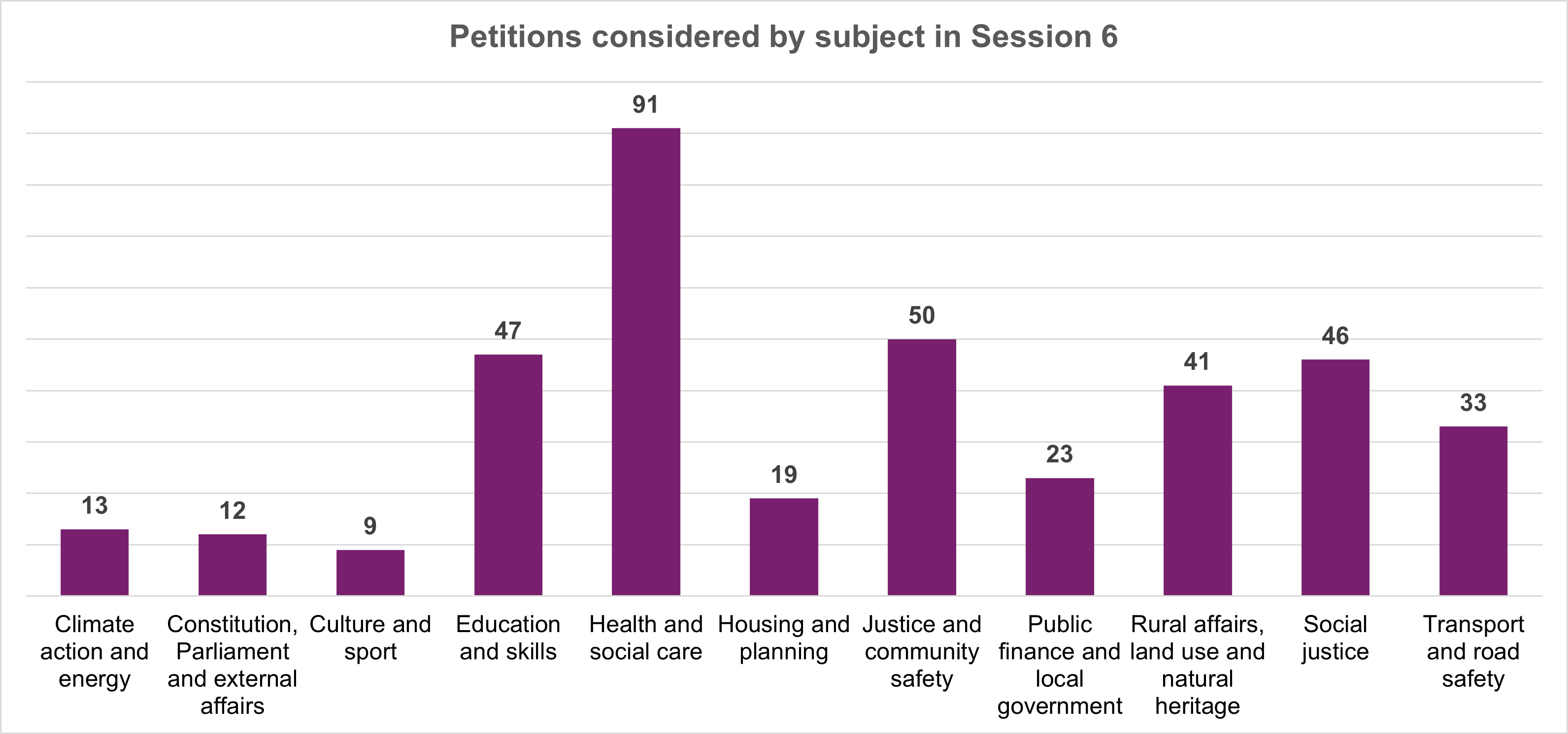
While changes to working practices make it difficult to make direct comparisons between some of the categories in the image above, one thing that is clear is that demand for petitions continues to increase. In Session 5, 250 petitions were published, compared to 344 this Session. While the continued growth of the petitions system is to be welcomed it does put more pressure on resources to ensure petitions are still properly considered and the time that petitioners spend on the process is respected. Details of some of the changes that have been introduced to better manage petitions are included later on in this report, along with suggestions for possible areas for the Session 7 Committee to consider.


Inquiries
The Committee's inquiry into public participation is discussed later in this report. This was a substantial piece of work and contributed to the Committee having limited capacity for additional inquiry work this session. While a number of petitions were treated as mini-inquires with a series of evidence sessions followed by an appearance from the relevant Minister, only one piece of petition work was formally designated as an inquiry. This was the Committee's inquiry into the A9 dualling project.
Having published our report on the dualling the A9 we concluded our work on PE1992: Dual the A9 and improve road safety. However, a number of the issues identified in our report remain of concern. It is clear to us that sustained scrutiny of the programme will be required across both Sessions 7 and 8 to prevent a repeat of the issues of the past and ensure that dualling is completed by the new date of 2035.
Working practices
The Committee has kept its working practices under review during the Session. Details of some of the changes that have been made in response to feedback and experience can be found in our annual reports.
Unlike the practice in earlier Sessions where petitioners were often invited to speak to their petitions as a matter of course it has been very rare for us to invite petitioners to speak to the Committee. We will usually have a good understanding of the issues the petitioner is concerned about through their petition and any additional evidence they have shared. Given the volume of petitions and the limited time available to the Committee we have chosen to prioritise seeking evidence on areas of uncertainty, hearing from experts on the technical aspects of petitions and raising issues directly with Ministers.
While it is important for the views of petitioners to be included in all petition considerations we recommend the Session 7 Committee continue our practice of inviting petitioners to give evidence by exception only, in order to use limited Committee time as effectively as possible.
Since the start of this Session it has been the Committee's standard practice to seek a Government response and SPICe briefing ahead of the first consideration for each petition. We recommend that the Session 7 Committee continue with this practice.
One of the improvements the Committee agreed to during this Session was the use of a proforma for Government responses. This was intended to help the Government provide responses that were helpful to the Committee and also to ensure a level of consistency and engagement with the core ask of petitions to help both the Committee and petitioners.
In general, the introduction of the proforma has resulted in more consistent and informative responses.
We are grateful to the Scottish Government for agreeing to trial the use of a proforma for petition responses. Given the success of this approach we recommend it continue into the new Session.
As every petition is considered by the Committee at least once and petitions are often kept open and considered multiple times there can be a significant wait between petition considerations. For much of this Session the gap between petition considerations was six to nine months.
Often petitions were kept open on the basis that the Scottish Government was expecting to launch or conclude relevant work or bring legislation or guidance forward. This Session petitions have largely been considered in chronological order from the date of their last consideration.
One option that the Session 7 Committee may wish to explore to manage the waiting time between petition considerations is to develop a tracker to support the Committee's work. For example, petitions where the Scottish Government has committed to undertake specific work, or has indicated that developments are due by a certain date or within a certain period, could be placed on a tracker. Those petitions would not necessarily be brought back for consideration based on the last consideration date. Instead the Committee could review progress towards work on the tracker at set intervals then decide whether to schedule the relevant petitions for their next consideration, keep them on the tracker until the next review period, invite Ministers to provide evidence regarding the delayed work, or take any other action it considers appropriate.
Communication
It is important that people can engage with the petitions system in a meaningful way. To enable this, it is helpful when petitioners have a clear understanding of what to expect from the process. An important aspect of this understanding is being clear about what the Committee can and cannot do.
Feedback from petitioners over the course of this Session shows that there are some areas where a lack of clarity or mismatch between expectation and experience persist. The main areas we have identified are:
The powers of the Committee - petitions ask either the Scottish Government or, more rarely, the Scottish Parliament, to take action. We pursue the ask of petitions as far as we feel able. This can include seeking further evidence from stakeholders, putting questions to ministers and seeking time for parliamentary debate. Ultimately, however, the Committee cannot implement the changes asked for in petitions.
Closing petitions – in line with the approach set out above the Committee will pursue the asks of a petition on behalf of the petitioners for as long as we feel able to make progress. The decision to close a petition is not necessarily a reflection of the merits of the petition or the Committee's view on the worthiness of an issue but an acknowledgement that the Committee feel we have progressed the issue as far as possible.
Gathering evidence – one of the actions the Committee can take is to seek further information. This can be either in writing or by hearing from witnesses in person. Due to the volume of work the majority of information that is gathered is in writing and in-person evidence is taken on a very small percentage of petitions.
The Session 7 Committee may wish to explore ways to explain the petitions process and its own role to petitioners. This could include a review of petition communications, both in terms of content and the media used to explain how the process and the Committee works.
As part of any work to provide clearer information about petitions, the successor Committee could also consider how it communicates petition outcomes. Petitions are often used as effective campaign tools and can have a meaningful impact on petitioners in a range of different ways even if the main ask of a petition is not taken up by the Scottish Government. The successor Committee could reflect on the purpose of the petitions process, communicate the benefits of petitioning and set out a clear vision of what outcomes people might achieve when they petition the Scottish Parliament.
Rules
One of the areas where it is especially important for any communication or explanation to be clear is when it comes to the rules for petitions. The Scottish Parliament's Standing Orders set out some rules for admissibility and also allow for the Committee to make a determination on the proper form of petitions.
The determination was updated in Session 5 and in their legacy report the Session 5 Committee recommended that it be reviewed in Session 6.
This Committee agreed updates to the determination on 12 January 2026. These changes were informed by feedback from petitioners and experience of the petitions system in Session 6. The changes to the determination aimed to update language to be clearer and more user-friendly for petitioners. This included clarifying what the requirement to take ‘previous action’ means and providing additional guidance on the Standing Order requirement for petitions to raise a matter of national policy or practice. The changes also included clarification about naming or identifying other people in a petition and advertising or endorsing a specific product.
The Session 7 Committee may wish to review the determination before the end of Session 7.
Thematic sessions
A number of petitions, while having differing specific asks, raise similar themes. During this Session we began to make greater use of identifying these themes and holding thematic evidence sessions. This approach can help to progress the aims of petitions by allowing the Committee to raise overarching issues directly with Scottish Ministers, with the Committee continuing to seek clarification or updates on specific points for individual petitions.
We have held five thematic evidence sessions over the past two years on road infrastructure, youth crime, healthcare, emergency stroke and cardiac care and energy. Some of these sessions looked at a discrete theme covering a small number of petitions while others, such as the healthcare session, covered a wide range of topics and was broken down into smaller sub-themes.
In the 2025-2026 parliamentary year thematic sessions allowed us to hear evidence relevant to 29 individual petitions. Thematic sessions have allowed the Committee to make the best use of limited time and contributed to effective scrutiny. We recommend the Session 7 Committee continues with the practice of thematic evidence sessions and seeks to further develop this approach.
Participation
At the start of this Session the remit of the Committee was expanded to also include a role “to consider and report on public policy or undertake post-legislative scrutiny through the use of deliberative democracy, Citizens’ Assemblies or other forms of participative engagement".
Early in the Session the Committee agreed to both hold an inquiry into how the Scottish Parliament should embed citizen participation (including deliberative engagement) as part of its work and hold a citizens' panel in support of this work.
The Committee published a report, Embedding Public Participation in the Work of the Parliament, in September 2023 which contained the findings from this work and set out next steps for embedding participation in the work of the Parliament. This included the proposal for two further panels, now called People's Panels, to take place before the end of the Session to inform a blueprint for deliberative democracy.
The Committee published a further report, A blueprint for participation - embedding deliberative democracy in the work of the Scottish Parliament, in May 2025. This drew on the evaluation of the panels to recommend principles for deliberative democracy and an approach to this work for Session 7. These principles and the approach were endorsed by the Parliament on 3 June 2025 when motion S6M-17733 was agreed to. The motion set out:
That the Parliament welcomes the Citizen Participation and Public Petitions Committee's 1st Report, 2025 (Session 6), A blueprint for participation - embedding deliberative democracy in the work of the Scottish Parliament (SP Paper 789), including the blueprint for this work in Session 7 with a view to making the use of such panels a regular feature of committee scrutiny from Session 7 onwards; endorses the principles for the future use of deliberative democracy that are set out in the blueprint, and acknowledges the work already being done by Parliament staff to develop and improve engagement methods.
The Committee is convinced by the evidence and experience we collected over this session that deliberative democracy can be a powerful tool to support scrutiny and that this should sit within a wider ecosystem of deliberative and participative tools and engagement approaches.
While our work on deliberative democracy was undoubtedly useful and drove forward the development of an approach to this work in Session 7 it did have an impact on the capacity the Committee had for petitions work.
Now that work on participation and deliberative democracy is moving on to a new phase of embedding it throughout the Parliament for Session 7 we believe that the remit of the Committee should return to a focus on petitions in the next session.
That is not to say that there should be no interaction between the petitions committee and the work of People's Panels. People's Panels are most effective when they look at a question that matters to people and that can benefit from a considered, non-partisan approach. In many ways, the topics and themes arising in petitions could be a useful basis for identifying Panel topics.
We recommend that the Session 7 Committee identifies those petitions or themes arising from petitions that might lend themselves to a People's Panel with a view to bidding for one of the four Panels due to take place in the next session.
Open petitions
While we have tried, wherever possible, to bring the work that we have undertaken on petitions this Session to a close there are a small number of petitions which the Committee feels would benefit from being kept open.
It will, of course, be for the Session 7 Committee to decide their own work programme but we have provided a short summary of work to date on each of the open petitions along with a recommendation for further action.
There are also a number of petitions that have been referred to subject committees and remain under consideration. At the start of this parliamentary session, the Committee considered all referred petitions as part of its first work programme discussion and agreed to refer them to the relevant subject committees. We recommend that the Session 7 Committee consider the approach for any open petitions that were referred to other committees as part of their initial work programme discussion.
PE1933: Allow the Fornethy Survivors to access Scotland's redress scheme
This petition was lodged by Iris Tinto on behalf of Fornethy Survivors Group, calling on the Scottish Parliament to urge the Scottish Government to widen access to Scotland's Redress Scheme to allow Fornethy Survivors to seek redress.
The Committee undertook extensive work on this petition throughout the parliamentary session and agreed to seek a committee chamber debate on the petition. It was not possible to hold this debate before the end of the Session.
The Committee agreed to keep the petition open on the basis that a committee debate did not take place during Session 6 as planned. Work is ongoing on this issue and the petition remains important to the Fornethy survivors. We are therefore of the view that the petition merits further consideration in the next parliamentary session.
We invite the Session 7 Committee to consider the issues raised in the petition. Given the Fornethy survivors continue to campaign for redress, the Session 7 Committee may wish to review what progress has been made on the issues raised by the petition when it comes to consider next steps. This might include pursuing the request for a Chamber debate, exploring whether to refer the petition to a Committee able to undertake substantive work on the issue of redress or seeking an updated view from the Scottish Government.
PE1979: Establish an independent inquiry and an independent national whistleblowing officer to investigate concerns about the alleged mishandling of child safeguarding enquiries by public bodies
This petition was lodged by Neil McLennan, Christine Scott, Alison Dickie, and Bill Cook, calling on the Scottish Parliament to urge the Scottish Government to launch an independent inquiry to examine: concerns that allegations about child protection, child abuse, safeguarding, and children's rights have been mishandled by public bodies, including local authorities and the General Teaching Council Scotland (GTCS); gaps in the Scottish Child Abuse Inquiry; and establish an independent national whistleblowing officer for Education and Children's Services in Scotland to handle these enquiries in the future.
The Committee considered this petition on a number of occasions between February 2023 and February 2025, including an evidence session on 4 October 2023. On 25 February 2026, the Committee agreed to keep the petition open as it considered that a number of issues underpinning the petition remain current and have not been fully addressed by the Scottish Government.
We invite the Session 7 Committee to consider this petition further and to rigorously pursue the most appropriate means to progress its aims. This could include consideration of whether referring the petition could be appropriate if other committees are undertaking relevant work which would allow substantive scrutiny of the issues.
PE2099: Stop the proposed centralisation of specialist neonatal units in NHS Scotland
This petition was lodged by Lynne McRitchie, calling on the Scottish Parliament to urge the Scottish Government to stop the planned downgrading of established and high-performing specialist neonatal intensive care services across NHS Scotland from a level three to a level two and to commission an independent review of this decision in light of contradictory expert opinions on centralising services.
The Committee undertook extensive work on this petition, including two oral evidence sessions and a visit to University Hospital Wishaw’s neonatal intensive care unit. As a result of this work, the Committee wrote a substantive letter to the Minister for Public Health and Women’s Health to highlight outstanding questions and concerns regarding the new model of neonatal care. Despite the Minister’s response to the Committee, work is still underway on financial modelling, there are ongoing concerns about capacity in NHS Grampian and it remains unclear what additional support will be provided to families impacted by the new model.
As the implementation of the new model will take place in the next parliamentary session, we are of the view that the issues merit further consideration. We invite the Session 7 Committee to consider the issues raised in the petition. Given the significant ongoing work on this issue, the Session 7 Committee may wish to review what progress has been made on the outstanding issues set out in our letter to the Minister.
PE2161: Extend the time period for complaints through the Scottish Public Services Ombudsman for neurodivergent people to two years
This petition was lodged by Ivor Roderick Bisset, calling on the Scottish Parliament to urge the Scottish Government to amend the Scottish Public Services Ombudsman Act 2002 to allow for a two-year complaints period for people with cognitive disabilities.
Given the limited time remaining in the parliamentary session, the Committee was unable to progress the petition beyond two considerations. Given the responses received to date from the Scottish Government and the Scottish Public Services Ombudsman did not address the core concerns raised in the petition, we believe the issues raised merit further consideration in the next parliamentary session.
We invite the Session 7 Committee to consider the issues raised in the petition. The Committee may wish to receive further evidence from the SPSO, either in writing or in person, in order to inform its actions on the petition.
PE2202: Stop the Guga Hunt
This petition was lodged by Rachel Bigsby, calling on the Scottish Parliament to urge the Scottish Government to amend Section 16 of the Wildlife and Countryside Act 1981 to remove the power to grant licences for taking Gannets on Sula Sgeir.
This petition received two considerations on 21 January 2026 and 11 March 2026. Given the limited time remaining in the parliamentary session, the Committee was unable to undertake further work. In recognition of the issues raised in the petition and the significant public interest in this petition, with over 95,000 signatures at the time of writing, we agreed to keep the petition open.
We invite the Session 7 Committee to consider the issues raised in the petition. We also recommend that any work to explore the issues raised in the petition should consider a range of views, ensuring the voices of islanders are heard.
Conclusion
The Scottish Parliament's petition system allows anyone to raise an issue of national importance and have their concerns considered. This Session we have seen people use petitions to make real progress on the issues that matter to them. From securing a legislative change to support Scottish falconry, to prompting the Government to launch a rapid review of access to controlled medication in custody and commit to ongoing oversight to getting support for a targeted campaign to tackle vehicle littering, petitions can and do lead to change. Even where the ultimate aim of the petition is not achieved our system gives people a voice at the heart of the Scottish Parliament and a chance to raise awareness about their concerns.
We urge the Session 7 Committee to embrace their role as the voice of petitioners and ensure that the Scottish Parliament's petition system continues to be a powerful tool for accountability and scrutiny.