Marine and Fisheries: Subject Profile Session 7
This briefing is written for the benefit of both new MSPs and those returning to the Parliament. It provides an overview of the main issues related to fisheries and the marine environment. It highlights the main legislation and policy developments in previous parliamentary sessions, and potential future developments. More detailed briefings on related topics will be produced throughout the parliamentary session. (Cover image by Jason Reid).
Scope of the briefing
This briefing aims to summarise how the marine environment in Scotland is governed and protected, and to summarise legislation, policy and topical issues in respect of fisheries (including sea fisheries and freshwater fisheries), aquaculture, and marine planning.
It is recognised that there are a range of other marine industries, in particular energy industries, which are not covered in detail by this briefing.
Scotland's seas and boundaries
Scotland’s seas are one of our greatest shared national assets. Almost six times greater than our land area, they are home to extraordinary biodiversity, with marine industriesi supporting a 'Blue Economy' contributing around 3% of the overall Scottish economy (GVA: £5.6 billion) and approximately 2.9% of total Scottish employment.1
However, Scotland's seas are under pressure – from the growing and sometimes competing demands we place upon them, from climate change and from environmental degradation. Balancing competing demands on Scotland's marine resources while protecting Scotland's diverse marine environment is a significant challenge.
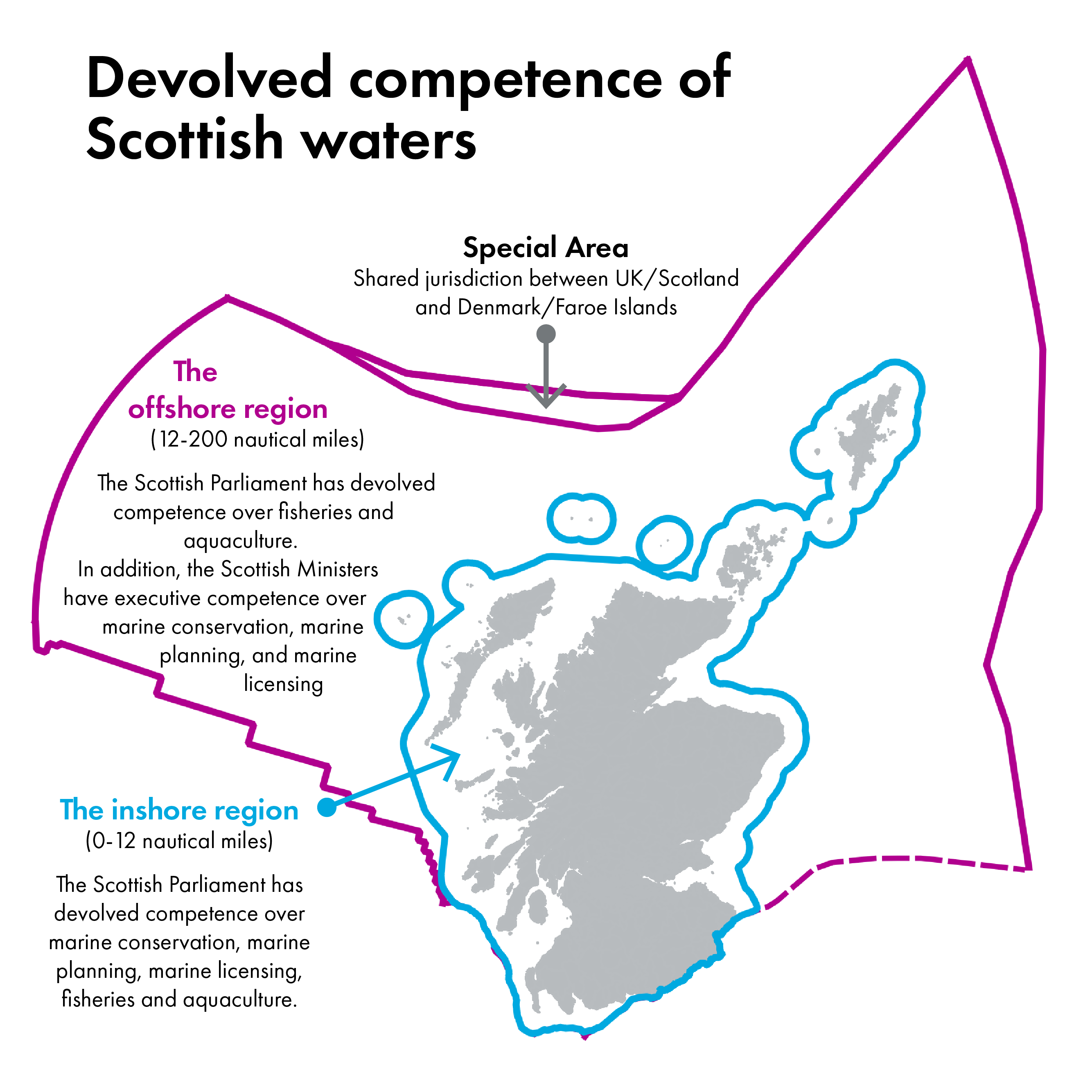
Scotland's seas and boundaries are shown in the map in figure 1 below. Responsibility for the governance and management of Scottish waters is complex and involves a mixture of devolved and reserved competence. Different areas of the seas are governed by different regulations with regards to marine protection measures and the management of commercial fishing and fishing access rights.
Source: SPICe
6 nautical miles - UK vessels have exclusive rights to fish within six nautical miles of territorial baselines. (This is also referred to as 'Scottish Inshore Waters' under the Inshore Fishing (Scotland) Act 1984).
Up to 12 nautical miles - inshore region (the territorial limit) – Scottish Territorial Seas Boundary. The Scottish Parliament has legislative competence for marine environment and planning matters within the Scottish inshore region.
12-200 nautical miles (offshore waters) – Scottish Fisheries Limits and subject to access requirements provided by the Fisheries Act 2020. This is also referred to as the 'Exclusive Economic Zone' (EEZ). The Scottish Parliament does not generally have legislative competence for the offshore region (12-200 nautical miles). There are some exceptions to this general rule, for example the regulation of sea fishing or some marine licence matters such as the issuing of licences for deep sea bed mining. Marine planning for offshore waters is 'executively devolved' to Scottish Ministers.
Governance and responsibilities
Table 1 below sets out key regulatory and delivery functions of public bodies (including Scottish public bodies and UK-wide bodies acting in Scotland) as they relate to the marine environment and fisheries in Scotland.
| Body | Type of body | Key functions and roles in relation to the marine environment and fisheries |
| Marine Directorate | Directorate of the Scottish Government | The Marine Directorate is responsible for the integrated management of Scotland's seas. The Directorate's responsibilities include:
|
| Fish Health Inspectorate | Regulatory body within the Scottish Government Marine Directorate. Fish health inspectors are appointed by Scottish Ministers under the aquaculture and aquatic animal health regulations. |
|
| Animal and Plant Health Agency (APHA) | Executive Agency of the UK Government Department for Environment, Food & Rural Affairs (DEFRA) acting in Scotland on behalf of the Scottish Government. |
|
| Scottish Environmental Protection Agency (SEPA) | Executive non-departmental public body |
|
| Marine Management Organisation | Executive non-departmental public body of the UK Government Department for Environment, Food and Rural Affairs (DEFRA) |
|
| Crown Estate Scotland | Public corporation |
|
| Maritime and Coastguard Agency | Executive agency of the UK Government Department for Transport. |
|
| Police Scotland | Devolved public body |
|
| Local Authorities | Scottish local government |
|
| NatureScot | Executive non-departmental public body | Provides nature conservation advice for:
|
| Joint Nature and Conservation Committee (JNCC) | Executive non-departmental public body | As above but for offshore waters (12-200 nautical miles). Some functions are delegated to NatureScot such as statutory advice for offshore wind developments. |
| 39 District Salmon Fishery Boards (DSFBs) and River Tweed Commission | Statutory owner-led local salmon fishery management bodies | Constituted and governed under the Salmon and Freshwater Fisheries (Consolidation) (Scotland) Act 2003. The cross-border River Tweed Commission operates under The Scotland Act 1998 (River Tweed) Order 2006.Both DSFBs and the River Tweed Commission have powers and duties to protect and improve salmon and sea trout fisheries within their legally-defined salmon fishery districts. |
| Food Standards Scotland (FSS) | Non-Ministerial Office |
|
| Environmental Standards Scotland (ESS) | Non-Ministerial Office |
|
UK Marine Strategy and Good Environmental Status
The UK Marine Strategy Regulations 2010 require the UK Government and devolved governments to take the necessary measures to achieve or maintain ‘Good Environmental Status’ (GES) "of marine waters in the UK marine strategy area" i.e. all marine waters under UK jurisdiction.
This is pursued through the development and implementation of the UK Marine Strategy (UKMS), which sets out the shared commitments of the four governments of the UK to work together to monitor, protect and manage some of the most biologically diverse and productive seas in Europe.
Achieving GES involves balancing the protection, restoration and recovery of the marine environment with the continued sustainable use of marine resources. Under the Marine Strategy Regulations 2010, the UK Secretary of State, and the devolved governments were under a duty to put the necessary measures in place to achieve or maintain GES of marine waters within the marine strategy area by the deadline of 31 December 2020. GES was not achieved across descriptors within that initial timeframe.
The UKMS operates on an ongoing basis through a three-part cycle, renewed every six years, to support the achievement of GES in UK seas:
Part One (assessments)
Part Two (monitoring programmes)
Part Three (measures)
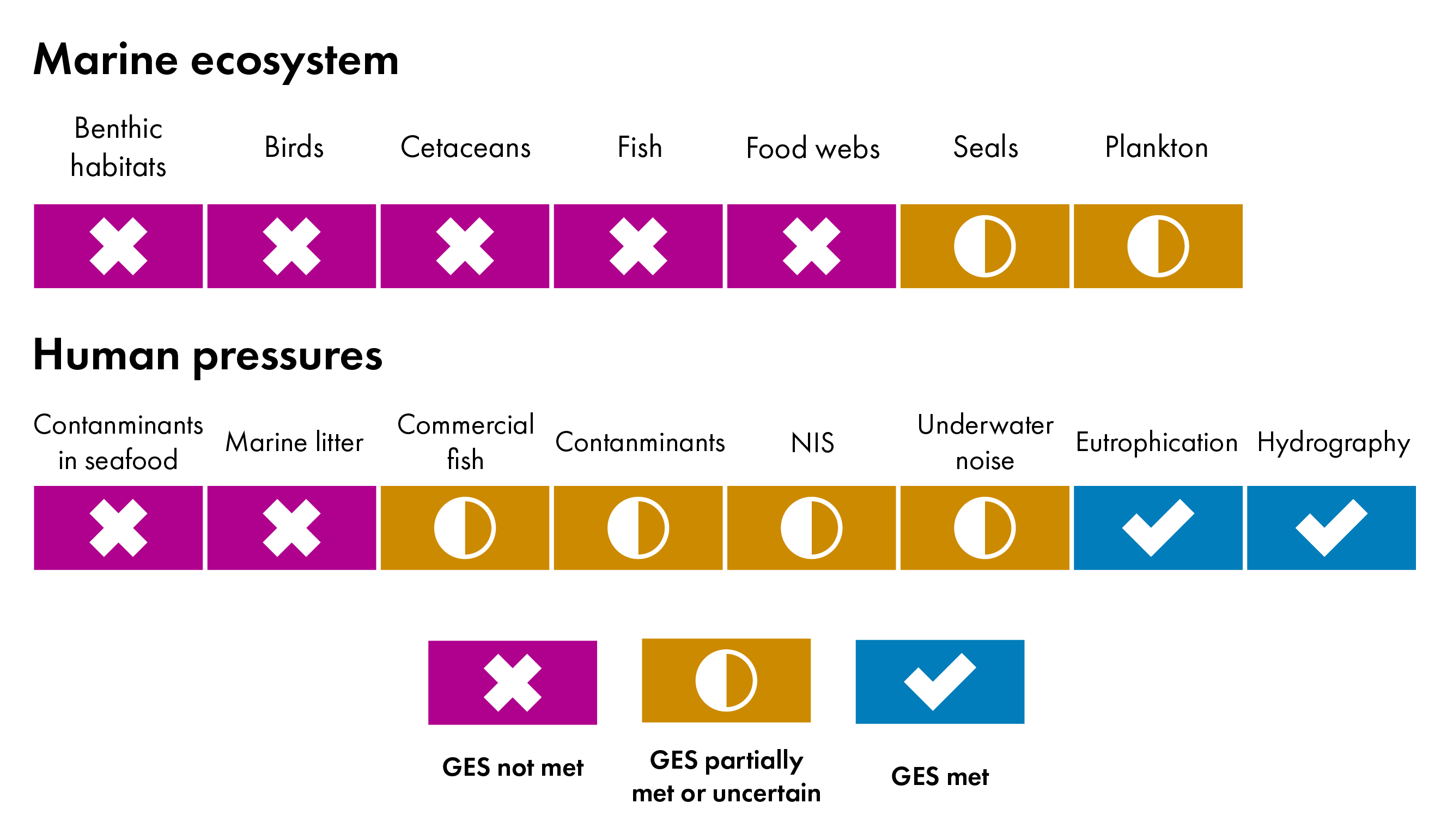
The Strategy is structured around 11 elements, known as descriptors. Figure 2 below shows the most recent 2026 assessment of GES in UK waters for all 11 descriptors. The figure also shows the status for assessments within the biodiversity descriptor (for seals, cetaceans, fish, birds, pelagic and benthic habitats). GES has been achieved in only two descriptors, representing a decline from the 2018 assessment, when four descriptors met GES.
Source: SPICe, adapted from UK Marine strategy part one: 2026 update
In January 2025, the Office for Environmental Protection (OEP, the environmental law watchdog for England and Northern Ireland) launched an investigation into the UK Government's potential failures to comply with the legal requirements to implement necessary measures for achieving or maintaining GES in UK marine waters.1
In August 2025, the OEP and Environmental Standards Scotland (ESS, equivalent public body covering Scotland) also separately identified shortcomings in the 2026 Part One UK Marine assessment.23 Issues raised included:
Lack of methodological consistency and transparency: Multiple methods are used to aggregate indicator assessments into GES ratings, which obscures how assessments have been conducted and makes progress difficult to gauge. There is poor justification for changes to the assessment methodology and presentation of results, including incorrect claims that the approach aligns with the EU in relation to threshold values for GES.
Data gaps and inconsistent handling: Data gaps, and an inconsistent approach to addressing them, create a fragmented and potentially misleading picture of progress, undermining the credibility, comparability, and robustness of the overall assessment.
Targets not SMART: None of the proposed overarching or criteria targets are entirely SMART (Specific, Measurable, Achievable, Relevant, and Time-bound). Most lack specificity and none are time-bound.
In June 2026, ESS published an analytical report which concluded that Scottish Ministers have been both non-compliant and ineffective in fulfilling legal duties under the Marine Strategy Regulations 2010 in relation to the protection and restoration of the seafloor.4 Key findings included:
Monitoring programmes lack sufficient data to assess seafloor status across Scotland's marine regions, despite this being a statutory requirement, resulting in non-compliance with the regulations.
Fundamental steps had not been taken to develop and implement an effective Programme of Measures (PoM), which is essential for achieving GES, resulting in ineffective implementation of environmental law.
Fragmented responsibilities, weak accountability, delays with putting measures into practice and poor integration of marine objectives across policy areas, had all undermined delivery of GES for seafloor integrity.
The Scottish Biodiversity Delivery Plan (2024-2030) includes a commitment to "Work with stakeholders to focus on identifying practical, achievable actions to reduce pressure on seafloor habitats most at risk or most extensively impacted informed as appropriate by the development of an OSPAR Regional Action Plan on benthic shelf habitats", with an expected delivery date in 2027.5
Further reading:
International obligations and EU alignment
While negotiating and entering into international treaties is reserved to the UK Government, implementing and complying with those agreements in devolved areas is the responsibility of the Scottish Government.
Many aspects of Scotland's marine and environmental legislation originate from European Union (EU) directives that applied when the UK was an EU Member State and now form part of assimilated law (previously called 'retained EU law'). Examples include the concept of 'Good Environmental Status', derived from the Marine Strategy Framework Directive, protection of coastal waters in the Water Framework Directive, and framework for protected sites and species established through the Birds and Habitats Directives.
The Scottish Government has committed to maintaining alignment with EU standards where this is considered "possible and meaningful".1
A number of international agreements are particularly important for the protection of Scotland's marine environment and the sustainable management of marine resources.
The United Nations Convention on the Law of the Sea (UNCLOS)
The 1982 United Nations Convention on the Law of the Sea (UNCLOS) defines the rights and responsibilities of coastal states, including the UK, in managing marine resources within their Exclusive Economic Zone (EEZ) i.e. up to 200 nautical miles from the coast.
For fish stocks located entirely within a state's EEZ, UNCLOS grants exclusive rights over conservation and management measures, including setting Total Allowable Catches (TACs). Decisions must be based on the best available scientific evidence and ensure stocks are not overexploited.
Many fish stocks of commercial interest move across international boundaries (so-called shared stocks). The UK and EU are estimated to share more than 100 fish stocks, some of which also extend into international waters. UNCLOS therefore requires states to cooperate on the management of shared stocks, typically through annual negotiations.
These negotiations involve the UK, the EU and other coastal states such as Norway, Iceland and the Faroe Islands. The UK Secretary of State is responsible for negotiating for the UK as an independent coastal state, with input from the Scottish Government and Scottish fishing industry representatives. More detail on fisheries governance is available in a SPICe briefing on fisheries governance after Brexit.2
The OSPAR Convention
The 1992 OSPAR Convention (The Convention for the Protection of the Marine Environment of the North-East Atlantic) provides the framework for cooperation between governments to protect the marine environment of the North-East Atlantic. It covers issues including pollution, waste disposal at sea, biodiversity and ecosystem protection.3
The OSPAR North-East Atlantic Environment Strategy 2030 (adopted on 1 October 2021) sets out collective objectives to 2030.4 The Strategy states that there is clear evidence that "the health of the ocean, including the North-East Atlantic, is at risk and that urgent action is needed to address the loss of biodiversity and the functioning of the marine ecosystems". It identifies a range of pressures on the marine environment, including:
Pollution and marine litter, including microplastics
Eutrophication
Overexploitation of living and non-living marine resources
Incidental bycatch
Non-native species
Underwater noise
Seabed damage
Climate change and ocean acidification
The United Nations Global Biodiversity Framework
The Global Biodiversity Framework (GBF), agreed in 2022 under the UN Convention on Biological Diversity5, establishes the international framework for tackling biodiversity loss. It includes four goals and 23 targets to be achieved by 2030. Most of the targets are relevant to the marine environment. A selection of the GBF targets are listed in the box below.
Selection of UN Global Biodiversity Framework targets
Target 1: Ensure that all areas are under participatory integrated biodiversity inclusive spatial planning and/or effective management processes addressing land and sea use change.
Target 2: Ensure that by 2030 at least 30% of areas of degraded terrestrial, inland water, and marine and coastal ecosystems are under effective restoration, in order to enhance biodiversity and ecosystem functions and services, ecological integrity and connectivity.
Target 3: Ensure that by 2030 at least 30% of terrestrial and inland water areas, and of marine and coastal areas, especially areas of particular importance for biodiversity and ecosystem functions and services, are effectively conserved and managed through ecologically representative, well-connected and equitably governed systems of protected areas and other effective area-based conservation measures (often referred to as the '30 by 30' target).
Target 5: Ensure that the use, harvesting and trade of wild species is sustainable, safe and legal, preventing overexploitation, minimising impacts on non-target species and ecosystems.
Target 8: Minimise the impact of climate change and ocean acidification on biodiversity.
Target 10: Ensure that areas under agriculture, aquaculture, fisheries and forestry are managed sustainably, in particular through the sustainable use of biodiversity, including through a substantial increase of the application of biodiversity friendly practices.
The Convention on the Conservation of European Wildlife and Natural Habitats (Bern Convention)
The Bern Convention aims to ensure the conservation and protection of plant and animal species and their habitats on the European continent and some African states. EU Member states contribute to the Bern Convention's 'Emerald Network' of protected sites through sites designated under the Birds and Habitats Directives. The UK Government has made a commitment that UK sites which were formerly part of the EU's Natura 2000 Network will continue as the UK’s contribution to the Emerald network.6
The Biodiversity Beyond National Jurisdiction (BBNJ) Agreement
Under UNCLOS (see above) the Agreement on the Conservation and Sustainable Use of Marine Biological Diversity of Areas Beyond National Jurisdiction, commonly known as the BBNJ Agreement or 'High Seas Treaty', aims to ensure the conservation and sustainable use of marine biological diversity in Areas Beyond National Jurisdiction (ABNJ).7
The agreement establishes frameworks for:
Environmental impact assessments (EIAs) for activities in ABNJ;
Governance of marine genetic resources aiming to ensure equitable sharing of benefits;
Area-based management tools (ABMTs), including marine protected areas;
Capacity-building and the transfer of marine technology.
The UK Biodiversity Beyond National Jurisdiction Act 2026 provides the framework for implementing the agreement across the UK and includes powers for Scottish Ministers, explained in more detail in Legislative Consent Memorandums. In general, implementation falls within devolved competence where measures apply "in or as regards Scotland".8
In 2026, The Marine Licensing (Miscellaneous Amendment) (Scotland) Order 2026 updated the licensing powers of Scotland's Marine Directorate to enable compliance with EIA requirements for activities beyond national jurisdiction that may cause substantial pollution or environmental harm, applying when undertaken or controlled by 'Scottish persons'. Implementation of the agreement remains at an early stage. The UK Government ratified the agreement on 10 July 2026.
Further reading:
The Marine Acts
Marine planning in Scotland's inshore waters (out to 12 nautical miles) and offshore waters (12 to 200 nautical miles) is governed by the Marine (Scotland) Act 2010, an Act of the Scottish Parliament and by the UK Marine and Coastal Access Act 2009, an Act of the UK Parliament, respectively. The two Acts (referred to as the Marine Acts) establish a framework for marine planning and management enabling the sustainable use and protection of Scotland's marine environment.
Marine Assessments
Under the Marine (Scotland) Act 2010, Scottish Ministers are required to prepare an assessment of the condition of the Scottish marine area to inform the National Marine Plan, or a Scottish Marine Region to inform Regional Marine Plans (See following sections).
These assessments have been carried out by a partnership of academic research institutes and public bodies1 and provide an evidence base on the state of Scotland's seas and of the main activities and pressures on Scotland's marine environment. They are required prior to the development and review of the National Marine Plan and Regional Marine Plans.
The Scottish Government published the first marine assessment - known as 'Scotland's Marine Atlas' in 2011.2 The most recent Scottish Marine Assessment was published in December 2020.3
Key findings of the Scottish Marine Assessment 2020 included:
Progress is being made in relation to contaminants.
There are increasing pressures associated with non-indigenous species.
Many marine industries such as offshore wind and marine energy (wave and tidal) are of growing importance to the Scottish economy.
Climate change is the most critical factor affecting Scotland's marine environment.
Pressures associated with bottom-contacting and pelagic fishing continue to be the most geographically widespread.
The 2020 Scottish Marine Assessment committed to various next steps including to:
Take an "ecosystem-based approach" to reviewing Scotland’s National Marine Plan, recognising that as the environment becomes more unpredictable with increasing impacts from climate change, the resilience of ecosystems will change, and taking account of such changes when developing marine management measures "will be integral".
Improve predictions of climate change impacts, noting climate change is already resulting in changes in the seas, and the pace of change is predicted to increase.
Assess cumulative pressures, recognising Scotland’s seas are subject to multiple pressures.
Improve understanding of natural capital and ecosystem services.
Improve the availability of data, with "enhanced efforts" to capture relevant data and
Undertake sustained monitoring and investigative research to explain change.
Further reading
Scottish Marine Assessment 2020 (December 2020)
National Marine Plan
Scotland's first statutory National Marine Plan (NMP) 1 was published in March 2015. It covers both Scottish inshore waters (out to 12 nautical miles) - as required by the Marine (Scotland) Act 2010 - and offshore waters (12 to 200 nautical miles) - as required by the UK Marine and Coastal Access Act 2009.
The Marine and Coastal Access Act 2009 introduced a new system of marine management including a new system for marine plans which should set out in more detail what is to happen in the different parts of the areas to which they relate.
The Marine (Scotland) Act 2010 established a new system of marine planning specifically for Scotland, with part 3 of the 2010 Act requiring Scottish Ministers to prepare and adopt a National Marine Plan.
Under section 15 of the Marine (Scotland) Act 2010, public authorities have certain duties in relation to marine plans and how they are to be taken into account in decision making.
Marine planning aims to promote the sustainable development of marine areas and the sustainable use of marine resources by managing competing demands. For example it may seek to set out policies or objectives in relation to:
Fishing
Aquaculture
Marine renewable energy
Offshore Oil and Gas
Marine tourism and recreation.
The Marine Acts set out that the Scottish Government may publish a single plan to meet the requirements of UK and Scottish legislation. The NMP is required to be compatible with the UK Marine Policy Statement.2
The purpose of the NMP is to set out strategic policies for the sustainable development of Scotland's marine resources out to 200 nautical miles.
It also provides a strategic framework for marine licensing decisions.3 Public authorities must take authorisation or enforcement decisions in accordance with the NMP and must also have regard to the Plan in taking other decisions if they impact on the marine area. This includes for example:
Marine licensing e.g. dredging, construction works, developments, deposits and removals from the seabed.
Commercial fishing licences.
Aquaculture development consents.
Ports and harbours - marine licence applications by Harbour Authorities.
Legislation requires regular reviews of the NMP which the Scottish Government undertakes every three years. Ministers must consider the review report and then decide whether to replace or amend the Plan. The 2021 statutory review4 highlighted significant national and global developments that impacted on the management of marine resources since the 2015 NMP such as:
The UK's exit from the EU.
The Global Climate Emergency and legal net zero target for 2045.
The Covid-19 pandemic.
The 2021 review stated:
Our assessment found that there is a clear need to begin work to replace [the National Marine Plan].
Scottish Ministers committed to start developing a second statutory national marine plan (NMP2) in the 2022 to 2023 Programme for Government.5
Initial steps towards developing NMP2 included a 'stakeholder engagement strategy and statement of public participation'6 (a requirement of the Act, published August 2024) and consultation on a 'planning position statement' (5 November 2024 to 7 February 2025).7
A consultation analysis and Scottish Government response was published in August 20258, in which the Scottish Government sought to reassure environmental stakeholders, some of which had raised concerns that the planning position statement indicated environmental protections may be weakened in NMP2. The consultation on a draft NMP2 originally anticipated in winter 2025 was postponed. The Scottish Government has stated this is "to allow for further consideration of both the feedback received, and our intended approach to the draft NMP2".9
Regional Marine Plans
The Marine (Scotland) Act 2010 also allows for the development of Regional Marine Plans. However, unlike the National Marine Plan, they are optional as there is no legal duty to develop them. Regional Marine Plans are intended to support local ownership and decision making, where appropriate and to implement the aims and objectives of the National Marine Plan, taking into account local environmental and socio-economic circumstances.
Scottish Ministers can delegate powers to develop Regional Marine Plans under the Marine (Scotland) Act 2010 to either a local authority alone (in certain areas) or a Marine Planning Partnership (MPP) of different actors, which could include the local authority.
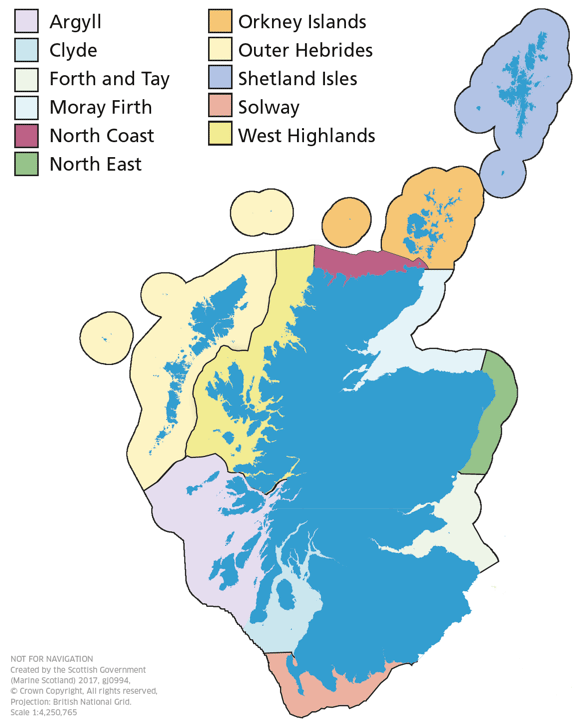
There are 11 Scottish Marine Regions designated for the purposes of marine planning. The marine regions were established by secondary legislation under the Marine (Scotland) Act 2010 in 2015. Regional Marine Plans can be developed for any of the 11 Scottish Marine Regions. The Scottish Marine Regions are shown in figure 3 below.
Source: Scottish Government
So far, three marine regions have received delegated powers to develop Regional Marine Plans:
The Shetland Islands Marine Planning Partnership (Shetland UHI and Shetland Islands Council, established in March 2016)
The Clyde Marine Planning Partnership (currently made up of 24 stakeholders established in March 2017)
The Orkney Islands Council (established as the sole delegate in September 2020)
In December 2025, the Shetland Islands Regional Marine Plan1 became officially adopted by Scottish Ministers as Scotland's first statutory Regional Marine Plan shortly followed by the Orkney Islands Regional Marine Plan in February 2026.2
The Clyde Marine Planning Partnership is developing a draft Regional Marine Plan, but this has yet to be subject to public consultation or be approved by Scottish Ministers.
In Session 5, the Environment, Climate Change and Land Reform (ECCLR) Committee undertook an inquiry into progress in regional marine planning. The Committee published its final report on 17 December 2020.3 Key findings of the inquiry included:
There had been slow progress in establishing Marine Planning Partnerships.
There had been a lack of guidance from central government.
A lack of clarity in decision making processes which had led to a breakdown in trust between stakeholders and had a detrimental impact on collaborative working.
A lack of finance, resources and expertise was available for regional marine planning.
The Committee also emphasised that regional marine planning has the potential to be a key driver in delivering a Green Recovery (from the COVID-19 pandemic) and sustainable economic growth in Scotland's coastal communities.
The Scottish Government responded to the ECCLR report in July 2023.4 The response stated that there would be no further Marine Planning Partnerships established until the second National Marine Plan is adopted, with the exception of the Outer Hebrides where early work had already commenced.
Further reading:
Sectoral Marine Plans
The National Marine Plan sets out that in the marine environment, planning for offshore renewable energy will be progressed under both the NMP and via "Sectoral Marine Plans for Offshore Wind, Wave and Tidal Energy" which will "contain Scottish Government policies, including their spatial strategy, to steer commercial scale offshore renewable energy development".
The Scottish Offshore Wind Energy Policy Statement (OWPS)1 set out the Scottish Government's ambition to capitalise on the potential of offshore wind development and the role it could play in meeting the net zero target. The OWPS set a target of 8 to 11 gigawatts of offshore wind generation capacity by 2030.
The Scottish Government subsequently published a Sectoral Marine Plan for offshore wind in 2020.2Draft sectoral plans for wave and tidal energy3 were also published in 2013 but were never formally adopted.
The Sectoral Marine Plan for offshore wind aimed to identify sustainable plan options for the future development of commercial-scale offshore wind energy in Scotland, including deep water wind technologies, and covers both Scottish inshore and offshore waters. The plan identified 15 Plan Options, split across four regions considered capable of generating several gigawatts of renewable energy.
2025 consultation on revised Sectoral Marine Plan for Offshore Wind
The Scottish Government consulted on a draft revised Sectoral Marine Plan for Offshore Wind in May 2025,4 stating that since the publication of the 2020 Sectoral Plan, "significant ambition has been shown" through subsequent leasing rounds (ScotWind5 and the Innovation and Targeted Oil and Gas leasing round6) and "Scotland now has an ambitious pipeline of potential development over the next decade", requiring the Plan to be updated.
The total generation capacity considered by the draft updated Plan and associated assessments is 37.4 GW across 32 Option Areas.
Maps of the Plan Options under the 2020 Sectoral Plan7, and refined Option Areas (OAs) within those Plan Options set out in the draft 2025 Sectoral Plan are available on the Scottish Government's marine open data network.
Marine protection and enhancement
Scotland's Environment Strategy (2026) states:
While Scotland's seas remain rich, trends point to declining biodiversity and habitat degradation. For example, habitats such as seagrass and maerl beds have reduced in extent and condition, and populations of several species of seabird have fallen significantly since the 1980s. Similar trends are seen across the Northeast Atlantic. Key pressures include climate change, fishing, seabed disturbance, pollution, invasive non-native species and emerging pressures from marine renewables and other development.
Scottish Government. (2026, March 24). The Environment Strategy for Scotland. Retrieved from https://www.gov.scot/publications/environment-strategy-scotland/ [accessed 30 September 2026]
It also sets out that Scotland's seas are affected by global changes including ocean acidification (caused by increased carbon dioxide in the atmosphere), disruptions to nutrient cycles (due to increasing flows of nutrient into the oceans e.g. from agriculture, aquaculture and sewage), and marine litter (noting concern over the implications of microplastics for human health).
More information on pressures on the marine environment in Scotland is set out in sections above on indicators for Good Environmental Status (GES) and the 2020 Scottish Marine Assessment.
The State of Nature Scotland report (2023) also summarises evidence on pressures on the marine environment2. It sets out that:
Scotland’s breeding seabirds ("of international importance") showed an average decline of 49% between 1986 and 2019, with "precipitous declines" in some species, influenced by climate change and changes in fish populations. The report also notes the likely significant impact of outbreaks of Highly Pathogenic Avian Influenza (bird flu). (More recent data on seabird decline is now available on the NatureScot website - which also sets out that on average, seabird numbers are now around half of what they were in the 1980s).3
Average abundance of demersal fish species (species that inhabit or are caught near the sea bed) in both the Celtic Seas and Greater North Sea increased in the early years of the 21st century but has since declined towards pre-2000 levels. The proportion of stocks of fish and shellfish harvested sustainably (below the maximum sustainable yield) has more than doubled since 1991, with the latest estimate being 69% in 2019. However, some fish stocks remain in a poor state.
The reduction in the abundance of commercially caught fish has meant significant changes to ecosystems. Overfishing and fishing methods that damage benthic (seafloor) habitats have been major drivers of biodiversity loss.
Invasive non-native species (INNS) continue to spread and increase in marine environments, and constitute a major threat on islands used by breeding seabirds.
Marine protection and enhancement duties (2010 Act)
Sections 3 and 4 of the Marine (Scotland) Act 2010 require that when exercising powers under the Act, Scottish Ministers and other public authorities must (emphasis added):
act in the way best calculated to further the achievement of sustainable development, including the protection and, where appropriate, enhancement of the health of that area, so far as is consistent with the proper exercise of that function
And -
act in the way best calculated to mitigate, and adapt to, climate change so far as is consistent with the purpose of the function concerned.
More specific requirements and policies for marine conservation and enhancement fall under the setting out and implementation of the National Marine Plan and Nature Conservation Marine Protected Areas (MPAs).
Marine Protected Areas and Priority Marine Features
Marine Protected Areas (MPAs) are a key mechanism in Scotland intended to conserve marine biodiversity and help Scotland achieve its international commitments in this area.
The Scottish MPA network is underpinned by a variety of legislation depending on whether the site is located in the inshore or offshore region, and the types of features they protect.
There are several types of MPAs which make up Scotland's MPA network across over 240 sites, which can be designated based on powers set out in the Marine Acts (see above) or other environmental legislation .
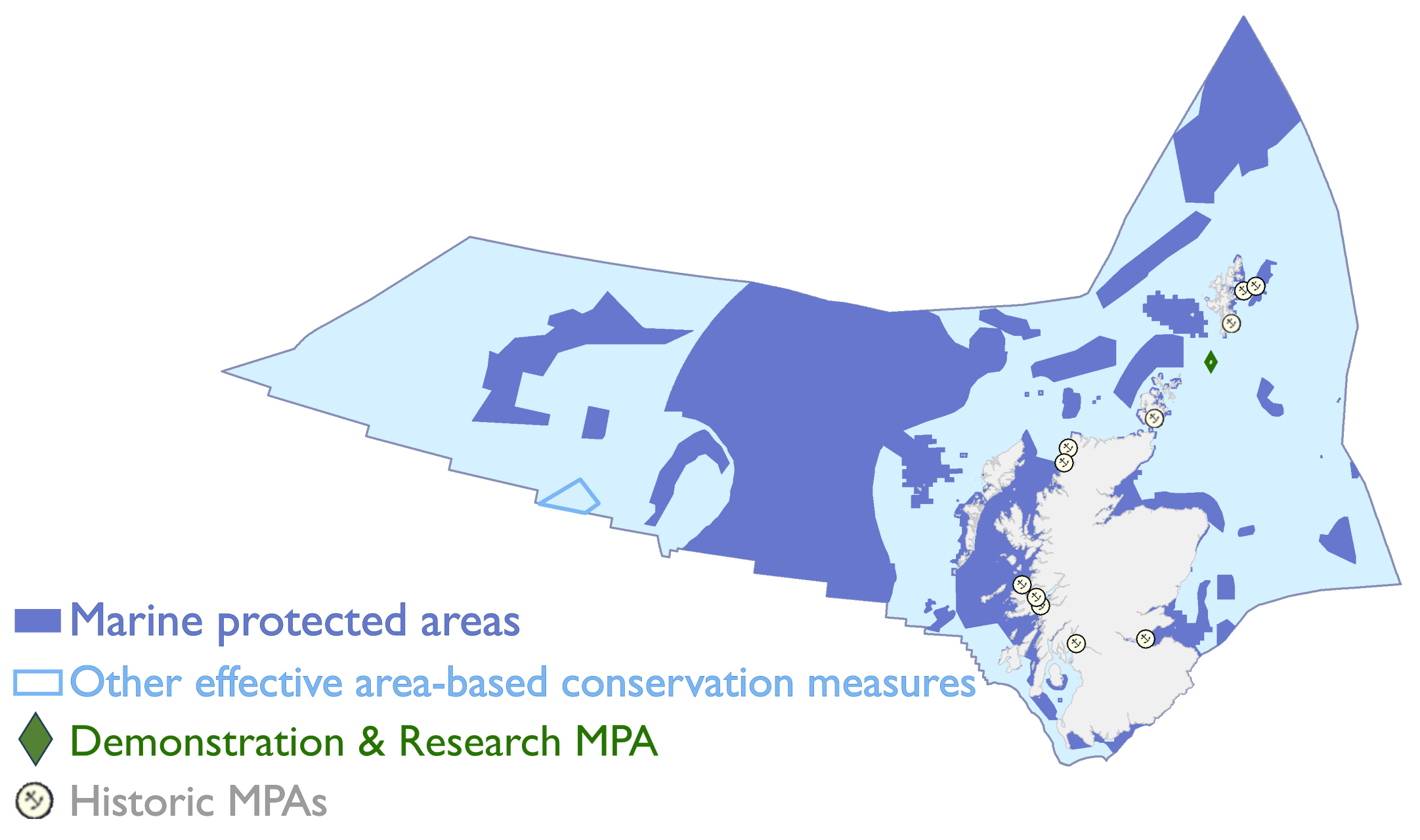
The MPA network (set out on the Scottish Government website as of August 2025)1 is made up of:
65 Sites of Special Scientific Interest (SSSIs)
58 Special Areas of Conservation (SACs)
58 Special Protection Areas (SPAs)
36 Nature Conservation MPAs (NCMPAs)
16 Ramsar sites
10 Historic MPAs
one other effective area-based conservation measure
one demonstration and research MPA
The site selection and designation process depends on the type of MPA and underpinning legislation.
Nature Conservation Marine Protected Areas (NCMPAs)
NCMPAs are sites within the marine environment designated under sections 67 and 68 of the Marine (Scotland) Act 2010. They are intended to conserve marine biodiversity and protect vulnerable species, habitats and geological features. NCMPAs are selected in accordance with MPA Selection Guidelines2 and are assigned site-specific conservation objectives. NatureScot and the Joint Nature Conservation Committee (JNCC) provide advice on site selection and management.
Historic Marine Protected Areas
HMPAs are designated under Section 67 of the Marine (Scotland) Act 2010 to protect marine historic assets of national importance e.g historic shipwrecks, within Scottish territorial waters (out to 12 miles offshore). Historic Environment Scotland provides advice to the Scottish Government on designation of HMPAs and advises on their management.
Demonstration and Research Marine Protected Areas
Demonstration and Research MPAs are designated by Scottish Ministers under section 67 of the Marine (Scotland) Act 2010. Sites can be established for the purpose of demonstrating, or carrying out research on sustainable methods of marine management or exploitation in Scottish territorial waters. Their application is not restricted to nature conservation.
European sites: Special Areas of Conservation (SACs) and Special Protection Areas (SPAs)
SACs protect habitats and species listed in Annexes I and II of the EU Habitats Directive. SPAs are designated to protect rare, threatened and vulnerable bird species listed in Annex I of the EU Birds Directive, as well as regularly occurring migratory bird species. SPAs are selected using the UK SPA Selection Guidelines.
Following the UK's departure from the EU, the requirements of the Birds and Habitats Directive were retained in domestic legislation. SPAs and SACs can be designated in both the marine and terrestrial environments. In Scotland's marine environment, SPAs and SACs are designated and protected under:
The Conservation (Natural Habitats, &c.) Regulations 1994 (as amended in Scotland) for inshore waters ('the Habitats Regulations')
The Conservation of Offshore Marine Habitats and Species Regulations 2017 for offshore waters .
Sites of Special Scientific Interest (SSSIs)
SSSIs are designated areas that protect nationally important animal and plant species and geological and geomorphological features. While primarily a terrestrial designation, coastal and intertidal SSSIs can contribute to the wider MPA network by helping to protect important coastal habitats and species and by complementing other protected area designations. The Nature Conservation (Scotland) Act 2004 empowers NatureScot to designate ('notify') and protect SSSIs.
Ramsar sites
Ramsar sites are wetlands of international importance designated under the Convention on Wetlands. Most Ramsar sites in Scotland are linked to the European site network (see above). All are underpinned by SSSIs. Sites proposed for selection are advised by the relevant statutory nature conservation body (or bodies) within the UK, guided by site criteria set out by the Convention. 34
Figure 4 below shows the current location of MPAs in Scottish waters.
Source: Scottish Government
Priority Marine Features
Priority Marine Features (PMFs) are a prioritised list of habitats and species of conservation importance, which aim to help focus approaches to marine conservation. A list of 81 PMFs was adopted by Scottish Ministers in 2014.5 A PMF is not in itself a statutory designation, although some PMFs are 'protected features' of designated sites or separately protected under species legislation (e.g. cetaceans, basking sharks), key legislation being the Habitats Regulations and Wildlife and Countryside Act 1981.
Policy protection for all PMFs is provided via the National Marine Plan. General policy 9 of the NMP (Natural heritage) sets out that:
Development and use of the marine environment must:
(a) Comply with legal requirements for protected areas and protected species.
(b) Not result in significant impact on the national status of Priority Marine Features.
(c) Protect and, where appropriate, enhance the health of the marine area.
It also states that:
Impacts of development and use on the national status of Priority Marine Features must be considered when decisions are being made, taking account of the advice of Statutory Advisors. Where planned developments or use have potential to impact PMFs, mitigation, including alternative locations, should be considered. Actions should be taken to enhance the status of PMFs where appropriate.
The Scottish Biodiversity Delivery Plan (2024-2030) includes a commitment to adopt a revised PMF list by 2027.6
Monitoring
Each MPA has its own specified objectives. The Marine (Scotland) Act 2010 requires the Scottish Government to report to the Scottish Parliament every 6 years updating on MPA progress. The last MPA progress report was published in 2024.7 It set out that:
Seventeen new MPAs were designated between 2018 and 2024 and three have had their boundaries extended.
The majority of sites (70%) have "partially implemented management measures".
The majority of sites are either moving towards (30%) or partially moving towards (47%) their conservation objectives, and "the condition of features is generally varied within sites".
A Monitoring Strategy was also published in 2024 which sets out roles, data requirements and how monitoring will seek to support the delivery of international obligations.8
More broadly, the Scottish Biodiversity Delivery Plan includes a commitment to "Develop new approaches to marine biodiversity monitoring, covering both state and pressure assessment and aligned with the UK Marine Strategy", with an expected delivery date in 2028.6
Protection and management of MPAs
There are differences between the level of protection offered to each type of MPA.
Duties of public authorities in respect of MPAs designated under the Marine (Scotland) Act 2010 are provided for by sections 82 and 83 of that Act. Public authorities must, so far as consistent with the proper exercise of their functions, exercise their functions in a manner they consider best furthers the objectives or purposes of those MPAs.
For offshore MPAs, under the Marine and Coastal Access Act 2009, Scottish Ministers have a duty to exercise functions which could significantly affect an NCMPA in a manner that best furthers the conservation objectives of the site (or where that is not possible, least hinders the achievement of the objectives).
The Marine (Scotland) Act 2010 also requires that the National Marine Plan set out Scottish Ministers' policies on the contribution of Nature Conservation MPAs, European sites, SSSIs and Ramsar sites to marine protection and enhancement.
The Marine Acts also provide powers for Scottish Ministers to introduce and enforce management measures where necessary to protect MPA features and support the achievement of conservation objectives. Marine conservation orders (MCOs) can be created by Scottish Ministers to further the conservation objectives of MPAs in territorial waters.
A first phase of fisheries management measures for inshore MPAs was implemented in 2016 for MPAs containing some of the most sensitive habitats in the Scottish MPA network. Subsequently, fisheries management measures for 20 offshore MPAs came into force in 2025, following a site specific and zoned approach for different fishing methods to support the conservation objectives of the protected sites.10
A 2023 review of the effectiveness of the MPA Network in Scotland by Professor James Harrison (University of Edinburgh)11, commissioned by Scottish Environment LINK, found that whilst significant progress had been made in designating MPAs:
Some "gaps in the substantive protection in the network remain, with some species lacking protection or replication of protection is missing".
There are both "gaps in management" of MPAs and also a need for a "better balance between MPAs which are strictly/highly protected and MPAs which allow sustainable use"
Where sustainable use of MPAs continues to be permitted, there are areas where the legal and policy framework can be strengthened to ensure more clarity.
There are "opportunities to reinforce the MPA network through the use of other legal and policy mechanisms, including the marine planning regime."
2026 consultation on management measures for inshore MPAs and PMFs
Management measures within the remaining inshore MPAs - as far as they are considered necessary - are yet to be agreed.
The Scottish Government published its long-awaited consultation on Fisheries management measures within Scottish inshore Marine Protected Areas (MPAs) and proposed Priority Marine Feature (PMF) management areas on 14 September 2026 (closing 18 January 2027).12
Options for site and area specific spatial restrictions are proposed, which aim to manage existing and potential pressures arising from fishing activities. The consultation also includes proposals for fisheries management measures for Priority Marine Features sensitive to bottom-contacting mobile fishing gear outside the MPA network, which was a commitment in the Scottish Biodiversity Delivery Plan.6
NatureScot has published a FAQs page on the consultation.14
The pace at which the Scottish Government has progressed the development of fisheries management measures within inshore MPAs and PMFs has been criticised by some environmental and fishing industry groups.
In 2021 the Scottish Government said it had decided to delay the consultation15 to allow for further engagement. In 2022, the Scottish Government committed to have measures in place by 2024.16 In 2023 the Scottish Government said that due to the complexity of the issues, progress had been slower than hoped, and committed to consult in 2024.17 In December 2025 this was delayed until after the 2026 Scottish Election.18
Further policy commitments on marine protection
The Scottish Biodiversity Delivery Plan6 also commits to:
Introducing fisheries closures to protect Vulnerable Marine Ecosystems in offshore waters between 400-800m depth, by 2027. However, Marine Directorate officials have indicated the development of proposals remains at an early stage and this delivery date is likely to require review.
Delivering additional protection for spawning and juvenile congregation areas where needed, and for species which are integral components of the marine food web, by 2028.
Highly Protected Marine Areas: What happened in Session 6?
Highly Protected Marine Areas (HPMAs) were proposed by the Scottish Government in Session 6 as a new form of marine conservation. The proposal emerged from the Bute House Agreement in 2021, through which the Scottish Government committed to designating HPMAs covering at least 10% of Scotland's seas by 2026.
Unlike existing MPAs, which can protect specific habitats or species through agreed management measures while allowing some managed activities, HPMAs would be expected to prohibit most extractive, destructive and depositional activities within designated areas. Proposed restrictions included commercial and recreational fishing, aquaculture, renewable energy developments, and, subject to UK Government agreement, activities such as oil and gas exploration. The UK Government designated three pilot HPMAs in English waters in 2023.20
No specific HPMA sites were proposed in the Scottish Government's 2022 consultation. 21Proposed site selection criteria focused on ecological importance, ecosystem recovery potential, and geographical representation, while excluding areas with existing infrastructure or activities that would be difficult to relocate. Stakeholder engagement was intended to play a key role in the selection process.
The proposal to introduce HPMAs became highly controversial. While the consultation analysis showed a narrow majority in favour of the proposals, it also revealed strong opposition from fishing organisations, island councils, coastal communities and marine industries.22
In June 2023, the Scottish Government announced that it would not progress the policy, recognising the need for a more collaborative approach. A commitment was made to develop a "new pathway" to enhancing marine protection, taking a whole-community approach.23
The HPMA debate highlighted the challenges of balancing conservation objectives with the economic and social needs of coastal communities.
Further reading
Further key policies and legislation
In addition to the National Marine Plan, and supporting regional and sectoral plans detailed above, the Scottish Government has produced several policy documents relevant to the sustainability of marine and fisheries management, summarised below. Many of these policy documents and strategies overlap or intersect to some extent.
Blue Economy Vision (March 2022)1: sets out the Scottish Government's long-term ambition for Scotland's blue economy to 2045. It establishes six outcomes sitting across a range of environmental, social and economic ambitions. The Blue Economy Vision was followed by a delivery plan 'Delivering Scotland's Blue Economy approach'2 and a 'current status review' (February 2023).3
Future Fisheries Management Strategy 2020 to 2030 (December 2020)4: sets out the Scottish Government's vision for Scotland to be a world class fishing nation, delivering responsible and sustainable fisheries management. The strategy was followed by a delivery plan published in September 2022.5
Vision for Sustainable Aquaculture (July 2023)6: sets out the Scottish Government's long-term aspirations to 2045 for the finfish, shellfish and seaweed farming sectors, and the wider aquaculture supply chain.
Wild Salmon Strategy (January 2022)7: sets out the vision, objectives and priority themes to ensure the protection and recovery of Scottish Atlantic wild salmon populations. There is an accompanying implementation plan8 setting out the actions to be taken over a five year period to 2028, to achieve the vision, and annual progress reports are produced.9
Scottish Biodiversity Strategy to 2045 (November 2024)10: sets out the Scottish Government's ambition for Scotland to be Nature Positive by 2030, and to have restored and regenerated biodiversity by 2045 across land and sea. This was accompanied by a delivery plan for 2024 to 203011, which includes multiple commitments relating to marine and fisheries.
Scottish Seabird Conservation Action Plan (August 2025):12 sets out a series of priority actions for seabird conservation and resilience, recognising that populations are under threat from a range of pressures. It sets out a vision that by 2045, Scotland’s seabird colonies are thriving and showing improved resilience to climate change with increases in abundance and breeding success.
Marine and Coastal Restoration Plan (December 2025)13: sets out actions to accelerate active restoration of habitats and species across Scotland and support communities interested in undertaking restoration.
Marine Litter Strategy (September 2022)14: sets out approaches to tackle e.g. sewage-related debris, plastic pellets, and fishing and aquaculture gear. ESS published a report on marine litter in 202415 calling on the Scottish Government to embed a ‘source-to-sea’ approach (see box below) and to increase monitoring. ESS also wrote to the Scottish Government in January 2026,16 highlighting new EU rules on plastic pellets, and recommending that there should be a plan with specific actions in this area.
Scottish National Adaptation Plan 2024 – 2029 (September 2024):17 sets out how climate change is expected to impact on marine ecosystems and the blue economy, and how actions including across marine and coastal planning and habitat restoration can support adaptation.
UK Cetacean Conservation Strategy (December 2025):18 sets out policies aimed at supporting the conservation and protection of cetaceans in UK waters.
What is a source-to-sea approach?
Taking a 'source-to-sea approach' involves recognising that land, freshwater, coasts and the ocean are physically connected, and that holistic approaches to management and governance are therefore needed. This might mean, for example, working across Government departments, agencies and groups, across administrative and ecological boundaries (e.g. at catchment scale), or spanning national boundaries.
In the context of marine litter for example, a source-to-sea approach would recognise that marine litter includes significant terrestrial sources, and seek to tackle root causes.
NatureScot published research in 202319 which set out that "fragmentation of environmental management frequently separates work on land, freshwater, estuaries, coasts and seas, overlooking their inherent connectivity via the water environment", and found "considerable appetite to embrace source-to-sea approaches, amongst public bodies, charitable and private sectors".
Key legislation
In addition to the Marine Acts, a range of legislation governs the marine environment in Scotland. The below list is non-exhaustive but highlights some key legislation in relation to marine protection. Legislation on fisheries is summarised in later sections.
The Habitats Regulations: The Conservation (Natural Habitats, &c.) Regulations 1994 or 'Habitats Regulations' transposed the EU Habitats and Birds Directives, and apply on land and in inshore waters. In offshore waters, the Conservation of Offshore Marine Habitats and Species Regulations 2017 apply. As set out above, the Habitats Regulations aim to provide a high level of protection for internationally important habitats and species through the designation of protected areas ("European sites"). Plans or projects likely to have a significant effect on European sites must be assessed, and consent may only normally be granted where adverse effects on site integrity can be ruled out. Where they cannot, development may proceed only through strict derogation tests, including that no alternatives are available, there are imperative reasons of overriding public interest and compensation is secured. The Regulations also set out certain species protections. The Habitats Regulations were amended in Session 6 to enable a 'strategic compensation' approach to the impacts of offshore wind (see box below).20
The Water Environment and Water Services (Scotland) Act 2003 (WEWS Act): transposed the EU Water Framework Directive, and provides a framework for the protection of freshwater bodies, transitional waters (where water is partially saline in river mouths) and coastal waters (3 nautical miles from the highest tide). It provides for the production of River Basin Management Plans (RBMPs) by SEPA, which seek to identify and manage pressures on the water environment, and for the classification and monitoring of water bodies. In 2024, the percentage of water bodies classified as 'high' or 'good' was 56.9% for rivers, 69.8% of lochs, 87.5% for estuaries, 99.6% for coastal and 86.1% for groundwater.
The Environmental Authorisation (Scotland) Regulations 2018, as amended (EASR): provide the regulatory framework for activities impacting on the water environment, including discharges to the water environment. SEPA administers this framework out to 3 nautical miles. Beyond this, licensing is undertaken by the Marine Directorate under separate legislation (with the exception of discharges from marine pen fish farms, which continue to be regulated by SEPA under EASR to 12 nautical miles under a change made in March 2026).21
The Bathing Waters (Scotland) Regulations 2008: require Scottish Ministers to designate surface waters (coastal or inland) as bathing waters when certain conditions are met. Bathing waters are monitored by SEPA during the bathing season and receive excellent, good, sufficient or poor classifications. The Regulations transposed the EU Bathing Water Directive and aim to protect human health. Most designated bathing waters are in coastal waters.
The Natural Environment (Scotland) Act 2026: sets out the framework for Scottish Ministers to set legally binding nature targets, which may be relevant to the marine environment. During Stage 1 scrutiny of the Bill by the Session 6 Rural Affairs and Islands (RAI) Committee,22 the Scottish Government confirmed that the powers in the Bill could be used to set targets in inshore waters, but not offshore waters, as that would fall outwith the legislative competence of the Scottish Parliament. The Scottish Government emphasised that in offshore waters, the four UK administrations work together on achieving GES. The RAI Committee considered this to be "a legislative gap relating to nature targets" and asked how this could be addressed. The Scottish Government responded in October 2025,23 again emphasising the existing duty to achieve GES, but also stating that the "Scottish Government is determined to ensure nature restoration targets are as effective as possible in addressing biodiversity loss in the marine environment, including for the offshore marine area" and that "officials continue to work through all options in this regard".
The Nature Conservation (Scotland) Act 2004: relevant to marine protection, particularly through the overarching biodiversity duty placed on public bodies24 and via SSSI protection for coastal and intertidal sites, as set out above.
The Wildlife and Countryside Act 1981: also provides species protections relevant to Scotland’s coastal and inshore marine environment.
Strategic compensation for offshore wind impacts on protected sites - a new approach
Recent changes have been made to the Habitats Regulations in Scotland - using enabling provisions in the UK Energy Act 2023 - as part of UK-wide developments aimed at facilitating the growth of offshore wind. The Scottish Government states that these reforms "are critical to delivering Scotland's offshore wind ambitions and to contributing to delivery of the UK Government's Clean Power 2030 Action Plan".25
The Scottish Government states that it has worked with the UK Government and other Devolved Administrations to develop "a broader, more flexible approach to compensatory measures for offsetting the adverse effects of offshore wind on protected habitats and species".26
Changes to the Habitats Regulations for inshore waters came into force via secondary legislation on 25 May 2026. Equivalent regulations for offshore waters came into force on 21 May 2026. The reforms require that compensatory measures for offshore wind must benefit the UK MPA network in a manner reasonably proportionate to the adverse effects, or predicted adverse effects, on European sites. This enables compensation across the network as a whole, a significant change from the previous law where measures were required to have direct links to the impacted species or habitat. The UK MPA network is defined to include European Sites, SSSIs, Ramsar sites, NCMPAs and certain other MPAs.
The Scottish Government states that these changes "recognise the reality that there are very limited compensatory measures available where it is feasible to provide direct evidence links back to the impacted species/habitat due to the complexity of the environment and ecological processes". The reforms required a 'compensation hierarchy' to be established which must be considered when identifying compensation. This statutory guidance was published on 6 July 2026.26
Related developments in this area include a commitment by the Scottish Government to "work to establish a Scottish Marine Recovery Fund to facilitate investment in the marine environment from offshore wind development".28 This was consulted on in 2025.29
Marine licensing
Marine Directorate licensing functions also include key species protection mechanisms:
Marine European Protected Species and basking sharks licensing: The Habitats Regulations, Conservation of Offshore Marine Habitats and Species Regulations 2017 and the Wildlife and Countryside Act 1981 also cover licensing for marine European Protected Species (EPS)i and basking sharks. All cetaceans (whales, dolphins and porpoise) are EPS. Where an activity is likely to cause disturbance or injury to an EPS or basking shark, a licence is required.
Seal licensing: Part 6 of the Marine (Scotland) Act 2010 makes it an offence to kill any seal except under specific licence or for animal welfare reasons to end suffering. Seal licences authorise the killing or taking of seals for a number of purposes.
Sea Fisheries
Economic and social value
While fishing makes a limited contribution to the national economy (0.21% of the Scottish economy in approximate Gross Value Added in 2023)1, it remains economically and socially vital in local and regional contexts - especially in island communities and the north east. In 2025, provisional figures showed Scottish registered fishing vessels landed 509 thousand tonnes of sea fish and shellfish with a gross value of £960 million. Adjusted to 2025 prices this is an increase of 27 per cent in the ten years from 2016 to 2025, and an increase of 26 per cent compared to 2024.2
Scottish vessels account for the largest share of commercial sea fishing activity in the UK industry. In 2024, Scottish vessels accounted for 64 per cent by weight (532,000 tonnes) and 71 per cent by value (£740 million) of all landings into the UK and abroad by UK vessels.3
Despite its relatively small contribution to Scotland and the UK's economy, fishing has been, and continues to be at the forefront of political debates around EU exit and negotiations on the EU-UK Trade and Cooperation agreement. This highlights that its importance transcends monetary value. Fishing is an ancient and historic industry that is central to the cultural identity of many coastal communities, particularly those in remote regions and the islands of Scotland. During the EU referendum campaign it was also an emblematic issue for sovereignty.
The box below summarises key aspects of the cultural and social value of fishing from a 2014 study by the University of Greenwich which addressed the challenge of incorporating the socio-economic and cultural importance of inshore fisheries to coastal communities more explicitly into fisheries and maritime policy, coastal regeneration strategies and sustainable community development. Although this study focussed on the English Channel and Southern North Sea, the values listed could equally apply to remote coastal communities in Scotland.
The social and cultural value of fishing (adapted from Urquhart and others, 2014)4
Cultural identity – Fishing shapes the identity of those who live in coastal places. It is perceived and attached to the physical environment and objects that form a sense of place (e.g. buildings, fishing gear and boats, artworks, signs etc.) and the fishing activity associated with it.
Individual and group attachment to place – Fishing facilitates and strengthens attachment to place through family and community history, connection between work and home, along with the fishing underpinning social fabric.
Place meaning – The meanings attached to places may differ for those associated with fishing and those not, with fishers relating to the place as a working environment and connection to family/community history. For those not associated with fishing those meanings may focus on the aesthetics of the place, and a (sometimes romanticised) perception of the fishing industry.
Cultural heritage and memory – As an activity that has often taken place for generations, fishing is deep-rooted in many coastal towns and villages. It is represented through the built cultural heritage in the form of the remains of old buildings or equipment, some of which are reused for other purposes. Fishing heritage is also about the non-tangible memories of those who have lived there, passed on through oral histories, preserved traditions and representations in museums.
Inspiration – The activity of fishing and the particular nature of coastal environments provides inspiration and wellbeing benefits for those living there, enhancing quality of life. This is also reflected in the work of artists who try to capture the particular quality of these environments.
Connection to the natural world – For fishers this may occur through daily engagement with the marine environment, sometimes in very harsh conditions. For others, living by the coast may provide a certain perspective and sometimes religious and spiritual meanings for those communities.
Tourism – The presence of fishing, or the idea of ‘fishing culture’, provides an attraction for tourism. Visitors like to watch the boats in the harbour, the fishermen unloading the daily catch and they enjoy eating locally-caught fish in a harbourside restaurant. With traditional coastal industries such as fishing and shipbuilding on the decline in many areas, tourism is becoming an increasingly important alternative economic activity.
Knowledge – Fishers may have a particular knowledge about the marine environment in which they work, along with the skills and traditions associated with that activity. Educating and passing on knowledge is an important part of cultural identity.
Further reading
SPICe Briefing -Inshore fisheries (February 2019)
SPICe Briefing - Seafood processing in Scotland: an industry profile (July 2019)
SPICe Briefing - Mackerel (April 2018)
The Scottish Fleet
Scotland's fisheries are diverse. The types of fish and the methods by which they are caught vary considerably in different regions of Scotland's seas. In total, there were 1,998 active Scottish registered fishing vessels in 2024. The number of fishers working on these vessels was 3,735. The number of fishers employed has decreased by 15 per cent (641) since 2015.
Target species can be broadly categorised as:
Demersal – those living close to the sea bottom (e.g. cod, haddock, whiting).
Pelagic – migratory species living in the mid water (e.g. herring, mackerel).
Shellfish – mostly fished inshore from the seabed (e.g. langoustine, crab, lobster, scallops).
Broadly speaking, fishing activity in the North Sea contributes the most in terms of total weight and value caught. This is focussed mainly on pelagic (mid-water) and demersal (bottom feeding) species. These species accounted for £374 million of landings into Scotland by Scottish vessels in 2024.1 Most of these species are landed in ports on the n
orth east coast such as Fraserburgh and Peterhead and in Lerwick, Shetland.
On the west coast, most fishing is carried out by smaller inshore vessels, which make up the majority of the Scottish fleet in total number. These vessels primarily target shellfish such as nephrops (langoustine), scallops, crabs and lobster. These species accounted for £145 million of landings into Scotland by Scottish vessels in 2024.1 Figure 5 below shows the proportion of fishing activity by Scottish vessels in 2024 by vessel size, species targeted and by region.
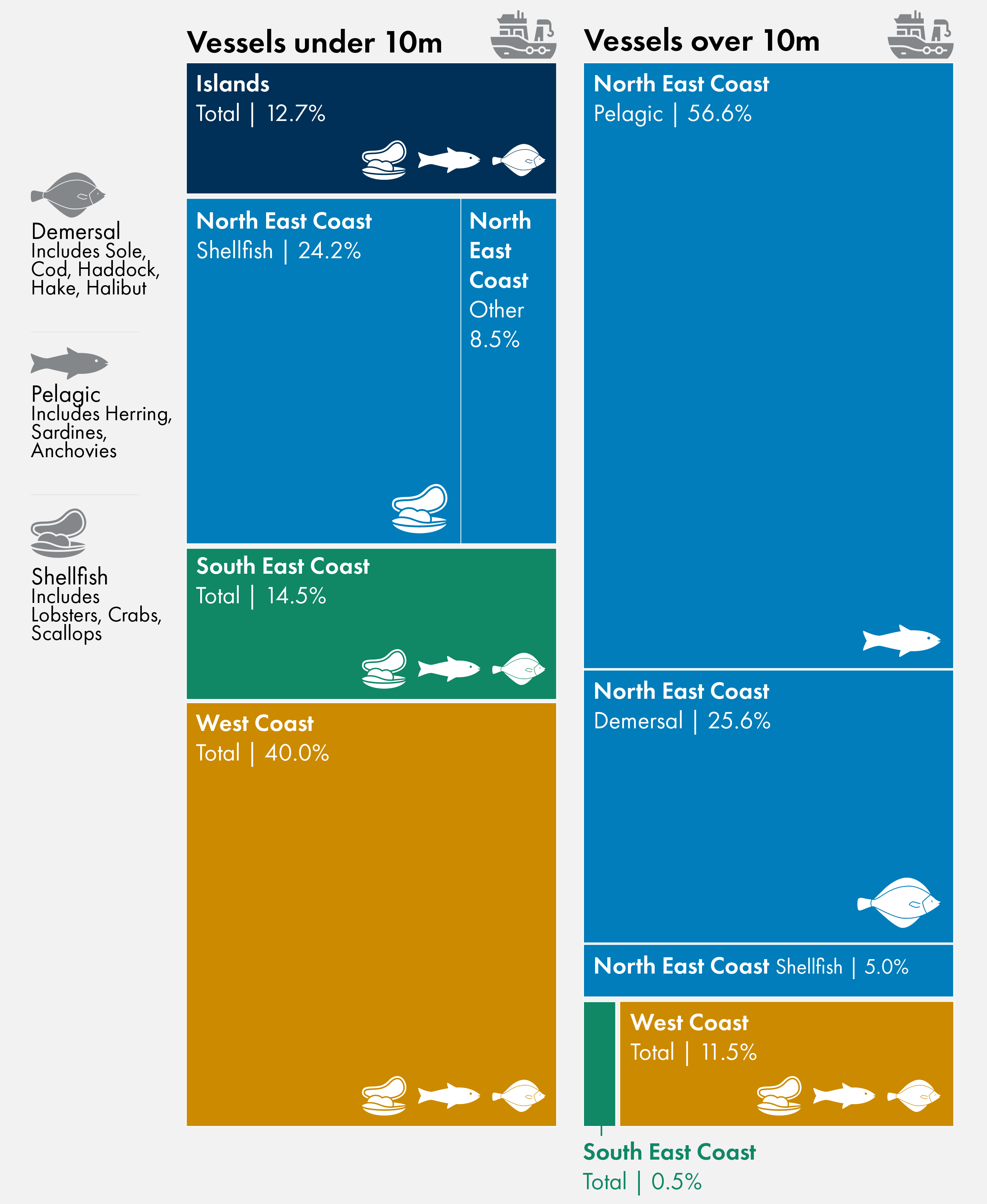
Source: Scottish Government. (2025, December 19). Scottish Sea Fisheries Statistics 2024. Retrieved from https://www.gov.scot/publications/scottish-sea-fisheries-statistics-2024/ [accessed 1 June 2026]
Mackerel is the largest species by weight and most valuable fish species landed by Scottish vessels. £285 million of mackerel were landed in 2024, triple the next most common species by value, Nephrops (also known as langoustine, Norway lobster or prawns).
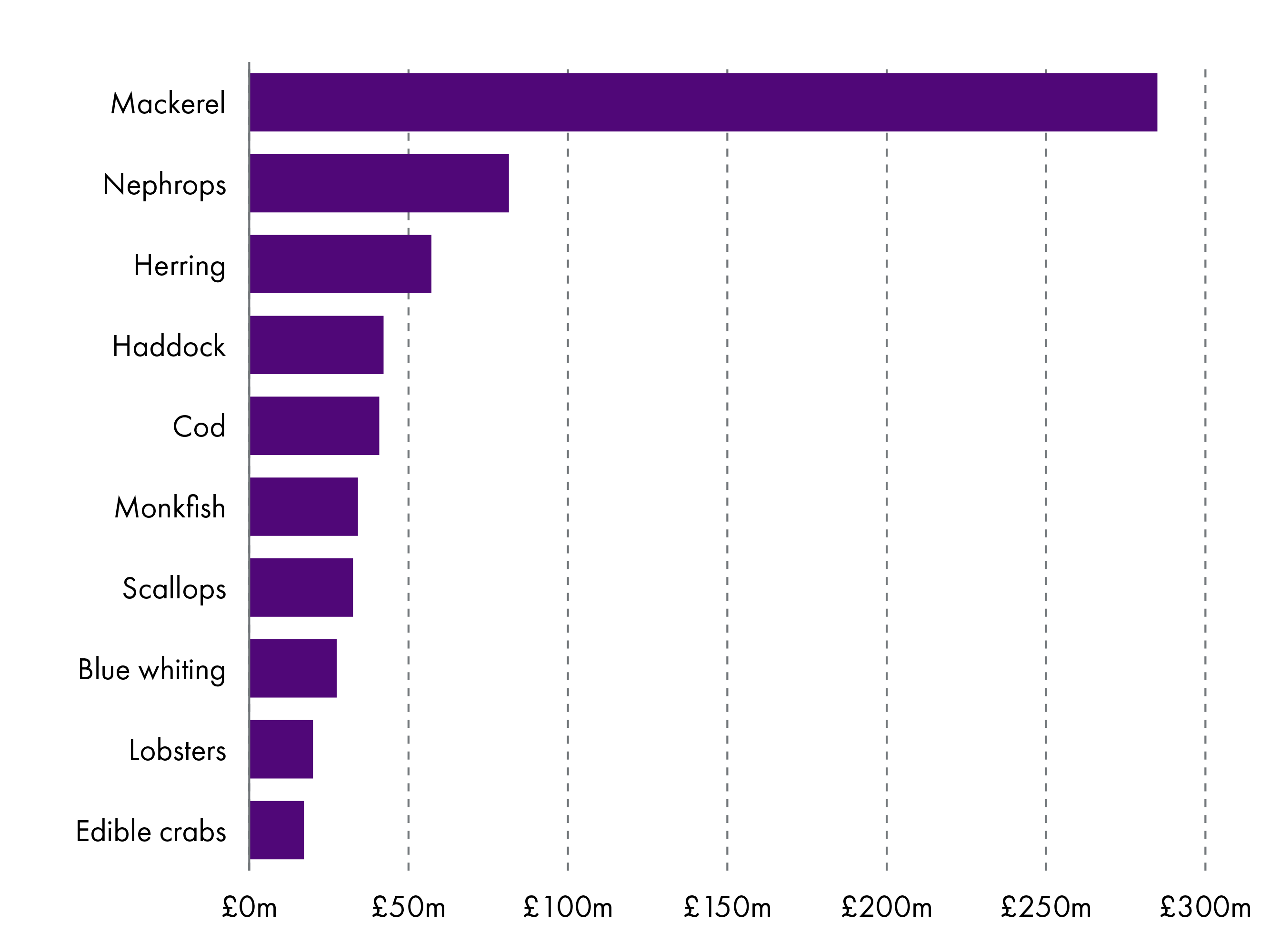
Source: Scottish Sea Fisheries Statistics 2024 (Table 8).
Pelagic species have shown strong overall growth in the value of landings over time. The value adjusted to 2024 prices of pelagic species landed by Scottish vessels increased from £213 million in 2015 to £370 million in 2024. Pelagic landings by Scottish vessels have shown particularly strong growth following the UK's exit from the EU in 2020.
Demersal species value has remained relatively stable but overall, the trend is flat to slightly declining with a slight rise to around £240–£250 million by 2019, followed by a drop in 2020. From 2021 onwards, values stabilise again around £180–£210 million but have not recovered to pre-2020 values.
The value of shellfish landings show more volatility but no long-term growth. The 2024 value, at £175 million, is similar to 2015, at £179 million. There was a sharp drop in values in 2020, likely caused by export and trade issues encountered due to EU exit and the COVID-19 pandemic. Values have not recovered to pre-2020 levels.
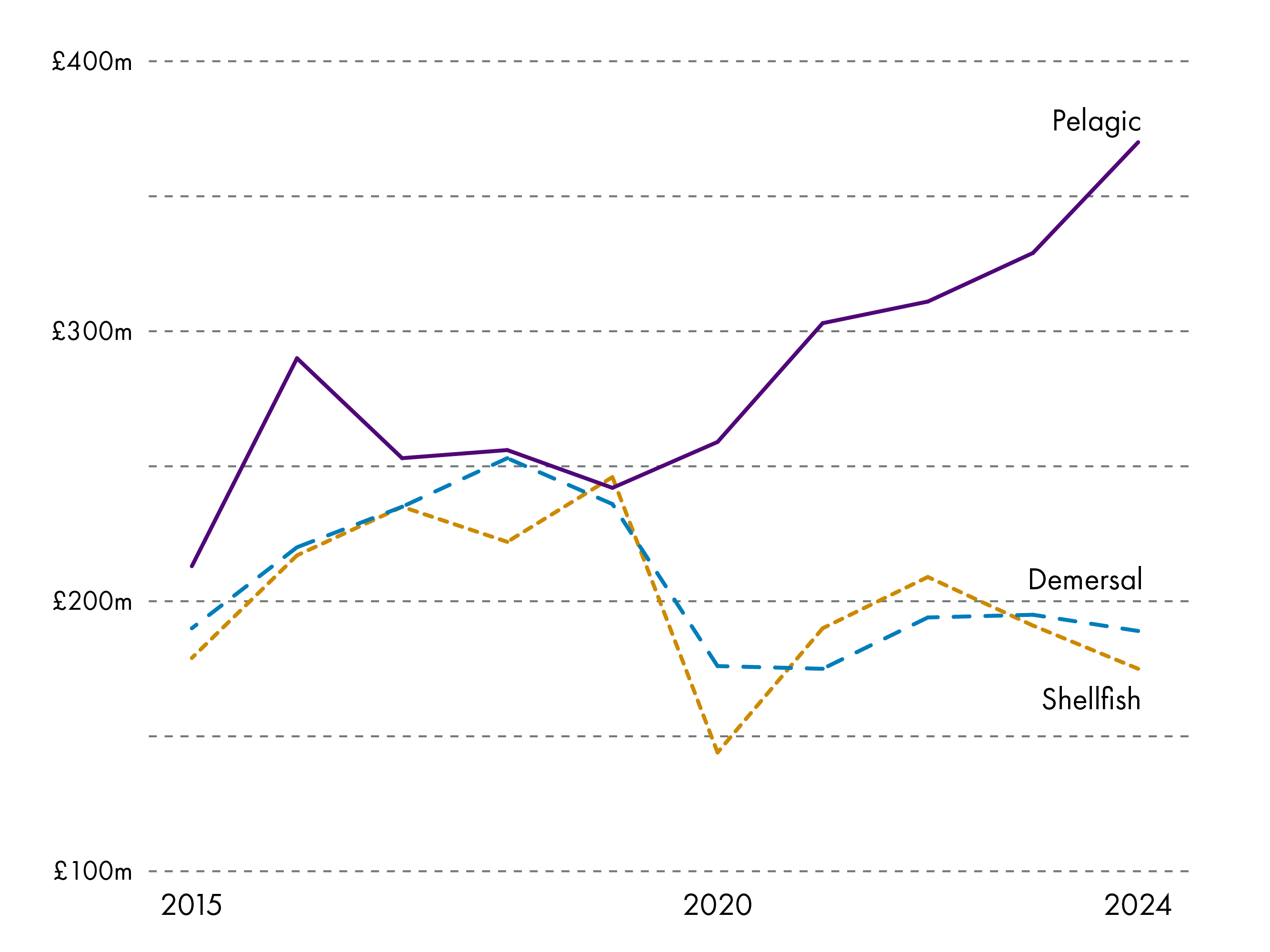
Source: Scottish Sea Fisheries Statistics 2024 (Table 3).
Since 2015, employment on Scottish fishing vessels has fallen by 15 per cent. There was a 13 per cent decrease in regular employment and a 22 per cent decrease in irregular employment since 2015.
Fisheries management
The UK Fisheries Act 2020 provides the legal framework for the UK to operate as an independent coastal state. The Act established a range of legal objectives such as 'sustainability, 'national benefit' 'bycatch' and 'climate change'.
The Act also provides for the licensing of UK and foreign vessels in UK waters and establishes a system of Joint Fisheries Statements (JFS) and Fisheries Management Plans (FMPs) for coordinating a common approach to fisheries management across the UK. The figure below sets out how this approach will work.
Most aspects of fisheries management are devolved. The Marine Directorate within the Scottish Government, is responsible for managing the activities of Scottish fishing vessels operating within the ‘Scottish Zone’, as well as all Scottish vessels operating beyond the Scottish Zone. This is defined as covering the North Sea and west of Scotland out to 200 nautical miles. The Marine Directorate's role in fisheries management includes the following:
Licensing of Scottish fishing vessels. The vessels of other UK policy authorities are licensed by the relevant authority.
Whilst international negotiations are reserved to UK Government, the Scottish Government plays a key role in forums where Scotland has a primary interest.
Setting catch limits through the allocation of fish quota and limits on fishing effort (time spent at sea).
Setting minimum standards (known as ‘Technical Conservation’) in the ways that fishing activity is conducted, for example by regulating the use of nets.
Monitoring fishing vessels while they are at sea.
The distribution of fish quota allocated to Scottish Ministers by the UK Secretary of State.
The setting of catch limits for non-sector fishing vessels
Controls on the landing, sale, purchase, transport and traceability of sea fish.
Prior to EU Exit, the framework for fisheries governance was an EU competence under the EU Common Fisheries Policy. Since the UK's departure from the EU, it is an independent coastal state, meaning it has control over fisheries management and governance in UK waters.
The Scottish Parliament has a role in scrutinising the development of Joint Fisheries Statements and Fisheries Management Plans and statutory reviews (see figure 8 below). The first JFS was published in November 2022.1 The JFS originally set out a timetable of 2022-2024 for the preparation and publication of FMPs led by the Scottish Government's Marine Directorate. However, after a public consultation the deadline was extended to the end of 2026. 2
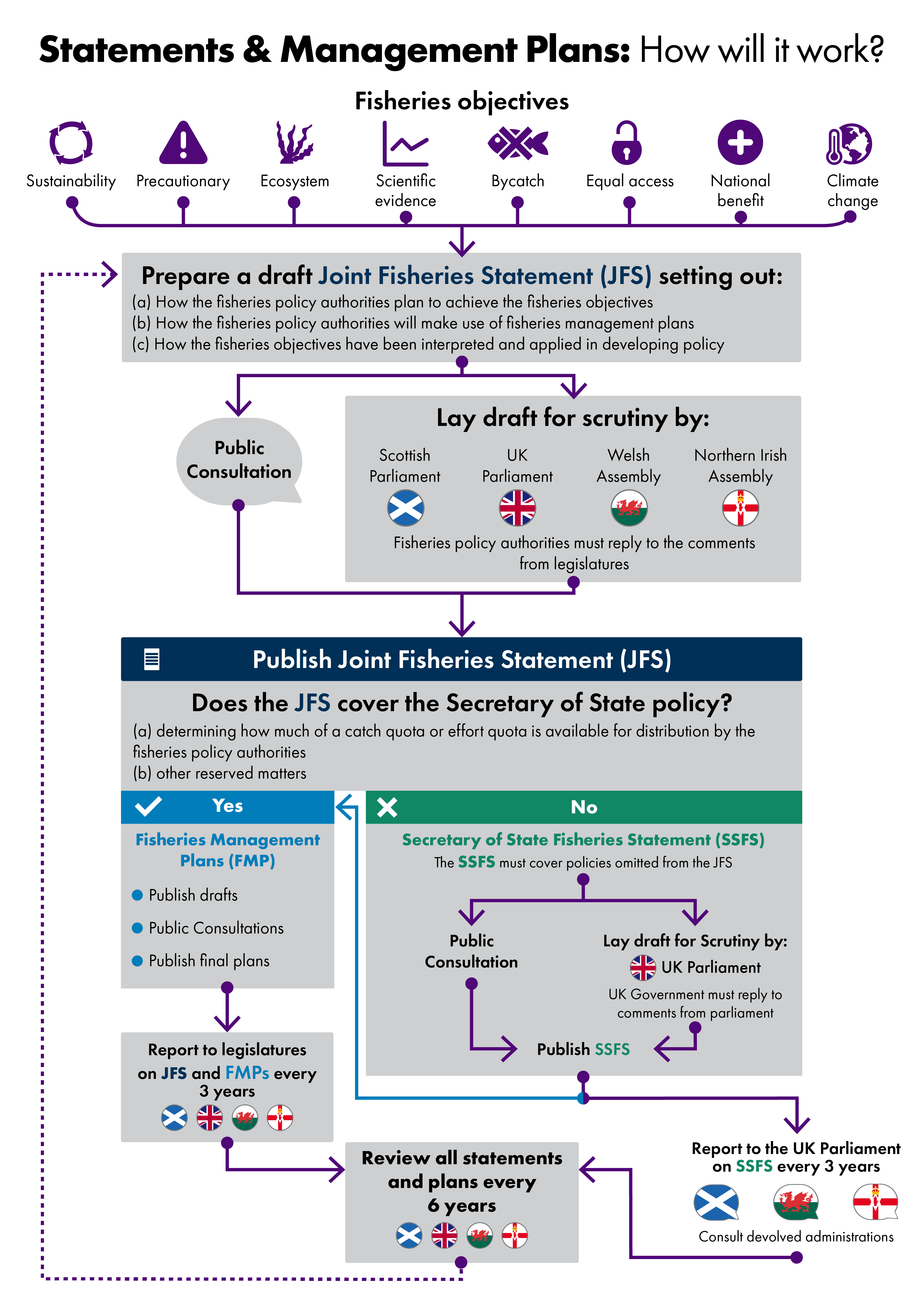
Source: SPICe
Fisheries management and the climate change and biodiversity loss crises
Effective fisheries management is key to addressing the contribution of commercial fishing to climate change and biodiversity loss and improving economic resilience to its impacts.
Scotland's Marine Assessment 2020 identified bottom-contact and pelagic (mid-water) fishing as being the most geographically widespread and direct pressure on the marine environment. Commercial fishing also contributes to greenhouse gas emissions which in turn affects coastal ecosystems through impacts such as ocean acidification, sea-level rise and the changing ecology and distribution of fish stocks.3
The role of fisheries management is recognised in Scotland's Future of Fisheries Management Strategy 2020-2030 which states:
...climate change already has an impact on fish ecology and the distribution of commercially important species, and with a warming climate, will increasingly do so. In a fisheries context, it is important for us to recognise and understand these potential changes and the impacts of our activities, and also to consider the contribution that the fishing sector itself makes to climate change and how we can reduce its impact.
Scottish Government. (2020, December 17). Future fisheries: management strategy - 2020 to 2030. Retrieved from https://www.gov.scot/publications/scotlands-future-fisheries-management-strategy-2020-2030/ [accessed 30 September 2026]
Outcomes of UN international negotiations on climate change and biodiversity require a step-change in action to mitigate greenhouse gas emissions and biodiversity loss.
An example relevant to fisheries management is a commitment to conserve at least 30% of the world's land and sea areas through "ecologically-representative, well-connected and equitably-governed systems of protected areas" as set out in the outcomes of the 'Kunming-Montreal Global Biodiversity Framework' following the COP-15 negotiations in October 2021, often referred to as the '30 by 30' target.5
As set out above, Scotland has designated around 37% of its waters as Marine Protected Areas (MPAs). MPA designations offer broad protections by making it a criminal offence to intentionally or recklessly damage the species or habitats for which a MPA has been designated(subject to certain exceptions, including where the act was the incidental result of a lawful operation). However, the designation of a MPA does not automatically restrict the activities that may take place in the area. Scottish Ministers have powers to increase protections in MPAs by introducing further restrictions on specific activities such as fishing gear restrictions (e.g. bottom -trawling or dredging) or by introducing 'no-take zones'.
Further information about marine conservation and fisheries management can be found in the above section on marine protection, and SPICe briefing 'Fisheries governance after Brexit'.6
In December 2020, the Scottish Government published its Future of Fisheries Management Strategy 2020-2030. The Scottish Government states the following about the strategy:
This strategy sets out our approach to managing Scotland's sea fisheries from 2020 to 2030, as part of the wider Blue Economy. It explores how we will achieve the delicate balance between environment, economic and social outcomes, and how we will work in partnership with our fisheries stakeholders at home, within the UK, and in an international context, to deliver the best possible results for our marine environment, our fishing industry and our fishing communities. It also considers how, as part of our Blue Economy approach, we can best share the marine space, to ensure we are managing in the right way, and making the best decisions, for the marine environment as a whole and all those who depend on it.
Scottish Government. (2020, December 17). Future fisheries: management strategy - 2020 to 2030. Retrieved from https://www.gov.scot/publications/scotlands-future-fisheries-management-strategy-2020-2030/ [accessed 30 September 2026]
Further reading:
SPICe briefing - Post-Brexit Fisheries Governance (August 2021)
SPICe blog series - The future of fisheries management in Scotland (November 2020)
SPICe briefing - The revised UK Fisheries Bill (April 2020)
Fisheries in the EU-UK Trade and Cooperation Agreement
The EU-UK Trade and Cooperation Agreement (TCA) took effect on 1 January 2021. A key area of the agreement was fisheries. Reaching agreement on future access for EU boats to UK waters was a source of disagreement throughout the nine months of the negotiations. Control over access to UK waters was a red line in the negotiations for the UK Government.1
The fisheries component of the TCA is particularly important to Scottish fishing industry interests for both catching opportunities and trade in seafood.
The following key provisions feature in the TCA:
Access to waters: The deal provides a continuation of reciprocal access for UK and EU vessels to each other's Exclusive Economic Zone. This was originally agreed until 30 June 2026 but later extended until 30 June 2038 under a renewed agreement between the UK Government and the EU negotiated in May 2025.2 After that, access will be subject to annual negotiations unless agreed otherwise.
Quota shares: The Agreement set out arrangements for the joint management of more than 100 shared fish stocks in EU and UK waters. There was an ‘adjustment period’ over five years implementing a gradual reduction of EU quotas of fish stocks in UK waters shared with the UK. The UK's share of fishing quotas increased by 25% of the value of the EU catch in UK waters. The agreed quota shares are set out in the annexes of the Agreement.1 Example increases are shown in figure 9 below. After the adjustment period, the UK and the EU will conduct annual fisheries negotiations regarding the Total Allowable Catch for shared stocks.
Access to EU markets for seafood: The deal maintained tariff-free access to EU markets for seafood products. However, it introduced new customs checks requiring more paperwork.
Economic link to the fisheries agreement: The deal tied access to waters to market access through compensation arrangements. This means that if either party breaches the agreement on access to waters or preferential tariffs on fisheries products they can introduce proportionate sanctions. These sanctions can be introduced by ending preferential tariffs not just on seafood, but on any goods included in the TCA, or suspending other parts of the TCA.
.png)
Source: SPICe, TACs from the EU-UK Trade and Cooperation Agreement, Annex 35
For more detailed information on the UK-EU Trade and cooperation agreement, see the further reading below.
Further reading
Inshore fisheries
Scottish Ministers are responsible for the regulation of inshore fishing around Scotland. Inshore fisheries are primarily regulated by the Inshore Fishing (Scotland) Act 1984. This Act enables Scottish Ministers to regulate fishing in inshore waters (within 6 nautical miles from baselines) by prohibiting one or a combination of the following:
all fishing for sea fish
fishing for a specified description of sea fish
fishing by a specified method
fishing from a specified description of fishing boat
fishing from or by means of any vehicle, or any vehicle of a specific description
fishing by means of a specified description of equipment.
Ministers may also specify the period during which prohibitions apply, and any exceptions to any prohibition. Management of inshore fisheries in Scotland also falls under the following legislation:
The Sea Fish (Conservation) Act 1967 allows regulation of the size of fish landed, gear type that can be used, and restrictions on species that can be landed.
The Sea Fish (Shellfish) Act 1967 allows local management of fisheries through the granting of Several Orders for setting up or improving private shellfisheries, and/or Regulating Orders which give the right to manage exploitation of a natural shellfishery.
A number of organisations are active in the management of Scotland's inshore fisheries at a local and national level. The Scottish Government's Fisheries Management and Conservation Group (FMAC)1 is a co-management stakeholder forum concerned with all issues connected to sea fisheries management. Its inshore fisheries sub-group focuses on fisheries management and wider marine issues in the inshore fisheries sector, and also includes Regional Inshore Fisheries Group (RIFG) chairs.
Regional Inshore Fisheries Groups are six non-statutory bodies that have been set up around the coast helping to provide local fishermen a role and voice in inshore fisheries management and wider marine planning developments (see figure 10 below). The Shetland Shellfish Management Organisation (SSMO) directly manages and regulates most of Shetland's inshore shellfish fisheries through a Regulating Order, giving it the powers to introduce its own regulations and control entry via licence permits.
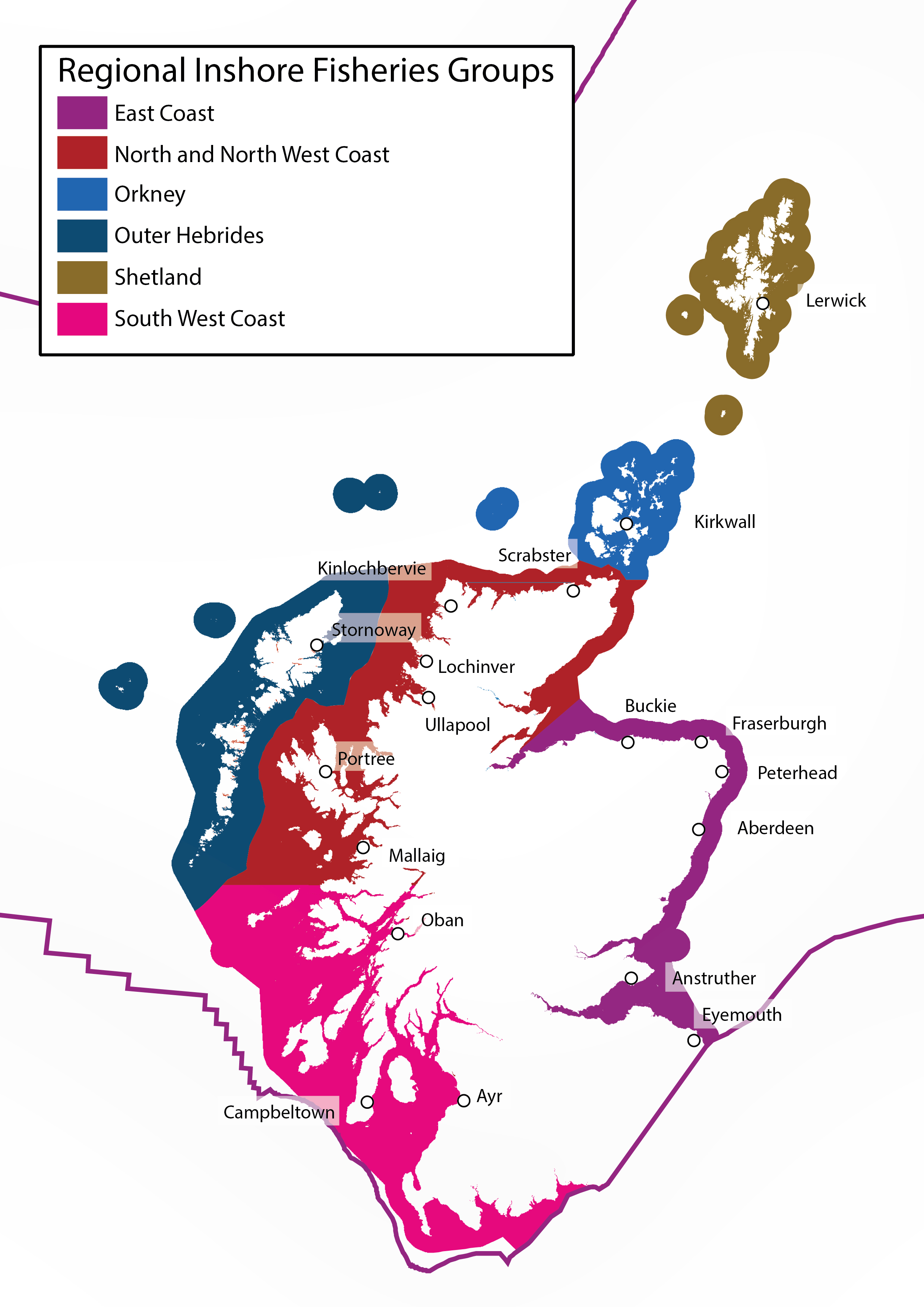
Source: Scottish Government
Further reading
SPICe briefing - Inshore Fisheries (February 2019)
SPICe Blog (4 part series) - The future of fisheries management in Scotland (November 2020)
Recreational sea angling
Sea angling takes place right around Scotland's coasts, and can be a year-round sport. There are additional restrictions depending on the species caught. For example, when fishing for sea bass, there are seasonal closures, minimum sizes and catch limits which apply.
Individuals are responsible for checking that they practice recreational sea angling within the appropriate restrictions for the species they wish to target.
Freshwater fisheries
In contrast to sea fishing, freshwater fishing in Scotland is almost entirely recreational, with the exception of a limited commercial harvesting remaining through a small number of traditional estuarine and in-river net fisheries.
Freshwater angling is commonly described by both target species and fishing setting. “Game” fishing targets salmonids, principally Atlantic salmon, sea trout, brown trout and rainbow trout, and takes place in rivers, lochs and managed stillwaters.
‘Coarse’ fishing refers to angling for freshwater species outside the salmonid group, such as pike, perch and cyprinids (species belonging to the carp family). Managed still-water fisheries, often stocked with rainbow trout, form an important part of Scotland’s recreational angling sector, while Scotland’s vast and diverse network of freshwater lochs supports widespread wild brown trout populations and, in some areas, more localised native species such as Arctic charr, alongside a range of locally important recreational fisheries.
The 2017 Public and Corporate Economic Consultants (PACEC)/Marine Scotland study found that Scotland’s wild fisheries made a significant economic and social contribution, particularly in rural areas, supporting around 4,300 FTE jobs, £79.9 million GVA and £135 million of angler expenditure in 2014.1 However, the report also highlighted declining salmon and sea trout catches, reduced angler activity compared with 2004, a much diminished netting sector, and uncertain future prospects linked principally to fish stock condition.
International obligations
NASCO (North Atlantic Salmon Conservation Organisation) is an international organisation, established by an inter-governmental Convention in 1984.1 The NASCO objective is to conserve, restore, enhance and rationally manage Atlantic salmon through international cooperation taking account of the best available scientific information.
Only Governments are members of NASCO, which has seven Parties: Canada, Denmark (in respect of the Faroe Islands & Greenland), the European Union, the UK, Norway, the Russian Federation and the United States of America. Scotland, as part of the UK, has obligations to, and contributes to, the work of NASCO.2
Ownership of freshwater fishing rights
In Scotland, freshwater fishing rights are private property rights and the owners of those rights largely control access to fisheries. It is not the fish themselves that are owned, but the right to fish for them. Salmon fishing rights, which include rights to fish for sea trout, are heritable titles that may be held with, or separately from, ownership of the land. It is a criminal offence to fish for Atlantic salmon or sea trout without the legal right or without written permission from the owner of that right.
Rights to fish for non-migratory freshwater species, such as brown trout, pike, perch and other coarse fish, normally belong to the owner of the land adjoining the river, stream or loch, although such rights may be leased or managed by others. Owners of fishing rights include Crown Estate Scotland, private individuals, companies, local authorities, angling clubs and associations.
Management of freshwater fisheries
Scottish Ministers have statutory functions for the management, conservation and regulation of freshwater fish resources in Scotland, principally under the Salmon and Freshwater Fisheries (Consolidation) (Scotland) Act 2003, as amended by subsequent legislation including the Aquaculture and Fisheries (Scotland) Act 2007.
The Scottish Government, through the Marine Directorate, is responsible for:
delivery and implementation of fisheries legislation
monitoring and analysis of catch statistics.
The Marine Directorate also carries out research to underpin fisheries policy. This includes investigation into fish populations, their habitats and the fisheries that exploit them to provide the information required for effective management.
Since 2008 the movement or stocking of fish into inland waters has been regulated to help protect native biodiversity. Where a District Salmon Fishery Board operates, applications to stock Atlantic salmon or sea trout are considered by the relevant Board; where no Board operates, or where the fish are species other than salmon or sea trout, responsibility rests with the Marine Directorate.
NatureScot must be consulted if an application to introduce fish involves waters in, or connected to, sites designated for nature conservation.
As set out above, SEPA regulates activities that could impact the water environment through the Environmental Authorisations (Scotland) Regulations 2018. This includes the regulation of sectors such as hydropower to minimise the impact of assets which could, if not managed appropriately, present barriers to migratory fish.
River Basin Management Planning (RBMP)1 is the primary framework for the protection and improvement of Scotland’s rivers (also other freshwater bodies, estuaries, coastal and transitional waters). Through RBMP, SEPA supports river restoration and the removal of historic barriers, such as weirs which are no longer used by industry, also supported through its administration of the Water Environment Fund (WEF).2 SEPA is currently developing Scotland’s fourth River Basin Management Plan, which will run from 2027 to 2033, and is expected to consult on proposals in December 2026.
The enforcement of the law relating to salmon and freshwater fisheries in Scotland is facilitated by the Salmon and Freshwater Fisheries (Consolidation) (Scotland) Act 2003. There are a range of offences set out in the body of the 2003 Act which are listed on the Scottish Government's website.3
Maximum penalties under this Act were recently increased by the Natural Environment (Scotland) Act 2026, and also modified to allow penalties to be determined on a per-fish basis, aiming to recognise harm caused by salmon poaching. At the time of writing however this section of the Act has not been commenced.
District Salmon Fishery Boards (DSFBs)4 have statutory powers and duties to protect and improve salmon fisheries within their legally-defined salmon fishery districts. This includes powers to raise money to fund fisheries management (through a levy system) and to appoint water bailiffs.
Water bailiffs can be appointed by Scottish Ministers, generally in places where DSFBs do not exist. They
exercise the powers conferred by the 2003 Act to prevent the illegal taking of salmon or trout. Powers extend only to the waters in respect of the fishery district within which they are appointed, but not to any adjoining districts.
Scottish Ministers may appoint water wardens in order to enforce the provisions of protection orders.5 Where a protection order is in force, it is a criminal offence to fish for or take freshwater fish in the inland waters in the prescribed area without legal right, or written permission from the owner of the legal right.
Wild salmon decline
Across Scotland, the total number of salmon returning to coastal waters has declined since estimates began in the 1970s. In the early 1970s, around 1 million salmon returned to the Scottish coast. In recent years, this has fallen to around 300,000 (see figure 11 below).1 A similar decline has been seen across the wider North Atlantic. In December 2023, the International Union for Conservation of Nature (IUCN) reclassified wild Atlantic Salmon from ‘Least Concern’ to ‘Endangered’ in Great Britain.
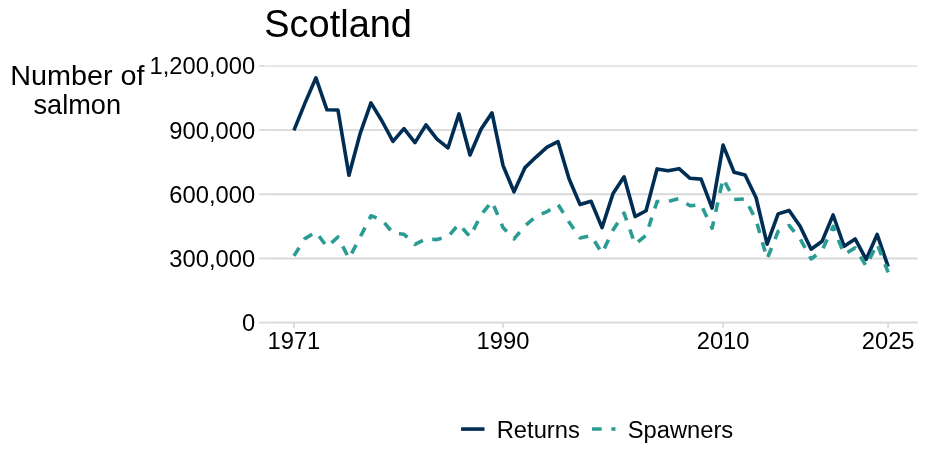
Source: Marine Directorate
Wild Atlantic salmon in Scotland are exposed to a wide range of pressures across their life cycle, including:
exploitation,
predation,
disease and parasites,
sea lice,
genetic introgression from escaped farmed salmon,
invasive non-native species,
poor water quality,
altered water quantity,
loss of suitable thermal habitat,
degraded instream and riparian habitat,
barriers to fish passage,
marine and estuarine development; and
changing conditions on the high seas.
These pressures can act cumulatively and are often intensified by climate change. While there remains a need to manage local and regional pressures in rivers and coastal waters, the most significant overarching driver of recent decline is likely to be increased marine mortality, with changing ocean conditions associated with climate change affecting salmon growth, food availability, migration and survival at sea.234
Some of these pressures are summarised in the figure 12 below. More detailed discussion is provided in a SPICe briefing on Wild Salmon (see further reading below).
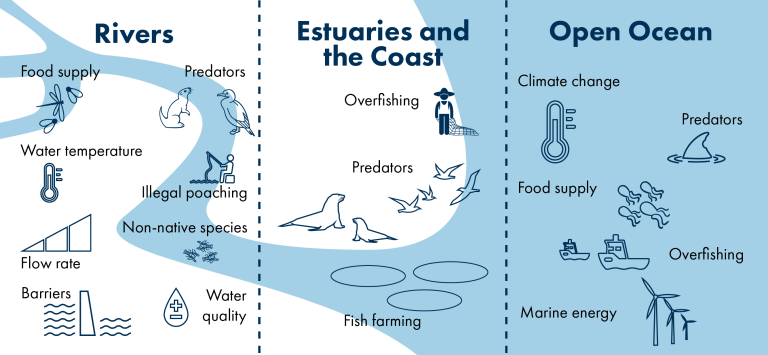
Source: SPICe
In January 2022, the Scottish Government published a Wild Salmon Strategy5 setting out its vision, objectives and priority themes to ensure the protection and recovery of Scottish Atlantic wild salmon populations. The strategy is accompanied by an implementation plan6 setting out over 60 actions to complete up to 2028 with progress reported annually and overseen by a Delivery Group comprised of relevant public body and stakeholder organisations.7
In Scotland, wild Atlantic salmon and their habitats are protected through a combination of species, fisheries, protected-area, environmental and planning controls.
It is listed under the Habitats Regulations as a Schedule 3 species in freshwater, meaning they may not be taken or killed using prohibited methods such as poison or explosives, or by other indiscriminate means capable of causing local disappearance or serious disturbance of a population.
Atlantic salmon also receive site-based protection in Scotland through the designation of Special Areas of Conservation (SACs) where the species is listed as a qualifying feature. As set out above, any plan or project likely to affect these 'European sites' must be considered through the Habitats Regulations assessment process. There are 17 SACs for which Atlantic salmon is a 'qualifying interest'. Those sites include significant parts of many of the country’s major salmon river catchments e.g. the Dee, Spey, Tay, Tweed, South Esk, Naver, Thurso and Oykel. They were selected to protect a representative network of high-quality salmon river systems, covering the diversity of Scottish river types, geography and life-history characteristics. Further site information available from JNCC and NatureScot.89
Statutory fishery controls provide further protection: no salmon may be taken in Scotland before 1 April to protect the most vulnerable spring stocks, killing in inland waters is regulated annually according to stock conservation status, mandatory catch-and-release applies where stocks are below conservation limits (the minimum safe stock level), and retention of salmon in coastal waters is prohibited.
Wider habitat protection is provided through water regulation, river basin planning, protected areas, and controls on activities affecting water quality, flows, fish passage and river morphology.
In policy terms, salmon are given additional recognition through National Performance Framework 4,10 Scotland's national planning framework, which carries legal weight in planning decisions. This includes area-based safeguards for migratory fish, notably the policy not to support further open-pen salmon and trout farm developments on Scotland's north and east coasts.
Salmon are also recognised as a species of principal importance for biodiversity conservation in Scotland through the Scottish Biodiversity List and are also identified as a Priority Marine Feature in Scottish waters. They were previously listed as a UK Biodiversity Action Plan priority species, a legacy designation that continues to inform country-level biodiversity priorities.
The Scottish Government brought forward legislation to regulate the killing of wild salmon in certain fishery districts in Scotland. The Conservation of Salmon (Scotland) Regulations 2016 stated that an assessment of the conservation status of salmon had to be carried out for all inland waters, based on both the stock level and condition of salmon. Following the introduction of the first regulations,the Marine Directorate now assesses the conservation status of 173 Scottish stocks each year and each stock is assigned a conservation status depending on the outcome of that assessment. Amendment regulations are laid before the Scottish Parliament annually after a public consultation on the new conservation statuses.
The 2026 report on the status of salmon in Scotland was published by the Scottish Government in August 2026.1 This assessment, which informs the 2027 angling season, shows that:
123 out of 173 (71%), of the salmon stocks in Scotland are in poor conservation status
The picture is different when looking at the number of individual salmon rather than the number of stocks. Scotland’s larger east coast rivers tend to be in good conservation status, and these rivers contain most of Scotland’s wild salmon. Although only 13% of stocks are in good conservation status, they are estimated to contain about 73% of the total number of Scottish salmon.
The number of stocks in good conservation status has declined from 61 in 2017 to a proposed 22 in 2027. Over the same time the number of stocks in poor conservation status has increased from 75 to a proposed 123.
A stock is usually a single river but may be a group of rivers or Special Area of Conservation (SAC). This is based on the probability that each stock will be above a defined conservation limit (the minimum safe stock level) over a five-year period. Rather than a simple pass or fail, stocks are assigned a conservation status (good to poor) each with its recommended management actions.
For stocks assigned as poor conservation status it is illegal to retain salmon, this means that any salmon caught must be released back into the water (known as "catch-and-release"). More information on salmon conservation can be found on the Scottish Government's website.12
The 2016 Regulations also prohibit the retention of any salmon caught in coastal waters, as a measure directly aimed at protecting stocks returning to inland waters.
Aquaculture
Aquaculture is the farming of aquatic animals and plants in fresh, brackish or marine water environments. It is a major industry in Scotland's coastal areas.
Both finfish (e.g. salmon, trout) and shellfish (e.g. mussels, oysters) are farmed in Scotland. There is also a developing seaweed cultivation sector.
In 2023 Scottish Government published the Vision for Sustainable Aquaculture1 which describes the Scottish Government’s long-term aspirations to 2045 for the finfish, shellfish and seaweed farming sectors. The nine-point Vision aims to support the ongoing development of a sustainable aquaculture sector, operating within environmental limits while delivering significant and lasting socio-economic benefits for Scotland and for the communities that host aquaculture businesses.
Trade and regulation of fish and shellfish production
Fish farming is subject to a wide spectrum of regulation to manage animal health and welfare, discharges from production sites and environmental impacts, trade biosecurity, interactions between sea lice emitted from fish farms and wild salmonids, as well as planning considerations and locational controls. Regulators and their key responsibilities are outlined in the above section on governance.
Scotland, as part of the wider Great Britain health zone, has a high health status with respect to fish, molluscs and crustaceans diseases listed in legislation.1 This is important for trade as movements of live aquatic animals (including ova (eggs) or gametes (reproductive cells)) are only permitted between areas with equivalent health status or from a higher to a lower health status.
Maintaining high levels of biosecurity, in terms of trade into and out of the country, and in relation to practices within aquaculture in Scotland, helps to prevent the introduction and spread of serious aquatic animal diseases and maintain health status to the benefit of trade. The Scottish Government’s Fish Health Inspectorate plays an important role in the regulation of live aquatic domestic production as well as trade in and out of the country.
Finfish aquaculture
Scotland is one of the top three producers of farmed Atlantic Salmon globally (after Norway and Chile, though it is worth noting that both countries produce considerably more than Scotland).1 Scotland produced 192,000 tonnes in 2024.2 Scotland's highest production was recorded in 2021, at 205,393 tonnes. Figure 13 shows trends in Scottish salmon production in tonnes since 1999.
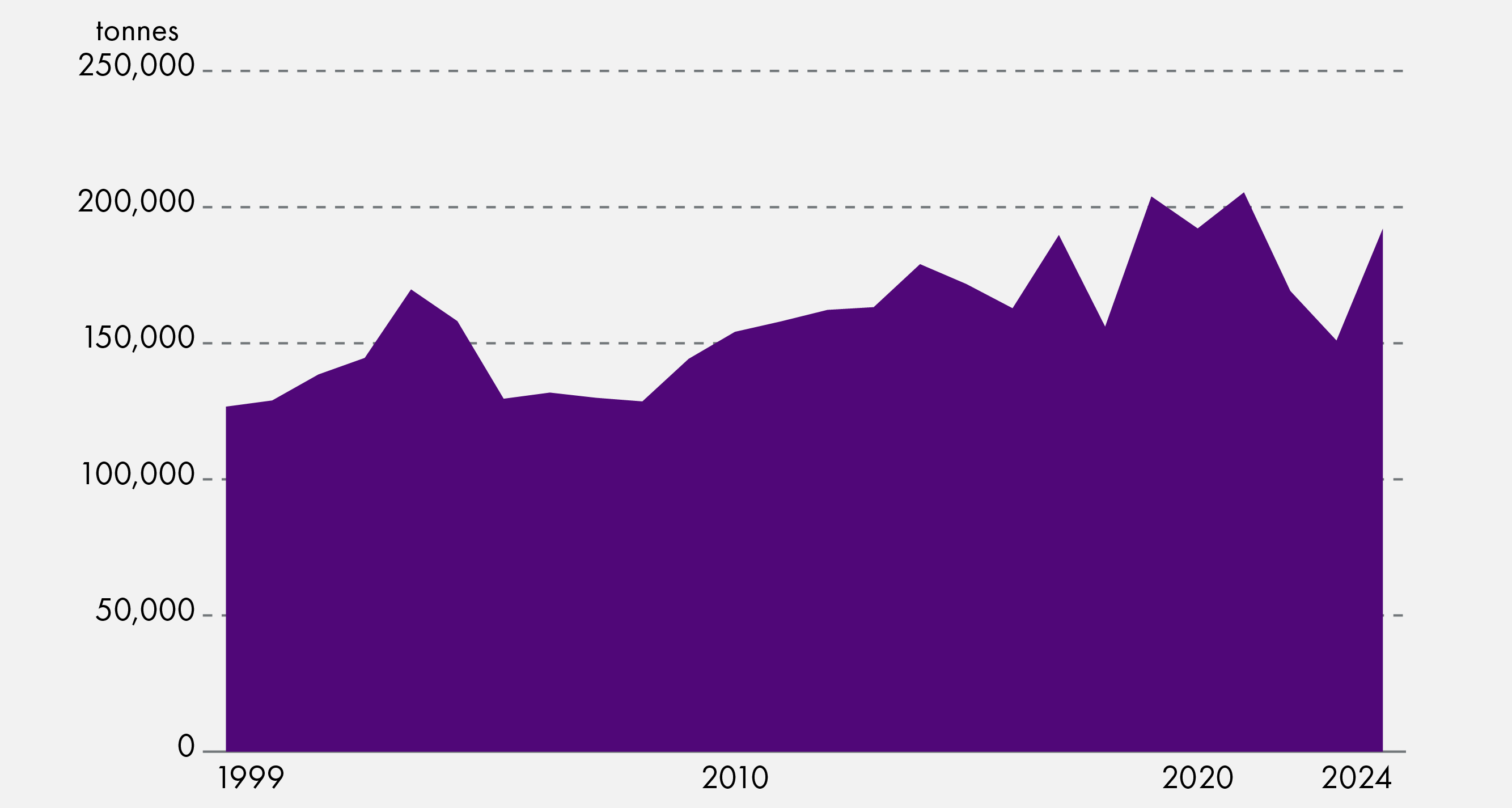
In 2024, the total number of staff employed in salmon production was 1,362, a decrease of 118 employees (8%) compared with 2023, with most staff directly employed in production located in the Highlands and Islands (see figure 14 below).
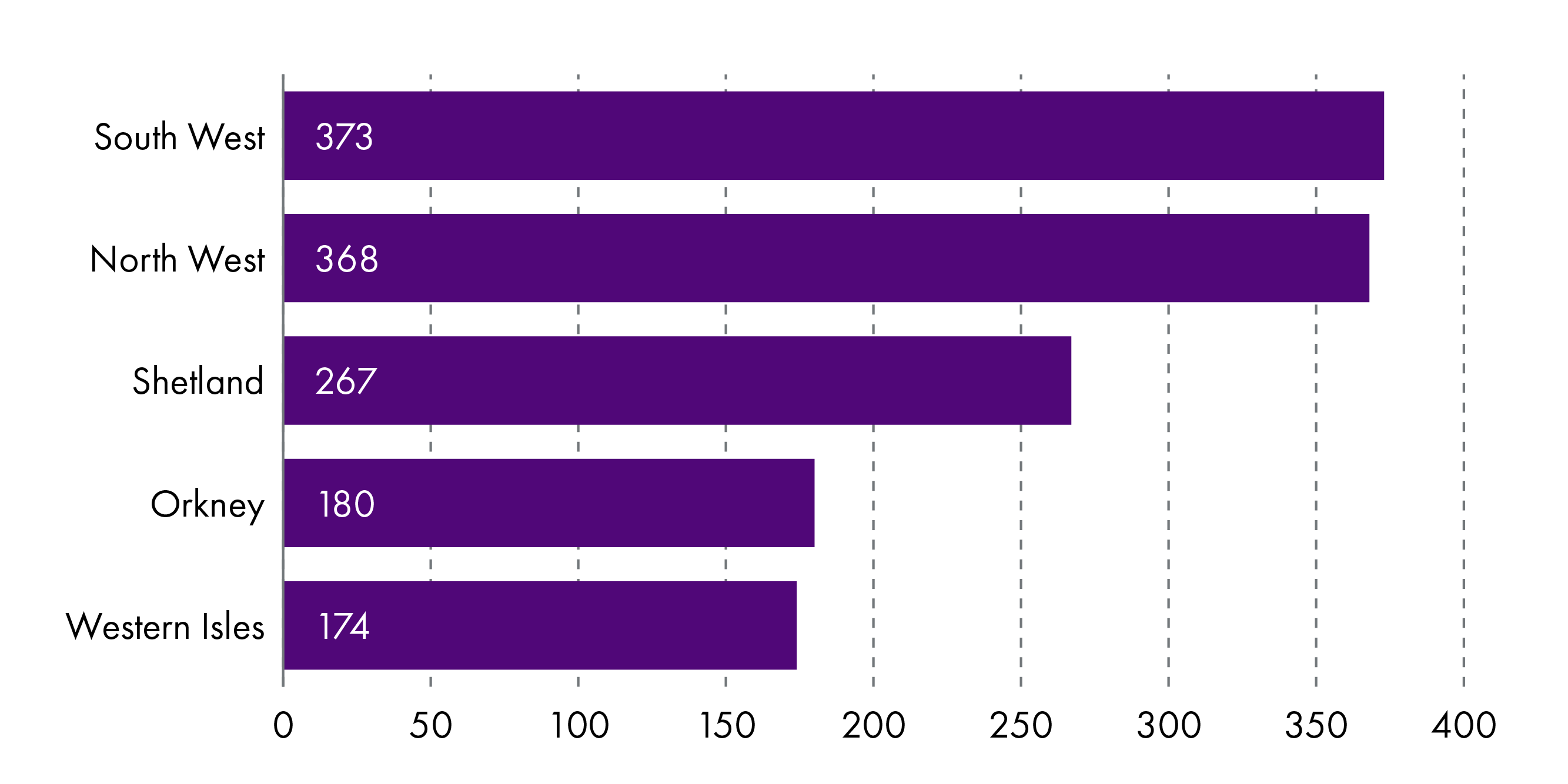
Source: Scottish Fish Farm Production Survey 2024, Supplementary Tables, Table 35
Other finfish produced in Scotland include rainbow trout (8,171 tonnes in 2024) and brown and sea trout (23 tonnes in 2024).2 In 2024, wrasse were cultured for use as a biological control for parasites in the marine Atlantic salmon industry. In total, 65,000 cleaner fish were produced. The number of cleaner fish sold increased from 19.8 million in 2023 to 21.8 million in 2024, although many were sold at the larval stage for on-growing outside Scotland and are not included in this figure. In contrast to previous years, when cleaner fish production included both wrasse and lumpfish, only wrasse were produced in 2024.
Economic and social contribution
Farmed salmon is a major Scottish export; Scottish farmed salmon was the UK's top food export in 2025, with international sales of £828 million.4 A 2025 report by Biggar Economics5, commissioned by Salmon Scotland, noted that Scottish salmon farming supported 10,850 jobs and generated an estimated economic impact worth £953 million GVA to the country’s economy in 2024.
In 2026 AECOM published a report examining the role of the Scottish salmon farming sector in Scotland’s rural and coastal communities6. The review found that salmon farming is a significant support to the economic and social fabric of Scotland's coastal and island communities. The report noted that in providing year round permanent employment, at above local average wages, the sector acted as an anchor for rural and island communities and economies, providing significant community benefits. The report recognised that the sector supports a supply chain with over £700m of annual spend in Scotland and investment by the sector in innovation since 2018 was valued at more than £183m in a 2025 report by Frontline Consultants.7
A 2025 report by Pareto Consulting and University of Edinburgh Business School8 assessed the Economic Impact of Salmon Farming in Skye & Lochalsh. It found that headline estimates of the economic impacts of Scottish salmon exaggerate economic benefits by focussing on gross rather than net effects and disregarding counterfactuals such as displacement effects on other businesses competing with salmon farms for marine and coastal space, environmental resources and labour. For example, other firms experience additional costs, reduced revenues and labour recruitment difficulties. In Skye and Lochalsh, salmon farms were estimated to account for 137 jobs. Of these, stakeholder testimony suggests that 9% to 28% may not be net additions to local employment due to displacement effects. It also found that aggregate public revenue raised from salmon farming is at least partially offset by tax breaks and grant aid to salmon farming itself plus expenditure by public bodies on behalf of the industry.
In 2024-25 Crown Estate Scotland (CES) received Gross Revenue from aquaculture of £12.5m9, an increase over the £11.4m achieved in 2023-24. CES returns Net Revenues to the Scottish Consolidated Fund for distribution to local authorities and these revenues enable significant benefits to be delivered to local communities.
The regulation of salmon farming sector has been the subject of Scottish Parliament inquiries which explored animal welfare, social, economic benefits and environmental impacts of salmon farming:
Session 5 inquiries (2018): In Session 5, the Environment, Climate Change and Land Reform (ECCLR) Committee held an inquiry into the environmental impacts of salmon farming, commissioning the Scottish Association of Marine Science (SAMS) to review the evidence around this topic10 and held a call for stakeholder views on the findings of the SAMS review.11 The ECCLR Committee reported their findings to the Rural Economy and Connectivity (REC) Committee, which held a wider inquiry on Salmon Farming in Scotland.12
The REC Committee acknowledged both the economic and social value that the salmon farming industry brings to Scotland and noted that the sector provides jobs to rural areas, investment and spend into communities and stimulates economic activity in the wider supply chain.
The inquiries determined that, if the industry is to expand, the status quo was not an option and there was a need to introduce enhanced and more effective regulatory standards using a precautionary approach to ensure that fish health issues are properly managed and the impact on the environment is minimised.
Session 6 follow-up inquiry (2024/25): In Session 6, the Rural Affairs and Islands (RAI) Committee held a follow-up inquiry13 to assess progress made by the Scottish Government on the recommendations made by the ECCLR and REC Committees in 2018. The Committee concluded that while some REC Committee recommendations had been implemented, the Committee expressed concern over a lack of progress in implementing many of the other REC Committee recommendations and considered this to be detrimental to the long-term viability of the Scottish salmon farming industry. This included the lack of progress undertaking research and analysis into the environmental impact of chemical use on farms, progressing a spatial planning exercise setting out suitable and unsuitable sites for farms or simplifying the planning process to facilitate farms to relocate from unsuitable sites. The Committee also noted a lack of progress implementing the recommendations made by other parallel workstreams, such as the Salmon Interactions Working Group.
The Scottish Government set out its work programme and responded to the RAI Committee on 13 March 202514 and provided a further interim update on progress implementing the Committee's recommendations on 30 September 2025.15 Together these outline the spectrum of actions taken, and under development, by the Scottish Government in recent years to strengthen regulation of the farmed fish sector.
On 11 March 2026, the RAI Committee held a further evidence session with the former Cabinet Secretary for Rural Affairs, Land Reform and Islands16 to assess progress made by the Scottish Government. The Committee then wrote to the Cabinet Secretary expressing disappointment over what it considered as a lack of urgency across key areas of its inquiry recommendations.17 In particular it noted key recommendations aimed at addressing farmed fish mortality had not been accepted by the Scottish Government and a lack of progress in implementing recommendations that seek to protect wild salmon populations from the risks posed by farmed salmon. The Committee reiterated its recommendations and called on the Scottish Government to set out a work plan in the early part of Session 7 to deliver on them.
Shellfish aquaculture
Shellfish aquaculture in Scotland is on a smaller scale compared to finfish aquaculture. Production is dominated by common mussel and Pacific oyster, although small quantities of king scallop and native oyster are also produced. In 2025, 12,303 tonnes of common mussel and 2.45 million Pacific oyster shells were produced for the table market. The Scottish shellfish farming sector was estimated to be worth approximately £145.1 million at first sale value in 2025, an increase of 18% on the 2024 value.1
Mussels are grown on ropes in the sea that are naturally seeded by larval mussels and do not need to be fed, as they feed on plankton. Oysters are grown in bags or flat cages in tidal areas, and also filter-feed on naturally occurring organisms in the sea. As a result, by comparison to finfish aquaculture, shellfish aquaculture is considered to have a lower environmental impact.2
Regulation and monitoring
Shellfish aquaculture is subject to a range of similar regulatory controls as outlined for fin-fish production and trade.
In addition, Food Standards Scotland (FSS) is responsible for monitoring and determining the safety of marine waters used for the harvesting of live bivalve molluscs (shellfish such as mussels, oysters, clams and cockles) in Scotland. Food safety standards for the monitoring of levels of microbiological and chemical contaminants, including marine biotoxins, are set out in assimilated law originating in EU Regulations.3
FSS and SEPA also work together to classify 'Shellfish Water Protected Areas',4 areas used for the growing and harvesting of shellfish. Monitoring takes place at a representative sub-set of sites. Monitoring results and classifications can be seen on the Shellfish Monitoring and Classification website.5
Seaweed aquaculture
Seaweed cultivation is a developing form of aquaculture in Scotland. Seaweed can be utilised for a variety of purposes such as:
human consumption
animal feed
biofuel
fertiliser
cosmetics
pharmaceuticals
biomaterials (e.g. alternatives to petroleum-based plastics)
possible climate change mitigation through carbon sequestration.
Seaweed is mostly cultivated in coastal areas on long-lines suspended below the water (often in grids) and fixed in place by buoys and anchors. Seeding of long lines normally takes place in autumn and is harvested in the spring and summer. Seaweed is usually harvested by hand or with a mechanical cutter from a boat.1
The wide variety of uses of seaweed provides the potential for economic activity and employment in coastal communities. However, the Sustainable Inshore Fisheries Trust's guide for seaweed cultivation in Scotland notes potential adverse environmental impacts which need to be considered as the industry develops.2 These include:
damage to seabed habitats and seabed shading
impact on marine species (e.g. entanglement of marine mammals, disturbance of migration routes or breeding/feeding grounds)
disturbance of tidal currents and water circulation
impact on genetic diversity of wild seaweed
spread of disease/pathogens
introduction of invasive species
pollution from ropes or other equipment
localised nutrient depletion
visual impacts
displacement of other marine users (e.g. commercial fishing, recreation)3
There is therefore a need for careful consideration of potential impacts to ensure the industry expands in a sustainable way.
Further reading:
Scottish Government Vision for Sustainable Aquaculture (July 2023)
Seaweed Review Steering Group: seaweed regulatory and legislative framework (February 2022)
SPICe Briefing: Kelp harvesting (November 2018)
Scottish Seaweed Industry Association: Code of Good Practice (CoGP) for Seaweed Operations in Scotland (November 2025)
The Scottish Crown Estate
The Scottish Crown Estate is a collection of ancient rights, functions and assets owned by the Monarch in right of the Crown. Scottish Crown Estate assets include a diverse portfolio of property, rights and interests. The total property value of the Scottish Crown Estate assets (across land and sea) was approximately £767.1m as of 31 March 2025.1 Scottish Crown Estate assets are managed by Crown Estate Scotland - a statutory public corporation established under the Scottish Crown Estate Act 2019.
The Scottish Crown Estate includes:
leasing of the seabed out to 12 nautical miles,
37,000 hectares of rural land,
rights to most naturally-occurring gold and silver; and
approximately half of Scotland's foreshore including 5,800 licensed moorings; 750 aquaculture sites; and salmon fishing rights.2
Beyond 12 nautical miles, the seabed itself is technically ownerless, but Crown Estate Scotland has rights over certain commercial activity to the edge of the continental shelf and the 200 nautical mile limit (EEZ) – this includes offshore renewable energy, marine mineral extraction and gas or carbon storage.
Scottish Crown Estate assets were previously managed by The Crown Estate at UK level. The Smith Commission (2014) recommended that the management of Crown Estate assets in Scotland, and their revenues, should be devolved.3The Scotland Act 2016 enabled HM Treasury to develop a Transfer Scheme to devolve powers over the revenue management of Scottish assets and this came into force on 1 April 2017.
This was followed by the Scottish Crown Estate Act 2019 which set out the statutory duties and obligations on Crown Estate Scotland.
The 2019 Act requires that managers of Scottish Crown Estate assets must act in the way best calculated to further the achievement of sustainable development in Scotland, and seek to manage the assets in a way that is likely to contribute to the promotion or improvement in Scotland of:
economic development
regeneration
social wellbeing
environmental wellbeing
sustainable development.
Local delegation of Crown Estate Scotland assets
The 2019 Act also provides a statutory process for management of a Scottish Crown Estate asset to be delegated to a different public body or to a more local level e.g. a local authority or community group, with the agreement of Scottish Ministers. A local asset management pilot scheme was undertaken and a "transfer and delegation application round" ran from 1 November 2021 to 2 May 2022 but no formal designations were made as a result.4There is more information about transfer and delegation on the Crown Estate Scotland website5 and the Scottish Government website.6
Marine and Fisheries Budget
The Marine Directorate of the Scottish Government is responsible for the integrated management of Scotland's seas. During Session 6, the Marine Directorate's budget formed part of the Rural Affairs, Land Reform and Islands (RALRI) portfolio.
Marine budget lines in the RALRI portfolio were made up of:
Marine Directorate budget: covers the Marine Directorate's work to manage fisheries, protect the marine environment, plan and license marine activity, enforce regulations and provide scientific evidence.
Marine Funding: Marine Fund Scotland (MFS) replaced the European Maritime and Fisheries Fund (EMFF) and is “focused on transforming the way the marine environment is used, it supports how Scotland's 'blue' resources are managed including the delivery of outcomes for Scotland's Blue Economy Vision.”
The most recent marine budget changes in the 2026-27 budget are provided in the tables below. Key changes include:
Overall budget for the Marine Directorate was unchanged in cash terms at £79.3m compared to 2025-26. This was a £1.7m decrease in real terms (2025-26 prices).
2026-27 was the third consecutive year in which the Marine Directorate budget decreased in real terms from £83m (cash) in 2023-24 - an overall real-terms decrease of £7.8m since the 2023-24 budget.
Resource budget increased by £0.8m (£0.7m increase in real terms).
Capital budget decreased by £0.8m (£0.9m decrease in real terms).
The Marine Fund Scotland allocation increased by £2.1m (£1.7m in real terms).
The budget documents provided no explanatory notes for the Marine Directorate budget allocation for 2026-27. However, the budget committed to:
begin the replacement programme for two Marine Protection and Research vessels
continue programmes of fisheries modernisation
“realise” the Vision for Sustainable Aquaculture
streamline the aquaculture consenting process.
The explanatory notes on the increase in the Marine Fund Scotland stated the allocation “has been maintained at pre-existing levels and uprated to include the full value of the Fisheries and Coastal Growth Fund consequentials that were received following the UK Autumn Budget 2025.”
Table 2: Marine Directorate spending, 2024-25 to 2026-27
| Budget line | 2024-25 outturn (final spend) £m | 2025-26 ABR Budget £m | 2026-27 Budget £m | Cash change (2025-26 ABR to 2026-27 budget) £m | Real terms change (2025-26 ABR to 2026-27 budget) £m |
| Marine Directorate | 92.8 | 79.3 | 79.3 | 0 | -1.7 |
| Of which | |||||
| Total Fiscal Resource | 81.1 | 66.3 | 67.1 | 0.8 | -0.7 |
| Non-cash | 5.8 | 5.7 | 5.7 | 0 | -0.1 |
| Capital | 5.2 | 7.3 | 6.5 | -0.8 | -0.9 |
Table 3:
Marine Fund Scotland spending, 2024-25 to 2026-27
| Budget line | 2024-25 outturn (final spend) £m | 2025-26 ABR Budget £m | 2026-27 Budget £m | Cash change (2025-26 ABR to 2026-27 budget) £m | Real terms change (2025-26 ABR to 2026-27 budget) £m |
| Marine Fund Scotland | 12.8 | 14.5 | 16.6 | 2.1 | 1.7 |
Parliamentary scrutiny
The RAI Committee ran a call for views1 which closed on 9 August 2024, and took evidence from stakeholders in a roundtable discussion on 4 September 20242 followed by an evidence session with the Cabinet Secretary for Rural Affairs, Land Reform and Islands and Officials on 25 September 2024.3
The RAI Committee also undertook a fact-finding visit to the Marine Directorate science laboratories in Aberdeen on 2 September 2024 and expressed concern about the impact the poor condition of the laboratory facilities was having on scientists’ ability to work effectively.4
Key issues identified by stakeholders during the roundtable included:
Decreases in the fisheries science budget were impacting the Marine Directorate's international reputation due to diminished capacity to undertake scientific research.
The organisational structure of the Marine Directorate science division as part of the Scottish Government rather than an arms-length organisation impacted the Marine Directorate's ability to provide independent and objective research.
Decline in capacity to leverage additional funding from commercial science.
Enforcement was seen as outdated and inefficient, with too much focus on physical inspections of the Scottish fleet, high operating costs for vessels and aircraft, limited local control, and penalties that were too low to deter non‑compliance.
Digital tools and Remote Electronic Monitoring were viewed as better‑value options by some stakeholders, suggesting that parts of the compliance budget should be shifted towards science and research instead.
Insufficient resources for Regional Inshore Fisheries Groups (RIFGs) and a lack of control of budgets and decision-making powers within RIFGs.
A lack of transparency and detailed information on the Marine Directorate's budget and science research activity to enable scrutiny.
Stakeholders’ concerns regarding the Marine Directorate's resource for scientific research were reinforced by analysis from the Committee's fisheries adviser, Professor Paul Fernandes of Heriot‑Watt University. 5
His conclusion from this analysis, produced for the Committee, was that reduced resources and unfilled scientific posts have caused a decline in Marine Directorate fisheries research over the past decade, unlike equivalent bodies in the UK and abroad.
The RAI Committee wrote to the Cabinet Secretary on 31 October 2024 setting out recommendations for the 2025-26 budget.4 The Cabinet Secretary responded to the Committee on 5 December 2024.7 The response included the following actions:
Aberdeen labs: Ongoing work to implement short, medium and long-term improvements and solutions to issues. This includes a “repair and maintenance programme”, identifying “suitable off-site premises” and a commitment to producing a “Strategic Outline Case” in 2025/26 addressing future redevelopment.
Compliance and enforcement: Development of a “land-based inspection and analysis system" focussing on "vessels that fish our seas but do not land into a Scottish port”, enhancing in-person" engagement and published communication and increasing the use of technology such as trialling unmanned aerial vehicles and remote electronic monitoring of vessels. Commitment to publish a report on a review of penalties for marine offences and survey on attitudes to compliance.
Regional Inshore Fisheries Groups: a review of the RIFG network which was “nearing completion”.
Information and transparency: Commitment to providing the Committee with a full breakdown of the internal budget allocations following the conclusion of Marine Directorate's 2025-26 business planning. Commitment to reviewing options for “making SEDD publication information readily available” in preparation for 2025/26. Ongoing review on publishing annual processed bycatch estimates for observed fisheries.
Progress on Committee recommendations
Aberdeen labs: A Marine Directorate report published in August 2025 states a “Strategic Outline Case is in development to address the future redevelopment of the Aberdeen site to support planning in the longer term”.8
Compliance and enforcement:
A procurement Prior Information Notice (PIN)9 was issued in June 2025 signalling the Scottish Government's intention to initiate a formal procurement process to replace the Marine Directorate’s two oldest vessels, the Marine Research Vessel (MRV) Scotia and Marine Protection Vessel (MPV) Minna.
An FOI release published 13 January 202610 indicates the report ‘Fishers’ behaviour and attitudes towards compliance and enforcement report’ originally expected in spring 2025 and published in March 2026.11
Regional Inshore Fisheries Groups: A ‘Regional Inshore Fisheries Group: evaluation’ report was published on 7 April 2025.12
Information and transparency:
The Cabinet Secretary provided a breakdown of the Marine Directorate's internal budget allocations to the RAI Committee in July 2025 (see table 4 below). 13
The Marine Directorate Science Evidence Data and Digital Portfolio published its first annual report for 2024–2025 (published August 2025). The report provides details on work and publications in each of the delivery areas within the SEDD Portfolio.8
Table 4: Marine Directorate internal budget allocations 2024-25 and 2025-26
| Portfolio area | 2024–25 Budget £m | 2025–26 Indicative Budget £m | 2025–26 Approved Budget £m |
| Operational Delivery | 29.3 | 29.9 | 28.9 |
| Science Evidence, Data and Digital | 16.5 | 17.7 | 19.1 |
| Marine Economy and Communities | 4.1 | 4.2 | 3.9 |
| Marine Environment | 8.2 | 8.2 | 8.0 |
| Corporate, Strategy and Marine Planning | 6.5 | 6.6 | 6.7 |
| Fiscal Resource Total | 64.6 | 66.6 | 66.6 |
| Non‑cash | 6.1 | 5.7 | 5.7 |
| Capital | 7.3 | 7.3 | 7.3 |
| Total | 78 | 79.6 | 79.6 |
Requirement for a report on penalties in sea fisheries legislation
In relation to concerns about the levels of penalties for non-compliance with sea fisheries legislation (mentioned above), the Natural Environment (Scotland) Act introduced a legal requirement for Scottish Ministers to publish a report on the effectiveness of relevant penalties in ensuring compliance with the sea fisheries legislation, both within the Scottish enforcement area, and by Scottish fishing boats (wherever they are operating).
The Act requires Scottish Ministers to publish the report within 2 years of that section coming into force. However at the time of writing this section of the Act (section 44) has not been commenced.
Parliamentary scrutiny
| Requirement | Parent legislation | Format | Timescale |
|---|---|---|---|
| Marine Directorate budget | Annual Budget Bill | Budget legislation | Annual (usually introduced in Winter) |
| Review and report of the implementation of the National Marine Plan | Marine (Scotland) Act 2010 | Report to Parliament | Every 3 years (most recent report published March 2024) |
| Report and review of Joint Fisheries Statements and Fisheries Management Plans under the Fisheries Act 2020 | Fisheries Act 2020 | Report to legislatures |
|
| International Fisheries Negotiations (catch limits and management of shared fish stocks). | N/A | Ministerial Statement | Annual |
| Conservation of Salmon (assessment of conservation status and corresponding management measures for every stock) | Conservation of Salmon (Scotland) Regulations 2016. | Consultation and Amendment regulations made by Scottish Statutory Instrument | Annual - consultation in Summer. Regulations laid to come into effect at the start of each financial year. |
| Scottish Marine Protected Area network report | Marine (Scotland) Act 2010 | Report to the Scottish Parliament | Every 6 years (most recent report published in 2024) |
| Report on penalties in sea fisheries legislation | Natural Environment (Scotland) Act 2026 | Report to the Scottish Parliament | Within 2 years of commencement (provision not yet commenced at time of writing). |
Sources
Scottish Government . (2025, December 12). Scotland's Marine Economic Statistics 2023. Retrieved from <a href="https://www.gov.scot/publications/scotlands-marine-economic-statistics-2023/" target="_blank">https://www.gov.scot/publications/scotlands-marine-economic-statistics-2023/</a> [accessed 28 September 2026]
Office for Environmental Protection. (2025, September 19). OEP identifies possible failures to comply with environmental law over marine target. Retrieved from <a href="https://www.theoep.org.uk/news/oep-identifies-possible-failures-comply-environmental-law-over-marine-target" target="_blank">https://www.theoep.org.uk/news/oep-identifies-possible-failures-comply-environmental-law-over-marine-target</a> [accessed 29 September 2026]
Office for Environmental Protection. (2025, August 20). OEP response to UK Marine Strategy Part One Assessment consultation. Retrieved from <a href="https://www.theoep.org.uk/report/oep-response-uk-marine-strategy-part-one-assessment-consultation" target="_blank">https://www.theoep.org.uk/report/oep-response-uk-marine-strategy-part-one-assessment-consultation</a> [accessed 29 September 2026]
Environmental Standards Scotland. (2025, August 20). ESS response to UK Marine Strategy Consultation. Retrieved from <a href="https://environmentalstandards.scot/keep-up-to-date/ess-response-to-uk-marine-strategy-part-one-update-2025-consultation/" target="_blank">https://environmentalstandards.scot/keep-up-to-date/ess-response-to-uk-marine-strategy-part-one-update-2025-consultation/</a> [accessed 29 September 2026]
Environmental Standards Scotland. (2026, June 23). Scottish Ministers failing in legal duties to protect and restore seafloor, concludes ESS. Retrieved from <a href="https://environmentalstandards.scot/keep-up-to-date/scottish-ministers-failing-in-legal-duties-to-protect-and-restore-seafloor-concludes-ess/" target="_blank">https://environmentalstandards.scot/keep-up-to-date/scottish-ministers-failing-in-legal-duties-to-protect-and-restore-seafloor-concludes-ess/</a> [accessed 29 September 2026]
Scottish Government. (2024, November 27). Biodiversity: delivery plan 2024 to 2030. Retrieved from <a href="https://www.gov.scot/publications/scottish-biodiversity-delivery-plan-20242030/" target="_blank">https://www.gov.scot/publications/scottish-biodiversity-delivery-plan-20242030/</a> [accessed 29 September 2026]
Scottish Government. (2026, September 29). Brexit. Retrieved from <a href="https://www.gov.scot/brexit/" target="_blank">https://www.gov.scot/brexit/</a> [accessed 29 September 2026]
Scottish Parliament. (2021, October 27). Fisheries governance after Brexit. Retrieved from <a href="https://bprcdn.parliament.scot/published/2021/10/27/5e3aba93-488a-4fb2-bcb6-7c0f0a1081e3-1/SB%2021-74.pdf" target="_blank">https://bprcdn.parliament.scot/published/2021/10/27/5e3aba93-488a-4fb2-bcb6-7c0f0a1081e3-1/SB%2021-74.pdf</a> [accessed 29 September 2026]
OSPAR Commission. (n.d.) OSPAR Convention. Retrieved from <a href="https://www.ospar.org/convention" target="_blank">https://www.ospar.org/convention</a> [accessed 29 September 2026]
OSPAR Commission. (n.d.) North-East Atlantic Environment Strategy 2030. Retrieved from <a href="https://www.ospar.org/convention/strategy" target="_blank">https://www.ospar.org/convention/strategy</a> [accessed 29 September 2026]
United Nations. (n.d.) Global Biodiversity Framework. Retrieved from <a href="https://www.cbd.int/gbf" target="_blank">https://www.cbd.int/gbf</a> [accessed 29 September 2026]
Joint Nature and Conservation Committee. (2023, March 16). Bern Convention. Retrieved from <a href="https://jncc.gov.uk/our-work/bern-convention/" target="_blank">https://jncc.gov.uk/our-work/bern-convention/</a> [accessed 29 September 2026]
United Nations. (n.d.) Agreement on Marine Biological Diversity of Areas beyond National Jurisdiction. Retrieved from <a href="https://www.un.org/bbnjagreement/en" target="_blank">https://www.un.org/bbnjagreement/en</a> [accessed 29 September 2026]
Scottish Parliament. (n.d.) Biodiversity Beyond National Jurisdiction Bill. Retrieved from <a href="https://www.parliament.scot/bills-and-laws/legislative-consent-memorandums/Session-6/biodiversity-beyond-national-jurisdiction-bill" target="_blank">https://www.parliament.scot/bills-and-laws/legislative-consent-memorandums/Session-6/biodiversity-beyond-national-jurisdiction-bill</a> [accessed 29 September 2026]
Scottish Government. (n.d.) Acknowledgements. Retrieved from <a href="https://marine.gov.scot/sma/assessment-theme/acknowledgements" target="_blank">https://marine.gov.scot/sma/assessment-theme/acknowledgements</a> [accessed 29 September 2026]
Scottish Government. (2011, March 16). Scotland's Marine Atlas: Information for The National Marine Plan. Retrieved from <a href="https://www.gov.scot/publications/scotlands-marine-atlas-information-national-marine-plan/" target="_blank">https://www.gov.scot/publications/scotlands-marine-atlas-information-national-marine-plan/</a> [accessed 29 September 2026]
Scottish Government. (2020). Scotland's Marine Assessment 2020. Retrieved from <a href="https://marine.gov.scot/sma/" target="_blank">https://marine.gov.scot/sma/</a> [accessed 29 September 2026]
Scottish Government . (2015, March 27). Scotland's National Marine Plan. Retrieved from <a href="https://www.gov.scot/publications/scotlands-national-marine-plan/" target="_blank">https://www.gov.scot/publications/scotlands-national-marine-plan/</a> [accessed 29 September 2026]
UK Government. (2011, September 30). UK marine policy statement. Retrieved from <a href="https://www.gov.uk/government/publications/uk-marine-policy-statement" target="_blank">https://www.gov.uk/government/publications/uk-marine-policy-statement</a> [accessed 29 September 2026]
Scottish Government. (n.d.) Marine environment: licensing and consenting requirements. Retrieved from <a href="https://www.gov.scot/collections/marine-licensing-and-consent/" target="_blank">https://www.gov.scot/collections/marine-licensing-and-consent/</a> [accessed 29 September 2026]
Scottish Government. (2021, March 21). National Marine Plan Review 2021: Three Year Report on the effectiveness of Scotland’s National Marine Plan. Retrieved from <a href="https://marine.gov.scot/sites/default/files/national_marine_plan_review_2021.pdf" target="_blank">https://marine.gov.scot/sites/default/files/national_marine_plan_review_2021.pdf</a> [accessed 29 September 2026]
Scottish Government. (2022, September 6). Programme for Government 2022 to 2023. Retrieved from <a href="https://www.gov.scot/publications/stronger-more-resilient-scotland-programme-government-2022-23/" target="_blank">https://www.gov.scot/publications/stronger-more-resilient-scotland-programme-government-2022-23/</a> [accessed 29 September 2026]
Scottish Government . (2024). National Marine Plan 2: stakeholder engagement strategy and statement of public participation. Retrieved from <a href="https://www.gov.scot/publications/scotlands-national-marine-plan-2-stakeholder-engagement-strategy-statement-public-participation/" target="_blank">https://www.gov.scot/publications/scotlands-national-marine-plan-2-stakeholder-engagement-strategy-statement-public-participation/</a> [accessed 29 September 2026]
Scottish Government. (2024, November 5). National Marine Plan 2 - planning position statement: consultation. Retrieved from <a href="https://www.gov.scot/publications/nmp2-planning-position-statement/" target="_blank">https://www.gov.scot/publications/nmp2-planning-position-statement/</a> [accessed 29 September 2026]
Scottish Government. (2025, August 29). National Marine Plan 2 - planning position statement: consultation analysis. Retrieved from <a href="https://www.gov.scot/publications/national-marine-plan-2-planning-position-statement-consultation-analysis-report/pages/11/" target="_blank">https://www.gov.scot/publications/national-marine-plan-2-planning-position-statement-consultation-analysis-report/pages/11/</a> [accessed 29 September 2026]
Scottish Government. (2025, September 26). National Marine Plan 2 Planning Position Statement. Retrieved from <a href="https://consult.gov.scot/marine-scotland/national-marine-plan-2-planning-position-statement/" target="_blank">https://consult.gov.scot/marine-scotland/national-marine-plan-2-planning-position-statement/</a> [accessed 29 September 2026]
Scottish Government. (2025, December 4). Shetland Islands Regional Marine Plan. Retrieved from <a href="https://www.gov.scot/publications/shetland-islands-regional-marine-plan/" target="_blank">https://www.gov.scot/publications/shetland-islands-regional-marine-plan/</a> [accessed 29 September 2026]
Scottish Government. (2026, February 19). Orkney Islands Regional Marine Plan. Retrieved from <a href="https://www.gov.scot/publications/orkney-islands-regional-marine-plan/" target="_blank">https://www.gov.scot/publications/orkney-islands-regional-marine-plan/</a> [accessed 29 September 2026]
Scottish Parliament. (2020, December 17). Development and implementation of Regional Marine Plans in Scotland: final report (December 2020). Retrieved from <a href="https://www.parliament.scot/chamber-and-committees/committees/committee-reports/ecclr/2020/12/17/ecclrs0520r15#" target="_blank">https://www.parliament.scot/chamber-and-committees/committees/committee-reports/ecclr/2020/12/17/ecclrs0520r15#</a> [accessed 29 September 2026]
Scottish Government . (2023). ENVIRONMENT, CLIMATE CHANGE AND LAND REFORM COMMITTEE- DEVELOPMENT AND IMPLEMENTATION OF REGIONAL MARINE PLANS IN SCOTLAND – RESPONSE (AUGUST 2023). Retrieved from <a href="https://www.parliament.scot/-/media/files/committees/net-zero-energy-and-transport-committee/correspondence/2023/regional-marine-plans-in-scotland-31-july-2023.pdf" target="_blank">https://www.parliament.scot/-/media/files/committees/net-zero-energy-and-transport-committee/correspondence/2023/regional-marine-plans-in-scotland-31-july-2023.pdf</a> [accessed 29 September 2026]
Scottish Government. (2026, January 28). Offshore wind policy statement 2020 update: Scotland's Offshore Wind Ambition. Retrieved from <a href="https://www.gov.scot/publications/update-2020-offshore-wind-policy-statement-scotlands-offshore-wind-ambition-2/" target="_blank">https://www.gov.scot/publications/update-2020-offshore-wind-policy-statement-scotlands-offshore-wind-ambition-2/</a> [accessed 29 September 2026]
Scottish Government. (2020, October 28). Sectoral marine plan for offshore wind energy. Retrieved from <a href="https://www.gov.scot/publications/sectoral-marine-plan-offshore-wind-energy/pages/1/" target="_blank">https://www.gov.scot/publications/sectoral-marine-plan-offshore-wind-energy/pages/1/</a> [accessed 29 September 2026]
Scottish Government . (2013). Draft Sectoral Marine Plans for Wind Wave and Tidal - 2013. Retrieved from <a href="https://marine.gov.scot/information/draft-sectoral-marine-plans-wind-wave-and-tidal-2013" target="_blank">https://marine.gov.scot/information/draft-sectoral-marine-plans-wind-wave-and-tidal-2013</a> [accessed 29 September 2026]
Scottish Government . (2025, May 30). Offshore wind energy - draft updated Sectoral Marine Plan 2025: consultation. Retrieved from <a href="https://www.gov.scot/publications/draft-updated-sectoral-marine-plan-offshore-wind-energy-2025/" target="_blank">https://www.gov.scot/publications/draft-updated-sectoral-marine-plan-offshore-wind-energy-2025/</a> [accessed 29 September 2026]
Crown Estate Scotland. (n.d.) ScotWind leasing round. Retrieved from <a href="https://www.crownestatescotland.com/scotlands-property/offshore-wind/scotwind-leasing-round" target="_blank">https://www.crownestatescotland.com/scotlands-property/offshore-wind/scotwind-leasing-round</a> [accessed 26 September 2026]
Crown Estate Scotland. (n.d.) INTOG leasing round. Retrieved from <a href="https://www.crownestatescotland.com/scotlands-property/offshore-wind/intog-leasing-round" target="_blank">https://www.crownestatescotland.com/scotlands-property/offshore-wind/intog-leasing-round</a> [accessed 29 September 2026]
Scottish Government. (n.d.) Sectoral Marine Plan for Offshore Wind Energy - Plan Options. Retrieved from <a href="https://marine.gov.scot/?q=information/sectoral-marine-plan-offshore-wind-energy-plan-options" target="_blank">https://marine.gov.scot/?q=information/sectoral-marine-plan-offshore-wind-energy-plan-options</a> [accessed 29 September 2026]
Scottish Government. (2026, March 24). The Environment Strategy for Scotland. Retrieved from <a href="https://www.gov.scot/publications/environment-strategy-scotland/" target="_blank">https://www.gov.scot/publications/environment-strategy-scotland/</a> [accessed 30 September 2026]
State of Nature Partnership. (2023). State of Nature Scotland Report. Retrieved from <a href="https://stateofnature.org.uk/wp-content/uploads/2023/09/TP26056-SoN-Scotland-summary-report-v5-1.pdf" target="_blank">https://stateofnature.org.uk/wp-content/uploads/2023/09/TP26056-SoN-Scotland-summary-report-v5-1.pdf</a> [accessed 30 September 2026]
NatureScot. (2026, August 13). Scotland’s seabirds under threat. Retrieved from <a href="https://www.nature.scot/scotlands-seabirds-under-threat" target="_blank">https://www.nature.scot/scotlands-seabirds-under-threat</a> [accessed 30 September 2026]
Scottish Government . (n.d.) Marine environment. Retrieved from <a href="https://www.gov.scot/policies/marine-environment/marine-protected-areas/" target="_blank">https://www.gov.scot/policies/marine-environment/marine-protected-areas/</a> [accessed 30 September 2026]
NatureScot. (2024). Background to NCMPA selection. Retrieved from <a href="https://www.nature.scot/professional-advice/protected-areas-and-species/protected-areas/marine-protected-areas/background-ncmpa-selection" target="_blank">https://www.nature.scot/professional-advice/protected-areas-and-species/protected-areas/marine-protected-areas/background-ncmpa-selection</a> [accessed 30 September 2026]
JNCC. (2026). Ramsar Sites in the UK, the Crown Dependencies & UK Overseas Territories. Retrieved from <a href="https://jncc.gov.uk/our-work/ramsar-sites/" target="_blank">https://jncc.gov.uk/our-work/ramsar-sites/</a> [accessed 25 August 2026]
NatureScot. (2025). Ramsar sites. Retrieved from <a href="https://www.nature.scot/professional-advice/protected-areas-and-species/protected-areas/international-designations/ramsar-sites" target="_blank">https://www.nature.scot/professional-advice/protected-areas-and-species/protected-areas/international-designations/ramsar-sites</a> [accessed 25 August 2026]
NatureScot. (2020). Priority Marine Features in Scotland's seas - The List. Retrieved from <a href="https://www.nature.scot/doc/priority-marine-features-scotlands-seas-list" target="_blank">https://www.nature.scot/doc/priority-marine-features-scotlands-seas-list</a> [accessed 30 September 2026]
NatureScot. (2024). 2024 MPA Report to Parliament. Retrieved from <a href="https://www.nature.scot/MPAReporttoParliament" target="_blank">https://www.nature.scot/MPAReporttoParliament</a> [accessed 30 September 2026]
Scottish Government. (2024, March 22). Scottish Marine Protected Areas (MPA): monitoring strategy. Retrieved from <a href="https://www.gov.scot/publications/scottish-marine-protected-areas-mpa-monitoring-strategy/pages/2/" target="_blank">https://www.gov.scot/publications/scottish-marine-protected-areas-mpa-monitoring-strategy/pages/2/</a> [accessed 30 September 2026]
Scottish Government. (2025, September 1). Offshore Marine Protected Areas - fisheries management measures: supporting guidance on coordinates and restrictions:. Retrieved from <a href="https://www.gov.scot/publications/supporting-guidance-fisheries-management-measures-offshore-marine-protected-areas-coordinates-restrictions/" target="_blank">https://www.gov.scot/publications/supporting-guidance-fisheries-management-measures-offshore-marine-protected-areas-coordinates-restrictions/</a> [accessed 30 September 2026]
Harrison, J. (2023, November). Ensuring the effectiveness of the Marine Protected Area Network in Scotland. Retrieved from <a href="https://www.law.ed.ac.uk/sites/default/files/2024-02/Ensuring%20the%20effectiveness%20of%20the%20Marine%20Protected%20Area%20Network%20in%20Scotland.pdf" target="_blank">https://www.law.ed.ac.uk/sites/default/files/2024-02/Ensuring%20the%20effectiveness%20of%20the%20Marine%20Protected%20Area%20Network%20in%20Scotland.pdf</a> [accessed 30 September 2026]
Scottish Government. (2026, September). Fisheries management measures within Scottish inshore Marine Protected Areas (MPAs) and proposed Priority Marine Feature (PMF) management areas. Retrieved from <a href="https://consult.gov.scot/marine-scotland/fisheries-management-measures-for-inshore-mpas/" target="_blank">https://consult.gov.scot/marine-scotland/fisheries-management-measures-for-inshore-mpas/</a> [accessed 30 September 2026]
NatureScot. (n.d.) Marine Protected Areas: Frequently Asked Questions (FAQs). Retrieved from <a href="https://www.nature.scot/doc/frequently-asked-questions-faqs" target="_blank">https://www.nature.scot/doc/frequently-asked-questions-faqs</a> [accessed 30 September 2026]
Scottish Government . (2021, October 6). Phase 2 MPA measures and PMF review: minutes of stakeholder meetings. Retrieved from <a href="https://www.gov.scot/publications/phase-2-mpa-measures-and-pmf-review-minutes-of-stakeholder-meetings/" target="_blank">https://www.gov.scot/publications/phase-2-mpa-measures-and-pmf-review-minutes-of-stakeholder-meetings/</a> [accessed 30 September 2026]
Scottish Parliament. (2022, December). Official Report: Meeting of the Parliament, Thursday 22 December 2022. Retrieved from <a href="https://www.parliament.scot/api/sitecore/CustomMedia/OfficialReport?meetingId=14071" target="_blank">https://www.parliament.scot/api/sitecore/CustomMedia/OfficialReport?meetingId=14071</a> [accessed 30 September 2026]
Scottish Parliament. (2023, June). Official Report: Meeting of the Parliament Meeting date: Thursday, June 29, 2023. Retrieved from <a href="https://www.parliament.scot/api/sitecore/CustomMedia/OfficialReport?meetingId=15402" target="_blank">https://www.parliament.scot/api/sitecore/CustomMedia/OfficialReport?meetingId=15402</a> [accessed 30 September 2026]
Scottish Wildlife Trust. (2025, December 12). Yet another delay to meaningful protection for Scotland’s seas. Retrieved from <a href="https://scottishwildlifetrust.org.uk/news/yet-another-delay-to-meaningful-protection-for-scotlands-seas/" target="_blank">https://scottishwildlifetrust.org.uk/news/yet-another-delay-to-meaningful-protection-for-scotlands-seas/</a> [accessed 30 September 2026]
Joint Nature Conservation Committee. (2025, December 11). English Highly Protected Marine Areas. Retrieved from <a href="https://jncc.gov.uk/our-work/english-highly-protected-marine-areas/" target="_blank">https://jncc.gov.uk/our-work/english-highly-protected-marine-areas/</a> [accessed 30 September 2026]
Scottish Government. (2022, December 12). Scottish Highly Protected Marine Areas (HPMAs). Retrieved from <a href="https://consult.gov.scot/marine-scotland/scottish-highly-protected-marine-areas/" target="_blank">https://consult.gov.scot/marine-scotland/scottish-highly-protected-marine-areas/</a> [accessed 30 September 2026]
Scottish Government. (2023, November 7). Highly Protected Marine Areas (HPMAs): consultation analysis - final report. Retrieved from <a href="https://www.gov.scot/publications/highly-protected-marine-areas-hpmas-analysis-consultation-responses-final-report/" target="_blank">https://www.gov.scot/publications/highly-protected-marine-areas-hpmas-analysis-consultation-responses-final-report/</a> [accessed 30 September 2026]
Scottish Parliament. (2023, June). Official Report: Meeting of the Parliament, Thursday, June 29, 2023. Retrieved from <a href="https://www.parliament.scot/chamber-and-committees/official-report/search-what-was-said-in-parliament/recent-publication?meeting=15402&iob=131410" target="_blank">https://www.parliament.scot/chamber-and-committees/official-report/search-what-was-said-in-parliament/recent-publication?meeting=15402&iob=131410</a> [accessed 30 September 2026]
Scottish Government . (2022). A Blue Economy Vision for Scotland. Retrieved from <a href="https://www.gov.scot/publications/blue-economy-vision-scotland/" target="_blank">https://www.gov.scot/publications/blue-economy-vision-scotland/</a> [accessed 30 September 2026]
Scottish Government. (2022, November 30). Delivering Scotland's Blue Economy approach. Retrieved from <a href="https://www.gov.scot/publications/delivering-scotlands-blue-economy-approach/" target="_blank">https://www.gov.scot/publications/delivering-scotlands-blue-economy-approach/</a> [accessed 30 September 2026]
Scottish Government. (2023, February 27). Scotland's Blue Economy: current status review. Retrieved from <a href="https://www.gov.scot/publications/scotlands-blue-economy-review-current-status/" target="_blank">https://www.gov.scot/publications/scotlands-blue-economy-review-current-status/</a> [accessed 30 September 2026]
Scottish Government. (2020, December 17). Future fisheries: management strategy - 2020 to 2030. Retrieved from <a href="https://www.gov.scot/publications/scotlands-future-fisheries-management-strategy-2020-2030/" target="_blank">https://www.gov.scot/publications/scotlands-future-fisheries-management-strategy-2020-2030/</a> [accessed 30 September 2026]
Scottish Government. (2022, September 21). Fisheries management strategy 2020 to 2030: delivery plan. Retrieved from <a href="https://www.gov.scot/publications/scotlands-fisheries-management-strategy-2020-2030-delivery-plan/" target="_blank">https://www.gov.scot/publications/scotlands-fisheries-management-strategy-2020-2030-delivery-plan/</a> [accessed 30 September 2026]
Scottish Government. (2023, July 21). Vision for sustainable aquaculture. Retrieved from <a href="https://www.gov.scot/publications/vision-sustainable-aquaculture/" target="_blank">https://www.gov.scot/publications/vision-sustainable-aquaculture/</a> [accessed 30 September 2026]
Scottish Government. (2022, January 14). Scottish wild salmon strategy. Retrieved from <a href="https://www.gov.scot/publications/scottish-wild-salmon-strategy/" target="_blank">https://www.gov.scot/publications/scottish-wild-salmon-strategy/</a> [accessed 30 September 2026]
Scottish Government. (2023, February 1). Wild salmon strategy: implementation plan 2023 to 2028. Retrieved from <a href="https://www.gov.scot/publications/wild-salmon-strategy-implementation-plan-2023-2028/" target="_blank">https://www.gov.scot/publications/wild-salmon-strategy-implementation-plan-2023-2028/</a> [accessed 30 September 2026]
Scottish Government. (2025). Wild Salmon Strategy Implementation Plan: annual progress report 2024. Retrieved from <a href="https://www.gov.scot/publications/scottish-wild-salmon-strategy-implementation-plan-annual-progress-report-2024/" target="_blank">https://www.gov.scot/publications/scottish-wild-salmon-strategy-implementation-plan-annual-progress-report-2024/</a> [accessed 30 September 2026]
Scottish Government. (2024, November 27). Scottish Biodiversity Strategy to 2045. Retrieved from <a href="https://www.gov.scot/publications/scottish-biodiversity-strategy-2045/" target="_blank">https://www.gov.scot/publications/scottish-biodiversity-strategy-2045/</a> [accessed 30 September 2026]
Scottish Government. (2025, August 13). Scottish seabird conservation action plan. Retrieved from <a href="https://www.gov.scot/publications/scottish-seabird-conservation-action-plan-2/" target="_blank">https://www.gov.scot/publications/scottish-seabird-conservation-action-plan-2/</a> [accessed 30 September 2026]
Scottish Government . (2025, December 12). Marine and coastal restoration plan. Retrieved from <a href="https://www.gov.scot/publications/marine-coastal-restoration-plan/" target="_blank">https://www.gov.scot/publications/marine-coastal-restoration-plan/</a> [accessed 30 September 2026]
Scottish Government. (2022, September). Marine litter strategy. Retrieved from <a href="https://www.gov.scot/publications/marine-litter-strategy-scotland-2/" target="_blank">https://www.gov.scot/publications/marine-litter-strategy-scotland-2/</a> [accessed 30 September 2026]
Environmental Standards Scotland. (2024, October). ‘Source-to-sea’ approach needed to clean up Scotland’s marine litter. Retrieved from <a href="https://environmentalstandards.scot/keep-up-to-date/source-to-sea-approach-needed-to-clean-up-scotlands-marine-litter/" target="_blank">https://environmentalstandards.scot/keep-up-to-date/source-to-sea-approach-needed-to-clean-up-scotlands-marine-litter/</a> [accessed 30 September 2026]
Environmental Standards Scotland. (2026, January 22). RE: ESS’ Marine Litter analytical report recommendations. Retrieved from <a href="https://environmentalstandards.scot/wp-content/uploads/2026/01/Letter-Outgoing-CEO-to-SG-Marine-Litter-report-20260122.pdf" target="_blank">https://environmentalstandards.scot/wp-content/uploads/2026/01/Letter-Outgoing-CEO-to-SG-Marine-Litter-report-20260122.pdf</a> [accessed 30 September 2026]
Scottish Government. (2024, September 25). Climate change: Scottish National Adaptation Plan 2024-2029. Retrieved from <a href="https://www.gov.scot/publications/scottish-national-adaptation-plan-2024-2029-2/documents/" target="_blank">https://www.gov.scot/publications/scottish-national-adaptation-plan-2024-2029-2/documents/</a> [accessed 11 November 2024]
Scottish Government. (2025, December 3). UK cetacean conservation strategy. Retrieved from <a href="https://www.gov.scot/publications/uk-cetacean-conservation-strategy/" target="_blank">https://www.gov.scot/publications/uk-cetacean-conservation-strategy/</a> [accessed 30 September 2026]
NatureScot. (2023). NatureScot Research Report 1343 - Source to Sea - enabling coherent, efficient and synergistic outcomes. Retrieved from <a href="https://www.nature.scot/doc/naturescot-research-report-1343-source-sea-enabling-coherent-efficient-and-synergistic-outcomes" target="_blank">https://www.nature.scot/doc/naturescot-research-report-1343-source-sea-enabling-coherent-efficient-and-synergistic-outcomes</a> [accessed 30 September 2026]
Scottish Government . (2025, July). Strategic Compensation Policy for Offshore Wind. Retrieved from <a href="https://consult.gov.scot/offshore-wind-directorate/strategic-compensation-for-offshore-wind/" target="_blank">https://consult.gov.scot/offshore-wind-directorate/strategic-compensation-for-offshore-wind/</a> [accessed 30 September 2026]
NetRegs. (n.d.) Marine cages for fish farming at sea. Retrieved from <a href="https://www.netregs.org.uk/environmental-topics/water/more-ways-to-prevent-water-pollution/marine-cages-for-fish-farming-at-sea/" target="_blank">https://www.netregs.org.uk/environmental-topics/water/more-ways-to-prevent-water-pollution/marine-cages-for-fish-farming-at-sea/</a> [accessed 30 September 2026]
Scottish Government . (2025, September 30). Stage 1 report on the Natural Environment (Scotland) Bill. Retrieved from <a href="https://www.parliament.scot/chamber-and-committees/committees/committee-reports/rai/2025/9/30/rais62025r8" target="_blank">https://www.parliament.scot/chamber-and-committees/committees/committee-reports/rai/2025/9/30/rais62025r8</a> [accessed 30 September 2026]
Scottish Parliament . (2025, October 30). SCOTTISH GOVERNMENT RESPONSE TO THE RURAL AFFAIRS AND ISLANDS COMMITTEE’S REPORT ON THE NATURAL ENVIRONMENT (SCOTLAND) BILL AT STAGE 1. Retrieved from <a href="https://www.parliament.scot/-/media/files/committees/rural-affairs-and-islands-committee/correspondence/2025/ne-bill-stage-1-report-scot-gov-response.pdf" target="_blank">https://www.parliament.scot/-/media/files/committees/rural-affairs-and-islands-committee/correspondence/2025/ne-bill-stage-1-report-scot-gov-response.pdf</a> [accessed 30 September 2026]
NatureScot. (n.d.) Biodiversity Duty. Retrieved from <a href="https://www.nature.scot/scotlands-biodiversity/scottish-biodiversity-strategy/biodiversity-duty" target="_blank">https://www.nature.scot/scotlands-biodiversity/scottish-biodiversity-strategy/biodiversity-duty</a> [accessed 30 September 2026]
Scottish Government. (2026, January 28). Conservation of Habitats and Species (Offshore Wind) (Miscellaneous Amendments) (Scotland) Regulations 2026: BRIA. Retrieved from <a href="https://www.gov.scot/publications/business-regulatory-impact-assessment-bria-conservation-habitats-species-offshore-wind-miscellaneous-amendments-scotland-regulations-2026/pages/2/" target="_blank">https://www.gov.scot/publications/business-regulatory-impact-assessment-bria-conservation-habitats-species-offshore-wind-miscellaneous-amendments-scotland-regulations-2026/pages/2/</a> [accessed 30 September 2026]
Scottish Government . (2026, July 6). Offshore wind - compensating for adverse effects on Protected European Sites: statutory guidance 2026. Retrieved from <a href="https://www.gov.scot/publications/compensating-adverse-effects-offshore-wind-protected-european-sites-scotland-statutory-guidance-2026/pages/1/" target="_blank">https://www.gov.scot/publications/compensating-adverse-effects-offshore-wind-protected-european-sites-scotland-statutory-guidance-2026/pages/1/</a> [accessed 30 September 2026]
Scottish Government. (2025, December 18). Scottish Marine Recovery Fund: consultation analysis report. Retrieved from <a href="https://www.gov.scot/publications/scottish-marine-recovery-fund-consultation-analysis-report/" target="_blank">https://www.gov.scot/publications/scottish-marine-recovery-fund-consultation-analysis-report/</a> [accessed 30 September 2026]
Scottish Government. (2025, December 12). Scotland's Marine Economic Statistics 2023. Retrieved from <a href="https://www.gov.scot/publications/scotlands-marine-economic-statistics-2023/pages/fishing/" target="_blank">https://www.gov.scot/publications/scotlands-marine-economic-statistics-2023/pages/fishing/</a> [accessed 29 September 2026]
Scottish Government. (2026, May 20). Provisional Scottish Sea Fisheries Statistics 2025. Retrieved from <a href="https://www.gov.scot/publications/provisional-scottish-sea-fisheries-statistics-2025/" target="_blank">https://www.gov.scot/publications/provisional-scottish-sea-fisheries-statistics-2025/</a> [accessed 21 September 2026]
UK Government. (2025, December 2). UK sea fisheries annual statistics report 2024. Retrieved from <a href="https://www.gov.uk/government/statistics/uk-sea-fisheries-annual-statistics-report-2024" target="_blank">https://www.gov.uk/government/statistics/uk-sea-fisheries-annual-statistics-report-2024</a> [accessed 29 May 2026]
Acott, T.G., & Urquhart, J. (2014). Sense of place and socio-cultural values in fishing communities along the English Channel. Social Issues in Sustainable Fisheries Management, 257-277. doi: 10.1007/978-94-007-7911-2_14
Scottish Government. (2025, December 19). Scottish Sea Fisheries Statistics 2024. Retrieved from <a href="https://www.gov.scot/publications/scottish-sea-fisheries-statistics-2024/" target="_blank">https://www.gov.scot/publications/scottish-sea-fisheries-statistics-2024/</a> [accessed 1 June 2026]
UK Government. (2022, November 23). Joint Fisheries Statement. Retrieved from <a href="https://www.gov.uk/government/publications/joint-fisheries-statement-jfs" target="_blank">https://www.gov.uk/government/publications/joint-fisheries-statement-jfs</a> [accessed 30 September 2026]
UK Government . (n.d.) Annex A: List and publication dates of FMPs (amended December 2024). Retrieved from <a href="https://assets.publishing.service.gov.uk/media/637cee048fa8f53f4af6850b/Joint_Fisheries_Statement_JFS_2022_Final.pdf" target="_blank">https://assets.publishing.service.gov.uk/media/637cee048fa8f53f4af6850b/Joint_Fisheries_Statement_JFS_2022_Final.pdf</a> [accessed 1 September 2026]
United Nations. (2022, December 19). COP15: Nations Adopt Four Goals, 23 Targets for 2030 In Landmark UN Biodiversity Agreement. Retrieved from <a href="https://www.cbd.int/article/cop15-cbd-press-release-final-19dec2022" target="_blank">https://www.cbd.int/article/cop15-cbd-press-release-final-19dec2022</a> [accessed 30 September 2026]
Trade and Cooperation Agreement. (2021). Retrieved from <a href="https://assets.publishing.service.gov.uk/media/608ae0c0d3bf7f0136332887/TS_8.2021_UK_EU_EAEC_Trade_and_Cooperation_Agreement.pdf" target="_blank">https://assets.publishing.service.gov.uk/media/608ae0c0d3bf7f0136332887/TS_8.2021_UK_EU_EAEC_Trade_and_Cooperation_Agreement.pdf</a>
UK Government. (2025). A renewed agenda for European Union – United Kingdom cooperation Common Understanding. Retrieved from <a href="https://assets.publishing.service.gov.uk/media/682afb7002662c6f8ec243ef/UK_EU_Summit_-_Common_Understanding.pdf" target="_blank">https://assets.publishing.service.gov.uk/media/682afb7002662c6f8ec243ef/UK_EU_Summit_-_Common_Understanding.pdf</a> [accessed 30 September 2026]
Scottish Government. (n.d.) Fisheries Management and Conservation Group (FMAC). Retrieved from <a href="https://www.gov.scot/groups/fisheries-management--conservation-group-fmac/" target="_blank">https://www.gov.scot/groups/fisheries-management--conservation-group-fmac/</a> [accessed 1 October 2026]
Public and Corporate Economic Consultants. (2017). Marine Scotland An Analysis of the Value of Wild Fisheries in Scotland Final Report. Retrieved from <a href="https://www.gov.scot/binaries/content/documents/govscot/publications/research-and-analysis/2017/03/value-of-the-wild-fisheries-sector-analysis/documents/value-of-the-wild-fisheries-sector/value-of-the-wild-fisheries-sector/govscot%3Adocument/value-wild-fisheries.pdf#:~:text=Scotland%20Economic%20impacts%20in%20Scotland%20FTE" target="_blank">https://www.gov.scot/binaries/content/documents/govscot/publications/research-and-analysis/2017/03/value-of-the-wild-fisheries-sector-analysis/documents/value-of-the-wild-fisheries-sector/value-of-the-wild-fisheries-sector/govscot%3Adocument/value-wild-fisheries.pdf#:~:text=Scotland%20Economic%20impacts%20in%20Scotland%20FTE</a> [accessed 1 October 2026]
North Alantic Salmon Conservation Organisation. (2026). Handbook of Basic Texts. Retrieved from <a href="https://nasco.int/wp-content/uploads/2020/05/NASCO_Handbook.pdf" target="_blank">https://nasco.int/wp-content/uploads/2020/05/NASCO_Handbook.pdf</a> [accessed 1 October 2026]
NASCO. (n.d.) Council of NASCO. Retrieved from <a href="https://nasco.int/about/council/" target="_blank">https://nasco.int/about/council/</a> [accessed 29 June 2021]
Scottish Environment Protection Agency. (n.d.) River Basin Management Planning. Retrieved from <a href="https://www.sepa.org.uk/environment/water/river-basin-management-planning/" target="_blank">https://www.sepa.org.uk/environment/water/river-basin-management-planning/</a> [accessed 1 October 2026]
Scottish Environment Protection Agency. (n.d.) The Water Environment Fund. Retrieved from <a href="https://www.sepa.org.uk/environment/water/water-environment-fund/" target="_blank">https://www.sepa.org.uk/environment/water/water-environment-fund/</a> [accessed 1 October 2026]
Scottish Government . (2022, April 28). Salmon and freshwater fisheries: list of offences. Retrieved from <a href="https://www.gov.scot/publications/salmon-and-freshwater-fisheries-list-of-offences/" target="_blank">https://www.gov.scot/publications/salmon-and-freshwater-fisheries-list-of-offences/</a> [accessed 1 October 2026]
Fisheries Management Scotland. (n.d.) District Salmon Fishery Boards. Retrieved from <a href="https://fms.scot/about-district-salmon-fishery-boards/" target="_blank">https://fms.scot/about-district-salmon-fishery-boards/</a> [accessed 1 October 2026]
Scottish Government . (n.d.) Salmon and recreational fisheries. Retrieved from <a href="https://www.gov.scot/policies/salmon-and-recreational-fisheries/recreational-fishing/#protectionorder" target="_blank">https://www.gov.scot/policies/salmon-and-recreational-fisheries/recreational-fishing/#protectionorder</a> [accessed 1 October 2026]
Scottish Government. (2026, August 5). The status of salmon in Scotland: 2026. Retrieved from <a href="https://www.gov.scot/publications/status-of-salmon-in-scotland/pages/decline-in-adult-salmon-numbers/" target="_blank">https://www.gov.scot/publications/status-of-salmon-in-scotland/pages/decline-in-adult-salmon-numbers/</a> [accessed 1 October 2026]
NASCO. (2026). CNL(26)43 ICES Advice Highlights. Retrieved from <a href="https://nasco.int/wp-content/uploads/2025/06/CNL2561_Presentation-of-ICES-Advice-on-North-Atlantic-Salmon-Stocks-to-the-Council.pdf" target="_blank">https://nasco.int/wp-content/uploads/2025/06/CNL2561_Presentation-of-ICES-Advice-on-North-Atlantic-Salmon-Stocks-to-the-Council.pdf</a> [accessed 1 September 2026]
Chaput, G. (2012). Overview of the status of Atlantic salmon (Salmo salar) in the North Atlantic and trends in marine mortality. ICES Journal of Marine Science, 69(9), 1538-1548. doi: https://doi.org/10.1093/icesjms/fss013
Olmos, M., Massiot-Granier, F., Prévost, E., Chaput, G., R Bradbury, I., Nevoux, M., … Rivot, E. (2018). Evidence for spatial coherence in time trends of marine life history traits of Atlantic salmon in the North Atlantic. Fish and Fisheries, 20(2), 322-342. doi: https://doi.org/10.1111/faf.12345
Scottish Government . (n.d.) Wild Salmon Strategy Implementation Plan Delivery Group. Retrieved from <a href="https://www.gov.scot/groups/wild-salmon-strategy-implementation-plan-delivery-group/" target="_blank">https://www.gov.scot/groups/wild-salmon-strategy-implementation-plan-delivery-group/</a> [accessed 1 October 2026]
Joint Nature Conservation Committee. (n.d.) 1106 Atlantic salmon Salmo salar. Retrieved from <a href="https://sac.jncc.gov.uk/species/S1106/" target="_blank">https://sac.jncc.gov.uk/species/S1106/</a> [accessed 1 October 2026]
NatureScot. (n.d.) SiteLink. Retrieved from <a href="https://sitelink.nature.scot/home" target="_blank">https://sitelink.nature.scot/home</a> [accessed 1 October 2026]
Scottish Government. (2023, February). National Planning Framework 4. Retrieved from <a href="https://www.gov.scot/binaries/content/documents/govscot/publications/strategy-plan/2023/02/national-planning-framework-4/documents/national-planning-framework-4-revised-draft/national-planning-framework-4-revised-draft/govscot%3Adocument/national-planning-framework-4.pdf" target="_blank">https://www.gov.scot/binaries/content/documents/govscot/publications/strategy-plan/2023/02/national-planning-framework-4/documents/national-planning-framework-4-revised-draft/national-planning-framework-4-revised-draft/govscot%3Adocument/national-planning-framework-4.pdf</a> [accessed 11 May 2026]
Scottish Government Fish Health Inspectorate. (n.d.) Imports and exports. Retrieved from <a href="https://www.gov.scot/policies/fish-health-inspectorate/imports-and-exports/" target="_blank">https://www.gov.scot/policies/fish-health-inspectorate/imports-and-exports/</a> [accessed 1 October 2026]
Food and Agricultural Organization of the United Nations. (2026). GLOBEFISH Quarterly Salmon Analysis - February 2026. Retrieved from <a href="https://openknowledge.fao.org/items/a4ea8a0f-6f86-4606-bcfc-d033147c6fca" target="_blank">https://openknowledge.fao.org/items/a4ea8a0f-6f86-4606-bcfc-d033147c6fca</a> [accessed 1 October 2026]
Scottish Government . (2025, October 28). Scottish Fish Farm Production Survey 2024. Retrieved from <a href="https://www.gov.scot/publications/scottish-fish-farm-production-survey-2024/pages/5/" target="_blank">https://www.gov.scot/publications/scottish-fish-farm-production-survey-2024/pages/5/</a> [accessed 1 October 2026]
Salmon Scotland. (2026, February 12). Scottish salmon has retained its crown as the UK’s top food export, with international sales of £828 million in 2025.. Retrieved from <a href="https://www.salmonscotland.co.uk/news/scottish-salmon-remains-the-uks-top-food-export" target="_blank">https://www.salmonscotland.co.uk/news/scottish-salmon-remains-the-uks-top-food-export</a> [accessed 1 October 2026]
Salmon Scotland. (2025, November). The Economic Impact of Scottish Salmon Farming. Retrieved from <a href="https://www.salmonscotland.co.uk/reports/the-economic-impact-of-scottish-salmon-farming" target="_blank">https://www.salmonscotland.co.uk/reports/the-economic-impact-of-scottish-salmon-farming</a> [accessed 1 October 2026]
Salmon Scotland. (2026, August 11). Salmon farming is a ‘key anchor’ for rural and coastal communities, report finds. Retrieved from <a href="https://www.salmonscotland.co.uk/news/salmon-farming-is-a-key-anchor-for-rural-and-coastal-communities-report-finds" target="_blank">https://www.salmonscotland.co.uk/news/salmon-farming-is-a-key-anchor-for-rural-and-coastal-communities-report-finds</a> [accessed 1 October 2026]
Salmon Scotland. (2026, February). An Independent Review of Innovations in Scottish Aquaculture Since 2018: Final Report for Salmon Scotland in Partnership with the Sustainable Aquaculture Innovation Centre. Retrieved from <a href="https://www.salmonscotland.co.uk/reports/an-independent-review-of-innovations-in-scottish-aquaculture-since-2018" target="_blank">https://www.salmonscotland.co.uk/reports/an-independent-review-of-innovations-in-scottish-aquaculture-since-2018</a> [accessed 1 October 2026]
Moxey, A., & Tregear, A. (2025, November). Assessing the Economic Impact of Salmon Farming in Skye & Lochalsh November 2025Angela Tregear, University of Edinburgh Business School An Exploratory Scoping Study. Retrieved from <a href="https://wildfish.org/wp-content/uploads/2026/03/25.03.26_Economic-Impact-of-Salmon-Farming_Skye-and-Lochalsh.pdf" target="_blank">https://wildfish.org/wp-content/uploads/2026/03/25.03.26_Economic-Impact-of-Salmon-Farming_Skye-and-Lochalsh.pdf</a> [accessed 1 October 2026]
Crown Estate Scotland. (2025, March 31). Annual Report and Accounts to 31 March 2025. Retrieved from <a href="https://www.crownestatescotland.com/sites/default/files/2025-12/Annual%20Report%20and%20Accounts%20to%2031%20March%202025%20-%20Web.pdf" target="_blank">https://www.crownestatescotland.com/sites/default/files/2025-12/Annual%20Report%20and%20Accounts%20to%2031%20March%202025%20-%20Web.pdf</a> [accessed 1 October 2026]
SAMS Research Services Ltd. (2018, January). REVIEW OF THE ENVIRONMENTAL IMPACTS OF SALMON FARMING IN SCOTLAND Executive Summary and Main Report. Retrieved from <a href="https://webarchive.nrscotland.gov.uk/public/+/archive2021.parliament.scot/S5_Environment/General%20Documents/20180125_SAMS_Review_of_Environmental_Impact_of_Salmon_Farming_-_Report.pdf" target="_blank">https://webarchive.nrscotland.gov.uk/public/+/archive2021.parliament.scot/S5_Environment/General%20Documents/20180125_SAMS_Review_of_Environmental_Impact_of_Salmon_Farming_-_Report.pdf</a> [accessed 1 October 2026]
Scottish Parliament. (n.d.) Environmental impacts of salmon farming. Retrieved from <a href="https://webarchive.nrscotland.gov.uk/public/+/archive2021.parliament.scot/parliamentarybusiness/CurrentCommittees/107588.aspx" target="_blank">https://webarchive.nrscotland.gov.uk/public/+/archive2021.parliament.scot/parliamentarybusiness/CurrentCommittees/107588.aspx</a> [accessed 1 October 2026]
Scottish Parliament. (n.d.) Salmon Farming in Scotland. Retrieved from <a href="https://webarchive.nrscotland.gov.uk/public/+/archive2021.parliament.scot/parliamentarybusiness/CurrentCommittees/107585.aspx" target="_blank">https://webarchive.nrscotland.gov.uk/public/+/archive2021.parliament.scot/parliamentarybusiness/CurrentCommittees/107585.aspx</a> [accessed 1 October 2026]
Scottish Parliament. (n.d.) Salmon farming in Scotland. Retrieved from <a href="https://www.parliament.scot/chamber-and-committees/committees/current-and-previous-committees/Session-6/session-6-rural-affairs-and-islands-committee/business-items/salmon-farming-in-scotland" target="_blank">https://www.parliament.scot/chamber-and-committees/committees/current-and-previous-committees/Session-6/session-6-rural-affairs-and-islands-committee/business-items/salmon-farming-in-scotland</a> [accessed 1 October 2026]
Scottish Government. (2025). Salmon farming in Scotland: Scottish Government response to the report. Retrieved from <a href="https://www.parliament.scot/chamber-and-committees/committees/current-and-previous-committees/session-6/session-6-rural-affairs-and-islands-committee/correspondence/2025/salmon-farming-in-scotland-scottish-government-response" target="_blank">https://www.parliament.scot/chamber-and-committees/committees/current-and-previous-committees/session-6/session-6-rural-affairs-and-islands-committee/correspondence/2025/salmon-farming-in-scotland-scottish-government-response</a> [accessed 1 October 2026]
Scottish Government. (2025, September 30). Salmon Farming in Scotland: Scottish Government interim update. Retrieved from <a href="https://www.parliament.scot/chamber-and-committees/committees/current-and-previous-committees/session-6/session-6-rural-affairs-and-islands-committee/correspondence/2025/salmon-farming-scottish-government-update-23-sept-2025" target="_blank">https://www.parliament.scot/chamber-and-committees/committees/current-and-previous-committees/session-6/session-6-rural-affairs-and-islands-committee/correspondence/2025/salmon-farming-scottish-government-update-23-sept-2025</a> [accessed 1 October 2026]
Scottish Parliament. (2026, March). Official Report: Rural Affairs and Islands Committee, Wednesday, March 11, 2026. Retrieved from <a href="https://www.parliament.scot/api/sitecore/CustomMedia/OfficialReport?meetingId=20141" target="_blank">https://www.parliament.scot/api/sitecore/CustomMedia/OfficialReport?meetingId=20141</a> [accessed 1 October 2026]
Scottish Parliament. (2026, March 25). Salmon farming in Scotland: Assessment of progress. Retrieved from <a href="https://www.parliament.scot/chamber-and-committees/committees/current-and-previous-committees/session-6/session-6-rural-affairs-and-islands-committee/correspondence/2026/salmon-farming-out-cabinet-secretary-25-march-2026" target="_blank">https://www.parliament.scot/chamber-and-committees/committees/current-and-previous-committees/session-6/session-6-rural-affairs-and-islands-committee/correspondence/2026/salmon-farming-out-cabinet-secretary-25-march-2026</a> [accessed 1 October 2026]
Scottish Government. (2026, May 27). Scottish Shellfish Farm Production Survey 2025. Retrieved from <a href="https://www.gov.scot/publications/scottish-shellfish-farm-production-survey-2025/" target="_blank">https://www.gov.scot/publications/scottish-shellfish-farm-production-survey-2025/</a> [accessed 25 August 2026]
Scotland's Aquaculture. (n.d.) Shellfish. Retrieved from <a href="https://aquaculture.scotland.gov.uk/OurAquaculture/Shellfish" target="_blank">https://aquaculture.scotland.gov.uk/OurAquaculture/Shellfish</a> [accessed 1 October 2026]
Food Standards Scotland. (n.d.) Shellfish guidance. Retrieved from <a href="https://www.foodstandards.gov.scot/business-guidance/industry-specific-advice/fish-and-shellfish/shellfish" target="_blank">https://www.foodstandards.gov.scot/business-guidance/industry-specific-advice/fish-and-shellfish/shellfish</a> [accessed 1 October 2026]
Scottish Environment Protection Agency. (n.d.) Shellfish water protected areas. Retrieved from <a href="https://www.sepa.org.uk/environment/water/shellfish-water-protected-areas/" target="_blank">https://www.sepa.org.uk/environment/water/shellfish-water-protected-areas/</a> [accessed 1 October 2026]
CEFAS. (n.d.) Shellfish monitoring and classification. Retrieved from <a href="https://smc.cefas.co.uk/dashboard" target="_blank">https://smc.cefas.co.uk/dashboard</a> [accessed 1 October 2026]
Sustainable Inshore Fisheries Trust. (n.d.) Seaweed Cultivation in Scotland: A guide for community participation in seaweed farm applications. Retrieved from <a href="https://www.sift.scot/wp-content/uploads/2021/03/SIFT-Seaweed-Guide.pdf" target="_blank">https://www.sift.scot/wp-content/uploads/2021/03/SIFT-Seaweed-Guide.pdf</a> [accessed 9 September 2026]
Sustainable Inshore Fisheries Trust. (n.d.) Guidelines for environmentally responsible seaweed cultivation . Retrieved from <a href="https://sift.scot/wp-content/uploads/2023/06/Guidelines-for-environmentally-responsible-seaweed-cultivation-June-2023.pdf" target="_blank">https://sift.scot/wp-content/uploads/2023/06/Guidelines-for-environmentally-responsible-seaweed-cultivation-June-2023.pdf</a> [accessed 1 October 2026]
Sustainable Inshore Fisheries Trust. (n.d.) Seaweed cultivation in Scotland. Retrieved from <a href="https://www.sift.scot/wp-content/uploads/2021/03/SIFT-Seaweed-Guide.pdf" target="_blank">https://www.sift.scot/wp-content/uploads/2021/03/SIFT-Seaweed-Guide.pdf</a> [accessed 2 July 2021]
Scottish Government. (n.d.) Marine planning. Retrieved from <a href="https://www.gov.scot/policies/marine-planning/the-scottish-crown-estate/" target="_blank">https://www.gov.scot/policies/marine-planning/the-scottish-crown-estate/</a> [accessed 5 June 2026]
The Smith Commission. (2014). Report of the Smith Commission for further devolution of powers to the Scottish Parliament. Retrieved from <a href="https://webarchive.nationalarchives.gov.uk/ukgwa/20151202171017/http:/www.smith-commission.scot/" target="_blank">https://webarchive.nationalarchives.gov.uk/ukgwa/20151202171017/http:/www.smith-commission.scot/</a> [accessed 1 October 2026]
Crown Estate Scotland. (2021, November). Scottish Crown Estate Local Management Pilots: Interim lessons learned report November 2021. Retrieved from <a href="https://www.crownestatescotland.com/sites/default/files/2023-07/scottish-crown-estate-local-management-pilots-interim-lessons-learned-report-november-2021.pdf" target="_blank">https://www.crownestatescotland.com/sites/default/files/2023-07/scottish-crown-estate-local-management-pilots-interim-lessons-learned-report-november-2021.pdf</a> [accessed 1 October 2026]
Crown Estate Scotland. (n.d.) Transfer and delegation. Retrieved from <a href="https://www.crownestatescotland.com/how-we-help/communities/transfer-and-delegation" target="_blank">https://www.crownestatescotland.com/how-we-help/communities/transfer-and-delegation</a> [accessed 1 October 2026]
Scottish Government. (n.d.) Transfer and Delegation - Application Hub. Retrieved from <a href="https://marine.gov.scot/content/transfer-and-delegation-application-hub" target="_blank">https://marine.gov.scot/content/transfer-and-delegation-application-hub</a> [accessed 1 October 2026]
Scottish Parliament. (2024, June). Pre-budget scrutiny for 2025-26. Retrieved from <a href="https://yourviews.parliament.scot/session-6/pre-budget-scrutiny-2025-26/consult_view/" target="_blank">https://yourviews.parliament.scot/session-6/pre-budget-scrutiny-2025-26/consult_view/</a> [accessed 1 October 2026]
Scottish Parliament. (2024, September). Official Report: Rural Affairs and Islands Committee, Wednesday, September 4, 2024. Retrieved from <a href="https://www.parliament.scot/api/sitecore/CustomMedia/OfficialReport?meetingId=15976" target="_blank">https://www.parliament.scot/api/sitecore/CustomMedia/OfficialReport?meetingId=15976</a> [accessed 1 October 2026]
Scottish Parliament. (2024, September). Official Report: Rural Affairs and Islands Committee, Wednesday, September 25, 2024. Retrieved from <a href="https://www.parliament.scot/api/sitecore/CustomMedia/OfficialReport?meetingId=16021" target="_blank">https://www.parliament.scot/api/sitecore/CustomMedia/OfficialReport?meetingId=16021</a> [accessed 1 October 2026]
Scottish Parliament. (2024, October 31). Budget scrutiny for 2025 to 2026. Retrieved from <a href="https://www.parliament.scot/-/media/files/committees/rural-affairs-and-islands-committee/correspondence/2024/budget-scrutiny-2025-to-2026-of-31-october-2024.pdf" target="_blank">https://www.parliament.scot/-/media/files/committees/rural-affairs-and-islands-committee/correspondence/2024/budget-scrutiny-2025-to-2026-of-31-october-2024.pdf</a> [accessed 1 October 2026]
Scottish Parliament. (2024, September 25). A comparative analysis of fisheries research publications by Professor Paul Fernandes, Heriot Watt University. Retrieved from <a href="https://www.parliament.scot/chamber-and-committees/committees/current-and-previous-committees/session-6/session-6-rural-affairs-and-islands-committee/correspondence/2024/fisheries-research-publications-by-professor-paul-fernandes" target="_blank">https://www.parliament.scot/chamber-and-committees/committees/current-and-previous-committees/session-6/session-6-rural-affairs-and-islands-committee/correspondence/2024/fisheries-research-publications-by-professor-paul-fernandes</a> [accessed 1 October 2026]
Scottish Government. (2024, December 5). Pre-budget scrutiny 2025 to 2026. Retrieved from <a href="https://www.parliament.scot/chamber-and-committees/committees/current-and-previous-committees/session-6/session-6-rural-affairs-and-islands-committee/correspondence/2024/pre-budget-scrutiny-2025-to-2026-of-5-december-2024" target="_blank">https://www.parliament.scot/chamber-and-committees/committees/current-and-previous-committees/session-6/session-6-rural-affairs-and-islands-committee/correspondence/2024/pre-budget-scrutiny-2025-to-2026-of-5-december-2024</a> [accessed 1 October 2026]
Scottish Government. (2025, August). Science Evidence Data and Digital Portfolio Annual Report 2024 - 2025. Retrieved from <a href="https://www.gov.scot/binaries/content/documents/govscot/publications/corporate-report/2025/08/science-evidence-data-digital-portfolio-annual-report-2024-2025/documents/marine-directorate-science-evidence-data-digital-portfolio-annual-report-2024-2025/marine-directorate-science-evidence-data-digital-portfolio-annual-report-2024-2025/govscot%3Adocument/marine-directorate-science-evidence-data-digital-portfolio-annual-report-2024-2025.pdf" target="_blank">https://www.gov.scot/binaries/content/documents/govscot/publications/corporate-report/2025/08/science-evidence-data-digital-portfolio-annual-report-2024-2025/documents/marine-directorate-science-evidence-data-digital-portfolio-annual-report-2024-2025/marine-directorate-science-evidence-data-digital-portfolio-annual-report-2024-2025/govscot%3Adocument/marine-directorate-science-evidence-data-digital-portfolio-annual-report-2024-2025.pdf</a> [accessed 1 October 2026]
Scottish Government. (2025). Marine Vessel Replacement Project. Retrieved from <a href="https://www.find-tender.service.gov.uk/Notice/035899-2025" target="_blank">https://www.find-tender.service.gov.uk/Notice/035899-2025</a> [accessed 1 October 2026]
Scottish Government . (2026, January 13). Number of Scottish Government reports that have been delayed or not published: FOI release. Retrieved from <a href="https://www.gov.scot/publications/foi-202500486099/" target="_blank">https://www.gov.scot/publications/foi-202500486099/</a> [accessed 1 October 2026]
Fishers' Behaviour and Attitudes Towards Compliance and Enforcement: Research Report. (2026, March 23). Retrieved from <a href="https://www.gov.scot/publications/fishers-behaviour-attitudes-towards-compliance-enforcement-research-report/" target="_blank">https://www.gov.scot/publications/fishers-behaviour-attitudes-towards-compliance-enforcement-research-report/</a> [accessed 1 October 2026]
Scottish Government. (2025, April 7). Regional Inshore Fisheries Group: evaluation. Retrieved from <a href="https://www.gov.scot/publications/evaluation-regional-inshore-fisheries-group/pages/6/" target="_blank">https://www.gov.scot/publications/evaluation-regional-inshore-fisheries-group/pages/6/</a> [accessed 1 October 2026]
Scottish Government. (2025, July 4). Marine Directorate. Retrieved from <a href="https://www.parliament.scot/-/media/files/committees/rural-affairs-and-islands-committee/correspondence/2025/20250704-marine-directorate-letter-from-cabinet-secretary-for-rural-affairs-land-reform-and-islands.pdf" target="_blank">https://www.parliament.scot/-/media/files/committees/rural-affairs-and-islands-committee/correspondence/2025/20250704-marine-directorate-letter-from-cabinet-secretary-for-rural-affairs-land-reform-and-islands.pdf</a> [accessed 1 October 2026]