Primary Care and General Practice in Scotland
Primary care is normally a person's first point of contact with the NHS and it is where most patient contacts occur. This briefing explains what primary care is, how it operates in Scotland and outlines recent developments and initiatives. It also provides information which may be useful in answering enquiries from MSPs' constituents.
Executive summary
Primary care is normally a person's first point of contact with the NHS and it is where most patient contacts occur.
Primary care is provided by generalist health professionals including General Practitioners (GP,) Nurses, Dentists, Pharmacists, Optometrists and Allied Health Professionals (AHPs) such as podiatrists and physiotherapists. The primary care team also includes non-clinical staff such as administration staff, managers and receptionists.
Like all areas of health and social care, primary care faces a number of challenges around an ageing population and an increase in the number of people with multiple long term conditions.
The Scottish Government's vision for the future of primary care services is for multidisciplinary teams to work together to support people in the community and free up GPs to spend more time with patients in specific need of their expertise. This was at the heart of the 2018 GMS contract1.
Progress is still being made towards implementing the 2018 GMS contract. Audit Scotland has stated that the Scottish Government is unlikely to meet its target of increasing GP numbers by 800 by 2027 and has called for a clearer delivery plan, with defined actions, timescales and accountability, to set the future direction of general practice2.
The publication of a Primary Care and Community Health Route Map is a key commitment in the Service Renewal Framework, and is expected in the near future.
In 2026, a funding package was announced to support core general practice, GP recruitment, premises and digital improvements.
The first, of a planned thirty, new GP led walk-in services have been opened. These pilot projects will be subject to a full evaluation3.
Primary care
For most people, primary care is their first point of contact with the National Health Service (NHS) and it is where the majority of patient contacts occur. NHS Boards are responsible for providing or securing primary care services for their populations. The responsibility for running the NHS in Scotland is predominantly devolved by the Scottish Government to the 14 territorial health boards.
Primary care is provided by generalist health professionals including GPs, Nurses, Dentists, Pharmacists, Optometrists and Allied Health Professionals (AHPs) such as podiatrists and physiotherapists. The primary care team also includes non-clinical staff such as administration staff, managers and receptionists. Some members of the primary care team are employed directly by a practice. Others, such as community nurses and health visitors, are often employed directly by the NHS through Agenda for Change (which provides common pay scales, terms and conditions for NHS staff).
In May 2017, a number of professional organisations representing clinical staff drew up an agreement: The future of primary care in Scotland: a view from the professions, which explained what is meant by the term ‘primary care’ and included a set of shared principles. It stated:
Primary care is provided by generalist health professionals, working together in multidisciplinary and multiagency networks across sectors, with access to the expertise of specialist colleagues. All primary care professionals work flexibly using local knowledge, clinical expertise and a continuously supportive and enabling relationship with the person to make shared decisions about their care and help them to manage their own health and wellbeing.
Royal College of Nursing. (2019, July 23). The Future of Primary Care: a view from the professions. Retrieved from https://www.rcn.org.uk/About-us/Our-Influencing-work/Policy-briefings/sco-pol-future-of-primary-care-1-sept [accessed 17 2026]
In 2018, the Scottish Government set out its vision for the future of primary care services:
General practice and primary care at the heart of the healthcare system. People who need care will be more informed and empowered, will access the right professional at the right time and will remain at or near home wherever possible. Multidisciplinary teams will deliver care in our communities and be involved in the strategic planning of our services.
Scottish Government and British Medical Association . (2017, November 13). GMS contract: 2018. Retrieved from https://www.gov.scot/publications/gms-contract-scotland/ [accessed 17 June 2026]
The primary care team
The primary care workforce is made up of a range of occupations. Within primary care there are four independent contractor groups: medical (GPs), dental, pharmaceutical and ophthalmic. These practitioners are usually independent of the NHS and are contracted to provide services on behalf of NHS Boards.
Independent contractors
General Practitioners (GPs) are doctors who specialise in primary care. They are registered with the General Practitioner Register of the General Medical Council. Most GPs are independent contractors. This means that they are responsible for running the business affairs of the practice and employing and training practice staff. A number of GPs are in salaried positions employed directly by an NHS Board or a GP Partner.
A small number of GPs are part of the ScotGP Train & Retain scheme (previously the GP Retainer Scheme). This is for people who are at risk of leaving general practice and wish to continue to maintain and develop their skills.
A GP registrar or GP trainee is a qualified doctor who is training to become a GP through a 3 year period of working and training in a practice.
A locum GP is a fully qualified GP who works at the practice on a temporary basis to cover for the regular doctors when they are away from the practice.
General Dental Practitioners and Public Dental Service Dentists provide primary care dentistry. General Dental Practitioners (GDPs) are independent contractors who provide General Dental Services (GDS) on behalf of NHS Boards in their own practices. Public Dental Service (PDS) dentists are employed by NHS Boards primarily to provide GDS to patients with special care needs and to areas with no available GDS. More information on dentistry can be found in the SPICe blog:NHS Dental Services in Scotland – Braced for change.
Community Optometrists are all independent contractors providing NHS services on behalf of the NHS Board. Optometrists directly employed by the NHS to work in hospitals may or may not also undertake additional work in the community under General Ophthalmic Services arrangements with the NHS Board. With additional training, optometrists can also qualify as independent prescribers.
Community Pharmacists are all independent contractors providing NHS services on behalf of the NHS Board. Pharmacists directly employed by the NHS are unlikely to work in a community pharmacy setting. Pharmacists and pharmacy technicians also work in GP practices and can either be directly employed by the GP practice or employed through the Board.
The primary care team is much broader than the independent contractor groups and can include a range of other professionals. For example:
The Wider Primary Care Team
General Practice Nurses work in general practice and are often employed directly by the practice. Their role is set out in the Transforming roles paper 6: role of the general practice nurse 2025.
Physican Associates are medically trained, generalist healthcare professionals who work with doctors in multidisciplinary teams to provide medical care. There are a small number who work in General Practice and more broadly there have been recent calls for the Scottish Government to review these roles1.
Community and Primary Care Nurses work with people in community settings such as health centres, their own homes and GP practices. Many nurses have additional skills and knowledge and are Nurse Practitioners and Advanced Nurse Practitioners (ANPs). ANPs are experienced and highly educated registered nurses. Community and Primary Care ANPs can request and act upon the reports of investigations such as chest X-rays, ECGs, echocardiograms, ultrasounds2.
Community Mental Health Professionals (e.g. nurses, occupational therapists) can work with individuals and families assessing their mental health needs, providing support for conditions such as low mood, anxiety and depression. The Session 6 Scottish Government published its Mental Health and Wellbeing Strategy, in June 2023, this noted that mental health has been and always will be an essential part of general practice 3.
District Nurses are qualified nurses who have undertaken a specialist qualification in community health.
Community Midwives provide care and support to women and their families while pregnant, throughout labour and during the period after a baby's birth.
Health Care Assistants work across healthcare disciplines under the direction and professional accountability of registered practitioners, such as Nurses, Physiotherapists and Pharmacists.
Health Visitors are qualified nurses or midwives who have completed specialist training in children and family health.
Allied Health Professionals (AHPs) are a group of health professionals who prevent illness, diagnose, treat and rehabilitate people of all ages. AHPs include:
Art Therapists
Dieticians
Drama Therapists
Music Therapists
Occupational Therapists
Orthoptists
Orthotists
Paramedics
Physiotherapists
Podiatrists
Prosthotists
Diagnostic Radiographers
Therapeutic Radiographers
Speech and Language Therapists
Pharmacy Technicians can be involved in monitoring, clinics, medication compliance reviews, medication management advice and reviews.
The dental workforce can include Dental Nurses, Hygienists, Therapists and Dental Technicians, Clinical Dental Technicians and Orthodontic Therapists. The General Dental Council publishes full guidance on the scope of practice for each of the dental workforce groups.
The optical workforce can include Dispensing Opticians and optical support staff such as optical assistants, reception staff and clinical assistants.
Non-clinical staff also play an important role in the effective delivery of primary care services. For example:
Non-Clinical Roles
Practice Managers are involved in managing all the business aspects of the practice. They are involved in contract management and monitoring, team co-ordination, business planning and staff management.
Practice Administration Staff are responsible for organising patient appointments, managing communications, prescription requests and administration. Receptionists will also have a role in supporting patients with information on available services.
Community Link Workers aim to improve patient health and well-being, reduce pressure on general practice and tackle health inequalities. They are usually based within GP practices, particularly in socioeconomically deprived areas, and work with people to address some of the broader issues affecting their health and wellbeing, such as poverty, debt, housing issues, social isolation, and abuse. More information can be found in the SPICe blog Community Link Workers in Scotland4.
NHS 24
NHS 24 is a special health board it provides urgent care response through the 111 service . It also provides a range of other telephony and digital services including mental health and wellbeing, and Scotland's health information service through NHS inform. It also has a service directory to help people find health and well-being services across Scotland.
Regulation of healthcare professionals
The regulation of healthcare professionals is reserved to the UK Parliament. However, there is collaboration between all the parts of the UK on regulation. All people working in one of the regulated professions must be registered with the relevant Council to practice legally anywhere in the UK. Primary care regulators include:
All of the regulators are overseen by the Professional Standards Authority for Health and Social Care.
Each of the healthcare regulators have protected titles. These are enshrined in legislation and are used by health professionals to indicate their field of practice to patients and the public.
Primary care- a system under pressure
As with many areas in the health and social care sector, primary care is facing an increase in demand for services which places increased pressure on existing resources. Projected demographic changes will see the number of older people increase in relation to the number of younger people, as well as an overall rise in the number of older people.
The number of people in Scotland aged 75 and over is projected to increase by 300,700 over the 25 years to mid-2049.
Showing projected increase in older people in 2049 compared with 2024
.png)
This demographic shift will impact right across the health and social care sector. An increase in chronic conditions, such as diabetes, and changing models of care that see a move from acute to community care will result in a considerable impact on primary care services and resources.
The Scottish Government's Medium-Term Financial Strategy 2025 outlines, alongside population health challenges, the impact of inflation and rising energy costs on health and care spending. It identifies "spending challenges in new medicines, procurement and in workforce pay" and notes that health and social care spending has grown at an average of 5.6 per cent nominal growth over the last four years, a faster rate than projected in 2023.
A more detailed discussion of population change and healthy ageing in Scotland can be found in the SPICe briefing Promoting Healthy Ageing in Scotland.
Paying for services
Most services offered by GPs are free of charge, but some services can be charged for such as accident or sickness certificates for insurance purposes.
Eye and dental examinations in Scotland are available free of charge and around 40% of people in Scotland do not pay for dental treatment1. Those who do pay will pay 80% of the cost of their dental treatment (up to a maximum of £384 per course of treatment) and/or towards the cost of their glasses/contact-lenses.
From 2011, Scottish NHS prescriptions dispensed in Scotland have been free of charge. Under the NHS Pharmacy First Scotland Scheme, community pharmacists are able to dispense a limited range of items which to eligible patients following a consultation in response to presenting symptoms.
Some people are eligible for help towards paying for health costs. More information can be found in Help with Health Costs.
A number of primary care services, such as GP consultations and dental care, are also available privately. However, there is no formal process in place whereby patients from private GPs can be referred into the NHS.
Experiences of care
The Scottish Government undertakes a biennial Health and Care Experience Survey which asks about people's experience of accessing and using their GP and other local healthcare services. The results from the most recent (2025/26) survey1 showed that:
71% of people rated the overall experience of their GP Practice as “good” or “excellent". This is 2 percentage points higher than in 2023 to 2024 (69%), but below pre-pandemic levels of 79% in 2019 to 2020.
72% of people rated their overall experience of Out of Hours healthcare as good or excellent. This is similar to 2023 to 2024 (73%), but it’s lower than the pre-pandemic level of 79% (2019 to 2020).
Use of general practice services
Public Health Scotland publishes information on the approximate number of encounters, not necessarily appointments, with general practice staff. In January 2026, 2 million (81%) direct encounters were recorded as physical (face to face) and 0.5 million (19%) as virtual (telephone or technology assisted). The most recent data shows that since January 2018, there has been a steady increase in the number of indirect encounters recorded by clinicians. However, the number of direct encounters recorded by clinicians has been stable over the course of the time series with a slight increase recently.
Direct encounters involve direct contact for clinical care between clinical staff and a patient e.g. face to face or telephone consultations. Indirect encounters include any activity not involving direct patient contact e.g. reviewing prescriptions or clinical administration.
.png)
As part of the recent funding agreement between the BMA and the Scottish Government notes:
GMS regulations will be amended so all practices have a contractual obligation to provide online, telephone and walk in access for patients but [...] the mix and flow management will remain the discretion of the practice.
BMA. (2026, March 24). GP contract Scotland 2026/27 - 2028/29. Retrieved from https://www.bma.org.uk/pay-and-contracts/contracts/gp-contract/gp-contract-scotland-202627-and-202829 [accessed 17 June 2026]
People seek care in general practice for a wide range of conditions. Public Health Scotland publishes information on 19 disease indicators.
Showing prevalence (rate per 100 people) of 19 diseases in general practice in 2025
.png)
Access to general practice
People living in Scotland are able to register with a GP practice if they live in the practice boundary area. If people are away from home for more than 24 hours, but less than three months, they can access GP services as a temporary resident.
In 2023, the General Practice Access Principles were developed. There are four key principles:
Access to General Practice is inclusive and equitable for people, based on the principles of Realistic Medicine and Value Based Health and Care. Care will be person-centred and based on what matters to the individual.
People should have a reasonable choice about how they access services.
Services should be approachable, sensitive, compassionate, and considerate to need.
General Practices should help people to get the right care from the best and most appropriate person or team to care for them (Right Care, Right Place, Right Time).
These are built on by supplementary principles which relate to self management, prioritisation of care, methods of access, the role of trained administrative staff, the use of the multi-disciplinary team, continuity of care, holistic care and the use of digital resources1.
GP led walk in services
The Scottish Government is currently piloting a service to provide GP led walk-in services. The first service was opened in Wester Hailes Healthy Living Centre, in Edinburgh on 11 February 2026, another 15 were announced in February 2025 and this was increased to 30 at the start of Session 71:
A significant part of tackling pressures in our hospitals involves our continuing to move more care into communities, with new community health hubs, new lung and heart health MOTs and 30 walk-in general practice centres from Shetland to Stranraer.
Scottish Parliament. (2026, June 3). Official Report. Retrieved from https://www.parliament.scot/chamber-and-committees/official-report/search-what-was-said-in-parliament/meeting-of-parliament-03-06-2026?meeting=20165&iob=223534 [accessed 17 June 2026]
Non-recurring funding of £36 million for the pilot was approved in the 2026-27 budget. Any budget for further expansion will form part of the normal budget process.
The Scottish Government has committed to 30 walk-in services.
.png)
Public Health Scotland has published information on the number of monthly cases at pilot NHS walk-in services. Between the opening of the first centre on 10 February 2026 and the end of June 2026, 6,792 cases were reported. At the end of June, nine centres had opened, of which six had been operational for the full month of June: NHS Western Isles (Benbecula), NHS Tayside (Lochee), NHS Borders (Hawick), NHS Shetland (Lerwick), NHS Lothian (Wester Hailes), and NHS Dumfries & Galloway (Stranraer).
The Royal College of General Practitioners (RCGP) and the BMA have raised some concerns in the model in relation to cost and continuity of care3. The Scottish Government has said that the scheme will be subject to a full evaluation4.
General practice data
Public Health Scotland publishes some information on general practice in Scotland. This includes information on the number of GP practices and the number of patients registered at these practices, general practice activity and out of hours services.
Since April 2017 the number of GP practices has decreased from 958 to 880 in April 2026 reflecting a trend towards fewer, larger practices overall.
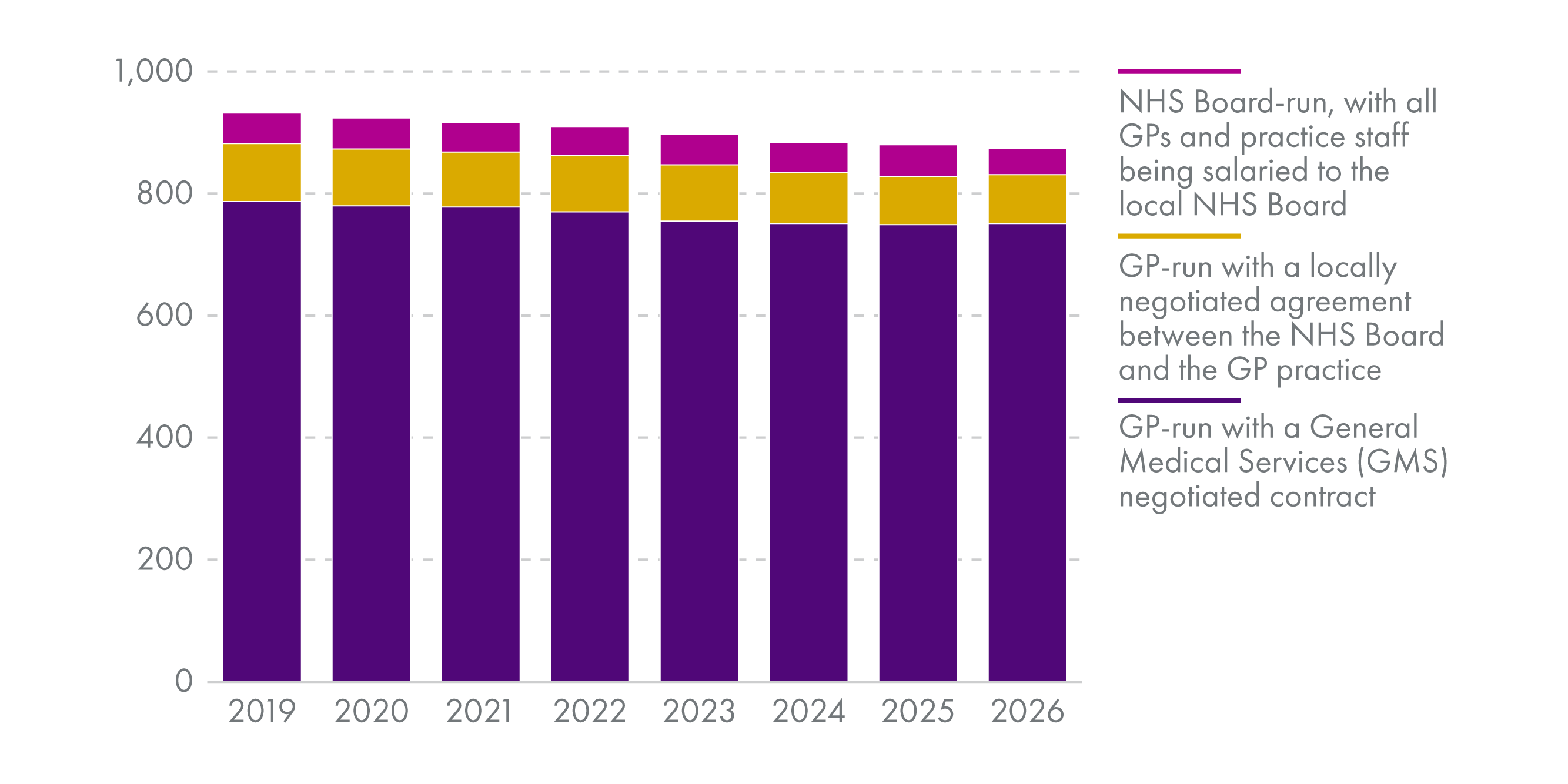
Care in the Digital Age: delivery plan 2025 to 26 committed to developing a Primary Care Data and Intelligence Platform to make available data from all GP IT systems daily for statistical analysis and reporting by March 2026. However, this appears to have been delayed and, in the interim, Public Health Scotland operates the Primary Care Intelligence Service which provides aggregate‑level data extracts and dashboards using an interim technical solution but it does not provide a comprehensive, patient‑level primary care dataset1.
Developments in other primary care services
There have been a number of developments in optometry and pharmacy. Independent prescriber optometrists have been supported to manage more complex acute anterior eye conditions through a new tier of specialist supplementary eye examination fees and continuing professional development allowance claims. Along with the community glaucoma service these changes aim to reduce demand in the hospital eye service by managing more patients in the community. Approximately 2.44 million eye examinations were undertaken in Scotland in 2024/25. This is an increase of 0.71% compared to 2023/24. The number of supplementary eye examinations has increased almost every year since 2006/07 and has more than doubled since 2010/11 (climbing from around 300,000 to around 686,000 in 2024/25)1.
In 2020, the NHS Pharmacy First Scotland (and Pharmacy First Plus) service was launched in community pharmacies. Through this pharmacists can provide advice and treatment for many minor ailments and common clinical conditions. In addition, community pharmacists who are qualified independent prescribers can provide a wider range of treatments. These services are intended primarily as face to face services, where consultations with individuals are in response to symptoms of minor self-limiting conditions. From 2026, all newly qualified pharmacists will be independent prescribers upon registration. In the most recent 12 months (1 October 2024 to 30 September 2025) 35% of the Scottish population used Pharmacy First Scotland2.
There have been a number of reforms in dentistry. These are discussed in detail in the SPICe blog NHS Dental Services in Scotland – Braced for change. One major change is that the number of items of treatment has been drastically reduced from over 100 items to 45. Other changes are to the regular ‘check-up’. These create a more extensive clinical examination including consideration of oral hygiene, clinical risk status and other health factors . The recall frequency between these more extensive check ups has also been changed to 12, 18 or 24 months, based on the clinical judgement of the patient's dentist. Over 4.4 million courses of NHS dental treatment were delivered under this new payment system in the year to 31 March 2026 – an increase of over 320,000 from the same period in the previous year3. The number of high street dentists is now above pre-pandemic levels, with an increase of 6.4% in the year to March 2026.
Feedback and complaints
NHS services
People who wish to make a complaint about NHS care or treatment can use the NHS complaints procedure. To make a complaint, people should contact the feedback and complaints team at the relevant health board. More information is available from Citizens Advice Scotland: NHS Complaints.
The Patient Advice and Support Service (PASS) is an independent service which provides free, accessible and confidential advice and support to patients, their carers and families about NHS healthcare.
The Scottish Public Service Ombudsman (SPSO) is the final stage for complaints about public services in Scotland, including councils and the NHS. The SPSO can look at complaints about the service provided by the NHS and complaints about clinical treatment, once the organisation's complaints procedure has been completed.
GP practices, dental practices, pharmacies and optometry practices
GP practices, dental practices, pharmacies and optometry practices have their own complaints procedures. It is also possible to make a complaint about professional misconduct to the practitioner's professional or regulatory body - one of the Councils listed earlier.
The Dental Complaints Service of the General Dental Council runs a service for complaints about private dentistry. The Optical Consumer Complaints Service is an independent mediation service for consumers of optical care and the professionals providing that care.
Primary care policy
The Scottish Government has a long standing commitment to move care out of hospital and into the community, where possible. The most recent strategies (the NHS Scotland Operational Improvement Plan, the Health and Social Care Renewal Framework 2025-2035 and the Scottish Population Health Framework 2025-2035) reference shifting the balance of care and focus on the role of prevention.
The Health and Social Care Renewal Framework says:
The system will be reshaped to focus on delivering the outcomes that matter to the people we support and care for, and empowering people to be more in charge of the care they receive. Building the capacity of, and access to, primary and community care will be easier and more accessible.
Scottish Government. (2025, June 17). Health and Social Care Service Renewal Framework. Retrieved from https://www.gov.scot/publications/health-social-care-service-renewal-framework/ [accessed 17 June 2026]
The Scottish Parliament Committees have undertaken a number of inquires into primary care including:
Primary care route map
Since 2024 the Scottish Government has been working on its Primary Care route map. This is intended to:
Set out key aspects of both how the primary care system operates currently, including across rural areas, and how it will operate in the context of wider reforms […]The Route Map covers key enablers to realise our collective vision for Primary Care such as: workforce, finance, governance, infrastructure, data and digital, policy and improvement with cross-cutting themes are being considered throughout including the remote and rural perspective, alongside health inequalities and person–centeredness.
Scottish Parliament. (2024, November 18). Inquiry to Rural Healthcare Provision. Retrieved from https://www.parliament.scot/-/media/files/committees/health-social-care-and-sport-committee/correspondence/2024/letter-to-the-convener--18-november-2024.pdf [accessed 17 June 2026]
In 2025, the route map was cited in the Health and Social Care Service Renewal Framework 2025-2035. In this it promised to:
Set out […] the actions and enablers required for this shift [improving access to treatments in the Community] (workforce, infrastructure, systems), clarify the role and services to be delivered in the community, and support leadership and cohesion in our health services in the community.
Scottish Government . (2026, June). Health & Social Care Service Renewal Framework 2025-2035. Retrieved from https://www.gov.scot/binaries/content/documents/govscot/publications/strategy-plan/2025/06/health-social-care-service-renewal-framework/documents/health-social-care-service-renewal-framework/health-social-care-service-renewal-framework/govscot%3Adocument/health-social-care-service-renewal-framework.pdf [accessed 17 June 2026]
It is anticipated that the route map will be a delivery plan organised around six key drivers of change (e.g. governance, finance, workforce) and will include priority actions, timelines, and measurement indicators aligned with Service Renewal Framework and Population Health Framework commitments3.
However, at the time of publication in August 2026, the route map had not been published.
Funding primary care
The Scottish Government's Budget: 2026-27 puts the total Health and Sport budget at £22,476.9 million. Of this, £1,432.3 million is for General Medical Services (made up of the General Medical Services, Primary Care Fund and other spend budget lines, shown below), £526.5 million is for General Dental Services and £144.5 million is for Community Eyecare.
| Resource | 2026-27 (£million) | Scottish Government explanation of what the funding is for |
|---|---|---|
| General Medical Services | 1,179.6 | Funding of primary medical services commissioned by NHS Boards and delivered through GP practices. |
| Primary Care Fund | 245.1 | This investment supports the crucial services that General Practices provide. This includes a minimum annual £190m investment plus uplifts in multi-disciplinary teams and developing measures to support GP sustainability. It also includes support for health inequalities, increasing use of data and digital opportunities and supporting improvements in provision of primary care as well as GP walk in services. |
| Other spend | 7.6 | Includes ongoing investment in audiology to support funding for the existing Third Sector partnerships. It also provides professional, clinical and wider PPM expertise to commission, oversee and deliver agreed programmes |
| Pharmaceutical Services Contractors' Remuneration | 326.2 | National General Pharmacy Service funding as negotiated with Community Pharmacy Scotland (CPS). Also incorporates Pharmacy First funding and supports provision of free prescriptions. |
| Other spend | 14.9 | Covers a range of pharmacy related budgets including Achieving Excellence in Pharmaceutical Care, Essential Medicines, Access to Medicines and ePharmacy (which support core components of Community Pharmacy Contract) and resource costs |
| General Dental Services | 526.5 | Funding is used to deliver payment of fees and allowances to contractors who provide a full range of NHS preventive care and dental treatments, including universally free dental examinations. The 2026-27 budget includes additional funding to support dentistry reform and continued access to NHS services. |
| Community Eyecare | 144.5 | Funding is used to continue to deliver free universal NHS eye examinations, the continued rollout of enhanced services provision for community glaucoma and anterior eye management, as well as design and development work for a community low vision service. |
.png)
In terms of actual expenditure, the Scottish Health Service Cost Book provides a detailed analysis of where resources are spent. However, Cost Book data for financial year 2024 to 2025 was due to be published in February 2026 but has been delayed as "the introduction of a new costing system (PLICS) in NHS boards has led to significant delays in some data submissions"1.
Future funding: 2026-27 to 2028-29
On 28 October 2025, following agreement with the BMA, the Scottish Government announced a three-year funding package for core General Practice. The funding builds to a recurring £249 million in 2028-29. The funding is intended to increase staff numbers and capacity, support day-to-day operations and make it easier for people to access GP services1. More detail is available in the BMA's publication Details of additional funding to end formal dispute with Scottish Government2.
Primary care service planning
Integration Authorities
The Public Bodies (Joint Working) Scotland Act (2014) required NHS Boards and Local Authorities to integrate the governance, planning and resourcing of adult social care services, adult primary care and community services and some hospital services.
Under the Act, 31 integration authorities (IAs) were created. Each of these have developed a Primary Care Improvement Plans. Each of the IAs were required to establish at least two localities. Localities were intended to provide an organisational mechanism for local leadership of service planning, to be fed upwards into the integration authority's strategic commissioning plans. They bring together local GPs and other health and care professionals, representatives of the housing sector, representatives of the third and independent sectors, carers’ and patients’ representatives and people managing services.
The Scottish Government's guidance on localities notes that they must:
Support the principles that underpin collaborative working to ensure a strong vision for service delivery is achieved. Robust communication and engagement methods will be required to assure the effectiveness of locality arrangements.
Support GPs to play a central role in providing and co-ordinating care to local communities, and, by working more closely with a range of others – including the wider primary care team, secondary care and social care colleagues, and third sector providers – help improve outcomes for local people.
Support a proactive approach to capacity building in communities, by forging the connections necessary for participation, and help to foster better integrated working between primary and secondary care.
Remote and rural primary care
The provision of healthcare in remote and rural areas faces a number of specific issues including the recruitment and retention of staff as well as the large distances that some people have to travel to access services. This was investigated in the Session 6 Health and Social Care Committee's inquiry into healthcare in remote and rural areas and has been the subject of a number of petitions such as PE2210: Improve access to local healthcare in rural communities.
The Scottish Government has outlined relevant work to improve the recruitment and retention of staff. Work has been undertaken by the Centre for Workforce Supply and the National Centre for Remote and Rural Health and Care in relation to developing a sustained model of direct support that will provide rural and island health and social care employers to improve recruitment.
There are also number of incentive schemes including a £10,000 'Golden Hello' scheme to incentivise GPs into taking up harder to fill posts in rural and deprived areas and Public Services Delivery Scotland (formally NHS Education for Scotland) also offer rural fellowships to support GPs to develop the right skills and experience to work in island and rural settings.
The Scottish Government commissioned the Scottish School of Primary Care to undertake an independent evaluation of the Golden Hello initiative for GPs and has said that any future expansion and improvement plans for Golden Hellos will be set out in due course.
The Rediscover the Joy of General Practice programme is a Scottish Government-funded GP recruitment and retention initiative, coordinated by the NHS Shetland Hub. The programme enables experienced GPs to undertake flexible short-term placements in practices across Scotland, particularly in rural and remote communities, helping to improve practice sustainability while offering GPs greater flexibility and variety in their careers.
Rural dentistry
The Scottish Government has acknowledged that despite recent payment reform there are localised challenges in the dentistry workforce, particularly in rural areas such as Dumfries and Galloway, the Highlands, as well as in island areas. It is working with NHS Boards to refine the financial incentives in place to support dentists moving to work in rural areas, supporting sustainable access across Scotland1.
There are a range of incentive payments for dentists working in remote areas. The remote areas allowance is paid annually, up to a maximum of £9,000, to dentists working in remote areas.
Health inequalities
The issue of health inequalities and the role of prevention and primary care has been much discussed but remains a persistent issue. In 2012, Audit Scotland found:
The distribution of primary care services across Scotland does not fully reflect the higher levels of ill health and wider needs found in deprived areas, or the need for more preventative healthcare.
Audit Scotland . (2012, December). Health inequalities in Scotland. Retrieved from https://audit.scot/uploads/docs/report/2012/nr_121213_health_inequalities_0.pdf [accessed 17 June 2026]
The Scottish Parliament has conducted a number of inquiries into health inequalities including an inquiry in 2013, which looked at the relationship between access to primary care health services and inequality. It reported on the following themes:
The impact of poverty and deprivation.
People with disabilities.
Carers.
The inverse care law -which describes the relationship whereby the availability of good medical care tends to vary conversely with the need for it in the population served.
Access.
Funding and need.
Did not attends (DNAs).
Accident and Emergency use.
Resourcing the primary care team.
In 2022, the Health, Social Care and Sport Committee undertook another inquiry which explored the role of Community Link Workers and of primary care in mitigating health inequalities.
The Scottish Government has published Socioeconomic inequality and barriers to primary care in Scotland: A literature review in 2025. This highlighted four areas of consideration for programmes of primary care reform in Scotland.:
System related barriers to engaging with primary care.
Improved understanding of the challenges related to socioeconomic deprivation may facilitate empathetic interactions with patients.
Establishing links between healthcare services and the wider communities can facilitate patient empowerment.
Inequalities in the accessibility of care and patient experience should be considered within programmes of primary care reform.
The Deep End Project is a group of GPs who work in general practices serving the 100 most deprived populations in Scotland, based on the proportion of patients on the practice list with postcodes in the most deprived 15% of Scottish datazones. The Scottish Government provides the Deep End with core funding. In 2026, the Deep End published a Manifesto for the Scottish Parliament election.
In 2023, the Scottish Government introduced the Inclusion Health Action in General Practice programme. This was intended to provide GP practices in areas of high deprivation with additional investment to undertake practical action to address healthcare inequalities which impact health inequalities across three themes:
Patient engagement.
Enhancing workforce knowledge and skills.
Outreach and extended consultations.
This programme is currently confined to practices in NHS Greater Glasgow and Clyde and the programme was evaluated in 2026. The Scottish Government has also introduced a highly targeted Whole Family Support though General Practice project in Glasgow City HSCP which provides 12 practices with a Family Wellbeing Workers and resources to address child poverty in their patient population. A commitment in the latest Tackling Child Poverty Delivery Plan (March 2026) will double the number of practices to 24.
In its 2025 report Audit Scotland reflected that:
The Scottish Government needs to set out a clear plan for how it intends to better support general practices to contribute to tackling health inequalities.
The role of technology
There has been ongoing discussion and debate about the role digital technology could and should play in primary care and in furthering the preventative agenda. In 2017, the Session 5 Health and Sport Committee heard in written evidence from health professions working in primary care:
It is clear to us that the transformation of primary care with a wider primary care team cannot be achieved without the sharing of information amongst health and social care professionals and their teams.
Since then, this work has been progressed towards the development of a national digital platformfor heath and social care data. There have also been developments in the release of the MyCare.scot app which is part of the national Digital Front Door programme and aims to make it easier for people to access their health and social care information in one secure place. Currently, people can view:
medicine and allergy information
health and wellbeing services
Community Health Index (CHI) number
COVID-19 and flu vaccination record since 2021
some of the details NHS Scotland holds such as home address.
It is not yet a shared care record, and it does not currently solve long‑standing challenges around data flowing between care settings1.
Recent funding agreements have also been agreed to improve digital and access solutions for practices. All practices will be supported to adopt cloud based telephony systems and digital prescribing2.
Workforce planning
In 2017 and 2018 the Scottish Government published a National Health and Social Care Workforce Plan, in three parts.
Part 1 – a framework for improving workforce planning across NHS Scotland
Part 2 – a framework for improving workforce planning for social care in Scotland
Part 3 – Improving workforce planning for primary care in Scotland
Part 3 of the plan focussed on developing, building and expanding multidisciplinary teams. It set out recommendations, next steps and lists supporting actions and a number of commitments, including the publication of a Primary Care Monitoring and Evaluation Strategy 2018-2028 .
It also made and, restated, a number of commitments by the Scottish Government to strengthen the workforce including increasing the number of GPs by at least 800 by 2027 (announced December 2017).
This was followed by the health and social care: national workforce strategy in 2022. This set the vision for the Health and Social Care Workforce:
A sustainable, skilled workforce with attractive career choices and fair work where all are respected and valued for the work they do
Scottish Government . (2022, March 11). Health and social care: national workforce strategy. Retrieved from https://www.gov.scot/publications/national-workforce-strategy-health-social-care/ [accessed 17 June 2026]
It also committed to creating:
A network of 1,000 additional dedicated staff who can help grow community mental health resilience and help direct social prescribing, by 2026.
Scottish Government . (2022, March 11). Health and social care: national workforce strategy. Retrieved from https://www.gov.scot/publications/national-workforce-strategy-health-social-care/ [accessed 17 June 2026]
In 2026, there were 407.41 whole-time equivalent mental health workers working in general practice3.
In November 2024 the Scottish Government published the GP Recruitment and Retention Plan. This set out 20 measures aimed to improve the GP training pipeline and career pathway to recruit and retain GPs in general practice4. An update on developments was published in March 2026.
Work has continued on improving GP recruitment and retention in Scotland and the Scottish Government has also undertaken Future Medical Workforce project which has considered what Scotland's medical workforce will need to look like in the next 15–20 years. The Future Medical Workforce Project: phase 1 report (December 2025) set out the key insights and views of doctors. Phase two, which began in January 2026, focuses on co-designing solutions with the profession, and early thinking envisages work on medical education and training reform, the future role of doctors to support NHS renewal, improving workplace culture and experiences for doctors and workforce planning.
As part of a three year (2026-2029) funding agreement, between the BMA’s Scottish GP Committee and Scottish Government, recurrent funding will be available to general practice to improve workforce capacity. Tranche 1 funding for 2026-27 has been allocated with the allocation of tranche 2 dependent on practices achieving increases to workforce capacity.
| Total 2026-27 (£m) | Total 2027-28 (£m) | Total 2028-29 (£m) | Total recurring | |
|---|---|---|---|---|
| Continued Workforce Payment (started Autumn 2025/26) | 15 | 15 | 15 | 15 |
| Workforce tranche 1 payment | 35 | 81.6(proportion comprising year 2 tranche 1 to be confirmed) | 133.3(proportion comprising year 3 tranche 1 to be confirmed) | 133.3 |
| Workforce tranche 2 payment(funding to be released during year upon achieving milestones) | 15 | (proportion comprising year 2 tranche 2 to be confirmed) | (proportion comprising year 3 tranche 2 to be confirmed) | n/a |
| Total | 65 | 96.6 | 148.3 | 148.3 |
Scottish Government . (2026, March 23). New Core Investment in General Practice 2026-29. Retrieved from https://www.publications.scot.nhs.uk/files/new-core-investment-in-general-practice-2026-29.pdf [accessed 17 June 2026]
Workforce data
Optometrist workforce
There are approximately 1,200 optometrists and dispensing opticians providing NHS-funded eye care services in Scotland. The number of optomotrists that are independent prescribers has increased and was 614 (at 31 March 2025)1.
Pharmacy workforce
The Community Pharmacy Survey 2025 reported that there were 8,424 Pharmacists, Pharmacy Technicians and support staff employed (excluding relief staff, trainees, locums and central staff) (with a total Whole Time Equivalent (WTE) of 5,883.1) across Scotland (13 September 2025). The WTE of core pharmacists decreased between 2020 and 2022, stabilised in 2023 and increased in 2024 and 2025 with the current WTE at the same level as 20202.
Information is also published on the number of pharmacists directly employed by NHS Scotland (Managed Sector). There were 746.9 Pharmacists, 486.2 Pharmacy Technicians, 191.1 support staff working in primary care in health boards (2024)3.
Dentist workforce
At the end of March 2026, there were 3,704 dentists working in NHS Scotland. Of these 3,429 work in the General Dental Service (GDS) and Public Dental Service (PDS). This is an increase from 3,319 (3,010 GDS and PDS) in 20234.
Community Nursing
The Royal College of Nursing (RCN) has submitted a Freedom of Information (FOI) request to all NHS boards to determine the level of investment in the community nursing workforce, including district nursing, health visiting and school nursing. It estimated that 1,735.7 WTE nurses were working in general practice in 2025and highlighted that there is significant variation in education activity, workforce distribution, and leadership infrastructure across NHS boards5. The number (headcount) of district nurses was 5,305(end of March 2026)4..
Allied Health Professionals
In March 2026, there were 14,424.8 (WTE) AHP staff in post working across the NHS in Scotland, although this is the number across the NHS not only those working in primary or community care4.
Mental health workers
Data on the whole-time equivalent (WTE) Mental Health Workers, who are employed as part of Primary Care Improvement Plans associated with delivery of the 2018 GMS contract, is published annually by Scottish Government. At the end of March 2025, this was 392.9 (WTE). Most of these staff are employed by Health Boards and most are funded from the Scottish Government's Primary Care Improvement Fund8.
Data on the Mental Health Workforce which is directly employed by GP practices, is published annually by NHS Education for Scotland (NES) in the General Practice Workforce Survey 2025 Dashboard. This reports that as of 31 March 2025, there were 23 Mental Health Nurses(14.1 WTE) employed by GP practices9.
General Practitioner workforce
As of 31 March 2026 there were 5,419 GPs (4,688 GPs excluding trainees). The latest available data on GP WTE (whole time equivalent)from September 2025 shows that there are 3,657 WTE GPs. The General Practice Workforce Survey reports the GP vacancy rate was 3.8%, a decrease from 7.6% in March 2024. It also shows that between 2015 and 2025 GP Headcount has increased by 3.9% and estimated WTE has increased by 0.3% 9.
In 2017, the Scottish Government committed to increasing the the number of GPs in Scotland by at least 800 over the next decade. In its report into Primary Care in 2025, Audit Scotland said:
the Scottish Government's commitment to increase the number of GPs by 800 is unlikely to be met by 2027.
Audit Scotland . (2025, March 27). General practice: Progress since the 2018 General Medical Services contract. Retrieved from https://audit.scot/publications/general-practice-progress-since-the-2018-general-medical-services-contract [accessed 17 June 2026]
| Year | Headcount GPs | Headcount GPs (excluding trainess) | WTE (excluding trainees) |
|---|---|---|---|
| 2017 | 4,821 | 4,365 | 3,520.3 |
| 2018 | 4,900 | 4,375 | N/A |
| 2019 | 4,916 | 4,380 | 3,613.0 |
| 2020 | 5,044 | 4,462 | N/A |
| 2021 | 5,095 | 4,488 | N/A |
| 2022 | 5,085 | 4,471 | 3,493.9 |
| 2023 | 5,116 | 4,454 | 3,478.4 |
| 2024 | 5,125 | 4,416 | 3,453.1 |
| 2025 | 5,257 | 4,577 | 3,591.5 |
| 2026 (March) | 5,419 | 4,688 | To be published September 2026 |
Training
GP training
To practise as a GP, it is necessary to complete a recognised medical degree, an MBChB Medicine, which is normally a 5 year course. Following this, graduates must complete two years of foundation training before undertaking three years of specialist GP training before being entered on the General Medical Council's (GMC) GP Register.
In October 2018, the Cabinet Secretary for Health and Sport launched the Scottish Graduate Entry Medicine (ScotGEM) Programme. This programme is a four-year graduate entry programme leading to a Primary Medical Qualification (PMQ), (MB ChB), that fully meets GMC requirements. Students on the ScotGEM course are offered a “return of service” bursary, a grant worth up to £16,000 in total, in exchange for working in NHS Scotland for up to four years1.
Applicants for the GP training programme in the UK apply through the General Practice National Recruitment Office. In 2025, there were 317 General Practice Specialty Training (ST1) places in Scotland, of which 99.37% were filled2.
Optometrist training
To practise as an optometrist it is necessary to complete a four year undergraduate course, a BSc (Hons) Optometry. This is followed by a one year pre-registration training programme overseen by the College of Optometrists, and professional examinations. Registration is required with the General Optical Council (GOC). Optometrists can also undertake additional postgraduate training which entitles them to extend their scope of practice.
Pharmacist training
The initial education and training of a pharmacist comprises a four-year Master of Pharmacy (MPharm) degree and a one-year pre-registration training programme . Pre-registration trainees then have to pass a national registration assessment before registering as a pharmacist with the General Pharmaceutical Council (GPhC). In 2021, the GPhC published new standards for the Initial Education and Training of Pharmacists.
Dentist training
UK trained dentists are required to complete a Bachelor of Dental Surgery (BDS) course and must register with the General Dental Council (GDC) after graduating. Dentists educated in Scotland then complete one year of vocational training in an approved dental practice supervised by an experienced practitioner.
Nursing and Midwifery training
Nurses and midwives need a relevant degree and must be registered with the Nursing and Midwifery Council (NMC). The NMC also sets standards of education, training, conduct and performance for nurses and midwives in the UK. As part of nursing training, people choose from one of the four specialisms (adult, children, mental health, or learning disability).
It is possible for nurses to continue with their professional development and work in roles such as Advanced Nurse Practitioners (ANPs), district nurses and school nurses.
Allied Health Professionals training
For the majority of AHP professions, training is four years for an undergraduate BSc programme and two years for a post graduate MSc programme. Many AHPs are regulated by the Health and Care Professions Council.
Cost of training
The cost of training primary care staff varies by profession. The University of Kent provides estimates of the training costs of health and social care professionals. It estimates for roles such as physiotherapists, occupational therapists and nurses the total investment (pre registration) is £74,635, (whilst noting that although further training is available to all professionals to enable them to progress to higher grades the cost of postgraduate training is known only for doctors). It estimates that the total investment for training a GP is £495,7161.
A number of bursary schemes are available for people wishing to study in Scotland, including:
The Paramedic, Nursing and Midwifery Student Bursarywhich is set at £10,000 for students annually (£7,500 for eligible students in year 4) paid monthly throughout the course (for 2025/26)2.
The Dental Student Support Grant of £4,000 a year to help dental students with study costs. People who receive the grant are required to work for NHS Scotland as a dentist for the same number of years as grant funding was received after graduation 3.
Regulations governing independent contractors
As outlined earlier in this briefing, there are four independent contractor groups in primary care: medical (GPs), dental, pharmaceutical and ophthalmic. These practitioners are usually independent of the NHS and provide services on behalf of NHS Boards.
General Ophthalmic Services
In 2006, the National Health Service (General Ophthalmic Services) (Scotland) Regulations provided for free NHS eye examinations. The regulations encouraged the profession to manage patients in the community where it was safe to do so and improve the quality of the referrals that were made to the Hospital Eye Service.
The National Health Service (General Ophthalmic Services) (Scotland) Amendment Regulations 2018 aimed to support Optometrists and Ophthalmic Medical Practitioners as the first port of call for all eye related problems, including emergency eye examinations.
The Scottish Government's NHS Operational Improvement Plan (2025) committed to support independent prescribing optometrists and ophthalmic medical practitioners to manage patients with ten complex acute anterior eye conditions under General Ophthalmic Services. This was enabled by the implementation of the National Health Service (General Ophthalmic Services) (Scotland) Amendment Regulations 2025.
The majority of individual Optometrists are employed by body corporate (a body corporate is a group of persons incorporated to carry out a specific enterprise) and the body corporate (not the Optometrist) is the entity that has the direct contractual arrangement with the NHS Board to provide General Optical Services. Most dispensing opticians are employed by the body corporate.
General Dental Services
General Dental Services are currently delivered by General Dental Practitioners or General Bodies Corporate on behalf of the fourteen NHS Boards. The arrangements for the provision of General Dental Services are governed by the National Health Service (General Dental Services) (Scotland) Regulations 2010 and theNational Health Service (Scotland) Act 1978.
Unlike GPs, there is no contractual requirement for a dentist to provide a basic level of service. A dentist is directly reimbursed for the treatments they provide to NHS patients. These treatments are limited and detailed in the Statement of Dental Remuneration.
The regulations were amended in 2023 with a new scale of fees, introduced on 1 November 2023 via secondary legislation.
Community Pharmacy
The provision of NHS Pharmaceutical Services is governed by the National Health Service (Pharmaceutical Services) (Scotland) Regulations 2009. NHS pharmaceutical services are provided under NHS arrangements with local and high street retail pharmacies. These arrangements are managed by the local NHS Board which is responsible for ensuring that the communities it serves have appropriate access to NHS pharmaceutical services. Funding of these arrangements is as required by the National Health Service (Pharmaceutical Services) (Scotland) Regulations 2009 and laid down in the Scottish Drug Tariff.
General Medical Services
NHS Boards are responsible for providing GP services and have a number of options for doing so. NHS Boards can contract with a practice under the Scottish General Medical Services (GMS) contract, run their own practices or negotiate a local contract. NHS Boards are not allowed to contact with commercial bodies.
The Primary Medical Services (Scotland) Act 2004, established three types of general practice contract in Scotland.
GMS/17J: A General Medical Service (GMS) practice is GP run and has a standard, nationally negotiated contract in place. The majority of practices in Scotland are run by GPs with a GMS/17J contract in place.
17C: These practices are GP run and have a locally negotiated agreement between the NHS Board and the practice. This enables, for example, flexible provision of services in accordance with specific local circumstances.
2C: An NHS Board run practice where all GPs and practice staff are salaried to the local NHS Board.
At April 2026, 751 practices operated under the GMS contract, 80 practices operated under the 17C contract and 49 practices operated under the 2C contract.
The 2018 Scottish General Medical Services (GMS) Contract
The 2018 Scottish General Medical Services Contract Offer was published on 13 November 2017, supported by a Memorandum of Understanding between the Scottish Government, the BMA, Integration Authorities and NHS Boards. On 18 January 2018, the Scottish GP Committee of the BMA agreed to proceed to implement the new 2018 GP contract. This decision followed a poll of the profession, in which 71.5% were in favour of the new contract.
The National Health Service (General Medical Services Contracts) (Scotland) Regulations 2018 and The National Health Service (Primary Medical Services Section 17C Agreements) (Scotland) Regulations 2018 were considered by the Scottish Parliament's Health and Sport Committee on 20 March 2018 and came into force on the 1 April 2018.
The 2018 GP contract aimed to see GPs working as an expert medical generalist and senior clinical decision maker within multi-disciplinary community teams. It noted that the key contribution of GPs in this role will be in:
undifferentiated presentations (when patients who are ill but do not yet have a diagnosis)
complex care in the community
whole system quality improvement and clinical leadership.
The GP contract sets the structure for pay and expenses, the workload formula, the wider primary care team and infrastructure and introduces measures to reduce the risks for GPs as independent contractors. It also set out the role of the multidisciplinary team and the practice team, including general practice nurses, practice managers and practice receptionists.
The 2018 GP contract also aimed to redistribute the non-expert medical generalist workload to the wider primary care multi-disciplinary team. The Memorandum of Understanding (MOU) set out six priority service areas which would be the focus of service redesign and expansion of the MDT:
Vaccination Transformation Programme which aimed to move away from a model based on GP delivery to one based on NHS Board delivery, through dedicated teams.
Pharmacotherapy was to be available to GPs and all practices were to receive pharmacy and prescribing support.
Community Treatment and Care Services such as the management of minor injuries and dressings, phlebotomy, chronic disease monitoring and related data collection was to move from GPs to integration authorities.
Urgent Care Services advanced practitioners were to be first response for home visits. These services provide support for urgent unscheduled care within primary care.
Additional Professional Roles to provide services for groups of patients with specific needs that can be delivered by other professionals as first point of contact in the practice and/or community setting. For example: musculoskeletal focused physiotherapy services and/or community clinical mental health professions.
Community Link Workers to be based in or aligned with a GP practice or Cluster. The link worker was to work directly with patients to help them navigate and engage with wider services, often serving a socio-economically deprived community or assisting patients who need support. This could be due to the complexity of their conditions or rurality
A revised Memorandum of Understanding for the period 2021-23 reaffirmed the commitment to expanding and enhancing the MDT and placed a focus on vaccination transformation programme, pharmacotherapy and community treatment and care services. Regulations were also changed to place a legal responsibility on health boards to deliver pharmacotherapy and community treatment and care service alongside their existing responsibilities for vaccinations delivery.
Funding to support the expansion of MDTs was allocated to integration authorities through the Primary Care Improvement Fund and Primary Care Improvement Plans have been developed and implemented since July 2018. From April 2024, the Scottish Government established the Primary Care Phased Investment Programme to help develop the evidence base on MDT working. The final report was published in June 2026:
Overall, PCPIP findings suggest that additional investment alone is insufficient to deliver the ambitions of the GMS contract. Improvement would be more likely where investment is accompanied by clear expectations, strong leadership, QI capability, reliable infrastructure and genuine engagement with primary care teams. The findings indicate that a flexible, needs-based approach to MDT development, rather than a rigid interpretation of ‘one size fits all full implementation’, would be more realistic, sustainable and aligned with local population needs.
Healthcare Improvement Scotland . (2026, June). Primary Care Phased Investment Programme: Final report . Retrieved from https://www.healthcareimprovementscotland.scot/wp-content/uploads/2026/06/PCPIP-final-report-full-version-June-2026.pdf [accessed 6 August 2026]
The report made 13 recommendations to inform future policy, investment and programme design.
Reset national expectations to align MDT development with improving outcomes and making best use of resources.
Embed improvement principles and realistic timelines.
Apply hub/hybrid models selectively.
Invest in IT system integration and Outcome Focused Monitoring.
Establish clear governance and engage with all relevant stakeholders at the programme design stage.
Ensure enabling conditions for MDT effectiveness.
Co-design MDT configuration based on local need.
Expand evaluation of MDT impacts over time.
Protect continuity of care.
Ensure workforce stability and wellbeing.
Adopt a QMS [Quality Management System] approach and tailor improvement support.
Develop a national health equity framework.
Strengthen public communication on MDT roles.
The Scottish Government publishes information on the number of staff (WTE) working to support the six priority areas set out in the MOU. At March 2026, there were 5,455.3 (WTE) staff working in the MOU services. The majority of these (3,579.4 ) were funded by the Primary Care Improvement Fund.
Phase two
Phase two of the contract was intended to introduce an agreed income range with pay progression for GPs comparable to consultants, and to directly reimburse practice expenses. This phase is subject to further negotiations and another poll of the profession. Audit Scotland outlined that it involves:
collecting data on GP earnings and practice expenses, to improve transparency and enable practice expenses to be directly reimbursed
agreeing an income range and pay progression comparable to NHS consultants
identifying the GP workforce needed to meet population health needs and contribute to addressing health inequalities and the challenges faced by rural communities.2
Audit Scotland reflected that progress towards phase two has been slow, noting that it was delayed because of the Covid‑19 pandemic and challenges collecting data from practices2. The Scottish Government (March 2026) has said:
We remain committed to a modern, sustainable model of general practice that supports prevention, continuity, and access. This includes progressing Phase Two of the 2018 GP Contract with the BMA by exploring direct reimbursement of practice expenses and aligning future investment with the SRF [Service Renewal Framework] and the PHF [Population Health Framework] to secure a sustainable, prevention-focused general practice service at the heart of our rebalanced health and care system.
Scottish Parliament. (2026, March 24). Doctors' and Dentists' Remuneration - 2026-2027 pay round: written evidence. Retrieved from https://www.gov.scot/publications/doctors-dentists-remuneration-2026-2027-pay-round-scottish-governments-written-evidence/documents/ [accessed 17 2026]
£40 million of funding for direct reimbursement of non-staff expenses was included in the new core general practice investment announced in October 2025, with the aim of delivering improved sustainability. It will be allocated as follows:
| 2026-27(£m) | 2027-28(£m) | 2028-29(£m) | |
| Expenses | 10 | 21.7 | 8.3 |
| Total recurring | 10 | 31.7 | 40 |
Guidance for general practices and Health Boards on the first phase of direct reimbursement in 2026-27 was published in June 2026. Data to be collected from Health Boards and practices in 2026-27 will inform the approach to direct reimbursement in 2027-28 and 2028-29, with updated guidance to be issued in advance of each year.
Implementation of the 2018 GMS contract
Audit Scotland, in its 2025 report General Practice, found that reform of general practice under the 2018 GMS contract has fallen short of its aims. The contract was intended to ease pressure on GPs by expanding multidisciplinary teams, improving access to care and making general practice more sustainable.
However, Audit Scotland reported that several key commitments remained unmet, progress had been slower than planned, and pressures on general practice had increased. The number of whole‑time equivalent GPs had fallen, the expansion of wider primary care teams had lagged behind expectations, and patients report greater difficulty accessing GP services.
The report also highlighted weak national data on demand, workload and workforce, which is claimed limited the Scottish Government's ability to assess impact or value for money. Audit Scotland concluded that the Scottish Government is unlikely to meet its target of increasing GP numbers by 800 by 2027 and called for a clearer delivery plan, with defined actions, timescales and accountability, to set the future direction of general practice.
After taking evidence on the report, the Session 6 Public Audit Committee wrote to the Health and Social Care Committee and suggested the following areas of future work1:
The Committee was disappointed to hear from the AGS that several commitments made by the Scottish Government in the 2018 GMS contract have yet to be fully implemented. It supports the recommendation from the AGS that the Scottish Government should publish a clear delivery plan for general practice. The HSCS Committee may wish to consider monitoring progress by the Scottish Government as part of its future work programme.
The HSCS Committee may wish to monitoring workforce challenges including how GP and nurse recruitment is progressing and how well multidisciplinary teams are working in practice as part of its future work programme.
The HSCS Committee may wish to monitor whether investment is achieving the intended outcomes, in improving patient access, reducing pressure on secondary care, supporting workforce sustainability, and delivering value for money.
The Committee notes the AGS’s findings on the decline in patient satisfaction and the increasing difficulties patients face in accessing primary care. The HSCS Committee may wish to keep track of how the Scottish Government’s plans to improve access and patient experience are working in practice, including the rollout of its NHS app later this year.
The Committee suggests that the HSCS Committee may wish to monitor progress in addressing concerns over the condition and ownership of GP premises including delivery of the sustainability loan scheme, NHS Boards’ role in leases and the development of long-term estate plans under the Health and Social Care Renewal Framework.
The Committee suggests the HSCS Committee may wish to follow up on how the Scottish Government intends to improve the data it collects on GP services, such as demand, workload and patient outcomes so that it is clear whether changes are making a real difference and representing value for money.
In January 2026,the National Health Service (General Medical Services Contracts and Primary Medical Services Section 17C Agreements) (Miscellaneous Amendment) (Scotland) Regulations 2026, allowed for pharmacotherapy and community treatment and care services health boards to agree with GP practices that those practices will deliver part or some of those services if the health board is having serious difficulties in doing so and if certain criteria are met. In these cases, GPs would receive financial payments from the health board with specific details agreed locally.
Enhanced services
Enhanced services are additional services delivered by GP practices outwith the the contract for nationally specified services like an opt-in out of hours services and more recently the cardiovascular disease prevention scheme.
As part of the negotiations with the Scottish Government in relation to funding general practice, the BMA states that it has "agreed with Scottish Government to review the entire Enhanced Service framework across Scotland over the coming years". Noting that:
There is opportunity to use the framework to deliver new services within General Practice in a fair and equitable manner, as well as offer the bespoke support some Practices require. We have discussed the ability of this Framework to offer a just transition of services into the community and a mechanism by which new asks become routine business in future contractual arrangements.
BMA. (2026, March 24). GP contract Scotland 2026/27 - 2028/29. Retrieved from https://www.bma.org.uk/pay-and-contracts/contracts/gp-contract/gp-contract-scotland-202627-and-202829 [accessed 17 June 2026]
Sharing best practice and evaluation
Healthcare Improvement Scotland runs a number of national programmes which aim to support health, social care and housing partners. It aims to use quality improvement methodology to enhance primary care service delivery and improve the safety and quality of care for people across Scotland. Its current programmes are:
Primary Care Phased Investment Programme
Primary Care Access Programme
Pharmacotherapy
Community Treatment and Care Network
Frailty Improvement Programme
GP Cluster Improvement Network
Primary Care Learning System
Scottish Patient Safety Programme Primary Care.
Alongside the 2018 contract, the Scottish Government published a National Monitoring and Evaluation Strategy for Primary Care. This set out the approach and principles for evaluation until 2028. A Primary Care Evaluators Network was developed to support the evaluation of the reforms.
The Scottish Government has also established a Primary and Community Health Steering Group. The purpose of the group is to provide advice to the Scottish Government on the reform of primary care services within the wider context of long-term reform of health and social care.
GP clusters
GP clusters were introduced in 2016-17. They are locally based groups of around four to eight GP practices who work with local partners to develop outcomes which can be used to help planning and drive improvement. Each GP practice has a Practice Quality Lead (PQL) who engages with the local cluster, and each cluster has a PQL designated as a Cluster Quality Lead. The 2018 GP contract sought to further embed the cluster quality approach.
Improving together A National Framework for Quality and GP Clusters in Scotland sets out the role of clusters and the national support available for improving quality in GP clusters through quality planning, quality improvement and quality control. As of December 2025, the Scottish Government has re-established a multi-agency Improving Together Advisory Group to provide clearer strategic direction, national support and more consistent delivery.
| Learning network, local solutions, peer support | Collaboration and practice systems working with Community Multidisciplinary Team and third sector partners |
| Consider clinical priorities for population | Participate in and influence priorities and strategic plans of Integrated Authorities |
| Transparent use of data, techniques and tools to drive quality improvement | Provide critical opinion to aid transparency and oversight of managed services |
| Improve wellbeing, health and reduce health inequalities | Focus on improving clinical outcomes and addressing health inequalities |
Future developments
The Scottish Government's Primary and Community Health Steering Group outlined some of the recent and forthcoming developments in primary care:
Further development of the Primary Care and Community Health Route Map, a key commitment in the Service Renewal Framework.
Digital developments: the rollout and further development of the MyCare app and digital prescribing initiatives.
A funding package has been announced to support core general practice, GP recruitment, premises, and digital improvements.
The establishment of a community health sub-group which has discussed principles around person-centred care, relational continuity, and integrated pathways.
There is also a commitment from the Scottish Government around primary care infrastructure. As set out in the Infrastructure Delivery Pipeline, the Scottish Government is taking forward a primary and community care infrastructure investment programme, through the use of a Mutual Investment Model.
An initial tranche of 12 priority areas has been identified, based on health needs, population demographics and the condition of the existing estate, with work on three projects commencing immediately. This programme includes the development of a sustainable revenue funding model to support further investment in primary and community care infrastructure, including a network of local care and wellbeing centres across Scotland.
Scottish Parliament . (2026, May 21). Question reference: S7W-00241. Retrieved from https://www.parliament.scot/chamber-and-committees/questions-and-answers/question?ref=S7W-00241 [accessed 17 June 2026]
Sources
Scottish Government and British Medical Association . (2017, November 13). GMS contract: 2018. Retrieved from <a href="https://www.gov.scot/publications/gms-contract-scotland/" target="_blank">https://www.gov.scot/publications/gms-contract-scotland/</a> [accessed 17 June 2026]
Audit Scotland . (2025, March 27). General practice: Progress since the 2018 General Medical Services contract. Retrieved from <a href="https://audit.scot/publications/general-practice-progress-since-the-2018-general-medical-services-contract" target="_blank">https://audit.scot/publications/general-practice-progress-since-the-2018-general-medical-services-contract</a> [accessed 17 June 2026]
Scottish Government. (2026, February 24). Delivering new GP walk-in clinics. Retrieved from <a href="https://www.gov.scot/news/delivering-new-gp-walk-in-clinics/" target="_blank">https://www.gov.scot/news/delivering-new-gp-walk-in-clinics/</a> [accessed 17 June 2026]
Royal College of Nursing. (2019, July 23). The Future of Primary Care: a view from the professions. Retrieved from <a href="https://www.rcn.org.uk/About-us/Our-Influencing-work/Policy-briefings/sco-pol-future-of-primary-care-1-sept" target="_blank">https://www.rcn.org.uk/About-us/Our-Influencing-work/Policy-briefings/sco-pol-future-of-primary-care-1-sept</a> [accessed 17 2026]
HealthandCare.scot. (2025, July 19). Scotland to work with UK on Physician Associate reform. Retrieved from <a href="https://healthandcare.scot/stories/4220/leng-review-bma-scotland-rcpe" target="_blank">https://healthandcare.scot/stories/4220/leng-review-bma-scotland-rcpe</a> [accessed 17 June 2026]
Scottish Government . (2021, April 26). Advanced nursing practice - transforming nursing roles: phase two. Retrieved from <a href="https://www.gov.scot/publications/transforming-nursing-roles-advanced-nursing-practice-phase-ii/" target="_blank">https://www.gov.scot/publications/transforming-nursing-roles-advanced-nursing-practice-phase-ii/</a> [accessed 17 June 2026]
Scottish Government . (2024, December 20). Mental health in primary and community care: report - December 2024. Retrieved from <a href="https://www.gov.scot/publications/mental-health-primary-community-care-report-december-2024/pages/1/" target="_blank">https://www.gov.scot/publications/mental-health-primary-community-care-report-december-2024/pages/1/</a> [accessed 17 June 2026]
Scottish Paliament. (2025, March 20). Community Link Workers in Scotland. Retrieved from <a href="https://spice-spotlight.scot/2025/03/20/community-link-workers-in-scotland/" target="_blank">https://spice-spotlight.scot/2025/03/20/community-link-workers-in-scotland/</a> [accessed 17 2026]
Scottish Government . (2026, August). Personal correspondence.
Scottish Government. (2026). Health and Care Experience Survey: results. Retrieved from <a href="www.gov.scot/collections/health-and-care-experience-survey/" target="_blank">www.gov.scot/collections/health-and-care-experience-survey/</a> [accessed 17 June 2026]
BMA. (2026, March 24). GP contract Scotland 2026/27 - 2028/29. Retrieved from <a href="https://www.bma.org.uk/pay-and-contracts/contracts/gp-contract/gp-contract-scotland-202627-and-202829" target="_blank">https://www.bma.org.uk/pay-and-contracts/contracts/gp-contract/gp-contract-scotland-202627-and-202829</a> [accessed 17 June 2026]
Scottish Government. (2023, October 24). General Practice Access Principles. Retrieved from <a href="publications.scot.nhs.uk/files/general-practice-principles.pdf" target="_blank">publications.scot.nhs.uk/files/general-practice-principles.pdf</a> [accessed 17 June 2026]
Scottish Parliament. (2026, June 3). Official Report. Retrieved from <a href="https://www.parliament.scot/chamber-and-committees/official-report/search-what-was-said-in-parliament/meeting-of-parliament-03-06-2026?meeting=20165&iob=223534" target="_blank">https://www.parliament.scot/chamber-and-committees/official-report/search-what-was-said-in-parliament/meeting-of-parliament-03-06-2026?meeting=20165&iob=223534</a> [accessed 17 June 2026]
HealthandCare.scot. (2026, February 24). Doctors say walk-in GP pilot won’t work. Retrieved from <a href="https://healthandcare.scot/stories/4391/gp-walk-appointment-rcgp-provan-bma-swinney-scottish-government" target="_blank">https://healthandcare.scot/stories/4391/gp-walk-appointment-rcgp-provan-bma-swinney-scottish-government</a> [accessed 17 June 2026]
Public Health Scotland. (2024, December 17). Primary Care Intelligence Service (PCIS). Retrieved from <a href="https://publichealthscotland.scot/healthcare-system/primary-care/general-practice/primary-care-intelligence-service-pcis/information-about-pcis/" target="_blank">https://publichealthscotland.scot/healthcare-system/primary-care/general-practice/primary-care-intelligence-service-pcis/information-about-pcis/</a> [accessed 17 June 2026]
Public Health Scotland . (2025, September 30). Ophthalmic workload statistics. Retrieved from <a href="https://publichealthscotland.scot/publications/ophthalmic-workload-statistics/ophthalmic-workload-statistics-statistics-as-at-year-ending-march-2025/" target="_blank">https://publichealthscotland.scot/publications/ophthalmic-workload-statistics/ophthalmic-workload-statistics-statistics-as-at-year-ending-march-2025/</a> [accessed 17 June 2026]
NHS Pharmacy First Scotland. (2026, May 5). Retrieved from <a href="https://publichealthscotland.scot/publications/nhs-pharmacy-first-scotland/nhs-pharmacy-first-scotland-5-may-2026/" target="_blank">https://publichealthscotland.scot/publications/nhs-pharmacy-first-scotland/nhs-pharmacy-first-scotland-5-may-2026/</a> [accessed 17 June 2026]
Scottish Government. (2025, June 17). Health and Social Care Service Renewal Framework. Retrieved from <a href="https://www.gov.scot/publications/health-social-care-service-renewal-framework/" target="_blank">https://www.gov.scot/publications/health-social-care-service-renewal-framework/</a> [accessed 17 June 2026]
Scottish Parliament. (2024, November 18). Inquiry to Rural Healthcare Provision. Retrieved from <a href="https://www.parliament.scot/-/media/files/committees/health-social-care-and-sport-committee/correspondence/2024/letter-to-the-convener--18-november-2024.pdf" target="_blank">https://www.parliament.scot/-/media/files/committees/health-social-care-and-sport-committee/correspondence/2024/letter-to-the-convener--18-november-2024.pdf</a> [accessed 17 June 2026]
Scottish Government . (2026, June). Health & Social Care Service Renewal Framework 2025-2035. Retrieved from <a href="https://www.gov.scot/binaries/content/documents/govscot/publications/strategy-plan/2025/06/health-social-care-service-renewal-framework/documents/health-social-care-service-renewal-framework/health-social-care-service-renewal-framework/govscot%3Adocument/health-social-care-service-renewal-framework.pdf" target="_blank">https://www.gov.scot/binaries/content/documents/govscot/publications/strategy-plan/2025/06/health-social-care-service-renewal-framework/documents/health-social-care-service-renewal-framework/health-social-care-service-renewal-framework/govscot%3Adocument/health-social-care-service-renewal-framework.pdf</a> [accessed 17 June 2026]
Scottish Government. (2026, March 18). Primary and Community Health Steering Group minutes: October 2025. Retrieved from <a href="https://www.gov.scot/publications/primary-and-community-health-steering-group-minutes-october-2025/" target="_blank">https://www.gov.scot/publications/primary-and-community-health-steering-group-minutes-october-2025/</a> [accessed 17 June 2026]
Public Health Scotland. (2026). Costs Book publication. Retrieved from <a href="https://publichealthscotland.scot/healthcare-system/system-monitoring-accountability-and-quality-of-care/finance-within-the-nhs/costs-book/costs-book-publication/" target="_blank">https://publichealthscotland.scot/healthcare-system/system-monitoring-accountability-and-quality-of-care/finance-within-the-nhs/costs-book/costs-book-publication/</a> [accessed 17 June 2026]
Scottish Government. (2025, October 28). £531 million investment in General Practice. Retrieved from <a href="https://www.gov.scot/news/531-million-investment-in-general-practice/" target="_blank">https://www.gov.scot/news/531-million-investment-in-general-practice/</a> [accessed 17 2026]
Scottish Parliament. (2026, March 24). Doctors' and Dentists' Remuneration - 2026-2027 pay round: written evidence. Retrieved from <a href="https://www.gov.scot/publications/doctors-dentists-remuneration-2026-2027-pay-round-scottish-governments-written-evidence/documents/" target="_blank">https://www.gov.scot/publications/doctors-dentists-remuneration-2026-2027-pay-round-scottish-governments-written-evidence/documents/</a> [accessed 17 2026]
Audit Scotland . (2012, December). Health inequalities in Scotland. Retrieved from <a href="https://audit.scot/uploads/docs/report/2012/nr_121213_health_inequalities_0.pdf" target="_blank">https://audit.scot/uploads/docs/report/2012/nr_121213_health_inequalities_0.pdf</a> [accessed 17 June 2026]
Community Pharmacy Scotland . (2026, April 20). CEO Insights - MyCare.scot. Retrieved from <a href="https://www.cps.scot/latest-news/ceo-insights-mycarescot" target="_blank">https://www.cps.scot/latest-news/ceo-insights-mycarescot</a> [accessed 17 June 2026]
Scottish Government . (2022, March 11). Health and social care: national workforce strategy. Retrieved from <a href="https://www.gov.scot/publications/national-workforce-strategy-health-social-care/" target="_blank">https://www.gov.scot/publications/national-workforce-strategy-health-social-care/</a> [accessed 17 June 2026]
Scottish Parliament . (2026, February 26). Question reference: S6W-43829. Retrieved from <a href="https://www.parliament.scot/chamber-and-committees/questions-and-answers/question?ref=S6W-43829" target="_blank">https://www.parliament.scot/chamber-and-committees/questions-and-answers/question?ref=S6W-43829</a> [accessed 17 June 2026]
Scottish Government . (2024, November 29). General Practitioner recruitment and retention: action plan 2024 - 2026. Retrieved from <a href="https://www.gov.scot/publications/general-practitioner-recruitment-retention-action-plan-2024-2026/" target="_blank">https://www.gov.scot/publications/general-practitioner-recruitment-retention-action-plan-2024-2026/</a> [accessed 17 June 2026]
Scottish Government . (2026, March 23). New Core Investment in General Practice 2026-29. Retrieved from <a href="https://www.publications.scot.nhs.uk/files/new-core-investment-in-general-practice-2026-29.pdf" target="_blank">https://www.publications.scot.nhs.uk/files/new-core-investment-in-general-practice-2026-29.pdf</a> [accessed 17 June 2026]
Optometry Scotland. (2025, November). Community Optometry: A Sustainable Solution for Eye Care. Retrieved from <a href="https://optometryscotland.org.uk/wp-content/uploads/2025/10/OS-Manifesto-26-C-O-A-Sustainable-Solution-to-Eye-Care.pdf" target="_blank">https://optometryscotland.org.uk/wp-content/uploads/2025/10/OS-Manifesto-26-C-O-A-Sustainable-Solution-to-Eye-Care.pdf</a> [accessed 17 June 2026]
NHS Education for Scotland . (2026, February 24). Community Pharmacy Survey 2025. Retrieved from <a href="https://turasdata.nes.nhs.scot/data-and-reports/other-workforce-statistics/dental-and-pharmacy-workforce-reports/all-other-publications/community-pharmacy-survey-2025/?pageid=15460" target="_blank">https://turasdata.nes.nhs.scot/data-and-reports/other-workforce-statistics/dental-and-pharmacy-workforce-reports/all-other-publications/community-pharmacy-survey-2025/?pageid=15460</a> [accessed 17 June 2026]
NHE Education for Scotland. (2025, August 4). Pharmacy Workforce Report 2024. Retrieved from <a href="https://turasdata.nes.nhs.scot/data-and-reports/other-workforce-statistics/dental-and-pharmacy-workforce-reports/all-other-publications/pharmacy-workforce-2024/?pageid=14394" target="_blank">https://turasdata.nes.nhs.scot/data-and-reports/other-workforce-statistics/dental-and-pharmacy-workforce-reports/all-other-publications/pharmacy-workforce-2024/?pageid=14394</a> [accessed 17 June 2026]
NHS Education for Scotland . (2026). NHSScotland workforce. Retrieved from <a href="https://turasdata.nes.nhs.scot/data-and-reports/official-workforce-statistics/all-official-statistics-publications/02-june-2026-workforce/dashboards/nhs-scotland-workforce/?pageid=16255" target="_blank">https://turasdata.nes.nhs.scot/data-and-reports/official-workforce-statistics/all-official-statistics-publications/02-june-2026-workforce/dashboards/nhs-scotland-workforce/?pageid=16255</a> [accessed 17 June 2026]
RCN. (2026, May 14). The Nursing Workforce in Scotland. Retrieved from <a href="https://www.rcn.org.uk/news-and-events/news/scot-nursing-workforce-in-scotland-2026" target="_blank">https://www.rcn.org.uk/news-and-events/news/scot-nursing-workforce-in-scotland-2026</a> [accessed 17 June 2026]
Scottish Government . (2025, June 17). Primary care improvement plans - implementation progress summary: March 2025. Retrieved from <a href="https://www.gov.scot/publications/primary-care-improvement-plans-implementation-progress-summary-march-2025/" target="_blank">https://www.gov.scot/publications/primary-care-improvement-plans-implementation-progress-summary-march-2025/</a> [accessed 17 June 2026]
NHS Education for Scotland . (2026). General Practice Workforce Survey 2025. Retrieved from <a href="https://turasdata.nes.nhs.scot/data-and-reports/official-workforce-statistics/all-official-statistics-publications/general-practice-workforce-survey-2025/general-practice-workforce-dashboards/general-practice-workforce-survey-2025-dashboard/?pageid=14582" target="_blank">https://turasdata.nes.nhs.scot/data-and-reports/official-workforce-statistics/all-official-statistics-publications/general-practice-workforce-survey-2025/general-practice-workforce-dashboards/general-practice-workforce-survey-2025-dashboard/?pageid=14582</a> [accessed 17 June 2026]
NHS Education for Scotland . (2026). Scottish Graduate Entry Medicine (ScotGEM). Retrieved from <a href="https://www.scotlanddeanery.nhs.scot/trainer-information/scottish-graduate-entry-medicine-scotgem/" target="_blank">https://www.scotlanddeanery.nhs.scot/trainer-information/scottish-graduate-entry-medicine-scotgem/</a> [accessed 17 June 2026]
NHS England. (2025, August 21). 2025 Recruitment Scotland Fill Rates - Round 1 and 2. Retrieved from <a href="https://medical.hee.nhs.uk/medical-training-recruitment/medical-specialty-training/fill-rates/2025-fill-rates/2025-scotland-recruitment-fill-rates" target="_blank">https://medical.hee.nhs.uk/medical-training-recruitment/medical-specialty-training/fill-rates/2025-fill-rates/2025-scotland-recruitment-fill-rates</a> [accessed 17 June 2026]
University of Kent. (2026). Unit Costs of Health and Social Care 2025 Manual. Retrieved from <a href="https://kar.kent.ac.uk/115569/1/The%20unit%20costs%20of%20health%20and%20social%20care%202025_Final%20%281st%20June%202026%29.pdf" target="_blank">https://kar.kent.ac.uk/115569/1/The%20unit%20costs%20of%20health%20and%20social%20care%202025_Final%20%281st%20June%202026%29.pdf</a> [accessed 17 June 2026]
Scottish Government. (2025, April 18). Support for paramedic, nursing and midwifery students: academic year 2025 to 2026. Retrieved from <a href="https://www.gov.scot/publications/support-paramedic-nursing-midwifery-students-scotland-academic-year-2025-2026/pages/4/" target="_blank">https://www.gov.scot/publications/support-paramedic-nursing-midwifery-students-scotland-academic-year-2025-2026/pages/4/</a> [accessed 17 June 2026]
Scottish Government. (n.d.) About the Dental Student Support Grant. Retrieved from <a href="https://www.mygov.scot/dental-student-support-grant" target="_blank">https://www.mygov.scot/dental-student-support-grant</a> [accessed 17 June 2026]
Healthcare Improvement Scotland . (2026, June). Primary Care Phased Investment Programme: Final report . Retrieved from <a href="https://www.healthcareimprovementscotland.scot/wp-content/uploads/2026/06/PCPIP-final-report-full-version-June-2026.pdf" target="_blank">https://www.healthcareimprovementscotland.scot/wp-content/uploads/2026/06/PCPIP-final-report-full-version-June-2026.pdf</a> [accessed 6 August 2026]
Scottish Parliament . (2025, September 22). General practice: Progress since the 2018 General Medical Services (GMS) contract. Retrieved from <a href="https://www.parliament.scot/-/media/files/committees/public-audit-committee/correspondence/2025/general-practice-pac-to-hscsc-22-sept-2025.pdf" target="_blank">https://www.parliament.scot/-/media/files/committees/public-audit-committee/correspondence/2025/general-practice-pac-to-hscsc-22-sept-2025.pdf</a> [accessed 17 June 2026]
Scottish Parliament . (2026, May 21). Question reference: S7W-00241. Retrieved from <a href="https://www.parliament.scot/chamber-and-committees/questions-and-answers/question?ref=S7W-00241" target="_blank">https://www.parliament.scot/chamber-and-committees/questions-and-answers/question?ref=S7W-00241</a> [accessed 17 June 2026]