Childcare: Subject Profile
This subject profile provides an overview of policy in relation to childcare in Scotland.
Executive Summary
Childcare policy in Scotland is centred on the provision of funded Early Learning and Childcare (ELC), which currently entitles eligible children to 1,140 hours per year. Provision of ELC is delivered through a mixed economy of local authority, private, voluntary and independent (PVI) providers, alongside childminders. 68% of funded ELC is delivered through local authority run settings. Take-up of funded ELC is near universal for three‑ and four‑year‑olds, but lower (around 55%) among eligible two‑year‑olds.
The sector is regulated, primarily by the Care Inspectorate, and the workforce (not including childminders) must be registered with the Scottish Social Services Council. While overall quality is high, inspection data indicates somewhat stronger outcomes in the public sector compared to private and voluntary providers. The number of registered childminders has declined significantly over the past decade, reducing a source of flexible childcare.
Local authorities spent around £1.0 billion on ELC in 2024‑25, with average costs per place higher than in primary or secondary education and significant variation between areas. Funding arrangements for PVI providers remain a key issue, with concerns about sustainability, workforce recruitment and pay differentials relative to local authority settings. The Scottish Government has issued guidance for local authorities on ensuring that they pay sustainable rates to local providers.
The “Funding Follows the Child” approach aims to provide parents with choice across settings that meet the National Standard. In practice, this choice can be dependent on availability and local authority delivery plans. There are restrictions on choices for cross‑boundary placements in a few areas. Flexibility also varies: PVI providers and childminders generally offer more provision outside standard hours than local authority nurseries.
Evaluation of the ELC expansion shows mixed results. There is evidence of increased maternal employment, but limited evidence of improved child developmental outcomes at a population level or narrowing of poverty‑related outcomes gaps. Overall quality and parental satisfaction remain high, though some families report ongoing challenges with access, flexibility and affordability.
Policy development is now focused on expanding childcare provision. The Scottish Government has signalled an ambition to provide a more comprehensive, year‑round system from nine months to the end of primary school. However, there are likely to be challenges around cost, workforce capacity, system design, and the balance between the aims of supporting child development and parental employment.
Current provision and policy development
Devolved provision of childcare includes funded Early Learning and Childcare (ELC) which is provided to pre-school children. Local authorities also have powers to provide additional childcare at their discretion. There is also UK-wide support through Tax-Free Childcare and Universal Credit, which are managed by the UK Government.
Regulation
The Care Inspectorate regulates the provision of daycare of children and childminders in Scotland. Inspection frequency is proportionate and based on a risk assessment of individual services rather than undertaken on a fixed annual cycle
Funded ELC providers are also inspected by His Majesty's Inspectorate of Education in Scotland (HMIE). This reflects the fact that funded ELC is both 'day care of children', and therefore regulated by the Care Inspectorate, and the first stage of 'school education' which is regulated by HMIE. HMIE does not inspect childminders. In September 2025, HMIE and the Care Inspectorate agreed a joint quality improvement framework for the early learning and childcare sectors.
Local authorities also have a role to ensure that all providers of funded ELC in their area meet the National Standard.
Staff in this sector, with the exception of childminders, are regulated by by the Scottish Social Services Council (SSSC). All nursery staff working with children or managing settings must be registered with the SSSC and have (or be working towards) 'benchmark qualifications' suitable to their role. Childminders are regulated by the Care Inspectorate but are not required to register with the SSSC.
Early Learning and Childcare
Local authorities have a duty to secure the provision of 1,140 hours of funded early learning and childcare for eligible children.
The amount of funded ELC children are entitled to increased from 600 to 1,140 hours in August 2021. 1,140 hours is the equivalent of 30 hours a week over 38 weeks - term time. Families can choose to spread the entitlement of funded ELC across more of the year and including school holiday periods.
Eligible children
The definitions of eligible children are set out in Section 47 of the Children and Young People (Scotland) Act 2014 and subsequent regulations.
All children qualify as an eligible child in the school term after they turn three. The table below sets out when families' entitlement to funded ELC begins.
| Birth date | Eligibility start date |
|---|---|
| 1st March to 31st August | Beginning of autumn term (i.e. August) |
| 1st September to 31st December | Beginning of spring term (i.e. January) |
| 1st January to the the last day of February | Beginning of summer term (i.e. after Easter) |
Two-year-olds (or three-year-olds who have not reached the eligibility start date) are also eligible for funded ELC if they are care experienced or if their parents/carers receive certain qualifying benefits. The dates at which the local authorities have a duty to provide funded ELC to two-year-olds depends on the child's birthday and are the same as the table above. An eligible two-year-old will remain eligible for funded ELC even if parents/carers subsequently stop receiving qualifying benefits.
Local authorities may provide funded ELC to children who are not statutorily eligible. For example, shortly after they reach the age of three, rather than the start of the following term. Glasgow City Council provides funded ELC from the Monday after the child's third birthday. The majority of local authorities' policies provide funded ELC from the statutory eligible dates1. Statutory guidance on the provision of funded ELC states “arrangements to commence closer to the child’s birth date are encouraged.”
Children are eligible for funded ELC up to the point that they start primary school.
Delivery
A key data source on the delivery of funded ELC is the annual ELC census. The most recent was undertaken in September 2025 and the data was published in December 2025.
The 2025 ELC census found that the take-up of funded ELC was estimated to be around 100% for three and four-year-olds. For two-year-olds eligible for funded ELC, the take-up was estimated to be around 55% nationally but with significant variation at a local authority level (between 32% and 88%).
Most local authorities have a mix of local authority provision and provision through the Private, Voluntary and Independent (PVI) sector to deliver funded ELC. In 2025, the census reported that, nationally, around 68% of registrations were in local authority run centres and 32% in PVI settings (this data excludes childminders). Different local authorities have different shares of provision in the public sector. In most local authorities, the share of children attending local authority settings is in the region of 60-85%.
On average in 2025, PVI settings had 38.4 registrations per setting. Local authority run nurseries averaged 30.0 registrations per setting. The island council areas tend to have fewer registrations per setting than other local authorities.
The Care Inspectorate collects data on the wider childcare sector and funded ELC. Funded ELC is delivered across nurseries, childminders, Children & Family Centres and playgroups. There are relatively few Children & Family Centres and playgroups delivering funded ELC and, for the sake of brevity, these categories are not considered further in this part of this briefing.
At an aggregate level, private and voluntary/not for profit nurseries delivering funded ELC had a lower proportion of inspection results graded ‘good’ or better compared to the public sector. The table below shows these data for nurseries providing funded ELC as of 31 December 2024.
| Provider Sector providing funded places | Number of graded services | All grades unsatisfactory/ weak | All grades excellent/very good | All grades good or better |
| Public | 1,581 | 0.1% | 37.9% | 92.7% |
| Private | 668 | 0.7% | 16.6% | 81.4% |
| Voluntary/not for profit | 176 | - | 27.8% | 86.9% |
Care Inspectorate. (2025). Early learning and childcare statistics 2024. Retrieved from https://www.careinspectorate.scot/resources-data/publications-and-statistics/library/elc-statistics-2024
In 2024 98% of all nurseries provided funded ELC. Only around 25% of childminders were providing funded ELC in December 2024. The Care Inspectorate provided further background:
At 31 December 2024, there were 1,084 childminding services approved to deliver funded ELC places in Scotland, 43 fewer than last year. Of these, 759 were delivering funded places at 31 December 2024. The proportion of childminding services approved to deliver funded ELC in 2024 was 35.7%, which is an increase from the 34.9% reported in 2023.
At 31 December 2024, there were 1,769 childminding services not approved to deliver funded ELC. Most of these said they had chosen not to apply to become a funded provider (79.3%), and around a sixth (17.0%) said that they had not applied but would consider doing so in the future.
Care Inspectorate. (2025). Early learning and childcare statistics 2024 A statistical bulletin. Retrieved from https://www.careinspectorate.com/images/documents/8269/Early_learning_and_childcare_statistics_2024.pdf
Funding and rates paid to the PVI sector & Childminders
Local authorities report on their expenditure on pre-primary education and funded ELC. Pre-primary education includes discretionary provision of pre-school childcare. Funded ELC takes up the large majority of the funding on pre-primary education.
The latest outturn data from local authorities is from 2024-25. In that year, councils spent £1,041 million resourcei on ELC. Around two-thirds of this funding was reported to be spent on employee costs. The average costs per pre-primary place in Scotland in 2024-25 was £12,055. This is more expensive than either the average cost of primary school places (£7,605) or secondary school places (£9,338).1
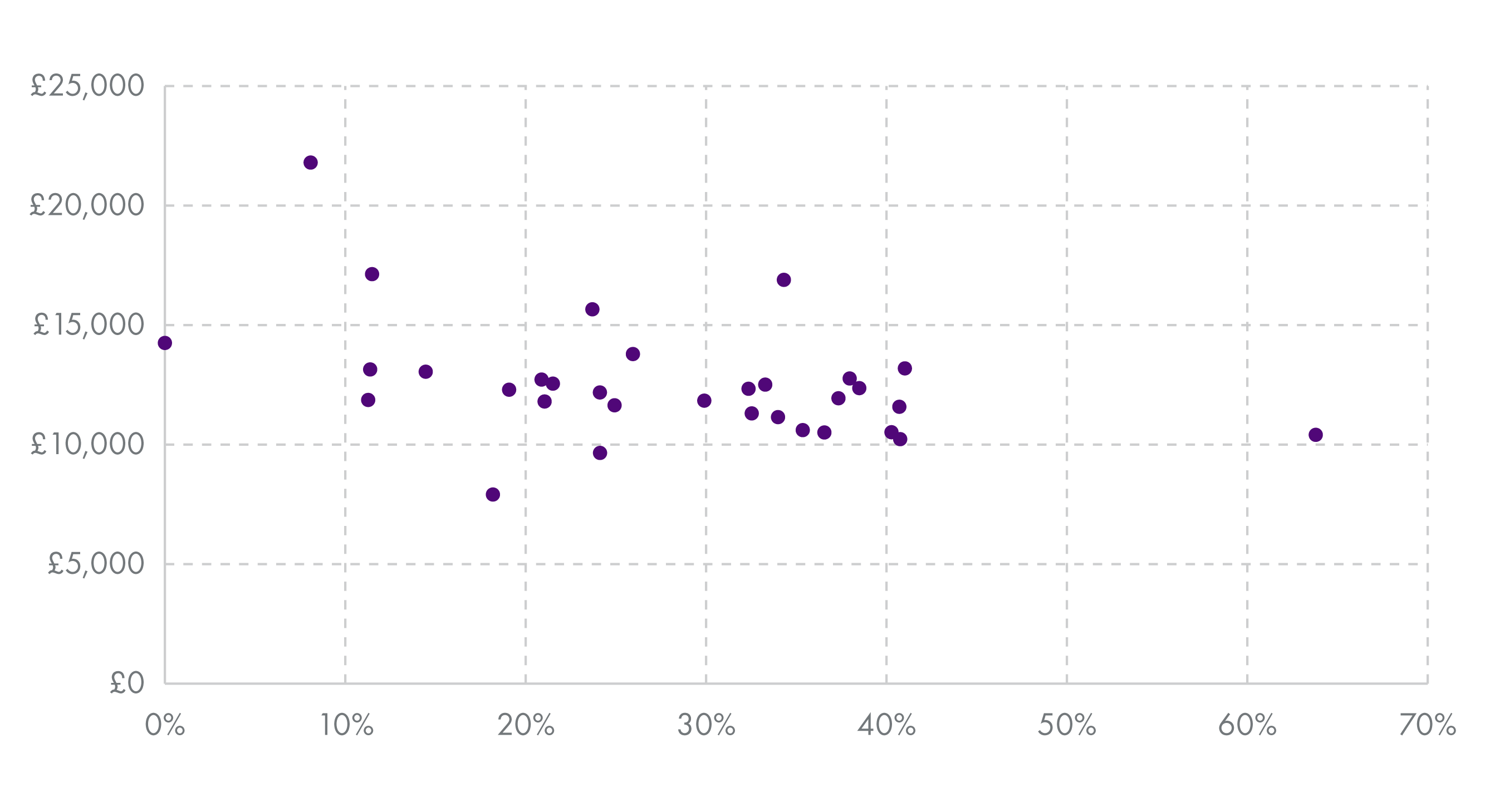
There is wide variation in the average cost per place across different local authorities. The highest, Na-Eilean Siar's, average cost per pre-primary place in 2024-25 was £21,802; the lowest cost per place in 2024-25 was East Lothian and was £7,913. All of the island authorities have among the higher costs per place; they also generally have lower average registrations per setting. It is not clear why there is such wide variation in average costs across, particularly, the mainland authorities.
The chart below maps the average cost per pre-primary place against the proportion of ELC funding that is delivered by the PVI sector.
Scottish Government. (2025). Funded Early Learning and Childcare Statistics 2025. Retrieved from https://www.gov.scot/publications/funded-early-learning-and-childcare-statistics-2025/documents/Improvement Service. (2026). Local Government Benchmarking Framework. Retrieved from https://www.improvementservice.org.uk/benchmarking/explore-the-data
There is not a strong relationship between the extent of the utilisation of the PVI sector in each local authority and the average cost per place reported by local authorities.
Concerns have been voiced by the PVI sector that local authorities do not fund the PVI sector sufficiently and that funding arrangements favour local authority settings. In 2025, the Scottish Government commissioned a national data collection exercise to understand the costs of delivering funded ELC in PVI and and childminding settings. The subsequent report was published in March 2026. This said:
A dominant theme in the responses and engagement was concern about perceived unequal funding between local authority (LA) and funded providers in the private, third and childminding sector. ... While all providers are subject to the same regulatory standards and inspection frameworks, LA settings are perceived to receive higher hourly rates and more generous support.
This disparity was seen to undermine sustainability in the private, third and childminding sector, particularly in relation to staffing and quality of provision. Several providers described losing staff to LA settings due to better pay and conditions, despite delivering equivalent services.
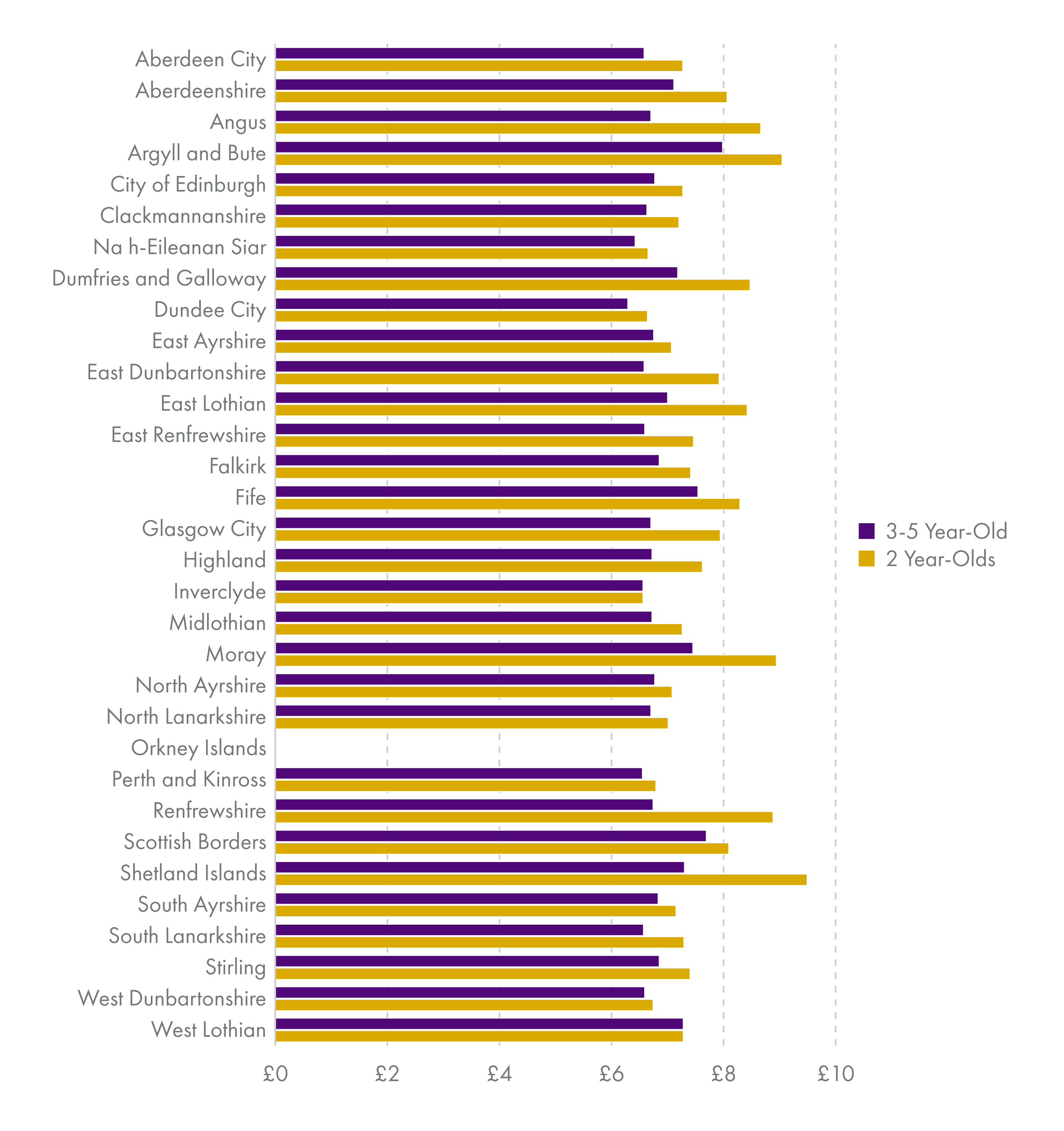
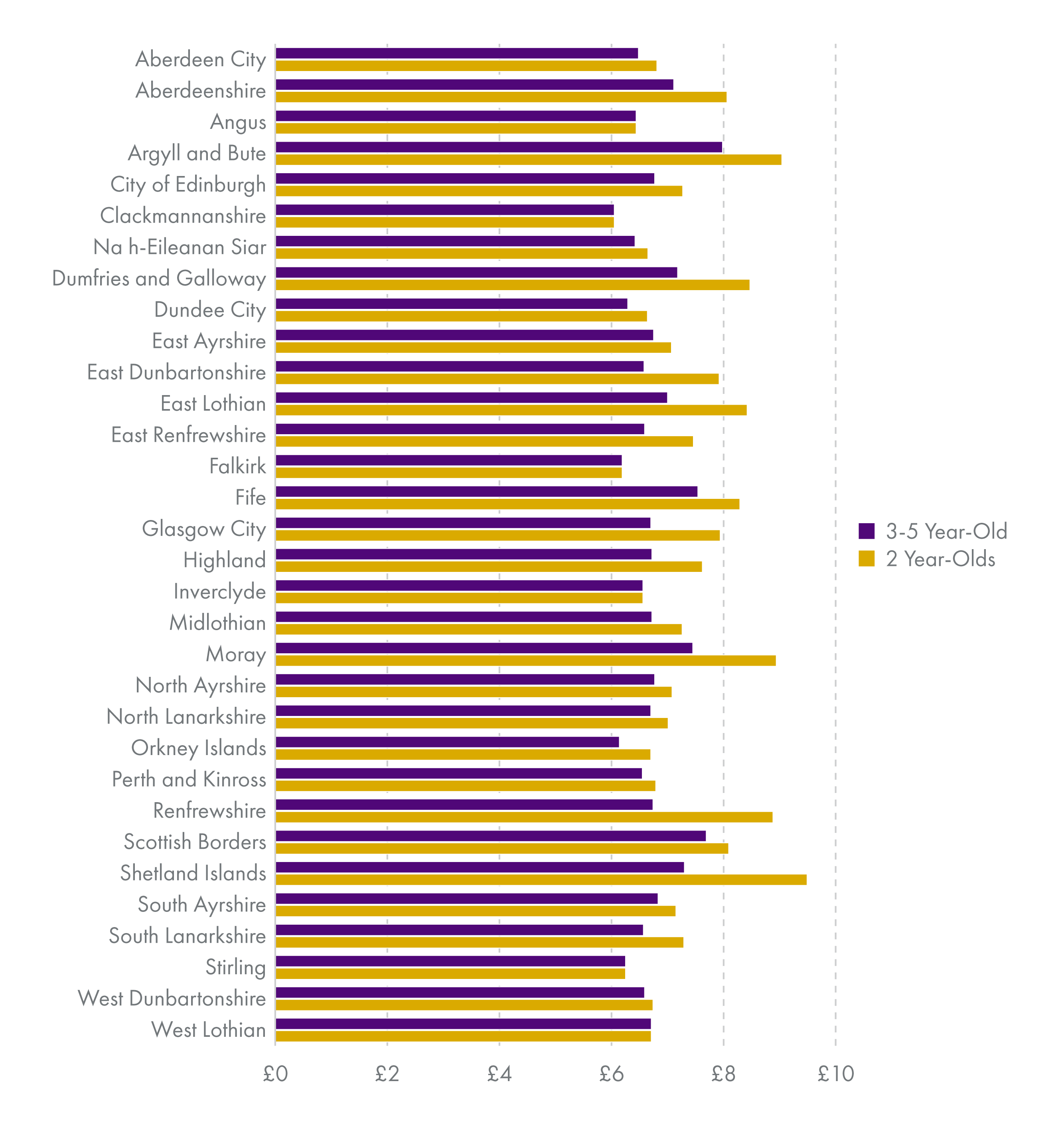
Each local authority sets hourly rates which are paid to private, third sector and childminding providers that they contract with to deliver funded ELC. These rates are set in,line with the joint Scottish Government and COSLA sustainable rates guidance.These providers also receive funding to deliver the free meal commitment. The Scottish Government has regularly surveyed local authorities to determine how much they pay PVI providers in their area. The amount paid to PVI providers increased over the past Parliament. In 2021-22, hourly rates for delivering of funded ELC for 3-5 year-olds were reported to be on average (across local authorities that responded at the time) £5.44. In 2025-26, the average hourly rate for three-five-year-olds across local authorities was £6.87. In cash terms, this represents an increase of around 26%; in real terms (accounting for inflation using HM Treasury GDP deflator) this is around a 5% increase over the period.
There is variation in the level of funding for PVI providers and childminders across Scotland. The following charts show the the hourly rates paid by local authorities to PVI settings and childminders to deliver funded ELC in 2025-26. Generally the rates for two-year-olds are higher, reflecting the lower adult-to-child ratios required for children under the age of three.
Scottish Government. (2026). Funded early learning and childcare 2026-27: guidance for setting sustainable rates. Retrieved from https://www.gov.scot/publications/funded-early-learning-childcare-2026-27-guidance-setting-sustainable-rates/pages/1/
Scottish Government. (2026). Funded early learning and childcare 2026-27: guidance for setting sustainable rates. Retrieved from https://www.gov.scot/publications/funded-early-learning-childcare-2026-27-guidance-setting-sustainable-rates/pages/1/
The Scottish Government and COSLA provide guidance for local authorities on setting sustainable rates for funded PVI settings and childminders. There have been several iterations of this guidance and the latest was published in March 2026, Funded early learning and childcare 2026-27: guidance for setting sustainable rates. This guidance reflected a Sustainable Rates Review conducted by COSLA and the Scottish Government, published in December 2023. One of the conclusions of the review was that there should be greater standardisation in the rate setting process across all local authorities.
The guidance for 2026-27 says that the sustainable rate local authorities set should "cover the cost of running the service and allow for future investment and development" and "the rates must be sustainable for authorities in terms of the budgets available".
The 2025 National Collection exercise estimated that 77% of costs of PVI settings are due to staffing. The 2026-27 guidance on setting sustainable rates recommended a minimum uplift of 5.2% in rates paid to funded providers. Staff delivering funded ELC are expected to be paid at least the real living wage which increased by 6.7% in April 2026 to £13.45 per hour. The suggested minimum of 5.2% is only to account for this rise in the staffing portion of settings costs. At this level of uplift, there could be little or no increase for funded providers to support "future investment and development". In terms of supporting non-staff costs, around 23% of total costs, the guidance states:
[Local authorities should] set the remainder of the sustainable rate in-line with [the] guidance ... The overall rate must be affordable for local authorities in terms of the budgets available. Given the challenging financial position for local authorities, it is recognised that not all will be able to provide an uplift beyond the 5.2%.
Scottish Government. (2026). Funded early learning and childcare 2026-27: guidance for setting sustainable rates. Retrieved from https://www.gov.scot/publications/funded-early-learning-childcare-2026-27-guidance-setting-sustainable-rates/pages/8/
The Scottish Government has provided additional funding of £13.4 million in 2026-27 to support local authorities to set sustainable rates.ii
As well as the hourly rates paid to PVI settings and childminders, local authorities provide in-kind services to partner-providers. Operating Guidance on Funding Follows the Child states that it is for each local authority to determine "the best package [of additional support] to ensure high quality ELC provision is offered to children and families, based on their own local circumstances". For example, this support could be:
training programme resources
support for workforce planning
marketing and recruitment support
funding for staff to undertake relevant qualifications
grant funding for specific resources
buildings support
regular contact through local authority ELC meetings.7
Funding follows the child: the National Standard
The policy intention is that the provision is 'provider neutral'. This means that parents/carers can choose which setting their child attends. This choice is intended to provide flexibility for parents/carers to, among other things, support employment and education/training opportunities.
This choice has both practical and policy limits. Funding Follows the Child and the National Standard for Early Learning and Childcare Providers: operating guidance explains that parents/carers should be able to choose where the ELC is provided, so long as the setting:
meets the National Standard
wishes to deliver funded ELC
has available space
is able to offer the funded hours in line with local ELC delivery plans
has or is willing to enter into a contract with the local authority.
The National Standard is intended to ensure that all children will receive high-quality ELC in all settings. The National Standard includes criteria under the following headings:
staffing, leadership and management
development of children's cognitive skills, health and wellbeing
physical environment
self-evaluation and improvement
parent and carer engagement and involvement in the life of the setting
inclusion
business sustainability
fair work practices, including payment of the Living Wage
payment processes
food.
Criteria in the National Standard should apply equally to both local authority and PVI settings but some of the criteria are adjusted for childminders.
Some of the criteria in the National Standard refer to the regulatory regime of the sector. The settings' Care Inspectorate quality evaluations should be ‘good’ or better across a range of indicators. There is, however, flexibility to allow time settings to improve if their quality evaluations fall below this level.
Local authorities are responsible for ensuring that all settings providing funded ELC meet the National Standard.
Flexible provision
The Funding Follows the Child approach is intended to ensure that families have choice and flexibility in the childcare they access.
Local authorities are expected to facilitate this choice and flexibility. Under Section 50 of the Children and Young People (Scotland) Act 2014, local authorities have a duty to produce a plan on how they intend to make ELC available in their areas. Local authorities must consult and this process should take place at least every two years. Under Section 52 of the 2014 Act, local authorities have a duty to consider how the ELC provision in their area provides a suitable degree of choice for families.
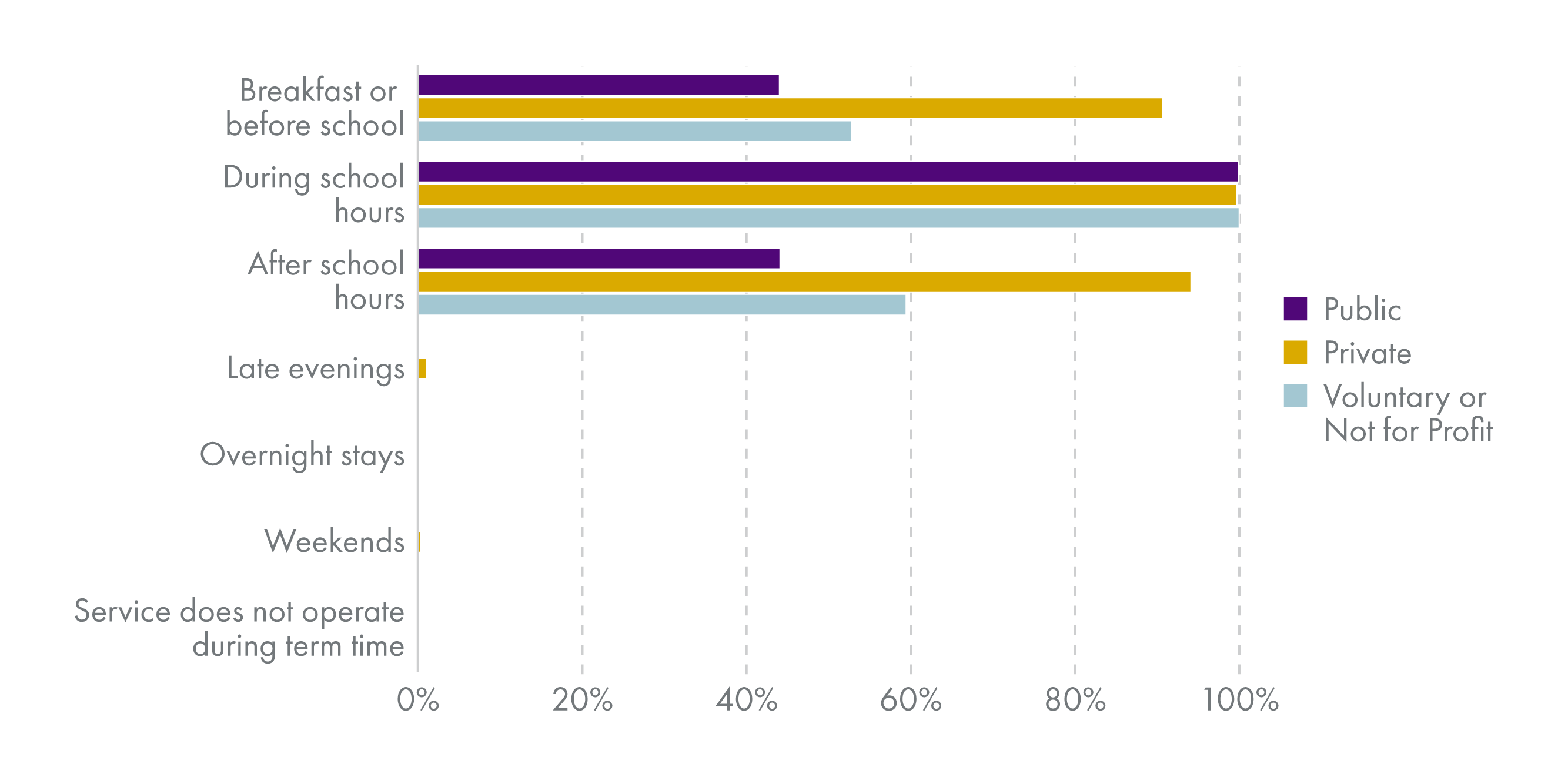
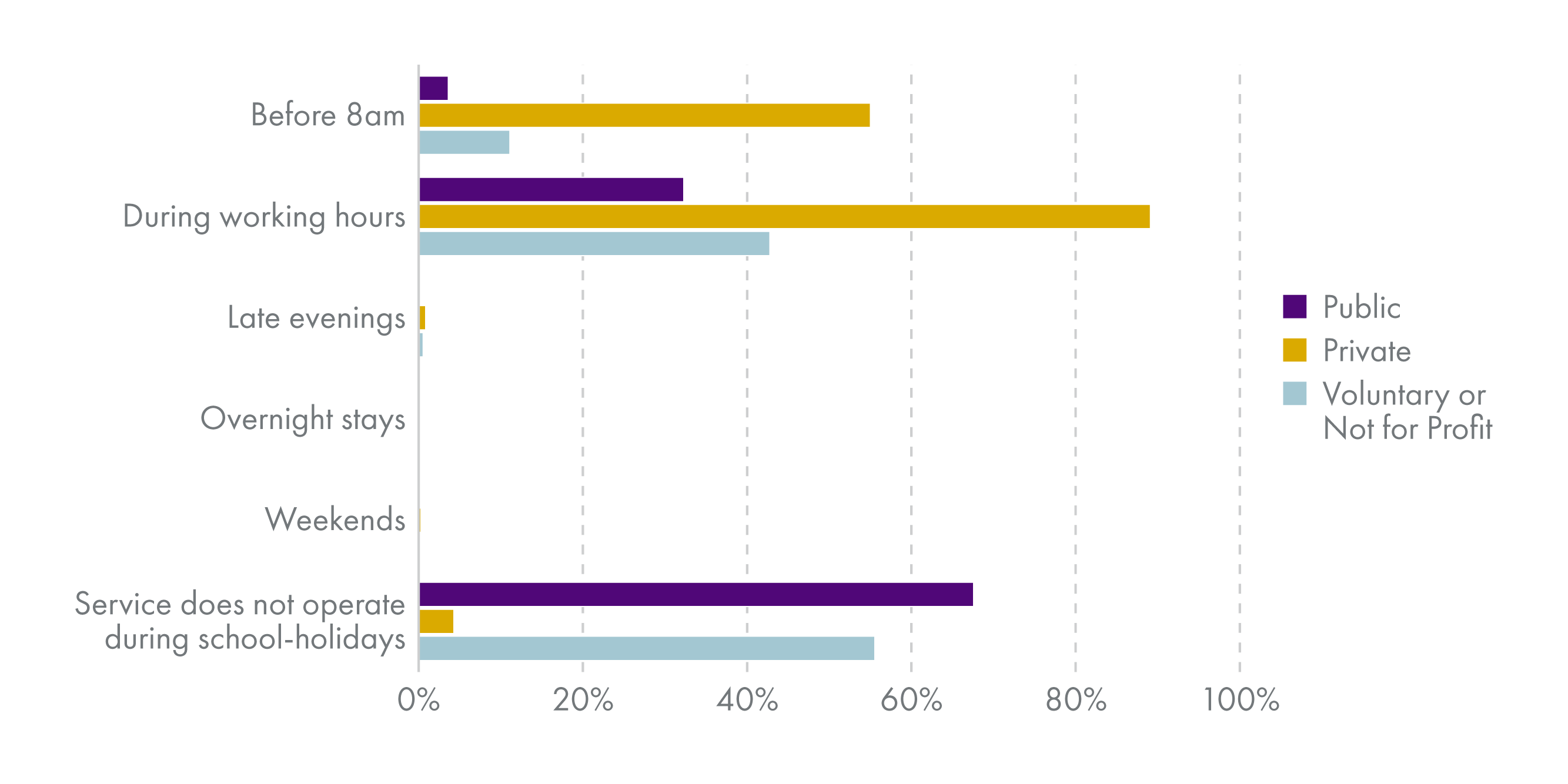
A key difference, at a national level, between public sector nurseries and the PVI sector is the flexibility of provision. Charts below show the availability of childcare at various times for nurseries delivering funded ELC.
Care Inspectorate. (2025). Early learning and childcare statistics 2024. Retrieved from https://www.careinspectorate.scot/resources-data/publications-and-statistics/library/elc-statistics-2024
Care Inspectorate. (2025). Early learning and childcare statistics 2024. Retrieved from https://www.careinspectorate.scot/resources-data/publications-and-statistics/library/elc-statistics-2024
Over 90% of private nurseries provide childcare before and after school hours in term time, compared to around 45% of public sector nurseries. During school holidays, 4% of private sector nurseries do not operate, whereas 68% of nurseries in public sector and 56% of voluntary/not for profit nurseries do not operate in school holidays. There is almost no funded ELC nursery provision in the late evenings, overnight, or at weekends.
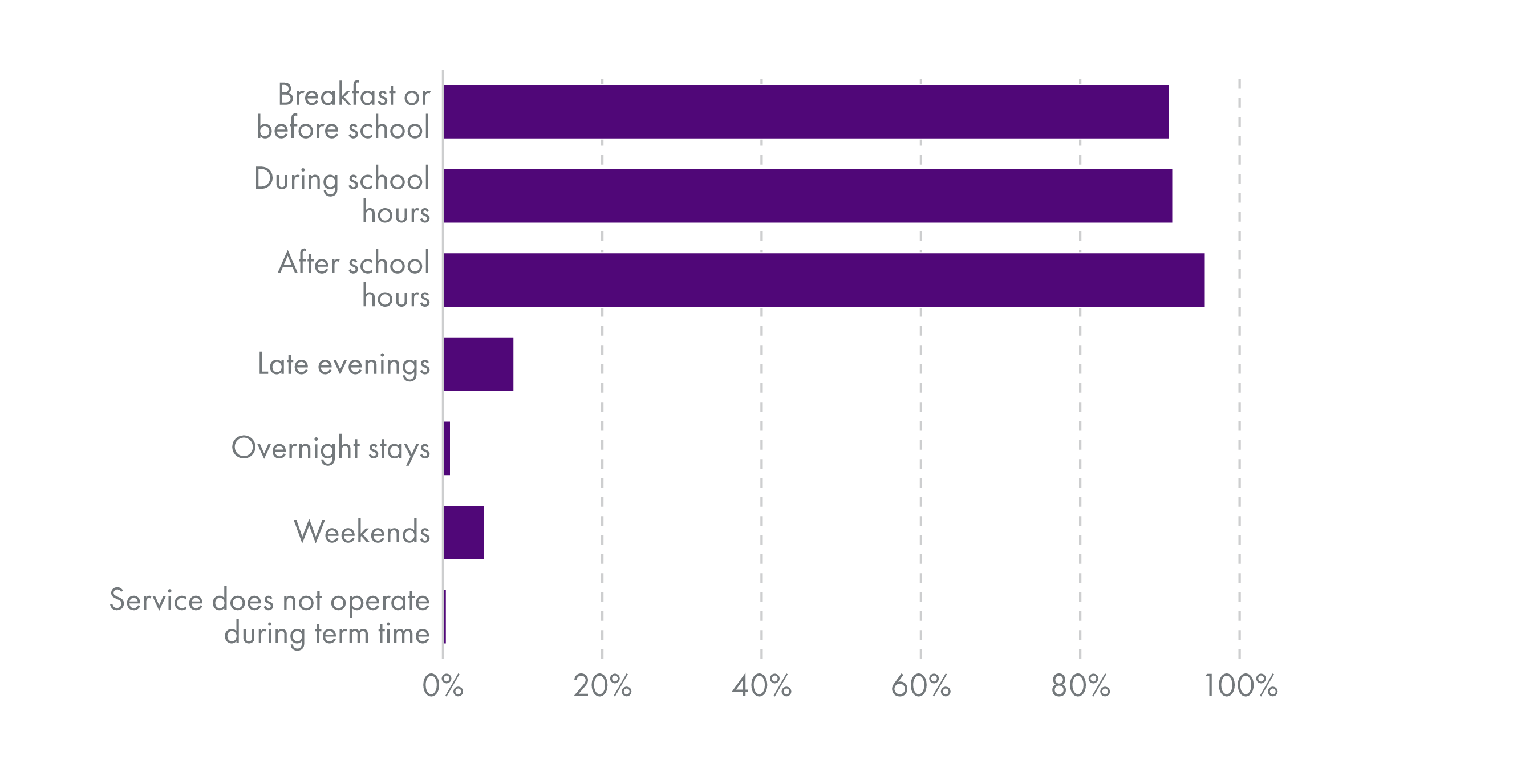
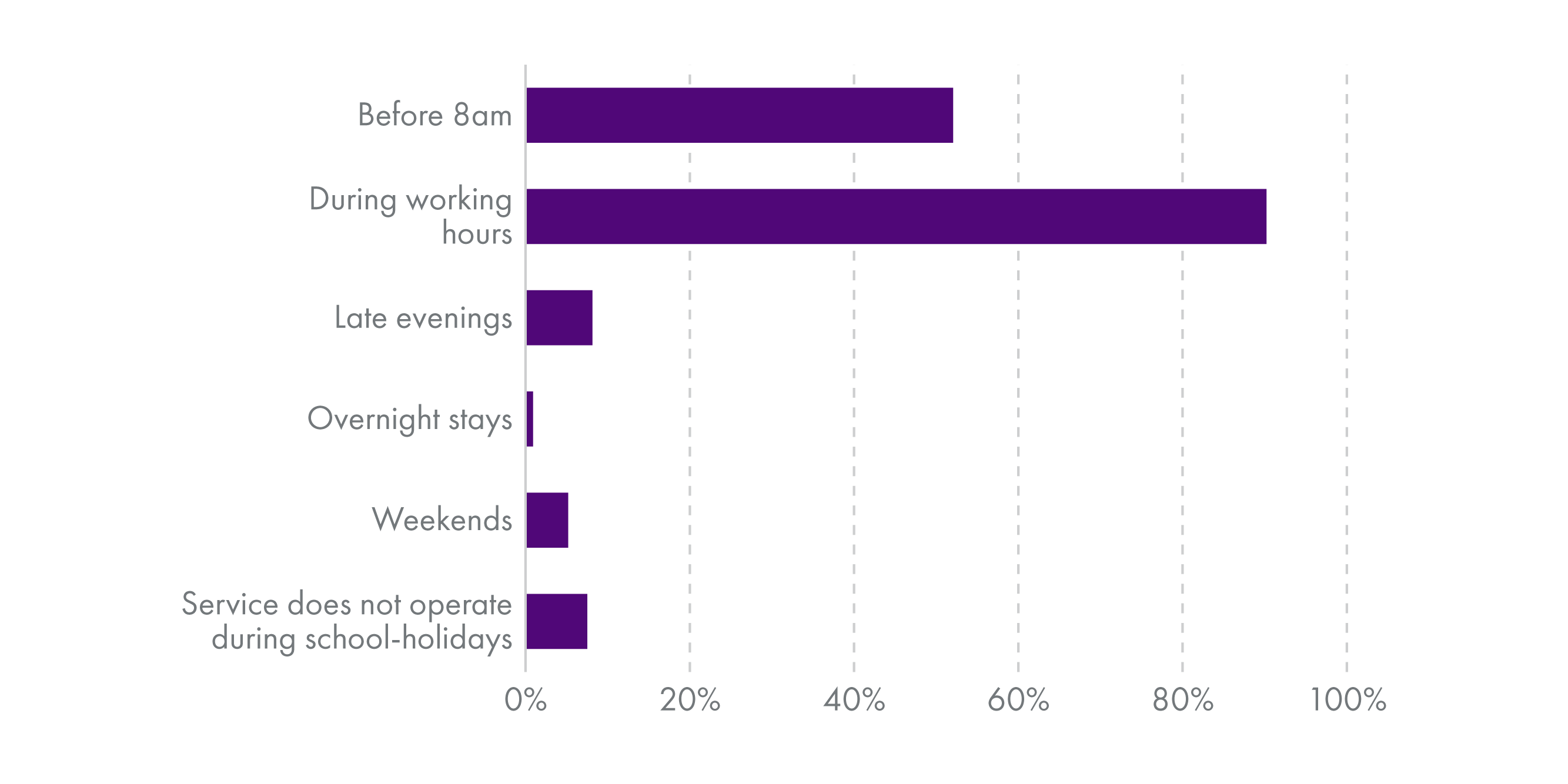
As a sector, childminders provide more flexibility in the care offered. The two charts below show the availability of all childcare (i.e. funded ELC and other childcare) for childminders in school term time and holidays.
Care Inspectorate. (2025). Early learning and childcare statistics 2024. Retrieved from https://www.careinspectorate.scot/resources-data/publications-and-statistics/library/elc-statistics-2024
Care Inspectorate. (2025). Early learning and childcare statistics 2024. Retrieved from https://www.careinspectorate.scot/resources-data/publications-and-statistics/library/elc-statistics-2024
The large majority of childminders provide care before school (91%), after school (96%) and in the school holidays (92%). There is also some provision in the late evenings (8-9%) and at weekends (5%).
The policy intention is that families should not be limited to settings in their own local authority area. The statutory guidance on the delivery of funded ELC says that local authorities' admission policies should include arrangements for cross-boundary placements. The statutory guidance says that local authorities "should, wherever possible, make arrangements that ensure families accessing cross-boundary placements are treated on the same basis, for example in the timeframe for providing a decision, as families accessing provision within their local authority area." The statutory guidance also recommends that local authorities "meet on a regional or neighbouring basis to identify movement and places across boundaries and reach sustainable and mutually beneficial arrangements."
In the west of Scotland, a number of local authorities have agreed a cross-border protocol to manage families requests for funded ELC outside of their home local authority. Elsewhere, there have been some issues with how cross-border placements have worked in practice, particularly in Edinburgh and the Lothians. Both the City of Edinburgh and West Lothian councils have policies where out of area requests for childcare will be met only through local authority settings, where there is capacity. Filling an empty space in a local authority setting is likely to have a lower marginal cost, in the short term, to the local authority than funding an ELC provider (i.e. if no additional staff are required at the LA setting).
In April 2026, the Centre for Public Policy at the University of Glasgow published an evaluation of the policy adopted by the City of Edinburgh Council. This found that:
Without access to PVI childcare in Edinburgh, parents had to rely on local authority provision in the city or childcare - local authority and/or PVI - in their local authority area. Alternative childcare arrangements were often described as less flexible (i.e. restricted to school hours which did not echo working patterns) and the availability of places for children were limited (i.e. specific days, hours, and waiting lists) and were not available at short notice. Families often had to weigh up affordability, quality of provision, and practical travel considerations - sometimes incurring extra costs to maintain continuity of care or remain with a preferred provider.
Centre for Public Policy. (2026). Evaluating Cross‑Boundary Childcare Provision in Scotland: Insights from an Edinburgh Case Study. Retrieved from https://www.gla.ac.uk/media/Media_1257910_smxx.pdf
Staffing
The Scottish Social Services Council (SSSC) regulates the workforce in the daycare of children sector, including for funded ELC, with the exception of childminders.
Overall the number of registered workers in the childcare sector has increased through the expansion of funded ELC to 1,140 hours. In March 2019, the total SSSC registrations in the daycare of children sector was 36,194; in March 2026, the SSSC reported that there were 45,915 registered workers in the sector, an increase of 27%.1 The workforce in the daycare of children sector in 2024 was 96% female and 4% male.2
The Scottish Government's Best Start - strategic early learning and school age childcare plan 2022 to 2026 said that the quality of the ELC provided is key to ensuring that children's outcomes are improved. It said that research evidence suggested that quality of provision is influenced by a range of factors including "staffing levels and aspects of their working conditions; staff qualifications and development; the relationships and interactions between staff and children; the physical environment; and the curriculum."3
There are minimum qualification requirements for support workers, practitioners and lead practitioners/managers (the three categories of registration with the SSSC). The relevant qualifications are set out in the table below.
| Role | Scottish Credit and Qualifications Framework (SCQF) Qualification leveli | Examples of qualifications |
|---|---|---|
| Support workers | SCQF Level 6 | Foundation Apprenticeship Social ServicesNational Certificate in Early Education and Childcare |
| Practitioners | SCQF Level 7 | Modern Apprenticeship Social ServicesHigher National Certificate in Childhood Practice |
| Lead practitioners/managers | SCQF Level 9 | Technical Apprenticeship Social ServicesBachelor's Degree in Childhood Practice |
Scottish Social Services Council. (n.d.) Working with children and young people in Scotland's social services. Retrieved from https://www.careersincare.scot/childcare/
Professionals can begin work in these roles without a relevant qualification and are given time to gain the relevant qualifications. Around one-third of ELC staff joining the profession gain their qualifications via college based learning before they enter employment, while two-thirds undertake vocational qualifications ‘on the job’.ii
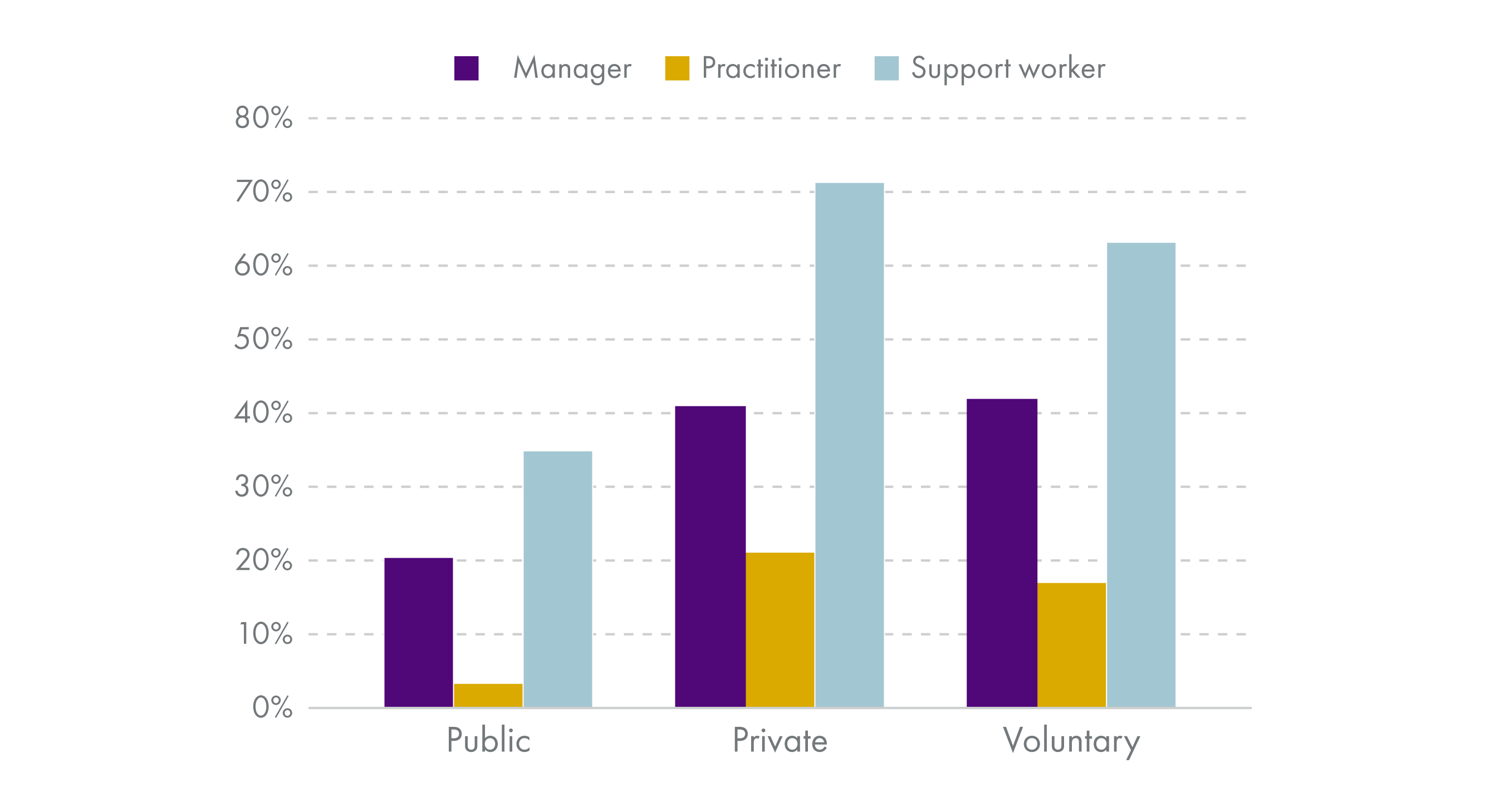
The SSSC reports on the number of registrations in the three categories above working in funded ELC. It also reports on how many are working towards the relevant qualifications while in their role. The chart below shows the percentage of ELC workers who are working towards the benchmark qualification.
SSSC. (2026). Workforce datat: Quarterly Data. Retrieved from https://data.sssc.uk.com/registration-data/quarterly-data#elc
The percentage of workers in the public sector delivering funded ELC working towards a benchmark qualification is lower than in the private or voluntary sectors. Looking at this data over time, the percentage of managers in funded ELC working towards the relevant qualification is falling across all three sectors between 2021 and 2026.1
Aims and evaluation
The Scottish Government published an evaluation strategy in 2022 which highlighted three high-level outcomes for the expansion to the ELC offer:
Children's development improves and the poverty-related outcomes gap narrows
Family wellbeing improves
Parents' opportunities to take up or sustain work, study or training increase.
The evaluation strategy stated that there were four aims of the evaluation:
understand changes in the ELC sector following the expansion, including any unintended consequences
evaluate the intermediate outcomes of the ELC expansion
assess the contribution of the policy change to the three high-level outcomes for children, parents and families (noted above)
assess the economic costs and benefits of the expansion.
An integral element of the evaluation strategy was the Scottish Study of Early Learning and Childcare (SSELC). The SSELC focused on evaluating the outcomes for children and families and its final report was published in March 2026.
Some of the key findings the SSELC final report identified were:
Use of ELC and childcare: Post-expansion, most children in the sample were receiving their increased allocation of funded hours. Further, fewer families were paying for additional hours, and the average number of additional hours paid for decreased.
Children's outcomes: there was "limited evidence to date for progress on the child outcomes that the ELC expansion was seeking to improve". There was no evidence to suggest improved outcomes related to children's cognitive and language development and "mixed evidence on social, behavioural and emotional development". This "mixed evidence" included "a large improvement post-expansion in social, behavioural and emotional development following a year of funded ELC" for eligible two-year-olds.
Poverty-related development gap: SSELC surveys provide no evidence for a closing of the poverty-related gap in child development outcomes since the expansion of funded ELC.
Parental employment: the SSELC found "clear evidence of an increase in the proportion of mothers/female carers of children receiving funded ELC who were in employment, training or full-time education since the expansion of funded ELC."
Parental health and mental wellbeing: the SSELC found no evidence for an improvement in parental wellbeing since the expansion of funded ELC from 600 to 1140 hours.
The SSELC report noted that the period of the expansion of funded ELC coincided with the COVID-19 pandemic and that this is likely to have affected the outcomes that the SSELC was examining. For example, children's outcomes could have been negatively affected by the pandemic or parental employment opportunities could have been positively affected by the growth in more flexible working through and after the pandemic.
In March 2026, the Scottish Government also published a report on the wider evaluation of the expansion programme which drew on the findings of the SSELC as well as other sources of data, including those referenced elsewhere in this briefing. Again this report framed its conclusions in the context of the pandemic and the impacts it may have had on those outcomes the evaluation was considering.
In relation to the quality of provision the wider evaluation found:
Most settings providing funded ELC (89% in 2024) achieve all grades of good or better in assessments of quality. There was a fall in the percentage of services with very good and excellent evaluations (by 14 percentage points to 32%), although this may have been affected by changes to the inspection approach. Given the period of significant change and disruption for the sector, with the ELC expansion and the pandemic, it is encouraging that overall quality has remained high. In addition, most parents (91% in 2024) are very or fairly satisfied with the funded ELC provision they receive, with the proportion who were very satisfied increasing between 2018 and 2024 (from 57% to 72%).
The overall evaluation found that flexibility of provision has improved through the expansion programme. It noted, however, that "there remains considerable variation between local authorities in ELC provision outside school hours". It found that "a minority of parents experienced issues with the accessibility and flexibility of the ELC provision they are offered" and that this could impact negatively on parents access to work.
The overall evaluation also noted that while the expansion had reduced the costs of childcare, "a substantial minority of parents of children under school age who paid for ELC are still experiencing some difficulties with affordability". The evaluation concluded that "the overall childcare system may not be meeting the needs of all families."
The evaluation of the economic costs and benefits of the expansion has not yet been completed and published.
Childminders
The number of registered Childminders has been trending downwards. Between 2021 and 2024, the number of registered childminders reduced from 3,998 to 3,040. Taking a longer view, in 2014, there were 6,102 registered childminders, i.e. the number of registered childminders halved between 2014 and 2024.
As noted earlier in this briefing, childminders are also more likely to be able to provide more flexible hours of care than nurseries.
Childminders are regulated by the Care Inspectorate. Childminding is a distinct category of service from day care of children and is defined in the Public Services Reform (Scotland) Act 2010 as "looking after one or more children on domestic premises for reward". The statutory definition excludes looking after a relative or in the home of the parents/carers of the child.
The Government and its agencies have sought to support the childminding sector in a range of ways over a number of years. In January 2021, the Scottish Government published a Childminding Action plan, Our Commitment to Childminding in Scotland. This highlighted four areas of work to reflect the "challenges experienced by childminders":
investing in the development and growth of the childminding workforce
supporting childminding as a choice – availability and access to childminders
promoting childminding as a choice – helping parents and carers to make informed choices
business sustainability and support for childminders.
The 2023-24 Programme for Government set out an ambition to grow the childminding workforce by 1,000. The then First Minster, Humza Yousaf MSP, said that the aim was to achieve this by the end of the last Parliament. To support this aim, in June 2024, the Scottish Government announced its Programme for Scotland's Childminding Future which included additional funding to support new entrants and help to retain existing childminders. This scheme was intended to run for three years to 2027 and is delivered in partnership with the Scottish Childminding Association. To help attract new childminders, this scheme provides a £750 grant. In relation to improving retention, the scheme has three strands: quality and learning; mentoring; and "funded time off the floor".1
Pre-ELC and school-aged Childcare
Most of the policy focus in the past decade and the majority of Scottish Government funding has been aimed at pre-school children and funded Early Learning and Childcare. Last session saw greater focus on the broader childcare sector, including childcare for younger children, and wrap-around and holiday provision for children in school.
In 2023 the Scottish Government published its School age childcare delivery framework. This was part of the commitment to build a system of school age childcare for primary school children. The framework took a broad view of school-aged childcare. It said:
The current school age childcare sector is wide-ranging, with families often using a mix of regulated providers, registered childminders, breakfast clubs, children’s activities (including those centred around sports or cultural activities) and youth work provision to support their childcare needs. In addition, many families rely on friends and family, or consider at-home services such as nannies, to accommodate their family’s circumstances.
This framework set out a range of projects that would be undertaken to develop school-aged childcare, some of which are discussed later in this briefing.
Local authorities' have fewer duties in relation to childcare outwith funded ELC. The Children (Scotland) Act 1995 (Section 27) places a statutory duty on local authorities to provide childcare for 'children in need' (e.g. disabled children) "as is appropriate".
Local authorities are also required to consult with families about the wider school age childcare needs in their area every two years and to prepare and publish plans in relation to the provision of appropriate care (Sections 27(3A) and 27(3B)of the 1995 Act).
Generally, childcare outwith funded ELC is funded by families themselves. There are UK Government schemes to help support families with the costs of childcare and these are set out below.
Coram Family and Childcare publish results of surveys on the availability and costs of childcare across Great Britain every year. Its 2026 report found that, in 2025, the weekly costs of a part-time (25 hours) childcare place in Scotland for under-twos were on average £133 in a nursery and £146 at a childminder. The equivalent figures in England (for those not eligible for 30 hour working parent entitlement) are £189 at a nursery and £155 at a childminder; for Wales £163 and £137.
The 2026 Coram Family and Childcare report also reported on costs of after-school clubs and after school childminding up to 6pm. It reported that the average weekly costs for Scotland were £71 per child at an after-school club and £94 at a childminder.
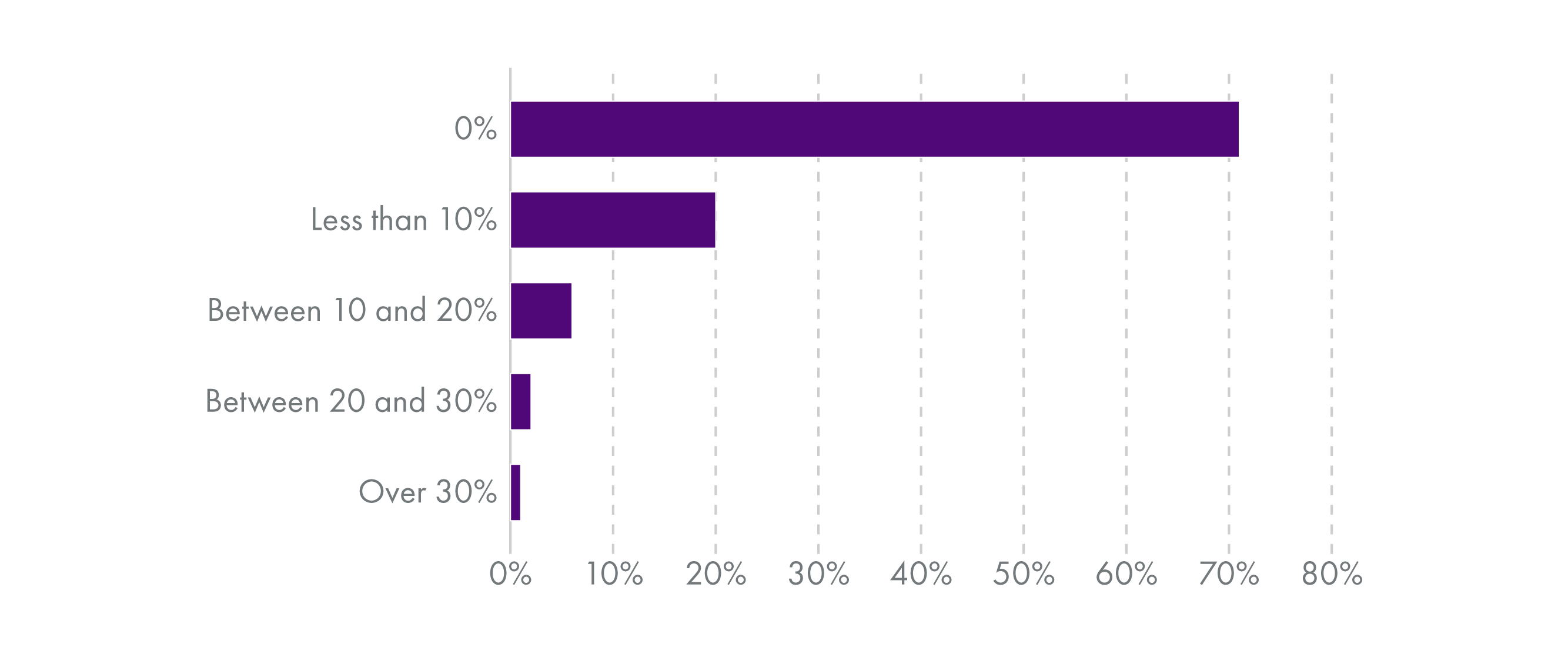
The Scottish Household Survey also includes questions on the costs of childcare. The chart below shows data on reported costs of childcare for all children 0-11 as a percentage of the household income.
Scottish Government. (2025). Scottish Household Survey (2024). Retrieved from https://scotland.shinyapps.io/sg-scottish-household-survey-data-explorer/
This shows that over 70% of respondents reported that their childcare costs were zero and 20% reported that their costs were less than 10% of their household income (but not zero).
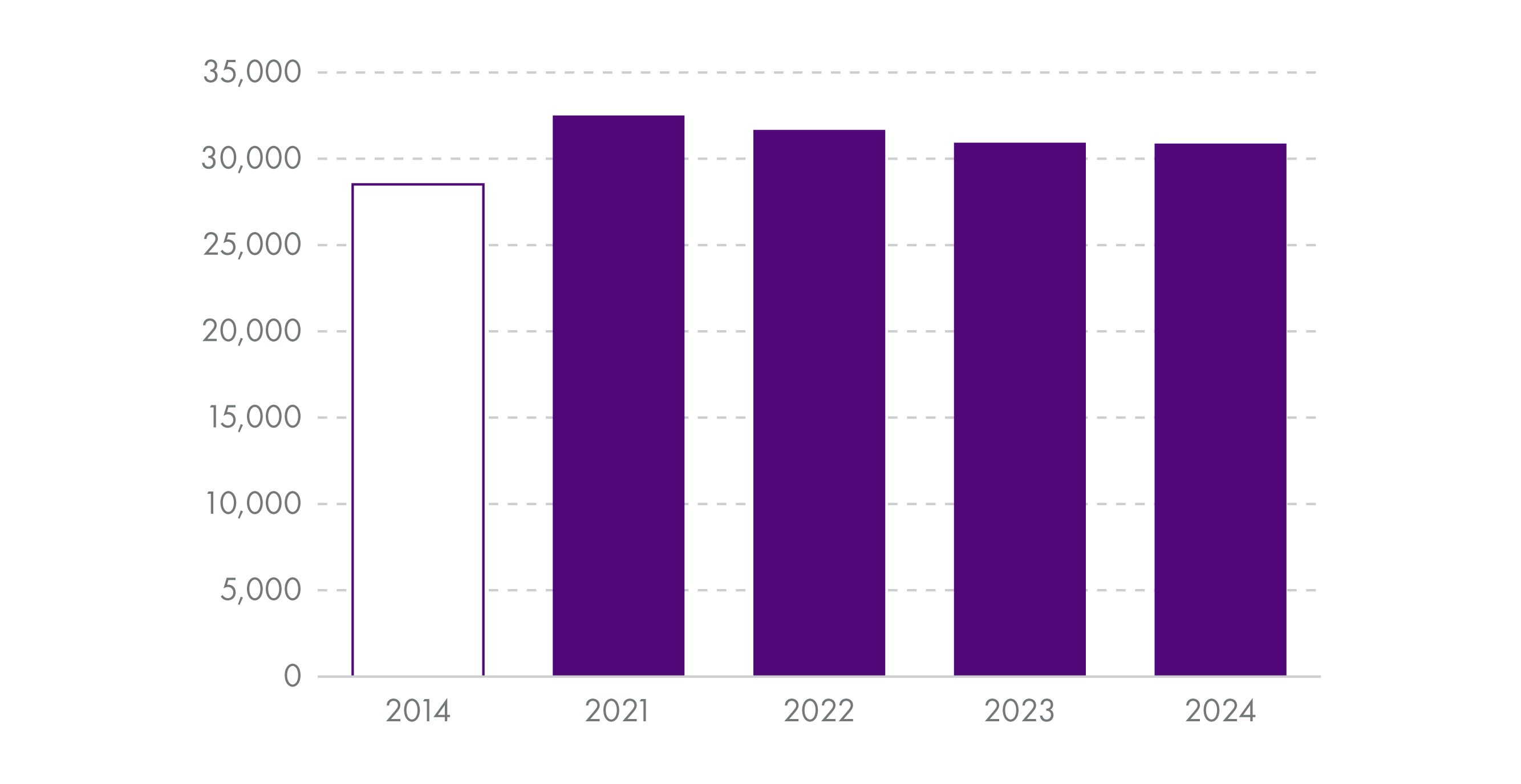
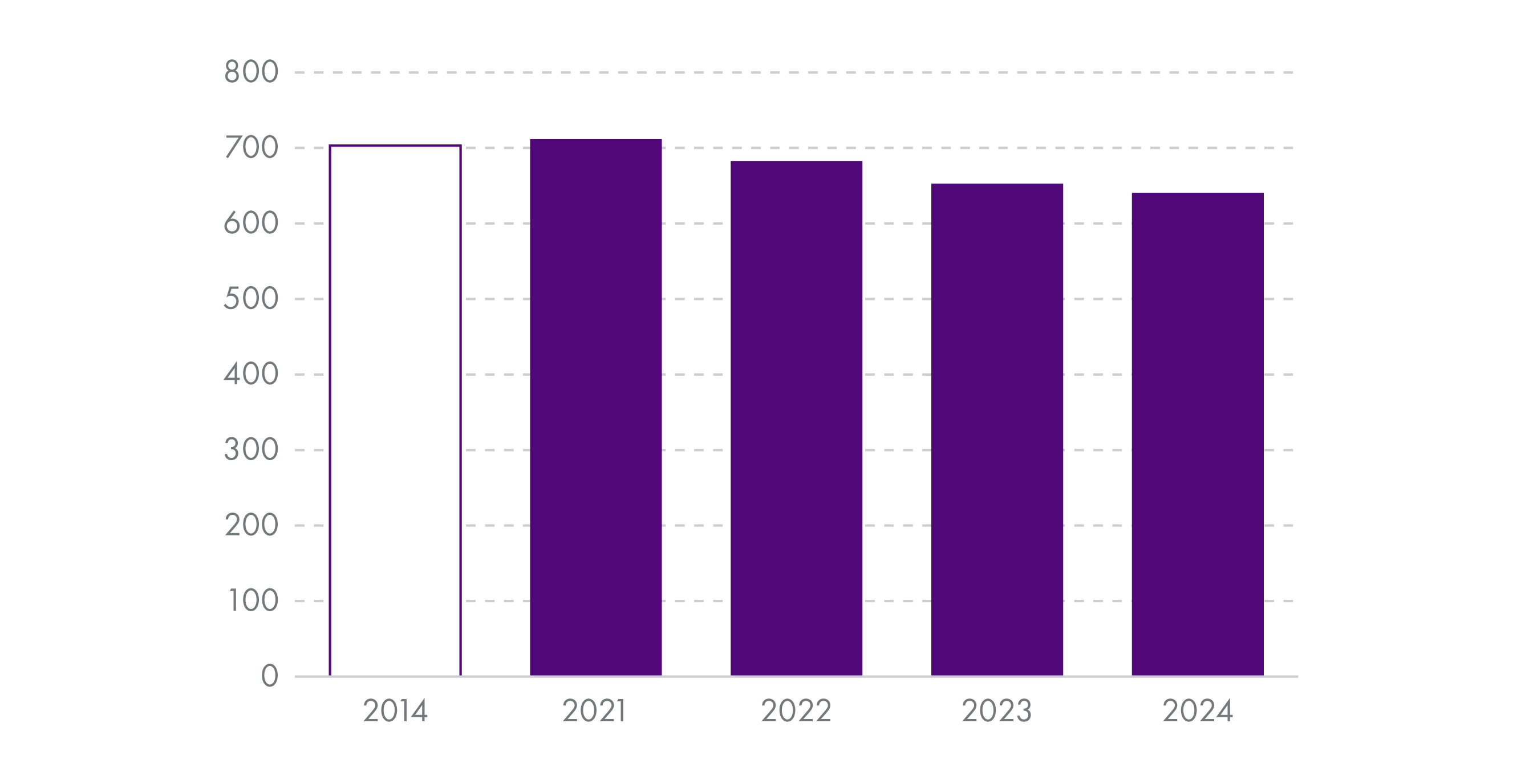
The Care Inspectorate reports on the number of school-aged childcare settings, their capacity and the number of children registered at these settings. In 2024, there were 640 settings with a capacity of 30,850 places. 45,740 children were registered in school-aged childcare settings; around 11% of all children aged 5-11 are registered in school-aged childcare settings. Capacity here refers to the maximum attendance at any one time; children will not necessarily attend every day, which is why the number of children registered can be higher than the capacity.
The two charts below show the number of school-aged childcare capacity and settings in 2014 and 2021-24.
Care Inspectorate. (2025). Early learning and childcare statistics 2024. Retrieved from https://www.careinspectorate.scot/resources-data/publications-and-statistics/library/elc-statistics-2024
Care Inspectorate. (2025). Early learning and childcare statistics 2024. Retrieved from https://www.careinspectorate.scot/resources-data/publications-and-statistics/library/elc-statistics-2024
Between 2014 and 2021, the number of registered school-aged childcare settings increased slightly (703 to 711); at the same time the capacity of the settings increased by around 14%. Between 2021 and 2024, the number of settings fell by 10% and the capacity of the sector fell by 5%.
School-aged childcare settings are classed as day care of children and are regulated similarly to nurseries and other settings. In February 2026, the Scottish Government consulted on creating a new legal definition for school age childcare. The Government said that school-aged childcare "provides a recreation and leisure service for children and doesn't have the same educational role" as ELC. The consultation particularly noted that separating school-aged childcare from childcare for younger children would enable "a review of job roles and qualification standards".
Tax-Free Childcare and Universal Credit
Families can receive financial support for childcare through the Tax-Free Childcare scheme and Universal Credit. Families cannot receive both Tax-Free Childcare and the childcare element of Universal Credit.
Tax-Free Childcare is a UK Government scheme where parents/carers can pay money into an online account and this will be topped up by 25%. The total top up is capped at £500 every three months for each child or £1,000 every three months if the child is disabled. Eligibility is for children up to the September after they turn 11 years old (i.e. the start of secondary school in England). For disabled children, eligibility extends to the September after they turn 16. In order to qualify for Tax-Free Childcare, families must have all adults earning the equivalent of at least the national minimum or living wage for 16 hours per week and cannot have income over £100,000 a year. They must not be claiming Universal Credit.1 This scheme replaced the childcare voucher and directly contracted childcare schemes, which closed to new entrants in October 2018.
There are statistics on the take-up and UK Government contribution to Tax-Free Childcare. The statistics published on 5 March 2026 show that in 2024-25, around 61,000 children's childcare was supported by the scheme in Scotland. This was a little less than 10% of the total population of 0-11 year-olds in Scotland that yeari. The equivalent figure for England was a little under 12%. Across the UK the take up of Tax-Free Childcare is greatest for children aged one-three years.
Families in receipt of Universal Credit (UC) may be able to receive up to 85% of childcare costs. Money is paid in arrears and can be up to £1,071.09 for one child and £1,836.16 for two or more children. Childcare costs can be claimed for children up to 31 August after their 16th birthday.2
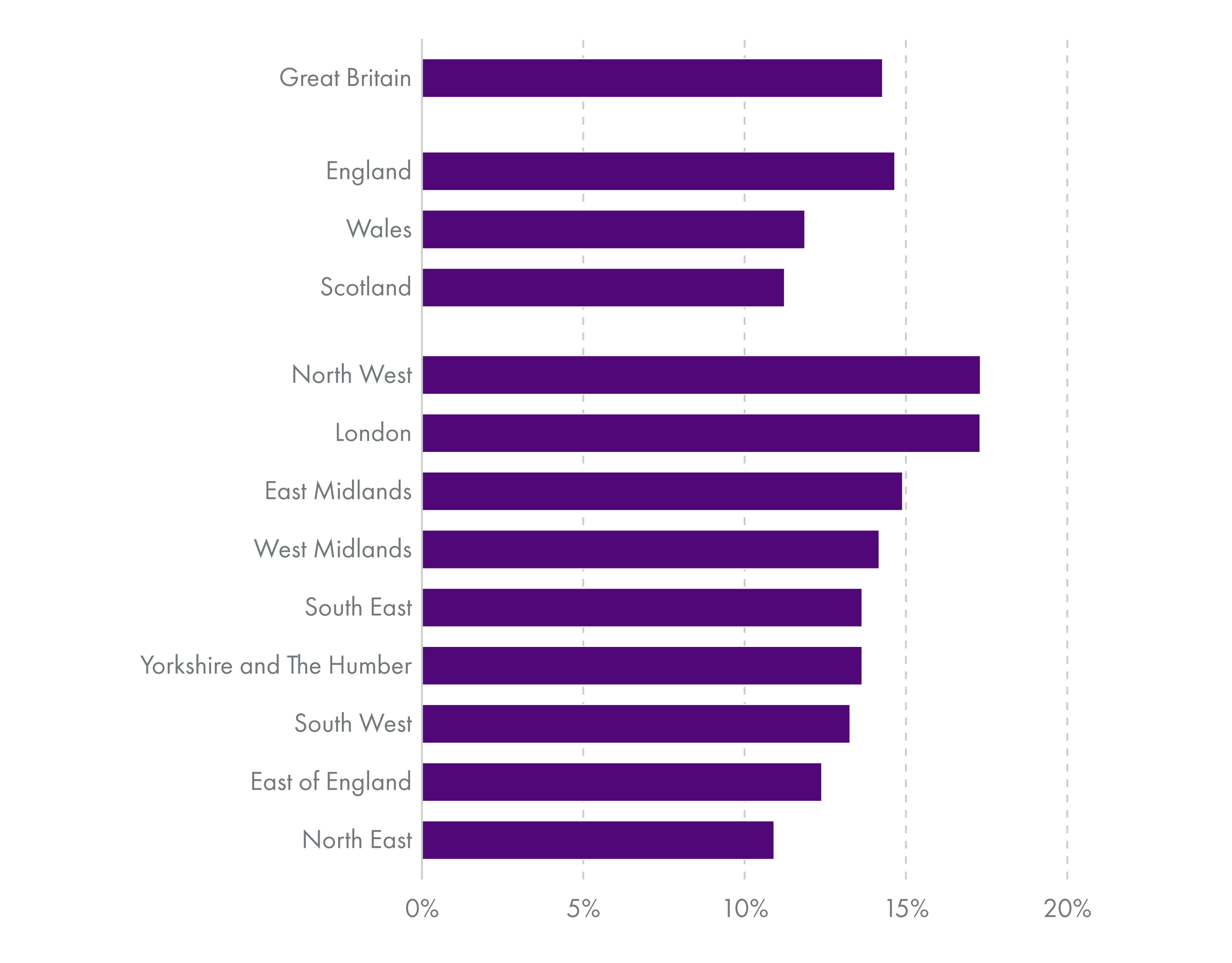
Take-up of the childcare element of UC varies across different regions/nations in Great Britain. The most recent data is from May 2025. The chart below shows the percentage of households in receipt of the childcare element of UC. The percentages shown the number of households in receipt of the childcare element as a percentage of UC households which include someone with income from employment and at least one child aged 16 or under.
UK Government. (2025). Universal Credit childcare element statistics, supplementary data tables. Retrieved from https://www.gov.uk/government/statistics/universal-credit-statistics-29-april-2013-to-10-july-2025
The proportion of households in receipt of UC with children 16 and under in Scotland claiming the childcare element is lower than the equivalent in both England and Wales. Within England, there is regional variation; the take-up in London and the North West is around 17%.
Very few of those who receive the childcare element of UC claim the maximum available. Across Great Britain, around 3% of those in receipt of the childcare element of UC receive the full amount of the childcare element. In Scotland, this was around 2%; in London, the figure was around 7%.4
Some of these differences in take-up of both Tax-Free Childcare and the childcare element of UC across different parts of Great Britain may be due to economic and policy differences. Nevertheless, there may be scope for greater promotion and utilisation of these supports as part of a future childcare policy framework.
Policy development
During Session 6, there was a policy focus on exploring further expansion of the pre-school offer as well as school-aged childcare. The 2021 SNP Manifesto committed to:
Building a system of ‘wraparound’ childcare, providing care before and after school, all year round. Those on the lowest incomes will pay nothing, and others will make fair and affordable contributions.
We will also expand free early years education to all 1 and 2 year olds, starting with children from low income households in this parliament.
Scottish National Party. (2021). Scotland's Future. Retrieved from https://issuu.com/hinksbrandwise/docs/04_15_snp_manifesto_2021___a4_document
These commitments were reflected in the first Programme for Government of the Session 6 of the Parliament.2
In October 2022, the Scottish Government published its childcare strategy, Best Start - strategic early learning and school age childcare plan 2022 to 2026. This was intended to set out how to "embed the benefits" of funded ELC and explain the Government's approach to expanding the childcare offer in the years up to 2026. This plan had four priorities, one of which was, "progressing the expansion of [the Scottish Government's] childcare offer, including building a future system of school age childcare and a new early learning and childcare offer for one and two year olds". The plan discussed how policy-development would progress but did not set out key targets for how and when additional entitlements to childcare would occur. It said:
We will be taking the time to get policy design and engagement on our future childcare offers right, recognising that they must be appropriate to parents', carers' and families' needs and that these will differ depending on children's ages and stages, and families' circumstances. We will also work closely with providers in the public, private, third and childminding sectors throughout our design process.
The Government published a School age childcare delivery framework in October 2023. This defined the Government's “action areas for the next three years, describes [the Scottish Government's] transformational approach – centred around people and place – and considers how we will measure and evidence the impact of early delivery.”
A key element of the Scottish Government's approach to exploring further expansion of childcare for low income families in Session 6 was through a programme of Early Adopter Communities" (EACs). These EACs were aimed at helping to tackle child poverty and were targeted at the six priority groups identified by Scotland's Tackling Child Poverty Delivery Plan (Best Start, Bright Futures).
Initially EACs were established in local areas within Clackmannanshire, Dundee, Glasgow and Inverclyde and focused on school-aged childcare. Between 2022 and 2024, the Scottish Government provided £3.5 million to support projects. In 2024, the EAC programme was expanded to include communities in Fife and the Shetland Islands. The Government increased its financial support to £8 million a year for the final two years of Session 6.
EAC projects included childcare delivered by registered providers and through activity programmes which are not regulated in the same way as nurseries or childminders. EACs were co-designed and intended to build on existing local assets. There were a variety of approaches to delivery. An initial process evaluation published in 2024 said:
Specific delivery approaches were shaped by local circumstances. Some communities had large scale existing initiatives or a greater number of school age childcare services to build on. Some areas expanded existing services while others created new ones, and a mix of registered and unregistered childcare or activity providers were used. While three EACs provided fully funded provision for families, Glasgow took a tapered approach based on household income, to reach a greater number of families.
Scottish Government. (2024). Early Adopter Communities - process evaluation: research findings. Retrieved from https://www.gov.scot/publications/early-adopter-communities-process-evaluation-research-findings/pages/4/
The EACs are likely to inform future policy development in this area. EACs had a particular focus on supporting families and communities experiencing deprivation. It should be noted that these schemes are targeted. Different approaches may be more suited for families in different situations and depending on the intended outcomes and available resource.
The Scottish Government plans to introduce a universal breakfast club offer to ensure that "every primary pupil in Scotland to access a breakfast club". This is planned to be rolled out by August 2027.
The second debate held by the Scottish Parliament in the current session was on childcare. In her speech, the Cabinet Secretary for Education, Culture and Gaelic, Màiri McAllan MSP, said:
[The Scottish Government wants], by the end of this parliamentary session, to provide the choice of childcare support for every child in the country from nine months old to the end of primary school. Importantly, the support is to be provided for 52 weeks a year and will be designed to fit around families, rather than families being expected to fit around the system. I must say that it is a substantial project that will take a team Scotland approach.
Scottish Parliament. (2026). Official Report: 27 May 2026. Retrieved from https://www.parliament.scot/chamber-and-committees/official-report/search-what-was-said-in-parliament/meeting-of-parliament-27-05-2026?meeting=20162&iob=222702#orscontributions_M16190E517P923C3055943
The Cabinet Secretary indicated that future work in this area will have two goals: supporting outcomes for children in relation to their learning and development; and supporting parental employment and thereby wider economic performance in Scotland.
The Cabinet Secretary also said:
In our manifesto, we set out an estimate of about £500 million. However, the Government is in the early days of developing the policy, so the estimates on costs and workforce requirements will be developed in due course.
Childcare policy has a number of aims and there are a range of policies that are currently in place across local government, the Scottish Government and the UK Government. The Institute for Fiscal Studies, discussing childcare policy in England, said:
With a policy area that touches on so many core objectives of the government, there is a big opportunity to be had from getting the design of the early years system right. But this also makes policymaking much more difficult. There are real tensions and trade-offs between policies aimed at supporting children's development and at helping families into work – the types of families targeted, the level and design of the subsidy rate, and the emphasis on quality and flexibility will all differ.
Rather than telling policymakers to choose just one objective, the key insight here is to think about whether the early years system as a whole is delivering on these different aims. A well-functioning early years system could have some policies that target labour supply while others focus on child development and the disadvantage gap. Instead, trying to ensure that every policy ticks every box risks developing a set of programmes that fail to achieve their potential in each dimension.
IFS. (2026). Early years. Retrieved from https://ifs.org.uk/education-spending/early-years
Pre-school offer in England
Over the past five years there have been changes in the state-funded childcare offer to families in England. There are three elements to the funded pre-school offer in England:
a universal 15 hours entitlement from three years old
15 hours for two-year-olds in 'families receiving additional support'
free childcare for working families.
The universal offer is for all three- and four-year-olds. All children of those ages are eligible for 570 hours of government-funded childcare a year, which equates to 15 hours a week in term time, although the hours can be spread over a longer period.
Fifteen hours for disadvantaged two-year-olds is available to families under similar eligibility criteria1 as the offer to two-year-olds in Scotland2. In both cases eligibility is through qualifying benefits and available to children with experience of care. In Scotland, the eligibility on the basis of experience of care is wider and includes when the parent has experience of care. The eligibility in England includes children who have an education, health and care plan - there is no directly comparable plan in Scotland.
A key difference in eligibility for the two-year-old offer is the maximum income threshold associated with the receipt of Universal Credit. In this respect, the eligibility in England is more generous: in 2026-27 the household income must be £15,400 a year or less after tax (not including benefit payments) to qualify. In Scotland, the maximum household income is £885 a month or less (i.e. £10,620 a year).
The free childcare for working families entitles families to 1,140 hours of childcare for each child. This is the area of childcare that has substantially expanded over recent years. Prior to April 2024, this element was available to 3 and 4 year olds. It is now available to children from 9 months until they start school. This part of the childcare offer is aimed at working parents. The parent(s) are required to earn at least the equivalent of 16 hours at the minimum wage and no more than £100,000 (adjusted net income) per year. For couples, both have to meet the criteria.3
The previous UK Government announced the expansion of free childcare for working families in the Spring Budget 2023. The expansion was undertaken in three stages:
April 2024: 570 hours for two year-olds
September 2024: 570 hours for children from 9 months
September 2025: 1,140 hours for children from 9 months.
Taken as a whole the aims of the system in England are similar to the ELC offer in Scotland. That is to support both parental employment and childhood development. However, there has been a greater focus on parental employment than in Scotland, both in terms of the design of the system and the focus in some policy documents (see the Spring Budget 2023, for example). A Parliamentary Question answered in July 2025 said "the working parent entitlement is aimed at eligible parents who wish to start working or work more hours, which is why this entitlement is conditional on work."
In July 2025, the current UK Government published a policy paper, Giving every child the best start in life. This paper had a strong focus on early years education's impact on child development, while also highlighting benefits to parental employment. It also noted that the current system is complex and had been developed "ad hoc". It committed to explore how to simplify the system. The Institute for Fiscal Studies' Annual report on education spending in England: 2025–26 argued that changes to the policy in this area should reflect the aims of the policy.4
The UK Government has also committed to provide a free breakfast club in every state-funded school with primary-aged children in England. Phase 1 of the national rollout began in April 2026.
Annexe A: Adult to Child Ratios
The Care Inspectorate that sets out the expected maximum ratios of adults to children in different settings.
The expected ratios of staff to children in childcare settings depend on the age of the children and the type of setting. For children's day care settings the following maximum ratios are expected.
| Age range | Ratio |
|---|---|
| 0 to under two years | One adult to three children |
| Two to under three years | One adult to five children |
| Three to under eight years | One adult to eight childreni |
| Over eight years | One adult to 10 children |
Care Inspectorate. (2018). Guidance on adult to child ratios in early learning and childcare settings. Retrieved from https://www.careinspectorate.scot/resources-data/publications-and-statistics/library/adult-to-child-ratios
The guidance also notes:
[The Care Inspectorate] may agree to vary the ratios up or down where warranted, for example attendance of children with additional support needs, the layout of the premises and additional support staff on the premises. It is the responsibility of the provider to ensure that children’s care and learning needs are met at all times. Where there are a number of children with additional support needs, providers may have to vary the ratios to meet children’s individual learning and support needs.
In relation to childminders, the Guidance states:
Usually, childminders can care for a maximum of eight children at any one time under the age of 16 years, of whom a maximum of six children will be under 12 years, no more than three children will be under primary school age, and only one child will be under one year old. ...
[The Care Inspectorate] may vary the adult to child ratios to take account of special circumstances, such as siblings under one year old, additional support needs, the layout of the premises or other special circumstances that support the best outcomes for children. Ratios will also be varied where more than one childminder works from the premises or the childminder employs an assistant.
Sources
Scottish Government. (2025). Funded Early Learning and Childcare Statistics 2025 Additional Tables (Appendix 2). Retrieved from <a href="https://www.gov.scot/publications/funded-early-learning-and-childcare-statistics-2025/documents/" target="_blank">https://www.gov.scot/publications/funded-early-learning-and-childcare-statistics-2025/documents/</a>
Care Inspectorate. (2025). Early learning and childcare statistics 2024. Retrieved from <a href="https://www.careinspectorate.scot/resources-data/publications-and-statistics/library/elc-statistics-2024" target="_blank">https://www.careinspectorate.scot/resources-data/publications-and-statistics/library/elc-statistics-2024</a>
Care Inspectorate. (2025). Early learning and childcare statistics 2024 A statistical bulletin. Retrieved from <a href="https://www.careinspectorate.com/images/documents/8269/Early_learning_and_childcare_statistics_2024.pdf" target="_blank">https://www.careinspectorate.com/images/documents/8269/Early_learning_and_childcare_statistics_2024.pdf</a>
Scottish Government. (2026). Scottish local government finance statistics (SLGFS) 2024-25: workbooks. Retrieved from <a href="https://www.gov.scot/publications/scottish-local-government-finance-statistics-slgfs-2024-25-workbooks/" target="_blank">https://www.gov.scot/publications/scottish-local-government-finance-statistics-slgfs-2024-25-workbooks/</a>
Scottish Government. (2025). Funded Early Learning and Childcare Statistics 2025. Retrieved from <a href="https://www.gov.scot/publications/funded-early-learning-and-childcare-statistics-2025/documents/" target="_blank">https://www.gov.scot/publications/funded-early-learning-and-childcare-statistics-2025/documents/</a>
Improvement Service. (2026). Local Government Benchmarking Framework. Retrieved from <a href="https://www.improvementservice.org.uk/benchmarking/explore-the-data" target="_blank">https://www.improvementservice.org.uk/benchmarking/explore-the-data</a>
Scottish Government. (2026). Funded early learning and childcare 2026-27: guidance for setting sustainable rates. Retrieved from <a href="https://www.gov.scot/publications/funded-early-learning-childcare-2026-27-guidance-setting-sustainable-rates/pages/1/" target="_blank">https://www.gov.scot/publications/funded-early-learning-childcare-2026-27-guidance-setting-sustainable-rates/pages/1/</a>
Scottish Government. (2026). Funded early learning and childcare 2026-27: guidance for setting sustainable rates. Retrieved from <a href="https://www.gov.scot/publications/funded-early-learning-childcare-2026-27-guidance-setting-sustainable-rates/pages/8/" target="_blank">https://www.gov.scot/publications/funded-early-learning-childcare-2026-27-guidance-setting-sustainable-rates/pages/8/</a>
Scottish Government. (2025). Funding Follows the Child and the National Standard for Early Learning and Childcare Providers: operating guidance. Retrieved from <a href="https://www.gov.scot/publications/funding-follows-child-national-standard-early-learning-childcare-providers-operating-guidance-3/pages/4/" target="_blank">https://www.gov.scot/publications/funding-follows-child-national-standard-early-learning-childcare-providers-operating-guidance-3/pages/4/</a>
Centre for Public Policy. (2026). Evaluating Cross-Boundary Childcare Provision in Scotland: Insights from an Edinburgh Case Study. Retrieved from <a href="https://www.gla.ac.uk/media/Media_1257910_smxx.pdf" target="_blank">https://www.gla.ac.uk/media/Media_1257910_smxx.pdf</a>
SSSC. (2026). Scottish Social Services Workforce Data; Quarterly Data. Retrieved from <a href="https://data.sssc.uk.com/registration-data/quarterly-data" target="_blank">https://data.sssc.uk.com/registration-data/quarterly-data</a>
Scottish Social Services Council. (2025). 2024 Children's Services Workforce Tables. Retrieved from <a href="https://data.sssc.uk.com/local-level-data/454-2024-children-s-services-workforce-tables" target="_blank">https://data.sssc.uk.com/local-level-data/454-2024-children-s-services-workforce-tables</a>
Scottish Government. (2022). Best Start - strategic early learning and school age childcare plan 2022 to 2026. Retrieved from <a href="https://www.gov.scot/publications/best-start-strategic-early-learning-school-age-childcare-plan-scotland-2022-26/" target="_blank">https://www.gov.scot/publications/best-start-strategic-early-learning-school-age-childcare-plan-scotland-2022-26/</a>
Scottish Social Services Council. (n.d.) Working with children and young people in Scotland's social services. Retrieved from <a href="https://www.careersincare.scot/childcare/" target="_blank">https://www.careersincare.scot/childcare/</a>
SSSC. (2026). Workforce datat: Quarterly Data. Retrieved from <a href="https://data.sssc.uk.com/registration-data/quarterly-data#elc" target="_blank">https://data.sssc.uk.com/registration-data/quarterly-data#elc</a>
Scottish Parliament. (2024). Letter from Minister for Children, Young People and Keeping the Promise to the Education, Children and Young People Committee : Programme for Scotland’s Childminding Future. Retrieved from <a href="https://www.parliament.scot/-/media/files/committees/education-children-and-young-people-committee/correspondence/2024/programme-for-scotlands-childminding-future-20-september-2024.pdf" target="_blank">https://www.parliament.scot/-/media/files/committees/education-children-and-young-people-committee/correspondence/2024/programme-for-scotlands-childminding-future-20-september-2024.pdf</a>
Scottish Government. (2025). Scottish Household Survey (2024). Retrieved from <a href="https://scotland.shinyapps.io/sg-scottish-household-survey-data-explorer/" target="_blank">https://scotland.shinyapps.io/sg-scottish-household-survey-data-explorer/</a>
UK Government. (2026). Tax-Free Childcare; Check if you're eligible. Retrieved from <a href="https://www.gov.uk/tax-free-childcare/check-if-youre-eligible" target="_blank">https://www.gov.uk/tax-free-childcare/check-if-youre-eligible</a>
UK Government. (2026). Universal Credit childcare costs. Retrieved from <a href="https://www.gov.uk/guidance/universal-credit-childcare-costs" target="_blank">https://www.gov.uk/guidance/universal-credit-childcare-costs</a>
UK Government. (2025). Universal Credit childcare element statistics, supplementary data tables. Retrieved from <a href="https://www.gov.uk/government/statistics/universal-credit-statistics-29-april-2013-to-10-july-2025" target="_blank">https://www.gov.uk/government/statistics/universal-credit-statistics-29-april-2013-to-10-july-2025</a>
UK Government. (2025). Universal Credit childcare element statistics, supplementary data tables (May 2025). Retrieved from <a href="https://www.gov.uk/government/statistics/universal-credit-statistics-29-april-2013-to-10-july-2025" target="_blank">https://www.gov.uk/government/statistics/universal-credit-statistics-29-april-2013-to-10-july-2025</a>
Scottish National Party. (2021). Scotland's Future. Retrieved from <a href="https://issuu.com/hinksbrandwise/docs/04_15_snp_manifesto_2021___a4_document" target="_blank">https://issuu.com/hinksbrandwise/docs/04_15_snp_manifesto_2021___a4_document</a>
Scottish Government. (2021). A fairer, greener Scotland Programme for Government 2021-22. Retrieved from <a href="https://www.gov.scot/binaries/content/documents/govscot/publications/strategy-plan/2021/09/fairer-greener-scotland-programme-government-2021-22/documents/fairer-greener-scotland-programme-government-2021-22/fairer-greener-scotland-programme-government-2021-22/govscot%3Adocument/fairer-greener-scotland-programme-government-2021-22.pdf" target="_blank">https://www.gov.scot/binaries/content/documents/govscot/publications/strategy-plan/2021/09/fairer-greener-scotland-programme-government-2021-22/documents/fairer-greener-scotland-programme-government-2021-22/fairer-greener-scotland-programme-government-2021-22/govscot%3Adocument/fairer-greener-scotland-programme-government-2021-22.pdf</a>
Scottish Government. (2024). Early Adopter Communities - process evaluation: research findings. Retrieved from <a href="https://www.gov.scot/publications/early-adopter-communities-process-evaluation-research-findings/pages/4/" target="_blank">https://www.gov.scot/publications/early-adopter-communities-process-evaluation-research-findings/pages/4/</a>
Scottish Parliament. (2026). Official Report: 27 May 2026. Retrieved from <a href="https://www.parliament.scot/chamber-and-committees/official-report/search-what-was-said-in-parliament/meeting-of-parliament-27-05-2026?meeting=20162&iob=222702#orscontributions_M16190E517P923C3055943" target="_blank">https://www.parliament.scot/chamber-and-committees/official-report/search-what-was-said-in-parliament/meeting-of-parliament-27-05-2026?meeting=20162&iob=222702#orscontributions_M16190E517P923C3055943</a>
IFS. (2026). Early years. Retrieved from <a href="https://ifs.org.uk/education-spending/early-years" target="_blank">https://ifs.org.uk/education-spending/early-years</a>
UK Government. (2026). Free education and childcare for 2 year olds if you get extra support. Retrieved from <a href="https://www.gov.uk/help-with-childcare-costs/free-childcare-2-year-olds-extra-support" target="_blank">https://www.gov.uk/help-with-childcare-costs/free-childcare-2-year-olds-extra-support</a>
Scottish Government. (2026). Funded early learning and childcare for 2 year olds. Retrieved from <a href="https://www.mygov.scot/childcare-costs-help/funded-early-learning-and-childcare-for-2-year-olds" target="_blank">https://www.mygov.scot/childcare-costs-help/funded-early-learning-and-childcare-for-2-year-olds</a>
UK Government. (2026). Eligibility for 30 hours childcare. Retrieved from <a href="https://beststartinlife.gov.uk/childcare-early-years-education/15-and-30-hours-support/working-families/eligibility/" target="_blank">https://beststartinlife.gov.uk/childcare-early-years-education/15-and-30-hours-support/working-families/eligibility/</a>
Institute for Fiscal Studies. (2026). Annual report on education spending in England: 2025–26. Retrieved from <a href="https://ifs.org.uk/publications/annual-report-education-spending-england-2025-26" target="_blank">https://ifs.org.uk/publications/annual-report-education-spending-england-2025-26</a>
Care Inspectorate. (2018). Guidance on adult to child ratios in early learning and childcare settings. Retrieved from <a href="https://www.careinspectorate.scot/resources-data/publications-and-statistics/library/adult-to-child-ratios" target="_blank">https://www.careinspectorate.scot/resources-data/publications-and-statistics/library/adult-to-child-ratios</a>