Explainer: Boundaries Scotland and Scottish Parliament boundaries
This short briefing explains the role of Boundaries Scotland. It focuses on how the Commission undertakes reviews of Scottish Parliament constituency and regional boundaries and also explains how the Commission is governed.
Summary
Boundaries Scotland is the independent public body responsible for reviewing and recommending Scottish Parliament constituencies and regions, as well as local government electoral boundaries and councillor numbers. It operates independently of government, political parties and other interests.
Responsibility for reviewing Scottish Parliament boundaries transferred from the Boundary Commission for Scotland to Boundaries Scotland (then known as the Local Government Boundary Commission for Scotland) in 2017 under the terms of the Scotland Act 2016. Boundaries Scotland is separate from the Boundary Commission for Scotland, which reviews UK Parliament constituencies.
Boundary reviews are carried out to maintain fair representation as population patterns change over time. They aim to ensure that constituencies and regions contain broadly similar numbers of electors while reflecting local communities and administrative boundaries.
The Scottish Parliament has 73 constituencies with one MSP elected for each constituency and eight electoral regions, each represented by seven MSPs, electing a total of 129 MSPs. Constituency and region reviews must generally be conducted every eight to twelve years.
Reviews are governed by rules set out in the Scotland Act 1998. These require Boundaries Scotland to consider local authority boundaries, electoral equality, geographical factors and the impact of changes on local communities and ties.
Reviews involve several rounds of public consultation, each lasting a period of one month. Draft proposals are published, responses are considered and revised proposals may be issued before final recommendations are submitted.
Boundaries Scotland are required to hold a local inquiry if representations objecting to the proposals are received either from a local authority for part or all of the area of the affected constituency, or from a body of 100 or more parliamentary electors for the affected constituency. Boundaries Scotland can also choose to hold one in a particular area if it thinks it would be helpful. The inquiry is conducted by an Assistant Commissioner appointed by Scottish Ministers at Boundaries Scotland's request. No statutory procedure is prescribed for the conduct of a local inquiry. The purpose is to:
hear local opinions;
hear criticisms of or support for the provisional proposals;
receive counter-proposals; and
enable everyone who wishes to comment on the proposals to do so.
The Second Review of Scottish Parliament boundaries began in 2022 and concluded in 2025. The resulting changes were approved through secondary legislation and came into force for the Scottish Parliament election in May 2026.
Since the Scottish Elections (Reform) Act 2020, the Scottish Parliament has the power to approve or reject Boundaries Scotland's recommendations. If proposals are rejected, Ministers may request a further review.
There is ongoing debate about introducing "automaticity", where boundary recommendations would automatically take effect without requiring approval by the Scottish Parliament or Scottish Ministers. Supporters argue this would further reduce the risk of political interference.
Boundaries Scotland is governed by commissioners appointed by Scottish Ministers through a regulated public appointments process. Commissioners are required to remain politically neutral and comply with standards of transparency and ethical conduct.
What is Boundaries Scotland?
Boundaries Scotland is the statutory independent public body responsible for reviewing and making recommendations on:
constituencies and regions for the Scottish Parliament
the number of councillors on each council in a local government area
the number of wards for local government elections and their boundaries; and
the extent of council areas1
It is independent of Scottish Government and local government. Similarly, Boundaries Scotland is independent of political parties, community and individual interests. There is no consideration of political outcomes in the work of Boundaries Scotland. 2
Boundaries Scotland was established by the Local Government (Scotland) Act 1973. Since being passed, the Act has been amended by various pieces of legislation.
The Scotland Act 2016 devolved competence over Scottish Parliament elections to the Scottish Parliament, this included responsibility for the Parliament's constituencies and reviews of those constituencies. 3 Under the terms of section 8 of the 2016 Act, responsibility for reviews of Scottish Parliament boundaries passed from the Boundary Commission for Scotland to the Local Government Boundary Commission for Scotland with effect from 18 May 2017.
Following this change of responsibility, the Commission's name was changed to Boundaries Scotland under the Scottish Elections (Reform) Act 2020. The change was to reflect the role of the Commission in Scottish Parliament elections resulting from the Scotland Act 2016. 3
Boundaries Scotland is not responsible for reviewing UK Parliament constituencies. This is the responsibility of the Boundary Commission for Scotland which is a separate organisation. Both Boundaries Scotland and the Boundary Commission for Scotland share the same staff.
This briefing focuses on the role of Boundaries Scotland in relation to review of Scottish Parliament constituency and regional boundaries.
Scottish Parliament boundary reviews
Why boundary reviews are carried out?
The Electoral Register is constantly changing as people become eligible to join the electoral register and leave it. As places develop and people move between areas, the electorate (the number of people entitled to vote) in any given place also changes. If left unchecked this would create an unbalanced and unfair system of representation. Reviews then take into account development and migration in order to keep constituencies broadly similar in size (by electorate).
Simply put, the purpose of reviews of constituency boundaries are twofold. They make sure that:
each MSP is elected by broadly the same number of electors
constituencies reflect people’s general understanding of their community.
Reviews ensure democratic integrity and fairness in Scotland's electoral system and facilitate effective representation. 1
Boundaries Scotland have also undertaken Interim Reviews of Scottish Parliament boundaries in order to recognise new council area boundaries.
Legal framework for Scottish Parliament boundaries
The Scotland Act 1998 provides that there are to be 73 constituencies and eight regions for the Scottish Parliament. At general elections to the Scottish Parliament a member is returned for each constituency. In addition, seven members are returned for each region. In total this means that 129 MSPs are elected.
The sections below set out the rules that determine how these reviews are carried out.
Constituency reviews
A constituency review cannot create new constituencies or increase the number of MSPs.
Schedule 1 (paragraph 3(5)) to the Scotland Act 1998 requires that reviews of the constituencies are carried out every eight to twelve years. The Act excludes the island constituencies of Na h-Eileanan an Iar, Orkney Islands and Shetland Islands from the constituency review because they are reserved in legislation. However these three island constituencies are included in the review of region boundaries.
Detail of the requirements of a review, including the processes to be followed are also set out in Schedule 1 to the Scotland Act 1998. These processes include the requirements for publication of draft proposals and consultation on them.
Schedule 1 to the Scotland Act 1998 sets out ‘The Constituency Rules’. These Rules set out specific requirements that any new proposals for constituencies must comply with.
There are four constituency rules which can broadly be summarised as:
Rule 1: So far as is practicable, regard must be had to the boundaries of the local government areas.
Rule 2: The electorate of a constituency must be as near the electoral quota as is practicable, having regard to Rule 1.
Boundaries Scotland may depart from the strict application of Rule 1 if it thinks that it is desirable to do so to avoid an excessive disparity between the electorate of a constituency and the electoral quota or between the electorate of a constituency and that of neighbouring constituencies.
Rule 3: Boundaries Scotland may depart from the strict application of Rules 1 and 2 if it thinks that special geographical considerations (including in particular the size, shape and accessibility of a constituency) render it desirable to do so.
Rule 4: Boundaries Scotland need not aim at giving full effect in all circumstances to Rules 1 to 3 but it must take account (so far as it reasonably can) – of the inconveniences attendant on alterations of constituencies other than alterations made for the purposes of Rule 1, and of any local ties which would be broken by such alterations.
Note, no one rule has priority over another, it is a balancing act for the Commission to consider all of the rules.
Region reviews
In addition to the 73 constituencies, there are eight regions for the Scottish Parliament. Schedule 1 to the Scotland Act 1998 also sets out specific requirements for proposals for regions - ‘The Region Rules’.
There are two regional rules.
Rule 1: A constituency must fall wholly within a region.
Rule 2: The regional electorate of a region must be as near the regional electorate of each of the other regions as is practicable, having regard (where appropriate) to special geographical considerations.
How Scottish Parliament boundary reviews are conducted
Constituency boundaries
As stated above, legislation requires that constituency boundary reviews must be carried out every eight to twelve years. The review process is summarised below:
Boundaries Scotland develops provisional proposals
Provisional proposals are published for a one month period of public consultation
All consultation responses are considered. Local inquiries are held if a council objects or body of 100 electors objects or Boundaries Scotland seeks to hold one
Revised recommendations are produced where necessary
Revised recommendations are published for a further one month period of public consultation
Additional consultation responses are considered, and further recommendations are produced where necessary
Further recommendations are published for public consultation
A final report is submitted to the Scottish Ministers
As part of a review, a booklet explaining the process is produced and made available from Boundaries Scotland or via its website1
Regional boundaries
Boundaries Scotland make provisional proposals for the regions taking into account its deliberations on constituency boundaries. The provisional proposals for regions, are published and representations invited in the same way as for constituencies.
Boundaries Scotland is required to hold a local inquiry on its provisional proposals for regions if representations objecting to its proposals are received from an interested local authority or a body of 500 or more electors for the proposed region.
Boundaries Scotland considers whether to revise its provisional proposals for regions, and publish any revised proposals for regions and consult on them in the same way as was done for constituencies.2
Electorate Quota
The electoral quota is defined as the average local government electorate of the 70 constituencies that are the subject of this review.
The electoral quota for the Second Review of Scottish Parliament Boundaries was 59,902. The electorate of a constituency must be as near the electoral quota as is practicable, having regard to Rule 1. The table below explains how the electorate quota was calculated.
| Calculation | Number |
|---|---|
| Total local government electorate on 1 September 2022 | 4,250,563 |
| less the three protected constituency electorates (Orkney Islands; Shetland Islands; and Na h-Eileanan an Iar) | 57,430 |
| Subtotal | 4,193,133 |
| divided by 70 electorate quota | 59,902 |
The electorate quota for regions was 531,320 which is calculated by dividing the total electorate of Scotland (4,250,563) by eight.2
Constituency names and designation
Boundaries Scotland's recommendations for each constituency must include:
the name by which it should be known and
whether it should be designated as a county constituency or a burgh constituency. The designation of a constituency affects the expenses allowable at elections.i
Boundaries Scotland have a naming policy which is shared with the Boundary Commission for Scotland, with the aim that constituency names differ for each parliament.2
The timeline below sets out previous reviews of Scottish Parliament constituency and regional boundaries.
Timeline of previous reviews of Scottish Parliament boundaries
First Review of Scottish Parliament Boundaries
2010: undertaken by the Boundary Commission for Scotland which reported to the UK Parliament.
2013 and 2020: two interim reviews which slightly altered council area boundaries at Robroyston and Cardowan by Stepps. These constituency boundaries were used in the Scottish Parliament elections of 2011, 2016 and 2021.
Second Review of Scottish Parliament Boundaries
September 2022: Boundaries Scotland launched the Second Review
May 2023 – June 2023: Boundaries Scotland published and consulted on its Provisional Proposals for constituencies and six local inquiries were held
April 2024 – May 2024: Boundaries Scotland publishes and consults on its Revised Proposals for constituencies and one local inquiry was held
September 2024 – October 2024: Boundaries Scotland published and consulted on its Further Proposals for constituencies and Provisional Proposals for regions, and two local inquries are held
January 2025 – February 2025: Boundaries Scotland publishes dand consulted on its Additional Proposals for constituencies and Revised Proposals for Regions
March 2025: Boundaries Scotland published and consulted on its Supplementary Proposals for constituencies and Further Proposals for regions
May 2025: Deadline for Boundaries Scotland to submit final recommendations to Scottish Ministers
October 2025:The Scottish Parliament (Constituencies and Regions) Order 2025 (Scottish Statutory Instrument 2025/285) giving effect to the final recommendations was approved.
7 May 2026: New boundaries came into effect (the date of the 2026 Scottish Parliament election).12
Details of the changes made to constituencies and boundaries during the Second Review are set out in the following SPICe blogs:
Approval of Scottish Parliament boundaries
The Scottish Parliament decides whether to accept or reject the recommendations of Boundaries Scotland. This is a result of the Scottish Elections (Reform) Act 2020 which changed the approval process for Scottish Parliament constituency reviews by giving the Parliament, rather than Scottish Ministers, the power to accept or reject proposals put forward by Boundaries Scotland. The Scottish Ministers must also request further review by Boundaries Scotland if the Scottish Parliament does reject its proposals.
The approval process for constituency boundary reviews is set out in the diagram below.
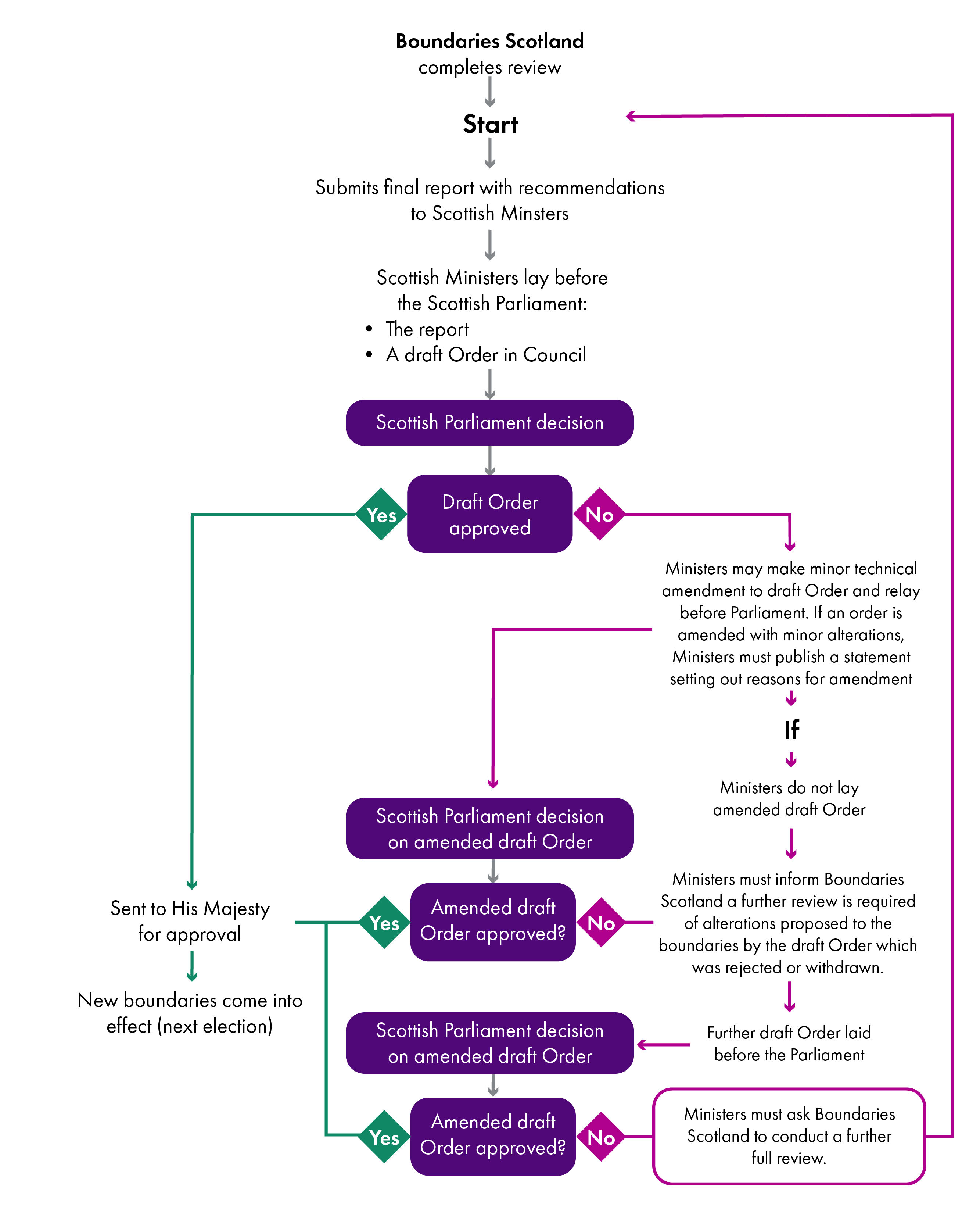
Source: SPICe
A move towards automaticity?
Automaticity is a process ‘where legislation implementing the proposals made by Boundaries Scotland comes into effect automatically; without Parliament or Ministers having the final say over being able to reject or modify the reports". 1
The main argument for automaticity is to reduce or remove political interference in drawing electoral boundaries. Boundaries Scotland favours automaticity and states that it "is both widely employed in other jurisdictions and is also the direction of travel to protect against partisan/political interference in the drawing of electoral boundaries".
In the UK Parliament the Parliamentary Constituencies Act 2020 requires that boundary recommendations are approved automatically. In Wales, boundary recommendations are also approved automatically.
The Scottish Government formally considered automaticity in its consultation on electoral reform which ran from 14 December 2022 to 15 March 2023. The consultation set out three options:
Option 1 was to remove the requirement for Ministers to instruct Boundaries Scotland to undertake a further review should its recommendations be rejected by the Parliament.
Option 2 suggested that the Parliament only be allowed to reject recommendations made by Boundaries Scotland where there were concerns that statutory guidance or duties had not been followed.
Option 3 was to change the process to an automatic adoption of recommendations made by Boundaries Scotland. This would take away the opportunity for the Parliament to object to the recommendations. A legal challenge would be the avenue available should there be concerns that Boundaries Scotland had not followed statutory guidance and duties.
The consultation analysis showed that option 3 was the most popular proposal (of the 61% of respondents in favour of change, 58% of those supported option 3 including the majority of organisations and Boundaries Scotland).
The consultation analysis report recommended that Boundaries Scotland adopts a form of automaticity for approving electoral boundary changes.
The Scottish Government's response to the consultation stated that it is "considering a range of options for future development of how Boundaries Scotland reviews are conducted and approved".2
In 2024, during the Standards, Procedures and Public Appointments Committee's Stage 1 scrutiny of the Elections (Representation and Reform) Bill, the then Minister for Parliamentary business indicated that automaticity is the intended long-term direction for the Scottish Government. The Minister stated that automaticity is "is the right way to make changes to electoral boundaries" and "is our chosen direction and, inevitably, it is where we will end up", but explained that more work was required before implementation.1
Ultimately automaticity was not included in the Scottish Elections (Representation and Reform) Bill (now Act 2025).
Governance and oversight
Appointments to Boundaries Scotland are made under Schedule 4 to the Local Government (Scotland) Act 1973.
Members of the Commission are appointed by Scottish Ministers, following procedures approved by the Commissioner for Ethical Standards in Public Life in Scotland. Appointments are normally for 3 or 4 years, with the possibility of renewal. Posts receive a daily fee, plus expenses. Vacant posts are advertised in the national press and are subject to a process of selection and interview by a panel including the Chair and a representative of the Scottish Government. The final appointment is made by the Scottish Ministers.
Commissioners must be politically neutral. They are subject to a Code of Conduct and must also maintain and make publicly available a Register of Interests as required by the Ethical Standards in Public Life etc. (Scotland) Act 2000.12
Sources
Boundaries Scotland . (2026). The Commission - a general guide. Retrieved from <a href="https://www.boundaries.scot/wp-content/uploads/2026/03/BS_general_guide.pdf" target="_blank">https://www.boundaries.scot/wp-content/uploads/2026/03/BS_general_guide.pdf</a> [accessed 1 July 2026]
Scottish Parliament. (2024, February 28). Electoral reform in Scotland and the Scottish Elections (Representation and Reform) Bill. Retrieved from <a href="https://digitalpublications.parliament.scot/ResearchBriefings/Report/2024/2/28/d7768d94-ce4f-40c0-9c51-0676169b89f0-2#4d0dc6ca-e945-4e11-a4f9-cb050fb20966.dita" target="_blank">https://digitalpublications.parliament.scot/ResearchBriefings/Report/2024/2/28/d7768d94-ce4f-40c0-9c51-0676169b89f0-2#4d0dc6ca-e945-4e11-a4f9-cb050fb20966.dita</a> [accessed 26 2026]
Scottish Parliament. (2023, January 16). Review of Scottish Parliament constituencies . Retrieved from <a href="https://spice-spotlight.scot/2023/01/16/review-of-scottish-parliament-constituencies/" target="_blank">https://spice-spotlight.scot/2023/01/16/review-of-scottish-parliament-constituencies/</a> [accessed 26 June 2026]
Boundaries Scotland. (n.d.) FAQs. Retrieved from <a href="https://www.boundaries.scot/resources/faqs/2/" target="_blank">https://www.boundaries.scot/resources/faqs/2/</a> [accessed 30 2026]
Boundaries Scotland. (n.d.) Second Review of Scottish Parliament Boundaries: Guidance Booklet. Retrieved from <a href="https://www.boundaries.scot/wp-content/uploads/2025/09/SP_Review_Guidance_Booklet.pdf" target="_blank">https://www.boundaries.scot/wp-content/uploads/2025/09/SP_Review_Guidance_Booklet.pdf</a> [accessed 8 July 2026]
Scottish Parliament. (2025, February 27). The Second Review of Scottish Parliament boundaries: Updated proposals for constituencies and regions. Retrieved from <a href="https://spice-spotlight.scot/2025/02/27/the-second-review-of-scottish-parliament-boundaries-updated-proposals-for-constituencies-and-regions/" target="_blank">https://spice-spotlight.scot/2025/02/27/the-second-review-of-scottish-parliament-boundaries-updated-proposals-for-constituencies-and-regions/</a> [accessed 2 July 2026]
Boundaries Scotland. (2026, July 2). Second Review of Scottish Parliament Boundaries. Retrieved from <a href="https://www.boundaries.scot/reviews/reviews-historical-reviews/reviews-second-review-scottish-parliament-boundaries/" target="_blank">https://www.boundaries.scot/reviews/reviews-historical-reviews/reviews-second-review-scottish-parliament-boundaries/</a> [accessed 2 July 2026]
Scottish Parliament. (2024). Stage 1 Report on the Scottish Elections (Representation and Reform) Bill. Retrieved from <a href="https://digitalpublications.parliament.scot/Committees/Report/SPPAC/2024/6/18/cd992e36-6dce-411e-bb9c-21ebd4880798-1#Introduction" target="_blank">https://digitalpublications.parliament.scot/Committees/Report/SPPAC/2024/6/18/cd992e36-6dce-411e-bb9c-21ebd4880798-1#Introduction</a> [accessed 30 2026]
Scottish Government. (2023, October 19). Electoral reform consultation results 2022-2023: Scottish Government response. Retrieved from <a href="https://www.gov.scot/publications/scottish-government-response-results-electoral-reform-consultation-2022-23/" target="_blank">https://www.gov.scot/publications/scottish-government-response-results-electoral-reform-consultation-2022-23/</a> [accessed 30 June 2026]
Boundaries Scotland. (2025, August). Code of Conduct for Members of Boundaries Scotland. Retrieved from <a href="https://www.boundaries.scot/wp-content/uploads/2025/09/Code_of_Conduct_for_Members_of_Boundaries_Scotland_issued_by_Scottish_Ministers__28August_202529.pdf" target="_blank">https://www.boundaries.scot/wp-content/uploads/2025/09/Code_of_Conduct_for_Members_of_Boundaries_Scotland_issued_by_Scottish_Ministers__28August_202529.pdf</a> [accessed 2 2026]
Boundaries Scotland. (2025, August). Boundaries Scotland Register of Interests form. Retrieved from <a href="https://www.boundaries.scot/wp-content/uploads/2025/09/Register_of_Interests.pdf" target="_blank">https://www.boundaries.scot/wp-content/uploads/2025/09/Register_of_Interests.pdf</a> [accessed 2 July 2026]