Prisons: Subject Profile
This subject profile provides information on prisons, including young offender institutions, in Scotland.
Scottish Prison Service
The Scottish Prison Service is an executive agency of the Scottish Government with responsibility for Scotland's prisons and young offender institutions. As at 31 March 2025, there were 4,809 full-time equivalent staff in post.1 The Scottish Prison Service also operates a victim notification scheme, as well as managing the contract for the provision of secure transport for those in custody to and from courts.
The Scottish Prison Service operates in accordance with a framework document2 which is approved by the Scottish Ministers and provides guidance on topics including:
the role of the Scottish Ministers
the role of the Scottish Prison Service Chief Executive
accountability to the Scottish Parliament.
The responsibilities of the Scottish Prison Service extend to both publicly managed prisons and the remaining privately managed prison. The latter is operated under contract by a private company but is still part of the Scottish Prison Service estate.
All prisoners, regardless of their location, are managed in accordance with prison rules and directions.3 The Scottish Prison Service has published a guide to rights under the prison rules.4
Prisons
Individual prisons and young offender institutions are commonly referred to along with the letters HMP and/or YOI (e.g. HMP Barlinnie and HMP & YOI Polmont).
Young offender institutions are used for prisoners aged at least 18 but under 21. Until August 2024, it was also possible for them to hold children aged 16 and 17. However, this was ended following changes made by the Children (Care and Justice) (Scotland) Act 2024.
Children under the age of 18 can be held in secure accommodation1 (not covered in this subject profile).
For conciseness, this subject profile uses the term 'prison' to include young offender institutions, unless the context indicates otherwise.
This rest of this section provides information on:
Current prison estate
The prison estate consists of 17 prisons (including young offender institutions):
publicly operated - HMP Barlinnie, the Bella Centre, HMP Castle Huntly, HMP Dumfries, HMP Edinburgh, HMP Glenochil, HMP & YOI Grampian, HMP Greenock, HMP Inverness, HMP Kilmarnock, the Lilias Centre, HMP Low Moss, HMP Perth, HMP & YOI Polmont, HMP Shotts, and HMP & YOI Stirling
privately operated - HMP Addiewell.
Until March 2024, HMP Kilmarnock was also privately operated.
The Bella and Lilias centres are specialised community custody units (CCUs). They are small establishments providing secure accommodation and closer community contact for low supervision female prisoners.
The Scottish Prison Service website provides information on individual prisons (including a map of prison locations).1
The prison estate caters for a diverse prison population. Separate provision is made for prisoners based on a range of factors. These include sex, age (under 21 or 21 and over), and whether a prisoner is serving a custodial sentence or is being held on remand.
Other factors, such as the nature of the offences involved (e.g. sex offending or organised crime), may also require separation of prisoners - for their own safety or that of other prisoners.
Prisons can differ greatly in terms of the types and numbers of prisoners they hold. For example:
HMP & YOI Stirling is a national facility for female prisoners, with the Bella and Lilias centres housing low supervision female prisonersi
HMP & YOI Polmont holds most of the under 21 prison population (whilst also having separate accommodation for prisoners over that age)
HMP Castle Huntly is an open prison accommodating low supervision adult male prisoners
the Bella and Lilias centres have a combined capacity of 40, whilst the maximum number of prisoners held in HMP Barlinnie during 2024-25 was 1,477.2
In August 2024, in her final annual report as Chief Inspector of Prisons for Scotland,3 Wendy Sinclair-Gieben highlighted the work that had been carried out to improve the prison estate (p 3), as well as what she described as an ageing infrastructure (p 25):
Scotland has invested hugely in the prison estate in the last 25 years; the building of two prisons run by the private sector, two new prisons run by the public sector and the recent build of a new women's prison and two community custody units are testimony to the commitment to hold in safe and secure custody those sent by the courts.
As has been repeatedly mentioned, the ageing infrastructure and general condition of some of Scotland's prison buildings are ill suited to a modern prison system and the added complexity of an ageing population, not least at HMPs Barlinnie, Castle Huntly, Dumfries, Greenock, Inverness, and Perth. Some of Scotland's prisons are modern and fit for purpose, but Scotland still has antiquated Victorian prison establishments that breach human rights guidelines on cell size, are expensive to maintain, and do not provide for the population size or changing demographics.
Development of the prison estate
Recent developments
Significant developments in the prison estate during the last few years have included:
The Bella and Lilias centres (community custody units) - opened in 2022, providing small scale secure accommodation aimed at supporting the needs of female prisoners who would benefit from closer community contact and access to local services.
HMP & YOI Stirling - opened in 2023 as a national facility for female prisoners (replacing HMP & YOI Cornton Vale which was on an adjacent site).
HMP Kilmarnock - transferred to the Scottish Prison Service in 2024, following the expiry of a contract under which it was operated by a private company.
In her foreword to the Scottish Prison Service's annual report for 2023-24 (published September 2024),1 the Chief Executive commented that:
The year commenced with the opening of our innovative and bespoke women's national facility, HMP & YOI Stirling which completes the new build programme of purpose-built facilities designed for women alongside the Bella and Lillias Centres. This is delivering a transformative shift in the care and support for women in custody in Scotland. Establishing a trauma informed approach within an environment that truly lend themselves to providing inclusion, hope and a tangible sense of agency.
On March 17 [2024], after several years of planning and engagement, HMP Kilmarnock transferred into public ownership under the banner of Scottish Prison Service. The first move of its kind saw us take over the operation of the first Private Prison in Scotland bringing an end to 25 years of Serco management, and I must place on the record that we have inherited an excellent staff team and an extremely well-run, prison.
A research report published by the Scottish Government in December 2025 provides an evaluation of how the Bella and Lilias community custody units have been working in practice - Scottish Prisons Assessment and Review of Outcomes for Women (SPAROW).2 It includes a number of reflections and recommendations for improvement.
Ongoing development
The Scottish Prison Service's annual report for 2024-25 (published September 2025)3 highlighted continued work in building two new prisons, with the Chief Executive stating in the foreword:
We have also continued to progress with improvement in our estate and infrastructure with positive progress towards construction of the 2 new build prisons - HMP Highland and Glasgow. The steel structure of the main building for HMP Highland was erected during March 2025 and focus remains on construction completion in 2026. In January, Kier Construction, was awarded the contract to build HMP Glasgow following approval from Scottish Government. Enabling works continue [on] the site following the contract award. The prison is expected to be completed in late 2028.
HMP Highland will replace HMP Inverness, mainly providing places for adult males. Being built to hold 200 prisoners, its design capacity will be just over double that of the current prison. The average population of HMP Inverness in 2025-26 was 122, with a maximum daily population of 136 (both exceeding its design capacity).
HMP Glasgow will replace HMP Barlinnie, providing places for adult males. Being built to hold 1,344 prisoners, its design capacity will also exceed that of the prison it is replacing (which is designed to hold fewer than 1,000 prisoners). However, the design capacity of HMP Glasgow is slightly less than the average number of 1,370 prisoners actually held in HMP Barlinnie during 2024-25 (with a maximum population of 1,477).
Overcrowding
Overcrowding in large parts of the prison estate has been a significant concern in recent years.
Concerns about the size of the prison population and problems caused by overcrowding have been acknowledged by the Scottish Government. For example, in a statement on the prison population by the then Cabinet Secretary for Justice and Home Affairs, Angela Constance MSP, on 2 October 2025:1
Today's population is 8,363, and we are on the cusp of having a record number of people in custody. [...] The recent increases in the prison population are having a significant impact on those who live and work in our prisons. There is now a critical risk to the continued safe and effective operation of the estate, due to the pressured environment, and the Scottish Prison Service's ability to deliver rehabilitative regimes has been severely curtailed.
In relation to the prison population, the Scottish Prison Service's annual report for 2024-25 (p 16) noted that:2
For the reporting year 2024-25, our average daily population was 8,214, compared with the reporting year 2023-24 average of 7,859. This figure represents the highest average daily figure recorded by SPS [Scottish Prison Service]. This is an average increase of 355, or 4.5% compared to the previous year.
It also noted that, during 2024-25, an average of 1,005 single cells were being used to house two prisoners.
Figures illustrating the extent of overcrowding in Scotland's prisons were provided by the then Cabinet Secretary for Justice and Home Affairs in response to a parliamentary question.3 The response provided figures for 20 November 2025. For that particular day, it set out information on the following for both individual prisons and the prison estate as a whole:
number of prisoners being held
design capacity - "an effective, manageable number at which prisons are not overcrowded, are occupied in accordance with their initial design and can be safely and effectively managed to support rehabilitation"
assessed capacity tolerance - "an assessment of the absolute extremis capacity in each establishment".
Looking at the prison estate as a whole, the prisoner population on 20 November 2025 was 8,321. This exceeded the design capacity of the prison estate (7,805) but was a little under the assessed capacity tolerance (8,401). However, several prisons did hold more than their assessed capacity tolerance, including Scotland's largest prison HMP Barlinnie.
More detailed data on prisoner numbers is provided later in this subject profile.
In September 2025, the current Chief Inspector of Prisons for Scotland, Sara Snell wrote to the Scottish Government4 stating that overcrowding "is an invidious and all-pervading evil that affects every aspect of prison life". The letter highlighted a range of problems caused by overcrowding, including:
greater difficulty for prisons in complying with core human rights (e.g. access to fresh air)
increased strain on relationships between staff and prisoners
inadequate access for prisoners to purposeful activities which can support rehabilitation and reduce the risks of offending when released (e.g. work, education and offender behaviour programmes)
the impact on the mental health of prisoners caused by reduced time out of cells and a lack of access to purposeful activity
no capacity within the prison estate to accommodate significant additional numbers of prisoners if damage to part of the estate (e.g. due to prisoner unrest) means that they need to be moved.
The Scottish Government has previously outlined a range of actions taken in response to the high prison population. For example, in October 2025 it highlighted:5
changes to early release provisions for short-term prisoners, reducing the length of time most spend in custody before qualifying for automatic release
changes expanding eligibility rules for prisoner release on home detention curfew
steps taken by the Scottish Prison Service to maximise the capacity of the existing prison estate
investment in electronically monitored bail (as an alternative to remand)
investment in alternatives to custodial sentences and in support for people leaving prison.
The Scottish Government also noted that an independent Sentencing and Penal Policy Commission6 had been established to:
review how custody and community-based interventions are used, with a focus on reducing crime, supporting rehabilitation, and ensuring a sustainable prison population.
The Commission's final report was published in February 2026 - Justice that Works.7 The foreword to the report noted that it sets a clear ambition:
that Scotland should work towards reducing its prison population in line with the European average – doing the calculations for our nation, that works out at approximately 5,775 people.
The report is broad in its scope, covering – the prevention of crime, alternatives to prosecution, bail and remand, community and custodial sentences, and release from custody. Being published towards the end of Session 6 of the Scottish Parliament, it includes analysis and recommendations which may help inform debate in Session 7.
Categories of prisoner
Prisons and young offender institutions hold both remand and sentenced prisoners:
remand – held in custody awaiting trial or following conviction awaiting sentence
sentenced – serving a custodial sentence.
Young offender institutions hold those aged at least 18 but under 21. Until August 2024, it was also possible for them to hold children aged 16 and 17. However, this was ended following changes made by the Children (Care and Justice) (Scotland) Act 2024.
Prisoners serving sentences (in both prisons and young offender institutions) may be:
short-term prisoners – serving determinate custodial sentences of less than four years
long-term prisoners – serving determinate custodial sentences of four or more years
life prisoners – serving indeterminate custodial sentences (a life sentence or order for lifelong restriction).
Determinate sentences are for a fixed period of time (e.g. months or years). Sentences that are not fixed in this way are called indeterminate sentences.
The categorisation by type of sentence affects arrangements for the release of prisoners.
Prison life
The Scottish Prison Service is tasked with holding prisoners in a safe and secure environment. It also seeks to provide services which support the rehabilitation of prisoners, including their successful reintegration into society upon release.
This section contains information on two areas which are important in rehabilitation and reintegration, as well as in providing a humane environment for those in custody:
Information on a wider range of matters affecting prison life is provided in a guide to rights under the prison rules1 published by the Scottish Prison Service.
Purposeful activity
The term purposeful activity is generally used to cover a range of constructive activities within prisons, including:
work
education and vocational training
physical education
counselling and other rehabilitative programmes.
In providing these activities, the Scottish Prison Service works with various partner organisations. For example, in August 2025 the PeoplePlus Group became the new provider for educational services.1
Most purposeful activity is carried out by convicted prisoners. In 2025-26, an average of approximately 21 hours purposeful activity was carried out per convicted prisoner per week.i
As noted early in this subject profile, one of the concerns associated with prison overcrowding is the impact it can have on prisoners being able to access purposeful activity. In her first annual report as Chief Inspector of Prisons for Scotland (published in March 2026),2 Sara Snell commented that:
Increasing numbers of people are locked in their cells for more than 22 hours a day, despite the best efforts of staff. Lack of access to purposeful activity and programmes adversely affects mental health, which is particularly disturbing in the context of the extremely worrying rise in the number of deaths in custody in Scotland, and the number of suicides in Scottish prisons.
HM Inspectorate of Prisons for Scotland has raised particular concerns in a report on the experience of remand prisoners.3 For example, stating that (p 6):
Despite the high level of need among the remand population, there is a disparity in treatment between remanded and convicted prisoners, and remand prisoners have fewer legislative rights than their convicted counterparts. Remand prisoners were significantly more likely to report negative experiences regarding access to purposeful activity, time out of cell, and access to certain health services.
Contact with family and friends
Where appropriate, maintaining contact between prisoners and their families and friends can play an important role in:
providing a humane environment for prisoners
supporting the successful reintegration of prisoners back into the community upon release.
It can also help lessen the negative impact which separation may have on those left to cope with the imprisonment of a family member (e.g. where the parent of a child is imprisoned).
Sources of advice on visiting prisoners include:
Scottish Prison Service - Supporting links between families and friends1
Families Outside - Visiting Prison.2
Release of prisoners
This section contains information on some of the main rules and practical arrangements relating to the release of prisoner back into the community:
Most of the information relates to prisoners serving a custodial sentence. However, the discussion of prisoner transition to the community is also relevant to remand prisoners.
The following does not seek to cover all the provisions which may apply to the release of prisoners (e.g. it does not cover the power to release prisoners on compassionate grounds).
Early release
The rules on early release from a custodial sentence are mainly set out in the Prisoners and Criminal Proceedings (Scotland) Act 1993 (as amended by subsequent legislation).i They differ depending upon whether a prisoner is a:
short-term prisoner – serving a determinate custodial sentence of less than four years
long-term prisoner – serving a determinate custodial sentence of four or more years
life prisoners – serving an indeterminate custodial sentence (a life sentence or order for lifelong restriction).
Early release provisions include the following:
Short-term prisoners - until relatively recently, short-term prisoners were automatically released after serving 50% of their sentence. From 11 February 2025, the period before automatic release was generally reduced to 40%.ii From 12 May 2026 this was further reduced to 30%.iii However, the reductions to 40% and then 30% did not affect those serving sentences for sexual or domestic abuse offences, who are still released after serving 50% of the sentence. For most short-term prisoners, release is not subject to licence conditions and thus not subject to supervision by justice social work. Sex offenders receiving sentences of between six months and four years are released on licence, with conditions set by the Scottish Government.
Long-term prisoners serving sentences imposed before 1 February 2016 - they may be released after serving one-half of the sentence. If not already released, such prisoners must be released after serving two-thirds of the sentence. Any decision to release before the two-thirds point is taken by the Scottish Ministers on the recommendation of the Parole Board for Scotland. This follows an assessment of whether a prisoner is likely to present a risk to the public if released. Long-term prisoners are, irrespective of the proportion of sentence served in custody, released on licence under conditions set by the Parole Board for Scotland and subject to supervision by justice social work. The licence, unless previously revoked, continues until the end of the whole sentence.
Long-term prisoners serving sentences imposed on or after 1 February 2016 - they may also be released after serving one-half of the sentence but automatic early release at the two-thirds point of the sentence does not apply.iv Changes to the rules, limiting the scope of automatic early release, were made by the Prisoners (Control of Release) (Scotland) Act 2015. The rules do include provision to ensure that a period of post-release supervision is preserved for long-term prisoners. For some, this is achieved by retaining automatic early release at the point when the prisoner has six months of the sentence left to serve. Any decision to release before this point involves the Parole Board for Scotland on the same basis as for long-term prisoners sentenced before 1 February 2016. The provisions relating to licence conditions and supervision are also the same as before.
Life prisoners - they have a punishment part set by the court when imposing the sentence. This is the period that the court considers appropriate to satisfy the requirements of retribution and deterrence, but ignoring any period of confinement necessary for the protection of the public. The prisoner serves the whole of the punishment part in custody. Such a prisoner may be released after this point if the Parole Board for Scotland considers that continued incarceration is not required for the protection of the public. The possibility of release is considered again periodically where the Parole Board for Scotland does not initially order the release of the prisoner. Prisoners are released on licence, continuing until the person's death, under the supervision of justice social work.
Breach of licence conditions can lead to a released prisoner being recalled to custody.
There are special rules applying to the release of prisoners serving:
extended sentences - these combine a determinate custodial term with an additional period of supervision in the community
sentences for offences connected to terrorism.
In relation to long-term prisoners, in July 2024 the Scottish Government published a consultation paper seeking views on whether early release arrangements should revert to those applying before the changes made by the Prisoners (Control of Release) (Scotland) Act 2015.1 This would have meant that most long-term prisoners would again be entitled to automatic early release after serving two-thirds of the sentence. A key reason for proposing the change was concern about the rising prison population.
The change proposed in the consultation was not taken forward at the time. Instead, the Prisoners (Early Release) (Scotland) Act 2025 made changes to early release for short-term prisoners (as outlined above). However, this Act also gave the Scottish Government broader powers to alter the automatic early release point, for both short-term and long-term prisoners, through secondary legislation.
Further information on the release of prisoners and parole can be found on the websites of the:
Scottish Sentencing Council - Custodial sentences2
Parole Board for Scotland - Frequently Asked Questions.3
Emergency early release
In addition to early release under the standard provisions discussed above, there have been three recent occasions in which emergency powers have been used to release groups of prisoners serving custodial sentences.
COVID-19 powers
In response to the COVID-19 pandemic, the Coronavirus (Scotland) Act 2020 gave the Scottish Government temporary powers to bring forward secondary legislation allowing for the release of groups of prisoners earlier than would be the case under normal early release rules. The use of these powers was limited to situations where they were a necessary and proportionate response to the impact of COVID-19.
The above powers were used once, with the Release of Prisoners (Coronavirus) (Scotland) Regulations 2020 setting out time-limited measures (applying to a period in 2020) providing for the release of some short-term prisoners before the normal point of early release. The measures were aimed at supporting the safe management of prisons by reducing the prison population during the pandemic.
The temporary powers set out in the Coronavirus (Scotland) Act 2020 were replaced by similar temporary powers in the Coronavirus (Recovery and Reform) (Scotland) Act 2022. These powers expired in November 2024 without being used.
Current powers
The Bail and Release from Custody (Scotland) Act 2023i gave the Scottish Government permanent powers to bring forward secondary legislation allowing for the release of groups of prisoners earlier than would be the case under normal early release rules. There are a range of restrictions on who can be released (e.g. the powers cannot be used in relation to remand or life prisoners). The Scottish Government may only use these powers where satisfied that it is a necessary and proportionate response to the effects of an emergency situation on prisons.
In May 2024, the Scottish Government announced its intention to use the above powers to "address the impacts of an unprecedented rise in the prison population".1 Relevant regulations came into force in June 2024 - the Early Release of Prisoners and Prescribed Victim Supporters (Scotland) Regulations 2024. Under the regulations, a total of 477 short-term prisoners were released earlier than they would have been under normal early release provisions. This took place during June and July 2024.2
In October 2025, the Scottish Government indicated that it was seeking to use these powers again in response to increases in the prison population.3 Relevant regulations came into force in November 2025 - the Early Release of Prisoners (Scotland) Regulations 2025. They allowed for the early release of groups of short-term prisoners in seven tranches, between November 2025 and April 2026. Further information (e.g. on prisoners excluded from emergency release) is set out in a policy note published along with the regulations.4 In total, 614 prisoners were released early across the seven tranches.5
Home detention curfew
Since 2006, the Scottish Prison Service has had the power to release prisoners on home detention curfew (HDC). This allows prisoners, subject to a range of exceptions, to serve an additional part of their custodial sentence in the community (e.g. prior to the point at which short-term prisoners qualify for automatic early release).
Relevant provisions are set out in section 3AA of the Prisoners and Criminal Proceedings (Scotland) Act 1993 and are exercised by the Scottish Prison Service on behalf of the Scottish Ministers. They allow prisoners to spend up to 210 days of their sentence in the community on licence whilst wearing an electronic tag. Release conditions include a curfew, monitored using the tag, under which a prisoner must remain at a particular place for a set period each day. Breach of licence conditions can result in recall to custody.
The amount of time a prisoner can spend on HDC was increased from 180 to 210 days by the Home Detention Curfew (Amendment of Specified Time Periods) (Scotland) Order 2025. This also reduced the proportion of the sentence which a prisoner must spend in custody before qualifying for release on HDC. A Scottish Government policy note published along with the Order provides more detail on the rules relating to HDC.1
Release on HDC is mainly used in relation to short-term prisoners, but can also be used for some long-term prisoners. Not all prisoners within these categories are eligible for release on this basis (e.g. sex offenders). In relation to those who are eligible, release is not automatic. Prior to any release, the Scottish Prison Service carries out an assessment including consideration of public protection, prevention of re-offending and securing successful re-integration of the prisoner in the community.
Section 9 of the Bail and Release from Custody (Scotland) Act 2023 sets out provisions which would replace the possibility of release on HDC for long-term prisoners with a new system of temporary release. However, the provisions are not yet in force. The proposed change would not affect short-term prisoners, who would still be covered by the rules allowing for release on HDC.
Rules and procedures, relating to release and enforcement of HDC conditions were tightened in light of concerns arising from a 2018 conviction for murder of a prisoner who had been released on HDC and was in breach of his release conditions when he committed the crime. Changes included some legislative changes made by the Management of Offenders (Scotland) Act 2019. Following this, there was a significant fall in the number of prisoners released on HDC, although numbers have increased in the last couple of years.
Figures for the average number of prisoners on HDC at any one time are set out in the following table.
| Year | 2016 | 2017 | 2018 | 2019 | 2020 | 2021 | 2022 | 2023 | 2024 | 2025 |
|---|---|---|---|---|---|---|---|---|---|---|
| Prisoners | 287 | 311 | 265 | 57 | 62 | 57 | 64 | 62 | 96 | 104 |
Scottish Prison Service
Transition to the community
The successful reintegration of prisoners back into the community may depend upon a range of measures aimed at tackling existing problems and avoiding the creation of new ones. These include:
programmes to address offending behaviour and addiction issues
support for prisoners in maintaining positive relationships with family and friends in the community
support for prisoners in obtaining stable accommodation, social security benefits and work upon release.
This is sometimes referred to as 'throughcare'. Some aspects may be spread across a person's time in prison (e.g. see earlier discussion on purposeful activity in prison) whilst others may be focused on a period before and following release.
In addition to prison personnel, throughcare may be provided by:
other central and local government services - including ones with a criminal justice focus (e.g. justice social work) and more general ones (e.g. dealing with health and social security)
third sector providers of services (e.g. as part of Upside voluntary throughcare services)
private sector organisations (e.g. the Scottish Prison Service seeks to develop partnerships with businesses offering employment opportunities to people with convictions).
Throughcare arrangements differ depending on whether a prisoner is covered by:
statutory throughcare - mainly prisoners serving long-term (four of more years) and life sentences, but including some short-term prisoners (e.g. sex offenders serving sentences of between six months and four years)
voluntary throughcare - short-term prisoners (not covered by statutory throughcare) and prisoners released from remand.
Prisoners receiving statutory throughcare are released on licence and subject to compulsory supervision by justice social work. Information on statutory throughcare is provided on Community Justice Scotland's website .1
A new national voluntary throughcare service called Upside was launched in April 2025. 2 Further information on voluntary thoughcare is provided on Community Justice Scotland's website.3
Inspection and complaints
Inspection and monitoring of prisons
HM Inspectorate of Prisons for Scotland (HMIPS),1 headed by HM Chief Inspector of Prisons for Scotland, has responsibility for the inspection and monitoring of Scotland's prisons (including young offender institutions). Other responsibilities include the inspection of court custody units and prisoners under escort.
The inspection of prisons involves a programme of regular inspection visits as well as unannounced visits. The work is carried out by HMIPS staff together with subject experts from other organisations (e.g. the Care Inspectorate, Education Scotland and Healthcare Improvement Scotland ).
Monitoring is a regular weekly activity carried out for each prison and young offender institution by Independent Prison Monitors - trained volunteers from the local community.2 During visits, monitors check on the treatment and conditions of prisoners and can investigate issues raised by individual prisoners.
HMIPS is one of 21 statutory bodies, independently monitoring places of detention, that make up the UK's National Preventive Mechanism (NPM).3 The NPM was established in 2009 to strengthen the protection of people in detention.
The latest annual report of HM Chief Inspector of Prisons for Scotland was published in March 2026.4
Prison complaints
Prisons (including young offender institutions) have internal complaint procedures which prisoners should use in the first instance. A guide to rights under the prison rules1 published by the Scottish Prison Service includes a section on making a complaint. Independent Prison Monitors can assist with this.
Where a prisoner is not satisfied with the outcome of internal procedures, a complaint can be raised with the Scottish Public Services Ombudsman. Its website includes the following information for prisoners:
In August 2025, the Scottish Human Rights Commission published a report on the complaints system.4 The report criticised various aspects of the system and argued that it was "in need of urgent review and reform". Concerns have also been highlighted by HM Chief Inspector of Prisons for Scotland, with her annual report published in March 2026 stating that (p 17):5
Our long-standing concerns about the lack of confidence prisoners have in the SPS [Scottish Prison Service] complaints system has not changed. In some prisons it is not possible to submit a complaint without first discussing it with an officer, and in most prisons no proof is given that a complaint has even been lodged. A fully electronic system for logging complaints, tracking progress and securing a response within the official timelines is long overdue. It is especially challenging for those who do not have English as a first language to access the complaints system.
Prison statistics
This section of the subject profile sets out ten charts providing a range of statistics relating to imprisonment, along with commentary on those statistics.
Drivers of changes in the prison population
To help in the interpretation of the statistics in this section, some of the factors which may have contributed to changes in the size and/or composition of the prison population are outlined below.
Some of these factors will have had an impact over a limited period, whilst others may be expected to produce more sustained changes. For instance, the use in recent years of emergency early release powers for some groups of short-term prisoners had an immediate impact in reducing prisoner numbers, but the impact of each release faded over the course of a few months. By contrast, permanent changes to early release provisions for long-term prisoners (ending automatic early release at the two-thirds point of the sentence) had a less immediate but more sustained impact in driving up the prison population.
In 2025, the Scottish Government published a paper looking at long-term drivers of and changes in the prison population.1 It highlighted the following factors:
the types of cases being dealt with by the courts - an increase in convictions for more serious offences and a decrease in convictions for less serious ones, leading to an increase in the average length of custodial sentences imposed
a reduction in the use of short custodial sentences for less serious offences (e.g. due to the current statutory presumption against the use of sentences of a year or less)
the proportion of custodial sentence spent in custody - changes to early release provisions meaning that long-term prisoners (determinate sentences of four years or more) tend to serve a greater proportion of their sentence in custody, whilst short-term prisoners (determinate sentences of less than four years) serve less of their sentence in custody
an increase in the average length of time individuals who are remanded in custody are held on remand - to a large extent caused by the impact of COVID-19 on the courts but part of a trend which started before the pandemic.
In relation to the types of cases being dealt with by the courts, a report published by Audit Scotland in May 2026 highlighted "a continuing increase in serious, complex cases, such as historical sexual abuse and serious organised crime" (p 3).2
Some information on particular factors affecting the prison population (both in the short and longer term) is set out below, with further information on relevant factors highlighted when considering the statistics.
COVID-19 pandemic
Measures taken in response to the COVID-19 pandemic, with significant restrictions imposed from March 2020, had a major impact on the justice system. This can be seen in a range of statistics from 2020-21 onwards, including ones relating to prisoner numbers. For example, restrictions on criminal courts during the pandemic limited the number of trials which could be held. This meant fewer custodial sentences imposed, but also meant a rising court backlog with an increase in the time people spent on remand awaiting trial.
During the pandemic, the Scottish Government used emergency early release powers provided for in the Coronavirus (Scotland) Act 2020 to release some short-term prisoners before the normal point of early release.
The ending of pandemic restrictions on court business, coupled with the allocation of additional resources to help reduce the court backlog, allowed for a greater throughput of criminal cases. This resulted in an increase in custodial sentences, whilst also helping to reduce some of the upward pressure on remand numbers.
Bail and Remand
The remand prison population (those held in custody awaiting trial or following conviction awaiting sentence) is determined by the number of people who are remanded and the length of time they are held on remand. The latter has already been mentioned (in relation to the impact of the COVID-19 pandemic) and is considered further when looking at statistics on remand prisoners.
In relation to the number of people who are remanded, concerns have been expressed that remand (particularly pre-trial remand) has been used where releasing a person on bail with suitable safeguards would be more appropriate. For example, in 2018 the then Scottish Parliament Justice Committee published a report on the use of remand3 noting that (para 144):
A key issue throughout the Committee's inquiry was whether any steps could be taken to reduce what many witnesses perceived to be an inappropriately high use of remand.
In 2023, the Scottish Government published a research report looking at decision-making on bail and remand.4 It referred to the Justice Committee's report on the use of remand, and went on to note (p 2):
The 2021 Programme for Government subsequently included a commitment to introduce legislation to change the way that imprisonment is used and a 12 week public consultation was subsequently facilitated which sought views on how custody should be used in a modern and progressive society, the findings from which were used to inform the development of a new Bill.
In June 2023, the Bail and Release from Custody (Scotland) Act 2023 (which was still being passed through parliament at the time that the current research was reaching its conclusion) set out new statutory limits on the use of remand so that it is a last resort for the court, reserved for those who pose a risk to public safety, including the protection of the complainer from a risk of harm, or to prevent a significant risk of prejudice to the interests of justice in a given case.
Relevant provisions of the Bail and Release from Custody (Scotland) Act 2023 dealing with bail remand were brought into force in May 2025.
Sentencing
Changes in approaches to sentencing may impact on whether a person receives a custodial sentence and the length of any such sentence. Such changes may be be influenced by a range of factors, including evidence on what works and the availability of different alternatives to custodial sentences. They also include legislation seeking to guide sentencing decisions and the work of the Scottish Sentencing Council. Some examples of these are outlined below.
Since February 2011, there has been a statutory presumption against the courts imposing short custodial sentences. This initially applied to sentences of three months or less but was, from July 2019, extended to sentences of up to one year. The relevant statutory provisions are set out in section 204(3A) of the Criminal Procedure (Scotland) Act 1995:
A court must not pass a sentence of imprisonment for a term of 12 months or less on a person unless the court considers that no other method of dealing with the person is appropriate.
Also relevant to the use of custodial sentences are sentencing guidelines5 produced by the Scottish Sentencing Council. For example, a guideline on the sentencing of young people6 (applying to offenders under the age of 25) states that (para 21):
A custodial sentence should only be imposed on a young person when the court is satisfied that no other sentence is appropriate. If a custodial sentence is imposed on a young person, it should be shorter than that which would have been imposed on an older person for the same, or a similar, offence.
The guideline came into effect in January 2022.
Notes on statistics
Sources of data
Most of the charts in this section use figures taken from Scottish Prison Population Statistics, which are published annually by the Scottish Government,1 with the latest data covering the year 2024-25. Some of these charts present figures from 2000-01, whilst others start from 2009-10 - reflecting the fact that a greater range of readily comparable data is available from that date.
Two other main sources of data are used:
Safer Communities and Justice Statistics2 - monthly reports published by the Scottish Government (providing the daily population figures in Charts 4 and 6)
Criminal Proceedings in Scotland Statistics3 - published annually by the Scottish Government (providing the figures for custodial sentences in Chart 8), with the latest data covering the year 2023-24.
Generally, the most up-to-date published figures for prisoner numbers are found on the Scottish Prison Service website under the heading of Prison Population.4 This provides population figures broken down by sex, age, sentenced and remand for the Friday of each week.
Prison population figures compared to people experiencing imprisonment
Most of the statistics set out below are for the prison population during a particular period - either the average during a year or the number on a certain day. Such data is useful in highlighting potential pressures on prison capacity, as well as providing an indication of the changing make-up of the prison population over time.
What these population figures do not directly show is the number of people who experience a period of custody during any given year. For the purposes of the average during a year, six people who each spend two months in custody during that year are counted the same as one person who spends the whole of the year in custody. So, for example, there could be a fall in the number of people sent to prison coupled with an increase in the average prison population if there is a large enough increase in the average length of time individuals spend in custody. This issue is considered below when looking at data on people being remanded, prison population data broken down by length of sentence, and criminal proceedings data on the use of custodial sentences.
Problems with data on sentenced and remand populations
The latest publication of annual Scottish Government prison population statistics, Scottish Prison Population Statistics 2024-25,5 highlights problems with the data used to produce average annual population figures. This arises where the data is used to differentiate between prisoners serving a custodial sentence from those being held on remand.
Where a prisoner has been involved in more than one case, it is possible for the prisoner to be serving a custodial sentence and remanded in custody at the same time. In such situations, the prisoner is treated for statistical purposes as serving a custodial sentence. This in itself is not the problem. However, Scottish Government statisticians found that the relevant data source failed to accurately identify (for statistical purposes) where a prisoner is no longer being held under a sentence and should therefore be counted as a remand prisoner. Thus, average annual figures overestimated the sentenced population and underestimated the remand population. In addition, it was found that the level of inaccuracy caused by this problem had been increasing from 2020-21 onwards. For more information on the issue see Scottish Prison Population Statistics 2024-25 (p 21-24).
To help address the above problem, Scottish Government statisticians have produced revised figures with the aim of providing a more accurate picture for 2020-21 onwards. These are used in Chart 3 (average prison population - sentenced and remand). Although the degree of inaccuracy is thought to have been less prior to 2020-21, the fact that the figures from 2020-21 onwards are calculated differently should still be borne in mind when making comparisons with figures from before 2020-21.
Chart 5 (average remand population by type of remand) also uses revised figures for 2020-21 onwards, although these have not gone through the same degree of correction.
Revised figures for the sentenced population broken down length of sentence (see Chart 7) are not available at this point in time.
It should be noted that the daily remand population figures used in Chart 6 below are not affected by the above problem.
Prison population
Average prison population - total and male
Chart 1 shows how the total average prison population has changed since 2000-01. The figures include both sentenced and remand prisoners.
The chart also shows how male prisoner numbers have changed. Given that male prisoners make up the bulk of the prison population (around 95%), the profile of the male population closely follows that of the total population.
During the period 2000-01 to 2011-12, the total average population rose by over 2,300 (nearly 40%), from less than 6,000 to almost 8,200. This was followed by a gradual fall to under 7,500 in 2017-18. The fall was reversed in the following two years, so that in 2019-20 the total average prison population was again almost 8,200.
In 2020-21, the total average population fell significantly to a little over 7,300. This was the result of temporary measures taken in response to the COVID-19 pandemic:
additional powers to release prisoners before the end of their sentence – aimed at supporting the safe management of prisons by reducing the prison population during the pandemic
restrictions on the carrying out of criminal court business – aimed at the safe running of the courts during the pandemic but limiting the level of business concluded and thus numbers of custodial sentences imposed.
However, the total average population had by 2024-25 risen to a new high of 8,213. This was despite the use of emergency early release powers during 2024-25 which were aimed at tackling the rising prison population.
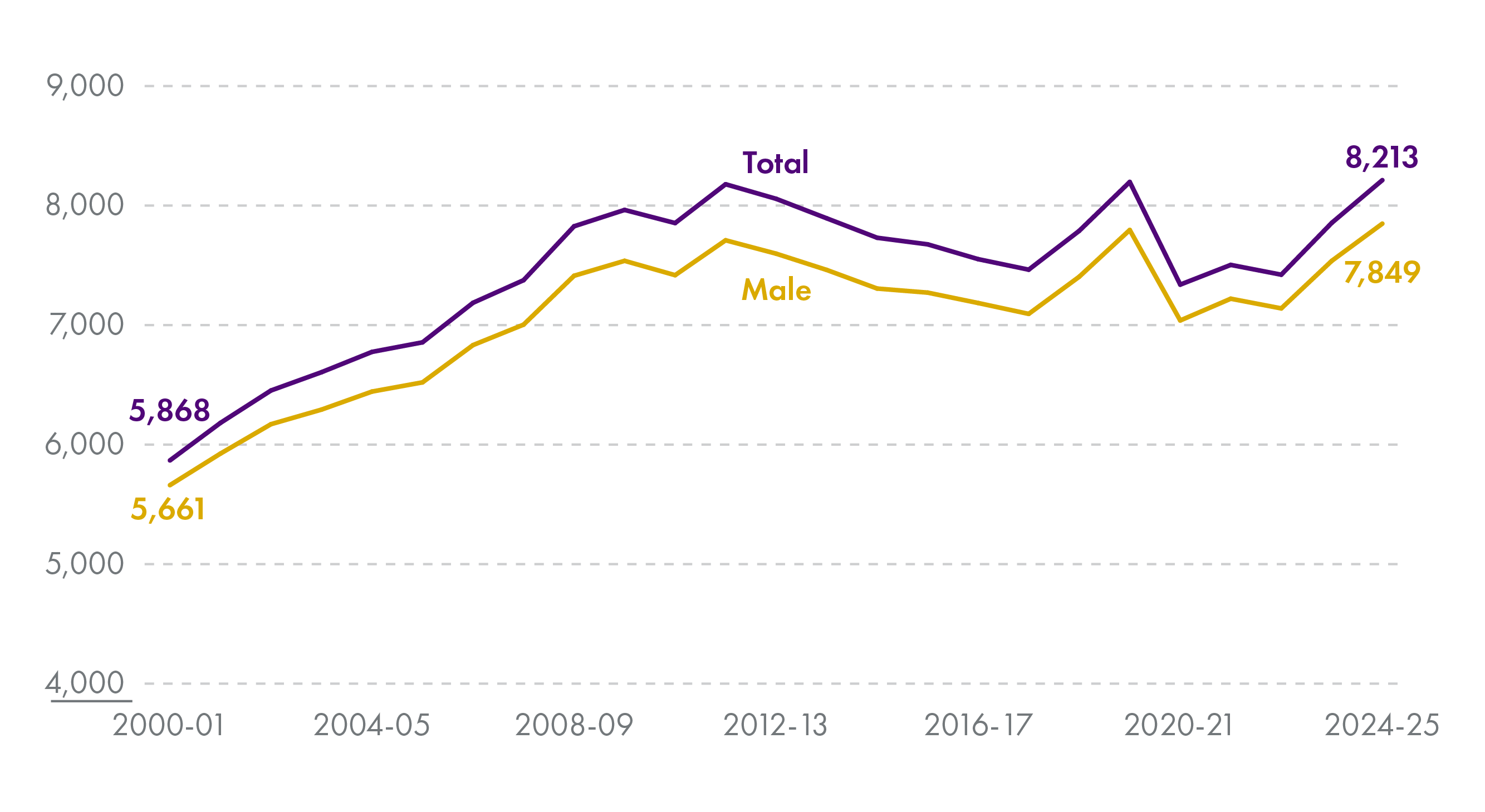
One reason for the return to higher prisoner numbers was an increase in the number of custodial sentences imposed (getting back towards more typical pre-pandemic levels) following the lifting of COVID-19 restrictions on court business. In 2019-20, almost 11,100 people received a custodial sentence. In 2020-21 this dropped significantly to a little over 7,200. By 2023-24, the figure was just under 10,100.
Other factors include:
stubbornly high levels of remand (discussed below)
the fact that the use of emergency release powers only lowers prisoner numbers for a relatively short period - the time between the release of prisoners under emergency powers and when they would have been released anyway under normal early release provisions.
Average prison population - female
Chart 2 shows how the average number of female prisoners has changed since 2000-01.
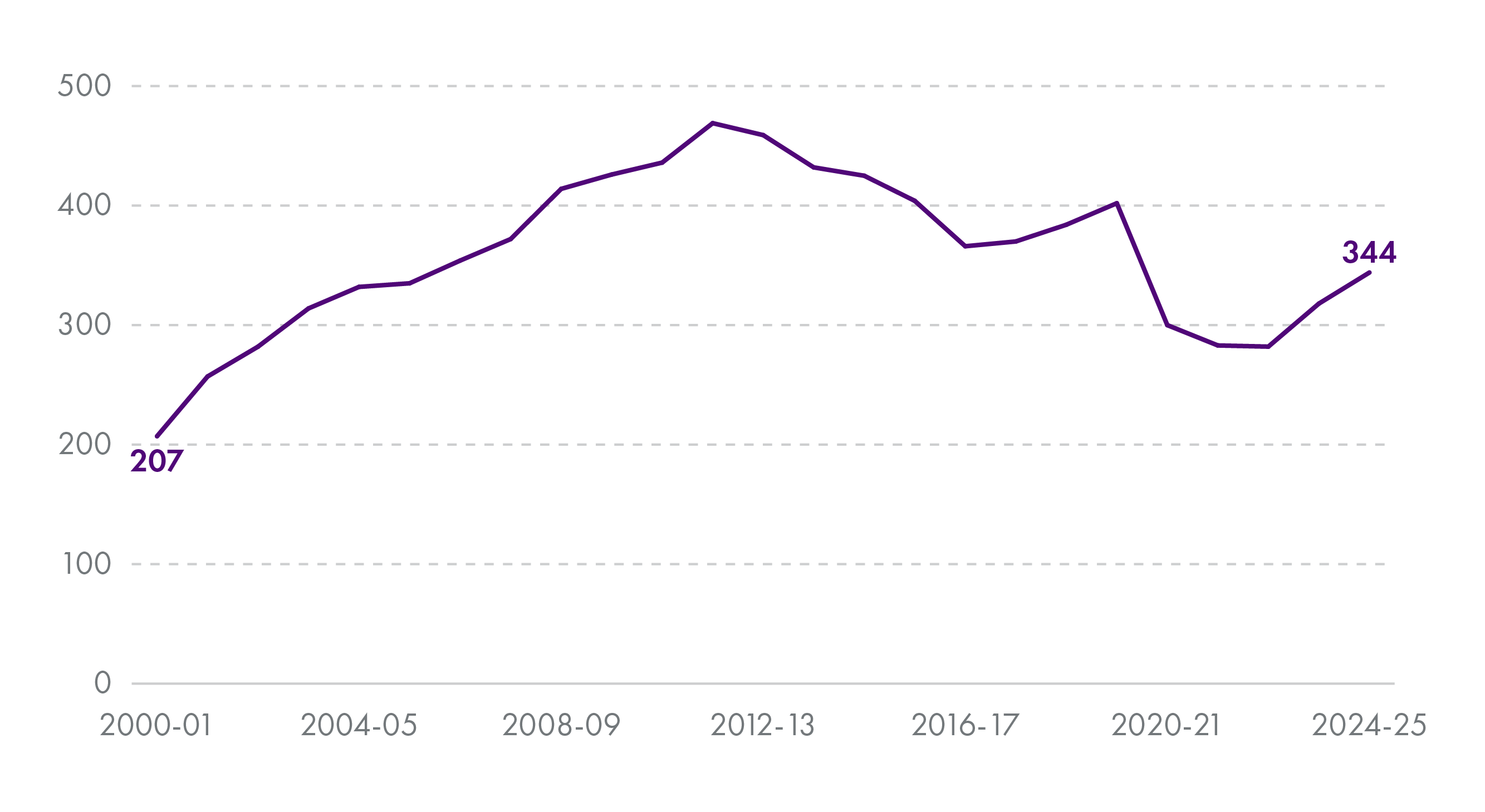
Although forming a small proportion of the total prison population (4% in 2024-25), specific concerns have been highlighted in relation to the use of imprisonment for women. Reasons for this include:
analysis of the circumstances which frequently form part of the history of women in prison (e.g. victims of abuse and/or poor mental health) and of the impact of imprisonment on female prisoners and their families
changes in the female prison population.
In relation to the second point, the total figure for female prisoners rose by 127% between 2000-01 and a high point in 2011-12. Despite reductions since then, it was in 2024-25 still 66% higher than in 2000-01.
A commentary on the use of imprisonment for women is provided in chapter 2 of a research report published by the Scottish Government in 2025 - Scottish Prisons Assessment and Review of Outcomes for Women (SPAROW).1
Average prison population - sentenced and remand
Chart 3 provides a breakdown of sentenced and remand prisoners since 2009-10. The later starting point, compared to the previous two charts, reflects the fact that a greater range of readily comparable data is available from that date.
Earlier comments about problems with data on sentenced and remand populations (see notes on statistics) should be borne in mind when looking at the information in this chart.
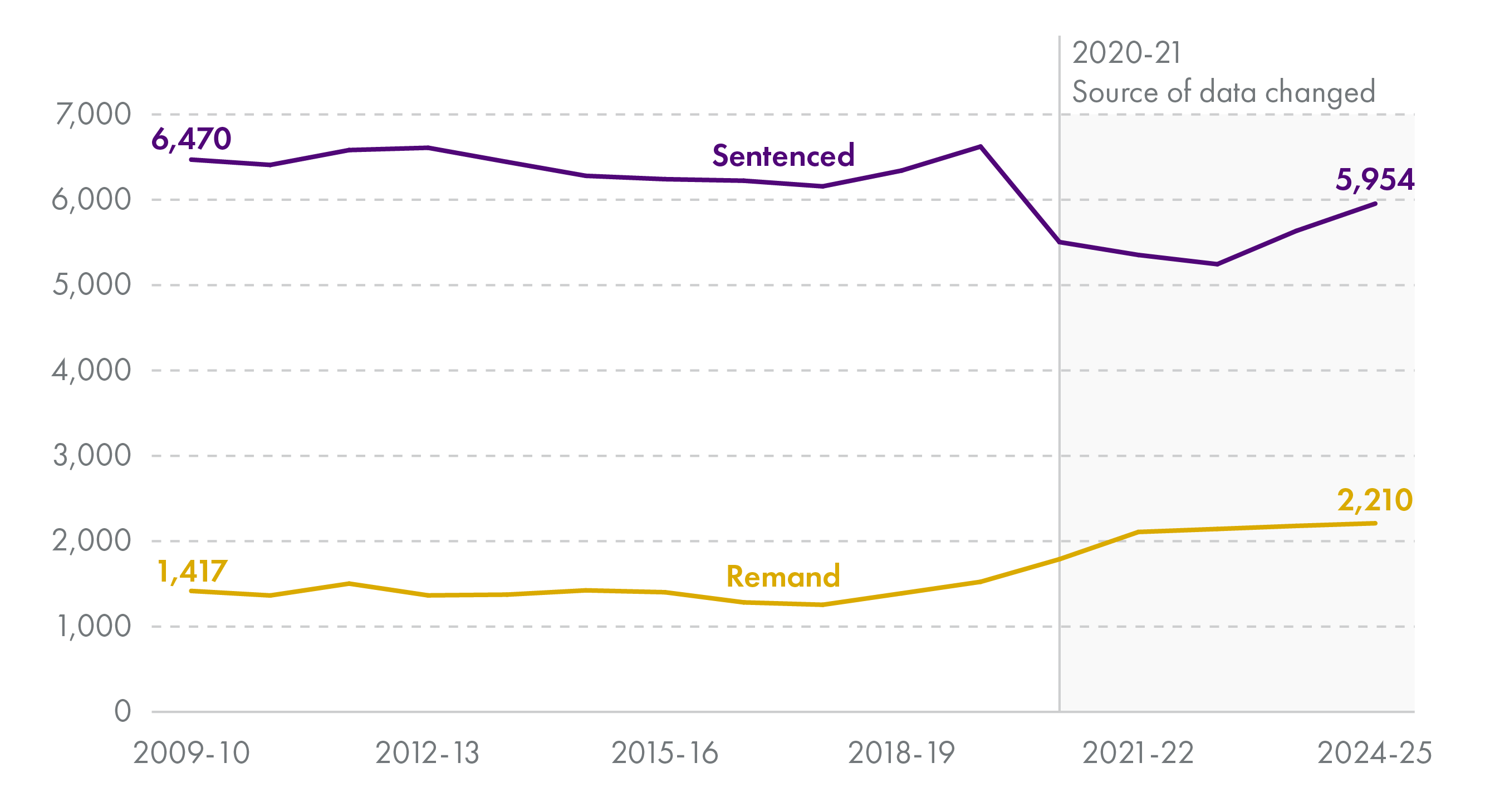
The impact of the COVID-19 pandemic can be seen in the sentenced population, which fell from more than 6,600 in 2019-20 to less than 5,300 in 2022-23. It then increased, reaching more than 5,900 in 2024-25. Drivers of these changes included:
restrictions on court business during the COVID-19 pandemic limiting the number of trials which could be held, and thus the number of people receiving custodial sentences
more prosecutions being concluded following the lifting of COVID-19 restrictions leading to an increase in the number of people receiving custodial sentences.
The average number of prisoners held on remand was starting to increase before the COVID-19 pandemic (from a low of less than 1,300 in 2017-18) and continued to increase during the pandemic. Restrictions on criminal courts during the pandemic made it more difficult to keep periods of remand within normal time limits. Although the rate of increase slowed in recent years, it reached a high point of over 2,200 in 2024-25.
Further data on the remand population is provided later.
Daily prison population data
Figures for the average annual prison population are currently available up to 2024-25. Chart 4 uses daily prison population data to provide a picture of what has been happening during the period from the start of January 2024 to the end of January 2026. It sets out information on the total prison population (sentenced plus remand).
In looking at daily prison population data (rather than average annual figures) it should be noted that the prison population can be subject to seasonal fluctuations during the course of a year (e.g. there can be a dip in December-January associated with a reduction in the number of court sitting days due to public holidays).
As can be seen from Chart 4, the total prison population has experienced several peaks and troughs during a period of just over two years. However, it ended higher than it started:
the average during January 2024 was 7,892
the average during January 2026 was 8,346.
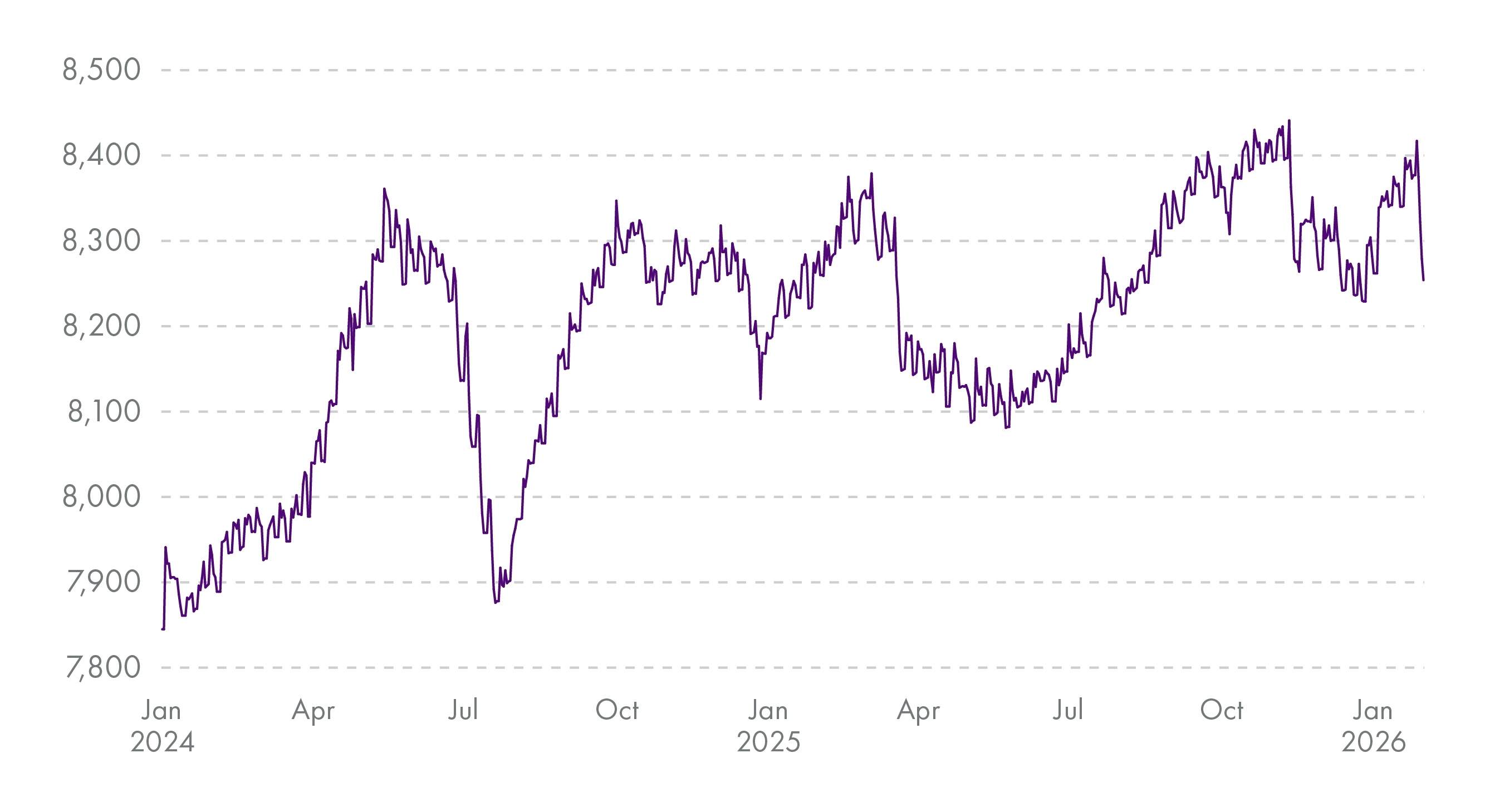
In the months following January 2024, the total prison population rose, peaking at more than 8,300 during May 2024. Following this the population fell, dropping to below 7,900 during July 2024. This fall was associated with the Scottish Government's use of emergency early release powers in June and July 2024.
However, the impact of the emergency early release was short-lived, with the total population again exceeding 8,300 during October 2024. Following this, the total population fluctuated between a low of just under 8,100 during May 2025 and a high exceeding 8,400 in November 2025.
Further steps taken to reduce the prison population, since the use of use of emergency early release in the summer of 2024, have included:
changes to the normal rules on early release in February 2025 meaning that short-term prisoners (with some exceptions) were automatically released after serving 40% of their sentence rather than 50% - from 12 May 2026 this was further reduced to 30% of the sentence
a further use of emergency early release, with groups of prisoners being released from November 2025 to April 2026.
Remand prisoners
As noted earlier, the total remand population increased during the COVID-19 pandemic. Although delays in concluding cases during the pandemic meant fewer people receiving custodial sentences, such delays also made it more difficult to keep periods of pre-trial remand within normal statutory time limits. This was reflected in the temporary extension of those limits under COVID-19 legislation.
Statutory time limits on remand
COVID-19 related legislation provided, on a temporary basis, for the automatic extension of certain time limits affecting criminal court cases. This was first done in the Coronavirus (Scotland) Act 2020. Some changes were made over time, with the final set of automatic extensions set out in the Coronavirus (Recovery and Reform) (Scotland) Act 2022.
In relation to remand, the relevant extended time limits provided for in Coronavirus (Recovery and Reform) (Scotland) Act 2022, along with the normal limits set out in the Criminal Procedure (Scotland) Act 1995, are set out below.
1. Pre-trial remand in solemn cases:
time on remand until service of indictment on accused: normal 80 days; extended 260 days
time on remand until pre-trial hearing: normal 110 days; extended 290 days
time on remand until trial: normal 140 days; extended 320 days.
2. Pre-trial remand in summary cases:
time on remand until trial: normal 40 days; extended 130 days.
In relation to all the above time limits (normal and extended), statutory provisions allow for an application to the court for a time limit to be extended if justified in the circumstances of a specific case. Regarding the pandemic, it was argued that simply relying on extensions being sought through applications in individual cases would, in the context of the disruption caused by COVID-19, divert too much court time towards the consideration of such applications.
There has been a gradual return to normal time limits as the impact of the pandemic has lessened and court backlogs have reduced:
pre-trial remand in solemn cases – for new cases the extended time limits were ended in November 2025 (the extended limits were retained for cases which had reached a certain stage at that point)
pre-trial remand in summary cases – the extended time limit was ended in November 2023.
However, concerns about the length of time which some people spend remanded in custody (particularly when awaiting trial) remain. For example, in a report on the experience of remand prisoners (published December 2025),1 HM Inspectorate of Prisons for Scotland commented that (p 8):
Currently the remand population is too high, the length of time spent on remand is too long, and Scottish remand prisoners are not given adequate protection under Scottish legislation. Taking stronger measures to reduce the remand population and decrease time spent on remand is needed to relieve the pressure on the prison system, leaving the SPS [Scottish Prison Service] better able to provide fair and humane treatment to all those in their care.
Average remand population by type of remand
Chart 5 shows how the average remand population has changed since 2009-10, broken down by the type of remand:
untried - untried prisoners awaiting trial
awaiting sentence - convicted prisoners awaiting sentence.
Earlier comments about problems with data on sentenced and remand populations (see notes on statistics) should be borne in mind when looking at the information in this chart.
The chart highlights that:
the average number of prisoners held on remand whilst awaiting trial was already increasing before the COVID-19 pandemic, but that this was exacerbated by the pandemic - the untried remand population rose by 94% between a low in 2017-18 (less than 1,000) and a high point in 2022-23 (over 1,800)
there was a fall in the number of remand prisoners awaiting sentence in the immediate aftermath of pandemic restrictions, but this was eclipsed by the rise in untried remand prisoners
by 2024-25, the number of untried remand prisoners was still at historically high levels, and the pandemic dip in the number of remand prisoners awaiting sentence had been reversed.
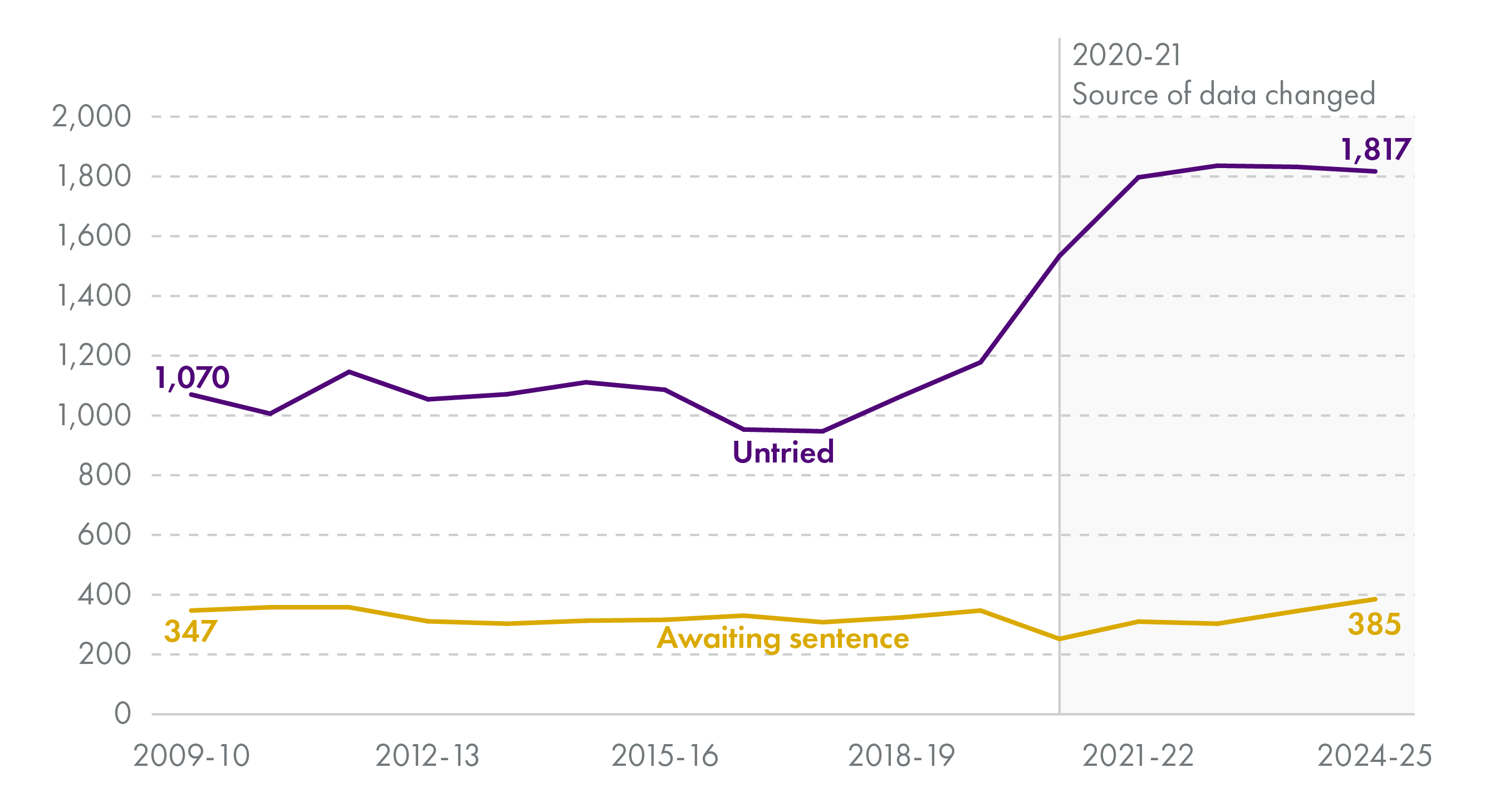
The remand population is a product of the number of people being remanded and the length of time they are held on remand. It would appear to be an increase in the latter which has led to the rise in the remand population.
Figures published as part of the Scottish Government's Scottish Prison Population Statistics indicate that there was a fall in the number of people arriving on remand during the period covered by the above chart. For example, the number of prison arrivals of people remanded for trial was:i
10,544 in 2009-10
6,636 in 2024-25.
In relation to the time spent on remand, a 2025 Scottish Government paper looking at long-term drivers of and changes in the prison population1 noted (p 10):
the time taken to depart from remand or transition into the sentenced population has increased. Much of the rise has occurred since the COVID-19 pandemic began and is related to the time-bar extension introduced during the pandemic. However, [...] this is part of a longer-term trend which started in the years prior to the pandemic.
As for why the average length of time people are held on remand has increased, the impact of the pandemic has been mentioned. Other factors may include delays caused by pressures on available resources and changes in the offence profile of people being remanded (e.g. if there is a higher proportion of serious and/or complex cases).
Daily remand population data
Chart 6 uses daily remand population data to provide a picture of what has been happening more recently (covering the period from the start of January 2024 to the end of January 2026). Figures are for the total remand population (untried prisoners plus those awaiting sentence).
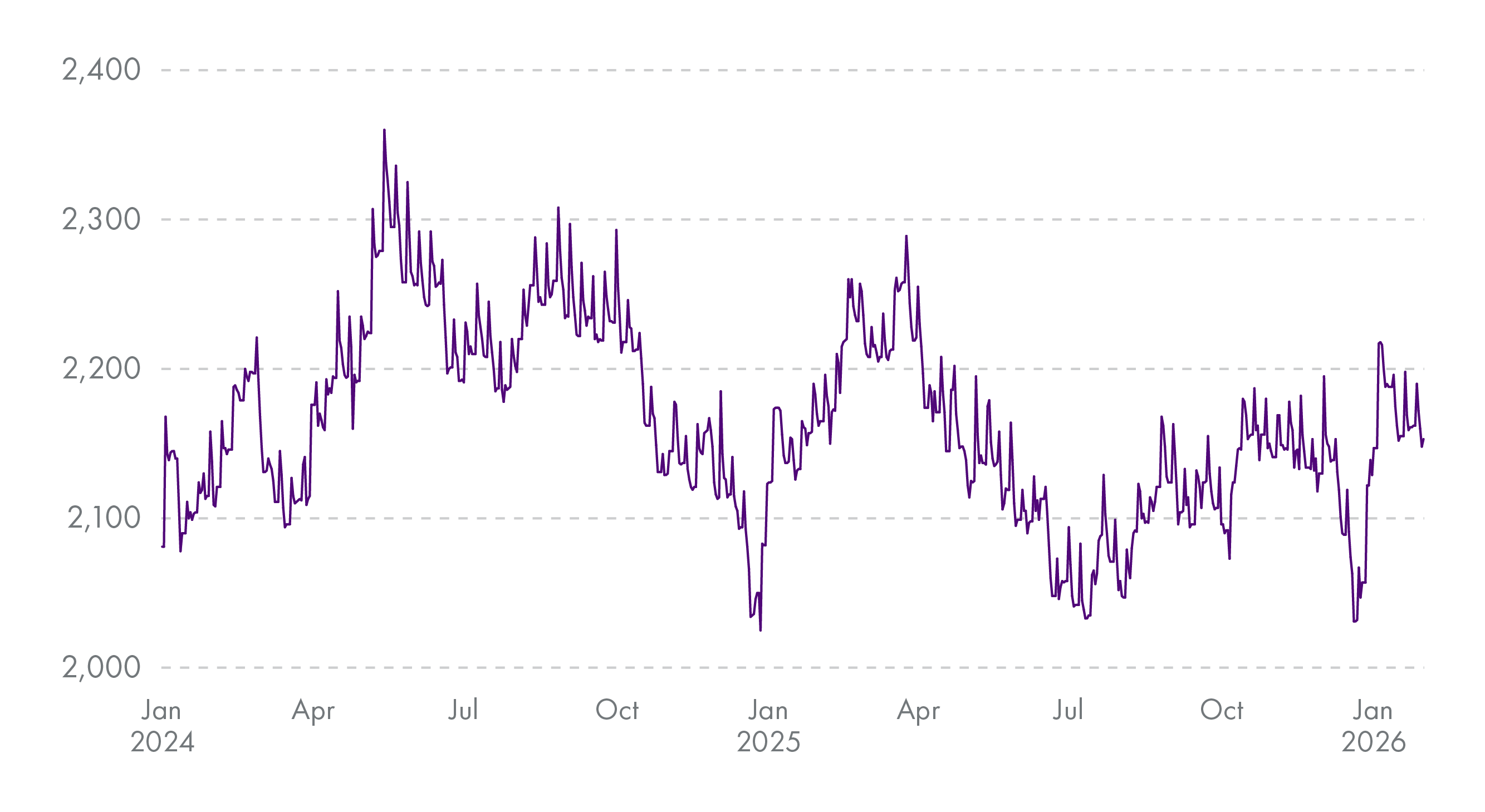
On 1 January 2024, the remand population was 2,081. It increased in early 2024, peaking at 2,360 during May. The population then fell in the second half of 2024, to a low of 2,025 during December.
On 1 January 2025, the remand population was 2,124. This increased to a peak of 2,289 during March. Fluctuations during the rest of 2025 included two dips in the remand population, falling to just over 2,030 in both July and December.
On 31 January 2026, the remand population stood at 2,153.
It is worth noting that remand prisoners have not been eligible for release as part of emergency early release.
Custodial sentences
The size of the prison population is a product of the number of people sent to prison (sentenced and remand) and the time they spend in prison. In relation to the sentenced population this means:
the number of people receiving custodial sentences
the length of custodial sentences imposed
the proportion of custodial sentences actually spent in custody.
So, for example, there could be a fall in the number of people receiving custodial sentences, coupled with an increase in the sentenced prison population, if there is a large enough increase in the length of sentences imposed and/or the proportion of sentences spent in prison.
These issues are explored below.
Average sentenced population by length of sentence
Chart 7 sets out information on the average sentenced prison population broken down by the length of the 'index sentence'. The index sentence is the longest single sentence being served during a period in custody.
The chart shows how the prison population has changed between 2009-10 and 2024-25. For the purposes of this chart, the sentenced population has been broken down into three groups:
prisoners serving sentences of up to and including one year
prisoners serving sentences of more than one year up to and including four years
prisoners serving sentences of more than four years, including life sentences.
The figures in the chart do not include prisoners who have been recalled. Their numbers varied between just under 300 to almost 400 during the period covered. Prisoner may be recalled where they breach licence conditions imposed on their release.
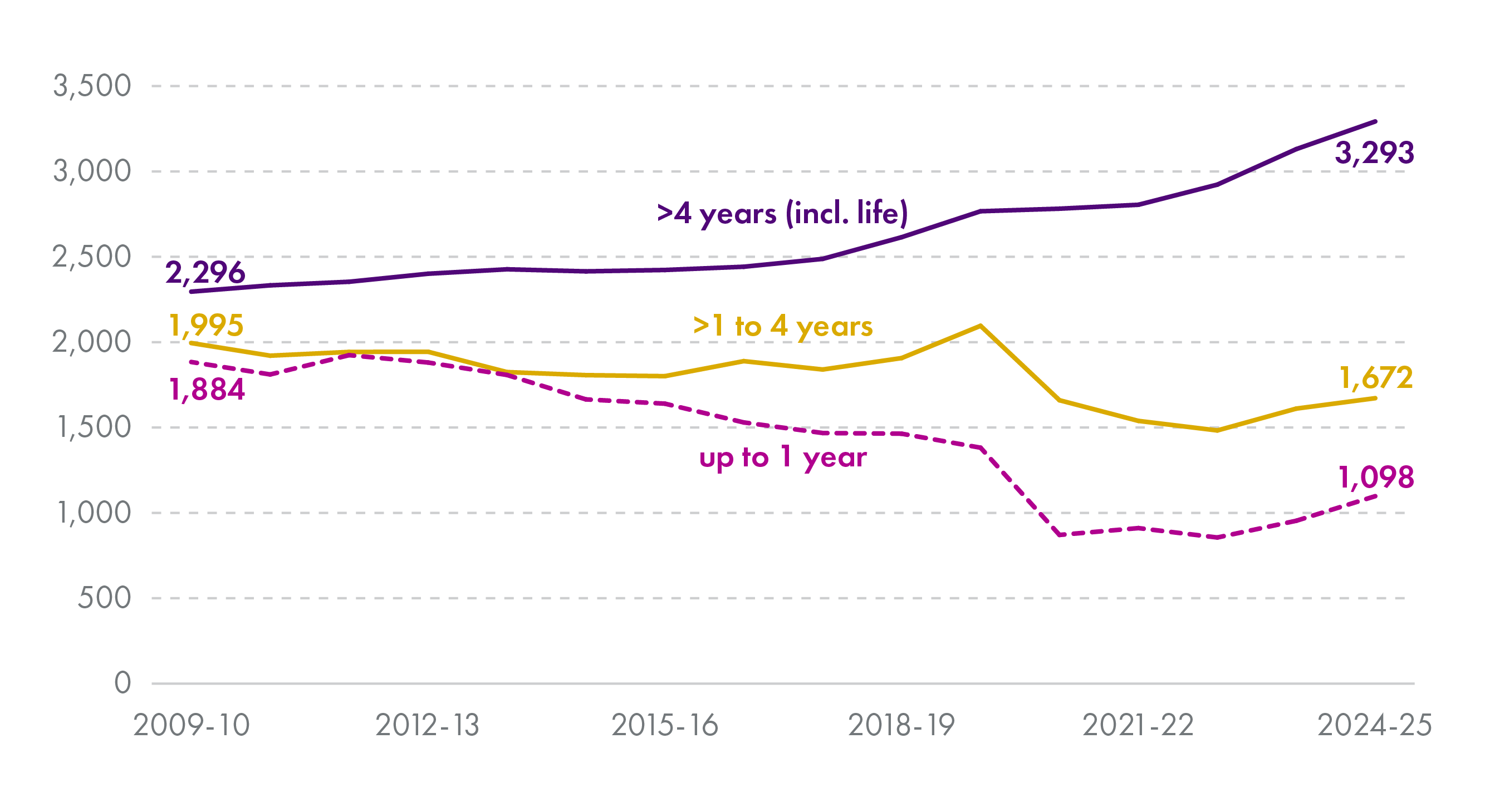
The first group has been chosen to reflect the current presumption against the use of custodial sentences of a year or less. As noted earlier, there has since February 2011 been a presumption against the courts imposing short custodial sentences. This initially applied to sentences of three months or less but was, from July 2019, extended to sentences of up to one year.
The first and second groups combined approximate to the category of short-term prisoners, with the third group consisting of long-term prisoners and life prisoners. This split is of interest given the significant differences in early release provisions. The published data does not allow for an exact split between short-term and long-term prisoners due to the fact that it includes long-term sentences of exactly four years in the same data set as short-term sentences.
Of the three groups set out in the chart, the largest consists of those serving sentences of more than four years (including life). The average number of prisoners in this group increased from almost 2,300 in 2009-10, to almost 3,300 in 2024-25. During the same period, the proportion of the overall sentenced population accounted for by this group increased from around 37% to around 54%.
Possible factors contributing to an increase in the number of people in custody serving long-term or life sentences include:
more convictions for serious offences (e.g. sexual offences) leading to more people receiving long sentences
long-term prisoners spending a greater proportion of their sentences in custody - as a result of changes to early release provisions which restricted automatic early release for those sentenced from February 2016 onwards.
In addition, there are concerns that an overstretched prison system has failed to provide prisoners with timely access to opportunities which would allow them to demonstrate that they are making progress in addressing risk factors. And that this in turn can unduly delay the release on parole of long-term and life sentence prisoners.
The average number of prisoners held in the other two groups decreased during the period covered by the chart:
prisoners serving sentences of up to and including one year - fell from a little under 1,900 in 2009-10 to just under 1,100 in 2024-25
prisoners serving sentences of more than one year up to and including four years - fell from just under 2,000 in 2009-10 to less than 1,700 in 2024-25.
The numbers in these two groups were relatively similar in the initial years covered by the chart, but started to diverge more from 2014-15:
the number of prisoners serving sentences of up to and including one year continued to fall, to less than 1,400 in 2019-20
the number of prisoners serving sentences of more than one year up to and including four years fluctuated, reaching a high point of just under 2,100 in 2019-20.
For both, there then followed a sharp fall in numbers linked to the impact of the COVID-19 pandemic, and something of a bounce-back in the last couple of years as more criminal court business took place.
In looking at the numbers of prisoners broken down by the length of sentence, it is important to remember that prisoners are categorised by the longest single sentence being served during a period in custody. So, for example, a single prisoner may during a particular year be in custody as part of a two-year sentence and also under a nine-month sentence, with only the former being counted for statistical purposes.
In 2025, the Scottish Government published a paper looking at the relationship between custodial sentences of 12 months or less and the overall sentences being served by people in prison - Short custodial disposals from court and the prison population.1 Using data for 2023, it highlighted the limited effect some short sentences can have on the period spent in custody. For example, reporting that in around half of cases they had no impact on the overall length of sentence being served. The paper noted that this was most likely as a result of a new short sentence being served concurrently with an existing sentence.
Custodial sentences - length of sentence
Chart 8 sets out figures for people receiving a custodial sentence from the courts during the period 2009-10 to 2023-24.i Sentences have been been broken down into three groups which broadly reflects the approach taken in Chart 7:ii
sentences of up to and including one year
sentences of more than one year but less than four years
sentences of four years and over, including life sentences.
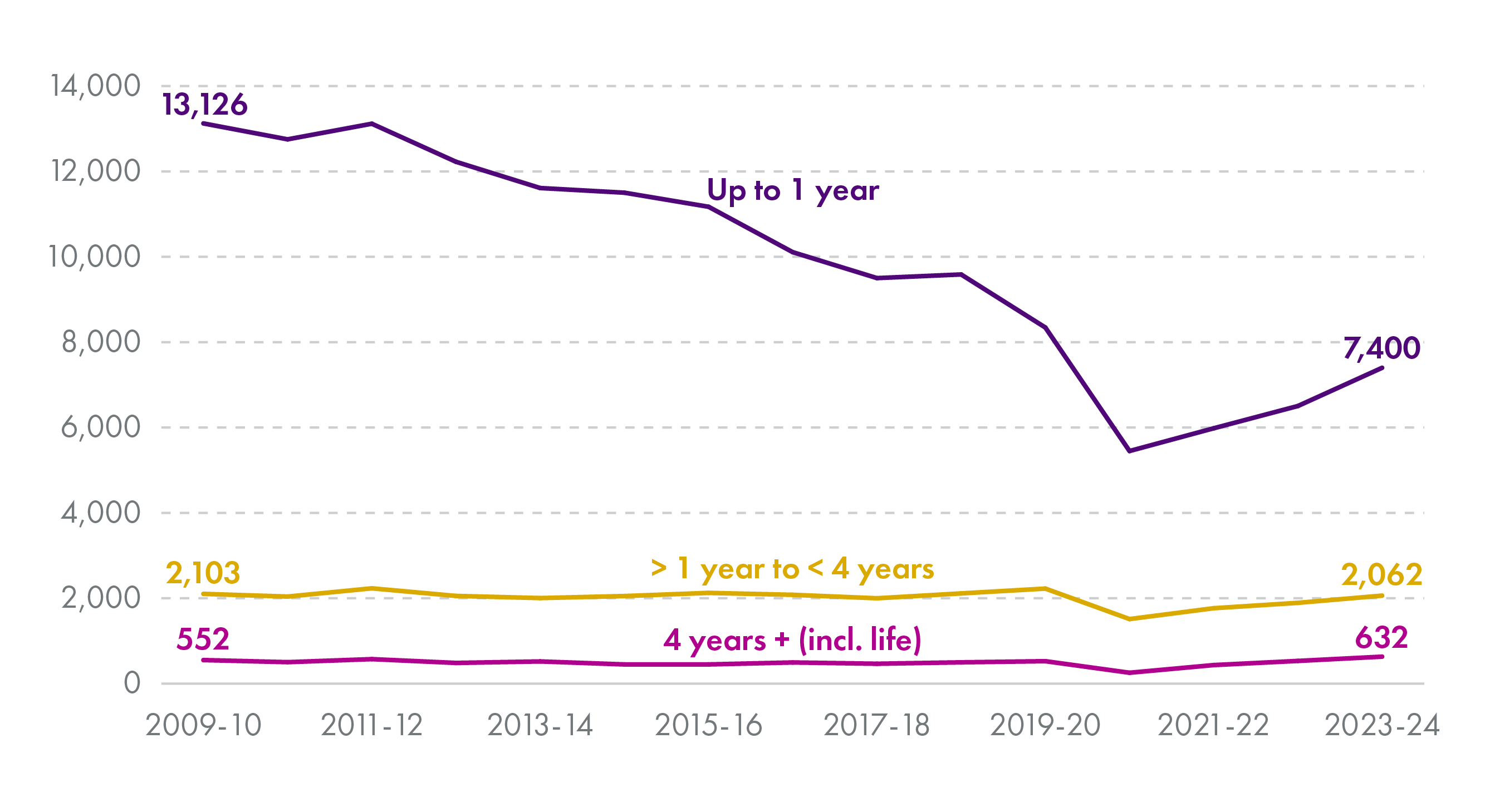
Comparing Chart 8 with Chart 7, one sees that the order or the three groups has been reversed, with the top line relating to sentences of up to and including one year. Chart 8 highlights the fact that short sentences still account for most custodial sentences imposed. This is despite the fact that their numbers have fallen significantly.
All three groups show substantial falls in the number of sentences imposed as a result of the COVID-19 court restrictions, although the scale of the chart makes this less obvious in the lines representing longer sentences. All three groups also exhibit a bounce-back in numbers of sentences as pandemic restrictions have been removed and more criminal court business takes place. (This effect, including measures taken to tackle the court backlog, may at least in part account for the relatively high number of sentences of four years and over imposed in 2023-24).
If one largely excludes the impact of the COVID-19 pandemic, by comparing figures for 2009-10 with those for 2019-20, the total number of people receiving a custodial sentence fell by 30% (from a little under 15,800 to just under 11,100). This decline was almost wholly accounted for by a fall in sentences of a year or less:
sentences of up to and including one year - fell by nearly 4,800 (down 36%)
sentences of more than one year but less than four years - rose by 124 (up 6%)
sentences of four years and over (including life sentences) - fell by 26 (down 5%).
The fall in the use of custodial sentences of up to one year may reflect changes in sentencing practice. It might also in part reflect changes in the types of cases being dealt with by the courts.
In relation to sentencing practice, the introduction of the statutory presumption against short custodial sentences (introduced February 2011) may have had an impact. However, this only applied to sentences of three months or less for most of the period up to 2019-20. (The extension of the presumption to sentences of up to one year applied from July 2019.) Comparing figures for 2009-10 with those for 2019-20, the number of custodial sentences of three months or less fell by 57% (accounting for 70% of the fall in sentences of a year or less during the period).
Those involved in sentencing may also have been influenced by:
the same debate and research on the merits of short sentences which led to the statutory presumption
better provision of community sentences as an alternative to custodial sentences.
Given that there is a presumption against the use of short custodial sentences, stating that they should not be used "unless the court considers that no other method of dealing with the person is appropriate", one might ask why they were still used in relatively high numbers. By way of explanation, it has been argued that the wording of the presumption is not strong enough and that it fails to challenge a culture of resorting to imprisonment when other options don't seem to be working - even when evidence suggests that prison will not be more effective.1
Other factors which may play a part in the continued use of short custodial sentences include evidence that they are most often used where the offender is already in custody. The previously mentioned Scottish Government paper on Short custodial disposals from court and the prison population,2 when looking at data for 2023, reported that (p 11):
Around 20% of all custodial sentences of 12 months or less handed down by courts were given to people arriving to court from the community (meaning they were not on remand or already serving previous prison sentences). The remaining 80% were given to people who were already on remand or were serving previous custodial sentences.
The paper also noted that in a substantial number of cases, the new short custodial sentence did not add to the time the prisoner spent in custody - either because the new sentence was served concurrently with a longer sentence, or because of time already spent on remand.
Age of prisoners
Charts 9 and 10 set out information on the average prison population (sentenced plus remand) broken down age. Both charts cover the period 2009-10 to 2024-25.
Chart 9 looks at prisoners under the age of 30, with data broken down into three age groups: under 21, 21-24, and 25-29. The average population for all three groups fell between 2009-10 and 2024-25, with this being particularly striking for the younger age groups:
25-29 - fell by 25%, from just over 1,500 to a little over 1,100
21-24 - fell by 63%, from just over 1,300 to 485
under 21- fell by 83%, from a little over 1,000 to 170.
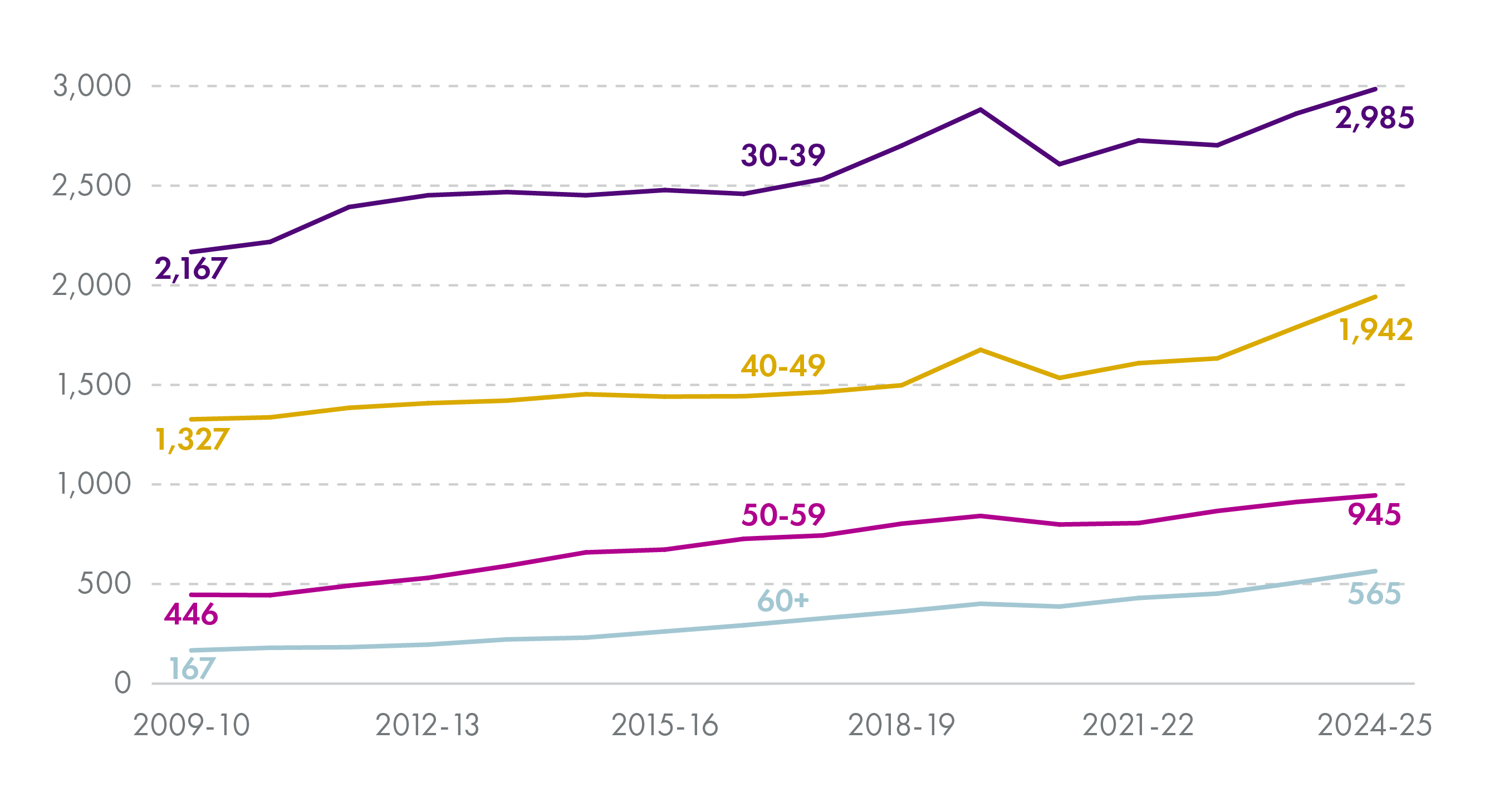
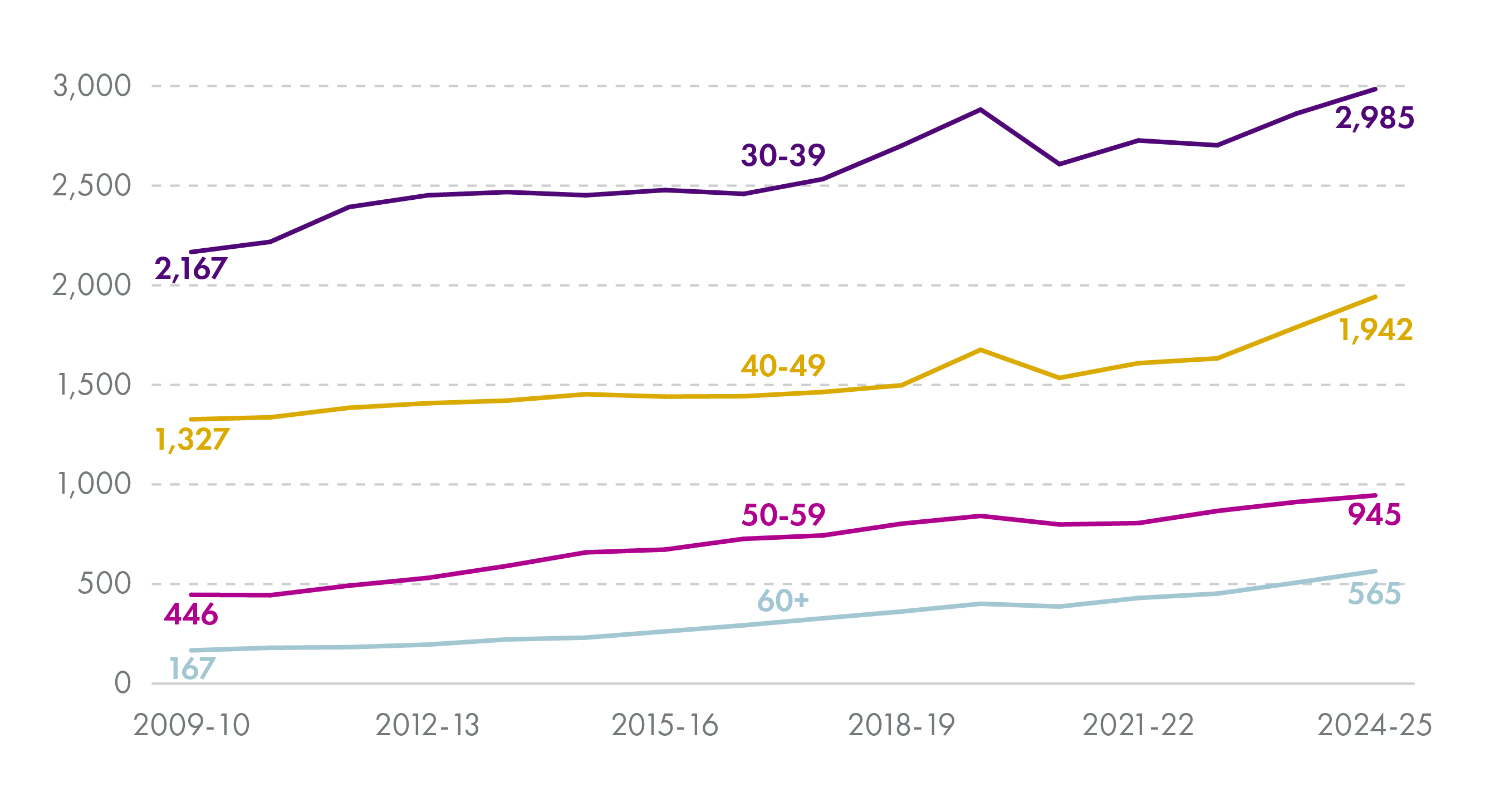
Chart 10 looks at prisoners aged 30 and over, with data broken down into four age groups: 30-39, 40-49, 50-59, and 60 plus. The average population for all four groups increased between 2009-10 and 2024-25:
30-39 - rose by 38%, from less than 2,200 to almost 3,000
40-49 - rose by 46%, from a little over 1,300 to more than 1,900
50-59 - rose by 112%, from 446 to 945
60 plus - rose by 238%, from 167 to 565.
Factors driving changes illustrated in the two charts may include:
changes in the approach to sentencing of younger offenders
an older age profile for people in prison serving sentences for offences which are more likely to result in a substantial custodial sentence
convictions for serious historic sex offences leading to substantial custodial sentences for people who are already older at the time of the conviction.
In relation to the first bullet point, the Scottish Sentencing Council's guideline on the sentencing of young people,1 applying to offenders under the age of 25, states that a custodial sentence should only be imposed "when the court is satisfied that no other sentence is appropriate". The guideline came into effect in January 2022 and so cannot account for most of the fall in prisoner numbers aged under 25 (as shown in Chart 9). However, an early review of the sentencing guideline2 commented that (para 75):
Some evidence suggests, however, that courts were in fact already approaching the sentencing of those under 25 differently during the five years preceding the introduction of the guideline. This might indicate that the guideline reflects pre-existing sentencing practice to a degree, particularly in respect of those aged 21-24, rather than setting out a new approach, although this conclusion should be treated with caution.
In relation to the second bullet point, the previously mentioned 2025 Scottish Government paper looking at long-term drivers of and changes in the prison population3 highlighted some changes in age. For example (p 19):
the rise in prisoners with index offences of 'Murder and culpable homicide' has been driven by an increase in prisoners aged 30 and over. This chimes with wider statistics on people accused of homicide. Over the past 10 years, the median age of a person accused of homicide ranged between 29 and 35 years old. This is generally older than the preceding ten years, which ranged between 23 and 30 years old.
Although still a relatively small proportion of the total prison population, the significant increase in prisoners aged 60 plus brings with it a range of additional challenges for the Scottish Prison Service (e.g. in providing appropriate healthcare and accessible facilities). In her annual report published in March 2026,4 the Chief Inspector of Prisons for Scotland stated that (p 15):
A rising number of older prisoners with greater care and support needs means staff are caring for people with vulnerabilities in accommodation unsuited to hospital beds and wheelchairs. This is especially difficult in the older prison estate where adaptations for disabilities are expensive and difficult to make.
Issues relating to older prisoners are considered in two thematic reports published by HM Inspectorate of Prisons for Scotland in 2017 and 2021:
Sources
Scottish Prison Service. (2025, September 22). Annual Report and Accounts 2024-25. Retrieved from <a href="https://www.sps.gov.uk/sites/default/files/2025-09/SPS_Annual_Report_and_Accounts_2024-25.pdf" target="_blank">https://www.sps.gov.uk/sites/default/files/2025-09/SPS_Annual_Report_and_Accounts_2024-25.pdf</a>
Scottish Prison Service. (2024, July 9). SPS Framework Document 2024. Retrieved from <a href="https://www.sps.gov.uk/about-us/governance" target="_blank">https://www.sps.gov.uk/about-us/governance</a>
Scottish Prison Service. (n.d.) Prison Rules. Retrieved from <a href="https://www.sps.gov.uk/about-us/governance/prison-rules" target="_blank">https://www.sps.gov.uk/about-us/governance/prison-rules</a>
Scottish Prison Service. (2025, July 31). Your Rights Under the Scottish Prison Rules. Retrieved from <a href="https://www.sps.gov.uk/sites/default/files/2025-07/Your%20Rights%20under%20the%20Scottish%20Prison%20Rules.pdf" target="_blank">https://www.sps.gov.uk/sites/default/files/2025-07/Your%20Rights%20under%20the%20Scottish%20Prison%20Rules.pdf</a>
Scottish Government. (n.d.) Youth Justice - Secure Care. Retrieved from <a href="https://www.gov.scot/policies/youth-justice/secure-care/" target="_blank">https://www.gov.scot/policies/youth-justice/secure-care/</a>
Scottish Prison Service. (n.d.) Prisons. Retrieved from <a href="https://www.sps.gov.uk/Corporate/Prisons/Prisons.aspx" target="_blank">https://www.sps.gov.uk/Corporate/Prisons/Prisons.aspx</a>
HM Inspectorate of Prisons for Scotland. (2024, August 6). HM Chief Inspector's Annual Report 2023-24. Retrieved from <a href="https://prisonsinspectoratescotland.gov.uk/publications/hm-chief-inspectors-annual-report-2023-24" target="_blank">https://prisonsinspectoratescotland.gov.uk/publications/hm-chief-inspectors-annual-report-2023-24</a>
Scottish Prison Service. (2024, September 11). Annual Report and Accounts 2023-24. Retrieved from <a href="https://www.sps.gov.uk/sites/default/files/2024-09/SPS%20Annual%20Report%20and%20Accounts%202023-24.pdf" target="_blank">https://www.sps.gov.uk/sites/default/files/2024-09/SPS%20Annual%20Report%20and%20Accounts%202023-24.pdf</a>
Scottish Government. (2025, December 17). Scottish Prisons Assessment and Review of Outcomes for Women (SPAROW): full report. Retrieved from <a href="https://www.gov.scot/publications/scottish-prisons-assessment-review-outcomes-women-sparow-full-report/" target="_blank">https://www.gov.scot/publications/scottish-prisons-assessment-review-outcomes-women-sparow-full-report/</a>
Scottish Prison Service. (2025, September 22). Annual Report and Accounts. Retrieved from <a href="https://www.sps.gov.uk/sites/default/files/2025-09/SPS_Annual_Report_and_Accounts_2024-25.pdf" target="_blank">https://www.sps.gov.uk/sites/default/files/2025-09/SPS_Annual_Report_and_Accounts_2024-25.pdf</a>
Scottish Parliament. (2025, October 2). Scottish Parliament Official Report, Prison Population. Retrieved from <a href="https://www.parliament.scot/chamber-and-committees/official-report/search-what-was-said-in-parliament/meeting-of-parliament-02-10-2025?meeting=16611&iob=141857" target="_blank">https://www.parliament.scot/chamber-and-committees/official-report/search-what-was-said-in-parliament/meeting-of-parliament-02-10-2025?meeting=16611&iob=141857</a>
Scottish Parliament. (2025, December 1). Question reference: S6W-42026. Retrieved from <a href="https://www.parliament.scot/chamber-and-committees/questions-and-answers/question?ref=S6W-42026" target="_blank">https://www.parliament.scot/chamber-and-committees/questions-and-answers/question?ref=S6W-42026</a>
HM Inspectorate of Prisons for Scotland. (2025, September 12). Overcrowding - Letter to Cabinet Secretary. Retrieved from <a href="https://prisonsinspectoratescotland.gov.uk/news/overcrowding-letter-cabinet-secretary-12-september-2025" target="_blank">https://prisonsinspectoratescotland.gov.uk/news/overcrowding-letter-cabinet-secretary-12-september-2025</a>
Scottish Government. (2025, October 2). Prison population: information note - October 2025. Retrieved from <a href="https://www.gov.scot/publications/prison-population-information-note-october-2025/" target="_blank">https://www.gov.scot/publications/prison-population-information-note-october-2025/</a>
Scottish Government. (n.d.) Sentencing and Penal Policy Commission. Retrieved from <a href="https://www.gov.scot/groups/sentencing-and-penal-policy-commission/" target="_blank">https://www.gov.scot/groups/sentencing-and-penal-policy-commission/</a>
Scottish Government. (2026, February 6). Justice that Works: Report of the Scottish Sentencing and Penal Policy Commission. Retrieved from <a href="https://www.gov.scot/publications/justice-works-report-scottish-sentencing-penal-policy-commission/" target="_blank">https://www.gov.scot/publications/justice-works-report-scottish-sentencing-penal-policy-commission/</a>
Scottish Prison Service. (2025, August 1). New education contract begins. Retrieved from <a href="https://www.sps.gov.uk/about-us/our-latest-news/new-education-contract-begins" target="_blank">https://www.sps.gov.uk/about-us/our-latest-news/new-education-contract-begins</a>
HM Inspectorate of Prisons for Scotland. (2026, March 4). HM Chief Inspector's Annual Report 2024-25. Retrieved from <a href="https://prisonsinspectoratescotland.gov.uk/publications/hm-chief-inspectors-annual-report-2024-25" target="_blank">https://prisonsinspectoratescotland.gov.uk/publications/hm-chief-inspectors-annual-report-2024-25</a>
HM Inspectorate of Prisons for Scotland. (2025, December 9). Remand Prisoners' Experiences in the Scottish Prison System: An HMIPS Analytical Review. Retrieved from <a href="https://prisonsinspectoratescotland.gov.uk/publications/remand-prisoners-experiences-scottish-prison-system-hmips-analytical-review" target="_blank">https://prisonsinspectoratescotland.gov.uk/publications/remand-prisoners-experiences-scottish-prison-system-hmips-analytical-review</a>
Scottish Prison Service. (n.d.) Supporting links between families and friends. Retrieved from <a href="https://www.sps.gov.uk/family-and-friends" target="_blank">https://www.sps.gov.uk/family-and-friends</a>
Families Outside. (n.d.) Visiting Prison. Retrieved from <a href="https://www.familiesoutside.org.uk/families/visiting-prison/" target="_blank">https://www.familiesoutside.org.uk/families/visiting-prison/</a>
Scottish Government. (2024, July 8). Long-term prisoners. Retrieved from <a href="https://www.gov.scot/news/long-term-prisoners/" target="_blank">https://www.gov.scot/news/long-term-prisoners/</a>
Scottish Sentencing Council. (n.d.) Custodial sentences. Retrieved from <a href="https://www.scottishsentencingcouncil.org.uk/sentencing-information/custodial-sentences" target="_blank">https://www.scottishsentencingcouncil.org.uk/sentencing-information/custodial-sentences</a>
Parole Board for Scotland. (n.d.) Frequently Asked Questions. Retrieved from <a href="https://scottishparoleboard.scot/frequently-asked-questions/" target="_blank">https://scottishparoleboard.scot/frequently-asked-questions/</a>
Scottish Government. (2024, May 16). Tackling unprecedented prison population. Retrieved from <a href="https://www.gov.scot/news/tackling-unprecedented-prison-population/" target="_blank">https://www.gov.scot/news/tackling-unprecedented-prison-population/</a>
Scottish Prison Service. (2024, August). Early Release of Prisoners and Prescribed Victim Supporters (Scotland) Regulations 2024 - Data Analysis Summary Report. Retrieved from <a href="https://www.sps.gov.uk/sites/default/files/2024-10/Early%20Release%20of%20Prisoners%20and%20Prescribed%20Victim%20Supporters%20%28Scotland%29%20Regulations%202024-%20Data%20Analysis%20Summary%20Report.pdf" target="_blank">https://www.sps.gov.uk/sites/default/files/2024-10/Early%20Release%20of%20Prisoners%20and%20Prescribed%20Victim%20Supporters%20%28Scotland%29%20Regulations%202024-%20Data%20Analysis%20Summary%20Report.pdf</a>
Scottish Government. (2025, October 2). Scotland's prison population: Ministerial statement. Retrieved from <a href="https://www.gov.scot/publications/ministerial-statement-scotlands-prison-population/" target="_blank">https://www.gov.scot/publications/ministerial-statement-scotlands-prison-population/</a>
Scottish Government. (2025, October). Policy Note - The Early Release of Prisoners (Scotland) Regulations 2025. Retrieved from <a href="https://www.legislation.gov.uk/ssi/2025/343/pdfs/ssipn_20250343_en_001.pdf" target="_blank">https://www.legislation.gov.uk/ssi/2025/343/pdfs/ssipn_20250343_en_001.pdf</a>
Scottish Prison Service. (n.d.) Emergency Early Release data 2025-26. Retrieved from <a href="https://www.sps.gov.uk/about-us/transparency/data-research-and-evidence/emergency-early-release-data" target="_blank">https://www.sps.gov.uk/about-us/transparency/data-research-and-evidence/emergency-early-release-data</a>
Scottish Government. (2025, May 15). Policy Note - The Home Detention Curfew (Amendment of Specified Time Periods) (Scotland) Order 2025. Retrieved from <a href="https://www.legislation.gov.uk/ssi/2025/242/pdfs/ssipn_20250242_en_001.pdf" target="_blank">https://www.legislation.gov.uk/ssi/2025/242/pdfs/ssipn_20250242_en_001.pdf</a>
Community Justice Scotland. (n.d.) Statutory Throughcare. Retrieved from <a href="https://communityjustice.scot/community-justice/scotland-justice-system/process/sjs-230-statutory-throughcare/" target="_blank">https://communityjustice.scot/community-justice/scotland-justice-system/process/sjs-230-statutory-throughcare/</a>
Sacro. (2025, April 2). No Downside: New 'Upside' Prison Throughcare Service Launches Across Scotland. Retrieved from <a href="https://www.sacro.org.uk/post/no-downside-new-upside-prison-throughcare-service-launches-across-scotland" target="_blank">https://www.sacro.org.uk/post/no-downside-new-upside-prison-throughcare-service-launches-across-scotland</a>
Community Justice Scotland. (n.d.) Voluntary Throughcare. Retrieved from <a href="https://communityjustice.scot/community-justice/scotland-justice-system/process/sjs-229-voluntary-throughcare/" target="_blank">https://communityjustice.scot/community-justice/scotland-justice-system/process/sjs-229-voluntary-throughcare/</a>
HM Inspectorate of Prisons for Scotland. (n.d.) About Us. Retrieved from <a href="https://www.prisonsinspectoratescotland.gov.uk/about-us" target="_blank">https://www.prisonsinspectoratescotland.gov.uk/about-us</a>
HM Inspectorate of Prisons for Scotland. (n.d.) Monitoring. Retrieved from <a href="https://prisonsinspectoratescotland.gov.uk/monitoring" target="_blank">https://prisonsinspectoratescotland.gov.uk/monitoring</a>
National Preventive Mechanism. (n.d.) Welcome to the UK National Preventive Mechanism. Retrieved from <a href="https://nationalpreventivemechanism.org.uk/" target="_blank">https://nationalpreventivemechanism.org.uk/</a>
Scottish Public Sector Ombudsman. (n.d.) How you can complain. Retrieved from <a href="https://www.spso.org.uk/sites/spso/files/communications_material/leaflets_public/general/2018%20Prison%20leaflet%201.pdf" target="_blank">https://www.spso.org.uk/sites/spso/files/communications_material/leaflets_public/general/2018%20Prison%20leaflet%201.pdf</a>
Scottish Public Sector Ombudsman. (n.d.) What we do when we get your complaint. Retrieved from <a href="https://www.spso.org.uk/sites/spso/files/communications_material/leaflets_public/general/PrisonLeaflet2v3.pdf" target="_blank">https://www.spso.org.uk/sites/spso/files/communications_material/leaflets_public/general/PrisonLeaflet2v3.pdf</a>
Scottish Human Rights Commission. (2025, August 27). Access to Justice for Prisoners: The Complaints System. Retrieved from <a href="https://www.scottishhumanrights.com/media/3055/pdf-mainreport-spotlights-accesstojusticeforprisonerscomplaints-2025.pdf" target="_blank">https://www.scottishhumanrights.com/media/3055/pdf-mainreport-spotlights-accesstojusticeforprisonerscomplaints-2025.pdf</a>
Scottish Government. (2025, June 11). Occasional Paper: Long-term drivers of and changes in the prison population. Retrieved from <a href="https://www.gov.scot/publications/long-term-drivers-of-and-changes-in-the-prison-population/documents/" target="_blank">https://www.gov.scot/publications/long-term-drivers-of-and-changes-in-the-prison-population/documents/</a>
Audit Scotland. (2026, May 28). Criminal courts backlog follow-up. Retrieved from <a href="https://audit.scot/publications/criminal-courts-backlog-follow-up" target="_blank">https://audit.scot/publications/criminal-courts-backlog-follow-up</a>
Scottish Parliament. (2018, June 24). Report of the Justice Committee - An Inquiry into the Use of Remand in Scotland. Retrieved from <a href="https://bprcdn.parliament.scot/published/J/2018/6/24/An-Inquiry-into-the-Use-of-Remand-in-Scotland/JS052018R07.pdf" target="_blank">https://bprcdn.parliament.scot/published/J/2018/6/24/An-Inquiry-into-the-Use-of-Remand-in-Scotland/JS052018R07.pdf</a>
Scottish Government. (2023, December 20). Decision-making on Bail and Remand in Scotland: Final Report December 2023. Retrieved from <a href="https://www.gov.scot/publications/decision-making-bail-remand-scotland-final-report-december-2023/pages/1/" target="_blank">https://www.gov.scot/publications/decision-making-bail-remand-scotland-final-report-december-2023/pages/1/</a>
Scottish Sentencing Council. (n.d.) Sentencing guidelines. Retrieved from <a href="https://www.scottishsentencingcouncil.org.uk/sentencing-guidelines" target="_blank">https://www.scottishsentencingcouncil.org.uk/sentencing-guidelines</a>
Scottish Sentencing Council. (2021, November 9). Sentencing young people. Retrieved from <a href="https://www.scottishsentencingcouncil.org.uk/media/4d3piwmw/sentencing-young-people-guideline-for-publication.pdf" target="_blank">https://www.scottishsentencingcouncil.org.uk/media/4d3piwmw/sentencing-young-people-guideline-for-publication.pdf</a>
Scottish Government. (n.d.) Scottish prison population statistics and projections. Retrieved from <a href="https://www.gov.scot/collections/scottish-prison-population-statistics/" target="_blank">https://www.gov.scot/collections/scottish-prison-population-statistics/</a>
Scottish Government. (n.d.) Safer communities and justice statistics monthly reports. Retrieved from <a href="https://www.gov.scot/collections/justice-analytical-services-safer-communities-and-justice-statistics-monthly-reports/" target="_blank">https://www.gov.scot/collections/justice-analytical-services-safer-communities-and-justice-statistics-monthly-reports/</a>
Scottish Government. (n.d.) Criminal Proceedings in Scotland statistics. Retrieved from <a href="https://www.gov.scot/collections/criminal-proceedings-in-scotland/" target="_blank">https://www.gov.scot/collections/criminal-proceedings-in-scotland/</a>
Scottish Prison Service. (n.d.) Prison population. Retrieved from <a href="https://www.sps.gov.uk/about-us/transparency/data-research-and-evidence" target="_blank">https://www.sps.gov.uk/about-us/transparency/data-research-and-evidence</a>
Scottish Government. (2025, November 18). Scottish Prison Population Statistics 2024-25. Retrieved from <a href="https://www.gov.scot/publications/scottish-prison-population-statistics-2024-25/" target="_blank">https://www.gov.scot/publications/scottish-prison-population-statistics-2024-25/</a>
Scottish Government. (2025, April 3). Short custodial disposals from court and the prison population. Retrieved from <a href="https://www.gov.scot/publications/short-custodial-disposals-from-court-and-the-prison-population/" target="_blank">https://www.gov.scot/publications/short-custodial-disposals-from-court-and-the-prison-population/</a>
Scottish Parliament. (2019). Submission from Professor Cyrus Tata as part of the Justice Committee's consideration of the Presumption Against Short Periods of Imprisonment (Scotland) Order 2019. Retrieved from <a href="https://webarchive.nrscotland.gov.uk/20240327035540/https://archive2021.parliament.scot/parliamentarybusiness/CurrentCommittees/111877.aspx" target="_blank">https://webarchive.nrscotland.gov.uk/20240327035540/https://archive2021.parliament.scot/parliamentarybusiness/CurrentCommittees/111877.aspx</a>
Scottish Sentencing Council. (2025, January 23). Sentencing young people guideline: one-year review. Retrieved from <a href="https://www.scottishsentencingcouncil.org.uk/media/obmpvkam/sentencing-young-people-guideline-one-year-review.pdf" target="_blank">https://www.scottishsentencingcouncil.org.uk/media/obmpvkam/sentencing-young-people-guideline-one-year-review.pdf</a>
HM Inspectorate of Prisons for Scotland. (2017, July). Who Cares? The lived experience of older prisoners in Scotland's prisons. Retrieved from <a href="https://prisonsinspectoratescotland.gov.uk/sites/default/files/publication_files/SCT03172875161.pdf" target="_blank">https://prisonsinspectoratescotland.gov.uk/sites/default/files/publication_files/SCT03172875161.pdf</a>
HM Inspectorate of Prisons for Scotland. (2021, February 9). Who Cares: a follow-up review of the lived experience of older prisoners in Scotland's prisons 2020. Retrieved from <a href="https://www.prisonsinspectoratescotland.gov.uk/sites/default/files/publication_files/HMIPS%20-%20Who%20Cares%20-%20A%20follow-up%20review%20of%20the%20lived%20experience%20of%20older%20prisoners%20in%20Scotland%27s%20prisons%202020%20Report.pdf" target="_blank">https://www.prisonsinspectoratescotland.gov.uk/sites/default/files/publication_files/HMIPS%20-%20Who%20Cares%20-%20A%20follow-up%20review%20of%20the%20lived%20experience%20of%20older%20prisoners%20in%20Scotland%27s%20prisons%202020%20Report.pdf</a>