Housing: Subject Profile
This subject profile provides an overview of housing in Scotland. It describes recent trends in housing tenure, the housing market and provides information on Scottish Government policy and the legislative background.
Introduction
This subject profile provides an overview of housing in Scotland. It describes recent trends in housing tenure, the housing market and provides information on Scottish Government policy and the legislative background.
The subject profile is aimed at new MSPs and their staff.
Given the range of activity in this area, the subject profile is not exhaustive. More detailed briefings on specific topics will be produced throughout this parliamentary session.
Key organisations
There are many organisations involved in housing. Table 1 provides a summary of some of the main organisations.
Housing policy is devolved but there are a range of other factors and policies that affect housing, some of which are reserved to the UK Government. For example, the Bank of England sets monetary policy including interest rates and the UK Government is responsible for a range of other relevant matters including consumer protection, working age means-tested benefits and tax relief for private landlords.
| Organisation | Role |
|---|---|
| Councils | Have strategic duties such as preparing local housing strategies. Have a range of specific statutory functions such as assessing homeless applications and administering the private landlord registration scheme.26 of the 32 councils also own their own housing stock and act as a social landlord. |
| Financial Conduct Authority | Regulates financial services firms in the UK. |
| First-tier Tribunal for Scotland (Housing and Property Chamber) | Considers disputes about civil private rented matters and property factors. |
| Registered Social Landlords (RSLs) | Most commonly housing associations. There are around 160 RSLs in Scotland and they vary in size. Some are more focussed on the provision of specialist accommodation. Tenants play an important role in governing many RSLs. |
| Scottish Government | Responsible for setting national strategy and policy. Provides funding to councils, Registered Social Landlords (RSLs) and others and leads national initiatives. Some social security powers relevant to housing, including powers to vary the housing element of Universal Credit and Discretionary Housing Payments.Maintains the register of letting agents and property factors. |
| Scottish Housing Regulator | Regulates how councils and RSLs manage their housing stock, how RSLs manage their finances and governance arrangements, and council homelessness services. |
| Scottish Land Commission | A non-departmental public body that provides advice, research, and recommendations to Scottish Ministers to create a fairer, more productive, and sustainable system of land ownership and use. |
| Scottish Public Services Ombudsman (SPSO) | Is the final stage for complaints about councils, housing associations, the Scottish Government and its agencies. |
| UK Government | Responsible for consumer protection legislation, much social security policy and some taxation relevant to housing. |
Legislative overview
Since devolution, there has been a substantial amount of housing-related legislation (see summary in Annex 1). Further details on legislative provisions are provided, where appropriate, throughout the briefing.
During the previous parliamentary session, the main legislative developments were related to temporary COVID-19 and cost of living legislation which provided protections from eviction and limited rent increases in private rented homes.
The Housing (Scotland) Act 2025 was a substantial Act covering a variety of different topics although the main focus was on homelessness prevention and private rented tenancies. Implementation of the Act and associated secondary legislation is likely to continue during this parliamentary session.
The previous Scottish Government's plans for a heat in building bill were delayed, although a draft Buildings (Heating and Energy Performance) and Heat Networks (Scotland) Bill was published in late 2025.
The SNP manifesto included legislative commitments on:1
Tenant Right to First Refusal: new legislation to give private rental tenants a period of first refusal to purchase the property they rent at a fair market price when the owner chooses to put it up for sale.
Reforming the Tenement (Scotland) Act 2004 and Property Factors (Scotland) Act 2011 to better meet the needs of relevant owners and tenants to enable repairs, maintenance and enhancement of tenements, and improve delivery of services by factoring organisations, including considering costs, where they manage properties.
The Heat in Building Bill to support homeowners, landlords and tenants to transition to clean heating in a fair and affordable way.
The Manifesto also committed to "further simplify regulation and reform the planning system, speeding up decision making, including reforming Compulsory Purchase Orders and exploring Compulsory Sales orders.” It is expected that the latter would require legislation.
Households and tenure
Scotland has around 2.55 million households with a population of around 5.5 million.12
There has been steady growth in both the population and the number of households over the past 20 years. Household numbers have risen faster than the population largely because more people now live alone and more households are headed by older adults.
This trend is expected to continue into the 2040s. By mid-2047, the number of households is projected to be 12% higher than in mid-2022, compared to a 6% increase in population.3 Most of this increase in households will come from older age groups.4 This has important implications for housing policy in terms of supporting independent living.
Geographically, projected household growth is uneven. Most council areas are projected to see an increase in households with relatively high increases in the east of the country.3
In terms of housing tenure, owner‑occupation is the most common tenure at around 63% of households (see Figure 1).
The proportion of social rented homes (provided by RSLs and councils) has declined significantly since the late 1990s, largely due to the right‑to‑buy policy. The end of right‑to‑buy and increased investment in affordable homes have led to recent increases in the absolute number of social housing and proportionately its share has stabilised with around 23% of households living in social housing.
Around 13% of households live in private rented housing. Private renting has expanded since 1999, driven by reduced access to social housing, challenges in entering home ownership, and broader economic and social changes. The private rented sector now accommodates a wider range of households, including more families and lower‑income groups. 6
Younger people have been most affected by these tenure shifts. They are now less likely to own a home than previous generations at the same age, with many expected to remain in private renting for much longer—hence the term “Generation Rent.”
Owner-occupation is the most common tenure in Scotland
.png)
Source:Scottish Government. (2026, February). Households in Scotland by housing tenure: Scottish Household Survey, 2024. Retrieved from https://www.gov.scot/publications/households-in-scotland-by-housing-tenure-scottish-household-survey-2024/documents/ [accessed 23 April 2026]
Scottish Government policy development
The previous Scottish Government published its Housing to 2040 Strategy in 2021, providing a 'route-map' for achieving its vision for housing, accompanied by a set of supporting principles to guide housing policy. Since its publication, the housing emergency has been declared, but the strategy remains central to housing policy. 1
In short, the vision is that:
... by 2040, everyone will have a safe, high-quality home that is affordable and meets their needs in the place they want to be.
Housing to 2040. (n.d.) Retrieved from https://www.gov.scot/publications/housing-2040-2/ [accessed 27 April 2021]
The broad aims are set out as:
Housing to 2040. (n.d.) Retrieved from https://www.gov.scot/publications/housing-2040-2/ [accessed 27 April 2021]
Affordability and choice: Our aim is for everyone to have access to a home that is affordable and choices about where they live, no matter what tenure they live in.
Affordable warmth and zero emissions homes: Our aim is for housing to contribute to tackling climate change by 2045 by delivering homes that are warm and affordable to heat and reducing the emissions caused by housing and housing construction.
Improving the quality of all homes: Our aim is for all homes to be good quality, whether they are new build or existing, meaning everyone can expect the same high standards no matter what kind of home or tenure they live in.
The strategy set out the integral nature of housing to the Scottish Government’s wider policy objectives, including:
tackling poverty and inequality
supporting economic growth
creating and supporting jobs
meeting energy efficiency and decarbonisation aims
creating better health outcomes
delivery of fuel poverty and child poverty targets
creating connected, cohesive communities.
A wide range of actions were set out in the route map. Some of these actions have already been implemented or are progressing. Other actions have not progressed as much as a result of changing circumstances and priorities, such as the cost of living crisis which led to emergency legislation being introduced.
Oversight of the strategy has been led by the Housing to 2040 Strategic Board.
In general, stakeholders have welcomed the high level vision set out in Housing to 2040 but there have been some criticisms about the lack of an implementation plan and limited delivery in some areas. 4
Housing emergency
On 15 May 2024, the Scottish Parliament agreed to a motion supporting the declaration of a national housing emergency. Fourteen councils have also declared a local housing emergency, beginning with Argyll and Bute Council in June 2023, and most recently with Dundee City Council on 2 March 2026.
There is no single agreed definition of a “housing emergency.” Rather, it is due to a combination of long‑term and immediate pressures, including:
rising homelessness and heavy pressure on homelessness services
increasing numbers of people in temporary accommodation
a shortage of affordable housing and long waiting lists
structural factors such as wages failing to keep pace with rising house prices and rents.
Reasons for local housing emergency declarations vary reflecting local circumstances. For example, Glasgow City Council has highlighted pressures on its homelessness provision linked to the UK Government’s faster asylum decision process.1
Responses to the housing emergency
Councils are taking a range of actions to address the housing emergency in their areas. Each council tailors its approach to local pressures. Some common actions include:
repairing and re‑letting empty homes
buying existing properties to boost housing supply
strengthening homelessness prevention work
adjusting housing allocation policies.
The Scottish Government's initial response drew on existing policies, with targeted funding for councils facing the highest homelessness pressure. Following some criticism that this was not enough for an 'emergency' situation', the Government published a national Housing Emergency Action Plan in September 2025.1 It focuses on three strategic goals:
ending the use of unsuitable accommodation for children
supporting vulnerable communities’ housing needs
maximising investment to address Scotland’s housing emergency.
Short‑term measures to address the situation include:
extra funding for social landlords to buy homes
encouraging councils to convert suitable temporary accommodation into permanent housing
increasing the Discretionary Housing Payments budget.
Long‑term measures include:
a new cross‑tenure housing delivery ambition
new homelessness prevention duties
increased investment in affordable housing.
One of the main actions taken has been to increase the Affordable Housing Supply Programme budget with £926 million allocated in 2026-27, with a further commitment to £4.1 billion of public sector investment over four years. 2Further information on the Affordable Housing Supply Programme is provided in a later section of this briefing.
In January 2026, the Scottish Government announced the establishment of More Homes Scotland, a national housing agency intended to streamline and accelerate housing delivery. It is planned to become operational in 2028–29, depending on election outcomes.
To bring simplicity, speed and scale to the delivery of housing that Scotland needs, MHS will:
Source: Scottish Government. (2026, March 25). Letter from the Cabinet Secretary for Housing to the Convenor of the Local Government, Housing and Plannign Committee regarding More Homes Scotland, 25 March 2026. Retrieved from https://www.parliament.scot/-/media/files/committees/local-gov/correspondence/2026/more-homes-scotland-update_cab-sec-housing-to-lghp_25-march-2026.pdf [accessed 1 April 2026]
make greater use of land assembly and preparation powers to support viability and help accelerate pace of delivery
provide enhanced support on housing planning and development delivery
introduce greater opportunities for standardisation and adopt simplified commissioning options
promote flexible funding approaches to drive economic growth opportunities, including through joint work with Scottish NationaI Investment Bank.
Housing market
In 2024–25, there were almost 100,000 residential house sales in Scotland, up 7% from 2023–24. Over the longer term, sales volumes dropped from 2008 following the global financial crisis and have been lower ever since then. A further dip in sales took place around the time of the COVID-19 pandemic but have since increased (see Figure 2). 1
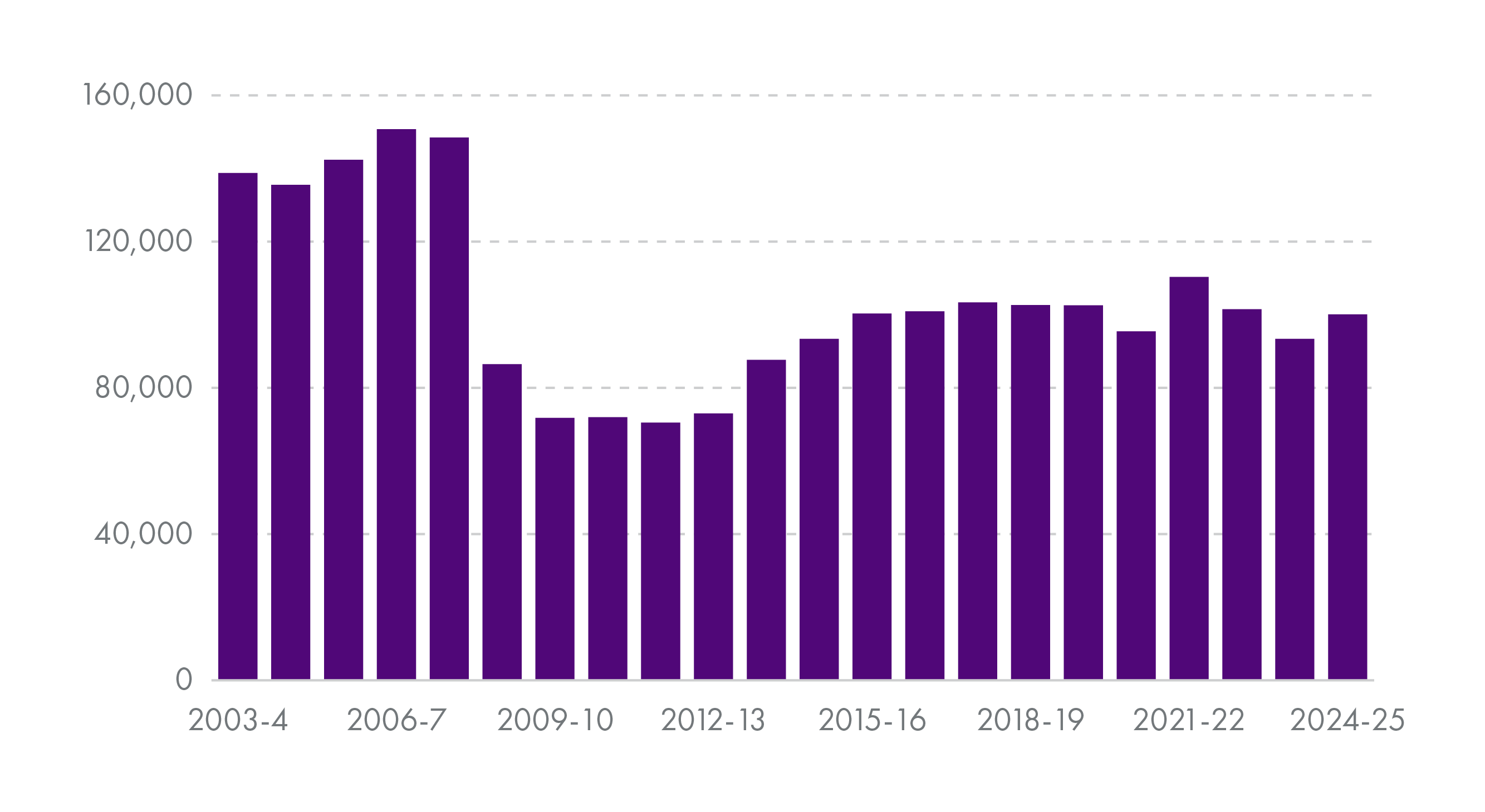
Source: Registers of Scotland . (2025). Property market report 2024-25. Retrieved from https://www.ros.gov.uk/data-and-statistics/property-market-statistics/property-market-report-2024-25 [accessed 20 April 2025]
The UK House Price Index shows that the average residential property price in Scotland was £186,000 in February 2026, up 2.3% from the previous year. Over the last 25 years, the long-term trend has increasing house prices although the annual rate of growth has slowed since the early to mid 2000s.3
Affordability and assistance for home ownership
First-time buyers provide liquidity in the housing market, allowing people to trade up and facilitate labour mobility.1 However, some households, particularly lower income and younger households, can find it difficult to buy their own. High deposit requirements can be a barrier, with the average deposit of first-time buyers in Scotland at almost £44,000. 2
Many first-time buyers receive help from their parents or other family members to purchase a home,2 but for some this help may be unavailable which has raised wider policy questions. For example, a UK Finance report states:
This then begs a question of whether this is a desirable outcome for society as a whole. Is the property-owning democracy, theoretically open to all, being tilted disproportionately towards those families where the older generations have already accumulated sufficient property and other wealth assets that they are able to pass some onto their children? At the individual level there is clearly a benefit from parents helping their children out in this way if they want to do so.
However, taking a wider societal perspective, it may have the effect of entrenching social divisions, in relation to what is generally the most valuable asset that a household will own, assuming they achieve that ambition.
Source:UK Finance . (2025, May). First-time buyers: keeping it in the family?. Retrieved from https://www.ukfinance.org.uk/system/files/2025-05/First-time%20buyers%20-%20keeping%20it%20in%20the%20family.pdf [accessed 6 May 2026]
An increasing share of borrowers are also taking out longer mortgages to make their monthly payments more manageable. Lenders have gradually re‑expanded high loan to value products, which can help first-time buyers with smaller deposits,after the pandemic and the 2022 mini‑budget shock.5
For many years, the Scottish Government has provided financial support for people to buy their own home through various shared equity schemes. Details of current Scottish Government schemes to help people buy their own home, primarily the Open Market Shared Equity Scheme, is available on the mygov.scot website.
The SNP Manifesto outlined a commitment to support first-time buyers by part-funding their mortgage deposit with a joint equity contribution of up to £10,000. On 27 May 2026, the Scottish Government announced that the first round of applications for the First Homes Fund will provide first-time buyers with £10,000 contribution towards a deposit on their first home at a property value of up to £300,000.
In addition, other measures that help support people to buy a home include:
UK Government Help to Buy ISA: (closed to new applicants) Offers a 25% government bonus (up to £3,000) on savings up to £12,000, designed for homes costing up to £250,000
LBTT (Land and Buildings Transaction Tax): First-time buyers in Scotland pay no LBTT on properties up to £175,000
UK Government mortgage guarantee scheme: participating lenders provide higher loan to value mortgages with a government backed guarantee, insuring them against a portion of their potential losses on those mortgages.
The Financial Conduct Authority is also planning reforms to the mortgage market, including aiming to help first-time buyers and the self-employed to buy a home. 6
Housing related taxes
Land and Building Transaction Tax
The Scotland Act 2012 devolved Stamp Duty Land Tax to the Scottish Parliament. This was replaced by the Land and Building Transaction Tax (LBTT) which came into force in April 2015 and is administered by Revenues Scotland with support from Registers of Scotland.
LBTT is payable at different rates on each portion of the purchase price within specified tax bands. There is a zero rate threshold for £175,000 for first-time buyers and £145,000 for other buyers
From 1 April 2016, the Scottish Government also introduced an 'additional dwelling supplement' (ADS) on the purchase of additional residential properties, such as buy-to-let properties and second homes, of £40,000 or more. The aim of this was to protect opportunities for first-time buyers and home movers in Scotland, and to help them compete with buy-to-let investors or those buying second homes.
The ADS rate, currently 8% of the purchase price, has increased from 3% when it was first introduced.
Council Tax
Councils have powers to increase council tax charges for certain second homes and long-term empty homes in their area. From April 2026, changes to legislation gave councils further flexibilities in how such charges are applied, with the aim of allowing councils to respond to local circumstances. A SPICe blog provides more detail on the topic.1
In the 2026-27 budget, the previous Scottish Government announced its intention to reform council tax to introduce new council tax bands for properties valued at over £1 million (based on updated valuations) from 1 April 2028.
Some commentators have argued that housing related taxation needs further reform. For example, a report by Collaborative Centre for Housing Evidence (CACHE) states that council Tax and LBTT are "widely seen as outdated and misaligned with housing objectives." Key arguments are that :
Council Tax is regressive (households in expensive homes pay a disproportionately small share of property value in tax) and still based on property valuations from 1991, resulting in glaring inequities . It also fails to reflect ability to pay, contributing to wider wealth inequality linked to housing. Meanwhile, LBTT (akin to stamp duty) is economically damaging because, by taxing transactions, it disincentivises people from moving, thus hindering labour mobility, exacerbating underoccupation, and efficient use of the housing stock.
Source:Gibb, P.K., & James , D.G. (2025, December). The 2026 Scottish Election Housing Evidence Priorities for a New Government. Retrieved from https://housingevidence.ac.uk/wp-content/uploads/2025/12/10Dec25_HousingEvidencePrioritiesForANewGovernment.pdf [accessed 2 April 2026]
New housing supply
Several factors influence the supply of new homes including:
the availability of land
finance
the capacity of the construction sector and construction costs
enabling infrastructure such as sewerage and roads
housing market conditions.
The Scottish Government has the ability to influence some of these factors more than others. For example, it directly invests in affordable housing. Other factors, such as housing market conditions and construction costs are subject to wider influences which the Scottish Government may find more difficult to influence.
The main component of new supply is new build homes. In 2025, there were 17,336 new homes built (completed), an annual decrease of 13% (see Figure 3).
The private sector is the biggest contributor to overall house building, accounting for almost 80% of all homes completed in 2025 (13,725 new homes). In 2025, private-sector-led completions were 34% lower than 2004, although higher than the lowest point in 2011.1
In 2025, total new build completions were down 13% from 2024

Source:Scottish Government. (2026, March 31). Housing Statistics for Scotland Quarterly Update: New Housebuilding and Affordable Housing Supply to end December 2025. Retrieved from https://www.gov.scot/publications/quarterly-housing-statistics-march-2026/pages/affordable-housing-supply-programme/ [accessed 2026 April 2026]
Historically, the Scottish Government has only set housing targets for new affordable homes which it funds. However, as part of the response to the housing emergency, the housing emergency action plan set out a new "all-tenure delivery ambition, working with the housebuilding sector to increase delivery across all sectors by at least 10% each year over the next three years."
Other responses to improve supply include increasing investment in the Affordable Housing Programme (this is covered in more detail in the next section of the briefing).
The role of the planning system in facilitating new build housing is also important.
The planning system
The National Planning Framework 4 establishes a Minimum All-tenure Housing Land Requirement (MATLR), which sets out the minimum number of housing units that local, city-region and national park authorities must plan, as a minimum, to accommodate in future development plans. It also identifies two major development sites likely to involve significant housing elements, Edinburgh waterfront and Dundee waterfront, as National Developments. In addition, it also sets out policies aimed at delivering quality homes and homes in rural areas.
Homes for Scotland (HFS) has repeatedly warned that Scotland’s planning system is under‑resourced, overly restrictive, and directly contributing to a worsening housing emergency. Some of the issues they have highlighted include delays, outdated development plans, and a lack of land supply.12
The Scottish Government has stated that although “planning” can often be cited as the primary reason for delays, significant barriers to delivery often remain following a grant of planning permission, such as the viability of sites given costs and market assumptions around returns.3
The Scottish Land Commission (SLC) has also highlighted a lack of transparency about land optioned for development. Housebuilders across Scotland take out option agreements to buy and develop land in future. SLC's research found a lack of transparency on what land is optioned for development and who holds the option. The research concludes that there is no publicly available information on where developers plan to build in future and this is impacting and restricting opportunities for other actors, including communities, to access land for development or diversify outcomes from land. 45
Action taken by the Scottish Government includes:
publishing a Planning and the Housing Emergency Delivery Plan6
a Ministerial direction on implementation of national planning policy on housing where a planning application is for 10 or more proposed new homes on land not allocated for housing 7
the National Planning Improvement Champion, with support from the Planning Hub, aims to drive improvements in the planning system
issuing of a Ministerial letter to planning authorities relating to Small and Medium Sized Enterprises housebuilders, highlighting their role in rural and brownfield development, and emphasising the need for proportionality in the planning system to enable delivery
working with councils and other private sector partners to develop stalled housing sites
consulting on a range of options which could help to increase the rate at which homes are built on sites that have been identified for housing development.8
Affordable housing supply
The Session 6 Scottish Government's commitment, repeated in the SNP Manifesto, is to deliver 110,000 affordable homes by 2032. Of this total, the target is that 70% (77,000) will be available for social rent and 10% will be in remote, rural and island communities.
A key policy had been to increase affordable housing supply. The Scottish Government, and its partners, have invested substantial amounts in new affordable homes
The Scottish Government's Affordable Housing Supply Programme (AHSP) provides funding to support the delivery of the 110,000 homes commitment (this includes homes for social rent, mid-market rent and affordable home ownership).
Councils and RSLs are the main providers of homes through the the Scottish Government's AHSP. They use Scottish Government grant funding in addition to their own money, largely funded through borrowing. 1
Councils have important roles in deciding how funding should be used in their area, in line with their local housing strategies.
Figure 4 shows the number of completions funded through the AHSP since 2016.
Almost 84,000 affordable homes have been completed between 2016 and 2025
.png)
Source: Scottish Government . (2026, March). Affordable Housing Supply Programme statitical tables . Retrieved from https://view.officeapps.live.com/op/view.aspx?src=https%3A%2F%2Fwww.gov.scot%2Fbinaries%2Fcontent%2Fdocuments%2Fgovscot%2Fpublications%2Fstatistics%2F2026%2F03%2Fquarterly-housing-statistics-march-2026%2Fdocuments%2Fmarch-2026---affordable-housing-supply%2Fmarch-2026---affordable-housing-supply%2Fgovscot%253Adocument%2FMarch%252B2026%252B-%252BAffordable%252BHousing%252BSupply%252BSummary%252BTables%252B%252B-%252BWeb%252BTable.xlsx&wdOrigin=BROWSELINK [accessed 28 April 2026]
In light of the housing emergency, the previous Scottish Government prioritised investment in affordable housing. In 2026-27, the AHSP budget is £926 million with a commitment to invest up to £4.9 billion over the next four years, which is expected to deliver around 36,000 affordable homes by 2029–30.3
Stakeholders had argued for certainty of long-term funding to enable them to plan new homes.4 Some stakeholders have also called for an increase in affordable housing supply ambitions. A 2025 research report, commissioned by Shelter Scotland, Chartered Institute of Housing Scotland and the Scottish Federation of Housing Associations, called for a minimum of 15,693 affordable homes every year in order to reduce affordable housing need.5
Progress towards the 110,000 affordable homes commitment
Progress towards the 110,000 affordable homes commitment is measured by the number of homes completed under the AHSP from 23 March 2022, as this was when the previous 50,000 affordable homes target was completed.
From 23 March 2022 to 31 December 2025, 32,479 affordable homes had been completed representing 30% of the target. These completions consist of 25,016 (77%) homes for social rent, 4,750 (15%) for affordable rent, and 2,713 (8%) for affordable home ownership (See Figure 5).
.png)
Source: Scottish Government . (2026, March). Affordable Housing Supply Programme statitical tables . Retrieved from https://view.officeapps.live.com/op/view.aspx?src=https%3A%2F%2Fwww.gov.scot%2Fbinaries%2Fcontent%2Fdocuments%2Fgovscot%2Fpublications%2Fstatistics%2F2026%2F03%2Fquarterly-housing-statistics-march-2026%2Fdocuments%2Fmarch-2026---affordable-housing-supply%2Fmarch-2026---affordable-housing-supply%2Fgovscot%253Adocument%2FMarch%252B2026%252B-%252BAffordable%252BHousing%252BSupply%252BSummary%252BTables%252B%252B-%252BWeb%252BTable.xlsx&wdOrigin=BROWSELINK [accessed 28 April 2026]
Data on completions under the AHSP are updated on a quarterly basis in the Scottish Government's Affordable Housing Supply Programme Summary Tables available on the Scottish Government website.
With just over five years of the target period remaining around 77,500 completions are required, suggesting the need for a significant scaling up of delivery. Despite the increased AHSP budget, future challenges remain and there has been some doubt that the target can be met. 23
Some of the challenges of delivering new affordable homes include increasing costs of land, construction and other building-related costs and a lack of labour and materials, particularly in rural areas. Social landlords also face a range of competing demands, including investing in retrofitting their own stock. 45
Rural Housing
There are particular issues facing housing in some rural areas. These include:
the relative lack of social housing and volume housebuilders and the importance of community-led initiatives and rural housing enablers
the impact of short-term lets and second homes in areas with high tourism
the relatively high costs of building and of retrofitting
poorer energy efficiency of existing housing
landowner's willingness to release land for development
impact a housing shortage has on the depopulation of rural areas and the ability of employers to recruit staff.
Some of these issues were explored more fully in an evidence session held by the previous Local Government, Housing and Planning Committee in April 2024.
The Scottish Land Commission commissioned research that aimed to explore ways to increase the supply of land for rural housing and thereby the supply of housing. 1Based on this work, the Commission proposed that government uses public land ownership more actively to: 2
create a long-term pipeline of land for housing by using the powers of existing public bodies to buy, sell, and hold land
support this with a large-scale capital fund that can reuse money from land sales to keep the programme running and reinvesting
require public landowners to review their land and identify sites that could be used for rural housing
update Compulsory Purchase Order rules to make them easier to use when needed
provide better guidance and support to help public bodies release land for housing at effective prices to unlock development
focus public support for Local Place Plans in areas with potential for economic growth or where populations are declining.
The Scottish Government's Rural and Islands Housing Action Plan, published in 2023 has four priorities: delivering the right homes in the right places, enabling the delivery of more high-quality affordable homes, making best use of existing homes and support for home ownership, and supporting community-led development.3 Other wider actions in the housing emergency action plan also apply to rural areas.
As part of the AHSP, the Scottish Government provides higher grant subsidy rates for rural and islands areas. Since 2016, a Rural and Island Housing Fund has operated. This fund is open to a wide range of applicants including community organisations and development trusts and was extended to March 2028 as part the Programme for Government 2025-26.
The Scottish Government's affordable homes target includes a commitment to deliver 10% of the target in rural and island communities. Progress towards the target in rural areas is not regularly reported on in the Scottish Government's quarterly housing statistics.
Social rented housing
Social housing is rented accommodation which is owned and managed either by councils (26 of Scotland's 32 councils own their own housing stock) and by Registered Social Landlords (RSLs) (housing associations and co-operatives).
Around 23% of households live in social rented housing. The 2024 Scottish Household Surveyreported that around 5% of all households (nearly 115,000 households) were on a social housing list. An additional 10,000 households had applied for social housing using a choice-based letting system or similar within the last year.1
RSLs and councils, which own their own stock, perform a variety of different management roles including:
allocations: Provisions in the Housing (Scotland) Act 1987 (as amended) govern social housing allocations. Social landlords must have an allocation policy that sets out how their housing stock will be allocated, taking into account the legislative requirements and Scottish Government guidance.2
tenancy management: most tenants in social rented housing have a Scottish Secure Tenancy governed by the Housing (Scotland) Act 2001. The Act and associated tenancy agreements provide the rights and responsibilities of the tenant and landlord and sets out how tenancies can be ended.
repairs and maintenance: Generally, social landlords are responsible for ensuring their properties are in wind and watertight condition and for major repairs to the structure and installations of the house. Under the ‘Right to Repair’ scheme tenants have the right to have small urgent repairs carried out within a given timescale. Social landlords also need to plan for the long-term maintenance and improvement of the homes they own.
tenant participation: The Housing (Scotland) Act 2001 Act places a duty on social landlords to have tenant participation strategies in place and to maintain a register of tenants' groups meeting certain criteria. Individual tenants and registered tenants' groups should be consulted by the landlord on issues affecting them.
Social landlords must also work towards meeting the standards and outcomes set by the Scottish Government in the Scottish Social Housing Charter It aims to help improve the quality and value of the services that social landlords provide. Social landlords' adherence to the Charter is monitored by the Scottish Housing Regulator.
Scottish Housing Regulator
The Scottish Housing Regulator (SHR) is the independent regulator of social landlords in Scotland.
The Housing (Scotland) Act 2010 sets out the SHR's statutory objective to safeguard and promote the interests of current and future tenants, and others who use local authority and RSL housing services (people who are homeless, factored owners and Gypsy/Travellers).
The SHR monitors, assesses and reports regularly on social landlords' performance of housing activities and RSLs' financial well-being and standards of governance, and intervenes where appropriate.
The Regulatory Framework sets out how it regulates social landlords. 1The SHR also publishes an engagement plan for each landlord in its landlord directory.
The SHR's latest risk assessment of social landlords sets out the main risks and challenges it will engage with social landlords on during 2026-2027. This includes, for example, financial challenges for tenants, other service users and landlords, local authorities that are impacted by systemic failure and at heightened risk in their homelessness services, and continuing to ensure effective governance. 2
The SHR does not have a role in dealing with individual complaints from tenants. Such complaints should be directed at the landlord and the Scottish Public Services Ombudsman if the landlord's response is unsatisfactory.
Tenants can contact the SHR where their social landlord regularly and repeatedly fails to achieve the regulatory or social housing, and this failure affects a group of the social landlord tenants. Further details are available on the SHR website.
Homelessness
Increasing levels of homelessness and people living in temporary accommodation have contributed to the housing emergency declaration. Legislation and policy has focussed on strengthening homelessness prevention.
Councils have legal duties to support people who apply to them as homeless under the Housing (Scotland) Act 1987. These duties have been amended several times to strengthen the rights of homeless people. Homeless legislation is supplemented by a Code of Guidance on Homelessness.12
In 2024-25, 40,688 homelessness applications were made to councils, although not everyone who is homeless will apply for council assistance.3
Council obligations to homeless persons differ depending on the outcome of the assessment of the homelessness application. If an applicant is unintentionally homeless (where that is assessed), then the council must secure 'settled' accommodation. Normally this is a permanent social housing let. The applicant might have to spend some time in temporary accommodation before a suitable permanent home can be found.
Homelessness policy
Policy has focused on homelessness prevention with the housing options approach developing from around 2010. This approach seeks to look at an individual's options and choices. Examples of housing options and prevention work could include family mediation, domestic abuse victim support, enhanced housing advice, outreach targeted at vulnerable groups, schemes to help access private rented accommodation, and tenancy sustainment work.
A key aspect of this is the need for relevant agencies and services (such as housing, mental health, criminal justice services, health services, children's and social care services) to work together.
The Ending Homelessness Together Action Plan, published by the Scottish Government and COSLA (updated in 2020) sets out actions to fulfil the Scottish Government’s commitment to end homelessness in Scotland.
The plan comprises a wide range of policy actions focusing on tackling homelessness through achieving the following:
a person-centred approach
prevention of homelessness
prioritising settled housing for all
responding quickly when homelessness happens
joining up planning and resources.
The Scottish Government has also encouraged councils to transition to rapid rehousing by default and to end the use of night shelters. The aim is to move people experiencing homelessness into permanent housing as quickly as possible.
The action plan is reported on annually with the latest report published in December 2025.1
Homelessness pressures
Over the past five years, there has been growing systemic pressures in relation to homelessness services, including record high numbers of people living in temporary accommodation. This reflects the pressures on the housing system and is one of the contributory factors that led to a declaration of a the housing emergency.
The Scottish Government publishes bi-annual homelessness statistics. The latest statistics show that over the six-month period 1 April to 30 September 2025 there were:1
20,643 homeless applications, a decrease of 2% from the previous year
33,006 open homelessness applications, an increase of 4% from the previous year and the highest in the time series since 2023
18,092 households living in temporary accommodation, an increase of 9% from the previous year and highest in the time series since 2022
households spent an average of 237 days in temporary accommodation, the same as the previous year
applications from those with refugee / leave to remain status accounted for 16% of all applications; applications from these households increased by 51% between 2024 and 2025.
In 2023, the Scottish Housing Regulator's thematic report on homelessness identified three major strategic challenges in providing homelessness services:
dealing with the significant numbers of people currently in temporary accommodation
maintaining a sufficient supply of appropriate temporary accommodation
ensuring access to the number of permanent homes that are needed.2
It found that some councils were finding it increasingly difficult to meet these challenges and their statutory duties, a message repeated in its December 2023 update which identified systemic failure in the delivery of two local authorities’ services to people experiencing homelessness (Glasgow and the City of Edinburgh Council).3
As of April 2026, the SHR has assessed two local authorities as experiencing systemic failure in their homelessness services, with a further nine at heightened risk.
The majority of funding for council homelessness services is provided through the local government settlement. As part of the response to the housing emergency the Scottish Government has allocated additional funding to extend rapid rehousing funding and the delivery of housing first projects and launched a homelessness prevention pilot.
New homelessness prevention duties
Provisions in Part 5 of the Housing (Scotland) Act 2025 will introduce new homelessness prevention duties on councils and other public bodies.
The policy objective is to shift the focus away from crisis intervention and towards prevention activity which can eliminate the need for a household to go through the trauma of homelessness in the first place. 1 The work of the Homelessness Prevention Review Group, convened by Crisis, was central to the development of the legislative proposals.
The 2025 Act's provisions include:
placing duties on relevant bodies, such as health boards and the police, to ask if an individual is homeless or at risk of homelessness, and requiring them to take action if they are - the aim being to make homelessness prevention a shared responsibility across the public sector. This is known as the 'ask and act' duty.
requiring local authorities to act sooner to prevent homelessness by providing support to households threatened with homelessness up to six months before homelessness appears imminent rather than the current two months
making social landlords put in place support for tenants if they are overdue on rent due to domestic abuse
requiring social landlords to have a policy which sets out how they will support tenants who are at risk of homelessness due to domestic abuse.
It is likely that implementation of the provisions will take place this parliamentary session. During the parliamentary passage of the Bill, one of the main areas of debate concerned the practical implementation of the measures and the need for training for staff working in relevant public bodies. 2
Housing condition and standards
The main source of information on the physical condition of housing in Scotland is the Scottish House Condition Survey (SHCS), part of the Scottish Government's Scottish Household Survey. It provides information on the physical condition of Scotland's homes as well as the experiences of householders.
The survey shows:
Scotland's housing stock is diverse, for example, with 7% of properties being pre-1919 tenement flats and more modern post-1982 detached houses accounting for 20% of stock.
around 81% of Scottish households use mains gas for heating, while around 12% of all households) were estimated to have low and/or zero greenhouse gas emissions heating systems
energy efficiency of Scotland's homes has gradually improved; housing in the social sector is more energy efficient than the owner occupied or private rented sector
in 2024, 29% of households were estimated to be in fuel poverty, of which 14% were in extreme fuel poverty
90% of properties were free from any damp or condensation and 92% were free from any mould
private rented properties tend to have the highest levels (65%) of any disrepair to critical elements. The prevalence of disrepair to critical elements is associated with age of construction, with newer dwellings significantly less likely to fall within this category.
Housing standards
All new buildings, and substantially refurbished ones, must meet the relevant building standards regulations in force at the time the building warrant was approved.
There are several other standards which apply to properties in different tenures (see Figure 6).
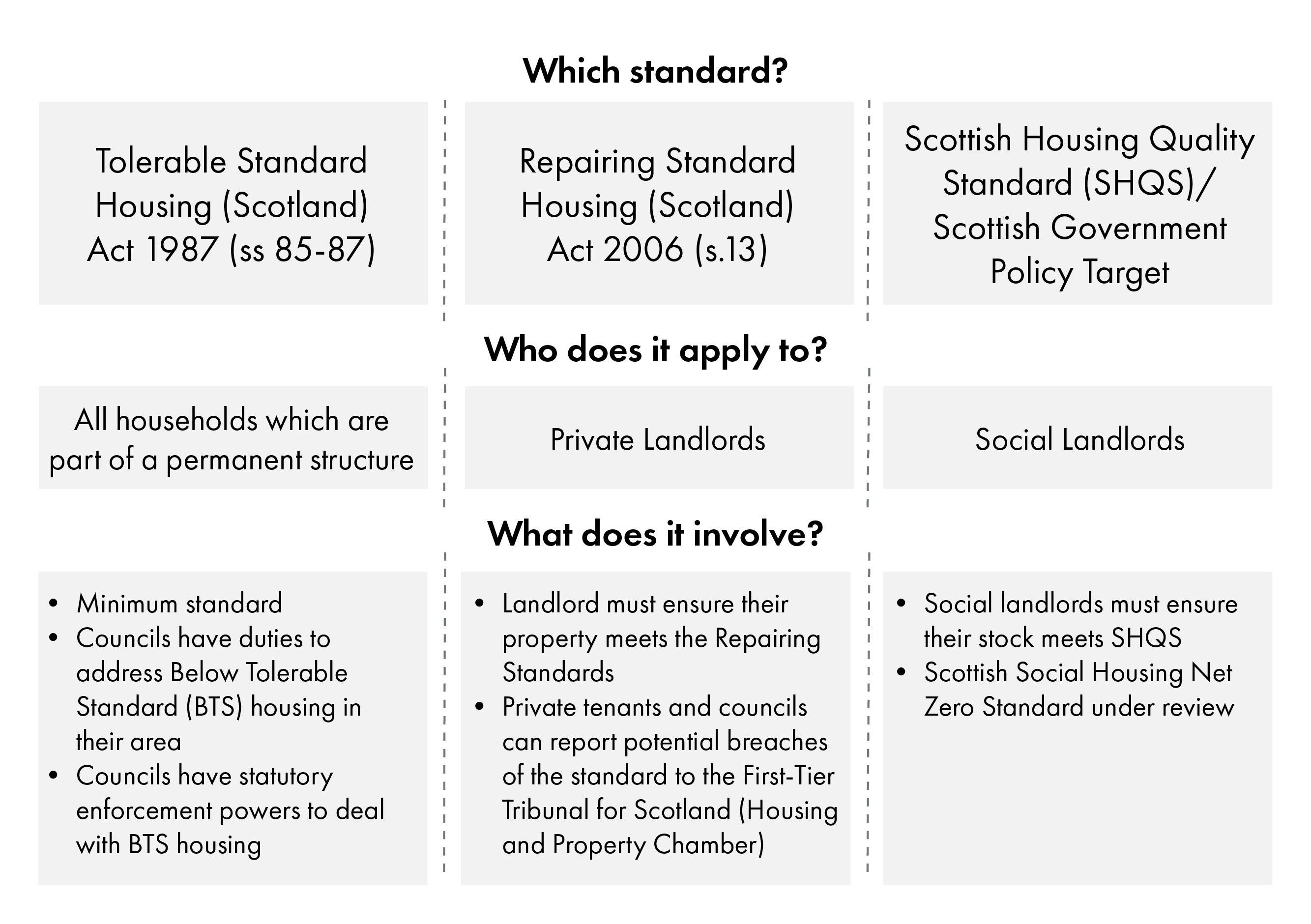
Source: SPICe
In the last parliamentary session, legislative changes sought to bring the standards for social and private rented housing closer together, for example, by the extension of the Repairing Standard for private landlords and by the introduction of common fire and carbon monoxide safety requirements.
However, Scottish Government plans for a new housing standard covering all tenures, as set out in Housing to 2040, were rescheduled, with the Scottish Government prioritising other areas of work.
There has been an increased focus on the issue of dampness and mould in rented housing. Regulations approved in 2026 will introduce an "Awaab's law" in Scotland from October 2026. This will place new duties on landlords to investigate reports of damp and mould and begin any necessary repairs within set timescales, unless they are unable to do so for reasons outwith their control. Further details are in a SPICe blog on the topic.1
The previous Scottish Government's intention was that damp and mould would be the starting point, with other qualifying hazards to be included over time.
The condition of flats
The condition of flats (which account for over one-third of Scottish homes), particularly older traditional tenement flats, has attracted growing attention over the last few years.
A programme of law reform in the 2000s, including the Tenement (Scotland) Act 2004, aimed to facilitate the upkeep of flats. Despite legislative reforms, the repair and maintenance of flats remains challenging; for example, there can be a reluctance by owners, including private landlords, to take a long term view and invest in their properties. A forthcoming SPICe briefing will provide further information on repairs in flats.
The Scottish Parliamentary Working Group on Tenement Maintenance (established in 2018) proposed reforms. Key recommendations focused on mandatory five-yearly building inspections, compulsory owners’ associations, and building reserve funds to ensure long-term maintenance. 1
Following the working group's report, the Scottish Government instructed the Scottish Law Commission to consider changes to the law in order to establish compulsory owners’ associations for tenement properties. The Commission published its Report on Tenement law: compulsory owners’ associations, together with a draft Tenements (Amendment) (Scotland) Bill, on 11 December 2025. 2 The SNP Manifesto provides a commitment to implementing tenement reform by the end of this Parliament.
Council powers to address poor quality housing
Councils have various statutory powers to address poor quality housing in their area. For example, the Housing (Scotland) Act 2006 gives councils powers to serve owners of properties in serious disrepair with a 'work notice' requiring the owner to carry out necessary work.
Under the 2006 Act, councils must also have a 'scheme of assistance' detailing the support that will be offered in its area. The assistance can take various forms, including loans, practical assistance and grants. Grant assistance must be provided for most essential work to adapt homes to meet the needs of disabled people (other than for home extensions).
All other grant assistance is discretionary. In general, councils tend not to offer grant support for owners to repair their homes. The Under One Roof website provides a range of useful information on the topic.
Cladding
Scottish Government action to tackle potentially flammable cladding systems has several strands, collectively known as the Cladding Remediation Programme. This programme emerged from UK and Scottish Government actions taken after the Grenfell Tower fire in London in 2017, which exposed systemic failures in the design, regulation and use of combustible external wall systems across the UK.
The first significant element was the establishment of a pilot Single Building Assessment (SBA) programme in March 2021, providing a standardised system of fire safety assessments for all residential flatted developments over 11 metres high, clad with potentially flammable material, and built between 1 June 1992 and 1 June 2022.
The aim is to identify whether the external wall system creates or exacerbates a risk to human life, and what remediation or mitigation works are required to reduce that risk to an acceptable level. The identification of such cladding by a SBA paves the way for necessary remediation work to be carried out.
The Housing (Cladding Remediation) (Scotland) Act 2024:
put SBAs onto a statutory basis
created the Cladding Assurance Register - this shows that the building has been properly assessed and records whether work was needed and whether it has been done
gives Scottish Ministers powers to arrange assessments and remediation where voluntary progress was blocked (for example, by lack of owner consent).
The technical specifications for assessments were published in June 2024, meaning the limited number of SBAs carried out prior to 6 January 2025 had to be revisited. Remediation that had already begun, or completed, also had to be reviewed.
The Scottish Government launched a “Single Open Call” in March 2025, which allows local authorities, Registered Social Landlords, and residents or their representatives to apply for a fully funded SBA. As at 28 February 2026, 938 expressions of interest had been identified as likely to be eligible for Scottish Government funding for an SBA and 824 had been identified as ineligible for funding.1
It has been acknowledged that the existence of cladding in multi-residential buildings was causing problems for people when trying to buy or sell their home. 2 Once a building has been assessed, and any problems are rectified it should be easier for affected homeowners to sell, insure or remortgage their properties.
Developer funded remediation
The Scottish Government announced the creation of the Scottish Safer Building Accord on 12 May 2022. Under the Accord, developers will be expected to fund works to properties they built to address safety issues identified through the SBA programme. Public funding will be prioritised for buildings that are not linked to an existing developer.
Building on this agreement, the Scottish Government and house builders have been negotiating a developer remediation contract. The previous Cabinet Secretary for Housing, Mairi McAllan MSP, wrote to the Local Government, Housing and Planning Committee on 25 Match 2026 confirming that four developers had signed the contract, with others due to do so.
The Building Safety Levy (Scotland) Bill was passed by the Scottish Parliament on 17 March 2026 and will provide for a tax on the construction of certain new residential properties from April 2028. The levy aims to raise up to £450 million over 15 years to help fund work to fix residential buildings with unsafe cladding which have no linked developer.
Next phase
The Cladding Remediation Programme: Next Phase Plan of Action, published in 2025, provided information on expected key milestones with plans that by 2029 every high-risk residential building over 18 metres in Scotland will have been resolved, whether made safe, decommissioned or replaced. Every building between 11 and 18 metres will be on a defined pathway to resolution.
RAAC in homes
RAAC, an acronym for Reinforced Autoclaved Aerated Concrete, is a type of building material used in the UK between the late 1950’s and mid 1990’s. RAAC is prefabricated in a factory and delivered to building sites in the form of panels, which can be used in roofs, walls, and floors.
RAAC, if it is manufactured, installed, and maintained correctly, poses no more danger to building users than most other construction products. However, concerns that RAAC elements of some buildings could be liable to fail under certain circumstances have been recognised for decades.
The Institution of Structural Engineers categorise potential RAAC defects under three headings, performance, manufacturing, and construction, with a more general concern that the manufacture of panels was highly inconsistent and the quality control poor, meaning there can be quite wide variations in the quality and physical characteristics of panels, even within a single building.
Following concerns about safety incidents elsewhere in the UK and new UK‑wide risk advice,the Scottish Government, through the Building and Fire Safety Ministerial Working Group, supported by a RAAC Cross‑Sector Working Group has aimed to identify, assess, manage and mitigate any risks associated with RAAC across Scotland’s public sector.
Scottish Housing Regulator statistics, published in July 2025, indicate that RAAC is present in 2,205 socially rented homes managed by 17 landlords. While RAAC is not thought to have been widely used in privately owned homes, it has been identified in clusters of such homes, principally ex-socially rented properties sold under the right to buy, in areas including Aberdeen, Dundee, and Clackmannanshire.
The Scottish Government has been clear that it will not fund RAAC remediation in homes of any tenure or ownership.
Property Factors
Property factors manage the repair and maintenance of property (e.g. common property and communal areas in flats and housing estates) on behalf of homeowners.
The Property Factors (Scotland) Act 2011 regulates the sector. It includes:
compulsory registration for property factors operating in Scotland
a Code of Conduct with minimum standards which property factors have to follow
a dispute resolution system - homeowners can bring cases to the First-tier Tribunal for Scotland (Housing and Property Chamber) if their property factor breaches the Code of Conduct.
The SPICe Briefing “Property Factors - Frequently Asked Questions” includes responses to certain frequently asked questions on property factors, including a summary of the main rules on their dismissal. 1
The Housing (Scotland) 2025 made some relatively minor changes to the 2011 Act and will also introduce changes to provide that the power to dismiss and appoint a property manager will requires a majority vote of the owners, rather than two-thirds.
The SNP Manifesto commits to reform of the property factors legislation.
Housing's contribution to net-zero emissions
The Scottish Government's ambition is that Scotland will be “net zero” in carbon emissions by 2045. Net Zero is the point when emissions entering the atmosphere are balanced by removals out of the atmosphere.
Since 1990 there has been a 39% reduction in emissions from residential and public buildings, driven by improvements in boiler efficiency, energy efficiency retrofit improvements to existing buildings, higher efficiency standards for new buildings and milder winters.
Despite progress, homes and buildings still account for around 15% of Scotland’s greenhouse gas emissions. At the same time, high energy prices put an increasing number of people at risk of living in fuel poverty unless their homes can be made more efficient through retrofitting measures such as improved insulation.
The biggest impact from reducing emissions from buildings will be from moving from gas boilers to other 'clean' heating' systems such as heat pumps:
The heat transition will require around 1.9 million homes and 14,000 public buildings to move to clean heating systems such as heat pumps and heat networks by 2045.
Source:Scottish Government . (2026, March 24). Scotland's Climate Change Plan: 2026–2040. Retrieved from https://www.gov.scot/publications/scotlands-climate-change-plan-2026-2040-annexes/pages/14/ [accessed 9 April 2026]
A key part of the Scottish Government plans are to ensure that the move to low carbon heating is fair and stimulates employment opportunities.
Scottish Government policy has focussed on:
Financial support for energy efficiency and zero carbon heating, for example, through grant funding and loan funding for individual households, and the public sector. The Scottish Government has been clear that the public sector cannot fund the heat transition alone and established the Green Heat Taskforce to develop innovative financial solutions for building owners. The Taskforce has produced two reports.
Raising standards for new buildings: the New Build Heat Standard (NBHS) requires new buildings to install climate-friendly heating systems instead of oil and gas boilers.
The Scottish Government has consistently called on the UK Government to rebalance gas and electricity prices and reform the electricity market to lower the costs of clean heating.1
The Climate Change Plan
In late 2025, the Scottish Government published a draft Climate Change Plan for 2026–2040, which underwent parliamentary scrutiny. The plan builds on existing support and advice schemes and the development of heat networks. It set a target to decarbonise heating systems by 2045 and committed the government to publishing a Heat in Buildings Strategy and delivery plan by the end of 2026.
On 18 November 2025, the Scottish Government also published a draft Buildings (Heating and Energy Performance) and Heat Networks (Scotland) Bill, stating its intention of introducing it as early as possible in the next parliamentary session, subject to election outcomes. The draft Bill proposed to set a target for decarbonising heating systems by the end of 2045, give Scottish Ministers powers to make regulations to set minimum energy performance standards for buildings and to facilitate the expansion of heat networks. The SNP Manifesto stated that it would "take forward our Heat in Building Bill to support homeowners, landlords and tenants to transition to clean heating in a fair and affordable way."
Parliamentary scrutiny of the draft plan highlighted key challenges, including the need to improve consumer awareness and confidence, expand the retrofit workforce, address high costs, and secure alternative financing. A major concern was the slow pace of progress in decarbonising buildings. 1 The Climate Change Committee echoed these concerns, warning that:
... the draft CCP lacks sufficient plans for buildings. Very little emissions reduction is projected to occur over the next ten years, compensated for by a rapid acceleration in the late 2030s. It is not clear what will drive this acceleration, which will be challenging for supply chains to deliver. This ‘delay and catch-up’ approach therefore carries significant risk.
Source: Climate Change Committee. (2026, February 25). Progress in reducing emissions in Scotland – 2025 report to Parliament. Retrieved from https://www.theccc.org.uk/publication/progress-in-reducing-emissions-in-scotland-2025/ [accessed 2 April 2026]
The final Climate Change Plan was subsequently published on 24 March 2026.
The Scottish Government had planned to introduce minimum energy‑efficiency standards for privately rented homes through secondary legislation. However, these plans were paused due to delays to Energy Performance Certificate (EPC) reform, which depends on a technical modelling approach being developed by the UK Government. Work has also been underway to develop a revised Social Housing Net Zero Standard (SHNZS), but this has not yet been finalised because of uncertainty around the timing of EPC reform. 3
Private rented housing reform
Since the early 2000s, there have been a series of changes made to private rented sector policy and legislation (see Figure 7).
A key policy aim has been to improve standards and provide greater protections for tenants. One of the main ongoing debates in framing policy and legislation has been the need to balance the rights of tenants and landlords. 1
Chart showing the introduction of private rented sector policy developments in Scotland.
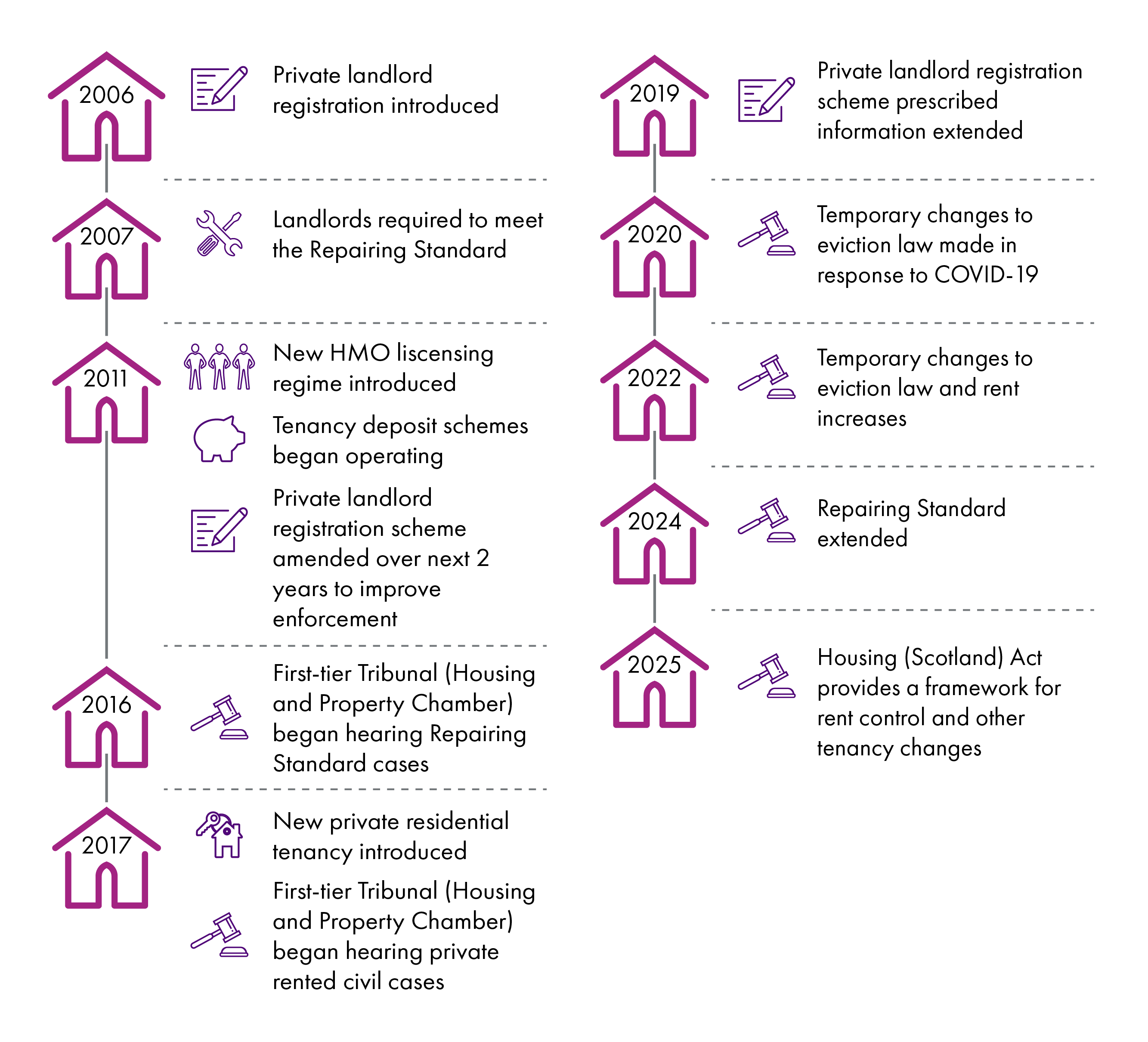
Source: SPICe
The Housing (Scotland) Act 2025 will introduce new rights for tenants in private rented housing including:
reforms to rent provisions, including a framework for the introduction of Rent Control Areas where rent increases for certain tenancies would be limited
the right for tenants to request to keep a pet
the right of private housing tenants to make changes to the property they are renting
changes to how joint private residential tenancies are ended.
The rent control area (RCA) provisions were the most controversial part of the Act. The Act sets out the steps that will need to to be followed before any RCAs are introduced, starting with a local authority assessment of rent conditions in its area. Any decision to introduce an RCA would need approval from the Scottish Parliament, through regulations brought forward by the Scottish Government. In 2025, regulations were passed to exempt mid‑market rent homes and build‑to‑rent properties from any RCA designations.
Private rented housing disputes
The First-tier Tribunal Housing and Property Chamber ('the Tribunal') hears disputes about civil private rented housing matters and property factors.
The Tribunal was established by the Tribunals (Scotland) Act 2014 which transferred responsibility for such cases from the sheriff courts. The aim of the move was to provide more efficient, accessible and specialist access to justice for landlords and tenants. It does not cost to make an application to the Tribunal and there is no need to use a solicitor.
The range of cases the Tribunal can hear is wide, although the majority of private rented sector applications involve evictions and applications for a payment order (for example, for rent arrears).
Details on how to make an application to the Tribunal are on the website
The Housing (Scotland) Act 2025 will give the Tribunal additional roles, including handling challenges related to joint tenancies, ruling on disputes about pets in homes and a tenant's right to personalise their homes. It will also have a new role resolving mobile home (park home) disputes, by moving most of these cases away from the sheriff court.
Independent living and housing adaptations
The Scottish Government aims to support people to live at home for as long as possible, rather than in care homes or hospital settings.
Accessibility and adaptability are core themes of the Housing to 2040 strategy which commits to improving the accessibility of both new and existing homes. As Housing to 2040 noted:
Most older people and disabled people live in mainstream homes and want to continue to do so, but these properties may or may not meet their needs. There is a small amount of specialist supported housing, such as extra care housing or sheltered housing. This is around 1% of total housing stock and the vast majority of it is in the social rented sector which limits choice. Some disabled people live in care homes or other settings because there is a lack of suitable housing to allow them to live independently within their community. There is a considerable number of people whose needs are not being met and who are not able to choose a home or way of living that meets their needs ...
Source:Housing to 2040. (n.d.) Retrieved from https://www.gov.scot/publications/housing-2040-2/ [accessed 27 April 2021]
Councils have strategic roles in assessing housing requirements in their areas and to consider how to support people to live independently as part of their local housing strategies. Since 2019, the Scottish Government has also required local authorities to set wheelchair-accessible housing targets within their Local Housing Strategies, covering all tenures. 2
In terms of new buildings, all new homes funded through the Scottish Government's affordable housing supply programme must meet the housing for varying needs standard. This is a design guide which covers how to meet the needs of older people, disabled people, wheelchair users and people with other specific needs. This standard is currently being reviewed. Housing to 2040 also proposed the introduction of new building standards to underpin a Scottish Accessible Homes Standard which all new homes must achieve. This has still to be introduced.
Some stakeholder groups have argued that further change is required. For example, the Scottish Accessible Housing Network, led by Horizon Housing Association, has argued for change, including3:
national and local targets for accessible housing, informed by robust data and a National Strategy for Independent Living
the creation of a truly accessible, tenure-neutral housing standard, co-designed with disabled people
securing and expanding funding for adaptations, ensuring timely support across all tenures
engaging the private sector to deliver accessible homes as standard
transparent tracking and reporting of accessible housing stock and unmet need.
The Scottish Federation of Housing Associations (SFHA) has also made similar points in its report Homes Fit for the Future.4
Housing adaptations
Adaptations to homes such as shower and bathroom adaptations, hand or grab rails, stair lifts, adapted toilets, and ramps can support independent living, reduce hospital admissions and enable early discharge. 1
Integration authorities are responsible for the provision of aids and adaptations (in council and owner-occupied homes) as a minimum. In practice this is mainly provided by councils). 2 The Housing (Scotland) Act 2026 provides a framework for the mandatory provision of grant assistance for adaptations to meet the needs of a disabled person where it is deemed essential.
In general, adaptations for RSL homes are funded differently, with the Scottish Government funding RSLs directly. In 2025, the Scottish Government increased the adaptations budget for RSLs after concerns about inadequate funding. 3
In 2011, the Scottish Government established an Adaptations Working Group to explore ways to achieve the best possible outcomes for older and disabled people from investment in housing adaptations. The working group's reports identified a number of improvements needed, in particular for a tenure neutral strategy with a single funding pot.4
Many of the issues identified by the working group remain. For example, recent research led by the University of Stirling criticised the adaptations system as complex, underfunded and inequitable. It found:5
long waits for adaptations
wide variation between tenures and local authorities
poor co-ordination between housing, health, and social care.
In late 2025, the previous Cabinet Secretary for Housing, Mairi McAllan MSP, confirmed that a review of the housing adaptations system, a commitment in the Housing to 2040 strategy, is underway with the aim to publish a short report in the autumn of 2026.6
Annex 1: Summary of main Scottish housing legislation
| Act | Description |
|---|---|
| Housing (Scotland) Act 1987 | Provides the framework for the management and allocation of social rented housingGives local authorities duties with respect to homelessnessProvides local authorities with powers to tackle sub-standard housing in their areasProvides that local authorities must maintain a housing revenue account |
| Housing (Scotland) Act 1988 | This Act deregulated the private rental market in Scotland. It introduced two new forms of tenancy in the private sector from 2 January 1989 – the assured tenancy and the short assured tenancy, with less security of tenure. From 1 December 2017 no |
| Housing (Scotland) Act 2001 | The focus of this Act is on the social rented sector. It introduced the Scottish Secure Tenancy (SST) for tenants of RSLs and local authorities and made reforms to the right to buy and homelessness legislation. It also enhanced the strategic role of local authorities in assessing and tackling local housing needs. |
| Homelessness etc. (Scotland) Act 2003 | The policy intention of this Act was to improve the rights of homeless people, largely through amending the 1987 Act. |
| Antisocial Behaviour etc. (Scotland) Act 2004 | This Act established the framework for the private landlord registration scheme and the system for serving anti-social behaviour notices on private landlords. |
| Tenements (Scotland) Act 2004 | This Act provided a structure for the maintenance and management of tenements if this is not provided for in the owner's title deeds. A key innovation is that it provides for decision making by majority. |
| Housing (Scotland) Act 2006 | The main purpose of this Act was to address problems of condition and quality in private sector housing. It reformed local authority powers to deal with disrepair in their areas and the system of supporting owners to undertake repairs. It also contained provisions governing the “Home Report” (the set of documents that sellers must provide to potential buyers) and re-enacted, with changes, the system of licensing of houses in multiple occupation (HMOs) which is now contained in secondary legislation. |
| Housing (Scotland) Act 2010 | This Act modernised the system of regulation of social housing and provided for the end of the right to buy for new tenants and new supply social housing. |
| Property Factors (Scotland) Act 2011 | This Act provides that Scottish Ministers must prepare and maintain a register of property factors and makes it an offence to act as a property factor without being on the register. The Act also makes provision in relation to the resolution of disputes between homeowners and property factors. |
| Private Rented Housing (Scotland) Act 2011 | This Act amended the private landlord registration system provisions in the 2004 Act with the aim of improving enforcement of the scheme. It introduced a power for local authorities to serve a statutory overcrowding notice that local authorities can use. It also made relatively minor changes to the system of HMO licensing in the 2006 Act and other miscellaneous provisions. |
| Housing (Scotland) Act 2014 | This wide ranging Act which included provisions to end the right to buy, reforms to the mobile home site licensing system and the introduction of a letting agent regulation system and the transfer of private rented housing civil cases from the sheriff court to a new Tribunal. |
| Private Housing (Tenancies) (Scotland) Act 2016 | This Act introduced a new private residential tenancy to supersede existing assured and short assured tenancies. |
| Coronavirus (Scotland) Act 2020 | This Act introduced temporary measures to protect renters from eviction during the COVID-19 pandemic. |
| Cost of Living (Tenant Protection) (Scotland) Act 2022 | This temporary emergency legislation introduced some temporary restrictions on private rent increases and evictions. |
| Coronavirus (Recovery and Reform) (Scotland) Act 2022 | This Act made some of the temporary coronavirus legislation changes permanent. It made all eviction grounds mandatory and implements a pre-action protocol which for a landlord to end a private residential tenancy on the ground of rent arrears. |
| The Housing (Cladding Remediation) (Scotland) Act 2024 | Provides a legal framework for identifying and fixing unsafe cladding on residential buildings in Scotland. |
| Housing (Scotland) Act 2025 | This wide ranging act focuses on reforms to private rented housing and homelessness prevention. |
Sources
SNP. (2026). On Scotland's Side: SNP Manifesto 2026. Retrieved from <a href="https://s3-eu-west-2.amazonaws.com/www.snp.org/uploads/2026/04/2026-05-0120SNP20The20Scottish20Parliament20Election2020262072pp20COMPLETE20no-crops.pdf" target="_blank">https://s3-eu-west-2.amazonaws.com/www.snp.org/uploads/2026/04/2026-05-0120SNP20The20Scottish20Parliament20Election2020262072pp20COMPLETE20no-crops.pdf</a> [accessed 11 May 2026]
National Records of Scotland. (2025, December 2). Unprecedented changes in Scotland’s population. Retrieved from <a href="https://www.nrscotland.gov.uk/latest-news/unprecedented-changes-in-scotland-s-population" target="_blank">https://www.nrscotland.gov.uk/latest-news/unprecedented-changes-in-scotland-s-population</a> [accessed 2 April 2026]
National Records of Scotland. (2025, June 26). Households and Dwellings in Scotland, 2024. Retrieved from <a href="https://www.nrscotland.gov.uk/publications/households-and-dwellings-in-scotland-2024/" target="_blank">https://www.nrscotland.gov.uk/publications/households-and-dwellings-in-scotland-2024/</a> [accessed 2 April 2026]
National Records of Scotland . (2025, December). Household Projections for Scotland (2022-based). Retrieved from <a href="https://www.nrscotland.gov.uk/publications/household-projections-for-scotland-2022-based/" target="_blank">https://www.nrscotland.gov.uk/publications/household-projections-for-scotland-2022-based/</a> [accessed 2 April 2026]
National Records of Scotland. (2025). https://www.nrscotland.gov.uk/media/lcjpz52h/2022-based-snpp-data-tables.xlsx. Retrieved from <a href="2022-based subnational population projections: data tables" target="_blank">2022-based subnational population projections: data tables</a> [accessed 2 2026]
Scottish Parliament Information Centre . (2019, May 14). Overview of Private Rented Housing Refroms in Scotland . Retrieved from <a href="https://digitalpublications.parliament.scot/ResearchBriefings/Report/2019/5/14/Overview-of-private-rented-housing-reforms-in-Scotland" target="_blank">https://digitalpublications.parliament.scot/ResearchBriefings/Report/2019/5/14/Overview-of-private-rented-housing-reforms-in-Scotland</a> [accessed 28 April 2026]
Scottish Government. (2026, February). Households in Scotland by housing tenure: Scottish Household Survey, 2024. Retrieved from <a href="https://www.gov.scot/publications/households-in-scotland-by-housing-tenure-scottish-household-survey-2024/documents/" target="_blank">https://www.gov.scot/publications/households-in-scotland-by-housing-tenure-scottish-household-survey-2024/documents/</a> [accessed 23 April 2026]
Housing to 2040. (n.d.) Retrieved from <a href="https://www.gov.scot/publications/housing-2040-2/" target="_blank">https://www.gov.scot/publications/housing-2040-2/</a> [accessed 27 April 2021]
Gibb, P.K., & James , D.G. (2025, December). The 2026 Scottish Election Housing Evidence Priorities for a New Government. Retrieved from <a href="https://housingevidence.ac.uk/wp-content/uploads/2025/12/10Dec25_HousingEvidencePrioritiesForANewGovernment.pdf" target="_blank">https://housingevidence.ac.uk/wp-content/uploads/2025/12/10Dec25_HousingEvidencePrioritiesForANewGovernment.pdf</a> [accessed 2 April 2026]
Glasgow City Counci. (2026, November 30). Glasgow declares housing emergency. Retrieved from <a href="https://glasgow.gov.uk/article/7848/Glasgow-declares-housing-emergency" target="_blank">https://glasgow.gov.uk/article/7848/Glasgow-declares-housing-emergency</a> [accessed 22 2026]
Scottish Government . (2025, September). Tackling Scotland’s Housing Emergency Housing Emergency Action Plan. Retrieved from <a href="https://www.gov.scot/binaries/content/documents/govscot/publications/strategy-plan/2025/09/tackling-scotlands-housing-emergency/documents/tackling-scotlands-housing-emergency/tackling-scotlands-housing-emergency/govscot%3Adocument/tackling-scotlands-housing-emergency.pdf" target="_blank">https://www.gov.scot/binaries/content/documents/govscot/publications/strategy-plan/2025/09/tackling-scotlands-housing-emergency/documents/tackling-scotlands-housing-emergency/tackling-scotlands-housing-emergency/govscot%3Adocument/tackling-scotlands-housing-emergency.pdf</a> [accessed 22 April 2026]
Scottish Government. (2026, March 25). Letter from the Cabinet Secretary for Housing to the Convenor of the Local Government, Housing and Plannign Committee regarding More Homes Scotland, 25 March 2026. Retrieved from <a href="https://www.parliament.scot/-/media/files/committees/local-gov/correspondence/2026/more-homes-scotland-update_cab-sec-housing-to-lghp_25-march-2026.pdf" target="_blank">https://www.parliament.scot/-/media/files/committees/local-gov/correspondence/2026/more-homes-scotland-update_cab-sec-housing-to-lghp_25-march-2026.pdf</a> [accessed 1 April 2026]
Registers of Scotland . (2025). Property market report 2024-25. Retrieved from <a href="https://www.ros.gov.uk/data-and-statistics/property-market-statistics/property-market-report-2024-25" target="_blank">https://www.ros.gov.uk/data-and-statistics/property-market-statistics/property-market-report-2024-25</a> [accessed 20 April 2025]
HM Land Registry. (2026, April 22). UK House Price Index Scotland: February 2026. Retrieved from <a href="https://www.gov.uk/government/statistics/uk-house-price-index-for-february-2026/uk-house-price-index-scotland-february-2026?utm_medium=RoS&utm_source=news_page&utm_campaign=UKHPI_Scotland&utm_term=9.30_22_04_26&utm_content=UKHPI_Scotland" target="_blank">https://www.gov.uk/government/statistics/uk-house-price-index-for-february-2026/uk-house-price-index-scotland-february-2026?utm_medium=RoS&utm_source=news_page&utm_campaign=UKHPI_Scotland&utm_term=9.30_22_04_26&utm_content=UKHPI_Scotland</a> [accessed 22 April 2026]
UK Finance . (2025, May). First-time buyers: keeping it in the family?. Retrieved from <a href="https://www.ukfinance.org.uk/system/files/2025-05/First-time%20buyers%20-%20keeping%20it%20in%20the%20family.pdf" target="_blank">https://www.ukfinance.org.uk/system/files/2025-05/First-time%20buyers%20-%20keeping%20it%20in%20the%20family.pdf</a> [accessed 6 May 2026]
Bank of Scotland . (2025, February). Scotland offers UK’s most affordable places to buy a first home. Retrieved from <a href="https://www.lloydsbankinggroup.com/assets/pdfs/media/press-releases/2025-press-releases/bank-of-scotland/250214-scotland-offers-most-affordable-places.pdf" target="_blank">https://www.lloydsbankinggroup.com/assets/pdfs/media/press-releases/2025-press-releases/bank-of-scotland/250214-scotland-offers-most-affordable-places.pdf</a> [accessed 20 April 2026]
Scottish Government . (2026, January 23). Scottish Housing Market Review Q4 2025. Retrieved from <a href="https://www.gov.scot/publications/scottish-housing-market-review-q4-2025/" target="_blank">https://www.gov.scot/publications/scottish-housing-market-review-q4-2025/</a> [accessed 20 April 2026]
Financial Conduct Authority. (2025, December 15). FCA sets out plans to help build mortgage market of the future. Retrieved from <a href="https://www.fca.org.uk/news/press-releases/fca-sets-out-plans-help-build-mortgage-market-future#:~:text=The%20Financial%20Conduct%20Authority%20(FCA)%20is%20reviewing,on%20proposed%20rule%20changes%20in%20early%202026." target="_blank">https://www.fca.org.uk/news/press-releases/fca-sets-out-plans-help-build-mortgage-market-future#:~:text=The%20Financial%20Conduct%20Authority%20(FCA)%20is%20reviewing,on%20proposed%20rule%20changes%20in%20early%202026.</a> [accessed 20 April 2026]
Berry, K. (2026, March 24). New Scottish Council Tax Powers for Empty and Second Homes. Retrieved from <a href="https://spice-spotlight.scot/2026/03/24/new-scottish-council-tax-powers-for-empty-and-second-homes/" target="_blank">https://spice-spotlight.scot/2026/03/24/new-scottish-council-tax-powers-for-empty-and-second-homes/</a> [accessed 27 April 2026]
Scottish Government. (2026, March 31). Housing Statistics for Scotland Quarterly Update: New Housebuilding and Affordable Housing Supply to end December 2025. Retrieved from <a href="https://www.gov.scot/publications/quarterly-housing-statistics-march-2026/pages/affordable-housing-supply-programme/" target="_blank">https://www.gov.scot/publications/quarterly-housing-statistics-march-2026/pages/affordable-housing-supply-programme/</a> [accessed 2026 April 2026]
Homes for Scotland . (2024). Under-resourced and ill-equipped planning system failing to tackle Scotland’s escalating housing emergency. Retrieved from <a href="https://homesforscotland.com/under-resourced-and-ill-equipped-planning-system-failing-to-tackle-scotlands-escalating-housing-emergency/?utm_source=copilot.com" target="_blank">https://homesforscotland.com/under-resourced-and-ill-equipped-planning-system-failing-to-tackle-scotlands-escalating-housing-emergency/?utm_source=copilot.com</a> [accessed 2 April 2026]
Homes for Scotland . (2026). New statistics confirm housing emergency is continuing on catastrophic trajectory. Retrieved from <a href="https://homesforscotland.com/new-statistics-confirm-housing-emergency-is-continuing-on-catastrophic-trajectory/" target="_blank">https://homesforscotland.com/new-statistics-confirm-housing-emergency-is-continuing-on-catastrophic-trajectory/</a> [accessed 2026 April 2026]
Scottish Government . (2026, February 5). Accelerating home building - incentives and penalties to speed up housing delivery: consultation. Retrieved from <a href="https://www.gov.scot/publications/accelerating-home-building-scotland-consultation-penalties-incentives-speed-up-housing-delivery/" target="_blank">https://www.gov.scot/publications/accelerating-home-building-scotland-consultation-penalties-incentives-speed-up-housing-delivery/</a> [accessed 2 April 2026]
Scottish Land Commission. (2023). Option Agreements and the Housing Market – Why Transparency Matters. Retrieved from <a href="https://www.landcommission.gov.scot/downloads/64e35312c079e_Land-Focus_Option-Agreements-and-the-Housing-Market_Why-Transparency-Matters.pdf" target="_blank">https://www.landcommission.gov.scot/downloads/64e35312c079e_Land-Focus_Option-Agreements-and-the-Housing-Market_Why-Transparency-Matters.pdf</a> [accessed 15 May 2026]
Diffley Partnership. (2023). Scottish Land Commission: Transparency of option agreements. Retrieved from <a href="https://www.landcommission.gov.scot/downloads/64e33ff4e5519_Diffley-Transparency-Research-Report.pdf" target="_blank">https://www.landcommission.gov.scot/downloads/64e33ff4e5519_Diffley-Transparency-Research-Report.pdf</a> [accessed 25 May 2026]
Scottish Government . (2024, November 12). Planning and the housing emergency: delivery plan. Retrieved from <a href="https://www.gov.scot/publications/planning-housing-emergency-delivery-plan/pages/2/" target="_blank">https://www.gov.scot/publications/planning-housing-emergency-delivery-plan/pages/2/</a> [accessed 2026 April 2026]
Scottish Government. (2025, September 2). Housing applications: Chief Planner letter and Notification Direction – September 2025. Retrieved from <a href="https://www.gov.scot/publications/housing-applications-chief-planner-letter-and-notification-direction-september-2025/" target="_blank">https://www.gov.scot/publications/housing-applications-chief-planner-letter-and-notification-direction-september-2025/</a> [accessed 1 April 2025]
Scottish Government . (2026). Accelerating home building - incentives and penalties to speed up housing delivery: consultation. Retrieved from <a href="https://www.gov.scot/publications/accelerating-home-building-scotland-consultation-penalties-incentives-speed-up-housing-delivery/" target="_blank">https://www.gov.scot/publications/accelerating-home-building-scotland-consultation-penalties-incentives-speed-up-housing-delivery/</a> [accessed 29 April 2026]
Scottish Government. (2020, December). Affordable Housing Supply Programme Out-turn Report 2019-20. Retrieved from <a href="https://www.gov.scot/binaries/content/documents/govscot/publications/transparency-data/2020/12/affordable-housing-supply-programme-out-turn-report-2019-2020/documents/affordable-housing-supply-programme-2019-20-out-turn-report/affordable-housing-supply-programme-2019-20-out-turn-report/govscot%3Adocument/Affordable%2BHousing%2BSupply%2BProgramme%2B%2528AHSP%2529%2B-%2B2019-2020%2B-%2BOut-turn%2Breport.pdf" target="_blank">https://www.gov.scot/binaries/content/documents/govscot/publications/transparency-data/2020/12/affordable-housing-supply-programme-out-turn-report-2019-2020/documents/affordable-housing-supply-programme-2019-20-out-turn-report/affordable-housing-supply-programme-2019-20-out-turn-report/govscot%3Adocument/Affordable%2BHousing%2BSupply%2BProgramme%2B%2528AHSP%2529%2B-%2B2019-2020%2B-%2BOut-turn%2Breport.pdf</a> [accessed 10 May 2021]
Scottish Government . (2026, March). Affordable Housing Supply Programme statitical tables . Retrieved from <a href="https://view.officeapps.live.com/op/view.aspx?src=https%3A%2F%2Fwww.gov.scot%2Fbinaries%2Fcontent%2Fdocuments%2Fgovscot%2Fpublications%2Fstatistics%2F2026%2F03%2Fquarterly-housing-statistics-march-2026%2Fdocuments%2Fmarch-2026---affordable-housing-supply%2Fmarch-2026---affordable-housing-supply%2Fgovscot%253Adocument%2FMarch%252B2026%252B-%252BAffordable%252BHousing%252BSupply%252BSummary%252BTables%252B%252B-%252BWeb%252BTable.xlsx&wdOrigin=BROWSELINK" target="_blank">https://view.officeapps.live.com/op/view.aspx?src=https%3A%2F%2Fwww.gov.scot%2Fbinaries%2Fcontent%2Fdocuments%2Fgovscot%2Fpublications%2Fstatistics%2F2026%2F03%2Fquarterly-housing-statistics-march-2026%2Fdocuments%2Fmarch-2026---affordable-housing-supply%2Fmarch-2026---affordable-housing-supply%2Fgovscot%253Adocument%2FMarch%252B2026%252B-%252BAffordable%252BHousing%252BSupply%252BSummary%252BTables%252B%252B-%252BWeb%252BTable.xlsx&wdOrigin=BROWSELINK</a> [accessed 28 April 2026]
Scottish Government. (2025, September 2). Housing Emergency Action Plan Published. Retrieved from <a href="https://www.gov.scot/news/housing-emergency-action-plan-published/" target="_blank">https://www.gov.scot/news/housing-emergency-action-plan-published/</a> [accessed 7 May 2026]
Scottish Parliament Local Government, Housing and Planning Committee. (202, May 15). Housing Inquiry. Retrieved from <a href="https://digitalpublications.parliament.scot/Committees/Report/LGHP/2025/5/15/5e27adfd-6d08-4d34-a701-17fc4ffe5f83#Annex-A" target="_blank">https://digitalpublications.parliament.scot/Committees/Report/LGHP/2025/5/15/5e27adfd-6d08-4d34-a701-17fc4ffe5f83#Annex-A</a> [accessed 2 April 2026]
Marshall, M., Watkins, C., Keskin, B., Richard, D., & Ferrari, E. (2025, September). Affordable Housing Need in Scotland Post-2026. Retrieved from <a href="https://scotland.shelter.org.uk/professional_resources/policy_library/affordable_housing_need_in_scotland_post-2026" target="_blank">https://scotland.shelter.org.uk/professional_resources/policy_library/affordable_housing_need_in_scotland_post-2026</a> [accessed 6 May 2026]
Scottish Housing News . (2026, March 31). Government ‘on course to break’ social housing promise as building falls behind. Retrieved from <a href="https://www.scottishhousingnews.com/articles/government-on-course-to-break-social-housing-promise-as-building-falls-behind" target="_blank">https://www.scottishhousingnews.com/articles/government-on-course-to-break-social-housing-promise-as-building-falls-behind</a> [accessed 2 April 2026]
Gibb, K., Young, G., & Earley, A. (2024, October 11). Sustainable Housing Policy in Scotland: Re-Booting the Affordable Housing Supply Programme. Retrieved from <a href="https://housingevidence.ac.uk/project/sustainable-housing-policy-in-scotland-re-booting-the-affordable-housing-supply-programme/" target="_blank">https://housingevidence.ac.uk/project/sustainable-housing-policy-in-scotland-re-booting-the-affordable-housing-supply-programme/</a> [accessed 20 April 2026]
James , G., Satsangi, M., & Lawson, V. (2026, May 13). Land supply for housing in rural Scotland. Retrieved from <a href="https://housingevidence.ac.uk/wp-content/uploads/2025/02/Land-supply-for-housing-in-rural-Scotland-1.pdf" target="_blank">https://housingevidence.ac.uk/wp-content/uploads/2025/02/Land-supply-for-housing-in-rural-Scotland-1.pdf</a> [accessed 13 May 2026]
Scottish Land Commission . (2025, February). Land supply for rural housing proposal: summary . Retrieved from <a href="https://www.landcommission.gov.scot/downloads/67aa23addf5ae_Land-supply-for-rural-housing-proposal-Summary.pdf" target="_blank">https://www.landcommission.gov.scot/downloads/67aa23addf5ae_Land-supply-for-rural-housing-proposal-Summary.pdf</a> [accessed 13 May 2026]
Scottish Government. (2023, October 13). Rural and islands housing: action plan. Retrieved from <a href="https://www.gov.scot/publications/rural-islands-housing-action-plan/" target="_blank">https://www.gov.scot/publications/rural-islands-housing-action-plan/</a> [accessed 2 April 2026]
Scottish Government . (2026, February). Households in Scotland by housing tenure: Scottish Household Survey, 2024. Retrieved from <a href="https://www.gov.scot/publications/households-in-scotland-by-housing-tenure-scottish-household-survey-2024/pages/households-on-social-housing-waiting-lists/" target="_blank">https://www.gov.scot/publications/households-in-scotland-by-housing-tenure-scottish-household-survey-2024/pages/households-on-social-housing-waiting-lists/</a> [accessed 7 May 2026]
Scottish Government . (2019, April 30). Social housing allocations legal framework: statutory guidance for social landlords. Retrieved from <a href="https://www.gov.scot/publications/legal-framework-social-housing-allocations-statutory-guidance-social-landlords/" target="_blank">https://www.gov.scot/publications/legal-framework-social-housing-allocations-statutory-guidance-social-landlords/</a> [accessed 19 April 2021]
Scottish Housing Regulator . (2024, February 13). Regulatory Framework. Retrieved from <a href="https://www.housingregulator.gov.scot/for-landlords/regulatory-framework/" target="_blank">https://www.housingregulator.gov.scot/for-landlords/regulatory-framework/</a> [accessed 7 May 2026]
Scottish Housing Regulator. (2026, April 2). Our risk assessment of social landlords: summary outcomes - April 2026. Retrieved from <a href="https://www.housingregulator.gov.scot/landlord-performance/the-risks-we-will-focus-on/our-risk-assessment-of-social-landlords-summary-outcomes-april-2026/#section-3" target="_blank">https://www.housingregulator.gov.scot/landlord-performance/the-risks-we-will-focus-on/our-risk-assessment-of-social-landlords-summary-outcomes-april-2026/#section-3</a> [accessed 7 May 2026]
Scottish Government. (2019, November 7). Homelessness Code of Guidance . Retrieved from <a href="https://www.gov.scot/publications/code-guidance-homelessness-2/pages/15/" target="_blank">https://www.gov.scot/publications/code-guidance-homelessness-2/pages/15/</a> [accessed 12 April 2021]
Scottish Government. (2024, October 24). Homelessness: local connection guidance. Retrieved from <a href="https://www.gov.scot/publications/guidance-on-local-connection-code-of-guidance-chapter-7/" target="_blank">https://www.gov.scot/publications/guidance-on-local-connection-code-of-guidance-chapter-7/</a> [accessed 20 April 2026]
Scottish Government . (2025). Homelessness in Scotland: 2024-25. Retrieved from <a href="https://www.gov.scot/publications/homelessness-in-scotland-2024-25/" target="_blank">https://www.gov.scot/publications/homelessness-in-scotland-2024-25/</a> [accessed 7 May 2026]
Scottish Government. (2025, December 8). Ending homelessness together: annual report to the Scottish Parliament, December 2025. Retrieved from <a href="https://www.gov.scot/publications/ending-homelessness-together-annual-report-scottish-parliament-december-2025/" target="_blank">https://www.gov.scot/publications/ending-homelessness-together-annual-report-scottish-parliament-december-2025/</a> [accessed 9 April 2026]
Scottish Government. (2026, February 3). Homelessness in Scotland: update to 30 September 2025. Retrieved from <a href="https://www.gov.scot/publications/homelessness-in-scotland-update-to-30-september-2025/https://www.gov.scot/publications/homelessness-in-scotland-update-to-30-september-2025/" target="_blank">https://www.gov.scot/publications/homelessness-in-scotland-update-to-30-september-2025/https://www.gov.scot/publications/homelessness-in-scotland-update-to-30-september-2025/</a> [accessed 29 April 2026]
Scottish Housing Regulator . (2023, February). Homelessness services in Scotland A thematic review February 2023 . Retrieved from <a href="https://www.housingregulator.gov.scot/media/1884/homelessness-services-in-scotland-a-thematic-review-february-2023.pdf" target="_blank">https://www.housingregulator.gov.scot/media/1884/homelessness-services-in-scotland-a-thematic-review-february-2023.pdf</a> [accessed 2 April 2026]
Scottish Housing Regulator. (2023, December 4). Update to our February 2023 thematic review of homelessness services in Scotland - December 2023. Retrieved from <a href="https://www.housingregulator.gov.scot/landlord-performance/national-reports/thematic-work/update-to-our-february-2023-thematic-review-of-homelessness-services-in-scotland-december-2023/" target="_blank">https://www.housingregulator.gov.scot/landlord-performance/national-reports/thematic-work/update-to-our-february-2023-thematic-review-of-homelessness-services-in-scotland-december-2023/</a> [accessed 2 April 2026]
Scottish Government . (2025). Housing (Scotland) Bill 2025: Policy Memorandum. Retrieved from <a href="https://www.parliament.scot/-/media/files/legislation/bills/s6-bills/housing-scotland-bill/introduction/policy-memorandum-accessible.pdf" target="_blank">https://www.parliament.scot/-/media/files/legislation/bills/s6-bills/housing-scotland-bill/introduction/policy-memorandum-accessible.pdf</a> [accessed 29 April 2026]
Scottish Parliament Social Justice and Social Security Committee . (2024, September 20). Stage 1 Report on Housing (Scotland) Bill: Part 5 (homelessness prevention) and Part 6 (other housing matters - fuel poverty). Retrieved from <a href="https://bprcdn.parliament.scot/published/SJSS/2024/9/20/7286ef8d-9a54-420d-8b77-33ca9447e4a1/SJSSS062024R10.pdf" target="_blank">https://bprcdn.parliament.scot/published/SJSS/2024/9/20/7286ef8d-9a54-420d-8b77-33ca9447e4a1/SJSSS062024R10.pdf</a> [accessed 7 2026]
Scottish Parliament Information Centre . (2026, March 19). SPICe blog: Dampness and mould in rented housing – What will ‘Awaab’s law’ in Scotland do? . Retrieved from <a href="https://spice-spotlight.scot/2026/03/19/dampness-and-mould-in-rented-housing-what-will-awaabs-law-in-scotland-do/" target="_blank">https://spice-spotlight.scot/2026/03/19/dampness-and-mould-in-rented-housing-what-will-awaabs-law-in-scotland-do/</a> [accessed 9 April 2026]
Royal Institute of Chartered Surveyors. (2019). Working Group on Maintenance of Tenement Scheme Property. Final Recommendations Report . Retrieved from <a href="https://www.befs.org.uk/wp-content/uploads/2019/06/Working-Group-on-Maintenance-of-Tenement-Scheme-Property-Final-Recommendations-Report.pdf" target="_blank">https://www.befs.org.uk/wp-content/uploads/2019/06/Working-Group-on-Maintenance-of-Tenement-Scheme-Property-Final-Recommendations-Report.pdf</a> [accessed 12 April 2021]
Scottish Law Commission. (2025). Report 270: Tenement law: compulsory owners' associations. Retrieved from <a href="https://www.scotlawcom.gov.uk/publications/report-270-tenement-law-compulsory-owners-associations" target="_blank">https://www.scotlawcom.gov.uk/publications/report-270-tenement-law-compulsory-owners-associations</a> [accessed 9 April 2026]
Scottish Government. (2026, April 21). Scotland’s Cladding Remediation Programme monthly management information: February 2026. Retrieved from <a href="https://www.gov.scot/publications/scotlands-cladding-remediation-programme-monthly-management-information-february-2026/pages/key-points/" target="_blank">https://www.gov.scot/publications/scotlands-cladding-remediation-programme-monthly-management-information-february-2026/pages/key-points/</a> [accessed 11 May 2026]
Scottish Government. (2021, March 21). Ministerial Working Group on Mortgage Lending and Cladding: report - March 2021. Retrieved from <a href="https://www.gov.scot/publications/ministerial-working-group-mortgage-lending-cladding-report-march-2021/" target="_blank">https://www.gov.scot/publications/ministerial-working-group-mortgage-lending-cladding-report-march-2021/</a> [accessed 11 May 2026]
Evans, A. (2022, December 15). Property Factors: Frequently Asked Questions. Retrieved from <a href="https://digitalpublications.parliament.scot/ResearchBriefings/Report/2022/12/15/e707079e-18b3-11e9-a576-000d3a23af40" target="_blank">https://digitalpublications.parliament.scot/ResearchBriefings/Report/2022/12/15/e707079e-18b3-11e9-a576-000d3a23af40</a> [accessed 23 April 2026]
Scottish Government . (2026, March 24). Scotland's Climate Change Plan: 2026–2040. Retrieved from <a href="https://www.gov.scot/publications/scotlands-climate-change-plan-2026-2040-annexes/pages/14/" target="_blank">https://www.gov.scot/publications/scotlands-climate-change-plan-2026-2040-annexes/pages/14/</a> [accessed 9 April 2026]
Scottish Parliament Local Government, Housing and Planning Comittee. (2026, February 6). Draft Climate Change Plan 2026-2040: scrutiny by the Local Government, Housing and Planning Committee. Retrieved from <a href="https://digitalpublications.parliament.scot/Committees/Report/LGHP/2026/2/6/d0e94425-30b0-4bbd-9cb0-96a37b48f95f#973aa33e-99a5-43e7-b460-e9faa7b64379.dita" target="_blank">https://digitalpublications.parliament.scot/Committees/Report/LGHP/2026/2/6/d0e94425-30b0-4bbd-9cb0-96a37b48f95f#973aa33e-99a5-43e7-b460-e9faa7b64379.dita</a> [accessed 2 April 2026]
Climate Change Committee. (2026, February 25). Progress in reducing emissions in Scotland – 2025 report to Parliament. Retrieved from <a href="https://www.theccc.org.uk/publication/progress-in-reducing-emissions-in-scotland-2025/" target="_blank">https://www.theccc.org.uk/publication/progress-in-reducing-emissions-in-scotland-2025/</a> [accessed 2 April 2026]
Scottish Parliament . (2026, March 9). Correspondence from the Cabinet Secretary for Housing to the Local Government, Housing and Planning Committee, 9 March 2026. Retrieved from <a href="https://www.parliament.scot/-/media/files/committees/local-gov/correspondence/2026/epc-reform-and-energy-efficiency-standards_cab-sec-housing-to-lghp_9-march-2026.pdf" target="_blank">https://www.parliament.scot/-/media/files/committees/local-gov/correspondence/2026/epc-reform-and-energy-efficiency-standards_cab-sec-housing-to-lghp_9-march-2026.pdf</a> [accessed 2 April 2026]
Berry, K., & Banks , K. (2021, February 18). Fair Rents (Scotland) Bill . Retrieved from <a href="https://digitalpublications.parliament.scot/ResearchBriefings/Report/2021/2/18/6d4bbb5c-67f4-4f27-83e7-8992d8656d28" target="_blank">https://digitalpublications.parliament.scot/ResearchBriefings/Report/2021/2/18/6d4bbb5c-67f4-4f27-83e7-8992d8656d28</a> [accessed 4 May 2021]
Scottish Government . (2026, March 25). Local Housing Strategy: guidance 2026. Retrieved from <a href="https://www.gov.scot/publications/local-housing-strategy-guidance-2026/pages/20/" target="_blank">https://www.gov.scot/publications/local-housing-strategy-guidance-2026/pages/20/</a> [accessed 27 April 2026]
Scottish Accesisble Housing Network. (2025, December). Accessible Homes for Scotland: A Call for Action. Retrieved from <a href="https://www.horizonhousing.org/download/docm93jijm4n4017.pdf?ver=6746" target="_blank">https://www.horizonhousing.org/download/docm93jijm4n4017.pdf?ver=6746</a> [accessed 27 April 2026]
SFHA. (2025, July). Road to 2026: Homes Fit for the Future . Retrieved from <a href="https://www.sfha.co.uk/sites/default/files/2025-07/PDF%20-%20Road%20to%202026%2C%20Homes%20Fit%20for%20the%20Future.pdf" target="_blank">https://www.sfha.co.uk/sites/default/files/2025-07/PDF%20-%20Road%20to%202026%2C%20Homes%20Fit%20for%20the%20Future.pdf</a> [accessed 27 April 2026]
Scottish Government . (2015). Health and Social Care Integration Guuidance: Advice Note . Retrieved from <a href="https://www.gov.scot/binaries/content/documents/govscot/publications/advice-and-guidance/2015/09/housing-advice-note/documents/00484861-pdf/00484861-pdf/govscot%3Adocument/00484861.pdf" target="_blank">https://www.gov.scot/binaries/content/documents/govscot/publications/advice-and-guidance/2015/09/housing-advice-note/documents/00484861-pdf/00484861-pdf/govscot%3Adocument/00484861.pdf</a> [accessed 5 May 2021]
Scottish Housing News . (2025, May 21). Home adaptations funding increased to more than £20m. Retrieved from <a href="https://www.scottishhousingnews.com/articles/home-adaptations-funding-increased-to-more-than-ps20m" target="_blank">https://www.scottishhousingnews.com/articles/home-adaptations-funding-increased-to-more-than-ps20m</a> [accessed 27 April 2026]
Adaptations Working Group. (2012, November). Adapting for Change: Final Report of the Adaptations Working Group. Retrieved from <a href="https://www.gov.scot/binaries/content/documents/govscot/publications/advice-and-guidance/2012/12/adapting-for-change-final-report-adaptations-working-group/documents/adapting-change-final-report-adaptations-working-group-pdf/adapting-change-final-report-adaptations-working-group-pdf/govscot%3Adocument/Adapting%2Bfor%2BChange%2B-%2Bfinal%2Breport%2Bfrom%2Bthe%2BAdaptations%2BWorking%2BGroup.pdf" target="_blank">https://www.gov.scot/binaries/content/documents/govscot/publications/advice-and-guidance/2012/12/adapting-for-change-final-report-adaptations-working-group/documents/adapting-change-final-report-adaptations-working-group-pdf/adapting-change-final-report-adaptations-working-group-pdf/govscot%3Adocument/Adapting%2Bfor%2BChange%2B-%2Bfinal%2Breport%2Bfrom%2Bthe%2BAdaptations%2BWorking%2BGroup.pdf</a> [accessed 27 April 2026]
McCall, V., Rutherford , A., Davidson, L., Julia , L., Pearce , A., & Pritchard, J. (2025). What's next for adaptations?. Retrieved from <a href="https://www.sfha.co.uk/sites/default/files/2025-08/SFHA%20-%20ISPA%20What%27s%20Next%20for%20Adaptations%20-%20Summary%20DIGITAL.pdf" target="_blank">https://www.sfha.co.uk/sites/default/files/2025-08/SFHA%20-%20ISPA%20What%27s%20Next%20for%20Adaptations%20-%20Summary%20DIGITAL.pdf</a> [accessed 11 2026]
Scottish Parliament . (2026, January 14). Written Questions and Answers: S6W-42642, answered 14 January 2026. Retrieved from <a href="https://www.parliament.scot/chamber-and-committees/questions-and-answers/question?ref=S6W-42642" target="_blank">https://www.parliament.scot/chamber-and-committees/questions-and-answers/question?ref=S6W-42642</a> [accessed 27 April 2026]