Election 2026
This briefing analyses the result of the 2026 Scottish Parliament election.
The result
The 2026 Scottish Parliament election produced the following result.
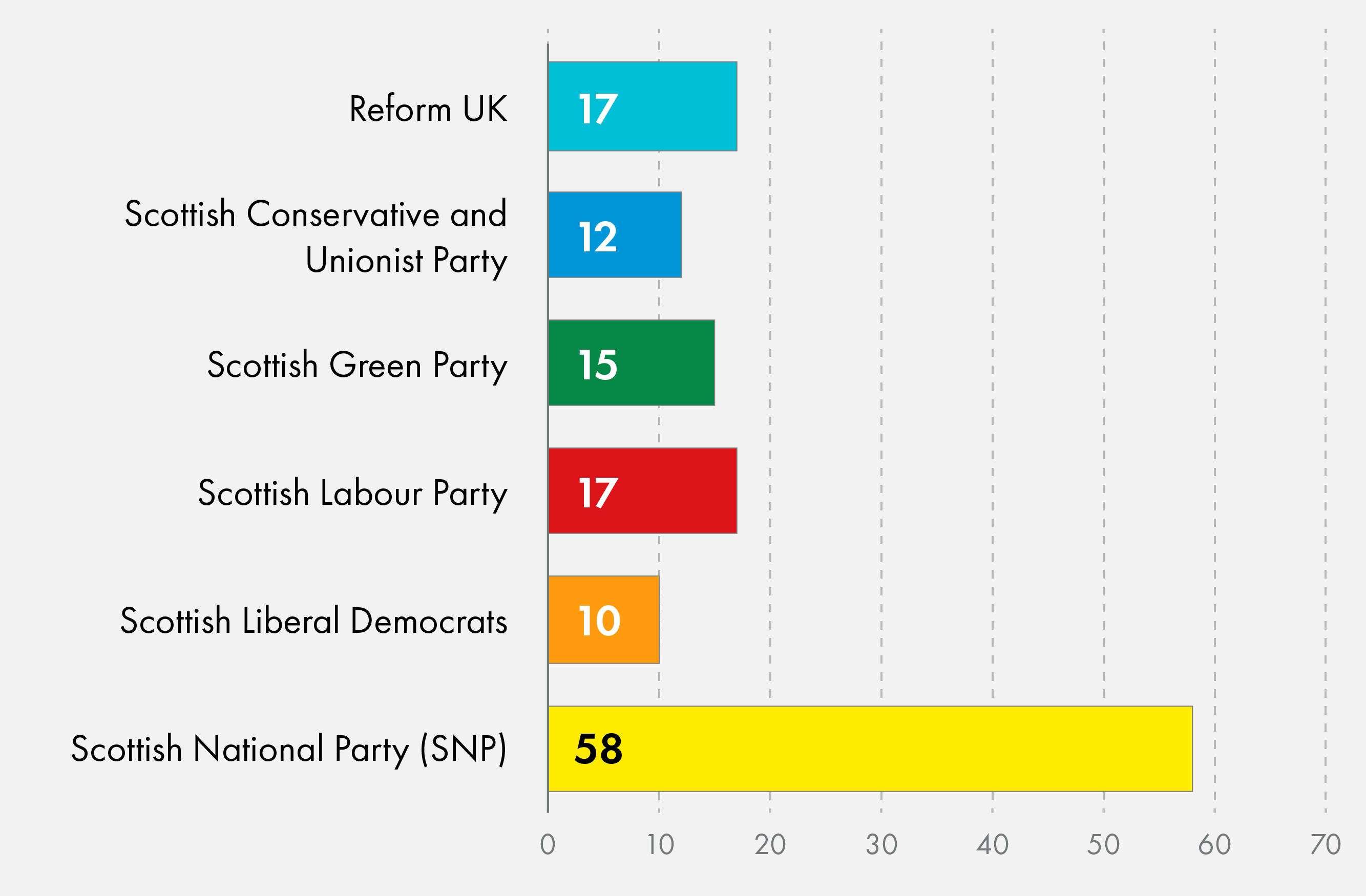
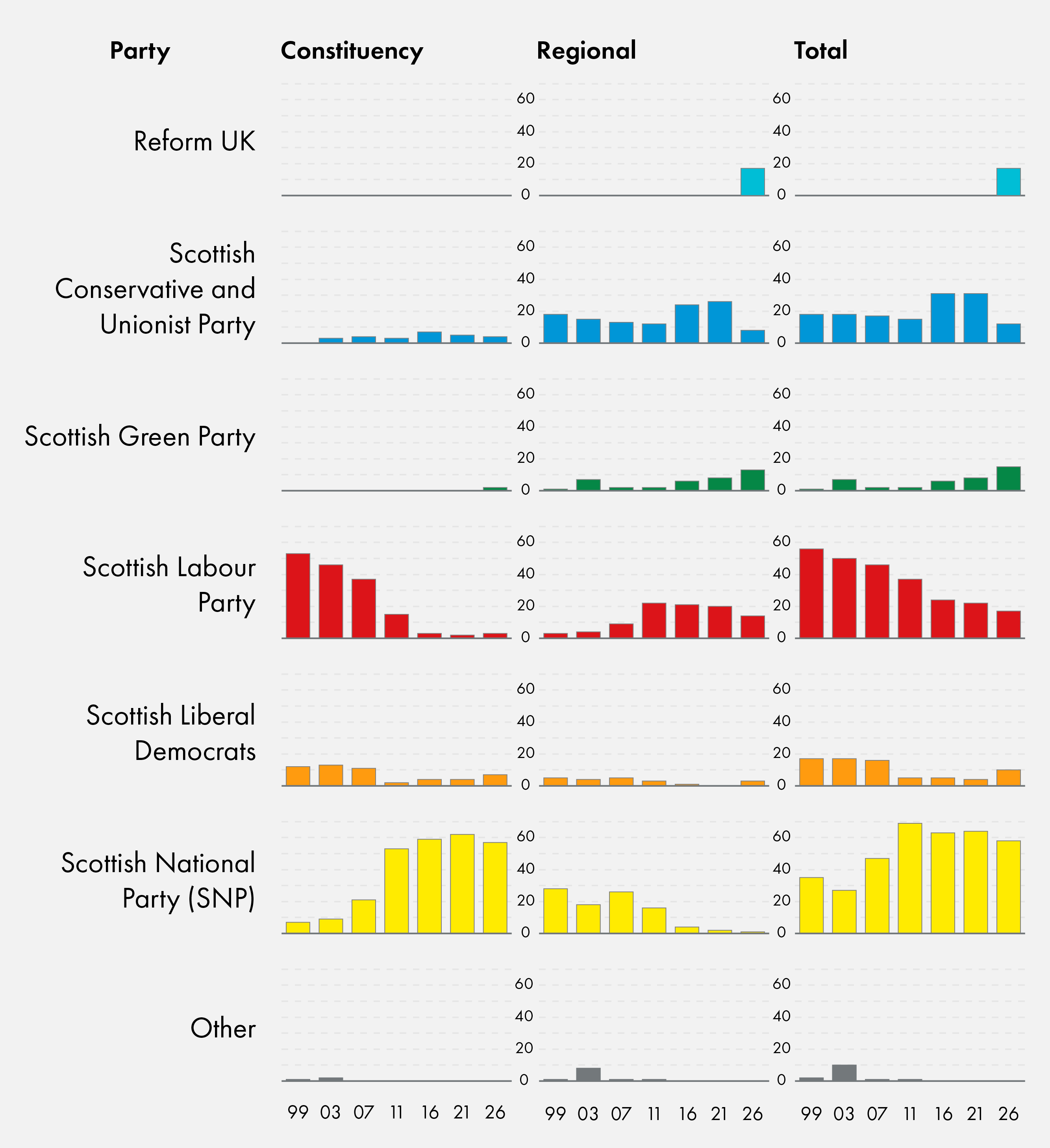
The Scottish National Party (SNP) was the largest political party represented in the Parliament after the 2026 election, winning 58 seats. While this was a reduction of 6 seats compared to 2021, this is considerably ahead of the next largest parties. In a first for the Scottish Parliament, Reform UK and Scottish Labour (Labour) finished joint second with 17 seats each. Labour and the Scottish Conservative and Unionist Party (the Conservatives) saw their lowest seats total at the Scottish Parliament since devolution, with Labour losing 5 seats compared to 2021 and the Conservatives winning 12 seats, a loss of 19 compared to 2021. The Scottish Green Party (the Greens) increased its number of seats to 15 (from 8 in 2021), and the Scottish Liberal Democrats (the Liberal Democrats) increased their number of seats to 10, from 4 in 2021. The biggest change in the composition of the parliament though was Reform UK returning 17 MSPs, an increase from 0 at the 2021 election.
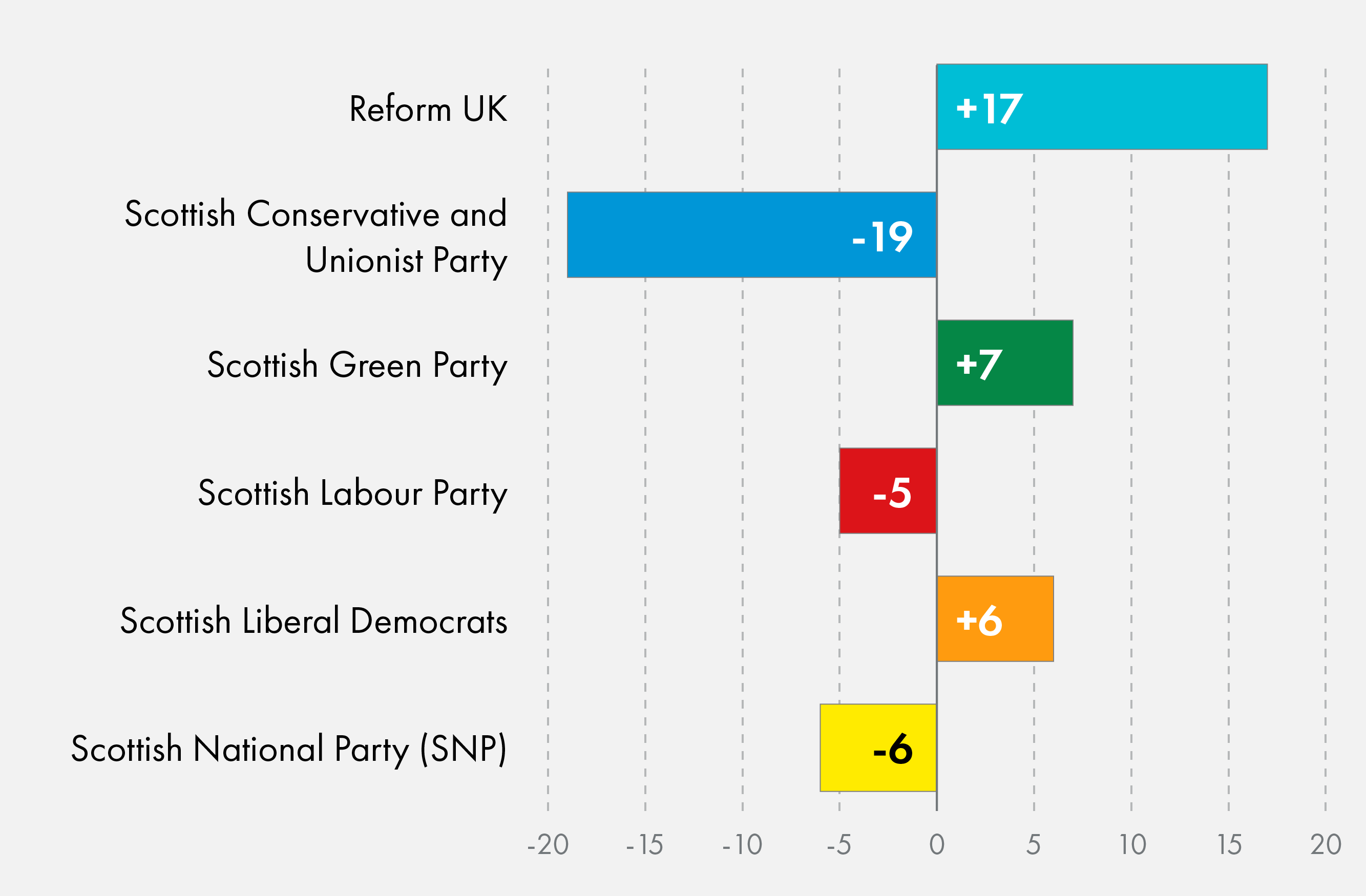
This was the 7th general election to the Scottish Parliament since devolution in 1999. The figure below shows results by political party compared with the previous Scottish Parliament election in 2021.
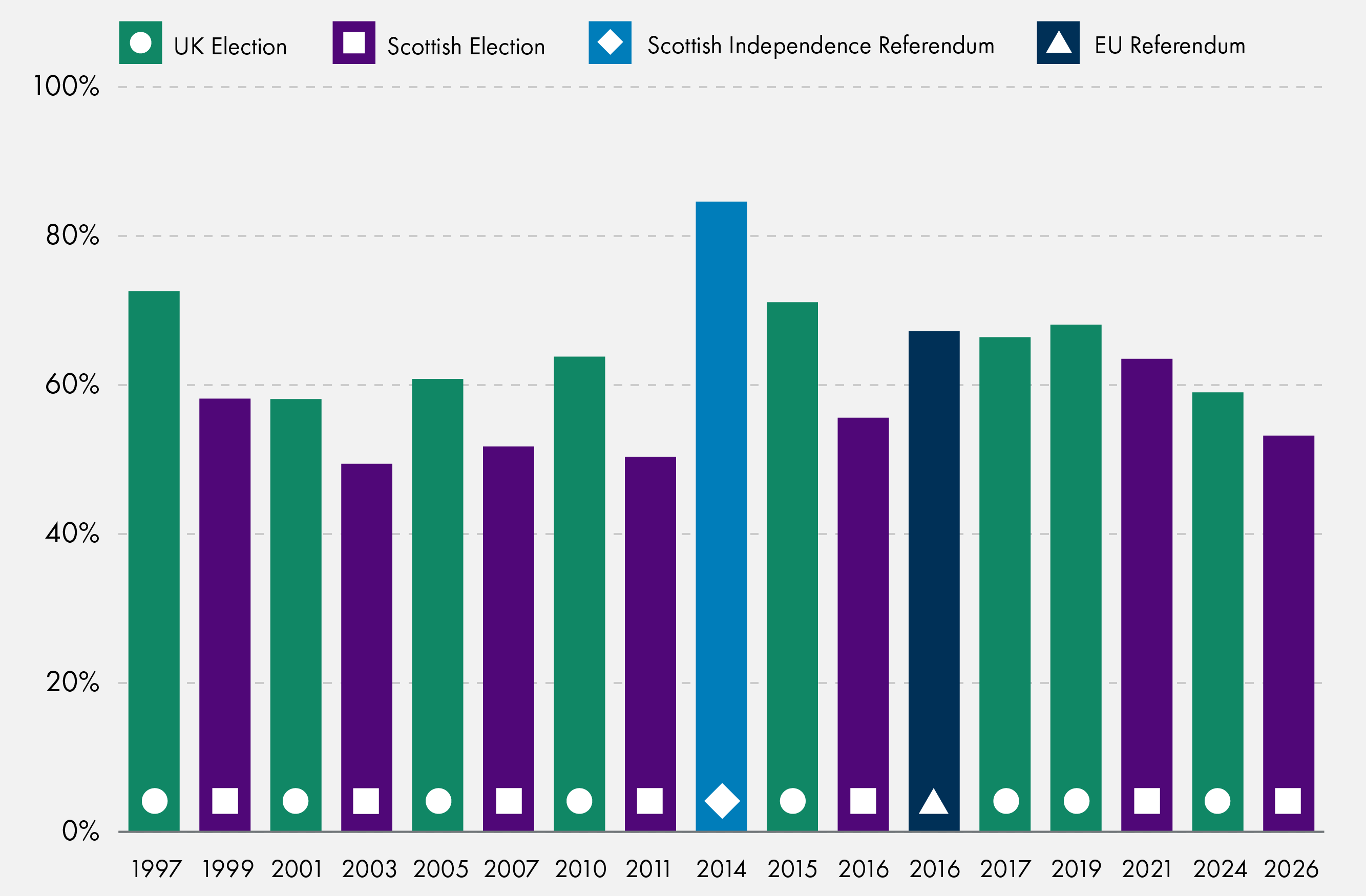
Turnout in the constituency vote atthe election was 53.2%. This is a reduction of 10.3 percentage points compared to the 2021 election. The SPICe blog notes that the 53.2% turnout in 2026 is similar to the average of 54.9% for Scottish Parliament elections. The figure below compares turnout to previous elections and referendums.
Unlike recent elections, the counting in 2026 did not start following the closure of the polls, but started at 9.00am on Friday 8 May. The Electoral Management Board for Scotland1 stated that the reasons for delaying the count to the next day were:
Counting during the day allows the use of well-rested staff with quick access to more resources, people and support facilities. Our Counts are always accurate but working in the day removes some risks, reduces costs and lets us declare the results when more people are engaged.
The final result of the 2026 election was declared at 1:30am on Saturday 9 May 2026, when the result for the Highlands and Islands Region was declared.
The data behind this briefing will be available on the Scottish Parliament website.
What does the result mean for Session 7?
Overview
Although the largest party in the Parliament remains the SNP, the 2026 election brought significant changes to the seat distribution across parties. Reform were the biggest winners, going from 0 MSPs at the 2021 election to 17, becoming the joint second largest party with Labour. Labour and the Conservatives both returned their lowest number of MSPs at a Scottish Parliament election, losing 5 seats and 19 seats respectively.
The Greens and the Liberal Democrats increased their seats by 7 and 6 respectively.
The shape of the Parliament is: SNP 58 seats (a decrease of 6 from 2021); Reform 17 (an increase of 17 from 2021) ; Labour 17 (down 5 from 2021); the Greens 15 (up 8 from 2021) the Conservatives 12 (down 19 from 2021) and the Liberal Democrats 10 (up 6 from 2021).
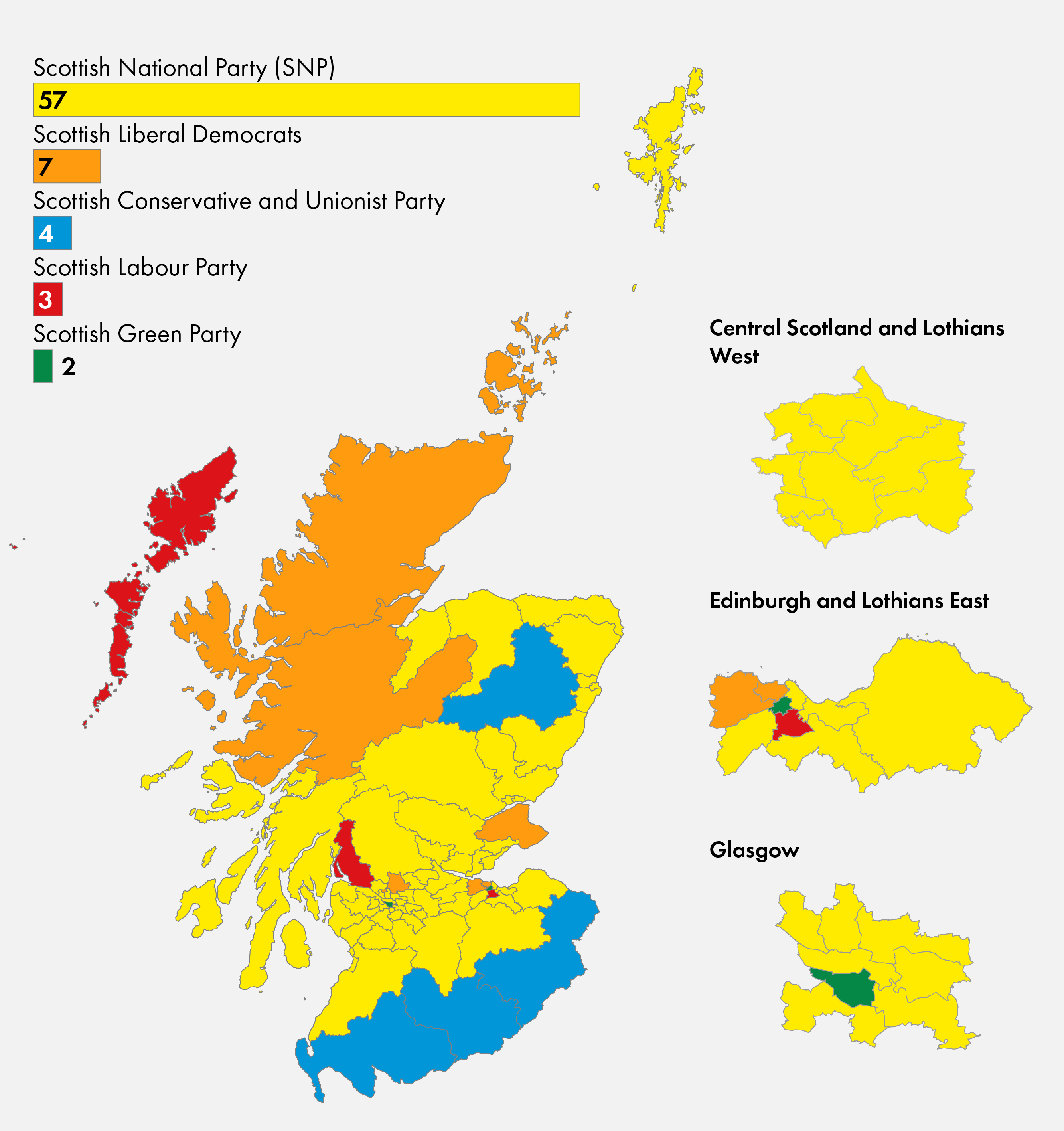
The SNP won 57 of the 73 constituency seats, gaining Shetland from the Liberal Democrats and Larkhall, Hamilton and Stonehouse from Labour. However, the SNP also lost 7 constituency seats: Glasgow Southside and Edinburgh Central to the Greens; Na h-Eileanan an Iar to Labour; and four constituencies to the Liberal Democrats:
Caithness, Sutherland and Ross,
Skye, Lochaber and Badenoch,
Edinburgh Northern, and
Strathkelvin and Bearsden.
Are there any patterns to the election results?
While it is early days in terms of analysing all the data to come from the election, there are a few trends that are apparent from the result. While the SNP lost support compared to 2021, this did not translate into a significant loss of seats.
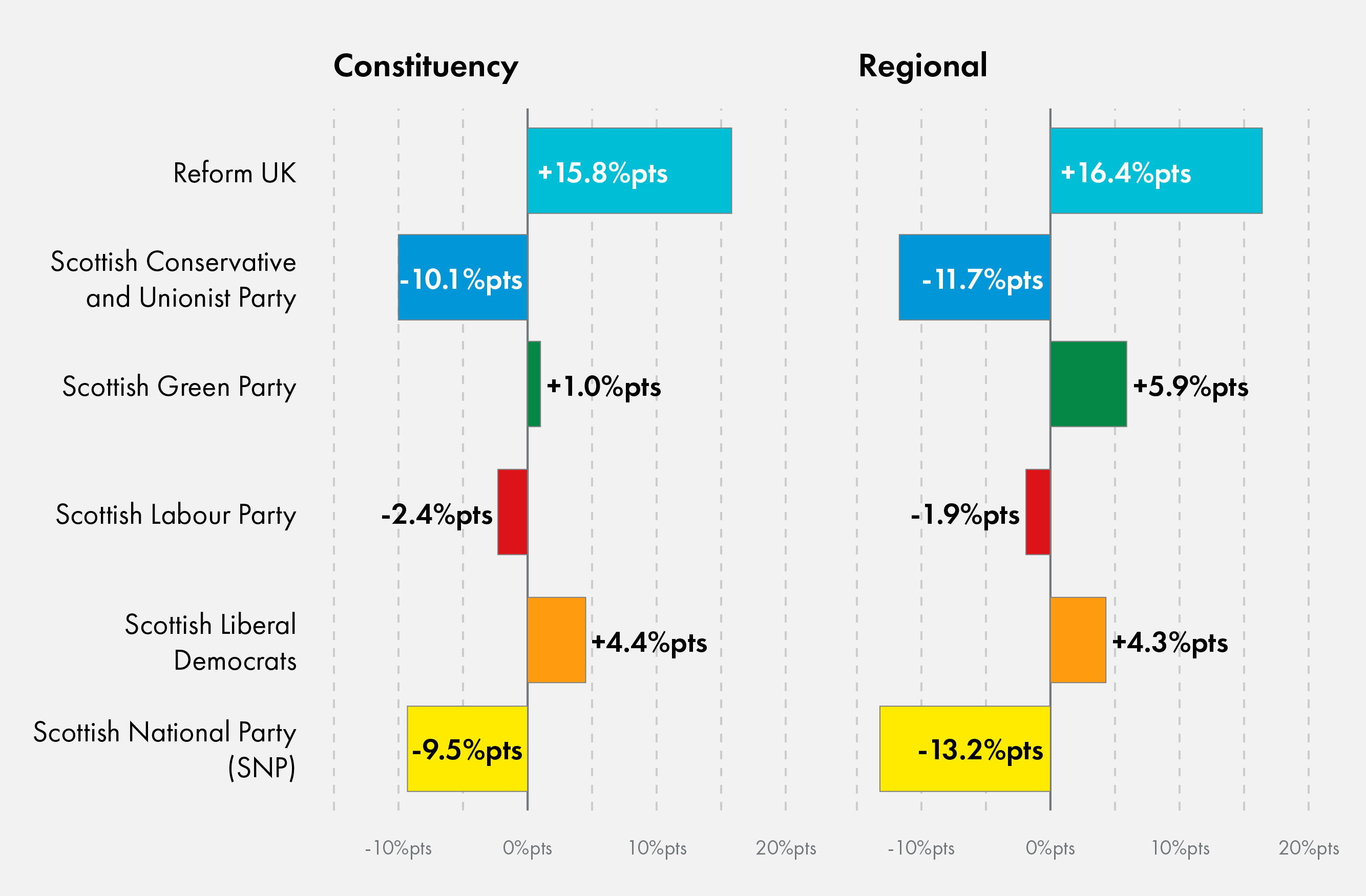
The SNP, while remaining the largest party in the Parliament, lost support in the constituency vote (down 9.5 percentage points) and on the regional list (down 13.2 percentage points). This loss of support resulted in a net loss of 6 seats - 5 constituencies and 1 on the list.
The Conservatives, the second largest party at the 2021 election, suffered a similar loss in support, down 10.1 percentage points in the constituency vote, and 11.7 percentage points on the regional list. However, compared to the SNP, this loss of support resulted in a significant loss of 19 seats.
Labour lost support in the constituency vote (down 2.4 percentage points) and on the regional list (down 1.9 percentage points). This resulted in a loss of 5 seats.
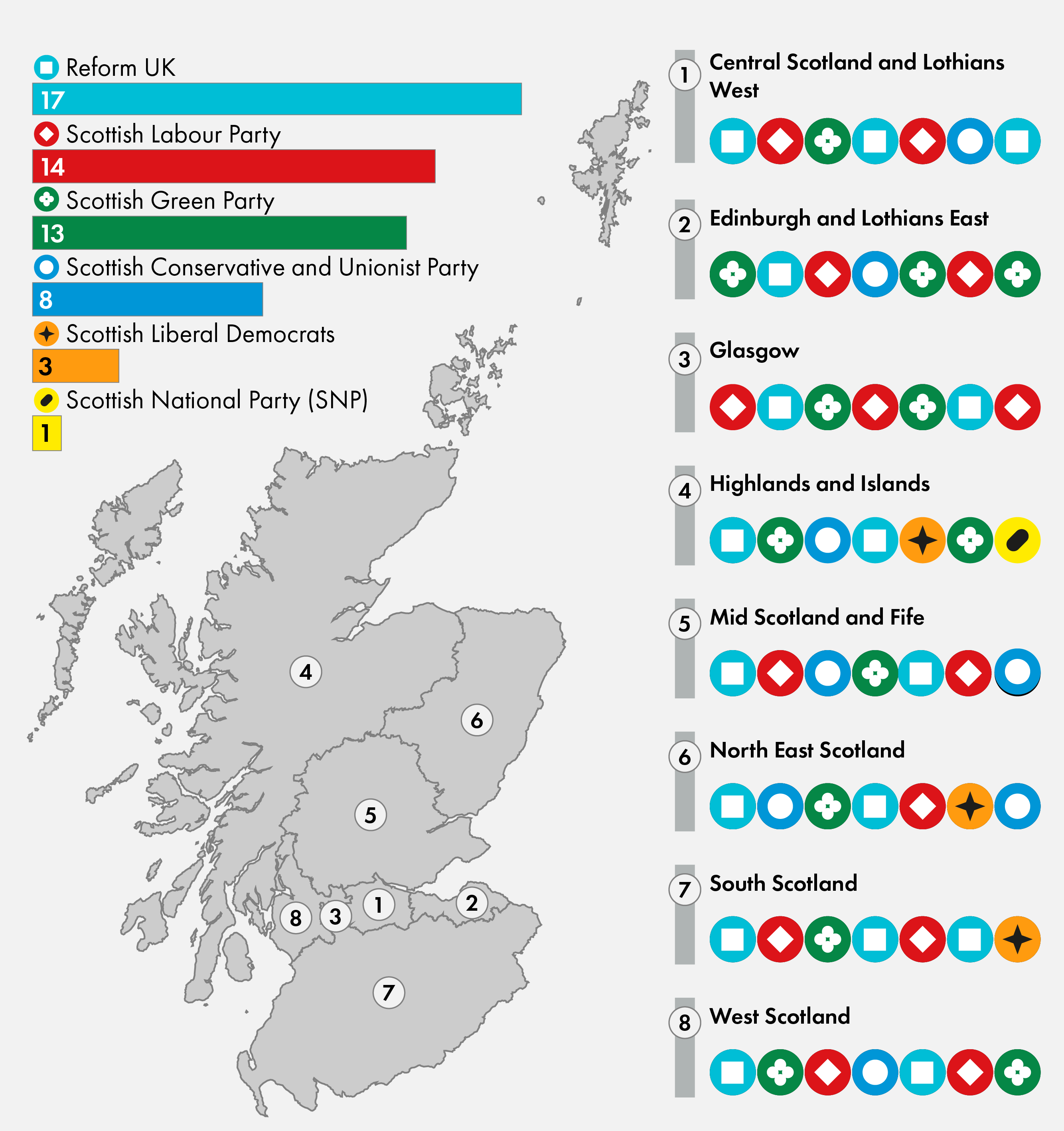
Reform UK gained 15.8 percentage points more in the constituency vote than in 2021 (Reform UK did not stand in any constituencies in 2021), and 16.4 percentage points more on the regional list. This was not enough to secure any constituency seats, but the party did secure 17 list seats to become the joint second largest party (with Labour), after the SNP
The Greens increased their share of the constituency vote by 1 percentage point to 2.3%. However, as they only stood constituency candidates in 6 seats, this concentrated support resulted in the Greens winning their first two constituencies. The party also increased its share of the list vote by 5.9 percentage points, reaching 14.0%. This delivered 13 list seats, taking the Greens to their best ever result of 15 seats.
The Liberal Democrats also increased their vote share in the constituencies (up 4.4 percentage points) and on the regional list (up 4.3 percentage points). These increases resulted in a gain of 6 seats.
What does the result mean for the formation of the Scottish Government?
In spite of not gaining a majority, it is likely that the SNP will form the next Scottish Government and serve a fifth consecutive term in office. As after the 2021 election, the SNP have options: they could govern as a minority government and seek support for key legislation such as budgets, on a case-by-case basis; they could seek to enter into a cooperation agreement similar to the one reached with the Greens in Session 6, or they could look to form a formal coalition with one of the other parties. Support from just one of the five other parties represented in Parliament would be enough to deliver a parliamentary majority (65 seats).
During Session 6, the Scottish Government governed with the Greens as part of a cooperation agreement (the Bute House Agreement, which lasted from August 2021 to April 2024). For the remainder of Session 6, the SNP governed as a minority government.
These issues are likely to take time to work through. After the 2021 election, for example, the Bute House Agreement wasn't signed until August1. The first order of business after members of the new Parliament are sworn in will be to elect a Presiding Officer and deputies. The business of the Parliament selecting a candidate for nomination as First Minister will take place the following week.
In the coming weeks Scotland will also see new Cabinet Secretaries and junior Ministers appointed. There will need to be changes, given that some big names in the Scottish Government did not stand for re-election or were not returned. Notable names who did not stand for re-election include Kate Forbes, Deputy First Minister and Cabinet Secretary for Economy and Gaelic, Shona Robison, Cabinet Secretary for Finance and Local Government, Mairi Gougeon, Cabinet Secretary for Rural Affairs, Land Reform and Islands, and Fiona Hyslop, Cabinet Secretary for Transport. Angus Robertson, Cabinet Secretary for Constitution, External Affairs and Culture, and Kaukab Stewart, Minister for Equalities were not returned.
SPICe will publish a series of blogs to explain what will happen in the first few meetings of the Parliament.
Diversity
The proportion of female MSPs fell to 43.4, a decrease of 1.6 percentage points from the 2021 election. However, this proportion was still the second highest proportion returned at a Scottish Parliament election, after the 2021 election.
A separate section considers the composition of the new Parliament in further detail.
Turnout
This election saw record numbers of people register to vote. Figures from the Electoral Commission, the independent body which oversees elections in the UK 1, show that a total of 4,320,981 people registered to vote.
A total of 2,297,159 voted in the 2026 constituency report, which was a turnout of 53.2%. This was a decrease of 10.3 percentage points compared to the 2021 election.
Looking across elections to the Scottish Parliament, the 2021 election is an outlier as it was the only time turnout for a Scottish Parliament election was above 60%. The average turnout across all Scottish Parliament elections is 54.9%.
Turnout this year was once again substantially below the 84.6% who voted in the 2014 Scottish Independence Referendum.
What is the result likely to mean for the Session 7 Parliament?
SPICe has published its Key Issues for Session 7 briefing which highlights four overarching themes and a number of subjects which are likely to be of interest to Parliamentarians during the upcoming Session. The overarching themes are:
Public finances and public service delivery
Living standards and wellbeing
Environment, natural resources and rural affairs
Devolution, the Parliament and transparency
The election campaign provided little focus on the difficult financial context that the next Scottish Government will face, or on how the Session 7 Parliament might scrutinise the difficult budgetary decisions which will need to be made.
The fiscal context for the next Scottish Government already looked challenging, when the Scottish Government's own 1Medium Term Financial Strategy, published last year, identified that without action, there would be a near £5 billion difference between funding and spending by 2029-30.
Alongside the fiscal challenges facing the Scottish Government, the David Hume Institute’s analysis in February 2026 suggested that the cost of living was already among the top issues for Scottish voters ahead of the 2026 election. This analysis was prior to the outbreak of the conflict in the Middle East, which has exacerbated concerns over the cost of living.
The Fraser of Allander Institute note that over half the resource budget is spent on public sector pay, but that achieving the planned 3 year pay deal of 9% looks very challenging given the awards already made, and the inflationary environment.
The first budget for the next Scottish Government will likely require difficult decisions, which will be compounded by the need to secure backing from at least one other party, or at least secure the abstention of one party.
In addition, while the election did not result in a majority for the SNP, there is a majority of pro-independence MSPs once again. This, coupled with the success of Plaid Cymru in the Welsh Senedd election and a nationalist Government in Northern Ireland, means that questions on the constitutional future of Scotland are likely to be a key feature of Session 7.
How the Parliament chooses to scrutinise the Scottish Government’s approach to meeting its targets to achieve Net Zero by 2045 and to halting nature decline is also likely to be of interest to many MSPs during Session 7.
Comparison with previous parliaments
The figures below show political party representation in the Scottish Parliament following each election going back to 1999.
State of the parties
The SNP lost 6 seats but remains the largest party by a considerable margin. Six parties are represented in the Parliament, but only the SNP holding more than 20 seats. Reform, who won 0 seats in the 2021 election, ended up the joint second largest party with 17 seats, alongside Labour. This marks Labour's lowest seat total at the Scottish Parliament since devolution.
The Greens nearly doubled their seats, from 8 after the 2021 election to 15.
The Conservatives, who were the second largest party after the 2021 election with 31 seats, lost over half and have 11 seats.
The Liberal Democrats increased their seats from 4 in 2021 to 10 in 2026.
Constituency and regional list vote
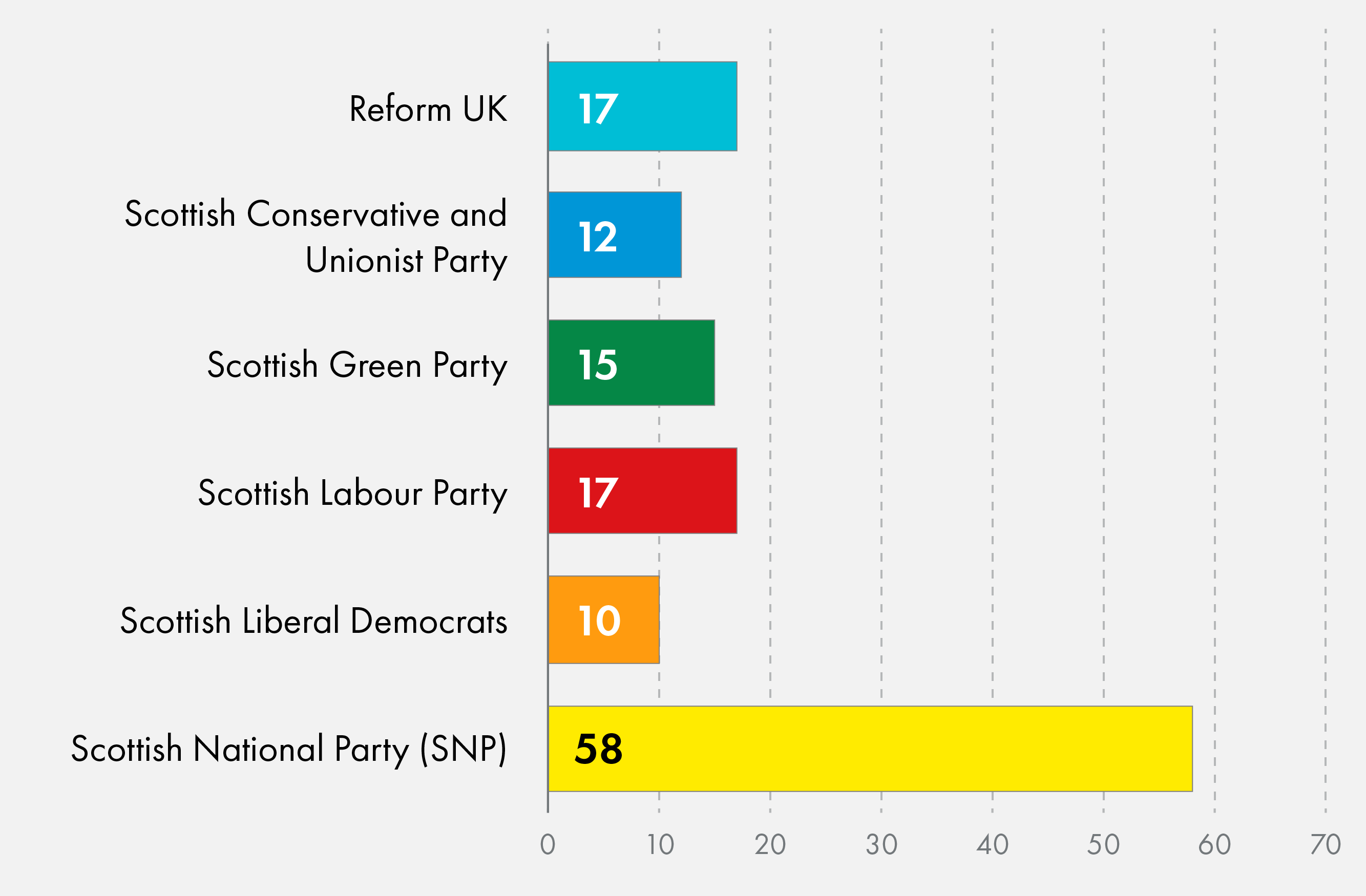
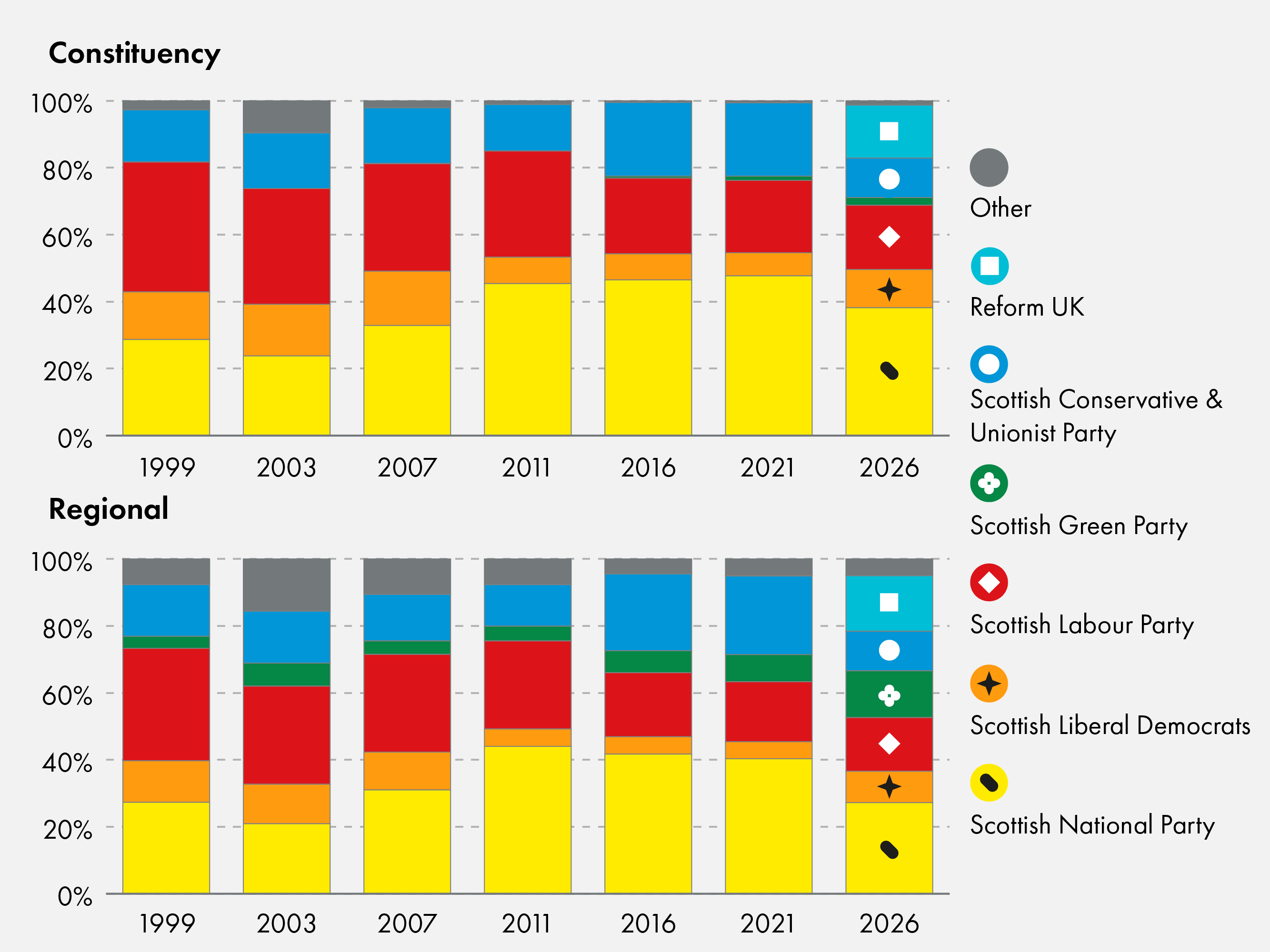
The following figure shows the changing share of the vote by political party in the constituency and on regional list votes.
Key points related to the constituency vote are as follows:
The SNP won 57 of the 73 constituencies, but saw its share of the constituency vote fall by 9.5 percentage points. They gained two constituencies (Shetland from the Liberal Democrats, and Hamilton, Larkhall and Stonehouse from Labour), but lost seven others.
Reform UK did not win any constituencies, but did secure 15.8% of the constituency vote. This included 33.9% of the constituency vote in Banffshire and Buchan Coast, where they finished second, just 364 votes behind the SNP.
The Greens won their first two constituencies in Edinburgh Central and Glasgow Southside, and increased their vote share to 2.3%. It is worth noting that the Greens only stood candidates in 6 of the 73 constituencies.
The Conservatives held all 4 of their constituencies from 2021, however their share of the constituency vote fell by 10.1 percentage points
Labour gained 19.2% of the constituency vote, down 2.4 percentage points compared to 2021. They gained Edinburgh Southern and Na h-Eileanan an Iar, both from the SNP. Edinburgh Southern was one of the seats impacted by the change in boundaries for the 2026 election.
Lib Dem gained 4 constituencies (Caithness, Sutherland and Ross, Skye, Lochaber and Badenoch, Edinburgh Northern, and Strathkelvin and Bearsden), all from the SNP. This takes their total to 7 constituency seats.
Key points related to the regional vote are as follows:
The SNP vote share was 27.2%, down 13.2 percentage points on the 2021 election. Due to the SNP performance in constituencies, this resulted in them winning only 1 regional seat, a drop of 1 compared to 2021.
Reform UK's vote share was 16.6%, a significant increase from the 0.2% the party won in 2021. All 17 Reform UK MSPs were elected on the regional list.
Labour secured 16.0% of the regional vote, a decrease of 1.9 percentage points compared to 2021. This resulted in 14 seats from the regional list.
The Greens increased their share of the regional vote by 5.9 percentage points to 14.0%, which resulted in 13 seats from the regional list.
The Conservatives share of the regional vote was 11.8%, a reduction of 11.7 percentage points from 2021. This resulted in 8 seats from the regional list.
The Liberal Democrats share of the regional vote was 9.4%, an increase of 4.3 percentage points from the 2021 election. This resulted in 3 seats from the regional list.
The infographic below presents the percentage share of the constituency and regional votes in elections since 1999. It shows the changing nature of representation at the Scottish Parliament since it was reconvened.
Composition of the Parliament
This section of the briefing looks at the composition of the new Parliament in more detail.
MSPs who did not re-stand for election
Ahead of the 2026 Scottish Parliament election, 42 members announced they would stand down and not seek re-election. Amongst those stepping down was the Scottish Parliament's Presiding Officer, Alison Johnstone, two former First Ministers, and the former Deputy First Minister.
| Name | Party | Constituency or Region |
|---|---|---|
| Sarah Boyack | Labour | Lothian (R) |
| Stephanie Callaghan | SNP | Uddingston and Bellshill (C) |
| Foysol Choudhury | Independent | Lothian (R) |
| Willie Coffey | SNP | Kilmarnock and Irvine Valley (C) |
| Graeme Dey | SNP | Angus South (C) |
| Natalie Don-Innes | SNP | Renfrewshire North (C) |
| James Dornan | SNP | Glasgow Cathcart (C) |
| Pam Duncan-Glancy | Independent | Glasgow (R) |
| Annabelle Ewing | SNP | Cowdenbeath (C) |
| Joe FitzPatrick | SNP | Dundee City West (C) |
| Kate Forbes | SNP | Skye, Lochaber and Badenoch (R) |
| Maurice Golden | Conservatives | North East Scotland (R) |
| Mairi Gougeon | SNP | Angus North and Mearns (C) |
| Christine Grahame | SNP | Midlothian South, Tweeddale and Lauderdale (C) |
| Rhoda Grant | Labour | Highlands and Islands (R) |
| Fiona Hyslop | SNP | Linlithgow (C) |
| Alison Johnstone | No political allegiance | Lothian (R) |
| Bill Kidd | SNP | Glasgow Anniesland (C) |
| Richard Leonard | Labour | Central Scotland (R) |
| Richard Lochhead | SNP | Moray (C) |
| Gordon MacDonald | SNP | Edinburgh Pentlands (C) |
| Rona Mackay | SNP | Strathkelvin and Bearsden (C) |
| Ruth Maguire | SNP | Cunninghame South (C) |
| John Mason | Independent | Glasgow Shettleston (C) |
| Michael Matheson | SNP | Falkirk West (C) |
| Edward Mountain | Conservatives | Highlands and Islands (R) |
| Oliver Mundell | Conservatives | Dumfriesshire (C) |
| Audrey Nicoll | SNP | Aberdeen South and North Kincardine (C) |
| Shona Robison | SNP | Dundee City East (C) |
| Douglas Ross | Conservatives | Highlands and Islands (R) |
| Alex Rowley | Labour | Mid Scotland and Fife (R) |
| Colin Smyth | Independent | South Scotland (R) |
| Liz Smith | Conservatives | Mid Scotland and Fife (R) |
| Kevin Stewart | SNP | Aberdeen Central (C) |
| Nicola Sturgeon | SNP | Glasgow Southside (C) |
| Michelle Thomson | SNP | Falkirk East (C) |
| Evelyn Tweed | SNP | Stirling (C) |
| Mercedes Villalba | Labour | North East Scotland (R) |
| Tess White | Conservatives | North East Scotland (R) |
| Elena Whitham | SNP | Carrick, Cumnock and Doon Valley (C) |
| Beatrice Wishart | Liberal Democrats | Shetland (C) |
| Humza Yousaf | SNP | Glasgow Pollok (C) |
MSPs who lost their seats at the 2026 election
In total, 22 Members lost their seat in the Scottish Parliament at the 2026 election, shown in the table below.
| Name | Party | Constituency or Region |
|---|---|---|
| Alasdair Allan | SNP | Na h-Eileanan an Iar (C) |
| Jeremy Balfour | Independent | Lothian (R) |
| Jackson Carlaw | Conservatives | Eastwood (C) |
| Sharon Dowey | Conservatives | South Scotland (R) |
| Fergus Ewing | Independent | Inverness and Nairn (C) |
| Pam Gosal | Conservatives | West Scotland (R) |
| Jamie Greene | Liberal Democrats | West Scotland (R) |
| Roz McCall | Conservatives | Perthshire South and Kinross-shire (C) |
| Sandesh Gulhane | Conservatives | Glasgow (R) |
| Jamie Halcro Johnston | Conservatives | Highlands and Islands (R) |
| Emma Harper | SNP | South Scotland (R) |
| Monica Lennon | Labour | Central Scotland (R) |
| Paul O’Kane | Labour | West Scotland (R) |
| Ash Regan | Independent | Edinburgh Eastern (C) |
| Angus Robertson | SNP | Edinburgh Central (C) |
| Davy Russell | Labour | Hamilton, Larkhall and Stonehouse (C) |
| Alexander Stewart | Conservatives | Mid Scotland and Fife (R) |
| Kaukab Stewart | SNP | Glasgow Kelvin (C) |
| Sue Webber | Conservatives | Lothian (R) |
| Annie Wells | Conservatives | Glasgow (R) |
| Martin Whitfield | Labour | South Scotland (Region) |
| Brian Whittle | Conservatives | South Scotland (Region) |
New Members
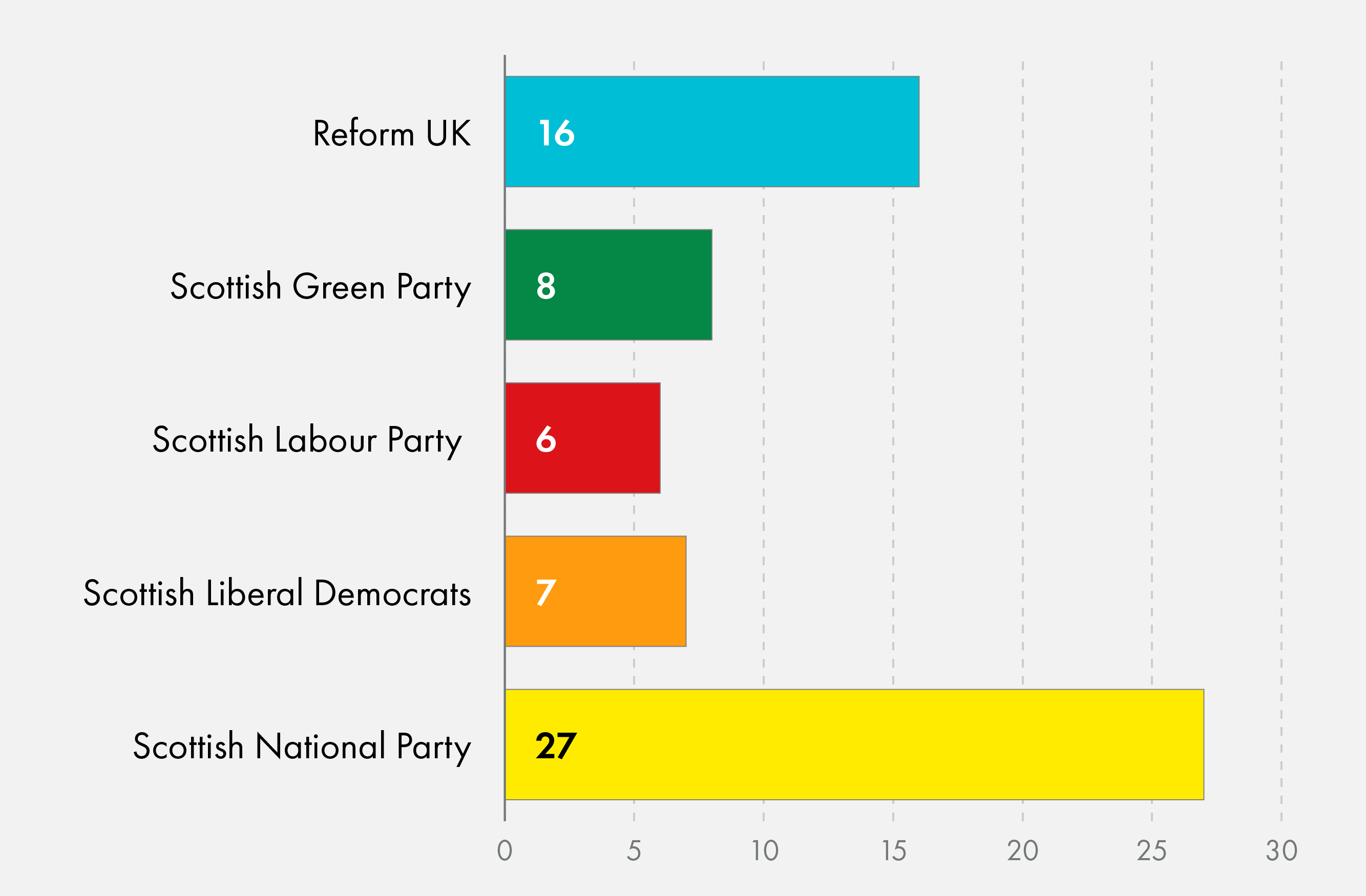
The 2026 election returned the largest number of new Members since 1999, with 64 new Members being elected replacing the 42 who chose not to seek re-election and the 22 Members who lost their seats. Prior to 2026, the biggest intake of new Members was 51 in 2016.
The SNP account for 27 of the 64 new Members (42%), Reform for 16 (25%), the Greens for 8 (12.5%), and the Liberal Democrats for 7 (11%).
The breakdown by political party of new members is as follows:
| Name | Party | Constituency (C) or Region (R) |
|---|---|---|
| Irshad Ahmed | Labour | Edinburgh and Lothians East (R) |
| Heather Anderson | SNP | Dundee City West (C) |
| Max Bannerman | Reform | Highlands and Islands (R) |
| David Barratt | SNP | Cowdenbeath (C) |
| Andrew Baxter | Liberal Democrats | Skye, Lochaber and Badenoch (C) |
| Senga Beresford | Reform | South Scotland (R) |
| Dawn Black | SNP | Angus North and Mearns (C) |
| Amanda Bland | Reform | Central Scotland and Lothians West (R) |
| Steven Bonnar | SNP | Uddingston and Bellshill (C) |
| Gary Bouse | SNP | Falkirk West (C) |
| Alan Brown | SNP | Kilmarnock and Irvine Valley (C) |
| Holly Bruce | Green | Glasgow Southside (C) |
| Kate Campbell | SNP | Edinburgh Eastern, Musselburgh and Tranent (C) |
| Michelle Campbell | SNP | Renfrewshire North and Cardonald (C) |
| Yi-pei Chou Turvey | Liberal Democrats | North East Scotland (R) |
| Vic Currie | Reform | Highlands and Islands (R) |
| Martyn Day | SNP | Falkirk East and Linlithgow |
| Sanne Dijkstra-Downie | Liberal Democrats | Edinburgh Northern (C) |
| Iris Duane | Green | Glasgow (R) |
| Duncan Dunlop | Liberal Democrats | South Scotland (R) |
| Joe Fagan | Labour | South Scotland (R) |
| Stephen Flynn | SNP | Aberdeen Deeside and North Kincardine (C) |
| Stephen Gethins | SNP | Dundee City East (C) |
| Zen Ghani | SNP | Glasgow Cathcart and Pollok (C) |
| Patricia Gibson | SNP | Cunninghame South (C) |
| Hannah Mary Goodlad | SNP | Shetland Islands (C) |
| David Green | Liberal Democrats | Caithness, Sutherland and Ross (C) |
| Katie Hagmann | SNP | Carrick, Cumnock and Doon Valley (C) |
| Adam Harley | Liberal Democrats | Strathkelvin and Bearsden (C) |
| Alex Kerr | SNP | Hamilton, Larkhall and Stonehouse (C) |
| Calum Kerr | SNP | Midlothian South, Tweeddale and Lauderdale (C) |
| Thomas Jordan Kerr | Reform | Glasgow (R) |
| Kristopher Leask | Green | Highlands and Islands |
| Kayleigh Kinross-O'Neill | Green | Edinburgh and Lothians East (R) |
| Simita Kumar | SNP | Edinburgh South Western (C) |
| David Kirkwood | Reform | South Scotland (R) |
| Jamie Langan | Reform | South Scotland (R) |
| David Linden | SNP | Glasgow Baillieston and Shettleston (C) |
| Mandy Lindsay | Reform | Central Scotland and Lothians West (R) |
| Joe Long | Labour | Mid Scotland and Fife (R) |
| Julie MacDougall | Reform | Mid Scotland and Fife (R) |
| Donald MacKinnon | Labour | Na h-Eileanan an Iar (C) |
| Morven-May MacCallum | Liberal Democrats | Highlands and Islands (R) |
| Helen McDade | Reform | Mid Scotland and Fife (R) |
| Cara McKee | Green | West Scotland (R) |
| Q Manivannan | Green | Edinburgh and Lothians East (R) |
| Duncan Massey | Reform | North East Scotland (R) |
| Lloyd Melville | SNP | Angus South (C) |
| Colm Merrick | SNP | Glasgow Anniesland (C) |
| Jack Middleton | SNP | Aberdeen Central (C) |
| Laura Mitchell | SNP | Moray (C) |
| Laura Moodie | Green | South Scotland (R) |
| Kate Nevens | Green | Edinburgh and Lothians East (R) |
| Malcolm Offord | Reform | West Scotland (R) |
| Kirsten Oswald | SNP | Eastwood (C) |
| Angela Ross | Reform | Edinburgh and Lothians East (R) |
| Katherine Sangster | Labour | Edinburgh and Lothians East (R) |
| Kim Schmulian | Reform | Glasgow (R) |
| Mark Simpson | Reform | North East Scotland (R) |
| Alyn Smith | SNP | Stirling (C) |
| David Smith | Reform | West Scotland (R) |
| Pauline Stafford | SNP | Bathgate (C) |
| Alison Thewliss | SNP | Glasgow Central (C) |
| Jenny Young | Labour | Central Scotland and Lothians West (R) |
MSPs with dual mandates
Dual mandate is the term used to describe those MSPs who, in addition to their seat in the Scottish Parliament, also hold a seat in either the House of Commons (MPs), House of Lords (Peers) or represent a ward in their local council (Councillors).
The Scottish Elections (Representation and Reform) Act 20251 and associated secondary legislation means that dual mandates for members of the Scottish Parliament are no longer allowed. There is a grace period during which individuals newly elected are able to resign their mandate elsewhere so as to be able to serve as an MSP. The grace periods are as follows:
Members of the House of Commons have 49 days to resign.
Members of the House of Lords have 14 days to resign.
Councillors are allowed to serve as an MSP where the next scheduled local government election is due to occur within 372 days of the election at which the councillor was returned as an MSP. This reflects the current electoral cycle where local government elections will take place the year following a Scottish Parliament election. If an MSP is elected and there is more than 373 days until the next scheduled local government election, the grace period is 49 days. The next local government election is scheduled for 6 May 2027.
In total, there are 27 MSPs with a dual mandate, which are listed below:
| MSP | Party | Dual mandate |
|---|---|---|
| Stephen Flynn | SNP | MP |
| Stephen Gethins | SNP | MP |
| Katy Clark (Baroness Clark of Kilwinning) | Labour | House of Lords |
| Heather Anderson | SNP | Councillor |
| David Barratt | SNP | Councillor |
| Andrew Baxter | Liberal Democrats | Councillor |
| Dawn Black | SNP | Councillor |
| Gary Bouse | SNP | Councillor |
| Kate Campbell | SNP | Councillor |
| Michelle Campbell | SNP | Councillor |
| Yi-pei Chou Turvey | Liberal Democrats | Councillor |
| Sanne Dijkstra-Downie | Liberal Democrats | Councillor |
| Joe Fagan | Labour | Councillor |
| Zen Ghani | SNP | Councillor |
| Hannah Mary Goodlad | SNP | Councillor |
| Katie Hagmann | SNP | Councillor |
| Alex Kerr | SNP | Councillor |
| Thomas Kerr | Reform | Councillor |
| Kayleigh Kinross-O'Neill | Green | Councillor |
| Simita Kumar | SNP | Councillor |
| Kristopher Leask | Green | Councillor |
| Morven-May MacCallum | Liberal Democrats | Councillor |
| Julie MacDougall | Reform | Councillor |
| Duncan Massey | Reform | Councillor |
| Lloyd Melville | SNP | Councillor |
| Colm Merrick | SNP | Councillor |
| Pauline Stafford | SNP | Councillor |
Gender
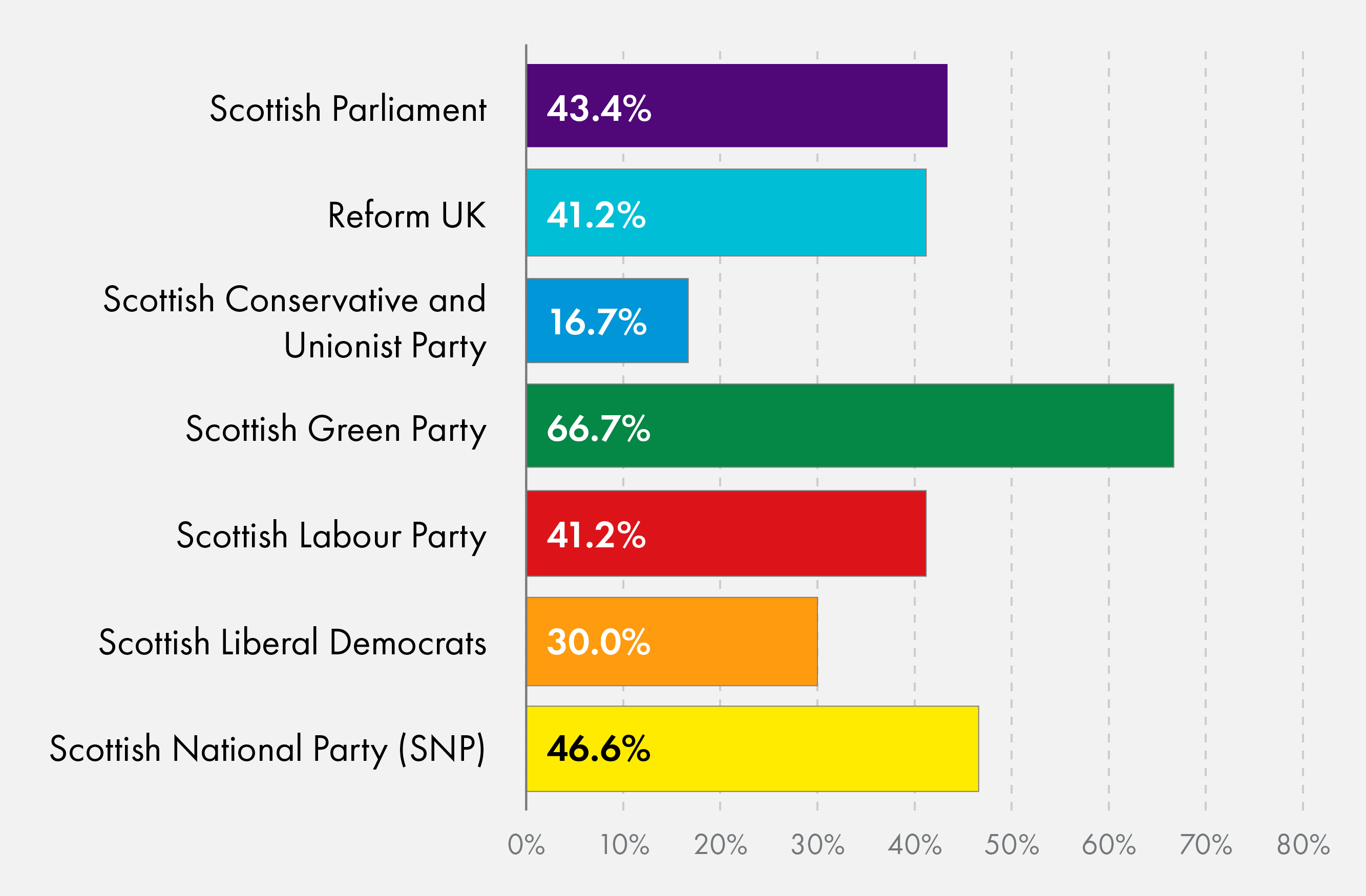
The number of female Members of the Scottish Parliament has decreased to 56, from 58 after the 2021 election.
The breakdown of female Members by party and as a proportion of their party’s total is shown below.
| Party | Constituency | Regional | Total |
|---|---|---|---|
| Reform UK | 0 | 7 | 7 |
| Scottish Conservative and Unionist Party | 1 | 1 | 2 |
| Scottish Green Party | 2 | 8 | 10 |
| Scottish Labour | 1 | 6 | 7 |
| Scottish Liberal Democrats | 0 | 3 | 3 |
| Scottish National Party | 26 | 1 | 27 |
| Total | 30 | 26 | 56 |
The total number of female MSPs returned in each election since devolution in 1999 is shown below:
| Election | Number of female Members elected | % female Members |
|---|---|---|
| 1999 | 48 | 37.2% |
| 2003 | 51 | 39.5% |
| 2007 | 43 | 33.3% |
| 2011 | 45 | 34.9% |
| 2016 | 45 | 34.9% |
| 2021 | 58 | 45.0% |
| 2026 | 56 | 43.4% |
In addition, the first trans Member was elected in 2026, representing the Scottish Green Party.
Class of 1999
Following the 2021 Scottish Parliament election, there were eight Members who had served continuously since 1999.
Of those 8 members, only 3 stood for election in 2026, and Fergus Ewing was unsuccessful in the Inverness and Nairn constituency.
This leaves only John Swinney and Jackie Baillie as Members who have served continuously since 1999.
Sources
Electoral Management Board for Scotland. (2025, October 28). Directions issued for the Scottish Parliament Election 2026. Retrieved from <a href="https://www.emb.scot/news/article/67/directions-issued-for-the-scottish-parliament-election-2026" target="_blank">https://www.emb.scot/news/article/67/directions-issued-for-the-scottish-parliament-election-2026</a> [accessed 7 May 2026]
The Guardian. (2021, August 20). SNP and Scottish Greens confirm power-sharing deal in historic moment for Greens. Retrieved from <a href="https://www.theguardian.com/politics/2021/aug/20/snp-and-scottish-greens-expected-to-confirm-power-sharing-deal" target="_blank">https://www.theguardian.com/politics/2021/aug/20/snp-and-scottish-greens-expected-to-confirm-power-sharing-deal</a> [accessed 7 May 2026]
The Electoral Commission. (2026, May 1). More than 4 million voters ready to have their say at Scottish Parliament election. Retrieved from <a href="https://www.electoralcommission.org.uk/media-centre/more-4-million-voters-ready-have-their-say-scottish-parliament-election" target="_blank">https://www.electoralcommission.org.uk/media-centre/more-4-million-voters-ready-have-their-say-scottish-parliament-election</a> [accessed 7 May 2026]
Scottish Government. (2025, June 25). Scotland's fiscal outlook: medium-term financial strategy. Retrieved from <a href="https://www.gov.scot/publications/scotlands-fiscal-outlook-scottish-governments-medium-term-financial-strategy-3/" target="_blank">https://www.gov.scot/publications/scotlands-fiscal-outlook-scottish-governments-medium-term-financial-strategy-3/</a> [accessed 10 May 2026]
Scottish Elections (Representation and Reform) Act 2025. (29, January 2025). Retrieved from <a href="https://www.legislation.gov.uk/asp/2025/4/contents" target="_blank">https://www.legislation.gov.uk/asp/2025/4/contents</a> [accessed 9 May 2026]