Resources and Waste Common Framework
This briefing discusses the Resources and Waste Provisional Common Framework. The Resources and Waste Framework sets out how the UK and devolved governments propose to work together on policies that relate to resource and waste efficiency as part of the wider approach to delivering a circular economy. It also provides background information on the common frameworks programme.
Summary
This briefing provides detailed information on the Resources and Waste Provisional Common Framework. The Common Framework sets out how the UK and devolved governments ('the Parties') propose to work together on policies that relate to resources and waste efficiency.
The framework has been published and implemented on a provisional basis.
Background information on, for example, what common frameworks are and how they have been developed is also provided in this paper. The policy context of the framework is also briefly covered.
The Common Frameworks section of the SPICe Intergovernmental Activity Hub brings together all publicly available information on frameworks considered by Scottish Parliament committees. SPICe aims to publish a briefing for each common framework relevant to Scotland. These briefings, along with general blogs on the Common Frameworks programme, are all accessible via the Intergovernmental Activity Hub.
What are common frameworks?
A common framework is an agreed approach to a particular policy, including the implementation and governance of it. The aim of common frameworks is to manage divergence in order to achieve some degree of consistency in policy and practice across UK nations in areas formerly governed by EU law.
Why are common frameworks needed?
During its membership of the European Union, the UK was required to comply with EU law. This means that, in many policy areas, a consistent approach was often adopted across all four nations of the UK, even where those policy areas were devolved.
On 31 December 2020, the transition period ended, and the United Kingdom left the EU single market and customs union. At this point, the requirement to comply with EU law also came to an end. As a result, the UK and devolved governments agreed that common frameworks would be needed to avoid significant policy divergence between the nations of the UK, where that would be undesirable.
The Joint Ministerial Committee (JMC) was a set of committees which comprised ministers from the UK and devolved governments. The JMC (EU Negotiations) sub-committee was created specifically as a forum to involve the devolved administrations in discussion about the UK’s approach to EU Exit. Ministers responsible for Brexit preparations in the UK and devolved governments attended these meetings.
In October 2017, the JMC (EN) agreed an underlying set of principles to guide work in creating common frameworks. These principles are set out below.
Common frameworks will be established where they are necessary in order to:
enable the functioning of the UK internal market, while acknowledging policy divergence;
ensure compliance with international obligations;
ensure the UK can negotiate, enter into and implement new trade agreements and international treaties;
enable the management of common resources;
administer and provide access to justice in cases with a cross-border element; and
safeguard the security of the UK.
Frameworks will respect the devolution settlements and the democratic accountability of the devolved legislatures, and will therefore:
be based on established conventions and practices, including that the competence of the devolved institutions will not normally be adjusted without their consent;
maintain, as a minimum, equivalent flexibility for tailoring policies to the specific needs of each territory, as is afforded by current EU rules; and
lead to a significant increase in decision-making powers for the devolved administrations.
Frameworks will ensure recognition of the economic and social linkages between Northern Ireland and Ireland and that Northern Ireland will be the only part of the UK that shares a land frontier with the EU. They will also adhere to the Belfast Agreement.
What information is included?
In its October 2017 communique on common frameworks, the JMC (EN) stated that:
A framework will set out a common UK, or GB, approach and how it will be operated and governed. This may consist of common goals, minimum or maximum standards, harmonisation, limits on action, or mutual recognition, depending on the policy area and the objectives being pursued. Frameworks may be implemented by legislation, by executive action, by memorandums of understanding, or by other means depending on the context in which the framework is intended to operate.
Joint Ministerial Council (EU Negotiations), 16 October 2017, Common Frameworks: Definition and Principles
The Scottish Government indicated in 2019 that common frameworks would set out:
the area of EU law under consideration, the current arrangements and any elements from the policy that will not be considered. It will also record any relevant legal or technical definitions.
a breakdown of the policy area into its component parts, explain where the common rules will and will not be required, and the rationale for that approach. It will also set out any areas of disagreement.
how the framework will operate in practice: how decisions will be made; the planned roles and responsibilities for each administration, or third party; how implementation will be monitored, and if appropriate enforced; arrangements for reviewing and amending the framework; and dispute resolution arrangements.
However, while early statements about common frameworks suggested they would provide a mechanism for the joint development of future policy, the documents themselves largely set out procedural arrangements for intergovernmental working in areas of law previously governed at EU level. There is some variation between frameworks in the extent to which they establish substantive policy as opposed to setting out how policy decisions within the framework’s scope will be taken. Nonetheless, common frameworks share broad structural similarities, typically outlining the roles and responsibilities of the participating administrations, arrangements for review and amendment, and processes for dispute avoidance and resolution.
What is the process for developing frameworks ?
Frameworks are inter-governmental agreements between the UK Government and the devolved administrations. They are approved by Ministers on behalf of each government prior to being sent to all UK legislatures for scrutiny. The UK Government Cabinet Office is coordinating the development of common frameworks and oversees the common frameworks programme.
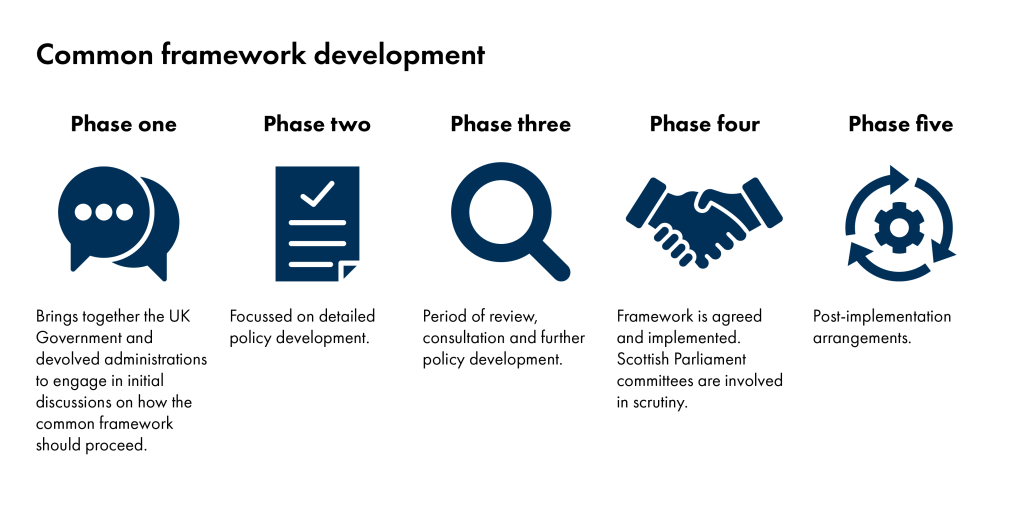
Common frameworks go through four phases of development before implementation at phase five. The stages are set out below. The parliament receives frameworks for scrutiny at phase four.
Scottish Parliament Information Centre
How does the Scottish Parliament consider frameworks?
Frameworks which have reached phase four are available to be considered by the Scottish Parliament. Subject committees can consider frameworks which sit within their policy areas.
Each legislature in the UK can consider common frameworks. Issues raised by legislatures during this scrutiny are fed back to their respective government. Governments then consider any changes which should be made to frameworks in light of scrutiny by legislatures before implementing the framework. Changes in light of scrutiny are not, however, a requirement.
The Constitution, Europe, External Affairs and Culture Committee had an oversight role in relation to frameworks in Session 6, and led on cross-cutting issues around transparency, governance and ongoing scrutiny.
The Scottish Government has previously acknowledged the ongoing role of the Scottish Parliament in relation to frameworks:
Consideration will also need to be given to what role the Parliament might have in the ongoing monitoring and scrutiny of frameworks post-implementation.
Scottish Government response to the session five Finance and Constitution Committee report on common frameworks, June 2019
The scrutiny challenge
The way in which common frameworks have been developed and operate raises some significant scrutiny challenges for the Scottish Parliament.
Common frameworks are intergovernmental agreements and the scope for parliamentary influence in their development is significantly limited with scrutiny taking place at phase four.
The ongoing operation of frameworks takes place at an official level between government departments. It is therefore unclear how much information the Parliament may be able to access to scrutinise the effect of frameworks on policy-making.
Governments may have different objectives for common frameworks.
The interconnected nature of common frameworks and the UK Internal Market Act 2020 (see section on the UK Internal Market Act).
The impact of common frameworks on the Scottish Government’s stated policy position of keeping pace with EU law.
The fact that most frameworks were or have been operating on an interim basis since 1 January 2021 in spite of being unavailable for scrutiny by legislatures.
The legacy expert panel report to the Session 5 Finance and Constitution Committee noted these scrutiny challenges. The Committee had previously recommended that the Scottish Government should have to report on the operation of each common framework, noting interactions with cross-cutting issues such as keeping pace with EU law, on an annual basis. No such reporting requirement was subsequently implemented in Session 6.
In its report How devolution is changing post-EU, the Session 6 Constitution, Europe, External Affairs and Culture Committee concluded that the post-EU exit arrangements for managing the UK’s regulatory environment lack clarity and consensus, with significant implications for parliamentary scrutiny. The Committee stated:
After EU-exit there has been significant disagreement between the devolved institutions and the UK Government regarding how the regulatory environment should be managed within the UK.
While a number of mechanisms and ways of working have been developed to manage the shared space, there is a lack of clarity around both the purpose of these and how they are being implemented.
The Committee notes that this lack of consensus, clarity and consistency in how the regulatory environment is now managed has considerable consequences for the effectiveness of the Scottish Parliament in carrying out its core legislative function and role in holding the Scottish Ministers to account.
Without consensus at an intergovernmental level in areas such as Common Frameworks and the use of delegated powers by UK Ministers in devolved areas, there is a significant blockage to effective parliamentary scrutiny. For example, with regards to transparency and the timing and level of information provided to Parliament.
Scottish Parliament Constitution, Europe, External Affairs and Culture Committee report, How devolution is changing post-EU, October 2023
Evaluation of common frameworks
As of 25 March 2026, 23 common frameworks have been published, of which four have been finalisedi. A further two frameworks relevant to Scotland were expected to be published (the Zootechnics framework and the Services Directives framework). These were mentioned in the UK Government's update to the Constitution, Europe, External Affairs and Culture Committee on 14 January 2026 .
In July 2025, SPICe published a briefing on the intergovernmental relations “reset”, which summarised key developments in the common frameworks programme between July 2024 and July 2025. One development during this period was the publication of the UK Government’s evaluation of common frameworks in July 2025. The evaluation was based on evidence provided by officials from the UK Government and the devolved administrations. Its purpose was to assess how common frameworks are functioning in practice and to identify areas for improvement.
The evaluation identified "six key factors to maximise the effectiveness" of the Common Frameworks programme in future:
increased sharing of good practice across Frameworks
increasing co-ordination across Frameworks
effective levels of stakeholder engagement
increasing wider knowledge and awareness of Frameworks within governments
central guidance and monitoring of key Framework processes; and
further evaluation of Frameworks in the future.
The UK Internal Market Act 2020
The UK Internal Market Act 2020 was passed in the UK Parliament in preparation for the UK’s exit from the EU. The Act establishes two market access principles to protect the flow of goods and services in the UK’s internal market.
The principle of mutual recognition, which means that goods and services which can be sold lawfully in one nation of the UK can be sold in any other nation of the UK.
The principle of non-discrimination, which means authorities across the UK cannot discriminate against goods and service providers from another part of the UK.
The Act means that the market access principles apply even where divergence may have been agreed in a framework.
The introduction of the UK Internal Market Act had a significant impact on the common frameworks programme because of the tension between the market access principles contained in the Act and the political agreement reached that “common frameworks would be developed in respect of a range of factors, including "ensuring the functioning of the UK internal market, while acknowledging policy divergence"."i
UK Government Ministers have the power to disapply the market access principles set out in the Act where the UK Government has agreed with one or more of the devolved governments that divergence is acceptable through the common frameworks process.
Although UK Ministers can disapply the market access principles in such circumstances, they are not legally obliged to do so.
On 2 December 2021, Angus Robertson MSP, Cabinet Secretary for Constitution, External Affairs and Culture wrote to the Convener of the Constitution, Europe, External Affairs and Culture Committee to give an update on the common frameworks programme.
The letter indicated that agreement had been reached between the UK Government and the Scottish Government and other devolved administrationsii on an approach to "securing exemptions to the Act for policy divergence agreed through common frameworks".
The meeting agreed an approach to securing exemptions to the Act for policy divergence agreed through common frameworks, and endorsed the text of a statement that UK Ministers will shortly make to the House of Commons. This will give effect to firm commitments made to the UK Parliament during the passage of the Bill that “…divergence may occur where there is agreement under a common framework, and that such divergence could be excluded from the market access principles. Regulations to give effect to such an agreement can be made under Clauses 10 and 17. In those cases, the Secretary of State would be able to bring to the House a statutory instrument to exclude from the market access principles a specific agreed area of divergence.
This would follow consensus being reached between the UK Government and all the relevant parties that this is appropriate in respect of any specific defined topic within a common framework.
Letter from the Cabinet Secretary for Constitution, External Affairs and Culture, 2 December 2021
Process for considering UK Internal Market Act exclusions in common framework areas (2021-July 2025)
The UK Government and devolved administrations published a process for considering exclusions to the market access principles of the UK Internal Market Act 2020 on 10 December 2021.
The process requires that if a party to the framework wishes to seek an exclusion to the market access principles, it must set out the scope and rationale for this. The proposed exclusion is then considered by the appropriate framework forum, taking into account evidence including about the likely direct and indirect economic impact of the proposed exemption. If the exemption is agreed, it is for UK Ministers to introduce a draft instrument to the UK Parliament to give effect to the exclusion. The UK Parliament will then consider the draft instrument.
The process is set out in full in the UK Government process for considering UK Internal Market Act exclusions process in Common Framework areas (December 2021).
The ban on certain single-use plastics in Scotland required an exclusion from the UK Internal Market Act's market access principles. See this 2022 blog from SPICe.
Review of UK Internal Market Act 2020
The UK Internal Market Act 2020 (UKIMA) required a statutory review of certain provisions of the Act to be completed by December 2025. While the statutory requirement focused on specific aspects of the Act, the UK Government adopted a broader approach to the review, indicating that it would also seek views on the operation of the exclusions process.
On 15 July 2025, the UK Government published its response to its review. The publication was accompanied by a written statement in the House of Commons by Douglas Alexander MP, then Minister of State for Trade Policy and Economic Security.
SPICe published a blog in October 2025 analysing the outcomes of the UK Internal Market Act review. In summary, the UK Government’s response included the following commitments and proposed changes:
a commitment to implement any UKIMA exclusions agreed by all governments through a common framework;
the introduction of a Minimum Economic Impact (MEI) process for considering exclusions with an estimated economic impact of less than £10 million per year, alongside a commitment by the UK Government to implement such exclusions where all governments agree they have minimum impact;
the creation of a “reserve” exclusions process for circumstances where agreement cannot be reached by all four governments through either the common framework or MEI processes;
an agreement to take account of environmental protection and public health considerations, alongside economic impacts, when assessing potential exclusions;
work to improve the transparency of common frameworks, including agreement between governments on how businesses and other stakeholders should be engaged on matters discussed within frameworks; and
a commitment by the UK Government to work with the devolved governments to agree a process through which all four governments can jointly refer UK internal market matters to the Office for the Internal Market for advice.
Overall, the outcomes of the review indicate that two additional processes for considering exclusions are to operate alongside revisions to the existing approach. The three proposed routes for exclusions are therefore:
the common frameworks process (with revisions);
the Minimum Economic Impact process; and
the reserve exclusions process.
Proposed amendments to the existing exclusions process
The table below (republished from a SPICe blog) provides a comparison of the existing process for considering exclusions and the process proposed by the review. The text used in column 1 is taken from the UK Government Process for considering UK Internal Market Act exclusions in Common Framework areas (published December 2021). The text from column 2 is taken from the process set out in the UK Government’s response to the review (published 15 July 2025).
| Existing exclusions process | New exclusions process proposed in Review |
|---|---|
| The exclusion seeking party should set out the scope and rationale for the proposed exclusion; and consideration of the proposal, associated evidence and potential impact should be taken forward consistent with the established processes as set out in the relevant Common Framework, including an assessment of direct and indirect economic impacts. | Exclusions shall be proposed in writing to all relevant Ministers in UK Government and devolved governments, who shall confirm receipt of the proposal. |
| It is recognised that all parties will have their own processes for considering policy proposals. Administrations should consult and seek agreement internally on their position before seeking to formally agree the position within the relevant Common Frameworks forum. | Whenever any party is proposing an amendment to Schedules 1 or 2 of the Act by a Common Framework:
|
| Where policy divergence has been agreed through a Common Framework this should be confirmed in the relevant Common Framework forum. This includes any agreement to create or amend an exclusion to the UKIM Act 2020’s market access principles. | It is recognised that all parties will have their own processes for considering policy proposals, before seeking to formally agree the position within the relevant Common Frameworks. It is also recognised that substantive policy change to an exclusion proposal that occurs during discussions may require further / new agreement between parties. |
| Evidence of the final position of each party regarding any exclusion and whether an agreement has been reached should be recorded in all cases. This could take the form of an exchange of letters between appropriate UK Government and Devolved Administration ministers and include confirmation of the mandated consent period for Devolved Administration ministers regarding changes to exclusions within the Act. | Where policy divergence has been agreed by all governments through a Common Framework, this should be confirmed in the relevant Common Framework. This includes any agreement to create or amend an exclusion to the UKIM Act Market Access Principles. |
| Parties remain able to engage the dispute resolution mechanism within the appropriate Common Framework if desired. | Evidence of the final position of each party regarding any exclusion, and the fact that an agreement has been reached, should be recorded in all cases. This could take the form of an exchange of letters between appropriate UK government and devolved government ministers. |
| Under section 10 or section 18 of the UK Internal Market Act 2020 amendments to the schedules containing exclusions from the application of the market access principles require the approval of both Houses of the UK Parliament through the affirmative resolution procedure. Where agreement to such an exclusion is reached within a Common Framework, the Secretary of State for the UK Government department named in the Framework is responsible for ensuring that a draft statutory instrument is put before the UK Parliament. | Parties remain able to engage the dispute resolution mechanism within the appropriate Common Framework, if desired. The need for seeking an exclusion does not automatically mean there is a dispute to resolve. |
| [This cell is intentionally blank.] | The UK Government will commit to implement all exclusions that have been formally agreed by all governments within a Common Framework. |
Minimum economic impact process
The UK Government’s response to the review notes that respondents generally supported the “UK Government running a lighter touch exclusions process where there is clear evidence to show minimal economic impacts on the UK internal market.” The proposed process is more streamlined, requiring that:
the proposing government demonstrates that the economic impact does not exceed the £10 million annual threshold
other governments have no objections based on minimum economic impact having been demonstrated
the UK Government implements legislation and commits to doing so as soon as reasonably practicable.
"Reserve" exclusions process
A reserve exclusions process is to be introduced for proposed exclusions which fall neither within a Common Framework area nor within the minimum economic impact exclusions process.
The reserve exclusions process will also be used should agreement not be reached on an exclusion proposed through either the Common Frameworks or the minimum economic impact process. The reserve process proposes that the administration seeking an exclusion can write to the relevant UK Minister, detailing the proposal and indicating they wish to use the reserve exclusion process to propose the exclusion.
Resources and Waste Common Framework
The Resources and Waste Common Framework ("the framework") has reached phase four and has, as such, been received by the Scottish Parliament for scrutiny.
Policy Area
This framework is about the legislative systems relating to waste and resource efficiency including both primary and secondary legislation. It also relates to statutory guidance, codes of practice, the gathering of data and evidence on waste, enforcement, and market surveillance coordination.
The policy area in scope of the framework interacts with policy areas in the scope of other frameworks, in particular the frameworks on Air Quality, Agriculture, Organic Farming, Chemicals and Pesticides and Radioactive Substances frameworks.
Scope
The policy area in scope of the framework was previously governed by EU law. With the requirement to comply with EU law now at an end, most of this legislation was converted into domestic law as retained EU law (now known as assimilated law)i. The framework documents the elements of retained EU law in this area that intersect with or impact upon devolved competence i.e. the specific directives and regulations:
The Waste Framework Directive (2008/98/EC) (as amended by the Circular Economy Package)
The Landfill Directive (99/31/EC)
The Mining Waste Directive 2006/21/EC
The Packaging and Packaging Waste Directive (94/62/EC)
The End of Life Vehicle (ELV) Directive (2000/53/EC)
The Batteries Directive (2006/66/EC)
The Waste Electrical and Electronic Equipment (WEEE) Directive (2011/19/EU)
The Restriction of Hazardous Substances (RoHS) Directive (2011/65/EU)
The EU Waste Shipment Regulation (1013/2006/EC)
Regulation (EU) No 1257/2013 on ship recycling
The Single Use Plastics Directive (Directive (EU) 2019/904)
The Waste Statistics Regulation (2150/2002/EC)
The Regulation on Ozone Depleting Substances (1005/2009)
Regulation (EU) 2019/1021 of the European Parliament and of the Council on persistent organic pollutants
The Ecodesign Directive (2009/125/EC)
Regulation (EC) No 66/2010 on the EU Ecolabel
Eco-Management and Audit Scheme Regulation (EMAS) (regulation (EC) No 1221/2009)
Organisation for Economic Co-operation and Development (OECD) municipal waste data return (voluntary)
Regulation (EU) 2017/852 Of the European Parliament and Of the Council of 17 May 2017 on mercury, and repealing Regulation (EC) No 1102/2008
Environmental Crime Directive 2008/99/EC
Environmental Liability Directive 2004/35/EC
The framework states that most of the subject matter of the relevant EU legislation falls into devolved competence although some elements are reserved e.g. product standards and shipment of waste across international borders. As a largely devolved area 'each nation has its own strategies, waste management plan, waste prevention programme and waste targets'. Enforcement is generally carried out by each nation's regulatory agency (which for Scotland is generally the Scottish Environment Protection Agency, SEPA). There are however, some waste streams, often through producer responsibility regimes, that operate on a UK-wide basis.
The framework highlights that part of the aim of common frameworks is 'to ensure the UK can negotiate, enter into and implement new trade agreements and international treaties, and ensure compliance with international obligations'.
The EU legislation cited above enshrined an obligation to handle waste in a way that does not have a negative impact on the environment or human health, a requirement to apply the waste hierarchy and, in accordance with the polluter-pays principle, a requirement that the costs of disposing of waste must be borne by the holder of waste by previous holders or by the producers of the product from which the waste derives.
International agreements
A number of international obligations to which the UK is subject intersect with policy in the scope of the framework, and as such, policy in devolved areas. Ten binding and four non-binding obligations (or groups of obligations) are listed. Binding obligations set out include:
The United Nations Framework Convention on Climate Change (UNFCCC) and the 2015 Paris Agreement
The Stockholm Convention on Persistent Organic Pollutants (PoPs) - which aims to protect human health and the environment by setting a global framework for action on PoPs
The 2030 UN Sustainable Development Goals and relevant associated targets, such as the 12.3 target to reduce food waste ("By 2030, halve per capita global food waste at the retail and consumer levels and reduce food losses along production and supply chains, including post-harvest losses").
Ensuring compliance with international obligations is an important aspect of what common frameworks are designed to achieve. Compliance with these international obligations is the responsibility of the UK Government, but implementing obligations in devolved areas is the responsibility of the devolved governments.
The Protocol on Ireland/Northern Ireland (NIP)
Where one or more of the Parties propose changes that have policy or regulatory implications for the rest of the UK, or where rules in Northern Ireland change in alignment with the EU, the framework will provide governance structures and consensus-based processes for considering and managing the impact of these changes.
Policy areas and interdependencies
There are a number of legislative and non-legislative policy areas in scope of the framework. Some are UK-wide and some operate on a UK-nation basis. Some key areas include:
Waste Prevention Programmes which operate on an individual UK-nation basis
Powers to prohibit or restrict the importation, use, supply or storage of injurious articles, including product bans. For example as applied in the market restrictions banning certain single-use plastics in 2022
Charges to encourage waste prevention/reuse – for example the carrier bag charge
Product Environmental Standards arising from a number of Directives. Powers to extend this (in relation to resource efficiency of products) are provided for UK and devolved government ministers in the UK Environment Act 2021.
Definitions
Within the framework, the definition of waste is 'any substance or object which the holder discards, intends to or is required to discard' and comes from that contained in Article 3(1) in the Waste Framework Directive. The Directive also contain definitions of hazardous waste, municipal waste, litter etc.
Summary of proposed approach
The framework identifies the areas where common rules and/or arrangements for working together are necessary in order to comply with the JMC (EN) frameworks principles. These principles are listed in Why are common frameworks needed?.
Detailed overview of proposed framework: legislation
This section provides information on the legislation associated with the framework. No additional legislation is deemed immediately necessary for the implementation of this framework. The framework states that resources and waste policy is primarily devolved and so:
It is expected that the Scottish Government will continue to make a substantial portion of legislation on a devolved basis
The UK Government will continue to legislate in reserved areas and may (where legislation allows) legislate, with the agreement of relevant devolved governments, in certain devolved matters.
Detailed overview of proposed framework: non-legislative arrangements
The framework documents include a Concordat which sets out shared principles and future ways of working. It includes a Dispute Avoidance and Resolution Mechanism, and a Review and Amendment Mechanism. The framework states that 'the requirement to transpose EU legislation has resulted in a broadly consistent approach to the objectives and principles within which waste is managed across the UK.'
Stakeholder engagement
When required to inform decision making, a process of external stakeholder engagement should be agreed by all of the Parties. If policy proposals affect more than one Party then stakeholder engagement arrangements should be jointly developed.
The Concordat includes the following section on stakeholder engagement:
It is recognised that clear communication with stakeholders is important to ensure the smooth operation of resources and waste policy. The parties will work to ensure necessary stakeholder communication and consultation can take place as appropriate. Where engagement is proposed with stakeholders on a UK-wide basis or to encompass more than one nation, relevant arrangements will be established to jointly develop and agree the approach.
On parliamentary engagement the Concordat simply states that there should engagement with legislatures at the relevant stages of legislation and proposals.
A Resources and Waste Working Group brings together relevant policy officials from the UK, Scottish and Welsh Governments and the Northern Irish Dept. of Agriculture, Environment and Rural Affairs (DAERA), partly as a means of coordinating parliamentary and stakeholder engagement.
Resources and Waste Framework in practice
This section contains information on how the Resources and Waste Framework sets out that it will operate in practice.
Decision-making
The types of decision that will be made using the framework are as follows:
Decisions about resources and waste policy
The resolution of issues or the referring of issues using the dispute avoidance and resolution mechanism
The review and amendment of the framework.
The main forum for official-level decision-making will be the Resources and Waste (policy officials) Working Group, terms of reference for which are set out in Annex I of the framework. This Working Group can establish separate sub-groups to consider specific matters. There will also be a forum for discussion amongst senior officials.
Decision-making principles
The framework sets out a number of high-level 'decision-making principles', which include for example:
This agreement acknowledges the statutory freedom of all Parties to take decisions and have separate regulations on areas within their competence; however, the Framework will serve as a mechanism by which to consider or facilitate a UK-wide or multi-nation approach where appropriate and where all Parties agree to work together on matters of mutual interest as set out in the JMC(EN) Common Framework principles.
Roles and Responsibilities: Parties to the framework
This section sets out the roles and responsibilities of each party to the framework.
Officials are expected to hold day-to-day discussions on the policy covered by the framework and put advice to Ministers. If officials do not agree, discussions can be escalated initially to the Resource and Waste Working Group or to the Senior Official Programme Board (SOPB - more on this below). Senior Officials (e.g. Deputy Directors and Directors) provide strategic direction and take key operational decisions. If an issue is unresolved by senior officials then it may be escalated to Ministers. Ministers may consider joint decisions as a part of the framework's dispute avoidance and resolution mechanism.
Information sharing
Parties are expected to share ideas and best practice and alert other Parties to new policy developments, with a standing agenda item for policy developments at the quarterly Working Group. There should be a process of inter-Party information sharing to replace the current 'linear data collection process'.
Roles and responsibilities: existing or new bodies
This section sets out the roles and responsibilities of any bodies associated with the framework which already exist, or which are to be created.
All Parties commit to involving other bodies as appropriate and to working together to support the development of technology and other innovations, including through information sharing on research activity. They recognise that open communication and integrated working is important in the development of innovative solutions
Senior Official Programme Board
The Senior Official Programme Board (SOPB) is made up of senior officials from each government and appears to be a feature of framework governance structures for most Environment, Food and Rural affairs (EFRA-related) common frameworks. The SOPB and Inter-ministerial Group-Environment, Food and Rural Affairs (IMG-EFRA) sit above framework-specific governance structures for the following frameworks:
Agricultural support
Animal health and welfare
Air Quality
Plant varieties and seeds
Integrated pollution prevention and control: developing and setting of Best Available Techniques (BAT)
Fertilisers
Plant health
Organics
Chemicals and pesticides
Fisheries management and support
Ozone Depleting Substances (ODS) and Fluorinated Greenhouse Gases (F-gases)
Some framework documents contain virtually no information about the SOPB and its membership whereas others contain full terms of reference. The Resources and Waste Common Framework states that the SOPB consists of senior officials from the governments and sets out its role in decision-making and dispute resolution. It does not contain more detailed information about membership or terms of reference. Legislatures have asked questions about how the membership of the SOPB differs from other framework forums, its role in dispute resolution, and its additional tasks.
The primary role of the SOPB appears to be to sift disputes before they are escalated for Ministerial attention. In response to a letter by the House of Lords Common Framework Scrutiny Committee, George Eustice, former MP and then Secretary of State for Environment, Food and Rural Affairs, further stated that:
[the SOPB] can also play a role in helping to avoid the need for a dispute to be referred to ministers, for example if a resolution and consensus can be achieved at the SOPB.
Monitoring and enforcement
The Resources and Waste Working Group will meet quarterly to monitor the framework, in addition to regular monitoring in the course of routine business. The purpose of monitoring is to assess:
intergovernmental cooperation and collaboration as a result of the framework
whether the Parties are implementing and complying with the framework
whether divergence has taken place in contravention of the Common Framework principles; and
whether divergence has taken place that impacts on a policy area covered by the framework.
Review and amendment
The Review and Amendment Mechanism (RAM) ensures the framework can adapt to changing policy and governance environments in the future. This Mechanism applies to two types of review; periodic and exceptional.
The framework states that periodic reviews of the framework will take place after six months initially, then after one, then three years, after implementation in line with official or ministerial level meetings. It appears that reporting requirements become live after common frameworks have been agreed and become fully operational.
The periodic review is used to discuss whether the framework is working effectively. An exceptional review takes place when significant issue arises, which must be "time sensitive and fundamentally impact the operation and/or scope of the Framework". Input by third parties can be requested at any stage of the process.
An amendment stage can only be triggered through unanimous agreement by Ministers. If an amendment is deemed necessary the existing framework remains in place until the final amendment is agreed. If Parties cannot agree whether or how the framework should be amended the disagreement could be raised through the dispute avoidance and resolution mechanism. If Parties agree no amendment is needed it will be three years until the next periodic review and at least six months until the same significant issue can trigger an exceptional review.
Dispute resolution: official level
This section considers the dispute resolution process set out in the framework. Disputes could apply to a disagreement over policy or over the functioning of the framework. A disagreement becomes a dispute when it enters the formal dispute avoidance and resolution process. The goal of the dispute avoidance and resolution mechanism is to avoid escalation to this point, by resolving disagreements at the lowest possible level. This mechanism will be utilised only when genuine agreement cannot be reached, and divergence would impact negatively on the ability to meet the Common Frameworks principles. In those areas where a common approach is not needed in order to meet these principles an "agreement to disagree" could be considered an acceptable resolution.
The groups involved in the mechanism are the Resources and Waste Working Group, Senior Officials and the SOPB.
Dispute resolution: Ministerial level
It is anticipated that recourse to resolution at Ministerial level will be as a last resort and only sought where dispute resolution at official level has failed. Disputes which reach Ministerial level will be resolved through intergovernmental dispute resolution mechanisms. Relevant intergovernmental disputes may concern the "interpretation of, or actions taken in relation to, matters governed by […] common framework agreements".
Intergovernmental dispute resolution mechanisms were considered as part of the joint review on intergovernmental relations (IGR). The conclusions of the joint review were published on 13 January 2022 and set out a new approach which the UK Government and devolved governments have agreed to work to. The joint review created a new three-tiered system for intergovernmental discussions, doing away with the old Joint Ministerial Committee structure.
.webp)
The lowest and middle tiers have specific responsibilities for common frameworks. At the lowest tier, interministerial groups (IMGs) are responsible for policy areas, including common frameworks falling within them. At the middle-tier, the Interministerial Standing Committee (IMSC) is intended to provide oversight of the common frameworks programme.
The new IGR dispute resolution process follows on from the process at the official level. If a dispute cannot be resolved at the official level as set out in individual frameworks, it is escalated to the Ministerial level. The diagram below illustrates the general dispute resolution process for frameworks, including discussions between officials (square) and Ministers (triangle).i
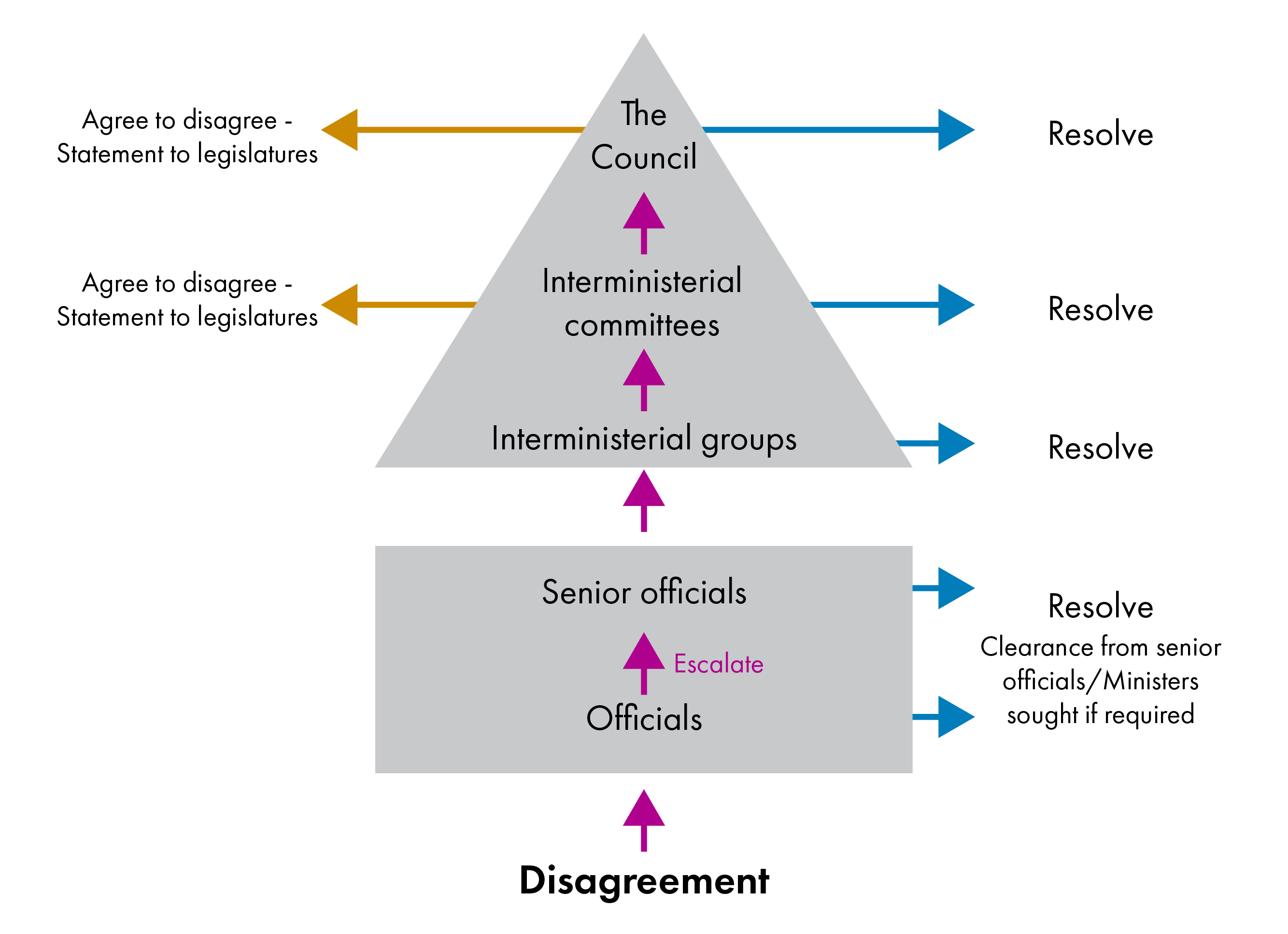
At the lowest level, interministerial groups comprising portfolio Ministers attempt to resolve the disagreement. If their attempts are unsuccessful, the issue can be escalated to an interministerial committee. If the committee is unsuccessful in resolving the issue, it can either agree to disagree, in which case each government makes a statement to their legislature or escalates the dispute further. If a dispute is escalated to the highest level, third-party advice or mediation should normally be sought and made available to the Council. If the Council fails to find agreement, it is again required to make a statement to their legislatures.
The new process includes more extensive reporting requirements. The IGR secretariat is required to report on the outcome of disputes at the final escalation stage, including on any third-party advice received. Each government is required to lay this report before its legislature.
The Office for the Internal Market (OIM) can provide expert, independent advice to the UK Government and devolved governments which may be used by governments as evidence during a dispute. Rachel Merelie of the OIM explained the position whilst giving evidence to the House of Lords Common Frameworks Scrutiny Committee in November 2021:
The OIM is not involved in dispute resolution. We are here to provide advice to government, using our economic and technical expertise…It is of course possible…that our reports are considered in some shape or form as evidence in support of that process, and we remain open to being used in that way.
Framework analysis and scrutiny
This section provides analysis of the Resources and Waste framework, and summarises parliamentary scrutiny of the framework.
Scrutiny in the Net Zero, Energy and Transport Committee
Scrutiny of the provisional framework was undertaken by the Net Zero, Energy and Transport (NZET) Committee in Session 6, integrated into its Stage 1 scrutiny of the Circular Economy (Scotland) Bill (now Circular Economy (Scotland) Act 2024).
The Committee noted: "the Resources and Waste Common Framework is still provisional to allow for parliamentary scrutiny around the UK. However, it is operating. Given the situation which has arisen in attempting to implement a Deposit Return Scheme (DRS) in Scotland, it does not appear to the Committee it is operating optimally. The Scottish and UK Governments have different opinions on the reasons for that. The UK Internal Market Act 2020 is a complicating factor in the operation of this and other common frameworks".
The Committee said that "In light of this, the Committee believes it necessary to consider whether the Resource and Waste Common Framework contains sufficient guidance on how Governments should work together to navigate the UK Internal Market Act 2020 challenges".
The Committee also maintained its recommendation made on previous common frameworks that the Scottish Government must seek to work with the UK Government "to provide clearer guidance for how Common Frameworks will operate within the current regulatory landscape in Scotland, particularly with regards to its interaction with the UK Internal Market Act 2020, devolved competence, international trade treaties and the role of environmental oversight and enforcement bodies".
The interaction between the framework and how it had been used or followed to support discussions with the UK Government about the Scottish DRS was also discussed in the NZET Committee on 13 June 2023, with the Scottish Government stating that the processes in the framework were not followed.
Scrutiny at other legislatures
This section provides information on scrutiny of the framework at other legislatures.
The House of Lords Common Frameworks Scrutiny Committee considered the framework at their meeting on the 7th February 2023 and in a letter to the Secretary of State for Environment, Food and Rural Affairs, made the following observations, questions and recommendations.
Involving devolved administrations: the Committee asked for examples of involving the devolved administrations and whether the absence of a functioning Northern Ireland Executive was having an impact.
How has managing divergence been working in practice 'particularly since the passing of the Environment Act 2021?
Recommended that the framework is updated with an annex 'containing a full breakdown of the areas of reserved and devolved competence and the associated interactions and a list of relevant statutory instruments.'
Recommended more detail in the international obligations section.
Recommended the framework is updated to include more detail on how it interacts with other frameworks e.g. Air Quality, Agriculture, Organic Farming and more.
Recommended the framework is updated to include 'sufficient, detailed information on stakeholder engagement'
Request more information on access to advisory groups and research support
How will the Northern Ireland Protocol Bill (now Act) affect the operability of the Common Framework?
Set out how the Retained EU Law (Revocation and Reform) (REUL) Bill (now Act) will impact on the operability of this common Framework.
UK Internal Market Act: 'the Government has accepted our recommendation to update all common frameworks to include text referencing the UK Internal Market Act (UKIMA) exclusions process in principle.' Request the Government to 'provide a timeline for their proposed discussions with the devolved administrations on this matter'
Clarify future reporting mechanisms will be put in place (including in the devolved assemblies) to ensure future accountability.
The framework has been considered by the Welsh Parliament's Climate Change, Environment, and Infrastructure Committee. It has also been considered by the House of Commons' Environment, Food and Rural Affairs Committee.
Current policy position
Devolved and reserved areas (and UK-wide schemes in devolved areas)
Waste is generally a devolved area, and prior to EU exit the Scottish Government pursued distinct approaches to waste policy to the rest of the UK under a framework of EU law, both in relation to waste processing and measures to reduce waste.
That has included distinct (non-statutory) recycling targets, banning the landfilling of biodegradable municipal waste (expected to come into force at the beginning of 2028), introducing a single-use charge on carrier bags and developing its Deposit Return Scheme on a Scotland-only basis prior to UKIMA.
A number of areas of waste policy and regulation have also been pursued at UK-level (including before EU exit) due to UK internal market reasons or the overlap between devolved and reserved areas. Principal examples of this are UK-wide producer responsibility schemes for packaging, electrical and electronic equipment (EEE), batteries and end of life vehicles (ELVs).
Some specific areas of waste regulation are reserved because they fall under reserved areas of product standards, import and export control or reserved fiscal areas e.g. the plastic packaging tax.
Scottish Government waste and circular economy policy
The Scottish Government has committed to support a transition to a circular economy in Scotland, moving from a "take, make and dispose" model to one where materials are valued and kept in use. The Scottish Government published a Circular Economy and Waste Route Map to 2030 in December 2024 which sets out that it is designed to drive progress on three key fronts:
Setting the strategic direction and laying foundations for delivery of a system-wide, comprehensive vision for Scotland’s circular economy from now to 2030 – based on Responsible Production, Responsible Consumption, and Maximising Value from Waste and Energy
Setting out priority actions from now to 2030 to accelerate more sustainable use of resources across the waste hierarchy
Reducing emissions associated with resources and waste.
A Circular Economy Strategy was also published by the Scottish Government in March 2026 (a requirement of the Circular Economy (Scotland) Act 2024), which sets out key policy mechanisms, priority sectors and monitoring arrangements for developing a circular economy in Scotland.
Key issues
Looking ahead to forthcoming circular economy policy development and milestones:
The Circular Economy (Scotland) Act 2024 ('2024 Act') puts a duty on Scottish Ministers to introduce regulations imposing national circular economy targets (but does not set a statutory timeframe for when this must be done by). The routemap includes a policy commitment to set circular economy targets by 2027.
The Circular Economy Strategy also includes a commitment to progress 'Product Stewardship' i.e. tackling specific products based on their environmental and economic impact. The Strategy states that the Scottish Government will work with the other nations in the UK and "continue to prioritise packaging, waste electrical and electronic equipment (WEEE), batteries, end-of-life vehicles (ELVs) and end-of-life fishing gear". In addition, the Scottish Government states "we will prioritise textiles (clothing), mattresses and furniture".
The operation of UKIMA has clearly caused tensions between the UK and Scottish Governments in the circular economy space, principally around the issue of a DRS for drinks containers and the extent to which different UK schemes could diverge (discussed in the NZET Committee on 13 June 2023 and on 27 May 2025). A DRS for single-use drinks containers is now due to launch in October 2027 in Scotland, England and Northern Ireland under an aligned approachi.
Notably, the UK Government published a policy position on a UKIMA exclusion on 12 February 2026 which will enable the Welsh Government to include glass in a DRS from 2031, whereas the previous UK Government did not agree an exclusion for glass for Scotland in 2023.
The agreement of an exclusion from UKIMA principles in respect of the 'single-use plastics ban' in 2022 also arguably showed the UKIMA exclusions process working, although the Scottish Government described the negotiations around this process as "protracted", and there was minimal policy divergence in this instance.
More recently, the UK and devolved governments sought to align approaches for both the ban on single-use vapes (which came into force on 1 June 2025, with the Regulations in Scotland being amended to delay the ban slightly to align with regulations in other parts of the UK), and ban on wet wipes containing plastic (expected to come into force in Scotland in August 2027).
However, it is clear that interactions with UKIMA (and relatedly, intergovernmental working) has become a central issue where circular economy policies relate to marketed products and services, and the scope for future divergence of approaches under the framework, and following the UKIMA review discussed in previous sections, is largely still to be tested.
At the international level, since the agreement of the Provisional Framework there have been relevant developments, and negotiations are progressing in some key areas which relate to waste management and resource use, for example:
The Global Biodiversity Framework was agreed in December 2022 under the UN Convention on Biological Diversity, which sets ambitious targets for halting and reversing nature loss including targets relating to sustainable consumption and waste reduction.
Steps have been taken to develop a new treaty to address plastic pollution under the UN framework, although negotiations on a draft text in August 2025 in Geneva failed to come to a resolution and next steps are currently uncertain.
There is also a question of to what extent the Scottish Government will seek to keep pace with evolving EU standards in relation to waste, resource management and the circular economy.
There have been significant developments at EU level aimed at developing a circular economy, both in the run up and following EU exit and as part of the European Green Deal. For example, since the framework was published in 2022:
A new EU Regulation on microplastic pollution entered into force in December 2025 seeking to reduce pollution from plastic pellets
A new EU Regulation on packaging waste entered into force in 2025
The EU Ecodesign Directive was replaced by the Ecodesign for Sustainable Products Regulation (ESPR) in 2024. It is framework legislation which enables phased introduction of new rules to make products more durable, reusable, repairable and recyclable. Rules adopted under the ESPR include recent measures banning the destruction of unsold clothing and footwear.
A new Directive on repair of goods establishing a “right to repair” entered into force in 2024
A new Batteries Regulation was adopted in 2023
A range of new pilot measures were also announced in December 2025, with a particular focus on plastics (and developing markets for recycled plastic).