Intergovernmental activity update Q3 2026
This update gives an overview of intergovernmental activity of relevance to the Scottish Parliament between the Scottish Government and the UK Government, the Welsh Government, and the Northern Ireland Executive during quarter three (July to September) of 2026.
Introduction
SPICe publishes quarterly updates to give an overview of intergovernmental activity.
'Intergovernmental activity’ refers to work between governments – in a Scottish context between the Scottish Government and the UK Government or other devolved governments. It can include discussions on areas of mutual interest, policy development, and policy implementation.
Read more about what intergovernmental activity is and why awareness of it is an essential element of parliamentary scrutiny on our SPICe blog. SPICe has published an explainer briefing on intergovernmental activity and its implications for the Scottish Parliament which looks at issues that may be particularly relevant in Session 7.
SPICe also maintains an intergovernmental activity hub that collates information on intergovernmental activity of relevance to the Scottish Parliament.
This update reflects information available at the time of publication.
Highlights
.png)
Scottish Parliament Information Centre
Intergovernmental activity
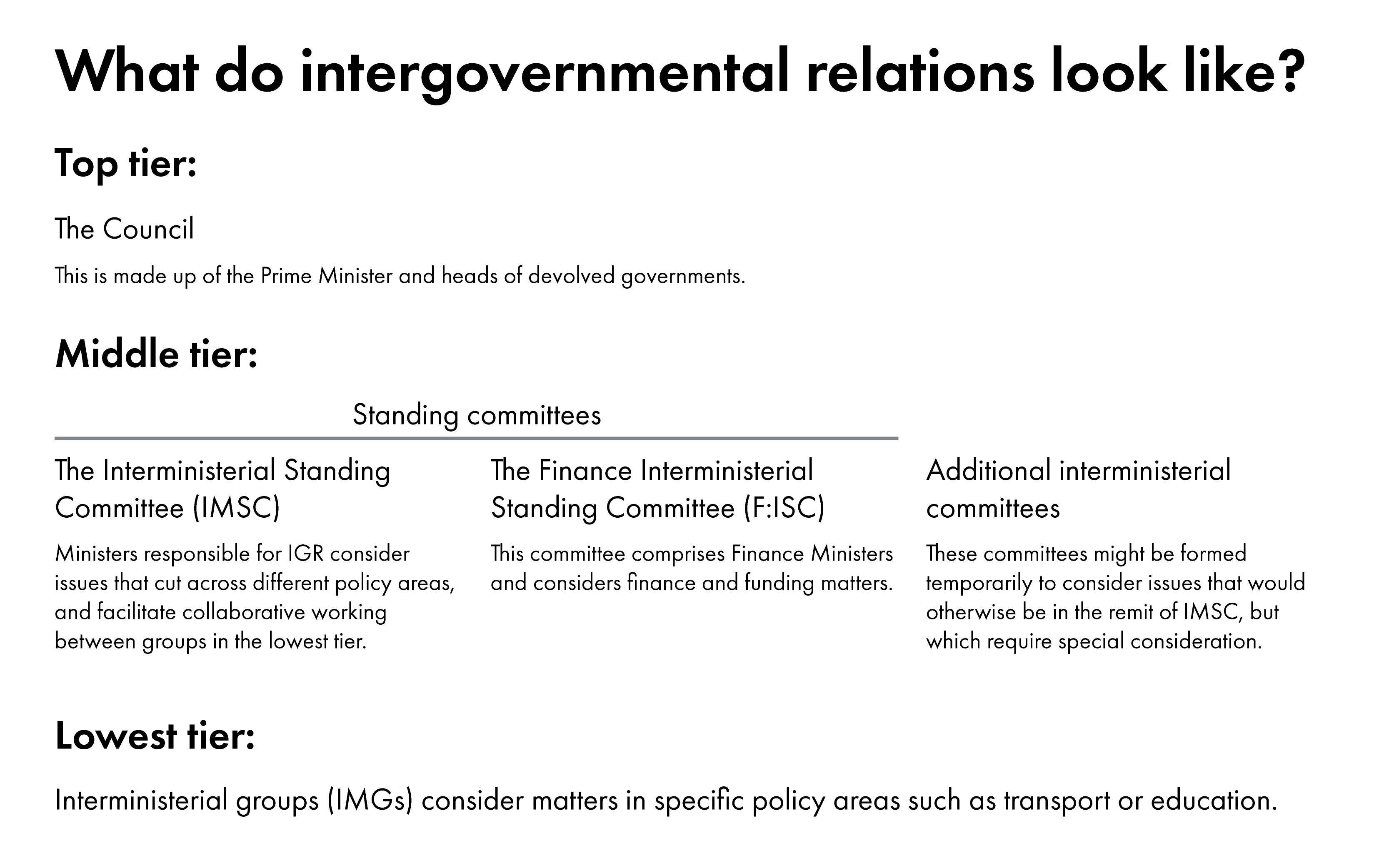
Formal intergovernmental interactions take place under the following three-tier structure, which was established in January 2022.
Scottish Parliament Information Centre
See a SPICe blog for more information on how the three-tier structure operates.
Interministerial meetings

Scottish Parliament Information Centre
Finance: Interministerial Standing Committee
The Finance: Interministerial Standing Committee met on 17 September 2026. The Deputy First Minister and Cabinet Secretary for Finance and Local Government, Jenny Gilruth MSP, attended from the Scottish Government. Discussions included:
the current economic and fiscal context, including the impact of the Iran conflict and cost-of-living measures
priorities for public spending, economic growth and investment ahead of the UK Autumn Budget 2026 and the 2027 UK Government Spending Review.
Ministers also discussed priorities for the period ahead, including areas of shared interest and opportunities for future collaboration.
Interministerial Group for Net Zero, Energy and Climate Change
The Interministerial Group for Net Zero, Energy and Climate Change met on 1 July 2026. The Minister for Europe, External Affairs and Energy, Stephen Gethins MSP, attended from the Scottish Government. The group heard from the UK Minister for Energy on the UK Government's response to the situation in the Middle East and discussed shared priorities. The Minister for Energy also updated the group on UK Government preparations for the next summit with the EU.
Cardiff Agreement
On 14 September 2026, the First Minister of Scotland, John Swinney MSP, and the First Minister of Wales, Rhun ap Iorwerth MS, signed a bilateral framework, called the 'Cardiff Agreement'. The Cardiff Agreement sets out areas of shared interest and cooperation, including:
tackling child poverty
addressing the cost-of-living pressures
supporting sustainable economic growth
considering fiscal arrangements which support effective government
tackling climate change and strengthening resilience
maximising the opportunities and benefits of relations with the European Union and other international partners
recognising the importance of language, culture, media and sport in expressing national identity, supporting communities and enhancing wellbeing.
The Cardiff Agreement also states:
These common endeavours are rooted in the belief that the relationship between all governments of the United Kingdom should be underpinned by trust and mutual respect. The United Kingdom in its current form is unjust and unsustainable. We will use every opportunity available to us to press the case for greater fairness for Wales and Scotland in areas such as the operation of the UK funding arrangements and powers over our constitutional future.
The Cardiff Agreement is not legally binding but states that it "represents a foundational commitment to strategic partnership and the pursuit of common goals". SPICe has published a blog providing further detail on the agreement.
The First Minister of Scotland wrote to the Europe, External Affairs and Culture Committee on 14 September 2026 to notify it about the Cardiff Agreement.
Common Frameworks
Common Frameworks are intergovernmental agreements which set out how governments will work together to make decisions about policy in certain devolved policy areas, in particular decisions about policy divergence.
They were originally intended to be used to consider matters which were former EU competences, however, some also state that they may be used to consider related matters within the wider policy area. You can read more about what common frameworks are on SPICe's intergovernmental activity hub and in an explainer briefing on common frameworks and their implications for the Scottish Parliament.
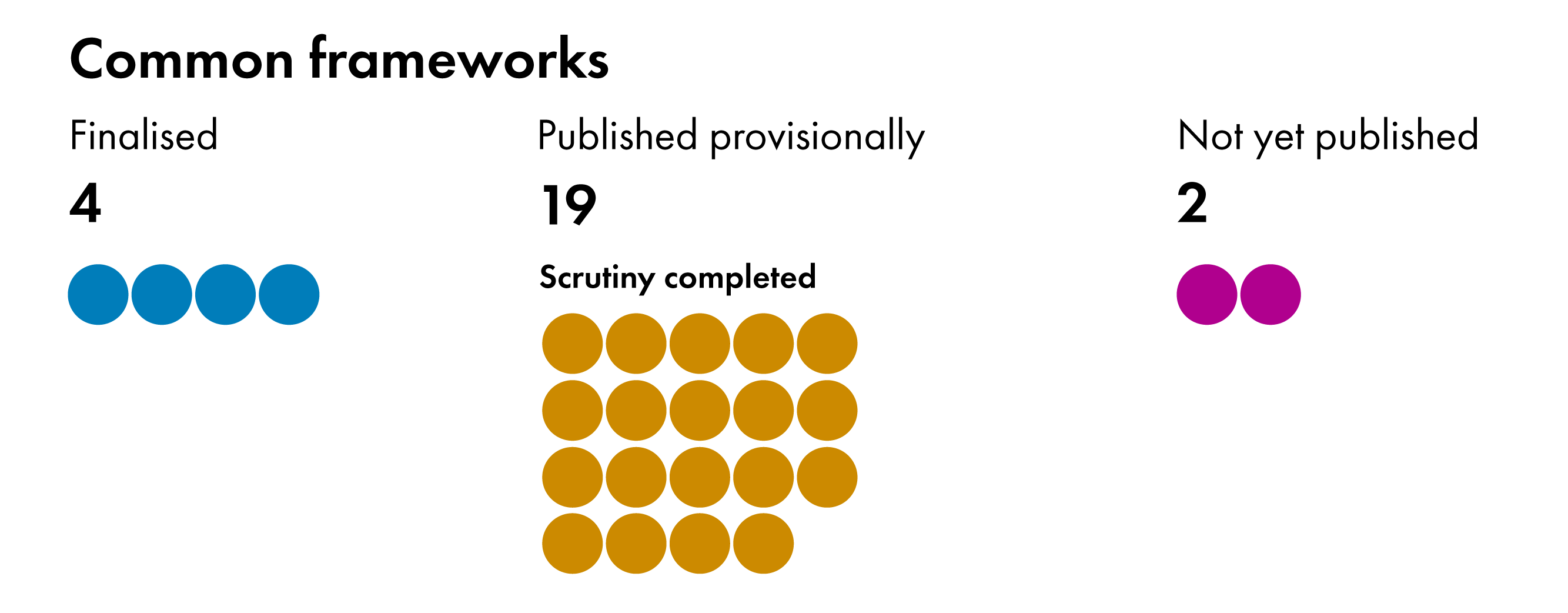
Scrutiny of all currently provisionally published frameworks that apply to Scotland has been completed at the Scottish Parliament. The image below provides an overview on frameworks relevant to Scotland and scrutiny of frameworks at the Scottish Parliament.
Scottish Parliament Information Centre
'provisionally published': Common framework agreements are published in draft form to enable scrutiny. They may be revised before finalisation.
'scrutinised': Common framework agreements can be examined by the four UK legislatures.
'operational': Common framework forums facilitate intergovernmental activity in the policy area covered by the framework, in line with the processes set out in the agreement.
'finalised': Common framework agreements are republished to reflect any changes made following parliamentary scrutiny.
These terms describe key points in the development and use of common frameworks, but they do not represent a set of sequential stages. For example, a framework may be provisionally published and become operational while parliamentary scrutiny is still ongoing.
Policy and regulatory developments
This section summarises intergovernmental discussions relating to specific policy and regulatory developments, including issues concerning the UK internal market.
Programme for Government
On 2 September 2026, the Europe, External Affairs and Culture Committee sought the Scottish Government's initial assessment of whether Bills announced in the Programme for Government were likely to interact with Common Frameworks, the UK Internal Market Act 2020, EU alignment commitments or other considerations requiring cooperation between governments. In a response dated 7 September 2026, the Deputy First Minister and Cabinet Secretary for Finance and Local Government, Jenny Gilruth MSP, noted:
• Food Prices (Scotland) Bill: the Internal Market Act’s mutual recognition principle, which can nullify devolved policies, is unlikely to apply to legislative provisions setting price caps; however the Act’s non-discrimination principle may be relevant. The extent to which the Internal Market Act may impact final proposals will however depend on the final design of any scheme.
• The Football Banning Orders (Scotland) Bill may require engagement on matters relating to, for example, co-ordination with criminal justice and related agencies in other parts of the UK.
• The Budget Bill, will, as in previous years, be informed by the outcome of the UK budget this autumn.
The Scottish Government launched a consultation on proposals for price controls on essential food items on 1 September 2026. The consultation is due to close on 24 November 2026. In relation to the UK Internal Market Act 2020, the consultation paper states:
As recognised throughout this consultation, there are many different models and ways the Scottish Government can take forward the price cap proposal. Each design choice may give rise to different interactions with various regulatory regimes: these may include reference to the World Trade Organisation, the Competition and Markets authority or the application of the United Kingdom Internal Market Act (UKIMA) 2020.
Legislation that sets limits on the price at which goods are sold, such as a price cap, is a “manner of sale” requirement in terms of the United Kingdom Internal Market Act 2020. This means that the mutual recognition principle, which can nullify devolved policies, is unlikely to apply to legislative provisions setting price caps but the non-discrimination principle will be relevant. The final design of any scheme would take into account potential impacts on trade within the UK and information about trade impacts is sought as part of this consultation. The extent to which UKIMA may impact final proposals depends on the final design of any scheme.
Blogs by Professor Nicola McEwen and Professor Thomas Horsley provide further background on potential interactions between the proposals and UKIMA.
Conversion practices
On 4 September 2026, the Equalities, Human Rights and Civil Justice Committee received a letter from the Minister for Equalities and International Development, Simita Kumar MSP, outlining the Scottish Government's approach to ending conversion practices in Scotland. The Minister stated that the Scottish Government was considering whether to seek an extension to Scotland of the UK Government's draft legislation on ending conversion practices, which as currently drafted would only apply to England and Wales. She stated that the Scottish Government has contacted the UK Government and the Welsh Government for further discussion. The Minister also set out that, should legislation not be passed in the UK Parliament, the Scottish Government would introduce its own legislation to end conversion practices in Scotland.
Earlier, in July 2026, the Secretary of State for Scotland, Douglas Alexander MP, told the UK Parliament's Scottish Affairs Committee that the UK Government intended to work with the devolved governments to explore the feasibility of a UK-wide ban on conversion practices.
UK Internal Market Act exclusions
The UK Internal Market Act 2020 (UKIMA) is UK-wide legislation about the trading and movement of goods and services across the United Kingdom. You can read more about the Act's provisions in a SPICe explainer briefing.
A process was established in 2021 by which the UK Government and devolved governments could consider exclusions to the UKIMA market access principles in the appropriate common framework forum.
The UK Government carried out a review of UKIMA in 2025. The review outcomes include a commitment by the UK Government to implement all exclusions that have been agreed by all governments through a common framework and two additional processes for considering exclusions that will operate alongside the common framework process. The UK Government also committed to taking environmental protection and public health considerations into account when assessing potential exclusions. For more information on these changes, see a SPICe blog on the review outcomes.
Deposit Return Scheme
Discussions about a UKIMA exclusion relating to a Scottish Deposit Return Scheme (DRS) for drinks containers took place during 2023. The UK Government offered a temporary, narrower exclusion than the one requested by the Scottish Government, not including glass, which the Scottish Government cited as the reason for its delay of the Scottish DRS scheme. See SPICe blogs from 2023 for background about the scheme and further information about intergovernmental discussions regarding an exclusion.
Following the UK Government's decision, the Scottish Government said it would align its scheme with UK-wide DRS plans. The UK Government, Scottish Government, Welsh Government and Northern Ireland Department of Agriculture, Environment and Rural Affairs agreed in April 2024 to launch interoperable deposit return schemes covering the whole of the UK in October 2027 and the Scottish DRS framework was subsequently amended to reflect this approach.
The Welsh Government announced in November 2024 that it would not proceed with the joint process and would instead pursue its own scheme that includes glass. In February 2026, the UK Government announced that it would make a UK Internal Market Act exclusion for single-use glass bottles in the Welsh DRS Scheme. Glass is not currently included in plans for Deposit Return Schemes in Scotland, Northern Ireland or England. The Welsh Government has also indicated that it intends the scheme to incorporate reuse in future, with discussions on any further UKIMA exclusions required for reuse elements of the scheme underway. The Deposit Scheme for Drinks Containers (Wales) Regulations 2026 were made on 25 March 2026. They provide for a four-year transition period for in-scope glass drinks containers.
In a written statement on 20 August 2026, the Welsh Government confirmed that a deposit management organisation, Exchange for Change, has been appointed. This is the same organisation that will operate the DRS schemes in the rest of the UK.
Horticultural peat
The Scottish Government has a long-standing commitment to phase out the use of peat in horticulture, and, in 2023, consulted on proposals for a staged ban on the sale of peat - beginning with the retail horticulture sector. Similar proposals have been explored elsewhere in the UK. In 2023, the Office for the Internal Market assessed the potential impacts of proposals to ban the sale of horticultural peat in England. SPICe's intergovernmental activity update Q4 2023 provides more background.
The Scottish Government committed to ban the sale of horticultural peat in its 2026-2040 Climate Change Plan. In January 2026, then Minister for Agriculture and Connectivity (now Minister for Agriculture, Marine and the Islands), Jim Fairlie MSP, asked the Secretary of State for Environment, Food and Rural Affairs to set out an indicative timetable for bringing forward UK-wide legislation. In an answer to a parliamentary question, the Cabinet Secretary for Climate Action and Rural Affairs, Gillian Martin MSP, stated on 3 September 2026 that the Scottish Government was “engaged in preparatory work with the other UK nations towards joint legislation to establish an effective ban” on the sale of peat for use in horticulture. The Cabinet Secretary indicated that part of the rationale for a collaborative cross-UK approach was “to overcome the challenges posed by the UK Internal Market Act”.
Office for the Internal Market review on 'Ready-to-burn' scheme
Following a joint referral from the UK and devolved governments, on 17 July 2026, the Office for the Internal Market published its review on the interaction between UKIMA and England’s Air Quality (Domestic Solid Fuels Standards) Regulations 2020.
The Office for the Internal Market concluded that UKIMA's market access principles are coinciding with several other developments contributing to increased sales of cheaper uncertified solid fuels in England. The market access principles "may have increased the pace of certain changes by creating a legal route to supply uncertified fuels to customers in England" and that "the sector will probably continue to evolve towards uncertified fuel in the absence of an exclusion [from the market access principles]." The report recommends further consideration of an exclusion and work on enforcement through the Air Quality Common Framework.
Legislative consent
Scottish Parliament Information Centre
According to the Sewel Convention, the UK Parliament will not normally legislate on devolved matters without the consent of the Scottish Parliament. The Scottish Parliament's standing orders set down rules which apply where UK primary legislation requires the Parliament's consent under the Sewel Convention. They apply where UK primary legislation makes ‘relevant provision’, which means provision which applies to Scotland in any of the following ways:
for any purpose within the legislative competence of the Scottish Parliament
to alter the legislative competence of the Scottish Parliament
to alter the executive competence of the Scottish Ministers.
When any of the criteria on relevant provision are fulfilled, the Scottish Government is obliged to lodge a legislative consent memorandum. A legislative consent memorandum, amongst other things, sets out the Scottish Government's view on whether the Parliament should grant legislative consent.
Following the lodging of the memorandum, Members of the Scottish Parliament may vote on a motion on legislative consent to either grant or withhold consent for the Bill.
More information about legislative consent is available on the Scottish Parliament's website, and in this November 2024 SPICe blog. SPICe has also developed two tools that can be used to track legislative consent at the Scottish Parliament, which can be accessed on SPICe's intergovernmental activity hub.
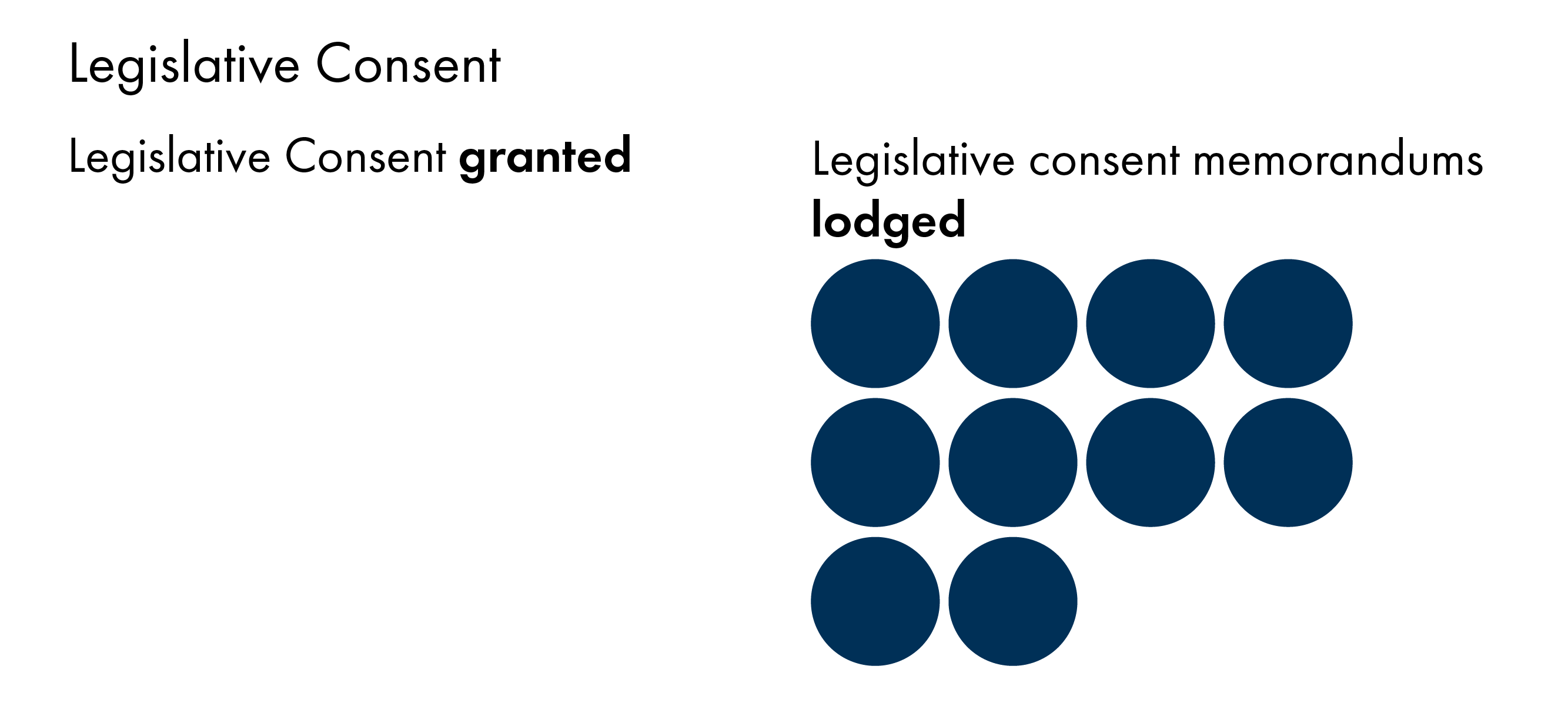
During quarter 3 of 2026, the Scottish Government lodged 10 legislative consent memorandums.
Legislative consent memorandums lodged during Q3 2026
| Bill title | Date memorandum lodged | Consent recommendation by Scottish Government |
|---|---|---|
| Immigration and Asylum Bill | 14 July 2026 | No recommendation on consent |
| Sporting Events Bill (first supplementary memorandum) | 22 July 2026 | No recommendation on consent |
| Public Office Accountability Bill (second supplementary memorandum) | 28 July 2026 | Consent recommended |
| Commercial Payments Bill (first supplementary memorandum) | 06 August 2026 | Consent recommended |
| Representation of the People Bill (second supplementary memorandum) | 21 August 2026 | No recommendation on consent |
| Sporting Events Bill (second supplementary memorandum) | 02 September 2026 | Consent recommended |
| Civil Aviation (Consumer Protection and Regulatory Reform) Bill | 3 September 2026 | No recommendation on consent |
| Cyber Security and Resilience (Network and Information Systems) Bill (first supplementary memorandum) | 10 September 2026 | Consent recommended |
| Representation of the People Bill (third supplementary memorandum) | 10 September 2026 | No recommendation on consent |
| Civil Aviation (Consumer Protection and Regulatory Reform) Bill (first supplementary memorandum) | 17 September 2026 | Consent recommended |
Further information
Information within this intergovernmental update is primarily based on the following sources:
The UK Government intergovernmental relations website contains minutes of interministerial groups and standing committees. Minutes of other intergovernmental meetings are not currently published and hence are not reflected in this update.
The UK Government Common Frameworks website contains Common Framework agreements.
The Scottish Parliament legislative consent website lists legislative consent memorandums and associated motions.
Statements by governments and correspondence with parliamentary committees listed on the Scottish Parliament website.
Further information on intergovernmental activity can be found on our intergovernmental activity hub and:
A SPICe explainer briefing on intergovernmental activity and its implications for the Scottish Parliament and an explainer briefing on how devolution works.
UK Government transparency reports on intergovernmental relations and quarterly intergovernmental relations engagement dashboard
The Office for the Internal Market's Regulatory Developments Dashboard, which tracks potential regulatory differences in the UK’s internal market.