Land Reform - Subject Profile
This briefing sets out the history, legislation, policy framework, public attitudes, ownership trends, community ownership mechanisms, key issues, and possible future directions for land reform in Scotland.
Summary
Land reform in Scotland is an ongoing, multifaceted process aimed at making land ownership in urban and rural areas more transparent, equitable, and beneficial for communities and the environment. Significant post-devolution interventions have been made, including the introduction of community rights to buy and the establishment of a Land Commission. Challenges are considered by some to remain in relation to concentration of land ownership; transparency; and community empowerment and sustainability.
Public attitudes are difficult to quantify, however there appears to be support for diversification of land ownership; tackling vacant and derelict land; better, more targeted taxation and fiscal reforms; tackling depopulation; and addressing the twin climate and biodiversity crises.
Key legislation includes:
Land Reform (Scotland) Act 2003: Introduced public right of responsible access to most land and inland water, and community rights to buy rural and crofting land.
Community Empowerment (Scotland) Act 2015: Extended rights to buy to urban communities and introduced asset transfer requests.
Land Reform (Scotland) Act 2016: Established the Land Rights and Responsibilities Statement, and new transparency measures.
Land Reform (Scotland) Act 2025: Requires large landholdings (>1,000ha) to develop, consult on, and publish Land Management Plans, and introduces provisions in relation to compulsory fragmentation (lotting).
Ownership Trends and Data
Land ownership in Scotland is highly concentrated: 408 landowners own 50% of privately owned rural land.
Community land ownership has increased by 26% since 2012, now covering 2.7% of Scotland's land area.
Public sector land holdings have decreased, while community ownership and private concentration have grown.
Transparency of ownership remains a challenge due to fragmented data sources and incomplete property registers.
Future Directions and Recommendations
The Scottish Land Commission has proposed three pillars for reform:
Opening up land: Diversify ownership, create small-scale holdings, use public land proactively.
Rebalancing power: Ensure ownership serves the public good, introduce mechanisms to intervene in misuse.
Shaping change locally: Strengthen regional and local planning, make local benefit a feature of land use change.
Key Session 7 changes are the implementation of the 2025 Act, primarily the appointment of a Land and Communities Commissioner, and development of detailed regulations on Land Management Plans. Possible further reforms include changes to community rights to buy (following a recent review), and the introduction of a Rural Renewal Bill.
Introduction
Scotland's engagement with land reform spans generations and continues to be influenced by long‑standing debates concerning who owns the land (and whether that matters), how it is used, and who benefits. These discussions also encompass questions of transparency and whether reforms to existing ownership patterns and structures could better serve the public interest.
This SPICe Briefing provides an introduction to the broad subject of land reform in Scotland, exploring a range of topics, devolved and reserved, urban and rural. Key pieces of legislation and the current policy framework are also explored, including a look at what is likely to come forward in Session 7. It does not cover agricultural holdings or crofting, which are often wrapped up into land reform debates - these issues are covered in Land use in Scotland - Session 7 subject profile.
A previous SPICe Briefing on Land Reform in Scotland1 provides a comprehensive history of land reform measures up to 2015.
What is land reform?
What land reform actually entails depends largely on a range of environmental, social, economic and cultural factors that are specific to the country where reforms are taking place.
The origins of the modern land reform movement in Scotland have often been portrayed as being focussed on righting historical injustices, as well as redressing local power imbalances in favour of communities over (often absentee) landowners 12. For example, following a"long period of insecurity and instability" the Isle of Eigg Heritage Trust took ownership of the island in 1997 (pre-dating the re-establishment of the Scottish Parliament in 1999), citing 3:
A lack of home and business security.
Poor housing conditions.
Unemployment.
Lack of employment opportunities – with seasonal work patterns.
Poor infrastructure – no mains electricity supply.
Actions to address this perceived lack of local democratic decision making led to early post-devolution legislation abolishing the feudal land tenure system and establishing a right for rural communities to register an interest in buying the land where they lived, if it was to be sold 45678.
Land reform was, until 2015, largely perceived in fairly narrow terms as a question of the ownership and occupancy of rural land and the rights of local communities. However, more recent reforms have significantly broadened the scope of relevant policy (considered in detail in the next section).
Whilst Scotland's system of land ownership is defined by Scots law, a modern contextual definition of land reform was only set out in 2014 by the Scottish Government's independent Land Reform Review Group as 9:
[…] measures that modify or change the arrangements governing the possession and use of land in Scotland in the public interest.
The Scottish Land Commission, who provide "evidence, advice and practical guidance to government, landowners, communities and businesses to keep land reform moving forward" state 10:
Land reform is about who owns Scotland’s land, how it is used, and how the benefits from it are shared.
It is about making sure that land contributes to a fair, green and thriving country for the people who live and work here now, and for future generations.
Land reform is not one piece of legislation. It is an ongoing programme of change in law, policy and practice that continues to shape how land is owned, managed and governed.
The Land Rights and Responsibilities Statement sets out the Scottish Government's high level aim to bring about 11:
a Scotland with a strong and dynamic relationship between its land and people, where all land contributes to a modern, sustainable and successful country, supports a just transition to net zero, and where rights and responsibilities in relation to land and its natural capital are fully recognised and fulfilled.
Since the establishment of the Scottish Land Commission in 2017, the debate has evolved to become more focussed on the outcomes of how land is owned, used and managed, and the extent to which this is in the public interest. It is now considered to be more reactive to changing economic, social and cultural factors, and spans topics as diverse as 10:
Housing - unlocking land to build homes.
Regeneration - bringing vacant and derelict land back into use.
Economy - exploring how the value of land, including how it is taxed, can support jobs, local businesses and shared prosperity.
Environment - ensuring that climate driven land use change is in the public interest.
Public sector - making the most of publicly owned land for public benefit.
Communities - strengthening local voices in decisions about land and creating opportunities for community ownership.
Power - understanding how ownership, governance and decision making shape places.
Legislation - creating a fairer more transparent land system.
Discussion - debating and collecting evidence on how land should be owned, used and shared in the future.
Scotland's land
Land is a vital natural asset, and is the platform upon which our society and economy is built. It supports life, underpins livelihoods, and supplies much of our food and natural resources. Whilst often viewed through the lens of physical geography, landscapes (both urban and rural) are equally about people. This includes those who live and work on the land, as well as those who benefit from what it produces; food, energy, and recreation as well as the wider ecosystem services it provides 1.
A fixed amount of land has to meet many different—and often competing—needs, which look very different from one place to another. These demands are becoming more complex as the climate and biodiversity crises deepen 2.
The Royal Institute of International Affairs (known as Chatham House) recognises the need for "transformational changes to land use and its governance", and calls for governments to "make land an urgent priority, and put in place institutional changes that embed land [conflicts] at the centre of domestic, foreign and economic policy" 3.
The Scottish Government's spatial strategy (National Planning Framework 4) sets out the domestic context 4:
Scotland’s rich heritage, culture and outstanding environment are national assets which support our economy, identity, health and wellbeing. Many communities benefit from great places with excellent quality of life and quality, affordable homes. Many people can easily access high quality local greenspaces and neighbourhood facilities, safe and welcoming streets and spaces and buildings that reflect diverse cultures and aspirations. Increasingly, communities have been finding new ways to live sustainably, including by taking control of their property or land.
However, people living in Scotland have very different life chances, at least partly a result of the places where they live.
Past industrial restructuring has had significant impacts in some places and communities. Disadvantage, child poverty and poor health outcomes are concentrated in parts of Scotland where life expectancy is significantly lower than in more advantaged areas. Access to the natural environment varies, and pollution and derelict land is concentrated in some places. Population change will bring further challenges in the future, particularly in rural parts of Scotland. Many people have limited access to opportunities because of the way our places have been designed in the past, and our city and town centres have experienced accelerating change in recent years.
And the Scottish Government's Fourth Land Use Strategy 2026 - 2031 notes the interconnected nature of the land system, identifying the following key themes 5:
Nature and climate.
Jobs, skills and economy.
Communities, place, people and equity.
Public attitudes
Accurately mapping and quantifying public attitudes to land reform is a complex and nuanced endeavour. It appears that, if asked about support for "land reform", a significant majority of members of the public will not have a view. However, if asked about specific reforms, then stronger responses emerge. In 2021 the Scottish Government published research on attitudes to land reform1 which noted:
There is low awareness of the Scottish Government's land reform agenda as a whole [...]. However, once explained to participants, there is considerable support for the overall aims and for specific policies on diversification of land ownership, vacant and derelict land, access rights and community involvement in decision-making.
More recently (2025), research commissioned by Revive – The coalition for grouse moor reform found that 2:
Despite growing political focus on land reform, public awareness remains low. When asked how much they knew about the Scottish Government's plans, just 1% of respondents knew a lot while 49% knew nothing at all.
[However]
When presented with potential reforms, public support was strikingly high. 78% supported requiring large landowners to meet climate and nature targets. 67% supported a land tax for large landowners and more than half (53%) supported land reform in general.
Key points from the Scottish Government's 2021 research include 1:
Participants tended to think first about rural land that has not been built on. However, the following issues were raised unprompted: concentrated land ownership, absentee landlords, housing developments encroaching on the green belt, derelict land, land bankingi and disputes over access rights.
Most people said they supported plans to diversify land ownership. There was general support for a greater number of landowners (though less importance was placed on widening the types of owners). However, others felt it mattered less who owned the land, and more how they treated it.
44% of respondents were concerned about vacant or derelict land in their own area. Even among those who had little vacant or derelict land near them, there were concerns about the detrimental effect on wellbeing for those who did. There was a concern that it can be in the interests of landowners to keep land derelict and there was support for tighter regulations to limit this.
When asked specifically about how important it is to consider the protection of wildlife and climate change when making decisions about land use, there were high levels of concern about both (96% thought protecting wildlife should be an important factor and 89% thought climate change should be an important factor).
Revive note "that Scottish residents see land reform as an important cross-cutting issue; and one that underpins other economic and social problems." 2, including:
Calls for an end to hidden land ownership, with a desire for transparency about who owns what land.
Large landowners to be held more accountable for the way their land is managed.
Limits on how much land can be owned by one person or company, to prevent increased concentration of land ownership.
Communities given real power over land decisions that affect them.
Land reform policies that help deliver more local jobs and housing.
Some form of land tax to fund these transformative changes.
ScotLand Futures, a recent (2025) engagement and consultation exercise by the Land Commission, sought to find out "how land should be owned, used and shared in the decades ahead" 5. Explored in more detail below, it surveyed over 1,200 people from across Scotland, and commissioned 20 relevant experts with diverse experiences to share their perspective on what a land reformed Scotland would look like, as well as holding public meetings and analysing in-depth submissions ii.
When asked “What changes would you like to see in how land is owned and used in Scotland” 96% of participants wanted to see change, with a strong feeling of impatience for progress across every theme.
Some said government and agencies have moved too slowly on longstanding issues; others said there’s been too much talk and too many short-term initiatives. By contrast, a small number feel that a perception of continual legislative change is getting in the way of investment and development, but even those wary of change would welcome clarity and certainty. All agree that leadership and delivery are needed. 5
However, Scottish Land and Estates (the membership organisation representing Scotland's land owners and managers has questioned some of the more detailed statistics from the Land Commission's work, and state 7:
Land based businesses are all for change that will benefit rural Scotland and are at the forefront of delivery.
We have long held the belief that the debate around land reform needs to be modernised and based on outcomes for people, jobs and nature rather than ideological stances on ownership. If we do that then positive change – which is supported and embraced by land-based businesses – can be achieved.
Scottish Land and Estates have also commissioned research (2025) to "gauge public attitudes towards rural policy", and found that "land reform was ranked lowest of all, with only 6% of respondents considering it a priority" 8. This is explored in more detail in a later section.
The most recent parliamentary scrutiny of land reform, carried out during the passage of the Land Reform (Scotland) Act 2025 (considered in more detail below) lasted for over 18 months (March 2024 - November 2025), and the Stage 1 call for views received 122 responses with varying degrees of support for the proposed measures 9.
Ownership trends and data
Scotland's Register of Sasines is the oldest national public land register in the world, dating back to 1617.
It is widely acknowledged that knowing who owns land, who has the power to make decisions on how it is managed, and who is benefiting is fundamentally important. However, actually delivering an accessible, navigable, affordable, complete, and accurate portal for this information is more complex, given the disparate sources of Scotland's land data. There are a number of public sources of information covering use, ownership and control etc, but no single source - which makes assessing, monitoring, reporting on, and updating a Scotland-wide picture of land ownership trends a significant undertaking 12345.
In 2024, the James Hutton Institute carried out a Review of land ownership data in Scotland and concluded that the "only readily usable source of land ownership data with both land parcels and owners attributed is Who Owns Scotland, the outcome of a private citizen's initiative" 5.
The Who Owns Scotland website is run by Andy Wightman, former MSP and land reform expert. He also publishes an annual report on landownership in Scotland 7, and notes that 83% of rural Scotland is owned by private entities (individuals, companies, trusts etc.). Further key points include:
The ownership of privately-owned rural land has become more concentrated since 2012 as a result of existing owners acquiring more land.
408 landowners own 50% of the privately-owned rural land compared to 421 in 2024 and 440 in 2012.
2413 landowners own 70% of the privately-owned rural land compared to 2588 in 2024 and 3161 in 2012.
The public sector estate has decreased by 58,650 ha (6.3%) since 2012.
Community landownership has increased by 44,191 ha from 172,294 ha in 2012 to 216,485 ha in 2025 (a 26% increase in extent).
The information above is compiled by purchasing and then analysing individual entries in the relevant registers, and set out in searchable map form on Who Owns Scotland. At present (September 2026), the research (funded by subscription) accounts for the ownership of 77.25% of rural Scotland. Whilst every effort is made to ensure that the analysis is correct, it is not independently verified or validated.
It should also be noted that whilst an individual may own a parcel of land, it could also be owned by a legal entity (community bodies, trusts, companies etc.) with multiple officeholders, members or shareholders. Yet, the statistics above might show a single owner.
The work of Registers of Scotland, land market data, and the analysis / reporting of market trends is considered in more detail in later sections on Transparency, and Ownership information and improving transparency.
Land Reform post-devolution
This section maps the legislative and policy framework for land reform measures in Scotland.
It starts by summarising the key pieces of legislation, and then sets out the policy framework and explores associated issues.
Key legislation
Since the re-establishment of the Scottish Parliament in 1999 there have been four key pieces of legislation that specifically relate to land reform. These underpin a complex policy framework that encompasses measures such as community rights to buy, transparency, rights and responsibilities, and the Scottish Land Commission.
The Land Reform (Scotland) Act 2003 introduced a public right of responsible access to land (as set out in the Scottish Outdoor Access Code), the original rural Community Right to Buy (CRtB) land (including buildings), and the Crofting Community Right to Buy.
In relation to land reform, The Community Empowerment Act 2015 extended the original CRtB to urban communities, and introduced a new right to buy land which is abandoned, neglected or detrimental, where the owner is not willing to sell. It also allowed for asset transfer requests which give community bodies a right to request to buy, lease, manage or use publicly owned land and buildings (i.e. owned by local authorities, public bodies, or Scottish Ministers etc). This Act also establishes a requirement for local authorities to establish and maintain a register of common good propertyi.
The Land Reform (Scotland) Act 2016 introduced the Land Rights and Responsibilities Statement (LRRS), and provided for the establishment and functioning of the Scottish Land Commission (with six Commissioners), introduced a Register of persons holding a controlled interest in land, and a right to buy land to further sustainable development. Amongst other measures, this Act also made changes to agricultural holdings legislation, and repealed the exclusion of shootings and deer forests from the valuation roll.
The Land Reform (Scotland) Act 2025 seeks to create community engagement obligations by requiring large landholdings (broadly, holdings over 1,000ha) to produce, consult on and publish Land Management Plans and introduces a Land and Communities Commissioner with powers to enforce community engagement obligations. In the event of a transfer of all or part of a large land holding, a modified process for registering an interest in the pre-emptive right to buy for a local community and/or lotting (i.e. compulsory fragmentation) is also provided for. N.B. Many of the provisions in the Act have yet to be commenced. It is expected that further consultation will take place, and secondary legislation will come forward in Session 7.
Policy framework
Key policies, actions stemming from this legislation, and associated issues are explored in more detail below.
Community ownership mechanisms
A collection of legal powers allow legally constituted Community Bodies to buy land and buildings where they live. There are four separate Community Rights to Buy (CRtB), and associated mechanisms.
Community Right to Buy
Part 2 of the Land Reform (Scotland) Act 2003 allows communities to apply to register an interest in land or buildings, and to be given the first right of refusal for 8 months should the landowner decide to put the land up for sale.
It provides pro-active groups, who have identified a need within their community for an area of land or a building and have successfully registered an interest on that land or building, with the first option to buy that asset.
Crofting Community Right to Buy
Part 3 of the Land Reform (Scotland) Act 2003 gives crofting communities the right to acquire and control the croft land where they live and work.
It is a right which can be exercised at any time, i.e. a successful application results in the land being acquired compulsorily.
Community Right to Buy Abandoned, Neglected or Detrimental Land
Part 3A of the Land Reform (Scotland) Act 2003 allows communities to apply to Scottish Ministers for consent to exercise a compulsory purchase of land or a building, which is wholly or mainly abandoned or neglected, or where the use or management of the land is causing harm to the environmental wellbeing of the community.
Right to Buy Land to Further Sustainable Development
Part 5 of the Land Reform (Scotland) Act 2016 allows communities to apply to compulsorily purchase land or buildings for the purposes of furthering the achievement of sustainable development.
Scottish Government Guidance on these Rights to Buy provides further information on the process.
Community Asset Transfer
Part 5 of the Community Empowerment Act gives community bodies the right to make requests to all local authorities, Scottish Ministers and a range of public bodies for any land or buildings they feel they could make better use of. They can request ownership, lease or other rights as they wish.
These authorities must transparently assess requests against a specified list of criteria and agree the request unless there are reasonable grounds for refusal.
Ownerless Property Transfer Scheme
The Ownerless Property Transfer Scheme (OPTS) is run by the King's and Lord Treasurer’s Remembrancer (KLTR). The KLTR is the Crown’s representative in Scotland, and deal with ownerless property, including "the land, assets and other rights of dissolved companies, the estates of individuals who die leaving no heirs, and treasure found in Scotland". This scheme provides opportunities for local authorities, public bodies and appropriately constituted community bodies to acquire property at cost recovery value, and aims to bring ownerless property back into productive use.
This is a relatively new scheme (launched 1 March 2024), with guidance stating 1:
The OPTS is a distinct pathway to community or public land ownership. It is intended to provide an additional option to the above legislation as an alternative to owned property. The Scheme is also unique in allowing applicants to receive property on a cost-recovery basis, that is, the KLTR’s professional costs only, such as legal advice and conveyancing and valuation fees (but not KLTR administrative staff costs). In most cases, this is expected to be a fraction of the property’s market value.
Community Right to Buy Review
In July 2024 the Session 6 Scottish Government launched a review of four of the rights to buy set out above (excluding Community Asset Transfer and the Ownerless Property Transfer Scheme).
This review concluded in March 2026 and recommended a series of changes, including merging the Part 3A and Part 5 rights, changes to how community bodies are structured and to the ballot thresholds used to indicate community support 2.
One of the key areas that the review identified for change was to the process for late applications under Part 2. An application is considered "late" if it is submitted after the owner has taken an action to transfer the land but before missives are concluded, or an option to acquire is granted.
There has been a general downward trend in approval rates for late applications, with none approved in the last five years. The review noted concerns that the current late application process has failed to adapt to shifts in the market. Therefore, some streamlining of the process is recommended, including to remove the requirement for a detailed business plan at the point that a late application is made.
As yet, there is no indication of how or when these recommendations will be acted on, however they will require legislative changes.
Extent of community ownership
From Annan Harbour in Dumfries and Galloway to Unst in the Shetland Isles, via Port Bannatyne on Bute and Huntly in Aberdeenshire, a diverse range of communities own an equally diverse range of buildings and land assets across Scotland, most commonly purchased by negotiation with a private owner 1. The following searchable maps provide more information on individual projects:
The extent of community ownership is monitored by the Scottish Government's Community Ownership in Scotland statistical publication. The most recent data shows that, as of December 2024 2:
There were 853 assets in community ownership, an increase of 23 (3%) from 830 in 2023. These are owned by 503 groups.
Most assets in community ownership are land and/or buildings. These cover an area of 213,803 hectares, which is 2.7% of the total land area of Scotland.
Na h-Eileanan Siar contains 153,678 hectares of community owned land, 72% of the total land area in community ownership.
The Highland and Argyll and Bute local authorities together contain 326 assets, therefore making up 38% of all assets in community ownership.
There are 21 assets which are not land and/or buildings. These include a ferry, a small boat, a pontoon for berthing watercraft, a single car transporter and salmon fishing rights for a river.
Community groups paid just over £4.0 million for the 23 assets acquired in 2024.
Rural areas of Scotland contain 80% of community owned assets and these assets make up over 99% of the land area in community ownership.
Information on community bodies and the assets where they have registered an interest are held by Registers of Scotland. Right to Buy applications under Part 2 of the 2003 Act are available on the Register of Community Interests in Land. Right to Buy applications under Part 3A of the 2003 Act and Part 5 of the 2016 Act are available on the Register of Applications by Community Bodies to Buy Land.
Right to Buy applications under Part 3 of the 2003 Act are held by the Crofting Commission, who can provide information on request.
As noted above, the vast majority of the 853 assets in community ownership were bought through negotiation. The CRtB registers show that there have been 24 successful Part 2 purchases, and 1 successful purchase each for Part 3A and Part 5. There have been no successful crofting community purchases through the legislation. These relatively low numbers, however, do not take into account the function of the legislation as a negotiating tool to bring owners to the table.
Another form of community ownership is that of common good property owned by local authorities on behalf of communities. Registers of these land and assets are held by local authorities.
Land Rights and Responsibilities Statement
Established under Part 1 of the 2016 Act, first published in 2017 and updated in 2022, the Land Rights and Responsibilities Statement (LRRS) sets out the Scottish Government's vision for land ownership, management, and use across Scotland. It sets out the following key principles 1:
The overall framework of land rights, responsibilities and public policies should promote, fulfil and respect relevant human rights in relation to land, contribute to public interest and wellbeing, and balance public and private interests. The framework should support sustainable economic development, protect and enhance the environment, support a just transition to net zero, help achieve social justice and build a fairer society for the common good.
There should be a more diverse pattern of land ownership and tenure, with more opportunities for citizens to own, lease and have access to land.
More local communities should have the opportunity to own, lease or use buildings and land which can contribute to their community's wellbeing and future development.
The holders of land rights should exercise these rights in ways that take account of their responsibilities to meet high standards of land ownership, management and use. Acting as the stewards of Scotland's land resource for future generations they should contribute to wider public benefit, sustainable growth and a modern, successful country.
Land ownership, management and use should deliver a wide range of social, environmental, economic and cultural benefits.
There should be transparency about the ownership, use and management of land, and this information should be publicly available, clear and contain relevant detail.
There should be meaningful collaboration and community engagement in decisions about land.
Ministers have a statutory duty to promote the LRRS, however it constitutes voluntary guidance rather than legally binding duties for private land owners and managers.
Practical implementation of the LRRS is provided for by the Land Commission through a series of Protocols and Guidance, as well as advice and support, which aims to 2:
Build capacity and confidence in issues related to land ownership, use and management.
Enable and empower landowners and communities to build, improve or mend relationships so that they can identify solutions that suit them and resolve issues in ways that benefit everyone.
Identify common and recurring issues that require further investigation and intervention.
Understand the real-world applicability of the Land Rights and Responsibilities Statement to inform the further development of advice on policy and practice.
Ownership information and transparency
As previously noted, Scotland has a long history of publicly accessible registers of land and property ownership, however the Scottish Government also recognises that "Improving transparency of land ownership [...] is at the very heart of progressing land reform", and that a "key part of ensuring that land rights are clearly defined and transparent, is ensuring we have a comprehensive understanding of land ownership" 12.
This section sets out some of the key measures that allow ownership information to be accessed, and for transparency to be improved. It also explores recent work on how best to integrate relevant information and streamline the process of accessing this.
The James Hutton Institute has identified 18 separate sources of information on land ownership, management and usei, however notes that the "datasets differ in terms of scope, coverage, granularity, frequency of update, and cost of access", and states 3:
[...] land ownership relevant data is fragmented with data collected across multiple organisations with different remits. This leads to partial coverage: spatially, temporally, and thematically. This limits the attribution of tenure to individual land parcels and the identification and classification of active land managers and final beneficiaries of land. Such fragmentation is inherently limiting for transparency as, at best, it implies the need to integrate these sources, a substantially challenging task from a technical and institutional perspective.
Registers of Scotland
In most cases, information on the ownership of individually owned buildings, parts of buildings, or parcels of land (known as titles) can be determined by consulting either the Land Register or the Register of Sasines, held by Registers of Scotland (RoS).
The Sasines Register dates back to 1617, is a register of legal documents associated with land and buildings, partially based on written descriptions of legal boundaries, and costs £30 + VAT to carry out a search.
It is slowly being replaced by the Land Register which began in 1981 and defines precise boundaries on an Ordnance Survey map. For a fee of £3 + VAT, ownership information by individual title can be obtained. Extracting information from multiple titles using specific search criteria involves time-consuming manual research work or, in some circumstances, commissioning a bespoke report from RoS, with prices starting from £432.
In 2014, Scottish Ministers asked RoS to complete the Land Register within 10 years 12. However, in 2022, it was recognised that this target could not be met, and a change of approach to pursue "functional completion" began.
This means that all land and property in Scotland was split into two categories: first, all the land and property which RoS thinks will be the subject of regular property transactions and, second, land and property which RoS thinks will not regularly change ownership. Around 2.5 million property addresses are in the first category, around 1.5 million are in the second category. The second category includes some large, landed estates, as well as social housing stock.
RoS defines "functional completion" as when "most land and property that transacts regularly is on the land register" 3, i.e. those that fall into the first category. For the second category, a project called Unlocking Sasines seeks to use "spatial data to help “unlock” the historic information in the Sasine Register. This allows us to visually represent the Sasine Register for the first time making it more helpful and accessible". Unlocking Sasines (or Indicative Sasines as the data layer is now known) has been available to business customers since December 2024, and to the public since January 2025 4.
As of June 2026, RoS reports that total land mass coverage of both categories has reached 96% 3.
The key policy to improve ownership information and transparency in recent years has been the development of the Register of Persons Holding a Controlled Interest in Land (RCI), provided for by Part 3 of the Land Reform (Scotland) Act 2016, and launched on 1 April 2022.
The RCI shows who controls the decisions of owners and long-term tenants of land and property, which may not be obvious from the property registers or other public sources. This is however a very complicated jigsaw, because those with controlling interests may not have to register with the RCI if their information is held on another transparency regime e.g. They are registered as a charity, a company, or a collective investment scheme.
Recent analysis by investigative journalists has found that two-thirds of overseas entities were not complying with their legal obligation to record details on the RCI. Whilst RoS has no duty to ensure compliance, some monitoring by private individuals has been undertaken, and reports made to Police Scotland where breaches are suspected. To date, no action has been taken 67.
Other relevant registers held by RoS include the Register of Community Interests in Land, and the Crofting Register.
Integrating information and streamlining access
Whilst the property registers may be close to being "functionally complete", this is still a long way from a unified easy-to use and affordable system for accessing a wide range of information about land and property, which RoS was tasked with developing in 2015 12 . A Scottish Land Information Service (ScotLis) was launched in 2017, which provides some property information, such as the title number, date of registration and a plan or the title area.
A 2023 paper jointly commissioned by the Built Environment Forum for Scotland and the David Hume Institute explores the background to ScotLIS, and makes a case for a refreshed approach. ScotLIS 3 – a critical tool for Scotland Scotland’s land information service: what is it and why it matters states 3:
Information about land is vital. It is used by businesses, policy-makers, academics and others every day. As the climate crisis intensifies, there is even more need for better, more timely, more comprehensive and more accessible information about land.
Such information is varied and ranges from information on land ownership to valuation, from energy efficiency ratings to building types and from vegetation cover to hydrology and flood risks.
All of this information exists in some form and some of it is relatively accessible. However, much of this information is not easily available and virtually none of it is made available in an integrated form. This means that the effort to source the information, to collate it and to analyse it is time consuming, costly and, in some cases, impossible.
It goes on to note that ScotLIS is an "important first step in acting as an effective portal for searching the Land Register", however there was consensus amongst stakeholders that progress has stalled due to a "failure of political leadership, in particular to establish the governance framework necessary to deliver the ambitions set out in 2015".
Recently published work by the Land Commission on Learning from international cadastral systems for transparency, tax, and valuation has found that Scotland is unique amongst the countries studiedi in that ownership is recorded across two registers and there is not full coverage of land registered (currently at 96%). The central finding is that "completeness of the land register is critical", stating 4:
This significantly limits the ability to identify landowners, model potential taxation options, and support evidence-based land policy. In contrast, all comparator countries have near or fully complete systems, forming a reliable foundation for taxation and governance.
Modern cadastral systems are evolving into multi-functional Land Information Systems (LIS) that integrate legal, spatial, and additional datasets such as land value and land use. These systems are fully digital and increasingly interoperable across government, supporting a wide range of functions including taxation, planning, environmental policy, and infrastructure development.
Land market data and effective monitoring
Since 2021, the Scottish Land Commission, in partnership with Scotland's Rural College, has carried out annual reporting on the rural land market. This is built around two annual reports, designed to complement each other:
Insights Report. Based on anonymised interviews with land agents, providing a window into market sentiment, drivers of demand and trends that do not appear in the official data.
Data Report. Tracks sales of farmland, estates and forestry, analysing volumes, prices and geographic patterns across Scotland.
By comparing annual results, it is now possible to "form a long-term narrative of rural land market activity in Scotland, making it easier to identify trends that can inform policy decisions".
The most recent reports make the following key points 12:
Overall, the 2025 land market was widely described as slow, static, and subdued. Activity levels declined across most sectors, with fewer active buyers and longer transaction times. While supply and demand were broadly balanced, this equilibrium has been reached at a lower level of activity, resulting in a “thin” market with limited competition. Buyers are increasingly cautious and selective, reflecting reduced confidence compared to the high-activity period of 2020–2022. Macroeconomic factors – including high interest rates, inflation, and wider economic uncertainty – have been central to this shift.
The forestry sector experienced a significant downturn in 2025. Underlying activity levels were very low, with demand for both commercial forests and planting land falling sharply. Investor confidence has been weakened by low timber prices, rising costs, and delays in approvals, particularly for planting schemes. As a result, transactions are taking longer and values—especially for marginal land—have declined.
The natural capital market has also cooled considerably following several years of rapid growth. Demand for land linked to carbon and environmental schemes has fallen, reflecting uncertainty around carbon pricing, lower than expected returns, and increasing complexity in delivering viable projects. Buyers are now more cautious and require clearer evidence of income potential, marking a shift away from speculative investment towards more evidence-based decision-making.
The farmland sector demonstrated relative resilience. Although overall activity levels were lower, performance was stronger than anticipated, supported by demand from expanding farming businesses. Arable land remained particularly robust, while marginal land values declined due to reduced demand from forestry and natural capital buyers. Strong livestock prices supported some farm incomes, helping to sustain confidence in parts of the sector despite broader market pressures.
The estates market remained subdued, particularly for larger holdings, where both supply and demand have weakened. Smaller amenity estates have performed more steadily, supported by lifestyle buyers and those seeking diversified land use. The amenity and lifestyle sector continues to show underlying demand, although this has softened compared to the peak seen during the COVID-19 period.
It should be noted however, that the rural land market in Scotland is considered to be "relatively small", with very little land transacted every year. The analysis notes that in 2024 “there were 203 land market transactions covering a total of 43,168 hectares of land”, which accounts to approximately 0.6% of Scotland’s total land mass.
Section 10 of the Land Reform (Scotland) Act 2025
Section 10 of the 2025 Act requires the Land Commission to review the impact and effectiveness of Part 1. The review must consider:
Whether there is greater transparency of land ownership and management as a result of this Part
Whether communities are experiencing greater involvement in decisions about the land on which they live and work as a result of this Part
Any impact that this Part has had on the amount of land purchased by community bodies
Whether there is a greater diversification of land ownership as a result of this Part and, if so, the impact this has had on community sustainability
Whether the 1,000ha thresholds for the land to which the Act applies should be amended
Whether there are any loopholes that have been identified in the application of this Part
Any negative unintended consequences of this Part
This must be completed within 5 years of commencement of the section. To carry out this review, the Commission will have to set baselines for measuring these criteria, and is likely to require significant improvements in the scope and scale of land data. Their 2025 Rural Land Market Data Report states 2:
[...] the report continues to highlight ongoing gaps in Scotland’s land data. Missing information on price or area of sales continues to make the market analysis slow and labour intensive. The Commission is actively working with partners to recommend improvements in land data quality and accessibility which remains vital for informed decision-making, especially as Scotland moves towards implementing the Land Reform Bill.
Investigating and addressing ownership concentration
In 2017 the Scottish Government asked the Land Commission to carry out a major review into the scale and concentration of landownership in Scotland. This work included research into how land markets are managed to limit the concentration of ownership elsewhere in the world, a literature review, and a call for evidence alongside in-depth interviews.
Published in 2019, the Investigation into the Issues Associated with Large scale and Concentrated Landownership in Scotland is a significant report, with many detailed and nuanced arguments. Notably, “scale” and “concentration” are considered to be distinct, with 1:
Most of the advantages associated with Scotland’s current pattern of land ownership related to the size of landholdings [due to economies of scale] and most of the disadvantages related to the concentration of social, economic and decision-making power.
Other findings include:
In some places, concentrated ownership impedes economic development and causes significant and long-term harm to affected communities.
The pattern of concentration has parallels with wider economic monopolies.
A lack of effective participation in land use change decisions is also an issue.
These problems can be associated with public, Non-Governmental Organisations and community landowners as well as private ones.
There are few, if any, ways that communities or individuals can rectify adverse economic or social impacts from concentration of ownership.
As previously noted, the ownership of privately-owned rural land has become more concentrated since 2012 as a result of existing owners acquiring more land.
Part 1 of the 2025 Act puts new provisions in place in relation to large landholdings (>1,000ha); including, ultimately, the power for Scottish Ministers to "lot" (i.e. order the compulsory fragmentation of) a relevant holding. It is not yet clear how this will work in practice, and there are likely to be many steps before lotting could take place. Further details are provided in the section on the session 7 jigsaw.
The Land Commission's webpage on Land and Power sets out their ongoing approach to "how governance, scale, and market dynamics influence power, and what reforms can support more accountable, transparent and inclusive decision-making".
Funding
The Scottish Land Fund is funded by the Scottish Government and delivered in partnership with the National Lottery Community Fund and Highlands and Islands Enterprise. It offers grants of up to £1 million to help communities take ownership of land and buildings, as well as practical support to develop projects.
In 2021, the Scottish National Party made a manifesto commitment to double the Land Fund to £20m by 2026 1. A Parliamentary Question, in December 2024 by Ariane Burgess MSP asked the Scottish Government 2:
in light of the proposed reduction to land reform funding in its draft Budget 2025-26, how it plans to meet its commitment to increase the Scottish Land Fund to £20 million per year by the end of the current parliamentary session.
The Scottish Government responded that it:
is committed to supporting community ownership to increase the diversity of land ownership and, despite severe financial pressures, we have maintained an allocation of £7.1 million for the Scottish Land Fund in 2025-26. We will seek to increase this allocation going forward, subject to ongoing budget pressures
The Scottish Budget 2026 to 2027 has allocated £7m to the Fund 3.
Published in 2021, a report commissioned by the Land Commission on community ownership financing noted that "a barrier to community groups being able to acquire land is the relatively high capital value of land and property compared with the level of returns that may normally be expected, particularly in a rural context." Furthermore 4:
There are significant limitations on the ability of community organisations to borrow on the strength of assets being purchased or projects that are being developed, particularly where there is uncertainty over the level of income generation from those particular assets or projects or the income yield is low.
A list of awards made by the Land Fund since 2016 provides examples of the projects that have been funded . The significant majority of these are for relatively small assets and amounts e.g. less than £150,000 for buildings, or small parcels of land to support community sustainability, rather than large estates. Exceptions include £1m for the Langholm Initiative to purchase part of the Tarras Water and Holm Hill Estate to create a nature reserve, and £4.4m for the North West Mull Community Woodland Company to purchase the Isle of Ulva, as well as some land on nearby Mull 5.
What are the key issues and possible next steps?
In line with the requirements of the Land Reform (Scotland) Act 2016, and the Scottish Land Commission's Strategic Plani, their Research Strategy aims to keep up to date with the latest evidence, generate new evidence, build capacity and partnerships, and share knowledge and impact. The Commission regularly publishes advice and research, including recent (2026) work on Land supply for rural housing, Tax and the reuse of Scotland’s long-term derelict land, and Understanding the impact of re-introducing rates for shooting and deer forestry.
In 2025, the Commission embarked on an extensive engagement exercise and "national conversation" to explore "what it would look like to complete Scotland’s land reform journey". Called ScotLand Futures, it included a public survey, invited contributions, and public meetings, as well as ongoing interaction with landowners, tenants, communities and individuals 1.
With reference to this engagement exercise, a November 2025 speech by the chair of the Land Commission acknowledged that "our land is not yet fully reformed", and that "we are not there yet in terms of creating a fair and equitable land policy". However, he also noted that the process should not simply dwell "repeatedly on the origins of the current land ownership and use system nor on the injustices involved from the outset". It should also not mean "entrenching a climate of instability and uncertainty which discourages the type of long-term planning and investment that land usage needs" 2.
In February 2026 the Land Commission published Next Steps for Land Reform, which notes that land reform should not simply be about "a new piece of legislation every ten years". Drawing on the insights gained through ScotLand Futures, as well as "the extensive body of research and analysis published", it seeks to provide the "basis on which to build the clarity of direction and co-ordinated programme of reforms that many people seek" 3.
The following sections explore of the issues raised, and the observations and recommendations made in ScotLand Futures. It also highlights some stakeholder views.
Pillars for future reform
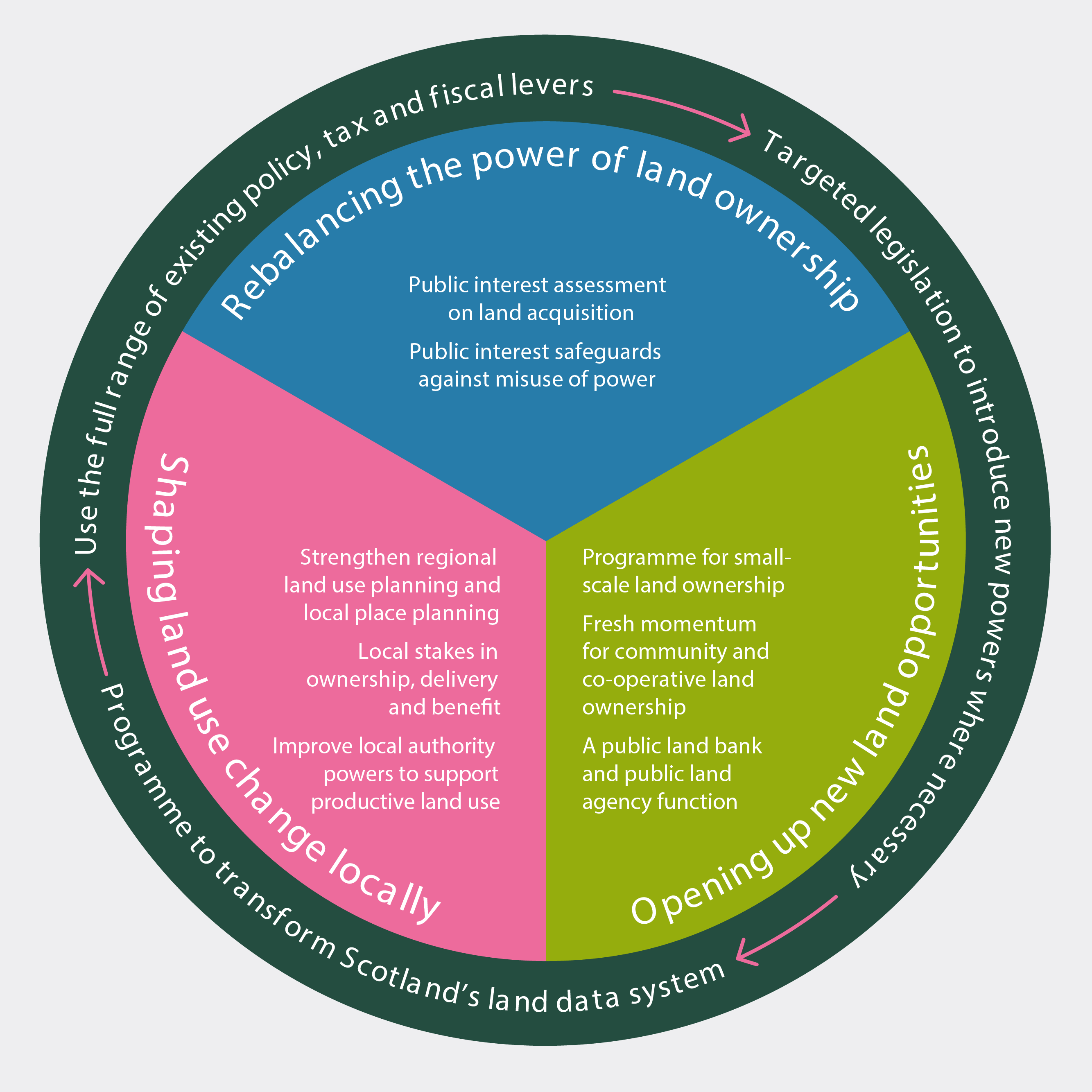
Three key pillars for future reform are set out by the Land Commission 1:
1. Opening up land: making ownership and use possible for more people - To "diversify ownership, support housing and enterprise, and build community wealth", the following is recommended:
Commit to a national programme to create small-scale land holdings across Scotland.
Use public land proactively to open up new land opportunities.
Simplify and strengthen routes into community and co-operative ownership, in urban and rural Scotland alike.
The Commission proposes consideration of "how existing public body powers or a new agency can most effectively create a rolling public land bank to deliver public interest outcomes". This could "support negotiated transfers or restructuring in partnership with other landowners". Furthermore:
It would be able to make the most of the opportunities arising from the new Land Reform Act’s lotting provisions, by providing an active vehicle to acquire land for a specific public interest purpose.
2. Rebalancing power: ensuring land ownership works for the public good - The "public interest" is a "golden thread" connecting a range of reforms, and the 2025 Act requires that guidance on the public interest must be issued to inform lotting decisions, taking into account of the desirability of:
Achieving a more diverse ownership of land, including more community ownership of land.
Furthering sustainable development.
Securing a greater proportion of community owned energy.
Advancing community wealth building.
Ensuring an adequate supply of affordable housing and of workspace for employment.
The Commission goes on to note that:
The public interest is also important in being the only legal justification for Government to override private property rights. Property rights are protected through the European Convention on Human Rights (ECHR), enshrined in Scots law.
Therefore, to protect the "public interest while ensuring power is exercised responsibly", the following is recommended:
Introduce ways to consider and protect the public interest when significant areas of land are acquired, including expectations around local presence.
Establish clear mechanisms to intervene where the power of land ownership is misused. This approach protects the public interest while ensuring power is exercised responsibly.
3. Shaping change locally: putting people at the heart of land use decisions - Scotland is considered to be undergoing major land use change, and the Commission notes from their engagement that it "is striking [...] that people feel uneasy with the pace and scale of change, and in many cases, disconnected from decisions about their local places". They make the following points:
Carrying public support for land use change is key to meeting climate, nature, and just transition commitments.
There are many benefits for landowners, project developers and communities associated with early engagement when making land use decisions.
Direct community and resident involvement in ownership and governance is an important factor in building support for change as well as directing where financial value from natural resources flows.
Scottish examples of community owned energy are not uncommon, with direct ownership stakes providing annual returns up to 60 times greater than industry standard community benefit schemes.
Therefore to "carry public confidence and deliver better outcomes", the following is recommended:
Strengthen regional land use planning with real decision-making and delivery powers through regional land use frameworks and Local Place Plans
Give communities and local authorities a decisive role in shaping land use change through mechanisms such as Compulsory Sale Orders and innovative tax powers.
Make local ownership and benefit a normal feature of renewable energy, nature and climate investment.
These pillars do not stand alone, and a coordinated interlinked delivery programme is envisaged, shown as follows:
This infographic shows the Scottish Land Commission's view of the interrelated nature of land reform measures
Scottish Land Commission. (2026, February). ScotLand Futures: Next Steps for Land Reform. Retrieved from https://www.landcommission.gov.scot/downloads/SLC-Futures-policy-digital.pdf [accessed 4 May 2026]
Ways to achieve this
Based on engagement and consultation through ScotLand Futures, the Land Commission is clear that "a coordinated programme across government" is required 1. This means:
Using public land ownership actively to lead change - proactive public sector involvement is considered to be a key step "to support transition into community, co-operative, and shared ownership with interim arrangements where needed". The Commission states:
While successful in establishing a new community ownership model, Scotland remains unusual in a European context in the lack of co-operative land ownership and shared governance that blend the strengths of community, local government, private and third sectors. There is an opportunity to inject fresh momentum by better supporting routes into community ownership and by supporting development of wider cooperative and shared-governance models.
Deploying tax and fiscal levers to encourage productive use and fair sharing of land value - noting that "almost two-thirds of UK wealth is held in land and property assets", the Commission considers that "tax and fiscal policy has a particular role to play", and states:
Scotland can use its tax and fiscal powers in new and improved ways to create new land opportunities, support economic productivity and deliver on land policies. Investing in a modern system to underpin land and property taxation would be a major opportunity for national and local government.
However, the following points are noted:
There is not currently sufficient data on land use, value and ownership for Scotland to make full use of existing or new powers in a potentially transformative way.
The relationship between tax and other Scottish Government funds, grants and fiscal mechanisms needs to be better aligned.
Scotland falls behind other countries in the way we gather land data to inform tax and fiscal decisions.
Therefore, the following steps are proposed:
A phased delivery plan for the taxation of land that builds tax and data infrastructure fit for the future.
Establishing a practical way to bring all land onto the valuation roll or equivalent database, opening up future options to reform annual taxation of land.
Reforming conditionality, public grants and spend to ensure that these are more effectively aligned and more consistent in the signals they give to landowners and managers.
Giving local government stronger powers to tackle dereliction and unlock stalled sites - noting that "our local government system has been disempowered and spans large areas with widely varying populations", the Commission states:
One of the clearest differences with many other European countries is that the issues Scotland now seeks to address nationally through land reform are often matters that are dealt with as a matter of course by municipal government, a highly empowered level of local government that Scotland had until its abolition 50 years ago.
Significant local government reform would be required to replicate European levels of municipal governance in relation to land ownership and land use decision making, however lessons can be learnt. For example, there could be "a more joined-up land use planning system, empowered at regional and local levels, backed by clear mechanisms to ensure a fair distribution of risk and reward". Clear direction could be delivered through a national land use strategy, "backed by the powers, resource and flexibility to deliver at a regional and local scale".
To develop, this could include:
Adding Compulsory Sale Orders to local authorities’ regeneration powers to bring about a change in ownership where land or buildings have been abandoned or are neglected, blighting the local community.
Giving local authorities greater autonomy and further tax powers to encourage productive use of land and property. For example, through use of exemptions, reliefs or new local taxes.
Using the public land agency functions in collaboration with local government to be active in acquiring and disposing of land to create public value.
Transforming land data, starting with completing the Land Register and building a joined-up national system - the Commission's work to date has shown that a "key barrier to delivering reforms and to effective decision-making in the land sector is the lack of joined-up information on land use, value and ownership". They state:
Not only is better access to information seen as a basic matter of transparency, it is also needed to deliver the Government's policy ambitions for land and public service reform.
The desirable outcome is a joined-up and accessible land data system that empowers citizens, provides sound evidence to inform public policy and land use, and realises the public value of land data for a wide range of uses.
And recommend:
Improving access to land ownership information and landowner contact details, building on work to complete the Land Register and making Sasines data as accessible as possible.
A programme to develop an integrated cadastral data system, working across public bodies that would provide full ownership information and use existing data sets to join up information about land.
Establishing a national land data research and analytical service for land information that monitors ongoing land market activity for wider public and policy purposes.
Survey responses
As previously noted, accurately mapping and quantifying public attitudes to land reform is a complex and nuanced endeavour. The public survey that formed part of the ScotLand Futures engagement exercise did not specifically ask about many of the issues often associated with land reform, and explored throughout this briefing, but sought answers to two questions 1:
What changes would you like to see in how land is owned and used in Scotland and what difference would that make to you, your community or your work?
When you think about land in your area, what's most important to you?
This section summarises key themes from the responses.
Transparency
Just over 5% of respondents explicitly wanted greater transparency about who owns land in Scotland 1. In particular, there were calls for a complete, accessible Land Register, cheaper or free searches, and clearer information about what owners intend to do with their land. Further points include:
Some consider that ownership alone isn't the problem — it's the absence of openness and accountability that causes frustration.
A particularly important time for transparency is when ownership changes, this is because communities often have little information about new owners or their intentions, which can lead to rumours and worry.
People see transparency as the first step to rebuilding trust and creating a sense of shared responsibility for Scotland's land. 2
Concentration of ownership
24.4% of respondents believed that ownership, and associated power, is concentrated in too few hands 1. Concerns were raised about families being unable to find land for housing, small businesses unable to expand, and communities affected by decisions taken remotely. Put in more positive terms, it was felt that a fairer, more diverse pattern of ownership could support "family farms, crofts, community trusts and small local enterprises — models that keep money and decision making rooted in the local area". Potential opportunities included:
Small-scale land holdings.
Self-build housing.
Food production.
Woodland stewardship.
Business, environmental and amenity use.
There were also calls for "bolder public action to open up opportunity: stronger support for community ownership, [...], and clearer limits on excessive concentration".
This theme of fairness ran through almost every response. Whether in rural or urban areas, people want land to be part of the solution supporting livelihoods, homes and local resilience, not a barrier to them. 2
Absentee ownership
21% of respondents believed that those with significant land holdings should be part of the communities whose lives their decisions affect 1. Concerns were raised about the economic and social consequences of reduced local spending, and a lack of engagement, as well as frustration about decisions that are made from a distance. In particular, the "perceived rapid rise in absentee corporate and international land ownership was seen as particularly corrosive to community cohesion".
Others acknowledged that not every owner can or will live locally, but they still want a sense of accountability. Ownership, they said, should come with an expectation of presence, care and contribution. 2
Meaningful community engagement
In relation to "how land is used, developed and managed", 13% of respondents felt "locked out of decisions that affect their lives" 1. Issues raised include:
The planning system feels distant and technical.
Consultations often take place too late, when decisions have already been made.
Communities feel unheard and powerless.
In response to this, there were calls for more meaningful involvement in decisions, particularly in relation to housing, renewable energy, forestry and large-scale investment projects.
[...] genuine participation isn't just about fairness, it leads to better results. When communities are involved early, development is more likely to reflect local needs and build long-term support. 2
Vacant and derelict land
2.5% of respondents highlighted their frustration at living beside empty land or buildings that had been left for years to decay 1. These sites were considered to be "symbols of neglect", with the potential for new homes (particularly social housing), green space or economic development wasted. Many respondents were in favour of local authorities having stronger powers to take action where owners fail to maintain or repurpose their land.
People see tackling derelict land as a test of fairness and ambition: if Scotland can't fix what is visibly broken, it will struggle to build confidence in wider change. 2
Tax system
9.4% of respondents thought that changes to the tax system could help to make positive changes land ownership and use 1. Types of tax proposed include:
Land value taxation.
Taxing absentee owners.
Using tax to make land ownership fairer and more focused on community benefit
Some also raised concerns about Council Tax, Non-Domestic Rates, Inheritance Tax and how farming tenancies are treated, noting that the current system makes it harder for land to be owned and used in a fair and productive way.
While people suggested different ideas, many agreed that tax could be used to encourage better decisions about land. Some supported a new land value tax to bring wider change. Others said smaller changes could help meet specific goals, like bringing derelict land back into use or cutting carbon emissions from peatland. 2
Other views and issues
This section sets out some of the other issues raised by stakeholders. There is a broad wish to achieve successful local businesses, sustainable land use and thriving communities, however differences of opinion on how to achieve this.
N.B. This section is not intended to provide a comprehensive summary of the views of all relevant stakeholders. As previously noted, the most recent parliamentary scrutiny of land reform, carried out during the passage of the Land Reform (Scotland) Act 2025 (considered in more detail below) received 122 responses with varying degrees of support for the proposed measures 1.
Stakeholder views
Scottish Land and Estates has questioned the reporting of the Land Commission's ScotLand Futures work, stating that "political agendas on land reform are out of step with public priorities" and noting that the issues raised "are supported [by] only a minority of respondents", as follows 1:
Only a quarter of respondents (24.4%) believe that ownership is concentrated in too few hands.
Just one in five people (21%) said those who own significant parts of Scotland should also be part of the communities whose lives their decisions affect.
Less than one in ten people (9.4%) said that changes to the tax system could help make a big difference to how land is owned and used in Scotland.
Work commissioned by Scottish Land and Estates in 2023 sets out the Contribution of Rural Estates to Scotland's Wellbeing Economy2, and reiterates their view that “management of land at scale has positive outcomes for the environment and communities”. Written evidence in response to 2024's Land Reform Bill states 3:
[...] as custodians of Scotland’s landscapes, landowners take their responsibilities to the environment, communities and economy very seriously. They [...] make significant economic contributions on a local and national scale, and have the expertise and means to undertake the vital biodiversity and carbon sequestration work that the country desperately needs. [...]
Landowners of all types and sizes are part of the solution, not the problem. [...] It must be concluded that the driving force behind so much of this is not a sincere wish to improve life in rural Scotland or take advantage of land to tackle the nature and climate crises, but rather a fundamental ideology about land ownership.
More recently (2025), research commissioned by Scottish Land and Estates has highlighted the following top concerns for rural policy 4:
48% said improving access to healthcare should be a priority.
43% prioritised the need for better infrastructure, including roads, transport and broadband.
41% called for more focus on creating long-term employment opportunities.
36% supported the development of affordable housing to sustain rural communities.
These concerns are reflected in their Route2050 policy document, which identifies "actions required of government for land managers in Scotland to respond to the challenges posed by climate change and volatile global markets". Immediate key (devolved) asks include 5:
Investment in transport networks and coordination with local authorities to support the timber industry to reduce costs and to access markets.
Support the recruitment and retention of rural workers, including through the availability of housing and infrastructure.
To make full use of the potential of technology and innovation in Scottish land management, fast and reliable broadband connections and mobile connectivity will be crucial.
Scottish Government must ensure that investment continues to ensure the conservation of heritage and cultural practices.
Support for land managers with research and knowledge exchange to understand their businesses’ climate risk and make data-led decisions to reduce that risk.
Much greater cooperation so that we can use land rationally and efficiently. Critical to this is increased support for land management clusters which facilitate collaboration.
Appropriate levels of funding, as well as clarity on the focus and purpose of funding schemes, and how the desired outcome will be achieved.
Community Land Scotland (the representative body for community landowners) believe in the "democratic ownership of local land and assets" (including "natural assets"), consider that "addressing the issue of concentrated land ownership" is necessary to "create a more socially just Scotland", and support the "growth of community land ownership [as] part of developing a more diverse land ownership pattern" 6. Their Manifesto for the Scottish Parliamentary elections states that Scotland's "archaic pattern of landownership has resulted in vast amounts of land lying underused or managed in ways that do not serve pressing public priorities"; furthermore 7:
Diversifying who owns and therefore controls land is essential to creating a fairer and more resilient Scotland. Tackling affordability of land and opening access to more people and communities to own land will ensure wealth is retained in local areas where it is generated and help to combat the multiple crises of climate, biodiversity, housing and growing inequality.
Their Briefing to new MSPs8 set out "five of the most pressing priorities":
An Enhanced Scottish Land Fund. Including offering multi-year funding to maximize opportunities, ring-fenced funding for large acquisitions and realistic timescales for communities, as well as committing to the Fund being £25 million per year by the end of the Parliament to match the already established pipeline of community projects.
Community Right to Buy Review and Reform. Swiftly implementing the recommendations of the 2025/26 review.
Compulsory Purchase and Sales Orders (CPO/CSO) Reform. Consulted on in the last Parliament, Community Land Scotland call for "these long overdue changes to be dealt with quickly through precise legislation in the first year of Parliament".
Implementation of the Land Reform (Scotland) Act 2025. Quick implementation will ensure that "eligible land transfers and poor examples of landownership [...] are not addressed due to slow-paced implementation".
A National Land Information System. The establishment of a "national Land Information Service to systematically collect and manage data on landownership and land use". Community Land Scotland states:
This should be supported by a clear government target date for completion of the existing register and specific triggers to accelerate first registration of all other lands. If we do not know who ultimately owns land, nor who has options agreements or how that land is valued and used then we cannot address corruption or start to build the policies that will fully address pressing public priorities like house building and progressive taxation.
Depopulation
Regardless of contrasting views on how best to support sustainable land use and communities, there is agreement that population decline in rural areas is a perennial challenge, with the James Hutton Institute noting that Sparsely Populated Areasi1:
have a demographic legacy which, in the absence of intervention, will result in decades of population decline, and shrinkage of its working age population, on a scale which implies serious challenges for economic development, and consequences for its landscape and ecology which are poorly understood.
In November 2025 Scotland's Rural College published Demographic Change and Out-Migration in Rural and Island Scotland, which notes that "population decline and out-migration [are] driven by shortages in housing, limited employment opportunities, and inadequate services such as healthcare and transport". A two-tier approach was recommended 2:
Retain and support the local population by improving housing, services, and infrastructure.
Develop targeted migration programmes, including international migration, with appropriate integration support, led by local authorities and aligned with national priorities.
Similarly, research carried out for Homes for Scotland (membership organisation representing Scotland's housebuilding industry)(September 2025) shows that 61% of rural Scots are supportive of new housing being built in their local area, rising to 75% in remote rural areas. Further key points include 3:
51% believe that economic growth is limited by the availability of housing.
60% say that home building provides work for small businesses in their area.
61% report that more new build homes that are energy efficient and warm are needed in their area.
Both Scottish Land and Estates and Community Land Scotland agree that tackling depopulation is fundamentally important to rural sustainability. However, they differ over the necessary actions with Scottish Land and Estates stating that 4:
no single measure will work in isolation. Housing without jobs simply fuels second home ownership. Jobs without services leave families stranded. Connectivity without affordable homes offers little incentive to stay. Where success has come, it has been because governments have combined these levers, invested for the long term, and trusted local communities to shape their own future.
They propose that "creative measures such as cost of living offsets, employer incentives for job creation and student loan write-downs could attract more young people to return to, or stay in, rural areas" 54.
Conversely, Community Land Scotland state 7:
Private landowners own 83% of rural Scotland. They have a huge role to play in both providing land for housing and building housing themselves.
Community Land Scotland argue for "land reform policies which could deliver a much-needed decrease in land prices and diversification of ownership", and note that "without land prices reducing, and private landowners much more willing to sell land for housing, Scotland will continue to face huge depopulation challenges".
The Session 7 jigsaw
In Session 6, the Parliament spent a significant proportion of time scrutinising a framework Bill to address how the public interest is best served by large landholdings. What this looks like in practice will depend largely on the detail contained in secondary legislation, and on the work of a new Land and Communities Commissioner.
Part 1 of the 2026 Land Reform (Scotland) Act
Part 1 of the Land Reform (Scotland) Act 2026 inserts a new section into the Land Reform (Scotland) Act 2016 and includes a power for Ministers to impose obligations on owners of large land holdings (over 1,000ha) to produce, consult on with the local community, and then publish a land management plan for their holding.
In the event of a transfer of all or part of a large land holding (generally over 1,000ha), a modified pre-emptive right to buy for a local community and / or lotting (i.e. compulsory fragmentation) is also provided for. To oversee and advise on this, a new Land and Communities Commissioner is established within the Land Commission.
Some of the information that a land management plan must contain is set out in the Act:
The land to which it relates and how ownership is structured.
Long-term vision and objectives.
Compliance with outdoor access and deer management codes.
How the owner intends to manage the land in a way that contributes to achieving net-zero greenhouse gas emissions, adapting to climate change and increasing biodiversity.
How the owner is having regard to, or intends to have regard to, any relevant local place plan.
However, the detail of the land management plan obligations will be set out in regulations (expected during Session 7) which will be laid under the affirmative procedure. These regulations must be informed by the Land Rights and Responsibilities Statement, and Ministers must consult the Land and Communities Commissioner, and anyone else that is considered “appropriate”.
The recruitment and proposal of Land Commissioners is carried out by the Scottish Government; however Parliament must approve the appointment.
Much of the Act is yet to be commenced, with commencement regulations, as well as further provisions in relation to compensation for lotting decisions expected in Session 7.
What’s on the menu for Session 7?
Whilst the review of community rights to buy and the passage of the Land Reform Bill were (theoretically) separate, MSPs in the coming session will have a role to examine these changes and ensure that a coherent and genuinely useful framework evolves to support and complement other parts of land reform policy.
The first part of this jigsaw will be scrutinising the appointment of the Land and Communities Commissioner, who will have a crucial role in developing the detailed regulations for land management plans. These regulations will then come before Parliament in draft form for Members to ensure that they deliver what the Net Zero Energy and Transport Committee, in their Stage 1 Report considered to be “essential increases in transparency about land ownership and use”, in the public interest.
An August 2026 letter from the Cabinet Secretary for Climate Action and Rural Affairs to the Parliament's Rural Affairs Committee provides a timetable, with a new Commissioner expected to be in post by April 2027.
Programme for Government
The Scottish Government's Programme for Government (PfG) proposes measures that are relevant.
Rural Renewal Bill
A SNP manifesto commitment for the 2026 election was to bring forward a ‘Rural Renewal Bill’ in Session 7, potentially comprising:
Rural planning reform, improving permitted development rights, such as for small-scale renewable energy production, business diversification and opportunities to streamline processes.
Review industry levy bodies across the rural and marine sectors.
Create new small land holdings to support rural repopulation.
Review and revitalise support and opportunities for crofting for new entrants.
Action to protect unique Scottish landscapes such as the machair, including on options on species management.
The bill will continue our land reform journey and consider a range of strategic proposals. It will also include steps to make land ownership transparent, implementing robust anti-avoidance measures, supporting existing tenants and providing new long-term opportunities for progressing farmers, and enhancing opportunities and support for community right to buy and ownership
The Scottish Government noted in its plans for the first 100 days of government in Session 7, that it will begin engagement towards the new Bill, and it confirmed in a written answer on 23 September that engagement began with people, communities and organisations over the summer.
Last Provider Fund
Another 2026 SNP manifesto commitment was to establish a “Last Provider Fund” to:
help keep open shops and pubs who are the last remaining providers in rural and island communities, after the UK Government closed the Community Ownership Fund.
The PfG clarified that establishing the fund is planned for 2026-27.
The UK Government’s Community Ownership Fund was a £150m fund which supported community groups across the four UK nations to “take ownership of assets and amenities at risk of being lost”. The funding was to be used for voluntary or community organisations to “bid for funding to acquire important assets and run them for the benefit of the local community.” This fund closed after the 2025 funding round.
Compulsory Purchase
The SNP Manifesto also committed to Reforms to Compulsory Purchase Orders and exploring the introduction of Compulsory Sales Orders.
The PfG undertook to "Develop legislation to reform and modernise Scotland’s compulsory purchase system, to support more effective delivery of development, regeneration and infrastructure projects". However, it is not clear whether this will include the development of Compulsory Sale Orders; with reference to the Scottish Government's consultation on Compulsory Purchase Reform in Scotland, a written answer on 16 September 2026 stated:
The consultation also included questions about compulsory sale orders, and while respondents expressed support in principle, some questioned whether this could offer additional advantages beyond a reformed compulsory purchase process, with uncertainty about efficacy, justification and practical operation. As part of continuous improvement, we will continue to monitor whether compulsory sale powers could provide any additional benefits beyond a reformed compulsory purchase system.
Cover image
Cover image: A.M.Hurrell. From Wikimedia Commons
Sources
Reid, A. (2015, June). Land Reform in Scotland. Retrieved from <a href="https://webarchive.nrscotland.gov.uk/20240327015750/https://archive2021.parliament.scot/parliamentarybusiness/90168.aspx" target="_blank">https://webarchive.nrscotland.gov.uk/20240327015750/https://archive2021.parliament.scot/parliamentarybusiness/90168.aspx</a> [accessed 23 April 2026]
BBC News. (23, June 2015). Land reform - The battle to decide who owns Scotland. Retrieved from <a href="https://www.bbc.co.uk/news/uk-scotland-33225369" target="_blank">https://www.bbc.co.uk/news/uk-scotland-33225369</a> [accessed 20 July 2026]
The Guardian. (2003, January 24). Holyrood backs land reform seen by Tories as Mugabe-style confiscation. Retrieved from <a href="https://www.theguardian.com/politics/2003/jan/24/scotland.devolution" target="_blank">https://www.theguardian.com/politics/2003/jan/24/scotland.devolution</a> [accessed 20 July 2026]
Isle of Eigg Heritage Trust. (2026). Community Buyout. Retrieved from <a href="https://isleofeigg.org/ieht/community-buyout/" target="_blank">https://isleofeigg.org/ieht/community-buyout/</a> [accessed 16 July 2026]
Cameron, E. (2021, February 15). https://euppublishingblog.com/2021/02/15/remembering-the-history-of-scottish-land-reform/. Retrieved from <a href="Remembering the history of Scottish land reform" target="_blank">Remembering the history of Scottish land reform</a> [accessed 5 May 2026]
University of Highlands and Islands. (2026). Historians and Scottish land reform. Retrieved from <a href="https://www.uhi.ac.uk/en/research-enterprise/case-studies/historians-and-scottish-land-reform/" target="_blank">https://www.uhi.ac.uk/en/research-enterprise/case-studies/historians-and-scottish-land-reform/</a> [accessed 5 May 2026]
The Land. (2018). Lessons from Scotland. Retrieved from <a href="https://www.thelandmagazine.org.uk/articles/lessons-scotland" target="_blank">https://www.thelandmagazine.org.uk/articles/lessons-scotland</a> [accessed 5 May 2026]
Peacock, P. (2025, January 3). Land Reform in Scotland – its history and why more is needed. Retrieved from <a href="https://www.communitylandscotland.org.uk/land-reform-in-scotland-its-history-and-why-more-is-needed/" target="_blank">https://www.communitylandscotland.org.uk/land-reform-in-scotland-its-history-and-why-more-is-needed/</a> [accessed 5 May 2026]
Combe, M., Glass, J., & Tindley, A. (2020). Land Reform in Scotland: History, Law and Policy (Scotland's Land). (n.p.): (n.p.).
Land Reform Review Group. (2014, May). The land of Scotland and the common good: report. Retrieved from <a href="https://www.gov.scot/publications/land-reform-review-group-final-report-land-scotland-common-good/" target="_blank">https://www.gov.scot/publications/land-reform-review-group-final-report-land-scotland-common-good/</a> [accessed 1 May 2026]
Scottish Land Commission. (2026). What is land reform?. Retrieved from <a href="https://www.landcommission.gov.scot/shaping-land-policy/what-is-land-reform" target="_blank">https://www.landcommission.gov.scot/shaping-land-policy/what-is-land-reform</a> [accessed 1 May 2026]
Scottish Government. (2022, September). Scottish Land Rights and Responsibilities Statement 2022. Retrieved from <a href="https://www.gov.scot/publications/scottish-land-rights-responsibilities-statement-2022/" target="_blank">https://www.gov.scot/publications/scottish-land-rights-responsibilities-statement-2022/</a> [accessed 1 May 2026]
Organisation for Economic Co-operation and Development (OECD). (2021, May). Biodiversity, natural capital and the economy. Retrieved from <a href="https://www.oecd.org/en/publications/biodiversity-natural-capital-and-the-economy_1a1ae114-en.html" target="_blank">https://www.oecd.org/en/publications/biodiversity-natural-capital-and-the-economy_1a1ae114-en.html</a> [accessed 22 April 2026]
Govan, S. (2024, July). One land, many functions: exploring 'integrated land use'. Retrieved from <a href="https://bprcdn.parliament.scot/published/2024/7/12/65b7d813-d3f8-4df6-938c-bfd11b551f45/SB%2024-36.pdf" target="_blank">https://bprcdn.parliament.scot/published/2024/7/12/65b7d813-d3f8-4df6-938c-bfd11b551f45/SB%2024-36.pdf</a> [accessed 20 April 2026]
Chatham House. (2024, February). The emerging global crisis of land use. Retrieved from <a href="https://www.chathamhouse.org/2023/11/emerging-global-crisis-land-use/07-measuring-land-wealth" target="_blank">https://www.chathamhouse.org/2023/11/emerging-global-crisis-land-use/07-measuring-land-wealth</a> [accessed 22 April 2026]
Scottish Government. (2023, February). National Planning Framework 4. Retrieved from <a href="https://www.gov.scot/publications/national-planning-framework-4/" target="_blank">https://www.gov.scot/publications/national-planning-framework-4/</a> [accessed 22 April 2026]
Scottish Government. (2026, March). Scotland's Fourth Land Use Strategy: 2026-2031. Retrieved from <a href="https://www.gov.scot/publications/scotlands-fourth-land-use-strategy-2026-2031/pages/1/" target="_blank">https://www.gov.scot/publications/scotlands-fourth-land-use-strategy-2026-2031/pages/1/</a> [accessed 24 April 2026]
Scottish Government. (2021, March 5). Attitudes to land reform: research. Retrieved from <a href="https://www.gov.scot/publications/attitudes-land-reform/" target="_blank">https://www.gov.scot/publications/attitudes-land-reform/</a> [accessed 27 April 2026]
Diffley Partnership. (2025, November 10). Land Reform: What Scotland Wants – The Results of Scotland’s Big Land Question. Retrieved from <a href="https://diffleypartnership.co.uk/land-reform-what-scotland-wants-the-results-of-scotlands-big-land-question/" target="_blank">https://diffleypartnership.co.uk/land-reform-what-scotland-wants-the-results-of-scotlands-big-land-question/</a> [accessed 26 April 2026]
Scottish Land Commission. (2025, November). ScotLand Futures. Retrieved from <a href="https://www.landcommission.gov.scot/get-involved/scotland-futures" target="_blank">https://www.landcommission.gov.scot/get-involved/scotland-futures</a> [accessed 1 May 2026]
Scottish Land and Estates. (2025, November 25). Land Reform political priorities out of step with public. Retrieved from <a href="https://www.scottishlandandestates.co.uk/news/land-reform-political-priorities-out-step-public" target="_blank">https://www.scottishlandandestates.co.uk/news/land-reform-political-priorities-out-step-public</a> [accessed 7 May 2026]
Scottish Land and Estates. (2025, June 26). Rural Scotland's Priorities. Retrieved from <a href="https://www.scottishlandandestates.co.uk/sites/default/files/library/Rural%20Scotland%27s%20Priorities%20-%20Public%20Attitudes%20Survey%20on%20Rural%20Policy.pdf" target="_blank">https://www.scottishlandandestates.co.uk/sites/default/files/library/Rural%20Scotland%27s%20Priorities%20-%20Public%20Attitudes%20Survey%20on%20Rural%20Policy.pdf</a> [accessed 7 May 2026]
Scottish Parliament Net Zero, Energy and Transport Committee. (2025, March 19). Stage 1 report on the Land Reform (Scotland) Bill. Retrieved from <a href="https://digitalpublications.parliament.scot/Committees/Report/NZET/2025/3/19/3dce404f-b786-4553-95f7-d683987eec3a-1" target="_blank">https://digitalpublications.parliament.scot/Committees/Report/NZET/2025/3/19/3dce404f-b786-4553-95f7-d683987eec3a-1</a> [accessed 1 May 2026]
Scottish Government. (2015, June 22). Land Reform (Scotland) Bill 2015 - Policy Memorandum. Retrieved from <a href="https://webarchive.nrscotland.gov.uk/20240327023007mp_/https://archive2021.parliament.scot/S4_Bills/Land%20Reform%20(Scotland)%20Bill/b76s4-introd-pm.pdf" target="_blank">https://webarchive.nrscotland.gov.uk/20240327023007mp_/https://archive2021.parliament.scot/S4_Bills/Land%20Reform%20(Scotland)%20Bill/b76s4-introd-pm.pdf</a> [accessed 27 May 2026]
Scottish Government. (2016, September 11). Improving transparency in land ownership in Scotland: a consultation on controlling interests in land. Retrieved from <a href="https://www.gov.scot/publications/improving-transparency-land-ownership-scotland-consultation-controlling-interests-land/" target="_blank">https://www.gov.scot/publications/improving-transparency-land-ownership-scotland-consultation-controlling-interests-land/</a> [accessed 27 May 2026]
Scottish Land and Estates. (2018, November 14). Transparency of land ownership supported but complex regulations raise concern. Retrieved from <a href="https://www.scottishlandandestates.co.uk/news/transparency-land-ownership-supported-complex-regulations-raise-concern" target="_blank">https://www.scottishlandandestates.co.uk/news/transparency-land-ownership-supported-complex-regulations-raise-concern</a> [accessed 27 May 2026]
Scottish Land and Estates. (2022, March 29). SLE supportive of transparency of landownership. Retrieved from <a href="https://www.scottishlandandestates.co.uk/news/sle-supportive-transparency-landownership" target="_blank">https://www.scottishlandandestates.co.uk/news/sle-supportive-transparency-landownership</a> [accessed 27 May 2026]
James Hutton Institute. (2026). Review of land ownership data in Scotland . Retrieved from <a href="https://land-reform-futures.hutton.ac.uk/sites/land-reform-futures.hutton.ac.uk/files/inline-files/Keith%20Matthews_0.pdf" target="_blank">https://land-reform-futures.hutton.ac.uk/sites/land-reform-futures.hutton.ac.uk/files/inline-files/Keith%20Matthews_0.pdf</a> [accessed 25 May 2026]
Wightman, A. (n.d.) Who Owns Scotland 2025. Retrieved from <a href="https://andywightman.scot/2026/02/who-owns-scotland-2025/" target="_blank">https://andywightman.scot/2026/02/who-owns-scotland-2025/</a> [accessed 27 April 2026]
King's and Lord Treasurer's Remembrancer. (2024, March). OPTS Guidance. Retrieved from <a href="https://www.kltr.gov.uk/media/3obhwypx/opts-guidance-march-2024.pdf" target="_blank">https://www.kltr.gov.uk/media/3obhwypx/opts-guidance-march-2024.pdf</a> [accessed 20 May 2026]
Scottish Government. (2026, March 18). Community rights to buy review. Retrieved from <a href="https://www.gov.scot/publications/community-rights-buy-review/pages/2/" target="_blank">https://www.gov.scot/publications/community-rights-buy-review/pages/2/</a> [accessed 1 April 2026]
Community Land Scotland. (2026). Community Ownership Across Scotland. Retrieved from <a href="https://www.communitylandscotland.org.uk/our-work/community-landownership/" target="_blank">https://www.communitylandscotland.org.uk/our-work/community-landownership/</a> [accessed 19 May 2026]
Scottish Government. (2025, November 25). Community Ownership in Scotland 2024. Retrieved from <a href="https://www.gov.scot/publications/community-ownership-in-scotland-2024/" target="_blank">https://www.gov.scot/publications/community-ownership-in-scotland-2024/</a> [accessed 19 May 2026]
Scottish Land Commission. (2026, June). SEFARI Fellowship to understand changes in demand for largescale community land acquisitions and identify barriers and solutions to new acquisitions . Retrieved from <a href="https://www.landcommission.gov.scot/downloads/SEFARI-Fellowship-to-understand-changes-in-demand-for-largescale-community-land-acquisitions-and-identify-barriers-and-solutions-to-new-acquisitions.pdf" target="_blank">https://www.landcommission.gov.scot/downloads/SEFARI-Fellowship-to-understand-changes-in-demand-for-largescale-community-land-acquisitions-and-identify-barriers-and-solutions-to-new-acquisitions.pdf</a> [accessed 21 June 2026]
Scottish Land Commission. (2026, July). Next steps for community ownership in Scotland Advice to Scottish Ministers. Retrieved from <a href="https://www.landcommission.gov.scot/downloads/Next-steps-for-community-ownership-in-Scotland.pdf" target="_blank">https://www.landcommission.gov.scot/downloads/Next-steps-for-community-ownership-in-Scotland.pdf</a> [accessed 30 July 2026]
Scottish Land Commission. (2026, July). Casework policy . Retrieved from <a href="https://www.landcommission.gov.scot/downloads/Casework-policy-July-2026.pdf" target="_blank">https://www.landcommission.gov.scot/downloads/Casework-policy-July-2026.pdf</a> [accessed 27 July 2026]
Scottish Government. (2014, November). Annex A – What the Scottish Government is already doing for land reform . Retrieved from <a href="https://consult.gov.scot/land-reform-and-tenancy-unit/land-reform-scotland/supporting_documents/What%20the%20Scottish%20Government%20is%20already%20doing%20for%20land%20reform.pdf" target="_blank">https://consult.gov.scot/land-reform-and-tenancy-unit/land-reform-scotland/supporting_documents/What%20the%20Scottish%20Government%20is%20already%20doing%20for%20land%20reform.pdf</a> [accessed 29 May 2026]
Registers of Scotland. (2014, July). Completion of the Land Register Public Consultation. Retrieved from <a href="https://www.ros.gov.uk/__data/assets/pdf_file/0018/68031/land_ownership_scotland.pdf" target="_blank">https://www.ros.gov.uk/__data/assets/pdf_file/0018/68031/land_ownership_scotland.pdf</a> [accessed 21 May 2026]
Law Society Scotland. (2014, July). 10-year target. Retrieved from <a href="https://www.lawscot.org.uk/members/journal/issues/vol-59-issue-07/10-year-target/" target="_blank">https://www.lawscot.org.uk/members/journal/issues/vol-59-issue-07/10-year-target/</a> [accessed 21 May 2026]
Registers of Scotland. (2026). Functional completion. Retrieved from <a href="https://www.ros.gov.uk/performance/land-register-completion/functional-completion" target="_blank">https://www.ros.gov.uk/performance/land-register-completion/functional-completion</a> [accessed 21 May 2026]
Registers of Scotland. (2026). Unlocking Sasines. Retrieved from <a href="https://www.ros.gov.uk/performance/land-register-completion/unlocking-sasines" target="_blank">https://www.ros.gov.uk/performance/land-register-completion/unlocking-sasines</a> [accessed 21 May 2026]
The Ferret. (2026, June 14). Hundreds of offshore landowners are illegally flouting Scotland's land control register. Retrieved from <a href="https://www.theferret.scot/offshore-landowners-scotland-land-control-register/" target="_blank">https://www.theferret.scot/offshore-landowners-scotland-land-control-register/</a> [accessed 15 June 2026]
Land Matters. (n.d.) No Police or COPFS action over transparency offences. Retrieved from <a href="https://andywightman.scot/2026/06/no-police-or-copfs-action-over-transparency-offences/" target="_blank">https://andywightman.scot/2026/06/no-police-or-copfs-action-over-transparency-offences/</a> [accessed 16 June 2026]
Registers of Scotland. (2015, July). Digital land and property information system report. Retrieved from <a href="https://www.ros.gov.uk/about/publications/governance-and-corporate/2015/digital-land-and-property-information-system-report-july-2015" target="_blank">https://www.ros.gov.uk/about/publications/governance-and-corporate/2015/digital-land-and-property-information-system-report-july-2015</a> [accessed 21 May 2026]
Built Environment Forum for Scotland. (n.d.) ScotLIS 3 – a critical tool for Scotland. Retrieved from <a href="https://www.befs.org.uk/resources/publications/scotlis-3-a-critical-tool-for-scotland/" target="_blank">https://www.befs.org.uk/resources/publications/scotlis-3-a-critical-tool-for-scotland/</a> [accessed 21 May 2021]
Built Environment Forum for Scotland and The David Hume Institute. (2023, February). ScotLIS 3 – a critical tool for Scotland Scotland’s land information service: what is it and why it matters. Retrieved from <a href="https://www.befs.org.uk/wp-content/uploads/2023/03/SCOTLISReportbyAndyWightmanMarch2023-1.pdf" target="_blank">https://www.befs.org.uk/wp-content/uploads/2023/03/SCOTLISReportbyAndyWightmanMarch2023-1.pdf</a> [accessed 21 May 2026]
Scottish Land Commission. (2026, July). Learning from international cadastral systems for transparency, tax, and valuation. Retrieved from <a href="https://www.landcommission.gov.scot/downloads/Learning-from-international-cadastral-systems-for-transparency-tax-and-valuation.pdf" target="_blank">https://www.landcommission.gov.scot/downloads/Learning-from-international-cadastral-systems-for-transparency-tax-and-valuation.pdf</a> [accessed 28 July 2026]
Scottish Land Commission. (2026, June). Rural Land Market Insights 2026. Retrieved from <a href="https://www.landcommission.gov.scot/downloads/Rural-Land-Market-Insights-Report-2026.pdf" target="_blank">https://www.landcommission.gov.scot/downloads/Rural-Land-Market-Insights-Report-2026.pdf</a> [accessed 5 July 2026]
Scottish Land Commission. (2025, December). Rural Land Market Data Report 2025. Retrieved from <a href="https://www.landcommission.gov.scot/downloads/6936fb00e2789_Rural-Land-Market-Data-Report-2025.pdf" target="_blank">https://www.landcommission.gov.scot/downloads/6936fb00e2789_Rural-Land-Market-Data-Report-2025.pdf</a> [accessed 20 June 2026]
Scottish Land Commision. (2019, March 20). Investigation into the Issues Associated with Large scale and Concentrated Landownership in Scotland . Retrieved from <a href="https://www.landcommission.gov.scot/downloads/5dd7d6fd9128e_Investigation-Issues-Large-Scale-and-Concentrated-Landownership-20190320.pdf" target="_blank">https://www.landcommission.gov.scot/downloads/5dd7d6fd9128e_Investigation-Issues-Large-Scale-and-Concentrated-Landownership-20190320.pdf</a> [accessed 6 May 2026]
GovTracker. (2026, June 21). Double the Scottish Land Fund to £20m per year by 2026. Retrieved from <a href="https://govtracker.scot/policies/double-the-scottish-land-fund-to-20m-per-year-by-2026/" target="_blank">https://govtracker.scot/policies/double-the-scottish-land-fund-to-20m-per-year-by-2026/</a> [accessed 21 June 2026]
Scottish Parliament. (2025, January 13). Question reference: S6W-32463. Retrieved from <a href="https://www.parliament.scot/chamber-and-committees/questions-and-answers/question?ref=S6W-32463" target="_blank">https://www.parliament.scot/chamber-and-committees/questions-and-answers/question?ref=S6W-32463</a> [accessed 21 June 2026]
Scottish Government. (2026, March 6). Scottish Budget 2026 to 2027. Retrieved from <a href="https://www.gov.scot/publications/scottish-budget-2026-2027/pages/13/" target="_blank">https://www.gov.scot/publications/scottish-budget-2026-2027/pages/13/</a> [accessed 21 June 2026]
Scottish Land Commission. (2021). Community Ownership Financing: Options to Complement the Scottish Land Fund . Retrieved from <a href="https://www.landcommission.gov.scot/downloads/62baf1a4b87fa_Community-Ownership-Financing-Options-to-Complement-the-Scottish-Land-Fund.pdf" target="_blank">https://www.landcommission.gov.scot/downloads/62baf1a4b87fa_Community-Ownership-Financing-Options-to-Complement-the-Scottish-Land-Fund.pdf</a> [accessed 21 June 2026]
The National Lottery Community Fund. (n.d.) Awards Made. Retrieved from <a href="https://www.tnlcommunityfund.org.uk/media/03bddusw/the-national-lottery-community-fund-scottish-land-fund-awards-made.pdf" target="_blank">https://www.tnlcommunityfund.org.uk/media/03bddusw/the-national-lottery-community-fund-scottish-land-fund-awards-made.pdf</a> [accessed 21 June 2026]
James Hutton Institute. (2026, March 3). ‘Are we there yet?’ The long journey to a Land Reformed. Retrieved from <a href="https://www.youtube.com/watch?v=BinU1pMpbUk" target="_blank">https://www.youtube.com/watch?v=BinU1pMpbUk</a> [accessed 5 May 2026]
Scottish Land Commission. (2026, February). ScotLand Futures: Next Steps for Land Reform. Retrieved from <a href="https://www.landcommission.gov.scot/downloads/SLC-Futures-policy-digital.pdf" target="_blank">https://www.landcommission.gov.scot/downloads/SLC-Futures-policy-digital.pdf</a> [accessed 4 May 2026]
Scottish Land Commission. (2025, November). What we heard: A national call for change. Retrieved from <a href="https://www.landcommission.gov.scot/downloads/692444ee87aac_ScotLand-Futures-What-We-Heard-FINAL.pdf" target="_blank">https://www.landcommission.gov.scot/downloads/692444ee87aac_ScotLand-Futures-What-We-Heard-FINAL.pdf</a> [accessed 21 July 2026]
Scottish Land and Estates. (2025). Our work: Land Reform. Retrieved from <a href="https://www.scottishlandandestates.co.uk/our-work/land-reform" target="_blank">https://www.scottishlandandestates.co.uk/our-work/land-reform</a> [accessed 27 April 2026]
Scottish Land and Estates. (2022, October 28). Land Reform in a Net Zero Nation Consultation response . Retrieved from <a href="https://www.scottishlandandestates.co.uk/sites/default/files/inline-files/SLE%20response%20to%20Land%20Reform%20in%20a%20Net%20Zero%20Nation%20Consultation.pdf" target="_blank">https://www.scottishlandandestates.co.uk/sites/default/files/inline-files/SLE%20response%20to%20Land%20Reform%20in%20a%20Net%20Zero%20Nation%20Consultation.pdf</a> [accessed 27 April 2026]
Scottish Land and Estates. (2025, June). Route 2050. Retrieved from <a href="https://www.scottishlandandestates.co.uk/route2050" target="_blank">https://www.scottishlandandestates.co.uk/route2050</a> [accessed 12 May 2026]
Community Land Scotland. (2026). Who we are. Retrieved from <a href="https://www.communitylandscotland.org.uk/about-us/who-we-are/" target="_blank">https://www.communitylandscotland.org.uk/about-us/who-we-are/</a> [accessed 12 May 2026]
Community Land Scotland. (2025, November). Manifesto 25-26. Retrieved from <a href="https://www.communitylandscotland.org.uk/resources/manifesto-25-26/" target="_blank">https://www.communitylandscotland.org.uk/resources/manifesto-25-26/</a> [accessed 12 May 2026]
Community Land Scotland. (2026, June). Community Landownership and Land Reform in the Scottish Parliament. Retrieved from <a href="https://www.communitylandscotland.org.uk/resources/2026-2031-scottish-parliament-community-land-scotland-briefing/" target="_blank">https://www.communitylandscotland.org.uk/resources/2026-2031-scottish-parliament-community-land-scotland-briefing/</a> [accessed 2 July 2026]
James Hutton Institute. (2024, March 18). Demographic change in the Sparsely Populated Areas of Scotland (1991-2046) . Retrieved from <a href="https://www.hutton.ac.uk/sites/default/files/files/research/srp2016-21/RD3.4.1%20Note%20WP1-3%20web%20-%20published.pdf" target="_blank">https://www.hutton.ac.uk/sites/default/files/files/research/srp2016-21/RD3.4.1%20Note%20WP1-3%20web%20-%20published.pdf</a> [accessed 14 May 2026]
Scotland's Rural College (SRUC). (2025, November 18). SRUC Study highlights urgent need to tackle rural and Island depopulation. Retrieved from <a href="https://www.sruc.ac.uk/all-news/sruc-study-highlights-urgent-need-to-tackle-rural-and-island-depopulation/" target="_blank">https://www.sruc.ac.uk/all-news/sruc-study-highlights-urgent-need-to-tackle-rural-and-island-depopulation/</a> [accessed 12 May 2026]
Homes for Scotland. (2025, September). Rural Scots call for home building to address local challenges. Retrieved from <a href="https://homesforscotland.com/rural-scots-call-for-homes-building-to-address-local-challenges/" target="_blank">https://homesforscotland.com/rural-scots-call-for-homes-building-to-address-local-challenges/</a> [accessed 12 May 2026]
Scottish Land and Estates. (2025, December 4). Tackling de-population key to future of rural Scotland. Retrieved from <a href="https://www.scottishlandandestates.co.uk/news/tackling-de-population-key-future-rural-scotland" target="_blank">https://www.scottishlandandestates.co.uk/news/tackling-de-population-key-future-rural-scotland</a> [accessed 12 May 2026]
Scottish Land and Estates. (2025, December 12). Innovative solutions to bring young people back to Rural Scotland. Retrieved from <a href="https://www.scottishlandandestates.co.uk/news/innovative-solutions-bring-young-people-back-rural-scotland" target="_blank">https://www.scottishlandandestates.co.uk/news/innovative-solutions-bring-young-people-back-rural-scotland</a> [accessed 12 May 2026]
Community Land Scotland. (2025, December 12). Our statement on Scottish Land & Estates report on Repopulating Rural Scotland. Retrieved from <a href="https://www.communitylandscotland.org.uk/our-statement-on-sle-report-on-repopulating-rural-scotland/" target="_blank">https://www.communitylandscotland.org.uk/our-statement-on-sle-report-on-repopulating-rural-scotland/</a> [accessed 12 May 2026]