Disability Benefits
This briefing gives an overview of Social Security Scotland’s disability benefits.
Summary
There are four disability benefits administered by Social Security Scotland designed to provide a contribution towards the extra costs of disability. They were introduced between 2021 and 2025 as the 'Scottish equivalent' of disability benefits administered by the Department for Work and Pensions (DWP). The Scottish benefits have largely the same eligibility criteria as their Department of Work and Pension's equivalents, but there are differences in, for example, the definition of terminal illness, the availability of free advocacy and not requiring 'functional assessments' for Adult Disability Payment (ADP). These, and other differences, do result in higher spending, but to a lesser degree than was first expected when the benefits launched.
Overall, clients agree that they are treated with dignity and that the experience of applying for ADP is an improvement on applying for Personal Independence Payment (PIP). However, there have been operational challenges, including slow processing times for Child Disability Payment (CDP) and ADP - particularly during summer 2023 - and long waiting times for appeals. Other emerging trends include falling authorisation rates, and fewer people getting the highest possible levels of award. While it is not clear why this is the case, these trends may suggest that, although more people are getting disability benefits, they have, on average, lower levels of need than previously.
Across the UK, there has been a widely discussed increase in both the number of disabled people and the number of people getting disability benefits. While this growth has been greater amongst younger people, it remains the case that older people are far more likely to be disabled. Within an overall caseload increase, there has been a large increase in the number of people whose main disabling condition relates to mental health. In Scotland, between 2019 and 2024, the number of people getting disability benefits for 'mental and behavioural disorders' almost doubled.
Growth is set to continue. Between 2024 and 2030, the number of people getting disability benefits in Scotland is forecast to increase by 31% to one million people. The number of new awards each month has been relatively stable over the last year. The growth is coming from people joining the caseload more quickly than they are leaving it.
All these trends have led to UK-wide concerns about spending. In Scotland, as long as the trends in England and Wales are similar, then the 'Block Grant Adjustment' means that funding will keep pace. However, reviews in England and Wales (by Sir Stephen Timms) and in Scotland (by Edel Harris) raise the prospect of policy change, which could impact on that balance between funding and spending.
Introduction
Between 2021 and 2025, Scotland introduced its own disability benefits, replacing those provided by the Department for Work and Pensions (DWP). This briefing explains the similarities and differences between Scottish benefits and those available in England and Wales, and sets out trends in caseload, spending and decision-making for Scottish benefits.
The Scottish disability benefits are listed in Table 1 below, alongside their caseload, spend and DWP equivalent.
| Social Security Scotland | Caseload forecast 2026-27 (000s) | Spending forecast 2026-27, £million | DWP equivalent |
|---|---|---|---|
| Child Disability Payment | 109 | 629 | Disability Living Allowance (child) |
| Adult Disability Payment | 550 | 3,845 | Personal Independence Payment |
| Scottish Adult Disability Living Allowance | 58 | 375 | Disability Living Allowance (adult) |
| Pension Age Disability Payment | 175 | 927 | Attendance Allowance |
| Total | 892 | 5,776 |
Scottish Fiscal Commission. (2026). Scottish Economic and Fiscal Forecsts January 2026. Retrieved from https://fiscalcommission.scot/publications/scotlands-economic-and-fiscal-forecasts-january-2026/ [accessed 13 August 2026]
The Scottish Government receives funding through ‘Block Grant Adjustments’ (BGA) for social security. The total BGA for the above benefits is £5,580 million in 2026-27, leaving the Scottish Government to fund the remaining £197 million from elsewhere in the budget. 1
There are two disability benefits which, although devolved, are administered by DWP under agency agreements. These are Severe Disablement Allowance and the Industrial Injuries Disablement Benefits. This briefing does not cover these benefits. Current spending on these benefits is a total of £85 million in 2026-27.
Overview of eligibility criteria
All these benefits are available regardless of income or whether someone is employed. They are for people with long-term needs, therefore individuals must have met the eligibility criteria for a certain period before an award can start.
Table 2 below summarises eligibility and current (2026-27) payment rates. There is a statutory duty to uprate annually to reflect inflation.
| Benefit | Client group | Components and weekly rates 2026-27 |
|---|---|---|
| Child Disability Payment | Children under 16. 16 and 17 year olds already getting CDP can continue their claims. | Care component
|
| Adult Disability Payment | Claim aged 16 to 66. If already getting ADP, payments can continue after pension age. | Daily living
|
| Scottish Adult Disability Living Allowance | No new claims. For adults transferring from DLA. | As CDP |
| Pension Age Disability Payment | People of pension age. | Lower £76.70Higher £114.60 |
Scottish Government. (2026). Social Security Assistance in Scotland: up-rating for inflation in 2026-27. Retrieved from https://www.gov.scot/publications/social-security-assistance-scotland-up-rating-inflation-2026-27/ [accessed 13 August 2026]
Child Disability Payment
Both Child Disability Payment (CDP), available in Scotland, and child Disability Living Allowance (available in the rest of the UK) are made up of a care element, paid at three different rates and a mobility element paid at two different rates.
Eligibility for the care rate is based on the level of help required during the day (for the lower rate), during the night (for the middle rate) or during both night and day (for the higher rate).
The lower rate mobility component can be awarded to children aged 5 or over who require substantially more supervision outdoors compared to other children of the same age. The higher rate can be awarded to children aged 3 or over who are unable, or virtually unable, to walk.
The eligibility criteria must be met for at least 13 weeks before CDP can start, and be expected to continue for a further 26 weeks.
Normally, applicants need to provide at least one piece of supporting information illustrating that the eligibility criteria are met.
Social Security Scotland’s decision-making guide for CDP gives more detail.
The main legislation is The Disability Assistance for Children and Young People (Scotland) Regulations 2021, made under the Social Security (Scotland) Act 2018.
Adult Disability Payment
Both Adult Disability Payment (ADP) , available in Scotland, and Personal Independence Payment (PIP), available in the rest of the UK, are made up of a daily living element and a mobility element, both of which can be paid at either an enhanced or standard rate.
These are ‘working age’ benefits, but ,if a person reaches pension age while they are getting ADP or PIP, they can continue to receive it and do not have to transfer to a pension age benefit.
They are determined based on an individual’s functional needs and the impact of their conditions on daily living and mobility.
Eligibility is decided according to points scored against various descriptors of everyday activities – such as washing, preparing food, dressing and undressing etc. There are ten activities for the daily living component and two for the mobility component.
Each activity has several descriptors or statements with points attached setting out increasing levels of difficulty. For example, under the activity 'preparing food', 'can cook a simple meal unaided' scores no points, while 'cannot prepare and cook food' scores 8 points. For the daily living component, points scored in each of the 10 activities are added together with a total score of 12 points needed for the enhanced rate, and 8 points for the standard rate. Similarly, for the mobility component, the points scored against each activity are added together with 12 points needed for the enhanced mobility component and 8 points in total needed for the standard rate.
To score points, the descriptor must apply to the individual for more than half the days across a 12 month period. This is known as the ‘50% rule’. In addition, a descriptor is only satisfied if the specified action can be completed safely, to an acceptable standard, repeatedly and within a reasonable time period. This is known as the ‘reliability criteria’.
The eligibility criteria must be met for at least 13 weeks before an award can be made and be expected to continue for at least another 39 weeks.
Social Security Scotland’s decision-making guide for ADP gives more detail.
The main legislation is The Disability Assistance for Working Age People (Scotland) Regulations 2022, made under the Social Security (Scotland) Act 2018.
Scottish Adult Disability Living Allowance
This benefit is not open to new clients. It was created to allow those people who were still receiving Disability Living Allowance (DLA) in March 2025 to transfer to Social Security Scotland without having to move to ADP.
It therefore has the same components as Disability Living Allowance, with a care component awarded at three different rates and a mobility component awarded at two different rates.
Clients born after 8 April 1948 have the option to transfer to Adult Disability Payment.
Social Security Scotland’s decision-making guide for SADLA gives more detail.
The main legislation is The Disability Assistance (Scottish Adult Disability Living Allowance) Regulations 2025, made under the Social Security (Scotland) Act 2018.
Pension Age Disability Payment
Pension Age Disability Payment (PADP), available in Scotland, and Attendance Allowance (available in the rest of the UK) can be applied for by people over pension age.
They are awarded at a higher or lower rate. The higher rate is awarded to people who need care during both the day and night. The lower rate is awarded to people who need care during the day. There is no mobility component.
The eligibility criteria must be met for at least 13 weeks before an award can be made.
Social Security Scotland’s decision-making guide for PADP gives more detail.
The main legislation is The Disability Assistance for Older People (Scotland) Regulations 2024, made under the Social Security (Scotland) Act 2018.
Differences between Social Security Scotland and DWP disability benefits
As set out above, the payment rates and most of the eligibility criteria are the same in Scotland as their DWP equivalent, but there are some differences.
These differences are mainly in the approach to administration, with an emphasis on dignity and respect. For example, the introduction to the 2019 consultation on disability assistance stated:
We have repeatedly heard about the stress and anxiety caused by the current system. We will ensure that the system in Scotland is different. We will create a fair, transparent system which respects the needs of individuals and works for people, not against them
Scottish Government. (2019). Social Security Consultation Disability Assistance. Retrieved from https://webarchive.nrscotland.gov.uk/public/20191022123044/https://www.gov.scot/publications/social-security-consultation-disability-assistance-scotland/pages/1/ [accessed 13 August 2026]
Table 3 below summarises the main differences.
| Social Security Scotland | DWP | |
|---|---|---|
| Applications | Can be claimed online, by post or phone. Local delivery service can assist. Independent free advocacy available. | Ability to claim online varies by benefit. Disablity Living Allowance (DLA) cannot be claimed online. PIP can be claimed online in some areas (but the applicant may be required to attend assessment).Attendance Allowance (AA) can be claimed online. |
| Past presence test | Adults must have been in the common travel area for 26 of the past 52 weeks.For children under 16 the period is 26 out of previous 52 weeks in the common travel area.For babies up to 6 months, the period is 13 weeks. | Adults must have been in Great Britain for two of the last three years.For children under 16, the requirements differ by age.
|
| Age range | Young people can stay on CDP until their 18th birthday, but have the option to apply for ADP from age 16. | Young people can stay on DLA until their 16th birthday, when they can apply for PIP. |
| Late request for redetermination | Requests for redetermination can be accepted up to one year following the decision being challenged. | In certain circumstances, requests for mandatory reconsideration can be accepted at any time. |
| Assessments | Consultation for ADP only, if no other way to decide eligibility. | Functional assessment as standard in PIP. |
| Supporting information | Social Security Scotland can help gather supporting information. | It is the applicant’s responsibility to provide supporting information for their claim. |
| Terminal illness | Entitled to highest care/daily living and mobility components if a health professional's opinion that illness is terminal. | Entitled to highest care/daily living /care component if expected to die within one year. |
| Award length | Ongoing awards with date set for review. | Most people have fixed-term awards which end at the date set for review. |
| Reviews | Light touch reviews, asking whether condition has changed. See decision-making guide for approach to reviews. | Generally, reviews are a full re-assessment. PIP has light touch reviews for claimants who have reached pension age or who have an ongoing award. |
| Short Term Assistance | Top up payments available during redetermination and appeal. | Not applicable. |
| Appeals | Ability to lapse appeals legislated for but not yet in force (as at August 2026). | Appeals can lapse (i.e If the client and DWP agree, then an award can be changed without having to complete the appeal process). |
How clients have experienced the differences
One of the main policy intentions with devolved benefits was to create a system based on ‘dignity and respect’. Social Security Scotland’s 2024-25 client survey suggests that most people find this to be the case.
Around eight-in-ten believed that they had been treated with dignity (79%), fairness (76%) and respect (80%). Seven-in-ten respondents also agreed they could trust Social Security Scotland (72%) and Social Security Scotland is an open and honest organisation (69%).
Social Security Scotland. (2025). Client Satisfaction Survey 2024-25. Retrieved from https://www.socialsecurity.gov.scot/publications/2025/11/client-satisfaction-survey-2024-2025 [accessed 13 August 2026]
Scottish Adult DLA and PADP were only available across Scotland from spring 2025, so the following focuses mainly on CDP and ADP.
The 2024-25 client survey found that 75% of ADP clients and 89% of CDP clients agreed that Social Security Scotland treated them with dignity.
Respondents were asked for suggestions for improvements.
Adult and Child Disability applicants were notable in pushing for more face-to-face contact with agency staff. This group also stressed the need for Social Security Scotland to capture more of the complexity, and humanity of individuals living with disabilities within the context of their wider life experiences.
Social Security Scotland. (2025). Client Satisfaction Survey 2024-25. Retrieved from https://www.socialsecurity.gov.scot/publications/2025/11/client-satisfaction-survey-2024-2025 [accessed 13 August 2026]
The Scottish Government has published a range of evaluations on devolved social security. This included a 2026 report on disability benefit decision making. Findings included:
Overall, there is evidence that the policy principles of decisions being person-centred and trust-based are being met; however, client experience tended to vary depending on their circumstances.
Many clients mentioned lack of application progress updates and processing timescales as factors that negatively impacted them understanding what is happening and why at each stage of the process.
There is a strong desire among clients to have direct communication with Social Security Scotland in order to explain their situation or condition and the impacts more fully, at application, review, and for changes of circumstances.
Pre-application support
Social Security Scotland provides pre-application support through its local delivery service. The independent review of ADP reported low awareness of this service, but also received:
generally positive feedback about the support people have received from the Local Delivery team, to help them complete the application form.
Harris, E. (2026). Independent Review of Adult Disability Payment: final report. Retrieved from https://www.gov.scot/publications/independent-review-adult-disability-payment-final-report/
Terminal illness
A 2026 evaluation on the Special Rules for Terminal Illness (SRTI) reported that, overall, the findings show evidence to suggest that the SRTI (Special Rules for Terminal Illness) process is broadly being carried out in line with policy principles, with fast timescales and accurate payments. Most clients felt they were treated with dignity, fairness and respect but some clinicians found the guidance and forms lengthy and time-consuming.
Decision-making and consultation
A recent literature review by the Scottish Commission on Social Security (SCOSS) reported that ADP compared positively with PIP:
Client survey data and qualitative evidence suggest that many applicants experience the ADP decision-making process as clearer, more respectful and easier to navigate than PIP, although there are still some concerns around the application length and complexity. The removal of routine face-to-face assessments is widely viewed as a positive change, especially for people who found PIP assessments stressful or dehumanising. Consultations, when used, are generally rated positively, although concerns persist about decision-makers’ condition-specific knowledge.
Scottish Commission on Social Security. (2026). Literature Review: Decision-making for Adult Disability Payment. Retrieved from https://socialsecuritycommission.scot/publications/social-security-charter/charter-2026-adp/literature-review-decision-making-for-adult-disability-payment-tlb-report/ [accessed 13 August 2026]
Similarly, the Independent Review of ADP (2025) found that many clients had a more positive experience of ADP than PIP. For example:
There is universal praise for the cessation of DWP-style assessments and that consultations do not appear to be used on the same scale. […] clients found practitioners helpful and consultations less stressful than expected.
Harris, E. (2026). Independent Review of Adult Disability Payment: final report. Retrieved from https://www.gov.scot/publications/independent-review-adult-disability-payment-final-report/
However the report also noted that:
while I generally have had positive feedback on the differences between Adult Disability Payment and Personal Independent Payment, there is still difficulty in believing that the systems are materially different.
Short-term assistance
Another innovation in the Scottish system is the availability of short-term assistance for people when they are challenging decisions to change their award. Administrative statistics suggest low take-up. For example, by 30 April 2026, 6,690 ADP clients had received STA, despite 23,380 redeterminations of review decisions and 1,415 appeals of review decisions having taken place.1 The independent review of ADP noted that:
Without any doubt it is evident that the introduction of short-term assistance is welcomed by disabled people and is viewed as an improvement on the DWP process. There were some suggestions that the process should be automatic without the need for clients to apply but other than that, the issue of short-term assistance was rarely mentioned.
Harris, E. (2026). Independent Review of Adult Disability Payment: final report. Retrieved from https://www.gov.scot/publications/independent-review-adult-disability-payment-final-report/
What financial impact was expected?
These differences between Social Security Scotland benefits and their DWP equivalents result in additional spending. As the largest benefit, the main financial impact on the Scottish budget is from differences between ADP and PIP. When the Scottish Fiscal Commission first published costings for Adult Disability Payment in 2021, it assumed that the policy differences would result in higher spending on ADP. The initial costing set out spend of £3 billion on ADP in 2026-27, compared to spend of around £2.5 billion had PIP continued.1
We expect spending on ADP to be £0.5 billion higher than PIP in 2026-27 because of changes to the application and review processes as well as how the payment is delivered.
Scottish Fiscal Commission. (2021). Scotland's Economic and Fiscal Forecasts August 2021. Retrieved from https://fiscalcommission.scot/wp-content/uploads/2021/10/Scotlands-Economic-and-Fiscal-Forecasts-August-2021-Full-Report-Revised-October-2021.pdf [accessed 13 August 2026]
Since then, there has been the UK-wide increase in disability benefit claims and disruption due to COVID-19. For example, since COVID-19, PIP assessments have mostly taken place over the phone instead of face-to-face, although the DWP is now working to reverse this.3
It has turned out that the difference in spending between ADP and PIP has been less than was first expected. ADP spend in 2026-27 is now forecast to be £209 million more than the PIP BGA. The most recent forecast is that ADP spend will be £3.8 billion this year compared to a PIP BGA of £3.6 billion in 2026-27.4
Trends in the operation of disability benefits
Now that Child Disability Payment and Adult Disability Payment have been available for several years (since 2021 and 2022 respectively), there is a growing body of evidence on how they are working. This section summarises administrative statistics available on:
processing times, which can be lengthy, particularly for CDP
authorisation rates, which have fallen since the benefits launched
redeterminations and appeals, most of which are for ADP
reviews – the vast majority of which leave the award unchanged.
PADP has only been available across Scotland since April 2025, after being phased in from October 2024, so there is less trend data available. SADLA is not included in the following analysis because it is not open to new claims. The focus is therefore on ADP and CDP.
Processing times
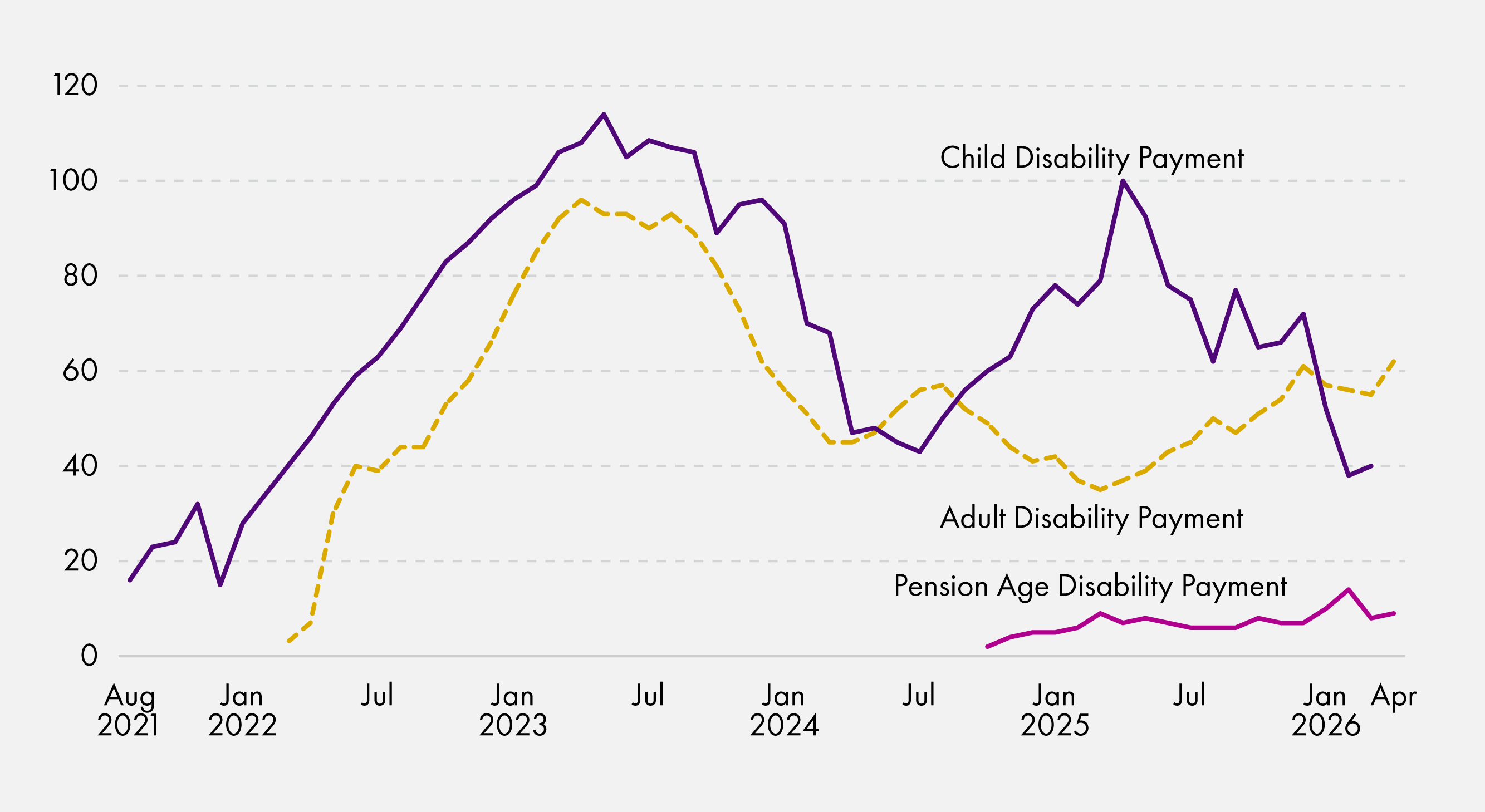
Processing times have been lengthy for ADP and CDP – particularly in summer 2023. As Chart 1 shows, CDP processing times slowed markedly in summer 2025, although the latest statistics show improvement, with the average processing time at 40 working days in March 2026.
Although still well below the 2023 peak, ADP processing times have been getting longer during 2025-26, reaching 62 working days in April 2026.
PADP has far shorter processing times than either CDP or ADP, with an average of nine working days in April 2026.
Social Security Scotland statistics
Authorisation rates
Authorisation rates for CDP and ADP have been falling in each year since disability benefits launched. They have fallen from 75% to 67% for CDP and from 57% to 34% for ADP. PADP authorisation are very high – at 82% in 2025-26, but this was the first full year of operation, and this is similar to CDP in its first full year.
| Year | CDP | ADP | PADP |
|---|---|---|---|
| 2021-22 | 75% | n/a | n/a |
| 2022-23 | 82% | 57% | n/a |
| 2023-24 | 76% | 51% | n/a |
| 2024-25 | 66% | 42% | 77% |
| 2025-26 | 67% | 34% | 82% |
Social Security Scotland. (2026). Adult Disability Payment statistics to 30 April. Retrieved from https://www.socialsecurity.gov.scot/publications/2026/06/adult-disability-payment-statistics-to-30-april-2026 [accessed 13 August 2026],Social Security Scotland. (2026). Child Disability Payment statistics to 31 March 2026. Retrieved from https://www.socialsecurity.gov.scot/publications/2026/05/child-disability-payment-statistics-to-31-march-2026 [accessed 13 August 2026], Social Security Scotland. (2026). Pension Age Disability Benefit statistics to 30 April 2026. Retrieved from https://www.socialsecurity.gov.scot/publications/2026/06/pension-age-disability-payment-statistics-to-30-april-2026 [accessed 13 August 2026]
To put this in context, the table below shows the number of applications processed and authorised each year for each of the above benefits. For ADP, this shows that the number of both processed applications and approved applications has fallen over the last three years.
| Year | CDP processed | CDP authorised | ADP processed | ADP authorised | PADP processed | PADP authorised |
|---|---|---|---|---|---|---|
| 2021-22 | 3,575 | 2,690 | 20 | 5 | n/a | n/a |
| 2022-23 | 16,960 | 13,945 | 35,955 | 20,455 | n/a | n/a |
| 2023-24 | 26,360 | 20,095 | 138,880 | 70,490 | n/a | n/a |
| 2024-25 | 23,645 | 15,710 | 128,765 | 53,590 | 1,740 | 1,350 |
| 2025-26 | 27,510 | 18,315 | 108,215 | 36,750 | 39,040 | 32,120 |
Social Security Scotland. (2026). Pension Age Disability Benefit statistics to 30 April 2026. Retrieved from https://www.socialsecurity.gov.scot/publications/2026/06/pension-age-disability-payment-statistics-to-30-april-2026 [accessed 13 August 2026]Social Security Scotland. (2026). Child Disability Payment statistics to 31 March 2026. Retrieved from https://www.socialsecurity.gov.scot/publications/2026/05/child-disability-payment-statistics-to-31-march-2026 [accessed 13 August 2026]Social Security Scotland. (2026). Adult Disability Payment statistics to 30 April. Retrieved from https://www.socialsecurity.gov.scot/publications/2026/06/adult-disability-payment-statistics-to-30-april-2026 [accessed 13 August 2026]
Level of award
People who have been transferred from DWP are more likely to be getting the highest rate of disability benefit, compared to people who have applied as new claimants to Social Security Scotland. This may suggest that the growth in numbers of people getting disability benefits is amongst people with, on average, less severe levels of need, or it may suggest different decision-making. It may also reflect the fact that those transferring from DWP have been receiving disability benefits for longer and been through reviews which will mean that those still in receipt are likely to have higher levels of need.
Overall, 10% of the CDP caseload get both the higher care component and the higher mobility component (March 2026). However, there is a clear difference between those who were transferred from DWP’s child Disability Living Allowance (15% got the highest rate) and those who applied to CDP as new claimants (7% got the highest rate) (see Table 6 below).
The pattern for ADP is similar. Table 6 shows that 37% of those transferring from PIP get the enhanced rates of both daily living and mobility compared to 19% of those who applied for ADP since 2022.
PADP is different – with those transferring from Attendance Allowance less likely to be on the higher rate compared to new claimants. As mentioned, PADP has been running for less time, so it may be too early to identify a trend.
| CDP | ADP | PADP | |
|---|---|---|---|
| New applicants | 7% | 19% | 73% |
| Case transfer from DWP | 15% | 37% | 64% |
| All clients | 10% | 30% | 66% |
| Total caseload | 101,990 | 503,175 | 181,530 |
| £/wk highest award in 2026-27 | £194.60 | £194.60 | £114.60 |
Social Security Scotland. (2026). Pension Age Disability Benefit statistics to 30 April 2026. Retrieved from https://www.socialsecurity.gov.scot/publications/2026/06/pension-age-disability-payment-statistics-to-30-april-2026 [accessed 13 August 2026]Social Security Scotland. (2026). Child Disability Payment statistics to 31 March 2026. Retrieved from https://www.socialsecurity.gov.scot/publications/2026/05/child-disability-payment-statistics-to-31-march-2026 [accessed 13 August 2026]Social Security Scotland. (2026). Adult Disability Payment statistics to 30 April. Retrieved from https://www.socialsecurity.gov.scot/publications/2026/06/adult-disability-payment-statistics-to-30-april-2026 [accessed 13 August 2026]
Challenging decisions: redeterminations and appeals
When someone disagrees with a decision about their disability benefits, they can ask Social Security Scotland to look at it again - known as a 'redetermination'. If they disagree with the redetermination decision they can appeal to the First-tier Tribunal and then to the Upper Tribunal.
The percentage of new applicants who ask for a redetermination is low but increasing . The number submitting an appeal is lower still.
Table 7 below compares redetermination rates and outcomes for CDP and ADP applications showing that a higher proportion of new ADP applicants requested a redetermination (17% of ADP applicants in 2025-26), compared to just 9% of new CDP applicants that year.
The table also shows that, over the years, the proportion of CDP decisions overturned at redetermination has been falling (down from 84% in 2022 to 47% in 2025) while the proportion of ADP decisions overturned has been rising (up from 32% in 2022 to 54% in 2025).
| ADP | ADP | ADP | CDP | CDP | CDP | |
|---|---|---|---|---|---|---|
| Requests | As % of processed applications | % redeterminations allowed | Requests | As % of processed applications | % allowed | |
| 2022-23 | 1,945 | 5.4% | 32% | 780 | 5% | 84% |
| 2023-24 | 17,045 | 12.3% | 42% | 1,705 | 6% | 66% |
| 2024-25 | 19,350 | 15.0% | 47% | 1,940 | 8% | 45% |
| 2025-26 | 18,535 | 17.1% | 54% | 2,460 | 9% | 47% |
Social Security Scotland. (2026). Child Disability Payment statistics to 31 March 2026. Retrieved from https://www.socialsecurity.gov.scot/publications/2026/05/child-disability-payment-statistics-to-31-march-2026 [accessed 13 August 2026]Social Security Scotland. (2026). Adult Disability Payment statistics to 30 April. Retrieved from https://www.socialsecurity.gov.scot/publications/2026/06/adult-disability-payment-statistics-to-30-april-2026 [accessed 13 August 2026] Shows % new applicants requesting redetermination of first decision.
PADP only has one full year of data. In 2025-26, 4.2% of PADP applicants requested a redetermination, and of those, 54% were allowed (i.e the decision was changed).3
A redetermination decision can be further challenged at appeal to the First-tier Tribunal.
Table 8 below shows that the number of appeal hearings are, very broadly, around half the number of appeals received – suggesting a considerable backlog exists. In ADP, around half of appeals are upheld. The proportion is slightly higher for CDP – with 57% of CDP appeals upheld in 2025-26.
| ADP | ADP | ADP | CDP | CDP | CDP | |
|---|---|---|---|---|---|---|
| Year | Received | Hearing | Upheld | Received | Hearing | Upheld |
| 2023-24 | 2,340 | 545 | 55% | 125 | 35 | 61% |
| 2024-25 | 3,920 | 2,280 | 50% | 405 | 200 | 55% |
| 2025-26 | 3,800 | 1,815 | 54% | 395 | 215 | 57% |
Social Security Scotland. (2026). Child Disability Payment statistics to 31 March 2026. Retrieved from https://www.socialsecurity.gov.scot/publications/2026/05/child-disability-payment-statistics-to-31-march-2026 [accessed 13 August 2026]Social Security Scotland. (2026). Adult Disability Payment statistics to 30 April. Retrieved from https://www.socialsecurity.gov.scot/publications/2026/06/adult-disability-payment-statistics-to-30-april-2026 [accessed 13 August 2026]
Reviews
When a disability benefit is awarded, a date is set for a planned review to check if anything has changed. If there are changes between reviews, the client must inform Social Security Scotland and a 'change of circumstances' review takes place. In addition, everyone who transferred from DWP had their award reviewed within a year. All this leads to a substantial number of reviews taking place.
In 2025-26, there were 117,725 ADP reviews- almost a quarter (23%) of the total caseload of 504,710 in April 2026. Overall, only 6% of cases were decreased on review. For new applicants (i.e those who have applied for ADP since 2022) who had planned reviews, the proportion is far higher – with 13% of people getting their award decreased or ended on review.
| Planned | Change of circumstances | All | Number of reviews | |
|---|---|---|---|---|
| New applicants | 13% | 8% | 11% | 38,720 |
| Case Transfers | 3% | 4% | 3% | 79,010 |
| All | 6% | 6% | 6% | 117,730 |
Social Security Scotland. (2026). Adult Disability Payment statistics to 30 April. Retrieved from https://www.socialsecurity.gov.scot/publications/2026/06/adult-disability-payment-statistics-to-30-april-2026 [accessed 13 August 2026]
For CDP, 7% of cases were decreased after a planned review but, unlike ADP, this is reasonably consistent between different types of review (table 10, below).
| Planned | Change of circumstances | All | Number of reviews | |
|---|---|---|---|---|
| New applicants | 6% | 6% | 6% | 18,250 |
| Case Transfers | 8% | 4% | 7% | 7,495 |
| All | 7% | 5% | 6% | 25,745 |
Social Security Scotland. (2026). Child Disability Payment statistics to 31 March 2026. Retrieved from https://www.socialsecurity.gov.scot/publications/2026/05/child-disability-payment-statistics-to-31-march-2026 [accessed 13 August 2026]
For PADP, most reviews have been for case transfers, as the benefit hasn't been running long enough for most new applicants to have had a planned review yet. As with ADP and CDP, a very small proportion (5%) of PADP clients get their award decreased on review.
Trends in caseload
The devolution of disability benefits to Scotland has co-incided with an increase in the number of people getting disability benefits across the UK, particularly amongst young people and people with mental health conditions. The Timms review interim report discusses the trends in England and Wales. The evidence pack for that report states:
Most sources show an upward trend in self-reported disability among the working age population, and that this upward trend steepened around the time of the COVID-19 pandemic. Within this, the share being accounted for by mental health conditions has increased, from around one-third of working age people reporting a mental health condition as a primary or secondary condition in FYE 2014 to almost 45% 10 years later.
Department for Work and Pensions. (2026). Annex B: DWP evidence pack (to the interim report of the Timms review). Retrieved from https://www.gov.uk/government/publications/timms-review-of-personal-independence-payment-interim-report/annex-b-dwp-evidence-pack [accessed 13 August 2026]
The following focuses on trends in Scotland.
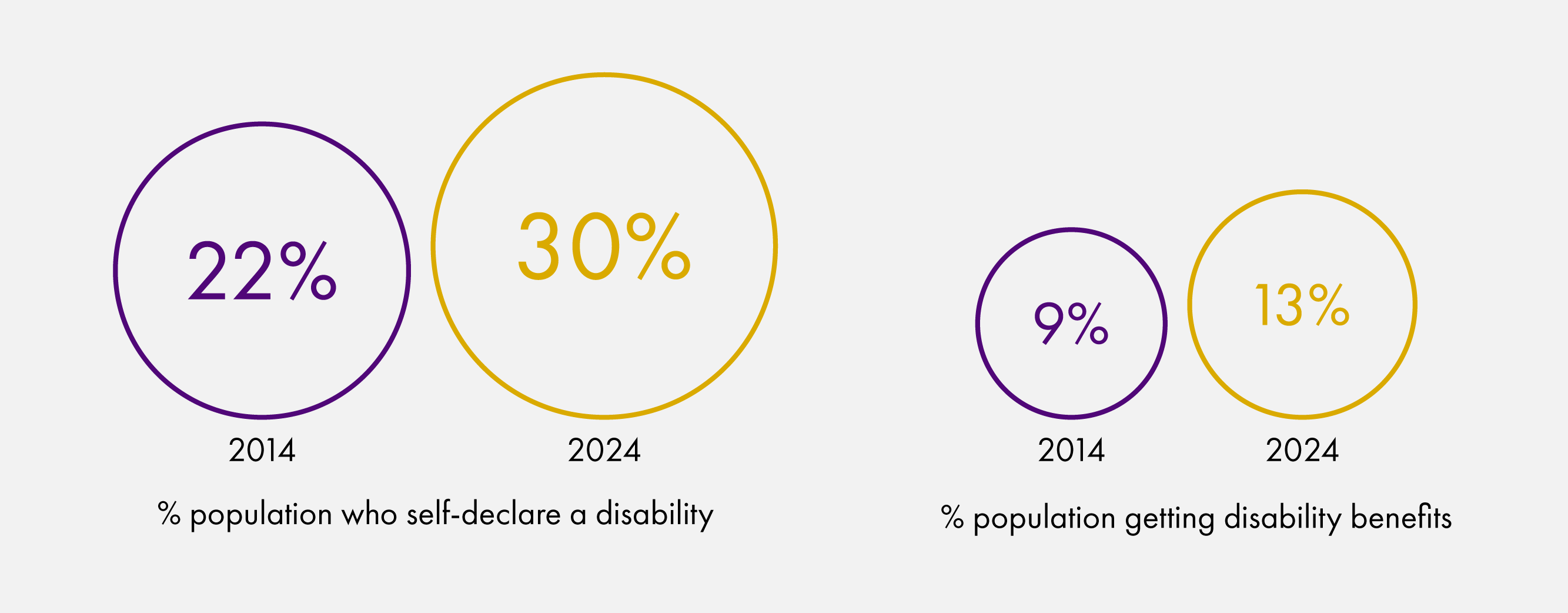
In 2014-15, 22% of the Scottish population were disabled as reported in the Family Resources Survey. Ten years later, in 2024-25, this had increased to 30%.
SPICe calculations from DWP StatXplore (benefit statistics and Family Resource Survey), Social Security Scotland statistics
Fewer than half of those self-reporting a disability get a disability benefit (chart 2, above). In 2014, 9% of the Scottish population got a disability benefit (either Disability Living Allowance, PIP or Attendance Allowance). In 2024 this had increased to 13% (getting DLA, PIP, Attendance Allowance, Child Disability Payment or Adult Disability Payment).
Table 12 below shows the breakdown by benefit. Over this period, PIP started to replace DLA for adults and later CDP started to replace DLA for children and ADP replaced PIP.
| 2014 | 2024 | |
|---|---|---|
| Disability Living Allowance | 340,597 | 72,991 |
| Personal Independence Payment | 8,308 | 172,682 |
| Attendance Allowance | 129,128 | 146,287 |
| Child Disability Payment | n/a | 84,155 |
| Adult Disability Payment | n/a | 254,365 |
| Total | 478,033 | 730,480 |
| Population | 5,247,121 | 5,428,028 |
| % population getting disability benefit | 9% | 13% |
DWP StatXplore (DWP benefit statistics and FRS population data), Social Security Scotland statistics. Benefit data is for May except PIP and ADP in 2024 are for April.
Age
While disability is far more common amongst older people, the growth in disability and in receipt of disability benefits is particularly noticeable amongst younger people.
For example, in 2014, around 3% of people aged under 35 were getting a disability benefit. Ten years later, this had increased to 8%. In contrast, a much higher proportion (24%) of older people aged 65+ got a disability benefit in 2014, but this only increased by one percentage point to 25% by 2024.
| age | % disabled 2014 | % disabled 2024 | % getting disability benefits 2014 | % getting disability benefits 2024 |
|---|---|---|---|---|
| 0-15 | 8% | 13% | 3% | 8% |
| 16-24 | 11% | 22% | 3% | 7% |
| 25-34 | 15% | 28% | 3% | 8% |
| 35-44 | 17% | 28% | 5% | 10% |
| 45-54 | 22% | 31% | 8% | 13% |
| 55-64 | 31% | 35% | 11% | 17% |
| 65+ | 47% | 44% | 24% | 25% |
| Total | 22% | 30% | 9% | 13% |
DWP StatXplore (DWP benefit and Family Resources Survey), Social Security Scotland statistics.
Main disabling condition
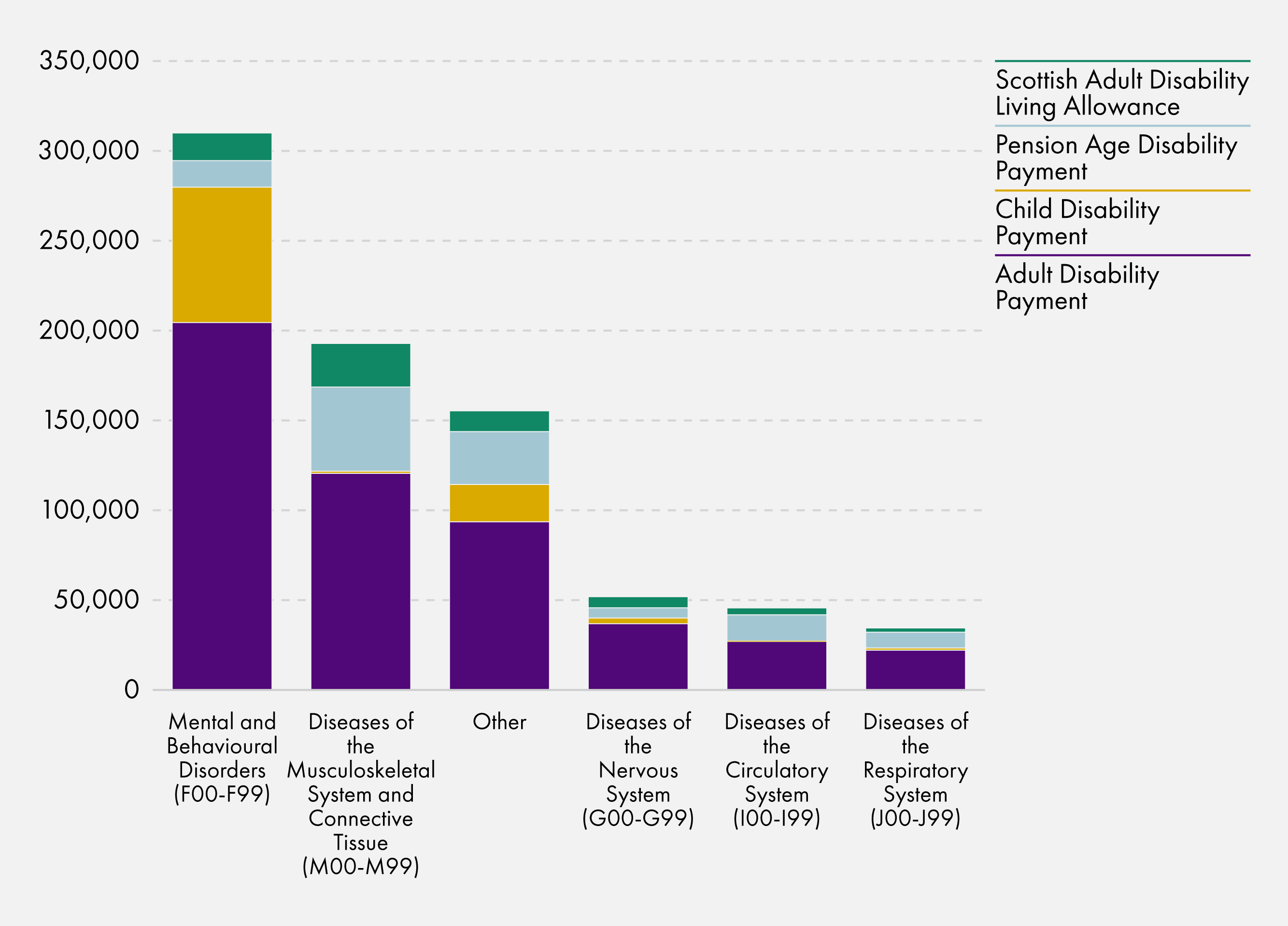
For CDP and ADP, the most common main disabling condition category is mental and behavioural disorders (74% and 41% of the caseload respectively). This is a very broad category which includes, for example, learning difficulties and disability, mood disorders, anxiety and dementia. For older people claiming PADP, the most common condition is musculoskeletal disorders, which is the main condition for 39% of the caseload.
The chart below shows the main disabling conditions across the four Scottish disability benefits, illustrating the dominance of mental and behavioural disorders.
Social Security Scotland statistics. NB ADP, CDP caseload as at April 2026. CDP, SADLA as at March 2026.
For CDP and ADP, there is a further breakdown of the category ‘mental and behavioural disorders’. This shows:
18% getting ADP have their main disabling condition as neurotic, stress-related and somatoform disorders
6% have their main disabling condition as mood disorders
6% have their main disabling condition as autism and other developmental disorders
42% of those getting CDP have childhood autism as their main disabling condition and
13% of those getting CDP have ADHD as their main disabling condition.
The number of people getting a disability benefit for mental health and behavioural conditions in Scotland has increased 98% since 2019, as shown in chart 4 below.
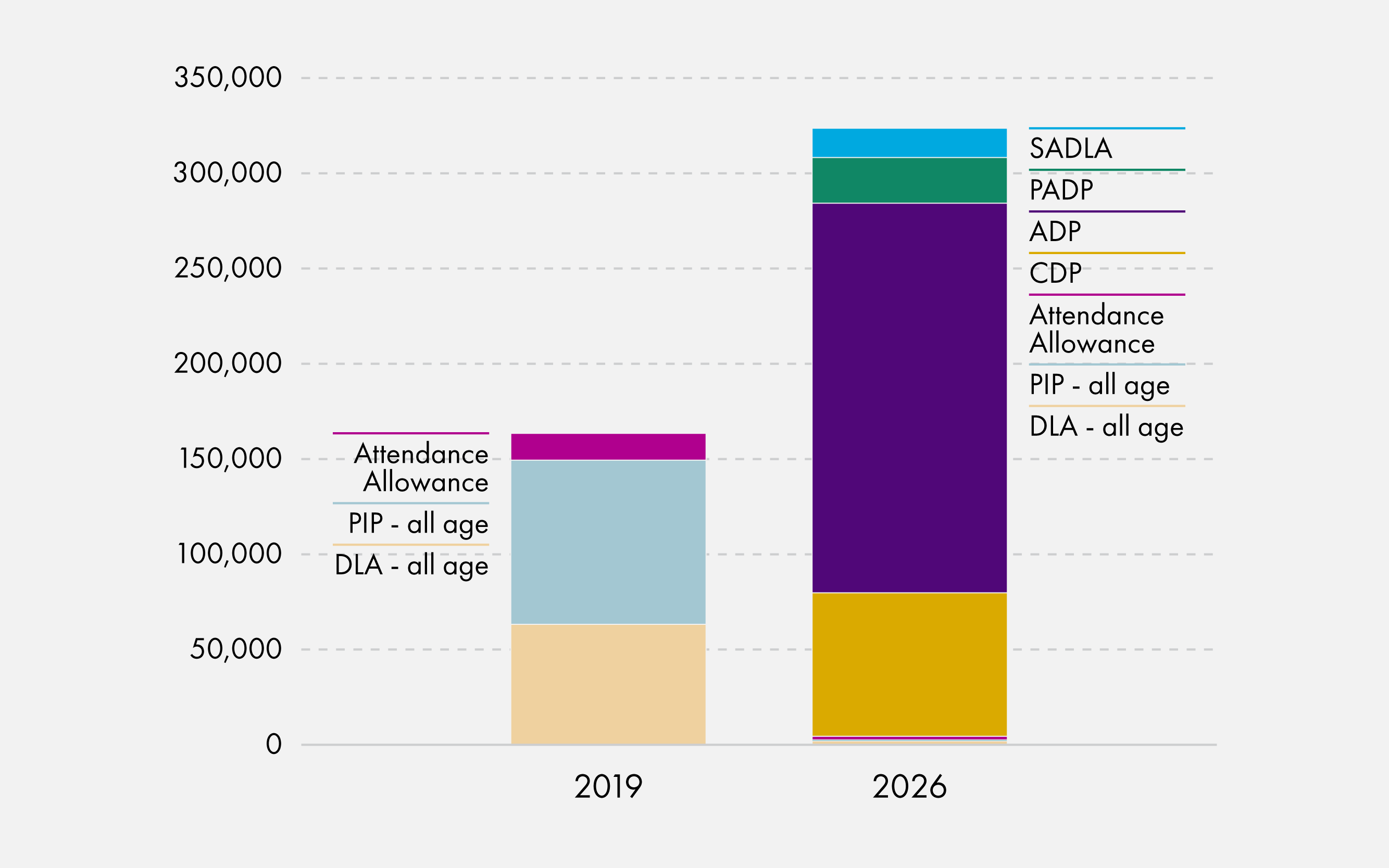
Sources: StatXplore, Social Security Scotland statistics. NB: 2019 data is caseload in May 2019. 2026 data is: ADP, PADP April 2026, CDP, SADLA March 2026, DLA, Attendance Allowance November 2025. Shows caseload for 'mental and behavioural disorders'. This category is not used in DLA and AA which show sum of: learning difficulties, psychosis, psychoneurosis, personality disorder, dementia, behavioural disorder, alcohol and drug abuse, hyperkinetic syndrome and severely mentally impaired.
Current growth in new awards
The introduction of new disability benefits in Scotland was expected to,1 and did, result in more people applying. However, after that initial increase in the two years following the launch of CDP and ADP, the number of new awards made each month has been relatively steady since spring 2025.
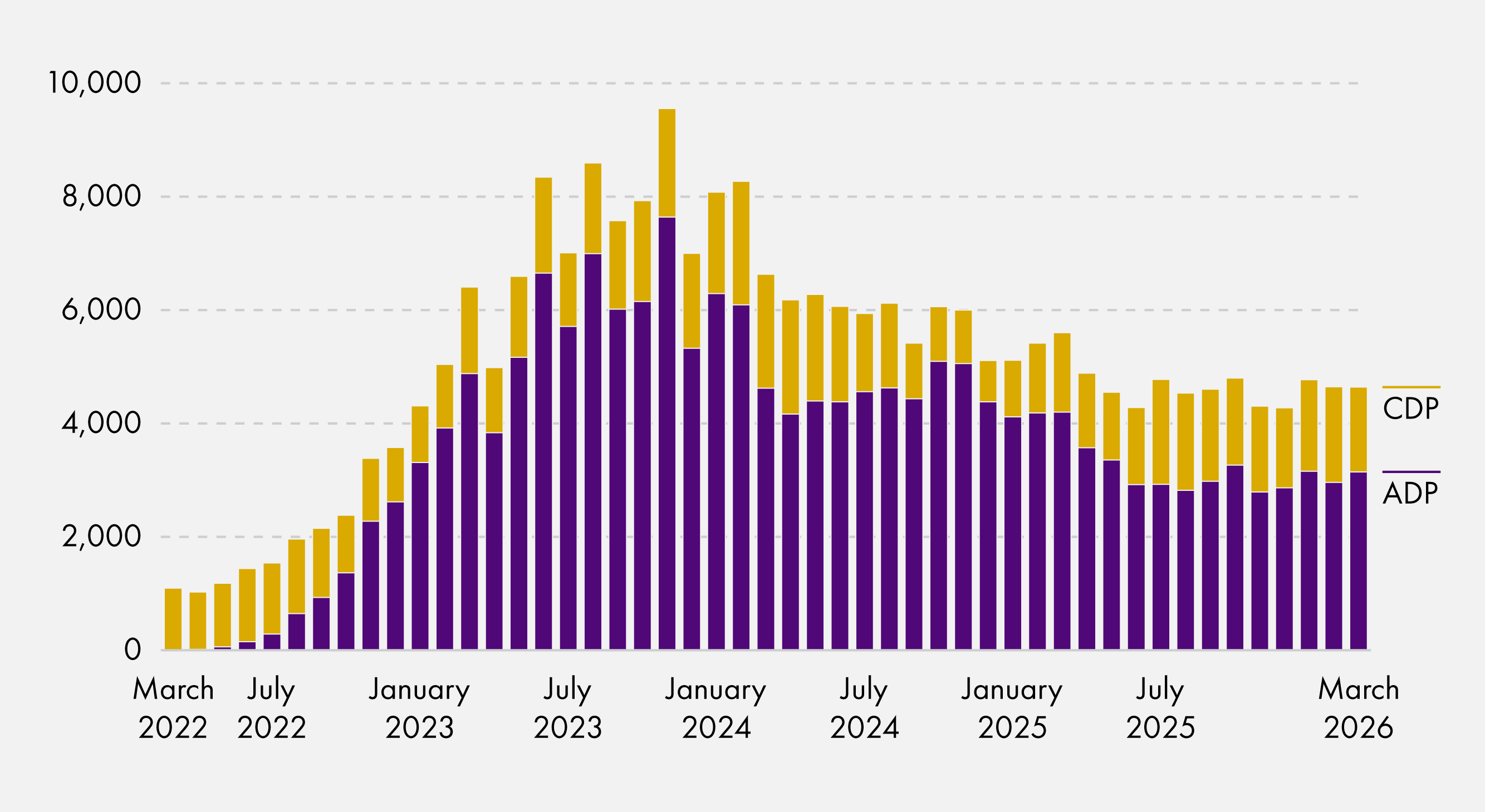
Social Security Scotland, ADP and CDP statistics. Shows authorised applications by month. NB This is an underestimate as it doesn’t include those getting awards following redetermination or appeal.
Although new applications appear to have stabilised, people leave ADP far more slowly than they are taking it up, resulting in a caseload that continues to grow.
Forecast future growth in caseload
The latest (January 2026) forecast for all four disability benefits is set out below, showing forecast increase from 790,000 people getting Social Security Scotland disability benefits in 2024-25 to just over 1 million people in 2030-31. This is an increase of 31%. ADP is expected to grow faster – from 473,000 to 691,000, which is a 46% increase.
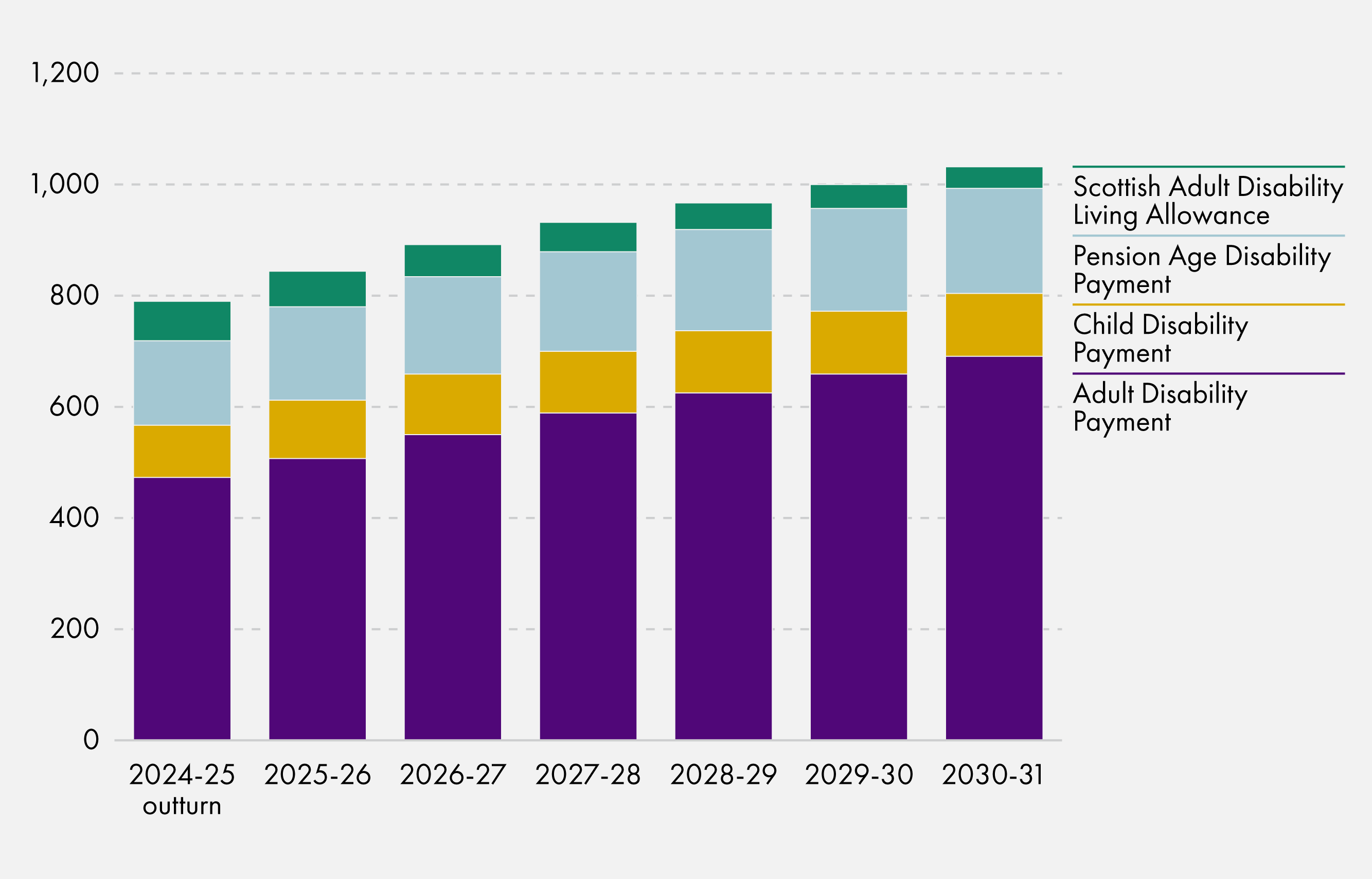
Scottish Fiscal Commission, January 2026.
There is similar overall growth forecast for England and Wales. The number of people getting DLA, PIP and Attendance Allowance is forecast to increase from 6.4 million in 2024 to 8.6 million in 2030 – an increase of 33%. PIP is expected to grow faster – with the caseload forecast to increase by 51% over the same period.
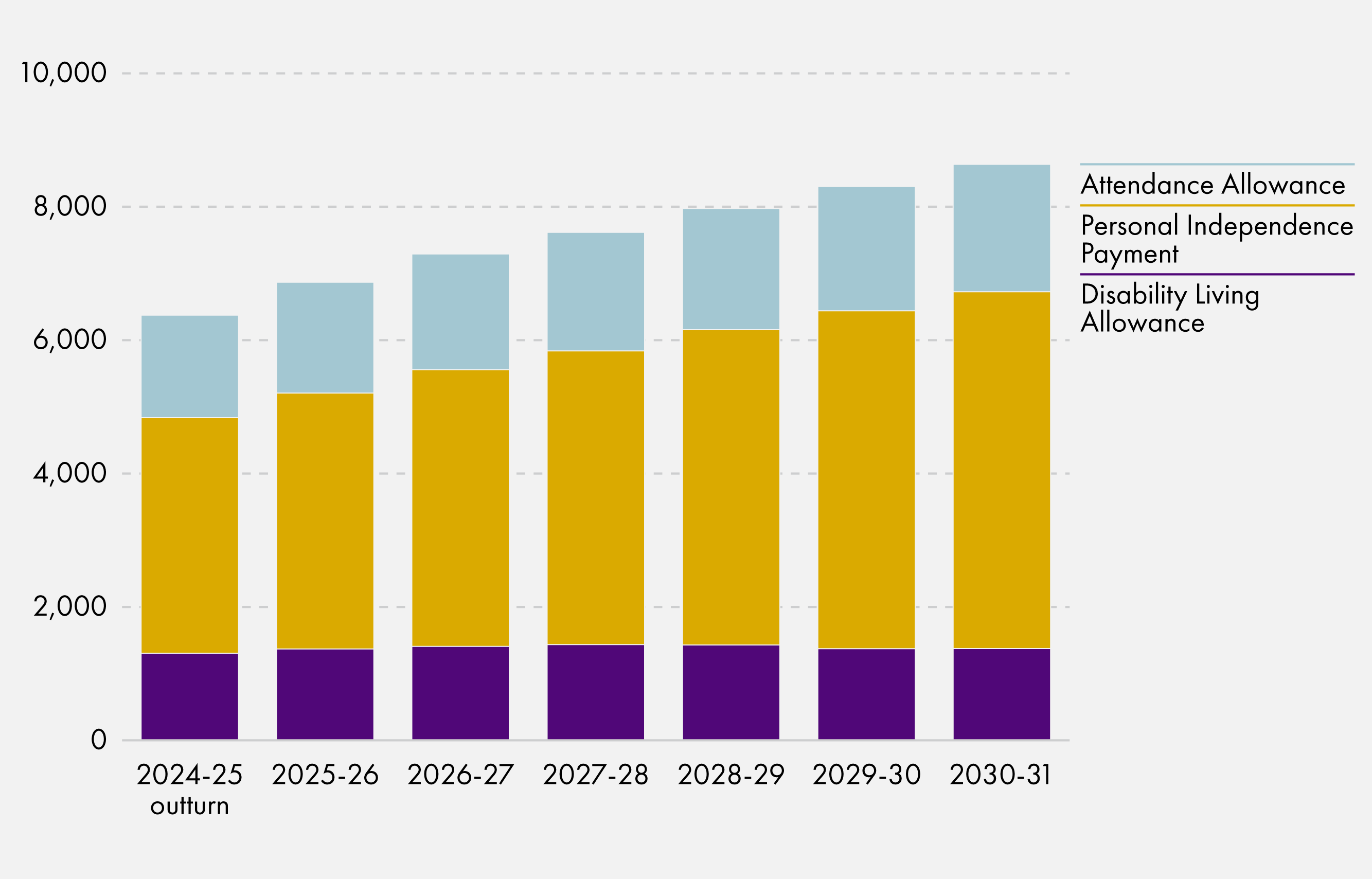
DWP, Benefit caseload and expenditure
Adult Disability Payment and the Scottish Budget
As caseloads increase, so does spending. Spending on ADP is forecast to increase from £3,845 million this year (2026-27) to £5,308 million in 2030-31. 1 In 2026-27, spending on ADP makes up 7.6% of the Scottish Government total resource budget of £50,634 million. This means that trends in caseload and decisions for ADP can have a big impact on the Scottish budget as a whole. However, this spending is largely balanced by UK Government funding. The Scottish Government receives funding from the UK Government based on what is spent on Personal Independence Payment. At the moment this funding, the PIP Block Grant Adjustment (BGA), is equivalent to around 95% of what the Scottish Government spends on ADP, thus mitigating the impact of ADP on the Scottish budget. 1
Given the scale of ADP spend, if funding via the PIP BGA were to significantly change this would put pressure on the Scottish Government budget as they would need to either change ADP policy or make up the shortfall through reductions elsewhere or increase tax.
Under current policy, this difference between PIP BGA and ADP spend is not expected to change much over the next five years. In January 2026, the Scottish Fiscal Commission forecast that ADP spend would be £209 million more than the PIP BGA in 2026-27, rising to £290 million in 2030-31.1
These forecasts are based on current Scottish and UK Government policy, but there are significant reviews of both ADP and PIP which could result in policy changes.
Future policy developments
There have been recent reviews into both ADP and PIP.
ADP independent review
The independent review of ADP by Edel Harris1was published in July 2025 making 58 recommendations across the four themes of:
The client voice – recommendations 1 to 9, including more promotion of local delivery service and independent advocacy.
Processes that work – recommendations 10 to 34, including automatic award of short- term assistance, and giving clients the choice whether to have a consultation.
A learning system – recommendations 10 to 39, including reviewing inclusive communications, and providing a single point of contact.
A better future – recommendations 40 to 58, including reviewing eligibility criteria, replace the ‘50%’ rule and remove references to walking a fixed distance for the mobility component.
Edel Harris has referred to high expectations for change, telling the previous Social Justice and Social Security Committee that there are:
high expectations of the review among disabled people in Scotland. Probably the most important point to make is that they expect some things to change as a result.
Scottish Parliament. (2025, November 27). Social Justice and Social Security Committee Official Report. Retrieved from https://www.parliament.scot/api/sitecore/CustomMedia/OfficialReport?meetingId=16722 [accessed 13 August 2026]
The Scottish Government published an initial response in March 2026. Many (23) of the more process orientated recommendations were accepted, but decisions on most (16) of the recommendations under the theme a ‘better future’ theme were deferred to the incoming Scottish Government after the election. Edel Harris has said that the strongest themes raised with her were not addressed by the Scottish Government:
Alongside changes to the mobility criteria, the 50% rule and living with fluctuating conditions were the strongest recurring themes coming from the disabled people I engaged with during the course of the Review.”
[…]
“I know that many of the Disabled People's Organisations and charities who engaged with the Review will be disappointed that the Government has not addressed the most substantive, system changing, recommendations from the Review
Harris, E. (2026). Submission to Social Justice and Social Security Committee for meeting 12 March 2026. Retrieved from https://www.parliament.scot/~/media/committ/12817/Note-by-the-Clerk--Paper-3 [accessed 13 August 2026]
The 50% ruleis a requirement that a person must be impacted by their condition, to the extent set out in the assessment descriptors, on at least half (50%) of the days in a given period (normally a year). The 20m rule is that, to qualify for the higher mobility rate, a person must not be able to walk more than 20m.
The Scottish Government’s response emphasised the scale of the challenge:
The wholesale modernisation of ADP, as recommended in the Report, will require extensive policy development, consultation, user research, and legislative reform. In many cases changes will require significant ongoing expenditure.
Scottish Government. (2026). Scottish Government Response to the Independent Review of Adult Disability Payment Final Report. Retrieved from https://www.gov.scot/publications/scottish-government-response-independent-review-adult-disability-payment-final-report/ [accessed 13 August 2026]
Edel Harris welcomed some measures, such as the commitment to review the ’28 day rule’ but expressed her disappointment that the response on changes to eligibility has been deferred to after the election. She concluded:
I welcome the commitment shown by the Scottish Government, but there is still more that can be done to deliver a truly human-rights based approach to the awarding of disability payments in Scotland.
Harris, E. (2026). Submission to Social Justice and Social Security Committee for meeting 12 March 2026. Retrieved from https://www.parliament.scot/~/media/committ/12817/Note-by-the-Clerk--Paper-3 [accessed 13 August 2026]
The MS Society commented that there were a number of positive steps, but “the response does not go far enough.” In particular, they said it is “deeply disappointing” that “recommendations that challenge current policies have yet to receive a definite commitment.”3
A more detailed analysis of the report and Scottish Government response is available in the papers for the Social Justice and Social Security Committee of 12 March 2026.
Timms review
The review of PIP by Sir Stephen Timms published its interim report in July 2026 and the final report with recommendations is expected this autumn.
The review is wide-ranging and is co-produced with disabled people, but it is also constrained to stay within current spending projections:
the Review is assessing whether PIP is fair, accessible, and fit for disabled people, so that it is there to support them to participate in day-to-day life and society, today and into the future. […] the Review will need to assess how PIP can be there to support future generations while remaining within the Office for Budget Responsibility’s (OBR) projections for future spending on PIP. The Review will also need to examine whether pressures in the wider system and loss of access to services have impacted the growth in the number of people claiming PIP.
Timms, S. (2026). Timms review of Personal Independence Payment interim report. Retrieved from https://www.gov.uk/government/publications/timms-review-of-personal-independence-payment-interim-report [accessed 13 August 2026]
The report set out the evidence received during the review. Much of this reflects themes raised with Edel Harris and with the Scottish Government in the early days of developing policy on ADP. For example:
There are concerns about whether the functional assessment and descriptors fully reflect real-life impacts, particularly for fluctuating, multiple, and less visible conditions, as well as about the consistency and transparency of decision-making and the role of supporting evidence. The experience of claiming PIP is often described as stressful, with accessibility adjustments applied inconsistently, contributing to low trust in the process.
Timms, S. (2026). Timms review of Personal Independence Payment interim report. Retrieved from https://www.gov.uk/government/publications/timms-review-of-personal-independence-payment-interim-report [accessed 13 August 2026]
Findings included:
people’s needs and extra costs vary significantly, and the current system does not always recognise these differences or offer appropriate support
for some people who need to claim PIP, the application, assessment and decision-making journey feels stressful and complex – it is described as focussing too much on what people cannot do rather than what they can do.
society’s understanding of disability has shifted since PIP was introduced and the benefit has not changed to reflect this context
there has been an increase in demand for PIP which is faster than the rise in the prevalence of disability in the population
wider system pressures may play a role in increasing PIP demand, impacting PIP’s ability to remain within fixed financial limits -the review is looking at PIP’s interaction with other forms of support, and whether PIP is being used to compensate for gaps in other services offered by DWP or the other Government departments
future reforms such as the planned removal of the Work Capability Assessment (WCA) placed expectations on PIP that were not present when it was designed.
Draft recommendations were published on 9 September. These included recommendations for improving the experience of applying for and receiving PIP. For example, reducing unnecessary reviews and improving forms and guidance. There were also recommendations to improve use of supporting information, looking at how fluctuating conditions are assessed and increasing capacity for face-to-face assessments. The emerging recommendations also set out the overall vision for a reformed benefit:
Department for Work and Pensions. (2026). The Timms Review: co-chair update September 2026. Retrieved from https://www.gov.uk/government/publications/the-timms-review-co-chair-update-september-2026 [accessed 15 September 2026]
The reformed benefit will support independent living, choice and control, helping disabled people and those with long-term conditions participate fully in society
Cash will remain the foundation of the award
The award will support participation and opportunity across everyday life, including work, volunteering, care and other meaningful activities
A reformed benefit will provide a non-means tested contribution towards the additional costs arising from disability or long term health condition
The person will be central to a fair and equitable process, with consistent rights but support tailored to individual needs
The process will be trusted and supportive, helping people explain their needs and fill evidence gaps where needed
The reformed benefit will promote dignity, choice and control for disabled people and those with long-term health conditions
The reformed benefit will be designed with disabled people and those with long term health conditions, and tested to make sure it works before it is rolled out.
Looking to the more fundamental reform of PIP, the emerging recommendations state that cash will remain the foundation of the award but "some awards will also include services, and offer other non-cash support." They also state that there will be different assessment pathways for different groups of people, and people with well-evidenced, serious conditions could benefit from a fast-track pathway.
These emerging recommendations will be 'tested' at workshops during September.
The review will not impact directly on Scottish benefits, but, if the UK Government makes changes to PIP as a result, there are two main issues for the Scottish Government.
Will it change spending on PIP and therefore change the funding provided through the Block Grant Adjustment? It is worth noting again the review's remit to keep spending within current projections and the commitment in the emerging recommendations to test reforms before they are rolled-out, which would give the Scottish Government time to consider its response to any changes.
Will the Timms review, combined with changes to ADP following the Edel Harris review, make ADP and PIP more like each other or less like each other? If the latter, does that raise questions about whether ADP and PIP continue to be treated as equivalent benefits in the rest of the reserved social security system?
Sources
Scottish Fiscal Commission. (2026). Scottish Economic and Fiscal Forecsts January 2026. Retrieved from <a href="https://fiscalcommission.scot/publications/scotlands-economic-and-fiscal-forecasts-january-2026/" target="_blank">https://fiscalcommission.scot/publications/scotlands-economic-and-fiscal-forecasts-january-2026/</a> [accessed 13 August 2026]
Scottish Government. (2026). Social Security Assistance in Scotland: up-rating for inflation in 2026-27. Retrieved from <a href="https://www.gov.scot/publications/social-security-assistance-scotland-up-rating-inflation-2026-27/" target="_blank">https://www.gov.scot/publications/social-security-assistance-scotland-up-rating-inflation-2026-27/</a> [accessed 13 August 2026]
Scottish Government. (2019). Social Security Consultation Disability Assistance. Retrieved from <a href="https://webarchive.nrscotland.gov.uk/public/20191022123044/https://www.gov.scot/publications/social-security-consultation-disability-assistance-scotland/pages/1/" target="_blank">https://webarchive.nrscotland.gov.uk/public/20191022123044/https://www.gov.scot/publications/social-security-consultation-disability-assistance-scotland/pages/1/</a> [accessed 13 August 2026]
Social Security Scotland. (2025). Client Satisfaction Survey 2024-25. Retrieved from <a href="https://www.socialsecurity.gov.scot/publications/2025/11/client-satisfaction-survey-2024-2025" target="_blank">https://www.socialsecurity.gov.scot/publications/2025/11/client-satisfaction-survey-2024-2025</a> [accessed 13 August 2026]
Harris, E. (2026). Independent Review of Adult Disability Payment: final report. Retrieved from <a href="https://www.gov.scot/publications/independent-review-adult-disability-payment-final-report/" target="_blank">https://www.gov.scot/publications/independent-review-adult-disability-payment-final-report/</a>
Scottish Commission on Social Security. (2026). Literature Review: Decision-making for Adult Disability Payment. Retrieved from <a href="https://socialsecuritycommission.scot/publications/social-security-charter/charter-2026-adp/literature-review-decision-making-for-adult-disability-payment-tlb-report/" target="_blank">https://socialsecuritycommission.scot/publications/social-security-charter/charter-2026-adp/literature-review-decision-making-for-adult-disability-payment-tlb-report/</a> [accessed 13 August 2026]
Social Security Scotland. (2026). Adult Disability Payment statistics to 30 April. Retrieved from <a href="https://www.socialsecurity.gov.scot/publications/2026/06/adult-disability-payment-statistics-to-30-april-2026" target="_blank">https://www.socialsecurity.gov.scot/publications/2026/06/adult-disability-payment-statistics-to-30-april-2026</a> [accessed 13 August 2026]
Scottish Fiscal Commission. (2021). Scotland's Economic and Fiscal Forecasts August 2021. Retrieved from <a href="https://fiscalcommission.scot/wp-content/uploads/2021/10/Scotlands-Economic-and-Fiscal-Forecasts-August-2021-Full-Report-Revised-October-2021.pdf" target="_blank">https://fiscalcommission.scot/wp-content/uploads/2021/10/Scotlands-Economic-and-Fiscal-Forecasts-August-2021-Full-Report-Revised-October-2021.pdf</a> [accessed 13 August 2026]
Department for Work and Pensions. (2025). Reforms to welfare system set to save £1.9 billion by 2030. New release 18 December 2025. . Retrieved from <a href="https://www.gov.uk/government/news/reforms-to-welfare-system-set-to-save-19-billion-by-the-end-of-203031" target="_blank">https://www.gov.uk/government/news/reforms-to-welfare-system-set-to-save-19-billion-by-the-end-of-203031</a> [accessed 13 August 2026]
Social Security Scotland. (2026). Child Disability Payment statistics to 31 March 2026. Retrieved from <a href="https://www.socialsecurity.gov.scot/publications/2026/05/child-disability-payment-statistics-to-31-march-2026" target="_blank">https://www.socialsecurity.gov.scot/publications/2026/05/child-disability-payment-statistics-to-31-march-2026</a> [accessed 13 August 2026]
Social Security Scotland. (2026). Pension Age Disability Benefit statistics to 30 April 2026. Retrieved from <a href="https://www.socialsecurity.gov.scot/publications/2026/06/pension-age-disability-payment-statistics-to-30-april-2026" target="_blank">https://www.socialsecurity.gov.scot/publications/2026/06/pension-age-disability-payment-statistics-to-30-april-2026</a> [accessed 13 August 2026]
Department for Work and Pensions. (2026). Annex B: DWP evidence pack (to the interim report of the Timms review). Retrieved from <a href="https://www.gov.uk/government/publications/timms-review-of-personal-independence-payment-interim-report/annex-b-dwp-evidence-pack" target="_blank">https://www.gov.uk/government/publications/timms-review-of-personal-independence-payment-interim-report/annex-b-dwp-evidence-pack</a> [accessed 13 August 2026]
Scottish Parliament. (2025, November 27). Social Justice and Social Security Committee Official Report. Retrieved from <a href="https://www.parliament.scot/api/sitecore/CustomMedia/OfficialReport?meetingId=16722" target="_blank">https://www.parliament.scot/api/sitecore/CustomMedia/OfficialReport?meetingId=16722</a> [accessed 13 August 2026]
Harris, E. (2026). Submission to Social Justice and Social Security Committee for meeting 12 March 2026. Retrieved from <a href="https://www.parliament.scot/~/media/committ/12817/Note-by-the-Clerk--Paper-3" target="_blank">https://www.parliament.scot/~/media/committ/12817/Note-by-the-Clerk--Paper-3</a> [accessed 13 August 2026]
Scottish Government. (2026). Scottish Government Response to the Independent Review of Adult Disability Payment Final Report. Retrieved from <a href="https://www.gov.scot/publications/scottish-government-response-independent-review-adult-disability-payment-final-report/" target="_blank">https://www.gov.scot/publications/scottish-government-response-independent-review-adult-disability-payment-final-report/</a> [accessed 13 August 2026]
Timms, S. (2026). Timms review of Personal Independence Payment interim report. Retrieved from <a href="https://www.gov.uk/government/publications/timms-review-of-personal-independence-payment-interim-report" target="_blank">https://www.gov.uk/government/publications/timms-review-of-personal-independence-payment-interim-report</a> [accessed 13 August 2026]
Department for Work and Pensions. (2026). The Timms Review: co-chair update September 2026. Retrieved from <a href="https://www.gov.uk/government/publications/the-timms-review-co-chair-update-september-2026" target="_blank">https://www.gov.uk/government/publications/the-timms-review-co-chair-update-september-2026</a> [accessed 15 September 2026]