Labour Market Update: March 2018
This briefing provides an overview of the Scottish labour market from the latest regional labour market statistics from the Office for National Statistics (ONS).
Executive Summary
This briefing provides an overview of the Scottish labour market from the latest regional labour market statistics 1 and UK labour market: March 2018 statistics2 from the Office for National Statistics (ONS).
The unemployment rate in Scotland increased over the quarter, and is now the same as the UK overall at 4.3%. The increase in unemployment was due to the number of unemployed women increasing by 11,000, while the number of men fell by 6,000.
The employment rate fell over the quarter in Scotland, despite the number of men entering work increasing.
The economic inactivity rate was unchanged over the quarter, and is still higher than the UK overall.
| Overall | Men | Women | ||||
|---|---|---|---|---|---|---|
| Rate (%) | Change over the qtr (% pts) | Rate (%) | Change over the qtr (% pts) | Rate (%) | Change over the qtr (% pts) | |
| Unemployment | 4.3% | +0.2 | 4.8% | -0.4 | 3.8% | +0.8 |
| Employment | 74.8% | -0.2 | 78.2% | +0.4 | 71.5% | -0.8 |
| Economic Inactivity | 21.9% | 0.0 | 18.0% | 0.0 | 25.6% | +0.1 |
What are the labour market measurements?
The International Labour Organisation provides the official definition of labour market statistics.
What is unemployment?
Level: Any individual aged 16 and over without a job who has been actively seeking work within the last four weeks and is available to start work within the next two weeks.
Rate: Number of unemployed individuals as a proportion of the total number of economically active people, which includes both the unemployed and those in work.
What is employment?
Level: Any individual aged 16 and over who is undertaking one hour or more a week of paid work.
Rate: Number of people in employment expressed as a percentage of all people aged 16-64.
What is economic inactivity?
Level: Any individual aged 16 to 64 who is not in employment, has not looked for work in the last four weeks, and is unable to start work within the next two weeks.
Rate: Number of people economically inactive expressed as a percentage of all people aged 16-64.
The main reasons for economic inactivity are:
being a student and not having or looking for a job
looking after the family and/or home
being sick (temporary and long-term)
being retired
being discouraged.
You can find out more in formation on labour market statistics in the SPICe Labour market statistics briefing.
Unemployment
The number of unemployed people in Scotland increased by 5,000 over the quarter but fell by 9,000 over the year.
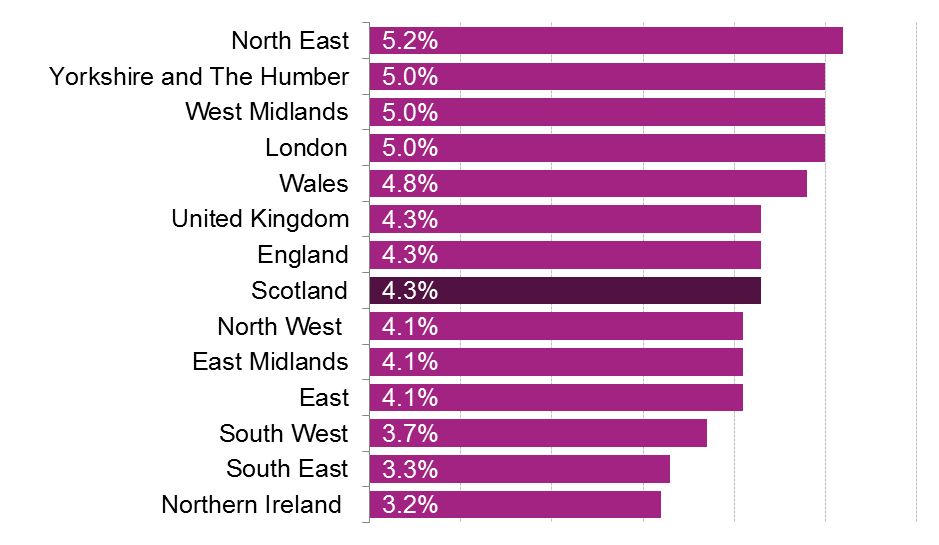
The unemployment rate for the UK is 4.3%. The rate in Scotland sits at 4.3%. Despite the rate increasing over the quarter in Scotland, it fell over the year and is still one of the lowest rates since comparable records began in 1992.
| Level ('000) | Quarter change ('000) | Year change ('000) | Rate (%) | Quarter change (% pts) | Year change (% pts) | |
|---|---|---|---|---|---|---|
| Scotland | 118 | +5 | -9 | 4.3% | +0.2 | -0.4 |
| UK | 1,453 | +24 | -127 | 4.3% | 0.0 | -0.4 |
Looking at unemployment across the UK, Northern Ireland has the lowest rate at 3.2%, while the North East has the highest at 5.2%.
Unemployment by gender
Over the quarter in Scotland, the increase in the unemployment level was due to the number of unemployed women increasing by 11,000, while the number of men fell by 6,000.
The quarterly increase in the number of women and their unemployment rate is the largest since 2013 ( Feb-Apr 2013 to May-Jul 2013). It is also the first increase in five quarters.
| Level ('000) | Quarter change ('000) | Year Change ('000) | Rate (%) | Quarter change (% pts) | Year change (% pts) | ||
|---|---|---|---|---|---|---|---|
| Scotland | Men | 68 | -6 | +1 | 4.8% | -0.4 | 0.0 |
| Women | 50 | +11 | -10 | 3.8% | +0.8 | -0.8 | |
| UK | Men | 757 | -25 | -109 | 4.2% | -0.2 | -0.6 |
| Women | 696 | +49 | -18 | 4.4% | +0.3 | -0.2 |
Unemployment by age
This data is not seasonally adjusted and is compared with the same quarter in previous years.
The unemployment rate for 25-34 year olds (3.5%) is the lowest since comparable records began in 2002.
Looking across the age groups, youth unemployment is the only group where Scotland deviates significantly from the UK, with the Scottish rate 2.5 percentage points lower.
| Age group | Scotland | UK | |
|---|---|---|---|
| 16-24 | Rate | 9.2% | 11.7% |
| Year change (% pts) | +0.7 | -0.1 | |
| 25-34 | Rate | 3.5% | 3.7% |
| Year change (% pts) | -0.7 | -0.9 | |
| 35-49 | Rate | 3.8% | 2.8% |
| Year change (% pts) | -0.2 | -0.4 | |
| 50-64 | Rate | 3.4% | 3.1% |
| Year change (% pts) | -0.9 | -0.1 |
Employment
The number of people aged 16 and over in employment in Scotland decreased by 8,000 over the quarter, but increased by 35,000 over the year. This is the second quarter in a row where the employment level has fallen.
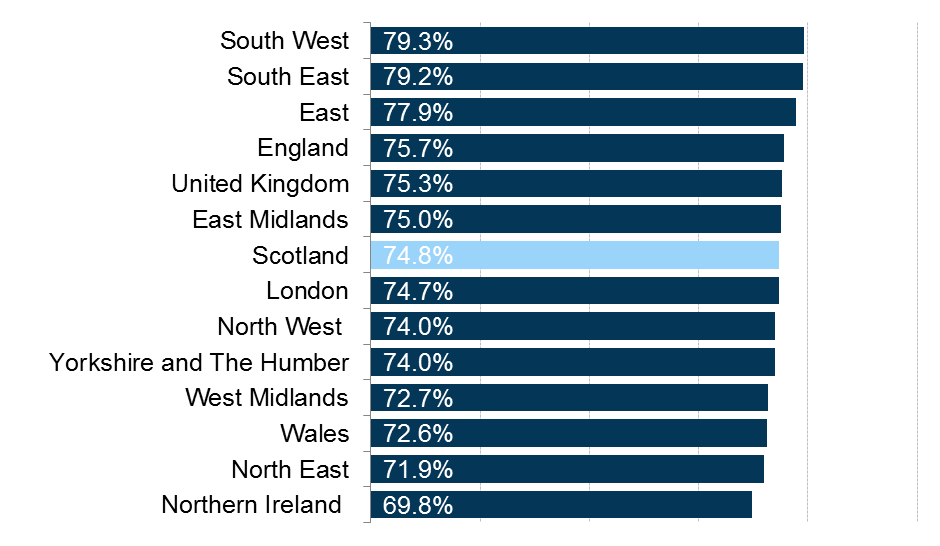
The employment rate in Scotland fell by 0.2 percentage points over the quarter, while the UK saw an increase of 0.3 percentage points. However, over the year the rate in Scotland increased at a slightly higher rate that the UK, 1.0 compared to 0.8 percentage points.
Despite a fall over the quarter, the rate in Scotland is one of the highest since comparable records began in 1992.
| Level ('000) | Quarter change ('000) | Year change ('000) | Rate (%) | Quarter change (% pts) | Year change (% pts) | |
|---|---|---|---|---|---|---|
| Scotland | 2,644 | -8 | +35 | 74.8% | -0.2 | +1.0 |
| UK | 32,248 | +168 | +402 | 75.3% | +0.3 | +0.8 |
Looking at employment across the UK, the Scottish rate is lower than the UK average. The South West has the highest rate at 79.3%, while Northern Ireland has the lowest at 69.8%.
Employment by gender
Employment levels and rates are higher for men than for women at both the Scottish and UK levels.
The fall in the employment level over the quarter is down to 14,000 women leaving employment, while the number of men in employment increased by 6,000.
This is the first fall in female employment since 2016 (May-Jul 2016 to Aug-Oct 2016)
Despite falling over the quarter the rate for both men and women increased over the year.
The female employment rate is higher in Scotland than in the UK (71.5% in Scotland versus 70.9% in the UK).
| Level ('000) | Quarter change ('000) | Year change ('000) | Rate (%) | Quarter change (% pts) | Year change (% pts) | ||
|---|---|---|---|---|---|---|---|
| Scotland | Men | 1,360 | +6 | +21 | 78.2% | +0.4 | +1.1 |
| Women | 1,285 | -14 | +14 | 71.5% | -0.8 | +1.0 | |
| UK | Men | 17,101 | +131 | +168 | 79.8% | +0.4 | +0.4 |
| Women | 15,147 | +38 | +234 | 70.9% | +0.2 | +1.1 |
Employment by age
This data is not seasonally adjusted and is compared with the same quarter in previous years.
The employment rate for 50-64 year olds is the highest since comparable records began in 2002, having increased by 13.9 percentage points since 2001.
Looking across the age groups, the employment rate the youth employment rate (4.3 percentage points higher) and that for 35 to 49 year olds (3.3 percentage points lower) are the only age groups where Scotland significantly deviates from the UK.
| Age group | Scotland | UK | |
|---|---|---|---|
| 16-24 | Rate (%) | 58.8% | 54.5% |
| Year change (% pts) | +1.0 | -0.6 | |
| 25-34 | Rate (%) | 82.1% | 83.7% |
| Year change (% pts) | +1.4 | +1.8 | |
| 35-49 | Rate (%) | 81.7% | 85.0% |
| Year Change (% pts) | -0.2 | +1.0 | |
| 50-64 | Rate (%) | 71.7% | 71.4% |
| Year Change (% pts) | +1.9 | +0.5 |
Economic inactivity
The number of people economically inactive in Scotland increased by 1,000 over the quarter, but fell by 25,000 over the year.
Over the quarter, the economic inactivity rate in Scotland was unchanged, whilst the UK's fell by 0.3 percentage points.
Over the year the rate in Scotland fell by 0.7 percentage points while the UK fell by 0.3. This is the biggest annual fall in Scotland since 2014 (Nov-Jan 2013 to Nov-Jan 2014).
| Level ('000) | Quarter change ('000) | Year change ('000) | Rate (%) | Quarter change (% pts) | Year change (% pts) | |
|---|---|---|---|---|---|---|
| Scotland | 745 | +1 | -25 | 21.9% | 0.0 | -0.7 |
| UK | 8,723 | -136 | -158 | 21.2% | -0.3 | -0.4 |
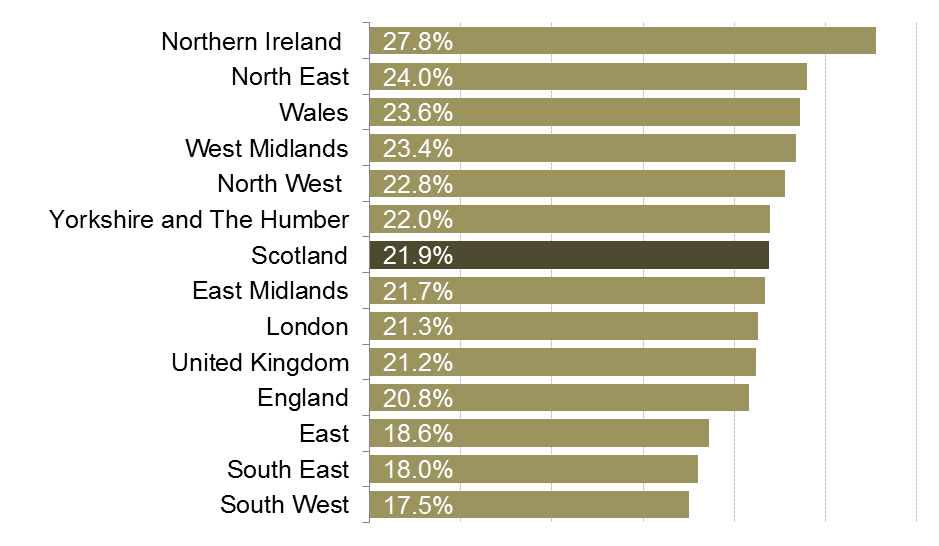
Looking at economic inactivity across the UK, the Scottish rate is higher than the UK average. Northern Ireland has the highest rate at 27.8%, while the South West has the lowest at 17.5%.
Economic inactivity by gender
Economic inactivity rates are higher for women than for men.
The number of economically inactive people in Scotland was unchanged over the quarter. However 1,000 women became economically inactive, while 1,000 less men were economically inactive.
The rate for men was unchanged, while the rate for women increased over the quarter. The rate fell for both men and women over the year.
| Level ('000) | Quarter change ('000) | Year change ('000) | Rate (%) | Quarter change (% pts) | Year change (% pts) | ||
|---|---|---|---|---|---|---|---|
| Scotland | Men | 299 | -1 | -17 | 18.0% | 0.0 | -1.0 |
| Women | 446 | +1 | -8 | 25.6% | +0.1 | -0.4 | |
| UK | Men | 3,396 | -47 | +41 | 16.6% | -0.2 | +0.1 |
| Women | 5,327 | -88 | -200 | 25.7% | -0.4 | -1.0 |
Economic inactivity by age
This data is not seasonally adjusted and is compared with the same quarter in previous years.
The economic inactivity rate for 50-64 year olds is the lowest since comparable records began and has fallen by 13.3 percentage points since 2001.
Looking across the age groups, the rate for 50-64 year olds is the only age group where Scotland doesn't deviate significantly from the UK.
| Age Group | Scotland | UK | |
|---|---|---|---|
| 16-24 | Rate (%) | 35.2% | 38.3% |
| Year change (% pts) | -1.6 | +1.0 | |
| 25-34 | Rate (%) | 15.0% | 13.0% |
| Year change (% pts) | -0.8 | -1.0 | |
| 35-49 | Rate (%) | 15.1% | 12.6% |
| Year change (% pts) | +0.4 | -0.7 | |
| 50-64 | Rate (%) | 25.8% | 26.4% |
| Year change (% pts) | -1.3 | -0.5 |
Claimant Count
The Claimant Count figures presented here are experimental statistics from the ONS for Jobseekers Allowance, plus Universal Credit claimants who are out of work.
Under Universal Credit a broader span of claimants are required to look for work than under Jobseekers Allowance. As Universal Credit Full Service is rolled out in particular areas, the number of people recorded as being on the Claimant Count is therefore likely to rise.
This is not an official measure of unemployment, but it does provide accurate information on the labour market at a local level.
Scotland and UK comparison
The seasonally adjusted claimant count rate for February in Scotland was unchanged over the month, and increased over the year.
The Scottish claimant count rate is higher than the UK rate.
| Level | Month Change | Year Change | Rate (%) | Month Change (% pts) | Year Change (% pts) | |
|---|---|---|---|---|---|---|
| Scotland | 83,800 | +200 | +5,500 | 2.4% | 0.0 | +0.2 |
| UK | 837,800 | +9,200 | +76,100 | 2.0% | 0.0 | +0.2 |
Constituency data: economic inactivity rate
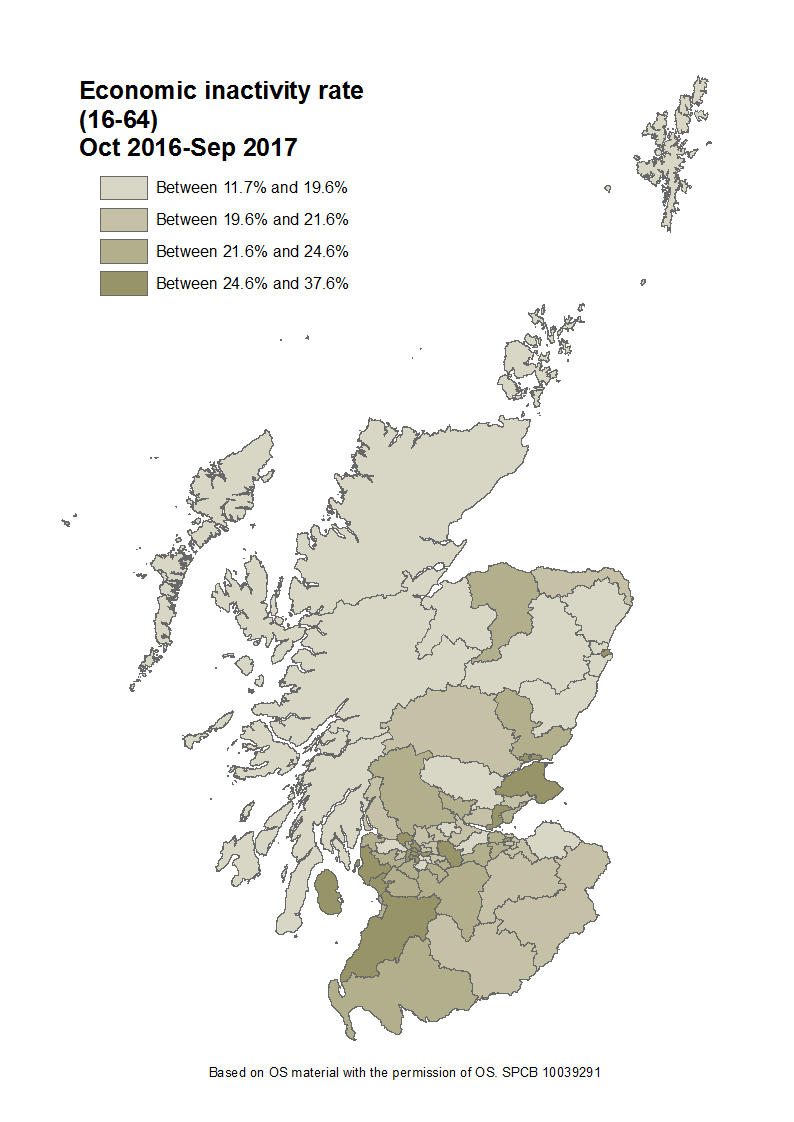
The constituency data for Scotland comes from the Annual Population Survey (APS). The APS datasets are produced quarterly, with each dataset containing 12 months of data. This data is based on residence analysis of the APS.
The latest APS data is for Oct 2016-Sep 2017.
The Shetland Islands have the lowest economic inactivity rate at 11.7%, while Glasgow Kelvin has the highest at 37.6%. Glasgow Cathcart saw the biggest increase over the year, while Glasgow Anniesland saw the largest decrease.
Find out the latest labour market data for your constituency.
Sources
Office for National Statistics. (2018, March 21). Regional labour market statistics in the UK: March 2018. Retrieved from <a href="https://www.ons.gov.uk/employmentandlabourmarket/peopleinwork/employmentandemployeetypes/bulletins/regionallabourmarket/march2018" target="_blank">https://www.ons.gov.uk/employmentandlabourmarket/peopleinwork/employmentandemployeetypes/bulletins/regionallabourmarket/march2018</a> [accessed 21 March 2018]
UK labour market: March 2018. (2018, March 21). Retrieved from <a href="https://www.ons.gov.uk/employmentandlabourmarket/peopleinwork/employmentandemployeetypes/bulletins/uklabourmarket/march2018" target="_blank">https://www.ons.gov.uk/employmentandlabourmarket/peopleinwork/employmentandemployeetypes/bulletins/uklabourmarket/march2018</a> [accessed 21 March 2018]