Rural Affairs and Islands Committee
Report on the draft Climate Change Plan as it relates to agriculture and land use
Introduction
This report sets out the Rural Affairs and Islands (RAI) Committee’s scrutiny of the Scottish Government’s draft Climate Change Plan (CCP). The draft CCP and its supporting documentation is published on the Scottish Government’s website.
The draft CCP was published on 6 November 2025 and describes how the Scottish Government will achieve its carbon budgets for reducing emissions from 2026-2040 and, in doing so, maintaining progress towards achieving ‘Net Zero’ by 2045i. Following the passage of the Climate Change (Emissions Reduction Targets) (Scotland) Act 2024, Scotland has moved to a ‘carbon budgets’ model for calculating emissions reductions, whereby legal limits on greenhouse gases (GHG) are set by the Scottish Government to cover four five-yearly cycles throughout the 2026-2045 period. Carbon budgets are set by the Scottish Government based on independent advice it receives from the Climate Change Committee (CCC). The latest CCC’s advice to the Scottish Government on Scotland’s carbon budget was published on 21 May 2025.
Under requirements in section 35 of the Climate Change (Scotland) Act 2009, the Scottish Government must refresh its CCP every five years and lay a draft before the Scottish Parliament. The Scottish Parliament thereafter has 120-days to scrutinise the contents of the draft CCP and report its findings, after which the Scottish Government must lay a final CCP taking account of the views expressed during the parliamentary process and its own consultation exercise.
The draft CCP includes policies and proposals which aim to decarbonise all sectors of the economy and, as such, has engaged the remits of a number of parliamentary committees. Joint scrutiny of the draft CCP has been led by the Net Zero, Energy and Transport (NZET) Committee and further information on this work can be found on the NZET Committee’s website.
Consideration by the RAI Committee
The Committee’s scrutiny work has focused on two chapters of the draft CCP that are relevant to its remit:
Agriculture
Land use, land use change and forestry (LULUCF)
The Committee took oral evidence on the draft CCP over two meetings. On 7 January 2026, the Committee scrutinised the LULUCF chapter by hearing from experts in peatland restoration, representatives of the commercial forestry sector, and academics and NGOs with an interest in woodlands. At its meeting on 14 January 2026, the Committee considered the agriculture chapter of the draft CCP by hearing from industry stakeholders and then from academics and NGOs. It then took concluding evidence from the Cabinet Secretary for Rural Affairs, Land Reform and Islands and Scottish Government officials on 28 January 2026.
The Official Report from these meetings are available on the Committee’s webpage. A copy of the minutes from each meeting can be found in Annexe A.
In addition, the Committee reflected on written responses to the NZET Committee’s joint consultation on the draft CCP, which ran between June and September 2025. All written submissions to the call for views are published on the Scottish Parliament website.
The Committee is grateful to all those who provided written and oral evidence to inform its consideration of the draft CCP.
Agriculture
Background
The draft CCP outlines that “delivering emissions reductions in the agriculture sector can and should go hand in hand with building climate resilience, improving biodiversity and delivering business productivity”. It adds that “our pathway to 2045 will focus on decarbonising the agriculture industry while ensuring that we do not offshore emissions”.
The emissions reduction pathway for agriculture across the next three carbon budgets is set out in Annex 3 of the draft CCP.
| MtCO2e | 2026-2030 | 2031-2035 | 2036-2040 |
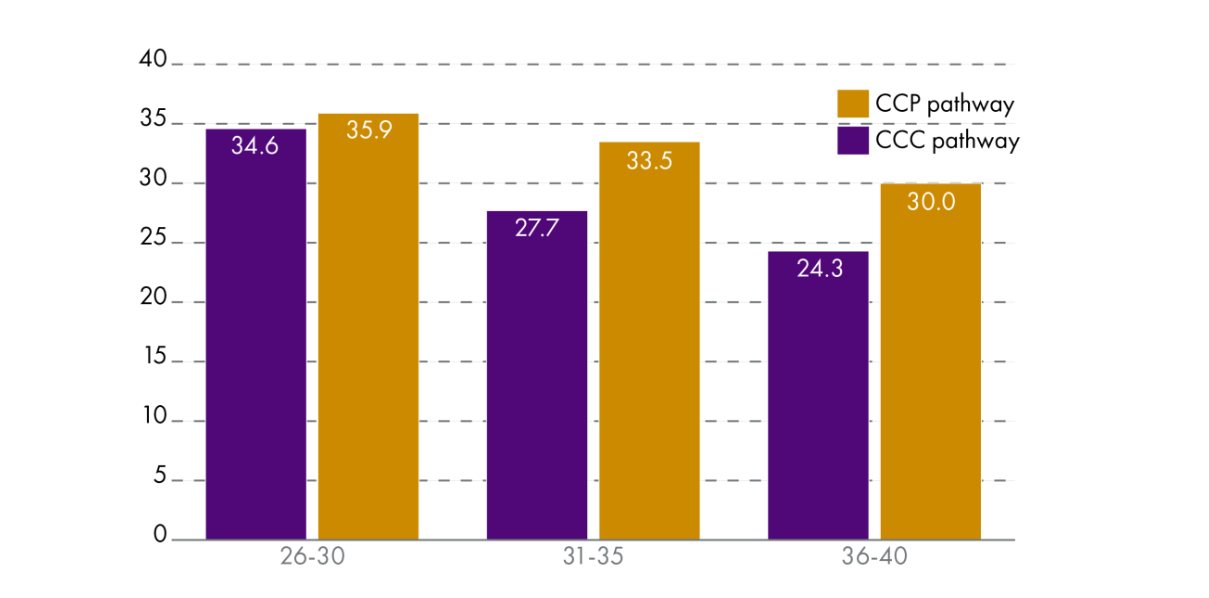
| Agriculture Emissions Pathway | 35.9 | 33.5 | 30.0 |
| Agriculture Baseline Emissions | 36.1 | 34.8 | 33.5 |
| Agriculture Policy Reductions | 0.1 | 1.3 | 3.5 |
A detailed breakdown of emissions from individual agricultural processes was published in a 2018 report by Scotland’s Rural College (SRUC). The report explains that almost half of all emissions in the agriculture sector are due to methane produced from the digestive processes of livestock, with 14% of emissions coming from manure management, 10% from mobile machinery, and 8% from inorganic fertilisers.
Policies and proposals in the draft CCP
The main policy in the draft CCP in respect to agriculture is the commitment by the Scottish Government to reform agricultural support schemes to “support our farmers and crofters to reduce their emissions, as well as delivering high-quality food production, climate adaptation, and nature restoration, supporting thriving rural communities”. The Agricultural Reform Programme is expected to include the uptake of climate change mitigation measures on farms and crofts. Projections used in the draft CCP relating to the emissions reduction pathway for agriculture are based on an assumption that the agricultural reform programme will result in a 45% uptake of mitigation measures, although it recognises that this “will be extremely challenging for the sector to achieve”.
The draft CCP stated that further details on how the Scottish Government “will deliver agricultural support and our strategic priorities for that support” would be set out in the first rural support plan.i Although the draft CCP said the plan would be published by ‘winter 2025’, the Minister for Agriculture and Connectivity confirmed in oral evidence to the Committee on 17 December 2025 that the publication of the plan would not meet this deadline. In correspondence to the Committee on 6 January 2026, the Minister said the plan would be laid in Parliament “as soon as is practicable”.
Two new proposals were also announced in the draft CCP aimed to decarbonise agricultural practices through innovation and adoption of low-emissions technologies. More specifically, the draft CCP states that the Scottish Government will reduce emissions from non-road mobile machinery by “investigating and promoting efficiencies, alternative fuels and technological developments and providing knowledge exchange, guidance and advice”. It also states that the Scottish Government will “investigate technologies for alternative, improved or more efficient fertilisers, including organic and organo-mineral fertilisers and fertilising products”.
The Cabinet Secretary announced in a statement in June 2025 that the Scottish Government would not introduce a policy to reduce livestock numbers as part of efforts to achieve Net Zero. This position is reflected in the emissions reduction pathway set out in the draft CCP. The draft CCP states that further progress on livestock emissions will be made through other measures that improve animal welfare and the adoption of new technologies that promote low-carbon livestock practices, including research into selective breeding for low methane genetics.
SPICe said in its blog analysis of the draft CCP that, when comparing the Scottish Government’s emissions pathway for agriculture to the CCC’s balanced pathway, the latter “assumes deeper emissions reductions for agriculture, in large part because it assumes a reduction in livestock numbers alongside a reduction in meat and dairy consumption to avoid imports increasing to make up for lower domestic production”.
A comparison of the trajectories for agricultural emissions (MTCO2e) in the draft CCP and the CCC’s balanced pathway are presented in the following chart.
Scottish Parliament Information Centre
Reforms to agricultural support
Most stakeholders emphasised that changes to agricultural support payments are key to delivering the ambitions set out in the draft CCP. Stakeholders pointed to how changes to scheme requirements could incentivise farmers to transition to more sustainable and regenerative practices. NatureScot pointed out in its written evidence to the NZET Committee that “what will be critical is the scale and pace of change, especially given the significant proportion of Scotland’s greenhouse gas emissions from the agriculture and other land use sector”.
The vast majority of industry and academic stakeholders who gave oral evidence to the Committee raised concerns about a lack of clarity on the Scottish Government’s new agricultural payments regime. Many said this had also been a significant contributor to the slow progress made in transitioning to low emission agriculture over recent years. The Scottish Agroecology Partnership said:
It is an issue of ambition versus the reality gap of implementation. As outlined, the climate change plan relies heavily on an agricultural reform programme and tools such as whole farm planning to deliver that ambition. However, the way in which the delivery routes and tools have been implemented has been too slow. The route map has lost the confidence of the industry. It is too fragmented, and you cannot underpin long-term business planning if you do not know where things will go after 2030.
Some industry stakeholders called for clarity around what farmers and crofters will be expected to do. The Scottish Agriculture Organisation Society called for the Scottish Government to publish its list of mitigation measures, arguing that without this information “we do not really know to what degree, in Scotland, they are going to give good wins”.
Some industry stakeholders said that, whilst the collaborative and inclusive approach to bringing forward the reform programme was well-intentioned, the Scottish Government needs to show strong leadership in making choices around future schemes. The Scottish Agricultural Organisation Society said “I do not feel that it is misrepresentation or that people are being missed out; it is more that sometimes you have to lead, which means stepping out and beyond and doing things that are, frankly, unpopular—you cannot always be liked, sadly”.
Delays to the publication of the rural support plan made it difficult for some stakeholders to take a view on whether the proposed emissions reduction pathway set out in the draft CCP is achievable. Professor Dave Reay from University of Edinburgh said that, “without a rural support plan, actual policies or a budget in place, it is really hard to see, despite our sector having limited emissions reductions compared to other sectors in the climate change plan, how that will be delivered.”. Stakeholders highlighted that the rural support plan must be sufficiently clear and ambitious in articulating how the Scottish Government intends industry to operate in the future, as well as defining what a just transition will look like for rural communities as a result of these changes.
Most of the panel of academics suggested the 45% voluntary uptake of mitigation measures assumed in the draft CCP was not credible. To that end, many called for the Scottish Government to underpin the CCP with contingency measures that would enable robust monitoring of progress and early intervention if the Scottish Government was off track in meeting its targets. Dr Vera Eory from SRUC said “there also needs to be a credible policy threat that 5, 10 or 15 years down the line, much stronger policies will need to come in if the voluntary policies do not help”.
The Cabinet Secretary said she recognised “some of the criticisms that we have received about the pace and scale of change, but we have to balance that with the need to take people along with us on that journey”. She explained that the Scottish Government’s actions have been “all about building strong foundations in the coming years so that we can ramp up progress in the next period of the plan”. The Cabinet Secretary also pointed to changes to whole farm plans and ecological focus areas as demonstrating the progress made in delivering the Scottish Government’s reform programme.
In response to concerns about the viability of the 45% uptake, the Cabinet Secretary accepted that “it is challenging, but the research sets out that it is believed to be achievable”. A Scottish Government official said that a monitoring and evaluation framework is being developed to underpin the agricultural reform programme, which they said would give early feedback on the uptake of measures and their climate impact.
When asked by the Committee if the Scottish Government would include further information on the list of mitigation measures in the final CCP, the Cabinet Secretary answered that “I do not think that there will be any problem in publishing those measures in the CCP”.
In response to questions regarding the timescales for the rural support plan, the Cabinet Secretary confirmed the plan “will be published before the election”.
Integration of agricultural and land use policies
Stakeholders also highlighted the crucial role of farmers and crofters in delivering smaller-scale forestry and peatland restoration. A number of witnesses noted the need for more alignment and integration of policy and funding schemes in agriculture, forestry and peatlands. As a peatland specialist, Dr Emily Taylor from the Crichton Carbon Centre said she did not have much engagement with the farming sector. She felt this was because “it is very difficult to see how peatland restoration fits in the farming context, particularly given its alignment with agricultural subsidies”. In contrast, Scottish Woodlands said that, from a forestry standpoint, “we have huge interaction with the farming sector, and about 70 per cent of all the schemes that we do by number are done for farmers, who have a significant uptake in what we do.”
The Cabinet Secretary agreed with the need for alignment between policies in the agricultural and LULUCF chapters of the draft CCP. She said:
We are talking about different envelopes today, and it is easy to categorise things in different areas and put them in those envelopes, but we need to look at land in an integrated and coherent way. Fundamentally, that is in our minds as we are shaping future policy that involves peatland and forestry to ensure that we provide a range of options.
Emissions from non-road machinery and fertiliser
The Committee discussed with witnesses the potential application of low-emissions agricultural machinery. It was noted by NFUS and Scottish Agroecology Partnership that electric-powered tractors are currently approximately double or triple the cost of their diesel equivalents. They also commented that electric tractors are significantly heavier which could damage to soil structures. SE LINK concluded that “lots of things are going on in the manufacturing industry, but it feels unlikely that there will be mass uptake or affordability of such technology in the next 10 or 15 years”.
In relation to moves towards more efficient and low-impact fertilisers, NFUS told the Committee that “we are seeing a big uptake, in our membership and across the industry, of folk on the farm and on the ground ensuring that they are spreading the right fertiliser or minerals that are needed in their soils, because that improves the fertility and it is good across the board”. However, when asked if the draft CCP’s ambitions around fertiliser use are deliverable, NFUS said that:
fertilisers can be spread more precisely, but the plan talks about alternative and more efficient fertilisers. Again, that is about technology rather than reduction. It is challenging, and we need to base the work on productive and viable businesses.
WWF Scotland told the Committee that, “despite the draft climate change plan identifying non-road machinery and fertiliser in key areas, it has very little detail on what the Scottish Government will do to deliver the emissions reductions”.
The Cabinet Secretary said the draft CCP categorised measures relating to low-emissions technologies as “proposals rather than policies, because we recognise that a lot of work is on-going”. In response to questions about how the Scottish Government would address financial barriers to the uptake of low-emissions technologies, the Cabinet Secretary said “we will consider what we can do, including incentivising the uptake of different measures, and will continue to work with the sector as we do that”.
Livestock emissions
Some industry stakeholders were supportive of the decision by the Scottish Government not to pursue a policy of reducing livestock numbers. NFUS said:
most of our country is suited only to livestock production, and it has a fundamental role in our culture and in rural Scotland more generally, so we support maintaining livestock numbers. Efficiencies can be made, and we will continue to work constructively to ensure that that is done properly through animal welfare measures and efficiencies in the production system. However, we absolutely want livestock still to be produced in Scotland.
Conversely, the Committee heard concerns from some academics and NGOs that, without reducing herd numbers, the emissions reduction pathway for agriculture in the draft CCP would be unachievable. Dr Vera Eory stated that “if we do not tackle the livestock numbers and livestock emissions, we will run a really high risk of not reaching the net zero target”. She explained this is due to the fact that Scottish Government could only expect to reduce livestock emissions by 20-25% through technological solutions.
The Scottish Agroecology Partnership advocated for a more nuanced approach to livestock emissions. It said that by focussing too heavily on livestock numbers “we could go down an intensification route whereby we focus on the efficiency of the cow as a machine”. It suggested “the Scottish Government should set a policy that prioritises public value—including biodiversity and soil health—over simply the number of cows per unit of land”.
It was consistently noted in evidence that livestock numbers have already declined steadily over a number of years and the Committee considered whether this was because of falling consumption or an increase in imports. Several stakeholders pointed out that increasing imports could result in higher emissions and NFUS stated that “the demand is not going to go away, which means that, if we are not producing the meat at home, we will only have to import it, and in doing so we will just be offshoring those emissions”.
The Committee heard strong calls that offshoring emissions must be avoided, and a number of options were discussed to boost consumption of home-grown livestock products. The Scottish Agricultural Organisation Society and the Scottish Crofting Federation suggested that changes to rules around public procurement could ensure Scottish producers were awarded more contracts to supply meat for schools and other public services.
Changes to consumption and dietary habits were identified as a key consideration in relation to agriculture emissions. Dr Vera Eory noted that "it is extremely important to consider production and consumption together and develop policies for both of them together”. SE LINK agreed that “diet needs to be mentioned in the plan” as more than a third of individuals are eating more than the recommended amount of red meat and that, “if we were eating in line with what we are being told to eat, that would make a difference”.
When asked by the Committee why the Scottish Government did not follow the CCC’s advice on livestock numbers, the Cabinet Secretary said “we were concerned about the impact that such a policy, should it be delivered, would have not only on agriculture but across the broader rural economy and our economy as a whole”. She went on to say:
That means that we have had to consider how we look more broadly across the piece if we are to meet those carbon budgets. That also involves other sectors, because it is not for agriculture alone to deliver on reaching our net zero ambitions. We need to look more broadly across other areas and think about how we can deliver the targets together.
Conclusions and recommendations - agriculture
The Committee highlights evidence from the agriculture industry suggesting that efforts to decarbonise the sector are being impacted by a lack of clarity regarding the Scottish Government’s agricultural reform programme. Given the strong relationship between future agricultural policy and the CCP, the Committee’s scrutiny of the agriculture chapter has also been hindered by delays to the Scottish Government’s rural support plan. As a consequence, the Committee cannot come to a view on the emissions reduction pathway for agriculture in the draft CCP. The Committee draws this to the attention of the NZET Committee.
Noting the Cabinet Secretary’s confirmation that the rural support plan will be published before dissolution, the Committee expects the final CCP to set out further details of how any policies set out in the rural support plan will assist with reducing emissions in the sector. The Committee also recommends its successor committee gives detailed scrutiny to the linkages between the rural support plan, the wider agricultural reform programme and the final CCP to determine whether these show sufficient leadership and ambition for the agriculture sector.
The Committee notes evidence from stakeholders and the Cabinet Secretary that suggests achieving a 45% uptake of mitigation measures will be challenging. As such, the Committee believes the final CCP must be clear at what point uptake will be assessed and any decisions on additional efforts required will be taken. To that end, the final CCP should be clear on whether there will be an 'early warning indicator' for agriculture.
The Committee also recommends the Scottish Government includes in the final CCP information relating to each mitigation measure it has modelled in the agriculture chapter, and their respective impacts on emissions reductions. This added transparency would allow the Committee and the wider public to evaluate more clearly the credibility of the Scottish Government's plans for the agriculture sector, including the Scottish Government’s assumption of a 45% uptake by 2030. The Cabinet Secretary told the Committee she did not believe there would be a problem with publishing this information.
In relation to proposals in the draft CCP targeted at reducing emissions from non-road machinery and fertilisers, the Committee heard evidence from industry that, while many farming businesses are already adopting low-emissions technologies, uptake remains slow due to efficacy and affordability. The Cabinet Secretary told the Committee these measures in the draft CCP are in early development. The Committee believes it would be helpful for the Scottish Government to provide further information on how it will progress these initiatives going forward, including what financial models it could deploy to support farmers with the start-up costs of investing in low-emissions technologies such as electric and alternative-fuelled tractors.
The Committee heard a range of views on the Scottish Government’s decision not to follow the CCC’s emissions pathway by reducing livestock numbers. Supporters of the decision raised the important economic and cultural identity of livestock farming in many rural communities, as well as the potential for offshoring livestock emissions to meet domestic demand. Concerns were raised, however, that given almost half of all agriculture emissions came from livestock production, the Scottish Government could not deliver its climate ambitions without dealing with the sector’s highest emitter. The Committee notes the Cabinet Secretary’s comment that reaching Net Zero means looking broadly across all sectors, and asks the NZET Committee to scrutinise how, as part of its wider consideration of the draft CCP, shortfalls from livestock emissions are being compensated for through further reductions in other sectors.
Greater integration of agriculture and land use policy was considered essential to most stakeholders in incentivising more farmers to carry out peatland and forestry activities on their units. The Cabinet Secretary sought to assure the Committee that efforts were being made to mainstream tree-planting and peatland restoration into future agricultural support. The Committee requests further details on the work the Scottish Government is undertaking to deliver this level of policy coherence.
Land use, land use change and forestry
Background
The draft CCP states that “there are two key pillars within LULUCF: forestry and peatland”. This is because “Forestry is responsible for the biggest GHG removal, while peatlands are the biggest emissions source within the sector”.
The emissions reduction pathway for LULUCF across the next three carbon budgets is set out in Annex 3 of the draft CCP.
| MtCO2e | 2026-2030 | 2031-2035 | 2036-2040 |
| LULUCF Emissions Pathway | 3.6 | -1.1 | 0.0 |
| LULUCF Baseline Emissions | 5.7 | 11.1 | 15.9 |
| LULUCF Policy Reductions | 2.1 | 12.1 | 15.9 |
Annex 3 of the draft CCP notes that a proportion of the LULUCF ‘policy reductions’ in the second and third carbon budgets periods come from a correction in the emissions accounting for peatland under grassland vegetation. This has been presented as a ‘policy’ of “improved accuracy in emissions reporting”. This correction makes up around 64% of the emissions reductions in the 2031-35 carbon budget period, and 48% in the 2036-40 carbon budget period.
Peatlands
The key policy announced in the draft CCP regarding peatlands is the introduction of a new target to “increase peatland restoration by 10% each year to 2030 and maintain levels after that leading to the restoration of more than 400,000 hectares by 2040”. The 2040 target will sit alongside an existing commitment made by the Scottish Government, which is restated in the draft CCP, to restore 250,000 hectares of degraded peatland by 2030.
A SPICe blog notes that the draft CCP expects a higher rate of peatland restoration over the next few years compared to that advised by the CCC in recognition that restoration levels have surpassed expectations in recent years. However, SPICe also points out that “looking beyond the next few years, it appears that the draft CCP’s plans for peatland restoration are significantly less ambitious than the CCC has advised”.
At present, peatland restoration activities are financed solely from public resources. However, the draft CCP states the Scottish Government intends to develop a natural capital market to “leverage and blend responsible private investment into peatland protection, management and restoration up to and beyond 2030”. In addition, the Scottish Government says it will assess options for a ‘carbon land tax’.
Peatland restoration targets
Peatland experts were broadly supportive of the introduction of the 2040 target on the basis that it demonstrates a long-term commitment to delivering restoration activities at scale. Dr Emily Taylor said this clarity was “essential in giving confidence to the sector and building the workforce capacity to deliver more, at scale and pace”.
Some witnesses highlighted, however, that the Scottish Government is unlikely to deliver its 2030 peatland restoration target and that, therefore, the rate of restoration is decreasing in the short term. Future Economy Scotland stated that, in relation to the 2030 target, “we are obviously not going to meet the target, although I note that it is still mentioned in annex 2 of the climate change plan”. The organisation went on to say that “we are seeing a back loading of peatland restoration” and “rather than delaying and looking for a solution from private finance, which we have some concerns about, we should be thinking about how we could fund that vital work now”.
The Committee heard concerns from some stakeholders that the proposed 10% increase in the draft CCP represented a short-term reduction in the scale and pace of peatland restoration previously promised by the Scottish Government. Dr Emma Hinchcliffe from the IUCN UK Peatland Programme described this as a “perceived and communicated slowdown in the draft climate change plan”. She went on to say that:
We have been speaking directly to those in contracting and project development communities who are involved in the voluntary carbon market, and we are hearing concern from them that the plan is not giving them the signal that the Government is committed in the longer term, at scale and at pace, so as allow them to invest in and grow their businesses in what is a growing and emerging sector. We are concerned about the pace of delivery that is communicated under the target.
Developing the skills and workforce capable of carrying out peatland projects was considered by most stakeholders to be essential to deliver the scale of restoration activities needed to deliver the ambitions in the draft CCP. NatureScot told the Committee that in recent years progress has been made in increasing workforce capacity within the sector, noting that “we feel that we now have the workforce to do projects and that projects are not failing because we do not have the workforce capacity”. Peatland experts said building workforce capacity must go hand-in-hand with expanded training opportunities. Professor Roxane Andersen from the University of the Highlands and Islands stated that it is important training reflects regional differences, noting that, in practice, this would develop “a local understanding of the problems in order to deliver a tailored workforce to tackle all the different peatland restoration needs across Scotland”.
Evidence from some stakeholders suggested that crofters must be supported to take on a more prominent role in delivering peatland restoration. NatureScot explained that "It is hard to do peatland restoration on land under crofting tenureship" because of "issues such as who gets the carbon credits". Professor Andersen, however, pointed to the success of the Flow Country Partnership in developing what she described as "the first joint peatland code peatland restoration on a common grazings". She went on to explain that this innovative approach could "pave the way for future solutions by serving as an example of a mechanism for making a much fairer distribution of the benefits that come from the peatland restoration schemes".
The Committee heard evidence emphasising the importance of removing barriers to encouraging crofters to carry out peatland restoration. NatureScot stated that "the restoration of peatland in crofting communities is a challenge, but we are finding some solutions". Professor Andersen pointed to the success of the Flow Country Partnership in developing "the first joint peatland code peatland restoration on a common grazings". She went on to explain that this innovative approach could "pave the way for future solutions by serving as an example of a mechanism for making a much fairer distribution of the benefits that come from the peatland restoration schemes".
Some peatland experts commented on the Scottish Government’s decision to set hectarage-based target for peatland restoration. Professor Andersen stated that hectarage targets could be seen as “misleading” because “there are some high-emission areas of peatland that are highly degraded” but that “those peatlands may not be the largest in area, but they will be important to tackle”. Dr Hinchcliffe highlighted that it is important to look both at the most degraded sites and the needs of the wider peatland area. She said “I do not feel that the right balance has been struck in current peatland action delivery or in the draft climate change plan between addressing the most highly emitting sites and looking after our peatlands as a whole”.
The Cabinet Secretary acknowledged that “there are challenges in meeting the 2030-hectare target—there is no getting away from it” but that “the 400,000-hectare target is ambitious, and we believe that we can reach it”. When asked by the Committee to explain the discrepancy in the annual peatland restoration figure in the Scottish Budget 2026/27 (10,000 hectares) and the draft CCP (13,200 hectares), the Cabinet Secretary made clear that “the expectation has been that there will be peaks and troughs between years”. She added that, “if you look at previous years, you will see that we were able to restore 15,000 hectares of degraded peatland, so we would expect to be able to make up this shortfall in the coming years”.
The Cabinet Secretary assured the Committee that the Scottish Government’s approach “is not either/or” when it comes to focusing on highly-degraded peatlands or pursuing national hectarage-based targets and that “it is fundamentally about delivering them both”. She explained that “we are targeting the higher-emitting sites, but it is also about reaching the target of restoring 400,000 hectares”. The Cabinet Secretary added that, through the Peatland ACTION Partnership Plan, the Scottish Government will work with the sector, “focusing public funds on delivering on climate and nature objectives and broader objectives and ensuring that we increase the proportion of highly degraded, high-emitting peatlands that are restored”.
Financing peatland restoration
Peatland experts emphasised that contractors require a financial model that ensures a stable investment environment to give industry the confidence to scale up their workforce and operational capabilities. NatureScot and Dr Emily Taylor noted that a key component of this is a move towards a multi-year approach to financing of peatland restoration projects. The publication of the Scottish Government’s five-yearly Peatland ACTION partnership plan was also identified as providing much-needed certainty for the sector on the policy landscape over the coming years.
The Committee heard a range of views regarding the role of private investment in peatland restoration. Most stakeholders were supportive of a role for private finance on the basis that it would help to drive peatland restoration at the scale needed to deliver the Scottish Government’s targets. Dr Emily Taylor said “the peatland action programme alone will not be able to fund meeting the targets; we will have to look at different sources of funding, and private finance will play a critical role in that”. However, other stakeholders were more cautious. Responding to the NZET Committee’s call for views ahead of the draft CCP being published, Highland Council and the Respect Project both noted that natural capital markets also brought risks that needed addressing through strong governance.
Future Economy Scotland agreed that it is important to be cautious about the use of private investment in peatland projects, citing potential unintended consequences. Future Economy Scotland proposed alternatives to the Committee:
Regulation of the carbon market absolutely needs to be brought in. We would also say, however, that there is a broader way of looking at things. Given the costs and the public goods involved, is this work something that the public should be funding? We have developed a model around the idea of zero-interest income contingent loans, which is a mouthful, but, essentially, it is a version of a student loan, which would involve the Government putting up loans directly to landowners and project managers, who would start to pay back if and when the carbon market took off, if they were selling on the market. In a sense, that involves derisking projects directly, rather than derisking the middleman of the private investor.
Future Economy Scotland also highlighted the potential role of tax to “consider the right blend of carrots and sticks”.
The Cabinet Secretary told the Committee that “I do not think that we can rely solely on public funding to do everything that we need to do, whether it be in relation to peatland or other areas”. The Cabinet Secretary explained that options for blended finance models were being considered by the Scottish Government whereby projects would be funding 90% by public funding and 10% from private finance. This included piloting the use of ‘carbon contracts’ to finance peatland project. The Cabinet Secretary said the Scottish Government would be monitoring progress on the carbon contracts pilot to assess if the finance model was scalable and cost-effective.
Forestry
The draft CCP outlines that “the annual woodland creation target will rise to 18,000 hectares by the end of this decade, achieving 21% woodland cover in Scotland by 2032” and that “approximately 250,000 hectares of new woodland would be created by 2040”. This longer-term target is new, though the previous target had been to reach 18,000 hectares per year from 2024/25.
Public funding of woodland creation is delivered through the Scottish Government’s Forestry Grants Scheme. The draft CCP states that “recent cuts to funding undermined forest sector confidence about investing in woodland creation in future and could best be addressed through a multi-annual agreement on funding for the FGS”. By 2028, the draft CCP states a future Forestry Grants Scheme will be rolled out, alongside an updated Woodland Carbon Code to unlock additional private sector investment in woodland creation.
Annual tree planting targets
Representatives of the commercial forestry sector were broadly supportive of the adoption of new tree planting targets. They told the Committee the forestry supply chain was ready to increase production in order to deliver the ambitions set out in the draft CCP. Confor said:
We believe that the planting targets as set out, rising by 2,000 hectares a year, are achievable. That does not accord with the Climate Change Committee’s advice, and it does not quite accord with broader policy objectives or previous statements on the climate change plans regarding the percentage of area that is expected to be planted by 2030 or 2040. However, as a sector, we believe that 2,000 additional hectares a year is achievable, and we are happy to work with those targets. There is a broader question as to whether forestry will be able to deliver all that it could to the climate change plan
Academics raised concerns about the use of an area-based target for forestry. They emphasised that a more spatial approach to tree planting, which takes into account the characteristics of specific sites, could deliver a number of co-benefits alongside climate mitigation, such as biodiversity, flood management and soil conservation. Dr Ruth Mitchell from the James Hutton Institute said:
The flaw with the plan is that it is focused on hectarage and it also assumes that the tree that is planted is the same wherever it is planted, but that is not true. The key message that I would like to get across is that it depends on where those trees are being planted. Not all trees, and not all trees in all places, will deliver the same benefits. We need to think carefully about where we plant them, particularly if we do so on organo-mineral soils, because there are great uncertainties about whether we will get net carbon gains in the first couple of decades, and that is relevant to our net zero timescales
Industry stakeholders said the sector requires long-term clarity on Government policy to give the certainty it needs to increase the sector’s capacity to deliver the ambitions set out in the draft CCP. Scottish Woodlands told the Committee that “we need the confidence to enable people to invest in skills and the deliverability of the projects over that timescale”. Forestry and Land Scotland explained that sustained political support for forestry was also a key aspect of certainty for the sector “especially when we move away from the places where forestry was located before”.
Forestry stakeholders strongly underlined the importance of avoiding polarisation in debates between commercial forestry and increasing native woodlands. According to Scottish Woodlands “the two are entirely complementary, and modern, productive forestry provides a balance of commercial conifers with timber production that sustains employment and timber production”. Dr Alessandro Gimona from the James Hutton Institute agreed, saying “we need both of those types of forest, we also need many more types in the middle ground between them”.
The Cabinet Secretary explained that the Scottish Government has not followed the CCC’s advice on tree-planting “because the policies and the pathway that it set out were based on different modelling”. She added that the Scottish Government “had access to different modelling through Forest Research, which is why we have set out this particular trajectory”. A Scottish Government official said:
The main difference between the Climate Change Committee recommendation and the Scottish Government draft climate change plan is that our approach is earlier and more up front. We are trying to get to the higher target more quickly, but we are not going as high as the Climate Change Committee suggested towards the end of the period. Bearing in mind that it takes 10 to 15 years for the impact of any trees planted to feed through, we think that that is the right thing to do, and it is very much reflected in the modelling that we had access to.
Funding for forestry
A number of industry stakeholders told the Committee that multi-year funding for forestry is essential to encourage additional private-sector investment in woodland creation projects. Scottish Woodlands said “there is a huge amount of private sector funding out there waiting to be deployed in Scotland to establish forestry—there is absolutely no doubt about that”. It made clear, however, that “having certainty around public support and tie-in from the Government, so that it has skin in the game, gives people absolute certainty that it is a long-term project, so that they are willing to invest in it”.
The impact of cuts to the Forestry Grant Scheme as part of the Scottish Budget 2024/25 was highlighted in evidence to the Committee. During a previous roundtable considering forestry-related issues held by the Committee on 15 January 2025, Confor said:
If we are going to take away anything from this meeting, it is that confidence in the sector has been hit massively by the cuts from last year […] Trust and confidence have been hit hard. If we do not provide reassurance and confidence, and if trust is not built up again in the sector, we will be sitting here in two or three years’ time and planting will have fallen away and we will be failing to hit our targets
As part of the Committee’s evidence session on 21 January 2026 regarding the Scottish Budget 2026/27, the Cabinet Secretary acknowledged that cuts to the Forestry Grant Scheme in previous years have impacted industry confidence and that, therefore, “it will take a bit of time to ramp up to the rate of planting that we hope to see and that we have set out in the climate change plan”. She stated that “in this year’s budget, we have an increase on last year to help us to get back to some of the planting rates that we saw”.
A Scottish Government official stated that, “as far as the current draft climate change plan is concerned, we have done some very detailed analysis of the level and profile of the funding needed to support the number of hectares that are set out in the plan, and we are confident that that is sufficient”.
Conclusions and recommendations - land use, land use change and forestry
The Committee shares the view of most stakeholders that the new targets on tree planting and peatland restoration in the draft CCP provide a clear commitment by the Scottish Government to develop these sectors over the long term. The Committee notes, however, that the rate of both activities has not increased as quickly as anticipated in the previous climate change plan update in 2020, though notable gains have been made in both areas. It also notes that a large proportion of the emissions reductions for future carbon budget periods result from a correction in the estimated emissions from certain types of peatlands, rather than from sequestration activities. The Committee draws this to the attention of the NZET Committee.
The Committee notes that, for peatlands, the targets in the draft CCP appear to be less ambitious than the CCC’s balanced pathway. For forestry, the draft CCP has pursued a different pathway to the CCC advice due to use of different modelling by the Scottish Government. The Committee believes it would be helpful for further information to be included in the final CCP on how the Scottish Government’s and the CCC’s modelling is different, and what this means for comparing the two trajectories.
The Committee highlights concern from academics that, without careful spatial planning and prioritisation, area-based targets might not always ensure peatland restoration and tree planting occurs in places where they will maximise emissions reductions and deliver co-benefits. The Cabinet Secretary said that having broad, area-based targets and focussing on high-emitting sites were not mutually exclusive concepts and “it is fundamentally about delivering them both”. While the Committee agrees with the Cabinet Secretary’s view, it believes the final CCP should more clearly specify how peatland restoration and tree planting sites will be prioritised, and include any spatial analysis or mapping exercises it has carried out to support targeted actions.
The Committee highlights evidence from industry stakeholders that a sustained level of public funding is essential to give confidence to forestry businesses and peatland specialists to invest in the skilled workforce and equipment needed to increase their capacity to deliver the Scottish Government’s LULUCF targets. The Committee heard how previous cuts to the Forestry Grants Scheme stalled progress in the sector’s woodland creation activities. The Committee requests further information on how the Scottish Government will finance tree planting and peatland restoration over the longer term, including its position on multi-annual funding.
The Committee heard a range of evidence in relation to the role of private finance in peatland restoration and woodland creation. Some stakeholders believed that developing natural capital markets for leveraging private finance is essential to accelerating progress, whilst others suggested that increased use of natural capital could result in unintended consequences. The Committee requests further information on the carbon contracts projects being piloted by the Scottish Government, including any initial findings on costs and benefits of this financial model.
Cross-cutting issues relating to LULUCF and agriculture
Regional Land Use Partnerships (RLUPs)
The role of RLUPsi was discussed in evidence to the Committee in relation to delivering the ambitions set out in both the agriculture and LULUCF chapters of the draft CCP. Forestry and peatland experts said that RLUPs allowed land management activities to be more effectively integrated across multiple policy agendas. Professor Andersen stated that RLUPs “are absolutely vital, especially as we tailor the restoration regionally and more strategically”, because they “are trusted in their communities and understand the challenges, who the local champions are and which people need to be convinced, so that we can better use those channels to deliver on the ground”.
However, Trees for Life told the Committee that, at present, RLUPs “are not really facilitating delivery on the ground” due to barriers around resources, whilst Dr Gimona described a “mixed picture” in terms of the success of individual RLUPs across Scotland.
A Scottish Government official told the Committee that consideration is being given to the potential for RLUPs to “spatially identify where forestry should be created and where it will deliver the most benefits”. However, they explained that RLUPs “may not necessarily be the solution” due to the need for environmental assessments to be carried out at a site-level.
The Committee recognises the important role farmers and crofters must play in accelerating progress on peatland restoration and tree-planting at the scale needed to deliver the Scottish Government’s LULUCF targets, and highlights evidence suggesting RLUPs could be an effective tool for developing a localised and spatial approach to land management to complement the national area-based LULUCF targets. The Committee notes the intention set out in the draft CCP to place RLUPs on a firmer footing and requests further information on the process and timescales to achieve this.
Annexe A - extract of minutes
1st meeting, 2026 (Session 6), Wednesday 07 January 2026
Draft Climate Change Plan: The Committee took evidence from—Professor Roxane Andersen, Theme leader, Peatlands, University of the Highlands and Islands; Dr Emma Hinchliffe, Director, IUCN UK Peatland Programme; Peter Hutchinson, Head of Peatland Programme and Strategy, NatureScot; Dr Emily Taylor, Director, Crichton Carbon Centre; Hanna Wheatley, Senior Economist, Future Economy Scotland;
and then from—Stuart Goodall, Chief Executive, Confor; David Robertson, Director of Investment and Business Development, Scottish Woodlands; Willie McGhee, Board Member, Community Woodlands Association; Jo Ellis, Head of Planning and Environment, Forestry and Land Scotland;
and then from—Dr Alessandro Gimona, Senior Landscape Scientist and Dr Ruth Mitchell, Biodiversity and Ecosystems Group Leader, James Hutton Institute; Alan McDonnell, Convener of LINK’s Woodlands Group, Scottish Environment LINK; Dr Mike Perks, Principal Scientist, Climate Change, Forest Research.
Edward Mountain declared an interest as a farmer in Moray and as a recipient of the Woodland Grants Scheme 3.
Ariane Burgess indicated she was a member of the Community Woodlands Association.
2nd meeting, 2026 (Session 6), Wednesday 14 January 2026
Draft Climate Change Plan: The Committee took evidence from— Nim Kibbler, Scotland Manager for Nature Friendly Farming Network, Scottish Agroecology Partnership; Emma Patterson Taylor, Project Manager, Scottish Agricultural Organisation Society; Lorna Scott, Senior Policy Manager for Climate, Land and Business, National Farmers Union Scotland; Donna Smith, Chief Executive, Scottish Crofting Federation;
and then from— Claire Daly, Head of Policy and Advocacy, WWF Scotland; Dr Vera Eory, Scotland’s Rural College; David McKay, Vice Convener of Food and Farming Group, Scottish Environment LINK; Professor Dave Reay, University of Edinburgh.
Tim Eagle declared an interest as an owner of a small sheep and arable farm in Moray.
Edward Mountain declared an interest as a farmer in Moray which is partly tenanted and includes a beef herd and mixed farming.
4th meeting, 2026 (Session 6), Wednesday 28 January 2026
Draft Climate Change Plan: The Committee took evidence from— Mairi Gougeon, Cabinet Secretary for Rural Affairs, Land Reform and Islands, Brendan Callaghan, Interim Chief Executive, Scottish Forestry, Tim Ellis, Deputy Director, Future Environment and John Kerr, Head of Agriculture Policy, Scottish Government.
6th meeting, 2026 (Session 6), Wednesday 11 February
Draft Climate Change Plan (in private): The Committee considered a draft report. Various changes were agreed to. The Committee delegated to the Convener responsibility for finalising the draft report for publication.