Public Audit Committee
Cairngorm funicular railway
Introduction
Through its scrutiny of reports prepared by the Auditor General for Scotland (AGS) and Audit Scotland, the Public Audit Committee (the Committee) examines whether public funds are being spent wisely and holds to account those who are charged with spending public money. In all its work, the Committee aims to make a difference to the quality of public services in Scotland.
The Committee agreed to carry out scrutiny to ascertain the current situation, further to the Session 5 Public Audit and Post-legislative Scrutiny (PAPLS) Committee’s work on the Cairngorm Funicular Railway (the funicular). Exploration of this issue is supported through scrutiny of Highlands and Islands Enterprise’s (HIE) annual report and accounts which are laid before the Scottish Parliament.
It is noted that the current and previous AGSs have produced three reports on the Cairngorm funicular railway over an 11-year period.
In 2009, the then AGS, Bob Black, published a review of the Cairngorm funicular railway project1, examining its planning, construction, and outcomes. The report criticised HIE for failing to reassess the business case following major early changes to the project to take account of increased risks, and noted that construction costs exceeded the original budget. However, it concluded that the project had delivered its intended employment and wider economic benefits.
His successor, Caroline Gardiner, subsequently published further reports. In 2019, she published a section 22 report on the 2018/2019 audit of the Highlands and Islands Enterprise Cairngorm mountain and funicular railway2. The report provides a summary of the circumstances surrounding HIE’s establishment of a subsidiary company, Cairngorm Mountain (Scotland) Ltd, to take over the operation of the Cairngorm mountain ski resort. In the most recent report, in June 2020, the Section 23 report on Highlands and Islands Enterprise management of Cairngorm mountain and funicular railway3 the AGS examined in detail the events leading up to Cairngorm Mountain Ltd (CML) entering administration and the decision-making and actions of HIE. In evidence to the PAPLS Committee on 1 October 2020, the AGS said the performance report concluded that—
Overall, we found that HIE acted appropriately throughout but that there are lessons to be learned and areas for improvement. The tendering process to find a new operator in 2014 was comprehensive. HIE identified risks that came with appointing NAIL [Natural Assets Investments Limited] and took steps to mitigate those risks. However, HIE should have monitored NAIL’s financial situation more closely. There was also disagreement on aspects of the obligations and responsibilities of HIE and the operator in relation to repairs and maintenance at the resort.
In addition, the Scottish Government published a financial management review4 of Cairngorm Mountain in June 2020 which made recommendations for HIE around the procurement of an operator of the resort, scrutiny of the operator’s finances and costs and financial risk assessments for HIE.
Due to ongoing legal proceedings, the PAPLS Committee was restricted in the evidence it was able to take at that time and so the Session 5 Committee’s legacy report5 recommended that the successor committee may wish to continue scrutiny once proceedings had concluded.
The Committee commenced its evidence taking by hearing from senior representatives from HIE and its operating subsidiary Cairngorm Mountain (Scotland) Ltd (CMSL) on 17 September 20256. It then undertook a visit to Cairngorm Mountain on 17 November 2025 where it met with HIE and CMSL. On the following day the Committee held a meeting with local stakeholders. A note of these meetings7 and all written evidence8 received by the Committee in relation to its scrutiny is available on the Committee’s dedicated Cairngorm Funicular Railway webpage. A further evidence session was held on 14 January 20269, where the Committee heard from contributors to Parkswatch Scotland, a website and blog which aims to hold Scotland’s National Parks to account through constructive criticism and increased awareness.
This report sets out the Committee’s observations, conclusions and recommendations based on the evidence it has considered through its scrutiny work.
Background
HIE is a non-departmental public body of the Scottish Government, established by the Enterprise and New Towns (Scotland) Act 1990. HIE acts as a public agency with a statutory duty to undertake economic and social development across the Highlands and Islands of Scotland.
The Chair and Board Members of HIE are appointed by and are accountable to Scottish Ministers. The Principal Accountable Officer for the Scottish Administration has designated the Director-General for Economy (DG Economy) as the Portfolio Accountable Officer for the Scottish Government portfolio budget which will provide funding for HIE. The Scottish Government’s sponsorship team for HIE falls within the DG Economy portfolio. The Framework Agreement between HIE and Scottish Ministers sets out how they will work together in respect of governance, accountability and where individual responsibilities lie.
HIE is the owner and custodian of the 3,500-acre Cairngorm estate, which sits in the United Kingdom’s largest national park and includes ownership of land, buildings and facilities. HIE also owns the resort’s funicular railway (Scotland’s only funicular railway), which transports visitors to the mountain’s northern ski slopes and the UK’s highest restaurant and viewing terrace.
Cairngorm Mountain is a natural and economic asset to the Highland area and particularly for the local area of Strathspey and Badenoch. The Chief Executive of HIE, Stuart Black, emphasised the importance of the resort and the funicular in generating wider economic benefits in an area that has a high dependency on tourism—
Crucially, the resort supports year-round tourism employment, in contrast to marked seasonality elsewhere in the region. Approximately 72 people are employed at Cairngorm Mountain in the summer, which rises to around 100 in winter, generating £1.8 million a year in gross wages for the local economy.1
Key dates
Scottish Parliament
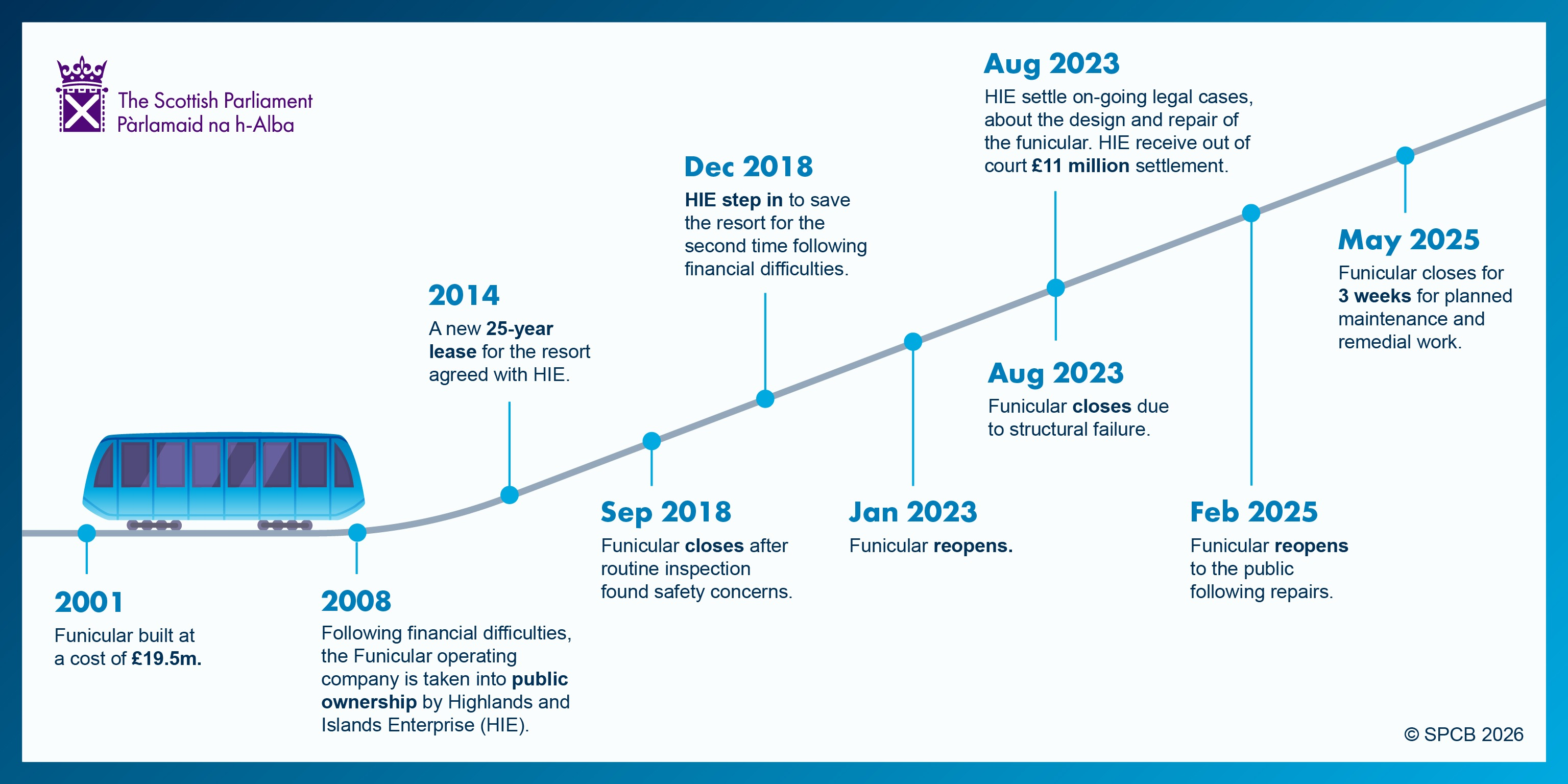
Given the history of the funicular, it is helpful to have an awareness of the timeline of events, particularly on its ownership and operation. These are set out in the following paragraphs.
In 2001, the funicular was built at a cost of £19.5m. Cairngorm Mountain Ltd (CML) assumed operation of the ski resort and funicular under a lease agreement with HIE. CML would go on to repeatedly report financial losses.
HIE took CML into public ownership in 2008. This decision was taken to keep the resort open, protect HIE’s investment in the resort, and maintain wider economic benefits for the area.
Six years later in 2014, CML agreed a new 25-year lease for the resort with HIE. HIE transferred ownership of CML to Natural Assets Investments Limited (NAIL). This returned management of the resort to the private sector. NAIL offered financial guarantees to protect HIE’s exposure to potential future losses from CML.
The funicular railway was closed in September 2018 after a routine inspection by engineers found safety concerns. HIE acquired the assets of CML and subsequently placed CML into administration. HIE considered that the suspension of the funicular, with a consequent downturn in business, was a key factor in this decision.
In December 2018, the assets and staff of CML were transferred to a new company, Cairngorm Mountain (Scotland) Ltd (CMSL). This is a subsidiary of HIE. This was the second time in a decade that HIE had to step in to save the Cairngorm Mountain resort following financial difficulties.
From October 2018 to January 2023, the funicular was closed due to structural concerns in the viaduct.
HIE decided to repair the funicular. The full business case for this was published in 2021 after the decision was taken in 2020.
Additionally, during this time, HIE was engaged in two relevant legal proceedings. One was in relation to financial guarantees provided by NAIL when CML was transferred to NAIL in 2014. The other was in relation to design and build aspects of the original funicular railway. HIE sued construction company Galliford Try Infrastructure Ltd and designer AF Cruden Associates Ltd over work done in the 1990s and early 2000s.
In August 2023, HIE settled these legal cases out of court and received an £11 million legal settlement.
The funicular was closed again from August 2023 to February 2025. This was because of structural failure.
The funicular also closed for 3 weeks in May 2025 for planned maintenance and remedial work.
Governance and oversight
CMSL, a wholly owned subsidiary established by HIE, is responsible for the operation of the resort. This means that HIE is directly responsible for the performance and financial health of CMSL.
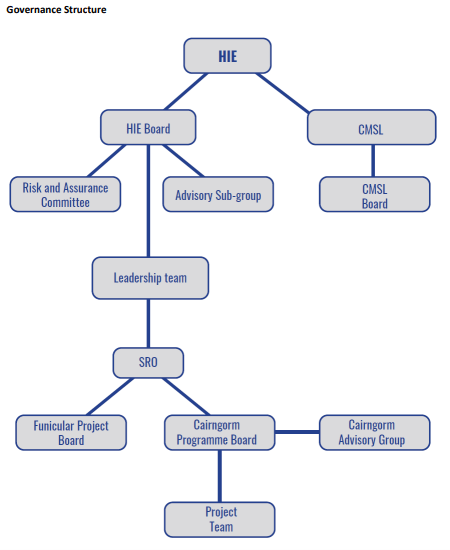
HIE’s written submission lists the Governance arrangements which are in place:
An Operating Agreement between HIE and CMSL
Performance monitoring of CMSL by HIE through KPIs, quarterly reviews, and annual assurance reports
HIE meeting with the Cairngorm Programme Board and Funicular Project Board
Regular reporting to HIE’s CEO, Leadership Team, Board, sub-group of the Board, and Risk and Assurance Committee
External reporting by HIE to the Scottish Government and Audit Scotland. 1
A diagram of the HIE and CMSL governance arrangements was included in their supplementary written submission.
Highlands and Islands Enterprise
The Committee explored whether these governance arrangements are effective and if lessons had been learned from previous governance arrangements involving CML and NAIL.
Sandra Dunbar, Director of Corporate Services, HIE said the funicular “is sufficiently high risk that we have added additional governance” to support effective activity. Furthermore, she said HIE has worked closely with CMSL to ensure it has good governance within the organisation. The risks associated with the funicular are specified in HIE’s 2024/25 annual report2.
Nick Kempe, Parkswatch Scotland, considered the governance process to be very complicated and argued that for such a small operation “an incredible amount is being spent each year on governance—several million pounds.” Parkswatch Scotland’s submission stated there is no evidence that HIE’s “extensive and complex governance structures” have improved operational outcomes.
Stuart Black, HIE explained that there is “a higher degree of scrutiny of the project”. He added HIE has considered closely the work of the PAPLS Committee and Audit Scotland’s reports and, because the project is of national importance, HIE has continued a dialogue with Audit Scotland.3
The Committee acknowledges there are overly complex governance arrangements in place. Cairngorm Mountain (Scotland) Ltd (CMSL) took over responsibility for the funicular in 2018, and the Committee notes that for most of this time the funicular has not been operational. We consider the governance arrangements should be simplified and be made more transparent.
The Committee therefore recommends Highlands and Islands Enterprise (HIE) should continue to monitor the ongoing effectiveness of CMSL’s governance arrangements and review these within two years. It is also vital that the Scottish Government has oversight of the governance arrangements, as well as assuring itself that HIE’s financial management controls are appropriate to safeguard public funds and conform to the requirements both of propriety and of good financial management in accordance with the Framework Agreement between the Scottish Government and HIE.
Transparency and accountability
Concerns were raised with the Committee about the transparency of the governance arrangements.
In its written submission, Parkswatch Scotland described “a cloak of secrecy” around HIE’s governance, Nick Kempe, Parkswatch Scotland, gave examples of a lack of transparency—
Most information about Cairn Gorm is not regularly published, so we have had to extract it by means of a series of freedom of information requests. For example, we just got the full business case, which I believe might now be on the website, as a result of a freedom of information request. It is highly redacted.1
He added that “all the key points” of board minutes are highly redacted. Parkswatch Scotland’s written evidence further highlighted that information is “often only provided after requests for review or appeals to the Information Commissioner.”1
HIE explained it has been working to improve engagement in response to Audit Scotland’s key finding on increasing openness and transparency. It had set up a stakeholder group of representatives from the community and business with an interest in Cairngorm. Initially the group met every six to eight weeks as the Funicular Response Group to respond to problems identified. As time has gone on Cairngorm Advisory Group (CAG), as it became known, met quarterly and now meets twice a year “because we have gained more confidence among the community”. The Group is co-chaired by the Convener of Highland Council and the Chair of HIE. HIE also pointed out that lessons-learned exercises had been undertaken, including with the CAG.3
In further written evidence, HIE pointed to the range of local organisations included in CAG, as well as national organisations involved such as Mountaineering Scotland, Disability Snowsports UK and NatureScot.
Regarding the composition of CAG, Parkswatch Scotland argued that the Group should contain individual experts rather than stakeholders because “stakeholders in Badenoch and Strathspey […] dare not say what needs to be done, because they are also looking over their shoulders at the next grant obligation to HIE”.1
On implementation of other Audit Scotland recommendations, HIE highlighted it has improved its project management. Lessons learned from the Cairngorm project have been applied across the wider organisation to large projects, such as the Sumitomo investment at Nigg. HIE has achieved this through providing clear guidance for major projects which is supplemented with training for relevant senior staff.
The Committee notes that one of the areas that was raised in the 2020 section 23 audit report was the opportunity for Highlands and Islands Enterprise (HIE) to learn and consider the best way to provide transparency and openness into how future decisions are made in light of the choices available.
Whilst we acknowledge that HIE has made progress in relation to its engagement with local stakeholders, we also note there is a sense of frustration amongst some stakeholders around the level of information available to take a judgement on HIE’s decision-making for the future of the funicular. The Committee therefore considers there is significant room for improvement, particularly in view of the highly redacted board minutes. HIE should ensure it is sharing information about the funicular proactively and in a timely manner on its website, so the public has less need to rely on Freedom of Information requests. This would lead to greater accountability on the use of public money.
Financial management and operational reliability
The funicular project has involved substantial public investment. It was built at a cost of £19.5m in 20011 and was publicly funded through HIE, with support from the European Regional Development Fund.
Despite the initial years of operation, the funicular’s more recent repeated closures have had operational, financial, and reputational consequences. In September 2018, the funicular was taken out of service following a routine inspection that raised safety concerns over the strength of the viaduct and did not return to operation until January 2023. The funicular closed again due to structural failures in August 2023, reopening in February 2025. More recently, the funicular closed in May 2025 for annual maintenance. During this period some extra remedial work was carried out in addition to annual maintenance.
Management financial risks of closures and maintenance
The Committee examined the financial risks with repeated closures and maintenance of the funicular to ascertain the overall potential liability to the public purse.
HIE told the Committee that the initial reinstatement works had been paid for by the public sector through HIE and the Scottish Government. The work was intended to finish for the 2021/22 winter sports season but instead finished in January 2023 with a total cost of £25.4 million. This is compared to the £20.51 million initially approved. Reasons provided by HIE as to why costs had increased were the “challenging environment, the factors around Brexit, the cost of inflation in the construction sector and labour supply.” Stuart Black, HIE, added—
The construction site is 1.8km long and almost 4,000 feet up into the Cairngorm mountains. It is a very difficult environment, and the contractor has to get some credit for the work that was done. It has been a very difficult job.1
HIE clarified the amount it had borne of the £25.4 million reinstatement costs relevant to remediation costs—
On the remediation work, the £2 million that we have paid covers contractors working on our behalf, our project managers, legal support and so on. The sum that has been paid to the main contractor is £70,000. The work that it is doing is being done at its cost to put right work that was not done correctly in the first place.1
It is noted that HIE's annual report 2023/243 shows potential operating losses with CMSL as a principal financial risk for 2024/25. According to HIE’s most recent annual report, 2024/25—
Predicting the final outturn of Cairngorm Mountain (Scotland) Limited is dependent on factors out with the control of HIE with the scale and timing of potential losses relative to HIE’s budget making this an area of increased risk for HIE.
When asked about the amount of risk around subsidy levels and the impact this has on budget planning, HIE said there is a budget allowance for CMSL, should this be exceeded "we would have to have discussions with our sponsor team, and we might have to find the money from other parts of our budget, or we might be allowed an authorised overspend."1
There were mixed views from participants at the Committee’s stakeholder meeting held on 18 November 2025 on the sustainability of the asset. Some commented that dismantling the funicular might cost more than £10 million and voiced concerns about future maintenance costs. Stakeholders sought greater clarity on long-term infrastructure planning and funding models, including the potential role of private finance.
The submission from David Farquharson, Managing Director of Glenshee Ltd,raised concerns over advance operating-loss grants, disruption funding without revenue-loss insurance, lack of sector consultation, and competitive distortion. He called for transparent accounting, capped subsidy, a deadline for commercial self-sufficiency, and evaluation of sector-wide investment alternatives.
Prevention of future structural failures and operational reliability
HIE’s written submission explained that following closure of the funicular in 2018, HIE prepared a full business case informed by an appraisal from independent consultants. This included an examination of the following options: to remove the funicular; to remove and replace with an alternative gondola model, or to reinstate the existing structure. In 2020, HIE submitted a business case1 with the preferred option “to reinstate the funicular, continue to fund the operating company and fund certain additional capital / revenue investments”, which was approved by the Scottish Government.
The costs associated with this approach include:
£16.16 million capital funding to support funicular reinstatement
£4.35 million capital funding to support additional capital investments
A range of between £9.67 million and £14.57 million revenue cost to support the operating company over a 5-year period from 2020/21
A HIE revenue cost of £1.88 million associated with internal project management
A CMSL project management cost of £0.27 million.
The above costs were subject to, as previously confirmed by the Scottish Government, that £8.5m proceeds from the sale of an HIE asset would be made available to support Cairngorm activity in addition to normal business as usual capital spend of £300,000 per annum.
Some of the participants at the Committee’s stakeholder meeting noted that the funicular currently carries 500 people an hour, compared to estimates that a chairlift could take 3500 people an hour, and expressed concern that decisions sometimes appeared to be taken to justify the funicular.
Gordon Bulloch, Parkswatch Scotland, argued that other choices should have been given better consideration and that the full business case “was highly flawed” and “lacks huge amounts of backup information.” Moreover, Parkswatch Scotland believes the repairs made will not last and will require significant extra maintenance. He pointed to a Freedom of Information Request which showed interim safety certificates of construction compliance were being issued, as opposed to long-term certificates. This, he said, indicates “the designer and the builder are concerned that the structure will not last."2
Parkswatch Scotland’s written submission asserts the repairs are unsustainable, both physically and financially, and that the “claims in the Full Business Case that the repairs would extend the life of the funicular by another 30 years were preposterous."3
However, Tim Hurst, Board Member and former interim Chief Executive of CMSL, was confident in the on-going maintenance process and inspection regime to ensure that all the critical components in the system are kept within the original specification. He said this "gives us an assurance that the funicular can be maintained safely over its 30-year life. We are in a good position."4
The Infrastructure Delivery Pipeline (IDP) 20265 sets out the infrastructure projects and programmes the Scottish Government will fund over the next four financial years. The pipeline is updated annually with the Scottish Budget and Spending Review. The IDP states “We will report on progress delivering the projects and programmes set out in the Delivery Pipeline every six months. We are working to improve transparency further and will continue to engage with Audit Scotland and the Scottish Parliament’s Public Audit Committee to provide the most useful information to the public and the Scottish Parliament."
The Auditor General’s section 23 report recommended Highlands and Islands Enterprise (HIE) should “fully consider the options available before deciding on a new operating model for Cairngorm Mountain and draw on lessons learned from the problems encountered by the two previous external operators”. We note that independent consultants were used at that time to appraise the business case, including the options for the funicular railway.
The Infrastructure Delivery Pipeline (IDP) sets out the infrastructure projects and programmes the Scottish Government will fund over the next four financial years. The Committee notes that the Cairngorm funicular railway does not feature in the 2026 IDP. The Committee therefore asks for information from the Scottish Government on its plans for the funicular, given the project does not appear to be included in the Scottish Government's infrastructure funding priorities for the next four years.
We also note that the Scottish Government is working on improving the transparency of infrastructure projects. The Committee seeks improved transparency on major capital projects taken forward by Scottish Government funded public bodies, such as Highlands and Islands Enterprise (HIE) in relation to the Cairngorm Funicular Railway. The Committee therefore asks that such projects are included in future Major Capital Updates provided by the Scottish Government and in its future IDPs.
As the owner and custodian of the Cairngorm Mountain Estate, HIE has responsibility for the costs of removal of equipment and reinstatement of the funicular railway and associated buildings to a natural condition. According to HIE’s most recent 2024/25 annual report and accounts, the liability for the funicular railway would arise where a permanent discontinuance of operation occurs, and alternative operation is not secured within three years.
The Committee raises these points as it will be of importance to our successor Committee when the funicular comes to the end of its lifespan, whether this is in 30-years (2050) as projected in the 2020 business case or earlier, so any liability or investment at that time can be monitored in relation to the decision-making that has been taken. The Committee will include a reference to this point in its Legacy Paper.
Given the reliance on public sector funding and the funicular’s history of structural issues, the Committee has some concerns that the costs of regular monitoring and maintenance may become disproportionate to its benefit over the projected 30-year lifespan of the funicular railway.
The Committee recommends the Scottish Government closely monitors HIE and Cairngorm Mountain (Scotland) Ltd to ensure the effective use of public funds. Therefore, the Committee asks the Scottish Government to set out a detailed plan including review dates where updated cost estimates for the project can be considered to ensure continuing value for money.
Economic and community impact
HIE and CMSL’s written submission stated—
The 2020 business case identified the project’s strategic fit with important policy areas, including its vital support for the tourism sector at a local, regional and national level alongside contributions to health and physical activity, education and skills and environmental conservation. It also noted that, as a high-profile attraction for Scotland’s mountain resort sector, Cairngorm operating effectively benefits the whole industry to grow and manage demand. Evidence supported the importance of the funicular as a major asset for the resort.1
Local employment, economic growth and long-term economic impact
Cairngorm Mountain and the funicular railway have an impact on the Strathspey and Badenoch region as well as Scotland's tourism sector.
According to HIE and CMSL’s written submission, the 2020 business case concluded that—
Along with other capital investment at Cairngorm, it was expected to generate the greatest economic benefits, including Gross Value Added (GVA) totalling almost £162m over 30 years and 1,000 full-time equivalent jobs years in the same timescale.1
Regarding annual economic benefit, the submission states—
The annual local spend attributed to funicular visitors is estimated at £10.2m. This activity supports 123 FTE jobs in the economy, with wages totalling £2.2m, and generates GVA of £3.8m.1
The Committee examined the robustness of these figures, given the long periods of closure of the funicular.
HIE explained the methodology on which its figures were based—
The calculation is based on an estimate of around 11,000 visitors a month, on average, when the funicular has been running. We know that 60 per cent of visitors are day visitors, and 40 per cent are overnight visitors; we apply spending figures to both, and then we take a view on the proportion of people who come because of the funicular. We have taken quite a conservative view on overnight stays. We multiply that, and that is how we come up with the spend figure of £10 million a year.3
Parkswatch Scotland’s disputed the HIE’s assessment of the economic benefits of the funicular, its written submission stated—
HIE in their submission claims the funicular is “a significant Scottish visitor attraction and economic driver for Strathspey and Badenoch” and makes various assertions about the Gross Value Added. HIE provides no evidence, in the form of statistics about the total number of visitors to Cairn Gorm. They have not even explained how many of those visitors use the funicular in summer and winter or other attractions, to substantiate their claims of economic value.4
The submission went on to state that doorstep research for the Aviemore Business Association in 2020 surveyed around 50 local businesses on the impact of the funicular closure on their business and found more than “75% said that the closure had no discernible impact during the later spring, summer and autumn months. 45% said that it didn't affect them much in winter either”.4
Although the funicular has not been profitable, HIE said "visitor spend has actually had a very significant—indeed, huge—impact on the local economy."3
Another area of interest for the Committee concerned how long-term economic impact is measured.
HIE explained a lot of modelling had been done on this aspect, stressing that “even with the higher cost of reinstatement, the benefit is still very positive—it is more than 3 to 1”, although HIE recognised it could do more detailed evaluation once the funicular has been up and running for a period.3
Means of engagement with local community
Local community and businesses are an important part of the economic plan. As mentioned earlier in the report, CAG is one of the mechanisms used by HIE to engage and respond to community concerns. It includes over 20 organisations, such as local community interest groups, those with a local business interest, other public sector stakeholders who have an interest in outdoor or sports activities, neighbouring landowners and other mountain sport organisations.
When asked about the impact of the reduction in the frequency of meetings held to twice yearly, Elaine Hanton, Cairngorm Programme Lead, HIE reassured the Committee that “The group’s meetings are not the only time that we speak to those stakeholders. There are lots of other opportunities, forums and meetings that many of the same people attend.” Additionally, HIE said it works closely with, for example, the Aviemore and Glenmore Community Trust, an active organisation in the local area.1
Scottish Parliament
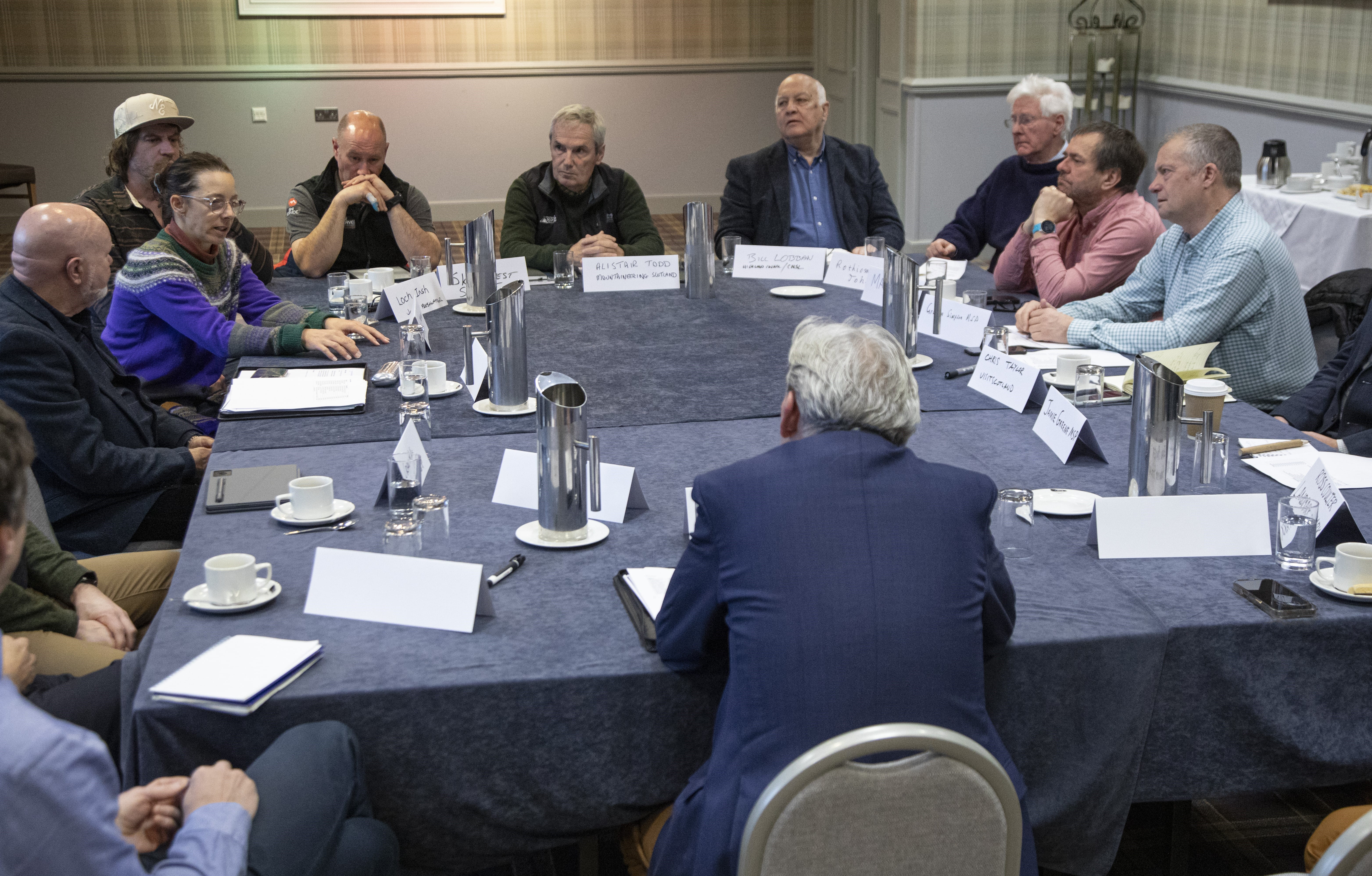
The Committee met with a wide range of organisations on 18 November 2025 when it visited the Cairngorm Mountain resort. They held a cross section of views about the access, usage and future of the Mountain. Some participants raised the funding of the funicular, saying lots of other attractions receive money. The consensus was that Cairngorm Mountain Resort needs public money, but it must be commercially viable. Participants discussing this aspect also felt the overall economic impact must be looked at in the round as there are clear indirect benefits. The full note of the meeting is available at Annexe A.
Future Strategy
In 2020, HIE published the Cairngorm Mountain Masterplan to cover 2021-20451. It is intended that the Masterplan is reviewed every five years. The funicular is important to this strategy because of the role it plays in providing access to the mountain as well as being a unique attraction.
The funicular is also highlighted as playing a role in balancing environmental sustainability with economic viability by offering a controlled and low-impact way to transport visitors. Of the 10 strategic themes in the Masterplan, CMSL is either individually or jointly the lead body for seven.
Transforming Cairngorm mountain into a year-round destination
According to a news release1 in June of 2025—
A key focus will be continuing the resort’s transition to a year-round attraction that offers a variety of family-friendly outdoor activities and environmental education in all seasons, while maintaining snowsports as the core winter activity.
More information was sought by the Committee on the actions being taken to underpin the resort’s long-term financial future, including those leading to greater diversification.
Mike Gifford, CMSL’s new CEO, said in addition to enhancing existing facilities such as the mountain biking park, adventure play areas and the camper van parking area, adding a toboggan run would provide all-year-round activity. This would be, however, subject to funding and planning consent. He suggested ski touring could also be an option—
Cairngorm is the one centre in Scotland where we can get people very high up without needing snow on the ground at lower levels; we use the funicular and do not need drag lifts. […] we could allow people to go ski touring, depending on the section 50 agreement on planning.2
At the time of taking evidence, CMSL is currently developing a new three-year business plan, targeting 2026-29 with a renewed focus on sustainability, community engagement, and diversified outdoor activities.
Interruptions caused by the ongoing maintenance of the funicular (see also section on financial management and operational reliability), have the potential to impede the goals of the Masterplan and the new business plan. According to CMSL’s website, in May 2025 the funicular was closed for 3 weeks for works including rail grinding, gearbox repairs, undercarriage lubrication, and testing and inspection of the rail welds. Parkswatch Scotland said the funicular tunnel blocks with snow “so the funicular cannot operate and staff spend hours in the morning trying to dig out the tunnel”.3
Balancing environmental sustainability with economic development
HIE and CMSL’s submission stated that there is continued investment in path maintenance and path construction which positively improves designated habitats whilst supporting mountain recreation. The evidence highlighted the path network across Cairngorm Estate and the maintenance regime conducted by the Cairngorm Mountain Ranger Service is seen as an exemplar by NatureScot.1
The submission further noted that CMSL has planted over 12,000 trees to increase montane woodlandi diversity within Coire Cas. The company is also working with partners including the Spey Catchment Initiative which is leading on planting 30,000 trees in Coire na Ciste.1
Protection of the natural environment around the plateau mountain, is delivered through the Visitor Management Plan. This was a condition of planning approval for the funicular. HIE and CMSL stated in their written submission that over the years this has evolved to enable access with guided ranger walks. Proposals to amend restrictions further, using app-based solutions and movement tracking technology, are currently being explored.
Dave Morris, Parkswatch Scotland, suggested there is a simpler way to support the future of Cairngorm Mountain. He said—
Forestry and Land Scotland could take over all of the management of the mountain, from an ownership point of view, but leave any financial responsibility issues with regard to the funicular with HIE. HIE should for evermore keep hold of that financial responsibility, up to the day when the funicular has to be removed.3
According to Forestry and Land Scotland’s website it has expertise in the timber industry, forest planning, conservation and biodiversity, tourism and recreation, renewable energy and working with communities.4
Participants attending the Committee’s stakeholder meeting emphasised the importance of environmental considerations, including protection of wildlife and the potential for improved visitor education.
From the evidence we gathered there appears to be a clear vision for the year-round diversification of the mountain to future-proof it. As this is a national asset, it will be crucial to take the local community wider conservation and nature organisations’ views into account. The Committee recommends that Cairngorm Mountain (Scotland) Ltd continues to engage with the local community and expert groups and does so in a transparent way, particularly when it is reviewing its masterplan.
The Committee believes that there would be merit in the Auditor General and Audit Scotland undertaking further audit work in relation to the funicular. We therefore ask the Auditor General for Scotland to give consideration to this suggestion as part of his future work programme.
The Committee also intends to draw this report to the attention of its successor Committee through its legacy paper.
Annexe A: Note of Meeting, 17th/ 18th November 2025
Public Audit Committee: Informal discussion with HIE/CMSL
Monday 17 November 2025
Meeting with HIE/CMSL Senior management team and staff
Present:
Richard Leonard, Jamie Greene, Graham Simpson, Colin Beattie (PAC Members)
Edward Mountain (NZET Member)
HIE senior management team and staff– Stuart Black (CEO), Sandra Dunbar (Director of Corporate Services), Audrey McIver (Area Manager Inner Moray Firth), Elaine Hanton (Cairngorm Programme Lead), Peter Dennis (Construction Project Manager), Paul Dzialdowski (Property Manager)
CMSL senior management team and staff – Mike Gifford (CEO), Tim Hurst (ex-interim CEO and board member), Jim Cornfoot (Land Manager), Colin Matthew (Head of Technical Operations), Angus Trinder (Marketing Manager),
Scottish Parliament staff – Katrina Venters, Linda Peter, Kelly Eagle, Andy Hogg
Presentation on Local Economy and role of Cairngorm Mountain – HIE’s Area Manager for the Inner Moray Firth
Members received a presentation which covered the impact of the funicular, non- monetary benefits, HIE support in the local community including relationships with commercial, third sector and public partners
Question raised about barriers to living in the area
Challenges securing seasonal and part time staff
Concerns raised about the population decline and limited housing - short term lets add pressure
Young people are seeking affordable housing, good employment and strong digital connectivity
Without the CMSL staff house, recruitment of staff would be more difficult
Presentation on funicular works – HIE Construction Project Manager
Members received a presentation which covered the previous settlement, timeline for return of the funicular to service, timeline for future inspection regime and compliance issues. Commercial negotiations with contractors are ongoing.
HIE expressed disappointment and noted that Balfour Beatty are a reputable contractor and normal contractual protections and warranties remain in place.
A BB appointed subcontractor was used for part of the reinstatement and remediation works but BB retains overall responsibility.
All work was signed off by a professional team as per standard industry practice led by independent project managers.
Presentation on Cairngorm Resort – CMSL CEO
Members received a presentation which covered activities on the mountain, environmental stewardship and future plans.
Current operations
Previous weekend revenue of £30k driven by special offers. The projected loss is £1.4m this year but performance is currently better than expected.
Active collaborations are ongoing with schools and universities (tree planting, skiing, snowboarding), other resorts and local businesses.
Strong partnership engagement locally.
Operational challenges
Increasing frequency of snow melts (5–6 per season) and periods without snow (sometimes up to 3 weeks).
Need to expand non-snow activities and diversify.
Environmental and infrastructure planning
There is a 3-year strategy exploring routes to net zero.
Options previously assessed: geothermal, solar, other renewables.
Snow making could be more efficient and environmentally friendly as currently much of it runs on diesel.
Exploring options for the base station.
Access
Planning restrictions currently limit access to the top for environmental protection reasons.
There is a trial ongoing on how to responsibly increase access and measure impacts.
Section 50 signatories are Highland Council, Forestry and Land Scotland and NatureScot.
Section 50 signatories will require to be satisfied supported by evidence from the trials that that visitors accessing the top are not straying from the paths or creating damage.
Future plans
New lift infrastructure capable of transporting bikers, walkers, and skiers year-round.
Reviewing options to introduce bundled activity packages alongside current ski and other activity offers.
The funicular has been in existence for 25 years and there is hope that it can run for another 25 years. Its design life is 2050 which can be achieved with good maintenance and investment.
Public Audit Committee
Tuesday 18 November 2025
Meeting with local organisations
Present (Members) – Richard Leonard, Jamie Greene, Graham Simpson, Colin Beattie
Representatives from: Aviemore & Glenmore Community Trust, Cairngorm Business Partnership, Cairngorm Mountain Trust, Mountaineering Scotland, Rothimurchus Estate, Snowsport Scotland, The Highland Council, VisitScotland, RSPB Abernethy Forest Estate, Landmark Forest Adventure Park, Loch Insch Outdoor Centre, Ski Norwest, Cairngorms National Park Authority
Scottish Parliament Staff - Katrina Venters, Linda Peter, Kelly Eagle, Andy Hogg
Impact
Widely recognised as culturally significant.
150 people trained there last year and it has strong heritage links.
Cairngorm’s ability to support the local community is reduced without the funicular.
The funicular is needed to access the higher snowline, when it is not working there can be a 60-70% decline in numbers.
It is essential for ski school access to the most challenging landscape.
Mountaineering perspective: The funicular is largely irrelevant because it does not allow access to the summit. However, the community is divided due to environmental considerations. Positive feedback re CMSL’s new CEO.
Parking
Reduced car parking capacity and new double yellow lines have created issues
Park and ride suggested as a potential solution.
The funicular provides an important evacuation route in severe weather.
Sustainability
Comments that dismantling the funicular might cost in excess of £10 million. Concerns about how much the maintenance is going to cost in the future.
Stakeholders would welcome clarity on future infrastructure plans.
Mixed views on private finance. This could help but shareholders would also be prioritised rather than the community.
Cairngorm was compared to other major attractions like Edinburgh Castle and Stirling Castle but noted that many may visit the funicular only once if non-skiers.
Alternatives to the funicular
Alternatives would be a chair lift to transport people and/or bikes. Gondolas are also an option or a different kind of funicular. The decision would depend on who and why they were using it.
The next generation (gen z) are interested in connections to nature but the business model does not provide this. Discussion on whether there are business models which account for social communities and commercial partners and which benefit the local community.
The offering could be year round.
Lots of other attractions receive money and consensus that Cairngorm deserves public money but it also needs to be commercially viable. The subsidy could be recovered from other businesses ie £2m tax raised by those working. The overall benefit has to be looked at more widely. There are indirect benefits.
The funicular as a ski lift is only taking 500 an hour but a chairlift could take 3500 people an hour. Sometimes feels like decisions are being made to justify the funicular which feels like the wrong way around.
Diversification
Discussion of how HIE can get this right. Members commenting that the 3 year plan did not prioritise where the money should go. Question on whether local interests are being taken into account?
Broad consensus on:
Need for both summer and winter offerings
Strong existing visitor base
There are significant opportunities beyond snow sports.
Snow gate closures make access unpredictable. Some believe a gondola might have been a better long-term solution but “we are where we are”
The mountain trails and trampolines have been a success.
Consideration could be given to a dry slop for when there is no snow. That would support year-round snowsports.
Nature
Bird populations are good and people want to see them but it is important they are protected.
There is an opportunity to have a hub and educate people about the mountain environment. The wildlife has developed without humans and dogs and we need to be careful and ensure it is protected in the process.
The National Park has a committee which meets fortnightly after COVID. They encourage people what to do instead of telling them what not to do.
Section 50: Nature Scotland and HIE are signatories. It is about improving access while protecting the environment.
International context
Climbers from 28 different countries visit. There is an international community and every time they are amazed at Cairngorm. It is recognised and respected as being special.
The mountain has the highest number of repeat visitors – 60% but most will not revisit the funicular. They could do more.
Annexe B: Extract of Minutes
Extract of meetings of the Public Audit Committee
24th Meeting, Wednesday 17 September 2025
2. Cairngorm Funicular Railway
The Committee took evidence from—
Stuart Black, Chief Executive, Sandra Dunbar, Director of Corporate Services and Elaine Hanton, Cairngorm Programme Lead, Highlands and Islands Enterprise; Mike Gifford, Chief Executive and Tim Hurst, Former Interim Chief Executive and Board Member, Cairngorm Mountain (Scotland) Limited.
6. Cairngorm Funicular Railway (In Private)
The Committee considered the evidence heard at agenda item 2 and agreed its future scrutiny.
32nd Meeting, Wednesday 3 December 2025
8. Work programme (In Private)
In relation to the Cairngorm funicular railway, the Committee agreed its next steps in scrutiny.
2nd Meeting, Wednesday 14 January 2026
3. Cairngorm funicular railway
The Committee took evidence from—
Nick Kempe, Campaigner and Mountaineer, Dave Morris, Cairngorm and International Mountain Expert and Gordon Bulloch, Former Environmental Land Remediation and Business Turnaround Manager, Parkswatch Scotland.
6. Cairngorm funicular railway (In Private)
The Committee considered the evidence heard at agenda item 3 and agreed to draft a report.
Sources
Audit Scotland. (2009, October 8). Review of the Cairngorm funicular railway. Retrieved from <a href="https://audit.scot/docs/central/2009/nr_091008_cairngorm_funicular_railway.pdf" target="_blank">https://audit.scot/docs/central/2009/nr_091008_cairngorm_funicular_railway.pdf</a>
Audit Scotland. (2019, August 30). The 2018/19 audit of Highlands and Islands Enterprise: Cairngorm Mountain and funicular railway. Retrieved from <a href="https://audit.scot/uploads/docs/report/2019/s22_190830_highlands_islands_enterprise.pdf" target="_blank">https://audit.scot/uploads/docs/report/2019/s22_190830_highlands_islands_enterprise.pdf</a>
Audit Scotland. (2020, June 18). Highlands and Islands Enterprise: Management of Cairngorm Mountain and Funicular Railway . Retrieved from <a href="https://audit.scot/uploads/docs/report/2020/nr_200618_highlands_islands_enterprise.pdf" target="_blank">https://audit.scot/uploads/docs/report/2020/nr_200618_highlands_islands_enterprise.pdf</a>
Scottish Government. (2020, June 18). Highlands and Islands Enterprise: Financial management review of Cairngorm Mountain. Retrieved from <a href="https://www.gov.scot/publications/highlands-islands-enterprise-financial-management-review-cairngorm-mountain/pages/1/" target="_blank">https://www.gov.scot/publications/highlands-islands-enterprise-financial-management-review-cairngorm-mountain/pages/1/</a>
Scottish Parliament . (2021, March 15). Public Audit Committee Session 5 Legacy Paper . Retrieved from <a href="https://digitalpublications.parliament.scot/Committees/Report/PAPLS/2021/3/15/4f0f838b-3e50-479a-8721-621037bca0a0#Introduction" target="_blank">https://digitalpublications.parliament.scot/Committees/Report/PAPLS/2021/3/15/4f0f838b-3e50-479a-8721-621037bca0a0#Introduction</a>
Scottish Parliament. (2025, September 17). Official Report Wednesday 17 September 2025. Retrieved from <a href="www.parliament.scot/api/sitecore/CustomMedia/OfficialReport?meetingId=16586" target="_blank">www.parliament.scot/api/sitecore/CustomMedia/OfficialReport?meetingId=16586</a>
Scottish Parliament. (2025, November 17). Public Audit Committee: Informal discussion with Highlands and Islands Enterprise/ Cairngorm Mountain (Scotland) Limited. Retrieved from <a href="www.parliament.scot/-/media/files/committees/public-audit-committee/correspondence/2025/cairngorm-visit-meeting-note-17--18-november-2025.pdf" target="_blank">www.parliament.scot/-/media/files/committees/public-audit-committee/correspondence/2025/cairngorm-visit-meeting-note-17--18-november-2025.pdf</a>
Scottish Parliament. (2025, September). Correspondence. Retrieved from <a href="https://www.parliament.scot/chamber-and-committees/committees/current-and-previous-committees/session-6-public-audit-committee/business-items/cairngorm-funicular-railway" target="_blank">https://www.parliament.scot/chamber-and-committees/committees/current-and-previous-committees/session-6-public-audit-committee/business-items/cairngorm-funicular-railway</a> [accessed 20 February 2026]
Scottish Parliament. (2026, January 14). Official Report Wednesday 14 January 2026 . Retrieved from <a href="www.parliament.scot/api/sitecore/CustomMedia/OfficialReport?meetingId=20011" target="_blank">www.parliament.scot/api/sitecore/CustomMedia/OfficialReport?meetingId=20011</a>
Highlands and Islands Enterprise and Cairngorm Mousntain (Scotland) Ltd. (2025, September). Written Submission. Retrieved from <a href="https://www.parliament.scot/-/media/files/committees/public-audit-committee/correspondence/2025/hie-cairngorm-mountain-to-pac-17-sept-2025.pdf" target="_blank">https://www.parliament.scot/-/media/files/committees/public-audit-committee/correspondence/2025/hie-cairngorm-mountain-to-pac-17-sept-2025.pdf</a> [accessed 23 February 2026]
Highlands and Islands Enterprise. (2025, November 27). Annual Report and Accounts 2024/25. Retrieved from <a href="www.hie.co.uk/media/cghfzho3/annual-report-2024-25-signed-version-for-internet.pdf" target="_blank">www.hie.co.uk/media/cghfzho3/annual-report-2024-25-signed-version-for-internet.pdf</a>
Parkswatch Scotland. (2025, November 3). Written Submission. Retrieved from <a href="https://www.parliament.scot/-/media/files/committees/public-audit-committee/correspondence/2025/cairngorm-funicular-railway-written-submission-parkswatch-scotland-3-november-2025.pdf" target="_blank">https://www.parliament.scot/-/media/files/committees/public-audit-committee/correspondence/2025/cairngorm-funicular-railway-written-submission-parkswatch-scotland-3-november-2025.pdf</a> [accessed 23 February 2026]
Highlands and Islands Enterprise. (2023, August 16). Cairngorm funicular legal cases settled. Retrieved from <a href="https://www.hie.co.uk/news-and-blogs/news/2023/august/16/cairngorm-funicular-legal-cases-settled/" target="_blank">https://www.hie.co.uk/news-and-blogs/news/2023/august/16/cairngorm-funicular-legal-cases-settled/</a> [accessed 20 February 2026]
Highlands and Islands Enterprise. (2024, October 7). Annual Report and Accounts 2023/24. Retrieved from <a href="www.hie.co.uk/media/ej4n30kz/annual-report-2023-24.pdf" target="_blank">www.hie.co.uk/media/ej4n30kz/annual-report-2023-24.pdf</a>
Highlands and Islands Enterprise. (2022, February). Cairngorm Mountain - Full Business Case. Retrieved from <a href="www.hie.co.uk/media/10384/cairngorm-full-business-case-feb-2021.pdf" target="_blank">www.hie.co.uk/media/10384/cairngorm-full-business-case-feb-2021.pdf</a>
Scottish Government. (2026, January 23). Infrastructure Delivery Pipeline 2026. Retrieved from <a href="https://www.gov.scot/publications/infrastructure-delivery-pipeline-2026/pages/2/" target="_blank">https://www.gov.scot/publications/infrastructure-delivery-pipeline-2026/pages/2/</a> [accessed 20 February 2026]
Highlands and Islands Enterprise. (2021, June 2). Cairngorm Mountain Masterplan: Unlocking the potential of Cairngorm Mountain Estate. Retrieved from <a href="www.hie.co.uk/media/10744/cairngorm-mountain-masterplan_2021.pdf" target="_blank">www.hie.co.uk/media/10744/cairngorm-mountain-masterplan_2021.pdf</a>
Cairngorm Mountain Scotland. (2025, April 7). New CEO at Cairngorm Mountain. Retrieved from <a href="https://www.cairngormmountain.co.uk/ceo-april-2025/" target="_blank">https://www.cairngormmountain.co.uk/ceo-april-2025/</a> [accessed 20 February 2026]
Forestry and Land Scotland. (2026). What we do. Retrieved from <a href="https://forestryandland.gov.scot/what-we-do" target="_blank">https://forestryandland.gov.scot/what-we-do</a>