Net Zero, Energy and Transport Committee
Net Zero, Energy and Transport Committee Report on the Draft Climate Change Plan
Executive Summary
Scotland has made significant progress in decarbonisation since the need for action was first recognised, but in recent years momentum has slowed and a number of targets have been missed. Delays in laying a new Climate Change Plan in this Parliamentary session have not helped. With the next Plan imminent, there is an opportunity to reset Scotland’s net zero ambitions.
The Plan should above all be about delivery: it must explain how the Scottish Government will use its powers and capacity to bring down emissions whilst improving the lives of people in Scotland. It should be clear about areas where the Scottish Government does not have all the levers but, where it does, set out how it will use them. Key policies should, wherever possible, have timelines and targets, be costed, and state clearly who within government or elsewhere is expected to lead on delivery.
The Committee has carefully considered the draft of the Plan since it was laid in November, hearing from a wide spectrum of industry and academic experts and NGOs, and gathering views from community groups, harder to reach members of the public, and young people. We are grateful to them all for their input.
Our scrutiny has been on the overall governance and delivery of the Plan: how the Scottish Government will drive positive change: how progress (or failure to make progress) will be monitored; and how the Scottish Government will communicate and engage with communities and households. We also focused on three specific sectors: Transport, Energy Supply, and Waste.
We are grateful to the many other Parliamentary committees who joined in this scrutiny, covering areas relevant to them. This includes considering the four other sectors covered by the draft Plan: industry; agriculture; land use; and buildings, including homes. We summarise some of their key findings in our report.
This is the first time the Parliament, and wider stakeholders, have had 120 days, rather than 60, to consider a draft Plan. This is the first draft Plan that plots progress against three 5-year carbon budgets set following independent expert advice, rather than against relatively more arbitrary annual emissions targets. It is the first draft required to include cost and benefit estimates and explain how it will deliver a Just Transition. It is also the first to set Just Transition indicators. These are all welcome developments.
The key question for the Committee is whether the draft Plan plots a credible pathway to Scotland meeting its carbon budgets and, ultimately, reaching net zero by 2045: on whether it “adds up”. This is a complex task for the Scottish Government, requiring coordinated action across the breadth of government and with multiple partners outside of government, over a longer timeframe than governments normally deal in. While the draft Plan sets out information on how the Scottish Government will work with others, there are some clear gaps on support for local authorities, communities and households.
There are good aspects to the draft Plan but we agree with stakeholders that it falls somewhat short as a delivery-focused document. In some key areas, it provides insufficient detail on the actions that will be taken to achieve clear, specified outcomes and who will take them.
Delivery would be supported by a comprehensive mix of performance indicators across the breadth of the Plan. Not only would this assist the Parliament, experts and regulatory bodies in their analysis, it would also enable the provision of a public-facing “dashboard”, communicating progress (or delay) in key policy areas in an accessible way by reference to specific, concrete outcomes.
Evidence has indicated there are also some areas of risk, where the Plan has set out ambitions that look stretching or where key aspects of delivery may not be in the hands of the Scottish Government. Such areas include:
Switchover to electric vehicles;
Decarbonising Scotland’s homes;
Decarbonising freight transport;
Use of negative emissions technologies;
Woodland creation and peatland restoration targets.
There is also the key background condition of affordable electricity. Lower electricity bills will make the pathway to net zero easier and enable a more just transition.
The Plan would also benefit from more, and more consistently presented, detail on data and assumptions. The final Plan should:
provide more of the underlying data used for its modelling (both for emissions and for costs and benefits) and outline how it was used for key policies and outcomes;
set out any significant uncertainties and risks and how these are being dealt with.
Overall, we think the Plan should show more of its working and that the Scottish Government should welcome any additional scrutiny this brings, recognising the iterative nature of climate change policy-making and the role experts can play. More detail on financial costs and benefits in key areas would also give the Plan more “signalling strengths” to members of the public and to the private sector about areas where costs, incentives and reliefs will fall.
This report was agreed just as the Climate Change Committee – the independent advisor to governments in the UK on net zero science and policy – published its own assessment of the draft Plan. We have not had time to take its findings into account in preparing this report. We are disappointed the CCC did not feel able to provide formal evidence during the period of committee scrutiny.
Finally, it is not good practice to have such a tight turnaround time between the Parliament completing its deliberations on the draft and the final Plan issuing. It does not give confidence that the Scottish Government will have had time to reflect on this scrutiny and how to use the Parliament’s findings to strengthen the Plan. Respondents to the Scottish Government consultation on the draft, which ran concurrently to this scrutiny, may feel similarly. We believe a similar situation should be avoided when the next draft Plan is laid in the next Parliamentary session.
Introduction
The Climate Change Plan (CCP) is a strategy document which outlines how the Scottish Government intends to meet carbon emissions reduction targets across all portfolio areas and sectors of the economy.
A draft CCP, covering the period 2026-40, was laid on 6 November 2025 for a period of 120 days. The parliamentary scrutiny period ends on 5 March 2026.
The Net Zero, Energy and Transport Committee led cross-committee scrutiny of the draft CCP.
Coinciding with parliamentary scrutiny, the Scottish Government have also received feedback on the draft CCP through: a public consultation, which closed on 29 January 2026; and a progress report by the Climate Change Committee (CCC), the advisory body on climate change to governments in the UK, was published on 25 February 2026. This was just as we were concluding agreement of this report and we were not able to take account of the CCC’s findings.
Approach to scrutiny
The Scottish Parliament’s Conveners Group set scrutiny of net zero as a strategic priority for committees in the current session of the Parliament, reflecting the transformational impact of both climate change and net zero across all committee remits.
The Committee has led scrutiny of the draft CCP. In that coordinating role, we have sought to ensure that consideration covers all major sectors in the draft. We are pleased that so many other committees have done their part, taking evidence and reporting to us or the Parliament, and have taken into account in our work all reports or letters we received from them. An outline of how committee scrutiny has been divided can be found in Annexe A.
Committees who published reportsi on the draft CCP ahead of our own are:
Rural Affairs and Islands Committee report, published 12 February 2026;
Local Government, Housing and Planning Committee report, published 6 February 2026;
Seven other committees wrote to the Committee to support our scrutiny on the draft CCP.ii These are all annexed to this report.
Health, Social Care and Sport Committee letter, received 30 January 2026 - Annexe E
Economy and Fair Work Committee letter, received 29 January 2026 - Annexe F
Criminal Justice Committee letter, received 29 January 2026 - Annexe G
Citizen Participation and Public Petitions Committee letter, received 23 January 2026 - Annexe H
Constitution, Europe, External Affairs and Culture Committee letter, received 23 January 2026 - Annexe I
Social Justice and Social Security Committee letter, received 27 November 2025 - Annexe J
Public Audit Committee letter, received 6 November 2023 - Annexe K
The Committee's own scrutiny has covered the three main sectors in our remit - Energy Supply, Transport, and Waste - as well as considering the draft Plan as a whole, and the role of the Cabinet Secretary for Climate Action and Energy in co-ordinating a “whole government” response to climate change across the public sector. This has included considering the governance, monitoring, and fiscal arrangements required for the Plan to succeed.
Call for Views
The Committee ran a Call for Views asking respondents what should be in the upcoming draft CCP over the summer of 2025, and got 101 responses , which are available on the Committee’s webpage. Alongside them are theme-based summaries prepared by the Scottish Parliament Information Centre (SPICe).iii
Public participation, engagement and visit
The Committee also sought to reach people who might not normally take part in formal Parliamentary or governmental consultations but for whom matters in the Plan might be particularly impactful, and to hear their views.
The Committee launched a targeted online consultation once the draft Plan was laid, using four themes from the report of a “People’s Panel” commissioned by the Committee:
accessible and relatable climate policy;
participatory and community-led decisions;
transparency and accountability;
and advice and financial support for households.
We also met Members of the Scottish Youth Parliament’s Transport, Environment and Rural Affairs Committee on 13 January 2026. The conversation was based around these same four themes, with a particular focus on whether young people feel that the draft Plan covers issues important to them.
The Committee also met about 25 people from local community groups at the Aberdeen Science Centre on 19 January 2026. A full list of the community groups who attended is available in Annexe B. The same four themes from the People's Panel were used to facilitate a discussion about the draft CCP.
A distillation and analysis of views from this engagement work was developed by SPICe and is available on the Committee's webpage.
As part of our visit to Aberdeen on 19 January, the Committee met with staff from the new Energy Transition Zone (ETZ), and partner organisations North East Scotland College (NESCol), who run the Energy Transition Skills Hub, and ORE Catapult, who run its Floating Wind Innovation Centre.
Oral evidence
The Committee took oral evidence across seven meetings, five of which were with expert witnesses. Official reports of the meetings are available on the Parliament's website:
Audit Scotland has made important contributions on the effectiveness of climate governance in this Parliamentary session (as discussed below). This included responding to the Committee’s targeted consultation referenced above. They declined an invitation to provide oral evidence on the draft CCP itself on the grounds that they cannot make suggestions or comment on the policy content of the CCP, but did set out some high-level considerations on the draft in a letter to the Committee.
The final two evidence sessions were with the Cabinet Secretary for Transport, on 3 February 2026, and closing evidence with the Cabinet Secretary for Climate Action and Energy on 10 February 2026.iv
We thank everyone who provided evidence or took part in our engagement.
Background
Climate change: a global and local challenge
The impacts of climate change are increasingly being felt across the world. Warmer summers, wetter winters, and more erratic weather conditions impact Scotland's infrastructure, economy, and public health. In 2022, Scotland had its highest ever recorded temperature of nearly 35°C, impacting health, ecosystems, and infrastructure. In 2023, prolonged rainfall followed by Storm Babet led to widespread flooding and several deaths, as well as substantial disruption to transport and power systems. In 2025, the east of Scotland experienced its driest January to August period since 1959, with water scarcity warnings leading to restrictions on farmers and businesses.
The World Meteorological Organization's State of the Climate Report from 6 November 2025 highlights that:
"the past 11 years, 2015 to 2025, will individually have been the eleven warmest years in the 176-year observational record, with the past three years being the three warmest on record;"
and concentration levels of greenhouse gases in the atmosphere reached record levels in 2024, with CO2 concentration levels increasing by 53% since 1750.
The two main policy responses to climate change are:
Adaptation - dealing with the reality of climate change as it is: transforming infrastructure and encouraging behaviour change to minimise the impacts of climate change on people and nature;
Mitigation – addressing the root cause of human-made climate change: by reducing carbon emissions in the atmosphere. This can be done either by reducing emissions or by increasing sequestration: capturing and storing emissions, either through technology, like carbon capture and storage, or natural means, like trees or peatland, to slow down or even reverse change.
The CCP deals solely with mitigation. There is a separate process for adaptation, primarily implemented through Scottish National Adaptation Plans. The most recent Scottish National Adaptation Plan was published in September 2024.
The Committee has done some separate work on Scotland’s adaptation policiesi. Whilst it makes sense to treat them as distinct policy approaches, there are clearly also strong linkages - if mitigation measures are successful on a global level, that requires less need for adaptation measures, some of which will be expensive and potentially disruptive in the short term.
The Committee recognise that the costs of climate change will be significant. The draft Plan cites a July 2025 Office for Budget Responsibility report saying that "climate damages could reach 8% of UK GDP by 2070 if the world warms by 3 degrees by the end of the century" in making that case that " it is important to understand that while the costs of a just transition to a net zero economy are significant, the costs of global inaction will likely be even higher. "iii This sentiment was supported by stakeholders throughout the Committee's consideration, for example, WWF Scotland said in their written response that "the economic damage from unchecked climate change mounts sharply and soon.”iv
Climate mitigation is a global challenge. Each country must do its part. The UK is one of 195 signatories of the Paris Agreement, which came into force in 2016. Its main aim is to keep global average temperatures “well below” 2°C above pre-industrial levels and pursue efforts “to keep the increase at 1.5°C.”
The CCP, and Scotland's statutory emissions reduction targets amount essentially to Scotland’s formal commitment to meeting the Paris Agreement.
Climate Change policy and legislation in Scotland
2009 and 2019 Acts
The Climate Change (Scotland) Act 2009 ("the 2009 Act") was Scotland's first major law in this area. It set two targets to reduce emissions:
by 42% by 2020 (against a 1990 baselinei)
and by 80% by 2050.
It also required the Scottish Government to produce a Report on Policies and Proposals (RPP), in effect setting out how it proposed to work to meet the emission reduction targets. RPP's were published in:
The 2009 Act gave the Scottish Parliament 60 days to consider a draft RPP. It also required Scottish Ministers to have regard to views or resolutions about the draft made by the Parliament or its committees.
The Climate Change (Emissions Reduction Targets) (Scotland) Act 2019 ("the 2019 Act") largely amended the 2009 Act. It set new targets of reducing emissions by:
75% by 2030
90% by 2040
and reaching net zeroii by 2045.iii
These changes responded to the advice of the CCC's Net Zero analysis, setting the 2040 and 2045 targets in line with the advice but going beyond the recommended target for 2030 (which was 70% in the CCC advice).i The 2019 Act also formally changed the name of the RPP to the 'Climate Change Plan' and added additional requirements for what must be included (see further in next section).
It increased the parliamentary scrutiny period for the draft plan to 120 days and required that a CCP be laid within five years of the previous one.
Climate Change Plan update
In December 2020 the Scottish Government laid a draft "Climate Change Plan Update". At a time of lockdown, this sought to map a revised path to net zero in the context of the Scottish Government’s proposed “green recovery” from the pandemic. It is important to note that the CCP update was not laid under a formal statutory process and therefore not required to meet the new legislative requirements from the 2019 Act. With this significant caveat, it is nonetheless the most recent finalised “Climate Change Plan” from the Scottish Government.
The 2021-26 session: delays and the 2024 Act
The 2021 Bute House Agreement between the Scottish National Party and the Scottish Greens committed the Scottish Government to publish a draft CCP by no later than November 2023 and the Parliament readied itself for this deadline. ii However, on 7 November 2023, the Scottish Government announced a delay. It cited recent UK Government decisions to “roll back” net zero commitments as the cause. It said that instead the Scottish Government would publish a CCP in line with statutory deadlines. At the time, this meant laying a final Plan by March 2025.
In March 2024, the CCC published its annual progress report on Scottish emissions reductions concluding that:
"Scotland missed its 2021 annual legal target. This is the eighth target in the past 12 years that has been missed."iv
"The acceleration required in emissions reduction to meet the 2030 target is now beyond what is credible."
In April 2024, the Scottish Government announced that they accepted the CCC’s view that the 2030 interim target was no longer reachable and accordingly would legislate to delay the laying of the next CCP and replace the interim targets with a different approach. They also announced a climate change action policy package.
The Scottish Government introduced the Climate Change (Emissions Reduction Targets) (Scotland) Bill in September 2024. The Bill was passed and became an Act ("the 2024 Act") in November 2024 following an expedited parliamentary process.
The 2024 Act's main purposes were to:
remove the requirement for Scottish Ministers to lay a new CCP by March 2025;
remove the interim 2030 and 2040 targets set by the 2019 Act (the 2045 net zero target was not changed);
replace interim targets (and the “straight-line” annual targets that were in turn set by them) with a system of 5-year carbon budgetsv, to be set by regulation following advice from the CCC.
It also required the next draft CCP to be laid within 2 months of the carbon budget regulations coming into force.
The CCC published its advice to the Scottish Government on carbon budget levels in May 2025. It also outlined a "Balanced Pathway" of potential policies and proposals, which the CCC model as "an ambitious but credible route to Net Zero for Scotland by 2045". The advice also briefly summarises the CCC's view on the extent to which policy areas are reserved or devolved.
The Scottish Government laid Regulations setting carbon budget levels in line with the CCC’s advice in June 2025. Alongside these, it published an “Indicative Statement”, outlining the policies and proposals likely to be in the draft CCP.
The NZET Committee reported on the Regulations in September 2025. Following a debate in the chamber, the Parliament approved them in October 2025.
The draft Plan: structure and timing
Structure & definitions
Section 35 of the 2009 Act makes a number of specific requirements about what must be in a CCP, some of which are summarised in Annexe B.
The draft Plan includes several definitions which tie in with the language used in the 2009 Act. These are set out in Annexe C and used throughout this report.
It includes seven sectors, which are considered in turn later in this report. They are:
Energy Supply
Transport (including international aviation and shipping)
Waste
Business and Industrial Process (which includes Negative Emissions Technologies)
Residential and Public (in relation to buildings in those sectors)
Land Use, Land Use Change and Forestry (LULUCF)
Agriculture.
The draft CCP itself is relatively short, with the majority of the content in its annexes:
Annex 1 - Supporting Content - which includes information on how the draft Plan meets several statutory requirements.
Annex 2 - Sectoral Annexes - which includes commentary on the different sectors.
Annex 3 - Monitoring and Analytical Annex - which sets out the approach to monitoring and evaluation, including both progress in reducing emissions and in delivering a Just Transition, estimates of costs and benefits, and a list of policies and proposals.
Annex 4 - Responding to the Consultation - which includes the questions asked in the public consultation on the draft Plan.
The Scottish Government also published an easy read version and A Children and Young People’s Guide to understanding the new draft plan. The Children and Young People's Guide is also available in Gaelic.
The Scottish Government also published the following impact assessments:
Environmental Standards Scotland’s (ESS) 2024 report followed a complaint being raised that the Scottish Government’s previous CCPs had been insufficient. The report found that “the Scottish Government’s most recent Climate Change Plan did not fully meet statutory requirements to: (1) provide quantified emission reductions for individual proposals and policies and (2) provide clear timelines for all proposals and policies.” It also questioned the effectiveness of the Scottish Government’s monitoring.
The Committee asked ESS about whether the draft Plan appeared to meet statutory requirements during our evidence session. Neil Langhorn of ESS said: “The requirements of the 2019 act have been met in part.”i ESS also reflected on this in their letter to the Cabinet Secretary in January 2026, copied to the Committee, which said that “The legislation on what must be included within the CCP is set out in the Climate Change (Scotland) Act 2009, as amended, and this is relatively prescriptive. The draft Plan is broadly aligned with these requirements.” But that “there is room for some improvement”, citing as an example that more detail on the timeline for specific interventions would help to satisfy the requirement of the 2009 Act for the CCP to set out ”the timescales over which those proposals and policies are expected to take effect.”
Timing of the Plan
As noted above, the original plan for this Session had been to lay a draft CCP by November 2023, with a statutory backstop at the time of March 2025 for having a finalised CCP in place. For reasons outlined above, the Scottish Government came to the view that this could not be satisfactorily done. The Committee’s Stage 1 report on the Bill for the 2024 Act discussed some of this in more detail. It outlines stakeholders and experts’ disappointment at the position that had been reached, and the importance of having a new Plan in place as soon as possible, to restore momentum. We said:
The Committee is first agreed on the need for urgency. This requires a new climate change plan, setting out credible, deliverable, detailed and costed proposals to meet the new carbon budget target, to be in place as soon as reasonably possible before the end of this parliamentary session to allow for sufficient scrutiny.ii
We also said:
In relation to key milestones for Parliamentary scrutiny over the remainder of this session, the Scottish Government must balance the recognised need for urgency in laying a plan against the importance of the Parliament, key delivery partners, and the wider public having a full opportunity to comment on and influence proposals for inclusion in the plan. This includes considering how matters such as recess and dissolution periods may impact on scrutiny. We expect the Scottish Government to be in frequent and open dialogue with the Committee about the timetabling of key documentation over the remainder of this session.ii
In Stage 1 evidence, the then Acting Cabinet Secretary for Net Zero and Energy (now the Cabinet Secretary for Climate Action and Energy) said that provided she received CCC advice on carbon budgets in Spring 2025, it was her ambition to lay a draft plan before the 2025 summer recess and have a finalised Plan in place before the election.ii
The draft Plan was laid on 6 November 2025, meaning the statutory 120 days of parliamentary scrutiny will end on 5 March 2026. Parliament's last sitting day this session is 26 March. It is important to note the different ways two key deadlines operate in the 2009 Act:
The 120-day period for Parliamentary consideration is “protected time” for the Parliament’s scrutiny in that the Scottish Government is not permitted to lay a finalised Plan during that period;
The 90-day period after this is a maximum period: the Scottish Government must lay a finalised Plan within those 90 days. The period can be as short as the Scottish Government consider appropriate under the circumstances.i
The Parliament finds itself now in a similar position to when it was considering the draft CCP update in 2020-21 (albeit that that was not a formal statutory plan). Then, four parliamentary committees scrutinised the draft, with the lead committee, the Environment, Climate Change and Land Reform Committee's (ECCLR) report published on 4 March 2021.
The Scottish Government then confirmed the draft Plan update, unamended, would be the final CCP update.ii They cited the narrow gap between receiving committee reports and the end of the parliamentary session (on 24 March 2021); the need to move into implementation of the Plan rapidly to meet the targets; and their view that they had already accounted for many of the recommendations as reasons why no changes had been made in their response to parliamentary committees.
The Scottish Government have been clear since Stage 1 of the 2024 Act that it is their preference and intention to have a finalised Plan in place before the end of the Parliamentary Session, on 26 March. There will be 21 days between the end of the parliamentary scrutiny period on 5 March (which the Committee understands will likely be the day of a debate in the Chamber) and the end of the session.
As in 2020-21, this raises concerns about whether the Scottish Government has enough time to meaningfully take account of views and recommendations from the Parliament and its own consultees on a Plan and annexes that collectively run to hundreds of pages. As noted earlier, our Stage 1 report sought to anticipate the risk of the scrutiny process running up against the hard stop of dissolution and it was also raised in correspondence with the Scottish Government last year.v
The Local Government, Housing and Planning Committee have said it is:
... disappointed at the significant delays in laying a draft CCP despite the importance of thorough Parliamentary scrutiny and the legal requirement that the conclusions of that work be regarded by the Scottish Government when producing the final Plan.vi
A number of witnesses this committee heard from echoed these concerns. Dr Mark Winksel said:
A lot of people are putting quite a bit of effort into responding to the Government’s consultation and to the Parliament’s questions. We submitted a response to the Committee’s earlier call for evidence. Given that the timeline is so tight, there is an obvious concern about how different the final plan will look from the draft.ii
Dr Richard Dixon said:
"We do not seem to have learned the lesson from last time. In 2021, when the CCPU came before the Parliament, four committees worked hard on it, making 166 recommendations. I thought that that was a great example of the Parliament doing proper scrutiny on a piece of strategy. However, because there were only about 20 days between the end of the scrutiny period and the election, the final version that the Government published was the same as the draft—it basically ignored all 166 recommendations." He added "We are in the same situation now, in that we have about 20 days between the end of parliamentary scrutiny and the Parliament going into recess and then being dissolved for the election. The Government has said that it will produce the final version by the end of those 20 days, so there is very little time for it to read what you have said and actually do something meaningful about it. That is frustrating."ii
In her cover letter to the draft Plan, the Cabinet Secretary said that:
"Since the consultation will be an iterative process, I remain confident that the next Climate Change Plan will be finalised during this Parliament following consideration of the feedback received."
The Cabinet Secretary reiterated on 10 February that her "intention is to lay the final climate change plan before the dissolution of Parliament."ii
Evidence from the Climate Change Committee
The Committee heard from the CCC on 2 September 2025, when they gave evidence on their carbon budget and “balanced pathway” advice to the Scottish Government. This was very helpful evidence, with CCC witnesses talking through their proposals, discussing key policy-choices and trade-offs for the Scottish Government to consider, and providing useful pointers for further scrutiny.
Once the draft Plan was laid, the Committee agreed a programme of scrutiny which included the CCC as particularly key witnesses. The CCC has given evidence on draft CCPs in the past. As independent, statutory expert advisers to the governments of the UK on climate change, their views on whether the draft Plan the Scottish Government has laid maps out a clear and credible pathway to meeting the carbon budgets would be especially weighty.
In the end, the CCC declined the invitation. The Committee acknowledges that, in an effort to be constructive, the CCC made an offer to provide a private informal briefing to the Committee in early February. The Committee respectfully declined on the grounds that Parliamentary scrutiny of the draft Plan was intended to be an open and public process. The CCC have agreed to give evidence to the Committee on 3 March, just before the Chamber debate on draft CCP, and the Committee acknowledges this.
In her letter declining the Committee’s invitation to give public evidence, the CCC Chief Executive said that as their "report is still to be finalised and presented to the Scottish Government, it is not possible for us to share its findings at a public committee hearing."xi This was a reference to the annual “Scotland progress report” under section 9 of the 2009 Act, which requires the Scottish Government to ask the CCC each year for a report on progress meeting emissions goals.
In a 19 January letter to the Cabinet Secretary, the Committee Convener requested that she use her good offices, as the person formally requesting the report under section 9 of the 2009 Act, to address any perceived barriers to the CCC giving evidence to the Committee.xiii The letter referenced subsection (1)(d) of section 9, one of several provisions providing more detail on matters to be included in the progress report. This provision specifically requires that the CCC set out their “views on any draft climate change plan laid before the Scottish Parliament …. within the period of 12 months immediately preceding the making of the request”. Subsection (1)(d) had been added to the 2009 Act by the 2019 Act.
The Convener’s letter noted apparent views that this provision could be a legal barrier to the CCC expressing views on the draft to a Parliamentary committee before their progress report is published. The Convener’s letter said it would be surprising if:
“… a provision inserted for the entirely sensible purpose of requiring the CCC to comment in their annual progress report on a draft CCP published in the last 12 months is being interpreted in this restrictive way: so as to actually frustrate the CCC in its core role of advising and giving evidence on how to ensure governments deliver strong, effective plans and policies on climate change. I do not see how anyone benefits from this interpretation.”xiii
Progress in reducing emissions has stalled in recent years, with the Scottish Government in 2024 reluctantly accepting that its next major statutory milestone could not realistically be met. Everyone agrees that the Climate Change Plan is the key document for the Scottish Government to provide a reset, with clear, credible and sufficiently detailed proposals for improved delivery. It requires both careful scrutiny and the opportunity and space for the Scottish Government to respond to that scrutiny.
There was disappointment that a draft Plan was not laid in 2024 (in line with then current legal requirements) but the Committee notes the Scottish Government’s view that it considered itself to be in a position where there was no alternative but to delay. It is also disappointing now to be in a situation where the Scottish Government has given itself a maximum of three weeks to reflect on recommendations from Parliamentary Committees and consultation responses from experts, industry and the public. While we accept that the process laid out in statute does not give the Scottish Government complete control over timetabling, this is not good practice and lowers confidence that we have a robust consideration process.
There are steps a future Scottish Government could take to ensure this result is avoided when the next draft Plan is laid. The Committee also considers that the absence of a statutory minimum period before the Scottish Government can lay a finalised Plan: so that it has time to reflect on Parliamentary recommendations and consultation responses, should be addressed early in the next parliament. We will revisit this in our forthcoming legacy report to our successor committee in Session 2026-31.
It was deeply disappointing that the Climate Change Committee, the key independent expert advisor on governmental climate change policies, did not consider itself able to provide formal evidence during the period of committee scrutiny. The Committee, the Parliament and the public lost out on their expertise. Early in the next session, the Scottish Government, the Scottish Parliament and the CCC should work together to find a constructive way forward, addressing any perceived or actual barriers to the CCC providing evidence during this crucial period. We also propose to write to the CCC asking for a response to the conclusions and recommendations in this report.
Emissions reductions: past and projected
Scotland's carbon budget levels, expressed as an average percentage reduction in emissions against the 1990 baseline, are:
2026 to 2030 – 57% lower
2031 to 2035 – 69% lower
2036 to 2040 – 80% lower
2041 to 2045 – 94% lower.
The Carbon budgets set Scotland's pathway to net zero by 2045 and were agreed by the Parliament in October 2025 through the Climate Change (Scotland) Act 2009 (Scottish Carbon Budgets) Amendment Regulations 2025. The Committee has heard evidence from stakeholders arguing that the level of ambition in this pathway is not right. We reflected briefly on the level of ambition in our report on those regulations. However, the role of the Plan is to set out how the budgets will be delivered and to outline the role of each sector, not to amend the pathway they set. Therefore we do not comment further in this report on the overall level of ambition set out.
Between 1990 and 2023i Scotland's GHG emissions fell 51.3%.i The figure below shows Scotland's emissions over that period plus projected reductions from Scotland's agreed carbon budgets using data from the CCC's advice.
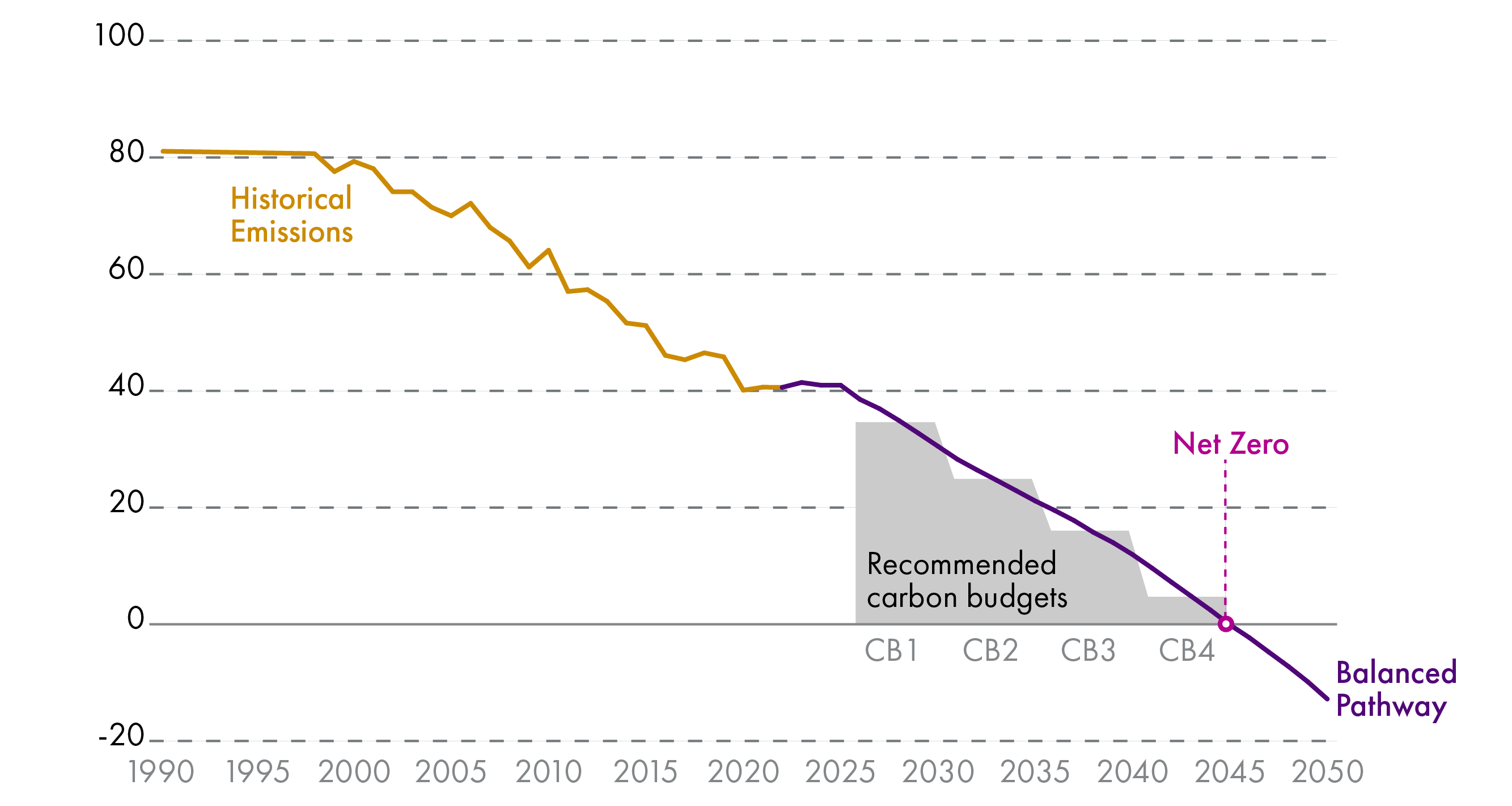
CCC, Scotland's Carbon Budgets, May 2025
The draft CCP projects emissions reductions by sector to meet the carbon budgets. The projected contribution of each sector is shown below.iiiii
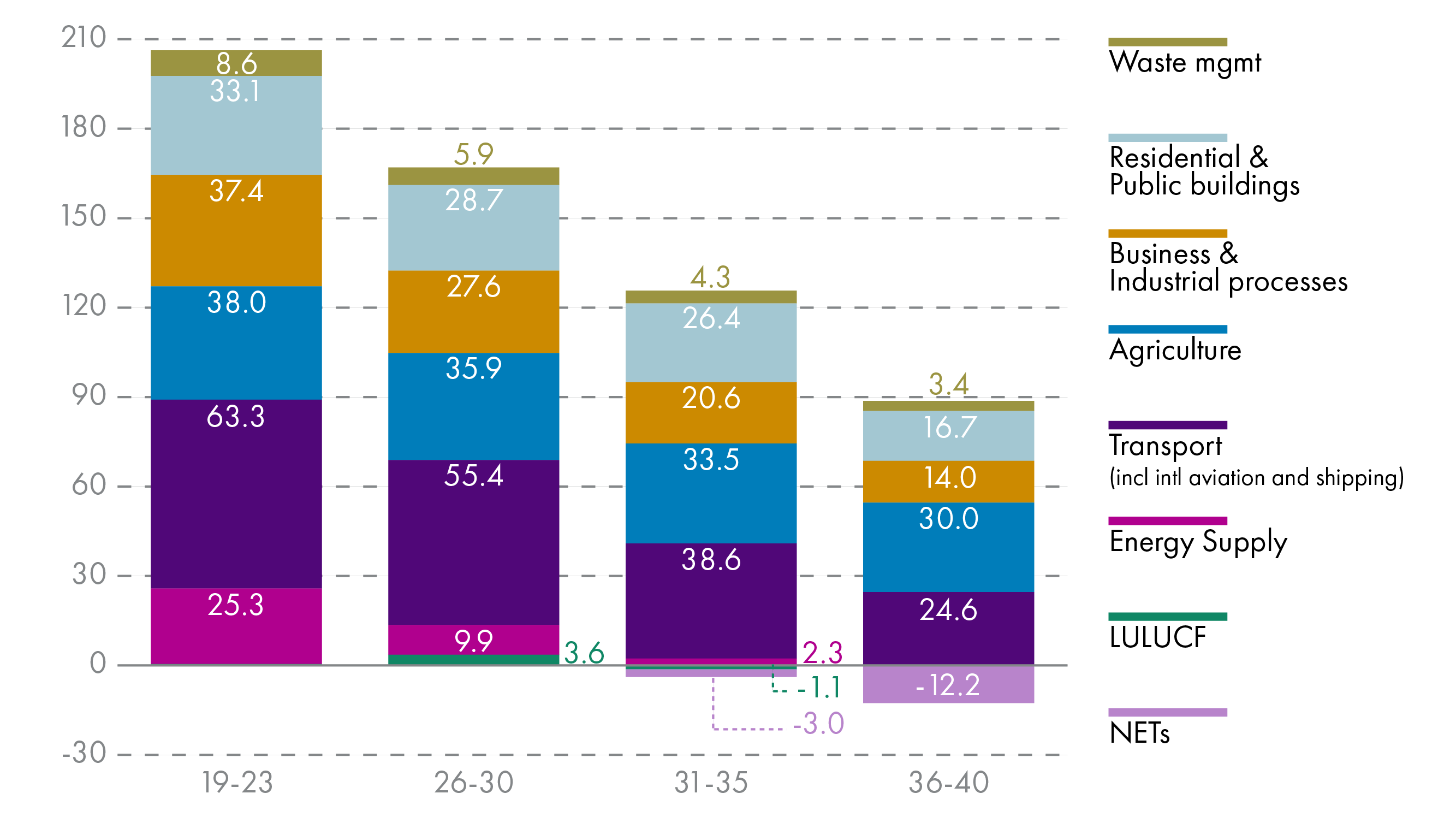
Draft Climate Change Plan, annex 3, page 19
The draft CCP projects a different pathway to the CCC’s “Balanced Pathway”, though they model Scotland reaching the same outcome – meeting the carbon budgets. One of the headline differences was noted in the Scottish Government’s June 2025 statement accompanying the carbon budget regulations and reiterated in the draft Plan – that the Scottish Government will not be adopting a policy to reduce livestock numbers, which had been modelled in the CCC’s pathway.i
The Committee asked the CCC about this decision in September 2025 during evidence on the carbon budget regulations. The CCC's Head of Carbon Budgets, Dr Eoin Devane said that, in their modelling, around half of emissions reductions in the agriculture sector come from reducing livestock numbers and that “if you were not to deliver those reductions, that would add about a megatonne—1 million tonnes—of emissions to the Scottish emissions pathway compared with what we have published.”
In our September report on the Carbon budget setting regulations, we noted evidence from the Cabinet Secretary that the Scottish Government envisaged three sectors decarbonising faster under their Plan than under than the CCC's modelling (and therefore compensating for the decision not to follow the CCCs advice on livestock were):
Transport
Industry
Land use (through tree planting and peatland restoration)
Following further discussion of the CCC’s advice at our meeting with her on 10 February 2026, the Cabinet Secretary followed up in correspondence. She said:
There are a number of differences for the sectoral emissions pathways between what the CCC recommended and what the Scottish Government has set out in the draft CCP, including policy choices and implementation timelines. The draft CCP identifies greater emissions reductions in other sectors including peatlands and forestry, and negative emissions technologies, where the Scottish Government feels that there is scope for greater ambition than what has been proposed in the CCC’s advice.
Implementing the Plan
Whether this is a "good" CCP, could reasonably be judged by the extent to which it puts the framework in place to support actions which reduce emissions while improving the lives of people in Scotland. Several mechanisms need to be in place for the Plan to be implemented, with a focus on delivery of emissions reductions and outcomes for people.
The Committee's Stage 1 report on the 2024 Bill made several recommendations related to the CCP, including for future CCPs to include, compared to previous iterations:
More detailed information on the cost of each policy and proposal;
More data on the actual emissions reduction to be achieved by individual policies;
More accessible information which can engage the non-expert; and
More information about the specific responsibilities and actions of different spheres of government.i
Part of the Committee’s preparation for formal scrutiny involved writing to auditors and regulators - the CCC, Audit Scotland, the Scottish Fiscal Commission, and ESS - to ask what would make a "good" CCP. A summary of the themes of these replies was sent to the Cabinet Secretary for Climate Action and Energy in April 2025, and these themes reappeared in our formal evidence-taking. Several of these themes are further considered below.
Modelling
The 2009 Act requires that the CCP set out the contributions towards meeting the emission reduction targets by each sector and each "group of associated policies" and an estimate of the costs and benefits associated with the policies set out in the Plan. This draft CCP sets out estimations of these and explains that the analytical work has:
...in general, followed a bottom-up process whereby policies and proposals, or groupings of policies and proposals, have been assessed for their impact on emissions and costs and benefits. This bottom-up analysis has used various analytical models and estimation approaches appropriate to each context. The component estimates for each policy and proposal or group of policies and proposals have then been summed to give the sector and whole-plan totals. Each element of the analytical process has had its own quality assurance process located at the sector level.
The Committee recognises that a “model” is precisely that; an estimate based on the best information available about the future, and that modelling is intrinsically uncertain. What matters is the robustness of its foundations. Professor Graeme Roy of the Scottish Fiscal Commission told the Committee that "a model is only as good as the four things that underpin it: the data, the assumptions and the parameters that link it, along with the uncertainties."iii
Costs and benefits
Costs and benefits in the draft Plan
The 2019 Act amended the 2009 Act to require that the CCP set out "an estimate of the costs and benefits associated with the policies set out in the plan." Although as the 2020 CCP update came out after the 2019 Act was non-statutory, it did not do this. The draft Plan cautions that the estimates it sets out: "... are based on forecasts to 2040 and so rely on a series of assumptions, meaning there is a degree of uncertainty and they represent best estimates. In reality, costs and benefits are likely to change as a result of economic and technological factors."
Benefitsi are referred to as "cost savings and financial benefits" of delivering all the policies" in the draft Plan.iiBenefits are provided for the draft Plan as a whole, for each carbon budget period, per sector, and sometimes in relation to specific policies or groups of policies.
Costs in the draft Plan are set out as net costs. It explains that these "… are produced by deducting the estimated cost savings and financial benefits... from the estimated costs."iii As with benefits, they are set out for the draft Plan as a whole and for carbon budget periods, sectors, and some policies or groups of policies.
The draft CCP draws a distinction between a policy, which is more certain, and a proposal, which is less certain (their full definitions are in Annexe C). It is important to underline that all cost estimates in the draft Plan relate to policies. There are none for proposals. This means that in some quite significant areas no costs (or benefits) are given. An example is negative emissions technologies (NETs). The draft projects NETs delivering 12.2 megatonnes in CO2 equivalent emissions reductions in 2036-40; a very significant amount. However, it says that since the cost of NETs are currently “highly uncertain,” no estimates are provided.iv
Net costs are set out for policies in the draft Plan for sectors by carbon budget period. They are also set out for some groups of policies.
The total benefit across the Plan period is estimated to be £42.3 billion. The total net costs across the Plan period are estimated to be £4.8 billion. Gross costs are not provided, but as the Plan advises that net costs "are the costs of actions outlined minus the cost savings"ii it can be calculated that the total gross costs associated with the CCP between 2026 and 2040 will be £47.1 billion. A summary of gross costs, benefits (shown as negative to indicate a projected saving), and net costs by carbon budget and across the Plan as a whole is set out in the figure below.
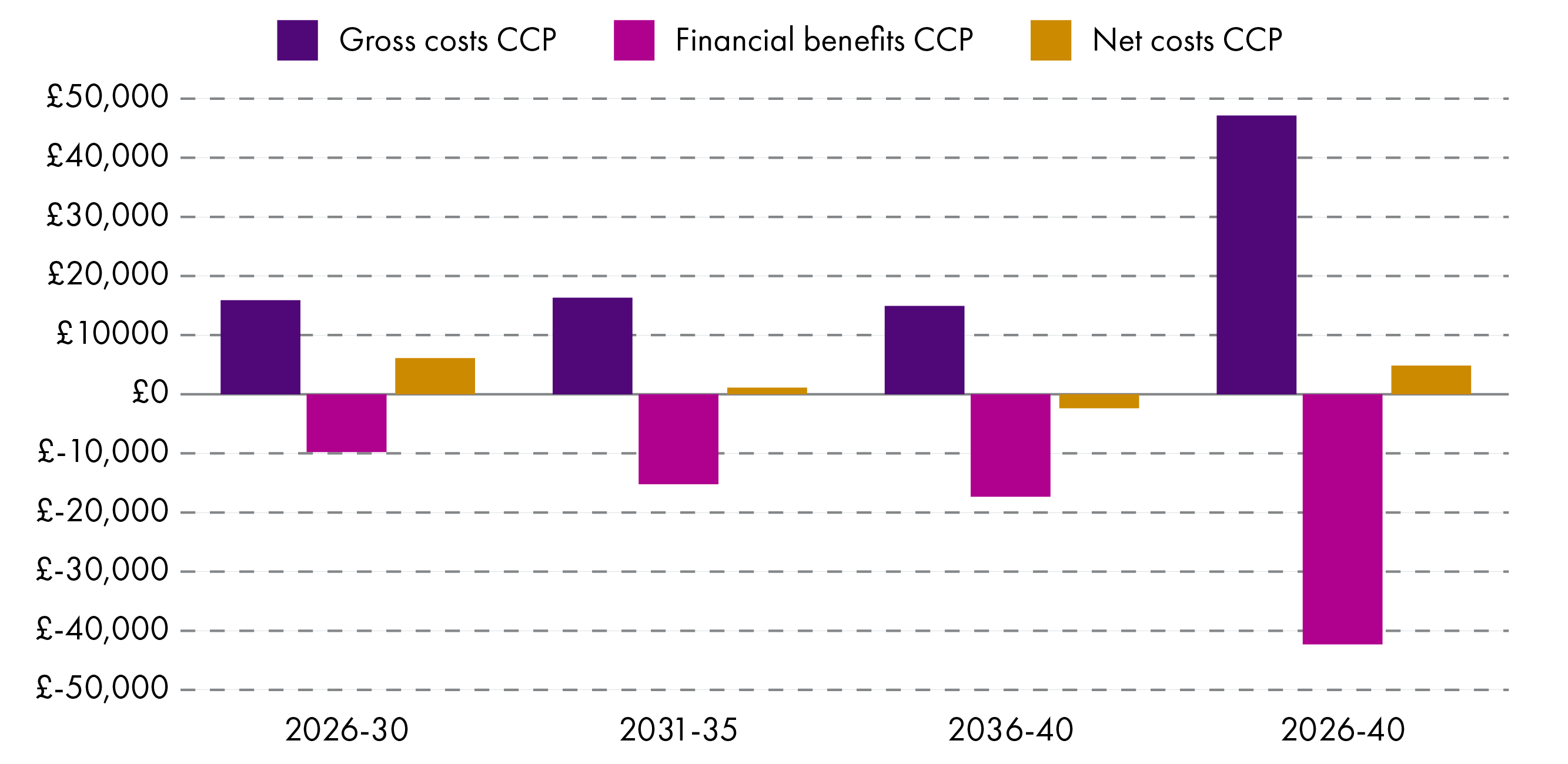
Draft Climate Change Plan
Many stakeholders were critical of the way costs and benefits are presented in the draft Plan. Audit Scotland said that:
"Although it is helpful to see the net costs, it does not provide transparency on the direct financial requirement of delivering the plan. This ought to be the basis for financial planning. It is also not clear which individual policies or packages will cost money to implement, the scale of that investment, and when it needs to happen. There is also no breakdown between resource and capital costs or where the investment will come from (i.e. public sector, private sector, or individuals and households)."vi
The draft Plan does not quantify who will pay the costs or gain from the benefits, although it makes this high-level comment on allocation of benefits:
"Our analysis suggests that most of the direct benefits are anticipated to go to households and businesses. This is largely driven by the substantial forecasted financial benefits associated with the switch to EVs [electric vehicles]. But further substantial benefits are expected for farming businesses from the Common Agricultural Payment, and for forestry businesses through the economic activity around timber and carbon credits."ii
The Scottish Government's Philip Raines said the detail of allocations of costs of benefits had not been set out for several reasons:
One is that it is difficult to predict, and it would probably be misleading for us to do so, who would pay those costs, particularly if such a prediction covered the whole period of the climate change plan. We cannot say what the UK Government might do next year and the year after, which might affect how much the public sector and the private sector have to do. We cannot predict the contributions that the private sector might make on, for example, EV infrastructure and a lot of the other things that we have talked about today. We could just put our finger in the air, but putting our finger in the air is not what we will be doing for the climate change plan, so we have not set out a breakdown of costs.viii
Following discussion during her evidence to the Committee, the Cabinet Secretary for Transport wrote to the Committee setting out a breakdown of how the £4,334m benefits figure associated with the transport sector in the first carbon budget period was developed. Her letter says the "figure for the period 2026-2030 includes:
Concessionary Travel – the financial benefit of Scottish Government's concessionary travel schemes to the scheme users i.e. the financial savings that users of concessionary travel benefit from;
Capital and Operating Savings from Zero Emission Car, Van and HGV – the financial savings from running EV cars, vans and HGVs compared to internal combustion engine vehicles, due to generally cheaper operating and maintenance costs; and
Potential for financial revenue raising from local schemes to encourage modal shift from car to other modes."
It was helpful to have this additional information. However, it is not an exhaustive list, and the data it provides is still high-level. The information the Cabinet Secretary provided suggests that more than half of the transport benefits in this period come from concessionary travel spend. While it is to be hoped this policy will, over the longer term mean more people using buses rather than cars for journeys, the data on the effect of the policy is not settled. Witnesses were clear that this policy is only partially about reducing emissions and is also a cost of living measure. This is illustrative of a wider issue of apportioning specific net zero benefits to policies, even ones that can be costed with relative certainty.viii
The Cabinet Secretary for Climate Action and Energy was also asked if the Scottish Government would consider publishing the disaggregated data and modelling which led to the cost and benefit estimates in the draft CCP. She said
"... it is very difficult to put figures on what the Government might have to spend on the basis of not knowing what the UK Government will do in some areas. For example, not knowing what the electricity cost is going to be in five or 10 years makes that very difficult, so you can only ever give an estimate... My worry about our modelling and setting out the figures associated with that at the moment is that the figures might be out of date very quickly, based on market movement, public sector investment and market creation, as well as UK Government interventions in key areas that have costs associated with them."viii
Other estimates of the costs
The Scottish Fiscal Commission's September 2025 report "Fiscal Sustainability Perspectives: Climate Change Mitigation" focused on the devolved public sector costs of delivering climate mitigation measures. It noted the complex interdependencies between the UK and Scottish climate goals and that "For Scotland to achieve its emission targets, the UK Government must take action in reserved areas". However, it also found that "Devolved spending makes up 81 per cent of expected public spending to 2050", with by far the largest area of additional public investment required in the buildings sector, peaking in the 2031-35 and 2036-40 carbon budget periods.
The report also says that "the amount of additional public investment in Scotland per person in devolved areas is expected to be higher across all carbon budgets. The main factor driving this is the difference in the expected investment in buildings between Scotland and the rest of the UK."
The CCC's carbon budget advice sets out an estimate of all costs, as opposed to the draft CCP, which does not cost proposals or baseline emission reductions. They say their balanced pathway "requires upfront investment". The CCC estimate a net cost of £750 million per year between 2025 and 2050, with the additional costs peaking in 2029 and that pathway becoming a net cost saving in 2043.xi
There are significant differences between the costings set out in the draft Plan, by the Scottish Fiscal Commission, and by the CCC. Dr Mark Winskel sought to outline the difference between the CCC and the draft CCP figures in writing to the Committee, including noting differences in the baselines, cost boundaries and responses to cost uncertainty. The example of energy supply illustrates the difference: it incurs zero cost in the draft Plan because the actions are seen to be taken by the UK Government and private sector, whereas the CCC analysis indicates that this is one of the two largest cost areas, because they are modelling whole economy costs.
The Cabinet Secretary said that the Scottish Government "... made sure that our assessment of costs and benefits is in line with the net cost projections that were worked out by the Scottish Fiscal Commission and the Committee for Climate Change." She also said that "The expected distribution of costs and benefits is very difficult to lay out, but that is also not required by the Climate Change (Scotland) Act 2009. What is required is an estimate of the costs and a whole-economy plan."viii
The CCP and the annual budget
It is important to stress that CCP does not allocate spending; it merely states or predicts it. The annual budget process itself: the agreeing by the Parliament of a budget Bill to determine spending, therefore remains crucial. Drawing up the CCP and the budget are separate processes within government, carried out largely by different ministers and officials, and one process is much more short-term than the other. The risk of divergence between the ambitions set out in a Plan and the reality of budgetary spending is high, and the Committee has seen it as one of its main high-level tasks of this session, to explore ways of making the two processes dovetail better. There is clearly a challenge in seeking to do so from a vantage point outside of government itself.
Scottish Fiscal Commission Chair, Professor Graeme Roy, highlighted the importance of having a "clear connection between decisions that are being made in the budget and how they feed through to the delivery of the plan and, crucially, how the plan is being monitored to see whether budget decisions need to change on the back of the evidence that is coming through."viii
The Joint Budget Reviewii set out a process which could improve the linking of emissions reduction policies with budgetary decisions. In the Committee's December 2025 pre-budget letter, we asked the Scottish Government to use the scrutiny period to cross-check the Budget against the draft Plan for consistency. The Scottish Government response said:
"We worked very closely with Exchequer colleagues throughout the development of the draft Climate Change Plan (CCP) to ensure the key policies are considered and accounted for in Budget discussions, and that the quality of cost data is scrutinised and challenged where needed."
Co-benefits
Several responses to the Committee's Call for Views called for the wider social, economic and health benefits of climate action to be captured and monitored in the CCP.xiv The Air Pollution Working Group and Climate Café of the Royal College of Physicians Edinburgh and Public Health Scotland both called for all policies to be assessed for health and health equity impacts – not just carbon emissions – and stated that showing how climate action can improve lives (for example through improved air quality and active travel) can strengthen public and political support.xiv Several responses also stated that a focus on the wider benefits of policies would support a just transition.xiv
The draft Plan refers to wider benefits as "co-benefits". It says there are "further indirect benefits" that are "in addition" to the financial benefits discussed above and describes them as "further indirect benefits from climate action which will support the wellbeing of people across Scotland, for example protecting people and communities from the health harms associated with fossil fuels."
Beyond the above, a clear definition is not given as to the distinction between co-benefits and the financial benefits. However, the draft Plan does cite estimates from the Edinburgh Climate Change Institute's modeliii in saying that:
Their estimates include the benefits of improving air quality, valued at roughly £1.5 billion over the next 15 years; addressing dangers associated with excessively cold homes, valued at £180 million over the same period; and increases in physical activity caused by a move to active travel, valued at £4 billion between 2025-40. Further co-benefits include noise reduction, reduced congestion and increased road safety. All co-benefits they identify taken together could deliver over £6.3 billion worth of value to Scotland between 2025 to 2040.
The Health, Social Care and Sport Committee considered co-benefits. Their letter (Annexe E) to the Committee said:
...witnesses argued that health and inequality outcomes should be made explicit in the Plan and that these co-benefits should be integral to policy appraisal and budget decisions, rather than treated as secondary considerations.
Emissions
To meet the requirement to set out estimates of emission reductions from each policy, the Scottish Government have modelled the emissions reductions expected if what is set out in the draft Plan happens over the next 15 years. The draft Plan says relatively little on the modelling that was used to predict emissions reductions from each sector, beyond what is referenced above, though sources for data on some sectors is referenced throughout Annex 3.
Following questions at our evidence session on 10 February 2026 on how the modelling of emissions was done, the Cabinet Secretary wrote back to the Committee to provide some more information on the modelling that was used for each sector. She said that projections "...use a combination of internal estimates and models to predict future emissions levels. These were judged by relevant experts within the Scottish Government to be the best available evidence and, where possible, in line with recognised wider UK Government and CCC approaches."
The Cabinet Secretary goes on to explain that different sources and evidence is used for the modelling of each sector, with a brief amount of information available for each sector in the letter.
Stakeholders have criticised how transparent the draft Plan is on its modelling. Lloyd Austin (Stop Climate Chaos Scotland) said:
...the draft plan sets out the policies and proposals to deliver those things and then tells you what the predicted emissions reductions will be. However, that is as a result of the modelling work, which again includes assumptions. For instance, if you set up a grant scheme for the installation of heat pumps, the model predicts that X percentage or Y thousand people will take advantage of that grant scheme and there will be that number of households that change heating. What the plan does not show is how that modelling works. It is a black box.i
He called for a disaggregation of the emissions calculations so "we can really see and assess their credibility."i
Dr Mark Winskel said that the Scottish Government's approach of using a system of "bottom-up sector level analysis" mirrors the approach the CCC now uses. However, he added that "while the CCC explains its working methods in detail, there is very little analytical detail in the draft CC Plan."iii
The draft Plan sets out that the estimates for emissions reductions include the impacts of both policies and proposals.
Audit Scotland said having less detail on proposals than policies reflects the uncertainties in a 15 year plan. However:
... given that the estimates of emissions reductions include the impacts of both policies and proposals, the draft CCP could be clearer on the uncertainties that may impact on the implementation of specific policies and proposals and their implications for achieving corresponding carbon reductions. This would provide greater transparency over the degree of certainty that can be attached to emissions reductions in specific areas. For example, a new industrial decarbonisation programme accounts for a high proportion of the estimated emissions reduction in the sector, but this is classified as a proposal given it will need further policy development.iv
Monitoring and evaluation
Monitoring and evaluation of the Plan and the policies and proposals within it is critically important - to determine whether progress is on or off track and to assess cost and cost effectiveness. It allows the Scottish Government to take corrective action where needed and enables scrutiny bodies (including the Parliament, the CCC, Environmental Standards Scotland, Audit Scotland, and the Scottish Fiscal Commission) to hold the Scottish Government to account.
It is already the case that, following the publication of the GHG emissions data, the Scottish Government prepare CCP monitoring reports each year. The most recent was published in May 2025. Dr Richard Dixon from ESS said these reports "... are really good and very honest about where we are on track and where we are not. I would like exactly that kind of format to continue, so that we have that honest picture."i
Annex 3 of the draft CCP sets out a "Monitoring Framework” for policies and proposals. It has three strands:
National, sectoral and sub-sectoral greenhouse gas emissions monitoring. Annual emissions data will be published via annual emissions Inventory Emissions Statistics, published every June with an approximately 18-month time lag. This is the same as the previous approach, with the latest data being the 2023 data, published in June 2025.
Early-warning indicators. Given the time lag associated with emissions inventory data, the draft CCP states that a system of emissions-reduction early-warning indicators will be developed and monitored for each sector. The proposed indicators are not included in the draft Plan (though it does note that some indicators from the existing monitoring report will be retained) and the process for their development is not set out.
Just transition indicators. For the first time, the CCP monitoring framework also includes a set of just transition indicators, to be reported on annually alongside progress on emissions reduction.iii
It is important to underline that what the Plan labels “early-warning indicators” are not an unpolished or “raw” form of emissions data obtained earlier than the time-lagged annual data. They are in most cases of a fundamentally different character and relate to specific outcomes that the Plan considers will have a positive climate change impact. The Scottish Government already uses early warning indicators as part of its CCP monitoring process: current examples early-warning indicators include percentage of new car registrations that are ultra-low emissions vehicles, renewable energy capacity at the planning stages, and number of existing domestic properties using low and zero direct emissions heating systems.iii
There is a direct relationship between having policies in the Plan that set out clear outcomes and timelines, and state clearly who is responsible for delivery, and having a good and useful early warning indicators. As noted below, some of our witnesses had doubts that policies in the Plan were sufficiently clear and delivery-focused.
Neil Langhorn (ESS) said indications in the draft that there could be early warning indicators for targets like heat pumps or EVs was:
"... a great idea in principle, but the level of detail is not there at the moment. We do not know what a lot of the early warning indicators are. In two or three years’ time we will want to ascertain whether we are on track with the plan, but I am not clear as to exactly how we would assess that."i
In their letter to the Committee Audit Scotland said:
Finalising the monitoring and evaluation framework in time to assess progress during the first five-year carbon budget period will be important. Until the framework proposed in the draft CCP is developed, it is not possible to assess how effective it will be in supporting scrutiny of progress or in highlighting risks to delivery early enough to enable the Scottish Government to take effective corrective action, if needed.v
Philip Raines (Scottish Government) said that "...the emissions data that we collect is quite a few years out of date. The early indicators are therefore the key thing and it is important to get a sense from each sector of how we will know whether we are making progress... The cabinet secretary has talked about things such as the programme board and the Cabinet subcommittee. We present that data to them and use those indicators to show how each sector is doing on emissions reduction."i
Prior to adopting carbon budgets under the 2024 Act, the Scottish Government were required to lay so-called "Section 36" reports when an annual emission reduction target was missed. These had to set out what policies and proposals the Government would implement to compensate for the excess emissions. These reports are now only required when a 5-year carbon budget is missed - and this may not become clear until 18 months or more after the budget period ends - when the emissions data is published. In our Stage 1 report on the Bill for the 2024 Act, we said this seemed like a backwards step and recommended having an earlier trigger, where projections indicate the carbon budget is unlikely to be met.vii
Dr. Richard Dixon expressed similar views. Section 36 reports were:
...a direct annual process for catching up when we went off track. Sometimes it worked and sometimes it did not work, but it was a good mechanism, and I think that we have lost that. We do not have annual targets, having moved to five-year carbon budgets, so the annual pressure is not really there.
We will have reports from the CCC telling us how we are doing, so we will know if we are off track, and we will have the Government’s own monitoring that will tell us if we are off track. However, how the Parliament will hold cabinet secretaries and ministers accountable to ensure that we get back on track is a bit less clear in the five-year budget world than it was in the annual target world.i
Much of our evidence stressed the importance of dynamic monitoring to ensure the Parliament and expert bodies such as the CCC, ESS, and Audit Scotland can meaningfully keep track of progress and recommend corrective actions before it risks becoming too late.ix There were also suggestions to make monitoring more responsive and transparent. For instance, Aberdeen City Council called for "open-access dashboards of progress using simple, timely metrics alongside technical emissions data."x Clare Wharmby also supported the idea of a public dashboard to make monitoring and evaluation more transparent, saying it
... would allow them to find and track the policies that they are interested in. If this work matters to us—and we want it to matter to people—we could make it easier to see what is working well and what elements have stalled, and we could then explain the process for restarting them.i
The Cabinet Secretary said that the Scottish Government had not considered ideas along these lines before but that she ..."will take away the suggestion about a dashboard."i
Governance and coordination
The CCP is a long term strategic document that envisions significant changes through the economy and society. This will require governance arrangements that enable coordination across the whole Scottish Government and with delivery partners. These arrangements must provide effective oversight of risk management, and clear lines of accountability for each policy.
The Cabinet Secretary for Climate Action and Energy's foreword to the draft Plan said "governments cannot tackle climate change alone. All of us – individuals, communities and businesses across our society – have a role in this shared ambition. This government will continue to work through partnerships to support the action we must see happen to protect people and the wider planet and maximise the economic opportunities of the climate transition."i
Scottish Government
Previous commentary on Scottish Government climate policy governance
In 2023 an Audit Scotland report said that the delivery of emission reduction policies is dependent on all directorates of the Scottish Government and that "cross-government collaboration is required to progress climate change policies and manage competing priorities".i
The report also said the Scottish Government had improved how it organised itself to deliver emissions reduction targets since it had declared a climate emergency in 2019. However, it also found a lack of clarity over roles and responsibilities which could hinder collaborative working and gaps in performance monitoring which make it difficult to gain assurance of overall progress.i
The Public Audit Committee considered the report shortly after it came out and wrote to this Committee in 2023 (Annexe K) , highlighting these issues:
Cross-government collaboration, progress had been made but there were still gaps and a need for greater transparency.
Impact of policies and spending on emissions, this had been insufficiently assessed by government: the next CCP should have detail on the emissions that each policy will deliver, as well as costings based on informed assessments.
Risk management, several risk registers contained actions which were vague and unclear.iii
Their letter also drew attention to a new structure within government; a “Global Climate Emergency Programme Board” to oversee the CCP. A Scottish Government letter to the Public Audit Committee has more information about the Board and refers to having "a full climate governance framework review as the parliamentary term [2021-26] draws to a close."
The Committee also took evidence from the Auditor General in March 2024 and the then Cabinet Secretary for Net Zero and Energy in May 2024 on the Auditor General's report and climate change and environmental governance more generally. We reflected on evidence from this work in our 2025-26 pre-budget scrutiny letter to the Scottish Government.
The development of the CCP
The Cabinet Secretary for Climate Action and Energy set out that in the development of the CCP the Scottish Government "...take a whole-Government approach" and that "portfolios that are able to do a lot of work on emissions reduction have to reach out to their stakeholders while looking at all the other things that they have to achieve and must ensure that the decisions they are going to make are also part of the just transition..." They then "have discussions with me and my officials about the climate change plan, and we work through that to decide what is possible and what it might be less desirable to do"iv
Cross-Government working
The Strategic Environmental Assessment Environmental Reportv, published alongside the draft Plan, notes that there is a relationship between the CCP and nine other Scottish Government plans, programmes and strategies:
There are at least three significant gaps in this list:
The Energy and Just Transition Plan – consultation on a draft closed in May 2023, but it has not yet been finalised. The draft said that it would be a “route map of actions we will take to deliver a flourishing net zero energy system that supplies affordable, resilient and clean energy to Scotland’s workers, households, communities and businesses”.vi
The Rural Support Plan – a draft outline was sent to the Rural Affairs and Islands Committee in June 2024. This Plan is a requirement under the Agriculture and Rural Communities (Scotland) Act 2024 and must set out information relating to the agricultural support the Scottish Government intends to provide over a five-year period.vii
The new Heat in Building Strategy and Delivery Plan – the draft CCP says Scottish Government will publish this by the end of 2026 and that it will set out the actions the Scottish Government will take to achieve a still to be set target for decarbonising heating systems.viii The Scottish Government also took the decision not to proceed in this Session with legislation to speed up the transition to decarbonised heat whilst it reflected on its position.vi
The sequencing of policies and interventions is important. If it is unclear when one will start, this will have a knock-on effect on any policies downstream of it or with which it is inter-related. The risk of this “snagging” may increase in already complex areas where there is a mixture of UK, Scottish and indeed local government competencies, energy policy being an example of this. The Scottish Government cited actions by the then UK Government as the reason for the delay to this draft CCP.
Other stakeholders have also reflected the need for cross-government working. South East of Scotland Transport Partnership stated that “cross-government collaboration is vital, ensuring alignment across departments and with regional authorities to avoid duplication and maintain policy coherence.”x
The Economy and Fair Work Committee said hitting net zero targets means:
... greater integration across the Scottish Government directorates and between Government strategies and policies including industrial strategy, infrastructure project planning, energy policy and economic strategies.xi
Delivery mechanisms
After the draft Plan was published, the Auditor General, said it:
... does not clearly set out who the main delivery partners are for each policy or proposal, or exactly what is expected of them and by when. The draft CCP also does not include any details of the governance or accountability arrangements supporting it.xii
The Climate Emergency Response Group recommend that "mission-based approaches" (10 or more year goals where government concentrate resources) on heat decarbonisation, transport and land use be set up as soon as possible which give clear responsibility for delivery across directorates.xiii
Historic Environment Scotland called for the publication of implementation plans for each sector shortly after the CCP is laid in Parliament, to enable stakeholders to access information and plan ahead accordingly.x
Witnesses also commented that delivering policy is more challenging when policies are not clearly set out. Clare Wharmby said:
Sometimes, we look at a policy and we do not know what it is meant to do, how it is meant to work or what it is going to deliver, and we cannot think of a monitoring and evaluation indicator for it. If we do not know what a policy does, how it works, who will do the work, how much it is going to cost or what it is going to do, it is probably not a policy.iv
The Committee heard that governance must be goals-focused: emphasising delivery of specific policies with defined objectives. Professor James Curran, of the Climate Emergency Response Group said:
The predominant failure in the current draft plan… is to do with the extent to which any delivery mechanism is evident in it… We all welcome the plan and its ambition of reaching net zero by 2045. Many of the elements for getting to that point are there in the plan, but there seems to be a void when it comes to the pathway for delivering on all those commitments.
The Cabinet Secretary said that "Detail and delivery are themes that have been coming through" responses to the Scottish Government's consultation and that they "take on board that people are asking for more detail on the delivery mechanisms associated with the plan."iv
Partnerships
The CCP belongs the Scottish Government and its delivery ultimately sits with them. However, meeting the carbon budgets also relies significantly upon actions taken by others.
The draft CCP includes an "Our Call to Others" section for each sector. They outline the actions that, in the Scottish Government's view, the UK Government, local authorities, businesses and industry, public bodies, local communities, and individuals / households need to take to support the delivery of the policies and proposals in that sector.
UK Government
Climate change policy is a complex mix of reserved and devolved policy. SPICe blogs by Professor Colin Reid, a Committee adviser, explore this complexity both in terms of the general framework of devolution and also by sector in detail.
The draft Plan says:
The Scottish and UK Governments’ ambitions to tackle climate change and biodiversity loss, are highly interdependent: many of the critical levers required to deliver net zero in Scotland are held at the UK level; meanwhile, delivering UK wide climate targets is also reliant on Scotland achieving our net zero aim.i
Despite this, many of the emissions reductions action required to meet the carbon budgets exist in devolved areas. The CCC have said that:
Progress to date has largely come from electricity decarbonisation, reflecting Scotland’s abundant renewable resources. This is a reserved area of policy and Scotland has benefited from measures across Great Britain’s electricity system. Action will increasingly be required in predominantly devolved policy areas to hit the Net Zero 2045 target and the proposed carbon budgets. Now that the framework for climate action has been reset, the Scottish Government has the opportunity to use its powers to match its ambitions with action.ii
However, the Committee heard throughout evidence that there are delivery risks to be considered, where action by the UK Government is required to support the Scottish Government to deliver in certain policy areas (notably, the cost of electricity, which is considered below). This presents a clear risk that is best mitigated by effective collaboration and joint working between the UK and Scottish Governments.
The Cabinet Secretary for Climate Action and Energy said that engagement with the UK Government has been a lot better than previously but that it was still at "a surface level". She highlighted that there are inter-ministerial groups involving the four governments, and that the Scottish, Welsh and Northern Irish Governments "have been pressing particularly for actions to decarbonise the gas grid and on electricity costs."iii The Cabinet Secretary emphasised throughout her evidence that action on electricity pricing from the UK Government was key to Scotland meeting its carbon budget.
In their October 2025 Carbon Budget and Growth Delivery Plan (broadly the UK-wide equivalent to Scotland’s Climate Change Plan), the UK Government stated that:
In preparing this package of proposals and policies, we have consulted with devolved governments who we continue to work with to deliver our UK-wide carbon budgets.iv
Public bodies
The wider public sector has a responsibility to lead on reducing emissions, with public bodies having been legally required to reduce emissions since 2011. The draft plan notes their role in relation to:
public procurement - public bodies are required to report on how their procurement policy and activity has contributed to compliance with climate change dutiesii; and
service delivery - with bodies including the Scottish Environment Protection Agency and Nature Scot playing a key direct role.ii
The draft CCP notes five ways the Scottish Government will support public bodies, (several of these apply to local government, which is considered in the section below this):
the Climate Delivery Framework - a policy group co-chaired by the Scottish Government and COSLA;
the Sustainable Scotland Network - who support the public sector through leadership, policy and research;
forthcoming revised statutory guidance for public bodies, published in draft in February 2025 and says that more detailed sustainable procurement guidance is being produced;
sustainable procurement tools - which includes guidance on environmental requirements in contracts;
the Scottish Climate Intelligence Service, which helps local authorities use data to plan, monitor and deliver climate action.ii
Several public sector organisations have set their own targets and actions to reduce emissions, some of which were reflected by other committees in letters to the Committee, including:
The Criminal Justice Committee heard from several public bodies within their remit. Their letter (Annexe G) to the Committee reported on:
Police Scotland and the Scottish Police Authority - who said they had taken work on the estate as far as they can, but aim to continue progress in electrifying their vehicle fleet.
Scottish Fire and Rescue Service - highlighted their Carbon Management Plan and £12 million invested in carbon reduction measures including heating control systems, solar panels, building insulation and EV chargers.
Scottish Prison Service - highlighted the closures of HMP Inverness and HMP Barlinnie as having an impact on reducing emissions, with the new HMP Highland planned to have zero direct emissions.
The Scottish Courts and Tribunal Service - highlighted a 54% reduction in emissions since 2009-10 and further work planned or underway, including building heating and insulation upgrades, solar panels on the estate and changing the pool car fleet to EVs.
Crown Office and Procurator Fiscal Service - who indicated they had reduced emissions in part through the installation of solar panels.v
The Constitution, Europe, External Affairs and Culture Committee's letter (Annexe I) highlighted the role of the culture and heritage sector (a mixture of public, private and third sector organisations) in both reducing their own emissions and in "shaping and informing public attitudes on climate and sustainability." They said:
The culture sector has a role in shaping public understanding and attitude towards climate change.
Substantial capital investment will be needed to decarbonise historic buildings.
Audience travel is the biggest source of emissions associated with the culture sector with both international and domestic travel challenges.v
We also heard about opportunities for public sector procurement to drive down emissions. The draft CCP says that the Scottish Government will "develop opportunities within public procurement...recognising that the Scottish public sector spends more than £16 billion a year buying goods and services and that this purchasing power has the potential to stimulate market development and innovation."ii
Several public bodies responding to the Committee's Call for Views said CCP policies should encourage public procurement practices which embed circular economy principles.viii Highland Council advocated for minimum recycled content in public procurementix, which was also raised by Duncan Simpson (Resource Management Association Scotland), who also suggested social value should be another driver.x NHS Lothian said there are significant opportunities given it spends around £1.1 billion per annum on goods and services. However they said there are also challenges with embedding circular economy principles, given it is highly regulated and technical with a high dependence on single use products.ix
Iain Gulland raised opportunities around changing life-cycle assessment to discourage purchasing cheaper products that will not last, and said NHS procurement could support “remanufacturing and repurposing of products in Scotland at a level that can demonstrate value”. He said that plans needed to work from a systems perspective, including looking at what critical raw materials we need. x
The Committee discussed a £30 million investment in EV charging infrastructure from the Scottish Government with the Cabinet Secretary for Transport as one such example where public procurement policy could ensure local economic benefits as well as environmental ones. The Cabinet Secretary said that it is “… a requirement of all grants that come from the Government, so that we can identify what goes into local supply chains. Measuring that is an aspect of the general procurement condition of grants.” However Scottish Government official, Morna Cannon added that “No specific target has been set for local content as part of those contracts.”x
Local Government
The draft Plan notes the importance of working with local authorities in delivering emission reduction policies. The Local Government, Housing and Planning Committee considered the role of local government in delivering the CCP in their report.
In 2022-23 this Committee conducted an inquiry into the role of local government and its cross-sectoral partners in financing and delivering a net-zero Scotland. The report noted that local government had a key role in the delivery of a spectrum of climate change-related policies, but was hobbled by a lack of resources, including access to capital spending on transformative projects, access to specialist expertise and, in some areas, a lack of clear strategic direction from government. Because of this, some local government powers relevant to net zero delivery (such as “carrot and stick” polices on transport in urban areas) seemed to exist more on paper than in reality.
It also said that:
Scotland will not meet its ambitious target of being net zero by 2045 without a more empowered local government sector, with better access to the skills and capital it will need to play a full role in this energy revolution, and a clearer understanding of the specific role the Scottish Government wants it to play in some key delivery areas.i
A key recommendation of the report was for:
Scottish Government to heed the Climate Change Committee's call for a comprehensive and detailed roadmap for delivery of net zero in key areas, such as heat in buildings and transport: one that also gives Councils far more certainty than they have at present about the roles they are to play in these areas and about any additional resources or powers they are to receive to help them do so.i
The Local Government, Housing and Planning Committee's report on the draft CCP notes councils’ important role as transport authorities, especially in:
Encouraging and incentivising the rapid uptake of electric vehicles to help meet the goal of all vehicles on the road being zero emission by 2040.
Reducing private car use through a combination of ‘carrots’ and ‘sticks’.iii
It noted views from the local government sector that “billions of pounds” in investment would be needed to help councils meet long-term goals to decarbonise transport.iii
The Local Government, Housing and Planning Committee's report on the draft CCP includes findings that:
the Scottish Government should work with local government to develop the roadmap for delivery of net zero this Committee recommended in 2023;
the final version of the CCP should include reference to the role of local authorities to deliver each policy and proposal;
local authorities would appreciate greater clarity on the funding which will be available to them from the Scottish Government or support to access private funding;
and the Scottish Government should explore "what additional resource and long-term certainty it can provide through multi-year funding."iii
Private sector
The draft Plan discusses working with the private sector on decarbonisation saying that public sector funds will be used to "unlock, rather than replace" private sector investment. It highlights the role of the Scottish National Investment Bank, the ScotWind offshore wind leasing round, and work to encourage investment into EV public charge points.i
The role of the businesses in specific sectors is set out in the sectoral chapters, and so is discussed at the relevant point below in this report. However, the draft CCP sets out five ways the Scottish Government provide "cross-sectoral support for businesses":
Policy and strategic planning - by creating a stable policy environment and removing regulatory barriers;
Funding and financial support- examples given include the SME Loan Scheme for energy efficiency upgrades and the Green Jobs Fund;
Advice and expertise - highlighting the roles of Enterprise Agencies, Business Energy Scotland, Energy Savings Trust and Zero Waste Scotland;
Workforce development - for example, the Green Jobs Workforce Academy; and
Tools and resources - for example a Net Zero Accelerator Tool for businesses to develop net zero plans.ii
The Committee heard that private sector finance is vital, with stakeholders proposing a range of mechanisms for leveraging funds, including blended finance modelsiii, contracts for difference (CfDs)iv, and green bondsiii.
Other respondents said that regulation would be required to ensure private investment aligned with public goals, with the Royal College of Physicians, Edinburgh: Air Pollution Working Group and Climate Café saying that private finance should be required to "meet health, environmental and social criteria."vi
The Energy Transition Zone (ETZ), which the Committee visited in Aberdeen, had received both public and private support to develop the Energy Transition Skills Hub. The Committee heard that there are opportunities for government investment to facilitate private sector development and investment to develop the renewables sector in the region.
During the visit, the Committee toured the skills hub, meeting with students taking part in a welding course and heard from staff from both the ETZ and North East Scotland College about the future plans to increase the number of students at the site to support the skills development needed in the transition. We also heard calls for positive messaging from both the UK and Scottish Governments on energy to increase confidence
In a meeting with ORE Catapult, the Committee heard that scaling up floating offshore wind was a big opportunity in Scotland that would capitalise on the skills currently in the oil and gas industry. The Committee saw floating offshore wind technologies being tested, including anchors and cables.
Individuals and communities as delivery partners, and effective communication and engagement with them
The draft Plan says that communities and individuals are partners in the transition to net zero and references both their participation in decision-making on climate policy and empowering individuals and communities to take actions to lower their own emissions.i
The Committee discussed the need for people to "buy in" to actions being taken to reach net zero set out in the draft Plan and have heard throughout evidence about the need for communication about climate change to the public to be relevant and meaningful to people's daily lives.
The Committee commissioned a People's Panel in 2024 to scrutinise the effectiveness of the Scottish Government's public engagement on climate change. The Panel made several recommendations and highlighted that "There needs to be more opportunities for the Scottish Government to listen to the public and their experiences, so money spent addresses real need."ii The CCP presents an opportunity to reconsider whether the Panels recommendations have been actioned.
The draft CCP highlights the Scottish Government's Public Engagement Strategy for Climate Change, which aims to increase awareness of climate change and encourages people to "embrace their role in the transition." Practical approaches include:
Climate Action Schools - supports children and young people to learn about climate change.
Climate Engagement Fund - funds groups to deliver projects that helps people understand climate change and actions they can take.
NetZeroNation.scot - gives information to individuals and businesses about actions they can take
The Climate Change Participation Programme - supporting communities to take part in designing climate change policy
Participatory budgeting - with the draft CCP saying the Government have distributed £3.5 million since 2022 through the Just Transition Fund for the North East and Moray through participatory budgeting.iii
It also includes sections on communities as well as individuals / households throughout the sector chapters, where it discusses climate impacts on people as well as areas they encourage people to take action on to reduce emissions.
The draft CCP says "empowering people to take action individually and as part of their communities" is key. It highlights support provided to 24 Climate Action Hubs to raise awareness and implement initiatives which deliver for local places as evidence of the Scottish Government's work to support communities.iv
The Committee heard from several stakeholders that the Scottish Government should support community climate hubs, with the Royal College of Physicians, Edinburgh: Air Pollution Working Group and Climate Café proposing a "national fund for community climate hubs," enabling local groups to run initiatives like tool libraries, repair cafés, growing projects, and food waste reduction schemes.v
Across the Committee's public engagement activity views on the draft CCP's approach to community-led solutions were mostly negative. One respondents said that "What is already happening in community groups must be supported, encouraged and shared". Participants in our discussion in Aberdeen highlighted a variety of community group-led initiatives, such as energy projects or recycling and re-use schemes, that underlined how these groups can help deliver net zero outcomes at a human and local level. But we heard that funding for climate-related community programmes was generally short-term (often annual) and might only comprise capital funding when revenue funding for staffing and other current costs was needed. We heard some of the grants and schemes highlighted in the draft Plan were relatively generous but difficult to access. Barriers included a lack of awareness, inconsistent advice, digital exclusion, and insufficient clarity about eligibility.vi
Members of the Scottish Youth Parliament told the Committee that the plan says frustratingly little about community transport, which they said is crucial for young people living in rural areas.vi
Advice and support available to individuals and households was also raised as a concern throughout our engagement work.vi
Some stakeholders welcomed the Scottish Government's work on public engagement. The UK Energy Research Centre's response noted that "the Scottish Government has, to date, taken commendable steps to engage civil society and enhance public contributions to climate action."ix
They also said there was a need for better data on how the public are already contributing to climate action in Scotland.
Jess Pepper emphasised that good public participation work had already taken place - such as Big Climate Conversations in 2019, climate emergency summits, the Committee's People's Panel and the Scottish Government's climate assembly - which she said the Government should respond to in the CCP.x
Others drew a link between good communication and inspiring behaviour change, with the Climate Emergency Response Group recommending the CCP be accompanied by a public engagement campaign to help demonstrate the social, health and economic benefits of climate policy.xi
Communication around the development of the draft Plan itself has also been raised with the Committee. Stakeholders called for greater clarity and practical detail to support public engagement. They said that the Plan should include plainer language, worked examples, and a clearer explanation of who will do what, when, and with what resources to help people engage with it.vi
To make it accessible to different audiences, the draft Plan includes a children and young people's version and an easy read version. Members of the Scottish Youth Parliament, however, told the Committee that the children and young people's version included too little detail, while the full document and its annexes are unlikely to be read by members of the public. They recommended the Scottish Government publish a "middle ground" version, using multimedia approaches to make it more engaging. vi
The Cabinet Secretary said the Scottish Government had reopened the £275,000 Climate Engagement Fund to "increase understanding of climate change and to empower people across Scotland to take action in their local communities."xiv
She also said, as a result of engagement with children and young people, she had spoken with the Cabinet Secretary for Education and Skills about making sure schools had all the necessary materials available for work on climate action generally.xv
The Cabinet Secretary highlighted investment in this year's budget "...which includes £6 million to continue the network of community climate action hubs and £1 million to support the Scottish Climate Intelligence Service".xv
Delivery
Scotland’s Climate Change Plan must be first about delivery: it must explain how the Scottish Government will use its powers and capacity to bring down emissions in line with carbon budgets and with the principles of a just transition. It should be clear about areas where the Scottish Government does not have all the levers, but in the many areas where it does, should set out how it will use them. This means setting out those policies, current or future, that the Scottish Government proposes to use to drive down emissions. Wherever possible, these should have timelines and targets, be costed, and state clearly who within government or elsewhere in the public sector will lead on delivery. The role of partners outside of government in relation to each major policy should also be set out. Specific, measurable policies with clear outcomes should be at the centre of the Plan.
There are good aspects to the draft Plan, such as the inclusion of Just Transition indicators discussed later in this report, but the Committee agrees with stakeholder views that it falls short in some areas as a delivery document, with insufficient detail on key policies and the mechanism to achieve specific outcomes. There are some specific recommendations later in this report on particular policies within specific sectors which the Committee considers require a clearer focus.
Monitoring
Having a comprehensive mix of “early warning indicators” across the breadth of the Plan will also be vital if it is to be a successful delivery document. Not only would this assist the Parliament, academia and regulatory bodies in their scrutiny work, it would also provide a public service of setting out progress in particular areas in a relatively straightforward way. The Committee recommends that:
the Scottish Government should publish early warning indicators at the earliest opportunity;
the Scottish Government should consider renaming the indicators to be “performance indicators”. Regardless of this, they should frame the indicators clearly around performance – with each one tracking a clear delivery goal with read across to corresponding significant policies in the CCP;
the Scottish Government should consider developing an indicators-based “dashboard” as a transparent and accessible way of communicating net zero progress to the public. The CCC should have a role in monitoring progress against the relevant indicators.
Modelling: emissions reductions, costs and benefits
Emissions reduction policy is built on long-term climate and economic modelling, with large built-in uncertainties. Broadly, governments seeking to map a long-term plan of action can respond to this in one of two main ways:
they can share only the outputs (i.e. the final figure that is reached on a cost or benefit calculation) and not the underlying assumptions which are key inputs for their modelling. Governments could defend this approach by reference to the technical and contingent nature of modelling inputs, and the risk of these becoming a distraction, when the focus should be on overall policy direction and prioritisation and on delivery. They could also compensate by providing more detailed narrative sections about the detail of policy and its delivery;
or they can publish all their main assumptions and modelling processes within or alongside the Plan, making these part of the overall conversation about whether the action plan looks likely to meet its aims, and where the main risks might lie.
The CCC's Balanced Pathway is based on their own modelling using the policy assumptions in their Carbon Budget advice. Alongside their advice, the CCC published a "full dataset" setting out the data for each measure that can be used to reduce emissions and a methodology report setting out the analytical approach behind their advice.
This is the first Climate Change Plan to include estimates of the costs and benefits of the transition. This amounts to progress and is welcome: it partially improves our understanding about the levels of investment required and what mitigation policies might produce savings, and at what level. However data and assumptions, and information on modelling, is presented inconsistently in the Plan and key information is often missing. The Committee recommends that the final Plan should:
Provide more of the underlying data used for its modelling and outline how the modelling was used to produce cost and benefit estimates.
Especially in cases where the Scottish Government lacks significant agency in relation to a particular policy or outcome (an example might be how the affordability of electric vehicles could affect take-up), set out any significant uncertainties and risks and how they have sought to address these.
Overall, the Scottish Government should welcome informed commentary and constructive criticism on the data and assumptions from policy experts (even if it cannot be provided within the period of Parliamentary scrutiny) recognising the iterative nature of climate change policy-making.
Some narrative sections of the draft Plan allude broadly to costs falling on particular sectors or refer to private sector investment or UK Government investment being needed. Other than this, the draft does not quantify which costs associated with a particular policy fall where. The Committee accepts that it would be challenging to do so, and that longer-term estimates in particular would be highly contingent. However, there is a balance to be struck and the Scottish Government should reflect on whether the draft falls short as a “signal” to the public and stakeholders (including private investors) about where costs, incentives, and reliefs will fall, especially in the current absence of long-term Scottish Government strategies on heat in buildings, energy and the just transition and rural support.
As highlighted by the Scottish Fiscal Commission's report, climate mitigation policies that meet the carbon budgets will require significant upfront public sector investment. The annual budget process is therefore crucial to ensure that the policies and proposals outlined in the CCP can be delivered in line with the projections. To allow the Parliament to properly scrutinise this the Scottish Government should set out the linkages between the final Plan and the annual budget process using the tools developed through the Joint Budget Review.
Governance and partnerships
The Scottish Government should now have had time to reflect and act upon findings by Audit Scotland and the Public Audit Committee on sharpening its governance arrangements for delivery of climate change policy. The Committee notes that the Scottish Government undertook to carry out a "full climate governance framework review" within this parliamentary term and asks for an update on the progress of this review, and the changes made as a result of it.
Effective cooperation and coordination at inter-governmental level will be crucial in relation to many, if not most, major policies in the Plan. In some areas, successful delivery is significantly dependent on UK Government actions. The draft CCP is largely dependent on electrification. The pace of decarbonisation set by the carbon budgets is challenging, with changes required across all sectors of the economy to meet them. However lower electricity costs would help several key areas decarbonise at the pace required. The Committee calls on the Scottish Government to work with the UK Government and other UK administrations on a joint plan of action for more affordable electricity including by considering the decoupling of electricity and gas prices and the role of different renewable energy technologies.
The Committee asks the Scottish Government to note the findings of the Local Government, Housing and Planning Committee, including that local authorities feel they lack clarity on sources of net zero funding, and still lack the “roadmap” to net zero that this Committee recommended in 2023.
The Local Government, Housing and Planning Committee’s report underlines the critical role local authorities will play in reducing emissions from three sectors in particular - buildings, transport, and waste. But they will be unable to play this role fully without more support and the sharing of best practice. We welcome the advent of a local government climate change intelligence service in this Session, but consider that local government needs additional resourcing and clear delivery plans for specific policies agreed with central government in order for it to play its required role in net zero delivery.
Procurement is another area where all levels of government and public bodies, can help deliver significant emissions reductions, along with the twin benefit of promoting local produce and services and local, regional and national supply chains. The Committee welcomes that updated guidance on sustainable procurement is being developed. We see this as an opportunity for the public sector to deliver emissions reductions by embedding sustainable procurement practices while also securing value for money. The Committee recommends that the updated guidance empowers and equips decision-takers to make sustainable procurement choices and, where consistent with emissions goals, take decisions that support local goods and services, and local supply chains. It should be backed up by the availability of training.
Communities, individuals and communication
Communities and community groups are delivery partners in efforts to reduce emissions. However we heard concerns about lack of long-term and revenue funding and how this inhibited the role local groups could play. The Committee recommends the CCP set out how community‑led and place‑based climate action will be enabled through multi‑year funding, including revenue funding, and capacity support which could include support through the Just Transition Fund.
In the final Climate Change Plan, the Scottish Government should set out clearly how households and individuals will be supported to understand what is required of them and to access clear information, advice, funding and practical help - including through trusted local organisations.
The Committee welcomes the Cabinet Secretary’s announcement of the reopening of the Climate Engagement Fund. The Committee believes that engagement should focus on areas and groups most affected by the transition, in line with the principles of a Just Transition.
As the focus turns from scrutiny of the CCP to delivering its policies, the Scottish Government should communicate its contents clearly and accessibly using a variety of formats and approaches. This should include setting out what the Plan will mean for people’s everyday lives, how progress will be tracked, and the wider social, economic and health benefits of the transition. It could make use of the early warning indicators “dashboard” we proposed earlier. The Scottish Government’s communication on net zero delivery should be developed with input from communities and other relevant groups, including young people, cultural bodies and researchers.
Sectors
The draft CCP covers seven sectors. The Committee led on scrutiny of three - Energy Supply, Transport and Waste. The other sectors - Agriculture; Buildings; Business and Industrial Processes; and Land Use, Land Use Change and Forestry (LULUCF) – we did not consider in depth, largely leaving this to other committees specialising in these areas in their reports or letters:
Economy and Fair Work Committee letter - considers the Business and Industrial Processes sector.
Local Government, Housing and Planning Committee report - considers the Buildings sector.
Rural Affairs and Islands Committee report - considers the Agriculture and LULUCF sectors.
Energy Supply
Put broadly, “energy supply” as used in the draft CCP means emissions from “making” energy, rather than “spending” it: the spend takes place elsewhere, for instance in heating buildings or powering cars. This is with the important caveat that making energy means spending energy: with some energy needed in the energy production process. The energy supply chapter is about the emissions footprint of this process.
The energy supply sector is split broadly into two sources of emissions:
electricity supply - emissions from the generation of electricity;
fuel supply - which, in Scotland, relates to oil and gas extraction and processing (but not the eventual combustion of these fuels).
The CCC consider both electricity and fuel supply to be largely reserved,i however the Scottish Government's control over the consenting of electricity infrastructure does mean it has an important role to play. Electricity supply is also a critical part of the Scottish Government's pathway to net zero, which involves scaling up “electricity-hungry” technologies like heat pumps and EVs.
The draft Plan includes energy from waste in the energy supply sector rather than the Waste sector. In our scrutiny and in this report, the Committee has chosen to consider energy from waste emissions in the "Waste" chapter because of this topic's strong connection to policy on landfill.
The draft CCP includes two policy outcomes for Energy Supply, one about reducing the sector’s remaining emissions and one about non-road mobile machinery (which is categorised here despite the actual emissions occurring in multiple sectors).ii
In 2023, emissions from the Energy Supply sector were down 82% from 1990i. They now make up only 10% of total emissions at 3.9 megatonnes of CO2 equivalent (MtCO2e).iii The draft CCP projects a further 85% reduction in emissions between 2025 and 2040, based on declining demand for fossil fuels and utilizing carbon capture technology at Peterhead power station.iv
ii
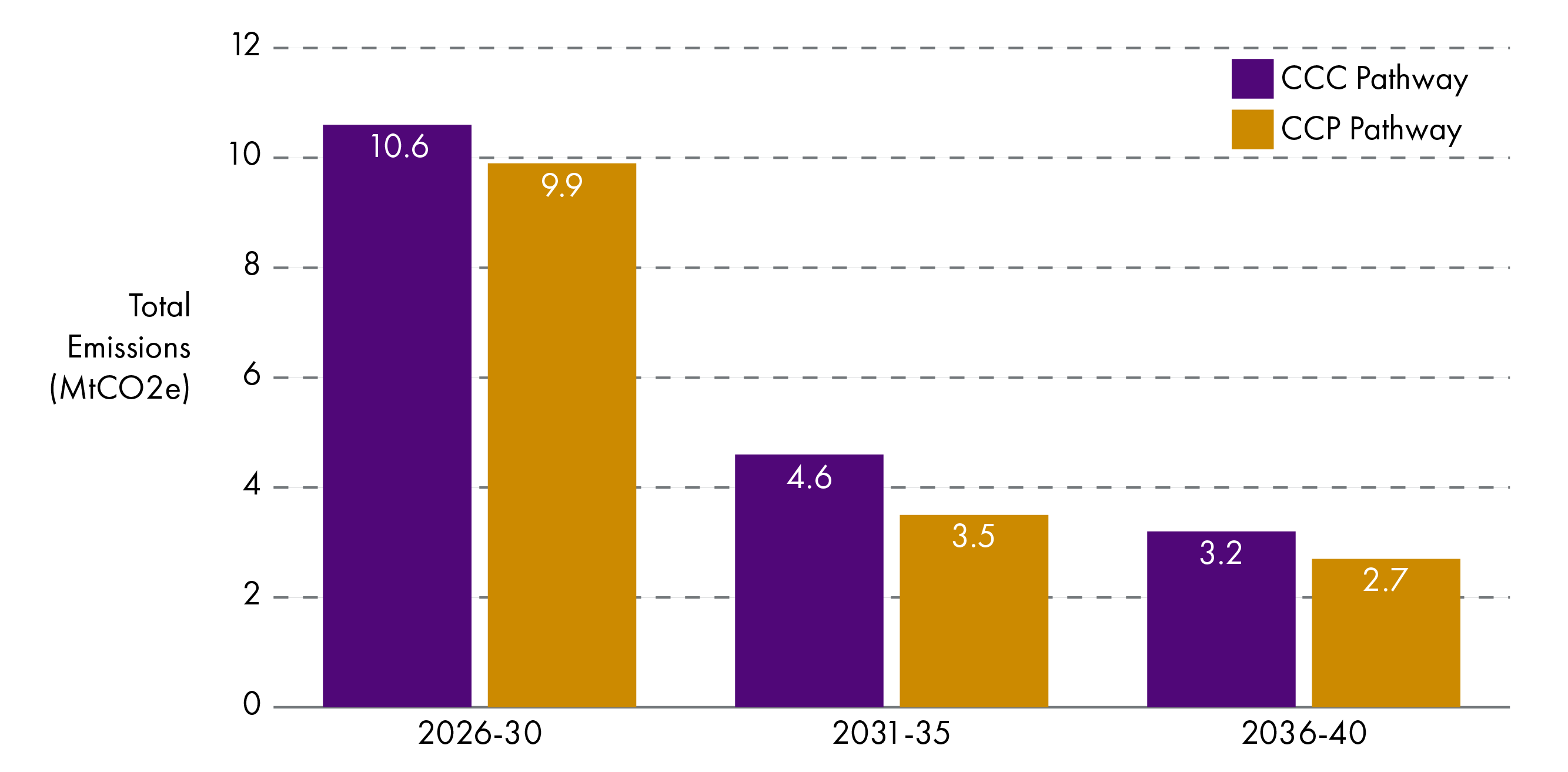
CCC, Scotland's Carbon Budgets, May 2025 & Draft Climate Change Plan, annex 3
The draft CCP sets out no financial benefits and no net costs from the policies in this sector, as all costs and benefits are said to be "market driven".v
Electricity supply
In 2023, emissions from electricity supply were down 93% from 1990 to 1 MtCO2e, largely as a result of the closure of all coal fired power stations.i Far more of our energy is now electricity from renewables, such as wind and solar (see figure below comparing reductions in electricity emissions over period 1990-2023 versus increase in operational renewable capacity 2010-2025). Polices to reduce emissions further include:
Reducing the reliance on diesel power stations by improving connections between islands and mainland and using alternative fuels;
working with the UK Government to deliver the Acorn Project and the Scottish Cluster to establish Carbon Capture and Storage at scale in Scotland;
influencing the UK Government to encourage energy storage, hydrogen production and EV smart charging as well as in "representing Scotland's interests in reducing power sector emissions".ii
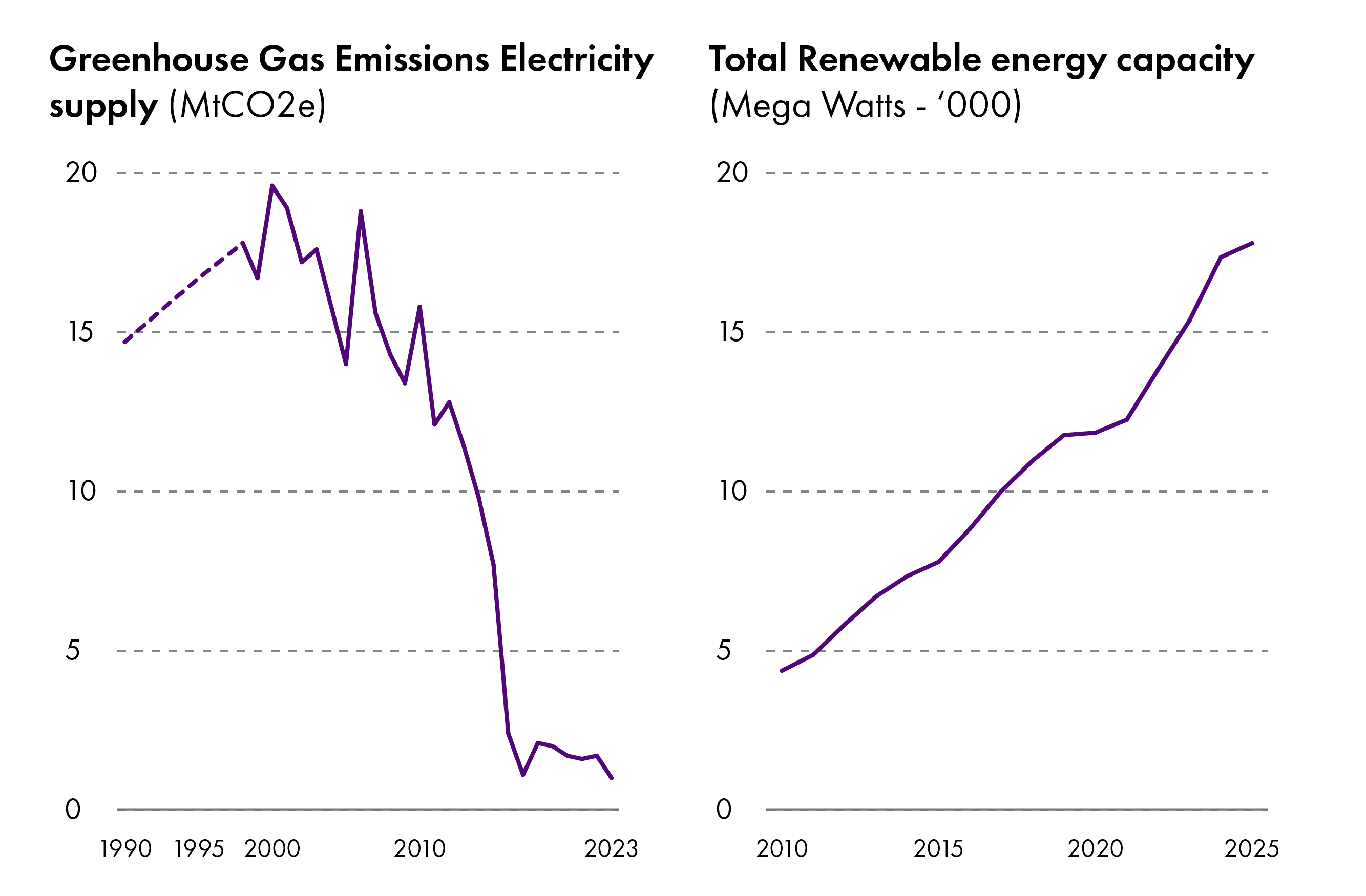
Carbon capture and storage and negative emission technologies
Negative emission technologies (NETs) and carbon capture and storage (CCS) are not the same thing. CCS captures emissions at their source, which could include industrial sites, power stations and energy from waste sites - it can reduce the emissions from sites but cannot, on its own, be negative emissions.
CCS is a fundamental part of some forms of NETs. NETs (referred to as "engineered removals" in the CCC's balanced pathway) include three groups of technologies in the CCC's advice:
Direct air carbon capture and storage - is a group of technologies designed to extract CO2 directly from the atmosphere through chemical and physical methods and send it to permanent geological storage.
Bioenergy with carbon capture and storage - is the burning or converting of a biomass resource in a process with CCS applied, producing energy – electricity and/or heat – whilst capturing and storing carbon.
Enhanced weathering and biochar - these are removals approaches that rely on land- and water-based CO2 storage. They would not involve mechanical CCS or the Acorn project.i
NETs are projected by the draft CCP to reduce emissions by 12.2 MtCO2e in the third carbon budget period,ii around double what was projected in the CCC's balanced pathway as shown in the figure below.i
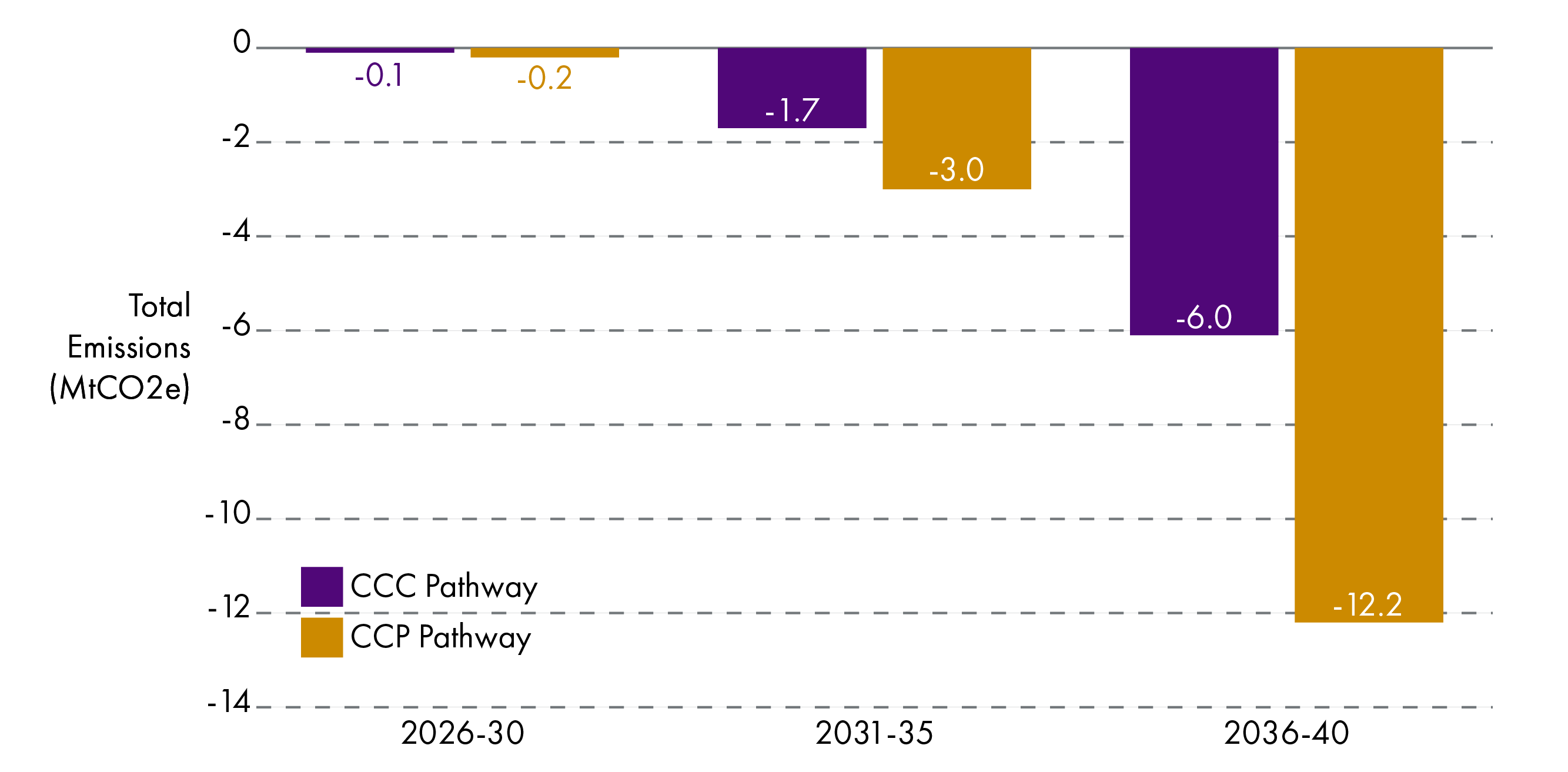
CCC, Scotland's Carbon Budgets, May 2025 & Draft Climate Change Plan, annex 3
The draft CCP puts NETs in the Business and Industrial Processes chapter, because it envisages them playing a key role in balancing out emissions from hard to decarbonise industrial processes, including having a physical link to them.
It was therefore mainly the Economy and Fair Work Committee which considered this topic, with their views summarised in their letter to the us (Annexe F). But some of our witnesses considered NETs and CCS to have an important role in the context of an integrated low-carbon future energy supply.
One of the remaining emissions sources in the Electricity Supply sector is Peterhead gas power plant. The draft CCP appears to differ from the CCC’s “balanced pathway” advice on the future of the Peterhead gas power plant. The balanced pathway assumes that the station will closes in 2030.i The draft CCP assumes it is replaced by "Peterhead 2", with CCS technology, saying it would "connect to the shared infrastructure being developed by the Scottish Cluster to transport the captured CO2 and store it at the Acorn storage site in the North Sea". v
Asked about Peterhead’s future, the Cabinet Secretary for Climate Action and Energy indicated she was completely constrained from discussing the matter with the Committee.vi
The Acorn project, which both the CCP and the CCC model as coming online, is technically a carbon transportation and storage project which would transport carbon captured from the ‘Scottish cluster’ (the sites that have carbon capture technology installed) to St Fergus in Aberdeenshire, where it would proceed to be stored in sites under the North Sea.
The UK Government have committed to making a final investment decision on the Acorn project in this UK parliamentary session, so by 2029.vii However, the pathway set out in the draft CCP assumes that the Scottish CCS cluster is “online by 2032”.viii
The Committee heard from Adam Berman (Energy UK) and Professor Underhill (University of Aberdeen) that the future viability of Peterhead was closely interlinked to the future of the Acorn project, as the economic viability of CCS projects is related to the amount of CO2 that is available to be stored.ix Professor Underhill said the recent losses of Grangemouth and Mossmoran meant the project might now lack sufficient supply of carbon for storage to make it viable and attractive to investors.ix We note that some of his evidence was disputed by one such investor, Storegga, who had announced in December 2025 that they planned to sell their stake in Acorn.xi
A number of stakeholders agreed NETs and CCS had a potentially important role to play. NECCUS said that CCS "allows for the development of net zero emission flexible dispatchable power plants which provide stability of the electricity grid."xii
The Economy and Fair Work Committee commented that:
The draft CCP places greater emphasis on the contribution of NETs to meeting emissions reduction targets than advised by the Climate Change Committee… Although the draft CCP envisages almost twice the contribution to emissions reduction than was suggested in the Climate Change Committee’s ‘balanced pathway’, there is no detail on what Scottish Government assumptions have been used to support the increased role of NETs.xiii
Other concerns were more fundamental: that no robust case had been made for either NETs or CCS as major elements in reaching net zero. We note that, reflecting the view of the CCC, our predecessor committee's report on the 2020 CCP update, called on the Scottish Government to “review the credibility” of estimates the update had made about the contribution NETs could make through abatement. The Committee said that, given the uncertainties associated with this technology, the Scottish Government should “set out a plan B for how equivalent abatement could be achieved.”xiv
In written evidence to the Committee, Stop Climate Chaos Scotland described them as"potentially expensive (both costly and inefficient), unreliable and unproven technologies".xv
2050 Climate Group said CCS needed further evaluation before any decision was taken to use it given uncertainties about its long-term scalability and environmental impacts.xv
Professor Kevin Anderson said:
If you look at the bit that is actually used and stored, CCS delivered only 11 million tonnes globally in 2024. That is one third of Scotland’s emissions. On carbon dioxide removal, 0.6 million tonnes were collected and stored geologically in 2024; in other words, that is 0.0003 per cent of global CO2 emissions. Yes, research those technologies, but take them out of your plan, because they do not exist at scale today.ix
The Cabinet Secretary said that Acorn is a "massive economic opportunity for Scotland" and that the capacity for CCS "... in Scottish waters is not only sufficient to capture the carbon that will be generated in the UK, but large enough to enable a sector that can import carbon from other parts of Europe that do not have such capacity."xviii
She added that "If the UK Government does not provide substantial funding for it, we will miss out on a massive economic growth area for Scotland, as well as put in jeopardy the UK’s climate change ambitions more generally."xviii
The Cabinet Secretary was not able to comment on Acorn's connection to Peterhead 2. On Acorn specifically she said it was "never predicated on one or two sites. The Scottish cluster involved looking into sectors—particularly hard-to-decarbonise sectors—throughout the whole of Scotland that might benefit from having CCUS.”xviii
On the decision for the draft CCP to expect greater emissions reductions from NETs than was the case in the CCC's balanced pathway, the Cabinet Secretary said that the CCC "...always said that we could go further—it did not say that its figure represented the limit of the negative emissions technology. We had those discussions with the CCC, and it said that we could go further."xviii
She said that the Scottish Government has had input from "industry roundtable discussions and academic research, as well as information from companies that already capture CO2 in Scotland about where they could scale up and what more they could do" and that the "consensus was that a target of 3.3 megatonnes per annum by 2040 was stretching but achievable." She added that the Scottish Government will set out their "preferred route to NETs deployment later this year".xviii
Renewables
In Q2 2025, there was 10.4GW of onshore wind, 4.3GW of offshore wind and 0.8GW of solar in Scotland. The CCC’s “balanced pathway” projects a massive increase in renewables capacity in Scotland over the next 20 years, tripling from 15 GW in 2023 to 49 GW in 2035 and then to 66 GW by 2045.ii
The "vision" for the Energy Supply sector set out in annex 2 of the draft CCP says that "By 2035, we will have expanded our renewable capacity significantly to meet the increasing demand as other sectors decarbonise." It highlights Scottish Government targets of 20GW of onshore wind by 2030iii and 40GW of new offshore wind by 2040.iii The Scottish Government also have a target of 4-6GW of solar by 2030v.
However, the Energy Supply policies and proposals set out in annex 3 do not include specific actions on increasing renewable energy generation.
Nonetheless, it appears implicit that renewables must continue to scale up rapidly to meet the above targets and since key interventions in the draft Plan rely on abundant green electricity.
In January 2026, the UK Government announced the results of Contract for Difference (CfD) round 7 for offshore wind. These included contracts for two Scottish projects: Berwick Bank (fixed base), and Pentland Floating Offshore Wind Farm. We heard from industry voices that this was a good outcome after a tricky period for offshore wind.vi
There are several barriers to this level of ambition in renewables:
Transmissions charging - Scotland's are among the highest in Europe. Claire Mack said high charges were an example of "man-made harm"vi, impacting the competitiveness of Scottish offshore wind projects in CfD rounds. The West of Orkney wind farm was the first ScotWind project to secure offshore and onshore planning consent but in January this year it was reported plans were on hold until "unfair" transmission charges are addressed.iv
Grid capacity and storage - The Committee is familiar with the challenges facing the grid and increasing baseload and storage capacity having considered them in detail in our 2023 inquiry Scotland’s electricity infrastructure: inhibitor or enabler of our energy ambitions? The Committee heard two main challenges impacting the grid are:
The Grid's overall capacity to handle an increased electricity load;
Delays in connecting new generation sources to the Grid.
As of June 2025, there was 0.7GW of pumped hydro and 0.5GW of battery storage in Scotland, with the CCC modelling a significant increase will be required, reaching 5GW by 2035.ii
Opposition to infrastructure - New renewable developments; whether that is large turbines, pylons or substations and associated infrastructure like new tracks and the work to make them, can arouse opposition. We heard such views on our visit to Aberdeen, including views that there should be more focus on reducing energy use, rather than always looking to increase supply.x
Long planning process - this was another major theme of our 2023 energy infrastructure inquiry. We noted evidence "consistently pinpointing Scotland's planning system as a major block on our net zero ambitions".xi
Skills and supply chain - Professor Underhill said that a timeline for when projects will come online was needed to ensure the right skills were available for the renewables industry to grow. Simon Coop (Unite the Union) said the growing renewables sector needs a supply chain and that, unfortunately, jobs in the sector have not been created in Scotland despite ongoing increases in renewables.vi
The cost of some renewable technologies – with the latest contracts for difference allocation in January 2026 including a “strike price” of £216 per megawatt hour for floating offshore wind compared to £72 per megawatt hour for onshore wind for example.xiii Claire Mack (Scottish Renewables) said that they recognise “… the need, if we are going to rely on floating projects for their cost reduction pathway, to be as rapid as possible”.vi
The Committee also heard there could be a growing role for solar in both production, and in associated jobs. Gemma Grimes (Solar Energy UK) said:
Currently, around 800 fulltime equivalents work in solar and storage in Scotland. We expect that number to increase to around 11,000 by 2030 or 2035, depending on when we reach 6 to 9 gigawatts of solar capacity. In order to do that, we need a significant increase in the workforce and the number of available training places.vi
The Cabinet Secretary said that "Scotland is producing around 70 per cent of the renewable electricity in the UK."xvi She also said that a strong domestic renewables base was crucial for energy security:
The best way that a country can protect itself is to produce green electricity and hydrogen at scale, by ramping up efforts in relation to hydro and ensuring that it has the storage that is needed for that electricity so that it can have as much energy security as possible. At the same time as all those efforts, infrastructure has to be built out to provide the capacity for more electricity so that that can displace the burning of fossil fuels.xvii
Hydrogen
The draft Plan itself references hydrogen just once where it is referred to as one of five key ‘opportunity areas’ for Scotland. There are several references to hydrogen in annexes, mainly to existing policies: some about increasing production of it, either as “green” or “blue” hydrogen,i some about using it for specific low-carbon technologies, such as modes of transport (some further discussion on this later in report) .
In this session, the Committee has expressed support for growing the green hydrogen sector. Hydrogen is likely to be needed for specific purposes in industry as fossil fuels are phased out, and it may even have potential for more everyday purposes, as our wind sector continues to grow, as a means of capturing what would otherwise be the trapped asset of abated wind energy, and turning into fuel, as well as an additional energy hedge against wind’s intermittency.
Commenting in 2023 on the Scottish Government’s Draft Energy Strategy and Just Transition Plan (as noted, earlier a finalised Plan has yet to be laid), we said the Committee welcomed:
… the ambition of setting a 5 GW target for green hydrogen in the draft Strategy but asks the Scottish Government to note and respond to evidence that it must more clearly map out a plan for how this is to be achieved for this ambition to have more credibility with industry and potential investors. This should include mapping out what role green hydrogen could play in helping decarbonise Scotland's main industrial emitters of greenhouse gases, whether in the short or longer term.i
In May 2025, we took evidence on Grangemouth’s green and blue hydrogen potential from industry stakeholders and academic experts, in light of the Project Willow recommendations for the site.ii Most witnesses agreed blue hydrogen production in Scotland was viable, though for some it would only be as a bridging technology. They were bullish on the enormous growth potential for green hydrogen in Scotland, but several factors had to be in alignment. Chief among these is lower UK electricity prices, as, under current conditions, high electricity prices correlate to high and possibly uneconomic green hydrogen prices.ii
Community benefits
The Plan also considers community benefits which can be provided to communities affected by the significant increase in renewable energy infrastructure expected. It says that the power to mandate community benefits is reserved to the UK Government, but that the Scottish Government are currently reviewing voluntary Good Practice Principles and that £30 millions in community benefits were offered last year. It also says that the Scottish Government "Community and Renewable Energy Scheme (CARES) has advised over 1,300 organisations and provided over £67 million in funding to communities".i
The Citizen Participation and Public Petitions Committee's letter to the Committee followed evidence with the Cabinet Secretary for Climate Action and Energy during which one of the themes considered was community engagement and input for energy projects. They said that:
The Cabinet Secretary indicated that she was aware that communities may be concerned about the scale of developments. Her stated view was that community buy-in for energy developments is a problem because many communities do not see the benefit of these developments.
She thereby highlighted her hope to see community benefit from proposed developments also mandated at UK level. She indicated that, if or when that happens, the Scottish Government intends to consult on what community benefit should look like, what conditions should be associated with it, and what the extent of it should be.ii
Professor Matthew Hannon discussed community benefit and ownership. He said that community benefit funds can also provide in-kind benefit which “... may take the form of shared ownership.” However, he added that despite a huge pipeline of potential projects “... very few of those projects are coming through.”iii He said the big question underpinning community benefit is:
... who owns the land and who owns the asset. Although the predominant model is one of commercial ownership of land and commercial ownership of assets, such as onshore wind, with predetermined donations to communities, where there is community ownership, or in some cases such as the Quanterness wind farm in Orkney, public ownership, we see donations being made at a much larger scale. Studies have pointed to that. The committee has probably heard of the one from Aquaterra Energy, and a recent study commissioned from Platform London points to the dividends coming back to the community being somewhere between 10 and 100 times the amount from commercial donations.iv
The Cabinet Secretary said community benefit was "a huge area of work" that she prioritises. She added "It will not be in the climate change plan, because it involves a separate piece of work on the good practice principles." She did however say that there are two areas of work in relation to this, the ongoing review of the good practice principles and some "...movement on the issue from the United Kingdom Government, and the Planning and Infrastructure Act 2025 will allow community benefit and the principles associated with that to be mandated."v
Fuel supply
In 2023, emissions from fuel supply were down 56% from 1990 to 2.9 MtCO2e.i The remaining emissions are from:
refining crude oil into petroleum products,
terminals where oil and gas are onshored,
gas leaks from pipelines, and
onshore production of oil and gasii
The closure of the Grangemouth oil refinery will hugely impact emissions. It was responsible for 0.8 MtCO2e emissions (approximately 28% of fuel supply emissions) in 2022.iii
The draft CCP does not include policies for reducing emissions from domestically generated oil and gas. Instead it expects emissions reductions "to be market driven" as a result of "Ceasing refining of crude oil and falling imports as a result of declining domestic demand for petroleum products and gas" and because "North Sea oil and gas production will decline as a result of the maturity of the basin".iv
Emissions from burning oil and gas are considered where relevant in each individual sector chapter in the draft CCP (e.g. gas boiler emissions are in the buildings sector).
Regarding new licenses for oil and gas extraction, this is a reserved matter. The draft CCP's comments on it are limited. It says: "We continue to call on UK Government to approach decisions for North Sea oil and gas projects on a rigorously evidence-led, case by case, basis – with climate compatibility and energy security key considerations."v
The draft CCP sets out that as the make up of Scotland's energy use from oil and gas declines, renewables will grow - which presumes that oil and gas will make up a declining percentage of Scotland's energy use throughout the transition.vi It cites a 2023 Ernst and Young Report (with data updated in 2025) which predicts “ a marked and continued decline” in Scottish North Sea oil and gas from 2019 levels. The report says that “Of the predicted remaining production, over 80% is from already sanctioned fields with less than 20% forecast to be from new developments.” A 2025 Robert Gordon University Report, "Striking the Balance", focusing on employment and the Just Transition in oil and gas, cites similar figures on reduced extractive capacity but states that “it may be necessary to sustain selective oil and gas activities until the early 2030s if Scotland is to retain its offshore energy workforce, skills, supply chain, and economic contribution.”
Less oil and gas extraction in Scotland clearly means lower emissions from domestic fuel supply. However the Committee heard views that the issue needed to be considered carefully. These views included that oil and gas will clearly continue to make up a proportion of Scotland's energy mix for some years, but if less of this demand is met from domestic supplies, then importation only “offshores” emissions, transferring them to other countries’ balance sheets without, in itself, reducing consumption. Professor Underhill said that, for as long as oil and gas form part of our energy mix, the most effective way to keep their carbon footprint “as low as possible" would be to rely, where possible, on domestic or Norwegian oil and gas.vii
Other witnesses argued there should be a continued role for domestically produced oil and gas in the transition. David Whitehouse (Offshore Energies UK) said that "Today, 75 per cent of the energy in Scotland still comes from oil and gas" and that supportive policy would mean the UK could produce "at least half" of the oil and gas needed between now and 2050, but that "As things currently stand, the UK is on target to produce less than a third of that from our North Sea."vii He said that the UK Government's Energy Profits Levy was "driving away investment" and accelerating the decline in activity.vii Claire Mack (Scottish Renewables) said the levy is "fast tracking the decline of the oil and gas sector".vii
Conversely, other witnesses criticised the draft Plan for not clearly setting a path out for decreasing oil and gas extraction and use. Lloyd Austin said:
Despite us putting out a draft energy strategy several years ago now that talked about oil and gas futures, we do not have a finalised energy strategy and the plan is quite silent on what the Scottish Government would like the UK Government to do with its reserved powers in that area. We would like the Scottish Government to be much more robust in arguing the case for a managed just transition and rapid wind-down in oil and gas production and use.vii
Professor Anderson said Scotland should have joined the Beyond Oil and Gas Alliance, and become one of the "few so-called developed countries" driving that agenda forward.vii
The Cabinet Secretary reminded the Committee that Scottish Ministers had “no powers” over licensing for oil and gas projects, either for exploration or production. She said the Scottish Government “… have asked and advised the UK Government to take a climate compatibility approach to future licensing."xiii She said that "...as long as we continue to burn natural gas, it is obvious that having a supply of it from our own resources makes the most economic and energy-security sense."xiii
Negative emissions technologies
The draft Plan is significantly reliant on negative emissions technologies to stay within carbon budgets. Notably, it models for double the level of abatement during Scotland’s third budget period than the Climate Change Committee did in their “balanced pathway”. It is to be hoped that NETs will play a major role in decarbonisation. However, they remain a developing technology, largely untested at scale. The economics of their use at this scale is also uncertain. Placing this level of reliance on NETs does appear to be a significant delivery risk that will require careful monitoring and reappraisal in the light of new evidence and data. Assuming the finalised Plan maintains a similar position to the draft on NETs, we see this as a legacy issue for a future energy committee to investigate in the next Parliamentary session.
In the meantime, we ask the Scottish Government to outline how it proposes to monitor whether NETs are developing at the pace required to meet the ambitions set out in the Plan and what contingency planning it has undertaken for a scenario in which NETs do not deliver at this scale.
Renewables and electrification
The success of the entire Climate Change Plan substantially depends on an abundance of affordable, clean electricity. This will require an effective inter-governmental strategy to achieve three-long term strategic needs:
Increased generation of electricity from renewables;
Increased Grid capacity and robust Grid infrastructure;
Increased electricity storage, whether in batteries, pumped storage hydro, or through “storage” as fuel (i.e. hydrogen).
The Energy Supply section of the draft Plan is useful in setting out the Scottish Government's ambitions for renewables, but with insufficient detail on how the Scottish Government proposes to get there, especially in the absence in this Session of an updated energy strategy that could be read alongside it. The Committee asks the Scottish Government to reflect on how this section of the Plan could be strengthened to provide clearer signals to the renewables sector of the specific actions the Scottish Government proposes to take, especially in relation to increasing generation and storage.
Specifically, we also recommend that the Scottish Government conduct an audit to identify key existing infrastructure which could be utilised in renewable energy infrastructure. The Committee has heard recently about opportunities for hydrogen and sustainable aviation fuel development at Grangemouth, but other sites will also present opportunities.
Community benefit and ownership present strong opportunities to ensure benefits of the net zero transition are felt by communities across Scotland. The Committee welcomes the recently announced review of the good practice principles on community benefit from onshore renewable energy. This is an opportunity to set out a clear message on how future community benefit from renewable energy developments will be strengthened, including clearer expectations for developers and transparent guidance for communities.
Particularly in the light of larger-scale renewables projects, including offshore developments, the Committee recommends that the Scottish Government, in guidance, set out a more strategic approach to community benefit, taking account of community need across Scotland and the just transition.
Oil and gas
The Committee asks the Scottish Government to note views in evidence that the Plan should set out a clearer vision on the future for the oil and gas industry in Scotland, whether that is, as some argued, that it should commit to a clear end to oil and gas extraction in Scottish waters and map a path to it or, as others argued, that it should make a case for continued (albeit declining) oil and gas extraction, within an overall context of achieving a Just Transition to net zero by 2045.
Transport
Around one third of Scotland’s total emissions are from transport, which has lagged behind most other sectors in lowering its carbon footprint. There has been only a 13% reduction in transport emissions since 1990.i
The draft Plan projects a 68% fall in Transport emissions between 2025-40, making transport the biggest contributor to overall reductions in this period.ii The CCC’s “balanced pathway” advice maps a similar reduction over that period.
The CCC consider that significant policies in surface transport are devolved, shipping is partially reserved and aviation is largely reserved.iii
The full list of policies and proposals for the transport sector are available in annex 3 of the draft Plan. Commentary in this section is on those that appeared to the Committee to be most important. Broadly, emissions reductions can be expected to come from:
Encouraging more active travel (walking and cycling);
encouraging more use of public transport use as well as driving down emissions from public transport;
driving down emissions from freight; and
for car users, enabling a mass switch to EVs.
The draft Plan mentions the electrification of rail. It says that three quarters of Scotrail passengers currently travel on electrified railway but that the Scottish Government are “committed to ensuring more passengers can benefit from newer and more efficient trains.” There are no specific policies or proposals on rail electrification or decarbonisation mentioned in the draft Plan, however Transport Scotland published the ScotRail Fleet Transition Plan in November 2025.
The emissions reductions in transport are similar between the draft CCP and the CCC's balanced pathway.
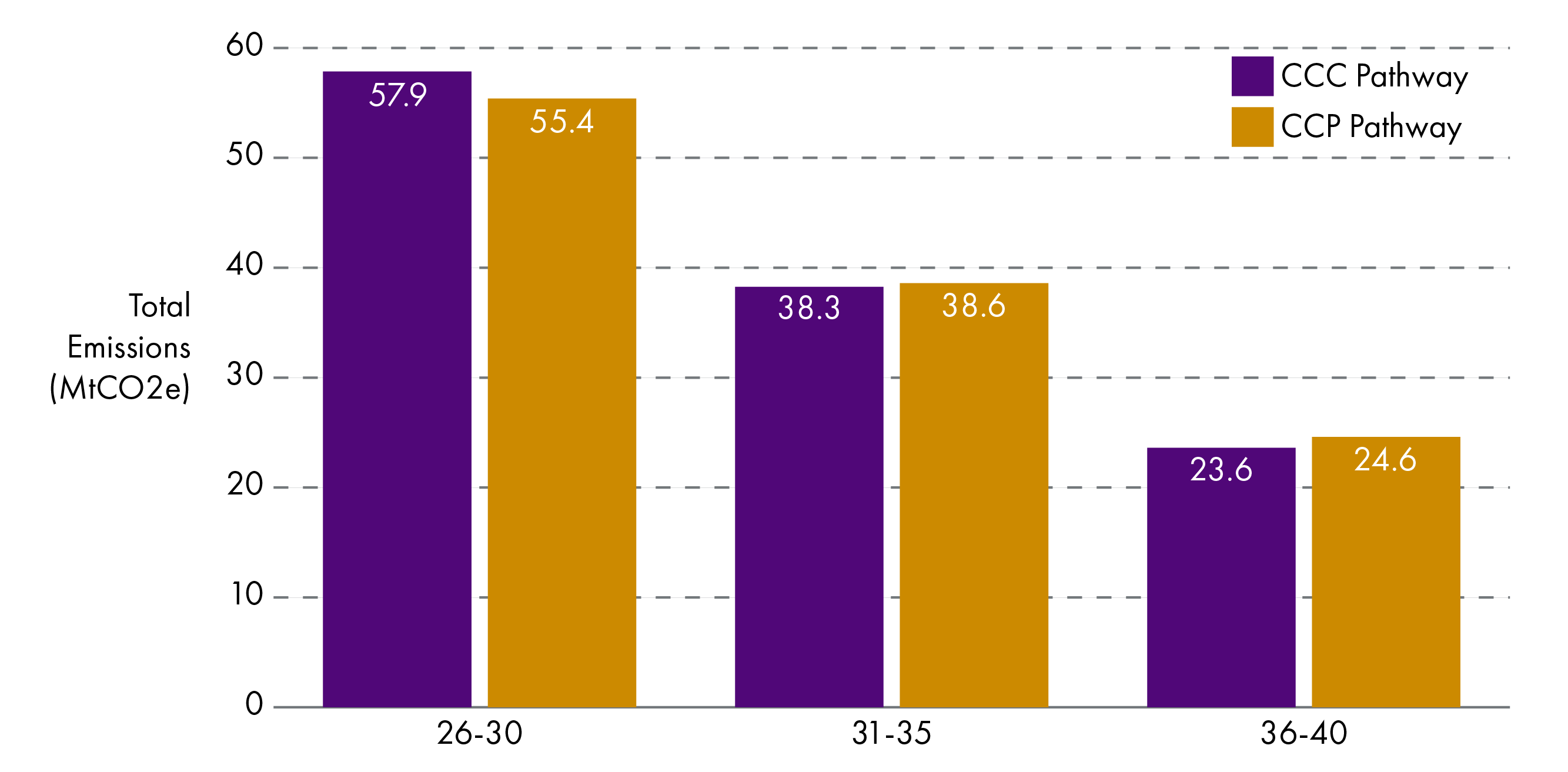
CCC, Scotland's Carbon Budgets, May 2025 & Draft Climate Change Plan, annex 3
The draft Plan estimates total financial benefits from transport at over £26 billion across the Plan period, with nearly half of that coming in 2036-2040.iv Its estimated total costs can be calculated to be nearly £21 billion over the period.v
Electric vehicles
The draft Plan includes outcomes to "phase out the need for new petrol and diesel cars and vans by 2030" and "ensure all road vehicles are zero emission by 2040".i It predicts that policies and proposals supporting the switch from petrol and diesel road vehicles (of all types) to EVs will produce the biggest reduction in emissions across the whole draft plan.
The most important policies to achieve this in the draft Plan include:
Zero Emission Vehicle (ZEV) Mandate: This is a UK Government mandate. It specifies how many ZEVs car manufacturers must sell as a minumum. This will rise from 22% of cars and 10% of vans in 2024 to 80% of cars and 70% of vans by 2030, and 100% of both in 2035.ii
Vehicle Emission Trading Schemes (VETS) (one scheme on cars and one on vans): A House of Commons Library briefing sets out that: "For each non-ZEV sold, the manufacturer must have an allowance. Manufacturers that sell more ZEVs than the regulations require will have a surplus of allowances that they can sell, bank (for use in later years) or convert (to offset against the CO2 emissions for the rest of the fleet). If a manufacturer wants to sell more non-ZEVs than the target, they will need to either get more allowances (by trading) or pay a ‘compliance payment’."iii
Electric Vehicle Infrastructure Fund: a £30 million Scottish Government fund to support the expansion of the public EV charging network which also aims to lever in £30 million of private sector investment. This policy supports a target to create 24,000 additional public charge points by 2030.iv
Emissions reductions predicted from EVs and HGVsClimate Change Plan. Transport – Forever in electric dreams? SPICe 2026-30 2031-35 2036-40 Measures to encourage EV take up 4.8 MtCO2e 13.8 MtCO2e 17.7 MtCO2e Measures to reduce emissions from Heavy Duty Vehicles (HGVs and buses)i 1.8 MtCO2e 2.8 MtCO2e 4.9 MtCO2e Total CCP transport policy related emission reductions 7.5 MtCO2e 17.8 MtCO2e 23.8 MtCO2e Proportion of total transport emissions reduction reliant on EV uptake 88% 93% 95%
This table illustrates how heavily the transport section of the draft Plan and, to an extent the draft Plan as a whole, relies on EV uptake. A significant shortfall against the modelling would make it difficult for Scotland to meet its carbon budgets under the CCP's pathway.
EVs are an example of an area of the Plan where the Scottish Government has set what are widely agreed to be stretching targets but holds only some of the levers and will be highly reliant on factors outside its direct control: including consumer behaviour, which will be highly influenced by considerations of convenience and affordability. Affordability relates both to upfront expenditure on the vehicle and running costs. As in other policy areas requiring major electrification, a further key aspect largely outside the Scottish Government’s control is Grid capacity.vi
The 2024 Scottish Household Survey found that "The percentage of drivers saying they wouldn't consider buying an electric car was 56%". The three main reasons given were the convenience of charging, the cost of the vehicles to buy and the range of the battery.vii Evidence to the Committee also raised concerns about the high upfront cost of EVs as an initial barrier.viii
The Committee heard industry views that the outcomes could be very hard to achieve. Andy Poole said that UK level targets in the ZEV mandate are "incredibly challenging". They would require the Scottish Government to increase the speed of the transition relative to the rest of the UK. He said industry "would need to see significant detail on how that gap will be filled"; more than is in the draft Plan. He highlighted that a transition at the scale and speed set out in the draft would be expensive for the industry, and would require an " enabling ecosystem" including support for consumers and infrastructure investment.vi
Professor Jillian Anable said that "the vast majority” of EV purchases so far have been by commercial buyers for fleets, rather than by individuals. She said that international comparisons show uptake relies on policies that include disincentivising petrol or diesel vehicle purchases. An example was Norway which had placed "a huge purchase tax” on conventional vehicles so that “when EVs were introduced, it was not necessary to tax them as much."vi
Jarrod Birch told the Committee that 24,000 more public charge points by 2030 was plausible but "will require significant acceleration from where we are today", with 1,350 new points installed between October 2024 - October 2025. A "slow and sometimes painful process around grid connections" and a huge increase in standing charges paid by charge-point operators, up 462% since 2021, would also be major barriers.vi
The Committee also heard about high variability in charging costs, EVs charged at home will be far cheaper to run. Professor Jillian Anable said:
There are huge discrepancies in the cost of running an electric vehicle, depending on whether you can charge at home. By comparison, it is cheaper to run an internal combustion engine vehicle—much cheaper in many cases. We almost could not have designed a less just transition if we tried, given the haves and have nots in that regard.vi
The Cabinet Secretary for Transport said that the draft Plan "anticipates that there will be far greater take-up of electric vehicles than was previously thought." She added that the Scottish Government "are looking at the detail of the incentive programmes" and they will seek to ensure the incentives are complimentary to UK Government schemes.vi
On charge points, the Cabinet Secretary said that "We are currently at 7,400 public charge points, which is two years ahead of target". She added that discussing the target with the CCC, they "... were less concerned about the number of charging points; they were more concerned about their location, for Scotland in particular." She highlighted the £4 million Rural and Island Infrastructure Fund and plans to roll it out further as examples of the Scottish Government ensuring that charging is made available in areas where the private sector business case is likely to be weaker.vi
Modal shift
Headline policies on modal shift to public and active travel include:
a revised car use reduction target and associated policy;
retaining concessionary bus travel for some cohorts and a Bus Infrastructure Fund; and
continuing to invest in active and sustainable travel, including multi-year funding programmesi
The 2020 Climate Change Plan Update committed to reduce car kilometres by 20% by 2030. However this was abandoned in April 2025 following an Audit Scotland report advising it was unlikely to be met. The draft CCP now commits to “reduce annual car mileage by at least 4% by 2030". Importantly, this is on a “business as usual” to 2030 forecast baseline. Since car use is continuing to increase, what this means is that the target could be met even if mileage is higher in 2030 than now.i The draft says this target will be kept under review and could be strengthened in the final CCP.ii
The CCC's balanced pathway assumed a target of 6% reduction (again, against a baseline, not in real terms) by 2035.iii
The Committee heard that interventions to reduce car use are broadly divided into carrots and sticks; or what one witness called “push and pull” policies:
Encouraging alternatives - by making public transport and active travel more attractive through pricing, infrastructure changes, availability, reliability, etc...
Disincentivising car use - by making car use less attractive through charges or taxes, parking restrictions, etc...
The Committee heard evidence that if governments want a material reduction in car use they must do both. Some witnesses said the draft Plan did not get the balance right. Professor Adrian Davis said:
"In the whole of the 160 pages in annex 2, the word “encouragement” appears 50 times. It appears most times in the transport section, and within that section it appears most times to do with road transport rather than shipping or aviation. The emphasis is on encouragement, but we know from the best robust science that encouragement alone is not enough"iv
Professor Rachel Aldred agreed, describing demand reduction policies as “sidelined" in the draft.iv
In our engagement work, we also heard views that the Plan needed clearer examples of what the Scottish Government would actually do to discourage car use. vi
Others were more positive. Sara Collier of the Confederation of Passenger Transport said the policies echoed what they had felt was needed in Scottish Government workshops held before the draft was laid. They had emphasised the need for a package of measures, not just a focus on free bus travel and bus infrastructure.iv
Stakeholders also said improvements to public transport and active travel were needed to encourage people out of cars. South Lanarkshire Council argued that it is “…important to ensure that sustainable modes are easy to use, affordable and attractive for people to use, thus supporting modal shift.”viii Paths for All noted the relationship between active travel and public transport, saying that improved walking and wheeling infrastructure is also vital in driving public transport use, as safe, easy access to bus stops and railway stations is a key factor in its uptake.ix
The Committee heard that interventions to reduce car use must take account of, and where possible, improve upon the limited public transport choices people have in rural areas. We heard that infrequent and unreliable services and poor connectivity left people in rural areas more car-dependent.vi Giving evidence in September 2025 on their carbon budget advice, the CCC told us they had sought to take this dimension into account in their modelling, with modal shift disproportionately occurring in urban areas where integrated public transport systems are easier to build.iv
We heard views that car use reduction policies are potentially at odds with policies to promote EVs. Professor Aldred said that in Scandinavian countries, which are ahead of Scotland in EV uptake, more EVs had appeared to mean more not less car use. She said the risk was: "that people will simply drive more and shift from public transport to car use if you make it easier for them to drive electric cars and do not make it harder to drive more generally and sufficiently improve alternative modes of transport."iv
Modal shift also has a link to the co-benefits discussed earlier in this report. Sustrans Scotland said that “Our 2023 Walking & Cycling Index calculated that across Scotland’s eight cities, 4,251 long-term health conditions were avoided by walking and cycling activity saving the NHS nearly £54million.”xiii
Professor Adrian Davis said: “if we can increase the amount of active travel that people do, we will reduce the disease burden on the national health service and on society generally and improve levels of overall wellbeing.”iv
The Cabinet Secretary for Transport said that there are flaws with "blunt car use reduction" which "on average, does not help in a country such as Scotland, where we have not just cities but extensive rural areas." She said this was one of the reasons why this part of the draft placed more emphasis on emissions reductions than car use reduction.iv
The Cabinet Secretary also highlighted work the Scottish Government is doing to encourage public transport use. She highlighted the Scottish Government's £60 million bus infrastructure fund and said it will mean "if you are sitting in a car in a queue on the M8 or elsewhere, and a bus flies by, you will see how much easier and quicker it is to get in by bus."iv She also said that a new rail fleet will "help with frequency issues and the pressures on the Fife and Borders railway lines." and that reducing the cost of rail prices for commuters through the removal of peak rail fares will increase the number of people who want to use rail servicesiv
Freight
The draft Plan includes policies and proposals on:
Investing in replacement of HGV vehicles and the deployment of charging infrastructurei - it says Scottish Ministers will "continue to press the UK Government to set meaningful and ambitious dates for phasing out the sale of new diesel HGVs" adding that a "unified UK action on a common regulatory pathway" would be the best outcome for transport operators;ii and
providing grant support for modal shift of freight from road to rail or water and specific rail freight investments.i It says the Government will encourage rail freight growth with "... a regulatory target for rail freight growth of 8.7% for 2024 to 2029, with the expectation that a figure closer to 10% could be achievable by the rail industry." iv The draft also cites as an example of grant support - the Freight Facilities Grants, saying awards for 2025/26 total more than £3 million and that the grants can help with capital costs.iv
Road freight
The draft Plan sets out that the Scottish Government signed the "Global Memorandum of Understanding on Zero Emission Medium and Heavy Duty Vehicles" in 2021 which sets an aspiration that at least, 30% of sales of new passenger and freight vehicles over 3.5 tonnes will be zero emission by 2030 and all new sales will be zero emission by 2040.vi It also summarises previous and ongoing work by the Scottish Government on zero-emissions freight vehicles including the publication of the HGV Decarbonisation Pathway for Scotland in 2024. The draft Plan also says that uptake of zero emission HGVs has "... so far been negligible in Scotland, with around 150 zero emission HGVs."vii
The draft also notes that the road freight sector contains a very high proportion of SMEs operating within tight margins, with limited spare cash for major investment.ii The Cabinet Secretary elaborated in her evidence to the Committee that "... that almost 80 per cent of road haulage firms in Scotland have five trucks or fewer. "ix
The Committee heard that industry was sceptical about whether the ambitions set out in the draft were realistic.
Lamech Soloman from Logistics UK told the Committee "... the maturity of the technology is not aligned with where the regulation or legislation is expected to be" and that moving at the pace anticipated in the draft would be "... particularly difficult in Scotland, where there is not much charging infrastructure for HGVs, and there is an issue with power capacity." He said operators "... pay double the price for electric HGVs and are paying more for electricity—and, on top of that, they are making less money because they can carry less."ix
Given this, the Committee asked about alternatives to electric HGVs. Lamech Solomon said that Logistics UK advocated for the use of "low-carbon drop-in fuels" which "provide up to an 80 per cent reduction in emissions" and can "act as a good support in the meantime until the technology maturity catches up."ix He also said the high cost of hydrogen-powered HGVs (they cost about six times a diesel equivalent) meant he did not see them currently as a viable alternative.ix
The Cabinet Secretary said there were challenges with using biofuels for HGVs. They were a limited resource and their main need is in aviation. She said there would need to be a "public discussion" on whether to subsidise biofuels for road freight over zero-emission alternatives.ix On hydrogen, she indicated that it was intentional that there had been limited focus on it in this part of the Plan. Provided UK Government policy aligned with the Scottish Government’s ambitions, hydrogen was more likely to play a significant role.ix
Modal shift
The Committee also heard doubts from industry about ambitions to shift freight from road to rail or water. Lamech Soloman said:
Support for modal shift schemes has recently been reduced—indeed, the mode shift revenue support scheme, which provided support up to £700,000, was removed from the Scottish budget two budgets ago, and subsidies for timber transportation by water have also reduced. A lot of ambition is being portrayed in the climate plan, but the parallel, or adjacent, funding to support it is not there. We need to ensure that the funding aligns with the policy ambitions in what we are asking for.ix
Aviation
Scottish international aviation emissions (which make up most aviation emissions) increased by 173% between 1990 and 2023, accounting for 11.5% of Scottish transport emissions. Scottish domestic aviation emissions fell by 23% in that time accounting for 3.6% of Scottish transport emissions.i
The draft Plan says that “Aviation will experience little decarbonisation as gradual uptake of sustainable aviation fuel (SAF), aircraft efficiency improvements and contributions from Emissions Trading Schemes (UKETS/CORSIA) are expected to be offset by potential demand growth for air travel at Scottish airports.”
The draft Plan says the Government will work to decarbonise scheduled flights within Scotland by 2040, with policies to:
Develop the world’s first zero emission aviation region in the Highlands and Islands;
develop new electric/alternative fuels and vehicles, such as sustainable aviation fuel (SAF); and
introduce an Aid Departure Tax (ADT) to replace the UK-wide Air Passenger Duty.iii
Despite this, the draft Plan predicts zero reduction in emissions from aviation as a result of these policies over the Plan period.
Annex 3 of the draft Plan explains:
The Scottish policy package for aviation is expected to deliver limited emissions reductions in the overall scheme of aviation emissions, as its focus is on decarbonising flights within Scotland, which make up a small share of aviation emissions. Emissions reduction will be reliant on wider UK and international policies, however, such as the Sustainable Aviation Fuel (SAF) mandate, delivery of the UK Government’s Jet Zero strategy, and the impacts of airspace change and emissions trading schemes. Because these policies are not owned by the Scottish Government, their impact is captured in the emissions baseline for aviationiii
The Committee lacked time to consider aviation policies in detail. We have, however, taken recent evidence on the prospects for increased uptake and production of SAF in Scotland, reporting in January this year. We strongly agreed with expert opinion that there is a need for a massive increase in the production and use of SAF if aviation is to make a significant contribution to reaching net zero.iv
We also concluded that so-called first and second generation SAF (biofuels made from different types of organic matter) should have only a limited and transitional role to play in decarbonising aviation and urged the Scottish Government to exercise caution in encouraging or supporting significant long-term investment in this area.iv
We instead agreed with most expert views that power-to-liquid (PTL) SAF appeared a far better medium to long-term bet, in terms of energy security, potential abundance of feedstock, the just transition, and synergy with Scottish Government ambitions on wind energy and green hydrogen. We urged the Scottish Government to work with industry and universities, and with the UK Government, to investigate whether practical routes to making PTL can be made more affordable and deliverable, signalling to the private sector that Scotland is supportive of PTL investment.iv
During our evidence-gathering, we heard from the Scottish Government that they wanted to see SAF take off in Scotland, alongside other relatively nascent technologies, such as battery powered aircraft for short flights. We heard about ambitions to grow an indigenous SAF industry, making use of assets like a skilled energy sector workforce, and abundance of wind and water and growing renewables capacity, and the Grangemouth site. We heard in evidence that, with some initial support from government, Grangemouth had excellent potential as a site for handling and processing SAF and, in the slightly longer term for SAF production.iv
Electric vehicles and modal shift
The draft Plan places a significant reliance on the uptake of EVs - if this policy fails it seems unlikely the carbon budgets will be met. The Committee heard concerning evidence from industry and community groups about the challenges in delivering change at the pace required. There are challenges around upfront affordability, the cost of charging, and the significant inequalities that exist within that, and the knock-on effects on efforts to reduce car mileage.
The Committee recommends that the final Plan set out how the Scottish Government intend to work with the UK Government and relevant stakeholders to overcome these barriers. The uptake of EVs and the delivery of charging infrastructure should be monitored through specific early-warning (or performance) indicators.
The 4% reduction in car mileage by 2030 target in the draft CCP is a considerable move away from the real terms 20% reduction target committed to in the last CCP update. Even with the much more manageable target, the Committee heard evidence that efforts to encourage modal shift were likely to be unsuccessful with a focus entirely on “carrots” and not on “sticks” in the draft CCP. Despite this, the Committee also heard that improvements to active and sustainable travel were still needed to encourage people out of cars. With 2030 not far away, the CCP should set out more about how the Scottish Government plans to reach its modal shift targets and the role it sees for policies to discourage car use.
Freight
The Committee is concerned by industry views that the draft Plan sets out ambitions for electrification or modal shift that appear unrealistic and with insufficient detail on delivery. We note views that “drop-in” biofuels may offer a more realistic route to decarbonisation in the short term. The Committee asks the Scottish Government to reflect on this evidence and continue to engage the industry in discussions.
Waste
The Waste sector in the draft Plan includes emissions from landfill (by far the biggest emitter), composting, anaerobic digestion, water and sewerage.i As discussed earlier, in this report we discuss emissions from energy from waste under this heading and not Energy Supply (where they sit in the draft Plan). This is because rising emissions from energy from waste are, at least in part, linked to policy and operational choices that have been made about waste management. Kim Pratt (Friends of the Earth Scotland) told us that:
What has happened is that emissions have been transferred from the waste chapter to the energy chapter of the plan, and that is because the biggest change that we have seen in waste management in Scotland over the past few decades has been the move from landfilling our waste to incinerating it instead.ii
Emissions from the waste sector were 1.7 MtCO2e in 2023, down 73% from 1990. However, reductions have plateaued, mainly because since 2013 reductions in waste sent to landfill have slowed.iii Industry experts told us that the sector had already "picked off the low-hanging fruit,"ii and that remaining areas are likely to be “more complex."ii
The draft forecasts that emissions from waste management will decline by 58% between 2025 and 2040 (This is relatively similar to the CCC's pathway for waste as shown in the figure below). It categorises three types of emitter: landfill; compost / anaerobic digestion; and sewage and water treatment. It is only landfill that is projected to reduce emissions between the first and third carbon budget periods.i
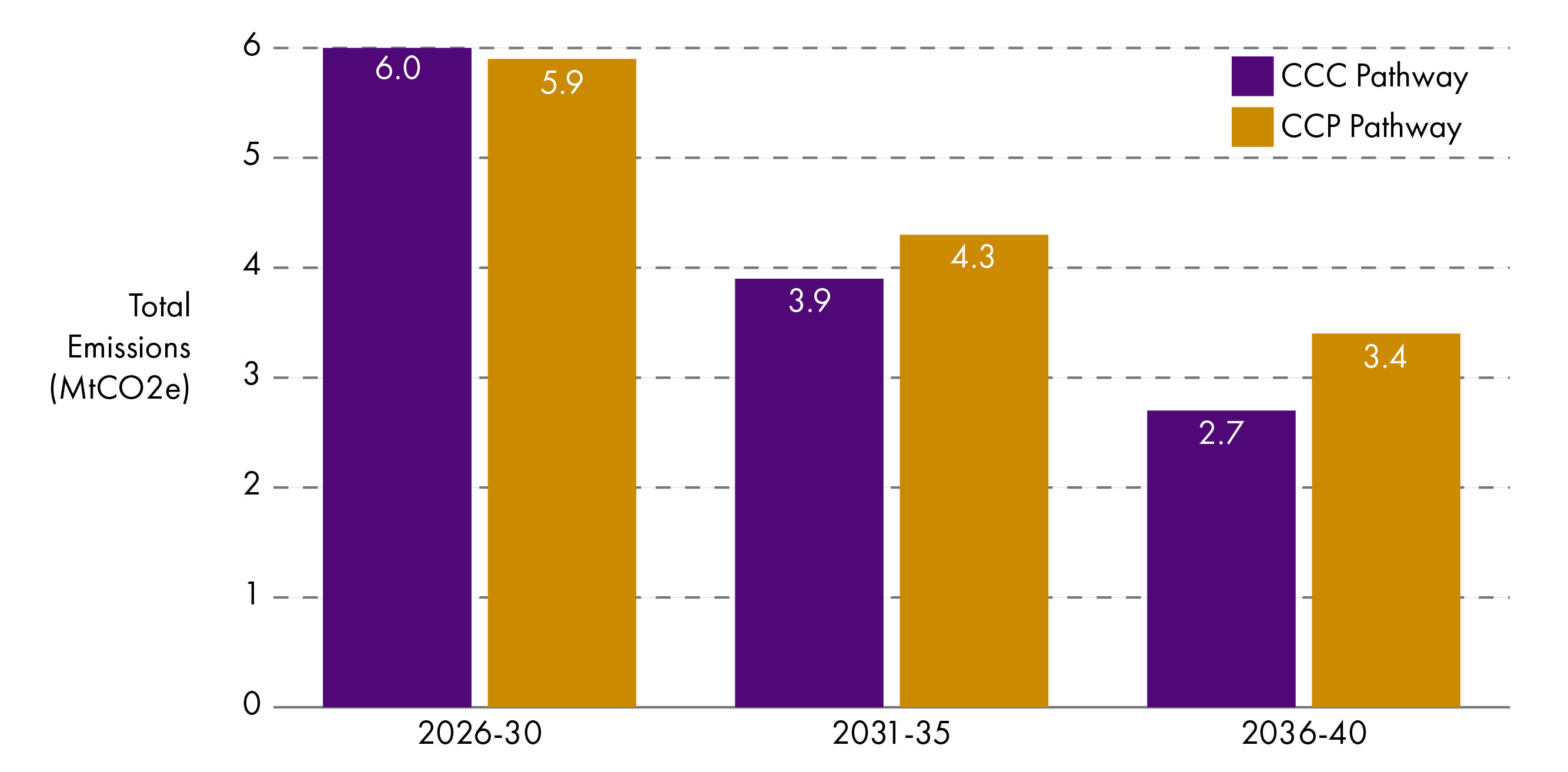
CCC, Scotland's Carbon Budgets, May 2025 & Draft Climate Change Plan, annex 3
The full list of policies and proposals are in annex 3 of the draft CCP. Some headline policies:
The forthcoming ban on biodegradable municipal waste going to landfill;
maximising landfill gas capture opportunities;
actions to cut household and business food waste;
delivering the Deposit Return Scheme and extended producer responsibility reforms;
a new statutory Code of Practice and statutory local recycling and reuse performance targets for household waste and recycling services; and
a new circular economy strategy to be published in 2026 and targets to be set by 2027.vii
Policies on energy from waste include:
Reducing emissions from energy from waste through: Requiring energy from waste facilities to have a decarbonisation strategy; supporting the inclusion of energy from waste in the UK Emissions Trading Schemei; and encouraging energy from waste plants to retrofit CCS.
The total financial benefits from policies on waste over the Plan period are estimated at £3.1 billion and the total cost can be calculated to be around £2.5 billion.viii Dr Lucy Wishart was critical of way costs are laid out, saying:
It is important that we have more details in line with the aspiration for a just transition about where those costs are going to lie and where the benefits will go. We therefore need a more detailed breakdown of those figures, along with the methodology behind them.ii
Landfill
Biodegradable waste in landfill emits methane, which has a far higher global warming potential than carbon dioxide.
Biodegradable Municipal Waste
The key policy response to landfill emissions in the draft CCP is the forthcoming ban on landfilling Biodegradable Municipal Waste (BMW). BMW means waste capable of decomposing such as food, garden waste, paper and cardboard, and includes waste from households and businesses. The ban means that any non-recyclable BMW cannot go to landfill, instead being dealt with through other waste management streams - such as energy from waste, being pre-treated before it goes to landfill, or being exported.
The ban was originally planned to begin in 2021. In 2019 the Scottish Government delayed this until the end of 2025.ii A few days before the draft CCP was laid, the Scottish Environment Protection Agency (SEPA) announced that they would not fully enforce the ban until January 2028 - essentially further delaying its start. SEPA also said that ”not all required treatment capacity and logistics will be in place by the end of this year. Additional energy-from-waste facilities are being built and are expected to begin operating between 2026 and 2027 alongside ongoing efforts to reduce, reuse and recycle more waste.”iii
The Cabinet Secretary for Climate Action and Energy told the Committee that the draft CCP did not take this development into account because it had been so recent but that the Scottish Government will update projections in the final Plan.iv
Gary Walker from SEPA told the Committee that SEPA "... remain focused on delivering the ban". He also said that had the ban come into force now, emissions from landfill would only have been displaced outwith Scotland, with additional emissions from transporting it.v
Biodegradable non-municipal waste
The 2020 CCP update set out an “intention” to extend the proposed ban on sending biodegradable municipal waste to landfill to biodegradable non-municipal waste (which would include waste from industrial or construction sources for example).vi
The draft Plan states a proposal for "the potential to extend the BMW landfill ban to include biodegradable non-municipal wastes."vii The Scottish Government consulted on this matter in March 2025, but has not published a consultation response or specified further actions.
Landfill gas capture
Emissions can be mitigated by landfill gas capture, which involves catching methane as it forms within landfill. The Scottish Government’s 2025 CCP monitoring report undertook to seek, within budgetary constraints, "to extend the landfill gas capture programme to increase the number of sites undertaking investigative or development work, to optimise and increase the amount of landfill gas captured in Scotland and minimise environmental and climate impacts of closed landfill sites." It said further detail would be set out in the draft CCP.viii
The draft Plan says that the Scottish Government are "reviewing the potential options to drive the pace and scale of decarbonisation" and that they "will work with industry and the public sector to maximise landfill gas capture opportunities in Scotland."ix
SEPA said that landfill gas capture offered considerable scope to reduce emissions but progress had been limited. Policy should focus on removing barriers to scaling it up, which SEPA said was primarily a funding and resources issue.x
Energy from waste
As noted above, the ban on BMW is closely linked with energy from waste - one of the solutions to disposing of BMW (that soon will not be able to be landfilled), is to incinerate it at an energy from waste plant.
The CCC’s carbon budget advice outlined that energy from waste emissions have increased rapidly and are still rising.i ESS commented in 2025 that:
The incineration of residual waste has become a prominent waste management method in Scotland. The volume of waste incinerated has increased rapidly, with 1.86 million tonnes incinerated in 2024 (representing a 354% increase since 2011).ii
The draft Plan seeks to reduce emissions from energy from waste mainly by:
reducing the amount of waste that Scotland produces; and
installing CCS technology at energy from waste sites (It assumes that “…45% of EfW [energy from waste] sites (by emissions) install CCS by 2032, a 90% capture rate, and that 50% of emissions are from biogenic sources, leading to a share of negative emissions”).iii
It adds that the Scottish Government has stated its support in principle for including energy from waste in the UK Emissions Trading Scheme. iv
The draft Plan projects no reduction from energy from waste emissions in the first carbon budget but significant reductions of 1.3 and 1.6 MtCO2e in the second and third.v It also predicts that emissions will peak in 2026, but this is on the now superseded basis that the ban on biodegradable municipal waste going to landfill will start that year.
The Committee heard views that abating energy from waste should be prioritised and not merely on emissions grounds. Stirling Council said incineration is “now the most polluting form of waste management”vi
However, Duncan Simpson (Resource Management Association Scotland) said:
If we do not have landfill in Scotland, that waste has to go somewhere but, with the best will in the world, the tonnage that we produce as waste, recycling or reuse is not going to go down to zero in two or three years. We will need a transitional plan to get there, and energy from waste is quite an elegant solution if it is well managed, run and maintained.vii
The draft CCP was lodged when an ESS investigation into incineration capacity was ongoing. Since then, the Scottish Government and ESS have come to an "informal resolution". As part of this, ESS commented that:
Evidence suggests that Scotland may soon have an excess of incineration capacity. This has the potential to create further unfavourable outcomes, including ‘lock-in’ effects (where the reliance on incineration as a waste management method undermines more sustainable waste reduction, reuse, and recycling techniques), climate impacts and risks to the environment and human health.ii
They also found that planning and regulatory controls to limit incineration capacity are potentially ineffective. As part of the informal resolution the Scottish Government has agreed to develop an indicative residual waste treatment cap (essentially, a national cap on total incineration capacity) by 2027. Notably this is after the draft CCP says it expects emissions from energy from waste to peak, in 2026. The Committee notes that this appears to be based on assumptions that the BMW ban comes into force at the end of 2025.
The Cabinet Secretary was asked about the latest delay in enforcing the BMW landfill ban. She told us that "At the moment, energy-from waste capacity in Scotland allows for the vast majority of waste carriers not to have to use landfill". But "some small waste carriers do not have places in the queue and do not have the relevant contracts with energy-from-waste sites." She added that inflation and Brexit had delayed some new energy from waste plants which meant there was less capacity than previously anticipated, but that "Those plants are due to come online this year and next year."ix
The Cabinet Secretary added that: “The emissions that are associated with energy from waste come to about 0.3 megatonnes [per year], so are relatively small compared with those from other areas.”ix
Food waste reduction
The Plan does not set a target to reduce food waste. It says that "To drive food waste reduction, working with delivery partners we will develop an intervention plan by 2026/27 to guide long-term work on household food waste reduction behaviour change."i Elsewhere the Scottish Government’s Good Food Nation Plan commits to meeting a UN commitment to halve food waste by 2030.
Food waste is an instance of policy going the wrong way. The CCP update committed to a 33% reduction by 2025 (using a 2013 baseline)ii but the 2025 CCP Monitoring Report states there has been a 5% increase since 2013.iii
Circular economy and carbon footprint
Consumption emissions
Respondents to the Call for Views highlighted Zero Waste Scotland’s estimate that 80% of Scotland's carbon footprint comes from our consumption of goods, materials and services.i It is important to note that this refers to a different measure than the one used throughout the draft Plan - carbon footprint (or consumption emissions) measures the emissions associated with the goods and services we consume, regardless of where they are produced. The draft CCP says that "since 1998, Scotland’s carbon footprint has decreased by 19.9% from 73.9 MtCO2e in 1998 to 59.2 MtCO2e in 2021."ii
With waste, it is especially important to be mindful of the risk of "offshoring" rather than abating emissions (though these considerations are also relevant to other sectors). It is a convention of carbon accounting that the emissions cost of goods is generally assigned to the place that made them, not the place that uses them. But taking no account of the latter’s collaborative role in “creating” those emissions risks creating perverse policy incentives and disincentives, including for the development of local industries.
This means that while the emissions envelope from waste in the CCP is relatively small, circular economy policies could have impacts beyond reducing waste emissions in the CCP's inventory and work to reduce Scotland's wider carbon footprint.
Circular economy
The Committee heard from stakeholders that tackling the remaining emissions from the waste sector (and indeed potentially having a further impact on reducing Scotland's carbon footprint) involves prioritising actions in order of the "waste hierarchy" in line with circular economy principles:
reducing waste,
reuse and repair,
recycling,
recovery,
and finally disposal.
Consumer Scotland said changes must move beyond the “well established and lower impact behaviours such as recycling”, and focus on reducing consumption, increasing re-use, and extracting maximum value from existing resources.iii
Policies on reducing waste in the draft Plan include:
delivering the Deposit Return Scheme and extended producer responsibility reforms;
a new statutory Code of Practice and statutory local recycling and reuse performance targets for household waste and recycling services; and
new circular economy strategy to be published in 2026 ( a requirement of the Circular Economy (Scotland) Act 2024.iv) and targets to be set by 2027.
A draft circular economy strategy was published in October 2025. The Committee notes that it is a requirement of the Circular Economy Act that Scottish Ministers prepare the circular economy strategy with a view to achieving consistency, so far as practicable, with the CCP.v
Kim Pratt (Friends of the Earth Scotland) said she was not certain how well this had been achieved. She said the strategy "... is not a quantified document, so we do not know how much impact or benefit there will be from each of the policies in it."vi
Iain Gulland said that the two documents are aligned but that the draft strategy looks at the issue from a different point of view from the draft CCP, with the strategy looking more at consumption emissions and the economic and social aspects of transitioning to a circular economy.vi
Reuse and repair
The draft Plan, says that "Mainstreaming reuse and repair is key to addressing the current unsustainable approach to consumption and production."viii However, the Committee heard that while there are opportunities it is a hard aspect to plan for. Dr Lucy Wishart said "Excellent work on reuse and repair is happening in local communities, but it often relies on either low paid or voluntary labour. The work is hugely skilled, and yet somehow we have not managed to address those issues, and we cannot scale it up without recognising the value of that labour within the economy."vi
Iain Gulland added that we also need to consider the role of reuse and repair beyond the community level and in industry. He gave the example of the National Manufacturing Institute Scotland, which he said is "...helping individual businesses consider how they can put reuse and refurbishment into some significantly complex components in their industry."vi
Respondents to the Call for Views made several suggestions about mainstreaming reuse and repair. Aberdeen City Council suggested skills development at college and apprenticeship levels with recognised qualifications.xi IKEA suggested reducing VAT on reused, refurbished, and repaired items and incentives for businesses to utilise second-hand products.xi
Deposit Return Scheme and packaging extended producer responsibility
The draft Plan says the Scottish Government remains committed to the Deposit Return Schemei which aims to increase recycling rates for single use drinks containers to at least 90%. It also says that reforms to UK-wide packaging extended producer responsibilityii are anticipated to increase recycling rates for packaging materials to at least 76% by 2030.xiii
The Committee did not further consider these as part of its scrutiny of the draft Plan, but has scrutinised both schemes throughout the session.iii However several stakeholders in response to the Committee's Call for Views advocated for the expansion of the use of extended producer responsibility to tackle other problematic waste streams and to make producers more accountable for waste generated.i
The delay in implementing the ban on biodegradable municipal waste, announced around the time the draft Plan was laid, raises doubts about the draft's projection that emissions from energy from waste will peak in 2026. Whilst emissions have been low, relative to other sectors, they are rising and there is a clear risk that if they continue to rise they could offset some progress in other areas. Some waste is still to be diverted from landfill into other waste management streams, including likely energy from waste, up until the BMW ban begins to be enforced in 2028. The Committee asks the Scottish Government to:
set out in the final Plan revised projections on emissions in this area, as a consequence of the delay in full enforcement of the ban, and any other relevant developments;
set out in the final Plan any further actions the Scottish Government intend to take to stem the increase in emissions from energy from waste pending the ban;
indicate whether other parts of the Plan require revision to account for such revisions.
While the focus of the Plan is necessarily on emissions from within Scotland, the bigger picture of global climate emissions should not be lost. Consumption emissions are referenced in the draft Plan. However, the Committee heard that there should be better alignment between emissions reduction policies and the circular economy strategy, to mitigate the risk of offshoring emissions. The Committee recommends that the Scottish Government consider including an early-warning or performance indicator specifically tailored to prevent emissions being moved “off balance sheet” through offshoring goods consumed in Scotland that could be produced here.
Buildings (Residential and Public)
Emissions from residential and public buildings mostly come from heating, and account for 15% of Scotland's emissions. They have reduced by39% between 1990 and 2023i largely resulting from progressive improvements in energy standards for new buildings, government funded energy retrofit programmes and the mandate of more efficient condensing boilers. Buildings decarbonisation is considered to be mostly devolved by the CCC.ii
The draft Plan projects a 60% reduction in emissions between 2025 and 2040, with the majority of the reductions taking place in the 2036-2040 carbon budget period as shown in the figure below.iii
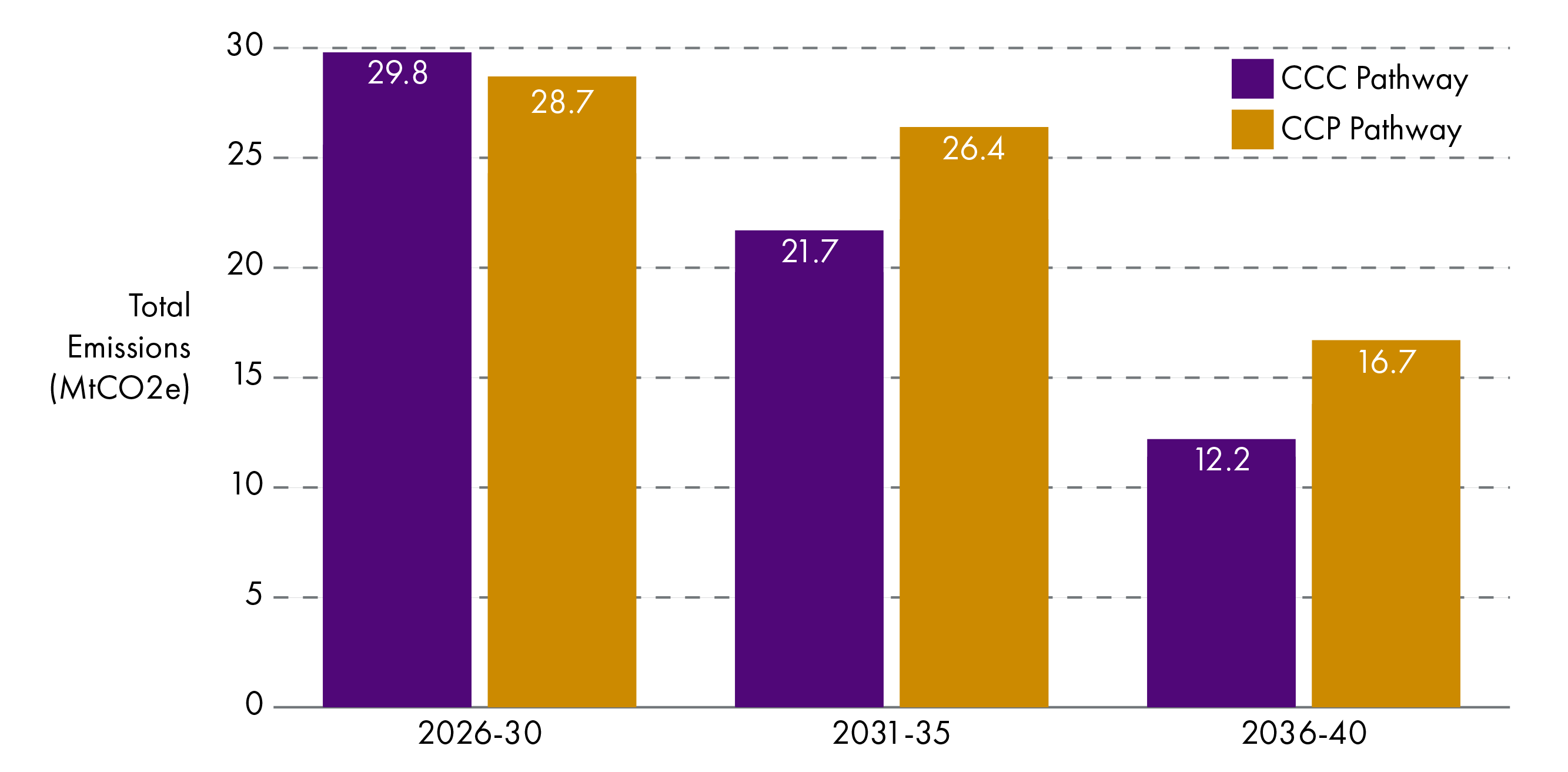
CCC, Scotland's Carbon Budgets, May 2025 & Draft Climate Change Plan, annex 3
Headline policies on buildings in the draft Plan include:
To set a target for decarbonising heating systems by 2045 "where reasonable and practicable to do so";
continuing to provide advice and financial support for energy efficiency measures in homes;
considering options to introduce powers to set Minimum Energy Efficiency Standards;
support for heat networks including through the Heat Network Support Unit and Scotland's Heat Network Fund; and
to develop a Heat in Buildings Strategy and Delivery Plan.iv
Scrutiny of the buildings chapter of the draft Plan was carried out by the Local Government, Housing and Planning Committee, who published their report on 6 February 2026. Their report says that:
Stakeholders lack confidence that the CCP will sufficiently drive the necessary progress in decarbonising buildings and that stakeholders have called for the CCP to be a 'route-map' to provide greater clarity about the action required;
delays to legislation on heat in buildings has been regrettable and while the Cabinet Secretary for Housing said it would not jeopardise targets to decarbonise buildings by 2045, witnesses said it puts the Government's net zero targets at risk;
retrofitting existing housing tock will be essential but a "piecemeal approach which continues to rely on individuals taking action will not be sufficient" and that national leadership from the Scottish Government in partnership with the UK Government is required;
they recommend the CCP be accompanied by "an updated and detailed public engagement strategy" noting the importance that the public understand what steps they can take.
The Committee notes the crucial role the decarbonisation of buildings will need to play for Scotland to meet its carbon budgets. The Committee welcomes the Local Government, Housing and Planning Committee’s scrutiny of the buildings sector and agrees with the recommendations and conclusions set out within their report.
Business and Industrial Process and Negative Emissions Technologies
This sector includes emissions from non-residential buildings, industry and NETs, with the CCC considering non-residential buildings to be partly devolved but industry and NETs mainly reserved.i This sector accounts for 18% of Scotland's total emissions.ii Emissions from industry have reduced by 60% since 1990.iii
The draft Plan projects a 49% reduction in emissions from business and industrial processes (not including NETs) between the first and third carbon budget period.iv
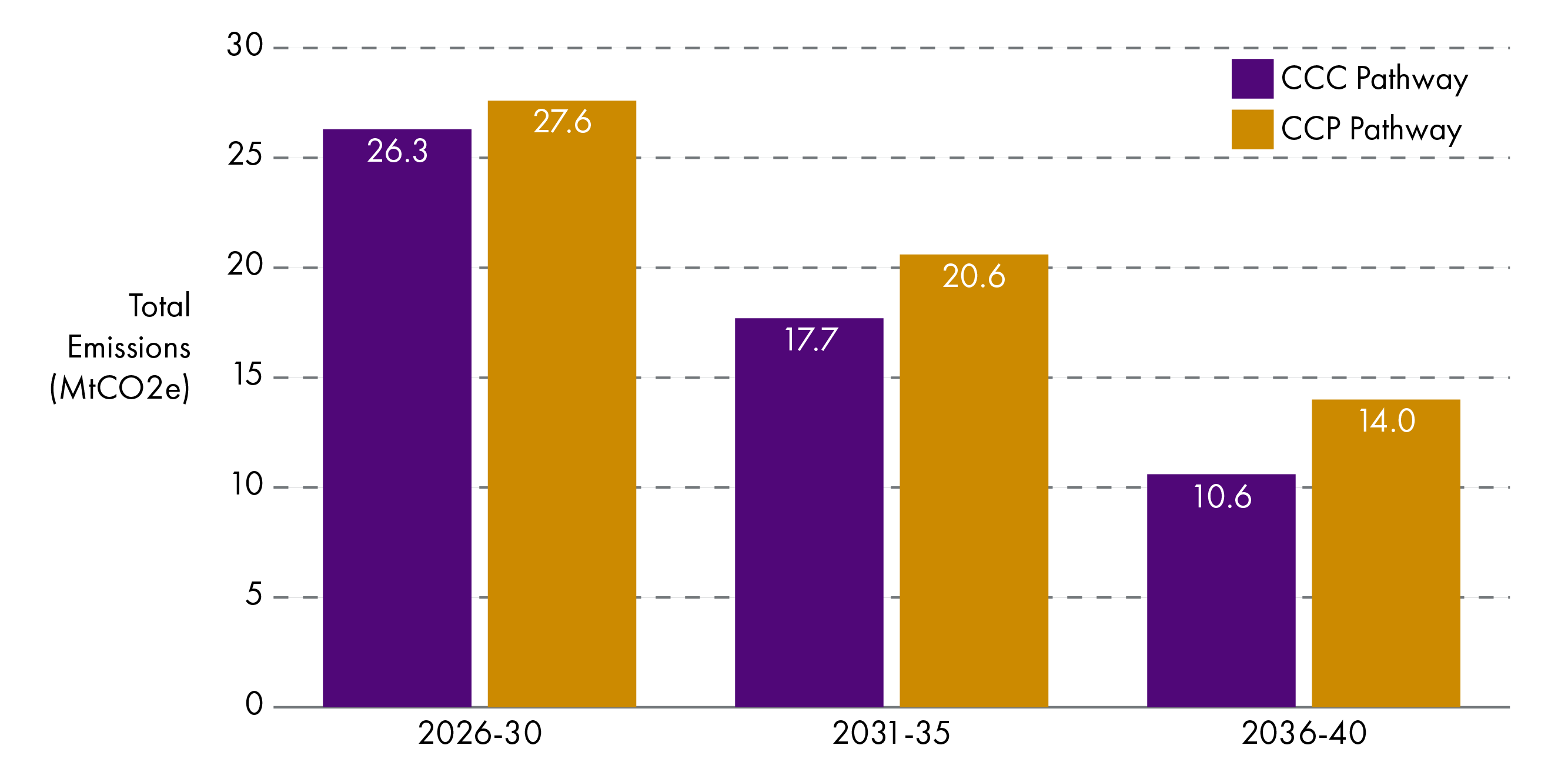
CCC, Scotland's Carbon Budgets, May 2025 & Draft Climate Change Plan, annex 3
Policies in this sector include:
Engaging with the UK Government on the UK Emissions Trading Scheme;
to continue the Scottish Industrial Energy Transformation Fund, to support industrial manufacturing decarbonisation;
to work with the UK Government to support the delivery, including in relation to planning, of CCUS and the Acorn project;
to continue to "explore and understand the potential" of NETs in Scotland; and
to support the development of the hydrogen sector in Scotland.v
Scrutiny of the Business and Industrial Process and NETs chapter of the draft Plan was carried out by the Economy and Fair Work Committee, who wrote to the Committee on 29 January 2026 with a summary of the evidence heard, and their conclusions and recommendations (though this Committee did consider evidence on NETs during scrutiny of the Energy Supply sector - this is covered in that section of our report). Some of the conclusions and recommendations from their report included that:
The draft Plan does not provide adequate detail on pathways to net zero and should set out more clearly what actions are required and who will do them. There is also uncertainty on financing and cost allocation and a lack of data on the assumptions that underpin the draft Plan;
there are significant dependences on the UK Government in decarbonising industry particularly in relation to the cost of electricity, which is described as "a binding constraint", and the need for significant mulit-year funding;
there are concerns that the UK Emissions Trading Scheme could make industry unviable without low cost electricity and that they heard evidence that, in its current form, it is contributing to site closures and reduced domestic production;
they call for "urgent reform of electricity pricing and cost allocation, including a review of levies and charges borne by users".
The Committee welcomes the Economy and Fair Work Committee’s scrutiny of the Business and Industrial Process sector and agrees with the recommendations and conclusions set out within their letter to us. The Committee requests the Scottish Government include in its responses to Committee reports, a response to the conclusions and recommendations outlined in the letter (Annexe F).
The Committee notes the relationship between the decarbonisation of industry and several of the issues considered within our own scrutiny – including negative emissions technologies, the cost of electricity, and the Just Transition and asks the Scottish Government to consider the relationships between these areas.
Agriculture
Emissions from agriculture have reduced by 13% since 1990 and the CCC consider policy in this sector to be largely devolved.i These emissions reductions are largely the result of a decline in livestock numbers from 1990 up until the mid 2010s and a reduction in emissions from soils.ii
The draft Plan projects that emissions from agriculture will reduce by 21% between 2025 and 2040.iii
The notable difference between the CCC pathway and the CCP pathway shown in the figure below is largely from the Scottish Government's decision not to bring forward a policy to reduce livestock numbers which was announced in a Statement in June 2025. The CCC’s modelling presumes a 26% reduction in cattle and sheep numbers by 2035, accounting for 48% of emissions reductions in 2035.
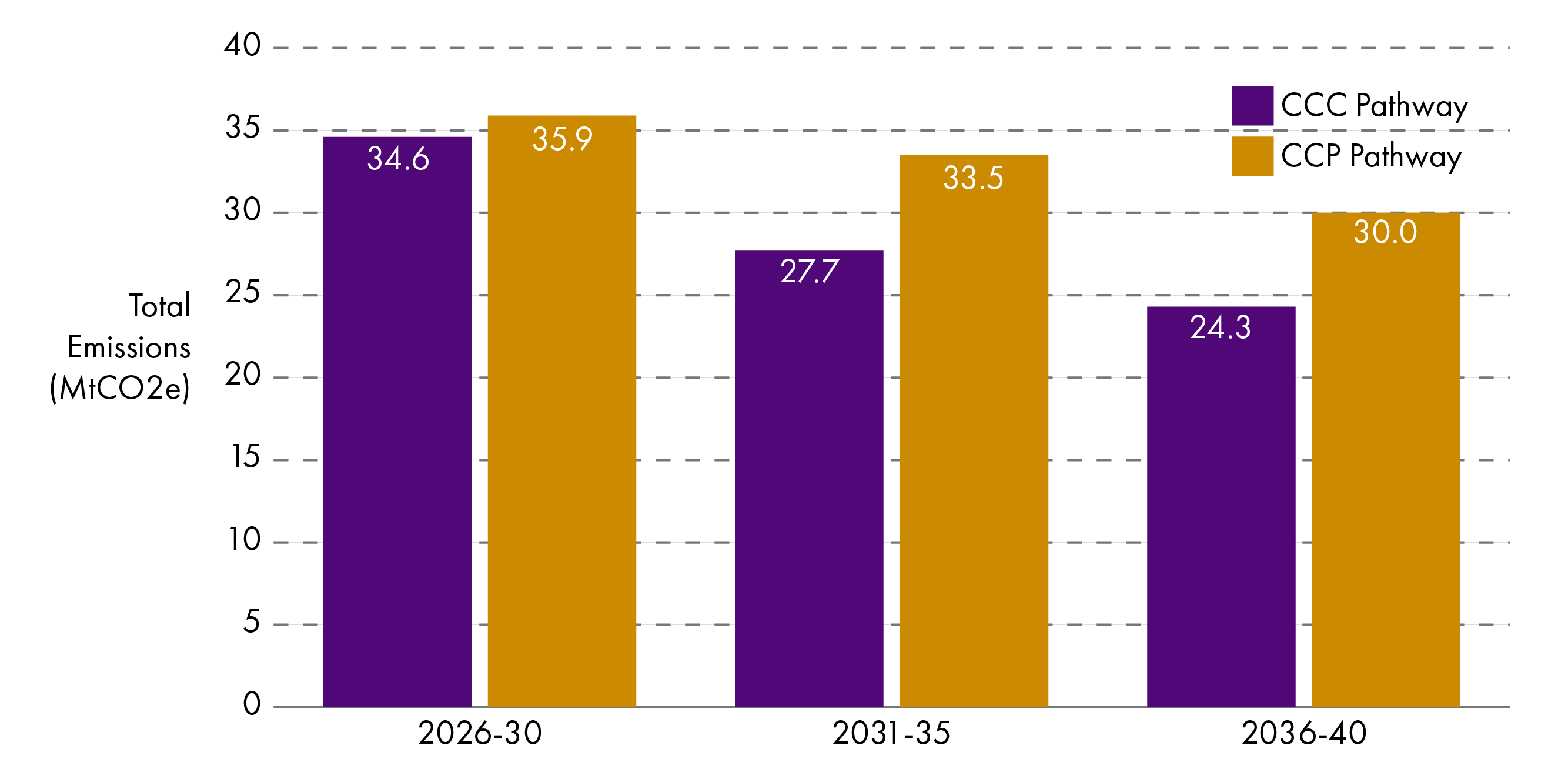
CCC, Scotland's Carbon Budgets, May 2025 & Draft Climate Change Plan, annex 3
Policies in agriculture include:
the delivery of the Agricultural Reform Programme, including a commitment to lay and publish the initial Rural Support Plan.i This is a requirement of the Agriculture and Rural Communities (Scotland) Act 2024 and the Scottish Government say it will outline the phased transition from the EU Common Agricultural Policy schemes;
to reduce emissions from agriculture non-road mobile machinery through efficiencies, alternative fuels and other technological developments;
to investigate technologies for alternative, improved or more efficient fertilisers;
engage with farmers to improve slurry storage management; and
to support cattle keepers to improve farm management practices through tracking information on herd fertility and animal. iv
Scrutiny of the agriculture chapter of the draft Plan was carried out by the Rural Affairs and Islands Committee, who published their report on 12 February 2026. The report says that:
they heard evidence that efforts to decarbonise agriculture are being impacted by a lack of clarity on the Scottish Government's agricultural reform programme, and as such, they "cannot come to a view on the emissions reduction pathway for agriculture in the draft CCP";
the Cabinet Secretary for Rural Affairs, Land Reform and Islands has confirmed the Government's rural support plan will be published before dissolution, and so they expect the CCP to set out further details of how policies in the rural support plan will help reduce emissions;
stakeholders said that uptake of low-emissions technologies for decarbonising non-road machinery and fertilisers remains slow;
a range of views were heard on the decision not to follow the CCC's pathway to reduce livestock numbers with some citing negative economic and cultural impacts and the risk of offshoring livestock emissions to meet domestic demand but others citing high emissions from livestock meaning that not tackling those would risk not meeting emissions reduction targets.
The Committee welcomes the Rural Affairs and Islands Committee’s scrutiny of the Agriculture sector and agrees with the recommendations and conclusions on this topic set out within their report. The Committee notes the Rural Affairs and Islands Committee could not come to a conclusion on the emissions reductions pathway in the draft Plan without clarity on the agricultural reform programme.
Land use, land use change and forestry
Emissions from the LULUCF sector mostly relate to forestry and peatland. Emissions from the sector are 91% down from 1990 to 2023.i
The sector includes both large sources of emissions, mainly from peatlands and croplands, and large sinks, mainly from forests and grasslands. The overall LULUCF emissions figure is a net of both the sources and sinks in this sector.
On forestry, in 2023 it absorbed "7.6 MtCO2e annually (or 9.2 MtCO2e if storage in harvested wood products is included) which is equivalent to 14% of Scotland’s gross emissions."ii The draft Plan states that: "The uneven age profile of Scotland’s forests (a mixture of new planting with younger trees, older trees reaching their sequestration capacity and timber harvest removal) means the level of carbon removal by Scotland’s forests will fluctuate. Indeed, this forest carbon sink is predicted to contract by an estimated 42% (3.3 MtCO2e) from 2025 to 2040 before rising again."ii However, under the policies set out in the draft Plan forestry is modelled to sequester an additional 0.3 MtCO2e per year by 2040.iv
Around 70% of Scotland's peatlands are degraded, meaning they release rather than store carbon.v In 2023, emissions from peatland were 16% of Scotland's total emissions.v The CCP's pathway projects emissions from peatland to reduce from 29.5 megatonnes of CO2 equivalent in the first carbon budget to 17.3 in the third.vii The Committee notes that a significant proportion of this reduction in emissions is due to improved emissions accounting on some types of peatlands, rather than from peatland restoration activities and that changes in emissions accounting can have a significant impact on the way emissions data is presented.viiii
Policies in the LULUCF sector include:
Publish Scotland's fourth Land Use Strategy;
increase the annual woodland creation target every year until the end of the decade, hitting 18,000 hectares per year in 2029/30. The draft Plan also adds that approximately 250,000ha of woodland would be created by 2040. Policies to do this include forestry grants to eligible landowners, develop a market for responsible investment in natural capital, and skills support on tree planting for farmers; and
increase peatland restoration by 10% each year to 2030 and maintain levels after that, leading to the restoration of more than 400,000 hectares by 2040. Policies to do this include: working with other UK nations to ban the sale of peat for horticulture, ensure deer management arrangements in Scotland support peatland ambitions; continue work with Peatland ACTION to support crofters on the Scottish Ministers' estate wishing to progress peatland restoration, and publish a five-year Peatland ACTION Plan.ix
As with Agriculture, the scrutiny of the LULUCF Sector was carried out by the Rural Affairs and Islands Committee and is considered in detail in their report. Some findings from their report include that:
the targets on tree planting and peatland restoration in the draft Plan provide a clear commitment, but that while notable gains have been made since the 2020 CCP update, the rate of both activities has not increased as much as was anticipated in 2020;
the CCP should more clearly specify how peatland restoration and tree planting sites will be prioritised;
industry stakeholders said that sustained public funding for tree planting and peatland restoration was needed;
a range of evidence was heard on the role of private finance in peatland restoration and woodland creation, with some saying it is essential to accelerate progress and others suggesting it could have unintended consequences.
The Committee notes the significant role the draft Plan envisions for woodland creation and peatland restoration. The Committee welcomes the Rural Affairs and Islands Committee’s scrutiny of the Land Use, Land Use Change and Forestry sector and agrees with the recommendations and conclusions on this topic set out within their report.
Just Transition
The Scottish Government is required to incorporate the principles of the just transition into the CCP, including how proposals and policies will affect different regions and sectors. The 2009 Act defines the principles of a just transition as reducing emissions in a way which:
supports environmentally and socially sustainable jobs,
supports low-carbon investment and infrastructure,
develops and maintains social consensus through engagement with workers, trade unions, communities, non-governmental organisations, representatives of the interests of business and industry and such other persons as the Scottish Ministers consider appropriate,
creates decent, fair and high-value work in a way which does not negatively affect the current workforce and overall economy,
contributes to resource efficient and sustainable economic approaches which help to address inequality and poverty.i
The Plan must also take into account the principle of climate justice. It defines this as taking actions to address climate change in ways which:
support the people who are most affected by climate change but who have done the least to cause it and are the least equipped to adapt to its effects, and
help to address inequality.ii
Climate Justice is discussed in the draft Plan in relation to the Scottish Government's international work, specifically the launch of the Climate Justice Fund in 2012, which the Plan says: "focuses on communities most affected by climate change: in particular, ensuring the views and needs of those typically marginalised in such communities are at the centre of interventions in Malawi, Rwanda, and Zambia."iii
The draft Plan discusses the Just Transition in broadly three ways:
Annex 1 sets out the Governments general approach to supporting communities, workers and employers. It references the Scottish Government's decision to establish the Just Transition Commission in 2019 (who advise on how to achieve net zero in a fair way) and the National Just Transition Planning Framework. Actions in their "general approach" include:
Giving communities a say in decisions which affect them and empowering them to take action (covered in this report in the Public engagement and communication section).
"Working closely with trade unions and workers across" the economy, including on the Energy Skills Partnership for the college sector and on "Fair Work First" criteria, which are applied to public sector funding.
Collaborating and supporting businesses through: policy and strategic planning, funding such as the SME Loan Scheme for energy, and advice.
Recognising the transition will impact particular regions more. It outlines support for the north east of Scotland through the 2022 £500 million Just Transition Fund for the North East and Moray, the North East of Scotland Investment Zone, and the Aberdeen City Region Deal. It also references support for the Grangemouth area including the Grangemouth Industrial Just Transition Plan and the £25 million Grangemouth Just Transition Fund.iv
Annex 2 includes a section on just transition for each of the seven sectors, again covering how the Scottish Government intend to support communities, workers and employers in that sector.
Annex 3 includes proposed Just Transition indicators. It says the Scottish Government will report on these indicators as part of the CCP monitoring process "to provide an overview of progress on delivering our emissions reduction ambitions in a way which is fair and just." The indicators are split into four categories: communities and place; people and equity; jobs, skills and economic opportunities; and environment and biodiversity. vi
Scrutiny of the Just Transition aspects of the draft Plan was primarily conducted by the Economy and Fair Work Committee, and their views are covered in their letter to the Committee (Annexe F). Earlier this session they conducted inquiries into the Just Transition for the Grangemouth area and the Just Transition for the North East and Moray this session.
The final report of the 2nd Just Transition Commission – No Time to Lose - was published in February 2026, shortly before this report. It provides the Commission’s annual assessment of Scotland’s progress towards achieving a just transition to a low carbon economy.
Just Transition for workers
Some themes from the Economy and Fair Work Committee's letter echoed what we heard in our own scrutiny in relation to the energy sector:
Witnesses warned that the current approach to transitioning from fossil fuels risks offshoring emissions, with an associated risk to jobs and Scotland’s industrial skills base. This would simply repeat historic patterns seen in previous deindustrialisation.
The Economy and Fair Work Committee ultimately recommended that:
The draft CCP needs to be clearer on the relative priority of actions to ensure there is a managed transition, otherwise there is a high risk of history being repeated with the loss of jobs and skills as industries close and emissions and jobs are offshored.
For a Just Transition for workers, they need both job opportunities and support to develop the skills to succeed in new jobs. The Committee heard from Simon Coop (Unite the Union) that: “There is a workforce in oil and gas that is clearly transitioning, but they believe that there are not enough clear plans for good, sustainable, trade union national agreement jobs as the transition moves forward. He added that the Government need "a clear plan in relation to ensuring that the communities that are involved in oil and gas are not in a cliff-edge situation".vii
On developing skills, Professor John Underhill told the Committee: “…we need skills capability mapping to determine which jobs are needed and when and where they are needed, and we need to ensure that there is investment in the relevant areas. That will inform universities, further education colleges and apprenticeships, and even the school curriculum, which is curriculum for excellence."viii
On our visit to Aberdeen’s new Energy Transition Zone -a recent initiative to provide the skills needed to enable a just jobs transition, we were pleased to meet and talk with students taking welding courses - required in the deployment of renewable energy technologies - at the Energy Transition Skills Hub operated by NESCol.
In considering the buildings sector, the Local Government, Housing and Planning Committee highlighted skills concerns - that there is a lack of trained contractors to deliver energy efficient home improvements. They said that the draft CCP does not provide detail on how to tackle this and recommended that the Scottish Government develop a National Retrofit Plan which includes a "Skills Plan" that sets out actions to address the gap, particularly in rural areas.ix
In her evidence to the Committee, the Cabinet Secretary for Climate Action and Energy highlighted some areas of work which could grow during the transition saying that the work that is associated with carbon capture and storage presents an opportunity for a Just Transition for oil and gas workers.x
She also cited joint work by the Scottish Government and unions to support a Just Transition:
Unite the Union came to us with a jobs guarantee proposal. It wanted to put in place a jobs guarantee for any business that was receiving Government funding as a result of the work that we were doing there. The union sought first refusal for interviews for those who were losing their jobs. That is a potential blueprint for further work, and I am keen to work with the unions on that.xi
In evidence to the Committee on this year’s budget, Karen Thomas (Scottish Government) confirmed that £83.5 million of the £500 million Just Transition Fund for the North East and Moray had been committed. This is despite it launching in 2022 for a 10-year period. The Cabinet Secretary added that “A lot more needs to be done. The fiscal situation that we are in has made it difficult to deploy as much money as was set out by previous First Ministers who made that commitment.”xii
Just Transition for communities
The Social Justice and Social Security Committee's letter (Annexe J) notes Scottish Government findings that 34% of all Scottish households were in fuel poverty in 2023. This was a concern also raised throughout the Committee's engagement work, with participants at our community event in Aberdeen emphasising that poorer households are least able to upgrade homes yet are often expected to act. Participants questioned whether grants were being taken up by those who needed them most to address fuel poverty.xiii Concerns about fuel poverty are also raised throughout the Local Government, Housing and Planning Committee's report. As discussed earlier, high electricity prices are already an impediment to a just transition, and risk becoming more so as electrification increases.
In considering the Agriculture and LULUCF sectors, the Rural Affairs and Islands Committee heard evidence that the rural support plan, which they expect to be published before the Parliamentary session ends in late March 2026, needs to define "what a just transition will look like for rural communities as a result of these changes".xiv
On measures and funding to support the Just Transition, ClimateXChange said research showed that people "wanted to see an equitable approach, meaning that everyone contributes but not all in the same way or by the same amount."xv Others suggested models including community wealth building, regional climate action hubs, and human rights budgeting as methods of ensuring funding and support reached communities who need it most.xvi
The Cabinet Secretary for Climate Action and Energy gave an example of how Just Transition was considered in developing policies for the draft Plan, saying that it was the key reason the Scottish Government elected not to take up a policy to reduce livestock numbers, which had been included in the CCC's Balanced Pathway - because of the impact they believe that policy would have on Scotland's rural economy.xvii She also said she was pleased with the response from the Just Transition Commission to the inclusion of Just Transition indicators and that she was "proud that we have 14 social, environmental and economic indicators, which are the first of their kind to be included in a Scottish climate change plan".xviii
The Committee notes the Economy and Fair Work Committee’s scrutiny in relation to Just Transition and agrees with the conclusions and recommendations in their letter.
We welcome the inclusion of Just Transition indicators in the draft Plan – this is a positive step forward towards monitoring what progress is being made in delivering a Just Transition, and critically, taking corrective action where progress is lacking.
During scrutiny of the draft Plan, we have seen the Just Transition in action, supported by both UK and Scottish Government funding, for instance in the launch of Aberdeen’s new Energy Transition Skills Hub. However, we also heard concerns about the economic future of Aberdeen and the wider north-east, as oil and gas energy scales down. Other communities in Scotland face broadly similar challenges. The Scottish and UK Governments must work together to develop site-specific Just Transition plans everywhere they are needed, focusing on what communities will need during the energy transition period and what new opportunities the transition will create.
Just Transition funding from both governments will be crucial in the short to medium term for communities going through the energy transition but should also have a strategic purpose, attracting business to invest in renewable energy projects and associated supply chains. As noted earlier in the report, this also requires government to set clear signals to the market, in the Plan and in other key strategy documents. The Committee is concerned to note that less than 20% of the £500 million Just Transition Fund for the North East and Moray has been committed to so far given the vital role Just Transition funding can play, and asks the Scottish Government to outline in the draft Plan how it proposes to make use of remaining funding. We ask the Scottish Government to note views that groups working at the “front line” of the Just Transition may need revenue funding more than capital funding in order to provide sustainable support.
Annexe A - Cross committee scrutiny
Topics covered during scrutiny of the draft CCP by Scottish Parliament Committees Committee Topics Net Zero, Energy and Transport Committee (lead committee) Mechanisms for delivering the Plan: Finance, governance, monitoring, and public engagementEnergy SupplyTransport (Including International Aviation and Shipping)Waste Management Citizen Participation and Public Petitions Committee Community engagement in energy Constitution, Europe, External Affairs and Culture Committee Culture and heritage sector Criminal Justice Committee Justice sector Economy and Fair Work Committee Business and Industrial Process and Negative Emissions Technologies and the overarching theme of Just Transition Health, Social Care and Sport Committee Health and social care sector Local Government, Housing and Planning Committee Residential and public buildings, and the wider implications of the plan for local authorities in Scotland. Public Audit Committee Governance, risk management and delivery Rural Affairs and Islands Committee AgricultureLand Use, Land Use Change, and Forestry Social Justice and Social Security Committee Scottish Government fuel poverty targets
Annexe B - Legislative requirements for the Climate Change Plan
Section 35 of the 2009 Act makes a number of specific requirements about what must be in a CCP; matters such as regional land use partnerships, fossil fuels, district heating, electric vehicles, a whole farm approach to emissions accounting, carbon capture and storage, and energy efficient housing. Some of the other key requirements set out in the 2009 Act include:
Policies and proposals: must be set out for meeting the emissions reduction targets during the plan period.
Sectors: proposals and policies must be broken down across seven sectors; energy supply, transport (including international aviation and shipping), business and industrial process, residential and public (in relation to buildings in those sectors), waste management, land use, land use change and forestry, and agriculture).
Contributions to meeting emission reduction targets: the Plan must set out the respective contributions ("in measurable terms") towards meeting emissions reduction targets by "each sector" and "each group of associated policies".
Costs and benefits: an estimate of the costs and benefits associated with the policies set out in the plan.
Just Transition: the incorporation of the principles of just transition and climate justice are required, including how proposals and policies will affect different regions and sectors.
An assessment of the progress towards implementing proposals and policies set out in the immediately preceding plan.
Monitoring: Scottish Ministers are required to publish an annual report on emissions reduction and an annual progress report on the CCP, including an assessment of progress towards implementing the proposals and policies.
Annexe C- Definitions and structure
The draft CCP's includes several definitions which tie in with the language used in the 2009 Act. These are set out below and used throughout this report.
Policies: The draft CCP explains that the 2009 Act "distinguishes between "policies’" and "proposals". Policies are defined as "where it is possible to clearly set out a specific action, scale, a lever of choice, an outcome and a timeline, and, thus, it is possible to set out clear delivery details and cost implications."i
Some requirements in the 2009 Act only exist for policies, not for proposals. For example, the CCP is required to set out an estimate of the costs and benefits of policies, but not of proposals.
Proposals: The draft CCP explains that proposals are "where it is possible to clearly set out an outcome and a timeline, and it is recognised action needs to take place, and generally these will have impact later in the plan period; consequently, more concrete detail on the precise policy levers and cost implications is more difficult to present."i
Outcomes: Throughout the sectoral chapters in annex 2, policies and proposals are listed under outcomes. Outcomes are essentially sub-goals that sit below the overall emissions reduction target for a sector and relate to it. The draft CCP explains that "Although many of these policies and proposals are relevant to multiple outcomes, they are listed under the most relevant outcome."iii
Baseline: The Scottish Government analysis includes a baseline emissions scenario, in which the policies and proposals included in the draft CCP are not implemented. The baseline scenario does, however, take account of actions by the private sector and the UK Government which will influence Scottish emissions (despite not being in scope of the CCP). A certain amount of emission change results within the baseline (in the absence of CCP policies) and in the Scottish Government's analysis, these changes tend to be reductions.iv
Annexe D - Community groups who met with the Committee in Aberdeen
During a community engagement event held at the Aberdeen Science Centre on 19 January 2026, the Committee met with:
Grampian Housing Association
North East Scotland Retrofit Hub
Buchan Dial a Community Bus
North East Transport Training
Stella's Voice
Udny Climate Action
Aberdeen Community Energy
Aboyne Community Trust
Friends of St Fittick’s Park
Hill of Fare Wind Farm Information Group
Leylodge Against Industrialisation
Instant Neighbour
Cyrenians
Action for a Fairer World
Aberdeen Youth Movement
Annexe E - Letter from Health, Social Care and Sport Committee
30 January 2026
Dear Convener,
RE: Summary of key themes from evidence on the Draft Climate Change Plan
I am writing to provide an interim summary of the key themes emerging from the Health, Social Care and Sport Committee’s ongoing scrutiny of the draft Climate Change Plan (CCP) and its implications for health and social care in Scotland.
Given the timing of parliamentary business, it will not be possible to finalise and report our findings before your planned sessions with Cabinet Secretaries. We therefore offer this summary to support your preparatory work. In due course, the Committee plans to present its findings from its scrutiny of the draft Climate Change Plan in the form of a short report. In that context, this letter should be read as a factual presentation of some of the main themes raised in evidence taken by the Committee so far rather than representing the views of the Committee itself.
To date, the Committee has held two evidence discussions on the draft CCP:
On 13 January 2026, we heard from Professor Jill Belch (University of Dundee and Royal College of Physicians of Edinburgh) and Professor Peter Scarborough (University of Oxford). Due to technical difficulties, two witnesses joining remotely – Professor Ruth Doherty (University of Edinburgh), and Dr Andrew Sudmant (University of Edinburgh) were unable to contribute orally, but indicated their intention to provide written evidence thereafter. We have received written evidence from Dr Sudmant.
On 20 January 2026, we took oral evidence from Jane Miller (The Health and Social Care Alliance Scotland – the ALLIANCE) and Dr Joanna Teuton (Public Health Scotland).
Across these sessions, witnesses consistently emphasised the significant health impacts associated with emissions and the scale of the potential co-benefits from mitigation. Evidence presented by Dr Sudmant highlighted that actions in buildings and transport can yield particularly large social and health gains, often exceeding direct financial benefits, including through improved air quality, reduced exposure to cold homes and enhanced physical activity.
However, witnesses argued that health and inequality outcomes should be made explicit in the Plan and that these co-benefits should be integral to policy appraisal and budget decisions, rather than treated as secondary considerations. Dr Teuton advised that the CCP cuts across the building blocks of health and should be more explicitly treated as a public health intervention in the Plan.
She advocated a ‘health in all policies’ stance, in which climate measures are designed and delivered to reduce emissions while maximising health gains and safeguarding equity, thereby contributing to improved life expectancy and reduced health inequalities. Dr Teuton argued that this could be done using a place-based, community wealth-building model. Jane Miller also underlined the important role of social care within this wider prevention agenda.
Air quality was a major theme. Witnesses observed that the draft CCP does not fully address important pollutants such as ozone and ammonia, both of which have demonstrable health effects. They also noted that indoor air quality is insufficiently covered in the draft Plan, particularly in relation to the interaction between insulation, ventilation and the risk of cold, damp and mould. The need for monitoring frameworks to ensure that improvements in building performance do not inadvertently worsen indoor conditions was highlighted repeatedly.
Inequality was also central to the evidence we heard. Jane Miller described the disproportionate effects of climate change on disabled people, those with long term conditions, unpaid carers and lower income households, and stressed the importance of designing mitigation measures to avoid widening existing health inequalities. Dr Sudmant similarly emphasised that co-benefits vary significantly by place and population, and that targeted, data driven implementation is critical to ensuring equitable outcomes. Witnesses highlighted that rural and island communities face distinct issues, including limited public transport, reliance on private vehicles and differing patterns of exposure and benefit, and that these differences should be explicit in the Plan.
Diet, food systems and agricultural emissions were discussed extensively, building on the Committee’s ongoing scrutiny of the Good Food Nation National Plan. There was disagreement on the potential impacts of reducing meat production and consumption on health, diet, the economy and the environment. The Committee also heard differing views on ultra-high/ ultra-processed foods (UPFs). This focused on the impact of UPFs on health and the environment, including on GHG emissions, biodiversity, and obesity and other non-communicable diseases. There was consensus however on the complexity of the food system from production to consumption, and witnesses were clear that the draft CCP does not adequately acknowledge or address this complexity or the role of food in meeting climate and health objectives.
A further recurring theme across witnesses was the need for stronger governance, monitoring and accountability mechanisms. They argued that the draft CCP lacks quantifiable metrics in many areas, making it difficult to track delivery and outcomes. Dr Sudmant, among others, suggested that health and social co-benefits should be explicitly embedded in appraisal and budget processes, with place-based data used to guide prioritisation and ensure that benefits are realised where need is greatest. Witnesses also highlighted the importance of embedding public health expertise in planning and evaluation structures across Government.
Finally, communication and engagement emerged as significant issues. Dr Teuton and academic witnesses stated that current public communication does not convey the local, immediate health benefits of climate action and can lead to disengagement. Witnesses recommended clearer, more accessible messaging, stronger community involvement in design and delivery, and more emphasis on the lived experience of the individuals and groups most affected. They stressed that inclusive communication and coproduction are essential to ensuring fairness, legitimacy and uptake of climate measures.
The Committee will continue to take further evidence on these issues in the coming weeks. Once our scrutiny is complete, we will publish a report and will share this with the NZET Committee to support your ongoing scrutiny of the CCP and related policy decisions.
Yours sincerely,
Clare Haughey MSP
Convener, Health, Social Care and Sport Committee
Annexe F - Letter from Economy and Fair Work Committee
29 January 2026
Dear Edward
Draft climate change plan 2026 - 2040
I am pleased to set out the Economy and Fair Work Committee’s views on the Scottish Government’s draft Climate Change Plan (draft CCP) for the attention of the Net Zero, Energy and Transport Committee, as lead committee for scrutiny of the draft CCP.
The Climate Change (Emissions Reductions Target) Scotland Act 2024 moves from a system of annual reductions targets to one of 5-yearly carbon budgets. The draft CCP attempts to set out how the Scottish Government intends to meet the emissions reductions targets, agreed by the Parliament, and reach net zero emissions by 2045.
The Economy and Fair Work Committee has focused its scrutiny on the Business and Industry chapter of the draft CCP. The Committee was particularly interested in the economic impact of the draft CCP and how the Scottish Government intends to ensure workers benefit from the transition to net zero – often referred to as a just transition for workers.
Since 1990, emissions from industry have fallen by 57% in Scotland. However, emission reductions have not primarily been from decarbonising industrial processes. Instead, they have come broadly from the closure of industrial sites such as steelworks and papermills, and businesses changing what they manufacture toward less energy-intensive, higher-value output.
Last April saw Petroineos close Scotland’s only oil refinery at Grangemouth and the shift to an import terminal for finished fuels. This closure resulted in significant direct job losses and losses for smaller businesses in the wider supply chain. The impact on the community and surrounding area has been stark. The imminent closure of ExxonMobil's Fife Ethylene Plant (FEP) at Mossmorran will result in further direct and contractor job losses.
Undoubtedly, both closures will contribute towards emissions reduction targets, but that “contribution” is at significant cost to jobs, livelihoods and communities. Closures create the risk of a skills drain, with jobs or workers moving from Scotland and ultimately the loss of Scotland’s industrial base.
The Parliament is agreed that the move from fossil fuels towards greener energy is necessary to meet Scotland’s emissions reductions targets, but the cost of electricity is a significant barrier.
Parliament is also agreed that the transition must be managed by both the Scottish and UK Governments creating the conditions to ensure the move presents economic opportunities and manages economic risks. The establishment of the Grangemouth Investment Taskforce, and the extension of its remit to cover Mossmorran to support workers to retrain and encourage investment, was welcomed. However taskforces and meaningful plans need to be in place before closures are announced and jobs lost. The economy needs to see jobs lost in the fossil fuel industries being replaced at pace. This will require detailed and flexible workforce planning within and beyond the energy sector.
The plan to deliver net zero by 2045 must take a holistic approach to the potential costs and overall economic impact. A credible route-plan for ensuring that balance, financing and allocating the cost is needed. This is the context for the Committee’s views.
In your letter to conveners of 9 October 2025, you suggested business and industrial processes and negative emissions technologies as areas that the Economy and Fair Work Committee may wish to consider. The Committee took evidence over two meetings focussing first on the business and industry chapter of the draft CCP and then on Just Transition, a theme throughout the draft CCP. Just Transition has been an area of interest for this Committee throughout the Parliamentary Session. The Committee has undertaken scrutiny work looking at the North East and Moray, including the Scottish Government’s Just Transition Fund and the Grangemouth area and its industrial future.
Given timetabling and other work programme constraints, the Committee was limited in the scope of its scrutiny of the draft CCP but earlier work fed into our considerations. I attach the key points from the Committee’s two specific sessions on the draft CCP and set out the Committee’s conclusions and recommendations for strengthening it. I trust these will be helpful for your scrutiny.
Yours sincerely,
Daniel Johnson MSP Convener
Draft Climate Change Plan business and industry chapter
The Business and Industry Chapter of the draft CCP covers emissions from industrial processes, primarily from fuel combustion in manufacturing and production processes and non-domestic buildings (not including public sector buildings) which primarily relates to heating the buildings and negative emissions technologies (NETs) such as carbon capture and storage.
The witnesses from whom the Committee took evidence, acknowledged the work that had gone into the draft plan but suggested it should be characterised more as an emissions reduction framework. Elements they expected to see in a climate change plan, such as resilience adaptions and a clear skills and jobs route map by sector, are not included.
There were also concerns about the lack of detail on financing, cost allocation and upfront costs. More clarity on what will be expected of businesses and organisations was asked for, alongside further consideration of the cumulative impacts on business, industry and consumers. Necessary actions should be clearly prioritised and then supported by a multi-year funding plan.
Professor Paul de Leeuw said when he read the plan he had “a little Ikea moment”:
“I know what the starting point is, which is a flat pack, and I know what the end point looks like, which is net zero, but what I am missing is the instructions and the plan in the middle”.
David Thomson (Food and Drink Federation Scotland) said his members:
“would probably struggle to see...the link between the plan and the actions, whether financial support, policy support or legislative support...”
Industrial processes
The UK Climate Change Committee provided advice to the Scottish Government in 2025 and set out a “balanced pathway” to net zero by 2045. The Scottish Government has not clearly explained how and why its draft CCP departs from the Climate Change Committee’s advice.
In 2023, emissions from industry accounted for 13% of Scotland’s emissions. The same sector contributed £13.8 billion to Scotland’s gross added value and employed more than 166,000 people. Emissions from non-residential buildings (including public sector buildings) accounted for 5% of Scotland’s emissions. Since 1990, emissions from non-residential buildings have fallen by 31%. This is mainly due to improved energy efficiency.
Reducing emissions by decarbonising industry is likely to require processes to be electrified, to move away from fossil fuels for power and for electricity to be generated from low carbon sources. Industrial electrification at scale will require significant up-front capital investment to replace equipment and machinery.
For this to be cost-effective for industry, electricity will need to be cheaper than fossil fuels. The current high cost of electricity is a significant barrier. Alongside electrification, the draft CCP envisages a role for hydrogen technologies and “more efficient use of materials”.
Overall, the business and industry chapter of the draft CCP pushes emission reductions into future years and envisages lower reductions than the Climate Change Committee’s balanced pathway. Lower emissions reductions are made up for by NETs in the draft CCP. The draft CCP envisages NETs removing twice as many emissions than they are forecast to do by the Climate Change Committee’s balanced pathway.
It was emphasised to the Committee that the availability of low cost electricity would be a key trigger to enable market forces to drive the energy transition for most industries.
The UK’s high electricity prices were repeatedly cited as the major barrier to decarbonisation. The move from gas to electricity is not seen as currently financially viable for most industry. It was pointed out that electricity is currently four and half times more expensive than gas and included in the cost of electricity “there is a lot loaded in through compliance and distribution costs and green charge elements”.
Without low cost electricity, electrifying industrial processes is too expensive and the carbon budgets for industry are unlikely to be delivered without job losses.
There are significant questions about how gas will be replaced as a heat source, given its broad range of uses currently in industries key to Scotland’s economies. Across the whole of the food sector, for instance, there is significant reliance on gas. Decarbonisation of heat is a significant consideration for manufacturers. Reference was made to the much lower price of electricity in other countries, for example in France where nuclear is the back-up, and in Norway where it is hydro. For some industrial processes, alternative options would include hydrogen but there was a clear call to decouple electricity pricing from gas and unlock low cost renewable capacity.
Concerns were not confined to the cost of and reliance on electricity. Currently, hydrocarbons are the common basic raw material for industrial production and supply chains for chemicals, pharmaceuticals and plastics. Although the chemicals industry is looking at alternative sources for future carbon requirements including bio-based carbon from forestry and farming, recycling and carbon capture, the alternative carbon sources are also energy intensive. The Committee was told that the chemicals industry is currently uncompetitive due to the price of energy and raw material costs.
During the Committee’s discussions with witnesses, it was pointed out that for some high-heat industries, there was no “off the shelf” technology to switch over to using electricity. Even if there were, the price of electricity would make them too costly to use. The importance of the Acorn cluster being funded to provide a hydrogen network was stressed, given the potential for hydrogen to be used for high-heat processes.
A related concern was the availability and cost of grid connection to support heat and energy demand. There are known grid capacity and cost constraints. Last week, one of the biggest ScotWind funded projects in Scotland, the 125-turbine West of Orkney wind farm, was halted due to the cost of grid connection. Developers reportedly said that the cost of connecting to the network made it impossible to compete against other projects being proposed elsewhere in the UK. Until a resolution is found, the investment is on hold.
UK Emissions Trading Scheme (ETS)
The UK ETS is a mechanism for setting a carbon price for industry with the aim of polluter pays and creating a financial incentive to decarbonise. The ETS currently applies to power generation, aviation and energy intensive industries such as steelmaking, chemicals and cement manufacturing. The UK sets a cap on carbon allowances and allowances that can be traded. Over time, carbon allowances are reduced, increasing the price of carbon and the incentive to decarbonise.
The Chemical Industries Association expressed concern that the scheme is damaging UK industry’s competitiveness and creating an incentive to relocate instead of decarbonise. In response, the UK Government recently announced a Carbon Border Adjustment Mechanism (CBAM) to take effect from January 2027. This is not mentioned in the draft CCP. However, it does appear that the impact of the UK ETS is included in the draft CCP baseline level of emissions reductions (and expected to occur without Scottish Government action).
Richard Woolley (Chemical Industries Association) noted that since 2021, in the chemicals sector, 40% of emissions reductions had come from site closures or the closure of production lines. He said only one site had been able to decarbonise and this was not replicable because the only reason it had been able to do it was due to previously selling hydrogen to an adjacent site that had since closed.
Smaller business
Although the draft CCP is aimed broadly at the biggest polluters, it is of relevance to smaller businesses. In Scotland most private businesses are small businesses. The Committee was told there is a disconnect between the draft CCP and small businesses with low awareness and a lack of practical guidance. Stacey Dingwall (Federation of Small Businesses) noted references in the draft CCP to Business Energy Scotland being a key source of support for small business but said feedback from her members suggested it took a couple of months for BES to respond to approaches.
Negative emissions technologies (NETs)
NETs have been given a prominent role in the draft CCP with the expectation that CO2 transport and storage infrastructure will be constructed to enable carbon capture and storage (CCS). Project Acorn will be key to realising expectations.
There are several types of NETs. The most significant in terms of emission reductions in the draft CCP are Bioenergy with Carbon Capture and Storage
(BECCS) which extracts CO2 from biomass and Direct Air Capture with Carbon Storage (DACCS) which extracts CO2 directly from the air.
The Centre for Energy Policy identified carbon capture and storage as a “comparative advantage” for Scotland suggesting it could contribute 3,000 jobs and
£300 million per year to economic output by the 2040s “if fully established”. However, within the range of new technologies that fall within the descriptor of NETs, some are unproven. There are also questions about long-term scalability and environmental impacts.
The draft CCP places greater emphasis on the contribution of NETs to meeting emissions reduction targets than advised by the Climate Change Committee. Although the draft CCP envisages almost twice the contribution to emissions reduction than was suggested in the Climate Change Committee’s “balanced pathway”, there is no detail on what Scottish Government assumptions have been used to support the increased role of NETs.
Professor de Leeuw told the Committee there was no way to get to net zero without carbon capture and storage. Both he and Richard Woolley strongly emphasised the importance of making progress with the Acorn project and receiving assurances that it will happen. There are worries, following the withdrawal of the main investor, about maintaining investor interest, planning permissions expiring and the loss of skilled people from the area.
The expectation had been that the UK Government would support all clusters equally to have carbon capture alongside hydrogen infrastructure. Richard Woolley expressed his industry’s disappointment at the UK Government announcement last summer that only one regional hydrogen network would be supported (not the Scottish cluster) as this would now limit options for the chemicals industry.
Non-domestic buildings
Decarbonising non-residential buildings is likely to involve a mixture of replacing heating systems with low carbon alternatives alongside energy efficiency measures to reduce energy demand. The draft CCP envisages emissions from non-residential buildings falling more slowly than advised by the Climate Change Committee. In the time available, this was not an area that the Committee took any evidence on.
Just Transition for workers
Witnesses warned that the current approach to transitioning from fossil fuels risks offshoring emissions, with an associated risk to jobs and Scotland’s industrial skills base. This would simply repeat historic patterns seen in previous deindustrialisation.
Richard Wooley warned that the loss of jobs in emitting industries would lead to the loss of capability to support national resilience. He spoke about scientists and engineers who had lost their jobs who were previously “making things that we are now importing from China”. He also pointed to the pandemic and highlighted the vital role played by the chemicals industry making protective equipment, disinfectants and medicines.
Ryan Morrison (STUC) expressed concern about the level of investment, the return on jobs and the local benefit from the renewable energy sectors compared to oil, gas and nuclear, to deliver on the draft CCP. He pointed to the significantly lower job return per million pounds of turnover in offshore and onshore wind and called for more focus on the manufacturing side of renewables. He agreed with other witnesses that the draft CCP was more of an emissions reductions plan than a climate change plan. It was noted that the draft CCP makes no reference severe weather and the direct impact that might have on workers.
Although significant industrial and economic transformation will be required, ownership was also highlighted as a significant consideration. Trade unions suggested there should be more public and community stakes in, and greater control over, new green industries. This would better ensure benefits and wealth from renewables and emerging technologies were retained in Scotland.
Ryan Morrison said the STUC was interested in opportunities for national and municipal ownership. He pointed to the ScotWind projects in which he said Scotland did not have any ownership share. He referenced the case study in the draft CCP on the Orkney offshore wind farm, expected to return significant profits for the local authority but said there was nothing about it being expanded elsewhere. He referenced the Scottish National Investment Bank’s investment in an asset management firm to secure the Iona wind partnership. He questioned why SNIB’s investment had not been used to support part ownership for the local authority, instead of supporting ownership by an overseas asset management firm.
Overall, there was concern about the extent to which there was meaningful dialogue between trade unions, Government and employers about how transitions will work. Dougie Maguire (Unite the Union) spoke about workers from the industries that had closed having retrained, yet there being no new green jobs. He said, “we manufacture everything abroad, and everything to do with green energy is also being manufactured abroad”. Ryan Morrison agreed and said with the offshore skills passport, qualifications were logged, further training and qualifications gained but there was often no new job. He summarised:
“The question is whether we are creating a full pathway for those workers that starts with recognising the skills that they have in the job that they are in, understands the timeline of changes that are expected for them, supports them to reskill and then opens up opportunities for them on the other side”.
Claire Greer (GMB Scotland) also agreed with that assessment. She told the Committee that workers did not currently see the pathways, that their skills are being wasted and they are moving elsewhere for jobs.
The job prioritisation scheme put in place to support workers following the announcement of the Grangemouth oil refinery was welcomed but there was disappointment that those sorts of measures, and the furlough initiative introduced at Alexander Dennis, were not part of the draft CCP.
Strategy alignment, costs, benefits and risks
Investment in infrastructure and government strategic policy alignment will also be crucial to delivery on emissions reductions targets. Alignment between the draft CCP, the Scottish Government’s Green Industrial Strategy and NSET must be strong and consistent.
A key theme from both evidence sessions was the lack of detail on costs and benefits and on the Scottish Government assumptions used to underpin the draft CCP. Professor Karen Turner (University of Strathclyde) said that modelling of the numbers under different scenarios was needed. This would enable an assessment to be made of the key pathways for achieving emissions reductions and ensure that investments, already made, were supported to stay on track.
Professor De Leeuw said Scotland was losing more of its supply chain and workforce capacity than was being replaced by offshore wind and carbon capture and storage. He argued that strategic investment, at scale, ahead of final approval of projects was now required. He observed that between now and the early 2030s, the majority of wind activities would not be in Scotland, but the rest of the world. Most ScotWind developments are not due to happen until early 2030. To get ahead, his call was for Scotland to build supply chain capacity in advance of demand, otherwise “things will be built somewhere else” and the next generation of industry would be lost to Scotland.
Much of the action required to meet emissions reductions targets will come down to co-operation and co-ordination between the Scottish and UK Governments.
Professor Turner spoke about the need to consider Scotland’s fiscal settlement. Richard Wooley said there was no plan without a funding to back commitments and that what was lacking was industrial decarbonisation funding which is needed “rapidly and we need it to be ensured for a minimum of three to five years”.
Committee conclusions
There are legitimate questions about whether the draft CCP is a climate change plan or an emissions reduction plan. There are omissions in relation to resilience, adaptation, emissions and skills pathways broken down by sector.
The draft CCP does not provide an adequate level of detail on the pathways to net zero. It must set out much more clearly what actions are required, and by whom, and the actions that will happen without Government intervention or policy.
There is uncertainty on financing and cost allocation and a lack of data on the assumptions that underpin the draft CCP.
The draft CCP was criticised for lacking credibility and clarity, particularly in relation to providing security for workers. There are also questions about the timing of decarbonisation actions and the resultant gap between jobs lost in high emissions sectors and new jobs in renewables being created. There are also concerns about the nature of future jobs if Scotland is simply importing and not manufacturing.
The rationale for the Scottish Government having departed from the Climate Change Committee’s suggested pathway, particularly the choice to place greater reliance on NETs in the draft CCP, is not clear. The Scottish Government’s approach would appear to come with a higher degree of risk due to CCS, at scale, being unproven, untested and potentially costly.
The Committee is clear that the current cost of electricity is not a marginal obstacle to industrial decarbonisation but a binding constraint. Evidence repeatedly pointed to electricity prices that are materially higher than those faced by overseas competitors, driven in large part by policy, regulatory and system costs, rather than generation costs alone. In such circumstances, expectations that industry will electrify at pace are unrealistic Given the significant concerns about high energy costs, and particularly the cost of electricity. The Committee concludes this is a major barrier to decarbonisation for industry.
In a 2024 report, the Scottish Fiscal Commission looked at how climate change could affect the Scottish Government’s fiscal sustainability. The report considered the potential effects on public finances from damage created by climate change, the costs of adapting to a changing environment and actions to meet emissions reductions targets. The SFC’s view is that the required additional public investment in devolved areas is significant.
The challenge of meeting net zero creates an inter-dependency between the Scottish and UK Governments. There are issues of linked funding and the Scottish Government’s funding position is influenced by UK Government choices. Meeting emissions reduction targets will require significant multi-year funding.
Delivery of the draft Climate Change Plan is heavily dependent on sustained multi- year public investment, much of which lies outwith devolved competence and is shaped by UK Government fiscal decisions and the limitations of the current fiscal framework. That interdependency makes transparency on costs, on accountabilities of each government and funding assumptions essential.
The Committee is concerned that the draft CCP does not clearly set out the scale of public funding required, the opportunity costs for other public services, or the consequences if anticipated funding does not materialise. Without that clarity, there is a real risk that commitments are made which are neither affordable nor deliverable, undermining confidence in the plan and in long-term fiscal sustainability.
Regarding the UK Emissions Trading Scheme, there are concerns that without low cost electricity, industry will simply become unviable. The Committee heard strong evidence that the UK Emissions Trading Scheme is, in its current form, contributing to site closures and reduced domestic production rather than driving meaningful investment in decarbonisation. In the absence of affordable low-carbon energy alternatives, rising carbon costs risk accelerating carbon leakage, with emissions and jobs displaced overseas, rather than emissions being eliminated.
Committee recommendations
Considering the questions about the nature of the plan and what has been omitted from it, the Committee recommends more work is undertaken to ensure the information on adaptations, resilience, cost and cost allocation and underlying assumptions are included in the finalised plan.
The draft CCP needs to be clearer on the relative priority of actions to ensure there is a managed transition, otherwise there is a high risk of history being repeated with the loss of jobs and skills as industries close and emissions and jobs are offshored.
The Committee calls for urgent reform of electricity pricing and cost allocation, including a review of levies and charges borne by users. Until this structural issue is addressed, the Committee cautions against placing additional decarbonisation obligations on industry, which risk further damaging competitiveness and accelerating de-industrialisation.
The Committee recommends that any further tightening of carbon allowances should require careful assessment and calibration against energy costs and industrial competitiveness.
The Committee draws the Scottish Government’s attention to the evidence from STUC about national and municipal ownership and urges it to consider where there may be future opportunities for public investment and / or municipal ownership stakes in the energy sector.
To deliver against agreed net zero targets there is a need for greater integration across the Scottish Government directorates and between Government strategies and policies including industrial strategy, infrastructure project planning, energy policy and economic strategies.
The Scottish Government must also do more to embed a direct participative role for the workforce, trade unions and professional bodies in climate change planning. Their involvement must be structural and not simply reactive, to ensure genuine participation in shaping the future.
Annexe G - Letter from the Criminal Justice Committee
29 January 2026
Dear Convener,
Joint scrutiny of the draft Climate Change Plan
In my letter of 1 December 2025, I set out the Committee’s approach to scrutinising the efforts of key justice organisations to meet commitments under Scotland’s climate change targets.
A summary of the evidence received during our pre-budget scrutiny sessions and through written correspondence is set out below along with the resulting conclusions and recommendations from our pre-budget scrutiny report.
Police Scotland and the Scottish Police Authority (SPA)
At our meeting of 5 November 2025, DCC Alan Speirs set out the work of Police Scotland’s sustainability team. He noted that it produces an annual report for the SPA board and that this year’s report showed considerable progress is being made on reducing the organisation’s carbon footprint.
DCC Speirs told the Committee it has become “really evident that, in some ways, we have taken the work on the estate as far as we can” in terms of meeting climate targets. He also noted that a large proportion of the fleet is made up of electric vehicles and that the “ambition is to continue to progress that."
Lynn Brown, Head of Finance, Police Scotland agreed that the estate and fleet are key areas of investment in relation to sustainability and that they want to “have a modern, fit-for-purpose estate.” In its response to the Committee’s call for views it was noted that of the overall capital expenditure plan for 2026-27 of £93.9 million,
£24 million is earmarked for investment in the estate and £15.2 million is planned for its fleet, including the continued development of an ultra-low emission fleet to meet climate change commitments.
With regards to the estate modernisation programme, Chris Brown, Chief Executive of the SPA commented that it allows Police Scotland to build efficiency in from the beginning “instead of having to patch things up later.” However, he also highlighted that some of the reductions in Police Scotland’s emissions relate to the disposal of buildings, some of which will go on to be used elsewhere in the public sector and was of view that “a more holistic approach is needed to ensure that the actions that we collectively take are, in the round, contributing to reducing emissions.”
Scottish Fire and Rescue Service (SFRS)
In written evidence, the SFRS set out the work undertaken during its 2020-25 Carbon Management Plan (CMP) which focused on three key areas; reducing energy waste, the installation of renewable energy generation and the removal of small-scale gas heating systems. Over £12 million was invested in carbon reduction measures across the estate during this time and more than 400 projects were delivered to make sites more energy efficient. Completed work includes the installation of heating control systems and solar panels and upgrades to building insulation and EV chargers.
The 2020-25 CMP reduced carbon by 4,784 TCO2e over the 5-year period, which although significant, was only 68% of its original reduction target of 7,000 tonnes. SFRS notes that considerable progress was made during the first three years of the plan when external funding was available, but the reductions slowed in years 4 and 5 as reduced grant funding, internal budgetary pressures and resourcing impacted progress.
Its CMP for 2026-31 is currently being drafted and will include over 120 projects, requiring investment of more than £4.6 million. It is exploring the possibility of installing a large-scale solar panel field at its Cambuslang site and the remaining oil boiler at Invergordon Community Fire Station and Training Centre will be replaced with electric heating. Multiple sites will benefit from smart heating controls, new windows and doors, insulation, LED lighting, and small-scale air sourced heat pumps.
SFRS advises that it will also continue to monitor the carbon footprint of purchased goods to record the impact of, and align procurement decisions with, its net zero targets.
In relation to its fleet, SFRS currently has EV chargers in over 140 sites to power over 260 electric vehicles (the majority of which are pool cars). Around a fifth of SFRS’ light fleet are Ultra Low Emission Vehicles. The SFRS Annual Performance Review Report for 2024/25 highlights that £1.4 million has been invested to reduce emission output of 24 Light Weight Rescue Pumps. Its light fleet was also expanded with 11 Ford Ranger pick-ups, 9 Kia Niro EVs, 16 eVito panel vans and 4 eCitan small panel vans. 20 electric cars were also purchased to replace leased electric vehicles.
With regards to its commitment to protecting communities from the impacts of climate change, such as wildfires and flooding, it has enhanced its wildfire preparedness through expanded training, deployment of specialised equipment and the appointment of 14 Wildfire Tactical Advisors. £397,735 was invested during 2024/25 into delivering the Wildfire Strategy as part of a £1.725 million investment which commenced in 2022/23. £35,000 has also been invested in PPE for Flood First Responder Stations and an additional £30,000 was spent on the procurement of 200 life jackets to support water rescue operations.
Scottish Prison Service (SPS)
At our meeting of 19 November 2025, we heard from Teresa Medhurst, Chief Executive of the SPS on how it’s addressing its climate targets, particularly in light of the age of the current prison estate. Ms Medhurst told us that the SPS takes its responsibilities for tackling climate change very seriously and that it has been factored into the facilities of their new builds. The closures of HMP Inverness and HMP Barlinnie will have a significant impact on reducing emissions, and the new facilities that replace them will meet all the new requirements and targets.
Ms Medhurst also noted that SPS has increased the capital funding that it requires for next year to meet its climate change obligations.
In addition, in evidence to the Committee on 26 November 2025, the Cabinet Secretary for Justice and Home Affairs told members that the new HMP Highland will have zero direct emissions, and that no fossil fuels will be burned in the running of the new HMP Glasgow as it will be all electric.
The Scottish Courts and Tribunal Service (SCTS)
In written evidence, the SCTS highlighted its Sustainability Strategy, which sets out its ambition “to continue our progress on the path to net zero direct emissions by 2045”. It has already reduced its total emissions by 54% since 2009-10 and has a range of further activities planned or already underway. For example:
it has invested in building energy management systems, metering, controls, and sensors to collect data and optimise how its buildings operate and reduce energy consumption.
LED lighting upgrades continue to be rolled out across the estate.
it has undertaken building fabric improvements, heating, cooling and ventilation improvements, and window upgrades (e.g. highly efficient vacuum glazing was recently rolled-out at Edinburgh High Court).
it has installed Solar photovoltaic panels on 10 buildings with additional projects planned for the Office the Public Guardian, Glasgow High Court, and Glasgow Sheriff Court.
opened more evidence by commission suites to reduce the need for vulnerable witnesses to travel to court. The introduction of facilities to allow remote witness testimony (e.g. for police and expert witnesses) has also reduced the need for them to travel to court.
changed its whole pool car fleet to electric vehicles.
In terms of future plans, it is currently looking for opportunities to decarbonise heating systems, by assessing opportunities for heat pumps and is liaising with local authorities in relation to the development of heat networks. It is also looking at its procurement function to identify sustainability improvements in its contractual arrangements and is surveying staff on their travel patterns to see if more can be done to encourage sustainable travel.
The submission also highlights that due to the historic nature of many of its buildings, there is significant cost and practical challenges that come with investing the estate. It is of the view that these buildings not only need to be improved to increase their energy efficiency but also to withstand the effects of climate-change related weather events.
Crown Office and Procurator Fiscal Service (COPFS)
In a follow-up letter to the Committee, COPFS indicated that it continues to exceed its target to reduce CO2e emissions from the use of gas and electricity in its buildings by over 2.5% per year from the baseline year of 2022-23 with emissions reduced by 13% overall by the end of March 2025. A large part of the overall reduction is due to an increase in national renewable energy generation. An overall reduction in electricity consumption is partly due to the installation of PV arrays in some offices.
In addition, it successfully applied for funding from the Scottish Government Energy Efficiency Grant Scheme for two projects. The first was a complete low carbon retrofit of the Elgin COPFS office completed in 2024.The completed building achieved an EPC score of 6 and an A+ rating, a significant improvement on the previous D rating and will be Zero Carbon Ready for when the grid electricity is generated from 100% renewable sources.
The second project was a similar low carbon retrofit of Edinburgh Crown Office in 2025. Estimated savings from the retro fit are expected to be 467,472 kWh of electricity and tCO2e: 85 tonnes. The completed building achieved an EPC score of 7 and an A+ rating, significantly improving on the previous D rating.
Scottish Government
At our meeting of 26 November 2025, the Cabinet Secretary for Justice and Home Affairs noted the measures being taken by the organisations above and told members that tackling the climate emergency is a priority for the Scottish Government as a whole and the justice portfolio is expected to contribute in the same way as other areas.
In a follow-up letter, the Cabinet Secretary noted that the Chief Constable of Police Scotland, the SPA, the SFRS, the SPS, the SCTS and the Scottish Legal Aid Board are all subject to the statutory climate change reporting duty. As such, they are required to report annually on their compliance with the climate change duties, on a mandatory basis and their reports are published on the Sustainable Scotland Network website.
It is clear from the evidence we received that the justice sector takes its responsibilities in relation to climate change very seriously and that there is a broad range of ongoing climate-focused work taking place across the key organisations. However, we made the following points in our pre-budget scrutiny report:
We recommend that the Cabinet Secretary should ensure that the upcoming Scottish Spending Review and the first Climate Budget clearly set out how the policies and efforts of justice sector stakeholders will be underpinned with dedicated resources to continue to address climate change (and cybersecurity) in a joined-up and coordinated way across the justice sector.
Of particular note is the impact climate change is having on the role and work of the Scottish Fire and Rescue Service. We noted that this service is, quite literally, on the front-line of protecting the people of Scotland from climate-driven dangers such as increased flooding and wildfire events.
In the Scottish Government’s response to the Committee’s report, the Cabinet Secretary recognised the positive work that is taking place across the justice portfolio but stated that it is for individual organisations to prioritise and allocate sufficient budget from their annual settlements to meet their climate change requirements and responsibilities.
In addition, the Cabinet Secretary’s response highlighted that the Scottish Government has been working with SFRS and rural stakeholders on improving both prevention, coordination on wildfire warnings and a joined-up approach to response. She also noted that flooding and wildfires are a core part of SFRS activity and are therefore included in the core funding provided to them.
I hope this is helpful in informing your scrutiny of the draft Climate Change Plan.
Yours sincerely,
Audrey Nicoll MSP Convener
Annexe H - Letter from Citizen Participation and Public Petitions Committee
23 January 2026
Dear Edward
Joint Scrutiny of the Climate Change Plan
I wrote to you on 9 December 2025 regarding joint scrutiny of the Scottish Government’s draft Climate Change Plan.
In that letter, I brought to your attention the fact that, while the Citizen Participation and Public Petitions Committee had neither the scope nor the capacity to scrutinise the Scottish Government’s draft Climate Change Plan, it had invited the Cabinet Secretary for Climate Action and Energy to provide oral evidence to the Committee, in relation to energy themes raised across a number of petitions currently under consideration. As planned, that session took place on 14 January 2026.
As indicated in my letter of 9 December, I am now following up to provide an overview of some of the issues raised in the evidence session, which may inform further questions that the Net Zero, Energy and Transport Committee wishes to put to the Scottish Government, as part of its scrutiny of the draft Climate Change Plan.
As a reminder, the CPPPC had agreed for the evidence session to broadly focus on the following themes:
community engagement and input for energy projects
the cumulative environmental impact of developments and strategic oversight
the interaction between the Scottish Government’s and the UK Government’s policies on energy
The basis for these themes was the Committee’s continued consideration of the following petitions:
PE1864: Increase the ability of communities to influence planning decisions for onshore windfarms
PE2095: Improve the public consultation processes for energy infrastructure projects
PE2109: Halt any further pump storage hydro schemes on Scottish lochs holding wild Atlantic salmon
Community engagement with, and benefit from, renewable developments
The view expressed by the Cabinet Secretary for Climate Action and Energy in front of the Committee was that, while renewables and low carbon energy represented a large economic opportunity for Scotland, these must be managed “in a way that brings people with them”.
Community engagement
Some members highlighted that community engagement around energy developments was variable, and that local voices were often dismissed.
The Cabinet Secretary’s position was that community engagement should be a level-playing field and that, regardless of the type of energy projects, engagement with communities should not be voluntary. The Cabinet Secretary suggested that her own engagement with the UK Government in relation to the Planning and Infrastructure Act 2025 led to securing the ability for Scottish Government ministers to mandate community engagement for energy projects.
Community benefit
The Cabinet Secretary indicated that she was aware that communities may be concerned about the scale of developments. Her stated view was that community buy-in for energy developments is a problem because many communities do not see the benefit of these developments.
She thereby highlighted her hope to see community benefit from proposed developments also mandated at UK level. She indicated that, if or when that happens, the Scottish Government intends to consult on what community benefit should look like, what conditions should be associated with it, and what the extent of it should be.
Local vs national decisions
Some members highlighted the feeling amongst certain communities that there was a democratic deficit in decisions related to new developments and that, even when local authorities turn down an application, the Scottish Government can overrule that decision. The Cabinet Secretary was asked for information regarding the number of applications granted by the Scottish Government, and the number of decisions taken by local authorities but overturned by the Scottish Government.
The Cabinet Secretary suggested that she would provide that information to the Committee, and stated that she could not recall, since becoming a Minister, having called in an application decided upon by a council.
Impact of new energy developments
Impact on land use
Members raised questions about how the Scottish Government is tracking renewable energy developments and what the Government’s view is on land use, particularly in terms of the loss of agricultural land and food production land to such developments.
The Cabinet Secretary indicated that the work by the National Energy System Operator (NESO) to develop both a Strategic Spatial Energy Planning (SSEP) and a Regional Energy Strategic Plan for Scotland would shape the way in which Scotland’s energy infrastructure will need to develop over coming decades, in order to meet demand and energy security requirements and to assess the cumulative effect of developments on communities, land use and the environment.
Environmental impact
Members wished to know what assumptions the Scottish Government has made regarding the impact of hydrogen production on water usage. The Cabinet Secretary explained that water usage was continually assessed by Scottish Water and SEPA, for all high-water usage industries in Scotland, including hydrogen production. She highlighted that any developers requiring high volumes of water for their projects would have to engage with SEPA and Scottish Water before submitting a planning application.
The Cabinet Secretary recognised that water scarcity was becoming a pressing issue in Scotland. The Committee was told that, given these general concerns, Scottish Water, SEPA and the Scottish Government were working together to produce water scarcity reports and assessments of where water is needed, whether for hydrogen production or for something else.
Some members pressed the Cabinet Secretary on how the Government could ensure that water supply was available without affecting traditional industries, given that most hydrogen production was expected to be done on the East Coast, while most water reserves are on the West Coast. The Cabinet Secretary’s response was that Scottish Water had a critical role in this matter, in terms of its investment in infrastructure and its assessment of requirements.
Impact on biodiversity
Members were interested to know how it was set out that impact assessments on pump hydro storage (PSH) projects should take into account the overall effect on salmon populations.
The Cabinet Secretary indicated that SEPA had a dedicated working group which was exploring the challenges to water courses associated with PSH projects, including the cumulative impact of developments, the lack of formal coordination agreements for developers working in the same body of water, and the impact on fish populations more generally. The Cabinet Secretary stated that SEPA was developing guidance for the consideration of cumulative impact of such developments and, to the Cabinet Secretary’s understanding, would consult on any such guidance.
Members expressed concerns about the timing of such work, given that decisions on applications are taken at present. The Cabinet Secretary reiterated that these issues were being explored by SEPA, and that, as and when more information would be available, this would be passed on to the Committee.
Energy sources and excess production
Some members suggested that, while most people were supportive of renewable energy as part of a balanced grid, there was a growing concern regarding the excess production of energy, as well as the issue of constraint payments. There was therefore a question regarding the need for a continuing backup of gas or nuclear sources, in order to maintain stability of the grid.
The Cabinet Secretary’s view was that updated and improved capacity in the grid will allow more excess energy to be used and therefore avoid constraint payments. She underlined that the work commissioned from NESO will help the Scottish Government ascertain where the weak spots are in the grid and in energy generation in Scotland, and plan on the basis of that assessment.
The Cabinet Secretary agreed that a variety of energy sources was key, and that “as long as we rely on gas to heat our homes, we need to keep supplying it”. The Cabinet Secretary indicated that she has engaged with the UK Government regarding the injection of hydrogen into the gas grid, which she was supportive of. She also reiterated the Scottish National Party’s policy against new developments related to nuclear energy.
Some members continued to express concerns regarding the timescale of the transition from oil and gas to renewables, and they suggested this would be unlikely to happen within a decade.
Energy Strategy and Just Transition Plan
The Committee requested an update on the publication of the Scottish Government’s Energy Strategy and Just Transition Plan.
The Cabinet Secretary indicated that the Scottish Government needed to assess, and come to a view on, a number of Supreme Court judgments, particularly in relation to oil and gas licenses. In light of this, the Cabinet Secretary stated that she could not “give an answer to the question about when the final energy strategy will be published”. However, she was hopeful that this would happen before the publication of the SSEP in the autumn of 2027.
Conclusion
As indicated previously, the CPPPC intention in inviting the Cabinet Secretary for Climate Action and Energy to provide evidence was to assist the Committee’s consideration of the relevant petitions, in order to make as much progress as possible on the ask of the petitions before the end of the current parliamentary session.
While the Committee is yet to come to a view on the issues raised in the session, I trust that the above summary of the discussion will be useful to your Committee in progressing its scrutiny of the Scottish Government’s draft Climate Change Plan.
Should you, or any of your team, have any queries on the above then please contact [email protected].
Yours sincerely,
Jackson Carlaw MSP Convener
Annexe I - Letter from Constitution, Europe, External Affairs and Culture Committee
23 January 2026
Dear Edward,
Scottish Government draft Climate Change Plan
The Constitution, Europe, External Affairs and Culture Committee agreed to feed into the Net Zero, Energy and Transport Committee’s scrutiny of the draft Climate Change Plan by considering within our Pre-Budget call for views how the culture and heritage sector supports the Scottish Government’s priorities and outcomes relating to the Plan and to Net Zero.
The Committee’s Pre-Budget call for views included the following questions relevant to the draft Climate Change Plan—
How is the culture and heritage sector addressing its own operational emissions in line with the Scottish Government’s net zero ambitions?
What is the role of the culture and heritage sector in shaping and informing public attitudes on climate and sustainability, and in scrutinising and challenging the political response?
What impact might the Climate Change Plan have on the culture and heritage sector, and how could funding streams better support culture and heritage organisations to contribute towards net zero outcomes?
The responses to the call for views are available to view online. Additionally, the Committee took evidence on the draft Plan at our meetings on 11 September 2025, 18 September 2025 and 25 September 2025.
Our Pre-Budget report outlines the evidence we received as well as a number of recommendations to the Scottish Government relating to the culture sector’s role in shaping public attitudes, current funding challenges and the impact of audience travel. I have attached the relevant section of the report at Annexe A for your consideration.
Yours sincerely,
Clare Adamson MSP Convener
Annexe A
Constitution, Europe, External Affairs and Culture Committee
Pre-Budget scrutiny 2026-27: funding for culture, 4th Report, 2025 (Session 6)
Climate change and Net Zero
Respondents to the Committee’s call for views indicated that organisations across the cultural and heritage sector are actively implementing a wide range of measures to reduce emissions and contribute to Scotland’s net zero ambitions. Culture for Climate Scotland (CCS) noted that 46% of cultural organisations (reporting to it) were on track to be net zero by 2045.
Some of the actions highlighted in submissions included:
Energy efficiency upgrades such as LED lighting, improved insulation, and Building Management Systems (e.g. NMS, Community Leisure UK).
Renewable energy integration, including photovoltaic panels (e.g. Museums Association referenced Gairloch Museum) and switching to green energy tariffs.
Sustainable exhibition and production practices, with reuse of materials and modular displays (e.g. Museums Association referenced Perth Museum’s “Waters Rising”).
Digital engagement and remote working to reduce travel emissions.
Carbon literacy training for staff and volunteers (e.g. Community Leisure UK members).
Promotion of sustainable travel, including cycle-to-work schemes and partnerships with transport providers (e.g. RSNO).
Circular economy initiatives, such as the Arts Resource Management Scotland (ARMS) project (see SCAN submission) and Lend & Mend Hubs in libraries (see SLIC).
Carbon budgeting and reporting, with sector-wide data collection led by CCS.
Shaping public attitudes
Submissions to the Committee's call for views outlined the impact of the sector on shaping public attitudes. Creative Scotland’s submission stated that “research has shown that the cultural and creative sector are well placed to play this role, engaging with the narratives and challenges of climate change and helping us to envisage alternative futures.” Additionally, the Museums Association highlighted that “Museums are ideal places for people to have big conversations about complex issues.”
Several exhibitions were highlighted by respondents, including “Rewrite the Future” at the Wardlaw Museum (MGS submission) and “Waters Rising” at Perth Museum (Museums Association), which were said to have engaged audiences with climate themes. Participatory projects like “Sewing Hope: Quilts for Climate Change” (Museums Association) and the RSNO’s “Sounds of the Deep” schools initiative were said to demonstrate how creative programming can foster climate literacy and intergenerational dialogue.
CCS told the Committee that cultural organisations “reach the hard-to-reach groups and provide welcoming spaces” and “provide creative, accessible and restorative ways of having conversations about climate change.”
CCS also highlighted the Scottish Government’s climate change public engagement strategy, which contains a reference to the role of the cultural sector, and the climate change public engagement fund that certain organisations in the cultural sector have taken advantage of. However, CCS noted that the fund is “very small” and oversubscribed, explaining that “The application success rate was something like 12 or 13 per cent during the last round of funding. Loads of organisations want to do public engagement work on climate change but are not able to access the funds to do it.”
CCS went on to state that it is—
"interested in how funds that are being mobilised to address the environmental emergency can be used by the cultural sector, because we have a lot of the skills that are needed and I do not think that they are being taken advantage of at the moment. It is an important funding stream."
The Committee recognises the role of the culture sector in shaping public understanding of, and attitudes towards, climate change. We recommend that the sector’s role be recognised in the Scottish Government’s Climate Change Plan and that the Scottish Government considers how funding to support net zero ambitions could be used to further the impact of the culture sector on public attitudes.
Funding challenges
Submissions highlighted several further challenges facing the sector. For example, HES stated that—
"With nearly a fifth of Scotland’s homes and a large proportion of public and civic buildings constructed before 1919, the challenge of decarbonising the built environment cannot be met without sustained action on traditional buildings. Preserving and adapting existing historic buildings presents a major opportunity to avoid the emissions associated with demolition and new construction, while the use of traditional materials and skills ensures compatibility, durability, and low-carbon performance over the long term."
Respondents to the call for views also noted that achieving net zero will require substantial capital investment. Retrofitting historic buildings, upgrading heating systems, and improving energy infrastructure are costly and complex, particularly for listed or heritage properties. NMS said—
"Achieving net zero is contingent on finding alternative carbon-free heating sources for four sites which are heated from gas boilers. Sourcing alternative heating solutions is technologically challenging and expensive, beyond our annual operating budgets. We can only achieve this level of change through partnership working and major external funds."
We invite the Scottish Government to outline how it intends to address the substantial capital investment required in the culture and heritage sector in order to meet its climate change and net zero ambitions.
Audience travel
The Committee heard from CCS that audience travel to and from cultural events and venues is the largest source of emissions associated with the cultural sector and that, as such, “in terms of value for money, it is useful to focus on that.”
CCS suggested that possible solutions include the provision of bus travel from surrounding areas to venues through working with community transport groups or private bus companies. This, they stated, could be provided through the cultural partner itself, through collaboration with transport providers, or through the implementation of a levy on ticket sales to subsidise travel for those who need it.
In evidence, the Committee asked whether organisations in the culture sector experience pressure to prove that they are encouraging international visitors, rather than thinking about how the sector might focus on serving a domestic audience or address some of the impacts of audience travel. CCS responded that, though experiences vary, “there is still a pressure, in that cultural organisations, in order to be seen as being in the top flight of what they do, have to be seen to have that international impact.”
CCS noted, however, that this appears to be changing, citing as an example the recent funding decisions from Creative Scotland which made the international aspect criteria non-compulsory, compared with the situation in previous years. This, they explained, resulted in a greater number of smaller community arts organisations receiving funding “that do the kind of work that does not have an international impact but has enormous local significance.”
Noting the reliance on international visitors of, for example, the festivals in Edinburgh, CCS highlighted that there are “difficult questions for the culture sector about international travel” and that part of this involves “thinking about how we can do more to serve local audiences and value that kind of work.”
In evidence, the Cabinet Secretary told the Committee that the Scottish Government is focussing efforts on increasing public transport use and that there is a need to ensure that the culture sector is “properly served with the ability for people to travel with the least environmental impact possible.”
The Committee notes the evidence heard that audience travel to and from cultural events and venues is the largest source of emissions associated with the cultural sector. As such, we welcome the Cabinet Secretary’s confirmation that the Scottish Government is focussing efforts on public transport use. The Committee requests more details on how the Scottish Government is supporting greater use of public transport to cultural events or sites and how progress is being measured.
Noting the evidence heard that there are “difficult questions for the culture sector about international travel”, we also ask the Scottish Government to outline what steps it is taking to address aviation emissions associated with audience travel.
Annexe J - Letter from Social Justice and Social Security Committee
27 November 2025
Dear Edward,
Scottish Government Response on Fuel Poverty Targets
In response to the request for the Social Justice and Social Security Committee to contribute to scrutiny of the Climate Change Plan, the Committee sought an update from the Scottish Government on its fuel poverty targets.
Following its meeting on Thursday 20 November, the SJSS Committee agreed to forward the Scottish Government’s response to the Net Zero, Energy and Transport Committee to support its scrutiny of the Plan.
Please find the Cabinet Secretary for Housing’s response attached as an annex to this letter.
Yours sincerely,
Bob Doris MSP Deputy Convener
Social Justice and Social Security Committee
Annex
Dear Bob,
Thank you for your letter of 14 October 2025 on behalf of the Social Justice and Social Security Committee which seeks an update on progress towards our statutory fuel poverty targets. I am responding as Cabinet Secretary with portfolio responsibility for fuel poverty - however the link between both portfolios is clear and we continue to work collaboratively to progress our climate and fuel poverty ambitions.
Progress towards our ambitious fuel poverty targets, as set in The Fuel Poverty (Targets, Definition and Strategy) (Scotland) Act 2019, is measured as part of our long-standing national Scottish House Condition Survey (SHCS). The SHCS provides a snapshot of the Scottish housing stock in each survey year, including fuel poverty rates, with the most recent survey estimating that 861,000 households (34% of all households) were in fuel poverty in 2023, of which 491,000 (19.4% of all households) were in extreme fuel poverty.
The next SHCS findings for 2024 will be published early 2026 and will include local authority estimates of fuel poverty based on a three-year average for 2022 to 2024. Meanwhile, we continue to undertake scenario modelling on the impact of the energy price cap on fuel poverty rates for the typical dual fuel household paying by direct debit.
Based on Ofgem’s announcement on 27th of August 2025, Scottish Government’s published scenario modelling suggests that during October to December 2025 there will be around 830,000 fuel poor households in Scotland – 33% of all households. This is an increase of 10,000 households from estimates for July to September 2025.
We continue to progress actions within our devolved powers towards raising household incomes and improving the energy efficiency of our homes, however it is clear that the fundamental fiscal and policy levers to make a real difference lie with the UK Government. This is further emphasised by published Scottish Government modelling estimates that if energy prices returned to 2019 levels, then there would be 389,000 fewer households in fuel poverty in Scotland in 2023, with a fuel poverty rate of 19 per cent, representing 472,000 households.
It is essential that the UK Government takes urgent action to address the high energy bills faced by the people of Scotland – in an energy rich country like Scotland, people should not be struggling to pay their bills. In particular, the UK
Government must urgently deliver a social tariff in the form of an automatic and targeted discount on energy bills to address unaffordable bills at source.
I trust that the Committee finds this letter helpful. Yours sincerely,
MÀIRI MCALLAN
Annexe K - Letter from Public Audit Committee
Dear Edward
6 November 2023
Net Zero and climate change scrutiny
Thank you for your letter of 3 July 2023, seeking information on how Parliamentary committees can work together to scrutinise the Scottish Government’s forthcoming draft Climate Change Plan (CCP). As you will be aware, scrutiny of the CCP does not fall within the Public Audit Committee’s remit. However, recent scrutiny work undertaken by our Committee in relation to net zero and climate change may be of relevance to your Committee’s work in this area.
We therefore agreed to write to you, setting out the key issues arising from our scrutiny of the Auditor General for Scotland’s (AGS) report on How the Scottish Government is set up to deliver climate change goals and our scrutiny of the Major Capital Projects and Programmes (MCP) falling under the “Enabling the transition to Net Zero emissions and environmental sustainability” theme of the Scottish Government’s Infrastructure Investment Plan. The Committee hopes that its scrutiny in these areas will help support your forthcoming scrutiny of the CCP.
On 18 May 2023, the Committee heard evidence from the AGS on his report, which focuses primarily on the governance and risk management arrangements that the Scottish Government has in place to deliver its net zero targets and adaptation outcomes. On 29 June 2023, we took evidence from the Scottish Government on its September 2022 MCP update with a focus on the delivery of net zero and climate change ambitions. We then took evidence from the Director-General (DG) Net Zero on issues that were raised during both of these evidence sessions at our meeting on 7 September 2023.
Governance arrangements
The AGS’s report is clear that the delivery of climate change ambitions is dependent on all eight DG areas embedding climate change considerations into their financial and policy decision making processes. The report states that the DG Net Zero is responsible for working with all DG’s, and their respective directorates to ensure climate change is considered as part of the activities they lead on. During the evidence session, the AGS stated that the Scottish Government’s governance arrangements—
“support a complex area of delivery that has many interdependencies across Government, in what might be essentially competing areas of policy”.
Exhibit 3 of the report sets out the Scottish Government’s corporate and climate change governance arrangements. One of the key messages from the AGS’s report is that the Scottish Government has improved how it organises itself to support the delivery of its climate change goals, but that further improvements to key aspects of governance are required. During evidence, the AGS stated that “action needs to be taken on governance and risk management to ensure that collaboration takes place”.
When giving evidence to the Committee, the DG Net Zero told the Committee that since the AGS’s report had been published, the Scottish Government had “revised the terms of reference for the Global Climate Emergency (GCE) Board and established a new governance framework that more clearly sets out the roles of all the individuals involved in climate change delivery, including the role of the Deputy Director (DD) group, which we no longer see as being a pivotal part of the governance structure, but as support to the GCE board”. The Scottish Government’s new governance framework can be found on the Committee's webpage.
The Committee was concerned to read in the AGS’s report that governance arrangements to help Scotland adapt to the impact of climate change are less developed than those for reducing emissions. During evidence, the AGS told us that comprehensive governance and risk management arrangements that bring parity to the work on adaptations and the work on climate change is required. The DG Net Zero confirmed during evidence that climate change adaptation is now “one of the three key pillars of the climate change programme that the GCE Board will oversee”. He also confirmed that the Scottish Government was still to formalise responsibility for the delivery of the changes required on adaptation across all sectors and that the development of the next climate change adaptation plan would include working on the production of a monitoring and evaluation framework.
The Committee highlights its concern that governance arrangements to support adaptations to climate change are not yet as fully developed as those in place to reduce emissions.
Cross-government collaboration
We heard from Audit Scotland during evidence that—
“There is a desire in the Scottish Government to have collaborative working, but the systems are not in place to support it”.
We also heard from Audit Scotland during evidence that there is a lack of direct reporting links between key Scottish Government bodies, such as the Global Climate Emergency (GCE) Programme Board, the Deputy Director network and the policy delivery boards and that there is a reliance on having the same individuals sitting on various groups.
The AGS’s report states that—
“frequent changes to complex, cross-cutting governance arrangements, and the lack of clear documentation, makes it difficult for teams across the Scottish Government to see where responsibilities lie and could hinder collaborative working on this cross-cutting priority area”.
During evidence, the DG Net Zero provided examples of how cross-government collaboration is taking place. One such example was in respect of how the Director of Budget and Public Spending from the DG Scottish Exchequer sits on the GCE Board, in addition to having “all the directors of all the sectors on that Board, as well as directors from DG Economy”. Previously in his evidence session, the AGS welcomed the DG Scottish Exchequer playing a more active role in climate change matters. However, during evidence, Audit Scotland also highlighted that “a lot of the work happens within policy boards and at directorate level and we just cannot see how those link in, so we cannot see how these things are connected”.
The Committee notes the progress that has been made to strengthen cross-government collaboration by making changes to climate change governance arrangements. However, we wish to highlight the comments made by the AGS during evidence that “there are some gaps, and some collaboration is happening, but there is a lot of work still to undertake” and that there is a need for greater transparency.
Lack of assessment of the impact of policies and spending on emissions
The AGS’s report states that the Scottish Government does not routinely carry out carbon assessments or capture the impact of spending decisions on its carbon footprint in the long term. The report explains that this means that the Scottish Government does not know the impact of its policies or its spending on greenhouse gas emissions. During evidence, the AGS expressed the view that—
“…for many years, there has not been a clear enough alignment between spending plans and outcomes from spending plans in relation to climate emission reductions and the wider connection between budgets and the national performance framework.”
Policies
The AGS’s report highlights that the Scottish Government does not assess how far the policies outlined in the CCP update will contribute to net zero. The report added that following recommendations from the Climate Change Committee, the Scottish Government is in the process of reviewing its emissions reductions pathways to net zero for the new CCP. We heard from Audit Scotland that—
“There is a commitment from the Scottish Government to consider the carbon impact of significant policies at an early stage, but the timescales for that are still not clear”.
During evidence, the DG Net Zero acknowledged this was a “a fair reflection of where we are at the present time” and confirmed that the weaknesses identified by the AGS and by the Climate Change Committee would be addressed in the forthcoming CCP.
The Committee is of the view that providing detail on the emissions that each policy in the CCP will deliver is an important aspect of the forthcoming CCP.
Spending and investment
Case study 1 in the AGS’s report highlights work undertaken by the Fraser of Allander Institute in 2022, to look at improving assessment of the carbon impact of the Scottish Government’s spending decisions and the Scottish Budget.
During evidence, the AGS stated that the research showed that:
“although work is going on, there has been a lack of alignment with regard to some of the carbon assessments that have been made and the Scottish budget.”
We also heard from the AGS that the Scottish Government “needs to be clear what public spending is contributing to managing the implications of climate change”.
The AGS’s report also states that “the Scottish Government does not know how much the policies proposed in the current Climate Change Plan Update will cost and so is uncertain whether sufficient money will be available to support the commitments it has made”. The report goes on to state that there is a legal requirement that the next version of the CCP is fully costed.
During the evidence session with Scottish Government officials on MCPs, we heard of underspends on particular schemes, where demand had not picked up as quickly as had been anticipated when initial budget allocations were set. Examples included bus priority investment, the heat network, the low carbon manufacturing challenge fund, the emergency energies technology fund and peatland restoration.
During evidence, the DG Net Zero told us that some of these schemes were demand led, and that demand had not materialised as expected. He commented that “the capital review that is underway just now will take a look at and be cognisant of capital across the piece, including in relation to net zero activity”. We also heard from the Scottish Government that some of the figures, such as those for the emergency energies technology fund were showing the cost to date, while the budget for the fund covers the whole of this Parliamentary session.
The AGS’s report notes that some progress has been made in considering climate change in budget planning and spending. The report also notes that DG Scottish Exchequer staff are working with other DG areas to gain a collective understanding of competing financial and policy pressures, policy affordability and the impact of spending on climate change.
During evidence, the Committee also explored how the Scottish Government planned to ensure that its net zero projects were viable and attractive propositions to investors. The DG Net Zero confirmed that his directorate is working closely with the DG Economy, whose directorate is “focused on identifying marketable and investable propositions, whether in Scotland or other areas”. The DG Net Zero also confirmed that, following the success of securing a “good level of private investment in the transformation of the bus fleet to a low-carbon fleet through pump priming with Scottish Government money”, a similar piece of work is being undertaken on electric vehicle charging points.
The Director of Energy and Climate Change told the Committee during evidence that private finance can be ‘levered’ in a range of ways. They also confirmed that there was “a role for the Scottish National Investment Bank in providing public sector money for projects and investments that are not commercially viable on their own”.
The Director of Energy and Climate Change also highlighted the work undertaken by Scottish Enterprise and other enterprise agencies to support investments.
The Committee considers that it is vital that all costings in the next Climate Change Plan are made following informed assessments, to ensure that the targets they support are realistic and achievable.
The Committee is also of the view that given the climate emergency—
urgent action should be taken where monitoring reveals that the rate of take up is lower than expected;
the CCP should set out credible approaches to ensure take up of demand led schemes occurs at the pace required; and
the Scottish Government must ensure that its net zero projects have access to funding in order to deliver on its climate change ambitions.
Just Transition
During evidence, we heard from the AGS that:
“there will need to be prioritisation and difficult choices along the way to deliver a balanced budget and outcomes that meet the Scottish Government’s policy objectives, which include ensuring a just transition, meeting climate change emission reduction targets and spending”.
We asked the DG Next Zero how the Scottish Government plans to secure public participation and promote a shift in public behaviour, to ensure the take up of schemes that impose direct costs on the public such as domestic heating systems and electric vehicles. The DG Net Zero acknowledged that behavioural change and societal transformation “is probably the hardest thing to undertake as we head on our journey to next zero”. He confirmed that this is part of the work of the GCE Board and the work of each of the teams across each sector in the Scottish Government.
The Committee asked the DG Net Zero to provide information on what grant assistance and resources are available at ‘ground level’ to help people make the transition to a different heating system and install home insulation. That information can be found on the Committee's webpage.
The Committee strongly believes that the Scottish Government must continue to actively promote the support available to ensure maximum public participation in schemes to help achieve its ambitious net zero targets.
Risk management
The AGS’s report states that the Scottish Government’s climate change risk management arrangements remain underdeveloped. The report goes on to add that:
“Scotland’s targets to reach net zero emissions and adapt to climate change will require deep and rapid change across the whole of society”.
In particular, the AGS’s report highlights that the Scottish Government has identified a high risk of it not meeting its net zero targets and failing to adapt to the impacts of climate change. This concurs with the most recent report of the Climate Change Committee, which also highlights that there is a high risk of the Scottish Government not meeting its climate change goals.
The AGS’s report states that the GCE Board does not have risk management arrangements in place, despite a recommendation from a 2019 review that this should be a priority. The report highlights that this is a weakness that the Scottish Government must address. During evidence, Audit Scotland confirmed its surprise that the GCE Board had no risk arrangements in place, given its remit is to provide oversight and assurance of climate change at a corporate level.
One of the key messages in the AGS’s report is that the Scottish Government’s evidence base and processes to identify and score risks is not always clear and that actions to address risks are sometimes vague. We heard from the AGS that:
“…a number of risk registers at different levels in the Scottish Government outline actions to address the various risks in not achieving the Government’s climate change goals. However, we found that those actions are sometimes quite vague and that it is not clear exactly what needs to happen, what the Government intends to happen and what the expected impact of that action would be.”
The Committee raised this issue with the DG Net Zero in evidence and asked how the Scottish Government is identifying, monitoring and reviewing risks so that there is clear sight of how they are being addressed. The DG Net Zero confirmed that a new structured risk approach has been put in place that mirrors the approach taken by the DG Economy at a corporate level and has “been cascaded through the sectors and their boards, and those risks are now flowing up to a climate-change-specific risk register”. The DG Net Zero added that he “was comfortable that [the Scottish Government] have addressed the specific points in the report, but we need to socialise that approach, so that it becomes normal activity”.
The Committee highlights its concern that several risk registers contained actions which were vague and unclear. While steps have been taken to address this, we consider this to be an area that merits further scrutiny.
Workforce plan and workforce capacity
The AGS’s report states that the Scottish Government has identified issues of workforce capacity and capability as key challenges, at both organisation wide and DG Net Zero levels. The report goes on to state that—
“Some work has recently been done to explore resource requirements within DG Net Zero but it is difficult to calculate the impact of climate change policy on resource requirements across wider areas of government. All other DGs should consider how climate change ambitions may impact on their workforce requirements. It is unclear if the Scottish Government has enough staff with the skills needed to deliver on its climate change commitments.”
The report recommended that the Scottish Government ensure that a DG Net Zero workforce plan is in place by Spring 2023. When giving evidence, the DG Net Zero confirmed that a workforce plan has been produced and ratified by the Scottish Government’s Executive Team. However, it is still not clear to the Committee whether the Scottish Government has the workforce capacity and capability, as a whole, to deliver on its climate change commitments.
The Committee notes that a DG Net Zero workforce plan is now in place. However, the Committee suggests that there may be merit in exploring the steps that the Scottish Government is taking to ensure it has the workforce capacity and capability to deliver its climate change commitments in all Scottish Government directorates.
I can also confirm that I and other Members of the Public Audit Committee are happy to participate in the Chamber debate on the draft Climate Change Plan.
I hope that this is helpful in assisting your Committee’s scrutiny of the CCP.
Yours sincerely,
Richard Leonard MSP Convener