Local Government, Housing and Planning Committee
Draft Climate Change Plan 2026-2040: scrutiny by the Local Government, Housing and Planning Committee
Executive summary
The Committee is disappointed at the significant delays in laying a draft Climate Change Plan (CCP) despite the importance of thorough Parliamentary scrutiny and the legal requirement that the conclusions of that work be regarded by the Scottish Government when producing the final Plan. We request that the Scottish Government provides clarity on whether there is time before the end of the parliamentary Session for the Scottish Government to make the changes we have heard are required.
The Committee hopes that if not fully incorporated into the final CCP, the recommendations within this report will be addressed during the development of the new Heat in Buildings Strategy and Delivery Plan (subject to the outcome of the election). We hope the new strategy will significantly accelerate progress in decarbonising buildings in the coming years.
The CCP is required to be updated every 5 years which means future iterations may again coincide with the 5-year Parliamentary election cycle. This should be avoided and the Scottish Government should commit to publishing the next iteration of the CCP significantly earlier in the next Session to allow for appropriate consideration of the recommendations of parliamentary committees when producing the final plan.
The role of local authorities
It is disappointing that in developing the draft CCP the Scottish Government was not mindful of the recommendation made by the Net Zero, Energy and Transport Committee back in 2023 for a roadmap to delivery of net zero. As a result it is lacking in the detail which stakeholders have called for. The Committee notes that the local government sector has offered to work with the Scottish Government in developing a route-map for delivery and recommends that this is taken forward as a priority.
The Committee recommends that the final version of the CCP should include reference to the role of local authorities to deliver each policy and proposal. The Committee heard from local authorities that they would appreciate greater clarity on the funding which will be made available to them by the Scottish Government or where the Scottish Government will support and facilitate access to private funding.
Resources
Tackling climate change is one of many demands on local government resources, and will intersect with a number of key issues such as housing and transport. As a minimum, each local authority needs to retain climate change teams with sufficient skills and expertise to guide and inform the authority's journey to net zero. Given the importance of local authorities in tackling climate change and thus meeting the CCP's ambitions the Scottish Government should explore what additional resource and long-term certainty it can provide through multi-year funding.
Data
The Committee recognises the important role that the Scottish Climate Intelligence Service has in monitoring and collating data to underpin authorities' work to tackle climate change, and that work is ongoing to identify suitable 'early warning indicators'. The Committee recommends the Scottish Government keep the Scottish Parliament updated on progress with that important analysis.
Transport, waste and renewable energy
The Net Zero, Energy and Transport Committee has considered the transport component of the CCP in more detail and so this Committee has not explored it further, but highlights the important role of local authorities in delivering transport policy and the challenges they face in decarbonising public transport and EV infrastructure.
The Committee highlights the evidence we have heard on waste to the Scottish Government and to the NZET Committee.
The Committee highlights the evidence we have heard on renewable energy developments (in relation to local authorities and communities) to the Scottish Government and to the NZET Committee.
Planning
Once again the Committee must highlight to the Scottish Government that the resourcing of planning departments continues to be an area of significant concern. As with its past conclusions on the progress being made in delivering NPF4 it must stress how important addressing this is to meeting the Scottish Government's ambitions - in this respect in its delivery of its aim reach net zero by 2045.
The Committee was pleased to hear about the work underway by the Scottish Government to help address the shortage of planners. The Committee considers the CCP is an opportunity to specify how the Scottish Government thinks this should be addressed in the long term and the Committee recommends the Plan should contain more detail on resourcing of planning departments.
Heat networks and Local Heat and Energy Efficiency Strategies (LHEES)
The Committee recognises that expanding the use of heat networks is a priority for the Scottish Government and this is under active development. However, the draft CCP merely signposts development of future strategy and legislation, rather than containing concrete plans. In due course the Scottish Parliament may scrutinise the new Bill, however in the meantime the Committee recommends the Government considers in detail the issues raised by local authorities about where barriers exist and then sets out how they will each be addressed.
LHEES are clearly an important tool in the Scottish Government's net zero ambitions and have been very successful in developing a significant body of data across all 32 local authorities. It appears, however, that to build on this through local authority delivery of the actions identified, they will require additional long-term investment to build their capacity. The Committee welcomes the Scottish Government's review of LHEES and recommends that it sets out how the Scottish Government will use the review and results of this to build on the valuable existing work.
Decarbonising buildings
The Committee is concerned that stakeholders lack confidence that the CCP will sufficiently drive the necessary progress in decarbonising buildings. As they have highlighted to the Committee, there is arguably little that is new in the CCP which seems to instead bring together the many strands of work already planned or underway.
Stakeholders are calling for the CCP to provide greater clarity about the actions required - a 'route-map' in effect. The Scottish Government has indicated that it is actively responding to the feedback it is receiving during the course of its consultation and the Parliament's scrutiny, and that the final version will provide more of the 'how', together with the intended Strategy which is to be published before the end of the year.
It is regrettable that there have been such significant delays in delivering the Scottish Government's commitment to bring forward legislation on heat in buildings. The Cabinet Secretary for Housing told the Committee that this will not jeopardise the target to decarbonise buildings by 2045, but also heard from witnesses that it has not only put at risk the Government's own net zero targets, but has also created significant uncertainty for the housing sector and for home-owners.
Whilst it is not the scope of this report to consider the draft Buildings (Heating and Energy Performance) and Heat Networks (Scotland) Bill in its current form, it is important to note its importance in Scotland's ambitions to meet net zero by 2045. The initial reaction to the draft Bill from stakeholders has raised concerns that it will not provide the clarity which they are seeking. The final CCP should do more to specifically highlight the intended impact of the proposed Bill.
Retrofitting and skills
It is clear that retrofitting Scotland's existing housing stock at sufficient scale and pace will be essential to decarbonising heating, and therefore to meeting the CCP's targets. A piecemeal approach which continues to rely on individuals taking action will not be sufficient. The Committee is concerned that the projected rates of heat pump installations will not sufficiently scale up by 2030 in order to put Scotland on course to reaching the 2045 target.
There needs to be national leadership from the Scottish Government in partnership with the UK Government to deliver this through a coherent delivery plan, for example a National Retrofit Strategy as proposed by witnesses. It may be that the Scottish Government's intended Heat in Buildings Strategy and Delivery Plan will meet this need. If so, this should include planning for:
An area-based approach which enables retrofitting to take place at scale using housing archetypes. This would in turn help reduce costs and enable local supply chains to be developed.
Retrofitting Scotland's significant proportion of tenement and flatted buildings.
Meeting the particular challenges in retrofitting rural properties.
The Committee considered whether there may be a particular role for local authorities in becoming a trusted supplier of technology such as heat pumps, and notes that the Cabinet Secretary for Finance and Local Government has confirmed that in principle this may be possible. The Committee recommends that the Scottish Government should explore this further as an option for ensuring decarbonisation takes place at the scale and pace required.
Having sufficient numbers of trained tradespeople to deliver retrofitting is clearly critical, and the draft CCP acknowledges the significant additional numbers required in order to deliver its aims. It does not however provide detail on how that challenge will be tackled. The National Retrofit Plan which the Committee recommends is developed by the Scottish Government should incorporate a Skills Plan that sets out how the gap will be addressed, in particular in rural areas where the skills shortage is greater, and with a focus on supporting SMEs to grow their retrofit workforce.
The Committee invites the Scottish Government to note the success of the Edinburgh and South-East City Region deal in investing in skills, and recommends it incorporates this approach with a National Retrofit Plan.
Consumers
The Committee appreciates the inherent inefficiencies in relying on heat decarbonisation taking place home-by-home, but it remains critical that the public understand both the importance of taking action and what steps they can take as individuals or households. The Committee notes that there is an existing public engagement strategy in place but heard concerns that little progress has been made. The draft CCP stresses the importance of supporting people and communities and reiterates the Scottish Government's commitment to fund a range of delivery schemes, but is very brief on this important area.
The Committee recommends that the final CCP is accompanied by an updated and detailed public engagement strategy that sets out how different audiences will be targeted and explores the role that different sectors will have, especially that of local authorities as a trusted voice. This should also provide clarity about the role of the Heat and Energy Efficiency Scotland agency.
Given the importance of the public taking action to improve the energy efficiency of their homes, and a real-term decrease in the budget for 2026-2027 for energy efficiency and decarbonisation the Committee recommends that the Scottish Government looks more widely than Home Energy Scotland to meet the demand for advice and guidance. It should actively explore how to foster the 'one-stop shops' suggested by witnesses which could provide tailored support for improvement projects. The approach in Ireland may provide a useful exemplar.
Clearly the Scottish Government cannot finance the expense of decarbonising every home in Scotland, and the CCP notes the important role that private investment and finance will have. The Government can seek to remove barriers to people obtaining finance, and the Committee heard a number of practical suggestions. It has not explored these in detail but recommends that the Scottish Government considers and responds to these:
Retrospective applications for heat pump grants, given that heating systems are often replaced in emergency situations (for example after breaking down during winter months).
Widening the eligibility for grants beyond heat pumps, for example to other technologies such as air-to-air heat pumps on a case by case basis.
A 'help to retrofit' scheme for older homeowners where costs are covered on the sale of a property.
Energy cost and production
The issues raised on energy cost and production by witnesses are familiar concerns which the Committee wishes to reiterate in this report. However the Net Zero, Energy and Transport Committee is considering the energy supply sector in more depth during its scrutiny of the CCP and so the Local Government, Housing and Planning Committee has not explored this in further detail. It notes however that without clarity from the UK Government on electricity pricing it is difficult to see how the public can be persuaded to make the switch from polluting heating systems in sufficient numbers.
Introduction
The draft Climate Change Plan (CCP) is a strategy document which outlines how the Scottish Government intends to meet targets to reduce carbon emissions across all sectors of the economy.
Prior to producing a final Climate Change Plan, the Scottish Government must lay a draft document in the Scottish Parliament. During this time, committees of the Scottish Parliament have the opportunity to scrutinise the draft Plan and make recommendations for the final version. The Local Government, Housing and Planning Committee is among several committees which have been considering the draft Plan since it was laid in November 2025. This report outlines our scrutiny of the draft Plan and our recommendations for the final version.
What is the Climate Change Plan?
The Scottish Government's ambition is that Scotland will be “net zero” in carbon emissions by 2045. Net Zero is the point when emissions entering the atmosphere are balanced by removals out of the atmosphere. To achieve this, the Scottish Government will seek to meet carbon reduction targets for this period, based on advice from the independent Climate Change Committee (CCC) published in May 2025.i
Targets are set out in ‘carbon budget’ regulations made in 2025i. These are limits on the amount of greenhouse gas which can legally be emitted over a given time. Not exceeding a carbon budget is a “Scottish carbon budget target.” The five-year carbon budget targets aim to reduce emissions by:
57% lower than baseline levels for 2026-2030,
69% lower than baseline levels for 2031-2035,
80% lower than baseline levels for 2036-2040, and
94% lower than baseline levels for 2041-2045.
The CCP sets out the proposals and policies for meeting the emissions reductions targets.
The CCP must include:
Scottish Ministers' proposals and policies for meeting the emissions reduction targets during the plan period, broken down across seven sectors (energy supply, transport (including international aviation and shipping), business and industrial process, residential and public (in relation to buildings in those sectors), waste management, land use, land use change and forestry, and agriculture);
the respective contributions (in measurable terms) towards meeting the emissions reduction targets that should be made by each of the seven sectors and each group of associated policies set out in the plan;
an estimate of the costs and benefits associated with the policies set out in the plan;
the timescales over which the proposals and policies will take effect;
the incorporation of the principles of just transition and climate justice;
demonstration of how the implementation of the plan will contribute to sustainable development; and
an assessment of the progress towards implementing proposals and policies set out the immediately preceding plan.
The draft CCP covers the period 2026-2040.
Parliamentary process for scrutinising the CCP
The parliamentary process for laying and scrutinising a draft CCP is contained in three pieces of legislation - the Climate Change (Scotland) Act 2009, the Climate Change (Emissions Reduction Targets) (Scotland) Act 2019 and the Climate Change (Emissions Reduction Targets) (Scotland) Act 2024.
The Scottish Government’s draft CCP 2026-2040 was published on 6 November and must be laid in draft in the Scottish Parliament for 120 days. During this time committees may scrutinise and publish reports on the draft CCP, and the Chamber may debate or consider motions on it. Under the Climate Change (Emissions Reduction Targets) (Scotland) Act 2019 the Scottish Government is required to "have regard to"Committee reports on the draft Plan. When laying the final version of the CCP before Parliament it should set out how it has responded to the committee's reports.
A number of Parliamentary committees are scrutinising elements of the Plan which are relevant to their remits, coordinated by the Net Zero, Energy and Transport Committee. The Local Government, Housing and Planning Committee’s scrutiny has focused specifically on the impact on and role of local authorities in delivering the CCP, and on the CCP’s ambitions to decarbonise buildings.
The Bute House Agreement between the Scottish Government and the Scottish Green Party contained a commitment to produce a draft CCP in the first half of Session 6.i However, publication of the draft CCP has come over two years since it was first expected:
In November 2023 the Scottish Government cited changes to the UK Government's net zero policies and uncertain economic conditions as the reason for postponing publication.
Plans to lay a draft CCP in autumn 2024, as was effectively required under the legislation then in force, were also postponed in the light of the Scottish Government accepting the Climate Change Committee’s verdict that achieving the 2030 interim target to reduce emissions by 75% was no longer credible.
New legislation in 2024 subsequently set out a revised process for setting targets (through carbon budgets) and the timetabling of the corresponding climate change plans that, in effect, pushed the laying date back further.
The Scottish Government has committed to publishing its final Climate Change Plan before the dissolution of Parliament for the 2026 election.
Delays to publishing the draft CCP have significantly constrained the time available to the Committee to scrutinise it, and regrettably it has not been possible to take evidence from the Climate Change Committee. There will subsequently be very little time for the Scottish Government to take the Committee's findings (and those of other Parliamentary Committees) properly into account before it publishes a finalised CCP. The Committee notes that the Scottish Government's has consulted stakeholders on the draft CCP concurrently with the period of parliamentary scrutiny. Its own consultation on the draft CCP will be similarly constrained, and it is not entirely clear how a detailed analysis of the responses received, followed by consideration of how the CCP should take account of these, can be achieved by the Scottish Government within the short time available.
The Committee notes the Scottish Government has indicated in the CCP that the actions which will be required to achieve the target of decarbonising buildings by 2045 will be included within a new Heat in Buildings Strategy and Delivery Plan, to be published in 2026. We note that there has been a Heat in Buildings Strategy in place since 2021 yet witnesses described there being a 'lost decade' of action.iii
The Committee has endeavoured to carry out its scrutiny within the very limited timescales afforded, but in sufficient time so as to submit its conclusions not only to the Scottish Government but also to the Net Zero, Energy and Transport Committee in order for it to take into account the Committee's findings.
More detail on the evidence which the Committee has drawn on in its scrutiny is provided at Annexe A, but in summary it has comprised:
A round-table discussion with a wide range of stakeholders;
Oral evidence from local authority representatives;
Oral evidence from panels of experts on skills and training, and on public engagement and support;
An informal online meeting with members of the public who have had experience of retrofitting their homes;
A visit to a heat network site in Midlothian;
Consideration of the written submissions made to the Net Zero, Energy and Transport Committee prior to publication of the draft CCP;
Written submissions from local authorities, and from organisations providing oral evidence; and
Oral evidence from the Cabinet Secretary for Housing, and the Cabinet Secretary for Local Government and Finance.
The Committee is disappointed at the significant delays in laying a draft CCP despite the importance of thorough Parliamentary scrutiny and the legal requirement that the conclusions of that work be regarded by the Scottish Government when producing the final Plan. We request that the Scottish Government provides clarity on whether there is time before the end of the parliamentary Session for the Scottish Government to make the changes we have heard are required.
The Committee hopes that if not fully incorporated into the final CCP, the recommendations within this report will be addressed during the development of the new Heat in Buildings Strategy and Delivery Plan (subject to the outcome of the election). We hope the new strategy will significantly accelerate progress in decarbonising buildings in the coming years.
The CCP is required to be updated every 5 years which means future iterations may again coincide with the 5-year Parliamentary election cycle. This should be avoided and the Scottish Government should commit to publishing the next iteration of the CCP significantly earlier in the next Session to allow for appropriate consideration of the recommendations of parliamentary committees when producing the final plan.
Committee scrutiny of the draft CCP
The role of local authorities
Local authorities have a crucial role in tackling climate change. As Audit Scotland states:
“The role that councils have to play in addressing climate change is critical if Scotland is to meet its climate change targets. This is both in terms of how they manage their own activities, estates and assets, as well as the strong leadership needed to tackle climate change across the whole of their local areas. Collaboration between key partners and the communities councils serve will be essential.”i
The draft CCP does not contain a specific chapter on local authorities but there are numerous references to their role throughout. The CCP commits the Scottish Government to work with and support public bodies, including local authorities, through the following:
The Climate Delivery Framework, a group co-chaired by the Scottish Government and COSLA, which supports the joint shaping of key climate change polices and implementation at the national, regional and local level.
The Sustainable Scotland Network, which supports the public sector to drive action on climate change, through: building and showcasing leadership on climate change; peer-to-peer knowledge exchange and support; capacity building; and development of case studies, tools and resources.
Forthcoming revised statutory guidance for public bodies to support them in putting the climate change duties into practice, including a climate change plan template for Local Authorities.
Sustainable procurement tools, which provide detailed guidance to public bodies on including social and environmental requirements in contracts.
The Scottish Climate Intelligence Service, funded jointly by the Scottish Government and all 32 local authorities, which helps local authorities use data to plan, monitor and deliver climate action.
There are also several pieces of legislation that place specific climate change duties on listed public sector bodies, including local authorities. For example the Climate Change (Scotland) Act 2009 requires that councils must act in the way best calculated to contribute to the delivery of Scotland’s national emissions reduction targets. Local authorities must also prepare local heat and energy efficiency strategies (LHEES) which include identification of strategic heat decarbonisation zones. Many local authorities have also declared their own net zero emission targets.ii
Local government representatives stressed to the Committee that the sector is fully committed to delivering net zero and recognises how essential it is to enabling Scotland's targets to be met.iii The Committee heard that the necessary governance infrastructure is being put in place which will provide the scope to act rapidly once the final CCP is published. This includes the establishment of the joint Scottish Government and local government Climate Delivery Oversight Group, and of the Scottish Climate Intelligence Service. The climate delivery framework within the Verity House Agreement has also aided that collaboration.iii
The Cabinet Secretary for Finance and Local Government stressed the joint work that is underway between the Scottish Government and COSLA but that local government is independent and the draft CCP seeks to outline the "direction of travel".iii
In contrast the key message from the local authority sector was that whilst the draft CCP is welcomed it does not provide the clarity which is needed to plan effectively for delivering Carbon Budget 1.iii This was reflected too in the evidence heard more specifically on decarbonising buildings which is covered in more detail later in this report. Councillor Gail Macgregor from COSLA stressed that local government is committed to working with the Scottish Government to deliver the CCP, but that they need to co-produce a route map:
"At the moment, the plan is incredibly high level and very policy driven, and it is not telling us what we need to do, who needs to do it, how they will do it, who is going to pay for it and when it will happen. We need that granular detail to flow from the plan, because that involves the work that our officers and stakeholders will be doing."vii
This reflects the conclusions reached by the Net Zero, Energy and Transport Committee's 2023 inquiry into the role of local government and its cross-sectoral partners in financing and delivering a net-zero Scotland. Their concluding report included the following:
"The Committee calls on the Scottish Government to heed the Climate Change Committee's call for a comprehensive and detailed roadmap for delivery of net zero in key areas, such as heat in buildings and transport: one that also gives Councils far more certainty than they have at present about the roles they are to play in these areas and about any additional resources or powers they are to receive to help them do so."viii
It is disappointing that in developing the draft CCP the Scottish Government was not mindful of the recommendation made by the Net Zero, Energy and Transport Committee back in 2023 for a roadmap to delivery of net zero. As a result it is lacking in the detail which stakeholders have called for. The Committee notes that the local government sector has offered to work with the Scottish Government in developing a route-map for delivery and recommends that this is taken forward as a priority.
The Committee recommends that the final version of the CCP should include reference to the role of local authorities to deliver each policy and proposal. The Committee heard from local authorities that they would appreciate greater clarity on the funding which will be made available to them by the Scottish Government or where the Scottish Government will support and facilitate access to private funding.
Resources
Local authorities and their representative bodies were clear that competing priorities and resources, such as the delivery of core services and addressing deprivation, are a significant barrier to them delivering net zero.ii As an example, COSLA estimate that across local authorities there is a shortfall of £750m in delivering social care,i making investment in tackling climate change even harder.
In her evidence to the Committee the Cabinet Secretary for Finance and Local Government stressed that the draft Budget for 2026-2027 has seen a real-terms increase for local government, and that allocation of funds is a matter for councils, particularly given that ring fencing has been decreased.i The Scottish Government seeks to support local authorities through, for example, its joint funding with COSLA of the Scottish Climate Information Service (SCIS) which will help provide resources to support local authorities in establishing how to respond to climate change challenges.i
The Committee heard concerns though from witnesses about the resources available within councils, with typically only small climate change teams in place.i Clare Wharmby from SCIS for example described the important role that they play in contributing to the development of a national data set about climate change actions which involves a huge amount of work and effort by a stretched team of officers.i
Councils also stressed the importance of multi-year funding in addressing long term challenges such as climate change. City of Edinburgh Council said:
"When funding is only available in one year cycles a notable portion of the year is spent applying for funds and awaiting confirmation that funds are available. This therefore leaves a very short delivery window within each financial year, especially when accounting for the public procurement processes required to appoint contractors to deliver the work. This timeline also makes it challenging for the Council to bolster internal resources to focus on delivery e.g. recruit new staff, given the uncertainty over funding each financial year."viii
Similarly, Orkney Islands Council said in its submission that local government requires confidence in medium-term funding arrangements, both for capital funding for infrastructure, buildings and services and revenue funding for transition costs, skills and capacity development as well as the project implementation essential for achieving a 'just transition'.ix
When asked whether there is an opportunity to provide multi-year funding to local authorities on climate change, the Cabinet Secretary for Finance and Local Government stressed that the reality of funding projections changes with time and so whilst the Scottish Government's Spending Review sets out indicative spending envelopes that is more of a "guide" than a "reality".i
Cllr Macgregor from COSLA described the need for flexibility and a funding distribution model that will fit different kinds of local authorities. She believed that investment and subsidy were more likely to be seen in cities than in rural areas.i
Philip Raines, joint Deputy Director for Domestic Climate Change, went on to explain that the Scottish Government is aware of a range of delivery issues faced by local government, including their capacity to deliver the CCP, and these will be worked through and more information provided in the final version of the plan in response to Parliament's scrutiny. The Scottish Government's intention is that feedback to the draft will help inform how the CCP will be delivered.i
Tackling climate change is one of many demands on local government resources, and will intersect with a number of key issues such as housing and transport. As a minimum, each local authority needs to retain climate change teams with sufficient skills and expertise to guide and inform the authority's journey to net zero. Given the importance of local authorities in tackling climate change and thus meeting the CCP's ambitions the Scottish Government should explore what additional resource and long-term certainty it can provide through multi-year funding.
Data
The importance of using data to best align limited resources against priorities was emphasised to the Committeei and is discussed further in the section below on Local Heat and Energy Efficiency Standards (LHEES).
The Scottish Climate Intelligence Service (SCIS) is funded jointly by the Scottish Government and all 32 local authorities to help local authorities use data to plan, monitor and deliver climate action. In her evidence to the Committee, Clare Wharmby from SCIS explained they are working on three critical areas: data on the size of the problem, data on current activity, and data on whether that activity is working at the rate that is needed and the areas expected to be working. i
Clare Wharmby went on to explain the importance of having indicators in place of what progress is being made or where that may be off track, and that local authority indicators are often better than the emissions data set which is always is two years behind. A combined intelligence is therefore needed between local government and the Scottish Government:i
"We need to look at those early warning signals that come through local government. Local government is often very effective at picking up those data sets and understanding what they are doing. However, we need to ensure that that intelligence gets to the Government and back again."i
The Cabinet Secretary for Finance and Local Government stressed the importance of the SCIS in building capacity and providing a unique approach to support local authorities.i Philip Raines noted the importance of both timeously collecting national data to show how carbon budgets are being met and policies delivered, but also to ensure that local authorities have the data they require. vi In addition, work is ongoing within the Scottish Government to look at what early warning indicators will be required to highlight where progress to meeting climate change targets is off track.
The Cabinet Secretary for Housing wrote to the Committee following her oral evidence session to provide further information about the datasets that will be used to monitor progress on the public and residential buildings chapter of the CCP. The Scottish Government will consider trends across emissions data, indicators, and policy implementation together to evaluate progress and to identify where additional action, adjustment, or further analysis may be required.vii
The Committee recognises the important role that the SCIS has in monitoring and collating data to underpin authorities' work to tackle climate change, and that work is ongoing to identify suitable 'early warning indicators'. The Committee recommends the Scottish Government keep the Scottish Parliament updated on progress with that important analysis.
Regions and communities
The draft CCP notes that the Scottish Government is “working with local government, regional partners and communities to ensure that any negative impacts are addressed, and that new opportunities are seized.”i This includes work to support the places where the transition to net zero presents the most significant, concentrated impacts such as the North East of Scotland and Grangemouth. Its approach also seeks to recognise the particular implications that the transition has for rural and island communities.
Witnesses highlighted to the Committee the importance of ensuring that communities are not left behind in the journey to net zero.ii This involves demonstrating the value of investing in areas such as sustainable transport and making cost savings in energy efficiency. These are often not communities which are themselves significant emitters of carbon and so investment may not in itself directly lead to large reductions in emissions.ii Clare Wharmby said:
"We need to sell this transition better to people through demonstrating that yes, they do get access to jobs, better transport, well-paid green skills and lower-cost heating. That is fundamental."ii
The Cabinet Secretary for Finance and Local Government was in agreement about the importance of engaging with communities and bringing the public along on climate change issues.ii Trusted sources of information will be particularly important and the Scottish Government recognises the importance of investing in structures to enhance community engagement, such as the existing Climate Action Hubs, and the Climate Engagement Fund.ii
In a subsequent letter to the Committee the Cabinet Secretary for Finance and Local Government provided more information about the network of community-led Climate Action Hubs. The Scottish Government is providing up to £6 million of funding in 2025-2026 alongside a support package to ensure it can deliver effectively. The national network of 24 regional Climate Action Hubs aims to support communities to address local priorities through impactful and positive climate action.
The Committee heard too about examples of collaboration across local authorities which can be built on. Cllr Macgregor from COSLA for example described how six local authorities are collaborating on infrastructure for electric vehicles, led by the City of Edinburgh Council, which has created sufficient scale for a private company to provide management services.vii
Clare Wharmby told the Committee about how effectively networked the public sector is in Scotland, with SCIS building an 'intervention library' for authorities to share best practice, and their online dashboard of data which can identify areas where collaboration is taking place.ii
George Tarvit from the Sustainable Scotland Network (SSN) described the collection of analysis reports which they have produced providing case studies of best practice in local authorities, and also initiatives run by SSN that are all about sharing examples of activity. They also have a steering group of practitioner representatives and Scottish Government officials in order to keep up to date with policy changes within Government.vii
Transport
The role of local authorities in the draft CCP is not always specifically highlighted in the document. However, in some areas responsibility for delivering the measures generally lies with them. For example, the Scottish Government’s approach to transport decarbonisation set out in the draft CCP is largely focused on two key areas:
Encouraging and incentivising the rapid uptake of electric vehicles, as replacements for existing petrol and diesel vehicles, with a goal of all vehicles on the road being zero emission by 2040.
Reducing private car use by a combination of policy ‘carrots’ (namely improving alternatives to car use such as walking, cycling, and public transport), and policy ‘sticks’, physical or fiscal approaches which make car use less attractive such as road space reallocation to buses, cyclists, and pedestrians.
Local authority roles in delivering these goals include:
Local management of plans and public sector funding for the development of public electric vehicle charging infrastructure.
Management of the local road network.
Powers to instigate bus service improvement partnerships or local bus service franchising schemes.
The creation of bus lanes, bus gates, and cycle lanes on local roads.
The subsidy of bus routes that cannot be provided on a commercial basis.
The development and implementation of low emission zones, workplace parking levies, road user charging schemes, and on-street parking management.
Witnesses told the Committee that decarbonising transport remains the biggest challenge for local authorities and will require significant investment in public transport including integrated ticketing, as well as infrastructure for electric vehicles.i Transport accounts for 40% of emissions, 68% of that from road use, and given the need for car-use in rural areas it is city regions which must do the "heavy lifting" through that additional investment.i
Councillor Macgregor told the Committee that:
"Meeting those targets will take a massive amount of investment, and a massive amount of skill and expertise will be needed in local authorities... Transport is pivotal. Let us be honest - billions of pounds of investment will be needed."i
Robert Nicol said that whilst it is clear what needs to be done, the 'how' remains less clear and in particular how the public can be equipped to make different transport choices.i He noted too that the CCP puts a lot of emphasis on increasing use of electric vehicles over the next five years and that will determine whether carbon targets are met. He described the "hard conversations" that may have to be had exploring viable alternatives such as road charging, which some councils could potentially seek to do.v
The decarbonisation of transport also has implications for grid capacity and Clare Wharmby described there being big systems risk in that, saying that there will need to be sufficient flex in the system to allow the temporal displacement of energy use.i
Public understanding and support for making what might be difficult changes in their transport use are also very important, as Councillor Macgregor of COSLA told the Committee:
"We must take the public with us, and the process has to be just. Everything that we ask or expect of the public will be difficult for some people, and we must acknowledge that. Some people will simply never be able to afford to make the move. Investment from both the UK and Scottish Governments will be absolutely pivotal. Transport is probably the single biggest issue that we are dealing with."i
The Committee put to the Cabinet Secretary for Finance and Local Government the barriers to a modal shift in public behaviour, such as the lack of park and ride facilities which would enable people to then move to public transport. The Cabinet Secretary agreed that transport issues are critical, and that the draft CCP presents changes as a negative net cost with savings to be made through financial benefits to households and businesses through electrification.i National government has a role in supporting investment such as with electric vehicle infrastructure and support for regional strategy approaches through the Active Travel Budget. i
The NZET Committee has considered the transport component of the CCP in more detail and so this Committee has not explored it further, but highlights the important role of local authorities in delivering transport policy and the challenges they face in decarbonising public transport and EV infrastructure.
Waste
In relation to emissions from waste (comprised mainly of landfill emissions and a smaller amount of emissions from composting, anaerobic digestion and water treatment), emissions reductions in the draft CCP are projected to come from reducing waste sent to landfill (including by diverting it to Energy from Waste), increasing recycling and increasing landfill gas capture. Local authorities have statutory obligations to provide waste collection and disposal services, and are likely to be involved in implementing, or impacted by, waste policies including:
The forthcoming ban on biodegradable municipal waste (BMW) going to landfill (meaning local authorities have needed to secure alternative waste disposal capacity for BMW, in particular via Energy from Waste, or otherwise divert BMW from landfill e.g. by reducing overall waste levels and increasing recycling).
Introduction of a new statutory Code of Practice and statutory local recycling and reuse targets for household waste (implementing the Circular Economy (Scotland) Act 2024), and participating in ‘co-design’ of the Code – which could have significant implications for local approaches to household waste collection and provision of recycling services and infrastructure.
Developing actions to reduce household food waste.
Developing public procurement opportunities to reduce the environmental impact of public spending.
The forthcoming Deposit Return Scheme and reforms to extended producer responsibility schemes e.g. for packaging (which could impact on local authority recycling and waste management schemes); and
Maximising landfill gas capture opportunities.
Witnesses described a positive picture on delivering the CCP's outcomes on waste, with there being clarity on the actions needed, and it being a much smaller sector for local authorities in respect of carbon production than heat and transport.i
Robert Nicol from COSLA explained that there is a good working relationship with the Scottish Government, but that waste is impacted by wider UK-wide factors such as a potential deposit return scheme as well as the economy and people's buying habits.i He went on to describe the implications of the code of practice sitting beneath the Circular Economy (Scotland) Act 2024:
"That is a big, important piece of work for us and will have sizeable implications for councils and involve sizeable resources... There are real complexities there."i
The Committee highlights the evidence we have heard on waste to the Scottish Government and to the NZET Committee.
Renewable energy
In relation to energy supply (comprised of electricity generation and fuel supply), the draft CCP sets out a vision that by 2035, renewable capacity will have expanded significantly to meet the increasing demand as other sectors decarbonise and that; “We will be less reliant on imported fuels and global fossil fuel markets; strengthen our energy independence and security; and produce the power we need to meet increasing demand for clean electricity as we decarbonise heat and transport.” There is therefore the need for growth in renewables capacity, including from offshore and onshore wind and solar. The draft CCP commits the Scottish Government to working with local authorities, public sector organisations and COSLA to achieve a decarbonised energy supply system.
The Committee asked witnesses about the role of local authorities in delivering renewable energy, and heard about the enormous opportunity that it presents.i For example, South Ayrshire Council is developing a solar farm, which Craig Hatton from Solace said is:
"...good from a revenue perspective, it is great for the environment and we are using some of the money to support local communities with their own initiatives."i
However, he went on to describe the challenges in delivering local renewable energy and the barriers that local authorities experience, in particular working with the National Grid and energy providers. He provided examples of projects that have experienced considerable delays of years and seen significant increase in costs before finally being connected to the grid. i
Robert Nicol from COSLA highlighted the importance of communities getting genuine benefit from infrastructure and how acute that is becoming with the increase in onshore wind farms and battery farms.i That issue was raised too with the Committee during its online discussion event on retrofitting, where attendees described the frustration of living within sight of wind turbines yet seeing no benefit through reduced energy costs.v
The Cabinet Secretary for Finance and Local Government agreed with the principle of community ownership, which is currently supported by the CARES scheme.i This issue is considered further under 'Decarbonising buildings' below.
The Committee highlights the evidence we have heard on renewable energy developments (in relation to local authorities and communities) to the Scottish Government and to the NZET Committee.
Planning
Local authority planning functions have an important part to play in tackling climate change, as set out in the National Planning Framework (NPF4) which the Committee scrutinised extensively earlier in this session of Parliament. Meeting emission reduction targets is one of six statutory outcomes introduced by the Planning (Scotland) Act 2019, and Policy 2 within NPF4 is explicitly about climate mitigation and adaptation. Planning departments therefore need sufficient expertise and resources to consider climate issues in responding to planning proposals.
However, the issue of a lack of resources within planning departments is one that has been raised with the Committee across its scrutiny of a number of issues during this Parliamentary session. In 2025 the Committee undertook its second annual review of NPF4. Its primary concern in its letter to the Scottish Governmenti outlining its findings was the resourcing of planning departments, which mirrored its concerns raised in 2024:
"...the concerns we heard about the resourcing of planning departments are no less pronounced than they were when we considered the draft NPF4. Witnesses stressed to us that there has been no increase in resources available to planning authorities, with some evidence that the situation continues to worsen."ii
The Committee's letter on its second review of NPF4 went on to highlight the evidence heard that the new climate and biodiversity requirements in NPF4, such as climate impact assessments for some development proposals, are placing an increasing burden on the limited number of suitably qualified planning authority staff. Increasingly planning authorities are turning to external consultants to assess such reports adding cost and delay into the already challenging development management process.i In response, the Scottish Government's Minister for Public Finance agreed there are continuing challenges with the resourcing of planning services and the Scottish Government is committed to actions that will have a positive impact on resourcing and service delivery, both in the short and long terms.iv
The issue of resourcing planning departments was however raised again with the Committee during its scrutiny of the draft CCP. Derek Rankine highlighted that according to the Royal Town Planning Institute, there was a 30% reduction in planning department spend between 2010 and 2023, while, at the same time, the unfunded duties of departments went up.v David Raines from Homes for Scotland said that that they had surveyed SMEs in 2025 who told them that delays and the speed of processing in planning and consenting was a major concern and a barrier to delivering homes. He went to highlight that the Scottish Government's announcement of its ambition to increase the output of housing by 10% annually for three years will further increase the burden on planning departments.vi
In a letter to the Committeevii the Cabinet Secretary for Finance and Local Government set out the measures the Scottish Government is taking to address the shortage of planners through its Future Planners Programme and Planning Bursary Scheme. To date 30 students have been supported with the bursary scheme and there are 17 new Student Planners on the Future Planners Programme. These are welcome measures, however the Committee notes that in 2025 the Royal Town Planners Institute (RTPI) found that nearly 66% of public sector planners report their team lacked capacity either frequently or always. In 2023 they estimated a demand for an additional 680 to 730 entrants into the sector over the next 10-15 years.ix
When asked what the Scottish Government's expectations are about how local authorities' planning departments are to best balance the competing demands of climate change and planning, the Cabinet Secretary for Finance and Local Government noted that Planning Hubs have been formed to give additional support to local authorities. Local authorities may also need to reflect on whether planning functions are suitable for potential shared service agreements across authorities so that resources are shared and competition (for example for staff recruitment) is reduced.vi
Once again the Committee must highlight to the Scottish Government that the resourcing of planning departments continues to be an area of significant concern. As with its past conclusions on the progress being made in delivering NPF4 it must stress how important addressing this is to meeting the Scottish Government's ambitions - in this respect in its delivery of its aim reach net zero by 2045.
The Committee was pleased to hear about the work underway by the Scottish Government to help address the shortage of planners. The Committee considers the CCP is an opportunity to specify how the Scottish Government thinks this should be addressed in the long term and the Committee recommends the Plan should contain more detail on resourcing of planning departments.
Heat networks
A key policy in the CCP for decarbonising buildings is to boost the use of heat networks by requiring certain properties to change from fossil fuel heating systems when a heat network is available. It describes networks as being a "key strategic technology for reducing emissions" and it calls on local authorities to:
Explore opportunities for developing heat networks alongside industry partners, including providing anchor loads by committing to connect local authority buildings.
Collaborate across neighbouring authorities to join up on heat plans at an appropriate spatial level, while agreeing planning projects to prioritise.
Since the draft CCP was published the Scottish Government has also published its draft Buildings (Heating and Energy Performance) and Heat Networks (Scotland) Billi, Part 3 of which relates to heat networks. It proposes giving Scottish Ministers regulation-making powers to set up a new licensing regime for heat network zones, and for granting certain rights and powers over land in connection with the installation and maintenance of heat networks.
The existing Heat Networks (Scotland) Act 2021 introduced powers to regulate the heat networks market in Scotland and the Scottish Government's existing heat networks delivery planiii sets out what actions it is taking to expand the development of heat networks.
The Committee sought local authorities' views on the requirements in the CCP for local authority action on heat networks, and they raised a number of challenges which are summarised below:
A combination of technologies will be required to deliver local heat networks, as not all areas are suitable for large developments.iv
Many projects would not attract investment to make the project financially viable, along with likely increasing heating costs for customers.v
There are financial constraints on smaller councils, for example the outlay of £150-£200k needed to develop a business case.v
Most local authorities lack the capacity, specialist expertise, and financial means to undertake detailed risk assessments or develop strategic outline cases, business cases, and delivery plans necessary for heat network implementation.v
Budgetary pressures are leading to authorities rationalising their estates, meaning that they may not risk investing in heat networks as assets which may be sold in the future.viii
There are concerns about a heat network's viability depending on privately-owned heat sources which could close (Mossmorran being cited as an example of regionally significant infrastructure closing due to global market forces).viii
Connecting buildings to heat networks to provide anchor loads may require significant investment to be upgraded before connection.x
The dispersed population in island authorities makes it difficult to make a district heating network economically viable.v
There is a need to decrease the cost of heat provided by heat networks in order to compete with gas prices and connections at the scale needed.iv
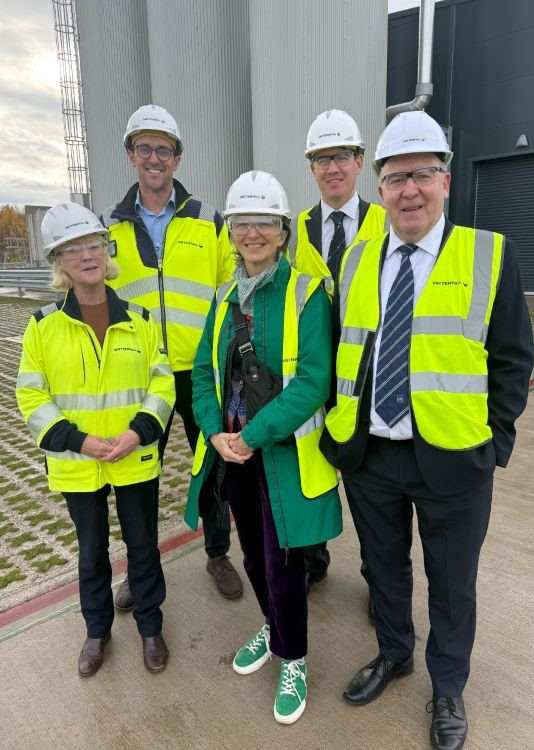
Cross boundary collaboration on heat plans requires coordination, shared governance, council resource and expertise. Midlothian Council for example has a joint venture Midlothian Energy Ltd which is a partnership with Vattenfall Heat UK. A district heating network provides district heating to the Shawfair development, and in the future potentially more widely in collaboration with other authorities. The Committee undertook a visit to to the heat centre to see an example of a large scale heat network.
Committee members and Vattenfall Heat UK staff outside Midlothian Energy Centre
Scottish Parliament
In a written submission Vattenfall Heat UK highlighted to the Committee the need for long-term funding, explaining that city-scale low carbon project takes a minimum of 2 years to develop, procure and design, and then up to 15 years to deliver.
The Cabinet Secretary for Housing told the Committee that there will be a process of providing support through schemes working to build a heat networks industry. ivShe went on to say that much of the Scottish Government's work on heat networks is about trying to make the case for investment and bringing in as much private funding into this expensive area as possible.iv
The Scottish Government has a £300m Heat Network Fund in place providing capital grants to businesses and organisations in the public, private and third sectors to develop heat network projects. It also sponsors the Heat Network Support Unit to support the development of heat network projects through grant funding and advice throughout the pre-capital stages of development. The Unit is building a pipeline of heat network projects to bring to market strategic projects of scale that will gain private investment.
The Committee recognises that expanding the use of heat networks is a priority for the Scottish Government and this is under active development. However, the draft CCP merely signposts development of future strategy and legislation, rather than containing concrete plans. In due course the Scottish Parliament may scrutinise the new Bill, however in the meantime the Committee recommends the Government considers in detail the issues raised by local authorities about where barriers exist and then sets out how they will each be addressed.
Local Heat and Energy Efficiency Strategies (LHEES)
All local authorities are required to produce and deliver Local Heat and Energy Efficiency Strategies (LHEES) in order to drive forward heat decarbonisation and improve energy efficiency in buildings. The draft CCP notes that LHEES have provided an invaluable understanding of the local context across Scotland, and through them the Scottish Government has identified a range of opportunities including over 300 potential large-scale heat networks.
The Scottish Government's aim is to build on the existing LHEES, standardise them where possible and create a streamlined and investible delivery route to underpin its Heat in Buildings Programme. The CCP goes on to say that the process of developing LHEES was designed to be iterative and cumulative, and the Scottish Government has now begun developing the methodology and toolbox for the next iteration in collaboration with a range of local stakeholders.
Gareth Fenney from the Scottish Government told the Committee that the Scottish Government provides £75,000 each year to fund LHEES officers in each local authority, and has committed to do so up until 2027-2028. A scheme review is planned which will include looking at the role of local government and LHEES in delivery going forward. i
The Committee heard from witnesses that LHEES have been a successful tool to collect and analyse data, with local authorities building an understanding of the housing stock and the scale of retrofit required in their region. As described in the following chapter on Decarbonising Buildings, Highland Council has for example determined the extent and cost of retrofitting properties in the authority through its LHEES. George Tarvit from the Sustainable Scotland Network said that LHEES have been part of an important common approach across all 32 local authorities.i
Witnesses were clear that LHEES are not in themselves a delivery mechanism for decarbonising heating, and once again raised the issue of lack of resources in local government.iii Neil Osborne from Highland Council said:
"The reality is that the LHEES is a tool that allows us to collect and analyse data; they are not a delivery mechanism... Alongside the LHEES are the delivery plans - 'delivery plan' is a misnomer, because although they allow to identify what a project should look like, there is no mechanism to drive it forward. Unless we can unlock funding related to that, it is very difficult to see how we can deliver at any kind of scale using that as a tool set"i
Perth and Kinross Council similarly highlighted their lack of capacity and resources to fully deliver the objectives in their LHEES, and that investment in skills, governance and increased staff is needed. They said it would not be sustainable to rely on external expertise. Professor Jan Webb made a similar point about resourcing local authorities to enable to them to deliver and implement LHEES according to the original intention, and in particular move away from competition-based short term funding for specific projects.i
LHEES are clearly an important tool in the Scottish Government's net zero ambitions and have been very successful in developing a significant body of data across all 32 local authorities. It appears, however, that to build on this through local authority delivery of the actions identified, they will require additional long-term investment to build their capacity. The Committee welcomes the Scottish Government's review of LHEES and recommends that it sets out how the Scottish Government will use the review and results of this to build on the valuable existing work.
Decarbonising buildings
The creation of heat networks and the development of Local Heat and Energy Efficiency Strategies by local authorities are important components of the journey towards decarbonising buildings. These have been discussed in the previous chapter covering local authorities' role in delivering the CCP.
The CCP highlights that emissions from buildings, primarily from heating, currently account for 15% of Scotland’s greenhouse gas emissions. They have fallen 39% since 1990, driven by improvements in boiler efficiency, energy efficiency retrofit improvements to existing buildings, higher efficiency standards for new buildings and milder winters. Nearly 90% of Scottish homes, still however, use fossil fuels. Non-residential buildings emissions accounted for 5% of emissions in 2022, down by 31% since 1990. Public buildings have reduced emissions by 53% in this period, while commercial buildings have increased by 15%.i
The Climate Change Committee's assessment is that in order for Scotland to reach net zero by 2045 annual heat pump installations in existing homes will need to accelerate rapidly, reaching nearly 35,000 each year by 2030. i This is an enormous increase from current rates of installations which most recently sat at 7,355 households in 2024.iii Nesta Scotland's analysis is that in total 110,000 heat pumps will need to be installed over the course of the next Scottish Parliament (2026-2031).iv
Emissions from non-domestic buildings (for example factories, shops and office blocks, but excluding public buildings) are covered in the 'business and industrial process' section of the CCP. The draft CCP estimates that more than half of non-domestic buildings use clean heat, and calls on Scottish businesses to take measures to improve the energy efficiency of their non-domestic and domestic buildings, and to replace existing heating systems with clean heat alternatives. It explains that the majority of emissions reductions from non-domestic buildings will be driven by the target to decarbonise heating systems by 2045 and by the current and future support, incentives and advice in place to help building owners to make those changes. The CCP also references:
The intention to boost heat network development through the potential use of powers to require certain properties to change from fossil fuel heating systems when they have the opportunity to connect to a heat network.
Plans to create powers to set minimum energy efficiency standards for non-domestic properties, subject to further consideration.
Revised Energy Performance Certificate (EPC) regulations, coming into force in 2026. These will give businesses better information on how to improve the energy efficiency of their buildings and reduce emissions from their heating systems.
The draft CCP models a 60% reduction in emissions in the residential and public building sector between 2025-2040. The primary driver of emissions reductions is the transition from fossil fuels to clean heat sources in residential buildings. As the CCP notes:
“…a transformational change to the way in which we heat our residential and public buildings is essential to meet our net zero target. Emissions from buildings, primarily accounts for the 15% of Scotland’s greenhouse gas emissions. The heat transition will require around 1.9 million homes and 13,000 public buildings to move to clean heating outcomes such as heat pumps and heat networks by 2045”.iii
The draft CCP lists three heat in buildings outcomes:
"The heat supply to our homes and non-domestic buildings is very substantially decarbonised, with high penetration rates of renewable and zero emissions heating.
Our homes and buildings are highly energy efficient, with all buildings upgraded where it is appropriate to do so, and new buildings achieving ultra-high levels of fabric efficiency.
The heat transition is fair, leaving no-one behind and stimulates employment opportunities as part of the green recovery."
The key policy drivers to meet these outcomes are summarised by the Scottish Government in the CCP as being:
"A target for decarbonising heating systems by 2045: We will also publish a Heat in Buildings Strategy and Delivery Plan.
Financial support for energy efficiency: To enable progress towards our decarbonisation goal while reducing fuel poverty, by providing advice and financial support for energy efficiency.
Heat networks: We are developing plans to boost heat networks by requiring certain properties to change from fossil fuel heating systems when a heat network is available.
Heat in Buildings Programme: We will continue to deliver a programme of support schemes and advice services which are designed to support a wide range of groups to decarbonise heat in our buildings."
The CCP goes on to summarise the policies and proposals identified to deliver the outcomes:
Setting a target for decarbonising heating systems by 2045, so far as reasonably practicable.
By the end of 2026 prepare a Heat in Buildings Strategy and Delivery Plan by setting out the actions that Ministers intend or consider should be taken to ensure that the decarbonisation target is met.
Developing means to boost heat network development through the potential use of powers to require certain properties to change from fossil fuel heating systems when they have the opportunity to connect to a heat network.
Considering options to introduce minimum energy efficiency standards for owner occupier and non-domestic properties, subject to further consideration.
Developing a minimum energy efficiency standard in the private rented sector.
Continue to provide advice and support (such as grants and financial support) for property owners related to energy efficiency and clean heating. Continue to work with lenders to foster market conditions that support a wider range of private lending products.
Continue to target support towards those who need it the most.
The New Build Heat Standard, introduced in April 2024 will continue to ensure that new buildings are future-proofed with either zero or negligible direct emissions from the main heating systems.
Revised Energy Performance Certificate (EPC) regulations to come into force in 2026. In conjunction with EPC reform, consulting on the development of a Heat and Energy Efficiency Technical Suitability Assessment to make sure that the right measures are being installed.
Liaising with partners in the social housing sector on a proposed Social Housing Net Zero Standard before confirming next steps.
Continue to provide free advice to all through Home Energy Scotland Advice Services (and Business Energy Scotland Advice Services), while delivering funding through the Green Heat Installer Engagement Programme to help businesses secure accreditation and upskill their workforce in heat pump installation.
Work to provide advice and support for consumers wherever that is needed and to help people feel confident about navigating the process. A technology neutral approach is a key component of this approach.
Commitment to reduce fuel poverty, and that clean heat combined with reduce electricity prices will enable people to heat their homes comfortably and affordably.
The issues that decarbonising buildings touches on - such as retrofitting, housing quality, construction skills gaps, and funding issues for housing providers - are familiar to the Committee through its scrutiny of housing issues throughout this session of Parliament. These have included the Scottish Government's Housing to 2040 strategy, the current housing emergency, and most recently new subordinate legislation to amend the Energy Performance Certificate system. In addition through its exploration of the current housing emergency, the Committee is particularly aware of the dual importance of increasing housing stock whilst also ensuring existing homes are of high quality and energy efficient.
During the course of its scrutiny of the buildings element of the draft CCP the Committee took evidence from a broad range of witnesses, including householders seeking to retrofit their homes, construction and architectural experts, housing representatives, academics, and local authorities. It also received a number of written submissions from organisations including local authorities. The Committee then put the key issues raised to the Cabinet Secretary for Housing.
The main themes and issues emerging from that evidence are described below. In summary these are:
Heat in Buildings Bill;
Retrofitting and skills;
Consumers; and
Energy costs and production.
Views on the Buildings sections of the draft CCP
The draft CCP was broadly welcomed by many witnesses, in particular the emphasis on linking fuel poverty reductions with emissions reduction targets.iThe CCP’s reference to being technology-neutral was welcomed in providing flexibility given that a 'one-size-fits-all' approach would not be suitable.i However, whilst welcoming the ambition set out in the CCP to decarbonise buildings by 2045, typically those positive comments were accompanied by doubts whether it can achieve that ambition in its present form. Clare Wharmby made the distinction between providing a target and a policy, which should provide clarity on the levers that will be used to meet that target:
"...we need to know exactly the who, what, where, how and when of delivery over the carbon budget periods. We need to know how we are going to eat this elephant bit by bit, because there are an awful lot of buildings to decarbonise and some of them are very tricky."i
In particular witnesses told the Committee they have concerns about whether the CCP brings forward any new actions, and whether it will sufficiently accelerate the pace of change. Gillian Campbell from the Existing Homes Alliance (EHA) said that the CCP does not contain any new policies and that "...doing more of the same is not going to deliver what is required."i Nicola Barclay from BE-ST expressed concerns about a 'lost decade' and a 'drifting of policy'.i She said:
"The lack of urgency is frustrating and disappointing for all those people who could be part of the solution. If we want to have a clear, solution-focused approach as a nation, we need a clear pipeline of work..."i
Professor Janette Webb expressed similar frustration about a lack of progress, noting that whilst there is a commitment in the CCP to delivering a Heat in Buildings Strategy by the end of 2026 there has been a previous version in place for a number of years (which the CCP does not acknowledge), and that there is no reference to the consultation that has already taken place about a Heat in Buildings Bill.i
George Tarvit from the Sustainable Scotland Network suggested the CCP lacks both technological and social innovation, and that one of the weaknesses of the plan is its focus on the "big ticket" mainstream issues.i
Derek Rankine from the Built Environment Forum Scotland (BEFS) welcomed the multiple strategies within the plan that relate to improving building conditions, but noted that the focus on decarbonising heat in buildings is too narrow when there is a need to respond to the climate emergency and achieve net zero as part of a whole-systems approach across policy portfolios.i That need for better linkages across policy areas was raised by other witnesses, for example Dr Jocelyne Fleming who highlighted the crowded policy landscape for construction and housing and said the CCP fails to take into account what the impact of the proposals would be on other areas of policy.i
The Cabinet Secretary for Housing agreed that the number of documents, strategies and delivery plans in the heat in buildings space can make the space appear cluttered, but said it reflects the complexity of an area with many moving parts.i She explained to the Committee that delivering the transition to clean heat is not about a single policy lever but requires a coherent strategy bringing together many elements. These include long-term market certainty, advice and financial support, and investment in the workforce and supply chain.i (Each of these issues will be considered in more detail below in this report.)
She went on to say, when asked whether actions in the CCP may in effect defer the delivery of emissions reductions to beyond carbon budget one, that meeting that budget is about continuing existing schemes whilst understanding that they will need to increase in scale.i
That view contrasted with witnesses' frustrations. Nicola Barclay from BE-ST told the Committee:
"...we spend a lot of time with plans and revised plans, pushing dates beyond election cycles, and we are not good at getting on and doing it. I think that that is what holds us back."i
Io Hadjicosta from Stop Climate Chaos Scotland expressed concerns that the ambition to decarbonise buildings by 2045 is being set up to fail:
"On paper, that aim is bold and progressive, but in practice, it is structurally misaligned with the UK Climate Change Committee in its scale and the timing of the action required. Without urgent action to introduce robust mechanisms that have both incentives and regulatory levers, we believe that the climate change plan in its current form is being set up to fail, partly because it creates a cliff-edge scenario with perhaps modest progress in the first decade, followed by an unrealistic expectation of near-total decarbonisation in the final decade. What that highlights is the need to front load that investment, that action and that ambition in the first decade."i
The Committee asked the Cabinet Secretary for Housing whether the Scottish Government will put an assessment in the final CCP to demonstrate how the target beyond 2030 will be reached. She said that assessment will be provided on an ongoing basis using the best information available at the time, and that the strategy and delivery plan will be:
"...another articulation of our attempt to set out in a really clear way the steps, the funding and what needs to come together in order to make this work. We will just have to keep doing that on an ongoing basis, such is the complexity of this work." i
The Committee also asked the Cabinet Secretary if the final CCP will provide more information on the anticipated costs associated with specific policies and proposals. She described the inherent difficulties in providing accurate costs due to likely technological advices, the cost of products reducing, and because UK Government policy will affect the cost of running clean heating systems.i
The Committee is concerned that stakeholders lack confidence that the CCP will sufficiently drive the necessary progress in decarbonising buildings. As they have highlighted to the Committee, there is arguably little that is new in the CCP which seems to instead bring together the many strands of work already planned or underway.
Stakeholders are calling for the CCP to provide greater clarity about the actions required - a 'route-map' in effect. The Scottish Government has indicated that it is actively responding to the feedback it is receiving during the course of its consultation and the Parliament's scrutiny, and that the final version will provide more of the 'how', together with the intended Strategy which is to be published before the end of the year.
Heat in Buildings Bill
In September 2023, the Scottish Government's Programme for Government announced it would bring forward a Heat in Buildings Bill, and in November that year a consultation was launched on detailed proposals which would prohibit polluting heating systems by 2045 and require those purchasing a home or business premises to end their use of polluting heating systems within a fixed period following completion of the sale. The Climate Change Committee praised that approach in its 2023 report on 'Progress in Reducing Emissions in Scotland' as being a potential template for other parts of the UK. The Government's consultation stated that:
"There is no way to meet our legal obligation to reach net zero without changing the heating systems in the vast majority of our buildings."i
In each annual tracker report which the Committee has since published, we have expressed disappointment at the lack of urgency from the Scottish Government in progressing this.ii The then Acting Cabinet Secretary for Net Zero and Energy announced to Parliament in March 2025 that a Heat in Buildings Bill would not be laid until she was satisfied that the interventions in it will decrease fuel poverty at the same time as they decarbonise houses. The Climate Change Committee (CCC) the following month said that:
"It has been 18 months since the Scottish Government initially consulted on the Heat in Buildings Bill... It is therefore disappointing that the proposals for regulations to upgrade properties at the point of sale have been abandoned, with, as yet, no specific alternative measures to deliver the target for heating to be zero emissions by 2045."iii
A Ministerial statement to Parliament in April 2025, and the subsequent Programme for Government in May 2025 both reiterated the Scottish Government's commitment to delivering a Bill during this session of Parliament.iv The Committee and our stakeholders have long anticipated scrutinising the draft Bill once it was laid before Parliament, in recognition of its importance.
However on 18 November, two weeks after the draft CCP was published, the Cabinet Secretary made a statement to Parliament announcing that the Bill would not be introduced this session. It is to be replaced with a Buildings (Heating and Energy Performance) and Heat Networks (Scotland) Bill which (subject to the outcome of the election) will be introduced in the next parliamentary session, but which has been published in draft form in the meantime.
There are three main parts to the draft Bill:
Part 1 sets a target for decarbonising heating systems by the end of the year 2045.
Part 2 allows the Scottish Ministers to make regulations to set minimum energy performance standards for buildings in which direct emission heating systems are used, and to provide for the assessment and improvement of the energy performance of those buildings.
Part 3 relates to heat networks (as defined the Heat Networks (Scotland) Act 2021). In particular, it gives the Scottish Ministers regulation-making powers to set up a new licensing regime for heat network zones, and for granting certain rights and powers over land in connection with the installation and maintenance of heat networks.
In the Cabinet Secretary for Housing's evidence to the Committee she said that the decision to delay a Heat in Buildings Bill was not straightforward, and due to a number of reasons. However she did not believe it would have a great impact on meeting the target to decarbonise buildings by 2045.v
The frustration expressed by the Committee with the significant delays to introducing legislation on heat in buildings was mirrored by that of witnesses in the evidence that we heard on the CCP, who were disappointed that its original scope has been diluted, and said that industry confidence has been undermined. The Committee asked for views on the impact of a lack of regulation thus far and within the CCP itself to drive the decarbonisation of buildings.
IPPR Scotland argued in their written submission that the pace of voluntary action is too slow, and that it leaves households wondering if their own sacrifice is going to be matched by their neighbours'. Regulatory intervention would help accelerate pace and improve coordination and certainty.vii
Io Hadjicosta from Stop Climate Chaos Scotland also described to the Committee the importance of regulation driving change, saying the draft plan lacks any direct mention of carrots and sticks in the form of timelines and clear mechanisms:
"In this case, the carrots would be sustained grants, low-cost finance and working with the UK Government to reform electricity and gas prices; and the sticks would be the regulatory triggers that we were waiting for the heat in buildings bill to introduce in order to give the workforce, businesses and consumers certainty and a commitment that the transition will happen in a just and fair way."v
In its written submission to the NZET Committee, the Existing Homes Alliance said that without the Heat in Buildings Bill in its original form there is a significant gap in a lack of policy to drive action amongst owner-occupiers, who account for 60% of homes:
"...dropping the proposed point of purchase trigger from the Heat in Buildings Bill creates a significant policy gap in the Scottish Government's approach... Approximately 100,000 homes are sold each year, and having this visible and reliable flow of demand would enable industry able to scale over time and ensure an affordable and achievable transition throughout the 2030s."ix
And in her oral evidence to the Committee, Gillian Campbell from the Existing Homes Alliance expressed concerns about the impact of the CCP and the draft revised Bill, saying she did not have confidence that the target will be achieved or that decarbonisation of heating will happen in a way that is phased, manageable and achievable by the supply chain.v
It is regrettable that there have been such significant delays in delivering the Scottish Government's commitment to bring forward legislation on heat in buildings. The Cabinet Secretary for Housing told the Committee that this will not jeopardise the target to decarbonise buildings by 2045, but also heard from witnesses that it has not only put at risk the Government's own net zero targets, but has also created significant uncertainty for the housing sector and for home-owners.
Whilst it is not the scope of this report to consider the draft Buildings (Heating and Energy Performance) and Heat Networks (Scotland) Bill in its current form, it is important to note its importance in Scotland's ambitions to meet net zero by 2045. The initial reaction to the draft Bill from stakeholders has raised concerns that it will not provide the clarity which they are seeking. The final CCP should do more to specifically highlight the intended impact of the proposed Bill.
Retrofitting and skills
The term 'retrofitting' refers to making improvements that will improve a building's energy efficiency and can include a range of actions, from increasing insulation and reducing drafts, upgrading windows to reduce heat loss, through to replacing gas central heating with alternatives such as heat pumps.
The CCP notes that around 1.9 million homes and 13,000 public buildings need to move to clean heating systems such as heat pumps and heat networks by 2045. It also highlights the economic opportunities presented by that transition, with research on Building Skills for Net Zero in Scotland estimating that Scotland will need an additional 22,500 workers by 2028.
As Nicola Barclay from BE-ST told the Committee, Scotland has some of the "leakiest" buildings in Europe, losing three times as much heat as homes in Germany. As a result of being so inefficient they are clearly less comfortable and more expensive to heat, putting people at greater risk of fuel poverty. In addition, the statistics provided by the Scottish Government's most recent Housing Condition Survey show that 186,000 of tenement flats and 97,000 detached houses date from pre-1919, and older buildings such as these are typically less heat efficient.i
The draft CCP acknowledges the challenge, saying that:
"We must rapidly accelerate the number of heating systems converting to clean heat as we move towards and then into the next decade. Almost 20% of Scotland’s dwellings were constructed before 1919, so special consideration will be given to retrofitting traditional buildings."
Attendees of the Committee's online discussion event about retrofitting described their personal experiences. Some people are living in homes that are damp, mouldy and draughty, and need fixing before any retrofitting can make a difference. At times social housing providers are installing new kitchens and bathrooms but not including window replacement in upgrades, so properties remain draughty and cold.
Derek Rankine from the Built Environment Forum Scotland said that 34% of households are in fuel poverty, 20% of dwellings are below tolerable standards and 45% have disrepair to critical elements.iii As an example of the resources required in just one local authority area to tackle these issues, Neil Osborne from Highland Council told the Committee that the council's analysis for its Local Heat and Energy Efficiency Strategy (LHEES) identified there are 87,000 properties needing intervention at a cost of £3.2 billion.iii
Clearly the scale of the challenge to decarbonise heating is enormous. Craig Hatton from Solace highlighted that without funding, the investment needed to retrofit local authority housing stock will have to be funded through rent increases, and will therefore impact on tenants.iii
Outwith social housing, retrofitting Scotland's existing housing stock remains the responsibility of individual owners, but witnesses told the Committee that given the scale of the challenge, this is not the solution. Professor Webb said that:
"The one-building-at-a-time approach is probably the most expensive all round; it is expensive not just for the property owner, but for all of us as consumers of electricity. If we rely on individual heat pumps, for example, that will be very challenging in Scotland, given that 40 per cent of housing is made up of tenements and flats. "iii
As described above, the Scottish Government had initially intended to mandate the installation of heat pumps at the point of sale of a property through a Heat in Buildings Bill. Instead, a draft Buildings (Heating and Energy Performance) and Heat Networks (Scotland) Bill has been published and is intended to be brought to Parliament following the election in May 2026, subject to the outcome. The Cabinet Secretary for Housing told the Committee that including a requirement for people to switch to zero-carbon heating systems would not be fair:
"It could catch people at points of difficulty and potentially exacerbate fuel poverty. Therefore, rather than prescribe trigger points, we should set the long-stop date and fill that period with the right support, industry building and regulatory elements...to encourage behaviour."iii
Craig Hatton from Solace highlighted that it is easier to build more energy efficient homes than it is to retrofit existing homes.iii Scotland's New Build Heat Standard came into force effective April 2024, requiring that new buildings use zero direct emissions heating systems such as heat pumps and solar. As a result new homes typically achieve an energy efficiency rating of at least 'B'. Dr Atkins from the Royal Incorporation of Architects in Scotland though highlighted the relatively small proportion of housing which new homes comprise, and that by 2045 only 1% of existing housing stock will have been demolished.iii
Key components of delivering retrofitting at sufficient scale are the creation of a pipeline of demand through improved public awareness (discussed in more detail under the section on 'consumers' below), and the ability of that demand to be met by a strong supply chain including trained contractors. However the cost will still be a barrier for many people.
Installation of heat pumps is expensive, although estimates vary. Changeworks, for example, suggest that the average cost of installing a heat pump is £14,000, although that varies according to the circumstances.x In their written submission to the NZET Committee, the Royal College of Physicians Edinburgh estimates costs at typically being £7,000–£12,000, but that these costs can be significantly reduced through area-based delivery, economies of scale, and supply chain development. They note too that cheaper alternatives such as installing or upgrading loft insulation and changing to LED lighting should be standard.xi
The Committee put it to the Cabinet Secretary for Finance and Local Government that given their position of trust, local authorities could perhaps become a delivery partner in not only the provision of advice but also facilitating heat decarbonisation measures such as heat pump installation. The Cabinet Secretary noted there are economies of scale with regard to price, and Gareth Fenney noted that existing Area Based Schemes provide an existing example of local councils leading in this way.iii In a subsequent letter to the Committee the Cabinet Secretary confirmed that in principle there is nothing to prevent a public authority from becoming a bulk buyer assuming they give due consideration to procurement regulations and Best Value considerations.xiii
The Cabinet Secretary for Housing suggested that there are a significant number of bank products available for consumers to fund improvements. Gareth Fenney went on to say that there is no shortage of finance, such as green mortgages, but the demand for it needs to be grown.iii In 2022 the Scottish Government established a 'Green Heat Taskforce' to explore alternative sources of funding and financing for heat decarbonisation. In December 2025 the Scottish Government responded to the Taskforce's recommendations.xv
Witnesses told the Committee that potential solutions to making retrofitting more cost-efficient include the use of housing 'archetypes'xvi which support the identification of the most effective improvements to a particular type of home. Professor Sean Smith told the Committee that this is not a new concept, and one which the Net Zero Social Housing Taskforce's report referred to as a priority in 2021.xvii He went on to explain that:
"Part of the reason why the industry is keen on archetype solutions is that they enable you to go to the public and say 'Here is your typical house' - it could be a timber frame, it could be a four in a block or it could be a tenement - 'Here are before and after, and here are different types of solutions, technologies or measures."iii
The Committee heard too about the particular challenges in retrofitting tenement buildings, given not only their age but often the frequent mix of tenures within each block, including social housing, owner occupiers, renters, and holiday lets. In their written submission to NZET Committee, Historic Environment Scotland referred to the need to bring forward legislation to facilitate owners to take action together, and for the need for the definition of 'maintenance' to be expanded to include zero-carbon heating transitions, with compulsory owners' associations mandated to support this. Professor Webb said that there needs to be a much more structured and planned approach.iii:
Professor Smith from the Chartered Institute of Architectural Technologists told the Committee about the creation of the Centre for Net Zero High Density Buildings, a research partnership of five Scottish Universities and funded by the UK Government. The Centre is testing various archetype solutions for high density buildings which will be published on the Retrofit Scotland website.iii
The Energy Saving Trust (EST) also referred to the challenges which exist in seeking to retrofit flats, in particular co-ordinating groups of owners, the technical complexity of the retrofit required and varying incomes and ability to pay within groups of owners. Given more than 36% of people in Scotland live in flats decarbonising these homes has an important role to play in meeting climate change targets.xxii In 2024 the EST published a report on this issue, learning lessons from countries across Europe, which recommended the need to address the gap in financial support for groups of owners, noting that current schemes do not include provisions for collective applications.
EST went on to say in their submission that there needs to be planning in place for retrofitting in order to provide policy certainty that would in turn drive investment:
"The Scottish Government should set out clear, long-term plans and funding commitments for retrofit programmes. This should include clarity on what measures will be needed, how much work is expected, when it will happen, and where - so that businesses can plan ahead and invest in workforce growth. Regulation will also be important to provide certainty for businesses... At present, uncertainty about future demand is holding back supply chain investment."
The Committee heard too about the challenges in retrofitting homes in rural areas, which are typically older buildings, many of which are detached. Councillor Macgregor said there is a need to be realistic in recognising that many older buildings may never meet energy efficiency targets.iii Nicola Barclay highlighted that they are typically not on mains gas supply, and that the information and advice provided to the public about retrofitting in rural areas needs to be regionalised and hence more contextual to the relevant area.iii The availability of trained tradespeople in rural areas compounds the practical difficulties in retrofitting properties, which is discussed in more detail below.
It is clear that retrofitting Scotland's existing housing stock at sufficient scale and pace will be essential to decarbonising heating, and therefore to meeting the CCP's targets. A piecemeal approach which continues to rely on individuals taking action will not be sufficient. The Committee is concerned that the projected rates of heat pump installations will not sufficiently scale up by 2030 in order to put Scotland on course to reaching the 2045 target.
There needs to be national leadership from the Scottish Government in partnership with the UK Government to deliver this through a coherent delivery plan, for example a National Retrofit Strategy as proposed by witnesses. It may be that the Scottish Government's intended Heat in Buildings Strategy and Delivery Plan will meet this need. If so, this should include planning for:
An area-based approach which enables retrofitting to take place at scale using housing archetypes. This would in turn help reduce costs and enable local supply chains to be developed.
Retrofitting Scotland's significant proportion of tenement and flatted buildings.
Meeting the particular challenges in retrofitting rural properties.
The Committee considered whether there may be a particular role for local authorities in becoming a trusted supplier of technology such as heat pumps, and notes that the Cabinet Secretary for Finance and Local Government has confirmed that in principle this may be possible. The Committee recommends that the Scottish Government should explore this further as an option for ensuring decarbonisation takes place at the scale and pace required.
The CCP estimates that delivering the workforce required to decarbonise buildings needs an additional 22,500 workers by 2028. Witnesses were concerned that Scotland is not on the necessary trajectory to meet that need and that the CCP does not address this. Professor Smith noted that skills were only mentioned once in the main CCP document. iiiIan Hughes from the Construction Industry Training Board for example highlighted workforce planning, skills requirements and the scale of what is required are not covered in the CCP.iii
The Committee heard from a number of witnesses about the current lack of trained contractors to deliver energy efficiency home improvements. Neil Osborne from Highland Council explained that in the region there are no qualified contractors at all for some skill-sets, and so they need to be brought in from the central belt. He told the Committee that the retrofit market is predominantly driven by the Energy Obligation Fundxxviii (a government scheme requiring large energy suppliers to fund energy efficiency upgrades like insulation and new boilers for low-income, vulnerable households to reduce bills and carbon emissions, which is helping to tackle fuel poverty). The large contractors that are buying into it and skilling up are looking at opportunities presented by volume of business and focusing on those areas.iii
In contrast, the Committee heard that small and medium-sized enterprises (SMEs) make up around 95% of the construction industry in Scotland.iii SMEs are therefore the main employers and also key to building the retrofit workforce. Professor Smith said that the industry needs to be incentivised in order to grow and to produce a pipeline of activity. He told the Committee that despite Scotland having excellent facilities such as the Energy Training Academy they are not being maximised. The Academy is funded by SMEs rather than receiving direct investment by the Scottish Government.iii
People who attended the Committee's online discussion about retrofitting described their own challenges in finding tradespeople to get work done, particularly in more rural areas, echoing Highland Council's experience. They told the Committee that there needs to be investment in training programmes and people encouraged to get into trades as a career, especially electricians. One customer had to wait months before his contractor could undertake the necessary accreditation for the work he required. Others highlighted contractors travelling between cities daily to undertake work.
Dr Fleming from the CIOB called for an enhanced role for local authorities in delivering on retrofit, saying that they could catalyse change and drive supply chains as anchor stakeholders and leaders on area-based projects.iii This idea was put to the Cabinet Secretary for Finance and Local Government who subsequently wrote to the Committee saying that further exploration would be needed.xxxiv
In their written submission to the NZET Committee BE-ST called for a government-led oversight and accreditation mechanism for retrofit assessment that covers assessment, design and specification, installation, evaluation and occupancy. They said it should have clear scope, competency requirements (including routes via professional bodies) and independence from production and installation outcomes to maintain public trust.xxxv
Professor Smith expressed concerns about building safety given the significant shift towards electrification and the fire risks associated with battery technologies that are going into housing. He noted that there is not the equivalent of a gas safety register for electricians, and that this is a health and safety issue that needs to be addressed for consumers' protection.iii
Ian Hughes from the CITB explained that the solution to a skills shortage is not necessarily about increasing the numbers entering the profession but improving retention. Of around 19,000 young people studying construction within the further education sector in Scotland, there are only around 6,000 modern apprenticeship starts each year. He said that the Scottish Government has set up a short life working group to explore how to retain more apprentices.iii
Professor Smith also described the success of the Edinburgh and South-East City Region deal in investing in skills, and how it could be highlighted in the CCP as a successful model. He said that it has had a huge impact on the number of people trained and skilled, with 200 EV charging installers.iii
Having sufficient numbers of trained tradespeople to deliver retrofitting is clearly critical, and the draft CCP acknowledges the significant additional numbers required in order to deliver its aims. It does not however provide detail on how that challenge will be tackled. The National Retrofit Plan which the Committee recommends is developed by the Scottish Government should incorporate a Skills Plan that sets out how the gap will be addressed, in particular in rural areas where the skills shortage is greater, and with a focus on supporting SMEs to grow their retrofit workforce.
The Committee invites the Scottish Government to note the success of the Edinburgh and South-East City Region deal in investing in skills, and recommends it incorporates this approach with a National Retrofit Plan.
Consumers
As described in the previous section on 'retrofitting and skills', building public awareness and support for taking action is a key part of bringing about the change that is needed to decarbonise heating. The Buildings sectoral annexe in the draft CCP has a very brief section on 'People and Communities' which notes the implications of decarbonising buildings and commits to "take action to support people and communities". Elsewhere it notes that public engagement has informed the development of measures throughout. It says:
"Achieving this transition will depend on making the journey as smooth as possible by supporting consumers...and by helping people to understand and smoothly navigate the transition to clean heat."i
However the Committee heard that there is a long way to go in building that understanding. Alistair Hill from Consumer Scotland welcomed the focus in the CCP on supporting consumers to transition to cleaner home heating given the important role of consumers as active participants, but said that it needs to have more focus on preparing consumers for what actions will be required in the coming years.ii Dr Fleming from the Chartered Institute of Building (CIOB) told the Committee about the CIOB's consumer survey in Scotland which found that 39% of people had never heard of any of the available energy efficiency upgrade grants, 19% indicated that their understanding of how to go about retrofit and energy efficiency upgrades was a barrier to taking action, and one in five said they don't know how. ii
Gillian Campbell from the Existing Homes Alliance noted that although the Scottish Government published a public engagement strategy in December 2023 "...we have not seen a great deal of progress since then."ii
David Raines from Homes for Scotland suggested there needs to be a sustained marketing campaign to both educate and support the public in understanding the costs and benefits of the move to net zero. ii Professor Webb expressed concerns that there is no reference in the CCP to the role of Heat and Energy Efficiency Scotlandii the national public energy agency established to provide leadership and coordination to accelerate delivery of clean heat and energy efficiency.
Professor Webb also suggested that emphasising people's identities as 'consumers' moves the focus away from the different identities that people have, and there needs to be a more holistic approach to getting people engaged in understanding why they need to act.ii Gillian Campbell went on to similarly highlight the different motivations that people may have to take actions, and the need for public engagement to take account of those by using motivating factors such as improving warmth and comfort of a home, or financial benefits which will enhance people's lives.ii
She went on to describe the potential for industry-led initiatives which match those motivations, for example a warmth or comfort guarantee which could be provided by an installer. Nicola Barclay from BE-ST similarly described the need for different messages for different age groups, housing typologies and tenures.ii
In its written submission to the Committee the City of Edinburgh Council set out in some detail how best to deliver public communication:
"The Scottish Government has a role in reinvigorating the climate emergency as a priority through communications. Myth-busting, positive stories and testimonials, practical advice and engaging and regular communications campaigns and the use of trusted advocates...would all be useful types of communication. Communications should move away from generic national campaigns using static graphics and boilerplate messaging which do not drive engagement and move instead towards a more place-based approach, supporting local authorities, community groups and regions to create and share content relevant to their locality."x
The Committee heard about the important role that the public sector can play in public engagement as a trusted voice, as described by George Tarvit from the Sustainable Scotland Network who said that people in the farming community, emergency services or the cultural sector "...can often cut through very effectively when you are trying to change behaviour."ii
The suggestion was put to the Cabinet Secretary for Housing that local authorities also have an important role in being trusted by the public, and could provide advice and potentially also become a volume supplier in order to bring prices down. She indicated that she would be open to looking at how local authorities might play a bigger role.ii
The Committee appreciates the inherent inefficiencies in relying on heat decarbonisation taking place home-by-home, but it remains critical that the public understand both the importance of taking action and what steps they can take as individuals or households. The Committee notes that there is an existing public engagement strategy in place but heard concerns that little progress has been made. The draft CCP stresses the importance of supporting people and communities and reiterates the Scottish Government's commitment to fund a range of delivery schemes, but is very brief on this important area.
The Committee recommends that the final CCP is accompanied by an updated and detailed public engagement strategy that sets out how different audiences will be targeted and explores the role that different sectors will have, especially that of local authorities as a trusted voice. This should also provide clarity about the role of the Heat and Energy Efficiency Scotland agency.
Advice services
The draft CCP commits the Scottish Government to continue its delivery of support schemes and advice services, including the Home Energy Scotland (HES) Advice Service and its grants and loans system, Area Based Schemes (which meet the costs of energy efficiency measures in households at risk of fuel poverty), and Warmer Homes Scotland (the national fuel poverty scheme).
Attendees at our engagement event described there being a lot of complex information available about retrofitting which is difficult to navigate, concerns about potential unintended consequences of taking action, and difficulties in finding trusted sources of advice. In addition, people without access to the internet are at a disadvantage in accessing information, and need direct contact from the Government, for example on the grants available.
The Committee heard that some people actively trying to retrofit their homes have found the Home Energy Scotland (HES) advice and support hard to navigate, and the point was made to it that if motivated individuals find it hard to engage with HES advice, then how were those who were not already engaged going to accomplish decarbonisation of their home.
It seems that HES is not always able to provide the bespoke guidance needed by households seeking to undertake a significant retrofitting project. Alistair Hill from Consumer Scotland echoed that point, telling the Committee that whilst people are positive about the Home Energy Scotland advice service, they wanted more detailed information about their property, at times finding that installers were more useful sources of information.iiiAttendees of the Committee's online discussion said that it was only when they came across an agency who could take them through each step of the way and make recommendations (rather than just provide information) that they began to make progress.
In recognition of this, some councils are providing services through other organisations rather than HES, for example South Lanarkshire who uses Eco-cosi to be a ‘one-stop-shop’. Part of that service is to identify vetted installers and make checks on them. The Committee heard about the importance of being able to have trust in contractors - some attendees at the discussion gave examples of installers recommending very expensive solutions which were not actually required (for example, a larger heat pump than would be needed for the size of the property just based on the size of the house).
Attendees of the discussion event suggested there should be an organisation which could translate the requirements of their home into the exact practical steps needed. However those representing social enterprises and charities told the Committee that it is hard for them to compete with Home Energy Scotland, despite their limitations, because it provides a free service, and more private finance in the advice sector was needed.
Gillian Campbell from the Existing Homes Alliance Scotland suggested three changes to the existing advice and support framework to enable services to grow:
"If Home Energy Scotland was enabled to signpost customers to the... one-stop shop services - that would help to generate the demand that would ensure that people were getting the level of support that they needed... Secondly, policy certainty is absolutely critical to demonstrate that there will be future demand. Thirdly, by making the project coordination costs eligible for grant and loan funding, there would be the potential to help these organisations to scale up."iii
The Energy Saving Trust (EST) delivers the Home Energy Scotland advice service on behalf of the Scottish Government, which covers energy efficiency, clean heat, water saving and renewables. Elaine Waterson from the EST described the success of the scheme, with it reaching around 95,000 households a year, around 40% of which go on to take action. She noted that demand for that service will dramatically increase if climate targets are to be met, and that HES' approaches to advice will need to change as a result, such as through offering more digital self-service options. Gillian Campbell from the Existing Homes Alliance told the Committee that even with increased digitisation of services she did not think HES would be able to respond in the future to the increased scale of demand, or the more intensive engagement needed by many households.iii
Elaine Waterson went on to describe the improvements that HES has been making in order to streamline its processes, in response to the frustrations experienced by customers and installers, which has reduced the numbers of complaints received.iii Professor Sean Smith from the Chartered Institute of Architectural Technologists agreed that it seemed the position has improved.iii
The Committee put to the Cabinet Secretary for Housing that the 2026-2027 Scottish Government draft budget provision for energy efficiency and decarbonisation shows real-term cuts being made, with an allocation of £326.5 million in the coming year. That is only a 1.6% increase in budget for heat in buildings schemes, including Home Energy Scotland, despite an anticipated large increase in demand for their services.iii
The Cabinet Secretary for Housing told the Committee that she wants HES to be the main window of support and trusted advice, and Gareth Fenney described an ongoing programme of work underway to improve the customer journey through HES and engagement with the supply chain. There is awareness too that the existing loan offer can complicate the customer journey, which is being explored further, and that particular groups of people may need different support.iii
The Committee notes that Home Energy Scotland clearly provides an important service and is a vital source of advice and guidance for many people, in addition to administering grants and loans. But it clearly does not meet the needs of all people seeking to make their homes more energy efficient, in particular those seeking to make significant and complex changes. The Scottish Government also needs to prepare now for how a rapid increase in demand for help will be met. The Committee believes there is significant merit in the proposals made to it that 'one-stop shops' should be fostered to supplement the work of HES, which could then refer people on to these where appropriate. Nicola Barclay from BE-ST described Ireland's successful model which began with two one-stop shops in 2021, and there are now over 20 of them around the country.
Given the importance of the public taking action to improve the energy efficiency of their homes, and a real-term decrease in the budget for 2026-2027 for energy efficiency and decarbonisation the Committee recommends that the Scottish Government looks more widely than Home Energy Scotland to meet the demand for advice and guidance. It should actively explore how to foster the 'one-stop shops' suggested by witnesses which could provide tailored support for improvement projects. The approach in Ireland may provide a useful exemplar.
Funding
As discussed in the section above on 'Retrofitting and skills', installing a heat pump is a significant expense for a household, with estimates ranging from £7,000 to £14,000. The CIOB's consumer survey referred to above highlighted that the biggest barrier to people taking action is, unexpectedly, a lack of funding.
There are some existing schemes for people to access funding. Home Energy Scotland's grant and loan schemei offers grants for heating systems of up to £7,500, with a further £7,500 available as an interest free loan. Grants are also available for other energy efficiency measures such as installing insulation. The Scottish Government announced in November 2025 that grant support of up to £7,500 will also be introduced for homeowners to enable connections to heat networks through the Home Energy Scotland Grant and Loan schemeii in addition to a £7,500 interest free loan. For those that qualify for a island/remote rural uplift through the scheme, an additional £1,500 of grant funding will be available.
The Committee heard during its online discussion event about some of the limitations of the existing funding available. Conditions placed on funding can at times act as a barrier, for example a requirement for 100% of heating to be delivered by a heat pump in order to be eligible for grant funding, and a more nuanced approach was suggested including eligibility extending to other heat sources such as air-to-air heat pumps. Even with grant eligibility, uncertainty about lengthy payback periods can make additional contributions to retrofit feel unrealistic. The perceived inability to realise financial benefit within a meaningful time-frame is a genuine barrier for many in an older age group.
Professor Smith from the CIAT made a similar point, noting that the vast majority of people who have fully paid their mortgages are likely to be retired and have limited funds available. He suggested introducing a 'help-to-retrofit' scheme where the cost of the works was subsidised by the Scottish Government and recovered at the point of sale of a property.iv
The point was made too to the Committee during its online discussion event that most people replace boilers in emergency situations, for example in winter when they break down, rather than planning ahead. In order to capitalise on this and increase the installation rates of heat pumps it was suggested that there needs to be a pathway for retrospective applications for heat pump grants, so that if needed people can get them installed urgently (for example an installer could issue an emergency replacement notice).
Clearly the Scottish Government cannot finance the expense of decarbonising every home in Scotland, and the CCP notes the important role that private investment and finance will have. The Government can seek to remove barriers to people obtaining finance, and the Committee heard a number of practical suggestions. It has not explored these in detail but recommends that the Scottish Government considers and responds to these:
Retrospective applications for heat pump grants, given that heating systems are often replaced in emergency situations (for example after breaking down during winter months).
Widening the eligibility for grants beyond heat pumps, for example to other technologies such as air-to-air heat pumps on a case by case basis.
A 'help to retrofit' scheme for older homeowners where costs are covered on the sale of a property.
Energy cost and production
One significant challenge to the shift towards clean heating systems such as heat pumps is the relative expense of electricity compared with gas. As the CCP notes, multiple stakeholders including the Climate Change Committee (and witnesses to the Committee's inquiry) have underlined the importance of this. Reducing fuel bills is also vital to tackling fuel poverty, which affects an estimated 33% of all households in Scotland.
In her evidence to the Committee, the Cabinet Secretary for Housing explained that heat pumps are estimated to be three times as efficient as gas boilers, but the unit costs for electricity are currently around five times higher than for gas.ii The Scottish Government hoped that when published the UK Government's Warm Home Plan would take steps to rebalance the pricing of electricity and gas, but since the Cabinet Secretary's evidence the Plan has been published and does not address this.iii The Cabinet Secretary said that the decisions made by the UK Minister for Energy Consumers will be integral to what the Scottish Government is able to take forward.ii
The Committee also heard though that rebalancing gas and electricity pricing is not the only financial solution to decarbonising heating. Io Hadjicosta from the Stop Climate Chaos Scotland described the other mechanisms available including ongoing grant and loan schemes and unlocking private investment.ii
Action at community or regional levels is also important. Neil Osborne from Highland Council described the frustrations experienced in rural regions where renewable infrastructure is highly visible, such as wind turbines in the Highlands, but people experience no advantage from that proximity. He said:
"We live in a region that is one of the biggest producers of renewable energy, yet we have the highest energy cost. There is currently no mechanism for us to utilise that energy locally... Inverness does not have any direct connections, so using renewables directly will be difficult.... There needs to be fundamental change in how we look at the energy market, certainly in rural Scotland, if we are to deliver this at scale."ii
Cornelia Helmcke from the Scottish Research Alliance for Energy, Homes and Livelihoods highlighted that such frustrations can be counter-productive by reducing support for a just transition:
"The rollout of just transition infrastructure, such as the transmission network and the big pylons that are being built across Scotland, begs the question what Scottish rural communities that are in fuel poverty will get out of it. If more renewable energy is removed from where those communities can access it, and it is still not affordable or available to them, it is hard for them to be supportive of that."ii
Neil Osborne went on to describe Highland Council's social value charter which aims to capture benefits from development taking place by enabling communities to understand how they can use funding effectively. He said that the charter looks at how the council can engage with developers and businesses so they can structure how they support communities by feeding in community benefit.ii
Robert Nicol made a similar point about ensuring that communities get genuine benefit from the renewables infrastructure that is developed, an issue which is becoming more acute due to both wind farms but other infrastructure too.ii The Cabinet Secretary for Finance and Local Government agreed with the principle that communities need to see the benefit of infrastructure investment, and that more is to be done in the space.ii
Witnesses told the Committee about the opportunities presented by energy production for local authorities. Craig Hatton described a project by South Ayrshire to develop a solar farm, an approach which other councils are looking to. He went on to say:
"In our case there is what I call a triple bottom line: it is good from a revenue perspective, it is great for the environment and we are using some of the money to support local communities with their own initiatives."ii
Councillor Macgregor though noted that although there is the desire for investment in solar and other renewables, there is no grid link and there will not be for a number of years, perhaps as late as 2040.ii Craig Hatton went on though to describe how difficult working with the National Grid has proved to be in developing such projects, with connection in one instance taking six years after applying and costs doubling in the meantime. He explained that such great uncertainty makes it very difficult for communities to become energised in developing initiatives.ii
The National Energy System Operator (NESO) is a UK-wide organisation created as a result of the UK’s 2023 Energy Act, which is responsible for planning and delivering energy across all sources. NESO is developing Regional Energy Strategic Plans (RESPs) for England, Scotland and Wales which will aim to ensure that local areas get the energy infrastructure they need to meet local net zero and growth ambitions, and help communities to access clean and affordable energy. Robert Nicol highlighted that NESO is working closely with Scottish councils, and once in place its RESP for Scotland could be quite powerful.ii
The Committee notes that the Scottish Government has a target of 2GW of community and locally owned energy by 2030, but is currently at just 55% of that target. Cornelia Helmcke said that community ownership has become unviable in recent years because the feed-in tariff scheme that supported it ended in 2019 and the community and renewable energy scheme ('CARES') is not "pulling its weight". She gave an example of what successful community ownership might look like:
"Instead of just putting a solar panel on a local school, community ownership could mean having one to three larger turbines that create a substantial income for the community, which can decide for itself how to use that."ii
She also told the Committee about the waste of curtailed energy, providing the example of Orkney, where energy operators are not allowed to install a battery to store or distribute the extra energy they get from turbines.xvii:
"...the big elephant is that energy prices are hovering over everything. In addition, at the moment, electricity grid regulation does not allow curtailed energy operators to distribute or store energy on the grid.. That is completely against what the Just Transition is trying to achieve, so it needs to be addressed."ii
The issues raised on energy cost and production by witnesses are familiar concerns which the Committee wishes to reiterate in this report. However the Net Zero, Energy and Transport Committee is considering the energy supply sector in more depth during its scrutiny of the CCP and so the Local Government, Housing and Planning Committee has not explored this in further detail. It notes however that without clarity from the UK Government on electricity pricing it is difficult to see how the public can be persuaded to make the switch from polluting heating systems in sufficient numbers.
Annexe A: Committee scrutiny
At its meeting on 11 November 2025, the Committee agreed its approach to scrutiny of the draft Climate Change Plan. The Committee agreed to seek views in writing from local authorities about the calls that the draft Climate Change Plan makes of them. Ten responses were received from local authoritiesi.
The Committee held two oral evidence sessions with a range of witnesses. On 18 November 2025, the Committee took evidence in round-table format from:
Built Environment Forum Scotland (BEFS)
Chartered Institute of Building
Consumer Scotland
Highland Council
Homes for Scotland
The Royal Incorporation of Architects in Scotland (RIAS)
Scottish Research Alliance for Energy, Homes and Livelihoods (SRAEHL)
Stop Climate Chaos Coalition (SCCS)
Professor Janette Webb
On 16 December 2025, the Committee took evidence from:
Built Environment – Smarter Transformation (BE-ST)
Chartered Institute of Architectural Technologists (CIAT)
Construction Industry Training Board (CITB)
COSLA
Energy Saving Trust
Existing Homes Alliance Scotland
Scottish Climate Intelligence Service (SCIS)
Society of Local Authority Chief Executives and Senior Managers (Solace)
Sustainable Scotland Network
Ahead of, and following these sessions, several witnesses accepted an invitation to provide written submissions to supplement their oral evidence. In addition the Committee received two submissions from organisations that did not provide oral evidence.
Submissions were received from the following organisations:
Built Environment Forum Scotland (BEFS), 14 November and 26 November 2025
Built Environment - Smarter Transformation (BE-ST), 9 December 2025
Chartered Institute of Architectural Technologists (CIAT), 9 December 2025
Construction Industry Training Board (CITB) 5 December and 16 December 2025
Energy Saving Trust, 9 December 2025 and 13 January 2026
Existing Homes Alliance Scotland, 9 December 2025
Nesta Scotland, 11 December 2025
Passivhaus Trust, 9 December 2025
The Royal Incorporation of Architects in Scotland (RIAS), 13 November 2025
On 4 November 2025, Members of the Committee visited Midlothian Energy Centre, a large-scale heat network development delivered by Vattenfall Heat UK and Midlothian Council. The purpose of the visit was to understand the opportunities and challenges presented in the development of large-scale heat networks. Following the visit, Vattenfall Heat UK provided Members with a written briefing.
On 18 November, Members of the Committee held an online discussion event. The event, which was private, involved people who have experience of retrofitting and decarbonising their homes, and people who have attempted to do so. A report summarising the event is available online.
On 13 January 2026, the Committee took evidence from the Cabinet Secretary for Housing, Màiri McAllan MSP. Following this meeting, on 27 January 2027 the Cabinet Secretary wrote to the Committee with further evidence.
On 20 January 2026, the Committee took evidence from the Cabinet Secretary for Finance and Local Government, Shona Robison MSP. Following this meeting, on 23 January 2026, the Cabinet Secretary wrote to the Committee with further evidence.