Local Government and Communities Committee
Stage 1 Report on the Fuel Poverty (Target, Definition and Strategy) (Scotland) Bill
Conclusions and Recommendations
Section 1 - Fuel Poverty Target
The Target
The Committee supports the principle of setting a statutory target for reducing fuel poverty within a set time period.
Eradication versus a 5% target
The Committee accepts that setting a statutory target for reducing fuel poverty is ultimately a matter of judgment. We are satisfied, on the basis of evidence led, that the target of 5% set out in the Bill is achievable and at the same time would make a real difference to the lives of hundreds of thousands of people were it to be achieved. On balance, it appears to us to strike an appropriate balance between realism and ambition. The 5% target also recognises the Scottish Government's limited influence in relation to two of the four main drivers of fuel poverty, and its transient nature, with the potential for individual households to move in and out of the definition, depending on changing circumstances in relation to which governments may have little or no direct control.
The Committee agrees with the Scottish Government that the more long-term ambition should be the eradication of fuel poverty, as much as is realistically possible, and that the 5% target should not be the limit of this or future government's ambitions. With robust monitoring systems in place (as discussed later in the report), there is the opportunity to learn from experience and to benefit from technological advances between now and the target date.
The length of the target
The Committee notes concerns regarding the length of the target date set out in the Bill, which at 21 years is considerably longer than the 14-year target previous Scottish administrations had worked to. However, the Committee also understands views that this approach is a pragmatic response to previous attempts to set a target, which ultimately failed. We also recognise arguments that reducing fuel poverty will lean heavily on applying technologies still in development and that it is realistic to build in time for these to come on-stream.
The Committee therefore accepts the Government's reasons for setting the target date at 2040. This would however be conditional on the Government bringing forward amendments to make at least some of its interim milestones statutory by way of amendment at Stage 2, and we are pleased to note that a public commitment has been made to enshrine two of these at Stage 2. If the amendments are agreed to, this should help protect the fuel poverty strategy from "drift", and enable comprehensive assessment of how well the strategy is working at its mid-point.
Extreme Fuel Poverty
The Committee notes concerns from stakeholders working with those in extreme fuel poverty (i.e. those having to spend more than 20% of their income on fuel) about the lack of explicit reference in the Bill to prioritising a reduction in extreme fuel poverty. We heard that, without such a reference, there is a risk, even if the overall target is ultimately met, of efforts being targeted at "low hanging fruit". This could leave a disproportionate number of those with the most critical needs remaining in the final 5 per cent facing fuel poverty by 2040.
We ask the Government to bring forward proposals for a separate target for targeting extreme fuel poverty at Stage 2, and to ensure that there is specific reference to eradicating it in any strategy produced under the Bill.
Local Targeting
Given that island areas receive more spend per head on energy efficiency measures than mainland communities, it is concerning that inordinate numbers of householders on our island communities still experience fuel poverty. We believe that the Scottish Government should consider amending Section 1 of the Bill to put in place statutory targets for each local authority to reduce fuel poverty in their areas to no greater than 5 per cent of their households by 2040, in order to help drive progress towards achievement of the national target and eliminate regional disparities.
The Committee understands concerns that there may be a tendency for local authorities to direct resources at the most easy to treat properties in order to meet the new statutory target. We welcome the Minister’s commitment to continue to work with local authorities to consider how best to distribute schemes to balance the requirements of those with the greatest needs for support and those with more marginal problems. We, however, urge the Government to ensure that the fuel poverty strategy will provide clear, helpful and practical guidance to local authorities on how best to distribute their resources to avoid local disparities.
We also heard of the innovative local schemes already in place which allow services to be creative around how they distribute their resources to reduce such anomalies and seek further information on how the Government will ensure the sharing of best practice between local authorities. This applies particularly to island communities which often struggle to achieve the economies of scale that can be achieved on the mainland.
Section 2 - Definition of Fuel Poverty
MIS and rural uplift
The Committee welcomes the revised definition of fuel poverty set out in the Bill, based around the calculation of a Minimum Income Standard that takes account of daily living costs. This should help ensure a closer linkage to actual "lived" income poverty.
However, we understand stakeholders' concerns that the definition may not adequately take into account the reality of living in islands, remote towns and remote rural areas, including the much higher living and travel costs in those areas, reflected in current high levels of fuel poverty.
We therefore ask the Scottish Government, during the remaining passage of the Bill, to commit to introducing an additional Minimum Income Standard to reflect the higher costs faced by those living in islands, remote towns and remote rural areas. In doing so we would urge the Scottish Government to ensure that the additional MIS captures all households in areas covered by categories 4 and 6 of the Urban Rural Classification.
No MIS mark-up for disability or long-term illness and the extension of the age vulnerability criteria
As people are, in general, living longer and healthier lives, the Committee agrees that reaching 60 should not, as a matter of course, be regarded as an indicator of vulnerability and thus of a need for "enhanced heating" under the Bill. We are generally content with the age threshold being 75. In this connection, the Committee notes that the Scottish Government intends to include individuals with long-term health problems amongst those in need of enhanced heating and that this is likely to capture a significant number of households which include an individual in the 60-75 age cohort.
However, the Committee does note concerns about how the approach set out in the Bill might impact in areas of multiple deprivation where life expectancy is on average lower. We ask the Scottish Government to respond to evidence that there should be some built-in flexibility when setting vulnerability criteria by age, so as not to exclude households in real need of enhanced heating status.
Complexity of the new target and linkage to delivery on the ground
The Committee notes that the fuel poverty definition in the Bill is a statistical measuring tool to assess the national fuel poverty rate. As noted earlier, we broadly welcome the definition as a more effective measure of "real life" fuel poverty than the current definition.
Measures on the ground are of course what matter most to people currently in fuel poverty and those trying to help bring them out of it. Stakeholders have significant concerns that the complexity of the definition could obstruct help going to some of those in need and prevent some from self-identifying as living in fuel poverty. A "door-step tool" to help determine which households are in fuel poverty could assist and we would welcome an update on the Scottish Government's thinking on the feasibility of such a tool should the Bill progress. We also invite the Scottish Government to respond to the evidence led at Stage 1 proposing better sharing of information that is relevant in determining whether households are in fuel poverty.
Stakeholders also had concerns as to how the new definition could be made to work alongside the proxies that are used in practice to determine whether households are in need of assistance. We would therefore welcome an update on when the review of the current proxies will take place, how the Government intends to roll out guidance, and how it will encourage the sharing of best practice.
Sections 3-5 - Fuel Poverty Strategy
The Committee believes that an effective fuel poverty strategy will be crucial if current and future administrations are to be successful in their ambitious long-term aim of eradicating fuel poverty in Scotland. It is therefore welcome that the Bill requires the Scottish Government to publish a fuel poverty strategy.
It is vital that key measures and policies are informed by the views of those with first-hand knowledge of the effects and impact of fuel poverty. The Committee welcomes the requirement in the Bill for consultation with people who are living, or who have lived, in fuel poverty before any strategy is published.
Any successful strategy cannot be "top down" if it is to successfully identify the measures best placed to help people. The Committee considers that when periodically reporting to Parliament on progress under the strategy, the Scottish Ministers show whether and how policies and procedures to tackle fuel poverty have taken the lived experience of individuals into account.
The content of the draft strategy
Lack of policies reflecting the rural dimension
The Committee welcomes the Minister's commitment to undertake an Islands Impact Assessment on all aspects of the Bill and considers that any such assessment should also cover the Draft Fuel Poverty Strategy. The Committee would welcome this happening as soon as possible, to allow the Committee to take a view on any of the issues raised in advance of its consideration of amendments to the Bill.
Monitoring of delivery schemes
The Committee was concerned to hear about the inadequacy of works carried out under UK-based energy-efficiency schemes and the apparent lack of monitoring of the quality of this work. We were also concerned with reports that there had been insufficient support from the UK Government to provide re-dress for those who have received defective repairs. The Committee intends to write to the UK Government to call for it to take action and urges the Scottish Government to continue to highlight this issue to the UK Government.
General
The Committee welcomes the publication of the draft fuel poverty strategy and recognises that it is a "work in progress". We note that the Government will work with stakeholders and those with experience of fuel poverty to drive forward improvements. We urge the Scottish Government to take account of the views presented by those who gave evidence in this section of the report, particularly on-
how the strategy will take action to address the drivers of fuel poverty in addition to energy efficiency;
how lessons will be learned from previous schemes;
how best practice will be mainstreamed across Scotland;
linkages to other policies and proposed laws, such as the Planning (Scotland) Bill and the Climate Change (Emissions Reduction Targets) (Scotland) Bill;
resourcing and the impact on other policy areas such as the economy, health, social care and educational attainment;
how it will improve policies to tackle fuel poverty in remote rural and island areas;
how it will tackle fuel poverty in the private rented sector;
how it will monitor quality and value for money of energy efficiency measures and delivery schemes; and
the support provided to households that have received ineffective repairs.
Section 6-9 – Reporting on Fuel Poverty
The Committee welcomes the Minister’s commitment to include reporting on progress against all four drivers of fuel poverty and the impact of measures to address each driver. In addition to providing an overall picture of progress against milestones and targets, it will also provide an overview of those mechanisms which are producing positive results and those which are to be mainstreamed as part of best practice, but also those where extra resource needs to be targeted. This is particularly important given that the Scottish Government does not have full control over each of the drivers.
The Committee understands the Minister’s comments that the 5 year reporting requirements in the Bill align well with those in the Climate Change (Emissions Reduction Target) (Scotland) Bill. However, the Fuel Poverty (Target, Definition and Strategy) (Scotland) Bill is a significant piece of legislation in itself, and the Committee also understands views that 5 years is too long a period for statutory reporting on such an important matter. We therefore agree with those who provided evidence that a 3 year reporting period would be preferable. This would better enable quick and effective action to be taken should critical milestones not be achieved.
We recognise the benefit of robust and independent scrutiny that the Committee on Climate Change has brought to measuring progress against climate change targets. The Committee recommends that an independent scrutiny body be put in place to provide the same function for fuel poverty targets. We suggest that the current Scottish Fuel Poverty Advisory Panel could be put on a statutory footing to carry out this role.
Sections 10-14 – General
The Committee agrees that all provisions of the Bill should come into force within 12 months from the date of royal assent.
Delegated Powers and Law Reform Committee consideration
The Committee is grateful to the the Delegated Powers and Law Reform Committee for raising questions over the delegated powers set out in the Bill, in relation to the appointment of a person to determine the Minimum Income Standard and a power to redefine "fuel poverty". Following evidence from the Minister, we are satisfied that these powers are appropriate.
Policy and Financial Memorandum
The Committee considers that the level of detail provided in the Policy Memorandum on the policy intention behind the provisions in the Bill assisted the Committee in its scrutiny of the Bill.
It is difficult to comment on the financial implications of the Bill, given that the true costs are associated with measures, policies and procedures to be set out in the strategy. At Stage 1, the Committee heard differing views from the Scottish Government and some stakeholders as to whether achieving the target in the Bill would or would not require a step change in resourcing.
It is also surprising that the Government has provided estimated costings for meeting climate change targets in the Climate Change (Emissions Reduction Targets) (Scotland) Bill, yet chose not to take a similar approach for this Bill.
We therefore urge the Scottish Government to consider providing further information on the potential costings and funding sources for achieving the fuel poverty targets to the Commitee and to Parliament as the Bill progresses.
Conclusions and Recommendations
Under Rule 9.6.1 of Standing Orders, the lead committee is required to report to the Parliament on the general principles of the Bill.
The Committee has made a number of requests for further information from the Scottish Government and recommendations on issues related to certain aspects of the Bill. That said the Committee overall welcomes the Bill and its core commitment of setting a target which, if achieved, would make a real difference to the lives of thousands of Scottish families.
The Committee therefore recommends that the Parliament agrees the general principles of the Bill.
Introduction
The Fuel Poverty (Target, Definition and Strategy) (Scotland) Bill was introduced by the Scottish Government on 26 June 2018. The Local Government and Communities Committee was appointed lead Committee to scrutinise the Bill at Stage 1 on 5 September 2018.
The long title of the Bill sets out its purpose-
An Act of the Scottish Parliament to set a target relating to the eradication of fuel poverty; to define fuel poverty; to require the production of a fuel poverty strategy; and to make provision about reporting on fuel poverty.1
The Policy Memorandum states that the ambition for Scotland is to see more households:
living in well-insulated homes;
accessing affordable, low carbon energy; and
having an increased understanding of how to best use energy efficiently in their homes.2
This report sets out the Committee's conclusions and recommendations on its Stage 1 scrutiny of the Bill. At Stage 1 of a Bill, the lead Committee takes evidence and gathers views on the general principles of the Bill, before reporting to Parliament with a view on whether the general principles should be approved, and the Bill proceed to Stage 2.
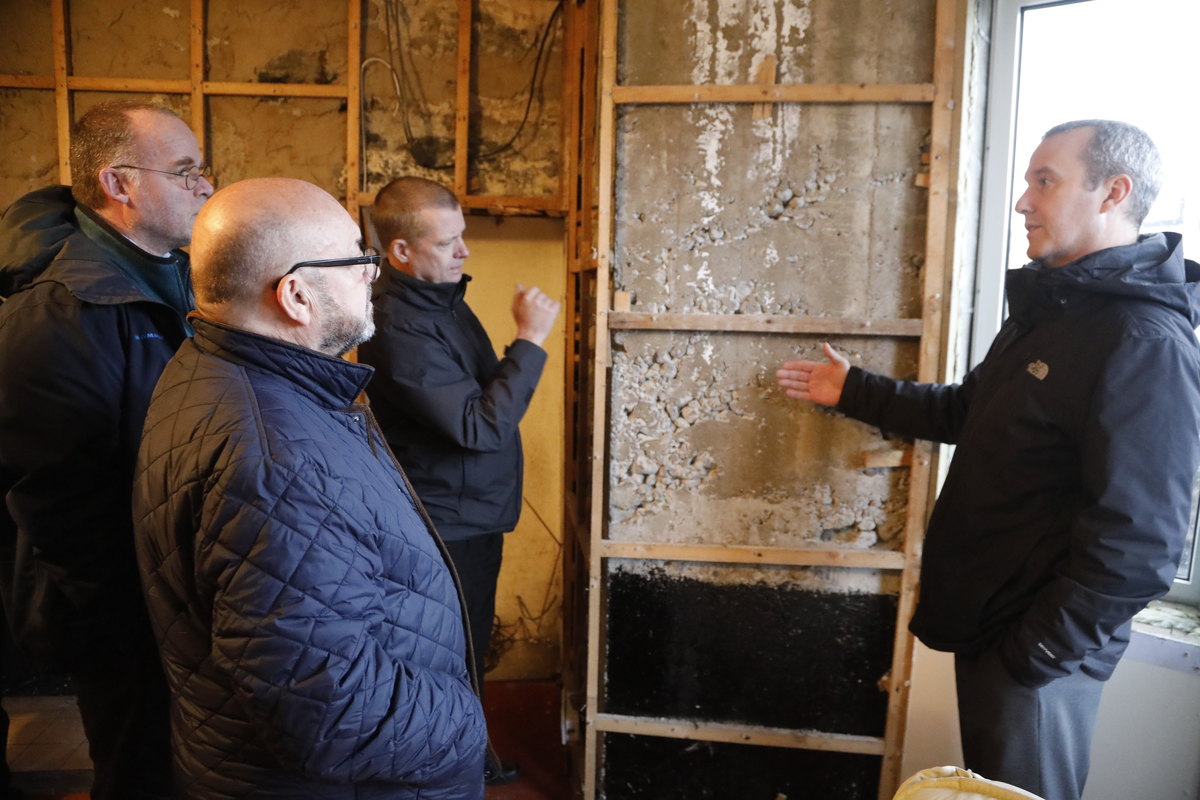
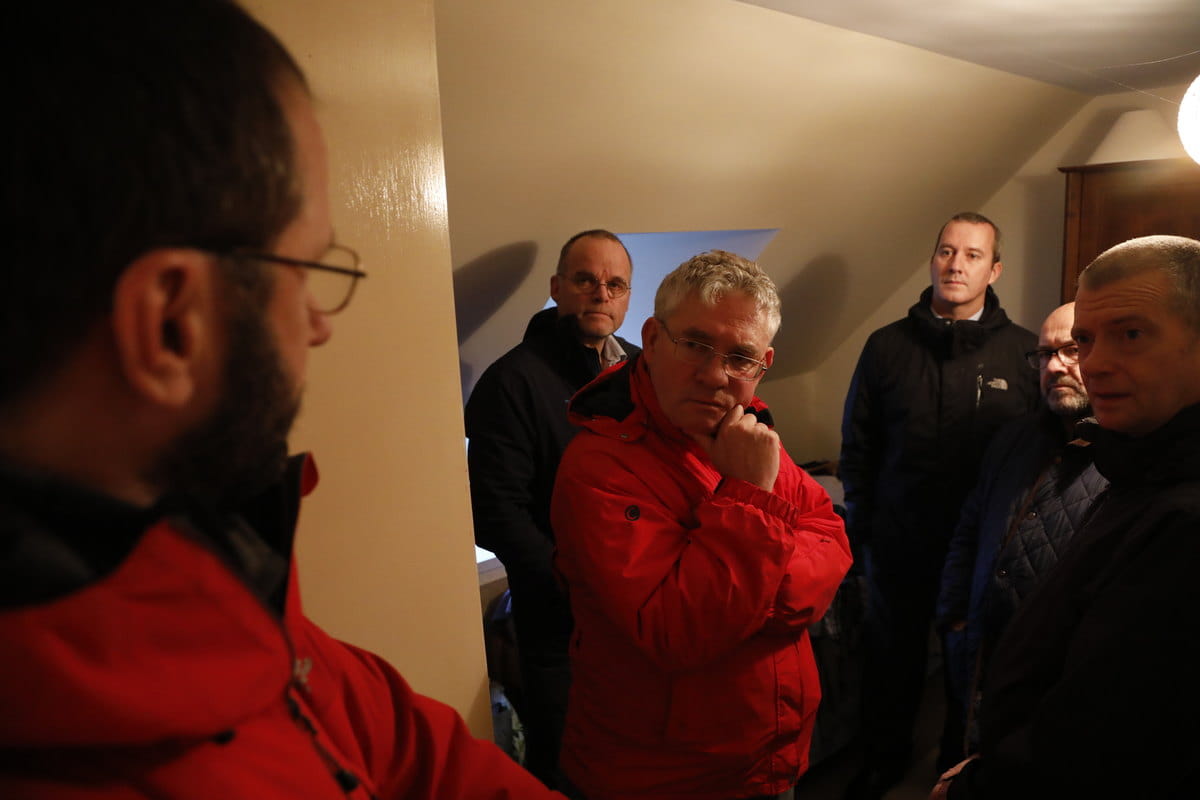
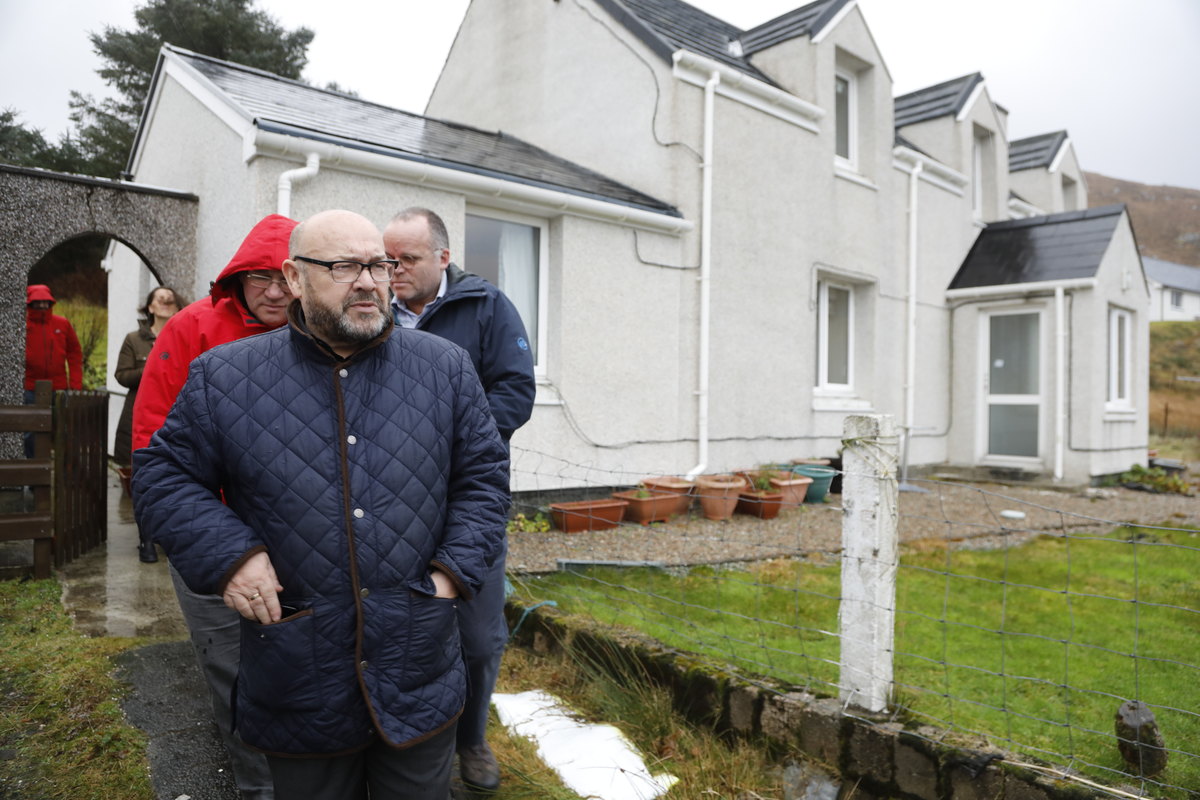
Committee Members hearing about the benefits of insulation measures in the Western Isles.
Scottish Parliament
Scottish Parliament
Background
The issue
Fuel poverty is an issue which affects a large number of people in Scotland, with some people and families struggling to pay for their fuel bills or heat their home to an acceptable and comfortable level. During our scrutiny, the Committee heard reports of people having to make a choice about whether to eat or to heat their home, even though we live in an energy-rich country abundant in renewable energy sources and with oil, gas and coal reserves.
Living in a cold draughty home can have a negative impact on people's physical health and mental wellbeing and impact on children's attainment.1 2
Despite efforts by previous administrations to tackle the issue of fuel poverty, it is disappointing that it remains a significant problem in this country. The most recent Scottish House Condition Survey (SHCS) figures show that in 2017, 24.9% of households (613,000) were in fuel poverty.
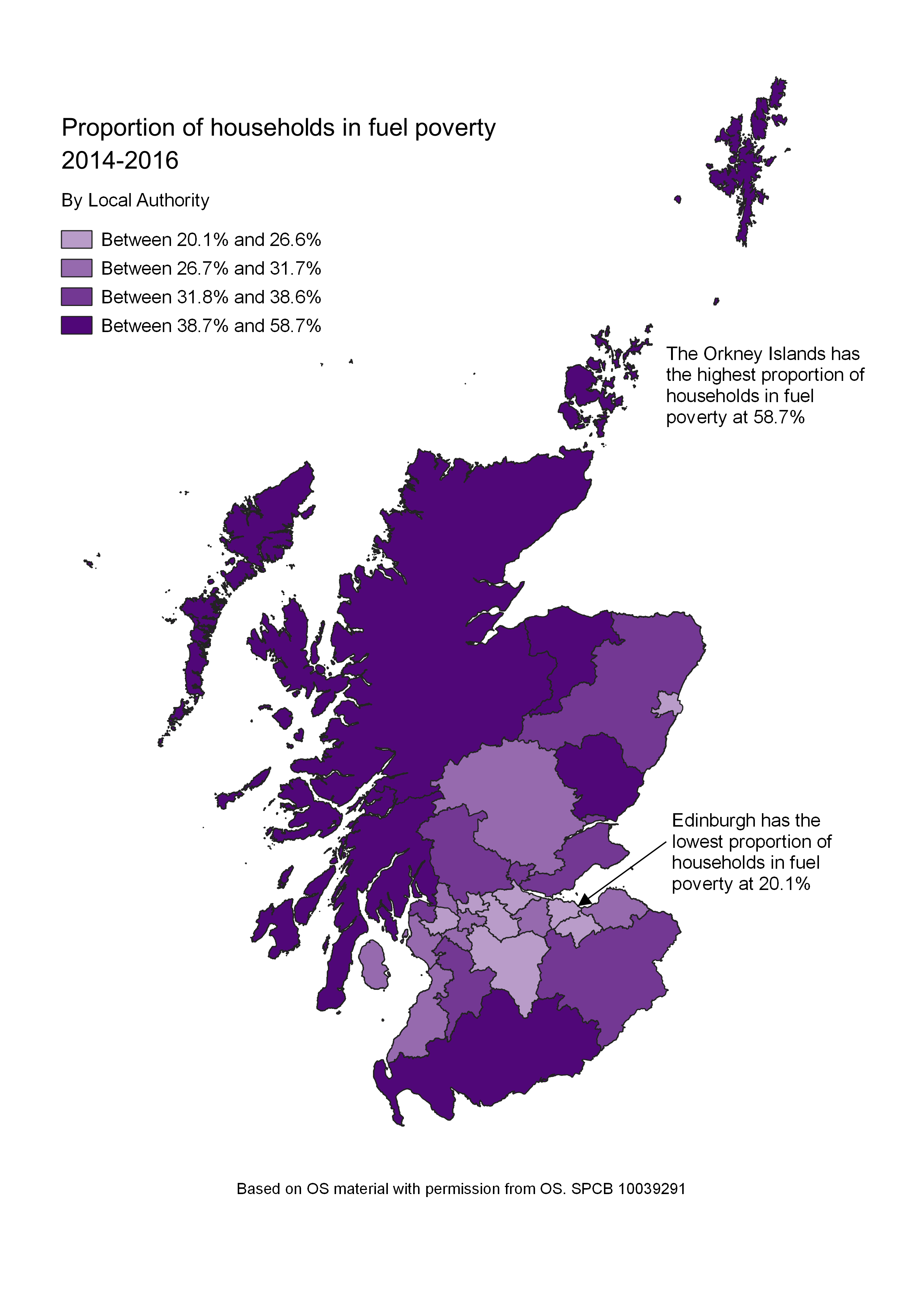
Levels of fuel poverty can vary regionally, with figures reaching as high as 59% of households in Orkney and as low as 20% in Edinburgh. The table below shows regional variations. The Committee heard that rural and island local authority areas have higher rates of fuel poverty than urban or suburban areas. Members who visited the Western Isles witnessed first-hand some of the work being done to tackle the problem.3
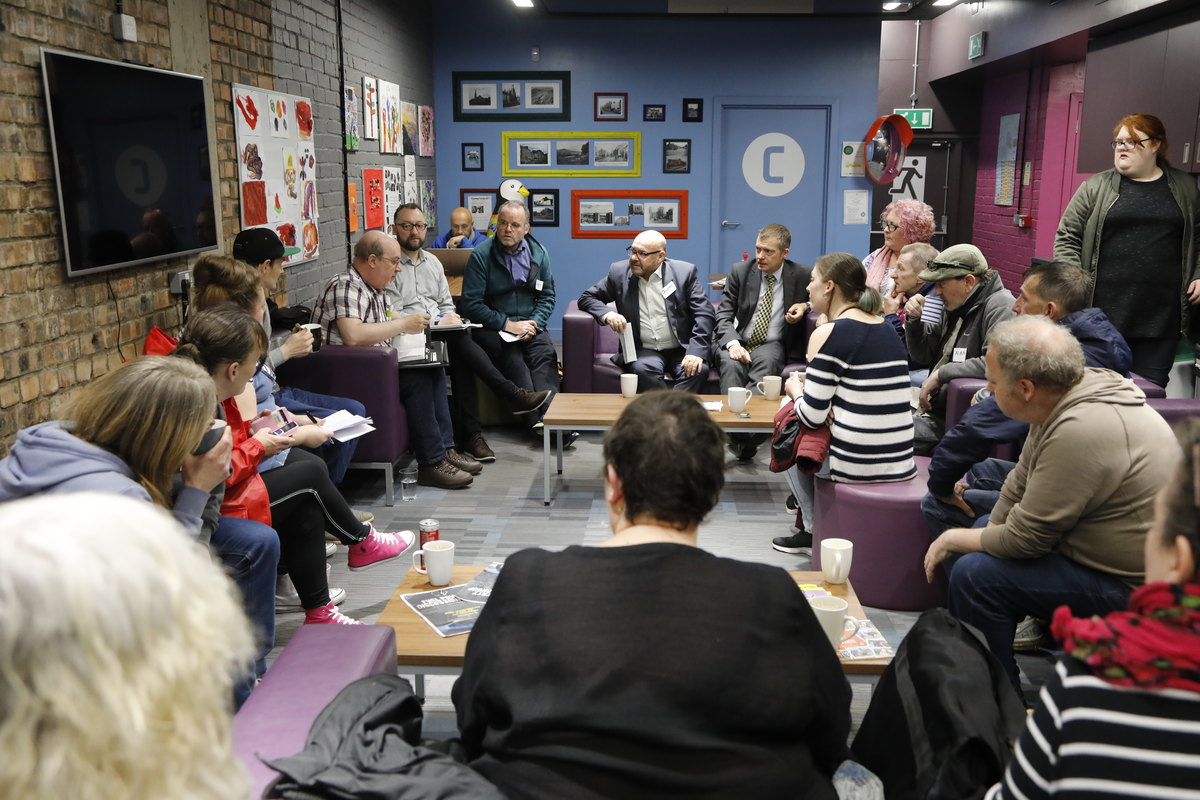
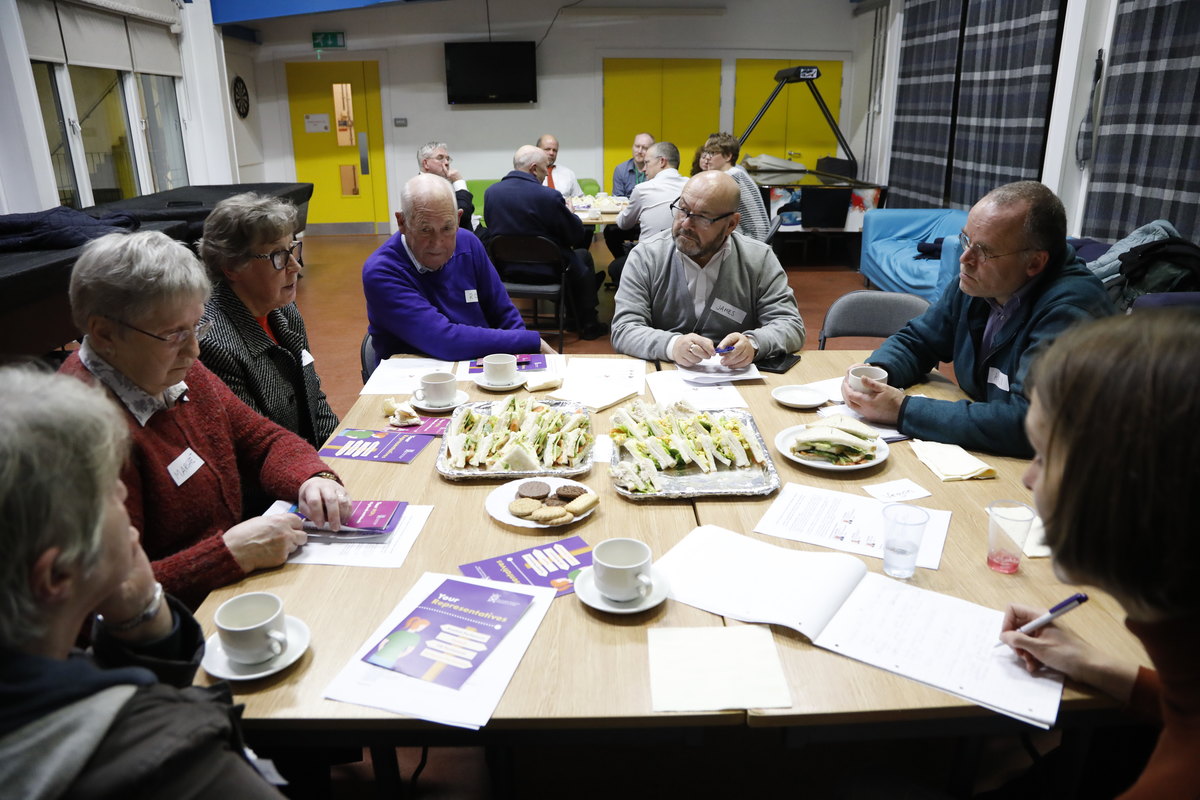
Committee members discussing the issue of fuel poverty at Lochee Community Hub in Dundee.

Scottish Parliament
Scottish Parliament
Fuel Poverty (Target, Definition and Strategy) (Scotland) SPICe Briefing
These figures are based on the current formal definition of fuel poverty, which the Bill would revise. This definition was associated with a previous target set by the 2002 Fuel Poverty Statement, published under section 88 of the Housing (Scotland) Act 2001: "so far as reasonably practicable, that people are not living in fuel poverty in Scotland by November 2016". This was not met. The Minister for Local Government and Housing wrote to the Committee on 29 June 2016 notifying the target would be missed despite the Scottish Government's investment of over £500 million in fuel poverty and energy efficiency initiatives since 2009.4
Past efforts to address the issue
It is widely recognised that there are four main drivers of fuel poverty:
the cost of energy;
the energy efficiency of the home;
household income; and
how households use the energy they buy.
The Scottish Government does not have direct devolved responsibility in relation to the cost of energy and household income, which are in any case partly influenced by factors that would be outwith the direct control of any government. The Committee heard that much of the focus of past initiatives to tackle fuel poverty had been on improving the energy efficiency of people's homes, an area where the Scottish Government has far more direct power and influence.1
There have been a number of programmes to deliver improved energy efficiency. As noted, successive governments in Scotland have spent millions of pounds on initiatives and also channelled monies from UK-based funding models. Current programmes which are used to deliver the measures are contained in the table below.
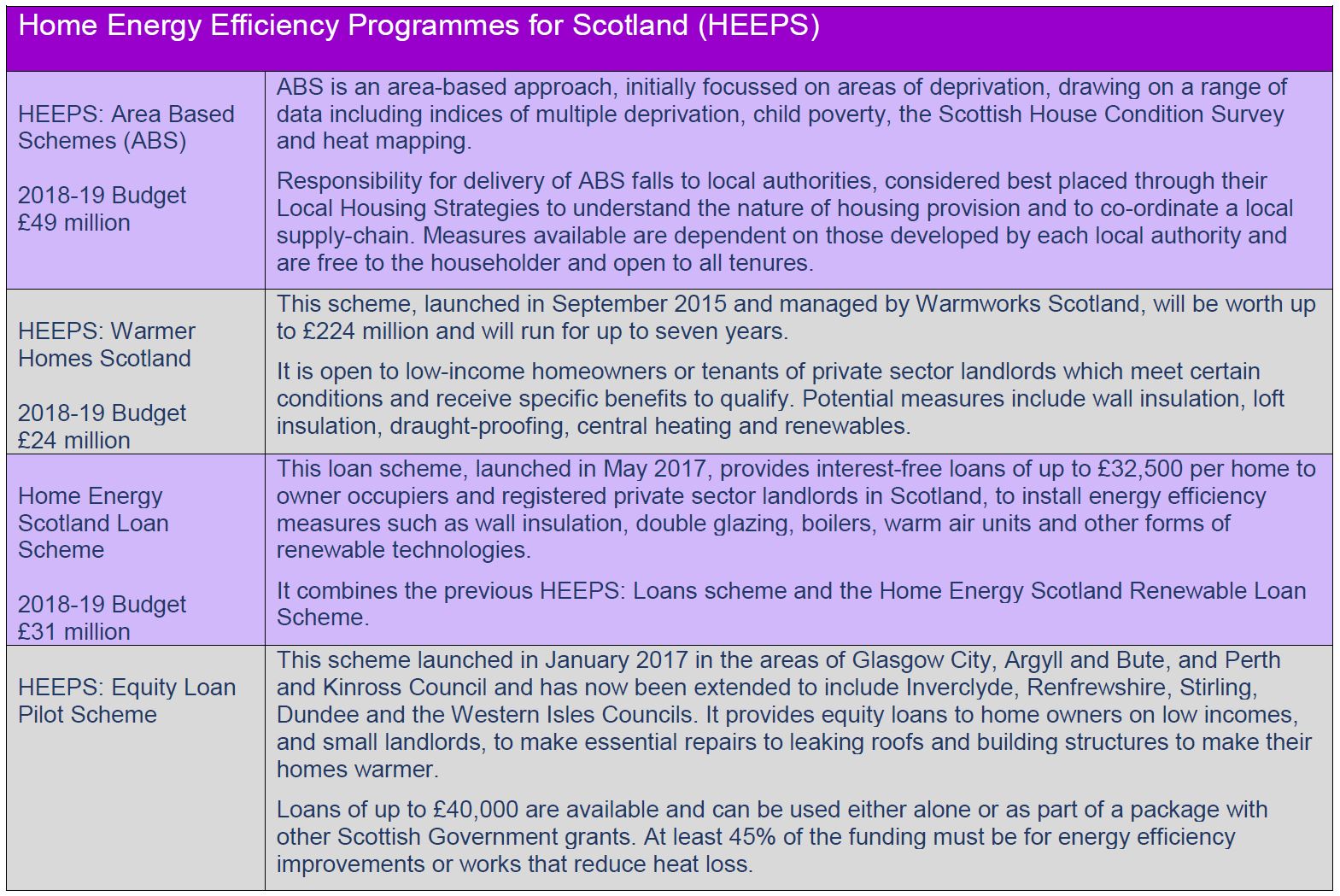
https://www.eas.org.uk/en/home-energy-efficiency-programmes-for-scotland-heeps_50558/
The Committee heard about the benefits of such measures during scrutiny earlier this Parliamentary session of the draft climate change plan. We heard that they can improve not only the energy efficiency of the home, but also its value and attractiveness, and the health and well-being of its inhabitants. We heard this again during our scrutiny of this Bill.23 4
In relation to how householders use the energy they buy, there are local schemes providing advice to people on the most efficient ways to use energy at home; for instance, how to use heating appliances properly, how to switch services and get the best deals, and how to get smart meters. During Stage 1 scrutiny of the Bill, Committee Members witnessed first-hand the benefits of such schemes on our visits to Dundee and to the Western Isles.
Energy prices have, overall, increased at a much higher rate than general inflation since 2002. The target that was missed in November 2016 was set at a time when prices were at a historic low. The Minister for Local Government, Housing and Planning told the Committee that, whilst median household incomes in Scotland rose by 50% between 2003/4 and 2017, fuel prices rose by 150%. He stated that had fuel prices increased in line with inflation since 2002 (35%), the 2017 fuel poverty rate under the current definition would have been 8.5%.5
The overall energy efficiency of homes in Scotland improved by 38% over the same period. This is welcome, but shows that we cannot rely solely on this measure if we want to bring down fuel poverty. The attached table shows how fuel prices have risen in comparison to household income and rates of fuel poverty between 2003 and 2016.1
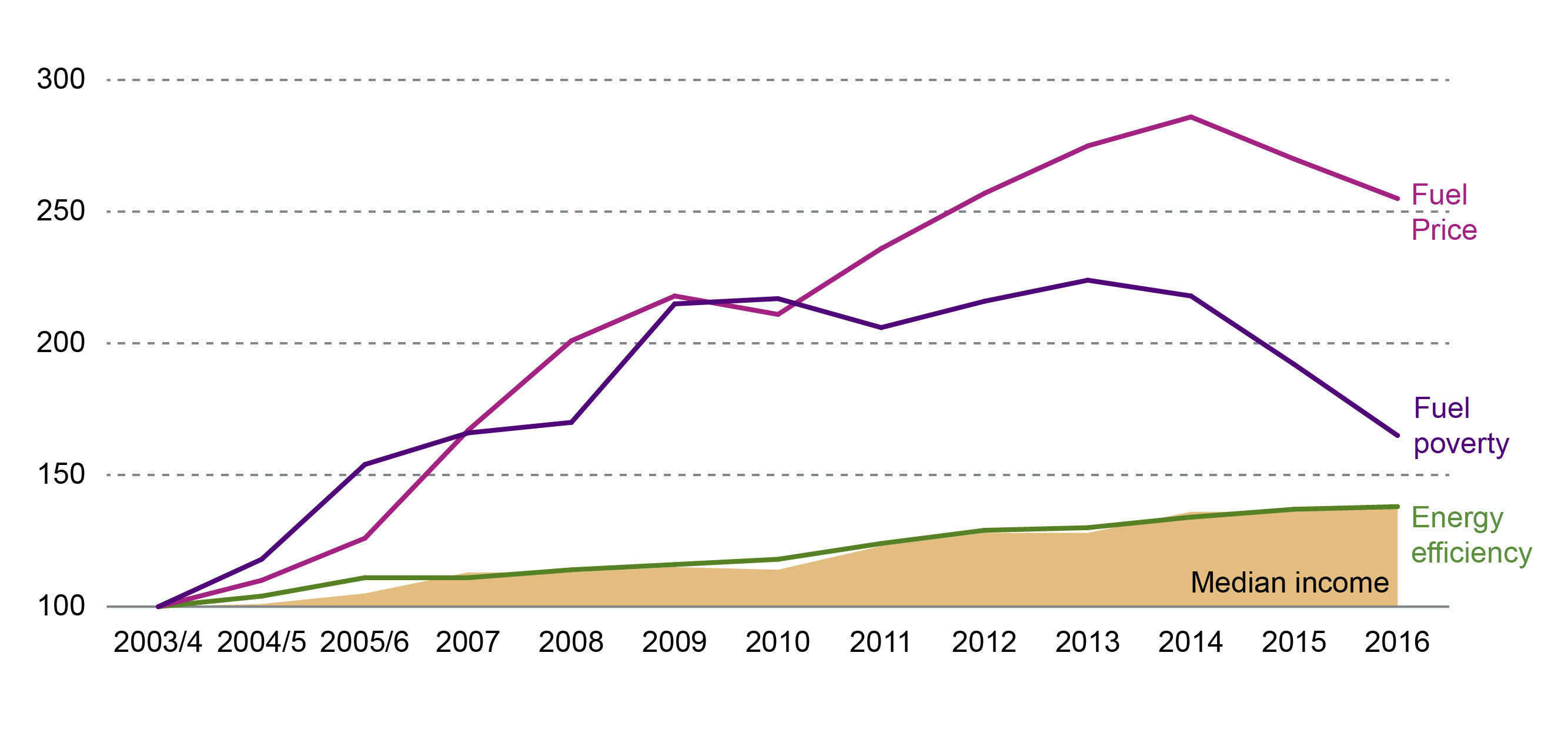
Fuel Poverty (Target, Definition and Strategy) (Scotland) SPICe Briefing
Energy Efficient Scotland
The Scottish Government made energy efficiency of the home a National Infrastructure Priority in June 2015. It reaffirmed this position and committed to removing energy efficiency as a driver of fuel poverty in May 2018 when it published the Energy Efficient Scotland Route Map which delivers across two key policy areas, fuel poverty and climate change.
The Route Map sets the following targets:
By 2040 all Scottish homes achieve an EPCi C (where technically feasible and cost effective).
Maximise the number of social rented homes achieving EPC B by 2032, building on the existing standard, equivalent to EPC Band C or D, which social landlords must meet by 2020.
Private rented homes to EPC E by 2022, to EPC D by 2025, and to EPC C by 2030 (where technically feasible and cost effective).
All owner occupied homes to reach EPC C by 2040 (where technically feasible and cost effective).
All homes with households in fuel poverty to reach EPC C by 2030 and EPC B by 2040 (where technically feasible, cost effective and affordable).12
Working Groups and independent Definition Review Panel
When it became clear that the 2016 fuel poverty target was not going to be met, the Scottish Government established two short-life working groups (the Scottish Fuel Poverty Strategic Working Group (SWG) and the Scottish Rural Fuel Poverty Task Force (RFPTF)) to consider an approach to reviewing the definition of fuel poverty and make recommendations regarding a new fuel poverty target and strategy.
Their reports are available here:
One of the recommendations of the SWG, was to appoint an independent panel of academics to review the definition, and the Government established the independent Definition Review Panel which reported in November 2017.
The independent panel's recommendations acknowledged a criticism that a high number of households considered to be in fuel poverty under the existing definition, were not actually in financial distress.
The independent panel called for a new definition which assesses the affordability of fuel after housing costs, such as rent, mortgage, council tax, and water/sewerage rates, are deducted and incorporates a Minimum Income Standard (MIS) (the MIS is considered in more detail in the report’s section on the Bill legislating for a new definition).
The Panel proposed that households are in fuel poverty when:
they need to spend more than 10% of their after housing cost income on heating and electricity in order to attain a healthy indoor environment that is commensurate with their vulnerability status; and
once these housing and fuel costs are deducted, households have less than 90% of Scotland’s Minimum Income Standard (MIS) from which to pay for all the other core necessities commensurate with a decent standard of living.
They also proposed marking up the MIS for those experiencing disability or long-term illness and for those living in remote rural areas, in accordance with the view that those groups face higher costs of living.1
The Scottish Government broadly accepted this definition but also made some key changes, which are reflected in the wording used in the Bill. We discuss the definition the Bill uses, and stakeholders' views on it, later in the report.
The Bill
The Bill has 14 sections-
Section 1 sets out the Scottish Government’s target to reduce fuel poverty to no more than 5 per cent of Scottish Households by 2040.
Section 2 sets out a definition of fuel poverty.
Sections 3-5 require the Scottish Government to publish a fuel poverty strategy within a year of Section 3 of the Bill coming into force. It also sets out consultation requirements in relation to the strategy.
Sections 6-9 place interim reporting requirements on the Scottish Government: it must report to Parliament every five years on various matters in the years leading up to 2040.
Sections 10-14 contain various mainly standard provisions relating to modification and regulation-making powers, commencement powers, and the short title.
As stated above, if the Bill is agreed to, the Scottish Government must publish a fuel poverty strategy. A draft fuel poverty strategy was published alongside the Bill on 27 June 2018 and the Scottish Government has stated that it is consulting on the measures contained within it. The draft strategy is available here:1
https://www.gov.scot/publications/draft-fuel-poverty-scotland-2018/
At Stage 1, the lead Committee's substantive role is to report to Parliament on whether the general principles should be approved, and the Bill proceed to Stage 2. However, it is clear that achieving the target set out in the Bill would be heavily reliant in practice on a robust and realistic fuel poverty strategy that built on lessons learned from previous efforts and was backed by the resources necessary to put it into effect. A separate section of the report is therefore dedicated to consideration of evidence on the draft strategy.
During Stage 1, some commented on the narrow focus of the Bill. For example, the Existing Homes Alliance stated that its scope should be widened in order to create a-
'once in a generation' opportunity to tackle energy efficiency as well and end the scandal of Scotland's cold, damp homes. This Bill should support the achievement of warm, affordable to heat and low carbon homes for everyone in Scotland, so no one is at risk of being in fuel poverty.2
We note, however, that the Bill is part of a suite of measures which will not only improve the energy efficiency of Scotland's homes and buildings, but also lower climate change emissions. These include the Climate Change (Emissions Reduction Targets) (Scotland) Bill (also at Stage 1 at the time of publication), legislative and other measures to deliver the new Energy Efficient Scotland programme, the Energy Efficiency Route Map and the Draft Fuel Poverty Strategy itself.3
Outline of the Committee's Stage 1 scrutiny
The Committee agreed its approach to scrutiny of the Bill at meetings on 12 and 26 September, issuing a call for written evidence on Monday 17 September. This closed on 9 November. We received 67 written responses. A link to this evidence is at Annexe A.
We promoted the call for written evidence on the Committee’s Twitter account. A Facebook post with a featured animation reached 6,700 people, was viewed 1,900 times, and was commented upon 23 times.
https://www.facebook.com/scottishparliament/videos/p.341086850032844/341086850032844/?type=2&theater
The Committee held five oral evidence sessions with stakeholders and experts in November and December, concluding with an evidence session with the Minister for Local Government, Housing and Planning on 19 December.
Further details of these sessions are available on the dedicated Bill webpage here:
https://www.scottish.parliament.uk/parliamentarybusiness/CurrentCommittees/109630.aspx
In addition to formal evidence taking, Members of the Committee made visits to Dundee and to the Western Isles during Stage 1 hearing directly from affected people about the different experiences of those facing fuel poverty in urban and rural/island communities. Reports of these visits are available here:
http://www.parliament.scot/S5_Local_Gov/Inquiries/20181129_FPB_DundeeNote.pdf
https://www.scottish.parliament.uk/S5_Local_Gov/Inquiries/20181219_FPB_WesternIslesNote.pdf
The Committee thanks all those who provided written and oral evidence and all those who engaged with us throughout scrutiny of the Bill.
Committee Members in the Western Isles
Scottish Parliament
Scottish Parliament
Issues Explored
Section 1 - Fuel Poverty Target
The Target
Section 1 of the Bill sets out a new target to reduce fuel poverty to no more than 5 per cent of Scottish households by 2040. The initial Scottish Government consultation preceding the Bill set a target of 10 per cent. This was revised downwards following comments from many of the respondents that 10 per cent was not ambitious enough.
The Government states that it has set this target to place “Scotland amongst the very best in the world in terms of tackling fuel poverty”. A target of 5% is considered realistic in part because "households move in and out of fuel poverty due to changes in income and energy costs”.1
The Minister for Local Government, Housing and Planning told the Committee that-
Scotland is one of only a handful of European countries to define fuel poverty, let alone set a goal to eradicate it. Achieving the target will place Scotland among the very best countries in the world in terms of tackling fuel poverty.2
Almost all respondents to the Committee's call for written evidence agreed that having a target enshrined in legislation was a good idea, sending a strong signal of the Scottish Government's intent and the seriousness with which it proposed to treat the problem. For example, the Existing Homes Alliance said that a statutory target would provide "a clear end point to measure progress against”. 3
A consensus in favour of a legally defined target also emerged in oral evidence. Ross Armstrong from Warmworks Scotland told the Committee that-
“Politics is often a transient business: the policy priorities of an administration can change as things such as the macroeconomic climate change. However, a statutory target that binds the Government to committing to addressing fuel poverty over the longer term is a welcome and essential part of the strategy.”4
Simon Markall from Energy UK said that the Bill-
“would help to focus minds and give momentum to making sure that we meet the 5 per cent target that is set out in it. There are many aspects on which the strategy and plan that will come with the bill will need to focus, including where the money will come from to finance meeting the 5 per cent target. The 5 per cent target is good, and we broadly support it, but in order to meet it, a clear plan and strategy on how the Government will deliver it are needed.4
The Committee supports the principle of setting a statutory target for reducing fuel poverty within a set time period.
Eradication versus a 5% target
There was far less consensus on whether 5% was the right target or whether 2040 was the right date. There is clearly an inter-relationship between these two issues (the longer the time period, the more opportunity there would be to drive the numbers down) but in this report we will consider the evidence received on each separately.
Some evidence argued that the 5% target was not ambitious enough. A target of 5% is self-evidently not "eradication"; the long-term policy goal set out in the long title to the Bill. Currently, 5% would amount to around 140,000 households, a substantial number of people, and some evidence expressed concern that this would inevitably tend to include those hardest to reach and most in need of help. Energy Action Scotland, the Existing Homes Alliance, the Poverty Alliance, the Chartered Institute of Housing and the Scottish Fuel Poverty Advisory Panel were amongst those arguing that the target should be 0%, generally caveated that this should be as far as reasonably practicable.1 2345
Elizabeth Leighton from the Existing Homes Alliance said-
We acknowledge that there are people who move in and out of fuel poverty and that we might not be able to get that down to absolute zero. There will be particular times when that is not possible, but we think that that is a reasonable position and that that is an achievable and credible target for us to strive for.6
Ross Armstrong from Warmworks Scotland argued that the prior wording of the target: to (by November 2016) eradicate fuel poverty, “so far as reasonably practicable” was-
... a more logical approach. As far as I am aware, 5 per cent is an arbitrary number. Four per cent, 7 per cent and 10 per cent are also arbitrary numbers. The words “so far as reasonably practicable” recognise that fuel poverty is a difficult thing to pin down. People move in and out of it, often from day to day, as their circumstances change. Even if 5 per cent were to be reached by the 2040 target date, the following day the figure might need to be 5.5 per cent or 6 per cent, because an increase in fuel prices might be announced that would push another 5,000 people into fuel poverty.7
Other evidence, whilst welcoming a target overall, expressed concerns that the rationale for a 5% target had not been set out and that it appeared unambitious. They argued for a target closer to 2 or 3%. (e.g. North Lanarkshire Council8 , Energy Agency9 )
However, a signficant body of evidence expressed support, or qualified support, for a 5% target as representing the right balance between ambition and realism, and the Scottish Government's limited influence in relation to two of the four main levers. These included, for example, Argyll and Bute Council and the Rural and Islands Housing Association Forum, the latter of which argued that the target seemed fair given that “the total elimination of Fuel Poverty is neither achievable or totally within the power of the Government.”9 11
Citizens Advice Scotland (CAS) expressed a similar view in written evidence. However, in oral evidence, CAS's representative Craig Salter argued that, if and when the statutory target was met, it would be crucial to keep up the pressure to bring the figure down further-
If that 5% of households are hard to reach or have a greater support need, more resource has to be put towards supporting them.12
The Minister for Local Government, Housing and Planning described the target in the Bill as-
... challenging but achievable and, importantly, deliverable. Of the four key drivers of fuel poverty, two are outwith our direct control: fuel prices and income. Therefore, we are concentrating on the two drivers that we can change: poor energy efficiency and how energy is used in the home. We must bear in mind that most Scottish homes are owner occupied. Bringing such households out of fuel poverty will involve an unprecedented level of intervention in private homes that relies on technology being affordable and in line with low-carbon technologies.13
The Minister confirmed that the Scottish Government's long-term plan remained eradicating fuel poverty, but that-
There will always be a small number of people who move in and out of fuel poverty due to a change in their income or the cost of energy. It is also important to note that the target is for no more than 5 per cent of households to be in fuel poverty by 2040. If we manage to get the level down to 5 per cent, we will not just say, “Job done” and stop trying; our ambition is to ensure that as many folk as possible are out of fuel poverty.14
The Committee accepts that setting a statutory target for reducing fuel poverty is ultimately a matter of judgment. We are satisfied, on the basis of evidence led, that the target of 5% set out in the Bill is achievable and at the same time would make a real difference to the lives of hundreds of thousands of people were it to be achieved. On balance, it appears to us to strike an appropriate balance between realism and ambition. The 5% target also recognises the Scottish Government's limited influence in relation to two of the four main drivers of fuel poverty, and its transient nature, with the potential for individual households to move in and out of the definition, depending on changing circumstances in relation to which governments may have little or no direct control.
The Committee agrees with the Scottish Government that the more long-term ambition should be the eradication of fuel poverty, as much as is realistically possible, and that the 5% target should not be the limit of this or future government's ambitions. With robust monitoring systems in place (as discussed later in the report), there is the opportunity to learn from experience and to benefit from technological advances between now and the target date.
The length of the target
Another significant area in which views differed was as to the date set out in the Bill for when the target should be reached. The Bill provides that the 5% target should be reached "in the year 2040"; in effect, therefore by no later than the end of that year. The difference of views at Stage 1 was between those who considered this time period about right and those who thought it should be shorter. The latter group proposed 2032.
In the Policy Memorandum, the Government argued that the 2040 date had been selected because it was consistent with other policies and measures to address fuel poverty, such as a commitment to remove energy efficiency as a driver for fuel poverty by 2040, by maximising the number of homes reaching minimum EPC ratings. These measures are in the process of consultation. However, the current proposal is that all fuel poor households reach EPC band C by 2030 and EPC band B by 2040.
The Government's view is that reaching the 2040 target of fuel poverty no higher than 5% would require widespread use of cost-effective low carbon heating technologies. It argues that bringing forward the date could create inefficiencies or even perverse incentives that are contrary to climate change goals. For instance, it could encourage increased use of existing higher carbon heating fuels or require further upgrades to renew heating systems in the future to bring them in line with low carbon technologies. The Policy Memorandum adds that currently there is uncertainty on how to best decarbonise Scotland’s energy networks. It says that decisions regarding the operation of the gas network are reserved to the UK Government and there is not yet a strong evidence base on how best to decarbonise it. The Scottish Government argues that without more time to drive down the cost of energy technologies, there is a risk that, if anything, more people could be drawn into fuel poverty because of the high cost of pioneer reduced carbon technologies. Finally, the Scottish Government, in the memorandum, again refers to those drivers over fuel poverty in relation to which it had less control as another reason not to bring the date forward from 2040.1
A large number of stakeholders disagreed. They argued that 2040 was too distant, noting that the previous target, set in 2002, as well as being more ambitious, covered a shorter period of 14 years. Organisations arguing for a 2032 target included West Lothian Council, Citizens Advice Scotland, the Rural and Islands Housing Association Forum, Inclusion Scotland, East Ayrshire Health and Social Care Partnership, the Existing Homes Alliance, and the Highlands and Islands Housing Associations Affordable Warmth Group. Energy UK argued that an earlier date "could help concentrate minds". 234567
CAS was amongst a number of organisations to highlight that a shorter period would also bring policy in line with targets which have been set to improve the energy efficiency of social housing and general energy efficiency standards. It added that not aligning the target in the Bill with the 2032 energy efficiency target would put undue focus on the driver relating to energy efficiency. Craig Salter of CAS told us-
“As has been pointed out already, all the drivers of fuel poverty interact. They all have a significant impact and, as a result, they all need to be addressed together. If we are saying that we can achieve improvements in energy efficiency by 2032, work should be on-going alongside that to address the other drivers too. In that regard, 2032 is an achievable target.8
David Stewart, representing the Scottish Federation of Housing Associations agreed, adding that a 2032 date would also align better with the Climate Change (Emissions Reduction Targets) (Scotland) Bill (also at Stage 1 during the Committee's consideration of this Bill) and the Climate Change Plan.9
Norman Kerr of Energy Action Scotland queried why the development of low-carbon heating technologies should be put forward as a reason for not bringing forward the date to 2032. He said that the 2040 date "condemns another generation to fuel poverty". Mr Kerr said that-
The electricity grid in Scotland is now mainly low carbon. We will have our gas grid for many years to come and we will not replace it, although we are looking at technologies that reduce the amount of carbon in the gas mix, such as biofuels and a range of other mixes, including hydrogen. However, simply giving someone low-carbon heat does not take away the fact that they are fuel poor. It may actually contribute to their fuel poverty if there is a significant additional cost of the technology that is applied to gain that low-carbon heat, such as completely stripping out the gas grid and moving to electricity alone for heating…10
Organisations including StepChange Debt Charity and the Energy Agency recognised the pragmatic reasons for a longer target date, but expressed concerns about the impact it could have on vulnerable individuals. Lawrie Morgan Klein of StepChange referred to data they held indicating that-
... electricity arrears is the second-fastest growing debt type— such arrears have gone up by about 37 per cent between 2013 and 2017…It is a growing problem in Scotland, so we welcome there being a target to tackle it. The timeline to 2040 feels distant, considering that we have seen a 4 per cent increase in clients who are struggling with energy costs, so that is a concern.11
In contrast, most local authorities who gave evidence at Stage 1 were less supportive of moving the date forward, on pragmatic grounds. Council witnesses tended to agree with the Scottish Government that a longer time period would allow more time to harness low carbon technology.12
Councils agreed that their reluctance to back an earlier target date related to a lack of clarity around funding and resourcing in the fuel poverty strategy (which will be discussed in more detail later), given the large role they would be expected to play in actually delivering the strategy. Glasgow City Council's Patrick Flynn referred to the complexity of funding schemes, which had also changed significantly over the last few years, which made significant demands on human resources within councils. He said that-
... the 2040 target is a recognition that, if we get interim milestones and certainty about funding, we can make our local strategy work as well as we can so that we can contribute to the national strategy.13
Alasdair Calder, from Argyll and Bute Council, argued that the 2040 target date represented a credible timescale, indicating that lessons had been learned from the previous missed target and that it was not just technical and technological changes that were required-
There is still resistance to switching to lower tariffs, and it will take a long time to change householders’ attitudes. I am a little uncomfortable about bringing behaviour into the discussion, because there is a tendency to sound as though we are saying that people make themselves fuel poor, and I do not believe for a minute that anyone does that. However, there is no doubt that behavioural changes are required. That will take time and resources. I am talking about the old fashioned resource of feet on the ground—people going out to talk to people and coach them through a process.14
Warmworks Scotland told the Committee that, whilst setting a date in legislation was important, the focus should be as much on having a properly resourced governmental plan, with additional dates, targets and milestones.15
In his evidence before the Committee, the Minister made clear that the Scottish Government's preference remained a 2040 target date-
The 2040 target aligns with the energy performance certificate targets that are in “Energy Efficient Scotland: route map”, and it lends itself to the achievement of the interim target in the Climate Change (Emissions Reduction Targets) (Scotland) Bill that by 2040 Scotland’s net emissions must be at least 78 per cent lower than the baseline. If we bring the fuel poverty target forward to an earlier year, that would mean utilising technologies to reduce fuel poverty that rely on existing high-carbon heating fuels. In some cases, that might lead to households needing two interventions in order to meet climate change objectives as well as everything else.
The Minister said that a 2040 target would also give more time to-
“set in place a pipeline that allows companies to boost the skill sets that are required in various parts of Scotland, rural and urban. They can then benefit in terms of employability in delivering the schemes. I think that 2040 is realistic; it is ambitious, but we can do it.16
Interim targets
The Scottish Government has set some non-statutory interim targets to measure progress in reaching targets set out in the Bill (should the Bill be agreed to). By 2030:
The overall fuel poverty rate will be less than 15%.
Ensure the median fuel poverty gap is no more than £350 (in 2015 prices before adding inflation).
Make progress towards removing poor energy efficiency of the home as a driver for fuel poverty.
And by 2040:
Ensure the median fuel poverty gap is no more than £250 (in 2015 prices before adding inflation).
Remove poor energy efficiency of the home as a driver for fuel poverty.1
During Stage 1 scrutiny, a number of stakeholders, such as the Existing Homes Alliance, called for the interim targets to be statutory.2
At the meeting on 19 December, the Minister confirmed that, if the Bill proceeds past Stage 1, he would bring forward amendments at Stage 2 to enshrine two interim targets in law: that by 2030 the overall fuel poverty rate will be less than 15%; and that by 2030 the median fuel poverty gap is no more than £350.3
The Committee notes concerns regarding the length of the target date set out in the Bill, which at 21 years is considerably longer than the 14-year target previous Scottish administrations had worked to. However, the Committee also understands views that this approach is a pragmatic response to previous attempts to set a target, which ultimately failed. We also recognise arguments that reducing fuel poverty will lean heavily on applying technologies still in development and that it is realistic to build in time for these to come on-stream.
The Committee therefore accepts the Government's reasons for setting the target date at 2040. This would however be conditional on the Government bringing forward amendments to make at least some of its interim milestones statutory by way of amendment at Stage 2, and we are pleased to note that a public commitment has been made to enshrine two of these at Stage 2. If the amendments are agreed to, this should help protect the fuel poverty strategy from "drift", and enable comprehensive assessment of how well the strategy is working at its mid-point.
Extreme Fuel Poverty
The 2003 Scottish Executive Fuel Poverty Statement defines extreme fuel poverty as when a household has to spend over 20% of its income on fuel. The annual Scottish House Condition Survey includes data on extreme fuel poverty. However, evidence at Stage 1 commented that there is no mention of measuring or targeting extreme poverty in the Bill, Policy Memorandum or draft Fuel Poverty Strategy.
The Committee heard of concerns that a lack of emphasis on tackling extreme fuel poverty could risk there being a focus on prioritising “low hanging fruit” to meet the 5% target, i.e. the easiest to treat properties, meaning that those in the most extreme circumstances, with the most difficult to treat issues, would end up disproportionately in the 5% still facing fuel poverty.
In their written submissions, organisations including the Wheatley Group and the Scottish Federation of Housing Associations called for explicit recognition of extreme fuel poverty in the Bill or for other measures to prevent the strategy failing to prioritise those in extreme fuel poverty. The Highlands and Islands Housing Associations Affordable Warmth Group further suggested an additional target in the Bill: “the elimination of extreme fuel poverty by 2025.”123 In oral evidence, Dion Alexander, representing the group, told the Committee-
In our submission, we ask that extreme fuel poverty should continue to be measured, because it will provide a guide to what is going on in the elimination of the worst forms of fuel poverty. We say very firmly that extreme fuel poverty is intolerable in a civilised society and that it should be eradicated as quickly as possible— within five years.4
In oral evidence, representatives of the Existing Homes Alliance, the Energy Agency, StepChange Debt Agency, Argyll and Bute Council and Glasgow City Council all agreed, with Alexander Macleod of Aberdeenshire Council, noting the potential for "unintended consequences if the measure were not added.5 Elizabeth Leighton of the Existing Homes Alliance suggested that-
We may be able to look for examples from the Child Poverty (Scotland) Act 2017, which talks about “persistent poverty”. The risk is that, if we allow for 5 per cent, those people will be the most difficult, hardest and most expensive to reach, and they will just be left behind. We cannot be in a position where we say that it is okay for that 5 per cent to continue to live in fuel poverty in 2040—surely that is unacceptable.67
The Minister for Local Government, Housing and Planning told us-
In our draft strategy we proposed fuel poverty gap targets for 2030 and 2040, which consider the depth of fuel poverty. That, in effect, is a measurement of the size of the gap between the bill for the fuel that a household requires to stay warm and its spending 10 per cent of its income on fuel. The independent panel suggested such a measure in respect of the proposed new definition; it was suggested as a means by which the severity of fuel poverty can be better understood. The approach that we are proposing in all that we are doing is therefore in line with the panel’s view and is designed to tackle the situation of folks who are in extreme fuel poverty.8
The Committee notes concerns from stakeholders working with those in extreme fuel poverty (i.e. those having to spend more than 20% of their income on fuel) about the lack of explicit reference in the Bill to prioritising a reduction in extreme fuel poverty. We heard that, without such a reference, there is a risk, even if the overall target is ultimately met, of efforts being targeted at "low hanging fruit". This could leave a disproportionate number of those with the most critical needs remaining in the final 5 per cent facing fuel poverty by 2040.
We ask the Government to bring forward proposals for a separate target for targeting extreme fuel poverty at Stage 2, and to ensure that there is specific reference to eradicating it in any strategy produced under the Bill.
Local Targeting
The Bill sets out a national target for reducing fuel poverty. As with the discussion on extreme fuel poverty, some stakeholders expressed concerns that this might create an incentive for local authorities to target "quick wins", rather than households with more critical needs. The Committee also heard views that local targets should be set, to ensure that there was a nationwide effort to reduce fuel poverty. As noted earlier, there are big disparities between local authority areas. In particular, rural and island authorities tend to have far greater problems with fuel poverty. A number of local authorities who provided evidence argued that setting local targets would increase the likelihood of resources under the fuel poverty strategy being better directed.12
Argyll and Bute Council argued in their written evidence that the risk with a "blanket" nationwide target was that "householders in remote and rural areas will be disproportionately represented in the residual" even if the 5% target were met.3
In oral evidence, Alasdair Calder, representing Argyll and Bute Council, said there was scope to further break down the target at local level, to reduce the risk of pockets of fuel poverty remaining in particular sectors and areas-
We have nine distinct housing market areas in our local housing strategy, and we could operate the target at that level—we could say that the 5 per cent target applied in each housing market area.4
A key theme to have emerged during Stage 1 is the particular fuel poverty challenge that exists in island communities. Referring to Coll and Tiree, Alasdair Calder of Argyll and Bute Council referred to-
... the issue of getting the workforce over there, the supply chain issue and the difficulty of the location. That all adds up to its being an extremely difficult area to deal with, for which extra resources will be needed. At the same time, if we addressed the whole of Argyll and Bute, we would not want our 5 per cent to be disproportionately located on our islands or in remote rural areas. Whatever the challenge is nationally, we should face that challenge locally to make sure that we have a good distribution of all the schemes that we operate.5
The Energy Agency's Liz Marquis highlighted how Councils could be creative in how they allocated their area based schemes-
The area-based schemes that we are talking about have some flexibility. That is really important—everything should not be too rigid; there should be a bit of flexibility. The project in Dumfries and Galloway that I have been talking about comes out of the council’s budgets for tackling poverty in the area. There are creative ways of doing things inexpensively that help lots of people. We should try to combine that creativity with quite rigid rules about what we should be doing and achieving in the long term.5
Ross Armstrong of Warmworks, which runs the Warmer Homes Scotland programme, demonstrated how the current mechanisms target those areas with the greatest need and felt that this needed to be a key aim of the strategy-
It is important for the Government to ensure that, as part of the fuel poverty strategy, national instruments are properly set up and incentivised to target areas where need exists.
Our contract with the Government has been set up in a specific way to ensure that we go where need presents itself. Just under a fifth of all the work that we do is in the Highlands and Islands, for example, in areas that will have some of the worst levels of fuel poverty. That means that, in population terms, our work is disproportionately skewed towards those areas where the need for warmth—and for affordable warmth—is clearly greater.
He added-
The Government should learn the lesson of the past three years of our programme, which is that you can clearly direct help to where it is needed most if your contract, your key performance indicators, and all the targets that you have to hit and report on monthly are properly set up to tackle the areas where need is greatest.7
On whether the Scottish Government would consider targets for each local authority, the Minister for Local Government, Housing and Planning said-
We need to take into account the difficulties that exist in certain places. We as a Government have ensured that the allocation of resource reflects the needs of various places. For example, our island councils benefit from three times more spend per head of population on HEEPS ABS than those on the mainland, because we recognise the differences that exist in those communities.
Three or four weeks ago, I announced further flexibilities in delivery in island communities. We are looking at bringing new things into schemes, such as microgeneration, the removal of asbestos and the installation of oil tanks. We will continue to look at those flexibilities and I will consider having further discussions with local authorities about setting individual targets if that is deemed appropriate.8
Given that island areas receive more spend per head on energy efficiency measures than mainland communities, it is concerning that inordinate numbers of householders on our island communities still experience fuel poverty. We believe that the Scottish Government should consider amending Section 1 of the Bill to put in place statutory targets for each local authority to reduce fuel poverty in their areas to no greater than 5 per cent of their households by 2040, in order to help drive progress towards achievement of the national target and eliminate regional disparities.
The Committee understands concerns that there may be a tendency for local authorities to direct resources at the most easy to treat properties in order to meet the new statutory target. We welcome the Minister’s commitment to continue to work with local authorities to consider how best to distribute schemes to balance the requirements of those with the greatest needs for support and those with more marginal problems. We, however, urge the Government to ensure that the fuel poverty strategy will provide clear, helpful and practical guidance to local authorities on how best to distribute their resources to avoid local disparities.
We also heard of the innovative local schemes already in place which allow services to be creative around how they distribute their resources to reduce such anomalies and seek further information on how the Government will ensure the sharing of best practice between local authorities. This applies particularly to island communities which often struggle to achieve the economies of scale that can be achieved on the mainland.
Section 2 - Definition of Fuel Poverty
Previous definitions of fuel poverty in Scotland were based on the Boardman definition which states that a household is fuel poor if it is "unable to obtain an adequate level of energy services, particularly warmth, for 10 per cent of its income".1
In 2002, the then current Scottish Executive refined the definition. The aim was to achieve a more precise definition that would enable better targeting of resources-
A household is in fuel poverty if, in order to maintain a satisfactory heating regime, it would be required to spend more than 10% of its income (including Housing Benefit or Income Support for Mortgage Interest) on all household fuel use. The definition of a 'satisfactory heating regime' would use the levels recommended by the World Health Organisation. For elderly and infirm households, this is 23° C in the living room and 18° C in other rooms, to be achieved for 16 hours in every 24. For other households, this is 21° C in the living room and 18° C in other rooms for a period of 9 hours in every 24 (or 16 in 24 over the weekend); with two hours being in the morning and seven hours in the evening. 'Household income' would be defined as income before housing costs, to mirror the definition used in the UK Households Below Average Income (HBAI) Statistics.2
It was recognised during the 14 year period of the previous target that a minority of households caught by the definition might not, by most conventional measures, be income poor and might not, in fact, be struggling to pay fuel bills.3
Earlier in this report, we noted the work of the short life working groups set up by the current Scottish Government, when it became clear that the prior target would not be met, and the defintion they produced. They intended, in revising the definition, to more closely align the target to income poverty.
The definition in section 2 of the Bill largely adopts this definition. It provides that-
A household is in fuel poverty if -
(a) the fuel costs necessary for the home in which members of the household live to meet the conditions set out in subsection (2) are more than 10% of the household's adjusted net income, and
(b) after deducting such fuel costs and the household's childcare costs (if any), the household's remaining adjusted net income is insufficient to maintain an acceptable standard of living for members of the household.4
This new definition switches the assessment of fuel poverty from before housing costs (BHC) to after housing costs (AHC). In other words, the affordability of fuel is assessed against income after deduction of housing costs (rent, mortgage, council tax and water rates) and childcare costs.
The calculation uses an income threshold measure known as the Minimum Income Standard (MIS) to determine an acceptable standard of living. The MIS is currently determined by the Centre for Research in Social Policy at Loughborough University in conjunction with the Joseph Rowntree Foundation. The Policy Memorandum states that the "consistent and simple standard" of 90% of MIS set out in the Bill better enables regional variations to be taken into account. It adds-
This approach ensures that households only marginally above the income poverty line that are struggling with their fuel bills, will be captured in the new definition of fuel poverty. The new definition also excludes higher income households, even if they would need to spend 10% or more of their net household income after housing costs on required fuel costs. This addresses a drawback, highlighted by the Panel, of the current definition where households with quite high incomes could be classified as fuel poor.
It adds-
This will allow the Scottish Government to focus the definition of fuel poverty, and targeting of support, onto those most in need, regardless of where they live.5
Enhanced heating requirements
The conditions in Subsection (2) set out the requisite temperatures and length of time to be maintained at that temperature for standard and for those which require enhanced heating. For those who require enhanced heating, the requisite temperatures are-
23 degrees Celsius for the living room;
20 degress Celsius for any other room;
for 16 hours a day. Otherwise, requisite temperature are
21 degrees Celsius for the living room;
18 degrees Celsius for any other room;
for-
9 hours a day on a weekday;
16 hours a day during the weekend.1
The Bill does not define who is deemed to require "enhanced heating." There is a regulation-making power to do this. The Policy Memorandum states that it will include households where a member is elderly, or has a condition or illness which makes that person especially at risk of suffering adverse effects from being in a cold home.2
The Scottish Government accepted a recommendation by the fuel poverty expert panel that being over the age of 60 should not, in itself, be a threshold for vulnerability, as it was under the previous definition. It proposes under regulations to set 75 as the relevant age at which enhanced heating is required.
There were two recommendations by the expert review panel that the Scottish Government did not take forward. These were that the MIS should be marked up for those experiencing disability or long term illness, and for those living in remote rural areas.3
MIS and rural uplift
During consultation before the Bill was introduced, most stakeholders welcomed the new definition. The general view was that this would better align fuel poverty with income poverty. However most views were critical of the decision not to adopt a Scotland specific MIS to reflect the additional cost of living in Scottish rural and island areas.
In the Policy Memorandum, the Government argues that the additional living costs faced by remote and rural households are already accounted for within the modelling used to estimate fuel poverty. Thus, it says, there is no need to adjust the MIS for the new definition. The Draft Fuel Poverty Strategy explains-
the way fuel poverty is calculated already takes account of regional variations in external temperatures, solar irradiance and exposure to the wind as well as types of stock and information about occupants. These can lead to greater energy usage estimates to maintain either standard or vulnerable heating regimes in rural and remote rural areas. In addition, regionalised (North and South Scotland) energy prices are used in the fuel poverty calculation (for mains gas and electricity).1
Most of the evidence the Committee heard at Stage 1 broadly supported the new definition and, in particular, the use of the MIS within it. For example, the Highlands and Islands Housing Associations Affordable Warmth Group said that using the MIS would “underpin and inform the evidence-based understanding of poverty and the amount of disposable income that people have.” However, it was amongst a number of stakeholders to query the exclusion of a rural MIS. Dion Alexander referred to research carried out by Highlands and Islands Enterprise in 2013 and 2016, telling the Committee that-
The independent panel of academics that came up with the new fuel poverty definition recognised that there was a particular problem in remote rural areas of Scotland and suggested an uplift, in the same way, for example, that we have a London uplift on the MIS UK data when it is used to inform the living wage. We are asking people to do the same thing for remote rural Scotland, because we know from the MIS remote rural Scotland data that, depending on their household type and location, families in remote rural areas need between 10 and 35 per cent more income to achieve the same basic standard of living as those in households elsewhere. That has to be a fundamental contributor to fuel poverty; it is not the only contributor, but it must be recognised in any definition if that definition is to have credibility and serve the purpose for which it is designed.2
This view was shared by amongst others, CAS and the SFHA, with the latter noting that it was in rural off-gas areas that problems with fuel poverty tended to be especially acute.3
Dr Keith Baker of the Energy Poverty Research Initiative said that-
It has become quite clear—particularly from our work, but also from the Scottish house condition survey stats—that there is a question about whether we need a remote rural adjustment in the definition. Is the condition of fuel poverty in rural areas and, in particular, remote rural areas significantly different from its condition in urban areas? It is very clear that the answer to that is yes… and the new SHCS stats show that the increase in fuel poverty over the past year has been proportionally higher in rural areas.4
In a letter to the Committee sent at the start of Stage 1 oral evidence-taking, the Scottish Government set out further reasons for not supporting a rural MIS.
BREDEM calculations: The Government said that the higher costs of domestic fuel bills in remote rural and island areas are addressed in the measurement of fuel poverty under the proposed new definition by the use of BREDEMi, which it says-
already takes into account regional weather conditions. In response to concerns raised by rural and island stakeholders, we are further reviewing the weather information used in this estimation, together with the fuel prices pertaining to fuel types other than gas and electricity, with the aim of making these more localised where possible.
Alignment with other measures of poverty and uplift for delivery of energy efficiency measures in rural, remote rural and island areas: The letter said-
we believe that our approach to using UK MIS aligns with other measures of poverty such as the national minimum wage, minimum living wage and (real) living wage and other measures of poverty based on income, such as child poverty. Our approach aligns with other strategies to tackle poverty, reduce child poverty, improve health outcomes and make Scotland a fairer country.
The letter added that the Government would further review the weather and fuel cost information applied in BREDEM, using a model that would take account of house type and construction and the fact that rural, remote rural and island dwellings tend to be harder to heat. Via the strategy, it would also seek to develop innovative approaches and enhancements to delivery routes which currently take account of the additional costs of delivering energy efficiency measures in rural, remote rural and island areas, which provide higher funding per household and grant caps.
Cost: The letter stated that the regional MIS would be costly to develop and maintain at around £0.5 m over a 4 year period and that this was not good value for money-
The vast majority of the decrease in fuel poverty in rural, remote rural and island areas is due to the fact that an income threshold has been introduced at all rather than the value of that income threshold. The outcome [of a rural MIS] is unlikely to produce the desired effect for many stakeholders. We feel that the resources required to develop this would therefore be better utilised in the delivery of support to fuel poor households, including those in rural, remote rural and island areas.5
Some witnesses questioned the arguments set forth in the Scottish Government's letter. Dion Alexander, of the Highlands and Islands Housing Associations Affordable Warmth Group, queried the government's cost estimate but said that, even if it were accurate, it would be money well spent. Norman Kerr of Energy Action Scotland said-
On the figure of £0.5 million over four years, if we amend BREDEM—there is a reference to the need to amend BREDEM—that will not be free, but that has not been costed. I think that the figure has been given to demonstrate why we should not apply a remote rural uplift, rather than why we should. In the great scheme of things, £0.5 million over four years is a drop in the ocean to get more accurate reporting that will enable us to dedicate resources to a particular area. I am sorry, but I think that the figure is a smokescreen.6
CAS agreed, noting that Loughborough University and Highlands and Islands Enterprise had already undertaken some research on developing a rural MIS. CAS's Craig Salter told us that-
in the Scottish house condition survey, methodologies are revised and applied retroactively so, even if there were a short delay, there is no reason why a remote rural uplift should not then be applied once the information is ready. A delay is not a reason not to do it.7
The Committee heard directly from Professor Donald Hirsch, the leading expert on this issue at Loughbourgh University, and who had been instrumental in developing the definition used in the Bill. He confirmed that his team had been funded by Highlands and Islands Enterprise and partnership organisations to do a study on a remote rural MIS. Professor Hirsch said it would not take much more work to produce a measure. He told us-
The calculations in the independent review panel’s proposed measure used a crude estimate that was based on the work that we have already done on remote rural Scotland. The panel used that to come up with its estimates of what the results would be if you had that element. The method is there, the work has been done and it could be regularly updated. The issue about whether any extra research would be required is about whether one updates something that has already been done in those areas.
The Committee asked Professor Hirsch how much effort would be required to maintain the remote rural MIS as an accurate and useful measure. He told us that-
It would involve making sure—not every year, but on a regular cycle—that the estimate of additional, non-fuel costs in the areas concerned kept in touch with reality and that, when a premium was applied to the UK MIS, that was adjusted whenever the UK MIS changed, because the starting point would be different. There are light-touch ways of doing that—it could be done in more or less detail, depending on how many areas were looked at. Some additional qualitative research of the kind that we did, which involved talking to people in those areas about the extra costs, would be required, as well as some regular, fairly routine updating of prices.
On costs, he said his "broad estimate" was that-
... it would cost between £50,000 and £100,000 a year. I do not know why the Government has said that it would cost £0.5 million over four years rather than five—in our view, that would be a maximum. Is that a lot of money? I read that the Government spends around £100 million addressing fuel poverty, and £50,000 to £100,000 is not very much in comparison with that. I reckon that the Government spends about £2 million on the Scottish house condition survey. If you want to make sure that you target things properly, you need to spend a small amount on gathering knowledge.
Professor Hirsch said that the main case for a remote rural uplift was mainly the high cost of travel and delivery charges for people living in these areas. He added-
The independent review panel estimated that in remote rural Scotland, according to its measure, which included the adjustment that we are discussing, the fuel poverty rate would be 40 per cent. The Scottish Government's technical annex estimates the fuel poverty rate in those areas as being 28 per cent. I do not think that that is a negligible difference.
There are all sorts of technicalities to do with how those measures are compared, but the underlying point is that if, as our evidence suggested, it can cost 25 to 40 per cent more to live in such an area, why would having a threshold that was that much higher not make a difference to the number of people who we say are in fuel poverty?
We asked Professor Hirsch for a view on a Scotland-specific MIS, which some stakeholders, including Energy UK had proposed. He confirmed that there had been some research into this at Loughborough University, and the conclusion reached was that there was “close to zero difference” between urban areas in England and Scotland.
The Scottish Government formally classifies communities by how urban or rural there. There are six classifications, with category 1 the most urban. Category 6 refers to settlements with a population of fewer than 3,000 people which are more than half an hour’s drive from a larger town. Amongst those in favour of a specific recognition of rurality in the definition, there was further discussion as to whether it would be sufficient to map category 6 communities onto the definition, or whether category 4 communities should also be incorporated into any additional calculation of MIS.8 ii Referring to his team's prior work on identifying a rural MIS, Professor Hirsch explained that-
... what we called remote rural Scotland included towns such as Thurso, Stornoway and Lerwick. I suspect that the review panel’s initial calculations looked only at category 6, but I would submit that there is just as much of a case for including category 4. It is all part of the same work, and we have made the calculations in that respect. Whether a person lives in Thurso or in a village outside it, most of the same costs apply, because those who live in the town still have to travel quite far to get to work or have no access to a supermarket and therefore have to pay higher prices.9
Professor Hirsch confirmed that all island communities would fall within categories 4 and 6 as every island household in Scotland is more than a half hour's drive away from a town of more than 10,000 people.10
In a further update to the Committee, Professor Hirsch, stated that, if a rural MIS were created, the appropriate terminology should be "remote towns and remote rural areas" rather than just "remote rural areas".11
Argyll and Bute Council's Alasdair Calder said that the Bill failed to adequately address the rural dimension. He proposed-
We could look at developing a Scottish minimum income standard with a rural element. Alternatively, if the way forward is to continue to use the UK-wide MIS, I suggest that we consider having, instead of a 90 per cent measurement against fuel poverty to account for rural areas, a 110 or 120 per cent measurement to take account of areas where there are higher energy costs for things such as oil and electric heating. I do not believe that that would substantially change the position for folk who heat their homes using gas, which is substantially cheaper. That might be a way of capturing the rural issue.12
The Minister for Local Government, Housing and Planning told the Committee that he had considered this evidence from Mr Calder and that-
... I will look seriously at that suggestion and consider how such an uplift can be best achieved for remote rural areas.13
He added, however, that-
... first of all, we have to find out exactly what difference having that standard would make. Would it make any difference? Obviously, if it was thought that it would make a difference, the likelihood is that there would be amendments lodged recognising that those differences exist.14
The Committee welcomes the revised definition of fuel poverty set out in the Bill, based around the calculation of a Minimum Income Standard that takes account of daily living costs. This should help ensure a closer linkage to actual "lived" income poverty.
However, we understand stakeholders' concerns that the definition may not adequately take into account the reality of living in islands, remote towns and remote rural areas, including the much higher living and travel costs in those areas, reflected in current high levels of fuel poverty.
We therefore ask the Scottish Government, during the remaining passage of the Bill, to commit to introducing an additional Minimum Income Standard to reflect the higher costs faced by those living in islands, remote towns and remote rural areas. In doing so we would urge the Scottish Government to ensure that the additional MIS captures all households in areas covered by categories 4 and 6 of the Urban Rural Classification.
No MIS mark-up for disability or long-term illness and the extension of the age vulnerability criteria
As previously noted, the Scottish Government chose not to take forward a recommendation to mark up the MIS for those with a disability or long-term illness. The Policy Memorandum states that, in practice, this would instead be recognised by categorising such individuals as in need of enhanced heating (para 30) by way of regulations under the Bill if and when it becomes law. The Memorandum explains-
Where the enhanced heating regime is required, it follows that there are higher required fuel costs in order to maintain the home at the higher levels for longer periods. Required fuel costs are calculated based on the modelled energy consumption required to meet the heating regimes set out in the Bill. The required fuel costs will be higher than under the current definition since the ―other room temperature for the enhanced heating regime has been increased from the temperatures applied under the current fuel poverty statement, increasing from 18 to 20 degrees Celsius. This new policy therefore removes the potentially harmful impact of a 5 degree temperature difference between different rooms in the home. These higher fuel costs are both compared to after housing cost income and subtracted from household income before the residual is compared to the MIS threshold. This means that, all other things being equal, such households are more likely to be identified as fuel poor.1
There was not much evidence presented on this issue during Stage 1. Where views were expressed, stakeholders were generally supportive of the Scottish Government's commitment on future regulations. Glasgow City Council's Patrick Flynn said-
Our council supports broadening the enhanced heating regime to capture households in which an occupant’s health condition would benefit from higher temperatures, regardless of age.2
Referring to the proposed fuel poverty strategy, CAS's Craig Salter said that-
There would be benefit in the strategy if there was a clear commitment to establishing something like a permanent panel of public health experts to review the criteria [on what constitutes vulnerability] on an on-going basis. Vulnerability is a complex issue that changes a lot over time for society and individuals, and its definition should be reviewed regularly.3
There were, however, some concerns about the proposal to raise the age threshold for vulnerability. Mr Salter said that the age of 75 was-
... potentially too high. Vulnerability is not just a health issue. After retirement age, people become more financially vulnerable and spend more time at home, and the same goes for people with children under five. At least until the first stage of work is undertaken to set out the vulnerability criteria, it would be beneficial to include households with children under five and to bring the assumed age for requiring an enhanced heating regime in line with the pension age.4
Whilst, as was noted in evidence from the SFHA, the general trend is towards longer life expectancy, Glasgow City Council's evidence pointed out that in 15 of the 56 neighbourhoods in the city, the life expectancy for men is lower than 70 and is below 66 in some areas. They had concerns about the possibility of there being a category of individuals over 60 who were clearly vulnerable but did not fit within the definition of belonging to households requiring enhanced heating. They called for flexibility and a retention of the current level of the age of 60 as a proxy for vulnerability in areas of multiple deprivation.5
The Minister for Local Government, Housing and Planning said that the independent panel on the definition had recommended an age threshhold of between 75 and 80 and that the Scottish Government had chosen to adopt the lowest age suggested. He also pointed out that if just one person in the household were over 75, the entire household would be covered by the enhanced heating regime. He added-
However, the [draft] strategy does not suggest that being over 75 is the only criterion. It also states that the regime “is likely to cover those households where: ... at least one member has self-reported as having a physical or mental health condition or illness lasting or expected to last 12 months or more.6
As people are, in general, living longer and healthier lives, the Committee agrees that reaching 60 should not, as a matter of course, be regarded as an indicator of vulnerability and thus of a need for "enhanced heating" under the Bill. We are generally content with the age threshold being 75. In this connection, the Committee notes that the Scottish Government intends to include individuals with long-term health problems amongst those in need of enhanced heating and that this is likely to capture a significant number of households which include an individual in the 60-75 age cohort.
However, the Committee does note concerns about how the approach set out in the Bill might impact in areas of multiple deprivation where life expectancy is on average lower. We ask the Scottish Government to respond to evidence that there should be some built-in flexibility when setting vulnerability criteria by age, so as not to exclude households in real need of enhanced heating status.
Complexity of the new target and linkage to delivery on the ground
As noted, the revised definition in the Bill was generally welcomed as achieving better alignment of fuel and income poverty. However, many commented on the complexity of the new definition and were concerned it could cause difficulties in delivering services on the ground. It was noted that the approach under the new definition would involve an assessment of the situation on a national scale using aggregate statistics.
Alasdair Calder of Argyll and Bute Council cautioned that-
The new fuel poverty definition will be a lot more complicated to convey to householders. It will be a lot more difficult for front-line advisers to provide that test of fuel poverty in their line of work.1
Evidence from both Warmworks and SSE noted that the complexity of the new definition might be a barrier to people, especially vulnerable people, self-identifying as fuel poor, and feeling able to ask for assistance. Conversely, organisations helping people in fuel poverty might find it more difficult to identify their clients.23
Warmwork's Ross Armstrong added that the definition was a “statistical construct” and a "snapshot", identifying people who are fuel poor at a particular point in time. He said that there was a risk of over-focussing on households caught within the definition at the expense of those at extreme risk of fuel poverty, when both categories could benefit from help. He told the Committee that-
We have to get to 2040—or 2032 or whatever time we decide on—and we only have a limited amount of time and money to get there. We recognise that the definition is important, but spending more time and resources on trying to perfectly target precisely and only those homes that meet the requirements of that statistical construct on the day that we knocked on the door is not good policy.4
Lawrie Morgan Klein of StepChange Debt Charity queried whether the people with significant debt arrears to energy companies would be caught within the definition. He too had concerns that those falling just outside the margin might be overlooked-
We sampled around 2,000 or 2,200 of our clients in the G prefix postcode areas and found that, of the 465 clients who did not meet the new definition, about 83 were marginally outside it, which means that they were spending between 9 per cent and 10 per cent of their adjusted net income on their fuel costs. They were definitely in financial distress and were almost certainly rationing energy and suffering the ill effects of fuel poverty. It seems to be a bit self-defeating to define fuel poverty in a way that misses out people who are in such situations.5
The Chartered Institute of Housing Scotland called for the Scottish Government to produce "a simple tool or calculator which will show whether a household meets the definition” if and when the Bill is agreed to.6
Energy Action Scotland's Norman Kerr noted that-
When the minister talked about introducing the bill, he was looking for a doorstep tool, so that someone on the doorstep of a household could make an assessment of its fuel poverty. Given the complexity of the definition, that doorstep tool is nigh on impossible. It would have to take into account a person’s income and fuel costs and then work out the MIS. Therefore, a doorstep tool for an individual house is a non-starter, but we can amend BREDEM and we can do additional work that will move the information down to ward level, which would be more useful for local authorities.7
Use of proxies
Under the current definition, which is considerably less complicated, proxies are used on the ground to identify which households are entitled to services (eg energy efficiency measures). For example, Argyll and Bute Council explained that their current approach, in establishing whether a household is eligible to get assistance under HEEPS ABS, is to use a proxy of EPC Band E and below in rural and islands areas and council tax bands A to C in other areas, under Scottish Government guidance.1
Liz Marquis of the Energy Agency said that, because the new definition is more complex, the decision-making process could be perceived as less transparent-
We use a proxy, but it is very easy to use a proxy when we can explain the way that the Scottish Government defines fuel poverty. The more complications there are, the more difficult it will become to explain to the public why one person is able to get a new boiler—or external wall insulation, which is even more obvious—and their next-door neighbour cannot, because they are not included in the definition.2
Chris Bateman of North Lanarkshire Council told the Committee that-
Under the new definition, if we want to identify someone who is in fuel poverty, we will need to know the energy performance of their home; the energy costs that they should be incurring to maintain a satisfactory heating regime based on their current tariff; their household composition, including demographics and health or vulnerability status; their household income; and their housing and childcare costs. 28 November col 10 ... In most cases, we have access to energy performance certificate data, but we do not have a baseline of energy costs that households should be incurring. We might have information on household composition, but that is collected by our council tax services and, for data protection reasons, it cannot be shared with us. We do not have any usable data on health or vulnerability, we do not have reliable income data at household level and we do not know households’ housing or childcare costs.3
Aberdeenshire Council's Alexander Macleod said that-
An opportunity exists to better integrate and better link the data sources that we hold, not just in local authorities but across the public and private sectors. There is data that can be accessed through national databases and smart meters. There is a lot of data out there that we are probably not tapping into at the moment. We are not quite able to do that yet, but in time— we should certainly be able to do so well ahead of 2040.4
Energy UK's Simon Markall proposed making greater use of data sharing powers under the UK Digital Economy Act 2017i to allow the Government, local authorities, social housing organisations and power companies to share information-
There are important and useful regulations under that act that allow energy companies and the Government to share data on vulnerable customers. Who those were was based on benefits claimants and people like that.5
Energy UK also advocated for greater use of smart metering to provide a picture of how somebody uses energy daily, so as to match that information with information that public agencies already hold on different households, to identify vulnerable people, and to target support better. In a supplementary written submission, it provided further information on how energy companies were already using the data to provide tailored support for customers. It stated-
Smart metering will allow for a future energy system that is more flexible, will help customers get tailored energy services, and also allow new and innovative services to develop that can better support customers in vulnerable circumstances, including contributing support for fuel poor customers. 8 out of 10 people with a smart meter say they have a better idea of what they’re spending on energy and 8 out of 10 people with a smart meter say they have taken at least one step to use less energy.6
The Commitee notes Energy UK's acknowledgement that any such sharing of data would be subject to the data protection requirements and the usual individual permissions.7
The Minister for Local Government, Housing and Planning told the Committee that-
The new definition—much like the current one—is primarily a statistical tool for giving us a nationwide picture of fuel poverty. ... our fuel poverty schemes use various proxies including receipt of particular benefits. At present, we have no plans to change the use of proxies. However, we intend to review the proxies that are used for eligibility for our warmer homes Scotland scheme to see whether they could be more closely aligned with the proposed new definition.
We will continue to consider all of that. I am always keen to hear from local authorities about particular circumstances in their areas, where another proxy could be used. I have had discussions with members around this table about that.
Members will be aware that we are also considering a doorstep tool to deal with some of the issues. I know that some stakeholders look on that favourably, but others look on it not so favourably. We will continue to work with people in order to get that right.
The Minister added that-
We have seen great work going on across the country, including schemes such as HEAPS ABS and through Warmworks Scotland, but we now need to up the level and reach the folk who fall into fuel poverty and who have not yet been covered by the schemes that we have in place. Local authorities, as delivery partners, are best placed to do that; they will put the proxies in place. I know that many local authorities are looking in depth at all this, and we will continue to encourage that.8
The Committee notes that the fuel poverty definition in the Bill is a statistical measuring tool to assess the national fuel poverty rate. As noted earlier, we broadly welcome the definition as a more effective measure of "real life" fuel poverty than the current definition.
Measures on the ground are of course what matter most to people currently in fuel poverty and those trying to help bring them out of it. Stakeholders have significant concerns that the complexity of the definition could obstruct help going to some of those in need and prevent some from self-identifying as living in fuel poverty. A "door-step tool" to help determine which households are in fuel poverty could assist and we would welcome an update on the Scottish Government's thinking on the feasibility of such a tool should the Bill progress. We also invite the Scottish Government to respond to the evidence led at Stage 1 proposing better sharing of information that is relevant in determining whether households are in fuel poverty.
Stakeholders also had concerns as to how the new definition could be made to work alongside the proxies that are used in practice to determine whether households are in need of assistance. We would therefore welcome an update on when the review of the current proxies will take place, how the Government intends to roll out guidance, and how it will encourage the sharing of best practice.
Sections 3-5 – Fuel Poverty Strategy
Sections 3-5 of the Bill require the Scottish Government to publish a fuel poverty strategy within a year of Section 3 of the Bill coming into force. The Committee notes that the power to determine when section 3 of the Bill (if enacted) will come into force rests with the Scottish Ministers.
Before the strategy is published, the Government must consult "such persons as they consider appropriate". This must include people who are experiencing, or have experienced, fuel poverty. The strategy must set out:
the approach that Ministers intend to take to ensure that the 2040 target is met;
the types of organisations with which Ministers intend to work (for example, local authorities or third sector bodies);
characteristics of households for which fuel poverty is a particular problem (for example, there are particular issues which arise for rural Scotland and the islands);
how Ministers intend to assess whether the 2040 target is met and what the rates of fuel poverty are (and, as the policy memorandum notes, the intention is to use the Scottish House Condition Survey in order to measure fuel poverty).1
Most stakeholders to express a view were content with these requirements. In oral evidence, few witnesses took the opportunity to comment on them, which the Committee takes as an indication that they were generally satisfied with them.
Elizabeth Leighton of the Existing Homes Alliance was among those who welcomed the express requirements to consult with people who are living, or have lived, in fuel poverty. But, she added-
... their views should be gathered in order to report on progress, too. The consultation should be more co-designed instead of being a passive request for some input, with feedback wrapped in. Indeed, we have made extensive comments on that aspect.2
Similar views came from Energy Action Scotland, the Scottish Fuel Poverty Advisory Panel, the Poverty Alliance, the 3Association of Local Authority Chief Housing Officers and Mydex in their written submissions. The Health and Social Care Alliance Scotland argued that “people living in fuel poverty are assets” in terms of future policy-making, with "valuable knowledge to help inform, identify and create effective solutions to complex challenges”.45678
CAS's Craig Salter also called for front-line workers with experience of assisting people with fuel poverty to be involved in the consultation requirements-
it might give a good indication of the trigger points for when consumers approach a trusted intermediary, which includes organisations such as Energy Action Scotland, Home Energy Scotland, the Energy Saving Trust and, obviously, Citizens Advice Scotland. There is already a vast wealth of knowledge, and I am quite sure that many frontline workers in those organisations will be more than happy to pipe up and talk about their experience, too.2
The Minister for Local Government, Housing and Planning said that-
... as well as having the formal consultations, we should get out and about and find out exactly what is happening on the ground. We will continue to liaise with stakeholders who live or have lived in fuel poverty in order to develop not just the strategy but delivery. To get the strategy absolutely right, and for us to be able to direct support appropriately, we must take cognisance of those folks who are most in need, which we will continue to do.10
The Committee believes that an effective fuel poverty strategy will be crucial if current and future administrations are to be successful in their ambitious long-term aim of eradicating fuel poverty in Scotland. It is therefore welcome that the Bill requires the Scottish Government to publish a fuel poverty strategy.
It is vital that key measures and policies are informed by the views of those with first-hand knowledge of the effects and impact of fuel poverty. The Committee welcomes the requirement in the Bill for consultation with people who are living, or who have lived, in fuel poverty before any strategy is published.
Any successful strategy cannot be "top down" if it is to successfully identify the measures best placed to help people. The Committee considers that when periodically reporting to Parliament on progress under the strategy, the Scottish Ministers show whether and how policies and procedures to tackle fuel poverty have taken the lived experience of individuals into account.
The content of the draft strategy
A draft Fuel Poverty Strategy was published alongside the Bill. A consultation was carried out prior to its publication, but the Minister for Local Government, Housing and Planning has committed to consult further on the draft.1
Some stakeholders took the opportunity to pass comment on the draft during the Committee's Stage 1 evidence-gathering. Most witnesses to express a view welcomed the over-arching commitment set out in the strategy to seek to address all four drivers of fuel poverty. Elizabeth Leighton of the Existing Homes Alliance welcomed the emphasis in the strategy on addressing poor energy performance-
Doing that is within the powers of the Scottish Government and it is high time that poor energy performance is removed as a reason for fuel poverty.2
A number of witnesses queried whether the strategy provided clarity on how the Scottish Government proposed to address other drivers. For example, Craig Salter of CAS said-
The strategy sets out a commitment to addressing all four drivers of fuel poverty but, as I have said before, we need a lot more detail on how that will be done. We have talked a lot today about some of the limitations on Scottish Government powers; because of that, the strategy needs a lot more detail on what it will do to bring down energy prices and increase incomes.3
Norman Kerr of Energy Action Scotland questioned whether lessons had been learned from previous schemes, describing the draft strategy as "narrowly focussed"-
The strategy is more focused on removing poor energy efficiency as the main driver, and we would like to see a lot more built into it for support services such as Citizens Advice Scotland that are doing the handholding.4
David Stewart of the SFHA agreed, stressing the importance of behaviour and of householders having the information they need-
we do not want to have a situation in which although homes have technology retrofitted and heating systems are changed, householders lose the benefit of that investment because they receive insufficient advice. Energy advice and helping people with behaviour change or switching have to be a part of the strategy; it cannot just focus on energy efficiency, although that is important.5
Elizabeth Leighton of the Existing Homes Alliance questioned whether the strategy was ambitious enough or whether it was, in effect, “business as usual”-
We should build on what we have now, which has been successful, but if we are to make the step change towards accelerated progress, the strategy should contain new programmes and policies that use certain levers such as regulation or incentives or look at how explicit links are being made with other strategies such as the child poverty strategy or public health strategies. Those things should be evidenced in the fuel poverty strategy, so that we know that this will be mainstreamed across all of Scotland and not follow the current pepper-pot approach.3
Aberdeenshire Council complemented the vision, direction and accessibility of the strategy, but commented that there was limited information on resourcing, how data would be used and how the strategy would link to local authority activity. Alexander Mcleod said-
there is no reference to local housing strategies, yet all 32 local authorities have housing strategies and strategic approaches in place to tackle fuel poverty. We need to build on and include that activity, so that fuel poverty is seen as both a local and national priority.5
North Lanarkshire and Glasgow City Council agreed, with Patrick Flynn of the latter stating-
We are keen to understand the delivery plan, cost profile and funding sources for the strategy. As my colleague explained, we want our strategies to contribute to the national strategy. We would want to put our own fuel poverty strategy in place through our housing strategy and, in the future, our LHEES—local heat and energy efficiency strategy.5
Energy UK was pleased that there was a focus on improving energy efficiency, as it felt that that was key to tackling fuel poverty. It felt, however, that there should be greater linkages from the Bill and fuel poverty strategy to related policies, including the route map for energy efficiency, the possible energy efficiency bill next year, the Planning (Scotland) Bill and the Climate Change (Emissions Reduction Targets)(Scotland) Bill as all these policies would contribute to delivering the target. Simon Markall said-
If fuel poverty is tackled, energy efficiency can be increased and people can live in warmer homes and be healthier and happier. In addition, that can contribute to reductions in CO2 emissions and a reduction in climate change. That is where the fuel poverty strategy and some of the other strategies lack a coherent holistic approach. Given that the fuel poverty strategy is a draft strategy, there is an opportunity for it to be the first to link with the route map for energy efficiency, which could in turn link with the energy efficiency bill and the climate change bill, which is in its early stages. That way, Scotland could crack the issue of taking a holistic view of energy.9
Warmworks agreed, but felt that the strategy needed more information on resources. Ross Armstrong said-
At last week’s evidence session, Energy Action Scotland said that around £200 million a year needed to be invested in energy efficiency activity in Scotland. Various third sector organisations have put together a number of figures. At some stage, the strategy and the target—what we want to do—must be supported by information on how we propose to get there and how we propose to resource it.10
He highlighted-
Several organisations have made estimates around that already, such as Energy Action Scotland and what was Consumer Focus and is now Consumer Futures. Citizens Advice Scotland has also looked at what programmes cost, what energy efficiency improvement measures will cost and the likely packages that households might need to take them out of fuel poverty or protect them from going into fuel poverty. That work is out there and it is important to draw on it.11
Energy UK and Calor Gas also agreed that there needed to be more information on the cost of delivering services and how they would be resourced. Both referred to the benefits of energy efficiency to the individual, but also the wider impact on the economy, from the creation of jobs, the impact on health and social care through reducing hospital admissions and social care visits and improvements in educational attainment and agreed that this could be better reflected in the strategy. Simon Markall of the former said-
We need someone to sit down and do an economic study of the benefits of energy efficiency to the wider economy. As I have said in talking about smart metering and the benefits for the health service and social policy, the benefits could be massive. It could be a game changer in reducing customers’ bills overall, given the obligations that are put on them. About £140 a year is added due to obligations that energy companies have to add on their customers’ bills. Reducing that and overall bills will be key to getting people out of fuel poverty.11
Lack of policies reflecting the rural dimension
Some, such as Calor Gas, commented on the lack of specific policies in the strategy to address the issue of fuel poverty in remote and rural areas and called for greater emphasis on addressing the problem in off-grid areas, which it said had missed out on assistance under the Energy Company Obligation (ECO)i. Paul Blacklock said-
in off-grid areas, 11,000 measures have been delivered since 2013, which is about 0.5 per cent of the measures that have been delivered in Scotland under ECO. Given that 10 to 12 per cent of houses are in off-grid rural areas, there has been a chronic lack of delivery on energy efficiency. That is for understandable reasons, such as the cost of delivery.
He added-
When you start to look at resourcing local authorities…you find that delivering things in rural areas costs more money. That needs to be reflected in things such as the area-based schemes. We also need to see better data, so that we can monitor and measure delivery in those areas. We are struggling to see how much is being done in rural areas.1
Some, such as the Highlands and Islands Housing Association Affordable Warmth Group and Shetland Council called for the Bill and the strategy to be island proofed, with the latter stating-
By doing so, the Government will be ensuring that national resources are used to maximum effect in Shetland. For example, switching in Shetland is limited, due to the heating source for many households. Therefore, investment in organisations to support switching is of limited value in Shetland, with limited, if any evidence, of them being beneficial to our most vulnerable households.2
Dion Alexander of Highlands and Islands Housing Association Affordable Warmth Group said-
As I understand it, the minister, Kevin Stewart, has indicated that he is happy for the bill and the strategy to be island proofed as soon as possible, and I urge the committee to support that view, because that would be useful in making sure that the bill and the strategy do what they are required to do in practice.3
The Minister for Local Government, Housing and Planning confirmed to the Committee that he would undertake an Islands Impact Assessment on "all aspects of the bill before stage 3", encompassing the views of people on Orkney, Shetland, the Western Isles, Arran and the Cumbraes, alongside others.45
The Committee welcomes the Minister's commitment to undertake an Islands Impact Assessment on all aspects of the Bill and considers that any such assessment should also cover the Draft Fuel Poverty Strategy. The Committee would welcome this happening as soon as possible, to allow the Committee to take a view on any of the issues raised in advance of its consideration of amendments to the Bill.
Private rented sector
Many commented on the requirement to have minimum energy efficiency standards in the private rented sector. Lawrie Morgan Klein of StepChange Debt Charity highlighted the breadth of the issue in the private rented sector, stating-
In the sample of clients that we identified as meeting the definition [of fuel poverty], 29 per cent were renting privately—that proportion was marginally ahead of the proportion who were renting from housing associations. The lowest proportion was made up of people with mortgages or who owned their properties outright.1
When Members of the Committee were in Dundee, they heard that difficulties private sector tenants often face included a reluctance from private landlords to make energy efficiency improvements to the fabric of older homes, such as double glazing, replacing draughty doors or upgrading boilers.
Argyll and Bute Council highlighted the issue of mixed ownership tenements, with owner occupiers, private renters, and RSL tenants all sharing the same building. Alasdair Calder spoke of the difficulties faced by registered social landlords seeking to make improvements in order to meet the energy efficiency standard for social housing, when landlords and owners are "not interested in doing such works". The Council had been able to carry out a few such repairs using HEEPS ABS schemes and private sector housing grants, but these were “few and far between”. Alasdair Calder said-
standards need to be set for the private rented sector. When someone is letting a property, the property should meet the repairing standard. It is up to the Scottish Government to determine what energy standard should come into the repairing standard, but a property should certainly meet a standard on energy performance before it is let to a tenant.1
Liz Marquis of the Energy Agency also agreed, stating-
In the energy efficient Scotland programme’s area-based schemes, we are not now able to help private landlords. In principle, I completely agree with that, but in practice it makes things really complicated and can prevent schemes from going ahead. Help for three householders in a block of four can be held up because we cannot help the one private landlord—and it is the people in those properties who are really badly off. I want the Scottish Government to be clear about building standards across the board, so that all domestic properties can be brought up to standard.3
Patrick Flynn of Glasgow City Council highlighted a reluctance to take on equity loans in the private sector-
Owners, and especially private landlords, tend not to get involved when an equity loan is the vehicle for getting measures put in. We are communicating that experience to Scottish Government officials, who are running a HEEPS equity loan fund just now. I suggest that, unless there are grants, our proposed programme will not happen.4
Monitoring of delivery schemes
Committee members who visited the Western Isles heard anecdotal evidence about contractors carrying out sub-standard repairs under UK Government-funded energy efficiency schemes. There was some indication that there was a lack of monitoring and quality control happening in these circumstances.
The Minister for Local Government, Housing and Planning, highlighted that this was not the case for the Scottish Government based schemes and that robust monitoring and evaluations schemes are in place. He stated that Home Energy Scotland had won the best customer focus scheme and had a 97.7 per cent customer satisfaction rate. He said that Warmworks Scotland had won the Government Opportunities best service award for medium and large organisations.
In relation to the UK-based schemes that had been criticised The Minister said-
We have constantly been on to the UK Government to try to resolve these situations. Some steps have been taken at various points. However, a large number of people in Scotland have houses that have been, in some cases, severely damaged by the bad fitting of unsuitable energy efficiency measures. If anyone, at any point, has anything to tell me about the Scottish schemes, including if they are not working, I will act appropriately and speedily to resolve those situations.
The Minister added-
My colleagues and I have communicated with the UK Government about the matter on numerous occasions to try to get it to get its finger out and resolve the problems for folks who, in some cases, cannot sell their homes because they do not have the appropriate building warrants. That is absolutely unacceptable, so I would welcome any help that the committee could give in that regard.1
The Minister subsequently wrote to the Committee with further information on the monitoring of UK-based and Scotland-based schemes.
The Minister referred to problems caused to peoples' homes through work carried out under the UK-based Green Deal, many of which were largely as a result of "sub-standard" work carried out by the now liquidated Home Energy and Lifestyle Management Systems ("HELMS"). The scheme, which was later discontinued in 2015, was also deemed as failing to "provide value for money" by the National Audit Office.
The Minister also highlighted concerns with the UK-based Energy Companies Obligation (ECO) scheme. The Minister stated that this scheme, which is delivered through energy suppliers, is largely contracted out by energy companies causing-
long supply chains of contractors and sub-contractors, which can have a negative impact on determining accountability and resolving problems. It also creates significant issues with cold-calling, as companies seek out eligible households, and encourages a sales motivated approach to promoting energy efficiency improvements, which can lead to unnecessary, or unsuitable measures, being installed... a number of these cases of this type have been reported in the Western Isles lately.
The Minister added that ECO is administered by Ofgem, which assures itself around the quality of work through independent "onsite monitoring", but also said that the "proportion of works inspected is low", with energy companies only being required to monitor "at least 5% of measures installed".
The Committee was concerned to hear about the inadequacy of works carried out under UK-based energy-efficiency schemes and the apparent lack of monitoring of the quality of this work. We were also concerned with reports that there had been insufficient support from the UK Government to provide re-dress for those who have received defective repairs. The Committee intends to write to the UK Government to call for it to take action and urges the Scottish Government to continue to highlight this issue to the UK Government.
Ministerial Response to views on the Draft Fuel Poverty Strategy
On general criticisms directed at the strategy, the Minister for Local Government, Housing and Planning stated-
There is obviously an emphasis on energy efficiency in the draft fuel poverty strategy, as that is one of the drivers of fuel poverty that we control. However, it provides detail on all four drivers and the support that is available to those who are in need. That includes our national fuel poverty programme, which is the award-winning warmer homes Scotland programme, and the Scottish Government-funded energy Scotland scheme—also award winning— which provides free and impartial energy advice to callers on a freephone hotline. In addition, the only referral route for households experiencing fuel poverty to our national energy efficiency schemes.
It should be noted that, as Alexander Stewart rightly pointed out, what we have is a draft strategy. Our stakeholders at national and local levels have a critical role to play in helping us to develop the final fuel poverty strategy—there is nothing better than a critical friend. This is not all done and dusted. Folk can continue to have their say, and we will listen to them and develop the fuel poverty strategy accordingly.1
The Committee welcomes the publication of the draft fuel poverty strategy and recognises that it is a "work in progress". We note that the Government will work with stakeholders and those with experience of fuel poverty to drive forward improvements. We urge the Scottish Government to take account of the views presented by those who gave evidence in this section of the report, particularly on-
how the strategy will take action to address the drivers of fuel poverty in addition to energy efficiency;
how lessons will be learned from previous schemes;
how best practice will be mainstreamed across Scotland;
linkages to other policies and proposed laws, such as the Planning (Scotland) Bill and the Climate Change (Emissions Reduction Targets) (Scotland) Bill;
resourcing and the impact on other policy areas such as the economy, health, social care and educational attainment;
how it will improve policies to tackle fuel poverty in remote rural and island areas;
how it will tackle fuel poverty in the private rented sector;
how it will monitor quality and value for money of energy efficiency measures and delivery schemes; and
the support provided to households that have received ineffective repairs.
Sections 6-9 – Reporting on Fuel Poverty
The Bill requires the Scottish Government to report to Parliament every five years - beginning with the day on which the fuel poverty strategy is published.
The report should include the following:
the steps that have been taken towards meeting the 2040 target over the previous five years;
the progress made towards the 2040 target, and;
the steps that Scottish Ministers propose to take over the next five years in order to meet the 2040 target. 1
Assuming that the fuel poverty strategy is published in December 2019, the first update report should appear on the same day in 2024. Although this is not stipulated in the Bill, the final report would appear no later than 31 March 2042, as the Scottish Housing Condition Survey (SHCS) for 2040 would be published around then (most probably December 2041). The SCHS would continue to be published yearly and would continue to provide annual estimates of fuel poverty levels and rates by demographic group, housing type, local authority area, etc.2
Many we heard from called for more frequent reporting, although there were differing opinions on what the reporting period should be.
For example, the Existing Homes Alliance considered that annual reporting should be required in order to provide “an opportunity to consider whether any corrective action should be taken if progress is not sufficient and whether the approach is adequately resourced” in line with child poverty and climate change legislation.3
Dion Alexander, of Highlands and Islands Housing Associations Affordable Warmth Group, held similar views. He said that monitoring needs to be done sooner as 5 yearly reporting would mean that major reports would not be due until 2024 and 2029. This he said would-
keep proper tabs on what is really happening and try to avoid repeating the problem with the previous fuel poverty strategy, when we were always looking back to find that things were not really improving very much and it appeared as though not enough effective action was being taken to alter the direction of travel.4
Energy Action Scotland also agreed that a 5 year reporting period was too long, highlighting that it would be too long to allow for the target to be amended and guidance on change to be given. Norman Kerr said-
If we do it every five years, and then take a year to publish, that will run into six years, so the information will already be five years behind. The house condition survey used to be carried out every five years, but now it models every year and becomes statistically valid every three years, although the figures are put out every year. There is a precedent for gathering that information and reporting to Parliament.4
The local authorities we heard from were also in agreement that the five year reporting period was too long, and most agreed that every two or three years would be an appropriate reporting timescale. For example, Alex McLeod of Aberdeenshire Council said-
We would welcome more frequent reporting periods and the reports being tied into milestones such as the social housing sector meeting the energy efficiency standard for social housing by 2020. We might want to look across Scotland at the extent to which that has been met and to review any action that we might need to take. Every five years is probably a wee bit on the high side; we would prefer something a bit more frequent, as that would also allow us to keep abreast of technological change.6
Glasgow City Council and North Lanarkshire Council also agreed with this view-point, with the latter arguing that twice a session would be sufficient. Glasgow City Council suggested every three years, “especially if that was married to ending annuality for grants and loan schemes. That would enable us to marry the grant funding to the reporting period.”6
Some, such as CAS, called for a requirement to measure progress against all four drivers of fuel poverty. Local Authorities all agreed that that this was sensible, given the interrelationship between each driver and Glasgow City Council said that they would welcome an input to show the work they are doing in areas such as behaviour change.8
Calor Gas and Energy UK agreed with the requirement to measure progress against all four drivers and took a similar view that five year reporting was insufficient. Warmworks, however, cautioned against over-onerous reporting requirements, highlighting that annual reporting may affect their ability to deliver services. Ross Armstrong said-
I absolutely agree that it is important to have the right reporting and monitoring framework, and the fuel poverty advisory panel is full of high-quality industry experts who, rightly, will have an important role to play in holding Government accountable. However, I sound a little note of caution that we should not necessarily go too far down the road of devising lots of onerous reporting regimes that detract from the time and money that we have available to get on with delivery.9
Craig Salter of CAS called for a statutory third party body to give a more robust level of scrutiny similar to that of the Committee on Climate Change and a requirement in the Bill to measure-
the impact of each individual driver of fuel poverty, as well as the impact of measures to address those drivers individually, so that we can understand where the money needs to be spent. If we see that energy prices are holding back progress, we will know that money needs to go to innovation on that.10
He added-
There would also be a benefit from ministers being required to respond to the reports in Parliament and on each of the drivers of fuel poverty. It is important and beneficial to have a statutory requirement at least to measure and look at each driver to ensure that we do not focus only on one aspect of fuel poverty. Even if it ends up that not every driver can be tackled to the same extent, we need to understand why that is and where the sticking points are.4
The Existing Homes Alliance argued that this role could be fulfilled by establishing the fuel poverty advisory panel on a statutory basis so that “it is independent, goes beyond one Administration, can respond to reports and can provide advice to Parliament.”4
Warmworks and Energy UK both agreed that it would be sensible to appoint the fuel poverty advisory panel on a statutory basis to play the role of an independent scrutiny body akin to the approach adopted by the Child Poverty Act 2010 and Climate Change (Scotland) Act 2009.iii Ross Armstrong of Warmworks said-
The fuel poverty advisory panel should be looked at as an ideal instrument to make that accountability happen; in the context of the reporting framework, it could play a similar role to the one that is exercised in relation to the examples that you mentioned.13
Whilst the Minister for Local Government, Housing and Planning agreed to consider shorter term reporting requirements, he confirmed that there was a logic to the five year reporting period and that he was keen to avoid duplication and unnecessary bureaucracy. He said-
I have talked about the alignment with other aspects of policy, including the Climate Change (Emissions Reduction Targets) (Scotland) Bill, the bill about district heating regimes and other issues that Paul Wheelhouse will introduce at a later point and the energy efficient Scotland programme. We have proposed a five-year reporting cycle in order to align with the development of the reporting for the energy efficient Scotland programme. The report every five years will be a stocktake of progress over the past five years, and it will look forward to the next five years.
In addition, we will continue to publish the Scottish house condition survey, which includes the fuel poverty annual statistics, and our annual programme delivery reports. Therefore, there will still be the annual report in the Scottish house condition survey and the report every five years.14
The Minister agreed with proposals to report on progress against all four drivers, however, he did not agree with the proposals to put in place an independent scrutiny body, stating-
I believe that the current provisions are robust enough, and I will expect the committee and the Parliament to act as the scrutineers of all of them. We have just talked about reporting periods and, as I said, I am quite pragmatic and am happy to consider those. However, as I said, I do not want duplication or unnecessary additional bureaucracy. The Local Government and Communities Committee has been quite good at carrying out scrutiny over the piece. The scrutiny of the outcomes should be carried out by the committee and the Parliament.14
The Committee welcomes the Minister’s commitment to include reporting on progress against all four drivers of fuel poverty and the impact of measures to address each driver. In addition to providing an overall picture of progress against milestones and targets, it will also provide an overview of those mechanisms which are producing positive results and those which are to be mainstreamed as part of best practice, but also those where extra resource needs to be targeted. This is particularly important given that the Scottish Government does not have full control over each of the drivers.
The Committee understands the Minister’s comments that the 5 year reporting requirements in the Bill align well with those in the Climate Change (Emissions Reduction Target) (Scotland) Bill. However, the Fuel Poverty (Target, Definition and Strategy) (Scotland) Bill is a significant piece of legislation in itself, and the Committee also understands views that 5 years is too long a period for statutory reporting on such an important matter. We therefore agree with those who provided evidence that a 3 year reporting period would be preferable. This would better enable quick and effective action to be taken should critical milestones not be achieved.
We recognise the benefit of robust and independent scrutiny that the Committee on Climate Change has brought to measuring progress against climate change targets. The Committee recommends that an independent scrutiny body be put in place to provide the same function for fuel poverty targets. We suggest that the current Scottish Fuel Poverty Advisory Panel could be put on a statutory footing to carry out this role.
Sections 10-14 – General
The Committee explored whether the commencement provisions in section 13 of the Bill should be strengthened to include a timetable for commencement, rather than it being left to Ministers' discretion.
Elizabeth Leighton of the Existing Homes Alliance suggested commencement at-
... 12 months from the date of royal assent, which we think would be reasonable, given that we already have a draft strategy. A 12-month timetable would ensure that the bill did not languish. I do not think that the Scottish Government intends that to happen, but such a timetable would give assurance that the momentum will be maintained.1
Paul Blacklock of Calor Gas stated-
I would have thought that you would want to have the confidence of knowing that things would be put in place with sufficient speed that you had some chance of hitting those targets.2
The Committee agrees that all provisions of the Bill should come into force within 12 months from the date of royal assent.
Delegated Powers and Law Reform Committee consideration
The Delegated Powers and Law Reform (DPLR) Committee published a report with its recommendation on the delegated powers in the Bill on 28 November 2018. In its report, the Committee highlighted that there are two powers in the Bill that allow the Scottish Government to change the definition of MIS. The first, at section 2(6)(e)(ii) allows for them to appoint “another person as the Scottish Government may from time to time determine”. This is administrative and not subject to Parliamentary procedure.
The Government stated that this would be used only if it had to act quickly, for example, Loughborough University and the Joseph Rowntree Foundation were to suddenly cease publishing the current UK MIS, or if those bodies changed their names or ceased to exist in their current form, thereby making the definition of MIS inoperable.
A second power, as section 10(b), also allows the Government to amend the MIS, but this is subject to the affirmative procedure. The Government clarified that this would be used if the current UK MIS changed in such a manner that it was no longer deemed appropriate to use in the measurement of fuel poverty in Scotland.
The DPLR Committee questioned whether the Bill should be clearer regarding the choice of person who can determine the MIS. For example, in relation to section 2(6)(e)(ii), given that the power is not subject to Parliamentary procedure, should it be stated that the person be independent from the Scottish Government and have the requisite level of experience? Similarly, in relation to section 10(b), should it be clearer on the face of the Bill that the power will be used only in the circumstances where the UK MIS is no longer an appropriate measure of fuel poverty in Scotland?1
This Committee raised this issue with the Minister for Local Government, Housing and Planning who said-
The power would be used only if those bodies stopped determining the minimum income standard, changed their names or ceased to exist in their current forms.
The difficulty is that, as far as we are aware, Loughborough University is the only body that produces the UK MIS. Having said that, I will have the Scottish Government’s legal team look into the DPLRC’s concerns in more detail. As you know, Loughborough University and the Joseph Rowntree Foundation are the biz when it comes to MIS. [Laughter.]2
The DPLR Committee also drew the Committee’s attention to the number and wide scope of powers in the Bill (subject to the affirmative procedure) to alter the definition of fuel poverty. It recognised the requirement to allow for flexibility to react to social and economic changes, but had concerns that the powers would allow future Governments to significantly alter a large number of the key elements of the fuel poverty targets.1
This Committee also raised this point with the Minister for Local Government, Housing and Planning who said-
In both cases, the regulations would be subject to the affirmative parliamentary procedure. Moreover, under section 11, ministers would be required to consult
“such persons as they consider appropriate”,
who would have to include
“individuals who are living, or have lived, in fuel poverty.”
Thus, regulations that would alter the definition of fuel poverty in the bill would come under a high degree of scrutiny. I welcome the DPLRC’s questions, because I think that such a level of scrutiny is required. I hope that my response gives you the comfort that you are looking for.2
The Committee is grateful to the the Delegated Powers and Law Reform Committee for raising questions over the delegated powers set out in the Bill, in relation to the appointment of a person to determine the Minimum Income Standard and a power to redefine "fuel poverty". Following evidence from the Minister, we are satisfied that these powers are appropriate.
Policy and Financial Memorandum
The lead committee is required under Rule 9.6.3 of Standing Orders to report on the Policy and Financial Memorandum which accompany the Bill.
The Committee considers that the level of detail provided in the Policy Memorandum on the policy intention behind the provisions in the Bill assisted the Committee in its scrutiny of the Bill.
According to the Financial Memorandum (FM), the Bill "does not, on its own, impose any new or significant additional costs on the Scottish Administration". The focus of the FM is on the staff costs required to publish the strategy. This is estimated to be £125,000, which will be incurred during financial year 2018-19. In addition, between 2020 and 2040 it is expected that four update reports will be published. Each report will incur staff costs of £92,500. The FM states that these recurring costs are unlikely to be more than what is currently spent on fuel poverty statements as required by the 2001 Act.
The FM does not estimate the actual cost of eradicating fuel poverty, as "key policies and proposals will need to be set out in each update on the strategy over the period to 2040". According to the Scottish Government, an indicative overall cost for meeting the targets will be similar to the costs of delivering current programmes, i.e. in the region of £110 million per year.
Some felt that the Financial Memorandum should contain more detailed cost projections for achieving the targets in a similar manner in which the Climate Change (Emissions Reduction Targets) (Scotland) Bill set out forecasts for meeting the climate change emissions targets and set out the savings and benefits that would be achieved in other policy areas. Some felt that the projection that costs would be similar to the cost of delivering existing programmes represented a “business as usual approach” and that the actual costs required to meet the targets would be much higher.1
For example, the Existing Homes Alliance, highlighted research which had been carried out by Consumer Focus (now Consumer Futures) that indicate that the cost to meet the target would be at least double the current budget for energy efficiency. It indicated that the research would need updated, however, as it only focussed on one driver and was dated. 2
Ross Armstrong of Warmworks also referred to this work and to similar work done by Energy Action Scotland and CAS. He said that the latter work-
looked at what programmes cost, what energy efficiency improvement measures will cost and the likely packages that households might need to take them out of fuel poverty or protect them from going into fuel poverty.3
Elizabeth Leighton of the Existing Homes Alliance also felt that such projections should take into account-
the benefits for health, wellbeing, jobs, the economy and improved energy security as well as, of course, the energy savings, which go into people’s pockets and get spent in the local economy.4
The local authorities also had concerns with the lack of detail on costings and how that would be paid for. For example, Chris Bateman of North Lanarkshire Council highlighted that it is difficult to take an informed view on the assertion that “the cost of meeting the target would be similar to the cost of delivering current programmes”. He said that-
we will rely on as yet-undeveloped technologies to do that.
Eradicating fuel poverty has been a target for the Parliament more or less throughout its existence, but we are still in a situation in which a quarter of our population is fuel poor. It is therefore fairly clear that using existing resources and doing more of the same will not be sufficient.5
The SFHA highlighted that it would be difficult to arrive at an exact figure for projections, due to the use of un-costed emerging technologies, whose costs could also change over time. David Stewart of SFHA said-
I do not accept that that is a reason for not trying to assess what the overall cost would be and thinking about what different funding sources there might be, whether grants, low-interest loans, equity release or other forms of finance.6
It is difficult to comment on the financial implications of the Bill, given that the true costs are associated with measures, policies and procedures to be set out in the strategy. At Stage 1, the Committee heard differing views from the Scottish Government and some stakeholders as to whether achieving the target in the Bill would or would not require a step change in resourcing.
It is also surprising that the Government has provided estimated costings for meeting climate change targets in the Climate Change (Emissions Reduction Targets) (Scotland) Bill, yet chose not to take a similar approach for this Bill.
We therefore urge the Scottish Government to consider providing further information on the potential costings and funding sources for achieving the fuel poverty targets to the Commitee and to Parliament as the Bill progresses.
Conclusions and Recommendations
Under Rule 9.6.1 of Standing Orders, the lead committee is required to report to the Parliament on the general principles of the Bill.
The Committee has made a number of requests for further information from the Scottish Government and recommendations on issues related to certain aspects of the Bill. That said the Committee overall welcomes the Bill and its core commitment of setting a target which, if achieved, would make a real difference to the lives of thousands of Scottish families.
The Committee therefore recommends that the Parliament agrees the general principles of the Bill.
Annex A - Summary of Written and Oral Evidence
The written and oral evidence received by the Committee can be found on the Committee’s webpage at:
https://www.parliament.scot/parliamentarybusiness/CurrentCommittees/109630.aspx
Committee Meetings
32nd Meeting 2018 (Session 5), Wednesday 21 November 2018
3. Fuel Poverty (Target, Definition and Strategy) (Scotland) Bill: The Committee took evidence on the Bill at Stage 1 from—
Elizabeth Leighton, Director, Existing Homes Alliance Scotland;
Craig Salter, Policy Officer, Citizens Advice Scotland;
Linda Corbett, Energy Adviser, East Ayrshire Citizens Advice Bureau;
Norman Kerr, Director, Energy Action Scotland;
Dion Alexander, Chairman, Highlands and Islands Housing Associations Affordable Warmth Group.
6. Fuel Poverty (Target, Definition and Strategy) (Scotland) Bill (in private): The Committee considered and noted the evidence heard earlier in the meeting. The Committee also agreed witnesses for future evidence sessions on the Bill.
Supplementary Written Evidence
The following supplementary written submissions were received from organisations who attended to give evidence at the meeting on 21 November 2018:
Supplementary Written Submission from Energy Action Scotland
Supplementary Written Submission from Existing Homes Alliance Scotland
33rd Meeting 2018 (Session 5), Wednesday 28 November 2018
1. Fuel Poverty (Target, Definition and Strategy) (Scotland) Bill: The Committee took evidence on the Bill at Stage 1 from—
Patrick Flynn, Head of Housing and Regeneration, Glasgow City Council;
Chris Bateman, Business Planning Manager, North Lanarkshire Council;
David Stewart, Policy Lead, Scottish Federation of Housing Associations;
Alexander Macleod, Housing Manager (Strategy), Aberdeenshire Council;
and then from—
Paul Blacklock, Head of Strategy and Corporate Affairs, Calor Gas;
Ross Armstrong, Managing Director, Warmworks Scotland;
Simon Markall, Head of Public Affairs and Engagement, and Sarah Chisnall, Public Affairs Adviser - Scotland, Energy UK.
3. Fuel Poverty (Target, Definition and Strategy) (Scotland) Bill (in private): The Committee considered and noted the evidence heard earlier in the meeting.
Supplementary Written Evidence
The following supplementary written submissions were received from organisations who attended to give evidence at the meeting on 28 November 2018:
Supplementary Written Submission from Energy UK
34th Meeting 2018 (Session 5), Wednesday 5 December 2018
1. Fuel Poverty (Target, Definition and Strategy) (Scotland) Bill: The Committee took evidence on the Bill at Stage 1 from—
Dr Keith Baker, Co-Founder, Energy Poverty Research Initiative;
Professor Donald Hirsch, Director, Centre for Research in Social Policy, Loughborough University;
and then from—
Liz Marquis, Director, Energy Agency;
Lawrie Morgan Klein, Public Affairs Officer, StepChange Debt Charity Scotland;
Alasdair Calder, Housing Services: Home Energy Efficiency, and Bill Halliday, Team Lead for Housing Operations, Argyll and Bute Council.
2. Fuel Poverty (Target, Definition and Strategy) (Scotland) Bill (in private): The Committee considered and noted the evidence heard earlier in the meeting.
Supplementary Written Evidence
The following supplementary written submissions were received from organisations who attended to give evidence at the meeting on 5 December 2018:
Supplementary Written Submission from the Energy Poverty Research Initiative (1)
Supplementary Written Submission from the Energy Poverty Research Initiative (2)
Supplementary Written Submission from the Energy Agency (1)
Supplementary Written Submission from the Energy Agency (2)
Supplementary Written Submission from Professor Donald Hirsch
36th Meeting 2018 (Session 5), Wednesday 19 December 2018
1. Fuel Poverty (Target, Definition and Strategy) (Scotland) Bill: The Committee took evidence on the Bill at Stage 1 from—
Kevin Stewart, Minister for Local Government, Housing and Planning, Scottish Government.
4. Fuel Poverty (Target, Definition and Strategy) (Scotland) Bill (in private): The Committee considered and noted the evidence heard earlier in the meeting.
Supplementary Written Evidence
The Minister for Local Government, Housing and Planning wrote to the Committee on 14 January 2019 with follow-up information from the meeting on 19 December 2018:
Supplementary Written Submission from the Minister for Local Government, Housing and Planning
2nd Meeting 2019 (Session 5), Wednesday 16 January 2019
1. Fuel Poverty (Target, Definition and Strategy) (Scotland) Bill (in private): The Committee considered a draft Stage 1 report. Various changes were agreed and the Committee agreed to consider a further draft at its next meeting.
3rd Meeting 2019 (Session 5), Wednesday 23 January 2019
4. Fuel Poverty (Target, Definition and Strategy) (Scotland) Bill (in private): The Committee further considered and agreed a draft Stage 1 report. The Committee also agreed the arrangements for its publication.
Written Submissions
The written submissions received by the Committee can be found on the Committee’s webpage at:
https://www.parliament.scot/parliamentarybusiness/CurrentCommittees/109752.aspx
The Committee received written submissions from:
| Superglass Insulation Ltd | Scottish Borders Council | Professor Donald Hirsch |
| West Lothian Council | Calor Gas Ltd | Stirling Council |
| David Stark | North Lanarkshire Council | East Ayrshire Health and Social Care Partnership |
| Citizens Advice Scotland | Scottish Association of Landlords | Rural and Islands Housing Association Forum |
| Shetland’s Fuel Poverty Action Group | Inclusion Scotland | Energy Agency |
| Existing Homes Alliance | Energy Poverty Research Initiative and Common Weal | Shelter Scotland |
| COSLA | Highlands and Islands Housing Associations Affordable Warmth Group | Energy Saving Trust |
| Age Scotland | Tighean Innse Gall | Warmworks Scotland |
| Changeworks | Scottish Communities Climate Action Network | Coalition of Racial Equality and Rights |
| Shetland Islands Council | Health and Social Care Alliance Scotland | Chartered Institute of Housing Scotland |
| Rural Housing Scotland | Aberdeenshire Council | West Dunbartonshire Council |
| Scottish Renewables | Child Poverty Action Group in Scotland | Ripple Energy Ltd |
| Orkney Housing Association | South Lanarkshire Council | Wheatley Group |
| Perth and Kinross Council | Scottish Federation of Housing Associations | Dumfries and Galloway Council |
| Scottish Land and Estates | Scottish and Southern Electricity Networks | Kirsten Gow, Amy Dunnachie, Deborah Bryce, Sarah Compton Bishop and Andrew McCallum |
| Energy UK | The Electric Heating Company | Comhairle nan Eilean Siar |
| Homes for Scotland | Association of Local Authority Chief Housing Officers | Scottish Co-Operative Party |
| Glasgow City Council | Mydex | SGN |
| ScottishPower | THAW Orkney | Poverty Alliance |
| Fife Council Housing Services | Scottish Fuel Poverty Advisory Panel | npower |
| Energy Action Scotland | E.ON | SSE Energy Services |
| StepChange Debt Charity Scotland | Argyll and Bute Council | Scottish Older People’s Assembly |
| Home Group |
Sources
Scottish Government. (2018, June 26). Fuel Poverty (Target, Definition and Strategy) (Scotland) Bill. Retrieved from <a href="http://www.scottish.parliament.uk/parliamentarybusiness/Bills/108916.aspx" target="_blank">http://www.scottish.parliament.uk/parliamentarybusiness/Bills/108916.aspx</a>
Scottish Government. (2018, June 26). Fuel Poverty (Target, Definition and Strategy) (Scotland) Bill Policy Memorandum. Retrieved from <a href="https://www.parliament.scot/S5_Bills/Fuel%20Poverty%20(Target%20Definition%20and%20Strategy)%20(Scotland)%20Bill/SPBill37PMS052018.pdf" target="_blank">https://www.parliament.scot/S5_Bills/Fuel%20Poverty%20(Target%20Definition%20and%20Strategy)%20(Scotland)%20Bill/SPBill37PMS052018.pdf</a>
Energy Agency. (n.d.) Written Submission. Retrieved from <a href="https://www.scottish.parliament.uk/S5_Local_Gov/Inquiries/LGC_S5_18_FPB_15_EnergyAgency.pdf" target="_blank">https://www.scottish.parliament.uk/S5_Local_Gov/Inquiries/LGC_S5_18_FPB_15_EnergyAgency.pdf</a>
Local Government and Communities Committee. (n.d.) Official Report 5 December 2018, Col 32-33. Retrieved from <a href="http://www.scottish.parliament.uk/parliamentarybusiness/report.aspx?r=11831" target="_blank">http://www.scottish.parliament.uk/parliamentarybusiness/report.aspx?r=11831</a>
Scottish Government. (2018, December 4). Scottish House Condition Survey: 2017 Key Findings. Retrieved from <a href="https://www2.gov.scot/Publications/2018/12/8868" target="_blank">https://www2.gov.scot/Publications/2018/12/8868</a>
Scottish Parliament. (2016, June 29). Local Government Official Report. Retrieved from <a href="http://www.parliament.scot/parliamentarybusiness/report.aspx?r=10488&i=96590" target="_blank">http://www.parliament.scot/parliamentarybusiness/report.aspx?r=10488&i=96590</a>
Liddell, G. (2018, September 3). SPICe Briefing on the Fuel Poverty (Target, Definition and Strategy) (Scotland) Bill. Retrieved from <a href="https://bprcdn.parliament.scot/published/2018/9/3/Fuel-Poverty--Target--Definition-and-Strategy---Scotland--Bill/SB%2018-52.pdf" target="_blank">https://bprcdn.parliament.scot/published/2018/9/3/Fuel-Poverty--Target--Definition-and-Strategy---Scotland--Bill/SB%2018-52.pdf</a>
Local Government and Communities Committee. (n.d.) Report on the Draft Climate Change Plan - the Draft Third Report on Policies and Proposals 2017-2032. Retrieved from <a href="https://digitalpublications.parliament.scot/Committees/Report/LGC/2017/3/10/Report-on-the-Draft-Climate-Change-Plan---the-Draft-Third-Report-on-Policies-and-Proposals-2017-2032" target="_blank">https://digitalpublications.parliament.scot/Committees/Report/LGC/2017/3/10/Report-on-the-Draft-Climate-Change-Plan---the-Draft-Third-Report-on-Policies-and-Proposals-2017-2032</a>
Scottish Government. (2018, December 17). Scottish Government Briefing on the Fuel Poverty (Target, Definition and Strategy) (Scotland) Bill. Retrieved from <a href="http://www.parliament.scot/S5_Local_Gov/Inquiries/20181217_FPB_MinLGHPToConvener.pdf" target="_blank">http://www.parliament.scot/S5_Local_Gov/Inquiries/20181217_FPB_MinLGHPToConvener.pdf</a>
Scottish Government. (n.d.) Energy Efficient Scotland: route map. Retrieved from <a href="https://www.gov.scot/publications/energy-efficient-scotland-route-map/" target="_blank">https://www.gov.scot/publications/energy-efficient-scotland-route-map/</a>
Scottish Government. (n.d.) Draft Fuel Poverty Strategy for Scotland 2018. Retrieved from <a href="https://www.gov.scot/publications/draft-fuel-poverty-scotland-2018/" target="_blank">https://www.gov.scot/publications/draft-fuel-poverty-scotland-2018/</a>
Existing Homes Alliance. (n.d.) Written Submission. Retrieved from <a href="https://www.scottish.parliament.uk/S5_Local_Gov/Inquiries/LGC_S5_18_FPB_16_ExistingHomesAlliance.pdf" target="_blank">https://www.scottish.parliament.uk/S5_Local_Gov/Inquiries/LGC_S5_18_FPB_16_ExistingHomesAlliance.pdf</a>
Scottish Parliament. (n.d.) Meeting of the Parliament Official Report. Col 48. Retrieved from <a href="http://www.parliament.scot/parliamentarybusiness/report.aspx?r=11795" target="_blank">http://www.parliament.scot/parliamentarybusiness/report.aspx?r=11795</a>
Local Government and Communities Committee. (n.d.) Official Report 19 December 2018, Col 1. Retrieved from <a href="http://www.scottish.parliament.uk/parliamentarybusiness/report.aspx?r=11858" target="_blank">http://www.scottish.parliament.uk/parliamentarybusiness/report.aspx?r=11858</a>
Local Government and Communities Committee. (n.d.) Official Report 28 November 2018, Col 27. Retrieved from <a href="http://www.scottish.parliament.uk/parliamentarybusiness/report.aspx?r=11816" target="_blank">http://www.scottish.parliament.uk/parliamentarybusiness/report.aspx?r=11816</a>
Energy Action Scotland. (n.d.) Written Submission. Retrieved from <a href="https://www.scottish.parliament.uk/S5_Local_Gov/Inquiries/LGC_S5_18_FPB_61_EnergyActionScotland.pdf" target="_blank">https://www.scottish.parliament.uk/S5_Local_Gov/Inquiries/LGC_S5_18_FPB_61_EnergyActionScotland.pdf</a>
The Poverty Alliance. (n.d.) Written Submission. Retrieved from <a href="https://www.scottish.parliament.uk/S5_Local_Gov/Inquiries/LGC_S5_18_FPB_57_PovertyAlliance.pdf" target="_blank">https://www.scottish.parliament.uk/S5_Local_Gov/Inquiries/LGC_S5_18_FPB_57_PovertyAlliance.pdf</a>
Chartered Institute of Housing. (n.d.) Written Submission. Retrieved from <a href="https://www.scottish.parliament.uk/S5_Local_Gov/Inquiries/LGC_S5_18_FPB_30_CIHScotland.pdf" target="_blank">https://www.scottish.parliament.uk/S5_Local_Gov/Inquiries/LGC_S5_18_FPB_30_CIHScotland.pdf</a>
Scottish Fuel Poverty Advisory Panel. (n.d.) Written Submission. Retrieved from <a href="https://www.scottish.parliament.uk/S5_Local_Gov/Inquiries/LGC_S5_18_FPB_59_ScottishFuelPovertyAP.pdf" target="_blank">https://www.scottish.parliament.uk/S5_Local_Gov/Inquiries/LGC_S5_18_FPB_59_ScottishFuelPovertyAP.pdf</a>
Local Government and Communities Committee. (n.d.) Official Report 21 November 2018, Col 7. Retrieved from <a href="http://www.scottish.parliament.uk/parliamentarybusiness/report.aspx?r=11800" target="_blank">http://www.scottish.parliament.uk/parliamentarybusiness/report.aspx?r=11800</a>
Local Government and Communities Committee. (n.d.) Official Report 21 November 2018, Col 29-30. Retrieved from <a href="http://www.scottish.parliament.uk/parliamentarybusiness/report.aspx?r=11800" target="_blank">http://www.scottish.parliament.uk/parliamentarybusiness/report.aspx?r=11800</a>
Local Government and Communities Committee. (n.d.) Official Report 28 November 2018, Col 6. Retrieved from <a href="http://www.scottish.parliament.uk/parliamentarybusiness/report.aspx?r=11816" target="_blank">http://www.scottish.parliament.uk/parliamentarybusiness/report.aspx?r=11816</a>
Local Government and Communities Committee. (n.d.) Official Report 5 December 2018, Col 38. Retrieved from <a href="http://www.scottish.parliament.uk/parliamentarybusiness/report.aspx?r=11831" target="_blank">http://www.scottish.parliament.uk/parliamentarybusiness/report.aspx?r=11831</a>
Rural and Islands Housing Association Forum. (n.d.) Written Submission. Retrieved from <a href="https://www.scottish.parliament.uk/S5_Local_Gov/Inquiries/LGC_S5_18_FPB_12_RIHAF.pdf" target="_blank">https://www.scottish.parliament.uk/S5_Local_Gov/Inquiries/LGC_S5_18_FPB_12_RIHAF.pdf</a>
Local Government and Communities Committee. (n.d.) Official Report 21 November 2018, Col 8. Retrieved from <a href="http://www.scottish.parliament.uk/parliamentarybusiness/report.aspx?r=11800" target="_blank">http://www.scottish.parliament.uk/parliamentarybusiness/report.aspx?r=11800</a>
Local Government and Communities Committee. (n.d.) Official Report 19 December 2018, Col 2. Retrieved from <a href="http://www.scottish.parliament.uk/parliamentarybusiness/report.aspx?r=11858" target="_blank">http://www.scottish.parliament.uk/parliamentarybusiness/report.aspx?r=11858</a>
Local Government and Communities Committee. (n.d.) Official Report 19 December 2018, Col 4-5. Retrieved from <a href="http://www.scottish.parliament.uk/parliamentarybusiness/report.aspx?r=11858" target="_blank">http://www.scottish.parliament.uk/parliamentarybusiness/report.aspx?r=11858</a>
West Lothian Council. (n.d.) Written Submission. Retrieved from <a href="https://www.scottish.parliament.uk/S5_Local_Gov/Inquiries/LGC_S5_18_FPB_04_WLothianCouncil.pdf" target="_blank">https://www.scottish.parliament.uk/S5_Local_Gov/Inquiries/LGC_S5_18_FPB_04_WLothianCouncil.pdf</a>
Citizens Advice Scotland. (n.d.) Written Submission. Retrieved from <a href="https://www.scottish.parliament.uk/S5_Local_Gov/Inquiries/LGC_S5_18_FPB_10_CitizensAdviceScotland.pdf" target="_blank">https://www.scottish.parliament.uk/S5_Local_Gov/Inquiries/LGC_S5_18_FPB_10_CitizensAdviceScotland.pdf</a>
Inclusion Scotland. (n.d.) Written Submission. Retrieved from <a href="https://www.scottish.parliament.uk/S5_Local_Gov/Inquiries/LGC_S5_18_FPB_14_InclusionScotland.pdf" target="_blank">https://www.scottish.parliament.uk/S5_Local_Gov/Inquiries/LGC_S5_18_FPB_14_InclusionScotland.pdf</a>
East Ayrshire Health and Social Care Partnership. (n.d.) Written Submission. Retrieved from <a href="https://www.scottish.parliament.uk/S5_Local_Gov/Inquiries/LGC_S5_18_FPB_09_EAyrshireHSCP.pdf" target="_blank">https://www.scottish.parliament.uk/S5_Local_Gov/Inquiries/LGC_S5_18_FPB_09_EAyrshireHSCP.pdf</a>
Local Government and Communities Committee. (n.d.) Official Report 21 November 2018, Col 28. Retrieved from <a href="http://www.scottish.parliament.uk/parliamentarybusiness/report.aspx?r=11800" target="_blank">http://www.scottish.parliament.uk/parliamentarybusiness/report.aspx?r=11800</a>
Local Government and Communities Committee. (n.d.) Official Report 28 November 2018, Col 4. Retrieved from <a href="http://www.scottish.parliament.uk/parliamentarybusiness/report.aspx?r=11816" target="_blank">http://www.scottish.parliament.uk/parliamentarybusiness/report.aspx?r=11816</a>
Local Government and Communities Committee. (n.d.) Official Report 21 November 2018, Col 10 and 11. Retrieved from <a href="http://www.scottish.parliament.uk/parliamentarybusiness/report.aspx?r=11800" target="_blank">http://www.scottish.parliament.uk/parliamentarybusiness/report.aspx?r=11800</a>
Local Government and Communities Committee. (n.d.) Official Report 5 December 2018, Col 38 and 39. Retrieved from <a href="http://www.scottish.parliament.uk/parliamentarybusiness/report.aspx?r=11831" target="_blank">http://www.scottish.parliament.uk/parliamentarybusiness/report.aspx?r=11831</a>
Local Government and Communities Committee. (n.d.) Official Report 28 November 2018, Col 3. Retrieved from <a href="http://www.scottish.parliament.uk/parliamentarybusiness/report.aspx?r=11816" target="_blank">http://www.scottish.parliament.uk/parliamentarybusiness/report.aspx?r=11816</a>
Local Government and Communities Committee. (n.d.) Official Report 28 November 2018, Col 5 and 6. Retrieved from <a href="http://www.scottish.parliament.uk/parliamentarybusiness/report.aspx?r=11816" target="_blank">http://www.scottish.parliament.uk/parliamentarybusiness/report.aspx?r=11816</a>
Local Government and Communities Committee. (n.d.) Official Report 5 December 2018, Col 39 and 40. Retrieved from <a href="http://www.scottish.parliament.uk/parliamentarybusiness/report.aspx?r=11831" target="_blank">http://www.scottish.parliament.uk/parliamentarybusiness/report.aspx?r=11831</a>
Local Government and Communities Committee. (n.d.) Official Report 28 November 2018, Col 28 and 29. Retrieved from <a href="http://www.scottish.parliament.uk/parliamentarybusiness/report.aspx?r=11816" target="_blank">http://www.scottish.parliament.uk/parliamentarybusiness/report.aspx?r=11816</a>
Local Government and Communities Committee. (n.d.) Official Report 19 December 2018, Col 4 and 5. Retrieved from <a href="http://www.scottish.parliament.uk/parliamentarybusiness/report.aspx?r=11858" target="_blank">http://www.scottish.parliament.uk/parliamentarybusiness/report.aspx?r=11858</a>
Wheatley Group. (n.d.) Written Submission. Retrieved from <a href="https://www.parliament.scot/S5_Local_Gov/Inquiries/LGC_S5_18_FPB_39_WheatleyGroup.pdf" target="_blank">https://www.parliament.scot/S5_Local_Gov/Inquiries/LGC_S5_18_FPB_39_WheatleyGroup.pdf</a>
Scottish Federation of Housing Associations. (n.d.) Written Submission. Retrieved from <a href="https://www.parliament.scot/S5_Local_Gov/Inquiries/LGC_S5_18_FPB_41_SFHA.pdf" target="_blank">https://www.parliament.scot/S5_Local_Gov/Inquiries/LGC_S5_18_FPB_41_SFHA.pdf</a>
Highlands and Islands Housing Associations Affordable Warmth Group. (n.d.) Written Submission. Retrieved from <a href="https://www.parliament.scot/S5_Local_Gov/Inquiries/LGC_S5_18_FPB_20_HIHAAW.pdf" target="_blank">https://www.parliament.scot/S5_Local_Gov/Inquiries/LGC_S5_18_FPB_20_HIHAAW.pdf</a>
Local Government and Communities Committee. (n.d.) Official Report 21 November 2018, Col 6. Retrieved from <a href="http://www.scottish.parliament.uk/parliamentarybusiness/report.aspx?r=11800" target="_blank">http://www.scottish.parliament.uk/parliamentarybusiness/report.aspx?r=11800</a>
Local Government and Communities Committee. (n.d.) Official Report 28 November 2018, Col 25. Retrieved from <a href="http://www.scottish.parliament.uk/parliamentarybusiness/report.aspx?r=11816" target="_blank">http://www.scottish.parliament.uk/parliamentarybusiness/report.aspx?r=11816</a>
Local Government and Communities Committee. (n.d.) Official Report 19 December 2018, Col 6 and 7. Retrieved from <a href="http://www.scottish.parliament.uk/parliamentarybusiness/report.aspx?r=11858" target="_blank">http://www.scottish.parliament.uk/parliamentarybusiness/report.aspx?r=11858</a>
Scottish Borders Council. (n.d.) Written Submission. Retrieved from <a href="https://www.parliament.scot/S5_Local_Gov/Inquiries/LGC_S5_18_FPB_02_ScottishBordersCouncil.pdf" target="_blank">https://www.parliament.scot/S5_Local_Gov/Inquiries/LGC_S5_18_FPB_02_ScottishBordersCouncil.pdf</a>
Aberdeenshire Council. (n.d.) Written Submission. Retrieved from <a href="https://www.parliament.scot/S5_Local_Gov/Inquiries/LGC_S5_18_FPB_32_AberdeenshireCouncil.pdf" target="_blank">https://www.parliament.scot/S5_Local_Gov/Inquiries/LGC_S5_18_FPB_32_AberdeenshireCouncil.pdf</a>
Argyll and Bute Council. (n.d.) Written Submission. Retrieved from <a href="https://www.parliament.scot/S5_Local_Gov/Inquiries/LGC_S5_18_FPB_65_ArgyllButeCouncil.pdf" target="_blank">https://www.parliament.scot/S5_Local_Gov/Inquiries/LGC_S5_18_FPB_65_ArgyllButeCouncil.pdf</a>
Local Government and Communities Committee. (n.d.) Official Report 5 December 2018, Col 43. Retrieved from <a href="http://www.scottish.parliament.uk/parliamentarybusiness/report.aspx?r=11831" target="_blank">http://www.scottish.parliament.uk/parliamentarybusiness/report.aspx?r=11831</a>
Local Government and Communities Committee. (n.d.) Official Report 5 December 2018, Col 44. Retrieved from <a href="http://www.scottish.parliament.uk/parliamentarybusiness/report.aspx?r=11831" target="_blank">http://www.scottish.parliament.uk/parliamentarybusiness/report.aspx?r=11831</a>
Local Government and Communities Committee. (n.d.) Official Report 28 November 2018, Col 33. Retrieved from <a href="http://www.scottish.parliament.uk/parliamentarybusiness/report.aspx?r=11816" target="_blank">http://www.scottish.parliament.uk/parliamentarybusiness/report.aspx?r=11816</a>
Local Government and Communities Committee. (n.d.) Official Report 19 December 2018, Col 6. Retrieved from <a href="http://www.scottish.parliament.uk/parliamentarybusiness/report.aspx?r=11858" target="_blank">http://www.scottish.parliament.uk/parliamentarybusiness/report.aspx?r=11858</a>
Boardman, B. (1991). Fuel Poverty: From Cold Homes to Affordable Warmth. London: Belhaven Press.
The Scottish Government, 2017 Scottish Fuel Poverty Definition Review Panel. (n.d.) A new definition of fuel poverty in Scotland: review of recent evidence. Retrieved from <a href="https://www.gov.scot/publications/new-definition-fuel-poverty-scotland-review-recent-evidence/pages/7/" target="_blank">https://www.gov.scot/publications/new-definition-fuel-poverty-scotland-review-recent-evidence/pages/7/</a>
Local Government and Communities Committee. (n.d.) Official Report 21 November 2018, Col 11 and 12. Retrieved from <a href="http://www.scottish.parliament.uk/parliamentarybusiness/report.aspx?r=11800" target="_blank">http://www.scottish.parliament.uk/parliamentarybusiness/report.aspx?r=11800</a>
Local Government and Communities Committee. (n.d.) Official Report 5 December 2018, Col 14. Retrieved from <a href="http://www.scottish.parliament.uk/parliamentarybusiness/report.aspx?r=11831" target="_blank">http://www.scottish.parliament.uk/parliamentarybusiness/report.aspx?r=11831</a>
Scottish Government. (n.d.) November Written Submission. Retrieved from <a href="https://www.parliament.scot/S5_Local_Gov/Inquiries/20181120_FPB_SGBriefing.pdf" target="_blank">https://www.parliament.scot/S5_Local_Gov/Inquiries/20181120_FPB_SGBriefing.pdf</a>
Local Government and Communities Committee. (n.d.) Official Report 21 November 2018, Col 20. Retrieved from <a href="http://www.scottish.parliament.uk/parliamentarybusiness/report.aspx?r=11800" target="_blank">http://www.scottish.parliament.uk/parliamentarybusiness/report.aspx?r=11800</a>
Local Government and Communities Committee. (n.d.) Official Report 21 November 2018, Col 21. Retrieved from <a href="http://www.scottish.parliament.uk/parliamentarybusiness/report.aspx?r=11800" target="_blank">http://www.scottish.parliament.uk/parliamentarybusiness/report.aspx?r=11800</a>
Scottish Government. (n.d.) Scottish Government Urban Rural Classification. Retrieved from <a href="https://www2.gov.scot/Topics/Statistics/About/Methodology/UrbanRuralClassification" target="_blank">https://www2.gov.scot/Topics/Statistics/About/Methodology/UrbanRuralClassification</a>
Local Government and Communities Committee. (n.d.) Official Report 5 December 2018, Col 15-18. Retrieved from <a href="http://www.scottish.parliament.uk/parliamentarybusiness/report.aspx?r=11831" target="_blank">http://www.scottish.parliament.uk/parliamentarybusiness/report.aspx?r=11831</a>
Local Government and Communities Committee. (n.d.) Official Report 5 December 2018, Col 22. Retrieved from <a href="http://www.scottish.parliament.uk/parliamentarybusiness/report.aspx?r=11831" target="_blank">http://www.scottish.parliament.uk/parliamentarybusiness/report.aspx?r=11831</a>
Professor Donald Hirsch. (n.d.) Supplementary Written Submission from Professor Donald Hirsch. Retrieved from <a href="https://www.scottish.parliament.uk/S5_Local_Gov/Inquiries/20181211_FPB_DHirschSupplementary.pdf" target="_blank">https://www.scottish.parliament.uk/S5_Local_Gov/Inquiries/20181211_FPB_DHirschSupplementary.pdf</a>
Local Government and Communities Committee. (n.d.) Official Report 5 December 2018, Col 41 and 42. Retrieved from <a href="http://www.scottish.parliament.uk/parliamentarybusiness/report.aspx?r=11831" target="_blank">http://www.scottish.parliament.uk/parliamentarybusiness/report.aspx?r=11831</a>
Local Government and Communities Committee. (n.d.) Official Report 19 December 2018, Col 3. Retrieved from <a href="http://www.scottish.parliament.uk/parliamentarybusiness/report.aspx?r=11858" target="_blank">http://www.scottish.parliament.uk/parliamentarybusiness/report.aspx?r=11858</a>
Local Government and Communities Committee. (n.d.) Official Report 19 December 2018, Col 11. Retrieved from <a href="http://www.scottish.parliament.uk/parliamentarybusiness/report.aspx?r=11858" target="_blank">http://www.scottish.parliament.uk/parliamentarybusiness/report.aspx?r=11858</a>
Local Government and Communities Committee. (n.d.) Local Government and Communities Committee 15. Retrieved from <a href="http://www.scottish.parliament.uk/parliamentarybusiness/report.aspx?r=11816" target="_blank">http://www.scottish.parliament.uk/parliamentarybusiness/report.aspx?r=11816</a>
Local Government and Communities Committee. (n.d.) Official Report 21 November 2018, Col 22. Retrieved from <a href="http://www.scottish.parliament.uk/parliamentarybusiness/report.aspx?r=11800" target="_blank">http://www.scottish.parliament.uk/parliamentarybusiness/report.aspx?r=11800</a>
Local Government and Communities Committee. (n.d.) Official Report 21 November 2018, Col 23. Retrieved from <a href="http://www.scottish.parliament.uk/parliamentarybusiness/report.aspx?r=11800" target="_blank">http://www.scottish.parliament.uk/parliamentarybusiness/report.aspx?r=11800</a>
Local Government and Communities Committee. (n.d.) Official Report 28 November 2018, Col 16 and 17. Retrieved from <a href="http://www.scottish.parliament.uk/parliamentarybusiness/report.aspx?r=11816" target="_blank">http://www.scottish.parliament.uk/parliamentarybusiness/report.aspx?r=11816</a>
Local Government and Communities Committee. (n.d.) Official Report 19 December 2018, Col 19 and 20. Retrieved from <a href="http://www.scottish.parliament.uk/parliamentarybusiness/report.aspx?r=11858" target="_blank">http://www.scottish.parliament.uk/parliamentarybusiness/report.aspx?r=11858</a>
Local Government and Communities Committee. (n.d.) Official Report 5 December 2018, Col 27. Retrieved from <a href="http://www.scottish.parliament.uk/parliamentarybusiness/report.aspx?r=11831" target="_blank">http://www.scottish.parliament.uk/parliamentarybusiness/report.aspx?r=11831</a>
SSE Energy Services. (n.d.) Written Submission. Retrieved from <a href="https://www.parliament.scot/S5_Local_Gov/Inquiries/LGC_S5_18_FPB_63_SSEEnergyServices.pdf" target="_blank">https://www.parliament.scot/S5_Local_Gov/Inquiries/LGC_S5_18_FPB_63_SSEEnergyServices.pdf</a>
Warmworks Scotland. (n.d.) Written Submission. Retrieved from <a href="https://www.parliament.scot/S5_Local_Gov/Inquiries/LGC_S5_18_FPB_24_WarmworksScotland.pdf" target="_blank">https://www.parliament.scot/S5_Local_Gov/Inquiries/LGC_S5_18_FPB_24_WarmworksScotland.pdf</a>
Local Government and Communities Committee. (n.d.) Official Report 28 November 2018, Col 39 and 40. Retrieved from <a href="http://www.scottish.parliament.uk/parliamentarybusiness/report.aspx?r=11816" target="_blank">http://www.scottish.parliament.uk/parliamentarybusiness/report.aspx?r=11816</a>
Local Government and Communities Committee. (n.d.) Official Report 5 December 2018, Col 28 and 29. Retrieved from <a href="http://www.scottish.parliament.uk/parliamentarybusiness/report.aspx?r=11831" target="_blank">http://www.scottish.parliament.uk/parliamentarybusiness/report.aspx?r=11831</a>
Local Government and Communities Committee. (n.d.) Official Report 21 November 2018, Col 19 and 20. Retrieved from <a href="http://www.scottish.parliament.uk/parliamentarybusiness/report.aspx?r=11800" target="_blank">http://www.scottish.parliament.uk/parliamentarybusiness/report.aspx?r=11800</a>
Local Government and Communities Committee. (n.d.) Official Report 5 December 2018, Col 28. Retrieved from <a href="http://www.scottish.parliament.uk/parliamentarybusiness/report.aspx?r=11831" target="_blank">http://www.scottish.parliament.uk/parliamentarybusiness/report.aspx?r=11831</a>
Local Government and Communities Committee. (n.d.) Official Report 28 November 2018, Col 10 and 11. Retrieved from <a href="http://www.scottish.parliament.uk/parliamentarybusiness/report.aspx?r=11816" target="_blank">http://www.scottish.parliament.uk/parliamentarybusiness/report.aspx?r=11816</a>
Local Government and Communities Committee. (n.d.) Official Report 28 November 2018, Col 11. Retrieved from <a href="http://www.scottish.parliament.uk/parliamentarybusiness/report.aspx?r=11816" target="_blank">http://www.scottish.parliament.uk/parliamentarybusiness/report.aspx?r=11816</a>
Local Government and Communities Committee. (n.d.) Official Report 28 November 2018, Col 34 and 36. Retrieved from <a href="http://www.scottish.parliament.uk/parliamentarybusiness/report.aspx?r=11816" target="_blank">http://www.scottish.parliament.uk/parliamentarybusiness/report.aspx?r=11816</a>
Energy UK. (n.d.) Supplementary Written Submission. Retrieved from <a href="https://www.parliament.scot/S5_Local_Gov/Inquiries/20181211_FPB_EnergyUKSupplementary.pdf" target="_blank">https://www.parliament.scot/S5_Local_Gov/Inquiries/20181211_FPB_EnergyUKSupplementary.pdf</a>
Local Government and Communities Committee. (n.d.) Official Report 28 November 2018, Col 38 and 39. Retrieved from <a href="http://www.scottish.parliament.uk/parliamentarybusiness/report.aspx?r=11816" target="_blank">http://www.scottish.parliament.uk/parliamentarybusiness/report.aspx?r=11816</a>
Local Government and Communities Committee. (n.d.) Official Report 19 December 2018, Col 9 and 10. Retrieved from <a href="http://www.scottish.parliament.uk/parliamentarybusiness/report.aspx?r=11858" target="_blank">http://www.scottish.parliament.uk/parliamentarybusiness/report.aspx?r=11858</a>
Association of Local Authority Chief Housing Officers. (n.d.) Written Submission. Retrieved from <a href="https://www.parliament.scot/S5_Local_Gov/Inquiries/LGC_S5_18_FPB_50_ALACHO.pdf" target="_blank">https://www.parliament.scot/S5_Local_Gov/Inquiries/LGC_S5_18_FPB_50_ALACHO.pdf</a>
Mydex. (n.d.) Written Submission. Retrieved from <a href="https://www.parliament.scot/S5_Local_Gov/Inquiries/LGC_S5_18_FPB_53_Mydex.pdf" target="_blank">https://www.parliament.scot/S5_Local_Gov/Inquiries/LGC_S5_18_FPB_53_Mydex.pdf</a>
Health and Social Care Alliance Scotland. (n.d.) Written Submission. Retrieved from <a href="https://www.parliament.scot/S5_Local_Gov/Inquiries/LGC_S5_18_FPB_29_HSCAlliance.pdf" target="_blank">https://www.parliament.scot/S5_Local_Gov/Inquiries/LGC_S5_18_FPB_29_HSCAlliance.pdf</a>
Local Government and Communities Committee. (n.d.) Official Report 19 December 2018, Col 14. Retrieved from <a href="http://www.scottish.parliament.uk/parliamentarybusiness/report.aspx?r=11858" target="_blank">http://www.scottish.parliament.uk/parliamentarybusiness/report.aspx?r=11858</a>
Local Government and Communities Committee. (n.d.) Official Report 21 November 2018, Col 4. Retrieved from <a href="http://www.scottish.parliament.uk/parliamentarybusiness/report.aspx?r=11800" target="_blank">http://www.scottish.parliament.uk/parliamentarybusiness/report.aspx?r=11800</a>
Local Government and Communities Committee. (n.d.) Official Report 28 November 2018, Col 21. Retrieved from <a href="http://www.scottish.parliament.uk/parliamentarybusiness/report.aspx?r=11816" target="_blank">http://www.scottish.parliament.uk/parliamentarybusiness/report.aspx?r=11816</a>
Local Government and Communities Committee. (n.d.) Official Report 28 November 2018, Col 44 and 45. Retrieved from <a href="http://www.scottish.parliament.uk/parliamentarybusiness/report.aspx?r=11816" target="_blank">http://www.scottish.parliament.uk/parliamentarybusiness/report.aspx?r=11816</a>
Local Government and Communities Committee. (n.d.) Official Report 28 November 2018, Col 45. Retrieved from <a href="http://www.scottish.parliament.uk/parliamentarybusiness/report.aspx?r=11816" target="_blank">http://www.scottish.parliament.uk/parliamentarybusiness/report.aspx?r=11816</a>
Local Government and Communities Committee. (n.d.) Official Report 28 November 2018, Col 56. Retrieved from <a href="http://www.scottish.parliament.uk/parliamentarybusiness/report.aspx?r=11816" target="_blank">http://www.scottish.parliament.uk/parliamentarybusiness/report.aspx?r=11816</a>
Local Government and Communities Committee. (n.d.) Official Report 28 November 2018, Col 47. Retrieved from <a href="http://www.scottish.parliament.uk/parliamentarybusiness/report.aspx?r=11816" target="_blank">http://www.scottish.parliament.uk/parliamentarybusiness/report.aspx?r=11816</a>
Shetland Islands Council. (n.d.) Written Submission. Retrieved from <a href="https://www.parliament.scot/S5_Local_Gov/Inquiries/LGC_S5_18_FPB_28_ShetlandIslandsCouncil.pdf" target="_blank">https://www.parliament.scot/S5_Local_Gov/Inquiries/LGC_S5_18_FPB_28_ShetlandIslandsCouncil.pdf</a>
Local Government and Communities Committee. (n.d.) Official Report 19 December 2018, Col 5. Retrieved from <a href="http://www.parliament.scot/parliamentarybusiness/report.aspx?r=11858&mode=pdf" target="_blank">http://www.parliament.scot/parliamentarybusiness/report.aspx?r=11858&mode=pdf</a>
Local Government and Communities Committee. (n.d.) Official Report 19 December 2018, Col 22. Retrieved from <a href="http://www.parliament.scot/parliamentarybusiness/report.aspx?r=11858&mode=pdf" target="_blank">http://www.parliament.scot/parliamentarybusiness/report.aspx?r=11858&mode=pdf</a>
Local Government and Communities Committee. (n.d.) Official Report 5 December 2018, Col 36. Retrieved from <a href="http://www.scottish.parliament.uk/parliamentarybusiness/report.aspx?r=11831" target="_blank">http://www.scottish.parliament.uk/parliamentarybusiness/report.aspx?r=11831</a>
Local Government and Communities Committee. (n.d.) Official Report 5 December 2018, Col 37. Retrieved from <a href="http://www.scottish.parliament.uk/parliamentarybusiness/report.aspx?r=11831" target="_blank">http://www.scottish.parliament.uk/parliamentarybusiness/report.aspx?r=11831</a>
Local Government and Communities Committee. (n.d.) Official Report 28 November 2018, Col 9. Retrieved from <a href="http://www.scottish.parliament.uk/parliamentarybusiness/report.aspx?r=11816" target="_blank">http://www.scottish.parliament.uk/parliamentarybusiness/report.aspx?r=11816</a>
Local Government and Communities Committee. (n.d.) Official Report 19 December 2018, Col 12 and 13. Retrieved from <a href="http://www.scottish.parliament.uk/parliamentarybusiness/report.aspx?r=11858" target="_blank">http://www.scottish.parliament.uk/parliamentarybusiness/report.aspx?r=11858</a>
Local Government and Communities Committee. (n.d.) Official Report 19 December 2018, Col 14 and 15. Retrieved from <a href="http://www.scottish.parliament.uk/parliamentarybusiness/report.aspx?r=11858" target="_blank">http://www.scottish.parliament.uk/parliamentarybusiness/report.aspx?r=11858</a>
Local Government and Communities Committee. (n.d.) Official Report 21 November 2018, Col 25 and 26. Retrieved from <a href="http://www.scottish.parliament.uk/parliamentarybusiness/report.aspx?r=11800" target="_blank">http://www.scottish.parliament.uk/parliamentarybusiness/report.aspx?r=11800</a>
Local Government and Communities Committee. (n.d.) Official Report 21 November 2018, Col 25. Retrieved from <a href="http://www.scottish.parliament.uk/parliamentarybusiness/report.aspx?r=11800" target="_blank">http://www.scottish.parliament.uk/parliamentarybusiness/report.aspx?r=11800</a>
Local Government and Communities Committee. (n.d.) Official Report 28 November 2018, Col 18. Retrieved from <a href="http://www.scottish.parliament.uk/parliamentarybusiness/report.aspx?r=11816" target="_blank">http://www.scottish.parliament.uk/parliamentarybusiness/report.aspx?r=11816</a>
Official Report 28 November 2018, Col 19. (n.d.)
Local Government and Communities Committee. (n.d.) Official Report 28 November 2018, Col 42 and 43. Retrieved from <a href="http://www.scottish.parliament.uk/parliamentarybusiness/report.aspx?r=11816" target="_blank">http://www.scottish.parliament.uk/parliamentarybusiness/report.aspx?r=11816</a>
Local Government and Communities Committee. (n.d.) Official Report 21 November 2018, Col 19. Retrieved from <a href="http://www.scottish.parliament.uk/parliamentarybusiness/report.aspx?r=11800" target="_blank">http://www.scottish.parliament.uk/parliamentarybusiness/report.aspx?r=11800</a>
Local Government and Communities Committee. (n.d.) Official Report 28 November 2018, Col 43. Retrieved from <a href="http://www.scottish.parliament.uk/parliamentarybusiness/report.aspx?r=11816" target="_blank">http://www.scottish.parliament.uk/parliamentarybusiness/report.aspx?r=11816</a>
Local Government and Communities Committee. (n.d.) Official Report 19 December 2018, Col 16. Retrieved from <a href="http://www.scottish.parliament.uk/parliamentarybusiness/report.aspx?r=11858" target="_blank">http://www.scottish.parliament.uk/parliamentarybusiness/report.aspx?r=11858</a>
Local Government and Communities Committee. (n.d.) Official Report 21 November 2018, Col 27. Retrieved from <a href="http://www.scottish.parliament.uk/parliamentarybusiness/report.aspx?r=11800" target="_blank">http://www.scottish.parliament.uk/parliamentarybusiness/report.aspx?r=11800</a>
Local Government and Communities Committee. (n.d.) Official Report 28 November 2018, Col 44. Retrieved from <a href="http://www.scottish.parliament.uk/parliamentarybusiness/report.aspx?r=11816" target="_blank">http://www.scottish.parliament.uk/parliamentarybusiness/report.aspx?r=11816</a>
Delegated Powers and Law Reform Committee. (n.d.) Report on Fuel Poverty (Target, Definition and Strategy) (Scotland) Bill: Stage 1. Retrieved from <a href="https://digitalpublications.parliament.scot/Committees/Report/DPLR/2018/11/28/Fuel-Poverty--Target--Definition-and-Strategy---Scotland--Bill--Stage-1#Introduction" target="_blank">https://digitalpublications.parliament.scot/Committees/Report/DPLR/2018/11/28/Fuel-Poverty--Target--Definition-and-Strategy---Scotland--Bill--Stage-1#Introduction</a>
Local Government and Communities Committee. (n.d.) Official Report 19 December 2018, Col 18. Retrieved from <a href="http://www.scottish.parliament.uk/parliamentarybusiness/report.aspx?r=11858" target="_blank">http://www.scottish.parliament.uk/parliamentarybusiness/report.aspx?r=11858</a>
Local Government and Communities Committee. (n.d.) Official Report 21 November 2018, Col 23 and 24. Retrieved from <a href="http://www.scottish.parliament.uk/parliamentarybusiness/report.aspx?r=11800" target="_blank">http://www.scottish.parliament.uk/parliamentarybusiness/report.aspx?r=11800</a>
Local Government and Communities Committee. (n.d.) Official Report 28 November 2018, Col 22. Retrieved from <a href="http://www.scottish.parliament.uk/parliamentarybusiness/report.aspx?r=11816" target="_blank">http://www.scottish.parliament.uk/parliamentarybusiness/report.aspx?r=11816</a>
Local Government and Communities Committee. (n.d.) Official Report 28 November 2018, Col 23. Retrieved from <a href="http://www.scottish.parliament.uk/parliamentarybusiness/report.aspx?r=11816" target="_blank">http://www.scottish.parliament.uk/parliamentarybusiness/report.aspx?r=11816</a>