Local Government and Communities Committee
Stage 1 Report on the Planning (Scotland) Bill
Report Recommendations
The Scottish Government review of planning
We acknowledge the range of approaches and timescales over which the Scottish Government has consulted on its proposals for inclusion within the Planning (Scotland) Bill.
The purpose of planning
The planning system is uniquely placed to deliver a wide range of public benefits including a high quality environment, social development, cultural and artistic opportunities, connectivity and economic prosperity. We consider that it is important to have a clear and shared view of what the planning system is designed to achieve.
Since 1947, the purpose of planning has simply been (as reflected in the long title of the Bill), to make provision about how land is developed and used. The purpose to which land is developed and used has been left to policy and practice. It is well understood now, however, that the planning system is central to delivering not only outputs such as high quality environment, warm and secure homes and national infrastructure but also to helping fulfil climate change obligations, sustainable development goals, and wider human rights.
We note that by stating a purpose to planning there is a risk that it is so all-encompassing that it is ends up saying nothing at all. However, we are aware of examples from the Netherlands, Finland, Denmark and Germany where such a purpose has been effectively and succinctly articulated to provide an over-arching purpose of what a planning system should be seeking to achieve.
We also consider that a clear vision of what planning is to achieve will provide greater certainty to communities and developers supporting more meaningful engagement on planning applications, local place plans and local development plans.
We therefore recommend that a purpose of planning is included within the Bill. Such a purpose should reflect the ambition to create high quality places, to protect and enhance the environment, to meet human rights to housing, health and livelihoods, to create economic prosperity and to meet Scotland’s climate change goals and international obligations.
Part 1: Development Planning
The National Planning Framework
The proposal to incorporate Scottish Planning Policy (SPP) into the National Planning Framework (NPF) is, on balance, a sensible idea and puts the SPP onto a statutory footing. We note, however, that there is no explicit statutory reference to the SPP in the Bill[i] and the intention to merge the two documents could be made more explicit.
[i] We note that Section 1(2) of the Bill would expand the scope of the NPF to allow future versions of the NPF to include policies and proposals for the development and use of land.
The Bill provides that the new NPF would become part of the development plan for each planning authority, along with the Local Development Plan. This substantially increases the status of the NPF and concerns have been expressed that this creates greater central control and influence in the planning system.
The move to a 10 year cycle for reviewing the NPF better accords with development timescales, reducing the amount of time spent on preparing plans. It also means, however, that there is an increased likelihood of significant reviews needing to be made to reflect emerging policy issues and challenges.
We welcome the steps taken by the Scottish Government in this Bill to increase the time available for Parliament to scrutinise this Bill. Given the enhanced role to be accorded to the NPF, however, the Committee takes the view that the process of Parliamentary scrutiny must be significantly enhanced to include time for substantive engagement with the public. Provision for such enhanced scrutiny should be incorporated in the Bill and amendments brought forward to—
- require Parliament to be consulted on changes to the NPF
- remove limits to the timescales for Parliamentary scrutiny of the draft NPF (and any revisions) and give Parliament the power to establish such timescales as appropriate to the scope of the proposals according to normal Parliamentary business planning procedures
- require the draft NPF to be accompanied by a statement as to the process of engagement and consultation undertaken by Scottish Ministers in preparing the draft NPF as well as information on the impacts on equalities, human rights, children and young people, island communities and sustainable development (reflecting current reporting requirements for Scottish Parliament Bills)
- ensure that the final NPF reflects the views of Parliament as a whole rather than Scottish Ministers and has the standing to endure across successive governments. We recommend that the Scottish Government amends the Bill to enable the final NPF laid in Parliament to be amended by Parliament and, following any agreed changes, for the final NPF to be subject to Parliamentary approval.
We welcome the Scottish Government's commitment to bring forward amendments to the Bill at Stage 2 "to place procedures for significant amendments to the NPF on the face of the Bill" and its consideration of how to make appropriate arrangements for minor amendments. [35]
We request further information on how the Scottish Government will ensure that the NPF has "clear read across to funding arrangements".
Subject to the above amendments being brought forward we are content with the proposals to strengthen the NPF.
Finally, we suggest that the NPF should provide an opportunity to create greater coherence between a range of national policy areas such as climate change, energy, marine planning and transport. We recommend that Scottish Ministers consider how such greater coherence might be established within the NPF and be reflected in the Bill.
Removal of Strategic Development Plans
It is fair to say that views are mixed on the proposal to remove the statutory provisions relating to Strategic Development Plans (SDPs). To the extent that there is support, it is contingent on a commitment to continue with some form of regional spatial planning because, as one witness put it, “people and the natural environment do not obey strict political boundaries.”
We note that there are significant concerns about the future of regional spatial planning, a discipline that has a long history in Scotland and has attracted interest and commendation from elsewhere. A number of the planning authorities that comprise Clydeplan wrote of their positive experience and the valuable contribution that regional planning had made to "the successful delivery of regeneration and economic growth in the Glasgow city region in recent years."
It was not clear from the evidence we heard that removing the current provisions for SDPs will lead to a simplification, to streamlining, to cost savings or to more effective planning at a regional scale. There is a risk that the time and effort currently devoted to the four SDPs will be eroded and political support will wane if regional planning becomes a voluntary endeavour.
Given this, we do not consider that the current statutory framework for regional planning should be repealed unless a more robust mechanism is provided to that currently proposed in the Bill.
We suggest that such a mechanism could include enabling local authorities to work together for strategic planning purposes; and that any agreed plan that arises from that work should then form part of the relevant Local Development Plans (LDPs).
Local Development Plans
In considering the changes to local development plans we are content with the proposals to move to a 10 year cycle (which accords with the NPF cycle). We welcome the proposals to provide for greater connection between the LDP and local outcome improvement plans which should provide for a more coherent vision for communities.
We note the concerns expressed that the savings identified from the LDP and NPF moving to a 10 year cycle could be "unrealistic" and we therefore recommend that the Scottish Government and COSLA monitors and report on the costs of LDP and NPF plan preparation (should the Bill become an Act) to confirm that such savings do then materialise.
The requirement for planning authorities to review LDPs, in order to address newly emerging issues (or as a consequence of NPF reviews), may also give rise to additional costs. Our recommendations for enhanced Parliamentary scrutiny should ensure that NPF reviews (with their consequent impact on LDPs) are only undertaken when necessary and following robust consultation and engagement.
We remain to be convinced that removing statutory supplementary guidance will simplify LDPs and improve scrutiny and accessibility to any great extent. The removal of such guidance through the Bill could lead to increasingly complex and lengthy LDPs, as authorities include detail that would have previously formed supplementary guidance in the plan itself. This goes against the aims of streamlining plan making processes and producing concise, easily understood plans.
The removal of statutory supplementary guidance may also result in greater use of local guidance which, without statutory weight, could result in more confusion for developers and communities about the types and nature of developments that are permissible locally.
We therefore seek further clarification from the Scottish Government on how matters which were previously the subject to statutory supplementary guidance should now be articulated and given sufficient weight to ensure development is in accordance with an authority’s plans.
We agree with witnesses that removing the main issues report could reduce the opportunities for engagement with stakeholders and communities. We consider however that the new evidence report and gatecheck provides a mechanism to address these concerns. We welcome the Minister's commitment to consider amendments at stage 2 to provide for greater community engagement for development planning.
We recommend that those amendments should seek to ensure that evidence reports from authorities set out the quality and impact of their engagement with communities and stakeholders and in particular their engagement with disadvantaged communities.
We also consider that the gatecheck mechanism should provide for greater involvement with stakeholders so that their views are gathered by the Reporter as evidence on the robustness of evidence underpining the draft LDP. We recommend that regulations provide for this requirement.
We also note the calls for greater innovation on how views are gathered to inform LDP preparation and the gatecheck mechanism, including from public hearings and more deliberative approaches. We request further information from the Scottish Government on how it will encourage these and other more meaningful engagement approaches.
Later in this report we also make further recommendations about other aspects of the evidence report and gatecheck which should be amended in the Bill (see the section on Local Place Plans).
Local Place Plans
Local Place Plans (LPPs) will provide a statutory role for communities to bring forward plans that reflect their aspirations for the future of the places they live in. LPPs are not, however, a replacement for high quality, meaningful community engagement on the local development plan nor does this Bill propose that they should be. We therefore welcome the Minister's confirmation that—
As part of the wider planning review, we will bring forward proposals to ensure that planning authorities consult more widely on their development plans, including with children and young people. (Local Government and Communities Committee 21 March 2018, Kevin Stewart, contrib. 92 [95])
We also welcome the Scottish Government's commitment to amend the Bill to ensure that authorities must 'take account of' LPPs, placing them on a par with the status currently afforded to the NPF. It remains the case, however, that if minded to an authority can chose not to take account of any LPP it receives. As currently framed there is a risk that communities spend considerable time and effort on an exercise which may or may not be taken any account of by the planning authority.
Whilst we acknowledge the funding identified by the Minister to support capacity building and to fund the preparation of LPPs, we are not convinced that this will be sufficient to deliver the number of plans envisaged in the Financial Memorandum (92 per year). We remain to be persuaded that the resources that are necessary to support the delivery of LPPs are best expended on a process that might lead to no meaningful outcome for communities.
We are concerned that the powers available to create LPPs will disproportionately be taken up by communities with the capacity, time and resources to devote to preparing plans. More disadvantaged communities who stand to gain most from an effective, accountable and participatory planning system, by contrast, will be considerably less likely to take advantage of the opportunities due to a comparative lack of capacity, time and resources. This will widen inequality.
We welcome the statutory underpinning of LPPs as proposed in the Bill. However, what is unclear is the extent to which that statutory underpinning will mean that the time, effort and resources required to produce LPPs will result in them playing a "positive role in delivering development requirements" as originally envisaged by the Independent Review Group.
As things stand the proposals for LPPs run the risk of being disregarded or ineffective. The Committee firmly believes that communities should be supported to help develop plans for their areas. We suggest that councils, at the start of the Local Development Plan process, should put out a call for people to help them develop local place plans and show how this has been done in the Evidence Report. Once the LDP is in place then we are content that communities can bring forward their own plans that councils should take account of, providing communities are adequately supported to do so.
Equalities and planning
Whilst we welcome the Minister's offer to meet with ENGENDER to discuss their concerns, we request that the Minister respond to us before the Stage 1 debate on:
the specific "limited evidence" available that informed its views on the impact of the Bill on gender, sexual orientation and gender reassignment
the views it received (and that were echoed in our event in Skye) that access panels (or similar representative body) should become statutory consultees as identified within its EQIA
what specific evidence, broken down by protected characteristic, led it to conclude that "the overall Bill provisions will have a positive impact on equalities issues."
Third party/equal right of appeal
Whether rights of appeal in the planning system should be equalised has been a long standing issue on which a wide range of individuals and organisations hold passionate views either for or against. The reasons cited as supporting ERA or for not supporting it are well established as are the views as to whether those reasons are evidence based or robust.
The evidence we heard on ERA very much replicated this long standing debate about whether ERA would:
lead to a more robust, plan-led system which encouraged more meaningful up front engagement and agreement between communities, developers and authorities on what development should take place in local areas; or
lead to delays, uncertainty, reduce early engagement and investment in the housing and developments necessary to support people to live and work in their local area.
It is clear to the Committee that many communities feel frustrated by the planning system. Previous attempts to front-load the system have not been successful. The Committee is not persuaded that proposals in this Bill go far enough to address that. There is an imbalance in a system whereby the applicant can appeal decisions that have been taken in clear accordance with the development plan.
The Committee is conscious that the availability of appeals to applicants undermines confidence in a plan-led system. Appeals can be lodged free of charge and irrespective of whether an application is in accordance with the Development Plan. The Committee believes that in a plan-led system appeals should only be allowed in certain circumstances.
The Committee has heard evidence from both sides of the argument in relation to equal rights of appeal. We want people to feel involved in the planning system at all stages and we urge the Scottish Government to look at these issues before Stage 2.
Agent of change
Music venues make an important contribution to the cultural life and economy of Scotland. We agree that it is, therefore, unreasonable for those moving into a new development to lodge complaints about pre-existing noise levels that can ultimately result in the closure of such businesses.
We therefore welcome the Scottish Government's commitment to include the agent of change principle in the next National Planning Framework and that in the meantime the Scottish Government's Chief Planner has provided guidance to planning authorities asking them to ensure decisions reflect this principle.
That said, we note that the Chief Planner's letter to Planning Authorities suggests that current Planning Advice Note (PAN) 1/2011: Planning and Noise addresses this issue to some extent. Given that this existing advice required reinforcement by the Chief Planner, we question whether guidance alone or inclusion within the NPF will sufficiently safeguard this principle from subsequent changes in guidance or policy.
We also note that the advice in the Chief Planner's letter relates the agent of change principle to music venues, rather than other sources of existing noise such as those we heard about in evidence (e.g. sports venues, theatres).We recommend therefore that the Agent of Change principle should be applied more widely to, for example, theatres.
Given these concerns, we recommend that the Agent of Change principle be included within the Bill.
We also recommend that the Scottish Government considers widening the statutory consultees on planning applications to include an appropriate representative body of music venues (as already exists in relation to the Theatres Trust).
We also seek further information from the Scottish Government on whether:
the definition of cultural spaces should be amended to include grass-roots Music Venues;
a designation of "areas of cultural significance" should be created to provide greater protection to areas where creative industries, including music venues, have collectively created a cultural hub.
Part 2: Simplified Development plans
Simplified Development Zones (SDZs) in the context of a plan-led system could potentially make a positive contribution to place-making or delivering infrastructure. In considering the mixed views on the value of introducing SDZs we note that their predecessor - Simplified Planning Zones (SPZs) - have not met with much success since their introduction. Whilst we recognise SDZs are an improvement, providing greater flexibility and incentives for development to take place where it is needed, we remain to be convinced that they will lead to a sea change in proactive purposeful development.
We agree with witnesses that SDZs represent a "discretionary tool in the tool box authorities may use" if they consider it appropriate. As such we are supportive of their inclusion within the Bill. We would, however, wish to see some changes made in order to ensure that they more closely align with the proposals in the Bill to ensure meaningful engagement is undertaken early on.
We consider that, as part of the regulation making powers, proposals for SDZs should require to be included within the NPF or LDP to ensure that they are fully consulted on and form part of a wider plan for the area.
SDZs could play an important role in master planning and redevelopment, but we believe that only Scottish Ministers and planning authorities should have a statutory right to bring forward proposals for an SDZ.
We welcome the Minister's commitment to amend the Bill at Stage 2 to identify the types of land that may not be included in an SDZ scheme, with a power included to add or remove entries by regulations subject to the affirmative procedure. We also welcome the Scottish Government's commitment, in its letter dated 25 April 2018, to bring forward amendments to clarify its intention regarding advertising consent in SDZs and to remove the reference to disapplying regulations.
Part 3: Development Management
The evidence we received on the changes to pre-application consultation, delegation of decisions, the duration of planning permission and completion notices (Part 3 of the Bill) was broadly supportive. Overall the changes proposed seek to strengthen engagement through pre-application consultation, seek to have more decisions taken at an appropriate level and provide greater certainty to communities and developers that when planning permission is granted it leads to delivery on the ground in a timeous fashion.
As such we are broadly content with Part 3 of the Bill although we seek further clarification from the Scottish Government of whether those who lose permission for incomplete works will have a duty to restore the land to its original state, which will provide further encouragement to deliver the development on time.
We recognise that planning authorities currently can "decline to determine" repeat applications in some circumstances. We recommend, however, that the Scottish Government should further limit or deter repeat applications which have been previously refused and where there has been no significant change in that application. We call on the Scottish Government to bring forward amendments to the Bill to give effect to this recommendation.
We also recommend that the Scottish Government should limit or deter the ability of applicants to proceed with multiple appeals for the same site and should amend the Bill accordingly.
Part 4: Other matters
Fees
We welcome the provisions in the Bill that, subject to further regulations, may in time permit planning authorities to move to full cost recovery for development management. We note that the Scottish Government will consult on how the powers relating to fees will be used. As the Bill seeks an enabling power, we are limited in the extent that we can comment on the detail of the level and type of fees which authorities and the Scottish Government will be able to charge and their resulting impact on applicants and on the resources of planning authorities.
In relation to the provisions which would enable the Scottish Government to charge others for its services, we request clarification of what services would fall within "facilitates, is conductive or incidental to the performance of those planning functions".
We welcome the Scottish Government commitment that, in responding to the Delegated Powers and Law Reform (DPLR) Committee recommendations, it will bring forward amendments to provide for Scottish Ministers to have a power to waive or reduce a fee that they charge.
We note that in its response to the DPLR Committee report the Scottish Government does not consider there should be additional restriction and greater scrutiny of the surcharge provisions in section 21 of the Bill but that it would consider this recommendation further. We therefore seek confirmation of the outcome of the Scottish Government's deliberations on this matter.
We request a timetable from the Scottish Government of when it anticipates bringing forward the final fees structure.
Performance of planning authorities
We note that planning authorities have for a number of years voluntarily reported on their planning performance. We received no evidence that this approach has been flawed.
Indeed as COSLA explained in its written evidence "The decision by Scottish Government to legislate on reporting came as a surprise" and that it was "not expecting" the inclusion of the national planning performance co-ordinator in the Bill as discussions with the Scottish Government were ongoing. COSLA comment that "It is the proposals on assessment which give us most concern. As far as we are aware, the appointment of an assessor for local government performance has never recently been discussed."
The Committee sees no need or justification for the Bill's proposals on performance and recommends that section 26 of the Bill be removed. We consider that the Scottish Government should continue to work collaboratively with COSLA.
There is scope, however, to further enhance the measures reported on by the current Planning Performance Framework and we recommend that the Scottish Government, COSLA and HOPS consider whether to include measures on:
the quality of support and engagement with communities by planning authorities (given it is a key purpose for this Bill)
aspects of the entire planning system and not just those aspects under the control of the planning authority (this will give a more balanced view of what influences planning outcomes)
stakeholder satisfaction
the quality of planning outcomes and
recognition of the different planning environments and focus of planning authorities.
We also request a copy of the Ironside Farrar report on the reasons for delay in planning applications in housing at the time it is provided to the Scottish Government (end of May 2018) in order to inform our Stage 2 consideration of the Bill (should the Bill be agreed at Stage 1).
Enforcement
We are content with the enhanced enforcement provisions in the Bill as a potential deterrent mechanism. However, it will only be effective if planning authorities have the resources to pursue such actions. Not withstanding the proposals in the Bill for increases in the maximum fines that can be imposed by a court for breaches of planning control and for the pursuit of legal expenses associated with enforcement action, the Committee is concerned that there is insufficient investment in the planning service within planning authorities. This has implications for enforcement as lack of resources (including access to appropriate legal advice) could stop planning authorities pursuing enforcement action when it is in the public interest. Another consequence of this is that people's trust in the planning system is also undermined as they see applicants not penalised for failing to adhere to planning conditions.
We therefore request that the Scottish Government ensure planning authorities are properly resourced to take enforcement action. We also seek clarification of who retains any fines that planning authorities secure as a result of enforcement action.
Training for taking planning decisions
We agree that in undertaking their functions on a Planning Committee it is important that Councillors are clear about the matters upon which they should base their decisions. We consider therefore that Councillors should attend training on key aspects of the planning system. We do not agree, however, that it should be mandatory and accordingly we recommend that the Scottish Government amends the Bill to remove this provision.
We consider any training in planning should be considered as part of a continuous professional development programme for Councillors. We invite COSLA and the Improvement Service to consider broadening the range of training available to Councillors on planning to include—
best practice in community engagement in planning
equalities and human rights duties
challenges in urban and rural settings
environmental and sustainability duties
If the amendments we recommend are not made then we consider that all decision- takers in planning should be subject to the same training requirements. This includes all relevant Councillors and Scottish Ministers.
Tree Preservation Orders
We seek the Scottish Government's views on the concerns raised with us on the protection of trees in conservation areas and on whether it proposes to amend the Bill to address the concerns raised in written evidence.
Part 5: Infrastructure levy
As we heard the infrastructure levy as proposed will not be a "game changer that will fundamentally alter and remove blockages from the system." We agree and consider that, if it is introduced, it will likely be more effective in some circumstances and in some places than others. This is because of differences in the volume and nature of development and the potential impact of the infrastructure levy on the financial viability of developments.
As such, we agree with HOPS that—
it is another tool in the box and it is useful to have it, although we expect to have another two rounds of research before we start to think about using it again. I hope that it works, but it has a long way to go yet. (Local Government and Communities Committee 14 March 2018 [Draft], Robert Gray, contrib. 348 [177])
That said, we note the Scottish Government's statement that "no decisions have yet been made on the use of this power". Given this, plus the evidence we received that greater clarity is required as to how the Infrastructure Levy will work and the Minister's own comments that more work is needed before it can be used, we agree with the DPLR Committee that the powers in schedule 1 should be subject to the super-affirmative power. This high level scrutiny approach should ensure that the draft regulations are more likely to come forward as package which can be scrutinised and consulted on in more detail by Parliament and at a much earlier stage than an affirmative SSI procedure affords.
The Committee also seeks further information on the timetable for conducting the further work on the Infrastructure Levy and a commitment that the necessary draft regulations will all be laid in Parliament at the same time (to facilitate more meaningful scrutiny).
Finally, we remain concerned about the powers in the Bill that enable Scottish Ministers to collect and redistribute all the levy funds to local authorities as they wish. This wider redistribution power seems counter to the Scottish Government's intention, as set out in the Policy Memorandum, for the levy to be "both collected and spent locally, with the potential for authorities to pool resources for joint-funding of regional-level projects." We support the principle that money raised locally should be spent locally and therefore request that the Minister sets out the reasons why this power is necessary and the circumstances when it would be used.
Land Value Capture
We have some sympathy with those we heard from who are disappointed that the Bill proposes an infrastructure levy, when other potentially more effective approaches to funding infrastructure are being actively considered by the Scottish Government and others.
We note the Minister's explanation that the Scottish Government has not yet consulted on these other approaches and recommend that this work is taken forward quickly. We request clarification from the Minister of the timetable and key milestones for completing this work.
The balance between national and local decision taking
Whether or not the Bill appropriately balances decision taking at national or local level will depend upon how often, why, when and by whom its powers are then used. We have commented throughout our report on those circumstances where we consider the balance of decision making is appropriate (or not).
We welcome the Scottish Government's commitment to amend the Bill at Stage 2 to ensure that all directions issued as a consequence of this Bill and the Town and Country Planning (Scotland) Act 1997 are published.
We recommend, however, that the Scottish Government ensures those directions are provided to the Scottish Parliament at the time of issue to support greater transparency and scrutiny by MSPs of the circumstances when National Government directs Local Government to act in a specific way. Given the Minister's assurances that these powers would not be frequently used (such as his comments in relation to imposing SDZs) this requirement should not be unduly burdensome on the Scottish Government.
Regulation making powers
We note the concerns that a number of the enabling powers sought in this Bill mean that it is not yet clear how (or in the case of the Infrastructure Levy, if) those powers will be used. It is not good legislative practice for powers to be granted only for them to either lie on the statute books unused or for subsequent governments to seek to use them many years later, potentially in ways not originally envisaged.
Throughout our report we have referenced the technical paper provided by the Scottish Government which describes its "current thinking" on how some of the powers it seeks in this Bill will then be used. The Technical Paper is not, however, a guarantee that powers will be used in the way it specifies.
Whilst we note that in many areas of the Bill subsequent regulations will enable the Parliament to accept or reject the detail of the proposals, we remain concerned that the Infrastructure Levy provisions may never be enacted - given the work required before Ministers decide whether to use this power, as well as the work underway on other approaches. We therefore invite the Scottish Government to consider amending the Bill to provide a sunset clause for part 5 of the Bill, so that if the power is not enacted within an appropriate period of time (such as 10 years) then it lapses.
Conclusion
The Committee recommends that Parliament agrees the general principles of the Bill.
Introduction
The Scottish Government introduced the Planning (Scotland) Bill on 4 December 2017. In the Policy Memorandum to the Bill, the Scottish Government explains that the Bill's provisions "will improve the system of development planning, give people a greater say in the future of their places and support delivery of planned developments".1
The Bill aims to update aspects of the Scottish town planning system, by amending legislation that governs the operation of the system - the Town and Country Planning (Scotland) Act 1997.
As we learned during our scrutiny, planning has its own terminology some of which is not used in everyday discussions. Annexe A therefore contains a glossary of the most commonly used terms, and acronyms, in this report.
Approach
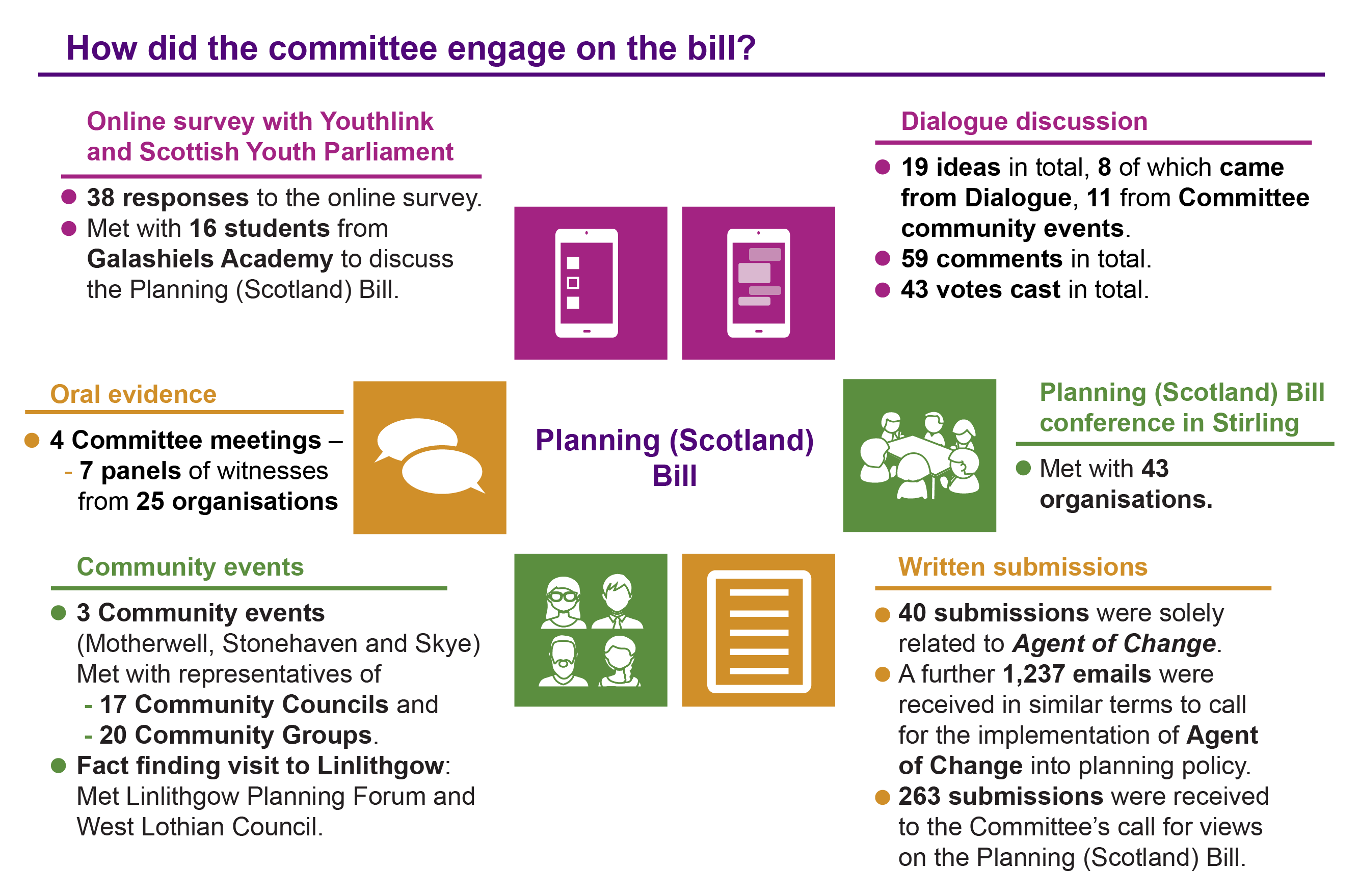
At its meeting on 13 December 2017 the Committee agreed its approach to Stage 1 scrutiny of the Bill. Mindful of the high level of interest in the Bill the Committee agreed a multifaceted approach to seeking views on the Bill including:
Issuing a call for written views
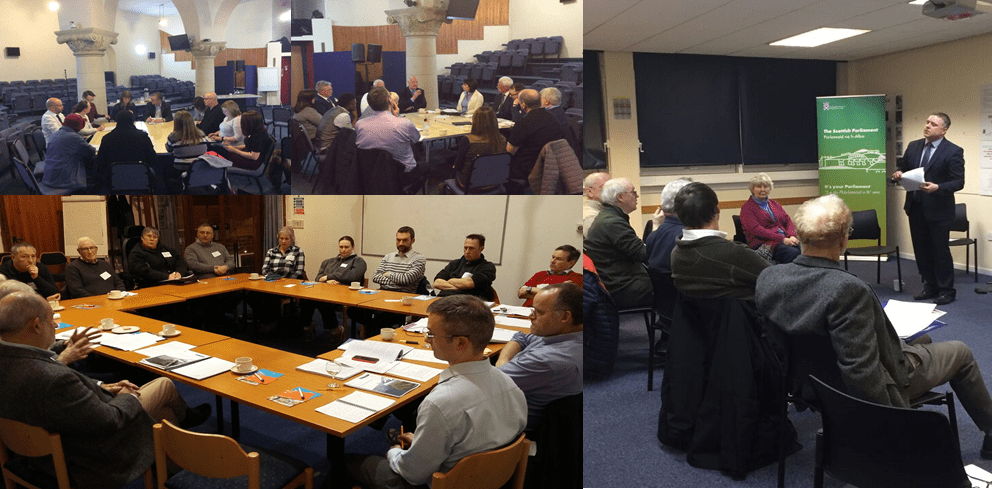
Holding community events in Motherwell, Skye and Stonehaven
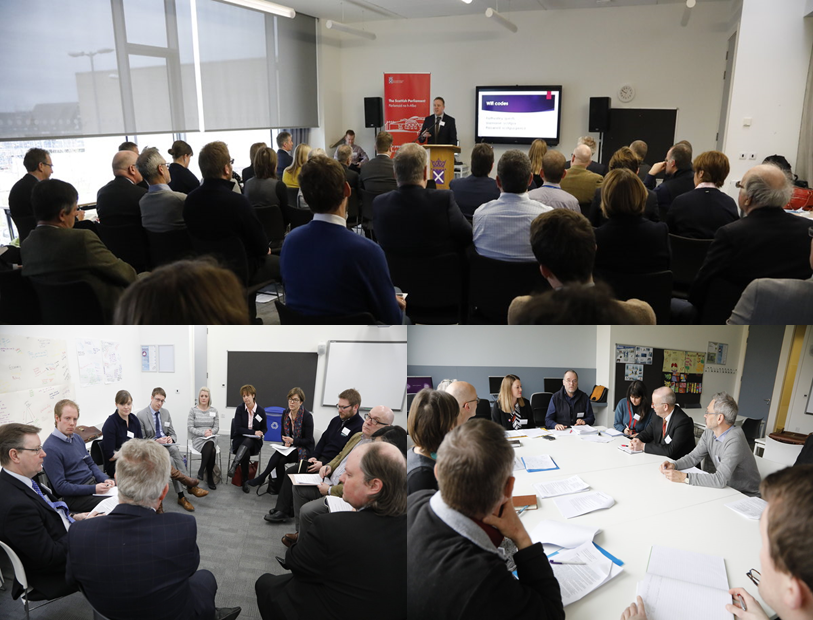
Holding a conference for public, private and third sector organisations
Piloting the use of Dialogue (an online discussion forum)
An online survey of young people's views principally promoted within the Scottish Youth Parliament and Youthlink as well as meeting with students from Galashiels Academy
Meeting with Linlithgow Planning Forum and West Lothian Council officers to discuss their experience of local place planning
Seeking oral evidence at Committee meetings
The Committee received a great response from individuals, small and large organisations (voluntary, charitable, public and private, businesses and others). We thank them for the time and effort taken to provide us with their views which have enhanced our scrutiny and this report.
All of the evidence we have considered can be found on our webpage including the names of all those who have contributed to our work (a summary of which is also contained in Annexe B). Figure 1 below provides details of the Committee's engagement 'in numbers'. Also important to the Committee, however, was the good quality of these contributions.
This report sets out our views, conclusions and recommendations at Stage 1 of the Planning (Scotland) Bill.
The Finance and Constitution Committee and the Delegated Powers and Law Reform (DPLR) Committee also provided their views and recommendations to us. We thank them for their contributions and have included their views and recommendations throughout this report as appropriate.
The Scottish Government's review of planning
In April 2015, the Scottish Government began its review of the Scottish planning system with the appointment of an independent review panel, chaired by Crawford Beveridge (chair of the Scottish Government’s Council of Economic Advisors), working with Petra Biberbach of Planning Aid Scotland (PAS) and John Hamilton of the Scottish Property Federation.
The independent review panel published its final report entitled Empowering planning to deliver great places in May 2016. The Scottish Government responded to that report in July 2016 before then undertaking further consultation, including through six working groups.
In January 2017, the Scottish Government published a consultation paper, Places, People and Planning which set out 20 proposals under four key areas of change. Following further consultation and engagement, the Scottish Government published an analysis report in June 2017 alongside its Position Statement. Alongside that position statement, the Scottish Government published a Strategic Environmental Assessment (SEA) Environmental Report on the environmental impact of those proposals.
The Scottish Government then consulted further on its position statement, and published a further report in October 2017 following analysis of those responses. In December 2017, the Scottish Government published "Review of the Scottish Planning System: Technical Paper" (hereafter referred to as the 'technical paper') which set out its "current thinking" on how key aspects of the Bill could work in practice.
We acknowledge the range of approaches and timescales over which the Scottish Government has consulted on its proposals for inclusion within the Planning (Scotland) Bill.
The purpose of planning
The Scottish Planning Policy (SPP) 2014, which sets out national planning policies which reflect Scottish Ministers’ priorities for operation of the planning system and for the development and use of land, states that—
NPF3 and this SPP share a single vision for the planning system in Scotland:
We live in a Scotland with a growing, low-carbon economy with progressively narrowing disparities in well-being and opportunity. It is growth that can be achieved whilst reducing emissions and which respects the quality of environment, place and life which makes our country so special. It is growth which increases solidarity – reducing inequalities between our regions. We live in sustainable, well-designed places and homes which meet our needs. We enjoy excellent transport and digital connections, internally and with the rest of the world.
The National Planning Framework (NPF) sets the context for development planning in Scotland and provides a framework for the spatial development of Scotland as a whole. It states that—
Key Planning outcomes for Scotland
- A successful sustainable place – supporting economic growth, regeneration and the creation of well-designed places
- A low carbon place – reducing our carbon emissions and adapting to climate change
- A natural resilient place – helping to protect and enhance our natural cultural assets and facilitating their sustainable use
- A connected place – supporting better transport and digital connectivity
Section 3D of the Town and Country Planning (Scotland) 1997 Act requires that functions relating to the preparation of the National Planning Framework by Scottish Ministers and development plans by planning authorities must be exercised with the objective of contributing to sustainable development.
The Scottish Planning system currently has no specific purpose established in legislation. We heard that when the planning system was introduced in 1947 it was assumed that there was a common purpose so it was never included in the legislation. There were calls for a statutory purpose for the planning system to be included within the Planning etc. (Scotland) Act 2006 (hereafter referred to as "the 2006 Act") which the then Scottish Government explained would "...be too great a risk to introduce a provision in relation to individual planning applications, as it would be too difficult to determine with legal certainty, where or not the developments were sustainable."1
As we heard these calls have not diminished since the 2006 Act with a number of respondees again calling for a statutory purpose for planning to be included within the Bill. We heard of examples of other jurisdictions where a purpose for planning had been included within their planning legislation. As Professor Hague explained—
What is the alternative to having a purpose? There are presumably two possibilities. One is that there is no purpose, in which case why are we doing it? The other is that there is a purpose but we are not prepared to say what it is, and that is not a great piece of administration.
Local Government and Communities Committee 07 March 2018, Professor Hague, contrib. 204, http://www.scottish.parliament.uk/parliamentarybusiness/report.aspx?r=11405&c=2070891
Some recommended that the purpose should reflect environmental and climate change priorities to ensure that planning supported the delivery of these Scottish Government commitments. The John Muir Trust stated—
The Trust believes there should be a Purpose for Planning Statement within the Bill, identifying the overarching aims of the planning policy and process. That Purpose should explain how the process will achieve protection and enhancement of the natural and cultural environment.3
Others such as Community Land Scotland, PAS and Planning Democracy proposed that providing a statutory purpose of planning could shift the perception of planning from a regulatory function to providing more positive engagement, creating better local places. Planning Democracy explained that—
A statutory purpose for planning would provide clarity about the public interest outcomes the system should both work towards and be assessed against, moving away from process-dominated debates about planning being a regulatory burden towards a positive focus on creating high quality places.4
Professor Hague highlighted examples from South Africa and Zambia where a purpose for planning had been included within legislation. The National Trust for Scotland also provided extracts of legislation from Denmark (Planning Act 2007), Finland (Land Use and Building Act 2003), Germany (Federal Planning Act 2009), France (Code of Urbanism 2018), Norway (Building and Planning Act 2005) and—
Netherlands - Environment and Planning Act, 2016
Article 1.3 (objectives of the Act in relation to society)
With a view to ensuring sustainable development, the habitability of the country and the protection and improvement of the living environment, this Act aims to achieve the following interrelated objectives:
a. to achieve and maintain a safe and healthy physical environment and good environmental quality, and
b. to effectively manage, use and develop the physical environment in order to perform societal needs.5
A number of those we heard from called for a purpose for planning to be set out in the Bill to reflect the United Nation's Sustainable Development Goals (UN SDG). The Royal Incorporation of Architects in Scotland (RIAS) called for the purpose to—
…align the planning system with international obligations, specifically the United Nations’ Sustainable Development Goals (SDG) which provide a global definitive statement on what sustainable development means and present a clear, unified message.6
Homes for Scotland, however, cautioned against the practicalities of including a purpose within the Bill to ensure that the current plan-led planning system retains flexibility and remains deliverable—
Trying to frame a purpose that describes all that without alienating people who perhaps do not want that to be the purpose of planning could be quite an endeavour.
Local Government and Communities Committee 07 March 2018, Tammy Swift-Adams, contrib. 181, http://www.scottish.parliament.uk/parliamentarybusiness/report.aspx?r=11405&c=2070868
Housing delivery was one of the six key themes Ministers asked the Independent Review panel to consider. It remains a key driver of the Scottish Government's planning reform agenda, featuring in the Minister for Local Government and Housing’s statement to Parliament on Planning and Inclusive Growth, on 5 December 2017. The Committee therefore explored the likelihood of the proposals in the Bill to meet the Government’s housing ambitions.
Several local authorities and others such as Architecture and Design Scotland, and Culter Community Council highlighted the fact that planning legislation, and the planning system more generally, is only one factor in housing delivery. Angus Council in its written submission summarised the range of factors highlighted to us asserting that—
…the planning system is not the primary factor for the lack of housing delivery in recent years. A range of factors have contributed to a reduction in house building activity, stemming largely from the impacts of the economic recession, continued restriction on development finance, lack of construction labour, reduction in the number of small and medium housebuilding and in some cases, the reluctance of landowners and developers to release land or commence development until local market conditions improve.8
Developers and housing stakeholders, such as Homes for Scotland, Scottish Federation of Housing Associations (SFHA) and the Federation of Master Builders Scotland, agreed that the Bill in itself won't deliver more homes. Some developers and housing providers, e.g. McCarthy and Stone, also argued that there needs to be stronger link between the range of housing needs that need to be met, e.g. housing for older people, and the planning process - allowing land to be specifically allocated in development plans for new housing to meet those needs. Similar calls for housing which better meets the needs of older people and those with additional access needs were also made at our community events such as in Skye.
Homes for Scotland explained that in relation to building more and better homes—
Success will be heavily reliant on the secondary legislation, guidance and updated national policy that will follow.9
Some house builders and developers were also keen to stress that delivering more homes was not really dependent on legislative or policy change – rather it would require a culture change towards development within policy and political circles. Stewart Milne Homes stated that—
We remain to be convinced that this Bill, or any variant of this Bill, in itself will result in an increase in housebuilding. Legislative changes through the Planning etc (Scotland) Act 2006 failed to deliver this and we are of the opinion that this Bill still will not deliver homes, unless there is a major change in the mindset of policy makers and decision takers including the Scottish Government and the Reporters’ Unit.10
Finally, a number of respondees highlighted what they see as fundamental problems with the operation of the current system of land purchase and house building, suggesting possible solutions based on experience elsewhere in Europe. The Centre for Progressive Capitalism considered that—
If the Scottish government wishes to increase the level of housebuilding then it will have to reform the land market to remove the speculative element of bidding for land at very high costs upfront. In our view this will require the 1963 Land Compensation Act (Scotland) to be amended to remove prospective planning permission from the compensation arrangements. It is this clause that generates the incentives to speculative in land given the potentially very high profits. Residential land in Edinburgh is estimated to be valued at around £3.2m [million] per hectare versus £800k[thousand] for industrial land and £18k [thousand] for agricultural land. Acquiring residential land at such high prices and which requires firms to manage the risk of these assets through the business cycle remains at the core of the issue. 11
We comment more fully on the proposals for a land value capture at the end of this report in relation to Part 5 of the Bill which seeks to provide Scottish Ministers with the power to introduce an infrastructure levy.
The Minister for Local Government and Housing (hereafter referred to as "the Minister") explained that although the planning system is not broken the need for planning reform came from a number of different sources including—
the need to deliver more housing, the need to improve the experience and influence of our communities, the effectiveness of development planning and leading positive change in our places, the need for more proactive management of development, and the need for strong leadership and better management of skills and resources.
Local Government and Communities Committee 21 March 2018, Kevin Stewart (Minister for Local Government and Housing), contrib. 2, http://www.scottish.parliament.uk/parliamentarybusiness/report.aspx?r=11441&c=2078002
The Minister confirmed that the Bill as only one part of that reform, although it has an important role to play in setting the framework for the system as a whole. It is—
certainly more than just tinkering—it will lead an essential shift in our planning services away from a largely regulatory function, and it will strip back unnecessary process to facilitate delivery of good-quality development and the great places that our communities deserve.
Local Government and Communities Committee 21 March 2018, Kevin Stewart (Minister for Local Government and Housing), contrib. 2, http://www.scottish.parliament.uk/parliamentarybusiness/report.aspx?r=11441&c=2078002
The Minister explained that the core purpose of planning was to create great places—
It is about ensuring that we serve Scotland’s communities, that we achieve sustainable economic growth and that we have the housing that we need and the jobs that we need for our economy to thrive.
Local Government and Communities Committee 21 March 2018, Kevin Stewart, contrib. 12, http://www.scottish.parliament.uk/parliamentarybusiness/report.aspx?r=11441&c=2078012
Whilst the Minister considered that the UN Sustainable Development Goals are a useful starting point for considering a purpose for planning, he observed that under the 2006 Act planning authorities already have a duty to contribute to sustainable development in the exercise of their development plan related functions. In that regard he considered that the UN Sustainable Development Goals and the purpose of planning would be more relevant in subsequent policy rather than in the Bill. 15
Given the different purposes people consider planning should support, the Minister considered that "reaching a definition and getting agreement on it is always going to be difficult." Scottish Government officials also highlighted that in setting out a purpose in the Bill—
it would have legal effect. If it were to have legal effect, it could be used—and people would want it to be used—to challenge decisions and alter how things are processed at all levels of the planning system. We would therefore need to be very clear that that purpose of planning was what we want it to be. It would be much harder to amend a purpose in legislation than to amend a purpose in a policy document.
Local Government and Communities Committee 21 March 2018, Norman Macleod (Scottish Government), contrib. 16, http://www.scottish.parliament.uk/parliamentarybusiness/report.aspx?r=11441&c=2078016
The Minister commented on the work of the Law Commission in Wales—
The Law Commission is currently undertaking a review of planning law in Wales, with a view to providing recommendations for consolidating and simplifying it. Its consideration of the appropriate section of the Planning (Wales) Act 2015 and the proposal on the need for a statutory purpose is set out in a detailed consultation paper that was issued in November last year. The commission suggests that setting out a purpose in law could cause unnecessary and unhelpful duplication as well as conflict.
The last thing that I, and others, want is conflict; a huge part of what we are embarking on is about trying to remove conflict from the system.
Local Government and Communities Committee 21 March 2018, Kevin Stewart, contrib. 18, http://www.scottish.parliament.uk/parliamentarybusiness/report.aspx?r=11441&c=2078018
The planning system is uniquely placed to deliver a wide range of public benefits including a high quality environment, social development, cultural and artistic opportunities, connectivity and economic prosperity. We consider that it is important to have a clear and shared view of what the planning system is designed to achieve.
Since 1947, the purpose of planning has simply been (as reflected in the long title of the Bill), to make provision about how land is developed and used. The purpose to which land is developed and used has been left to policy and practice. It is well understood now, however, that the planning system is central to delivering not only outputs such as high quality environment, warm and secure homes and national infrastructure but also to helping fulfil climate change obligations, sustainable development goals, and wider human rights.
We note that by stating a purpose to planning there is a risk that it is so all-encompassing that it is ends up saying nothing at all. However, we are aware of examples from the Netherlands, Finland, Denmark and Germany where such a purpose has been effectively and succinctly articulated to provide an over-arching purpose of what a planning system should be seeking to achieve.
We also consider that a clear vision of what planning is to achieve will provide greater certainty to communities and developers supporting more meaningful engagement on planning applications, local place plans and local development plans.
We therefore recommend that a purpose of planning is included within the Bill. Such a purpose should reflect the ambition to create high quality places, to protect and enhance the environment, to meet human rights to housing, health and livelihoods, to create economic prosperity and to meet Scotland’s climate change goals and international obligations.
Part 1: Development Planning
The National Planning Framework (NPF)
The National Planning Framework (NPF) sets out Scottish Ministers' long-term land use strategy for Scotland for the next 20-30 years. It is the spatial expression of the Government's Economic Strategy and infrastructure investment plan. The NPF also identifies national developments and other strategically important development opportunities in Scotland. The NPF is accompanied by an action programme which identifies how it should be implemented, by whom, and when. Statutory development plans must take account of the NPF, and Scottish Ministers expect planning decisions to support its delivery.
This Bill proposes that the NPF would be amended to include the content of the Scottish Planning Policy (SPP). The Scottish Government explains that-
the purpose of the SPP is to set out national planning policies which reflect Scottish Ministers’ priorities for operation of the planning system and for the development and use of land. The SPP promotes consistency in the application of policy across Scotland whilst allowing sufficient flexibility to reflect local circumstances. It directly relates to:
the preparation of development plans;
the design of development, from initial concept through to delivery; and
the determination of planning applications and appeals.1
The Bill also proposes that
the NPF would become part of the development plan for every area, alongside the local development plan (creating the 'statutory development plan' for each area);
the NPF would be reviewed every 10 years (currently every five years) with provision for amendments during that 10 years to be set out in future regulations; and
Parliamentary consideration of the NPF would be increased to 90 days (currently 60 days).
In its technical paper the Scottish Government confirms that NPF4 should be adopted in 2020 and that it will be aligned with the next Strategic Transport Projects Review. The approach taken with NPF3 will be built on, with extensive public engagement undertaken and that working with regional partnerships and local authorities will help achieve this. This paper also sets out the parameters for collaborative working, including that Ministers would be responsible for decisions on nationally significant issues and for the adoption of NPF but that they would be transparent about the grounds for deciding not to incorporate regional proposals. They also make clear that the NPF is not a spending document, but would take into account and be informed by wider Government policies and programmes and would therefore "have clear read across to funding arrangements". 2
In its policy memorandum the Scottish Government explains that-
the enhanced status of the NPF and SPP will play a key role in streamlining the planning process by removing the need for local development plans to restate national policy instead focussing on places and development delivery;
the move to a 10 year review of the NPF will provide for "greater stability and certainty as the future direction for growth, enabling investment choices by developers and infrastructure providers to be made with confidence."
in addition, the previous experience of parliamentary scrutiny of the NPF over 60 days has found it to be 'testing' hence the extension to 90 days for parliamentary consideration.
Content of the NPF
We heard that an enhanced NPF could provide a mechanism to set clear specific national house building targets.1 Whilst Scottish Environment LINK stressed that the NPF could provide "clear links across to other sectors of spatial planning in Scotland, particularly marine planning and agriculture, forestry and other areas of land use, through the land use strategy." 2
Scottish Water also supported some Scottish planning policies such as flooding being decided at a national level as this would allow LDPs to focus on more specific issues within an area. 3
Some witnesses, including Heads of Planning Scotland (HOPS) and Scottish Environment LINK, were supportive of a stronger NPF - particularly through its merger with the Scottish Planning Policy. However, they had concerns about how the proposals in the Bill might work in practice. Scottish Environment LINK summarised some of the concerns we heard from a range of organisations as follows—
We think that including Scottish planning policy in the national planning framework risks overloading it. At the moment, Scottish planning policy sets out different sorts of specific criteria-based policies, whereas the national planning framework is much more spatial... There is a risk of making the document quite heavy and burdensome.
The other disadvantage of including Scottish planning policy in the national planning framework is that it would mean that it is likely that there would be only one consultation on SPP and the NPF together, whereas, at the moment, they are consulted on separately, which gives communities and others an opportunity to get involved in thinking about what the criteria policies mean, separate from what the spatial strategy means. There is also, at the moment, an opportunity for an environmental assessment of those.
Local Government and Communities Committee 14 March 2018 [Draft], Aedán Smith (Scottish Environment LINK), contrib. 4, http://www.scottish.parliament.uk/parliamentarybusiness/report.aspx?r=11423&c=2074095
Clydeplan questioned whether the enhanced status of the NPF would require better budgetary alignment. They sought greater clarification on what information the Scottish Government would require from planning authorities, including regional collaborations, in drafting the next NPF. Professor Hague had concerns about the change in status of the NPF from a spatial strategy to a policy document, stating that this might—
restrict the capacity of the NPF to range widely and address matters that might fall outwith the scope of the statutory system at the moment—especially if we do not have a declared purpose of planning that takes on the points that we were talking about earlier this morning.
Local Government and Communities Committee 07 March 2018, Professor Hague, contrib. 310, http://www.scottish.parliament.uk/parliamentarybusiness/report.aspx?r=11405&c=2070997
The NPF and Local Development Plans
A number of local authorities expressed concerns about the Bill's proposals to make the NPF a formal part of each local development plan (LDP). As COSLA explained—
it is important that the planning process is kept under local democratic control. Given the move towards incorporating the regional aspirations within the national planning framework, sitting alongside the local aspirations in the local development plan, there is a risk that it could lead to more direction from above and so the withdrawal of local democratic control.
Local Government and Communities Committee 14 March 2018 [Draft], Councillor Heddle, contrib. 268, http://www.scottish.parliament.uk/parliamentarybusiness/report.aspx?r=11423&c=2074359
Local authorities were concerned that this change in the status of the NPF, along with other changes elsewhere in the Bill, centralised policy making powers. South Lanarkshire Council in its written evidence explained its concerns—
…that a number of the proposals may lead to the control of some planning matters pass from Councils to the Scottish Government. These include the preparation and approval [of] regional strategies through the National Planning Framework, the increased role of Scottish Planning Policy in setting policies formerly set out in Council approved LDPs; and the opportunity for Ministers to require Councils to prepare Simplified Development Zone schemes, and to direct how performance improvements are to be made by Councils. 2
We explore the balance between local and national accountability in the Bill in more detail later in this report.
City of Edinburgh Council also expressed some concerns about the impact of an enhanced NPF on LDPs—
Edinburgh, by its nature as the capital city, has a number of national interests in its development. The way in which we manage those developments should be left to the area’s planning authority to deal with in detail. It is important that the local experience is recognised when the national planning framework is prepared. It is a matter of how we input to that process.
Local Government and Communities Committee 14 March 2018 [Draft], David Leslie, contrib. 270, http://www.scottish.parliament.uk/parliamentarybusiness/report.aspx?r=11423&c=2074361
Parliamentary scrutiny of the NPF
Whilst some such as RTPI Scotland welcomed the enhanced status of the NPF, they considered that greater Parliamentary scrutiny was therefore necessary (additional to the proposed extension of the time for Parliamentary scrutiny from 60 to 90 days)—
In particular, we are exploring the possibility that the NPF could be subject to parliamentary approval. An alternative, or additional, form of scrutiny would be to require the minister to report on the NPF and its implementation perhaps annually or biennially.
Local Government and Communities Committee 07 March 2018, Kate Houghton, contrib. 305, http://www.scottish.parliament.uk/parliamentarybusiness/report.aspx?r=11405&c=2070992
The National Trust for Scotland also called for greater parliamentary scrutiny, particularly in relation to the national developments, stating "National Developments all happen in local places, so it is a concern if people are not aware of that the developments will impact on them." Scottish Environment LINK echoed the views of RTPI Scotland calling for the NPF to be owned and approved by Parliament especially given they consider that the Bill shifts the balance of decision-making "towards the Scottish Government and away from local levels."2
Graeme Purves of Built Environment Forum (BEF) Scotland, however, explained that in a previous role as a Scottish Government civil servant his experience of Parliamentary scrutiny by Committees and the Parliament was that it resulted in meaningful changes to NPF2—
On the process of parliamentary scrutiny, there is an important provision in the existing legislation that ministers are required to report back to Parliament on how they have taken account of the national planning framework, and that is not a perfunctory process...Significant changes were made to the second national planning framework in the light of the Parliament’s views. Two new national developments were added and a couple of others were adjusted.
Local Government and Communities Committee 14 March 2018 [Draft], Graeme Purves, contrib. 11, http://www.scottish.parliament.uk/parliamentarybusiness/report.aspx?r=11423&c=2074102
The Scottish Young Planners Network highlighted the challenges about the process for public consultation during the drafting of the NPF and also amending it during its proposed 10 year lifespan—
We have to be careful about the point at which we consider the national planning framework, particularly if it can be amended at any stage. Decisions made at that point might lead to a local development plan being incompatible with the national planning framework, given that whatever document is decided on will be the prevailing document. Consultation, particularly on the national planning framework, is important to ensure that there is a robust engagement process and that all opportunities for people to participate are taken.
Local Government and Communities Committee 14 March 2018 [Draft], Ailsa Anderson, contrib. 277, http://www.scottish.parliament.uk/parliamentarybusiness/report.aspx?r=11423&c=2074368
In the circumstances of changes to the NPF during the 10 year cycle the Bill provides that subsequent regulations will set out the process for revisions. Scottish Environment LINK called for those amendments to the NPF to go through the same procedures as the NPF in relation to strategic environmental assessment and approval by Parliament. 5
The DPLR Committee also expressed concerns about how changes to the NPF during its 10 year cycle might be considered by Parliament. It recommended that the Government amend the Bill so that significant amendments to the NPF that change the overall policy become subject to specific public and parliamentary consultation requirements set out in the Bill. On the basis that these amendments were made, it is content that the negative procedure applies to setting the procedure for minor amendments to the NPF. However, its preference would be that any provision for periodic parliamentary consideration of such minor issues was set out on the face of the Bill.6
The Minister explained that one of the reasons for the NPF becoming part of the statutory development plan is to reduce duplication, as policies won't require to be repeated in each LDP (unless they depart from the NPF). In addition—
We also intend to use the NPF to provide greater clarity in requirements for housing land, to reduce some of the conflict in the system. Development plan status will help in that regard. Instead of working as they do in the current situation, local development plans will be able to focus on achieving outcomes in places where future development should actually happen. We believe that, by reducing duplication, that could significantly reduce the amount of time that people in organisations have to spend contributing to development plans.
Local Government and Communities Committee 21 March 2018, Kevin Stewart, contrib. 138, http://www.scottish.parliament.uk/parliamentarybusiness/report.aspx?r=11441&c=2078138
Commenting on parliamentary scrutiny, the Minister confirmed that he was considering the recommendations for amendments called for by the DPLR Committee. The Minister highlighted that Committee recommendations arising from NPF3 were already being considered as part of NPF 4, which is due in 2020—
For example, the report on NPF3 asked that we build into the process early debate by Parliament on the national developments. That would be extremely helpful.
Local Government and Communities Committee 21 March 2018, Kevin Stewart, contrib. 142, http://www.scottish.parliament.uk/parliamentarybusiness/report.aspx?r=11441&c=2078142
The proposal to incorporate Scottish Planning Policy (SPP) into the National Planning Framework (NPF) is, on balance, a sensible idea and puts the SPP onto a statutory footing. We note, however, that there is no explicit statutory reference to the SPP in the Billi and the intention to merge the two documents could be made more explicit.
The Bill provides that the new NPF would become part of the development plan for each planning authority, along with the Local Development Plan. This substantially increases the status of the NPF and concerns have been expressed that this creates greater central control and influence in the planning system.
The move to a 10 year cycle for reviewing the NPF better accords with development timescales, reducing the amount of time spent on preparing plans. It also means, however, that there is an increased likelihood of significant reviews needing to be made to reflect emerging policy issues and challenges.
We welcome the steps taken by the Scottish Government in this Bill to increase the time available for Parliament to scrutinise this Bill. Given the enhanced role to be accorded to the NPF, however, the Committee takes the view that the process of Parliamentary scrutiny must be significantly enhanced to include time for substantive engagement with the public. Provision for such enhanced scrutiny should be incorporated in the Bill and amendments brought forward to—
- require Parliament to be consulted on changes to the NPF
- remove limits to the timescales for Parliamentary scrutiny of the draft NPF (and any revisions) and give Parliament the power to establish such timescales as appropriate to the scope of the proposals according to normal Parliamentary business planning procedures
- require the draft NPF to be accompanied by a statement as to the process of engagement and consultation undertaken by Scottish Ministers in preparing the draft NPF as well as information on the impacts on equalities, human rights, children and young people, island communities and sustainable development (reflecting current reporting requirements for Scottish Parliament Bills)
- ensure that the final NPF reflects the views of Parliament as a whole rather than Scottish Ministers and has the standing to endure across successive governments. We recommend that the Scottish Government amends the Bill to enable the final NPF laid in Parliament to be amended by Parliament and, following any agreed changes, for the final NPF to be subject to Parliamentary approval.
We welcome the Scottish Government's commitment to bring forward amendments to the Bill at Stage 2 "to place procedures for significant amendments to the NPF on the face of the Bill" and its consideration of how to make appropriate arrangements for minor amendments. 9
We request further information on how the Scottish Government will ensure that the NPF has "clear read across to funding arrangements".
Subject to the above amendments being brought forward we are content with the proposals to strengthen the NPF.
Finally, we suggest that the NPF should provide an opportunity to create greater coherence between a range of national policy areas such as climate change, energy, marine planning and transport. We recommend that Scottish Ministers consider how such greater coherence might be established within the NPF and be reflected in the Bill.
Removal of strategic development plans
Section 2 of the Bill proposes to remove the requirement to prepare strategic development plans (SDPs). This, the Scottish Government explains, will ensure time and cost savings for those authorities involved in the production and delivery of SDPs, which have become too prescriptive, overly complex, costly and lengthy to produce.
The Policy Memorandum notes that the removal of SDPs is closely linked to the duty in the Bill for planning authorities to co-operate in relation to the provision of information to Ministers to inform the NPF. The technical paper suggests that the following might be activities that could be undertaken under this new duty:
joint working to gather evidence and address cross boundary issues as required;
bringing together the output from regional level evidence gathering to help inform and influence a single spatial strategy; and
supporting the preparation and implementation of a delivery programme for the NPF.1
Modern strategic, or regional, planning in Scotland began with the publication of the Clyde Valley Regional Plan 1946 and continued on a non-statutory basis until local government reorganisation in 1975 (introduced by the Local Government (Scotland) Act 1973) and the creation of structure plans by the Town and Country Planning (Scotland) Act 1972. Structure plans, which were produced for the whole of Scotland - initially by the nine regional councils and (following a further round of local government reorganisation in 1996) local authority joint boards, remained a feature of the Scottish Planning system until the passage of the Planning etc. (Scotland) Act 2006. The 2006 Act abolished structure plans and introduced strategic development plans.
Currently strategic development plans set out a vision for the long-term development of Scotland’s four main city regions (these are regions centred on Aberdeen, Dundee, Edinburgh and Glasgow), focusing on cross-boundary issues such as the amount and areas for housing, major business and retail developments, infrastructure provision and green belts/networks.
A strategic development plan is drafted by a Strategic Development Planning Authority (SDPA), the membership of which is defined in statutory designation orders. SDPAs are required to publish, and update, a development plan scheme which outlines its programme for preparing and reviewing the strategic development plan and for engaging the public. The scheme must also contain a participation statement setting out the ways in which local people and other stakeholders will be involved in the preparation of the plan. Each strategic development plan must be accompanied by an action programme, which must be updated at least once every two years.
Under the Bill, authorities would have flexibility and scope to determine the best ways to work together as a bespoke partnership (such as the regional working that already occurs in relation to enterprise and skills, and city region deals). In its technical paper the Scottish Government explains that—
It is intended that all local authorities will be part of a regional partnership but that it would be open to any authority to contribute their views on regional priorities for the National Planning Framework to address on an individual basis through the normal consultation process.1
The Bill proposes that Ministers have the power to direct planning authorities and key agencies to provide information to them on matters relevant to the preparation of the NPF. The policy aim of this part of the Bill is to "ensure that cross-boundary issues are properly addressed and used to inform the NPF". The Bill then sets out a range of planning authority matters that the power of direction might include such as the purposes for which land in the area is used and infrastructure in the area. The power of direction also includes a power to require two or more planning authorities to co-operate with one another in the provision of information to Ministers to inform the NPF.
In 2014 Kevin Murray Associates undertook research on SDPs for the Scottish Government on whether the SDP system in Scotland was fit for purpose. That research concluded that "The answer is that the system is still bedding in, it is not broken, nor is its potential yet fully optimised."3
Views on the removal of SDPs were mixed. Opponents of the proposals included organisations such as Clydeplan, which with its predecessor organisations have developed strategic plans for the Glasgow city-region for 70 years. Clydeplan argued that—
as our economic, land use and transportation patterns have evolved, it has become increasingly important to think about delivering economic growth across city regions. Even the independent panel acknowledged the value of planning at the city region scale, and the Scottish Government recognises that strategic planning is an essential element of the overall planning system.
Taking that in context, the question is how that is delivered. Obviously, the bill seeks to remove the statutory duty to prepare a strategic development plan. Clydeplan does not wish that to happen. We think that there is still a role for the statutory nature of the plan, although processes around it could be changed to expand and enhance it. However, if things are going to change and the preparation of an SDP is to be removed from the system, we firmly believe that a regional spatial strategy is critical to economic delivery and that any role in that regard as part of a regional partnership should be a statutory duty.
Local Government and Communities Committee 07 March 2018, Stuart Tait (Clydeplan), contrib. 199, http://www.scottish.parliament.uk/parliamentarybusiness/report.aspx?r=11405&c=2070886
The City of Edinburgh Council (and others) also observed that some form of regional spatial planning will be required to underpin regional working in other circumstances such as the city region deals but questioned whether the tone in the Bill might weaken the resolve of local authorities to work together. COSLA observed that—
Councils will always work together when there is an opportunity to improve services and service delivery. The problem of working together comes when we come up with a plan that in some way conflicts with the regional dimension of the national planning framework as placed alongside the local development plan. That needs to be unpicked.
Local Government and Communities Committee 14 March 2018 [Draft], Councillor Heddle, contrib. 284, http://www.scottish.parliament.uk/parliamentarybusiness/report.aspx?r=11423&c=2074375
Many respondees, such as SFHA and Scottish Renewables, were neutral on the proposed removal of SDPs or offered cautious support, explaining that SDPs had not done the job they were intended to do. This cautious support was generally dependent on further refinement of the proposed replacement system for regional planning, a view summarised by Scottish Environment LINK Planning Group, which stated—
We are broadly neutral on the proposal to incorporate regional planning into the NPF however we do strongly believe that some form of regional planning is necessary in order to help manage environmental issues at the regional scale. The failure of some of the Strategic Development Plans (SDPs) to tackle these issues is partly why their value has been questioned by some but it is not clear from the current Bill proposals how these regional spatial issues will be addressed.6
Responding to a question as to whether SDPs should be removed albeit with some mechanism put in place to ensure local authorities worked together, SFHA explained that—
It is a good thing. It is up to local authorities to identify what the key priorities are in their areas. However, unless people come together in the first place, they cannot make that judgment.
Local Government and Communities Committee 07 March 2018, Sarah Boyack, contrib. 48, http://www.scottish.parliament.uk/parliamentarybusiness/report.aspx?r=11405&c=2070735
Homes for Scotland supported the removal of SDPs—
We maintain our support for the removal of Strategic Development Plans (SDPs) as these have not proven effective on housing delivery. We do not agree with the view that SDPs are still ‘bedding-in’. 8
They and others also called for greater recognition of regional working in the Bill, but where that does not happen then the Bill should enable the Scottish Government to "corral local authorities and make them work together to build a stronger NPF." Aberdeen City Council suggested that SDPAs should be able to continue to produce SDPs, under current arrangements, on a voluntary basis. 9
Secondary legislation also provided an opportunity to provide greater clarification with Scottish Renewables explaining that—
We broadly support the proposals on strategic development plans. On regional partnerships, which are linked to that, we feel that having more information on how they might be resourced would be useful. It would be desirable for secondary legislation to provide for regional planners a clear steer on the Scottish Government’s national priorities.
Local Government and Communities Committee 07 March 2018, Jenny Hogan, contrib. 36, http://www.scottish.parliament.uk/parliamentarybusiness/report.aspx?r=11405&c=2070723
A broad range of stakeholders expressed concern about how well regional planning would be supported in future, if there was no explicit requirement within the Bill. Homes for Scotland, McCarthy and Stone and others explained that if regional working is not a duty then it would be unlikely to be resourced (given the constraints on planning resources).11 The Law Society of Scotland questioned whether the duty as currently provided for in the Bill would lead to efficient partnership working. 12Some community groups shared the concerns of Cramond and Barnton Community Council—
…that regional planning priorities will be set at national level or by regional partnerships without adequate engagement and scrutiny by, or accountability to, the communities directly affected by such priorities.13
HOPS also questioned how the proposed new arrangements would work in practice, stating that—
HOPS has previously expressed concerns that the replacement of SDPs with a regional partnership approach, requires clearer evidence to justify the case for change, clarification of the actual expectations for the new arrangements, and clarification of how these objectives are to be delivered. Unfortunately given the lack of evidence and specification around the future arrangements, these matters remain concerns and emphasise the need for clear transitional arrangements to avoid a vacuum. 14
More specific concerns about resolving cross-border planning disputes were raised by RTPI Scotland, which—
…supports the principle behind voluntary regional partnership working, and agrees that local authorities are best placed to decide the geography of such partnerships. However, we believe that without a statutory requirement for agreement on outcomes of cross-border issues, there is potential for deadlock. 15
Resourcing of regional working was also highlighted with McCarthy and Stone explaining that "if the resources to implement the duty are not there or if the will to do so is not there, all of those principles will fail."16
The Minister confirmed that, whilst the Kevin Murray Associates research did not recommend removal of SDPs, it had raised similar concerns to those that the Bill seeks to address, namely to provide—
stronger collaborative leadership; greater alignment of vision, strategy and delivery mechanisms; improved community engagement and awareness raising; a more streamlined process for housing needs and demand assessments; better coverage of infrastructure; stronger links with wider community planning; improved action planning; and a focus on delivering outcomes. Together with the wider planning reform, the bill will ensure that many of those recommendations can be implemented.
Local Government and Communities Committee 21 March 2018, Kevin Stewart, contrib. 149, http://www.scottish.parliament.uk/parliamentarybusiness/report.aspx?r=11441&c=2078149
The Scottish Government's Chief Planner explained that SDPs currently focus on four geographic areas but that cross boundary issues arise over other parts of Scotland and that through the Bill—
We have sought to provide stronger regional focus. There is already a regional perspective in national planning framework 3, which moves us on considerably from earlier versions. The proposals are simply to strengthen that. We co-produce the national planning framework with planning authorities working over different geographies, to ensure that it can give regional perspectives and more information about regional infrastructure such as housing and so on, in a way that reduces duplication and complexity in the system.
Local Government and Communities Committee 21 March 2018, John McNairney, contrib. 150, http://www.scottish.parliament.uk/parliamentarybusiness/report.aspx?r=11441&c=2078150
It is fair to say that views are mixed on the proposal to remove the statutory provisions relating to Strategic Development Plans (SDPs). To the extent that there is support, it is contingent on a commitment to continue with some form of regional spatial planning because, as one witness put it, “people and the natural environment do not obey strict political boundaries.”
We note that there are significant concerns about the future of regional spatial planning, a discipline that has a long history in Scotland and has attracted interest and commendation from elsewhere. A number of the planning authorities that comprise Clydeplan wrote of their positive experience and the valuable contribution that regional planning had made to "the successful delivery of regeneration and economic growth in the Glasgow city region in recent years."
It was not clear from the evidence we heard that removing the current provisions for SDPs will lead to a simplification, to streamlining, to cost savings or to more effective planning at a regional scale. There is a risk that the time and effort currently devoted to the four SDPs will be eroded and political support will wane if regional planning becomes a voluntary endeavour.
Given this, we do not consider that the current statutory framework for regional planning should be repealed unless a more robust mechanism is provided to that currently proposed in the Bill.
We suggest that such a mechanism could include enabling local authorities to work together for strategic planning purposes; and that any agreed plan that arises from that work should then form part of the relevant Local Development Plans (LDPs).
Local Development Plans (LDPs)
The Bill proposes a number of changes to the content and process for drafting or amending local development plans. The Scottish Government explains in the Policy Memorandum that although these may appear to be largely procedural, the aim is to achieve a "much wider policy objective of significantly strengthening LDPs and giving them a greater focus on place and delivery".
LDPs cover the whole of Scotland; they identify sites for new developments and set out policies that guide decision making on planning applications. Currently, each planning authority (i.e. local authority or national park authority) is required to publish and then update local development plan(s) covering their area at least once every five years. In addition planning authorities must publish, and update, a development plan scheme which outlines its programme for preparing and reviewing local development plans and for engaging the public. The scheme must also contain a participation statement setting out the ways in which local people and other stakeholders will be involved in the preparation of the plan. Each local development plan must be accompanied by an action programme that must be updated at least once every two years.
The Bill proposes the following:
extending the timescale for LDPs from five years to 10 years (to better reflect investment and development timescales and a more settled vision);
a process for amending the LDP within that 10 years including provision for independent scrutiny of amendments in some circumstances (such as a shortfall in housing in the supply of housing land);
full council approval of the LDP (rather than a committee)
that the LDP will take account of local outcome improvement plans (to better align with the wider activities and objectives arising from community planning)
removal of the requirement to produce a vision statement with the LDP (to avoid unnecessary preparation of multiple visions for an area to focus on that of the local outcomes improvement plan and the spatial strategy);
removal of the requirement for a Main Issues Report. Instead there will be a single draft plan - the Proposed Plan- with extended consultation period (of eight weeks) and scope for amendment to reflect any consultation views;
publication arrangements for various stages of the LDP and evidence report;
Replaces LDP action programmes with delivery programmes which are regularly updated, strengthening their role as agreed by the local authority.
prior to adoption of the LDP Scottish Ministers can "choose to intervene and direct changes to the LDP where they conclude it is unsatisfactory."
Ministers can also appoint a person to report to them on any matter within or related to the plan, and can also set out the procedures that appointed person should follow.
In its technical paper the Scottish Government suggests that there would be some flexibility for local development plans to reflect local policy (as opposed to the NPF) "where local circumstances justify this" and they propose, at a later date, to indicate what some of those circumstances might be. They envisage that plan preparation would take two-three years and would be more streamlined than at present. The ability to review the LDP earlier than 10 years would be at the discretion of the planning authority.
The process for updates to LDPs within the 10 year period has yet to be finalised but the technical paper suggests that it may be designed as follows:
Amendments to be submitted to Scottish Ministers
A requirement to demonstrate that consultation has been undertaken
a report of consultees views and an explanation of how views have been taken into account
a procedure for Scottish Ministers to require an independent examination of the amendments where appropriate.
Figure 1 sets out the proposed plan preparation and implementation process which was included within the Technical Paper discussed at the Scottish Government’s Working Groups in October 2017.
Figure 1: Scottish Government's proposed plan preparation and implementation 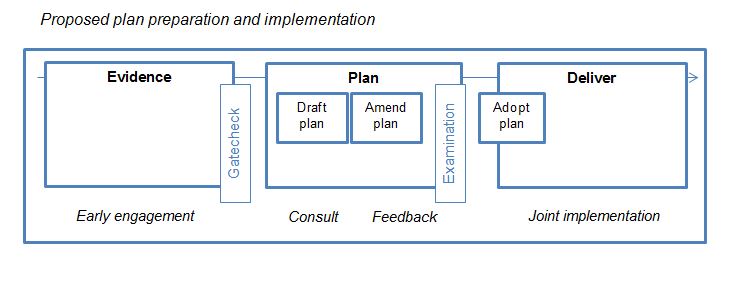
In relation to the proposal to remove the main issues report, the technical paper suggests that "a requirement to provide feedback on how the plan has been amended to take account of contributions made will also move process driven consultation towards more meaningful and continuous involvement."
The technical paper suggests that the Environmental Assessment (Scotland) Act 2005 requirement to assess alternatives would still be applicable, but that guidance would be produced on how this would work with the draft plan given the removal of the main issues report proposed in the Bill.
PAS welcomed the move away from the main issues report as—
it has not worked. Most local authorities simply produce something that they send out to consultation, but that is not participation; it is an invitation to the people who already know the system to be informed and get involved.
Local Government and Communities Committee 28 February 2018 [Draft], Petra Biberbach, contrib. 93, http://www.scottish.parliament.uk/parliamentarybusiness/report.aspx?r=11390&c=2068382
We heard a range of views on the proposed extension to 10 years for LDPs. Homes for Scotland queried the grounds under which a LDP might be reviewed, such as in the event of a shortfall in the housing supply arising.2
SFHA considered that by moving to a 10 year LDP the emphasis needed to be on implementation and delivery, rather than saving money (from moving from 5 year reviews) suggesting that LDPs need to better reflect communities housing needs and demands.3
COSLA expressed concern that the move to a 10 year LDP in combination with the removal of statutory supplementary guidance could mean that—
As we move to local development plans on a longer timescale, the risk is that something could go into those plans that rapidly became redundant and was at odds with authorities’ planning aspirations.
Local Government and Communities Committee 14 March 2018 [Draft], Councillor Heddle, contrib. 331, http://www.scottish.parliament.uk/parliamentarybusiness/report.aspx?r=11423&c=2074422
Much of the discussion on LDPs was about the proposed change to the status of the NPF, to form part of the statutory development plan. The Scottish Government's Chief Planner explained—
the development plan is a combination of the strategic development plan and the local development plan. The bill proposes that we no longer prepare the strategic development plan. A key reason why the national planning framework should become part of the development plan is to take account of the strategic element that currently exists, albeit only around the four largest cities, so that we have a conjoined development plan.
Local Government and Communities Committee 21 March 2018, John McNairney, contrib. 140, http://www.scottish.parliament.uk/parliamentarybusiness/report.aspx?r=11441&c=2078140
The Minister explained that by removing the duplication of the NPF in LDPs (as currently happens), LDPs will be able to "focus on achieving outcomes in places where future development should actually happen".6
In its response the Finance and Constitution Committee highlighted concerns it heard that the savings identified by the Scottish Government in the Financial Memorandum as arising from moving to a 10 year plan cycle for LDPs and the NPF were "unrealistic" as the funds would be directed to LPPs (on which we comment later). The Minister highlighted to that Committee that future regulations will amend the LDP process in order to redirect where these savings may be spent. 7
Statutory Supplementary Guidance
The Bill proposes removing the current provisions for creating statutory supplementary guidance. In its technical paper the Scottish Government suggests that this provision will simplify and improve the accessibility and scrutiny of LDPs. Non-statutory guidance may still be prepared and adopted by the planning authority, which would be a material consideration in planning decisions.
Several local authorities raised concerns that this proposal may result in development plans becoming more complex, the opposite of what the Scottish Government hopes to achieve. South Lanarkshire Council explained that it—
…has found that the option of being able to prepare and consult on statutory supplementary guidance is an effective means of clearly establishing detailed policy guidance directly relevant to our particular local circumstances and environment. This has been especially relevant to guidance on both minerals and renewable energy proposals – particularly onshore windfarms. It is considered that the removal of this option will add considerably to the ‘complexity’ of the LDP itself and that both communities and developers will not have the advantage of being able to access a document which comprehensively addresses these kinds of planning issues.1
Aberdeenshire Council agreed highlighting that—
There is concern that removing supplementary guidance would have the effect of potentially significantly increasing the size of the local development plan which goes against the aim of producing a leaner and clearer plan.2
While East Lothian Council also considers it will do little to reduce the creation of non-statutory guidance, stating—
The removal of the provision for statutory Supplementary Guidance would reduce the weight afforded to guidance but would do little to reduce the resources required by Planning Authorities to produce it.3
Others, such as planning consultants Aurora Planning Ltd, also highlighted the possible reduction in flexibility in development plan production, indicating that—
…we are concerned that the removal of statutory supplementary guidance will also remove the opportunity for and local flexibility in the application of national policies and the inclusion of locally specific policies in Local Development Plans. Again, the Bill does not provide sufficient detail on proposed non-statutory supplementary guidance to reassure us that it will be an adequate substitute. 4
The BEF Scotland highlight a lack of clarity in the likely impact of this proposal, asking—
…the Scottish Government to clearly set out its understanding of what is Supplementary Guidance of a statutory nature, and what is local planning guidance that is a material consideration in the planning process, to ensure clarity in understanding the full implications of the proposal. 5
The City of Edinburgh Council highlighted that statutory guidance enabled it to respond more quickly and transparently to the changing nature of growth in Edinburgh.6
Gate Check
The Bill also proposes that there is a requirement for planning authorities to produce an "evidence report" setting out the evidence to be used in drafting the local development plan. These reports must be submitted to Scottish Ministers. The evidence report will be the subject of a "gatecheck" by an independent planning reporter appointed by Ministers. The reporter may decide the evidence base is sufficient or that further evidence needs to be gathered. If further evidence is needed, then the authority will be required to gather and re-submit the evidence report to Ministers for further consideration.
Future regulations will set out the detailed procedures and costs of the gatecheck as well as what is to be assessed. In its technical paper the Scottish Government suggests that authorities would prepare "a statement of agreement/dispute with key stakeholders, such as communities, agencies and Homes for Scotland which would provide the basis for the reporter to add value whilst being proportionate in their approach. The Scottish Government is currently working with Moray Council on a pilot of the gatecheck.
Planning Democracy supported the introduction of a gatecheck mechanism replacing the main issues report, which never realised its ambitions of engaging people early. That said, they had concerns that—
At the moment, the gate check looks as though it will be a rather technocratic tick-box exercise, looking at evidence handed down from on high, instead of a chance for people to really deliberate the kinds of evidence that should be taken into account in planning.
There is a need to get people involved at the initial stage before a draft plan is produced, and there is scope to discuss the expansion of the gate check and how it could be made into a more deliberative and engaged process.
Local Government and Communities Committee 28 February 2018 [Draft], Dr Inch, contrib. 92, http://www.scottish.parliament.uk/parliamentarybusiness/report.aspx?r=11390&c=2068381
A broad range of respondees, including HOPS and City of Edinburgh Council, highlighted the opportunity for stakeholder involvement in the proposed gatecheck exercise. RTPI Scotland explained that it—
…is concerned by the narrow scope of the new evidence report to be introduced to the LDP process. To ensure that all stakeholders are engaged with the development planning process right from the beginning is it imperative that they are able to input to the evidence report.2
This concern is shared by the Scottish Planning Consultants Forum—
The Bill does not make the provision for consultation during the evidence “gate check” stage. This will further reduce the opportunity for other stakeholders to comment on a number of key policy areas, such as establishing the appropriate housing supply targets and housing land requirements to be delivered within local authority areas. 3
While the development industry is also concerned. Commercial lawyers Burness Paull state that—
…it is not clear the extent to which developers and landowners will be able to have an input to the gatecheck process as the detailed procedures, including consultation requirements, are to be set out in regulations. If key decisions on matters such as the amount of housing land required are to be made at the gatecheck stage, it is important that all stakeholders are consulted and the given the opportunity to participate fully in the process of giving evidence to the reporter.4
Several local authorities have also raised concerns that the gatecheck may not significantly streamline development plan examinations. Falkirk Council states that—
The new early gatecheck procedure may to some extent negate other time savings achieved by the new process. It is by no means clear that this procedure will achieve its aim of significantly reducing debate at the final examination stage. 5
In addition, East Ayrshire Council questions how the gatecheck exercise will work in practice, arguing that—
The Council finds it difficult to understand how an independent Reporter can determine whether the evidence provided at the start of the plan making process is sufficient if the issues that the plan needs to tackle are not fully known or the approach the plan will take to tackle them is sufficiently developed.6
The Minister explained the Scottish Government's proposed approach to involving communities and stakeholders in the evidence report and gatecheck—
Our intention is that communities should be closely engaged in the preparation of the evidence report and that the gate check should examine how engagement has taken place and identify areas of agreement or dispute with different stakeholders. There are powers for ministers to prescribe matters to be included in the evidence report and the procedures and matters to be assessed in the gate check. That is in proposed new section 16A of the Town and Country Planning (Scotland) Act 1997, which is inserted by section 3(4) of the bill.
We intend to include the duties for stakeholder and community engagement through the secondary legislation, but I understand the concern of the committee that our intentions for greater community engagement in development planning are not visible on the face of the bill. There are a number of ways in which that aspect might be strengthened, and I will consider what amendments we might lodge at stage 2.
Local Government and Communities Committee 21 March 2018, Kevin Stewart, contrib. 109, http://www.scottish.parliament.uk/parliamentarybusiness/report.aspx?r=11441&c=2078109
Responding to proposals that specific stakeholders (such as young people) should become statutory consultees in relation to consultation on LDPs, the Minister stated that—
I want everyone to become involved in the planning system, but I do not know whether mandating the involvement of particular groups is the right way forward, because we would then have to go through the entire gamut, which might well add to bureaucracy. The regulations for local development plans will certainly set out engagement requirements, and I want to be pretty strong on those requirements.
Local Government and Communities Committee 21 March 2018, Kevin Stewart, contrib. 112, http://www.scottish.parliament.uk/parliamentarybusiness/report.aspx?r=11441&c=2078112
The Minister then highlighted the opportunities that exist for greater engagement in the preparation of LDPs, including greater use of technology such as through three dimensional visualisation of a place on an digital device.
In considering the changes to local development plans we are content with the proposals to move to a 10 year cycle (which accords with the NPF cycle). We welcome the proposals to provide for greater connection between the LDP and local outcome improvement plans which should provide for a more coherent vision for communities.
We note the concerns expressed that the savings identified from the LDP and NPF moving to a 10 year cycle could be "unrealistic" and we therefore recommend that the Scottish Government and COSLA monitors and report on the costs of LDP and NPF plan preparation (should the Bill become an Act) to confirm that such savings do then materialise.
The requirement for planning authorities to review LDPs, in order to address newly emerging issues (or as a consequence of NPF reviews), may also give rise to additional costs. Our recommendations for enhanced Parliamentary scrutiny should ensure that NPF reviews (with their consequent impact on LDPs) are only undertaken when necessary and following robust consultation and engagement.
We remain to be convinced that removing statutory supplementary guidance will simplify LDPs and improve scrutiny and accessibility to any great extent. The removal of such guidance through the Bill could lead to increasingly complex and lengthy LDPs, as authorities include detail that would have previously formed supplementary guidance in the plan itself. This goes against the aims of streamlining plan making processes and producing concise, easily understood plans.
The removal of statutory supplementary guidance may also result in greater use of local guidance which, without statutory weight, could result in more confusion for developers and communities about the types and nature of developments that are permissible locally.
We therefore seek further clarification from the Scottish Government on how matters which were previously the subject to statutory supplementary guidance should now be articulated and given sufficient weight to ensure development is in accordance with an authority's plan.
We agree with witnesses that removing the main issues report could reduce the opportunities for engagement with stakeholders and communities. We consider however that the new evidence report and gatecheck provides a mechanism to address these concerns. We welcome the Minister's commitment to consider amendments at stage 2 to provide for greater community engagement for development planning.
We recommend that those amendments should seek to ensure that evidence reports from authorities set out the quality and impact of their engagement with communities and stakeholders and in particular their engagement with disadvantaged communities.
We also consider that the gatecheck mechanism should provide for greater involvement with stakeholders so that their views are gathered by the Reporter as evidence on the robustness of evidence underpining the draft LDP. We recommend that regulations provide for this requirement.
We also note the calls for greater innovation on how views are gathered to inform LDP preparation and the gatecheck mechanism, including from public hearings and more deliberative approaches. We request further information from the Scottish Government on how it will encourage these and other more meaningful engagement approaches.
Later in this report we also make further recommendations about other aspects of the evidence report and gatecheck which should be amended in the Bill (see the section on Local Place Plans).
Local Place Plans
The Bill introduces a new right for communities to produce plans (a 'local place plan (LPP)') for their local places which planning authorities should 'have regard to' as part of the LDP preparation process. The Scottish Government explains that the aim of this is to "significantly enhance engagement in development planning, effectively empowering communities to play a proactive role in defining the future of their place."
The Policy Memorandum explains that LPPs were recommended by the independent review panel, which recommended that—
Communities should be empowered to bring forward their own local place plans, and these should form part of the development plan.
Communities are best placed to define the future of their place and this may emerge from community planning as locality plans, or could be driven by land reform or charrettes. These plans should be given statutory status by forming part of the local development plan where it can be demonstrated that they play a positive role in delivering development requirements. Communities should also go beyond plan preparation and be supported to actively enable their delivery. Community development trusts, community councils and other community groups will play an increasingly important role in this. 1
Under the Bill, a Community Council or other community body (as defined in Section 19 of the Community Empowerment (Scotland) Act 2015) will have the power to produce a LPP. A completed LPP can be submitted to the relevant planning authority, which must have regard to its contents when preparing or reviewing the relevant local development plan.
The Scottish Government explains that the proposals for LPPs in the Bill are at an early stage with most of the detail to be set out in regulations at a later date. The Bill, however, requires an LPP to have regard to:
any relevant local development plan
the National Planning Framework
any other matters prescribed by the Scottish Government
Under the Bill, the Scottish Government will have the powers to set out the:
required content and form of an LPP
steps to be taken by the Community Council or body before developing an LPP
steps that must be taken by a Community Council or body before submitting an LPP to the planning authority
documentation that must be submitted by the Community Council/body to the planning authority alongside an LPP.
The policy memorandum explains that where the LPP leads to the amendment of the LDP, it would be required to be subject to the same procedure as other elements, including independent examination where it is viewed by the Scottish Ministers as a significant change in order to ensure the reliability and certainty of the development plan.
In its technical paper the Scottish Government sets out further how it thinks LPPs might work including:
LPPs could be expected to contribute to inclusive growth and the positive development of an area
LDP would set out the framework for local place planning across an area and should guide the key principles for any LPP in their area.
would give planning authorities an opportunity to work with their communities by helping to identify in the LDP any areas where LPPs could most usefully be prepared
LPPs could include linkage to locality plans
LPPs should not contradict local spatial strategies or national policy
LPPs should not have a negative effect on development proposals that have already been consulted on and incorporated into the development plan
it is not expected that the LPP proposals will take effect until 2019-2020
The technical paper also sets out that the Scottish Government expects to bring forward secondary legislation or guidance on details to be considered when preparing a LPP including:
purpose and scope of the plan,
area to be covered
evidence from the LDP and local outcome improvement plan
requirements for further evidence gathering
how to engage with the wider community
necessary resources and potential sources of support and possible paths to delivery.
The Scottish Government also "will ensure that community bodies are aware at the beginning of the process what, if any, statutory requirements they will need to fulfil".
The Scottish Government explains that should the Bill lead to significant additional proposals for local engagement in the planning process, a more measured approach to LPPs may be required in view of the limitations of available resources, planning authorities and community capacity.
The Financial Memorandum estimates that the average cost of preparing a LPP will be £13,000, with approximately 92 LPPs produced per year (five to six in a medium sized authority over 3 years). This is extrapolated from the experience of the Coalfields Regeneration Trust which has supported to 20 communities since 2011 to deliver similar types of plan. The costs for preparing an LPP are to met by communities in the first instance but some sources of funding (or support in kind) could be available through public sector, third sector, local businesses as well as Big Lottery Fund, Scottish Government or local authority funding. The Scottish Government explains that additional support for communities to develop their capacity and identity is "not a separate task specific to LPPs; it will be part of wider work on community development or empowerment."
Following the submission of a LPP, the technical paper suggests that it could:
act as a material consideration in subsequent decisions but not forming part of the LDP
be part of the evidence base used to inform the next full review of the LDP
where it is to be included within the LDP, the LPP should provide robust supporting information and evidence of consultation with people in the local area and other relevant communities of interest.
We heard from Linlithgow Planning Forum of their experiences of developing a local place plan. Working across the community the Planning Forum had developed a long term plan which they believed met the unique needs of Linlithgow in a way that the LDP process could not, given its focus across West Lothian. It was therefore disappointing to the Forum that after their hard work they felt that much of their plan had not been incorporated into West Lothian Council's work or LDP. On a positive note the forum members felt that having undertaken this process once, their consultation skills and community knowledge were considerably enhanced.
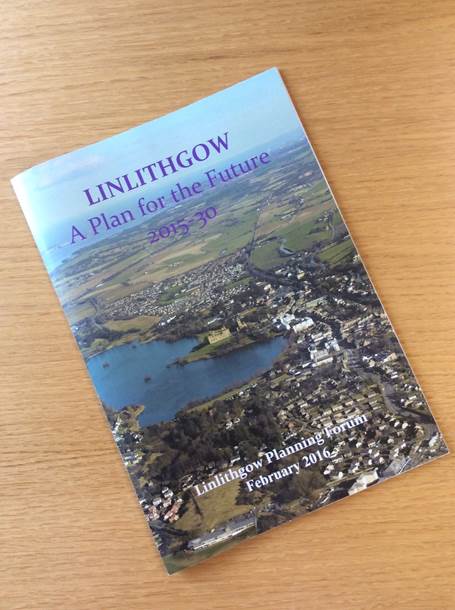
We also heard from West Lothian Council Officers who discussed the challenges that councils face in balancing the competing interests and needs of communities with strategic development goals, resources and wider needs of transportation, education and other issues. Conversely, they considered that much of the Linlithgow Planning Forum Plan had been incorporated into its plans and LDP.
Homes for Scotland were supportive of LPPs recognising that by bringing them into the planning system "they will be material considerations" giving communities an opportunity to positively influence planning. They considered that the current proposal that planning authorities should "have regard to" LPPs in drafting the statutory LDP struck the right balance—
If you make local place plans part of the development plan or put a much stronger obligation on local authorities and the national Government to ensure that development plans reflect local place plans, you will have to put in a lot more checks and balances relating to how the plans are prepared and ultimately what can go in them, which would mean that communities would lose flexibility.
Local Government and Communities Committee 07 March 2018, Tammy Swift-Adams, contrib. 83, http://www.scottish.parliament.uk/parliamentarybusiness/report.aspx?r=11405&c=2070770
Of the young people who responded to our online survey, 58% said they will be very likely or likely to become involved in local place plans with 78% considering that there should be duty on communities who draft local place plans to consult with young people.
Community Land Scotland, Development Trusts Association Scotland (DTAS) and a number of others were also broadly supportive of local place plans, while acknowledging that such community drafted place plans have been developed over the years. National Trust for Scotland and others considered that the requirement for planning authorities to "have regard to" an LPP when preparing and monitoring LDPs was a positive development, which provided greater "front-loading" of the planning systemi. Such support was, however, usually accompanied by concerns about how LPPs would work in practice. DTAS explained that—
We are very supportive of the proposal for local place plans, but they will achieve very little unless they are accompanied by a clear statement about their purpose and status.
Local Government and Communities Committee 28 February 2018 [Draft], Ian Cooke, contrib. 14, http://www.scottish.parliament.uk/parliamentarybusiness/report.aspx?r=11390&c=2068303
We heard a number of concerns about how LPPs would work in practice, their status and the level of influence they truly would have within the planning system. These can be broadly summarised as—
the level of resources available to community groups to produce LPPs (for example we heard at our event in Skye that Community Councils each currently receive £800 a year to support all their work)
capacity in communities to produce them (particularly disadvantaged communities)
the extent to which authorities will actually "have regard to" any LPP they receive
whether those communities without LPPs would be disadvantaged
the extent to which LPPs might displace community time and resource from engagement with the LDP preparation process
the extent to which LPPs may be constrained by the requirement to reflect the LDP, NPF and other spatial plans and agreed developments (and the ease with which communities can identify this information)
the extent to which any LPP reflects all of a community's views
when LPPs might best be produced to influence the LDP process.
There was widespread concern (such as from Cairngorms National Park Authority, BEF Scotland, RTPI Scotland) about the ability of communities and community councils to produce an LPP without access to substantial additional resources and planning expertise. Ballantrae Community Council considers that—
The Local Place Plan initiative is set to fail and increase inequalities unless communities themselves are given funds and access to experts to produce their own plan.4
At our event in Skye there was some support for LPPs, with the hope that they might offer rural communities the opportunity to get developments suited to their needs. LPPs could support officials to take a flexible approach to community wishes (such as not providing street lighting to reflect rural local needs).
Planning Democracy expressed concern that the figures in the Financial Memorandum of the cost of preparing a LPP were "on the low end" with the experience of preparing Neighbourhood plans in England demonstrating that these costs were considerably higher. The Scottish Property Federation echoed these concerns in evidence to the Finance and Constitution Committee suggesting that those costs could be between £25,000-£30,000.5 Whilst PAS suggested that resources might be available elsewhere—
Many areas have local planning outcome agreements. If we are moving towards greater alignment between spatial planning and community planning, I suggest that, on a practical level, there could be some alignment between the budgets of community planning partnerships and spatial planning departments, so that people work together on the ground.
Capacity building is vital. It is important for the very communities that do not feel that they have been given a voice in the past to be much more empowered.
Local Government and Communities Committee 28 February 2018 [Draft], Petra Biberbach, contrib. 27, http://www.scottish.parliament.uk/parliamentarybusiness/report.aspx?r=11390&c=2068316
HOPS share this concern about resources and the implications for entrenching disadvantage in some communities, but also raise some practical questions about how LPPs would integrate with other local authority plans, stating—
We need to integrate and simplify not complicate and clutter and our concerns are:
- how the critical links with community planning and Locality Plans would work in practice
- how we would support communities which would most benefit from LPP but perhaps don’t have the capacity or resources to undertake such a project
- that councils would inevitably be expected to support or fund LPP and LPAs do not have the budgets to facilitate LPPs. The resource implications need clarified, managing expectations.7
The Scottish Community Development Centre highlighted the potentially competing types of community engagement now being undertaken—
Separate legislative duties and their implementation have created different thresholds in different service areas in terms of the involvement of local people. Early experience suggests that different participation opportunities, championed by different agencies or stakeholders, are currently operating in parallel, rather than on an integrated basis. This presents a co-ordination challenge for public bodies, but also creates opportunities to develop new, holistic community engagement and independent community development processes, which can potentially improve coherence across community planning, service planning and spatial planning systems.8
Many witnesses raised concerns that requirement for planning authorities to "have regard to" an LPP when drafting a statutory LDP was not strong enough. Malcolm Fraser, PAS and others suggested that the content of an LPP "should be a material consideration" in any planning decision, as Malcolm Fraser explained so that "communities do not feel duped by processes that are not listened to."9
Others went further with National Trust for Scotland and others suggesting that LPPs should become part of the LDP.10
COSLA were neutral in their views, "we were not wholly supportive of local place planning but we are not against it". They are entirely supportive of the requirement for planning authorities to "have regard to" LPPs, as it leaves decision taking with elected members recognising that with LPPs—
There might be conflict with the national planning framework, the local development plan, simplified planning zones, the “agent of change” principle, the fairer Scotland duty and locality planning. A fully informed local place plan might have to consider all those things, and that is an entire industry in itself. Flexibility in allowing elected members to wrestle with problems is appropriate, and we would be content with the phrase “have regard to”.
Local Government and Communities Committee 14 March 2018 [Draft], Councillor Heddle, contrib. 295, http://www.scottish.parliament.uk/parliamentarybusiness/report.aspx?r=11423&c=2074386
A number of local authorities questioned whether LPPs are the best way to engage local communities in the development planning process. Moray Council considers that—
The Bill should focus on further integration of early and continuing engagement, rather than introduce another layer of plans and further complications to the system. 12
Scottish Environment LINK also thought LPPs had the potential to distract attention from LDP engagement explaining that—
The fact that they are not part of the local development plan means that they are likely to be given pretty limited weight, and we think that there is a risk that, as formulated, they could end up being quite a distraction from engagement in the local development plan. We are not keen on them as they are currently being progressed. We would much rather see a concentration on getting better engagement in the local development plan process.
Local Government and Communities Committee 14 March 2018 [Draft], Aedán Smith, contrib. 35, http://www.scottish.parliament.uk/parliamentarybusiness/report.aspx?r=11423&c=2074126
While West Lothian Council questions how effective LPPs may be, given that they need to be in alignment with a raft of other planning policies, stating—
If Local Place Plans (LPP) need to be compliant with the LDP then it is unclear how much difference this will, or indeed can, make to influencing LDPs. 14
Scottish Water highlighted their concerns about potentially having to provide information to support the development of more than one plan (LPPs and LDPs) and how that information is interpreted by those drafting the plans. 15
Views amongst developers about the role and usefulness of LPPs are mixed. There is a concern that LPPs could be used to block development and that communities are unlikely to have the knowledge and expertise required to produce a coherent development plan. Other developers are less keen, with Barratt North Scotland stating that—
We do not support the proposal to prepare ‘Local Place Plans’ as we are concerned that this will slow down the planning process, from LDP preparation and adoption, to consultations to decision making and delivery of housing.16
Scottish Renewables and others expressed concern about the extent to which LPPs represent the views of all communities in a local area—
The issue is how much credence is needed to make sure that the balance is right. The best way of dealing with that is to resource that broad engagement at an early stage so that we encourage the widest community to come forward, including young people and people of all economic backgrounds and ages. If we can get that right and maximise early engagement, that should reduce the risk of hearing from just a few vocal minorities.
Local Government and Communities Committee 07 March 2018, Jenny Hogan, contrib. 99, http://www.scottish.parliament.uk/parliamentarybusiness/report.aspx?r=11405&c=2070786
PAS however suggested that if LPPs are to be driven forward then community councils, where they existed, should take on that role given they are democratically elected.18 Others such as DTAS, Planning Democracy and Community Land Scotland considered that a range of organisations could take forward an LPP, suggesting it could be local anchor organisations, community landowners, or those defined as communities under the Community Empowerment (Scotland) Act 2015.19
When LPPs might be produced was also raised. Whilst the Scottish Government's Technical Paper envisaged that they would inform the next LDP (which could be up to 10 years away), others such as City of Edinburgh Council welcomed flexibility about when in the process they could be drafted. Homes for Scotland considered that—
To some extent, it all depends on what the communities want to use local place plans for. If they want them to influence the local development plan, they might look at putting one in place at the right time in the process. Equally, though, they might want to use a local place plan to fill in some detail that has been missed or to pick up on a change in events that might have happened since the development plan was put in place. There is not necessarily any perfect sequencing dynamic.
Local Government and Communities Committee 07 March 2018, Tammy Swift-Adams, contrib. 89, http://www.scottish.parliament.uk/parliamentarybusiness/report.aspx?r=11405&c=2070776
Others such as Professor Hague, PAS and Community Land Scotland considered that LPPs should be produced at the start of the LDP process, so that they could inform their development.
McCarthy and Stone suggested that how planning authorities have had regard to the content of an LPP could be set out in the evidence report and considered as part of the Gatecheck—
It seems sensible to have a review process that is based on the content of an LPP before the LDP is finalised and signed off.
Local Government and Communities Committee 07 March 2018, Jonathan Fair, contrib. 86, http://www.scottish.parliament.uk/parliamentarybusiness/report.aspx?r=11405&c=2070773
Others agreed with this approach, albeit with some caveats such as BEF Scotland explained—
it might be appropriate to place a requirement on the local authority to report back, perhaps at the examination stage, on how it has had regard to the local place plan. Even that would not be a fail-safe mechanism though; a sufficiently brazen authority could say that it had had regard to it, was not impressed by it and did not intend to take anything on board. What happens in that situation?
Local Government and Communities Committee 14 March 2018 [Draft], Graeme Purves, contrib. 34, http://www.scottish.parliament.uk/parliamentarybusiness/report.aspx?r=11423&c=2074125
Responding to the concerns that the Bill's current provision that planning authorities must "have regard to" LPPs the Minister stated that he had taken on board those concerns—
I think that we should require planning authorities to “take account” of local place plans in preparing their local development plans. That would place local place plans on the same level as the national planning framework and local outcome improvement plans, for which the phraseology “take account” is used.
Local Government and Communities Committee 21 March 2018, Kevin Stewart, contrib. 73, http://www.scottish.parliament.uk/parliamentarybusiness/report.aspx?r=11441&c=2078073
The Minister did not support calls for LPPs to be automatically incorporated as part of the statutory LDP by planning authorities, given the range of other matters that LDPs need to take account of - including policy related requirements for a whole area (and not just the community) as well as national planning framework objectives. He also highlighted the scrutiny that LDPs are subject to including strategic environmental assessments, independent examination and public consultation. In that regard if LPPs were to be automatically adopted then they would require to be similarly scrutinised, reducing the flexibility for LPP preparation and increasing the burden on communities.
In terms of resourcing for communities to produce LPPs, the Minister explained that he did not wish LPPs to be too onerous or necessarily require planning expertise but that existing tools and templates as well as processes such as the place standard tool are available now to support communities to develop LPPs. He commented that—
A number of places around the country have already formulated place plans with no resource input from anywhere else. In some cases, I have heard it said that folk did not want the resource input, because they thought that that might mean there would be interference from elsewhere.
Local Government and Communities Committee 21 March 2018, Kevin Stewart, contrib. 78, http://www.scottish.parliament.uk/parliamentarybusiness/report.aspx?r=11441&c=2078078
Writing to the Committee on 28 March 2018 the Minister added that—
The Financial Memorandum estimates that the provisions in the Bill, particularly our reforms to development planning, will free up between £22.6m [million] and £33m [million] of local authority resources over 10 years. We expect that to be reinvested in other activities to improve the planning system, in particular supporting greater community involvement and the focus on delivery. I have also made clear that spatial planning should be intertwined with community planning, and that local authorities and community planning partners should be focusing their efforts to support the most disadvantaged communities.
In terms of Scottish Government funding, our £20m Empowering Communities Fund supports communities in a number of ways to build their capacity to decide their own priorities and develop their own solutions. Local place plans may be one of those solutions.
Our Making Places Initiative has provided £300,000 to communities in 2017-18 for community-led design activities. We plan to provide similar funding in 2018-19 and to ensure this is targeted towards areas facing disadvantage. We are also increasing grant funding to PAS to allow it to offer more support for communities specifically in development and community-led planning.25
He also highlighted proposals elsewhere in the Bill to potentially provide for increased planning fees and the recent planning budget increases by some local authorities as other sources of funding, which could support capacity building in communities.26
It was suggested that a specific fund be set up to kick start the LPP process in the more deprived communities across Scotland. Responding the Minister did not promise additional funding but said he would consider "targeting the funds that the planning and architecture division has in certain areas to see what the benefits of that could be."26
In relation to concerns that LPPs might lessen engagement in the development of LDPs, the Minister responded that wider reform measures will ensure that planning authorities consult more widely on LDPs including with children and young people. This is in addition to work underway by the digital taskforce to identify new technologies, as well as improving communication, as ways to enhance engagement in the planning process.
Local Place Plans (LPPs) will provide a statutory role for communities to bring forward plans that reflect their aspirations for the future of the places they live in. LPPs are not, however, a replacement for high quality, meaningful community engagement on the local development plan nor does this Bill propose that they should be. We therefore welcome the Minister's confirmation that—
As part of the wider planning review, we will bring forward proposals to ensure that planning authorities consult more widely on their development plans, including with children and young people.
Local Government and Communities Committee 21 March 2018, Kevin Stewart, contrib. 92, http://www.scottish.parliament.uk/parliamentarybusiness/report.aspx?r=11441&c=2078092
We also welcome the Scottish Government's commitment to amend the Bill to ensure that authorities must 'take account of' LPPs, placing them on a par with the status currently afforded to the NPF. It remains the case, however, that if minded to an authority can chose not to take account of any LPP it receives. As currently framed there is a risk that communities spend considerable time and effort on an exercise which may or may not be taken any account of by the planning authority.
Whilst we acknowledge the funding identified by the Minister to support capacity building and to fund the preparation of LPPs, we are not convinced that this will be sufficient to deliver the number of plans envisaged in the Financial Memorandum (92 per year). We remain to be persuaded that the resources that are necessary to support the delivery of LPPs are best expended on a process that might lead to no meaningful outcome for communities.
We are concerned that the powers available to create LPPs will disproportionately be taken up by communities with the capacity, time and resources to devote to preparing plans. More disadvantaged communities who stand to gain most from an effective, accountable and participatory planning system, by contrast, will be considerably less likely to take advantage of the opportunities due to a comparative lack of capacity, time and resources. This will widen inequality.
We welcome the statutory underpinning of LPPs as proposed in the Bill. However, what is unclear is the extent to which that statutory underpinning will mean that the time, effort and resources required to produce LPPs will result in them playing a "positive role in delivering development requirements" as originally envisaged by the Independent Review Group.
As things stand the proposals for LPPs run the risk of being disregarded or ineffective. The Committee firmly believes that communities should be supported to help develop plans for their areas. We suggest that councils, at the start of the Local Development Plan process, should put out a call for people to help them develop local place plans and show how this has been done in the Evidence Report. Once the LDP is in place then we are content that communities can bring forward their own plans that councils should take account of, providing communities are adequately supported to do so.
Equalities and planning
The extent to which the Bill and its Equalities Impact Assessment (EQIA) reflects the impact of planning on those with protected characteristics such as gender was raised by a number of those who provided written views. Suzanne McIntosh Planning Ltd expressed concern that the EQIA did not appear to address the impact of the built environment on women, nor women's engagement in the planning process —
Women are routinely excluded directly or indirectly from participating in the planning process and in utilising the end product of the process – the built environment. There are perceptions of place that impact upon how we use and move around our cities, towns and countryside that root deep into our psyche. The planning process is where the start of the story begins and engaging, particularly women in the creation of place, and understanding how we use places will go some way to understanding this issue and creating a more balanced, equal society.1
In its submission ENGENDER also had concerns regarding the robustness of the EQIA which accompanied the Bill highlighting that in terms of gender it is "exceptionally bad". ENGENDER explain that more information and evidence on how the Scottish Government reached its conclusions should have been provided and the Scottish Government's commissioned research to inform the EQIA focused on community empowerment rather than rather than targeting women or other marginalised groups.2
Responding to the comments of ENGENDER, the Minister confirmed that—
I am confident that the EQIA accompanying the Planning Bill meets the legal requirement to assess the equality impact of proposed legislation. However, officials have offered to meet representatives of ENGENDER to better understand their concerns, and will undertake appropriate corrective action if that proves necessary.3
Whilst we welcome the Minister's offer to meet with ENGENDER to discuss their concerns, we request that the Minister respond to us before the Stage 1 debate on:
the specific "limited evidence" available that informed its views on the impact of the Bill on gender, sexual orientation and gender reassignment
the views it received (and that were echoed in our event in Skye) that access panels (or similar representative body) should become statutory consultees as identified within its EQIA
what specific evidence, broken down by protected characteristic, led it to conclude that "the overall Bill provisions will have a positive impact on equalities issues."
Third party/equal right of appeal (ERA)
Currently, after consideration of a planning application, a planning authority can decide to:
grant permission unconditionally
grant permission subject to certain conditions being met
refuse permission.
Where planning permission is granted subject to conditions or is refused, the applicant has the right to appeal that decision to either a local review body (for decisions on local developments made by a planning officer) or Scottish Ministers (for all other decisions).
The Committee heard that the right to appeal is long overdue for reform having its origins in the Town and Country Planning Act 1947 when it was brought in to address land owner concerns that they could no longer do as they pleased with their land.
The 'first party' to a planning application is the applicant, the 'second party' is the planning authority and the ‘third party’ is anyone else. The role of any third party in the development management process is limited to making representations to the planning authority, which are considered by the authority during the decision making process. A third party right of appeal, in the form called for by campaigners, would grant certain categories of objector to a planning application a limited right to appeal against the award of planning permission for certain types of development, e.g. when the development is a departure from the policies and proposals in an adopted development plan.
Third party rights of appeal are sometimes also referred to as "equal rights of appeal". Some people also propose that appeal rights could be “equalised” by limiting the right of the applicant to appeal in some circumstances and/or by providing third parties with limited rights, for example when the application or decision is a departure from the local development plan. We received evidence setting of how the different approaches might work in practice.
In evidence, we heard the terms "third party (TPRoA)", "equal (ERA)" and/or "limited" rights of appeal used, sometimes interchangeably, to refer to the circumstance where appeal rights are extended beyond those currently afforded to the applicant. We have used the term equal rights of appeal (or ERA) to refer to these circumstances except where quoting or referencing others when we have used their terminology.
Scottish Ministers are clear in their opposition to the creation of an equal right of appeal, with the policy memorandum that accompanies the Bill stating—
...it is far more appropriate and more constructive to have stronger early engagement, involving people in the shaping of their areas, as provided for through the changes to development planning, the introduction of LPPs and more effective pre-application consultation. A third party right of appeal would increase delay and uncertainty through to the end of the planning process, running counter to the whole thrust of the Bill and wider review of planning in streamlining and front-loading the system. It could discourage investment and could be used to block or delay development which is needed in the public interest, including new housing.1
Views on ERA are generally split between—
individuals, community groups and environmental organisations – who are strongly in favour of ERA
developers, professional planning organisations and most planning authorities – who are strongly against ERA.
Of those who support ERA, Planning Democracy has been leading a long-running campaign for the introduction of a limited equal right of appeal. They argue that—
Equal Rights of Appeal (ERA) can strengthen a democratic, plan-led system with:
a) The introduction of a right of appeal when the decision goes against the provisions of the development plan.
b) The restriction of existing appeal rights to cases when planning permission is refused even though the development plan indicates permission should be granted.
This would effectively restrict appeals to decisions that depart from the logic of the plan. In addition, far from undermining the goal of engaging people ‘upfront’ (as is often erroneously argued), right of appeals for communities would create a powerful incentive for individuals, community groups and developers to get involved in the production of plans to make sure they reflect their aspirations.2
ERA, Planning Democracy contends, would encourage greater involvement in the drafting of statutory development plans and consultation on the early stages of development proposals, incentivising both communities and developers to get involved in early engagement in developments because "there would be a stick at the end of the process." They cite evidence from Ireland as demonstrating that ERA improves decision making. They questioned the assertion that Scotland's competitiveness would be compromised as ERA could only apply in limited circumstances, principally when the development represents a departure from the development plan. They also explain that ERA would strengthens the 'plan-led' system because—
At the moment, the discretionary nature of the planning system in Scotland means that the up-front engagement might be right but a subsequent decision might well depart from what has been said in the engagement process.
Local Government and Communities Committee 28 February 2018 [Draft], Dr Inch, contrib. 177, http://www.scottish.parliament.uk/parliamentarybusiness/report.aspx?r=11390&c=2068466
West Lothian Council explained that whilst the longer time frames for development planning are welcome—
... in a plan led system the development plan should provide opportunities for individuals and communities to actively engage in the plan making process and, having done so, should have certainty about future scale and location of development. The current system does not provide this certainty and the Bill does not address deficiencies in the current system.
For example, developers will still have the opportunity to test the development plan through the submission of planning applications which are significantly contrary to the development plan and then appeal any refusal of the application. The council in its earlier submission called for the right of appeal to be removed where a development proposal was significantly contrary to an up to date development plan and restates that position.4
City of Edinburgh Council also supported a community right of appeal in some circumstances, recognising its experience of the limitations of front-loading and the fact that has not been enough to generate community trust and confidence in the planning system—
It is also a recognition that many developments in the city do not fall into the category of a major development but are significant local developments, in relation to which there is no statutory provision for pre-application engagement with the community at the moment. We recognise that that definition needs to be considered.
We are very much considering the idea in the round, not in isolation. The right of appeal would work only in certain circumstances. I certainly concur with the comments that other colleagues have made that it would not be in the council’s interest to hold back development. An appeals process would have to be done in a way that allowed the community to feel greater confidence in planning decision making without delaying the process unnecessarily.
Local Government and Communities Committee 14 March 2018 [Draft], David Leslie, contrib. 379, http://www.scottish.parliament.uk/parliamentarybusiness/report.aspx?r=11423&c=2074470
Friends of Craighouse, which opposed a major housing development on a site subject to multiple planning designations that was granted permission, argues that—
The fact that communities have no ultimate legal recourse in the form of Equal/Community Right of Appeal leads to a situation where the planning system cares less about upholding its processes and policies and more about developers’ legal threats or the fear of decisions being overturned by government reporters and the resultant monetary penalty for Councils. So there is no incentive for Councils to uphold the planning system, policies, processes or listen to communities when the pressure on them is so one-sided.6
Mary Gordon highlights concerns about the judicial review process, currently the only option available to individuals or community groups wishing to challenge a planning decision (although only on a point of law)—
…as there is no provision for 3rd party appeal on planning decisions it’s a punch in the face for local groups and people. As far as I know only one local group has managed to bring a judicial review of a planning decision in the whole of Scotland. It was regarding the India Buildings Development in Edinburgh - they had to raise £27,000 to do so. This is an ENORMOUS sum which most groups cannot do. It means that unsympathetic developers and councils always have the upper hand.7
Malcolm Fraser supported the removal of an applicant's right to appeal, arguing that—
The only winners I have seen are lawyers and planning consultants. The development is usually built, but with much of the value taken out of it and it is worse than when it started off.
The simple solution is to allow nobody to appeal. That would have the very radical consequence of making sure that we got things right upstream, and it would take away the planners who tell me that they are turning down an application, but that I will win on appeal. It would make sure that the right decisions were made upstream so that development happened more quickly. It would reduce the processes and administration in the system and focus on what we say and think about getting planning right. It would also make sure that local communities were involved earlier on, and it would strengthen the democratic process by requiring planning committee members to consider the economic impact and the impact on communities at the same time. To me, that would be a win-win situation.
Local Government and Communities Committee 07 March 2018, Malcolm Fraser, contrib. 336, http://www.scottish.parliament.uk/parliamentarybusiness/report.aspx?r=11405&c=2071023
The views of developers and those opposed to ERA were reflected by Taylor Wimpey, which—
…strongly believe that TPRoA will add additional delay and uncertainty to a system that is already slow and unresponsive. It will undermine democracy; will divert investment way from Scotland and would add in significant additional cost and pressure on a Local Authority resource that is already under overwhelming pressure. TPRoA will not deliver essential housing, infrastructure or investment, will be costly through the courts and does not increase collaborative working.9
COSLA and HOPS did not support ERA, expressing concern about its potential negative impact on development and the subsequent impact on local economies. They also raised concerns about the additional time it could take to consider those applications subject to an appeal. Cairngorms National Park Authority also highlighted that in some locations, like rural areas or islands, it could well be the same group of people, opposed to development within the Park in principle, objecting to every application for development - regardless of its social, economic or environmental benefits.10
Homes for Scotland highlighted the importance of an applicant's right of appeal, highlighting that "more than 5,500 homes have been given consent through the appeals process in the past few years." Consequently, they did not support ERA or the removal of an applicant's right of appeal, arguing that both would exacerbate existing housing delivery problems. They explained that—
Framing a limited right of appeal, or equal right of appeal, around departures would be very difficult. A departure from the plan is hard to define. A lot of communities would probably assume that, if a site was not specifically allocated in a plan, it is a departure, but it is not if it meets the broader aspirations and policies of the plan, including the housing targets. Often, the crux of what is debated in appeals is whether there has been a departure from the plan.
Local Government and Communities Committee 07 March 2018, Tammy Swift-Adams, contrib. 166, http://www.scottish.parliament.uk/parliamentarybusiness/report.aspx?r=11405&c=2070853
They and others argued that front loading community engagement, through LPPs and LDPs, represented a better way to enable communities to shape their local places than changing the appeals process. Professor Hague disagreed explaining that whilst over 95% of planning applications are agreed to—
The real issues are in the appeal system—the inequalities in it, and the extent to which, after all the front loading, the real decision can come at the final stage and not be locally accountable.
Local Government and Communities Committee 07 March 2018, Professor Hague, contrib. 275, http://www.scottish.parliament.uk/parliamentarybusiness/report.aspx?r=11405&c=2070962
In evidence the Minister reiterated the Scottish Government position that limited or equal right of appeals would place a resource burden on local authorities which would divert resources from front- loading and collaboration with communities. Instead, the focus should be on effective front-loading of the planning system with a view to getting people together early to iron out differences and reach agreement on aspects of the planning system. Highlighting cases where developers had supported effective community engagement, the Minister contended that—
If we end up with an equal right of appeal, what will happen in many places is that communities and developers will concentrate right from the beginning on the conflict at the end, rather than sitting down and discussing what is required for the community.
Local Government and Communities Committee 21 March 2018, Kevin Stewart, contrib. 234, http://www.scottish.parliament.uk/parliamentarybusiness/report.aspx?r=11441&c=2078234
The Minister wrote to the Committee on 28 March 2018 setting out further information about the costs of appeals—
Reporters have powers to make an award of expenses in relation to the expenses of parties to an appeal. However, in planning proceedings expenses are only awarded on grounds of unreasonable behaviour...
There is no clear way of estimating how many appeals might arise from third parties if this policy was introduced. In 2016/17 there were 27,232 planning decisions made in total in Scotland. Of these, 1579 applications were refused, and there were 500 appeals to the Scottish Ministers and 550 local reviews. Figures from the Republic of Ireland indicate that 54% of their appeals are from third parties, which might suggest that numbers in Scotland could double to around 2100. As an alternative indicator, in Ireland in 2016, 6.6% of all applications were appealed, which would give a figure of 1797 for Scotland. However, in Ireland there is a fee for bringing an appeal, and certain major developments are excluded from third party appeal. The details of implementation could have a significant impact on the numbers of cases that might arise.14
The Scottish Government's Chief Planner elaborated further—
A lot of the frustration for communities is that they do not have the certainty that we want them to have about which sites are going to be developed.
The development plan and changes to it are key, because if we can get better information from developers about how deliverable sites are so that they can be carefully considered and, at the gate check and beyond, we can get everything right, we will have a plan in which stakeholders generally can have some confidence. The problem at present is that shortcomings in, say, effective housing land emerge at the end of the process, and that causes tension for all stakeholders.
Local Government and Communities Committee 21 March 2018, John McNairney, contrib. 243, http://www.scottish.parliament.uk/parliamentarybusiness/report.aspx?r=11441&c=2078243
The Minister also highlighted concerns about defining which groups should be able to lodge an appeal and that it "would open up a can of worms and create even greater conflict and might actually lead to a huge amount of community division.
In relation to the removal of an applicant's right of appeal, the Minister argued that the actions of a settled community exercising its right of appeal could impact on others, particularly limiting new housing choices and access to employment opportunities.
The Scottish Government's Chief Planner set out the challenges in deciding whether a proposed development represented a departure from the development plan, whilst accepting that planning authorities prior to 2006 had had to exercise their judgement about when to notify a Minister of a decision which represented a departure from the LDP, he observed that—
Judging whether to advertise a development as being contrary to the development plan was certainly not clear cut. Especially for major developments, it could be found that a development is contrary to some policies in the plan but is generally consistent with the allocation. Would the development then be contrary to the development plan?
It is not always possible to make a straightforward judgment. Reporters will have seen cases in which an authority has refused an application on the basis that it is contrary to the development plan, but the reporter takes the view that it is not. It is not a clear-cut, black-and-white judgment. That is another element of potential complexity.
Local Government and Communities Committee 21 March 2018, John McNairney, contrib. 262, http://www.scottish.parliament.uk/parliamentarybusiness/report.aspx?r=11441&c=2078262
The Minister was clear that meaningful community engagement was a better approach to removing conflict from the planning system than ERA. However, given that ERA had been rejected during the passage of the 2006 Act, with assurances around improved frontloading and community engagement, the Minister was asked how he will assess if the front loading arising from this Bill is a success—
First of all, no matter what we put into play, there will be instances in which people do not get the results that they want from planning. We will continue to monitor how planning is operating and how our proposals turn out in terms of performance management, stakeholder satisfaction and how engaged people become.
Local Government and Communities Committee 21 March 2018, Kevin Stewart, contrib. 268, http://www.scottish.parliament.uk/parliamentarybusiness/report.aspx?r=11441&c=2078268
Whether rights of appeal in the planning system should be equalised has been a long standing issue on which a wide range of individuals and organisations hold passionate views either for or against. The reasons cited as supporting ERA or for not supporting it are well established as are the views as to whether those reasons are evidence based or robust.
The evidence we heard on ERA very much replicated this long standing debate about whether ERA would:
lead to a more robust, plan-led system which encouraged more meaningful up front engagement and agreement between communities, developers and authorities on what development should take place in local areas; or
lead to delays, uncertainty, reduce early engagement and investment in the housing and developments necessary to support people to live and work in their local area.
It is clear to the Committee that many communities feel frustrated by the planning system. Previous attempts to front-load the system have not been successful. The Committee is not persuaded that proposals in this Bill go far enough to address that. There is an imbalance in a system whereby the applicant can appeal decisions that have been taken in clear accordance with the development plan.
The Committee is conscious that the availability of appeals to applicants undermines confidence in a plan-led system. Appeals can be lodged free of charge and irrespective of whether an application is in accordance with the Development Plan. The Committee believes that in a plan-led system appeals should only be allowed in certain circumstances.
The Committee has heard evidence from both sides of the argument in relation to equal rights of appeal. We want people to feel involved in the planning system at all stages and we urge the Scottish Government to look at these issues before Stage 2.
Agent of Change
Under the Environmental Protection Act 1990 responsibility for managing and mitigating the impact of noise on neighbouring residents and businesses lies with the business or activity making the noise, regardless of how long the noise-generating business or activity has been operating in the area. In some cases, this has led to newly-arrived residents complaining about noise from existing businesses, sometimes forcing those businesses to close.
The Music Venue Trust has, since 2014, campaigned to shift the duty for the installation of measures to mitigate noise impacts on new residential developments built close to existing live music venues from venue owners to the developers of the new properties – known as the “agent of change” principle. The driving force behind this campaign being that the costs or practicalities of installing such measures can ultimately lead to the closure of such venues. This campaign has focused on introducing the agent of change principle into planning legislation and policy across the UK which has led to the Welsh and UK Government introducing plans to incorporate the agent of change principle within their Planning policies.
The Agent of Change principle works both ways. If a new noise-generating development is proposed close to existing noise-sensitive uses, such as residential development or businesses, the onus is on the developer to ensure its building or activity is designed to protect existing users or residents from noise impacts.
Although not included within the Planning (Scotland) Bill or the Committee’s call for views, we received in excess of thirty substantive written responses on the agent of change principle, principally from music industry bodies and businesses. The Committee also received over 1,200 written submissions from individuals asking that the agent of change principle be included in Scottish Planning Policy, to protect Scotland’s music venues.
Responding to this significant number of responses, on 16 February 2018, the Minister wrote to the Committee including a copy of a letter from the Scottish Government’s Chief Planner sent to senior local authority planners. The Chief Planning Officer stated that whilst Planning Advice Note 1/2011 currently provided advice on a pragmatic approach to the location of new development within the vicinity of existing noise generating uses—
…we now intend to include explicit policy guidance in the next National Planning Framework (NPF) and the SPP, implementing the Agent of Change principle in recognising the need to support our live music venues. This will be taken forward after the Planning (Scotland) Bill has completed its passage through the Scottish Parliament. You will be aware that the Scottish Government’s intention through the Bill is that the NPF will in future incorporate the SPP and the new format will be brought within the statutory development plan. This combined NPF/SPP will be subject to thorough public consultation and parliamentary scrutiny before being finalised.1
Subsequently, in evidence we heard about the impact of new property development on existing music venues. The UK live music census, led by the University of Edinburgh, highlighted that one third of venue respondents identified planning issues and property development that had a negative impact on them in the past 12 months. In addition, one third of respondents said that noise-related complaints had a negative impact on them in the past 12 months.2
Both UK Music and the Music Venue Trust welcomed the Minister's commitment and the Chief Planner's guidance to local authorities regarding agent of change, with UK Music noting that, read alongside the Bill's proposals to merge the SPP into the NPF—
That will strengthen the framework considerably, and if a new version of the document were to make a specific commitment to the agent of change principle, it would be very important.
Local Government and Communities Committee 28 February 2018 [Draft], Tom Kiehl, contrib. 249, http://www.scottish.parliament.uk/parliamentarybusiness/report.aspx?r=11390&c=2068538
UK Music recognised that, in order for this guidance to have an impact on the ground, there needed to be better communication between the Scottish Government and local authorities about the agent of change policy intention. They also recognised that, whilst the Scottish Government's recent guidance regarding agent of change may concern planning, there is significant crossover with the licensing system—
We cannot forget about that, because the planning and licensing processes should be more joined up. In some ways, decisions are made at a planning level and there is a need to pre-empt the licensing challenges that might come up further down the line.
Local Government and Communities Committee 28 February 2018 [Draft], Tom Kiehl, contrib. 283, http://www.scottish.parliament.uk/parliamentarybusiness/report.aspx?r=11390&c=2068572
When asked about whether the Agent of Change principle should be included within the Planning (Scotland) Bill, the Music Venue Trusts highlighted concerns how the policy intention of the agent of change is subsequently interpreted by planning authorities and a 'grey area' between policy and legislation—
When policy is created for cultural venues, people say that they knew that it was intended that grass-roots music venues would be covered, but the space between what is intended by the person who wrote the policy and how it might be interpreted at local authority level is proving a real issue for our venues. It might have been intended that music venues would be seen as cultural venues, but if someone in the local authority does not perceive a particular venue as that, they can say that a cultural venue is a theatre, not a grass-roots music venue. It was great that the minister’s letter specifically mentioned music venues and spoke about protecting them and recognising their cultural importance. We would like to see more of such specification, because it is explicit and does not leave room for interpretation.
Local Government and Communities Committee 28 February 2018 [Draft], Beverley Whitrick, contrib. 266, http://www.scottish.parliament.uk/parliamentarybusiness/report.aspx?r=11390&c=2068555
Whilst welcoming the Scottish Government's approach, UK Music and the Music Venue Trust called for the Bill to be amended to provide greater certainty and protection for music venues (and in some cases providing protection to other existing types of noise sources citing the examples of a speedway and church bells)—
an amendment that would place a duty on planning authorities to prevent unreasonable consequences for existing business;
requirement for developers to set out exactly how they plan to address those issues and to provide information that future residents could access;
a statutory right to comment on any planning application in any part of the UK that impacts on a grass-roots music venue (such as currently exists for the Theatres Trust in relation to planning applications that impact on any existing theatre buildings).
Following up in writing the Music Venue Trust provided draft amendments which would have the effect of enshrining the Agent of Change principle into the Bill.
The Music Venue Trust also called for greater recognition of the role of grass roots music venues as the research and development department of the UK Music Industry, which contributes significantly to the Scottish economy. They explained that last year music tourists contributed £334 million to Scotland through concerts and festivals. As such—
One of the core pieces of the Music Venue Trust’s mission is to gain recognition for grass-roots music venues so that they have cultural parity with theatres, arts centres, galleries and other spaces that are recognised as contributing to the cultural life of the UK.
Local Government and Communities Committee 28 February 2018 [Draft], Beverley Whitrick, contrib. 246, http://www.scottish.parliament.uk/parliamentarybusiness/report.aspx?r=11390&c=2068535
In that regard the Music Venue Trust called for grass-roots music venues to be specifically named alongside cultural venues to acknowledge that they are included within the definition of cultural spaces. They called for LDPs to be updated to include the designation of 'areas of cultural significance' within those plans, notably to include sites where live music is a key part of an area's cultural offer. They recognised that such zones or areas would more like apply to large towns and cities.7
Music venues make an important contribution to the cultural life and economy of Scotland. We agree that it is, therefore, unreasonable for those moving into a new development to lodge complaints about pre-existing noise levels that can ultimately result in the closure of such businesses.
We therefore welcome the Scottish Government's commitment to include the agent of change principle in the next National Planning Framework and that in the meantime the Scottish Government's Chief Planner has provided guidance to planning authorities asking them to ensure decisions reflect this principle.
That said, we note that the Chief Planner's letter to Planning Authorities suggests that current Planning Advice Note (PAN) 1/2011: Planning and Noise addresses this issue to some extent. Given that this existing advice required reinforcement by the Chief Planner, we question whether guidance alone or inclusion within the NPF will sufficiently safeguard this principle from subsequent changes in guidance or policy.
We also note that the advice in the Chief Planner's letter relates the agent of change principle to music venues, rather than other sources of existing noise such as those we heard about in evidence (e.g. sports venues, theatres).We recommend therefore that the Agent of Change principle should be applied more widely to, for example, theatres.
Given these concerns, we recommend that the Agent of Change principle be included within the Bill.
We also recommend that the Scottish Government considers widening the statutory consultees on planning applications to include an appropriate representative body of music venues (as already exists in relation to the Theatres Trust).
We also seek further information from the Scottish Government on whether:
the definition of cultural spaces should be amended to include grass-roots Music Venues;
a designation of "areas of cultural significance" should be created to provide greater protection to areas where creative industries, including music venues, have collectively created a cultural hub.
Part 2: Simplified Development Zones
Currently, a simplified planning zone (SPZ) is an area where the need to apply for planning permission is removed for certain types of development. A SPZ requires the planning authority to prepare a SPZ Scheme, which details the types of development and nature of uses that are permitted together with any limitations, conditions and guidelines that a development proposal must comply with. Should a development proposal comply with the SPZ Scheme applications for planning permission are not required.
Until recently there had been little take up of SPZs, with only two SPZs currently operational in Scotland - Hillington Park SPZ and Renfrew Town Centre SPZ. The Scottish Government is currently working with planning authorities on a series of SPZ Housing pilots. The Bill will stop the creation of any more new SPZs.
The Bill proposes to create Simplified Development Zones (SDZs) extending the types of permission automatically deemed to have been granted in a zone for a period of no longer than 10 years. For developments that comply with the SDZ scheme, those permissions will include:
Road construction consent (needed to create new roads within a development)
Listed building consent (needed to alter a listed building)
Conservation area consent (needed for demolition of buildings within conservation areas)
Under the Bill, developers would still be required to obtain other consents including Building Warrant and any licenses (where applicable) through the usual processes.
Planning legislation currently prevents SPZs from being designated on land:
in a conservation area
in a National Scenic Area
forming part of a green belt
in a site of special scientific interest in respect of which a nature conservation order or land management order made under Part 2 of the Nature Conservation (Scotland) Act 2004 has been made
The Bill would remove these restrictions and allow Scottish Ministers to make regulations setting out new restrictions on land that cannot form part of a SDZ.
The Financial Memorandum explains that the cost of preparing a SDZ will depend upon the size of the scheme and its features. It anticipates that the Bill's proposals on fees for planning activities (section 21) may be used to allow planning authorities to charge fees for certain activities in relation to SDZs, as well as being able to secure financial contributions from developers for developments within the zone. It explains that new developments will also generate increased council tax and business rates income. It estimates that the costs of including the report on SDZs may be £1,000-£2,000 for each authority per year whilst the preparation of any SDZ could range from £15,000 to £200,000. This range is based on the costs of the two SPZs currently in operation in Scotland.
The Bill sets out what a SDZ scheme is to consist of, specify and the categories of land that it cannot cover.
The Bill would also require planning authorities to periodically consider whether any part of their area should be covered by an SDZ and publish a statement setting out what they decided and how they reached this decision. Scottish Ministers will also have a power to direct a planning authority to make or amend an SDZ scheme. Third parties will also have a power to request an authority to make an SDZ, planning authorities have three months to respond to such third parties. The Bill will enable Ministers to recover the costs incurred where they have had to make or alter a scheme because the planning authority has not fulfilled their duty following a Ministerial direction.
In its technical paper the Scottish Government suggests that the record of how planning authorities have considered this duty could potentially be fulfilled as part of the LDP Delivery Programme (which will require to be updated annually). In addition, when linked to the LDP the Scottish Government suggest this may allow for efficiencies, with the strategic environmental assessment also covering issues the SDZ might raise.
The Bill sets out the process by which Scottish Ministers may request a SDZ is made or altered where it is in the national interest, to support the delivery of a national priority as set out in the NPF or SPP. It also sets out how Minister will respond to requests from third parties who have requested a planning authority makes or alters a SDZ and that authority has not done so or has not responded within three months.
The Bill provides Ministers with a range of regulation making powers in connection with SDZs including
their content, type of land that can be included, frequency of when planning authorities must consider making SDZs
requirements for valid requests for SDZs and deadlines for referrals to Scottish Ministers for a request for a SDZ
various aspects of the process for making or altering a SDZs,
consultation, including who, how and what constitutes valid representation
requirements for publicising and inviting representations on proposals for SDZs
holding hearings on proposals for SDZs in some circumstances
notification of proposals for SDZs by planning authorities in some circumstances and
pausing proposed alterations to existing SDZs in some circumstances.
The policy memorandum explains that SDZs will support more effective delivery of development through zoning of land, frontloading of scrutiny and community consultation and aligning of consents. It also explains that they will provide developers with greater certainty of consent being secured upfront and enable schemes to be progressed in a wider range of circumstances. Zoning in this way will, the Scottish Government explains, potentially unlock significant areas for housing developments and can support the delivery of LDPs.
The views we received on the likely uptake, effectiveness and impact of SDZs were mixed, with a number of those we heard from requesting more clarity on how they will work in practice (much of which will follow in regulations). Some, such as Community Land Scotland, considered there was merit in them depending on what they are designed to achieve and for whom. They cited examples of zones that might contribute towards development that is economically, socially and environmentally sustainable or which supported resettlement and repopulation of areas. In addition they observed that SDZs may provide community landowners with a powerful tool-
The combination of owning land and being able to manage it for the community is fundamentally important in unlocking opportunities for sustainable development. That is a critical element.
Local Government and Communities Committee 28 February 2018 [Draft], Dr MacLeod, contrib. 123, http://www.scottish.parliament.uk/parliamentarybusiness/report.aspx?r=11390&c=2068412
Others such as PAS and Planning Democracy also thought they were an interesting development, with zones showcasing innovation and producing the capacity to deliver development.2 The name "SDZ", however, was questioned with alternatives such as "investment ready zones", "place development plan" or "better planning zones" suggested as providing a better focus on what their purpose is.
That said, some witnesses, such the National Trust for Scotland and BEF Scotland, questioned whether Ministers needed a power to introduce SDZs. Planning Democracy observed that—
In thinking about sensible planning, we need to think about where those powers are vested. Local democratically elected authorities seem like a good place in which to vest them. There is not necessarily any need for the proposed level of central control and potential coercion to designate simplified development zones, which should be seen as a part of the local planning process.
Local Government and Communities Committee 28 February 2018 [Draft], Dr Inch, contrib. 125, http://www.scottish.parliament.uk/parliamentarybusiness/report.aspx?r=11390&c=2068414
COSLA went further, explaining that the ability of Ministers to impose SDZs on planning authorities raised issues of local democracy and subsidiarity and "if the approach is imposed on local authorities, that can only be described as a power grab."4
RTPI Scotland considered that the Minister's decisions should be linked to a site that is allocated within an LDP or in the NPF. 5
Professor Hague questioned whether using SDZ as a means to overcome blockages in the system to facilitate development will work in practice . He explained that—
The difficulty is that a fix has been suggested, in the bill and in the review, on the basis that the real issue is that planning is blocking the delivery of housing planning permissions, which equates to housing on the ground and housing of the type that we want. There are question marks over all those points. Is planning the sole blocking factor? It clearly is not... We also want quality of place in design terms. We risk going down a track that misses the main point, which is that quality development—which may have a strong element of conservation to it—is often a more sustainable option than new development. Therefore, how the SDZ proposal is couched risks sending us on the wrong track.
Local Government and Communities Committee 07 March 2018, Professor Hague, contrib. 246, http://www.scottish.parliament.uk/parliamentarybusiness/report.aspx?r=11405&c=2070933
Concerns about the impact of SDZs on the quality of the built environment are shared by a number of organisations, such as the Royal Institution of Chartered Surveyors in Scotland (RICS) and BEF Scotland, which consider that—
…SDZs may undermine existing protection. If SDZs are not brought forward through a plan-led system they could threaten Scotland’s natural and built heritage due to a bypassing of scrutiny. 7
A number of local authorities and others such as RTPI Scotland raised concerns about the cost associated with developing an SDZ scheme and the loss of planning fee income and democratic control over development in such areas, as set out by Highland Council—
How the potential loss of planning fees in such areas will be accommodated is not clear and this is a major concern for the Council, since the same degree of assessment will be required up front rather than through the formal consideration of planning applications. There are also concerns about loss of local democratic involvement in the development of such areas, particularly where these are adjacent to or within local communities.8
This concern about the impact of costs and lack of fees is also shared by some private sector respondees. GVA considered that—
The production of SDZs and associated development briefs and detailed guidance is likely to be of significant time and cost to local authority resources. We therefore have some reservations as to whether they will be widely taken up by many LPAs, particularly at a time when resources continue to be stretched. 9
National Trust for Scotland questioned the costs provided for delivering a SDZ identified in the Financial Memorandum as there is not the evidence base to say what it might cost. Scottish Environment LINK, however, suggested that opportunities to incentivise development might exist—
If the burden of doing some of the up-front assessment work falls to the public sector—local planning authorities or central Government—and it has already done environmental assessments, for example, and identified the most appropriate sites for development, that might incentivise development in more appropriate places and, in effect, de-risk sites because problems would be less likely to crop up. However, it would depend on the circumstances and the type of development.
Local Government and Communities Committee 14 March 2018 [Draft], Aedán Smith, contrib. 145, http://www.scottish.parliament.uk/parliamentarybusiness/report.aspx?r=11423&c=2074236
RTPI Scotland also had concerns that if SDZs are targeted at sites that are easy to develop then they wouldn't add much. If however they rallied people to address development on tricky sites with the correct resources and proper scrutiny of consents then they could help. Scottish Environment LINK had concerns that the amount of work that falls to planning authorities in relation to SDZs might encourage them to reduce the scrutiny given to those areas. National Trust for Scotland echoed those concerns and questioned whether the capacity existed to work on a SDZ for a complex urban site.11
A number of witnesses such as Scottish Environment LINK, RTPI Scotland, Scottish Young Planners Network and City of Edinburgh Council considered that potential areas for SDZs should be allocated through the development plan process (such as the LDP or NPF) rather than in isolation. This, they contend would mean there would be public scrutiny, they would form part of the evidence report, and the gate check which would enable consideration of whether they were appropriate for an area. RTPI Scotland suggested that amendment to the Bill to provide for that could considerably strengthen SDZs.12 As Scottish Environment LINK explained this would avoid undermining the LDP to some extent.13 Clydepan suggested that the delivery programmes proposed under the Bill could provide an opportunity to take forward SDZs and provide for community engagement as part of the discussion on delivering the LDP.14
Responding to concerns of the DPLR Committee, the Scottish Government committed to amend the Bill at Stage 2 to set out on the face of the Bill the types of land that may not be included in an SDZ scheme, with a power included to add or remove entries by regulations subject to the affirmative procedure. The Scottish Government also indicated to the DPLR Committee that the blanket exclusion of areas requiring Environmental Impact Assessment (EIA) that applies to simplified planning zones might be reconsidered for SDZs.
A range of witnesses at our Conference and community events such as in Skye questioned whether the success of SDZs would be down to developers. Those in Skye highlighted that for rural areas the challenge is that a SDZ may be designated in an area but the desired development wouldn't be built as the landowner or developers may not be interested in development in that location.
HOPS concluded that—
The take up of SPZs across Scotland has been extremely poor and it is not certain whether SDZs will fare any better as they are discretionary. HOPS view is that they will not be widely used.15
Whilst community organisations, including those at our Motherwell community event, took a more robust view on their likely impact on the built environment - suggesting that SDZs would allow developers to do what they want.
Responding to concerns about Ministerial powers to direct a planning authority to make a SDZ, the Minister explained that the vast bulk of such zones would led by LDP commitments and that if an SDZ is not in the National or regional interest, then it would be for local authorities to determine—
we do not at all envisage using that power frequently. It will be an option to consider when we prepare the delivery programme for the national planning framework and are considering how best to ensure that key sites and projects of national or regional importance are managed and brought forward for development in a co-ordinated way.
Local Government and Communities Committee 21 March 2018, Kevin Stewart, contrib. 31, http://www.scottish.parliament.uk/parliamentarybusiness/report.aspx?r=11441&c=2078031
The Minister confirmed that, except in the case of objections, he would not have to approve SDZs but that—
I expect that local authorities would engage with communities in the preparation of any scheme for an area, rather than the community having to react to that. We have built in various opportunities for the public to be involved in the preparation of simplified development zone schemes. We will set out in secondary legislation more details of the community engagement requirement in the preparation of such schemes, which will include early engagement, consultation with key agencies and the opportunity for formal representations. If there are objections, ministers may prescribe certain cases in which a hearing should be held.
Local Government and Communities Committee 21 March 2018, Kevin Stewart, contrib. 48, http://www.scottish.parliament.uk/parliamentarybusiness/report.aspx?r=11441&c=2078048
The Scottish Government Chief Planner explained that through pilots currently underway the benefits of SDZ will be recognised as a tool to be used and "the process for designating them will be more straightforward than at present."18
The Minister accepted that, as SDZs can be referred to Ministers when a third-party request for an SDZ is not granted or when no decision is taken, this created a new type of appeal. The procedures for this will be consulted on. The Scottish Government's Chief Planner then elaborated on the different circumstances when ministers might get notified of a SDZ—
The local authority would prepare the scheme; however, there might be objections and disagreement, so it might have a hearing. As a result, the scheme might then be notified to ministers. Some of the triggers for notification might be similar to those for casework; for example, something with a local authority interest might be significantly contrary to the development plan. There might be other reasons why a scheme would get notified, but ministers would then take a view on whether to call in the proposal or leave the matter with the planning authority. That is really about which level of government should take the decision.
If ministers were to call a decision in, you would expect the matter to go to the directorate for planning and environmental appeals; the minister would then get a recommendation, as he does with major casework. We do not envisage that that will be the norm, but we need to provide in legislation a framework that allows for all eventualities. Even if some of the powers are methods of last resort, they need to be in the bill.
As I meant to say earlier, the measures are intended to be positive and something that the community supports, so they will be front loaded. That said, in the event of any dispute and triggers being met, we would expect such matters to be notified to central Government.
Local Government and Communities Committee 21 March 2018, John McNairney, contrib. 64, http://www.scottish.parliament.uk/parliamentarybusiness/report.aspx?r=11441&c=2078064
He then explained that the Bill provides no restriction on who can propose a SDZ to the planning authority, in recognition that private landowners might bring them forward. Regulations will define in more detail the requirements for specific connections with the locality or any other restrictions.20 Writing to us on 28 March 2018 the Minister explained that "Our early thoughts on the requirements for making a valid request include that the requester should set out their connection with the land and, if they are not the landowner, should contact the landowner and seek their views on the proposal. To put this in context, a SDZ is, in effect, an alternative way of granting planning permission, and there are no restrictions on who can submit a planning application, but the applicant must inform the landowner of the application."21
Simplified Development Zones (SDZs) in the context of a plan-led system could potentially make a positive contribution to place-making or delivering infrastructure. In considering the mixed views on the value of introducing SDZs we note that their predecessor - Simplified Planning Zones (SPZs) - have not met with much success since their introduction. Whilst we recognise SDZs are an improvement, providing greater flexibility and incentives for development to take place where it is needed, we remain to be convinced that they will lead to a sea change in proactive purposeful development.
We agree with witnesses that SDZs represent a "discretionary tool in the tool box authorities may use" if they consider it appropriate. As such we are supportive of their inclusion within the Bill. We would, however, wish to see some changes made in order to ensure that they more closely align with the proposals in the Bill to ensure meaningful engagement is undertaken early on.
We consider that, as part of the regulation making powers, proposals for SDZs should require to be included within the NPF or LDP to ensure that they are fully consulted on and form part of a wider plan for the area.
SDZs could play an important role in master planning and redevelopment, but we believe that only Scottish Ministers and planning authorities should have a statutory right to bring forward proposals for an SDZ.
We welcome the Minister's commitment to amend the Bill at Stage 2 to identify the types of land that may not be included in an SDZ scheme, with a power included to add or remove entries by regulations subject to the affirmative procedure. We also welcome the Scottish Government's commitment, in its letter dated 25 April 2018, to bring forward amendments to clarify its intention regarding advertising consent in SDZs and to remove the reference to disapplying regulations.
Part 3: Development management
The Bill proposes a number of changes to the development management process. Development management describes the process used by planning authorities to reach a decision on the granting or refusal of an application for planning permission.
In addition to the more substantive changes set out in this part of the Bill and which are set out below, the Bill also provides for:
discontinuing the charging of fees and subsequent costs recovery for publication in newspapers of public notices (section 14)
alterations to some requirements for certain planning decisions to be made by full council after pre-determination hearings by Committee (section 15) and
widening the scope of decision-making options in relation to modification or discharge of planning obligations (section 20).
Of all the parts of the Bill, this part attracted considerably less comment. Many of those who attended our conference in Stirling were broadly supportive of the proposals in Part 3. Others at the Conference supported the Part 3 Bill proposals depending upon the proposals in Parts 1 and 2 working as intended.
Pre-application consultation
Section 12 of the Bill makes changes to pre-application consultation (PAC) with local communities on planning applications for national or major developments to ensure that consultation requirements are appropriate, effective and not unnecessarily onerous. More specifically it proposes to:
ensure that a valid planning application is submitted within 18 months from the date of the proposal of planning notice that it relates to (to ensure that the PAC remains relevant to the application once lodged)
provide for the process for PAC including timescales, screening of applicants and reporting
provides Ministers with regulation making powers in relation to content of the PAC report, and the circumstances when PAC is not required.
Professor Hague questioned whether, under the Bill, the move from one to two public meetings would really rebalance the scales of influence towards communities, given the appeals mechanisms that exists for applicants at the end of the process.1
In Stonehaven, we heard concerns about the extent to which developers were obliged to listen or act on the feedback they got at engagement events (whether PAC or other types of events).
Some at our conference in Stirling broadly supported the PAC proposals as potentially countering the perception that housing development is "bad". Improved PAC was seen as way to try and tackle this perception. Others at the conference highlighted that community engagement should begin at the earliest opportunity as even PAC can be too late. This was because by the PAC stage developers and planning authorities can already have firm plans about what they intend to take forward.
The Finance and Constitution Committee heard concerns from John Watchman (a solicitor working in planning and development related matters) that the additional requirements for PAC would place an additional financial burden on developers. The Health and Safety Executive also expressed concerns that depending upon the content of the PAC to be set out later in regulations there may be an additional financial and resource burden on it if it is prescribed as a statutory consultee. 2
Delegation of decisions
The Bill proposes to enable planning authorities to delegate more planning decisions to committees or officers of the authority for certain application types. The Bill also extends the schemes of delegation prepared by planning authorities to other types of application. It also provides for further delegation of decision-making and further movement of appeal decision-making responsibilities from Scottish Ministers over to local review bodies where developments are of a minor nature or of localised impact.
The Bill also provides choice for applicants who have not received a timeous decision on both their delegated planning application and on their subsequent local review. This, the Policy Memorandum explains, will provide flexibility and reduce unnecessary appeals.
It is also proposed that in order to provide greater consistency in handling small scale applications and for greater subsidiarity of decision-making, guidance on schemes of delegation will be issued by Scottish Ministers and planning authorities will be required to have regard to that guidance. Ministers will also be able to require a planning authority to modify its scheme of delegation before adopting it and future regulations will set out guidance on preparing, adopting, reviewing or changing schemes of delegation which planning authorities must have regard to.
Some at our Community event in Skye supported the proposals to devolve additional categories of development to planning officials, as they felt they are professionals and more likely to adhere to the development plan than Councillors. It was felt by some at the event that Councillors are more likely to support developments in their area, as they are close to the developers and, as a result, decisions are driven through which may be contrary to LDP policies.
In contrast to this view, some at the conference in Stirling considered that the Bill's proposals to delegate more decisions to officers, with appeals heard by a local review body made up of members from the Council, supported by Council planning officers, could mean that councils would be acting as both "judge and jury". It was suggested that, instead, there should be an independent chair of the local review body with no link to the Council, but with experience in architecture and planning, taking these final decisions.
Some at our Conference also had concerns about more decisions being taken by planning officers, given they are unelected - making the process undemocratic. Whilst others were concerned about safeguards against developers lobbying planning officials if officers' decision taking powers were extended.
Duration of planning permission
The Policy Memorandum explains that in order to simplify and clarify the duration of planning permission the Bill proposes technical changes to the duration of planning permission (three years for detailed permission and five years for permission in principle). This will "result in clear expiry dates for planning permission where development is not started timeousely".
Under the Bill planning authorities can also set different durations of planning permissions as a condition at the outset, to better manage the development in their area.
Suzanne McIntosh Planning Ltd are strongly in favour of going back to the use of conditions to express the duration of planning permission, as set out in section 17 of the Bill and for the greater time period for Planning in Principle. They requested, however, that "by means of transitional provisions, this new requirement of additional time is able to be applied to current PPP’s granted within the last few years."1
Alongside discussions about how long planning permission is granted were concerns about repeat applications. At our conference in Stirling we heard concerns that currently it is the developer that has the most sway in planning decisions and that should an application be rejected once, it will often be resubmitted, with minor changes on one or more occasions. Participants suggested the Bill include a provision limiting the circumstances in which a developer can reapply, ensuring that developers cannot wear opposition to a proposal down through repeated applications for very similar developments. Similar concerns were highlighted by Planning Democracy, who explained that this ability for developers to bring back previously refused applications repeatedly with no change led people to become "very opposed to developments that they feel are being done to them instead of with them."2 Some at our conference felt that strengthening the robustness of Local Development Plans could assist with this.
Scottish Environment LINK also highlighted repeat applications as a concern as part of a discussion about ERA—
Repeat applications are a bit of a symptom of the weighting that the current system gives to applicants for planning permission. Other than the fee for a new application, an applicant does not have much to lose by appealing or putting in a repeat application, whereas communities have limited opportunities to get their voices heard and so can feel that they are under real pressure...
The fact that, at the moment, there is no fee associated with an appeal is quite an anomaly. There is a fee associated with a planning application, so why is no fee associated with an appeal? If there were such a fee, that might reduce some of the work in that area.
Local Government and Communities Committee 14 March 2018 [Draft], Aedán Smith, contrib. 193, http://www.scottish.parliament.uk/parliamentarybusiness/report.aspx?r=11423&c=2074284
Professor Hague in supplementary written evidence to us also called for an end to the process whereby an applicant is allowed to run with two or more simultaneous appealed applications for the same site.4
Completion notices
The Bill provides for simplifying the completion notice process including the removal of need for Ministerial approval for completion notices that are unopposed. Completion notices require a developer to complete, by a certain date, a development in progress, or lose permission for uncompleted works. The Policy Memorandum explains that this provision is closely related to those around the duration of planning permission and it will support planning authorities in pursuing the delivery of developments.
At our event in Skye, the strengthening of completion notices was welcomed although questions were raised about whether there should also be a requirement for land to be returned to its original state if the development wasn't completed in time.
Planning obligations
Sections 19 and 20 of the Bill modify and broaden the scope of planning obligations as well as specifically allowing for a developer to make regular payments of set sums of money to a planning authority. They also provide for some technical changes around modification and the discharge of planning obligations.
In Skye, one participant asked that planning obligations be extended to cover service provision within a completed development - allowing continuing requirements to be placed on owners/occupiers in relation to equality and accessibility requirements. This would help ensure that buildings and services are truly accessible to all.
The evidence we received on the changes to pre-application consultation, delegation of decisions, the duration of planning permission and completion notices (Part 3 of the Bill) was broadly supportive. Overall the changes proposed seek to strengthen engagement through pre-application consultation, seek to have more decisions taken at an appropriate level and provide greater certainty to communities and developers that when planning permission is granted it leads to delivery on the ground in a timeous fashion.
As such we are broadly content with Part 3 of the Bill although we seek further clarification from the Scottish Government of whether those who lose permission for incomplete works will have a duty to restore the land to its original state, which will provide further encouragement to deliver the development on time.
We recognise that planning authorities currently can "decline to determine" repeat applications in some circumstances. We recommend, however, that the Scottish Government should further limit or deter repeat applications which have been previously refused and where there has been no significant change in that application. We call on the Scottish Government to bring forward amendments to the Bill to give effect to this recommendation.
We also recommend that the Scottish Government should limit or deter the ability of applicants to proceed with multiple appeals for the same site and should amend the Bill accordingly.
Part 4: Other matters
Fees
In the Policy Memorandum the Scottish Government explains that "the income from planning applications does not currently meet the costs of delivering development management services and there is need to move towards full cost recovering to be able to appropriately fund the reformed planning system."
It then quotes research undertaken by Heads of Planning Scotland that indicated that in 2015 planning fees covered only 63% of the cost of handling applications.
The Bill seeks to broaden Scottish Ministers regulation making powers to set fees for planning authorities by enabling some discretionary charging for services, under which planning authorities may also choose, in some circumstances, to reduce or waive fees. It enables future regulations to permit planning authorities to charge higher fees to retrospective planning applications in order to discourage breaches of planning control and poor behaviour by applicants.
The Bill also proposes to enable Scottish Ministers to charge for some of their functions within the planning system including anything which "facilitates, is conductive or incidental to the performance of those planning functions".
The Policy Memorandum explains that further work will be undertaken by the Scottish Government "to develop and finalise fees regulations relating to the decision-making aspects of the planning process with a view to moving those aspects towards full cost recovery by planning authorities". Those regulations will be built around the resource implications of the final Planning (Scotland) Bill and secondary legislation arising from it.
Evidence on the proposals in the Bill to allow fee increases and discretionary charging was often linked to the performance of planning authorities with some such as HOPS highlighting that "the ministerial view has always been that, if performance improves, fees will be increased but no-one has ever defined the level of improvement that is required."1
Some at our conference also made the case for any planning fee income to be ringfenced to planning as is the case in England. Others highlighted that local authority planning departments are under-resourced despite recent fee increases. There was some agreement that developers would be content to pay higher fees if this money was being allocated to planning departments to allow them to provide a better service.
Persimmon Homes Limited commented that—
It is our understanding that there is no requirement to ‘ring fence’ income from planning fees (which were increased in 2017) to support the planning function. There is therefore no certainty that the performance of planning departments will improve if fees are increased and unless Planning Departments have adequate resources to fulfil their function the proposed changes within the Bill are unlikely to deliver the improvements envisaged. 2
At our conference some highlighted that fees had increased significantly recently and that, at the moment, people were waiting to see whether that would provide sufficient resources to improve the performance of Planning Authorities. Others expressed concern that the pursuit of full cost recovery may discourage people from submitting applications to a certain degree, which from a developer's point of view could put Scotland at a disadvantage. Some attendees felt that whilst more development was needed, a hefty up-front fee may actually discourage development.
Adequate resourcing of planning departments was also a consistent theme which arose in evidence and was closely tied to the Bill's ability to deliver on its key objectives. Organisations and individuals representing the full range of stakeholders that responded to the call for views raised concerns that planning departments are currently under resourced. RTPI Scotland stated that—
between 2009 and 2016 local authorities on average lost 23% of planning staff, while over the same period planning service budgets were cut by an average of 32.5%. These figures illustrate the resource pressure that local authority planning services are experiencing.3
What this means in practice is set out in the responses from those organisations representing frontline planners. Trade union UNISON Scotland indicated that—
Planners tell us that they are overwhelmed by the volume and complexity of their workloads. They are also extremely stressed by the personal interaction that they often experience with clients. Good planning doesn’t require yet another reform programme. Improvement will come through adequate funding and staffing levels and empowering staff and giving them the time to do their work, reflect, learn and implement change. It is resources they need not reorganisation.4
HOPS raise concerns about the robustness of the Financial Memorandum and future financing of planning, stating—
HOPS submitted a formal response to the Finance and Constitution Committee on the Financial Memorandum highlighting concerns about the costs and estimates set out, the lack of detail and certainty, and the confusion between cash costs and productivity costs. HOPS has consistently campaigned for a comprehensive review of planning fees and resources towards a full cost recovery model.5
COSLA echoed those concerns about the Financial Memorandum explaining that—
the bill assumes that it will lead to savings for planning authorities that can be reinvested in the service. I believe that that will happen, but I think that the bill has the potential to place a greater burden on planning authorities.
Local Government and Communities Committee 14 March 2018 [Draft], Councillor Heddle, contrib. 362, http://www.scottish.parliament.uk/parliamentarybusiness/report.aspx?r=11423&c=2074453
The Accounts Commission and Auditor General for Scotland offer a more positive view, indicating that—
Given the pressures that we have reported on councils' finances, we welcome the commitment by the Scottish Government to further consultation on moving towards full cost recovery by planning authorities of decision-making aspects of the process. We welcome the provisions in the Bill towards enabling discretionary charging.7
The Minister restated his ambition that planning should become cost neutral to planning authorities but that—
I have also said that I am not willing to increase planning fees again until we see better performance, and in a number of authorities we are beginning to see that better performance.
I do not want to dictate to local authorities how they should spend their money, but you can be assured that I will keep a very close eye on resourcing and performance over the piece, with a view to getting to a point in the future when the service pays for itself.
Local Government and Communities Committee 21 March 2018, Kevin Stewart, contrib. 101, http://www.scottish.parliament.uk/parliamentarybusiness/report.aspx?r=11441&c=2078101
The Minister confirmed that the Scottish Government will consult again on the fees structure, including on enhanced fees and discretionary charging. He explained that as part of that work a full impact assessment on the implications of the changes for system users would be undertaken.9
We welcome the provisions in the Bill that, subject to further regulations, may in time permit planning authorities to move to full cost recovery for development management. We note that the Scottish Government will consult on how the powers relating to fees will be used. As the Bill seeks an enabling power, we are limited in the extent that we can comment on the detail of the level and type of fees which authorities and the Scottish Government will be able to charge and their resulting impact on applicants and on the resources of planning authorities.
In relation to the provisions which would enable the Scottish Government to charge others for its services, we request clarification of what services would fall within "facilitates, is conductive or incidental to the performance of those planning functions".
We welcome the Scottish Government commitment that, in responding to the Delegated Powers and Law Reform (DPLR) Committee recommendations, it will bring forward amendments to provide for Scottish Ministers to have a power to waive or reduce a fee that they charge.
We note that in its response to the DPLR Committee report the Scottish Government does not consider there should be additional restriction and greater scrutiny of the surcharge provisions in section 21 of the Bill but that it would consider this recommendation further. We therefore seek confirmation of the outcome of the Scottish Government's deliberations on this matter.
We request a timetable from the Scottish Government of when it anticipates bringing forward the final fees structure.
Performance of planning authorities
Planning authorities currently voluntarily compile annual performance reports under the Planning Performance Framework developed by Heads of Planning Scotland - an organisation representing senior local authority planning officers. Planning authorities also report on their performance against a number of key markers, devised by the High Level Group on Planning Performance, co-chaired by the Scottish Government and COSLA. The Scottish Government also publishes quarterly and annual development management statistics for each planning authority, with a particular focus on the time taken to make development management decisions.
The Bill proposes three key measures aimed at improving the performance of planning authorities:
There would be a statutory requirement for every planning authority to produce an annual performance report (with their form, content and process for production set out by Ministers in future regulations)
Scottish Ministers would have the power to appointment a national planning performance co-ordinator to report back to them on performance standards (This role will be to monitor performance and to support improvements e.g. sharing of good practice as well as gathering feedback from users)
Scottish Ministers would have the power to appoint a person to conduct assessments of one, or more, planning authorities’ performance, to report on their findings with recommendations and grant Scottish Ministers powers to pursue those recommended improvements.
The Policy Memorandum notes that these provisions will be used to pursue improvements as appropriate across service standards and quality of decision-making. It notes that responses to the independent review panel from the development industry particularly reflected that increases in application fees would have to result in improved performance and consistency in advice and decision-making, to provide greater certainty in the process.
The Federation of Master Builders welcome the performance measure provisions in the Bill, which seems to address concerns from builders about the inconsistent and poor performance they experience along with management and leadership issues.1
COSLA was "surprised" at the inclusion of reporting in the Bill explaining that the "Scottish Government had been working with Heads of Planning Scotland to improve the Planning Performance Framework, which has evolved since it was first established. The working assumption as of October 2017 was that this work would continue and was "separate from the Bill". COSLA expressed concern about the Bill's proposals on annual reporting, the undefined role of the national planning co-ordinator and how the planning authority's performance would be assessed—
.....Local Authorities currently willingly provide the information that Scottish Government requires on planning performance, and have done so since 2012, we do not believe that introducing a statutory requirement is necessary. It is also not clear whether the proposed requirement for an annual report will mirror what is currently reported by local authorities. This detail, and how this information may be used by Scottish Government and in conjunction with the coordinator post and assessment power, has yet to be established.
It is worth emphasising the Bill proposals are being introduced against the background of a long-term trend of improvement in planning performance.2
Local authorities were generally quite critical of the proposals, with North Ayrshire Council highlighting the effectiveness of current arrangements—
The Planning Performance Framework was introduced by the Heads of Planning Scotland as a means of demonstrating high levels of performance at a local level, rather than the purely statistical return on the time to decide an application. A statutory requirement, with a national performance co-ordinator with possible powers to penalise Authorities is unnecessary and unwelcome.3
While South Ayrshire Council argued that the proposals would not tackle the root cause of any performance issues as—
It is not considered that the proposals within the Bill will help drive performance improvements as such proposals do not address resource issues within planning authorities. In addition, the monitoring and performance is aimed at the time in which decisions are taken and not the quality of the decisions.4
HOPS was not opposed to the principle of a planning performance framework but they questioned it's proportionality as well as whether it should apply to the whole planning system rather than just the functions of planning authorities—
Key stakeholders and many others input into the planning system, and we would really like to have their performance measured and everyone to improve so that the whole system improves.
Local Government and Communities Committee 14 March 2018 [Draft], Robert Gray (Heads of Planning Scotland), contrib. 213, http://www.scottish.parliament.uk/parliamentarybusiness/report.aspx?r=11423&c=2074304
At our conference some commented that there are often good reasons why planning decisions are slow, so it was felt that assessing the speed of decision making alone would not be an appropriate measure of performance and that any assessment should cover other factors, such as the quality of consultation. Participants were also concerned that this enhanced scrutiny of local performance by central government could be used as a mechanism to influence local decision making around planning decisions to reflect national priorities. Some felt it could affect local democracy.
We heard about the use of processing agreements, which enable applicants and planning authorities to agree the timescales for considering applications enabling shorter or longer timescales to be agreed to reflect the nature of the development. Once agreed, those applications do not form part of the performance measures. The number of processing agreements has grown from 680 in 2015-16 to 1503 in 2016-17. More recently though some councils, such as City of Edinburgh Council, had seen a decline. Whilst some authorities use processing agreements others may use measures such as "stopping the clock" so that if information is missing from a planning application then that time is not measured.6
A broad range of respondents also raised a more fundamental point as to what constitutes good performance by a planning authority, for example BEF Scotland asked—
Is performance, in the sense of speed and percentage of approvals, the correct standard? The quality of places for all our citizens, with: appropriate infrastructure; sustainable economic growth; high environmental standards; affordability across housing tenures; and high-quality, shared, build standards; would be a more fitting measure.7
Others, such as Cairngorms National Park Authority, suggested that performance measures had to go beyond speed of processing applications. The Alliance for People and Places highlighted the importance that performance measurement should be extended to how community engagement has taken place, whilst Planning Democracy expressed concern that performance measures might stifle creativity in planning authority engagement "because they did not know if they would achieve it".8 Moray Council explained—
The current emphasis upon timescales and numbers has to be expanded/reviewed to include quality and outcomes which will include forward planning and alignment of infrastructure, engagement, delivery and quality placemaking. 9
How the performance framework might reflect the differing challenges planning authorities face was also questioned with City of Edinburgh Council, explaining—
If we as an individual authority decide to devote resources to one particular part of the planning process in the city, we should be reporting on how we have used those resources effectively in our annual report on performance and justifying our position in that respect.
I very much support the view that one size does not fit all here. What is appropriate for Edinburgh might not be appropriate for other planning authorities, and we should have the flexibility to adjust resources locally to reflect local planning situations. For instance, in one particular year, we might be dealing with an exceptional amount of new growth, and we might therefore want to devote more resources to pre-application advice. We can report on how effective we have been in doing that.
Local Government and Communities Committee 14 March 2018 [Draft], David Leslie, contrib. 234, http://www.scottish.parliament.uk/parliamentarybusiness/report.aspx?r=11423&c=2074325
Some developers were also dismissive of the proposals, but for different reasons than local authorities. Walker Group Scotland argued that—
So long as monitoring and assessment of performance is carried out by the planning authorities themselves and in a manner which is not transparent, the provisions of the Bill will not itself drive performance improvements. There is a fundamental failure to recognise poor productivity and to mask performance statistics by way of clock stopping. 11
The Accounts Commission and Auditor General for Scotland raised a technical concern about how these performance functions would work alongside existing legislation, stating—
…in the Accounts Commission's most recent Statutory Performance Information Direction published in 2015..., we emphasise instead that councils need to use their responsibilities in public performance reporting to report comprehensively; reflecting local improvement priorities, and being consistent with the Local Government Benchmarking Framework. This Framework contains some indicators pertaining to the cost and average time per planning application planning... We would welcome further clarification as to how the requirements set out in the Bill will fit with these existing statutory requirements.12
The Minister explained that—
The planning performance framework and key markers already recognise planning performance as being about whole-service delivery. The policy memorandum states:
“The Bill will increase scrutiny of the full extent of planning authority performance; in how authorities carry out their functions and deliver their services, on the quality of their decision-making and on the outcomes for their areas.”
That sets out the holistic approach to managing and improving performance across all of planning that I want to see. As I said, we have commissioned research and I intend to keep a close eye on the matter. The form and content of performance reports will be defined following consultation and we will continue to work with the high-level working group on planning and other stakeholders to develop that.
Local Government and Communities Committee 21 March 2018, Kevin Stewart, contrib. 177, http://www.scottish.parliament.uk/parliamentarybusiness/report.aspx?r=11441&c=2078177
Responding to concerns about what would be measured by the performance framework proposed in the Bill, the Minister acknowledged that—
sometimes applicant behaviour and other stakeholders that are involved in the process play a part in planning performance. We have commissioned research on barriers to decision making, so that we can get a more rounded picture of where delays lie. How we view performance has moved on a little bit in recent years. Speed of delivery is still a vital element of good performance, but there is more to it than that.13
The Minister explained that there was "scant" information on some of the reasons for delays in the system and that the Scottish Government had therefore commissioned research on the reasons for delays and to explore the barriers to decision making.15 Later in writing the Minister elaborated—
In the past the Scottish Government has gathered information from planning authorities on cases which took more than a year to be decided. Authorities indicated that common reasons for delay included:
The conclusion of Section 75 or other legal agreements, involving protracted negotiations on matters such as affordable housing, impact on viability and phasing of payments. Delays also included awaiting applicant action/agreement on the contents of the agreement and delays within council legal department with the drafting of the agreement; Further assessments/information required.
Submission of new drawings/plans
Issues around land ownership or land transaction being on hold.
A delay or sisting of the application requested by the applicant, for a number of reasons, often to do with funding.
Awaiting new development plan adoption before releasing decision.
The research now under way, specifically on delays on planning applications for housing, will seek the views of applicants on the reasons for delay as well as authorities, to provide a more balanced picture. Ironside Farrar has been appointed to undertake this research; the project inception meeting took place on 21 March and the final report is to be provided to the Scottish Government by the end of May 2018.16
The Minister explained the role of the National Planning Performance Co-ordinator was set out in general terms in the Bill but that regulations will provide further details at a technical and administrative level. That role is separate from that of a person who is appointed to conduct an assessment of the planning authority's performance. The assessor is appointed to carry out in-depth assessment of, and make recommendations on, any aspect of any aspect of an authority's performance or its performance in general. The Scottish Government's Chief Planner confirmed that there is a connection between to two.17
Responding to questions about how much of the performance proposals in the Bill are about control or sanction of planning authorities, the Scottish Government's Chief Planner explained that—
It might be that for some elements the assessor and the directing authorities are very much instances of the last resort, but they are there. The 2006 act contains provisions on assessment that were not implemented because things moved on and we moved to a performance framework and a collaborative approach to improving performance. However, as we move into the territory of significant fee increases, we will need to have a mechanism to ensure that those who are paying for full cost recovery can expect a reasonable service in return.
Local Government and Communities Committee 21 March 2018, John McNairney, contrib. 214, http://www.scottish.parliament.uk/parliamentarybusiness/report.aspx?r=11441&c=2078214
The Scottish Government's Chief Planner confirmed that currently authorities take feedback from stakeholders and include that in their planning performance returns. The Minister confirmed that he would look to include 360 degree feedback in the review of planning performance proposed in the Bill.19
We note that planning authorities have for a number of years voluntarily reported on their planning performance. We received no evidence that this approach has been flawed.
Indeed as COSLA explained in its written evidence "The decision by Scottish Government to legislate on reporting came as a surprise" and that it was "not expecting" the inclusion of the national planning performance co-ordinator in the Bill as discussions with the Scottish Government were ongoing. COSLA comment that "It is the proposals on assessment which give us most concern. As far as we are aware, the appointment of an assessor for local government performance has never recently been discussed."
The Committee sees no need or justification for the Bill's proposals on performance and recommends that section 26 of the Bill be removed. We consider that the Scottish Government should continue to work collaboratively with COSLA.
There is scope, however, to further enhance the measures reported on by the current Planning Performance Framework and we recommend that the Scottish Government, COSLA and HOPS consider whether to include measures on:
the quality of support and engagement with communities by planning authorities (given it is a key purpose for this Bill)
aspects of the entire planning system and not just those aspects under the control of the planning authority (this will give a more balanced view of what influences planning outcomes)
stakeholder satisfaction
the quality of planning outcomes and
recognition of the different planning environments and focus of planning authorities.
We also request a copy of the Ironside Farrar report on the reasons for delay in planning applications in housing at the time it is provided to the Scottish Government (end of May 2018) in order to inform our Stage 2 consideration of the Bill (should the Bill be agreed at Stage 1).
Enforcement
The Bill seeks to encourage greater compliance with planning controls by increasing the maximum fine that can be applied on summary conviction for different offences. The Bill also includes requirements for the court, in setting the amount of a fine, to have regard to any financial benefit to the convicted person which has arisen as a result of the breach of planning control. This is for some offences where this was not already in place.
The Bill also extends the liability for expenses under enforcement notices in some circumstances, in order to reduce the financial risks to planning authorities of taking direct action - in order to ensure compliance with an enforcement notice or an amenity notice. The Policy Memorandum explains that this is similar to other, already existing, charging powers (such as in relation to building standards).
Some at our conference commented that any financial penalties arising from enforcement action should act as a meaningful deterrent to breaches of planning control. We heard, however, that resource issues in planning authorities can sometimes limit their ability to pursue enforcement options. Midlothian Federation of Community Councils explained that—
Our experience is that enforcement is currently very poorly resourced and that planning authorities are often reluctant to enforce because of fear of the financial implications of enforcement cases going to court. We support the increased fines proposed. However we would also like to see a stronger mechanism for the additional funds generated being ploughed back into greater resources for the enforcement function in planning authorities.1
These concerns were also echoed by the Chartered Institute for Archaeologists and the Federation of Archaeological Managers and Employers—
Increased fines and the ability to recover expenses are welcomed, but the efficacy of such measures will be undermined if local authorities and other agencies involved in enforcement are not adequately resourced properly to pursue these issues wherever necessary.2
A lack of resources in planning was highlighted by a number of organisations including RTPI Scotland. In evidence to the Finance and Constitution Committee RTPI Scotland explained that—
according to figures published recently by the Improvement Service, a decrease of 33 per cent in investment in planning services over the past seven years. That is one of the highest decreases across all services in local government. Using Scottish Government figures, we have done some work that shows that the average amount of money from a local authority budget that goes into the planning service—into development management and development planning—is 0.44 per cent of the total budget. When that is combined with the fact that the planning fee that is paid for a planning application meets only 63 per cent of the cost of processing that application, we can see that we are in very difficult times. I think that we are heading towards a crisis in resourcing the planning system.
Finance and Constitution Committee 28 February 2018, Craig McLaren (Royal Town Planning Institute Scotland), contrib. 4, http://www.scottish.parliament.uk/parliamentarybusiness/report.aspx?r=11395&c=2069066
UNISON also expressed concern about the current level of resources in planning—
Staff levels across planning departments had decreased by approximately 20% compared to 2009. It’s not just planning jobs that have been cut but also specialists who support their work for example archaeologists. This severely impacts on the ability of teams to get work done. Since then local government budgets have been further squeezed and the situation is worse. Sadly demand for services does not fall in response to cuts in budgets. Demand is rising while resources to meet that demand are being cut. Not only have posts been lost but, as it is senior staff who tend to volunteer for redundancy, there is a loss of experience and expertise.
We are content with the enhanced enforcement provisions in the Bill as a potential deterrent mechanism. However, it will only be effective if planning authorities have the resources to pursue such actions. Not withstanding the proposals in the Bill for increases in the maximum fines that can be imposed by a court for breaches of planning control and for the pursuit of legal expenses associated with enforcement action, the Committee is concerned that there is insufficient investment in the planning service within planning authorities. This has implications for enforcement as lack of resources (including access to appropriate legal advice) could stop planning authorities pursuing enforcement action when it is in the public interest. Another consequence of this is that people's trust in the planning system is also undermined as they see applicants not penalised for failing to adhere to planning conditions.
We therefore request that the Scottish Government ensure planning authorities are properly resourced to take enforcement action. We also seek clarification of who retains any fines that planning authorities secure as a result of enforcement action.
Training for taking planning decisions
The Bill proposes that future regulations will set out the training requirements for members of planning authorities who sit on Planning Committees or on local review bodies. It requires that this training be completed before such members make planning decisions and sets out the arrangements to ensure continuity of the planning service should sufficient members not have completed this training.
The Policy Memorandum explains that regulations will specify a requirement for attendance and/or completion of an examination by members of the planning authorities before they may be involved in the making of planning decisions by their authority.
The Policy Memorandum explains that this will improve confidence in decision making, which will be rooted in clear planning principles and policies, and supports public trust in the planning system. It builds on the currently non-mandatory training that planning authorities can provide their members.
At our Skye community event most supported the provisions of training to Councillors (albeit there was a risk Councillors may then think that they are planners). Training suggested included equality and accessibility training as well as providing a better understanding of what makes a community and what impact developments may have on communities. It was also stressed that training must focus on the different requirements of urban and rural locations.
Those at our conference in Stirling were broadly supportive of training for Councillors, and Ministers, although some expressed concern that it may put people off becoming Councillors if it was too onerous. It was also highlighted that some planning decisions are made for political reasons, rather than due to planning policy and in these circumstances any training would not be relevant. However, it was recognised that decision-makers should be expected to follow the law. Others suggested that Local Review Boards should also receive suitable training before taking up their role, given it involves a quasi-judicial function.
Who should provide the training and what should it address also featured in discussion. Some at our conference felt that it should be decided at a local level and some highlighted that it should be an accredited body, whilst others proposed that the compulsory training should replicate that for licensing Committees e.g. a period of study then an exam. It was suggested that the training should be delivered three to six months after councillors are elected, with some proposing that Councillor training should take place outside of their authority by external and internal bodies.
COSLA explained that there was a range of views across local authorities about the proposal that Councillors must sit an exam before they are able to sit on a planning committee—
Some authorities would say that that approach already happens with licensing and that they do not see why the approach to planning should be any different, so there is an expectation that it should happen. Clearly, training is essential before someone sits on a planning committee, and simply making sure that that happens would be a good thing. Other authorities consider that there should be parity of esteem. However, although councillors would be required to do the training, ministers who consider appeals or call-ins might not be.
At the high-level group meeting, I posed that same question to the minister, who said that he would not be upset if ministers had to receive training, too, which was generous of him.
Local Government and Communities Committee 14 March 2018 [Draft], Councillor Heddle, contrib. 239, http://www.scottish.parliament.uk/parliamentarybusiness/report.aspx?r=11423&c=2074330
In relation to the Bill's proposals that planning functions could be removed if an authority had insufficient numbers of "trained" councillors, COSLA considered this disproportionate, cautioning against mandatory training but supportive of something short of that. HOPS were supportive of Councillor training on planning as it can provide them with protection and confidence as decision makers.2
We agree that in undertaking their functions on a Planning Committee it is important that Councillors are clear about the matters upon which they should base their decisions. We consider therefore that Councillors should attend training on key aspects of the planning system. We do not agree, however, that it should be mandatory and accordingly we recommend that the Scottish Government amends the Bill to remove this provision.
We consider any training in planning should be considered as part of a continuous professional development programme for Councillors. We invite COSLA and the Improvement Service to consider broadening the range of training available to Councillors on planning to include—
best practice in community engagement in planning
equalities and human rights duties
challenges in urban and rural settings
environmental and sustainability duties
If the amendments we recommend are not made then we consider that all decision- takers in planning should be subject to the same training requirements. This includes all relevant Councillors and Scottish Ministers.
Tree preservation orders
Whilst not in the Bill, we received a number of submissions calling for the existing applications process for Tree Preservation Orders (TPO) to be reviewed. The Scottish Tree Officers Group explained that Section 172 of the Town and Country Planning (Scotland) Act 1997, which provides protection for trees in conservation areas and produces a greater case load for planning authorities from Tree Preservation Order applications, has not been subject to any review.
They explain that as the only way to prevent or make otherwise unacceptable damaging tree work is by using an TPO. This results in significant staff, legal, ownership search and advertising costs. As local authorities receive more notifications regarding works to trees in conservation areas than TPO applications (some receive over 500 such notifications a year) this process is unduly burdensome on local authorities.
The Scottish Tree Officers Group requests that the Planning (Scotland) Bill be amended to safeguard amenity while creating a more efficient and effective way to deal with the high number of Section 172 notifications received by planning authorities by amending Section 172 of the Town and Country Planning (Scotland) Act 1997. In their submission they suggest this could be achieved by enabling planning authorities to determine a notice of intent to carry out tree work in a conservation area within the 6-week period so, if an authority consider the proposals submitted in a notification likely to have an unacceptable impact on amenity or that they could be made acceptable by attaching conditions, it can refuse permission or grant permission subject to conditions. This, they contend, would remove the costly and time consuming requirement of having to make TPOs to deal with tree work notifications.1
Fife Council and City of Edinburgh Council both echoed the concerns regarding the cost of making TPOs. Fife Council commented that in some instances it can be thousands of pounds highlighting one recent example where the trees where owned by a residents group of 37 properties and each one had to be notified and registered with the Land Registry. The cost of committee, legal and officers time to Fife Council was considerable.2 Both Councils called for similar action to be taken as requested by the Scottish Tree Officers Group.
We seek the Scottish Government's views on the concerns raised with us on the protection of trees in conservation areas and on whether it proposes to amend the Bill to address the concerns raised in written evidence.
Part 5: Infrastructure levy
Currently contributions towards infrastructure can be secured by a planning authority through a “planning obligation”, which is sometimes referred to as a “section 75 agreement”. The principle purpose of these agreements is to overcome obstacles to the granting of planning permission, which can include the developer contributing to the upgrade of infrastructure related to the development. The issues covered by a planning obligation are such that they could not normally be enforced through a condition attached to planning permission. Section 75 agreements are limited only to infrastructure required as a direct consequence of the proposed development and such agreements are considered by each planning authority on a case by case basis.
The Bill would give Scottish Ministers the power to establish an infrastructure levy although the Financial Memorandum notes that "no decisions have yet been made on the use of this power". The Policy Memorandum to the Bill explains that the intention behind the Bill's proposals for an infrastructure levy is to create a fairer system, which will help raise funds to provide essential infrastructure required to unlock additional development land.
The Financial Memorandum estimates that the illustrative cost to developers over 10 years at between £350 million and £750 million.
The Scottish Government explains that this levy would be additional to Section 75 planning obligations, rather than replacing them - although further detailed design work would consider the relationship between two. Details of the levy scheme would be set out in future regulations, which would be subject to parliamentary scrutiny, under the affirmative procedure.
The Bill defines the infrastructure levy as one which:
Is payable to a local authority
Relates to development wholly, or partly, within the authority’s area
Will be invested in infrastructure projects by the local authority
The Bill defines “infrastructure” as follows:
communications, transport, drainage, sewerage and flood-defence systems
systems for the supply of water and energy
educational and medical facilities
facilities and other places for recreation
Scottish Ministers would have the power to vary this definition, through regulations.
Scottish Ministers would also have the power to issue, vary and revoke guidance to local authorities on how the infrastructure levy powers should be used and the income generated spent. Guidance could apply to all authorities, some or just one. Local authorities would be required to have regard to the guidance when using their infrastructure levy powers.
Schedule 1 of the Bill sets out a framework for any future infrastructure levy regulations although the policy memorandum notes that "further work is required to define a model which is practical and meets the objectives of capturing a proportion of land value uplift whilst taking account of market circumstances and development viability." As such the Bill provides Ministers with the power to bring forward detailed provisions following the conclusion of that further work. It is explained that this further work will be complemented by a review of planning obligations including the appropriate use of section 75 planning obligations and their relationship to the levy.
In addition the intention is that the levy will be both collected and spent locally with the potential for authorities to pool the resource for joint-funding or regional projects. The Bill also enables regulation to require some or all of the income from the levy to be transferred to Scottish Ministers and to set out how all this money is to be distributed amongst local authorities.
In its technical paper the Scottish Government suggests that the levy "would be spread as widely as possible, applying to all residential buildings, retail buildings, offices and buildings for light industrial, other employment, educational, transport and leisure uses" although further work on this is to be undertaken. Research indicates that funds would not start to accrue until four years after the announcement of introduction, so other funding sources will be required.
Those we heard from were generally lukewarm about the proposals for an infrastructure levy. Whilst COSLA, HOPS, BEF Scotland and others thought it might be helpful, they had concerns about the lack of clarity in the Bill about how it will actually work, should it be enacted. A number cited the research of the Scottish Government that the funds the levy could raise would be limited compared with the level of infrastructure investment actually needed. Common Weal explained that—
The levy is unlikely to bring in sufficient funds to make a sizeable difference to the cost of Scottish Government infrastructure for housing provision. The Scottish Government study which proposed the levy (2017) found that a progressive form of the levy would raise £75m [million] annually, while a flat-rate policy would raise just £39m [million] annually. The same study estimates that the total annual infrastructure investment needed for dwellings is £7.5bn [billion], meaning the infrastructure levy would raise maximum 1% of required infrastructure costs.1
Given this, Homes for Scotland and others considered the levy to be a distraction from the wider work needed to fund infrastructure, beyond what can be raised through development. Homes for Scotland therefore concluded that—
…we are not fully convinced it is appropriate to enable the strategic and detailed thinking on this to be undertaken out with the full Parliamentary scrutiny afforded to primary legislation. It would therefore be more logical to see the enabling powers entirely removed from the Bill.2
A number of those we heard from expressed concern about how it would operate, including whether:
energy projects would come under the levy, given they are currently subject to extreme pressure to cut costs (Scottish Renewables)
the application of an infrastructure levy on the minerals industry in Scotland may open the market for cheaper imports which would be detrimental on the economy, impact rural employment and global climate change objectives (The Mineral Products Association Scotland)
it extends to cover green infrastructure (which Scottish Government commissioned research stated should be covered) (Scottish Environment LINK)
it might make affordable housing development too expensive should they have to also pay the levy (SFHA)
it should apply to small or rural housing developments, as it could diminish the viability of these sites even further (Federation of Master Builders)
McCarthy and Stone and others expressed concern that, under the Bill, the funds raised by the levy could be spent on the infrastructure not linked to proposed development. They cited the experience of the Community Infrastructure Levy (CIL) in England and Wales, where the disconnect between the timing and location of investment (from where it is raised) have jaundiced developers views about CIL. Homes for Scotland expressed similar concerns-
More broadly, the roles of local and national Government are unclear. It has been suggested that the powers should be framed so that a local authority could choose whether to bring in a levy, how to do that, and its level. However, provisions say that the national Government could take some or all of that money and redistribute it around the country. That is quite far removed from a simple infrastructure levy to fund infrastructure development in an area. Such an approach would be more like a selective tax on some types of development in some areas to cross-subsidise things that happen elsewhere in the country.
Local Government and Communities Committee 07 March 2018, Tammy Swift-Adams, contrib. 133, http://www.scottish.parliament.uk/parliamentarybusiness/report.aspx?r=11405&c=2070820
A number of those we heard from, such as the National Trust For Scotland, cited research on the CIL which was published in February 2017 and stressed that Scotland must learn from that experience. The National Trust for Scotland commented that CIL had "collected alot less money that was expected, is seen as being quite partial and inconsistent and perhaps disadvantages smaller developers".4 The Scottish Government also commissioned research into the Introduction of an Infrastructure Charging Mechanism in Scotland which they explained takes account of the CIL research findings as part of informing the consideration of options for a Scottish Levy.
The Federation of Master Builders had concerns about the impact of when Infrastructure Levy payments might require to be paid, arguing that whilst it would make little difference to local authorities when it is paid—
it would make a huge difference to SME developers. We argue for a build now, pay later model, otherwise the levy would act as another barrier to entry and disincentivise many home builders from upping their output.
Local Government and Communities Committee 07 March 2018, Gordon Nelson, contrib. 137, http://www.scottish.parliament.uk/parliamentarybusiness/report.aspx?r=11405&c=2070824
The impact of any levy on the viability of more marginal developments is shared by most in the development industry. Wallace Land Investments states that—
Any introduction of an infrastructure levy in Scotland must be carefully considered at the local level as further taxation could lead to a reduction of land available on the market for development, which would lead to fewer house completions and thus a reduction in delivery across Scotland. Also, marginal market areas and brownfield sites that are earmarked for regeneration could be mothballed by the introduction of further taxation on sites that are already struggling to deliver, so development viability must remain the most important consideration when assessing whether or not a development can withstand a level on top of existing taxation and S.75 contributions.6
Concerns about the levy are not limited to developers, HOPS considers that—
…cognisance needs to be taken of the limitations to revenue generation by means of a levy, the resource implications for planning authorities, impact on development viability and consequently the delivery of development.7
While Comhairle nan Eilean Siar raise particular concerns about island and remote rural communities, stating—
Given the lack of volume house builders in the Outer Hebrides, a high incidence of individual self-build on windfall sites, and additional island building costs, any infrastructure levy would impact negatively on the rate of house building.8
COSLA, while supportive of the principle of an infrastructure levy, asks that it meets certain principles, namely that is should be—
…fair and easy to understand; be efficient to collect; avoid de-stabilising the underlying tax base; should be determined locally including any exemptions; and should empower local authorities to raise local funding for local priorities.9
In its report the DPLR Committee recognised that further work would be undertaken by the Scottish Government on the model for the infrastructure levy. However, that Committee considered that the number of the infrastructure-levy powers in schedule 1 of the Bill are particularly wide and inhibit the Parliament from conducting line by line scrutiny of policy, as would be the case if such matters were set out on the face of the Bill. The DPLR Committee recommended that a form of super-affirmative procedurei be used and note that a similar approach has been taken to other levies, such as the social responsibility levy in the Alcohol etc. (Scotland) Act 2010.
Responding, the Minister confirmed in his letter dated 25 April 2018 that whilst he did not think that the super-affirmative procedures would be appropriate, he would bring forward an amendment at Stage 2 to introduce a statutory requirement for public consultation prior to the Scottish Ministers laying any regulations under these provisions.
In addition, the DPLR Committee called on the Scottish Government to reconsider the powers relating to criminal penalties, links between the levy and the schemes of delegation in section 16, and between Section 75 agreement and the levy. This is with a view to ensuring that those powers are framed more clearly and that the powers are no more than are necessary and proportionate.
The Scottish Government committed to the DPLR Committee to amend section 30 of the Bill at Stage 2 to refer to "schedule 1" rather than "the schedule". This will provide greater clarity given there are two schedules currently within the Bill.
The Minister recognised that the infrastructure levy would not fund all infrastructure requirements—
nor would that be possible given the scale of those requirements across the country. Although receipts would likely be small compared with total public sector infrastructure spend, they would have a positive impact on infrastructure delivery by, for example, levering in other funding. We have done an amount of work and received an independent report on the infrastructure levy and how it might work...
We still need to do a number of things to get the measures absolutely right, so we are asking for the power to introduce a levy even if we would not necessarily to do so at this time.
Local Government and Communities Committee 21 March 2018, Kevin Stewart, contrib. 159, http://www.scottish.parliament.uk/parliamentarybusiness/report.aspx?r=11441&c=2078159
The Scottish Government's Chief Planner explained that Section 75 agreements are limited in that there has to be a strong connection between the improvement and the land. The infrastructure Levy is therefore an opportunity, albeit more work needs to be done.11
As we heard the infrastructure levy as proposed will not be a "game changer that will fundamentally alter and remove blockages from the system." We agree and consider that, if it is introduced, it will likely be more effective in some circumstances and in some places than others. This is because of differences in the volume and nature of development and the potential impact of the infrastructure levy on the financial viability of developments.
As such, we agree with HOPS that—
it is another tool in the box and it is useful to have it, although we expect to have another two rounds of research before we start to think about using it again. I hope that it works, but it has a long way to go yet.
Local Government and Communities Committee 14 March 2018 [Draft], Robert Gray, contrib. 348, http://www.scottish.parliament.uk/parliamentarybusiness/report.aspx?r=11423&c=2074439
That said, we note the Scottish Government's statement that "no decisions have yet been made on the use of this power". Given this, plus the evidence we received that greater clarity is required as to how the Infrastructure Levy will work and the Minister's own comments that more work is needed before it can be used, we agree with the DPLR Committee that the powers in schedule 1 should be subject to the super-affirmative power. This high level scrutiny approach should ensure that the draft regulations are more likely to come forward as package which can be scrutinised and consulted on in more detail by Parliament and at a much earlier stage than an affirmative SSI procedure affords.
The Committee also seeks further information on the timetable for conducting the further work on the Infrastructure Levy and a commitment that the necessary draft regulations will all be laid in Parliament at the same time (to facilitate more meaningful scrutiny).
Finally, we remain concerned about the powers in the Bill that enable Scottish Ministers to collect and redistribute all the levy funds to local authorities as they wish. This wider redistribution power seems counter to the Scottish Government's intention, as set out in the Policy Memorandum, for the levy to be "both collected and spent locally, with the potential for authorities to pool resources for joint-funding of regional-level projects." We support the principle that money raised locally should be spent locally and therefore request that the Minister sets out the reasons why this power is necessary and the circumstances when it would be used.
Land Value Capture
A number of those who we heard from highlighted that there needed to be a more radical approach to funding appropriate development including accepting that the cost of providing infrastructure for the public good should come out of the public purse. A number of those we heard from, including the Minister, highlighted work underway by the Scottish Land Commission into delivering more public interest led development in Scotland.
A number of respondees called for the introduction of some form of land value capture, instead of an infrastructure levy. SFHA called for the Planning Bill—
…to make provision for the transfer of land at existing use value in order to increase the supply of affordable housing. We are also calling on Land Value Capture (LVC) from land granted planning permission for housing to be used to ensure the increased delivery of affordable housing, the funding of infrastructure and the development of better places.1
These calls were echoed by architect Malcolm Fraser who suggested—
reform of the Land Compensation (Scotland) Act 1963 so that Local Authorities can buy redesignated land at existing use value (or, maybe, a modest multiple, say x1.2 or x1.5, if some order of landowner profit is still desired), with the consequent major rise in value borrowed-against to pay for the infrastructure ready for developers to build homes. The result would remove the volume housebuilders major block on development, allowing early, public-led infrastructure progress without the current, contested drip of “Section 75s” and similar Infrastructure alternatives…[and]… introduce Compulsory Sales Orders for undeveloped and/or land-banked sites with the Local Authority compelling the sites to a public auction which would establish a lower, developable market value with consequent immediate economic activity.2
The Minister explained that it was not appropriate for this Bill to address whether there should be a land value capture, in part because the Scottish Government had yet to consult on that approach - whilst it had already consulted on the infrastructure levy. In relation to work already underway—
The Government has already said that it will enhance compulsory purchase orders and refresh the associated powers. We will look into introducing compulsory sale order legislation during this session of Parliament but, more important, we have to allow the Scottish Land Commission to take a hard look at land value taxes, which it is currently doing. The committee will have seen the SLC’s report last week, which called for the state to lead in major public interest development. We have to allow the SLC to do that work, so that it can get it absolutely right, as with the infrastructure levy.
Local Government and Communities Committee 21 March 2018, Kevin Stewart, contrib. 165, http://www.scottish.parliament.uk/parliamentarybusiness/report.aspx?r=11441&c=2078165
We have some sympathy with those we heard from who are disappointed that the Bill proposes an infrastructure levy, when other potentially more effective approaches to funding infrastructure are being actively considered by the Scottish Government and others.
We note the Minister's explanation that the Scottish Government has not yet consulted on these other approaches and recommend that this work is taken forward quickly. We request clarification from the Minister of the timetable and key milestones for completing this work.
The balance between national and local decision taking.
Throughout the Bill there are a number of areas where Scottish Ministers seek powers to direct or require planning authorities to have regard to various aspects of Scottish Government planning policy as set out in future guidance or regulations.
In its report the DPLR Committee sought clarification from the Minister about the direction-making powers under a range of sections, some of which we have also commented on report. In addition the DPLR Committee highlighted sections:
7(3) (direction to amend local development plans), 10(2) and (3) (duty to seek to make or alter a SDZ scheme when directed to do so),
25(1) (power to transfer functions where insufficient trained persons) and
26 (directions to planning authority following an assessment of performance).
In particular, the DLPR Committee asked the Government to give consideration to applying more safeguards to the exercise of these more significant powers by imposing a requirement to publish:
any directions given and
the reasons for making those directions (where no such requirements were set out in the Bill) and
a requirement to report to the Parliament on the use of these powers.
Responding to the DPLR Committee report on 25 April 2018, the Minister confirmed that he would bring forward an amendment at Stage 2 to ensure all directions made under the Town and Country Planning (Scotland) Act 1997 are published. He also explained that the Scottish Government does not consider it appropriate to require the Scottish Ministers to report to Parliament on the use of direction-making powers. All directions are in the public domain, and this will be guaranteed by a requirement to publish. The Scottish Parliament can also call the Planning Minister to account for their use at any time.
In addition to the DPLR Committee's concerns, throughout our consideration of the Bill we heard and read comments that it could be seen as a "centralising" Bill. Aberdeenshire Council highlights—
…concern that there appears to be centralisation of many aspects of the planning process, not least with the removal of Strategic Development Plans and introduction of the National Planning Framework into the Development Plan process. The likely role for local authorities in the preparation of the National Planning Framework is not clear.1
City of Edinburgh Council state—
There remains a concern about increasing the role of Scottish Planning Policy (SPP) in local decision making, with the transference of policy from the local to national levels resulting in undemocratic centralisation lacking transparency.2
Concern about a possible centralisation of control over planning matters at a national level is not restricted to local authorities. Many community organisations have also raised concerns, particularly that centralisation of powers could reduce opportunities for people to engage in planning for their areas. Canonbie and District Residents Association considers that—
the Bill is highly centralising, will reduce already limited opportunities for community engagement and is likely to further marginalise and disenfranchise local people.3
While Stockbridge and Inverleith Community Council state that—
The Bill in its present form appears designed to make the system faster. It is centralising and will make, on the whole, the community less involved. Speeding up the system and thus giving more consents may well have an adverse effect and in particular it may slow down the building of much needed affordable housing by encouraging developers to focus on land speculation and pressuring for consents for luxury housing on protected urban green spaces or historic sites.4
The Minister explained that his ambition was for spatial planning to be intertwined with community planning, to enable communities to have a greater say (where power flows to communities) and that—
I am not the kind of person who goes for a power grab. The bill is about getting it right for the people of Scotland. That is why we have ensured that it provides the opportunity for local place plans and why we have looked at removing often confusing process from the system. That is in order to involve more people in the planning system at the very early stages. I think that we are on the right track, and I dispute the suggestion that the bill is a centralising bill.
Local Government and Communities Committee 21 March 2018, Kevin Stewart, contrib. 21, http://www.scottish.parliament.uk/parliamentarybusiness/report.aspx?r=11441&c=2078021
The Scottish Government's Chief Planner also set out in more detail how the Bill moves away from centralisation—
the introduction of local place plans, the alignment of community and spatial planning, the co-production of the national planning framework, the strengthening of local review bodies, which, from their principle, are about returning powers to local government from central Government, and the day-to-day scrutiny of planning cases—ministers take very few planning decision cases now—are examples of the direction of travel away from centralisation.
Local Government and Communities Committee 21 March 2018, John McNairney (Scottish Government), contrib. 22, http://www.scottish.parliament.uk/parliamentarybusiness/report.aspx?r=11441&c=2078022
Whether or not the Bill appropriately balances decision taking at national or local level will depend upon how often, why, when and by whom its powers are then used. We have commented throughout our report on those circumstances where we consider the balance of decision making is appropriate (or not).
We welcome the Scottish Government's commitment to amend the Bill at Stage 2 to ensure that all directions issued as a consequence of this Bill and the Town and Country Planning (Scotland) Act 1997 are published.
We recommend, however, that the Scottish Government ensures those directions are provided to the Scottish Parliament at the time of issue to support greater transparency and scrutiny by MSPs of the circumstances when National Government directs Local Government to act in a specific way. Given the Minister's assurances that these powers would not be frequently used (such as his comments in relation to imposing SDZs) this requirement should not be unduly burdensome on the Scottish Government.
Regulation making powers
A number of respondees, particularly legal organisations, raised concerns that scrutiny of the Bill and its likely impacts was difficult due to a heavy reliance on secondary legislation, especially where major changes to the system were proposed, such as the Infrastructure Levy. The Law Society of Scotland comments that—
The Bill is of a skeletal nature with much detail to be set out in regulations. This makes it difficult to understand the full impacts of what is proposed by the Bill. In key areas of the Bill, particularly the scope of the gatecheck provisions, the relationship between the National Planning Framework (NPF) and Local Development Plans (LDPs), and the structure of the proposed infrastructure levy, there is insufficient clarity on how the new system will operate. We consider that this lack of clarity may be a disincentive to investors and developments.1
This is a view shared by Shepherd and Wedderburn LLP, which is—
…concerned that in many places the Bill is extremely vague on how the planning system will operate in future and that some elements of the new system may in fact involve less engagement on critical matters, such as the type and scale of development, than currently exist.2
Homes for Scotland raise some practical concerns about the impact of this apparent lack of detail in the Bill, stating—
There is significant reliance on secondary legislation, guidance, policy and voluntary action to fully enshrine the wider planning review. Some matters, such as collaboration in early plan-making and consistency within Development Plans, are too important to leave to trust. Other more radical matters such the potential Infrastructure Levy are perhaps too nebulous at this stage to be significantly delegated to secondary legislation and not fully scrutinised by parliament.3
While East Dunbartonshire Council are concerned about the discretionary nature of some of these broad powers established in the Bill, highlighting that—
There are a number of provisions in the Bill which give Ministers powers to create secondary legislation without necessarily committing the Ministers to taking forward the regulations. This detail and further clarity will be absolutely essential in ensuring the new system functions as effectively and efficiently as possible.4
In its report the DPLR Committee noted that this is another example of a Bill being introduced with framework powers, where significant policy matters have not been developed and further consultation is necessary. It's view is that such an approach undermines the Parliament's ability to scrutinise policy on a line by line basis on the face of the Bill. The application of the affirmative procedure limits the Parliament to accepting or rejecting regulations in their entirety that make provision on substantive policy matters.
We note the concerns that a number of the enabling powers sought in this Bill mean that it is not yet clear how (or in the case of the Infrastructure Levy, if) those powers will be used. It is not good legislative practice for powers to be granted only for them to either lie on the statute books unused or for subsequent governments to seek to use them many years later, potentially in ways not originally envisaged.
Throughout our report we have referenced the technical paper provided by the Scottish Government which describes its "current thinking" on how some of the powers it seeks in this Bill will then be used. The Technical Paper is not, however, a guarantee that powers will be used in the way it specifies.
Whilst we note that in many areas of the Bill subsequent regulations will enable the Parliament to accept or reject the detail of the proposals, we remain concerned that the Infrastructure Levy provisions may never be enacted - given the work required before Ministers decide whether to use this power, as well as the work underway on other approaches. We therefore invite the Scottish Government to consider amending the Bill to provide a sunset clause for part 5 of the Bill, so that if the power is not enacted within an appropriate period of time (such as 10 years) then it lapses.
Conclusion
When the Planning (Scotland) Bill was introduced the Minister explained to the Parliament that it is "about inclusive growth" and "sets out a strong legislative structure for a much more proactive and enabling planning system". He added that this system would provide clearer development plans that will be produced through collaboration without being stuck in process and empower people to play an active role in shaping the future of their places.
We consider that this Bill has the potential to improve the planning process albeit the role of communities and the Parliament needs to be strengthened. We have recommended changes to achieve this.
The Committee recommends that Parliament agrees the general principles of the Bill.
Annex A - Glossary of frequently used terms in this report
Community Council: Community Councils are the most local tier of statutory representation in Scotland. Their primary purpose is to ascertain and express the views of the community to the local authority and other public bodies. Community Councils have a statutory right to be consulted on applications for planning permission within their area.
Community Empowerment: The process by which communities are supported to do things for themselves, and to make their voices heard in the planning and delivery of services.
Community Planning: A statutory process that sets out how public bodies should work together and with local communities to design and deliver better services and improve local outcomes.
Completion Notice: A notice that must be submitted to a planning authority, as soon as reasonably practicable after completion of a development granted planning permission, confirming the development is complete.
Development Management: Development management is the process of deciding whether to grant or refuse planning permission and other related consents.
Development Plan: A general term for the Strategic Development Plan and/or Local Development Plan.
Environmental Impact Assessment (EIA): Environmental Impact Assessment is a process to draw together, in a systematic way, an assessment of the likely significant environmental effects of a proposed development. Applications for planning permission for certain categories of development must be accompanied by an Environmental Statement, which reports the results of an EIA.
Evidence report: The Planning (Scotland) Bill would require a planning authority to produce an evidence report, which sets out the evidence to be used in drafting the local development plan. The evidence report would be considered by an independent Reporter in the gatecheck exercise.
Full cost recovery: a term generally used to refer to the point at which planning authority fees and income meet the costs of providing the development management service.
Gatecheck: The Planning (Scotland) Bill proposes that the evidence report will be the subject of a "gatecheck" by an independent planning reporter appointed by Ministers. The Reporter may decide the evidence base is sufficient or that further evidence needs to be gathered. If further evidence is needed, then the authority will be required to gather and re-submit the evidence report to Ministers for further consideration.
Land Value Capture: The increase in the value of land (including the buildings thereon) arising from central or local government action, whether positive, e.g. by the execution of public works or improvements, or negative, e.g., by the imposition of restrictions on other land.
Local Development Plans (LDP): Part of the Development Plan - a statutory document prepared by all planning authorities in Scotland. The LDP is the basis for making planning decisions in an area. It must contain a spatial strategy and a vision statement, planning policies and maps. In the four city-regions, the LDP will be supplemented with a Strategic Development Plan; elsewhere the Development Plan will comprise only the Local Development Plan.
Local Outcome Improvement Plans: These plans show how Community Planning Partner organisations are working together to tackle inequalities in their local authority area.
Local Place Plans (LPP): The Planning (Scotland) Bill proposes the introduction of local place plans, which would be a plan produced by a community body for its area. The plan must have regard to the National Planning Framework and appropriate Local Development Plan (LDP). The planning authority would have to "have regard" to a local place plan when developing or revising the appropriate LDP.
Locality plans: Locality Plans cover smaller areas within a community planning partnership area and usually focus on those areas which benefit most from improvement.
Main Issues Report: A main issues report sets out a planning authority's general proposals for development of its area and particular proposals as to where development should and should not occur. A main issues report must also contain one or more reasonable alternative sets of proposals. Finally, it must draw attention to the ways in which the favoured and alternative proposals differ from the spatial strategy of the existing adopted local development plan (if any). The main issues report is then subject to a period of public consultation.
National Planning Framework (NPF): NPF3 sets out the Scottish Government's strategy for Scotland's spatial development for a period of 20 to 30 years. It also designates 14 national developments. Planning authorities are required to take account of NPF3 policies when drafting development plans and making development management decisions.
Planning Advice Note (PAN): PANs are produced by the Scottish Government and provide advice and information on technical planning matters, they are principally aimed at local authority planners.
Planning Authority: There are 34 Planning Authorities in Scotland (32 Local Authorities and two National Park Authorities). Planning authorities are responsible for administering the three main parts of the planning system:
development planning – setting out how places should change in the future using plans
development management – making decisions on planning applications. Decisions must be guided by policies in the development plan
enforcement – making sure development is carried out correctly and taking action when it is not.
Planning Obligations: Planning obligations can be used to overcome obstacles to the granting of planning permission (see also Section 75 agreement).
A planning obligation is a contract between the planning authority and the landowner (and possibly future landowners, depending on the terms of the agreement) which restricts or regulates the use of land, for example through requiring developers to mitigate against any potential negative impacts of the development through means set out in the agreement. This can include making a payment to the planning authority towards the development of associated infrastructure, e.g. expanding a school or improving a road. The issues covered by a planning obligation are such that they could not normally be enforced through a condition attached to planning permission. The Scottish Government sets out its policy on the use of planning obligations in Planning Circular 3/2012: Planning Obligations and Good Neighbour Agreements.
Planning Performance Framework: The planning performance framework, developed by Heads of Planning Scotland and supported by the Scottish Government, was introduced in 2012. The framework provides a tool for monitoring key elements of planning authority performance, with a view to driving continuous improvement. All planning authorities, strategic development plan authorities and seven key agencies prepare a Planning Performance Framework (PPF) report on an annual basis and receive feedback from the Scottish Government.
Pre-application Consultation (PAC): Planning applications for national and major developments require pre-application consultation to be carried out by developers. Where a pre-application consultation is required, the developer must submit a proposal of application notice to us at least 12 weeks before the application for planning permission is submitted. This will need to set out the extent of consultation that will be carried out, and must be agreed by the planning authority before consultation begins. Once complete, the developer must produce a report setting out the results of the consultation that must be submitted alongside the application for planning permission.
Reporter: An experienced professional planner, working for the Scottish Government’s Planning and Environmental Appeals Division, who considers and, in most cases decides, planning appeals made to Scottish Ministers
Scheme of delegation: Every planning authority is required to produce a “scheme of delegation” which sets out a list of local developments that can be determined by an appointed person, normally a planning officer, rather than Councillors at a committee.
Scottish Planning Policy (SPP): The Scottish Planning Policy sets out national planning policies which reflect Scottish Ministers' priorities for the operation of the planning system and the development and use of land.
Section 75 Agreement: Section 75 of the Town and Country (Planning) Scotland Act 1997, as amended, provides the statutory basis for the majority of planning obligations.
Simplified Development Zones (SDZ): The Planning (Scotland) Bill proposes the creation of Simplified Development Zones (SDZs), which would extend the types of permission automatically deemed to have been granted in a Simplified Planning Zone, for developments that comply with the SDZ scheme, to include:
Road construction consent (needed to create new roads within a development)
Listed building consent (needed to alter a listed building)
Conservation area consent (needed for demolition of buildings within conservation areas).
Simplified Planning Zones (SPZ): A simplified planning zone (SPZ) is an area where the need to apply for planning permission is removed for certain types of development. A SPZ requires the planning authority to prepare a SPZ Scheme, which details the types of development and nature of uses that are permitted together with any limitations, conditions and guidelines that a development proposal must comply with. Should a development proposal comply with the SPZ Scheme applications for planning permission are not required. The Planning (Scotland) Bill would prevent any new SPZs from being created.
Statutory Development Plan: A generic term for the Strategic Development Plan and/or Local Development Plan.
Strategic Development Plan (SDP): Strategic Development Plans (SDPs) set out a vision for the long term development of Scotland’s four main city regions (these are regions centred on Aberdeen, Dundee, Edinburgh and Glasgow), focusing on issues such as land for housing, major business and retail developments, infrastructure provision and green belts/networks. SDPs are drafted by Strategic Development Planning Authorities (SDPAs), the membership of which is defined in statutory designation orders.
Supplementary Guidance: Planning authorities can prepare supplementary guidance in connection with strategic or local development plans. Statutory supplementary guidance has the same weight as the development plan in decisions on applications for planning permission. Supplementary guidance generally includes the following:
Development briefs or master plans
Strategies or frameworks on specific issues
Detailed policies
Sustainable Development: Sustainable development is development that meets the needs of the present, without compromising the ability of future generations to meet their own needs.
Annex B - Summary of written and oral evidence
The written and oral evidence received by the Committee can be found on the Committee's webpage at: http://www.parliament.scot/parliamentarybusiness/CurrentCommittees/107202.aspx
Committee meetings
7th Meeting 2018 (Session 5), Wednesday 28 February 2018
1. Planning (Scotland) Bill: The Committee took evidence on the Bill at Stage 1 from—
Clare Symonds, Chair, and Dr Andy Inch, Trustee, Planning Democracy;
Dr Calum MacLeod, Policy Director, Community Land Scotland;
Ian Cooke, Director, Development Trusts Association Scotland;
Petra Biberbach, Chief Executive, PAS;
and then from—
Beverley Whitrick, Strategic Director, Music Venue Trust;
Tom Kiehl, Director of Government and Public Affairs, UK Music.
3. Planning (Scotland) Bill (in private): The Committee considered the evidence heard earlier in the meeting.
Supplementary Written Evidence
The following supplementary written submissions from organisations who attended the meeting on 28 February 2018 (and from those who were invited to attend but could not due to travel difficulties caused by the weather) were received:
Supplementary Written Submission from Mick Cooke
Supplementary Written Submission from Community Land Scotland
Supplementary Written Submission from DF Concerts
Supplementary Written Submission from Planning Democracy
Supplementary Written Submission from UK Music
Supplementary Written Submission from The Sub Club
8th Meeting 2018 (Session 5), Wednesday 7 March 2018
1. Planning (Scotland) Bill: The Committee took evidence on the Bill at Stage 1 from—
Tammy Swift-Adams, Director of Planning, Homes for Scotland;
Jenny Hogan, Deputy Chief Executive, Scottish Renewables;
Gordon Nelson, Director, Federation of Master Builders Scotland;
Sarah Boyack, Head of Public Affairs, Scottish Federation of Housing Associations;
Jonathan Fair, Regional Managing Director - Scotland, McCarthy and Stone;
and then from—
Kate Houghton, Policy and Practice Officer, RTPI Scotland;
Malcolm Fraser, Consultant Architect;
Professor Cliff Hague, Emeritus Professor of Planning and Spatial Development, Heriot-Watt University;
Stuart Tait, Manager, and Dorothy McDonald, Assistant Manager, Clydeplan.
2. Planning (Scotland) Bill (in private): The Committee agreed to defer consideration of the evidence heard earlier in the meeting to a future meeting.
Supplementary Written Evidence
The following supplementary written submissions from organisations who attended the meeting on 7 March 2018 were received:
Supplementary Written Submission from Professor Cliff Hague
Supplementary Written Submission from McCarthy and Stone
Supplementary Written Submission from Homes for Scotland
9th Meeting 2018 (Session 5), Wednesday 14 March 2018
1. Planning (Scotland) Bill: The Committee took evidence on the Bill at Stage 1 from—
Graeme Purves, Chair, Built Environment Forum Scotland;
Diarmid Hearns, Head of Policy, National Trust for Scotland;
Aileen MacKenzie, Planning Manager, Scottish Water;
Aedán Smith, Convener, Planning Group, Scottish Environment LINK;
and then from—
Cllr Steven Heddle, Environment and Economy Spokesperson, COSLA;
Robert Gray, Chair, Heads of Planning Scotland;
Gavin Miles, Head of Planning and Communities, Cairngorms National Park Authority;
David Leslie, Chief Planning Officer, and Kate Hopper, Senior Planning Officer, City of Edinburgh Council;
Ailsa Anderson, Member, Steering Group, Scottish Young Planners' Network.
2. Planning (Scotland) Bill (in private): The Committee considered the evidence heard earlier in the meeting.
The following supplementary written submissions from organisations who attended the meeting on 14 March 2018 were received:
Supplementary Written Submission from the City of Edinburgh Council
Supplementary Written Submission from Scottish Water
Supplementary Written Submission from COSLA
Supplementary Written Submission from the National Trust for Scotland
10th Meeting 2018 (Session 5), Wednesday 21 March 2018
1. Planning (Scotland) Bill: The Committee took evidence on the Bill at Stage 1 from—
Kevin Stewart, Minister for Local Government and Housing, John McNairney, Chief Planner, Andy Kinnaird, Bill Manager, and Norman Macleod, Senior Principal Legal Officer, Scottish Government.
3. Planning (Scotland) Bill (in private): The Committee considered the evidence heard earlier in the meeting.
The following additional written submission was received for the meeting on 21 March 2018:
Written Submission from ENGENDER
13th Meeting 2018 (Session 5), Wednesday 25 April 2018
1. Planning (Scotland) Bill (in private):
The Committee considered a draft Stage 1 report and agreed to consider a further draft, in private, at its next meeting.
14th Meeting 2018 (Session 5), Wednesday 2 May 2018
1. Planning (Scotland) Bill (in private): The Committee considered a draft Stage 1 report and agreed to consider a further draft, in private, at its next meeting.
15th Meeting 2018 (Session 5), Wednesday 9 May 2018
3. Planning (Scotland) Bill (in private): The Committee considered and agreed a draft Stage 1 report and agreed the arrangements for its publication.
Written submissions
The written submissions received by the Committee are available online at: http://www.parliament.scot/parliamentarybusiness/CurrentCommittees/107562.aspx
The Committee received written submissions from:
| North East Mountain Trust | David Valentine | E Willson |
| Jonathan Clarkson | Kathleen Byron | West Lothian Council |
| Arqiva Ltd | Falkirk Council | Graham Kerr |
| Canonbie and District Residents Association | Katherine Weetman | Michael McLaughlin |
| Elizabeth Ballantine | North Ayrshire Council | Maggie Proctor |
| Spokes | Fife Council | South Ayrshire Council |
| Cramond and Barnton Community Council | Alistair Godfrey | Dr Richard Humble |
| Claire Williams | North Lanarkshire Council | Veronica Harper |
| Community Land Scotland | Eric Blyth | Mineral Products Association Scotland |
| Karen Wilson-Dunnett | Scottish Community Development Centre | Andrew Kirkpatrick |
| Jackton and Thorntonhall Community Council | Association of Mediators | UNISON Scotland |
| Planning Democracy | Paths for All | Suzanne McIntosh Planning Ltd |
| Association of Scotland's Self-Caterers | Scottish Alliance for People and Places | Ballantrae Community Council |
| Royal Town Planning Institute Scotland | Culter Community Council | BMA Scotland |
| James Matheson | South Lanarkshire Council | Norman Muir |
| Pagoda Porter Novelli | Midlothian Federation of Community Councils | Scottish Tree Officers Group |
| Moray Council | Strathblane Community Council | Willie Oswald |
| Roslin and Bilston Community Council | Clydeplan | Community Planning Aberdeen |
| Scone and District Community Council | Chartered Institute for Archaeologists and the Federation of Archaelogical Managers and Employers | Cockburn Association |
| Built Environment Forum Scotland | McCarthy and Stone | Mountaineering Scotland |
| COSLA | Cycling Scotland | Law Society of Scotland |
| Diabetes Scotland | Walker Group Scotland | Stop Climate Chaos Scotland |
| Joan Higginson | Ramblers Scotland | Development Trusts Association Scotland |
| Energy UK | Charlestown, Limekilns and Pattiesmuir Community Council | PAMIS |
| Auchinloch Community Council | Friends of the Earth Tayside | Grangemouth, including Skinflats, Community Council |
| Taylor Wimpey plc | West Dunbartonshire Council | Tollcross Community Council |
| Residents Against Greenbelt Erosion | Paton Planning and Development | Kilmacolm Residents Association |
| Blackwood Homes and Care | Common Weal | Heads of Planning Scotland |
| Joyce Hartley | Scottish and Southern Electricity Networks | British Trout Association |
| City of Edinburgh Council | Health and Safety Executive | Scottish Wildlife Trust |
| Vivarium Trust | Stewart Noble | Scotland Against Spin |
| Halfway Community Council | Scottish Water | John Muir Trust |
| Sally Millar | Angus Council | Royal Institution of Chartered Surveyors in Scotland |
| Scottish Environmental Services Association | Older People's Housing Coalition | National Trust for Scotland |
| NHS Grampian | Dandara Ltd | John Wilson |
| Aberdeenshire Council | Federation of City Farms and Community Gardens | Archaeology Scotland |
| Nestrans | Glass and Glazing Federation | Aurora Planning Ltd |
| Residents of Kirkburn | Alice Gordon | Spokes (supplementary submission) |
| Architecture and Design Scotland | Edinburgh Association of Community Councils | Edinburgh Association of Community Councils (supplementary submission) |
| Susan Crosthwaite | Greenspace Scotland | Moscow and Waterside Community Council |
| EDF Energy | Society of Chief Officers for Transportation in Scotland | Barratt North Scotland |
| Royal Incorporation of Architects in Scotland | Freight Transport Association | Sustrans |
| Keep Scotland Beautiful | Persimmon Homes | Federation of Master Builders Scotland |
| Leith Links Community Council | Aberdeen City and Shire Strategic Development Planning Authority | Michael Martin |
| Sylvan Stuart Ltd | Biofuelwatch | Aberdeen City Council |
| St Andrews Environmental Protection Association Ltd | Historic Environment Scotland | Scottish Wild Land Group |
| Scottish Community Alliance | Judy Wilkinson | Gladman Developments Ltd |
| Chartered Institute of Housing Scotland | Cairngorms National Park Authority | Scottish Federation of Housing Associations |
| Barratt West Scotland | Centre for Progressive Capitalism | Old Aberdeen Community Council |
| Innogy Renewables UK | Theatres Trust | Sir Frank Mears Associates |
| Scottish Planning Consultants Forum | Architectural Heritage Society of Scotland | Barratt East Scotland |
| Homes for Scotland | Improvement Service | David Sutton |
| Brookfield Renewable UK Ltd | Highland Council | John Reiach |
| Scottish Land and Estates | Scottish Public Services Ombudsman | Strathclyde Partnership for Transport |
| Chairs of the Regional Transport Partnerships of Scotland | Scottish Property Federation | Glasgow City Region |
| Nigel Millar | Brodies LLP | Burness Paull |
| Wallace Land Investments | Campaign for Real Ale | Scott Hobbs Planning |
| Argyll and Bute Council | Eileen Thomas | Scone North Study Group |
| Comhairle nan Eilean Siar | Leith Creative | Eskbank and Newbattle Community Council |
| Grassmarket Residents Association | Scottish Environment Protection Agency | Shetland Islands Council |
| Malcolm Fraser | East Dunbartonshire Council | Savills |
| Scottish Salmon Producers Organisation | SSE Generation Development Ltd | SP Energy Networks |
| GVA | Colliers International | Granton and District Community Council |
| RSPB Scotland | Stewart Milne Homes | Scottish Power |
| Association of Local Government Archaeological Officers | John Watchman | Confor |
| Ferguson Planning | Jan O'Brien | Confederation of St Andrews Residents Associations |
| PAS | Badenoch and Strathspey Conservation Group | Scottish Battlefields Trust |
| Friends of Craighouse | Institute of Historic Building Conservation (Scotland Branch) | Nourish Scotland |
| Wildland Limited | Barbara Lyon | Alcohol Focus Scotland |
| Claudia Beamish MSP | Shepherd and Wedderburn LLP | CALA Group Ltd |
| Living Streets Scotland | Hallam Land Management | Freight Transport Association on behalf of the Scotland Rail Freight Joint Board |
| Dorothy Menzies Holden | Mrs B Boyle | Professor Cliff Hague |
| East Ayrshire Council | Tom Graveson | George Kempik |
| Accounts Commission and Auditor General for Scotland | East Lothian Council | Scottish Renewables |
| Scottish Environment Link Planning Group | Stephen Cragg | Development and Environmental Services Ltd |
| Penny Uprichard | Bill Geary | Symington Community Council |
| Jill Belch | Historians Committee on Culloden | Ken Miles |
| Mary Gordon | Birnam to Ballinluig A9 Community Group | SOLACE Scotland |
| Equality and Human Rights Commission | South West Communities Forum | South West Communities Forum (supplementary submission) |
| Friends of the Earth Scotland | Bill Mason | Michael Dolan |
| Aileen Stewart | Elizabeth Noon | Paul Smart |
| Opportunity North East | Daniel Lamont | Helen Di Mascio |
| Ann Glen | Monkland Glen Community Counci | Stockbridge and Inverleith Community Council |
| Old Aberdeen Heritage Society | Cushman and Wakefield | Scottish Rights of Way and Access Society |
| Doug McLaren | Jim Johnson | Pollokshields Community Council, Pollokshields Heritage and the Pollokshields Trust |
| John Raven | Alexander Cragg | Anonymous |
| JCR Mulholland | Richard and Catherine Lye | Kirkton Community and Safety Partnership |
| Lynn Watson | A McLennan | Gordon Drummond |
| David Pedley |
Written submissions on the implementation of Agent of Change into planning policy were received from:
| Music Venue Trust | UK Music | North Planning and Development on behalf of the Sub Club, King Tuts Wah Wah Hut, SWG3, Barrowland Ballroom, 02 ABC and 02 Academy |
| Robin Mason | Suzanne Elrick | Caroline Fraser |
| Guy Nicolson | Andrew Mackenzie | Angus Robb |
| Carter Anderson | Jonathan Trew | Caroline Wylie |
| Lindsay Forsyth | Paul Burke | Pierluigi Miceli |
| Sally Maidment | Aberdeen Inspired | Anonymous |
| Andy Lenthall | Allan Whyte | Jordan McKinney |
| Kirsten Baird | Louise MacLean | Linda Ure |
| Mike Murphy | Alec Downie | Mick Cooke |
| Andrew McKenna | Caroline Docherty | Culture Counts |
| Incorporated Society of Musicians | Jim Brady | Pete Ross |
| Scott Clarke | Shelley Queen | Scottish Music Industry Association |
| Victoria McRoberts | KSG Acoustics Ltd | Coopers Bar Aberdeen |
| Laurie Johnston |
The Committee also received 1237 responses to its call for views which used very similar terms to call for the implementation of Agent of Change into planning policy and the Planning Bill to protect Scotland’s music venues. A full list of those who provided such responses can be found on the Committee's webpage at: http://www.parliament.scot/S5_Local_Gov/Inquiries/20180131_PB_AgentOfChange.pdf
In addition to the above responses, 115 responses were received after the deadline for providing written views (that is after 00.01am on Saturday 3 February). The Committee also received 8 responses which were unattributable to an individual or organisation.
Community Events
The Committee held events in Skye, Stonehaven and Motherwell on Monday 5 February 2018 to discuss the Planning (Scotland) Bill with Community Councils and community groups. Summary notes from each of the community events are available online at: http://www.parliament.scot/parliamentarybusiness/CurrentCommittees/107202.aspx
Skye Attendees
| Kilmuir and District Community Council | Lochalsh Community Council | Staffin Community Trust |
| Camuscross and Duisdale Initiative | Dunvegan and District Community Council | Uig Community Council |
| Skye and Lochalsh Young Carers | Skye and Lochalsh Access Panel | Portree and Braes Community Council |
| Broadford and Strath Community Company | Skye Connect | Urras Baile Fhlòdaigearraidh (Flodigarry Township Trust) |
Stonehaven Attendees
| Dalriada Lodges | PAMIS | Stonehaven Community Council |
| Mearns Community Council | Old Aberdeen Community Council | Newtonhill, Muchalls & Cammachmore Community Council |
| Portlethen & District Community Council | Laurencekirk Development Trust | Stonehaven Heritage Society |
| North East Mountain Trust | North Kincardine Community Council |
Motherwell Attendees
| Cleland Community Council | Shotts Community Council | Bellshill Community Council |
| Jackton and Thorntonhall Community Council | Stepps Community Council | Monkland Glen Community Council |
| Lanarkshire Deaf Club | Health and Wellness Hub | SAMH Well Informed Service |
| Motherwell Football Club Community Trust | Motherwell Heritage Society | Best Way Community Development |
| Forge Ahead Community Group | LAMH Recycle Ltd | Drummore Estate Residents Association |
Visit to Linlithgow
Members of the Committee visited Linlithgow on Monday 19 February 2018 to meet with representatives of the Linlithgow Planning Forum and officers of West Lothian Council to discuss the value of local place plans within the context of the reforms proposed by the Planning (Scotland) Bill. A summary note of the discussions held can be found at: http://www.parliament.scot/S5_Local_Gov/Inquiries/20180308_PB_LinlithgowVisitNotes.pdf
Planning (Scotland) Bill Conference
The Committee held a half-day conference at Forth Valley College in Stirling on Monday 26 February 2018. The conference was attended by stakeholder organisations with an interest in the Planning (Scotland) Bill. The organisations were broken into groups (facilitated by Committee members) to discuss the Bill. Summaries of the discussions from the conference can be found at: http://www.parliament.scot/parliamentarybusiness/CurrentCommittees/107202.aspx
Conference Attendees
| Addleshaw Goddard LLP | Age Scotland | Scottish Environment Link |
| Scottish Water | Law Society of Scotland | Regional Transport Partnerships Scotland |
| Planning Bureau Ltd | Sustrans Scotland | SSE |
| Children in Scotland | Scottish Canals | SURF |
| Planning Democracy | British Holiday and Home Parks Association Scotland | PAS |
| Rural Housing Scotland | National Trust for Scotland | Scottish Land and Estates |
| Scottish Disability Equality Forum | Royal Institution of Chartered Surveyors | Scottish Mediation |
| Royal Yachting Association Scotland | Scottish Building Federation | SP Energy Networks |
| Scottish Land Commission | Visit Scotland | Theatres Trust |
| Mountaineering Scotland | Energy UK | McTaggart Construction |
| Network Rail Infrastructure Ltd | Sportscotland | Scottish Grocers Federation |
| Scottish Property Federation | John Muir Trust | CALA Group |
| Homes for Scotland | Scottish Natural Heritage | Scottish Federation of Housing Associations |
| Scottish Water | Scottish Allotments and Gardens Society | Royal Incorporation of Architects in Scotland |
| Chartered Institute for Archaeologists and the Federation of Archaeological Managers and Employers |
Sources
Scottish Government. (2018, December 4). Policy Memorandum. Retrieved from <a href="http://www.parliament.scot/Planning%20(Scotland)%20Bill/SPBill23PMS052017.pdf" target="_blank">http://www.parliament.scot/Planning%20(Scotland)%20Bill/SPBill23PMS052017.pdf</a> [accessed 5 March 2018]
Scottish Government. (2005, December). Policy Memorandum to the Planning etc. (Scotland Act 2006. Retrieved from <a href="http://www.parliament.scot/S2_Bills/Planning%20etc.%20(Scotland)%20Bill/b51s2-introd-pm.pdf" target="_blank">http://www.parliament.scot/S2_Bills/Planning%20etc.%20(Scotland)%20Bill/b51s2-introd-pm.pdf</a> [accessed 17 April 2018]
Local Government and Communities Committee 07 March 2018, Professor Hague, contrib. 204, <a href="http://www.scottish.parliament.uk/parliamentarybusiness/report.aspx?r=11405&c=2070891" target="_blank">http://www.scottish.parliament.uk/parliamentarybusiness/report.aspx?r=11405&c=2070891</a>
John Muir Trust. (2018, February). Written submission. Retrieved from <a href="http://www.parliament.scot/S5_Local_Gov/Inquiries/20180202_PB_JohnMuirTrust.pdf" target="_blank">http://www.parliament.scot/S5_Local_Gov/Inquiries/20180202_PB_JohnMuirTrust.pdf</a>
Planning Democracy. (2018, February). Written submission. Retrieved from <a href="http://www.parliament.scot/S5_Local_Gov/Inquiries/20180131_PB_PlanningDemocracy.pdf" target="_blank">http://www.parliament.scot/S5_Local_Gov/Inquiries/20180131_PB_PlanningDemocracy.pdf</a> [accessed 17 April 2018]
National Trust for Scotland. (2018, March 29). Supplementary written submisison.
Royal Incorporation of Architects in Scotland. (2018, February). Written submission. Retrieved from <a href="http://www.parliament.scot/S5_Local_Gov/Inquiries/20180202_PB_RIAS.pdf" target="_blank">http://www.parliament.scot/S5_Local_Gov/Inquiries/20180202_PB_RIAS.pdf</a> [accessed 17 April 2018]
Local Government and Communities Committee 07 March 2018, Tammy Swift-Adams, contrib. 181, <a href="http://www.scottish.parliament.uk/parliamentarybusiness/report.aspx?r=11405&c=2070868" target="_blank">http://www.scottish.parliament.uk/parliamentarybusiness/report.aspx?r=11405&c=2070868</a>
Angus Council. (2018, February). Written submission. Retrieved from <a href="http://www.parliament.scot/S5_Local_Gov/Inquiries/20180202_PB_AngusCouncil.pdf" target="_blank">http://www.parliament.scot/S5_Local_Gov/Inquiries/20180202_PB_AngusCouncil.pdf</a> [accessed 19 March 2018]
Homes for Scotland. (2018, February). Written Submission. Retrieved from <a href="http://www.parliament.scot/S5_Local_Gov/Inquiries/20180202_PB_HomesForScotland.pdf" target="_blank">http://www.parliament.scot/S5_Local_Gov/Inquiries/20180202_PB_HomesForScotland.pdf</a>
Stewart Milne Homes. (2018, February). Written Submission. Retrieved from <a href="http://www.parliament.scot/S5_Local_Gov/Inquiries/20180202_PB_SMilneHomes.pdf" target="_blank">http://www.parliament.scot/S5_Local_Gov/Inquiries/20180202_PB_SMilneHomes.pdf</a> [accessed 4 April 2018]
The Centre for Progressive Capitalism. (2018, February). Written submission. Retrieved from <a href="http://www.parliament.scot/S5_Local_Gov/Inquiries/20180202_PB_CentreProgressiveCapitalism.pdf" target="_blank">http://www.parliament.scot/S5_Local_Gov/Inquiries/20180202_PB_CentreProgressiveCapitalism.pdf</a> [accessed 17 April 2018]
Local Government and Communities Committee 21 March 2018, Kevin Stewart (Minister for Local Government and Housing), contrib. 2, <a href="http://www.scottish.parliament.uk/parliamentarybusiness/report.aspx?r=11441&c=2078002" target="_blank">http://www.scottish.parliament.uk/parliamentarybusiness/report.aspx?r=11441&c=2078002</a>
Local Government and Communities Committee 21 March 2018, Kevin Stewart, contrib. 12, <a href="http://www.scottish.parliament.uk/parliamentarybusiness/report.aspx?r=11441&c=2078012" target="_blank">http://www.scottish.parliament.uk/parliamentarybusiness/report.aspx?r=11441&c=2078012</a>
Local Government and Communities Committee 21 March 2018, Kevin Stewart, contrib. 14, <a href="http://www.scottish.parliament.uk/parliamentarybusiness/report.aspx?r=11441&c=2078014" target="_blank">http://www.scottish.parliament.uk/parliamentarybusiness/report.aspx?r=11441&c=2078014</a>
Local Government and Communities Committee 21 March 2018, Norman Macleod (Scottish Government), contrib. 16, <a href="http://www.scottish.parliament.uk/parliamentarybusiness/report.aspx?r=11441&c=2078016" target="_blank">http://www.scottish.parliament.uk/parliamentarybusiness/report.aspx?r=11441&c=2078016</a>
Local Government and Communities Committee 21 March 2018, Kevin Stewart, contrib. 18, <a href="http://www.scottish.parliament.uk/parliamentarybusiness/report.aspx?r=11441&c=2078018" target="_blank">http://www.scottish.parliament.uk/parliamentarybusiness/report.aspx?r=11441&c=2078018</a>
Scottish Government. (2014). Scottish Planning Policy. Retrieved from <a href="http://www.gov.scot/Resource/0045/00453827.pdf" target="_blank">http://www.gov.scot/Resource/0045/00453827.pdf</a>
Scottish Government. (2017, December). Review of the Scottish Planning System: Techical Paper. Retrieved from <a href="https://beta.gov.scot/publications/places-people-planning-working-paper-practice/" target="_blank">https://beta.gov.scot/publications/places-people-planning-working-paper-practice/</a> [accessed 15 March 2018]
Official Report. (2018, March 7). Local Government and communities Committee, Col 8.
Local Government and Communities Committee 14 March 2018 [Draft], Aedán Smith (Scottish Environment LINK), contrib. 4, <a href="http://www.scottish.parliament.uk/parliamentarybusiness/report.aspx?r=11423&c=2074095" target="_blank">http://www.scottish.parliament.uk/parliamentarybusiness/report.aspx?r=11423&c=2074095</a>
Official Report. (2018, March 14). Local Government and Communities Committee, Col 4.
Local Government and Communities Committee 07 March 2018, Professor Hague, contrib. 310, <a href="http://www.scottish.parliament.uk/parliamentarybusiness/report.aspx?r=11405&c=2070997" target="_blank">http://www.scottish.parliament.uk/parliamentarybusiness/report.aspx?r=11405&c=2070997</a>
Local Government and Communities Committee 14 March 2018 [Draft], Councillor Heddle, contrib. 268, <a href="http://www.scottish.parliament.uk/parliamentarybusiness/report.aspx?r=11423&c=2074359" target="_blank">http://www.scottish.parliament.uk/parliamentarybusiness/report.aspx?r=11423&c=2074359</a>
South Lanarkshire Council. (2018, February). Written Submission. Retrieved from <a href="http://www.parliament.scot/S5_Local_Gov/Inquiries/20180201_PB_SLanarkshireCouncil.pdf" target="_blank">http://www.parliament.scot/S5_Local_Gov/Inquiries/20180201_PB_SLanarkshireCouncil.pdf</a> [accessed 17 April 2018]
Local Government and Communities Committee 14 March 2018 [Draft], David Leslie, contrib. 270, <a href="http://www.scottish.parliament.uk/parliamentarybusiness/report.aspx?r=11423&c=2074361" target="_blank">http://www.scottish.parliament.uk/parliamentarybusiness/report.aspx?r=11423&c=2074361</a>
Local Government and Communities Committee 07 March 2018, Kate Houghton, contrib. 305, <a href="http://www.scottish.parliament.uk/parliamentarybusiness/report.aspx?r=11405&c=2070992" target="_blank">http://www.scottish.parliament.uk/parliamentarybusiness/report.aspx?r=11405&c=2070992</a>
Official Report. (2018, March 14). Local Government and Communities Committee, Col 6.
Local Government and Communities Committee 14 March 2018 [Draft], Graeme Purves, contrib. 11, <a href="http://www.scottish.parliament.uk/parliamentarybusiness/report.aspx?r=11423&c=2074102" target="_blank">http://www.scottish.parliament.uk/parliamentarybusiness/report.aspx?r=11423&c=2074102</a>
Local Government and Communities Committee 14 March 2018 [Draft], Ailsa Anderson, contrib. 277, <a href="http://www.scottish.parliament.uk/parliamentarybusiness/report.aspx?r=11423&c=2074368" target="_blank">http://www.scottish.parliament.uk/parliamentarybusiness/report.aspx?r=11423&c=2074368</a>
Local Government and Communities Committee 14 March 2018 [Draft], Aedán Smith, contrib. 205, <a href="http://www.scottish.parliament.uk/parliamentarybusiness/report.aspx?r=11423&c=2074296" target="_blank">http://www.scottish.parliament.uk/parliamentarybusiness/report.aspx?r=11423&c=2074296</a>
Delegated Powers and Law Reform Committee. (2018, March 13). Planning (Scotland) Bill at Stage 1. Retrieved from <a href="https://bprcdn.parliament.scot/published/DPLR/2018/3/13/Planning--Scotland--Bill-at-Stage-1/DPLRS052018R11.pdf" target="_blank">https://bprcdn.parliament.scot/published/DPLR/2018/3/13/Planning--Scotland--Bill-at-Stage-1/DPLRS052018R11.pdf</a> [accessed 17 April 2018]
Local Government and Communities Committee 21 March 2018, Kevin Stewart, contrib. 138, <a href="http://www.scottish.parliament.uk/parliamentarybusiness/report.aspx?r=11441&c=2078138" target="_blank">http://www.scottish.parliament.uk/parliamentarybusiness/report.aspx?r=11441&c=2078138</a>
Local Government and Communities Committee 21 March 2018, Kevin Stewart, contrib. 142, <a href="http://www.scottish.parliament.uk/parliamentarybusiness/report.aspx?r=11441&c=2078142" target="_blank">http://www.scottish.parliament.uk/parliamentarybusiness/report.aspx?r=11441&c=2078142</a>
Scottish Government. (2018, April 25). Response to the Delegated Powers and Law Reform Committee Report on the Planning (Scotland) Bill.
Kevin Murray Associates and the University of Glasgow. (2014, April). Review of the Strategic Development Plans in Scotland. Retrieved from <a href="http://www.gov.scot/Resource/0044/00448818.pdf" target="_blank">http://www.gov.scot/Resource/0044/00448818.pdf</a> [accessed 17 April 2018]
Local Government and Communities Committee 07 March 2018, Stuart Tait (Clydeplan), contrib. 199, <a href="http://www.scottish.parliament.uk/parliamentarybusiness/report.aspx?r=11405&c=2070886" target="_blank">http://www.scottish.parliament.uk/parliamentarybusiness/report.aspx?r=11405&c=2070886</a>
Local Government and Communities Committee 14 March 2018 [Draft], Councillor Heddle, contrib. 284, <a href="http://www.scottish.parliament.uk/parliamentarybusiness/report.aspx?r=11423&c=2074375" target="_blank">http://www.scottish.parliament.uk/parliamentarybusiness/report.aspx?r=11423&c=2074375</a>
Scottish Environment LINK Planning Group. (2018, February). Written submission. Retrieved from <a href="http://www.parliament.scot/S5_Local_Gov/Inquiries/20180202_PB_SELink.pdf" target="_blank">http://www.parliament.scot/S5_Local_Gov/Inquiries/20180202_PB_SELink.pdf</a> [accessed 17 April 2018]
Local Government and Communities Committee 07 March 2018, Sarah Boyack, contrib. 48, <a href="http://www.scottish.parliament.uk/parliamentarybusiness/report.aspx?r=11405&c=2070735" target="_blank">http://www.scottish.parliament.uk/parliamentarybusiness/report.aspx?r=11405&c=2070735</a>
Homes for Scotland. (2018, March). Supplementary written submission. Retrieved from <a href="http://www.parliament.scot/S5_Local_Gov/Inquiries/20180316_PB_HomesForScotland.pdf" target="_blank">http://www.parliament.scot/S5_Local_Gov/Inquiries/20180316_PB_HomesForScotland.pdf</a> [accessed 4 April 2018]
Aberdeen City Council. (2018, February). Written submission. Retrieved from <a href="http://www.parliament.scot/S5_Local_Gov/Inquiries/20180202_PB_AberdeenCC.pdf" target="_blank">http://www.parliament.scot/S5_Local_Gov/Inquiries/20180202_PB_AberdeenCC.pdf</a> [accessed 17 April 2018]
Local Government and Communities Committee 07 March 2018, Jenny Hogan, contrib. 36, <a href="http://www.scottish.parliament.uk/parliamentarybusiness/report.aspx?r=11405&c=2070723" target="_blank">http://www.scottish.parliament.uk/parliamentarybusiness/report.aspx?r=11405&c=2070723</a>
Official Report. (2018, March 7). Local Government and Communities Committee, Col 17.
The Law Society of Scotland. (2018, February). Written submission. Retrieved from <a href="http://www.parliament.scot/S5_Local_Gov/Inquiries/20180201_PB_LawSocietyScotland.pdf" target="_blank">http://www.parliament.scot/S5_Local_Gov/Inquiries/20180201_PB_LawSocietyScotland.pdf</a> [accessed 17 April 2018]
Cramond and Barnton Community Council. (2018, February). Written submission. Retrieved from <a href="http://www.parliament.scot/S5_Local_Gov/Inquiries/20180130_PB_CramondBarntonCC.pdf" target="_blank">http://www.parliament.scot/S5_Local_Gov/Inquiries/20180130_PB_CramondBarntonCC.pdf</a> [accessed 17 April 2018]
Heads of Planning Scotland. (2018, February). Written evidence. Retrieved from <a href="http://www.parliament.scot/S5_Local_Gov/Inquiries/20180202_PB_HOPScotland.pdf" target="_blank">http://www.parliament.scot/S5_Local_Gov/Inquiries/20180202_PB_HOPScotland.pdf</a> [accessed 17 April 2018]
Royal Town Planning Institute. (2018, February). Written submission. Retrieved from <a href="http://www.parliament.scot/S5_Local_Gov/Inquiries/20180131_PB_RTPIScotland.pdf" target="_blank">http://www.parliament.scot/S5_Local_Gov/Inquiries/20180131_PB_RTPIScotland.pdf</a> [accessed 17 April 2018]
Official Report. (2018, March 7). Local Government and Communities Committee, Col 18.
Local Government and Communities Committee 21 March 2018, Kevin Stewart, contrib. 149, <a href="http://www.scottish.parliament.uk/parliamentarybusiness/report.aspx?r=11441&c=2078149" target="_blank">http://www.scottish.parliament.uk/parliamentarybusiness/report.aspx?r=11441&c=2078149</a>
Local Government and Communities Committee 21 March 2018, John McNairney, contrib. 150, <a href="http://www.scottish.parliament.uk/parliamentarybusiness/report.aspx?r=11441&c=2078150" target="_blank">http://www.scottish.parliament.uk/parliamentarybusiness/report.aspx?r=11441&c=2078150</a>
Local Government and Communities Committee 28 February 2018 [Draft], Petra Biberbach, contrib. 93, <a href="http://www.scottish.parliament.uk/parliamentarybusiness/report.aspx?r=11390&c=2068382" target="_blank">http://www.scottish.parliament.uk/parliamentarybusiness/report.aspx?r=11390&c=2068382</a>
Official Report. (2018, March 7). Local Government and Communities Committee, Col 9.
Local Government and Communities Committee 14 March 2018 [Draft], Councillor Heddle, contrib. 331, <a href="http://www.scottish.parliament.uk/parliamentarybusiness/report.aspx?r=11423&c=2074422" target="_blank">http://www.scottish.parliament.uk/parliamentarybusiness/report.aspx?r=11423&c=2074422</a>
Local Government and Communities Committee 21 March 2018, John McNairney, contrib. 140, <a href="http://www.scottish.parliament.uk/parliamentarybusiness/report.aspx?r=11441&c=2078140" target="_blank">http://www.scottish.parliament.uk/parliamentarybusiness/report.aspx?r=11441&c=2078140</a>
Official Report. (2018, March 21). Local Government and Communities Committee, Col 28.
Finance and Constitution Committee. (2018, March). Letter to the Local Government and Communities Committee. Retrieved from <a href="http://www.parliament.scot/S5_Finance/General%20Documents/Letter_to_the_LGC_Committee_.pdf" target="_blank">http://www.parliament.scot/S5_Finance/General%20Documents/Letter_to_the_LGC_Committee_.pdf</a> [accessed 17 April 2018]
Aberdeenshire Council. (2018, February). Written submission. Retrieved from <a href="http://www.parliament.scot/S5_Local_Gov/Inquiries/20180202_PB_AberdeenshireC.pdf" target="_blank">http://www.parliament.scot/S5_Local_Gov/Inquiries/20180202_PB_AberdeenshireC.pdf</a> [accessed 17 April 2018]
East Lothian Council. (2018, February). Written submission. Retrieved from <a href="http://www.parliament.scot/S5_Local_Gov/Inquiries/20180202_PB_ELothianCouncil.pdf" target="_blank">http://www.parliament.scot/S5_Local_Gov/Inquiries/20180202_PB_ELothianCouncil.pdf</a> [accessed 17 April 2018]
Aurora Planning Ltd. (2018, February). Written submission. Retrieved from <a href="http://www.parliament.scot/S5_Local_Gov/Inquiries/20180202_PB_AuroraPlanning.pdf" target="_blank">http://www.parliament.scot/S5_Local_Gov/Inquiries/20180202_PB_AuroraPlanning.pdf</a> [accessed 17 April 2018]
Built Environment Forum Scotland. (2018, February). Written submission. Retrieved from <a href="http://www.parliament.scot/S5_Local_Gov/Inquiries/20180201_PB_BEFS.pdf" target="_blank">http://www.parliament.scot/S5_Local_Gov/Inquiries/20180201_PB_BEFS.pdf</a> [accessed 17 April 2018]
Official Report. (2018, March 14). Local Government and Communities Committee, col 69.
Local Government and Communities Committee 28 February 2018 [Draft], Dr Inch, contrib. 92, <a href="http://www.scottish.parliament.uk/parliamentarybusiness/report.aspx?r=11390&c=2068381" target="_blank">http://www.scottish.parliament.uk/parliamentarybusiness/report.aspx?r=11390&c=2068381</a>
Scottish Planning Consultants Forum. (2018, February). Written submission. Retrieved from <a href="http://www.parliament.scot/S5_Local_Gov/Inquiries/20180201_PB_BEFS.pdf" target="_blank">http://www.parliament.scot/S5_Local_Gov/Inquiries/20180201_PB_BEFS.pdf</a> [accessed 17 April 2018]
Burness Paull. (2018, February). Written submission. Retrieved from <a href="http://www.parliament.scot/S5_Local_Gov/Inquiries/20180202_PB_BurnessPaull.pdf" target="_blank">http://www.parliament.scot/S5_Local_Gov/Inquiries/20180202_PB_BurnessPaull.pdf</a> [accessed 17 April 2018]
Falkirk Council. (2018, February). Written submission. Retrieved from <a href="http://www.parliament.scot/S5_Local_Gov/Inquiries/20180126_PB_FalkirkCouncil.pdf" target="_blank">http://www.parliament.scot/S5_Local_Gov/Inquiries/20180126_PB_FalkirkCouncil.pdf</a> [accessed 17 April 2018]
East Ayrshire Council. (2018, February). Written submission. Retrieved from <a href="http://www.parliament.scot/S5_Local_Gov/Inquiries/20180202_PB_EAyrshireCouncil.pdf" target="_blank">http://www.parliament.scot/S5_Local_Gov/Inquiries/20180202_PB_EAyrshireCouncil.pdf</a> [accessed 17 April 2018]
Local Government and Communities Committee 21 March 2018, Kevin Stewart, contrib. 109, <a href="http://www.scottish.parliament.uk/parliamentarybusiness/report.aspx?r=11441&c=2078109" target="_blank">http://www.scottish.parliament.uk/parliamentarybusiness/report.aspx?r=11441&c=2078109</a>
Local Government and Communities Committee 21 March 2018, Kevin Stewart, contrib. 112, <a href="http://www.scottish.parliament.uk/parliamentarybusiness/report.aspx?r=11441&c=2078112" target="_blank">http://www.scottish.parliament.uk/parliamentarybusiness/report.aspx?r=11441&c=2078112</a>
An independent review of the planning system. (2018, May). Empowering planning to deliver great places. Retrieved from <a href="http://www.gov.scot/Resource/0050/00500946.pdf" target="_blank">http://www.gov.scot/Resource/0050/00500946.pdf</a> [accessed 17 April 2018]
Local Government and Communities Committee 07 March 2018, Tammy Swift-Adams, contrib. 83, <a href="http://www.scottish.parliament.uk/parliamentarybusiness/report.aspx?r=11405&c=2070770" target="_blank">http://www.scottish.parliament.uk/parliamentarybusiness/report.aspx?r=11405&c=2070770</a>
Local Government and Communities Committee 28 February 2018 [Draft], Ian Cooke, contrib. 14, <a href="http://www.scottish.parliament.uk/parliamentarybusiness/report.aspx?r=11390&c=2068303" target="_blank">http://www.scottish.parliament.uk/parliamentarybusiness/report.aspx?r=11390&c=2068303</a>
Ballantrae Community Council. (2018, February). Written submission. Retrieved from <a href="http://www.parliament.scot/S5_Local_Gov/Inquiries/20180131_PB_BallantraeCC.pdf" target="_blank">http://www.parliament.scot/S5_Local_Gov/Inquiries/20180131_PB_BallantraeCC.pdf</a> [accessed 17 April 2018]
Local Government and Communities Committee 28 February 2018 [Draft], Petra Biberbach, contrib. 27, <a href="http://www.scottish.parliament.uk/parliamentarybusiness/report.aspx?r=11390&c=2068316" target="_blank">http://www.scottish.parliament.uk/parliamentarybusiness/report.aspx?r=11390&c=2068316</a>
Scottish Community Development Cente. (2018, February). Written submission. Retrieved from <a href="http://www.parliament.scot/S5_Local_Gov/Inquiries/20180131_PB_SCDC.pdf" target="_blank">http://www.parliament.scot/S5_Local_Gov/Inquiries/20180131_PB_SCDC.pdf</a> [accessed 17 April 2018]
Official Report. (2018, March 7). Local Government and Communities, Col 73.
Official Report. (2018, March 14). Local Government and Communities Committee, Col 15.
Local Government and Communities Committee 14 March 2018 [Draft], Councillor Heddle, contrib. 295, <a href="http://www.scottish.parliament.uk/parliamentarybusiness/report.aspx?r=11423&c=2074386" target="_blank">http://www.scottish.parliament.uk/parliamentarybusiness/report.aspx?r=11423&c=2074386</a>
Moray Council. (2018, February). Written submission. Retrieved from <a href="http://www.parliament.scot/S5_Local_Gov/Inquiries/20180201_PB_MorayCouncil.pdf" target="_blank">http://www.parliament.scot/S5_Local_Gov/Inquiries/20180201_PB_MorayCouncil.pdf</a> [accessed 17 April 2018]
Local Government and Communities Committee 14 March 2018 [Draft], Aedán Smith, contrib. 35, <a href="http://www.scottish.parliament.uk/parliamentarybusiness/report.aspx?r=11423&c=2074126" target="_blank">http://www.scottish.parliament.uk/parliamentarybusiness/report.aspx?r=11423&c=2074126</a>
West Lothian Council. (2018, February). Written Submission. Retrieved from <a href="http://www.parliament.scot/S5_Local_Gov/Inquiries/20180123_PB_WLothianCouncil.pdf" target="_blank">http://www.parliament.scot/S5_Local_Gov/Inquiries/20180123_PB_WLothianCouncil.pdf</a> [accessed 17 April 2018]
Official Report. (2018, March 14). Local Government and Communities Committee, Col 9.
Barratt North Scotland. (2018, February). Written submission. Retrieved from <a href="http://www.parliament.scot/S5_Local_Gov/Inquiries/20180202_PB_BarrattNorth.pdf" target="_blank">http://www.parliament.scot/S5_Local_Gov/Inquiries/20180202_PB_BarrattNorth.pdf</a> [accessed 17 April 2018]
Local Government and Communities Committee 07 March 2018, Jenny Hogan, contrib. 99, <a href="http://www.scottish.parliament.uk/parliamentarybusiness/report.aspx?r=11405&c=2070786" target="_blank">http://www.scottish.parliament.uk/parliamentarybusiness/report.aspx?r=11405&c=2070786</a>
Official Report. (2018, February 28). Local Government and Communities Committee, Col 9.
Official Report. (2018, February 28). Local Government and Communities Committee, Col 10.
Local Government and Communities Committee 07 March 2018, Tammy Swift-Adams, contrib. 89, <a href="http://www.scottish.parliament.uk/parliamentarybusiness/report.aspx?r=11405&c=2070776" target="_blank">http://www.scottish.parliament.uk/parliamentarybusiness/report.aspx?r=11405&c=2070776</a>
Local Government and Communities Committee 07 March 2018, Jonathan Fair, contrib. 86, <a href="http://www.scottish.parliament.uk/parliamentarybusiness/report.aspx?r=11405&c=2070773" target="_blank">http://www.scottish.parliament.uk/parliamentarybusiness/report.aspx?r=11405&c=2070773</a>
Local Government and Communities Committee 14 March 2018 [Draft], Graeme Purves, contrib. 34, <a href="http://www.scottish.parliament.uk/parliamentarybusiness/report.aspx?r=11423&c=2074125" target="_blank">http://www.scottish.parliament.uk/parliamentarybusiness/report.aspx?r=11423&c=2074125</a>
Local Government and Communities Committee 21 March 2018, Kevin Stewart, contrib. 73, <a href="http://www.scottish.parliament.uk/parliamentarybusiness/report.aspx?r=11441&c=2078073" target="_blank">http://www.scottish.parliament.uk/parliamentarybusiness/report.aspx?r=11441&c=2078073</a>
Local Government and Communities Committee 21 March 2018, Kevin Stewart, contrib. 78, <a href="http://www.scottish.parliament.uk/parliamentarybusiness/report.aspx?r=11441&c=2078078" target="_blank">http://www.scottish.parliament.uk/parliamentarybusiness/report.aspx?r=11441&c=2078078</a>
Scottish Government. (2018, March 28). Letter to the Committee. Retrieved from <a href="http://www.parliament.scot/S5_Local_Gov/Inquiries/20180328_PB_MinLGHToConvener.pdf" target="_blank">http://www.parliament.scot/S5_Local_Gov/Inquiries/20180328_PB_MinLGHToConvener.pdf</a> [accessed 2 April 2018]
Local Government and Communities Committee 21 March 2018, Kevin Stewart, contrib. 105, <a href="http://www.scottish.parliament.uk/parliamentarybusiness/report.aspx?r=11441&c=2078105" target="_blank">http://www.scottish.parliament.uk/parliamentarybusiness/report.aspx?r=11441&c=2078105</a>
Local Government and Communities Committee 21 March 2018, Kevin Stewart, contrib. 92, <a href="http://www.scottish.parliament.uk/parliamentarybusiness/report.aspx?r=11441&c=2078092" target="_blank">http://www.scottish.parliament.uk/parliamentarybusiness/report.aspx?r=11441&c=2078092</a>
Suzanne McIntosh Planning Ltd. (2018, February). Written submission. Retrieved from <a href="http://www.parliament.scot/S5_Local_Gov/Inquiries/20180131_PB_SMcintoshPlanning.pdf" target="_blank">http://www.parliament.scot/S5_Local_Gov/Inquiries/20180131_PB_SMcintoshPlanning.pdf</a> [accessed 5 April 2018]
ENGENDER. (2018, March). Additional written submission. Retrieved from <a href="http://www.parliament.scot/S5_Local_Gov/Inquiries/20180321_PB_Engender.pdf" target="_blank">http://www.parliament.scot/S5_Local_Gov/Inquiries/20180321_PB_Engender.pdf</a> [accessed 4 April 2018]
Scottish Government. (2017, December 4). Policy Memorandum on the Planning (Scotland) Bill. Retrieved from <a href="http://www.parliament.scot/Planning%20(Scotland)%20Bill/SPBill23PMS052017.pdf" target="_blank">http://www.parliament.scot/Planning%20(Scotland)%20Bill/SPBill23PMS052017.pdf</a> [accessed 13 March 2018]
Local Government and Communities Committee 28 February 2018 [Draft], Dr Inch, contrib. 177, <a href="http://www.scottish.parliament.uk/parliamentarybusiness/report.aspx?r=11390&c=2068466" target="_blank">http://www.scottish.parliament.uk/parliamentarybusiness/report.aspx?r=11390&c=2068466</a>
Local Government and Communities Committee 14 March 2018 [Draft], David Leslie, contrib. 379, <a href="http://www.scottish.parliament.uk/parliamentarybusiness/report.aspx?r=11423&c=2074470" target="_blank">http://www.scottish.parliament.uk/parliamentarybusiness/report.aspx?r=11423&c=2074470</a>
Friends of Craighouse. (2018, February). Written submission. Retrieved from <a href="http://www.parliament.scot/S5_Local_Gov/Inquiries/20180202_PB_FriendsCraighouse.pdf" target="_blank">http://www.parliament.scot/S5_Local_Gov/Inquiries/20180202_PB_FriendsCraighouse.pdf</a> [accessed 17 April 2018]
Mary Gordon. (2018, February). Written submission. Retrieved from <a href="http://www.parliament.scot/S5_Local_Gov/Inquiries/20180202_PB_MGordon.pdf" target="_blank">http://www.parliament.scot/S5_Local_Gov/Inquiries/20180202_PB_MGordon.pdf</a> [accessed 17 April 2018]
Local Government and Communities Committee 07 March 2018, Malcolm Fraser, contrib. 336, <a href="http://www.scottish.parliament.uk/parliamentarybusiness/report.aspx?r=11405&c=2071023" target="_blank">http://www.scottish.parliament.uk/parliamentarybusiness/report.aspx?r=11405&c=2071023</a>
Taylor Wimpey plc. (2018, February). Written submission. Retrieved from <a href="http://www.parliament.scot/S5_Local_Gov/Inquiries/20180202_PB_TaylorWimpey.pdf" target="_blank">http://www.parliament.scot/S5_Local_Gov/Inquiries/20180202_PB_TaylorWimpey.pdf</a> [accessed 17 April 2018]
Official Report. (2018, March 14). Local Government and Communities Committee, Col 80 and 81.
Local Government and Communities Committee 07 March 2018, Tammy Swift-Adams, contrib. 166, <a href="http://www.scottish.parliament.uk/parliamentarybusiness/report.aspx?r=11405&c=2070853" target="_blank">http://www.scottish.parliament.uk/parliamentarybusiness/report.aspx?r=11405&c=2070853</a>
Local Government and Communities Committee 07 March 2018, Professor Hague, contrib. 275, <a href="http://www.scottish.parliament.uk/parliamentarybusiness/report.aspx?r=11405&c=2070962" target="_blank">http://www.scottish.parliament.uk/parliamentarybusiness/report.aspx?r=11405&c=2070962</a>
Local Government and Communities Committee 21 March 2018, Kevin Stewart, contrib. 234, <a href="http://www.scottish.parliament.uk/parliamentarybusiness/report.aspx?r=11441&c=2078234" target="_blank">http://www.scottish.parliament.uk/parliamentarybusiness/report.aspx?r=11441&c=2078234</a>
Local Government and Communities Committee 21 March 2018, John McNairney, contrib. 243, <a href="http://www.scottish.parliament.uk/parliamentarybusiness/report.aspx?r=11441&c=2078243" target="_blank">http://www.scottish.parliament.uk/parliamentarybusiness/report.aspx?r=11441&c=2078243</a>
Local Government and Communities Committee 21 March 2018, John McNairney, contrib. 262, <a href="http://www.scottish.parliament.uk/parliamentarybusiness/report.aspx?r=11441&c=2078262" target="_blank">http://www.scottish.parliament.uk/parliamentarybusiness/report.aspx?r=11441&c=2078262</a>
Local Government and Communities Committee 21 March 2018, Kevin Stewart, contrib. 268, <a href="http://www.scottish.parliament.uk/parliamentarybusiness/report.aspx?r=11441&c=2078268" target="_blank">http://www.scottish.parliament.uk/parliamentarybusiness/report.aspx?r=11441&c=2078268</a>
Scottish Government. (2018, February 16). Letter to the Local Government and Communities Committee. Retrieved from <a href="http://www.parliament.scot/S5_Local_Gov/Inquiries/20180216_PB_MinLGHToConvener.pdf" target="_blank">http://www.parliament.scot/S5_Local_Gov/Inquiries/20180216_PB_MinLGHToConvener.pdf</a> [accessed 5 March 2018]
Local Government and Communities Committee 28 February 2018 [Draft], Beverley Whitrick (Music Venue Trust), contrib. 244, <a href="http://www.scottish.parliament.uk/parliamentarybusiness/report.aspx?r=11390&c=2068533" target="_blank">http://www.scottish.parliament.uk/parliamentarybusiness/report.aspx?r=11390&c=2068533</a>
Local Government and Communities Committee 28 February 2018 [Draft], Tom Kiehl, contrib. 249, <a href="http://www.scottish.parliament.uk/parliamentarybusiness/report.aspx?r=11390&c=2068538" target="_blank">http://www.scottish.parliament.uk/parliamentarybusiness/report.aspx?r=11390&c=2068538</a>
Local Government and Communities Committee 28 February 2018 [Draft], Tom Kiehl, contrib. 283, <a href="http://www.scottish.parliament.uk/parliamentarybusiness/report.aspx?r=11390&c=2068572" target="_blank">http://www.scottish.parliament.uk/parliamentarybusiness/report.aspx?r=11390&c=2068572</a>
Local Government and Communities Committee 28 February 2018 [Draft], Beverley Whitrick, contrib. 266, <a href="http://www.scottish.parliament.uk/parliamentarybusiness/report.aspx?r=11390&c=2068555" target="_blank">http://www.scottish.parliament.uk/parliamentarybusiness/report.aspx?r=11390&c=2068555</a>
Local Government and Communities Committee 28 February 2018 [Draft], Beverley Whitrick, contrib. 246, <a href="http://www.scottish.parliament.uk/parliamentarybusiness/report.aspx?r=11390&c=2068535" target="_blank">http://www.scottish.parliament.uk/parliamentarybusiness/report.aspx?r=11390&c=2068535</a>
Music Venue Trust. (2018, February). Written submission. Retrieved from <a href="http://www.parliament.scot/S5_Local_Gov/Inquiries/20180202_PB_MusicVenueTrust.pdf" target="_blank">http://www.parliament.scot/S5_Local_Gov/Inquiries/20180202_PB_MusicVenueTrust.pdf</a> [accessed 19 March 2018]
Local Government and Communities Committee 28 February 2018 [Draft], Dr MacLeod, contrib. 123, <a href="http://www.scottish.parliament.uk/parliamentarybusiness/report.aspx?r=11390&c=2068412" target="_blank">http://www.scottish.parliament.uk/parliamentarybusiness/report.aspx?r=11390&c=2068412</a>
Official Report. (2018, February 25). Local Government and Communities Committee, Col 25.
Local Government and Communities Committee 28 February 2018 [Draft], Dr Inch, contrib. 125, <a href="http://www.scottish.parliament.uk/parliamentarybusiness/report.aspx?r=11390&c=2068414" target="_blank">http://www.scottish.parliament.uk/parliamentarybusiness/report.aspx?r=11390&c=2068414</a>
Official Report. (2018, March 14). Local Government and Communities Committee, Col 73.
Official Report. (2018, March 7). Local Government and Communities Committee, Col 62.
Local Government and Communities Committee 07 March 2018, Professor Hague, contrib. 246, <a href="http://www.scottish.parliament.uk/parliamentarybusiness/report.aspx?r=11405&c=2070933" target="_blank">http://www.scottish.parliament.uk/parliamentarybusiness/report.aspx?r=11405&c=2070933</a>
Highland Council. (2018, February). Written submission. Retrieved from <a href="http://www.parliament.scot/S5_Local_Gov/Inquiries/20180202_PB_HighlandCouncil.pdf" target="_blank">http://www.parliament.scot/S5_Local_Gov/Inquiries/20180202_PB_HighlandCouncil.pdf</a> [accessed 17 April 2018]
GVA. (2018, February). Written submission. Retrieved from <a href="http://www.parliament.scot/S5_Local_Gov/Inquiries/20180202_PB_GVA.pdf" target="_blank">http://www.parliament.scot/S5_Local_Gov/Inquiries/20180202_PB_GVA.pdf</a> [accessed 17 April 2018]
Local Government and Communities Committee 14 March 2018 [Draft], Aedán Smith, contrib. 145, <a href="http://www.scottish.parliament.uk/parliamentarybusiness/report.aspx?r=11423&c=2074236" target="_blank">http://www.scottish.parliament.uk/parliamentarybusiness/report.aspx?r=11423&c=2074236</a>
Official Report. (2018, March 14). Local Government and Communities Committee, Col 26.
Official Report. (2018, March 7). Local Government and Communities Committee, Col 60.
Official Report. (2018, March 14). Local Government and Communities Committee, Col 25.
Official Report. (2018, March 7). Local Government and Communities Committee, Col 61.
Local Government and Communities Committee 21 March 2018, Kevin Stewart, contrib. 31, <a href="http://www.scottish.parliament.uk/parliamentarybusiness/report.aspx?r=11441&c=2078031" target="_blank">http://www.scottish.parliament.uk/parliamentarybusiness/report.aspx?r=11441&c=2078031</a>
Local Government and Communities Committee 21 March 2018, Kevin Stewart, contrib. 48, <a href="http://www.scottish.parliament.uk/parliamentarybusiness/report.aspx?r=11441&c=2078048" target="_blank">http://www.scottish.parliament.uk/parliamentarybusiness/report.aspx?r=11441&c=2078048</a>
Official Report. (2018, March 21). Local Government and Communities Committee, Col 11.
Local Government and Communities Committee 21 March 2018, John McNairney, contrib. 64, <a href="http://www.scottish.parliament.uk/parliamentarybusiness/report.aspx?r=11441&c=2078064" target="_blank">http://www.scottish.parliament.uk/parliamentarybusiness/report.aspx?r=11441&c=2078064</a>
Official Report. (2018, March 21). Local Government and Communities Committee, Col 26.
Official Report. (2018, March 7). Local Government and Communities Committee, Col 80.
Official Report. (2018, February 28). Local Government and Communities Committee, Col 47.
Local Government and Communities Committee 14 March 2018 [Draft], Aedán Smith, contrib. 193, <a href="http://www.scottish.parliament.uk/parliamentarybusiness/report.aspx?r=11423&c=2074284" target="_blank">http://www.scottish.parliament.uk/parliamentarybusiness/report.aspx?r=11423&c=2074284</a>
Professor Cliff Hague. (2018, March). Additional Written Submission. Retrieved from <a href="http://www.parliament.scot/S5_Local_Gov/Inquiries/20180315_PB_CHague.pdf" target="_blank">http://www.parliament.scot/S5_Local_Gov/Inquiries/20180315_PB_CHague.pdf</a> [accessed 17 April 2018]
Official Report. (2018, March 14). Local Government and Communities Committee, Col 78.
Persimmon Homes Limited. (2018, February). Written submission. Retrieved from <a href="http://www.parliament.scot/S5_Local_Gov/Inquiries/20180202_PB_PersimmonHomes.pdf" target="_blank">http://www.parliament.scot/S5_Local_Gov/Inquiries/20180202_PB_PersimmonHomes.pdf</a> [accessed 17 April 2018]
UNISON Scotland. (2018, February). Written submission. Retrieved from <a href="http://www.parliament.scot/S5_Local_Gov/Inquiries/20180131_PB_UNISONScotland.pdf" target="_blank">http://www.parliament.scot/S5_Local_Gov/Inquiries/20180131_PB_UNISONScotland.pdf</a> [accessed 17 April 2018]
Local Government and Communities Committee 14 March 2018 [Draft], Councillor Heddle, contrib. 362, <a href="http://www.scottish.parliament.uk/parliamentarybusiness/report.aspx?r=11423&c=2074453" target="_blank">http://www.scottish.parliament.uk/parliamentarybusiness/report.aspx?r=11423&c=2074453</a>
Accounts Commission. (2018, February). Written submission. Retrieved from <a href="http://www.parliament.scot/S5_Local_Gov/Inquiries/20180202_PB_AccountsCommission_AGS.pdf" target="_blank">http://www.parliament.scot/S5_Local_Gov/Inquiries/20180202_PB_AccountsCommission_AGS.pdf</a> [accessed 17 April 2018]
Local Government and Communities Committee 21 March 2018, Kevin Stewart, contrib. 101, <a href="http://www.scottish.parliament.uk/parliamentarybusiness/report.aspx?r=11441&c=2078101" target="_blank">http://www.scottish.parliament.uk/parliamentarybusiness/report.aspx?r=11441&c=2078101</a>
Official Report. (2018, March 21). Local Government and Communities Committee, Col 22.
Official Report. (2018, March 7). Local Government and Communities Committee, Col 45.
COSLA. (2018, February). Written submission. Retrieved from <a href="http://www.parliament.scot/S5_Local_Gov/Inquiries/20180201_PB_COSLA.pdf" target="_blank">http://www.parliament.scot/S5_Local_Gov/Inquiries/20180201_PB_COSLA.pdf</a> [accessed 17 April 2018]
North Ayrshire Council. (2018, February). Written submission. Retrieved from <a href="http://www.parliament.scot/S5_Local_Gov/Inquiries/20180130_PB_NAyrshireCouncil.pdf" target="_blank">http://www.parliament.scot/S5_Local_Gov/Inquiries/20180130_PB_NAyrshireCouncil.pdf</a> [accessed 17 April 2018]
South Ayrshire Council. (2018, February). Written submission. Retrieved from <a href="http://www.parliament.scot/S5_Local_Gov/Inquiries/20180130_PB_SAyrshireCouncil.pdf" target="_blank">http://www.parliament.scot/S5_Local_Gov/Inquiries/20180130_PB_SAyrshireCouncil.pdf</a> [accessed 17 April 2018]
Local Government and Communities Committee 14 March 2018 [Draft], Robert Gray (Heads of Planning Scotland), contrib. 213, <a href="http://www.scottish.parliament.uk/parliamentarybusiness/report.aspx?r=11423&c=2074304" target="_blank">http://www.scottish.parliament.uk/parliamentarybusiness/report.aspx?r=11423&c=2074304</a>
Official Report. (2018, March 14). Local Government and Communities Committee, Cols 52-53.
Official Report. (2018, February 28). Local Government and Communities Committee, Col 33.
Local Government and Communities Committee 14 March 2018 [Draft], David Leslie, contrib. 234, <a href="http://www.scottish.parliament.uk/parliamentarybusiness/report.aspx?r=11423&c=2074325" target="_blank">http://www.scottish.parliament.uk/parliamentarybusiness/report.aspx?r=11423&c=2074325</a>
Walker Group Scotland. (2018, February). Written submission. Retrieved from <a href="http://www.parliament.scot/S5_Local_Gov/Inquiries/20180201_PB_WalkerGroup.pdf" target="_blank">http://www.parliament.scot/S5_Local_Gov/Inquiries/20180201_PB_WalkerGroup.pdf</a> [accessed 17 April 2018]
Local Government and Communities Committee 21 March 2018, Kevin Stewart, contrib. 177, <a href="http://www.scottish.parliament.uk/parliamentarybusiness/report.aspx?r=11441&c=2078177" target="_blank">http://www.scottish.parliament.uk/parliamentarybusiness/report.aspx?r=11441&c=2078177</a>
Official Report. (2018, March 21). Local Government and Communities Committee, Cols 38-39.
Official Report. (2018, March 21). Local Government and Communities Committee, Cols 37-38.
Local Government and Communities Committee 21 March 2018, John McNairney, contrib. 214, <a href="http://www.scottish.parliament.uk/parliamentarybusiness/report.aspx?r=11441&c=2078214" target="_blank">http://www.scottish.parliament.uk/parliamentarybusiness/report.aspx?r=11441&c=2078214</a>
Official Report. (2018, March 21). Local Government and Communities Committee, Col 42.
Midlothian Federation of Community Councils. (2018, February). Written Submission. Retrieved from <a href="http://www.parliament.scot/S5_Local_Gov/Inquiries/20180201_PB_MidlothianFedCC.pdf" target="_blank">http://www.parliament.scot/S5_Local_Gov/Inquiries/20180201_PB_MidlothianFedCC.pdf</a> [accessed 5 April 2018]
Chartered Institute for Archaeologists and the Federation of Archaeological Managers and Employers. (2018, February). Written submission. Retrieved from <a href="http://www.parliament.scot/S5_Local_Gov/Inquiries/20180201_PB_CIFA_FAME.pdf" target="_blank">http://www.parliament.scot/S5_Local_Gov/Inquiries/20180201_PB_CIFA_FAME.pdf</a> [accessed 17 April 2018]
Finance and Constitution Committee 28 February 2018, Craig McLaren (Royal Town Planning Institute Scotland), contrib. 4, <a href="http://www.scottish.parliament.uk/parliamentarybusiness/report.aspx?r=11395&c=2069066" target="_blank">http://www.scottish.parliament.uk/parliamentarybusiness/report.aspx?r=11395&c=2069066</a>
Local Government and Communities Committee 14 March 2018 [Draft], Councillor Heddle, contrib. 239, <a href="http://www.scottish.parliament.uk/parliamentarybusiness/report.aspx?r=11423&c=2074330" target="_blank">http://www.scottish.parliament.uk/parliamentarybusiness/report.aspx?r=11423&c=2074330</a>
Official Report. (2018, March 14). Local Government and Communities Committee, Col 52.
The Scottish Tree Officer Group. (2018, February). Written submission. Retrieved from <a href="http://www.parliament.scot/S5_Local_Gov/Inquiries/20180201_PB_ScottishTreeOfficersGroup.pdf" target="_blank">http://www.parliament.scot/S5_Local_Gov/Inquiries/20180201_PB_ScottishTreeOfficersGroup.pdf</a> [accessed 25 April 2018]
Fife Council. (2018, February). Written submission. Retrieved from <a href="http://www.parliament.scot/S5_Local_Gov/Inquiries/20180130_PB_FifeCouncil_ProtectedTrees.pdf" target="_blank">http://www.parliament.scot/S5_Local_Gov/Inquiries/20180130_PB_FifeCouncil_ProtectedTrees.pdf</a> [accessed 25 April 2018]
Common Weal. (2018, February). Written submission. Retrieved from <a href="http://www.parliament.scot/S5_Local_Gov/Inquiries/20180202_PB_CommonWeal.pdf" target="_blank">http://www.parliament.scot/S5_Local_Gov/Inquiries/20180202_PB_CommonWeal.pdf</a> [accessed 17 April 2018]
Local Government and Communities Committee 07 March 2018, Tammy Swift-Adams, contrib. 133, <a href="http://www.scottish.parliament.uk/parliamentarybusiness/report.aspx?r=11405&c=2070820" target="_blank">http://www.scottish.parliament.uk/parliamentarybusiness/report.aspx?r=11405&c=2070820</a>
Official Report. (2018, March 14). Local Government and Communities Committee, Col 22.
Local Government and Communities Committee 07 March 2018, Gordon Nelson, contrib. 137, <a href="http://www.scottish.parliament.uk/parliamentarybusiness/report.aspx?r=11405&c=2070824" target="_blank">http://www.scottish.parliament.uk/parliamentarybusiness/report.aspx?r=11405&c=2070824</a>
Wallace Land Investments. (2018, February). Written submission. Retrieved from <a href="http://www.parliament.scot/S5_Local_Gov/Inquiries/20180202_PB_WallaceLandInv.pdf" target="_blank">http://www.parliament.scot/S5_Local_Gov/Inquiries/20180202_PB_WallaceLandInv.pdf</a> [accessed 17 April 2018]
Comhairle nan Eilean Siar. (2018, February). Written submission. Retrieved from <a href="http://www.parliament.scot/S5_Local_Gov/Inquiries/20180202_PB_CNES.pdf" target="_blank">http://www.parliament.scot/S5_Local_Gov/Inquiries/20180202_PB_CNES.pdf</a> [accessed 17 April 2018]
Local Government and Communities Committee 21 March 2018, Kevin Stewart, contrib. 159, <a href="http://www.scottish.parliament.uk/parliamentarybusiness/report.aspx?r=11441&c=2078159" target="_blank">http://www.scottish.parliament.uk/parliamentarybusiness/report.aspx?r=11441&c=2078159</a>
Official Report. (2018, March 21). Local Government and Communities Committee, Col 34.
Local Government and Communities Committee 14 March 2018 [Draft], Robert Gray, contrib. 348, <a href="http://www.scottish.parliament.uk/parliamentarybusiness/report.aspx?r=11423&c=2074439" target="_blank">http://www.scottish.parliament.uk/parliamentarybusiness/report.aspx?r=11423&c=2074439</a>
Scottish Federation of Housing Associations. (2018, February). Written submission. Retrieved from <a href="http://www.parliament.scot/S5_Local_Gov/Inquiries/20180202_PB_SFHA.pdf" target="_blank">http://www.parliament.scot/S5_Local_Gov/Inquiries/20180202_PB_SFHA.pdf</a> [accessed 17 April 2018]
Malcolm Fraser. (2018, February). Written submission. Retrieved from <a href="http://www.parliament.scot/S5_Local_Gov/Inquiries/20180202_PB_MFraser.pdf" target="_blank">http://www.parliament.scot/S5_Local_Gov/Inquiries/20180202_PB_MFraser.pdf</a> [accessed 17 April 2018]
Local Government and Communities Committee 21 March 2018, Kevin Stewart, contrib. 165, <a href="http://www.scottish.parliament.uk/parliamentarybusiness/report.aspx?r=11441&c=2078165" target="_blank">http://www.scottish.parliament.uk/parliamentarybusiness/report.aspx?r=11441&c=2078165</a>
City of Edinburgh Council. (2018, February). Written submission. Retrieved from <a href="http://www.parliament.scot/S5_Local_Gov/Inquiries/20180202_PB_EdinburghCouncil.pdf" target="_blank">http://www.parliament.scot/S5_Local_Gov/Inquiries/20180202_PB_EdinburghCouncil.pdf</a> [accessed 17 April 2018]
Canonbie and District Residents Association. (2018, February). Written submission. Retrieved from <a href="http://www.parliament.scot/S5_Local_Gov/Inquiries/20180127_PB_CanonbieDistrictRA.pdf" target="_blank">http://www.parliament.scot/S5_Local_Gov/Inquiries/20180127_PB_CanonbieDistrictRA.pdf</a> [accessed 17 April 2018]
Stockbridge and Inverleith Community Council. (2018, February). Written submission. Retrieved from <a href="http://www.parliament.scot/S5_Local_Gov/Inquiries/20180202_PB_StockbridgeInverleithCC.pdf" target="_blank">http://www.parliament.scot/S5_Local_Gov/Inquiries/20180202_PB_StockbridgeInverleithCC.pdf</a> [accessed 17 April 2018]
Local Government and Communities Committee 21 March 2018, Kevin Stewart, contrib. 21, <a href="http://www.scottish.parliament.uk/parliamentarybusiness/report.aspx?r=11441&c=2078021" target="_blank">http://www.scottish.parliament.uk/parliamentarybusiness/report.aspx?r=11441&c=2078021</a>
Local Government and Communities Committee 21 March 2018, John McNairney (Scottish Government), contrib. 22, <a href="http://www.scottish.parliament.uk/parliamentarybusiness/report.aspx?r=11441&c=2078022" target="_blank">http://www.scottish.parliament.uk/parliamentarybusiness/report.aspx?r=11441&c=2078022</a>
Shepherd and Wedderburn LLP. (2018, February). Written submission. Retrieved from <a href="http://www.parliament.scot/S5_Local_Gov/Inquiries/20180202_PB_ShepherdWedderburn.pdf" target="_blank">http://www.parliament.scot/S5_Local_Gov/Inquiries/20180202_PB_ShepherdWedderburn.pdf</a> [accessed 17 April 2018]
East Dunbartonshire Council. (2018, February). Written submission. Retrieved from <a href="http://www.parliament.scot/S5_Local_Gov/Inquiries/20180202_PB_EDunbartonshireC.pdf" target="_blank">http://www.parliament.scot/S5_Local_Gov/Inquiries/20180202_PB_EDunbartonshireC.pdf</a> [accessed 17 April 2018]