Justice Committee
Stage 1 Report on the Vulnerable Witnesses (Criminal Evidence) (Scotland) Bill
Executive summary
This report sets out the Justice Committee's consideration of the Vulnerable Witnesses (Criminal Evidence) (Scotland) Bill ("the Bill") at Stage 1.
The main policy objective of the Bill is to improve how children and vulnerable witnesses participate in the criminal justice system by enabling the greater use of pre-recorded evidence.i It does this by introducing a rule, applying to child witnesses in the most serious cases, which would generally require all of the child's evidence to be given in advance of the trial.
The Committee welcomes the introduction of this rule, which should reduce the distress and trauma caused to child witnesses through giving evidence, as well as improve the quality of justice. However, the Committee recommends that the Bill should be amended to apply the rule requiring pre-recording to child witnesses giving evidence in domestic abuse cases,ii given the trauma that can be caused to children in such cases.
The Scottish Government intends to take a phased approach to the implementation of the rule requiring pre-recording, starting with certain child witnesses giving evidence in the most serious cases in the High Court. The Committee agrees that this approach is sensible, given the significant costs associated with the Bill's reforms as well as the shifts in legal practice and culture which will be required.
On balance, the Committee considers that it is appropriate that the Scottish Government will have the power to extend the application of the rule to other serious offences and/or adult vulnerable witnesses by regulations. However, it is important that there is an opportunity for sufficient parliamentary scrutiny to ensure that any such extension will deliver benefits for witnesses in practice, whilst still protecting the rights of the accused.
The Scottish Government should set out a clear framework for each phase of implementation which can be used to monitor progress. The Scottish Government must also ensure that sufficient resources are in place for each phase, particularly to provide for appropriate facilities and technology for pre-recording witnesses' evidence.
The Committee supports the reforms in the Bill aimed at improving the current court processes for pre-recording evidence. However, as one witness told the Committee, "a bad interview done early is no better than a bad interview done in a trial". The Committee therefore considers that the Bill's provisions could go further, both to safeguard child and vulnerable witnesses against inappropriate questioning and to ensure that they are provided with wider support. Moreover, resources must be in place to ensure that all those involved in questioning child and vulnerable witnesses receive appropriate trauma-informed training.
A sustained effort must be made to expedite the process of pre-recording evidence, particularly for child witnesses. Otherwise there is a real risk that, in practice, a witness's evidence will still be pre-recorded a long time after the reported events have taken place. This will significantly undermine the intended benefits of pre-recording evidence, in terms of enabling the witness to recount events more accurately and to recover from them more quickly.
The Committee considers that there is a compelling case for the implementation of the Barnahus principles - or child's house model - in Scotland, as the most appropriate model for taking the evidence of child witnesses.
Whilst the Bill's aim of increasing the use of pre-recorded evidence is to be welcomed, it is clear that a Barnahus model remains a considerable distance from where things currently stand in Scotland. The Committee therefore recommends that urgent action be taken to adopt elements of the Barnahus principles, whilst continuing to work towards adapting the "one forensic interview" approach for Scotland.
In the Committee’s view, priority should be given to developing an enhanced joint investigative interview process, conducted by highly-trained interviewers in child-friendly facilities with other services to support children and families available "under one roof". Should the case be prosecuted, any further questioning of the child for the purposes of the trial should be pre-recorded within the same facility. This would deliver significant benefits for child witnesses and be a meaningful step forward in implementing the Barnahus principles.
The Committee recommends that the Parliament approve the general principles of the Bill. This report sets out a number of recommendations relating to the more detailed aspects of the Bill, as well as wider reforms that may be necessary to support the Bill's policy objectives. The Committee expects discussion of these matters to continue should the Bill progress further.
Membership changes
Fulton MacGregor and Shona Robison replaced Mairi Gougeon and Ben Macpherson on 6 September 2018. The membership size of the Committee was reduced from 11 to 9 Members on 6 September 2018, and consequently George Adam and Maurice Corry resigned as Members of the Committee.
Introduction
The Vulnerable Witnesses (Criminal Evidence) (Scotland) Bill (“the Bill”) was introduced in the Scottish Parliament on 12 June 2018. It is a Scottish Government Bill.
The Bill and accompanying documents can be found here. The Scottish Government has also published a Child Rights and Wellbeing Impact Assessment and an Equality Impact Assessment for the Bill.
A SPICe briefing on the Bill can be found here.
The Bill sets out reforms relating to the use of special measures in criminal cases.i
The Policy Memorandum accompanying the Bill states:
The main policy objective of the Bill is to improve how children, in the first instance, and vulnerable witnesses participate in our criminal justice system by enabling the much greater use of pre-recording their evidence in advance of a criminal trial.
Policy Memorandum, paragraph 4.
It is currently possible for a vulnerable witness to give evidence in advance of a criminal trial using the following special measures:
prior statement – allowing evidence to be given in the form of a written statement or recorded interview
evidence by commissioner – allowing a recording of evidence taken before a commissioner (a sheriff or High Court judge) to be played at the trial (questioning of the witness at the commission hearing is still carried out by prosecution and defence lawyers)
The main provisions of the Bill create a rule, applying to child witnesses and complainers (i.e. alleged victims) involved in the most serious cases, which would generally require all of the child's evidence to be given in advance of the trial. This would be done using a prior statement and/or taking evidence by a commissioner. The rule would not, however, apply to child accused.
The Scottish Government would have the power to extend the application of the rule in the future, for example, to other offences or to adult deemed vulnerable witnesses (i.e. witnesses who are the complainers in cases involving a sexual offence, human trafficking, domestic abuse or stalking).
The Bill makes other reforms aimed at improving current court processes for taking evidence by a commissioner. It is important to note that the reforms in the Bill will not directly affect how the police currently undertake investigations or interview witnesses.
The Bill also seeks to streamline the process for arranging for the use of standard special measures. Standard special measures are those measures which child witnesses and deemed vulnerable witnesses are automatically entitled to use (a screen, live link or supporter).
Background to the Bill
Evidence and Procedure Review
According to the Policy Memorandum, the Bill builds on the work carried out by the Scottish Courts and Tribunals Service (SCTS) as part of its Evidence and Procedure Review. The Review was set up to consider how criminal court proceedings might be improved by changes to the rules of evidence and procedure. Areas covered have included the treatment of witnesses, including child and other vulnerable witnesses. The work of the Review is discussed in more detail later in this report.
Scottish Government consultation
According to that analysis, there was overwhelming support for the Scottish Government’s longer-term aim of a presumption that child and other vulnerable witnesses should have all of their evidence taken in advance of a criminal trial. Respondents generally favoured the initial focus being on child witnesses in the most serious cases in the High Court. The majority also considered that a child accused should be able to give pre-recorded evidence, although respondents acknowledged that this would require further consideration given the different status and rights of the accused.
There were limited detailed views on the technical changes to the pre-recorded evidence process proposed in the consultation, but those provided indicated general support for the changes.
Overview of the Bill
The Bill amends existing provisions on special measures contained within the Criminal Procedure (Scotland) Act 1995. It is a relatively short Bill consisting of 12 sections.
Section 1 of the Bill provides for a rule, applying to child witnesses involved in certain solemn cases,i which would generally require the court to make provision for all of the child's evidence to be given in advance of the trial.
This could be done using a prior statement and/or taking evidence by a commissioner. The rule would apply to child witnesses under the age of 18, including child complainers. It would not, however, cover child accused.
The Scottish Government would have the power, by means of regulations subject to the affirmative procedure, to extend the application of the rule to cases involving other offences prosecuted under solemn procedure. This power could, for example, be used to extend the rule to child witnesses in all solemn proceedings.
Where the rule does apply, the Bill allows for limited exceptions to the requirement for all of the child’s evidence to be pre-recorded. Section 1 states that an exception is justified where:
pre-recording all of the child’s evidence would give rise to a significant risk of prejudice to the fairness of the trial or the interests of justice, and that risk significantly outweighs any risk of prejudice to the interests of the child if the child witness were to give evidence at the trial
a child witness aged 12 or more wishes to give evidence at the trial and it would be in the child's best interests to do so
Where an exception applies, the Policy Memorandum envisages that the child’s evidence will be taken using a live television link.1
Section 1 also restricts the existing power of the court to review arrangements already in place for taking a child witness’s evidence. This is to ensure that this power is exercised in a way that is consistent with the requirement to pre-record all of the child’s evidence (subject to limited exceptions).ii
Section 2 of the Bill ensures that existing provisions in the Criminal Procedure (Scotland) Act 1995 relating to child witnesses under the age of 12 do not apply in cases where the rule in section 1 of the Bill applies.
Section 3 provides Scottish Ministers with a power to extend the rule requiring pre-recording by regulations (subject to the affirmative procedure) to adult deemed vulnerable witnesses in solemn cases. Deemed vulnerable witnesses are complainers in cases involving a sexual offence, human trafficking, domestic abuse or stalking.
Section 4 relates to cases where the rule in section 1 of the Bill does not apply. It limits the court’s power to vary special measures already in place for a child or vulnerable witness if these measures enable the witness’s evidence to be taken in advance of the trial.
Section 5 of the Bill makes various changes to the existing process for taking evidence by a commissioner. In particular, it:
provides a statutory framework for ground rules hearings (pre-trial court hearings used to prepare for taking evidence by a commissioner)
allows commissions to be held prior to the service of the indictment
provides that the same judge should undertake the ground rules hearing and the commission where it is reasonably practicable to do so
These changes will apply to all cases where evidence is taken by a commissioner (i.e. not just to those where the rule requiring the use of pre-recorded evidence applies).
Section 6 of the Bill introduces a simplified procedure for securing the use of standard special measures.
Sections 7 and 8 make adjustments to the timeframe within which a court must consider a vulnerable witness notice and the timeframe within which a vulnerable witness notice must be lodged with the court.
Sections 9 to 12 are general provisions, dealing with consequential amendments, ancillary provision, commencement and the short title. The commencement provisions in section 11 of the Bill would allow for a phased approach to implementation of the rule requiring pre-recording. For example, the rule could initially be brought into force in respect of younger child witnesses involved in cases in the High Court.
A more detailed explanation of the provisions in the Bill can be found in the accompanying Explanatory Notes.
Justice Committee consideration
The Bill was referred to the Justice Committee for Stage 1 scrutiny and the Committee issued a call for evidence on 4 July 2018. The Committee received 30 responses to its call for evidence, as well as six further written submissions during its Stage 1 scrutiny of the Bill. All written submissions can be found here.
The Committee took formal evidence on the Bill at five meetings (see Annex A):
on 20 November 2018 from the Scottish Government Bill Team (the officials responsible for assisting the Cabinet Secretary for Justice in formulating the policy and drafting of the Bill)
on 27 November 2018 from representatives of Barnardo’s Scotland, Children 1st and the Scottish Children’s Reporter Administration; and then from representatives of Action on Elder Abuse, ASSIST, the Mental Welfare Commission for Scotland and Victim Support Scotland
on 4 December 2018 from representatives of the Crown Office and Procurator Fiscal Service, the Faculty of Advocates, the Law Society of Scotland and the Miscarriages of Justice Organisation; and then from representatives of Police Scotland and Social Work Scotland
on 18 December 2018 from the Rt. Hon Lady Dorrian, Lord Justice Clerk, and Tim Barraclough, Executive Director, Judicial Office for Scotland, Scottish Courts and Tribunals Service
on 8 January 2019 from the Cabinet Secretary for Justice and Scottish Government officials
The Committee is grateful to all those who provided evidence which helped to inform its scrutiny of the Bill.
As well as receiving formal evidence, Members of the Committee visited:
Dundee Sheriff Court on 3 September 2018, where Members discussed with Sheriff Alastair Brown current procedures for vulnerable witnesses and the proposals in the Bill
Edinburgh High Court on 19 November and 13 December 2018, where Members viewed current facilities for taking evidence by a commissioner, as well as recordings of commissions. During the 19 November visit, Members met with the Lord Justice Clerk informally to discuss current procedures in the High Court for taking evidence by a commissioner and the changes proposed in the Bill
Statens Barnehusi in Oslo, Norway, on 10 December 2018, where Members discussed the Barnahus principles and their potential application in Scotland. The Barnahus principles, including learning from the Committee’s visit to Oslo, are discussed in more detailed later in this report.
The Committee is grateful to all those who gave their time to organise these visits and meet with Members, which were extremely helpful in informing the Committee’s scrutiny of the Bill.
Consideration by other committees
The Finance and Constitution Committee issued a call for evidence on the Financial Memorandum for the Bill, with a closing date of 28 August 2018. Three responses were received, following which the Finance and Constitution Committee agreed it would give no further consideration to the Financial Memorandum.
The Delegated Powers and Law Reform Committee considered the Delegated Powers Memorandum, reporting on 2 October 2018 that it is content with the delegated powers provisions in the Bill.
Both the Financial Memorandum and the delegated powers provisions in the Bill are considered in more detail later in this report.
Current support for vulnerable witnesses
Definition of vulnerable witness
The Victims and Witnesses (Scotland) Act 2014 made changes to the support available for vulnerable witnesses. Relevant provisions were brought into force in September 2015. These included a new definition of vulnerable witness in criminal cases. That definition (inserted into Criminal Procedure (Scotland) Act 1995) covers:
child witnesses (under the age of 18)
witnesses who are the complainers in cases involving a sexual offence, human trafficking, domestic abuse or stalking (known as deemed vulnerable witnesses)
witnesses where there is a significant risk that the quality of their evidence will be diminished by reason of mental disorder, or fear or distress in connection with giving evidence
witnesses who are considered to be at significant risk of harm by reason only of the fact that they are to give evidence
It is important to note that the provisions in the Bill would not change this definition of vulnerable witness. The Bill creates a rule in favour of using certain special measures to pre-record a child witness’s evidence. If Scottish Ministers were to use the power in the Bill to extend this rule to adult deemed vulnerable witnesses, this would only apply to those witnesses already covered by the definition of deemed vulnerable witness set out above.
Special measures
The Criminal Procedure (Scotland) Act 1995, as amended by various pieces of legislation including the Victims and Witnesses (Scotland) Act 2014, provides for the use of special measures to assist vulnerable witnesses giving evidence in criminal cases.
The following special measures may be available to a vulnerable witness:
a screen in the courtroom stopping the witness from having to see the accused
a live television video link allowing the witness to give evidence from somewhere outside the courtroom
a supporter who can sit with the witness whilst the witness gives evidence
excluding the public from the court whilst the witness gives evidence
allowing the witness's evidence to be given in the form of a prior statement taken before the trial (this may be a written statement or a recorded interview)
a commissioner (a sheriff or High Court judge) taking the evidence of the witness in advance of the trial (questioning of the witness is still carried out by defence and prosecution lawyers), with the evidence being recorded and played during the trial
The first three forms of special measure are known as standard special measures. Both child and deemed vulnerable witnesses have an automatic entitlement to them. Although there is an automatic entitlement, a process for notifying the court of the intention to use a particular special measure must still be followed.
Where there is no automatic entitlement to use a special measure (either because of the type of special measure or category of vulnerable witness) the party seeking its use must apply to the court for approval. The decision on whether to approve its use is taken by the court based on information supplied in the application and any objection made by another party in the case.
One of the reforms made by the Victims and Witnesses (Scotland) Act 2014 requires a number of bodies, including the Scottish Courts and Tribunals Service (SCTS), to set and publish standards of service for victims and witnesses. The standards are monitored, reviewed and reported on annually. The relevant annual report for 2017-18 includes the following figures for special measure applications/notices received during the years 2015 to 2017:
2015 = 13,541 (2,617 in solemn cases and 10,924 in summary cases)
2016 = 34,123 (3,986 in solemn cases and 30,137 in summary cases)
2017 = 33,300 (4,610 in solemn cases and 28,690 in summary cases)
Applications for standard special measures (screen, live link or supporter) accounted for the vast majority of applications (between 98% and 99%).
Pre-recording of evidence
Current law and practice
The use of a prior statement and the taking of evidence by a commissioner are both types of special measure which can currently allow a witness to give evidence prior to any criminal trial.
A prior statement is an interview or statement which was taken before the hearing that is then played or read out in court. A prior statement can be in the form of a:
visually or audio recorded interview between the witness and the police
visually recorded interview of a child witness by a police officer and a social worker as part of a child protection investigation (known as a joint investigative interview)
written statement
A prior statement can be used to cover some or all of the witness’s evidence in chief (i.e. the testimony first given by a witness on behalf of the prosecution or defence, depending on who called the witness, prior to any cross-examination by the other side in the case). The witness still needs to be available for cross-examination at trial.
Taking evidence by a commissioner can, in addition to evidence in chief, cover any cross-examination and re-examination. For example, in the case of a prosecution witness, this could involve the witness being examined in chief by the prosecutor, cross-examined by a defence lawyer and, if necessary, re-examined by the prosecutor.
The party citing the witness must apply for the witness’s evidence to be given using a prior statement and/or evidence by commissioner. As these are not standard special measures, the court must be satisfied that they are appropriate measures to enable the witness to give their evidence.
The flowchart below provides a simplified overview of the current process in solemn cases.i
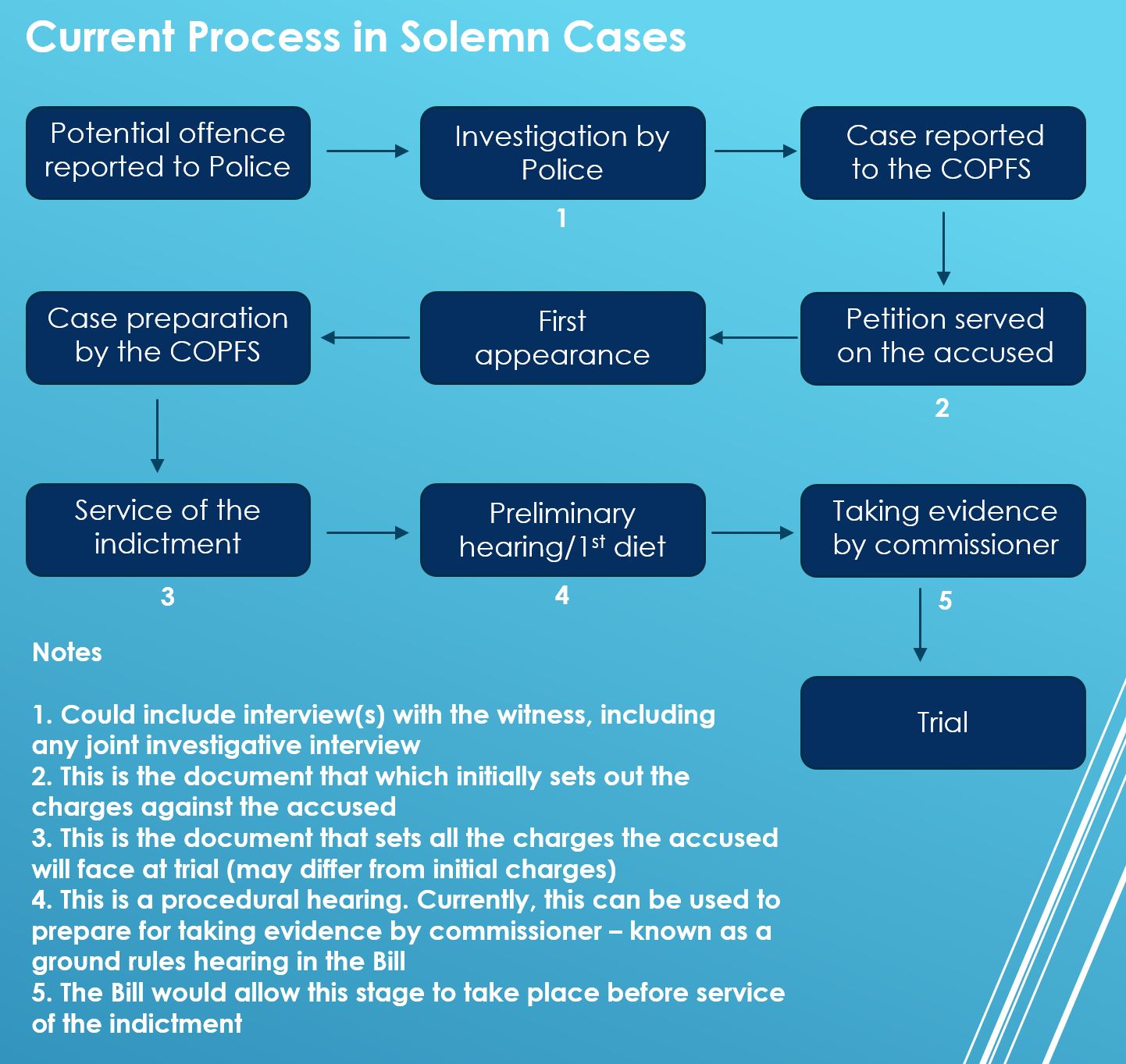
The reforms in the Bill would not directly affect how the police currently undertake investigations or interview witnesses. During its scrutiny of the Bill, the Committee heard that witnesses may have repeated contact with the police at this stage. Daljeet Dagon, representing Barnardo’s Scotland, told the Committee of one case where “a young person had given the police 27 statements and, by the time the case came to court, was deemed to be an unreliable witness”.1
Whilst in some circumstances a witness’s statement to the police could be used as their evidence in chief, the witness may still be required to give further evidence at a commission hearing, in particular to allow for cross-examination. The provisions in the Bill would enable this hearing to take place earlier in the process - before the service of the indictment - although the Committee heard that, in practice, this may happen rarely. The timing of commission hearings is discussed in more detail later in this report.
Taking evidence by a commissioner
The Bill’s Policy Memorandum explains the process for taking evidence by a commissioner as follows:
The court will appoint someone to act as the commissioner (the person who will hear the evidence) and depending on which court is dealing with the case, this will either be a judge or sheriff. The witness will be asked questions in the usual way. The accused involved in the case is entitled to see the witness and hear their evidence, but is not usually allowed to be in the same room as the witness during proceedings. The evidence is recorded and this is then played during the trial or court hearing. Evidence in chief, cross-examination and re-examination can be done in advance using this method.
Policy Memorandum, paragraph 17.
The majority of commission hearings currently take place at in the High Court in Edinburgh.1 As the Committee saw during its visits to the High Court, commission hearings take place in a room situated within the court building in Parliament House. The witness will sit at a table, usually with a supporter, along with the commissioner and the prosecution or defence lawyer who is asking the questions. Also present in the room will be a technician to operate the recording equipment, the court clerk, and the lawyer for the other party. The accused will not be present but usually watches the commission via a live television link.
As noted above, the vast majority of applications for special measures are for standard special measures. Work undertaken as part of the Evidence and Procedure Review considered how current processes for pre-recording evidence could be improved. As a result of this work, a revised High Court practice note on the taking of evidence of a vulnerable witness by a commissioner was developed. This practice note came into effect on 8 May 2017.
The practice note is intended to encourage greater use of taking evidence by a commissioner. It includes guidance on the matters that the High Court will expect to be addressed at a procedural hearing held in advance of any commission, such as:
the form of questions to be asked and lines of inquiry to be pursued at the commission
practical arrangements such as the location and timing of the commission2
The Bill’s Policy Memorandum suggests that the practice note has had a positive impact in terms of increasing the number of applications for taking evidence by a commissioner.3
This view is supported by evaluations of the practice note, published by the SCTS. According to provisional figures set out in the second evaluation (published December 2018), a total of 133 applications for evidence by commissioner were lodged with the High Court in the first 10 months of 2018. That compares with a total of 50 applications for the 2017 calendar year. The majority of applications in both 2017 and 2018 related to child witnesses.
It is worth noting that not all witnesses in respect of whom an application is made for taking their evidence by a commissioner will go on to record their evidence. This can be for a variety of reasons including the accused entering a guilty plea or the Crown deciding not to proceed with the case. The evaluation by the SCTS found that, of the 50 applications in 2017:
66% (33 applications) were called at a procedural hearing
58% (29 witnesses) had their evidence recorded at a commission hearing
50% (25 witnesses) had their pre-recorded evidence played at trial
For those 25 witnesses who had their evidence played at trial, their involvement with the criminal justice system concluded an average of 57 days (8 weeks) earlier than would have been the case if they had given their evidence at trial.
The case for reform
As noted earlier, the Bill builds on the work carried out by the SCTS as part of its Evidence and Procedure Review. The first report of that Review, published in March 2015, stated:
It is now widely accepted that taking the evidence of young and vulnerable witnesses requires special care, and that subjecting them to the traditional adversarial form of examination and cross-examination is no longer acceptable. This is for two main reasons. The first is that, as has been known for some time, the experience of going to court and recounting traumatic events is especially distressing for children, and can cause long-term damage, particularly where the necessary healing process for a victim of abuse is delayed for months, if not years. … The second reason is that, particularly for young and vulnerable witnesses, traditional examination and cross-examination techniques in court are a poor way of eliciting comprehensive, reliable and accurate accounts of their experience.
Scottish Courts and Tribunals Service (March 2015), Evidence and Procedure Review Report, paragraphs 2.1-2.3.
The report concluded that, in respect of measures designed to make the experience of child and vulnerable witnesses less traumatic, “Scotland is still significantly lagging behind those at the forefront in this field”.1
This first report was followed by a Next Steps Report, published in February 2016, which recommended that:
Initially for solemn cases, there should be a systematic approach to the evidence of children or vulnerable witnesses in which it should be presumed that the evidence in chief of such a witness will be captured and presented at trial in pre-recorded form; and that the subsequent cross-examination of that witness will also, on application, be recorded in advance of trial.
Scottish Courts and Tribunals Service (February 2016), Evidence and Procedure Review - Next Steps Report, paragraph 74.
Following publication of the Next Steps Report, two work-streams were established: one focusing on the visual recording of evidence in chief (particularly the use of joint investigative interviews) and one focusing on the pre-recording of further evidence.
The report of the work-stream on pre-recorded further evidence set out a vision which, if implemented in full, “should eventually lead to no child or vulnerable adult witness having to wait until trial to give their evidence in solemn proceedings, or attend court to give evidence at trial unless they choose to do so”. However, the report expressed support for a phased approach, recognising that “realisation of this vision will have resource implications, including a shift in resources to the front end of investigations”.2
The Policy Memorandum accompanying the Bill states that, whilst progress has been made, “more can and should be done to support child and other vulnerable witnesses, whilst protecting the interests of people accused of crimes”.3
A rule requiring the pre-recording of evidence
The principal reform in the Bill is to create a rule, applying to child witnesses involved in the most serious cases, which would generally require all of the child’s evidence to be given in advance of the trial. This could be done by the use of a prior statement and/or taking evidence by a commissioner.
The Scottish Government’s policy justification for this rule is that greater use of pre-recorded evidence will improve the experience of child witnesses. The Policy Memorandum highlights the potential for child witnesses to be “re-traumatised through their participation in the criminal justice process”, and that giving evidence in court long after events have taken place does not support witnesses to give their “best evidence”.1
The Policy Memorandum goes on to state:
Pre-recording evidence does not specifically address the issue of the length of time between events and the ultimate trial. But in certain circumstances it can be an appropriate way to give more certainty to a vulnerable witness that their evidence will be taken at an earlier stage, and it enables the evidence to be taken at a specific time, without the uncertainties which arrive from the programming of trials.
Policy Memorandum, paragraph 8.
The rule in the Bill requiring pre-recording would apply to most child witnesses under the age of 18, including child complainers. It would not, however, cover child accused. According to the Policy Memorandum, applying the rule to child accused would raise “complex issues that require to be further explored in particular that requiring pre-recording could prejudice the child’s right to remain silent and to not give evidence”.2
The rule would apply to prosecutions under solemn procedure (i.e. High Court or sheriff and jury cases) for the following offences:
murder
culpable homicide
assault to the danger of life
abduction
plagium (theft of a child)
various sexual offences (e.g. rape, sexual assault and communicating indecently)
various offences relating to human trafficking and exploitation
various offences relating to female genital mutilation
an attempt to commit the above offences
The Scottish Government would have the power, by means of regulations, to extend the application of the rule to child witnesses in cases involving other offences prosecuted under solemn procedure. This power could be used to extend the rule to all such offences. It would also be possible to remove an offence from the list covered by the rule.
It would not, however, be possible to extend the rule to offences prosecuted under summary procedure.
Although the rule, as provided for in section 1 of the Bill, relates to child witnesses involved in both High Court and sheriff and jury cases, the commencement provisions in section 11 of the Bill allow for a more phased approach. Thus, for example, the rule could initially be brought into force in respect of younger child witnesses involved in High Court cases only.
The Scottish Government’s view is that the introduction of a rule requiring pre-recording will require a substantial shift in criminal practice and it is therefore appropriate to focus initially on child witnesses in the most serious cases. The Policy Memorandum states:
There will be a number of practical and operational implications for justice sector partners in the introduction of the new rule. In order to ensure that any changes to how evidence is taken can be phased in a controlled and achievable way, targeted first at those who are the most vulnerable, a narrow and focussed approach has been taken in the Bill. However, the Bill provides the framework for a progressive extension of the arrangements to other categories of vulnerable witnesses, including, in due course, adult deemed vulnerable witnesses. Over time, the Scottish Government anticipates that it will provide the basis for pre-recording evidence to be used much more regularly in the Scottish criminal justice system.
Policy Memorandum, paragraph 68.
Section 3 of the Bill therefore provides a power for Scottish Ministers to make regulations extending the new rule to adult deemed vulnerable witness giving evidence in solemn proceedings. The Policy Memorandum notes that any extension to adult deemed vulnerable witnesses would likely be commenced on a phased basis (e.g. initially to complainers in sexual offence cases in the High Court).3
Support for the rule requiring pre-recording
Most of the evidence to the Committee supported the introduction of the rule in the Bill, to encourage the greater use of pre-recorded evidence for vulnerable witnesses. This support was particularly strong in relation to child witnesses.
The SCTS, for example, welcomed the Bill “as a critical step in improving both the experience of witnesses and the quality of justice”.1 Referring to the Evidence and Procedure Review, the submission noted:
At the heart of the Review’s proposals and recommendations was the idea that justice would be best served if young and vulnerable witnesses could give evidence in a way that maximised the chances of it being comprehensive, reliable and accurate, and minimised any potential further harm or traumatisation from the evidence-giving process itself. It also recognised that traditional adversarial procedures and techniques did not appear to meet those requirements.
Scottish Courts and Tribunals Service, written submission.
Concerns about existing processes for taking evidence
Echoing the reasoning set out in both the Evidence and Procedure Review and the Bill’s Policy Memorandum, evidence to the Committee emphasised the distress caused to child and vulnerable witnesses through traditional processes for giving evidence. A submission from Children 1st stated:
Over and over again child victims and witnesses have told us that Scotland’s justice system – designed for adults and rooted in the Victorian era – often causes them greater trauma and harm. At the same time, as scientific understanding of child development – and recently our understanding and awareness of the impact of Adverse Childhood Experiences – has grown, it has become overwhelmingly evident that Scotland’s traditional approach to justice is the least effective for eliciting consistent, reliable accounts from child victims and witnesses.
Children 1st, written submission.
Other evidence highlighted that similar concerns applied in relation to adult vulnerable witnesses. For example, a submission from Rape Crisis Scotland stated:
The current approach to taking evidence from rape complainers causes significant additional distress and trauma. There are frequently significant delays in cases coming to trial, with cases often taking two years or longer from the police report to trial. Complainers build themselves up to give what can be very difficult evidence only to get a call the night before to say the trial isn’t going ahead. This can happen many times. This causes considerable distress, and does not assist in complainers being able to give their best evidence.
Rape Crisis Scotland, written submission.
Benefits of pre-recording evidence
The Committee heard that removing child and vulnerable witnesses from the court environment, with its traditional approach to examination in chief and cross-examination, could both reduce the distress caused to witnesses and improve the quality of their evidence.
Witnesses also emphasised that, by reducing the time between events being reported and the evidence being taken, pre-recording could enable the person to recover from the events more quickly and recount them more accurately. As the Lord Justice Clerk told the Committee:
When children, in particular, are asked to give evidence at a time that is remote from the event, not only has their memory diminished, but they are more likely to be confused by general questioning about the incident, and in cross-examination might come across – often wrongly – as being shifty or unreliable. Indeed, they not only find it difficult to deal with questions at that stage, but are more inclined to agree with the questioner when they cannot remember something. Clearly, having a commission much closer to the incidents of which they were complaining would enhance their ability to recall and give accurate and comprehensive evidence and, of course, would reduce the harm to their lives, because they would be able to get on with their lives without having to attend the trial.
Justice Committee, Official Report 18 December 2018, cols. 3-4.
Children 1st similarly argued that it was in the “best interests of the child to give their complete testimony as soon as possible”, noting that:
Avoiding undue delay helps ensure children’s memories are as fresh as possible, reduces the distress children feel because they are having to wait to give evidence and would allow children to start their journey of recovery more quickly. By doing so it will also improve the quality of the child’s evidence which is in the interest of all parties in the proceedings.
Children 1st, written submission.
In oral evidence to the Committee, Daljeet Dagon, representing Barnardo’s Scotland suggested that delays in taking a child’s evidence could impact on how that evidence was perceived by the court:
We know of young people who had offences committed against them when they were 14 but were 16 and a half by the time they presented at court, by which point they were very different people from who they were as 14-year-olds. Because of the trauma that they have experienced, they can be involved in a lot of behaviours that are not seen to be positive. What the court sees is a difficult, belligerent, drug-addicted, alcoholic young person instead of the child they were when the offences happened.
Justice Committee, Official Report 27 November 2018, col. 12.
Evidence from the Crown Office and Procurator Fiscal Service (COPFS) emphasised that pre-recording evidence provided greater certainty for the witness and minimised the distress that could be caused by any future delays in the trial process.1
However, as is discussed further below, some evidence to the Committee expressed concern that, despite the reforms in the Bill, vulnerable witnesses may in practice still be giving their evidence long after the initial allegations were made.
Argument for further reform
Some evidence, whilst supporting the greater use of pre-recording, suggested that the Bill did not go far enough to address the potential distress caused to children and vulnerable witnesses through giving evidence. For example, the Committee heard that simply recording evidence earlier in the process would not necessarily improve the witness’s experience. As Colin McKay of the Mental Welfare Commission for Scotland said, “a bad interview done early is no better than a bad interview done in a trial”.1
This evidence emphasised the need for sufficient resources to implement the Bill, alongside additional measures to support child and vulnerable witnesses. Both these issues are discussed in more detail later in this report.
Evidence from some children’s organisations went further, arguing that the Bill was a missed opportunity to make more fundamental changes to improve children’s experience of the criminal justice process. In oral evidence Mary Glasgow, representing Children 1st, argued that the Bill “does not go as far as it should in realising children’s rights and enabling children to give evidence in a way that is commensurate with their developmental stage, that takes account of the way in which they communicate and which understands the impact of trauma”.2
She went on to say:
The Bill represents progress, but we are still tinkering incrementally with a system that is not and never will be built around children’s needs. That is why we are urging the Committee to think about the Bill as a start rather than a finish and to understand that, although it is better than what we currently have, it is nowhere near good enough for children. We are still squeezing and squashing children into a system that is not built with their needs in mind.
Justice Committee, Official Report 27 November 2018, col. 18.
In her view, the Bill should go much further in working towards the implementation of a Barnahus approach – or child’s house model – in Scotland, which would remove children from the court process entirely.3
Similarly, in its written submission to the Committee, NSPCC called for whole-system change to “move beyond the bolting on of ‘special measures’ to an adult-orientated system, towards a genuinely child-centred justice system”.4 It expressed support for implementing a Barnahus approach in Scotland.
The Barnahus principles are discussed in more detail later in this report.
Concerns about the rule requiring pre-recording
Some evidence to the Committee highlighted the need to balance the rule requiring pre-recording with sufficient protections for the rights of the accused.
For example, a submission from the Faculty of Advocates, whilst expressing support for the proposed rule, also highlighted the importance of being able to test the evidence of the vulnerable witness on an informed basis:
In principle, the Faculty of Advocates has no opposition to the introduction of such a rule. It is now well established that child witnesses benefit significantly from giving evidence in a different environment: away from the antiquated, and sometimes intimidating, environs of the courtroom; by answering questions that are simple and unambiguous; and by doing so as near in time as possible to the events in question. It is also expected that capturing the 'best' evidence of the child is in the wider interests of justice. However, the Faculty considers it vital that sufficient safeguards are in place to enable the rule to operate fairly, and to ensure that there is no scope for an increase in miscarriages of justice. It is therefore essential that the evidence of the child can be tested sufficiently and on an informed basis.
Faculty of Advocates, written submission.
In oral evidence, Dorothy Bain QC, representing the Faculty, expanded on the safeguards required:
The Faculty envisages insurance in the form of full disclosure of evidence at an early stage, a proper opportunity for defence counsel to prepare for the case being presented against their client, and an appropriate opportunity for cross-examination of witnesses, arising from, say, a child’s joint investigative interview to the police being led as evidence in chief. Our position is just a general recognition that change might upset a balanced procedure, so it must be ensured that individuals in that procedure are protected against miscarriages of justice.
Justice Committee, Official Report 4 December 2018, col. 9.
The Faculty’s evidence particularly stressed the need to ensure that the COPFS meets its disclosure obligations, so that defence lawyers are properly informed of the evidence and are able to prepare and present the accused’s case. Its written submission stated:
It is considered essential that there is timeous disclosure of all available and relevant evidence prior to cross-examination. The Faculty believes that a systemic failure to do so represents the single most significant obstacle to the success of this legislation. It is essential that this matter is not overlooked, and that the issue is resolved before the legislation is brought into force. The Crown should be asked to produce clear evidence that its current system of disclosure is fit for purpose and meets its statutory obligations under the Criminal Justice and Licensing (Scotland) Act 2010. Unfortunately, at the present time it is not uncommon for late disclosure, particularly of material such as telephone and computer records, or medical and social work records, to be made available to the defence at a very late stage in the proceedings. This problem is identified as regularly occurring in sexual offence cases. Provision of this late material undoubtedly impacts on the ability to cross examine witnesses, as it often results in the need to instruct expert reports and to make applications under sections 274 and 275 of the Criminal Procedure (Scotland) Act 1995. Such late disclosure would be difficult for any Judge to ignore and would undoubtedly delay any commission.
Faculty of Advocates, written submission.
These concerns were echoed in the written submissions from the Law Society of Scotland and the Miscarriages of Justice Organisation.
Use of prior statements
Evidence from the Faculty of Advocates, Glasgow Bar Association and Sheriffs’ Association expressed concern that the drafting of section 2(4) of the Bill, which provides that a prior statement could be used as “all of the child witness’s evidence”, could preclude the opportunity for cross-examination. The Faculty’s submission argued:
There can be no equivalence between an unchallenged pre-recorded statement and evidence on commission. There must always be scope for cross-examination and the subsection may have to be re-visited to make sure this is clear.
Faculty of Advocates, written submission.
In response to this specific concern, the Bill Team emphasised that it was not the Scottish Government’s intention to limit the scope for cross-examination:
We are 100 per cent clear that that is not the policy intent. … What we have tried to allow for in the Bill - and where concern has sometimes arisen - is that there is a real possibility that a child’s prior statement might be taken and the defence might not have any questions. If that is the case, we do not want a commission to have to be set up and for everybody to be sitting there, only for the defence to say that it has no questions and for the child to be sent away. We have to allow for some circumstances in which the prior statement might be the only evidence. However, if the party that has not called the witness wants to do any questioning, that will still happen.
Justice Committee, Official Report 20 November 2018, col. 17.
Risk of miscarriages of justice
The Miscarriages of Justice Organisation was more critical of the Bill. In its written submission it expressed serious concerns about expanding the use of pre-recorded evidence, arguing that this struck at the essential nature of the adversarial process:
The currently adopted procedure whereby certain witnesses are examined by video link provides the desired protection to the witness but differs fundamentally from the now proposed procedure in that the jury is able to see the contemporaneous examination of the witness. The separation of this process from the trial, by time, would fundamentally strike at the necessary relationship between witness and jury, since the witness would be giving evidence in the absence of the jury both by place and time. In simple terms, the witness would not be speaking to the jury when giving evidence.
Miscarriages of Justice Organisation, written submission.
The submission went on to argue:
Defence counsel and, by extension, accused persons, would be significantly disadvantaged by their inability to cross-examine Crown witnesses on matters arising and information coming to light in the course of a trial. It has long been recognised, in part for this very reason, that the appropriate forum for the examination of witnesses is the trial itself. In this context we place on record our view that the existing provisions for the taking of evidence by commissioner are an inappropriate dilution of the right of an accused to a fair trial.
Miscarriages of Justice Organisation, written submission.
In oral evidence, however, Euan McIlvride, representing the Miscarriages of Justice Organisation, drew a distinction between child witnesses, where he saw a rule in favour of pre-recording as appropriate, and adult deemed vulnerable witnesses. His concerns in relation to adult deemed vulnerable witnesses are discussed in more detail below.
In response to the concerns raised about the potential for miscarriages of justice, the Lord Justice Clerk emphasised that the process would still be subject to judicial oversight:
The safeguards are essentially the same as those that would apply if the child was giving evidence at trial. The commissioner is a High Court judge and is invested with the same powers; they are in control of proceedings and can deal with any difficulties that might arise in questioning. Equally, the commissioner protects the interests of the accused, just as the judge in a trial would.
Justice Committee, Official Report 18 December 2018, col. 4.
A similar point was made by the Cabinet Secretary for Justice in his closing evidence to the Committee, during which he also emphasised that the defence would continue to be able to test the evidence through cross-examination.1 However, he indicated that he would keep an “open mind” on any amendments proposed by the Faculty or others to ensure the fairness of the trial process.2
Phased implementation of the rule requiring pre-recording
As set out earlier, the rule in favour of pre-recording in section 1 of the Bill applies only to child witnesses in the most serious cases. Moreover, the commencement provisions in section 11 of the Bill allow for this rule to be implemented in stages.
Section 1 of the Bill would allow the rule to be extended to child witnesses giving evidence in cases involving other offences prosecuted under solemn procedure. This could include extending the rule to all children (other than child accused) giving evidence in solemn cases. Section 3 of the Bill would allow extension of the rule to adult deemed vulnerable witnesses giving evidence in solemn cases. Any extension of the rule to other child and adult deemed vulnerable witnesses would be done through regulations, subject to the affirmative procedure.
The Bill as currently drafted would not allow the rule to be extended to offences prosecuted under summary procedure, or to other existing categories of vulnerable witness.
The Scottish Government’s intention is to take a phased approach to the implementation of the rule in favour of pre-recording. Towards the end of the Committee’s scrutiny of the Bill, the Government provided an outline draft implementation plan. This envisages the first two phases of implementation being as follows:
from January 2020: for child witnesses (including complainers) aged under 18 in High Court cases involving an offence(s) specified in section 1 of the Bill
from July 2021: child complainers only aged under 16 in sheriff and jury cases involving an offence(s) specified in section 1 of the Bill
The outline plan does not set out intended dates for future phases, but suggests that these phases will be implemented in the following order:
other child witnesses aged under 16 in sheriff and jury cases involving an offence(s) specified in section 1 of the Bill
child witnesses (including complainers) aged 16 and 17 in sheriff and jury cases involving an offence(s) specified in section 1 of the Bill
adult deemed vulnerable witnesses in High Court sexual offence cases
all remaining adult deemed vulnerable witnesses in High Court cases
The implementation plan does not indicate if and when the rule in the Bill will be extended to other offences.
As noted above, the Scottish Government’s justification for this phased approach is that the introduction of a rule requiring pre-recording will be a significant change for the criminal justice system. It considers that the initial focus should be on those witnesses who are the most vulnerable – i.e. child witnesses in the most serious cases – before expanding the rule to other child or adult deemed vulnerable witnesses.
In a letter accompanying the Government’s outline implementation plan, the Cabinet Secretary for Justice stated:
It is crucial that commencement and roll out of provisions in the Bill is undertaken in a managed and effective way to ensure that the intended benefits are delivered to the individuals involved in these most serious cases. … The danger in rolling out too quickly is that it overwhelms the system, commissions do not operate as they should, which in turn means that the aims of the Bill to improve the position for the most vulnerable witnesses will not be met.
Scottish Government, supplementary written submission.
The Cabinet Secretary also emphasised the need to ensure that there is a “suitable period of evaluation and monitoring before moving to commence the next stage of implementation”.1
Overall views on a phased approach
Overall, evidence to the Committee supported a phased approach to implementation of the rule requiring pre-recording, including the initial focus on child witnesses in the most serious cases.
Reasons advanced in favour of this approach included the resource implications of the Bill, as well as the cultural and practical shifts that would be required.
For example, the COPFS supported a phased approach starting with child witnesses in the High Court for offences listed in the Bill. Its written submission stated:
This reform will have a very marked impact on the organisation of the business of the criminal courts. It is inevitable that the rule will require to be implemented in a phased manner. Deliberate decisions should be taken sequentially over time to extend the presumption to additional categories of witnesses. Those decisions can only safely be made once the necessary resources are in place – not merely the facilities to record evidence on the scale envisaged, but also the resources to provide the capacity in the system on the part of the Crown, the court and the defence (via the Scottish Legal Aid Board). Phasing will allow the system to absorb change while minimising risk both to the system and to individual cases. It will also enable any difficulties which arise in the operation of the rule to be identified and addressed before the rule is extended.
Crown Office and Procurator Fiscal Service, written submission.
Similar sentiments were expressed in other written submissions, including from the Faculty of Advocates, the Law Society of Scotland, Police Scotland, the Senators of the College of Justice and Social Work Scotland.
In supporting a phased approach, the SCTS also emphasised the resource implications of the Bill, as well as other changes that would be required in practice:
The long-term changes envisaged by this Bill will require significant shifts in legal thinking, practice, technology and infrastructure. It is essential that all those participating in the criminal justice system are given the time, support and resource to make the adjustments necessary. It is very sensible to plan for a phased rollout so that the growth in the use of pre-recorded evidence does not simply overwhelm the capacities of our staff, the judiciary and the court estate, as well as the prosecution (COPFS), defence agents and advocates, and associated services such as victim support.
Scottish Courts and Tribunals Service, written submission.
The SCTS suggested a phased approach was necessary for a number of reasons, including the need to:
create specialist venues for pre-recording evidence
develop appropriate technical capabilities to record, store and play such evidence
deliver training for the judiciary, prosecutors, defence agents and court staff
ensure that the new approach is implemented in a way that genuinely improves the experience for witnesses1
This latter point was emphasised by other evidence to the Committee, which stressed the need for appropriate monitoring and evaluation. This was also seen as necessary to learn lessons for extending the rule to other categories of witness, and to ensure that sufficient resources are in place for any such extension.2
Extending the rule requiring pre-recording
Timetable for implementation
Whilst acknowledging the need for a phased approach, some evidence argued that more clarity was needed as to the timetable for extending the rule in favour of pre-recording. Mhairi McGowan, representing ASSIST, told the Committee she was concerned that “if there is no set timetable that Parliament can properly consider, we will lose the benefits of extending the approach”.1
Similarly, Colin McKay of the Mental Welfare Commission for Scotland argued that there needed to be a commitment to extending the rule “within a reasonable timeframe”.2 He went on to say:
There is a danger that, once we get into the difficulties of implementation, some of the energy and commitment will get lost. People get into the mentality of thinking, “Let’s just get this one thing done and then we’ll see where we are”. It is important that the committee and the Parliament continue to hold the Government to account on a clear framework for action.
Justice Committee, Official Report 27 November 2018, col. 44.
Evidence from the COPFS, however, emphasised the need for flexibility in any implementation plan, suggesting that “a fixed implementation timetable would be incompatible with managing unforeseen challenges”.3
As discussed above, the Scottish Government has since provided an outline implementation plan, although this does not set out when the rule will be extended to other offences, or to adult deemed vulnerable witnesses. In oral evidence, the Cabinet Secretary told the Committee:
We need to have a degree of flexibility. In my implementation plan, which I forwarded to the Committee, dates are attached to some of what we are looking to do, but not to everything. The reason for this is that I want to get things right instead of just giving you an arbitrary date. We need to evaluate and monitor.
Justice Committee, Official Report 8 January 2019, col. 5.
Child accused
Under the provisions of the Bill, the proposed rule on pre-recording evidence would not apply to child accused. As noted earlier, the Scottish Government’s view is that pre-recording the evidence of a child accused raises complex issues and could prejudice the accused’s right to remain silent. 1
Evidence from some children’s organisations suggested that the rule should be extended to child accused. Children 1st, for example, emphasised that accused children are “extremely vulnerable”. It argued:
Accused children have the same rights to be heard and to be protected from harm within the criminal justice system as children who are victims or witnesses. What we know about eliciting consistent, reliable accounts from children’s testimony applies equally to children accused of crime as it does to child victims and witnesses.
Children 1st, written submission.
Similar points were made in the written submission from NSPCC, which suggested that the Bill should “include a commitment of a future phase fully considering the need of the child accused”.2
In its evidence, the Miscarriages of Justice Organisation suggested that introducing the provisions in the Bill without similar measures for child accused created an imbalance. Whilst accepting that more work needed to be done on this issue, it argued that the Bill should not be taken forward until measures to ensure appropriate support for vulnerable accused can also be brought forward.3
However, other evidence expressed support for the approach taken in the Bill. For example, the COPFS argued that extending the rule to child accused “could not readily be reconciled with the accused’s right to silence”.4 Similar points were made in evidence from the Faculty of Advocates and the Law Society.
In oral evidence, the Lord Justice Clerk emphasised the different status and rights of the child accused. She told the Committee:
The accused, whether they are a child or otherwise, is not required to give evidence; the decision about whether they give evidence has to be made in the context of what the evidence at the trial has been, which we will not know until the end of the trial. We might anticipate that the evidence will be A, B and C, but frequently that turns out not to be entirely accurate, and the accused has to respond to what the evidence has been at the trial. I cannot see a way in which the evidence of a child accused could be taken in advance of the trial, nor can I see how requiring an accused child somehow to do that would not be in breach of their rights.
Justice Committee, Official Report 18 December 2018, col. 13.
However, she went on to say that existing special measures which could support a child accused, such as giving evidence by live link, were currently underused.5Other witnesses agreed that more use could be made of existing special measures to assist vulnerable accused. The Committee also heard that, whilst there should not be a rule requiring pre-recording for child accused, current legislation would allow for pre-recording if appropriate in the individual circumstances of the case.
The Scottish Government told the Committee it was considering what further support could be given to child accused. On 6 September 2018, the Government and the Centre for Youth and Criminal Justice brought together a range of stakeholders to discuss this issue. A summary of the key themes that emerged from that event can be found here. Stakeholders at this event emphasised that the role of the defence is crucial in ensuring appropriate special measures are requested for child accused.
Conclusions and recommendations on the rule requiring pre-recording of evidence
The rule requiring pre-recording
The Committee welcomes the introduction of the rule in section 1 of the Bill, which would generally require child witnesses in the most serious cases to give all of their evidence in advance of the criminal trial. This is an important step forward in increasing the greater use of pre-recording, which the Committee agrees will reduce the distress and trauma caused to child witnesses as well as improve the quality of justice.
The Committee considers that the introduction of this rule must be balanced with sufficient safeguards to protect the rights of the accused. In particular, the Committee notes the concerns raised by the Faculty of Advocates and others that, unless the Crown Office and Procurator Fiscal Service meets its disclosure obligations in good time, the defence cannot properly prepare for a commission. The Committee asks the Scottish Government to set out what steps it intends to take to address these concerns.
The Committee also heard that the current drafting of section 2(4) of the Bill, which provides that all of the child witness’s evidence may be given by way of a prior statement, might be interpreted as precluding the scope for cross-examination in such cases. The Committee asks the Scottish Government to consider whether the Bill should be amended to make it clear that this is not the intention.
Phased implementation of the rule requiring pre-recording
The Committee recognises the significant costs associated with a rule in favour of pre-recording, which are discussed in more detail later in this report, as well as the shifts in legal practice and culture which will be required. The Committee therefore agrees that a phased approach to implementation is sensible, with the initial focus being on child witnesses in the most serious cases.
Extending the rule requiring pre-recording
However, the Committee considers that section 1 of the Bill should be amended to include domestic abuse in the list of offences covered by the rule requiring pre-recording, given the trauma that children can experience in such cases. The Committee welcomes the indication from the Cabinet Secretary for Justice that he is willing to consider this extension.
The Committee also supports the extension of the rule requiring pre-recording to adult deemed vulnerable witnesses. The Committee is not persuaded that pre-recording the evidence of such witnesses will enhance their credibility with jurors. Moreover, the Committee notes that the Bill’s provisions do not alter the existing statutory definition of a deemed vulnerable witness.
The Committee recognises that the process of giving evidence can be just as distressing for witnesses in summary cases as for solemn cases. This is particularly an issue for child witnesses giving evidence in domestic abuse cases, which are often prosecuted under summary procedure. The Committee therefore recommends that more use should be made of existing provisions which allow evidence to be pre-recorded in summary cases. The Committee, however, acknowledges that extending a rule requiring pre-recording to summary cases would have significant resource implications.
The Committee heard that there would be benefits in the greater use of pre-recording for other categories of vulnerable witness, such as those who are vulnerable by reason of mental disorder. However, there does not seem to be a pressing case for extending the rule requiring pre-recording to these witnesses. Moreover, some evidence suggested that, given the range of vulnerabilities in these categories, there is a need for flexibility in the approach to evidence-taking. Nonetheless, the Committee asks the Scottish Government to consider what steps could be taken to increase the use of pre-recording for other categories of vulnerable witness where appropriate.
On balance, the Committee considers that it is appropriate that the Scottish Government will have the power to extend the rule requiring pre-recording through regulations. This should allow other child and adult deemed vulnerable witnesses to benefit from the provisions without any unnecessary delay caused by requiring further primary legislation.
It is important that there is an opportunity for sufficient parliamentary scrutiny of any extension of the rule in section 1 of the Bill. The Committee agrees that the regulations should therefore be subject to the affirmative procedure. It also recommends that the Scottish Government provide the Scottish Parliament with early notification of its intention to lay any regulations extending the rule to other offences, courts or adult deemed vulnerable witnesses. The Committee welcomes the indication from the Cabinet Secretary for Justice that he would be willing to share information gathered during the monitoring and evaluation of earlier phases of implementation, to inform the Committee’s scrutiny of any regulations extending the application of the rule. This information should be provided at the same time as the Scottish Government gives early notification of its intention to lay regulations. This would not preclude the Committee at that stage from recommending that it would be more appropriate for any extension of the rule to be provided for in primary legislation.
Timetable for implementation
The Scottish Government’s draft implementation plan provides a useful starting point for considering the timetable for extending the rule to other offences, courts and adult deemed vulnerable witness. A more detailed implementation plan should be developed as soon as possible. This should provide a clear framework which can be used to monitor progress and ensure that there is not undue delay in extending the benefits of the rule to other witnesses.
The Committee considers that any plan should build in sufficient time for monitoring and evaluation, as well as potential resulting changes such as enhancements to the technology available for pre-recording. It welcomes that this approach has been suggested in the draft implementation plan provided by the Scottish Government. The Committee heard that this would be necessary to ensure that the rule is delivering improvements in practice and to learn lessons before extending to other categories of witness. The Committee asks the Scottish Government to provide more detail on how each phase will be evaluated and how decisions will be made about future phases of implementation.
Child accused
The Committee understands why, at this stage, the rule requiring pre-recording will not apply to child accused, given the concerns raised that to do so could prejudice the accused’s right to silence and ability to respond to the evidence produced at trial. However, the Committee also heard that more needs to be done to support child accused giving evidence, particularly as these children can often be the most vulnerable. The Committee therefore welcomes the ongoing work by the Scottish Government to consider the position of the child accused and requests an update on its plans for improving the support offered.
In particular, it appears that existing special measures which could be used to support child accused, such as giving their evidence by live television link, are currently underused. The Committee recommends that the Scottish Government work with relevant justice agencies, including the Law Society of Scotland, Faculty of Advocates and the Scottish Courts and Tribunals Service, to consider what steps could be taken to increase the use of such measures for child accused. This could include, for example, enhanced guidance or training for defence solicitors and advocates.
Reforms to the process of taking evidence by a commissioner
As set out earlier, section 5 of the Bill provides for various reforms to the existing process for taking evidence by a commissioner. These provisions would apply in all cases where the evidence of a vulnerable witness is to be taken by a commissioner.
The revised High Court practice note, which came into effect in May 2017, included a requirement for there to be a procedural hearing in advance of taking evidence by a commissioner. Section 5 of the Bill puts this requirement for a procedural hearing – referred to in the Bill as a ground rules hearing – on a statutory footing. The purpose of this provision is to ensure that in all cases where evidence is to be taken by a commissioner, the parties are prepared and the issues set out in the current practice note are considered.1
Section 5 provides that the ground rules hearing can take place separately or at the same time as another procedural hearing in the case, such as the preliminary hearing. The Policy Memorandum notes that it is expected that the ground rules hearing will, in High Court cases, continue to be dealt with at the preliminary hearing, as that approach has been working well under the practice note.2
Section 5 of the Bill also lists matters which must be considered at the ground rules hearing. These include:
the length of time the parties expect to take for questioning, including any breaks that may be required
the form and wording of the questions to be asked of the witness
the use of a supporter
steps that could reasonably be taken to enable the witness to participate more effectively in the proceedings
The Policy Memorandum states:
The Bill does not list all the matters contained in the Practice Note but it requires that (in addition to considering the matters listed in the Bill), consideration must be given to any other matter that could be usefully dealt with before the proceedings before the commissioner take place. This allows some flexibility. If the Practice Note is modified to include new matters, these are likely to be matters that could be usefully dealt with at ground rules hearings.
Policy Memorandum, paragraph 82.
The Bill also provides that, where reasonably practicable, the same judge or sheriff should preside over both the ground rules hearing and the commission hearing.
In relation to the timing of commissions in solemn procedure cases, the Bill allows for the possibility of a commission taking place before an indictment has been served on the accused.i
Views on the requirement for a ground rules hearing
The Committee heard strong support for the provisions in section 5 of the Bill on ground rules hearings, with evidence emphasising the importance of these hearings in ensuring that the process for taking evidence by a commissioner works effectively. The SCTS, for example, noted in its written submission:
There is extensive evidence, particularly from England and Wales, that a “ground rules hearing” is a necessary part of the process, helping to ensure the commission itself is as effective and efficient as possible for all parties.
Scottish Courts and Tribunals Service, written submission.
Similar points were made in many other submissions including those from the COPFS, Faculty of Advocates, Senators of the College of Justice, the Sheriffs’ Association and Victim Support Scotland. This evidence also supported the approach taken in the Bill which would allow the ground rules hearing to take place separately or at the same time as other procedural hearings.
Deciding on the questions to be asked of the witness
The Committee heard that consideration of the form and wording of questions to be asked of the witness is a crucial part of the ground rules hearing.
The SCTS stated:
That type of discussion with the judiciary in advance of a commission is essential so that the nature of questioning is agreed in advance and the right balance can be struck between a) the actual vulnerabilities exhibited by each child or adult vulnerable witness and b) the interests of justice in maintaining the right to a fair trial for the accused.
Scottish Courts and Tribunals Service, written submission.
Victim Support Scotland similarly argued:
The ground rules hearings are an effective way of ensuring that the child’s development, needs and safety are met during questioning. The need for this is clear. Research on how solicitors examine and cross examine children in Scotland shows that solicitors do not alter their questioning technique when questioning a child, regardless of the child’s age. This highlights that more needs to be done to protect children from inappropriate, misleading and/or confusing questions.
Victim Support Scotland, written submission.
Given these benefits, Victim Support Scotland argued that ground rules hearings should be extended to all cases involving child and vulnerable witnesses, regardless of the way in which their evidence is to be taken. This approach was also advocated in the submissions from the Scottish Children’s Reporter Administration and Social Work Scotland.
Other evidence suggested that the provisions on ground rules hearings should go further in promoting scrutiny of the questioning of vulnerable witnesses.
A submission from the Senators of the College of Justice noted that, for ground rules hearings to be effective, “it is essential that the defence communicate the lines of questioning to the court” and that this should be reflected in the Bill.1
Whilst the Scottish Children’s Reporter Administration argued:
The legislation should specifically require the prosecutor and the accused to submit the list of proposed questions to the judge or commissioner in advance. This will promote a practice of judicial scrutiny. This is the norm in English proceedings where pre-recording of evidence is to take place, and has been described as the success of the system. It is difficult to see any argument against proactive judicial scrutiny of questioning other than an unwillingness to change culture and practice. As in England, alternative questions can be suggested depending on possible witness responses.
Scottish Children's Reporter Administration, written submission.
During its visits to the High Court, the Committee explored whether a requirement to provide questions at the ground rules hearing would impact on the ability to deal with any unexpected evidence that emerged at the commission itself. The Committee understands that, under current practice, there is some flexibility to depart from lines of questioning agreed at the ground rules hearing and, if necessary, the commissioner’s permission can be sought to ask additional questions. This approach would not be altered by the provisions in the Bill. The Scottish Government also emphasised that the Bill is not intended in any way to prevent the legitimate questioning of witnesses.2
Other matters to be considered at the ground rules hearing
Some evidence to the Committee, for example from the Scottish Children’s Reporter Administration, suggested that the wider support to be provided to a child or vulnerable witness should be considered at the ground rules hearing.1
Other evidence suggested that there could be scope for involving a broader range of agencies in discussions at the ground rules hearings, such as police and social work. For example, Police Scotland noted that in certain sexual offence cases they will prepare a victim strategy for the COPFS and the information provided could be used to inform discussions at the ground rules hearings.i
Kate Rocks, representing Social Work Scotland, also suggested that social workers could be more involved, but emphasised that currently there is no process for notifying local authorities that a child is due to give evidence. She told the Committee:
If a child gives evidence, the team around the child should know that and help to support them. There should not be a reliance on the Crown Office to put in arrangements for that.
Justice Committee, Official Report 4 December 2018, col. 45
Evidence from Barnardo’s Scotland similarly suggested that professionals involved with a child will often not know what stage in the criminal justice process the case has reached, which can make it difficult to provide support.2
Other witnesses emphasised the desirability of not having too much detail in the Bill, with the Lord Justice Clerk stating:
We have detailed recommendations in our practice note as to what should take place at the ground rules hearing. If you are interested, you can find them in paragraph 11 of the practice note, which covers about two pages. As the document will be under review, we will be able to change those recommendations as and when it appears that something else would assist. The flexibility that would be maintained by having those recommendations on the ground rules hearing set out in the practice note would be much more beneficial than trying to put those into primary legislation, which would be much more difficult to change.
Justice Committee, Official Report 18 December 2018, col. 10.
The Cabinet Secretary made a similar point, suggesting that:
If we made the system too prescriptive by putting most of the detail in primary legislation, it would be difficult for practice to evolve in the future.
Justice Committee, Official Report 8 January 2019, col. 13.
The role of intermediaries
In its submission, the Faculty of Advocates suggested that the Bill should provide for the use of intermediaries at ground rules hearings. The Faculty argued:
The purpose of the ground rules hearings is to ensure that the pre-recording runs smoothly and that the form of questioning is appropriate. The principles and purpose behind the Bill would be defeated if this was not achieved. It is for this reason that the Faculty is concerned that there is no provision in the Bill for the introduction of intermediaries, who are skilled in ensuring that questions asked are worded in a way that the witness can understand, in order to permit the witness to give their best evidence.
Faculty of Advocates, written submission.
The submission went on to state:
It has long been accepted by experts in the field that neither lawyers nor the court are best placed to consider the communication abilities and needs of child and vulnerable witnesses and that trained intermediaries are far better placed to carry out such an assessment. …The role of the intermediary is to facilitate communication with the child or vulnerable witness. In order to do this the intermediary carries out an assessment of the witness’s communication abilities and needs. He or she then prepares a report for the court. This report will provide advice and make recommendations, with examples, to the parties who will question the witness about the most effective way in which to ask their questions.
Faculty of Advocates, written submission.
Other evidence to the Committee supported the use of intermediaries in ground rules hearings and subsequent commissions. However, views were more mixed on how quickly this could be achieved and whether the Bill itself should make provision for intermediaries.
Colin McKay, representing the Mental Welfare Commission for Scotland, argued that ground rules hearings need to be informed by a “clear assessment of the needs of the person who is giving evidence”. 1He suggested that a registered intermediary scheme, similar to one that has been in place in England and Wales since 2004, could be introduced quickly.2
In Police Scotland’s view, having the intermediary role set out in the Bill would be “hugely beneficial”.3 Detective Chief Inspector Graeme Lannigan suggested that the intermediary should be involved as early as possible in the criminal justice process, with the same individual remaining involved throughout.4
On the other hand, whilst supportive of the use of intermediaries, evidence from the Lord Justice Clerk, COPFS and Law Society of Scotland did not consider that provision should be made for intermediaries in the Bill. Reasons for this view included the current lack of individuals in Scotland with the appropriate expertise to act as intermediaries, as well as the need for more work to be done to ensure that any intermediary scheme operates effectively in practice.56
Moreover, a submission from the Senators of the College of Justice suggested that the current provisions in the Bill on ground rules hearings are broad enough to permit the court to appoint an intermediary.7
In closing evidence, the Cabinet Secretary told the Committee that “there is a strong argument for using intermediaries more”.8 However, he did not consider this was a matter for the Bill, noting that:
The use of intermediaries is a much wider issue, which could have implications for other parts of the criminal justice system.
Justice Committee, Official Report 8 January 2019, col. 14.
Timing of evidence taking
As discussed earlier, one of the arguments advanced in favour of pre-recorded evidence is that taking evidence closer to the alleged incident tends to make it more reliable. Earlier recording of evidence may also help to limit the distress caused to vulnerable witnesses and support them to recover from events more quickly.
In relation to prosecution witnesses, the submission from the COPFS outlines its planned approach to complying with the rule requiring pre-recording of a child witness’s evidence as follows:
where there is a good quality audio-visual recording of a statement made to the police, or of a joint investigative interview carried out by police and social work, it would seek to rely on that as the child’s evidence in chief
cross-examination and re-examination would be dealt with through the taking of evidence by a commissioner
where there is no audio-visual recording, or the quality is not adequate, it would seek to take all of the child's evidence by a commissioner
The submission notes that the COPFS does not generally favour the use of a written statement as evidence in chief.1
Under this planned approach, some or all of the witness’s evidence would be taken by a commissioner. Therefore, the timing of commissions will affect the extent to which the benefits of pre-recording evidence are realised in practice.
Currently in solemn cases evidence by commissioner can only take place after service of the indictment.i As recognised in the Policy Memorandum, this can create the potential for a long period of time to elapse between the child’s initial interview and any subsequent commission hearing.2
Pre-indictment commissions
As set out above, the Bill would allow evidence to be taken by a commissioner in advance of the service of the indictment. Whilst most evidence supported this reform, given the potential benefits to witnesses of their evidence being taken earlier in the process, different views were expressed on how frequently this should happen in practice.
The Scottish Government’s view is as follows:
Applications for evidence by commissioner in advance of the indictment are likely to be rare as it is only at the point at which an indictment is served that it will become clear what requires to be proven in a specific case. It is unlikely to be in the best interests of the witness to have their evidence recorded at too early a stage. The defence may not be certain of the exact charges the accused is facing and this could result in a further evidence taking session with the witness being required, particularly if further avenues of cross-examination are identified once the exact charges the accused is facing are certain.
Policy Memorandum, paragraph 76.
This view was supported by the COPFS. Its written submission stated:
It is only when all relevant evidence is available and the indictment is served that the charges upon which the accused will go to trial are certain. If evidence were to be taken before the indictment has been served, the examination would not be focused by reference to the charges on which the accused will face trial. If the accused is not, in fact, indicted, evidence would have been taken unnecessarily. If the accused is indicted, but on charges which differ from those which had been anticipated at an earlier stage, it might be necessary to hold a further commission hearing; multiple hearings would be liable to increase, rather than to reduce, trauma.
Crown Office and Procurator Fiscal Service, written submission.
In oral evidence, Kenny Donnelly representing the COPFS emphasised that there were often “significant changes to the information that appeared in the petition in the indictment”.1
The submission from the Law Society also cautioned against the risk that “if steps are taken to try and secure a child witness’s evidence at too early a stage, this could lead to multiple commissions in respect of the same witness because disclosure did not take place in time, or to the child having to give their evidence to a commissioner only to have the accused plead guilty”.2
However, the submission from the Faculty of Advocates argued that such an approach threatens to undermine the benefits of pre-recording. It suggested that it is possible to have a reasonable degree of certainty about the charges at a much earlier stage, noting that:
The strong prosecutorial experience within the Faculty of Advocates is that, particularly in relation to sexual cases, the form and content of the charge does not change significantly from petition to indictment and could easily be identified on an analysis of the content of a complainer's police statement or JII [joint investigative interview].
Faculty of Advocates, written submission.
The submission went on to state:
If the policy is to be that a commission will not take place until after the service of an indictment then that would, particularly in relation to the prosecution of sexual offences against children and vulnerable witnesses, undermine the purpose and effect of both the Evidence and Procedure Review and the Bill. A realistic consequence of this approach is that as a matter of routine, a child or vulnerable witness’s evidence will not be recorded for a lengthy period after initial complaint, ranging from a period of many months to the order of two years after the initial complaint.
Faculty of Advocates, written submission.
The Faculty therefore suggested that there should be a presumption in favour of commissions taking place as soon as possible after the initial complaint, so long as this would be in the best interests of the child or vulnerable witness. Otherwise, it argued that “a real and sustained effort must be made to bring cases involving child and vulnerable witnesses to court within far shorter timescales than are adhered to currently”.3
In its submission, Children 1st suggested that the Scottish Government and criminal justice agencies should “give in-depth consideration to how best to reduce the length of time between pre-recording of evidence in chief and taking cross-examination by commissioner while continuing to comply with the requirements of a fair trial”.4
Similarly, Daljeet Dagon of Barnardo’s Scotland suggested that “at the very least” cases involving children should be expedited.5 Evidence from the Scottish Children’s Reporter Administration also supported focusing on reducing delays in cases where children are giving evidence.6
Evidence from the COPFS pointed to ongoing work to reduce the time taken to serve indictments in High Court cases:
In August 2018 the Scottish Government committed to providing COPFS with additional in-year funding. Part of that funding will enable COPFS to progress a programme of work which, over time, should reduce the time between first appearance on petition and the service of the indictment. This should, in turn, result in ‘evidence by Commissioner’ hearings, albeit that they occur after the indictment has been served, taking place at an earlier date after first appearance than is currently possible.
Crown Office and Procurator Fiscal Service, written submission.
In oral evidence, Kenny Donnelly suggested that, whilst this work applied to all cases in the High Court, the COPFS was prioritising cases involving the most vulnerable witnesses including children.7
The possibility of multiple commissions
As the evidence discussed above suggests, one of the potential risks of taking evidence by a commissioner earlier in the process is that multiple commissions may need to take place if, for example, further evidence comes to light which needs to be put to the witness in the interests of fairness and justice.
Neither the Bill nor existing legislation explicitly provides for the possibility of further commissions. However, the Lord Justice Clerk told the Committee that, whilst she was not aware of this situation having arisen in practice, if new evidence emerged a further commission could take place if necessary.1
Definition of solemn proceedings
Evidence from the Lord Justice Clerk1 and the Senators of the College of Justice suggested that a definition of solemn proceedings may be needed to utilise the Bill’s provisions allowing commissions to take place before the service of the indictment. The submission from the Senators noted:
As there is no definition of “solemn cases” in the Bill it is not clear how “solemn cases” are to be identified if no indictment has yet been served, unless it is intended that this provision is to apply to all cases in which an accused person has appeared on petition.
Senators of the College of Justice, written submission.
Role of the commissioner
The commissioner is the judge or sheriff appointed by the court to hear the evidence of the vulnerable witness at the commission. The Bill provides that the same judge or sheriff should undertake the ground rules hearing and the commission where it is reasonably practicable to do so.
The Scottish Government’s view is that this will have benefits of familiarity and consistency for vulnerable witnesses. However, it does not consider that the Bill should require the same judge or sheriff to undertake the ground rules hearing and the commission, or the trial itself, noting that “it is more important that these reforms do not restrict the court too much in how it organises its business”.1
Evidence from Victim Support Scotland expressed support for the same judge or sheriff acting throughout the process, to provide continuity and reassurance to the witness.2 The Law Society of Scotland also saw benefits in this approach, but noted that “this may not always be possible or practical”.3 Whilst evidence from Malcolm Schaffer of the Scottish Children’s Reporter Administration suggested that:
Continuity of the individual has a lot of advantages, but the danger is that it could build in huge delay. The relevant individual might already be tied up in a lengthy trial for, say, two months. We have found from experience that, although there are huge benefits in having that continuity, there is a huge danger of it building in further delay.
Justice Committee, Official Report 27 November 2018, col. 22.
Training for those involved in the process of taking evidence by a commissioner
A recurring issue during the Committee’s scrutiny of the Bill was the need for appropriate training for all those involved in the process of taking evidence by a commissioner. This should include training for judges and sheriffs, as well as prosecution and defence lawyers, involved in both the ground rules hearing and the subsequent commission. Evidence suggested that this was important to ensure that the process was tailored to the individual needs of the witness and that questioning was carried out appropriately.
For example, in its submission Children 1st argued:
Legislative change needs to go hand in hand with training and guidance to ensure that all professionals involved in forensic interviewing of children have the skills and knowledge to sensitively elicit best evidence from a child or young person, without the risk of re-traumatisation.
Children 1st, written submission.
Children 1st also emphasised the need for this training to be trauma-informed, a point echoed in evidence from Social Work Scotland, Police Scotland, NHS Education Scotland Psychology Directorate and Victim Support Scotland.
This evidence highlighted that the provision of training would need to be sufficiently resourced. The costs associated with the Bill’s implementation are considered further below.
Resources for taking evidence by a commissioner
As discussed earlier in this report, the main argument in favour of a phased approach to the Bill’s implementation was the significant resource implications of a rule requiring pre-recording of evidence. As the submission from the COPFS stated in its submission to the Committee:
Pre-recording evidence has not previously been undertaken in Scotland on the scale that is proposed in the Bill. Several organisations in the criminal justice system, including COPFS, will require significant additional resources in order to comply with the new rule. It will be necessary to establish high quality facilities for pre-recording evidence and for playing it back at trial, as well as suitable technical solutions for editing, transcribing, storing and transporting recordings. At the same time, the pre-recording of evidence, and the ‘Ground Rules Hearing’ which will precede it, will impose additional demands on COPFS, SCTS and the defence.
Crown Office and Procurator Fiscal Service, written submission.
Financial Memorandum
The Scottish Government’s estimates of the costs associated with the rule in favour of pre-recording and the reforms of the process for taking evidence by a commissioner are set out in the Financial Memorandum.
The Financial Memorandum identifies cost implications for the SCTS, COPFS, Scottish Prison Service and Scottish Legal Aid Board. Most of these costs are attributed to the additional time that the judiciary, SCTS staff, and prosecution and defence lawyers will have to spend in preparing for and conducting ground rules hearings and commissions, as a result of the expected increase in the use of taking evidence by a commissioner. The COPFS will also incur additional costs in recording commissions.
The Financial Memorandum emphasises the uncertainty in predicting the number of commissions that will take place as a result of the Bill, given the uncertainty in predicting how many children will be required to give evidence in criminal cases.
The Financial Memorandum therefore provides a range of cost estimates depending on the percentage of children currently cited to give evidence who will be required to give evidence at a commission.i It estimates that the annual recurring costs of the Bill's provisions on pre-recording will total between £519,000 (based on the existing 215 children estimated to provide evidence at trial) and £3,551,000 (based on an absolute maximum where all children cited are required to provide evidence via commission). It states that “as commissions are already taking place, no additional set up costs are anticipated from implementation of the new rule in favour of children under 18”.1
These estimates are based on the new rule applying to child witnesses in both High Court and sheriff and jury cases. Given that the Bill allows for a more gradual roll-out of the rule, the Financial Memorandum (see paragraph 36) provides cost estimates if applied to High Court cases only.
The Bill also allows for the extension of the rule on pre-recording evidence to cover adult deemed vulnerable witnesses. The Financial Memorandum points out that:
Regulations may apply the new rule to all adult deemed vulnerable witnesses or to subcategories of adult deemed vulnerable witnesses in solemn cases only. The regulations may make different provision for different purposes, including for different courts or descriptions of courts or different descriptions of deemed vulnerable witnesses. … The potential cost impact associated with commencement and implementation of the secondary legislation power will very much be dependent on how that power is commenced and what provisions are included.
Financial Memorandum, paragraph 37.
It goes on to state:
Based on the high-level data provided by COPFS and SCTS, the maximum estimated costs of extending the new rule to all adult deemed vulnerable witnesses … is in the region of £14m.
Financial Memorandum, paragraph 39.
The Financial Memorandum suggests that, when any regulations are brought forward to extend the rule to adult deemed vulnerable witnesses, consideration will be given to whether “any one-off costs to support technology and infrastructure” may fall on justice stakeholders.2
Views on the resources required
Conclusions and recommendations on taking evidence by a commissioner
Ground rules hearings
The Committee welcomes the provisions in the Bill which would require a ground rules hearing to be held prior to the taking of evidence by a commissioner. The Committee heard that the preparation undertaken at these hearings is essential to ensure that the process of taking evidence by a commissioner works effectively and takes into account the needs of the child or vulnerable witness, whilst protecting the rights of the accused to challenge the evidence against them.
The Bill lists certain matters which must be considered at the ground rules hearing. Whilst recognising the need for flexibility, the Committee asks the Scottish Government to consider whether these requirements could be strengthened to encourage robust scrutiny of the questions to be asked of the witness at the commission. This would ensure that vulnerable witnesses are questioned appropriately, in a way that minimises the risk of causing further harm or distress.
The Committee also recommends that the court should be required at the ground rules hearing to ensure the provision of appropriate support for the witness, informed by ongoing assessment of the witness's needs, and to consider whether input should be sought from other relevant agencies and organisations.
Intermediaries
The Committee considers that there should be a role for intermediaries in ground rules hearings and commissions, to ensure that expert advice is available on the communication needs of the witness. The Committee welcomes the work being undertaken by the Scottish Government to scope out the potential introduction of an intermediary scheme, and acknowledges that it may therefore be premature to include provisions on intermediaries in the Bill. However, the Committee recommends that the Scottish Government consider what steps could be taken in the interim to ensure that the process for taking evidence by a commissioner is informed by appropriate information and expertise on the individual communication needs of the child or vulnerable witness. The Committee also asks the Scottish Government to provide further detail, including time frames, on the scoping work being undertaken.
Timing of commissions
The Committee notes the provisions in the Bill that will enable commissions to take place before the service of the indictment. This provides an opportunity to take evidence from child and vulnerable witnesses earlier in the process, which should have benefits both in terms of enabling the witness to recount events more accurately and to recover from them more quickly. However, there must be sufficient certainty over the charges to ensure that the witness is not questioned unnecessarily for a case that does not proceed, or has to be re-questioned if the charges later change.
The Committee notes that both the Scottish Government and the Crown Office and Procurator Fiscal Service expect that the vast majority of commissions will continue to take place after the indictment has been served. Whilst the Committee understands the practical reasons for this view, it is keen to ensure that this approach does not undermine the underlying policy aims of the Bill, given the amount of time that can lapse between an initial complaint to the police and the service of the indictment.
The Committee therefore recommends that, if most commissions are to take place after service of the indictment, a sustained effort must be made to expedite the process particularly in cases involving child witnesses. The Committee welcomes the funding that has been provided by the Scottish Government to the Crown Office and Procurator Fiscal Service to reduce the time taken to indictment. The Committee requests further detail on the work being undertaken by the Crown Office and the progress that has been made.
During evidence, the possibility of holding more than one commission to question a vulnerable witness was highlighted (e.g. where new evidence emerges after the initial commission but before the trial). Whilst this should be avoided where possible, to limit the impact of further questioning on the witness, the Committee accepts that it may be necessary on occasion. The Committee asks the Scottish Government to consider whether the Bill should be amended to provide a clear procedure for applications to take further evidence from a witness by a commissioner, including appropriate powers for the court to protect the witness from unnecessary questioning.
Role of the commissioner
The Committee recognises the need for flexibility in the programming of court business, and therefore agrees that it would not be appropriate for the Bill to require the same judge or commissioner to preside over the ground rules hearing and commission hearing, as well as the trial itself. However, such continuity can provide reassurance to the witness and therefore, wherever possible, should be encouraged. The Committee asks the Scottish Government to provide more information on how it will work with the Scottish Courts and Tribunals Service to achieve such continuity in practice.
Resources for taking evidence by a commissioner
The estimates set out in the Financial Memorandum provide a helpful indication of the potential costs associated with the Bill’s provisions on pre-recording evidence. The Committee recognises that the greater use of pre-recording will have significant resource implications for justice stakeholders and, as discussed earlier in this report, therefore supports a phased approach to implementation. The Scottish Government must monitor the costs of implementation, including the impact on other parts of the criminal justice system, to ensure that sufficient resources are in place for each phase of implementation.
The Committee welcomes the funding for a new dedicated child and vulnerable witness suite in Glasgow. The Committee heard that this should provide the Scottish Courts and Tribunal Service with the capacity, at least in the short to medium term, to conduct more commissions. However, as is discussed further later in this report, the Committee heard that this facility will not in itself be enough to significantly improve the experience of witnesses and ensure they are provided with appropriate support.
Moreover, evidence to the Committee suggests that further investment will be required in the facilities and technology for taking evidence by a commissioner, particularly as the rule requiring pre-recording is extended to other offences and adult deemed vulnerable witnesses. These resource requirements must be met for each phase of implementation of the Bill.
The Committee also asks the Scottish Government to consider whether further investment is needed to ensure that appropriate facilities for taking evidence by commissioner are available in other areas of the country. The Committee heard that there are currently difficulties in using more remote sites, particularly as there is a lack of consistency in the technology and equipment available.
Resources must be in place to ensure that all those involved in ground rules hearings and commissions, including judges, sheriffs, and prosecution and defence lawyers, receive appropriate trauma-informed training. The costs associated with such training do not appear to be covered in the Financial Memorandum. The Committee asks the Scottish Government to provide further detail on how such training will be resourced and, in particular, what training will be provided to ensure that questioning of witnesses at commissions is carried out appropriately.
The Committee asks the Scottish Government to keep under review, and inform the Committee of, any other additional resources that may be required which are not currently covered by the Financial Memorandum. For example, the Committee heard that additional costs may be incurred if commission hearings are to take place pre-indictment.
The use of prior statements
One way in which the rule requiring pre-recording could be satisfied (in part) is to allow the use of a prior statement for the witness’s evidence in chief. A prior statement can be in the form of a:
visually or audio recorded interview between the witness and the police
visually recorded interview of a child witness by a police officer and a social worker as part of a child protection investigation (known as a joint investigative interview)
written statement
As set out earlier, the COPFS does not generally favour the use of a written statement as evidence in chief. In such circumstances, the child or vulnerable witness would have to give this evidence again through the process of taking evidence by a commissioner.
If, however, a good quality audio-visual recording of a statement made to the police, or of a joint investigative interview, is available, this would minimise the need for the child or vulnerable witness to repeat that evidence. Whilst any cross-examination would still need to be done at a commission, the audio-visual recording could be used as the witness’s evidence in chief. The COPFS also suggested that having a good quality prior statement could allow evidence to be taken by a commissioner at an earlier stage in proceedings.1
According to work undertaken as part of the Evidence and Procedure Review, the visual recording of police interviews with child and vulnerable witnesses is not widespread in Scotland. At present, only joint investigative interviews are routinely recorded. Police interviews with vulnerable adult witnesses might be visually recorded in some circumstances but for the most part are not. The vast majority of statements made by child and adult vulnerable witnesses are produced in written form.2
Joint investigative interviews
Joint investigative interviews (JIIs) are carried out jointly by police officers and social workers with some, but not all, child witnesses. As a report from the JII work-stream of the Evidence and Procedure Review stated:
It is important to note that JIIs are carried out only where child protection concerns – whether for the child in question, or any other child – exist alongside a potential offence. They are not carried out with child witnesses or victims for whom there are no child protection concerns and they are not carried out with vulnerable adult victims or witnesses. Single agency interviews are carried out with these witnesses and such interviews are not generally visually or audio recorded (although they may be in some circumstances). At present, therefore, visually recorded investigative interviews that can potentially be used as evidence in chief are routinely conducted with only a specific subset of all potential child witnesses.
Scottish Courts and Tribunals Service (June 2017), Report of the Joint Investigative Interviews Work-Stream, paragraph 15.
JIIs are also distinct from any other discussions or interviews police officers may have had with the child, for example, when the incident is first reported. A JII is a formal, planned interview, carried out mainly for evidential purposes and to assess any necessary action in relation to that or any other child.1 According to current Scottish Government guidance on JIIs, interviews will be conducted by a lead interviewer from the police or social work, with a second interviewer usually present in the same room. Whilst the guidance notes that the number of persons present should be kept “to an absolute minimum”, consideration should be given to whether the child should have a supportive adult present.2 In terms of location, the guidance (at Appendix F) notes that there are a mix of JII suites across the country - from dedicated JII suites based in police stations to rooms in other locations which have been identified as suitable for JIIs where required.
The JII work-stream report suggested that the use of JIIs as evidence in chief in criminal proceedings “appears to be uncommon”, although it was unable to establish with any degree of certainty how may JIIs recorded each year were used as evidence in chief.3 It concluded that the quality of JIIs, either in terms of the way in which the interview is conducted or in terms of the audio-visual quality of the recording, acted as a barrier to the use of JIIs as evidence in chief.4
The report made 33 recommendations, including:
standardised and demand-led training of police officers and social workers, so that smaller numbers of interviewers are trained to a high standard and are able to develop expertise through regular practice
funding to allow the urgent replacement of existing equipment for visually recording JIIs
The Scottish Government was not able to provide the Committee with data on the number of JIIs used in criminal proceedings. It suggested that work was ongoing to develop a consistent methodology for the approach to data collection on JIIs, including their use in criminal proceedings.5 It did, however, agree with the findings of the Evidence and Procedure Review that the quality of JIIs acted as a barrier to their use in court.6
Improving the quality of joint investigative interviews
Evidence to the Committee emphasised the importance of good-quality JIIs in achieving the Bill’s overall policy objective of increasing the use of pre-recorded evidence.
For example, a submission from the Senators of the College of Justice referred to the potential benefits of JIIs being used as evidence in chief, but went on to say:
We regard maintaining and improving the quality of JIIs as a priority. An inexpertly conducted JII can, rather than contributing to improvement of the experience of a child witness, lead ultimately both to an increase in stress and anxiety experienced by the witness and a decrease in the efficiency of the proceedings. For example, if a JII is conducted by means of inappropriate leading questions this can, at the request of the defence, lead to a hearing at which the judge is required to rule on whether some or all of the JII is inadmissible in evidence. ... If parts or all of the JII are ruled inadmissible the policy objectives will be frustrated, since the witness will be required to recount in chief information already given. Not only will this dash the expectations of the witness but the quality of the evidence runs the risk of being diminished, not least because of the further passage of time.
Senators of the College of Justice, written submission.
Similar points were made by the COPFS and the Faculty of Advocates.1 Evidence from the COPFS also noted potential issues with the equipment available to record JIIs. Kenny Donnelly told the Committee that the COPFS could not always use JIIs as evidence in chief because “the quality of the recording equipment is not consistent and the quality of the recording can make things difficult by being distracting or simply because it is not capable of being played in a courtroom”.2
The Scottish Government told the Committee that work was ongoing to improve the quality of JIIs, with relevant organisations taking forward the recommendations from the JII work-stream of the Evidence and Procedure Review:
The Scottish Government have committed over £300,000 to a joint project led by Police Scotland and Social Work Scotland which will create a revised model for JIIs and develop a training programme which recognises the depth of knowledge and skills required for this interview process. They will also design national standards for quality assuring JIIs, and develop key principles to inform new statutory guidance. The project is due to complete this year [2018] and work on the roll out of the training and draft statutory guidance will follow in 2019.
A separate working group is taking forward the justice related recommendations including the roll out of new IT, visual recording and data storage equipment. The working group have overseen the delivery of further Scottish Government funding of £65,000 to Police Scotland to carry out urgent upgrades to improve accommodations for JIIs across the country. The working group are also developing a consistent approach to data collection and considering the further recommendations including the use of transcriptions services and the longer-term work on multi-purpose facilities.
Letter from the Scottish Government Bill Team to the Convener, 3 December 2018.
In terms of increasing the use of JIIs in criminal proceedings, Police Scotland suggested that feedback from the courts on the quality of JIIs would be helpful in informing practice.3
Extending the visual recording of police interviews
As noted above, police interviews with child and vulnerable witnesses are not routinely visually recorded. Some evidence to the Committee suggested that, in order to achieve the Bill’s policy objective of increasing the use of pre-recorded evidence, the visual recording of police interviews might need to be extended beyond JIIs to other child and vulnerable witnesses. In its written submission, the COPFS stated:
The need for Police Scotland to extend routine visual recording, but not necessarily ‘Joint Investigative Interviews’, to the other categories of witness to whom the rule will apply in future, i.e. child witnesses aged 16 and 17 and deemed vulnerable adult witnesses, will play an important role in minimising the demands on those witnesses.
Crown Office and Procurator Fiscal Service, written submission.
Work undertaken as part of the Evidence and Procedure Review also recommended extending the visual recording of investigative interviews to other child and adult vulnerable witnesses. This work recognised the significant resource implications of doing so, and therefore suggested that the extension of visual recording should be phased, with initial efforts focused on improving the training and practice of joint investigative interviews.1
The Policy Memorandum suggests that the Scottish Government, the COPFS, Police Scotland and Rape Crisis Scotland are exploring the possibility of piloting the recording of a complainer’s initial statement to the police, to be used in appropriate cases as evidence in chief in any subsequent trial.2
Resources for increasing the use of prior statements
The Financial Memorandum does not anticipate that any new costs will fall on Police Scotland or local authorities as a result of the provisions in the Bill.1
Evidence from Police Scotland, however, noted that if there was to be a significant increase in the audio-visual recording of statements made to the police by vulnerable witnesses, further consideration would have to be given to resources. Its written submission stated:
While not referred to in the Bill or associated memoranda, if the policy intention is for all vulnerable witnesses in the most serious cases (solemn proceedings) to have their witness statements visually recorded (Visually Recorded Interview) then further consideration is required to assess both the operational feasibility along with training, Information Technology, interview facility and transcription requirements. It is assessed that any expansion out with the initial narrow criteria will have noteworthy financial implications for Police Scotland, both in terms of capital and revenue spend.
Police Scotland, written submission.
Social Work Scotland similarly suggested that a significant increase in demand for video recorded interviews would raise resource issues for social work.2 Its written submission also noted that the Financial Memorandum did not capture the increased costs to local authorities of the new training programme for JIIs, as a result of the additional time commitment for social workers undertaking the course.3
Conclusions and recommendations on prior statements
The Committee recognises that the greater use of prior statements as evidence in chief has the potential to minimise the need for that evidence to be given at any subsequent commission. The Committee heard that improving the quality of joint investigative interviews (JIIs), which are carried out jointly by police and social work as part of a child protection investigation, will ensure that they can be more routinely used as evidence in chief, thus supporting the Bill’s policy objective to increase the use of pre-recorded evidence.
The Committee therefore welcomes the work that has already been undertaken to review the training programme for police officers and social workers conducting JIIs, as well as the funding from the Scottish Government to support the new training programme and to roll-out new technology. As is discussed later in this report, the Committee considers that learning from the Barnahus principles could be used to enhance the current process for JIIs.
The Committee asks the Scottish Government for an update on work to improve the quality of JIIs, including any plans to move to using a smaller number of police officers and social workers with more training and experience. Whilst the Committee heard that such an approach would allow interviewers to build up expertise through regular practice, any delivery model must ensure appropriate provision to meet local needs.
The Committee also recommends that the Scottish Government should work with the Crown Office and Procurator Fiscal Service and the Scottish Courts and Tribunals Service to consider whether ongoing feedback could be provided to police and social work on the quality of JIIs. Data should also be collected to monitor the number of JIIs used in criminal proceedings as evidence in chief, alongside qualitative analysis of the reasons why JIIs are or are not used.
The Committee notes that JIIs are only used in a small number of cases and that there may, in the future, be a need to extend visual recording of police interviews to other child and vulnerable witnesses, if pre-recorded evidence taken at the earliest opportunity is to be used more widely. The Committee recognises that this would have significant resource implications for Police Scotland in particular. The Committee notes that the Scottish Government is exploring piloting visually recorded interviews with other vulnerable witnesses and asks for further information on this work, as well as any other plans to extend visually recorded interviews.
Additional measures to support vulnerable witnesses
The Committee consistently heard that the policy objectives of the Bill would not be achieved without improvements in the information and support provided to child and vulnerable witnesses before, during and after the process of giving evidence.
The submission from Children 1st, for example, argued that implementation of the Bill “must be accompanied by measures to ensure children are fully informed of their options and the processes that they will be involved in”. It suggested this should include providing “clear and comprehensive information about processes, procedures and choices, appropriate to the child’s age and stage”. It also called for a review of the support available to children and vulnerable witnesses at all stages of their involvement in the justice system.1
Similar points were made in the submission from Barnardo’s Scotland. In oral evidence, Daljeet Dagon argued:
We need a holistic approach, almost like having a team of people around the child who are working closely together, whether that team is based in the court, police stations, social work or voluntary sector services. The members of the team around the child have different roles to play, but the team can keep the child, their family and their wider network informed at each stage on what is happening and it can provide feedback. Often, we take information from a child, it goes into a machine somewhere else and we do not let the young person know what is happening next.
Justice Committee, Official Report 27 November 2018, col. 10.
She went on to emphasise the need for consistent support throughout the process:
We have a notion in our heads that, as professionals, we should hand young people on to others as we go along that journey, but that is often not what young people want. It is not about having expert knowledge; it is about consistency, flexibility and the predictability of support. For young people, that is often the most important thing, rather than having all the knowledge and skills. It is about ensuring that that worker or that person, whoever they are, is supported and has access to all the information continuously, so that they can relay that information not just to the child but to the people who are looking after the child and who are supporting that young person outwith the nine-to-five set-up.
Justice Committee, Official Report 27 November 2018, col. 14.
Mary Glasgow, representing Children 1st, also stressed that:
Children want a relationship with a person who can walk through the process with them and support them from the moment they talk about what has happened right the way through to the process’s conclusion.
Justice Committee, Official Report 27 November 2018, col. 13.
Colin McKay, representing the Mental Welfare Commission for Scotland, suggested that “comments … on the need for consistent support for children apply equally to adults with vulnerability due to mental illness or learning disability”.2 He went on to say:
A witness, a victim or, indeed, an accused person needs someone who can take them through the system, and nobody really has that role at the moment. Even if a ground rules hearing or a judge were to ask someone to do that, there would be nobody to step forward to do it. That needs to be addressed urgently.
Justice Committee, Official Report 27 November 2018, col. 41.
The Policy Memorandum highlights ongoing work to improve and join up support, for example by providing “a one stop shop or single point of contact model”. It refers to funding providing by the Scottish Government to Victim Support Scotland to develop a national model, building on existing good practice.3
Communication with vulnerable witnesses
Evidence also stressed the importance of communicating with a child or vulnerable witness throughout the criminal justice process. As Daljeet Dagon told the Committee:
We need to keep young people informed. That also keeps them engaged in the process and makes it less likely that they will retract or withdraw their evidence. Our experience of what often happens is that young people say, “Do you know what? This is too difficult and too much hassle. I just want to move on with the rest of my life and put this to one side”.
Justice Committee, Official Report 27 November 2018, col. 10.
Kenny Donnelly, representing COPFS, accepted that communication with vulnerable witnesses could be improved. He noted that the COPFS was working on implementing the recommendations in the Inspectorate of Prosecution review of the investigation and prosecution of sexual offences, including increasing the frequency of contact with victims and witnesses.1 He stated:
It is imperative that we communicate decisions appropriately, in the right manner and at the right time to victims and witnesses, subject to the circumstances.
Justice Committee, Official Report 4 December 2018, col. 31.
Support after the criminal justice process has concluded
The Committee explored the support available to child and vulnerable witnesses after they have given evidence and the criminal justice process has concluded, particularly where there may be a risk of harassment or further victimisation. Evidence from the COPFS emphasised that this was not within its remit and, whilst it provided support during the court process, it would be for other agencies to offer support when the case concludes.1
Similarly, in a letter to the Committee the Lord President noted that this was “an area in which the courts themselves have no direct involvement”. He stated:
The role of the court is to ensure that the proceedings are conducted as efficiently and effectively as possible, with every witness given the best possible opportunity to give their evidence, safely and completely. The court only has authority in respect of the conduct of the proceedings. It has no authority, resource or expertise available in respect of post-proceeding support for those who have given evidence.
Letter from the Lord President to the Convener, December 2018.
However, he went on to note:
When looking at the operation of the justice system as a whole, it is, of course, of great importance that we eliminate any disincentive to give evidence in court, including the potential for further victimisation after the conclusion of proceedings. This is a matter that I understand will be looked at in some detail by the newly constituted Victims Taskforce, chaired by the Cabinet Secretary for Justice and the Lord Advocate.
Letter from the Lord President to the Convener, December 2018.
In oral evidence, Detective Chief Inspector Graeme Lannigan told the Committee:
If someone goes through a court process and it does not work for them and is unhelpful, I am sure that that is an inhibitor to their coming forward again and that they will tell people how unfortunate the process was for them. Therefore, any advancement that we can make and anything that we can do to make the process better and assist recovery will be hugely beneficial from a policing perspective, because there will be fewer inhibitors to people giving evidence, which we absolutely rely on.
Justice Committee, Official Report 4 December 2018, col. 46.
He added:
We have to be aware of the situation post-trial and be alive to the repercussions for witnesses or victims who have stood up and given evidence. We have to protect them, and being seen to do that will encourage other people to come forward. I fully support looking at risk and supporting all victims and witnesses who have been brave enough to report what has happened to them.
Justice Committee, Official Report 4 December 2018, col. 48.
In a submission to the Committee, the Cabinet Secretary for Justice noted that the Victims and Witnesses (Scotland) Act 2014 contains provisions relating to the support and protection of people who come in contact with the criminal justice system. These include the right of a victim to be protected during and after a criminal investigation and the requirement for the police to carry out an individual assessment of a victim’s needs in terms of a variety of factors, including the risk of repeat victimisation and intimidation.
The Cabinet Secretary also highlighted that the Scottish Government is providing £17.9 million in 2018/19 to support victims of crime. This includes funding for third sector organisations who provide practical and emotional support to victims, witnesses and their families.
During his closing evidence on the Bill, the Cabinet Secretary agreed that there is currently an absence of support for witnesses after the court process has concluded. He suggested that this issue would be considered by the Victims Taskforce.2
Victims Taskforce
Evidence from both the Cabinet Secretary for Justice and the Lord Advocate highlighted the role of the recently established Victims Taskforce, which they co-chair, in driving forward improvements for victims and witnesses. In a letter to the Committee, the Lord Advocate stated:
Prosecutors can only do their job of delivering justice if victims and witnesses are willing to come forward and give evidence. The Taskforce represents an opportunity to improve the experience of victims, to reassure them that the system will provide support and give them confidence to come forward, speak up and make sure their voices are heard.
Letter from the Lord Advocate to the Committee, January 2019.
The Committee questioned the Cabinet Secretary on how the work of the Taskforce would sit alongside other ongoing developments, including the provisions in the Bill, to improve the support available to victims and witnesses. The Cabinet Secretary told the Committee that he was considering setting up a sub-group to address this issue and to ensure a consistent approach to legislative and non-legislative measures in relation to victims and witnesses.1
Conclusions and recommendations on additional measures to support vulnerable witnesses
The Committee agrees with the evidence that it heard that, in order to meet the underlying policy objectives of the Bill, it is crucial that sufficient information and support is available for child and vulnerable witnesses. This must be provided before, during and after witnesses have given their evidence.
The Committee welcomes the establishment of the Victims Taskforce to drive forward improvements for victims and witnesses in the criminal justice system. The Committee requests regular updates from the Cabinet Secretary for Justice on the work of the Victims Taskforce.
The Committee recommends that a priority for the Victims Taskforce should be to review the information and support provided to child and vulnerable witnesses at all stages of their involvement in the criminal justice system.
This should include consideration of the support available to witnesses after they have given evidence and the criminal justice process has concluded. In particular, there must be sufficient measures in place to protect witnesses against the risks of harassment or further victimisation. This is important not only to protect individuals from harm, but also to ensure that other potential witnesses are not deterred from giving evidence. The Committee asks the Scottish Government to provide further information on how these risks are addressed at present and how protections for witnesses and their families could be strengthened.
The Committee recommends that, wherever possible, a child or vulnerable witness should receive support from the same person before, during and after the process of giving evidence. It therefore welcomes the work being undertaken by the Scottish Government and Victim Support Scotland to provide a single point of contact model. The Committee asks the Scottish Government to provide further detail on how this could be improved and strengthened, including whether any legislative change is required.
The Committee also considers that there needs to be continued efforts to improve communication with child and vulnerable witnesses. The Committee welcomes the steps being taken by the Crown Office and Procurator Fiscal Service to improve the frequency of contact with witnesses and between support agencies, and requests an update on progress.
Implementing the Barnahus principles in Scotland
As indicated earlier in this report, whilst there was broad support for the measures in the Bill, some evidence suggested that the Bill was a missed opportunity to make more fundamental changes to how child witnesses experience the criminal justice process. In particular, some witnesses suggested that the Bill could go further in implementing the Barnahus principles – or child’s house model – in Scotland.
On 10 December 2018, Members of the Committee visited the Statens Barnehusi in Oslo. This visit was extremely helpful in developing the Committee’s understanding of the Barnahus principles, and the Committee is grateful to all those who gave up their time to organise the visit and meet with Members.
This section of the report sets out background information on the Barnahus principles, including how they have been implemented in Norway. It then goes on to consider the evidence the Committee heard on the Barnahus principles and their potential application in Scotland.
Background to the Barnahus principles
The first Barnahus (which translates as “child’s house” in English) was established in Iceland in 1998, as a response to child sexual abuse and inspired by Children’s Advocacy Centres in the USA. Since 1998 the Barnahus has been adapted across Europe, with more than 50 Barnahus now established in the Nordic countries and other multi-disciplinary child-friendly centres growing across Europe.
In the simplest terms, the Barnahus is often described as a child-friendly house with four rooms: (1) criminal investigation (2) child protection (3) physical health (including forensic examination) (4) mental health and well-being and recovery and support needs, including family support. This multi-disciplinary approach means that all services are provided “under one roof”, with relevant professionals coming to the child.
The Barnahus has the joint aim of facilitating the legal process and ensuring that the child receives necessary support and treatment. A key role of the Barnahus is to produce valid evidence for judicial proceedings in a way that means the child does not have to appear in court, should the case be prosecuted. This reduces the risk of the child experiencing further trauma and enables them to start recovering from their experiences much more quickly.
There is, however, no one single model of the Barnahus. As the approach has been adopted across Scandinavia and other parts of Europe, countries have taken different approaches. There are variations regarding, for example:
the agencies and professionals involved
the children interviewed and supported in the Barnahus (e.g. some approaches focus on child victims of sexual abuse, whilst others include physical abuse or violence)
regulation and funding
Given the rapid growth and variation in what is being called a Barnahus across Europe, the PROMISE project was set up in 2015 to promote best practice in the development of Barnahus approaches. Scotland is represented in this project by Children 1st, the SCTS and the Scottish Government.
The first phase of the project resulted in the development of ten European Barnahus Quality Standards for Multidisciplinary and Interagency Responses to Child Victims and Witnesses of Violence.i
The forensic interview
The Barnahus approach to the forensic interview is seen as crucial in ensuring that children and young people do not suffer further trauma. The main aim of the forensic interview is to elicit the child’s free narrative in as much detail as possible without causing the child further trauma, whilst complying with the rules of evidence and the rights of the accused so that the recording of the interview can be used as the child’s evidence in court.
The interviews are routinely carried out by one single professional specialising in forensic interview, using evidence based practices and protocols, with other relevant professionals observing from another room. If the defence wish to pose questions to the child, this is done through the forensic interviewer. Most children will only undergo one forensic interview, usually within weeks of the incident being reported, although there can be scope for further forensic interviews if necessary. These will usually be carried out by the same professional who conducted the initial interview.
The backgrounds of professionals carrying out forensic interviews in different Barnahus vary – e.g. the police, or mental health professionals with a background in child development. However, what is common across Barnahus is that the interviewer undergoes highly specialised training, with regular guidance, supervision and ongoing development in forensic interviewing and that this is their primary role.
The Barnahus in Norway
The Barnahus was introduced in Norway in 2007. There are now Barnahus in all regions of Norway, eleven in total. It has been suggested that the Barnahus model may be seen as an exception to Norway’s primarily adversariali criminal justice system.ii
The Barnahus model in Norway is police-led - coordinated by the Police Directorate on behalf of the Ministry of Justice and Public Security. The key agencies involved are the police, prosecution and forensic medicine. Barnahus staff comprise social workers and psychologists. Child welfare services can also participate, observing interviews and attending the Barnahus for risk assessment and emergency placement of a child.
When first introduced, there was no specific regulation of the Barnahus in Norway. However, in 2015 the Criminal Procedure Act was amended and new regulations relating to the forensic interviews – known as facilitated interviews – came into force. The new rule states that the Barnahus should be used for facilitated investigative interviews with children under the age of 16 and other vulnerable victims and witnesses in cases involving sexual abuse, direct and indirect physical violence, homicide and gender mutilation. The use of the Barnahus by police and prosecutors is therefore now mandatory in these cases.
Committee visit to the Statens Barnehus Oslo
During its visit to the Statens Barnehus in Oslo, the Committee met with representatives of the Oslo Police, including police lawyers (prosecutors)i and officers conducting facilitated interviews, as well as Statens Barnehus staff and therapists.
The Committee was extremely impressed by the facilities and support available at the Statens Barnehus. Located away from the court building, the Barnehus was designed to provide high-quality facilities in a safe and child-friendly environment. Therapeutic and medical support could be accessed quickly and in one place, with a range of services available to meet the needs of the child and his or her family. In 2018, the Statens Barnehus in Oslo worked with around 850 children aged from around 3 years to 18-years-old.

All practitioners suggested that the key to the success in Norway had been situating the Barnehus within the justice system, with police conducting the interviews. The Committee also heard that the wraparound support provided by the Barnehus staff allowed the police to concentrate on the appropriate interviewing of the child, in the knowledge that additional support would be provided to the child and his or her family by the multi-disciplinary team. Practitioners were clear that the Barnehus had delivered improvements both in terms of the quality of evidence obtained from children and in supporting their recovery from trauma.
Practitioners also emphasised that police interviewers in Norway have to undertake a significant amount of training before they can conduct interviews with children in the Barnehus. All police officers in Norway must undertake a 3-year Bachelor’s degree at the Police Academy. After around five years’ service in the police, officers must then undertake a 12-month ‘Level 1’ qualification to undertake interviews with children aged 6 to 18. To carry out interviews with younger children aged 2 to 6, police interviewers must have considerable practical experience and complete a further 12-month ‘Level 2’ qualification in the sequential interviewing technique. This qualification was introduced in 2015, in recognition of the particular challenges involved in interviewing younger children. Both the Level 1 and Level 2 qualifications involve specialist training provided by the Police Academy, practical work under guidance and examinations.
In terms of the process of interviewing children in the Barnehus, the Committee heard that:
only the police interviewer and the child would normally be present in the interview room; recording equipment is discreet and controlled remotely
representatives from other agencies including police lawyers (prosecutors) and investigators, child protection services and Statens Barnehus employees (therapists) would observe the recording of the interview in real time in a separate room
towards the end of the interview, the police interviewer would take a break to check with the other agencies present whether any further questions should be asked of the child
the child would not be pressured to answer questions and further interviews could take place if necessary, although these would be conducted by the same interviewer and would not require the child to repeat evidence already given
time limits require the first interview to take place within weeks of the incident being reported to the police
usually the defence would not be present to observe this first interview (unless the accused had already been charged)
once a suspect was charged, the defence would be given access to the recording of the interview as soon as possible and could then request a supplementary interview
the decision to allow a supplementary interview would be made by the police lawyer, with any supplementary interview being conducted by the same interviewer
The view of those working at the Statens Barnehus was that the initial interview tended to be robust enough so that supplementary interviews were not required. Data suggested they were only requested in approximately 8% of cases, with decisions by police lawyers not to allow supplementary interviews rarely challenged in court.
Views on the Barnahus principles
A range of witnesses expressed support for the implementation of the Barnahus principles in Scotland for children – at least as a longer-term goal. For example, a submission from Children 1st stated that:
The ultimate aim for Scotland should be the type of family-minded, child centred support provided by a Barnahus approach within the Scottish context.
Children 1st, written submission.
In oral evidence, Mary Glasgow representing Children 1st noted that:
Along with partners, we strongly advocate the Barnahus model – the child’s house model – and we welcome the Government’s commitment to work towards it. That model takes children right out of the court system and develops a resource and a community that looks like an ordinary space for children, which has the child’s rights and needs, not only for justice but for care and support, built right into it. Therefore, the child and their family engage with one place. They go to one place, and the professionals come to them. At the moment, the system involves children going to one place to get interviewed, and sometimes two or three, depending on how many times that happens; another place to get medical treatment or a medical examination if that is required; and then possibly, and most often, they go nowhere to receive any long-term support to recover. We strongly advocate moving at speed to deliver a child’s house model, which will elicit best justice for children and accused, but which will also save us all in the long term, because it builds in support for the child to recover from the impact of trauma.
Justice Committee, Official Report 27 November 2018, col. 17.
Other evidence, including from Barnardo’s Scotland, NSPCC, the Scottish Association of Social Work and Social Work Scotland all pointed to similar benefits of a Barnahus approach.
As set out earlier in this report, Children 1st argued strongly that the Bill should go further in working towards full implementation of a child’s house model.
Mary Glasgow, representing Children 1st, also emphasised to the Committee that, whilst there were some positives to the facilities being developed for pre-recording evidence, such as the new facility announced in Glasgow, “they are far from being the same as the child’s house model that can be seen in other countries”.1 She added:
We welcome the Bill and think that progress has been made, but we should not rest on our laurels with the development of child witness suites. They are just different places for children to go. They might have a nice room that is painted a different colour and there might be nice people there, but the whole system needs to be right for children, from the point at which they tell their story to the support that they get alongside their family to recover from what will have a lifelong impact on them. There needs to be a much more holistic approach to how children interact with the system. It is not just about giving evidence.
Justice Committee, Official Report 27 November 2018, col. 9.
In her view, children should be taken out of the court system completely “sooner rather than later”. However, she did accept there were challenges in adapting the Barnahus principles to Scotland’s adversarial system.2 This was a point reiterated in other evidence to the Committee which, whilst recognising the benefits of a Barnahus approach, emphasised that it would require a significant investment in resources, as well as a fundamental change to Scotland’s adversarial criminal justice system.
Implementing the Barnahus principles in Scotland
The Scottish Government’s Programme for Government 2018-19 contains a commitment to explore “how the Barnahus concept for immediate trauma-informed support for child and victims of serious and traumatic crimes can operate within the context of Scotland’s healthcare and criminal justice system”.
In a letter dated 12 December 2018, the Cabinet Secretary provided an update on how the Scottish Government is taking forward this commitment. In that letter, he announced “the commissioning of Healthcare Improvement Scotland in partnership with the Care Inspectorate to develop Scotland-specific standards for Barnahus, based on the PROMISE quality standards”. In relation to the timescales for this work, the letter stated:
The scoping stage will begin in early 2019. Work to develop standards will take around 12 months, incorporating time for extensive consultation.
Letter from the Cabinet Secretary for Justice to the Convener, 12 December 2018.
Most evidence to the Committee suggested that full implementation of the Barnahus principles in Scotland should be a longer-term aim, although witnesses considered that some elements could be adopted more quickly.
In particular, the Committee heard that child-friendly facilities, where all services are provided to the child “under one roof”, could be established in the short-term to pre-record all of a child’s evidence – from the joint investigative interview with police and social work to the taking of evidence by a commissioner.
The Committee heard that these elements of the Barnahus could be implemented relatively quickly and easily, subject to the availability of sufficient resources. For example, Tim Barraclough, representing the SCTS, told the Committee that “the idea of a Barnahus as a very good space for interviewing children could be developed now”, particularly for joint investigative interviews.1 Evidence from Police Scotland similarly suggested that such facilities would be “hugely beneficial”, whilst emphasising the investment in resources that would be required.2
Children 1st also argued that elements of the Barnahus could be implemented immediately, with Mary Glasgow telling the Committee:
We could have resources that mean that all the professionals are based in one place and that children go there to get all their needs met - evidence is pre-recorded and goes to court. There is nothing to prevent us from doing that.
Justice Committee, Official Report 27 November 2018, cols. 23-24.
Both Children 1st and the Scottish Children’s Reporter Administration suggested that, in terms of resourcing, priority should be given to developing child-friendly facilities with services in place to support children.3
Other evidence also emphasised the need for resources to improve the quality of questioning of child witnesses, using learning from a Barnahus approach to enhance the training provided to all those conducting interviews with children. Witnesses representing Police Scotland and Social Work Scotland indicated that learning from Barnahus was being considered as part of the development of the new training programme for joint investigative interviews.2
The Committee heard that there should be clear commitments from the Scottish Government to adopt these elements of the Barnahus principles, as well as a timetable for moving towards full implementation in the longer term.5
The “one forensic interview” model
One of the reasons advanced in favour of a longer-term approach to implementing the Barnahus principles was the potential difficulties in adopting a one forensic interview model within Scotland’s adversarial criminal justice system, in particular the ability to test evidence and cross-examine witnesses.
As discussed above, a core element of a Barnahus approach is that there is usually only one forensic interview of the child, carried out by a highly-trained interviewer, which takes place as soon as possible after the incident is reported (usually within a few weeks). However, as the Committee saw in Norway, provision can be made for further interviews where necessary – for example, where these are requested by the defence. These are usually conducted by the same person who carried out the initial interview, without direct questioning of the child by lawyers.
In his letter to the Committee, that Cabinet Secretary for Justice indicated that this one forensic interview approach would “not be feasible in the Scottish adversarial system at this time”.
Evidence to the Committee also emphasised that a one forensic interview model would challenge the adversarial nature of the criminal justice system, whilst not ruling out the possibility of adopting this approach in the longer term. As Kenny Donnelly, representing the COPFS told the Committee, “because it is such a departure from the way in which we currently conduct investigations and subsequent court proceedings, it is a long-term vision rather than something that we could do now”.1
Work undertaken as part of the Evidence and Procedure Review also suggests that a one forensic interview model could be adopted in Scotland, albeit as part of a longer-term programme of work. In its report, the working group on pre-recorded further evidence, chaired by the Lord Justice Clerk, emphasised that:
While improvements in the approach towards both JIIs and the taking of evidence by commissioner are essential in the short term, they do not, and cannot, go far enough towards meeting the recommendation of the Evidence and Procedure Review Report to develop ‘a new, structured scheme that treats child and vulnerable witnesses in an entirely different way’.
Scottish Courts and Tribunals Service (September 2017), Report of the Pre-Recorded Further Evidence Work-Stream, paragraph 65.
The report went on to state that:
Research evidence shows that traditional, adversarial approaches to securing the testimony of witnesses tend not to be effective in enabling child witnesses, particularly young children, to give their best evidence. … If the research evidence on the impact of the passage of time on the ability of witnesses, particularly young children, to recall events accurately is also considered, it becomes clear that a process of visually recording a child witness’s evidence in chief at the point of interview, followed by visual recording of their cross and any further examination many months later is unlikely to be sufficient to enable them to give their best evidence. The Group agreed that ‘an entirely different way’ of securing the best evidence of child and vulnerable adult witnesses should be developed.
Scottish Courts and Tribunals Service (September 2017), Report of the Pre-Recorded Further Evidence Work-Stream, paragraph 66.
The report therefore set out a longer-term vision for the taking of evidence of child and vulnerable witnesses. This included a recommendation that:
Children under 16 who are complainers in cases involving the most serious crimes should have their complete evidence taken by means of a single visually recorded forensic interview conducted by highly trained, expert forensic interviews who are skilled at taking the evidence of children. There should be no direct questioning of such children by lawyers.
Scottish Courts and Tribunals Service (September 2017), Report of the Pre-Recorded Further Evidence Work-Stream, paragraph vi.
This was referred to as the “Level 1” vision in the report.
The report set out further detail on how this “comprehensive forensic interview” would work in practice, including how the defence could pose questions to the witness through the forensic interviewer.2
The report recognised that this Level 1 vision would “require increased investment to establish a body of highly trained, skilled and experienced interviewers and to upgrade equipment and facilities in which to conduct and visually record forensic interviews”.3
However, it went on to state:
It is important to recognise there will be concomitant benefits in relation to reliability of evidence and reduced trauma to victims and witnesses. There may also ultimately be resource savings in relation to the cost of trials.
Scottish Courts and Tribunals Service (September 2017), Report of the Pre-Recorded Further Evidence Work-Stream, paragraph vii.
During her oral evidence to the Committee, the Lord Justice Clerk reflected on this longer-term vision:
As members know, all the countries that operate the Barnahus system do so slightly differently, because they have adapted it to their own requirements. We have set out our vision of how a forensic interview of a child might take place, which was designed to meet our system’s particular circumstances.
We suggested a forensic interview of the child, which would require much greater training for the JII and a very different approach. The idea was that lawyers would have minimal involvement in that. That was our view of how we could use some of the best aspects of the Barnahus model. We envisaged that such an interview would take place in centres that also had medical or social work facilities available to assist the child.
That vision is very different from what is in the Bill. As we recognised in our report, achieving the vision that we set out would involve a long-term strategy, because it requires so much of a cultural change and so much of a change in the form of the forensic interview that takes place.
Justice Committee, Official Report 18 December 2018, cols. 16-17.
She welcomed the Bill as “one of the significant staging posts” on the journey to the achieving the group’s longer-term vision.4
The Policy Memorandum accompanying the Bill similarly stated that “the greater use of pre-recording will be an important first step” in achieving the Level 1 vision, commenting that this “is a longer-term vision which would require fundamental changes to our current adversarial criminal justice system”.5
In closing evidence to the Committee, the Cabinet Secretary reiterated that the Scottish Government had “no plans to have just one forensic interview of a witness, because our legal system is different and, under it, the defence must have the opportunity to test the evidence directly”.6 He did, however, offer to meet with the Committee to discuss its visit to Norway and suggested that he would consider the broad spectrum of models implementing the Barnahus principles.
Conclusions and recommendations on implementing the Barnahus principles in Scotland
The Committee considers that there is a compelling case for the implementation of the Barnahus principles in Scotland, as the most appropriate model for taking the evidence of child witnesses.
The Committee recognises that there is no single model of the Barnahus and that its implementation would have to be adapted in the context of Scotland’s adversarial criminal justice system. However, the Committee does not consider that this should prevent the Scottish Government from moving towards full implementation of the Barnahus principles, specifically a “one forensic interview” approach.
As the Committee saw first-hand during its visit to the Statens Barnehus in Oslo, a one forensic interview approach delivers benefits both in terms of the quality of the evidence obtained from child witnesses and in supporting their recovery from trauma. Moreover, work already carried out as part of the Evidence and Procedure Review sets out how the approach could be adapted for Scotland. This work was supported by stakeholders across the criminal justice system, including the Crown Office and Procurator Fiscal Service, the Faculty of Advocates, the Law Society of Scotland and the Scottish Courts and Tribunals Service, as well organisations working with child and vulnerable witnesses. The Committee therefore sees no reason, in principle, why a one forensic interview model could not be used in appropriate cases in Scotland.
On a practical level, the Committee acknowledges that adopting such an approach would involve a significant shift in current legal culture and practice, as well as require a substantial investment in resources. It therefore agrees with the conclusions of the Evidence and Procedure Review that this should be part of a longer-term vision for improving how child witnesses give evidence in criminal proceedings.
Whilst the Bill's aim of increasing the use of pre-recorded evidence is to be welcomed, it is clear to the Committee that a Barnahus model remains a considerable distance from where things currently stand in Scotland. The Committee therefore recommends that more immediate steps should be taken to adopt elements of the Barnahus principles, whilst continuing to work towards the longer-term aim of full implementation.
In particular, the Committee recommends that, in the short term, priority should be given to investing in child-friendly facilities where services to support children and their families are available “under one roof”. Whilst the announcement of the new facility for child and vulnerable witnesses in Glasgow is to be welcomed, the Committee heard that this will not in itself be enough to significantly improve the experience of witnesses and ensure they are provided with appropriate support.
The Committee also recommends that urgent action be taken to enhance the training for all those involved in interviewing and taking evidence from child and vulnerable witnesses. Improvements to training for those conducting joint investigative interviews were discussed earlier in this report, and the Committee welcomes the evidence it heard that development of this training will include learning from the Barnahus principles.
In the Committee’s view, an enhanced joint investigative interview process, conducted by highly-trained interviewers in child-friendly facilities with other services available at the same location, would deliver significant benefits for child witnesses and be a meaningful step forward in implementing the Barnahus principles. The Committee also considers that, where possible, any further questioning of the child, including through the process of taking evidence by a commissioner, should take place within the same facility.
The Committee welcomes the work announced by the Cabinet Secretary for Justice to develop a set of Scotland-specific standards for Barnahus. As part of this work, the Committee asks the Scottish Government to reflect on the evidence and recommendations set out in this report.
The Committee also considers that the Scottish Government must continue to drive forward efforts to fully implement the Barnahus principles in Scotland, setting out a clear timetable for action, to ensure that progress is made within this parliamentary session.
The Committee intends to meet with the Cabinet Secretary to discuss further the learning from its visit to the Statens Barnehus in Oslo.
A streamlined process for standard special measures
Current process for standard special measures
As outlined earlier in this report, there are a range of special measures intended to assist vulnerable witnesses in giving evidence. These include the following standard special measures:
a screen in the courtroom stopping the witness from having to see the accused
a live television video link allowing the witness to give evidence from somewhere outside the courtroom
a supporter who can sit with the witness whilst the witness gives evidence
Both child and deemed vulnerable witnesses (i.e. witnesses who are the complainers in cases involving a sexual offence, human trafficking, domestic abuse or stalking) have an automatic entitlement to use standard special measures.
Although there is an automatic entitlement, a process for notifying the court of the desire to use a particular special measure must still be followed. This involves lodging a vulnerable witness notice with the court which is then placed before a sheriff/judge for formal approval. The sheriff/judge is obliged to authorise the use of any standard special measure sought, and the other party to the case cannot object.
Reforms in the Bill
Section 6 of the Bill seeks to streamline the process for arranging for the use of standard special measures, by making it an administrative rather than judicial one.
The streamlined process would not apply where a mix of standard and other special measures are sought, or in cases where the rule in section 1 of the Bill requiring pre-recording applies. However, as noted earlier, applications for standard special measures account for the great majority of all applications.
Where the streamlined process does apply, instead of lodging a vulnerable witness notice, the party seeking use of the standard special measure(s) would provide the clerk of court and other parties to the case with the following information:
the standard special measure(s) considered to be most appropriate
whether the witness is a child or deemed vulnerable witness
the age of a child witness
any other information required by criminal court rules
Where this is done within the required timescale, the witness is entitled to use the standard special measure(s) sought.
In outlining the case for reform, the Policy Memorandum states:
Given that the provisions do not appear to give judicial discretion on granting standard special measures in these cases, the current process does appear to be overly bureaucratic and cumbersome by still requiring judicial oversight and a delay before the order is made. It was therefore suggested that the process be simplified by making it an administrative rather than judicial process.
Policy Memorandum, paragraph 94.
Views on the streamlined process
Where they addressed this aspect of the Bill, written submissions were broadly supportive of the proposals to streamline the process for arranging the use of standard special measures. For example, a response from Children 1st stated that:
Existing over-complex processes can often be perceived as a barrier to children and young people easily accessing special measures.
Children 1st, written submission.
Whilst one from the Senators of the College of Justice noted that:
The current requirements utilise judicial and staff time for a matter which should be purely administrative.
Senators of the College of Justice, written submission.
Similar points were made in the submissions from the COPFS, SCTS and Sheriffs’ Association.
A response from the Scottish Children's Reporter Administration, whilst welcoming the simplified notification procedure, argued that there should be a clearer requirement on the party lodging the notice to ascertain the wishes of the witness:
It is extremely important that witnesses have input into special measures. Anecdotally, witnesses views are not always being sought and screen and supporter are used as a ‘default’ special measure.
Scottish Children's Reporter Administration, written submission.
It suggested that the Criminal Procedure (Scotland) Act 1995 should be amended to require a party requesting the use of special measures to make reasonable attempts to ascertain the views of witnesses.
In oral evidence, Malcolm Schaffer emphasised that the effectiveness of this requirement would depend on the witness’s understanding of special measures.1
Mhairi McGowan representing ASSIST agreed that it was important to consult the witness on their views throughout the process, as these may change as the trial approaches:
Many victims of domestic abuse start by saying, “I am going to face him in court”, but as the court date gets closer that becomes just too much.
Justice Committee, Official Report 27 November 2018, col. 46.
Colin McKay also emphasised the need to ensure witnesses are able to make informed choices:
The worst thing that you can do is say to someone, “You’ve got that particular label, so you’re getting one of these”, regardless of whether that is what they want or need. The second worst thing that you can do is expect the person to understand immediately what might help them. … There is something about giving the person the time, space and support to understand what might help them and why they might want it, to make choices and, as Mhairi McGowan said, to change their mind if, nearer the time, they feel that they can no longer face it. We must not just impose things on people. We need to support witnesses so that the choices that they make are genuine and informed.
Justice Committee, Official Report 27 November 2018, col. 47.
Kenny Donnelly told the Committee that the COPFS should not routinely apply measures without consulting witnesses. However, he suggested that it could occasionally be difficult to make contact with witnesses and in such circumstances the COPFS would consider default measures. He went on to say that, in his view, there is sufficient flexibility in current provisions to allow the court to review the arrangements for special measures, should there be any change in circumstances or if the witness changes their mind about how they want to give evidence.2
In its written submission, ASSIST emphasised the need to ensure that there are sufficient resources in place for the use of standard special measures, noting that “it is not unusual for trials to be adjourned because a court room that can provide screens for example is not available”.3
The Financial Memorandum anticipates savings arising from the proposed streamlined process process for standard special measures, for both the SCTS and the COPFS. It anticipates annual savings totalling £283,000, suggesting that these these savings should partially offset the additional costs of Bill’s measures on pre-recording.4
However, in its submission to the Committee, the COPFS stated:
COPFS does not anticipate that this new process will result in releasable savings. Rather it will enable a better standard of service to be offered to witnesses by Victim Information and Advice (VIA) staff. The new process will ‘free-up’ VIA staff, allowing them to spend a greater portion of their time engaging with vulnerable witnesses, establishing their support needs and providing pertinent information.
Crown Office and Procurator Fiscal Service, written submission.
Conclusions and recommendations on the streamlined process for standard special measures
The Committee welcomes the provisions in the Bill which will streamline the process for arranging for the use of standard special measures, making the process an administrative rather than a judicial one. The Committee heard that this will have savings in terms of judicial and court staff time, as well as enable Victim Information and Advice staff to spend more time engaging with witnesses.
However, the Committee also heard some concerns that the views of witnesses are not always sought before special measures are requested. The Committee asks the Scottish Government to consider whether any further requirements are necessary to ensure that witnesses are able to make informed decisions about special measures and their views are routinely sought, particularly under the new streamlined procedure.
General principles
The Committee recommends to the Parliament that the general principles of the Bill be approved.
Annex A - Extracts from the minutes
Extracts from the minutes of the Justice Committee and associated written and supplementary evidence
20th Meeting, 2018 (Session 5) Tuesday 26 June 2018
Vulnerable Witnesses (Criminal Evidence) (Scotland) Bill (in private): The Committee considered its approach to the scrutiny of the Bill at Stage 1 and agreed to (a) issue a call for written evidence on the Bill; and (b) further consider its approach to the scrutiny of the Bill at a future meeting.
27th Meeting, 2018 (Session 5) Tuesday 30 October 2018
Vulnerable Witnesses (Criminal Evidence) (Scotland) Bill (in private): The Committee agreed potential witnesses for the scrutiny of the Bill at Stage 1.
30th Meeting, 2018 (Session 5) Tuesday 20 November 2018
Vulnerable Witnesses (Criminal Evidence) (Scotland) Bill: The Committee took evidence on the Bill at Stage 1 from—
Karen Auchincloss and Lesley Bagha, Criminal Justice Division, Scottish Government.
31st Meeting, 2018 (Session 5) Tuesday 27 November 2018
Vulnerable Witnesses (Criminal Evidence) (Scotland) Bill: The Committee took evidence on the Bill at Stage 1 from—
Daljeet Dagon, National Programme Manager for Child Sexual Exploitation, Barnardo's Scotland;
Mary Glasgow, Chief Executive, Children 1st;
Malcolm Schaffer, Head of Practice and Policy, Scottish Children's Reporter Administration;
Ronnie Barnes, Trustee, Action on Elder Abuse Scotland;
Mhairi McGowan, Group Manager, ASSIST, Community Safety Glasgow;
Colin McKay, Chief Executive, Mental Welfare Commission for Scotland;
Kevin Kane, Parliamentary, Policy and Research Officer, Victim Support Scotland.
Fulton MacGregor declared an interest as he is registered with the Scottish Social Services Council.
Written evidence
Barnardo’s Scotland
Children 1st
Scottish Children’s Reporter Administration
Action on Elder Abuse Scotland
ASSIST, Community Safety Glasgow
Victim Support Scotland
32nd Meeting, 2018 (Session 5) Tuesday 4 December 2018
Vulnerable Witnesses (Criminal Evidence) (Scotland) Bill: The Committee took evidence on the Bill at Stage 1 from—
Kenny Donnelly, Procurator Fiscal, High Court, Crown Office and Procurator Fiscal Service;
Dorothy Bain QC, Faculty of Advocates;
Grazia Robertson, Criminal Law Committee, Law Society of Scotland;
Euan McIlvride, Casework Team, Miscarriages of Justice Organisation Scotland;
Detective Chief Inspector Graeme Lannigan, Public Protection Specialist Crime Division, Police Scotland;
Kate Rocks, Head of Public Protection and Children's Services, East Renfrewshire Health and Social Care Partnership, representing Social Work Scotland.
Fulton MacGregor declared an interest as he is registered with the Scottish Social Services Council.
Written evidence
Crown Office and Procurator Fiscal Service
Faculty of Advocates
Law Society of Scotland
Miscarriages of Justice Organisation
Police Scotland
Social Work Scotland
Supplementary written evidence
Miscarriages of Justice Organisation
Police Scotland
33rd Meeting, 2018 (Session 5) Tuesday 18 December 2018
Vulnerable Witnesses (Criminal Evidence) (Scotland) Bill: The Committee took evidence on the Bill at Stage 1 from—
Rt Hon Lady Dorrian, Lord Justice Clerk, Judiciary of Scotland;
Tim Barraclough, Executive Director Judicial Office, Scottish Courts and Tribunals Service.
Written evidence
Senators of the College of Justice
Scottish Courts and Tribunals Service
1st Meeting, 2019 (Session 5) Tuesday 8 January 2019
Vulnerable Witnesses (Criminal Evidence) (Scotland) Bill: The Committee took evidence on the Bill at Stage 1 from—
Humza Yousaf, Cabinet Secretary for Justice, and Karen Auchincloss, Criminal Justice Division, Scottish Government.
Vulnerable Witnesses (Criminal Evidence) (Scotland) Bill (in private): The Committee reviewed the evidence received on the Bill in order to inform the drafting of its Stage 1 report.
Supplementary written evidence
Scottish Government
3rd Meeting, 2019 (Session 5) Tuesday 22 January 2019
Vulnerable Witnesses (Criminal Evidence) (Scotland) Bill (in private): The Committee considered a draft Stage 1 report. Various changes were agreed to and the Committee agreed its report to the Parliament.
John Finnie declared an interest as he is the Co-convener of the Scottish Parliament's Cross-Party Group on Men's Violence Against Women and Children.
Annex B - Written evidence
All written evidence received in relation to the Justice Committee’s consideration of the Vulnerable Witnesses (Criminal Evidence) (Scotland) Bill at Stage 1 can be accessed at:
https://www.parliament.scot/parliamentarybusiness/CurrentCommittees/109702.aspx
Sources
Scottish Government. (2018, June). Vulnerable Witnesses (Criminal Evidence) (Scotland) Bill Policy Memorandum, paragraph 67.
Justice Committee. (2018, November 27). Official Report 27 November 2018, col. 5.
Scottish Courts and Tribunals Service. (2018, December). Practice Note 1 of 2017 (Evidence by Commissioner): Evaluation Report No.2. Retrieved from <a href="https://www.scotcourts.gov.uk/docs/default-source/default-document-library/evaluation-report-no-2---practice-note-1-of-2017-(-evidence-by-commissioner)---outcomes.docx?sfvrsn=2" target="_blank">https://www.scotcourts.gov.uk/docs/default-source/default-document-library/evaluation-report-no-2---practice-note-1-of-2017-(-evidence-by-commissioner)---outcomes.docx?sfvrsn=2</a>
High Court of Justiciary. (2017, May 8). Practice Note No.1 of 2017 - Taking of evidence of a vulnerable witness by a commissioner, paragraph 11. Retrieved from <a href="https://www.scotcourts.gov.uk/docs/default-source/rules-and-practice/practice-notes/criminal-courts/criminal-courts---practice-note---number-1-of-2017.pdf?sfvrsn=4" target="_blank">https://www.scotcourts.gov.uk/docs/default-source/rules-and-practice/practice-notes/criminal-courts/criminal-courts---practice-note---number-1-of-2017.pdf?sfvrsn=4</a>
Scottish Government. (2018, June). Policy Memorandum, paragraph 39.
Scottish Courts and Tribunals Service. (2015, March). Evidence and Procedure Review Report, paragraph 2.63. Retrieved from <a href="http://www.scotcourts.gov.uk/docs/default-source/aboutscs/reports-and-data/reports-data/evidence-and-procedure-full-report---publication-version-pdf.pdf?sfvrsn=2" target="_blank">http://www.scotcourts.gov.uk/docs/default-source/aboutscs/reports-and-data/reports-data/evidence-and-procedure-full-report---publication-version-pdf.pdf?sfvrsn=2</a>
Scottish Courts and Tribunals Service. (2017, September). Report of the Pre-Recorded Further Evidence Work-Stream, paragraph xiii.. Retrieved from <a href="http://www.scotcourts.gov.uk/docs/default-source/aboutscs/reports-and-data/reports-data/evidence-and-procedure-pre-recorded-evidence-report-28-09-17.pdf?sfvrsn=2" target="_blank">http://www.scotcourts.gov.uk/docs/default-source/aboutscs/reports-and-data/reports-data/evidence-and-procedure-pre-recorded-evidence-report-28-09-17.pdf?sfvrsn=2</a>
Scottish Government. (2018, June). Policy Memorandum, paragraph 7.
Scottish Government. (2018, June). Policy Memorandum, paragraph 6.
Scottish Government. (2018, June). Policy Memorandum, paragraph 60.
Scottish Government. (2018, June). Policy Memorandum, paragraph 66.
Scottish Courts and Tribunals Service. (2018). Written submission.
Justice Committee. (2018, December 4). Official Report 4 December 2018, col. 16.
Justice Committee. (2018, November 27). Official Report 27 November 2018, col. 33.
Justice Committee. (2018, November 27). Official Report 27 November 2018, col.3.
Justice Committee. (2018, November 27). Official Report 27 November 2018, cols. 3, 8.
NSPCC. (2018). Written submission.
Justice Committee. (2019, January 8). Official Report 8 January 2019, col. 3.
Justice Committee. (2019, January 8). Official Report 8 January 2019, col. 12.
Scottish Government. (2019). Supplementary written submission.
Justice Committee. (2018, December 4). Official Report 4 December 2018, col. 5.
Barnardo's Scotland. (2018). Written submission.
ASSIST. (2018). Written submission.
Justice Committee. (2019, January 8). Official Report 8 January 2019, col. 6.
Justice Committee. (2019, January 8). Official Report 8 January 2019, col. 7.
Justice Committee. (2018, December 4). Official Report 4 December 2018, col. 15.
Justice Committee. (2018, December 18). Official Report 18 December 2018, col. 7.
Justice Committee. (2018, December 18). Official Report 18 December 2018, col. 8.
Scottish Children's Reporter Administration. (2018). Written submission.
Justice Committee. (2018, November 27). Official Report 27 November 2018, cols. 1-2.
Justice Committee. (2018, November 27). Official Report 27 November 2018, col. 6.
Justice Committee. (2018, December 4). Official Report 4 December 2018, col. 6.
Justice Committee. (2018, December 4). Official Report 4 December 2018, col. 7.
Justice Committee. (2018, December 4). Official Report 4 December 2018, col. 13.
Justice Committee. (2019, January 8). Official Report 8 January 2019, col. 8.
Action on Elder Abuse. (2018). Written submission.
Professors Chalmers, Leverick and Munro. (2018). Written submission.
Scottish Government. (2018, June). Delegated Powers Memorandum, paragraphs 7, 12..
Justice Committee. (2019, January 8). Official Report 8 January 2019, col. 9.
Justice Committee. (2019, January 8). Official Report 8 January 2019, col. 10.
Justice Committee. (2018, November 27). Official Report 27 November 2018, col. 29.
Justice Committee. (2018, November 27). Official Report 27 November 2018, col. 31.
Crown Office and Procurator Fiscal Service. (2018). Written submisison.
Justice Committee. (2018, December 4). Official Report 4 December 2018, cols. 6-7.
Crown Office and Procurator Fiscal Service. (2018). Written submission.
Justice Committee. (2018, December 18). Official Report 18 December 2018, col. 13.
Scottish Government. (2018, June). Policy Memorandum, paragraph 80.
Scottish Government. (2018, June). Policy Memorandum, paragraph 81.
Senators of the College of Justice. (2018). Written submission.
Justice Committee. (2018, November 20). Official Report 20 November 2018, col. 6.
Justice Committee. (2018, November 27). Official Report 27 November 2018, col. 21.
Justice Committee. (2018, November 27). Official Report 27 November 2018, cols. 9-10.
Justice Committee. (2018, November 27). Official Report 27 November 2018, col. 35.
Justice Committee. (2018, November 27). Official Report 27 November 2018, col. 46.
Justice Committee. (2018, December 4). Official Report 4 December 2018, col. 43.
Justice Committee. (2018, December 4). Official Report 4 December 2018, col. 44.
Justice Committee. (2018, December 4). Official Report 4 December 2018, cols. 23-24.
Justice Committee. (2018, December 18). Official Report 18 December 2018, col. 10.
Justice Committee. (2019, January 8). Official Report 8 January 2019, col. 14.
Scottish Government. (2018, June). Policy Memorandum, paragraph 74.
Justice Committee. (2018, December 4). Official Report 4 December 2018, col. 18.
Law Society of Scotland. (2018). Written submission.
Faculty of Advocates. (2018). Written submission.
Children 1st. (2018). Written submission.
Justice Committee. (2018, November 27). Official Report 27 November 2018, col. 12.
Justice Committee. (2018, November 27). Official Report 27 November 2018, col. 14.
Justice Committee. (2018, December 18). Official Report 18 December 2018, cols. 4-5.
Justice Committee. (2018, December 18). Official Report 18 December 2018, col. 19.
Scottish Government. (2018, June). Policy Memorandum, paragraphs 89-90.
Victim Support Scotland. (2018). Written submission.
Scottish Government. (2018, June). Financial Memorandum, paragraph 35.
Scottish Government. (2018, June). Financial Memorandum, paragraph 39.
Justice Committee. (2018, December 18). Official Report 18 December 2018, cols. 15-16.
Justice Committee. (2018, December 18). Official Report 18 December 2018, col. 16.
Justice Committee. (2018, December 18). Official Report 18 December 2018, col. 14.
Justice Committee. (2019, January 8). Official Report 8 January 2018, col. 3.
Justice Committee. (2018, December 4). Official Report 4 December 2018, cols. 2-3.
Scottish Courts and Tribunals Service. (2017, September). Report of the Pre-Recorded Further Evidence Work-Stream, paragraphs 18, 62.
Scottish Government. (2011, December). Guidance on joint investigative interviewing of child witnesses in Scotland, paragraph 8. Retrieved from <a href="https://www2.gov.scot/Publications/2011/12/16102728/0" target="_blank">https://www2.gov.scot/Publications/2011/12/16102728/0</a>
Scottish Government. (2011, December). Guidance on joint investigative interviewing of child witnesses in Scotland, paragraphs 54-55.
Scottish Courts and Tribunals Service. (2017, June). Report of the Joint Investigative Interview Work-Stream, paragraph 17. Retrieved from <a href="http://www.scotcourts.gov.uk/docs/default-source/aboutscs/reports-and-data/reports-data/evidence-and-procedure-review.docx?sfvrsn=4" target="_blank">http://www.scotcourts.gov.uk/docs/default-source/aboutscs/reports-and-data/reports-data/evidence-and-procedure-review.docx?sfvrsn=4</a>
Scottish Courts and Tribunals Service. (2017, June). Report of the Joint Investigative Interview Work-Stream, paragraph v.
Scottish Government. (2018, December 3). Letter from the Scottish Government Bill Team. Retrieved from <a href="https://www.parliament.scot/S5_JusticeCommittee/Inquiries/20181203SGtoMM.pdf" target="_blank">https://www.parliament.scot/S5_JusticeCommittee/Inquiries/20181203SGtoMM.pdf</a>
Justice Committee. (2018, November 20). Official Report 20 November 2018, col. 10.
Justice Committee. (2018, December 4). Official Report 4 December 2018, cols. 2, 10.
Justice Committee. (2018, December 4). Official Report 4 December 2018, col. 3.
Justice Committee. (2018, December 4). Official Report 4 December 2018, col. 36.
Justice Committee. (2018, December 4). Official Report 4 December 2018, col. 35.
Justice Committee. (2018, December 4). Official Report 4 December 2018, cols. 33, 35.
Justice Committee. (2018, December 4). Official Report 4 December 2018, cols. 38-39.
Scottish Courts and Tribunals Service. (2017, June). Report of the Joint Investigative Interviews Work-Stream, paragraphs vi-vii.
Scottish Government. (2018, June). Policy Memorandum, paragraph 45.
Scottish Government. (2018, June). Financial Memorandum, paragraphs 24, 30.
Justice Committee. (2018, December 4). Official Report 4 December 2018, col. 50.
Social Work Scotland. (2018). Written submission.
Justice Committee. (2018, November 27). Official Report 27 November 2018, col. 40.
Scottish Government. (2018, June). Policy Memorandum, paragraph 42.
Justice Committee. (2018, December 4). Official Report 4 December 2018, col. 31.
Crown Office and Procurator Fiscal Service. (2019). Letter from the Lord Advocate. Retrieved from <a href="https://www.parliament.scot/S5_JusticeCommittee/Inquiries/J-S5-18-VW-33-LA.pdf" target="_blank">https://www.parliament.scot/S5_JusticeCommittee/Inquiries/J-S5-18-VW-33-LA.pdf</a>
Justice Committee. (2019, January 8). Official Report 8 January 2019, col. 23.
Justice Committee. (2019, January 8). Official Report 8 January 2019, col. 19.
Justice Committee. (2018, November 27). Official Report 27 November 2018, col. 8.
Justice Committee. (2018, November 27). Official Report 27 November 2018, col. 9.
Justice Committee. (2018, December 18). Official Report 18 December 2018, col. 17.
Justice Committee. (2018, December 4). Official Report 4 December 2018, col. 51.
Justice Committee. (2018, November 27). Official Report 27 November 2018, col. 24.
Justice Committee. (2018, November 27). Official Report 27 November 2018, cols. 24, 26, 43.
Justice Committee. (2018, December 4). Official Report 4 December 2018, col. 30.
Scottish Courts and Tribunals Service. (2017, September). Report of the Pre-Recorded Further Evidence Work-Stream, paragraph 84..
Scottish Courts and Tribunals Service. (2017, September). Report of the Pre-Recorded Further Evidence Work-Stream, paragraph vii.
Justice Committee. (2018, December 18). Official Report 18 December 2018, col. 3.
Scottish Government. (2018, June). Policy Memorandum, paragraph 31.
Justice Committee. (2019, January 8). Official Report 8 January 2019, col. 17.
Justice Committee. (2018, November 27). Official Report 27 November 2018, col. 27.
Justice Committee. (2018, December 4). Official Report 4 December 2018, cols. 25, 28.