Justice Committee
Stage 1 report on the Offensive Behaviour at Football and Threatening Communications (Repeal) (Scotland) Bill
Membership changes
Maurice Corry and Liam Kerr replaced Oliver Mundell and Douglas Ross on 29 June 2017.
George Adam replaced Stewart Stevenson on 26 October 2017.
Daniel Johnson replaced Mary Fee on 9 January 2018.
Executive Summary
This report sets out the Justice Committee’s consideration of the Offensive Behaviour at Football and Threatening Communications (Repeal) (Scotland) Bill (“the Bill”) at Stage 1.
The Committee took evidence on the Bill over six meetings in 2017, as well as receiving written evidence from 30 organisations and 256 individuals.
The Bill is seeking to repeal the Offensive Behaviour at Football and Threatening Communications (Scotland) Act 2012 (“the 2012 Act”) in its entirety, as well as providing transitional provisions for those currently charged with offences under the 2012 Act.
The Policy Memorandum states that the Member in charge of the Bill, James Kelly MSP, is keen for the 2012 Act to be repealed at the earliest opportunity. Accordingly, the Bill provides for repeal of the 2012 Act to come into force on the day after Royal Assent. The Bill contains some transitional provisions for those charged under the 2012 Act but not yet prosecuted and the issuing of fixed penalty notices under Section 1 of the 2012 Act.
The 2012 Act contains two offences, one involving "offensive behaviour at regulated football matches" (the Section 1 offence) and one involving "threatening communications" (the Section 6 offence).
Given the narrow purpose of the Bill, there appears to be little scope for amending it – other than the proposed commencement date and transitional provisions – should it reach Stage 2. The Bill is progressing at the same time as Lord Bracadale’s review of hate crime legislation, under which the 2012 Act is also being considered.
The Committee has made the following recommendations in the report:
The Committee notes the views held by a range of stakeholders on both sides of the debate, and appreciates that the 2012 Act evokes strong feelings among both its supporters and opponents. The Committee unanimously condemns sectarianism, hate crime and offensive behaviour and considers it unacceptable. The Committee notes the evidence from some fans' groups that this has led to strained relations between their members and the police.
The Committee also recognises that the number of football fans engaging in criminal behaviour is minimal, and welcomes the context provided by the SFA, Police Scotland and fans’ groups to demonstrate this is the case.
The Committee acknowledges the statement made by the Minister regarding the inherent tension between different freedoms. However, the Committee notes the human rights concerns raised by the Scottish Human Rights Commission and others, and urges the Scottish Government to explore how it can continue to safeguard human rights and minimise the risk of misunderstandings around the legislation and individuals’ rights.
Regardless of whether or not the 2012 Act is repealed, the Committee believes that it would be appropriate for the Scottish Government to clarify what constitutes hate crime once the position on repeal of the 2012 Act is known and Lord Bracadale's review of hate crime legislation is concluded.
The Committee notes the view of some witnesses that the Section 1 offence is not clearly drafted and that its sole focus is on football.
The Committee notes the example outlined by the Crown Office and Procurator Fiscal Service in evidence that a lack of definition is not unusual, but also observes that the lack of a definition of dangerous driving and breach of the peace do not appear to have caused the same difficulties with understanding as is the case with the 2012 Act.
The Committee understands that the Bill seeks to repeal the 2012 Act in its entirety. However, should this repeal Bill not be passed, and the 2012 Act remains in place, the Committee is of the view that the Scottish Government should bring forward amendments to Section 1 of the 2012 Act.
The Committee understands that the Bill seeks to repeal the 2012 Act in its entirety, and notes that the measures contained within Section 6 of the 2012 Act, unlike those in Section 1, are applicable beyond a football context.
The Committee also acknowledges and accepts that repeal of Section 6 would result in no specific offence of incitement to religious hatred in Scotland. However, the Committee also notes concerns that the wording of Section 6 has inadvertently created a high threshold, which has concomitantly led to its limited use and relatively low number of convictions
The Committee notes the view of Police Scotland that the drafting of Section 6 has precluded more widespread use of its provisions to tackle threatening communications.
The Committee therefore believes that, were the 2012 Act to be repealed and in light of the forthcoming recommendations from Lord Bracadale's Review of hate crime legislation, it would be appropriate for the Scottish Government to consider how the provisions within Section 6 could be updated as part of a wider revision of hate crime legislation.
The Committee notes that there are opposing arguments regarding whether or not repeal of the 2012 Act would create gaps in the law.
The Committee concludes that repeal of the 2012 Act would have an effect with regard to extra-territoriality (with regards to Section 6) and the prosecution of certain offences on indictment. However, on balance, the Committee also concludes that repeal would not have a significant impact on the prosecution of the type of offences which the 2012 Act sought to capture in Sections 1 to 5.
Other than the offence of incitement to religious hatred covered by Section 6, the Committee is of the view that repeal would not result in behaviour or actions currently prosecuted under the 2012 Act becoming legal. The Committee is also mindful of the suggestion by Professor Fiona Leverick that sentencing aggravation provisions could be used to capture such offences in the absence of any replacement legislation.
Notwithstanding the above, should the Bill become law and the 2012 Act is repealed, the Committee considers it important that the Scottish Government and relevant stakeholders clearly communicate that offensive behaviour at football and threatening communications can still be tackled and prosecuted using other legislation and the common law. The Committee agrees with the view of Professor Leverick that a strong education campaign is required to ensure that people are aware that behaviour such as sectarian chanting is unacceptable.
Lord Bracadale's review of hate crime legislation
The Committee notes the views of many witnesses that it would be wise to wait until Lord Bracadale's review of hate crime legislation has reported in Spring 2018 before taking definitive action on the Bill (and, in turn, the 2012 Act).
The Committee is mindful that the timing of an independent review should not impinge on the Committee's role to carry out post-legislative scrutiny on any piece of legislation passed by the Scottish Parliament.
However, the Committee is also aware that the scope of Lord Bracadale's review of hate crime legislation extends beyond the 2012 Act, and that the Review itself states that its recommendations will cover both scenarios in relation to the 2012 Act so as to avoid any delay or confusion.
The Committee also accepts that the timescale for consideration and implementation of the review’s recommendations is unknown, and may take years, as has been the case in other reviews, for example, with Sheriff Principal Taylor’s review of civil litigation.
The Committee therefore believes that, while Lord Bracadale's review of hate crime legislation will be of great interest and importance to its future work, it would not be appropriate to delay consideration of this Bill while Lord Bracadale concludes his work.
The Committee notes that the 2012 Act covers many different offences and not just those resulting from sectarianism.
However, the Committee is aware that the public perception of this Act is that it primarily deals with sectarian behaviour. The scrutiny of the Bill to repeal the Act has therefore sparked a new debate on sectarian behaviour, and the Committee believes this presents an opportunity to make progress on tackling sectarianism.
The Committee considers it important that the Scottish Government gives consideration to introducing a definition of sectarianism in Scots Law, which – whether or not the 2012 Act is repealed – would help any future parliaments and governments in taking forward laws to tackle sectarianism.
Other measures for tackling hate crime and sectarianism
Regardless of whether the 2012 Act is repealed, the Committee is of the opinion that education is vital to tackling the root causes of sectarianism and offensive behaviour.
The Committee noted with interest the limited use of diversion schemes, such as that operated by SACRO, which aim to educate offenders on the effect of their behaviour. The Committee considers these schemes to be worthy of more widespread use, potentially as diversion from prosecution.
Whilst problems persist and there is more work to be done the Committee welcomes the work undertaken by football authorities to tackle sectarianism. The Committee asks the Scottish Government for an update on how sectarianism is addressed in schools and how diversion schemes for offenders in these areas can be expanded.
The Committee supports, by division, the general principles of the Billi.
The minority who voted against the general principles of the Bill are of the view that, should the 2012 Act be retained, the Scottish Government should revisit the 2012 Act and bring forward constructive amendments.
Introduction
Background to the 2012 Act
In 2011, a number of incidents during and after football matches (primarily involving Celtic FC and Rangers FC), and in the wider public domain, led to the Scottish Government organising a summit in March 2011 to discuss the impact of sectarianism and other offensive behaviouri on Scottish football and on wider society.
The intention of the summit was to assess and make proposals on certain aspects of the game in order to protect football's reputation in Scotland and beyond. The summit was attended by Scottish Ministers and representatives of the former Strathclyde Police force, Celtic FC, Rangers FC, the Scottish Football Association, the Scottish Football League and the Scottish Premier League.
At that time, the issue of sectarianism and associated behaviour at football matches had been to the fore of the debate. In addition to behaviour during football matches, a number of other serious incidents led to calls for an examination of, and response to, sectarian attitudes which pervade some sections of Scottish society.
Following the summit in March 2011, the Scottish Government issued a joint statement on behalf of those attending the summit:
Football is Scotland's national game and at its best combines pride and passion with a sense of responsibility, respect and discipline. There is absolutely no place in football for those who let the passion become violence, and the pride become bigotry, and we commit to doing all in our power to maintain the good reputation of Scottish football. No football club is directly responsible for the violence, disorder and bigotry seen on our streets and in our homes, and we condemn such acts entirely. However, we accept that as professionals and role models, those who play and coach the game do have a particular duty to ensure that their behaviour on and off the pitch sets a high standard.
We accept that those involved in football can positively influence the behaviour and attitudes of the wider community, and so do have a role in addressing the problems that affect such communities, whether that be violence or bigotry or alcohol misuse. We therefore commit to work together to ensure that however we can contribute to addressing these issues, we will. In particular, we agree on a renewed focus on tackling alcohol misuse.
Scottish Government joint statement, 8 March 2011
Following the summit, a Joint Action Group (JAG) was established to develop proposals and identify ways to deliver on the commitments agreed at the summit. The report of the JAG, published on 11 July, sets out those proposals including one to introduce an Offensive Behaviour at Football and Threatening Communications (Scotland) Bill with the intention that the Bill would be passed by the Parliament before the end of 2011.
The Offensive Behaviour at Football and Threatening Communications (Scotland) Bill ("the Offensive Behaviour Bill") was introduced in the Scottish Parliament on 16 June 2011. The Scottish Government initially indicated that it would like to see the Offensive Behaviour Bill passed and in force in time for the start of the 2011-12 Scottish football season which was due to start in July 2011. In order to achieve this, it was intended that the Offensive Behaviour Bill would be subject to emergency legislation procedure. At that time, concerns were raised about the Scottish Government's intention to progress the Bill without a full consultation and the opportunity for the Scottish Parliament's Justice Committee to take evidence from stakeholders. Bill McVicar, then Convener of the Law Society of Scotland's Criminal Law Committee said:
We understand the importance of tackling sectarianism. This is a very serious issue and one that needs both attention and action from our political leaders. However, it is because of the importance of this issue that the Scottish Government needs to allow adequate time to ensure the legislation can be properly scrutinised. It is particularly vital for sufficient time to be allowed at stage 1, the evidence gathering stage, for proper public consultation. Without this consultation there is the risk that the legislation could be passed which either does not meet its objective or is inconsistent with existing law, making it unworkable. It could also result in legislation that is open to successful challenge.
Law Society of Scotland, 17 June 2011
The then Moderator of the General Assembly of the Church of Scotland, the Right Reverend David Arnott, met with the then Minister for Community Safety and Legal Affairs, Roseanna Cunningham MSP, to discuss the Bill and stated:
We appreciated the opportunity to meet with the Minister on this very important issue but we remain nervous about this haste in which the Bill is being rushed through Parliament, apparently in time for the start of the football season. Whilst we are not against the ideas in this Bill, we remain unconvinced of the wisdom of this approach. The speed at which it is being rushed through means it appears to lack scrutiny and clarity. The government is rightly asking for support from across civic Scotland, but is not giving civic Scotland much time to make sure they are happy with the content.
Church of Scotland, 17 June 2011
In the Policy Memorandum to the Offensive Behaviour Bill, the Scottish Government stated that the measures in the Bill needed to be in place before the start of the 2011-12 football season to, amongst other things, begin to repair the damage done to the reputation of Scottish football and Scotland more generally by recent events and that this had curtailed the opportunity to engage in a standard consultation on the provisions in the Bill. The Government also pointed out that its plans to introduce the legislation had been discussed with a range of partners including the Association of Chief Police Officers in Scotland, Convention of Scottish Local Authorities (COSLA), the Scottish Courts Service, the COPFS and representatives of the Scottish Football Association and the Scottish Premier League.
As pointed out above, the Scottish Government initially intended to fast-track the Offensive Behaviour Bill through Parliament so that it could become law in time for the new football season in late July 2011. To do this, the Government proposed that it should be treated as an emergency bill,ii although it also proposed a gap between stage 1 (to be taken on 23 June 2011) and stages 2 and 3 (to be taken on 29 June 2011). Under the Parliament's standing orders, the procedure for emergency bills is that Parliament normally takes all three stages on the same day.
The Justice Committee took evidence on the Offensive Behaviour Bill from five panels of witnesses at two meetings on 21 June and 22 June 2011. The Committee did so in the knowledge that it would not have time to produce a report on the general principles of the Bill in time for the stage 1 debate (as would normally be the case). The Committee's intention was to take as much evidence as possible in the limited time available so as to help inform the stage 1 debate and any debate on amendments to the Bill at stages 2 and 3. The Committee also issued a call for written evidence on the Bill (necessarily with a very short deadline for responses) which was targeted at key stakeholders. In response, the Committee received 82 written submissions.
On 23 June 2011, the Parliament debated a motion to treat the Bill as an emergency bill. This was agreed to after a division. The Parliament then agreed by division to consider the Bill according to the timetable set out above. Following this, the Parliament debated the Bill at stage 1.
Shortly after the stage 1 debate, and just before the Parliament was to vote on whether to agree the general principles of the Bill at stage 1, the then First Minister Alex Salmond MSP, announced that, if the Parliament agreed to the general principles, he would propose an extended timetable for consideration of the Bill at stages 2 and 3. He indicated that this would, whilst allowing more scrutiny, enable the Bill to be passed by the end of the year. He said that he hoped that providing more time for evidence-taking on the Bill would increase the likelihood of the Parliament and wider Scottish society achieving consensus on the issues raised.
Following the First Minister's comments, the Parliament went on to approve the general principles of the Bill at stage 1 (by a majority of 103 to 5, with 15 abstentions). On 29 June, the Parliament agreed, without division, a motion not to take the remainder of the Bill as an emergency bill; that the Justice Committee be the lead committee on the Bill; and that stage 2 be completed by 11 November. Stage 2 was duly completed on 22 November 2011 and the Bill was passed at Stage 3 on 14 December 2011 with a division of 64 for (SNP), 57 against (all other parties) and no abstentions.
The 2012 Act
The 2012 Act makes provision for two new criminal offences, one involving "offensive behaviour at regulated football matches" ("the Section 1 offence") and one involving "threatening communications" ("the Section 6 offence").
The Section 1 offence
The Section 1 offence includes a number of separate elements. One is that the offending behaviour is "in relation to a regulated football match". Such behaviour can take place in the ground where a match is being held and on the day it is being held. Also covered is behaviour while the person is entering or leaving the ground or on a journey to or from the match. The same is true in relation to non-domestic premises where a match is being televised - so a person can commit the offence in, for example, a pub where the match is being televised.
The second element of the offence is that it involves behaviour that is or would be "likely to incite public disorder". Thirdly, the behaviour must be at least one of the following:
behaviour "expressing hatred of, or stirring up hatred against", a group of persons based on their religious affiliation or a group defined by reference to their colour, race, nationality, ethnic or religious origins, sexual orientation, transgender identity or disability - or against any individual member of such a group;
behaviour motivated by hatred of such a group;
behaviour that is threatening; or
other behaviour that a reasonable person would be likely to consider offensive.
Subject to these requirements, the behaviour may be "behaviour of any kind including, in particular, things said or otherwise communicated as well as things done", and may be behaviour consisting of a single act, as well as behaviour that amounts to "a course of conduct".
The Section 6 offence
The Section 6 offence consists of communicating material to another person if one of two conditions (A or B) is satisfied - although it is a defence to show that communication of the material was reasonable in the circumstances.
Condition A is that the material "consists of, contains or implies a threat, or an incitement, to carry out a seriously violent act" against a person or persons; that the material or communication of it "would be likely to cause a reasonable person to suffer fear or alarm"; and that the person communicating the material intends to cause fear or alarm or is reckless as to whether that is the outcome.
Condition B is that the material is threatening and is communicated with the intention of stirring up hatred on religious grounds. Condition B requires intent (to stir up hatred on religious grounds), in contrast to Condition A where recklessness as to whether the communication concerned would cause fear or alarm can be sufficient for that condition to be met.
Further provision makes clear that the "material" means anything capable of being read, looked at, watched or listened to (for example, photographs and audio or video recordings as well as text); and that material can be communicated by any means other than unrecorded speech.
Committee consideration of the Bill
On 27 July 2016, James Kelly MSP lodged a proposal for a Member's Bill which seeks to repeal the 2012 Act in its entirety. Mr Kelly also published a consultation on his Bill which closed on 23 October 2016. Mr Kelly proposed the repeal to the 2012 Act on the basis that the legislation was flawed on several levels including its illiberal nature, its failure to tackle sectarianism, and the existence of other charges which the police and prosecutors could use to tackle the behaviour in question. The Member's Bill was introduced by James Kelly MSP on 21 June 2017.
The Bill was allocated to the Justice Committee for Stage 1 scrutiny of the general principles. The Committee issued a call for evidence on the Bill shortly after it was introduced. 286 responses (including supplementary submissions) were received, of which 59 were published anonymously. The Committee also received some correspondence during its Stage 1 scrutiny which related to oral and written evidence.
The Committee took public evidence on the Bill at six meetings between September and December 2017. A list of witnesses for those meetings is set out in Annex A.
The Committee is grateful to all those who provided oral and written evidence on the Bill.
Call for written evidence
In total, the Committee received 286 submissions to its call for evidence. Of these 286 submissions, 30 were from organisations and 256 were from individuals, of whom 59 requested anonymityi. Several organisations provided supplementary submissions following oral evidence sessions. A list of those who provided written evidence is provided at Annex B.
Of the 286 submissions, 227 were in favour of repeal of the 2012 Act, one was in favour of repeal of sections 1-5 only, 48 were against repeal, and 10 expressed another view.
Summary of reasons for repealing the 2012 Act
Those who provided written evidence gave a number of reasons for repealing the 2012 Act, these are summarised as follows:
The 2012 Act is not necessary as UK and Scottish legislation already exists which can be used to effectively deal with sectarian behaviour or threatening communications. Examples given include breach of the peace, provisions in the Communications Act 2003 , Section 74 of the Criminal Justice (Scotland) Act 2003 and Section 38 of the Criminal Justice and Licensing (Scotland) Act 2010.
An example given is that in 2015-16, the 287 charges which were brought under Section 1 of the 2012 Act could have been prosecuted under pre-existing legislation or at common law (for example, breach of the peace).
A criminal conviction is too extreme a measure to tackle sectarian behaviour which is exhibited by a minority of people attending football matches. Other methods could be more effectively used to change behaviour, for example workshops run by charities such as Nil by Mouth and SACRO.
Football clubs should do more to control how their supporters behave, and be held accountable for what happens when their fans attend matches. A form of strict liability should be introduced for professional football clubs in Scotland.
The low number of prosecutions shows that the legislation is not necessary.
The 2012 Act has not tackled sectarianism or hate crimes. A strategy covering a much broader spectrum is required to tackle the issues of bigotry and sectarianism in society, which includes education and community engagement.
The 2012 Act is unfair and unjust as it discriminates against football supporters, especially young supporters. If behaviour is criminalised, it should be a crime no matter the setting.
It is subjective, as the 2012 Act is unclear about what behaviours are considered 'offensive'. This leaves police officers to determine what is offensivei.
It has had a negative impact on the relationships and trust between football supporters, football clubs, and the police.
Repeal of the 2012 Act should come into force with immediate effect and cases which have not been concluded should be dropped and previous convictions quashed, as a law that only applies to football fans should not have been enacted.
Responding to increases in online threats or hate behaviours is something that extends far beyond football and therefore, if the Communications Act 2003 or Section 38 of the Criminal Justice and Licensing (Scotland) Act 2010 is insufficient, separate legislation should be pursued to deal with this.
The impact of the Act on freedom of speech and political expression.
Summary of reasons for retaining the 2012 Act
Those who provided written evidence gave a number of reasons for retaining the 2012 Act, these are summarised as follows:
Repealing Sections 1-5 would reactivate concerns about alternative legislation covering issues such as offensive behaviour. For example, some of the offensive songs reported by Police Scotland under Section 1 of the 2012 Act have not been tested under the legislation which pre-dates the 2012 Act. With regards to Section 6 there is some behaviour which may not be prosecuted under any other provisions, e.g. the extra-territoriality provisions.i The tests applied and the maximum sentences that could be applied will differ.
Repealing Section 6 would create a gap in criminal law, as unlike the rest of the UK and Ireland, Scotland would not have a specific offence for issuing threats intended to incite religious hatred. This may leave prosecutors less able to secure convictions for certain crimes with a religious element.
The 2012 Act strengthens existing law by removing the requirement for COPFS to prove that the accused’s behaviour would cause fear or alarm to a reasonable person, as required for breach of the peace and Section 38 of the Criminal Justice and Licensing (Scotland) Act 2010.
Section 6 of the 2012 Act should be expanded so that the threatening communications provisions are able to deal with all forms of on-line abuse. Some respondents indicated that hateful on-line communications have increased.
Repealing the 2012 Act without a replacement would send out the wrong message about acceptable behaviour and could impact negatively on public confidence in reporting incidents of hate crime. The 2012 Act has raised awareness of hate crimes and provides an additional tool in prosecuting these of type of offences. Details of what will replace the 2012 Act should be provided before repeal.
Respondents suggested that instead of repeal the 2012 Act should either be: kept; used more and consistently enforced; amended to deal with any flaws; extended to include offensive behaviour in other contexts and extended to cover all of the protected characteristicsii; or replaced.
Sections 1 to 5 of the 2012 Act should be extended to include other settings, such as marches. A number of respondents gave the example of recent marches in Glasgow where it appeared as though the police did not arrest those singing sectarian songs. Another example provided was of protestors holding perceived hateful views attempting to stop artistic performances.
Others suggested that the current Hate Crime Legislation Review might allow the 2012 Act to be considered in the context of all hate crime legislation, and to await its outcome and recommendations, expected in early 2018.
A number of respondents pointed to prosecution and conviction rates as being a reason for retention of the 2012 Act.
The 2012 Act has tackled sectarianism. It has changed public opinion and improved the way people conduct themselves at football matches and the atmosphere at matches, making it more ‘family-friendly’ and less intimidating. For example, there has been a reduction in mass offensive singing.
Legislation is necessary as football fans, clubs, and authorities have not demonstrated that they are able or willing to self-regulate. Fear of prosecution is the only way to deal with sectarian behaviour.
Repealing the 2012 Act will make it more difficult to collect and provide data on football-related crimes.
Oral evidence sessions
The Committee took evidence from eight panels of witnesses across six evidence sessions. Details of these witnesses and the dates they gave evidence can be found in Annex A.
Outreach work
To further inform its scrutiny, the Committee agreed to undertake a number of visits to football matches as part of its information-gathering in relation to this Bill. This was an approach taken in 2011 as part of the Stage 1 scrutiny of the original Bill, as a useful tool to understand the context within which the proposed legislation would operate, and a way for Members to discuss the handling of such events with police officers and to witness how such events are policed.
Members attended three fixtures in September and October 2017 – Rangers v. Celtic on Saturday 23 September 2017, Hibs v. Hearts on Tuesday 24 October 2017, and Hearts v. Rangers on Saturday 28 October 2017. As well as observing the pre- and post-match policing arrangements and speaking with club and league officials, the visits provided an opportunity to understand the crowd dynamics and the challenges faced when policing high-profile matches.
The Committee also agreed to gather the views of young people on issues related to the proposal to repeal the 2012 Act through the use of a school questionnaire. An on-line questionnaire was sent to all 364 secondary schools in Scotland and issued to the 19 secondary schools who visited the Scottish Parliament in September. The pupils were given a short activity which provided them with an overview and context of the Offensive Behaviour at Football and Threatening Communications (Scotland) Act 2012 before being asked to complete the on-line questionnaire.
The questionnaire contained 11 questions and received 1441 responses. A summary of the questionnaire’s findings, as originally provided in public Committee papers, is contained at Annex C.
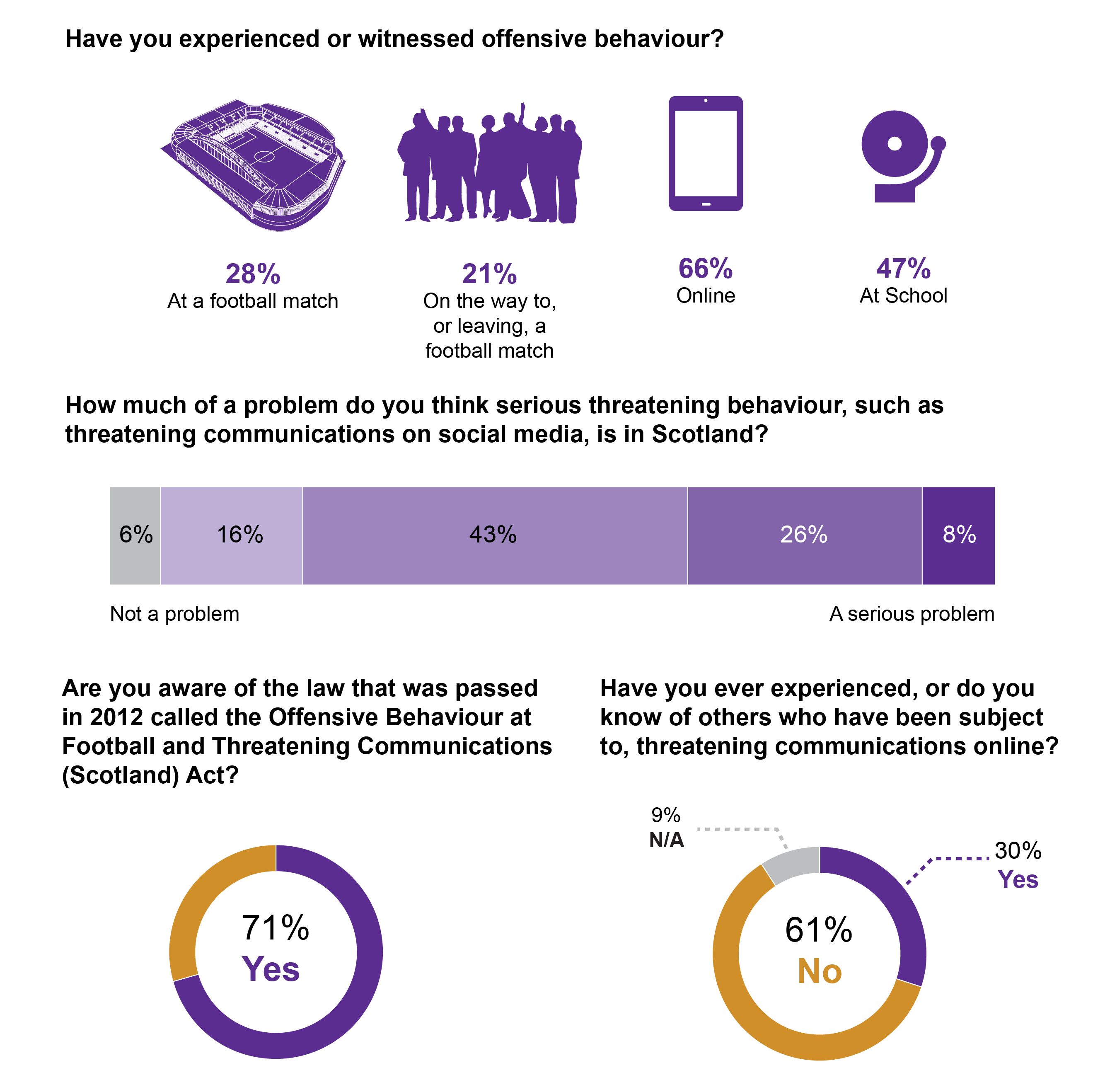
Questionnaire of Secondary School pupils.
The Bill
The Bill is in seven sections.
Section 1 - Repeal of the 2012 Act
Section 1 repeals the 2012 Act in its entirety, with effect from the day after the Bill, if passed, receives Royal Assent (see Section 6).
Section 2 - Offences
Section 2 deals with the effect of repeal on the ability of the courts to convict people for offences under the 2012 Act.
Subsection (1) includes provisions for no further convictions of the criminal offences in Sections 1 and 6 of the 2012 Act on or after Royal Assent.
The explanatory notes for the Bill state that:
This involves some departure from the default provision that is set out in Section 17 of the Interpretation and Legislative Reform (Scotland) Act 2010. Section 17 states that repeal of an Act of the Scottish Parliament does not affect liability to a penalty for an offence committed prior to repeal, and that the repealed Act continues to have effect for the purpose of investigating an offence, bringing or completing proceedings and imposing a penalty. Under the default (Section 17) arrangements, in other words, it would continue to be possible to convict people for a 2012 Act offence for an indefinite period after the Act was repealed, so long as the behaviour that constituted the offence took place before the date of its repeal. Under section 2(1), by contrast, a person who carried out behaviour of the sort criminalised by the 2012 Act can, from the date the repeal takes effect, no longer be convicted of a 2012 Act offence. (This does not, however, prevent the person being convicted of another offence constituted by the same behaviour, such as a breach of the peace).
Section 2(1) is subject to subsection (3), which allows for specific exceptions related to appeals. These are explained further below.
Subsection (2) includes provisions for application to new prosecutions brought following appeal, subsection (3) deals with continued possibility of conviction following Crown appeal against acquittal and subsection (4) deals with limitation of subsection (3) to pre-repeal acquittals.
Section 3 - Transitional and savings provisions
Section 3 makes transitional provision in respect of people alleged to have committed such offences but not convicted at the time of repeal, and saves the 2012 Act for a number of purposes, including sentencing of those convicted before repeal, and appeals.
Section 4 - Fixed penalties
Section 4 repeals a provision relating to fixed penalties inserted by the 2012 Act into the Antisocial Behaviour etc. (Scotland) Act 2004 ("the 2004 Act"). The Bill, by repealing the 2012 Act, removes (from the relevant date) the ability to issue any further fixed penalty notices for 2012 Act offences. Section 4 is a consequential provision to repeal the entry in Section 128 of the 2004 Act. This is explained more fully in paragraph 83.
Section 5 - interpretation
Section 5 provides definitions of the key terms "High Court" and "relevant offence" as they appear in the Bill.
Sections 6 and 7 - Commencement and Short title
Sections 6 and 7 deal with commencement and short title.
The Member's intention is for the 2012 Act to be repealed, in its entirety, from the day after the Bill (if passed) receives Royal Assent.
Committee Scrutiny
As the Bill seeks to repeal a previous Act, the Committee’s Stage 1 scrutiny focused to a large extent on the merits of the 2012 Act and could be considered a form of post-legislative scrutiny. This report therefore summarises the views of witnesses and those who responded to the Committee’s call for evidence on the 2012 Act and what effect repeal would have on the law, football fans, and wider society.
When taking evidence from witnesses, the Committee covered the following main issues:
Witnesses' views on repeal of the 2012 Act, and what outcomes would arise from repeal or retention;
The efficacy of the Section 1 offence and its use by police and prosecutors;
The efficacy of the Section 6 offence and its use by police and prosecutors;
Whether repeal would create a gap in the law;
How Lord Bracadale’s review of hate crime legislation would interact with the legislation, whether or not it is repealed; and
Whether the 2012 Act had tackled sectarianism.
Views on repeal
Views of witnesses
The Committee recognises that there are strong and conflicting views on whether the 2012 Act should be repealed, whether it had achieved its intended purpose, and the message that would be conveyed by repeal. These views were clearly expressed in both oral and written evidence.
James Kelly MSP, the Member in charge of the Bill, summarised his view that the Act was “discredited”, adding that:
It unfairly targets football fans, it is not an effective piece of legislation and it is not achieving the outcomes that it set out to achieve.
Justice Committee, Official Report 12 December 2017, Col. 34
In the first evidence session on the Bill, the Committee took evidence from a number of supporters’ groups. When asked about the message that would be sent by repealing the 2012 Act, Paul Quigley of Fans Against Criminalisation reported the following:
Repealing the Bill [sic] would send the message that football fans will no longer unfairly and unduly be criminalised as they have been under the 2012 Act, in a specific way that people in wider society are not… A Rangers fan was arrested for holding a banner that simply said, “Axe the Act.” A Motherwell fan was arrested, held in Greenock prison for four days and then convicted of singing a song that simply included profanity about a rival team. I do not think that that is worthy of a criminal conviction—it is not proportionate.
Justice Committee, Official Report 3 October 2017, cols. 37 - 38
This view was echoed by Paul Goodwin of the Scottish Football Supporters’ Association (SFSA), who told the Committee that:
A lot of the problems with the 2012 Act are down to the horrific public relations right from the start, when we talked about emergency legislation coming in. Fans of many clubs do not understand why the legislation was introduced in the first place, they do not understand the benefit of it, and they feel—rightly or wrongly—targeted.
Justice Committee, Official Report 3 October 2017, col. 38
However, Mr Goodwin’s SFSA colleague, Simon Barrow, cautioned:
We are conscious in presenting our evidence to the committee that fans have different opinions. According to our research, the great majority of fans have severe questions about or are opposed to the Act; others are concerned about the issues that the Act is intended to address. We acknowledge that the Act’s intention is good. The behaviours need to be challenged, and fans have to be central to doing that.
Justice Committee, Official Report 3 October 2017, col. 40
In its written evidence to the Committee the Scottish Government provided details of the YouGov poll that it had commissioned in 2015, which found that:
a clear majority of respondents (82%) agreed sectarian singing or chanting at football matches is offensive and that a similar proportion (83%) supported laws to tackle offensive behaviour at and around football matches. 80% of those surveyed also directly supported the Act.
Scottish Government written submission, Annex B, paragraph 13
Andrew Jenkin of Supporters Direct Scotland (SDS) referred the Committee to a survey of 12,000 supporters undertaken by SDS, to which 71% of respondents supported repeal of the 2012 Acti. He also stated:
Our organisation does not believe in football-specific legislation, so we support the earlier proposal about widening this out not just to sport, which would criminalise sport fans, but to the whole of society. That would be a step forward. You cannot have legislation that applies to one specific sector of society; that is grossly unfair.
Justice Committee, Official Report 3 October 2017, col. 51
The Committee heard a similar argument from the Scottish Football Association (SFA)'s Stewart Regan, who took issue with the specific targeting of football matches:
The key point that I would like to make in this evidence session is that football has been targeted and singled out, and a piece of legislation has been put in place that focuses exclusively on football. No other sport has that, and no other element of society has that. Over the past 24 hours, when I was preparing for this evidence session, I looked back at the music industry and identified that, between 2004 and 2013 at T in the Park, there were 3,600 incidents, three attempted murders, three drug-related deaths, 10 sexual assaults, one abduction and 2,000 drug offences. A summit was not called after T in the Park events and no emergency legislation was put in place. Football has been targeted, and many of the issues that the Act sought to address can be addressed by other legislation.
Justice Committee, Official Report 7 November 2017, col. 26
The only football club to provide written evidence was Celtic Football Club, which supported repeal of Sections 1 to 5 of the 2012 Act on the basis of:
significant concerns in relation to the potential for discrimination against football supporters and for confusion in applying and enforcing the Section 1 offence.
Celtic Football Club written submission, page 4
Dr John Kelly, Lecturer in Sport Policy, Management and International Development, University of Edinburgh reiterated his support for repeal:
I, too, support the repeal of the 2012 Act, because I think that some of the issues that were warned about when the original Bill was considered have come to fruition.
Justice Committee, Official Report 14 November 2017, col. 36
Not all of those who were critical of the 2012 Act supported repeal. Andrew Tickell, Lecturer in Law at Glasgow Caledonian University held the position that the 2012 Act can be amended:
I would argue that striking this Act completely aside is like using a sledgehammer for a task for which a scalpel is better devised, particularly in the context of something that a number of the witnesses from whom you have heard have mentioned, which is Lord Bracadale’s on-going review of hate crime legislation… I am not sure that that Act of Parliament is an unvarnished success from the Scottish Government’s perspective. I am not sure that the Act has been a great triumph but, despite all my reservations, I believe that we can fix it. It is easy for the Scottish Government to do that if it chooses to do so, but thus far there is no evidence that the Scottish Government wants to amend the Act, which I find somewhat disappointing.
Justice Committee, Official Report 14 November 2017, cols. 38 and 46
Some witnesses from groups representing people with protected characteristics opposed repeal of the 2012 Act, with concerns about the message sent by repeal contributing to their position. Colin Macfarlane of Stonewall Scotland made this point repeatedly during evidence, stating:
Repealing the Act without putting anything in place would be damaging—it would send a negative signal to LGBT people. Most LGBT people will not be watching today’s meeting and will not pore over the Official Report or look at the intricacies of the different elements of the Act, but they will see a headline that says that the Act that potentially protects them at football matches has gone. That would lead to a lack of confidence...
As I mentioned, people often do not know about the intricacies of the legislation that does and does not cover them, but they know that, if they go to a football match and hear homophobic chanting or if somebody throws homophobic, biphobic or transphobic abuse at them, the Act will protect them. The bit that we support is the principle of the Act.
Justice Committee, Official Report 24 October 2017, cols. 9 and 13
Rev. Ian Galloway of the Church of Scotland Church and Society Council made a similar point:
We think that there is a danger of sending the message, by the simple repeal of the Act, that we are not taking seriously enough such behaviours and attitudes, or society’s need to say that those behaviours and attitudes are unacceptable.
Justice Committee, Official Report 7 November 2017, col. 3
These views were noted by the Minister for Community Safety and Legal Affairs, Annabelle Ewing MSP (“the Minister”), who stated:
I seriously fear that repealing the Act without a viable alternative would send entirely the wrong signal and, as I have said, a number of organisations have made that point because they are concerned about the risk of that happening—it might be more likely than not. I accept the concern of many organisations, such as Stonewall, the Equality Network, the Scottish Council of Jewish Communities, the Church of Scotland, and Victim Support Scotland, that when the incidence of hate crime has increased in different areas, particularly online, it would send entirely the wrong signal.
Justice Committee, Official Report 5 December 2017, col. 17
However, some other groups, such as Coalition for Racial Equality and Rights (CRER), supported repeal:
We did not offer our support to the Offensive Behaviour at Football and Threatening Communications (Scotland) Act, as we were concerned about the duplication of legislation the Act created and its limited impact outwith football. Five years on, we remain unconvinced that the Act is necessary, and believe that it creates confusion and double-standards within hate crime policy and legislation.
CRER, written submission
Black and Ethnic Minority Infrastructure in Scotland (BEMIS), which provided both written and oral evidence, also supported repeal, stating that it remained:
deeply sceptical that the Act has contributed to challenging hate crime.
BEMIS, written submission
James Kelly MSP made the point that the message being sent by the current legislation could be considered to be mixed:
What we have with the legislation is a disjointed approach. We do not have full support from political parties. We do not have full support from legal organisations. We do not have full support from football supporters and football clubs. The legislation has been called into question by human rights groups. One commentator described it as the worst piece of legislation that has ever been passed by the Scottish Parliament. The fact that opinions on the legislation are so divided reinforces that view. We are not, therefore, sending a strong message.
Justice Committee, Official Report 12 December 2017, col. 37
The Minister provided the Committee with a summary of the Scottish Government’s position:
There are three principles that underpin our position in relation to the Act. The first is acceptance that there is a problem with behaviour at and associated with Scottish football. Offensive singing and chanting are not a feature of any other sporting events. The vast majority of football fans are well behaved, but the fact that we continue to regularly hear offensive singing and chanting clearly tells us that there is a problem that needs to be dealt with. Football is not an island on its own where people are free to do as they choose without any need to consider the wider impact of their behaviours. Aggressive behaviour that is deemed acceptable at football will simply be carried into other areas of life. The second principle is that action and interventions are required to tackle all social problems. Offensive behaviour at football will not simply disappear on its own. Football clubs and authorities have had decades to tackle the issue and have failed to take effective action to bring it under control. The third principle is that although it is not in itself a panacea, legislation is needed. Legislation sets the standards for what is and is not acceptable in society, and it has an important role in tackling offensive behaviour at football. Outright repeal is not favoured by those who represent vulnerable minority communities and it is not favoured by the Scottish Government.
Justice Committee, Official Report 5 December 2017, col. 9
Anthony McGeehan, Procurator Fiscal, Policy and Engagement, for COPFS, also referred to what he saw as a precedent for legislation being used to send a message:
I absolutely agree that legislation can be used to send a message. An example of legislation that has been used for that purpose is the Emergency Workers (Scotland) Act 2005. It could be argued that the offences that that Act describes were already addressed by the common law—by breach of the peace and assault, for example—but it sent a message about the way in which the law would treat offences against emergency workers. It is an entirely appropriate function of legislation to send such a societal message.
Justice Committee, Official Report 3 October 2017, col. 23
The Law Society of Scotland did not take a view on repeal. During evidence, Alan McCreadie, head of research at the Law Society of Scotland, did refer to the position held by some about the message sent out by repeal:
There is a view that repealing the 2012 Act could send out the wrong message. I contend—Professor Leverick has just alluded to this—that the 2012 Act is not just hate crime legislation, albeit that its scope is subject to Lord Bracadale’s review. However, I guess that that would have to be weighed against the content of the Act and how it is working at present in terms of how the courts interpret it and how it can be enforced.
Justice Committee, Official Report 7 November 2017, col. 35
Queen's University Belfast academic Dr Joseph Webster, who is supportive of repeal, did not believe that this was sufficient grounds for opposing repeal:
The wider point is that, just because the faulty legislation—I think that the witnesses generally agree that it has significant problems—is repealed, that does not mean that we are affirming the validity of the types of behaviour that the Act tries to restrict and criminalise. The way in which repeal is perceived is all of our collective responsibility to deal with. To say that the legislation should not be repealed because it might send a problematic message to potential offenders is not a good enough reason not to repeal it.
Justice Committee, Official Report 14 November 2017, col. 45
Another argument put forward by several stakeholders was that it would be wise to wait until Lord Bracadale’s review of hate crime legislation, which included the 2012 Act in its scope, had concluded. Rev Galloway said:
It seems to us that, given that a wider review of hate crime is being undertaken, it would be wise to see society’s response to sectarianism in the context of that wider review.
Justice Committee, Official Report 7 November 2017, col. 3
Both of these two points were made by Chris Oswald, head of policy for the Equality and Human Rights Commission (EHRC), who said:
I very much agree with Ian Galloway that it would be unwise to proceed with repeal of the 2012 Act until the wider review has been progressed and its findings have been discussed and debated. Although the discussions around the Act are predominantly about sectarianism, we must note that protections for disabled people and trans people would be lost if the Act were to be repealed, and there is at this point no prospect of their reintroduction. The threatening religious communications aspect of the Act would also be lost: again, there is no prospect at this point of its being reintroduced.
Justice Committee, Official Report 7 November 2017, col. 4
Assistant Chief Constable Bernard Higgins ("ACC Higgins") provided a view on the impact of the 2012 Act.
The Act has done two things: it has brought to the forefront for the wider Scottish community— not just the football community—what is and is not acceptable behaviour, and it has made it clearer when the police can take action to address behaviour at football matches and when they cannot.
Repealing the Act might be interpreted by some as a lifting of the restrictions on how they can behave in football stadia, or it might not.
The Act has allowed the police to address and challenge specific types of behaviour, and it has raised social consciousness. If the Act were repealed, the police would continue to try to address the behaviour using other legislation.
Justice Committee, Official Report 3 October 2017, col. 3
When asked what effect repeal would have on the policing of matches, ACC Higgins noted that it would not “pose a significant operational change”, telling the Committee that:
… we would continue to discharge our duties in the same manner ... We would seek guidance from the fiscal’s office about which charges we should apply, as opposed to those in the provisions of Section 1 of the 2012 Act … However, regarding boots on the ground and how football matches are policed, little—if anything—would change.
Justice Committee, Official Report 3 October 2017, col. 6
COPFS based its view on how effective it feels the 2012 Act is in prosecuting particular behaviours:
Our position is that use of the 2012 Act ensures that the behaviour can more securely be addressed and prosecution not be subject to the type of challenges that existed before the 2012 Act. When the Bill was first being debated by Parliament, the then Lord Advocate referred to cases in which there had been successful defence arguments that, for example, racist or homophobic abuse did not constitute a breach of the peace because of the peculiar circumstances of football and the potential that sections of a crowd might well be inured to that type of offending behaviour.
Justice Committee, Official Report 3 October 2017, col. 27
However, this view was not shared by SACRO, which stated:
While defining offensive behaviour likely to incite public disorder is helpful, such acts are also addressed in broader public order legislation and experience has shown that the application of the 2012 Act is not common or consistent in enforcement and prosecution action.
SACRO, written submission
Anthony McGeehan of COPFS also picked up on the Bill’s proposed transitional arrangements:
The Bill proposes a slightly unusual approach to repeal. There is almost a guillotine approach at the date of repeal for all live prosecutions. That is not the traditional approach, which is that new prosecutions would not be possible post-repeal but live prosecutions would not be affected. I understand that the policy behind the approach in the Bill is to prevent injustice, but only a minority of the charges and prosecutions relate to offensive behaviour under Section 1(2)(e) of the 2012 Act, which appears to be the subject of the most scrutiny. The remaining charges under Section 1(2)(a) to Section 1(2)(d) relate to behaviour such as hate crime. I ask whether a different type of injustice would be created if those prosecutions were brought to an end as a result of the approach that is adopted to repeal in the Bill.
Justice Committee, Official Report 3 October 2017, col. 24
There was also some disagreement over the impact the 2012 Act has had on offensive singing at football matches. Professor Fiona Leverick, Professor of Criminal Law and Criminal Justice at the University of Glasgow, stated:
If the question was whether the Act has been effective, I do not have any personal experience of that, but I point to the official evaluation of the Act that was undertaken by Niall Hamilton-Smith and some other colleagues, which was referred to in a previous evidence session. The evaluation concluded that there certainly had been a reduction in offensive chanting in football grounds since the Act came into force, but that it was impossible to tell whether that was because of the Act. I do not think that we will ever solve that conundrum, because so many other factors could have had an effect—changes in social attitude or policing strategies and so on. It will always be extremely difficult to attribute improvements to the Act.
Justice Committee, Official Report 7 November 2017, col. 47
Dr John Kelly took a slightly different view:
I would take issue a bit with the assertion that there have been fewer problematic songs at football games. As someone who has been to quite a number of Celtic games over the past few years, in a personal capacity and as an ethnographic observer, I would argue—I think that most Celtic fans would agree—that since the 2012 Act came in there have actually been more of what the Scottish Government might define as problematic songs. At Celtic Park and indeed away from it where Celtic has been playing, there have been more songs of an Irish nationalist and Irish republican nature than was the case before the introduction of the 2012 Act.
Justice Committee, Official Report 14 November 2017, col. 50
Impact on supporters
Another argument made for the repeal of the 2012 Act was regarding the impact on those charged with offences under the Act, and relations between fans and the police. In James Kelly MSP's view:
Football supporters do not like the fact that they are being specifically targeted with legislation that is pretty unique in Europe and that they are filmed going into football grounds. That has resulted in their relationship with the police deteriorating.
Justice Committee, Official Report 12 December 2017, col. 42
Police Scotland’s submissioni indicates that FoCUSii was established before the introduction of the 2012 Act and will remain. The methods of policing football matches are a policing operational matter which will not be affected by repeal of the 2012 Act.
Jeanette Findlay of Fans Against Criminalisation (FAC) laid out her experience of those charged under the Act, who had contacted FAC:
Over the past six years, around 200 people have contacted us ... I do not know whether you are aware of this, but there are usually three appearances at court: the pleading diet, the intermediate diet and the trial. The evidence, from our experience and the Stirling researchiii, is that the process is often extended in football cases and people have to appear in court four or five times for various reasons. Because of the nature of where alleged offences are supposed to have taken place, those appearances often involve people travelling quite long distances and having to take time off work and tell their employers that they have been charged.
Justice Committee, Official Report 3 October 2017, col. 49
Dr Joseph Webster reflected on the findings of his ethnographic researchiv on how the 2012 Act has been viewed by fans and the unintended consequences for how they now relate to the police and to one another:
They see themselves as the victims of the legislation because they see themselves as the ones being policed …
Having done extensive ethnographic work on exactly that question, I would dispute that there has been a dramatic decline in the singing of certain songs. What fans have done is change their behaviour by holding their hands in front of their mouths while singing certain songs in order to prevent CCTV from capturing them singing them. In addition, as we are all aware, they have replaced certain songs and chants with other words in order to try to skirt the law. My sense is therefore that one of the major problems with the 2012 Act is exactly the type of phenomenon that you are putting your finger on. The question therefore is what behavioural change the 2012 Act has brought about. Has the 2012 Act brought about behavioural change? Yes, it has, but it has not changed or discouraged the expression of the types of behaviours that the 2012 Act sought to do away with and it has not made people less offensive; it has made them engage in a different way in behaviour that the 2012 Act regards as offensive. The 2012 Act redirects those types of behaviours rather than prevents them from happening. That is a feature of the legislation because of the way that it was drafted....
The 2012 Act has made the policing of sectarianism more difficult, because fans have got wise to how to circumvent the law, and it has led to a deterioration in relationships between the fan bases and between them and the police.
Justice Committee, Official Report 14 November 2017, cols. 40, 49 and 59
Dr Stuart Waiton of the University of Abertay Dundee believed that the legislation emerged partly from views held of football fans by non-football fans:
There remains a snobbery about football fans except that, today, it takes a more politically correct form. If we are looking at people who are offended by football fans, we can look at prejudice and bigotry towards fans rather than just take it on good faith.
Justice Committee, Official Report 14 November 2017, col. 41
Danny Boyle of BEMIS provided some contextual commentary on the wider engagement with communities undertaken by football fans:
In respect of the 2012 Act, there is a tendency to talk about or assess football fans entirely negatively. I will say something beyond the statistics, which, as I have said, show that there is less hate crime in football than there is in the general populace. Football fans are running food drives and I have attended football games where there have been pro-refugee banners and antiracism banners. A couple of weeks ago, I saw, probably for the first time, some pro-LGBT banners at a game. There is a lot of progressive stuff happening in football clubs and among football supporters and in fan culture, and that should be appropriately acknowledged.
Justice Committee, Official Report 24 October 2017, col. 28
Paul Quigley of Fans Against Criminalisation related his own experiences since the inception of the 2012 Act:
In the past five years, we have not seen an improvement in terms of the behaviour of fans or the lessening of the singing of certain songs and so on. What we have seen is a breakdown in the relationship between fans and the police. That has been caused by this legislation…
The fan experience has been dramatically changed as a result of the 2012 Act. I understand what Mr Barrow said about how those experiences may differ depending on the club, including the size of the club, that a fan supports. In my experience, as a Celtic fan, from the second that fans get off a bus in any city across the country, they are filmed. Fans often feel intimidated from the second that they get off the bus to the second that they get back on it. They are subject to a type of surveillance that did not exist and that they did not have to experience before 2012. It is correct that there is now suspicion between fans and the police; the relationship has broken down, and I do not think that that is in anybody’s interest.
Justice Committee, Official Report 3 October 2017, cols 32 and 45
Responding to the argument that the 2012 Act criminalises young male football fans, Antony McGeehan of COPFS said:
I have read the critique that the 2012 Act focuses on young men. I suggest that the conclusion that the Act focuses on young football fans is incorrect. A conclusion that an Act focuses on young male persons in particular, or even on male persons in particular, might similarly be arrived at if we were to look at those persons who commit other types of criminal offences, such as sexual offences. If we did that, we would see that a significant proportion of people accused of sexual offences are male. In relation to the criminalisation of football fans, I would suggest that the question of whether an accused person is a football fan is irrelevant for the purposes of proving a case under the 2012 Act.
Justice Committee, Official Report 3 October 2017, col. 18
This view was echoed by ACC Higgins:
In the absence of the Act, those same young men would have been arrested but they would have been charged with a different offence, with the exceptions that Anthony McGeehan outlined in relation to the gaps. In the absence of the Act, someone who was arrested for singing an offensive song would almost certainly have been charged with a breach of the peace or a Section 38 offence. I do not accept the argument that the Act has criminalised young men. It has brought the issue to the forefront of people’s minds, but those arrests would still have taken place in the absence of the Act.
Justice Committee, Official Report 3 October 2017, col. 18
This perspective was shared by Chris Oswald, who said:
As to whether people are being brought into the criminal justice system because of the 2012 Act, I would say that that is happening because of their behaviour rather than because of the 2012 Act, which simply sets out behaviour that is felt to be socially damaging.
Justice Committee, Official Report 7 November 2017, col. 21
Andrew Tickell also noted that, for some fans, the specific targeting of the legislation is only part of their objection:
Their argument is that the 2012 Act is discriminatory because it targets only football fans. One way to make it not discriminatory is to make it apply to everyone, but the fans were still against the Act because of the offensiveness provision.
Justice Committee, Official Report 14 November 2017, col. 53
Freedom of speech
Dr Joseph Webster was of the view that “the Act is not justified on free speech grounds”, expanding by saying:
In essence, it says that it makes acts of hatred illegal but does not restrict “antipathy, dislike, ridicule, insult or abuse”. However, Section 6(5) does restrict those behaviours, which are set out in section 7(1)(b). The key problem is that there is insufficient ability to parse the behaviours. That has been evidenced in earlier oral submissions in which the committee has heard that police officers need to be trained on how to interpret different behaviours and on how to classify any given behaviour as hateful or perhaps abusive and where to draw the line.
Justice Committee, Official Report 14 November 2017, col. 36
For Fans Against Criminalisation, this was one of their main objections to the legislation:
We have two primary reasons for opposing it. The first is that it applies only to football fans, as I have said, and we believe that laws should apply universally. The second is that we think that creating an offence that criminalises something as subjective as offensiveness represents a broader danger to freedom of speech and freedom of expression. On that basis, we would oppose legislation that, for example, criminalised certain offensive behaviours outwith hate crime in other arenas.
Justice Committee, Official Report 3 October 2017, col. 37
The Committee also heard opposing views on whether the legislation infringed on free speech. Dr Stuart Waiton believes that it does, observing that, in his view:
We hide behind the public order issue, but essentially it is about the criminalisation of words and thoughts, and the arresting and imprisoning of people because we do not like their words.
Justice Committee, Official Report 14 November 2017, col. 38
However, other witnesses believed that the legislation did not inappropriately suppress freedom of speech. Chris Oswald of the EHRC noted:
Although the EHRC recognises that freedom of speech and freedom of expression are enormously important and are protected by article 10 of the European Convention on Human Rights [ECHR], they need to be balanced against the International Covenant on Civil and Political Rights, which says that states need to have in place laws that counter “incitement to discrimination, hostility or violence”. It is the Commission’s position that the international convention overrides the ECHR, in this case.
Justice Committee, Official Report 7 November 2017, col. 4
This position was shared by Ephraim Borowski, Director of the Scottish Council of Jewish Communities, who said:
I am also therefore predisposed against repealing any anti-hate crime legislation, for exactly the reason that Ian Galloway gave: doing so could inadvertently send the wrong message, that somehow some kind of hate crime, speech or action is now acceptable in society.
Justice Committee, Official Report 7 November 2017, col. 5
Responding to those who objected to the 2012 Act on free speech grounds, the Minister stated:
Freedom of speech is, of course, a fundamental right, but it is not an absolute right. There is also the freedom not to be subjected to hateful and prejudicial behaviour.
Justice Committee, Official Report 5 December 2017, col. 13
The Policy Memorandum for the Bill refers to freedom of speech and other human rights concerns:
Arguments have been made that the 2012 Act is incompatible with the European Convention on Human Rights (ECHR). The Scotland Act 1998 requires legislation of the Scottish Parliament to be compatible with Convention rights. The Section 1 offence has been viewed as restricting Article 10 rights to freedom of expression and creating legal uncertainty through the vagueness and subjectivity of key concepts it employs, such as "behaviour that a reasonable person would be likely to consider offensive".
Policy Memorandum, paragraph 47
This view was shared in a supplementary submission from the Scottish Human Rights Commission (SHRC) regarding the rights implications of the 2012 Act. While remaining “supportive of the overall policy objective of the Act”, the SHRC concluded that “there is a strong likelihood that key provisions of the Act fall short of the principle of legal certainty and the requirement of lawfulness”. The SHRC also stated:
It is important that the Act strikes the right balance between the protection of public order and equality in one hand and freedom of expression on the other. The provisions of the Act must also be considered in terms of whether they are necessary and proportionate to the aim of prevention of offensive behaviour in relation to football matches.
SHRC, written submission
However, the Scottish Government did not agree with the SHRC’s conclusions with the Minister stating:
I remain happy that the Act is compatible with human rights. The Commission’s submission appears to be a statement of its 2011 position, which does not take account of developments such as the Donnelly and Walsh case of 2015i, which did not identify any human rights issues.
Justice Committee, Official Report 5 December 2017, col. 9
The Minister added:
When the Bill was introduced, like any Bill, the Presiding Officer had to certify it as being competent—under the Scotland Act 1998, we have a duty to comply with the Human Rights Act 1998. The Bill was passed by Parliament and, following its passage, the law officers did not seek to raise any action to challenge its compatibility.
Justice Committee, Official Report 5 December 2017, col. 21
Hate crime and offensive behaviour
Another recurring theme in evidence was the extent of the role played by the 2012 Act in tackling hate crime. As has been covered elsewhere in the report, some witnesses referred to Lord Bracadale’s review of hate crime legislation, suggesting it would be worthwhile to wait until this had concluded before repealing the 2012 Act.
The Scottish Council of Jewish Communities stated:
We do not believe it appropriate to make changes to individual pieces of legislation during Lord Bracadale’s review of hate crime legislation, but strongly recommend awaiting his report.
Scottish Council of Jewish Communities, written submission
Victim Support Scotland, who support retaining the 2012 Act, shared this view, stating:
The on-going review of hate crime legislation in Scotland might allow the 2012 Act to be considered in the context of all hate crime legislation, which will help ensure that the overall legal coverage is appropriate and captured without compromising civil liberties.
Victim Support Scotland, written submission
However, as pointed out by Danny Boyle of BEMIS, the proportion of offences under the 2012 Act which were related to hate crime could be considered to be low:
The predominant hate crime charge under the Act has been for religious aggravation, and the predominant characteristic within the religious aggravation is anti-Catholicism, which accounts for over 75 per cent of charges in every reporting year. That being said, in relation to the volume of attendees at Scottish football matches, hate crime charges under the Act actually account for less than 50 per cent of all charges in every year of reporting. Indeed, in the year in which the Act was used most often—2016-17—in which there were 377 charges, only 18 per cent were for hate crimes.
Justice Committee, Official Report 24 October 2017, col. 5
Mr Boyle elaborated on this point later in evidence:
The dissemination of statistics in relation to the 2012 Act further clouds what is ambiguous and offers no illumination on the extent of hate crime issues in Scotland. Over the five-year lifetime of the Act, specifically in relation to hate crime—not a reclassified breach of the peace—we have had 64 race charges, six anti-Semitic charges, four Islamophobic charges, eight homophobic charges and one aggravation where anti-disability was the charge. All those hate crimes would be covered by pre-existing legislation. There is absolutely nothing new in the Act that did not exist before 2011 to deal with hate crime … we think that the most sensible thing is to create a universal approach to tackling hate crime that is preventative and rooted in education but which also has a strong legal remedy when necessary. The most simple way in which we envisage that being taken forward is to have a piece of hate crime legislation that reflects the characteristics in the Equality Act 2010 and which can be evolved and updated as society changes. Some of the contested issues that remain live in the context of the Football Act are about things that do not constitute hate crime and are separate—they are about what would be offensive to a reasonable person. They have to be dealt with outside the legislation.
Justice Committee, Official Report 24 October 2017, cols. 11 and 12
Professor Fiona Leverick also noted this subtlety:
Not everything in the 2012 Act is a hate crime provision; a lot of it relates to hate crime, but not all of it. Some parts are about straightforward public order offences that have no connection to hate crime whatever. At least part of the Section 6 criminal offence is not a hate crime related provision. I said that we should hang on and wait to see what Lord Bracadale says, but that will take us only so far because there are parts of the 2012 Act that do not relate to hate crime.
Justice Committee, Official Report 14 November 2017, col. 35
James Kelly MSP provided further context for the statistics:
The latest statistics on religious hate crime, which have been provided to the committee, show that there were 719 charges relating to religious hate crime in 2016-17. That is the highest that the figure has been in the past four years, which shows that there is a serious problem. However, only 46 of those charges were under the 2012 Act, so less than 7 per cent of the charges related to football. That demonstrates that we have a serious problem with religious hate crime in Scotland, which is something that should concern all of us, but the idea that it all carries on around football has been blown out of the water by the fact that only 7 per cent of those charges relate to football.
Justice Committee, Official Report 12 December 2017, Col. 38
Should the 2012 Act be repealed, COPFS confirmed that:
The Lord Advocate has published guidelines in relation to the operation of the 2012 Act by the police. We would intend to publish similar guidelines in relation to the application of breach of the peace and Section 38 of the Criminal Justice and Licensing (Scotland) Act 2010 should the Parliament decide to repeal the 2012 Act.
Justice Committee, Official Report 3 October 2017, col. 6
The Committee notes the views held by a range of stakeholders on both sides of the debate, and appreciates that the 2012 Act evokes strong feelings among both its supporters and opponents. The Committee unanimously condemns sectarianism, hate crime and offensive behaviour and considers it unacceptable. The Committee notes the evidence from some fans' groups that this has led to strained relations between their members and the police.
The Committee also recognises that the number of football fans engaging in criminal behaviour is minimal, and welcomes the context provided by the SFA, Police Scotland and fans’ groups to demonstrate this is the case.
The Committee acknowledges the statement made by the Minister regarding the inherent tension between different freedoms. However, the Committee notes the human rights concerns raised by the Scottish Human Rights Commission and others, and urges the Scottish Government to explore how it can continue to safeguard human rights and minimise the risk of misunderstandings around the legislation and individuals’ rights.
Regardless of whether or not the 2012 Act is repealed, the Committee believes that it would be appropriate for the Scottish Government to clarify what constitutes hate crime once the position on repeal of the 2012 Act is known and Lord Bracadale's review of hate crime legislation is concluded.
Section 1 offence
Use of Section 1 offence by COPFS/the police
As has been covered earlier in this report, Section 1 of the 2012 Act creates an offence of “offensive behaviour at regulated football matches”. The Section 1 offence includes a number of separate elements. One is that the offending behaviour is "in relation to a regulated football match". Such behaviour can take place in the ground where a match is being held and on the day it is being held. Also covered is behaviour while the person is entering or leaving the ground or on a journey to or from the match. The same is true in relation to non-domestic premises where a match is being televised - so a person can commit the offence in, for example, a pub where the match is being televised.
The second element of the offence is that it involves behaviour that is or would be "likely to incite public disorder". Thirdly, the behaviour must be at least one of the following:
behaviour "expressing hatred of, or stirring up hatred against", a group of persons based on their religious affiliation or a group defined by reference to their colour, race, nationality, ethnic or religious origins, sexual orientation, transgender identity or disability - or against any individual member of such a group;
behaviour motivated by hatred of such a group;
behaviour that is threatening; or
other behaviour that a reasonable person would be likely to consider offensivei.
The Committee observed that, of the two offences created by the 2012 Act, the Section 1 offence was the source of most of the issues identified by witnesses and those making written submissions.
One of the key criticisms made by opponents of the 2012 Act was of the application of the Section 1 offence by police officers and COPFS, which is informed by guidance issued by the Lord Advocate. The Lord Advocate’s Guidelines on the 2012 Act state:
While it is a matter for the judgement of a police officer whether a song or other behaviour, including the display of offensive flags or banners, is likely to be offensive to a reasonable person having regard to the nature of the material or song, including its lyrics and any “add ons”, the surrounding circumstances and the context in which it is being displayed or sung, the following are examples of the type of displays, songs and chants which are likely to be offensive to a reasonable person:
• Flags, banners, songs or chants in support of terrorist organisations
• Flags, banners, songs or chants which glorify, celebrate or mock events involving the loss of life or serious injury.
It should be noted that in order for this offence to be committed, in addition to the display, song or chant being offensive or threatening, it must be likely to incite public disorder.
Lord Advocate's guidelines, updated August 2015
Jeanette Findlay of Fans Against Criminalisation stated:
It should raise alarm bells that police officers have to be trained to discover what might be offensive. That is the problem...
What the Act captures is not hate crime—there is other legislation to cover that—but behaviour that a police officer might find offensive. I am not saying that there has never been any hate crime captured by the Act—of course there has been. However, on the whole, what the Act captures is behaviour that a police officer—trained or otherwise—thinks might be offensive to someone who is or is not there. On that basis, young people’s lives are disrupted...
The Lord Advocate’s guidelines might on the face of it have seemed a reasonable set of guidelines about when people should be charged, but the outcome of case law has shown that they are not adequate. That is because the law as it was originally drafted is not adequate. It was never clear, so—with all due respect to the Lord Advocate—I am not sure what guidelines he could have produced that would have allowed proper and sensible interpretation of the law.
Justice Committee, Official Report 3 October 2017, cols. 41 and 44
Paul Quigley shared this view, stating that:
fans would say the Act is applied arbitrarily and they feel that, in some cases, it has been applied overzealously by the police.
Justice Committee, Official Report 3 October 2017, col. 46
Danny Boyle of BEMIS reflected on the impact of interpreting the guidelines on police officers:
We feel that it places police officers in a precarious position. They are not anthropologists, sociologists or political commentators, so the Act is a difficult piece of legislation for them to implement and it immediately puts them in a negative interaction with football fans or other members of society. It fundamentally undermines the concept of policing by consent. We therefore have a degree of sympathy for police officers in that context.
Justice Committee, Official Report 24 October 2017, col. 13
This view was echoed by James Kelly MSP:
I accept that the police need to take forward the law of the land that has been agreed to by Parliament, and, although I opposed the 2012 Act and believe that it is deeply flawed, it is the current law. It puts the police in a difficult position. As I said earlier, offensive behaviour has such a wide definition within the Bill that police officers have had to be trained to interpret what behaviour might be offensive.
Justice Committee, Official Report 12 December 2017, col. 52
Police Scotland disagreed with this analysis. ACC Higgins said:
I will not throw statistics at you, but the Crown Office takes action in 89 per cent of cases in which we arrest people under the 2012 Act. To me, that demonstrates a high level of understanding by the arresting officers.
Justice Committee, Official Report 3 October 2017, col. 8
The Minister also observed that:
Police officers make judgments every day about a whole host of things. They use their judgment in accordance with guidelines and their training. It is the same for the Act as it is for many other parts of the law.
Justice Committee, Official Report 5 December 2017, col. 23
The Committee also explored the statistics on how Section 1 of the 2012 Act has been used. The COPFS stated:
In 2012-13, 267 charges were reported under Section 1 of the 2012 Act and no action was taken in connection with 23 of those. In 2013-14, 206 charges were reported and no action was taken on 16 of them. In 2014-15, 193 charges were reported and no action was taken on four of them. In 2015-16, 286 charges were reported and no action was taken on 14 of them. In 2016-17, 377 charges were reported and no action was taken on seven of them.
Justice Committee, Official Report 3 October 2017, col. 12
However, Fans Against Criminalisation questioned the analysis of the data provided by COPFS and the Scottish Government, as:
the published rates show the number of convictions as a proportion of the number of concluded cases. They do not show the true conviction rate ie the number of convictions as a proportion of the number of charges in a given reporting period.
Fans Against Criminalisation, written submission
Fans Against Criminalisation were also of the view that charges under the 2012 Act were pursued in a manner different to other offences, and that procurators fiscal “are rarely allowed to drop football cases”ii. This suggestion was rejected by COPFS who stated that it did not agree, as some stakeholders have argued, “that the legislation is applied arbitrarily or unfairly”iii:
The written and oral evidence of FAC criticises the Crown, apparently on the grounds of a lack of independence and an allegedly inappropriate limitation of prosecutorial discretion in relation to offences under the 2012 Act. The Crown rejects these criticisms. Prosecutors exercise their responsibilities independently in the public interest. The independence of the prosecution system in Scotland is guaranteed by the terms of the Scotland Act 1998, which requires the Lord Advocate to exercise his functions as head of the system of prosecution in Scotland independently of any other person. Prosecutors may only take action in relation to a reported crime where there is sufficient evidence in law to support a prosecution, and, in addition, where it is in the public interest to take action. Decisions in individual cases are taken by prosecutors who must apply the law to the available evidence and in light of the prosecution policies approved by the Lord Advocate. The requirement to apply prosecution policy ensures that similar cases are treated in a similar way.
The Crown's approach to offending under the 2012 Act is rigorous, but is based on principle. Offending captured by the 2012 Act includes serious public disorder and hate crime. It is appropriate that it should be dealt with robustly. COPFS published data confirms that in 2016-17 prosecutors took action in 89% of charges reported to COPFS under Section 1 of the 2012 Act. Scottish Government published statistics confirm that in 2015-16 convictions were returned by the Courts in 75% of cases commenced in relation to offences under the 2012 Act. This statistical picture is consistent with the proper exercise of professional judgment by prosecutors.
COPFS, supplementary written submission
Nevertheless, Andrew Tickell noted:
The most recent figures show that the conviction rate for charges under the 2012 Act is slightly lower than the general average of about 87 per cent. That might be because cases are ending up in court that might not otherwise have done so if procurators had more discretion over the cases before them. [Col 60]
Justice Committee, Official Report 14 November 2017, col. 60
The Scottish Government held a more positive view of the success of prosecutions under the 2012 Act:
As we have seen, in 2016-17 for example, 377 charges were brought. In 2015-16, we saw a conviction rate for charges brought under the Act of about 76 per cent. In that same year, there were comparable conviction rates of 74 per cent for breach of the peace and 84 per cent for common assault. That places the 2012 Act in a reasonable spot. It has been effective.
Justice Committee, Official Report 5 December 2017, cols. 24 - 25
Drafting of Section 1 offence
The Policy Memorandum for the Bill states that the “illiberal nature of the Act” is another reason for repeal, arguing that
the Act has been interpreted as being illiberal, and does not allow the public to understand what is and what is not allowed, and so is liable to be unfair and arbitrary in its application.
Policy Memorandum, paragraph 18
This opinion focuses largely on the Section 1 offence, with the Policy Memorandum observing that
there has been strong criticism that Section 1(2)(e), in particular, which criminalises "other behaviour that a reasonable person would be likely to consider offensive" (where it is or would be likely to incite public disorder) is confusing and unclear.
Policy Memorandum, paragraph 18
A number of witnesses commented on the drafting of the Section 1 offence, with some providing suggestions for improvement through amendment were the 2012 Act to be retained.
Andrew Tickell provided an extensive list of suggested changes to Section 1:
First, we have the list of prohibited behaviours, which are in five broad categories, including “expressing hatred of” groups or individuals on the basis of protected characteristics; “behaviour that is threatening”; “behaviour that is motivated” by hatred, which covers behaviour that in itself is not an expression of hatefulness or threatening; and offensiveness. I do not think that offensiveness is an appropriate threshold for criminalisation. That is what distinguishes the Act from earlier breach of the peace provisions, which criminalised only behaviour that would cause a reasonable person to suffer fear and alarm in the context in which it takes place. I think that you should knock out that bit of Section 1. Secondly, the definition of “public disorder” in the Act is absolutely baffling, in the sense that when the junior justice Minister came to your predecessor committee to introduce the public disorder restriction, she represented it as a safeguard for individuals who might find themselves accused of committing a criminal offence. However, two things are excluded from the sheriff’s deliberations about whether, in the context in which a criminal act took place, public disorder would have arisen. They can discount the fact that public disorder did not happen because of the police being there—that is, if the police were there and public disorder did not occur, the accused cannot claim any benefit from that. The second thing is that if no one is there to be incited…the sheriff is invited to invent fictional, absent incitees.
Proponents of the 2012 Act would say that often the behaviour is offensive in the context of football matches and therefore it should be criminalised.
Whether or not you agree with that argument, the Act specifically instructs judges to completely ignore the actual context in which the behaviour takes place. That is perverse. We can fix that, too, by knocking out the subsection that invites the court to invent fictional incitees. Even when it brought in that provision, the Scottish Government recognised that it was fairly indefensible—or not defensible in the long term—as it gave ministers the power to knock it out using an order as opposed to primary legislation.
Those are just a few examples of areas of problem and areas where there can be very straightforward fixes that would leave us criminalising only hateful behaviour—which I know that some panel members will not agree with—and threatening behaviour that is likely to give rise to public disorder in the context in which it is actually taking place. That would make it a mainstream public order piece of legislation that would be very much compatible with most UK approaches to dealing with the issue.
Justice Committee, Official Report 14 November 2017, cols. 52 - 53
Alan McCreadie of the Law Society of Scotland also identified another concern within the legislation as it currently stands:
The Law Society has also commented on the definition of “regulated football match”. That is where the offence becomes a special capacity offence, because it has to take place in relation to a regulated football match, which is defined in section 55(2) of the Police, Public Order and Criminal Justice (Scotland) Act 2006. I appreciate that, as I understand it, there has not been any judicial interpretation of “regulated football match”, but I understand that it would not cover, for example, Scottish Junior Football Association games or a football match between clubs from two foreign countries that was taking place in Scotland. Hampden park has held the European cup final, the champions league final and the UEFA cup final, and such matches would not be covered.
Justice Committee, Official Report 7 November 2017, col. 45
Andrew Jenkin of Supporters Direct Scotland commented that “there is generally a lot of ambiguity about what constitutes a criminal offence under the Act.”i Alan McCreadie agreed with this position, stating:
There could be more clarity. I add that regardless of whether the Act is repealed or otherwise, there is provision in section 5 for Scottish ministers to amend sections 1 and 4 by order. That is a fix that would not need primary legislation.
Justice Committee, Official Report 7 November 2017, col. 39
As has been discussed above, some witnesses believe Section 1 to be applied inconsistently and to be subjective. These witnesses were of the view that one of the reasons for this was that some of the terms in the 2012 Act were too vague.
Anthony McGeehan of COPFS disagreed with this analysis:
The lack of a definition of “offensive behaviour” in the 2012 Act is not unusual in legislation. A type of behaviour and offending that the majority of us are familiar with is dangerous driving. Section 2 of the Road Traffic Act 1998 prohibits dangerous driving but provides no definition of what may constitute dangerous driving—that is defined by the particular circumstances of each individual case.
Justice Committee, Official Report 3 October 2017, col. 10
The Minister agreed with COPFS, explaining that:
The reasonable person test is a common feature of the law. Much has been made of breach of the peace and of section 38 of the Criminal Justice and Licensing (Scotland) Act 2010. That law involves a reasonable person approach as well—it is quite common. The danger of defining something to the nth degree is that something gets left out—there is always a balance to be found when drafting legislation. For example, there is not an exhaustive list of circumstances that need to be met for dangerous driving; there are facts and circumstances to be adduced for consideration. Also, of course, the reasonable person test sits alongside the other part of the test, which looks at whether behaviour is “likely to incite public disorder”, so there are two strands to the test, not just one. The Lord Advocate’s updated guidelines from August 2015 are also helpful in fleshing out exactly what behaviour is likely to be included.
Justice Committee, Official Report 5 December 2017, col. 18
Andrew Tickell felt that the criticism of vague drafting was itself inconsistent, given the common law alternative:
What I therefore find slightly confusing about those who use that position to promote the repeal Bill is that they criticise the 2012 Act for being vague while saying that breach of the peace is fine, despite the fact that it is notoriously vague and has been used to prosecute everything from playing marbles on a Sunday on the island of Lewis to walking the streets of Aberdeen wearing women’s clothing. The critics of the legislation have to give some account of the ways in which the common law is substantially better, because, even though I think that there are tremendous things wrong with the Act, the common law is notoriously vague and unclear and does not specify to football fans what is and what is not criminal.
Justice Committee, Official Report 14 November 2017, col. 61
Responding to wider concerns about the drafting of the 2012 Act, the Minister confirmed she was open-minded to amendments should it be retained:
My experience in life is that there are almost always improvements that can be made, and I have always said that my door remains open if people wish to come forward with constructive, evidence-based suggestions on how we collectively can work to improve the legislation.
Justice Committee, Official Report 5 December 2017, col. 16
The Committee notes the view of some witnesses that the Section 1 offence is not clearly drafted and that its sole focus is on football.
The Committee notes the example outlined by the Crown Office and Procurator Fiscal Service in evidence that a lack of definition is not unusual, but also observes that the lack of a definition of dangerous driving and breach of the peace do not appear to have caused the same difficulties with understanding as is the case with the 2012 Act.
The Committee understands that the Bill seeks to repeal the 2012 Act in its entirety. However, should this repeal Bill not be passed, and the 2012 Act remains in place, the Committee is of the view that the Scottish Government should bring forward amendments to Section 1 of the 2012 Act.
Section 6 offence
The Bill proposes repeal of the entire 2012 Act, including the Section 6 offence. The Policy Memorandum for the Bill confirms that retention of Section 6 was considered, but decided against:
The member considered amendment of the 2012 Act as an alternative to repeal, which might have provided a means to reduce the impact of the Act in particular respects, but only repeal would address the main criticisms that have been made of it, which go to the heart of how the Act works. He was of the view that the Act has become so discredited in the eyes of many football fans that nothing short of wholesale repeal would have a chance of restoring their confidence and re-setting relations with the police.
Policy Memorandum, paragraph 36
James Kelly expanded on this consideration in evidence:
In 2011, although I had disagreed fundamentally with Sections 1 to 5, I could see the point in Section 6, which deals with threatening communications. In the intervening five-year period, there has been an increase in internet usage and, sadly, online abuse, so we can see the case for that section. However, the reality is that Section 6 has not been widely used: there have been only 17 cases in those five years. As we heard from the police, the threshold is too high and prosecutors and the police tend to use Section 127 of the Communications Act 2003. I accept that, in relation to evidence that we have heard about cases that have been brought forward for indictment, the potential penalties under the 2012 Act are greater than they would be under the Communications Act 2003. The Glasgow Bar Association indicated that one way forward might be to strengthen the powers under Section 127 of the 2003 Act. I recognise that as an issue and I am prepared to enter discussions with interested parties about it. I will actively consider it prior to the stage 1 vote.
Justice Committee, Official Report 12 December 2017, col. 53
Even among those supportive of repeal, it was noted that Section 1, rather than Section 6, is the focus of the majority of concerns, with the Glasgow Bar Association reflecting that:
...it is probably unfortunate that Sections 1 and 6 of the 2012 Act were amalgamated into one Act.
Justice Committee, Official Report 7 November 2017, col. 24
Use of Section 6 offence by COPFS/the police
The Committee heard about potential restrictions caused by the current wording of Section 6 from Police Scotland:
Section 6 is restrictive in that it requires a number of essential elements, specifically that material (as defined by the Act) is communicated (by means defined by the Act) and that at least one of two specific types of threat are communicated (as defined by the Act). As such, unless there is a threat communicated which is of a serious nature or a threat which involves stirring up religious hatred, Section 6 would not apply. For example, an individual making a threat intended to stir up racial hatred could not be dealt with using the Section 6 offence but would risk being prosecuted using other legislation. Similarly, a threat delivered by means of unrecorded speech would not fall within the Section 6 definition although it may well fall within the definition of other provisions, while a threat of a nature not defined in the Act would also not fall within the definition of the Section 6 offence but may fall within the definition of other provisions. The wording of the Section 6 offence is not in itself problematic as it can be readily understood and where the perpetrator's behaviour has fallen within the definition, police have submitted Standard Prosecution Reports using Section 6 and COPFS have also successfully prosecuted cases under this section. However, as with any provision, if the essential elements are not met, that particular provision would not apply to the perpetrator's behaviour, albeit another statute or common law offence may do so. I am aware that suggestions have been made by some organisations in their responses to the Repeal Bill that rather than repeal, expanding the Section 6 offence to cover additional forms of hatred may be beneficial. This would offer the protections provided by Section 6 to those who are subjected to threatening communications by reason of other protected characteristics and from a policing perspective the inclusion of the full range of hate crime in the drafting of Section 6 would undoubtedly have increased its use. I am, however, also conscious that a Police Scotland response to the Independent Review of Hate Crime Legislation in Scotland is being prepared by our Safer Communities team and would not wish to second guess its content or any recommendations which Lord Bracadale may make in due course upon completion of his review.
Police Scotland, supplementary written submission
The Committee heard from COPFS about the three advantages afforded to prosecutors by Section 6:
First, one of the pieces of logic behind Section 6 was that it would address a debate in connection with the Communications Act 2003 and its applicability to the variety of ways in which electronic communications can be used by persons. The 2003 Act relates to the sending of communications, and there have been questions and challenges to do with whether the variety of actions that an accused person might take on the internet constitute the sending of a communication as opposed to simply the creation of a forum, for example, or the posting of a blog. That was one of the doubts or grey areas that Section 6 was designed to address. The principal benefits of Section 6 are in relation to its extraterritorial provisions, which allow prosecutors to address offending by Scottish residents when they are outwith Scotland. The provisions are designed for a Scottish audience. The offence has been used to address hate crime posted in those circumstances. Section 6 also provides for greater sentencing powers than those in the 2003 Act. As I illustrated, we have had a case in which an accused person posted comments that were supportive of a proscribed terrorist organisation—ISIS—and the view of the sentencer was that the severity of those actions should be reflected in a starting point of 24 months’ imprisonment. That starting point for the sentencer would not have been available in the alternative charge under the 2003 Act.
Justice Committee, Official Report 3 October 2017, col. 20
Chris Oswald expressed the Equality and Human Rights Commission's particular concerns about the potential removal of Section 6:
Section 6 is perhaps the part of the 2012 Act that comes closest to prohibitions that are already in place around incitement to racial hatred. It is a very high bar and there are very few prosecutions on that issue. However, it is a serious issue and I would be concerned if Section 6 were to be removed. It might not be a provision that is used particularly often, but it has a strong significance.
Justice Committee, Official Report 7 November 2017, col. 19
This was supported by the Scottish Council of Jewish Communities, which noted:
The lawyers tell us that Section 6 is an important transnational power that catches conduct that would not otherwise be caught by Scots law, and that is another important reason why, if this legislation is not to be retained in exactly its present form, it should be amended rather than repealed. Given the runaway growth of social media, this matter probably needs more careful and extended consideration of the kind that Lord Bracadale is giving it instead of simply knee-jerk repeal.
Justice Committee, Official Report 7 November 2017, col. 19
Andrew Tickell focused on the nature of the Section 6 offence, and the likelihood of a replacement offence in future legislation:
Section 6 covers the threatening communications element of the legislation, so it extends more widely. If you abolish that section in the Bill process, I would be stunned if you did not reintroduce something similar a few months or years down the line. That raises fundamental questions of principle. Why repeal it if you are likely to want to back it in future?
Justice Committee, Official Report 14 November 2017, col. 56
Drafting of Section 6 offence
As has been mentioned above, Police Scotland suggested that an amended version of Section 6 could be used more widely. This view was echoed by the Glasgow Bar Association:
It is not for me to say whether it is badly drafted, but if Police Scotland is advising the committee that Section 6 cannot be used because of the wording, the inference may be drawn that there is an issue with the drafting of the Act.
Justice Committee, Official Report 7 November 2017, col. 34
The Glasgow Bar Association added:
The issue with Section 6—which allows prosecutors and Police Scotland to arrest people for the commission of offences—is with the wording of Section 6(2), which refers to “a seriously violent act”. That is causing concern with Police Scotland, which needs to be addressed before we can take on the issue of whether any legislation is available to prosecute certain offences. As I understand it, the term “seriously violent” is not defined. I think that that is why Police Scotland will try to use a Section 127 offence, which the committee has heard about before. If that is the offence that will primarily be used by Police Scotland and the Crown Office, surely the Crown Office should instigate greater sentencing power for it. I know that it has told the committee that the sentence for that offence is limited to 12 months, as opposed to five years for the Section 6 offence.
Justice Committee, Official Report 7 November 2017, col. 33
As well as the specific query regarding how Police Scotland can use Section 6, Jeanette Findlay of Fans Against Criminalisation raised a wider question about the drafting of the 2012 Act:
If there needed to be such legislation, it should not have been attached to something that relates only to football fans. I accept that Section 6 does not relate only to football fans, but it is because of the whole muddled original drafting of the legislation that Section 1 draws up a list of offences that apply only in the context of a regulated football match, while Section 6 concerns an entirely separate matter that applies to everybody and is rarely used. It seems to me that there was a problem with the original drafting, and that the issue could be looked at and corrected after the 2012 Act is repealed, which is what we hope will happen.
Justice Committee, Official Report 3 October 2017, col. 31
The Committee understands that the Bill seeks to repeal the 2012 Act in its entirety, and notes that the measures contained within Section 6 of the 2012 Act, unlike those in Section 1, are applicable beyond a football context.
The Committee also acknowledges and accepts that repeal of Section 6 would result in no specific offence of incitement to religious hatred in Scotland. However, the Committee also notes concerns that the wording of Section 6 has inadvertently created a high threshold, which has concomitantly led to its limited use and relatively low number of convictions.
The Committee notes the view of Police Scotland that the drafting of Section 6 has precluded more widespread use of its provisions to tackle threatening communications.
The Committee therefore believes that, were the 2012 Act to be repealed and in light of the forthcoming recommendations from Lord Bracadale's Review of hate crime legislation, it would be appropriate for the Scottish Government to consider how the provisions within Section 6 could be updated as part of a wider revision of hate crime legislation.
Other legislation
Gap in the law
One of the Committee’s considerations throughout Stage 1 was whether repealing the 2012 Act would create a gap in the law. The Policy Memorandum accompanying the Bill states:
One of the arguments for the Act's repeal…is that it is not needed as existing laws already made it possible for offenders to be brought to justice.
Policy Memorandum, paragraph 17
In written evidence, many submissions referred to offences contained within other specific pieces of legislation and to common law offences such as breach of the peace as alternatives.
COPFS were strongly of the view that repeal would create legislative gaps, and provided the Committee with the following explanation of their position:
In my assessment, there would be a gap in the law. Alternative charges to those under Section 1 of the 2012 Act are available to prosecutors—principally, under Section 38 of the Criminal Justice and Licensing (Scotland) Act 2010 and breach of the peace. There are similar alternatives to the charges under Section 6 of the 2012 Act in the provisions of Section 127 of the Communications Act 2003.
However, both of those alternatives to Sections 1 and 6 of the 2012 Act have limitations. The Section 1 alternatives pose a different legal test against which an accused person’s offending must be assessed; in short, it is “fear and alarm” as opposed to the test that is set out in Section 1. Section 1 also has an additional utilitarian value for prosecutors, as it has an extra-territorial element. It can currently be used by prosecutors to address offending that has been committed outwith Scotland by persons who are normally resident in Scotland, and it has been used successfully to prosecute hate crimes that were committed outwith Scotland by persons who were normally resident in Scotland. The ability to do that does not exist in relation to Section 38 of the 2010 act or breach of the peace.
The alternative to Section 6 of the 2012 Act— Section 127 of the Communications Act 2003—has similar limitations. It contains no extra-territorial element such as I have described in relation to Section 1 of the 2012 Act; therefore, we would be unable to prosecute offences that were committed outwith Scotland by persons who were normally resident in Scotland. We have successfully used Section 6 to prosecute hate crime that was intended for a Scottish audience and that was committed by persons who were normally resident in Scotland.
The other advantage of Section 6 relates to the sentencing powers that it makes available. Normally, only summary-level sentences are available to sentencers, whereas Section 6 of the 2012 Act makes solemn-level sentences available, and those have been used by a sentencer to address serious hate crime that was perpetrated by a Scottish accused. That person used the internet to post hate crime that was supportive of a proscribed terrorist organisation—ISIS. The severity of the accused’s actions were reflected in the sentencer’s starting point for the sentence, which was 24 months. The sentence was reduced to 16 months to reflect the fact that the accused pleaded guilty, but the reality is that the option for the sentencer to reflect the severity of the accused’s behaviour would not have been available if the alternative charge, under Section 127 of the 2003 Act, had been used.
Justice Committee, Official Report 3 October 2017, col. 6
This position is shared by the Scottish Government. In evidence, the Minister stated:
However, there is more to the Act than making a statement. It provides extraterritorial powers to ensure that those behaving in an abusive manner outside Scotland can be held to account, and Section 6 brings Scotland into line with the rest of the UK in relation to incitement to religious hatred.
Justice Committee, Official Report 5 December 2017, col. 9
The Minister elaborated:
As I have said already, the issue about the extra tool that is provided by the 2012 Act was clearly set out by the Crown Office in its oral evidence before the committee. In relation to Section 1, the Crown Office explained that, under the pre-existing laws, there was no extraterritorial application and a different evidential test, which would mean that you would impose limitations if you were to repeal the Act without a viable alternative. On Section 6, we have heard that the extraterritorial effect is not applicable under pre-existing legislation. There are also differences in sentencing opportunities: the pre-existing legislation’s approach is under summary procedure, while the 2012 Act’s is under solemn procedure. The Act introduced to Scots law, for the first time, a statutory provision that criminalises threats that are made with the intention to stir up religious hatred. If we were to repeal the Act without a viable alternative being put in place, we would take all that away, and the provision would not be available to the police and the Crown Office to deal with behaviour that fell within such circumstances. That is the position, as has been clearly enunciated by the Crown Office before the committee.
Justice Committee, Official Report 5 December 2017, col. 38
Other witnesses placed a different emphasis on what could be meant by a gap in the law, focusing on the use of other pieces of legislation rather than the severity by which such offences could be dealt with. Professor Fiona Leverick provided the Committee with her opinion:
Pretty much all the behaviour that is described in the Act is covered by other criminal offences, whether common-law breach of the peace or statutory offences. There are two advantages to keeping the Act. First, it is very specific. When somebody is convicted under the Act, the type of behaviour that they have engaged in is recorded very specifically, whereas, if a common-law offence such as breach of the peace is used, that specificity is lost. Having said that, breach of the peace can be racially or religiously aggravated, so those aspects can be captured. Secondly, the point that some people have made about symbolism is a good one. If you repealed the Act now, that might send a message that, all of a sudden, behaviour such as sectarian chanting is acceptable, so you would need a strong education campaign around that. The argument for repeal is possibly that the Act has lost the confidence of the people who are targeted by it—football supporters—even though it did not create any new criminal offences, or, if it did create new criminal offences, they are for conduct that is already covered in other legislation. It is very unusual—almost unheard of—for an Act containing criminal offences to be specifically targeted at football supporters. We conducted a review of worldwide legislation for Lord Bracadale’s hate crime review, and the only other comparable piece of legislation that we could find was one that prohibits racist and offensive chanting at football matches in England and Wales. Nowhere else has specifically football-related criminal offences, so you can see why football fans might perceive that they are being targeted by the Act. Nevertheless, the reality is that pretty much everything described in the Act is covered by other criminal offences.
Justice Committee, Official Report 14 November 2017, col. 25
Professor Fiona Leverick also agreed with the similar position put forward by Alan McCreadie of the Law Society of Scotland, who stated:
We are of the view that the common-law crime of breach of the peace, Section 38 and a number of statutory aggravations are in place and continue to be, and that offensive behaviour at football matches could be dealt with under pre-2012 legislation.
Justice Committee, Official Report 7 November 2017, col. 32
Andrew Tickell noted the argument that the repeal of the 2012 Act, including Section 6, could create a gap:
I suppose that, whatever you think of the merits of Section 6 of the 2012 Act, it is very difficult to argue that there is a specific criminalisation in Scotland of incitement to religious hatred. Such a provision applies in England but not in Scotland … So the repeal would create a gap in the law, although it might well be that individuals could be prosecuted under other existing offences.
Justice Committee, Official Report 14 November 2017, col. 51
Professor Fiona Leverick took a different view of the argument made for a gap under Section 6 of the 2012 Act:
I do not think that that would leave a gap, because if someone behaves in a threatening manner or makes a threat, that would be covered by Section 38 of the Criminal Justice and Licensing (Scotland) Act 2010, which is on threatening or abusive behaviour. If someone engaged in such behaviour online, that would be covered by Section 127 of the Communications Act 2003. The fact that the offence was religiously motivated or had a religious aggravation could be recorded using the sentencing aggravation provisions. Therefore, I do not think that there is a gap.
Justice Committee, Official Report 7 November 2017, col. 34
When these views were posed to James Kelly MSP, he replied:
I point you to the Law Society [of Scotland]’s submission, which states quite clearly that all 377 charges under the 2012 Act in 2016 could have been captured by pre-existing legislation ... I do not believe that it is good or effective law to have one set of legislation for inappropriate behaviour in a football ground and another for out in the street. I believe that the existing laws are more credible and will provide legal certainty.
Justice Committee, Official Report 12 December 2017, col. 47
The Committee notes that there are opposing arguments regarding whether or not repeal of the 2012 Act would create gaps in the law.
The Committee concludes that repeal of the 2012 Act would have an effect with regard to extra-territoriality (with regards to Section 6) and the prosecution of certain offences on indictment. However, on balance, the Committee also concludes that repeal would not have a significant impact on the prosecution of the type of offences which the 2012 Act sought to capture in Sections 1 to 5.
Other than the offence of incitement to religious hatred covered by Section 6, the Committee is of the view that repeal would not result in behaviour or actions currently prosecuted under the 2012 Act becoming legal. The Committee is also mindful of the suggestion by Professor Fiona Leverick that sentencing aggravation provisions could be used to capture such offences in the absence of any replacement legislation.
Notwithstanding the above, should the Bill become law and the 2012 Act is repealed, the Committee considers it important that the Scottish Government and relevant stakeholders clearly communicate that offensive behaviour at football and threatening communications can still be tackled and prosecuted using other legislation and the common law. The Committee agrees with the view of Professor Leverick that a strong education campaign is required to ensure that people are aware that behaviour such as sectarian chanting is unacceptable.
Lord Bracadale’s review of hate crime legislation
Some of those who provided evidence suggested that it would be appropriate to delay or postpone repeal of the 2012 Act until the conclusion of Lord Bracadale’s review of hate crime legislation (which includes both Section 1 and Section 6 of the 2012 Act). This independent review was announced on 26 January 2017 by Annabelle Ewing MSP, Minister for Community Safety and Legal Affairs, and its remit is:
To consider whether existing hate crime law represent the most effective approach for the justice system to deal with criminal conduct motivated by hatred, malice, ill-will or prejudice.
In particular, Lord Bracadale will consider and provide recommendations on:
Whether the current mix of statutory aggravations, common law powers and specific hate crime offences is the most appropriate criminal law approach to take
Whether the scope of existing laws should be adjusted, including whether the religious statutory aggravation should be adjusted to reflect further aspects of religiously motivated offending
Whether new categories of hate crime should be created for characteristics such as age and gender (which are not currently covered)
Whether existing legislation can be simplified, rationalised and harmonised in any way, such as through the introduction of a single consolidated hate crime act
How any identified gaps, anomalies and inconsistencies can be addressed in a new legislative framework, ensuring this interacts effectively with other legislation guaranteeing human rights and equality
It is anticipated that Lord Bracadale’s review will report in Spring 2018. In the consultation paper for the review, the confluence of his review and Parliament’s consideration of this Act is noted, with the following approach outlined:
The Review will therefore consider how the law should best deal with the type of hate crime behaviour covered by Section 1 in parallel with the Parliament’s consideration of James Kelly’s repeal bill. The final recommendations made by the Review will take into account the law as it exists or is anticipated at that point.
Consultation paper, page 48
Colin Macfarlane of Stonewall Scotland was one of those who had concerns about repealing the 2012 Act before the review reported:
Our view is that nothing should happen until the review of hate crime legislation that Lord Bracadale is undertaking has reported back. That would be a good time to look at what needs to be done, whether the 2012 Act needs to go and what reform it needs if it is to stay, and to look at hate crime legislation in the round….
If the 2012 Act is going to go, we would say that its repeal should be delayed until Bracadale has reported and made recommendations. Bracadale gives an opportunity to look at whether the Act should remain and be improved or, if it is to go, what should go in its place.
Justice Committee, Official Report 24 October 2017, cols 9 and 18
Andrew Tickell also supported such an approach, stating:
It seems to me that it would be more sensible to make amendments to parts of the 2012 Act that are bad, to listen to what Lord Bracadale has to say about the future of hate crime in Scotland and then to revisit the issues…
An amended Bill could be considered in the context of the Bracadale report, which will cover a complicated area of law. I daresay that the Parliament will want to scrutinise it and hear from a range of different folk who will want to argue about what is in it. That is some way down the line.
Justice Committee, Official Report 14 November 2017, cols 38 and 54
Witnesses who supported repeal of the 2012 Act also referred to Lord Bracadale’s review, and - as has been stated earlier in this report - reiterated that support for repeal did not mean that they opposed efforts to reform and consolidate hate crime legislation. The Glasgow Bar Association stated:
Coming before the committee and submitting that the 2012 Act should be repealed does not mean that we would not support other acts or statutory instruments that the Government might want to introduce in relation to hate crime or Lord Bracadale’s review.
Justice Committee, Official Report 7 November 2017, col. 38
Indeed, the Committee found there to be some consensus that action needed to be taken to update hate crime legislation. Andrew Tickell opined that:
Lord Bracadale is likely to come up with a comprehensive report or proposals on hate crime that the Parliament will be invited to consider. As an area of law, it is a mess. No tidy-minded lawyer would look at the current law and not think that the solution would be legislation that comprehensively deals with incitement to hatred of various kinds. As the law stands south of the border, incitement to racial hatred, LGBT hatred and religious hatred are recognised and covered by English legislation. Those last two categories do not apply in Scotland, and I think that the Scottish Parliament will come under considerable pressure on that from Lord Bracadale.
Justice Committee, Official Report 14 November 2017, col. 43
The Scottish Government also said:
the reason for inviting Lord Bracadale to conduct a review of hate crime legislation, although entirely separate from the repeal Bill, was to identify how all existing legislation in the area could be improved.
Justice Committee, Official Report 5 December 2017, col. 10
However, James Kelly MSP did not believe it was necessary to wait for this review to conclude, with the Policy Memorandum for the Bill reporting that:
the member considered the inclusion of the 2012 Act in this review to be a stalling tactic by the Scottish Government and that there was already enough evidence to justify repeal of the 2012 Act.
Policy Memorandum, paragraph 38
The Policy Memorandum also noted for the record that the member in charge:
regards the review as otherwise sensible and to be welcomed, and sees no reason why repealing the 2012 Act while the review is under way need prevent it fulfilling its remit.
Policy Memorandum, paragraph 38
This was expanded on in evidence by James Kelly MSP:
The Bracadale review has a very important job to do to make hate crime legislation more streamlined and efficient, and to offer people the protections that committee members have spoken about. I regard the review as a very important piece of work. However, Liam McArthur made the excellent point, when the issue was being discussed at last week’s meeting, that the committee is currently looking at the Civil Litigation (Expenses and Group Proceedings) (Scotland) Bill, which was driven by the Taylor report that was produced in 2013. There has been a big time gap between the production of that report and the introduction of a Bill. I simply do not think that it is acceptable to leave in place, until the outcome of the Bracadale review and the work that will drive, what I believe to be a fundamentally unfair piece of legislation that is not working properly.
Justice Committee, Official Report 12 December 2017, col. 49
The Committee notes the views of many witnesses that it would be wise to wait until the Bracadale Review has reported in Spring 2018 before taking definitive action on the Bill (and, in turn, the 2012 Act).
The Committee is mindful that the timing of an independent review should not impinge on the Committee's role to carry out post-legislative scrutiny on any piece of legislation passed by the Scottish Parliament.
However, the Committee is also aware that the scope of Lord Bracadale's review of hate crime legislation extends beyond the 2012 Act, and that the Review itself states that its recommendations will cover both scenarios in relation to the 2012 Act so as to avoid any delay or confusion.
The Committee also accepts that the timescale for consideration and implementation of the review’s recommendations is unknown, and may take years, as has been the case in other reviews, for example, with Sheriff Principal Taylor’s review of civil litigation.
The Committee therefore believes that, while the Bracadale Review will be of great interest and importance to its future work, it would not be appropriate to delay consideration of this Bill while Lord Bracadale concludes his work.
Sectarianism
Definition of sectarianism
The Policy Memorandum for the Bill states that “there has been concern that the focus on the setting of a football match means that exactly the same (sectarian) behaviour can be treated differently in law solely because of the context in which it occurs.”i One of the issues that the Committee considered was whether the 2012 Act intended to tackle sectarianism, and if so, whether it had achieved that aim.One of the recurring themes of the Committee’s evidence sessions was therefore what exactly is meant by sectarianism, and how this issue affects public discourse on the 2012 Act. As Danny Boyle of BEMIS pointed out:
The Policy Memorandum that supports the 2012 Act acknowledges that sectarianism is not a legal concept in Scots law.
Justice Committee, Official Report 24 October 2017, col. 7
This had been raised in written evidence by, among others, the Celtic Trust, who argued:
This Act has not tackled sectarianism at all, nor do we believe was it ever intended to do so. This is a piece of legislation often referred to as an antisectarian law but nowhere in the wording of this Act can the words ‘sectarian’ or ‘sectarianism’ be found. There is no doubt that sectarianism exists in Scottish society but it goes much wider than football. If those who support this Act really want to deal with the issue then they need to look much wider and deeper than football matches and football supporters.
The Celtic Trust, written submission
Dr John Kelly also spoke about the challenge of defining sectarianism:
In Scotland, there is still a misunderstanding of what we are trying to police or legislate for when the word “sectarian” rears its head. The Act does not mention the word “sectarian” but, nevertheless, much of the public commentary on it frames it as anti-sectarian legislation… In Scotland, when we seek to police and legislate to stop what some people perceive to be negative sectarian behaviour, we confuse sectarianism, intolerance and hatred towards the other based on people’s belief about the other person’s religious or national identity. That is different from policing someone who is exhibiting elements of a national identity, which is what has been happening in Scotland, particularly with some of the fans who are being arrested for singing two or three particular songs, which do not in fact mention any intolerance or hatred of any protected characteristics that are in the 2012 Act.
Justice Committee, Official Report 14 November 2017, cols. 36-37
Dr John Kelly later went further, stating:
The answer to the question of what can be done about sectarianism is to make an Act that deals with sectarianism, not one that deals with offensiveness and which is open to question and does not actually specify for any of us round this table, or for the police or the courts, what this country thinks is sectarian and what is sectarianism.
Justice Committee, Official Report 14 November 2017, col. 46
Andrew Tickell also made the point that:
It [the 2012 Act] has turned a difficult area—talking about sectarianism in Scotland—into an even more hot-house environment and, heaven knows, it was a particularly hot issue for starters.
Justice Committee, Official Report 14 November 2017, col. 46
As has been covered elsewhere in this report, the 2012 Act covers a wide range of offences, not all of which are related to tackling sectarianism. However, the Committee probed witnesses on how sectarianism could be tackled from a legal standpoint.
Dr Joseph Webster suggested that defining in law the meaning of sectarianism would be useful:
The Scottish Government’s advisory group on sectarianism has already produced numerous reports, two of which include pretty finely grained definitions of sectarianism. It would be helpful to define it. It has already been done by academics whom the Scottish Parliament has asked to produce such a definition. I am thinking of the work of Dr Michael Rosie and others on the advisory group on sectarianism. The definition exists. It is a good definition and it should be taken seriously in the legislative process and more widely in social and political debate.
Justice Committee, Official Report 14 November 2017, col. 56
Defining the meaning of sectarianism was supported by Dr John Kelly, who added:
I always said when discussing such things, “Let’s define it,” because I do not think that we have a clear definition in this country, although I take my colleague’s point that the working group provided a fairly reasonable definition. That needs to be a starting point if you are going to legislate for something that we generally call sectarian behaviour or sectarian identities.
Justice Committee, Official Report 14 November 2017, col. 57
The Committee notes that the 2012 Act covers many different offences and not just those resulting from sectarianism.
However, the Committee is aware that the public perception of this Act is that it primarily deals with sectarian behaviour. The scrutiny of the Bill to repeal the Act has therefore sparked a new debate on sectarian behaviour, and the Committee believes this presents an opportunity to make progress on tackling sectarianism.
The Committee considers it important that the Scottish Government gives consideration to introducing a definition of sectarianism in Scots Law, which – whether or not the 2012 Act is repealed – would help any future parliaments and governments in taking forward laws to tackle sectarianism.
Other measures for tackling hate crime and sectarianism
It was acknowledged by witnesses that sectarianism is a phenomenon across Scottish society, and not limited only to football. However, in the words of Anthony Horan of the Catholic Parliamentary Office, “we need to do more than simply throw legislation at the problem.”i
ACC Higgins stated:
I cannot arrest my way out of changing hate crime and sectarianism in this country; a far wider approach is needed to challenging behaviour that is inappropriate. It just so happens that a lot of the inappropriate behaviour manifests itself in a football stadium, but that does not mean that the problem lies with football. The problem lies within wider Scottish society, because we still see offensive behaviour on the streets of Scotland on a Saturday night.
Justice Committee, Official Report 3 October 2017, col. 16
Some witnesses stressed the importance of education in tackling sectarianism. Danny Boyle of BEMIS “called for an educational and universal approach to taking forward the strategy for tackling hate crime”i, while Colin Macfarlane from Stonewall Scotland said:
Education is key, but again, it is part of the jigsaw puzzle and just one element in our armoury for tackling the issue.
Justice Committee, Official Report 24 October 2017, col. 27
This was a feature of the written submission from the Scottish Council of Jewish Communities:
Legislation cannot, however, provide the whole solution, and we emphasise the importance of educational initiatives, and interfaith and inter-communal activities in demystifying ‘the other’, and enabling people to appreciate the lives and fears of people throughout Scotland’s diverse communities.
Scottish Council of Jewish Communities, written submission
The breadth of measures undertaken by Scottish footballing authorities to tackle sectarianism was outlined by the Scottish Football Association's Stewart Regan:
The Scottish Football Association partners with organisations such as Show Racism the Red Card, for example. Our clubs also have initiatives in place. We have worked with the Scottish Government. We have held seminars and workshops for various parties at Hampden park, which were led by Show Racism the Red Card. We have changed our rules to ensure that we can deal with unacceptable conduct, including sectarianism and other forms of unacceptable behaviour. We continue to work on a raft of areas with various stakeholders across the game, including the Scottish Government.
Justice Committee, Official Report 7 November 2017, col. 29
However, Stewart Regan put this work into context, stating that:
Without minimising or diminishing sectarianism and its impact on Scottish society, I want the committee to be aware that Scottish football is seen to be the 12th best behaved association out of 55 in Europe. When I look at some of the footage from other countries, particularly those in eastern Europe, I see huge issues with police with riot shields, police horses on the pitch and pyrotechnics across the stadium, which lead me to believe that we control behaviour as well as we can. There is always room for improvement, but I want to put it in perspective. There are occasional outbursts of sectarian activity and we try to deal with those. It is not something that happens at every football match across Scottish society.
Justice Committee, Official Report 7 November 2017, col. 29
James Kelly MSP also referred to the need for a collaborative effort to tackle sectarianism:
... we need more emphasis in the education system on promoting tolerance and respect. If we had a properly collaborative approach between fans, the police and football clubs, that could get the message across to fans much more directly where inappropriate songs are being sung. In discussions between fans and clubs, the clubs can be very frank in a way that is maybe not possible for police representatives in any discussions.
Justice Committee, Official Report 12 December 2017, col. 48
The potential use of diversion schemes, such as that operated by SACRO, was also mentioned by witnesses. SACRO’s Tackling Offending Prejudice (STOP) service:
[STOP] provides diversion from prosecution that can be applied when appropriate by the COPFS, Courts (CPO) and Early and Effective Intervention teams in local areas. Individuals referred complete a 4 module Cognitive Behavioural Programme to help them identify their own attitudes and behaviours in relation to sectarianism, and how to use this knowledge to avoid similar offending behaviour in the future. Sacro has trained staff available to deliver this intervention across Scotland. In the year 2016-2017 of the 26 persons who accessed Sacro’s STOP programme, only 3 persons did so in relation to sectarian behaviour as defined in the Offensive Behaviour at Football and Threatening Communications Act 2012. There were four other persons who were referred in relation to sectarian behaviour not charged under the 2012 Act as the behaviour was not connected to their physical attendance or travel in relation to relevant football matches. However other existing public order legislation did cover the offending sectarian behaviour concerned. This does indicate support for repeal of the 2012 Act. This low level of referral to STOP in relation to sectarian behaviour does also appear to highlight that the present application of fixed penalty notices is not addressing offensive sectarian behaviours beyond punishment. There does appear to be significant scope to improve the use of interventions such as STOP to tackle underlying causes of such offending at the level of the offender’s beliefs and attitude towards sectarianism.
Our experience is that interventions can be very successful, with well over 70 per cent of the people whom we work with reporting a real change in attitude. We would agree with them. However, if we do not work with people in terms of their belief systems and boundaries and how they sustain change once they have accepted it, this could be a very shallow change in Scottish society.
Justice Committee, Official Report 24 October 2017, cols 19-20
COPFS confirmed in written evidence that 18 accused persons have been referred to diversion schemes by prosecutors in relation to alleged offences under Section 1 of the 2012 Act, and 2 accused persons have been referred to diversion schemes by prosecutors in relation to alleged offences under Section 6 of the 2012 Act.iii
Regardless of whether the 2012 Act is repealed, the Committee is of the opinion that education is vital to tackling the root causes of sectarianism and offensive behaviour.
The Committee noted with interest the limited use of diversion schemes, such as that operated by SACRO, which aim to educate offenders on the effect of their behaviour. The Committee considers these schemes to be worthy of more widespread use, potentially as diversion from prosecution.
Whilst problems persist and there is more work to be done the Committee welcomes the work undertaken by football authorities to tackle sectarianism. The Committee asks the Scottish Government for an update on how sectarianism is addressed in schools and how diversion schemes for offenders in these areas can be expanded.
Conclusions
The Committee supports, by division, the general principles of the Billi.
The minority who voted against the general principles of the Bill are of the view that, should the 2012 Act be retained, the Scottish Government should revisit the 2012 Act and bring forward constructive amendments.
Annex A - extracts from the minutes
Extracts from the minutes of the Justice Committee and associated written and supplementary evidence
24th Meeting, 2017 (Session 5) Tuesday 27 June 2017
Offensive Behaviour at Football and Threatening Communications (Repeal) (Scotland) Bill (in private): The Committee considered its approach to the scrutiny of the Bill at Stage 1 and agreed to issue a call for written evidence.
25th Meeting, 2017 (Session 5) Tuesday 5 September 2017
Offensive Behaviour at Football and Threatening Communications
(Repeal) (Scotland) Bill (in private): The Committee considered the written evidence received and potential witnesses for the scrutiny of the Bill at Stage 1. The Committee agreed a number of witnesses, and agreed to further consider potential witnesses in private a future meetings.
29th Meeting, 2017 (Session 5) Tuesday 3 October 2017
Offensive Behaviour at Football and Threatening Communications (Repeal) (Scotland) Bill: The Committee took evidence on the Bill at Stage 1 from—
Anthony McGeehan, Policy and Engagement, Crown Office and Procurator Fiscal Service;
Assistant Chief Constable Bernard Higgins, Operational Support, Police Scotland;
Jeanette Findlay, and Paul Quigley, Fans Against Criminalisation;
Simon Barrow, Chair, and Paul Goodwin, Chief Executive, Scottish Football Supporters Association;
Andrew Jenkin, Head of Supporters Direct Scotland.
George Adam declared an interest as Convener of St Mirren Independent Supporters Association.
Work programme (in private): The Committee considered its work programme and agreed [ . . . ] (b) further witnesses for the Offensive Behaviour at Football and Threatening Communication (Repeal) (Scotland) Bill at Stage 1; [ . . . ]
Written evidence
OBR216 - Crown Office and Procurator Fiscal Service
OBR216a - Crown Office and Procurator Fiscal Service (supplementary submission)
OBR216b - Crown Office and Procurator Fiscal Service (further supplementary submission)
OBR215a - Police Scotland (supplementary submission)
OBR145 - Fans Against Criminalisation
OBR145a - Fans Against Criminalisation (supplementary submission)
OBR219 - Scottish Football Supporters Association
OBR219a - Scottish Football Supporters Association (supplementary submission)
OBR118 - Supporters Direct Scotland
30th Meeting, 2017 (Session 5) Tuesday 24 October 2017
Offensive Behaviour at Football and Threatening Communications (Repeal) (Scotland) Bill: The Committee took evidence on the Bill at Stage 1 from—
Danny Boyle, Parliamentary and Policy Officer, Black and Ethnic Minority Infrastructure in Scotland;
Tom Halpin, Chief Executive, Safeguarding Communities - Reducing Offending (Sacro);
Sandy Riach, Vice Chairman, Scottish Disabled Supporters' Association;
Colin Macfarlane, Director, Stonewall Scotland.
Offensive Behaviour at Football and Threatening Communications (Repeal) (Scotland) Bill (in private): The Committee agreed potential witnesses for the scrutiny of the Bill at Stage 1.
Written evidence
OBR207a - BEMIS (supplementary submission)
32nd Meeting, 2017 (Session 5) Tuesday 7 November 2017
Offensive Behaviour at Football and Threatening Communications (Repeal) (Scotland) Bill: The Committee took evidence on the Bill at Stage 1 from—
Anthony Horan, Director, Catholic Parliamentary Office, Catholic Bishops' Conference of Scotland;
Reverend Ian Galloway, Church of Scotland Church and Society Council;
Chris Oswald, Head of Policy, Equality and Human Rights Commission;
Ephraim Borowski, Director, Scottish Council of Jewish Communities;
Debbie Figures, Development Assistant, Scottish Women's Convention;
Desmond Ziolo, Glasgow Bar Association;
Alan McCreadie, Head of Research, Law Society of Scotland;
Stewart Regan, Chief Executive Officer, Scottish Football Association;
Neil Doncaster, Chief Executive, Scottish Professional Football League;
Professor Fiona Leverick, Professor of Criminal Law and Criminal Justice, University of Glasgow.
George Adam declared an interest as Convener of St Mirren Independent Supporters Association.
Written evidence
OBR224 - Catholic Bishops' Conference of Scotland
OBR161 - Church of Scotland Church and Society Council
OBR123 - Equality and Human Rights Commission
OBR075 - Scottish Council of Jewish Communities
OBR152 - Scottish Women's Convention
OBR155 - Glasgow Bar Association
OBR117 - Law Society of Scotland
OBR225 - Scottish Football Association
33rd Meeting, 2017 (Session 5) Tuesday 14 November 2017
Offensive Behaviour at Football and Threatening Communications
(Repeal) (Scotland) Bill: The Committee took evidence on the Bill at Stage 1
from—
Andrew Tickell, Lecturer in Law, Glasgow Caledonian University;
Dr Joseph Webster, Lecturer in Anthropology, Queen's University, Belfast;
Dr Stuart Waiton, Senior Lecturer, Division of Sociology, School of Social
and Health Sciences, University of Abertay Dundee;
Dr John Kelly, Lecturer in Sport Policy, Management and International
Development, University of Edinburgh.
Written evidence
35th Meeting, 2017 (Session 5) Tuesday 5 December 2017
Offensive Behaviour at Football and Threatening Communications (Repeal) (Scotland) Bill: The Committee took evidence on the Bill at Stage 1 from—
Annabelle Ewing, Minister for Community Safety and Legal Affairs, and Craig French, Solicitor, Directorate for Legal Services, Scottish Government.
Annabelle Ewing, Minister for Community Safety and Legal Affairs, declared an interest as a member of the Law Society of Scotland and holder of a current practising certificate.
Written evidence
OBR218 - Scottish Government (Minister for Community Safety and Legal Affairs)
36th Meeting, 2017 (Session 5) Tuesday 12 December 2017
Offensive Behaviour at Football and Threatening Communications (Repeal) (Scotland) Bill: The Committee took evidence on the Bill at Stage 1 from—
James Kelly MSP, Member in Charge of the Bill.
Offensive Behaviour at Football and Threatening Communications (Repeal) (Scotland) Bill (in private): The Committee considered the main themes emerging from the evidence received on the Bill at Stage 1.
1st Meeting, 2018 (Session 5) Tuesday 9 January 2018
Offensive Behaviour at Football and Threatening Communications (Repeal) (Scotland) Bill (in private): The Committee considered a draft Stage 1 report. Various changes were agreed to and the Committee agreed to continue consideration at its next meeting.
2nd Meeting, 2018 (Session 5) Tuesday 16 January 2018
Offensive Behaviour at Football and Threatening Communications (Repeal) (Scotland) Bill (in private): The Committee continued consideration of a draft Stage 1 report. Various changes were agreed to. The Convener proposed that the recommendation that the Committee supports the general principles of the Bill be agreed to. The proposal was agreed to by division: For 6 (Maurice Corry, John Finnie, Daniel Johnson, Liam Kerr, Margaret Mitchell, Tavish Scott), Against 5 (George Adam, Mairi Gougeon, Fulton MacGregor, Rona Mackay, Ben Macpherson), Abstentions 0. The recommendation was agreed to.
Annex B - written evidence
List of other written evidence
Individuals
OBR007 - Brown, Dr Andrew George
OBR111 - Russell, Craig William
OBR124 - Rankin, Carlos & McGurk, Kristi
Organisations
OBR061 - Victim Support Scotland
OBR114 - Glasgow Youth Council
OBR130 - Unite Scotland Young Members Committee
OBR146 - Coalition for Racial Equality and Rights (CRER)
OBR218 - Scottish Government (Minister for Community Safety and Legal Affairs)
OBR222 - Scottish Courts and Tribunals Service
Anonymous
Annex C - questionnaire summary
Background
The Justice Committee agreed to gather the views of young on issues related to the proposal to repeal the Offensive Behaviour at Football and Threatening Communications Act 2012.
An on-line questionnaire was sent to all 364 secondary schools in Scotland and issued to the 19 secondary schools who visited the Parliament in September. The pupils were given a short activity which provided them with an overview and context of the Offensive Behaviour at Football and Threatening Communications (Scotland) Act 2012 before being asked to complete the on-line questionnaire.
Summary of responses
There were a total of 1441 responses to the on-line questionnaire (not every respondent answered every question) and a summary of the responses to the 11 questions is outlined below.
1. What school do you go to?
Around 50 secondary schools from around Scotland responded to the questionnaire.
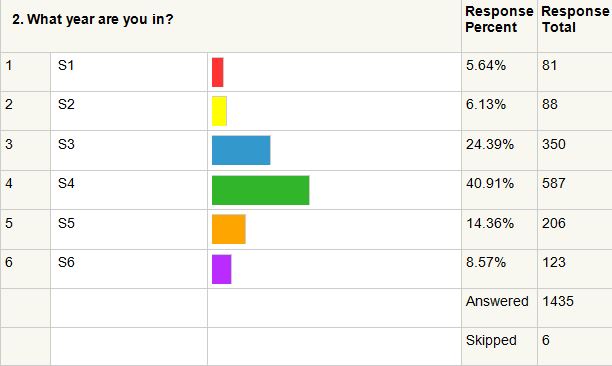
Questionnaire of Secondary School pupils.
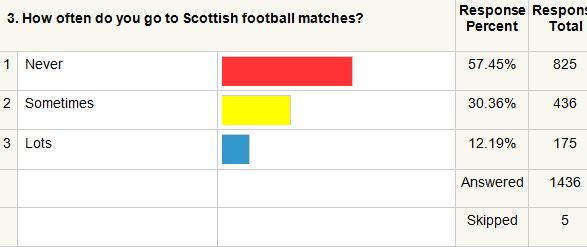
Questionnaire of Secondary School pupils.

Questionnaire of Secondary School pupils.
Over 400 people responded that they did not support any football club. The majority of respondents, who did support a football club, supported either Celtic, Rangers, Aberdeen, Hearts or Hibernian.
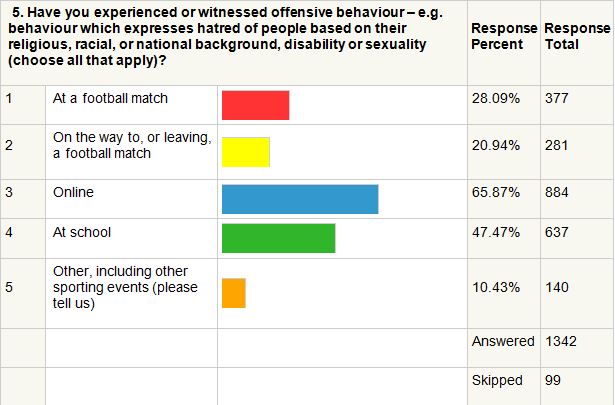
Questionnaire of Secondary School pupils.
About 20 respondents said that they had not experienced or witnessed offensive behaviour. Others said they had experienced or witnessed it at hockey, cricket and rugby matches, whilst out with their friends, watching TV or movies.
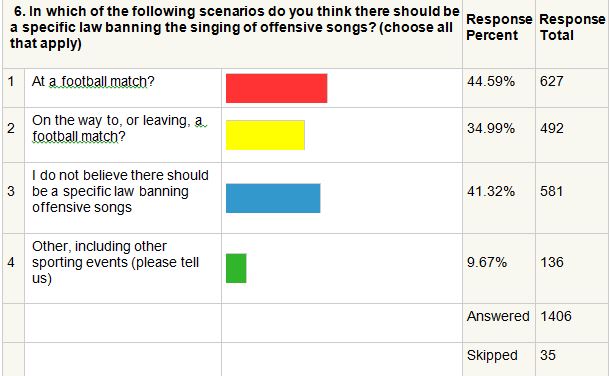
Questionnaire of Secondary School pupils.
Many respondents said that the law should not apply to any other venues, whilst some thought it should apply to sporting events, and others that offensive songs should be banned everywhere.

Questionnaire of Secondary School pupils.
Respondents to this question thought that there should be some sort of punishment, either right away or after a warning about behaviour being offensive. This included being issued a fine, being arrested and charged, being banned from football stadiums and/or sporting events. Others thought that there should be more police and stewards at football matches to prevent offensive behaviour and that the football clubs should take action to address the behaviour. Some respondents thought that singing at football matches added to the atmosphere and should therefore be allowed, whilst others said it was either too difficult or unfair to pick out certain individuals when a large number of people were singing. Educating children and adults about the effects of their behaviour was also highlighted.
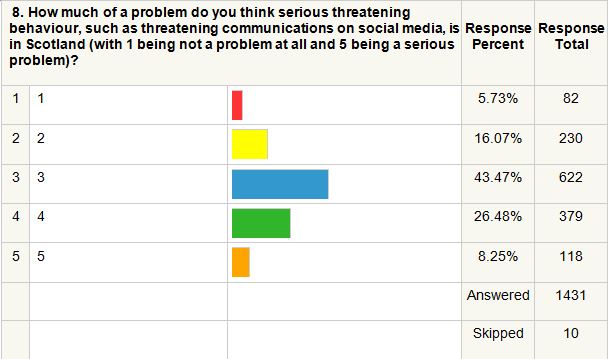
Questionnaire of Secondary School pupils.
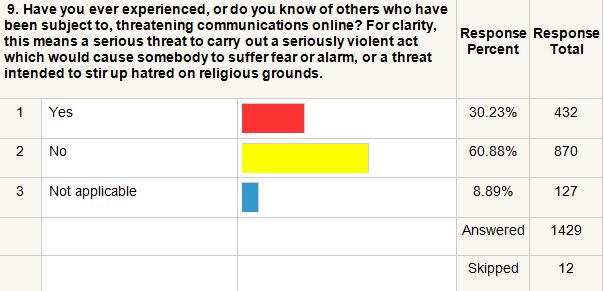
Questionnaire of Secondary School pupils.

Questionnaire of Secondary School pupils.
Responses to this question included action that the person should take, for example, informing an adult, telling the police, and blocking the person from contacting them. The police could then help to identify the person and either speak to them, fine them, or charge them with an offence under existing or separate legislation. Some thought that the internet providers / those hosting social media platforms should take action to address the issue. For example, having a method by which people could report the behaviour and then taking action to tackle it, such as imposing a ban on using social media.
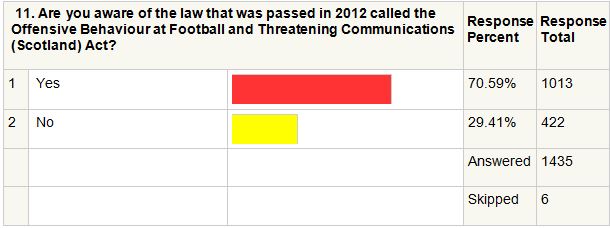
Questionnaire of Secondary School pupils.