Environment, Climate Change and Land Reform Committee
Stage 1 report on the Animals and Wildlife (Penalties, Protections and Powers)(Scotland) Bill
Introduction
The Bill was introduced on 30 September 2019 by Roseanna Cunningham, the Cabinet Secretary for Environment, Climate Change and Land Reform.
Why is the Bill needed
The Animal Health and Welfare (Scotland) Act 2006 (“2006 Act”) was an important landmark for animal welfare in Scotland that consolidated previous animal welfare legislation and offered improved protection for all domesticated animals. With its over-arching principles and powers to put in place secondary legislation to protect animal welfare in specific circumstances, the Act was widely recognised as a ground-breaking piece of legislation. However, in light of over a decade of experience of enforcing the 2006 Act, concerns have been raised about some aspects of the penalties applicable under the Act and of the regulations made under it.ii
An independent review for the Scottish Government of the current penalties available to punish perpetrators of wildlife crime found that these penalties may not be serving as a sufficient deterrent or reflect the serious nature of some of the crimes that are being committed.
What the Bill does
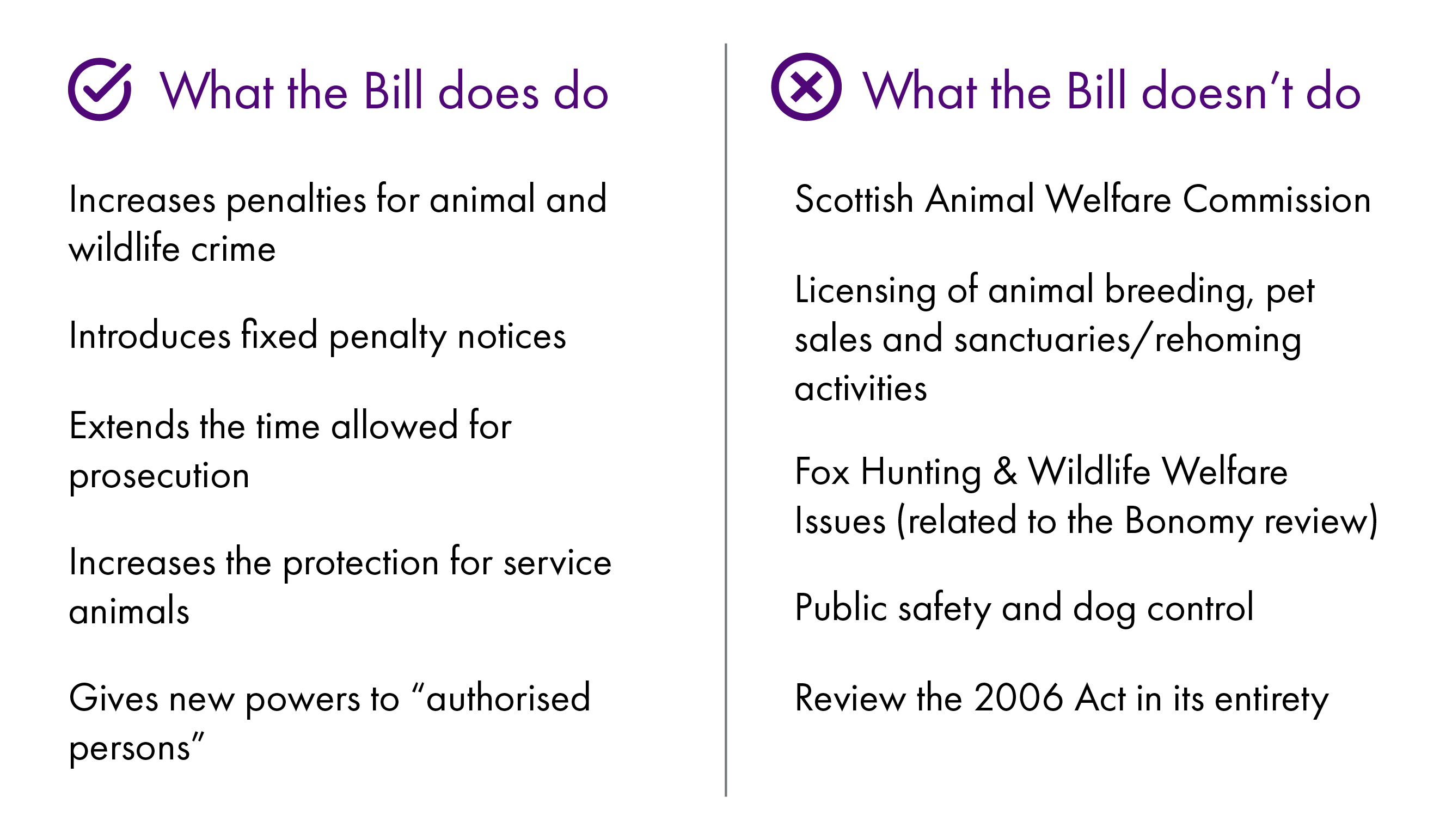
The objective of the Bill is to provide further protections for animals and wildlife in Scotland.
The Bill has two purposes—
to make provisions for existing animal and wildlife offences, including how these are dealt with, prosecuted or considered in courts, and
to provide authorised persons (including certain inspectors and constables) additional powers to deal with an animal taken into possession on welfare grounds, regardless of whether an offence has taken place.
The Bill amends various Acts (and one set of regulations) to increase penalties for animal welfare and wildlife offences and to make related procedural changes.
Financial Resolution
The Presiding Officer of the Scottish Parliament has agreed that a financial resolution is not required for the Bill. The Bill will impact those that have committed an offence relating to animal welfare, animal health or wildlife, and those who have a role in enforcing the legislation. The Financial Memorandum has assumed that detection rates of animal health, welfare and wildlife offences will be unaffected by the provisions of the Bill, as no changes to detection methods are being proposed. As the Bill is not creating any new offences, and for the most part is introducing and developing enforcement tools similar to those introduced at minimal cost under other legislation, the organisations involved in enforcement may need to make some minor arrangements for staff training. It is expected that the costs for introducing and developing enforcement tools will be minimal.
Delegated Powers and Law Reform Committee
The Bill confers a number of subordinate legislation powers on the Scottish Ministers. The Bill was considered by the Delegated Powers and Law Reform Committee. The Committee reported that it is content with the delegated powers provisions contained in the Bill.i
The Committee's approach
The Committee considered its approach to scrutiny at Stage 1 of the Bill on 8 October 2019. The Committee agreed to launch a call for views and to hold five evidence sessions over three meetings with the Scottish Government Bill team and stakeholders on key areas of the Bill before hearing from the Cabinet Secretary on 17 December 2019.
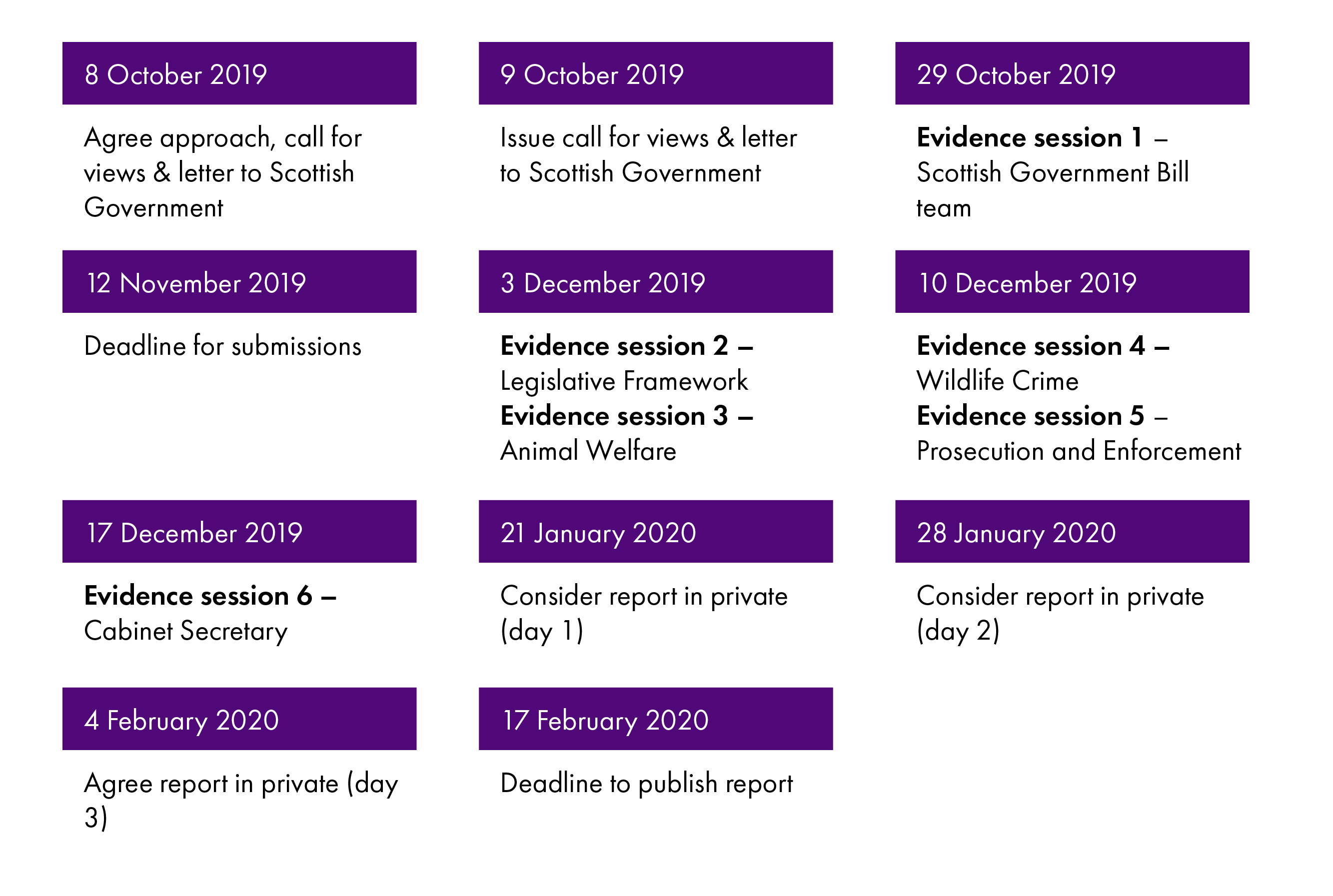
The Committee wrote to the Scottish Government on 10 October ahead of hearing evidence from the Scottish Government Bill team. The letter and the response from the Minister for Rural Affairs and the Natural Environment can be found on the Committee's webpages.
The first evidence session with the Scottish Government Bill team took place on 29 October 2019.
The Committee agreed to issue a call for evidence and then to invite key stakeholders to give their views.
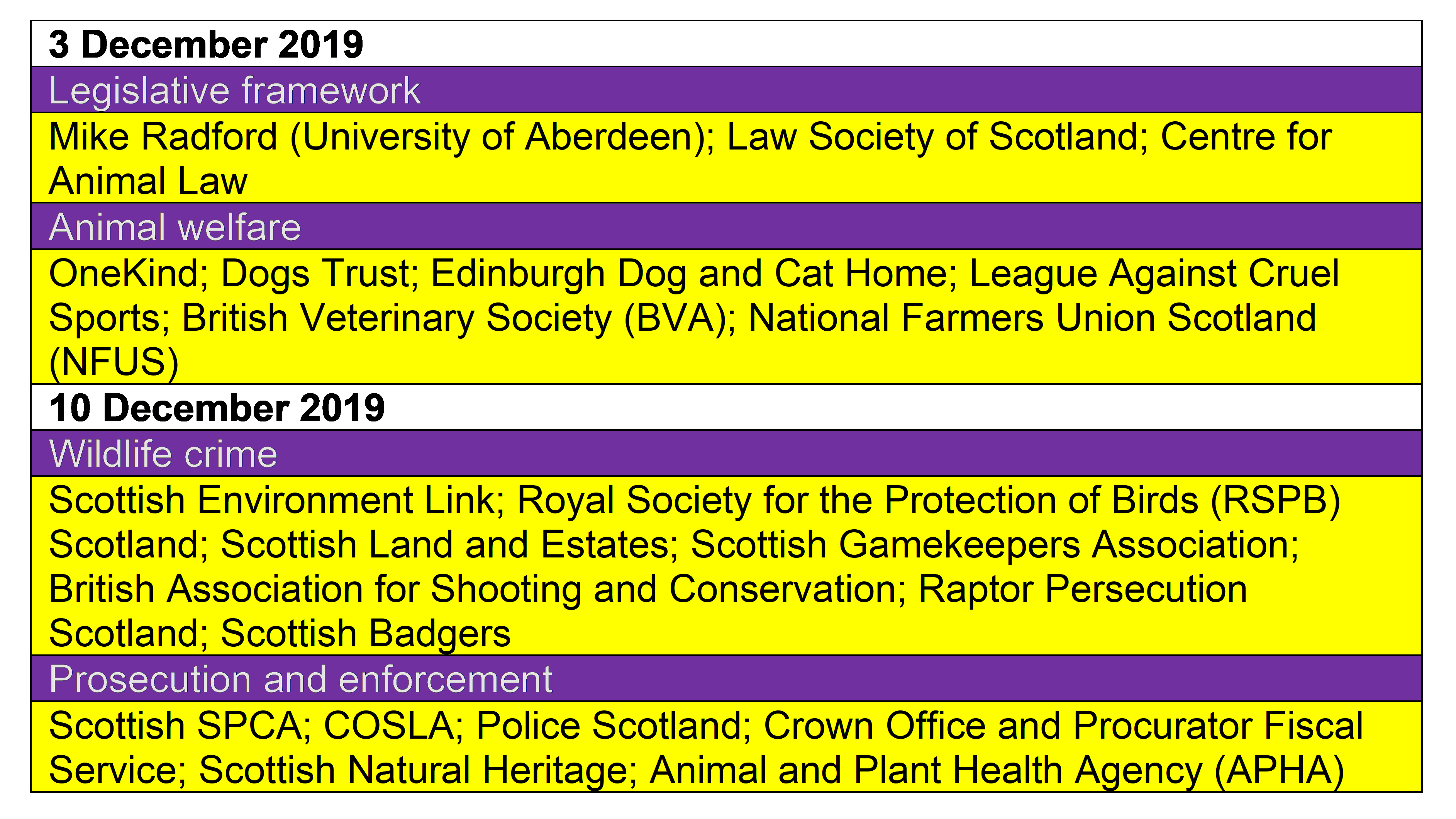
A note of the focus of the evidence sessions and the participants is set out below.
Written evidence can be read in full on the Committee's webpage. A summary of that evidence can be found in a paper for the meeting on 17 December 2019.iv
Key Issues
Penalties
99.4% respondents to the Scottish Government's consultation on the proposed changes agreed that penalties should be strengthened. Key themes included—
current maximum penalties available are too low;
increasing the maximum penalties would give sheriffs more sentencing options, and
ultimately the increase in maximum penalties would act as a deterrent.
The Scottish Government said that the maximum penalty of five years in prison is in line with current penalties elsewhere.
There was general support for increasing maximum penalties for wildlife crime, with many respondents citing that this was a key recommendation of the Poustie review (the Wildlife Crime Penalties Review Group).
Most organisations agreed with the proposed maximum penalties for animal welfare offences and considered that increasing the maximum would give the Courts the flexibility to treat each case properly on its merits.
The Law Society of Scotland noted that sentencing for wildlife offences can be quite different from other criminal offences with regard to the assessment of culpability, harm and public policy aspects, and it would be helpful to have sentencing guidelines.
The Committee notes the intention of the Bill to provide courts with the flexibility to impose sentences that are appropriate for a wide range of offending behaviour. This includes the use of non-custodial options such as fixed penalty notices, suspension of general licences, community payback orders and retraining courses to change offenders' behaviour. The Committee also notes that the Scottish Sentencing Council is at an early stage of developing guidelines for environment and wildlife crimes.
The Committee supports the increase in maximum penalties for animal welfare and wildlife crime to five years in prison.
The Committee would welcome further discussion with the Scottish Government on sentencing guidelines for wildlife crime offences.
Fixed Penalty Notices
The Bill creates the power to introduce future regulations to create fixed penalty notices (FPNs) for certain animal welfare (section 2) and animal health (section 4) offences and the Scottish Government has recently consulted stakeholders on introducing FPNs for certain wildlife offences.
The Committee understands that it is intended that a requirement that FPN regimes apply only to offences that have a maximum penalty of up to six months’ imprisonment and a fine at level 5 on the standard scale, which is currently £5,000. Stakeholders supported the use of FPNs whilst emphasising the importance that FPNs were used for minor and technical offences and not where actual harm has come to animals. In relation to the use of FPNs for animal welfare offences, there was also a desire from stakeholders to ensure that they are not used as a substitute for care notices where that may be a more appropriate and preventative measures, such as giving people access to the interventions they need.
The Scottish Government confirmed that regulations are intended to be made under the affirmative procedure and would come before the Parliament for scrutiny and parliamentary approval.i
The Scottish Government is continuing to consult on the Animal Health Act 1981 Amendmentii to establish if FPNs should be introduced for less serious animal health offences. However the current consultation had not concluded before the introduction of this Bill. It is anticipated that amendments to the Bill will be needed following the conclusion and analysis of the consultation responses.
There was broad support for the inclusion of powers to introduce FPNs via regulations for animal welfare and animal health offences. A number of respondents considered that FPNs would provide authorities with flexibility to determine proportionate penalties from a range of enforcement tools and should help to free up court resources for more serious offences, whilst providing a deterrent for more minor offences.
The Committee welcomes the proposed use of FPNs for animal welfare and animal health offences and agrees that FPNs should be used for minor and technical offences only. The Committee would welcome an update from the Scottish Government on the outcomes of the consultation on FPNs for animal health offences, which was ongoing at the time the Bill was introduced.
The Committee considers that there should be clear guidance on the use of FPNs and clear limits should be set. The Committee seeks assurance that FPNs will not be used when the severity of the crime is such that prosecution would be a more appropriate action. The Committee asks how the Scottish Government plans to ensure that this will be the case.
The Committee asks for clarity on how the Government proposes to introduce FPNs for wildlife offences following its recent consultation. To ensure FPNs are used effectively the Committee recommends that the Scottish Government develop and implement an awareness-raising and education campaign about wildlife crime and the impact that it can have. This should include information on the maximum penalties that can be applied to a person who commits a wildlife crime.
Income generated from fines and FPNs
The Financial Memorandum accompanying the Bill suggests that any increase in fine income as a result of the Bill will go to the Scottish Government but will be deducted from the Scottish Block Grant.
At the time the budget is set by the Scottish Government, there is a forecast of income from fines, forfeitures and fixed penalties and there is a Block Grant Adjustment (BGA) deduction made to the Scottish budget. For the Scottish Government to increase revenues from fines, it must generate a sum higher than the BGA. The Committee understands that income from FPNs that are served by enforcement authorities would not necessarily be counted in the same way as fines that are paid to court in relation to criminal offences. The Committee also understands that income derived from fines could be ring-fenced for example, for conservation or awareness raising.
The Committee asks the Scottish Government to provide clarity over the treatment of income generated from fines and FPNs before consideration of the Bill at Stage 2.
Empathy training
The Committee heard in evidence about other approaches that could be used alongside sentencing to develop empathy in offenders which may prevent future offending and thereby add protection for animals. A parallel was drawn with requiring speeding offenders to attend a course on the impact of speeding. The Poustie review recommended that wildlife crime offenders should be required to attend retraining courses, including courses on empathy where appropriate, either through Community Payback Orders or suspended sentences. The review noted that this would require “establishing that such courses are available and raising awareness of such courses amongst the judiciary.” The Committee heard that the Minister for Rural Affairs and Natural Environment would consider how best this could be addressed.ii
The Committee would welcome an update from the Scottish Government on its consideration of the use of other approaches that could be used alongside sentencing, the Committee asks the Scottish Government if it considers that this is an issue that can be addressed through regulations that would be made if the Bill passes Stage 3 and becomes an Act.
Sharing of information – disqualification orders and FPNs
Stakeholders, including the Scottish Society for Prevention of Cruelty to Animals (SSPCA),iraised issues with the effectiveness of disqualification orders (where people convicted of animal welfare offences are banned from keeping animals).
There appears to be a desire to share information between authorities but the Committee heard that this does not happen in practice. The Committee heard that there is no central register or database accessible to authorities and agencies (such as local authorities and the SSPCA) and this can act as a significant barrier to animal protection and can make investigations inefficient.ii
The Committee understands that FPNs will be held on a local authority register, so that they can be viewed, and the relevant authorities will be in a position to understand if a situation escalates. However there is no plan to create a central register.
The Committee heard from stakeholders that there is increasing evidence linking animal cruelty and other violent crime and therefore there is a need for joined-up thinking about risk factors for authorities to consider alongside intelligence sharing e.g. with social services. In discussion with the Committee, the Minister agreed to consider what further opportunities there may be for intelligence sharing in this regard.iii
The Committee considers that information-sharing on convictions (disqualification orders, fixed penalty notices issued, fines and custodial sentences) for animal welfare offences and the potential for a database shared by relevant authorities and agencies, including social services, may help track patterns of offending, including animal welfare and other forms of offending such as domestic abuse and criminal activity.
The Committee welcomes the commitment of the Minister to consider what further opportunities there may be for intelligence sharing. The Committee encourages the Scottish Government to set out proposals to establish a registration system or a means of effectively sharing information between authorities. This would highlight if the same people were receiving a fixed penalty notice for the same offence on a regular basis, warranting further action or investigation, and enable authorities to know where disqualification orders are in place.
Harming a service animal (‘Scottish Finn’s law’)
The Bill removes a defence of self-defence as it exists in section 19(4) of the 2006 Act. This defence has enabled people to claim that they attacked a service animal in order to protect themselves, another person or property or another animal.
The Committee heard from Police Scotland that attacks against service animals have been rare in Scotlandii and the Committee welcomes this. However, the Committee heard from A-Law that across the UK there were “many examples” of assaults against service animals.iii
There was broad support for the introduction of a 'Scottish Finn's law' with many respondents highlighting the vulnerability of service animals.
A small number of respondents suggested that the Bill should go further and require harsher penalties for attacks on service animals (beyond the wider increases to maximum penalties proposed by the Bill) for example by treating such attacks as an aggravated offence.
There were calls to extend the protection to other working animals, including assistance animals.
The Committee considered whether a definition of a service animal should be included within the Bill (rather than defining service animals by way of the type of person controlling them) and whether this should include other ‘working’ animals (where animals are providing assistance to people) such as guide dogs.
The Committee is content with the removal of the defence of self-defence in relation to attacks on service animals. The Committee notes the calls to extend the provisions to include other working animals but received no firm evidence to support the position that existing legislation is insufficient to protect working animals. Attacks against other types of assistance animal may be prosecuted under existing offences in the 2006 Act, such as causing unnecessary suffering. The Committee notes that maximum penalties for this offence are increased by this Bill, regardless of the type of animal involved, which increases protection across the board.
The Committee asks the Scottish Government if it is aware of instances of working animals, including assistance animals, being attacked and the attacker successfully using an argument of self-defence, or another defence, under the relevant subsection of section 19 as a defence. The Committee invites the Scottish Government to consider whether there may be merit in examining the issue in relation to assistance animals at a future date.
Categorisation of wildlife crimes
The Committee heard concerns that the consistency of approach for categorising and prosecuting different types of wildlife offence. For example stakeholders questioned the rationale for maximum penalties for the destruction of resting places of European protected species being significantly higher than equivalent offences in relation to badgers or other wild birds.
The Committee wishes to see a consistency of approach for categorising and prosecuting different types of wildlife offence. The Committee understands there are different tiers of penalties and is unclear as to the logic for these differences. The effect of the destruction of a habitat could be as fatal as directly harming or killing an animal. For example, the destruction of setts could lead to the destruction of a colony and the deaths of the animals.
The Committee recommends that the Scottish Government reconsiders its approach to ensure enhanced protections are extended to resting places and breeding sites therefore sentencing can reflect where crimes in effect have equivalent outcomes i.e. in terms of harm to the animal.
Detection and prosecution of wildlife crimes
Evidence suggests that stakeholders are supportive of the increased penalties in relation to wildlife crimes. However, the Committee also heard that there is a belief that often the courts do not impose the maximum penalty available to them and penalties can be inconsistent. Stakeholders expressed views that increased penalties will be more of a deterrent if they are used to the maximum, there is publicity or education around the outcome of cases to help prevent further similar crimes and detection and enforcement is enhanced, recognising the challenges in detecting wildlife crime in remote and rural areas.
The Committee supports the increased penalties. The Committee considers that penalties form part of the solution to addressing wildlife crime. The Committee asks the Scottish Government if it is content that there is a sufficiently collaborative approach and sufficient resources allocated to the detection of wildlife crime and if it has any plans for the deployment of further resources or collaboration with other agencies in the light of this Bill. The Committee also asks the Scottish Government if it has any plans in relation to publicity or education around the outcome of cases to help deter potential offenders.
The Committee would welcome sight of the full evaluation of the pilot for the use of Special Constables in the Cairngorms area. The Committee understands that this will be available early in 2020 and asks the Scottish Government for a firmer indication of when it will be available to the Committee.
Scottish Society for Prevention of Cruelty to Animals (SSPCA) - powers
In the context of previous scrutiny of the Scottish Government's annual wildlife reports, this Committee and predecessor Committees heard calls to extend the powers of the SSPCA in relation to wildlife crime to improve enforcement of the legislative provisions and support efforts to detect and prosecute wildlife crime offences.
In considering the Bill, the Committee heard suggestions from stakeholders that it would be beneficial to extend the powers of SSPCA in relation to wildlife crime to improve enforcement, given the resource and expertise available that could be harnessed. Given legislation only allows the SSPCA to enter land when an animal is actively suffering, this can lead to anomalous situations where, for example, if a live bird has been caught in an illegal trap, SSPCA inspectors could intervene, but could not look around it for other illegal traps or traps with dead animals. Stakeholders also made the point that, given wildlife crime often takes place in remote areas, it can be difficult for the police to prioritise attending within a timeframe that allows for the capture of evidence.
The Committee agrees that in some situations the lack of powers of the SSPCA to gather evidence is an anomaly, and their resources and expertise could potentially be used effectively by expanding their powers in this area. The Committee notes that it is not the intention of the Scottish Government to consider a change to the powers of the SSPCA at this time. However, it welcomes the assurance from the Minister that talks between the SSPCA and the Scottish Government have taken place and that the Minister is open to considering options for change.i
The Committee recommends that the Scottish Government explores in detail the options to enhance detection and prosecution by expanding the powers of the SSPCA , alongside the evaluation of the Special Constables pilot, as an approach to better resourcing wildlife crime enforcement. The Committee would welcome an indication of the timeframe for this consideration and how it fits with the passage of this Bill.
Impact statements
The Committee notes the recommendations of Professor Poustie on the use of impact statements in prosecutions of wildlife offences. The Committee heard there was broad support from stakeholders (including environmental and land management groups) for the more systematic use of impact statements to be put on a legislative footing. The Committee also heard concerns that they are not currently being used routinely and consistently. The Committee discussed this with the Scottish Government which considered that there was no need to put this on a statutory basis.
The Committee recommends that impact statements should be used as a matter of standard practice. The Committee is concerned that in case of wildlife prosecutions the victim has no voice and the impacts of the harmful actions can be extensive. The Committee asks the Scottish Government why it considers putting impact statements on a legislative footing, as recommended by Professor Poustie, is unnecessary. The Committee would welcome any available evidence to support this position. The Committee also asks the Scottish Government to consider how a monitoring process could be enhanced and used to determine whether impact statements are being used to best effect in the process of prosecution and sentencing. The Committee also asks the Scottish Government whether putting impact statements on a legislative basis would be a better way forward and if it considers it is not, the Committee would appreciate more clarity on the that position.
Pesticides
The Committee heard evidence that suggested possession of illegal pesticides should attract the higher level of penalties proposed in the Bill for wildlife crime, given that the pesticides in question have been banned for a number of years and there is no legitimate reason for possessing them in Scotland. The Scottish Government undertook to look at this matter including whether a further illegal pesticides amnesty would be of benefit.i
The Committee would welcome an update from the Scottish Government before Stage 2 commences on the appropriate level of penalties for the possession of illegal pesticides. The Committee would also welcome the Scottish Government's view of potential plans for a further pesticides amnesty.
Vicarious liability
The Committee explored the issues around vicarious liability and whether provisions in relation to this should be expanded to include any other wildlife offences.
In order to bring a charge of vicarious liability, it must be established that an offence has been committed, who it was committed by and the relationship between that person and the person who is vicariously liable. However, it does not necessarily follow that prosecution takes place. The Committee notes the low number of charges brought and prosecutions under vicarious liability provisions.
Stakeholders suggested that the initial deterrent effect of vicarious liability had been lost and expressed frustrations that only a small number of cases had been pursued under vicarious liability. They also suggested that the rationale for decisions made by the Crown Office not to pursue prosecutions using vicarious liability provisions have been unclear and thought that more transparent and detailed reasoning would be useful.
The Committee also heard evidence suggesting vicarious liability should be extended to other types of wildlife crime, drawing comparisons with how vicarious liability is used more extensively in industrial and health and safety legal settings.
The Committee appreciates that identifying who is potentially vicariously liable can be difficult. However the Committee would welcome the concept of vicarious liability being extended to further wildlife offences and would welcome the Scottish Government’s view on this.
The Committee recommends that the Scottish Government works with the Crown Office to provide more clarity and guidance about vicarious liability – what is essential to make successful prosecution, what is desirable, how the court applies procedures and evidence and opportunities for increased transparency around Crown Office decision-making (whilst recognising those decisions will always be made on a case-by-case basis by the Crown Office).
The Committee would also welcome a view from the Scottish Government, before the start of Stage 2, as to whether the principles of the Victims' Right to Review (VRR) scheme, could apply to organisations working in the public interest in relation to wildlife crime (given the ‘victims’ of alleged wildlife crimes are not able to act in their own interest). The Committee considers that this could enable non-government organisations (NGOs) acting in the public interest (i.e. on behalf of nature) to seek more information regarding decisions not to prosecute serious alleged wildlife offences and not only in situations where alleged crimes took place on their own land.
Video evidence/surveillance
The Committee explored issues around video evidence and surveillance and its usefulness given the remoteness of the areas in which some wildlife crimes take place. Stakeholders also discussed the rationale for video surveillance by other agencies, such as NGOs, given they may be better placed or resourced than the police for example to identify vulnerable nesting sites in the case of bird of prey persecution. Stakeholders also highlighted ongoing uncertainties about whether obtained video evidence will be deemed admissible in court and suggested that this can act as a barrier to prosecutions.
Police Scotland has the power to undertake direct surveillance. The Committee welcomes the increased power for intrusive surveillance (police-sanctioned surveillance) on a case-by-case basis following procedures under the Regulation of Investigatory Powers (Scotland) Act 2000 created in relation to some wildlife offences by virtue of increasing maximum penalties.
The Committee recognises that the Bill does not impact the powers of other agencies or groups in relation to surveillance. However, it agrees that there is a place for cameras to be deployed by other agencies as long as they are not being used in contravention of privacy rights, under article 8 of the European Convention on Human Rights. The Committee recommends that the Scottish Government works with the Crown Office to discuss whether more detailed reasons can be made publicly available regarding admissibility of video evidence in alleged instances of wildlife crime.
Taking possession, rehoming and disposal of animals
The Bill proposes new powers to remove the need for a court order for rehoming, treating or destroying animals that have been taken into possession for welfare reasons, with a view to speeding up the process of rehoming animals to benefit animal welfare and reduce the burden on authorities.
There was general support for these provisions in the Bill, principally due to two factors: firstly the operational cost burden that current requirements for court orders place on the SSPCA, local authorities and rehoming centres, and secondly the adverse welfare implication for animals held by authorities e.g. in kennels for long periods of time, which can result in behavioural problems.
The Committee is supportive of the new powers in relation to the rehoming (and other interventions) of animals without a court order to benefit animal welfare.
Decision notices and appeals
Where authorities wish to rehome, treat or euthanise an animal taken into possession under existing powers an authorised person must serve a decision notice on the owner of the animal, who then has three weeks to appeal this decision.
The Committee is aware that the keeper of an animal may not always be the owner, for example, where horses are in a livery yard. In these cases, identifying and serving a notice to an owner in the proposed timeframe may present difficulties.
The Committee asks the Scottish Government to clarify if both the owner and the ‘keeper’ of the animal could and should be served a decision notice.
The Committee explored the process in relation to owners who perhaps had neglected animals due to issues involving their own physical or mental health. In these cases the Committee is concerned that a decision notice and its implications may not be fully apparent or understood by an owner.
The Committee recommends that the Scottish Government engages with enforcement agencies and provide guidance as to how, and by whom, people suffering from health issues, which might prevent their effectively engaging with the decision notice and appeals procedure within a three week period, are to be identified and supported in practice.
Compensation
There are existing compensation provisions. Under the new arrangements, the owner can be compensated where their animal is taken into possession and subsequently rehomed or euthanised, with the proviso that the compensation can be deferred if there is a related on-going criminal case. A court will be able to order that compensation is not paid to the owner, if it thinks that that is an appropriate action after due process and a conviction.
Broadly, organisations responding recognised that it was a legal requirements to provide for compensation and this related to compliance with human rights law including article 1 of protocol 1 to the European Convention on Human Rights (ECHR)i, although this requirement can legitimately be balanced with broader public interests.
A significant number of individuals did not agree with the principle of providing any compensation to an owner of an animal where there has been a failure to secure their welfare, whether or not that resulted in a conviction.
The Committee recognises the need and rationale for a compensation system that is compatible with ECHR property rights, in cases where an owner has not been found to be criminally liable for an animal welfare offence. The Committee understands that the compensation payable is the greater of-
(a) the value of the animal before it is re-homed or euthanised; or
(b) the value at the time it was taken into possession,
minus relevant expenses incurred by authorities.
The Committee discussed with the Scottish Government the rationale for enabling owners to financially benefit from any increase in value taking place while an animal was in the care of authorities, and understands that this covers a range of circumstances including where an owner may not ultimately be at fault.
The Committee recognises that compensation is a complicated process and that once the draft provisions in the Bill sit within the existing legislation, they should be more readily understood. However, the Committee would welcome an explanation from the Scottish Government as to the rationale for and how it arrived at the drafting structure of the compensation provisions in the Bill.
Issues outwith the Bill as drafted
Scottish Animal Welfare Commission
The Committee would welcome further information from the Scottish Government and from the newly-established Scottish Animal Welfare Commission on its planned programme of work.
Firearms legislation
In discussing the range of penalties available for wildlife crime, the Committee discussed with the Minister for Rural Affairs and the Natural Environment the potential for the withdrawal of firearms certificates, noting that this is a reserved area. The Minister recognised that there were two recommendations related to firearms legislation in the Poustie review and committed to raising the issue with the justice department with a view to engaging with the UK Government.i
The Committee welcomes the commitment of the Scottish Government to explore this and asks for an update on how this is being progressed.
General licence suspensions
The Committee heard different views from stakeholders on the effectiveness of the suspension of general licences by Scottish Natural Heritage (SNH) as a civil compliance mechanism. The Committee sought information from the Scottish Government on why general licences are reinstated by SNH during an appeals process.
The Committee would welcome a response on this question, and more broadly asks the Scottish Government for an update on its position on the effectiveness of the suspension of general licences as an enforcement tool in relation to wildlife crime.
Links to the Grouse Moor Management Review Group report
The Grouse Moor Management Review Group report (the Werritty report) was published in December 2019 and the Committee notes the relevance of some of its recommendations to this Bill. The Committee notes that potential provisions for licensing of grouse moors are not included in the Bill. The Committee also notes the detailed conclusions and recommendations in the report regarding satellite tagging, the use of video surveillance, the law of corroboration and the consistency and severity of sanctions (recognising that the Bill already increases penalties for some wildlife crimes).
The Committee welcomes the publication of the Werritty report. In advance of Stage 2, the Committee would welcome the Scottish Government response to the report and asks the Scottish Government to set out: to what extent this Bill reflects the recommendations of the report; what recommendations not included in this Bill could be within scope and; what recommendations not included within the Bill could be within scope.
Wildlife Crime in Scotland: 2018 Annual Report
The seventh wildlife crime in Scotland annual report, with new data from the financial year 2017 to 2018 was published on 23 December 2019. In the Ministerial Foreword to the wildlife crime report, the Cabinet Secretary for Environment, Climate Change and Land Reform, Roseanna Cunningham MSP, noted
Following a fall in recorded wildlife crime incidents for the last two years, it is distressing to see this number rise by 2% in 2017-18. It is disappointing that wildlife crime and raptor persecution continue to threaten Scotland’s natural heritage and risk damaging the reputation of our country.
The Cabinet Secretary also highlighted in the wildlife crime report that
There continues to be persecution of birds of prey. Recorded bird of prey cases more than doubled, from 11 in 2016-17 to 24 in 2017-18, with one incident accounting for almost half of this number.
The Committee would welcome further discussion with the Scottish Government on the findings of this report.
Recommendation
The Committee recommends to the Parliament that it supports the general principles of the Animals and Wildlife (Penalties, Protections and Powers) (Scotland) Bill. In making this recommendation, the Committee recognises that there is much to be set out in the regulations that would follow if the Bill is passed at Stage 3 and becomes an Act of the Scottish Parliament.
Annex A
Extracts from the minutes of the Environment, Climate Change and Land Reform Committee.
1. Decision on taking business in private: The Committee agreed to take item 3 and all further consideration of its approach to the Animals and Wildlife (Penalties, Protections and Powers) (Scotland) Bill in private.
1. Animals and Wildlife (Penalties, Protections and Powers) (Scotland) Bill: The Committee took evidence on the Bill at Stage 1 from—
Leia Fitzgerald, Wildlife Management Team Leader, Wildlife Management and Biodiversity Unit, Grant McLarty, Solicitor, Animal Health and Welfare Branch, Directorate for Legal Services, Hazel Reilly, Solicitor, Forestry, Natural Resources and Climate Change, Directorate for Legal Services, and Andrew Voas, Veterinary Head of Animal Welfare, Animal Welfare Branch, Scottish Government.
6. Animals and Wildlife (Penalties, Protections and Powers) (Scotland) Bill (in private): The Committee reviewed the evidence heard earlier in the meeting.
1. Animals and Wildlife (Penalties, Protections and Powers) (Scotland) Bill: The Committee took evidence on the Bill at Stage 1 from—
Mike Radford, Reader, University of Aberdeen; Gillian Mawdsley, Secretary, Criminal Law Committee, Law Society of Scotland; Scott Blair, Advocate, Centre for Animal Law; Libby Anderson, Policy Advisor, OneKind; Runa Hanaghan, Deputy Veterinary Director, Dogs Trust; Howard Bridges, Chief Executive Officer, Edinburgh Dog and Cat Home; Robbie Marsland, Director, Scotland, League Against Cruel Sports; Penny Middleton, Policy Manager for Animal Health and Welfare, NFUS.
Finlay Carson indicated that he is a member of the National Farmers Union, Scotland (NFUS).
2. Animals and Wildlife (Penalties, Protections and Powers) (Scotland) Bill (in private): The Committee considered the evidence heard earlier in the meeting.
1. Animals and Wildlife (Penalties, Protections and Powers) (Scotland) Bill: The Committee took evidence on the Bill at Stage 1 from—
Ian Thomson, Head of Investigations, RSPB Scotland; Karen Ramoo, Policy Adviser, Scottish Land and Estates; Ross Ewing, Political and Press Officer, Scotland, British Association for Shooting and Conservation; Dr Ruth Tingay, Raptor Ecologist, Raptor Persecution UK; Eddie Palmer, Chairman, Scottish Badgers; Les George, Gamekeeper and Scottish Gamekeepers Association Committee member, Scottish Gamekeepers Association; Liz Ferrell, LINK Wildlife Crime Subgroup Convener and Scottish Officer, Bat Conservation Trust, SE Link; Mike Flynn, Chief Superintendent, SSPCA; Detective Chief Superintendent Gary Cunningham, Specialist Crime Division, Police Scotland; Constable Charlie Everitt, Scottish Investigative Support Officer at the UK National Wildlife Crime Unit; Robbie Kernahan, Head of Wildlife Management, Scottish Natural Heritage; Joanne Fairman, Head of Regulatory Affairs, Animal and Plant Health Agency; Sara Shaw, Head of Wildlife and Environmental Crime Unit, Crown Office and Procurator Fiscal Service.
3. Animals and Wildlife (Penalties, Protections and Powers) (Scotland) Bill (in private): The Committee reviewed the evidence heard earlier in the meeting.
1. Animals and Wildlife (Penalties, Protections and Powers) (Scotland) Bill: The Committee took evidence on the Bill at Stage 1 from—
Mairi Gougeon, Minister for Rural Affairs and the Natural Environment; Andrew Voas, Veterinary Head of Animal Welfare, Leia Fitzgerald, Wildlife Management Team Leader, Hazel Reilly, Solicitor, and Grant McLarty, Solicitor, Scottish Government.
2. Animals and Wildlife (Penalties, Protections and Powers) (Scotland) Bill (in private): The Committee reviewed the evidence heard earlier in the meeting.
4. Animals and Wildlife (Penalties, Protections and Powers) (Scotland) Bill (in private): The Committee considered a draft Stage 1 report.
6. Animals and Wildlife (Penalties, Protections and Powers) (Scotland) Bill (in private): The Committee agreed its draft Stage 1 report