Environment, Climate Change and Land Reform Committee
Stage 2 Report on the Climate Change (Emissions Reduction Targets) (Scotland) Bill
Introduction
The Committee produced its Stage 1 reporti on the Climate Change (Emissions Reduction Targets) (Scotland) Billii (the Bill) on 4 March 2019. Background information on the Bill and the Committee’s consideration of it at Stage 1 can be found at Annexe D. Before moving to the amending stage of the Bill at Stage 2, the Committee agreed to consider and report on the advice of the Committee on Climate Change (CCC) on the climate change targets for Scotland, once published. This report sets out the Committee’s position on the Bill, following developments since publication of the Stage 1 report.
Developments since publication of the Stage 1 report
Following publication of the Committee’s Stage 1 report, the Scottish Government responded on 1 April 2019 (Annexe A). The Stage 1 debatei took place in Parliament on 2 April 2019. On 28 April 2019, the First Minister, Nicola Sturgeon, declared a “climate emergency” and announced that Scotland would “live up to our responsibility to tackle it."
The CCC published its adviceii on Scottish, Welsh and UK targets in light of the Paris Agreement and the Intergovernmental Panel on Climate Change Special Reportiii on 2 May 2019. This advice details how Scotland can credibly adopt a more ambitious target of reaching net-zero greenhouse gas emissions (GHGs) by 2045, contingent on the UK adopting the CCC’s recommended 2050 net-zero GHG target. The CCC wrote to the Committeeiv on 20 May, providing additional information on accounting for the interim targets for Scotland.
The Cabinet Secretary for Environment, Climate Change and Land Reform then wrotev to the Committee on 2 May 2019, following publication of the CCC’s advice, and lodged a package of amendments that, if agreed at Stage 2, would implement the CCC’s advice by setting a target date of 2045 for net-zero emissions of all GHGs and increasing the levels of the 2030 and 2040 interim targets to 70% and 90% reductions respectively (Annexe B). The Cabinet Secretary made a statementvi in Parliament on 14 May 2019 outlining the Scottish Government’s response to ‘The Global Climate Emergency.’ Here, the Cabinet Secretary declared that “an emergency needs a systematic response that is appropriate to the scale of the challenge and not just a knee-jerk, piecemeal reaction. All Cabinet Secretaries are looking across the full range of policy areas to identify areas where we can go further, faster.” The Cabinet Secretary then wrote to the Committee with a further updatevii on the Scottish Government’s response to the Committee’s Stage 1 report on 15 May 2019 (Annexe C).
Committee on Climate Change Net-Zero Report
On 8 October 2018, during the Committee’s Stage 1 scrutiny of the Bill, the Intergovernmental Panel on Climate Change (IPCC) published its Special Report on Global Warming of 1.5°C.i In light of this report, a joint letter from the Governments of the UK, Scotland and Wales was sent to the Committee on Climate Change (CCC) requesting updated advice on long-term emissions targets, including the possibility of setting a new ‘net-zero’ target. That advice (known as the Net Zero Report), was publishedii on 2 May 2019.
The CCC report that a UK net-zero GHG target in 2050 is feasible but will only be deliverable with a major strengthening and acceleration of policy effort. Challenges across sectors must be tackled vigorously and in tandem, beginning immediately. They also state that this should be the clear understanding for the Governments and Parliaments of the UK, Scotland and Wales when considering the recommended targets. The report states that Scotland has greater potential to remove pollution from its economy than the UK overall, and can credibly adopt a more ambitious target of reaching net-zero greenhouse gas emissions (GHGs) by 2045. However, that date is contingent on the UK adopting the CCC’s recommended target. The CCC state that if the UK Government does not commit to a net-zero GHG target for 2050 then Scotland may need to revise its own net-zero date to 2050.
Key findings in the net-zero report state that:
The foundations are in place throughout the UK and the policies required to deliver key pillars of a net-zero economy are already active or in development. These include: a supply of low-carbon electricity (which will need to quadruple by 2050), efficient buildings and low-carbon heating (required throughout the UK’s building stock), electric vehicles (which should be the only option from 2035 or earlier), developing carbon capture and storage technology and low-carbon hydrogen (which are a necessity not an option), stopping biodegradable waste going to landfill, phasing-out potent fluorinated gases, increasing tree planting, and measures to reduce emissions on farms. However, these policies must be urgently strengthened and must deliver tangible emissions reductions – current policy is not enough even for existing targets.
Policies will have to ramp up significantly for a ‘net-zero’ emissions target to be credible, given that most sectors of the economy will need to cut their emissions to zero by 2050. The Committee's conclusion that the UK can achieve a net-zero GHG target by 2050 and at acceptable cost is entirely contingent on the introduction without delay or clear, stable and well-designed policies across the emitting sectors of the economy. Government must set the direction and provide the urgency. The pubic will need to be engaged if the transition is to succeed. Serious plans are needed to clear up the UK's heating systems, to deliver the infrastructure for carbon capture and storage technology and to drive transformational change in how we use our land.
For Scotland, the CCC places significant emphasis on “additional afforestation, peatland restoration and ‘engineered’ greenhouse gas removals”.19% of land in Scotland is currently forested (74% coniferous and 26% broadleaf)iii, the highest proportion in the UK, which could rise to almost 30% under deep emissions reduction scenarios. Emissions from degraded peatland compared to total emissions are also much higher in Scotland than the rest of the UK.
Lord Deben, Chairman of the CCC, concludes that the Government should accept the recommendations and set about making the changes needed to deliver them without delay.
Evidence Received at Stage 2
Ahead of considering amendments at Stage 2, the Committee agreed to hear further evidence from the CCC, the Cabinet Secretary, and a range of stakeholders. These evidence sessions focused on the CCC’s updated advice to the Scottish Government. The Stage 2 timetable can be found at Annexe D. The Committee heard from the CCC on 14 Mayi and from the Cabinet Secretary on 21 Mayi. The Committee then held two sessions with stakeholders on 28 Mayi – the first of these sessions focused on ‘wider issues and impacts’ and the second panel explored ‘sectoral and industry impacts.’
2045 Target
The Committee recognises that the 2045 target for Scotland will be amongst the most ambitious of any nation and increasing Scotland’s climate change ambitions offers clear potential for innovation, jobs, the economy, the environment and for the well-being of the people of Scotland and beyond. But Scotland can only meet its targets if the UK also meets its targets.
In its Stage 1 Report the Committee recommended that the Bill should reflect the most ambitious targets set out in the advice from the CCC. The Committee welcomes the updated advice of the CCC and the more ambitious 2045 target. The Committee recognises the need for rapid transformational change and welcomes the Scottish Government’s speedy response to the advice from the CCC. The Committee also acknowledges the Scottish Government’s declaration of a climate emergency and welcomes their commitment to publishing a revised Climate Change Plan within six months of the Bill achieving Royal Assent.
Interim Targets and accounting for emissions
In its Stage 1 report the Committee urged the Scottish Government to increase the pace of its thinking on the linear path between targets and to consider what can be done to increase action between now and 2030. The Committee proposed the Scottish Government consider the calls from stakeholders for the 2030 target to be increased to 77%.
In their recent report, the CCC called their proposed interim targets “prudent” and, when questioned on the level of ambition, the Chief Executive of the CCC confirmed it was possible to go further and faster in order to make it easier to achieve the net-zero target. Some stakeholders suggested that the interim targets for Scotland are not ambitious enough and there is no scientific rationale for setting a linear trajectory. The Committee understands the CCC plans to undertake more detailed analysis of near-term emissions reductions for its advice on the UK sixth carbon budget in 2020.
The approach to accounting for emissions and the way in which emissions from peatland are calculated is currently being revised by the IPCC. The methodology for calculating and including these in GHG inventories will change before 2022. The way that the UK Government decides to include peatland will affect the feasibility of achieving net-zero by 2045. Once included in the inventory, it is thought that this will add up to 9.7 MtCO2e to estimates of Scottish emissionsi, both for the present day and back to 1990. The CCC wrote to the Committee on 20 Mayii, providing additional information on interim targets for Scotland. They confirmed that their recommended interim targets are based on “future methods of accounting” i.e. they have taken into account the expected future changes to peatland methodology. The CCC’s letter included the following table comparing targets, depending on which inventory is used.
- Committee on Climate Change, Letter to the Environment, Climate Change and Land Reform Committee, 20 May 2019.
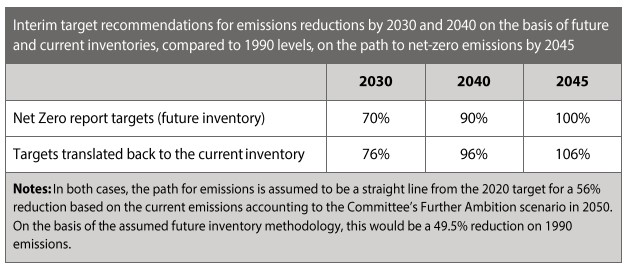
Section 5 of the Bill specifies that targets should be based on “current international reporting practice” and section 15 sets out mechanisms to revise and amend targets when inventory changes occur.
The Committee recognises the need for urgency of action and welcomes the view of the CCC that it is possible to go further and faster in relation to the interim targets and this would make it easier to achieve the net-zero target. However, the Committee notes that the way in which emissions from peatland are calculated is currently being revised by the IPCC, and the methodology for calculating and including these in GHG inventories will change before 2022. The Committee recognises that this will make achieving a net-zero target by 2045 more challenging.
The Committee is aware of an apparent anomaly between the CCC recommendation that the interim targets are based on “future methods of accounting” and section 5 of the Bill specifying that targets should be based on “current international reporting practice”. The Committee questions the compatibility of the CCC recommendation and the Bill as currently drafted. The Committee is also mindful that should section 5 of the Bill be redrafted to refer to current ‘and future’ reporting practice there could be unintended consequences.
The Committee asks the Scottish Government for clarification as to how they intend to respond to the CCC recommendation in relation to the interim targets, following the most recent correspondence, how emissions from peatland are to be accounted for and which inventory their plans will be based on. The Committee also asks for confirmation of the intention of the Scottish Government to bring forward further related amendments in response.
Sector-specific Targets
In its Stage 1 report the Committee recommended that the Scottish Government consider setting sectoral specific targets within the Bill, and consider how target setting, measurement and reporting for specific sectors could be improved. The Committee also heard of the need for clear pathways in order to reach the targets and the challenges for many sectors, including housing, transport and agriculture. This was emphasised in recent evidence alongside the need to take a systems-based approach.
The Committee recognises the need to raise the level of ambition across all sectors and considers there needs to be a clear plan for each sector which addresses the opportunities and challenges and provides a pathway for action. The Committee looks forward to further discussion with the Scottish Government on its approach to the development of sectoral plans.
Governance and Integration
The CCC highlight the importance of effective governance and integration. Their report stresses the need to embed and integrate the challenge across all departments, at all levels of Government and in all major decisions that impact on emissions. The CCC state it must also be integrated with businesses and society and - as many of the solutions cut across systems - fully integrated policy, regulatory design and implementation is crucial. While the CCC recognised that the Scottish Government has a more integrated approach generally, the Chief Executive did not underestimate the overall governance challenges. In its Stage 1 report the Committee recommended that the Government bring forward amendments requiring all relevant Cabinet Secretaries and Ministers to provide a statement in the Scottish Parliament on the contribution of their relevant portfolio area to the emissions target for that year and progress made in the annual monitoring reports on the climate change plans, in June each year.
The Committee welcomes the statementi from the Cabinet Secretary for Environment, Climate Change and Land Reform confirming that the Scottish Government “will be placing climate change at the heart of everything that we do”. The Committee also welcomes the commitments in relation to Programme for Government and the Spending Review.
The Committee recognises the commitment of the Scottish Government in relation to assessment of the climate impact of the budget, underpinned by the 2009 Climate Change Act. The Committee intends to continue to engage with the Scottish Government to ensure that the budget process, Climate Change Plans and monitoring reports are integrated, aligned and reflect all immediate and longer-term impacts.
Following the recent advice of the CCC and the declared climate emergency, the Committee remains convinced that it is vital that Scottish Ministers are required to provide a statement in Parliament on the contribution of each portfolio area to the emissions reduction targets. The Committee would also welcome a commitment from the Scottish Government to a separate statement from each Cabinet Secretary.
Innovation
The Committee emphasised the importance of innovation in its Stage 1 report. The significance of the capacity to innovate and the need for investment in skills in innovation was also reflected in the report of the CCC. The Committee is aware of the need for certainty for business and for an enhanced focus on encouraging and supporting innovation. A culture of innovation across the public and private sectors that accepts an inherent level of risk and takes a positive attitude to funding and incentivising innovation will be vital to meeting the challenges and opportunities of climate change.
Scotland has unique characteristics and great strengths across many sectors, such as renewables, and we should be building on, supporting, and promoting these. The Committee considers there is a strong role for the public sector alongside the private sector in actively supporting innovation and the Committee would welcome further discussion with the Scottish Government on this.
Public education, engagement and behaviour change
In its Stage 1 report the Committee emphasised the need to focus on changing behaviour at an individual, organisational and societal level. This was reflected in the report of the CCC. The Committee also heard of the need to address the barriers preventing change and about the importance of taking an opportunities-based approach to changing behaviours.
The Committee heard compelling evidence of the need for a change in social norms, for positive messaging, framing this in terms of the benefits of action and co-benefits in terms of health, wellbeing, the economy and the environment. The Committee would welcome further information from, and discussion with, the Scottish Government on its plans in relation to public education, engagement and behaviour change, and on its approach to framing and messaging.
Just Transition
The Committee emphasised the importance of a Just Transition and the need for intergenerational justice in its Stage 1 report and welcomed the establishment of the Just Transition Commission. The Committee considers the work of the Just Transition Commission and the Infrastructure Commission to be of great importance to Scotland in meeting the challenges and opportunities of climate change.
The Committee heard that there are a number of challenges in relation to the skills base, manufacturing, supply chains, procurement and management of large contracts that require to be addressed. The Committee would welcome continued discussion with the Scottish Government on its response to the work of the Just Transition Commission and the Infrastructure Commission for Scotland. The Committee will continue to engage with both Commissions as their work develops.
Climate Change Plan
The Committee made a series of recommendations in relation to the Climate Change Plan in its Stage 1 report.
The Committee emphasises the importance of having costed policy measures and plans and the need for integration between the Climate Change Plans and the process of annual budgeting. The Committee will continue to engage with the Scottish Government to seek an outcomes-based approach to budgeting, transparency in presenting the costs and benefits of expenditure, including the climate impacts.
Carbon Credits
In its Stage 1 report the Committee asked the Scottish Government for more detail on the circumstances when carbon credits could be used and the safeguards to ensure that they are not used in response to policy failures. The Committee recommended that agreement on the use of credits should be subject to an enhanced affirmative procedure. In response, the Scottish Government requested clarification as to the additional steps the Committee sought in relation to such regulations.
The Committee considers that any proposal to use carbon credits should be subject to an enhanced affirmative process requiring the Scottish Government to lay a draft instrument in Parliament for consultation for a period of a minimum of 60 days. The Committee considers that any such regulations should also be the subject of an open public consultation. The Committee recommends that the Scottish Government bring forward amendments to this effect.
Additional Issues
In taking evidence at Stage 2 the Committee both heard and raised additional issues that would merit further consideration, such as: how we frame issues in terms of benefits to health, the economy and environment and identify and assess co-benefits; how we deal with the challenge of seeking long term benefits alongside a short term approach to budgeting; how we ensure that investment decisions do not 'lock in' carbon; how consumptions-based emissions are accounted for, and' how the land classification system might better support meeting climate objectives.
The Committee would welcome further discussion with the Scottish Government on these, and other issues, in the process of updating the Climate Change Plan.
Annexe A
Letter from the Cabinet Secretary for Environment, Climate Change and Land Reform to the Convener, 1 April 2019
Climate Change (Emissions Reduction Targets) (Scotland) Bill - Stage 1 Report
I am grateful to the Committee for its scrutiny of the Bill and for its detailed conclusions and recommendations in the Stage 1 Report.
The Scottish Government has responded to each of your recommendations in the Annex to this letter, as fully as possible given the time available. As you are aware, we expect further advice from the Committee on Climate Change on 2 May. As set out in the Annex, I intend to write to you again after receipt of that advice – but prior to the start of Stage 2 - with updated responses on some of these matters.
For clarity, we have referred to your Committee as “the Committee” and to the Committee on Climate Change as “the CCC” in the Annex. The numbered headings in the Annex refer to the paragraph numbers from the Stage 1 report.
Annex to Letter from the Cabinet Secretary for Environment, Climate Change and Land Reform to the Convener, 1 April 2019 - Response to Committee's Recommendations
[Paragraph] 25 The Committee recommends the Climate Change Plans be accompanied by impact assessments for each of the policies and proposals on:
• island communities
• local authorities
• human rights
The impact assessments should also address the impacts on those groups identified in the Paris Agreement (indigenous peoples, local communities, migrants, children, persons with disabilities and people in vulnerable situations).
All Scottish Government policies are subject, where appropriate, to equalities impact assessment (which includes assessments of the impacts on different groups of people), strategic environmental assessment, business and regulatory impact assessment, children's rights and wellbeing impact assessment and socio-economic assessment.
The groups identified above will be considered and, where it is relevant to do so, included in the appropriate impact assessment. For example, the impact on children, people with disabilities and people in vulnerable situations will be taken into account in assessments such as Child Rights and Wellbeing Impact Assessment, Equality Impact Assessment and the Fairer Scotland Duty. Other legislation such as the Islands Act contains a duty to consult island communities before making a change to any policy which is likely to have an effect on an island community that is significantly different from its effect on other communities.
The Scottish Government is of the view that the appropriate and most effective time to consider which impact assessments are necessary and to undertake them, is at the stage of policy development. We do not consider it would be either effective or proportionate to undertake such assessments of all policies and proposals at the time of producing Climate Change Plans.
[Paragraph] 35 The Committee has concerns about the inconsistencies in the way sectors are dealt with. The Committee recommends that the Scottish Government give further consideration to the effectiveness of relying on a partial model (TIMES) that excludes a number of the most significant sectors in terms of ensuring emissions reductions. Failure to include sectors such as agriculture and transport and the financial implications of this is a significant omission.
The Scottish Government notes the Committee’s concerns and is actively exploring ways to increase the consistency of how sectors are dealt with by taking forward work to better incorporate agriculture and transport within the TIMES model.
[Paragraph] 44 While the Committee acknowledges the limits of the TIMES model, it asks the Scottish Government to provide details on the assumptions and a more comprehensive analysis which takes all sectors and activities into account.
The starting point for the TIMES run used to provide cost estimates in the Financial Memorandum was the Climate Change Plan final model run, with updated assumptions on land use, land-use change and forestry (LULUCF) emissions to reflect emerging findings from new sectoral models being developed by the Centre for Hydrology and Ecology. These take into account the expected impact of a fundamental change in the scope of future inventories resulting from adoption of the Wetlands Supplement guidance published by the IPCC. Whilst the underpinning scientific research continues, the Centre for Ecology and Hydrology currently estimate that these changes, which include incorporating new emission factors and categories of peatland condition, are likely to substantially increase emissions from LULUCF in Scotland. By increasing overall emissions, and the scale of abatement required, these revisions also increase the cost of meeting both a 90% and 80% reduction in emissions.
TIMES was not able to find a pathway to a 90% target with the constraints of the Climate Change Plan included. In order for the model to find a solution to achieve a 90% target it was necessary to alter the constraints of the mode. The constraints altered were chosen on the basis that they would allow for a 90% target to be met and a cost to be produced, as required for the Financial Memorandum. They do not represent a change in Scottish Government policy, or a revision to the Climate Change Plan.
The changes to the model were:
We allowed the model to draw on carbon capture and storage technologies post- 2025 (relative to post-2035 in the Climate Change Plan),
We allowed the model to deploy bioenergy with carbon capture and storage (a negative emission technology),
The lower output bound for refineries was revised downwards in the period to 2050 to allow for potentially greater decarbonisation in industry by 2050,
We modified the constraint on exports and imports of electricity to ensure that the system maintained sufficient capacity to continue exporting to the rest of the UK.
The Scottish Government shares the Committee’s ambition to have a comprehensive analysis which takes all sectors and activities into account. This is the subject of ongoing research and evidence development, which will enable us to incrementally build upon and improve our existing modelling capability. As noted in our response to paragraph 35, we are also working to improve the consistency with which sectors are dealt with through TIMES.
[Paragraph] 61 The Committee accepts there can be a degree of uncertainty in long-term forecasting and there are challenges in capturing the effects of innovation. However it considers there is scope for more work on this. The Committee intends to engage in further discussion with the Scottish Government and the Committee on Climate Change to develop a more robust approach to assessing the impacts of mitigating and adapting to climate change. In particular, it would welcome a model that highlights the significant additional and secondary benefits to, among other things, health, industry, and employment. The Committee requests that the result of work commissioned by the Government, from the University of the Strathclyde, is shared with the Committee when available.
The Scottish Government has commissioned the University of Strathclyde to develop an approach to assess the economic impacts of climate change mitigation, by linking the TIMES modelling framework to an economic model . This initial project will be a first step in allowing us to assess the impact on the Scottish economy of our climate change targets. We will share the results of the work with the Committee when it is available.
The Scottish Government would be happy to engage in further discussions with the Committee and the CCC about the potential to further develop the analytical approach to assessing the impacts of mitigating and adapting to climate change, and the additional and secondary benefits to, among other things, health, industry, and employment.
[Paragraph] 67 The Committee recommends the Scottish Government consider how the Explanatory Notes could be improved in future Bills to provide explanation on the effect of a particular section, as well as a technical, legalistic description of its function.
The Scottish Government welcomes this feedback on Explanatory Notes. To allow introduction of a Bill, the Explanatory Notes need to meet Standing Orders requirements that they “summarise objectively what each of the provisions of the Bill does (to the extent that it requires explanation or comment) and give other information necessary or expedient to explain the effect of the Bill” (Rule 9.3.2A). Here the Explanatory Notes needed to provide more by the way of technical explanation, given the content of the Bill and the fact that the Bill is amending the Climate Change (Scotland) Act 2009. The Notes did provide some examples to illustrate the targets and my officials also separately provided the Committee with a Keeling Schedule of the Bill showing the provisions of the Bill within the 2009 Act.
The Committee’s suggestion for greater emphasis on information to explain the effect of the Bill are noted and will be considered in assessing how the preparation of Explanatory Notes could be improved in future Bills.
[Paragraph] 76 The Committee recommends, and intends to request, a deadline for consideration of the Bill at Stage 2, which allows it sufficient time to consider and, if necessary, take further evidence on the advice received from the Committee on Climate Change prior to considering amendments.
The Scottish Government notes the intention of the Committee to take further evidence on the advice received from the CCC. Whilst the Government is keen to progress with this Bill, we are supportive of a responsible approach to legislative planning which considers the capacity of Government and Parliament and enables stakeholders to contribute to parliamentary scrutiny.
[Paragraph] 108 The Committee agrees with the purpose and role of an independent adviser on climate change issues, and understands why the Scottish Government has chosen to frame the Bill around the advice it has received. However, the Committee recommends that if the Scottish Government does not act on the advice of the Committee on Climate Change, it should provide an explanation of the rationale for rejecting that advice, to ensure the process is transparent.
The Scottish Government welcomes the Committee's support for the role of independent expert advice from the CCC within an evidence-based approach to setting targets in the Bill. The Scottish Government has been clear that if the CCC advises on 2 May that higher target ambition is now credible then we will act on that advice. Should it be the case that the CCC advise that the current target levels in the Bill continue to represent the most ambitious credible targets for Scotland, then we will respect this advice. Should it be the case that the CCC advise a lowering of target levels, we will need to consider how to proceed and are content to commit to providing further explanation to Parliament if we decide not to follow such advice.
[Paragraph] 123 The Committee heard of a range of different approaches and mechanisms to account for GHG emissions internationally. The Committee recognises other countries employ different methods to define net-zero and choose to include or exclude certain emissions which makes a direct comparison with the approach taken in Scotland very difficult. The Scottish Government has taken the opportunity presented by the Bill to make accounting and target setting more transparent and accountable. The Committee welcomes this ambitious approach, including issues such as inventory, baselines, annual target years and types of greenhouse gases. The Committee notes this approach, and believes that setting a 90% target, will place Scotland among those at the forefront of global ambition on climate change.
The Scottish Government welcomes the Committee’s recognition that the Bill makes target setting more transparent and accountable and also that a 90% target places Scotland at the forefront of global ambition.
[Paragraph] 131 The Committee agrees with the Cabinet Secretary that we need to be "crystal clear" about the implications of the targets and what they mean "in real life" but recognises that this may only be possible in the shorter-term as greater uncertainty exists in the longer-term. Nevertheless, the Bill and accompanying documents do not provide the necessary clarity to address this. The Committee also agrees with many stakeholders who expressed concern that the Bill and its accompanying documents fail to include specific costed policy measures and asks for an explanation, including costed measures, where possible.
The Scottish Government has been clear that the purpose of the Bill is to raise the ambition of our targets and make improvements to the target and reporting framework. The Scottish Government will continue to be required to set out the policies and proposals for achieving the targets in regular, strategic Climate Change Plans. The current Plan includes ambitious delivery goals such as; 100% of Scotland’s electricity demand to be generated from renewables by 2020 and phasing out the need to buy new petrol and diesel cars and vans by 2032.
[Paragraph] 135 The Committee is of the view that targets for emissions reduction cannot easily be considered in isolation from the measures that would be required to meet them. While including policy measures would undoubtedly result in a lengthier Bill, this should have been an integral part of it. The Committee notes from the IPCC report that the speed and scale of the changes needed in emissions reductions, emissions pathways and changes to social and technical systems has no precedent in human history. The Committee would like to see this reflected in a greater urgency of action across all portfolios and throughout the public and private sectors, to deliver the transformational change that is required.
The Scottish Government notes the Committee’s view that policy measures should have been included in the Bill. However, as stated elsewhere, the Government has been clear that the purpose of the Bill is to raise the ambition of our targets and improve the target and reporting framework. The Bill is not the only means by which the Government has been increasing its action to tackle climate change. The recent Climate Change Plan set out urgent action across all sectors and was described as “an ambitious statement of intent” by the independent CCC. We have also said that we will look again at the current Climate Change Plan following passage of the Bill to ensure it reflects the action needed to meet the targets in the Bill.
[Paragraph] 146 The Committee welcomes the Scottish Government's recognition of the importance of ensuring climate justice. However, the Committee considers climate justice requires further focus to ensure Scotland has the necessary structures in place to engage and support the most vulnerable through the period of transition, as well as a responsibility to developing nations. The Committee recommends the Scottish Government give specific attention to this and identify priorities for early action. The Committee looks forward to further discussion on this with the Scottish Government.
The Scottish Government has been championing climate justice for around a decade. We believe that the concept of climate justice can help build public support for domestic action on climate change.
In 2017-18 the Scottish Government collaborated with Edinburgh University on Climate Justice Begins at Home. This project built in a practical way on the work on co-benefits in the Climate Change Plan, looking at climate-just policy design and implementation across four key mitigation sectors: energy, built environment, transport, and waste. The Climate Change Adaptation Programme’s work on Mapping Flood Disadvantage was also related to climate justice and the new outcomes-based Adaptation Programme which is being developed has one of its seven outcomes based around climate justice.
[Paragraph] 162 The Committee supports the Scottish Government's objective of an inclusive, socially just transition to a low carbon economy. The Committee agrees with the Cabinet Secretary that there are potential opportunities arising from the transition and would like to see Scotland at the forefront of exploring, developing and investing in these opportunities. The Committee believes there is likely to be a role for the Just Transition Commission in looking at the skills required across the economy, and in working with educational institutions to support this. The Committee recommends the Scottish Government report progress on this work to the Committee at the earliest opportunity.
The Scottish Government has established an independent Just Transition Commission with a broad remit and it will need to gather evidence across a wide range of topics. It has already identified skills and education as one of the key topics for consideration. We would expect the Commission to engage with a range of stakeholders to support their work in this area.
The work of the Commission in this area will be able to build on the strong foundations of skills development activity that is already in place - for example Scotland’s Apprenticeship Family, our Flexible Workforce Development Fund, our STEM Strategy, and our leading Higher Education and Further Education sectors.
In addition the Commission will also be able to build on work currently in development regarding our National Retraining Partnership and our Future Skills Action Plan. In particular, the Future Skills Action Plan will establish how the wider Skills System in Scotland should be orientated, so that it can meet the challenges and opportunities of future labour market trends that may disrupt the supply and demand for skills in Scotland’s labour market.
The Commission’s remit requires it to produce a written report within two years of their first meeting, held on 31 January 2019. It is also tasked with working in an open and transparent manner, which means that any relevant interim papers, reports and meeting minutes will be made available in the meantime.
[Paragraph] 174 The Committee recommends that the Scottish Government keep an open mind and, in advance of consideration of the Bill at Stage 2, reflect on the possibility of establishing a Just Transition Commission with statutory underpinning. The Committee would welcome further discussion on this and on the merits, or otherwise, of establishing a Just Transition Commission as an independent Parliamentary commission.
The Scottish Government retains an open mind about the possibility of establishing a Just Transition Commission with statutory underpinning, and following the Parliamentary debate on just transition on 15th January, is giving this further consideration. We will explore options and the merits, or otherwise, of pursuing a statutory route with stakeholders ahead of Stage 2.
[Paragraph] 179 The Committee urges the Scottish Government to continue to place a priority on intergenerational justice and to ensure that the purpose of the Bill is underpinned by this. In advance of Stage 2 the Committee asks the Scottish Government to consider how this can best be reflected on the face of the Bill.
The Scottish Government agrees that intergenerational justice is an important principle in how we tackle climate change. The Environment National Outcome within our National Performance Framework reflects our commitments to environmental justice and preserving planetary resources for future generations.
As set out in our response to paragraph 288, we are working with stakeholders to explore updating the definition of the "fair and safe emissions budget" for Scotland to more directly reflect the Paris Agreement. We would hope that such changes, combined with the world-leading targets, will more clearly reflect our commitment to intergenerational justice through the Bill. We will also continue to work with stakeholders to consider if this can be further reflected in the Bill, for example through further amendments to the target-setting criteria.
[Paragraph] 185 The Committee considers it challenging to set targets in isolation from consideration of implementation. While a review and setting of new targets is welcome, excluding or divorcing this from a full consideration of policy measures is a missed opportunity. The Committee is also aware there has been no review of the other elements of the 2009 Act. The Committee believes that a review of the operation of the 2009 Act should have been undertaken to inform the Bill and recommends that the Scottish Government now undertake this review.
The Scottish Government is of the view that a systematic review of the entire 2009 Act at this time would both duplicate areas of recent and current work and divert resource from priority areas of action.
The Scottish Government keeps the operation of different parts of the 2009 Act under constant review. The present Bill follows review of the target framework elements of the Act (Parts 1 to 3) in light of the Paris Agreement. Other elements of the Act are also currently under review, such as the public bodies reporting duties (set by secondary legislation under Part 4). Major programmes are currently being developed and delivered in other areas, such as climate change adaptation and changes to those parts of the Act would not be appropriate at this time.
[Paragraph] 194 The Committee recommends that the Scottish Government carry out a review of the operation of sections 65 and 67 of the Climate Change (Scotland) Act 2009 and consider how this could be improved across Scotland.
In terms of section 65 of the 2009 Act, this amends the Local Government Finance Act 1992, to require local authorities to establish “energy efficiency discount schemes”.Under section 66 of the 2009 Act, the Scottish Government reports annually to the Parliament on the operation of these discount schemes – including in terms of making an assessment as to whether these “have contributed effectively to promoting energy efficiency”. The seventh annual report was recently laid in the Scottish Parliament (laying number: SG/2019/17). The Scottish Government will carefully consider the Committee’s recommendation that we review of the operation of section 65 of the Act and consider improvements.
In terms of section 67 of the 2009 Act, this provides further specification of the powers conferred by section 153 of the Local Government etc. (Scotland) Act 1994 to prescribe the amount of non-domestic rates due on any lands and heritages. Using these powers, the Scottish Government introduced, from 1 April 2016, a gradated relief for non-domestic properties that are solely concerned with the production of renewable energy and where a community organisation has entitlement to a sum equivalent to — (a) at least 15% of the annual profit of the project; or (b) so much of the annual profit of the project as is attributable to 1 megawatt of the total installed capacity of the project (or more). This covers the generation of renewable heat or power (or both) from a range of sources including photovoltaics, wave/tidal, wind and solar. In addition, the Scottish Government introduced, from 1 April 2018, a new 60% relief for hydro schemes each with rateable value no more than £5 million. Further, it introduced the Business Growth Accelerator relief on 1 April 2018, providing 100% relief for new builds until 12 months after first occupation, and a 12-month delay before rates bills increase following improvements to certain non-domestic properties. These benefit all new-builds, including renewables.
All non-domestic rates reliefs are kept under review on an on-going basis, with consideration given to how they can be improved. The Committee may wish to note that the independent Barclay Review of non-domestic rates called for a review of Plant and Machinery valuations with particular focus on renewable energy sector valuations. The Scottish Government subsequently established a Hydro Review from April 2018, chaired by Professor David Tretton and made up of representatives from the Scottish Assessors Association, Scottish Government, academia and the hydro sector’s nominated representatives. The Report of the Review will be published in due course.
[Paragraph] 204 The Committee welcomes the commitment from the Scottish Government to review the public sector reporting duty and considers this could have usefully informed the development and content of the Bill. The Committee has also agreed to consider the public sector reporting duty following the most recent publications. The Committee would welcome clarification from the Scottish Government on the timescales and remit of its review, including whether results will be available before the end of the parliamentary year in June 2019.
The Scottish Government is currently in the process of reviewing the public sector climate change reporting duties, in collaboration with representatives from the public sector, Sustainable Scotland Network, Adaptation Scotland, ClimateXChange and Stop Climate Chaos Scotland. The review is exploring how well the secondary legislation and the current administrative processes are working. This includes considering what information is currently reported, how it is collated and analysed and how it is used to drive further action. Any recommendations for change will be fully consulted on before a final decision is made. To allow for an appropriate length of time for this consultation, the results will not be available before the end of the parliamentary year.
[Paragraph] 207 The Committee remains concerned that the potential benefits of the Land Use Strategy have not been fully realised and supports a more coordinated approach to land use in Scotland.
The Scottish Government remains committed to the “Land Use Strategy 2016-2021 – Getting the best from our land” and is making progress on key policies and proposals. The Land Use Strategy was published just before the 2016 EU Referendum. The Scottish Government is taking stock of the Strategy’s proposals – including the proposal to further explore the development of Regional Land Use Frameworks for rural areas of Scotland – to identify actions which will best contribute to achieving the Strategy’s vision, in light of the UK Government’s decision to leave the EU. This includes building alignment between the Strategy and wider policy areas to support a more coordinated approach to land use in Scotland - including Scotland’s Forestry Strategy 2019-29 and future policy on Scotland’s rural economy, including farm support, in line with the motion agreed by the Scottish Parliament on 10 January: that we should seek to maintain flourishing communities, enable farmers and crofters to continue to deliver high-quality goods and services through food production and stewardship of the countryside and Scotland’s natural assets, and encourage diverse land use.
[Paragraph] 212 The Committee recommends that the Scottish Government consider the proposals and benefits of including additional types of targets within the Bill in advance of Stage 2.
The Scottish Government believes that the most appropriate place to set out specific delivery targets is in strategic Climate Change Plans. This approach, established in the 2009 Act, allows for these targets to be regularly reviewed and updated as circumstances evolve. It also allows for delivery targets and measures to be considered in the round across sectors, to arrive at the overall package that meets the economy-wide emissions targets in the most beneficial way for the people of Scotland.
We are already making progress across the delivery areas where stakeholder calls for additional targets are mentioned in the Committee’s report. A summary of this progress is set out below.
On energy efficiency, the Scottish Government is taking forward plans to set ambitious and realistic targets for improving the energy efficiency of all Scottish buildings and to tackle fuel poverty.
Through the Energy Efficient Scotland Route Map we have set out a clear framework of standards and by 2040, Energy Efficient Scotland will have transformed our buildings so that they are warmer, greener and more efficient. A consultation will be published in March 2019 which will ask for views on the impact of bringing forward the EPC C target date by 2040 for domestic properties. There are concerns that moving too quickly might lead to additional costs and means we need to import high proportions of skills and materials from outside Scotland rather than develop and grow supply chains here at home.
The Scottish Government will begin work to prepare a suite of legislative action to support the delivery of Energy Efficient Scotland. This will include primary legislation, but given pressures placed on Parliament by EU exit, will also look to use the powers already available under the Climate Change (Scotland) Act and Energy Act. Further details on our intended approach to legislating for Energy Efficiency Scotland will be set out shortly.
The Fuel Poverty (Target, Definition and Strategy)(Scotland) Bill was introduced to Parliament in June 2018. The Bill sets a new target for the reduction of fuel poverty: The Bill sets out the target of reducing the proportion of Scottish households in fuel poverty to no more than 5% by 2040. It also sets out a new definition of fuel poverty: The new definition calculates the proportion of household income required to maintain a satisfactory level of heating and meet the household's other reasonable fuel needs within the home and assesses the extent to which households can then maintain an “acceptable standard of living” once housing and fuel costs are deducted. The Local Government and Communities Committee has published its Stage 1 Report on the Fuel Poverty Bill and we welcomed their view that the 2040 target date for fuel poverty is a pragmatic response to previous attempts to set shorter targets which have ultimately failed.
On nitrogen use in agriculture, nitrogen is a key nutrient in plant growth and ensuring that there is an available supply of it when it is needed by the plant is crucial in our food production sector. However, when applied in an inefficient manner such as in excess or at the wrong times it can serve as a source of pollution - be that through GHG emissions or through negative effects to air and water quality. This is why the Scottish Government has targeted Nitrogen Use Efficiency within the Climate Change Plan. The Scottish Government understands that there is a need to ensure that our crops have access to the nutrients that they need but that this can be achieved in ways that reduce the risk of nitrogen being lost as a pollutant and that encouraging and increasing the uptake of practical Nitrogen Use Efficiency measures on-farm will have a key role to play. In order to achieve this outcome we have already committed to continuing to provide advice, information and technical notes through the likes of the Farm Advisory Service, the Soil Nutrient Network and Farming and Water Scotland and to establishing and publishing first-phase research into the feasibility of a SMART - specific, measurable, achievable, relevant and time bound - target for reducing Scotland’s emissions from nitrogen fertiliser by the end of 2019. This commitment is on track and the tender evaluation process is underway.
On organic land management, the Scottish Government aims to increase demand for organic produce via public sector procurement. From 2012 to 2021, £2.8 million is being invested in the Food For Life programme which helps to increase demand for organic produce through procurement of meals provided by the public sector, e.g. in schools. The Farm Advisory Service is funded to provide advice to organic farmers or those considering a conversion to organic. The advice is aimed at increasing profitability and sustainability of farms and crofts. The Scottish Government has commissioned research to look at factors influencing the uptake of organic production and consumer demand. The research findings will identify gaps and help identify ways that the SG can support the organics industry. The research report is expected to be published shortly. We are working with Scottish Agricultural Organisations Society and the Scottish Organic Forum to drive progress on the Organic Action Plan (which covers the period 2016 to 2020) to support and develop the organics industry.
On renewable energy, meeting Scotland’s existing climate change targets will already require the near complete decarbonisation of our energy system by 2050, with renewable energy meeting a significant share of our needs. Scotland’s Energy Strategy set two ambitious targets: 50% of all energy to come from renewables by 2030, and a 30% increase in productivity of energy use across the Scottish economy by 2030. These targets are compatible with our existing climate change targets and demonstrate our commitment to a low carbon energy system and to the continued growth of the renewable energy sector in Scotland. They also retain flexibility, allowing us to respond to the way in which the energy sector may evolve in the years to come, and pursue all low or zero carbon options.
Because we can’t be certain what our energy system will look like by 2050, our strategy considers two indicative scenarios - one where the energy system is mainly powered by electricity, and the other where hydrogen is dominant. The pace of technological change, and advances in engineering and information technology across the economy and the energy sector during the next three decades, will have a huge bearing on the energy system and the ways in which we interact with it. We will review our existing energy targets upon the passing of the Climate Change Bill, alongside a wider review of targets and policies across each of the key sectors, to ensure consistency.
The Scottish Government’s commitment to phase out the need for new petrol and diesel cars and light vans by 2032 puts Scotland ahead of the UK’s target to end the sale of such vehicles by 2040. The Scottish Government believes that the best way to achieve a smooth and fair transition to ultra-low emission vehicles is through ensuring that they are a practical and attractive option for individuals, businesses and other organisations. To this end, Transport Scotland has been working closely with local authorities, the energy network operators and other partners to ensure access to ULEV, and put in place the infrastructure required to support their use. The 2032 target allows sufficient time to allow for any necessary reinforcements to the energy network to be made in a strategic and efficient way as highlighted in Scotland’s Electricity and Gas Networks Vision to 2030, published in March this year.
[Paragraph] 228 The Committee recognises that the Scottish Government selected the more ambitious of the two options proposed by the Committee on Climate Change, which highlights what will be required from governments around the world to keep temperature rises closer to 1.5°C than 2°C. However, it notes that the Scottish Government is awaiting further advice from the Committee on Climate Change in light of the 2018 IPCC report.
The Scottish Government welcomes the Committee's recognition that we have followed the most ambitious of the CCC's recommended options on targets. This reflects our commitment to always strive for the most ambitious, credible targets. As set out in our response to paragraph 108, we have committed to acting upon any further advice from the CCC on 2 May that even higher target ambition for Scotland is now credible, in light of the IPCC Special Report, more being done at a UK level or other developments since the time of the CCC's 2017 advice.
[Paragraph] 237 The Committee supports the recommendation of the Delegated Powers and Law Reform Committee and recommends that the Scottish Government bring forward an amendment to make it explicit that in preparing regulations to specify the net zero target year, Ministers must have regard to the target setting criteria and whether the position is consistent with the most up-to-date advice from the Committee on Climate Change.
The Scottish Government can confirm it will be bringing forward an amendment to this effect at Stage 2, in line with the recommendations of the Delegated Powers and Law Reform Committee.
[Paragraph] 242 The Committee believes there are a number of ways to understand "net-zero" and numerous similar terms are used inter-changeably. The Committee considers it would be helpful to have clarity as to what the term "net-zero" means within the context of the Bill and recommends the Scottish Government make clear their definition of "net-zero."
Net-zero emissions under the Bill means a 100% reduction from baseline levels in net emissions of all the greenhouse gases. This is directly equivalent to saying that sources of all greenhouse gases must be smaller than the sinks for those gases.
Although the Scottish Government agrees that there are different uses for net-zero emissions colloquially, it considers that the definition given in the Bill is sufficiently clear.
The net-zero emissions target in section 1 of the Bill requires that the net Scottish emissions account is reduced to at least 100% lower than baseline levels. The various elements of this definition are further defined in the 2009 Act. Section 13 of the 2009 Act defines the concept of the net Scottish emissions account - which is the aggregate amount of net Scottish emissions reduced by any credits purchased by Ministers (the Bill sets a default limit of zero on the extent of credit use for all future years, unless Parliament decides otherwise). Section 17 of the 2009 Act defines net Scottish emissions for a period as “the amount of Scottish emissions of that gas for the period reduced by the amount of Scottish removals of that gas for the period.” Sections 10 and 11 of the 2009 Act set out the greenhouse gases included (all seven gases covered by the Kyoto Protocol) and the baselines for each gas respectively.
The Scottish Government has also been clear in distinguishing between net-zero emissions of all greenhouse gases and carbon neutrality. As defined by the IPCC, carbon neutrality refers to net-zero emissions of the gas carbon dioxide specifically. In its 2017 advice, the CCC said that a 90% reduction target for net Scottish emissions of all greenhouse gases in 2050 would also mean that carbon neutrality is reached by that same date. The Bill does not include a statutory target for carbon neutrality, as it retains the 2009 Act approach of only setting targets that are based on reducing emissions of all greenhouse gases.
[Paragraph] 246 The Committee believes that the Bill should be underpinned by the aims of the Paris Agreement and the international framework set out by the IPCC in terms of temperature. Therefore, a greater degree of clarity is needed from the Scottish Government on this issue.
The Scottish Government recognises the Committee's desire for clear links between the Bill and the Paris Agreement as the international legal framework for action on climate change. We entirely support these links, as we have been clear that the Bill represents Scotland's response to the global aims of the Agreement.
The Bill already includes "European and international law and policy relating to climate change (including the United Nations Framework Convention on Climate Change and protocols to that Convention)" as one of the target-setting criteria. Ministers must request the CCC has regard to these criteria when providing advice on targets. Ministers must also themselves have regard to these criteria when proposing changes to targets.
To make the link between the Bill and the Paris Agreement even clearer, we intend to explore bringing forward Stage 2 amendments that directly link the definition of Scotland's “fair and safe emissions budget” for the period 2010 to 2050 to the global temperature aim of the Paris Agreement, which is to "keep the global temperature rise this century to well below 2 degrees Celsius above pre-industrial levels and to pursue efforts to limit the temperature increase even further to 1.5 degrees Celsius.”
Ministers are then required to request the CCC has regard to this when advising on the levels of Scotland’s headline emissions reduction targets (including the date for net-zero emissions) and to have regard to this when proposing any changes to those targets. Elsewhere in this response (see paragraph 520), we have proposed further Stage 2 amendments to ensure that the level of the fair and safe budget is also subject to regular independent review from the CCC.
[Paragraph] 272 The Committee recommends the Bill include an explicit reference to the temperature the targets are seeking to achieve. The Committee recommends this should be 1.5°C, and it should reflect the most ambitious scenario in the forthcoming advice of the Committee on Climate Change (estimated to be in May 2019).
The Scottish Government notes the Committee’s desire for the Bill to reflect a specific global temperature goal. We appreciate that the Committee will be mindful, as we are, of the scientific evidence set out in the recent IPCC Special Report, which makes clear that limiting warming to 1.5 degrees will result in reduced, although still severe, impacts relative to a 2 degrees or higher scenario - especially if overshoot of 1.5 degrees can be avoided.
Tackling climate change and achieving any given global temperature outcome can only be achieved through co-ordinated global effort. In this context, we must note that Scotland accounts for only around 0.1% of global emissions. As such, the Scottish Government remains of the view that the most appropriate approach for individual countries to take in their domestic legislation is to set high ambition targets in an evidence-based manner that reflects international policy frameworks, scientific understanding and other relevant considerations. This is the approach that we have followed in the Bill. In its 2017 advice, the CCC set out the view that a 90% Scottish target for 2050 would be "more in line" with global efforts towards the 1.5, rather than 2, degrees aspects of the Paris Agreements global temperature aim to "keep the global temperature rise this century to well below 2 degrees Celsius above pre-industrial levels and to pursue efforts to limit the temperature increase even further to 1.5 degrees Celsius."
As set out in our response to paragraph 246, in light of the Committee’s recommendations on these matters we will now explore bringing forwards Stage 2 amendments to explicitly link the definition of Scotland's "fair and safe emissions budget" to the wording of the Paris Agreement global temperature aim. We cannot, however, support tying Scotland's domestic targets to a more specific global temperature outcome than what is set out in the Paris Agreement itself. Such an approach would create a clear risk that such targets may then become out of date through factors entirely outside the control of that country, both in terms of the ever evolving scientific evidence base and the levels of action undertaken by other countries. In this context, we are not aware of any country that has specified its domestic emissions reduction targets directly on a 1.5 degrees global temperature goal.
[Paragraph] 273 The Committee also recommends that the Scottish Government commit to a position that seeks to avoid an overshoot scenario.
In terms of the specific question of overshoot of a global temperature aim of 1.5 degrees, we again recognise the clear evidence set out by the IPCC Special Report regarding the importance of avoiding such overshoot if at all possible.
In its 2017 advice, the CCC provided an estimated range of 2050 Scottish emissions reductions (89 - 97%) that would be consistent with a 1.5 degrees global temperature scenario with some degree of overshoot. The CCC also recommended at that time that the highest 2050 target level for Scotland that could be credibly set was 90%. The CCC did not provide an emissions reduction range for achieving 1.5 degrees without any overshoot, but this would necessarily be expected to require deeper reductions than the with overshoot scenario.
As set out in our response to paragraph 108, we welcome the Committee's acknowledgement of the important role for independent expert advice from the CCC in the target setting process. We will, of course, need to wait and see what updated advice on targets the CCC may now provide on 2 May.
[Paragraph] 288 The Committee recognises that Scotland has a larger responsibility for global warming as a developed nation and recommends that the Scottish Government continue to focus its work on how Scotland should account for its fair share globally.
The Scottish Government shares the Committee's recognition that Scotland, as a developed nation with a proud industrial heritage, must undertake its fair share of global efforts to reduce emissions. As set out in our response to paragraph 519, officials are currently engaging with stakeholders to explore updating the definition of Scotland’s "fair and safe emissions budget”, including in terms of linking this more closely to the Paris Agreement.
[Paragraph] 346 The Committee recommends that the Scottish Government and its enterprise agencies place greater emphasis and effort on the development of technology that could assist in reaching our emissions targets and recognises that there is a place for risk taking. The Committee would welcome further early discussion with the Scottish Government on its approach to and support for research and development, innovation and the transfer of knowledge and technology within and across sectors. It would also welcome the Scottish Government's view on the operation of the Climate Challenge Fund and on whether this could benefit from review, particularly examining how solutions identified through the fund can be implemented to scale and in a sustainable way.
The overarching framework for Scottish Government and its enterprise agencies in approaching research, development, innovation and the transfer of knowledge and technology is set out in the Economic Strategy. The Strategy has sustainable economic growth at its core and is clear that investment should be prioritised to both deliver a low-carbon economy, and capture the opportunities offered by that transition. The plan for delivering on the strategy is the Economic Action Plan, and the actions it sets out, being taken forward by the Scottish Government, its enterprise agencies and others, will put Scotland at the forefront of the transition to carbon-neutrality. Our Innovation Action plan, which was published as part of the Enterprise and Skills Review in 2017, sets out four key steps to driving up levels of innovation in Scotland. This includes a commitment to “Support innovation across sectors and places” and highlights work to support energy efficiency and decarbonisation.
By way of example:
- Scottish Enterprise are currently prioritising the following programmes:
Supporting the decarbonisation of the transport sector, with a specific focus on longer duty cycle and heavier commercial vehicles such as buses, ferries, trains and niche council fleet vehicles. Key to this is work on the potential of Hydrogen.
Supporting Carbon Capture, Use and Storage with a focus on industrial decarbonisation of energy intensive industries, such as at Grangemouth, and the repurposing of existing North Sea Basin connected oil and gas assets.
Local Energy Systems - with Scottish Government and a wide range of public sector, Gas and Electricity Networks, academic partners, continuing the development of Local Energy Systems pilot demonstrators – in Island, Rural, Industrial and Urban locations.
- Highlands and Islands Enterprise is committed to advancing technologies that will ultimately lead to emission reductions from the power sector, recognising that the region is exceptionally well placed to support testing and demonstration activity, and that such activity generates economic value, particularly in rural, coastal areas and our islands.
HIE are currently prioritising:
Wave and tidal resources - the world leading European Marine Energy Centre and the unique technology development programme being advanced by HIE’s subsidiary, Wave Energy Scotland.
Offshore Wind currently being built out in the Moray Firth, and further projects in the pipeline. HIE works with the supply chain and organisations such as Offshore Renewable Energy Catapult and Scottish Manufacturing Advisor Service to encourage innovation, technology and productivity improvements, to increase overall competitiveness.
Working with developers, supply chain, academia, government and regulators, HIE seeks to address barriers to renewable deployment, encourage knowledge exchange, and to stimulate business growth in the sector.
Supporting technology development and Scottish propositions in alternative low-carbon solutions and reducing emissions in heat and transport sectors.
The examples given here are illustrative of the range of activity that enterprise agencies have underway to support development of technology that will assist in reaching our emissions targets, but not comprehensive. If the Committee would like a fuller overview of how Scottish Government and its enterprise agencies support research and development, innovation and the transfer of knowledge, that could be provided at a later date.
We are currently reviewing the Climate Challenge Fund to consider whether it can better support Scottish communities in taking action against climate change and as part of that will consider how solutions identified through the fund could be implemented to scale and in a sustainable way.
[Paragraph] 359 The Committee welcomes the recent shift in the UK Government's position on carbon capture and storage (CCS) and recommends that the Scottish Government continue to work with its UK and international counterparts on the development of CCS technology. Both Governments should utilise all levers at their disposal domestically to evaluate the merits of CCS and consider the merits of early development and implementation of this technology.
To advance Carbon Capture Utilisation and Storage (CCUS) in Scotland, the Scottish Government has:
Established the CCUS Leadership Group new forums to help us work with industry and academia to advance and track progress on CCUS
Supported the ACORN CCS project proposed in St. Fergus with £275k in 2018.
Provided funding to SCCS (a collaboration of Scottish Universities working on CCUS).
In addition, the Scottish Government is a member of the Global CCS Institute and officials continue to work closely with the UK Government to progress their CCUS Deployment Pathway published November 2018.
[Paragraph] 405 The Committee recommends that the Scottish Government give urgent consideration to the agricultural sector. The Scottish Government should take a holistic approach to emissions accounting, recognising the activities across the sector that play a positive role in reducing emissions, such as afforestation and peatland restoration, and highlighting the opportunities that can arise by developing new rural support mechanisms that encourage this. Emphasis should be placed on support, encouragement, and knowledge transfer in order to avoid the need for punitive mandatory action. The Committee intends to engage in early discussions with the Scottish Government and the sector to address this.
The Scottish Government wants Scotland to tackle climate change and be a world-class producer of high quality food – and to produce it sustainably, profitably and efficiently. We acknowledge that lasting change will only happen with the involvement of primary food producers. That is why we are exploring the potential for reducing emissions in agriculture with both the industry and our renowned scientific community. We want to find solutions that are beneficial for the environment, Scotland’s farmers and our wider food and drink industry.
As such, we continue to deliver on the commitments made within the agricultural chapter of the Climate Change Plan, including the establishment of the Industry led Agri-tech and the recruitment of our young farmer climate change champions. We are also on track to deliver on a further two Programme for Government and Climate Change Plan commitments. Namely the renewal of our flagship Farming For a Better Climate programme and we are currently in the process of tender evaluation for our first phase research of nitrogen accounting models as we look at the potential feasibility of a SMART target for improved nitrogen use efficacy. We continue to work closely with stakeholders, other government departments and our world renowned scientific community as we work towards achieving a transition to a sustainable low carbon farming future.
In terms of how emissions from agriculture are accounted for, both the 2009 Act and now the Bill are based on the principle that statutory emissions accounting should be in line with international carbon reporting practice - as determined through UNFCCC processes and IPCC guidelines. We would not want Scotland to deviate from this approach and also note the Committee's recommendations elsewhere in its report that Climate Change Plan chapter structures should be more closely tied to these international norms (see paragraph 652).
That said, we also agree with the Committee that it is important that farmers and land managers receive due recognition for their efforts to reduce emissions in the round and that that these efforts extend, within the context of the IPCC emissions classification scheme, to sectors other than "agriculture" - such as forestry and renewable energy. It is for this reason that the Scottish Government already reports on emissions figures, through the annual Official Statistics bulletins, on an "agriculture and related land-use" basis, as well as on the IPCC sectoral classification. Due to the resolution of the data used to construct the GHG inventory, it is not possible to undertake any further, even more detailed, separation of afforestation/peatland activities on agricultural land. We are also not aware of any efforts within formal reporting processes, in IPCC or other international fora, to achieve such a distinction.
Given these limitations and noting the clear interests of Committee and stakeholders in this area, Scottish Government analysts are currently exploring potential alternative methods to provide further, indicative, estimates of emissions from a "wider agricultural sector" - using auxiliary data sources beyond the GHG inventory. We will report back to the Committee on potential approaches to such reporting and the likely accuracy of these estimates as soon as this work has sufficiently progressed.
However, we would need to stress that:
By definition, any alternative estimates would not be compliant with IPCC guidance and could not be formally incorporated into either the Official Statistics bulletins or the statutory emissions accounting framework for targets; and
Releasing alternative definitions of agricultural emissions carries the potential for confusion in the interpretation.
We would welcome the opportunity for further discussion with the Committee and consideration of next steps in due course.
[Paragraph] 406 The Committee recommends that the Scottish Government account for the full extent of emissions reductions across the agricultural sector in the reports published each year under section 16 and 17. Doing so will actively demonstrate the full role of, and positively engage with, the sector in in taking action to tackle climate change. This should include the wide range of land management contributions made by the agricultural sector.
As set out in the response to paragraph 405, the Scottish Government already reports additional figures on the "agriculture and related land-use" basis as part of the annual Official Statistics. This will continue. We have also committed to engaging with the Committee on developing further, additional, reporting using auxiliary data outwith the GHG inventory. However, the Scottish Government is of the view that the evidence base around such estimates remains at a very immature stage and further exploration with the Committee and stakeholders, and development of data, is needed prior to establishing additional statutory reporting practices. The reporting duties in the Bill (new section 34) allow for any additional relevant information to be included in the annual statutory reports, should this become appropriate in the future.
[Paragraph] 435 The Committee recommends the Scottish Government consider how it can present the economic opportunities of transitioning to a low carbon economy in a more positive light. The Committee recognises the need to accelerate the pace of work in this area and the need for a clear focus. The Committee would welcome early discussion with the Scottish Government on the priorities for action.
The Scottish Government is clear that by being at the forefront of the global shift to carbon-neutrality Scotland can benefit economically from the worldwide market for low carbon goods and services. Our action to tackle climate change to date has resulted in new jobs and innovative new industries. This has occurred mostly with the provision of renewables and low carbon electricity, but there is significant economic turnover for some other sectors too, including provision of energy efficiency products and low carbon services. Beyond the opportunities presented by renewable technology, smaller businesses across Scotland will also benefit from engaging in climate change mitigation through energy efficiency and low carbon heat and by promoting sustainable practices.
The Scottish Government agrees that it is important to present the economic opportunities in a positive light, but also that it is important to be honest about the challenges. Scottish Ministers have established the Just Transition Commission to advise on maximising the economic and social opportunities that the move to a carbon-neutral economy by 2050 offers, and build on Scotland’s existing strengths and assets, as well as understand and mitigate risks that could arise in relation to regional cohesion, equalities, poverty (including fuel poverty), and a sustainable and inclusive labour market. We would be happy to discuss other priorities for action with the Committee.
[Paragraph] 436 The Committee recommends the Scottish Government commission work to assess and evaluate the economic opportunities, or otherwise, to Scotland of setting a net-zero target and how these could potentially be embedded in the work of enterprise agencies and the Scottish National Investment Bank.
As set out in the Scottish National Investment Bank Implementation Plan, the Bank will follow a mission-orientated approach to investment. To inform thinking on possible missions the Scottish Government has commissioned work to assess the current low carbon investment landscape in Scotland with the aim of identifying future funding interventions for the Scottish National Investment Bank. The report of that work, along with ongoing dialogue with stakeholders, will inform missions for the Bank and thus the Bank’s investment strategy.
In light of the Committee’s recommendation, the Scottish Government will explore with enterprise agencies and the Scottish National Investment Bank whether commissioning further work would be beneficial at this time, or the near future.
[Paragraph] 437 The Scottish Government should provide formal guidance on how it will further promote and enable a low emissions economy, as well as the criteria it sets for investment in low carbon emissions initiatives.
The Scottish Government will take this forward in conjunction with any further work commissioned to assess and evaluate the economic opportunities, or otherwise, of a net-zero target. This thinking will inform any guidance provided to enterprise agencies and the Scottish National Investment Bank.
The Cabinet Secretary for Finance, Economy and Fair Work has explained to Parliament how the Scottish National Investment Bank will promote the low emissions economy. In debate on 15 January the Cabinet Secretary said:
“The Bank will provide patient, mission-based finance, which will help to create and shape future markets and help Scotland to achieve its full economic potential. A transition to a carbon-neutral economy will be a central mission for the bank; the bank will have a role to play in Scotland’s transition to a carbon-neutral economy. I have committed to providing £2 billion over 10 years to capitalise the bank initially. That will make a material difference to the supply of capital to the Scottish economy, by levering in additional private investment, supporting ambitious firms to flourish and enabling the transformational change that is needed to achieve carbon neutrality”
[Paragraph] 452 The Committee accepts that a net-zero target is a clearer message to understand than 90% and would send a strong signal, emphasising the need for significant change.
The Scottish Government shares the Committee's recognition of the important signalling function that clear headline targets provide. However, we also remain committed to an evidence-based approach to target-setting and are mindful that 90% and net-zero (100%) targets will carry very different on-the-ground implications.
As set out in our response to paragraph 108, if the CCC advises that higher target ambition is now credible then we will act on that advice. This includes the setting of a target date for net-zero emissions - if the CCC advise that such a date can now credibly be set, we will do that through Stage 2 amendments to the Bill.
[Paragraph] 458 The Committee recommends that the Scottish Government give further consideration to how the Bill and accompanying documents could be amended to clarify the temperature limit the Bill contributing to.
As set out in our response to paragraph 246, we will explore bringing forward Stage 2 amendments to make a direct link between Scotland's fair and safe emissions budget and the global temperature aim set out in the Paris Agreement. The accompanying documents for the Bill will be updated accordingly.
[Paragraph] 459 The Committee believes that significant developments have taken place since the Committee on Climate Change first produced advice for the Government 18 months ago and notes that the content of the Bill may require reconsideration following receipt of the anticipated updated advice.
The Scottish Government is in full agreement with this point. Shortly after the IPCC Special Report was published last Autumn, we joined with the UK and Welsh Governments to commission further advice from the CCC on targets. As set out in our response to paragraph 108, if the CCC advise that higher target ambition is now credible for Scotland, in light of the IPCC report, more being done at the UK level or other recent developments, then we will act on that advice.
[Paragraph] 483 In light of the IPCC report, which calls for "rapid, far-reaching and unprecedented changes in all aspects of society" in the next 12 years and the recent request for updated advice from the CCC, the Committee recommends that the Scottish Government should also request updated advice from the CCC on whether the 2030 target is appropriate.
The Scottish Government has already requested this advice, through the commission we issued to the CCC in October 2018.
Following some confusion amongst stakeholders and Green Party members as to what the UK Government elements of the joint commission meant for advice on interim Scottish targets (including that for 2030), I wrote to the Chair of the CCC on 24 October 2018 to further clarify the position on this. That letter states: "The Bill provides interim targets for 2020, 2030 and 2040, and a target for 2050, all based on the Committee’s March 2017 recommendations on a high ambition Scottish response to the aims of the Paris Agreement. As you know, the UK Government’s carbon budgets are not directly linked to Scotland’s statutory target framework. For the avoidance of doubt, the UK Government’s request that the 3rd, 4th and 5th UK Carbon Budgets are not within scope of your advice should not therefore prevent you from advising on all of Scotland’s targets."
A copy of this letter was laid in the Parliament on 25 October (laying number: SG/2018/228), at which time it was also flagged to the attention of the Committee and SPICe. The letter has also subsequently been published on the Parliament’s website. Nonetheless, we are happy to provide renewed reassurance to the Committee on this matter at the present time.
As set out in our response to paragraph 108, the Scottish Government has been clear that that if the CCC advises on 2 May that higher target ambition is now credible then we will act on that advice. This commitment includes the target for 2030 and even that for 2020.
[Paragraph] 491 The Committee recommends the Scottish Government give further consideration to setting sectoral specific targets within the Bill and respond to the Committee ahead of Stage 2 with clarification as to how target setting, measurement and reporting for specific sectors could be improved. The Committee would welcome further discussion with the Scottish Government on this and the potential implications of setting legislative targets for each sector. The Committee may wish to take further evidence on this, following receipt of the updated advice from the CCC.
The Scottish Government will give further consideration to this important matter and provide an updated response to the Committee once the CCC's advice is available, but prior to the start of Stage 2.
Our current view remains that the existing framework of economy-wide emissions reduction targets is working well and that this provides the necessary flexibility to respond to changing circumstances. As noted by the Committee at paragraph 490 of its report, the Bill has already added a sector by sector approach to monitoring delivery of Climate Change Plans.
We also note that sectoral targets would necessarily pose challenges in terms of how effort and emissions reductions is classified between sectors. Many measures cut across sectors. For example, energy efficiency measures will contribute to reducing emissions from energy supply, residential and public sector buildings. As a further example that is raised specifically by the present report, we note that the Committee has called (see paragraph 652) for future Climate Change Plan chapters to be based directly on the IPCC emissions classification. This would then mean that sectoral targets for the agriculture sector would be defined solely on the basis of direct food production activity, with the wider efforts made by farmers and land managers around agroforestry and renewable energy being reflected under the targets for the land-use and energy sectors. There are multiple interconnections between sectors and we would be concerned that sector targets could make these substantially more difficult to factor in, to the potential detriment of overall success. What is most important is that all of Scotland pulls together to tackle this crucial global issue, so we must avoid anything that could pit sectors against each other.
A further technical consideration is that data revisions can have a disproportionate effect on specific sectors, particularly in land-use and forestry. Sectoral emission targets would be highly uncertain.
[Paragraph] 503 The Committee understands the desire to maintain flexibility to modify target levels in both directions should there be a change in the science but considers there should be a presumption against lowering targets. The Committee is not persuaded that the safeguards in the Bill as currently drafted are adequate.
The Scottish Government considers that the Bill already includes a strong presumption against any lowering of target levels (or moving backwards of a net-zero target date), by requiring that this can only ever be proposed by Ministers in the case that the CCC has first recommended that such a change should occur. The decision whether to make such a change then rests with Parliament. This approach has been explored with environmental NGO stakeholders who were content with it.
Nonetheless, to provide additional assurance to the Committee on this important matter we would be content to explore bringing forward amendments that further limit the power to modify target levels / dates to the effect that Ministers could only ever propose any lowering / bringing forward in the case that the CCC has recommended that such a change should occur with specific reference to two of the target-setting criteria, namely: "scientific knowledge about climate change" and/or "international carbon reporting practice."
[Paragraph] 504 The Committee recommends the Scottish Government give further consideration to the drafting of the Bill in advance of Stage 2 to ensure it reflects a presumption against lowering of targets and provides only for modifications based on changes in the science rather than as a result of a failure of policy effort.
The Scottish Government hopes that the amendments we have committed to exploring through our response to paragraph 503 will provide the assurances sought by the Committee.
[Paragraph] 513 The Committee welcomes the addition of the new criterion, incorporating the United Nations Framework Convention on Climate Change, and recommends that the Scottish Government conduct considered analysis of its target setting criteria, assessing whether these need updated in light of changes in emissions since the passage of the Climate Change (Scotland) Act 2009.
The Scottish Government would like to assure the Committee that it did carefully consider the target-setting criteria during the development of the Bill, including through the technical discussion group with stakeholders. At the time of introduction, the Government felt that on balance that, with the exception of making specific and explicit reference to the UNFCCC, the list of criteria from the 2009 Act remained appropriate and did not require further amendment. We acknowledge the subsequent recommendations from the Committee, and further representations from stakeholders, on other specific changes. As is set out in our responses to paragraphs 288, 519 and 525 we will explore bringing forward amendments at Stage 2 to update the definition of the fair and safe emissions budget and add public health considerations to the list of criteria. We will also continue to consider other potential changes in the run up to Stage 2.
[Paragraph] 519 The Committee welcomes the Cabinet Secretary's openness to discussion on the definition of fair and safe and recommends the Scottish Government explore a revised definition with stakeholders ahead of Stage 2.
Scottish Government officials are exploring this matter with stakeholders, including in terms of how the definition might be more directly linked to the Paris Agreement. As set out in our response in paragraph 246, we have already identified the potential to bring forward Stage 2 amendments that directly link the definition to the global temperature aim of the Paris Agreement.
[Paragraph] 520 The Committee also recommends the Scottish Government clarify whether and when the calculation of what is fair and safe will be revised.
The Scottish Government accepts the desire for greater clarity on when and how the level of the fair and safe budget will be updated. As defined in the 2009 Act, the level of the budget is determined directly by independent expert advice from the CCC. We will explore bring forward amendments at Stage 2 to ensure that Ministers must seek regular advice from the CCC on the appropriate level of the budget, as part of the (at most) 5 yearly cycle of advice on other target matters (new section 2C of the Bill).
[Paragraph] 525 The Committee recommends the Scottish Government consider the proposals of stakeholders on the target setting criteria, particularly with regard to incorporating a public health benefit aspect, in advance of Stage 2.
As noted above, a range of potential additions to the target-setting criteria were carefully considered ahead of introduction. The Scottish Government’s view at that time was that public health considerations were arguably covered by the social circumstances criteria. However, we note the further representations from stakeholders and the Committee’s recommendation on this matter. We will now explore bringing forward an amendment at Stage 2 to add public health considerations explicitly to the list of criteria.
[Paragraph] 536 The Committee recommends the Bill be amended to include a definition of 'achievable' in relation to setting targets.
The Scottish Government considers that the term "achievable" does not require further definition, as it is used in the particular context of seeking independent expert advice with regards to a range of specified criteria. In particular, the CCC are requested to make their independent expert assessment on the achievability of net-zero emissions with regards to the list of statutory target-setting criteria.
[Paragraph] 539 The Committee notes that advice from the CCC has not always been published on the date of receipt, however, the Committee welcomes confirmation from the Scottish Government that CCC advice could be published on the date of receipt. The Committee considers this should be the expected practice.
The 2009 Act and now the Bill requires that advice from the CCC is published as soon as reasonably practicable. This arrangement reflects the fact that publication on the day of receipt might not always be possible due to holidays / etc. In the case of the upcoming advice on targets, which was commissioned jointly by the Scottish, Welsh and UK Governments, we are happy to commit to publishing this on same day as we receive it from the CCC - provided that this is a working day. The CCC has indicated that it expects to provide this advice on 2 May, which is a Thursday.
[Paragraph] 542 The Committee recommends the Scottish Government give further consideration to the list of sectors included in section 6 to determine what additional sectors should be included on the face of the Bill and to ensure that these align with the Climate Change Plan and annual reports. The Committee also recommends the Scottish Government consider the need to include provision to add to the list by regulation.
The Scottish Government does not wish to be overly prescriptive in terms of how its requests that the CCC presents its independent advice. However, we also recognise the Committee's desire for consistency between such advice and the structures of Climate Change Plan and associated monitoring reports. In our response to paragraph 652, we have indicated that we will explore bringing forward amendments to add a definite list of sectoral chapter headings to the Climate Change Plan duty (section 35A). To meet the Committee's present recommendation, we will further explore bringing forward further amendments linking the requests for CCC advice on the balance of sectoral contributions (section 6) to the list of sectoral chapter headings.
[Paragraph] 548 The Committee recommends section 8 be amended to include a mechanism providing clarity to Parliament and stakeholders on the Scottish Government's response to the advice of the CCC, whether setting a net-zero target year or modifying a target.
The Scottish Government wishes to clarify that the 12 month timeframe (in section 8 of the Bill) for Ministers to make a statement to Parliament should they not act upon any advice from the CCC recommending changes to target levels/dates is intended to reflect the time it would take for not just for initial internal policy consideration, but also potential public and stakeholder consultation on responding to such advice. We would expect that future Ministers would set out their initial response well within that timeframe - for example through a set of consultation proposals.
In this context, we understand the Committee's present recommendation as reflecting a desire for an additional mechanism to ensure that Ministers provide clarity on their intentions upon receipt of such advice well within that 12 month timeframe. We will explore bringing forward amendments adding a further duty to section 8 to the effect that, within three months of receiving advice from the CCC that target levels/dates should be changed, Ministers must publish a written statement setting out their initial response to this advice and their proposed next steps.
[Paragraph] 556 The Committee welcomes the Scottish Government's commitment to continued annual targets and reporting on those targets.
The Scottish Government welcomes the Committee’s support for these measures. We also note that Scotland remains the only country in the world to have set statutory annual emissions reduction targets.
[Paragraph] 561 The Committee recommends that the Scottish Government continue to consider how it can make target setting more transparent.
As recognised in paragraph 123 of the Committee’s report, the “Scottish Government has taken the opportunity presented by the Bill to make accounting and target setting more transparent and accountable.” The Scottish Government assures the Committee that it will continue to consider further measures to make target-setting even more transparent, wherever possible.
[Paragraph] 569 The Committee recommends that, in light of the 2018 IPCC report, the Scottish Government should consider the need for more action in the near-term. As noted in an earlier recommendation, the Scottish Government should request updated advice from the CCC on whether the 2030 target is appropriate.
The Scottish Government recognises the urgency of the call to action from the IPCC’s Special Report. As set out in our response to paragraph 483, we have already requested advice from the CCC on the level of the 2030 target (and all other future targets, including that for 2020). The CCC will provide advice on this target, in light of the IPCC Special Report, as part of its 2 May report. If they advise that a higher targets are now credible, then we will act on that advice. In the meanwhile, we continue to note that the Bill target for 2030 – of a 66% reduction in emissions - represents the most ambitious statutory target of any country in the world for that year. In terms of a corresponding review of delivery action, we have committed to looking again at the current Climate Change Plan – which covers the period to 2032 - once the Bill has been finalised.
[Paragraph] 588 Ahead of Stage 2, the Committee asks the Scottish Government to provide further detail on the circumstances under which the Scottish Government considers carbon credits could be used and the necessary safeguards to ensure they are not used in response to policy failures. The Committee considers agreement on the use of carbon credits should be subject to an enhanced affirmative procedure and recommends the Scottish Government bring forward amendments to this effect at Stage 2.
The Scottish Government has been clear that it has no intention to make use of international carbon credits for the purpose of meeting domestic climate targets. This commitment is set out in the Climate Change Plan and is further reflected in the Bill provisions which establish a default limit of zero on the use of credits towards all targets to 2050.
As the Committee notes, the statutory possibility of using credits in the future has been retained, subject to Parliament deciding that the zero limit should temporarily be lifted (but only up to a strict absolute upper limit – see paragraph 598). This approach is consistent with advice from the CCC in 2017 that a limited flexibility of this type should be retained. In that advice, the CCC particularly identify the possibility of unexpected changes in industrial output leading to a situation where offset credits might need to be considered in order to maintain competitiveness whilst still meeting climate obligations.
In terms of the Committee’s recommendation regarding procedural arrangements for any regulations proposing a change from the default limit of zero, we note that the affirmative procedure already means that any decisions will be made by Parliament Nonetheless, we would be happy to explore with the Committee at Stage 2 what particular additional formal or informal procedural steps it would consider to be appropriate around such regulations.
[Paragraph] 591 The Committee considers transparency in accounting for emissions to be vitally important and supports the move from tonnage to percentage reporting. The Committee would welcome clarification from the Scottish Government on the impact of discounting the EU ETS in meeting the targets. The Committee is also keen to ensure that there will be no reduction in domestic effort as a result of this. The Committee seeks assurance from the Scottish Government that accounting will be transparent and domestic effort will not be reduced.
The change to actual, rather than EU ETS adjusted, emissions accounting in the Bill is purely to improve transparency around measuring and reporting progress to climate targets. The change means that emissions from all sectors will be reported based on their actual levels in Scotland, rather than their average levels across the EU. The change will not affect, in any way, the on-the-ground operation of the EU ETS in Scotland. The reductions in actual Scottish emissions delivered as a result of the operation of the ETS will continue to be counted in progress towards targets.
The change to this more transparent system of emissions accounting is in line with CCC advice and was supported by the overwhelming majority of consultation respondents. The levels of the targets in the Bill match those advised by the CCC as a high ambition response to the Paris Agreement, based on the shift to actual emissions accounting. These targets do not reflect any reduction in domestic effort from the adjusted emissions accounting targets under the 2009 Act.
[Paragraph] 592 The Committee recently considered EU exit legislation relating to the EU ETS and asks the Scottish Government to provide an update on the plan to replace the EU ETS following the UK's exit from the EU and the practical implications of this.
The Scottish Government continues to impress on the UK Government that it considers that remaining part of the EU ETS provides in the most cost effective route to decarbonisation and whilst supporting industry. However in the event that the UK cannot continue in the EU ETS following the UK’s exit from the EU, the Scottish Government continues to engage with the UK Government on developing long term alternatives.
The UK Minister of State Claire Perry announced in her evidence to the House of Lords Select Committee on the EU on 27 February that a consultation on the long term alternatives would be published shortly (around April). She confirmed that the UK Government’s preferred option was to create a UK ETS linked to the EU ETS, in line with the Political Declaration with the EU, which will be the focus of the consultation. It will also set out fall-back options in case a link cannot be agreed to link a UK ETS to the EU ETS by the end of the Implementation Period in 2020.
[Paragraph] 598 Ahead of Stage 2, the Committee would welcome further detail on the justification for setting the limit of 20% of emissions which can be accounted for using carbon credits.
The 20% year on year level for the maximum possible use of international credits towards meeting domestic targets was preserved from the level of the Domestic Effort Target in section 8 of the 2009 Act. The choice of 20% for the limit in the 2009 Act arose through a Labour Party amendment to that Bill. Under the Bill, the default limit on the use of credits is set to zero, unless Parliament decides to temporarily increase this. Even if such a decision is made, the new temporary limit must be no greater than 20% of the year on year change in emissions. These provisions ensure that the future use of credits can never be greater than would have been allowed under the arrangements of the 2009 Act. Also, to be clear, the upper limit is 20% of the year on year change in emissions - which is a much stricter limit than 20% of the total emissions for that year.
[Paragraph] 615 The Committee recommends that the Scottish Government explain the approach used to determine the target outcome and explain why the methodology to determine the target outcome is different from the method specified by the Committee on Climate Change, if that is the case.
The Scottish Government intends to follow, exactly, the method used to determine the target outcome set out by the CCC in its December 2017 advice on this matter.
Section 16 of the Bill requires that the calculation method used for this purpose must, “in so far as reasonably practicable”, follows those set out by the CCC. We can appreciate that the inclusion of this clause may have caused the Committee some concern. However, this was intended as a standard failsafe, to guard against the unlikely scenario that it might become temporarily technically impossible to meet the reporting requirement - for example if the CCC were to advise a change to an updated calculation method that requires the use of data that does not yet exist.
If the Committee wishes such reassurance, we would be content to bring forward Stage 2 amendments that remove the "in so far as reasonably practicable" clause. This will then have the effect of requiring that the methods used to determine the target outcome must exactly follow those set out by the CCC.
The details of the CCC's method for undertaking the calculation are set out in its December 2017 advice. Annual statutory (section 16/17) reports on target outcomes under the Bill will include the full workings of this calculation as applied to the present years emissions data.
In the meanwhile, illustrative worked examples of the CCC’s calculation method are provided below. Officials would be happy to talk this through with the Committee Clerks and/or SPICe researchers.
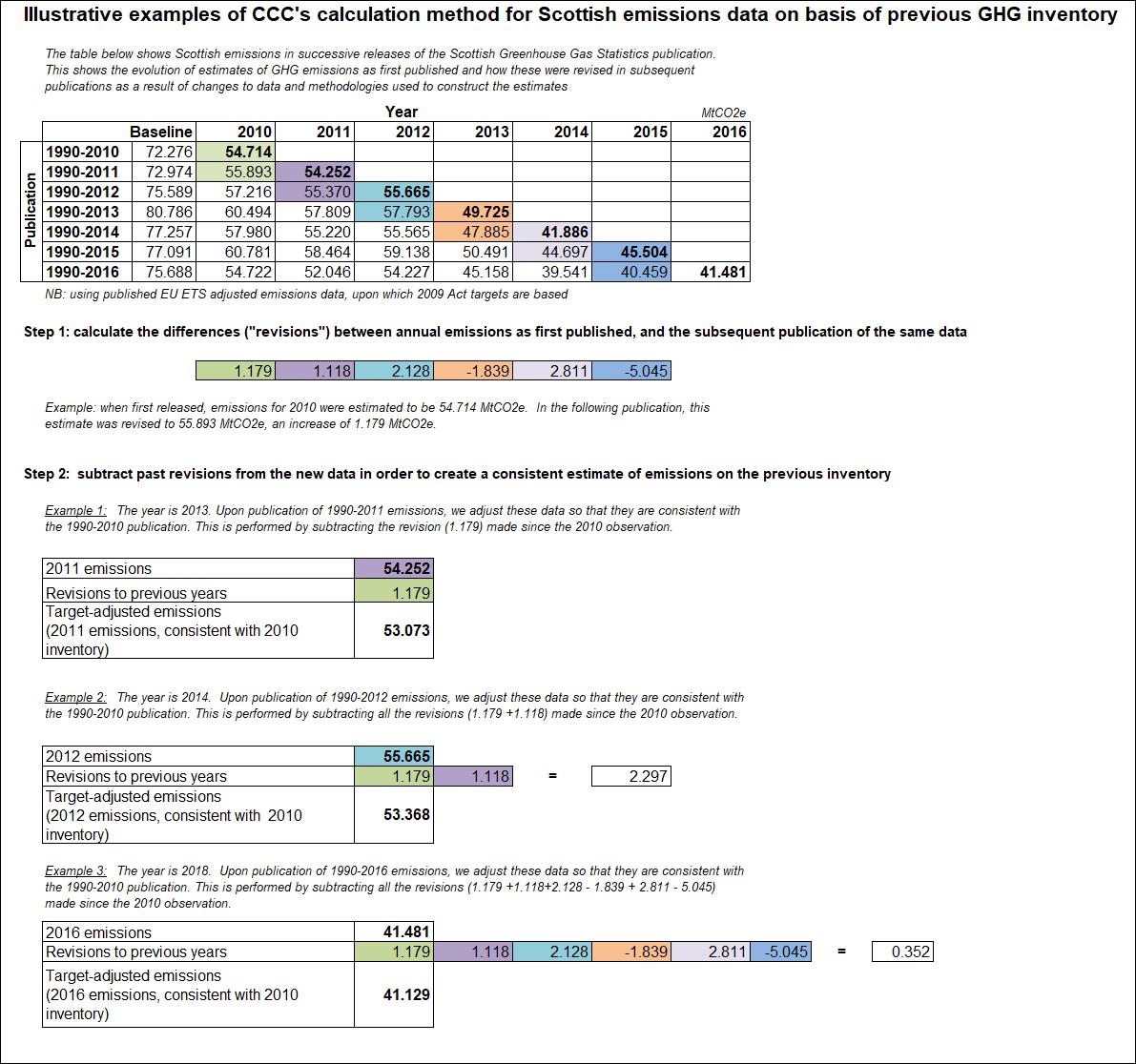 Annex to letter from the Cabinet Secretary for Environment, Climate Change and Land Reform to the Convener, 1 April 2019 - Response to Committee's Recommendations
[Paragraph] 627 The Committee considers the reports under section 16 and 17 of the Bill be published no later than June in each year to allow Parliament, Committees and stakeholders time to consider these ahead of the summer recess. The Committee considers a minimum of 28 days prior to summer recess is required. The Committee recommends the Scottish Government brings forward amendments to this effect at Stage 2.
The Scottish Government can understand the Committee's desire for such a timing requirement. We would like to be able to make this commitment, but it is not possible to do so as the timing of the Official Statistics bulletins which will comprise the content of the section 16/17 reports is outside of our control.
The Code of Practice for Official Statistics compels the release of official statistics as soon as they are judged ready (pillar T3, principle T3.5). The GHG inventory for Scotland and the other devolved administrations (the main data-source used in this release) is compiled from the final UK GHG inventory and requires substantial additional processing, estimation and quality assurance prior to release. In practice, this has entailed that the earliest release date we have been able to adhere to is the first or second week in June. It is also the case that the release of the Scottish data is synchronised with the release of data for the other devolved administrations; in effect we are unable to make a unilateral decision around the publication date for this information.
The current Bill provisions will ensure that the annual statutory reports on targets, which will be based directly on the Official Statistics bulletins, are laid as soon as reasonably practicable after this information is available. Given the timing constraints on the Official Statistics themselves (as set out above), the only way in which a guaranteed "pre June" date for the statutory report could be secured would be to move the entire reporting timetable back a full year from current arrangements. For example, Official Statistics for emissions during 2018 would be published in mid-June 2020 and then the statutory report for the 2018 target would be laid in (e.g.) late May 2021. Such an approach would clearly be contrary to the existing changes in the Bill to bring forward annual reporting on targets from October to June, which was welcomed by the Committee at paragraph 630 of the report and which has also been widely welcomed by stakeholders.
[Paragraph] 630 The Committee welcomes measures which allow the reports to be published in June and acknowledges reporting on electricity related measures will be reported on elsewhere.
The Scottish Government welcomes this comment.
[Paragraph] 636 The Committee recommends the Scottish Government bring forward amendments at Stage 2 to include a requirement for all relevant Cabinet Secretaries and Ministers to provide a statement in the Scottish Parliament on the contribution of their relevant portfolio area to the emissions target for that year and progress made in the annual monitoring reports on the climate change plans, in June each year.
The Scottish Government will consider this important recommendation and provide an update response in advance of Stage 2. It is noted that the Bill already requires the separate laying of sector by sector monitoring reports on the delivery of the Climate Change Plan, which will provide a clear prompt for lead subject Committees to decide whether to seek evidence from relevant Cabinet Secretaries and Ministers on these matters should they wish to do so.
There may be a legislative competence issue with singling out individual Cabinet Secretaries and Ministers in the way proposed by the Committee. Section 52 of the Scotland Act 1998 provides that statutory functions may be conferred on the Scottish Ministers by that name, that those functions are exercisable by any member of the Scottish Government, and that the Scottish Ministers have collective responsibility for those functions. Paragraph 4 of schedule 4 of that Act provides that an Act of the Scottish Parliament cannot modify, among other provisions, section 52.
[Paragraph] 638 The Committee recommends that the Scottish Government reflects on the proposals for inclusion of additional reporting requirements in advance of Stage 2.
The Scottish Government will continue reflect on all suggestions for additional and improved reporting in advance of Stage 2. We also note that the Bill already entails a substantial net increase in statutory reporting on climate change matters from the 2009 Act, especially in relation to the new reporting in relation to monitoring of sectoral delivery of Climate Change Plans.
[Paragraph] 646 The Committee recommends that the Bill be amended at Stage 2 to require all relevant documents relating to the Climate Change Plan be published at the same time as the plan itself.
The Scottish Government agrees that documents that are directly related to the Climate Change Plan e.g. technical annexes, should be published at the same time as the Plan itself. The Scottish Government will explore whether it is possible to require such publication arrangements through amendments for the Bill.
[Paragraph] 652 The Committee recommends the Bill be amended at Stage 2 to include a list of the chapters which, as a minimum, will appear in Climate Change Plans and the annual monitoring reports. These should be consistent with the UNFCCC guidelines, to include: Energy; Industrial processes and product use; Agriculture; Land use, land-use change and forestry; Waste; and Others (if applicable) and should be consistent with the areas on which the Scottish Government has sought advice from the Committee on Climate Change. Flexibility to add additional chapters should be retained, but a comprehensive set of chapter headers should be specified in legislation.
The Scottish Government accepts the Committee's request for a comprehensive set of Climate Change Plan (and monitoring report) chapter headings to be set in legislation and that these be aligned to internationally recognised emissions classifications. We will explore bringing forward Stage 2 amendments to this effect.
In terms of which classification scheme is used, we would propose to base this on the National Communications submitted biennially to the UNFCCC – with the following sectors defined in legislation:
Energy Supply
Transport (including international aviation and shipping)
Industrial Processes and Business
Residential and public (buildings)
Land use change
Waste management
Agriculture
An alternative classification scheme, which appears to be the specific suggestion of the Committee in its recommendation, would be to use the IPCC Common Reporting Format (CRF) classification scheme. We would note that under this scheme the “Energy" heading covers a very wide range of processes - including all of the emissions from energy supply, transport and buildings, as well as some agricultural processes (such as fuel use). As such, this one category would account for a very large portion of Scotland’s overall emissions. We would be very happy to engage further with the Committee on the choices of classification scheme in advance of Stage 2.
Given that all international classifications schemes may continue to evolve in the future, we also propose a power to amend this list through affirmative procedure secondary legislation - subject to the updates remaining aligned to international carbon reporting practice. As set out in our response to paragraph 542, we also propose to link the requested content of CCC advice (section 6 of the Bill) to the list of Climate Change Plan (and monitoring report) chapters set out through these amendments.
Finally, we do note that there is a potential tension between the Committee's recommendations regarding "holistic" reporting of agricultural emissions (paragraph 405, 406) and those here to use UNFCCC emissions classifications for Climate Change Plan chapter structures, as the latter draws the definition of the agriculture sector "narrowly" (especially so if the IPCC CRF were to be used rather than the National Communication format). We have interpreted these two recommendations as collectively implying a desire from the Committee for the statutory target framework to be closely linked to international carbon reporting practice, but to also explore the potential for additional reporting on particular issues such as emissions from the “wider agricultural" sector.
[Paragraph] 653 The Committee also recommends a chapter on just transition progress be included in the Climate Change Plan and the annual monitoring reports.
Future Climate Change Plans and future monitoring reports will certainly make reference to our ambition to ensure “just transition” principles are applied in Scotland. Given the complex, cross-cutting nature of the subject, putting in place appropriate methods to measure “just transition” progress is not straightforward.
The Scottish Government will continue to consider how it would be appropriate to measure progress in this area and, consequently, how best to report this. These considerations may be informed by the work of the Just Transition Commission as it progresses. However, it should be noted that the Commission is independent and is working to report to ministers against the agreed remit, within two years.
[Paragraph] 656 The Committee recommends the Scottish Government bring forward amendments to section 19 to require each Climate Change Plan to include an economic analysis of the estimated costs and benefits to be delivered by the plan. This should specify the detail of the costs to be incurred by the Scottish Government and the public sector for each policy and proposal and provide an indication of the estimated costs to the private sector. This analysis should be updated in the annual monitoring reports.
The Scottish Government will consider this important recommendation and provide an updated response in advance of Stage 2.
[Paragraph] 658 The Committee would welcome further discussion with the Scottish Government on adaptation and recommends that the Scottish Government consider incorporating adaptation planning into the climate change plans to provide a comprehensive overview of Scotland's approach to tackling both prevention and adaptation.
The Scottish Government welcomes the Committee’s interest in climate change adaptation and looks forward to discussing this with them further. Our Programme for Government 2018 committed to a new five-year cross-government Climate Change Adaptation Programme by the end of 2019 to ensure Scotland’s communities, economy and natural environment are resilient to climate change.
Following on from digital engagement and informal stakeholder workshops, the public consultation on the new Adaptation Programme closes on 9 April.
In terms of linkages with mitigation, the new outcomes-based Adaptation Programme will draw on policies from the Climate Change Plan – for example forestry, peatland restoration and built environment. We do increasingly look for areas of synergy between mitigation and adaptation. Once the new Adaptation Programme is completed we will be able to look at how much overlap there may be with the Climate Change Plan.
[Paragraph] 676 The Committee has reflected on the issue of timescales for consideration of the climate change plans. The Committee considers neither the Parliament or the Scottish Government should be constrained in the time available to scrutinise and finalise the plan. The Committee recommends the Scottish Government bring forward an amendment at Stage 2 to remove the restriction on the period available for parliamentary scrutiny.
The Scottish Government recognises that the current parliamentary scrutiny timescales have caused issues for Committees. Officials have considered various options with the technical discussion group, following on from the views expressed the public consultation and by the Parliamentary committees involved in scrutinising Plans. As set out to the Committee during the evidence sessions, the Scottish Government is concerned about an open-ended process, given the overall statutory timescale requirements for producing Plans. We have also taken on board concerns from stakeholders that an open-ended timescale could result in the Plan development process carrying on open-endedly, thereby delaying its implementation.
The Scottish Government’s view at the time of introduction was that an increase in the scrutiny period to 90 days was a good balance between current requirements and the desire for a more open-ended arrangements. However, given the views expressed by the Committee in its report, we will now consider bringing forward an amendment to further extend this period to 120 days. We remain concerned at the prospect of an open-ended scrutiny period, particularly given the views expressed by stakeholders.
[Paragraph] 677 The Committee considered the merits of including a publication date in statute. On balance the Committee recognises the need for flexibility and recommends Ministers notify Parliament of the publication date of the draft climate change plan at the earliest opportunity to ensure parliamentary committees have sufficient time to plan for consideration of the plan. The Committee would welcome early discussion on this with the Scottish Government and other parliamentary committees to ensure this is effective in practice.
The Scottish Government welcomes the Committee recognition for the need for flexibility in the dates for publishing future draft Climate Change Plans, which is something that was considered at length during the development of the Bill. We note Committee’s wish to have as much notice of publication dates as possible to allow for sufficient time to plan its subsequent scrutiny. The Scottish Government will endeavour to give as much notice as possible.
[Paragraph] 689 The Committee recommends the most recent climate change plan (RPP3) be updated in light of the commitments made in the Bill if approved by Parliament and that this should take place within 6 months of Royal Assent.
The Scottish Government has already committed to looking again at the current Climate Change Plan once the Bill is finalised. The question of the most appropriate timeframe for undertaking this update is a very important one, which requires careful consideration, including in light of the CCC's updated advice on target levels. We will provide an updated response on this important matter in advance of Stage 2.
We do, however, note that - as with all strategic planning exercises - there will inevitably have to be trade-offs between the rapidity of the exercise and the nature of what can be delivered. In particular, a very rapid update will necessarily limit the potential for stakeholder and public engagement.
[Paragraph] 690 The Committee recommends a copy of this report be laid in the Scottish Parliament and signals its intent to scrutinise the updated version.
The Scottish Government will consider this recommendation and provide an update in advance of Stage 2, alongside our response to paragraph 689.
[Paragraph] 691 The Committee recommends the updated version of the report must increase or retain the carbon envelopes for each sector, but it should not reduce the effort required by any sector. Further consideration should be given to proposals included in the 2017 draft climate change plan which were not adopted in the final version.
The Scottish Government will consider this recommendation and provide an update in advance of Stage 2, alongside our response to paragraph 689. In the meanwhile, we also refer the Committee to our response to paragraph 739 on related matters.
[Paragraph] 692 The Committee recommends that the Bill includes the dates of publications of subsequent climate change plans (as covered by section nineteen Climate Change Plan, parliamentary scrutiny of the draft Plans, date of publication of draft plans of this report) and these should align with the Paris stock takes, starting in 2024, the year after the first Paris stock take.
The Scottish notes the Committee’s recommendation for a programme of fixed dates for future Climate Change Plans to be set in statute. We are considering this carefully and will provide an updated response in advance of Stage 2. The approach taken in the Bill, which was discussed with stakeholders through the Bill Technical Discussion Group, of allowing each future Plan to be brought forward at any point within 5 years of the previous one, was intended to provide flexibility given the potential for unexpected changes in the Paris Agreement stocktake timetables and/or other relevant considerations (e.g. parliamentary session dates).
[Paragraph] 695 The Committee recommends that the Scottish Government consider the amount of evidence it has received on policies and proposals which stakeholders believe will contribute to meeting more ambitious climate change targets in updating the current climate change plan.
The Scottish Government will always consider the full range of evidence available, including suggestions from stakeholders, when developing Climate Change Plans. We can certainly also commit to this being the case with the forthcoming update to the current Plan. As in our response to paragraph 689, we do, however, note that - as with all strategic planning exercises - there will inevitably have to be trade-offs between the rapidity of the exercise and the nature of what can be delivered. In particular, a very rapid update will necessarily limit the breadth of evidence that can be considered.
[Paragraph] 713 The Committee recommends the Scottish Government prioritise the issue of behaviour change within the next climate change plan and consider how it can promote and incentivise transformational change, in order to reduce the need for mandatory measures. The Committee looks forward to further discussion with the Scottish Government on this.
The Scottish Government recognises that behaviour change is critical to achieving the scale and pace required to meet our climate change targets and continue progressing us towards a carbon-neutral society. We welcome further discussion with the committee on this topic.
We are committed to understanding more about the mechanisms behind behavioural change and are already actively incorporating behavioural thinking into our policy-making at all levels.
In 2018, in line with the Climate Change (Scotland) Act 2009, we reviewed the Low Carbon Scotland Behaviours Framework, our current public engagement strategy. We concluded that the public engagement strategy should be revised, with a view to publishing once the Climate Change Bill is adopted.
[Paragraph] 720 Small changes and individual changes can have a significant impact when they are scaled-up. The Committee recommends that the Scottish Government engages in wide discussion with stakeholders and sectors across Scotland on the need for transformational change and how wide-scale behavioural change could be achieved. The Committee looks forward to further discussion with the Scottish Government on this.
The Scottish Government reiterates that significant behaviour change is required at all levels. Individual changes can have a significant impact and to realise this we need to ensure that everyone in Scotland is informed and able to continue to participate in our transition to a carbon-neutral society. We welcome any further discussion with the committee on our approach to individual behaviours.
As set out in our response to paragraph 713, we are currently revising our public engagement strategy to ensure our approach to behaviour change is commensurate with the ambitions agreed by Parliament through this legislative process. This will involve working closely with stakeholders and the people of Scotland, across sectors, to develop a strategy that incorporates the need for a step change in how we engage on the public on climate change.
[Paragraph] 734 The Committee is concerned that the proposed publication schedule does not enable the monitoring reports to be considered during the pre-budget scrutiny period. The Committee recommends the Bill be amended to ensure that the reports be published a minimum of 28 days before the summer recess each year, and looks forward to further discussion with the Scottish Government on the effective consideration of the monitoring reports and the budget.
The Scottish Government accepts this recommendation and looks forward to further discussion on the effective consideration of the monitoring and the budget.
[Paragraph] 737 In advance of Stage 2 the Committee further requests detail on the remit and external membership of the governance body; its role in the production of the monitoring reports and; its role in addressing issues raised in the monitoring reports.
In light of recommendations made by the Committee about the content and timing of monitoring reports, the timing and process arrangements for updating the current Climate Change Plan and production of future Plans, the Scottish Government is considering whether "A Governance Body" as described in the Climate Change Plan is the right approach, or whether a more flexible set of Governance arrangements would be preferable that can better respond to the Parliament's evolving approach to scrutinising Government action. We will provide an update to the Committee in due course.
[Paragraph] 739 The Committee is concerned to ensure that sectoral ambition does not decrease between final and draft plans and seeks a commitment from the Scottish Government on this.
The Scottish Government can commit that we would only decrease the ambition of any sectoral envelope between draft and final Plans in the case that the evidence or circumstance in relation to a sectors envelope has substantially changed. However, in order for the process for developing Plans to remain evidence based, it is vital that the possibility of rebalancing envelopes in both directions when the evidence changes is retained.
For example, in the case of the current Climate Change Plan, the level of ambition on renewable heat was reduced between the draft and final versions following advice from the CCC that the envelope in the draft Plan was not credible based on the available evidence. This example also illustrates a potential tension between this recommendation from the Committee and those it has made regarding the role of CCC advice in preparing Plans (see paragraph 746). If all of these recommendations were to be accepted, and the CCC were to again advise that sectoral ambition from a draft Plans should be decreased, then future Governments would be placed in a position where they would be simultaneously; a) committed to not following this advice (through a committed to Parliament under this recommendation), and b) required by law to explain to Parliament why they were not following this advice (through the amendments made in response recommendation 746).
The Scottish Government is of the view that the Bill – especially with the additional assurances regarding the role for CCC advice set out in our responses to paragraphs 746 and 747 - contains sufficient safeguards to ensure that any rebalancing of sectoral envelopes between draft and final Plans would be carefully scrutinised.
[Paragraph] 746 The Committee recommends that the Scottish Government consult the CCC on revised versions of the Climate Change Plans. If the Scottish Government elects to reject the advice of the CCC, it must provide an explanation of the rationale for rejecting that advice, publish the advice it is relying on to bring clarity and transparency to the process and conduct a public consultation on the advice it is relying on. It recommends that the Scottish Government bring forward amendments to this effect at section 35A (in section 19) during Stage 2.
The CCC already sets out its views on Climate Change Plans, through its annual progress reports.
The Scottish Government notes the Committee’s recommendations around the role of the CCC in the Climate Change Plan process. We will consider these carefully and provide an updated response in advance of Stage 2.
[Paragraph] 747 The Committee also recommends that the Scottish Government bring forward amendments at Stage 2 to require Ministers to consult the CCC on the final climate change plan, prior to publication.
The Scottish Government notes the Committee’s further recommendation around the role of the CCC in the process for finalising Climate Change Plans. We will consider this carefully, alongside the recommendations made in paragraph 746, and provide an updated response in advance of Stage 2.
Annexe B
Letter from the Cabinet Secretary for the Environment, Climate Change and Land Reform to the Convener, 2 May 2019
Climate Change (Emissions Reduction Targets) (Scotland) Bill - Response to CCC Advice
As the Committee is aware, the Scottish Government’s policy is to always strive for the most ambitious, credible and responsible climate targets. The UK Committee on Climate Change (CCC) has today published its advice on Scottish, Welsh and UK targets in light of the Paris Agreement and the IPCC Special Report. The CCC recommends that Scotland should now set a target for net-zero emissions of all greenhouse gases by 2045, provided that UK-wide ambition is raised to net-zero by 2050.
The Scottish Government has responded to this advice by sending for lodging a package of government amendments to the Climate Change Bill. These would, if agreed by the Committee at Stage 2, implement the CCC’s advice by setting a target date of 2045 for net-zero emissions of all greenhouse gases and increasing the levels of the 2030 and 2040 targets to 70% and 90% reductions respectively. These proposals represent the most stretching climate targets anywhere in the world. The amendments also cover a range of consequential and associated changes, further information on which is set out in Annex A.
The CCC’s report states that the Scottish target recommendations “are contingent on the UK adopting a net-zero GHG target for 2050, given the importance of reserved UK policy levers alongside devolved action”. As such, we have proposed these targets in good faith that the UK Government will also act swiftly upon the CCC’s advice by updating the targets in the 2008 UK Act and strengthen its commitment to delivering the required emissions reductions through domestic action. In this regard, I continue to note with concern that the UK Government’s own projections show it to be off track from meeting its existing carbon budgets for the 2020s and 2030s, which are aligned to its current 2050 target of an 80% reduction. I have written today to the UK Government to request an urgent meeting to agree a collaborative approach to achieving the targets recommended by the CCC. A copy of this letter is attached as Annex B.
In its Stage 1 report, the Committee called upon the Scottish Government to act in line with the highest credible target ambition recommended by the CCC. This is exactly the approach we have taken and it is my hope that the Parliament can now find a strong cross-party consensus around such targets through the remainder of the Bill process.
I look forwards to discussing these matters further with the Committee during the Stage 2 sessions.
Annex A - further information on package of amendments
In addition to the main changes proposed to headline targets in line with the CCC’s advice, the package of amendments we have sent for lodging makes a range of consequential and associated changes.
A number of the amendments are to ensure the 2050 target is removed from the Bill and the 2009 Act, as this would now fall after the net-zero emissions target date of 2045. Others adjust the annual targets to take account of the net-zero emissions target year.
The amendments also propose to retain and further tighten the current Bill limitations around any future modification of the net-zero emissions target year and/or interim target levels. We have included these changes now, as bringing such amendments forward later would require adjustment of the key amendments on the headline targets.
These proposed changes, which are in line with commitments made in our response to the Committee’s Stage 1 Report, are as follows;
The Bill already means that Ministers can only propose, through secondary legislation, any moving backwards of the net-zero emissions target year / lowering of interim target levels if the CCC has advised this. The amendments further limit this power to situations where the CCC has advised such modifications with specific reference to changes in scientific knowledge about climate change and/or international carbon reporting practice.
Upon receipt of CCC advice saying that the net-zero emissions target year / interim target levels should be modified (in either direction), Ministers must publish a statement setting out how they intend to respond within 3 months.
Subject to the usual administrative scrutiny of proposed amendments, I expect our package of amendments to appear in today’s Daily List and tomorrow’s Business Bulletin. My officials would be happy to share draft text of the package of amendments with you during the course of today, if you require any more detail before they appear in the Daily List.
Annex B - letter to UK Minister of State for Energy and Clean Growth
Cabinet Secretary for Environment, Climate Change and Land Reform
Roseanna Cunningham MSP
Claire Perry MP
Minister of State at the Department for Business, Energy and Industrial Strategy
This morning I have responded immediately to the UK Committee on Climate Change’s advice by lodging amendments to the Climate Change (Emissions Reduction Targets) (Scotland) Bill. The amendments will mean greenhouse gas emissions in Scotland must reduce reach net-zero by 2045.
You will have noted however that the CCC say that achieving this is “contingent on the UK adopting a net-zero GHG target for 2050, given the importance of reserved UK policy levers alongside devolved action”. I invite the UK Government to act immediately and legislate for a net-zero GHG target for 2050 at the latest, and to make progress on a specific list of reserved policies, on issues referred to by the CCC, appended to this letter.
For obvious reasons I think an urgent meeting between the two of us is needed so we can agree how to collaborate and end our countries’ contribution to climate change as soon possible. I would be happy to travel to London for this meeting and I would appreciate a response as soon as possible.
Roseanna Cunningham
cc.
Secretary of State for Environment, Food and Rural Affairs, UK Government
Secretary of State for Foreign and Commonwealth Affairs, UK Government
Secretary of State for Transport, UK Government
Secretary of State for Scotland, UK Government
Minister for Environment, Energy and Rural Affairs, Welsh Government
Appendix
I invite the UK Government to act immediately and legislate for a net-zero GHG target for 2050 at the latest, and:
Accelerate deployment of fully operational carbon capture utilisation and storage facilities.
Accelerate action to decarbonise the gas grid, and consider the balance of taxes across different heating fuels to enable affordable low-carbon heating in homes and businesses across Scotland.
Re-design vehicle and tax incentives to support industry and business investment in zero emission and sustainable transport choices.
Commit to adhering to future EU emission standards regardless of our position in relation to the EU.
Reduce VAT on energy efficiency improvements in homes.
Ensure continued support for the renewables industry.
Annexe C
Letter from the Cabinet Secretary for the Environment, Climate Change and Land Reform to the Convener, 15 May 2019
Climate Change (Emissions Reduction Targets) (Scotland) Bill - Response to Stage 1 Report.
The Scottish Government issued its initial response to the Committee’s Stage 1 report on the Bill on the 1 April. This addressed most of the Committee’s recommendations in full but included holding responses on some points, given the time available prior to the Stage 1 debate.
On 2 May I updated the Committee on the Scottish Government’s response to the UK Committee on Climate Change (CCC)’s advice on targets, including in terms of amendments to the Bill. The Committee has recommended that “the Bill should reflect the most ambitious targets set out in the forthcoming advice by the CCC” and the Scottish Government has done exactly that.
The present letter provides full responses to the outstanding recommendations from the Committee’s Stage 1 report, grouped into themes of; Climate Change Plans (Annex A), Just Transition Commission (Annex B) and sector specific targets and reporting (Annex C). As with our initial response, the numbered headings in these Annexes refer to the paragraph numbers from the Stage 1 report.
I would also like to use this opportunity to update the Committee on certain other aspects of the Scottish Governments approach to amendments to the Bill at Stage 2 (Annex D), request clarification from the Committee on two aspects of its Stage 1 report (Annex E) and make a correction to our 1 April letter (Annex F).
Annex A - Response to Committee's Recommendations on Climate Change Plans
[Paragraph] 689 The Committee recommends the most recent climate change plan (RPP3) be updated in light of the commitments made in the Bill if approved by Parliament and that this should take place within 6 months of Royal Assent.
The Scottish Government’s high ambition on climate targets will continue to be matched by a credible package of on-the-ground delivery measures. We have previously committed to looking again at the current Climate Change Plan once the Bill has completed its passage through Parliament. As the First Minister announced at FMQs on 2 May, the Scottish Government will publish an update to the current Plan within 6 months of Royal Assent of the Bill.
The updated Plan will reflect the targets agreed by Parliament through the Bill. We will look across our whole range of responsibilities to make sure we continue with the policies that are under way and increase action where that is necessary. In the summer we will engage the public, communities, businesses, industry, and the public sector about what more everyone in Scotland can do.
The CCC has been clear in its recent advice that the delivery of net-zero emissions in Scotland also depends on increased UK-wide action across policy areas that remain reserved. As the Committee is aware, I have written to the UK Government requesting an urgent meeting and a collaborative approach to implementing the CCC’s advice. A response is still awaited.
[Paragraph] 690 The Committee recommends a copy of this report be laid in the Scottish Parliament and signals its intent to scrutinise the updated version.
As recommended by the Committee, our updated Plan will be laid in Parliament.
[Paragraph] 691 The Committee recommends the updated version of the report must increase or retain the carbon envelopes for each sector, but it should not reduce the effort required by any sector. Further consideration should be given to proposals included in the 2017 draft climate change plan which were not adopted in the final version.
The Scottish Government can commit that we would only decrease the ambition of any sectoral envelope as part of our proposals for updating the current Plan should it be the case that the evidence or circumstance in relation to a sectors envelope has substantially changed.
However, we are not able to give an absolute commitment that there are no circumstances in which the effort of a sector would not be reduced, as this would mark a fundamental departure from an evidence-based approach. Our 1 April response on recommendation paragraph 739, in relation to the envelopes for future Plans, set out considerations around these matters in detail, including practical examples of where such changes have needed to be made in the past.
The Chair of the IPCC, Dr. Hoesung Lee has recently said that he is “impressed with the Scottish Government’s Climate Change Plan and pleased to see it was based on science”. We would not want to compromise the evidence-based approach to climate change planning.
[Paragraph] 692 The Committee recommends that the Bill includes the dates of publications of subsequent climate change plans (as covered by section nineteen Climate Change Plan, parliamentary scrutiny of the draft Plans, date of publication of draft plans of this report) and these should align with the Paris stock takes, starting in 2024, the year after the first Paris stock take.
The Scottish Government agrees with the Committee that it is important that the key 5-yearly cycles under the Bill – of target review and then Climate Change Plan development - are aligned as effectively as possible to the 5-yearly Paris Agreement stock-take processes of international ambition and progress.
The approach taken in the Bill to the timings of future Plans, which was discussed with stakeholders through the Technical Discussion Group, is to allow each future Plan to be brought forward at any point within 5 years of the previous one. This is intended to ensure frequency and also provide a limited degree of flexibility, given the potential for unexpected changes in external timing considerations – for example the session dates of the Scottish Parliament, or even the Paris Agreement stocktake timetables themselves.
The Scottish Government would be concerned that setting a fixed sequence of dates for future Plans in legislation now could prove overly prescriptive, especially given the long time-horizons involved, in the face of the inherent uncertainties around key external timing considerations.
We are of the view that the approach taken in the Bill as stands will allow for appropriate alignment of Plan timing with Paris Agreement processes. In particular, it is noted that if the Bill achieves commencement by the end of 2019, then the next full Plan will be required at the latest by end 2024, which would align with the first specific year proposed by the Committee.
[Paragraph] 656 The Committee recommends the Scottish Government bring forward amendments to section 19 to require each Climate Change Plan to include an economic analysis of the estimated costs and benefits to be delivered by the plan. This should specify the detail of the costs to be incurred by the Scottish Government and the public sector for each policy and proposal and provide an indication of the estimated costs to the private sector. This analysis should be updated in the annual monitoring reports.
The Scottish Government recognises the Committee’s desire to have more information on costs and benefits included within Climate Change Plans. In response to this recommendation, we will explore bringing forward Stage 2 amendments to require that future Plans include estimates of the costs and benefits to be delivered by each of the policies set out therein.
The extent to which meaningful estimates of costs and benefits can be provided will necessarily vary between the policies and proposals elements of each Plan. A policy is a committed course of action. A proposal is a suggested course of action or exploratory action, the details of which might change as this course of action is explored further. Whilst it may be possible in some instances to provide semi-quantitative estimates of costs and/or qualitative estimates of benefits for certain proposals, these could not be as consistent or as detailed as those for policies. As such, the amendments we will explore will look to require additional reporting around the costs and benefits for the policy, but not proposal, elements of Plans.
The impacts on businesses of all Scottish Government policies are already assessed, where appropriate, through the Business and Regulatory Impact Assessment process.
The Scottish Government would be concerned that requiring the annual updating of the estimates of cost and benefit would be neither proportionate nor consistent with the wider purpose of the Plan monitoring reports. We note that a new Plan is required at least every 5 years and consider that this represents an appropriate frequency for undertaking such analysis.
[Paragraph] 746 The Committee recommends that the Scottish Government consult the CCC on revised versions of the Climate Change Plans. If the Scottish Government elects to reject the advice of the CCC, it must provide an explanation of the rationale for rejecting that advice, publish the advice it is relying on to bring clarity and transparency to the process and conduct a public consultation on the advice it is relying on. It recommends that the Scottish Government bring forward amendments to this effect at section 35A (in section 19) during Stage 2.
The CCC already sets out its views on Climate Change Plans, through its annual progress reports. In response to the Committee’s recommendation, the Scottish Government will explore bringing forward Stage 2 amendments to ensure that Ministers are required to request (under section 9 of the 2009 Act) such assessments be provided for each draft Plan. We will also explore amending the Climate Change Plan duty itself (new section 35A) to require that Governments must set out, alongside the final version of each Plan, how they have taken into account the CCC's recommendations on the draft version.
The amendments we have proposed above will make the CCC’s role in the Plan process clearer and more transparent. We cannot, however, accept the specific aspects of the Committee’s current recommendation in relation to other potential sources of advice. We have concerns with such changes in terms of their implications for free and frank advice within Government, questions of proportionality and also, more generally, the relative roles of the CCC, Governments and Parliaments. Climate Change Plans are major strategic policy documents and the design of policy pathways that are best for the people of Scotland is a key task for Scottish Ministers. In preparing Plans, Ministers will certainly listen to the expert advice of the CCC, but also to stakeholders, businesses and the public. The 2009 Act framework reflects this, in that the policy content of Plans is ultimately a matter for Governments to propose, the Scottish Parliament to scrutinise and then for Governments to finalise. That framework has proven successful in delivering decarbonisation outcomes in Scotland and we would not wish to jeopardise it.
[Paragraph] 747 The Committee also recommends that the Scottish Government bring forward amendments at Stage 2 to require Ministers to consult the CCC on the final climate change plan, prior to publication.
The Scottish Government has, through our response to paragraph 746, committed to exploring amendments that will ensure the CCC is requested to make an assessment of the draft Plan and that Ministers will be required to set out how this has been taken into account alongside the final Plan. It is unclear how a further, prepublication, assessment by the CCC of the final Plan would then add value to the overall process. In particular, we would be concerned that; a) it would be unclear how such a round of assessment would relate to that just undertaken of the draft Plan, and b) that such a process would raise questions of transparency given that the final Plan itself would, by definition, not be in the public domain at the time it was assessed by the CCC.
Annex B - Response to Committee's Recommendations on Just Transition Commission
[Paragraph] 174 The Committee recommends that the Scottish Government keep an open mind and, in advance of consideration of the Bill at Stage 2, reflect on the possibility of establishing a Just Transition Commission with statutory underpinning. The Committee would welcome further discussion on this and on the merits, or otherwise, of establishing a Just Transition Commission as an independent Parliamentary commission.
As set out in our 1 April response and during the parliamentary debate on Just Transition earlier in the year, the Scottish Government has been giving careful consideration, including through engagement with stakeholders, on the possibility of a statutory Just Transition Commission.
Having carefully considered it, we remain unclear why a statutory basis is needed. We remain open to further discussion with the Committee on these matters, but would wish to be convinced of the positive case before bringing forward additional amendments.
The Scottish Government recognises and agrees with the desire expressed by stakeholders and the Committee to see the importance of a just transition approach clearly reflected on the face of the Bill. We therefore intend to bring forward amendments for Stage 2 that will place the principles of just transition as a key part of the Bill, as matters to which Ministers must have regard when preparing their policies and proposals for draft Climate Change Plans. We consider the Climate Change Plan duty the appropriate place to locate the principles, as they should inform the on-the-ground manner of the transition. Each draft Plan will be required to set out how the principles have been taken account of, which we hope will also serve to further strengthen our previous response to recommendation paragraph 653.
Annex C - Response to Committee's Recommendations on Sector Specific Targets and Reporting
[Paragraph] 491 The Committee recommends the Scottish Government give further consideration to setting sectoral specific targets within the Bill and respond to the Committee ahead of Stage 2 with clarification as to how target setting, measurement and reporting for specific sectors could be improved. The Committee would welcome further discussion with the Scottish Government on this and the potential implications of setting legislative targets for each sector. The Committee may wish to take further evidence on this, following receipt of the updated advice from the CCC.
The Scottish Government has given further consideration to this important matter, including in light of the CCC’s updated advice. Our view remains that the existing framework of economy-wide emissions reduction targets is working well and that this provides the necessary flexibility to respond to changing circumstances. As noted by the Committee at paragraph 490 of its Stage 1 report, the Bill has already added a sector by sector approach to monitoring delivery of Climate Change Plans.
We also note that sectoral targets would necessarily pose challenges in terms of how effort and emissions reductions is classified between sectors. Many measures cut across sectors. For example, energy efficiency measures will contribute to reducing emissions from energy supply, residential and public sector buildings. As a further example that is raised specifically by the Committee’s Stage 1 report, we note that the Committee has called (at paragraph 652) for future Climate Change Plan chapters to be based directly on the IPCC emissions classification. This would then mean that sectoral targets for the agriculture sector would be defined solely on the basis of direct food production activity, with the wider efforts made by farmers and land managers around agroforestry and renewable energy being reflected under the targets for the land-use and energy sectors. There are multiple interconnections between sectors and we would be concerned that sector targets could make these substantially more difficult to factor in, to the potential detriment of overall success. What is most important is that all of Scotland pulls together to tackle this crucial global issue, so we must avoid anything that could pit sectors against each other.
A further technical consideration is that data revisions can have a disproportionate effect on specific sectors, particularly in land-use and forestry. Sectoral emission targets would be highly uncertain.
[Paragraph] 636 The Committee recommends the Scottish Government bring forward amendments at Stage 2 to include a requirement for all relevant Cabinet Secretaries and Ministers to provide a statement in the Scottish Parliament on the contribution of their relevant portfolio area to the emissions target for that year and progress made in the annual monitoring reports on the climate change plans, in June each year.
The Scottish Government considers that this recommendation would represent a very substantial change in Parliament’s approach to cross-portfolio scrutiny regarding climate change matters. We are not persuaded that the proposed duty for “all relevant Cabinet Secretaries and Ministers to provide a statement in the Parliament” would effectively improve such scrutiny, as it would not necessarily engage the relevant portfolio subject Committees. The Bill already requires the annual laying of separate sector by sector monitoring reports on the delivery of the Climate Change Plan, which will then provide a clear prompt for lead subject Committees to decide whether to seek evidence from relevant Cabinet Secretaries and Ministers on these matters, should they wish to do so.
The Scottish Government is also concerned that there may be a legislative competence issue with singling out individual Cabinet Secretaries and Ministers in the way proposed by the Committee. Section 52 of the Scotland Act 1998 provides that statutory functions may be conferred on the Scottish Ministers by that name, that those functions are exercisable by any member of the Scottish Government, and that the Scottish Ministers have collective responsibility for those functions. Paragraph 4 of schedule 4 of that Act provides that an Act of the Scottish Parliament cannot modify, among other provisions, section 52.
Annex D - Updates on Other Government Amendments
Reporting on statutory annual emissions reduction target for 2017
Official Statistics on Scottish greenhouse gas emissions during 2017 are expected to be available in June this year. The Scottish Government has committed to fulfilling the requirements of the 2009 Act until such a time as these are changed by the Bill provisions coming into force. This means that we will report, in full, on the annual target for 2017 under the 2009 Act.
The Bill, as introduced, contained updated annual targets for the years 2017, 2018 and 2019, set as percentage reductions from baseline levels (rather than amounts of emissions) and based on actual (rather than adjusted) emissions, with levels as advised by the CCC. The rationale for including updated annual targets for these years in the Bill was to allow the transition from the reporting regime of the 2009 Act to the new one (established by the Bill) to occur as soon as possible. The inclusion of updated targets for years that have passed relates to the two year timescale for the availability of emissions statistics.
The Bill timetable means that we will now need to bring forward Stage 2 government amendments proposing that the updated 2017 target be removed from the Bill. If this were not to be done, then i) Parliament would be asked to vote at Stage 3 on the level of a target for which the outcome is already known, and ii) two targets would be reported on for emissions during 2017, carrying the potential for confusion.
If agreed by the Committee at Stage 2, such amendments will mean that statutory reporting on annual targets during 2019 occurs solely under 2009 Act arrangements and then shifts cleanly to being under the new arrangements from 2020 onwards.
Timing requirements around the “catch-up” duty if targets are missed
The Scottish Government would also like to make the Committee aware of a further set of government amendments that we intend to bring forward at Stage 2, which relate to the duties in relation to “catching up” emissions shortfalls arising from any missed targets. The 2009 Act requires that additional policies and proposals (over and above those in whichever Climate Change Plan is current) are brought forward, “as soon as reasonably practicable” after a target has been reported as missed. The Bill as introduced retains this principle, but more specifically required that the additional actions be set out as part of the next Climate Change Plan.
The Scottish Government recognises that this element of the statutory framework needs to ensure a response to any missed targets that is both substantial and timely, but also that there is necessarily a certain degree of trade-off between these. Engagement with environmental NGO stakeholders since the time of introduction has made us aware of concerns that the change proposed in the Bill provides insufficient assurances on the timeliness aspect, in that the next Climate Change Plan could be as much as 4 years away at the point of a given target being missed.
Having listened carefully to these concerns, we have decided to bring forward Stage 2 amendments that would revert to the 2009 Act approach on the catch-up duty. If agreed by the Committee, this would mean that additional actions would continue to be set out as “soon as reasonably practicable” following any missed targets.
Annex E - Requests for clarification from the Committee's Stage 1 report
The Scottish Government would be grateful for any further information that might be available in terms of what the Committee intends through two of its recommendations in the Stage 1 report. In both cases, we would be content in principle to explore supporting changes to the Bill provisions but would need further clarity on what is sought before being able to commit to bringing forwards specific government amendments.
In relation to paragraph 588 of the Stage 1 report: “The Committee considers agreement on the use of carbon credits should be subject to an enhanced affirmative procedure and recommends the Scottish Government bring forward amendments to this effect at Stage 2.” It would be helpful if the Committee could set out any specific additional elements of procedure it would consider appropriate around such regulations.
In relation to paragraph 646 of the Stage 1 report: “The Committee recommends that the Bill be amended at Stage 2 to require all relevant documents relating to the Climate Change Plan be published at the same time as the plan itself.” It would be helpful if the Committee could set out what specific documents, or types of documents, it would envisage being captured by such a requirement. The current Plan already includes, for example, detailed technical Annexes.
Annex F - Correction to 1 April Response Letter
In our response to recommendation paragraph 503, the concluding element of this should have read: “…. to the effect that Ministers could only ever propose any lowering / moving backwards in the case that the CCC has recommended that such a change should occur with specific reference to …." In the original letter, the underlined text, which refers to a net-zero emissions target date, erroneously read as “bringing forwards”.
Annexe D - Background to the Climate Change (Emissions Reduction Targets) (Scotland) Bill
In December 2015, signatories to the United Nations Framework Convention on Climate Change met in Paris for the annual Conference of the Parties. In December 2015 the Paris Agreement (UNFCCC 2015) was adopted under the United Nations Framework Convention on Climate Change (UNFCCC). The Scottish Parliament Information Centre (SPICe) produced a briefing on provisions of the Paris Agreement and what these might mean for Scotland.
The key provisions of the agreement were:
Global temperature rises should be limited to “well below” 2°c and to “pursue efforts” to limit temperature increase to 1.5°c above pre industrial levels (See Article 2);
Parties to the agreement are to aim to “reach global peaking of greenhouse gas emissions as soon as possible”;
Parties are to take action to “preserve and enhance” carbon sinks;
To conduct a “Global Stocktake” every five years, starting in 2023;
For developed countries to provide financial support for developing countries to mitigate climate change;
Creation of goal of “enhancing adaptive capacity, strengthening resilience and reducing vulnerability to climate change”.
Following the adoption of the agreement, the First Minister (who attended the summit) welcomed the agreement and said:
“COP21 has, as we had hoped, achieved a big step forward in the international fight against climate change…..Devolved administrations, like the Scottish Government, will be strong drivers of a progressive climate agenda. We look forward to working with our international partners to secure the successful implementation of the Paris agreement.”
In its Programme for Government 2016-17, the Scottish Government signalled its intentions to legislate to create new, more pressing climate change targets via new legislation in order to address the Paris Agreement. In its 2017-18 Programme for Government, the Scottish Government stated the Bill would be included in the programme of legislation that year and said:
“The Climate Change Bill will respond to the historic Paris Agreement by setting more ambitious targets to reduce greenhouse gas emissions. The Bill will increase transparency, demonstrate our commitment to sustainable economic growth and signal to the international community that Scotland is the place to do low carbon business."
The Bill was introduced on 23 May 2018 and under rule 9.6 of the Standing Orders, the Parliamentary Bureau referred the Bill to the Environment, Climate Change and Land Reform Committee to consider and report on the general principles.
The Bill proposed to increase the 2050 target for reduction of greenhouse gas emissions from the 1990 baseline from 80% (as laid out in the Climate Change (Scotland) Act 2009) to 90%. The Bill also allowed for a target of the 100% reduction (known as a net zero target) from the baseline to be created at a future date.
Contents of the Bill
The Bill contains 5 Parts and 1 Schedule.
Part 1 allows for the creation of a net zero emissions target at a future date and updates the 2009 Act 2050 target from 80% to 90%. It also creates new interim targets for 2030 and 2040, as well as updating the previous 2020 interim target. The Bill creates a new provision for modification of these targets. Part 1 also includes sections proposing annual targets be presented in percentage terms in future and on advice the Scottish Government must seek in setting targets.
Part 2 is concerned with Emissions Accounting and how the emissions will be calculated in relation to the targets. This includes restricting the use of carbon units which can be purchased to contribute towards emissions reductions.
Part 3 is about the reporting and planning duties of the Scottish Government on the targets. It also includes detail of proposals for how reports on policies and proposals, suggested to be renamed Climate Change Plans, will be created and published in the future.
Part 4 provides further detail on the meaning of terms within the Bill and further consequentials to the 2009 Act.
Part 5 contains final general and miscellaneous provisions such as:
Meaning of the 2009 Act
Ancillary Provision
Commencement
Short title
The Scottish Government published the following documents in relation to the Bill:
The SPICe Briefing on the Bill is available here.
Committee Stage 1 Programme
The Committee completed Stage 1 with the following timetable:
19 June 2018: Evidence session: Scottish Government Bill Team on
27 June 2018: Launch of call for evidence
23 August 2018: Close of call for evidence: The Committee received over 90 responses.
23 October 2018: Evidence Session: Advice of the Committee on Climate Change. Following its meeting on 23 October 2018, the Committee wrote to the Chair of the Committee on Climate Change, Lord Deben, seeking further information relating to the session: Letter from the Convener to the Chair of the Committee on Climate Change, Lord Deben, seeking further information relating to the session 31 October 2018
30 October 2018: Evidence Session: International Context. Report highlighted by Anders Wijkman - The Circular Economy - A Powerful Force for Climate Mitigation
6 November 2018: Evidence Session: Behaviour Change and Climate Change Governance
13 November 2018: Evidence Session: Sector Specific Evidence on Agriculture and Transport
15 November 2018: Evidence Session: Innovation
20 November 2018: Evidence Session: Content of the Bill (environmental and climate change groups and sectoral perspectives)
27 November 2018: Evidence Session: Cabinet Secretary for Environment, Climate Change and Land Reform
December 2018-February 2019: Draft report consideration
4 March 2019: Stage 1 Report published
The Scottish Government responded to the Stage 1 report on 1 April 2019 and the Stage 1 debate took place on 2 April 2019.
The Bill is now at Stage 2 and amendments are being lodged to update and reflect the new advice from the CCC.
As part of its scrutiny, the Committee agreed the following timetable for consideration of the Bill at Stage 2:
Tues 14 May CCC gives evidence to the Committee Tues 21 May Scottish Government (Cabinet Secretary) gives evidence to the Committee Tues 28 May Stakeholder evidence sessions Tues 4 June Consider report Weds 5 June Publish report Tues 18 June Consideration of amendments Tues 25 June Consideration of amendments