Criminal Justice Committee
Report on the Prisoners (Early Release) (Miscellaneous Amendment and Transitional Provisions) (Scotland) Regulations 2026 [draft]
Introduction
At its meeting on 4 March 2026, the Criminal Justice Committee considered the following affirmative instrument:
The Prisoners (Early Release) (Miscellaneous Amendment and Transitional Provisions) (Scotland) Regulations 2026
The Prisoners (Early Release) (Miscellaneous Amendment and Transitional Provisions) (Scotland) Regulations 2026 were laid before the Scottish Parliament on 12 February 2026 and referred to the Criminal Justice Committee.
The Policy Note sets out that the purpose of the instrument is to change the point at which certain short-term prisoners are released from prison. Short-term prisoners are those serving sentences of less than four years. Following the commencement of the Prisoners (Early Release) (Scotland) Act 2025, most short-term prisoners are released after they have served 40% of their sentence (previously, 50%).
The Regulations will change that release point so that those eligible are released after serving 30% of their sentence. The change will also apply to the release of children detained following conviction in summary and solemn proceedings, and to persons serving a sentence for fine default or contempt of court.
The change will not apply to those serving sentences as a whole or in part for a domestic abuse offence (including those serving a sentence with a domestic abuse statutory aggravator), or sexual offences who will continue to be released after serving 50% of their sentence.
The change will apply to those serving a short-term sentence when the legislation comes into force and those sentenced to short-term sentences in the future. Those who become immediately eligible for release on commencement of the legislation will be released in tranches.
The Cabinet Secretary for Justice and Home Affairs wrote to the Committee on 23 February 2026 regarding the responses received during the consultation on the proposed changes. A copy of the letter can be found in Annexe A.
The Cabinet Secretary also wrote to the Committee on 27 February to provide an annual breakdown of those who serve short term sentences. This is included in Annexe B.
Victim Support Scotland have provided a written submission to the Committee. This is included in Annexe C.
Consideration by the Delegated Powers and Law Reform Committee
The DPLR Committee considered the instrument on 24 February 2026 and reported on it in its 21st Report, 2026. The DPLR Committee made no recommendations in relation to the instrument.
Consideration by the Criminal Justice Committee
Motion S6M-20793 was lodged proposing that the Committee recommended approval of the instrument. The Committee took oral evidence from Angela Constance MSP, Cabinet Secretary for Justice and Home Affairs ("the Cabinet Secretary"), Linda Pollock, Deputy Chief Executive, Scottish Prison Service and Scottish Government officials at its meeting of 4 March 2026.
During the evidence session, the Cabinet Secretary outlined the purpose of the Regulations to the Committee.
In response to questions regarding what impact the previous programme, which changed the early release point for certain short-term prisoners from 50% to 40% (STP40), had on the prison population, the Cabinet Secretary told the Committee it had been anticipated that it would reduce the population by up to 5%. However, work carried out by the Scottish Government's justice analytical services showed that between February and November 2025, the short-term prison population reduced by 8% with there being an additional decrease as a result of the emergency early release programme. She estimated that the prison population would be 260 to 390 prisoners higher, had the action with STP40 not been taken.
Linda Pollock, Deputy Chief Executive, Scottish Prison Service (SPS) also confirmed that without STP40 and the emergency release programme, the prison population would be significantly higher, at between 8,780 and 9,000 people, and that this would have been unmanageable for SPS.
Members also questioned the Cabinet Secretary on what evidence there is that the current change to the release point (STP30) will make a lasting impact on the prison population. In relation to this, the Cabinet Secretary told the Committee that reducing the point of automatic release for eligible short-term prisoners will provide a sustained reduction of between 239 and 312 people. However, she noted that bigger and more fundamental reform is required.
In addition, the Cabinet Secretary confirmed that the construction of two new prisons is on schedule with building work on HMP Highland on track for completion later this year, and construction of HMP Glasgow continuing as planned. In relation to the current prison estate, she told the Committee that, since 2024, capacity has been increased by 400. This has been achieved by working with establishments such as HMP Grampian, HMP Polmont and HMP Edinburgh to maximise their capacities.
With regards to the impact the changes will have on reoffending rates, the Cabinet Secretary indicated that the Scottish Government would, in due course, review STP30 in the same manner that it is committed to reviewing STP40. She told the Committee that for the first emergency early release programme, the return to custody rate (which is different from the reoffending rate) was 13% of 477 releases, equating to 61 individuals. The return to custody rate for the STP40 programme was 5%, which equated to 12 or 13 individuals. Claire Martin, Prison Population Team Leader, Scottish Government, told the Committee there will be a statutory review in 2027 of the changes that were made by the Prisoners (Early Release) (Scotland) Act 2025 and they will be able to consider the rates in more detail at that point.
The Cabinet Secretary also confirmed to Members that as with the STP40 programme, there will be no governor’s veto in the STP30 scheme and that prisoners serving sentences for domestic abuse and sexual offences will, again, be excluded.
With regards to home detention curfew (HDC), the Cabinet Secretary told the Committee that the numbers of individuals being granted HDC fall during periods of emergency early release and it is expected that they would remain comparatively low with STP30. She confirmed that individuals must serve a minimum of 15 per cent of their sentence before they are eligible for a home detention curfew, along with other eligibility criteria and that there is also a requirement that the period of HDC cannot be more than 210 days. The Cabinet Secretary agreed to write to the Committee with further information on how HDC will work in relation to the changes being made by STP30.
In relation to pre-release planning for prisoners, the Cabinet Secretary noted that a new throughcare contract is being delivered by Upside. This has increased eligibility for throughcare, as, for the first time, it includes men who are released from remand. Linda Pollock also told the Committee that SPS has been working closely with Upside and other partners, to look at pre-release planning particularly in relation to housing, support to ensure individuals get their medication, support to meet them at the gate on leaving prison and voluntary throughcare support.
In response to questions around the work that is being done to ensure that victims are aware of the changes, the Cabinet Secretary told the Committee there are currently 3,237 people registered with the Victim Notification Scheme (VNS) and that there are on-going efforts to increase awareness of it and encourage registration. She noted that for the majority of registered victims, the perpetrators are serving long-term sentences but there are 472 registered victims where the perpetrators who are serving a short-term sentence. The Cabinet Secretary gave an assurance that, if someone is a registered with the scheme and the release date of the perpetrator has changed, they will be notified.
In addition, Linda Pollock told the Committee that during STP40 and previous emergency releases, SPS worked with Victim Support Scotland to raise awareness and encourage more people to register with the VNS.
Following a short debate on the instrument, the Cabinet Secretary moved the motion:
S6M-20793 —That the Criminal Justice Committee recommends that the Prisoners (Early Release) (Miscellaneous Amendment and Transitional Provisions) (Scotland) Regulations 2026 be approved.
The motion was agreed to by division: For 4; Against 4; Abstentions 0. iThe motion was agreed to on the casting vote of the Convener.
The Criminal Justice Committee recommends to the Scottish Parliament that it approve the Prisoners (Early Release) (Miscellaneous Amendment and Transitional Provisions) (Scotland) Regulations 2026 [draft].
Annexe A: correspondence from the Cabinet Secretary for Justice and Home Affairs
23 February 2026
Dear Convener,
I wrote to the Committee on 4 February to provide information on the targeted consultation that we carried out on the proposed change to the automatic early release point for certain short-term prisoners, from 40% to 30% of their sentence.
A total of 28 responses were received. Where permission was granted, these responses have now been published and are available at: https://www.gov.scot/isbn/9781806438334.
As you are aware, the Prisoners (Early Release) (Miscellaneous Amendment and Transitional Provisions) (Scotland) Regulations 2026 were laid on 12 February. We continue to engage with stakeholders, and should Parliament approve the Regulations, we will work closely with them to plan for effective implementation.
I hope this information is helpful to the Committee.
Yours sincerely,
ANGELA CONSTANCE
Annexe B: correspondence from the Cabinet Secretary for Justice and Home Affairs
27 February 2026
Dear Convener,
Following my statement in Parliament on 03 February 2026, regarding proposed changes to the automatic early release point for certain short-term prisoners, I was asked to provide an annual breakdown of those who serve short term sentences. I can now share the requested information enclosed with this letter ahead of my appearance at the Criminal Justice Committee.
In the chamber, a Committee member raised an important point highlighting that the number of people who receive short term sentences of a year or below has remained stubbornly high despite the presumption against them. Whilst there is a longer-term trend away from shorter sentences, the numbers have recently been increasing and a significant number continue to be imposed.
In Annex A, Table 1 shows the number of people receiving a custodial sentence of one year or less from 2013 to 2023 and Table 2 shows a breakdown by year of people receiving short term sentences.
Work is ongoing to understand how the current presumption is operating but I recognise there may be merit, especially within the context of the Sentencing and Penal Policy Commission’s recommendations, for the next administration to explore whether any further steps should be taken.
Given the Committee’s interest, I also enclosed the crime profile of short term prisoners eligible for release.
In Annex B, Table 3 shows a percentage breakdown of eligible short term prisoners by Index Offence Group and Table 4 shows the number of eligible short term prisoners by Index Offence Group.
Most prisoners convicted of ‘Non-sexual crimes of violence’ are long term prisoners, sentenced to 4 years or more and therefore are not eligible for early release under the changes proposed by Prisoners (Early Release) (Miscellaneous Amendment and Transitional Provisions) (Scotland) Regulations 2026. The change would apply to all short term prisoners except for those serving sentences for domestic abuse and sexual offences, reflecting the historic barriers in reporting those offences.
I recognise the concerns raised by victims and victim support organisations and will continue engaging closely with them. The proposed exclusions seek to balance public safety, concerns of victims, and supporting a sustainable reduction in the prison population.
The Committee may wish to note that the newest prison population projections are due to be published on 3 March 2026. These will be available from the link below and might provide further useful context for our discussion on Wednesday:
I hope this information is helpful to the Committee.
Yours sincerely,
ANGELA CONSTANCE
ANNEX A: Short Term Sentences
Table 1: People Receiving a Custodial Sentence of a Year or Less
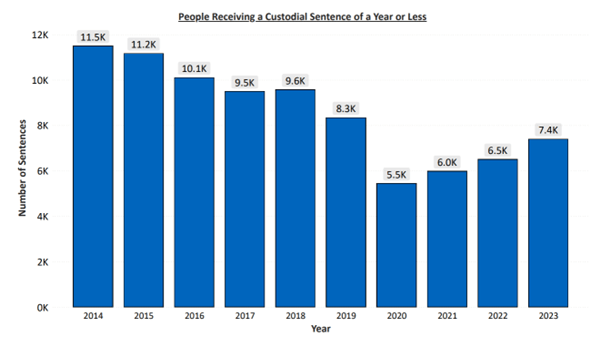
Table 2: Breakdown by Year of People Receiving Short Term Sentences
| Year | Up to 3 months | Over 3 months to 6 months | Over 6 months to 1 year | Over 1 year to 2 years | Over 2 years to less than 4 years |
| 2014-15 | 4,103 | 5,228 | 2,171 | 1,431 | 619 |
| 2015-16 | 4,067 | 4,850 | 2,256 | 1,479 | 645 |
| 2016-17 | 3,503 | 4,465 | 2,141 | 1,435 | 646 |
| 2017-18 | 3,190 | 4,276 | 2,036 | 1,387 | 613 |
| 2018-19 | 3,141 | 4,279 | 2,155 | 1,469 | 642 |
| 2019-20 | 2,555 | 3,716 | 2,073 | 1,599 | 628 |
| 2020-21 | 1,751 | 2,360 | 1,339 | 1,133 | 378 |
| 2021-22 | 1,899 | 2,530 | 1,554 | 1,332 | 435 |
| 2022-23 | 2,372 | 2,597 | 1,536 | 1,399 | 494 |
| 2023-24 | 2,658 | 2,982 | 1,760 | 1,464 | 598 |
ANNEX B: Short Term Prisoner Crime Profile
Table 3: Percentage of Eligible Short Term Prisoners by Index Offence Group (as of 09 February 2026).
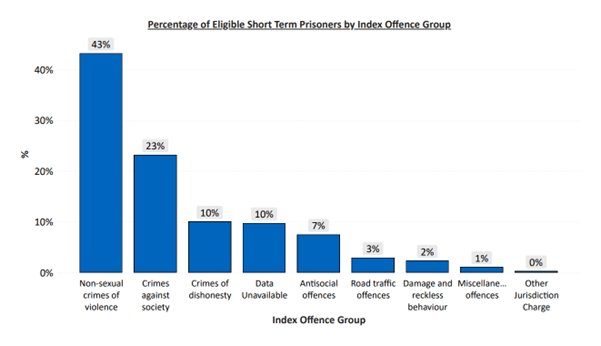
Table 4: Number of Eligible Short Term Prisoners by Index Offence Group (as of 09 February 2026).
| Index Offence Group | Count |
| Non-sexual crimes of violence | 690 |
| Crimes of dishonesty | 160 |
| Damage and reckless behaviour | 37 |
| Crimes against society | 370 |
| Antisocial offences | 119 |
| Miscellaneous offences | 17 |
| Road traffic offences | 46 |
| Other Jurisdiction Charge | 4 |
| Data Unavailable | 155 |
*Data unavailable denotes where an Index Offence Group had not yet been assigned in the data at the time of the request
Annexe C: written submission from Victim Support Scotland
1. Views on changing the release point for certain short-term prisoners to 30%
As Scotland’s national charity supporting victims and witnesses of crime, we are extremely concerned at the proposed changes to the release point for certain short-term prisoners from 40% to 30%.
Whilst we acknowledge the challenge of overcrowding in Scotland’s prisons, we have seen in recent reports that these repeated early release schemes have failed to achieve a meaningful and sustained reduction in Scotland’s prison population - which brings into question why this same strategy continues to be pursued.
The Cabinet Secretary for Justice and Home Affairs stated that prison numbers remain stubbornly high at 8,301.
In February 2025 (the month in which the Prisoners (Early Release) (Scotland) Act 2025 came into force), Scotland’s prison population sat at 8,350.
When looking at population numbers from across 2025, there was a slight reduction in numbers, however, by October 2025 Scotland’s prison population hit an all-time high of 8,430.
There are currently eight jails at ‘red risk status’ with 15 others being close to their over-capacity tolerance.
Additionally, we raise concerns that the Scottish Government is moving ahead with early release schemes without the necessary reforms for victims being implemented first.
It is important to highlight the pace at which new legislation regarding automatic short term prisoner early release, as well as emergency early release, has been implemented. This is in stark comparison with the slow pace of reform benefitting victims.
Victims of crime and their families express anger and incredulity upon learning that the perpetrator in their case may be released early. These proposals will only serve to exacerbate these feelings.
We fear it will also further erode the trust and confidence in the criminal justice system, potentially fostering a feeling of ‘what is the point?’ amongst victims and their families.
Although the criteria for early release only applies to short term sentences, the impact of crime on victims, families and the wider community cannot be understated for any type of crime or subsequent sentence.
This will be particularly true for crimes such as culpable homicide, which can and have, carried sentences of 4 years or less. Whilst all crime types have the potential to be traumatising for victims and families, we wish to highlight this example as one that will be particularly difficult and traumatising.
Reducing the time in prison reduces the amount of time a perpetrator has to access and complete rehabilitation – something the Scottish Government states is needed to reduce reoffending.
Previous Early Release Scheme Data
The reoffending rates from the release of prisoners during COVID was reported as 40%. We are concerned this will be replicated following these new proposals, leading to an increase in victims and/or re-victimisation.
Examples:
Following the first emergency early release in 2024, 57 out of the 477 (12%) prisoners released in June and July had been returned to custody by 18 September. 60% of this group re-entered prison within just 20 days of their emergency release. This highlights the need to completely re-think emergency release proposals. It also emphasises the need for adequate preparation, rehabilitation, and access to support services on release.
The available figures for the first group of prisoners released under the Prisoners (Early Release) (Scotland) Act 2025 in February and March 2025 show that 17 of the 311 released were returned to custody prior to their ‘original’ Earliest Date of Liberation (EDL).
As the Government continues with early release schemes, there must be more comparable reporting, clear data, and analysis of the impact of early release schemes, which includes reoffending rates. We would like to see:
Comparisons between recidivism rates for prisoners who have been released early and the current baseline of recidivism rates
Percentage of released prisoners returned to custody beyond their EDL
Impact of release measures on individuals and communities
Proportion of victims informed about the release of the prisoner in their case including consideration of people who are signed up to the Victim Notification Scheme, and significantly to include numbers and proportions of victims who are not.
There must also be more clarity provided to allow people to distinguish between early release due to changes to automatic release points changing and the Emergency Early Release Scheme. Currently, VSS feels that there is not a clear enough distinction between the two. This can cause added confusion and distress for victims who may think that an offender is being released under emergency early release when they are not, or vice versa.
Victim Support Scotland participates in weekly meetings regarding emergency early release. At these meetings, VSOs are encouraged to promote sign up to the VNS, which we willingly do. However, it is unclear whether this makes a positive impact, as proportionally and numerically victims being contacted about the release of the prisoner in their case remains low – generally around the 2% mark and less than 10 victims per tranche.
If VSOs are being asked to encourage sign up to the Victim Notification Scheme, it must be acknowledged that the independent review of the VNS was published in May 2023, nearly three years ago. Some changes, albeit not yet implemented, are included in the Victims, Witnesses, and Justice Reform Act 2025, yet there is a further consultation on the horizon this year. VSS argues that VNS reform is critical in informing victims, and priority has been given to reforms which benefit the prison estate only.
2.Exclusion of those with charges for domestic abuse and sexual offences
Victim Support Scotland stresses that the exclusion of prisoners serving sentences for domestic abuse and sexual offences remains essential. Through our services we know that women are at risk of further abuse, and sometimes death, when offenders are released.
We are aware of a case in which a prisoner in custody for domestic abuse charges was released before having served 40% of their sentence. Therefore, although this safeguard appears to be in place, in reality, perpetrators of domestic abuse are being released earlier than the current automatic point. The individual affected has raised this with their local MSP.
We also seek assurances that prisoners with a Non-Harassment Order against them, or offences that are often linked to domestic abuse or sexual offences (such as stalking), continue to be ineligible for early release.
3.Equivalent changes for children detained in secure accommodation
To Victim Support Scotland’s knowledge, this is the first time equivalent changes have been proposed for children in secure accommodation. We note SSI/277 in relation to YOIs,[ but, until now, there have been no indications that these changes would be applied to secure accommodation.
Given that the primary driver for changes to automatic early release and emergency early release is to ease overcrowding in prisons, VSS questions the rationale behind this proposal. VSS is not aware of overcrowding in secure accommodation, or any evidence to support this move. The lack of a clear rationale for this measure would further erode public confidence in the system, if it were to go ahead.
Detention of a child in secure accommodation is for the purpose and benefit of correcting behaviour and deviation from further offending. Therefore, can assurances be provided interventions provided through secure accommodation can be fully implemented and create positive outcomes for child perpetrators, if the detention is reduced due to ‘overcrowding.’
It must be noted that victims’ rights in respect of many parts of the criminal justice system differ greatly when the perpetrator is a child compared to when there is an adult perpetrator. We make this point particularly in relation to what victims can and cannot do and what information they are entitled to. However, the impact on a victim and their family remains the same, no matter the age of the perpetrator.
Open communication is therefore critical to a victims’ experience of early release – this is essential in the context of secure accommodation (relating to this question) and the young offender and adult criminal justice/prison system more widely. Given that the provision of information sharing differs significantly depending on the whether the perpetrator is a child, young person or an adult, it is essential that victims in such cases can and do access all they are entitled to.
VSS is currently developing a model to address the information needs of victims in cases where there is a child perpetrator. This is due to changes brought in through the Children (Care and Justice) Act 2024, which changed legislation in relation to 16- and 17-year-olds who commit offences.
4.Fine defaults and contempt of court
Victim Support Scotland questions why these two offences have been specifically highlighted. The measures proposed are based on a straight-line approach to time served in prison. These crime types are not excluded from the scheme.
We seek clarity on how these two offences would differ from a prisoner serving less than four years for any other offence – fine defaults and contempt of court are not victimless crimes.
However, it may be that this eligibility could be assessed based on the severity of the crime and the level of fine.
To clarify, VSS does not support the release of prisoners serving sentences for these crime types who are on bail or connected to any of the excluded crime types.
5.Additional Comments:
A holistic approach
Victim Support Scotland highlights that the topic of early release, and the issues raised by it, do not exist separately to other areas within the justice system. The issues we raise later in the answer to this question are inextricably linked and should therefore be considered and analysed in conjunction with one another to build the fullest of pictures and produce detailed and accurate responses.
Taking a compartmentalised approach to overcrowding in prisons and early release, separate to these other issues risks missing critical aspects that will negatively impact all involved.
From a victim’s perspective, any change to the criminal justice system and processes must be looked at in conjunction with one another. Recently, reform plans have included:
The passage of the Victims, Witnesses and Justice Reform (Scotland) Act 2025
The passage of the Criminal Justice Modernisation and Abusive Domestic Behaviour Reviews (Scotland) Act 2025
Voices in Justice: Parole Reform in Scotland Consultation
The future of secure care and the single point of contact (SPOC) for victims in the Children's Hearings System Consultation
Undertaking domestic homicide and suicide reviews: draft statutory guidance consultation
The Report by the Sentencing and Penal Policy Commission
Victim Notification Scheme Reform
Many of the reforms outlined above have had, or will have had, extensive timelines and still require a significant volume of SSIs to enact the changes. This is in contrast with the expedited nature of early release schemes has created a sense of de-prioritisation of victims.
Automatic Early Release alongside Emergency Early Release
Although automatic early release and emergency prison release are being looked at separately, it is very challenging for victims of crime to see these as separate schemes. Additionally and confusingly, the Governor’s veto applies to one scheme but not the other.
VNS Reform
Victim Support Scotland has consistently advocated for the swift implementation of the reforms to the Victim Notification Scheme outlined in the 2023 Independent Review. These reforms are essential in ensuring that victims and their families have access to the information they require to feel safe and informed
Victim Support Scotland cautions that victims continue to be at risk of not being informed about a prisoner’s release eligibility, parole eligibility, or offered support, if they are not currently signed up to the Victim Notification Scheme.
Current uptake of the VNS remains low and whilst we appreciate that victims who are signed up are contacted through the details available, it remains that the majority of victims who are eligible to be signed up are not informed. Therefore, the changes recommended for the Victim Notification Scheme made over three years ago are critical.