Criminal Justice Committee
Criminal Justice Committee Report on its Pre-Budget Scrutiny 2026/27
INTRODUCTION
Background
Since the start of Session 6 in May 2021, the Criminal Justice Committee (‘the Committee’) has carried out pre-budget scrutiny in advance of the publication of the Scottish Government’s budget for the forthcoming financial year. This is in line with the pre-budget scrutiny system of subject committees in the Parliament.
The aim is for the committees to collect evidence on spending priorities and make recommendations to the relevant Cabinet Secretary before the Scottish Government finalises its budget.
Session 6 scrutiny of criminal justice sector budgets
The Scottish Government's 2022 Resource Spending Review (‘RSR’) proposed a flat-cash settlement for the justice sector for the financial period up to the 2026/27 Scottish budget at the end of Session 6.
In our pre-budget scrutiny report on the 2023/24 Scottish budget, the Committee noted that, “if implemented, the RSR for the justice sector would result in an allocation of £11.6 billion of public spending to the Scottish justice system over this four-year financial cycle as follows-
2023-2024: £2,839 million
2024-2025: £2,839 million
2025-2026: £2,954 million
2026-2027: £2,969 million.i
In January 2022, the Committee also published a report entitled Judged on progress: The need for urgent delivery on Scottish justice sector reforms.
This set out key areas the Committee identified as needing to be urgently addressed across the Scottish criminal justice system, many of which pre-dated the COVID-19 pandemic. Many issues which were exacerbated by the impact of the pandemic and the refocussing of political and fiscal action on tackling the immediate impact of COVID.
These included delays in capital projects, maintenance, and refurbishment across the criminal justice sector. We also noted delays in prosecutions and criminal trials, and increases in the prisoner population – especially the numbers of persons on remand and awaiting trial. Finally, we noted the pressures on resource spending and increases in staff vacancies and recruitment.
Many criminal justice sector stakeholders also faced dealing with increased administrative and legal burdens as a result of the flat cash budget settlements, and new post-EU exit regulations which impacted the efficiency of existing systems for groups like Police Scotland, COPFS and Scottish Prison Service.
Scottish Budget 2025/26
The Scottish Government published its 2025/26 Budget in December 2024. It set out the Government's proposed spending and tax plans for 2025/26, as well as reproducing figures for previous years.i
Last year, the focus for the Committee's pre-budget scrutiny was a general one looking at the financial pressures facing organisations in the criminal justice sector and views on the main priorities for 2025/26. Of particular interest to the Committee then was the pressure on capital budgets and investment in policing, the fire and rescue service, prisons, prosecution service and the courts, community justice, criminal justice social work and the third sector.
The figures used in the tables produced by SPICe and the FSU below are taken from the Scottish Budget 2025/26 and 2024/25 to allow a comparison between figures agreed at the last budget with those proposed in the current budget.
Table 1 shows funding figures for both 2025/26 (the current year) and 2024/25 in cash terms. Totals are broken down into resource, capital, non-cash, and UK-funded annually managed expenditure (AME in the table).
Table 1: Scottish Budget 2024/25 – Justice, COPFS and CJSWTable 1 sets out funding for Justice & Home Affairs (Justice) portfolio, Crown Office & Procurator Fiscal Service (COPFS) portfolio and Criminal Justice Social Work (CJSW) grant to local authorities 
Table 2 below provides more detail on Justice funding, setting out figures for individual budget lines in both cash and real terms (using 2025/26 prices).
Table 2: Scottish Budget 2025/26 – Justice 
Table 3 provides figures for the COPFS portfolio and the Criminal Justice Social Work (CJSW) grant to local authorities, in both cash and real terms (2025/26 prices).
Table 3: Scottish Budget 2025/26 – COPFS and CJSW 
PRE-BUDGET EVIDENCE TAKING
The 2026/27 Scottish Budget
This year marks the final pre-budget scrutiny process for the Criminal Justice Committee in Session 6. However, the normal scrutiny process has been restricted owing to the delay in the publication of the UK Government budget, which was published on Wednesday 26 November 2025. This has resulted in the delaying of the publication of the Scottish Government’s draft budget to 13 January 2026.
On 7 July 2025, the Committee launched a public call for views on its 2026/27 Pre-Budget scrutiny. This ran until 9 September and received 25 submissions from the following. The Committee is grateful to all of those bodies who took them time to send us their views-
Association of Scottish Police Superintendents (ASPS)
Community Justice Scotland
COSLA and Social Work Scotland
Criminal Justice Voluntary Sector Forum (CJVSF)
Crown Office and Procurator Fiscal Service (COPFS)
Fire Brigades Union (Scotland)
G. Robertson (2 submissions)
Glasgow City Health and Social Care Partnership
His Majesty's Fire Service Inspectorate in Scotland (HMFIS)
His Majesty's Inspectorate of Constabulary in Scotland
His Majesty's Inspectorate of Prisons for Scotland
Michaela
Moray Council
PCS Procurator Fiscal Branch
Police Investigations and Review Commissioner (PIRC)
Police Scotland
Procurators Fiscal Section of the FDA Trade Union
Scottish Courts and Tribunals Service
Scottish Fire and Rescue Service (SFRS)
Scottish Police Authority
Scottish Police Federation
Scottish Prison Service
Stirling Council
Victim Support Scotland.
The Committee heard evidence as part of its pre-budget scrutiny between 5 and 26 November, as follows-
Police Scotland and the Scottish Police Authority on 5 November;
Crown Office and Procurator Fiscal, Scottish Courts and Tribunals Service and Scottish Fire and Rescue Service on 12 November;
Scottish Prisons Service on 19 November, and
Cabinet Secretary for Justice and Home Affairs, the Scottish Government on 26 November 2025.
This report sets out a summary of the evidence received and the Committee’s conclusions and recommendations.
Key issues emerging
During oral evidence, the Committee explored various issues facing criminal justice sector stakeholders in terms of how the resource allocation will impact on their ability to address these issues effectively-
The impact of flat-cash settlements, lack of further scope for efficiency savings and the need for a multi-year funding model;
Critical shortfalls in capital needs and progression of vital programmes;
Impact of changes by the UK Government to employer national insurance contributions;
The impact of policy changes and new legislative burdens in Scotland;
Growing cyber security risks as a result of increased digitalisation;
Efforts to meet commitments under Scotland’s climate change targets.
The sustainability of the current funding model
In our pre-budget report on the 2025/26 budget, we recommended the Scottish Government “explores what progress can be made to move to a system of multi-year funding cycles” for criminal justice stakeholders.i
In its response the Scottish Government stated that it “appreciate[d] the benefits of being able to plan in a longer time-frame than the annual budget cycle which we have had for the past few years.” The Government undertook to utilise its 2025 Medium-Term Fiscal Strategy, and its five-year fiscal sustainability Delivery Plan, “to outline the specific actions being undertaken to deliver sustainable finances” for the criminal justice sector.ii This would inform decisions on funding mechanisms going forward in the Scottish Spending Review (which is due for publication in January 2026).
This year’s pre-budget scrutiny has brought into sharp focus the importance of supporting a whole system approach by the Scottish Government going forward to the funding mechanism for the criminal justice sector.
This can be seen in the interconnectedness of challenges raised by all the organisations giving evidence to the Committee. The need for multi-year funding to allow for the coherent and effective planning and delivery of urgent priorities was raised by several witnesses in their evidence to the Committee this year.
The increasing complexity and interdependence of the policy landscape across the criminal justice sector, coupled with a requirement to spend-to-save and continue to invest in the reform currently taking place has been a recurring theme raised by many witnesses.
New challenges were also highlighted by almost all of the criminal justice organisations we took written and oral evidence from.
Scottish Police Authority and Police Scotland
In the 2025/26 Scottish budget, the Scottish Police Authority (SPA) and Police Scotland funding allocation came to £1,475 million. For the forthcoming 2026/27 budget SPA/Police Scotland has sought an allocation of £1,614.3 million. This represents an increase of £138.6 million over the present allocation, equivalent to a 9% increase.
In their written submission, the Scottish Police Authority (SPA) stated that over the next 4 years (FY 2026/27 - 2029/30) it anticipates a net additional capital requirement of around £245.5 million related mainly to additional spend on the police estate, incremental to current budget levels.
The SPA also stated its Forensic Services are being delivered at a cost of £47.4 million in the 2025/26 financial year, which represents 3.2% of overall policing budget. The SPA doesn’t expect this percentage to significantly change in the year ahead.
At present the SPA Forensic Services are meeting the demand for drug driving toxicology services by utilising in-house capital and outsourcing service. Forensic Services have been working to develop options for a long-term sustainable model that can meet this demand in the future and expect this to require additional revenue and capital funding from 2027 onwards.
In its written submission to the Committee, the Scottish Police Federation (SPF) pointed out that police officer numbers have fallen by over 1,200 since the creation of Police Scotland in 2013. At present, the SPF stated, the police workforce is now at its lowest point in over a decade. The SPF highlighted the fact that many police officers leave the service within their first 10 years of service, citing pay, work-life balance, and stress.i
They go on to state that over the last 10 years police officers have endured real term pay cuts and without meaningful pay restoration. Consequently, the SPF says, “policing will continue to lose experienced officers and struggle to attract new recruits that want to stay".
Mental health and sickness absence linked to stress and trauma remains high the SPF says, with surveys consistently showing that morale in policing is at its lowest level in years.
The SPF stated that capital allocations for estate renewal, fleet replacement, IT upgrades and uniform need to be protected and increased. They also called for ring-fenced funding for urgent health and safety upgrades to stations and custody facilities.
Many of these concerns were also reflected by the Association of Scottish Police Superintendents (ASPS) in their written evidence. The 2025 ASPS Member Survey found that 60% of respondents reported that their workload was not manageable with 77% identifying barriers to delivering their best work, including systemic issues in resourcing, governance, leadership, and workload management.ii
The ASPS warned that the demand on officers is not confined to policing duties. For example, the police attended over 185,000 mental health-related incidents where no crime was recorded in 2024/25, which amounts to the equivalent of 419 full-time officers diverted from core policing duties.
ASPS also pointed to the significant impact on officers from the 4-day visits of US President Donald Trump from 25-29 July 2025, and less than two weeks later the 5-day visit of US Vice President JD Vance to Scotland from 12 to 17 August 2025.
The ASPS told us that many police officers had to work for 12 consecutive days during this period, and some Superintendents worked over 15 consecutive days to support these visits. All of this took place against the background of there being 900 fewer Constables and 26 fewer Superintendents in Police Scotland this year than there were during the previous visit by President Trump to Scotland in 2018.
ASPS also flagged that since 2018, the number of officers not operationally deployable has nearly trebled to more than 2,500. With the most common cause for this increase being the rate of chronic illness and mental health conditions.
In his written evidence to us, HM Inspectorate of Constabulary in Scotland (HMICS) pointed to the fact that the capital allocation to Police Scotland has increased over recent years, but such increases have never been provided at a level to maintain the infrastructure of the organisation and to facilitate significant reform.iii
HMICS stated that annual budgeting is a major challenge for Police Scotland and the SPA as it provides them with no opportunity to phase spending over a longer-term period or manage reserves. HMICS states that the easing of these restrictions would be of significant benefit to the police service.
In her written submission, the Chief Constable of Police Scotland, Jo Farrell, set out her professional view that urgent support is now required to strengthen frontline police services.
Police Scotland is calling on the Scottish Government to ensure the additional £25.2 million in-year funding received for changes to employer national insurance contributions, reform and modernisation be baselined into its core revenue budget going forward.
£83 million is being sought for current commitments and to allow Police Scotland to meet the costs of new legislation. This also includes covering the pay offers made over the next two years, non-pay inflation, and the costs of implementing new legislation (which Police Scotland seeks to offset by non-pay savings of £3.3 million).
The Chief Constable is seeking £33.7 million to be provided to strengthen frontline policing to allow her to maximise officer recruitment and police staff workforce modernisation. This would also allow for much needed investment in priority digital and cyber capabilities and to undertake a roll-out of criminal toxicology across Police Scotland.
Police Scotland is seeking £93.9 million of capital expenditure to enable the investment in the estate and fleet, including the continued development of an ultra-low emission fleet to meet climate change commitments. This sum will also provide for improved technology, including the ongoing roll-out of body worn video, improvements to core operating systems and investment in AI-driven automation.
Receiving the baseline adjustment of £25.2 million and the further additional funding of £113.4 million that the Chief Constable is seeking would fund 850 police officers and 348 staff (some of which would help support meeting commitments of new legislation). If the baseline adjustment and only an additional £79.7 million was provided, this would require Police Scotland to identify about 300 FTE workforce modernisation savings to meet the shortfall.
The Chief Constable pointed out that if Police Scotland were only to receive the £25.2 million baseline adjustment this would result in 1,362 FTE posts plus around 300 FTE workforce modernisation savings having to be made by the force. Even if Police Scotland halted all recruitment from January 2026, it could not meet the savings required under this scenario.
Police Scotland continue to seek more appropriate funding arrangements, through multi-year allocations to support long term planning, the ability to carry forward financial reserves and statutory borrowing powers to support capital investment.
In her written submission, the Chief Constable set out the significant pressures on the police workforce, including an increase in assaults against officers and staff to 7,159 in 2024/25. Officer overtime spending totalled £28.1 million for the year, which is 12% higher than the approved budget for this.
At the end of 2024/25, the time off in lieu balance in Police Scotland totalled 25,127 hours, while the re-rostered rest day bank - which is the time off due to officers where rest days have been cancelled – came to a total of 28,265 days.
The Chief Constable set out the need for the Scottish Government to address critical resource issues facing the police. This request come in the face of a dramatic shift in the challenges in the Scottish policing landscape – even in the last 12 months.iv
The Chief Constable told us that “urgent decisions” are now required to address the “threat, harm and vulnerability” police are now seeing. The reforms that Police Scotland have achieved have been a success as an outlier in the Scottish public sector over the last 12 years.v
She went on to tell us that Police Scotland “are probably unique in being the only public sector organisation in Scotland, maybe with the exception of the Scottish Fire and Rescue Service, which has seen a reduction in resources since its inception".vi
The Chief Constable added that these challenges are all set against a “backdrop of a reducing workforce,” while Police Scotland has “improved professionalism and competence while taking on new and more complex work".
She warned that-
More than £2.5 billion—more than double what was initially proposed—should be invested back into policing. A flat cash funding allocation for 2026/27 cannot be delivered; we would immediately have to stop recruitment and reduce workforce numbers through retirement and resignation. However, that would not achieve the savings that would be needed. Such attrition would further reduce officer numbers to fewer than 15,500 by March 2027, with a significant reduction in visible policing, prevention work, delays in responding to calls from the public and a severe impact on our ability to respond to major events. Difficult decisions would be requiredv
Speaking about the implications of another flat-cash settlement for the Police in 2026/27, the Chief Constable told us that she does “not want to maintain a status quo in which we are already seeing those warnings” happening.
The Chief Constable told the Committee they required a £104.9 million uplift in their resource budget to “stand still” and “meet unavoidable cost pressures” such as pay awards and increased national insurance contributions. She stated a further £33.7 million was needed to strengthen the workforce by recruiting 850 extra officers (including 600 community officers) and 348 police staff.viii
We heard the role that the 600 extra community police officers that could be funded by this uplift, would play in “prevention and proactivity” when it comes to preventing the cycle of crime. The Chief Constable stressed the need for the capacity for police to work “collectively” to “break the cycle by working locally to identify the precursors to criminality and get ahead of the issues".ix
The Chief Constable reiterated that it costs significantly less a year to “wrap good support” around someone to prevent reoffending than to keep someone in prison, and that “that is where our focus needs to be” in terms of providing resources.
However, we were told that both new and increasing threats from issues like poverty, geopolitics, cybercrime, and civil unrest “are driving a high level of demand, and the challenge for policing is evolving rapidly".
Even in the last 12 months since the most recent 2025/26 budget settlement, these new threats are “illustrated by the increase in online harm and threat and in violence associated with organised crime, as well as a high level of protests.” The threat from all of these is happening “now,” and the budget allocation for 2026/27 has to respond in full to these needs.
Police Scotland and the SPA both noted that an increased capital allocation of £93.9 million was required to allow them to deliver the basic rolling replacement programme of fleet, systems, and policing equipment. The Chair of the SPA stated that this figure still “falls short of what is needed for modernisation and technology-driven efficiencies".x
Police Scotland also spoke of requiring an increase in their resource funding allocation for 2026/27. The Police are seeing a “further £33.7 million, which is equivalent to a 2.2 per cent cash-terms uplift” on 2025/26. This will allow them to strengthen the police workforce and “address harm and vulnerability, contribute to community cohesion, ensure public trust by sharing information, and ensure public confidence that policing can prevent crime and tackle antisocial behaviour".viii
The Chief Constable set out why, in her view, this must be delivered now. She said-
I want to strengthen our response to digitally enabled and globally connected crime and to target the sex offenders, organised criminals and extremists who are radicalising, recruiting, exploiting, and abusing our children and bringing illegal drugs and violence to the streets of Scotland. We must continue to improve our response to violence against women and girls and investigate cold cases, including Covid-related deaths. Importantly, I want to underpin that with additional local police officers to give communities identified contacts, put more hours into street patrols, help communities to prevent crime and antisocial behaviour and give victims a better response. This is a crossroads, not a crisis, but decisions must be taken now to enable policing to deliver fully and at the pace that is needed on our vision of safer communities, less crime, supported victims and a thriving workforce.xii
These needs have been added to by the “hidden cost” of new legislation, like the Victims, Witnesses, and Justice Reform (Scotland) Act 2025 or the Police (Ethics, Conduct and Scrutiny) (Scotland) Act 2025.
For example, Deputy Chief Constable Alan Speirs told us-
One of the challenges for us with legislation has been that there is a hidden cost. We have failed or struggled to identify the implications and impact of the introduction of new legislation. In our submission, we have tried to be clear about the cost of that. Some of that cost is an opportunity cost, which relates to drawing resources away from other areas and taking officers away from their day job for training purposes. We have worked hard to be clear about the impact of legislation, given how important it is, and about how we will deliver that programme. We can see a number of pieces of legislation coming together at the current time, and we are confident that we have been clear about the implications and the associated costs.xiii
When questioned as to why Police Scotland estimated an increase from £4.5 million for FY 2026/27 to an estimate of £22.9 million for FY 2028-29 for Police Scotland to meet the cost of new legislation, he said this is-
…because a range of different legislation is coming in. Elements of some of the legislation that is coming in will have an impact on a proportion of the organisation, and there is broader legislation that will have an impact right across the organisation. It is a matter of working out the precise implications of any particular piece of legislation…. Our challenge is prioritisation. There is a real commitment from Police Scotland to deliver, and we work with the legislation that supports the services that we provide. That brings me back to the point about difficult choices: if there is a choice, we will have to choose to prioritise training that relates to new legislation, rather than what might be considered less essential training. Our focus would be on prioritising our workload, and some things would have to come back from that.xiii
Responding to questions on how Police Scotland is meeting its climate change commitments, DCC Speirs set out the work of the Police Scotland sustainability team, stating that at the previous SPA board meeting Police Scotland presented an annual report on sustainability. This showed that the police were making considerable progress on reducing its carbon footprint. DCC Speirs pointed out that it has become “really evident that, in some ways, [Police Scotland] has taken the work on the estate” as far as it can in terms of meeting climate targets.xv
He pointed to the fact Police Scotland has “an incredibly strong fleet, a large proportion of which is made up of electric vehicles,” and that the “ambition is to continue to progress that".xv
Fiona McQueen, Chair of the SPA set out the rationale taken for developing a budget for the years ahead, telling the Committee that “the Police Authority has two essential objectives: first, allocating funding that delivers an effective and sustainable police service for Scotland; and, secondly, continuing effective financial management through setting a balanced budget and ensuring best value".xvii
The SPA reinforced the grave concerns expressed to the Committee by Police Scotland, saying that receiving anything short of the requested £104.9 million uplift in the resource budget would mean some reduction in policing staff would be needed.xviii
Chris Brown, the Chief Executive of the SPA told us that a flat cash budget would mean “we would not be able to set a balanced budget in 2026/27…it would take two years of recruitment freeze, in essence, to balance the budget under that scenario".v
The SPA stated that “having multi-year certainty, coupled with some ability to carry forward reserves or even to borrow” would help the SPA and police leadership plan better, in terms of the capital budget in particular.xx
Speaking about the ‘hidden costs’ from changes to policy and new legislative burden, the Chair of the SPA, Fiona McQueen noted that should the funding to cover these costs not be forthcoming from the Scottish Government, then “resources would need to be shifted to prioritise” meeting them from existing budgets.xxi Responding as to how the SPA would cope with a lack of adequate resources being provided in the budget, she said-
Money would need to be moved from elsewhere in the budget. That might involve staff reduction in other areas or the stopping of a particular piece of training.xxi
All the organisations who gave oral evidence highlighted the impact of the increase in employer NI costs introduced by the UK Government at the beginning of this financial year. The Scottish Government committed to centrally funding 60% of this NI increase for directly employed public sector staff, with the remainder to be managed within existing portfolio budgets.
Police Scotland, the SPA and their forensic services had seen an increase of around £25 million due to the NI increase in 2025/26. Police Scotland advised that they had managed that increase through additional in-year funding from the Scottish Government and with some one-off, non-recurring benefits within their own budget, but that “that is not sustainable” going forward.
On 26 November, we heard from the Cabinet Secretary for Justice and Home Affairs, Angela Constance MSP (‘The Cabinet Secretary’). She began by reassuring the Committee that she would “at every twist and turn, advocate for the best possible deal for the justice portfolio.” But she pointed out that “we know from previous information from the UK Government that the resource budget overall for [the Scottish] Government is set to increase by 0.5 per cent in real terms. However, once we strip out some demand-led obligations, which will equate to a real-terms cut for Scotland, with the capital budget remaining particularly challenging".xxiii
Responding to questions about multi-year funding, the impact of the annual flat-cash settlement to date and the stark concerns raised with the Committee by the police, fire service, and prisons etc., the Cabinet Secretary stated that-
…some of the evidence has been stark—I do not think that anybody would demur from that. I am certainly not in the business of reducing police officers and firefighter numbers or of closing prisons, for the obvious reason that we have an overpopulated prison estate as it stands. I want to continue the progress that has been made with the investments that have happened thus far, particularly in reform and innovation. I take very seriously all the representations that have been made to me and to the committee.xxiv
However, she cautioned, “it is unlikely that we will be able to give everybody everything that they have asked for, but that does not mean that we will not be in a position to protect the front line, maintain our focus on supporting victims and continue with our journey of reform and innovation".xxiv
With specific relation to the SPA and Police Scotland, the Cabinet Secretary recognised the need for community policing and “specialism and expertise in tackling particular forms of crime” like sexual offences or cybercrimes. She added that Police Scotland also has balanced this with “a preventive policing model”, noting that “there is absolutely value in having community police officers, particularly in crime prevention".xxvi
She also acknowledged that “Police Scotland has made a significant ask for additional resource to cover pay, but we are pleased to have secured a very positive two-year pay deal.” She told the Committee that she was “looking very seriously at Police Scotland’s ask.” However, she stated that the police budget has increased every year since 2016-17, and that has been in order to stabilise police officer numbers.”
The Cabinet Secretary agreed that Police Scotland (and the SFRS) had been “exemplars with regard to reform” in the Scottish public sector. She acknowledged that these “reforms made very significant savings” but stated that “those are not savings that now sit in a bank account somewhere; they are savings in terms of resource that did not have to be spent".xxvii
In supplementary written evidence to the Committee the Cabinet Secretary addressed the issue of SPA/Police Scotland and the Scottish Fire and Rescue Service no longer being able to carry financial reserves as their predecessor services had been able to before the establishment of the two national services in 2013. She stated-
With regards to reserves, the rules that apply are dictated by the classification of the bodies as determined by the Office for National Statistics (ONS). SPA and SFRS are assessed by ONS as being part of central government (as are the other justice bodies). This means that budgeting rules set out by HM Treasury apply. These rules effectively preclude individual bodies from operating their own reserves, as all the income and expenditure of central government bodies scores against Scottish Government budget limits. Under the powers set out in the Scotland Act 2016, the Scottish Government, as a whole, does have some limited ability to manage spending across financial years by carrying forward underspends through the Scotland Reserve. However, the Scottish Government is still required to balance the budget annually, and remain within the budget control limits set by HM Treasury.xxviii
Referring to the lack of borrowing powers for the SPA/Police Scotland and SFRS, the Cabinet Secretary said-
In relation to borrowing power, because the SPA and SFRS are classified as central government bodies they fall within the central government’s budgeting boundary. Limited capital borrowing limits as set out in the Fiscal Framework apply to Scottish Government as a whole, and there is no capacity for individual bodies within the budgeting boundary to borrow beyond those limits. Local Authority borrowing arrangements are subject to their own separate rules which can offer greater flexibility. Scottish Minsters have sought (and continue to seek) increases to the capital borrowing limit through renegotiation of the Fiscal Framework.xxviii
The Scottish Fire and Rescue Services
Like Police Scotland, since the establishment of the Scottish Fire and Rescue Service (SFRS) on 1 April 2013, it has seen a reduction in its resources in comparison to the levels of the previous eight regional fire services that were amalgamated on the establishment of the SFRS.
The most recent fire safety and organisational statisticsi set out details on fire stations and capabilities (including their crewing models – wholetime, retained and duty), vehicles and workforce. The statistics show that on 31 March 2025 SFRS had-
356 fire stations across Scotland, comprised of 74 wholetime fire stations, 240 retained duty system fire stations and 42 volunteer fire stations;
470 crews, comprised of 116 wholetime crews, 1 day crew, 311 retained crews and 42 volunteer crews;
The SFRS fleet includes 1,576 vehicles (including 774 appliances. Of those 630 appliances are currently operational), and
There are 7,556 SFRS staff (of which 5,467 staff are scheduled to crew appliances).
The 2025 fire and rescue incident statistics ii show that SFRS crews attended 74,610 incidents during 2024/25. These comprised-
22,925 fires (8,811 primary fires and 13,784 secondary fires)
35,476 false alarms incidents (34,688 were fire false alarms)
16,209 non-fire incidents.iii
Since the establishment of the SFRS, the work of firefighters across Scotland has changed significantly. Statistics show the eight-predecessor regional-based fire services attended a total of 20,677 primary fire incidents in the financial year 1999/2000. This compared to the SFRS attending 8,811 primary fire incidents in the financial year 2024/25, which represents a 234% decrease in primary fires over 25 years.
Conversely, the SFRS’s workload in response to other incidents, such as wildfires, flooding and water rescue has increased over the same period. Data on the number of non-fire incidents (which is only available as far back as 2009-10), show 11,505 such incidents were attended that year. While the level of non-fire incidents has fluctuated in numbers since then, the trend is generally in an upward direction since the formation of the SFRS. In 2024/25, the SFRS attended 16,209 non-fire incidents, which represents a 30% increase in 15 years.
The SFRS have stated that they required an additional £30.854 million of resource funding in 2026/27 to cover their baseline and unavoidable cost pressures (for example, pay and pension inflation, reducing their support staff vacancy back to 3% and increased demand due to climate-related incidents).
Without this additional funding they would require to reduce firefighter numbers. A flat-cash settlement would equate to a reduction of around 886 whole-time firefighters in Scotland and about 40 fewer appliances.
SFRS stated they required a further £5.7 million of resource funding to advance their strategic priorities in terms of using technology to improve firefighter safety, fire prevention work and digital transformation and cybersecurity.
On capital needs, SFRS again reiterated the significant capital backlog they have of around £818 million, of which £496 million is required to develop the operational estate up to modern design standards. They stated that they require £61 million of capital funding in 2026/27 with a total budget of £354 million required up to 2030-31.
Were they not to receive the requested capital funding they advised that they have to continue with a position where 45% of their estate is in poor or bad condition with 75% deemed unsuitable in terms of the standards they require (covering contaminant control as well as the availability of dignified facilities and general suitability of storage areas and garaging of vehicles).
SFRS stated that it was challenging when developing long-term capital spends over multiple years and that they “would welcome the ability to hold reserves over financial years, particularly from a capital perspective".
SFRS stated that the total impact of the NI changes was £5.5 million and that they received £3.42 million in support from the Scottish Government. They did not reduce firefighter numbers but instead cut costs in other areas to manage this increase, for example in corporate services and on a number of change investment areas in the organisation.
Like the police, the SFRS has delivered more than the expected savings the Scottish Government has sought over the last 12 years under the Police and Fire Reform (Scotland) Act 2012.
And, like the police, the SFRS’s capacity to make any further efficiency savings to compensate for a potential flat-cash settlement in 2026/27 is limited. The SFRS informed the Committee that it is having discussions with the Scottish Government on the development of multi-year funding in terms of the spending review.
Such multi-year funding will be central to the successful delivery and implementation of the SFRS Service Delivery Review which is currently under development. This is an issue the Committee will examine further in early 2026.
On 12 November, the Chief Officer of the SFRS Stuart Stevens set out the achievements of the service in terms of efficiencies since its formation in 2013, saying-
Since our formation in 2013, we have delivered extensive reform—realising the intended benefits of fire reform with a projection to deliver more than £900 million in savings by 2027-28, significantly exceeding the original expectations of the Police and Fire Reform (Scotland) Act 2012. That has been realised through rationalisation of our corporate estate and control rooms, the streamlining of corporate functions and a reduction of staff across all our staff groups.iv
Chief Officer Stevens went on to stress that while the SFRS face many challenges and “the financial pressures are real and require attention, let me be clear that ours is not a service in crisis".iv
Chief Officer Stevens went on to explain that the additional £30.854 million the SFRS needs for its resource budget “is what would be required to ensure that we would not have to consider reducing firefighter numbers further.” He added that the SFRS is now-
..starting from a very challenging financial position, and we believe that we have made all the efficiencies that we can drive from the organisation over the past 12 years. There are very few places that we can go to, apart from front-line firefighter numbers, given that more than 80 per cent of our resource budget is on head count. Our corporate services staff are already running with a 10 per cent vacancy factor, so the challenges associated with moving that any further would be significant. That amount is what we would need in order to deal with our financial pressures and not reduce head count any further. vi
On capital funding, the SFRS said it needs a total capital investment of £354 million, over the next five financial years to FY 2030/31. SFRS stated that if the current annual capital allocation of £47 million a year were to continue, that would leave you £119 million short by 2030-31.
Addressing the practical impacts of failing to get the necessary capital investment needed, the SFRS Chief Financial Officer Sarah O’Donnell told the Committee that-
Our capital budget, at £47 million—ideally going up to £61 million—has to cover a broad range of assets. It covers our estate, with its 300-plus properties right across Scotland. It covers our fleet and the operational equipment that is required to keep firefighters safe and that allows them to deliver their service. It also covers digital and technology. ….if we were unable to increase it, we would continue with a position where significant aspects of that asset portfolio were not fit for purpose. At this point in time, 45 per cent of our estate is in poor or bad condition, 75 per cent of it is deemed to be unsuitable in terms of the standards that we require from the buildings, and 61 per cent of the estate is more than 30 years old.…One of the well-documented challenges in the estate is the roofing made from reinforced autoclaved aerated concrete—RAAC. If we are unable to replace or repair fire stations with such roofing, we will incur more on-going resource costs to ensure that those stations can function safely—not very satisfactorily, but safely. That would also inhibit our ability to tackle contaminant control, for example.vii
Another serious consequence of not receiving the necessary resource budget would be to ensure the SFRS can “protect the front line and not reduce firefighter numbers in order to address the national insurance gap.viii
As a national service the SFRS cannot manage and carry forward financial reserves, as its eight predecessor services could, because they formed part of the local government structure. Sarah O’Donnell told us-
Back before reform, we had the luxury of having access to borrowing and to reserves, because our funding process was part of local government funding. Since becoming a national service, we have had to get used to not having that, which puts a strain on the people who manage our budgets. When things happen mid-year, we have to work particularly hard to ensure that we are able to fully spend the capital budget, for example. We have to have projects ready to bring forward from future years of our multiyear capital plan so that we can spend the money and make best use of it. I am pleased to say that we have consistently done that. We have been able to get investment into the service but achieving it is certainly more challenging than it would be if we had those other financial levers at our disposal.ix
Furthermore, Deputy Chief Officer Andy Watt spoke of the £4 million the SFRS has invested to address problems with terms and conditions for the recruitment and retention of on-call firefighting staff, and a new national on-call contract.
Witnesses were questioned on whether the £328 million in resource funding they are seeking is adequate in light of the £900 million in savings the SFRS has achieved since 2013. Staffing levels in the SFRS continue to be a critical challenge because of changing demographics and employment patterns across both urban and rural Scotland, as well as the remarkably high geographical percentage of the country which is only served by retained or on-call staff. The SFRS is seeking recruitment of 210 firefighters and 30 civilian staff. However, this is against a loss of 1,239 firefighters since 2013. Deputy Chief Officer Watt expanded on this, explaining-
That includes about 550 posts that were removed as part of the reform process, including senior officers and firefighter posts from across the organisation. An additional 166 posts were removed in 2023 due to the significant in-year inflationary pressure that we had to deal with. However, there are in the region of 300 vacant posts across the on-call duty system and we are actively and constantly trying to recruit into those posts. The vacancies are spread across about 356 stations in Scotland. Recruitment to the on-call system always remains a challenge and it is not unique to Scotland.x
Responding to questions on whether the work being undertaken by the SFRS around the increase in average response times to incidents over the last decade would be completed in advance of any final decisions being made by the SFRS Board as part of its Service Delivery Review, DOC Watt said-
That is a bigger piece of work and it is for all stations, not only those that are included in the service delivery review options for change. The response times, which we shared as part of the consultation and the work that was done by the community risk index modelling—CRIM— team, were based on the current factors that influence them. The response times that we have set out in the consultation are current and relevant but, as you have rightly said, we need to better understand the trends. The piece of work around response times is for the whole service and not necessarily only for the SDR options for change. We are content with the work that we have done on response times and that we have shared through the public consultation to this point, but we acknowledge that the increase in response times over a longer time means that a bigger piece of work for the entirety of the service is needed. That is important.xi
In their written submissions, the Fire Brigade Union (FBU) was blunt in their assessment of the risks to the ongoing viability of the fire service and the need for urgent action on staffing, funding, and capacity building. FBU Executive Board Member for Scotland, Colin Brown, highlighted several concerning problems the SFRS faces now.
These include that there are 1239 fewer firefighters in Scotland in 2025 than there were in 2013 (a 36% loss). This includes wholetime firefighters, as well as retained and volunteer firefighters. SFRS Control Room staff levels being 36% below ‘critical capacity’, that is the minimum number of trained staff necessary to maintain the service.
They stated the budget crisis the SFRS faced in 2023 led to the decision to temporarily withdraw 10 pumps and 166 firefighters from service, a decision which has now become permanent and was entirely financial. In addition, there are routinely 10 appliances unavailable across Scotland every day, as well as reductions in rope rescue teams, water rescue teams, mass decontamination teams etc.
Response times to 999 calls continue to rise and the FBU disputes some of the explanations provided by the SFRS and the Minister for Community Safety and Victims that issues like traffic calming measures or the crew needing to put on PPE gear before getting into the appliance is responsible. The FBU points out that these requirements have been in place for 17 years. The only reason for this, in the FBU’s view, is about saving money.
On 3 December, the Committee took evidence from the FBU on the ongoing SFRS Service Delivery Review. During that session, the FBU reiterated that it recognised the need for change within the SFRS, in order to face a range of evolving challenges.
They praised the ongoing commitment of firefighters across Scotland for their dedication and commitment to keeping the public safe, despite of the major reduction in firefighter numbers and resources since 2013. FBU witnesses also praised the ongoing work of the leadership of the SFRS in its task of managing, to date, to maintain fire services despite the enormous challenges.
Commenting on the SFRS evidence to the Committee, Colin Brown, told us that-
There may be dispute between ourselves and the Chief [Officer of the SFRS] as to the definition of “crisis”, but our members’ experience is that they have appliances and specialist resources off the run every single day. They have the retained duty system, and of the 345 pumps that should be available on the streets of Scotland every single day, protecting communities, roughly 200 can be unavailable at any given time. The push to increase reliance on the retained duty system through the service delivery review should be of concern to the people of Scotland. It is certainly of concern to our members, and it should be of concern to the committee, and to the public.x
Highlighting the critical impact lack of resource is having, he added-
The withdrawal of 10 whole-time pumps in 2023 was an entirely financial decision. The service had a budget crisis that it had to address with the temporary removal of 10 pumps. However, that is not the true story; the fact that 166 firefighter posts were slashed at the same time is the story. When a fire starts, it is a firefighter who puts it out—it is not a pump—and that cut of 166 posts took us to around 1,200-plus firefighters lost since the single service was created in 2012-13. That is really significant.xiii
His view was that the SFRS and other fire service leadership across the UK may have made too many efficiency savings through reductions in staff, equipment, and facilities, as a result of budget reductions by UK and devolved governments. The FBU cited a change in attitude amongst the UK National Fire Chiefs Council, stating their view that fire service reductions may have “gone too far, too fast and too deep".xiv
The Cabinet Secretary acknowledged the significant challenges facing the SFRS such as the “shift in demand due to climate-related incidents, wildfires and a number of emerging risks." x Addressing the concerns on the capital budget requirements now facing the SFRS, the Cabinet Secretary said-
It is not acceptable that capital has been squeezed and underfunded by the UK Government for many years—that has been the case for more than a decade now. I accept that there are particular challenges that are unique to the Scottish Fire and Rescue Service. I am well aware of the challenges with its estate and its fire stations and the work that it is doing on decontamination facilities. There has also been an issue with reinforced autoclaved aerated concrete in 14 of the fire stations. We all want to see an improvement in those facilities, not least to provide dignity at work for the Scottish Fire and Rescue Service’s employees and front-line firefighters.xvi
The Cabinet Secretary pointed to the fact the SFRS capital budget had received a 9% increase in the 2025/26 budget. However, she restated that “the bottom line is that the budget will depend on the allocations that come to the justice portfolio. I cannot be specific about how much the Scottish Fire and Rescue Service’s capital budget will increase by".xvi
Addressing the issue of an increased role for firefighters, the Cabinet Secretary told the Committee that “There is a very persuasive case to broaden the role of firefighters. I understand that there is great interest in that from the Fire Brigades Union and the Scottish Fire and Rescue Service.” Stating that she was “particularly interested in it, because it makes sense” the Cabinet secretary stated that the “full cost of broadening the role of firefighters is £26 million per year”. Finding these funds in the current budget landscape and the Government have “been unable to resource that” to date. However, she stated “I am keen to keep the option on the books and alive. I have asked my officials to explore with the Scottish Fire and Rescue Service whether we could look at a phased approach, because it would be another step in our innovation and reform journey. We continue to look at that issue".xviii
The Scottish Prisons Service
In its written submission, the Scottish Prison Service (SPS) set out the major challenges now facing it and the budgetary provisions it would need to address these.
The key driver for budgetary pressures for the SPS is the current high number of people in custody. In their submission to the Committee, the SPS stated that, on 14 October 2025, the prison population across their estate was 8,406. This represented operating at 107% of total design capacity of the SPS estate, with 9 prisons having been over their assessed operational tolerance for several months.
A more recent update was provided by the SPS, via the Scottish Government, in response to a Parliamentary Question (PQ S6W-42026) by Pauline McNeill MSP seeking information on “what the capacity tolerance is for each prison, and how this compares with the current population in each".
In her written response on 1 December 2025, the Cabinet Secretary for Justice provided the following table-
Population of Scottish prison estate in November 2025 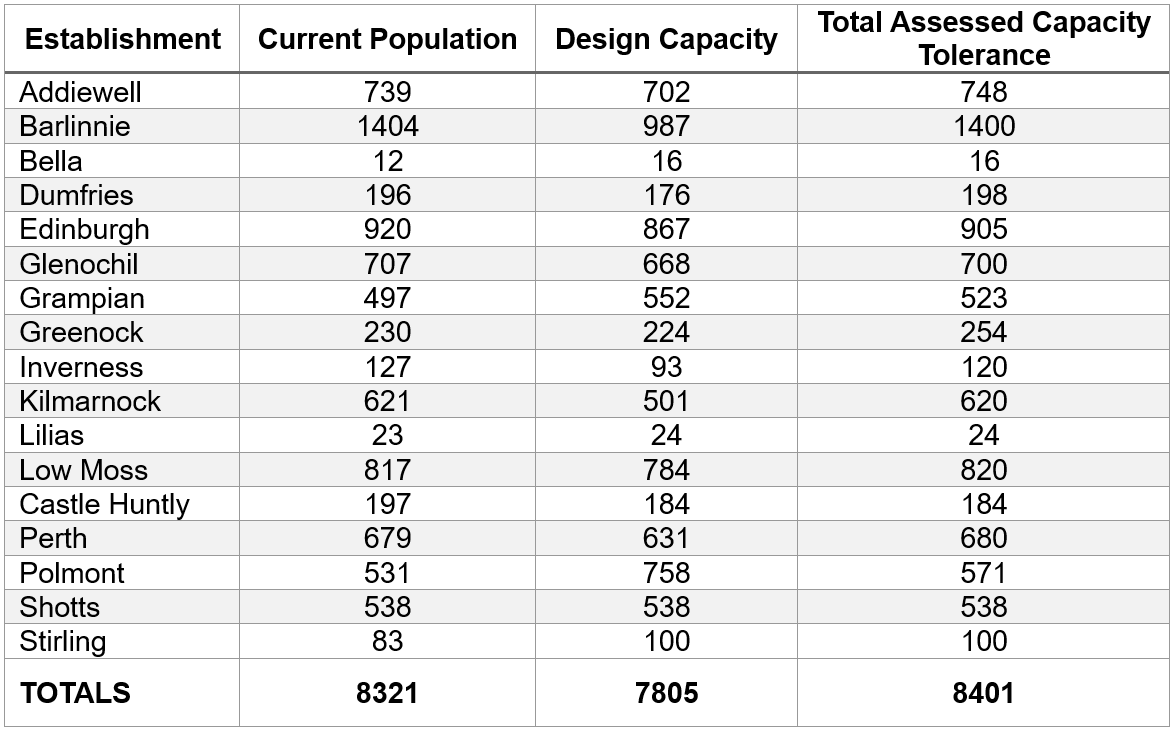
Source: SPS data in response to PQ S6W-42026
In its written submission, the SPS highlighted the impact of the population level on its operational costs, which is further compounded by the growing complexity within the prison population. This including more Serious and Organised Crime Group associations, those convicted of sexual offences, on Orders of Lifelong Restriction and long-term prisoners.i
All of this is leading to increased costs for the provision of food, clothing, bedding and social care for a larger and more complex prison population. Alongside this the SPS also faces higher expenses for staff pay, utilities, rates, and private sector contracts, all of which are adding further fiscal pressures.
The SPS received a budget increase of £45 million, or 8.6 per cent, between FY 2024/25 and FY 2025/26. However, early in the financial year, other inflationary pressures in relation to utilities and the pay settlement for staff arose. Also the SPS has to resource actions associated with the recommendations from the fatal accident inquiries into the deaths of William Lindsay (who was also known as William Brown) and Katie Allan. All of this meant the £45 million uplift was going to be insufficient to allow the SPS to operate.ii
In response, the SPS sought additional in-year funding from the Scottish Government and received an additional £22.5 million in 2025/26 to assist with addressing these cost and inflationary pressures.
The SPS submission sets out that high level costing shows they now require an additional £40 million uplift in resource funding for FY 2026/27, while also noting that they would not discount needing additional in-year funding next year depending on the size of the prison population.
Current and future cost pressures on the SPS resource budget include pressures from the high and complex prison population, pay awards, increased social care costs, costs of PFI contracts and Scottish Court Custody and Prisoner Escorting Service contracts.
On the PFI contract for HMP Addiewell, we were told that above inflation payments owing to contractual obligations will cost the SPS in excess of £2 million in payment to the contractor in 2026/27.iii
Similarly, various social care costs associated with the increasingly complex nature and age of the prisoner population – and which are met directly from the SPS funds - have seen an increase of almost £1 million since 2021/22. A situation the Chief Executive of the SPS described as “very concerning".iv
Consideration should also be given to the need to prepare for new duties across the criminal justice system, including for the SPS. For example, embedding a trauma-informed practice when discharging duties and functions. v This may require the development of a more rights-based budgeting process going forward.
The SPS also stated that were they not to receive this increase there is nowhere they can now cut back on. If the SPS were expected to reduce staff, or asked to slow down or stop recruitment, this would mean prisons would not be staffed to a safe level. Whilst some money could be saved, SPS said it would not amount to a sum which would meet the funding challenge it now faces.
SPS also informed the Committee that they received funding from the Scottish Government in terms of 60% of their own staff National Insurance costs. However, SPS has had to cover the full cost of increase for NI in relation to staffing under the custody and prisoner escort services contract due to a change in contractual arrangements with GEOAmey. This brought the total cost of NIC increases in 2025/25 for the SPS to £5 million.vi
In supplementary written evidence, the SPS confirmed that the £5 million spent on increased National Insurance contributions “based on a residential prison officers’ annual salary in 2025, including employer on-costs (pension & NI contributions), would equate to approximately 97 new start prison officers, this is based on direct salary costs only".vii
The capital needs of the SPS will require an increased capital budget of £462 million in 2026/27. This would cover the second-year costs for the delivery of the new HMP Glasgow and the final funding for HMP Highland, as well as additional costs around the investment in older prisons, such as HMP Dumfries, HMP Greenock and HMP Perth.
The capital budget sought also includes funding for maintenance costs, digital infrastructure and technological solutions including drone detection, the roll out of window grilles, operational investment in the roll out of ‘in-cell’ technology, the roll-out of body worn cameras and the provision of Control and Restraint 2 training across the prison estate.
During oral evidence on 19 November, the Chief Executive of the SPS, Teresa Medhurst was frank in her assessment of the consequences should the budget requirements not be met in full by the Scottish Government, saying-
If we are unsuccessful in our bid for funding, I will not have enough money to run the organisation next year. At some point, the funding will run out. I cannot see any area that we can cut back, particularly given the population pressures. We are doing everything that we can to maximise the amount of space, to provide support and to make changes in the operating day to ensure that we have staff on shift at the times that we require, in order to maximise the time that people spend out of their cell and to give them access to services and rehabilitation programmes. However, at the moment I can see nowhere that I can effect change or reform in a way that would ensure that we had sufficient funding for next year if we are unsuccessful.viii
While acknowledging that there may be some limited scope for the SPS to “stop doing some work” as a cost saving exercise, Ms Medhurst was clear that such action “absolutely would not, in any way, shape or form, meet the budget pressure, because those are all small costs in comparison” with the funding the SPS requires.ix
Another aspect which was considered in relation to the exceedingly high prison population was the continuing numbers of people on remand (approx. 25% of all those currently held in custody in 2025) and the lack of provision this group can receive. With regard to rehabilitation work for this cohort, while recognising they are subject to a different legal position to long-term and short-term convicted prisoners, in terms of what the costs might be for provision of services to people on remand, Ms Medhurst told us-
There is also the larger remand population. Because of the different legal position that they are in, and given the current funding situation, we would require additional funding to enable us to provide services and supports to them in the same way as we do for short-termers or long-termers.x
In supplementary written evidence to the Committee, the SPS stated that it “seeks to offer rehabilitation opportunities to everyone” in its care. It said-
The current population pressures both in terms of numbers and complexity of the population mean we are not able to deliver this support to the level we would wish to. The rehabilitation offered for all prisoners is dependent on their specific needs and includes offender behaviour programmes, family support, support for addiction, mental health problems, and work opportunities. These services are provided on the basis of assessed risk and need and not by population group – although remand prisoners are governed by different legislative arrangements than sentenced prisoners. It is unfortunately not possible to provide specific costings for these services which are delivered by SPS staff and our partners. It is also not possible to provide specific costings in relation to the provision of different services or supports for remand prisoners at this time as these would be very dependent on individual need and length of time on remand etc.xi
The SPS also updated the Committee on the budgetary impact of new legislation on early release of prisoners. In supplementary written evidence, Linda Pollock, Deputy Chief Executive of the SPS cited the estimated costs set out in the Financial Memorandum which accompanied the Prisoners (Early Release) (Scotland) Act 2025. That estimated a total approximate cost of £535,000 for every 100 prisoners who are released early under the Act. The Financial Memorandum did not provide recurring costs annually. That sum is spread across four spend areas, namely: (i) SPS staff costs; (ii) updating of warrant calculation training and guidance materials; (iii) development of a “Service Now” database to record re-calculated warrants and (iv) salary costs for a Legal Services team to support operation of the Victim Notification Scheme.
Ms Pollock went on to state that “In total, 312 people were released under this scheme in the initial tranches. The above costs are considered to have been accurate – reflecting the total numbers released.xii
When questioned on how the SPS was addressing it climate targets, especially in light of the age of its current prison estate, Ms Medhurst told us-
“We take our responsibilities for tackling climate change very seriously. That has been factored into the facilities in our new builds. For example, the closure of Inverness and Barlinnie prisons will have a significant impact, and the new facilities will meet all the new legislation requirements and targets. The organisation has on-going projects, which we require capital funding to support. As we have done for many years, we have factored that into this year’s and next year’s budgets. For next year, we have increased the funding that we require to meet our climate change obligations".xiii
In her evidence to the Committee the Cabinet Secretary acknowledged the cost savings which could be accrued by having more prisoners serving community-based alternatives to custody, such as home detention. Recognising the benefits of community-based solutions on issues like reconviction rates, the Cabinet Secretary told us-
We know, from the evidence about what works, that the reconviction rate for people who have completed community payback orders is around 28 per cent, whereas the rate for those who have served sentences of less than a year is around 52 per cent. That is why it is important that we continue working on the availability of community sentencing options and do whatever we can, notwithstanding the effects of local decision making, to increase the availability of those options and to increase confidence in them.xiv
When questioned about the rising costs for the construction of the new HMP Glasgow and HMP Highland, the Cabinet Secretary stated that a “contract has been signed, which locks in the costs and provides a legal commitment to build the new HMP Glasgow and, of course, to pay for it. Overall, the cost is the best part of £1 billion. There is a profile of the capital cost—increased investment will be required in the forthcoming year in comparison with this year. There is a profile of spend, although that does not mean that it will not change from one year to another—that would not be unusual with large-scale construction projects. However, we are financially and legally committed to the project.xv
The Scottish Courts and Tribunal Service and the Crown Office and Procurator Fiscal Service
In 2025/26, the Scottish Courts and Tribunal Service (SCTS) received a funding settlement of £177 million comprising £123.2 million in resource funding, £19.6 million in capital funding and £34.1 million in non-cash funding.
Resource funding for the SCTS is also failing to meet the needs of the courts. Malcolm Graham, Chief Executive of the SCTS, told us that they received "around £8 million less than they had requested in 2024/25".i
The result of this was that the SCTS could only respond to basic maintenance required for health and safety or structural issues across the courts estate. Mr Graham also stated that he had “not been able to invest in making the reforms that [SCTS] had planned to make or at the pace that we would have liked to make them".i
The SCTS also received an in-year funding transfer of £21.3 million from the Recover, Renew and Transformation (RRT) fund, which was put in place by the Scottish Government following the Covid-19 pandemic.
Furthermore, the SCTS received in-year funding transfers for areas that are activity led, such as members’ fees in relation to business across the chambers of the First Tier Tribunal for Scotland and judicial vacancies.
The SCTS also receive further income from fines and fees for civil court business. While these can fluctuate from year to year, it is estimated the SCTS received £57 million in income on top of their baseline fiscal resource in 2025/26, primarily relating to civil court fees.
The SCTS requires a baseline resource funding of £164.9 million for FY 2026/27. This will allow SCTS to maintain essential services and deliver a level of reform to mitigate against serious delivery risks to those services. This figure assumes an appropriate figure for RRT funding will be baselined into the core budget".iii
SCTS stated that they required an additional £41.7 million in resource budget for 2026/27 and that without this their “services would take longer”, “trials would be delayed across the system” and “ultimately, it would undermine trust and confidence in the courts and tribunals system".iv
Some of the particular pressures on the SCTS budget include the growing levels of serious criminal business and growing tribunal and Office of the Public Guardian business. Also pay and workforce pressures, including increases in employers’ national insurance contributions, are factors putting pressure on its budget.
They also face pressures on the Court estate, where the budget for planned maintenance was reduced to balance the budget shortfall in 2025/26. The need to improve digital and cyber security systems – as well as sector specific inflation in areas such as construction and digital – has added to the budgetary pressures.
SCTS told us that capital funding of £18.7 million is required in 2026/27, rising to £27.6 million in 2027/28 due to a major lease liability reaching a review point. This figure “represents the minimum at which operations can safely and effectively function”. iii This figure will also be balanced between maintaining the SCTS built environment and investing in digital developments and cyber security systems.
The capital budget only allows SCTS to meet health and safety requirements in their built environment but any further investment to improve services depends on additional and specific funding for projects above the core capital allocation.
SCTS are working as part of the Criminal Justice Board to look at initiatives to modernise and consolidate the case management system and digital landscape across the criminal justice system. They said investment by the Scottish Government in this area is needed.
SCTS has a target of a 2.5% year-on-year reduction in carbon output and has been exceeding this baseline in recent years, but that becomes more challenging (and costly) over time as the more straightforward adaptations are utilised.
SCTS noted that the position where they cannot carry reserves and are not allowed to borrow or carry over an underspend provides a “level of inflexibility” that is “a very inefficient way to run a large and complex public service".
Like the Fire Service, the SCTS also stated that they had had conversations with the Scottish Government around these elements of multi-year funding in terms of their spending review.
On changes to National Insurance contributions, COPFS and the SCTS provided figures for the impact of this in FY 2025/26, with both noting that their organisations had had to make savings in other areas to cover these costs. SCTS told us that “taking varying factors into consideration, the overall impact is estimated to be £2.7 million in 2026-27”.vi
In a supplementary response on increased National Insurance contributions, Linda Butcher, Executive Business Manager of COPFS stated that the “additional cost is £2.8 million of which the Scottish Government funded 60% (which is £1.7m). I can further advise that COPFS’ unfunded element is £1.1 million which is a pressure COPFS have had to absorb”.vii
New legislation will have a significant implication for the resource needs of the SCTS going forward. SCTS stated that they were currently going through the process of considering the cost implications of establishing a sexual offences court under the Victims, Witnesses, and Justice Reform (Scotland) Act 2025.
COPFS and SCTS both set out the efficiencies within the system from the summary case management (SCM) project. COPFS advised that the roll-out of SCM is almost complete, where it will be the standard way of working in all the summary courts. COPFS noted that they “have confidence that the model is working,” while SCTS set out that it is anticipated that SCM will result in at least 3,200 fewer trials being fixed per year and will reduce the annual level of police witness citations by more than 50,000.
Expanding on his written submission, Mr Graham told the Committee that the SCTS sought a budget settlement for 2025/26 for “what I felt we really needed” to run the Court system. However, he added that SCTS “received around £8 million less than I had asked for, and the Government acknowledged that it was significantly less than our request” in the 2025/26. As a result, he was required to-
…put in place stringent measures to control the size of our pay bill. We have introduced a 6.49 per cent vacancy factor, which means, in effect, that the pay bill, as it is budgeted for, is 6.49 per cent less than it should be for the number of people that we actually need in the organisation.viii
Additionally the SCTS had to limit any maintenance on the Court estate to addressing only “health and safety or wind and watertight issues.” SCTS also could not invest in in making planned reforms “at the pace that we would have liked to make.” For the 2026/27 budget, Mr Graham stated that the SCTS’s main task “is that we have baselined into our budget the recover, renew and transform—RRT—programme funding that currently still sits with the SCTS on a temporary basis”.
He told us, “In essence, I feel that I could make a strong case for why the SCTS should be a larger organisation to meet growing demands, and the complexity of those demands, but I have not done that. What I have done, in line with the Scottish Government public sector reform strategy, is to sign up to suggested reductions—for instance, a reduction in corporate staff of 0.5 per cent per year".viii
Mr John Logue, the Crown Agent and Chief Executive of the Crown Office and Procurator Fiscal Service (COPFS) pointed out that the 2025/26 budget funding they received was “very fair” and “included additional money for more staff to deal with the additional pressures”. Despite this, he said-
It would be fair to say, however, that, even with that additional funding, there was a requirement for significant efficiency savings in the course of the year to enable us to live within the budget. We are on track to achieve approximately £7 million of efficiency savings within the budget.x
Looking ahead to 2026/27, Mr Logue set out the two priorities the budget settlement for COPFS needs to meet, namely “continue dealing with the consequences of the disruption to courts in 2020-21 caused by the public health emergency.” He expanded on this saying that “in the past year we have made progress on that, but it is clear that there is still much more work to be done. That will be a priority for us next year".x
Secondly, COPFS wants to make progress with the benefits of the reforms that have been undertaken to date. He reassured the Committee that “those reforms are working. Therefore, our commitment is to conclude that work over the next year to two years. That will put our whole criminal justice system in a much stronger position, and it will look very different to the public.” He cautioned that failure to achieve the budget settlement requested for 2026/27 risked undermining this work at a critical phase of delivery.x
Addressing court backlogs continues to remain a key focus for both the SCTS and COPFS. However, Mr Graham stressed that increasing capacity in the High Court, without continuation of additional funding, would not be possible. Even if funding from the RRT fund were to be baselined into the SCTS budget, he said that we “will still need to make considerable adjustments to the court programme to accommodate the extra demands on the High Court” without the level of funding the SCTS is seeking.xiii
As with other justice stakeholders, both SCTS and COPFS have experienced additional and inflationary costs, such as pay awards and the rise in employer National Insurance contributions, which required additional in-year funding from the Scottish Government to partially offset. Even with that additional funding, both organisations face having to find additional savings if future budget allocations do not provide for these.
One area of concern Mr Graham reiterated was the need to modernise the IT infrastructure of the SCTS’s criminal case management system, which is now 25 years old. He stated that “in the course of at least the past decade it has been propped up in a way that we know is not sustainable. The consequence is that it is very time consuming for staff to enter and process data. The system presents a series of data protection and cybersecurity risks that are difficult to mitigate".xiv
This pointed to the wider need around critical capital ICT projects for the Court Service which Mr Graham highlighted. Given that much of the expected future efficiencies within SCTS, which are key to addressing the court backlog, expanded digitalisation will play a vital role. This, however, highlights the need to property resource projects underpinning the cybersecurity of Scotland courts system. Mr Graham said-
…all committee members will be acutely aware of the existential threat that is posed to public service and other organisations by the potential for significant cyberattacks. It will not surprise you to know that, as an accountable officer, I take that prospect extremely seriously. It is one of the few areas—not quite uniquely—into which I have chosen to put additional investment during the course of this year, despite the budget pressures. That is for two reasons. The first is that there is an increasing requirement for us to provide a broader range of services across digital platforms that we need to support ourselves. Therefore, we are responsible for ensuring cybersafety and cybersecurity, not just for SCTS staff and the judiciary, but for other court users and members of the public. I take that duty extremely seriously. [Secondly] concerns the inability to invest, at the scale and pace that we would like, in digital systems that are fit for the 21st century. We face an increasing risk of cyber insecurity in the systems that we have to continue running, and we have to spend more money, disproportionately, to try to shore up those systems and keep them safe. It gets to a point at which the only answer is to replace those systems and build them into a network of interfacing digital justice modules that can be designed to be cyber safe for the world that we now live in.xv
COPFS advised that they require an additional £11.3 million in resource funding for 2026/27. They stated this would allow them to focus on two priorities – dealing with the consequences of the disruption to the courts following Covid-19 and to “make progress with and demonstrate the benefits of reform".
In their oral evidence, COPFS advised that a consequence of funding being restricted would mean they would “not be able to deliver a faster, modern justice system that delivers better outcomes for the public” and later that “the consequence of that for the public will be most noticeable in relation to our casework”. They advised a flat-cash budget would mean around 10% of their workforce (around 260 full-time equivalent staff) would not be funded for next year which “would have a considerable impact on what we are able to deliver for the public".
In their written submission, COPFS stated that their capital budget request of £7.6 million includes “only essential spend for COPFS’s digital systems and estate”. They stated they were aiming for £7 million of efficiency savings in 2025/26 and £5 million next year.
Like the Court service, COPFS highlighted the additional costs that would come from establishing a sexual offences court under the Victims, Witnesses, and Justice Reform (Scotland) Act 2025.
COPFS stated that the increased costs are not part of their plans for next year but that their planning “is based on the fact that very significant costs will be associated with its establishment, and we cannot absorb those costs alongside the other pressures that we have discussed".xvi
Responding to questions on the SCTS’s request for RRT funding to be baselined permanently into its budget, the Cabinet Secretary said she “understand the arguments” and was “giving due consideration to the request for that budget to be baselined".xvii
The Cabinet Secretary confirmed that implementation of the Victims, Witnesses, and Justice Reform (Scotland) Act 2025 will commence in 2026. This will have major implications for both SCTS and COPFS, as well as other justice sector stakeholders and partners. More widely, the Cabinet Secretary stated that “implementation of legislation is an important feature of our budget planning, as it is for our partners. Whether there are any changes, positive or negative, will depend on the overall budget allocation to justice” for 2026/27.xviii
Responding to the issue of cybersecurity and cybercrime, both with regard to the SCTS, and other justice stakeholders, the Cabinet Secretary stated that increasing digitalisation will increase the need for more investment. She highlighted that we “know from Police Scotland’s statistics on recorded crimes that there are now around 14,000 cybercrimes each year. That is around double the number from before the Covid pandemic: about 7,700 cybercrimes were recorded in 2019".xix
She pointed to the fact that the SFRS “has had a number of internal audits and structural reviews, with a view to strengthening its cyber resilience. More broadly, earlier this year, Police Scotland set up a cyber and fraud unit, which promotes using a preventative policing model so that the service can be more agile and better co-ordinated".xix
The Scottish Government’s ongoing work to deliver cybersecurity across the criminal justice sector has been underpinned with the recent publication of the Government’s ‘The Strategic Framework for a Cyber Resilient Scotland 2025-2030’
The Cabinet Secretary recognised that “resilience needs to be embedded into governance arrangements. That means supporting boards and leadership in their training, including hammering home that being ready for an incident is imperative.” She pointed to the establishment of the “Scottish cyber co-ordination centre, the aims of which are to improve incident response, recovery and intelligence sharing and to get a much better understanding of cybersecurity maturity, particularly in the public sector. The same applies to the voluntary sector".xix
Responding to questions of the cost of UK Government changes to National Insurance Contributions to the Scottish budget, the Cabinet Secretary told us-
We provided funding of £23.9 million to the justice portfolio. The purpose of that was to fund 60 per cent of the additional employer national insurance contributions. For the Scottish Police Authority, that came to a little over £15 million; for the Scottish Fire and Rescue Service, it was £3.4 million; for the Scottish Prison Service, it was £3.3 million; for the Courts and Tribunals Service, it was £1.2 million; for the judiciary, it was £500,000; and for other, smaller justice and home affairs public bodies, it was £300,000. That came to a total of around £24 million. That is 60 per cent of the additional cost, leaving a shortfall of £16 million, which our justice public bodies had to find within the resource that was already allocated to them.xxii
The Cabinet Secretary confirmed that the overall cost of the NIC changes to public services in Scotland was £700 million, but that the UK Government had provided about £300 million to Scotland to cover this. This left a £400 million shortfall which had to be funded out of the Scottish Government budget. The proportionate cost to the justice portfolio is “£16 million” of which the Scottish Government provides mitigation at the 60 per cent threshold which will be baselined into budgets” with the remining 40% costs needing to be met by justice stakeholders from within their existing allocated budgets.xxii
COSLA, Social Work Scotland, Victim Support Scotland, and the Third Sector
Information in written submissions from local authorities and the third sector, along with COSLA and Social Work Scotland highlighted the impact from the increase in the complexity of their caseloads and in demand their organisations were facing, without a related increase in funding. COSLA and Social Work Scotland also stressed that the impact of a high prison population resulted in increased workloads for justice social work.
In particular, local authorities, COSLA and Social Work Scotland mentioned the need for funding to support the development of digital systems.
Victim Support Scotland (VSS) stated that their grant award equates to just 0.14% of the overall budget (excluding SFRS and Police and Fire Pensions). This has dropped from 0.22% last year. They also commented that their income from Local Authority grants and Service Level Agreements made up an average of 4.5% of income over the past ten years but only 1.9% of income over the last five years. They noted that as it is anticipated that local authority funding comes under further pressure in the future that this could result in a reduction or removal of financial support to VSS (and other organisations).
Changes in legislation also have a significant impact on other criminal justice sector partners as well. For example, the provisions of the Bail and Release from Custody (Scotland) Act 2023 and the Prisoners (Early Release) (Scotland) Act 2025, were mentioned as impacting on local authorities, and in particular social work, budgets in the written responses the Committee received as part of its call for views.
The impact of increased employer NI contributions and pay uplifts were also raised by local authority and third sector respondents to the call for views. In their written submission, VSS noted that the impact of the increase in national insurance contributions had diverted £106,000 from the funds available to them.
The Criminal Justice Voluntary Sector Forum’s (CJVSF) written submission stated that across the wider third sector in Scotland, the Scottish Council for Voluntary Organisations estimated that the changes in NI would collectively cost approximately £75 million.
Local authority and third sector respondents to the call for views, as well as Community Justice Scotland, highlighted the need for there to be a shift in the justice system from custodial sentences to community-based support and that opportunities for early intervention can be missed due to a lack of investment.
The CJVSF stated that “the aspirations of justice system transformation are also not meaningfully reflected in the distribution priorities of the Scottish Government Budget.” They went on to note that while the Scottish Government’s commitment to prevention and early intervention was welcome that “the ongoing realities of the wider funding environment do not support these aspirations".
The Glasgow City Health and Social Care Partnership stated in their written submission that “consideration needs to be given whether the balance of spend reflects the outcomes outlined in the Scottish Government’s Vision for Justice (2022)".
Community Justice Scotland suggested that a prevention approach could be encouraged across the justice system by using dedicated prevention budgets with ringfenced preventative spend. They also suggested empowering or creating an agency at a national level that can oversee, coordinate, drive and support collaborative and preventative approaches to justice, and whose responsibility it would be to drive forward this agenda. Community Justice Scotland also reiterated that-
the near perpetual state of crisis in our justice system can only be solved by shifting our response to crime as a society away from dealing with people through the criminal justice system and prison and instead to focus on evidence based, community first approaches to addressing offending behaviour.i
Local authority and third sector respondents to the call for views raised the fact that it is not just about the justice system and that investment is also needed in housing, mental health, addiction services, and employability to ensure there is holistic support in place for individuals.
Local authority and third sector respondents to the call for views also highlighted the need for multi-year funding, with Stirling Council stating-
We require to be advised of our area specific proposed budget much earlier. Over the last two years we have only received confirmation of our budgets in March, which leaves a significant number of staff unaware of their positions if on a temporary contract, and also causes issues in relation to our commissioning arrangements with third sector partners.ii
The CJVSF noted that while the Fairer Funding pilot was a sign of progress, the core challenges they raised within their 2024 submission to the Committee “essentially remain the same"iii
In terms of the funding for prison based social work, COSLA and Social Work Scotland noted that the funding arrangements for this area differ to that for community justice social work, which is funded from section 27 ring-fenced allocations. They noted there has been no uplift in the budgets from which SPS procure these social work services and that these arrangements are under review to consider whether prison based social work should also be part of the section 27 grant.
Responding to questions about the increasing caseloads for Criminal Justice Social Work, the Cabinet Secretary told us-
I accept that there are increasing caseloads and complexity. That trend is mirrored in the size of the prison population, as well as in the work that is expected of justice social work staff.…over the past two years, I have increased justice social work funding by £25 million to £159 million. The useful thing to bear in mind is that none of that £159 million is spent on staff salaries, which come instead from the overall local government settlement. Therefore, the local government settlement has a bearing here and will be important for me, as justice secretary, to consider, just as it will be for other cabinet secretaries. In the longer term there has been growth in the justice social work workforce. Since 2015, the number of staff there has increased by 18.6 per cent, which is more than double the overall increase in the general social work workforce. However, I am concerned that, over the past year, the number of justice social work staff has decreased a little, by around 3 to 3.5 per cent.iv
CONCLUSION AND RECOMMENDATIONS
The Committee thanks the witnesses from the Scottish Police Authority, Police Scotland, the Scottish Prison Service, the Scottish Fire and Rescue Service, COPFS and the Scottish Courts and Tribunal Service for their clear and candid assessment they have presented to us about the challenges the Scottish justice sector currently faces.
We are also grateful for the written submissions we have received from many other bodies such as COSLA, HMICS, HMIPS, the SPF, ASPS, FBU, Community Justice Scotland, Social Work Scotland, and Victim Support Scotland.
We recognise and acknowledge that there are no easy answers to the provision of budget allocations to the justice sector which would address all of the issues which have been raised during our pre-budget scrutiny this year. However, the evidence we received is gravely concerning to the Committee. While it is obvious that our justice sector organisations have made every effort possible to deliver the highest possible service to the Scottish people whilst making savings, it is clear to us that a crucial limit has now been reached in terms of funding and resources.
We acknowledge the Scottish Government, and the Cabinet Secretary for Justice and Home Affairs, is committed to providing a budget settlement which meets the most pressing needs of the justice sector. However, the high level of efficiency savings which have been achieved from across the sector in the last 10 to 15 years must now start to be reinvested in the justice portfolio.
The graph below illustrates the overall budget provision to the organisations who provided oral evidence to the Committee for the current financial year 2026/25 (SPA/Police Scotland, SFRS, SCTS, COPFS and SPS), compared to the total budget sought by organisations for 2026/27.

SPICe/Criminal Justice Committee written and oral evidence
This shows that, across the main justice bodies, a 13% uplift in budget for 2026/27 is needed compared to 2025/26, or just over £400 million.
The graphs below illustrate the individual budget provisions to the SPA/Police Scotland, the Scottish Prison Service, the Scottish Fire and Rescue Service, the Scottish Courts and Tribunal Service and the Crown Office and Procurator Fiscal Service from the justice portfolio in 2026/25, set against what each organisation has said is needed for 2026/27.

SPICe/Criminal Justice Committee written and oral evidence
In particular it is important to recognise that since their establishment in 2013, Police Scotland and the Scottish Fire and Rescue Service between them have achieved nearly £1 billion in savings for the Scottish budget. This is almost certainly an unmatched achievement in the Scottish public sector, especially in relation to the size of each organisations budget. The room for further savings by the police or fire service is now exhausted, and both must now see the reinvestment of these achievements back into their future funding, as opposed to having such savings redirected to other portfolios across the Scottish budget.
It is clear from the stark assessments that have been presented to us that a proposed flat-cash settlement for 2026/27 will not be sufficient to allow the justice sector to meaningfully address the serious and complex challenges it is facing. . The Committee draws the Scottish Government’s attention to the significant concerns expressed by the Chief Constable (paragraphs 48, and 56 to 58) and the Scottish Police Authority (paragraphs 72 and 73), the Chief Fire Officer (paragraphs 89 to 92), the Chief Executive of the Scottish Prison Service (paragraphs 136, 141 and 142) and the Chief Executive of the Scottish Courts and Tribunal Service (paragraphs 156 and 157, and 170 to 172) with regard to the serious implications to the running of a criminal justice service of a flat-cash settlement for 2026/27.
The sector has said it now needs an uplift of some £400 million if it is avoid making the kinds of cuts and reductions in service which the Committee does not think would be acceptable to the public and their expectations of the justice system.
We strongly recommend that the Cabinet Secretary for Justice and Home Affairs gives serious consideration to the additional funds needed by the sector and is supported by the wider Scottish Government when it comes to the final budget proposed.
Furthermore, there is now an urgent need for the Scottish Government to move towards multi-year funding settlements for all justice sector bodies in Scotland where possible or at least have firmer indicative settlements. This must be reflected in the forthcoming conclusions of the Scottish Spending Review.
In relation to police and fire services, we recognise that the creation of single nationally-funded bodies resulted in the loss of the ability to manage and carry financial reserves, as was the case when they were part of the local government funding system.
We recommend that the Scottish Government continues to press the UK Government to consider the present classification rules applied by the Office for National Statistics (ONS) and budgeting rules by HM Treasury which apply to the police and fire service in Scotland, and if there is a way within the rules to allow both the SPA/Police Scotland and the SFRS flexibility to manage their budgets through the use of a financial reserve.
We also recommend that the Scottish Government should examine whether there is scope to allow for borrowing capacity to be restored to the police and fire service. This would allow much needed flexibility to both organisations to address critical issues which arise at short notice and need an immediate response. We note that the Scottish Government’s ability to borrow is set by the Fiscal Framework agreed with the UK Government. We urge the Scottish Ministers to work with the UK Secretary of State for Scotland to find a solution which would allow the police and fire service in Scotland to regain funding flexibility on carrying reserves and borrowing powers.
In relation to the overcrowding crisis in the prison system, we recognise that a whole-system approach will be required to address the current situation. Urgent efforts to address the prison population are required, but they need to strikes the right balance between those serving a custodial sentence and more use of community-based alternatives to prison. These efforts must be evidence-based and any shift must be adequately resource through budget allocations to justice stakeholders.
We acknowledge that budgetary decisions made by the UK Government, such as the increase in employer National Insurance Contributions, are outwith the control of the Scottish Government. It is clear the Scottish Government has tried to mitigate the financial consequences to the justice sector budget with in-year funding to cover up to 60% of the costs as best it can.
We recommend the Scottish Government look to utilise the Scottish Spending Review to provide, as much as possible, for future cost implications of UK Government decisions which may impact justice stakeholder budgets. However, in our view, the UK Government must meet its responsibilities to provide full funding to Scotland for budgetary decisions made at a UK level and over which the elected Scottish Parliament does not have control, but the partial costs of which it is then required to meet from the existing Scottish budget.
Despite the welcome in-year funding top ups by the Scottish Government to meet other inflationary cost pressures for the likes of Police Scotland, the SFRS, the Scottish Prison Service and other stakeholders, the need for additional funds to be baselined into annual budget provisions is pressing.
All the stakeholders we heard from pointed to the pressure of additional costs in assessing, planning, and preparing for the implementation of new legislation enacted by the Parliament.
The implementation of laws such as the Bail and Release from Custody (Scotland) Act 2023, the Police (Ethics, Conduct and Scrutiny) (Scotland) Act 2025, the Prisoners (Early Release) (Scotland) Act 2025 and the Victims, Witnesses, and Justice Reform (Scotland) Act 2025, will have major implications for the police, courts, prisons, community justice and COPFS.
The Scottish Government must ensure the resource and staffing needs of justice sector stakeholders have the capacity to meet these legislative requirements. Also, any funding model must provide for justice sector stakeholders to undertake the level of strategic and coordinated multi-year planning which is necessary for the successful implementation of these legislative changes.
The Committee recommends that the Scottish Government should meet the calls of stakeholders like the police, prison service, courts service and others and baseline the additional dedicated funding it has provided to date for issues such as the implementation of legislation into justice sector budgets. Failure to do so now, may risk jeopardising the successful delivery of the new laws in the future.
We welcome the policy development and ongoing capital and resource investment by the Scottish Government to ensure the justice sector can keep pace with the threats of cyber insecurity and meeting climate change targets. We recommend that the Cabinet Secretary should ensure that the upcoming Scottish Spending Review and the first Climate Budget clearly set out how the policies and efforts of justice sector stakeholders will be underpinned with dedicated resources to continue to address cybersecurity and climate change in a joined-up and coordinated way across the justice sector.
Of particular note is the impact climate change is having on the role and work of the Scottish Fire and Rescue Service. It is, quite literally, on the front-line of protecting the people of Scotland from climate-driven dangers such as increased flooding and wildfire events.
It is vital that the restructuring of the SFRS’s delivery model results in a fire service which meets Scotland’s needs now and into the future, including the right levels of wholetime, retained and on-call firefighters, a sufficient estate and fleet, and certainty in terms of the response times members of the public can expect the SFRS to meet when they call for help.
In early 2026, the Committee plans to return to examine further the challenges facing the SFRS and how it, and the Scottish Government, propose to meet these through enhanced investment in the service.
ANNEXE A: Written, Oral and Supplementary Evidence
WRITTEN SUBMISSIONS IN RESPONSE TO THE CALL FOR VIEWS
ORAL AND WRITTEN EVIDENCE
Wednesday, 05 November 2025 -29th Meeting, 2025
Wednesday, 12 November 2025 - 30th Meeting, 2025
Wednesday, 19 November 2025 - 31st Meeting, 2025
Wednesday, 26 November 2025 - 32nd Meeting, 2025
Wednesday, 03 December 2025 - 33rd Meeting, 2025
SUPPLEMENTARY WRITTEN EVIDENCE
Submission from the Crown Office and Procurator Fiscal Service, 16 December 2025
Submission from Police Scotland on additional policing costs, 16 December 2025
Submission from the Crown Office and Procurator Fiscal Service, 11 December 2025
Letter from the Cabinet Secretary for Justice and Home Affairs, 9 December 2025
Letter from the Scottish Prison Service, 3 December 2025
Letter from the Scottish Fire and Rescue Service, 19 November 2025
Letter from the Scottish Courts and Tribunals Service, 19 November 2025
Letter from the Scottish Police Authority, 17 November 2025
ANNEXE B: Extracts from the Minutes
Wednesday, 25 June 2025 - 20th Meeting, 2025
8. Pre-Budget Scrutiny (In Private): The Committee considered its approach to Pre-Budget Scrutiny for 2026/27. The Committee agreed to issue a call for views. The Committee also agreed to take any further approach to the draft budget, consideration of any evidence heard and any draft report or letters, in private, at all future meetings and to delegate responsibility to the Convener and clerks, for approving any claims made for witness expenses under the Scottish Parliamentary Corporate Body witness expenses scheme.
Wednesday, 05 November 2025 -29th Meeting, 2025
2. Pre-Budget Scrutiny: The Committee took evidence as part of its Pre-Budget Scrutiny from Chief Constable Jo Farrell, Deputy Chief Constable, Alan Speirs, Professionalism, Strategy and Engagement and Lynn Brown, Head of Finance, Police Scotland; Fiona McQueen, Chair, Alasdair Hay, Vice Chair and Chris Brown, Chief Executive and Accountable Officer, Scottish Police Authority.
Wednesday, 12 November 2025 - 30th Meeting, 2025
2. Pre-Budget Scrutiny: The Committee took evidence as part of its Pre-Budget Scrutiny from John Logue, Crown Agent and Chief Executive and Yvette Greener, Chief Operating Officer, Crown Office and Procurator Fiscal Service; Malcolm Graham, Chief Executive, Scottish Courts and Tribunals Service; Stuart Stevens, Chief Officer, Andy Watt, Deputy Chief Officer and Sarah O'Donnell, Deputy Chief Officer (Corporate Services), Scottish Fire and Rescue Service.
Liam Kerr declared an interest as a practising solicitor regulated by the Law Society of Scotland.
Wednesday, 19 November 2025 - 31st Meeting, 2025
2. Pre-Budget Scrutiny: The Committee will take evidence as part of its Pre-Budget Scrutiny from Teresa Medhurst, Chief Executive, Linda Pollock, Deputy Chief Executive and Amy McDonald Director of Finance of the Scottish Prison Service.
Wednesday, 26 November 2025 - 32nd Meeting, 2025
2. Pre-Budget Scrutiny: The Committee took evidence as part of its Pre-Budget Scrutiny from Angela Constance, Cabinet Secretary for Justice and Don McGillivray, Director of Safer Communities, Scottish Government.
Wednesday, 03 December 2025 - 33rd Meeting, 2025
2. Pre-Budget Scrutiny (in private): The Committee will consider the evidence heard at previous meetings.
5. Scottish Fire and Rescue Service Delivery Review: The Committee took evidence from Colin Brown, Executive Council Member for Scotland and John McKenzie, Scottish Regional Secretary, Fire Brigades Union.
Wednesday, 10 December 2025 - 34th Meeting, 2025
4. Pre-Budget Scrutiny (In Private): The Committee considered a draft report on its Pre-Budget Scrutiny. Various changes were agreed to, and the Committee agreed to consider a revised draft, in private, at its next meeting.
Wednesday, 17 December 2025 - 35th Meeting, 2025
5. Pre-Budget Scrutiny (In Private): The Committee considered a revised draft report on its Pre-Budget Scrutiny. Various changes were agreed to, and the report was agreed for publication.