Flats: management, maintenance and repairs (updated 2026)
When a person owns a flat, they have an interest in what happens to the building as a whole. However, working together with other flat owners to manage and maintain the building can be difficult in practice. This briefing looks at some of the associated law and policy, as well as offering practical advice which might help support people in this situation.
Executive Summary
A range of repair and maintenance problems
Flats are an important part of Scotland's housing stock. In buildings which contain flats lots of different repairs and maintenance problems can arise. The condition of some of these buildings is relatively poor, particularly the older ones.
While there are plenty of incentives for flat owners to work together to maintain or improve their building, there are challenges in practice.
Uncertainty amongst flat owners
Sometimes flat owners are unclear as to who is responsible for dealing with maintenance and repairs problems affecting the building. However, a flat owner has the primary responsibility for repairs and maintenance to their flat. In addition, flat owners usually have some collective responsibility for repairs and maintenance to other important parts of the building.
Sources of legal obligations
The title documents, the official ownership documents relating to a building, are a significant source of rights and obligations in practice, including because they can contain binding legal obligations known as title conditions.
The Tenements (Scotland) Act 2004 ('the 2004 Act') is also an important piece of legislation, containing the Tenement Management Scheme (TMS), a default scheme for the management and maintenance of flatted buildings. The TMS applies where and to the extent that the title documents for the building do not make alternative arrangements - or consistent provision on those arrangements between different flats. A key feature of the TMS is that it allows binding decisions by a simple majority of flats (more than 50%) on a range of issues.
However, some housing experts question whether this legislation, and related legislation, have delivered improvements to the condition of buildings in practice.
Owners' associations
To help communication and decision-making, owners in a block of flats may choose to form an owners' association. This is a group of flat owners who work together on matters of shared concern. While the decision to establish an owners' association is often voluntary, some title documents do provide for such an association.
Property factors or managers
Instead, or in addition, the use of a property factor, also known as property manager, to manage and maintain building is also reasonably common in practice.
The property factoring sector is now regulated by the Property Factors (Scotland) Act 2011 ('the 2011 Act'). There is a Code of Conduct setting out minimum service standards which property factors have to meet. There is also the opportunity for a flat owner to complain to the First-tier Tribunal (Housing and Property Chamber) if the factor is not complying with the Code of Conduct or certain other parts of the 2011 Act.
Possible reforms
In 2019, the Scottish Parliament Working Group on Tenement Maintenance ('the working group') recommended further reforms to improve how flat owners manage and fund building repairs, but progress here has been relatively limited.
In 2025, the Scottish Law Commission, the independent law reform body, proposed a possible legal framework for compulsory owners' associations. This followed a Scottish Government referral to the Commission that asked it to develop a framework for such associations, in line with one of the working group's earlier recommendations.
The SNP committed to reforming the 2004 and 2011 Acts in its 2026 Scottish Parliament election manifesto. Commitments relating to flatted buildings also appeared in the manifestos of three other political parties.
Enforcement by owners
In relation to the current legal framework, note that, for alleged non-compliance with title conditions or binding decisions under the TMS, the local sheriff court is the main dispute resolution forum. Here a court application can be made by an aggrieved flat owner.
There is no public body with general responsibility to initiative enforcement action in these areas.
Local authorities' powers
Separately, however, the local authority has various statutory powers to require that owners carry out certain repairs. The local authority also usually has a good deal of discretion as to whether it uses the powers or not, unless the building is classified as dangerous. When public finances are tight, the powers are typically used as a last resort.
Paying for repairs
In Scotland, there is not really a culture amongst flat owners of anticipating future work and saving together for it, for example, via a building reserve fund. This means that owners can struggle to pay when something unexpected happens or when the parts of the building with a limited lifespan wear out. Owners may have to use any savings they have or take out a loan.
Local authorities can offer assistance to private owners to carry out repairs. For example, in some circumstances, they might pay for 'missing shares' where a particular flat owner is unable or unwilling to contribute to the cost of repairs. However, a significant proportion of local authorities do not offer the scheme and nowadays, due to the policy focus of the Housing (Scotland) Act 2006, the local authority's assistance with repairs is often not financial support.
While Scottish Government grants and interest-free loans can help fund energy-efficiency improvements and clean energy installations, they do not cover the wider range of repair and maintenance needs associated with flatted buildings.
Cover image: Canva free images
What this briefing covers
This briefing focuses on the management, maintenance and repair of buildings containing flats. It updates an earlier version of the briefing published at the start of Session 6 of the Scottish Parliament, in 2021.1
Early sections of the updated briefing focus on the policy landscape in this area, including current challenges and possible reforms.
Later parts of the briefing are more constituency focused, looking at a wide range of topics related to flats on which SPICe regularly receives enquiries from constituency offices.
Note that SPICe cannot provide legal advice in individual cases and the final section of the briefing describes how to find such advice.
The charity, Under One Roof, also cannot provide legal advice in individual cases. However, its Ask an Expert service can also provide specialist support on specific issues.
Under One Roof's website also provides guidance on organising repairs, maintenance and retrofit works. It also provides information on a range of related topics, including building components, cladding, owners' associations and property factors.
This wide-ranging SPICe briefing is divided into multiple sections, covering the following topics:
Scottish housing context:an explanation of how flats fit within the wider landscape of Scottish housing
current policy landscape:an overview of key policy issues affecting the flats sector, including ongoing initiatives and potential reforms
roles and responsibilities:an introduction to who is responsible for the management, maintenance, and repair of flats, with flat owners having important responsibilities
ownership structure:a description of who typically owns what within a building containing flats
Tenement Management Scheme:an outline of this important statutory framework, which governs decision-making, maintenance and repairs where a building's title conditions are silent, unclear or conflicting
support and shelter:lesser known, but important statutory duties on flat owners to provide support and shelter to other flats and parts of the building
insurance:the current statutory requirements for insurance for the building
communication and decision-making:some resources to support flat owners in working together
owners' associations:an introduction to setting up an owners' association for a building
property factors or managers:an overview of the role of property factors or managers, including steps owners can take if they are dissatisfied with the service provided
resolving disputes:methods of resolving disputes - such as between flat owners or between flat owners and an external contractor
local authority powers:an explanation of the largely discretionary powers available to local authorities to enforce repairs
financing repairs:an overview of the options available to flat owners for funding repair and maintenance works
miscellaneous topics:various miscellaneous, largely practical, topics - including how to get the title documents for the building, how to track down missing owners and how to find legal advice.
Title deeds or title documents?
SPICe recognises that the term title deeds is still often used in practice to describe the official documents relating to the registered ownership of land and property.
However, this briefing refers to the official ownership documents as the title documents and, similarly, Under One Roof uses the term, titles, in its published material.
These shifts in legal terminology reflect key differences in the format of the two existing property registers in Scotland. The older Register of Sasines contains traditional deeds, however, the newer Land Register of Scotland, which now contains a significant proportion Scotland's land and buildings, does not. Instead, its documentation makes reference to, or includes excerpts from, those deeds.
Flats as a type of housing
Flats are an important part of Scottish life, accounting for around 890,000 homes, around 35% of Scotland's housing stock.1 In more detail:
urban/rural: the most common housing type in urban areas is the flat, accounting for around 40% of urban housing - however, only around 10% of rural homes are flats2
by provider: flats account for 50% of the homes provided by local authorities, 65% of the homes provided by housing associations and around 70% of the homes let out by private landlords.3
The Tenements (Scotland) Act 2004 ('the 2004 Act') an important piece of legislation explored later, defines tenement broadly, to include all buildings containing flats.i
The wide statutory definition is important because flats are found in a wide range of buildings, not just the traditional pre-war sandstone or granite building:
Modern flats: There are more modern blocks of flats, including high rise blocks.
Four-in-a-block flats: Flats can also be found in four-in-a-block properties, typically built as social housing in the 20th Century. Each flat has a separate entrance, taking the form of a stair for an upper flat.
Apartment blocks: Developers tend to market brand new buildings as apartment blocks. These can have extensive common areas and facilities, such as underground parking and landscaped garden grounds, which can be expensive to maintain.
Converted buildings: Some buildings contain flats as a result of a change of use, such as large houses which have been subdivided or former commercial or public sector buildings.
Mixed-use buildings: Some buildings also currently have a mixture of flats and commercial units, such as shops or offices.
The Under One Roof website has a good section on buildings containing flats from different eras. It looks at the different types of construction materials used, and methods of construction. It includes a description of some key issues that can arise in respect of each type of building.
All these types of buildings fall within the scope of the 2004 Act and this briefing.

SPICe
The policy background to this briefing
Going into the new parliamentary session (Session 7), as was the case in the preceding parliamentary session, there are various policy issues affecting flatted buildings.
The condition of Scotland's flats
The condition of some buildings, particularly the older ones, is relatively poor.
The 2024 Scottish House Condition survey found that 68% of pre-1919 homes, just over half of which are flats, have disrepair affecting critical elements - that is, those central to weather-tightness and structural stability - compared to 28% of homes built after 1982.1
The 2024 survey also found that urgent disrepair, where immediate repair is required to prevent further deterioration to the building fabric or health and safety risks to occupants, affects more older homes: 32% of pre-1919 properties require urgent repairs to one or more critical elements, compared to 11% of homes built after 1982.2
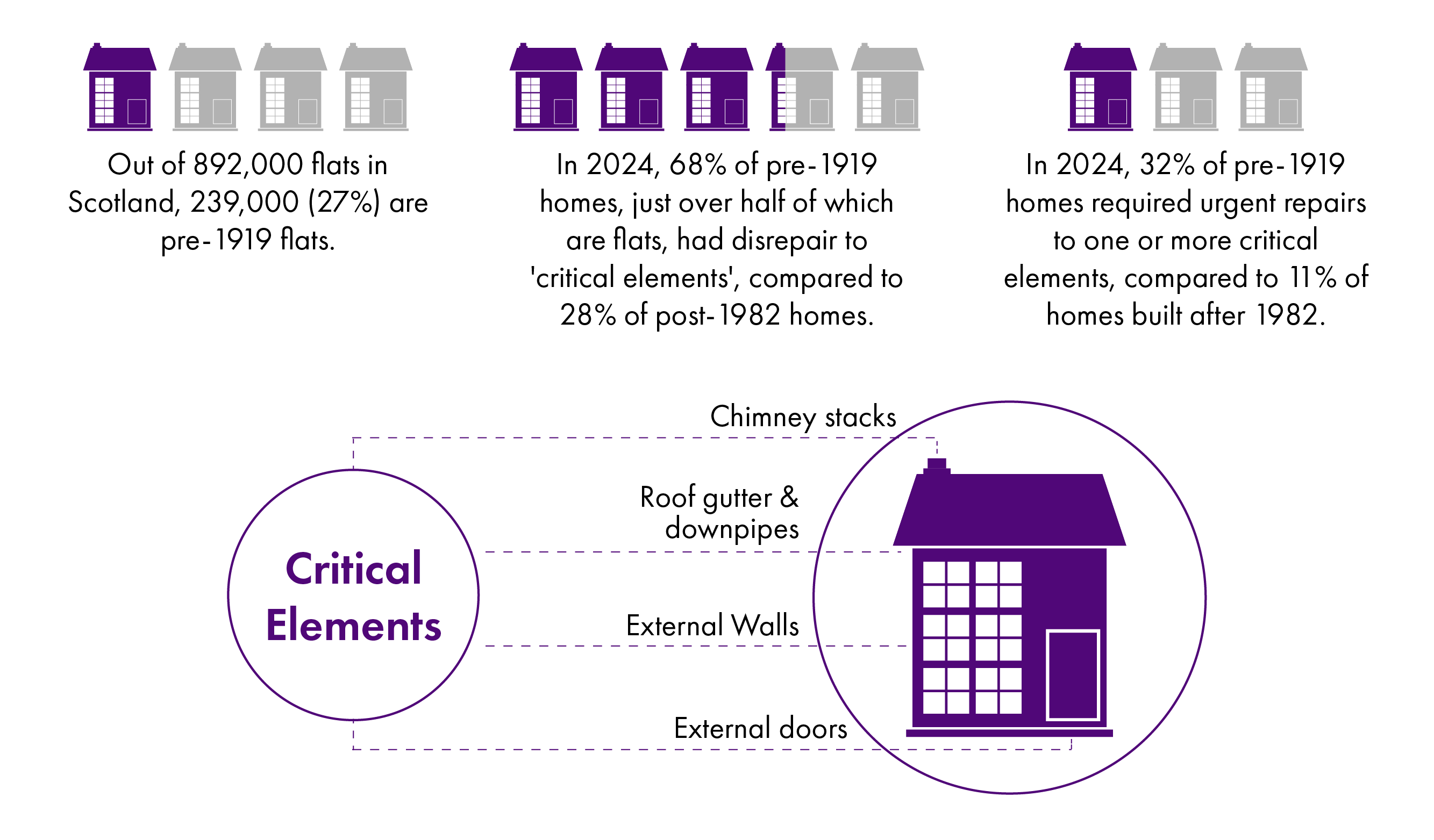
Why the condition of flatted buildings matters
The condition of buildings containing flats is important for several reasons.
Buildings in serious disrepair and dangerous buildings
First, if the poor condition of flatted buildings is not addressed, buildings will fall into more serious disrepair, becoming more expensive to repair and more difficult for flat owners to sell.
Ultimately, buildings may become dangerous to occupants and others and, in some instances, demolition might be the only option to restore safety.
A stark reminder of the dangers posed by deteriorating buildings came earlier in 2026, when the collapse of part of a tenement's gable wall and chimney stack caused masonry to fall onto a street in Glasgow.1
Sometimes dangerous buildings can be fatal. In 2000, in a well-known case, a 26-year old woman was killed, and several others injured, after heavy masonry fell from a tenement building in Edinburgh onto the street below.2
South of the border, the tragic Grenfell Tower fire in London in 2017 exposed a range of complex legal, regulatory and policy issues.3 Many of these lie beyond the scope of this briefing, and some relate to differences between English and Scottish property law. Nevertheless, the fire underscored a fundamental lesson: problems within a single building can have catastrophic consequences for large numbers of residents.
Climate change, net zero targets and retrofitting
Separately, Scotland's climate change strategy puts growing pressure on the condition of flats.1
Meeting net zero targets means large-scale retrofitting. Retrofitting refers to upgrading existing buildings to improve energy efficiency. For example, this might be by improving insulation, glazing, draught-proofing, and ventilation, and by adopting low-carbon heating system and/or on-site renewable energy generation.
In its Programme for Government 2026-2031, published on 1 September 2026, the Scottish Government stated that it intends to introduce a Buildings (Heating and Energy Performance) and Heat Networks (Scotland) Bill during the first year of Session 7 of the Scottish Parliament, with the aim of decarbonising heat in buildings.2 A draft Bill and accompanying explanatory notes were published in November 2025. However, it is not yet clear what any finalised proposals will include.
In flatted buildings, some changes and improvements associated with retrofitting may require collective decisions on the shared fabric of the building, making agreement between owners critical. As the Scottish Government signalled in its 2021 Heat and Buildings Strategy ('the Strategy'), new legislation on collective decision-making may be required to make this possible.3
In 2023, the Tenements Short Life Working Group, an expert group set up by the Scottish Government following publication of the Strategy, published its final report on energy efficiency and zero emissions heating, looking at some of the challenges in this area. This report is considered in more detail later in the briefing.
The challenges of working together
The previous section of the briefing shows that flat owners have strong incentives to cooperate on maintaining or improving their building, and that policymakers also have an interest in supporting or perhaps even requiring such collaboration.
However, in practice this cooperation between owners is difficult for a variety of reasons and the challenges are also significant for policymakers, as explored in this section.
Different types of housing
A single building can contain a mix of social housing, privately rented flats - including short-term or holiday lets - and owner-occupied homes.
This creates a range of differing interests among owners and occupiers in the building, alongside the potential for significant variation in their financial circumstances.
Finding all the owners
Sometimes it may be difficult for owners in a block to even identify who owns a particular flat, for example, if it is rented out by an investor landlord or the person has died and administration of the estate is ongoing.
There are some limitations to the public registers which can be used to track down owners in this context, as explored in more detail later in the briefing.
No single statutory standard relating to the condition of housing
Currently, there is no single statutory standard governing the condition of housing across different types of owners.
While social landlords are required to meet Scottish Government quality and energy efficiency standards, they can face difficulties securing agreement from other owners in mixed-tenure buildings when repairs or improvements are needed to meet those standards.
Long-term saving by owners
Significantly, there is not really a culture in Scotland of long-term saving by owners for future repairs, even though this is critical to the long-term health of buildings.1
Cost of living pressures in Scotland arguably make it much harder for policymakers to impose these requirements on shared ownership buildings through legislation.
The role of property factors or managers
In some parts of the Scotland, particularly in urban areas on the west coast, such as Glasgow, it has traditionally been very common to have a property factor, also known as a property manager.1 More widely across Scotland, many modern developments and increasing numbers of traditional blocks, especially in urban areas will have a property factor.
For a fee, property factors arrange repairs and maintenance and some owners find this a convenient approach.
However, under some types of factoring contract, maintenance may only be reactive rather than regular, and in rural areas it can sometimes be difficult to find suitable factoring services.
In addition, while there was earlier legislation on the topic in 2011,i ensuring the effective regulation of property factors remains a live policy issue. As explored in more detail later, the SNP 2026 election manifesto contained a commitment to further reform in this area by the end of the current parliamentary session.
Has existing legislation worked?
There were various reforms in the early part of the 21st Century designed to improve the condition of Scotland's housing, and to encourage owners to work together on repairs and maintenance. These are explored in more detail throughout the rest of the briefing.
Relevant legislation includes the Title Conditions (Scotland) Act 2003, which modernised the law on the legal obligations known as title conditions; the Tenements (Scotland) Act 2004, which sought to bring greater clarity to the ownership of the building's shared parts and introduced the Tenement Management Scheme; and, finally, the Housing (Scotland) Act 2006, which gave local authorities new powers relating to the condition of housing.
However, in his 2019 report Why Flats Fall Down: Navigating Shared Responsibilities for the Maintenance and Repair, the housing academic Professor Douglas Robertson argued that:
... despite this plethora of useful reforms...the actual impact on the ground has proved fairly negligible. If anything, matters now appear to have got worse.
Robertson, D. (2019). Why Flats Fall Down Navigating Shared Responsibilties for their Repair and Maintenance, p 23. Retrieved from https://www.befs.org.uk/wp-content/uploads/2020/01/BEFS-Why-Flats-Fall-Down-November-2019.pdf
Professor Robertson later revisited key themes from this report in an article in the Scottish Housing News in 2025, in an article entitled Tick Tock for Tenements.
Proposals for further reform
In Session 5 (2016-2021) and Session 6 (2021-26) of the Scottish Parliament, there were proposals for further reform, which remain wholly or partially unimplemented.
The Scottish Parliament Working Group on Tenement Maintenance and the work of the Scottish Law Commission on owners' associations (2019-2026)
In 2019, a report by the Scottish Parliament Working Group on Tenement Maintenance was published.1 It recommended a parliamentary Bill to be introduced by 2025, covering the following topics:
mandatory owners’ associations, to try and involve all owners in decision-making
building reserve funds, to enable long-term saving by flat owners for repairs
building surveys every five years, for regular identification of repairs issues.
In relation to the first bullet point above, note that owners' associations, in their current form, are discussed in more detail later in the briefing.
In late 2019, the Scottish Government broadly accepted the working group's position that action was needed, but questioned whether legislation by 2025 was realistic.2
In 2022, the Scottish Government referred the specific issue of owners’ associations to the Scottish Law Commission ('the Commission'), the independent statutory body that makes recommendations for the reform of Scots law.
The Government asked the Commission to make recommendations for reform in order to implement the recommendation in the 2019 report by the Scottish Parliament Working Group on Tenement Maintenance to establish compulsory owners’ associations.1
In December 2025, following an earlier discussion paper, the Commission published its final report (and associated executive summary) setting out a proposed legislative framework for compulsory owners' associations in flatted buildings, should the Scottish Government be minded to progress the relevant recommendation.45
The Scottish Government is yet to publish its formal response to the Commission's report.
In February 2026, the Scottish Parliament Working Group on Tenement Maintenance wrote to the then Scottish Government, seeking a renewed commitment from the Government to the working group's recommendations, to which it did not receive a response before the election.
As discussed in more detail later, various election manifesto commitments relating to tenement reform, including in the SNP manifesto, were made.6
The working group then wrote again on 18 June 2026 and the Cabinet Secretary for Social Justice and Housing, Shirley-Anne Somerville MSP, replied on 24 August 2026, confirming ongoing scoping work towards bringing legislation forward. The letter stated that it was not yet possible to provide a timescale for policy reform, as implementation timescales will depend upon "complexity and the legislative timetable". The Cabinet Secretary agreed to keep the working group informed of developments.
The Scottish Government's recent Programme for Government, setting out the proposed legislation for year 1 of Session 7, contains no relevant legislative proposal.6
The Tenements Short Life Working Group (2023)
There has also been relevant work by the Tenements Short Life Working Group. This is entirely separate from the Scottish Parliament Working Group on Tenement Maintenance, which was discussed in the preceding section of this briefing.
As a reminder, the Scottish Government's 2021 Heat and Buildings Strategy ('the Strategy'), indicated that new legislation on collective decision-making in flatted buildings may be required.1
The Tenements Short Life Working Group was set up following publication of the Strategy, and, in November 2023, it published its final report on energy efficiency and zero emissions heating, looking at some of the challenges in this area. The report made recommendations on a variety of topics, including possible legislative reform on tenements law, considered in more detail later in the briefing.2
Note that the Short Life Working Group strongly supported the recommendation of the Scottish Parliament Working Group on Tenement Maintenance for mandatory owners' associations. However, it did not view such associations as 'a silver bullet' for delivering all the energy efficiency and zero direct emissions heat improvements required in flatted buildings. Instead, it recognised the need for a range of complementary measures.2
On the financial aspects of what might be required, the report concluded that, while significant public investment will be essential, private finance will also be needed to bridge the gap between the scale of investment needed and available public resources.2
A single housing quality standard
In an initiative that would include flatted buildings, the Scottish Government's Housing to 2040 strategy (2021) committed to introducing a single housing quality standard for all homes. This was to be supported by an enforcement framework, with legislation planned for 2024–25 and phased implementation from 2025 to 2030.1
In Session 6 of the Scottish Parliament (2021-2026), legislative changes sought to bring the standards for social and private rented housing closer together, for example, by the revision of the Repairing Standard for private landlords and by the introduction of common fire and carbon monoxide safety requirements.23
During Session 7 (2026-2031), and as discussed earlier in the briefing, the Scottish Government intends to introduce a Buildings (Heating and Energy Performance) and Heat Networks (Scotland) Bill, with decarbonising heat in buildings as a key policy objective.4
However, Scottish Government plans for a new general housing standard covering all homes were rescheduled, with the Scottish Government prioritising other areas of work.
2026 election manifesto commitments relating to flatted buildings
In their manifestos for the 2026 Scottish Parliament election, four Scottish political parties (the SNP, Scottish Labour, the Scottish Liberal Democrats and the Scottish Green Party) made commitments relating to flatted buildings.
Without going into the specifics of any particular proposals, the SNP election manifesto for the Scottish Parliament election in May 2026 contained the following general commitment:
We know that tenement properties with multiple owners often struggle to organise and finance shared repairs, maintenance and enhancement works. We are committed to reforming the Tenement (Scotland) Act 2004 ... by the end of the next parliament, to better meet the needs of relevant owners and tenants to enable repairs, maintenance and enhancement of such properties
The SNP 2026 election manifesto contained a further commitment to reform on the law relating to property factors by the end of the current parliamentary session:
to improve delivery of services by factoring organisations, including considering costs, where they manage properties.
The Scottish Government's recently published Programme for Government has confirmed that neither of these proposals will be introduced as legislation during year 1 of Session 7.1
The remainder of this briefing explains the current law and practice, with the aim of offering support for MSPs' constituency case work in this area.
Rights and responsibilities of flat owners
In this section of the briefing there is an introductory overview of what the law says about the rights and responsibilities of flat owners, looking at:
Later sections of the briefing explain the concepts introduced here in more detail.
Who is responsible for repairs and maintenance?
The first issue is responsibility for maintenance and repairs.
Flat owners are sometimes unsure who should deal with maintenance and repairs affecting the building. They may assume that some responsibility lies with, for example, the local authority.
However, even where a property manager or factor has been appointed, as is the case for some flatted buildings, a crucial point is that ultimate responsibility for repairs and maintenance remains with the flat owners. The factor merely undertakes certain repair and maintenance functions on the owners' behalf.
In practice, a factor may be a private company or, in some cases, the local authority. However, this does not change the underlying legal position: primary responsibility for repairs and maintenance still rests with the flat owners.
Another source of confusion is that some flatted buildings include a mix of council-owned and privately owned flats, principally due to the (now repealed) 'right to buy' legislation.i In these situations, the local authority may have repair and maintenance responsibilities. However, unless it is also acting as the factor (with specific delegated duties for the building overall), it is responsible only in its capacity as a flat owner and only for the flat(s) it owns.
As covered in more detail later, this primary responsibility on a flat owner for repairs and maintenance does not just extend to their own flat.
Flat owners usually have the same responsibility, albeit collectively, for repairs and maintenance to other important parts of the building.
The legal situation also does not change significantly if an owner rents their out. See the box below for more details.
Residential tenants
Residential tenants typically have only limited responsibilities, which fall into two main categories:
the common areas: as 'occupiers', tenants are responsible under statute for maintaining the cleanliness of the common areas of the buildingii
tenancy agreement: under a typical tenancy agreement, tenants are responsible for minor internal decoration and for any damage caused by their own negligence or that of anyone they invite into the property.
The aspects of law which make flat owners responsible
The next issue is which law(s) make flat owners responsible. Flat owners' responsibilities for repairs and maintenance can come from two main sources:
title documents: responsibilities arising from the specific ownership documents relating to the building - also traditionally called 'the title deeds'
statutory obligations: responsibilities stemming from legislation.
The title documents set out, though not always exhaustively, the ownership of the tenement building. Key responsibilities on flat owners often arise directly from that ownership.
The title documents may also contain a type of legal obligation on flat owners called a title condition. A title condition can specifically impose repair and maintenance responsibilities on all or some of the flats in the building.
As alluded to earlier, a range of statutes can also create responsibilities for flat owners. The Tenement (Scotland) Act 2004 ('the 2004 Act') is a crucial one in this context. It provides the default rules on ownership for the building's different parts, where the title documents are silent or unclear.
The 2004 Act also sets out a default statutory scheme for the management and maintenance of flatted buildings ('the Tenement Management Scheme'). This applies to the extent the title documents are silent, unclear or conflicting on management and maintenance issues in relation to certain important parts of the building.
Ownership of the flatted building: an overview
Because ownership is an important source of obligations on flat owners, it is important to understand the legal model of ownership of flatted buildings in Scotland.
This section provides an overview and a later section considers the detailed statutory rules on ownership.
A key point is that the ownership model in Scotland differs significantly from what is typical in relation to flats in England and Wales.
Crucially, internet/AI sources referring to the legal system of England and Wales should not be relied upon in a Scottish context.
What is common property
In Scotland, in a building containing flats, significant parts of the building will typically be owned as common property. Common property is a specific type of ownership where each owner owns a legal share in it.
Accordingly, each owner not only owns their flat, but also usually has a legal share of ownership in other parts of the building, along with the other flat owners, as common property.
Owning a share of common property does not mean a person has exclusive rights to any specific part of it. Instead, all co-owners have the right to use the whole of the common property.
The basic property law rule (which can be overridden in practice) is that decisions on common property must be taken unanimously by all the co-owners. This applies unless the title documents make alternative provision on decision-making, or, in the case of flats, the Tenement Management Scheme applies. Both these topics are returned to in more detail later.
Joint ownership - but not joint ownership
In practice, common ownership is much the same as what most people would describe as 'joint ownership', and it can be helpful to think of it in those terms.
However, Scottish property lawyers often avoid the term 'joint ownership' because it has a distinct legal meaning in Scots law.
Although that meaning is beyond the scope of this briefing, for legal accuracy, this briefing uses the terms co-owner and co-ownership to describe the ownership of common property.
How does something become common property
Importantly, there are two ways that a part of the flatted building can become common property.
As alluded to earlier, one way is because the title documents say so. Where they do, the title documents decide ownership. For example, the title documents may specify, and quite often do specify in practice, that the roof and roof space of the building are common property.
Second, to the extent that the title documents are silent, unclear or conflicting between flats on ownership, the default ownership rules found in the Tenements (Scotland) Act 2004 apply to decide ownership. i As explored in the next section of the briefing, some of these rules also create common property.
Tenements (Scotland) Act 2004: the default rules of ownership
The (complex) default rules of ownership are set out in sections 1-3 of the Tenements (Scotland) Act 2004 (‘the 2004 Act’).
To emphasise once more, the default ownership rules only apply if the title documents are unclear or inconsistent.
If, and to the extent that, the title documents clearly set out who owns what, those provisions override the default rules and must be followed.
The statutory default rules currently use some traditional property law terms that may be unfamiliar to those without a legal background.
For instance, the rules refer to the solum, meaning the ground on which the building stands. The solum does not extend to gardens or other areas of shared ground adjacent to the building.
Note that, where the default rules create common property, the general position is that each flat covered by the particular rule owns an equal share of that common property. There is one minor exception to the rule of equal shares relating to chimneys - discussed later in the briefing.
This section considers various topics in turn:
For the avoidance of any confusion, this section looks only at the ownership rules in the 2004 Act. The default rules on the management and maintenance of tenements under the 2004 Act (the Tenement Management Scheme) are covered later in the briefing.
Boundaries and special rules for the top and ground floor flat(s)
First, key default ownership rules in the 2004 Act mean that:
Midpoint boundary rule: Where (and to the extent that) a flat or other part of a flatted building adjoins (a) another flat, (b) another part of the building, or (c) a neighbouring building, the legal boundary is generally taken to be the midpoint of the wall, floor, or ceiling separating them.i
Top floor flat(s): The top floor flat(s) also own the part of the roof and roof space directly above them.ii
Ground floor flat(s): The ground floor flat(s) also own the part of the solum directly below them.iii
Outer boundary rule: More generally, where (and to the extent that) a flat or other part of a flatted building does not adjoin (a) another flat, (b) another part of the building, or (c) a neighbouring building, its boundary extends to include the solum beneath it (where relevant) and to include the external walls of the building.iv
Features serving one flat/part: If something like a door or window sits within a wall, and it serves wholly or mainly one flat or other part of the building, then it belongs entirely to that flat or other part of the building - even though it is physically part of a shared structure.v
In practical terms, the effect of rule four above (on outer boundaries) is that, unless the title documents provide otherwise, ownership of most or all of the external walls is divided among the individual flats. Essentially, a legal ‘patchwork’ of ownership is then created across the building’s exterior. This default rule may not be widely known.
The roof and roof space – a key point to watch
In a similar vein, rule two above, giving the top floor flat(s) ownership of the roof and roof space, also often doesn't match public expectations of what legal ownership might be.
As mentioned earlier, this default rule is quite often altered by the title documents to make the roof and roof space above the top flat(s) common property of all the flat owners. However, this is far from universally the case.
Accordingly, for the roof and roof space, it is particularly important that the title documents are checked for an individual building.
Common passage and stair/lift
Any common passage and stair (often referred to in Scotland as a close and defined as such in the 2004 Act), together with any lifts in the building, is given specific treatment under the 2004 Act's default rules.i The Act says:
a common passage and stair, as well as any lift, is the common property of all the flat owners that can use these parts of the building to gain access to their flats ii
ownership of the common passage and stair includes the solum beneath it, and the roof and roof space above it, so the owners of the common passage and stair are co-owners of these parts of the solum/roof space as well.iii
Note that the requirement, described above, for access to a flat means that a main-door flat (where entry can be gained without using a common passage, stair or lift) will typically not fall within the scope of the first bullet point.
External walls enclosing the common passage and stair or lift
Any common passage and stair or lift being common property has possible additional consequences.
Depending on the layout of the building, the application of the default boundary rules outlined in the previous section, particularly rule four, can mean that any external walls enclosing the common passage and stair or lift are also treated as common property under the default rules.
The external walls to the common passage and stair, or lift, are then owned in common by the same group of flat owners as own the common passage and stair or lift.
The land adjacent to the flatted building
There may be land adjacent to the flatted building, such as garden ground or drying green.
(This is not to be confused with the land on which the building sits, that is, the solum.)
Under the main default rule, land adjacent the building belongs to the nearest ground floor flat(s).i
For example, if there are two ground floor flats with their back doors opening out onto a garden, each flat will get the strip of garden closest to their flat. The legal boundary between each section of garden will mirror the legal boundaries between two flats concerned.
There is an exception to the main rule for features that provide access to flat(s) such as a path, outside stair or fire escape. These are owned either exclusively by the flat they serve or, if they serve more than one flat, by those flats as common property.ii
The airspace above the roof of the building
One of the less intuitive features of the statutory default rules is that they make specific provision for the airspace above the tenement building.
For this purpose, the airspace is essentially divided into two main parts.
The airspace associated with a sloping roof
If the roof (or any section of it) slopes to any extent, there is a specific rule for the section of the airspace up to the highest point of that roof (or section of it).
This part of the airspace is owned by the owners of the top-floor flat or of the part of the building directly below the airspace, such as a common passage or stair.
What this means is that the owners of a top floor flat could, subject to appropriate planning and building consents and any other restrictions in the title documents, build a dormer window in their part of the airspace.
The remaining airspace above the building
The second rule provides that the remaining airspace above the building - effectively the space above the highest point of a sloping roof - is owned by either:
ground-floor flat(s): the owner(s) of the ground floor flat(s) directly below that airspace
common passage and stair owners: the co-owners of the common passage and stair - if that is instead below the part of the airspace in question.i
In both instances, ownership here actually stems from the fact that these flat owners also own the solum. For interest, this is because traditionally the ownership of the solum in Scots property law grants ownership, "from the heavens to the centre of the earth."1
Accordingly, under the default rules, the owner of a top-floor flat may be able to install a dormer window. However, if they wanted to add an additional external storey to the building, even if this were otherwise permitted by planning and building consents, the default rules on the airspace would not give them the ownership of the required airspace.
Other parts of the building
There are various other parts of the building to consider, not covered by the earlier rules. These include, for example, pipes, gutters, cables and chimneys.
The default rule for these parts is again that they belong entirely to one flat if they serve only that flat. If they serve more than one flat, they are owned by the flats they serve as common property.i
Chimney stacks as common property
As noted earlier, with common property created under by the default rules of the 2004 Act, the general position is that each owner affected by the particular rule has an equal share of the associated common property.
However, there is an exception for a chimney stack, defined to exclude the chimney pot or flue. For the chimney stack, the size of each flat's share of that stack depends on how many chimney flues it uses.ii
Title conditions: a type of legal obligation found in the title documents
To recap, title conditions are legal obligations, and associated rights, contained in the title documents of land or buildings. Importantly for this briefing, this includes those relating to flatted buildings.
Title conditions are imposed on (or burden) one property or a group of properties, and benefit a neighbouring property or group of properties.
Properly created, a title condition survives changes of ownership of the benefited and burdened properties.
Furthermore, if a rule in a title condition is not being followed, a benefited property owner or owners has the right to enforce a title condition against a burdened property owner or owners, through the civil courts if necessary, as explored in more detail later.
Note that in flatted buildings, a common scheme of title conditions is often found. This is a group of identical, or very similar, title conditions applying to the whole block, so that all flats are both benefited and burdened properties. Such title conditions are mutually enforceable by the flat owners against each other.
In law, owners of affected properties are regarded as having accepted the title conditions when they bought the property. In practice, there seem to be varying levels of awareness among flat owners of the title conditions affecting their property.
Solicitors do have a professional duty to explain title conditions before a property is purchased. However, the house-buying process can be stressful, and purchasers focused on other aspects of the transaction may sometimes overlook this information.
This section now considers:
types of title condition: the different types of title condition
validity and enforceability of real burdens: whether a real burden, a particular type of title condition, is valid and enforceable
enforcement: routes to enforcement, if the legal obligations are not being complied with.
Types of title condition - real burdens and servitudes
There are two main types of title condition of which to be aware.
First, there are real burdens (sometimes simply referred to as 'burdens'), which can be either positive or negative in nature.
Positive burdens require a property owner to take a particular action, such as paying a share of repair or maintenance costs. Negative burdens restrict a property owner from undertaking certain activities, such as operating a business from a residential property.
The second main type of title conditions are servitudes. These oblige an owner to let another person use or access their property or land for a specific purpose, for example, to cross one person's land on a defined route to access their own land or property.
Like a servitude, what is known as an ancillary real burden may also give a right to another property owner to enter or otherwise use property for a defined purpose. However, as its name suggests, such a real burden is only permitted in law where it is ancillary (secondary to) to the main permitted types of real burden described above.i
An example of a possible ancillary burden is one where a flat owner is permitted to enter another's garden, for the sole purpose of carrying out routine repairs and maintenance to their own flat on the next floor up of the building.
Some other specific types of burdens, including manager burdens and community burdens, are covered in more detail later in the briefing.
A real burden (or burden) is a key type of title condition associated with flats and so there is a particular focus on it in this briefing.
Some common examples include burdens stipulating:
repairs and maintenance: who is responsible for maintaining and repairing common property
decision-making by owners: how decisions can be made by owners about repairs and maintenance
allocation of costs: how repair and maintenance costs for common property should be split between owners
property factors/owners' association: whether there is a property factor or an owners' association (or both) and what this person or organisation can do.
Alterations and improvements and the scope of a real burden
Depending on its wording, a burden relating to repairs and maintenance, including any associated decision-making provisions, may not extend to works that are more properly characterised as alterations or improvements to the building.
Where there is any doubt about the scope of a burden, or how it applies in a particular case, legal advice should be sought from a solicitor.
In terms of who is legally bound by a burden, a positive burden requiring someone to do something (for example, pay a cost) is binding on the flat owner only.
However, negative burdens preventing someone from doing something (for example, running a business from a flat) are binding on flat owners and also certain occupiers of a flat, including tenants.ii
Whether a real burden is valid and in force
If a person encounters a real burden in their title documents, it is not unreasonable for them to assume that it imposes a legal obligation on them or, depending on the circumstances, confers an enforceable legal right for their benefit.
However, for various reasons, explored in this section, this is not always the case in practice.
Is it a valid real burden?
A purported real burden which appears in a flat owner's title documents might not be valid under legislation. There are several statutory requirements to create a valid real burden found in section 3 of the Title Conditions (Scotland) Act 2003.
A key statutory requirement is that a real burden must relate to the burdened property itself, not merely to whoever owns it at a particular time. Similarly, as a general rule, a burden must benefit the benefited property rather than simply its current owner.i For example, a requirement that a flat owner support a particular political party or attend a local church would not meet this test, as it has no connection to the use, enjoyment or value of the building.
In addition, a real burden must not be contrary to public policy. For example, it must not be an unreasonable restraint of trade. It must also not be so restrictive to be completely inconsistent with a right of ownership, nor must it be illegal.ii
Does the real burden still exist?
Separately, and more commonly in practice, a real burden might have started out life as a valid burden but no longer be in force.
There are various ways that a real burden can be extinguished or modified under existing legislation. These include, for example, as a result of a successful application to the Lands Tribunal for Scotland ('the Lands Tribunal') on certain grounds.i
Note that the Crofting and Scottish Land Court Act 2026 (not yet in force) provides for the eventual merger of the Lands Tribunal and the Scottish Land Court.ii
Real burdens are also subject to negative prescription. Broadly speaking, this means that if someone with enforcement rights under a real burden does not object to a breach by starting court proceedings within five years of it, the real burden is extinguished to the extent of the breach.iii This can be an important rule in practice.
In the context of real burdens, it is also essential to think about the former feudal system of land ownership in Scotland, which existed until relatively recently.
Property owners previously owned property subject to certain rights held by a legal entity called a feudal superior. Feudal superiors were abolished in 2004.iv
The abolition of the feudal system of land tenure also shook up the legal landscape of real burdens. When the feudal system was abolished, a policy decision was taken that there were not sufficient resources to update Scotland's land and property registers to reflect all resulting changes to real burdens.
Consequently, some current references to real burdens in the title documents are actually completely obsolete due to feudal abolition - or, in other cases, due to statutory rules, give enforceable rights to someone other than the former superior referenced in the title documents.iv
This is a complex area and, as with all topics in this briefing, the solicitor can advise according to the circumstances of the individual case.
Enforcing a real burden
Sometimes a real burden exists but the terms of that burden are not being followed. This situation is referred to by lawyers as being in breach of the burden.
A key issue is who can take action to make the person in breach comply with the burden, known as enforcing a burden. Another important issue is what steps can be taken by way of enforcement.
An important point is that there is no public body with general powers to proactively enforce burdens when they are breached, in court or by other means.
Instead, individuals or organisations with enforcement rights under real burdens can include:
Owners of neighbouring flats, who often have rights to enforce burdens against each other. Precisely which flat owners in an individual case may be set out in the title documents expressly, or implied by complex statutory rules.i As a reminder, a public body such as a local authority can be an owner of a flat in an individual case.
Tenants of flats (where those flat owners have enforcement rights) can also enforce burdens against neighbours subject to the burden.ii This is unusual in practice.
When we talk about enforcing a burden, the remedy of last resort requires a person or organisation to bring a civil court action in the local sheriff court.
The Tenement Management Scheme in the Tenements (Scotland) Act 2004
This important section of the briefing covers the Tenement Management Scheme (TMS), contained in the Tenements (Scotland) Act 2004. This is a fallback scheme for managing and maintaining buildings containing flats.
The TMS can only be used when the flat owners' title documents have gaps, defects or contradictions in their coverage of particular topics. For example, the title documents may not say how decisions should be taken. They might also, for example, allocate responsibility for shares of costs to flat owners which do not add up to 100%.
Additionally, the TMS cannot apply as long as the Development Management Scheme (DMS), a separate statutory scheme that can be opted into, and which is covered later in the briefing later, is in force for the building concerned.i The DMS is especially suitable for large and complex housing developments.
Among other things, the TMS:
key definitions: defines key terms associated with the scheme, including what is known as scheme property. These are the parts everyone is required to maintain, regardless of how they are owned
decision-making: describes how flat owners make decisions about scheme property - known as scheme decisions
cost sharing: explains how costs should be shared between owners
emergency repairs: says what should happen when there are emergency repairs.
More about these aspects of the TMS are explained in this section of the briefing. However, on the topic of how the TMS might apply to an individual building, legal advice is recommended.
Note that, as explained in more detail later, a key principle is majority decision-making among flat owners.
Note also that most of the rights and obligations in the TMS apply to owners not tenants. This can lead to a situation where, to take decisions and spend money jointly, there is a need to trace an owner who is currently renting a flat out. On this, see the later section of the briefing, called Tracking down missing owners.
Some aspects of the TMS are contained in the main body of the Tenements (Scotland) Act 2004. However, the detailed rules are contained in Schedule 1 of the Act. References in this briefing to the TMS rules are to the rules in Schedule 1.
Some key terms
This section of the briefing discusses the key terms of tenement, maintenance and scheme property, as these are crucial to understanding the TMS.
Tenement
As mentioned earlier, under section 26 of the Tenements (Scotland) Act 2004 ('the 2004 Act') a tenement is defined broadly. It is a building including two or more related flats that are divided from each other horizontally. It usually includes the ground on which the building stands and any land relating to the building.
The title documents, including any real burdens, can be used to help determine whether flats are related for the purpose of this definition. In complex cases, legal advice is recommended.
Maintenance
Many of the legal rights and obligations of flat owners under the TMS only apply when maintenance is being considered or carried out. The TMS defines maintenance as including:i
repairs and replacement, the installation of insulation, cleaning, painting and other routine works, gardening, the day to day running of a tenement and the reinstatement of a part, but not most, of the tenement building
It says maintenance does not include:i
demolition, alteration or improvement unless reasonably incidental to the maintenance
As discussed earlier in the briefing, large-scale retrofitting of a building may be desirable in policy terms, to meet net zero targets, but to the extent changes fall outside the scope of maintenance, they are outside the scope of the TMS.
Consequently, in the context of retrofitting and otherwise, decisions on proposed works to common property that fall outside the scope of 'maintenance' (as currently defined by the TMS) fall outside the scope of the TMS. Such decisions require unanimous agreement of flat owners, unless that requirement is varied by real burdens.
SPICe cannot provide advice on whether an activity falls within the scope of the TMS in an individual case, where this is uncertain. A constituent may wish to take legal advice.
Proposed reforms to the definition of 'maintenance'
The Tenements Short Life Working Group (2023) in its final report on energy efficiency and zero emissions heating, recommended that the Scottish Government consider whether the definition of 'maintenance' in the TMS should be amended.
This would be to include an expanded list of energy efficiency measures, the installation of communal zero emissions heating systems, and the use of common areas for putting equipment necessary for individual net zero direct emissions heating systems.1
Scheme property
The TMS only applies to scheme property. Scheme property can be divided into three main categories:i
any part of the building which the title documents say is the common property of two or more flat owners
any other parts of the building that real burdens say two or more owners must maintain
various other structurally important parts of the building, however they are owned.
It is this third category which takes the scope of the TMS beyond any scheme for owners set out in the typical set of title documents. The third category includes:ii
the ground on which the block is built (the solum)
its foundations
its external walls
its roof (including any rafter or other structure supporting the roof)
if it is separated from another building by a gable wall, the part of the gable wall that is part of the tenement building
any wall, beam or column that is load bearing.
Some parts of the building are specifically excluded from the third category, as follows:iii
any extension which forms part of only one flat
any door, window, skylight, vent or other opening which is used by only one flat
any chimney stack or flue.
SPICe cannot give advice on whether something falls within the scope of scheme property in an individual case, where this is uncertain. It is recommended that a constituent takes legal advice.
Taking scheme decisions
One of the key policy aims of the Tenements (Scotland) Act 2004 was to enable flat owners to work together more effectively to manage and maintain their tenements.
What is a scheme decision?
The TMS allows flat owners (not tenants) to take decisions together on a variety of topics related to scheme property. These are known as scheme decisions.
Where the title documents do not provide an alternative voting arrangement, scheme decisions are made by a simple majority - that is, more than 50% of the votes allocated to flat owners. i1
A key feature of the scheme is that there is one vote per flat.ii This means, for example, that if a couple live in their co-owned flat, it is still the case that only one vote may be cast.
A properly made scheme decision applies to flat owners even if they did not vote in favour of it. When a flat is later sold, a valid scheme decision also applies to the incoming owner. However, in both instances there are certain rights to challenge or appeal the decision.iii
It is possible for a person or organisation to own more than one flat in a block. They get one vote for each flat owned.
This issue often comes up in so-called mixed tenure blocks, where some flats are privately owned and others are owned by a local authority or housing association. If the local authority or housing association owns the majority of flats in the block, then the 'one vote per flat' rule gives them considerable influence in scheme decisions, as the TMS works on the basis of majority voting.
Alternatively, the local authority or housing association might want to undertake a particular course of action, such as common repairs to the building. However, as the owner of a minority of flats in a particular block, they might not manage to secure sufficient votes from other owners for the required scheme decision in favour of this. As alluded to earlier, this can cause issues for local authorities and housing associations in practice.
The Tenements Short Life Working Group (2023) in its final report on energy efficiency and zero emissions heating, recommended that the TMS could be amended to alter 50:50 ties in the voting process, "from a negative to an affirmative decision" (in other words, agreement in favour of going ahead) to "improve the likelihood of works being undertaken".2
Furthermore, for interest, the Scottish Law Commission, in its 2025 Report on compulsory owners associations, made a similar recommendation in the context of most decisions by such owners' associations.3
What issues can flat owners take decisions on?
Scheme decisions can be taken to:i
maintenance: carry out maintenance to scheme property, including instructing a particular person or firm to do the work
deposits: require the owners to pay a deposit towards the work
inspections: arrange for an inspection of scheme property for maintenance purposes
property factors: appoint or dismiss a property factor in some circumstances (see How property factors are appointed and Changing property factors)
delegated powers: delegate powers to that factor, including the power to carry out or organise maintenance
insurance: arrange a common insurance policy for the block (see Insurance for the building)
door-entry systems: install (or replace) a door-entry system for the block which can be controlled from each flat
cost exemptions: decide that an owner does not have to pay any or all of their share of a cost
retrospective approval: authorise any maintenance of scheme property which has already been carried out
changing decisions: change or cancel any previous decision.
Several of these powers refer to maintenance. As explained earlier, work might not qualify as maintenance under the TMS because it is an improvement to the building which is not reasonably incidental to the maintenance.
For improvements falling outside the scope of maintenance, the TMS (including its provision for majority rule) does not apply to determine decision-making.
Following the correct procedures
The TMS has procedures for scheme decisions. Compared to some statutory schemes, there is not a high level of formality associated with these. However, it is still important to follow procedures carefully.
In particular, the TMS makes specific provision to cover the situation where an individual owner was not notified in advance that there was going to be a scheme decision to incur expenditure. If, on finding out about that decision afterwards, the owner immediately objects to that decision, they are not liable for the associated costs.i
The main points associated with the relevant procedures are set out below:ii
notice requirements: all owners entitled to vote must get at least 48 hours' notice in writing of any meeting associated with a decision
owner consultation: if a meeting is not to be held, all owners with a vote on the issue must be asked what they think, unless there is a good reason not to do this
record-keeping: owners must keep a written note of the votes cast.
Getting owners' views in practice
Going door-to-door or sending an email or text or instant message might be good approaches in practice to obtain owners' views. The Novoville Shared Repairs app, which aims to help with owners' decision-making is also available for download.
Sharing the costs of repairs and maintenance
Rule 4 of the TMS sets out the default position for how costs associated with a scheme decision should be shared among flat owners.
Equal sharing for some types of costs
For some types of costs, there is a simple rule under the TMS that the costs are always equally shared between all the flats.i
Such costs include installing (or replacing) a communal door entry system; management or factoring fees; fees associated with calculating floor areas of flats; and other costs relating to management (not further defined).ii
A more complex set of rules for other categories of costs
For other categories of costs (mainly) associated with maintenance under the TMS, there are more complicated rules. They will often result in equal sharing in practice.i The main rules are set out in the box below.
TMS rules for certain categories of costs
Rule 1
For common property, costs are shared among the flats in proportion to the relevant shares of ownership of the common property.ii
An exception to rule 1 is where the common property is the roof over the common passage and stairs (often referred to as the close).iii Then the rule is equal sharing, unless the flats are of significantly different sizes.iv
Rule 2
For other types of scheme property, the general rule is that the costs are shared equally between the flats. However, it can be shared according to floor area, where the floor area of the largest flat is more than one-and-a-half times that of the smallest flat.v
Rule 3
For parts of the building which are not scheme property, the owners of the part pay equal shares of the costs.
There are also special rules for costs associated with insurance policies.vi See Insurance for the building.
Challenging scheme decisions
As explained earlier, the starting point of the TMS is that a properly made scheme decision applies to owners even if they voted against it. However, there are some additional points here worth noting.
Appeal rights for flat owners
Section 5 of the Tenements (Scotland) Act 2004 says an owner who voted against a scheme decision can challenge it in the local sheriff court.
A new owner who was not an owner when the scheme decision was made also has this right.
The owner must apply to the court within:
28 days of the meeting where the decision was taken; or
where there was no such meeting, within 28 days of being notified of the decision.
The sheriff may cancel the decision (in whole or in part) if they think it is not in the best interests of the owners taken as a group or is unfairly prejudicial to one or more owners.
Where the decision relates to maintenance - or improvements or alterations incidental to maintenance - the sheriff can take into account various issues. These include:
the age of the property
its condition
the cost of the works
the reasonableness of that cost in making their decision.
Right of veto for owners who would pay 75% of the costs
A special category of flat owners can also cancel a scheme decision by giving notice to the other owners.i These are owners (or indeed a single owner) who:
did not vote in favour; and
would be liable for not less than 75% of the costs of maintenance.
In other words this procedure can be used by one owner for whom the financial effect of the decision would be particularly significant.
The flat owners in question have to cancel not later than 21 days:
after any meeting associated with the decision; or
after the date on which an owner was notified.
Where there is a group of owners wanting to exercise this veto, it is the date the last owner was notified that counts.
Who can enforce scheme decisions
As mentioned earlier, there is no public body with general powers to enforce scheme decisions under the TMS.
Scheme decisions can be enforced by:
the flat owners against each other.i A reminder here that a flat owner might be a public body such as a local authority.
a person authorised in writing by a flat owner to do so.ii An owner's tenant, or the property factor for the building, are examples of people who might be authorised in an individual case.
A local authority where it has paid a 'missing share' of the maintenance or repairs costs for a particular tenement (when an owner cannot or will not pay). See Help from the local authority - missing shares. ii
As with burdens, to enforce a scheme decision, those with enforcement rights may have to raise a court action in the sheriff court. See Resolving Disputes.
Emergency work
Owners have powers under the TMS to carry out emergency work.i
Emergency work means work which requires to be carried out to scheme property to:
prevent damage to any part of the tenement; or
in the interests of health or safety.ii
Emergency work can be instructed without a scheme decision, which in practice means that one owner can get the work done without having to get the others to consent. Responsibility for the cost of the work is still divided up in the usual way though. In other words, in accordance with the general rules set out in rule 4 of the TMS.
SPICe cannot assist with how the definition of emergency work applies to individual cases. A constituent may wish to take legal advice. In the event of a dispute which cannot be resolved, it may be a court which will ultimately decide the issue.
In comments that are still potentially useful in 2026, in 2009, Consumer Focus Scotland discussed the scope of the emergency repairs rule as follows:
Few repairs are likely to be this urgent ... in any dispute over such work, you and your fellow owners must be able to justify what you have done, or you may appear to have acted without following proper procedures and may find it difficult to recover costs. If you cannot prove it was an emergency, you may find yourselves paying for the cost of the work.
Consumer Scotland. (2009). Common Repairs, Common Sense - a short guide to the management of tenements in Scotland. Retrieved from https://webarchive.nrscotland.gov.uk/public/+/https://www.gov.scot/resource/0041/00417200.pdf
Statutory duties of support and shelter
For repairs and maintenance of tenements, the TMS is the best-known part of the Tenements (Scotland) Act 2004. However, it is important not to overlook the additional statutory duties on flat owners in sections 8-10 of the 2004 Act.
Section 8 imposes a duty on flat owners to maintain the parts of the tenement that provide support and shelter. For example, a roof provides shelter, a structural wall provides support.
Section 9 forbids material interference by an owner or occupier with the support and shelter provided to any part of the tenement building.
These duties are useful because they are not just concerned with common parts of the building but the condition of, and the activities associated with, the individual flats themselves. They reflect the fact that the poor maintenance in parts of individual flats can damage the whole building.
Any single flat owner directly affected by a breach of either duty can enforce their rights in the local sheriff court. See Resolving Disputes. This can be helpful if one owner is struggling to get the majority of owners required under the TMS for making scheme decisions.
A court will apply a test of reasonableness in determining what the content of the section 8 duty is. The court can look at the age and condition of the building and the likely cost of the work.
Insurance for the building
Section 18 of the Tenements (Scotland) Act 2004 makes it compulsory for owners to insure their flats.
One policy?
The title documents sometimes require the owners to take out one common policy of insurance for the whole building.
However, a key point is that the 2004 Act does not require this.
Where the title documents are silent on insurance, owners might choose:
one common policy of insurance for the entire building
for each flat owner to individually insure their flat and its 'pertinents' (more on this term in the next section of the briefing)
to have a combination of individual and common policies. For example, each flat owner takes out a policy for their own flats, but the flat owners agree the other parts of the building will have a common policy of insurance.
What the law says in more detail
The statutory duty to insure a flat is for the reinstatement value, that is to say the total cost of rebuilding the flat from scratch. It may not be the same as the current market value of the flat.
Owners must insure against prescribed risks set out in secondary legislation.
The prescribed risks include, among others:i
fire
storm or flood
vandalism
subsidence
escape of water from water tanks, pipes, apparatus and domestic appliances
accidental damage to underground services.
The statutory duty to insure also applies to a flat's pertinents. This slightly old-fashioned legal term refers to:
the parts of the building which the law says belongs to an individual flat in a particular case
any share of common property a flat owner has in another (co-owned) part of the building.
Pertinents can be created by the tenement's title documents, or, to the extent these are silent on the topic, the fallback rules relating to ownership in the 2004 Act.ii
Examples of pertinents in the fallback rules include:
the right a flat owner has over the common passage and stair (the close) which these rules say is owned as common property
a chimney stack serving one flat (owned by that flat) or a right of common property in a chimney stack which serves several flats.iii
Taking decisions about insurance and paying for it
The TMS has various fallback rules on organising insurance and paying for it.
The flat owners can take a scheme decision to get a common policy of insurance.
The associated premiums should be paid in the proportions they agree when this decision is reached.i
Where the common policy is arranged because of a burden in the title documents, the TMS says the premiums should be paid equally.ii
Communication and decision-making by flat owners
One important topic in practice is how flat owners communicate with each other and reach decisions, both under the TMS and more generally.
One way a flatted building is more likely to be well managed is if the flat owners communicate well with each other. Day-to-day, this can be done in person, informally, by knocking on doors, by having regular meetings, emails and instant messaging, or by a mixture of these approaches.
Routine contact gives people a chance to discuss issues, iron out misunderstandings and make better decisions.
The Under One Roof website has a number of practical resources which can help flat owners communicate effectively with each other, including through meetings. See, for example:
management - this has a useful sub-section on effective meetings, another with a decision-tree guide to common repairs and some template letters for use by owners
the section on difficult conversations, which includes helpful advice on how not to make a challenging situation worse
resources on forming and running owners' associations, described in more detail in the next section of this briefing.
Owners' associations
Owners in a block of flats might want to consider an owners' association.
What is an owners' association?
An owners' association is a group of flat owners who act together to tackle issues of shared concern. It can supplement the role of a property factor or manager for a particular building, a topic discussed in more detail later. It can also be an alternative to having a property factor or manager.
An arrangement where flat owners themselves organise matters affecting their building themselves - with or without an owners' association - is sometimes called self-factoring.
Where there is an owners' association, a committee made up of some of the association's members can run things on a day-to-day basis.
Sometimes the title documents say that there should be an owners' association and set out requirements as to how it should be run. This is particularly likely to be the case in modern developments. Sometimes owners take the initiative to set one up.
There are several good practical resources on the suggested advantages of owners' associations, as well as how to create and run such an association:
Setting up and Running an Owners' Association (published by Argyll and Bute Council but with some good general information on such associations)
the section of the Under One Roof website on owners' associations and its downloadable owners' association toolkit on forming and running owners' associations.
Note that a bank typically require owners to set up an owners' association if the owners want to open a maintenance account - see later in the briefing on this.
What form does an owners' association take?
Owners' associations in Scotland take two main forms.
Unincorporated associations
At present, an owners' association is most commonly set up as an unincorporated association. This means that legally the association does not have a separate identity from the individual owners. It is not recognised separately from the individual owners.
As a result, an association does not have the power to sign a contract, for example, with a builder, maintenance contractor or property factor. It also does not have powers to take legal action through the civil courts in its own name, for example, for non-payment of a bill. In these examples, it would need to be the individual owners that would do these things on behalf of the association.
The range of bank accounts available and suitable for owners’ associations in this legal form is currently relatively limited. Even among the small number of banks that offer such accounts, almost none provide interest-bearing facilities appropriate for building up reserves for future repairs and some available accounts also have a maximum limit on what can be deposited.1
Development management associations under the 'Development Management Scheme'
For larger or more complicated developments, Part 6 of the Title Conditions (Scotland) Act 2003, along with associated secondary legislation,i may be relevant.
Under this legislation, developers - or owners acting together - can opt into a comprehensive management scheme, the Development Management Scheme, via the title documents. Some newer developments have this scheme and it is particularly suited to developments with extensive common parts needing maintenance.
The associated Development Management Association (DMA), a key part of the scheme, is a legal entity in its own right. This, in turn, means it is more straightforward when the association wants to enter into a contract or take legal action as it can do so in its own name.
However, a DMA is more expensive to run. It also needs to be set up by a professional adviser, such as a solicitor (due to the requirement to opt in via the title documents).
Property factors or managers
Owners in a block of flats might use the services of a property factor or manager to help manage and maintain the building, or be interested in moving to this system. In this part of the briefing, this topic is covered in more detail.
To describe such a person or organisation, various terms are used in practice:
Property manager is the term used by TPI Scotland, the Scottish branch of the professional body for residential property managers (see the box below for further details of this organisation).
Manager is also used in legislation, including the Title Conditions (Scotland) Act 2003 and the Tenements (Scotland) Act 2004.
Property factor (abbreviated to factor) is a more common alternative term, which also appears in legislation, for example, the Property Factors (Scotland) Act 2011.
The remainder of this section of the briefing mainly uses the term property factor.
TPI Scotland, formerly the Property Managers' Association Scotland, is the Scottish branch of The Property Institute which is the professional body for residential property managers in England, Scotland and Wales.
Areas of work which property factors regularly carry out include, for example:
building inspections: organising building inspections
repairs and maintenance: arranging repairs and maintenance, obtaining quotations, appointing contractors, overseeing works, and managing payments to tradespeople
owner contributions: collecting payments from flat owners
owners’ meetings: organising meetings to enable owners to make decisions about the building
insurance cover: arranging and maintaining insurance cover for all or part of the building
legal action: taking legal action on behalf of homeowners where authorised to do this.
In many cases, flat owners will appoint factors based on a regular maintenance and repair programme. However, in other cases the approach will be a more ad hoc one where work is carried out as and when it is needed.
Factors will charge a fee (usually monthly) to cover administration. Owners will normally also contribute towards a ‘float’ or ‘advanced deposit’ to cover small repairs.1Usually this is only a few hundred pounds per flat. Additionally, factors may also hold a building reserve fund, also known as a sinking fund, to pay for larger-scale, future repairs.1
For more information on property factors, see also:
registered property factor businesses providing services in constituents' local areas.
As a reminder, the SNP 2026 Scottish Parliament election manifesto contained a commitment to reform of the law applying to property factors by the end of the current parliamentary session.
Note that SPICe also produces a detailed briefing on property factors and an updated version of this briefing will also be published in November 2026.
How a property factor is appointed
A property factor might be appointed because they are:
required by the title documents: a real burden in the title documents associated with a building requires the flat owners to use one - and may even name the particular person or organisation to be appointed
chosen by the owners: the flat owners take the initiative themselves to appoint a factor.
Under either scenario, written agreements, sometimes called service contracts, also often play an important role in the relationship between a property factor and the flat owners.
These topics are considered in more detail in this section.
Development Management Scheme
The focus of this section of the briefing is the main circumstances in which a property factor is appointed, and the principal methods of appointment.
However, earlier in the briefing, the statutory Development Management Scheme (DMS) was mentioned. Note that this framework, which can be opted into, includes its own procedures for appointing a 'manager'.
The DMS names the first manager, who serves until the first annual general meeting (AGM). Thereafter, the owners' association, by majority vote, appoints the manager at the first AGM and whenever a term ends or a vacancy arises (DMS rule 7 and 11.3).
A requirement in the title documents: manager burdens
When considering the main methods of appointment, first, a real burden requiring a property factor for a particular building might name a particular person or organisation who must be appointed as a property factor, or who has the power to decide who the property factor should be.
Some title documents (on the face of the documents at least) give, for example, the developer, local authority or housing association a permanent right to be a factor or to appoint a factor.
This is via a type of real burden is known as a manager burden under the Title Conditions (Scotland) Act 2003 ('the 2003 Act'), reflecting the use of 'manager' in that legislation. These burdens can be controversial because some owners do not want to be bound in this way.
In practice, though, the right associated with a manager burden is not permanent, in spite of what the title documents say. It is limited by section 63 of the 2003 Act.
The first restriction in section 63 says that manager burdens are only 'exercisable' where the holder of the right under the manager burden retains ownership over one of the related properties.i
Related properties are ones which might be conveniently managed together when looking at all the relevant circumstances.
For example, the properties might have some or all of the following: a common feature; shared ownership of common property; shared maintenance obligations in respect of some facility; or, more broadly, membership of a common scheme of real burdens.ii
While legal advice should always be obtained in individual cases, a building containing flats will very often satisfy the definition of related properties in practice.
This first restriction in section 63 reflects a key policy justification for permitting manager burdens at all: owners of related properties may have a legitimate interest in the management of shared parts and facilities.
For example, local authorities and housing associations may seek these rights where they own units in a block alongside private owners (for example, following 'right to buy' sales),iii while developers may want them during the early years of a development while units are being marketed and sold.1
A second restriction on the scope of manager burdens in section 63, in a particularly complex aspect of the provision, also sets out various maximum time limits for manager burdens.
These time limits largely reflect a competing policy concern: property owners arguably should not be locked indefinitely into a particular factor. Given the importance afforded to ownership in property law, the freedom to choose a factor might be one they ought to enjoy.
The main rules here say that a manager burden comes to an end on the earliest of the following dates:
expiry under a manager burden: the point the manager burden says the burden comes to an endiv
expiry on the 'relevant date': this is three years (for sheltered or retirement housing),vthirty years (for homes bought from local authorities or housing associations under the 'right to buy' legislation),vi or five years (for other types of housing)vii
dismissal by owners: the date owners of ex-local authority/housing association properties act together to dismiss the factor using section 64 of the 2003 Act - see later in the briefing on this under Changing property factorsviii
extinction following loss of exercisability: 90 days after the point the manager burden ceases to be 'exercisable' by virtue of the person or entity who can be a factor, or appoint a factor, under a manager burden no longer owning a related property (see discussion of the first restriction in section 63 above on this area).ix
This is a extremely complex area of law, and legal advice is recommended in individual cases.
Owners take the initiative to appoint a factor
Owners might also decide on their own initiative to appoint a factor where there has not previously been one for the building and that is what this part of the briefing covers.
As mentioned earlier, the Under One Roof website contains a section with practical advice on topics including whether a property factor is needed, and what to look for in a property factor.
In terms of possible statutory procedures to be followed, there are two main ones, set out in the next sub-sections of the briefing.
The appropriate procedure for an individual set of circumstances is something on which a solicitor can advise. It is important to follow the relevant procedures, otherwise flat owners might not consider themselves bound by the decision reached.
Note that, where there is already a property factor for the building and the owners want to change factors, slightly different statutory rules apply - see Changing property factors on this.
The Tenement Management Scheme
As alluded to earlier in the briefing, the Tenement Management Scheme (TMS) in the Tenements (Scotland) Act 2004 sets out a default rule that flat owners in a tenement can appoint a factor by a scheme decision. As a reminder, this is a decision by simple majority of the flats (more than 50% of the votes allocated).i
When appointing a factor where previously there has been none, the decision-making rule in the TMS applies as long as:
there are no decision-making powers for flats to take the particular decision under real burdens in the title documents - or those that do exist are conflicting between the flats' title documents
there is no manager burden in force
the separate statutory Development Management Scheme has not been opted into for the building.ii
A scheme decision under the TMS here can also delegate powers to the organisation or person appointed.iii
As previously mentioned, the TMS has procedures for scheme decisions.iv Compared to some statutory schemes, there is not a high level of formality associated with these. However, it is still important to follow procedures carefully.
It is also worth remembering that there are also certain rights to appeal or cancel scheme decisions.v
The Title Conditions (Scotland) Act 2003
The second possible procedure is found in section 28(1)(a) of the Title Conditions (Scotland) Act 2003 ('the 2003 Act').
It is a power available to a community, which has a specific meaning in the 2003 Act (it does not mean community in the normal sense of the word).
First, a community is defined as one subject to community burdens. Community burdens are a particular type of real burden imposed under a mutually enforceable scheme affecting two or more properties. Under such a scheme, each property is both burdened by the relevant obligations and entitled to enforce them against the other properties within the community.i
Housing developments often have such a scheme of burdens and, in practice, they are one of the most common situations where a community will exist for the purposes of the 2003 Act.
A key point is that a community may include buildings containing flats where those buildings form part of a wider development subject to a common scheme of burdens, with the result that the development is treated in law as a single community.ii
Where a development includes flats and houses, the properties included in a community in an individual case is a matter for legal advice.
On the other hand, the term community does not apply to a standalone flatted building, which is not part of a wider development. Here the rules set out in the TMS, discussed in the preceding section, apply instead.iii
Section 28(1)(a) gives the power to the 'majority' of units (more than 50%) in the community to appoint a factor. In principle, that means that the owners of a majority of the units in the community can appoint a factor.
This power is, however, subject to the terms of any community burdens themselves. So if, for example, a community burden specified a higher voting threshold for appointing a factor (for example, two thirds or 75%) this would have to be followed instead of the default majority rule in the legislation.
As explored in more detail later, due to recent legislation, there is often no equivalent need to adhere to a higher voting threshold in the title documents when changing property factors from one already appointed.
This change does not affect the power to appoint a factor for the first time using section 28(1)(a) of the 2003 Act. As indicated, if a community burden specifies a higher threshold (such as two thirds or 75%) for appointing a factor then this must be followed.
Separately, section 28(1)(a) is also modified for sheltered housing or retirement developments. The power to appoint a factor under section 28(1)(a) for these type of developments requires a two- thirds majority of the units.iv
Agreement relating to services
There will almost always be some sort of an agreement between the property factor and property owner setting out the services to be provided, sometimes called a service contract.
In practice, often this will be the written statement of services required under the Property Factors (Scotland) Act 2011 - see later on this - plus relevant terms and conditions, rather than a detailed written agreement.
Overall, when there is nothing about property factors in the title documents, the written agreement can be the main source of legal rights and obligations. However, a written agreement can also add to what the title documents say on the more detailed aspects of the services provided.
The role of contract law
So far the briefing has focused on property law as it applies to property factors. However, as contract law governs agreements, this area of law will also be relevant to any disputes between the property owners and property factors.
Whatever the form of the agreement between property owners and factors, in very general terms, contract law works on the basis that agreements need to be followed. It is therefore crucial for property owners to understand what obligations their property factor has agreed to.
Regulation of property factors
Factors are regulated under the Property Factors (Scotland) Act 2011 and related secondary legislation. The details of this regime are explored in the remainder of this section of the briefing.
Depending on their activities, property factors may have to meet the requirements of statutory bodies such as the Scottish Housing Regulator. Some factors are also social landlords and this body regulates such landlords.
Factors may also have to conform to rules and codes of practice of professional or industry bodies, such as the Royal Institution of Chartered Surveyors (RICS) or TPI Scotland. For RICS, it may be possible to take complaints to this body in individual cases. On the other hand, TPI Scotland (part of The Property Institute) does not have a specific role in resolving complaints from clients of their member firms.
The Property Factors (Scotland) Act 2011: an overview
The 2011 Act defines property factor broadly. It can include private businesses, local authorities and housing associations.i
The system of regulation under the Property Factors (Scotland) Act 2011 ('the 2011 Act') has three main parts:
A factor must register on the Scottish Property Factor Register, maintained by the Scottish Government, if they want to operate in Scotland. Operating as a property factor without being registered, and without reasonable excuse, is a criminal offence.ii
There is a Code of Conduct, published by the Scottish Government and updated in 2021, which sets out the minimum standards of service which registered property factors have to meet.iii
There is also a process for resolving disputes between the flat owner and the property factor. A flat owner or flat owners can complain to the First-tier Tribunal for Scotland (Housing and Property Chamber) ('the First-tier Tribunal') if the factor is not complying with the Code of Conduct or certain other parts of the 2011 Act.
The Scottish Government has published a guide to registration. Although written from the applicant's perspective, it does contain a useful summary of various topics, including the legal standards which the property factor must meet after registration.
Registration and de-registration of property factors
As explained earlier, registration on the Scottish Property Factor Register is mandatory for all property factors operating in Scotland. Registration will only be granted where the Scottish Government is satisfied that the applicant is fit and proper to carry out factoring activities.i
If registration is granted, it remains valid for a period of three years, after which re-registration is required. If property factors don't re-register, they are removed from the register.ii
The Scottish Property Factor Register lets a member of the public search online to find out:
whether a person or body is registered, if the member of the public is already dealing with that person or body
in other circumstances, who the property factor may be for a certain property address or area of land
the contact details of a certain property factor
the latest number of properties a property factor manages.
Property factors are responsible for making sure that the information on the register is correct and is in line with any relevant legislation.
Most people or bodies offering factoring services should be registered. However, it is still advisable for a flat owner to check this, if they are involved in a dispute with a body or person providing those services.
Being unregistered affects factors' ability to recover costs from flat owners associated with work to a flatted building, or to charge flat owners for services.iii Unregistered property factors can also be reported to the police or to the Scottish Government.
Factors can be de-registered in various circumstances, including where they have failed to comply with the Code of Conduct or where the Scottish Government considers the factor to no longer be a fit and proper person.
De-registration is the ultimate sanction, which, in practice, would likely be used as a last resort, in the event of serious and unresolved failures.
The powers of the First-tier Tribunal provide a wider range of sanctions. For example, the Tribunal can issue a Property Factor Enforcement Order (PFEO), requiring the property factor to do something or to make a payment to the homeowner as is considered reasonable.iv
The legislation links the two aspects of the system of regulation though, by saying that the First-tier Tribunal can provide information to Ministers which might result in de-registration.v
The Code of Conduct
As explained earlier, property factors have to comply with the Code of Conduct ('the Code').
The first version of the Code was introduced in October 2012. Following consultation in 2017–18, a revised version was approved by the Scottish Parliament in early 2021 and came into force on 16 August 2021.i
The Code, considered in more detail later, consists of two main parts:
the written statement of services, which property factors are required, under the Code, to give to flat owners
general service standards imposed on the factor, which cover six individual themes.
There is some overlap between the two parts of the Code in terms of their content.
An innovation of the revised version of the Code is that there are also new Overarching Standards of Practice that property factors should apply in carrying out their work. Again, there is some overlap with other parts of the Code here, in terms of the content of these standards.
Written statement of services
The written statement of services is a key part of the system. It is meant to provide a simple and clear overview of the standards which the property factor will meet when providing services.
This statement should cover topics including the core services provided, with target times for taking action. It should explain, among other things, the factor's arrangements for:
charging owners
recovering outstanding debts
handling complaints.
It should also explain the factor's financial or other interests in the building, for example, if the factor is also a landlord for any flat.
The written statement must give clear information on how flat owners can change or end the arrangement with the particular factor.
General service standards
The Code of Conduct also requires property factors to meet other general service standards. As noted earlier, these cover six themes:
On debts owed by owners, charges imposed for late payments must not be “unreasonable or excessive,” with the further requirement that these charges must be clearly identified on any relevant bill or statement issued to the owner. When dealing with customers in default or in arrears difficulties, a property factor should treat its customers,
fairly, with forbearance and due consideration to provide reasonable time for them to comply.
When arranging repairs and maintenance, the factor must be able to show why contractors were appointed. The factor must also consider a range of repair options and have arrangements in place to ensure this. For any work, the costs should be balanced with the quality of the work and the end result, and the long-term benefits. Where appropriate, factors should recommend professional advice.
When organising repairs and maintenance, or arranging insurance on behalf of owners, the factor must also disclose any financial relationships with contractors and insurance providers (or any intermediaries of an insurance provider).
This would include a commission paid by an organisation to the factor for recommending a particular contractor, provider or intermediary.
Property factor duties
The 2011 Act also requires the factor to fulfil property factor duties. These are:
duties in relation to the management of the common parts of land owned by the homeowner, or
duties relating to the management of land.i
Some real burdens relating to property factors in the title documents may fall into this category, as well as obligations under the written agreement between owners and the factor.
It may be helpful for flat owners to get legal advice in individual cases.
Applying to the First-tier Tribunal for Scotland (Housing and Property Chamber)
The First-tier Tribunal for Scotland (Housing and Property Chamber) consists of members who are specialists in housing and land management issues. It is based in Glasgow.
The 2011 Act envisages that complaints or disputes will first be dealt with between the parties concerned. No application can be made to the First-tier Tribunal until:
the property factor has been given a reasonable opportunity to resolve the dispute or complaint
the property factor has refused to resolve, or has unreasonably delayed in resolving, the flat owner's concern.i
Flat owners who have disputes with a property factor are able to apply to the Tribunal requesting it to decide whether the property factor has failed:ii
The Tribunal can look into a wide range of matters, including whether the fees are transparent and match with the written statement. However, a key point is that it cannot take a view on whether the fee charged by a property factor is, of itself, excessive or otherwise unjustified.
There is no fee for applying to the Tribunal and it is not necessary to be represented by a solicitor. However, sometimes it may be helpful to get legal advice on specific points, especially if the costs of this can be shared between flat owners.
If a complaint is upheld, the Tribunal can issue a Property Factor Enforcement Order (PFEO).iii This, in turn, requires the factor to do something to correct the situation or to make a payment to the homeowner as is considered reasonable.iv It is a criminal offence to fail to comply with a PFEO, without reasonable excuse.v
Changing property factors
The briefing has already considered statutory procedures where a property factor is being appointed for a building where there has previously not been a property factor.
This section of the briefing looks at the important topic of what happens when flat owners want to dismiss an existing factor, and then potentially also appoint a new one.
As a reminder, the appointment of a new factor following dismissal is only one option open to owners. They might, for example, decide instead to set up an owners' association and run the building entirely this way.
The issue of whether a factor can be dismissed and then a new one appointed is not dealt with by the Property Factors (Scotland) Act 2011. Instead you have to look at the title documents. This is in conjunction with statutory powers in the Tenements (Scotland) Act 2004 ('2004 Act') and the Title Conditions (Scotland) Act 2003 ('2003 Act'), and associated secondary legislation.i
Each sub-section of this part of the briefing considers a different scenario:
This is an incredibly complex area of law and legal advice is strongly recommended.
The title documents cover property factors
The Housing (Scotland) Act 2025
The Housing (Scotland) Act 2025 ('the 2025 Act') has amended section 64 of the Title Conditions (Scotland) Act 2003, a key provision discussed in this section. The relevant amendment applies where the statutory power is exercised on or after 1 April 2026.
It is especially important to refer to the current version of this SPICe briefing rather than the 2021 version when considering this area of law.1
To recap, the title documents might contain a manager burden, naming a particular person or organisation who must be appointed as the property factor, or who has the power to decide who the property factor should be.
Additionally, or as their sole provision on property factors, the title documents might give a procedure for dismissing a factor - and then appointing a new one, if desired.
For example, the title documents might state that a simple majority (that is, more than 50%), two thirds, 75% or even 100% of flat owners must vote in favour of the change.
If the title documents state anything higher than simple majority, then they need to be considered carefully in conjunction with the new, significantly revamped section 64 of the Title Conditions (Scotland) Act 2003, as amended by the Housing (Scotland) Act 2025.
In more detail, the following key points may be helpful:
An overriding majority power: Even if the title documents say otherwise, section 64 of the 2003 Act allows a majority of flat owners (more than 50% of the allocated votes) to vote to replace an existing factor of related properties with a new one. This can be a very useful alternative where the title documents require a higher level of owner support that is difficult to obtain. However, see point 2 below.
Exception for manager burdens: In most cases, section 64 cannot be used where a manager burden is in force and confers a right on a person to act as factor, or to appoint a factor. That said, there are also some important caveats to that:
For ex-local authority and housing association properties bought under the 'right to buy' legislation, section 64 can still be used even if a manager burden exists.
Regardless of what the title documents say on a manager burden, it is only 'exercisable' where the holder of the right retains ownership over one of the related properties.i
There are various maximum time limits on manager burdens also set by section 63 of the 2003 Act. See below for a recap on these.
The Development Management Scheme (DMS): Property factors appointed under the DMS can, in principle, be removed by a majority vote of the owners association's general meeting (DMS rules 4.2 and 11.3).
Contractual agreements: When dismissing a property factor one also needs to consider whether there are any contractual obligations which need to be complied with in any contract between flat owners and the factor.2
The statutory time limits on manager burdens (referred to in point 2 above) have already been discussed earlier in the briefing. However, as a reminder, the main rules here say that a manager burden comes to an end on the earliest of the following dates:
expiry under a manager burden: the point the manager burden says the burden comes to an endii
expiry on the 'relevant date': this is three years (for sheltered or retirement housing),iiithirty years (for homes bought from local authorities or housing associations under the 'right to buy' legislation),iv or five years (for other types of housing).v
dismissal by owners: the date owners of ex-local authority/housing association properties act together to dismiss the factor using section 64 of the 2003 Actvi
extinction following loss of exercisability: 90 days after the point the manager burden ceases to be 'exercisable' by virtue of the person or entity who can be a factor, or appoint a factor, under a manager burden no longer owning a related property.vii
The original section 64 of the 2003 Act (pre-2026 position)
For interest, before the 2025 Act, section 64 had more limited practical effect. While it allowed owners to override higher voting thresholds in title documents, such as 75% support or unanimity, the original section 64 still required a two-thirds majority. It therefore provided no advantage where the title documents themselves already required a two-thirds majority. Unlike the current provision, it offered no lower alternative voting threshold.
The title documents do not cover property factors
When the title documents do not contain a procedure for dismissing a factor, and/or do not contain a manager burden, there are two possible statutory routes that can be followed. A solicitor can advise on the appropriate route to use according to the circumstances of the individual case.
The routes are:
The Tenement Management Scheme
First, a scheme decision may be made under the Tenement Management Scheme (TMS) to dismiss a factor and appoint a new one. This requires a simple majority, meaning more than 50% of the allocated votes.
The section on using the TMS to appoint a factor can be consulted for more detail on making a scheme decision on dismissal, as the basic approach is the same in both instances.
A scheme decision on dismissal of a factor can be made under the TMS where three conditions are satisfied:
the title documents do not provide a mechanism for making the relevant decision, or at least not a consistent one
no manager burden is in force
the Development Management Scheme (DMS) has not been adopted for the building.i
Should any of these circumstances instead exist, see The title documents cover property factors.
Section 28 of the Title Conditions (Scotland) Act 2003
The second possible procedure for dismissal is found in section 28(1)(d) of the Title Conditions (Scotland) Act 2003 ('the 2003 Act'). Appointments, as discussed earlier, are covered by section 28(1)(a).
The power under section 28(1)(d) is again a power available to a community. To recap, this is defined as one subject to community burdens.i Community burdens, in turn, are a type of real burden imposed on two or more properties under a mutually enforceable scheme of burdens.ii
Single flatted buildings are excluded from the scope of section 28, where the TMS rules, discussed in the preceding section, apply.iii
However, as discussed earlier in the briefing, in some circumstances, a housing development containing flats and houses may, by virtue of a common scheme of community burdens, fall to be treated as a single community.iv In these circumstances, section 28 can be used by that community.
Section 28(1)(d) gives the power to the 'majority' of units (more than 50%) in the community to dismiss a manager.v
As a reminder, section 28(1)(d) cannot be used when a manager burden is in force.
It is also subject to the terms of the community burdens themselves, for example, one specifying a higher voting threshold in decision-making.
Additionally, for dismissal under section 28(1)(d) - as with appointment under section 28(1)(a)- the voting threshold is adjusted in section 28(1)(d) to two thirds majority for retirement or sheltered housing.
Should any of these circumstances apply, section 64 of the 2003 Act becomes the key provision to focus on, not section 28(1)(d). See The title documents cover property factors.
Resolving disputes
The main dispute resolution system for flat owners in relation to property factors is covered earlier in the briefing.
However, disputes may arise either among flat owners themselves or between flat owners and other parties, such as private contractors hired directly by the owners to carry out work on the building.
There are various different ways of resolving disputes, summarised in this section of the briefing.
The section begins with the option of taking court action, although this is usually used as a last resort.
Taking court action
Taking court action in the local sheriff court is a key way a flat owner can enforce their rights for various aspects of the law relating to flats.
Sheriff courts do not specialise in property law issues, they hear a wide range of civil and criminal cases.
A court can order a person to do various things, including pay a debt or take some other specific action, for example, carry out repairs. A court order can also require a person to stop doing something.
The potential drawbacks of court action
There are potential drawbacks to court action. For example, unless someone fully qualifies for legal aid, there will be costs incurred, such as fees payable to the court (court fees) and to the solicitor (legal fees).
In addition, even if a court action is successful, this does not mean that debts will be immediately repaid, or work carried out. If a court order is not complied with, there are potential additional legal costs associated with that. Specific court proceedings (for example, debt recovery actions) often have to be raised with the aim of remedying any breach.
Other potential drawbacks include the possibility that, with actions against neighbours, relationships with those neighbours will deteriorate significantly as a result of court action. Engaging with the court process, of itself, can also cause additional stress.
The court process
The sheriff court, like other courts, operates based on specific procedures.
A simple procedure was introduced in the sheriff courts in 2016. It is intended to be a speedy and informal way to resolve disputes. It applies where the value of the claim, such as the debt owed by the person being sued, is £5,000 or less.
Under this procedure having a solicitor representing the person bringing or defending the action, whilst possible, is not required (or indeed encouraged). Accordingly, the costs are typically much lower than in other court procedures.
Note that legal aid to pay for the costs of a solicitor representing a litigant is not available for the simple procedure. This is because of the intention that the procedure should be able to be used without the help of a solicitor.
Simple procedure is best suited to straightforward debt recovery cases. Cases requiring a good understanding of complex legal concepts associated with legislation or title documents can greatly benefit from a solicitor investigating and presenting the case.
In addition, a person may want to stop somebody doing something (via a court order known as an interdict). They may also want to make somebody do something other than pay money (via a court order known as a specific implement). Usually the ordinary procedure is then used.
In addition, where the value of the claim is over £5,000 the ordinary procedure applies.
A flat owner wishing to use the ordinary procedure in the sheriff court should speak to a solicitor.
Alternatives to court action
Because of the drawbacks associated with court action, flat owners can often benefit from trying to resolve their disputes outside the court process, at least in first instance.
Before resorting to the simple procedure in the sheriff court, flat owners must be able to demonstrate the steps they have taken to resolve the dispute out of court.
Negotiation
A first step may be to negotiate directly with the flat owner or owners who are not complying to try and resolve the problem. The previously mentioned section of the Under One Roof website on difficult conversations may be useful here.
Mediation
Mediation is another alternative to court that can be worth trying in some circumstances. This is a process which involves an independent third party helping two sides to come to agreement.
People in dispute can also be directed to mediation by the sheriff court as part of the simple procedure.
A local mediator, including one who specialises in community and neighbour mediation, can be found through the search facility of the Scottish Mediation Network.
Sometimes local authorities can also recommend particular providers or have an in-house service.
Note that mediation has its own drawbacks. For example, the people in dispute have to be willing to take the initiative and participate voluntarily. The conclusions reached in these circumstances, unlike a court order, are also not legally binding, unless further steps are taken via a legal agreement to make them so.
Mediation is also not always free at the point of use. There are private mediation providers who charge fees.
A key point is that mediation is not suitable for situations where there is a threat to a person's safety.
A solicitor's letter
Another alternative to court action - or, more accurately, a preliminary legal step which may mean court action is unnecessary - is a solicitor's letter.
Here a solicitor, on the instructions of a flat owner, will write to the other side in the dispute. The solicitor will typically remind them of their legal obligations and the possibility of court action.
Solicitors' letters incur legal fees, unless these are fully met by legal aid. They are more likely to be a useful alternative to court action for certain types of claim, including higher value claims or complex cases where the simple procedure does not apply.
A local authority's powers in relation to the condition of housing
This section of the briefing summarises the main powers available to local authorities in relation to the condition of buildings.
Local authorities have a range of duties and powers contained in different pieces of legislation to deal with issues in privately owned housing, including flats.
A key issue is that, in most cases, local authorities have a discretion as to whether to act or not. In times of scarce public sector resources, it seems local authorities may be reluctant to intervene, unless public safety requires it.
Types of local authority powers and duties
Housing, property law, building control and environmental health legislation provide the main powers and duties relating to local authorities in this area.
The relevant statutory provisions can also be divided into four broad categories:
enforcement powers: those which enable a local authority to take action relating to the condition of buildings, including, crucially, requiring owners to carry out work themselves
support and assistance: support and assistance to owners to help them carry out their own repairs
missing shares: where a flat owner is unable or unwilling to contribute to the cost of repairs, local authorities may step in under statutory provisions to cover the outstanding share of repair costs, commonly known as 'missing shares'
cost recovery powers: those powers that enable a local authority or a registered social landlord to recover any costs it has incurred, for example, by carrying out repairs itself.
We mainly focus on enforcement powers in this section of the briefing. For a detailed treatment of the other topics, see later in the briefing in the section on Paying for repairs and maintenance, specifically the following sub-sections:
The Scottish Public Services Ombudsman and judicial review
Note that if a complaint about services provided by a local authority to a member of the public cannot be resolved directly, the Scottish Public Services Ombudsman may be able to investigate.
Separately, in limited circumstances, it may be possible to raise an action for judicial review against a public body, including a local authority. The person raising court proceedings asks the Court of Session in Edinburgh to consider whether that body has acted unlawfully in the exercise of its powers.
Judicial review can be very expensive, so often it isn't a practical solution, even if there are applicable grounds in the individual case. However, for an overview of the topic, SPICe published a briefing, Judicial Review, in 2022.1 This briefing is likely to be updated in Session 7 of the Parliament.
Powers in housing and property law legislation
Table 1 below sets out the wide range of powers available to local authority under:
the Housing (Scotland) Act 2006 ('the 2006 Act')
secondary legislation made under the Housing (Scotland) Act 2014.
A later section of the briefing discusses powers available under a range of other legislation, principally building control and environmental health legislation.
| Power | Description |
|---|---|
| Housing Renewal Areas (HRA)i | Powers to deal with poor quality housing issues by focusing on a particular geographical area within local authority boundaries. If a local authority decides that it wants to designate an HRA, the local authority must draw up a plan to improve the condition and quality of housing in the area. |
| Demolition Noticeii | A demolition notice requires the owner to demolish the building. Demolition notices can be used to implement an HRA action plan where a house in serious disrepair ought to be demolished. |
| Work noticeiii | Requires an owner to bring a house which is sub-standard into a reasonable state of repair.A house is sub-standard if:
|
| Demolition orders and closing ordersiv | Local authorities can serve a closing order (meaning occupation is not allowed) or a demolition order if a home not meeting the Tolerable Standard is not brought up to this standard within a reasonable time frame.A closing order can only be served if a house is below the Tolerable Standard and ought to be demolished, but is part of a building and other parts are not below the tolerable standard.The demolition order is separate from the demolition notice which can be used in relation to HRA action areas.See also under ‘Work notice' on the Tolerable Standard. |
| Repairing Standard Enforcement Order (RSEO)v | A private tenant, or a local authority can apply to the First-tier Tribunal for a decision on whether or not the property fails the Repairing Standard. This sets out the minimum physical standard which a house let by a private landlord must meet.The Tribunal can issue a RSEO if the landlord has failed to meet the required standard.A local authority can carry out the work required by a RSEO (and later recover the costs of doing so from the landlord in question). |
| Maintenance ordervi | A local authority may issue a maintenance order to require the owner of a house to prepare a maintenance plan. The purpose of the order is to get the house to a reasonable standard of maintenance over a period of not more than five years.As the order can apply to commonly owned facilities or areas, this type of order is particularly aimed at buildings containing flats. |
| Power to obtain informationvii | The local authority may use this to get the information they need in order to serve other notices under the 2006 Act. The type of information likely to be required is information about property ownership and mortgages held by an owner. |
| Enhanced enforcement area (EEA)viii | A local authority can apply to the Scottish Government for an area to be classified an EEA. The council then has extra powers to tackle housing problems such as poor quality private rented housing.An EEA is designed for exceptional circumstances. Govanhill in Glasgow has Scotland’s two EEAs designated to date. |
| Houses in Multiple Occupation (HMO)ix | One of the key aims of HMO licensing is to ensure that the accommodation provided is safe, of good quality and is well managed.Under Part 5 of the 2006 Act, local authorities have the powers to refuse or revoke an HMO license and landlord registration, if the landlord is in breach of the requirements. Furthermore, a local authority has the power to impose such license conditions as they think fit, which may, for example, require certain standards to be maintained throughout the period of the license. |
| Missing sharesx | If a property owner cannot be found or is unable or unwilling to pay for repairs, local authorities can use two statutory powers to cover the costs of the 'missing share'.These powers are explored in more detail in a later section of the briefing on paying for missing shares. |
Other legislation giving powers to local authorities
Table 2 sets out the powers available to local authorities under a range of other legislation, including building control, environmental health, planning and antisocial behaviour legislation.
Key points include the local authority’s responsibilities in relation to dangerous buildings, which are more extensive than those for defective buildings. The framework governing private landlord registration is also particularly significant.
| Power | Description |
|---|---|
| Defective building noticei | Requires an owner to rectify defects to bring the building into a reasonable state of repair, having regard to its age, type and location.It could be used, for example, to require an owner to fix a roof where a leak risked damaging the structure of a building. |
| Dangerous building noticeii | If a local authority considers a building to be dangerous to its occupants or to the public, it must take action to prevent access to the building and to protect the public.Where urgent action is necessary it can carry out the necessary work, including demolition (and recover the costs from the owner).Otherwise it must serve a dangerous building notice ordering the owner to carry out work which the local authority considers necessary to remove the danger (again, this work can include demolition). |
| Abatement noticeiii | Where a local authority believes a statutory nuisance exists or is likely to occur or recur, the local authority shall serve a notice requiring the nuisance to be dealt with or prohibiting or restricting its occurrence or recurrence.The notice can specify work (and other steps) which are necessary to achieve this.A statutory nuisance includes premises in such a state as to be prejudicial to health or a nuisance. |
| Planning authority poweriv | A local authority in its capacity as planning authority can serve a notice requiring an owner of land to carry out work on it, where the condition of the land is affecting the amenity of the area. This power can be used, for example, for badly neglected gardens. |
| Landlord Registrationv | Most private landlords are required to be registered with the local authority where they let their property. Local authorities can refuse or revoke registration if the landlord is in breach of requirements.Any evidence relating to breach of housing law - for example, failure to comply with the Repairing Standard - may be taken into account when deciding if the landlord is fit and proper to let houses. It is a criminal offence to operate as an unregistered landlord. |
| Cleaning and prohibition on littervi | An occupier of a tenement has a responsibility to keep the 'common property' of a building containing flats clean to the satisfaction of the council. Common property has a specific statutory definition in this context - different from the general property law one - but includes, for example, the common passage and stair.The local authority can serve a notice relating to this duty and also has rights of access (on giving reasonable notice) associated with it.Local authorities can also make associated bylaws, breach of which is an offence punishable by fine.Littering of the common property is also an offence punishable by fine. |
| City of Edinburgh Councilvii | The City of Edinburgh Council has local powers to serve notices requiring owners to carry out repairs.If the owner does not carry out the required repairs, the local authority can carry out the repairs and recover the costs of doing so.The local authority-run repairs service associated with this aspect of the legislation was suspended in 2011 when allegations emerged relating to the service. It was replaced with the Edinburgh Shared Repairs Service. |
Paying for repairs and maintenance
This section of the briefing discusses how a flat owner can pay for repairs and maintenance to the parts of the building for which they are financially responsible.
An important preliminary point is that the Housing (Scotland) Act 2006 changed the way local authorities support flat owners in relation to repairs and improvements. It made grant-funding from local authorities much less likely as the primary source of help. The 2006 Act emphasised that the main source of finance must be from other sources, such as the property owners' own savings.
Other sources of information
For more detail on paying for repairs and maintenance, see the Money Hub section of the website of the charity, Under One Roof.
This hub includes a very useful toolkit published by the charity, and written by a housing consultant. The toolkit covers funding for maintenance and repairs, as well as retrofitting.1
As a reminder, depending on the nature of the work planned, retrofitting may not fall within the scope of repair and maintenance burdens or the Tenement Management Scheme.
Building reserve funds
Some title documents, via real burdens, require flat owners to pay into a building reserve fund, also known as a sinking fund.
A building reserve fund is a savings fund to cover (in whole or in part) major repairs to the building or the replacement of the parts of it with a limited life expectancy.
As the charity, Under One Roof, noted:
It might be useful to think of a Building Reserve Fund as a pension for a building.
Building Reserve Funds spread the cost of works over generations of owners. Owners who sell just before a major repair comes up will have already made a contribution and new owners who have just purchased do not have to pay the whole cost. The value of the Building Reserve Fund becomes part of the value of the property.
Under One Roof. (2026). Building Reserve Funds. Retrieved from https://underoneroof.scot/building-reserve-funds/
As noted before, sometimes a property factor has a role in managing any such a fund.
However, a building reserve fund is relatively unusual. As discussed earlier, without a legal requirement to do so, most flat owners do not proactively save for future work to their building.
There is an argument that this culture should change. However, cost of living challenges might not make this easy for owners, or indeed for policymakers who might want to legislate for such change.
Relevant policy developments
As explained earlier, in 2019, a report by the Scottish Parliament Working Group on Tenement Maintenance was published, recommending a key role for building reserve funds.2
More recently, in 2025, Under One Roof, in partnership with a housing consultant, published a report exploring the role of building reserve funds in some other countries and making the case for reform in Scotland.3
Deposits and maintenance accounts
When flat owners agree to carry out repair or improvement works, contractors may only agree to start work once the money has been collected.
One common solution to this is to collect a deposit from each owner in advance of the work, representing their share of the estimated cost of the work. This can be paid into a maintenance account, that is to say a specific bank account set up for the purpose of collecting this money.
Where the title documents are silent on this topic, certain fallback rules in the Tenement Management Scheme (TMS) may apply.
Not so far discussed in any detail in this briefing, these rules say that if the amount collected per owner is more than £100 - or, taken together with other deposits made in the last 12 months is more than £200 - then the money must be paid into a maintenance account.i
The TMS also sets out the rules for setting up and managing maintenance accounts.ii
Maintenance accounts under the TMS must:
be held in a bank or building society
be interest-bearing accounts
require at least two owner signatures or the property factor’s authorisation for making payments.
When a repair is planned, and owners are asked to make an advance payment for a repair, they must be told, in writing:
what the repair is
why it is required
the estimates received
their and other owners’ shares
who made the decision to carry out these repairs and when
a timetable for the work
refund arrangements if the work does not go ahead.
On the potential need for an owners' association in this context, the website of the charity, Under One Roof, notes the following:
Most banks will require a constituted owners’ association before allowing you to open such an account – often banks will refer to these accounts as charity, non-profit, or community accounts. Some banks may allow a ‘trust’ account to be opened for this purpose. We suggest searching online to find a bank that provides an account suitable for your association.
See earlier in the briefing on owners' associations.
While SPICe cannot recommend or endorse particular bank account providers, for some potentially suitable accounts, see the funding repairs toolkit published by Under One Roof and the guide from the Scottish Council for Voluntary Organisations.1
As noted earlier in the briefing, owners’ associations constituted as unincorporated associations have access to a relatively limited range of suitable bank accounts, particularly interest-bearing accounts.1
Scottish Government grants and zero-interest loans
As discussed earlier, in most cases, the cost of repairing and maintaining a flat will lie with the flat owner. However, in some cases there may be financial support to help with the costs.
From central government, there are various Scottish Government grants and zero-interest loans aimed at supporting owners with the costs of making homes more energy efficient and installing clean energy. These are discussed in detail in the funding toolkit published by Under One Roof.1
It is worth noting that a number of businesses advertise 'grants' for upgrades such as replacement windows and solar panels. These should be treated with caution as they may be advertising techniques which artificially inflate prices and then suggest that a discount has been applied. These are not Scottish or UK government or local authority grants.1
Help from the local authority - schemes of assistance
The Housing (Scotland) Act 2006 ('the 2006 Act') requires all 32 local authorities to publish a statement about the circumstances in which they provide assistance for housing purposes. This is commonly referred to as the scheme of assistance.i
Constituents should be directed to the scheme of assistance applicable in their local authority area. Usually this will be published on the local authority's website.
Under statute, the type of assistance offered can include advice, training, provision of information, grants or loans.ii Former Scottish Government guidance from 2009 (now archived) discouraged the use of open-ended grant programmes.1
Subject to two exceptions (outlined below), any assistance provided will be at the discretion of the local authority. The nature and extent of that assistance will depend on local priorities and the resources available.
In the following two sets of circumstances, however, local authorities must provide assistance to homeowners, including flat owners:
work notice repairs: for work required by a work notice, including to any owners of non-residential property in the block (for example, shops on the ground floor of a tenement block)
disability adaptions and reinstatement works: for work required to make a house suitable for a disabled person, or to reinstate one that has been previously adapted for this purpose.iii
Crucially, where the work is required to make a (house or) flat suitable for a disabled person by giving it standard amenities (toilet, bath, shower, basin or sink) the legislation says the assistance must be in the form of a grant.iv
In practice, a small number of local authorities provide grants for repairs and/or energy efficiency works. In some local authority areas, there are additional bodies with small grants programmes.2
A number of local authorities also offer services relating to so-called 'missing shares', on which see the next section of the briefing.
The Scottish Government also publishes statistics on what local authorities do, and the latest set of statistics were published in May 2026.4
Help from the local authority - paying for missing shares
There are occasions when:
a flat owner in a block of flats is unable or unwilling to contribute to the cost of repairs
reasonable enquiries are made by the other flat owners but a particular flat owner cannot be identified or found.
There are two statutory provisions which can let local authorities step in and pay the so-called missing shares in these circumstances. These are considered in more detail in the next two sub-sections of this briefing.
Note that if a local authority does pay a missing share under the statutory provision, it may make a repayment charge in respect of itself for the debt. See later in the briefing on Repayment Charges.
The funding toolkit published by Under One Roof contains useful additional information on whether individual local authorities operate a dedicated missing shares scheme, and the conditions applying in any such scheme.1
Section 50 of the Housing (Scotland) Act 2006
Section 50 of the Housing (Scotland) Act 2006 gives local authorities powers to pay missing shares where a maintenance account has been set up.
The power in section 50 is not restricted to circumstances where a maintenance order has been served by the local authority.
Other requirements which must be satisfied before the local authority steps in include the following:
the maintenance proposed is reasonable, having regard to the state of repair of the premises
the share of the estimated cost is correct, according to the title documents or the rules of the Tenement Management Scheme (depending on which is applicable for the particular building)
the majority of owners have agreed to carry out the work
all owners have received notice that they should pay a deposit in advance, representing their share of the estimated cost of the maintenance.
Section 4A of the Tenements (Scotland) Act 2004
Section 4A of the Tenements (Scotland) Act 2004 was added by the Housing (Scotland) Act 2014. The provision overlaps to some extent with section 50 of the 2006 Act. However, it extends local authorities' powers in relation to missing shares beyond the circumstances where a maintenance account has been set up.
It applies when a scheme decision has been taken under the Tenement Management Scheme to carry out maintenance and that scheme, or the real burdens in the title documents set out how the costs are to be divided up between the owners.
Repayment charges
Where the local authority pays a missing share of a flat owner's costs, the local authority can make a repayment charge in order to recover its costs and expenses.i
A repayment charge is a legal document registered in one of the public registers relating to land and property in Scotland, that is, the older Register of Sasines or the newer Land Register for Scotland. This charge requires the owner in question to pay back the sum owed in instalments to the local authority over thirty years.
Instalments must be set by the local authority as equal annual instalments, being no fewer than five instalments and no more than 30.ii
On sale, a prospective buyer will probably require the seller to pay off the debt associated with a repayment charge in full, making it a potentially useful tool for local authorities.
A registered social landlord (RSL) - that is, a housing association or housing cooperative - might be the owner of a majority of flats in a block, or able to form a majority of flats with other owners.
If there is an RSL, it might decide to step in and pay a missing share of a flat in a block, if the local authority is not willing to do so. Unlike the position with local authorities, there is no specific statutory power covering the RSL's decision.
RSLs have also been able to register repayment charges since 2018, as a result of secondary legislation.iii However, responses to the consultation on the new power showed that RSLs had mixed views on how likely they were to use that power. It is not known the extent to which the new powers are being used in practice.
Private finance options
The private finance options for repairs and maintenance of flats all into two main categories:
These are described in more detail in this section of the briefing.
In addition, the Under One Roof website also has a good section on paying for repairs when they are required, including information on the different types of private finance loans available.1
While SPICe cannot recommend individual providers, the financing repairs and and retrofitting toolkit also has specific information on green mortgage and green loan options.2
Mortgages
Loans secured against a flat (a mortgage) are generally cheaper than personal loans, and extending a mortgage, if a flat owner has one, may be relatively easy. This is because the lender will have some level of ‘security’ in the event of non-payment. However, a flat owner must also consider the risks involved in taking out a secured loan.1
So-called 'green mortgages' are designed to encourage energy efficient home improvements through preferential terms such as lower interest rates or cashback.2
A mortgage adviser can give a flat owner advice on obtaining a mortgage to fund repairs, or on increasing the size of an existing mortgage for this purpose.
Unsecured loans
Unsecured personal loans are widely advertised, but an owner should check these out carefully. One approach is using independent comparison sites which take no commission from the sale or recommendation of loans. Unsecured loans may be easier to obtain if an owner has a good credit rating.1
An unsecured 'green home loan' is designed to support homeowners to financing energy efficiency and green home measures. They are intended for borrowing smaller amounts over a shorter time period than green mortgages. The shorter borrowing term can mean a lower total cost than a mortgage (depending on the rate and term length).2
Miscellaneous topics relating to flats
This final section of the briefing considering a number of other miscellaneous, largely practical, topics related to the wider content of this briefing. These topics are as follows:
obtaining title documents: getting the title documents relating to some or all of the flats in the building
missing owners: tracking down missing owners
accessing neighbouring flats: accessing another owner's flat for maintenance or other purposes
sale of flat during repairs: what happens if a flat is sold in the middle of repairs
legal advice: finding legal advice - and other sources of advice and information on flats.
Getting the title documents
The title documents are often the first place a flat owner should look when seeking information about their property. As discussed earlier, these official registered documents can help identify ownership of different parts of a building and may set out certain legal rights and obligations, via title conditions.
A flat owner may need to consult not only their own title documents but also those of neighbouring flats. This may be necessary where the ownership of a flat is unclear, for example because it is let out or unoccupied. Alternatively, there may be a suggestion from a neighbour that different title documents say conflicting things on important matters such as ownership of common parts or the allocation of repair and maintenance costs.
As a reminder, where title documents conflict, statutory default rules may apply instead, including the default ownership rules and the Tenement Management Scheme.
The title documents relating to a property can be obtained from:
The mortgage lender or solicitor
A flat owner's mortgage lender or the solicitor who did the conveyancing should be able to provide a flat owner with a copy of their title documents.
The mortgage lender or solicitor may charge a fee for this service. If so, the flat owner should consider how those fees compare to those charged by Registers of Scotland before proceeding.
Registers of Scotland
Information about a flat will also appear in one of the two publicly searchable property registers. These are either the Land Register for Scotland or the original Register of Sasines ('the Sasine Register').
The public body, Registers of Scotland ('RoS'), is responsible for managing both these registers.
The Sasine Register is being phased out, although the transition is expected to take place over an extended period and there is no current target completion date. A substantial proportion of property in Scotland remains recorded in the Sasine Register.
Private search companies offer search services of these registers. However, for the Land Register, RoS now provides:
basic information: without charge, some basic information about the property. For example, the sale price and date of sale. This is through its online public portal, Scotland's Land Information Service (ScotLIS)
title documents: for a fee, copy title documents relating to ownership of properties registered in the Land Register can also be ordered through ScotLIS. At the time of writing, this fee is £3 plus VAT.
Particularly helpful in the context of the Sasine Register, RoS also offers two search services:
property with a straightforward address: for properties with a straightforward address, including a postcode, ownership information can be obtained through the Property Help Service at a cost of £30 + VAT per property.
land without an obvious address: where the area of interest is without an obvious address, ownership information can be obtained through the Land Title Investigation Service. The cost is £90 + VAT per outlined area, with possible additional charges depending on the circumstances.
For a fee, Registers of Scotland can also provide copies of associated title documents from the Sasine Register.
The Property Help Service and the Land Title Investigation Service can also sometimes be relevant in the context of the Land Register. This includes, for example, where a property has changed hands relatively recently (see the box below).
Another example is where the flatted building is part of a much larger housing development that includes a mixture of Sasine and Land Register properties, as well as substantial areas of amenity land where ownership is unclear. RoS can advise in an individual case, but this could be a suitable candidate for the Land Title Investigation Service.
Pending applications
When an application for registration in the Land Register is pending with RoS, details of this application are not available to the public via ScotLIS. This is important because, for more complex applications, there can be delays before the Land Register is updated.
Details of pending applications are found on what RoS calls the Application Record and are included in the Property Help Service.
The existence of pending applications may also be noted in the report associated with the Land Title Investigation Service if any part of the area of interest turns out to be registered in the Land Register. The relevant application documents must then be purchased separately.
Tracking down missing owners
As mentioned in the preceding section, one issue flat owners may encounter is that they may need to contact, and work with, other owners in the block who are not living in the flat they own.
For example, if the flat is rented out, or lying empty.
If the flat is rented out
Any tenant occupying a flat may be able to provide details of the landlord or any letting agent to a neighbour, although they are typically under no obligation to do so. A letting agent can, in turn, contact the landlord.
In addition, all private landlords must be registered on the Scottish Landlord Register. It is possible to search that register for details of a particular landlord.
If the flat is empty
When the flat is empty, it may be worth contacting the Empty Homes Officer in the local council. While they will not be able to give out an owner's contact details, they may be able to give useful background on the flat in question. For example, they may be able to say contact has already made with the owner and to describe previous attempts to bring the property back into use.
Not all councils have an Empty Homes Service or a dedicated Empty Homes Officer. Where they do not, the Advice Service of the Scottish Empty Homes Partnership (SEHP) provides information and support to owners and neighbours directly.
Approaches that might be helpful in a range of circumstances
There are some other ways to track down property owners, which are worth noting.
Searching the property registers
As discussed in detail earlier, there are various ways to obtain ownership information and copies of the title documents associated with a flat through the property registers held by the public body, Registers of Scotland ('RoS').
The title documents should give the owner's name and address at the time of sale, although if the owner does not live at the address itself, the address information may now be out of date if the property last changed hands some time ago.
Conversely, where property has changed hands recently, and there is a pending application for registration in the Land Register, as explained earlier, a specific approach is required in those circumstances to identify the new owner.
Companies, partnerships and trusts
Property owned by companies, partnerships or trusts raise particular issues in terms of tracking down the appropriate point of contact.
This section describes these legal entities, the specific challenges associated with them, and recent policy responses.
An introduction to these legal entities
A company is a legal entity separate from the individuals who own it and can own property in its own name. It is managed by directors and, where it is a company limited by shares, is owned by shareholders.
At least one director of a company must be an individual. However, adding a layer of legal complexity, other directors may be other legal entities, including another company acting as a director (a corporate director).i
There are legal measures aimed at further limiting the use of corporate directors anticipated, once relevant regulations are made under the Companies Act 2006.ii1
A trust is a legal arrangement under which a truster transfers assets to trustees, who hold and manage those assets either for the benefit of beneficiaries, or to advance a specified purpose. Trusts serve a wide range of legal functions - including in commerce, financial services, for charities and public interest bodies, and for families.
Any person or legal entity (including a company) can act as a truster, trustee or beneficiary.
Finally, a partnership, like a company, also has a distinct legal identity. However, it differs from a company in that property is routinely held by some or all individual partners acting as trustees under a trust.2
The challenges of identifying who to contact
In relation to the property registers, and property owned by or on behalf of the legal entities described earlier, the principal challenge is that the information recorded in the property registers is not intended primarily to identify owners, key office holders or other people of influence, nor to provide their contact details.
For example, a company may be identified in the property registers by its registered office, rather than the actual place of business. Here a person might be able to discover its place of business from free sources on the web. A search of the Register of Companies can also provide additional information about the company. Some of its information is free, such as the names and correspondence addresses of individual directors, other information is available for a fee.
In the case of partnerships and trusts, a particular issue is that it is legally possible, and reasonably common in practice, that not all partners or trustees involved in managing a property are named on the title documents and so do not appear in the property registers.
New public registers
There have been a couple of relevant policy developments. They are intended to help address the limitations of the property registers and may be useful background when trying to track down missing owners.
For instance, since 1 April 2022, the searchable Register of Persons Holding a Controlled Interest in Land (RCI), a Scottish Government initiative, has been operational. This register aims to show who has significant influence or control over the decisions of owners and certain tenants of land and property in Scotland, where this information may not be publicly available elsewhere.
At UK level, also since 1 April 2022, the searchable Register of Overseas Entities, run by Companies House, has been in existence. Overseas entities who want to buy, sell or transfer property or land in the UK, must enter information into this register.
Private investigators
Finally, in general terms, it is worth noting that private investigators may be able to trace people whose whereabouts are unknown. This may be appropriate in some circumstances. Fees are charged for this service, although some may operate on a 'no find, no fee' basis. A solicitor may be helpful in identifying private investigators who operate reputable services.
Access to a flat for maintenance or other purposes
Sometimes a flat owner may want to access a part of the building (wholly or partly) owned by someone else. The main reasons a flat owner, or owners, can require access are:
maintenance under statutory schemes and burdens: to carry out maintenance or other work required as a result of the Tenement Management Scheme (TMS), the Development Management Scheme or real burdens in the title documents
maintenance to a particular flat: to carry out maintenance to a flat (or other part of the building) owned by the person or people requiring access - for example, if a contractor working on an upstairs flat wants to put a ladder in a garden owned by the downstairs flat
maintenance inspections: to carry out an inspection to decide whether maintenance is necessary
support and shelter duties: to assess whether an owner is complying with the duties of support and shelter in the Tenements (Scotland) Act 2004
calculation of floor area: to calculate the floor space of a person's flat. This is sometimes necessary for dividing up costs associated with a scheme decision under the TMS or a real burden in the title documents (see below on burdens).
Earlier in the briefing various types of legal obligations known as title conditions were discussed, such as servitudes and real burdens ('burdens').
Servitudes or ancillary real burdens in title documents for particular buildings may create rights of access for flat owners to individually owned parts of the tenement building, for limited purposes.i For example, to carry out the maintenance a flat owner is obliged to do by virtue of another burden.
In addition, section 17 of the Tenements (Scotland) Act 2004 ('the 2004 Act') gives a statutory right of access for flat owners to parts of the building which are individually owned where certain conditions are satisfied. Under section 17 of the 2004 Act, access must be for the reasons set out in the bullet points above.
That flat owner needs to get reasonable notice before they must give access, except in cases of emergency. A flat owner can refuse to give access, or access at a particular time, if, in the circumstances, it is reasonable to do so.
Separately, section 19 of the 2004 Act includes rules associated with the installation of service pipes. Specifically, section 19(1) entitles an owner of a flat to lead pipes, cables or other equipment through any part of the tenement (apart from parts wholly within another owner’s flat).
This right exists to provide a flat with services prescribed in regulations, currently restricted to gas and heating services.ii
What happens if a flat is sold in the middle of repairs
A flat may be put up for sale at the point that repair and maintenance work has been carried out by a contractor but not yet paid for.
The Tenements (Scotland) Act 2004 ('the 2004 Act') and the Title Conditions (Scotland) Act 2003 ('the 2003 Act') contain relevant rules here.i
The 2004 Act covers the situation where the work was carried out under the rules of the Tenement Management Scheme. It also applies where the work related to the duty of support and shelter under section 8 of that Act.ii
The 2003 Act covers costs arising as a result of a real burden in the title documents.i
The general rule is that a new owner will be jointly liable with the seller for the share of the costs allocated to the flat. Someone owed money can then choose who to approach, including who to take to court if that turns out to be necessary.
However, this joint liability arises only where a notice of potential liability for costs has been registered in the property registers. Registration of the notice must occur at least 14 days before the new owner became owner.
A solicitor acting for a prospective buyer routinely searches the property registers as part of their pre-purchase investigations. As a result, the practical effect of this notice is that that solicitor for the buyer will be alerted to the outstanding sum. Usually the buyer will insist (on advice from their solicitor) that the sum is paid off in full before the purchase goes through.
These notices can be registered by:
the existing owner of a particular flat
owners of other flats in the block
for notices associated with work agreed under the 2004 Act, the local authority who has stepped in to pay a 'missing share' of the costs.
The owner whose flat is affected by a notice of potential liability for costs can use a statutory procedure to get it removed from the property register. Specifically, they can apply for a notice of discharge. The person who registered the notice of potential liability for costs needs to consent as part of the procedure relating to the notice of discharge.
Notices of potential liability also expire three years after registration but can be renewed by registering again before the end of that period.
Finding legal advice
As noted earlier, SPICe cannot give legal advice in individual cases and it is recommended that a solicitor is consulted for this purpose.
To obtain legal advice from a solicitor trained in Scots law and practising in Scotland, see the SPICe Briefing, Legal Advice - where to go and how to pay.1
As explained in this SPICe legal advice briefing, the Law Society of Scotland offers an online 'find a solicitor' tool to help locate qualified specialists. You can search by location, by area of work (for example, one option is 'houses, property and neighbours') and by solicitors offering help via legal aid.
Likewise, the Scottish Legal Aid Board has an online search tool to help locate solicitors offering help via legal aid.
As mentioned at the start of the briefing, the charity, Under One Roof, has a range of information resources for flat owners in Scotland. While it cannot provide legal advice in individual cases, its Ask an Expert service can provide tailored support on specific issues.
Sources
Harvie-Clark, S. (2021, September 9). Flats: management, maintenance and repairs, SB21-59. Retrieved from <a href="https://digitalpublications.parliament.scot/ResearchBriefings/Report/2021/9/9/e001b7a4-97b4-11e7-b57f-000d3a23af40" target="_blank">https://digitalpublications.parliament.scot/ResearchBriefings/Report/2021/9/9/e001b7a4-97b4-11e7-b57f-000d3a23af40</a>
Scottish Government. (2024). Scottish House Condition Survey 2024, Chapter 01: Key Attributes of Scottish Housing Stock, Table K1A and Table K1B. Retrieved from <a href="https://www.gov.scot/publications/scottish-house-condition-survey-2024-key-findings/documents/" target="_blank">https://www.gov.scot/publications/scottish-house-condition-survey-2024-key-findings/documents/</a>
Scottish Government. (2024). Scottish House Condition Survey: 2024, Chapter 01, Key Attributes of Scottish Housing Stock, Table KA3a. Retrieved from <a href="https://www.gov.scot/publications/scottish-house-condition-survey-2024-key-findings/documents/" target="_blank">https://www.gov.scot/publications/scottish-house-condition-survey-2024-key-findings/documents/</a>
Scottish Government. (2024). Scottish House Condition Survey 2024, Chapter 01: Key Attributes of Scottish Housing Stock, Table KA14a. Retrieved from <a href="https://www.gov.scot/publications/scottish-house-condition-survey-2024-key-findings/documents/" target="_blank">https://www.gov.scot/publications/scottish-house-condition-survey-2024-key-findings/documents/</a>
Scottish Government. (2024). Scottish House Condition Survey 2024, Chapter 05: Housing Conditions, Table HC4a. Retrieved from <a href="https://www.gov.scot/publications/scottish-house-condition-survey-2024-key-findings/documents/" target="_blank">https://www.gov.scot/publications/scottish-house-condition-survey-2024-key-findings/documents/</a>
Scottish Government. (2024). Scottish House Condition Survey 2024, Chapter 05 Housing Conditions, Table HC4. Retrieved from <a href="https://www.gov.scot/publications/scottish-house-condition-survey-2024-key-findings/documents/" target="_blank">https://www.gov.scot/publications/scottish-house-condition-survey-2024-key-findings/documents/</a>
Glasgow Times. (2026, April 22). Hillend Road closed after masonry falls from tenement gable. Retrieved from <a href="https://www.glasgowtimes.co.uk/news/scottish-news/26044615.hillend-road-closed-reports-debris-falls-building/" target="_blank">https://www.glasgowtimes.co.uk/news/scottish-news/26044615.hillend-road-closed-reports-debris-falls-building/</a>
Edinburgh Evening News. (2020, June 29). Ryan's Bar tragedy 20 years on: How Christine Foster death changed Edinburgh forever. Retrieved from <a href="https://www.edinburghnews.scotsman.com/heritage-and-retro/retro/ryans-bar-tragedy-20-years-on-how-christine-foster-death-changed-edinburgh-forever-2897733" target="_blank">https://www.edinburghnews.scotsman.com/heritage-and-retro/retro/ryans-bar-tragedy-20-years-on-how-christine-foster-death-changed-edinburgh-forever-2897733</a>
Scottish Parliament Local Government and Communities Committee. (2021). Local Government and Communities Committee Session 5 Legacy Report, 10th Report, 2021 (Session 5). Retrieved from <a href="https://www.parliament.scot/chamber-and-committees/committees/committee-reports/lgc/2021/3/24/lgcs052021r10" target="_blank">https://www.parliament.scot/chamber-and-committees/committees/committee-reports/lgc/2021/3/24/lgcs052021r10</a>
Scottish Government. (2020, December 16). Securing a green recovery on a path to net zero: climate change plan 2018–2032 - update. Retrieved from <a href="https://www.gov.scot/publications/securing-green-recovery-path-net-zero-update-climate-change-plan-20182032/pages/8/" target="_blank">https://www.gov.scot/publications/securing-green-recovery-path-net-zero-update-climate-change-plan-20182032/pages/8/</a>
Scottish Government. (2026, September 1). Ambitious for Scotland: Programme for Government 2026-2031. Retrieved from <a href="https://www.gov.scot/binaries/content/documents/govscot/publications/strategy-plan/2026/09/programme-government-2026-2031/documents/programme-government-2026-2031/programme-government-2026-2031/govscot%3Adocument/programme-government-2026-2031.pdf" target="_blank">https://www.gov.scot/binaries/content/documents/govscot/publications/strategy-plan/2026/09/programme-government-2026-2031/documents/programme-government-2026-2031/programme-government-2026-2031/govscot%3Adocument/programme-government-2026-2031.pdf</a>
Scottish Government. (2021, October 7). Heat in Buildings Strategy - achieving net zero emissions in Scotland's buildings. Retrieved from <a href="https://www.gov.scot/publications/heat-buildings-strategy-achieving-net-zero-emissions-scotlands-buildings/" target="_blank">https://www.gov.scot/publications/heat-buildings-strategy-achieving-net-zero-emissions-scotlands-buildings/</a>
Scottish Parliament Justice Committee. (2013). Inquiry into the effectiveness of the provisions of the Title Conditions (Scotland) Act 2003, 8th Report, 2013 (Session 4), paras 132-151. Retrieved from <a href="https://webarchive.nrscotland.gov.uk/public/+/archive2021.parliament.scot/parliamentarybusiness/currentcommittees/64203.aspx" target="_blank">https://webarchive.nrscotland.gov.uk/public/+/archive2021.parliament.scot/parliamentarybusiness/currentcommittees/64203.aspx</a>
Robertson, D. (2019). Why Flats Fall Down: Navigating Shared Responsibilities for their Repair and Maintenance, pp 26-27. Retrieved from <a href="https://www.befs.org.uk/wp-content/uploads/2020/01/BEFS-Why-Flats-Fall-Down-November-2019.pdf" target="_blank">https://www.befs.org.uk/wp-content/uploads/2020/01/BEFS-Why-Flats-Fall-Down-November-2019.pdf</a>
Robertson, D. (2019). Why Flats Fall Down Navigating Shared Responsibilties for their Repair and Maintenance, p 23. Retrieved from <a href="https://www.befs.org.uk/wp-content/uploads/2020/01/BEFS-Why-Flats-Fall-Down-November-2019.pdf" target="_blank">https://www.befs.org.uk/wp-content/uploads/2020/01/BEFS-Why-Flats-Fall-Down-November-2019.pdf</a>
Scottish Parliament Working Group on Tenement Maintenance. (2019). Working Group on Maintenance of Tenement Scheme Property: Final Recommendations Report. Retrieved from <a href="https://www.befs.org.uk/wp-content/uploads/2019/06/Working-Group-on-Maintenance-of-Tenement-Scheme-Property-Final-Recommendations-Report.pdf" target="_blank">https://www.befs.org.uk/wp-content/uploads/2019/06/Working-Group-on-Maintenance-of-Tenement-Scheme-Property-Final-Recommendations-Report.pdf</a>
Scottish Government. (2019, December 20). Tenement Maintenance report: Scottish Government response. Retrieved from <a href="https://www.gov.scot/binaries/content/documents/govscot/publications/corporate-report/2019/12/tenement-maintenance-report-scottish-government-response/documents/scottish-government-response-tenement-maintenance-report/scottish-government-response-tenement-maintenance-report/govscot%3Adocument/Scottish%2BGovernment%2BResponse%2Bto%2BRecommendations%2BReport.pdf" target="_blank">https://www.gov.scot/binaries/content/documents/govscot/publications/corporate-report/2019/12/tenement-maintenance-report-scottish-government-response/documents/scottish-government-response-tenement-maintenance-report/scottish-government-response-tenement-maintenance-report/govscot%3Adocument/Scottish%2BGovernment%2BResponse%2Bto%2BRecommendations%2BReport.pdf</a>
Scottish Law Commission. (2024, April 24). Discussion Paper 176: Tenement law: compulsory owners' associations. Retrieved from <a href="https://www.scotlawcom.gov.uk/publications/discussion-paper-176-tenement-law-compulsory-owners-associations" target="_blank">https://www.scotlawcom.gov.uk/publications/discussion-paper-176-tenement-law-compulsory-owners-associations</a>
Scottish Law Commission. (2025, December 11). Report 270: Tenement law: compulsory owners' associations. Retrieved from <a href="https://www.scotlawcom.gov.uk/publications/report-270-tenement-law-compulsory-owners-associations" target="_blank">https://www.scotlawcom.gov.uk/publications/report-270-tenement-law-compulsory-owners-associations</a>
Scottish Government. (2023). Tenements Short Life Working Group – energy efficiency and zero emissions heating: final report. Retrieved from <a href="https://www.gov.scot/publications/tenements-short-life-working-group-energy-efficiency-zero-emissions-heating-final-report/" target="_blank">https://www.gov.scot/publications/tenements-short-life-working-group-energy-efficiency-zero-emissions-heating-final-report/</a>
Scottish Government. (2021, March 15). Housing to 2040: strategy and supporting documents. Retrieved from <a href="https://www.gov.scot/collections/housing-to-2040/" target="_blank">https://www.gov.scot/collections/housing-to-2040/</a>
Scottish Government. (2024, January 31). Repairing Standard: statutory guidance for private landlords. Retrieved from <a href="https://www.gov.scot/publications/repairing-standard-statutory-guidance-private-landlords/" target="_blank">https://www.gov.scot/publications/repairing-standard-statutory-guidance-private-landlords/</a>
Scottish Government. (2023, June 20). Satisfactory fire and carbon monoxide detection: tolerable standard guidance. Retrieved from <a href="https://www.gov.scot/publications/tolerable-standard-guidance-satisfactory-fire-carbon-monoxide-detection/" target="_blank">https://www.gov.scot/publications/tolerable-standard-guidance-satisfactory-fire-carbon-monoxide-detection/</a>
Scottish Law Commission. (1997). Report 162: Law of the Tenement, para 2.7. Retrieved from <a href="file:///C:/Users/s801059/Downloads/rep162%20(3).pdf" target="_blank">file:///C:/Users/s801059/Downloads/rep162%20(3).pdf</a>
Tenements (Scotland) Act 2004: Explanatory Notes, para 147. (2004). Retrieved from <a href="https://www.legislation.gov.uk/asp/2004/11/notes/division/4/10/10/2" target="_blank">https://www.legislation.gov.uk/asp/2004/11/notes/division/4/10/10/2</a>
Consumer Scotland. (2009). Common Repairs, Common Sense - a short guide to the management of tenements in Scotland. Retrieved from <a href="https://webarchive.nrscotland.gov.uk/public/+/https://www.gov.scot/resource/0041/00417200.pdf" target="_blank">https://webarchive.nrscotland.gov.uk/public/+/https://www.gov.scot/resource/0041/00417200.pdf</a>
Gillian Campbell Consulting. (2026, February). Financing Repairs and Retrofit: A toolkit for flat owners in Scotland. Retrieved from <a href="https://underoneroof.scot/financing-repairs-and-retrofit-read-our-toolkit/" target="_blank">https://underoneroof.scot/financing-repairs-and-retrofit-read-our-toolkit/</a>
Title Conditions (Scotland) Act 2003: Explanatory Notes. (2003). Retrieved from <a href="https://www.legislation.gov.uk/asp/2003/9/notes/division/4/5/5" target="_blank">https://www.legislation.gov.uk/asp/2003/9/notes/division/4/5/5</a>
The Laws of Scotland: Stair Memorial Encyclopaedia (property - reissue) para 824. (2025). Edinburgh: LexisNexis.
Harvie-Clark, S. (2022, June 27). Judicial Review. Retrieved from <a href="https://www.parliament.scot/chamber-and-committees/research-prepared-for-parliament/research-briefings/2022/6/27/sb-2235" target="_blank">https://www.parliament.scot/chamber-and-committees/research-prepared-for-parliament/research-briefings/2022/6/27/sb-2235</a>
Under One Roof. (2026). Building Reserve Funds. Retrieved from <a href="https://underoneroof.scot/building-reserve-funds/" target="_blank">https://underoneroof.scot/building-reserve-funds/</a>
Gillian Campbell Consulting. (2025, December). Building reserve funds - a workable model for Scotland. Retrieved from <a href="https://underoneroof.scot/a-workable-model-for-building-reserve-funds-new-report-out-now/" target="_blank">https://underoneroof.scot/a-workable-model-for-building-reserve-funds-new-report-out-now/</a>
Scottish Government. (2009). Implementing the Housing (Scotland) Act 2006: Statutory Guidance for Local Authorities: Volume 5 Scheme of Assistance. Retrieved from <a href="https://www.webarchive.org.uk/wayback/archive/20150218233537/http://www.gov.scot/Publications/2009/03/25153822/0" target="_blank">https://www.webarchive.org.uk/wayback/archive/20150218233537/http://www.gov.scot/Publications/2009/03/25153822/0</a>
Scottish Government. (2026, May 26). Excel Tables: Scheme of Assistance. Retrieved from <a href="https://www.gov.scot/publications/housing-statistics-scheme-of-assistance/" target="_blank">https://www.gov.scot/publications/housing-statistics-scheme-of-assistance/</a>
Under One Roof. (2026). Finding the Money . Retrieved from <a href="https://underoneroof.scot/finding-the-money/" target="_blank">https://underoneroof.scot/finding-the-money/</a>
Callander, R. (2023). Corporate directors: a stop-start reform, Journal of the Law Society of Scotland. Retrieved from <a href="https://www.lawscot.org.uk/members/journal/issues/vol-68-issue-12/corporate-directors-a-stop-start-reform/" target="_blank">https://www.lawscot.org.uk/members/journal/issues/vol-68-issue-12/corporate-directors-a-stop-start-reform/</a> [accessed 11 December 2023]
Gretton, G., & Reid, K. (2018). Conveyancing, Fith Edition, para 28-02. Edinburgh: W Green.
Haley, L. (2024). Legal advice - where to go and how to pay, SPICe Briefing, SB 24-24. Retrieved from <a href="https://digitalpublications.parliament.scot/ResearchBriefings/Report/2024/5/16/3d4eb61f-2f9e-4078-98b6-b161db1a65c2" target="_blank">https://digitalpublications.parliament.scot/ResearchBriefings/Report/2024/5/16/3d4eb61f-2f9e-4078-98b6-b161db1a65c2</a>