GLP-1 medicines for weight management and treating obesity
Rates of overweight and obesity have steadily increased over the last several decades. GLP-1 medicines, capable of producing significant weight-loss in patients, present significant opportunities and challenges in the management of overweight and obesity. This briefing examines the current GLP-1 medicines landscape in Scotland, current issues, and potential future developments.
Summary
Worldwide adult obesity has more than doubled since 1990, and in 2024 approximately 1.1 billion people worldwide were living with obesity.1 In Scotland, 66% of adults were living with overweight or obesity in 2024.2Obesity is associated with a higher risk of developing numerous other heath conditions, including cardiovascular disease, type 2 diabetes, and various cancers.3In 2025, overweight and obesity cost the UK economy an estimated £126 billion in health and social care costs and lost productivity.4In Scotland, the productivity cost alone was estimated at £2.1 billion.4
Administered via an injection just under the skin or tablet, GLP-1 medicines mimic the naturally produced gut hormone GLP-1, which is responsible for regulating appetite and blood sugar levels. GLP-1 medicines have emerged as a highly effective tool in the management of overweight and obesity, capable of producing weight-loss of up to -20.9% of initial body weight6, levels not previously seen without surgical intervention.7Common side effects of GLP-1 medicines can include gastrointestinal symptoms such as nausea, constipation and diarrhoea.8
Despite being approved for use on the NHS in Scotland for weight management and the treatment of obesity, issues persist with the roll-out of two of the GLP-1 medicines approved for use in NHS Scotland (Wegovy and Mounjaro), with provision varying by health board. As of August 2026, 6 health boards had pathways in place for prescribing the medicines, 4 had restricted exceptional use pathways or pathways close to implementation, and 5 had no pathway currently in place. Across all territorial health boards and the NHS state hospital, approximately 653 patients had been prescribed GLP-1 medicines as part of a specialist weight treatment pathway since their approval for use in NHS Scotland.
Rates of private prescribing of GLP-1 medicines substantially exceed NHS prescriptions, owing to high public demand. As of July 2025, the UK had the largest and fastest growing GLP-1 medicines market among other European countries, with monthly sales of more than £160 million and roughly 2.37 million packs of Mounjaro and Wegovy being prescribed every month, with the majority of this coming from private demand.910Survey data published by Scottish Government in December 2025 found that in the previous 12 months, 6% of respondents had used GLP-1 medicines, 71% of whom had accessed them privately.11Issues have been cited within the private prescribing market, including cases of illegal marketing12, inadequate screening and assessment of patients13, lack of provision of "wraparound" care14, and generating demand on NHS services.1416
Discussion and debate is ongoing on a number of issues around GLP-1 medicines. These include concerns of inequality of access to these medicines, the role of primary care in their prescribing, illicit markets, potential loss of muscle mass while taking them, weight regain after cessation of GLP-1 medicines, the duration they should be prescribed for, and their role in addressing the wider societal drivers of obesity.
On the horizon are future drug developments aimed at utilising different mechanisms of action, reducing side effects, and prolonging the duration of action to reduce dose frequency17. There is also the prospect of expiration of patent for GLP-1 medicines currently on the market, with the introduction of generic GLP-1 medicines available at substantially lower cost likely to follow18. Other future developments include the Scottish Government's plans to replace the existing 14 territorial NHS health boards with 2 strategic health boards for the Scottish mainland as part of their public service reform.19 The impact of these imminent changes on provision of GLP-1 medicines on NHS Scotland remains unclear at present.
Obesity in Scotland
Definition, diagnosis and associated health outcomes
Overweight and obesity is defined by the World Health Organisation as:
... abnormal or excessive fat accumulation that presents a risk to health.
WHO. (2026). Obesity. Retrieved from https://www.who.int/health-topics/obesity#tab=tab_1 [accessed 22 September 2026]
More broadly, they classify obesity as:
... a chronic, relapsing disease arising from complex interactions between genetics, neurobiology, eating behaviours, access to healthy diet, market forces, and the broader environment.
WHO. (2025). Obesity and Overweight. Retrieved from https://www.who.int/news-room/fact-sheets/detail/obesity-and-overweight [accessed 22 September 2026]
There has been a shift in recent years in medical and public health circles to view obesity as a disease, rather than merely a consequence of lifestyle.34 The rationale for this is increasing understanding of the complexity of obesity, its management and wide ranging health consequences.
Evidence also shows a steady and continual increase in the prevalence of obesity globally over the past several decades.2 Experts point out that a vast, collective loss of willpower or change in human biology during this time is an unlikely explanation.6
Many researchers and health experts point instead to a shift to an obesogenic environment. This is an environment created by societal changes and certain technological advancements which naturally drives weight gain. Some individuals are thought to be more susceptible to weight gain than others for numerous reasons including genetics, socio-economic status, accessibility to healthy food, opportunities to participate in exercise, exposure to advertising, eating behaviours, personal knowledge, and geography.78
Overweight and obesity are typically diagnosed by measuring body mass index (BMI), which is a measure of a person's weight relative to their height (with units of kg/m2). A BMI equal to or greater than 25 kg/m2 is classified as overweight. BMI equal to or greater than 30 kg/m2 is classified as obese. A BMI equal to or above 40 kg/m2 is classified as morbidly obese.
The below figure illustrates the different weight classifications based on BMI (kg/m2)

NICE. (2026, June). How should I confirm if a person is overweight or obese?. Retrieved from https://cks.nice.org.uk/topics/obesity/diagnosis/identification-classification/ [accessed 20 October 2026]
Obesity can be further classified as being class 1 (BMI of 30–34.9 kg/m2), class 2 (BMI of 35–39.9 kg/m2) or class 3 (BMI of 40 kg/m2 or more).9
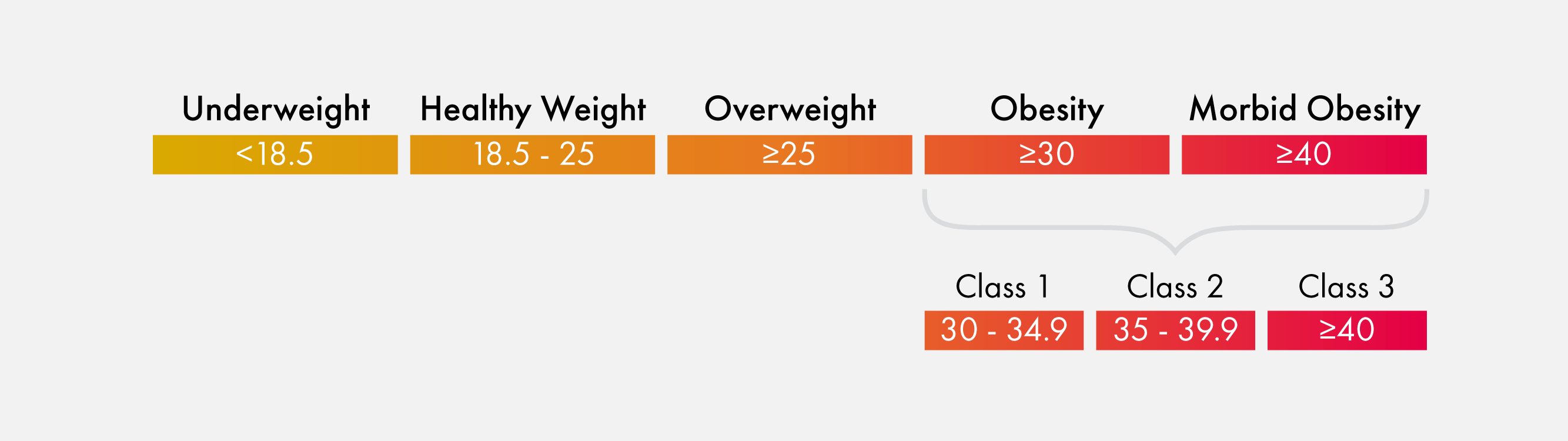
NICE. (2026, June). How should I confirm if a person is overweight or obese?. Retrieved from https://cks.nice.org.uk/topics/obesity/diagnosis/identification-classification/ [accessed 20 October 2026]
It should be noted that in minority ethnic groups lower BMI thresholds are used to diagnose overweight and obesity due to a greater risk in experiencing the consequences of obesity at a lower BMI in these populations.9
Obesity is associated with a higher risk of developing numerous other heath conditions (comorbidities), including cardiovascular disease, type 2 diabetes, and numerous cancers.1
The below figure summarises obesity-related health conditions, referred to as comorbidities.
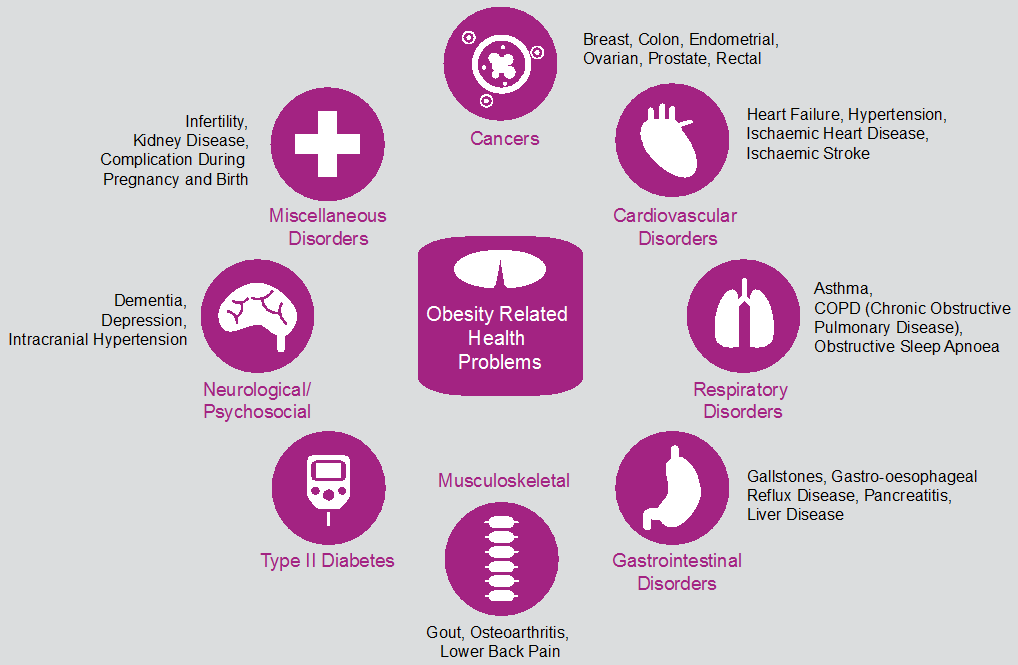
Scarborough, P., Bhatnagar, P., Wickramasinghe, K.K., Allender, S., Foster, C., & Rayner, M. (2011). The economic burden of ill health due to diet, physical inactivity, smoking, alcohol and obesity in the UK: an update to 2006–07 NHS costs. Journal of Public Health, 33.SIGN. (2010, February). Management of Obesity (SIGN Guideline No. 115). Retrieved from https://www.sign.ac.uk/assets/sign115.pdf [accessed 21 October 2026]Scottish Government. (2010, February 22). Preventing Overweight and Obesity in Scotland: A Route Map Towards Healthy Weight. Retrieved from https://www.gov.scot/publications/preventing-overweight-obesity-scotland-route-map-towards-healthy-weight/pages/12/ [accessed 26 October 2026]Behrens, G., Matthews, C.E., Moore, S.C., Hollenbeck, A.R., & Leitzmann, M.F. (2014). Body size and physical activity in relation to incidence of chronic obstructive pulmonary disease. Canadian Medical Association Journal, 186.Wolk, R., Shamsuzzaman, A.S.M., & Sommers, V.K. (2003). Obesity, Sleep Apnea, and Hypertension. Hypertension, 42.Walker, A. (2003). The Cost of Doing Nothing – the economics of obesity in Scotland. (n.p.): (n.p.).The National Heart, Lung and Blood Institute. (2022, March 24). Obesity Hypoventilation Syndrome. Retrieved from https://www.nhlbi.nih.gov/health/obesity-hypoventilation-syndrome [accessed 26 October 2026]
As such, there is a substantial disease burden associated with obesity.
Current levels of overweight and obesity in Scotland and recent trends
Data on rates of overweight and obesity in Scotland are collected via the annual Scottish Health Survey (SHeS). The below section discusses the data from chapter 10 of the 2024 SHeS Main Report and data available from the SHeS interactive data dashboard.12
In 2024, approximately 66% of adults in Scotland were living with overweight or obesity (i.e., BMI of ≥25 kg/m2). Rates have remained relatively stable since 2008, with a low of 64% (from 2011 to 2012, inclusive), to a high of 67% (2021 to 2022, inclusive).
The chart below illustrates the prevalence of overweight and obesity (as a % of the adult population) in Scotland over time.
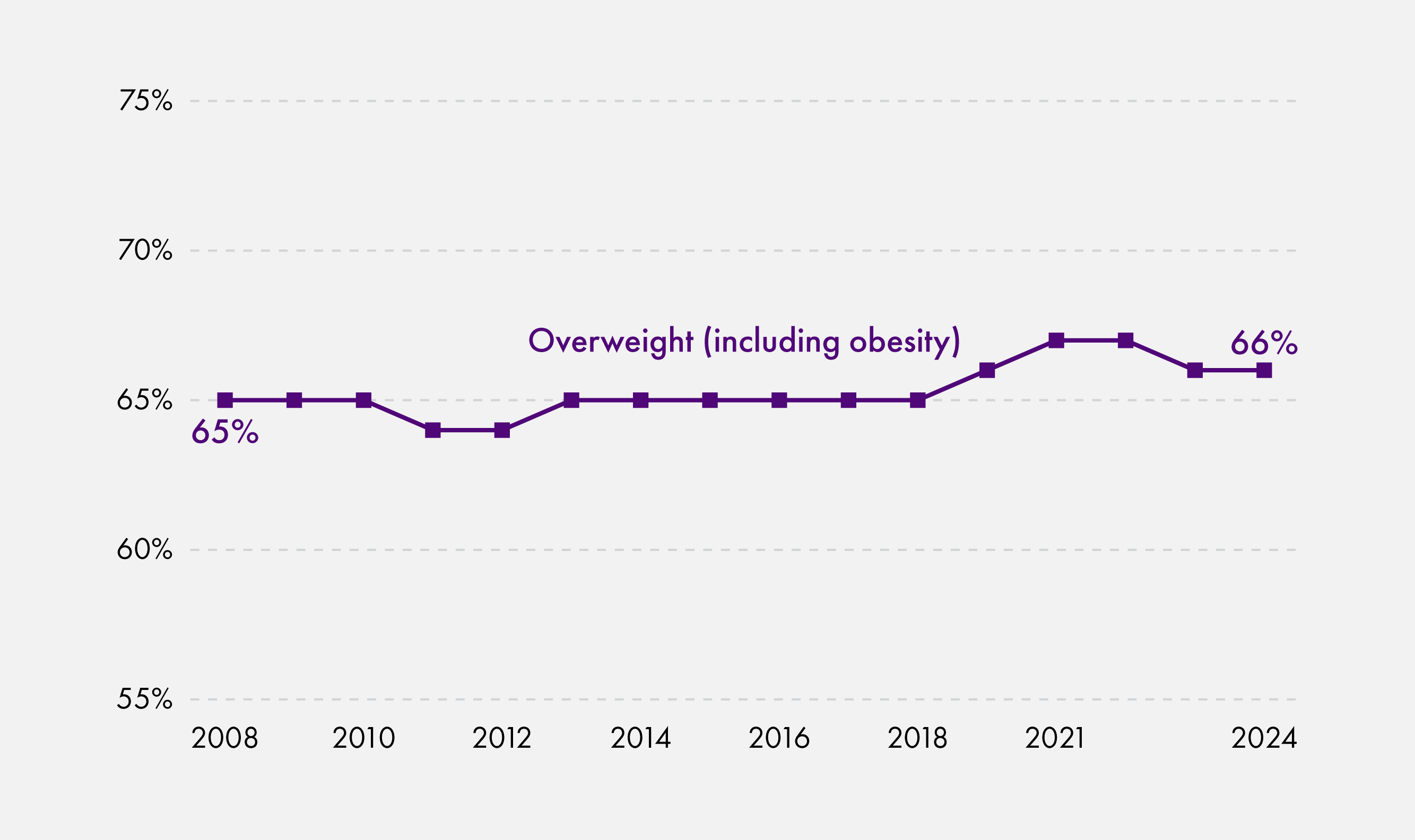
Scottish Government. (2025). The Scottish Health Survey: 2024 Main Report. Retrieved from https://www.gov.scot/binaries/content/documents/govscot/publications/statistics/2025/09/the-scottish-health-survey-2024---volume-1-main-report/documents/the-scottish-health-survey-2024-main-report/the-scottish-health-survey-2024-main-report/govscot%3Adocument/Scottish%2BHealth%2BSurvey%2B2024%2Bmain%2Breport.pdf [accessed 23 September 2026],Scottish Health Survey Data Dashboard. (2025, October). Retrieved from https://scotland.shinyapps.io/sg-scottish-health-survey/ [accessed 21 October 2026]
Looking only at obesity (i.e., BMI of ≥30 kg/m2), approximately 31% of adults were living with obesity in 2024. This is a notable increase from 24% in 2003, but down from a high of 32% in 2023.
The below chart illustrates the prevalence of obesity in Scotland over time.
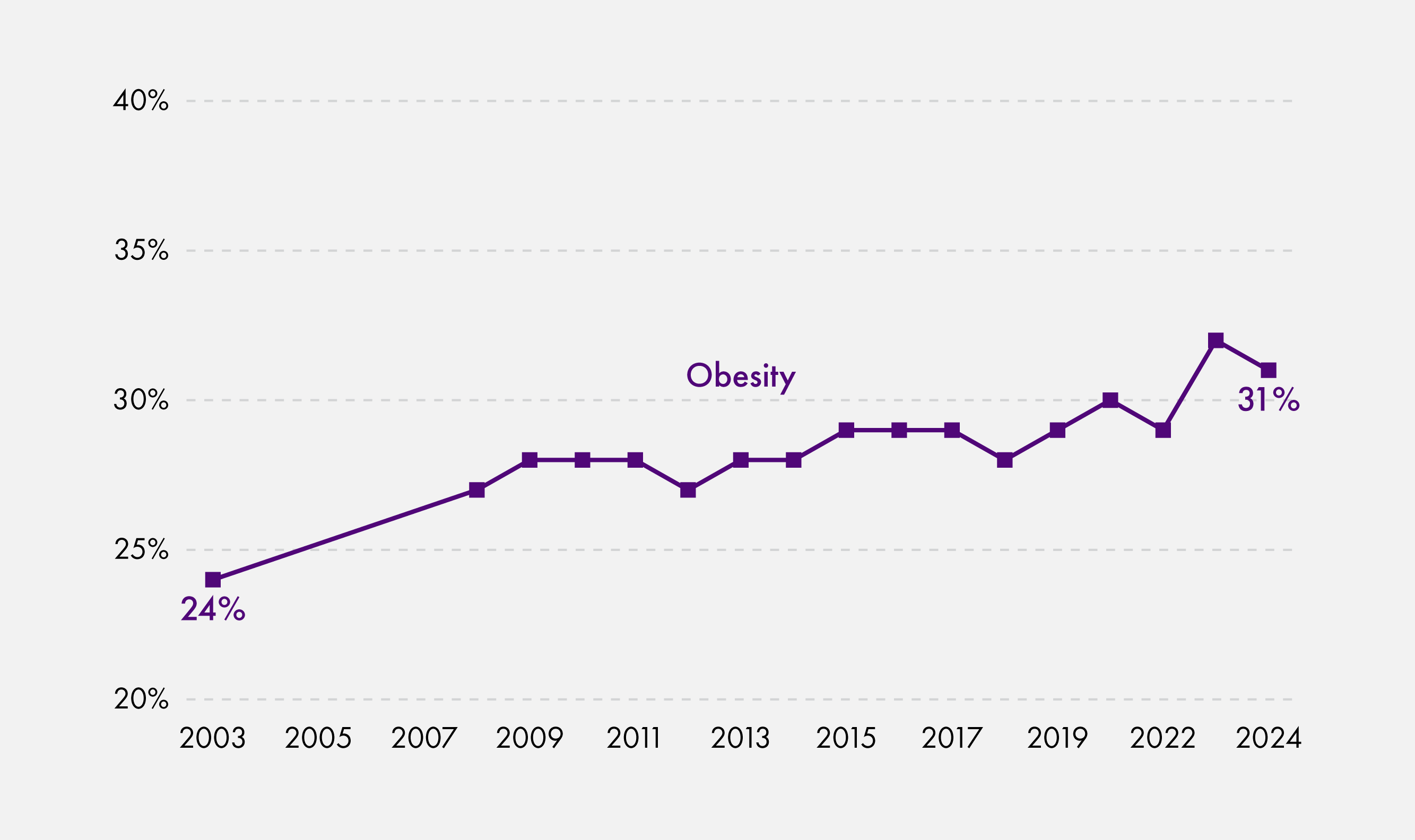
Scottish Government. (2025). The Scottish Health Survey: 2024 Main Report. Retrieved from https://www.gov.scot/binaries/content/documents/govscot/publications/statistics/2025/09/the-scottish-health-survey-2024---volume-1-main-report/documents/the-scottish-health-survey-2024-main-report/the-scottish-health-survey-2024-main-report/govscot%3Adocument/Scottish%2BHealth%2BSurvey%2B2024%2Bmain%2Breport.pdf [accessed 23 September 2026],Scottish Health Survey Data Dashboard. (2025, October). Retrieved from https://scotland.shinyapps.io/sg-scottish-health-survey/ [accessed 21 October 2026]
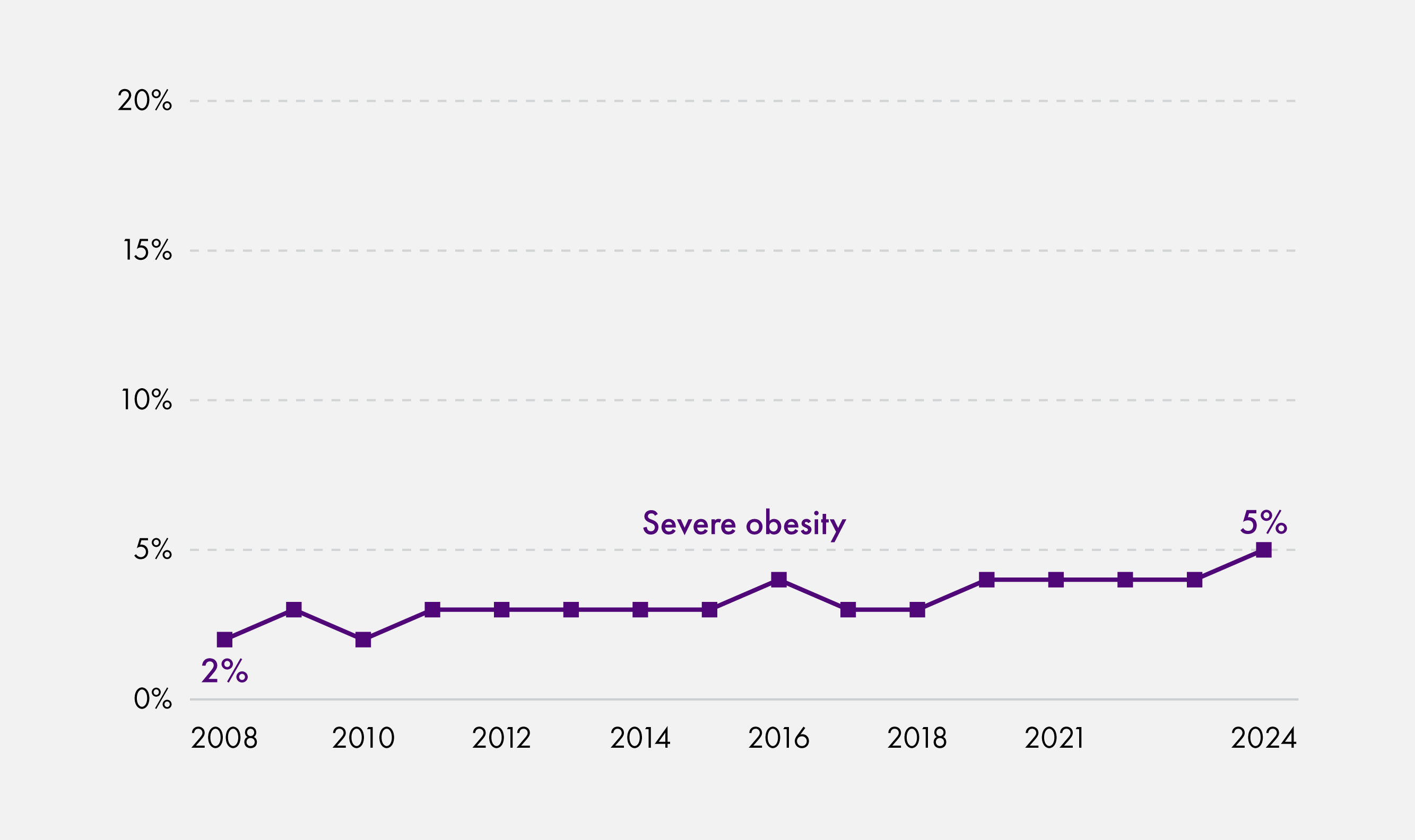
For severe obesity (i.e., BMI of ≥40 kg/m2 - class 3 obesity), approximately 5% of adults were living with severe obesity in 2024. This is the highest rate of severe obesity recorded, with the lowest recorded in the time series being 2% (in 2008 and 2010).
The below chart illustrates the prevalence of severe (i.e., class 3) obesity in Scotland over time.
Scottish Government. (2025). The Scottish Health Survey: 2024 Main Report. Retrieved from https://www.gov.scot/binaries/content/documents/govscot/publications/statistics/2025/09/the-scottish-health-survey-2024---volume-1-main-report/documents/the-scottish-health-survey-2024-main-report/the-scottish-health-survey-2024-main-report/govscot%3Adocument/Scottish%2BHealth%2BSurvey%2B2024%2Bmain%2Breport.pdf [accessed 23 September 2026],Scottish Health Survey Data Dashboard. (2025, October). Retrieved from https://scotland.shinyapps.io/sg-scottish-health-survey/ [accessed 21 October 2026]
Meanwhile, the average BMI of adults in Scotland was 28.1 kg/m2 in 2024, up from 27.1 kg/m2 in 2003.
Wider context
The trend for increasing prevalence of obesity in Scotland over the past two decades mirrors a trend seen both across the UK and globally.
According to the WHO, worldwide adult obesity has more than doubled since 1990, and in 2024 approximately 1.1 billion people worldwide were living with obesity.1
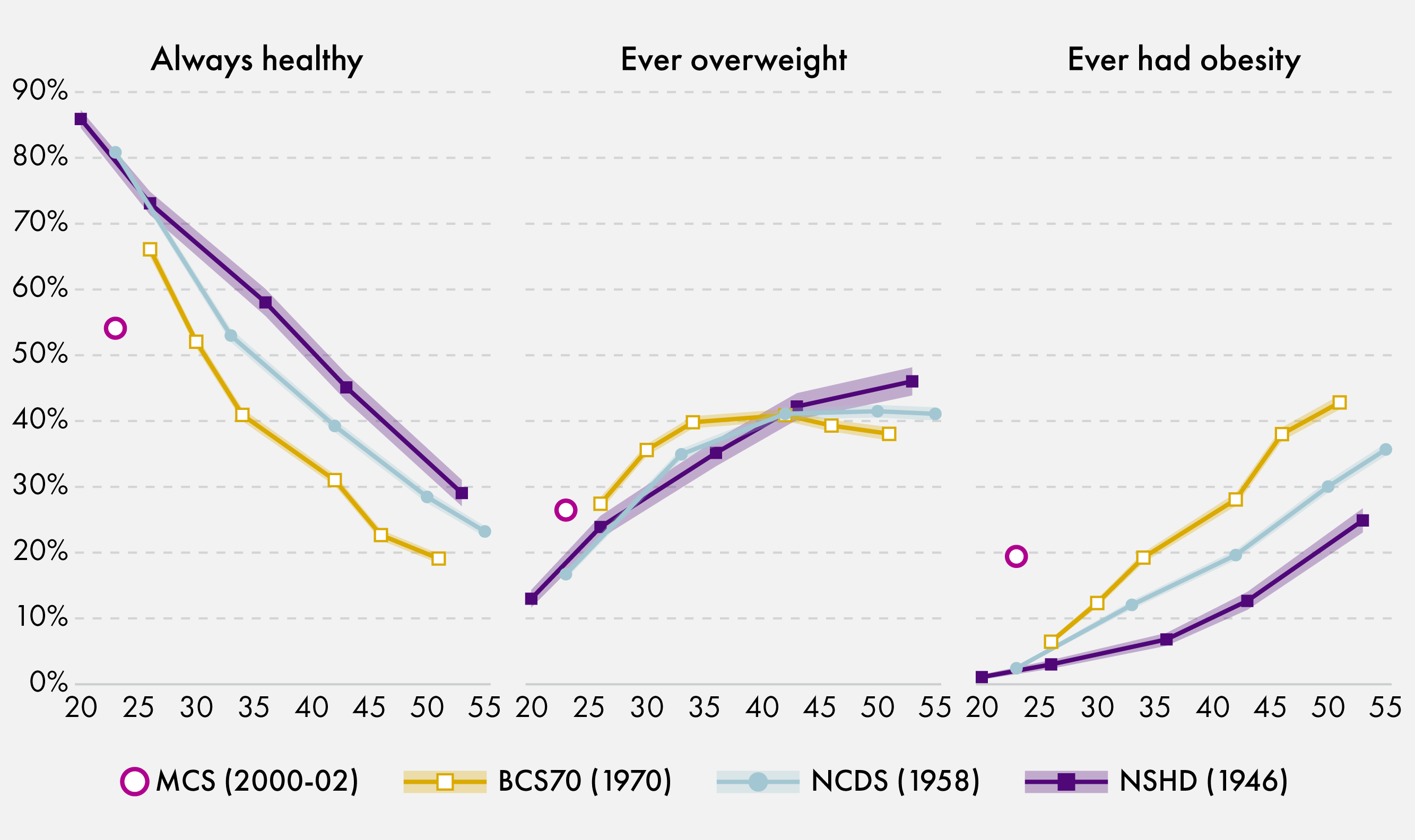
In the UK, longitudinal studies following cohorts of people from birth have found that, since the late 1940's, the prevalence of overweight and obesity has increased in each successive generation, and that in each successive generation overweight and obesity have occurred increasingly earlier in life (fig. 7).23
The below chart illustrates the prevalence of healthy weight, overweight, and obesity with age for successive longitudinal cohorts in the UK. NSHD: National Survey of Health and Development 1946, NCDS: National Child Development Study 1958, BCS: British Cohort Study 1970, MCS: Millennium Cohort Study 2000-02.
Reproduced from Bridger Staatz, C., Gimeno, L., Smeeth, D., Sattar, N., Chaturvedi, N., & Ploubidis, G.B. (2026, July 2). Hard to lose, easy to gain; Trends in obesity and weight change across the life course in four British Birth cohorts. Retrieved from https://www.medrxiv.org/content/10.64898/2026.06.22.26356252v1.full-text [accessed 27 October 2026], with kind permission from the authors.
The same data indicate that of those who become obese, relatively few go on to achieve substantial and sustained weight-loss. Of those born in 1958 and 1970, only 2.6% and 3.9% (respectively) of those who experienced obesity at any point over their life went on to lose more than 5% of their bodyweight and sustain this weight-loss.3
The degree of overweight and obesity in the UK has also increased over successive generations. This has occurred to a greater extent amongst the heaviest. Of people born in 1946, by age 11 the heaviest 2% had a BMI of ~20 kg/m2 , whereas of those born 2000-2002, by age 11 the heaviest 2% had a BMI of ~27 kg/m2.2
Associations with socioeconomic deprivation
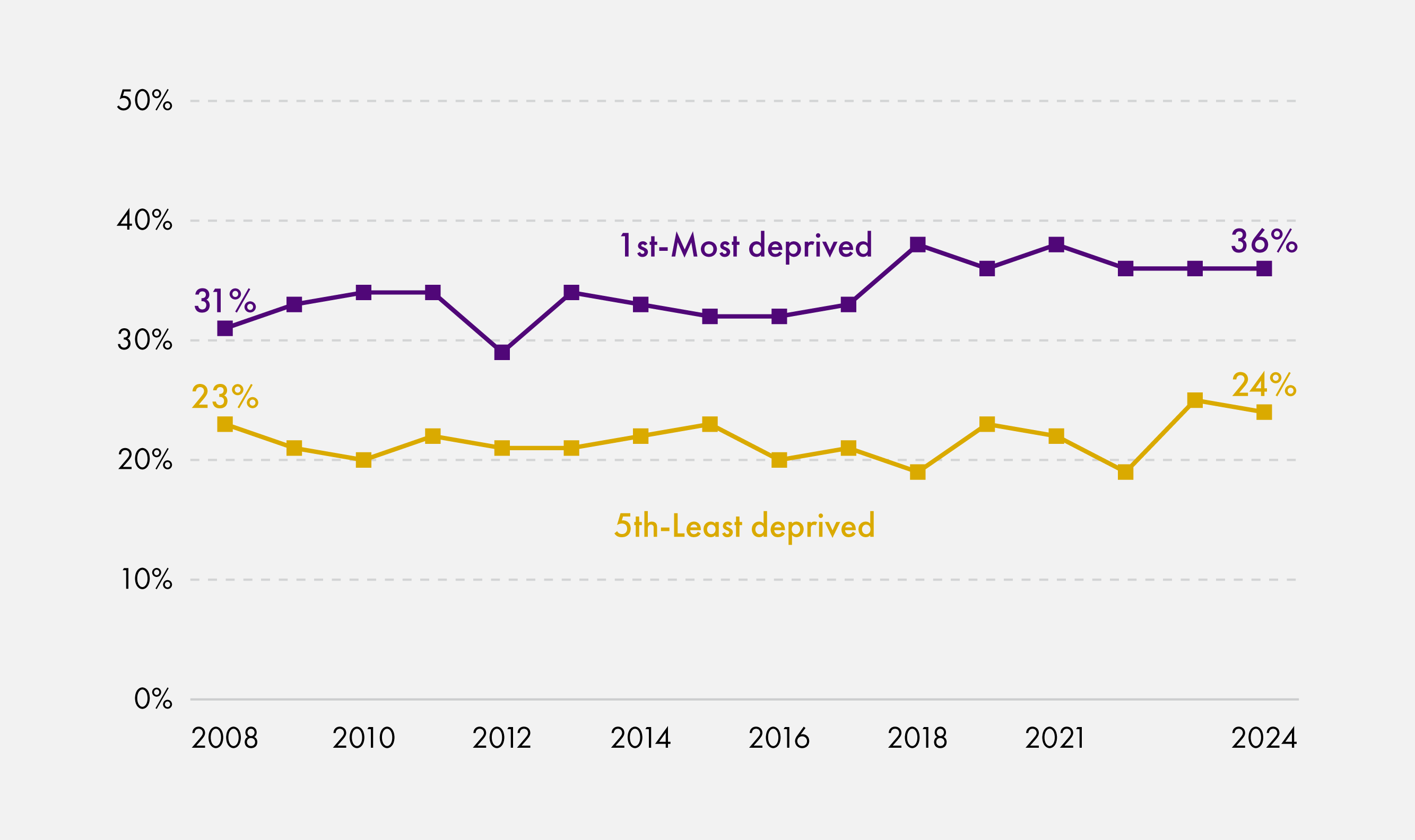
In economically developed countries, prevalence of obesity tends to correlate with level of socioeconomic deprivation.1 In Scotland, prevalence of obesity is consistently higher among the most deprived compared to the least deprived. In 2024, prevalence of obesity was 24% for the least deprived fifth, and 36% for the most deprived fifth.2
The below chart shows prevalence of obesity by Scottish Index of Multiple Deprivation (SIMD) quintile. SIMD is a scale used to measure deprivation, with the 1st quintile (or fifth) being the most deprived, and the 5th quintile being the least deprived.
Scottish Health Survey Data Dashboard. (2025, October). Retrieved from https://scotland.shinyapps.io/sg-scottish-health-survey/ [accessed 21 October 2026]
The reasons for this association are myriad and complex, owing to multiple interconnected factors, but is driven largely by differing access to health-related resources dependant on socioeconomic status.15
Current management and treatment options
Weight management services in Scotland typically consist of four tiers:1
Tier 1: Universal interventions - public health and national campaigns and other similar interventions aimed at promoting healthy eating and encouraging physical activity with the aim of preventing overweight and obesity at the population level.
Tier 2: Community-based delivery of diet, lifestyle and behaviour change advice, typically delivered in a group setting for a limited period of time (e.g., 12-weeks).
Tier 3: Specialist weight management services - a multidisciplinary team, including clinicians, specialist dietitians, nurses, exercise therapists and psychological support staff aimed at providing comprehensive, non-surgical weight management treatment, normally delivered in a community setting. This currently can include pharmacological treatments, including GLP-1 medicines.
Tier 4: Bariatric surgery - surgical (and in some cases non-surgical) intervention delivered by a multidisciplinary team in a secondary care setting.
Specialist weight management services (tier 3) are generally accessed through referral from primary care (GP) and in some cases from secondary care services (hospitals or specialists). This can be dependant on the weight management pathways in place which vary by health board and are dependant on local service provision.2
Bariatric surgery (tier 4) is considered on a case-by-case basis and is generally only for those with a BMI ≥35 kg/m2 and the presence of one or more weight-related comorbidities. It is usually also only recommended when previous attempts at weight loss through a structured weight management program have not led to sufficient weight loss.2
Economic costs of obesity and overweight
Management and treatment of obesity and overweight and their associated comorbidities produces substantial costs for health services. There are also wider economic costs owing to reduced productivity - obesity, overweight and associated comorbid conditions can lead to an inability or impaired ability to work (economic inactivity), increased absence due to sickness, and early death among the working-age population. In a report produced by Frontier Economics commissioned by Nesta, it was estimated that the combined healthcare (including social care), economic and productivity costs of overweight and obesity to the UK in 2025 was £126 billion, of which £30.8 billion was productivity costs alone.1
Breaking down the productivity costs by nation, it was estimated that obesity led to £2.1 billion in lost productivity in Scotland in 2025. The average productivity cost per 1000 people was £0.45 million in Scotland, the highest of all the UK nations.1
GLP-1 medicines
Glucagon-like peptide 1 (GLP-1) medicines are drugs which mimic the gut hormone GLP-1. They are typically administered via injection just under the skin (i.e., sub-cutaneous) from a pre-filled pen (although oral tablet formulations have more recently become available). Naturally produced GLP-1 is broken down rapidly in the body, lasting only 1-2 minutes.1 GLP-1 medicines are made by making structural changes to GLP-1 (or a structurally similar peptide) to make it resistant to breakdown in the body. This allows them to be more potent and longer-lasting than the naturally produced GLP-1 hormone.
GLP-1 medicines are sometimes referred to by other names. These include:
Brand names, including Ozempic, Wegovy, Mounjaro and Zepbound.
"Weight loss injections", "skinny jabs", or "fat jabs" - colloquial terms commonly used online and in the media.
GLP-1 Receptor Agonists (GLP-1 RAs) - the GLP-1 receptor is what the GLP-1 hormone acts on (i.e., the receptor is the lock, GLP-1 is the key). A receptor agonist is something which acts on the receptor. Therefore, GLP-1 medicines can be termed GLP-1 receptor agonists.
GLP-1 analogues
GLP-1s
Incretin mimetics - incretin hormones are gut hormones released after eating. The two main incretin hormones are GLP-1 and GIP (glucose-dependant insulinotropic polypeptide). Both have similar and overlapping functions, namely controlling appetite and regulating the body's blood sugar control mechanisms in response to a meal.
Peptides or peptide medications
How do GLP-1 medicines work?
Glucagon-like peptide 1 (GLP-1) is a hormone released in the stomach in response to eating. It has multiple actions, including:
Increasing insulin secretion - insulin works to reduce blood sugar levels.
Decreasing glucagon secretion - glucagon works in opposition to insulin by raising blood sugar levels. Decreasing glucagon secretion prevents the body from raising blood sugar levels.
Reducing appetite.
Slowing the rate of digestion - this can lead to an increased sense of fullness, as well as slowing the rate at which a meal increases blood sugar (by delaying absorption).1
Due to the role of GLP-1 in regulating blood sugar levels, GLP-1 medicines were initially developed to treat type 2 diabetes and are still mainly prescribed for this purpose. However, as it became clear that their effects on appetite regulation led to notable rates of weight-loss, focus shifted to their potential use for this purpose.1
Multi-agonists and oral GLP-1 medicines
Multi-agonists
The first GLP-1 medicines sought to mimic the effects of only the GLP-1 hormone (i.e., single-agonist). Subsequent medicines have sought to simultaneously mimic other, similar appetite-regulating hormones.
These medicines are referred to as multi-agonists. Dual-agonists target both the GLP-1 receptor and one other hormone receptor, usually the GIP (glucose-dependent insulinotropic polypeptide) receptor. The most well-known dual-agonist is tirzepatide, sold under and otherwise known by the brand names Mounjaro and Zepbound (US name only).1
Triple-agonists target the GLP-1, GIP and Glucagon receptors. Numerous pharmaceutical companies are currently developing triple-agonist medicines.13(see the Future Horizons section of this briefing for further discussion).
Oral GLP-1 medicines
Advances in drug development since their initial release have led to GLP-1 medicines which can be administered orally in the form of a tablet rather than by injection. This is believed to make them more tolerable to a wider range of patients and to lead to improved patient compliance.12 Unlike injectable GLP-1 medicines, they do not need to be refrigerated, thus providing a potentially more convenient option for patients.2
Oral GLP-1 medicines typically come in higher doses than injection-administered GLP-1 medicines, as they are absorbed less efficiently. For this reason, they currently need to be taken daily (whilst injectable GLP-1 medicines are taken once-weekly).4
Weight-loss effects and side effects
Potential weight-loss effects
There are currently four GLP-1 medicines licensed for the purposes of weight-loss in the UK, three of which are currently available on NHS Scotland. The below table summarises the weight-loss effects observed for each of these medicines in clinical trials when administered alongside lifestyle intervention.
| Medicine/Drug (brand name) | Method of administration | Dosage and duration | Treatment group | Average weight-loss achieved (as a % of initial body weight) vs. Placebo |
|---|---|---|---|---|
| Liraglutide (Saxenda)1 | Injection | 3mg daily for 56 weeks | Adults with a BMI of ≥30 kg/m2orBMI ≥27 kg/m2 with one or more weight-related conditions (excluding diabetes) | -8% vs. -2.6% |
| Semaglutide (Ozempic/Wegovy)2 | Injection | 2.4mg weekly for 68 weeks | Adults with a BMI of ≥30 kg/m2orBMI ≥27 kg/m2 with one or more weight-related conditions (excluding diabetes) | -14.9% vs. -2.4% |
| Semaglutide (Wegovy)3 | Tablet | 25mg daily for 64 weeks | Adults with a BMI of ≥30 kg/m2orBMI ≥27 kg/m2 with one or more weight-related conditions (excluding diabetes) | -13.6% vs. -2.4% |
| Trizepatide (Mounjaro)4 | Injection | 20 weeks of escalating dose 2.5mg at a time to a total of 5mg, 10mg, or 15mg weekly, for a total of 72 weeks | Adults with a BMI of ≥30 kg/m2orBMI ≥27 kg/m2 with one or more weight-related conditions (excluding diabetes) | 5mg: -15%10mg: -19.5%15mg: -20.9%vs. -3.1% |
| Orforglipron (Foundayo)5 | Tablet | 6mg, 12mg or 36mg daily, for 72 weeks | Adults with a BMI of ≥30 kg/m2orBMI ≥27 kg/m2 with one or more weight-related conditions (excluding diabetes) | 6mg: -7.5%12mg: -8.4%36mg: -11.2%vs. -2.1% |
The above figures are averages from the patient groups used in the clinical research trials, and are not necessarily reflective of individual responses to these medicines. Variation exists among individuals as to the degree of weight-loss achieved with these medicines, and there are some for whom the medicines have no effect. The exact reasons for this are not well-understood and are a point of ongoing research.
For context, weight-loss of 5-10% of body weight is widely considered the standard for clinically meaningful weight-loss; that is, weight-loss which leads to meaningful improvements in one or more health markers (for example, blood pressure or cholesterol levels) associated with metabolic or cardiovascular disease.67
Potential side effects
Like all medications, GLP-1 medicines can have side effects.
Common side effects can include:
Gastrointestinal symptoms
Nausea
Constipation
Diarrhoea
Vomiting
Stomach pain/cramps
Fatigue
Headaches
Local skin reaction/irritation at the site of injection
Hypoglycaemia (low blood sugar)12
Rare side effects can include:
Inflammation of the pancreas (acute pancreatitis)
Gallbladder disease (gallstone formation and inflammation of the gallblader)
Severe conditions affecting the eyes (diabetic retinopathy, non-arteritic anterior ischaemic optic neuropathy) - with semaglutide only.24
Understanding of potential rare and less common side effects is still developing as these medicines become available to a wider group of people and evidence from post-market surveillance, real-world use and case reports accumulates.
Most of the common side effects are mild to moderate in severity and go away over time. 2 However, they can result in some people discontinuing the medicine. Prescribing guidelines advise using dose titration - that is, starting patients on the lowest dose and slowly increasing the dosage over time - to minimise the severity of side effects.
Comparison to other weight-loss interventions
GLP-1 Medicines
As shown in Table 1, weight-loss achieved with the most prescribed GLP-1 medicines (semaglutide (Wegovy/Ozempic) and tirzepatide (Mounjaro)) ranges from 14.9% - 20.9%. However, the clinical effectiveness of a weight-loss intervention is often judged not just by the amount of weight-loss achieved, but the period for which the weight-loss is maintained (i.e., the rate of weight regain) after treatment. Studies have demonstrated that after stopping GLP-1 medicines, 60% of the weight that had been lost is regained within a year.1However, it should be noted that current prescribing guidance sets no limit on duration of prescription, allowing for continued use, differing from clinical trials in which there is a set study end-point when treatment will be withdrawn.
Bariatric surgery
Bariatric surgery involves surgically altering the stomach, including removing sections, resectioning, or banding the stomach, with the aim of reducing the volume available for food and reducing absorption. Compared to non-surgical intervention, bariatric surgery resulted in 20.0% to 23.4% weight-loss (as a % of initial weight) at 2 years post-surgery, depending on the surgery used.2
Total Diet Replacement
Total diet replacement involves replacing a patient's habitual diet entirely with nutritionally complete, low-calorie meal replacement products such as soups, shakes and bars for 12-20 weeks followed by a gradual re-introduction of food alongside behavioural support. Research indicates that such programmes can lead to average weight-loss of -10.7kg at 1 year post-intervention.3
Behavioural Weight Management Programmes
There are numerous behavioural weight management programmes available, all varying in their duration, intensity and delivery. However, they all have the same aim: to induce changes to an individuals' behaviours around diet and physical activity, through education, support, monitoring, and target-setting. The lowest-cost to implement of all available treatments, they generally result in more modest weight-loss, averaging -2.3kg at 1 year, and -1.8kg at 2 years post-intervention.4
Current NHS prescribing policy
The below table lists all GLP-1 -based medicines currently licensed for use in the UK by the Medicines and Healthcare products Regulatory Agency (MHRA), their brand names, and methods of administration.
| Medicine/Active Ingredient | Brand Name | Method of Administration |
|---|---|---|
| Semaglutide |
|
|
| Liraglutide |
|
|
| Tirzepatide |
|
|
| Lixisenatide |
|
|
| Dulaglutide |
|
|
| Exenatide |
|
|
| Orforglipron |
|
|
Entries in bold and underlined represent those currently approved for use in NHS Scotland for weight management and the treatment of obesity.12
*Licensed for the treatment of type 2 diabetes only.
†Discontinued/withdrawn by manufacturer.
Whilst clinicians can prescribe unlicensed medications, in the vast majority of cases medicines are only prescribed after being licensed for use by the MHRA.3 The MHRA licenses medicines for specific uses, for example, to treat type 2 diabetes. However, this does not prevent clinicians prescribing these medicines for off-license purposes, such as losing weight.
A medicine being licensed for use by the MHRA does not automatically make it available for use on the NHS. In order for a medicine to be made available on the NHS in Scotland, it must first be considered by the Scottish Medicines Consortium (SMC), which conducts a thorough review of the medicine's efficacy and value for money3. Based on their assessment (assuming a positive recommendation), the SMC provides guidance for the roll-out of the medicine in NHS Scotland.
The National Institute of Care Excellence (NICE) serves this roll for England and Wales, and often issues advice ahead of the SMC. NICE guidelines can sometimes differ to those issued by the SMC with regards to a medicine.
The SMC approved liraglutide (Saxenda) in May 2022 with the following advice on implementation:
SMC restriction: BMI ≥35kg/m² (obesity class II and above) with:
Prediabetes at high risk of type 2 diabetes, and
High risk of cardiovascular disease (CVD)
Patients should be treated in a specialist weight management service.
Scottish Medicines Consortium. (2022, May 9). liraglutide (Saxenda). Retrieved from https://scottishmedicines.org.uk/medicines-advice/liraglutide-saxenda-resub-smc2455/ [accessed 8 October 2026]
The SMC approved semaglutide (Wegovy) in October 2023 and subsequently approved tirzepatide (Mounjaro) in June 2024, both with the following advice on implementation:
SMC restriction: for use in adults with BMI ≥30 kg/m2 and at least one weight-related comorbidity.
Patients should be treated in a specialist weight management service (Wegovy only).
Scottish Medicines Consortium. (2024, June 10). tirzepatide (Mounjaro). Retrieved from https://scottishmedicines.org.uk/medicines-advice/tirzepatide-mounjaro-obesity-full-smc2653/ [accessed 30 September 2026], Scottish Medicines Consortium. (2023, October 9). semaglutide (Wegovy). Retrieved from https://scottishmedicines.org.uk/medicines-advice/semaglutide-wegovy-full-smc2497/ [accessed 30 September 2026]
The recommendations of the SMC are non-binding. Whilst it is expected that there will be a consistent approach across all of the 14 area NHS boards in following the recommendations, whether an individual board chooses to fund a particular medicine is decided largely by its Area Drug and Therapeutic Committee (ADTC). ADTCs consider implementation of a medicine on the basis of local factors such as medicines budget, service impact and existing local clinical pathways. For example, the SMC may conclude that a medicine offers good value for money. However if the medicine is relatively expensive or it would be suitable for a large number of patients (as is the case with GLP-1 medicines), then it may not be affordable for the health board.3
Following the approval of semaglutide (Wegovy) and tirzepatide (Mounjaro) by the SMC, concerns were raised that some health boards did not have a weight management service model which could support the implementation of the SMC guidance and that there was uncertainty over the projected uptake rates of these medicines, making budgetary and service planning difficult. At the time there were also supply issues of some GLP-1 medicines, adding further uncertainty around implementation.9
Based on this, and following consultation with key stakeholders, the Diet and Healthy Weight Policy team within the Scottish Government established a national short-life working group to advise on the implementation of the SMC guidance whilst taking these concerns into account.
In a consensus statement issued in September 2024, they advised a staggered roll-out of the SMC guidance, starting with prioritising prescribing to those at the upper end of the BMI scale and then widening this to those further down the BMI scale in subsequent phases, eventually encompassing the full patient group set out in the SMC guidance. This phased implementation only applies to semaglutide (Wegovy) and tirzepatide (Mounjaro), and does not include liraglutide (Saxenda). The BMI criteria for each phase are detailed below:
Phase 1: Adults with BMI ≥38 kg/m2 (≥35kg/m2 for members of minority ethnic groups known to be at equivalent risk of the consequences of obesity at a lower BMI than the white population) AND one or more obesity related condition.
Phase 2: Adults with BMI ≥35kg/m2 (≥32kg/m2 for members of minority ethnic groups known to be at equivalent risk of the consequences of obesity at a lower BMI than the white population) AND one or more obesity related condition.
Phase 3: Adults with BMI ≥30kg/m2 (≥27kg/m2 for members of minority ethnic groups known to be at equivalent risk of the consequences of obesity at a lower BMI than the white population) AND one or more obesity related condition.
The consensus statement states that phase 2 and phase 3 are merely proposals at this stage and that they will be informed by prescribing and outcomes data collected from the phase 1 roll-out. It also states that there is no clear timeline at present for when phase 1 will conclude and when phases 2 and 3 will be initiated.9
The SMC guidance for semaglutide (Wegovy) stipulates that patients be treated in a specialist weight management service in order to be prescribed, whereas there is no such restriction in the SMC guidance for prescribing tirzepatide (Mounjaro). This is due to Novo Nordisk, the manufacturer of Wegovy, including the stipulation as part of their submission to the SMC under the belief that roll-out would be best supported by weight management services. However, NHS Scotland weight management services do not have medical or prescribing capacity/capability. Eli Lilly, the manufacturer of Mounjaro, was aware of this and chose not to include such a stipulation, submitting their application to the SMC on the basis that Mounjaro could be presrcibed in any setting.
To address this disparity in prescribing guidance and concerns raised that some boards do not have suitable weight management service provision to support this, the consensus statement clarifies that:
Patients can be treated in any healthcare setting where evidence-based and appropriate lifestyle advice can be delivered. This could be:
• A tier 2 or tier 3 weight management service depending on the complexity of the individual’s needs
• Primary and community care, consistent with long term condition management of associated condition e.g. hypertension
• Secondary care as part of specialist treatment for associated conditions e.g. diabetes, chronic kidney disease
NHS Scotland, Scottish Government. (2024, September). Consensus statement: national criteria for the prioritisation of glucagon-like peptide-1 receptor agonists (GLP-1 RAs) and GLP-1 RA/glucose-dependent insulinotropic polypeptide receptor agonists (GIP RAs) for the treatment of obesity in NHS Scotland . Retrieved from https://www.publications.scot.nhs.uk/files/dcconsensus-statement.pdf [accessed 8 October 2026]
At present, the majority of NHS prescribing takes place through specialist adult weight management services in the community.
Current NHS provision
Implementation of the SMC guidance and rates of prescribing vary by health board, owing to multiple factors including budgetary decisions by individual boards and ATDCs, as well as variability of service provision.
The Diet and Healthy Weight Policy team within Scottish Government monitors the implementation of the SMC guidance and rates of prescribing of Wegovy and Mounjaro in secondary care within each of the 14 territorial NHS boards and the NHS state hospitali. It collects quarterly data on whether the medicines are on the area formulary (i.e., list of medicines approved and available for prescribing), the current state of pathway development/implementation, the maximum patient capacity of those pathways, and the number of patients currently receiving the medication. The below abridged table summarises key data from the most recent data collection (August 2026). The full table is available from SPICe upon request.
| Board name | Medicines on formulary (y/n) | Pathway in place (y/n) | Number of patients currently prescribed | Maximum capacity of pathway (annual) | Is primary care included in the pathway? (y/n) |
|---|---|---|---|---|---|
| NHS Borders | Yes | Yes | 32 | 100 | No |
| NHS Lothian | Yes | Yes | 45 | 500 | Yes |
| NHS Fife | Yes | Refined criteria has been agreed for patients following the National consensus statement. | 1 | 70 | No |
| NHS GGC | No | No | 0 | N/A | N/A |
| NHS Western Isles | Yes | Yes | 318 | No maximum level set, limited by staffing levels | Yes |
| NHS Lanarkshire | Yes | Yes | 237 | 1000 | Yes |
| NHS Grampian | Yes | SLA with General Practice being developed | 0 via this pathway; 3 patients via early access individual patient requests | 50 | Yes (subject to agreement of SLA with General Practice) |
| NHS Highland | No | Non-formulary exceptional use pathway only | Fewer than 10 | Not stated yet | No |
| NHS Tayside | No | Non-formulary exceptional use pathway only | 0 | N/A | N/A |
| NHS Forth Valley | Yes | Yes | 0 | N/A | N/A |
| NHS Orkney | No | No | 0 | N/A | N/A |
| NHS Shetland | No | No | 0 | N/A | N/A |
| NHS A&A | No | No | 0 | N/A | N/A |
| NHS Dumfries and Galloway | No | No | 0 | N/A | N/A |
| NHS State Hospital | Yes | Yes | 7 | 12 currently | No |
SLA: Service level agreement
As of August 2026, 8 health boards (including the NHS state hospital) had the medicines included on their area formulary. 6 health boards had pathways in place, 4 had restricted exceptional use pathways or pathways close to implementation, and 5 had no pathway currently in place. Across all health boards, approximately 653 patients had been prescribed GLP-1 medicines within a dedicated weight management pathway since they had been approved for use in NHS Scootland. This aligns with reporting by the BBC, based on Freedom of Information requests sent to each health board, that as of September 2026 a total of 705 patients had been prescribed GLP-1 medicines.1
Private prescribing
Medicines which have been reviewed and approved by the MHRA can be prescribed privately in the Scotland by an appropriate medical practitioner (subject to prescribing rights).
Private prescribing of GLP-1 medicines is widely reported to substantially exceed NHS prescriptions. Attempting to asses the number of private prescriptions of GLP-1 medicines remains difficult. Research based on survey data from a representative sample has estimated that in the first quarter of 2025, approximately 1.6 million adults in the UK had recently used GLP-1 medicines for weight management.1 Survey data published by Scottish Government in December 2025 found that in the previous 12 months, 6% of respondents had used GLP-1 medicines and of this group 71% had accessed them privately.2 More recently, it has been reported that an estimated 300,000 people are accessing GLP-1 medicines privately in Scotland.3
The huge public demand for GLP-1 medicines has driven substantial growth in the private prescribing market. As of July 2025, the UK had the largest and fastest growing GLP-1 medicines market among other European countries, with monthly sales of more than £160 million and roughly 2.37 million packs of Mounjaro and Wegovy being prescribed every month, with the majority of this coming from private demand.45
While private prescribing must still operate within certain regulatory frameworks there have been issues seen in the marketing and private prescribing of weight loss medications, including:
Cases of illegal marketing.67
Issues in screening and assessment of eligibility from some online private providers. Previously, GLP-1 medicines could be prescribed privately with minimal clinical assessment of patients prior to prescribing, with patients self-reporting their eligibility and medical history through online forms.8 This reportedly led to inappropriate prescribing and off-label use.810 The General Pharmaceutical Council, the pharmacy regulator in the UK, has since issued guidance requiring more stringent screening and assessment, including independently verifying patient eligibility via in-person or remote consultation and/or medical records.810
Lack of or minimal provision of wraparound care. The need for appropriate wraparound care is stipulated in prescribing guidance, however there are reports that some providers are not providing this.13 In some cases, while private providers offer wraparound care, not all patients will take this up, and they cannot be forced to do so.14
Lack of patient education and guidance. Some people have warned that patients are not being properly informed of potential risks and side effects of taking GLP-1 medicines and about safe and appropriate dose escalation from some private providers.1513
Demand for NHS support. Some people have reported that people using privately prescribed medication have sought support from primary care and emergency services for routine monitoring or for help with side effects.131819
Price of private prescription
The price of privately accessing GLP-1 medicines varies depending on supplier and dosage.
The below table summarises the price ranges for a one month supply of both the lowest dose and the highest dose available for Wegovy (both oral and injectable) and Mounjaro. Prices are lower for starter doses, with many companies offering introductory deals.
| Medicine | Method of administration | Price range for lowest dose | Price range for highest dose |
|---|---|---|---|
| Wegovy1 | Injection | £60 to £169 | £210 to £339 |
| Wegovy2 | Tablet | £49 to £160 | £120 to £269 |
| Mounjaro3 | Injection | £129 to £230 | £265 to £360 |
Prices accurate at time of writing
Cost is an often cited concern among those accessing GLP-1 medicines privately.4 This can lead some patients to switch supplier, to reduce the dosage they take, or to temporarily cease treatment to manage or reduce costs.5
Current issues
The below section discusses some of the current issues surrounding GLP-1 medicines. As the GLP-1 landscape continues to evolve, new issues continue to emerge. This is not intended to be a comprehensive list, but aims to serve as an overview of commonly cited issues that feature in conversations around GLP-1 medicines.
Inequality of access
Despite SMC guidance and the consensus statement advising a phased roll-out across Scotland, access to GLP-1 medicines varies significantly by health board, creating geographical inequalities in NHS access.
As discussed previously, many people are accessing GLP-1 medicines through private providers. However, high costs mean this is not an option for many people and raises issues around the continuation of treatment.1
Concerns have been raised that this is creating a "two-tier system", where only those who can afford to do so can quickly and reliably access GLP-1 medicines. As obesity tends to correlate with levels of socioeconomic deprivation, with rates of obesity often being higher among the most deprived, it is argued that this may increase existing health inequalities and prevent those who need them most from accessing GLP-1 medicines.214
Prescribing in primary care
However, some people believe that more prescribing of GLP-1 medicines should take place in primary care through GPs. This may allow for wider access. It may also allow for better provision of some elements of the associated wraparound care, such as routine monitoring, medication review, dietary and lifestyle support and psychological support. Some have argued that restricting prescribing to specialist weight management services allows health services to cope with the potential demand for these medicines.
This matter forms the basis for ongoing contractual negotiations between GPs and commissioning bodies. The Scottish General Practitioners Committee (SGPC) of the British Medical Association (BMA), representing GPs, has drafted an enhanced service proposal for monitoring and prescribing of GLP-1 medicines in general practice. An enhanced service is an additional service provided by primary care contractors above and beyond the core services contract, at additional cost. The proposal sets out what such a service could look like and the associated costing. The enhanced service proposal has been sent to the Scottish Government but at present has not received any formal response. The SGPC has subsequently sent the proposal to its Local Medical Committees for them to share with their individual health boards for their consideration in their planning of provision of GLP-1 medicines.
Illicit markets
Substantial public demand for GLP-1 medicines has led to the emergence of a significant illicit market supplying both real and counterfeit GLP-1 medicines1. More recently, counterfeit versions of retatrutide, a novel GLP-1 medicine which is still in development have become widely available through black market channels.2 It has been reported in the media that illicit GLP-1 medicines can be accessed with relative ease, with reports that they are being sold in gyms, beauty and nail salons, hairdressers and online, promoted via social media.2 There are also elements of organised crime, with criminal gangs reportedly involved in the mass production and supply of illicit GLP-1 medicines.41
There are a number of risks in using counterfeit medicines such as contamination, regulation of dose and composition. There have been reports of people suffering from nausea, diarrhoea, vomiting and kidney failure, with some patients requiring urgent hospitalisation after taking counterfeit medicines.27
Both regulatory agencies and pharmaceutical companies are seeking to address this issue. In October 2026, the MHRA seized £2 million worth of illicit GLP-1 medicines.1 Eli Lilly, which manufactures tirzepatide and is developing retatrutide, has reported more than 14,000 websites, advertisements and social media posts it claims are illegally marketing its GLP-1 medicines.2 Novo Nordisk, the manufacturer of semaglutide and liraglutide, won a landmark website blocking injunction against a number of the major UK internet service providers, requiring them to block several websites supplying fake versions of their GLP-1 medicines.10
Loss of muscle mass
With any weight-loss intervention, weight is lost from an individuals' fat mass, but weight can also be lost from fat-free mass such as muscle, bones, and other tissues. When a large proportion of weight lost comes from fat-free mass, this can be described as "poor quality" weight-loss, and is more likely to occur when weight is lost rapidly.12 Loss of muscle mass can lead to detrimental effects on health, including impairments in physical functioning and metabolic health.1
Research indicates that the rapid weight-loss induced by GLP-1 medicines can lead to substantial loss of muscle mass as well as fat mass.1 It should be noted however that levels of muscle mass loss are not above those seen with other weight loss interventions.1
Strategies for mitigating the loss of muscle mass while losing weight include eating adequate protein and partaking in resistance exercise.1 Patients would be advised of this and monitored as part of standard wraparound care provided when GLP-1 medicines are prescribed. However, as discussed previously, there are a number of circumstances where this wraparound care may not be provided or patients will choose not to access it, such as when GLP-1 medicines are obtained privately or through illicit channels. This raises the risk of increased loss of muscle mass and subsequent health consequences in these patients.
There are also populations where muscle mass loss is already occurring, such as older adults and post-menopausal women, putting them at potentially greater risk from the consequences of muscle mass loss from taking GLP-1 medicines.1
In circumstances where patients repeatedly lose and regain weight (such as when repeatedly ceasing and restarting treatment on GLP-1 medicines), the repeated bouts of muscle mass loss and fat mass regain can lead to what is termed sarcopenic obesity.8 This is where an individual's body composition shifts to a greater proportion of fat mass and reduced muscle mass and strength.9
Weight regain
As mentioned briefly earlier in this briefing, rates of weight regain are high following cessation of GLP-1s, with around 60% of weight lost being regained within 1 year.1 The exact reasons for this weight regain are not well studied.
However, research demonstrates that weight-loss can be maintained after cessation if taking of GLP-1 medicines is combined with a supervised exercise program2 and with a digital behaviour change program3. This again appears to highlight the importance of wraparound care. This also leads into concerns raised by some that the attention on GLP-1 medicines risks distracting and detracting from wider preventative measures aimed at tackling obesity.45
Duration of prescribing
The SMC guidance regarding semaglutide (Wegovy) and tirzepatide (Mounjaro) makes no mention of duration of prescribing in that there is no "stopping rule" as is recommended with other established time-limited treatments e.g. antibiotics. This differs to the NICE guidance, which limits prescribing of semaglutide (Wegovy) for the purposes of managing overweight and obesity to a maximum of 2 years1, but has set no limit on duration of prescribing for tirzepatide (Mounjaro).2NICE guidance on the stopping rule in relation to semaglutide (Wegovy) was in part influenced by the lack of longer term clinical and cost effectiveness data at the time the manufacturer submitted semaglutide (Wegovy) for assessment.
The absence of a stopping rule in the SMC guidance allows patients to be prescribed GLP-1s for long term, possibly lifelong use. This is supported by the view of obesity as a chronic, relapsing disease and the need for continued use of these medicines in order for treatment effect to be maintained.
Nonetheless, this has generated debate in a wide range of spheres, including medicine, public health, social responsibility, and health service budgetary planning about how these medicines should be viewed and used.345
There is also currently a lack of data on the effects of taking GLP-1 medicines for such extended durations of time.
Wider societal drivers of obesity
GLP-1 medicines can be described as a treatment for once obesity has already occurred. However, their use does not directly address the underlying obesogenic environment. In other words, they do not prevent obesity from first occurring. Some have argued that without addressing the wider obesogenic environment, weight regain after cessation of GLP-1 medicines will be a likely occurrence for most, necessitating life-long use.1
On the other hand, some have argued that GLP-1 medicines can mitigate the effects of obesogenic environments and drive positive changes faster and more effectively than policy interventions.2
As discussed previously, the role GLP-1s could play in preventing some of the illnesses associated with obesity is also an area of consideration.1
Future horizons
Future drug developments
Given the significant commercial success of existing GLP-1 medicines, potential new weight-loss drugs have become an area of intense research and investment by pharmaceutical companies. The section below discusses some of the drugs currently in development, and how they differ from currently available GLP-1 medicines in their effects, mechanism of action, and/or duration of action.
However, it is by no means an exhaustive list, and it should be noted that approximately 50% of drugs fail in phase 3 clinical trials, so it may be that some of the drugs discussed do not make it past the development stage.
Triple Agonists
Triple agonist medicines target not only the GLP-1 hormone receptor, but also simultaneously target two other receptors for gut hormones which have similar and overlapping functions to GLP-1. They are sometimes referred to colloquially as GLP-3s.1Various pharmaceutical companies are developing triple agonist medicines, but the furthest along in its development, and possibly the most highly-anticipated, is retatrutide, under development by Eli Lilly.
In recently published results from phase 3 clinical trials, a once-weekly injection of retatrutide for 80 weeks led to weight-loss (as a % of body weight) of -17.6% (4mg dose), -23.7% (9mg dose), and -25.0% (12mg dose), compared to -3.9% in the placebo group.2These results show it to be capable of producing greater weight-loss than any currently available drug. The weight-loss achieved in the 9mg and 12mg dose groups also makes it comparable to or more effective than bariatric surgery which, prior to these results, was the most effective weight-loss intervention available.
However, the incidence of gastrointestinal side-effects was higher with GLP-3s compared to previous GLP-1 medicines studied, and they increased with increased dosage.24
It is anticipated that Eli Lilly will submit retatrutide for approval by the Food and Drug Administration (FDA), the US drugs and medicines regulator, in early 2027. The review process can take up to a year, and retatrutide will still need to undergo review and be approved by the MHRA before becoming available in the UK.5 This means retatrutide will likely not be available in the UK market until well into 2028.
Amylin-based Medicines
Amylin is a hormone released from the pancreas after eating (alongside insulin), and it has similar effects to GLP-1 (slows the rate of digestion, suppresses the release of blood-sugar raising glucagon, and reduces appetite).
Similar to GLP-1, amylin-based medicines seek to mimic this hormone in order to induce its appetite-suppressing effects, and are administered via injection just below the skin. Also like GLP-1, initial investigations of amylin focused on its potential in treating diabetes, given its role in maintaining blood sugar levels.
Pramlintide (brand name Symlin) is an amylin-analogue approved by the FDA in 2005 for the management of type 1 and type 2 diabetes alongside insulin6 (although it should be noted that it has not been approved for use in the UK). Early studies demonstrated that pramlintide can lead to significant weight-loss in individuals with obesity7. Given this, and following the success of GLP-1 medicines, various pharmaceutical companies began developing their own amylin-based medicines.
Eli Lilly is developing eloralintide, a selective amylin receptor agonist, which is currently in phase 3 clinical trials8. Early results have demonstrated -11.3% weight-loss (as a % of initial body weight) with the highest administered dose after 12-weeks.9
Novo Nordisk is developing cagrilintide, an amylin analogue, also currently in phase 3 clinical trials. Phase 2 clinical trial results showed -10.8% weight-loss with the highest administered dose after 26-weeks.10
Given that the weight-loss achieved with amylin-based medicines is no better than that achieved with semaglutide (Wegovy) and tirzepatide (Mounjaro), pharmaceutical companies are now investigating combining amylin-based medicines with existing GLP-1 medicines to produce synergistic effects to achieve greater weight-loss7 (discussed in more detail below). Some speculate that, as amylin is a pancreatic hormone (as opposed to a gut hormone, as is the case with GLP-1), it will have fewer and/or less severe gastrointestinal side-effects, and thus combining the two medicines will allow a lower dose of the GLP-1 medicine to be used, potentially mitigating some of the gastrointestinal symptoms which currently often cause patients to cease taking GLP-1 medicines12.
Amylin-based medicines, given their targeting of a different hormone receptor, may also offer a solution for those for whom GLP-1 medicines are ineffective.
Novel Multi-Agonists
There are a number of other novel multi-agonist medicines currently in development.
One of the main avenues of development is multi-agonists which target both the GLP-1 receptor and the amylin receptor. The closest to market is Novo Nordisk's CagriSema, which combines two existing medicines (GLP-1 -targeting semaglutide and amylin-targeting cagrilintide), and is currently in phase 3 clinical trials.13 Early results showed -20.4% weight-loss after 68-weeks.13Novo Nordisk is also developing amycretin, a novel dual GLP-1 and amylin receptor agonist, currently in phase 2 clinical trials.15
Other Novel Medicines
Other novel medicines in development include maridebart cafraglutide (brand name MariTide), currently in phase 3 clinical trials. Differing from previous multi-agonist GLP-1 medicines which seek to activate multiple hormone receptors, MariTide acts to activate the GLP-1 receptor and simultaneously inactivates the GIP receptor.16 This dual activation/inactivation is reported to lead to fewer gastrointestinal side effects.1718 It is also longer lasting than previous medicines, requiring only monthly sub-cutaneous injection, or even less frequently.1618 Results reported from phase 2 clinical trials demonstrated weight-loss similar to currently available medicines (~20% after 52-weeks).16
Loss of Patent, Generic Medicines and Price
Once the patent (the "exclusivity period") for a medicine expires, other companies are free to manufacture and market generic versions of that medicine. However, pharmaceutical companies can hold multiple patents for the same medicine - this can include the core patent, which generally covers the basic chemical structure of the medicine, as well as patents for specific formulations, combinations with other medicines, or specialised delivery mechanisms.22These patents can hold different expiration dates, and it is a common strategy of pharmaceutical companies to hold multiple patents for the same medicine in order to maximise the exclusivity period.22
The core patent for liraglutide (Saxenda) expired in the UK market in November 2024, allowing the manufacturing and marketing of generic options. Generic liraglutide subsequently launched in the UK market in February 2025.24 However, uptake of generic liraglutide has been relatively low, likely owing to its lower popularity with patients given the need for daily injections and weaker weight-loss effects compared to the weekly-injectables semaglutide (Ozempic/Wegovy) and tirzepatide (Mounjaro).24
The core patent for semaglutide (Ozempic/Wegovy) expired in a number of major of markets in early 2026, including Canada, China, India and Brazil2227. This led to the immediate release of generic options, mainly produced by India-based pharmaceutical manufacturers2224. However, semaglutide (Ozempic/Wegovy) has extended patent protection in the UK, lasting until 2028, meaning availability of generic semaglutide in the UK market is still some time away. But, given the earlier loss of patent in other major markets and generic versions already being manufactured and approved for use, generics manufacturers will likely be poised for the loss of patent in the UK and have mature generic options ready to go to market22. The core patent for tirzepatide (Mounjaro) in the UK will expire in 2032, meaning generic options will likely not be available until at least the mid-2030s.31
Typically when generic versions of a medicine are launched, they are available at a substantially lower price than the branded versions. The increased competition and lower pricing of generic options often lead pharmaceutical companies to lower the price of their branded options in response to try maintain market share. It is hoped for and anticipated by many that this will be the case for GLP-1 medicines, and that the lower pricing will improve affordability for health services and those accessing them privately. As cost is often a significant barrier to uptake and continued use, any reduction in market price would likely widen access to a larger share of new and existing patients.27
At the time of writing, the British National Formulary (BNF) lists a 5 pen pack of branded liraglutide (Saxenda) as costing £196.20, compared to £127.53 for a 5 pen pack of generic liraglutide (Nevolat).33 Following loss of patent in India, generic alternatives have entered the market at a price reduction of around 50% or more compared to the pre- patent expiry price of branded semaglutide (ozempic), with the cheapest options up to around 90% lower in price for the lowest dose.22 Although it should be noted, some of the cheapest options come in the form of a vial of medicine, compared to the typically seen pre-filled injection pen, requiring patients to self-measure and administer via syringe under sterile conditions.2224
Given the significant price differential in branded versus generic GLP-1 medicines, there is high potential for grey market supply, personal cross-border importation and other alternative supply routes which, whilst illicit, may still exert pressure on branded manufacturers' pricing strategies.22 It also remains unclear how availability of low-cost generic GLP-1 medicines licensed for use in other countries will affect the current illicit market for these medicines in the UK.
The availability of generic options has the potential to improve supply chain resilience, addressing the issue of shortages which have been seen with both liraglutide (Saxenda) and semaglutide (Ozempic/Wegovy).38
The SCoMIS trial
The Scotland CardioMetabolic Impact Study (SCoMIS) is a large collaborative research study launched this year involving the UK and Scottish Governments, industry collaborators Novo Nordisk and IQVIA, and researchers from the Universities of Edinburgh and Dundee, led by the University of Glasgow.1
The study was awarded £650,000 from the UK Government to support the initial planning stages, with further multi-million pound funding to be provided to carry out the main study up to 2029/2030, subject to approval.1
The study aims to recruit 3,000 to 5,000 patients from Scotland's most deprived communities, where prevalence of obesity is highest. The aim of the study is to investigate obesity and its consequences in Scotland's most deprived communities with an expanding focus on cardiometabolic and long-term health outcomes, the impact GLP-1 medicines can have on this, and to gather data to better inform the development of delivery pathways to ensure these communities receive appropriate and proportionate provision of these medicines and the related wraparound care.1
It is hoped that the study will gather data on the effects of GLP-1 medicines in a more realistic, real-world setting outside of tightly controlled clinical trials, in populations who likely face barriers to accessing and adhering to GLP-1 medicines.
Public service reform
In September 2026, the Scottish Government published its Programme for Government 2026 to 2031 which announced its plans to replace the existing 14 territorial NHS health boards with 2 strategic health boards for the Scottish mainland, one for the East and another for the West of the country, with separate arrangements to be made for the island territories.1
How this will impact on the provision of adult weight management services and the availability of GLP-1 medicines remains unclear. The plans are currently in the proposal and consultation phase, with detailed plans of transition yet to be published.
Sources
WHO. (2025). Obesity and Overweight. Retrieved from <a href="https://www.who.int/news-room/fact-sheets/detail/obesity-and-overweight" target="_blank">https://www.who.int/news-room/fact-sheets/detail/obesity-and-overweight</a> [accessed 22 September 2026]
Scottish Health Survey Data Dashboard. (2025, October). Retrieved from <a href="https://scotland.shinyapps.io/sg-scottish-health-survey/" target="_blank">https://scotland.shinyapps.io/sg-scottish-health-survey/</a> [accessed 21 October 2026]
WHO. (2026). Obesity. Retrieved from <a href="https://www.who.int/health-topics/obesity#tab=tab_1" target="_blank">https://www.who.int/health-topics/obesity#tab=tab_1</a> [accessed 22 September 2026]
Frontier Economics. (2025, July 1). The Economic and Productivity Costs of Obesity and Overweight in the UK . Retrieved from <a href="https://media.nesta.org.uk/documents/The_economic_and_productivity_costs_of_obesity_and_overweight_in_the_UK_.pdf" target="_blank">https://media.nesta.org.uk/documents/The_economic_and_productivity_costs_of_obesity_and_overweight_in_the_UK_.pdf</a> [accessed 22 October 2026]
Jastreboff, A.M., Aronne, L.J., Ahmad, N.N., Wharton, S., Connery, L., Alves, B., … Stefanski, A. (2022). Tirzepatide Once Weekly for the Treatment of Obesity. New England Journal of Medicine, 387.
Picot, J., Jones, J., Colquitt, J.L., Gospodarevskaya, E., Loveman, E., Baxter, L., … Clegg, A.J. (2009). The clinical effectiveness and cost-effectiveness of bariatric (weight loss) surgery for obesity: a systematic review and economic evaluation. Health Technology Assessement, 13(41).
NHS. (2026, February 5). GLP-1 medicines for weight loss and diabetes: what you need to know. Retrieved from <a href="https://www.gov.uk/government/publications/glp-1-medicines-for-weight-loss-and-diabetes-what-you-need-to-know/glp-1-medicines-for-weight-loss-and-diabetes-what-you-need-to-know" target="_blank">https://www.gov.uk/government/publications/glp-1-medicines-for-weight-loss-and-diabetes-what-you-need-to-know/glp-1-medicines-for-weight-loss-and-diabetes-what-you-need-to-know</a> [accessed 2 October 2026]
IQVIA. (2025, October 9). The Potential for the Private Prescription Market in Europe . Retrieved from <a href="https://www.iqvia.com/-/media/iqvia/pdfs/emea/library/whitepaper/iqvia-2025_the-potential-for-the-private-prescription-market-in-europe.pdf" target="_blank">https://www.iqvia.com/-/media/iqvia/pdfs/emea/library/whitepaper/iqvia-2025_the-potential-for-the-private-prescription-market-in-europe.pdf</a> [accessed 24 October 2026]
UK Parliament Health and Social Care Committee. (2026, October 23). Written Evidence Submitted by Manesha Banwait at IQVIA (FWM0029). Retrieved from <a href="https://committees.parliament.uk/writtenevidence/146947/pdf/" target="_blank">https://committees.parliament.uk/writtenevidence/146947/pdf/</a> [accessed 24 October 2026]
Scottish Government. (2026, October 8). Public attitudes to cost of living and other topics: tracker - data tables. Retrieved from <a href="https://www.gov.scot/publications/public-attitudes-to-cost-of-living-and-other-topics-tracker-data-tables/" target="_blank">https://www.gov.scot/publications/public-attitudes-to-cost-of-living-and-other-topics-tracker-data-tables/</a> [accessed 29 October 2026]
UK watchdog takes first action on oral weight drug adverts. (2026, October 7). Retrieved from <a href="https://pharmaphorum.com/news/uk-watchdog-takes-first-action-oral-weight-drug-adverts" target="_blank">https://pharmaphorum.com/news/uk-watchdog-takes-first-action-oral-weight-drug-adverts</a> [accessed 25 October 2026]
Stricter Weight-Loss Jab Regulations in the UK: What It Means for Patients & Pharmacies. (2026, August 5). Retrieved from <a href="https://www.privatemedicalclinic.com/medical-guides/weight-loss/stricter-weight-loss-jab-regulations-in-the-uk-what-it-means-for-patients-pharmacies" target="_blank">https://www.privatemedicalclinic.com/medical-guides/weight-loss/stricter-weight-loss-jab-regulations-in-the-uk-what-it-means-for-patients-pharmacies</a> [accessed 29 October 2026]
Iacobucci, G. (2025). GPs demand tougher regulation of online prescribing of weight loss drugs. BMJ, 389.
Thomas, O., & Coulson, J.M. (2025). GLP-1 agonist-associated presentations to unscheduled care: An opportunistic pilot study. British Journal of Clinical Pharmacology, 92.
The Pharmaceutical Journal. (2025, October 3). Beyond GLP-1: the next wave of weight-loss medication innovation. Retrieved from <a href="https://pharmaceutical-journal.com/article/feature/beyond-glp-1-the-next-wave-of-weight-loss-medication-innovation" target="_blank">https://pharmaceutical-journal.com/article/feature/beyond-glp-1-the-next-wave-of-weight-loss-medication-innovation</a> [accessed 14 October 2026]
The Ozempic Reckoning: One Molecule, Two Price Wars, One Fractured World. (2026, April 20). Retrieved from <a href="https://www.lexology.com/library/detail.aspx?g=ad05113a-d1ea-4ac9-ae11-00c2c0e87f31" target="_blank">https://www.lexology.com/library/detail.aspx?g=ad05113a-d1ea-4ac9-ae11-00c2c0e87f31</a> [accessed 15 October 2026]
Scottish Government. (2026, September 1). Programme for Government 2026 to 2031. Retrieved from <a href="https://www.gov.scot/publications/programme-government-2026-2031/pages/5/" target="_blank">https://www.gov.scot/publications/programme-government-2026-2031/pages/5/</a> [accessed 16 October 2026]
Redefining obesity: advancing care for better lives. (2025). The Lancet Diabetes and Endocrinology, 13.
James, W.P.T. (2009). WHO recognition of the global obesity epidemic. International Journal of Obesity, 32.
Sattar, N. (2026). Obesity medicines as disruptive innovation. Nature Medicine, 32.
Castle, A. (2015, January 7). SB 15-01 Obesity in Scotland. Retrieved from <a href="https://scottish4.sharepoint.com/sites/office-spice/briefings/Forms/AllItems.aspx?id=%2Fsites%2Foffice%2Dspice%2Fbriefings%2FResearch%20Briefings%2F2015%2F2015%20pdf%2FSB%2015%2D01%20Obesity%20in%20Scotland%2Epdf&parent=%2Fsites%2Foffice%2Dspice%2Fbriefings%2FResearch%20Briefings%2F2015%2F2015%20pdf" target="_blank">https://scottish4.sharepoint.com/sites/office-spice/briefings/Forms/AllItems.aspx?id=%2Fsites%2Foffice%2Dspice%2Fbriefings%2FResearch%20Briefings%2F2015%2F2015%20pdf%2FSB%2015%2D01%20Obesity%20in%20Scotland%2Epdf&parent=%2Fsites%2Foffice%2Dspice%2Fbriefings%2FResearch%20Briefings%2F2015%2F2015%20pdf</a> [accessed 22 October 2026]
UK Government Office for Science. (2007, October 17). Tackling Obesities: Future Choices - Project Report. Retrieved from <a href="https://assets.publishing.service.gov.uk/media/5a759da7e5274a4368298a4f/07-1184x-tackling-obesities-future-choices-report.pdf" target="_blank">https://assets.publishing.service.gov.uk/media/5a759da7e5274a4368298a4f/07-1184x-tackling-obesities-future-choices-report.pdf</a> [accessed 22 October 2026]
NICE. (2026, June). How should I confirm if a person is overweight or obese?. Retrieved from <a href="https://cks.nice.org.uk/topics/obesity/diagnosis/identification-classification/" target="_blank">https://cks.nice.org.uk/topics/obesity/diagnosis/identification-classification/</a> [accessed 20 October 2026]
Scarborough, P., Bhatnagar, P., Wickramasinghe, K.K., Allender, S., Foster, C., & Rayner, M. (2011). The economic burden of ill health due to diet, physical inactivity, smoking, alcohol and obesity in the UK: an update to 2006–07 NHS costs. Journal of Public Health, 33.
SIGN. (2010, February). Management of Obesity (SIGN Guideline No. 115). Retrieved from <a href="https://www.sign.ac.uk/assets/sign115.pdf" target="_blank">https://www.sign.ac.uk/assets/sign115.pdf</a> [accessed 21 October 2026]
Scottish Government. (2010, February 22). Preventing Overweight and Obesity in Scotland: A Route Map Towards Healthy Weight. Retrieved from <a href="https://www.gov.scot/publications/preventing-overweight-obesity-scotland-route-map-towards-healthy-weight/pages/12/" target="_blank">https://www.gov.scot/publications/preventing-overweight-obesity-scotland-route-map-towards-healthy-weight/pages/12/</a> [accessed 26 October 2026]
Behrens, G., Matthews, C.E., Moore, S.C., Hollenbeck, A.R., & Leitzmann, M.F. (2014). Body size and physical activity in relation to incidence of chronic obstructive pulmonary disease. Canadian Medical Association Journal, 186.
Wolk, R., Shamsuzzaman, A.S.M., & Sommers, V.K. (2003). Obesity, Sleep Apnea, and Hypertension. Hypertension, 42.
Walker, A. (2003). The Cost of Doing Nothing – the economics of obesity in Scotland. (n.p.): (n.p.).
The National Heart, Lung and Blood Institute. (2022, March 24). Obesity Hypoventilation Syndrome. Retrieved from <a href="https://www.nhlbi.nih.gov/health/obesity-hypoventilation-syndrome" target="_blank">https://www.nhlbi.nih.gov/health/obesity-hypoventilation-syndrome</a> [accessed 26 October 2026]
Scottish Government. (2025). The Scottish Health Survey: 2024 Main Report. Retrieved from <a href="https://www.gov.scot/binaries/content/documents/govscot/publications/statistics/2025/09/the-scottish-health-survey-2024---volume-1-main-report/documents/the-scottish-health-survey-2024-main-report/the-scottish-health-survey-2024-main-report/govscot%3Adocument/Scottish%2BHealth%2BSurvey%2B2024%2Bmain%2Breport.pdf" target="_blank">https://www.gov.scot/binaries/content/documents/govscot/publications/statistics/2025/09/the-scottish-health-survey-2024---volume-1-main-report/documents/the-scottish-health-survey-2024-main-report/the-scottish-health-survey-2024-main-report/govscot%3Adocument/Scottish%2BHealth%2BSurvey%2B2024%2Bmain%2Breport.pdf</a> [accessed 23 September 2026]
UCL. (2015). The rise of the obesity epidemic. Retrieved from <a href="https://www.ucl.ac.uk/ioe/research-projects/2017/jun/rise-obesity-epidemic" target="_blank">https://www.ucl.ac.uk/ioe/research-projects/2017/jun/rise-obesity-epidemic</a> [accessed 21 October 2026]
Bridger Staatz, C., Gimeno, L., & Ploubidis, G. (2026). Easy to gain; hard to lose. Trends in obesity, weight loss and weight gain across generations. Retrieved from <a href="https://cls.ucl.ac.uk/wp-content/uploads/2026/07/BMI-event-briefing-paper.pdf" target="_blank">https://cls.ucl.ac.uk/wp-content/uploads/2026/07/BMI-event-briefing-paper.pdf</a> [accessed 21 October 2026]
Bridger Staatz, C., Gimeno, L., Smeeth, D., Sattar, N., Chaturvedi, N., & Ploubidis, G.B. (2026, July 2). Hard to lose, easy to gain; Trends in obesity and weight change across the life course in four British Birth cohorts. Retrieved from <a href="https://www.medrxiv.org/content/10.64898/2026.06.22.26356252v1.full-text" target="_blank">https://www.medrxiv.org/content/10.64898/2026.06.22.26356252v1.full-text</a> [accessed 27 October 2026]
Pampel, F.C., Denney, J.T., & Krueger, P.M. (2012). Obesity, SES, and Economic Development: A Test of the Reversal Hypothesis. Social Science & Medicine, 74.
Adams, J. (2020). Addressing socioeconomic inequalities in obesity: Democratising access to resources for achieving and maintaining a healthy weight. PLoS Medicine, 17.
NHS Health Scotland. (2019). Standards for the delivery of tier 2 and tier 3 weight management services for adults in Scotland. Retrieved from <a href="https://www.healthyweightgrampian.scot.nhs.uk/wp-content/uploads/2020/11/standards-for-the-delivery-of-tier-2-and-tier-3-weight-management-services-for-adults-in-scotland-english-oct2019.pdf" target="_blank">https://www.healthyweightgrampian.scot.nhs.uk/wp-content/uploads/2020/11/standards-for-the-delivery-of-tier-2-and-tier-3-weight-management-services-for-adults-in-scotland-english-oct2019.pdf</a> [accessed 29 October 2026]
Zheng, Z., Zong, Y., Ma, Y., Tian, Y., Pang, Y., Zhang, C., … Gao, J. (2024). Glucagon-like peptide-1 receptor: mechanisms and advances in therapy. Signal Transduction and Targeted Therapy. doi: https://doi.org/10.1038/s41392-024-01931-z
What to know about retatrutide: An investigational triple hormone receptor agonist. (2026, July 24). Retrieved from <a href="https://www.lilly.com/news/stories/what-to-know-about-retatrutide" target="_blank">https://www.lilly.com/news/stories/what-to-know-about-retatrutide</a> [accessed 29 September 2026]
Needle-phobic? Weight loss pills offer an alternative to injections. (2026, June 30). Retrieved from <a href="https://www.oxfordonlinepharmacy.co.uk/blog/needle-phobic-weight-loss-pills-alternative-injections" target="_blank">https://www.oxfordonlinepharmacy.co.uk/blog/needle-phobic-weight-loss-pills-alternative-injections</a> [accessed 28 October 2026]
Weight-loss drug Wegovy to be available in pill form in UK for first time. (2026, June 11). Retrieved from <a href="https://www.bbc.co.uk/news/articles/c9d2pl10lqzo" target="_blank">https://www.bbc.co.uk/news/articles/c9d2pl10lqzo</a> [accessed 29 September 2026]
Wegovy tablets vs Rybelsus: key differences. (2026, August 25). Retrieved from <a href="https://www.pharmica.co.uk/weight-loss/wegovy-tablets-vs-rybelsus" target="_blank">https://www.pharmica.co.uk/weight-loss/wegovy-tablets-vs-rybelsus</a> [accessed 29 September 2026]
Pi-Sunyer, X., Astrup, A., Fujioka, K., Greenway, F., Halpern, A., Krempf, M., … Wilding, J.P.H. (2015). A Randomized, Controlled Trial of 3.0 mg of Liraglutide in Weight Management. New England Journal of Medicine, 373.
Wilding, J.P.H., Batterham, R.L., Calanna, S., Davies, M., Van Gaal, L.F., Lingvay, I., … Kushner, R.F. (2021). Once-Weekly Semaglutide in Adults with Overweight or Obesity. New England Journal of Medicine, 384.
Wharton, S., Lingvay, I., Bogdanski, P., Duque do Vale, R., Jacob, S., Karlsson, T., … Garvey, T. (2025). Oral Semaglutide at a Dose of 25 mg in Adults with Overweight or Obesity. New England Journal of Medicine, 393.
Wharton, S., Aronne, L.J., Stefanski, A., Alfaris, N.F., Ciudin, A., Yokote, K., … Halpern, B. (2025). Orforglipron, an Oral Small-Molecule GLP-1 Receptor Agonist for Obesity Treatment. New England Journal of Medicine, 393.
Elmaleh-Sachs, A., Schwartz, J.L., Bramante, C.T., Nicklas, J.M., Gudzune, K.A., & Jay, M. (2023). Obesity Management in Adults: A Review. JAMA, 330.
House of Commons Library. (2025, April 25). Research Briefing - Weight loss medicines in England. Retrieved from <a href="https://researchbriefings.files.parliament.uk/documents/CBP-10171/CBP-10171.pdf" target="_blank">https://researchbriefings.files.parliament.uk/documents/CBP-10171/CBP-10171.pdf</a> [accessed 29 September 2026]
NHS. (2026, May 15). Semaglutide. Retrieved from <a href="https://www.nhs.uk/medicines/semaglutide/" target="_blank">https://www.nhs.uk/medicines/semaglutide/</a> [accessed 2 October 2026]
Budini, B., Luo, S., Tam, M., Stead, I., Lee, A., Akrami, A., … Park, A. (2026). Trajectory of weight regain after cessation of GLP-1 receptor agonists: a systematic review and nonlinear meta-regression. eClinicalMedicine, 93.
Astbury, N.M., Aveyard, P., Nickless, A., Hood, K., Corfield, K., Lowe, R., … Jebb, S.A. (2018). Doctor Referral of Overweight People to Low Energy total diet replacement Treatment (DROPLET): pragmatic randomised controlled trial. BMJ, 362(8169).
Madigan, C.D., Graham, H.E., Sturgiss, E., Kettle, V.E., Gokal, K., Biddle, G., … Daley, A.J. (2022). Effectiveness of weight management interventions for adults delivered in primary care: systematic review and meta-analysis of randomised controlled trials. BMJ, 377(8340).
Medicines & Healthcare products Regulatory Agency. (2026). Products. Retrieved from <a href="https://products.mhra.gov.uk/" target="_blank">https://products.mhra.gov.uk/</a> [accessed 25 October 2026]
Robson, K. (2020, January 16). SB 20-08 Medicines in Scotland. Retrieved from <a href="https://scottish4.sharepoint.com/sites/office-spice/briefings/Forms/AllItems.aspx?viewid=2e25afc4%2Dc98b%2D4fe3%2Da031%2D6bcfbfb97ad3&id=%2Fsites%2Foffice%2Dspice%2Fbriefings%2FResearch%20Briefings%2F2020%2FSB%2020%2D08%20Medicines%20in%20Scotland%2Epdf&parent=%2Fsites%2Foffice%2Dspice%2Fbriefings%2FResearch%20Briefings%2F2020" target="_blank">https://scottish4.sharepoint.com/sites/office-spice/briefings/Forms/AllItems.aspx?viewid=2e25afc4%2Dc98b%2D4fe3%2Da031%2D6bcfbfb97ad3&id=%2Fsites%2Foffice%2Dspice%2Fbriefings%2FResearch%20Briefings%2F2020%2FSB%2020%2D08%20Medicines%20in%20Scotland%2Epdf&parent=%2Fsites%2Foffice%2Dspice%2Fbriefings%2FResearch%20Briefings%2F2020</a> [accessed 21 October 2026]
Scottish Medicines Consortium. (2022, May 9). liraglutide (Saxenda). Retrieved from <a href="https://scottishmedicines.org.uk/medicines-advice/liraglutide-saxenda-resub-smc2455/" target="_blank">https://scottishmedicines.org.uk/medicines-advice/liraglutide-saxenda-resub-smc2455/</a> [accessed 8 October 2026]
Scottish Medicines Consortium. (2024, June 10). tirzepatide (Mounjaro). Retrieved from <a href="https://scottishmedicines.org.uk/medicines-advice/tirzepatide-mounjaro-obesity-full-smc2653/" target="_blank">https://scottishmedicines.org.uk/medicines-advice/tirzepatide-mounjaro-obesity-full-smc2653/</a> [accessed 30 September 2026]
Scottish Medicines Consortium. (2023, October 9). semaglutide (Wegovy). Retrieved from <a href="https://scottishmedicines.org.uk/medicines-advice/semaglutide-wegovy-full-smc2497/" target="_blank">https://scottishmedicines.org.uk/medicines-advice/semaglutide-wegovy-full-smc2497/</a> [accessed 30 September 2026]
NHS Scotland, Scottish Government. (2024, September). Consensus statement: national criteria for the prioritisation of glucagon-like peptide-1 receptor agonists (GLP-1 RAs) and GLP-1 RA/glucose-dependent insulinotropic polypeptide receptor agonists (GIP RAs) for the treatment of obesity in NHS Scotland . Retrieved from <a href="https://www.publications.scot.nhs.uk/files/dcconsensus-statement.pdf" target="_blank">https://www.publications.scot.nhs.uk/files/dcconsensus-statement.pdf</a> [accessed 8 October 2026]
BBC. (2026, October 14). Fewer than 800 Scots have received jabs for weight loss on NHS, BBC finds. Retrieved from <a href="https://www.bbc.co.uk/news/articles/c69wzpw0x9jeo" target="_blank">https://www.bbc.co.uk/news/articles/c69wzpw0x9jeo</a> [accessed 19 October 2026]
Jackson, S.E., Brown, J., Llewellyn, C., Mytton, O., & Shahab, L. (2026). Prevalence of use and interest in using glucagon-like peptide-1 receptor agonists for weight loss: a population study in Great Britain. BMC Medicine, 24.
The Guardian. (2024, December 26). ‘Wild west’: experts concerned by illegal promotion of weight-loss jabs in UK. Retrieved from <a href="https://www.theguardian.com/society/2024/dec/26/experts-concern-promotions-weight-loss-jabs-uk" target="_blank">https://www.theguardian.com/society/2024/dec/26/experts-concern-promotions-weight-loss-jabs-uk</a> [accessed 25 October 2026]
General Pharmaceutical Council. (2025, February 4). Online pharmacies to strengthen safeguards to prevent unsafe supply of medicines. Retrieved from <a href="https://www.pharmacyregulation.org/about-us/news-and-updates/online-pharmacies-strengthen-safeguards-prevent-unsafe-supply-medicines" target="_blank">https://www.pharmacyregulation.org/about-us/news-and-updates/online-pharmacies-strengthen-safeguards-prevent-unsafe-supply-medicines</a> [accessed 29 October 2026]
UK Parliament Health and Social Care Committee. (2026, October 23). Food and Weight Management: Modernising obesity treatment. Retrieved from <a href="https://publications.parliament.uk/pa/cm5902/cmselect/cmhealth/518/report.html#heading-2" target="_blank">https://publications.parliament.uk/pa/cm5902/cmselect/cmhealth/518/report.html#heading-2</a> [accessed 25 October 2026]
Chao, A.M., Gilden, A., & Wadden, T.A. (2026). Glucagon-like peptide-1 receptor agonists for obesity: Growing popularity met with growing questions over safety. PLOS Medicine, 23.
The Standard. (2026, January 4). Emergency hospital cases linked to weight-loss jabs surge 60% with three deaths. Retrieved from <a href="https://www.standard.co.uk/news/uk/emergency-hospital-cases-linked-to-weightloss-jabs-surge-three-deaths-b1264852.html" target="_blank">https://www.standard.co.uk/news/uk/emergency-hospital-cases-linked-to-weightloss-jabs-surge-three-deaths-b1264852.html</a> [accessed 25 October 2026]
Wegovy Price Comparison UK. (2026, October 25). Retrieved from <a href="https://www.comparewg.co.uk/" target="_blank">https://www.comparewg.co.uk/</a> [accessed 25 October 2026]
Wegovy Tablets Price Comparison UK. (2026, October 29). Retrieved from <a href="https://www.comparewg.co.uk/wegovy-tablets-price-comparison-uk" target="_blank">https://www.comparewg.co.uk/wegovy-tablets-price-comparison-uk</a> [accessed 29 October 2026]
Mounjaro Price Comparison UK. (2026, October 25). Retrieved from <a href="https://www.comparemj.co.uk/" target="_blank">https://www.comparemj.co.uk/</a> [accessed 25 October 2026]
IQVIA. (2025, August 7). Social Maturity: how have social media conversations about Obesity management and AOMs evolved with the market in two key countries?. Retrieved from <a href="https://www.iqvia.com/locations/emea/blogs/2025/07/social-maturity" target="_blank">https://www.iqvia.com/locations/emea/blogs/2025/07/social-maturity</a> [accessed 12 November 2026]
UK Parliament Health and Social Care Committee. (2026, October 23). Written Evidence submitted by Professor Nicola Heslehurst at the Association for the Study of Obesity (ASO) (FWM0178). Retrieved from <a href="https://committees.parliament.uk/writtenevidence/150030/html/" target="_blank">https://committees.parliament.uk/writtenevidence/150030/html/</a> [accessed 26 October 2026]
Tony Blair Institute For Global Change. (2025, May 20). Anti-Obesity Medications: Faster, Broader Access Can Drive Health and Wealth in the UK. Retrieved from <a href="https://www.google.com/goto?url=CAESwgEB6zswFRchqb0HkOor4xZI0Cn6NhC67c0UCu2-1wKEG7W0sS9VQUNg8anMgk9S3oEYEYG4q4AhKg8QWnQtzsuq8hfx3vVoaftMlq6cvfdLBM5Q5KrzpY_1WVkbFLlVoxUKtrmAlx6_ptSLjjyRj7kDw2Rr_Qjn4PwgWRAwc7nP_BQ5U6FOrfywr1qugvLKj_rbMDufvMgJOpuo6yfcS54juTTIKi4_SMoW6_sqN4VSj0n0ydG4sZoVv4ERv7PQvuv-kw" target="_blank">https://www.google.com/goto?url=CAESwgEB6zswFRchqb0HkOor4xZI0Cn6NhC67c0UCu2-1wKEG7W0sS9VQUNg8anMgk9S3oEYEYG4q4AhKg8QWnQtzsuq8hfx3vVoaftMlq6cvfdLBM5Q5KrzpY_1WVkbFLlVoxUKtrmAlx6_ptSLjjyRj7kDw2Rr_Qjn4PwgWRAwc7nP_BQ5U6FOrfywr1qugvLKj_rbMDufvMgJOpuo6yfcS54juTTIKi4_SMoW6_sqN4VSj0n0ydG4sZoVv4ERv7PQvuv-kw</a> [accessed 21 October 2026]
UK Government. (2026, October 15). Counterfeit weight loss pens worth £2 million seized by MHRA and West Midlands Police. Retrieved from <a href="https://www.gov.uk/government/news/counterfeit-weight-loss-pens-worth-2-million-seized-by-mhra-and-west-mids-police" target="_blank">https://www.gov.uk/government/news/counterfeit-weight-loss-pens-worth-2-million-seized-by-mhra-and-west-mids-police</a> [accessed 20 October 2026]
BBC. (2026, September 5). How hunger for a new weight-loss drug is feeding an industry of fakes. Retrieved from <a href="https://www.bbc.co.uk/news/articles/cwyz7lrwqdyo" target="_blank">https://www.bbc.co.uk/news/articles/cwyz7lrwqdyo</a> [accessed 19 October 2026]
The Telegraph. (2026, October 14). Gangs exploiting boom in weight-loss jabs. Retrieved from <a href="https://www.telegraph.co.uk/news/2026/10/14/criminal-gangs-exploiting-weight-loss-jab-boom-online/" target="_blank">https://www.telegraph.co.uk/news/2026/10/14/criminal-gangs-exploiting-weight-loss-jab-boom-online/</a> [accessed 20 October 2026]
The Pharmaceutical Journal. (2023, November 24). MHRA warns of dangers of fake weight loss pens after Yellow Card reports. Retrieved from <a href="https://pharmaceutical-journal.com/article/news/mhra-warns-of-dangers-of-fake-weight-loss-pens-after-yellow-card-reports" target="_blank">https://pharmaceutical-journal.com/article/news/mhra-warns-of-dangers-of-fake-weight-loss-pens-after-yellow-card-reports</a> [accessed 20 October 2026]
CMS Law. (2026, June 26). Pulling no punches: High Court orders ISPs to block websites selling fake GLP-1 jabs. Retrieved from <a href="http://cms.law/en/gbr/legal-updates/pulling-no-punches-high-court-orders-isps-to-block-websites-selling-fake-glp-1-jabs" target="_blank">http://cms.law/en/gbr/legal-updates/pulling-no-punches-high-court-orders-isps-to-block-websites-selling-fake-glp-1-jabs</a> [accessed 20 October 2026]
Rossi, G., Bucciarelli, L., Mananguite, C.L., Giovarelli, M., & Fiorina, P. (2025). Muscle loss and GLP-1R agonists use. Acta Diabetologica, 63.
Harvard Health Publishing. (2026, January 8). Trying to lose weight? Be careful not to lose muscle. Retrieved from <a href="https://www.health.harvard.edu/exercise-and-fitness/trying-to-lose-weight-be-careful-not-to-lose-muscle" target="_blank">https://www.health.harvard.edu/exercise-and-fitness/trying-to-lose-weight-be-careful-not-to-lose-muscle</a> [accessed 26 October 2026]
Zamboni, M., Giani, A., Fantin, F., Rossi, A.P., Mazzali, G., & Zoico, E. (2025). Weight cycling and its effects on muscle mass, sarcopenia and sarcopenic obesity. Reviews in Endocrine and Metabolic Disorders, 26.
Definition and Diagnostic Criteria for Sarcopenic Obesity: ESPEN and EASO Consensus Statement. (2022, February 23). Retrieved from <a href="https://pmc.ncbi.nlm.nih.gov/articles/PMC9210010/" target="_blank">https://pmc.ncbi.nlm.nih.gov/articles/PMC9210010/</a> [accessed 12 November 2026]
Birk Kjaer Jensen, S., Blond, M.B., Sandsdal, R.M., Olsen, L.M., Juhl, C.R., Lundgren, J.R., … Torekov, S.S. (2024). Healthy weight loss maintenance with exercise, GLP-1 receptor agonist, or both combined followed by one year without treatment: a post-treatment analysis of a randomised placebo-controlled trial. eClinicalMedicine, 69.
Omada. (2025, January 14). New Analysis Shows Successful Weight Maintenance After GLP-1 Discontinuation When Paired with Omada Health Behavior Change Program. Retrieved from <a href="https://www.omadahealth.com/resource-center/new-analysis-shows-successful-weight-maintenance-after-glp-1-discontinuation-when-paired-with-omada-health-behavior-change-program" target="_blank">https://www.omadahealth.com/resource-center/new-analysis-shows-successful-weight-maintenance-after-glp-1-discontinuation-when-paired-with-omada-health-behavior-change-program</a> [accessed 26 October 2026]
BBC. (2026, March 6). Relying on drugs to stop obesity would be 'societal failure', says Chris Whitty. Retrieved from <a href="https://www.bbc.co.uk/news/articles/clyzx4eypv8o" target="_blank">https://www.bbc.co.uk/news/articles/clyzx4eypv8o</a> [accessed 21 October 2026]
NICE. (2023, September 4). Semaglutide for managing overweight and obesity. Retrieved from <a href="https://www.nice.org.uk/guidance/ta875/chapter/1-Recommendations" target="_blank">https://www.nice.org.uk/guidance/ta875/chapter/1-Recommendations</a> [accessed 21 October 2026]
NICE. (2025, September 1). Tirzepatide for managing overweight and obesity. Retrieved from <a href="https://www.nice.org.uk/guidance/ta1026/chapter/1-Recommendations" target="_blank">https://www.nice.org.uk/guidance/ta1026/chapter/1-Recommendations</a> [accessed 21 October 2026]
The King's Fund. (2025, August 27). GLP-1 drugs on the NHS: Can, and should, we roll them out at scale?. Retrieved from <a href="https://www.kingsfund.org.uk/insight-and-analysis/blogs/glp-1-drugs-nhs-should-roll-them-out-at-scale#beyond-the-hype:-some-uncomfortable-questions" target="_blank">https://www.kingsfund.org.uk/insight-and-analysis/blogs/glp-1-drugs-nhs-should-roll-them-out-at-scale#beyond-the-hype:-some-uncomfortable-questions</a> [accessed 21 October 2026]
Eli Lilly. (2026, September 30). What to know about retatrutide: An investigational triple hormone receptor agonist. Retrieved from <a href="https://www.lilly.com/news/stories/what-to-know-about-retatrutide" target="_blank">https://www.lilly.com/news/stories/what-to-know-about-retatrutide</a> [accessed 12 October 2026]
Jastreboff, A.M., Kaplan, L.M., Davies, M.J., Wilding, J.P.H., Ahmad, N.N., Murray, M., … Wang, Y. (2026). Retatrutide, a Triple Hormone Receptor Agonist, for Treatment of Obesity. New England Journal of Medicine.
Financial Times. (2026, July 23). Lilly's triple agonist, retatrutide, successful in two additional Phase 3 obesity trials, delivering significant improvements in weight and A1C. Retrieved from <a href="https://markets.ft.com/data/announce/detail?dockey=600-202607230645PR_NEWS_USPRX____DE10479-1" target="_blank">https://markets.ft.com/data/announce/detail?dockey=600-202607230645PR_NEWS_USPRX____DE10479-1</a> [accessed 12 October 2026]
BBC. (2026, September 5). How hunger for a new weight-loss drug is feeding an industry of fakes. Retrieved from <a href="https://www.bbc.co.uk/news/articles/cwyz7lrwqdyo" target="_blank">https://www.bbc.co.uk/news/articles/cwyz7lrwqdyo</a> [accessed 12 October 2026]
Pramlintide. (2026, June 5). Retrieved from <a href="https://en.wikipedia.org/wiki/Pramlintide" target="_blank">https://en.wikipedia.org/wiki/Pramlintide</a> [accessed 13 October 2026]
Dehestani, B., Stratford, N.R.S., & Le Roux, C.W. (2021). Amylin as a Future Obesity Treatment. Journal of Obesity & Metabolic Syndrome, 30(4).
Eli Lilly. (2026). A Study of Eloralintide (LY3841136) in Participants With Obesity, or Overweight Without Type 2 Diabetes (ENLIGHTEN-1). Retrieved from <a href="https://trials.lilly.com/en-US/trial/664295" target="_blank">https://trials.lilly.com/en-US/trial/664295</a> [accessed 13 October 2026]
Bhattachar, S.N., Tham, L., Tidemann-Miller, B., Briere, D.A., Qu, H., Haupt, A., … Mather, K.J. (2025). 882-P: Eloralintide, a Selective, Long-Acting Amylin Receptor Agonist for Obesity—Phase 1 Proof of Concept. Diabetes, 74.
Lau, D.C.W., Erichsen, L., Francisco, A.M., Satylganova, A., Le Roux, C.W., McGowan, B., … Batterham, R.L. (2021). Once-weekly cagrilintide for weight management in people with overweight and obesity: a multicentre, randomised, double-blind, placebo-controlled and active-controlled, dose-finding phase 2 trial. The Lancet, 398(10317).
Financial Times. (2026, August 19). Big Pharma hunts for weight-loss drugs without nasty side effects . Retrieved from <a href="https://www.ft.com/content/ba401de2-f60d-49fc-a862-aa491ee0dfad?emailId=2d85f7d1-a2aa-4d5c-b5c7-015caaab26fa&segmentId=22011ee7-896a-8c4c-22a0-7603348b7f22&syn-25a6b1a6=1" target="_blank">https://www.ft.com/content/ba401de2-f60d-49fc-a862-aa491ee0dfad?emailId=2d85f7d1-a2aa-4d5c-b5c7-015caaab26fa&segmentId=22011ee7-896a-8c4c-22a0-7603348b7f22&syn-25a6b1a6=1</a> [accessed 13 October 2026]
Garvey, W.T., Bluher, M., Contreras, C.K.O., Davies, M.J., Lehmann, E.W., Pietilainen, K.H., … Wilding, J.P.H. (2025). Coadministered Cagrilintide and Semaglutide in Adults with Overweight or Obesity. New England Journal of Medicine, 393.
Dahl, K., Toubro, S., Dey, S., Duque do Vale, R., Flint, A., Gasiorek, A., … Adelborg, K. (2025). Amycretin, a novel, unimolecular GLP-1 and amylin receptor agonist administered subcutaneously: results from a phase 1b/2a randomised controlled study. The Lancet, 406(10499).
Jastreboff, A.M., Ryan, D.H., Bays, H.E., Ebeling, P.R., Mackowski, M.G., Philipose, N., … Pannacciulli, N. (2025). Once-Monthly Maridebart Cafraglutide for the Treatment of Obesity — A Phase 2 Trial. New England Journal of Medicine, 393.
AMGEN. (2025, June 23). RESULTS FROM AMGEN'S PHASE 2 OBESITY STUDY OF MONTHLY MARITIDE PRESENTED AT THE AMERICAN DIABETES ASSOCIATION 85TH SCIENTIFIC SESSIONS. Retrieved from <a href="https://wwwext.amgen.com/newsroom/press-releases/2025/06/results-from-amgens-phase-2-obesity-study-of-monthly-maritide-presented-at-the-american-diabetes-association-85th-scientific-sessions" target="_blank">https://wwwext.amgen.com/newsroom/press-releases/2025/06/results-from-amgens-phase-2-obesity-study-of-monthly-maritide-presented-at-the-american-diabetes-association-85th-scientific-sessions</a> [accessed 14 October 2026]
Lang, K. (2026). What the age of GLP-1 generics will mean. BMJ, 394.
IQVIA. (2025, August 5). Off-patent semaglutide in 2026: the next revolution in anti-obesity medications. Retrieved from <a href="https://www.iqvia.com/locations/emea/blogs/2025/07/off-patent-semaglutide" target="_blank">https://www.iqvia.com/locations/emea/blogs/2025/07/off-patent-semaglutide</a> [accessed 15 October 2026]
Medicines UK. (2024, November 20). First wave of generic weight loss medicines available in the UK. Retrieved from <a href="https://www.medicinesuk.com/static/newsarchive/first-wave-of-generic-weight-loss-medicines-available-in-the-uk.php" target="_blank">https://www.medicinesuk.com/static/newsarchive/first-wave-of-generic-weight-loss-medicines-available-in-the-uk.php</a> [accessed 15 October 2026]
NICE. (2026). Liraglutide; Medicinal Forms. Retrieved from <a href="https://bnf.nice.org.uk/drugs/liraglutide/medicinal-forms/" target="_blank">https://bnf.nice.org.uk/drugs/liraglutide/medicinal-forms/</a> [accessed 15 October 2026]
British Generic Manufacturers Association (BGMA). (2024, November 11). Weight Loss Medicines Policy Paper. Retrieved from <a href="https://www.medicinesuk.com/static/assets/weight-loss-medicines-policy-paper-final.pdf" target="_blank">https://www.medicinesuk.com/static/assets/weight-loss-medicines-policy-paper-final.pdf</a> [accessed 15 October 2026]
UK Government. (2025, November 1). Thousands of patients from Scotland’s poorest areas to benefit from landmark UK government-funded obesity study. Retrieved from <a href="https://www.gov.uk/government/news/thousands-of-patients-from-scotlands-poorest-areas-to-benefit-from-landmark-uk-government-funded-obesity-study" target="_blank">https://www.gov.uk/government/news/thousands-of-patients-from-scotlands-poorest-areas-to-benefit-from-landmark-uk-government-funded-obesity-study</a> [accessed 30 October 2026]